Cambridge IGCSE Economics 0455 — 2008 Oct/Nov Paper 2 · Variant 1
0455/21/O/N/08 · 60 marks · ≈68 min
The question paper and its mark scheme, free to read here and free to download. This is Cambridge’s own paper, exactly as it was sat.
Question paper4 pages

Mark scheme3 pages
Answers below. Sit the paper first if you are practising.
Paper as text
Question paper, page 1
This document consists of 3 printed pages and 1 blank page. IB08 11_0455_02/RP © UCLES 2008 [Turn over *9034784228* UNIVERSITY OF CAMBRIDGE INTERNATIONAL EXAMINATIONS International General Certificate of Secondary Education ECONOMICS 0455/02 Paper 2 Structured Questions October/November 2008 1 hour 30 minutes Additional Materials: Answer Booklet/Paper READ THESE INSTRUCTIONS FIRST If you have been given an Answer Booklet, follow the instructions on the front cover of the Booklet. Write your Centre number, candidate number and name on all the work you hand in. Write in dark blue or black pen. You may use a soft pencil for any diagrams, graphs or rough working. Do not use staples, paper clips, highlighters, glue or correction fluid. Answer all questions. At the end of the examination, fasten all your work securely together. The number of marks is given in brackets [ ] at the end of each question or part question. www.XtremePapers.com
Question paper, page 2
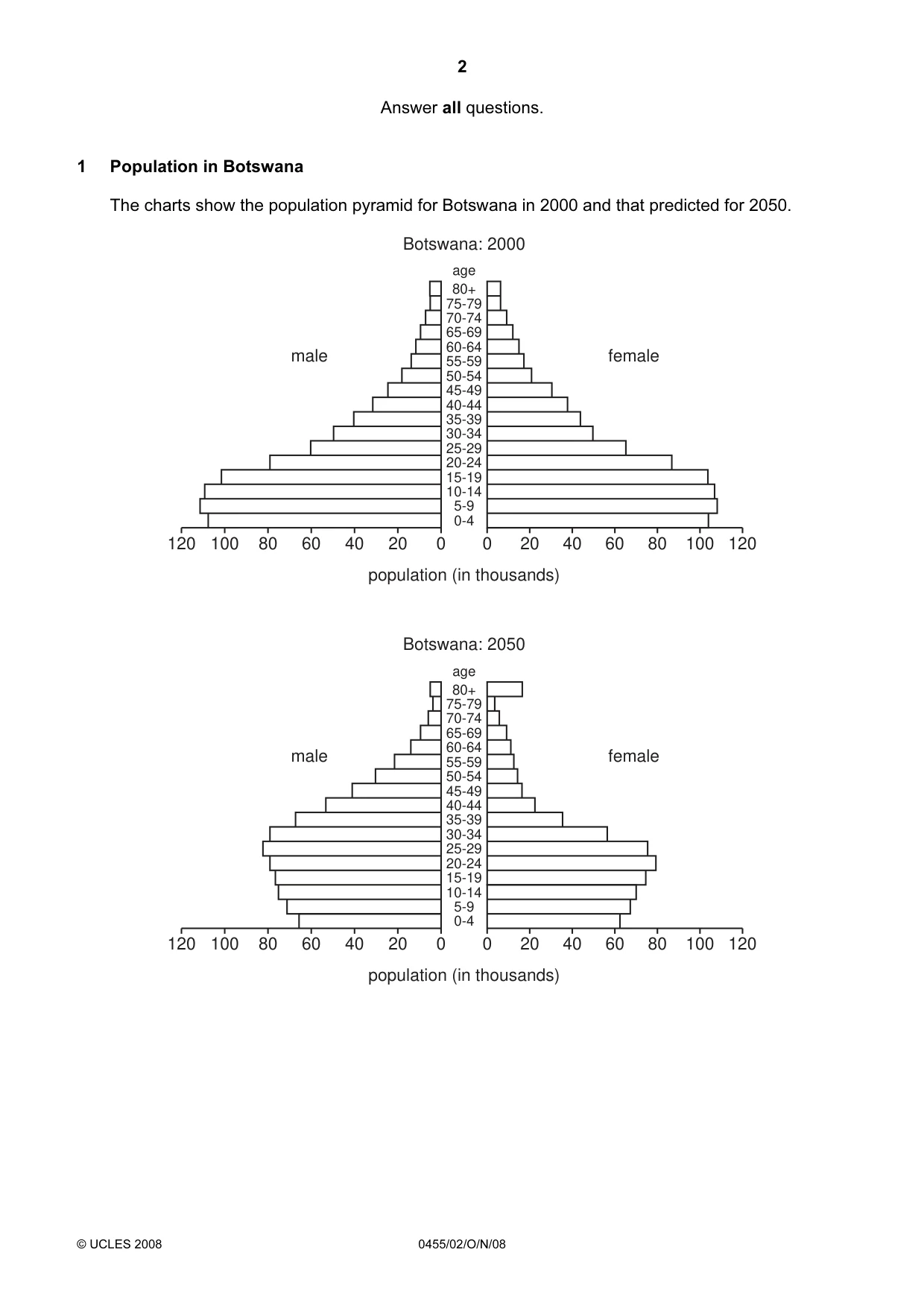
2 © UCLES 2008 0455/02/O/N/08 Answer all questions. 1 Population in Botswana The charts show the population pyramid for Botswana in 2000 and that predicted for 2050. 0 0 20 40 60 80 100 120 20 40 60 80 100 120 age 80+ 75-79 70-74 65-69 60-64 55-59 50-54 45-49 40-44 35-39 30-34 25-29 20-24 15-19 10-14 5-9 0-4 Botswana: 2000 population (in thousands) male female 0 0 20 40 60 80 100 120 20 40 60 80 100 120 age 80+ 75-79 70-74 65-69 60-64 55-59 50-54 45-49 40-44 35-39 30-34 25-29 20-24 15-19 10-14 5-9 0-4 Botswana: 2050 population (in thousands) male female
Question paper, page 3
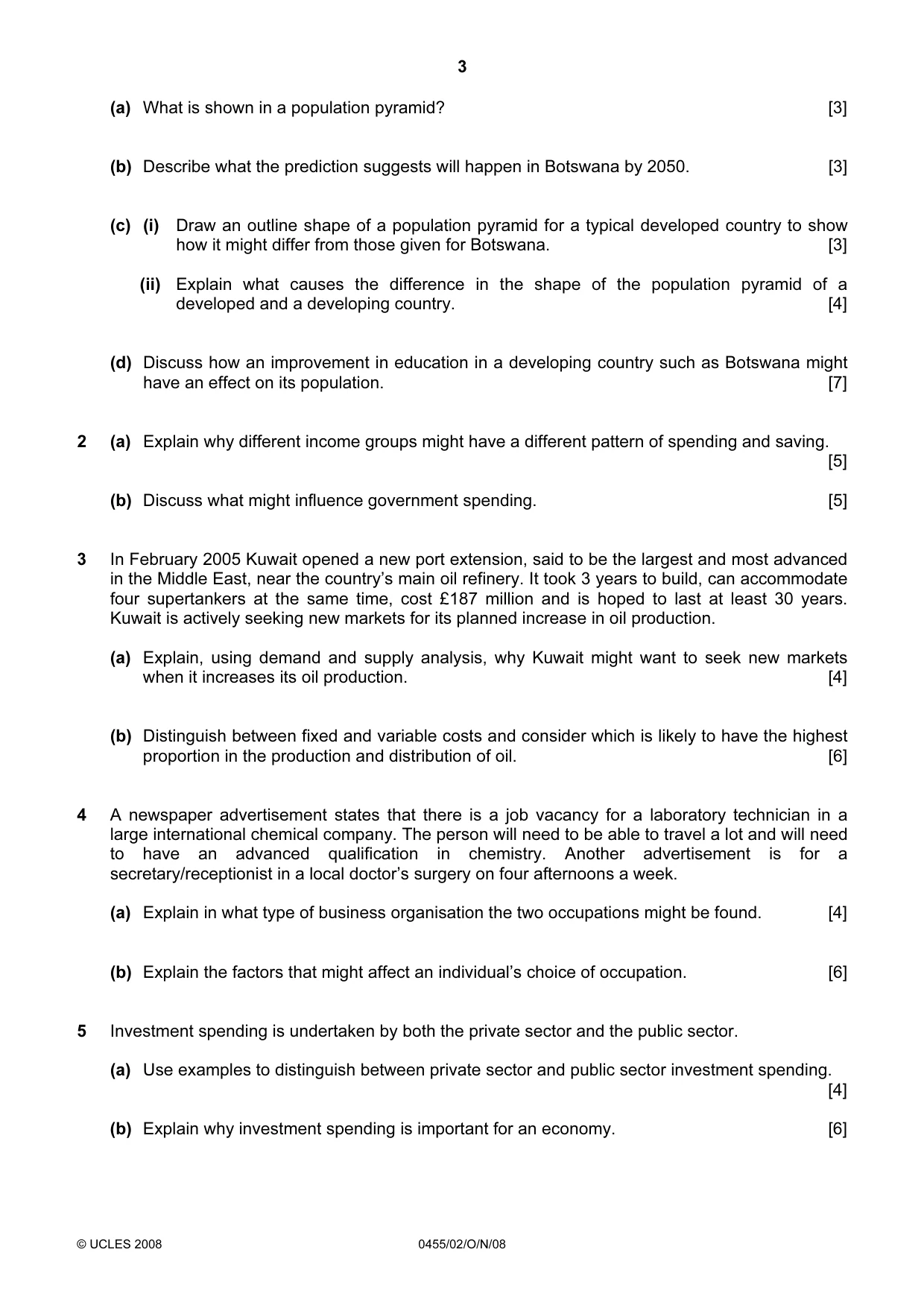
3 © UCLES 2008 0455/02/O/N/08 (a) What is shown in a population pyramid? [3] (b) Describe what the prediction suggests will happen in Botswana by 2050. [3] (c) (i) Draw an outline shape of a population pyramid for a typical developed country to show how it might differ from those given for Botswana. [3] (ii) Explain what causes the difference in the shape of the population pyramid of a developed and a developing country. [4] (d) Discuss how an improvement in education in a developing country such as Botswana might have an effect on its population. [7] 2 (a) Explain why different income groups might have a different pattern of spending and saving. [5] (b) Discuss what might influence government spending. [5] 3 In February 2005 Kuwait opened a new port extension, said to be the largest and most advanced in the Middle East, near the country’s main oil refinery. It took 3 years to build, can accommodate four supertankers at the same time, cost £187 million and is hoped to last at least 30 years. Kuwait is actively seeking new markets for its planned increase in oil production. (a) Explain, using demand and supply analysis, why Kuwait might want to seek new markets when it increases its oil production. [4] (b) Distinguish between fixed and variable costs and consider which is likely to have the highest proportion in the production and distribution of oil. [6] 4 A newspaper advertisement states that there is a job vacancy for a laboratory technician in a large international chemical company. The person will need to be able to travel a lot and will need to have an advanced qualification in chemistry. Another advertisement is for a secretary/receptionist in a local doctor’s surgery on four afternoons a week. (a) Explain in what type of business organisation the two occupations might be found. [4] (b) Explain the factors that might affect an individual’s choice of occupation. [6] 5 Investment spending is undertaken by both the private sector and the public sector. (a) Use examples to distinguish between private sector and public sector investment spending. [4] (b) Explain why investment spending is important for an economy. [6]
Question paper, page 4
4 BLANK PAGE Copyright Acknowledgements: Question 1 © U.S. Census Bureau. Permission to reproduce items where third-party owned material protected by copyright is included has been sought and cleared where possible. Every reasonable effort has been made by the publisher (UCLES) to trace copyright holders, but if any items requiring clearance have unwittingly been included, the publisher will be pleased to make amends at the earliest possible opportunity. University of Cambridge International Examinations is part of the Cambridge Assessment Group. Cambridge Assessment is the brand name of University of Cambridge Local Examinations Syndicate (UCLES), which is itself a department of the University of Cambridge. 0455/02/O/N/08
Mark scheme, page 1
UNIVERSITY OF CAMBRIDGE INTERNATIONAL EXAMINATIONS International General Certificate of Secondary Education MARK SCHEME for the October/November 2008 question paper 0455 ECONOMICS 0455/02 Paper 2 (Core), maximum raw mark 60 This mark scheme is published as an aid to teachers and candidates, to indicate the requirements of the examination. It shows the basis on which Examiners were instructed to award marks. It does not indicate the details of the discussions that took place at an Examiners’ meeting before marking began. All Examiners are instructed that alternative correct answers and unexpected approaches in candidates’ scripts must be given marks that fairly reflect the relevant knowledge and skills demonstrated. Mark schemes must be read in conjunction with the question papers and the report on the examination. • CIE will not enter into discussions or correspondence in connection with these mark schemes. CIE is publishing the mark schemes for the October/November 2008 question papers for most IGCSE, GCE Advanced Level and Advanced Subsidiary Level syllabuses and some Ordinary Level syllabuses. www.XtremePapers.com
Mark scheme, page 2
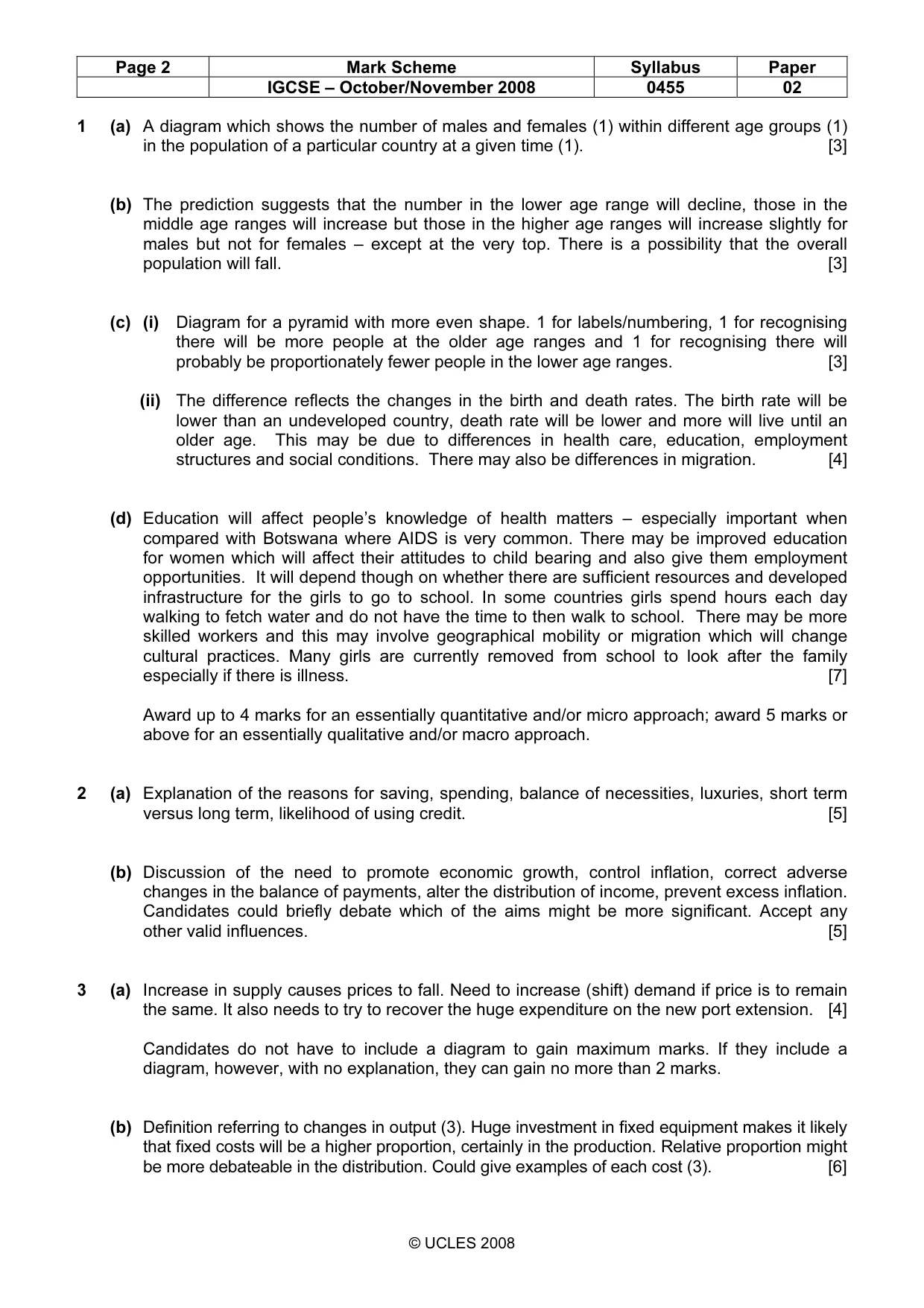
Page 2 Mark Scheme Syllabus Paper IGCSE – October/November 2008 0455 02 © UCLES 2008 1 (a) A diagram which shows the number of males and females (1) within different age groups (1) in the population of a particular country at a given time (1). [3] (b) The prediction suggests that the number in the lower age range will decline, those in the middle age ranges will increase but those in the higher age ranges will increase slightly for males but not for females – except at the very top. There is a possibility that the overall population will fall. [3] (c) (i) Diagram for a pyramid with more even shape. 1 for labels/numbering, 1 for recognising there will be more people at the older age ranges and 1 for recognising there will probably be proportionately fewer people in the lower age ranges. [3] (ii) The difference reflects the changes in the birth and death rates. The birth rate will be lower than an undeveloped country, death rate will be lower and more will live until an older age. This may be due to differences in health care, education, employment structures and social conditions. There may also be differences in migration. [4] (d) Education will affect people’s knowledge of health matters – especially important when compared with Botswana where AIDS is very common. There may be improved education for women which will affect their attitudes to child bearing and also give them employment opportunities. It will depend though on whether there are sufficient resources and developed infrastructure for the girls to go to school. In some countries girls spend hours each day walking to fetch water and do not have the time to then walk to school. There may be more skilled workers and this may involve geographical mobility or migration which will change cultural practices. Many girls are currently removed from school to look after the family especially if there is illness. [7] Award up to 4 marks for an essentially quantitative and/or micro approach; award 5 marks or above for an essentially qualitative and/or macro approach. 2 (a) Explanation of the reasons for saving, spending, balance of necessities, luxuries, short term versus long term, likelihood of using credit. [5] (b) Discussion of the need to promote economic growth, control inflation, correct adverse changes in the balance of payments, alter the distribution of income, prevent excess inflation. Candidates could briefly debate which of the aims might be more significant. Accept any other valid influences. [5] 3 (a) Increase in supply causes prices to fall. Need to increase (shift) demand if price is to remain the same. It also needs to try to recover the huge expenditure on the new port extension. [4] Candidates do not have to include a diagram to gain maximum marks. If they include a diagram, however, with no explanation, they can gain no more than 2 marks. (b) Definition referring to changes in output (3). Huge investment in fixed equipment makes it likely that fixed costs will be a higher proportion, certainly in the production. Relative proportion might be more debateable in the distribution. Could give examples of each cost (3). [6]
Mark scheme, page 3
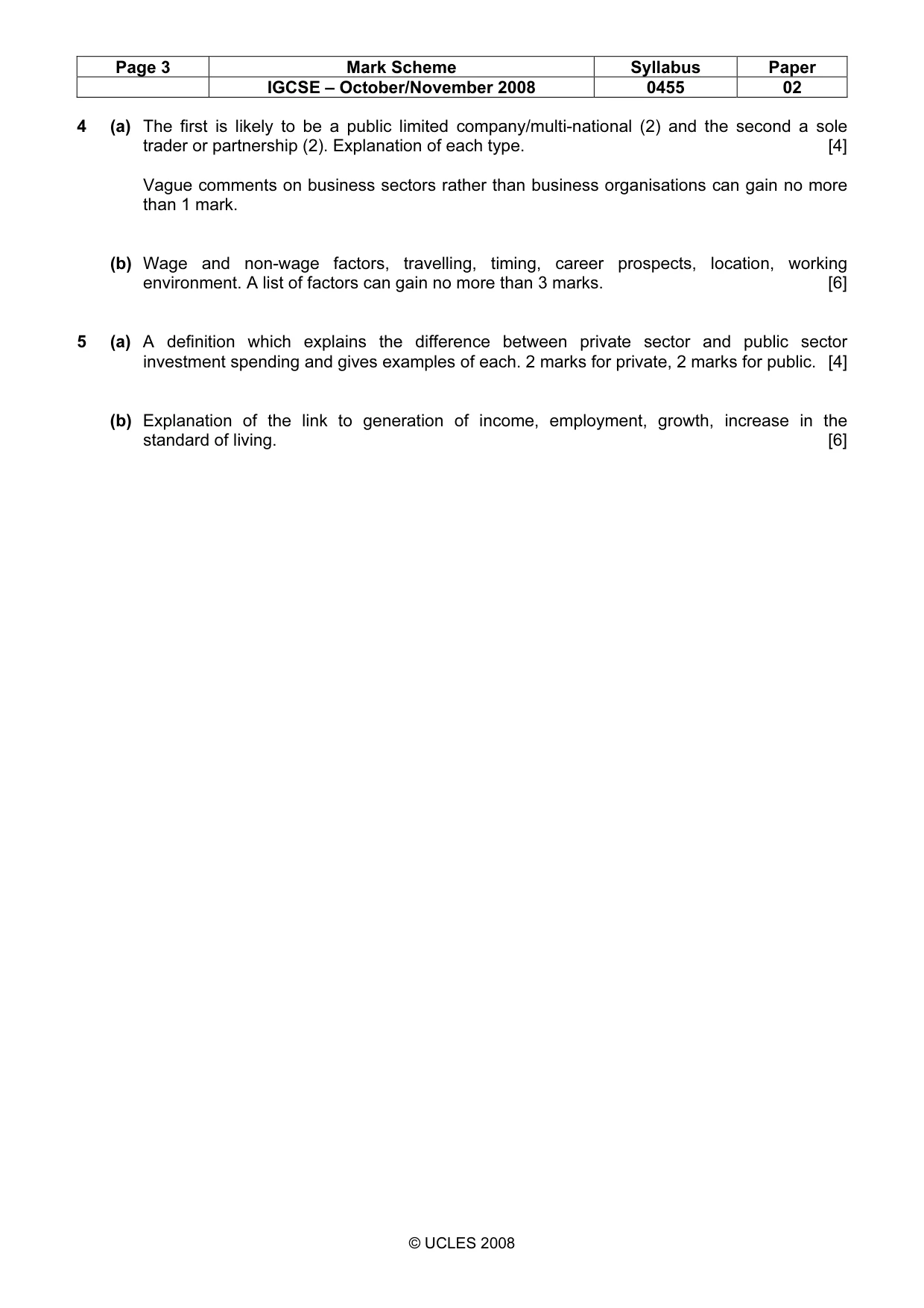
Page 3 Mark Scheme Syllabus Paper IGCSE – October/November 2008 0455 02 © UCLES 2008 4 (a) The first is likely to be a public limited company/multi-national (2) and the second a sole trader or partnership (2). Explanation of each type. [4] Vague comments on business sectors rather than business organisations can gain no more than 1 mark. (b) Wage and non-wage factors, travelling, timing, career prospects, location, working environment. A list of factors can gain no more than 3 marks. [6] 5 (a) A definition which explains the difference between private sector and public sector investment spending and gives examples of each. 2 marks for private, 2 marks for public. [4] (b) Explanation of the link to generation of income, employment, growth, increase in the standard of living. [6]
What you needed in this session
Cambridge’s own grade thresholds for 2008 Oct/Nov, Paper 2 · Variant 1. A higher threshold means an easier paper — the bar moves with how the cohort did.