Cambridge IGCSE Economics 0455 — 2007 Oct/Nov Paper 2 · Variant 1
0455/21/O/N/07 · 60 marks · ≈68 min
The question paper and its mark scheme, free to read here and free to download. This is Cambridge’s own paper, exactly as it was sat.
Question paper4 pages
Mark scheme3 pages
Answers below. Sit the paper first if you are practising.
Paper as text
Question paper, page 1
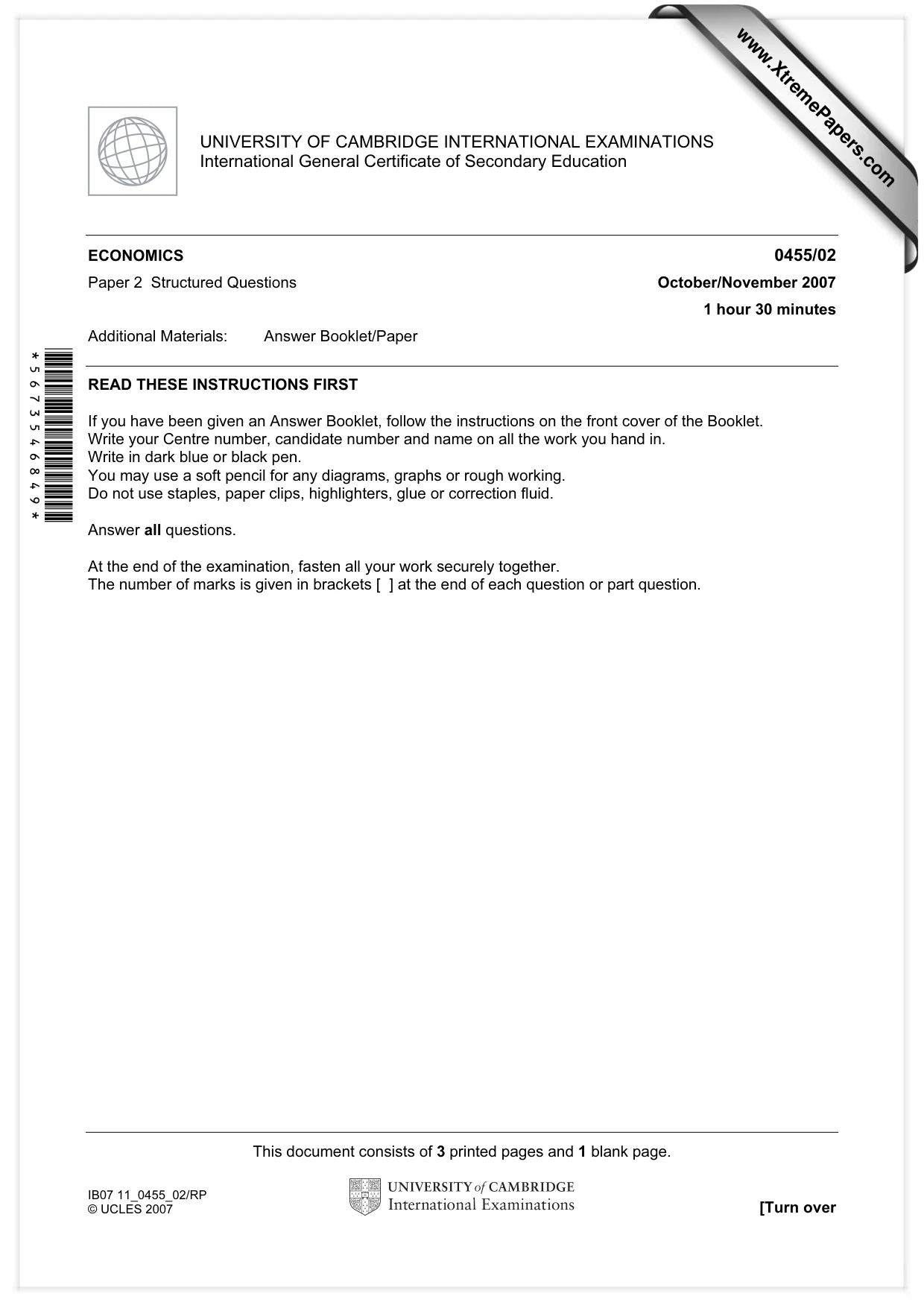
This document consists of 3 printed pages and 1 blank page. IB07 11_0455_02/RP © UCLES 2007 [Turn over *5673546849* UNIVERSITY OF CAMBRIDGE INTERNATIONAL EXAMINATIONS International General Certificate of Secondary Education ECONOMICS 0455/02 Paper 2 Structured Questions October/November 2007 1 hour 30 minutes Additional Materials: Answer Booklet/Paper READ THESE INSTRUCTIONS FIRST If you have been given an Answer Booklet, follow the instructions on the front cover of the Booklet. Write your Centre number, candidate number and name on all the work you hand in. Write in dark blue or black pen. You may use a soft pencil for any diagrams, graphs or rough working. Do not use staples, paper clips, highlighters, glue or correction fluid. Answer all questions. At the end of the examination, fasten all your work securely together. The number of marks is given in brackets [ ] at the end of each question or part question. www.XtremePapers.com
Question paper, page 2
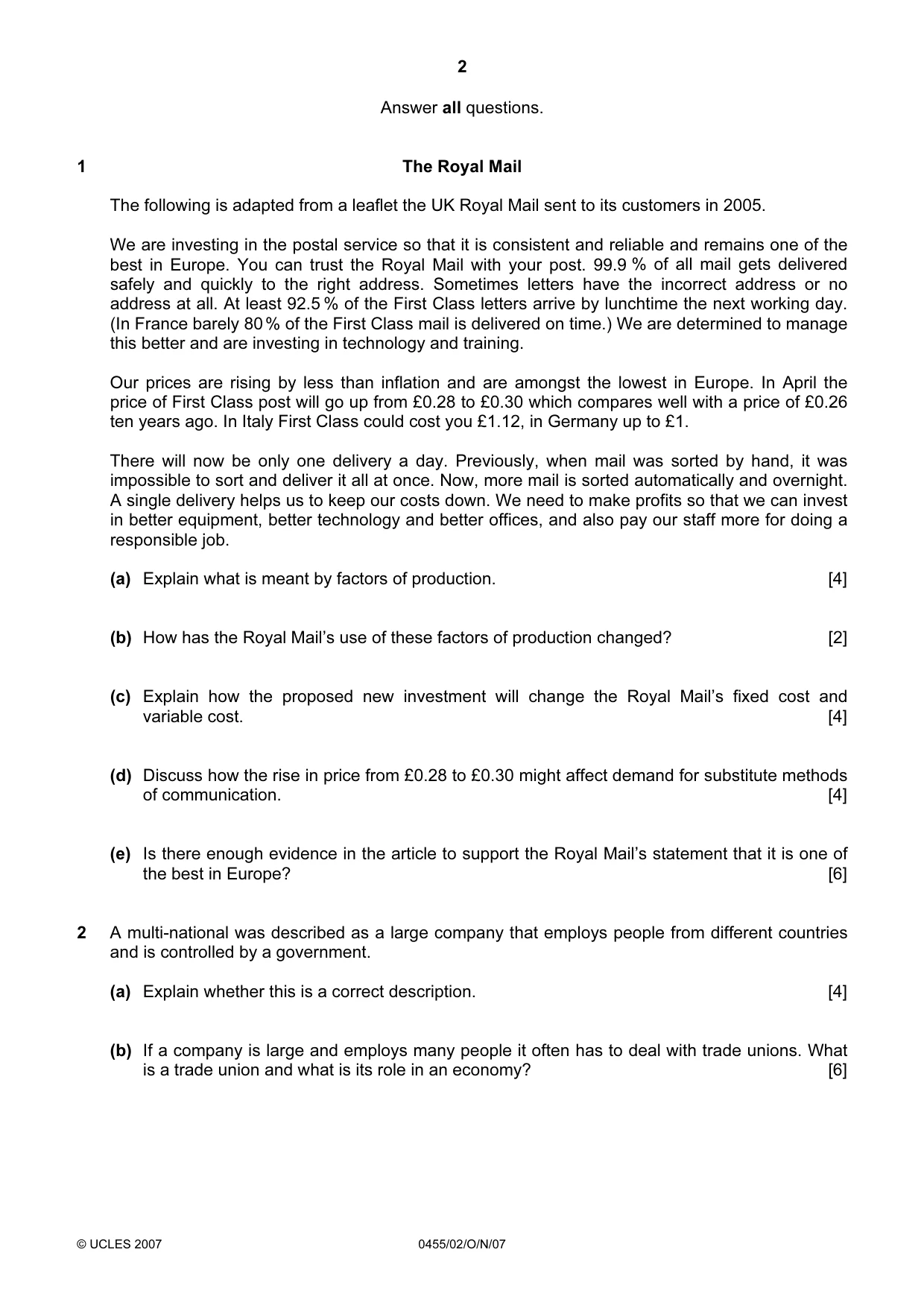
2 © UCLES 2007 0455/02/O/N/07 Answer all questions. 1 The Royal Mail The following is adapted from a leaflet the UK Royal Mail sent to its customers in 2005. We are investing in the postal service so that it is consistent and reliable and remains one of the best in Europe. You can trust the Royal Mail with your post. 99.9 % of all mail gets delivered safely and quickly to the right address. Sometimes letters have the incorrect address or no address at all. At least 92.5 % of the First Class letters arrive by lunchtime the next working day. (In France barely 80 % of the First Class mail is delivered on time.) We are determined to manage this better and are investing in technology and training. Our prices are rising by less than inflation and are amongst the lowest in Europe. In April the price of First Class post will go up from £0.28 to £0.30 which compares well with a price of £0.26 ten years ago. In Italy First Class could cost you £1.12, in Germany up to £1. There will now be only one delivery a day. Previously, when mail was sorted by hand, it was impossible to sort and deliver it all at once. Now, more mail is sorted automatically and overnight. A single delivery helps us to keep our costs down. We need to make profits so that we can invest in better equipment, better technology and better offices, and also pay our staff more for doing a responsible job. (a) Explain what is meant by factors of production. [4] (b) How has the Royal Mail’s use of these factors of production changed? [2] (c) Explain how the proposed new investment will change the Royal Mail’s fixed cost and variable cost. [4] (d) Discuss how the rise in price from £0.28 to £0.30 might affect demand for substitute methods of communication. [4] (e) Is there enough evidence in the article to support the Royal Mail’s statement that it is one of the best in Europe? [6] 2 A multi-national was described as a large company that employs people from different countries and is controlled by a government. (a) Explain whether this is a correct description. [4] (b) If a company is large and employs many people it often has to deal with trade unions. What is a trade union and what is its role in an economy? [6]
Question paper, page 3
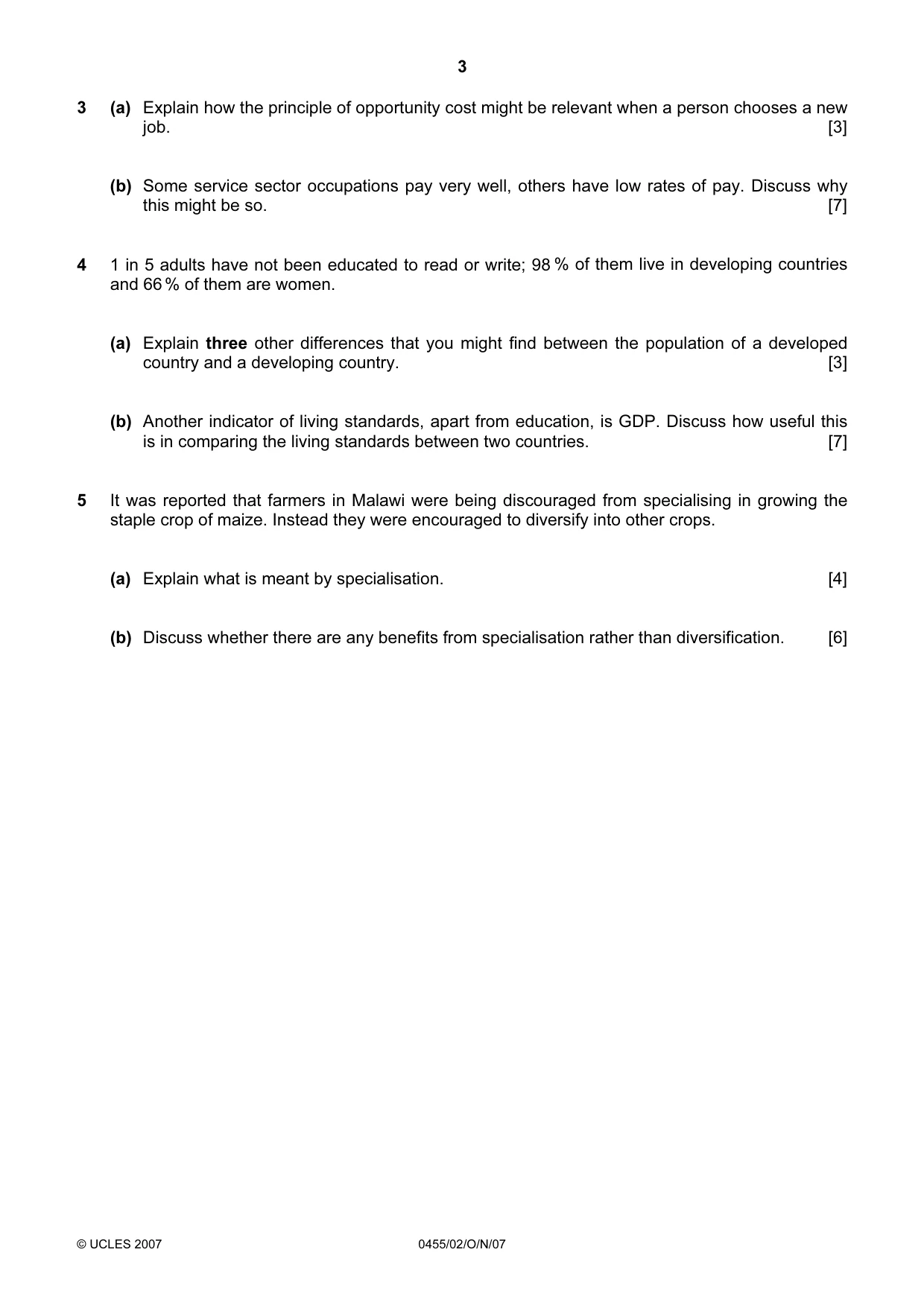
3 © UCLES 2007 0455/02/O/N/07 3 (a) Explain how the principle of opportunity cost might be relevant when a person chooses a new job. [3] (b) Some service sector occupations pay very well, others have low rates of pay. Discuss why this might be so. [7] 4 1 in 5 adults have not been educated to read or write; 98 % of them live in developing countries and 66 % of them are women. (a) Explain three other differences that you might find between the population of a developed country and a developing country. [3] (b) Another indicator of living standards, apart from education, is GDP. Discuss how useful this is in comparing the living standards between two countries. [7] 5 It was reported that farmers in Malawi were being discouraged from specialising in growing the staple crop of maize. Instead they were encouraged to diversify into other crops. (a) Explain what is meant by specialisation. [4] (b) Discuss whether there are any benefits from specialisation rather than diversification. [6]
Question paper, page 4
4 BLANK PAGE Copyright Acknowledgements: Question 1 © Royal Mail, March 2005. Permission to reproduce items where third-party owned material protected by copyright is included has been sought and cleared where possible. Every reasonable effort has been made by the publisher (UCLES) to trace copyright holders, but if any items requiring clearance have unwittingly been included, the publisher will be pleased to make amends at the earliest possible opportunity. University of Cambridge International Examinations is part of the Cambridge Assessment Group. Cambridge Assessment is the brand name of University of Cambridge Local Examinations Syndicate (UCLES), which is itself a department of the University of Cambridge. © UCLES 2007 0455/02/O/N/07
Mark scheme, page 1
UNIVERSITY OF CAMBRIDGE INTERNATIONAL EXAMINATIONS International General Certificate of Secondary Education MARK SCHEME for the October/November 2007 question paper 0455 ECONOMICS 0455/02 Paper 2 (Core), maximum raw mark 60 This mark scheme is published as an aid to teachers and candidates, to indicate the requirements of the examination. It shows the basis on which Examiners were instructed to award marks. It does not indicate the details of the discussions that took place at an Examiners’ meeting before marking began. All Examiners are instructed that alternative correct answers and unexpected approaches in candidates’ scripts must be given marks that fairly reflect the relevant knowledge and skills demonstrated. Mark schemes must be read in conjunction with the question papers and the report on the examination. • CIE will not enter into discussions or correspondence in connection with these mark schemes. CIE is publishing the mark schemes for the October/November 2007 question papers for most IGCSE, GCE Advanced Level and Advanced Subsidiary Level syllabuses and some Ordinary Level syllabuses. www.XtremePapers.com
Mark scheme, page 2
Page 2 Mark Scheme Syllabus Paper IGCSE – October/November 2007 0455 02 © UCLES 2007 1 (a) Explanation of land, labour, capital, and enterprise. [4] A list of four factors, 2 marks only. A list of three factors, 1 mark only. (b) More capital and more investment but less labour. [2] (c) Explanation of fixed and variable costs. Fixed cost will increase with new technology. Labour may be a fixed or a variable cost but likely delivery staff are thought to be a variable cost. As labour may be replaced by machines, this will decrease. However, if labour is paid more, the overall effect is uncertain. [4] (d) Price rises usually cause demand to fall and switch to other substitutes. This may not be thought to be a sufficient increase to cause many to switch to alternative means of communication. Extended candidates could mention price elasticity of demand. [4] (e) Only comparison on price is with Italy and Germany. No real information about rate of inflation, only a general statement about price comparing well. Delivery figures do seem to support the claim that Royal Mail is providing good service (but only comparison is with France). Only one delivery a day now, no comparison on that with other countries. Statement about investing in training and technology. Does say it needs to make profits. Not sure how much will be re-invested. The conclusion is uncertain as there is insufficient evidence. [6] A maximum of 4 marks for a one-sided answer. 2 (a) May employ people from different countries but this is not the definition. Has to operate in different countries. Governments may be involved in multi-national companies but this again is not the definition and most would be privately owned. [4] (b) Group of people working together in a similar occupation, promote welfare, safety, negotiate wages. [6]
Mark scheme, page 3
Page 3 Mark Scheme Syllabus Paper IGCSE – October/November 2007 0455 02 © UCLES 2007 3 (a) Explanation of principle. Must mention ‘next best’ or ‘best’ for 2 marks. Application in terms of what might be given up – for example, might get higher pay but give up shorter journey, might give up possible alternative job, might give up holidays by switching employment, 1 mark. [3] (b) Could be a range of non-wage factors, could be amount of skill required, may be a manager or a clerical worker, differences in male and female, extent of union activity, supply of and demand for labour can be mentioned. [7] Maximum of 5 marks if not related to a service sector occupation. 4 (a) Any three which could be connected with age distribution, birth rate, death rate; occupational distribution; dependency ratios, extent of malnutrition. [3] (b) Comment on validity of using GDP. Difficulties of comparison over time and between countries, problems of informal economy, inflation, income per head, non-economic factors influencing standard of living, exchange rates. [7] 5 (a) Concentration on a particular skill, or in this case a particular product, which it is thought the country is better suited to providing. [4] (b) Text books will tell you that specialisation will produce greater efficiency. However, this has implications in terms of the human cost of this through loss of income, employment, impoverishment of regions and general disaffection of those who are not involved in the specialised areas. [6]
What you needed in this session
Cambridge’s own grade thresholds for 2007 Oct/Nov, Paper 2 · Variant 1. A higher threshold means an easier paper — the bar moves with how the cohort did.