Cambridge IGCSE Economics 0455 — 2007 May/June Paper 2 · Variant 1
0455/21/M/J/07 · 60 marks · ≈68 min
The question paper and its mark scheme, free to read here and free to download. This is Cambridge’s own paper, exactly as it was sat.
Question paper4 pages

Mark scheme3 pages
Answers below. Sit the paper first if you are practising.
Paper as text
Question paper, page 1
This document consists of 3 printed pages and 1 blank page. IB07 06_0455_02/RP © UCLES 2007 [Turn over *7126181206* UNIVERSITY OF CAMBRIDGE INTERNATIONAL EXAMINATIONS International General Certificate of Secondary Education ECONOMICS 0455/02 Paper 2 Structured Questions May/June 2007 1 hour 30 minutes Additional Materials: Answer Booklet/Paper READ THESE INSTRUCTIONS FIRST If you have been given an Answer Booklet, follow the instructions on the front cover of the Booklet. Write your Centre number, candidate number and name on all the work you hand in. Write in dark blue or black pen. You may use a soft pencil for any diagrams, graphs or rough working. Do not use staples, paper clips, highlighters, glue or correction fluid. Answer all questions. At the end of the examination, fasten all your work securely together. The number of marks is given in brackets [ ] at the end of each question or part question. www.XtremePapers.com
Question paper, page 2
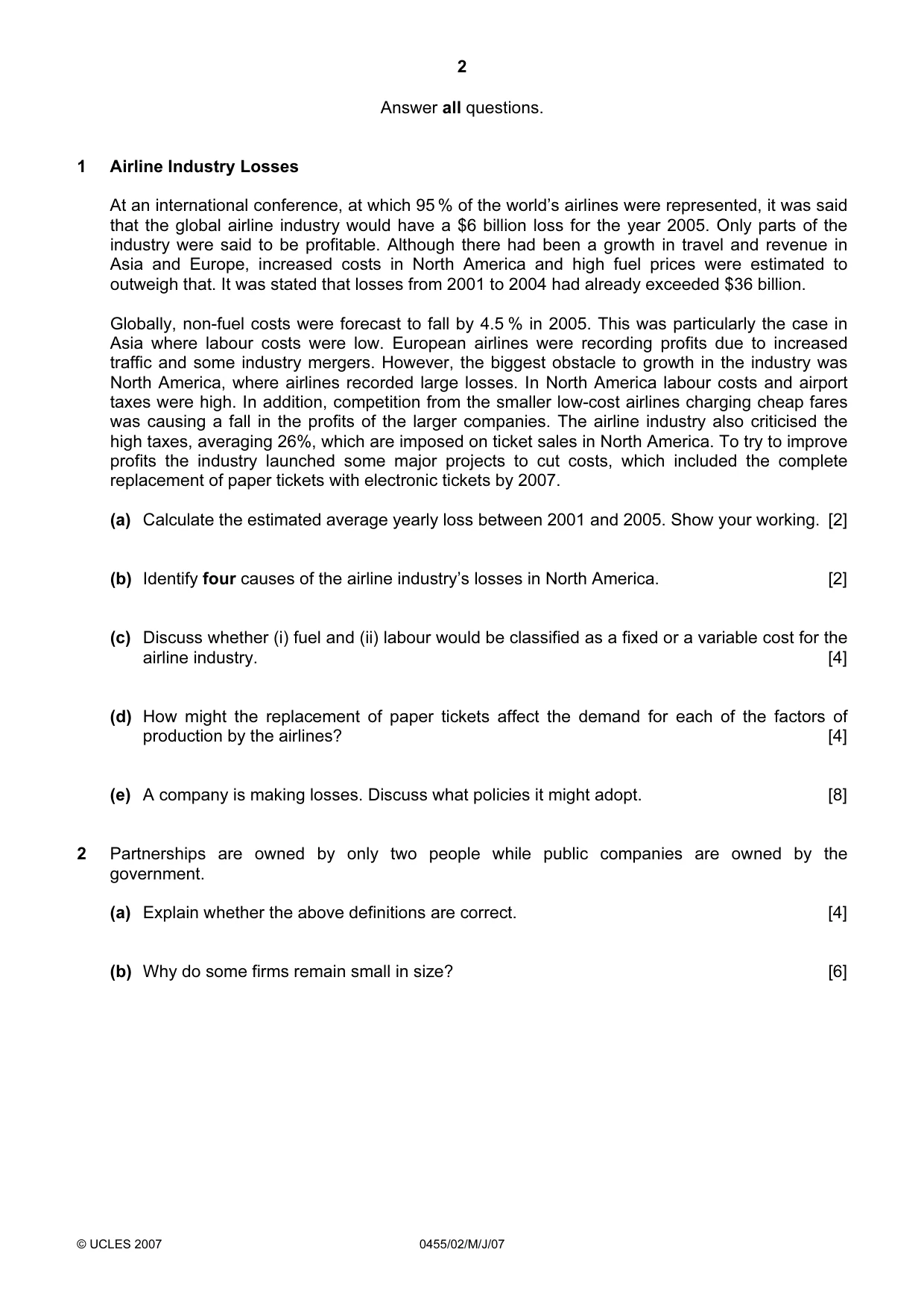
2 © UCLES 2007 0455/02/M/J/07 Answer all questions. 1 Airline Industry Losses At an international conference, at which 95 % of the world’s airlines were represented, it was said that the global airline industry would have a $6 billion loss for the year 2005. Only parts of the industry were said to be profitable. Although there had been a growth in travel and revenue in Asia and Europe, increased costs in North America and high fuel prices were estimated to outweigh that. It was stated that losses from 2001 to 2004 had already exceeded $36 billion. Globally, non-fuel costs were forecast to fall by 4.5 % in 2005. This was particularly the case in Asia where labour costs were low. European airlines were recording profits due to increased traffic and some industry mergers. However, the biggest obstacle to growth in the industry was North America, where airlines recorded large losses. In North America labour costs and airport taxes were high. In addition, competition from the smaller low-cost airlines charging cheap fares was causing a fall in the profits of the larger companies. The airline industry also criticised the high taxes, averaging 26%, which are imposed on ticket sales in North America. To try to improve profits the industry launched some major projects to cut costs, which included the complete replacement of paper tickets with electronic tickets by 2007. (a) Calculate the estimated average yearly loss between 2001 and 2005. Show your working. [2] (b) Identify four causes of the airline industry’s losses in North America. [2] (c) Discuss whether (i) fuel and (ii) labour would be classified as a fixed or a variable cost for the airline industry. [4] (d) How might the replacement of paper tickets affect the demand for each of the factors of production by the airlines? [4] (e) A company is making losses. Discuss what policies it might adopt. [8] 2 Partnerships are owned by only two people while public companies are owned by the government. (a) Explain whether the above definitions are correct. [4] (b) Why do some firms remain small in size? [6]
Question paper, page 3
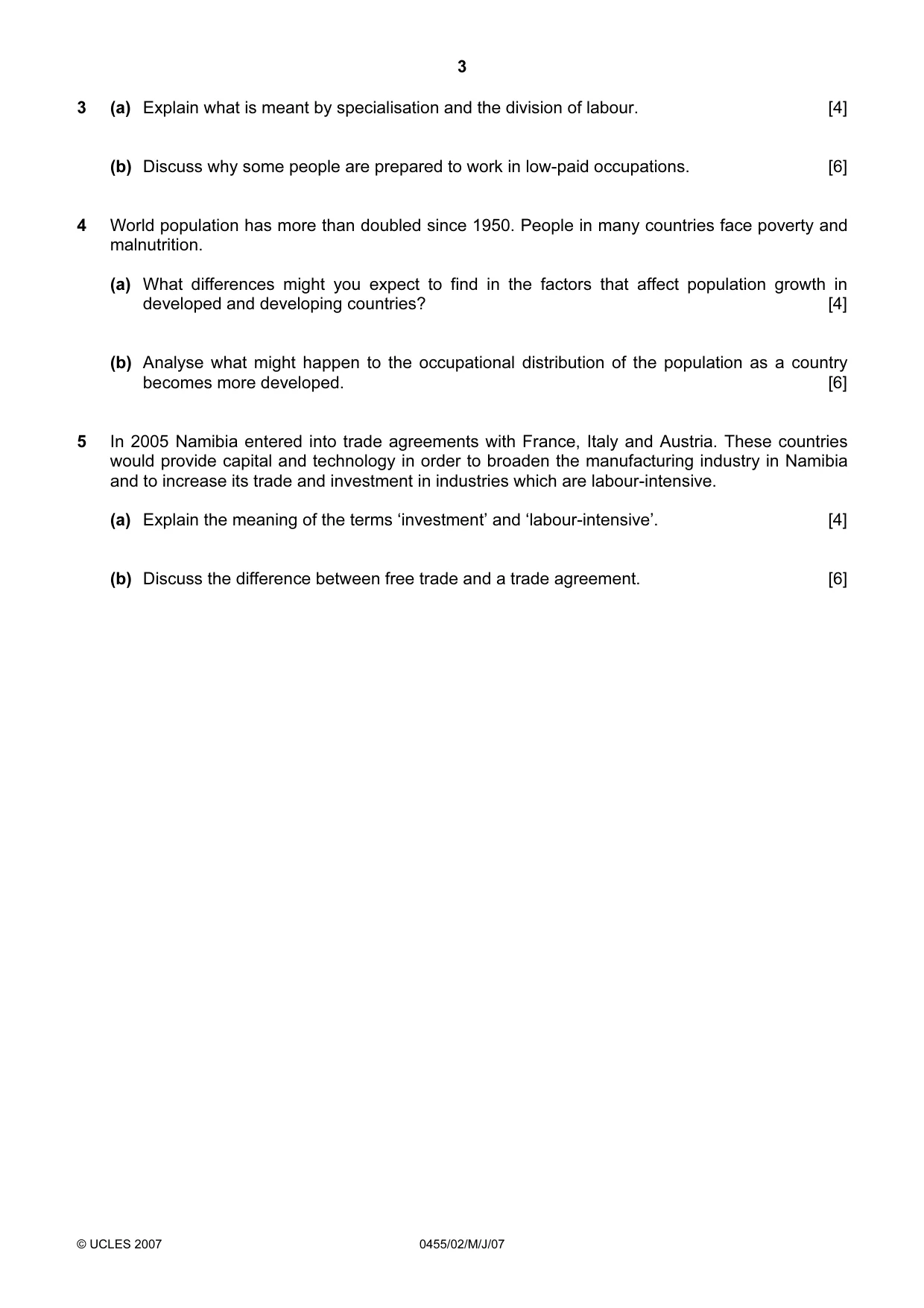
3 © UCLES 2007 0455/02/M/J/07 3 (a) Explain what is meant by specialisation and the division of labour. [4] (b) Discuss why some people are prepared to work in low-paid occupations. [6] 4 World population has more than doubled since 1950. People in many countries face poverty and malnutrition. (a) What differences might you expect to find in the factors that affect population growth in developed and developing countries? [4] (b) Analyse what might happen to the occupational distribution of the population as a country becomes more developed. [6] 5 In 2005 Namibia entered into trade agreements with France, Italy and Austria. These countries would provide capital and technology in order to broaden the manufacturing industry in Namibia and to increase its trade and investment in industries which are labour-intensive. (a) Explain the meaning of the terms ‘investment’ and ‘labour-intensive’. [4] (b) Discuss the difference between free trade and a trade agreement. [6]
Question paper, page 4
4 BLANK PAGE Copyright Acknowledgements: Question 1 © http://www.republikein.com.na/content/die_mark/DieMark_2005/Mei/31_airline.php Permission to reproduce items where third-party owned material protected by copyright is included has been sought and cleared where possible. Every reasonable effort has been made by the publisher (UCLES) to trace copyright holders, but if any items requiring clearance have unwittingly been included, the publisher will be pleased to make amends at the earliest possible opportunity. University of Cambridge International Examinations is part of the Cambridge Assessment Group. Cambridge Assessment is the brand name of University of Cambridge Local Examinations Syndicate (UCLES), which is itself a department of the University of Cambridge. 0455/02/M/J/07
Mark scheme, page 1
UNIVERSITY OF CAMBRIDGE INTERNATIONAL EXAMINATIONS International General Certificate of Secondary Education MARK SCHEME for the May/June 2007 question paper 0455 ECONOMICS 0455/02 Paper 2 (Core), maximum raw mark 60 This mark scheme is published as an aid to teachers and candidates, to indicate the requirements of the examination. It shows the basis on which Examiners were instructed to award marks. It does not indicate the details of the discussions that took place at an Examiners’ meeting before marking began. All Examiners are instructed that alternative correct answers and unexpected approaches in candidates’ scripts must be given marks that fairly reflect the relevant knowledge and skills demonstrated. Mark schemes must be read in conjunction with the question papers and the report on the examination. • CIE will not enter into discussions or correspondence in connection with these mark schemes. CIE is publishing the mark schemes for the May/June 2007 question papers for most IGCSE, GCE Advanced Level and Advanced Subsidiary Level syllabuses and some Ordinary Level syllabuses. www.XtremePapers.com
Mark scheme, page 2
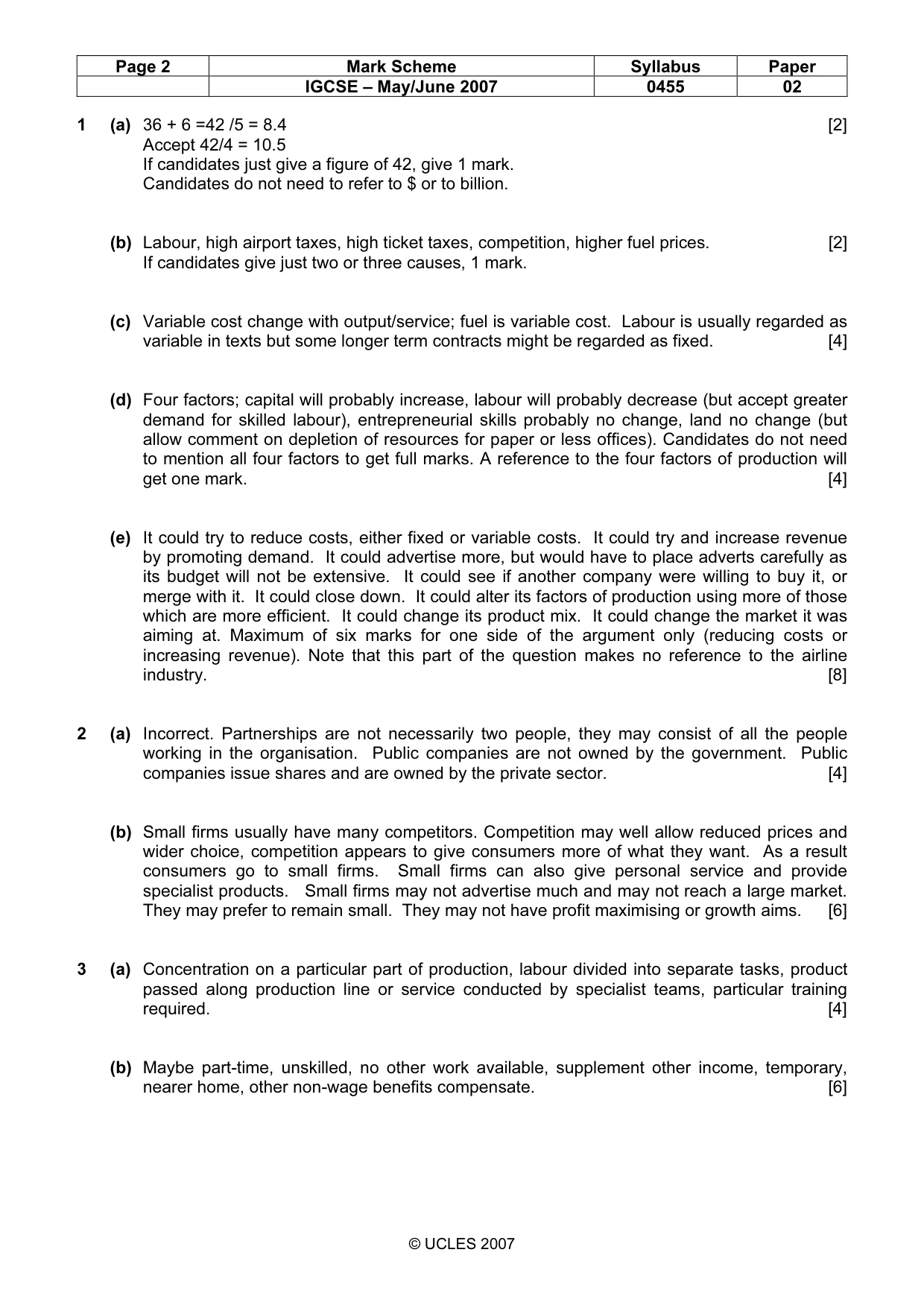
Page 2 Mark Scheme Syllabus Paper IGCSE – May/June 2007 0455 02 © UCLES 2007 1 (a) 36 + 6 =42 /5 = 8.4 [2] Accept 42/4 = 10.5 If candidates just give a figure of 42, give 1 mark. Candidates do not need to refer to $ or to billion. (b) Labour, high airport taxes, high ticket taxes, competition, higher fuel prices. [2] If candidates give just two or three causes, 1 mark. (c) Variable cost change with output/service; fuel is variable cost. Labour is usually regarded as variable in texts but some longer term contracts might be regarded as fixed. [4] (d) Four factors; capital will probably increase, labour will probably decrease (but accept greater demand for skilled labour), entrepreneurial skills probably no change, land no change (but allow comment on depletion of resources for paper or less offices). Candidates do not need to mention all four factors to get full marks. A reference to the four factors of production will get one mark. [4] (e) It could try to reduce costs, either fixed or variable costs. It could try and increase revenue by promoting demand. It could advertise more, but would have to place adverts carefully as its budget will not be extensive. It could see if another company were willing to buy it, or merge with it. It could close down. It could alter its factors of production using more of those which are more efficient. It could change its product mix. It could change the market it was aiming at. Maximum of six marks for one side of the argument only (reducing costs or increasing revenue). Note that this part of the question makes no reference to the airline industry. [8] 2 (a) Incorrect. Partnerships are not necessarily two people, they may consist of all the people working in the organisation. Public companies are not owned by the government. Public companies issue shares and are owned by the private sector. [4] (b) Small firms usually have many competitors. Competition may well allow reduced prices and wider choice, competition appears to give consumers more of what they want. As a result consumers go to small firms. Small firms can also give personal service and provide specialist products. Small firms may not advertise much and may not reach a large market. They may prefer to remain small. They may not have profit maximising or growth aims. [6] 3 (a) Concentration on a particular part of production, labour divided into separate tasks, product passed along production line or service conducted by specialist teams, particular training required. [4] (b) Maybe part-time, unskilled, no other work available, supplement other income, temporary, nearer home, other non-wage benefits compensate. [6]
Mark scheme, page 3
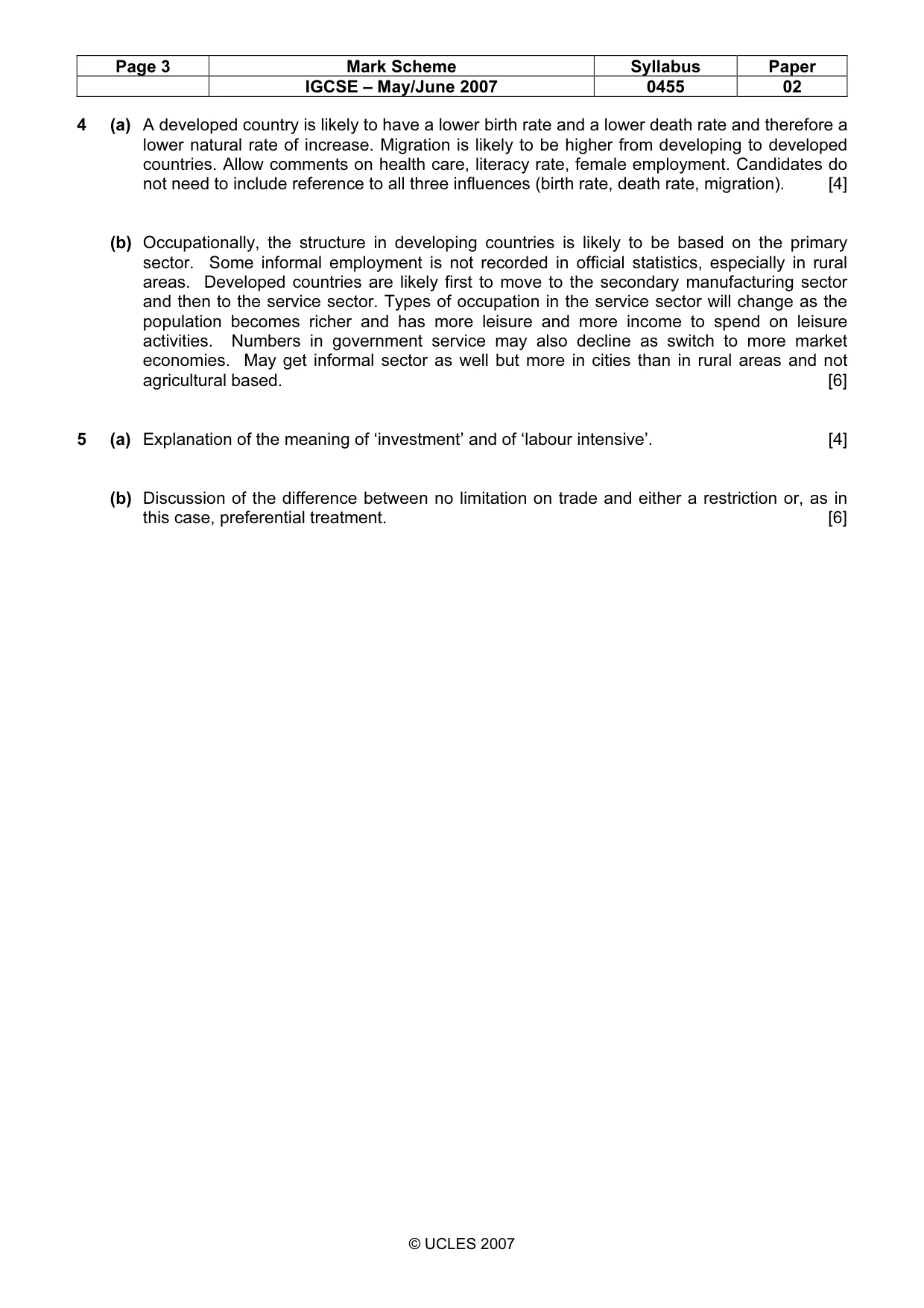
Page 3 Mark Scheme Syllabus Paper IGCSE – May/June 2007 0455 02 © UCLES 2007 4 (a) A developed country is likely to have a lower birth rate and a lower death rate and therefore a lower natural rate of increase. Migration is likely to be higher from developing to developed countries. Allow comments on health care, literacy rate, female employment. Candidates do not need to include reference to all three influences (birth rate, death rate, migration). [4] (b) Occupationally, the structure in developing countries is likely to be based on the primary sector. Some informal employment is not recorded in official statistics, especially in rural areas. Developed countries are likely first to move to the secondary manufacturing sector and then to the service sector. Types of occupation in the service sector will change as the population becomes richer and has more leisure and more income to spend on leisure activities. Numbers in government service may also decline as switch to more market economies. May get informal sector as well but more in cities than in rural areas and not agricultural based. [6] 5 (a) Explanation of the meaning of ‘investment’ and of ‘labour intensive’. [4] (b) Discussion of the difference between no limitation on trade and either a restriction or, as in this case, preferential treatment. [6]
What you needed in this session
Cambridge’s own grade thresholds for 2007 May/June, Paper 2 · Variant 1. A higher threshold means an easier paper — the bar moves with how the cohort did.