Cambridge IGCSE Economics 0455 — 2006 Oct/Nov Paper 2 · Variant 1
0455/21/O/N/06 · 60 marks · ≈68 min
The question paper and its mark scheme, free to read here and free to download. This is Cambridge’s own paper, exactly as it was sat.
Question paper4 pages

Mark scheme2 pages
Answers below. Sit the paper first if you are practising.
Paper as text
Question paper, page 1
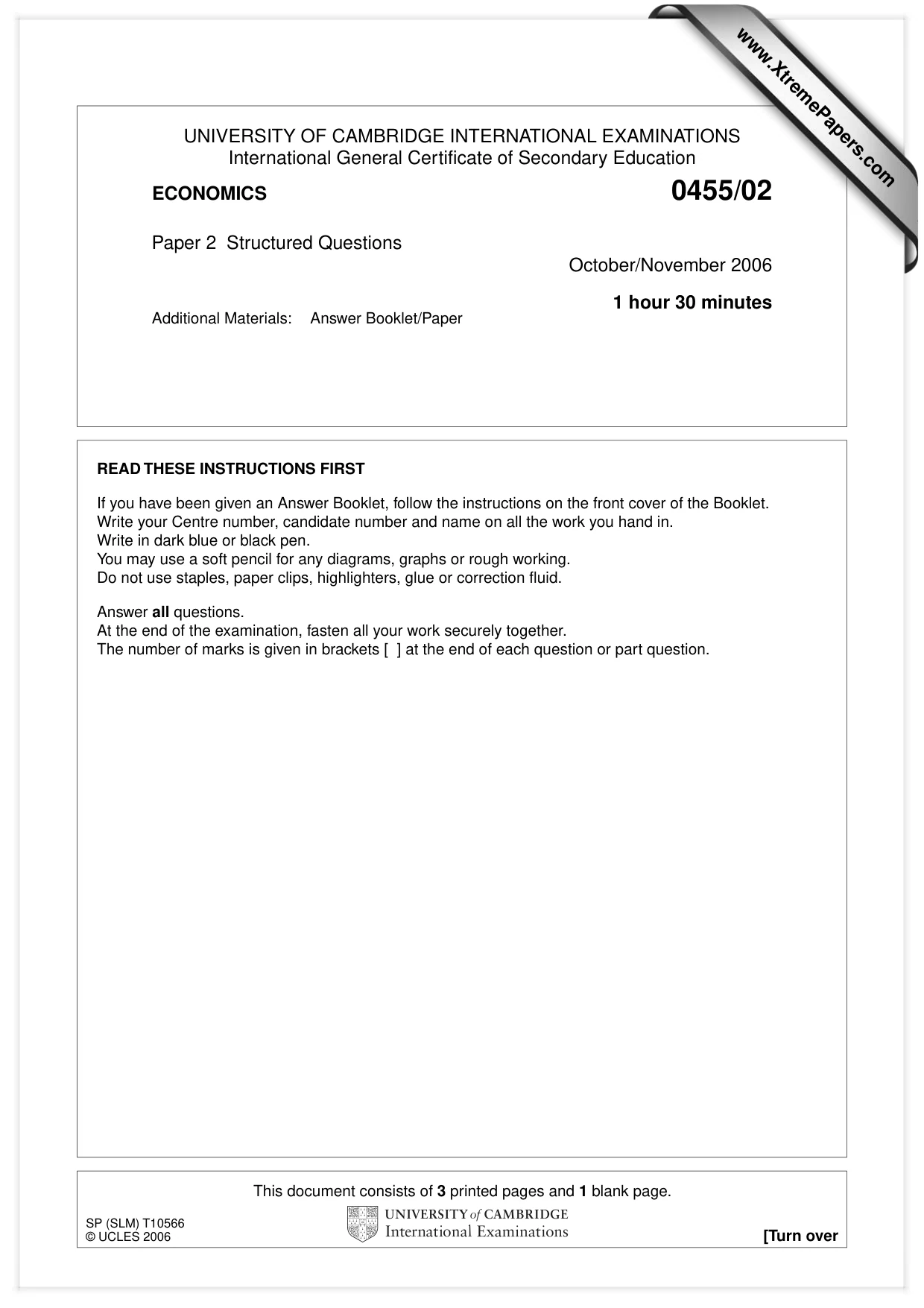
This document consists of 3 printed pages and 1 blank page. SP (SLM) T10566 © UCLES 2006 [Turn over UNIVERSITY OF CAMBRIDGE INTERNATIONAL EXAMINATIONS International General Certificate of Secondary Education ECONOMICS 0455/02 Paper 2 Structured Questions October/November 2006 1 hour 30 minutes Additional Materials: Answer Booklet/Paper READ THESE INSTRUCTIONS FIRST If you have been given an Answer Booklet, follow the instructions on the front cover of the Booklet. Write your Centre number, candidate number and name on all the work you hand in. Write in dark blue or black pen. You may use a soft pencil for any diagrams, graphs or rough working. Do not use staples, paper clips, highlighters, glue or correction fluid. Answer all questions. At the end of the examination, fasten all your work securely together. The number of marks is given in brackets [ ] at the end of each question or part question. www.XtremePapers.com
Question paper, page 2
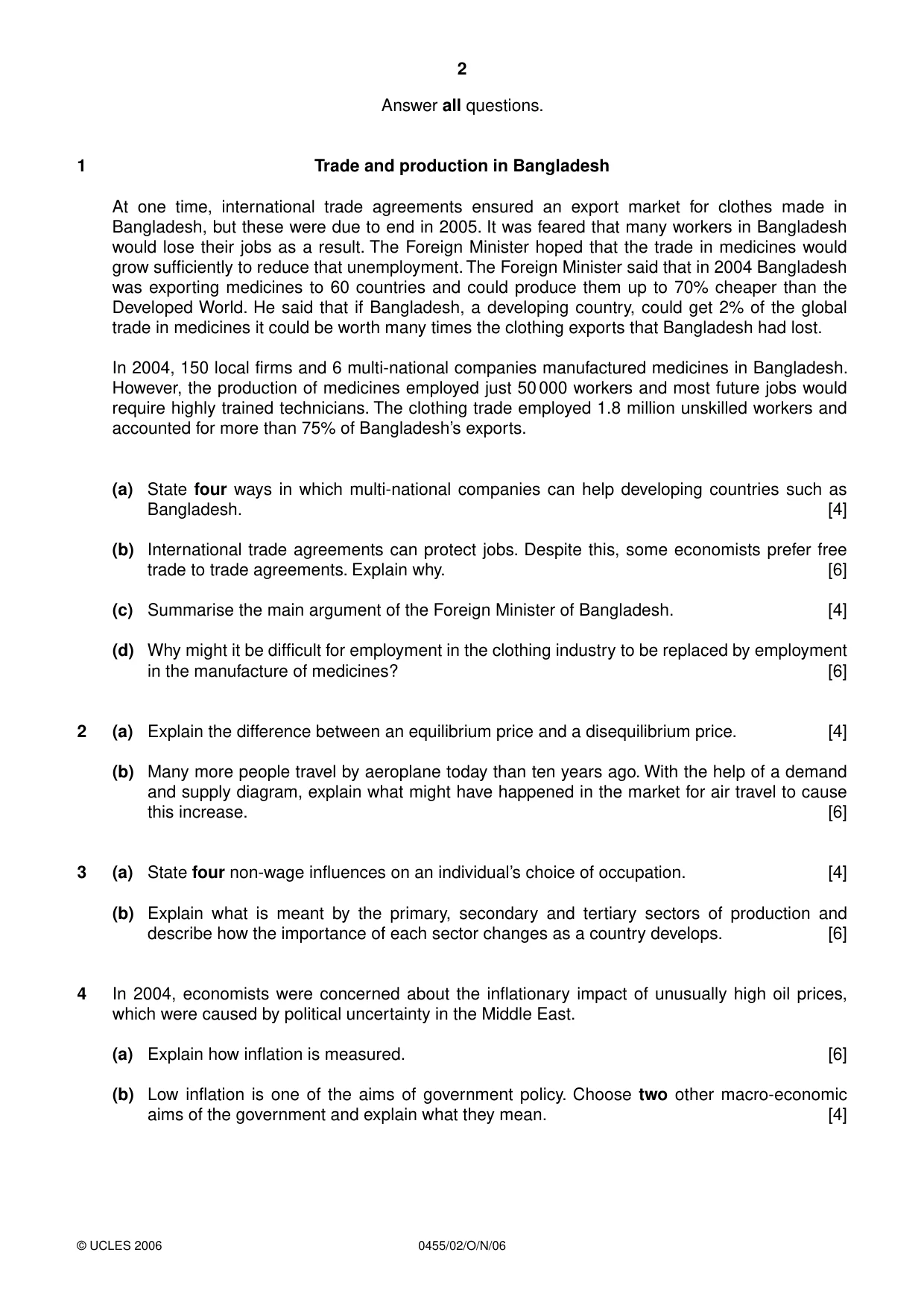
2 0455/02/O/N/06 © UCLES 2006 Answer all questions. 1 Trade and production in Bangladesh At one time, international trade agreements ensured an export market for clothes made in Bangladesh, but these were due to end in 2005. It was feared that many workers in Bangladesh would lose their jobs as a result. The Foreign Minister hoped that the trade in medicines would grow sufficiently to reduce that unemployment. The Foreign Minister said that in 2004 Bangladesh was exporting medicines to 60 countries and could produce them up to 70% cheaper than the Developed World. He said that if Bangladesh, a developing country, could get 2% of the global trade in medicines it could be worth many times the clothing exports that Bangladesh had lost. In 2004, 150 local firms and 6 multi-national companies manufactured medicines in Bangladesh. However, the production of medicines employed just 50000 workers and most future jobs would require highly trained technicians. The clothing trade employed 1.8 million unskilled workers and accounted for more than 75% of Bangladesh’s exports. (a) State four ways in which multi-national companies can help developing countries such as Bangladesh. [4] (b) International trade agreements can protect jobs. Despite this, some economists prefer free trade to trade agreements. Explain why. [6] (c) Summarise the main argument of the Foreign Minister of Bangladesh. [4] (d) Why might it be difficult for employment in the clothing industry to be replaced by employment in the manufacture of medicines? [6] 2 (a) Explain the difference between an equilibrium price and a disequilibrium price. [4] (b) Many more people travel by aeroplane today than ten years ago. With the help of a demand and supply diagram, explain what might have happened in the market for air travel to cause this increase. [6] 3 (a) State four non-wage influences on an individual’s choice of occupation. [4] (b) Explain what is meant by the primary, secondary and tertiary sectors of production and describe how the importance of each sector changes as a country develops. [6] 4 In 2004, economists were concerned about the inflationary impact of unusually high oil prices, which were caused by political uncertainty in the Middle East. (a) Explain how inflation is measured. [6] (b) Low inflation is one of the aims of government policy. Choose two other macro-economic aims of the government and explain what they mean. [4]
Question paper, page 3
3 0455/02/O/N/06 © UCLES 2006 5 In China, the State Council has ordered a reduction in urban development projects in Beijing. This is because, as developers clear land, people’s homes are destroyed. It will also support the government’s aim of reducing total demand in the economy. (a) Explain what is meant by the conservation of resources. [4] (b) Urban development is often thought to be beneficial. Consider who might benefit from an urban development project. [6]
Question paper, page 4
4 0455/02/O/N/06 BLANK PAGE Copyright Acknowledgements: Question 1 © Reprinted with permission of Far Eastern Economic Review, Copyright © (2004) Dow Jones & Company, Inc. All Rights Reserved Worldwide. Permission to reproduce items where third-party owned material protected by copyright is included has been sought and cleared where possible. Every reasonable effort has been made by the publisher (UCLES) to trace copyright holders, but if any items requiring clearance have unwittingly been included, the publisher will be pleased to make amends at the earliest possible opportunity. University of Cambridge International Examinations is part of the University of Cambridge Local Examinations Syndicate (UCLES), which is itself a department of the University of Cambridge.
Mark scheme, page 1
UNIVERSITY OF CAMBRIDGE INTERNATIONAL EXAMINATIONS International General Certificate of Secondary Education MARK SCHEME for the October/November 2006 question paper 0455 ECONOMICS 0455/02 Paper 2 (Core), maximum raw mark 60 This mark scheme is published as an aid to teachers and students, to indicate the requirements of the examination. It shows the basis on which Examiners were instructed to award marks. It does not indicate the details of the discussions that took place at an Examiners’ meeting before marking began. All Examiners are instructed that alternative correct answers and unexpected approaches in candidates’ scripts must be given marks that fairly reflect the relevant knowledge and skills demonstrated. Mark schemes must be read in conjunction with the question papers and the report on the examination. The grade thresholds for various grades are published in the report on the examination for most IGCSE, GCE Advanced Level and Advanced Subsidiary Level syllabuses. • CIE will not enter into discussions or correspondence in connection with these mark schemes. CIE is publishing the mark schemes for the October/November 2006 question papers for most IGCSE, GCE Advanced Level and Advanced Subsidiary Level syllabuses and some Ordinary Level syllabuses. www.XtremePapers.com
Mark scheme, page 2
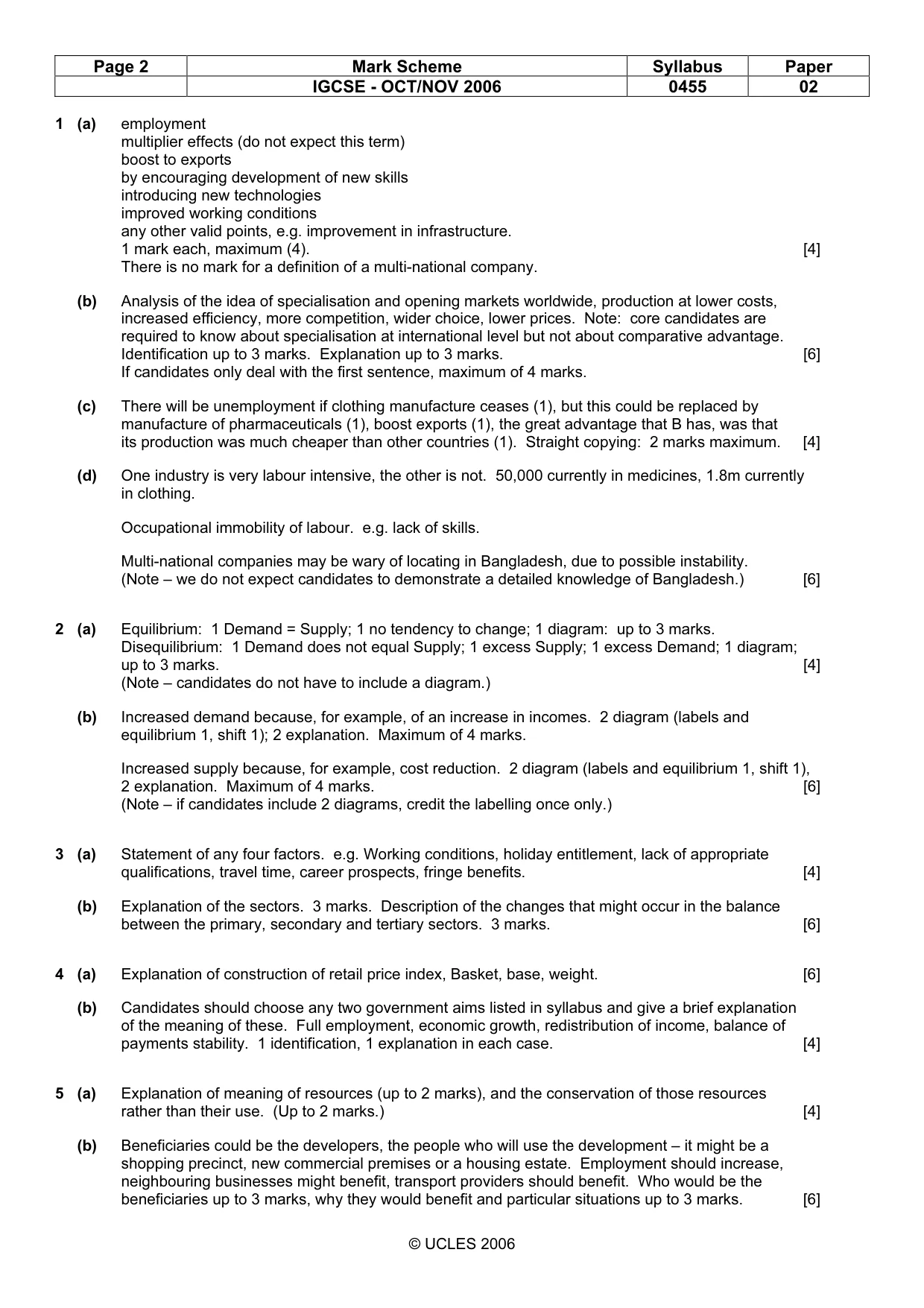
Page 2 Mark Scheme Syllabus Paper IGCSE - OCT/NOV 2006 0455 02 © UCLES 2006 1 (a) employment multiplier effects (do not expect this term) boost to exports by encouraging development of new skills introducing new technologies improved working conditions any other valid points, e.g. improvement in infrastructure. 1 mark each, maximum (4). [4] There is no mark for a definition of a multi-national company. (b) Analysis of the idea of specialisation and opening markets worldwide, production at lower costs, increased efficiency, more competition, wider choice, lower prices. Note: core candidates are required to know about specialisation at international level but not about comparative advantage. Identification up to 3 marks. Explanation up to 3 marks. [6] If candidates only deal with the first sentence, maximum of 4 marks. (c) There will be unemployment if clothing manufacture ceases (1), but this could be replaced by manufacture of pharmaceuticals (1), boost exports (1), the great advantage that B has, was that its production was much cheaper than other countries (1). Straight copying: 2 marks maximum. [4] (d) One industry is very labour intensive, the other is not. 50,000 currently in medicines, 1.8m currently in clothing. Occupational immobility of labour. e.g. lack of skills. Multi-national companies may be wary of locating in Bangladesh, due to possible instability. (Note – we do not expect candidates to demonstrate a detailed knowledge of Bangladesh.) [6] 2 (a) Equilibrium: 1 Demand = Supply; 1 no tendency to change; 1 diagram: up to 3 marks. Disequilibrium: 1 Demand does not equal Supply; 1 excess Supply; 1 excess Demand; 1 diagram; up to 3 marks. [4] (Note – candidates do not have to include a diagram.) (b) Increased demand because, for example, of an increase in incomes. 2 diagram (labels and equilibrium 1, shift 1); 2 explanation. Maximum of 4 marks. Increased supply because, for example, cost reduction. 2 diagram (labels and equilibrium 1, shift 1), 2 explanation. Maximum of 4 marks. [6] (Note – if candidates include 2 diagrams, credit the labelling once only.) 3 (a) Statement of any four factors. e.g. Working conditions, holiday entitlement, lack of appropriate qualifications, travel time, career prospects, fringe benefits. [4] (b) Explanation of the sectors. 3 marks. Description of the changes that might occur in the balance between the primary, secondary and tertiary sectors. 3 marks. [6] 4 (a) Explanation of construction of retail price index, Basket, base, weight. [6] (b) Candidates should choose any two government aims listed in syllabus and give a brief explanation of the meaning of these. Full employment, economic growth, redistribution of income, balance of payments stability. 1 identification, 1 explanation in each case. [4] 5 (a) Explanation of meaning of resources (up to 2 marks), and the conservation of those resources rather than their use. (Up to 2 marks.) [4] (b) Beneficiaries could be the developers, the people who will use the development – it might be a shopping precinct, new commercial premises or a housing estate. Employment should increase, neighbouring businesses might benefit, transport providers should benefit. Who would be the beneficiaries up to 3 marks, why they would benefit and particular situations up to 3 marks. [6]
What you needed in this session
Cambridge’s own grade thresholds for 2006 Oct/Nov, Paper 2 · Variant 1. A higher threshold means an easier paper — the bar moves with how the cohort did.