Cambridge IGCSE Economics 0455 — 2006 May/June Paper 2 · Variant 1
0455/21/M/J/06 · 60 marks · ≈68 min
The question paper and its mark scheme, free to read here and free to download. This is Cambridge’s own paper, exactly as it was sat.
Question paper4 pages
Mark scheme2 pages
Answers below. Sit the paper first if you are practising.
Paper as text
Question paper, page 1
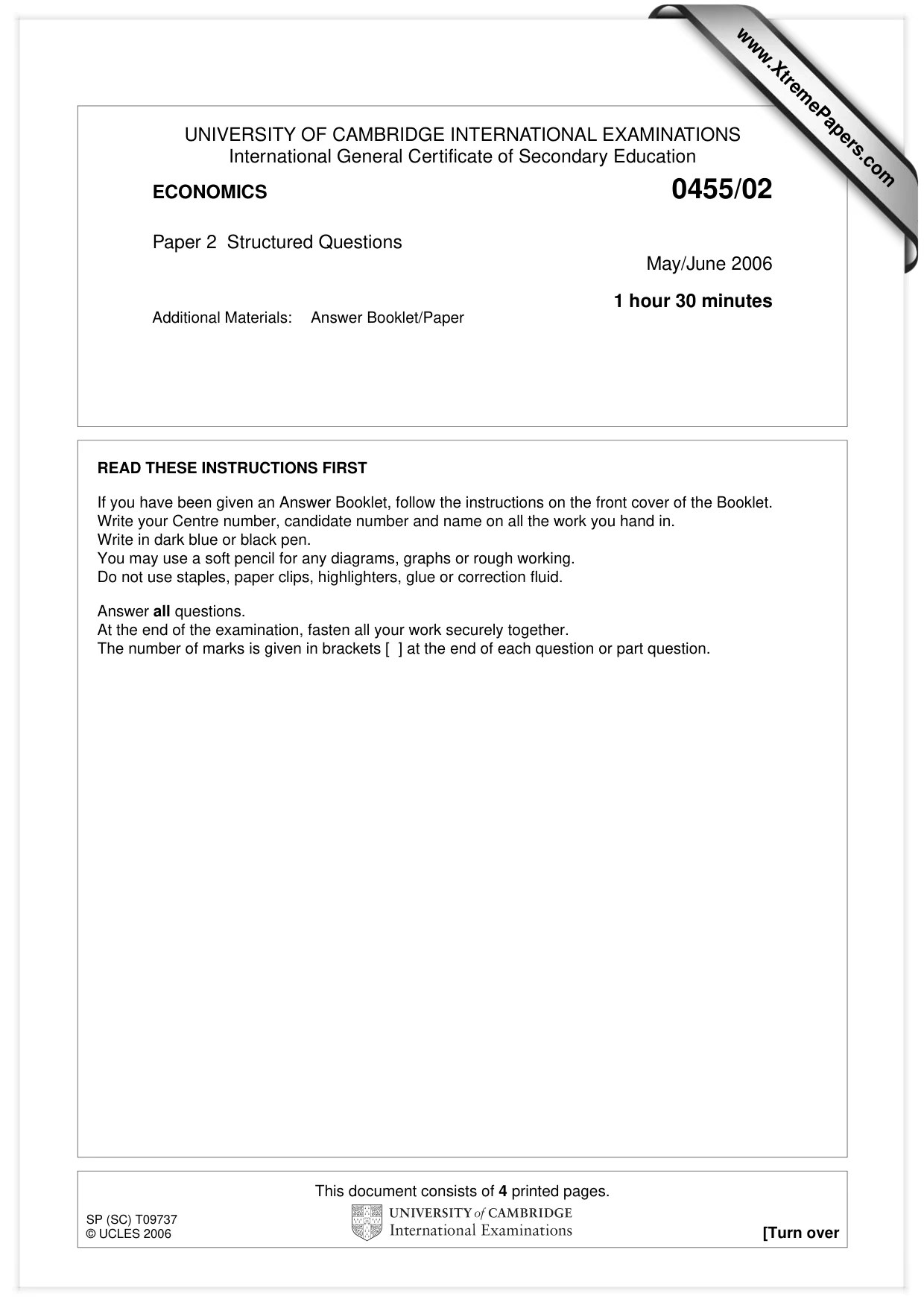
This document consists of 4 printed pages. SP (SC) T09737 © UCLES 2006 [Turn over UNIVERSITY OF CAMBRIDGE INTERNATIONAL EXAMINATIONS International General Certificate of Secondary Education ECONOMICS 0455/02 Paper 2 Structured Questions May/June 2006 1 hour 30 minutes Additional Materials: Answer Booklet/Paper READ THESE INSTRUCTIONS FIRST If you have been given an Answer Booklet, follow the instructions on the front cover of the Booklet. Write your Centre number, candidate number and name on all the work you hand in. Write in dark blue or black pen. You may use a soft pencil for any diagrams, graphs or rough working. Do not use staples, paper clips, highlighters, glue or correction fluid. Answer all questions. At the end of the examination, fasten all your work securely together. The number of marks is given in brackets [ ] at the end of each question or part question. www.XtremePapers.com
Question paper, page 2
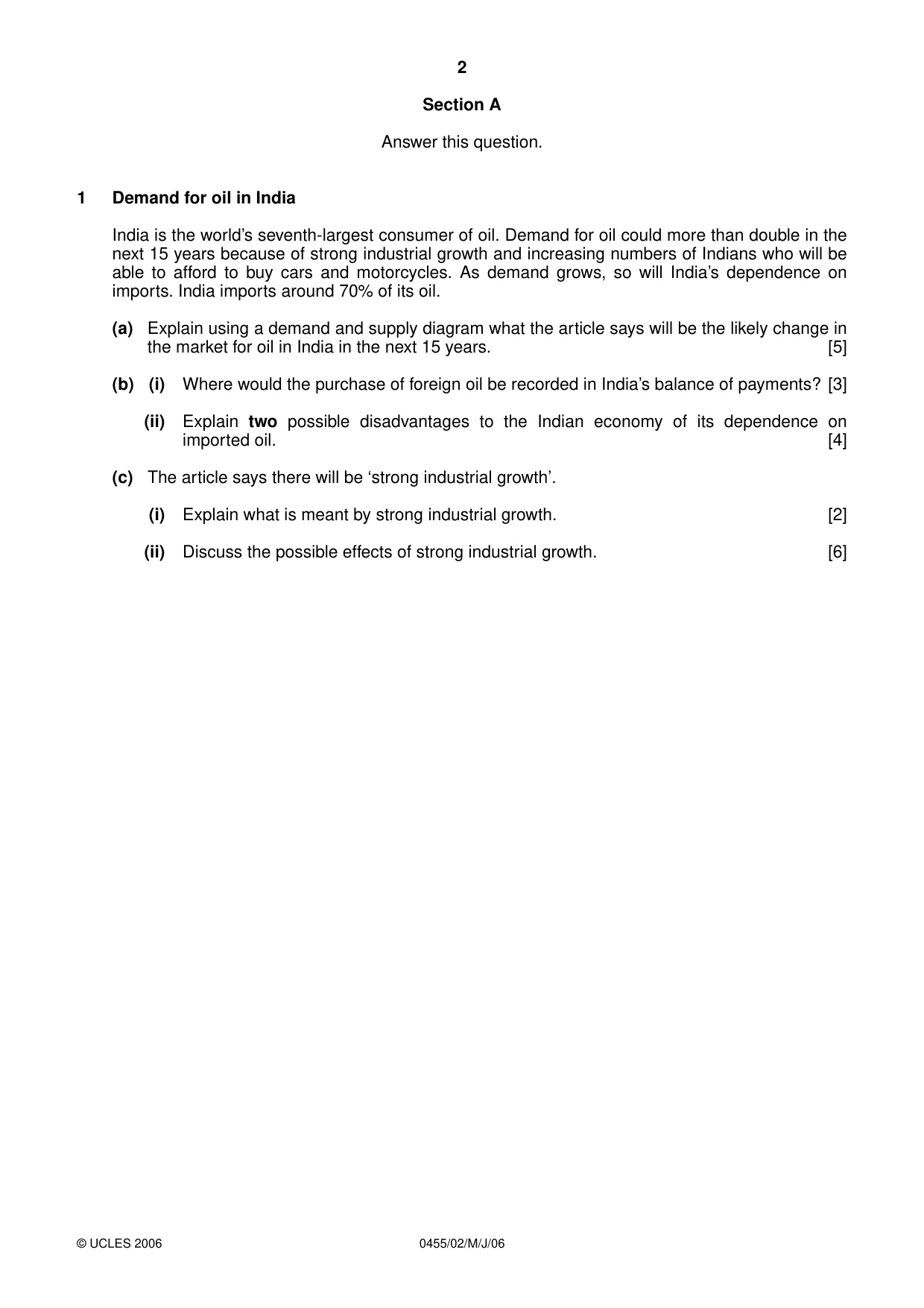
2 0455/02/M/J/06 Section A Answer this question. 1 Demand for oil in India India is the world’s seventh-largest consumer of oil. Demand for oil could more than double in the next 15 years because of strong industrial growth and increasing numbers of Indians who will be able to afford to buy cars and motorcycles. As demand grows, so will India’s dependence on imports. India imports around 70% of its oil. (a) Explain using a demand and supply diagram what the article says will be the likely change in the market for oil in India in the next 15 years. [5] (b) (i) Where would the purchase of foreign oil be recorded in India’s balance of payments? [3] (ii) Explain two possible disadvantages to the Indian economy of its dependence on imported oil. [4] (c) The article says there will be ‘strong industrial growth’. (i) Explain what is meant by strong industrial growth. [2] (ii) Discuss the possible effects of strong industrial growth. [6] © UCLES 2006
Question paper, page 3
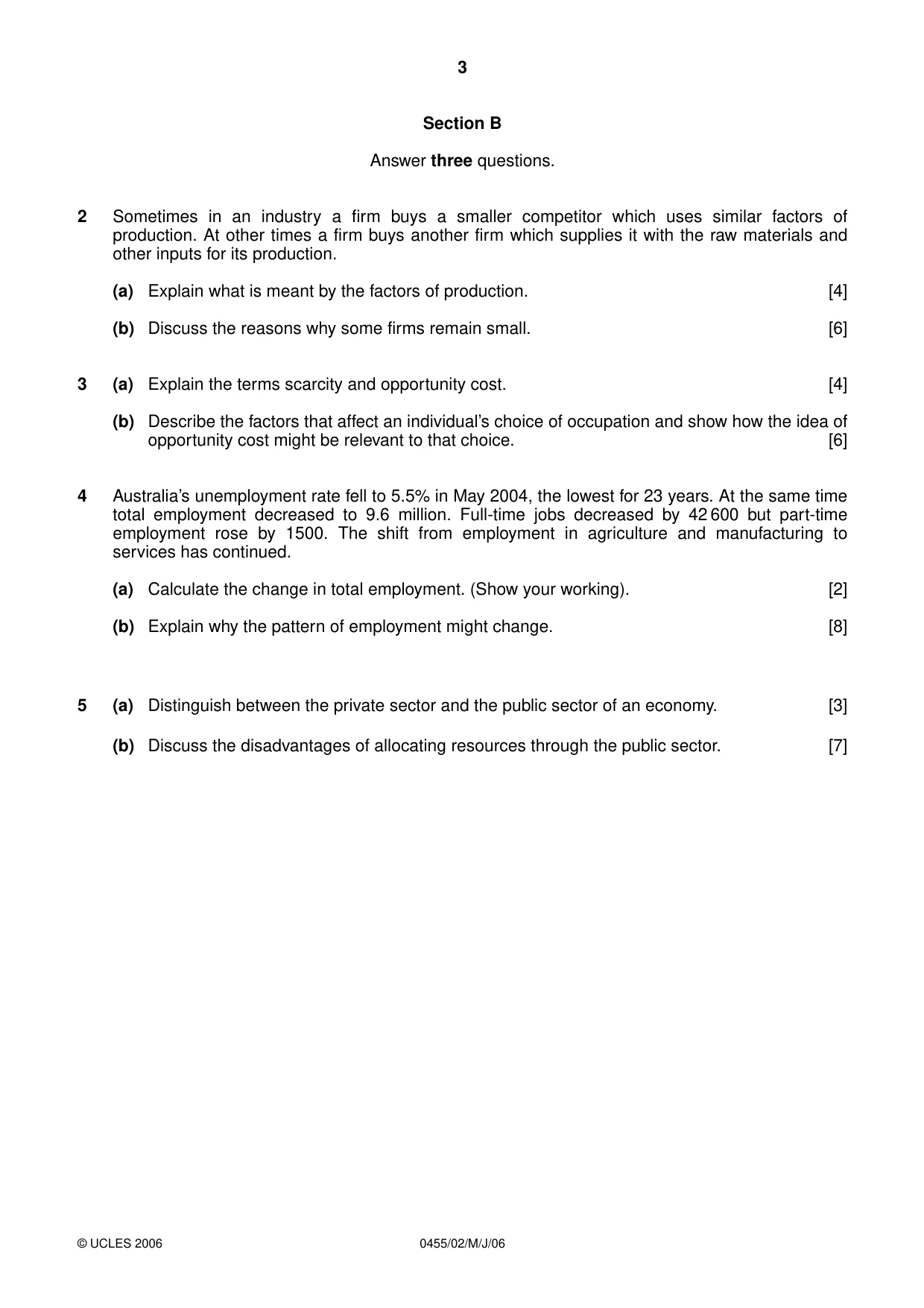
3 0455/02/M/J/06 Section B Answer three questions. 2 Sometimes in an industry a firm buys a smaller competitor which uses similar factors of production. At other times a firm buys another firm which supplies it with the raw materials and other inputs for its production. (a) Explain what is meant by the factors of production. [4] (b) Discuss the reasons why some firms remain small. [6] 3 (a) Explain the terms scarcity and opportunity cost. [4] (b) Describe the factors that affect an individual’s choice of occupation and show how the idea of opportunity cost might be relevant to that choice. [6] 4 Australia’s unemployment rate fell to 5.5% in May 2004, the lowest for 23 years. At the same time total employment decreased to 9.6 million. Full-time jobs decreased by 42 600 but part-time employment rose by 1500. The shift from employment in agriculture and manufacturing to services has continued. (a) Calculate the change in total employment. (Show your working). [2] (b) Explain why the pattern of employment might change. [8] 5 (a) Distinguish between the private sector and the public sector of an economy. [3] (b) Discuss the disadvantages of allocating resources through the public sector. [7] © UCLES 2006
Question paper, page 4
4 0455/02/M/J/06 © UCLES 2006 Copyright Acknowledgements: Question 1 Reprinted with permission of Far Eastern Economic Review, Copyright © (2004) Dow Jones & Company, Inc. All rights Reserved Worldwide. Question 4 Reprinted with permission of Far Eastern Economic Review, Copyright © (2004) Dow Jones & Company, Inc. All rights Reserved Worldwide. Permission to reproduce items where third-party owned material protected by copyright is included has been sought and cleared where possible. Every reasonable effort has been made by the publisher (UCLES) to trace copyright holders, but if any items requiring clearance have unwittingly been included, the publisher will be pleased to make amends at the earliest possible opportunity. University of Cambridge International Examinations is part of the University of Cambridge Local Examinations Syndicate (UCLES), which is itself a department of the University of Cambridge.
Mark scheme, page 1
UNIVERSITY OF CAMBRIDGE INTERNATIONAL EXAMINATIONS International General Certificate of Secondary Education MARK SCHEME for the May/June 2006 question paper 0455 ECONOMICS 0455/02 Paper 2, maximum mark 60 These mark schemes are published as an aid to teachers and students, to indicate the requirements of the examination. They show the basis on which Examiners were initially instructed to award marks. They do not indicate the details of the discussions that took place at an Examiners’ meeting before marking began. Any substantial changes to the mark scheme that arose from these discussions will be recorded in the published Report on the Examination. All Examiners are instructed that alternative correct answers and unexpected approaches in candidates’ scripts must be given marks that fairly reflect the relevant knowledge and skills demonstrated. Mark schemes must be read in conjunction with the question papers and the Report on the Examination. The minimum marks in these components needed for various grades were previously published with these mark schemes, but are now instead included in the Report on the Examination for this session. • CIE will not enter into discussion or correspondence in connection with these mark schemes. CIE is publishing the mark schemes for the May/June 2006 question papers for most IGCSE and GCE Advanced Level and Advanced Subsidiary Level syllabuses and some Ordinary Level syllabuses. www.XtremePapers.com
Mark scheme, page 2
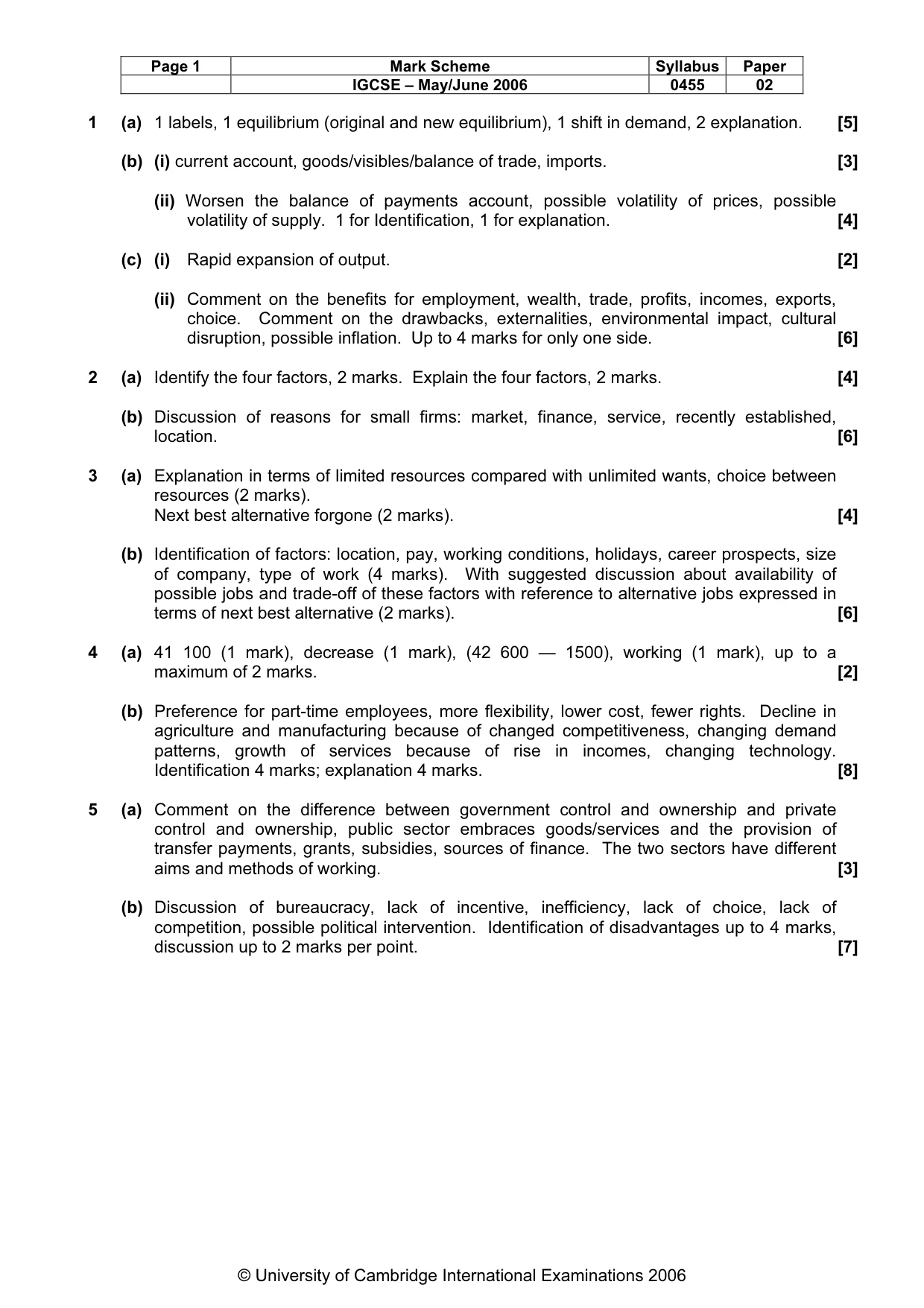
Page 1 Mark Scheme Syllabus Paper IGCSE – May/June 2006 0455 02 © University of Cambridge International Examinations 2006 1 (a) 1 labels, 1 equilibrium (original and new equilibrium), 1 shift in demand, 2 explanation. [5] (b) (i) current account, goods/visibles/balance of trade, imports. [3] (ii) Worsen the balance of payments account, possible volatility of prices, possible volatility of supply. 1 for Identification, 1 for explanation. [4] (c) (i) Rapid expansion of output. [2] (ii) Comment on the benefits for employment, wealth, trade, profits, incomes, exports, choice. Comment on the drawbacks, externalities, environmental impact, cultural disruption, possible inflation. Up to 4 marks for only one side. [6] 2 (a) Identify the four factors, 2 marks. Explain the four factors, 2 marks. [4] (b) Discussion of reasons for small firms: market, finance, service, recently established, location. [6] 3 (a) Explanation in terms of limited resources compared with unlimited wants, choice between resources (2 marks). Next best alternative forgone (2 marks). [4] (b) Identification of factors: location, pay, working conditions, holidays, career prospects, size of company, type of work (4 marks). With suggested discussion about availability of possible jobs and trade-off of these factors with reference to alternative jobs expressed in terms of next best alternative (2 marks). [6] 4 (a) 41 100 (1 mark), decrease (1 mark), (42 600 — 1500), working (1 mark), up to a maximum of 2 marks. [2] (b) Preference for part-time employees, more flexibility, lower cost, fewer rights. Decline in agriculture and manufacturing because of changed competitiveness, changing demand patterns, growth of services because of rise in incomes, changing technology. Identification 4 marks; explanation 4 marks. [8] 5 (a) Comment on the difference between government control and ownership and private control and ownership, public sector embraces goods/services and the provision of transfer payments, grants, subsidies, sources of finance. The two sectors have different aims and methods of working. [3] (b) Discussion of bureaucracy, lack of incentive, inefficiency, lack of choice, lack of competition, possible political intervention. Identification of disadvantages up to 4 marks, discussion up to 2 marks per point. [7]
What you needed in this session
Cambridge’s own grade thresholds for 2006 May/June, Paper 2 · Variant 1. A higher threshold means an easier paper — the bar moves with how the cohort did.