Cambridge IGCSE Economics 0455 — 2002 Oct/Nov Paper 2 · Variant 1
0455/21/O/N/02
The question paper and its mark scheme, free to read here and free to download. This is Cambridge’s own paper, exactly as it was sat.
Question paper4 pages

Mark scheme3 pages
Answers below. Sit the paper first if you are practising.
Paper as text
Question paper, page 1
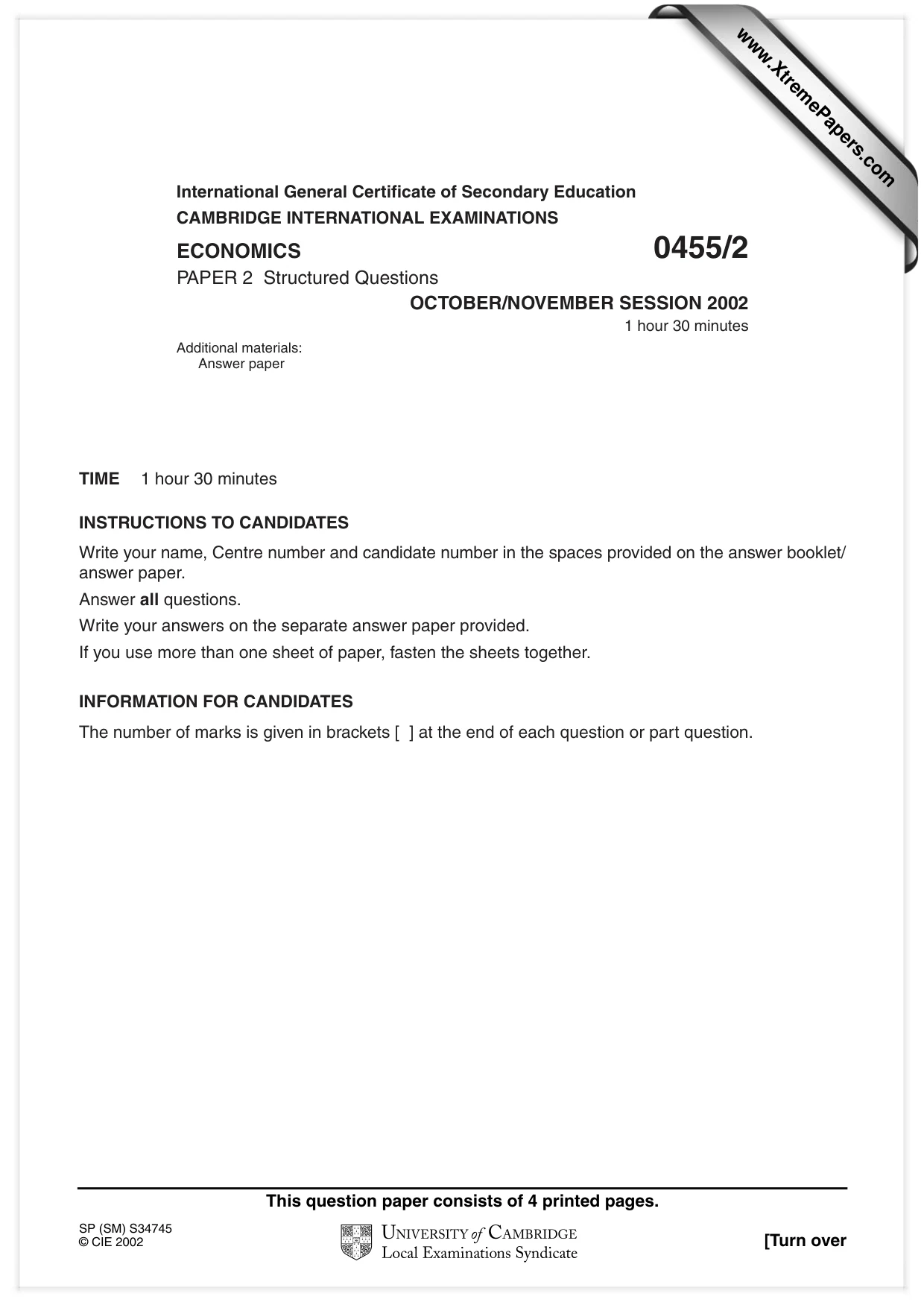
TIME 1 hour 30 minutes INSTRUCTIONS TO CANDIDATES Write your name, Centre number and candidate number in the spaces provided on the answer booklet/ answer paper. Answer all questions. Write your answers on the separate answer paper provided. If you use more than one sheet of paper, fasten the sheets together. INFORMATION FOR CANDIDATES The number of marks is given in brackets [ ] at the end of each question or part question. International General Certificate of Secondary Education CAMBRIDGE INTERNATIONAL EXAMINATIONS ECONOMICS 0455/2 PAPER 2 Structured Questions OCTOBER/NOVEMBER SESSION 2002 1 hour 30 minutes Additional materials: Answer paper This question paper consists of 4 printed pages. SP (SM) S34745 © CIE 2002 [Turn over www.XtremePapers.com
Question paper, page 2
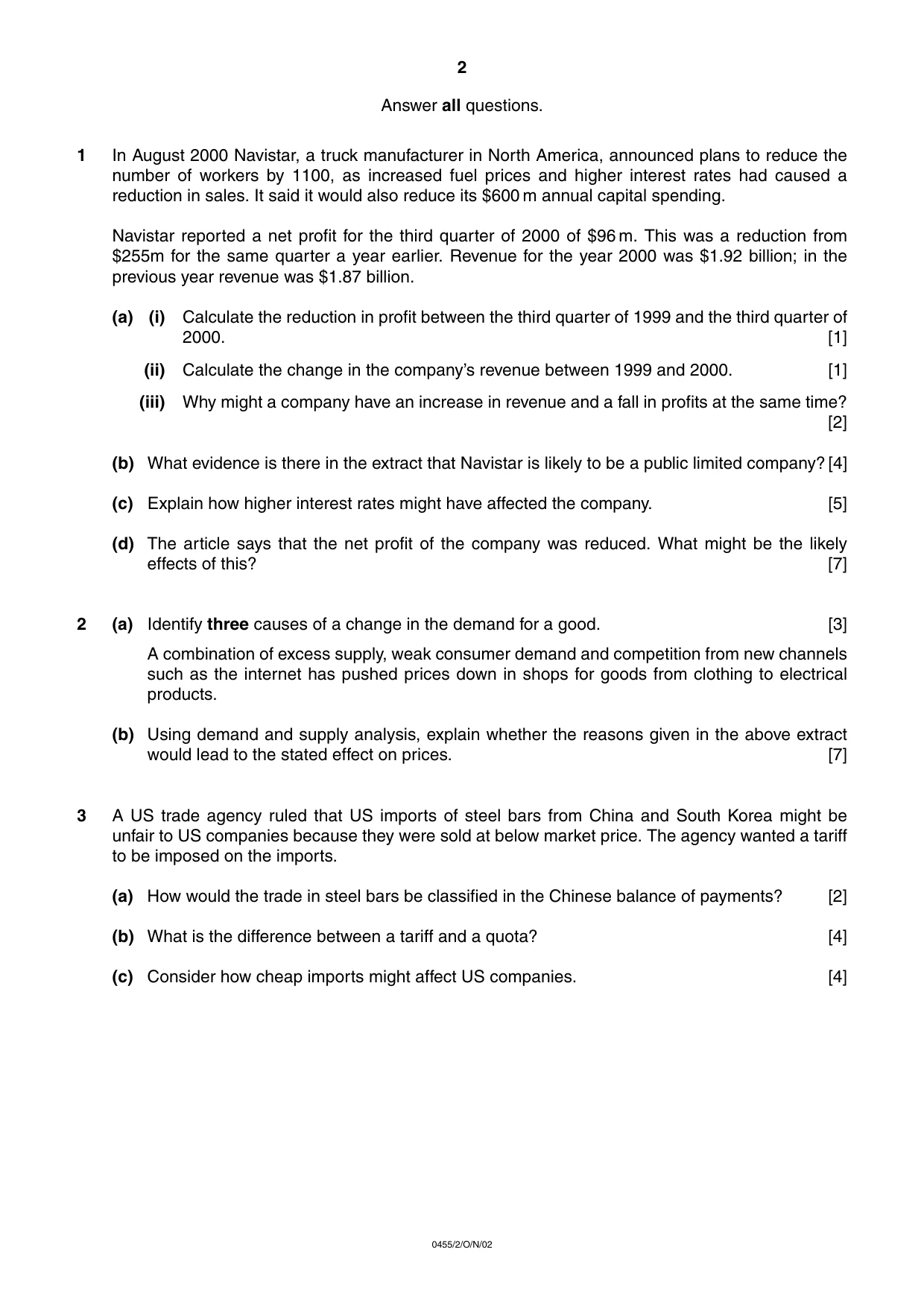
2 0455/2/O/N/02 Answer all questions. 1 In August 2000 Navistar, a truck manufacturer in North America, announced plans to reduce the number of workers by 1100, as increased fuel prices and higher interest rates had caused a reduction in sales. It said it would also reduce its $600 m annual capital spending. Navistar reported a net profit for the third quarter of 2000 of $96 m. This was a reduction from $255m for the same quarter a year earlier. Revenue for the year 2000 was $1.92 billion; in the previous year revenue was $1.87 billion. (a) (i) Calculate the reduction in profit between the third quarter of 1999 and the third quarter of 2000. [1] (ii) Calculate the change in the company’s revenue between 1999 and 2000. [1] (iii) Why might a company have an increase in revenue and a fall in profits at the same time? [2] (b) What evidence is there in the extract that Navistar is likely to be a public limited company? [4] (c) Explain how higher interest rates might have affected the company. [5] (d) The article says that the net profit of the company was reduced. What might be the likely effects of this? [7] 2 (a) Identify three causes of a change in the demand for a good. [3] A combination of excess supply, weak consumer demand and competition from new channels such as the internet has pushed prices down in shops for goods from clothing to electrical products. (b) Using demand and supply analysis, explain whether the reasons given in the above extract would lead to the stated effect on prices. [7] 3 A US trade agency ruled that US imports of steel bars from China and South Korea might be unfair to US companies because they were sold at below market price. The agency wanted a tariff to be imposed on the imports. (a) How would the trade in steel bars be classified in the Chinese balance of payments? [2] (b) What is the difference between a tariff and a quota? [4] (c) Consider how cheap imports might affect US companies. [4]
Question paper, page 3
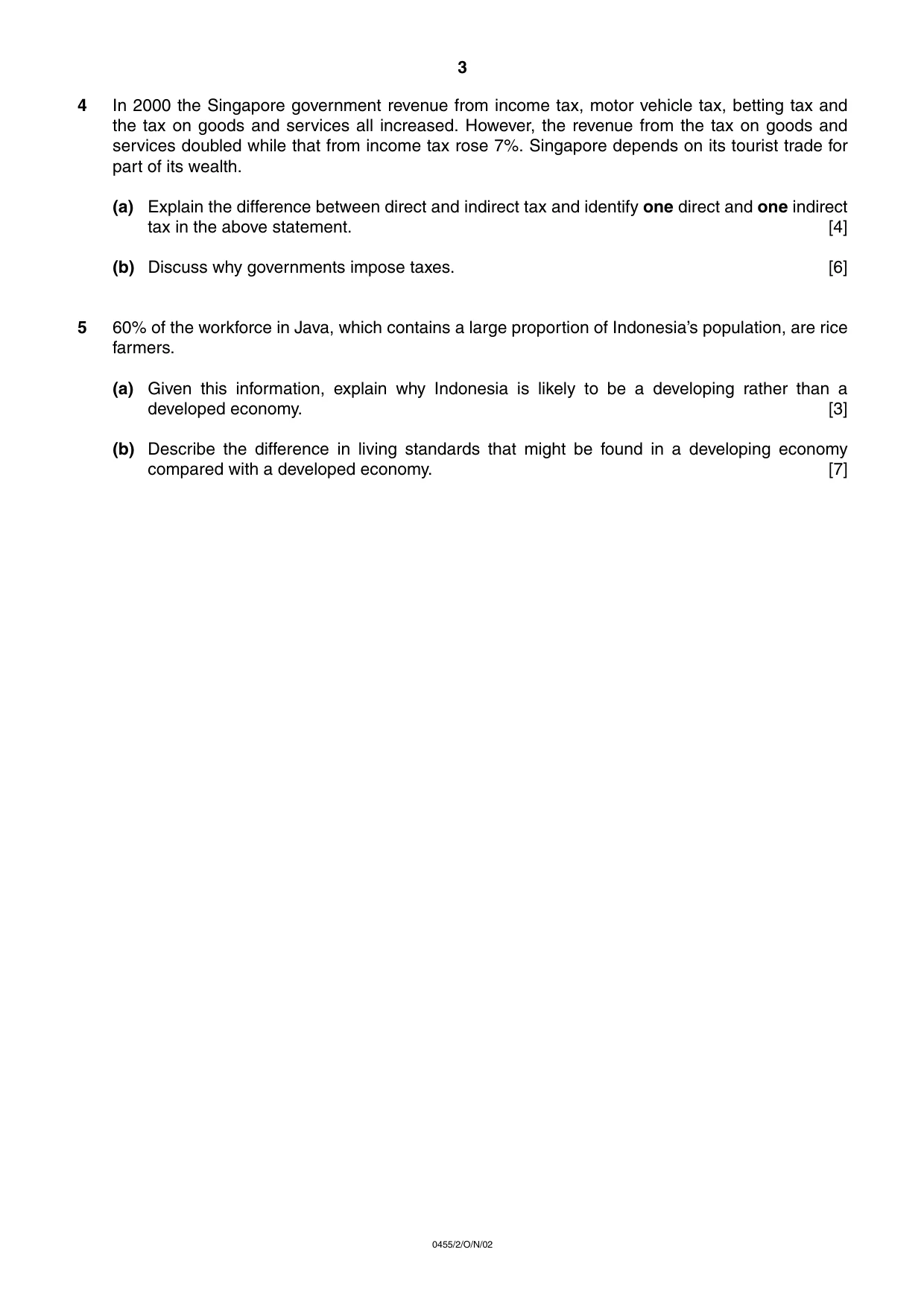
3 0455/2/O/N/02 4 In 2000 the Singapore government revenue from income tax, motor vehicle tax, betting tax and the tax on goods and services all increased. However, the revenue from the tax on goods and services doubled while that from income tax rose 7%. Singapore depends on its tourist trade for part of its wealth. (a) Explain the difference between direct and indirect tax and identify one direct and one indirect tax in the above statement. [4] (b) Discuss why governments impose taxes. [6] 5 60% of the workforce in Java, which contains a large proportion of Indonesia’s population, are rice farmers. (a) Given this information, explain why Indonesia is likely to be a developing rather than a developed economy. [3] (b) Describe the difference in living standards that might be found in a developing economy compared with a developed economy. [7]
Question paper, page 4
4 0455/2/O/N/02 Copyright Acknowledgements: Question 1. © International Herald Tribune, 16 August 2000. Question 4. © The Straits Times, 24 May 2000. Cambridge International Examinations has made every effort to trace copyright holders, but if we have inadvertently overlooked any we will be pleased to make the necessary arrangements at the first opportunity.
Mark scheme, page 1
CAMBRIDGE INTERNATIONAL EXAMINATIONS NOVEMBER 2002 INTERNATIONAL GCSE 5) Universiry of CAMBRIDGE SP Local Examinations Syndicate
Mark scheme, page 2
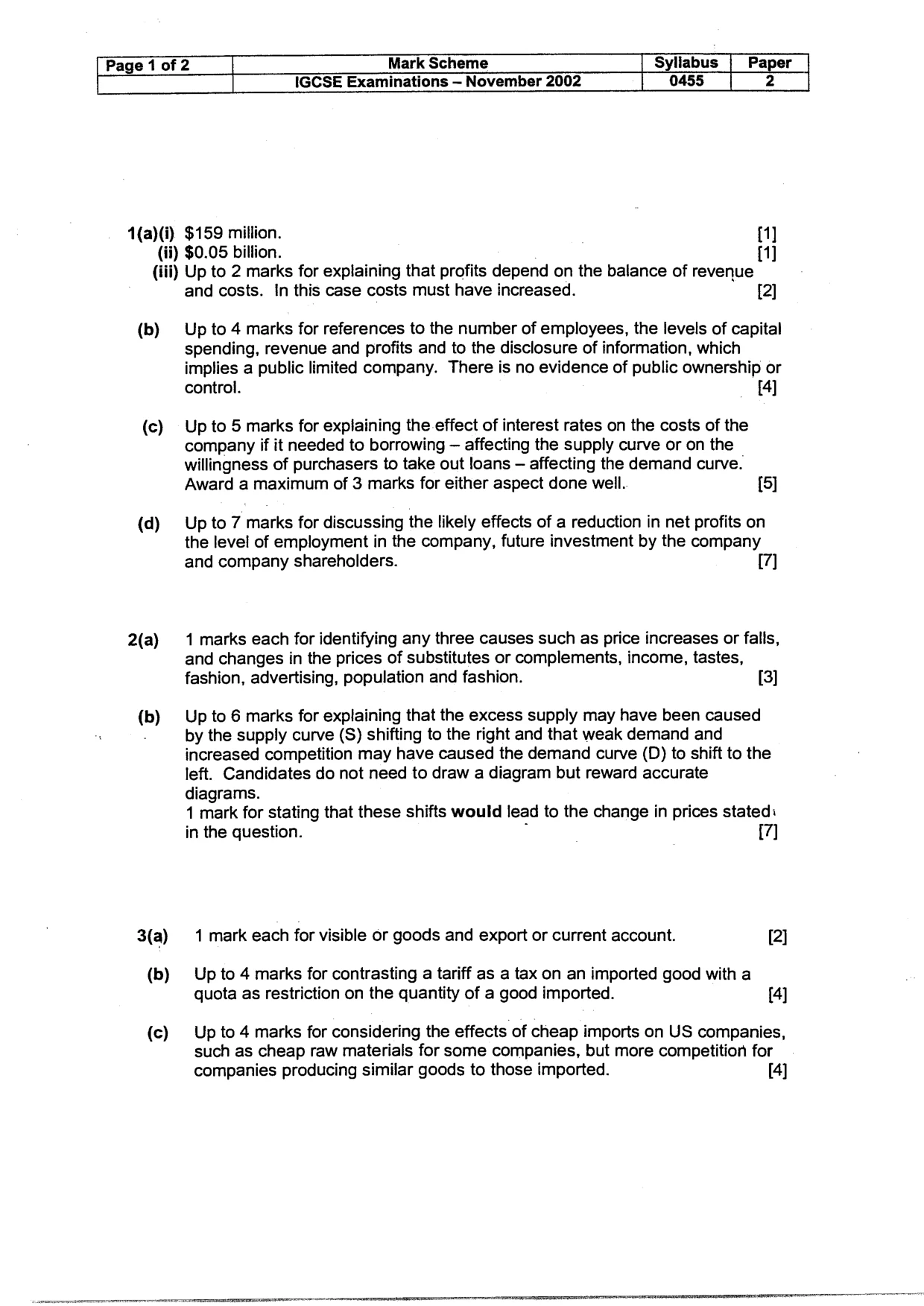
Page 1 of 2 Mark Scheme [| Syllabus | Paper IGCSE Examinations — November 2002 [0455 [2 1(a)(i) $159 million. {1] $0.05 billion. [1] Up to 2 marks for explaining that profits depend on the balance of revenue and costs. In this case costs must have increased. [2] (b) (c) (a) 2a) (b) 3a) (b) (c) Up to 4 marks for references to the number of employees, the levels of capital spending, revenue and profits and to the disclosure of information, which implies a public limited company. There is no evidence of public ownership or control. [4] Up to 5 marks for explaining the effect of interest rates on the costs of the company if it needed to borrowing — affecting the supply curve or on the willingness of purchasers to take out loans — affecting the demand curve. Award a maximum of 3 marks for either aspect done well. [5] Up to 7 marks for discussing the likely effects of a reduction in net profits on the level of employment in the company, future investment by the company and company shareholders. [7] 1 marks each for identifying any three causes such as price increases or falls, and changes in the prices of substitutes or complements, income, tastes, fashion, advertising, population and fashion. [3] Up to 6 marks for explaining that the excess supply may have been caused by the supply curve (S) shifting to the right and that weak demand and increased competition may have caused the demand curve (D) to shift to the left. Candidates do not need to draw a diagram but reward accurate diagrams. 1 mark for stating that these shifts would lead to the change in prices stated: in the question. ° [7] 1 mark each for visible or goods and export or current account. [2] Up to 4 marks for contrasting a tariff as a tax on an imported good with a quota as restriction on the quantity of a good imported. [4] Up to 4 marks for considering the effects of cheap imports on US companies, such as cheap raw materials for some companies, but more competition for companies producing similar goods to those imported. [4]
Mark scheme, page 3
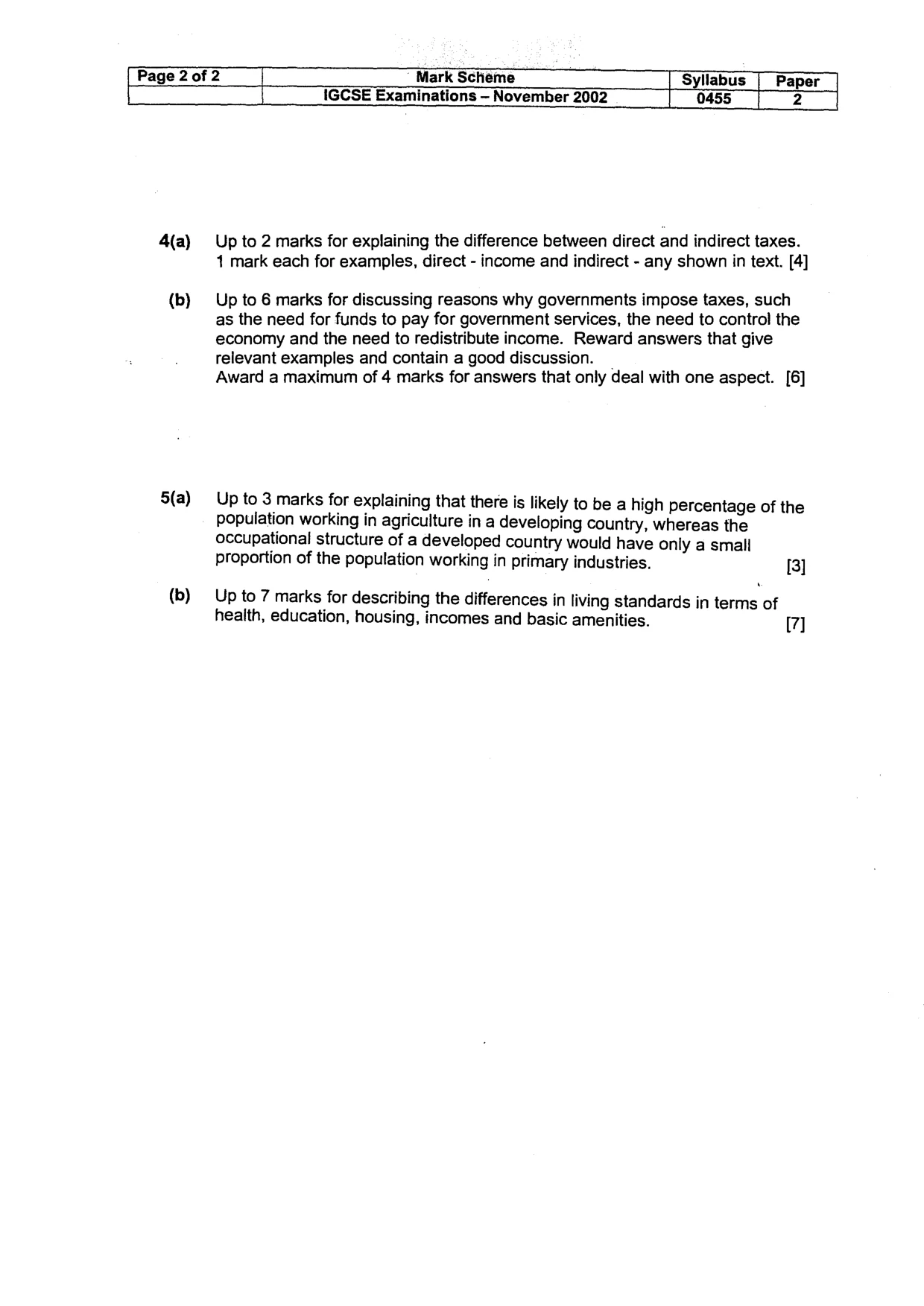
Page 2 of 2 Mark Scheme Syllabus Paper IGCSE Examinations - November 2002 0455 2 4(a) (b) 5(a) (b) Up to 2 marks for explaining the difference between direct and indirect taxes. 1 mark each for examples, direct - income and indirect - any shown in text. [4] Up to 6 marks for discussing reasons why governments impose taxes, such as the need for funds to pay for government services, the need to contro! the economy and the need to redistribute income. Reward answers that give relevant examples and contain a good discussion. Award a maximum of 4 marks for answers that only deal with one aspect. [6] Up to 3 marks for explaining that there is likely to be a high percentage of the population working in agriculture in a developing country, whereas the occupational structure of a developed country would have only a small proportion of the population working in primary industries. [3] Up to 7 marks for describing the differences in living standards in terms of health, education, housing, incomes and basic amenities. [7]