Cambridge IGCSE Dutch - First Language 0503 — 2019 May/June Paper 1 · Variant 1
0503/11/M/J/19 · 50 marks · ≈56 min
The question paper and its mark scheme, free to read here and free to download. This is Cambridge’s own paper, exactly as it was sat.
Question paper8 pages
Mark scheme8 pages
Answers below. Sit the paper first if you are practising.
Paper as text
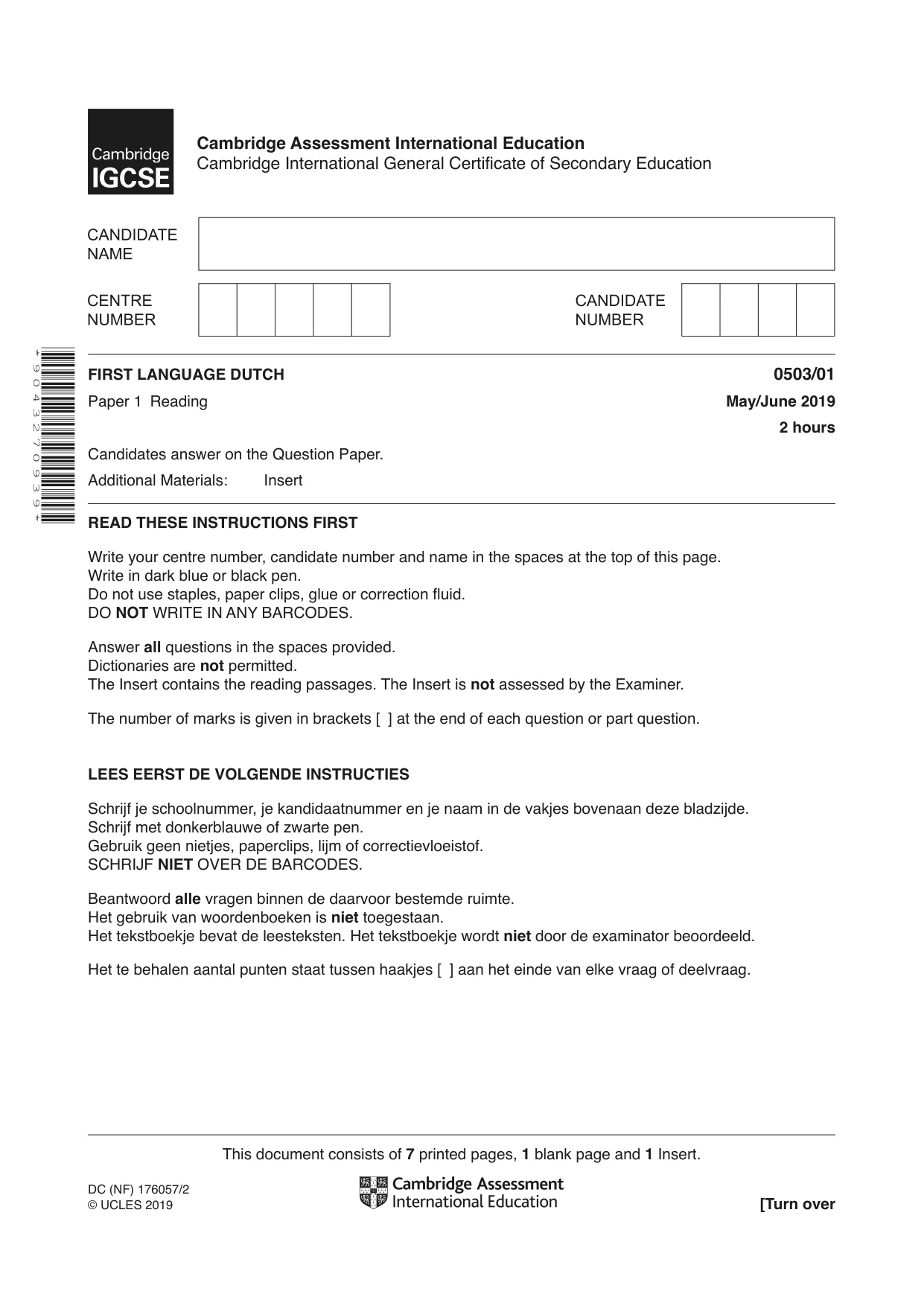
Question paper, page 1
* 9 0 4 3 2 7 0 9 3 9 * Cambridge Assessment International Education Cambridge International General Certificate of Secondary Education This document consists of 7 printed pages, 1 blank page and 1 Insert. DC (NF) 176057/2 © UCLES 2019 [Turn over FIRST LANGUAGE DUTCH 0503/01 Paper 1 Reading May/June 2019 2 hours Candidates answer on the Question Paper. Additional Materials: Insert READ THESE INSTRUCTIONS FIRST Write your centre number, candidate number and name in the spaces at the top of this page. Write in dark blue or black pen. Do not use staples, paper clips, glue or correction fluid. DO NOT WRITE IN ANY BARCODES. Answer all questions in the spaces provided. Dictionaries are not permitted. The Insert contains the reading passages. The Insert is not assessed by the Examiner. The number of marks is given in brackets [ ] at the end of each question or part question. LEES EERST DE VOLGENDE INSTRUCTIES Schrijf je schoolnummer, je kandidaatnummer en je naam in de vakjes bovenaan deze bladzijde. Schrijf met donkerblauwe of zwarte pen. Gebruik geen nietjes, paperclips, lijm of correctievloeistof. SCHRIJF NIET OVER DE BARCODES. Beantwoord alle vragen binnen de daarvoor bestemde ruimte. Het gebruik van woordenboeken is niet toegestaan. Het tekstboekje bevat de leesteksten. Het tekstboekje wordt niet door de examinator beoordeeld. Het te behalen aantal punten staat tussen haakjes [ ] aan het einde van elke vraag of deelvraag.
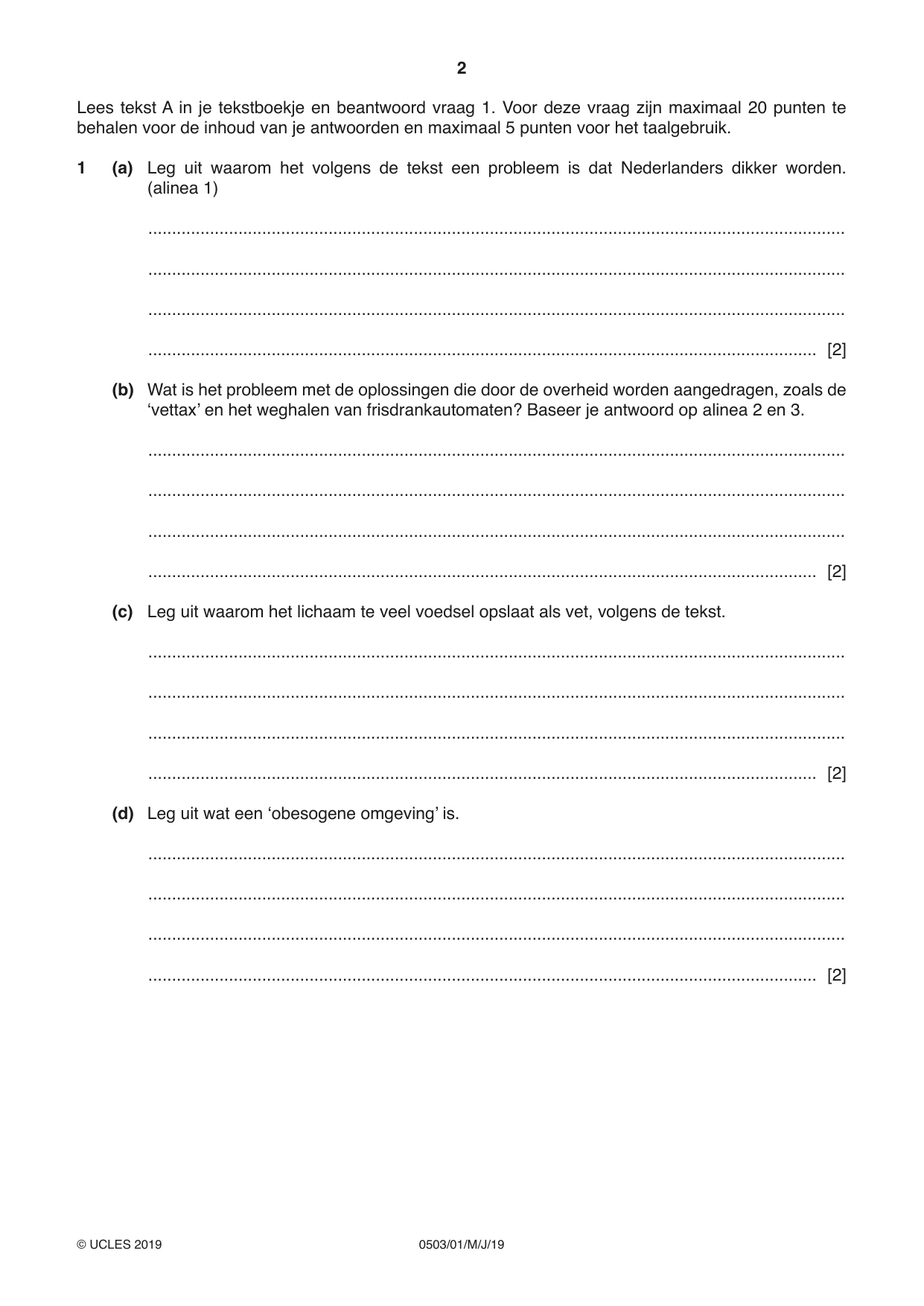
Question paper, page 2
2 0503/01/M/J/19 © UCLES 2019 Lees tekst A in je tekstboekje en beantwoord vraag 1. Voor deze vraag zijn maximaal 20 punten te behalen voor de inhoud van je antwoorden en maximaal 5 punten voor het taalgebruik. 1 (a) Leg uit waarom het volgens de tekst een probleem is dat Nederlanders dikker worden. (alinea 1) … … … … [2] (b) Wat is het probleem met de oplossingen die door de overheid worden aangedragen, zoals de ‘vettax’ en het weghalen van frisdrankautomaten? Baseer je antwoord op alinea 2 en 3. … … … … [2] (c) Leg uit waarom het lichaam te veel voedsel opslaat als vet, volgens de tekst. … … … … [2] (d) Leg uit wat een ‘obesogene omgeving’ is. … … … … [2]
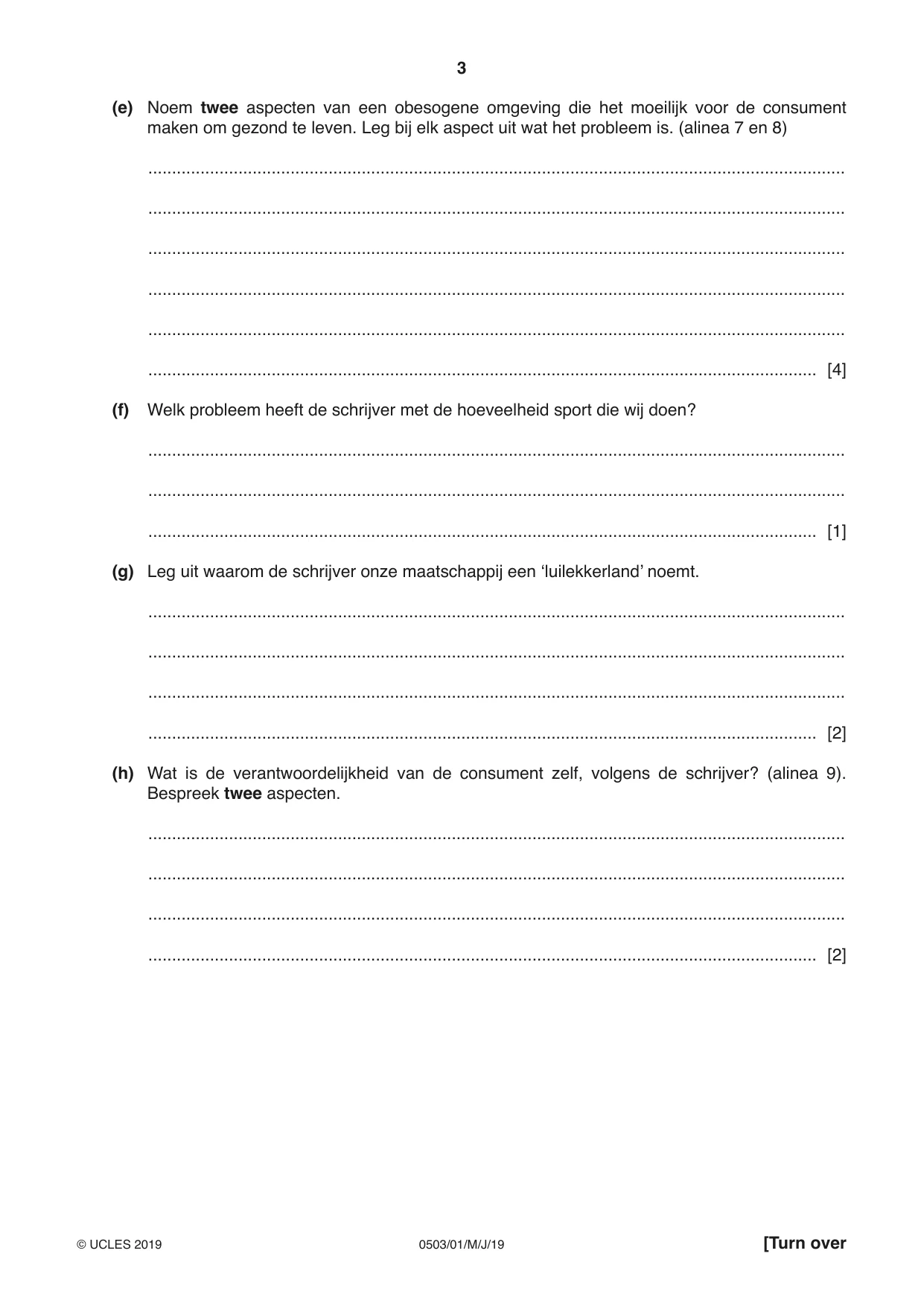
Question paper, page 3
3 0503/01/M/J/19 © UCLES 2019 [Turn over (e) Noem twee aspecten van een obesogene omgeving die het moeilijk voor de consument maken om gezond te leven. Leg bij elk aspect uit wat het probleem is. (alinea 7 en 8) … … … … … … [4] (f) Welk probleem heeft de schrijver met de hoeveelheid sport die wij doen? … … … [1] (g) Leg uit waarom de schrijver onze maatschappij een ‘luilekkerland’ noemt. … … … … [2] (h) Wat is de verantwoordelijkheid van de consument zelf, volgens de schrijver? (alinea 9). Bespreek twee aspecten. … … … … [2]
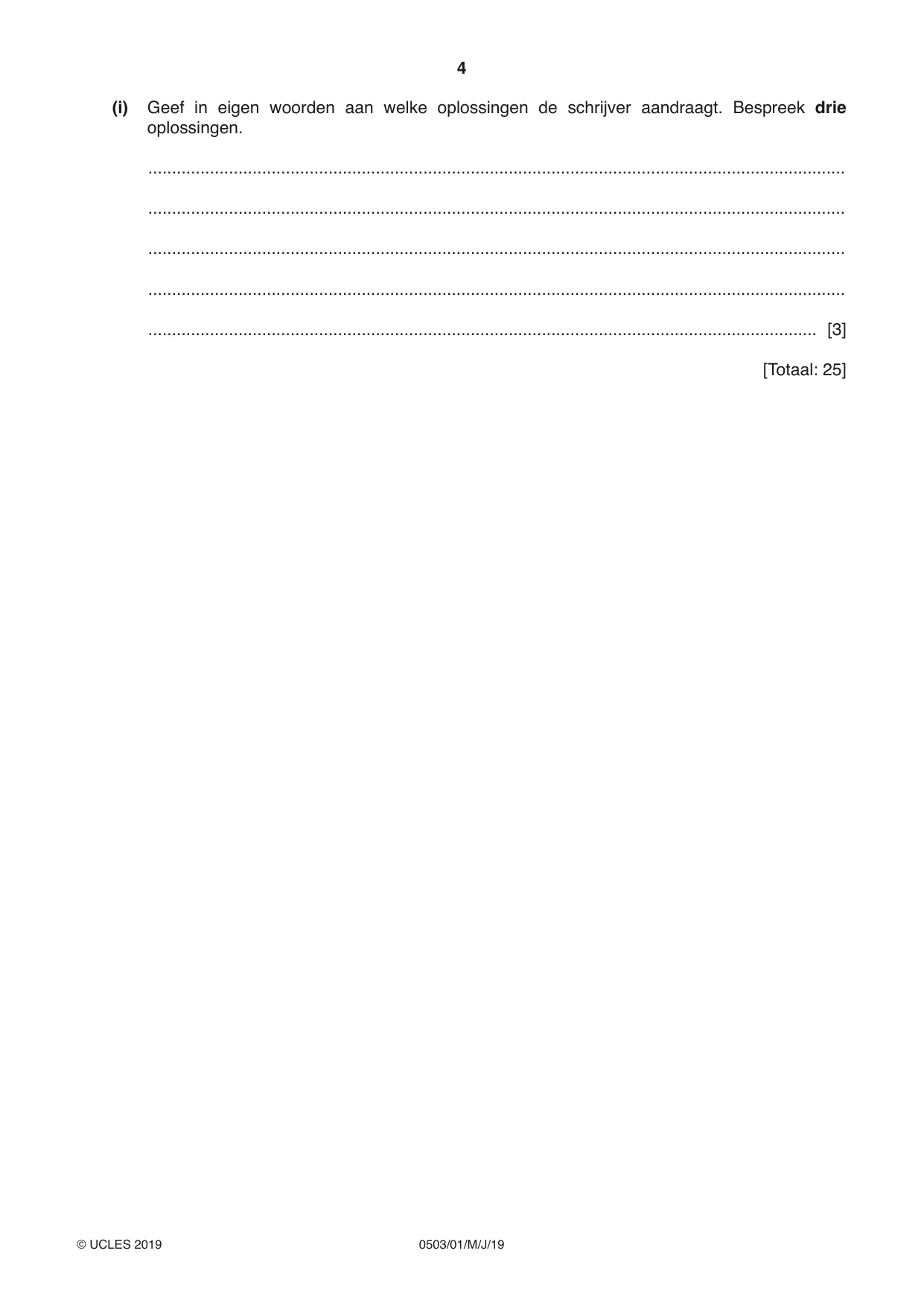
Question paper, page 4
4 0503/01/M/J/19 © UCLES 2019 (i) Geef in eigen woorden aan welke oplossingen de schrijver aandraagt. Bespreek drie oplossingen. … … … … … [3] [Totaal: 25]
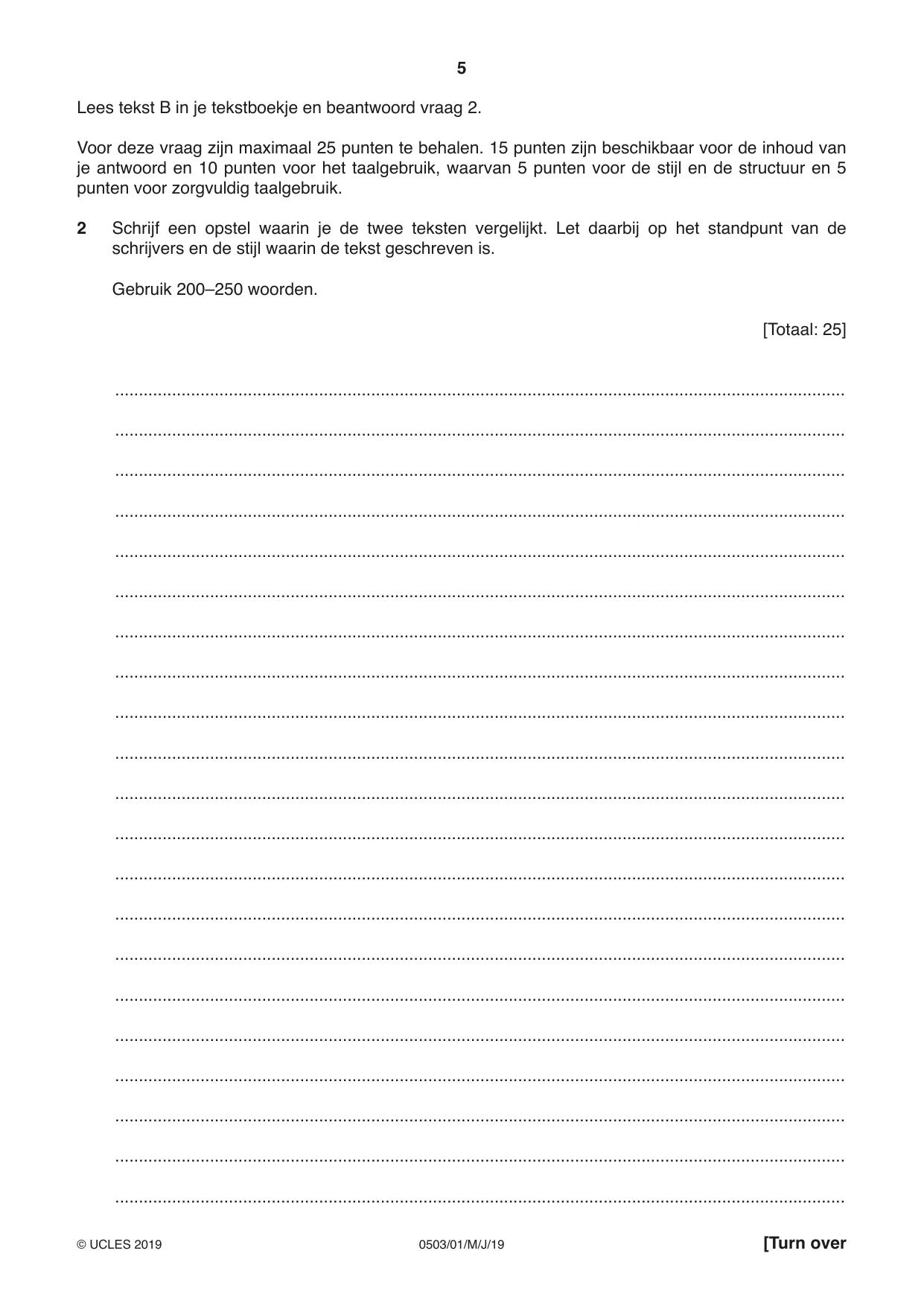
Question paper, page 5
5 0503/01/M/J/19 © UCLES 2019 [Turn over Lees tekst B in je tekstboekje en beantwoord vraag 2. Voor deze vraag zijn maximaal 25 punten te behalen. 15 punten zijn beschikbaar voor de inhoud van je antwoord en 10 punten voor het taalgebruik, waarvan 5 punten voor de stijl en de structuur en 5 punten voor zorgvuldig taalgebruik. 2 Schrijf een opstel waarin je de twee teksten vergelijkt. Let daarbij op het standpunt van de schrijvers en de stijl waarin de tekst geschreven is. Gebruik 200–250 woorden. [Totaal: 25] … … … … … … … … … … … … … … … … … … … … …
Question paper, page 6
6 0503/01/M/J/19 © UCLES 2019 … … … … … … … … … … … … … … … … … … … … … … … … … … … …
Question paper, page 7
7 0503/01/M/J/19 © UCLES 2019 … … … … … … … … … … … … … … … … … … … … … … … … … … … …
Question paper, page 8
8 0503/01/M/J/19 © UCLES 2019 Permission to reproduce items where third-party owned material protected by copyright is included has been sought and cleared where possible. Every reasonable effort has been made by the publisher (UCLES) to trace copyright holders, but if any items requiring clearance have unwittingly been included, the publisher will be pleased to make amends at the earliest possible opportunity. To avoid the issue of disclosure of answer-related information to candidates, all copyright acknowledgements are reproduced online in the Cambridge Assessment International Education Copyright Acknowledgements Booklet. This is produced for each series of examinations and is freely available to download at www.cambridgeinternational.org after the live examination series. Cambridge Assessment International Education is part of the Cambridge Assessment Group. Cambridge Assessment is the brand name of the University of Cambridge Local Examinations Syndicate (UCLES), which itself is a department of the University of Cambridge. BLANK PAGE
Mark scheme, page 1
This document consists of 8 printed pages. © UCLES 2019 [Turn over Cambridge Assessment International Education Cambridge International General Certificate of Secondary Education FIRST LANGUAGE DUTCH 0503/01 Paper 1 Reading May/June 2019 MARK SCHEME Maximum Mark: 50 Published This mark scheme is published as an aid to teachers and candidates, to indicate the requirements of the examination. It shows the basis on which Examiners were instructed to award marks. It does not indicate the details of the discussions that took place at an Examiners’ meeting before marking began, which would have considered the acceptability of alternative answers. Mark schemes should be read in conjunction with the question paper and the Principal Examiner Report for Teachers. Cambridge International will not enter into discussions about these mark schemes. Cambridge International is publishing the mark schemes for the May/June 2019 series for most Cambridge IGCSE™, Cambridge International A and AS Level and Cambridge Pre-U components, and some Cambridge O Level components.
Mark scheme, page 2
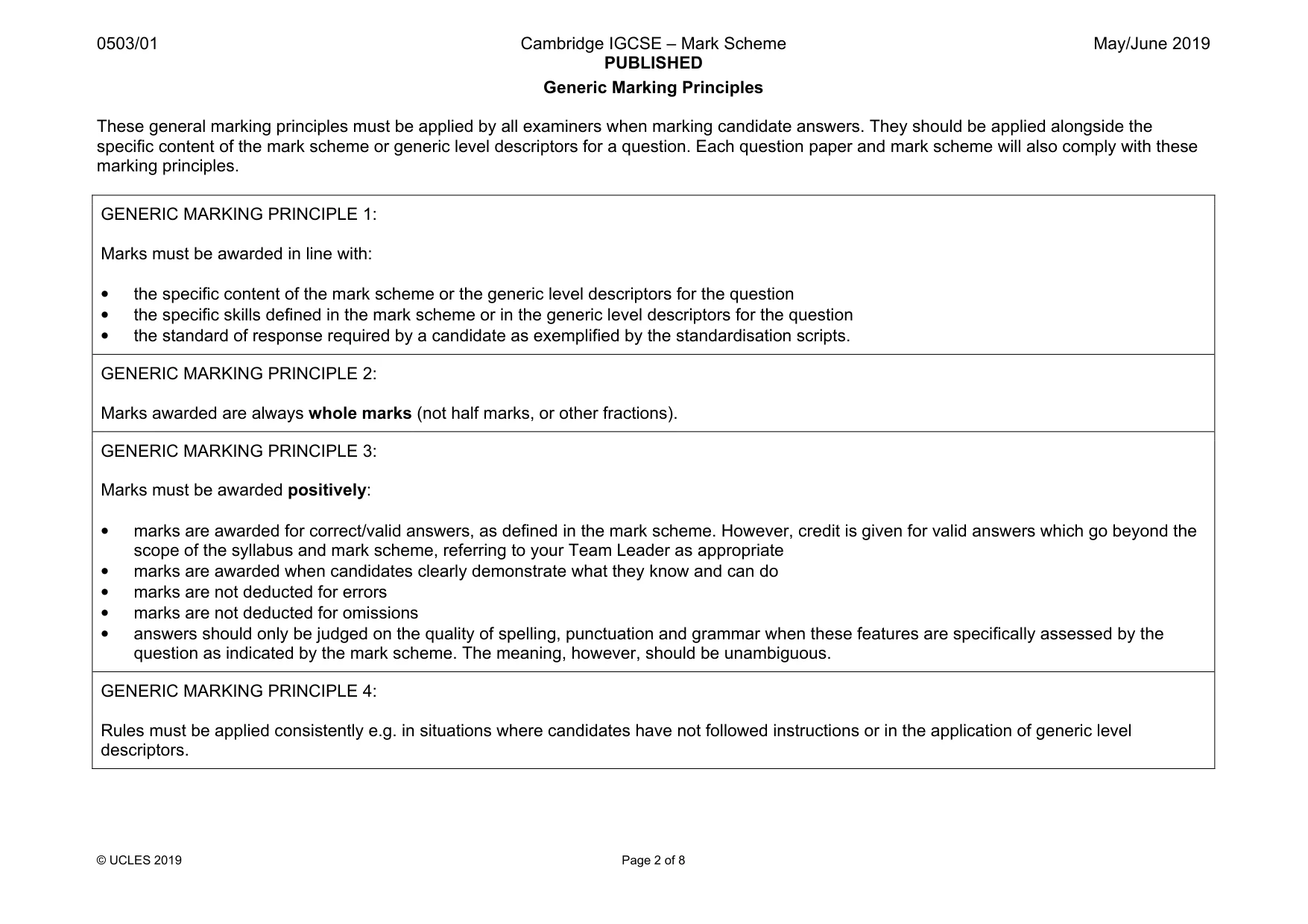
0503/01 Cambridge IGCSE – Mark Scheme PUBLISHED May/June 2019 © UCLES 2019 Page 2 of 8 Generic Marking Principles These general marking principles must be applied by all examiners when marking candidate answers. They should be applied alongside the specific content of the mark scheme or generic level descriptors for a question. Each question paper and mark scheme will also comply with these marking principles. GENERIC MARKING PRINCIPLE 1: Marks must be awarded in line with: • the specific content of the mark scheme or the generic level descriptors for the question • the specific skills defined in the mark scheme or in the generic level descriptors for the question • the standard of response required by a candidate as exemplified by the standardisation scripts. GENERIC MARKING PRINCIPLE 2: Marks awarded are always whole marks (not half marks, or other fractions). GENERIC MARKING PRINCIPLE 3: Marks must be awarded positively: • marks are awarded for correct/valid answers, as defined in the mark scheme. However, credit is given for valid answers which go beyond the scope of the syllabus and mark scheme, referring to your Team Leader as appropriate • marks are awarded when candidates clearly demonstrate what they know and can do • marks are not deducted for errors • marks are not deducted for omissions • answers should only be judged on the quality of spelling, punctuation and grammar when these features are specifically assessed by the question as indicated by the mark scheme. The meaning, however, should be unambiguous. GENERIC MARKING PRINCIPLE 4: Rules must be applied consistently e.g. in situations where candidates have not followed instructions or in the application of generic level descriptors.
Mark scheme, page 3
0503/01 Cambridge IGCSE – Mark Scheme PUBLISHED May/June 2019 © UCLES 2019 Page 3 of 8 GENERIC MARKING PRINCIPLE 5: Marks should be awarded using the full range of marks defined in the mark scheme for the question (however; the use of the full mark range may be limited according to the quality of the candidate responses seen). GENERIC MARKING PRINCIPLE 6: Marks awarded are based solely on the requirements as defined in the mark scheme. Marks should not be awarded with grade thresholds or grade descriptors in mind.
Mark scheme, page 4
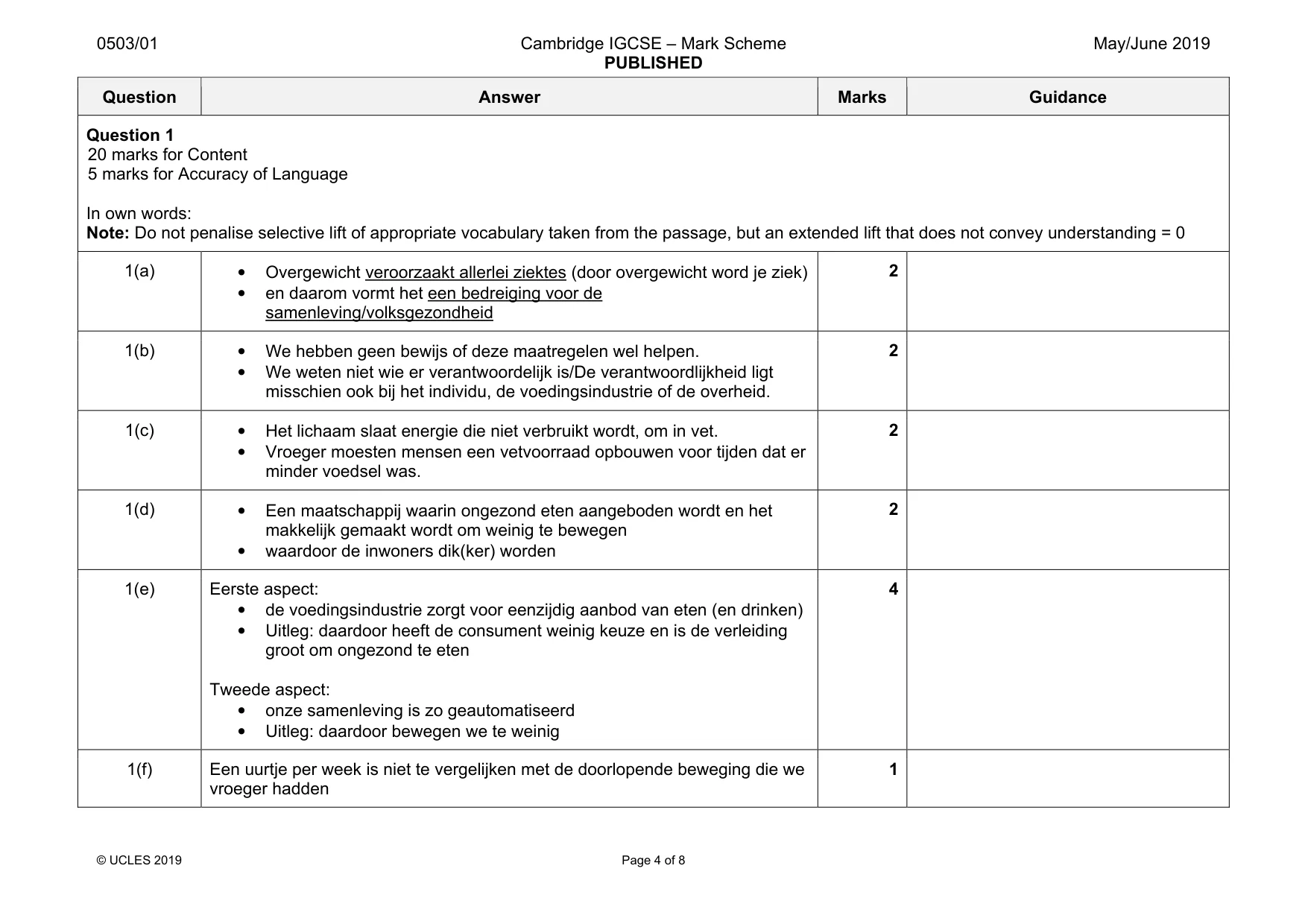
0503/01 Cambridge IGCSE – Mark Scheme PUBLISHED May/June 2019 © UCLES 2019 Page 4 of 8 Question Answer Marks Guidance Question 1 20 marks for Content 5 marks for Accuracy of Language In own words: Note: Do not penalise selective lift of appropriate vocabulary taken from the passage, but an extended lift that does not convey understanding = 0 1(a) • Overgewicht veroorzaakt allerlei ziektes (door overgewicht word je ziek) • en daarom vormt het een bedreiging voor de samenleving/volksgezondheid 2 1(b) • We hebben geen bewijs of deze maatregelen wel helpen. • We weten niet wie er verantwoordelijk is/De verantwoordlijkheid ligt misschien ook bij het individu, de voedingsindustrie of de overheid. 2 1(c) • Het lichaam slaat energie die niet verbruikt wordt, om in vet. • Vroeger moesten mensen een vetvoorraad opbouwen voor tijden dat er minder voedsel was. 2 1(d) • Een maatschappij waarin ongezond eten aangeboden wordt en het makkelijk gemaakt wordt om weinig te bewegen • waardoor de inwoners dik(ker) worden 2 1(e) Eerste aspect: • de voedingsindustrie zorgt voor eenzijdig aanbod van eten (en drinken) • Uitleg: daardoor heeft de consument weinig keuze en is de verleiding groot om ongezond te eten Tweede aspect: • onze samenleving is zo geautomatiseerd • Uitleg: daardoor bewegen we te weinig 4 1(f) Een uurtje per week is niet te vergelijken met de doorlopende beweging die we vroeger hadden 1
Mark scheme, page 5
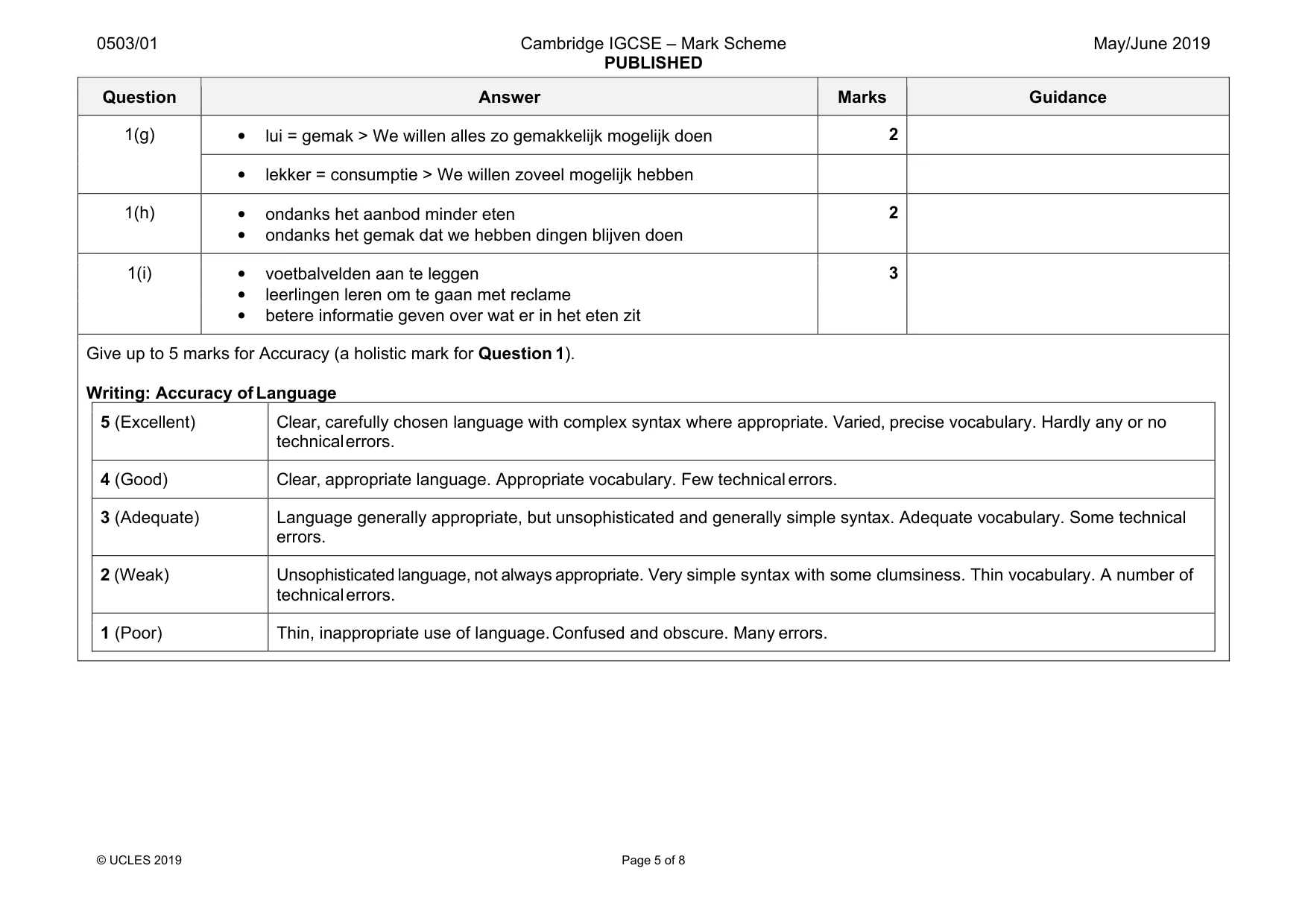
0503/01 Cambridge IGCSE – Mark Scheme PUBLISHED May/June 2019 © UCLES 2019 Page 5 of 8 Question Answer Marks Guidance 1(g) • lui = gemak > We willen alles zo gemakkelijk mogelijk doen 2 • lekker = consumptie > We willen zoveel mogelijk hebben 1(h) • ondanks het aanbod minder eten • ondanks het gemak dat we hebben dingen blijven doen 2 1(i) • voetbalvelden aan te leggen • leerlingen leren om te gaan met reclame • betere informatie geven over wat er in het eten zit 3 Give up to 5 marks for Accuracy (a holistic mark for Question 1). Writing: Accuracy of Language 5 (Excellent) Clear, carefully chosen language with complex syntax where appropriate. Varied, precise vocabulary. Hardly any or no technical errors. 4 (Good) Clear, appropriate language. Appropriate vocabulary. Few technical errors. 3 (Adequate) Language generally appropriate, but unsophisticated and generally simple syntax. Adequate vocabulary. Some technical errors. 2 (Weak) Unsophisticated language, not always appropriate. Very simple syntax with some clumsiness. Thin vocabulary. A number of technical errors. 1 (Poor) Thin, inappropriate use of language. Confused and obscure. Many errors.
Mark scheme, page 6
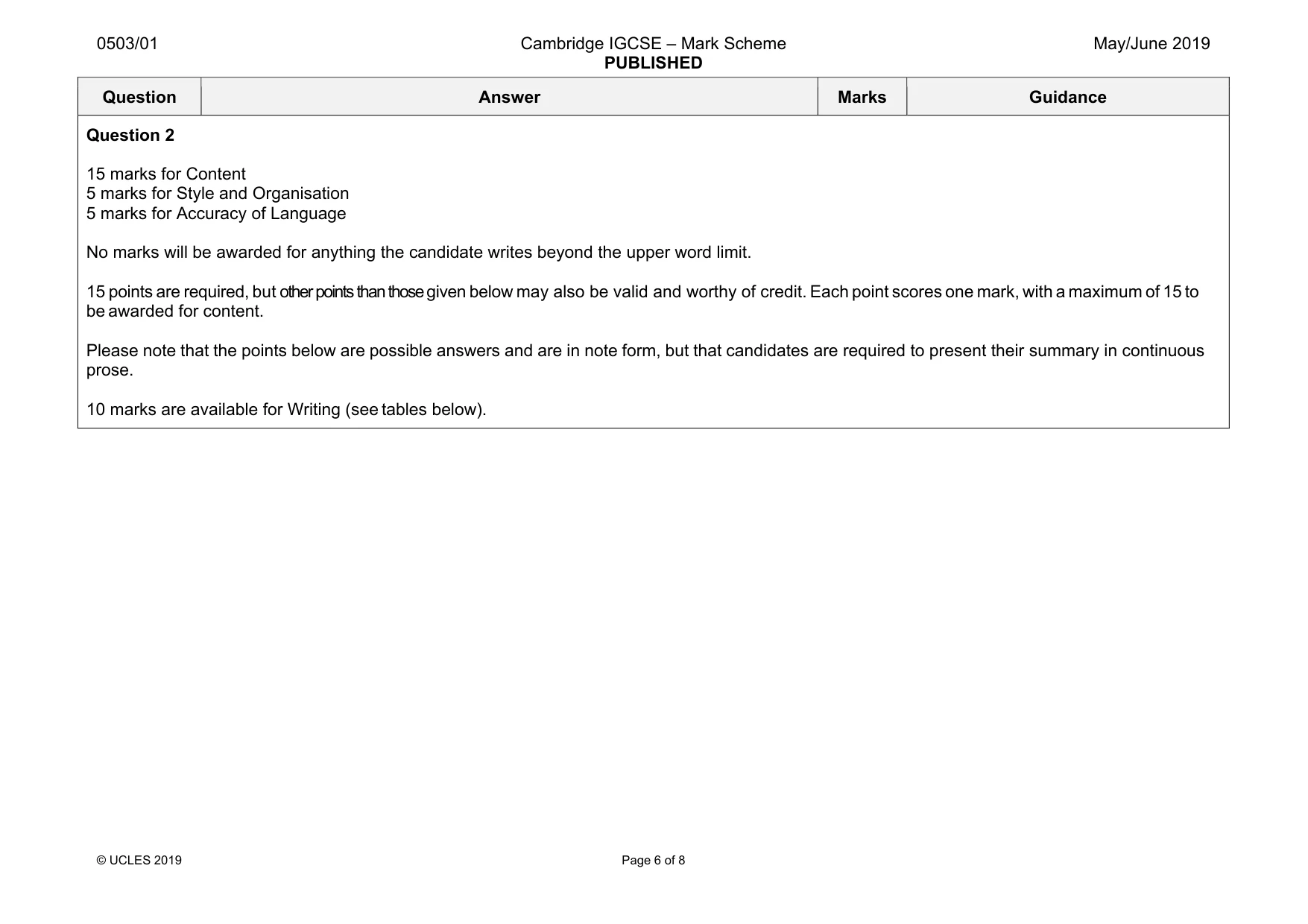
0503/01 Cambridge IGCSE – Mark Scheme PUBLISHED May/June 2019 © UCLES 2019 Page 6 of 8 Question Answer Marks Guidance Question 2 15 marks for Content 5 marks for Style and Organisation 5 marks for Accuracy of Language No marks will be awarded for anything the candidate writes beyond the upper word limit. 15 points are required, but other points than those given below may also be valid and worthy of credit. Each point scores one mark, with a maximum of 15 to be awarded for content. Please note that the points below are possible answers and are in note form, but that candidates are required to present their summary in continuous prose. 10 marks are available for Writing (see tables below).
Mark scheme, page 7
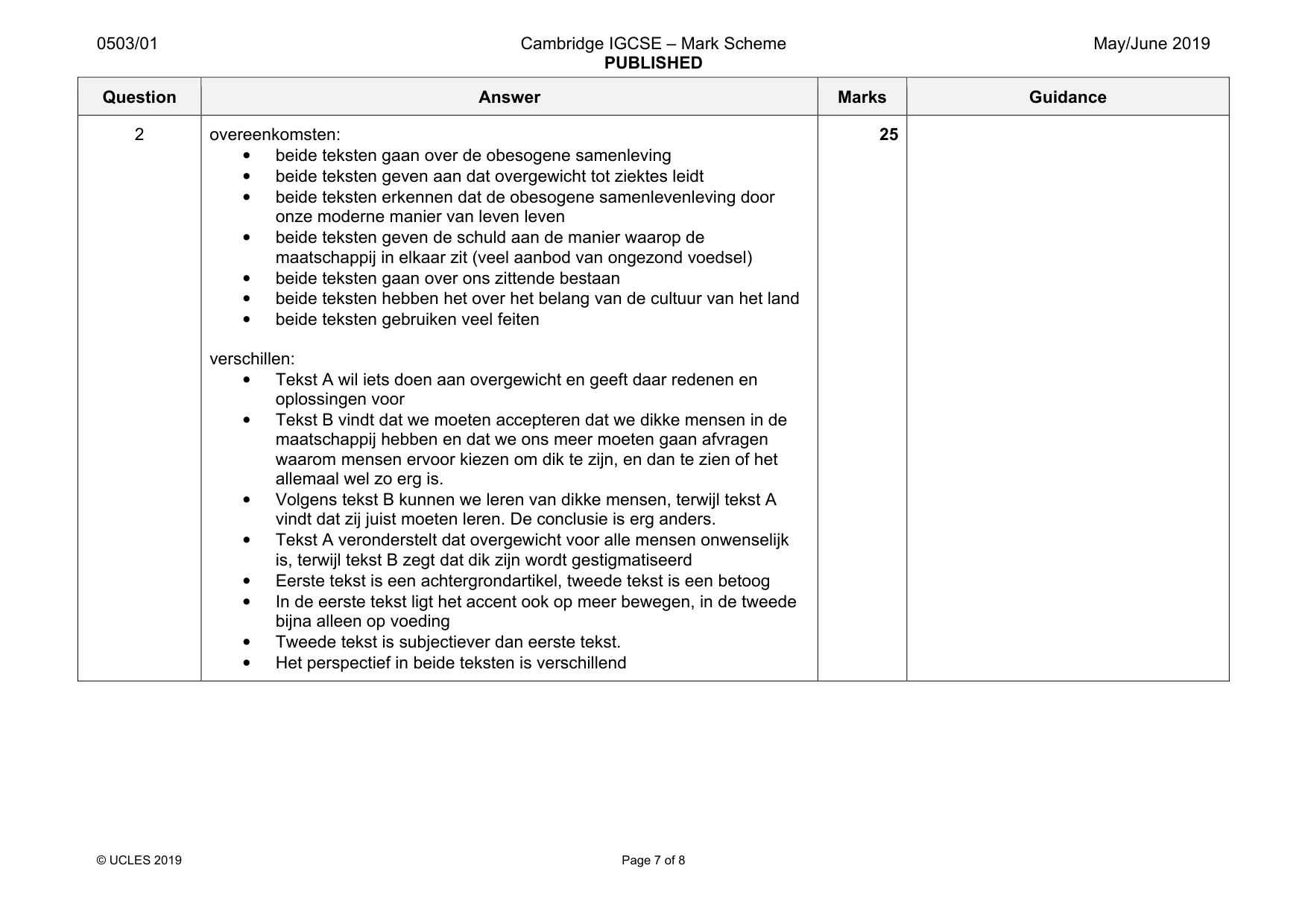
0503/01 Cambridge IGCSE – Mark Scheme PUBLISHED May/June 2019 © UCLES 2019 Page 7 of 8 Question Answer Marks Guidance 2 overeenkomsten: • beide teksten gaan over de obesogene samenleving • beide teksten geven aan dat overgewicht tot ziektes leidt • beide teksten erkennen dat de obesogene samenlevenleving door onze moderne manier van leven leven • beide teksten geven de schuld aan de manier waarop de maatschappij in elkaar zit (veel aanbod van ongezond voedsel) • beide teksten gaan over ons zittende bestaan • beide teksten hebben het over het belang van de cultuur van het land • beide teksten gebruiken veel feiten verschillen: • Tekst A wil iets doen aan overgewicht en geeft daar redenen en oplossingen voor • Tekst B vindt dat we moeten accepteren dat we dikke mensen in de maatschappij hebben en dat we ons meer moeten gaan afvragen waarom mensen ervoor kiezen om dik te zijn, en dan te zien of het allemaal wel zo erg is. • Volgens tekst B kunnen we leren van dikke mensen, terwijl tekst A vindt dat zij juist moeten leren. De conclusie is erg anders. • Tekst A veronderstelt dat overgewicht voor alle mensen onwenselijk is, terwijl tekst B zegt dat dik zijn wordt gestigmatiseerd • Eerste tekst is een achtergrondartikel, tweede tekst is een betoog • In de eerste tekst ligt het accent ook op meer bewegen, in de tweede bijna alleen op voeding • Tweede tekst is subjectiever dan eerste tekst. • Het perspectief in beide teksten is verschillend 25
Mark scheme, page 8
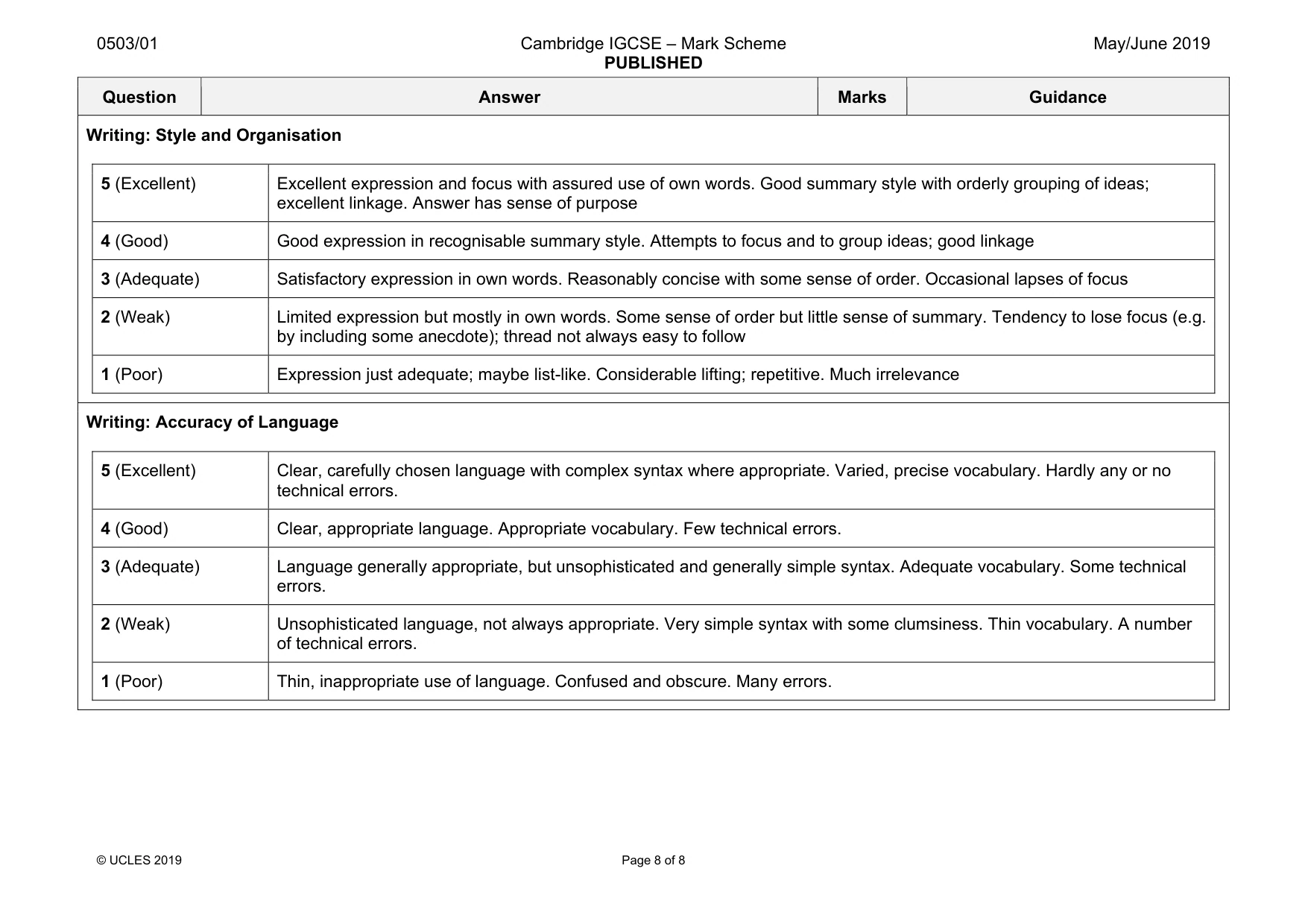
0503/01 Cambridge IGCSE – Mark Scheme PUBLISHED May/June 2019 © UCLES 2019 Page 8 of 8 Question Answer Marks Guidance Writing: Style and Organisation 5 (Excellent) Excellent expression and focus with assured use of own words. Good summary style with orderly grouping of ideas; excellent linkage. Answer has sense of purpose 4 (Good) Good expression in recognisable summary style. Attempts to focus and to group ideas; good linkage 3 (Adequate) Satisfactory expression in own words. Reasonably concise with some sense of order. Occasional lapses of focus 2 (Weak) Limited expression but mostly in own words. Some sense of order but little sense of summary. Tendency to lose focus (e.g. by including some anecdote); thread not always easy to follow 1 (Poor) Expression just adequate; maybe list-like. Considerable lifting; repetitive. Much irrelevance Writing: Accuracy of Language 5 (Excellent) Clear, carefully chosen language with complex syntax where appropriate. Varied, precise vocabulary. Hardly any or no technical errors. 4 (Good) Clear, appropriate language. Appropriate vocabulary. Few technical errors. 3 (Adequate) Language generally appropriate, but unsophisticated and generally simple syntax. Adequate vocabulary. Some technical errors. 2 (Weak) Unsophisticated language, not always appropriate. Very simple syntax with some clumsiness. Thin vocabulary. A number of technical errors. 1 (Poor) Thin, inappropriate use of language. Confused and obscure. Many errors.
What you needed in this session
Cambridge’s own grade thresholds for 2019 May/June, Paper 1 · Variant 1. A higher threshold means an easier paper — the bar moves with how the cohort did.