Cambridge IGCSE Dutch - First Language 0503 — 2017 May/June Paper 1 · Variant 1
0503/11/M/J/17 · 50 marks · ≈56 min
The question paper and its mark scheme, free to read here and free to download. This is Cambridge’s own paper, exactly as it was sat.
Question paper8 pages
Mark scheme5 pages
Answers below. Sit the paper first if you are practising.
Paper as text
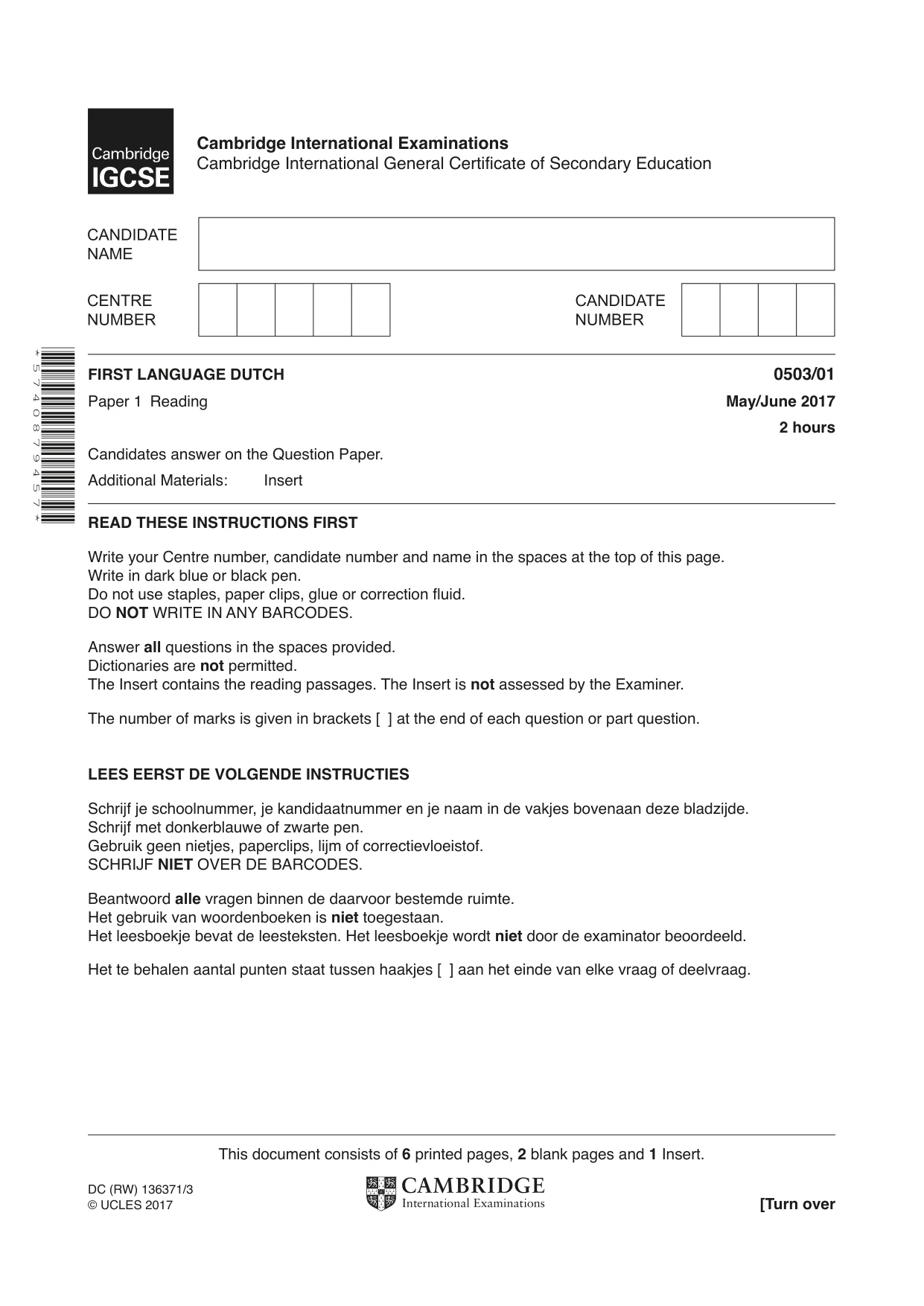
Question paper, page 1
* 5 7 4 0 8 7 9 4 5 7 * This document consists of 6 printed pages, 2 blank pages and 1 Insert. DC (RW) 136371/3 © UCLES 2017 [Turn over Cambridge International Examinations Cambridge International General Certificate of Secondary Education FIRST LANGUAGE DUTCH 0503/01 Paper 1 Reading May/June 2017 2 hours Candidates answer on the Question Paper. Additional Materials: Insert READ THESE INSTRUCTIONS FIRST Write your Centre number, candidate number and name in the spaces at the top of this page. Write in dark blue or black pen. Do not use staples, paper clips, glue or correction fluid. DO NOT WRITE IN ANY BARCODES. Answer all questions in the spaces provided. Dictionaries are not permitted. The Insert contains the reading passages. The Insert is not assessed by the Examiner. The number of marks is given in brackets [ ] at the end of each question or part question. LEES EERST DE VOLGENDE INSTRUCTIES Schrijf je schoolnummer, je kandidaatnummer en je naam in de vakjes bovenaan deze bladzijde. Schrijf met donkerblauwe of zwarte pen. Gebruik geen nietjes, paperclips, lijm of correctievloeistof. SCHRIJF NIET OVER DE BARCODES. Beantwoord alle vragen binnen de daarvoor bestemde ruimte. Het gebruik van woordenboeken is niet toegestaan. Het leesboekje bevat de leesteksten. Het leesboekje wordt niet door de examinator beoordeeld. Het te behalen aantal punten staat tussen haakjes [ ] aan het einde van elke vraag of deelvraag.
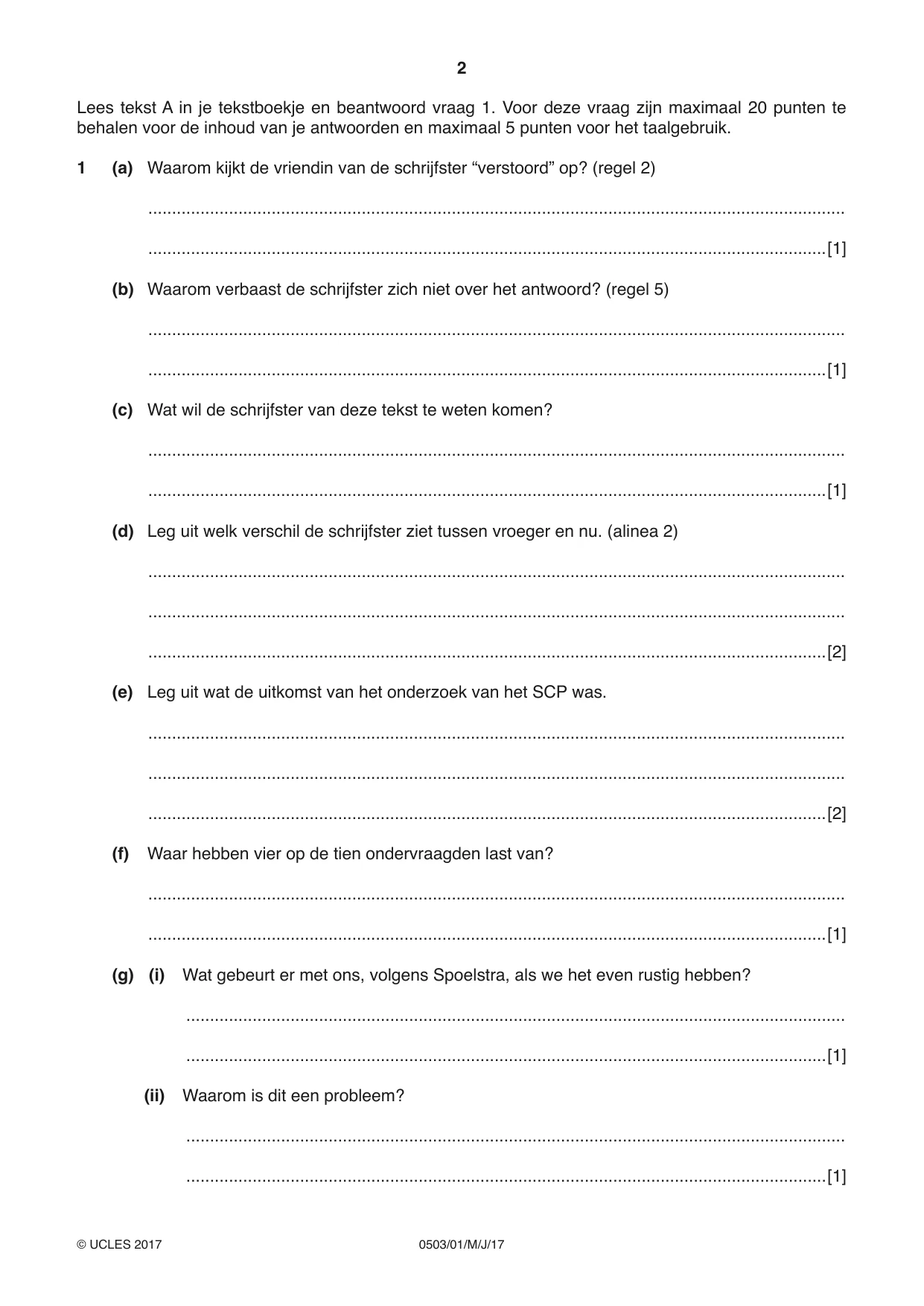
Question paper, page 2
2 0503/01/M/J/17 © UCLES 2017 Lees tekst A in je tekstboekje en beantwoord vraag 1. Voor deze vraag zijn maximaal 20 punten te behalen voor de inhoud van je antwoorden en maximaal 5 punten voor het taalgebruik. 1 (a) Waarom kijkt de vriendin van de schrijfster “verstoord” op? (regel 2) … …[1] (b) Waarom verbaast de schrijfster zich niet over het antwoord? (regel 5) … …[1] (c) Wat wil de schrijfster van deze tekst te weten komen? … …[1] (d) Leg uit welk verschil de schrijfster ziet tussen vroeger en nu. (alinea 2) … … …[2] (e) Leg uit wat de uitkomst van het onderzoek van het SCP was. … … …[2] (f) Waar hebben vier op de tien ondervraagden last van? … …[1] (g) (i) Wat gebeurt er met ons, volgens Spoelstra, als we het even rustig hebben? … …[1] (ii) Waarom is dit een probleem? … …[1]
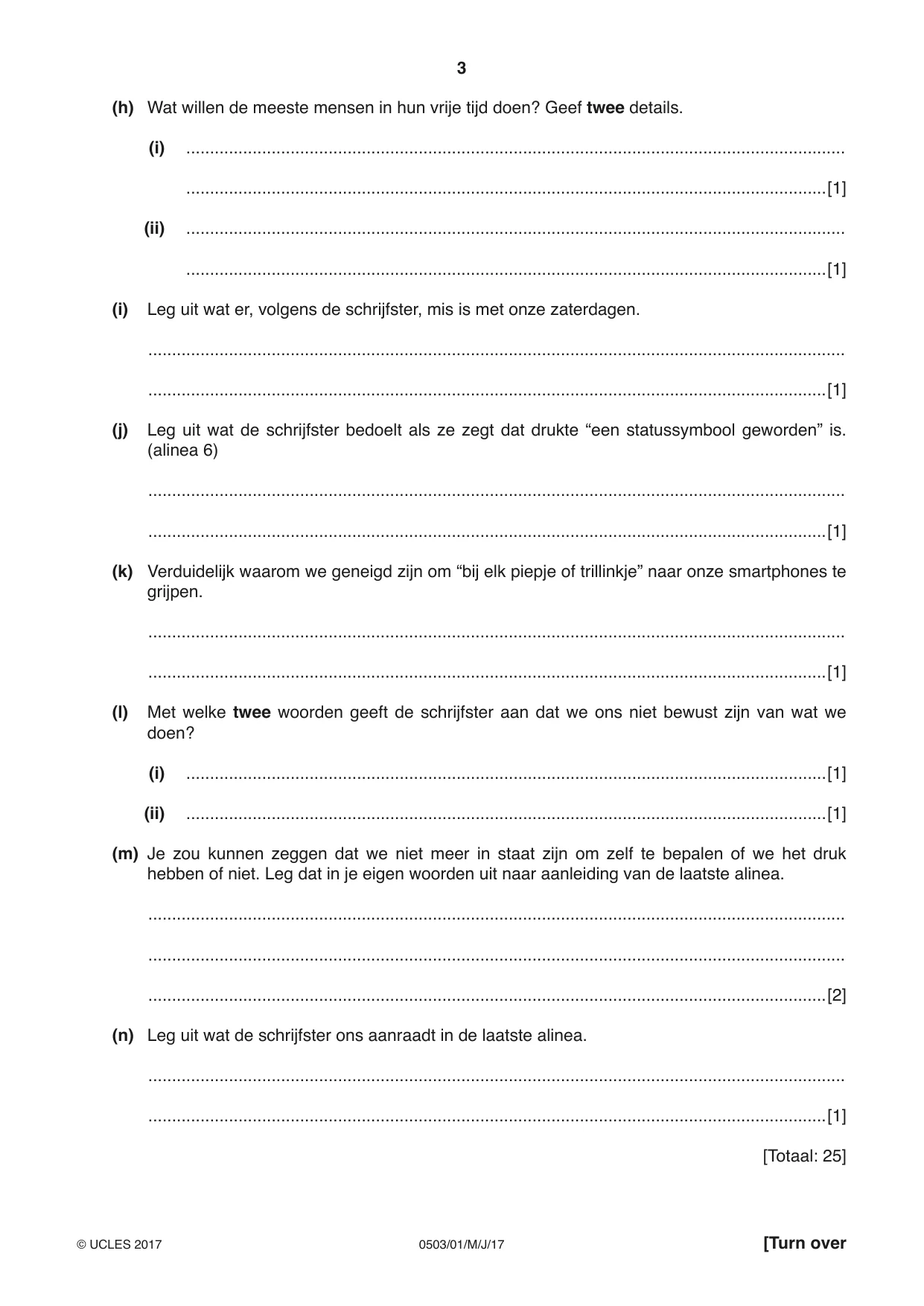
Question paper, page 3
3 0503/01/M/J/17 © UCLES 2017 [Turn over (h) Wat willen de meeste mensen in hun vrije tijd doen? Geef twee details. (i) … …[1] (ii) … …[1] (i) Leg uit wat er, volgens de schrijfster, mis is met onze zaterdagen. … …[1] (j) Leg uit wat de schrijfster bedoelt als ze zegt dat drukte “een statussymbool geworden” is. (alinea 6) … …[1] (k) Verduidelijk waarom we geneigd zijn om “bij elk piepje of trillinkje” naar onze smartphones te grijpen. … …[1] (l) Met welke twee woorden geeft de schrijfster aan dat we ons niet bewust zijn van wat we doen? (i) …[1] (ii) …[1] (m) Je zou kunnen zeggen dat we niet meer in staat zijn om zelf te bepalen of we het druk hebben of niet. Leg dat in je eigen woorden uit naar aanleiding van de laatste alinea. … … …[2] (n) Leg uit wat de schrijfster ons aanraadt in de laatste alinea. … …[1] [Totaal: 25]
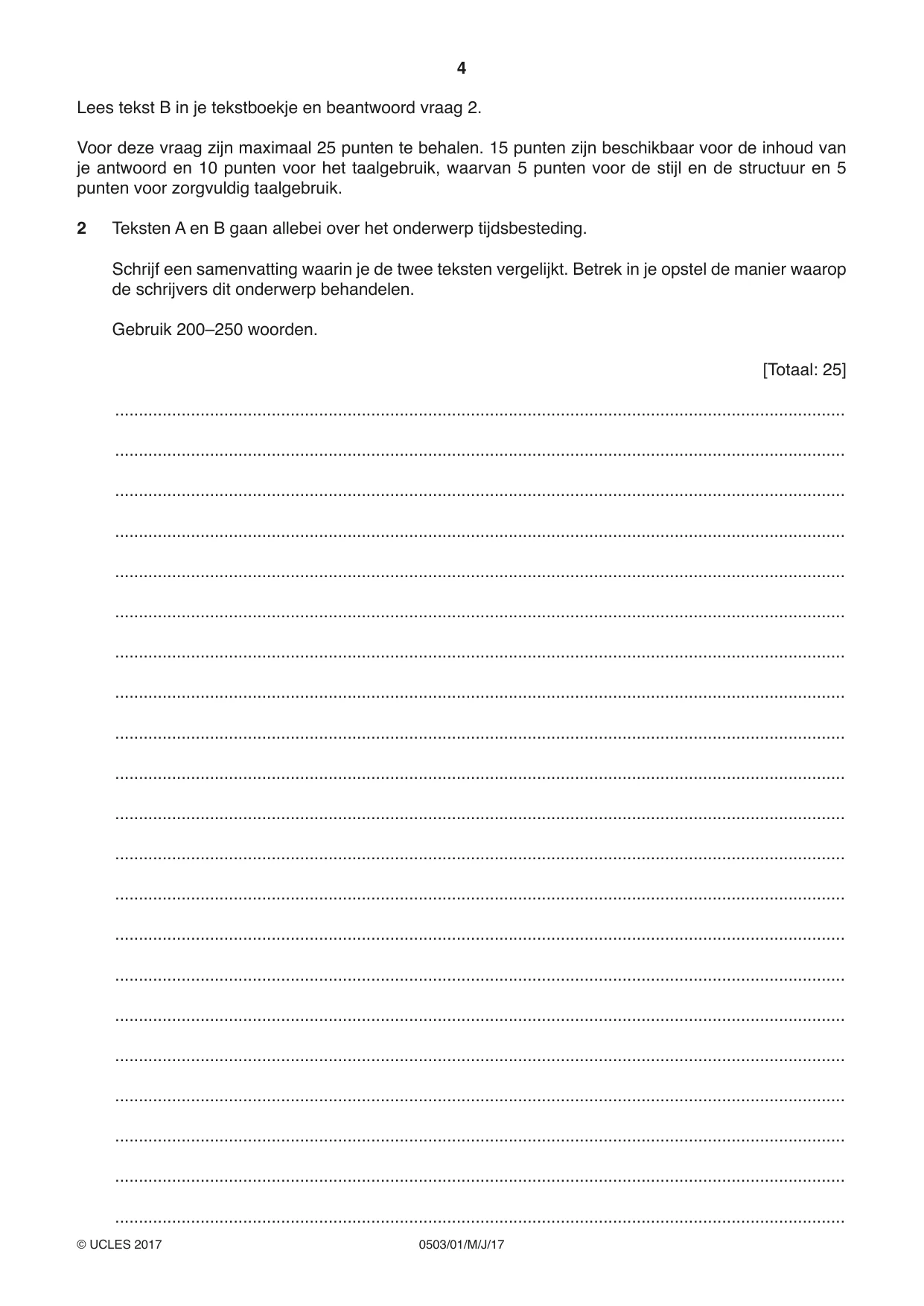
Question paper, page 4
4 0503/01/M/J/17 © UCLES 2017 Lees tekst B in je tekstboekje en beantwoord vraag 2. Voor deze vraag zijn maximaal 25 punten te behalen. 15 punten zijn beschikbaar voor de inhoud van je antwoord en 10 punten voor het taalgebruik, waarvan 5 punten voor de stijl en de structuur en 5 punten voor zorgvuldig taalgebruik. 2 Teksten A en B gaan allebei over het onderwerp tijdsbesteding. Schrijf een samenvatting waarin je de twee teksten vergelijkt. Betrek in je opstel de manier waarop de schrijvers dit onderwerp behandelen. Gebruik 200–250 woorden. [Totaal: 25] … … … … … … … … … … … … … … … … … … … … …
Question paper, page 5
5 0503/01/M/J/17 © UCLES 2017 [Turn over … … … … … … … … … … … … … … … … … … … … … … … … … … … …
Question paper, page 6
6 0503/01/M/J/17 © UCLES 2017 … … … … … … … … … … … … … … … … … … … … … … … … … … … …
Question paper, page 7
7 0503/01/M/J/17 © UCLES 2017 BLANK PAGE
Question paper, page 8
8 0503/01/M/J/17 © UCLES 2017 Permission to reproduce items where third-party owned material protected by copyright is included has been sought and cleared where possible. Every reasonable effort has been made by the publisher (UCLES) to trace copyright holders, but if any items requiring clearance have unwittingly been included, the publisher will be pleased to make amends at the earliest possible opportunity. To avoid the issue of disclosure of answer-related information to candidates, all copyright acknowledgements are reproduced online in the Cambridge International Examinations Copyright Acknowledgements Booklet. This is produced for each series of examinations and is freely available to download at www.cie.org.uk after the live examination series. Cambridge International Examinations is part of the Cambridge Assessment Group. Cambridge Assessment is the brand name of University of Cambridge Local Examinations Syndicate (UCLES), which is itself a department of the University of Cambridge. BLANK PAGE
Mark scheme, page 1
® IGCSE is a registered trademark. This document consists of 5 printed pages. © UCLES 2017 [Turn over Cambridge International Examinations Cambridge International General Certificate of Secondary Education FIRST LANGUAGE DUTCH 0503/01 Paper 1 Reading May/June 2017 MARK SCHEME Maximum Mark: 50 Published This mark scheme is published as an aid to teachers and candidates, to indicate the requirements of the examination. It shows the basis on which Examiners were instructed to award marks. It does not indicate the details of the discussions that took place at an Examiners’ meeting before marking began, which would have considered the acceptability of alternative answers. Mark schemes should be read in conjunction with the question paper and the Principal Examiner Report for Teachers. Cambridge will not enter into discussions about these mark schemes. Cambridge is publishing the mark schemes for the May/June 2017 series for most Cambridge IGCSE®, Cambridge International A and AS Level and Cambridge Pre-U components, and some Cambridge O Level components.
Mark scheme, page 2
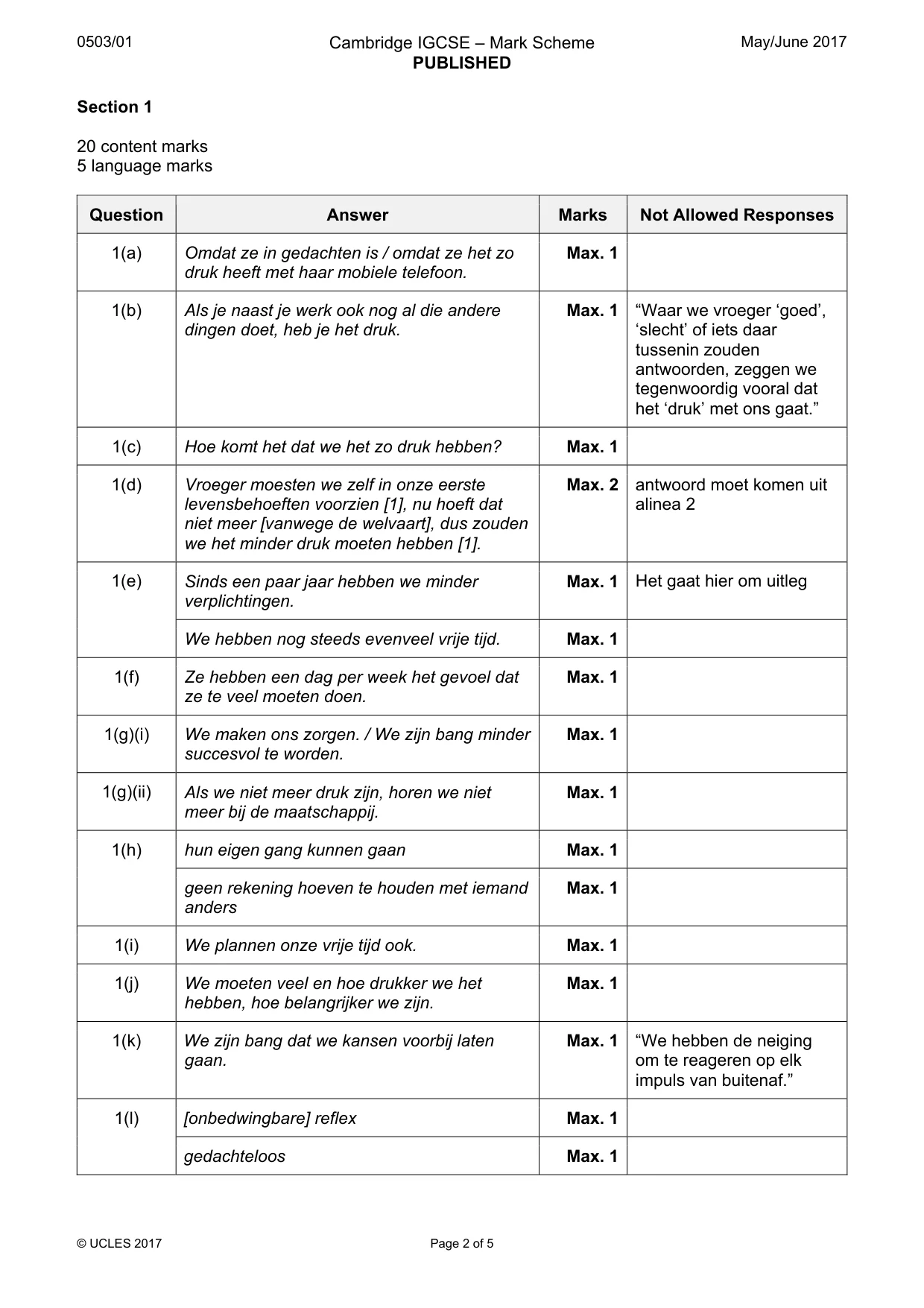
0503/01 Cambridge IGCSE – Mark Scheme PUBLISHED May/June 2017 © UCLES 2017 Page 2 of 5 Section 1 20 content marks 5 language marks Question Answer Marks Not Allowed Responses 1(a) Omdat ze in gedachten is / omdat ze het zo druk heeft met haar mobiele telefoon. Max. 1 1(b) Als je naast je werk ook nog al die andere dingen doet, heb je het druk. Max. 1 “Waar we vroeger ‘goed’, ‘slecht’ of iets daar tussenin zouden antwoorden, zeggen we tegenwoordig vooral dat het ‘druk’ met ons gaat.” 1(c) Hoe komt het dat we het zo druk hebben? Max. 1 1(d) Vroeger moesten we zelf in onze eerste levensbehoeften voorzien [1], nu hoeft dat niet meer [vanwege de welvaart], dus zouden we het minder druk moeten hebben [1]. Max. 2 antwoord moet komen uit alinea 2 1(e) Sinds een paar jaar hebben we minder verplichtingen. Max. 1 Het gaat hier om uitleg We hebben nog steeds evenveel vrije tijd. Max. 1 1(f) Ze hebben een dag per week het gevoel dat ze te veel moeten doen. Max. 1 1(g)(i) We maken ons zorgen. / We zijn bang minder succesvol te worden. Max. 1 1(g)(ii) Als we niet meer druk zijn, horen we niet meer bij de maatschappij. Max. 1 1(h) hun eigen gang kunnen gaan Max. 1 geen rekening hoeven te houden met iemand anders Max. 1 1(i) We plannen onze vrije tijd ook. Max. 1 1(j) We moeten veel en hoe drukker we het hebben, hoe belangrijker we zijn. Max. 1 1(k) We zijn bang dat we kansen voorbij laten gaan. Max. 1 “We hebben de neiging om te reageren op elk impuls van buitenaf.” 1(l) [onbedwingbare] reflex Max. 1 gedachteloos Max. 1
Mark scheme, page 3
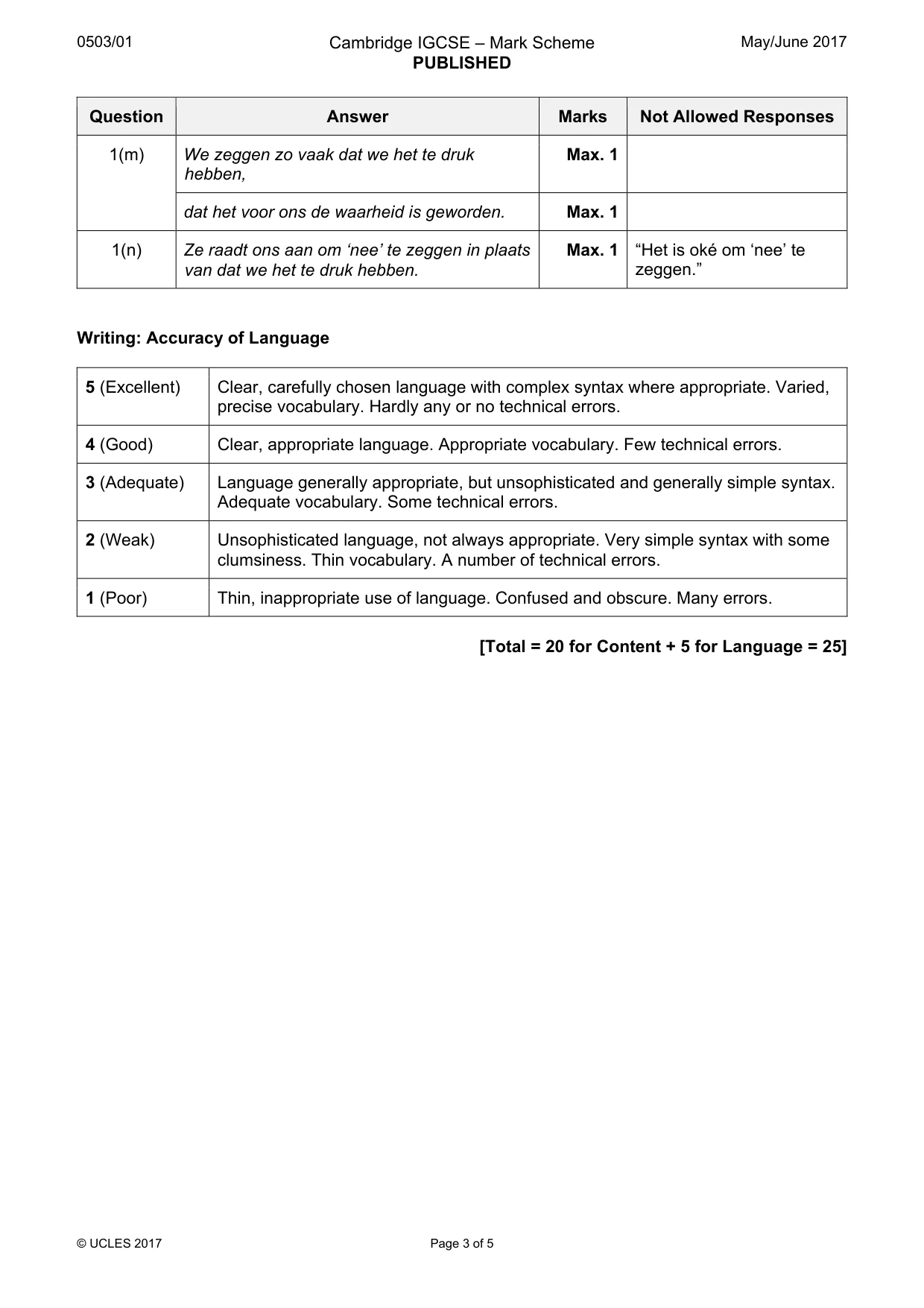
0503/01 Cambridge IGCSE – Mark Scheme PUBLISHED May/June 2017 © UCLES 2017 Page 3 of 5 Question Answer Marks Not Allowed Responses 1(m) We zeggen zo vaak dat we het te druk hebben, Max. 1 dat het voor ons de waarheid is geworden. Max. 1 1(n) Ze raadt ons aan om ‘nee’ te zeggen in plaats van dat we het te druk hebben. Max. 1 “Het is oké om ‘nee’ te zeggen.” Writing: Accuracy of Language 5 (Excellent) Clear, carefully chosen language with complex syntax where appropriate. Varied, precise vocabulary. Hardly any or no technical errors. 4 (Good) Clear, appropriate language. Appropriate vocabulary. Few technical errors. 3 (Adequate) Language generally appropriate, but unsophisticated and generally simple syntax. Adequate vocabulary. Some technical errors. 2 (Weak) Unsophisticated language, not always appropriate. Very simple syntax with some clumsiness. Thin vocabulary. A number of technical errors. 1 (Poor) Thin, inappropriate use of language. Confused and obscure. Many errors. [Total = 20 for Content + 5 for Language = 25]
Mark scheme, page 4
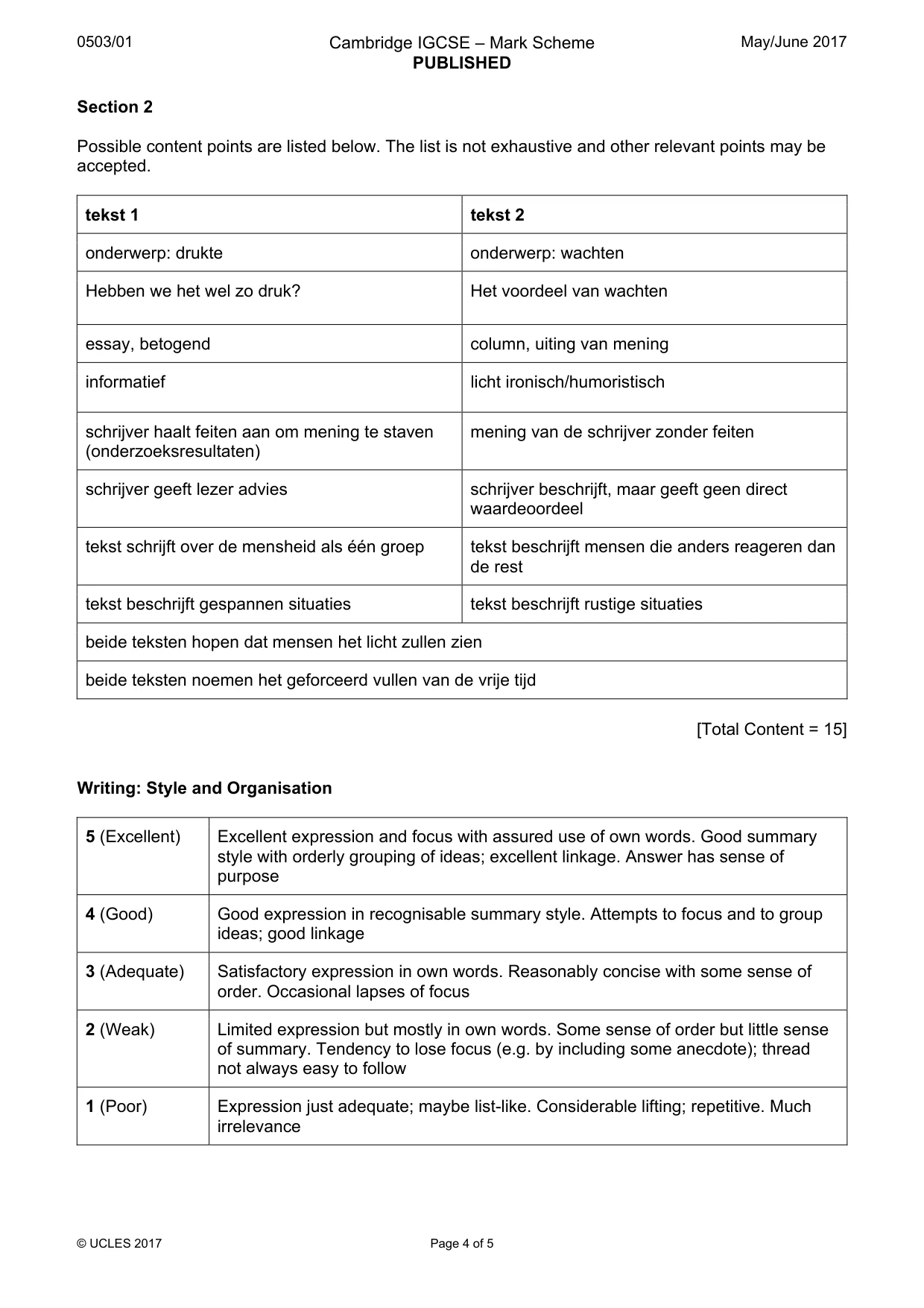
0503/01 Cambridge IGCSE – Mark Scheme PUBLISHED May/June 2017 © UCLES 2017 Page 4 of 5 Section 2 Possible content points are listed below. The list is not exhaustive and other relevant points may be accepted. tekst 1 tekst 2 onderwerp: drukte onderwerp: wachten Hebben we het wel zo druk? Het voordeel van wachten essay, betogend column, uiting van mening informatief licht ironisch/humoristisch schrijver haalt feiten aan om mening te staven (onderzoeksresultaten) mening van de schrijver zonder feiten schrijver geeft lezer advies schrijver beschrijft, maar geeft geen direct waardeoordeel tekst schrijft over de mensheid als één groep tekst beschrijft mensen die anders reageren dan de rest tekst beschrijft gespannen situaties tekst beschrijft rustige situaties beide teksten hopen dat mensen het licht zullen zien beide teksten noemen het geforceerd vullen van de vrije tijd [Total Content = 15] Writing: Style and Organisation 5 (Excellent) Excellent expression and focus with assured use of own words. Good summary style with orderly grouping of ideas; excellent linkage. Answer has sense of purpose 4 (Good) Good expression in recognisable summary style. Attempts to focus and to group ideas; good linkage 3 (Adequate) Satisfactory expression in own words. Reasonably concise with some sense of order. Occasional lapses of focus 2 (Weak) Limited expression but mostly in own words. Some sense of order but little sense of summary. Tendency to lose focus (e.g. by including some anecdote); thread not always easy to follow 1 (Poor) Expression just adequate; maybe list-like. Considerable lifting; repetitive. Much irrelevance
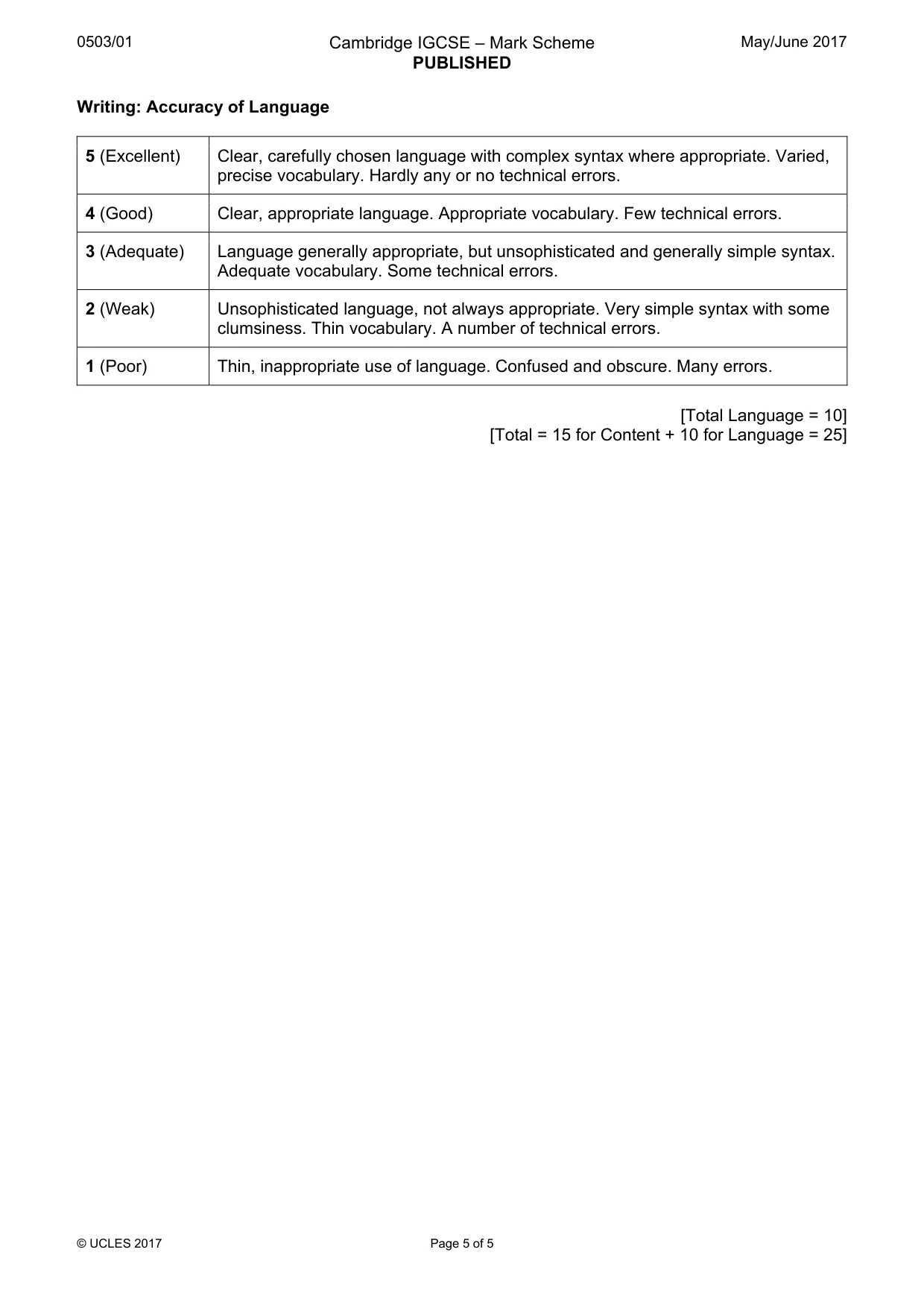
Mark scheme, page 5
0503/01 Cambridge IGCSE – Mark Scheme PUBLISHED May/June 2017 © UCLES 2017 Page 5 of 5 Writing: Accuracy of Language 5 (Excellent) Clear, carefully chosen language with complex syntax where appropriate. Varied, precise vocabulary. Hardly any or no technical errors. 4 (Good) Clear, appropriate language. Appropriate vocabulary. Few technical errors. 3 (Adequate) Language generally appropriate, but unsophisticated and generally simple syntax. Adequate vocabulary. Some technical errors. 2 (Weak) Unsophisticated language, not always appropriate. Very simple syntax with some clumsiness. Thin vocabulary. A number of technical errors. 1 (Poor) Thin, inappropriate use of language. Confused and obscure. Many errors. [Total Language = 10] [Total = 15 for Content + 10 for Language = 25]
What you needed in this session
Cambridge’s own grade thresholds for 2017 May/June, Paper 1 · Variant 1. A higher threshold means an easier paper — the bar moves with how the cohort did.