Cambridge IGCSE Design and Technology 0445 — 2017 Oct/Nov Paper 3 · Variant 1
0445/31/O/N/17 · 13 questions · 50 marks · ≈56 min
The question paper and its mark scheme, free to read here and free to download. This is Cambridge’s own paper, exactly as it was sat.
Question paper16 pages
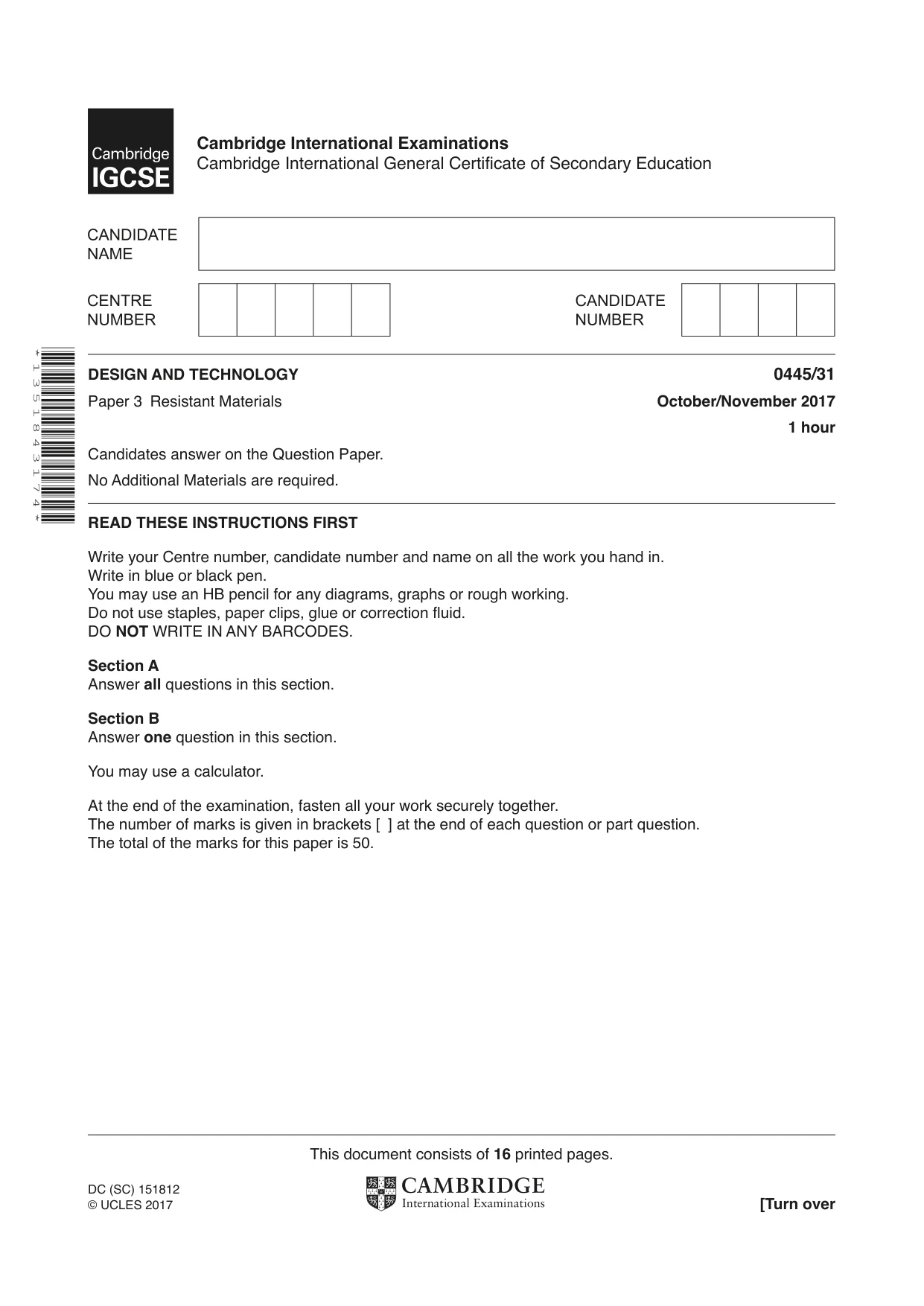
Mark scheme5 pages
Answers below. Sit the paper first if you are practising.
Questions as text
Question 1
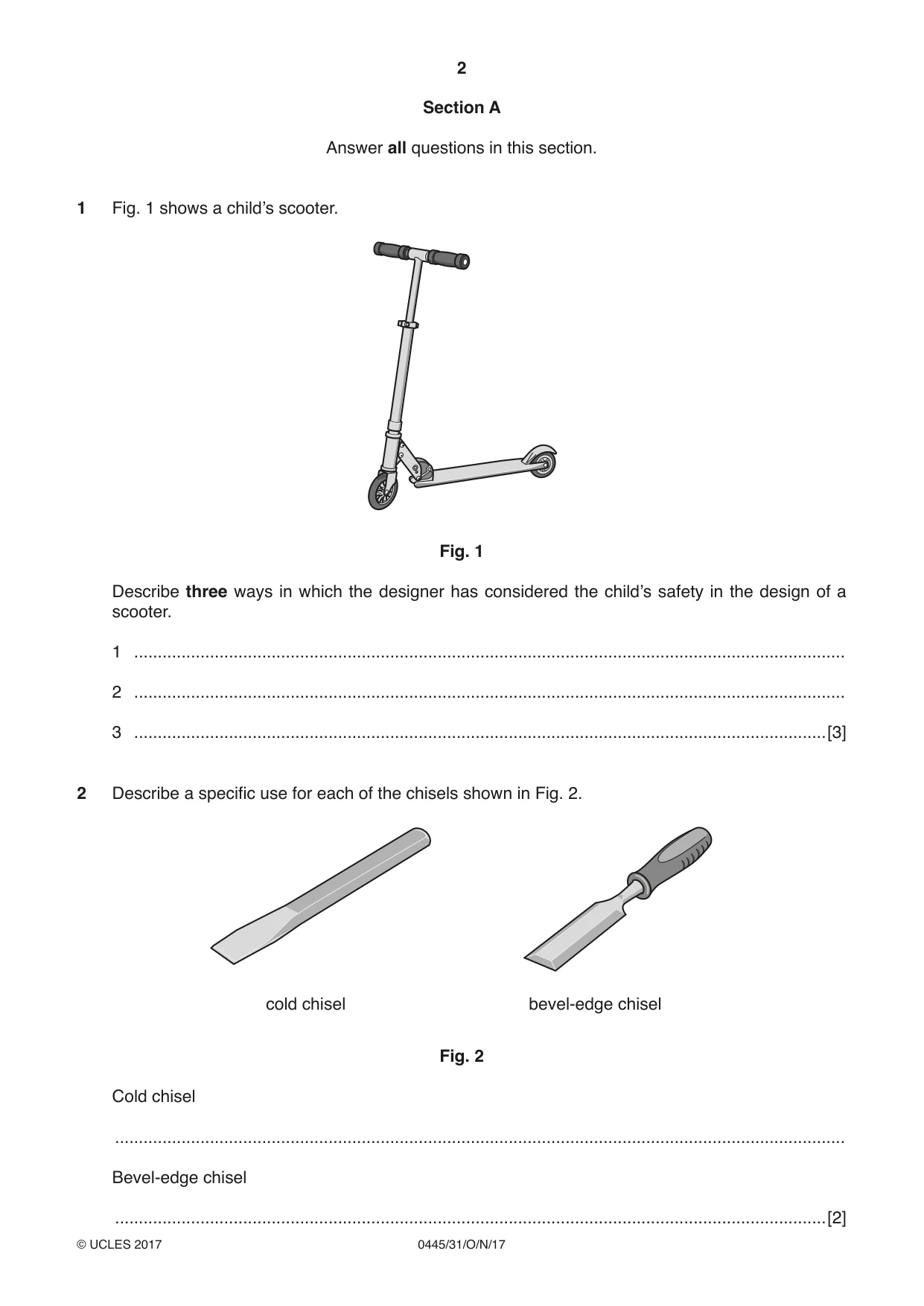
1 Fig. 1 shows a child’s scooter. Fig. 1 Describe three ways in which the designer has considered the child’s safety in the design of a scooter. 1 ...................................................................................................................................................... 2 ...................................................................................................................................................... 3 ..................................................................................................................................................[3]
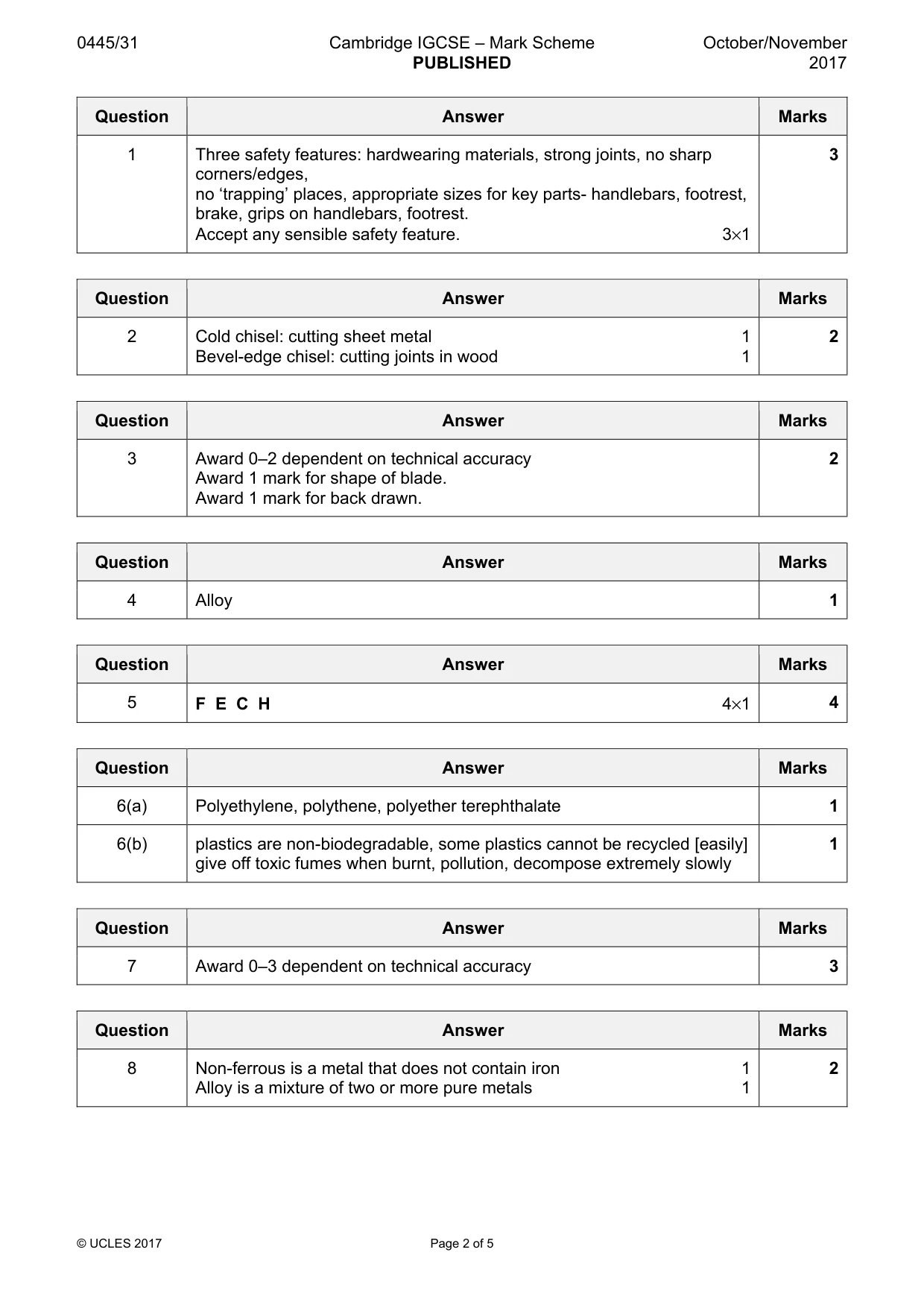
Mark scheme: Question Answer Marks 1 Three safety features: hardwearing materials, strong joints, no sharp 3 corners/edges, no ‘trapping’ places, appropriate sizes for key parts- handlebars, footrest, brake, grips on handlebars, footrest. Accept any sensible safety feature. 3×1
Q2 · Describe a specific use for each of the chisels shown in Fig
2 Describe a specific use for each of the chisels shown in Fig. 2. cold chisel bevel-edge chisel Fig. 2 Cold chisel .......................................................................................................................................................... Bevel-edge chisel ......................................................................................................................................................[2]
Mark scheme: 2 Cold chisel: cutting sheet metal 1 2 Bevel-edge chisel: cutting joints in wood 1
Q3 · Complete the drawing below to show a tenon saw
3 Complete the drawing below to show a tenon saw. [2]
Mark scheme: 3 Award 0–2 dependent on technical accuracy 2 Award 1 mark for shape of blade. Award 1 mark for back drawn.
Q4 · SMA is a smart material that, when bent out of shape, will return to its original shape…
4 SMA is a smart material that, when bent out of shape, will return to its original shape when heated. SMA stands for: Shape Memory A................................ [1]
Mark scheme: 4 Alloy 1
Q5 · A variety of tools used in a school workshop
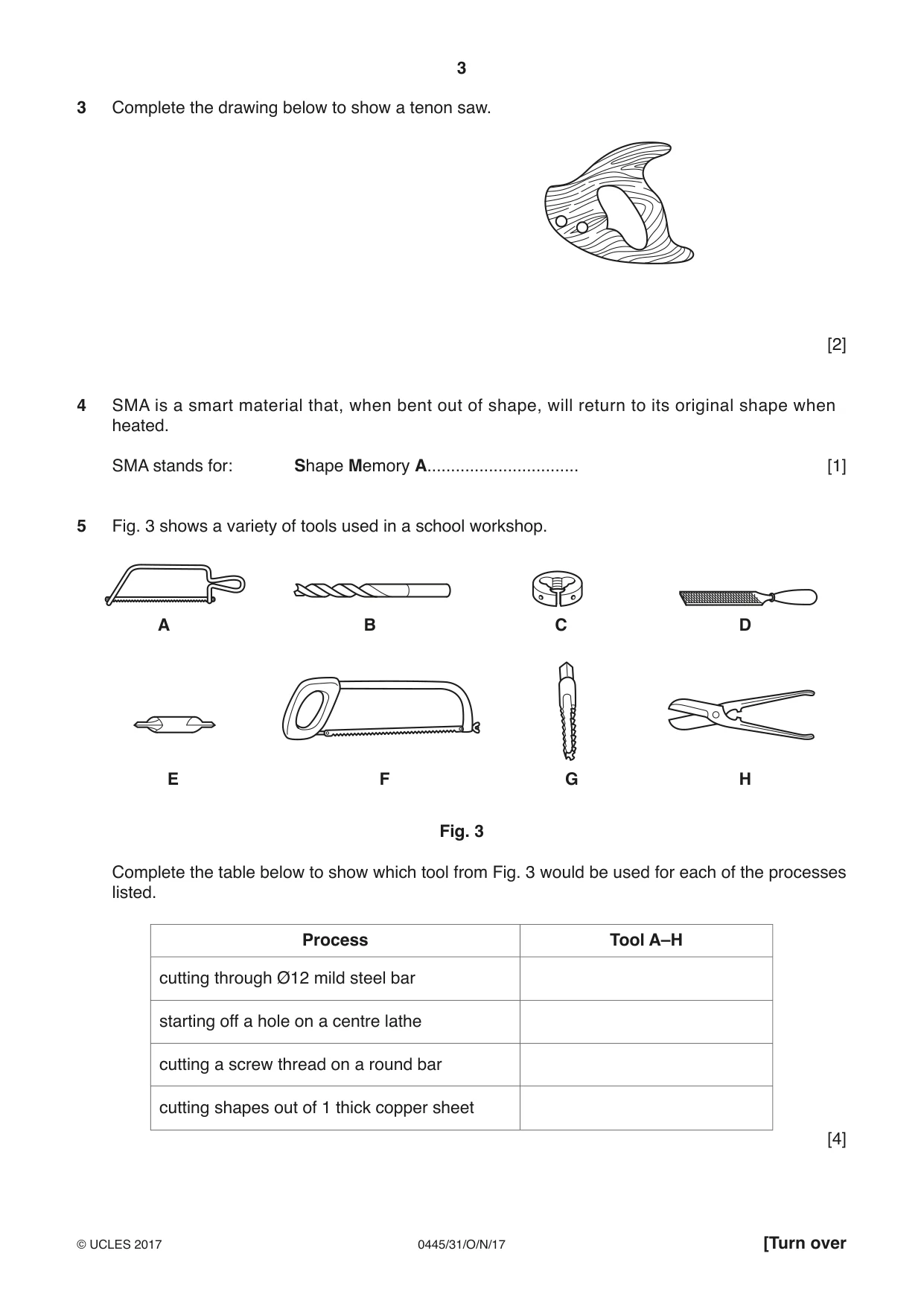
5 Fig. 3 shows a variety of tools used in a school workshop. A B C D E F G H Fig. 3 Complete the table below to show which tool from Fig. 3 would be used for each of the processes listed. Process Tool A–H cutting through Ø12 mild steel bar starting off a hole on a centre lathe cutting a screw thread on a round bar cutting shapes out of 1 thick copper sheet [4]
Mark scheme: 5 F E C H 4×1 4
Q6 · A washing-up liquid bottle made from plastic and a symbol that can be seen on the bottle
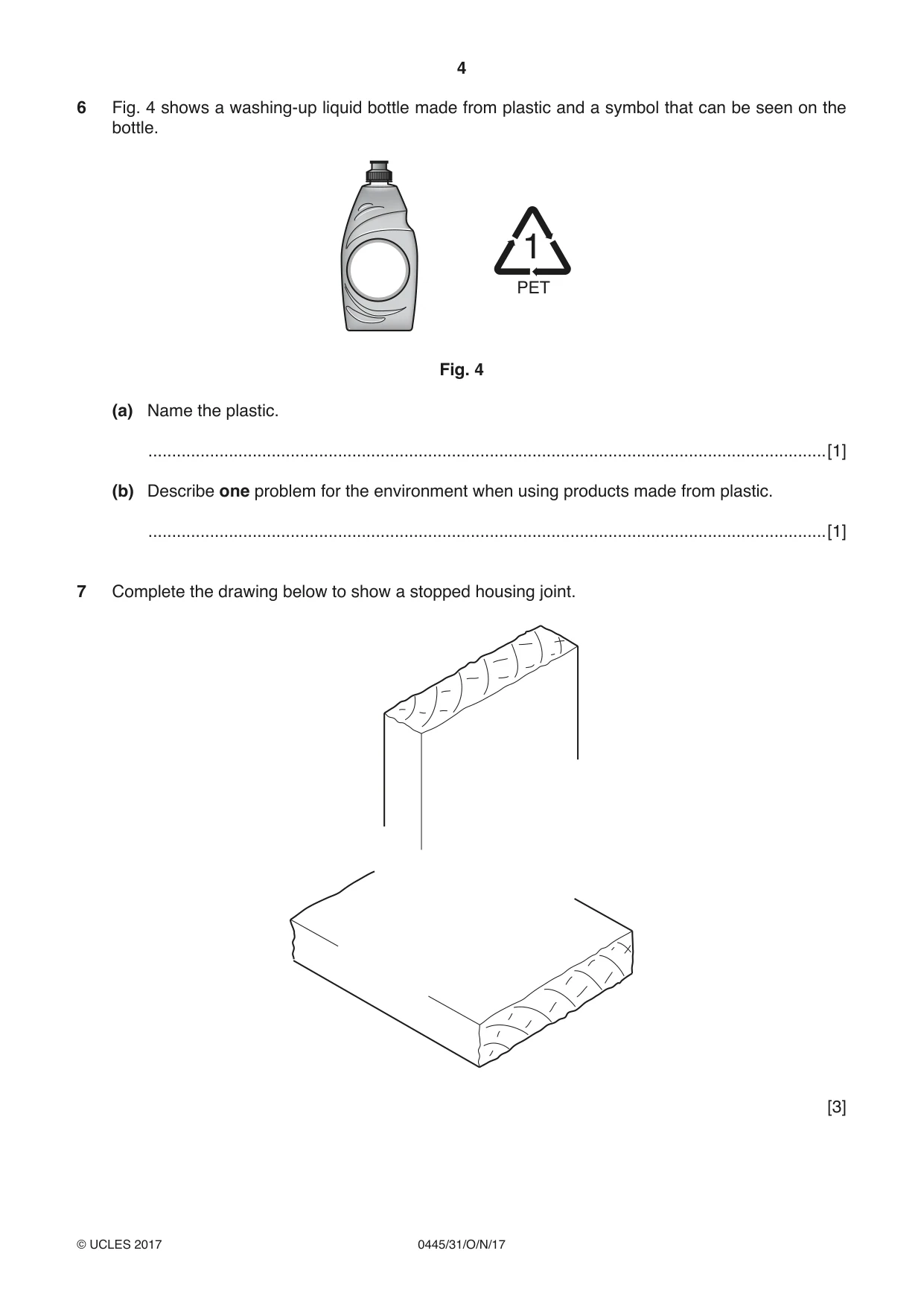
6 Fig. 4 shows a washing-up liquid bottle made from plastic and a symbol that can be seen on the bottle. 1 PET Fig. 4 (a) Name the plastic. ...............................................................................................................................................[1] (b) Describe one problem for the environment when using products made from plastic. ...............................................................................................................................................[1]
Mark scheme: 6(a) Polyethylene, polythene, polyether terephthalate 1 6(b) plastics are non-biodegradable, some plastics cannot be recycled [easily] 1 give off toxic fumes when burnt, pollution, decompose extremely slowly
Q7 · Complete the drawing below to show a stopped housing joint
7 Complete the drawing below to show a stopped housing joint. [3]
Mark scheme: 7 Award 0–3 dependent on technical accuracy 3
Q8 · A house number plate made from brass, a non-ferrous alloy
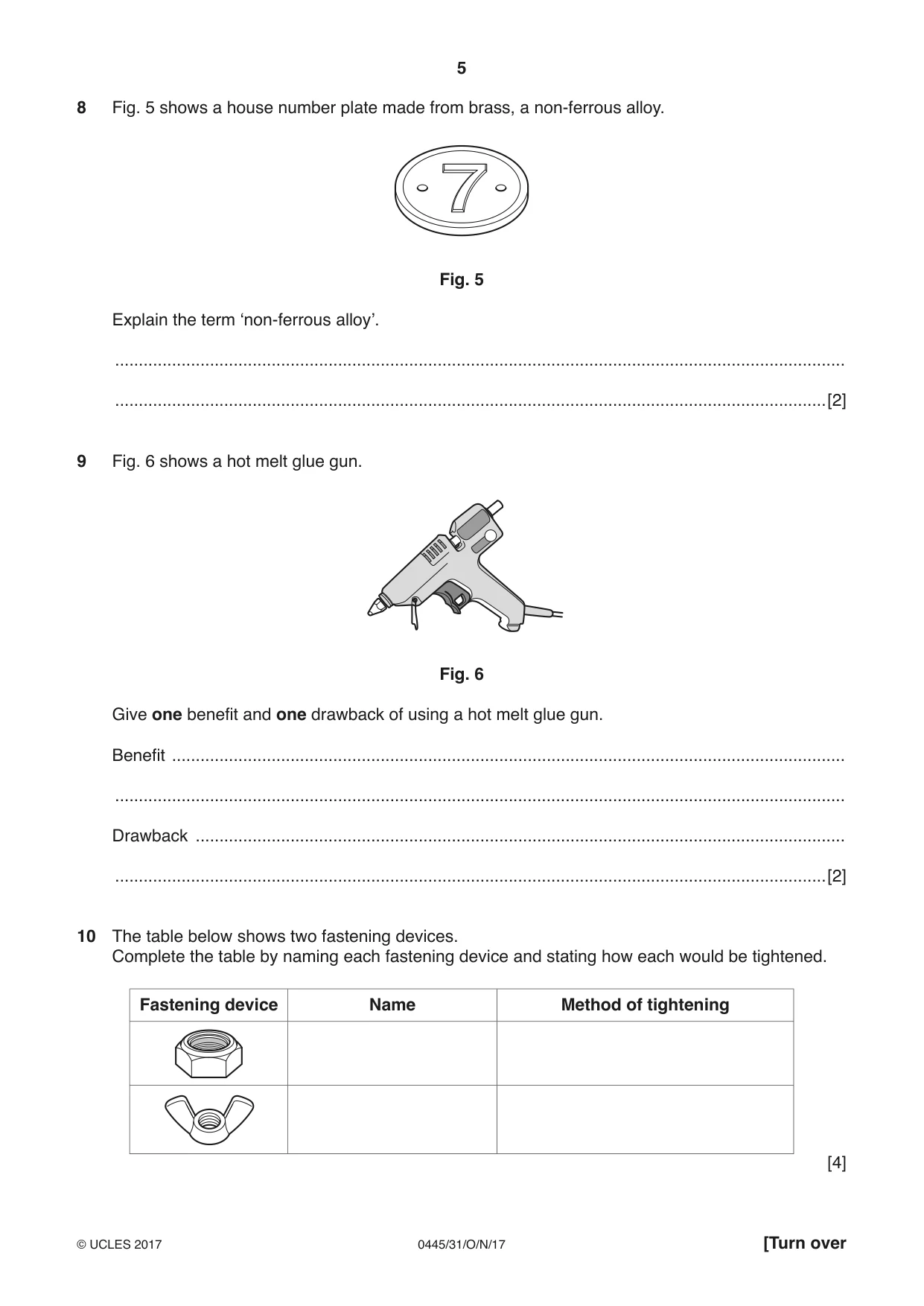
8 Fig. 5 shows a house number plate made from brass, a non-ferrous alloy. Fig. 5 Explain the term ‘non-ferrous alloy’. .......................................................................................................................................................... ......................................................................................................................................................[2]
Mark scheme: 8 Non-ferrous is a metal that does not contain iron 1 2 Alloy is a mixture of two or more pure metals 1
Q9 · A hot melt glue gun
9 Fig. 6 shows a hot melt glue gun. Fig. 6 Give one benefit and one drawback of using a hot melt glue gun. Benefit .............................................................................................................................................. .......................................................................................................................................................... Drawback ......................................................................................................................................... ......................................................................................................................................................[2]
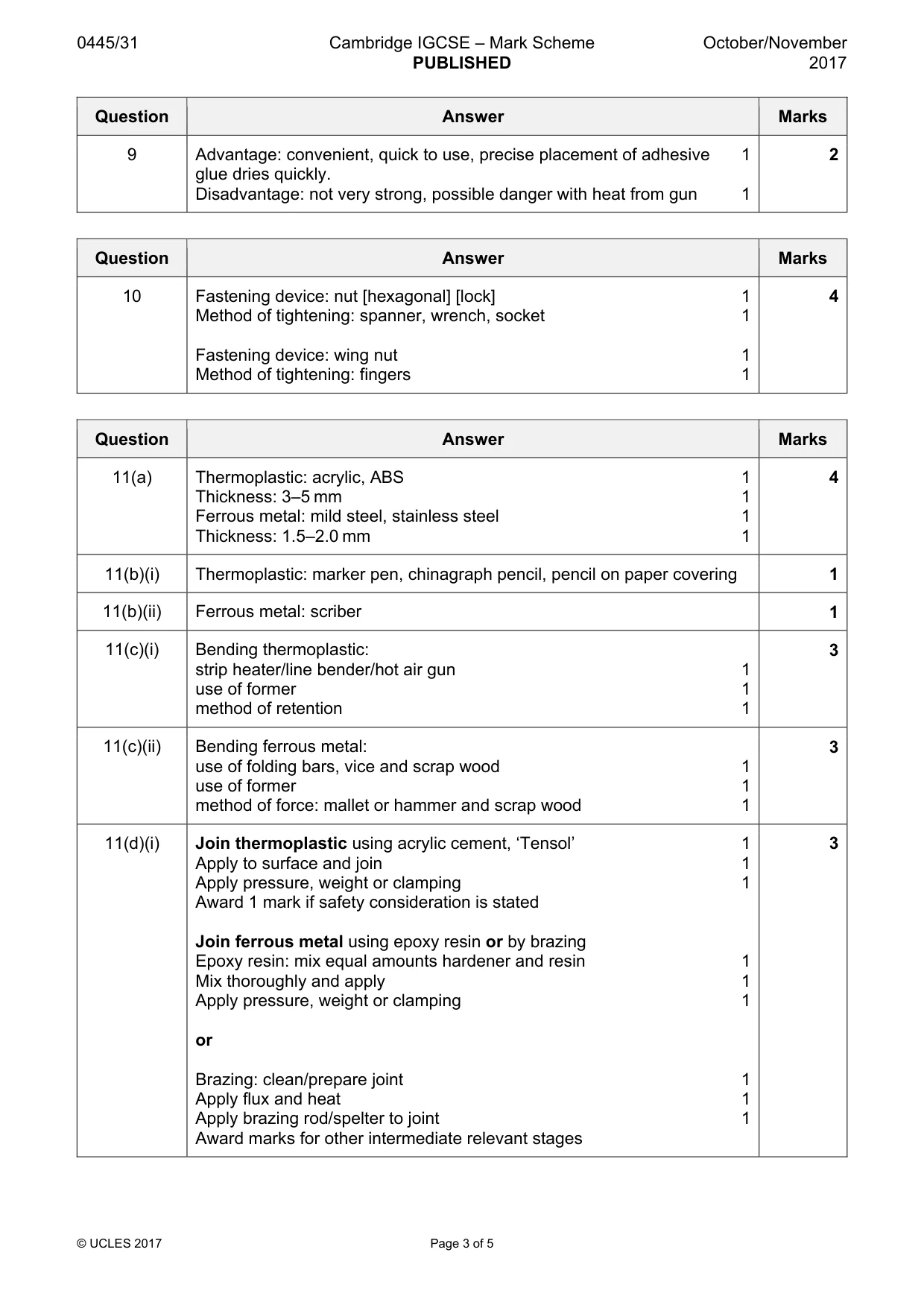
Mark scheme: 9 Advantage: convenient, quick to use, precise placement of adhesive 1 2 glue dries quickly. Disadvantage: not very strong, possible danger with heat from gun 1
Q10 · The table below shows two fastening devices
10 The table below shows two fastening devices. Complete the table by naming each fastening device and stating how each would be tightened. Fastening device Name Method of tightening [4]
Mark scheme: 10 Fastening device: nut [hexagonal] [lock] 1 4 Method of tightening: spanner, wrench, socket 1 Fastening device: wing nut 1 Method of tightening: fingers 1
Question 11
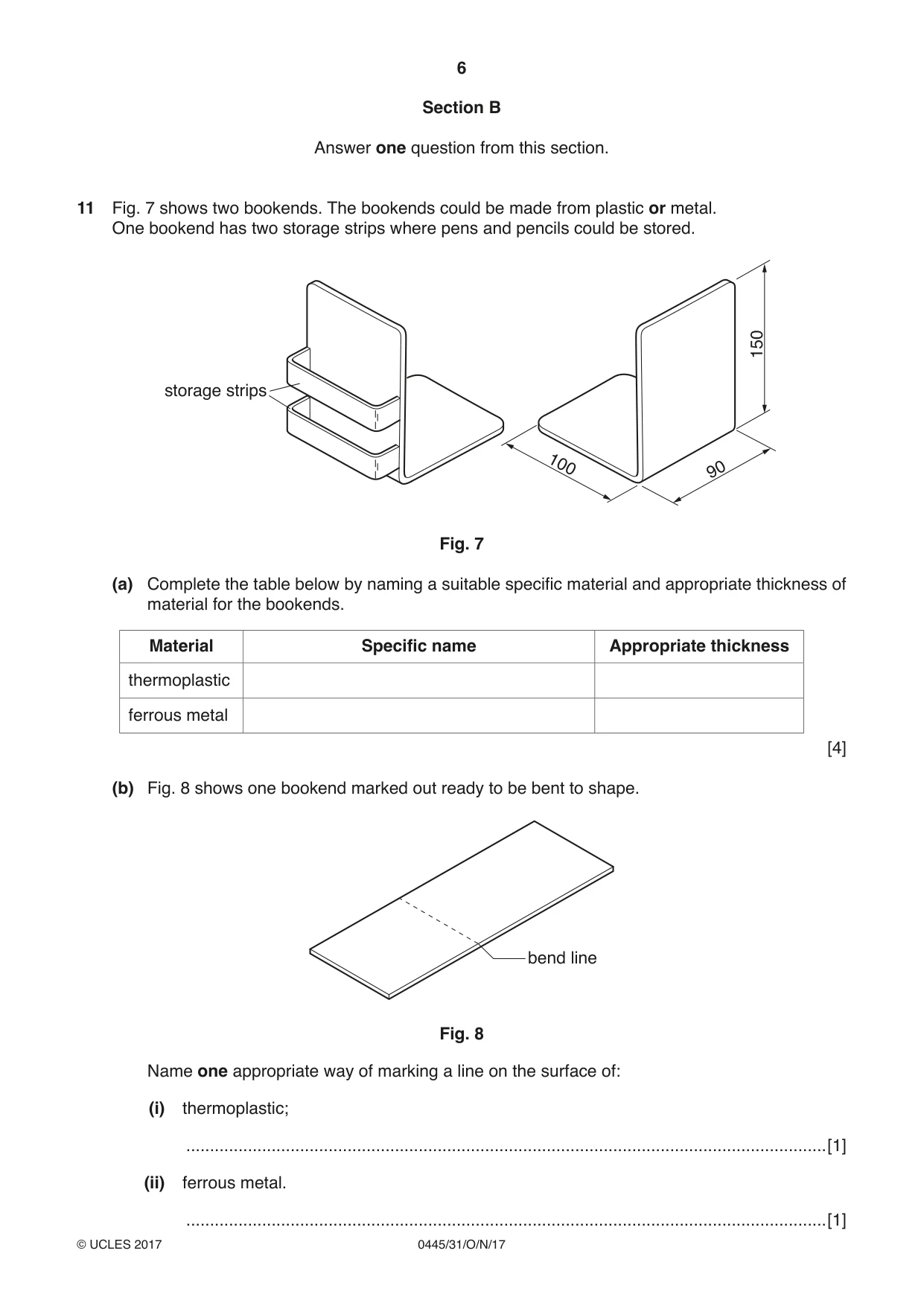
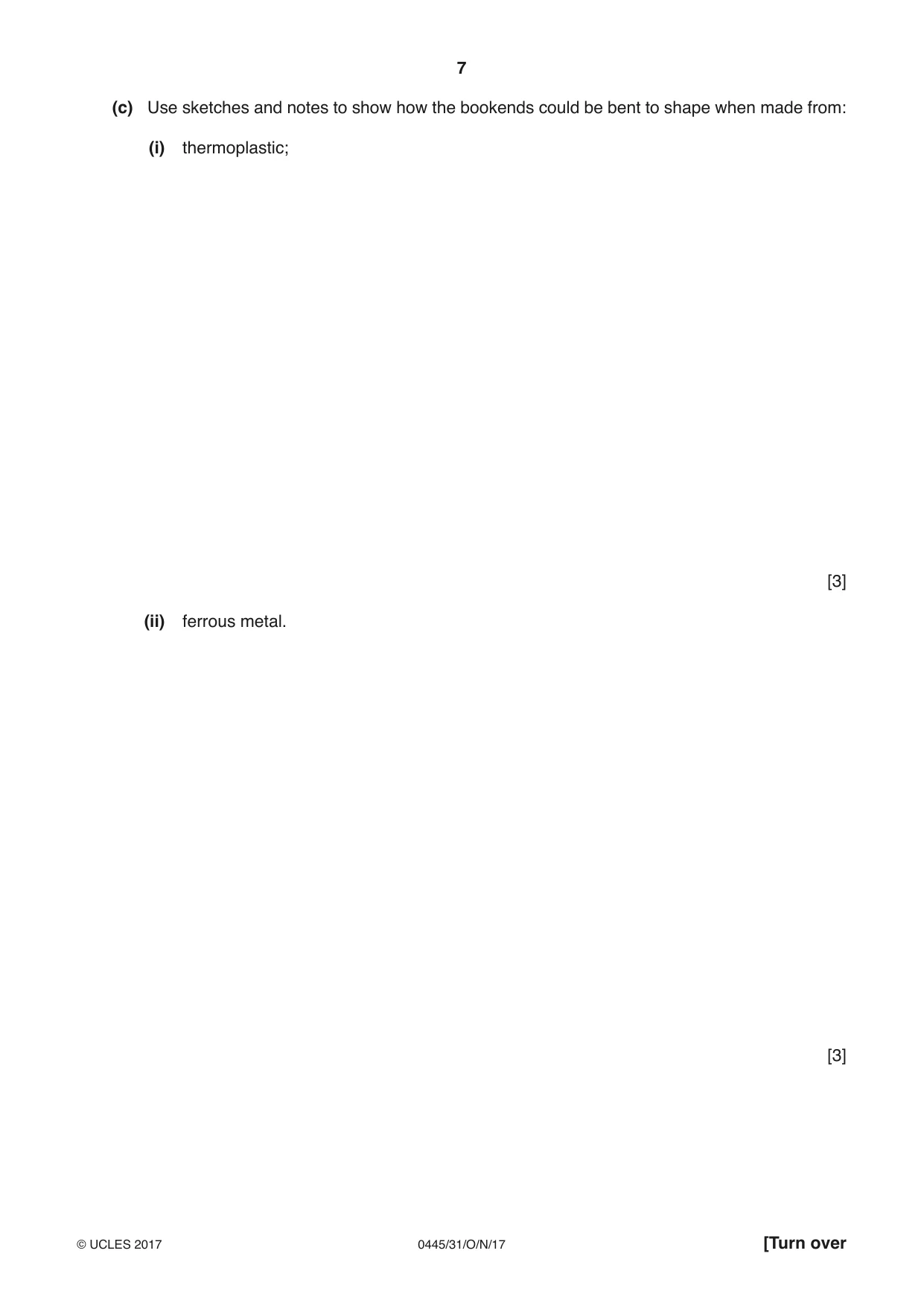
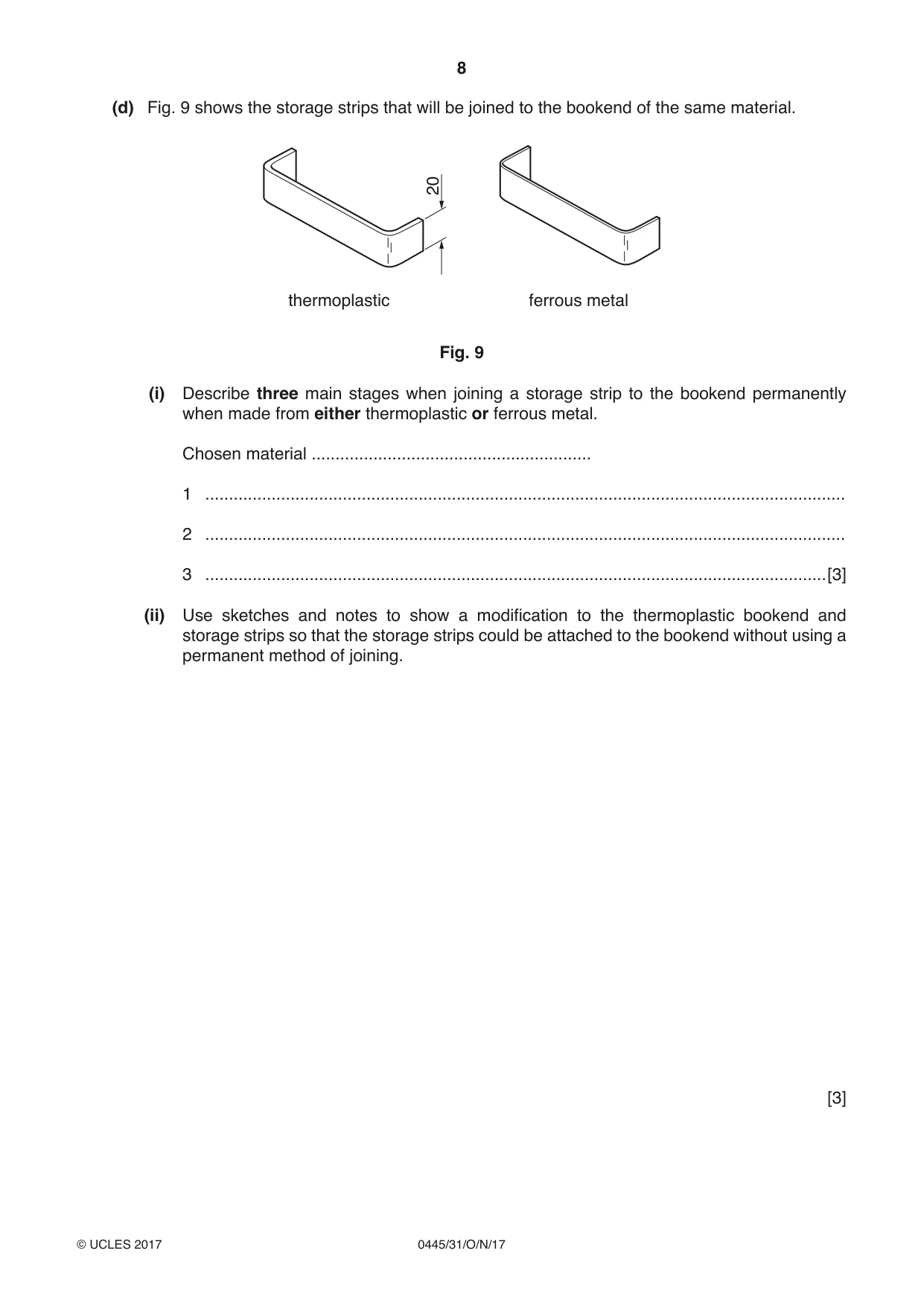
11 Fig. 7 shows two bookends. The bookends could be made from plastic or metal. One bookend has two storage strips where pens and pencils could be stored. 150 storage strips 100 90 Fig. 7 (a) Complete the table below by naming a suitable specific material and appropriate thickness of material for the bookends. Material Specific name Appropriate thickness thermoplastic ferrous metal [4] (b) Fig. 8 shows one bookend marked out ready to be bent to shape. bend line Fig. 8 Name one appropriate way of marking a line on the surface of: (i) thermoplastic; .......................................................................................................................................[1] (ii) ferrous metal. .......................................................................................................................................[1] (c) Use sketches and notes to show how the bookends could be bent to shape when made from: (i) thermoplastic; [3] (ii) ferrous metal. [3] (d) Fig. 9 shows the storage strips that will be joined to the bookend of the same material. 20 thermoplastic ferrous metal Fig. 9 (i) Describe three main stages when joining a storage strip to the bookend permanently when made from either thermoplastic or ferrous metal. Chosen material ........................................................... 1 ....................................................................................................................................... 2 ....................................................................................................................................... 3 ...................................................................................................................................[3] (ii) Use sketches and notes to show a modification to the thermoplastic bookend and storage strips so that the storage strips could be attached to the bookend without using a permanent method of joining. [3] (e) (i) The thermoplastic bookend will be self-finished. Explain what is meant by the term ‘self-finished’. ........................................................................................................................................... ........................................................................................................................................... .......................................................................................................................................[2] (ii) The ferrous metal bookend will be finished by dip coating with plastic. Describe three main stages in the process of dip coating with plastic. 1 ....................................................................................................................................... 2 ....................................................................................................................................... 3 ...................................................................................................................................[3] (f) The bookends are to be manufactured in large quantities. Give two benefits to a manufacturer to produce the bookends without the storage strips. 1 ............................................................................................................................................... 2 ...........................................................................................................................................[2]
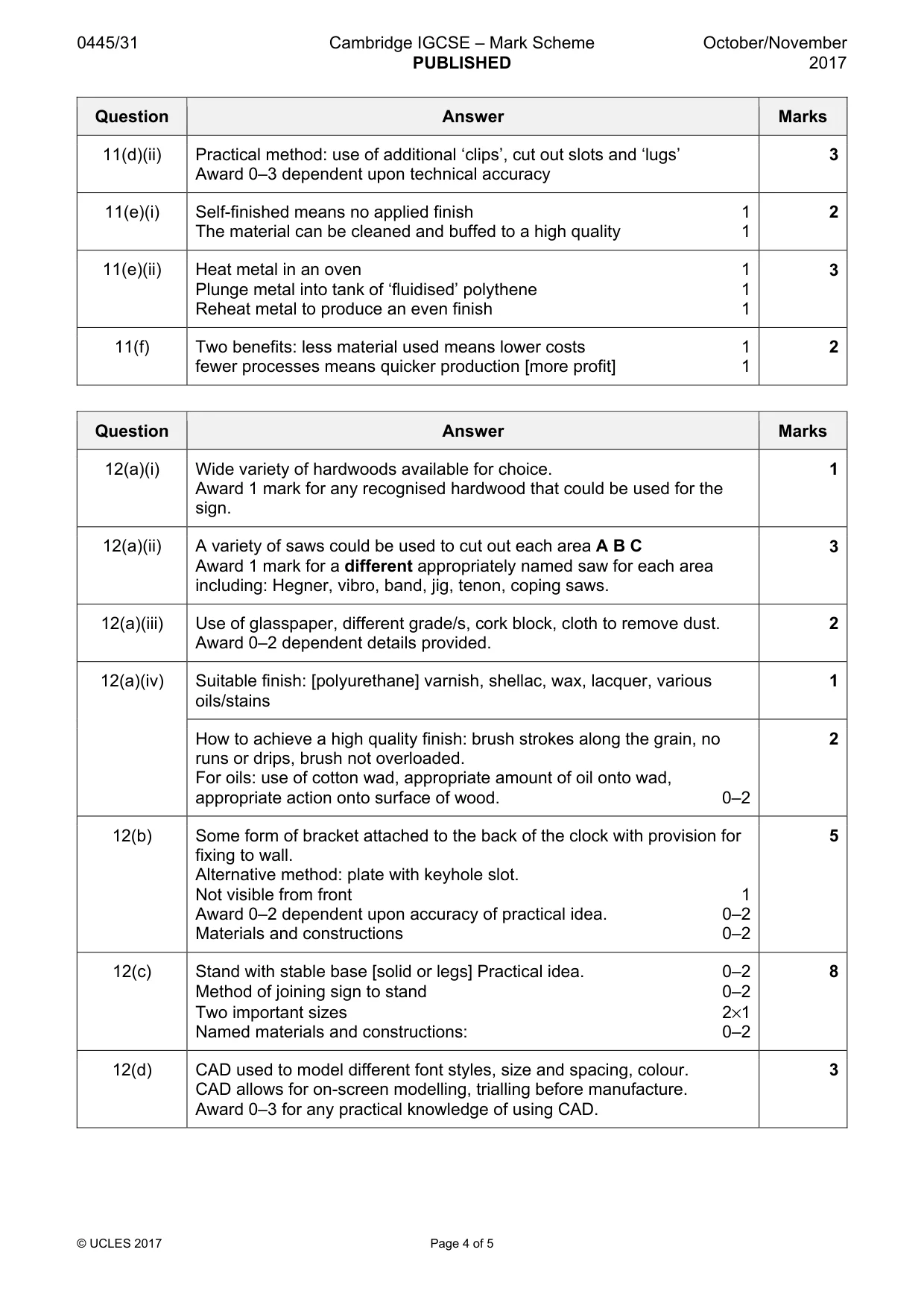
Mark scheme: 11(a) Thermoplastic: acrylic, ABS 1 4 Thickness: 3–5 mm 1 Ferrous metal: mild steel, stainless steel 1 Thickness: 1.5–2.0 mm 1 11(b)(i) Thermoplastic: marker pen, chinagraph pencil, pencil on paper covering 1 11(b)(ii) Ferrous metal: scriber 1 11(c)(i) Bending thermoplastic: 3 strip heater/line bender/hot air gun 1 use of former 1 method of retention 1 11(c)(ii) Bending ferrous metal: 3 use of folding bars, vice and scrap wood 1 use of former 1 method of force: mallet or hammer and scrap wood 1 11(d)(i) Join thermoplastic using acrylic cement, ‘Tensol’ 1 3 Apply to surface and join 1 Apply pressure, weight or clamping 1 Award 1 mark if safety consideration is stated Join ferrous metal using epoxy resin or by brazing Epoxy resin: mix equal amounts hardener and resin 1 Mix thoroughly and apply 1 Apply pressure, weight or clamping 1 or Brazing: clean/prepare joint 1 Apply flux and heat 1 Apply brazing rod/spelter to joint 1 Award marks for other intermediate relevant stages 11(d)(ii) Practical method: use of additional ‘clips’, cut out slots and ‘lugs’ 3 Award 0–3 dependent upon technical accuracy 11(e)(i) Self-finished means no applied finish 1 2 The material can be cleaned and buffed to a high quality 1 11(e)(ii) Heat metal in an oven 1 3 Plunge metal into tank of ‘fluidised’ polythene 1 Reheat metal to produce an even finish 1 11(f) Two benefits: less material used means lower costs 1 2 fewer processes means quicker production [more profit] 1
Q12 · A sign that will be located in a school corridor to give directions to a Design and…
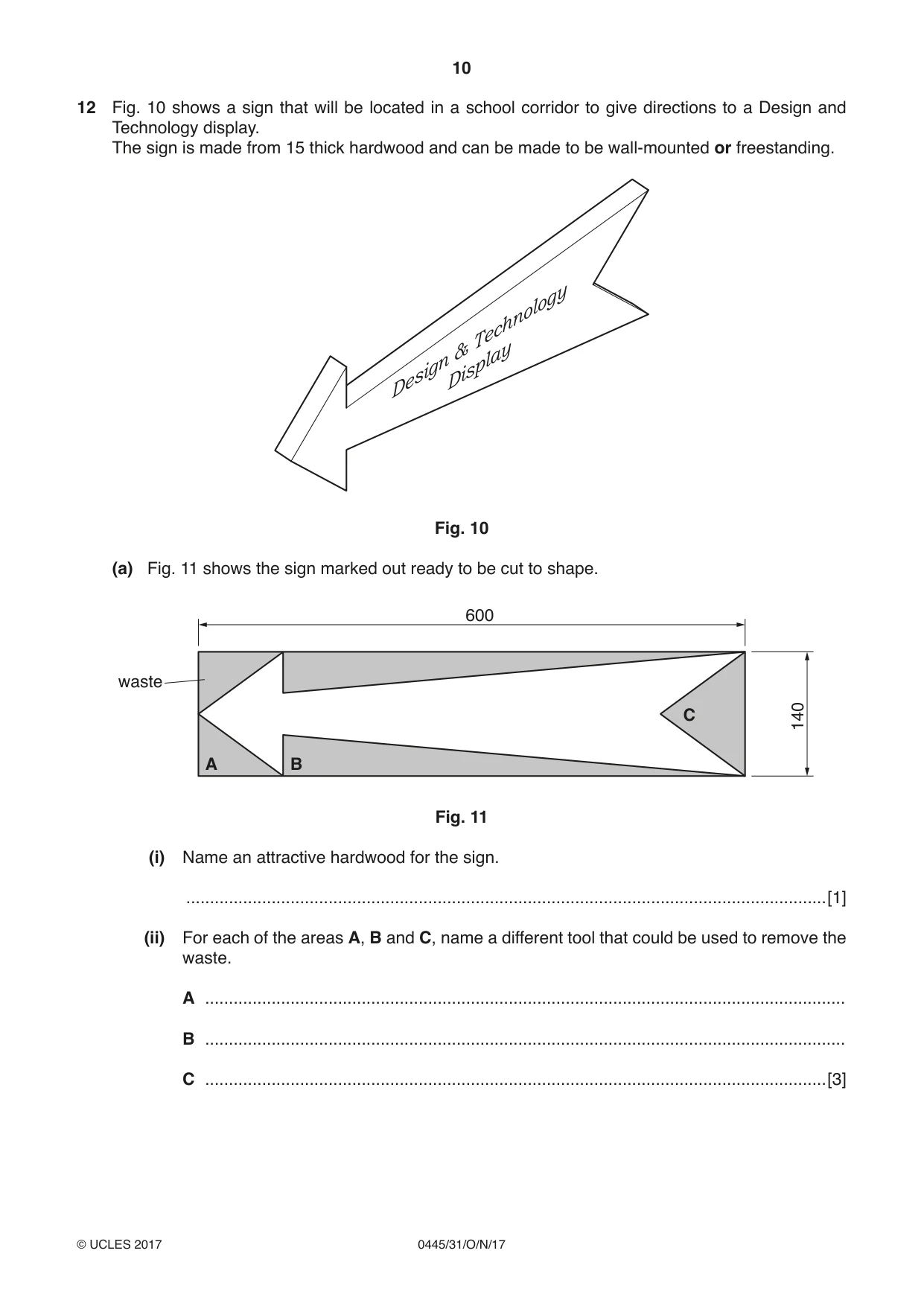
12 Fig. 10 shows a sign that will be located in a school corridor to give directions to a Design and Technology display. The sign is made from 15 thick hardwood and can be made to be wall-mounted or freestanding. Technology Display& Design Fig. 10 (a) Fig. 11 shows the sign marked out ready to be cut to shape. 600 waste C 140 A B Fig. 11 (i) Name an attractive hardwood for the sign. .......................................................................................................................................[1] (ii) For each of the areas A, B and C, name a different tool that could be used to remove the waste. A ....................................................................................................................................... B ....................................................................................................................................... C ...................................................................................................................................[3] (iii) Describe how the surfaces of the sign could be prepared to take an applied finish. ........................................................................................................................................... ........................................................................................................................................... .......................................................................................................................................[2] (iv) Name a suitable finish and describe how it could be applied to achieve a high quality finished surface. Suitable finish .................................................................................................................[1] How to achieve a high quality finished surface. ........................................................................................................................................... ........................................................................................................................................... .......................................................................................................................................[2] (b) Use sketches and notes to show how the sign could be fixed to a wall. Your method of fixing must not be seen on the front of the sign. Include all named materials and methods of construction. [5] (c) Use sketches and notes to show how the sign could be freestanding and supported at a height of 1.5 metres above the ground. Your design must include: • a stable base; • a method of joining the sign to the support; • two important sizes. Include all named materials and methods of construction. [8] (d) The sign and lettering could be produced using Computer-Aided-Design, [CAD]. Describe how CAD could be used to design the words ‘Design & Technology Display’. ................................................................................................................................................... ................................................................................................................................................... ................................................................................................................................................... ...............................................................................................................................................[3]
Mark scheme: 12(a)(i) Wide variety of hardwoods available for choice. 1 Award 1 mark for any recognised hardwood that could be used for the sign. 12(a)(ii) A variety of saws could be used to cut out each area A B C 3 Award 1 mark for a different appropriately named saw for each area including: Hegner, vibro, band, jig, tenon, coping saws. 12(a)(iii) Use of glasspaper, different grade/s, cork block, cloth to remove dust. 2 Award 0–2 dependent details provided. 12(a)(iv) Suitable finish: [polyurethane] varnish, shellac, wax, lacquer, various 1 oils/stains How to achieve a high quality finish: brush strokes along the grain, no 2 runs or drips, brush not overloaded. For oils: use of cotton wad, appropriate amount of oil onto wad, appropriate action onto surface of wood. 0–2 12(b) Some form of bracket attached to the back of the clock with provision for 5 fixing to wall. Alternative method: plate with keyhole slot. Not visible from front 1 Award 0–2 dependent upon accuracy of practical idea. 0–2 Materials and constructions 0–2 12(c) Stand with stable base [solid or legs] Practical idea. 0–2 8 Method of joining sign to stand 0–2 Two important sizes 2×1 Named materials and constructions: 0–2 12(d) CAD used to model different font styles, size and spacing, colour. 3 CAD allows for on-screen modelling, trialling before manufacture. Award 0–3 for any practical knowledge of using CAD.
Q13 · A wooden stool and a parts list
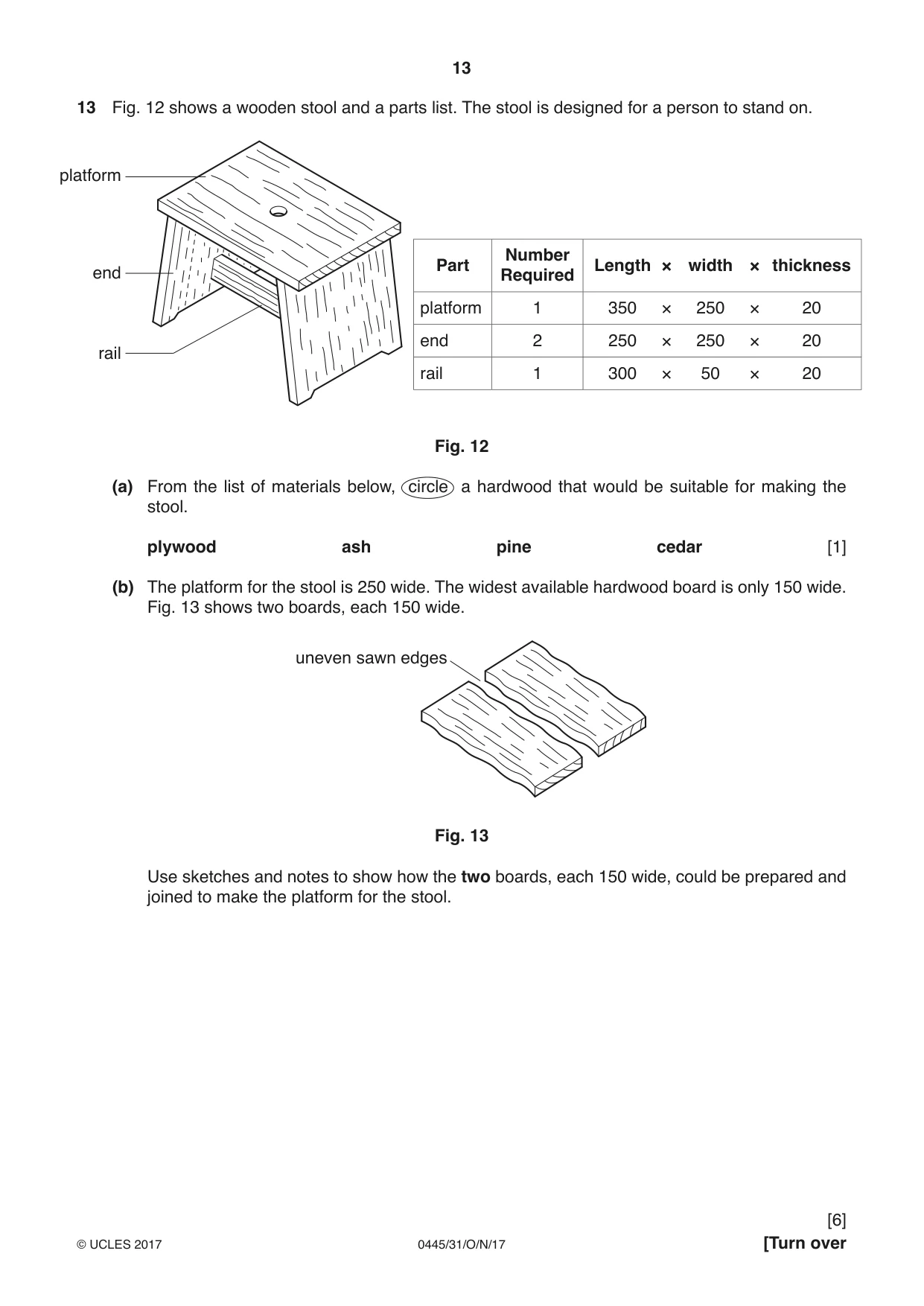
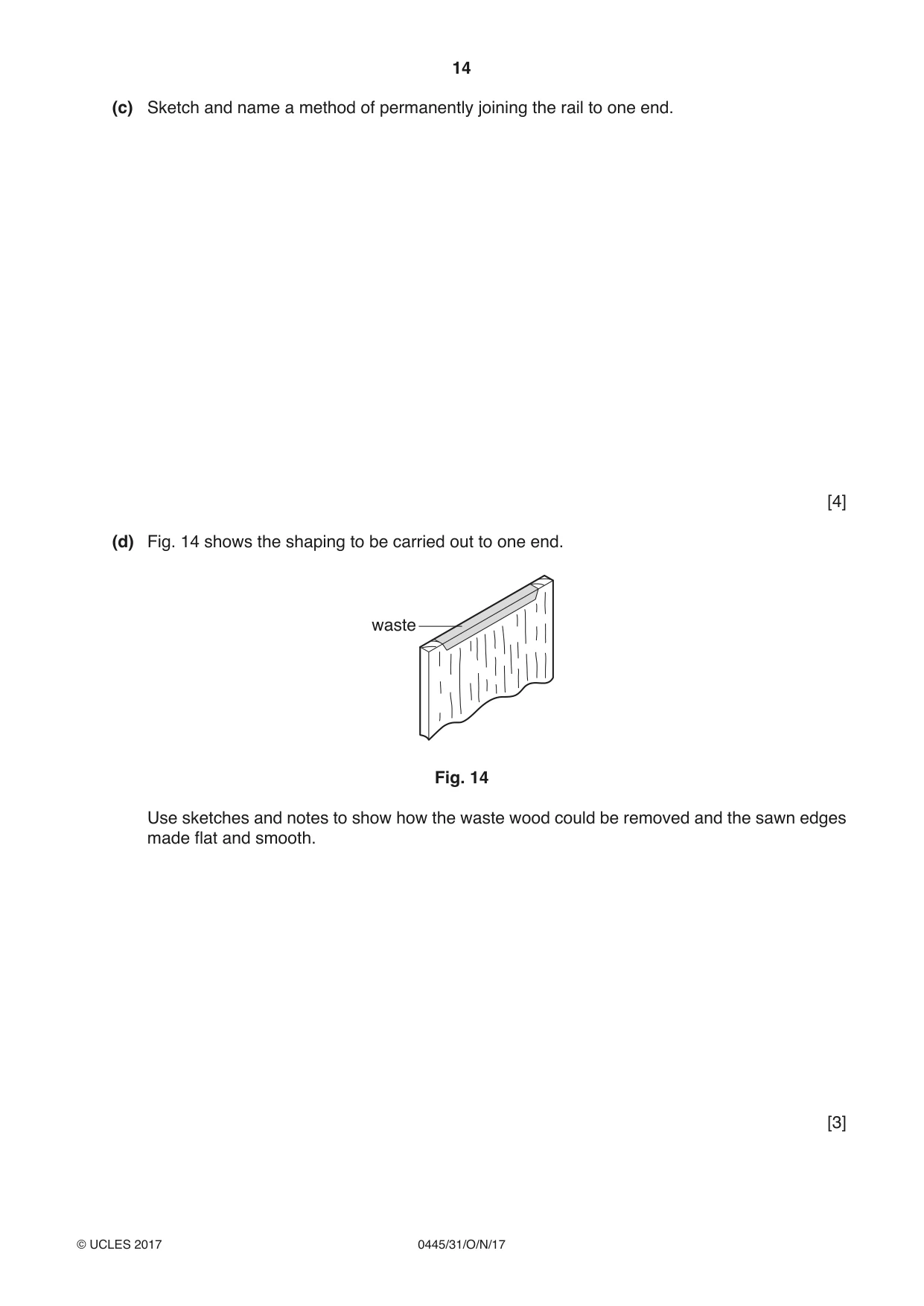
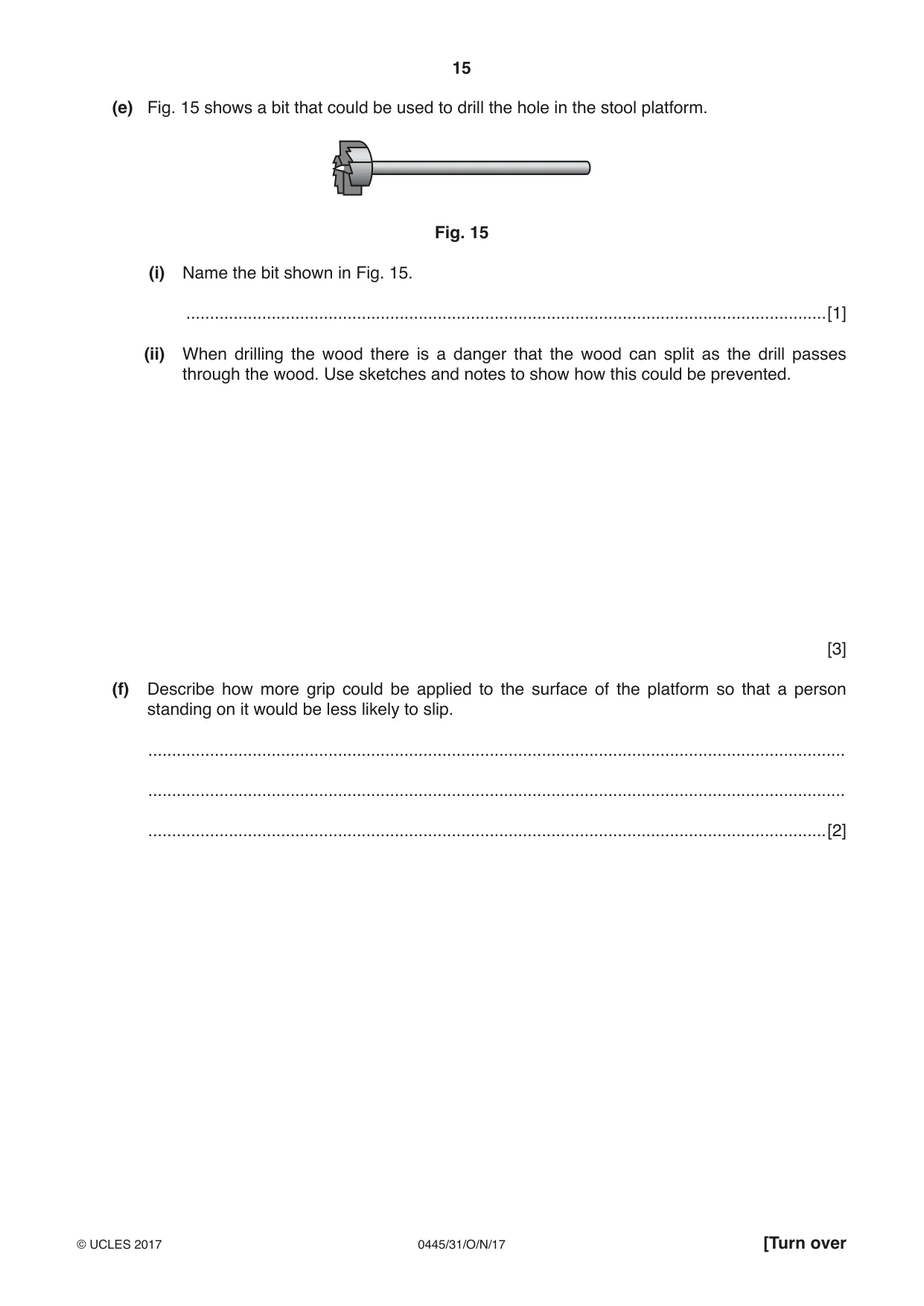
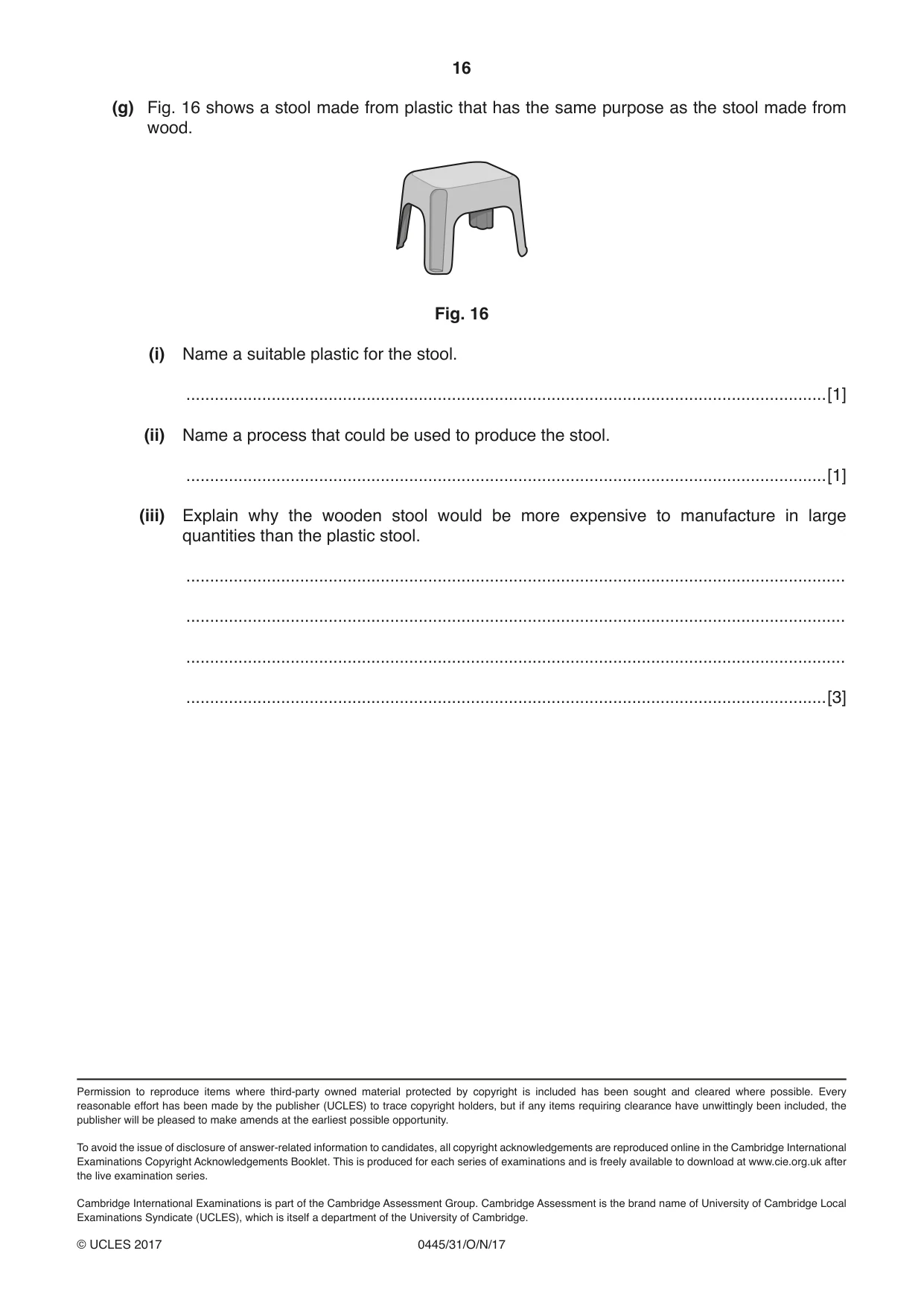
13 Fig. 12 shows a wooden stool and a parts list. The stool is designed for a person to stand on. platform Number Part Length × width × thickness end Required platform 1 350 × 250 × 20 end 2 250 × 250 × 20 rail rail 1 300 × 50 × 20 Fig. 12 (a) From the list of materials below, circle a hardwood that would be suitable for making the stool. plywood ash pine cedar [1] (b) The platform for the stool is 250 wide. The widest available hardwood board is only 150 wide. Fig. 13 shows two boards, each 150 wide. uneven sawn edges Fig. 13 Use sketches and notes to show how the two boards, each 150 wide, could be prepared and joined to make the platform for the stool. (c) Sketch and name a method of permanently joining the rail to one end. [4] (d) Fig. 14 shows the shaping to be carried out to one end. waste Fig. 14 Use sketches and notes to show how the waste wood could be removed and the sawn edges made flat and smooth. [3] (e) Fig. 15 shows a bit that could be used to drill the hole in the stool platform. Fig. 15 (i) Name the bit shown in Fig. 15. .......................................................................................................................................[1] (ii) When drilling the wood there is a danger that the wood can split as the drill passes through the wood. Use sketches and notes to show how this could be prevented. [3] (f) Describe how more grip could be applied to the surface of the platform so that a person standing on it would be less likely to slip. ................................................................................................................................................... ................................................................................................................................................... ...............................................................................................................................................[2]
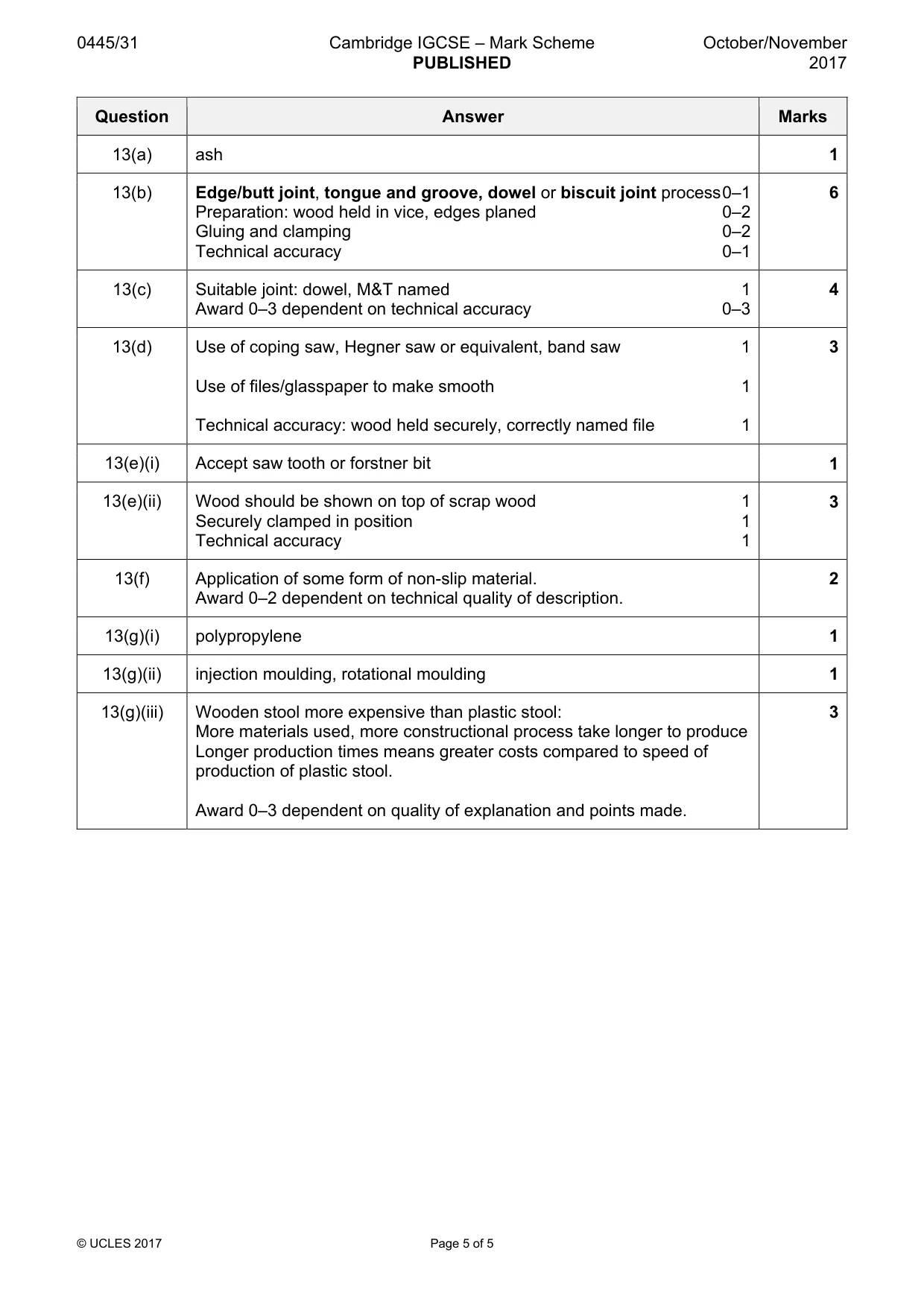
Mark scheme: 13(a) ash 1 13(b) Edge/butt joint, tongue and groove, dowel or biscuit joint process 0–1 6 Preparation: wood held in vice, edges planed 0–2 Gluing and clamping 0–2 Technical accuracy 0–1 13(c) Suitable joint: dowel, M&T named 1 4 Award 0–3 dependent on technical accuracy 0–3 13(d) Use of coping saw, Hegner saw or equivalent, band saw 1 3 Use of files/glasspaper to make smooth 1 Technical accuracy: wood held securely, correctly named file 1 13(e)(i) Accept saw tooth or forstner bit 1 13(e)(ii) Wood should be shown on top of scrap wood 1 3 Securely clamped in position 1 Technical accuracy 1 13(f) Application of some form of non-slip material. 2 Award 0–2 dependent on technical quality of description. 13(g)(i) polypropylene 1 13(g)(ii) injection moulding, rotational moulding 1 13(g)(iii) Wooden stool more expensive than plastic stool: 3 More materials used, more constructional process take longer to produce Longer production times means greater costs compared to speed of production of plastic stool. Award 0–3 dependent on quality of explanation and points made.
What was in this paper
The subtopics covered by these 13 questions, and how many questions each got. Open one in a new tab to see every Cambridge question on it.
What you needed in this session
Cambridge’s own grade thresholds for 2017 Oct/Nov, Paper 3 · Variant 1. A higher threshold means an easier paper — the bar moves with how the cohort did.