Cambridge IGCSE Design and Technology 0445 — 2015 May/June Paper 3 · Variant 1
0445/31/M/J/15 · 50 marks · ≈56 min
The question paper and its mark scheme, free to read here and free to download. This is Cambridge’s own paper, exactly as it was sat.
Question paper16 pages

Mark scheme7 pages
Answers below. Sit the paper first if you are practising.
Paper as text
Question paper, page 1
This document consists of 14 printed pages and 2 blank pages. DC (LK/SG) 101379/4 © UCLES 2015 [Turn over Cambridge International Examinations Cambridge International General Certificate of Secondary Education * 0 8 1 6 1 2 1 7 6 1 * DESIGN AND TECHNOLOGY 0445/31 Paper 3 Resistant Materials May/June 2015 1 hour Candidates answer on the Question Paper. No Additional Materials are required. READ THESE INSTRUCTIONS FIRST Write your Centre number, candidate number and name on all the work you hand in. Write in dark blue or black pen. You may use an HB pencil for any diagrams, graphs or rough working. Do not use staples, paper clips, glue or correction fluid. DO NOT WRITE IN ANY BARCODES. Section A Answer all questions in this section. Section B Answer one question in this section. You may use a calculator. At the end of the examination, fasten all your work securely together. The number of marks is given in brackets [ ] at the end of each question or part question. The total of the marks for this paper is 50.
Question paper, page 2
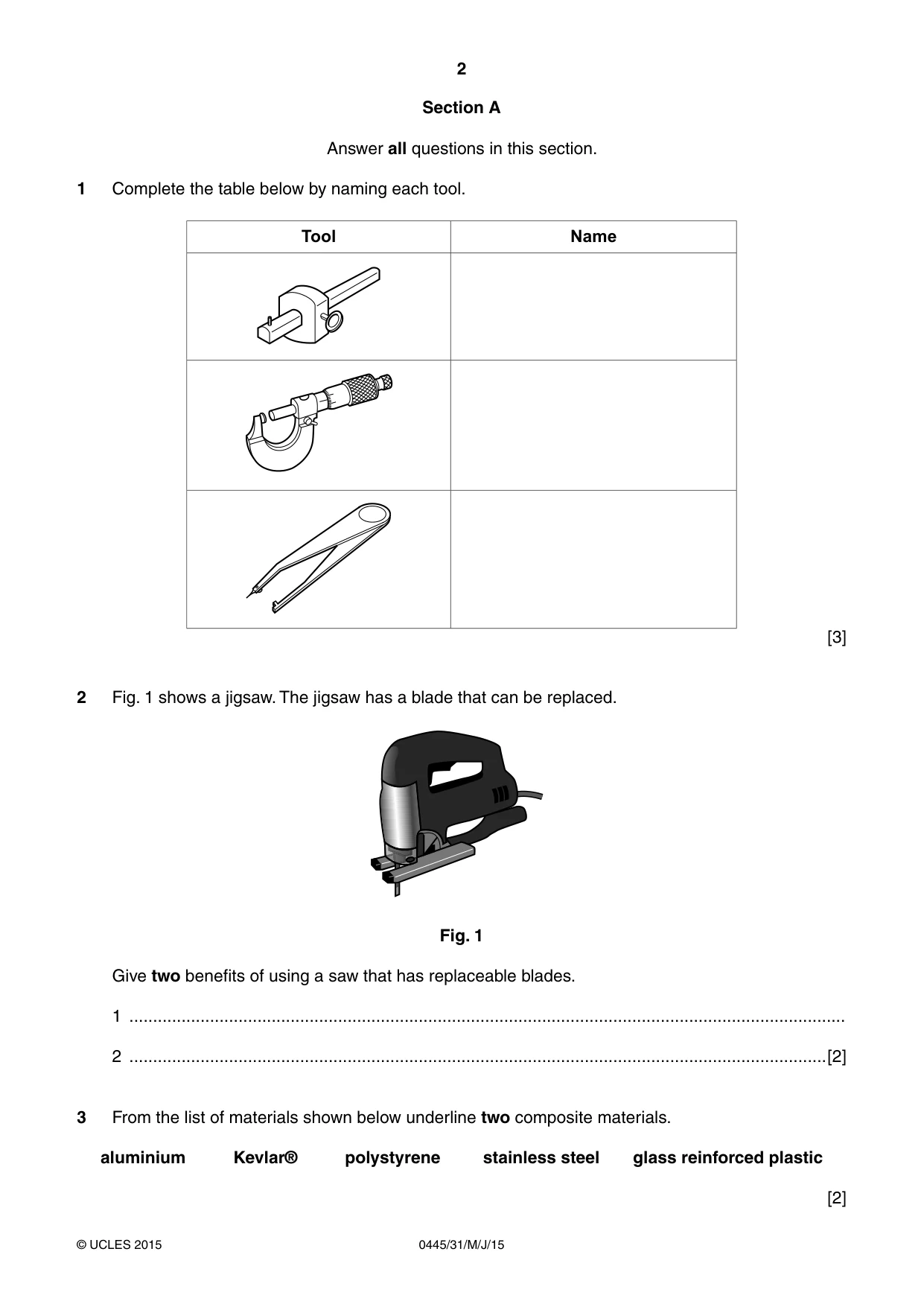
2 0445/31/M/J/15 © UCLES 2015 Section A Answer all questions in this section. 1 Complete the table below by naming each tool. Tool Name [3] 2 Fig. 1 shows a jigsaw. The jigsaw has a blade that can be replaced. Fig. 1 Give two benefits of using a saw that has replaceable blades. 1 … 2 …[2] 3 From the list of materials shown below underline two composite materials. aluminium Kevlar® polystyrene stainless steel glass reinforced plastic [2]
Question paper, page 3
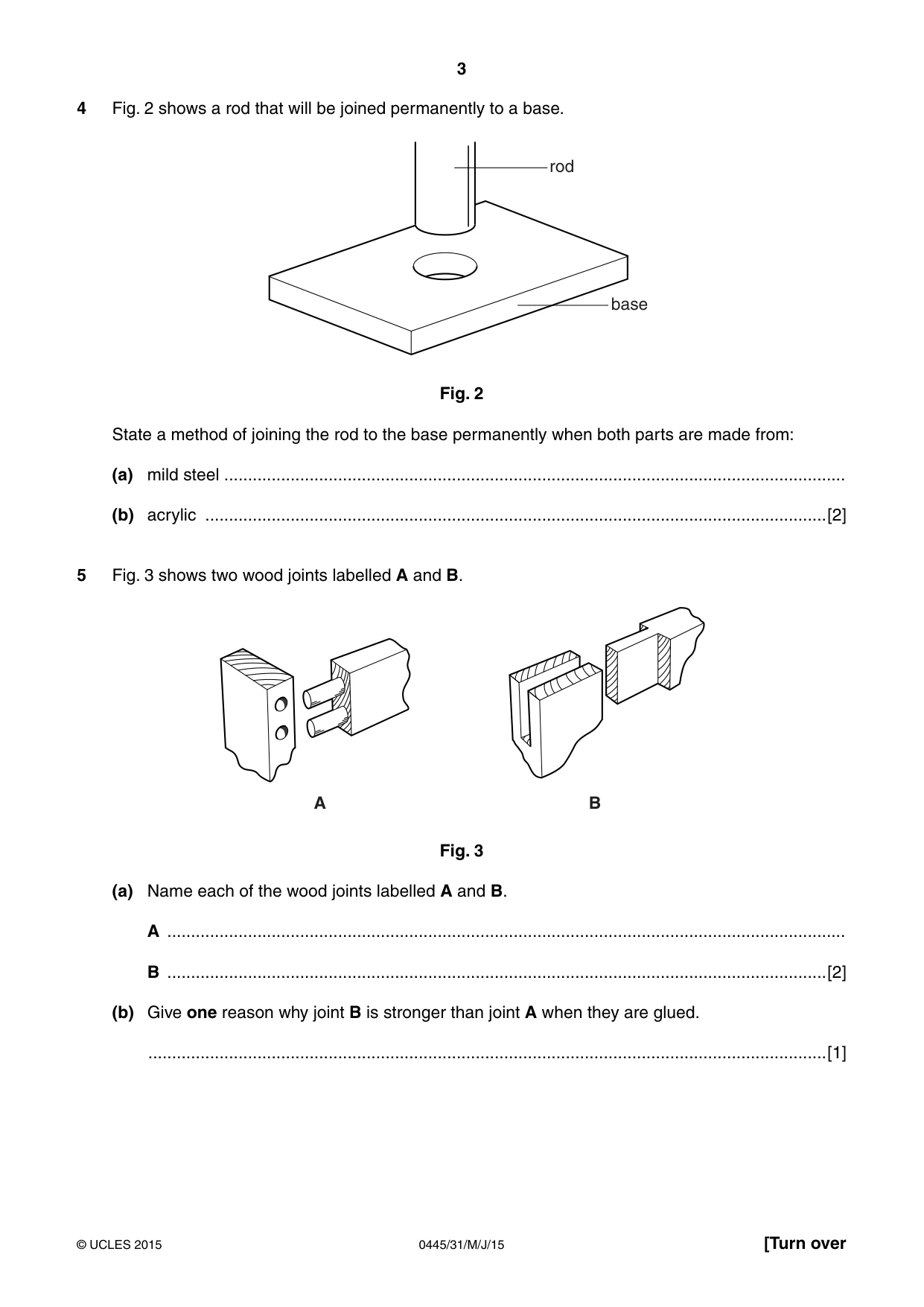
3 0445/31/M/J/15 © UCLES 2015 [Turn over 4 Fig. 2 shows a rod that will be joined permanently to a base. rod base Fig. 2 State a method of joining the rod to the base permanently when both parts are made from: (a) mild steel … (b) acrylic …[2] 5 Fig. 3 shows two wood joints labelled A and B. A B Fig. 3 (a) Name each of the wood joints labelled A and B. A … B …[2] (b) Give one reason why joint B is stronger than joint A when they are glued. …[1]
Question paper, page 4
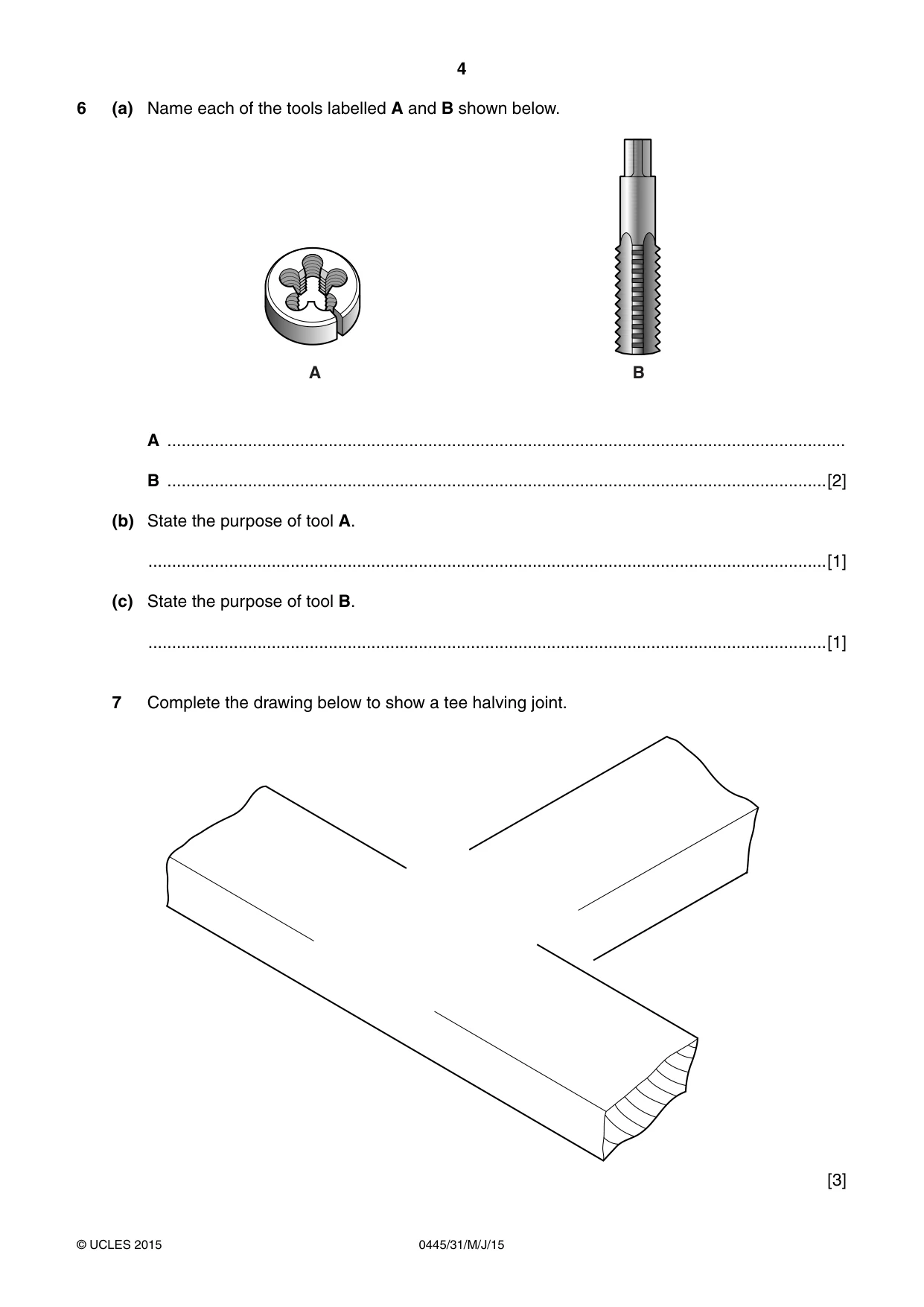
4 0445/31/M/J/15 © UCLES 2015 6 (a) Name each of the tools labelled A and B shown below. A B A … B …[2] (b) State the purpose of tool A. …[1] (c) State the purpose of tool B. …[1] 7 Complete the drawing below to show a tee halving joint. [3]
Question paper, page 5
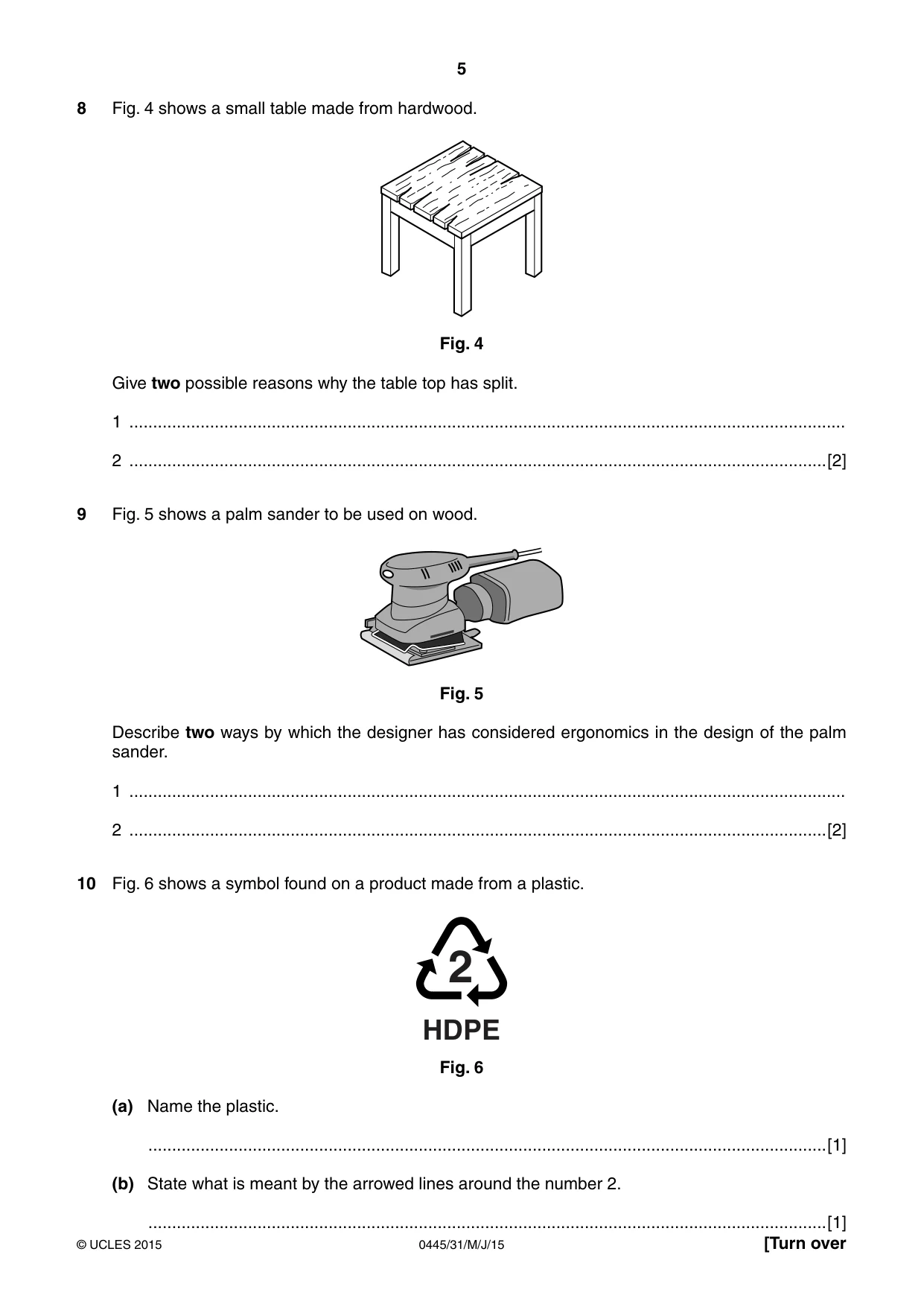
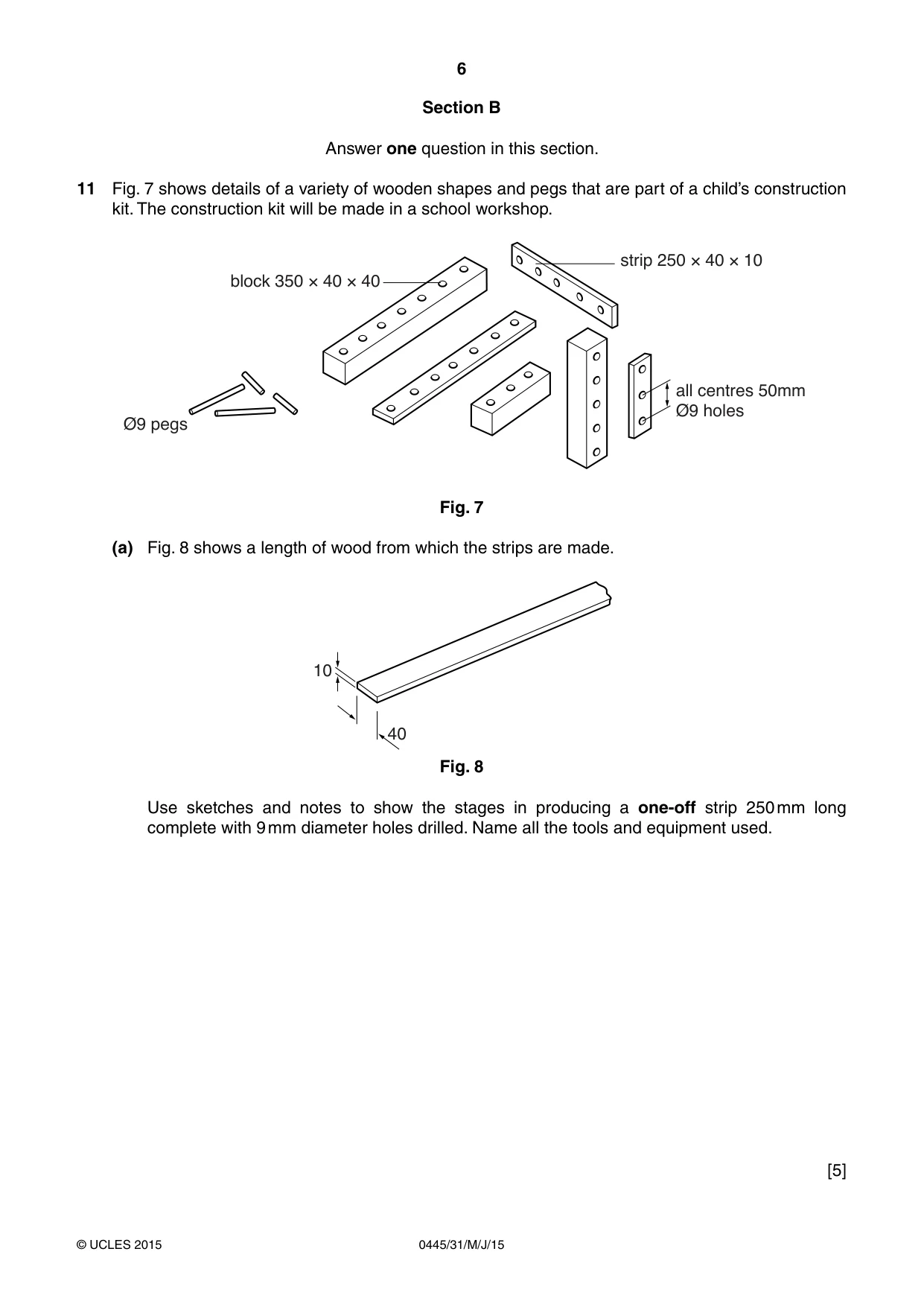
5 0445/31/M/J/15 © UCLES 2015 [Turn over 8 Fig. 4 shows a small table made from hardwood. Fig. 4 Give two possible reasons why the table top has split. 1 … 2 …[2] 9 Fig. 5 shows a palm sander to be used on wood. Fig. 5 Describe two ways by which the designer has considered ergonomics in the design of the palm sander. 1 … 2 …[2] 10 Fig. 6 shows a symbol found on a product made from a plastic. 2 HDPE Fig. 6 (a) Name the plastic. …[1] (b) State what is meant by the arrowed lines around the number 2. …[1]
Question paper, page 6
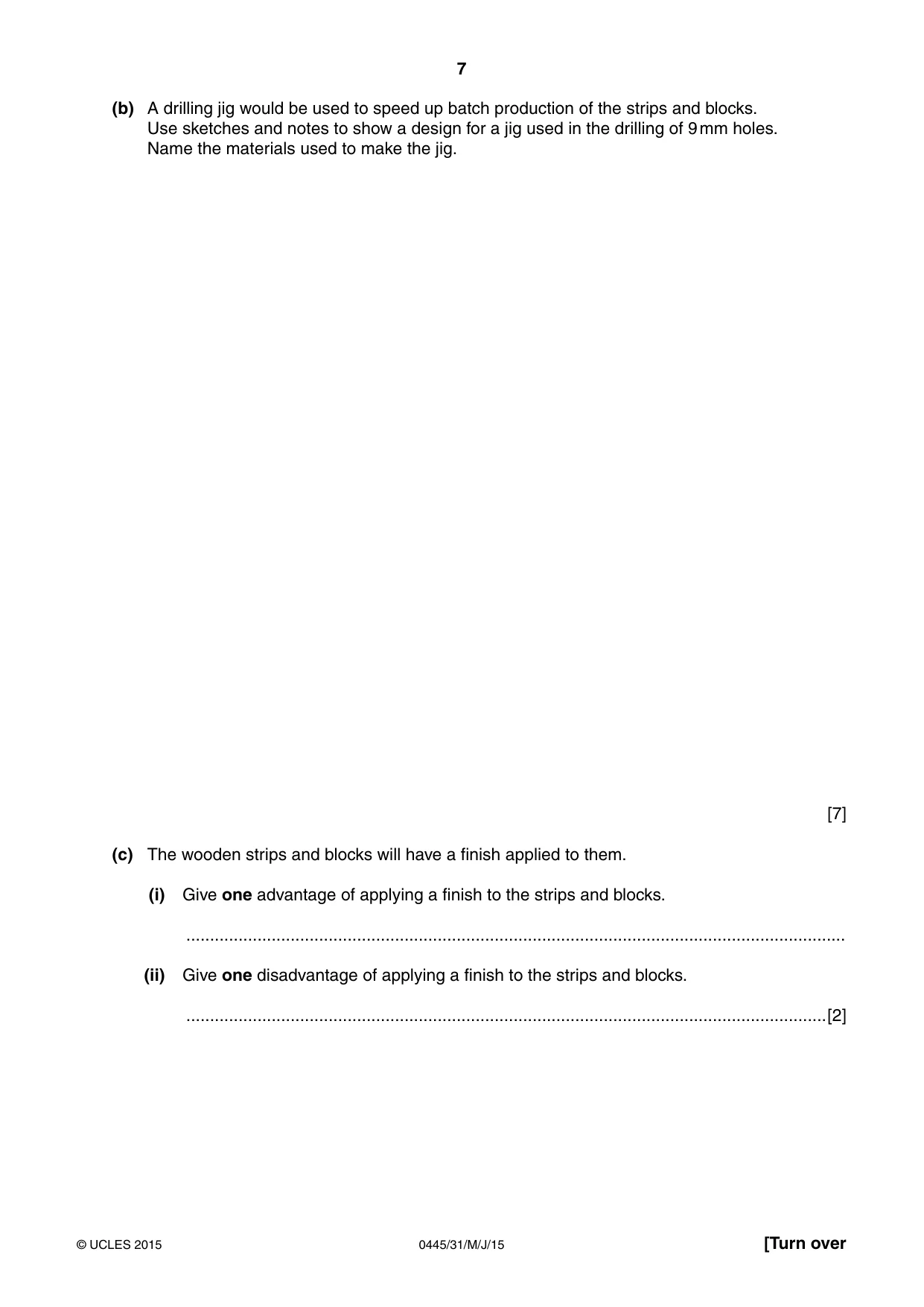
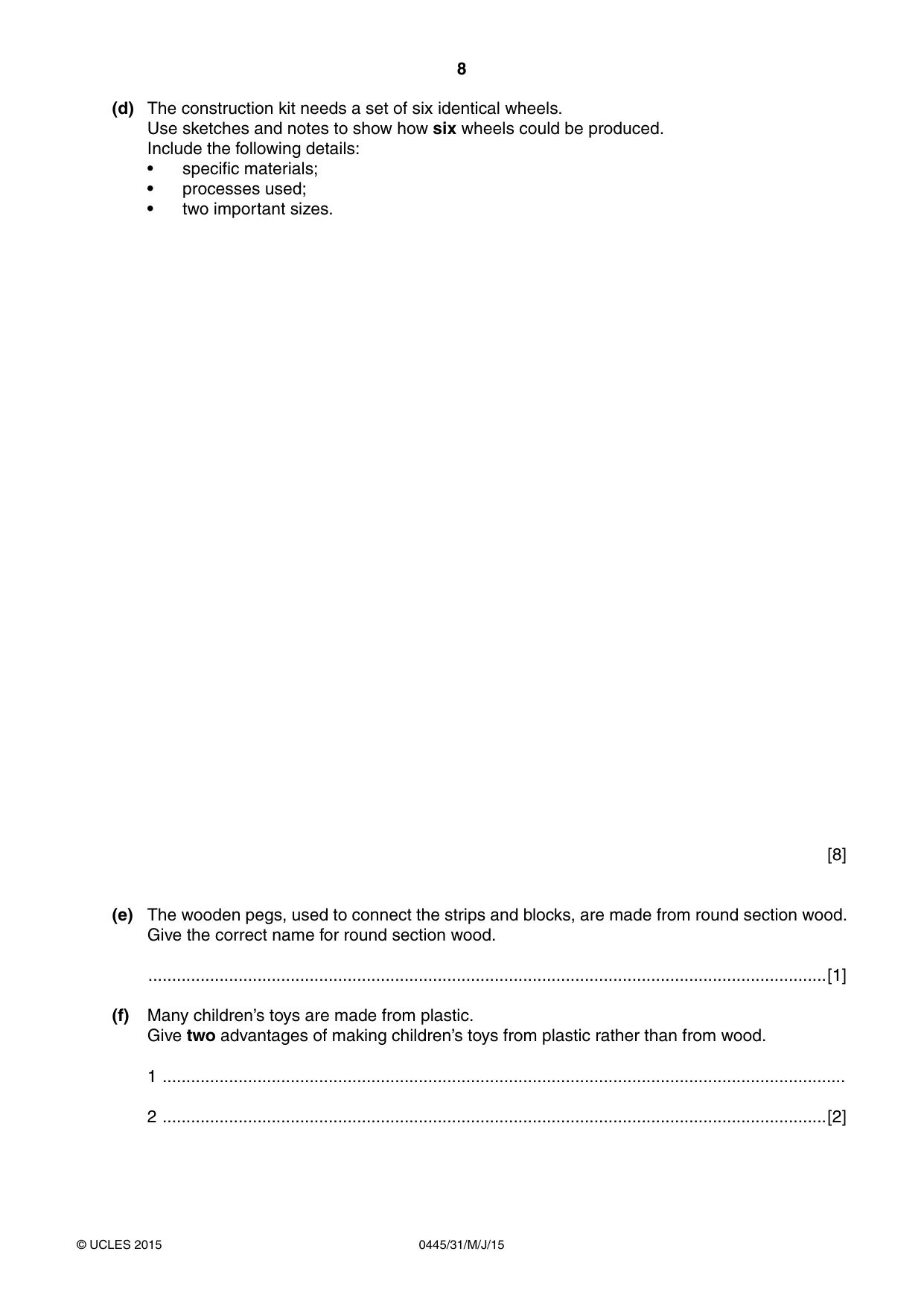
6 0445/31/M/J/15 © UCLES 2015 Section B Answer one question in this section. 11 Fig. 7 shows details of a variety of wooden shapes and pegs that are part of a child’s construction kit. The construction kit will be made in a school workshop. Ø9 pegs block 350 × 40 × 40 strip 250 × 40 × 10 all centres 50mm Ø9 holes Fig. 7 (a) Fig. 8 shows a length of wood from which the strips are made. 40 10 Fig. 8 Use sketches and notes to show the stages in producing a one-off strip 250 mm long complete with 9 mm diameter holes drilled. Name all the tools and equipment used. [5]
Question paper, page 7
7 0445/31/M/J/15 © UCLES 2015 [Turn over (b) A drilling jig would be used to speed up batch production of the strips and blocks. Use sketches and notes to show a design for a jig used in the drilling of 9 mm holes. Name the materials used to make the jig. [7] (c) The wooden strips and blocks will have a finish applied to them. (i) Give one advantage of applying a finish to the strips and blocks. … (ii) Give one disadvantage of applying a finish to the strips and blocks. …[2]
Question paper, page 8
8 0445/31/M/J/15 © UCLES 2015 (d) The construction kit needs a set of six identical wheels. Use sketches and notes to show how six wheels could be produced. Include the following details: • specific materials; • processes used; • two important sizes. [8] (e) The wooden pegs, used to connect the strips and blocks, are made from round section wood. Give the correct name for round section wood. …[1] (f) Many children’s toys are made from plastic. Give two advantages of making children’s toys from plastic rather than from wood. 1 … 2 …[2]
Question paper, page 9
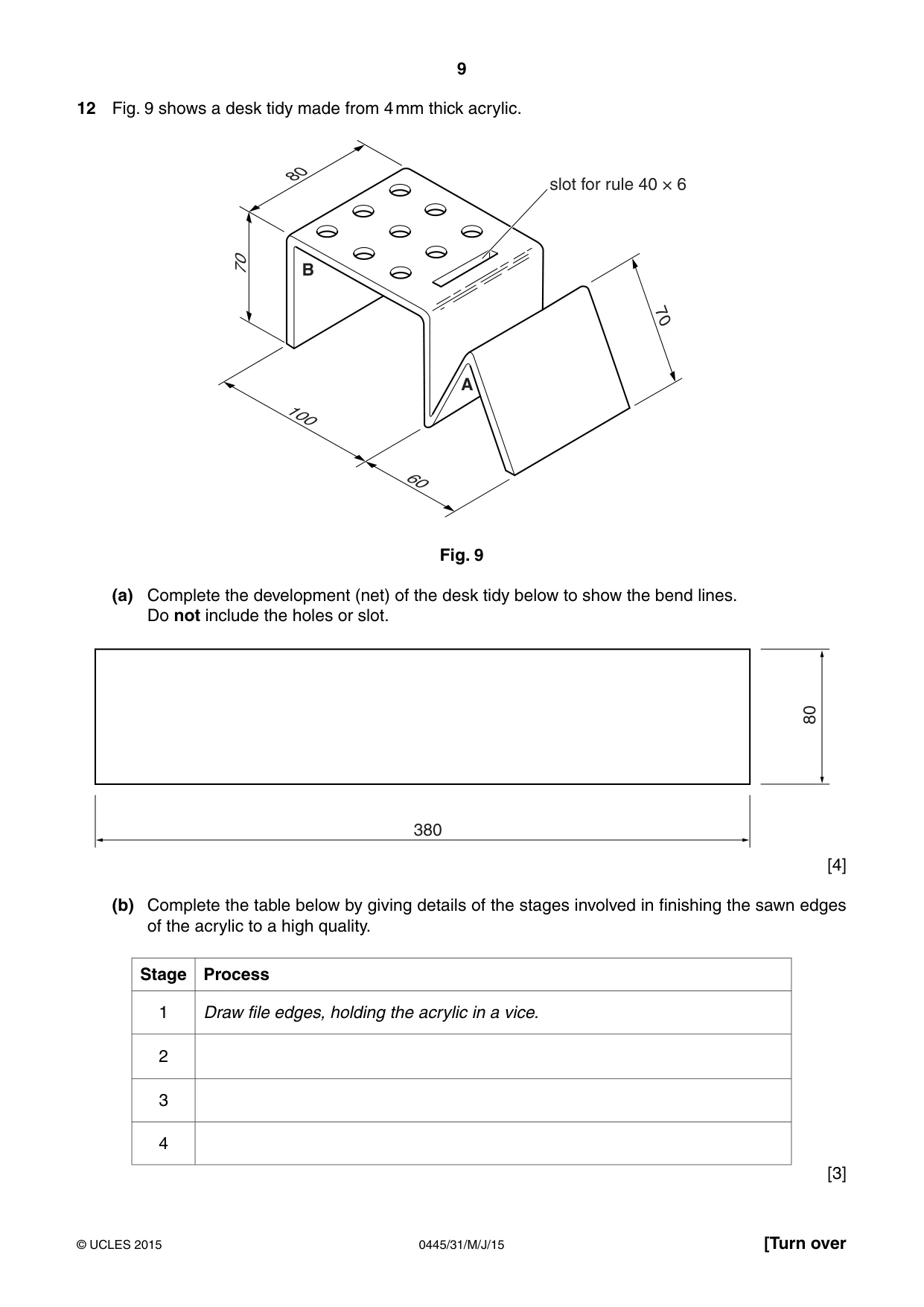
9 0445/31/M/J/15 © UCLES 2015 [Turn over 12 Fig. 9 shows a desk tidy made from 4 mm thick acrylic. 80 70 % $ 60 100 70 slot for rule 40 × 6 Fig. 9 (a) Complete the development (net) of the desk tidy below to show the bend lines. Do not include the holes or slot. 80 380 [4] (b) Complete the table below by giving details of the stages involved in finishing the sawn edges of the acrylic to a high quality. Stage Process 1 Draw file edges, holding the acrylic in a vice. 2 3 4 [3]
Question paper, page 10
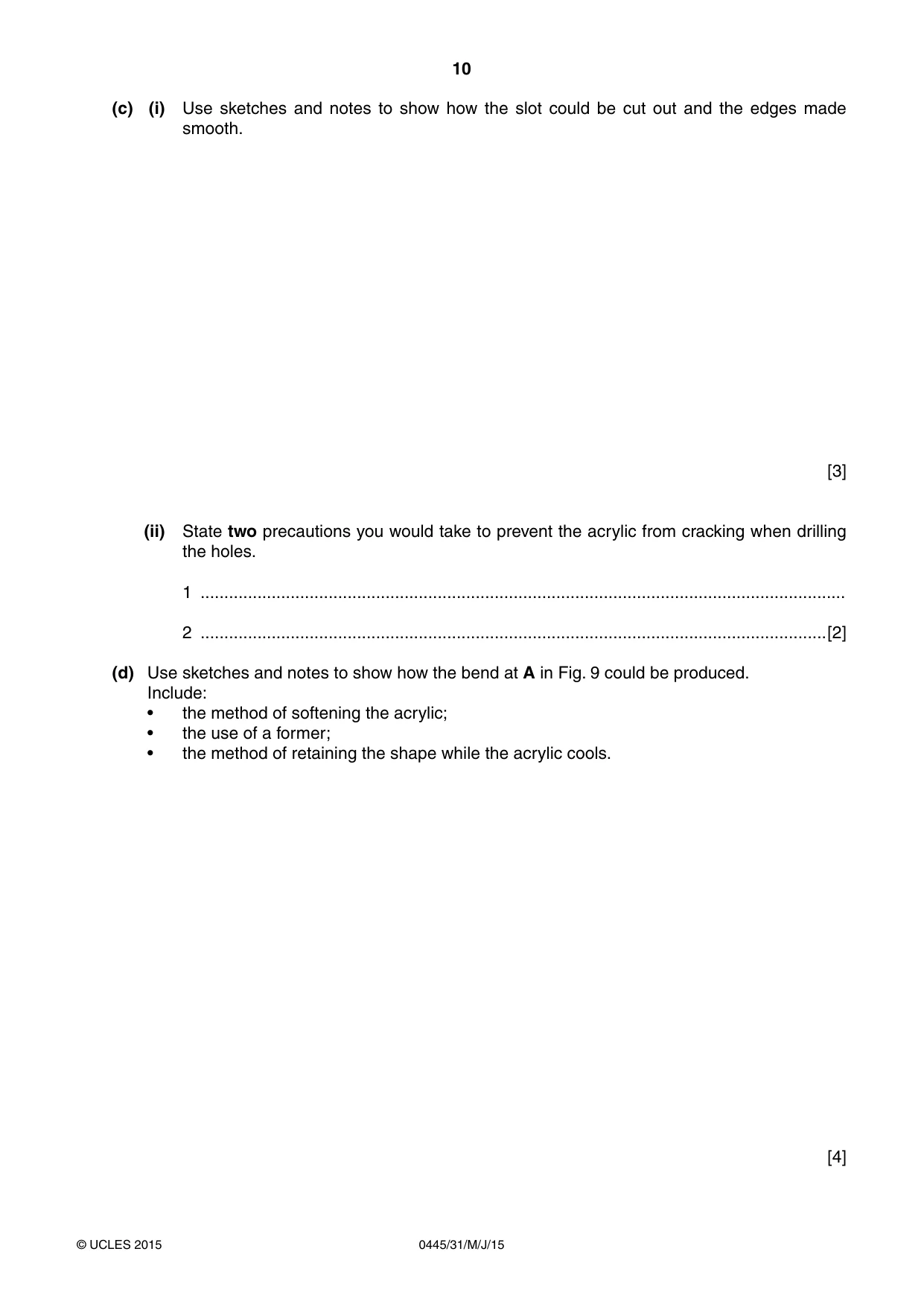
10 0445/31/M/J/15 © UCLES 2015 (c) (i) Use sketches and notes to show how the slot could be cut out and the edges made smooth. [3] (ii) State two precautions you would take to prevent the acrylic from cracking when drilling the holes. 1 … 2 …[2] (d) Use sketches and notes to show how the bend at A in Fig. 9 could be produced. Include: • the method of softening the acrylic; • the use of a former; • the method of retaining the shape while the acrylic cools. [4]
Question paper, page 11
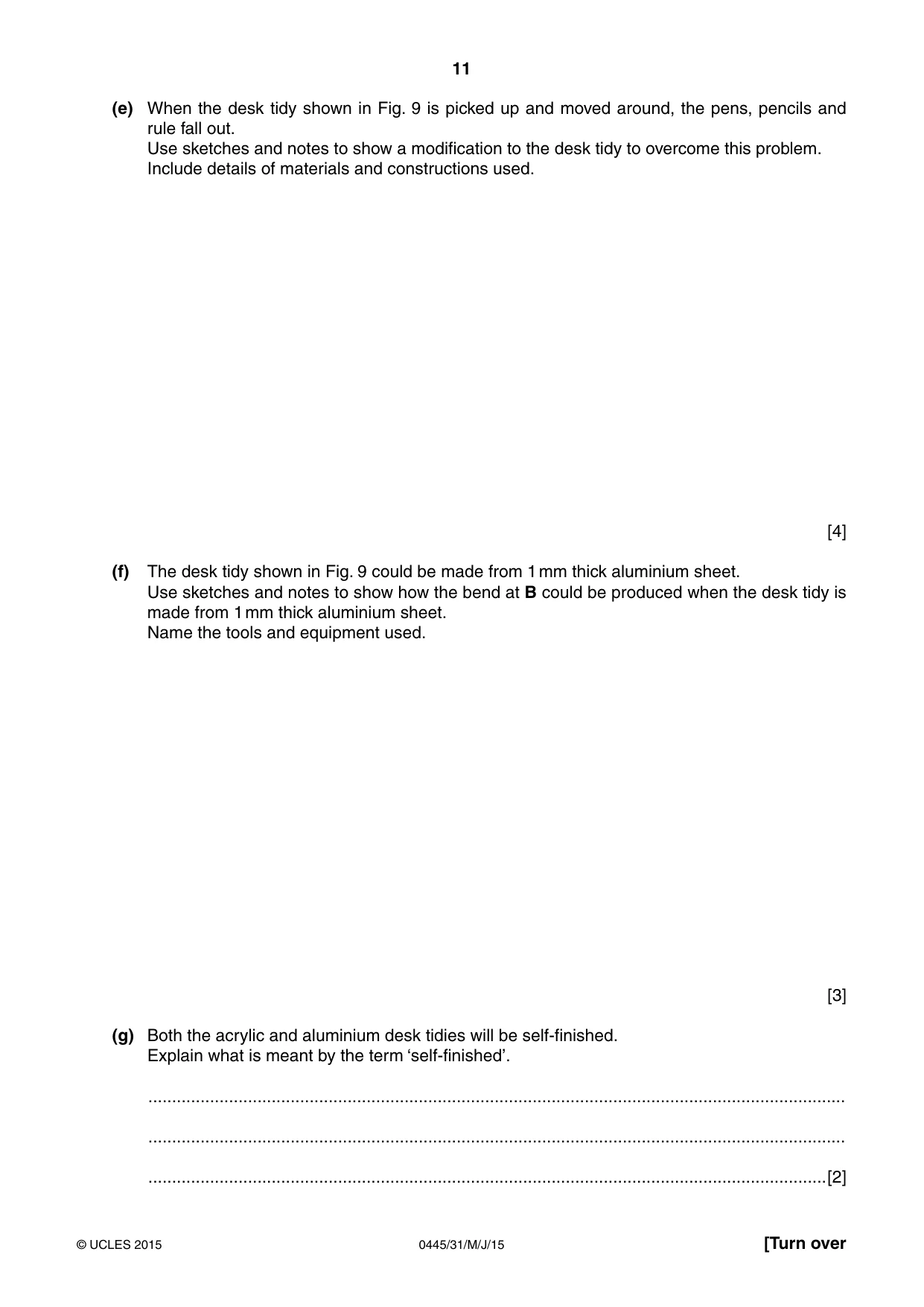
11 0445/31/M/J/15 © UCLES 2015 [Turn over (e) When the desk tidy shown in Fig. 9 is picked up and moved around, the pens, pencils and rule fall out. Use sketches and notes to show a modification to the desk tidy to overcome this problem. Include details of materials and constructions used. [4] (f) The desk tidy shown in Fig. 9 could be made from 1 mm thick aluminium sheet. Use sketches and notes to show how the bend at B could be produced when the desk tidy is made from 1 mm thick aluminium sheet. Name the tools and equipment used. [3] (g) Both the acrylic and aluminium desk tidies will be self-finished. Explain what is meant by the term ‘self-finished’. … … …[2]
Question paper, page 12
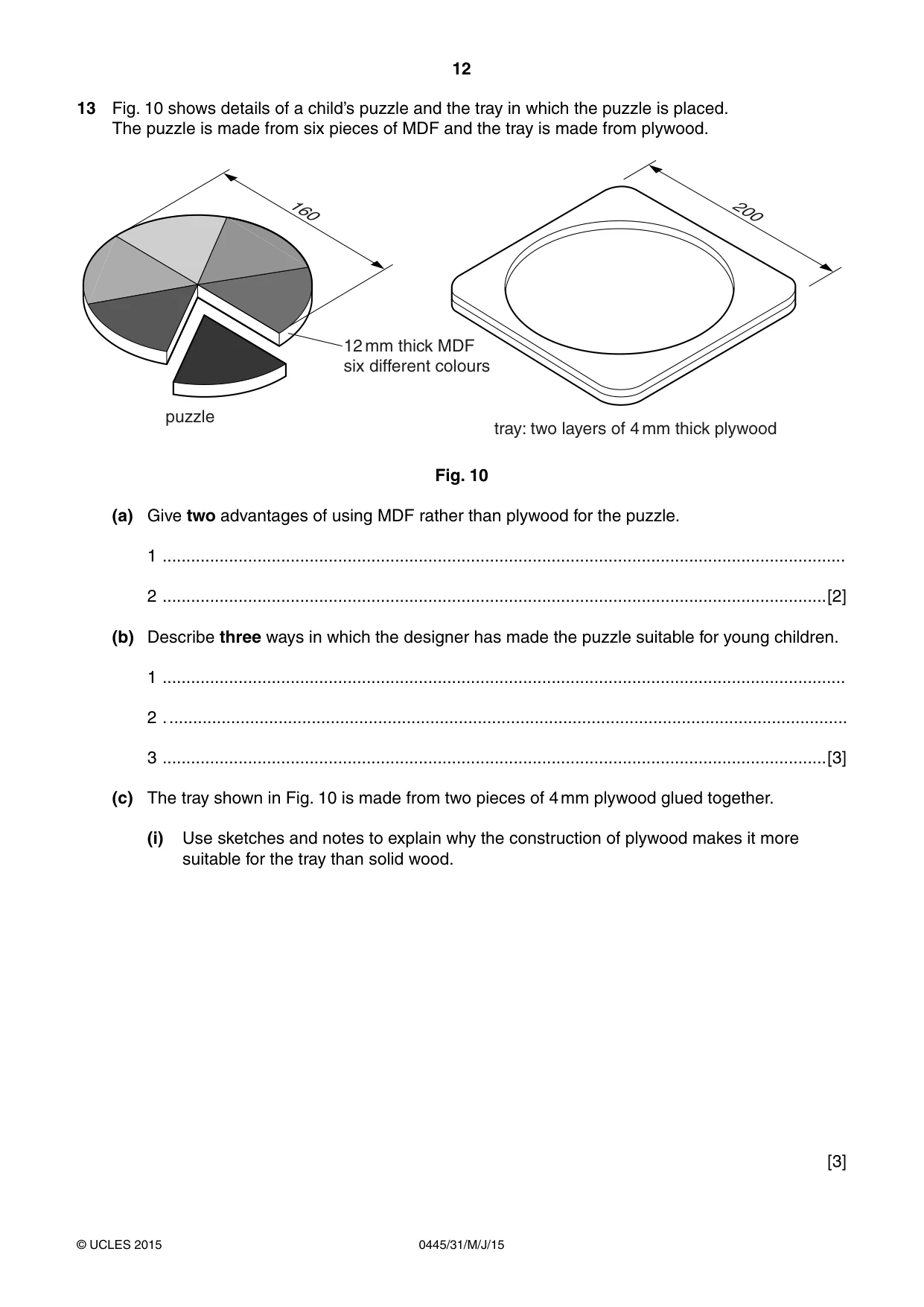
12 0445/31/M/J/15 © UCLES 2015 13 Fig. 10 shows details of a child’s puzzle and the tray in which the puzzle is placed. The puzzle is made from six pieces of MDF and the tray is made from plywood. 160 200 12 mm thick MDF six different colours puzzle tray: two layers of 4 mm thick plywood Fig. 10 (a) Give two advantages of using MDF rather than plywood for the puzzle. 1 … 2 …[2] (b) Describe three ways in which the designer has made the puzzle suitable for young children. 1 … 2 … 3 …[3] (c) The tray shown in Fig. 10 is made from two pieces of 4 mm plywood glued together. (i) Use sketches and notes to explain why the construction of plywood makes it more suitable for the tray than solid wood. [3]
Question paper, page 13
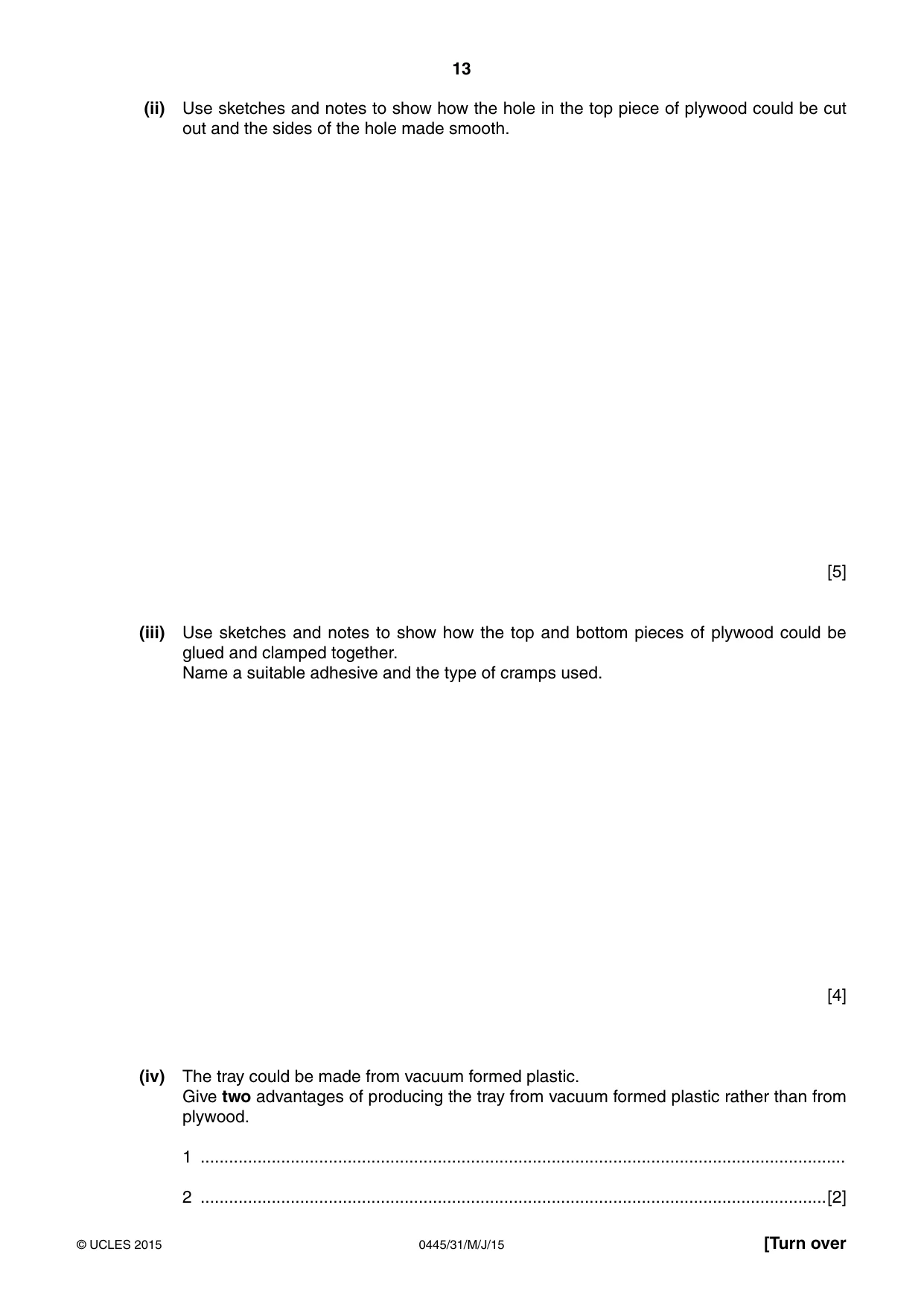
13 0445/31/M/J/15 © UCLES 2015 [Turn over (ii) Use sketches and notes to show how the hole in the top piece of plywood could be cut out and the sides of the hole made smooth. [5] (iii) Use sketches and notes to show how the top and bottom pieces of plywood could be glued and clamped together. Name a suitable adhesive and the type of cramps used. [4] (iv) The tray could be made from vacuum formed plastic. Give two advantages of producing the tray from vacuum formed plastic rather than from plywood. 1 … 2 …[2]
Question paper, page 14
14 0445/31/M/J/15 © UCLES 2015 (d) The puzzle could be produced using CAD/CAM. Complete the abbreviations CAD/CAM below. Computer Aided D … Computer Aided M … [2] (e) Describe two quality control checks that would be carried out during the manufacture of the puzzle and/or the tray. 1 … 2 …[2] (f) Give two reasons why the use of manufactured boards such as MDF and plywood, rather than plastics, could be considered good for the environment. 1 … … 2 … …[2]
Question paper, page 15
15 0445/31/M/J/15 © UCLES 2015 BLANK PAGE
Question paper, page 16
16 0445/31/M/J/15 © UCLES 2015 Permission to reproduce items where third-party owned material protected by copyright is included has been sought and cleared where possible. Every reasonable effort has been made by the publisher (UCLES) to trace copyright holders, but if any items requiring clearance have unwittingly been included, the publisher will be pleased to make amends at the earliest possible opportunity. To avoid the issue of disclosure of answer-related information to candidates, all copyright acknowledgements are reproduced online in the Cambridge International Examinations Copyright Acknowledgements Booklet. This is produced for each series of examinations and is freely available to download at www.cie.org.uk after the live examination series. Cambridge International Examinations is part of the Cambridge Assessment Group. Cambridge Assessment is the brand name of University of Cambridge Local Examinations Syndicate (UCLES), which is itself a department of the University of Cambridge. BLANK PAGE
Mark scheme, page 1
® IGCSE is the registered trademark of Cambridge International Examinations. CAMBRIDGE INTERNATIONAL EXAMINATIONS Cambridge International General Certificate of Secondary Education MARK SCHEME for the May/June 2015 series 0445 DESIGN AND TECHNOLOGY 0445/31 Paper 3 (Resistant Materials), maximum raw mark 50 This mark scheme is published as an aid to teachers and candidates, to indicate the requirements of the examination. It shows the basis on which Examiners were instructed to award marks. It does not indicate the details of the discussions that took place at an Examiners’ meeting before marking began, which would have considered the acceptability of alternative answers. Mark schemes should be read in conjunction with the question paper and the Principal Examiner Report for Teachers. Cambridge will not enter into discussions about these mark schemes. Cambridge is publishing the mark schemes for the May/June 2015 series for most Cambridge IGCSE®, Cambridge International A and AS Level components and some Cambridge O Level components.
Mark scheme, page 2
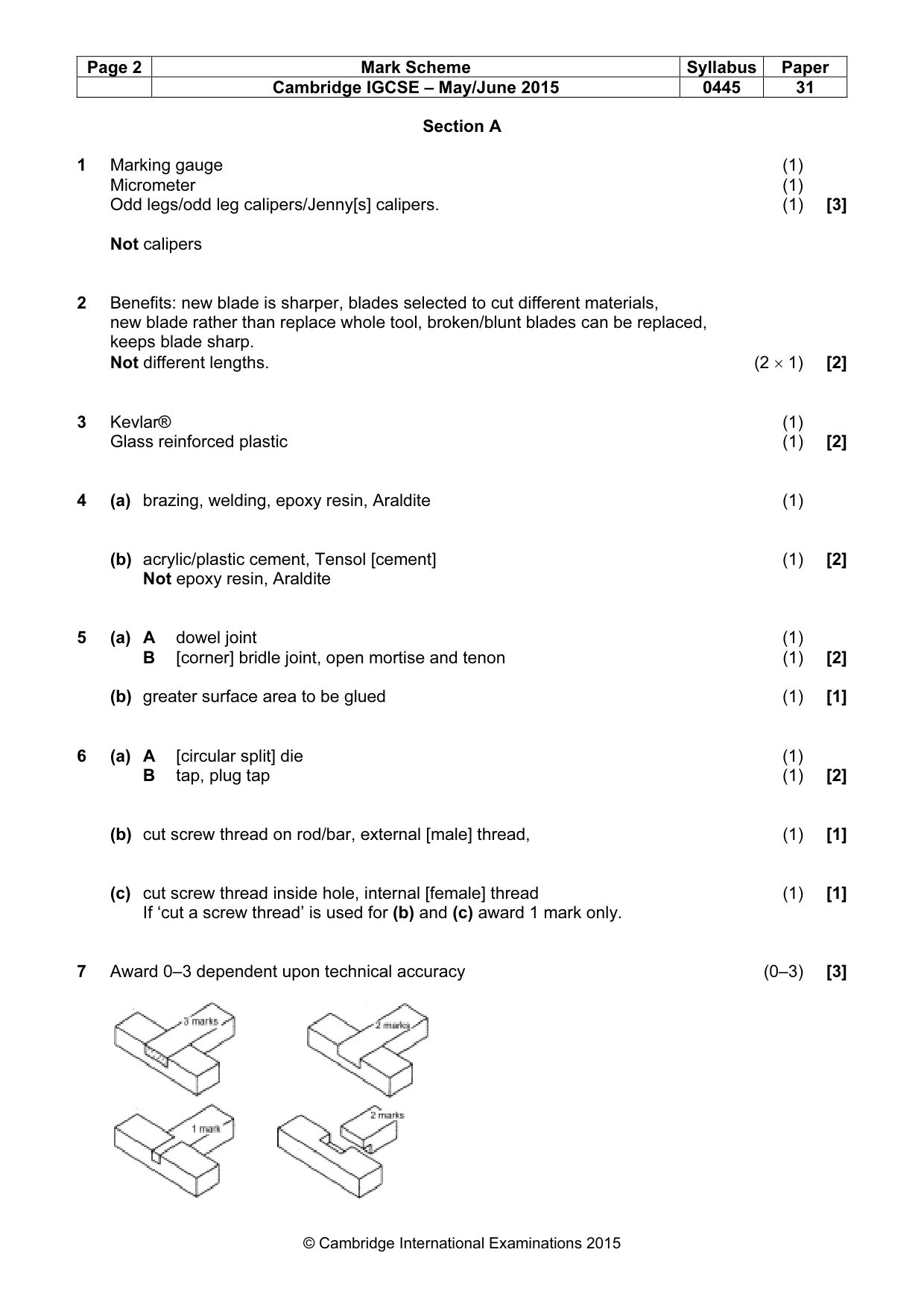
Page 2 Mark Scheme Syllabus Paper Cambridge IGCSE – May/June 2015 0445 31 © Cambridge International Examinations 2015 Section A 1 Marking gauge (1) Micrometer (1) Odd legs/odd leg calipers/Jenny[s] calipers. (1) [3] Not calipers 2 Benefits: new blade is sharper, blades selected to cut different materials, new blade rather than replace whole tool, broken/blunt blades can be replaced, keeps blade sharp. Not different lengths. (2 × 1) [2] 3 Kevlar® (1) Glass reinforced plastic (1) [2] 4 (a) brazing, welding, epoxy resin, Araldite (1) (b) acrylic/plastic cement, Tensol [cement] (1) [2] Not epoxy resin, Araldite 5 (a) A dowel joint (1) B [corner] bridle joint, open mortise and tenon (1) [2] (b) greater surface area to be glued (1) [1] 6 (a) A [circular split] die (1) B tap, plug tap (1) [2] (b) cut screw thread on rod/bar, external [male] thread, (1) [1] (c) cut screw thread inside hole, internal [female] thread (1) [1] If ‘cut a screw thread’ is used for (b) and (c) award 1 mark only. 7 Award 0–3 dependent upon technical accuracy (0–3) [3]
Mark scheme, page 3
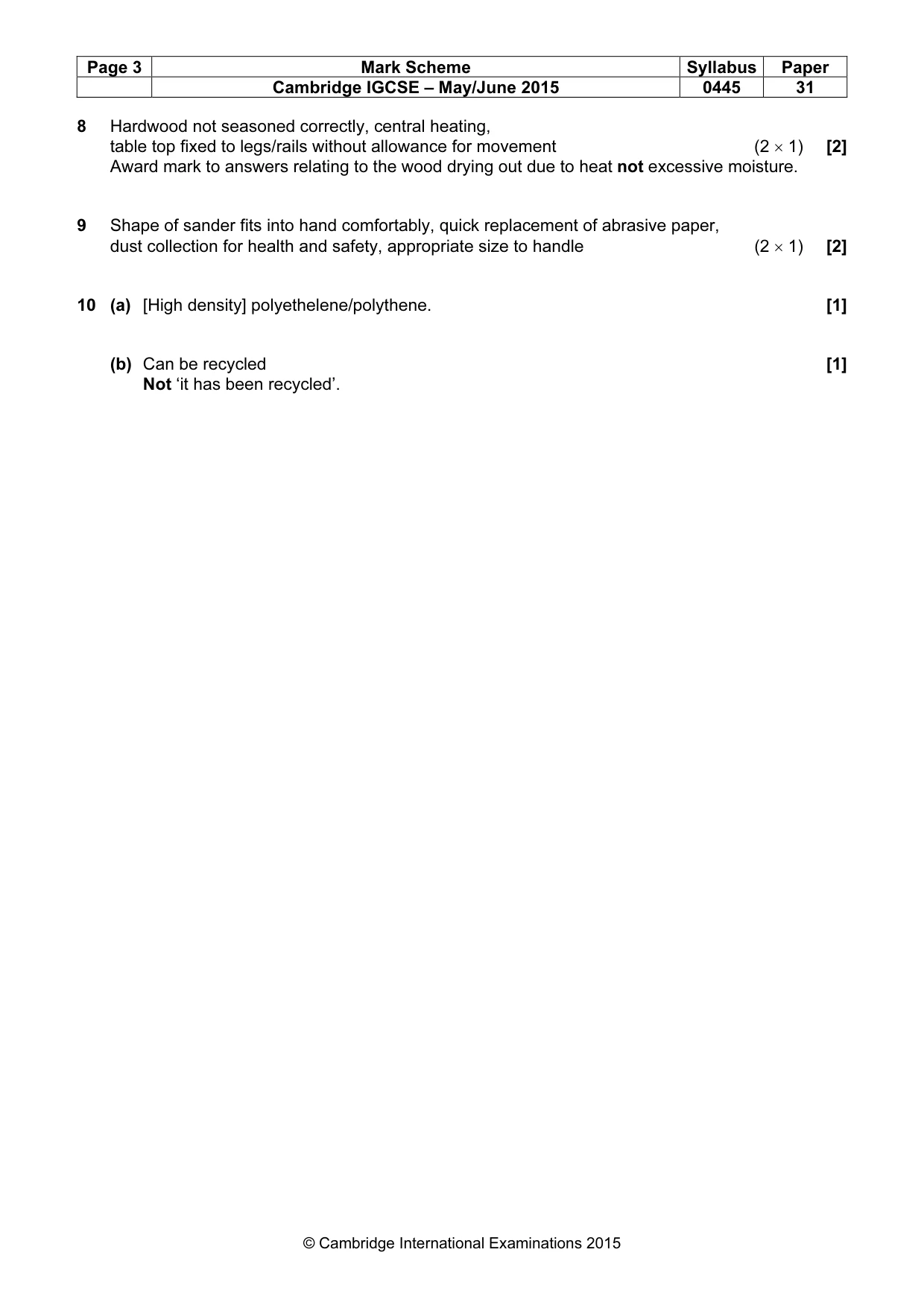
Page 3 Mark Scheme Syllabus Paper Cambridge IGCSE – May/June 2015 0445 31 © Cambridge International Examinations 2015 8 Hardwood not seasoned correctly, central heating, table top fixed to legs/rails without allowance for movement (2 × 1) [2] Award mark to answers relating to the wood drying out due to heat not excessive moisture. 9 Shape of sander fits into hand comfortably, quick replacement of abrasive paper, dust collection for health and safety, appropriate size to handle (2 × 1) [2] 10 (a) [High density] polyethelene/polythene. [1] (b) Can be recycled [1] Not ‘it has been recycled’.
Mark scheme, page 4
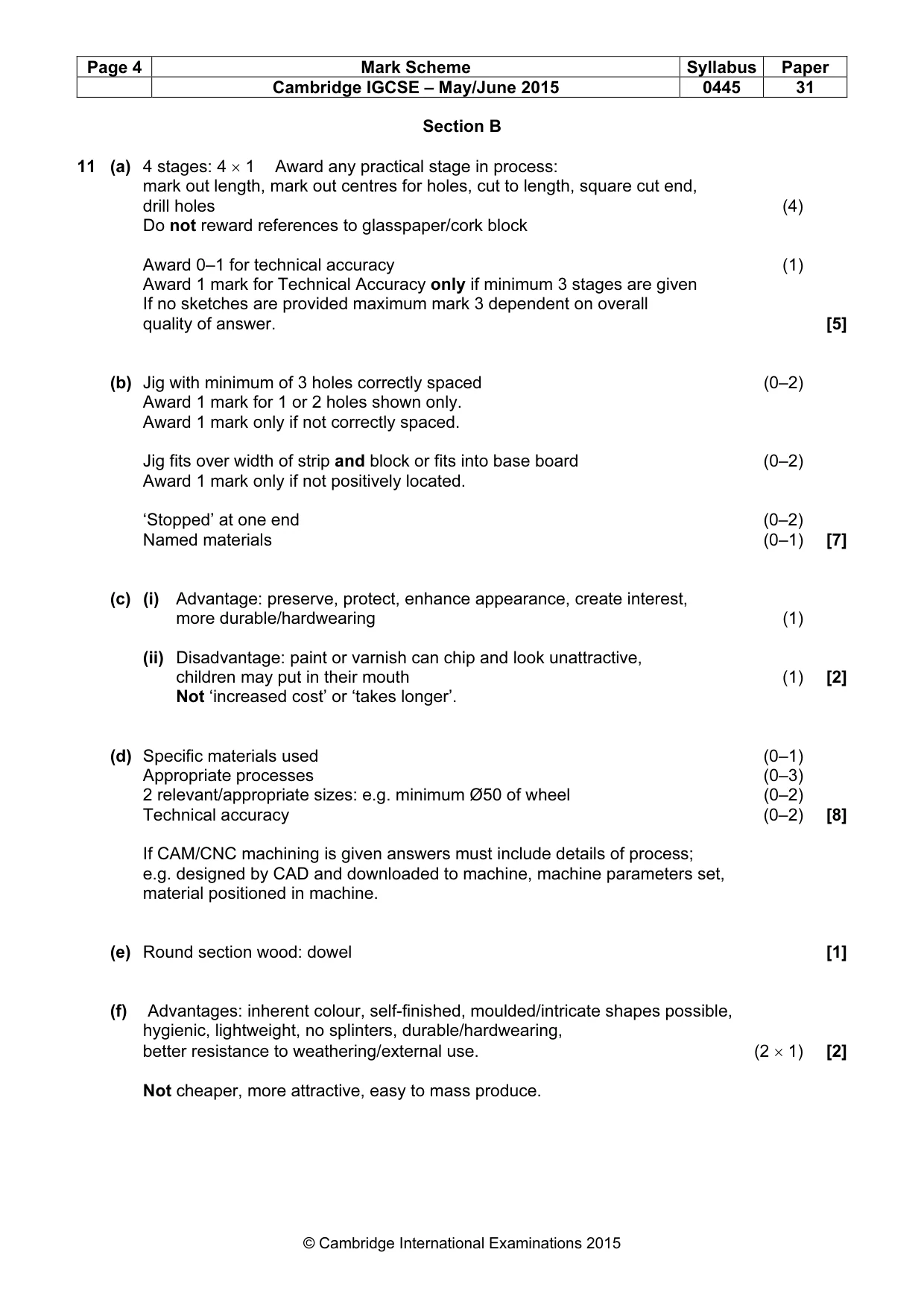
Page 4 Mark Scheme Syllabus Paper Cambridge IGCSE – May/June 2015 0445 31 © Cambridge International Examinations 2015 Section B 11 (a) 4 stages: 4 × 1 Award any practical stage in process: mark out length, mark out centres for holes, cut to length, square cut end, drill holes (4) Do not reward references to glasspaper/cork block Award 0–1 for technical accuracy (1) Award 1 mark for Technical Accuracy only if minimum 3 stages are given If no sketches are provided maximum mark 3 dependent on overall quality of answer. [5] (b) Jig with minimum of 3 holes correctly spaced (0–2) Award 1 mark for 1 or 2 holes shown only. Award 1 mark only if not correctly spaced. Jig fits over width of strip and block or fits into base board (0–2) Award 1 mark only if not positively located. ‘Stopped’ at one end (0–2) Named materials (0–1) [7] (c) (i) Advantage: preserve, protect, enhance appearance, create interest, more durable/hardwearing (1) (ii) Disadvantage: paint or varnish can chip and look unattractive, children may put in their mouth (1) [2] Not ‘increased cost’ or ‘takes longer’. (d) Specific materials used (0–1) Appropriate processes (0–3) 2 relevant/appropriate sizes: e.g. minimum Ø50 of wheel (0–2) Technical accuracy (0–2) [8] If CAM/CNC machining is given answers must include details of process; e.g. designed by CAD and downloaded to machine, machine parameters set, material positioned in machine. (e) Round section wood: dowel [1] (f) Advantages: inherent colour, self-finished, moulded/intricate shapes possible, hygienic, lightweight, no splinters, durable/hardwearing, better resistance to weathering/external use. (2 × 1) [2] Not cheaper, more attractive, easy to mass produce.
Mark scheme, page 5
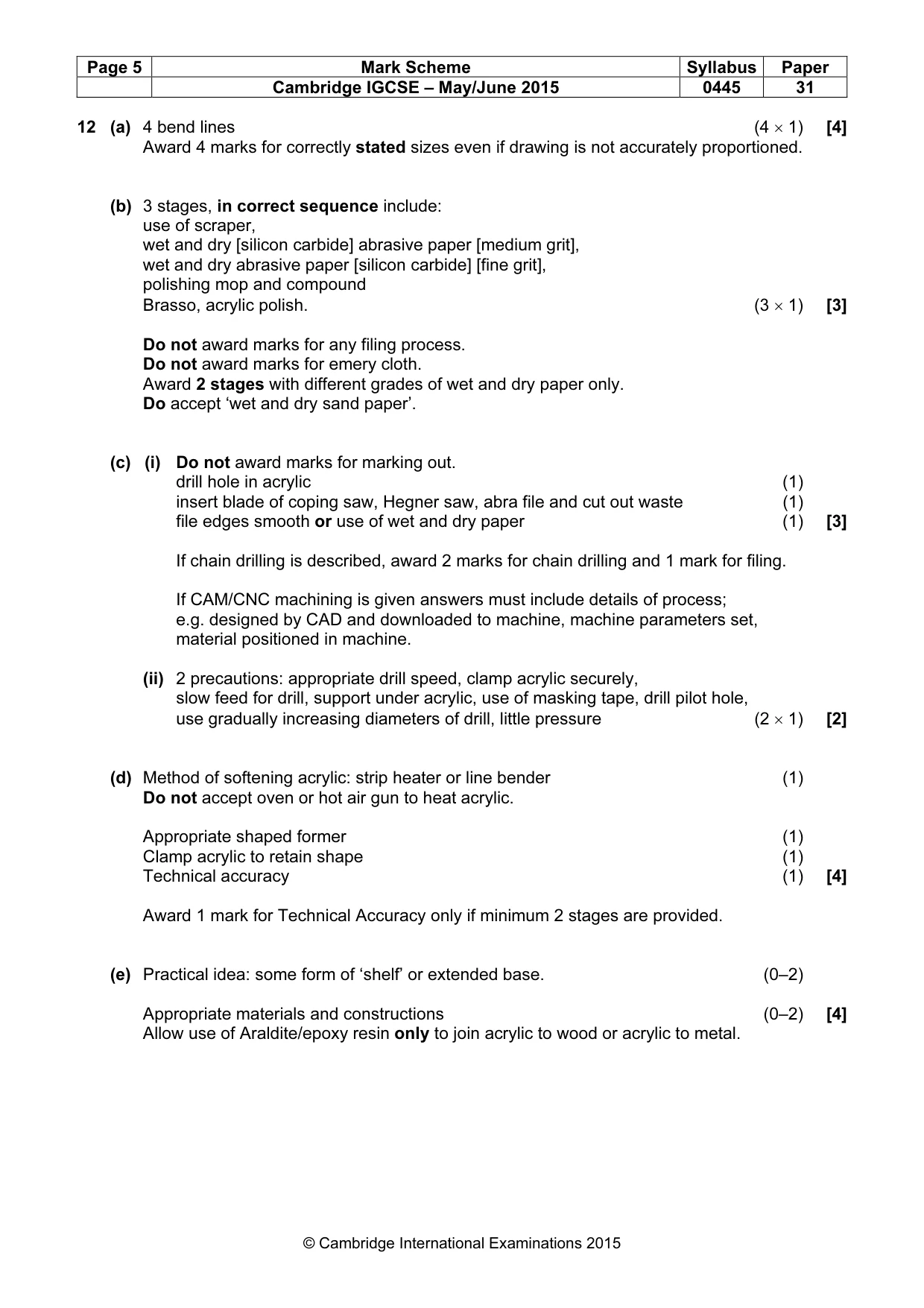
Page 5 Mark Scheme Syllabus Paper Cambridge IGCSE – May/June 2015 0445 31 © Cambridge International Examinations 2015 12 (a) 4 bend lines (4 × 1) [4] Award 4 marks for correctly stated sizes even if drawing is not accurately proportioned. (b) 3 stages, in correct sequence include: use of scraper, wet and dry [silicon carbide] abrasive paper [medium grit], wet and dry abrasive paper [silicon carbide] [fine grit], polishing mop and compound Brasso, acrylic polish. (3 × 1) [3] Do not award marks for any filing process. Do not award marks for emery cloth. Award 2 stages with different grades of wet and dry paper only. Do accept ‘wet and dry sand paper’. (c) (i) Do not award marks for marking out. drill hole in acrylic (1) insert blade of coping saw, Hegner saw, abra file and cut out waste (1) file edges smooth or use of wet and dry paper (1) [3] If chain drilling is described, award 2 marks for chain drilling and 1 mark for filing. If CAM/CNC machining is given answers must include details of process; e.g. designed by CAD and downloaded to machine, machine parameters set, material positioned in machine. (ii) 2 precautions: appropriate drill speed, clamp acrylic securely, slow feed for drill, support under acrylic, use of masking tape, drill pilot hole, use gradually increasing diameters of drill, little pressure (2 × 1) [2] (d) Method of softening acrylic: strip heater or line bender (1) Do not accept oven or hot air gun to heat acrylic. Appropriate shaped former (1) Clamp acrylic to retain shape (1) Technical accuracy (1) [4] Award 1 mark for Technical Accuracy only if minimum 2 stages are provided. (e) Practical idea: some form of ‘shelf’ or extended base. (0–2) Appropriate materials and constructions (0–2) [4] Allow use of Araldite/epoxy resin only to join acrylic to wood or acrylic to metal.
Mark scheme, page 6
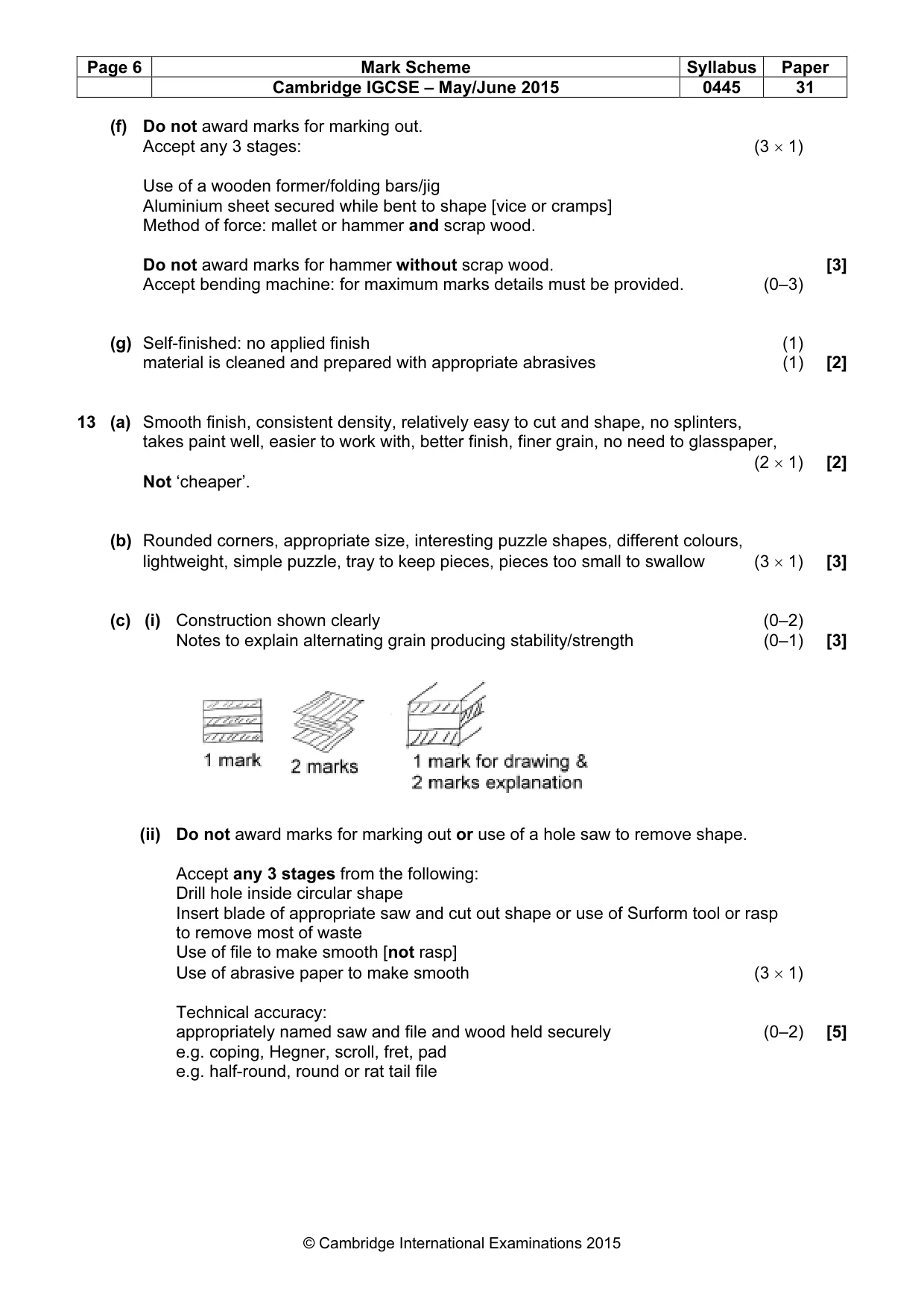
Page 6 Mark Scheme Syllabus Paper Cambridge IGCSE – May/June 2015 0445 31 © Cambridge International Examinations 2015 (f) Do not award marks for marking out. Accept any 3 stages: (3 × 1) Use of a wooden former/folding bars/jig Aluminium sheet secured while bent to shape [vice or cramps] Method of force: mallet or hammer and scrap wood. Do not award marks for hammer without scrap wood. [3] Accept bending machine: for maximum marks details must be provided. (0–3) (g) Self-finished: no applied finish (1) material is cleaned and prepared with appropriate abrasives (1) [2] 13 (a) Smooth finish, consistent density, relatively easy to cut and shape, no splinters, takes paint well, easier to work with, better finish, finer grain, no need to glasspaper, (2 × 1) [2] Not ‘cheaper’. (b) Rounded corners, appropriate size, interesting puzzle shapes, different colours, lightweight, simple puzzle, tray to keep pieces, pieces too small to swallow (3 × 1) [3] (c) (i) Construction shown clearly (0–2) Notes to explain alternating grain producing stability/strength (0–1) [3] (ii) Do not award marks for marking out or use of a hole saw to remove shape. Accept any 3 stages from the following: Drill hole inside circular shape Insert blade of appropriate saw and cut out shape or use of Surform tool or rasp to remove most of waste Use of file to make smooth [not rasp] Use of abrasive paper to make smooth (3 × 1) Technical accuracy: appropriately named saw and file and wood held securely (0–2) [5] e.g. coping, Hegner, scroll, fret, pad e.g. half-round, round or rat tail file
Mark scheme, page 7
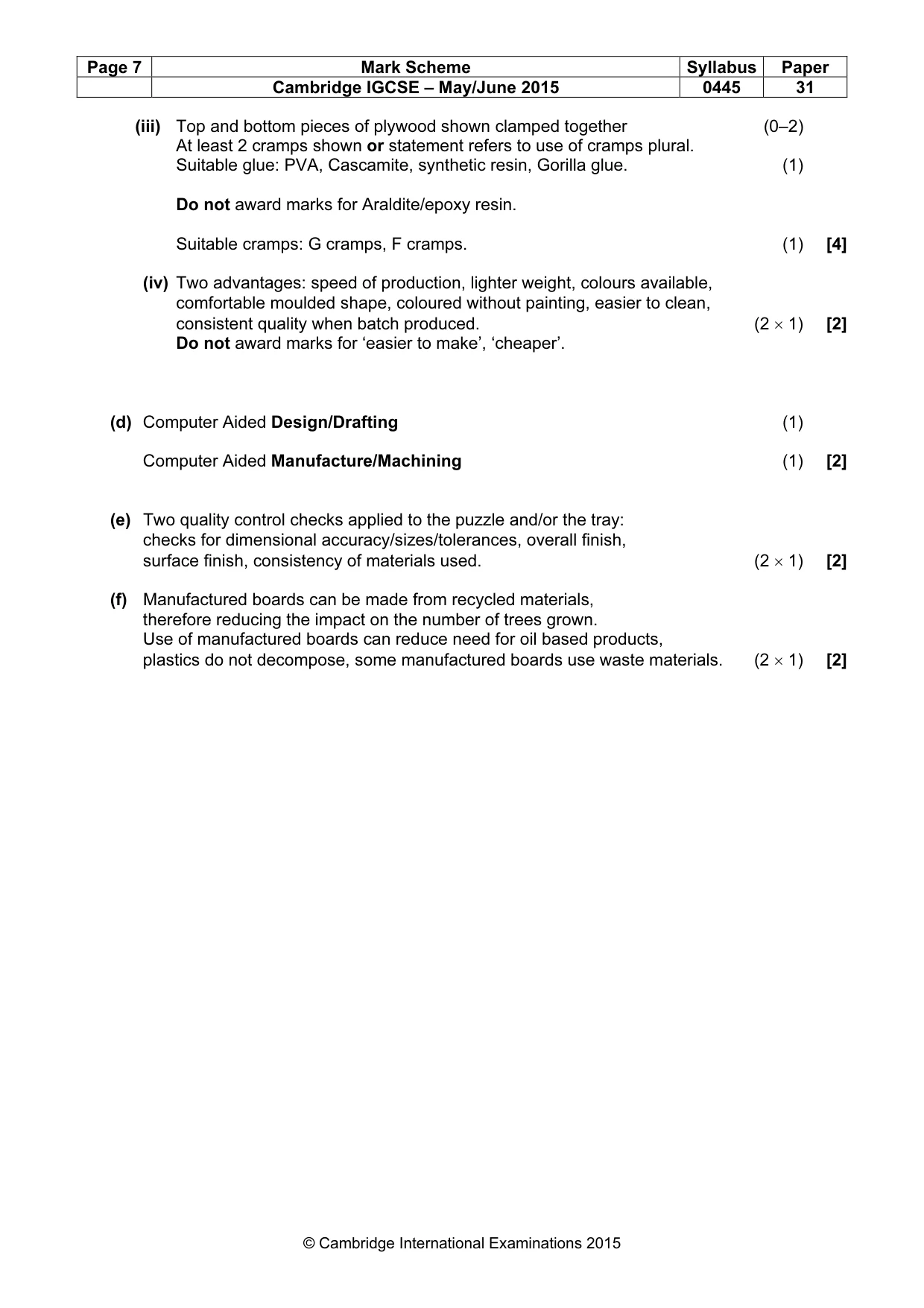
Page 7 Mark Scheme Syllabus Paper Cambridge IGCSE – May/June 2015 0445 31 © Cambridge International Examinations 2015 (iii) Top and bottom pieces of plywood shown clamped together (0–2) At least 2 cramps shown or statement refers to use of cramps plural. Suitable glue: PVA, Cascamite, synthetic resin, Gorilla glue. (1) Do not award marks for Araldite/epoxy resin. Suitable cramps: G cramps, F cramps. (1) [4] (iv) Two advantages: speed of production, lighter weight, colours available, comfortable moulded shape, coloured without painting, easier to clean, consistent quality when batch produced. (2 × 1) [2] Do not award marks for ‘easier to make’, ‘cheaper’. (d) Computer Aided Design/Drafting (1) Computer Aided Manufacture/Machining (1) [2] (e) Two quality control checks applied to the puzzle and/or the tray: checks for dimensional accuracy/sizes/tolerances, overall finish, surface finish, consistency of materials used. (2 × 1) [2] (f) Manufactured boards can be made from recycled materials, therefore reducing the impact on the number of trees grown. Use of manufactured boards can reduce need for oil based products, plastics do not decompose, some manufactured boards use waste materials. (2 × 1) [2]
What you needed in this session
Cambridge’s own grade thresholds for 2015 May/June, Paper 3 · Variant 1. A higher threshold means an easier paper — the bar moves with how the cohort did.