Cambridge IGCSE Design and Technology 0445 — 2010 Oct/Nov Paper 3 · Variant 1
0445/31/O/N/10 · 50 marks · ≈56 min
The question paper and its mark scheme, free to read here and free to download. This is Cambridge’s own paper, exactly as it was sat.
Question paper16 pages

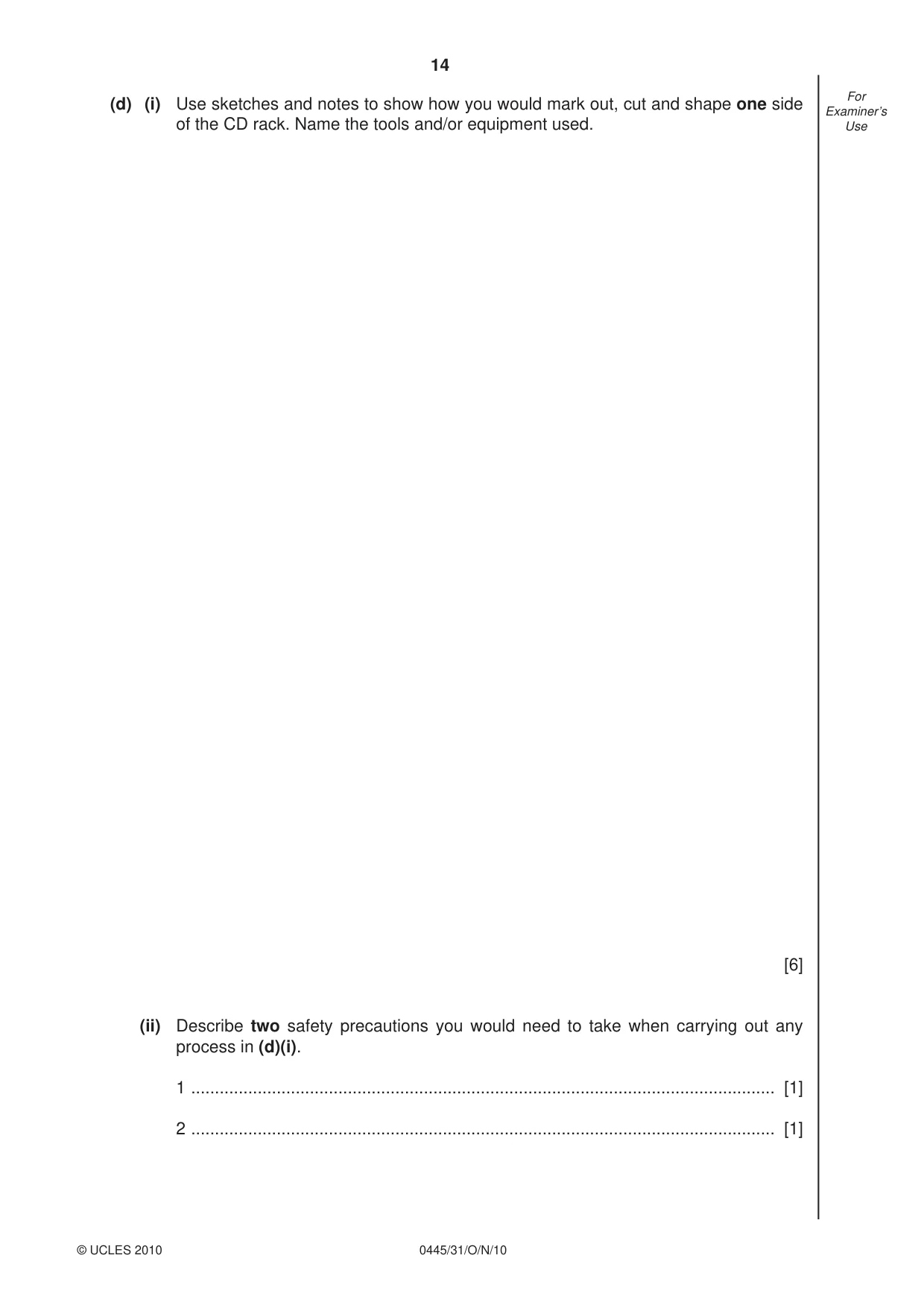
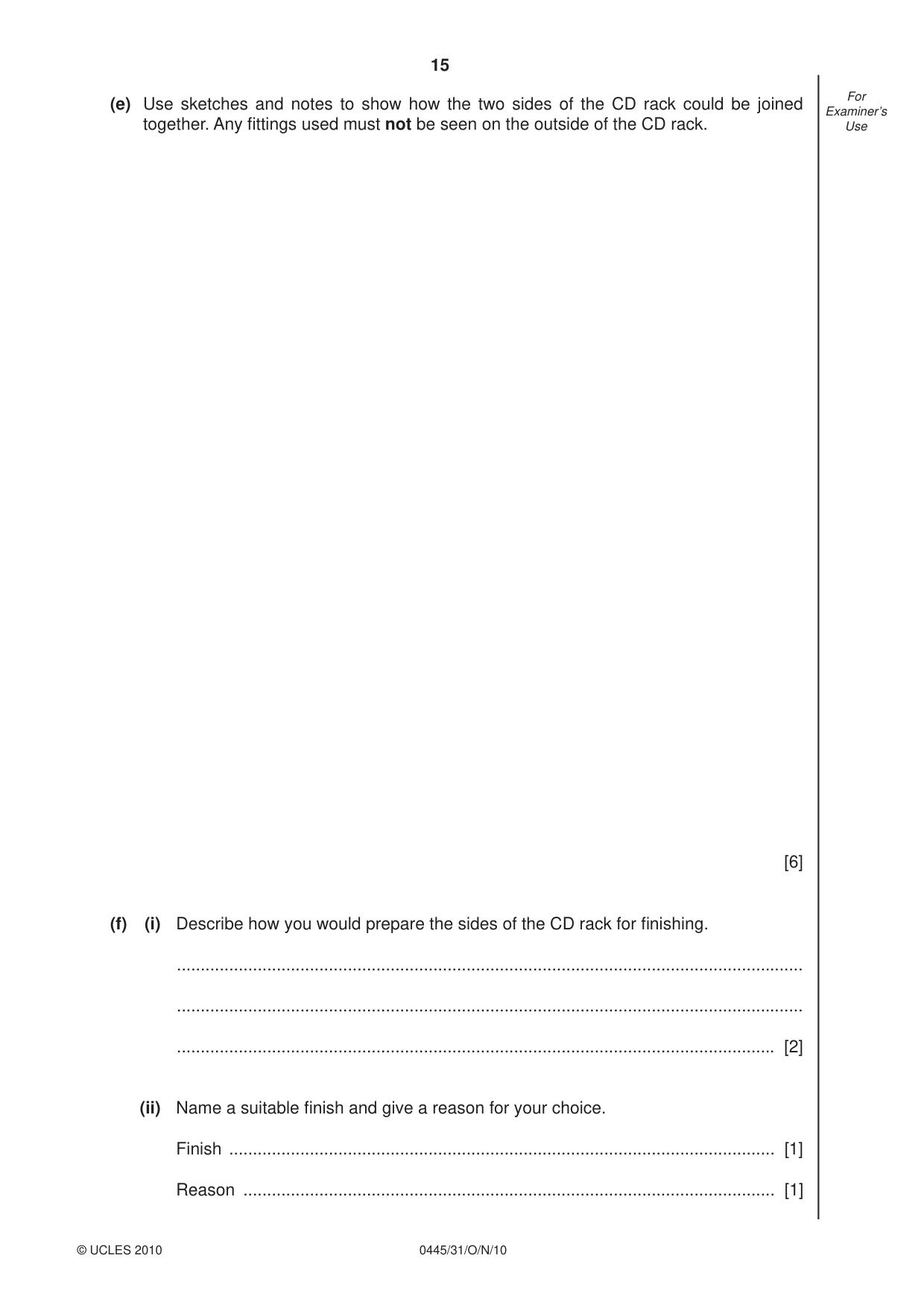
Mark scheme5 pages
Answers below. Sit the paper first if you are practising.
Paper as text
Question paper, page 1
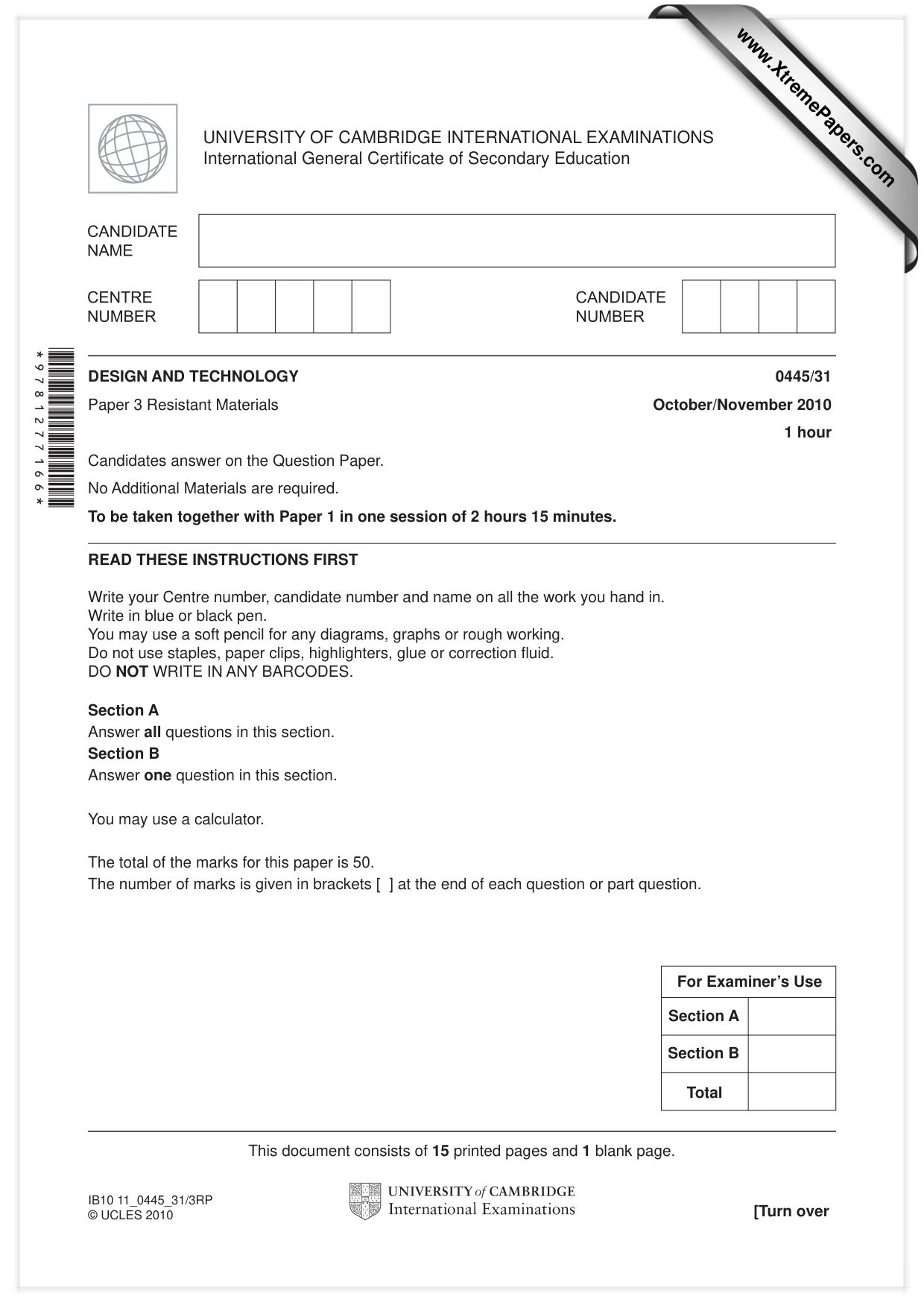
READ THESE INSTRUCTIONS FIRST Write your Centre number, candidate number and name on all the work you hand in. Write in blue or black pen. You may use a soft pencil for any diagrams, graphs or rough working. Do not use staples, paper clips, highlighters, glue or correction fl uid. DO NOT WRITE IN ANY BARCODES. Section A Answer all questions in this section. Section B Answer one question in this section. You may use a calculator. The total of the marks for this paper is 50. The number of marks is given in brackets [ ] at the end of each question or part question. DESIGN AND TECHNOLOGY 0445/31 Paper 3 Resistant Materials October/November 2010 1 hour Candidates answer on the Question Paper. No Additional Materials are required. To be taken together with Paper 1 in one session of 2 hours 15 minutes. UNIVERSITY OF CAMBRIDGE INTERNATIONAL EXAMINATIONS International General Certifi cate of Secondary Education This document consists of 15 printed pages and 1 blank page. [Turn over IB10 11_0445_31/3RP © UCLES 2010 *9781277166* For Examiner’s Use Total Section A Section B www.XtremePapers.com
Question paper, page 2
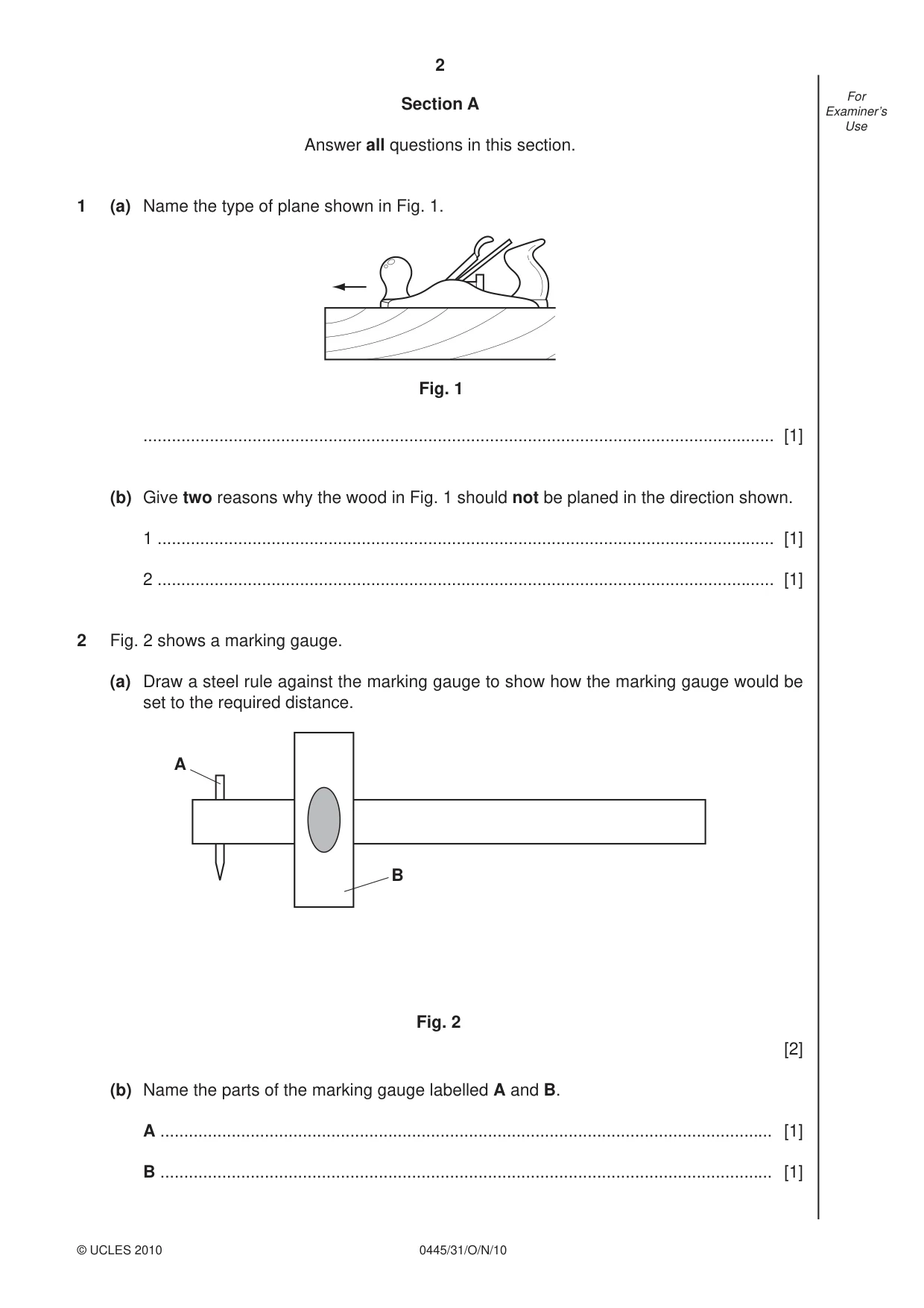
2 0445/31/O/N/10 © UCLES 2010 For Examiner’s Use Section A Answer all questions in this section. 1 (a) Name the type of plane shown in Fig. 1. Fig. 1 … [1] (b) Give two reasons why the wood in Fig. 1 should not be planed in the direction shown. 1 … [1] 2 … [1] 2 Fig. 2 shows a marking gauge. (a) Draw a steel rule against the marking gauge to show how the marking gauge would be set to the required distance. A B Fig. 2 [2] (b) Name the parts of the marking gauge labelled A and B. A … [1] B … [1]
Question paper, page 3
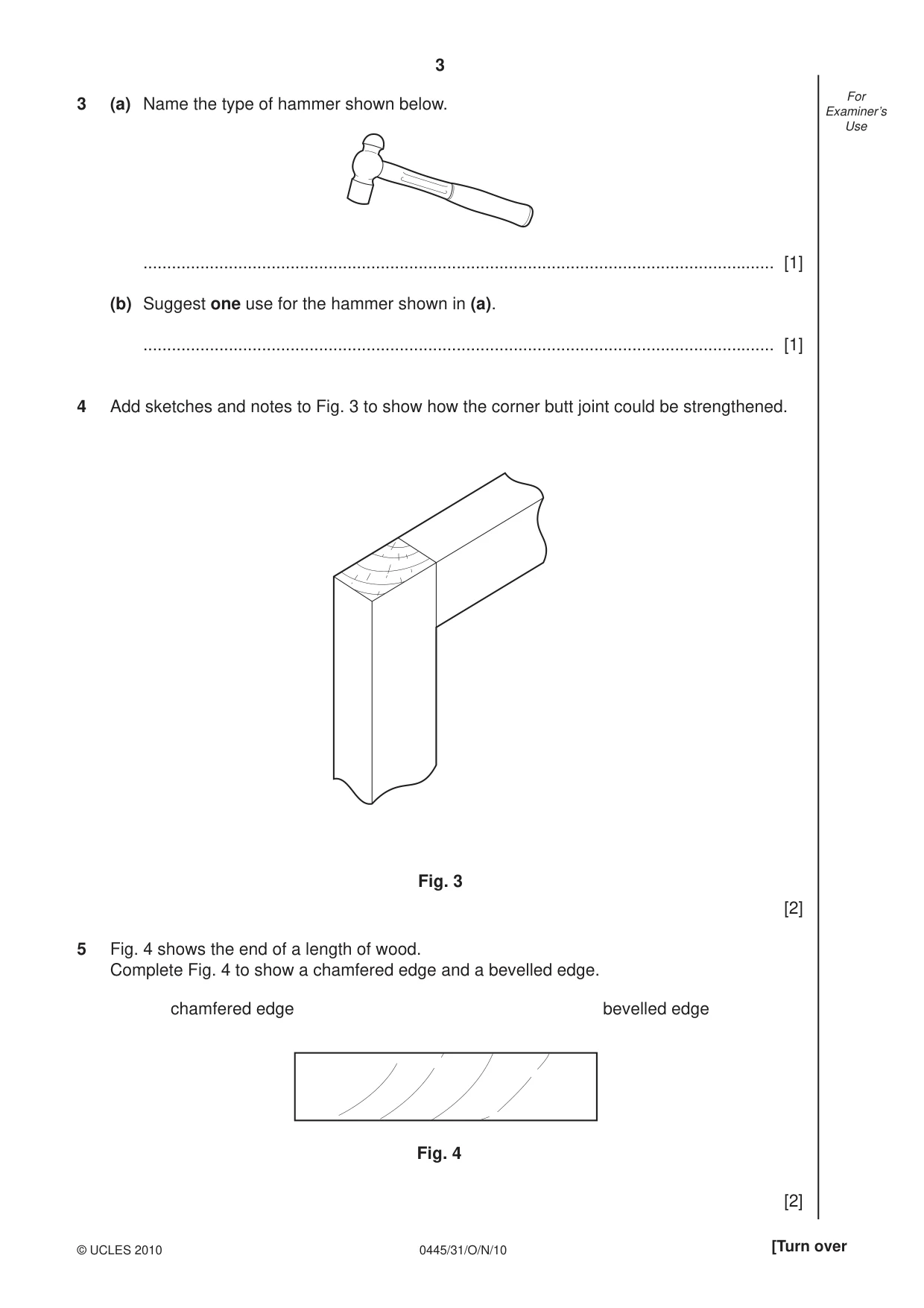
3 0445/31/O/N/10 © UCLES 2010 [Turn over For Examiner’s Use 3 (a) Name the type of hammer shown below. … [1] (b) Suggest one use for the hammer shown in (a). … [1] 4 Add sketches and notes to Fig. 3 to show how the corner butt joint could be strengthened. Fig. 3 [2] 5 Fig. 4 shows the end of a length of wood. Complete Fig. 4 to show a chamfered edge and a bevelled edge. chamfered edge bevelled edge Fig. 4 [2]
Question paper, page 4
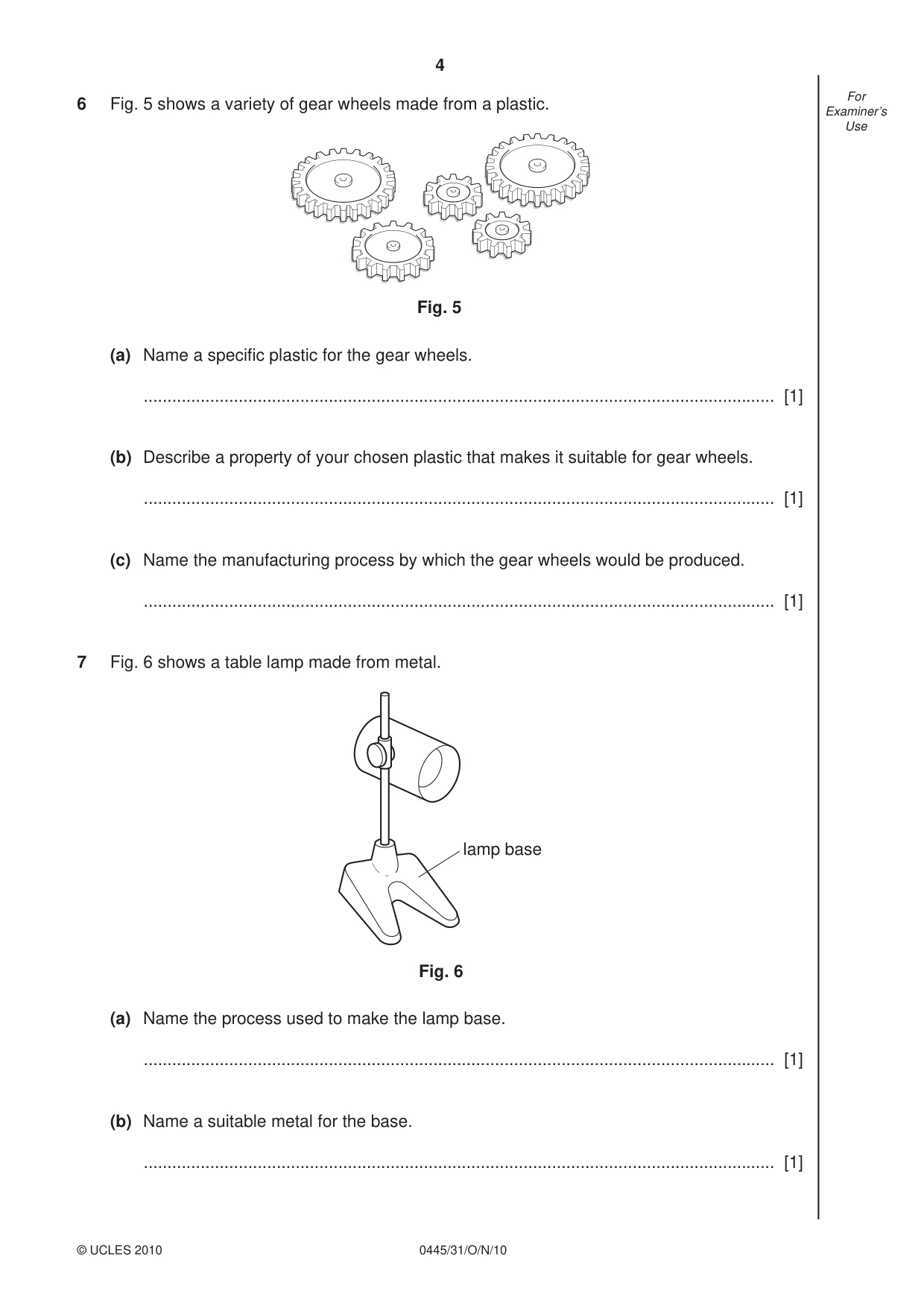
4 0445/31/O/N/10 © UCLES 2010 For Examiner’s Use 6 Fig. 5 shows a variety of gear wheels made from a plastic. Fig. 5 (a) Name a specifi c plastic for the gear wheels. … [1] (b) Describe a property of your chosen plastic that makes it suitable for gear wheels. … [1] (c) Name the manufacturing process by which the gear wheels would be produced. … [1] 7 Fig. 6 shows a table lamp made from metal. lamp base Fig. 6 (a) Name the process used to make the lamp base. … [1] (b) Name a suitable metal for the base. … [1]
Question paper, page 5
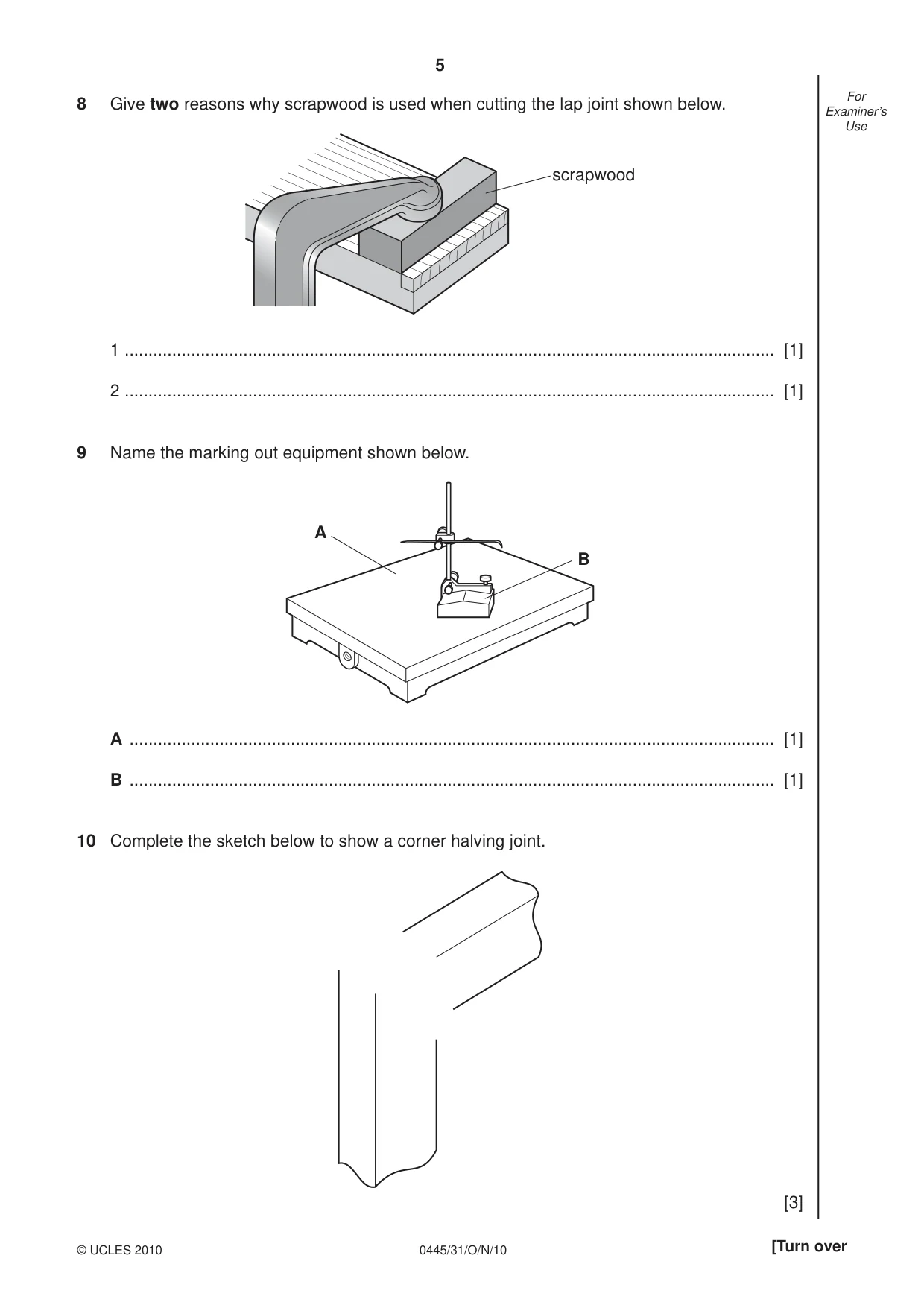
5 0445/31/O/N/10 © UCLES 2010 [Turn over For Examiner’s Use 8 Give two reasons why scrapwood is used when cutting the lap joint shown below. scrapwood 1 … [1] 2 … [1] 9 Name the marking out equipment shown below. B A A … [1] B … [1] 10 Complete the sketch below to show a corner halving joint. [3]
Question paper, page 6
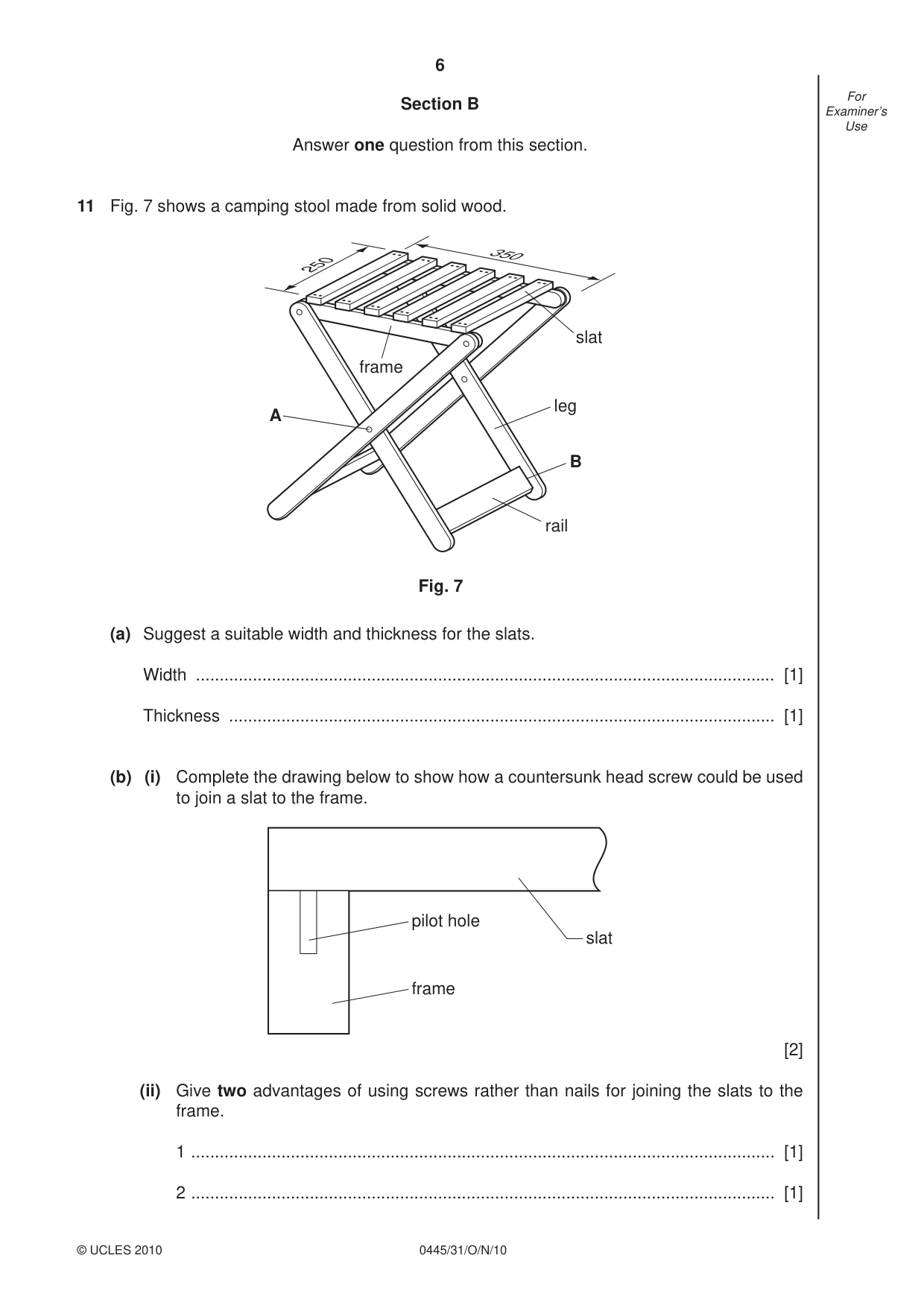
6 0445/31/O/N/10 © UCLES 2010 For Examiner’s Use Section B Answer one question from this section. 11 Fig. 7 shows a camping stool made from solid wood. A leg frame B rail slat 250 350 Fig. 7 (a) Suggest a suitable width and thickness for the slats. Width … [1] Thickness … [1] (b) (i) Complete the drawing below to show how a countersunk head screw could be used to join a slat to the frame. pilot hole frame slat [2] (ii) Give two advantages of using screws rather than nails for joining the slats to the frame. 1 … [1] 2 … [1]
Question paper, page 7
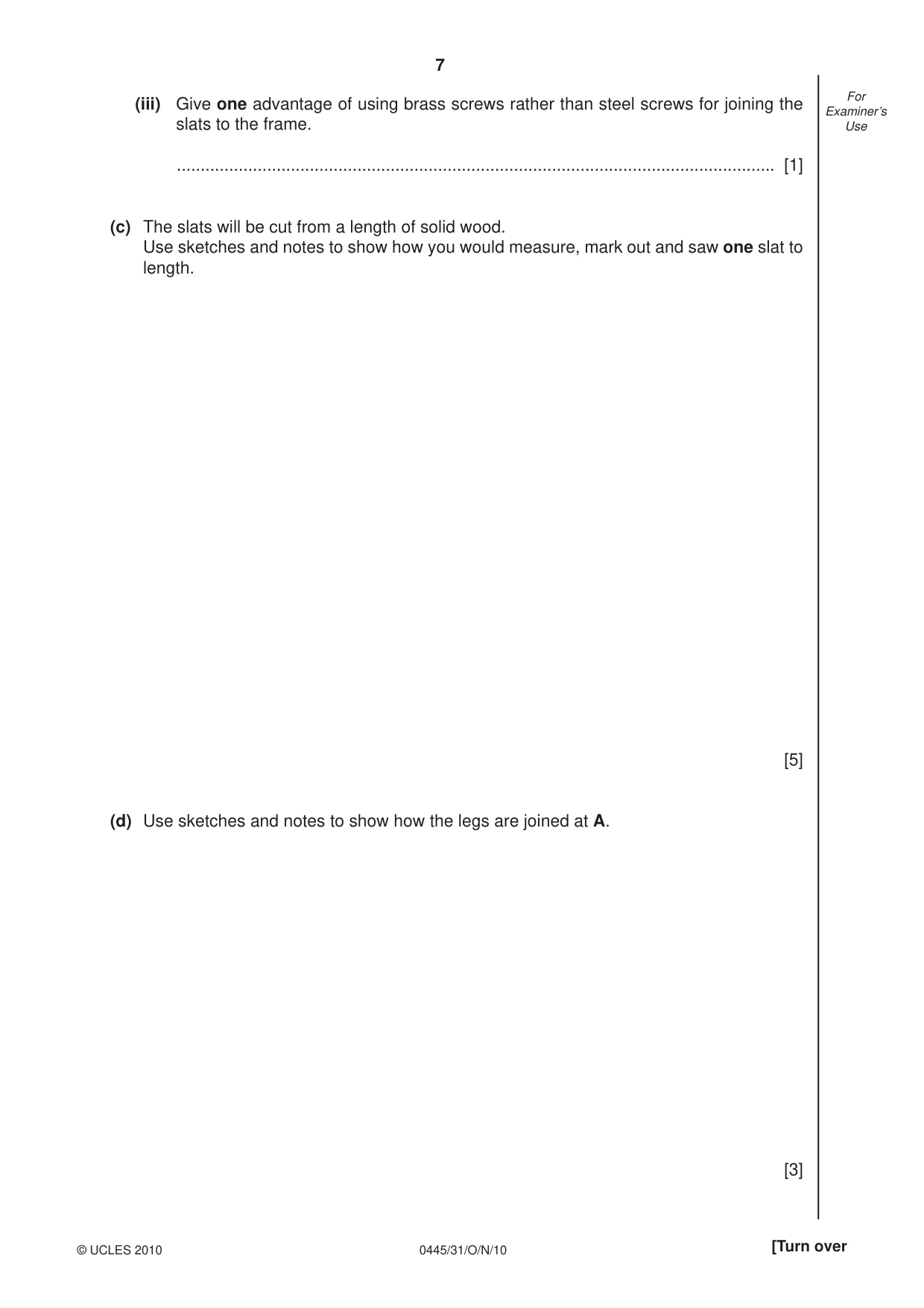
7 0445/31/O/N/10 © UCLES 2010 [Turn over For Examiner’s Use (iii) Give one advantage of using brass screws rather than steel screws for joining the slats to the frame. … [1] (c) The slats will be cut from a length of solid wood. Use sketches and notes to show how you would measure, mark out and saw one slat to length. [5] (d) Use sketches and notes to show how the legs are joined at A. [3]
Question paper, page 8
8 0445/31/O/N/10 © UCLES 2010 For Examiner’s Use (e) (i) Name and sketch a suitable construction that could be used to join a rail and leg at B. Name … [1] Sketch [3] (ii) Use sketches and notes to show how the legs and rail would be clamped when glueing. [3]
Question paper, page 9
9 0445/31/O/N/10 © UCLES 2010 [Turn over For Examiner’s Use (f) (i) Name a suitable fi nish for the camping stool. … [1] (ii) Give two reasons for your choice. 1 … [1] 2 … [1]
Question paper, page 10
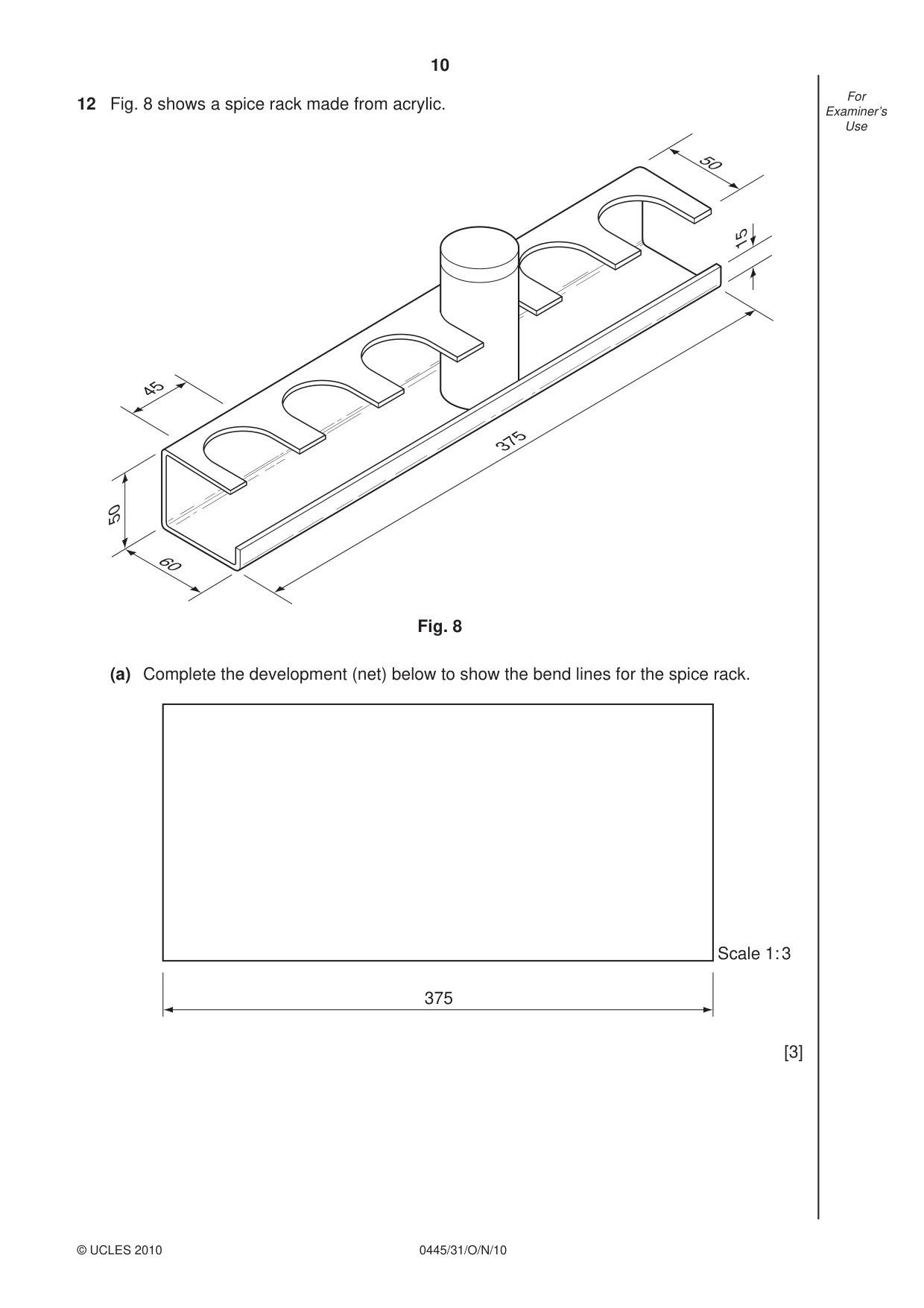
10 0445/31/O/N/10 © UCLES 2010 For Examiner’s Use 12 Fig. 8 shows a spice rack made from acrylic. 60 50 45 375 50 15 Fig. 8 (a) Complete the development (net) below to show the bend lines for the spice rack. 375 Scale 1: 3 [3]
Question paper, page 11
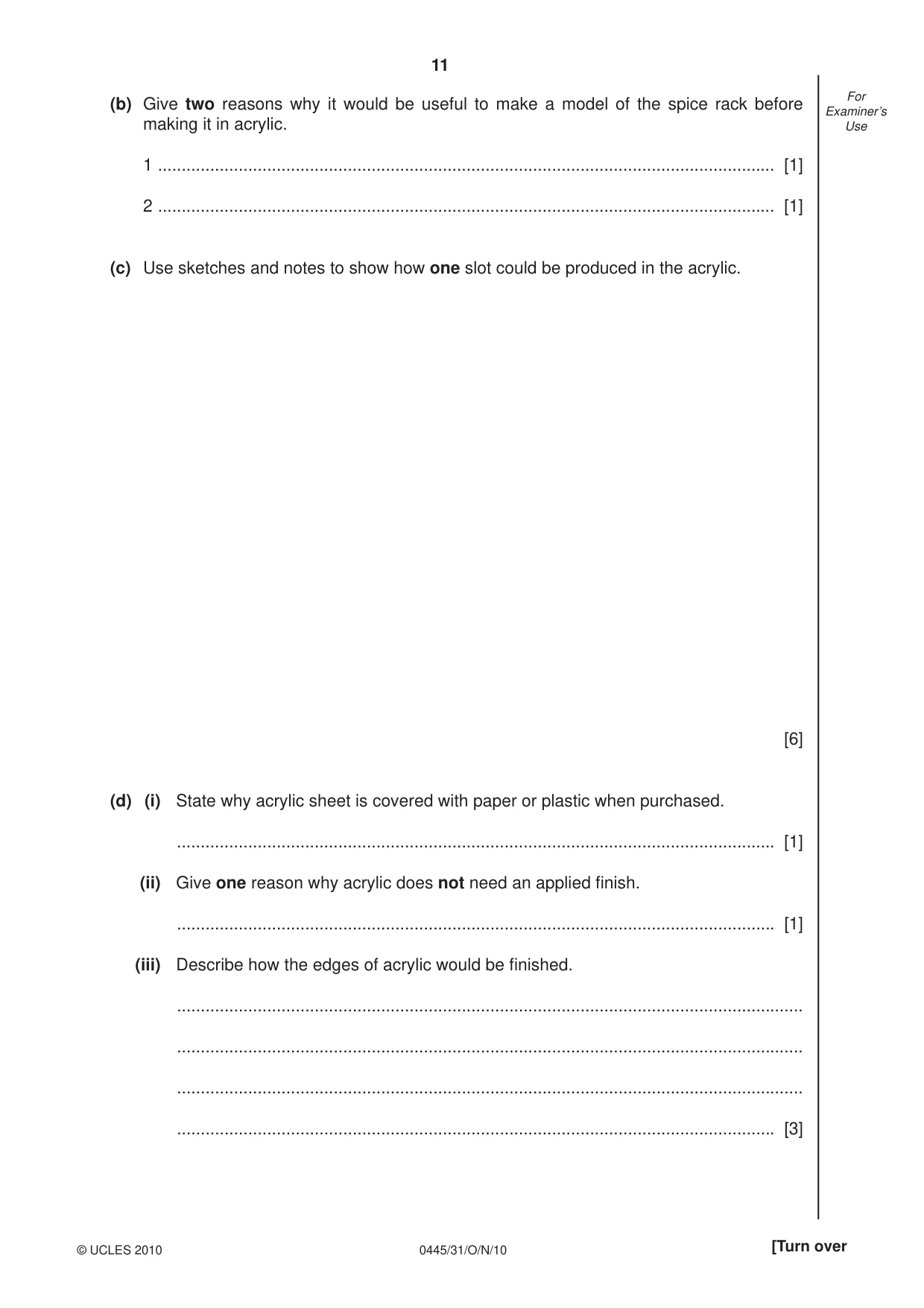
11 0445/31/O/N/10 © UCLES 2010 [Turn over For Examiner’s Use (b) Give two reasons why it would be useful to make a model of the spice rack before making it in acrylic. 1 … [1] 2 … [1] (c) Use sketches and notes to show how one slot could be produced in the acrylic. [6] (d) (i) State why acrylic sheet is covered with paper or plastic when purchased. … [1] (ii) Give one reason why acrylic does not need an applied fi nish. … [1] (iii) Describe how the edges of acrylic would be fi nished. … … … … [3]
Question paper, page 12
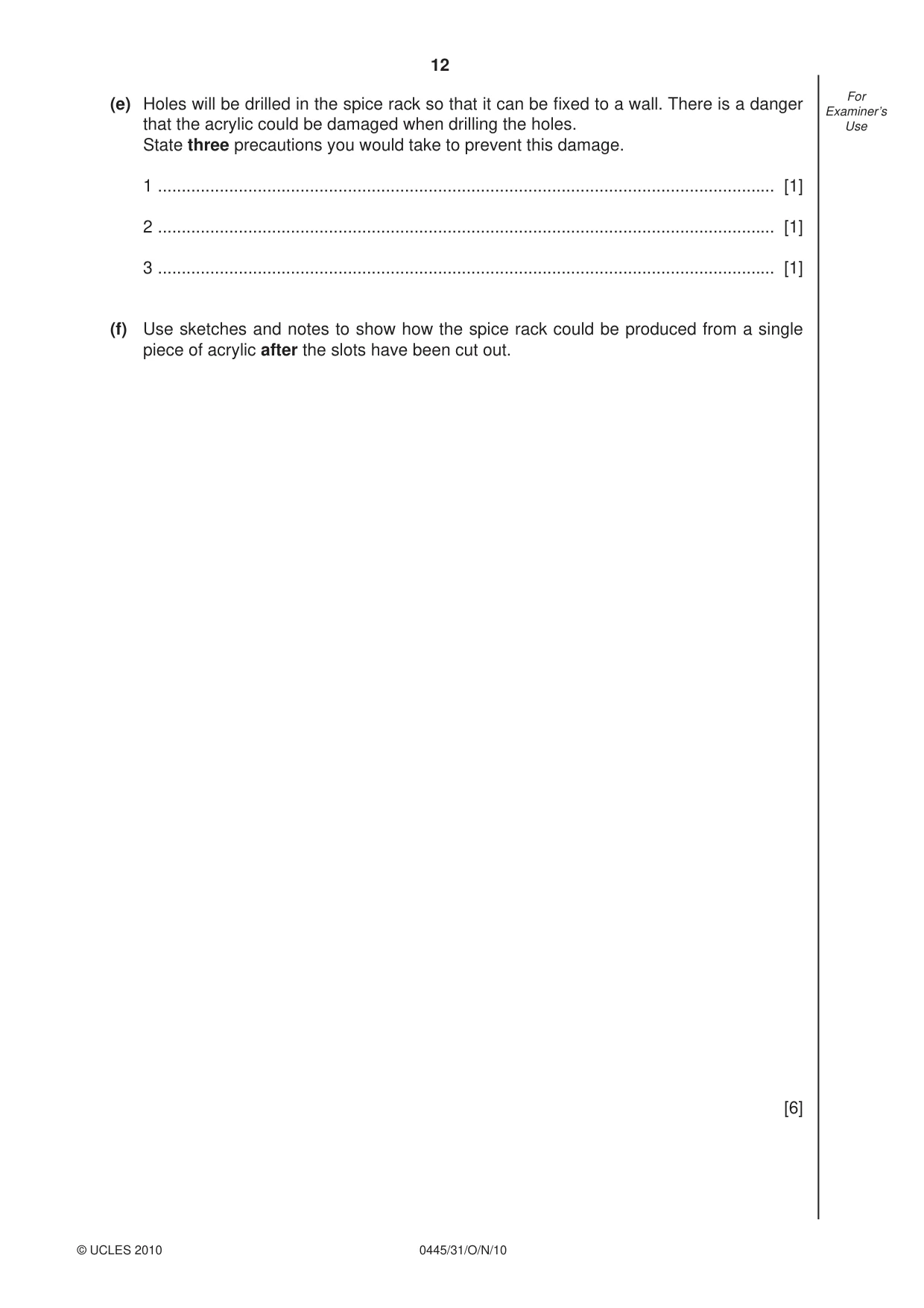
12 0445/31/O/N/10 © UCLES 2010 For Examiner’s Use (e) Holes will be drilled in the spice rack so that it can be fi xed to a wall. There is a danger that the acrylic could be damaged when drilling the holes. State three precautions you would take to prevent this damage. 1 … [1] 2 … [1] 3 … [1] (f) Use sketches and notes to show how the spice rack could be produced from a single piece of acrylic after the slots have been cut out. [6]
Question paper, page 13
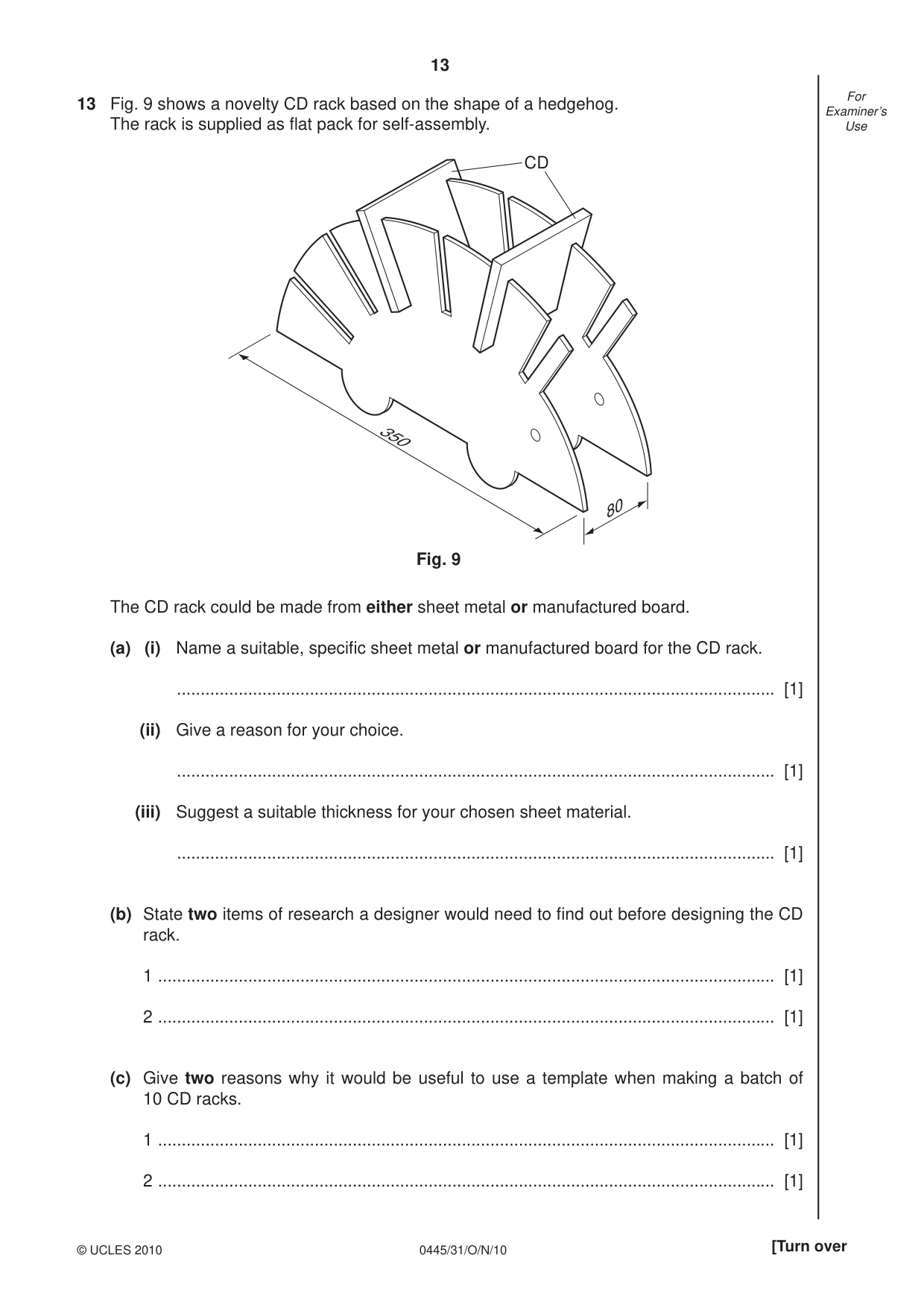
13 0445/31/O/N/10 © UCLES 2010 [Turn over For Examiner’s Use 13 Fig. 9 shows a novelty CD rack based on the shape of a hedgehog. The rack is supplied as fl at pack for self-assembly. 80 Fig. 9 CD 350 The CD rack could be made from either sheet metal or manufactured board. (a) (i) Name a suitable, specifi c sheet metal or manufactured board for the CD rack. … [1] (ii) Give a reason for your choice. … [1] (iii) Suggest a suitable thickness for your chosen sheet material. … [1] (b) State two items of research a designer would need to fi nd out before designing the CD rack. 1 … [1] 2 … [1] (c) Give two reasons why it would be useful to use a template when making a batch of 10 CD racks. 1 … [1] 2 … [1]
Question paper, page 14
14 0445/31/O/N/10 © UCLES 2010 For Examiner’s Use (d) (i) Use sketches and notes to show how you would mark out, cut and shape one side of the CD rack. Name the tools and/or equipment used. [6] (ii) Describe two safety precautions you would need to take when carrying out any process in (d)(i). 1 … [1] 2 … [1]
Question paper, page 15
15 0445/31/O/N/10 © UCLES 2010 For Examiner’s Use (e) Use sketches and notes to show how the two sides of the CD rack could be joined together. Any fi ttings used must not be seen on the outside of the CD rack. [6] (f) (i) Describe how you would prepare the sides of the CD rack for fi nishing. … … … [2] (ii) Name a suitable fi nish and give a reason for your choice. Finish … [1] Reason … [1]
Question paper, page 16
16 0445/31/O/N/10 Permission to reproduce items where third-party owned material protected by copyright is included has been sought and cleared where possible. Every reasonable effort has been made by the publisher (UCLES) to trace copyright holders, but if any items requiring clearance have unwittingly been included the publisher will be pleased to make amends at the earliest possible opportunity. University of Cambridge International Examinations is part of the Cambridge Assessment Group. Cambridge Assessment is the brand name of University of Cambridge Local Examinations Syndicate (UCLES), which is itself a department of the University of Cambridge. BLANK PAGE © UCLES 2010
Mark scheme, page 1
UNIVERSITY OF CAMBRIDGE INTERNATIONAL EXAMINATIONS International General Certificate of Secondary Education MARK SCHEME for the October/November 2010 question paper for the guidance of teachers 0445 DESIGN AND TECHNOLOGY 0445/31 Paper 3 (Resistant Materials), maximum raw mark 50 This mark scheme is published as an aid to teachers and candidates, to indicate the requirements of the examination. It shows the basis on which Examiners were instructed to award marks. It does not indicate the details of the discussions that took place at an Examiners’ meeting before marking began, which would have considered the acceptability of alternative answers. Mark schemes must be read in conjunction with the question papers and the report on the examination. • CIE will not enter into discussions or correspondence in connection with these mark schemes. CIE is publishing the mark schemes for the October/November 2010 question papers for most IGCSE, GCE Advanced Level and Advanced Subsidiary Level syllabuses and some Ordinary Level syllabuses. www.XtremePapers.com
Mark scheme, page 2
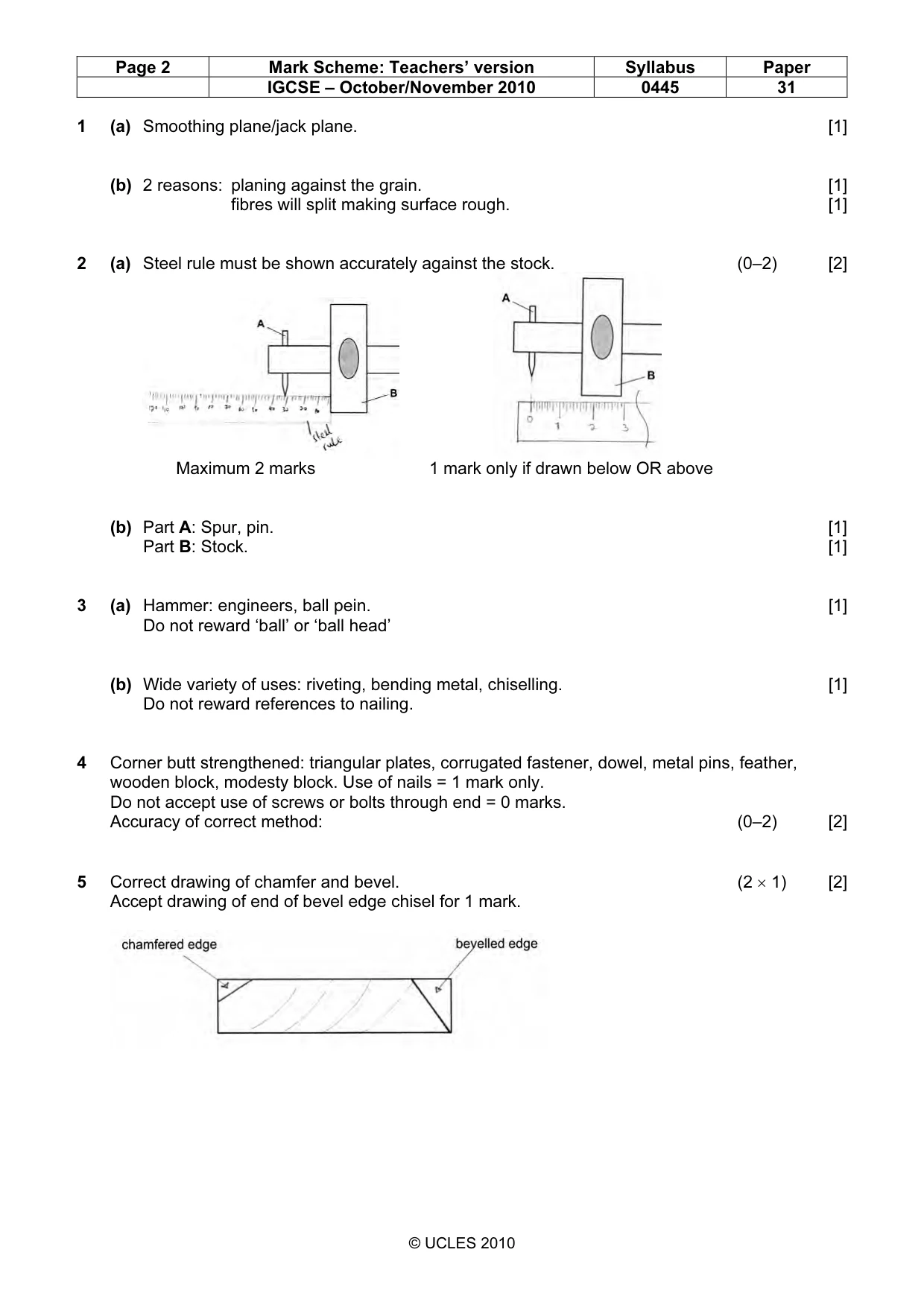
Page 2 Mark Scheme: Teachers’ version Syllabus Paper IGCSE – October/November 2010 0445 31 © UCLES 2010 1 (a) Smoothing plane/jack plane. [1] (b) 2 reasons: planing against the grain. [1] fibres will split making surface rough. [1] 2 (a) Steel rule must be shown accurately against the stock. (0–2) [2] Maximum 2 marks 1 mark only if drawn below OR above (b) Part A: Spur, pin. [1] Part B: Stock. [1] 3 (a) Hammer: engineers, ball pein. [1] Do not reward ‘ball’ or ‘ball head’ (b) Wide variety of uses: riveting, bending metal, chiselling. [1] Do not reward references to nailing. 4 Corner butt strengthened: triangular plates, corrugated fastener, dowel, metal pins, feather, wooden block, modesty block. Use of nails = 1 mark only. Do not accept use of screws or bolts through end = 0 marks. Accuracy of correct method: (0–2) [2] 5 Correct drawing of chamfer and bevel. (2 × 1) [2] Accept drawing of end of bevel edge chisel for 1 mark.
Mark scheme, page 3
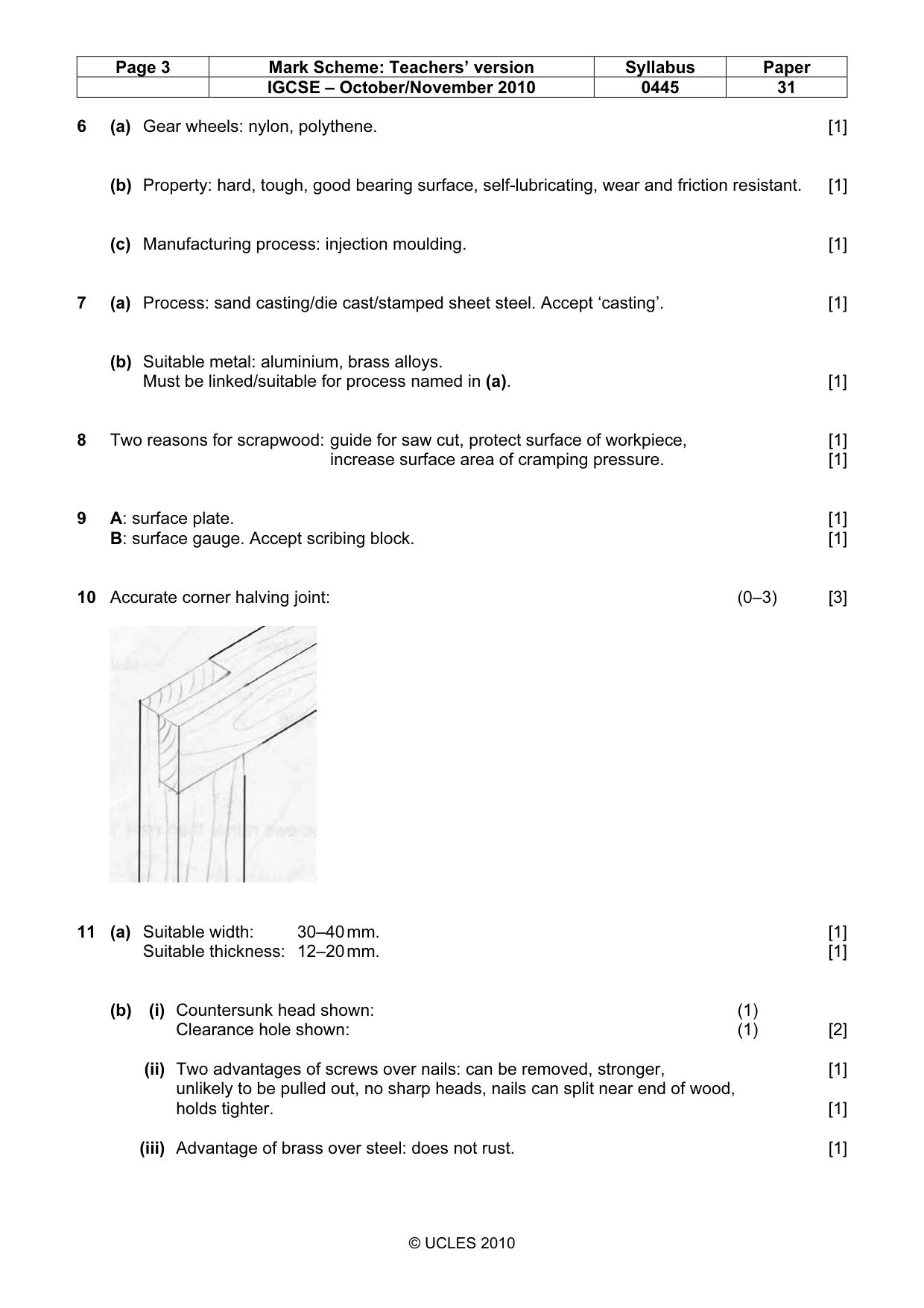
Page 3 Mark Scheme: Teachers’ version Syllabus Paper IGCSE – October/November 2010 0445 31 © UCLES 2010 6 (a) Gear wheels: nylon, polythene. [1] (b) Property: hard, tough, good bearing surface, self-lubricating, wear and friction resistant. [1] (c) Manufacturing process: injection moulding. [1] 7 (a) Process: sand casting/die cast/stamped sheet steel. Accept ‘casting’. [1] (b) Suitable metal: aluminium, brass alloys. Must be linked/suitable for process named in (a). [1] 8 Two reasons for scrapwood: guide for saw cut, protect surface of workpiece, [1] increase surface area of cramping pressure. [1] 9 A: surface plate. [1] B: surface gauge. Accept scribing block. [1] 10 Accurate corner halving joint: (0–3) [3] 11 (a) Suitable width: 30–40 mm. [1] Suitable thickness: 12–20 mm. [1] (b) (i) Countersunk head shown: (1) Clearance hole shown: (1) [2] (ii) Two advantages of screws over nails: can be removed, stronger, [1] unlikely to be pulled out, no sharp heads, nails can split near end of wood, holds tighter. [1] (iii) Advantage of brass over steel: does not rust. [1]
Mark scheme, page 4
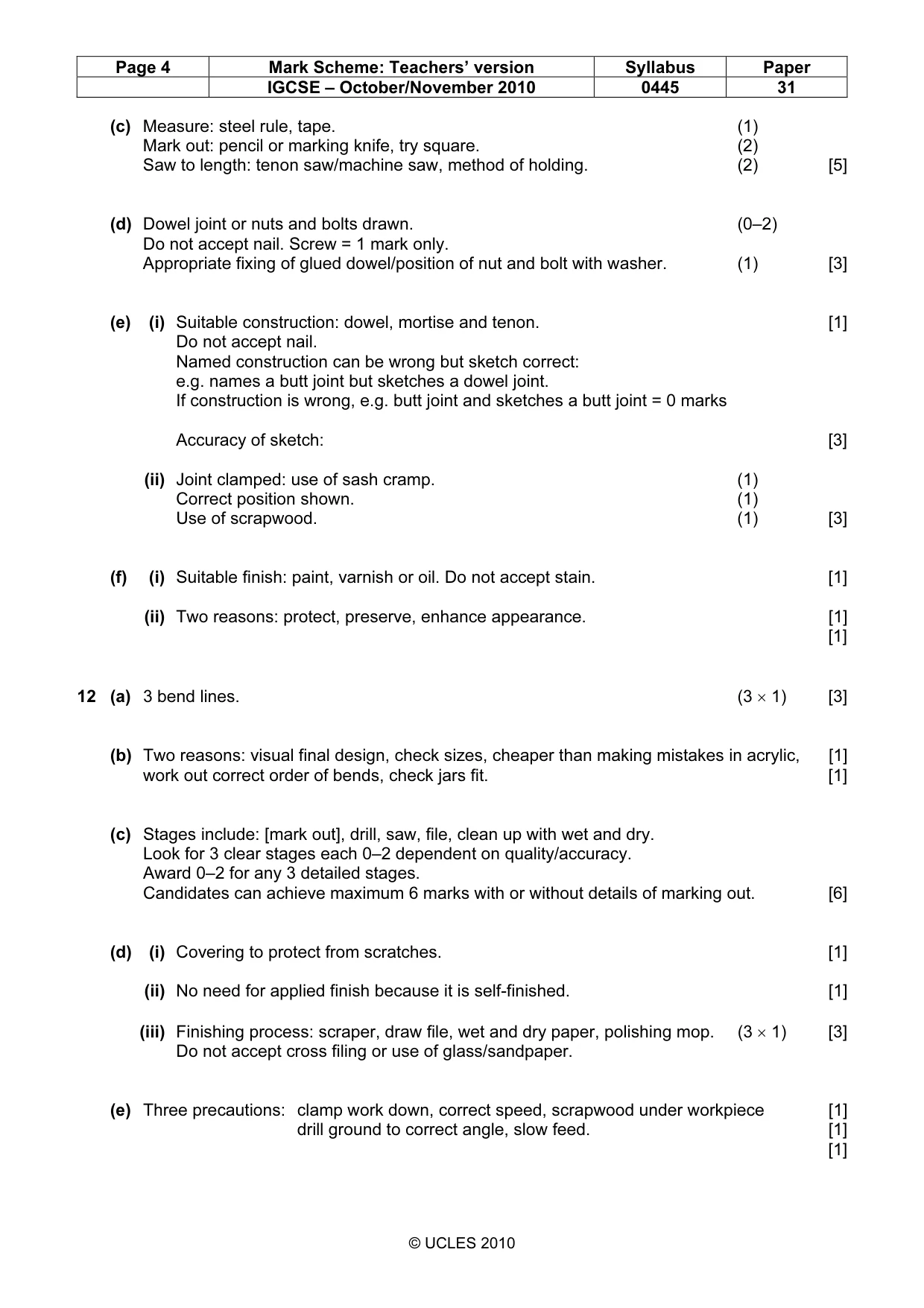
Page 4 Mark Scheme: Teachers’ version Syllabus Paper IGCSE – October/November 2010 0445 31 © UCLES 2010 (c) Measure: steel rule, tape. (1) Mark out: pencil or marking knife, try square. (2) Saw to length: tenon saw/machine saw, method of holding. (2) [5] (d) Dowel joint or nuts and bolts drawn. (0–2) Do not accept nail. Screw = 1 mark only. Appropriate fixing of glued dowel/position of nut and bolt with washer. (1) [3] (e) (i) Suitable construction: dowel, mortise and tenon. [1] Do not accept nail. Named construction can be wrong but sketch correct: e.g. names a butt joint but sketches a dowel joint. If construction is wrong, e.g. butt joint and sketches a butt joint = 0 marks Accuracy of sketch: [3] (ii) Joint clamped: use of sash cramp. (1) Correct position shown. (1) Use of scrapwood. (1) [3] (f) (i) Suitable finish: paint, varnish or oil. Do not accept stain. [1] (ii) Two reasons: protect, preserve, enhance appearance. [1] [1] 12 (a) 3 bend lines. (3 × 1) [3] (b) Two reasons: visual final design, check sizes, cheaper than making mistakes in acrylic, [1] work out correct order of bends, check jars fit. [1] (c) Stages include: [mark out], drill, saw, file, clean up with wet and dry. Look for 3 clear stages each 0–2 dependent on quality/accuracy. Award 0–2 for any 3 detailed stages. Candidates can achieve maximum 6 marks with or without details of marking out. [6] (d) (i) Covering to protect from scratches. [1] (ii) No need for applied finish because it is self-finished. [1] (iii) Finishing process: scraper, draw file, wet and dry paper, polishing mop. (3 × 1) [3] Do not accept cross filing or use of glass/sandpaper. (e) Three precautions: clamp work down, correct speed, scrapwood under workpiece [1] drill ground to correct angle, slow feed. [1] [1]
Mark scheme, page 5
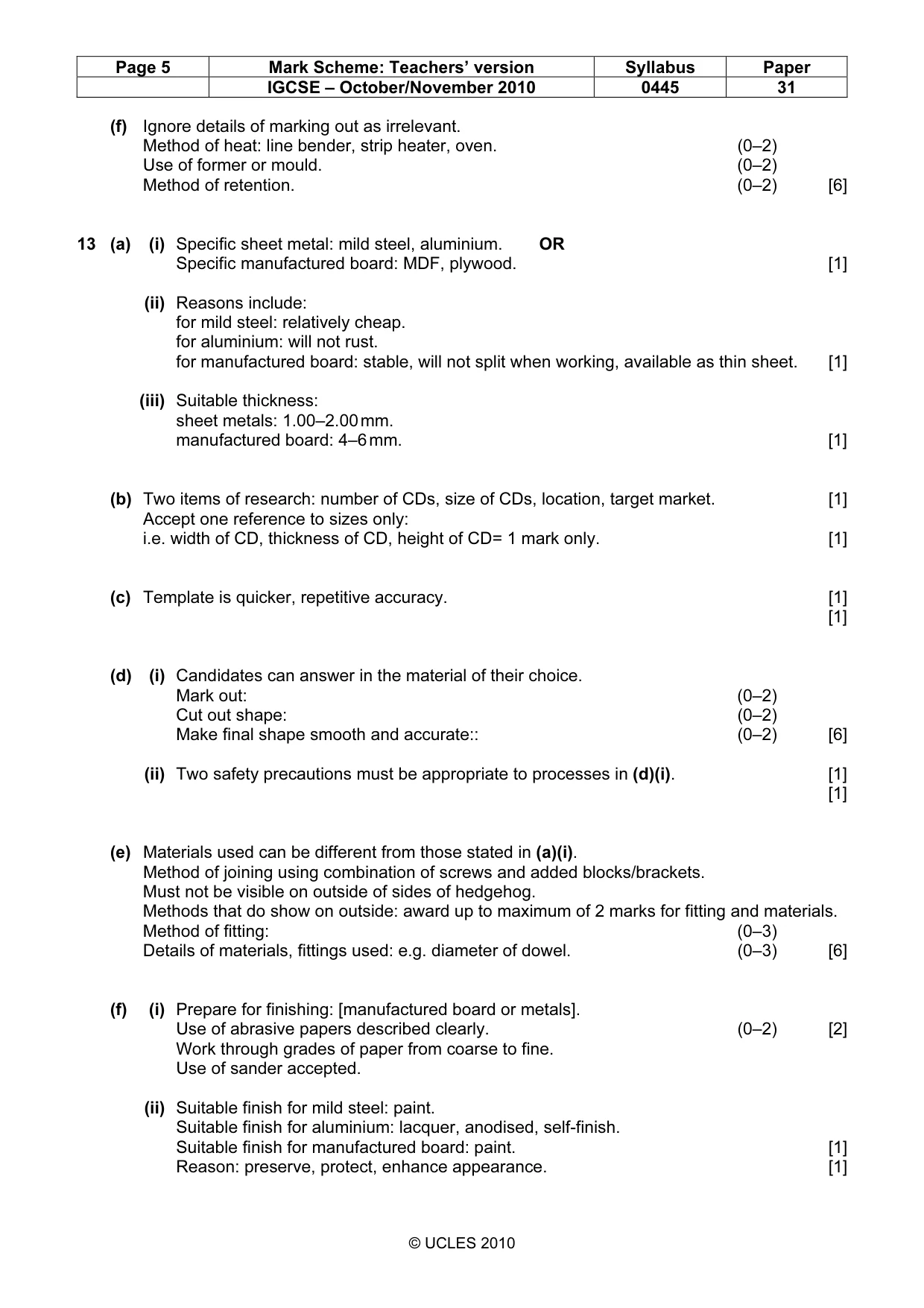
Page 5 Mark Scheme: Teachers’ version Syllabus Paper IGCSE – October/November 2010 0445 31 © UCLES 2010 (f) Ignore details of marking out as irrelevant. Method of heat: line bender, strip heater, oven. (0–2) Use of former or mould. (0–2) Method of retention. (0–2) [6] 13 (a) (i) Specific sheet metal: mild steel, aluminium. OR Specific manufactured board: MDF, plywood. [1] (ii) Reasons include: for mild steel: relatively cheap. for aluminium: will not rust. for manufactured board: stable, will not split when working, available as thin sheet. [1] (iii) Suitable thickness: sheet metals: 1.00–2.00 mm. manufactured board: 4–6 mm. [1] (b) Two items of research: number of CDs, size of CDs, location, target market. [1] Accept one reference to sizes only: i.e. width of CD, thickness of CD, height of CD= 1 mark only. [1] (c) Template is quicker, repetitive accuracy. [1] [1] (d) (i) Candidates can answer in the material of their choice. Mark out: (0–2) Cut out shape: (0–2) Make final shape smooth and accurate:: (0–2) [6] (ii) Two safety precautions must be appropriate to processes in (d)(i). [1] [1] (e) Materials used can be different from those stated in (a)(i). Method of joining using combination of screws and added blocks/brackets. Must not be visible on outside of sides of hedgehog. Methods that do show on outside: award up to maximum of 2 marks for fitting and materials. Method of fitting: (0–3) Details of materials, fittings used: e.g. diameter of dowel. (0–3) [6] (f) (i) Prepare for finishing: [manufactured board or metals]. Use of abrasive papers described clearly. (0–2) [2] Work through grades of paper from coarse to fine. Use of sander accepted. (ii) Suitable finish for mild steel: paint. Suitable finish for aluminium: lacquer, anodised, self-finish. Suitable finish for manufactured board: paint. [1] Reason: preserve, protect, enhance appearance. [1]
What you needed in this session
Cambridge’s own grade thresholds for 2010 Oct/Nov, Paper 3 · Variant 1. A higher threshold means an easier paper — the bar moves with how the cohort did.