Cambridge IGCSE Design and Technology 0445 — 2008 Oct/Nov Paper 3 · Variant 1
0445/31/O/N/08 · 50 marks · ≈56 min
The question paper and its mark scheme, free to read here and free to download. This is Cambridge’s own paper, exactly as it was sat.
Question paper16 pages
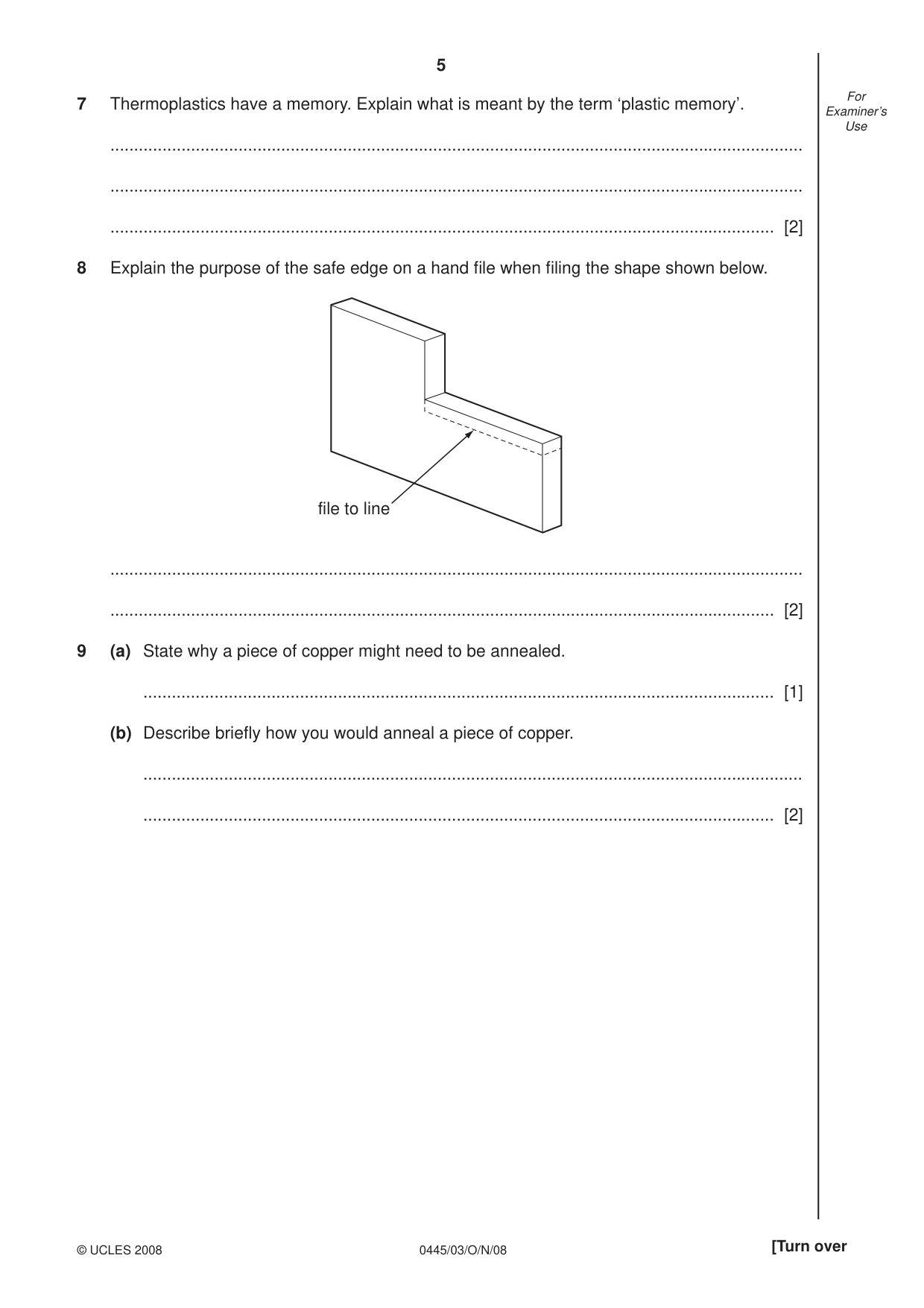
Mark scheme5 pages
Answers below. Sit the paper first if you are practising.
Paper as text
Question paper, page 1
READ THESE INSTRUCTIONS FIRST Write your Centre number, candidate number and name on all the work you hand in. Write in blue or black pen. You may use a soft pencil for any diagrams, graphs or rough working. Do not use staples, paper clips, highlighters, glue or correction fl uid. DO NOT WRITE IN ANY BARCODES. Section A Answer all questions in this section. Section B Answer one question in this section. You may use a calculator. The total of the marks for this paper is 50. The number of marks is given in brackets [ ] at the end of each question or part question. DESIGN AND TECHNOLOGY 0445/03 Paper 3 Resistant Materials October/November 2008 1 hour Candidates answer on the Question Paper. No Additional Materials are required. To be taken together with Paper 1 in one session of 2 hours 15 minutes. UNIVERSITY OF CAMBRIDGE INTERNATIONAL EXAMINATIONS International General Certifi cate of Secondary Education This document consists of 16 printed pages. [Turn over IB08 11_0445_03/2RP © UCLES 2008 *0587485022* For Examiner’s Use Total Section A Section B www.XtremePapers.com
Question paper, page 2
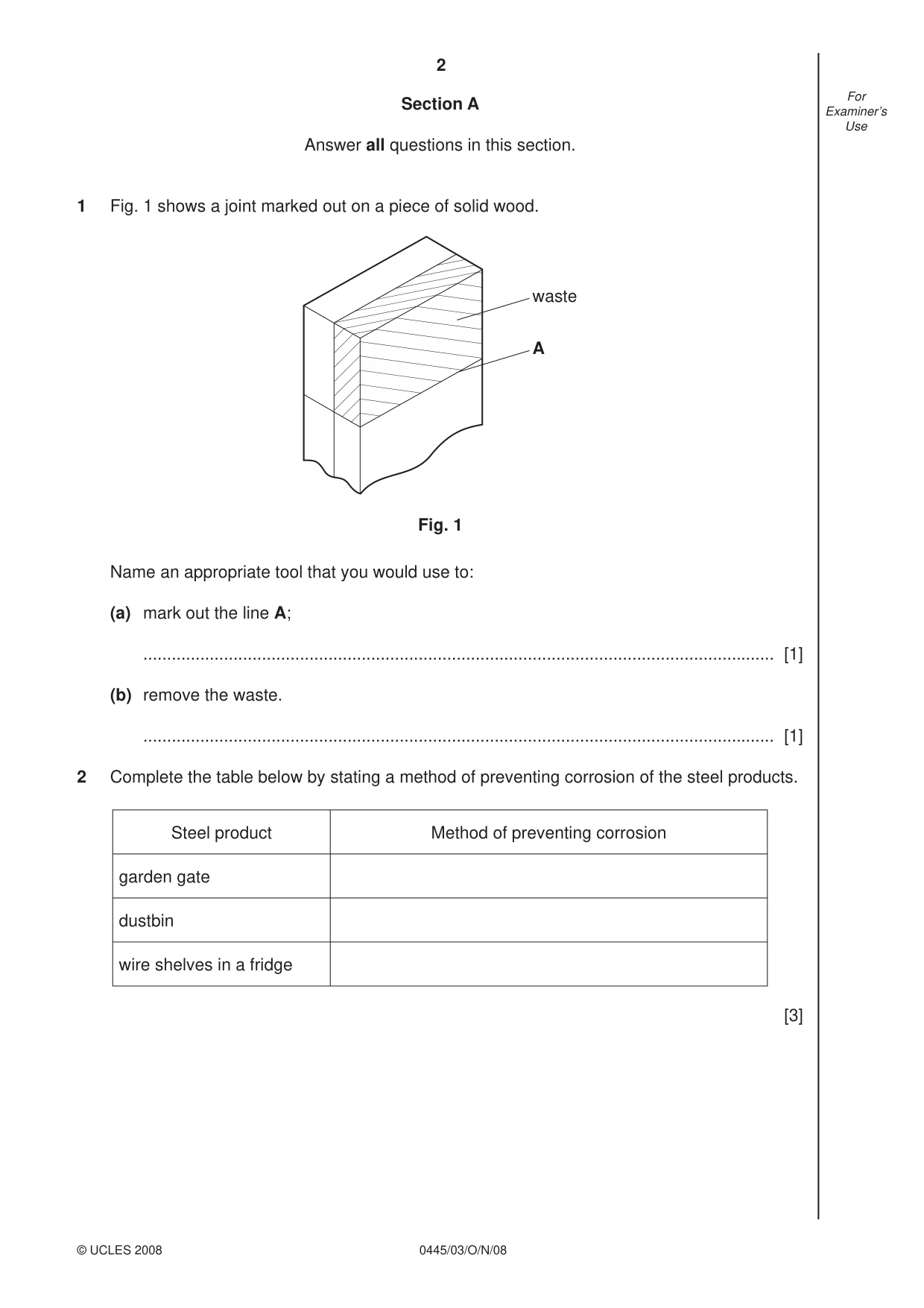
2 0445/03/O/N/08 © UCLES 2008 For Examiner’s Use Section A Answer all questions in this section. 1 Fig. 1 shows a joint marked out on a piece of solid wood. waste A Fig. 1 Name an appropriate tool that you would use to: (a) mark out the line A; … [1] (b) remove the waste. … [1] 2 Complete the table below by stating a method of preventing corrosion of the steel products. Steel product Method of preventing corrosion garden gate dustbin wire shelves in a fridge [3]
Question paper, page 3
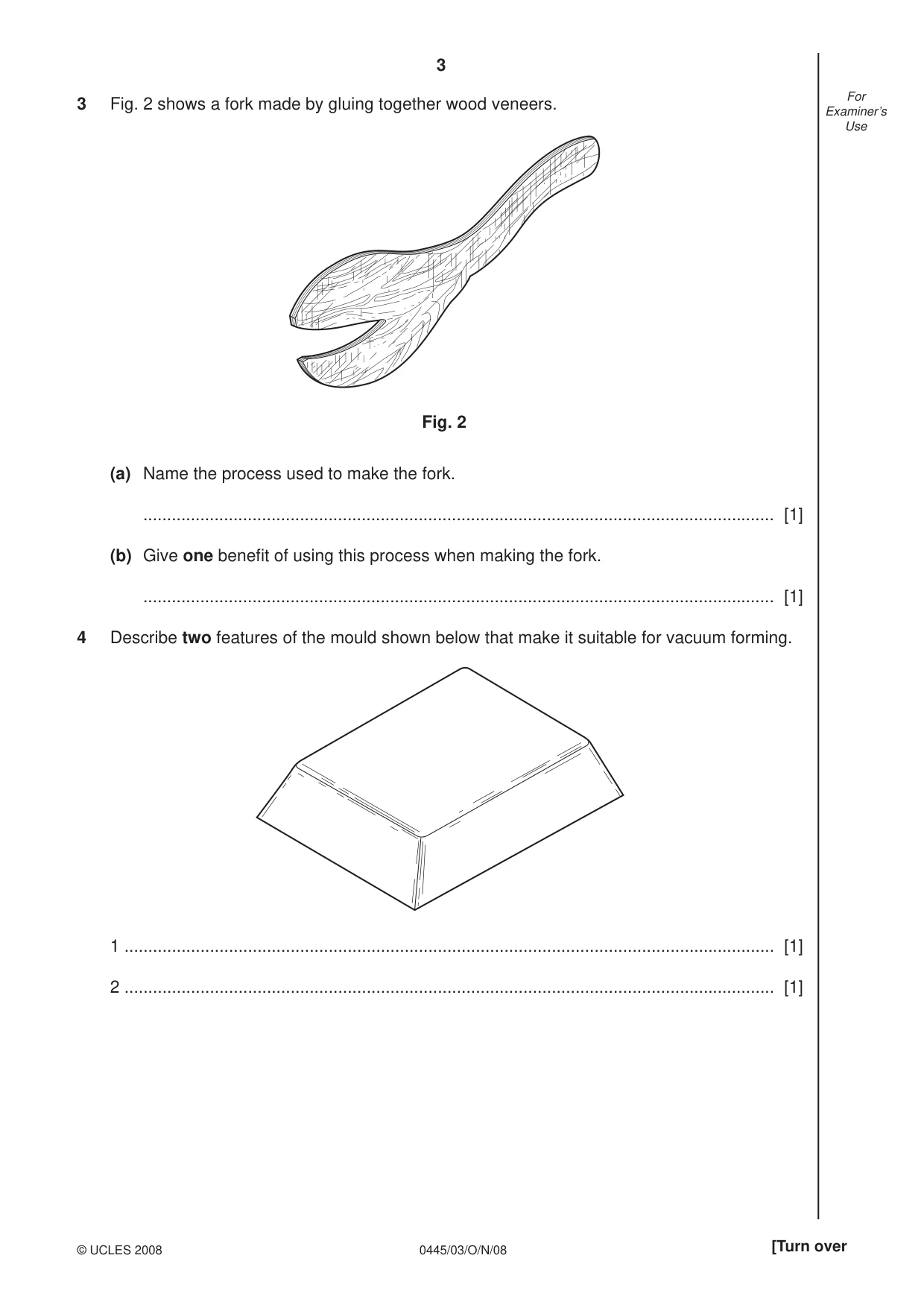
3 0445/03/O/N/08 © UCLES 2008 [Turn over For Examiner’s Use 3 Fig. 2 shows a fork made by gluing together wood veneers. Fig. 2 (a) Name the process used to make the fork. … [1] (b) Give one benefi t of using this process when making the fork. … [1] 4 Describe two features of the mould shown below that make it suitable for vacuum forming. 1 … [1] 2 … [1]
Question paper, page 4
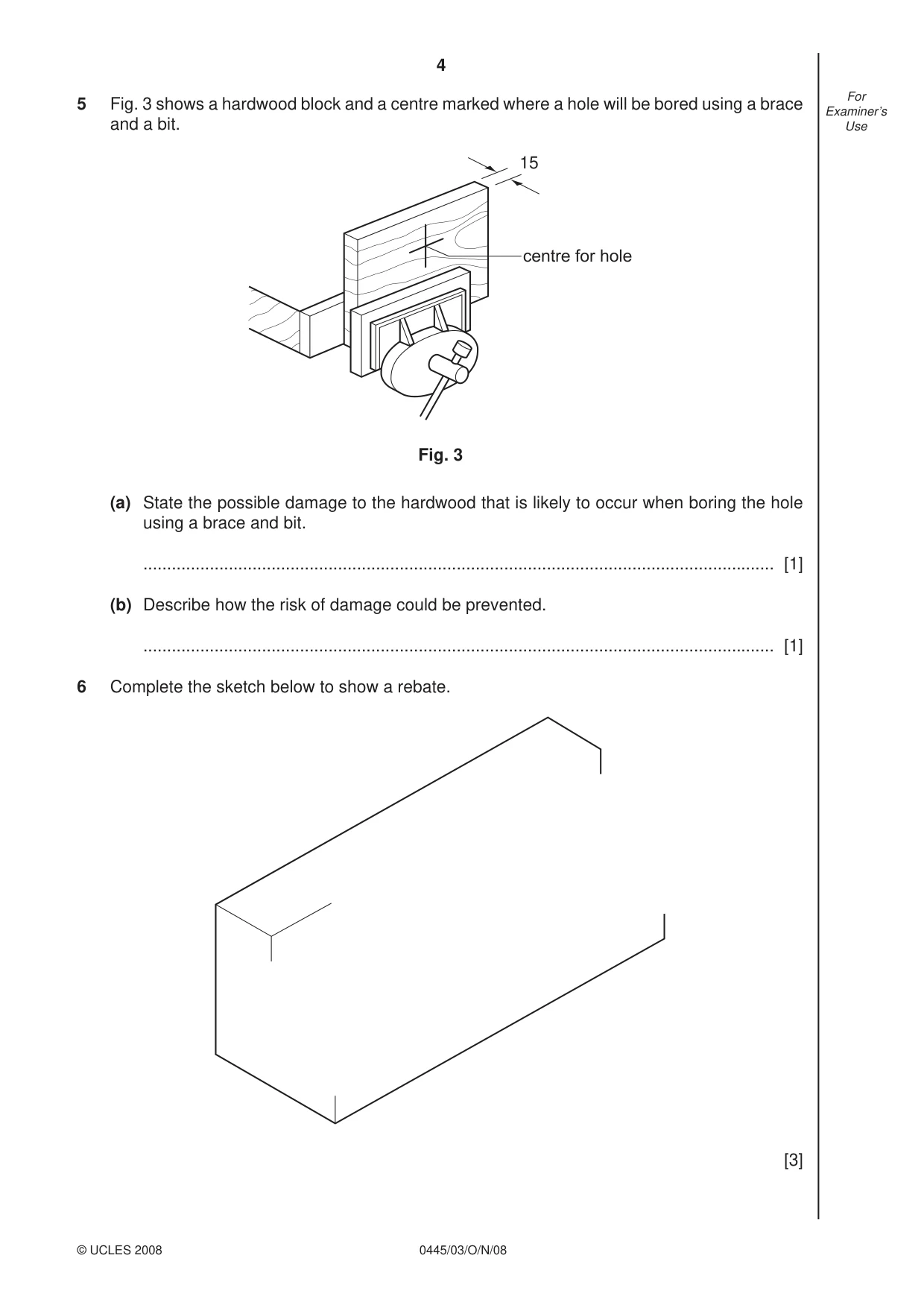
4 0445/03/O/N/08 © UCLES 2008 For Examiner’s Use 5 Fig. 3 shows a hardwood block and a centre marked where a hole will be bored using a brace and a bit. 15 Fig. 3 (a) State the possible damage to the hardwood that is likely to occur when boring the hole using a brace and bit. … [1] (b) Describe how the risk of damage could be prevented. … [1] 6 Complete the sketch below to show a rebate. [3]
Question paper, page 5
5 0445/03/O/N/08 © UCLES 2008 [Turn over For Examiner’s Use 7 Thermoplastics have a memory. Explain what is meant by the term ‘plastic memory’. … … … [2] 8 Explain the purpose of the safe edge on a hand fi le when fi ling the shape shown below. file to line … … [2] 9 (a) State why a piece of copper might need to be annealed. … [1] (b) Describe briefl y how you would anneal a piece of copper. … … [2]
Question paper, page 6
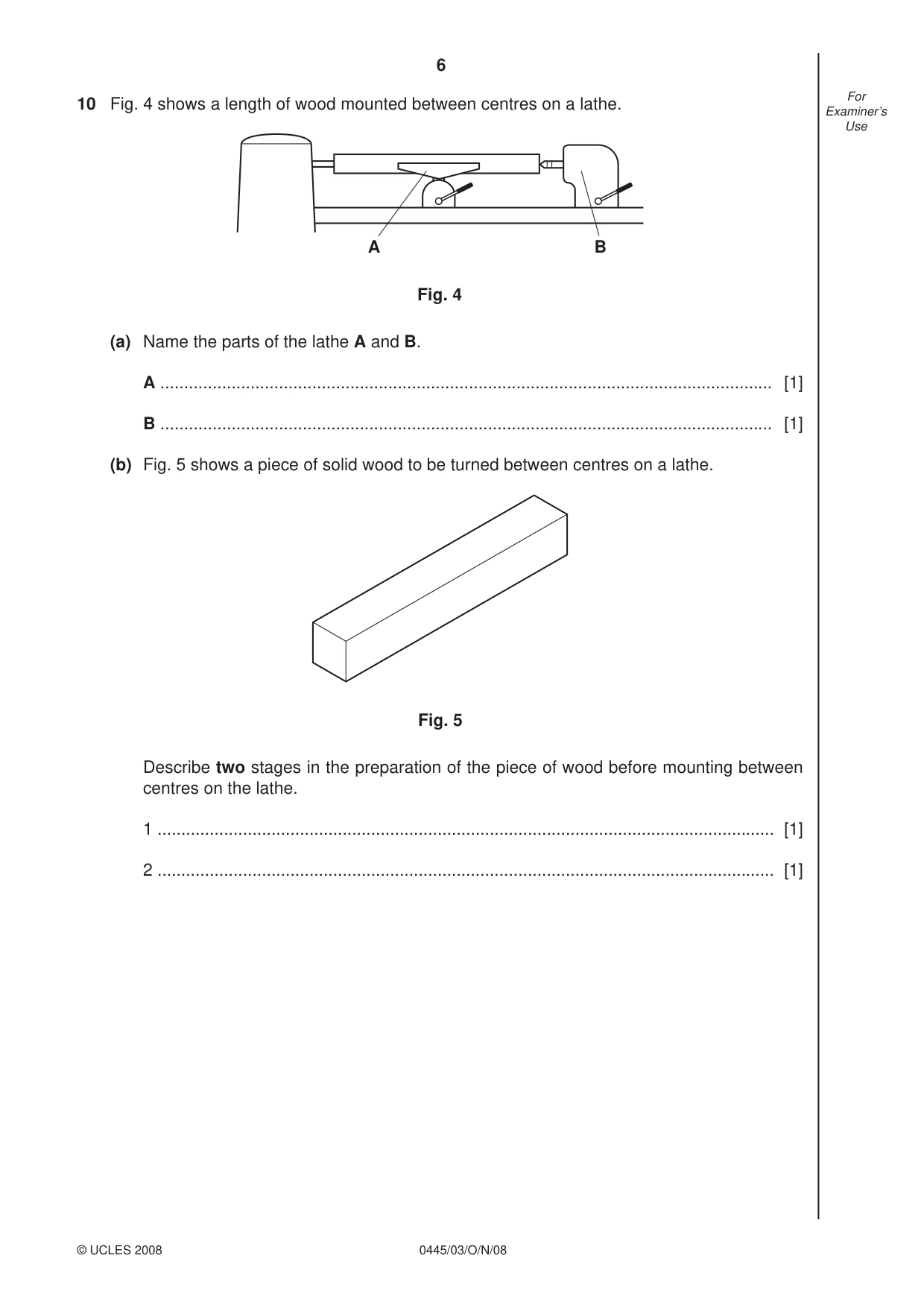
6 0445/03/O/N/08 © UCLES 2008 For Examiner’s Use 10 Fig. 4 shows a length of wood mounted between centres on a lathe. A B Fig. 4 (a) Name the parts of the lathe A and B. A … [1] B … [1] (b) Fig. 5 shows a piece of solid wood to be turned between centres on a lathe. Fig. 5 Describe two stages in the preparation of the piece of wood before mounting between centres on the lathe. 1 … [1] 2 … [1]
Question paper, page 7
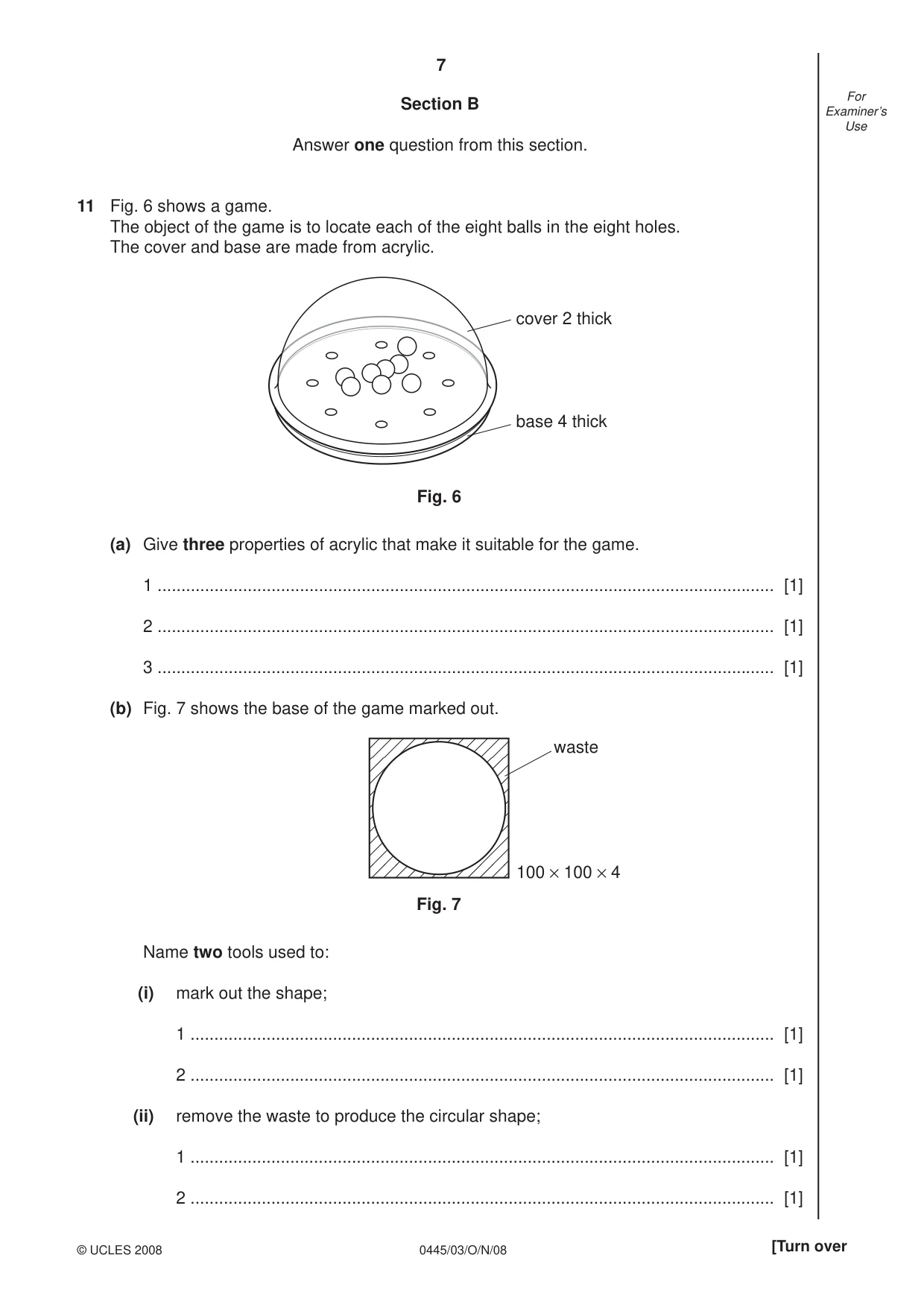
7 0445/03/O/N/08 © UCLES 2008 [Turn over For Examiner’s Use Section B Answer one question from this section. 11 Fig. 6 shows a game. The object of the game is to locate each of the eight balls in the eight holes. The cover and base are made from acrylic. cover 2 thick base 4 thick Fig. 6 (a) Give three properties of acrylic that make it suitable for the game. 1 … [1] 2 … [1] 3 … [1] (b) Fig. 7 shows the base of the game marked out. waste 100 × 100 × 4 Fig. 7 Name two tools used to: (i) mark out the shape; 1 … [1] 2 … [1] (ii) remove the waste to produce the circular shape; 1 … [1] 2 … [1]
Question paper, page 8
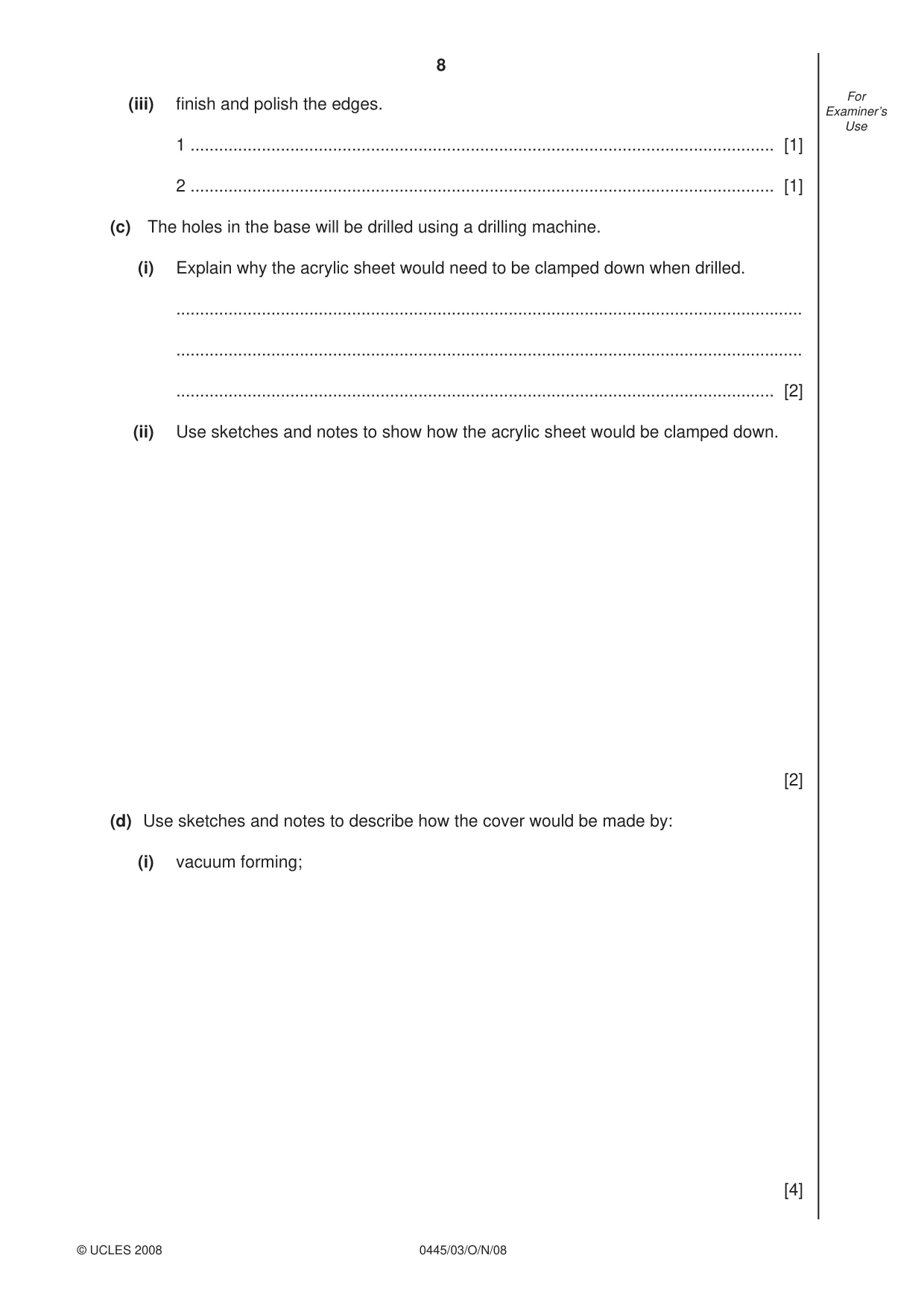
8 0445/03/O/N/08 © UCLES 2008 For Examiner’s Use (iii) fi nish and polish the edges. 1 … [1] 2 … [1] (c) The holes in the base will be drilled using a drilling machine. (i) Explain why the acrylic sheet would need to be clamped down when drilled. … … … [2] (ii) Use sketches and notes to show how the acrylic sheet would be clamped down. [2] (d) Use sketches and notes to describe how the cover would be made by: (i) vacuum forming; [4]
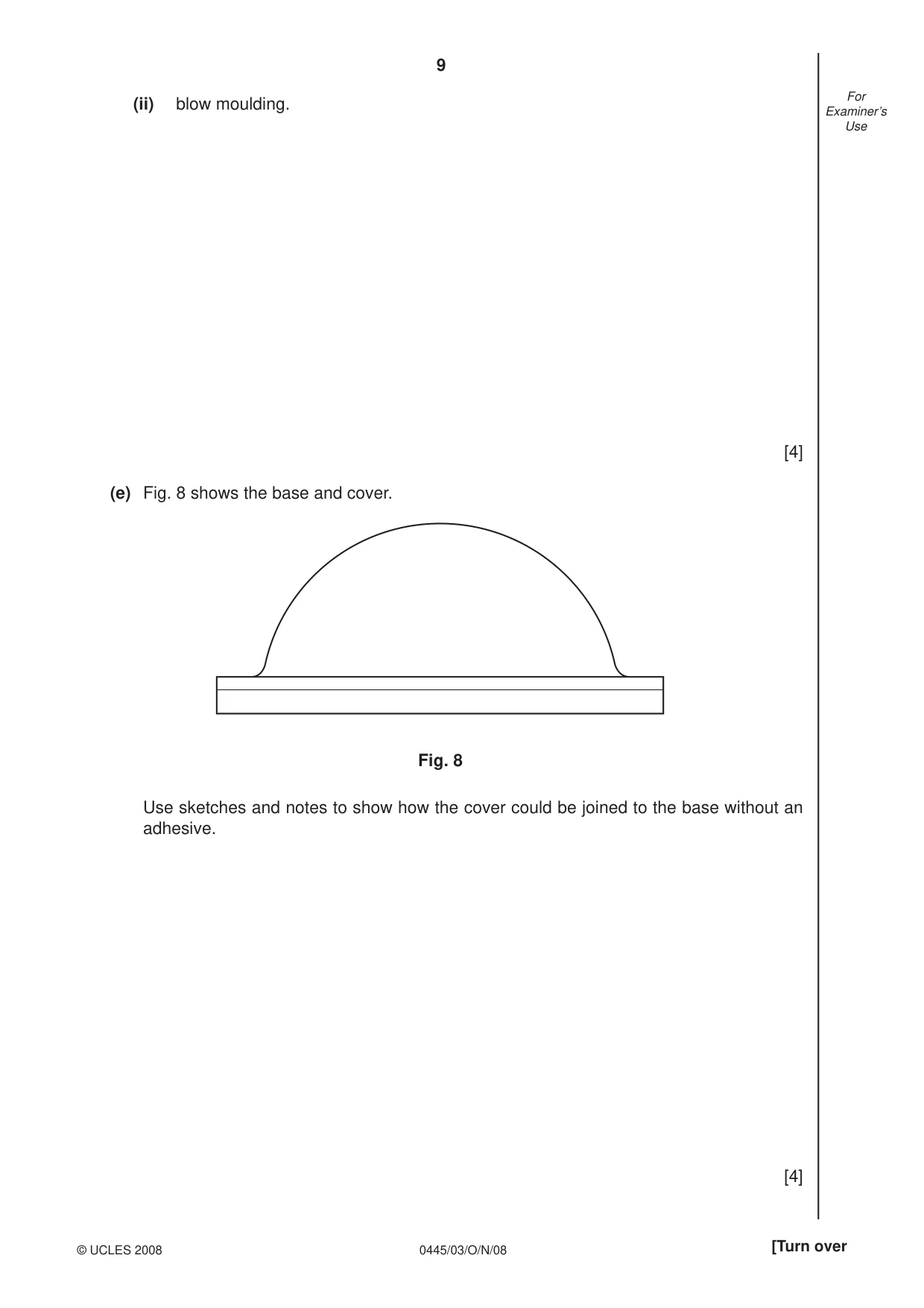
Question paper, page 9
9 0445/03/O/N/08 © UCLES 2008 [Turn over For Examiner’s Use (ii) blow moulding. [4] (e) Fig. 8 shows the base and cover. Fig. 8 Use sketches and notes to show how the cover could be joined to the base without an adhesive. [4]
Question paper, page 10
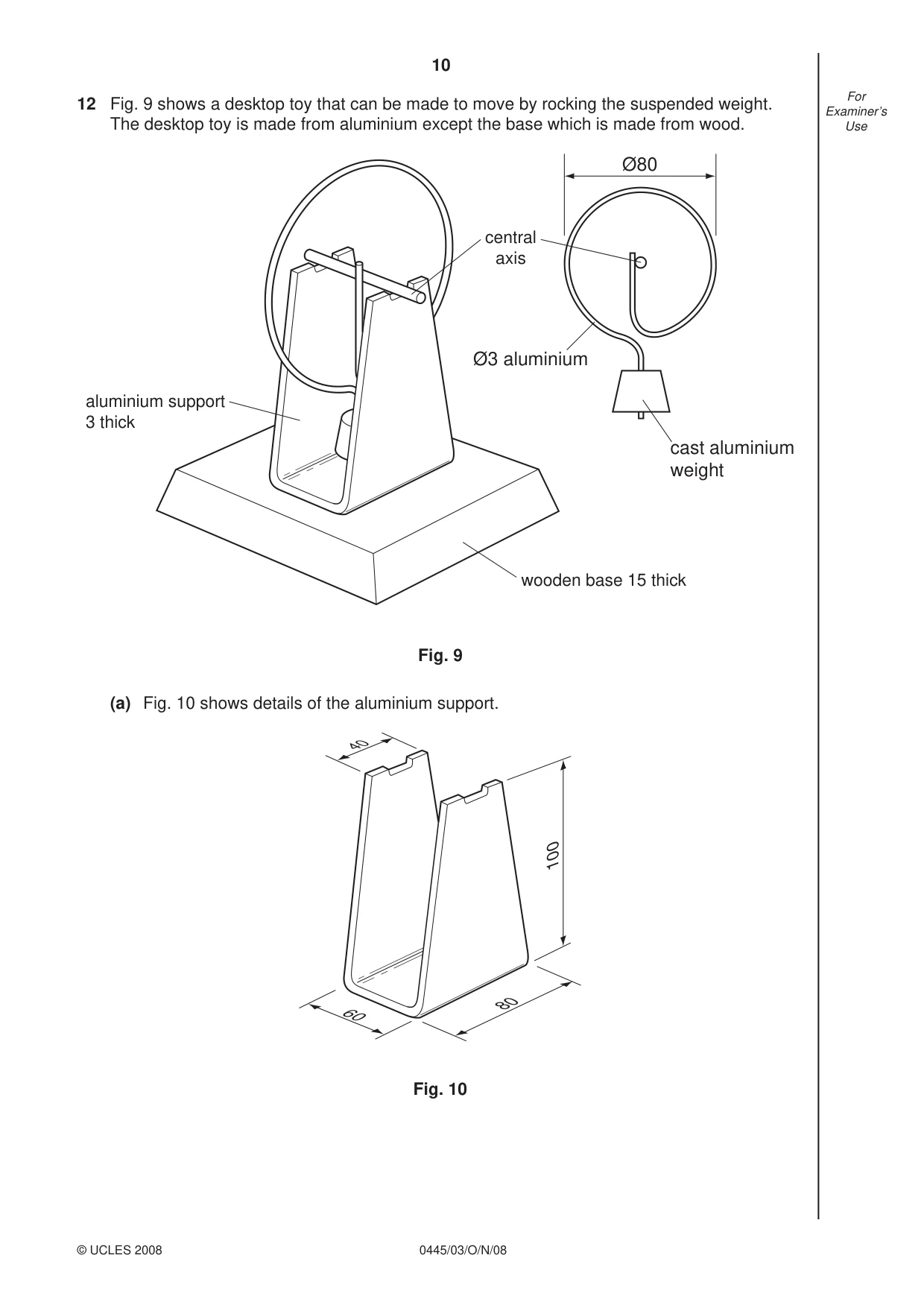
10 0445/03/O/N/08 © UCLES 2008 For Examiner’s Use 12 Fig. 9 shows a desktop toy that can be made to move by rocking the suspended weight. The desktop toy is made from aluminium except the base which is made from wood. aluminium support 3 thick central axis wooden base 15 thick Ø80 Ø3 aluminium cast aluminium weight Fig. 9 (a) Fig. 10 shows details of the aluminium support. 40 80 60 Fig. 10 100
Question paper, page 11
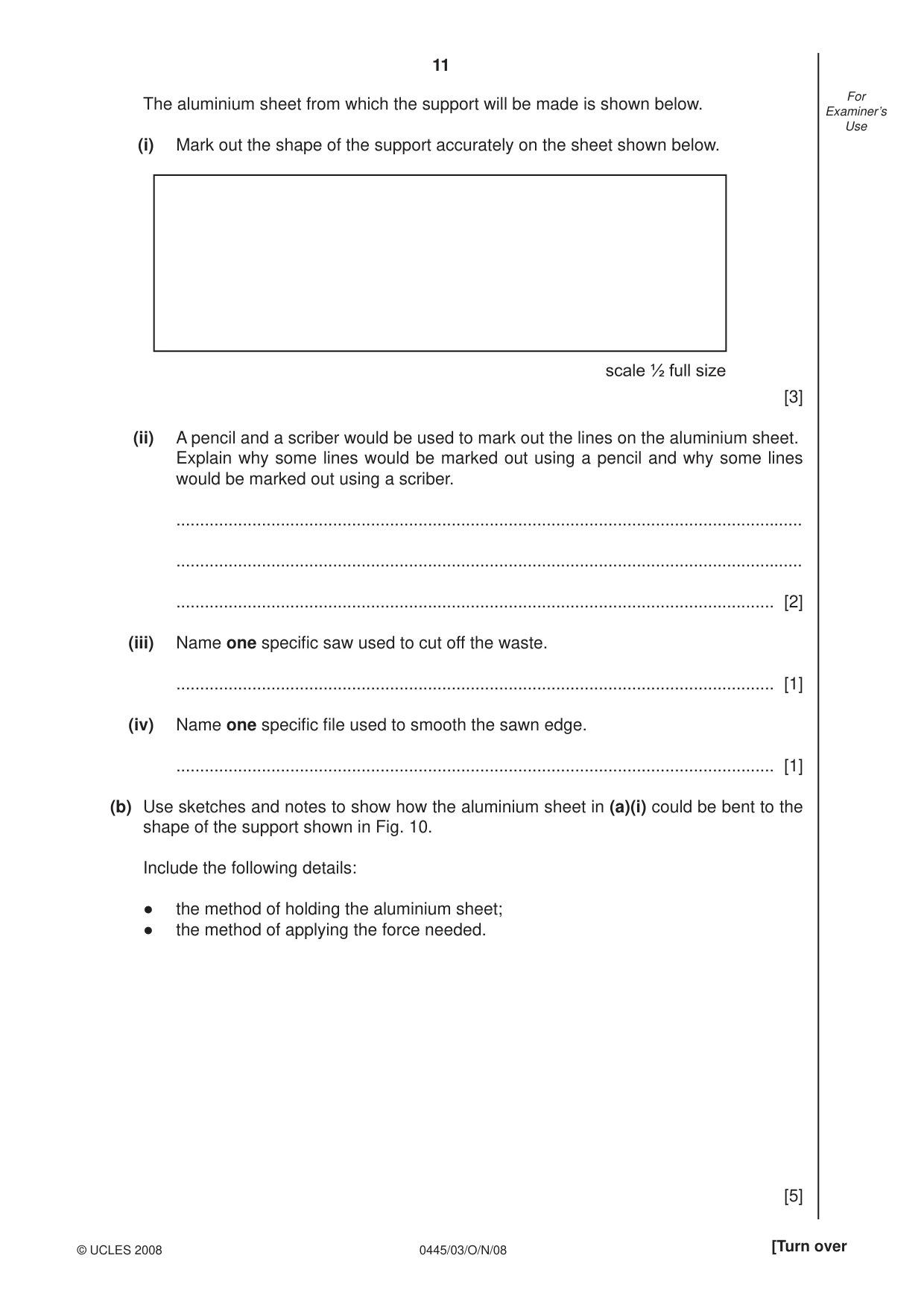
11 0445/03/O/N/08 © UCLES 2008 [Turn over For Examiner’s Use The aluminium sheet from which the support will be made is shown below. (i) Mark out the shape of the support accurately on the sheet shown below. [3] (ii) A pencil and a scriber would be used to mark out the lines on the aluminium sheet. Explain why some lines would be marked out using a pencil and why some lines would be marked out using a scriber. … … … [2] (iii) Name one specifi c saw used to cut off the waste. … [1] (iv) Name one specifi c fi le used to smooth the sawn edge. … [1] (b) Use sketches and notes to show how the aluminium sheet in (a)(i) could be bent to the shape of the support shown in Fig. 10. Include the following details: ● the method of holding the aluminium sheet; ● the method of applying the force needed. [5]
Question paper, page 12
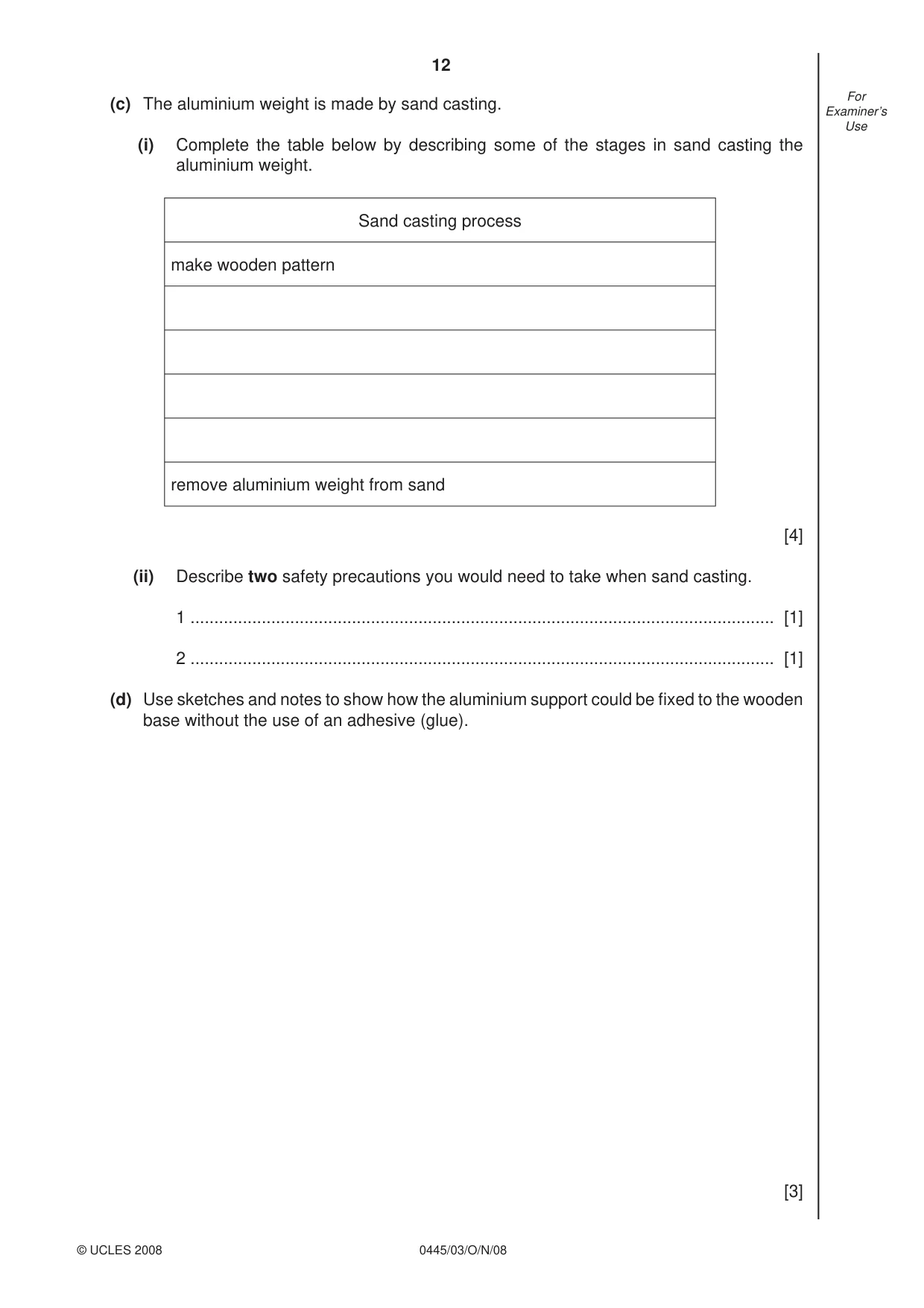
12 0445/03/O/N/08 © UCLES 2008 For Examiner’s Use (c) The aluminium weight is made by sand casting. (i) Complete the table below by describing some of the stages in sand casting the aluminium weight. Sand casting process make wooden pattern remove aluminium weight from sand [4] (ii) Describe two safety precautions you would need to take when sand casting. 1 … [1] 2 … [1] (d) Use sketches and notes to show how the aluminium support could be fi xed to the wooden base without the use of an adhesive (glue). [3]
Question paper, page 13
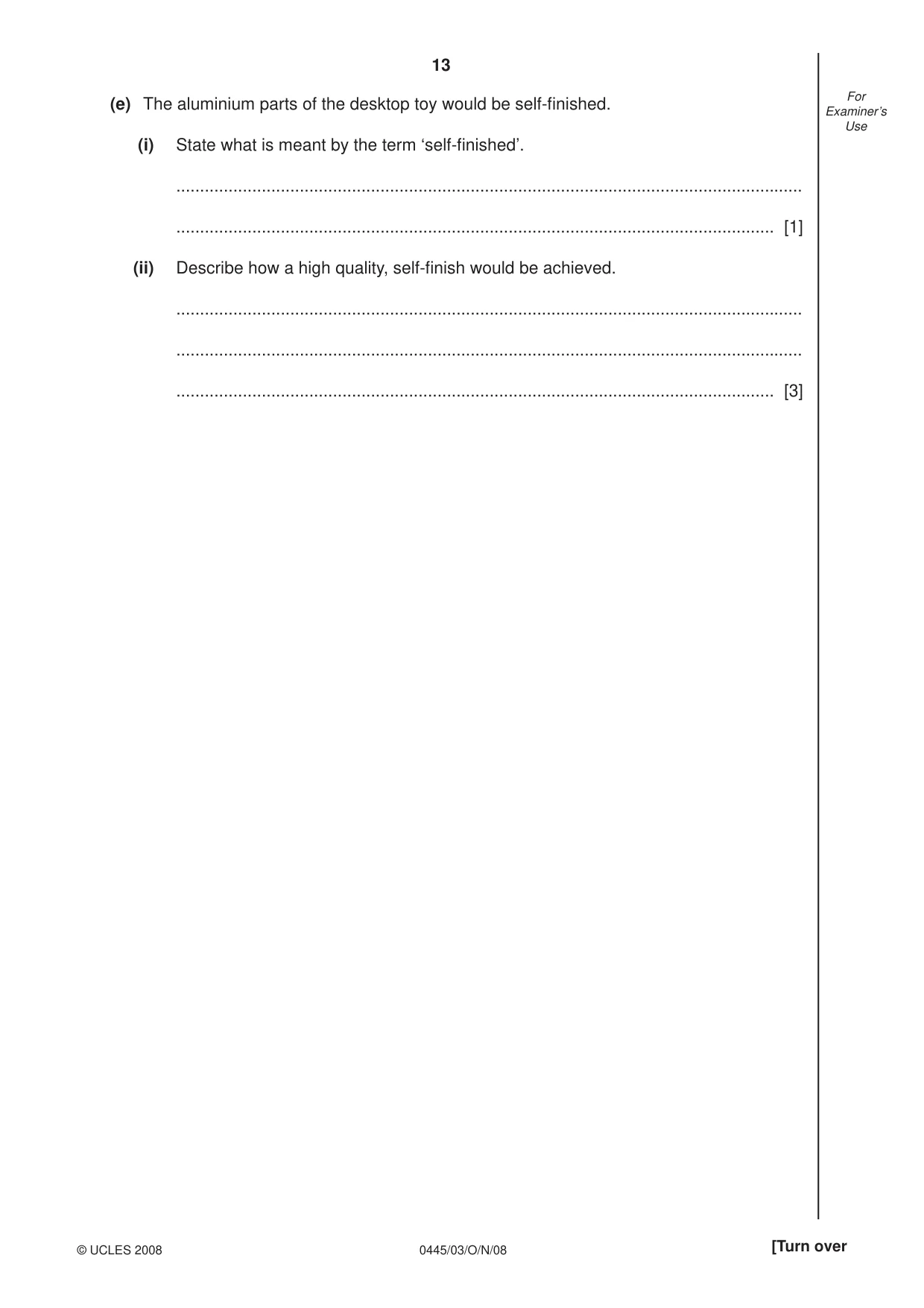
13 0445/03/O/N/08 © UCLES 2008 [Turn over For Examiner’s Use (e) The aluminium parts of the desktop toy would be self-fi nished. (i) State what is meant by the term ‘self-fi nished’. … … [1] (ii) Describe how a high quality, self-fi nish would be achieved. … … … [3]
Question paper, page 14
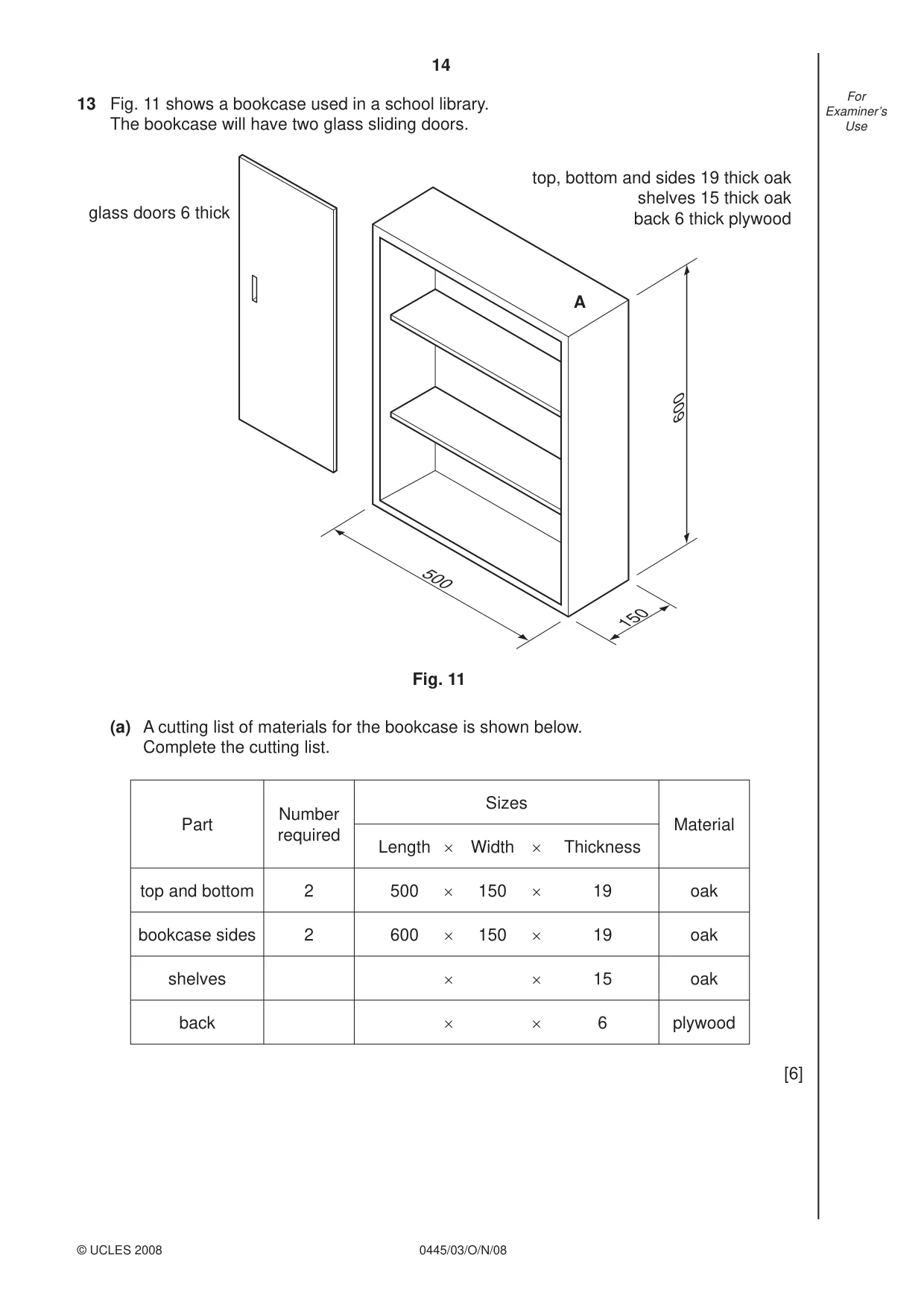
14 0445/03/O/N/08 © UCLES 2008 For Examiner’s Use 13 Fig. 11 shows a bookcase used in a school library. The bookcase will have two glass sliding doors. glass doors 6 thick top, bottom and sides 19 thick oak shelves 15 thick oak back 6 thick plywood A 500 600 150 Fig. 11 (a) A cutting list of materials for the bookcase is shown below. Complete the cutting list. Part Number required Sizes Material Length × Width × Thickness top and bottom 2 500 × 150 × 19 oak bookcase sides 2 600 × 150 × 19 oak shelves × × 15 oak back × × 6 plywood [6]
Question paper, page 15
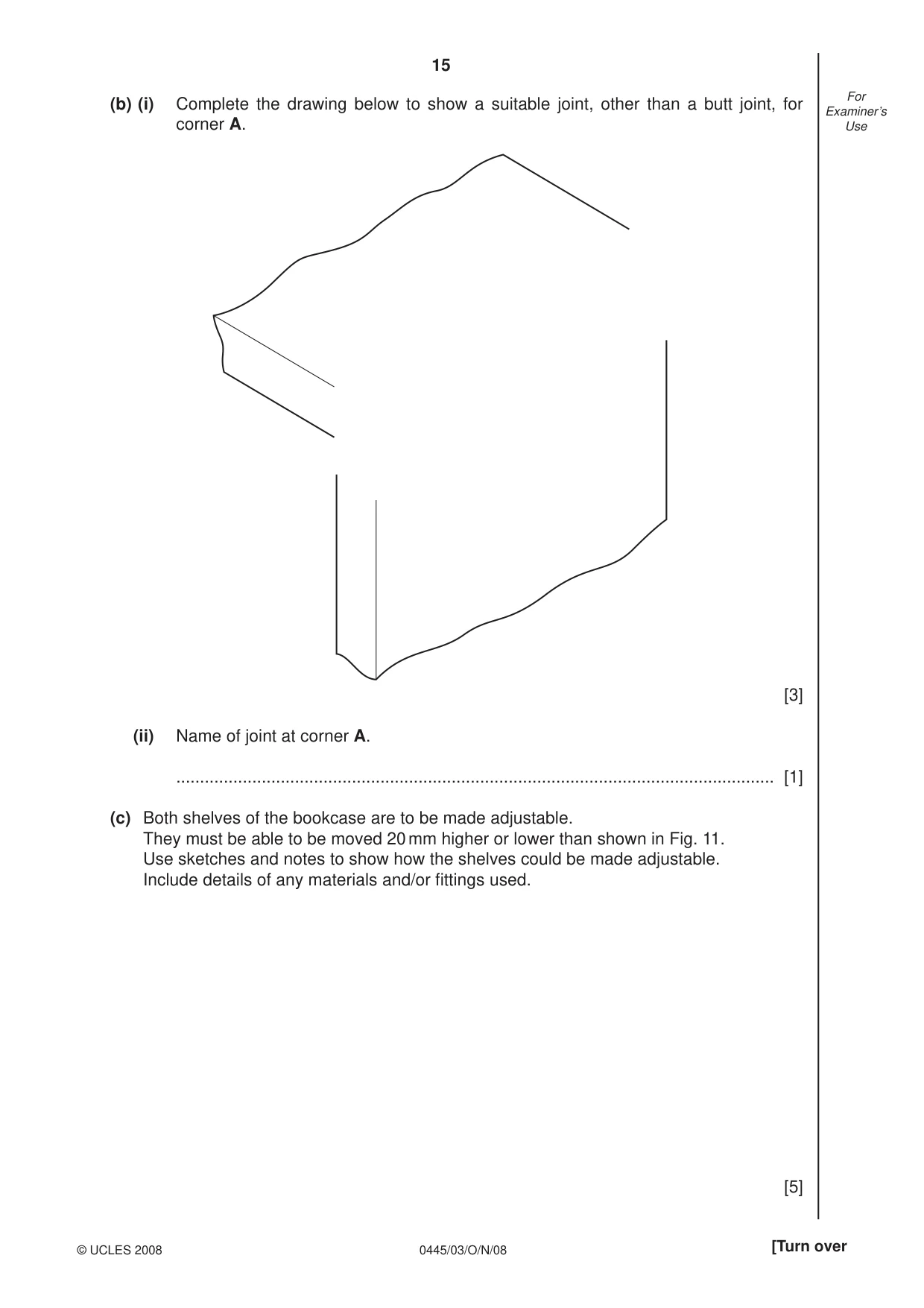
15 0445/03/O/N/08 © UCLES 2008 [Turn over For Examiner’s Use (b) (i) Complete the drawing below to show a suitable joint, other than a butt joint, for corner A. [3] (ii) Name of joint at corner A. … [1] (c) Both shelves of the bookcase are to be made adjustable. They must be able to be moved 20 mm higher or lower than shown in Fig. 11. Use sketches and notes to show how the shelves could be made adjustable. Include details of any materials and/or fi ttings used. [5]
Question paper, page 16
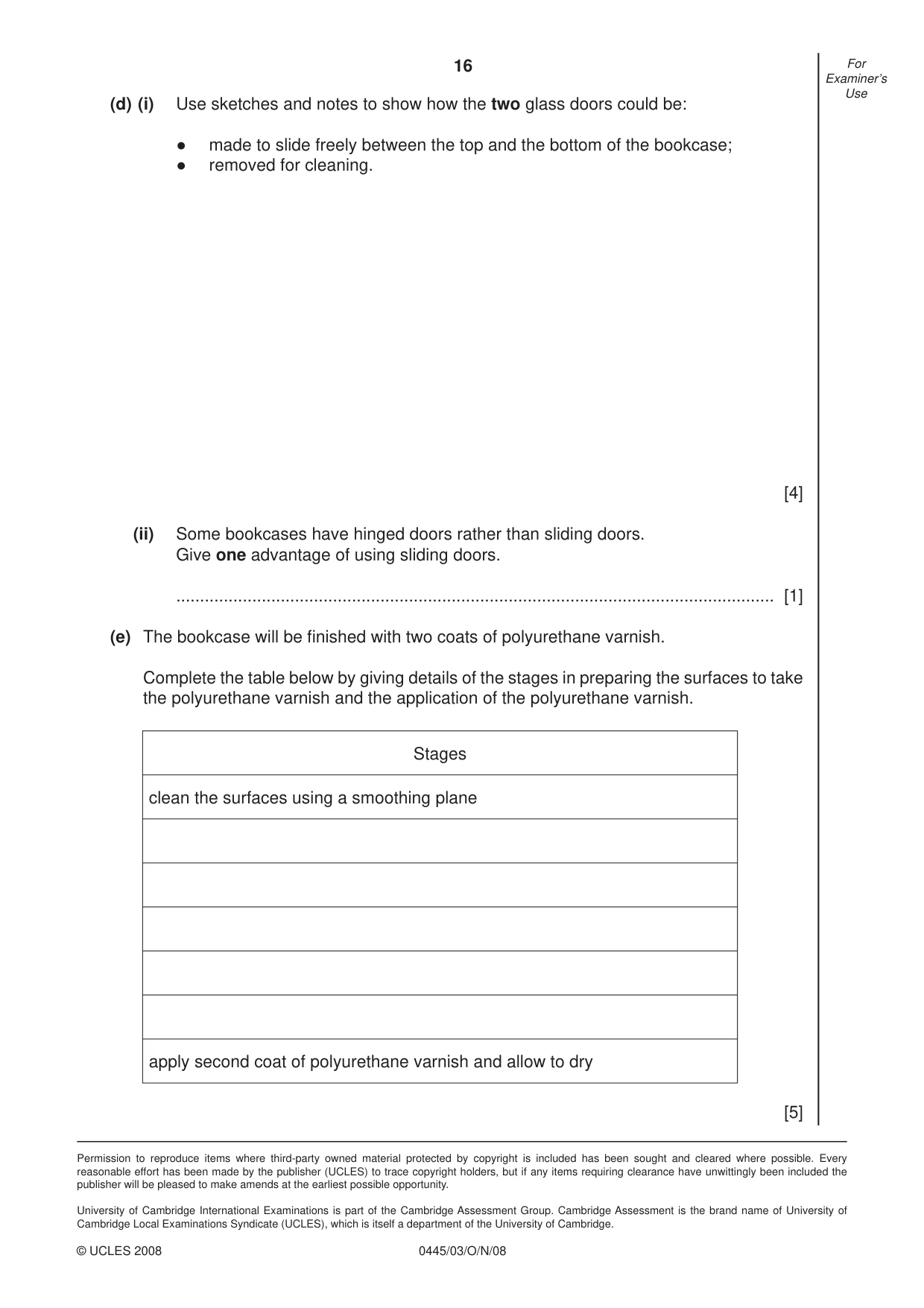
16 Permission to reproduce items where third-party owned material protected by copyright is included has been sought and cleared where possible. Every reasonable effort has been made by the publisher (UCLES) to trace copyright holders, but if any items requiring clearance have unwittingly been included the publisher will be pleased to make amends at the earliest possible opportunity. University of Cambridge International Examinations is part of the Cambridge Assessment Group. Cambridge Assessment is the brand name of University of Cambridge Local Examinations Syndicate (UCLES), which is itself a department of the University of Cambridge. 0445/03/O/N/08 © UCLES 2008 For Examiner’s Use (d) (i) Use sketches and notes to show how the two glass doors could be: ● made to slide freely between the top and the bottom of the bookcase; ● removed for cleaning. [4] (ii) Some bookcases have hinged doors rather than sliding doors. Give one advantage of using sliding doors. … [1] (e) The bookcase will be fi nished with two coats of polyurethane varnish. Complete the table below by giving details of the stages in preparing the surfaces to take the polyurethane varnish and the application of the polyurethane varnish. Stages clean the surfaces using a smoothing plane apply second coat of polyurethane varnish and allow to dry [5]
Mark scheme, page 1
UNIVERSITY OF CAMBRIDGE INTERNATIONAL EXAMINATIONS International General Certificate of Secondary Education MARK SCHEME for the October/November 2008 question paper 0445 DESIGN AND TECHNOLOGY 0445/03 Paper 3 (Resistant Materials), maximum raw mark 50 This mark scheme is published as an aid to teachers and candidates, to indicate the requirements of the examination. It shows the basis on which Examiners were instructed to award marks. It does not indicate the details of the discussions that took place at an Examiners’ meeting before marking began. All Examiners are instructed that alternative correct answers and unexpected approaches in candidates’ scripts must be given marks that fairly reflect the relevant knowledge and skills demonstrated. Mark schemes must be read in conjunction with the question papers and the report on the examination. • CIE will not enter into discussions or correspondence in connection with these mark schemes. CIE is publishing the mark schemes for the October/November 2008 question papers for most IGCSE, GCE Advanced Level and Advanced Subsidiary Level syllabuses and some Ordinary Level syllabuses. www.XtremePapers.com
Mark scheme, page 2
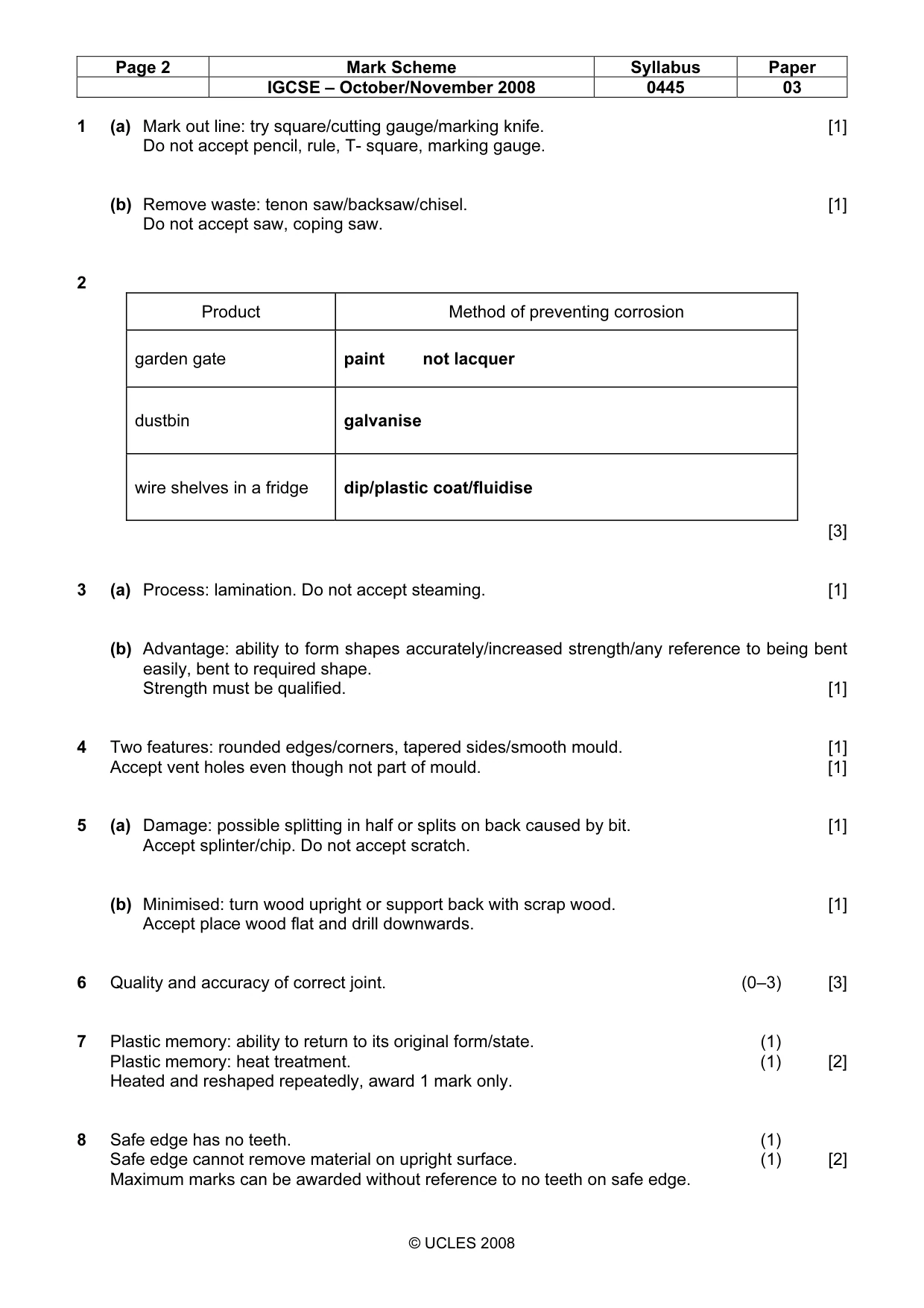
Page 2 Mark Scheme Syllabus Paper IGCSE – October/November 2008 0445 03 © UCLES 2008 1 (a) Mark out line: try square/cutting gauge/marking knife. [1] Do not accept pencil, rule, T- square, marking gauge. (b) Remove waste: tenon saw/backsaw/chisel. [1] Do not accept saw, coping saw. 2 Product Method of preventing corrosion garden gate paint not lacquer dustbin galvanise wire shelves in a fridge dip/plastic coat/fluidise [3] 3 (a) Process: lamination. Do not accept steaming. [1] (b) Advantage: ability to form shapes accurately/increased strength/any reference to being bent easily, bent to required shape. Strength must be qualified. [1] 4 Two features: rounded edges/corners, tapered sides/smooth mould. [1] Accept vent holes even though not part of mould. [1] 5 (a) Damage: possible splitting in half or splits on back caused by bit. [1] Accept splinter/chip. Do not accept scratch. (b) Minimised: turn wood upright or support back with scrap wood. [1] Accept place wood flat and drill downwards. 6 Quality and accuracy of correct joint. (0–3) [3] 7 Plastic memory: ability to return to its original form/state. (1) Plastic memory: heat treatment. (1) [2] Heated and reshaped repeatedly, award 1 mark only. 8 Safe edge has no teeth. (1) Safe edge cannot remove material on upright surface. (1) [2] Maximum marks can be awarded without reference to no teeth on safe edge.
Mark scheme, page 3
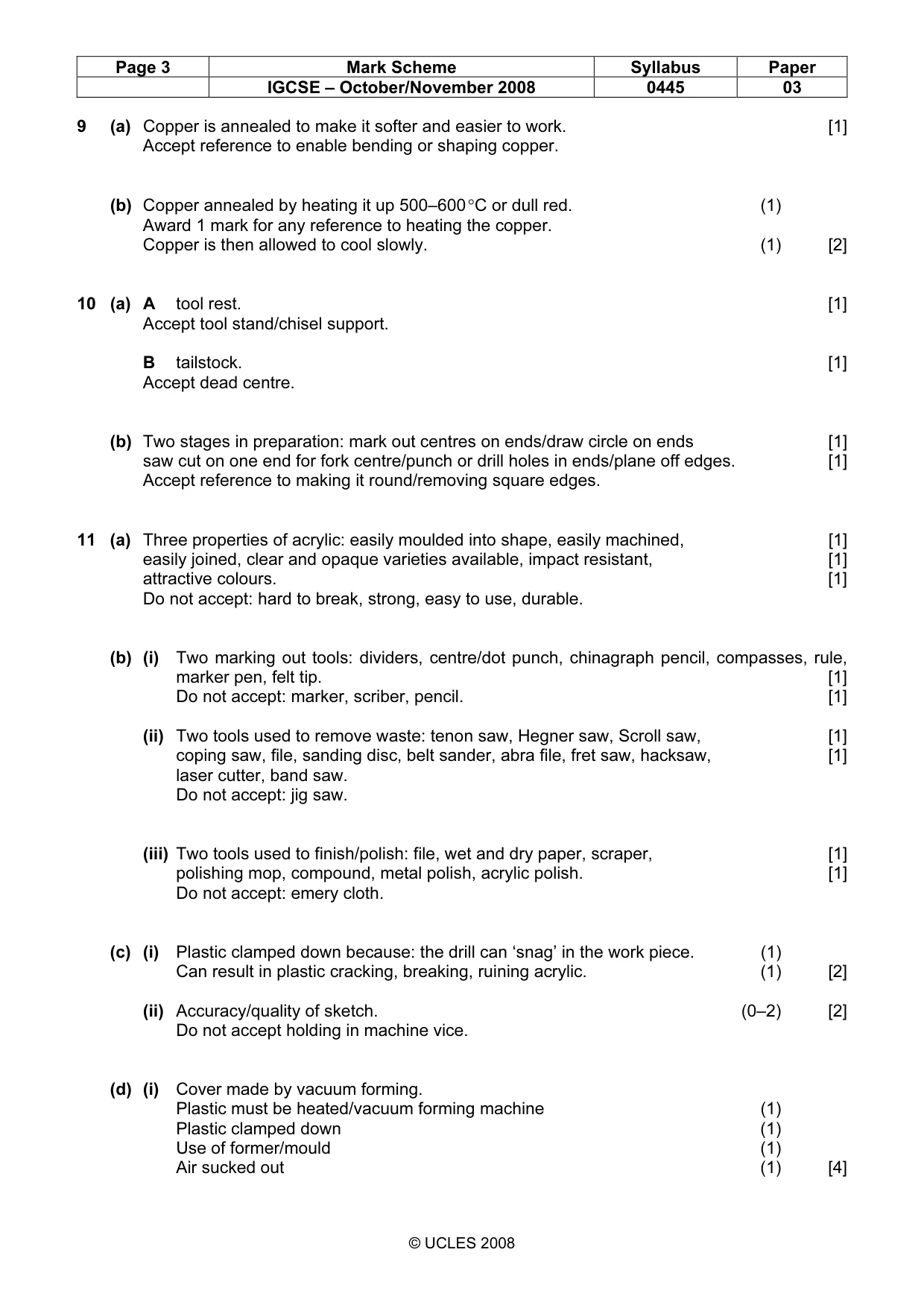
Page 3 Mark Scheme Syllabus Paper IGCSE – October/November 2008 0445 03 © UCLES 2008 9 (a) Copper is annealed to make it softer and easier to work. [1] Accept reference to enable bending or shaping copper. (b) Copper annealed by heating it up 500–600 °C or dull red. (1) Award 1 mark for any reference to heating the copper. Copper is then allowed to cool slowly. (1) [2] 10 (a) A tool rest. [1] Accept tool stand/chisel support. B tailstock. [1] Accept dead centre. (b) Two stages in preparation: mark out centres on ends/draw circle on ends [1] saw cut on one end for fork centre/punch or drill holes in ends/plane off edges. [1] Accept reference to making it round/removing square edges. 11 (a) Three properties of acrylic: easily moulded into shape, easily machined, [1] easily joined, clear and opaque varieties available, impact resistant, [1] attractive colours. [1] Do not accept: hard to break, strong, easy to use, durable. (b) (i) Two marking out tools: dividers, centre/dot punch, chinagraph pencil, compasses, rule, marker pen, felt tip. [1] Do not accept: marker, scriber, pencil. [1] (ii) Two tools used to remove waste: tenon saw, Hegner saw, Scroll saw, [1] coping saw, file, sanding disc, belt sander, abra file, fret saw, hacksaw, [1] laser cutter, band saw. Do not accept: jig saw. (iii) Two tools used to finish/polish: file, wet and dry paper, scraper, [1] polishing mop, compound, metal polish, acrylic polish. [1] Do not accept: emery cloth. (c) (i) Plastic clamped down because: the drill can ‘snag’ in the work piece. (1) Can result in plastic cracking, breaking, ruining acrylic. (1) [2] (ii) Accuracy/quality of sketch. (0–2) [2] Do not accept holding in machine vice. (d) (i) Cover made by vacuum forming. Plastic must be heated/vacuum forming machine (1) Plastic clamped down (1) Use of former/mould (1) Air sucked out (1) [4]
Mark scheme, page 4
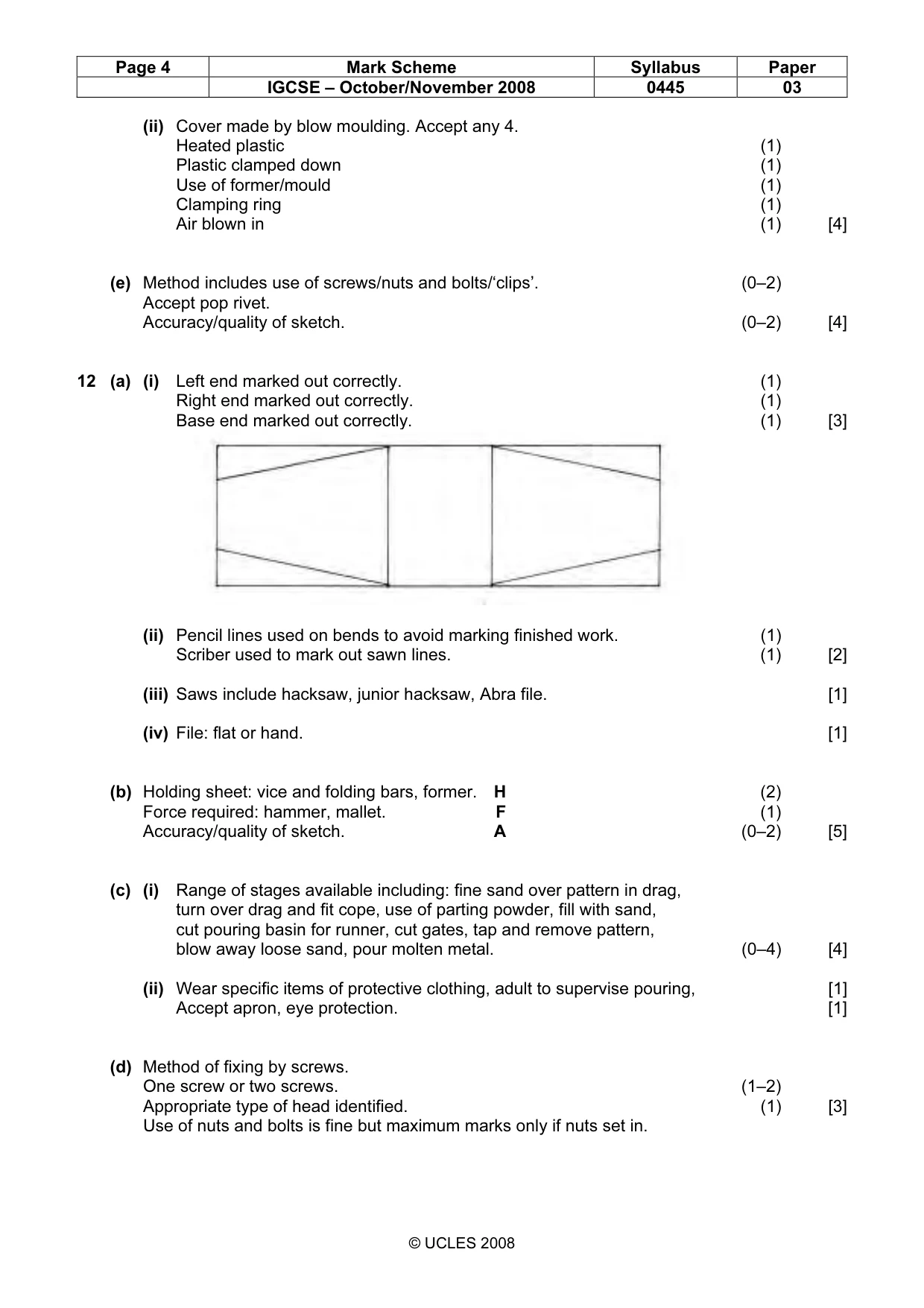
Page 4 Mark Scheme Syllabus Paper IGCSE – October/November 2008 0445 03 © UCLES 2008 (ii) Cover made by blow moulding. Accept any 4. Heated plastic (1) Plastic clamped down (1) Use of former/mould (1) Clamping ring (1) Air blown in (1) [4] (e) Method includes use of screws/nuts and bolts/‘clips’. (0–2) Accept pop rivet. Accuracy/quality of sketch. (0–2) [4] 12 (a) (i) Left end marked out correctly. (1) Right end marked out correctly. (1) Base end marked out correctly. (1) [3] (ii) Pencil lines used on bends to avoid marking finished work. (1) Scriber used to mark out sawn lines. (1) [2] (iii) Saws include hacksaw, junior hacksaw, Abra file. [1] (iv) File: flat or hand. [1] (b) Holding sheet: vice and folding bars, former. H (2) Force required: hammer, mallet. F (1) Accuracy/quality of sketch. A (0–2) [5] (c) (i) Range of stages available including: fine sand over pattern in drag, turn over drag and fit cope, use of parting powder, fill with sand, cut pouring basin for runner, cut gates, tap and remove pattern, blow away loose sand, pour molten metal. (0–4) [4] (ii) Wear specific items of protective clothing, adult to supervise pouring, [1] Accept apron, eye protection. [1] (d) Method of fixing by screws. One screw or two screws. (1–2) Appropriate type of head identified. (1) [3] Use of nuts and bolts is fine but maximum marks only if nuts set in.
Mark scheme, page 5
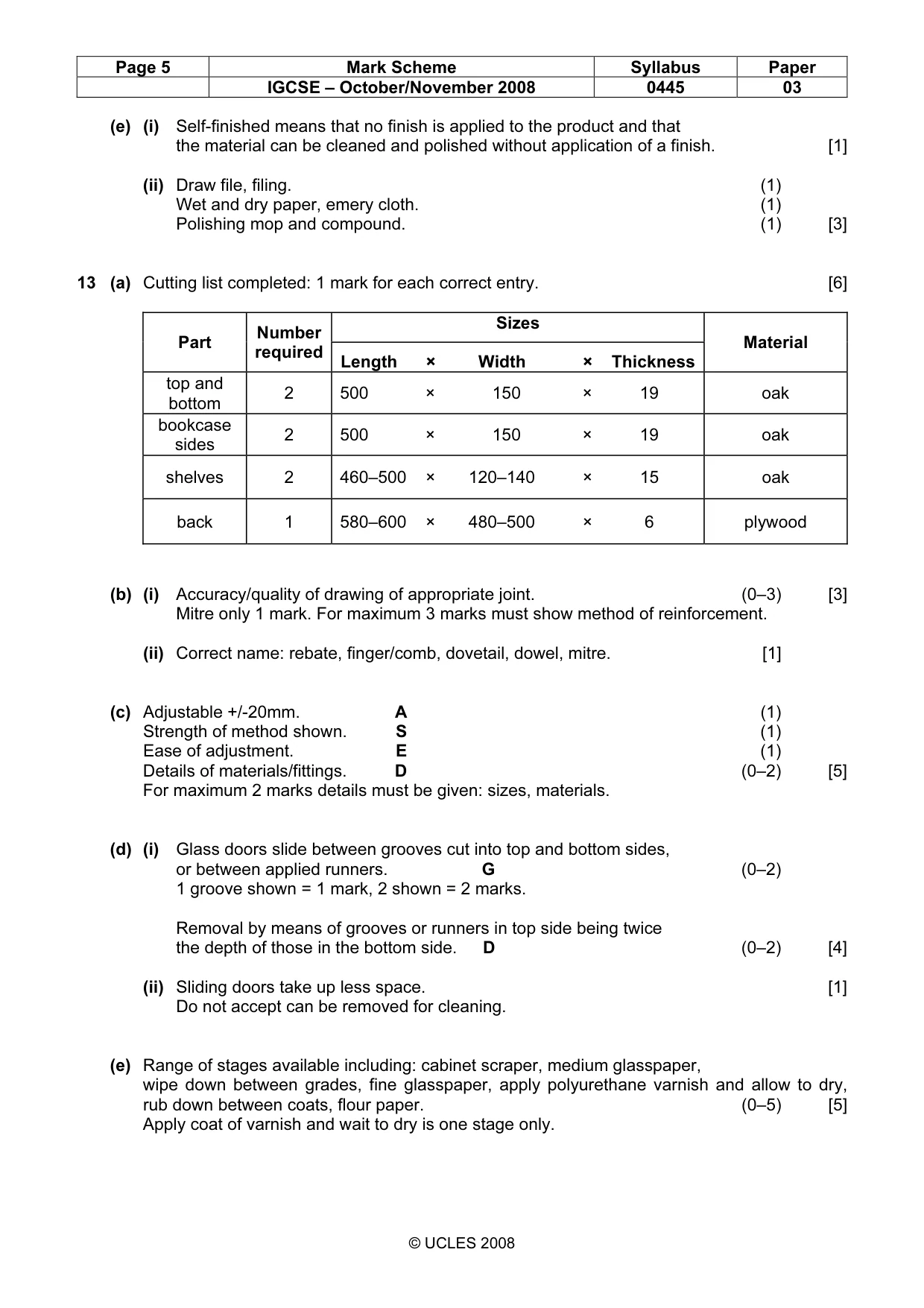
Page 5 Mark Scheme Syllabus Paper IGCSE – October/November 2008 0445 03 © UCLES 2008 (e) (i) Self-finished means that no finish is applied to the product and that the material can be cleaned and polished without application of a finish. [1] (ii) Draw file, filing. (1) Wet and dry paper, emery cloth. (1) Polishing mop and compound. (1) [3] 13 (a) Cutting list completed: 1 mark for each correct entry. [6] Sizes Part Number required Length × Width × Thickness Material top and bottom 2 500 × 150 × 19 oak bookcase sides 2 500 × 150 × 19 oak shelves 2 460–500 × 120–140 × 15 oak back 1 580–600 × 480–500 × 6 plywood (b) (i) Accuracy/quality of drawing of appropriate joint. (0–3) [3] Mitre only 1 mark. For maximum 3 marks must show method of reinforcement. (ii) Correct name: rebate, finger/comb, dovetail, dowel, mitre. [1] (c) Adjustable +/-20mm. A (1) Strength of method shown. S (1) Ease of adjustment. E (1) Details of materials/fittings. D (0–2) [5] For maximum 2 marks details must be given: sizes, materials. (d) (i) Glass doors slide between grooves cut into top and bottom sides, or between applied runners. G (0–2) 1 groove shown = 1 mark, 2 shown = 2 marks. Removal by means of grooves or runners in top side being twice the depth of those in the bottom side. D (0–2) [4] (ii) Sliding doors take up less space. [1] Do not accept can be removed for cleaning. (e) Range of stages available including: cabinet scraper, medium glasspaper, wipe down between grades, fine glasspaper, apply polyurethane varnish and allow to dry, rub down between coats, flour paper. (0–5) [5] Apply coat of varnish and wait to dry is one stage only.
What you needed in this session
Cambridge’s own grade thresholds for 2008 Oct/Nov, Paper 3 · Variant 1. A higher threshold means an easier paper — the bar moves with how the cohort did.