Cambridge IGCSE Design and Technology 0445 — 2007 May/June Paper 3 · Variant 1
0445/31/M/J/07 · 50 marks · ≈56 min
The question paper and its mark scheme, free to read here and free to download. This is Cambridge’s own paper, exactly as it was sat.
Question paper16 pages
Mark scheme5 pages
Answers below. Sit the paper first if you are practising.
Paper as text
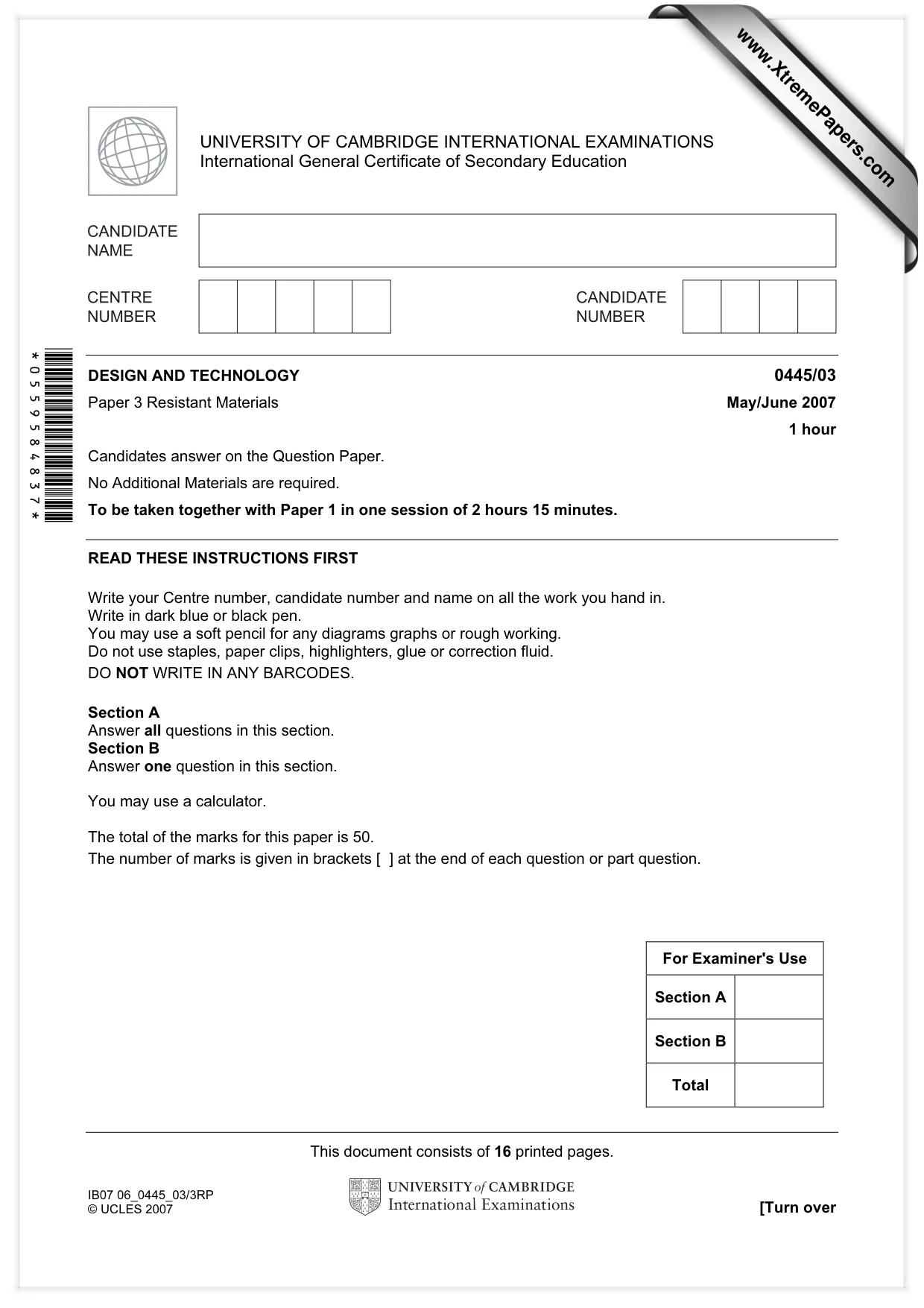
Question paper, page 1
This document consists of 16 printed pages. IB07 06_0445_03/3RP © UCLES 2007 [Turn over *0559584837* For Examiner's Use Section A Section B Total UNIVERSITY OF CAMBRIDGE INTERNATIONAL EXAMINATIONS International General Certificate of Secondary Education DESIGN AND TECHNOLOGY 0445/03 Paper 3 Resistant Materials May/June 2007 1 hour Candidates answer on the Question Paper. No Additional Materials are required. To be taken together with Paper 1 in one session of 2 hours 15 minutes. READ THESE INSTRUCTIONS FIRST Write your Centre number, candidate number and name on all the work you hand in. Write in dark blue or black pen. You may use a soft pencil for any diagrams graphs or rough working. Do not use staples, paper clips, highlighters, glue or correction fluid. DO NOT WRITE IN ANY BARCODES. Section A Answer all questions in this section. Section B Answer one question in this section. You may use a calculator. The total of the marks for this paper is 50. The number of marks is given in brackets [ ] at the end of each question or part question. www.XtremePapers.com
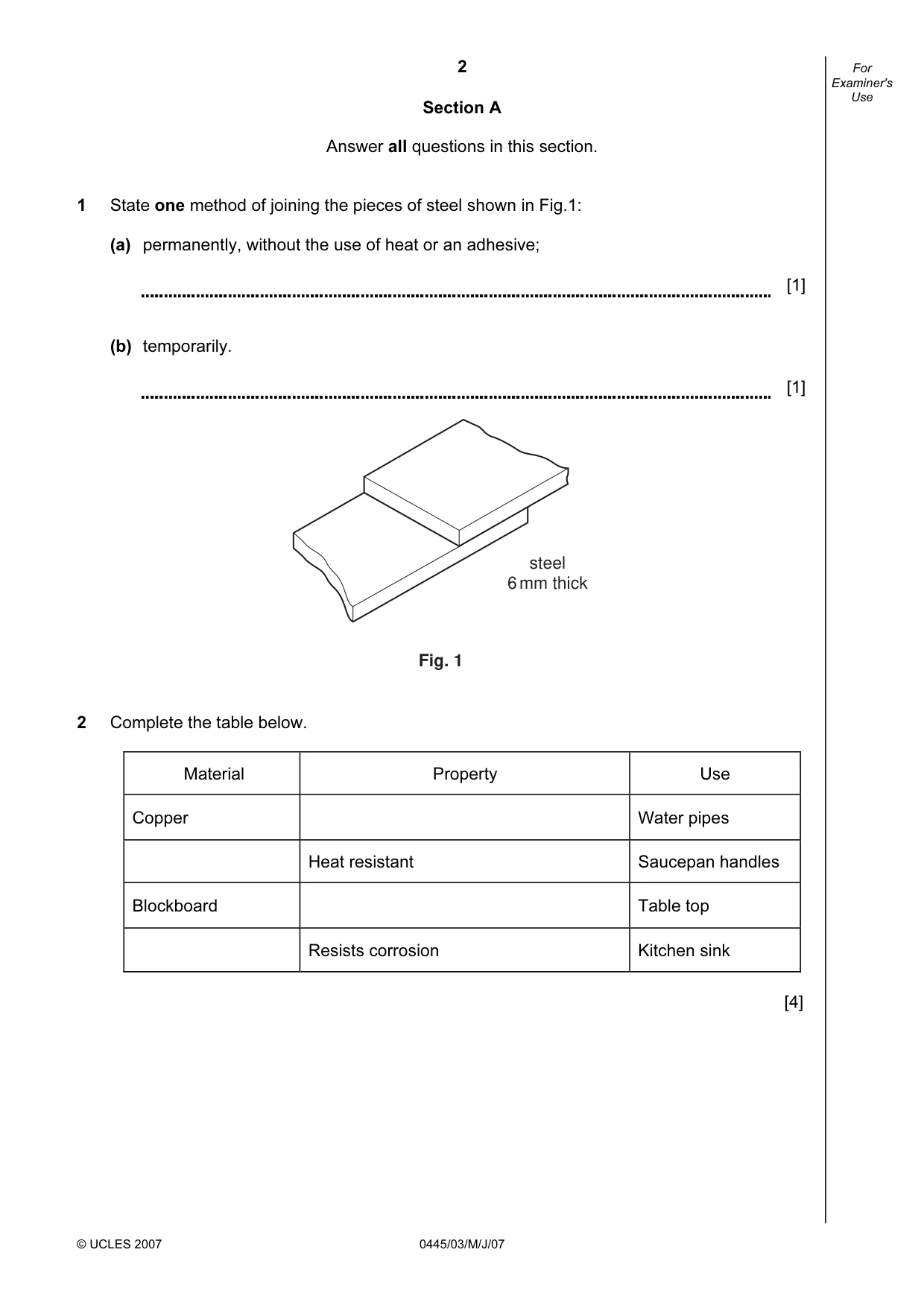
Question paper, page 2
2 © UCLES 2007 0445/03/M/J/07 For Examiner's Use Section A Answer all questions in this section. 1 State one method of joining the pieces of steel shown in Fig.1: (a) permanently, without the use of heat or an adhesive; [1] (b) temporarily. [1] steel 6 mm thick Fig. 1 2 Complete the table below. Material Property Use Copper Water pipes Heat resistant Saucepan handles Blockboard Table top Resists corrosion Kitchen sink [4]
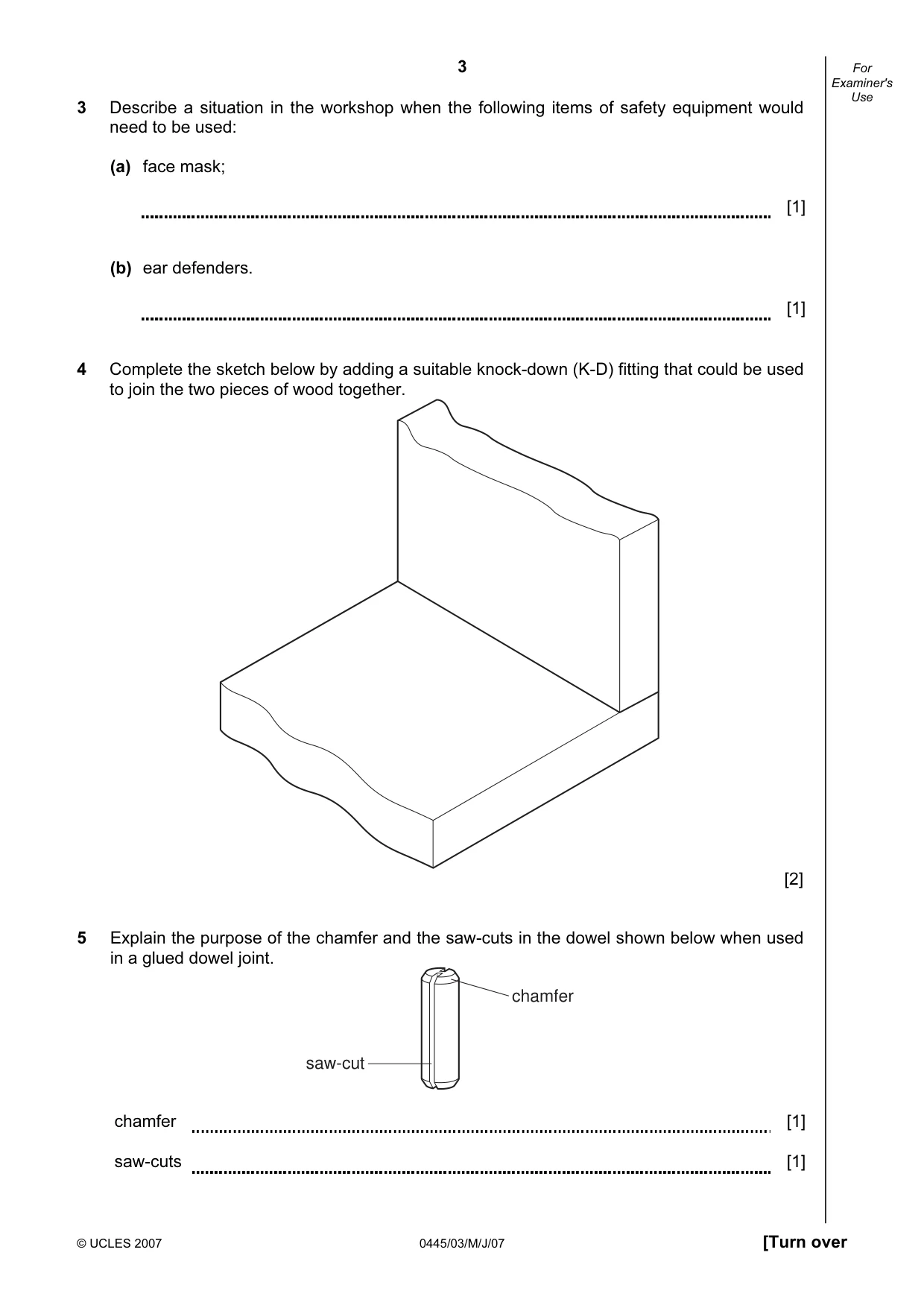
Question paper, page 3
3 © UCLES 2007 0445/03/M/J/07 [Turn over For Examiner's Use 3 Describe a situation in the workshop when the following items of safety equipment would need to be used: (a) face mask; [1] (b) ear defenders. [1] 4 Complete the sketch below by adding a suitable knock-down (K-D) fitting that could be used to join the two pieces of wood together. [2] 5 Explain the purpose of the chamfer and the saw-cuts in the dowel shown below when used in a glued dowel joint. chamfer saw-cut chamfer [1] saw-cuts [1]
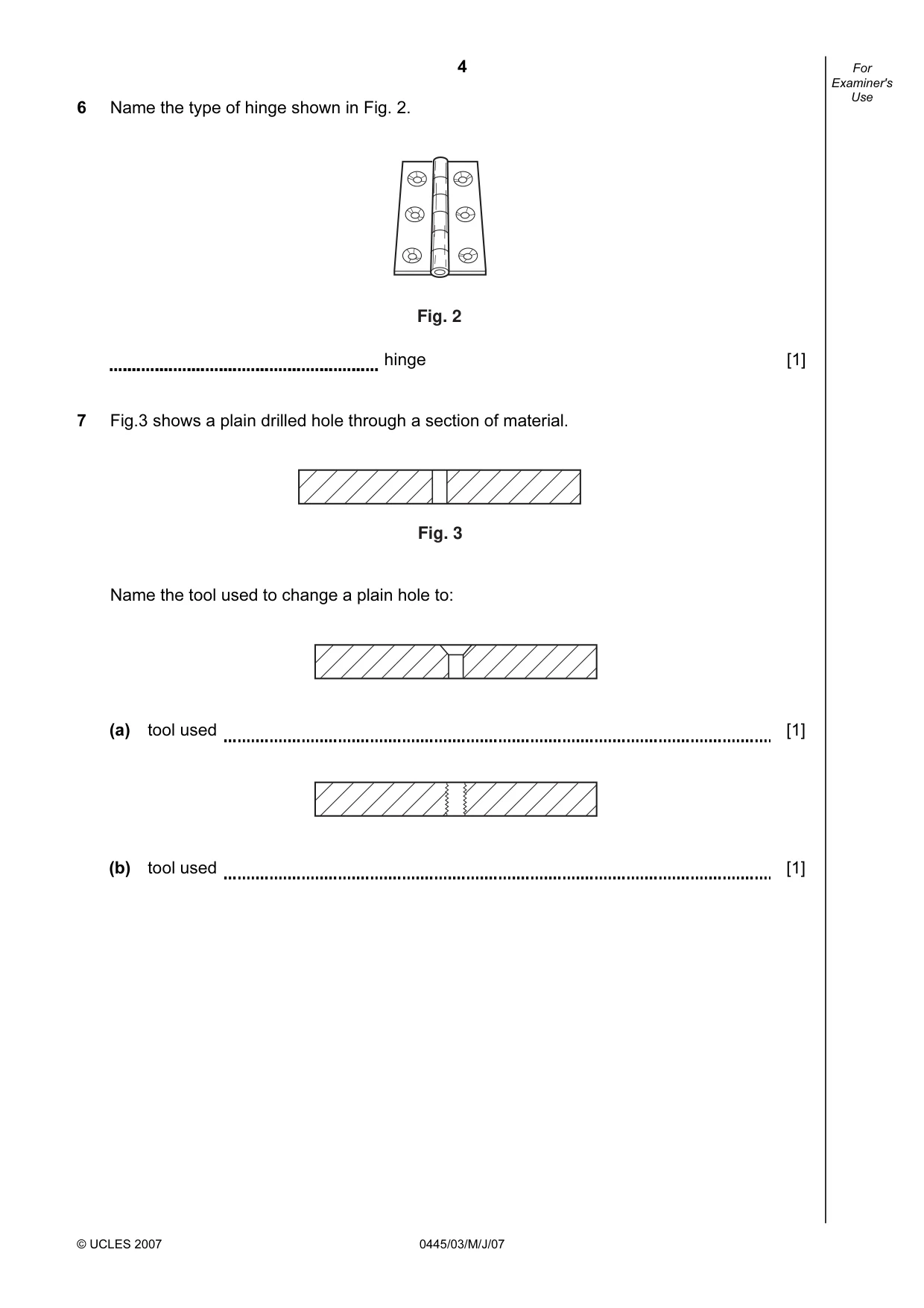
Question paper, page 4
4 © UCLES 2007 0445/03/M/J/07 For Examiner's Use 6 Name the type of hinge shown in Fig. 2. Fig. 2 hinge [1] 7 Fig.3 shows a plain drilled hole through a section of material. Fig. 3 Name the tool used to change a plain hole to: (a) tool used [1] (b) tool used [1]
Question paper, page 5
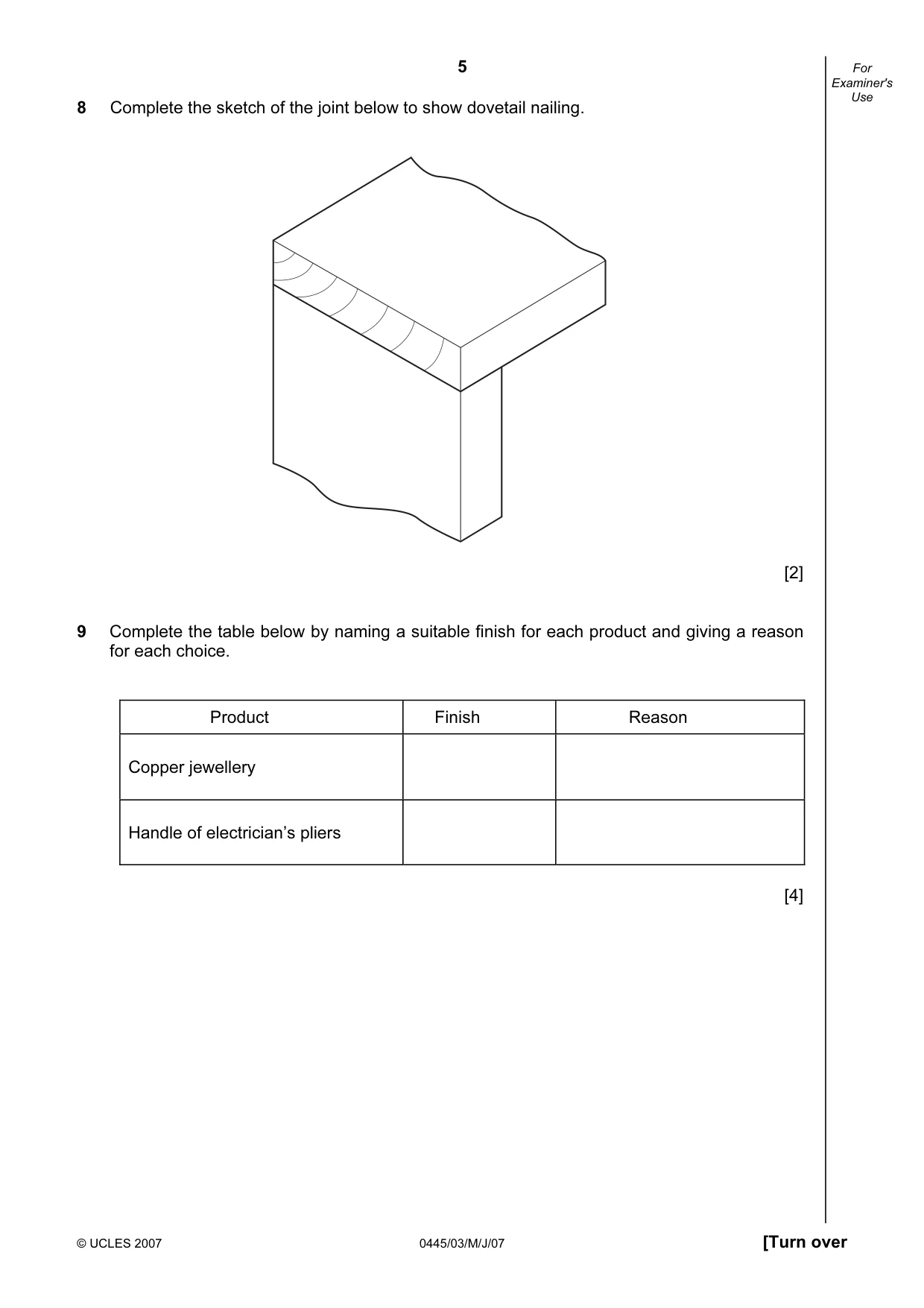
5 © UCLES 2007 0445/03/M/J/07 [Turn over For Examiner's Use 8 Complete the sketch of the joint below to show dovetail nailing. [2] 9 Complete the table below by naming a suitable finish for each product and giving a reason for each choice. Product Finish Reason Copper jewellery Handle of electrician’s pliers [4]
Question paper, page 6
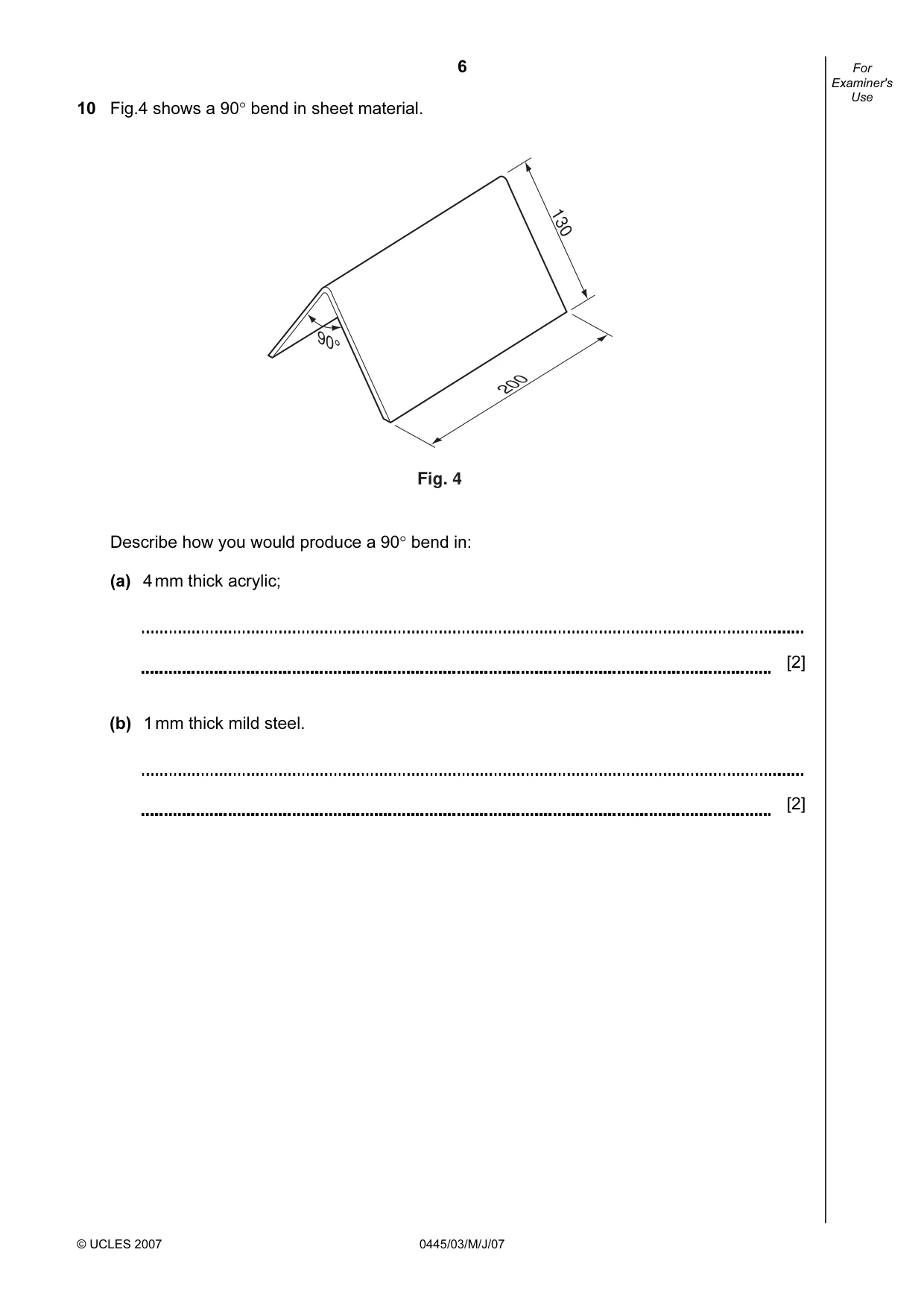
6 © UCLES 2007 0445/03/M/J/07 For Examiner's Use 10 Fig.4 shows a 90° bend in sheet material. 90° 200 Fig. 4 130 Describe how you would produce a 90° bend in: (a) 4 mm thick acrylic; [2] (b) 1 mm thick mild steel. [2]
Question paper, page 7
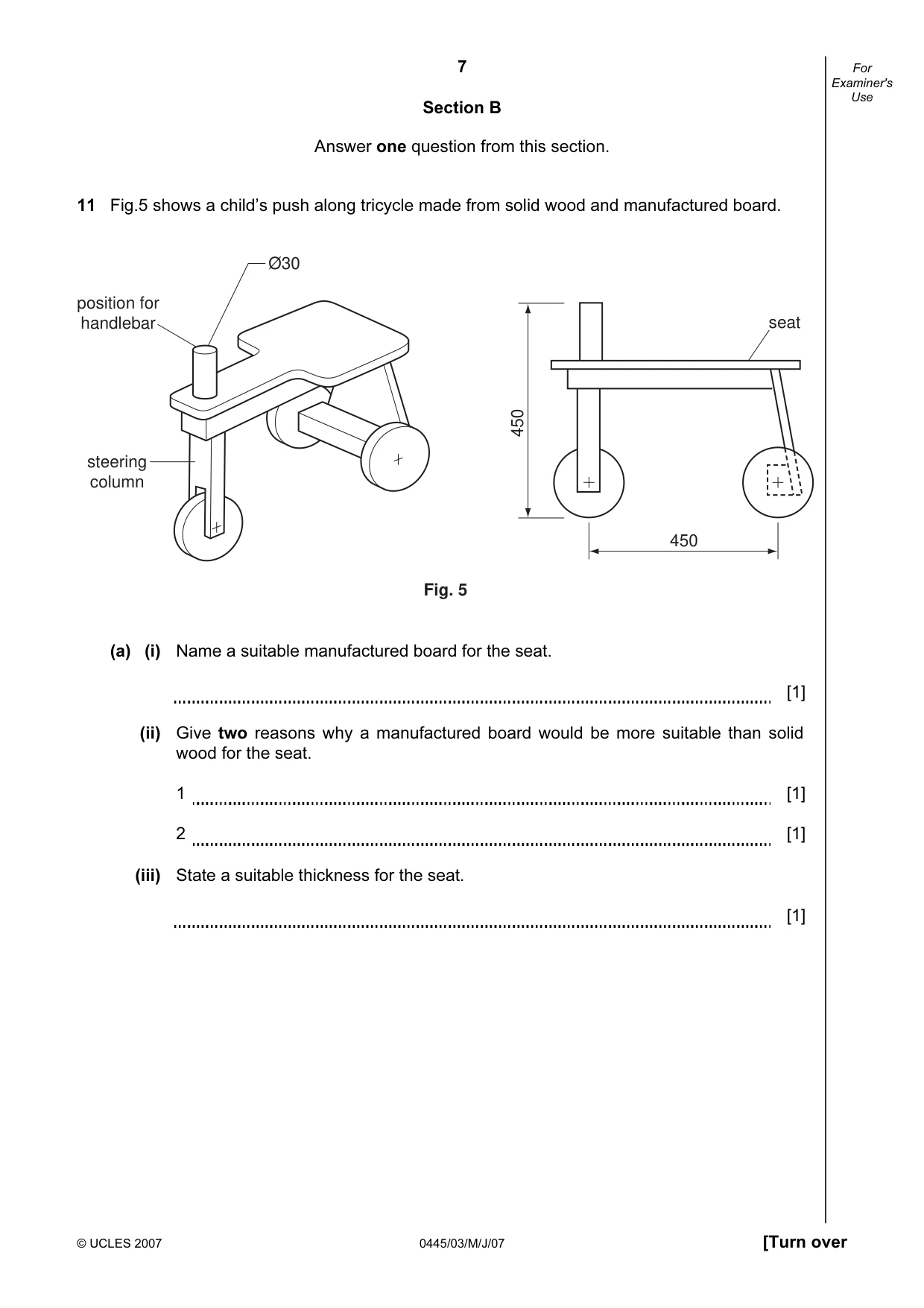
7 © UCLES 2007 0445/03/M/J/07 [Turn over For Examiner's Use Section B Answer one question from this section. 11 Fig.5 shows a child’s push along tricycle made from solid wood and manufactured board. 450 450 seat Fig. 5 position for handlebar Ø30 steering column (a) (i) Name a suitable manufactured board for the seat. [1] (ii) Give two reasons why a manufactured board would be more suitable than solid wood for the seat. 1 [1] 2 [1] (iii) State a suitable thickness for the seat. [1]
Question paper, page 8
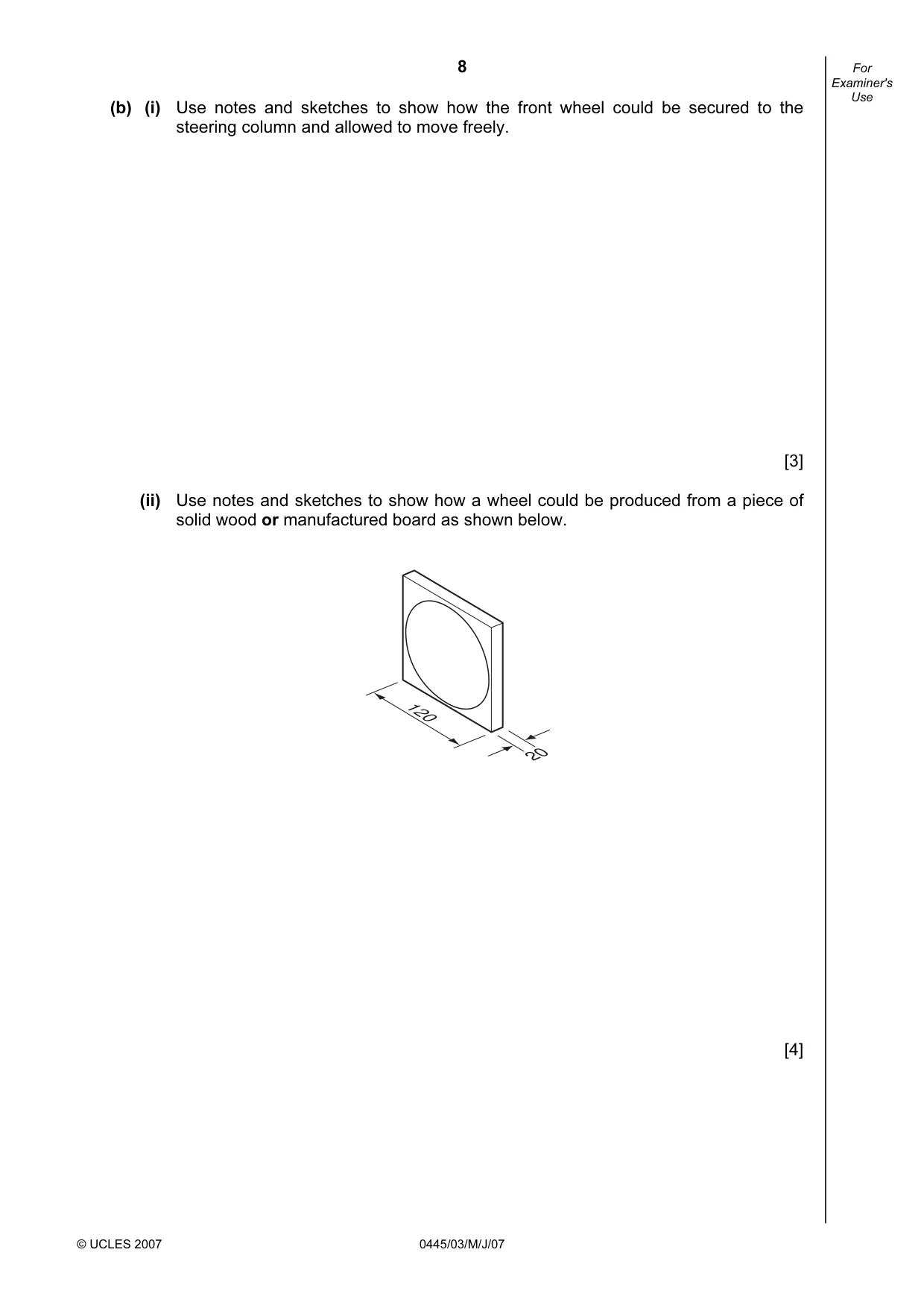
8 © UCLES 2007 0445/03/M/J/07 For Examiner's Use (b) (i) Use notes and sketches to show how the front wheel could be secured to the steering column and allowed to move freely. [3] (ii) Use notes and sketches to show how a wheel could be produced from a piece of solid wood or manufactured board as shown below. 120 20 [4]
Question paper, page 9
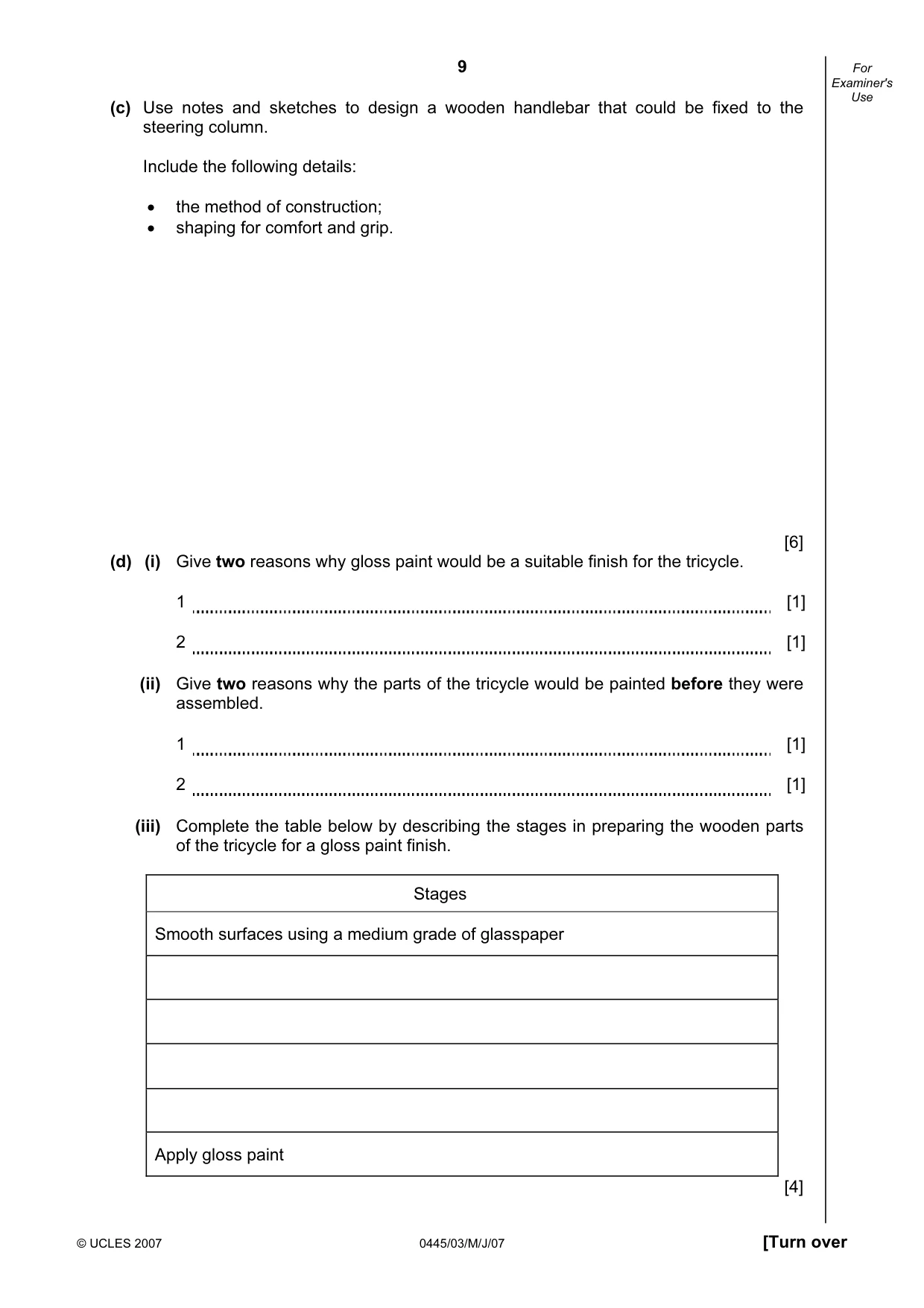
9 © UCLES 2007 0445/03/M/J/07 [Turn over For Examiner's Use (c) Use notes and sketches to design a wooden handlebar that could be fixed to the steering column. Include the following details: • the method of construction; • shaping for comfort and grip. [6] (d) (i) Give two reasons why gloss paint would be a suitable finish for the tricycle. 1 [1] 2 [1] (ii) Give two reasons why the parts of the tricycle would be painted before they were assembled. 1 [1] 2 [1] (iii) Complete the table below by describing the stages in preparing the wooden parts of the tricycle for a gloss paint finish. Stages Smooth surfaces using a medium grade of glasspaper Apply gloss paint [4]
Question paper, page 10
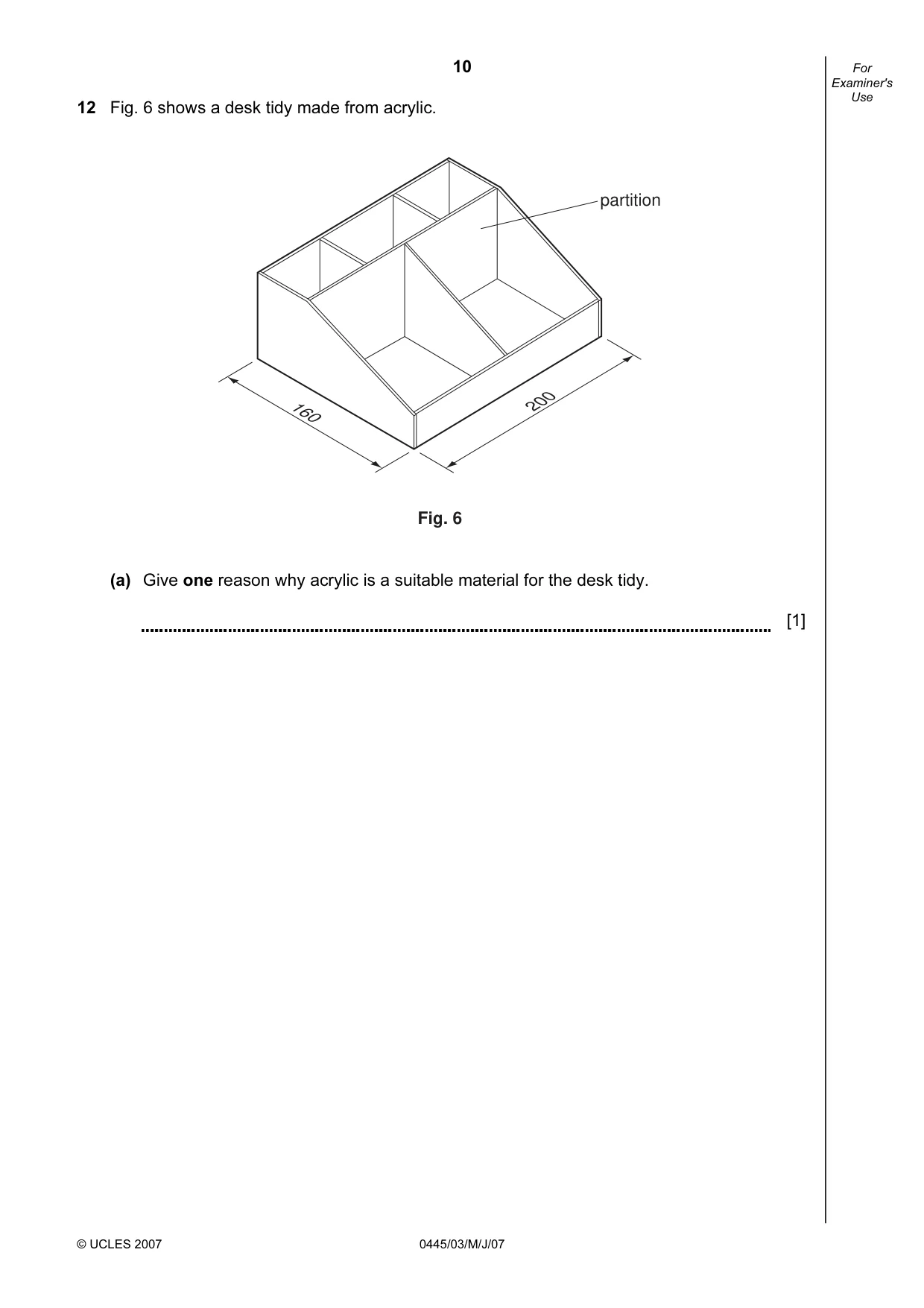
10 © UCLES 2007 0445/03/M/J/07 For Examiner's Use 12 Fig. 6 shows a desk tidy made from acrylic. partition Fig. 6 160 200 (a) Give one reason why acrylic is a suitable material for the desk tidy. [1]
Question paper, page 11
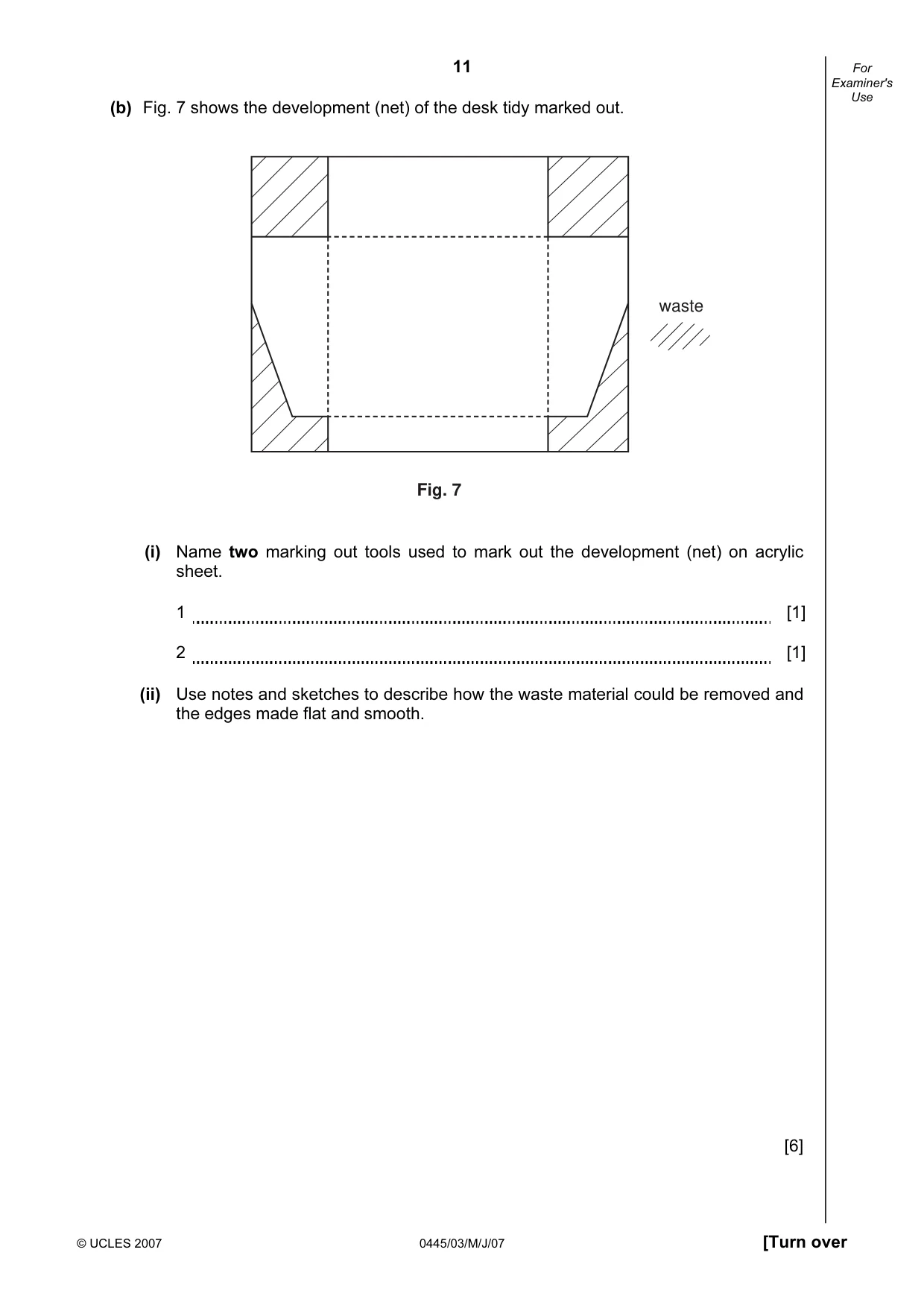
11 © UCLES 2007 0445/03/M/J/07 [Turn over For Examiner's Use (b) Fig. 7 shows the development (net) of the desk tidy marked out. Fig. 7 waste (i) Name two marking out tools used to mark out the development (net) on acrylic sheet. 1 [1] 2 [1] (ii) Use notes and sketches to describe how the waste material could be removed and the edges made flat and smooth. [6]
Question paper, page 12
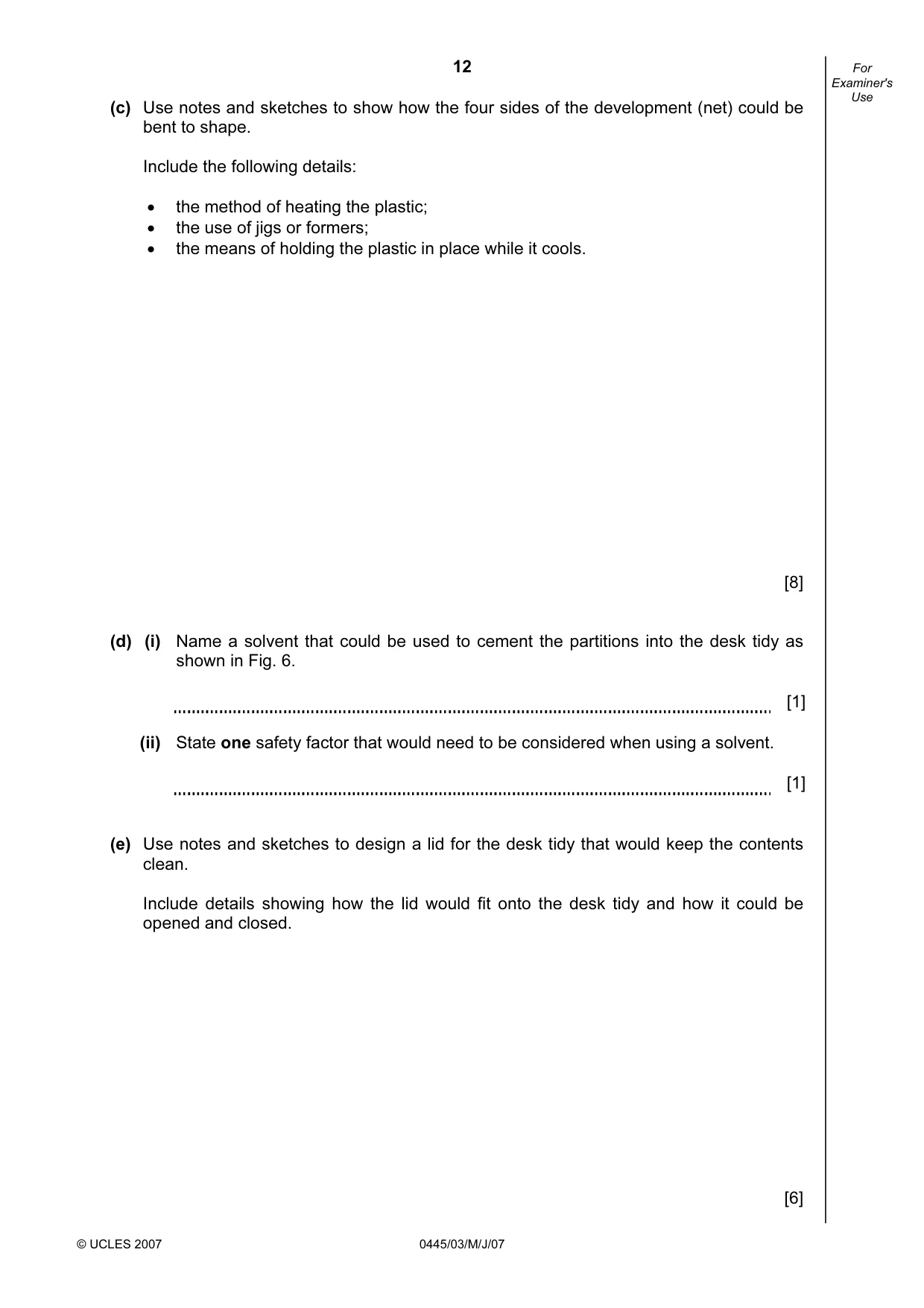
12 © UCLES 2007 0445/03/M/J/07 For Examiner's Use (c) Use notes and sketches to show how the four sides of the development (net) could be bent to shape. Include the following details: • the method of heating the plastic; • the use of jigs or formers; • the means of holding the plastic in place while it cools. [8] (d) (i) Name a solvent that could be used to cement the partitions into the desk tidy as shown in Fig. 6. [1] (ii) State one safety factor that would need to be considered when using a solvent. [1] (e) Use notes and sketches to design a lid for the desk tidy that would keep the contents clean. Include details showing how the lid would fit onto the desk tidy and how it could be opened and closed. [6]
Question paper, page 13
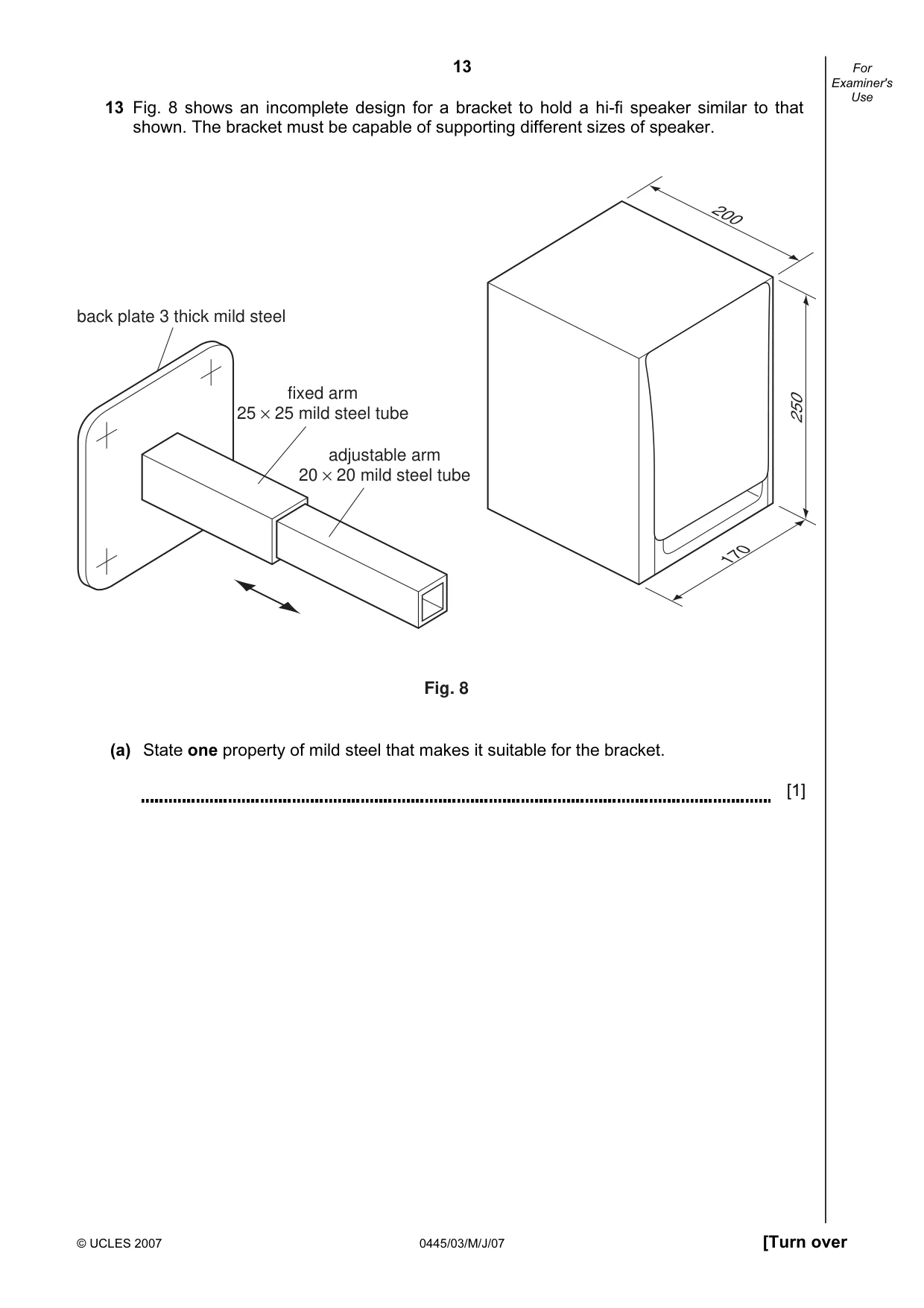
13 © UCLES 2007 0445/03/M/J/07 [Turn over For Examiner's Use 13 Fig. 8 shows an incomplete design for a bracket to hold a hi-fi speaker similar to that shown. The bracket must be capable of supporting different sizes of speaker. back plate 3 thick mild steel fixed arm 25 × 25 mild steel tube adjustable arm 20 × 20 mild steel tube Fig. 8 200 250 170 (a) State one property of mild steel that makes it suitable for the bracket. [1]
Question paper, page 14
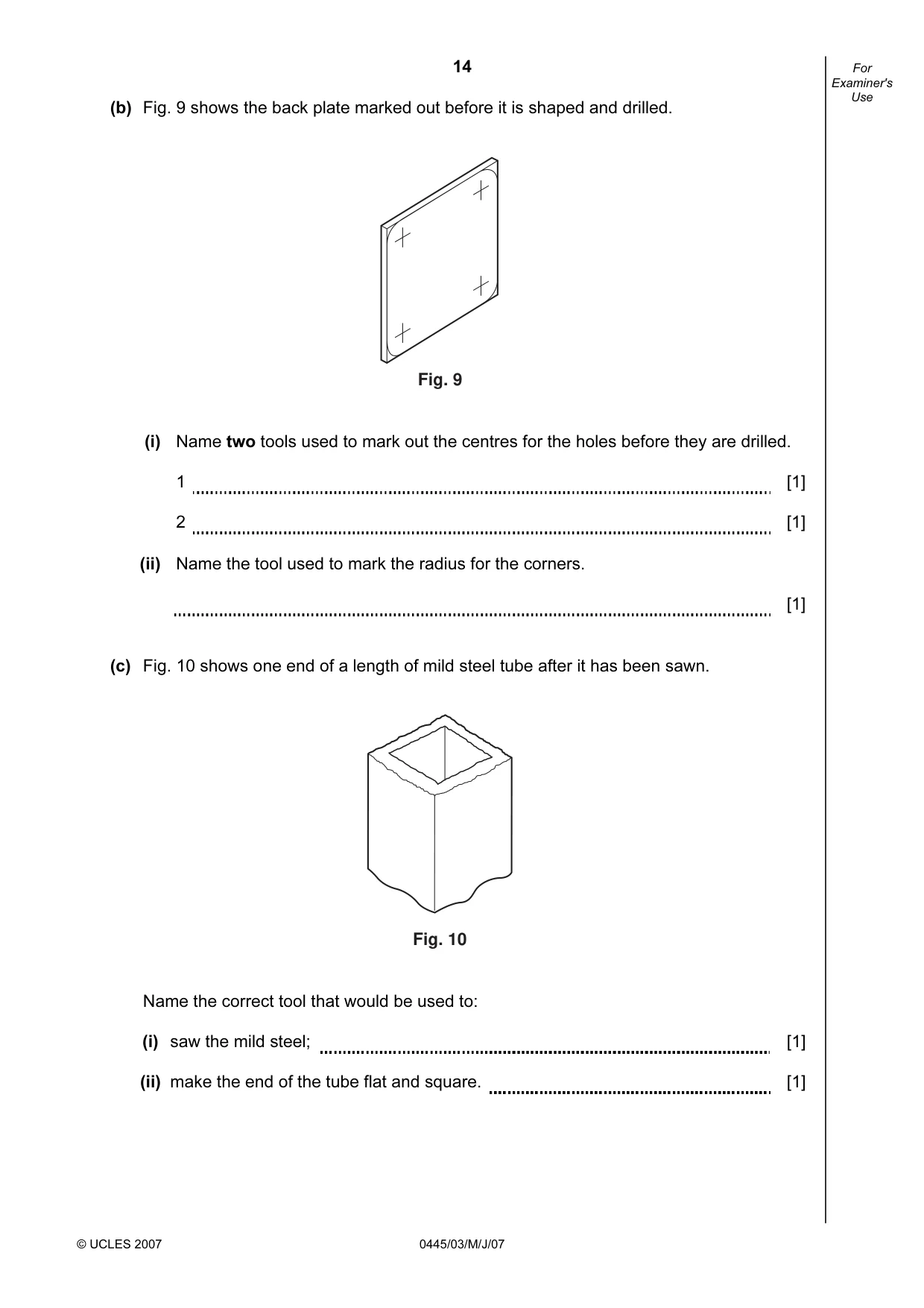
14 © UCLES 2007 0445/03/M/J/07 For Examiner's Use (b) Fig. 9 shows the back plate marked out before it is shaped and drilled. Fig. 9 (i) Name two tools used to mark out the centres for the holes before they are drilled. 1 [1] 2 [1] (ii) Name the tool used to mark the radius for the corners. [1] (c) Fig. 10 shows one end of a length of mild steel tube after it has been sawn. Fig. 10 Name the correct tool that would be used to: (i) saw the mild steel; [1] (ii) make the end of the tube flat and square. [1]
Question paper, page 15
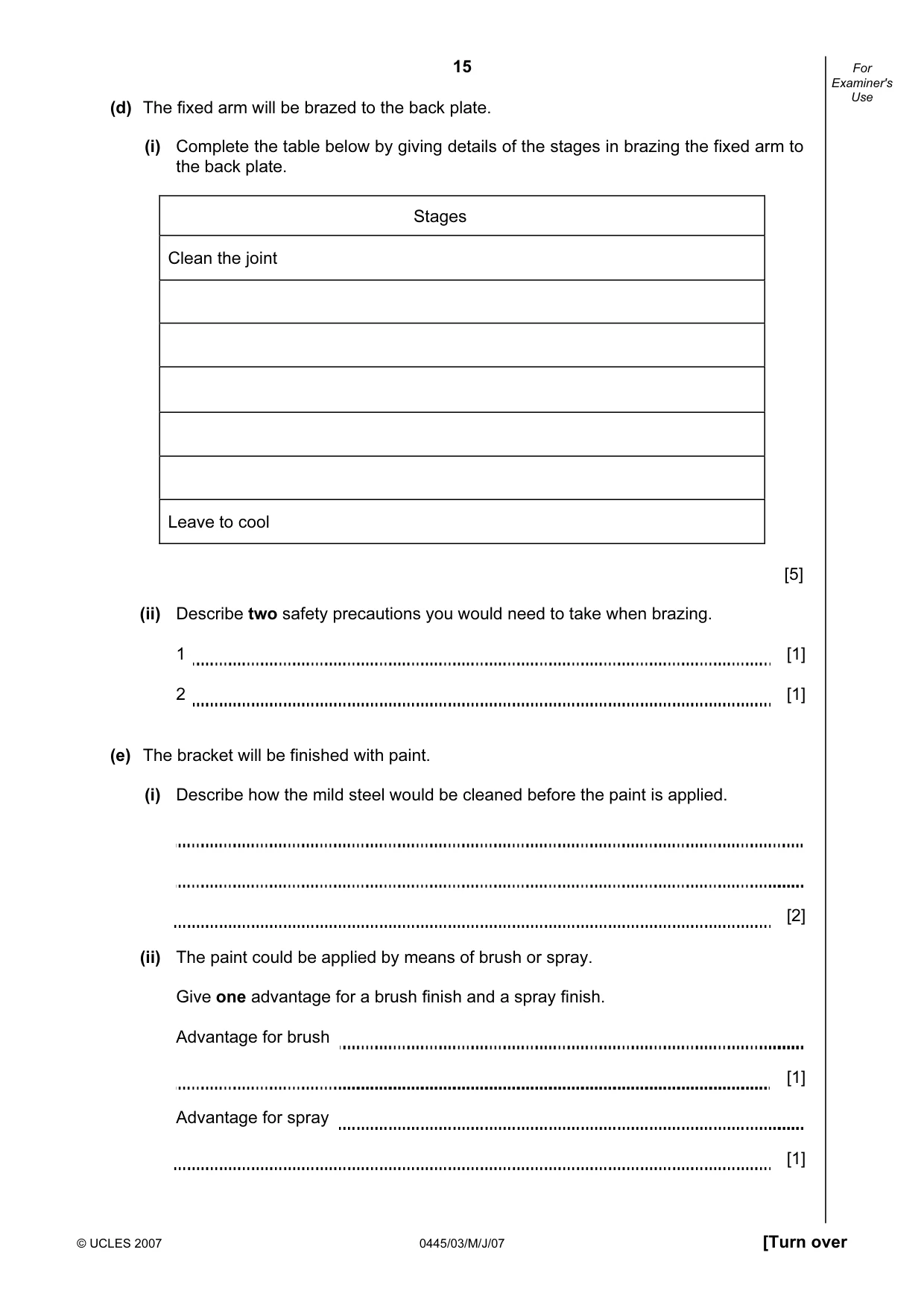
15 © UCLES 2007 0445/03/M/J/07 [Turn over For Examiner's Use (d) The fixed arm will be brazed to the back plate. (i) Complete the table below by giving details of the stages in brazing the fixed arm to the back plate. Stages Clean the joint Leave to cool [5] (ii) Describe two safety precautions you would need to take when brazing. 1 [1] 2 [1] (e) The bracket will be finished with paint. (i) Describe how the mild steel would be cleaned before the paint is applied. [2] (ii) The paint could be applied by means of brush or spray. Give one advantage for a brush finish and a spray finish. Advantage for brush [1] Advantage for spray [1]
Question paper, page 16
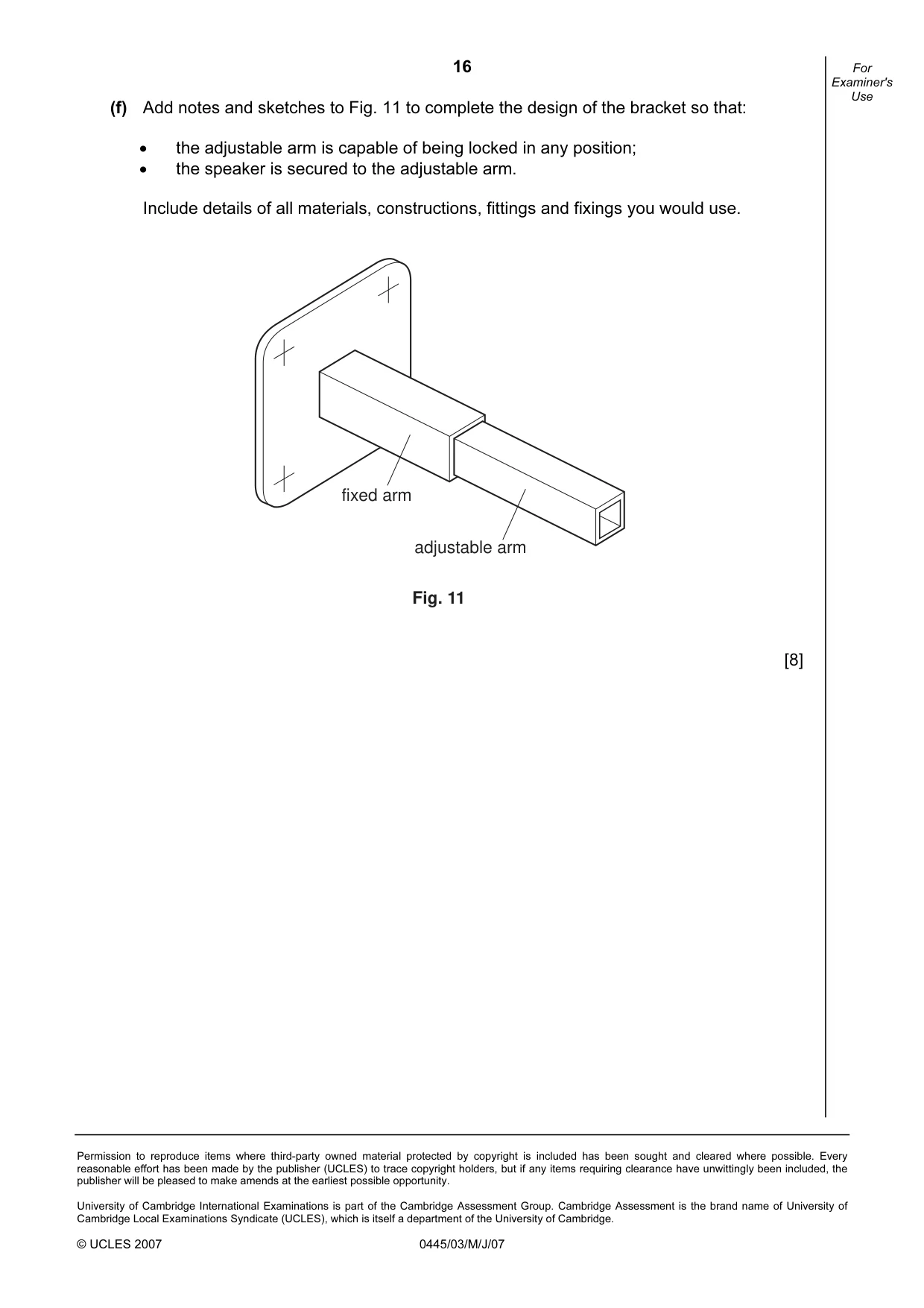
16 Permission to reproduce items where third-party owned material protected by copyright is included has been sought and cleared where possible. Every reasonable effort has been made by the publisher (UCLES) to trace copyright holders, but if any items requiring clearance have unwittingly been included, the publisher will be pleased to make amends at the earliest possible opportunity. University of Cambridge International Examinations is part of the Cambridge Assessment Group. Cambridge Assessment is the brand name of University of Cambridge Local Examinations Syndicate (UCLES), which is itself a department of the University of Cambridge. © UCLES 2007 0445/03/M/J/07 For Examiner's Use (f) Add notes and sketches to Fig. 11 to complete the design of the bracket so that: • the adjustable arm is capable of being locked in any position; • the speaker is secured to the adjustable arm. Include details of all materials, constructions, fittings and fixings you would use. fixed arm adjustable arm Fig. 11 [8]
Mark scheme, page 1
UNIVERSITY OF CAMBRIDGE INTERNATIONAL EXAMINATIONS International General Certificate of Secondary Education MARK SCHEME for the May/June 2007 question paper 0445 DESIGN AND TECHNOLOGY 0445/03 Paper 3 (Resistant Materials), maximum raw mark 50 This mark scheme is published as an aid to teachers and candidates, to indicate the requirements of the examination. It shows the basis on which Examiners were instructed to award marks. It does not indicate the details of the discussions that took place at an Examiners’ meeting before marking began. All Examiners are instructed that alternative correct answers and unexpected approaches in candidates’ scripts must be given marks that fairly reflect the relevant knowledge and skills demonstrated. Mark schemes must be read in conjunction with the question papers and the report on the examination. • CIE will not enter into discussions or correspondence in connection with these mark schemes. CIE is publishing the mark schemes for the May/June 2007 question papers for most IGCSE, GCE Advanced Level and Advanced Subsidiary Level syllabuses and some Ordinary Level syllabuses. www.XtremePapers.com
Mark scheme, page 2
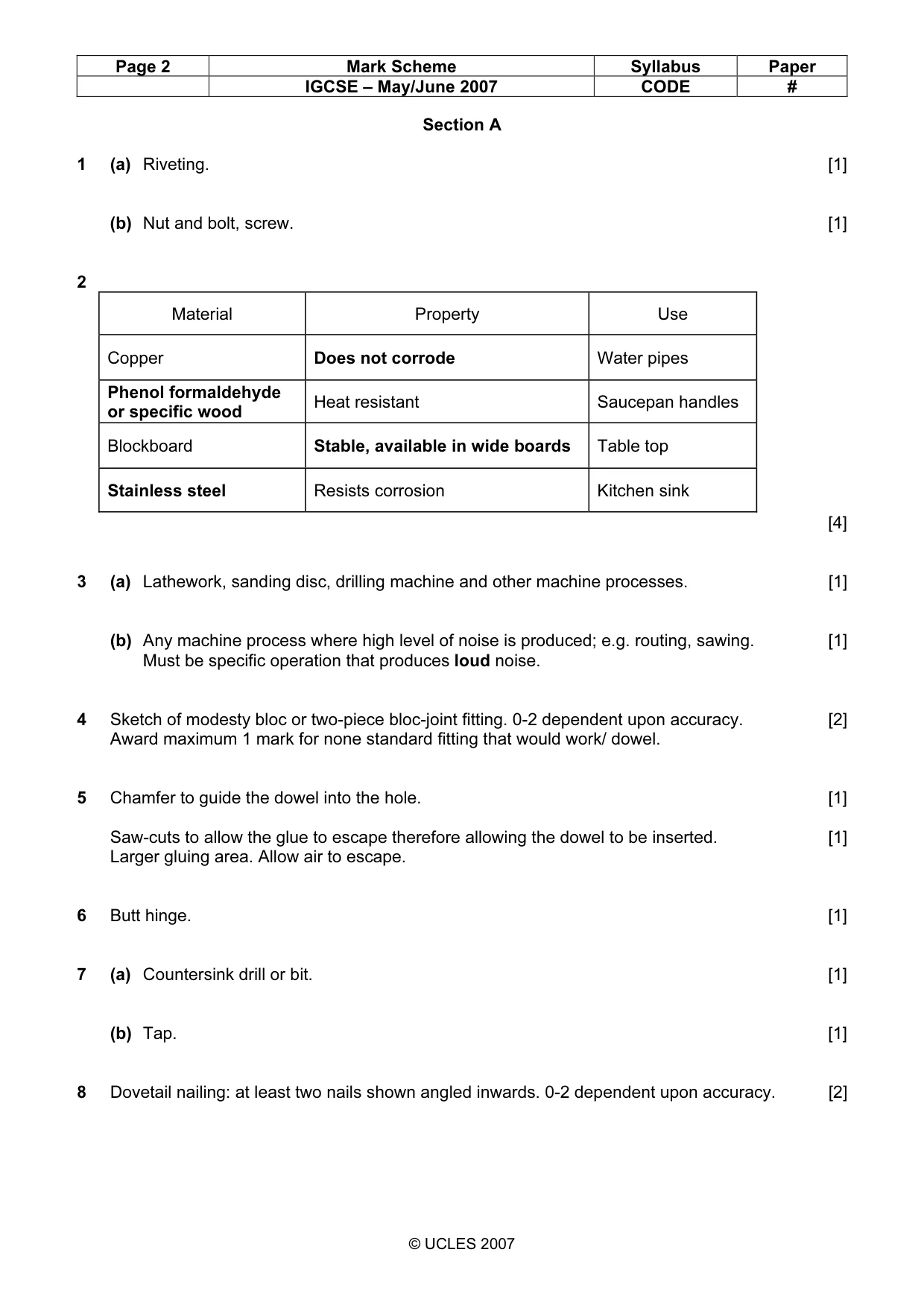
Page 2 Mark Scheme Syllabus Paper IGCSE – May/June 2007 CODE # © UCLES 2007 Section A 1 (a) Riveting. [1] (b) Nut and bolt, screw. [1] 2 Material Property Use Copper Does not corrode Water pipes Phenol formaldehyde or specific wood Heat resistant Saucepan handles Blockboard Stable, available in wide boards Table top Stainless steel Resists corrosion Kitchen sink [4] 3 (a) Lathework, sanding disc, drilling machine and other machine processes. [1] (b) Any machine process where high level of noise is produced; e.g. routing, sawing. [1] Must be specific operation that produces loud noise. 4 Sketch of modesty bloc or two-piece bloc-joint fitting. 0-2 dependent upon accuracy. [2] Award maximum 1 mark for none standard fitting that would work/ dowel. 5 Chamfer to guide the dowel into the hole. [1] Saw-cuts to allow the glue to escape therefore allowing the dowel to be inserted. [1] Larger gluing area. Allow air to escape. 6 Butt hinge. [1] 7 (a) Countersink drill or bit. [1] (b) Tap. [1] 8 Dovetail nailing: at least two nails shown angled inwards. 0-2 dependent upon accuracy. [2]
Mark scheme, page 3
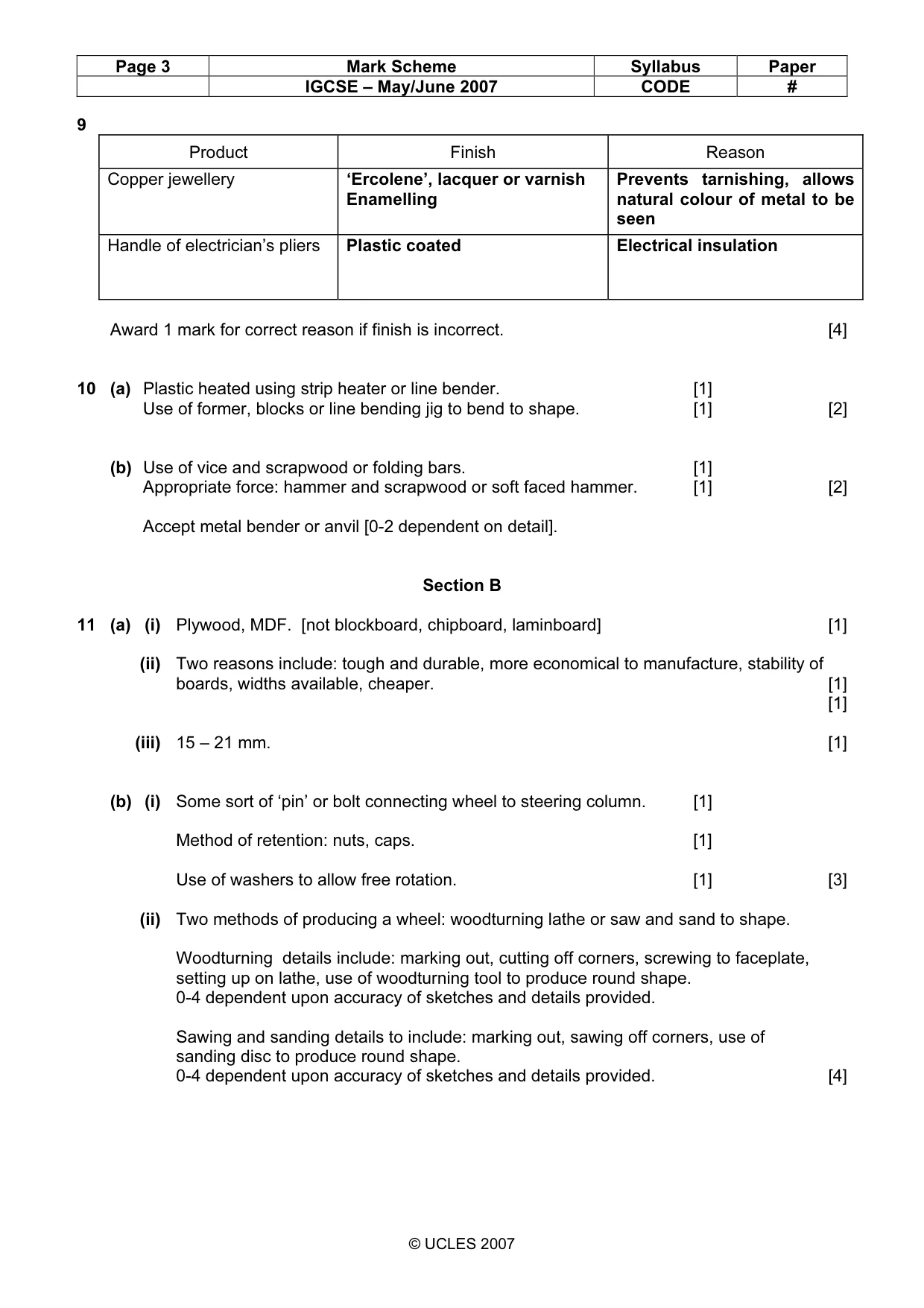
Page 3 Mark Scheme Syllabus Paper IGCSE – May/June 2007 CODE # © UCLES 2007 9 Product Finish Reason Copper jewellery ‘Ercolene’, lacquer or varnish Enamelling Prevents tarnishing, allows natural colour of metal to be seen Handle of electrician’s pliers Plastic coated Electrical insulation Award 1 mark for correct reason if finish is incorrect. [4] 10 (a) Plastic heated using strip heater or line bender. [1] Use of former, blocks or line bending jig to bend to shape. [1] [2] (b) Use of vice and scrapwood or folding bars. [1] Appropriate force: hammer and scrapwood or soft faced hammer. [1] [2] Accept metal bender or anvil [0-2 dependent on detail]. Section B 11 (a) (i) Plywood, MDF. [not blockboard, chipboard, laminboard] [1] (ii) Two reasons include: tough and durable, more economical to manufacture, stability of boards, widths available, cheaper. [1] [1] (iii) 15 – 21 mm. [1] (b) (i) Some sort of ‘pin’ or bolt connecting wheel to steering column. [1] Method of retention: nuts, caps. [1] Use of washers to allow free rotation. [1] [3] (ii) Two methods of producing a wheel: woodturning lathe or saw and sand to shape. Woodturning details include: marking out, cutting off corners, screwing to faceplate, setting up on lathe, use of woodturning tool to produce round shape. 0-4 dependent upon accuracy of sketches and details provided. Sawing and sanding details to include: marking out, sawing off corners, use of sanding disc to produce round shape. 0-4 dependent upon accuracy of sketches and details provided. [4]
Mark scheme, page 4
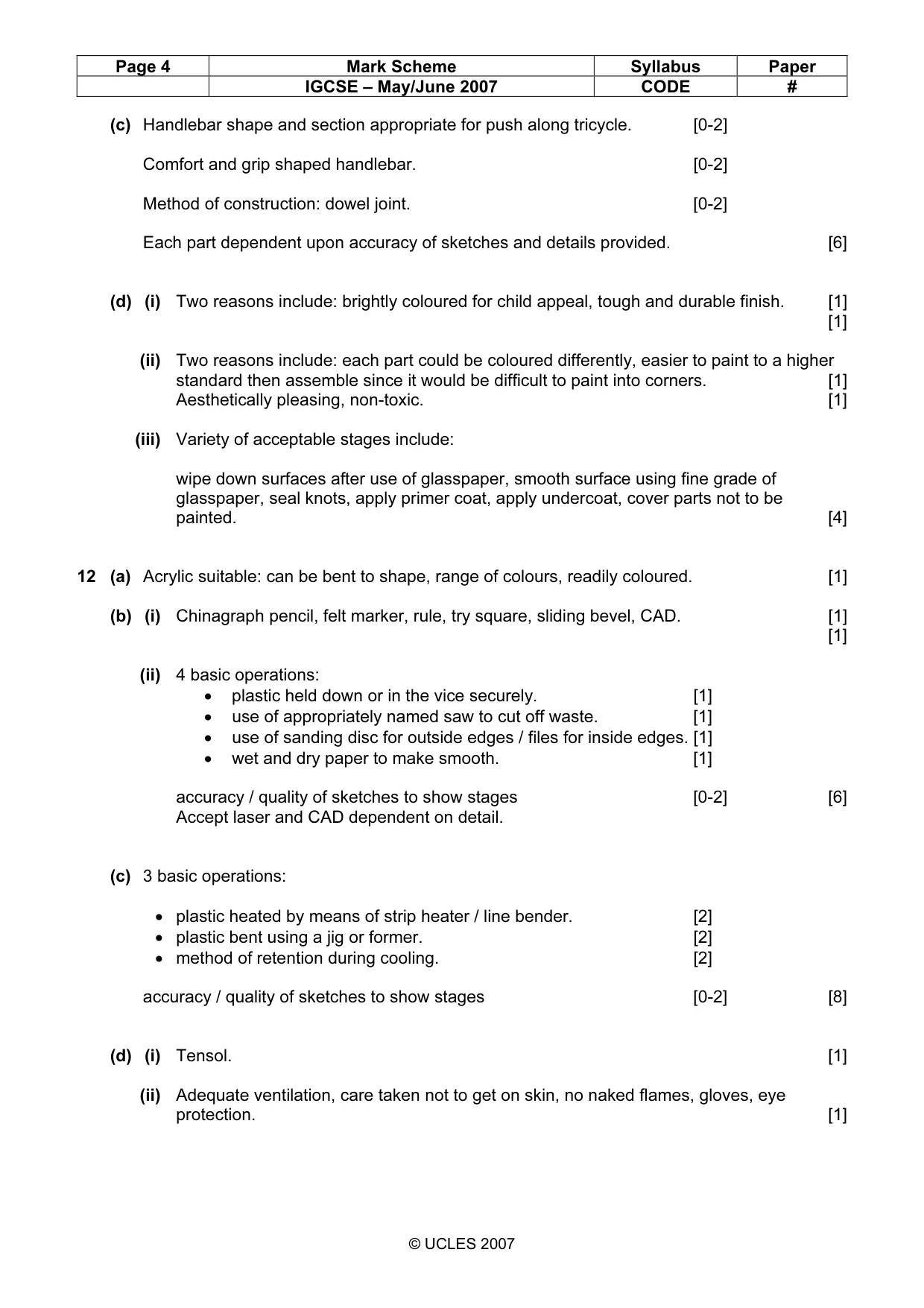
Page 4 Mark Scheme Syllabus Paper IGCSE – May/June 2007 CODE # © UCLES 2007 (c) Handlebar shape and section appropriate for push along tricycle. [0-2] Comfort and grip shaped handlebar. [0-2] Method of construction: dowel joint. [0-2] Each part dependent upon accuracy of sketches and details provided. [6] (d) (i) Two reasons include: brightly coloured for child appeal, tough and durable finish. [1] [1] (ii) Two reasons include: each part could be coloured differently, easier to paint to a higher standard then assemble since it would be difficult to paint into corners. [1] Aesthetically pleasing, non-toxic. [1] (iii) Variety of acceptable stages include: wipe down surfaces after use of glasspaper, smooth surface using fine grade of glasspaper, seal knots, apply primer coat, apply undercoat, cover parts not to be painted. [4] 12 (a) Acrylic suitable: can be bent to shape, range of colours, readily coloured. [1] (b) (i) Chinagraph pencil, felt marker, rule, try square, sliding bevel, CAD. [1] [1] (ii) 4 basic operations: • plastic held down or in the vice securely. [1] • use of appropriately named saw to cut off waste. [1] • use of sanding disc for outside edges / files for inside edges. [1] • wet and dry paper to make smooth. [1] accuracy / quality of sketches to show stages [0-2] [6] Accept laser and CAD dependent on detail. (c) 3 basic operations: • plastic heated by means of strip heater / line bender. [2] • plastic bent using a jig or former. [2] • method of retention during cooling. [2] accuracy / quality of sketches to show stages [0-2] [8] (d) (i) Tensol. [1] (ii) Adequate ventilation, care taken not to get on skin, no naked flames, gloves, eye protection. [1]
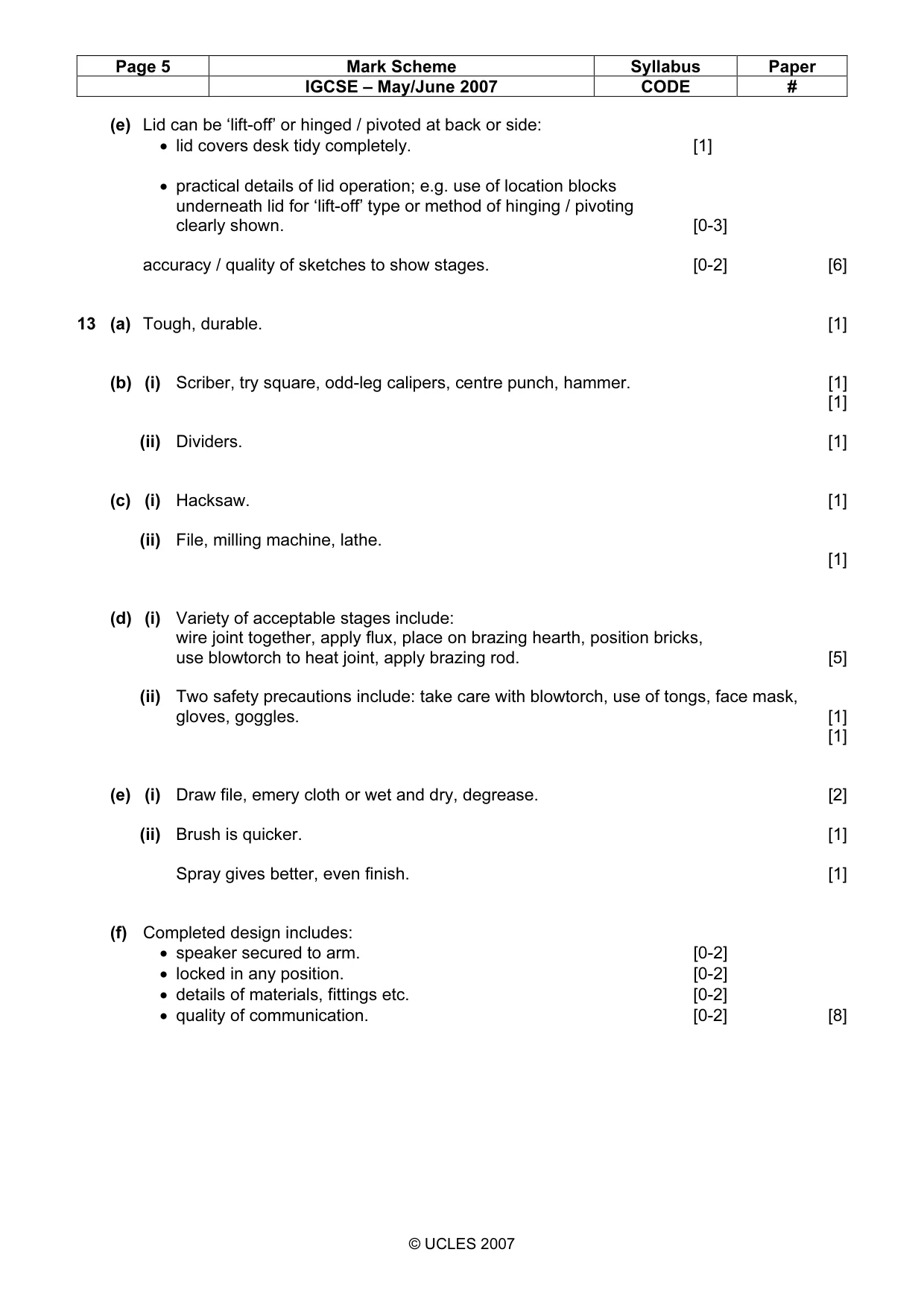
Mark scheme, page 5
Page 5 Mark Scheme Syllabus Paper IGCSE – May/June 2007 CODE # © UCLES 2007 (e) Lid can be ‘lift-off’ or hinged / pivoted at back or side: • lid covers desk tidy completely. [1] • practical details of lid operation; e.g. use of location blocks underneath lid for ‘lift-off’ type or method of hinging / pivoting clearly shown. [0-3] accuracy / quality of sketches to show stages. [0-2] [6] 13 (a) Tough, durable. [1] (b) (i) Scriber, try square, odd-leg calipers, centre punch, hammer. [1] [1] (ii) Dividers. [1] (c) (i) Hacksaw. [1] (ii) File, milling machine, lathe. [1] (d) (i) Variety of acceptable stages include: wire joint together, apply flux, place on brazing hearth, position bricks, use blowtorch to heat joint, apply brazing rod. [5] (ii) Two safety precautions include: take care with blowtorch, use of tongs, face mask, gloves, goggles. [1] [1] (e) (i) Draw file, emery cloth or wet and dry, degrease. [2] (ii) Brush is quicker. [1] Spray gives better, even finish. [1] (f) Completed design includes: • speaker secured to arm. [0-2] • locked in any position. [0-2] • details of materials, fittings etc. [0-2] • quality of communication. [0-2] [8]
What you needed in this session
Cambridge’s own grade thresholds for 2007 May/June, Paper 3 · Variant 1. A higher threshold means an easier paper — the bar moves with how the cohort did.