Cambridge IGCSE Design and Technology 0445 — 2006 May/June Paper 3 · Variant 1
0445/31/M/J/06 · 100 marks · ≈113 min
The question paper and its mark scheme, free to read here and free to download. This is Cambridge’s own paper, exactly as it was sat.
Question paper16 pages
Mark scheme5 pages
Answers below. Sit the paper first if you are practising.
Paper as text
Question paper, page 1
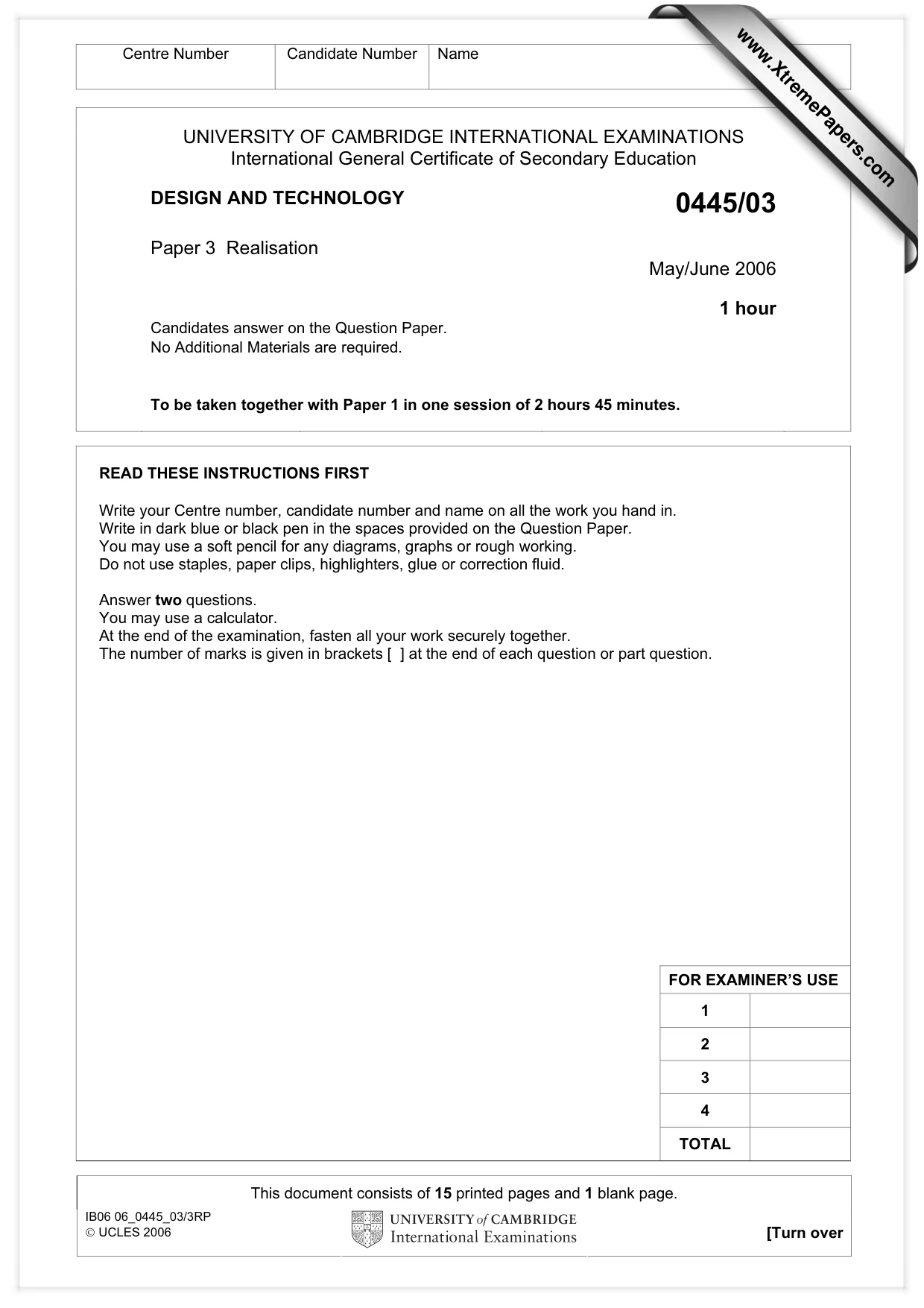
Centre Number Candidate Number Name UNIVERSITY OF CAMBRIDGE INTERNATIONAL EXAMINATIONS International General Certificate of Secondary Education DESIGN AND TECHNOLOGY 0445/03 Paper 3 Realisation May/June 2006 1 hour Candidates answer on the Question Paper. No Additional Materials are required. To be taken together with Paper 1 in one session of 2 hours 45 minutes. READ THESE INSTRUCTIONS FIRST Write your Centre number, candidate number and name on all the work you hand in. Write in dark blue or black pen in the spaces provided on the Question Paper. You may use a soft pencil for any diagrams, graphs or rough working. Do not use staples, paper clips, highlighters, glue or correction fluid. Answer two questions. You may use a calculator. At the end of the examination, fasten all your work securely together. The number of marks is given in brackets [ ] at the end of each question or part question. FOR EXAMINER’S USE 1 2 3 4 TOTAL This document consists of 15 printed pages and 1 blank page. IB06 06_0445_03/3RP UCLES 2006 [Turn over www.XtremePapers.com
Question paper, page 2
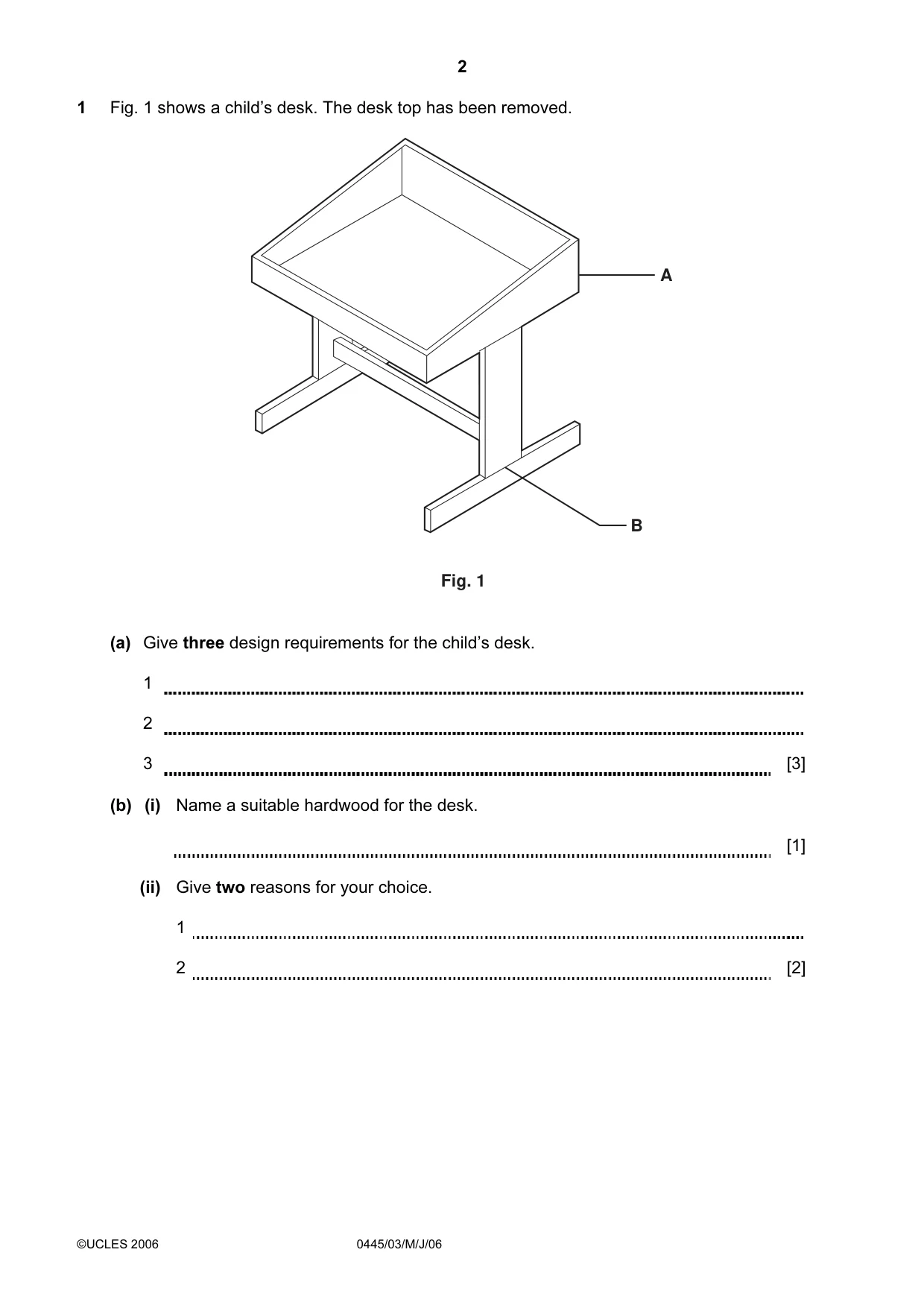
2 ©UCLES 2006 0445/03/M/J/06 1 Fig. 1 shows a child’s desk. The desk top has been removed. A B Fig. 1 (a) Give three design requirements for the child’s desk. 1 2 3 [3] (b) (i) Name a suitable hardwood for the desk. [1] (ii) Give two reasons for your choice. 1 2 [2]
Question paper, page 3
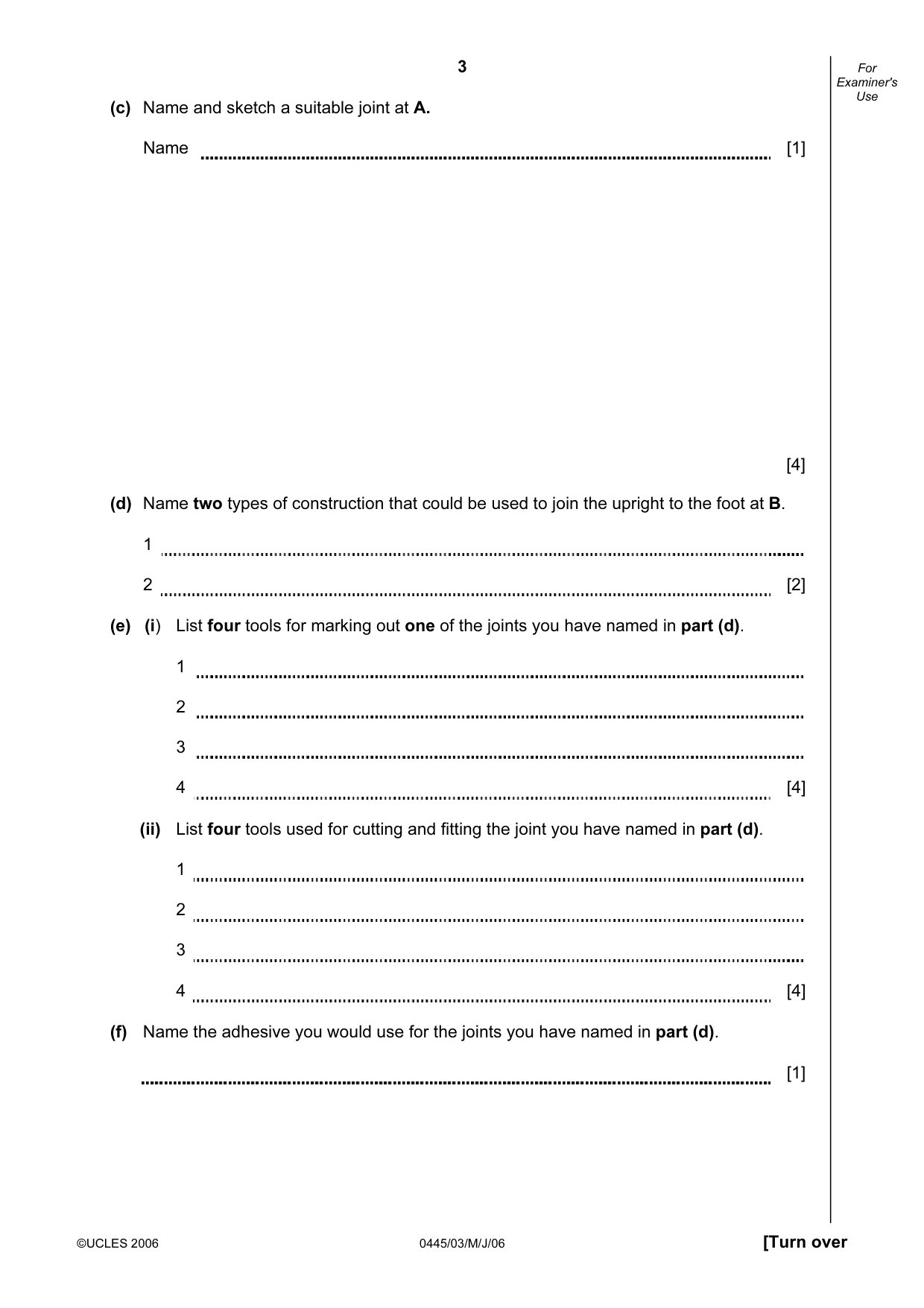
3 ©UCLES 2006 0445/03/M/J/06 [Turn over For Examiner's Use (c) Name and sketch a suitable joint at A. Name [1] [4] (d) Name two types of construction that could be used to join the upright to the foot at B. 1 2 [2] (e) (i) List four tools for marking out one of the joints you have named in part (d). 1 2 3 4 [4] (ii) List four tools used for cutting and fitting the joint you have named in part (d). 1 2 3 4 [4] (f) Name the adhesive you would use for the joints you have named in part (d). [1]
Question paper, page 4
4 © UCLES 2006 0445/03/M/J/06 For Examiner's Use (g) (i) Name a suitable manufactured board for the desk top. Manufactured board [1] (ii) Use notes and sketches to show how the desk top could be fitted to the desk, and list all the fittings you would use. [7]
Question paper, page 5
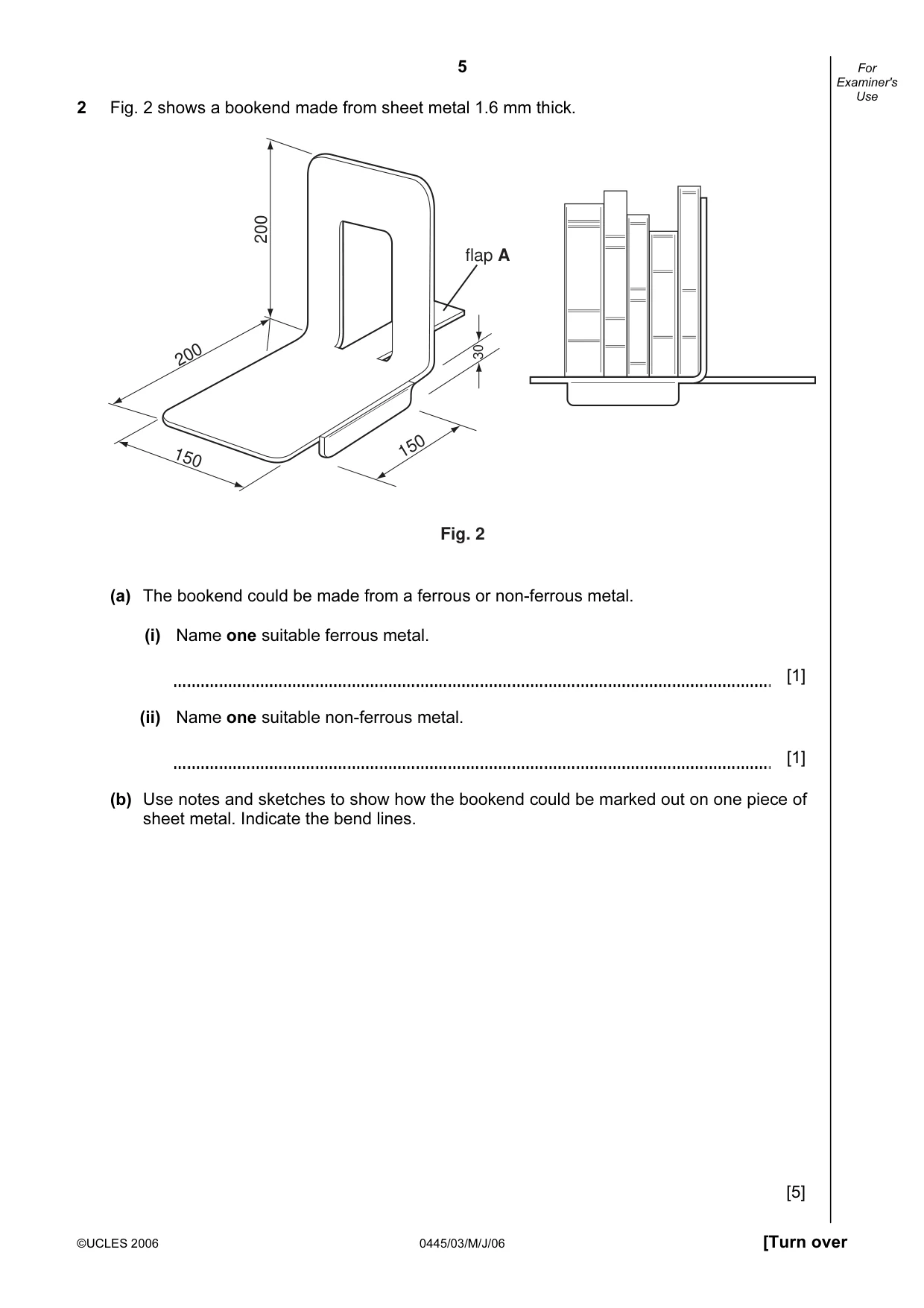
5 ©UCLES 2006 0445/03/M/J/06 [Turn over For Examiner's Use 2 Fig. 2 shows a bookend made from sheet metal 1.6 mm thick. flap A Fig. 2 150 150 200 200 30 (a) The bookend could be made from a ferrous or non-ferrous metal. (i) Name one suitable ferrous metal. [1] (ii) Name one suitable non-ferrous metal. [1] (b) Use notes and sketches to show how the bookend could be marked out on one piece of sheet metal. Indicate the bend lines. [5]
Question paper, page 6
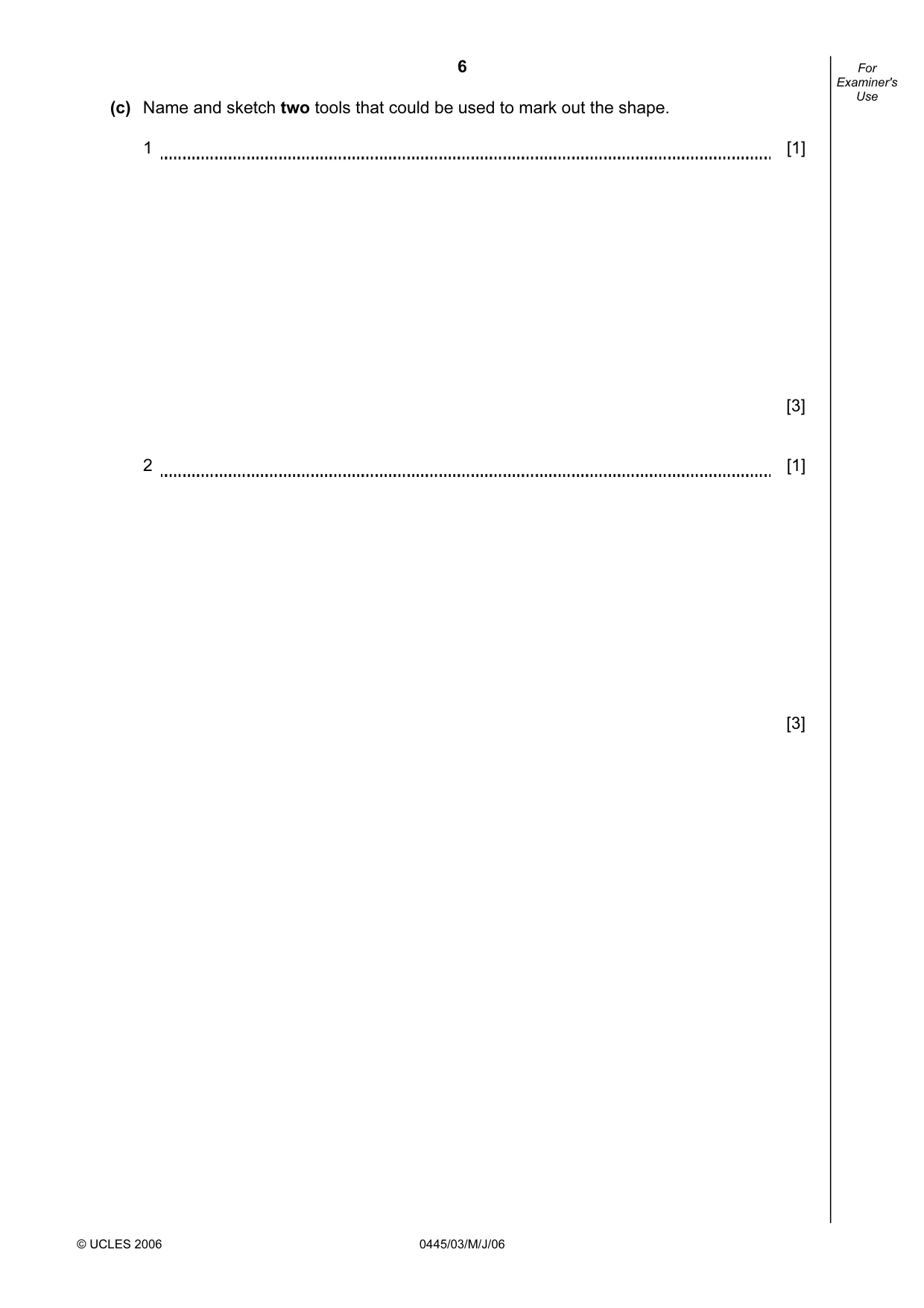
6 © UCLES 2006 0445/03/M/J/06 For Examiner's Use (c) Name and sketch two tools that could be used to mark out the shape. 1 [1] [3] 2 [1] [3]
Question paper, page 7
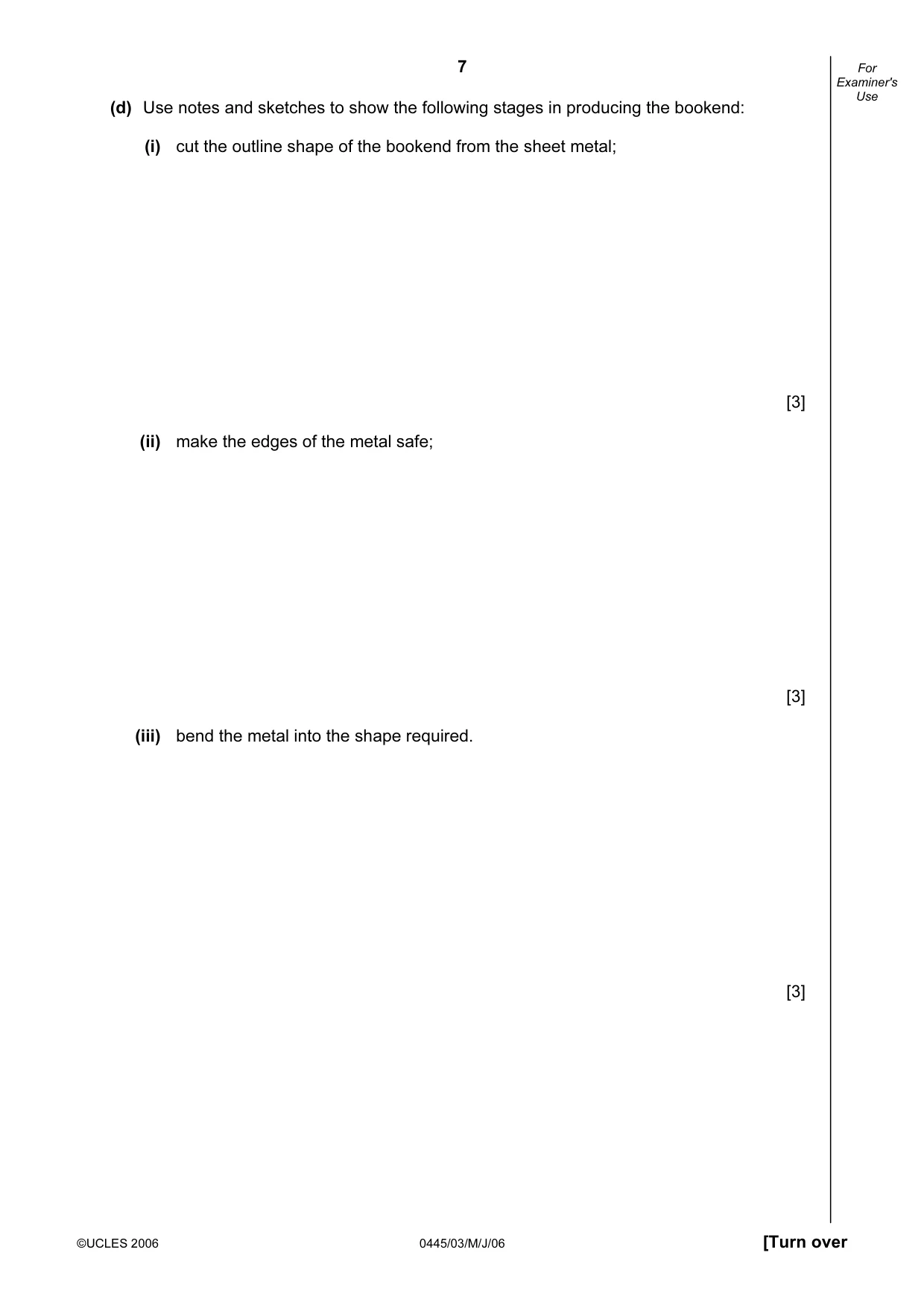
7 ©UCLES 2006 0445/03/M/J/06 [Turn over For Examiner's Use (d) Use notes and sketches to show the following stages in producing the bookend: (i) cut the outline shape of the bookend from the sheet metal; [3] (ii) make the edges of the metal safe; [3] (iii) bend the metal into the shape required. [3]
Question paper, page 8
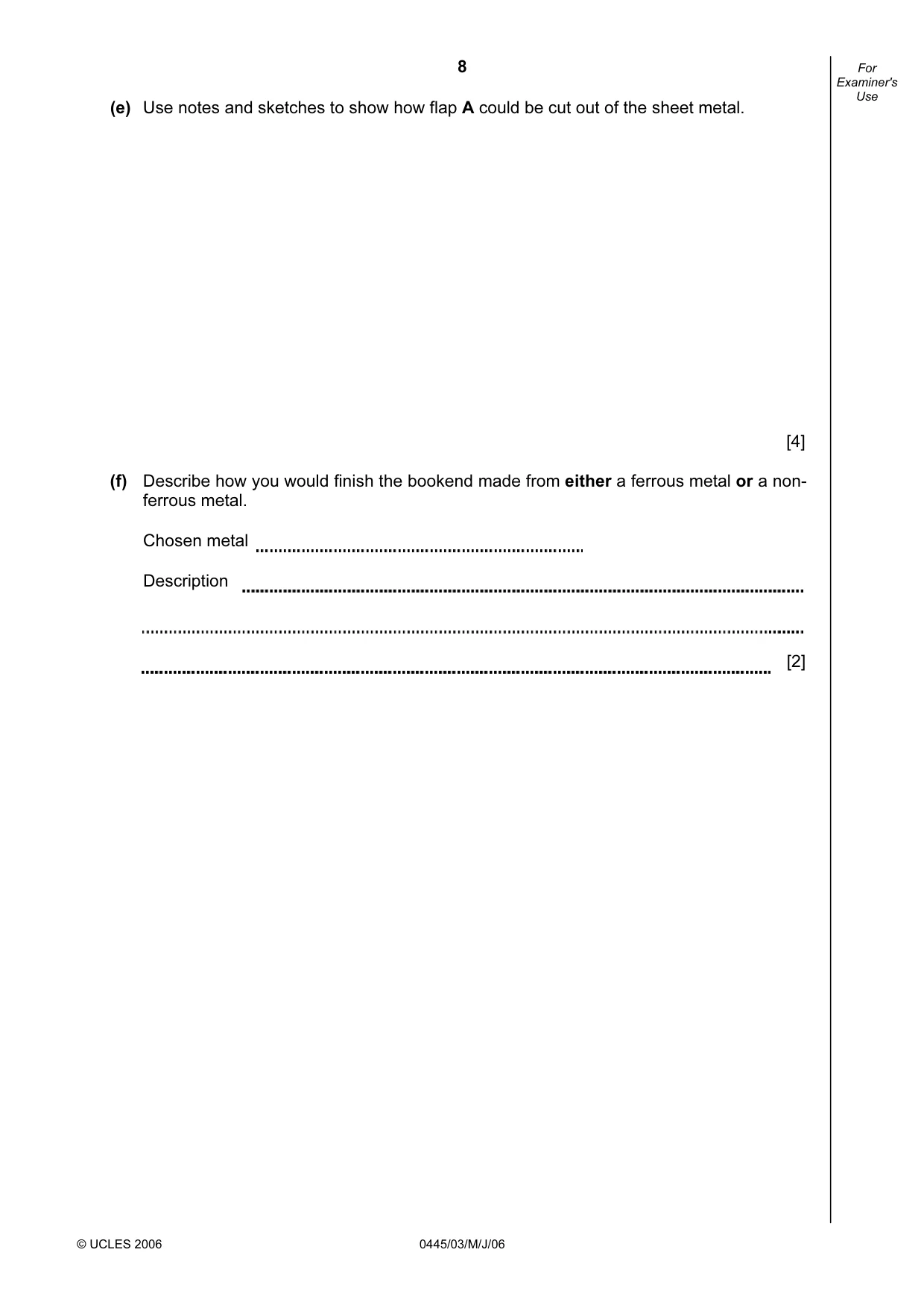
8 © UCLES 2006 0445/03/M/J/06 For Examiner's Use (e) Use notes and sketches to show how flap A could be cut out of the sheet metal. [4] (f) Describe how you would finish the bookend made from either a ferrous metal or a non- ferrous metal. Chosen metal Description [2]
Question paper, page 9
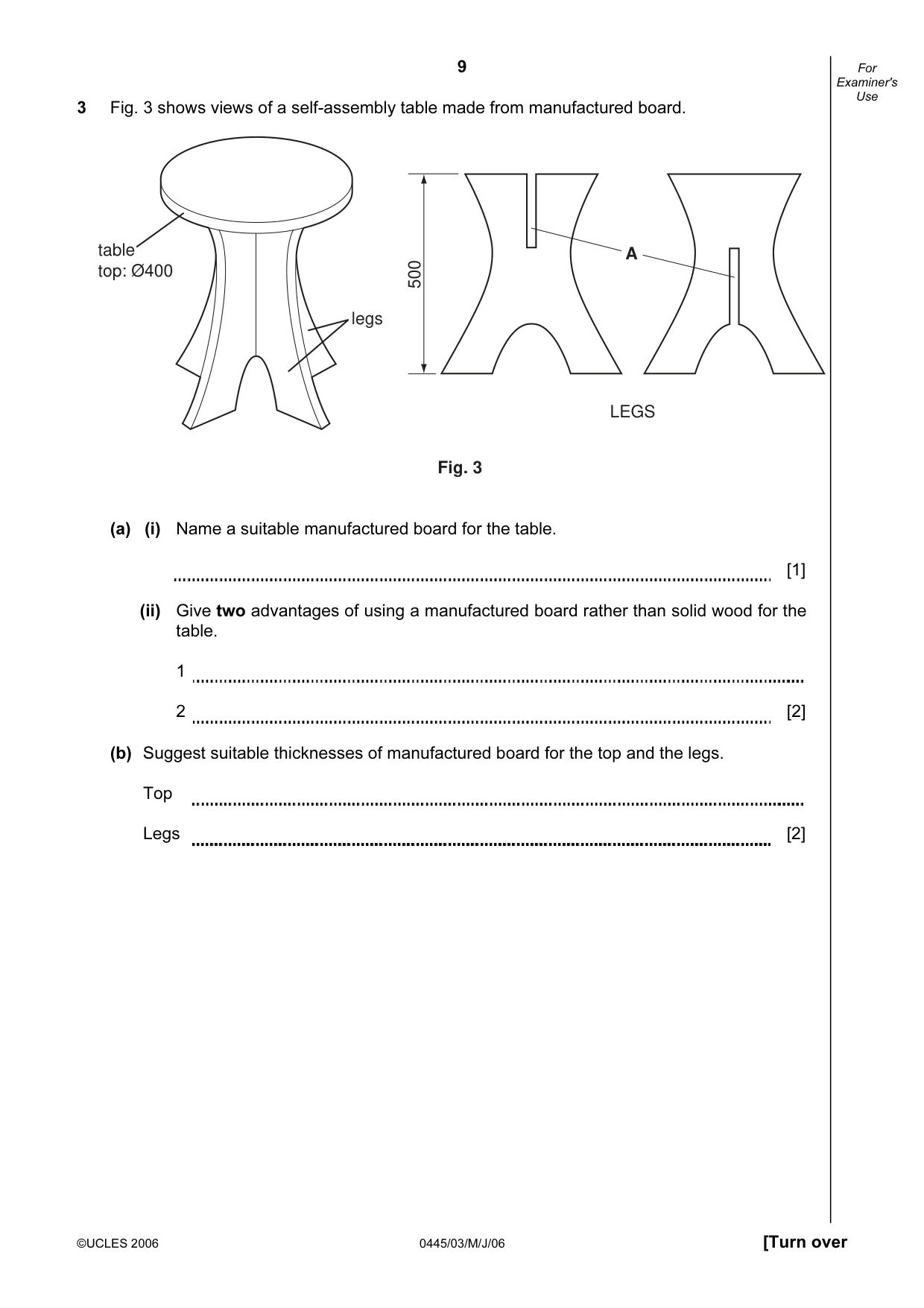
9 ©UCLES 2006 0445/03/M/J/06 [Turn over For Examiner's Use 3 Fig. 3 shows views of a self-assembly table made from manufactured board. table top: Ø400 legs 500 A LEGS Fig. 3 (a) (i) Name a suitable manufactured board for the table. [1] (ii) Give two advantages of using a manufactured board rather than solid wood for the table. 1 2 [2] (b) Suggest suitable thicknesses of manufactured board for the top and the legs. Top Legs [2]
Question paper, page 10
10 © UCLES 2006 0445/03/M/J/06 For Examiner's Use (c) Name and sketch two different tools you would use to produce the slot A. 1 [1] [3] 2 [1] [3]
Question paper, page 11
11 ©UCLES 2006 0445/03/M/J/06 [Turn over For Examiner's Use (d) The legs are to be attached to the top by means of knock-down (K-D) fittings. (i) Name and sketch a suitable knock-down fitting. Name [1] [3] (ii) Use notes and sketches to show how the knock-down fittings are used to attach the legs to the top. [3]
Question paper, page 12
12 © UCLES 2006 0445/03/M/J/06 For Examiner's Use (e) The self-assembly table requires an applied finish. (i) Give two reasons why manufacturers do not apply a finish to the table. 1 2 [2] (ii) Give a reason why it would be an advantage to apply a finish to the table before it is assembled. [1] (f) The circular table top would be cut from a square piece of manufactured board. (i) Name one portable power tool that could be used to cut out the shape. [1] (ii) Describe two safety precautions you would need to take when cutting out the shape. 1. 2. [2] (iii) Use notes and sketches to show how the edge of the top could be made smooth and circular after it has been cut to shape. [4]
Question paper, page 13
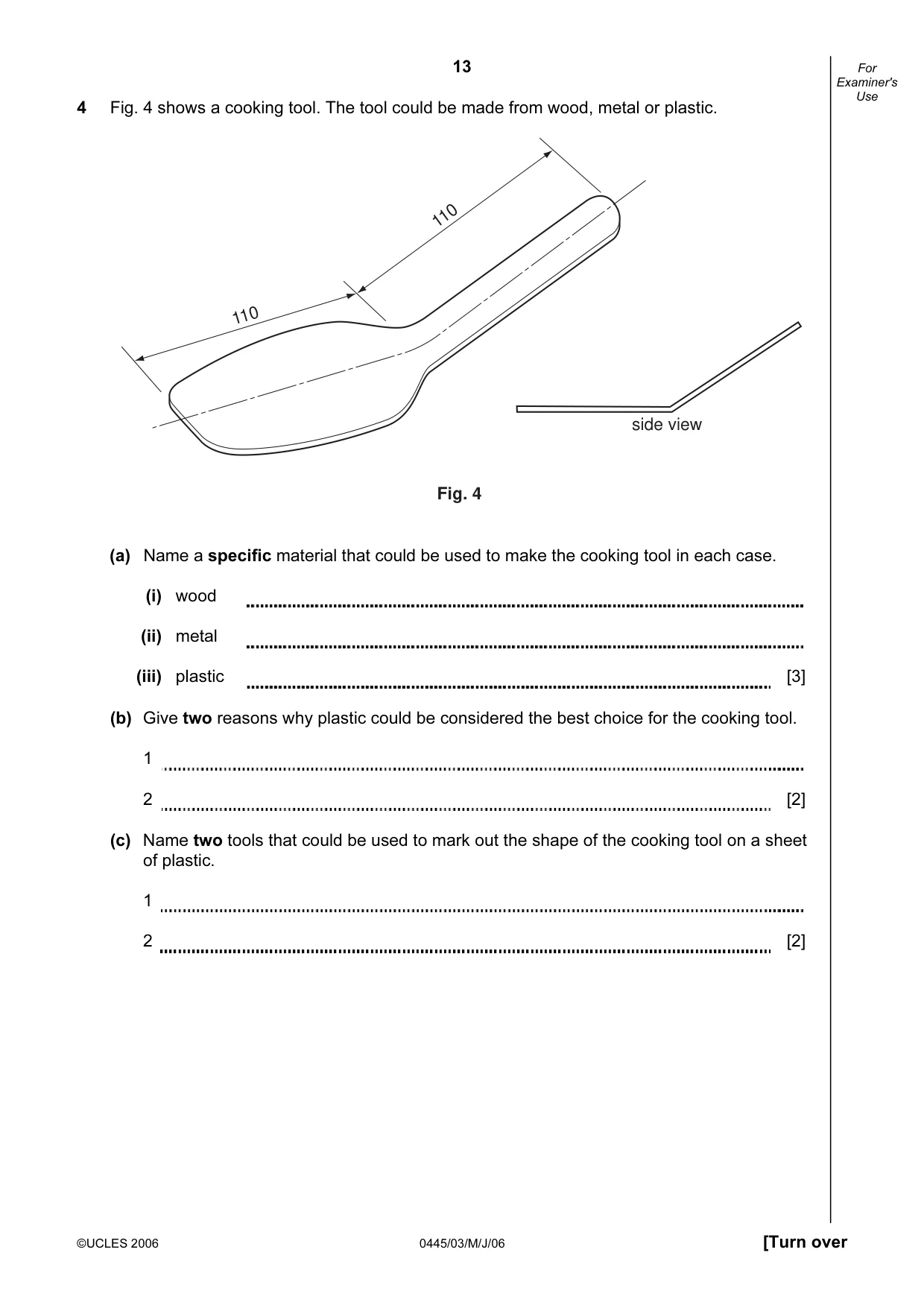
13 ©UCLES 2006 0445/03/M/J/06 [Turn over For Examiner's Use 4 Fig. 4 shows a cooking tool. The tool could be made from wood, metal or plastic. 110 110 Fig. 4 side view (a) Name a specific material that could be used to make the cooking tool in each case. (i) wood (ii) metal (iii) plastic [3] (b) Give two reasons why plastic could be considered the best choice for the cooking tool. 1 2 [2] (c) Name two tools that could be used to mark out the shape of the cooking tool on a sheet of plastic. 1 2 [2]
Question paper, page 14
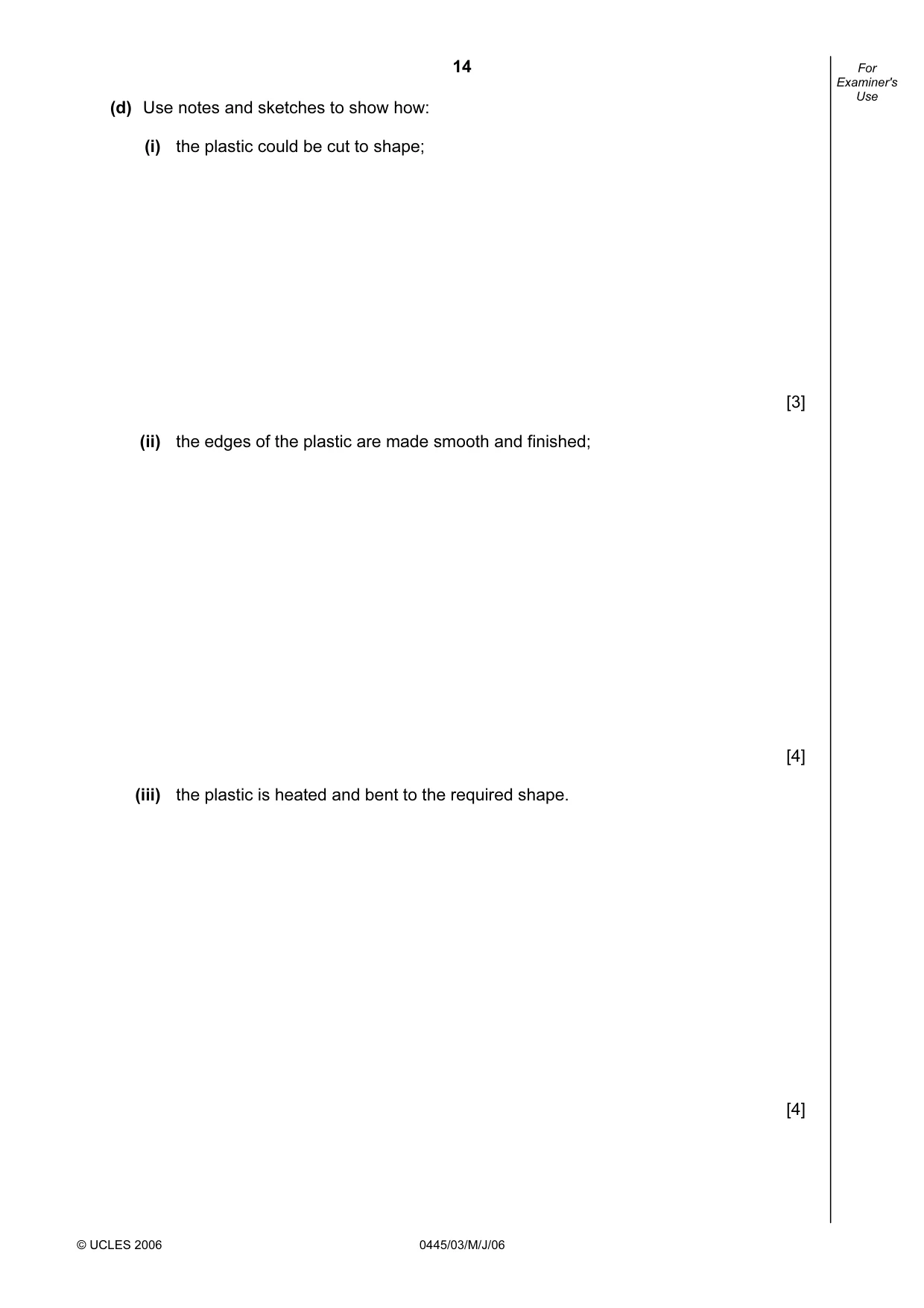
14 © UCLES 2006 0445/03/M/J/06 For Examiner's Use (d) Use notes and sketches to show how: (i) the plastic could be cut to shape; [3] (ii) the edges of the plastic are made smooth and finished; [4] (iii) the plastic is heated and bent to the required shape. [4]
Question paper, page 15
15 ©UCLES 2006 0445/03/M/J/06 For Examiner's Use (e) Describe two safety precautions you would need to take when carrying out any of the operations in part (d). 1 2 [2] (f) The handle of the plastic cooking tool is difficult to grip. Use notes and sketches to design a wooden handle that could be fitted to the plastic tool to improve the grip. [8] (g) Recycled plastics could be used as an alternative to the wooden handle in part (f). Give two advantages of using recycled plastics rather than wood. 1 2 [2]
Question paper, page 16
16 Permission to reproduce items where third-party owned material protected by copyright is included has been sought and cleared where possible. Every reasonable effort has been made by the publisher (UCLES) to trace copyright holders, but if any items requiring clearance have unwittingly been included, the publisher will be pleased to make amends at the earliest possible opportunity. University of Cambridge International Examinations is part of the University of Cambridge Local Examinations Syndicate (UCLES), which is itself a department of the University of Cambridge. 0445/03/M/J/06 BLANK PAGE
Mark scheme, page 1
UNIVERSITY OF CAMBRIDGE INTERNATIONAL EXAMINATIONS International General Certificate of Secondary Education MARK SCHEME for the May/June 2006 question paper 0445 DESIGN AND TECHNOLOGY 0445/03 Paper 3, maximum raw mark 60 These mark schemes are published as an aid to teachers and students, to indicate the requirements of the examination. They show the basis on which Examiners were initially instructed to award marks. They do not indicate the details of the discussions that took place at an Examiners’ meeting before marking began. Any substantial changes to the mark scheme that arose from these discussions will be recorded in the published Report on the Examination. All Examiners are instructed that alternative correct answers and unexpected approaches in candidates’ scripts must be given marks that fairly reflect the relevant knowledge and skills demonstrated. Mark schemes must be read in conjunction with the question papers and the Report on the Examination. The minimum marks in these components needed for various grades were previously published with these mark schemes, but are now instead included in the Report on the Examination for this session. • CIE will not enter into discussion or correspondence in connection with these mark schemes. CIE is publishing the mark schemes for the May/June 2006 question papers for most IGCSE and GCE Advanced Level and Advanced Subsidiary Level syllabuses and some Ordinary Level syllabuses. www.XtremePapers.com
Mark scheme, page 2
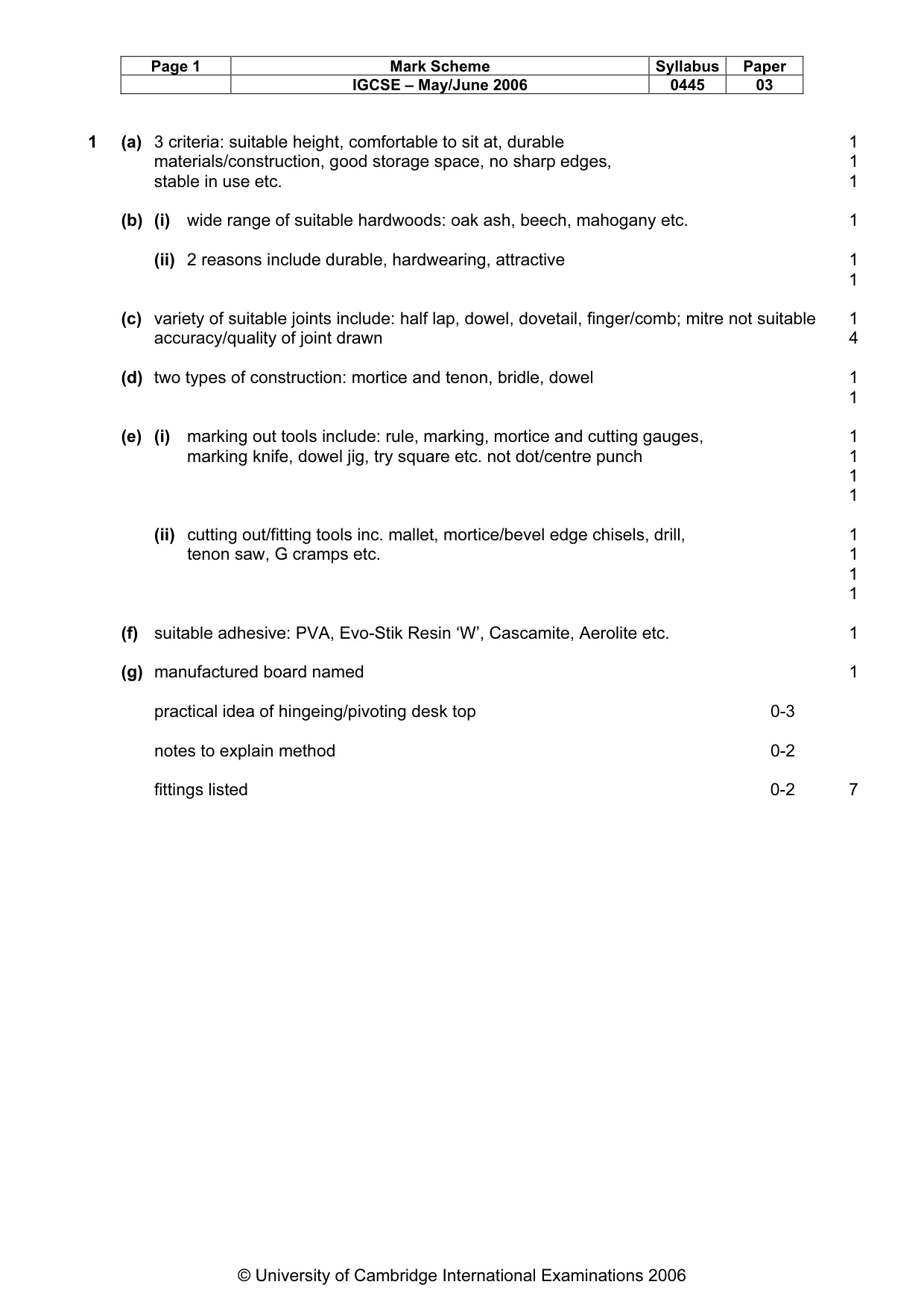
Page 1 Mark Scheme Syllabus Paper IGCSE – May/June 2006 0445 03 © University of Cambridge International Examinations 2006 1 (a) 3 criteria: suitable height, comfortable to sit at, durable 1 materials/construction, good storage space, no sharp edges, 1 stable in use etc. 1 (b) (i) wide range of suitable hardwoods: oak ash, beech, mahogany etc. 1 (ii) 2 reasons include durable, hardwearing, attractive 1 1 (c) variety of suitable joints include: half lap, dowel, dovetail, finger/comb; mitre not suitable 1 accuracy/quality of joint drawn 4 (d) two types of construction: mortice and tenon, bridle, dowel 1 1 (e) (i) marking out tools include: rule, marking, mortice and cutting gauges, 1 marking knife, dowel jig, try square etc. not dot/centre punch 1 1 1 (ii) cutting out/fitting tools inc. mallet, mortice/bevel edge chisels, drill, 1 tenon saw, G cramps etc. 1 1 1 (f) suitable adhesive: PVA, Evo-Stik Resin ‘W’, Cascamite, Aerolite etc. 1 (g) manufactured board named 1 practical idea of hingeing/pivoting desk top 0-3 notes to explain method 0-2 fittings listed 0-2 7
Mark scheme, page 3
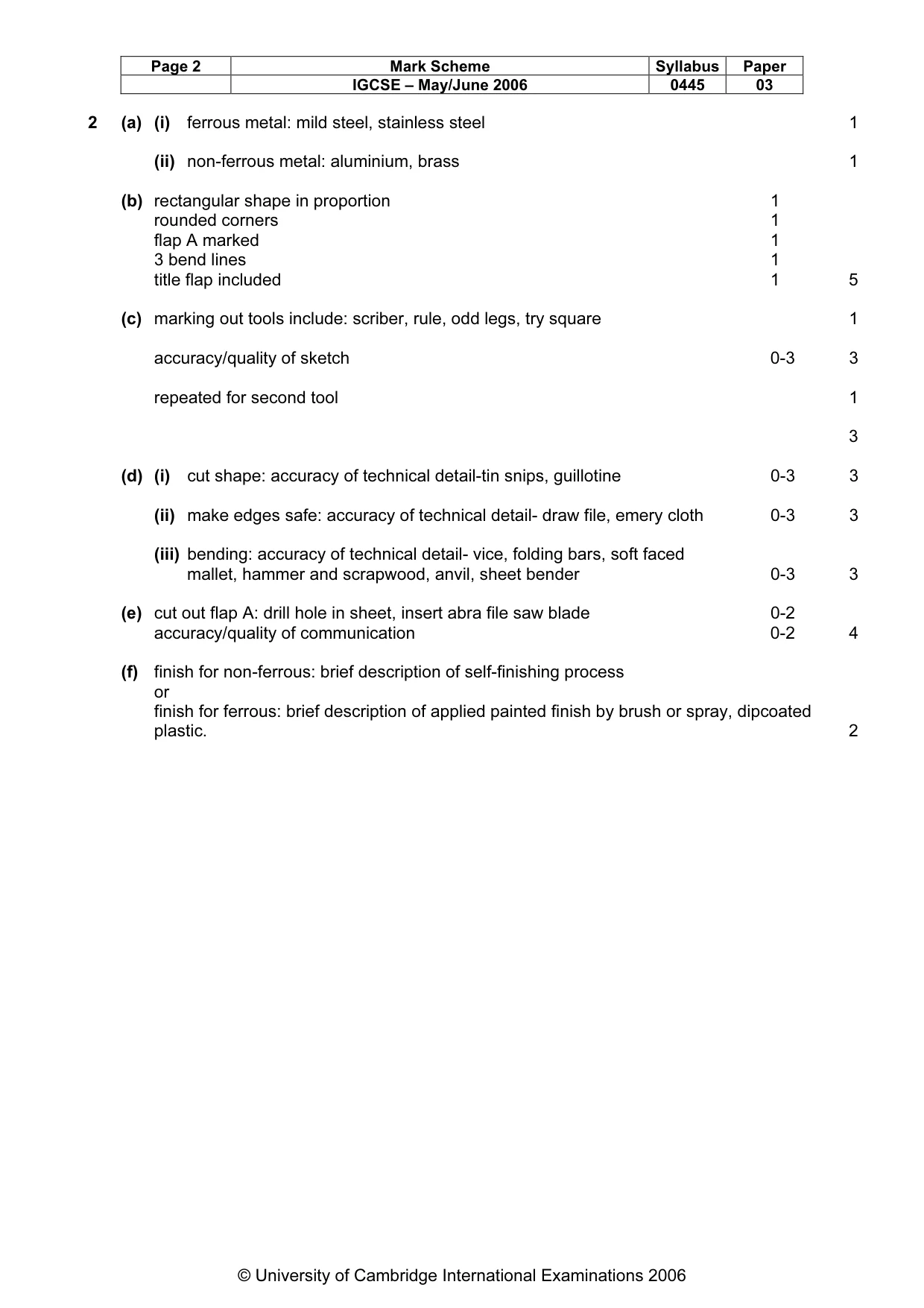
Page 2 Mark Scheme Syllabus Paper IGCSE – May/June 2006 0445 03 © University of Cambridge International Examinations 2006 2 (a) (i) ferrous metal: mild steel, stainless steel 1 (ii) non-ferrous metal: aluminium, brass 1 (b) rectangular shape in proportion 1 rounded corners 1 flap A marked 1 3 bend lines 1 title flap included 1 5 (c) marking out tools include: scriber, rule, odd legs, try square 1 accuracy/quality of sketch 0-3 3 repeated for second tool 1 3 (d) (i) cut shape: accuracy of technical detail-tin snips, guillotine 0-3 3 (ii) make edges safe: accuracy of technical detail- draw file, emery cloth 0-3 3 (iii) bending: accuracy of technical detail- vice, folding bars, soft faced mallet, hammer and scrapwood, anvil, sheet bender 0-3 3 (e) cut out flap A: drill hole in sheet, insert abra file saw blade 0-2 accuracy/quality of communication 0-2 4 (f) finish for non-ferrous: brief description of self-finishing process or finish for ferrous: brief description of applied painted finish by brush or spray, dipcoated plastic. 2
Mark scheme, page 4
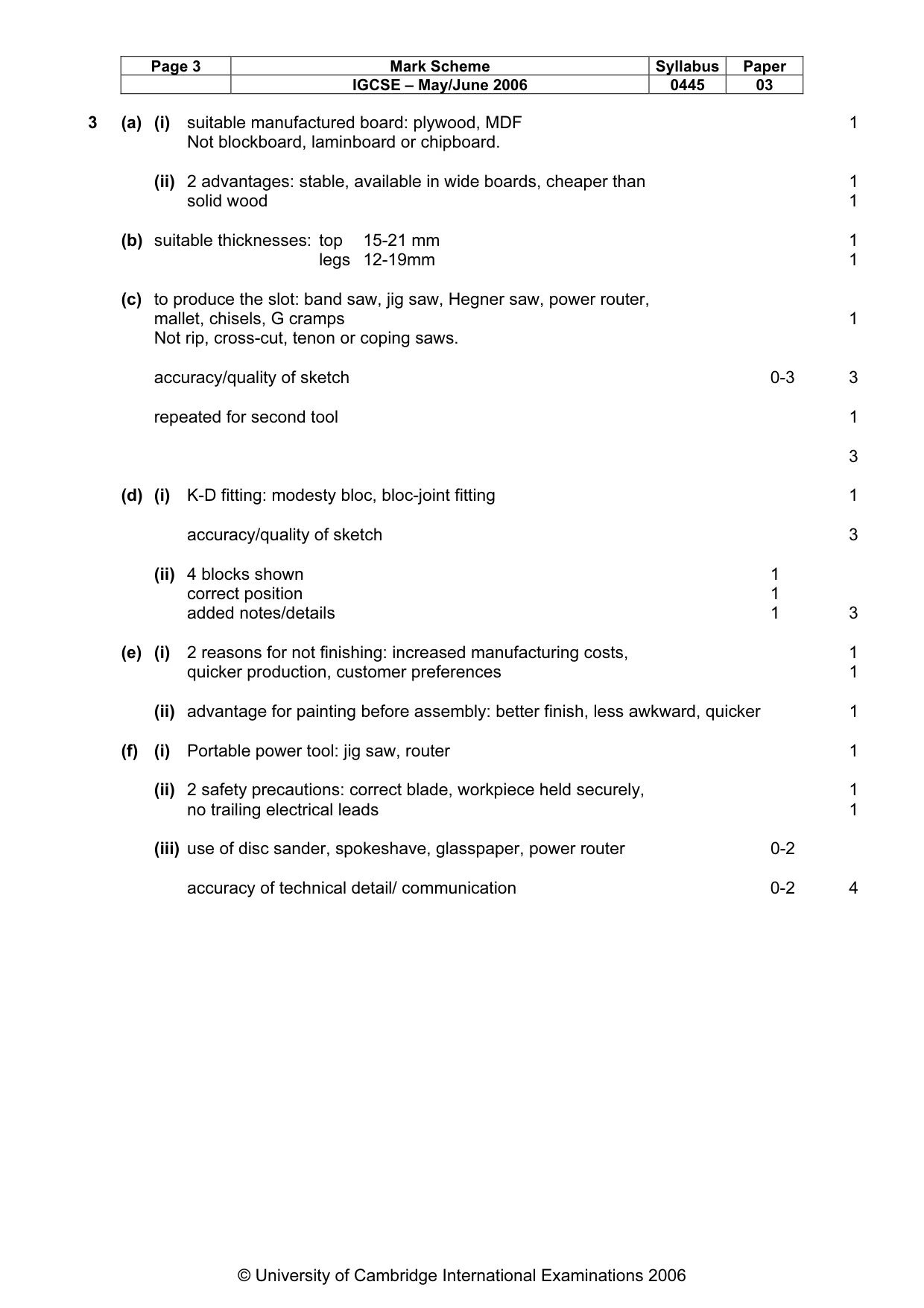
Page 3 Mark Scheme Syllabus Paper IGCSE – May/June 2006 0445 03 © University of Cambridge International Examinations 2006 3 (a) (i) suitable manufactured board: plywood, MDF 1 Not blockboard, laminboard or chipboard. (ii) 2 advantages: stable, available in wide boards, cheaper than 1 solid wood 1 (b) suitable thicknesses: top 15-21 mm 1 legs 12-19mm 1 (c) to produce the slot: band saw, jig saw, Hegner saw, power router, mallet, chisels, G cramps 1 Not rip, cross-cut, tenon or coping saws. accuracy/quality of sketch 0-3 3 repeated for second tool 1 3 (d) (i) K-D fitting: modesty bloc, bloc-joint fitting 1 accuracy/quality of sketch 3 (ii) 4 blocks shown 1 correct position 1 added notes/details 1 3 (e) (i) 2 reasons for not finishing: increased manufacturing costs, 1 quicker production, customer preferences 1 (ii) advantage for painting before assembly: better finish, less awkward, quicker 1 (f) (i) Portable power tool: jig saw, router 1 (ii) 2 safety precautions: correct blade, workpiece held securely, 1 no trailing electrical leads 1 (iii) use of disc sander, spokeshave, glasspaper, power router 0-2 accuracy of technical detail/ communication 0-2 4
Mark scheme, page 5
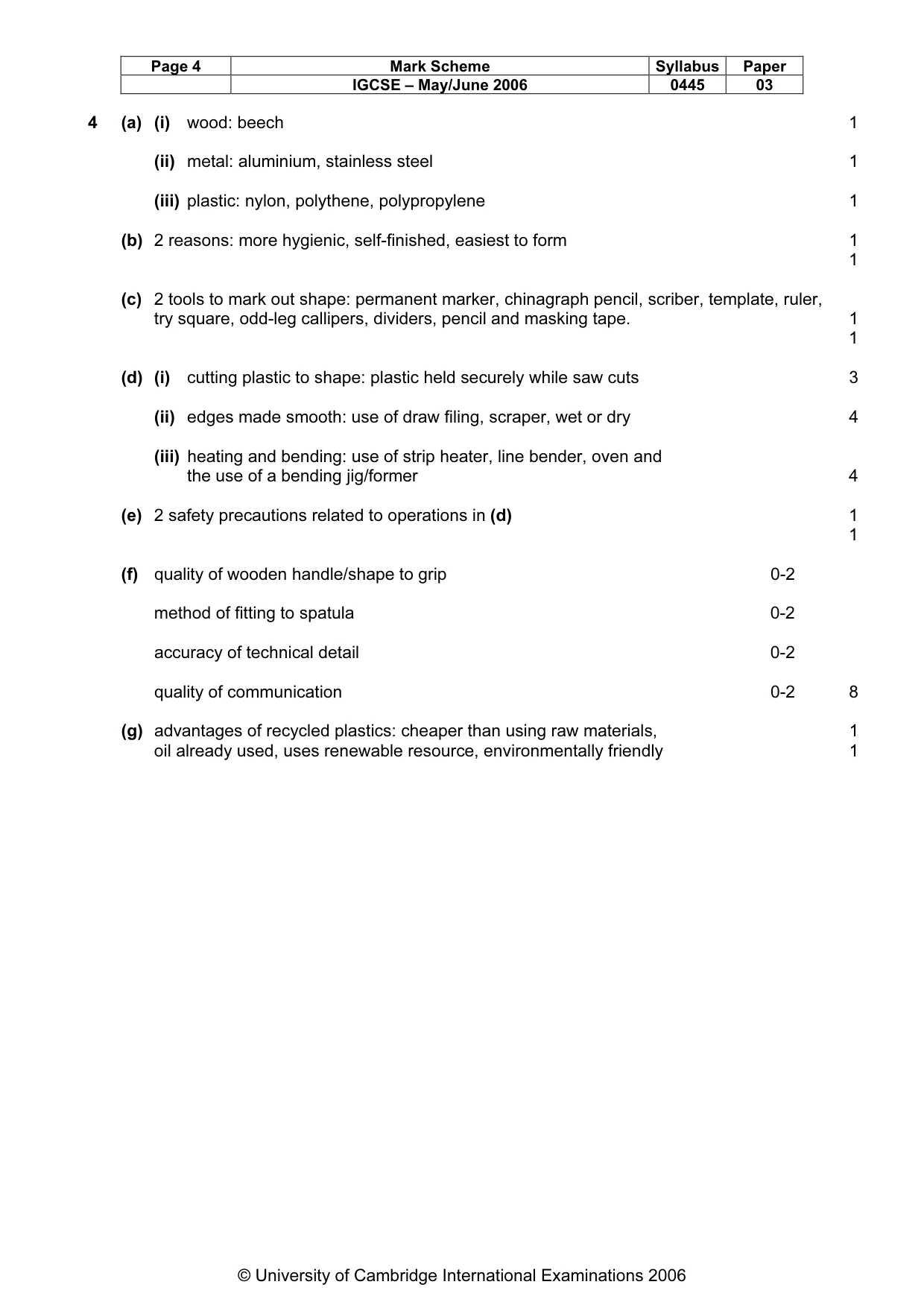
Page 4 Mark Scheme Syllabus Paper IGCSE – May/June 2006 0445 03 © University of Cambridge International Examinations 2006 4 (a) (i) wood: beech 1 (ii) metal: aluminium, stainless steel 1 (iii) plastic: nylon, polythene, polypropylene 1 (b) 2 reasons: more hygienic, self-finished, easiest to form 1 1 (c) 2 tools to mark out shape: permanent marker, chinagraph pencil, scriber, template, ruler, try square, odd-leg callipers, dividers, pencil and masking tape. 1 1 (d) (i) cutting plastic to shape: plastic held securely while saw cuts 3 (ii) edges made smooth: use of draw filing, scraper, wet or dry 4 (iii) heating and bending: use of strip heater, line bender, oven and the use of a bending jig/former 4 (e) 2 safety precautions related to operations in (d) 1 1 (f) quality of wooden handle/shape to grip 0-2 method of fitting to spatula 0-2 accuracy of technical detail 0-2 quality of communication 0-2 8 (g) advantages of recycled plastics: cheaper than using raw materials, 1 oil already used, uses renewable resource, environmentally friendly 1
What you needed in this session
Cambridge’s own grade thresholds for 2006 May/June, Paper 3 · Variant 1. A higher threshold means an easier paper — the bar moves with how the cohort did.