Cambridge IGCSE Design and Technology 0445 — 2005 Oct/Nov Paper 3 · Variant 1
0445/31/O/N/05
The question paper and its mark scheme, free to read here and free to download. This is Cambridge’s own paper, exactly as it was sat.
Question paper16 pages

Mark scheme3 pages
Answers below. Sit the paper first if you are practising.
Paper as text
Question paper, page 1
This document consists of 14 printed pages and 2 blank pages. SPA (KN) S84256/1 © UCLES 2005 [Turn over UNIVERSITY OF CAMBRIDGE INTERNATIONAL EXAMINATIONS International General Certificate of Secondary Education DESIGN AND TECHNOLOGY 0445/03 Paper 3 Realisation October/November 2005 1 hour Candidates answer on the Question Paper. No additional materials are required. To be taken together with Paper 1 in one session of 2 hours 45 minutes. READ THESE INSTRUCTIONS FIRST Write your Centre number, candidate number and name on all the work you hand in. Write in dark blue or black pen in the spaces provided on the Question Paper. You may use a soft pencil for any diagrams, graphs or rough working. Do not use staples, paper clips, highlighters, glue or correction fluid. Answer any two questions. The number of marks is given in brackets [ ] at the end of each question or part question. You may use a calculator. Centre Number Candidate Number Name If you have been given a label, look at the details. If any details are incorrect or missing, please fill in your correct details in the space given at the top of this page. Stick your personal label here, if provided. For Examiner’s Use 1 2 3 4 TOTAL www.XtremePapers.com
Question paper, page 2
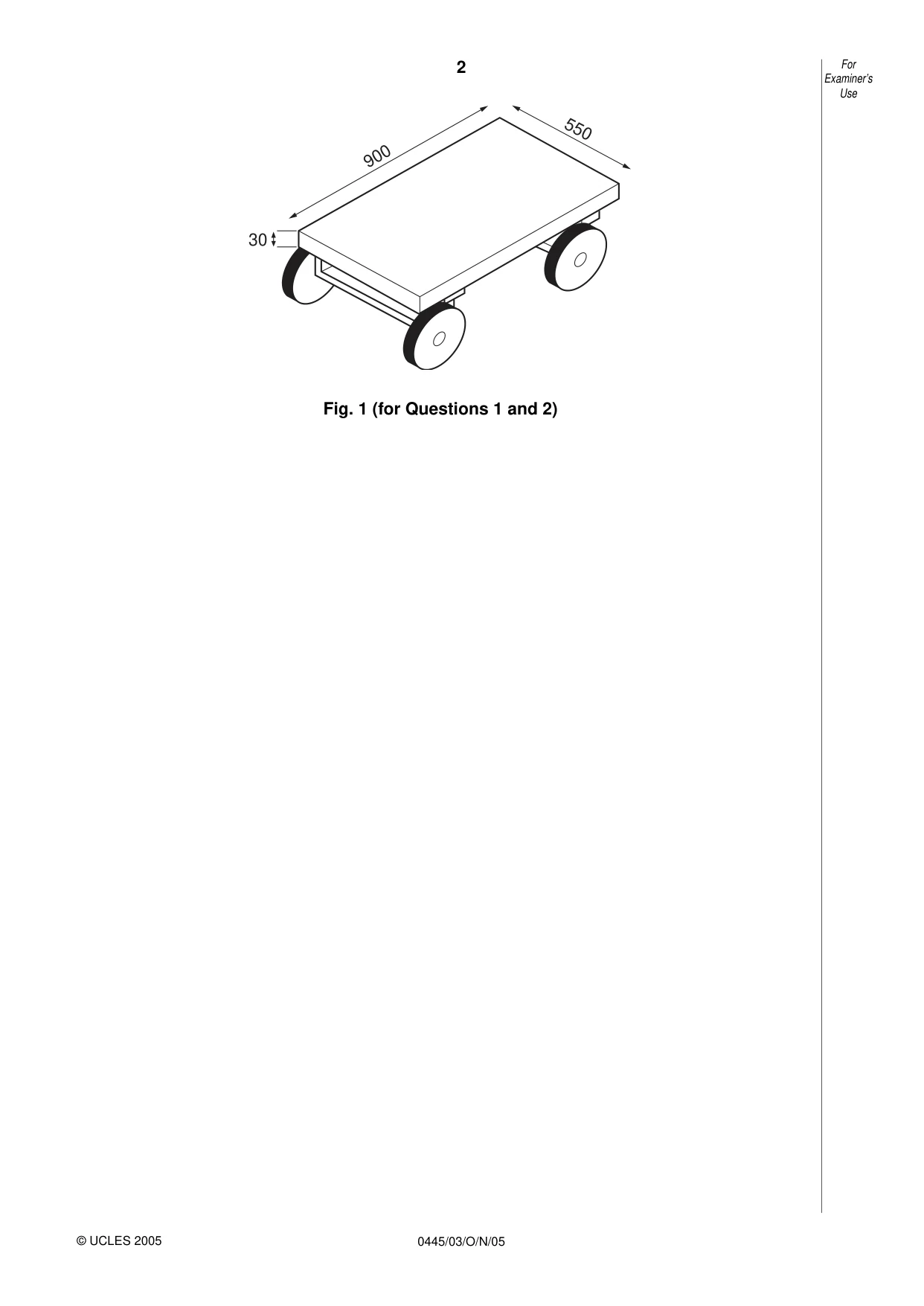
2 0445/03/O/N/05 Fig. 1 (for Questions 1 and 2) 900 30 550 For Examiner’s Use © UCLES 2005
Question paper, page 3
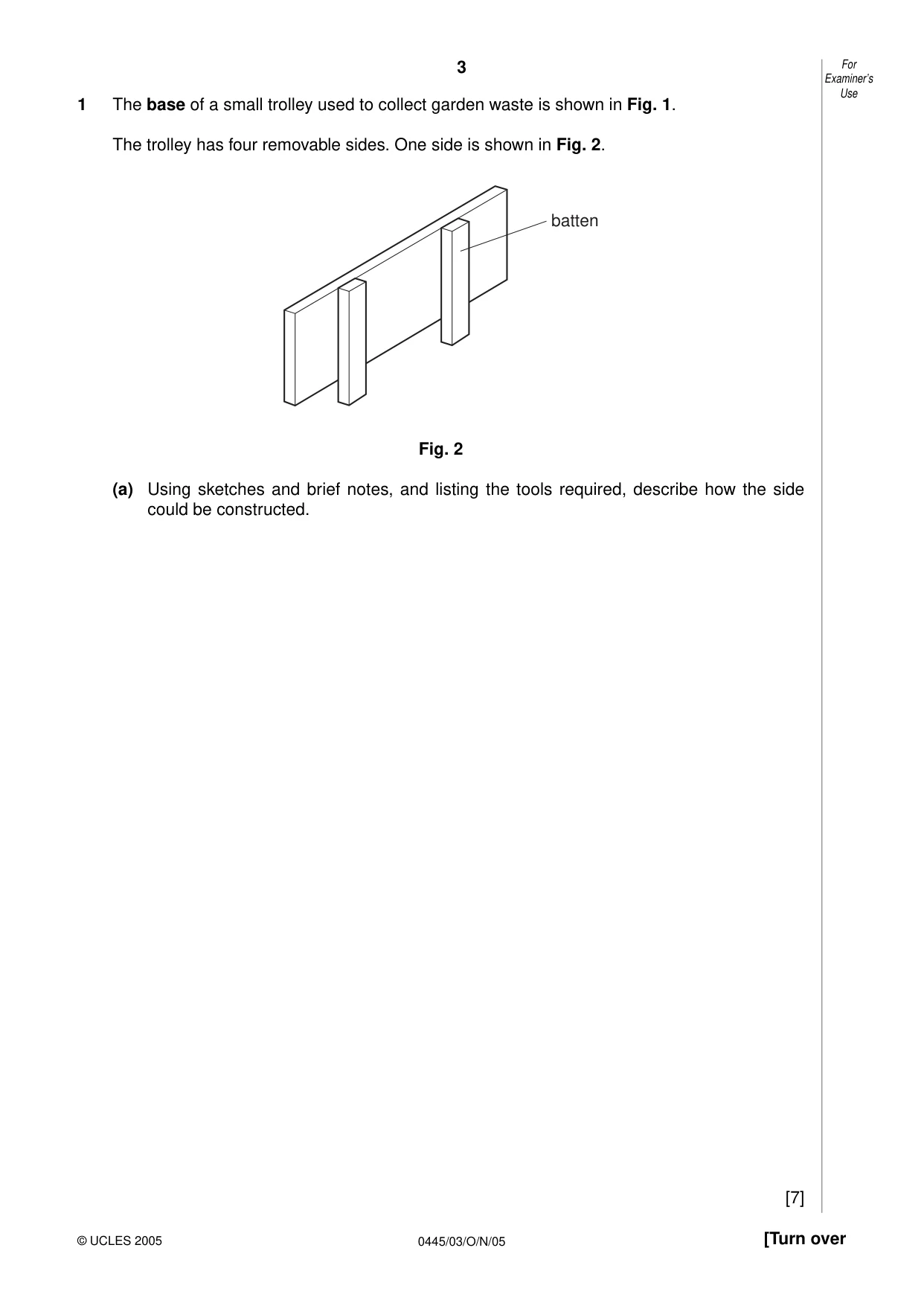
3 0445/03/O/N/05 [Turn over 1 The base of a small trolley used to collect garden waste is shown in Fig. 1. The trolley has four removable sides. One side is shown in Fig. 2. Fig. 2 (a) Using sketches and brief notes, and listing the tools required, describe how the side could be constructed. [7] batten For Examiner’s Use © UCLES 2005
Question paper, page 4
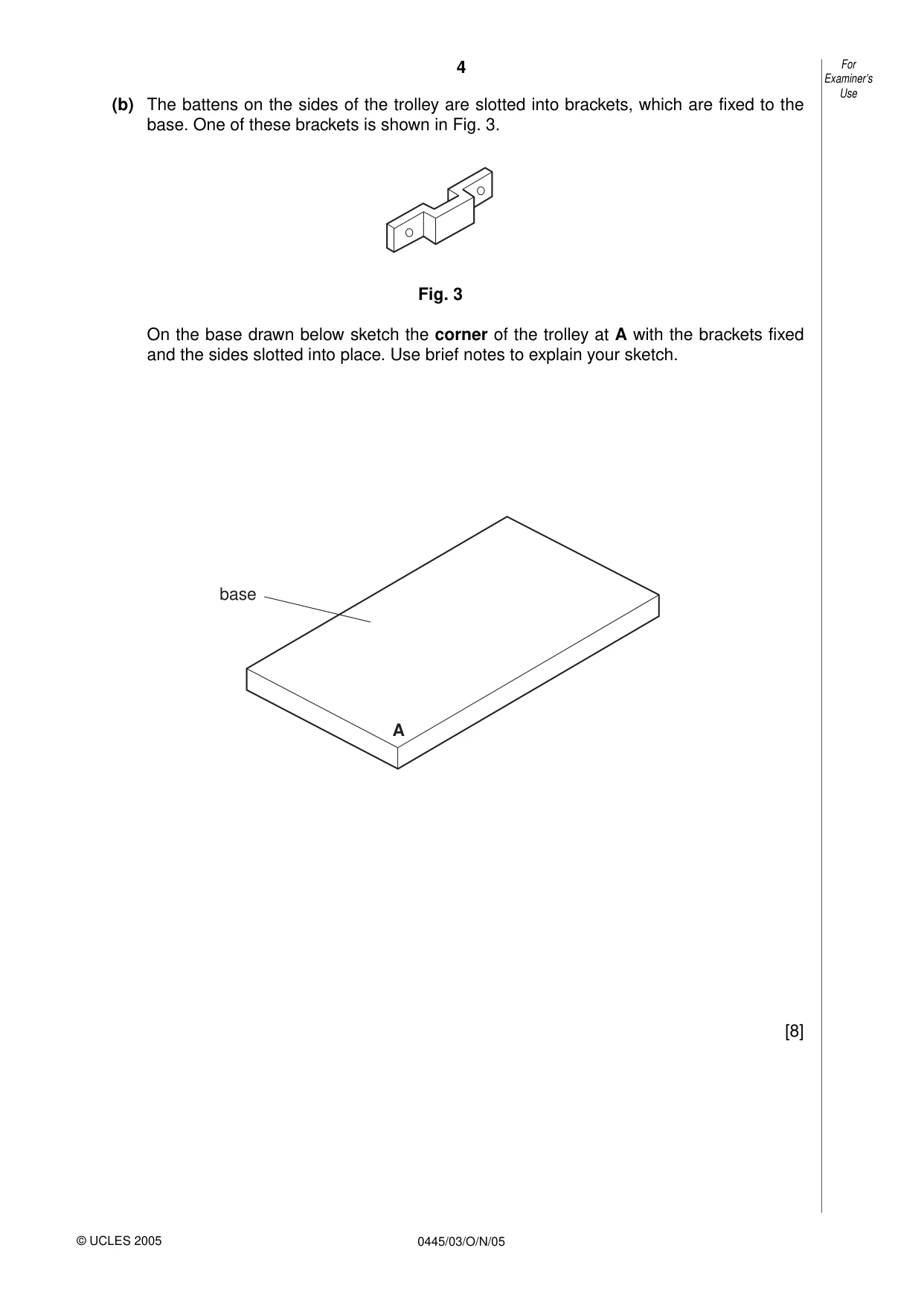
4 0445/03/O/N/05 (b) The battens on the sides of the trolley are slotted into brackets, which are fixed to the base. One of these brackets is shown in Fig. 3. Fig. 3 On the base drawn below sketch the corner of the trolley at A with the brackets fixed and the sides slotted into place. Use brief notes to explain your sketch. [8] base A For Examiner’s Use © UCLES 2005
Question paper, page 5
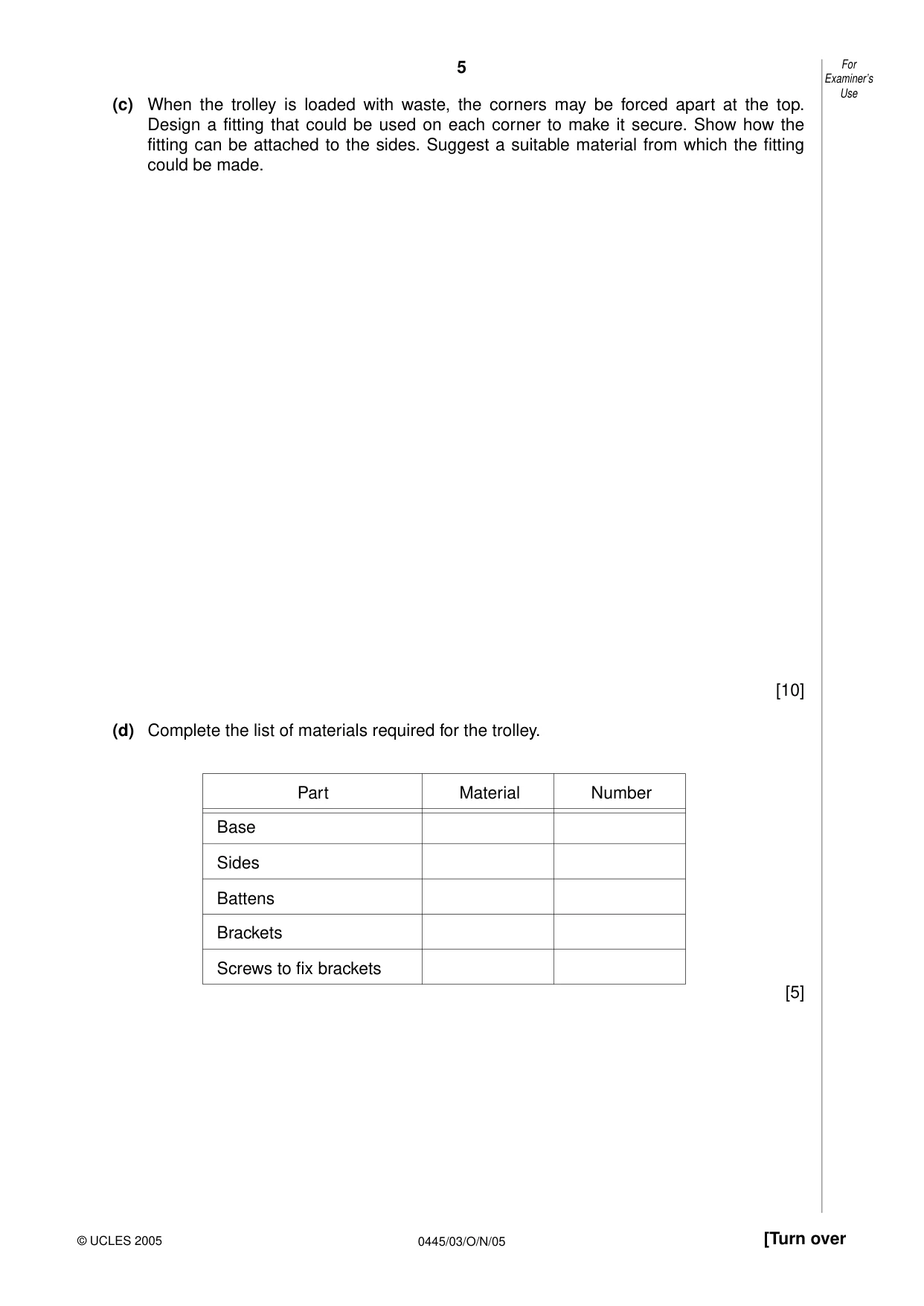
5 0445/03/O/N/05 [Turn over (c) When the trolley is loaded with waste, the corners may be forced apart at the top. Design a fitting that could be used on each corner to make it secure. Show how the fitting can be attached to the sides. Suggest a suitable material from which the fitting could be made. [10] (d) Complete the list of materials required for the trolley. [5] For Examiner’s Use © UCLES 2005 Part Material Number Base Sides Battens Brackets Screws to fix brackets
Question paper, page 6
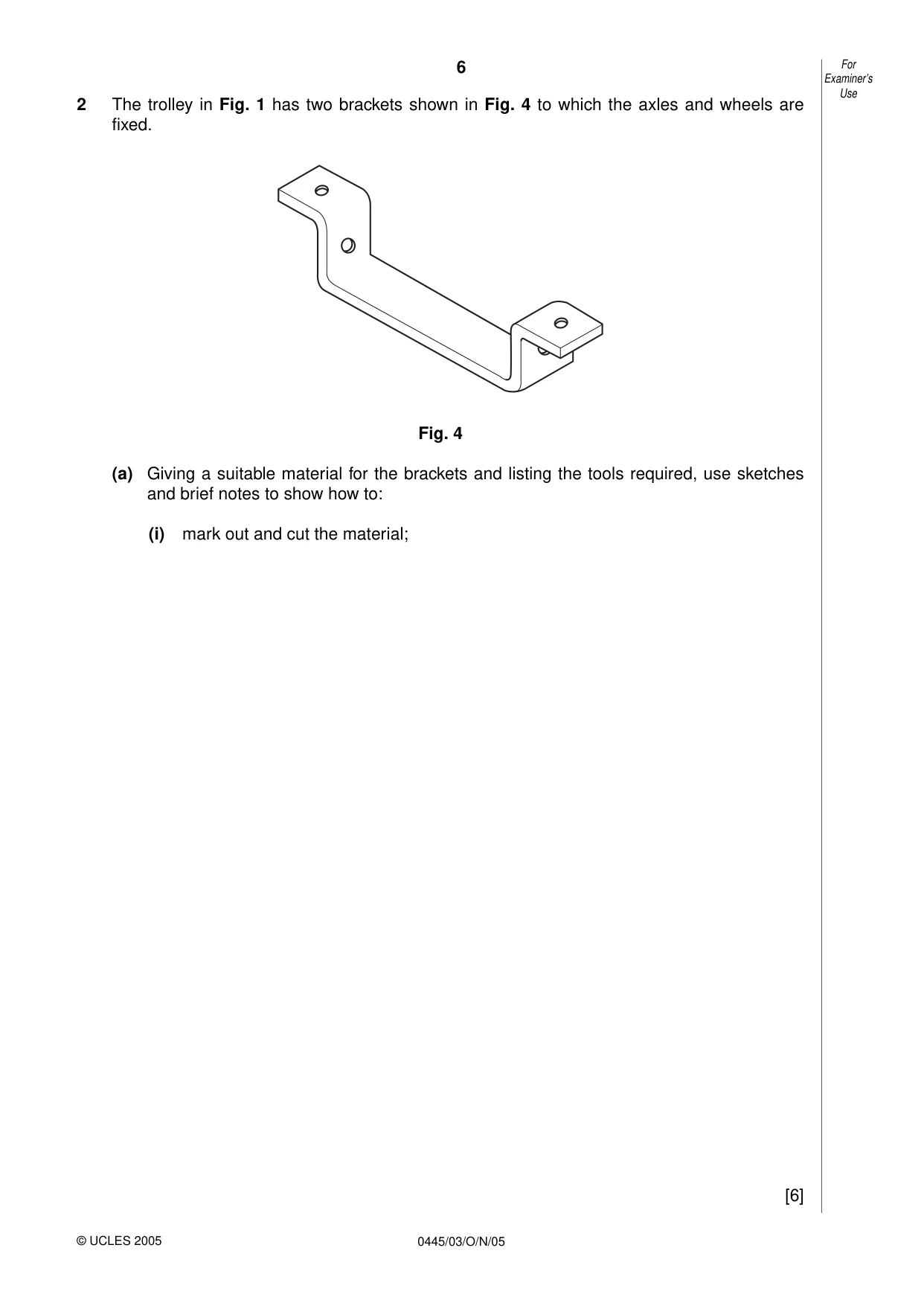
6 0445/03/O/N/05 2 The trolley in Fig. 1 has two brackets shown in Fig. 4 to which the axles and wheels are fixed. Fig. 4 (a) Giving a suitable material for the brackets and listing the tools required, use sketches and brief notes to show how to: (i) mark out and cut the material; [6] For Examiner’s Use © UCLES 2005
Question paper, page 7
7 0445/03/O/N/05 [Turn over (ii) mark out and drill the holes, include details of safety procedure to be followed; [7] (iii) bend the bracket into shape. [7] For Examiner’s Use © UCLES 2005
Question paper, page 8
8 0445/03/O/N/05 (b) Using sketches and brief notes show a method of attaching one bracket to the base. [4] (c) The wheels are made of nylon fixed to a steel axle. Using sketches and brief notes, show how the wheels are fixed to prevent them from coming off and from rubbing against the bracket when in use. [6] For Examiner’s Use © UCLES 2005
Question paper, page 9
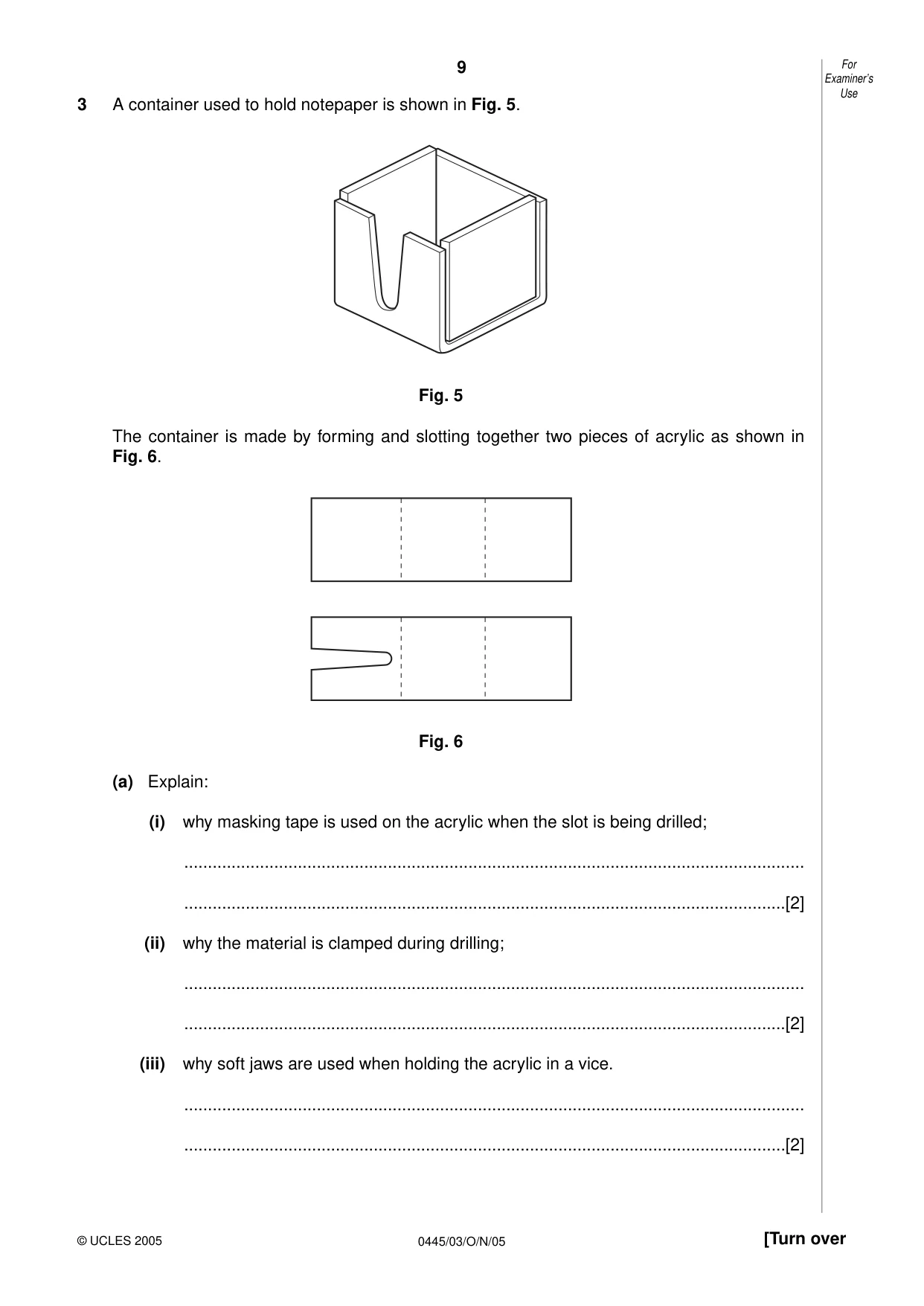
9 0445/03/O/N/05 [Turn over 3 A container used to hold notepaper is shown in Fig. 5. Fig. 5 The container is made by forming and slotting together two pieces of acrylic as shown in Fig. 6. Fig. 6 (a) Explain: (i) why masking tape is used on the acrylic when the slot is being drilled; … …[2] (ii) why the material is clamped during drilling; … …[2] (iii) why soft jaws are used when holding the acrylic in a vice. … …[2] For Examiner’s Use © UCLES 2005
Question paper, page 10
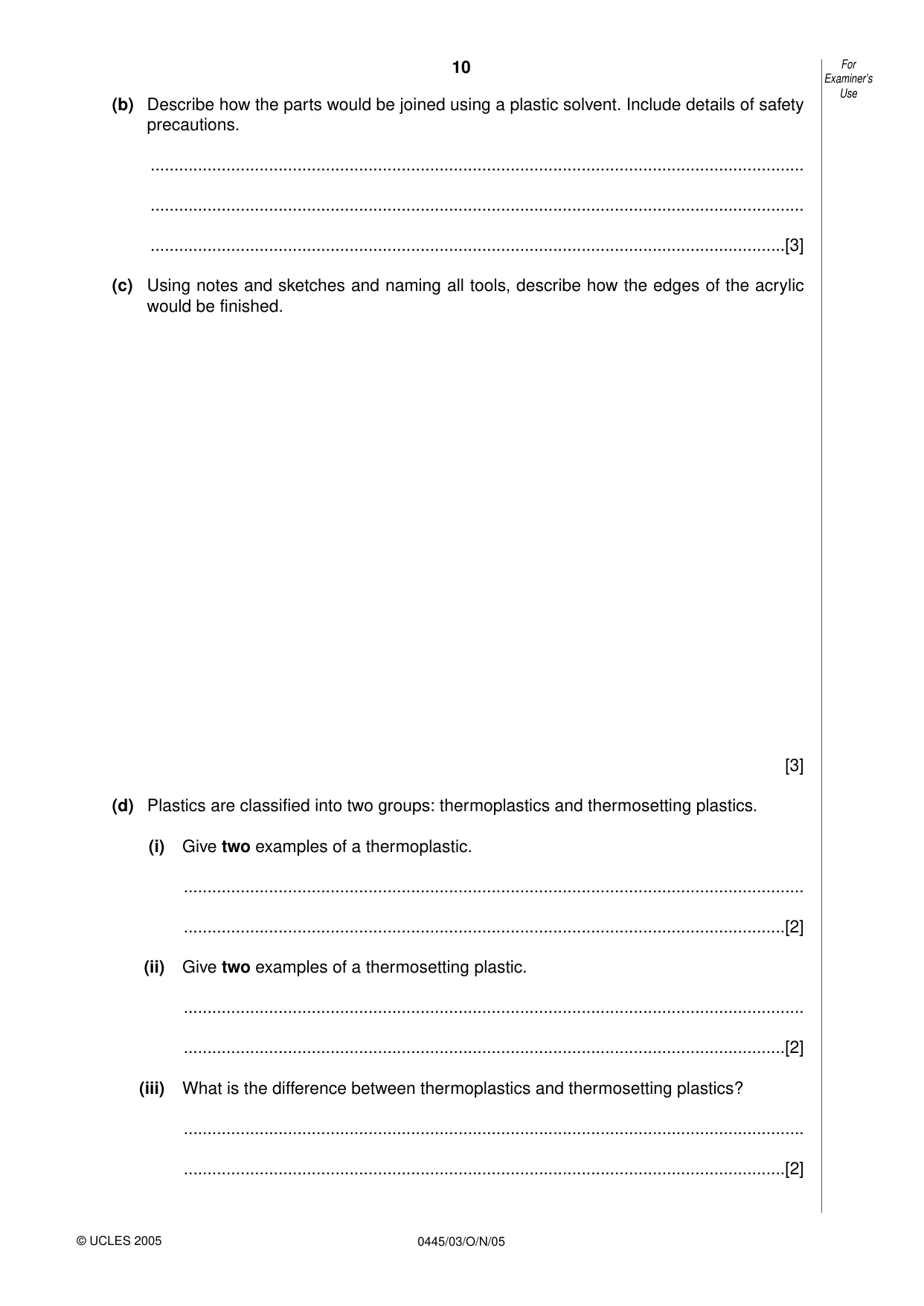
10 0445/03/O/N/05 (b) Describe how the parts would be joined using a plastic solvent. Include details of safety precautions. … … …[3] (c) Using notes and sketches and naming all tools, describe how the edges of the acrylic would be finished. [3] (d) Plastics are classified into two groups: thermoplastics and thermosetting plastics. (i) Give two examples of a thermoplastic. … …[2] (ii) Give two examples of a thermosetting plastic. … …[2] (iii) What is the difference between thermoplastics and thermosetting plastics? … …[2] For Examiner’s Use © UCLES 2005
Question paper, page 11
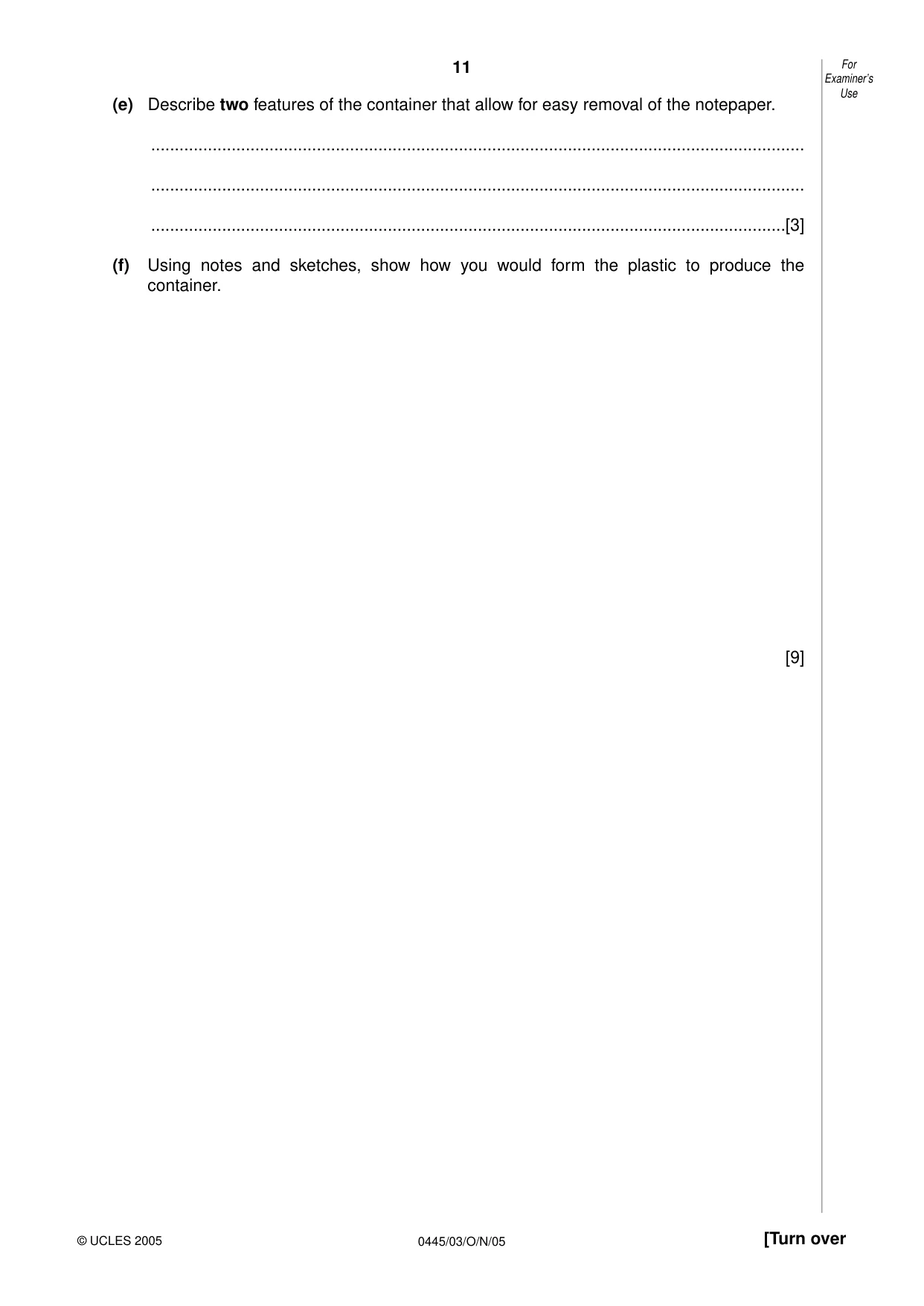
11 0445/03/O/N/05 [Turn over (e) Describe two features of the container that allow for easy removal of the notepaper. … … …[3] (f) Using notes and sketches, show how you would form the plastic to produce the container. [9] For Examiner’s Use © UCLES 2005
Question paper, page 12
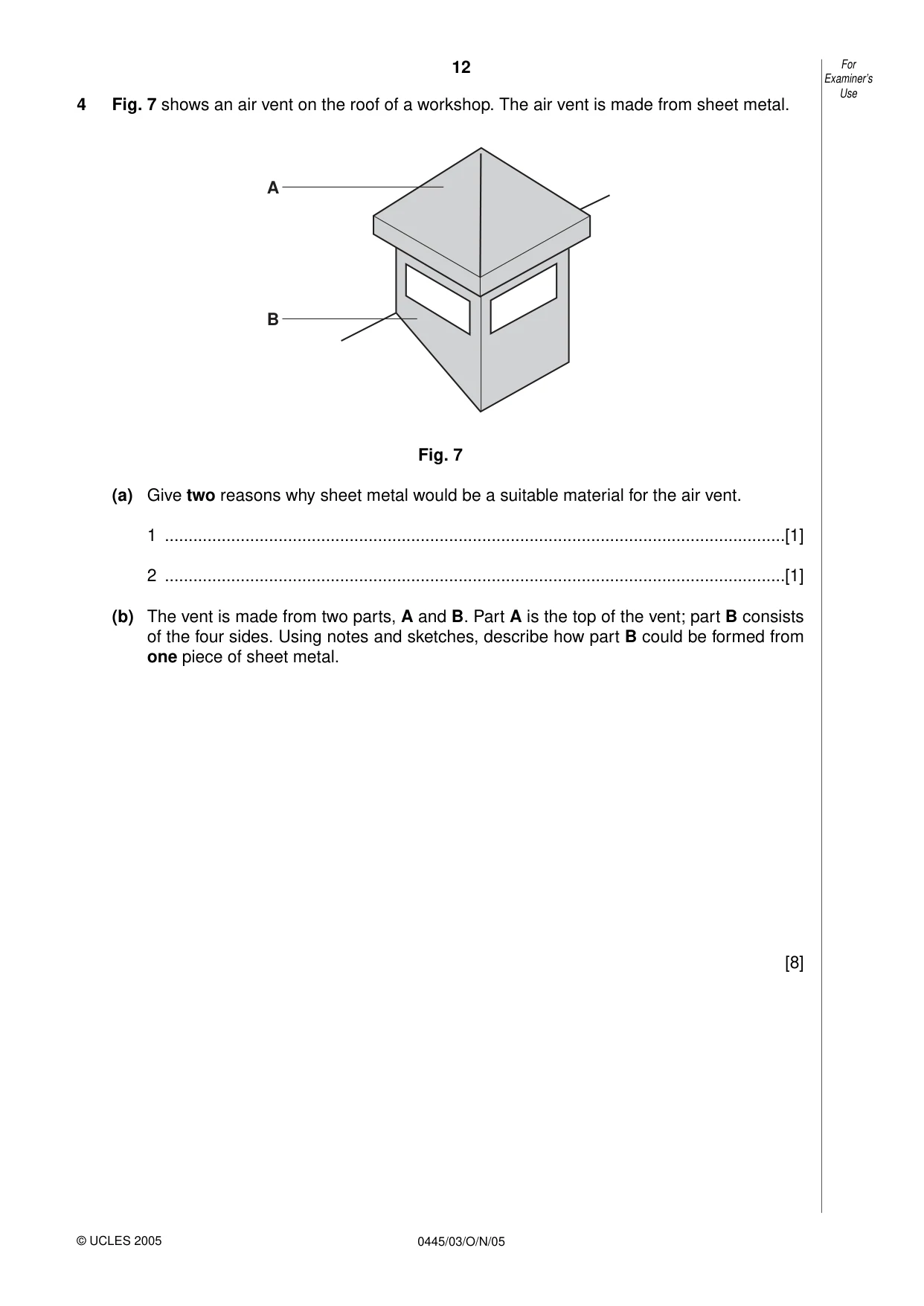
12 0445/03/O/N/05 4 Fig. 7 shows an air vent on the roof of a workshop. The air vent is made from sheet metal. Fig. 7 (a) Give two reasons why sheet metal would be a suitable material for the air vent. 1 …[1] 2 …[1] (b) The vent is made from two parts, A and B. Part A is the top of the vent; part B consists of the four sides. Using notes and sketches, describe how part B could be formed from one piece of sheet metal. [8] A B For Examiner’s Use © UCLES 2005
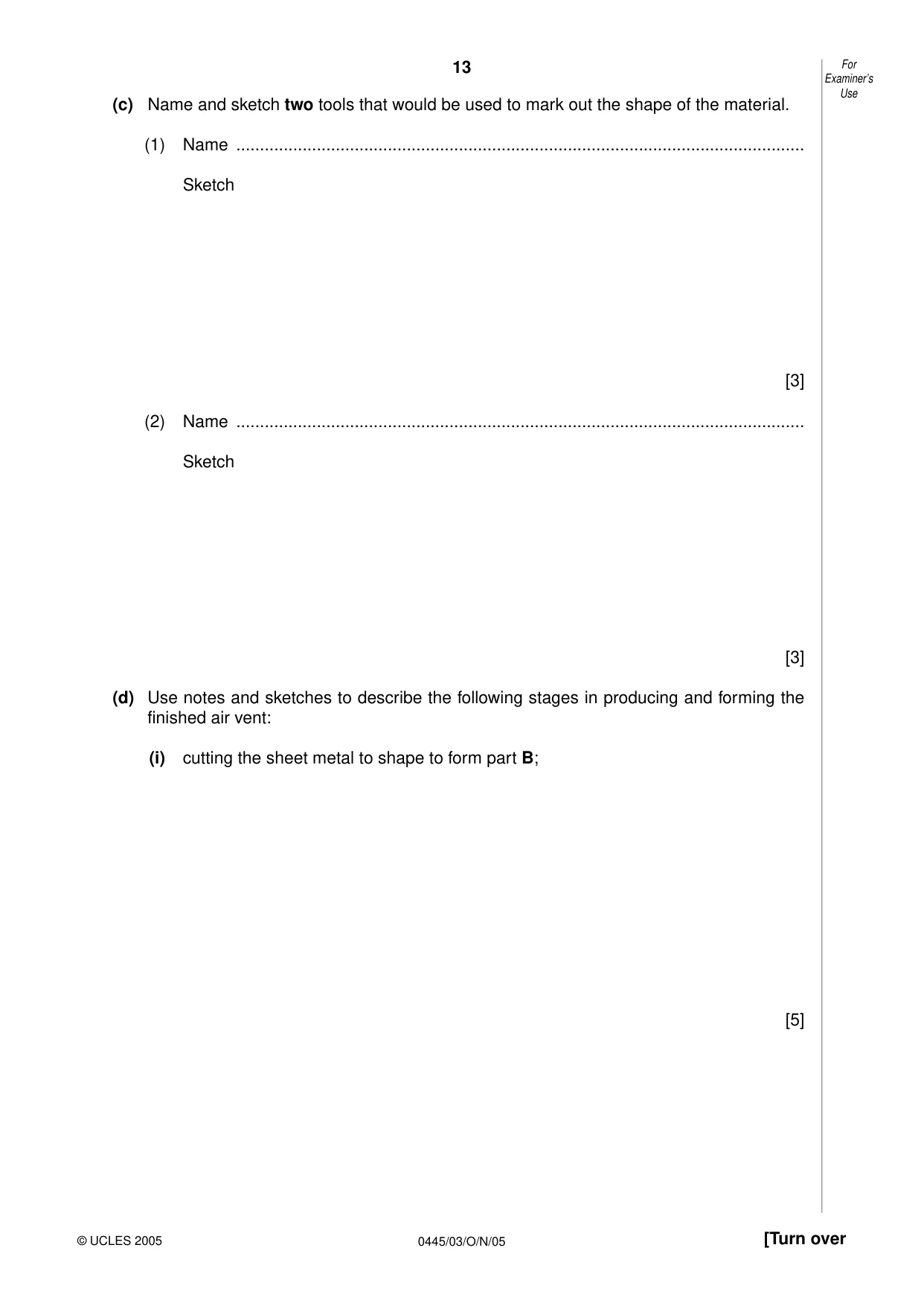
Question paper, page 13
13 0445/03/O/N/05 [Turn over (c) Name and sketch two tools that would be used to mark out the shape of the material. (1) Name … Sketch [3] (2) Name … Sketch [3] (d) Use notes and sketches to describe the following stages in producing and forming the finished air vent: (i) cutting the sheet metal to shape to form part B; [5] For Examiner’s Use © UCLES 2005
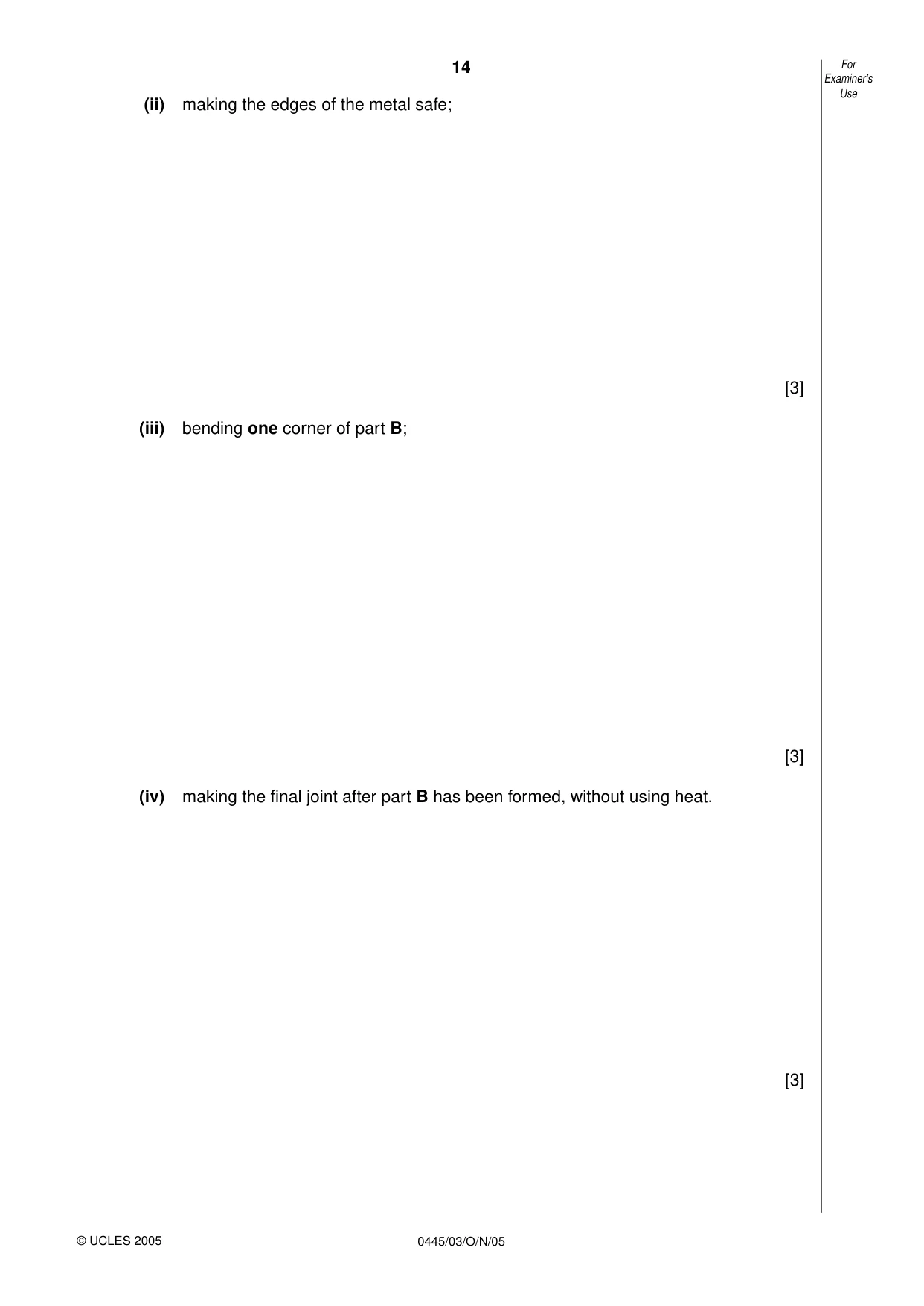
Question paper, page 14
14 0445/03/O/N/05 (ii) making the edges of the metal safe; [3] (iii) bending one corner of part B; [3] (iv) making the final joint after part B has been formed, without using heat. [3] For Examiner’s Use © UCLES 2005
Question paper, page 16
16 0445/03/O/N/05 BLANK PAGE Permission to reproduce items where third-party owned material protected by copyright is included has been sought and cleared where possible. Every reasonable effort has been made by the publisher (UCLES) to trace copyright holders, but if any items requiring clearance have unwittingly been included, the publisher will be pleased to make amends at the earliest possible opportunity. University of Cambridge International Examinations is part of the University of Cambridge Local Examinations Syndicate (UCLES), which is itself a department of the University of Cambridge.
Mark scheme, page 1
UNIVERSITY OF CAMBRIDGE INTERNATIONAL EXAMINATIONS International General Certificate of Secondary Education MARK SCHEME for the November 2005 question paper 0445 DESIGN AND TECHNOLOGY 0445/03 Realisation maximum raw mark 60 This mark scheme is published as an aid to teachers and students, to indicate the requirements of the examination. It shows the basis on which Examiners were initially instructed to award marks. It does not indicate the details of the discussions that took place at an Examiners’ meeting before marking began. Any substantial changes to the mark scheme that arose from these discussions will be recorded in the published Report on the Examination. All Examiners are instructed that alternative correct answers and unexpected approaches in candidates’ scripts must be given marks that fairly reflect the relevant knowledge and skills demonstrated. Mark schemes must be read in conjunction with the question papers and the Report on the Examination. The minimum marks in these components needed for various grades were previously published with these mark schemes, but are now instead included in the Report on the Examination for this session. • CIE will not enter into discussion or correspondence in connection with these mark schemes. CIE is publishing the mark schemes for the November 2005 question papers for most IGCSE and GCE Advanced Level and Advanced Subsidiary Level syllabuses and some Ordinary Level syllabuses. www.XtremePapers.com
Mark scheme, page 2
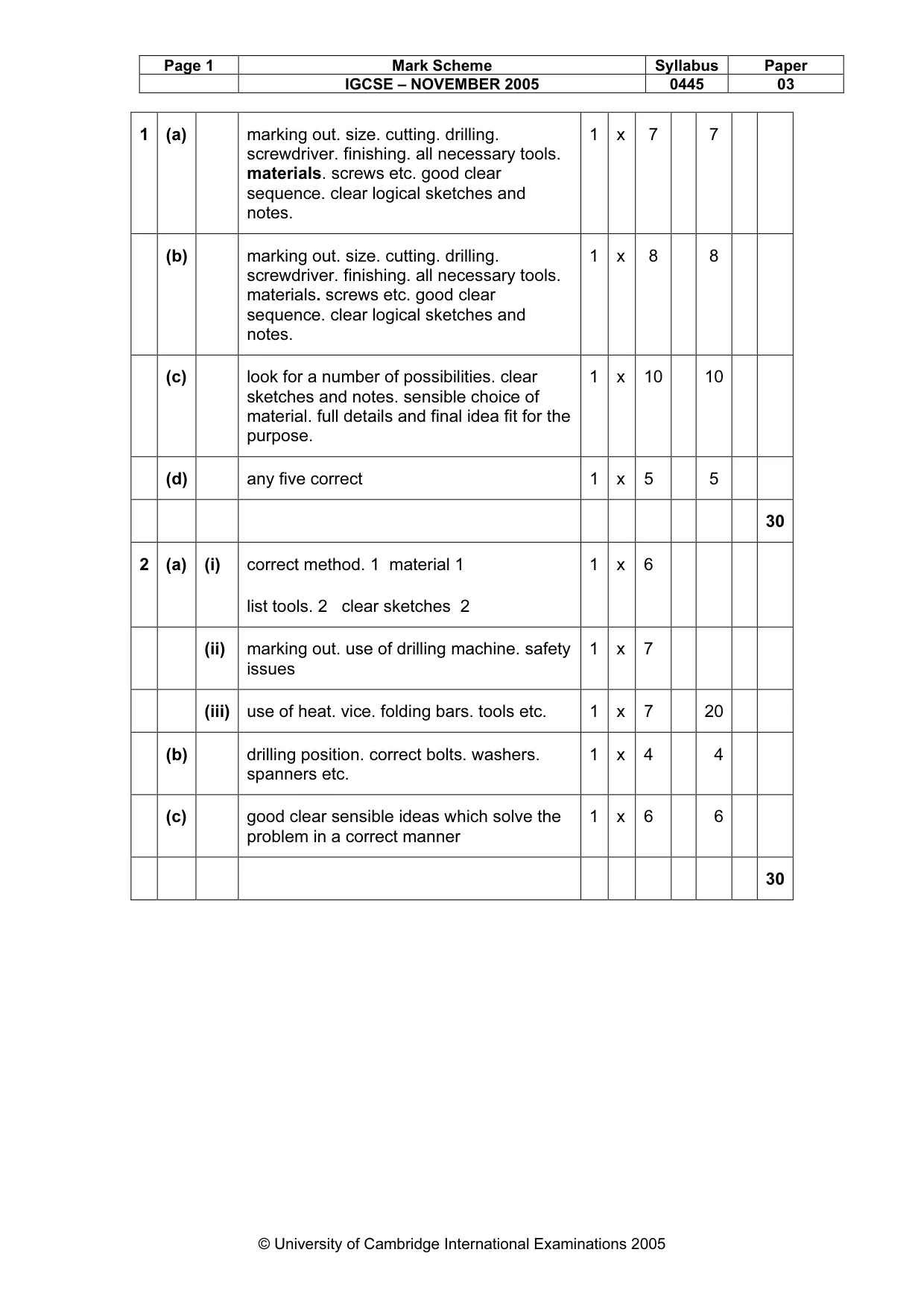
Page 1 Mark Scheme Syllabus Paper IGCSE – NOVEMBER 2005 0445 03 © University of Cambridge International Examinations 2005 1 (a) marking out. size. cutting. drilling. screwdriver. finishing. all necessary tools. materials. screws etc. good clear sequence. clear logical sketches and notes. 1 x 7 7 (b) marking out. size. cutting. drilling. screwdriver. finishing. all necessary tools. materials. screws etc. good clear sequence. clear logical sketches and notes. 1 x 8 8 (c) look for a number of possibilities. clear sketches and notes. sensible choice of material. full details and final idea fit for the purpose. 1 x 10 10 (d) any five correct 1 x 5 5 30 2 (a) (i) correct method. 1 material 1 list tools. 2 clear sketches 2 1 x 6 (ii) marking out. use of drilling machine. safety issues 1 x 7 (iii) use of heat. vice. folding bars. tools etc. 1 x 7 20 (b) drilling position. correct bolts. washers. spanners etc. 1 x 4 4 (c) good clear sensible ideas which solve the problem in a correct manner 1 x 6 6 30
Mark scheme, page 3
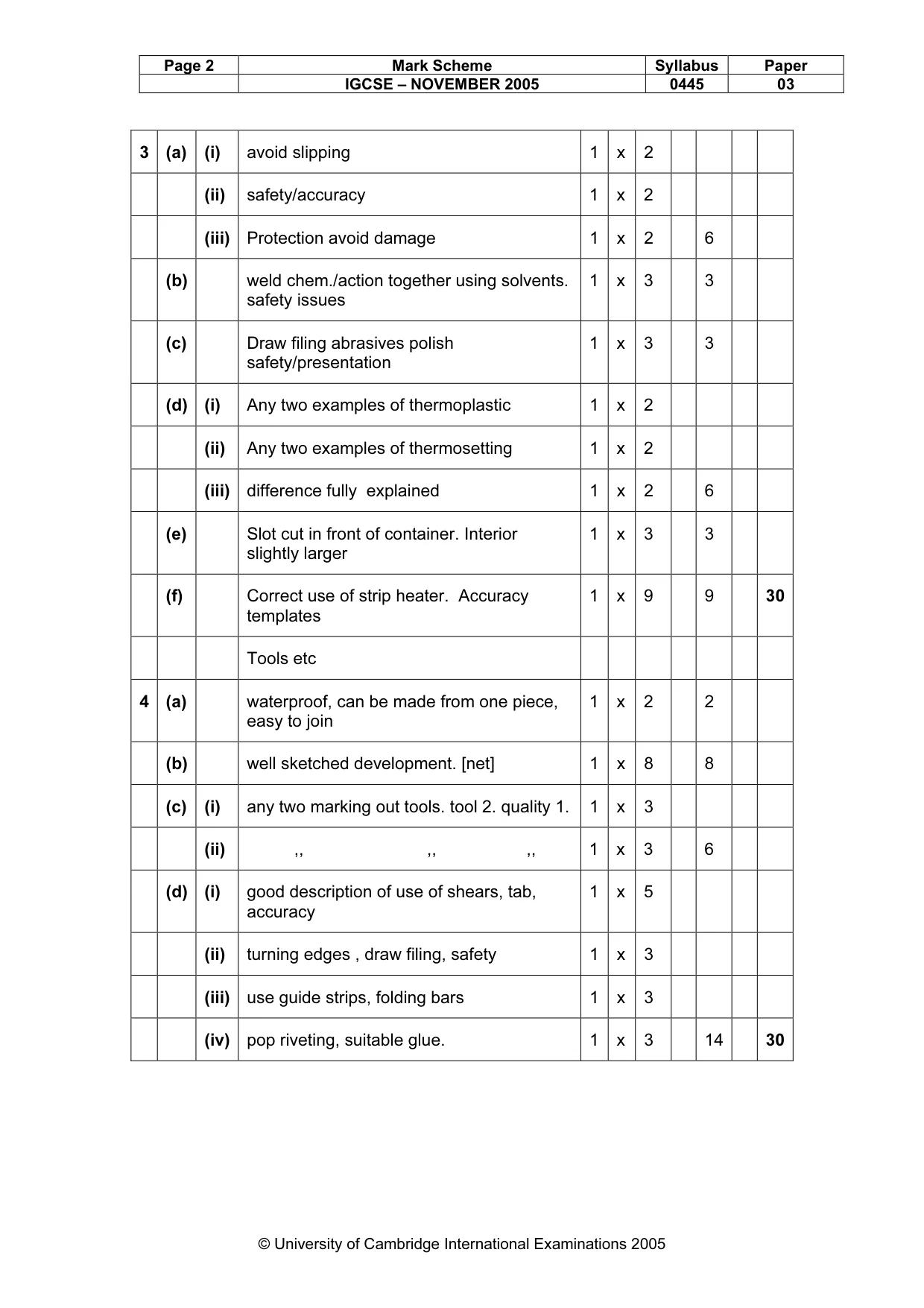
Page 2 Mark Scheme Syllabus Paper IGCSE – NOVEMBER 2005 0445 03 © University of Cambridge International Examinations 2005 3 (a) (i) avoid slipping 1 x 2 (ii) safety/accuracy 1 x 2 (iii) Protection avoid damage 1 x 2 6 (b) weld chem./action together using solvents. safety issues 1 x 3 3 (c) Draw filing abrasives polish safety/presentation 1 x 3 3 (d) (i) Any two examples of thermoplastic 1 x 2 (ii) Any two examples of thermosetting 1 x 2 (iii) difference fully explained 1 x 2 6 (e) Slot cut in front of container. Interior slightly larger 1 x 3 3 (f) Correct use of strip heater. Accuracy templates 1 x 9 9 30 Tools etc 4 (a) waterproof, can be made from one piece, easy to join 1 x 2 2 (b) well sketched development. [net] 1 x 8 8 (c) (i) any two marking out tools. tool 2. quality 1. 1 x 3 (ii) ,, ,, ,, 1 x 3 6 (d) (i) good description of use of shears, tab, accuracy 1 x 5 (ii) turning edges , draw filing, safety 1 x 3 (iii) use guide strips, folding bars 1 x 3 (iv) pop riveting, suitable glue. 1 x 3 14 30