Cambridge IGCSE Design and Technology 0445 — 2005 May/June Paper 3 · Variant 1
0445/31/M/J/05
The question paper and its mark scheme, free to read here and free to download. This is Cambridge’s own paper, exactly as it was sat.
Question paper16 pages
Mark scheme
No mark scheme is in the library for this paper.
Paper as text
Question paper, page 1
This document consists of 14 printed pages and 2 blank pages. (NH) S78390/2 © UCLES 2005 [Turn over UNIVERSITY OF CAMBRIDGE INTERNATIONAL EXAMINATIONS International General Certificate of Secondary Education DESIGN AND TECHNOLOGY 0445/03 Paper 3 Realisation May/June 2005 1 hour Candidates answer on the Question Paper. No Additional Materials are required. To be taken together with Paper 1 in one session of 2 hours 45 minutes. READ THESE INSTRUCTIONS FIRST Write your Centre number, candidate number and name on all the work you hand in. Write in dark blue or black pen in the spaces provided on the Question Paper. You may use a soft pencil for any diagrams, graphs or rough working. Do not use staples, paper clips, highlighters, glue or correction fluid. Answer two questions. The number of marks is given in brackets [ ] at the end of each question or part question. Centre Number Candidate Number Name If you have been given a label, look at the details. If any details are incorrect or missing, please fill in your correct details in the space given at the top of this page. Stick your personal label here, if provided. For Examiner’s Use 1 2 3 4 TOTAL www.XtremePapers.com
Question paper, page 2
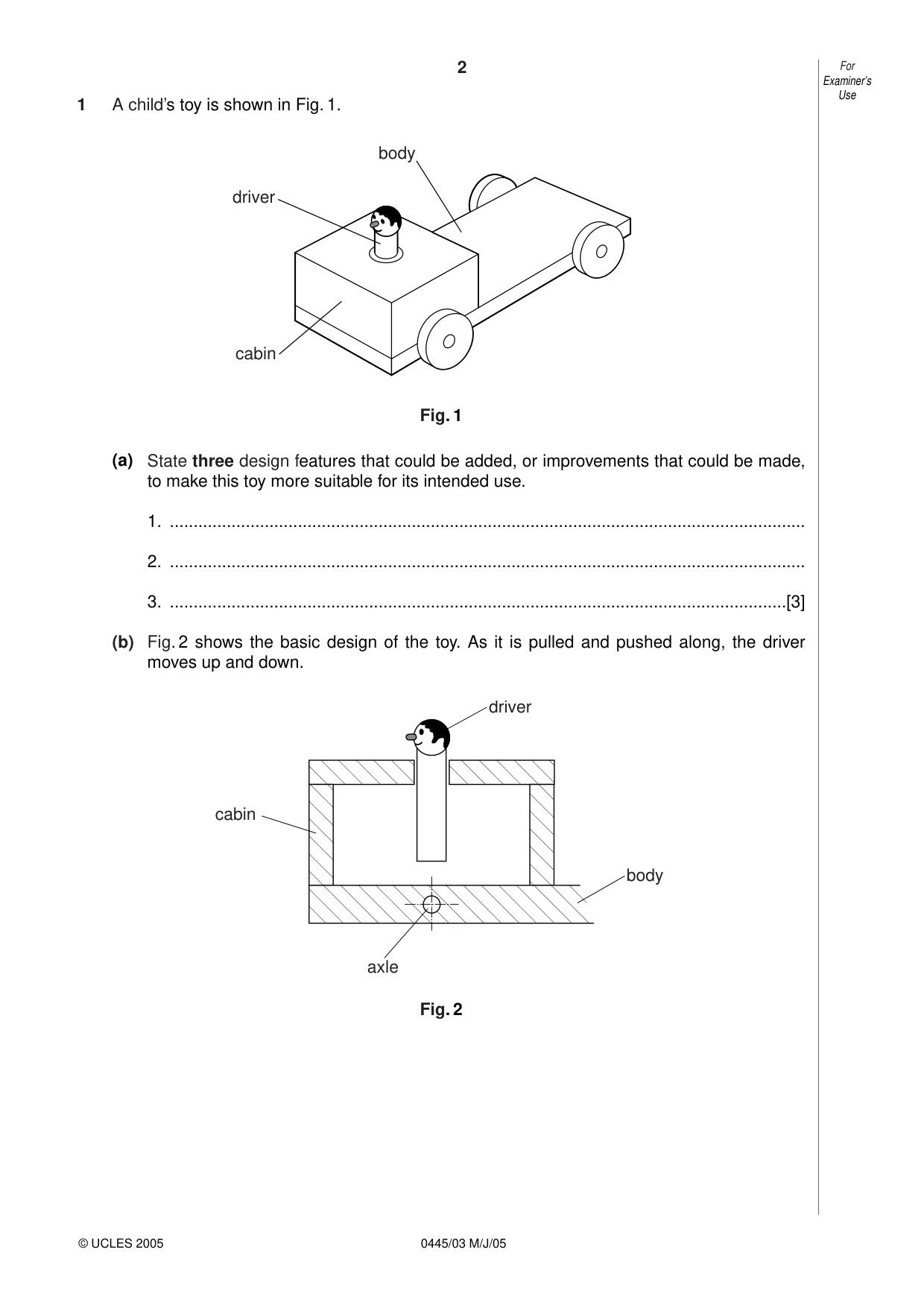
2 © UCLES 2005 0445/03 M/J/05 1 A child’s toy is shown in Fig. 1. Fig. 1 (a) State three design features that could be added, or improvements that could be made, to make this toy more suitable for its intended use. 1. … 2. … 3. …[3] (b) Fig. 2 shows the basic design of the toy. As it is pulled and pushed along, the driver moves up and down. Fig. 2 driver cabin axle body driver body cabin For Examiner’s Use
Question paper, page 3
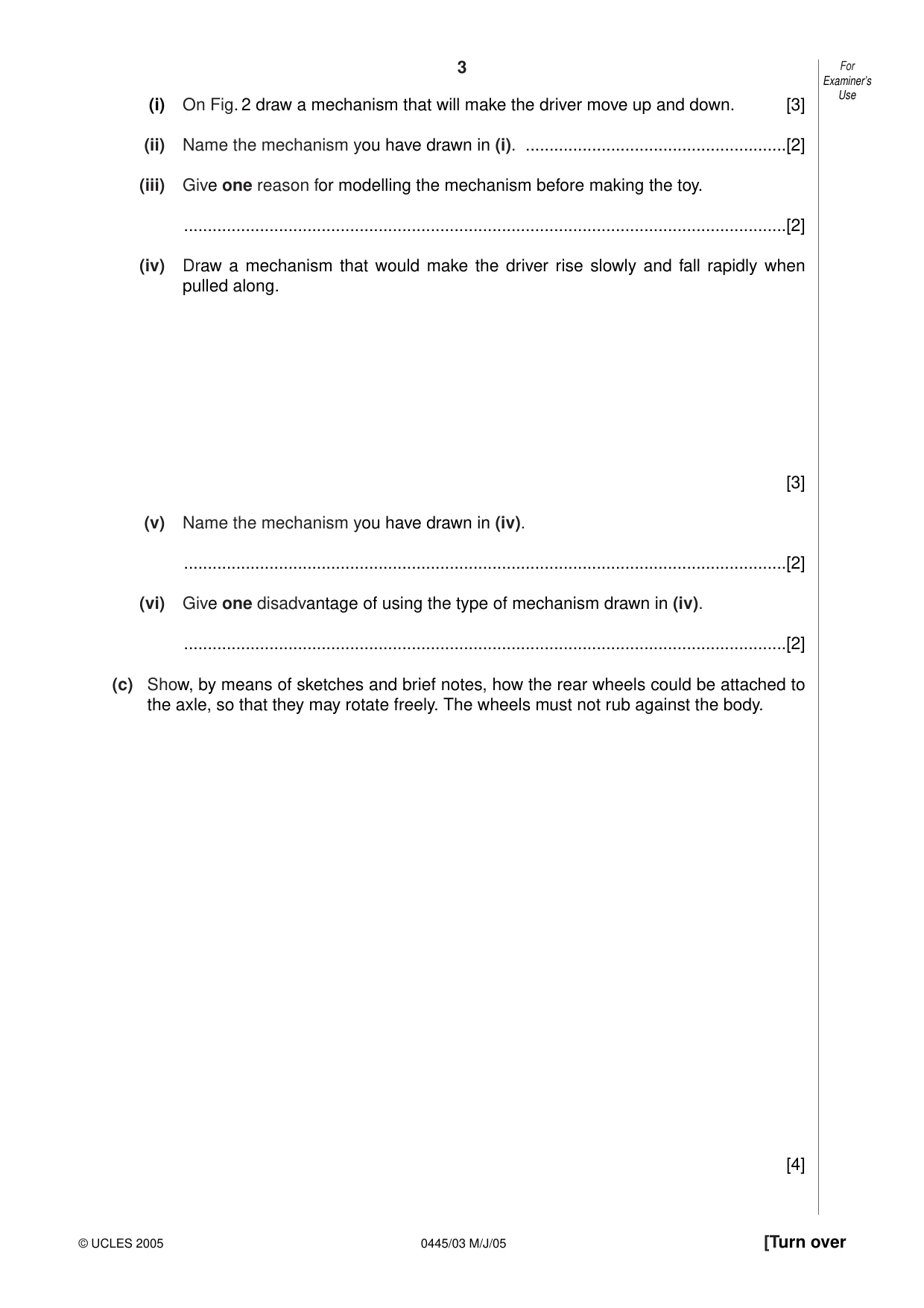
3 © UCLES 2005 0445/03 M/J/05 [Turn over (i) On Fig. 2 draw a mechanism that will make the driver move up and down. [3] (ii) Name the mechanism you have drawn in (i). …[2] (iii) Give one reason for modelling the mechanism before making the toy. …[2] (iv) Draw a mechanism that would make the driver rise slowly and fall rapidly when pulled along. [3] (v) Name the mechanism you have drawn in (iv). …[2] (vi) Give one disadvantage of using the type of mechanism drawn in (iv). …[2] (c) Show, by means of sketches and brief notes, how the rear wheels could be attached to the axle, so that they may rotate freely. The wheels must not rub against the body. [4] For Examiner’s Use
Question paper, page 4
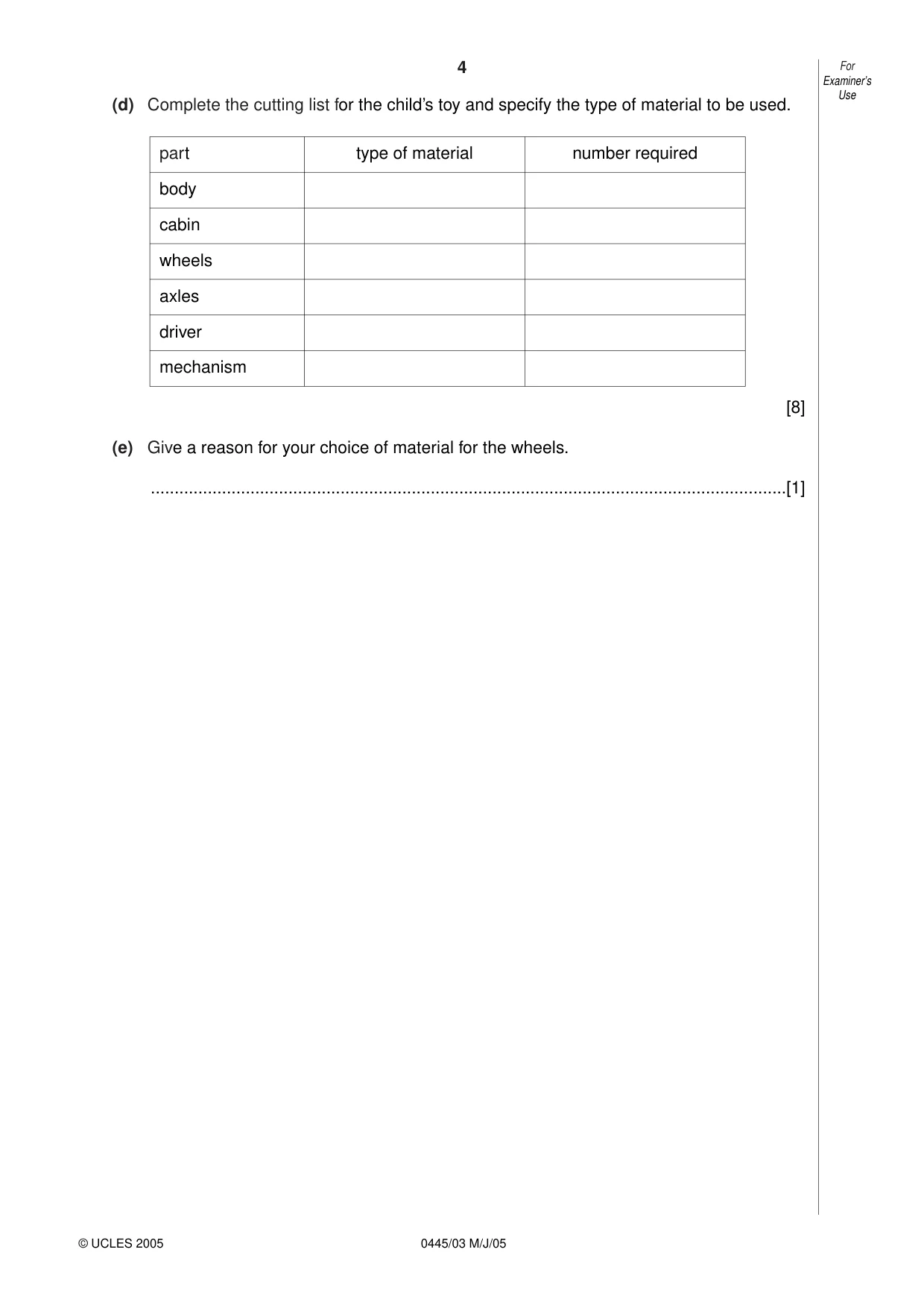
4 © UCLES 2005 0445/03 M/J/05 (d) Complete the cutting list for the child’s toy and specify the type of material to be used. [8] (e) Give a reason for your choice of material for the wheels. …[1] For Examiner’s Use part type of material number required body cabin wheels axles driver mechanism
Question paper, page 5
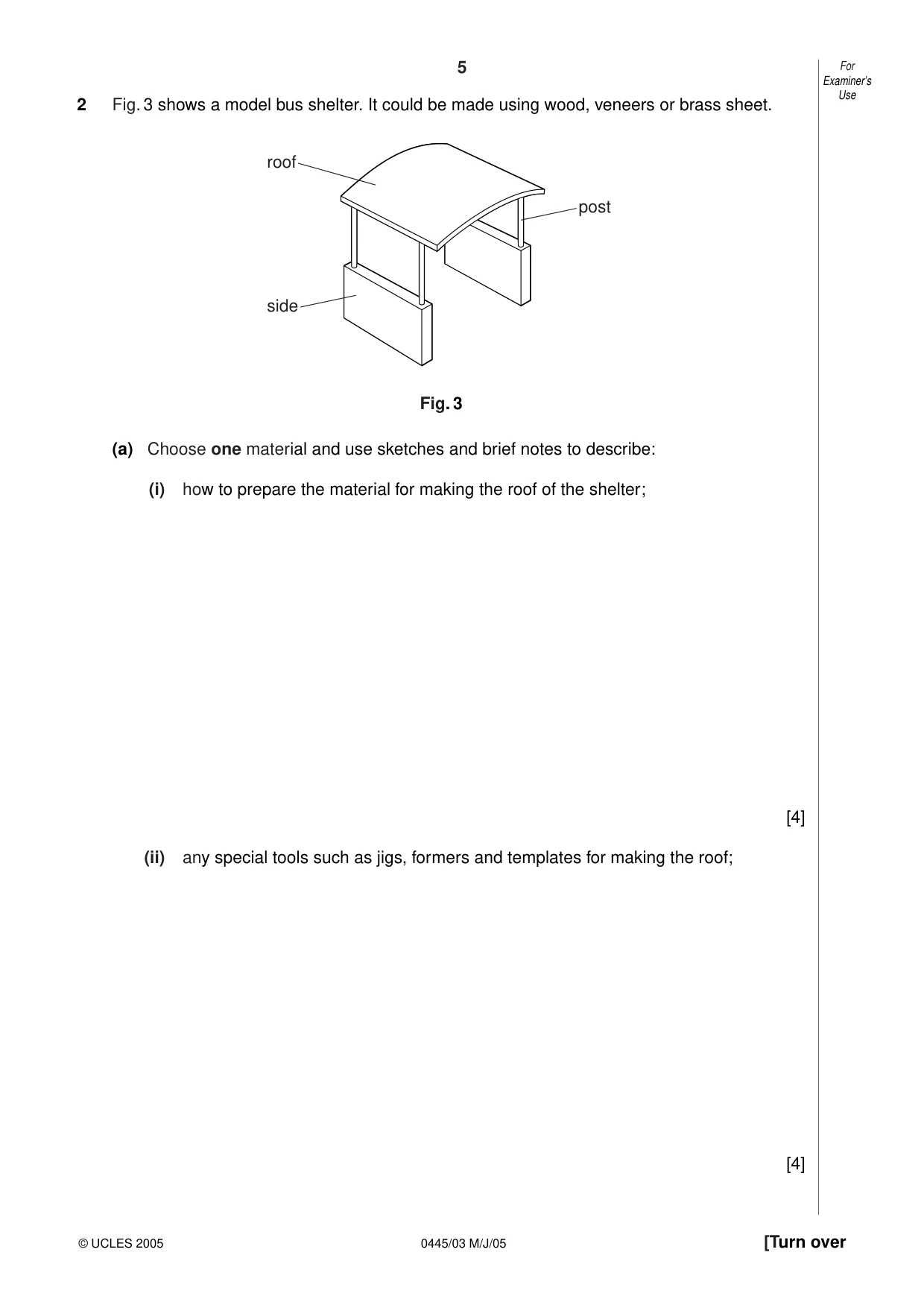
5 © UCLES 2005 0445/03 M/J/05 [Turn over 2 Fig. 3 shows a model bus shelter. It could be made using wood, veneers or brass sheet. Fig. 3 (a) Choose one material and use sketches and brief notes to describe: (i) how to prepare the material for making the roof of the shelter; [4] (ii) any special tools such as jigs, formers and templates for making the roof; [4] roof side post For Examiner’s Use
Question paper, page 6
6 © UCLES 2005 0445/03 M/J/05 (iii) how to make the roof; [3] (iv) how to join the roof to the posts; [3] (v) how to join the posts to the sides. [3] For Examiner’s Use
Question paper, page 7
7 © UCLES 2005 0445/03 M/J/05 [Turn over (b) Use sketches and brief notes to describe how the material you have chosen would be finished. Give details of the tools you would use. [4] (c) Explain each of the following terms and give an example of each. (i) manufactured board … … example …[3] (ii) non-ferrous … … example …[3] (iii) hardwood … … example …[3] For Examiner’s Use
Question paper, page 8
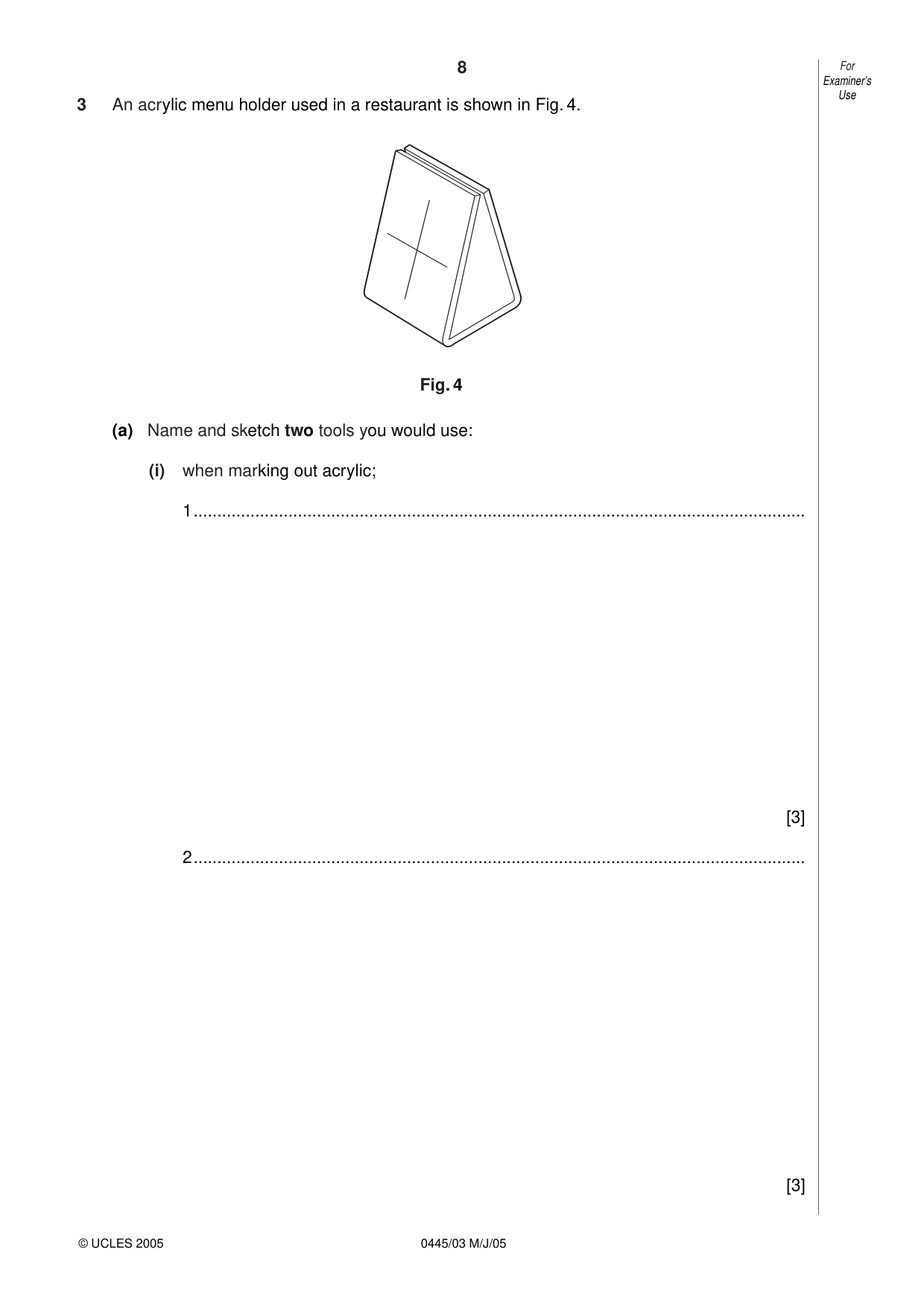
8 © UCLES 2005 0445/03 M/J/05 3 An acrylic menu holder used in a restaurant is shown in Fig. 4. Fig. 4 (a) Name and sketch two tools you would use: (i) when marking out acrylic; 1… [3] 2… [3] For Examiner’s Use
Question paper, page 9
9 © UCLES 2005 0445/03 M/J/05 [Turn over (ii) when cutting acrylic; 1… [3] 2… [3] For Examiner’s Use
Question paper, page 10
10 © UCLES 2005 0445/03 M/J/05 (iii) when finishing the edges of acrylic. 1… [3] 2… [3] For Examiner’s Use
Question paper, page 11
11 © UCLES 2005 0445/03 M/J/05 [Turn over (b) Describe, and give a reason for, one precaution you would take when holding acrylic in a vice. … … … …[2] (c) Using notes and sketches, show how acrylic could be formed into the required shape for the menu holder. [5] (d) Suggest a method to make the base of the sign non-slip. …[1] (e) (i) Explain the difference between thermoplastic and thermosetting plastics. … … … …[2] (ii) Give an example of: 1. a thermosetting plastic…[1] 2. a thermoplastic …[1] For Examiner’s Use
Question paper, page 12
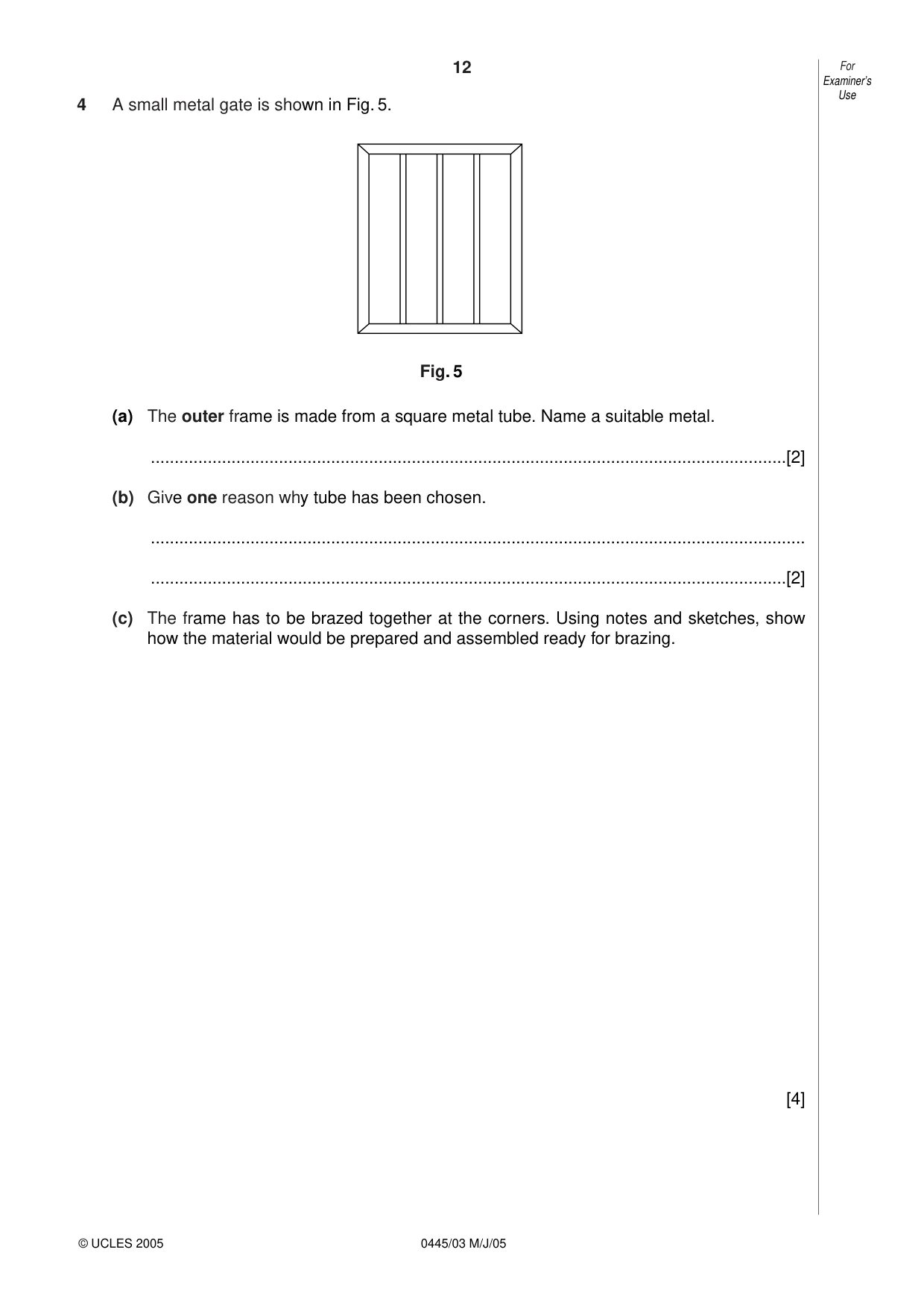
12 © UCLES 2005 0445/03 M/J/05 4 A small metal gate is shown in Fig. 5. Fig. 5 (a) The outer frame is made from a square metal tube. Name a suitable metal. …[2] (b) Give one reason why tube has been chosen. … …[2] (c) The frame has to be brazed together at the corners. Using notes and sketches, show how the material would be prepared and assembled ready for brazing. [4] For Examiner’s Use
Question paper, page 13
13 © UCLES 2005 0445/03 M/J/05 [Turn over (d) Describe fully the following terms. brazing … … flux … … oxidising … … spelter … …[8] (e) The rods forming the centre of the gate are held in the outer frame. Using notes and sketches show how this can be done. You must use a method other than brazing or welding. [6] For Examiner’s Use
Question paper, page 14
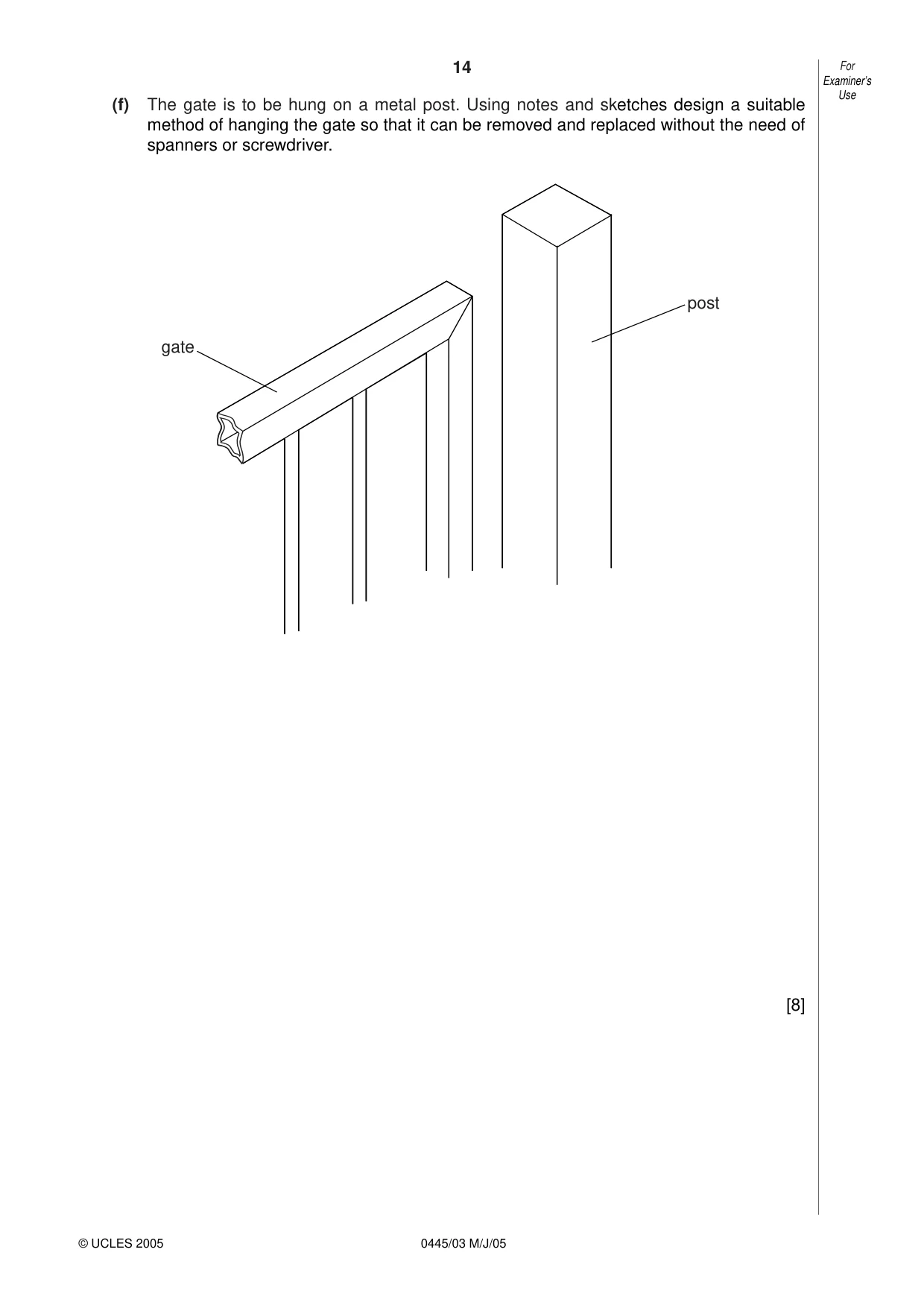
14 © UCLES 2005 0445/03 M/J/05 (f) The gate is to be hung on a metal post. Using notes and sketches design a suitable method of hanging the gate so that it can be removed and replaced without the need of spanners or screwdriver. [8] gate post For Examiner’s Use
Question paper, page 16
16 0445/03 M/J/05 BLANK PAGE Every reasonable effort has been made to trace all copyright holders where the publishers (i.e. UCLES) are aware that third-party material has been reproduced. The publishers would be pleased to hear from anyone whose rights they have unwittingly infringed. University of Cambridge International Examinations is part of the University of Cambridge Local Examinations Syndicate (UCLES), which is itself a department of the University of Cambridge.