Cambridge IGCSE Chinese - First Language 0509 — 2016 May/June Paper 1 · Variant 1
0509/11/M/J/16 · 50 marks · ≈56 min
The question paper and its mark scheme, free to read here and free to download. This is Cambridge’s own paper, exactly as it was sat.
Question paper12 pages
Mark scheme5 pages
Answers below. Sit the paper first if you are practising.
Paper as text
Question paper, page 1
This document consists of 9 printed pages, 3 blank pages and 1 Insert. NL 128941/3 R © UCLES 2016 [Turn over FIRST LANGUAGE CHINESE 0509/11 Paper 1 Reading May/June 2016 2 hours Candidates answer on the Question Paper. No Additional Materials are required. READ THESE INSTRUCTIONS FIRST Write your Centre number, candidate number and name in the spaces at the top of this page. Write in dark blue or black pen. Do not use staples, paper clips, glue or correction fluid. DO NOT WRITE IN ANY BARCODES. Answer all questions in the spaces provided. The questions on this question paper are printed twice, once in traditional and once in simplified characters. If you wish to read them in traditional characters, turn to page 2; if you wish to read them in simplified characters, turn to page 6. You may write your answers in either traditional or simplified characters. Dictionaries are not permitted. The Insert contains the reading passages. The Insert is not assessed by the Examiner. The number of marks is given in brackets [ ] at the end of each question or part question. 請先閱讀以下說明 請把考試中心編號、考生號和姓名寫在本頁上方的空格中。 請用深藍色或者黑色筆答卷。 請不要用訂書釘、曲別針、膠水或者塗改液。 請不要在任何條形碼上塗寫字跡。 試卷上的問題,有繁體和簡體兩種版本。若要繁體字版,請翻到第二頁。 请先阅读以下说明 请把考试中心编号、考生号和姓名写在本页上方的空格中。 请用深蓝色或者黑色笔答卷。 请不要用订书钉、曲别针、胶水或者涂改液。 请不要在任何条形码上涂写字迹。 试卷上的问题,有繁体和简体两种版本。若要简体字版,请翻到第六页。 Cambridge International Examinations Cambridge International General Certificate of Secondary Education * 7 2 6 8 8 2 6 9 5 1 *
Question paper, page 2
2 0509/11/M/J/16 © UCLES 2016 QUESTIONS IN TRADITIONAL CHARACTERS 請回答所有問題,把答案寫在試卷上。 可以用繁體字或者簡體字回答問題。 在考試中不允許使用字典。 插頁上的是閱讀短文。考官不會閱讀或者評判插頁。 每一題或者每一小題的分數在其後面的括弧[ ]裏。 第一部分 請閱讀插頁上的短文一,然後在試卷上回答第一題。 問題 1 (a) 重讀短文第一句話,列出藝術對哪兩種學科有影響。 … … …[2] (b) 重讀短文第一段,講一講 (i) 藝術的價值是什麼, … … …[2] (ii) 為什麼說藝術與人類發展是互相關聯,彼此共生的。 … … …[2] (c) 重讀短文第二段,講一講 (i) 為什麼作者認為不是所有人都能領悟科學, … … … …[2]
Question paper, page 3
3 0509/11/M/J/16 © UCLES 2016 (ii) 藝術與其有何不同。 … … …[2] (d) 重讀短文第三段,在談到藝術的教育作用時,作者提到哪兩類藝術形式? … … …[2] (e) 重讀短文第四段,解釋一下為什麼作者選擇了第四段中的兩個例子來證實藝術是一個有 效的教育工具。 … … … … …[4] (f) 重讀短文第五段,用自己的話分析作者對藝術的態度,用第五段中的例子講一講你怎樣 得出這個結論的。 … … … … …[4] [語言的精確:5] [總分:25] [Turn over
Question paper, page 4
4 0509/11/M/J/16 © UCLES 2016 第二部分 請閱讀插頁上的短文二,然後在試卷上回答第二題。 問題 2 看了以上兩篇文章,用自己的話簡述一下: – 藝術對人類的影響; – 藝術與社會的關係。 (字數250字左右) [內容:15 分] [語言的質量:10 分] … … … … … … … … … … … … … … … … … …
Question paper, page 5
5 0509/11/M/J/16 © UCLES 2016 [Turn over … … … … … … … … … … … … … … [總分:25分] PLEASE TURN OVER TO FIND QUESTIONS IN SIMPLIFIED CHARACTERS
Question paper, page 6
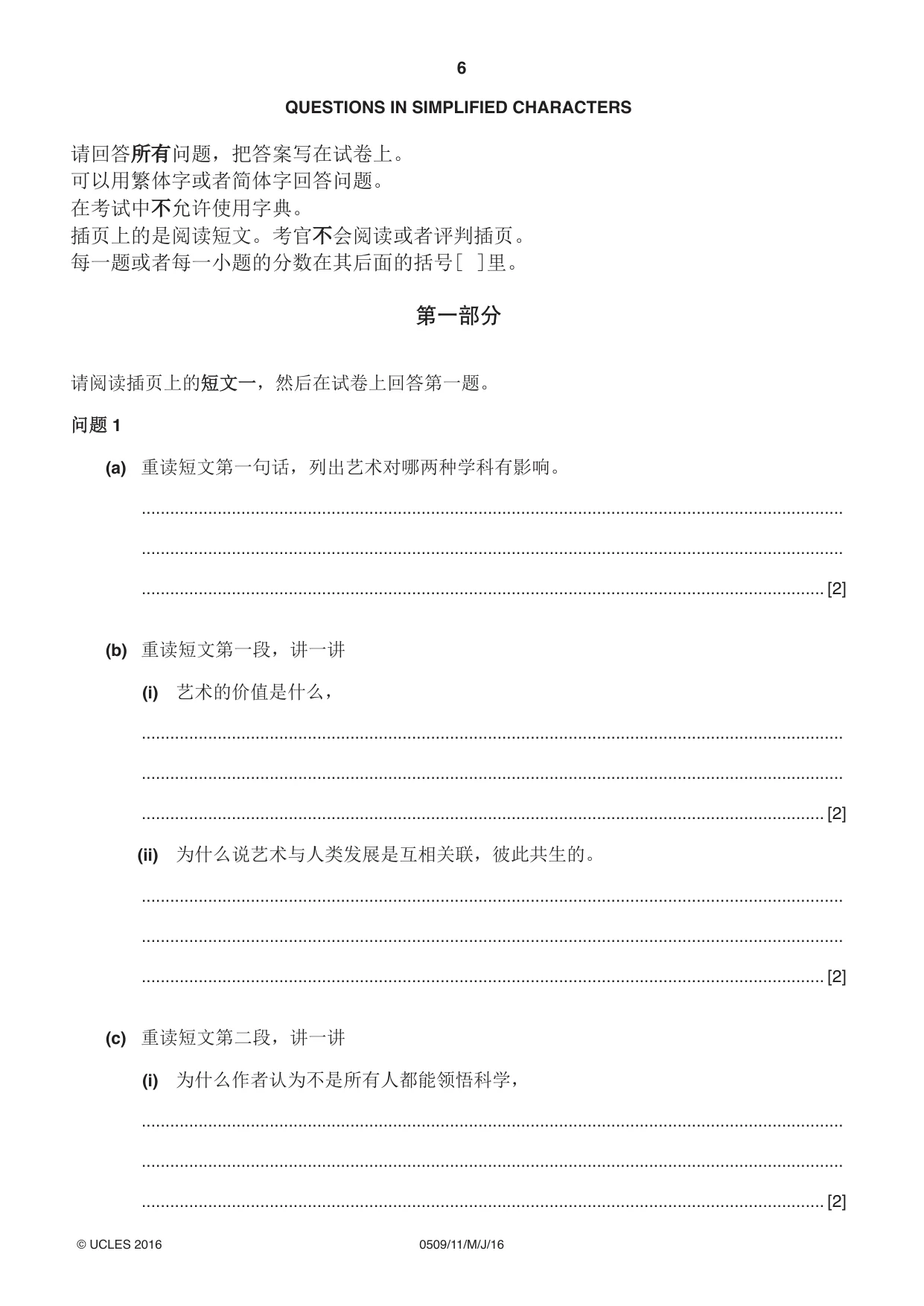
6 0509/11/M/J/16 © UCLES 2016 QUESTIONS IN SIMPLIFIED CHARACTERS 请回答所有问题,把答案写在试卷上。 可以用繁体字或者简体字回答问题。 在考试中不允许使用字典。 插页上的是阅读短文。考官不会阅读或者评判插页。 每一题或者每一小题的分数在其后面的括号[ ]里。 第一部分 请阅读插页上的短文一,然后在试卷上回答第一题。 问题 1 (a) 重读短文第一句话,列出艺术对哪两种学科有影响。 … … … [2] (b) 重读短文第一段,讲一讲 (i) 艺术的价值是什么, … … … [2] (ii) 为什么说艺术与人类发展是互相关联,彼此共生的。 … … … [2] (c) 重读短文第二段,讲一讲 (i) 为什么作者认为不是所有人都能领悟科学, … … … [2]
Question paper, page 7
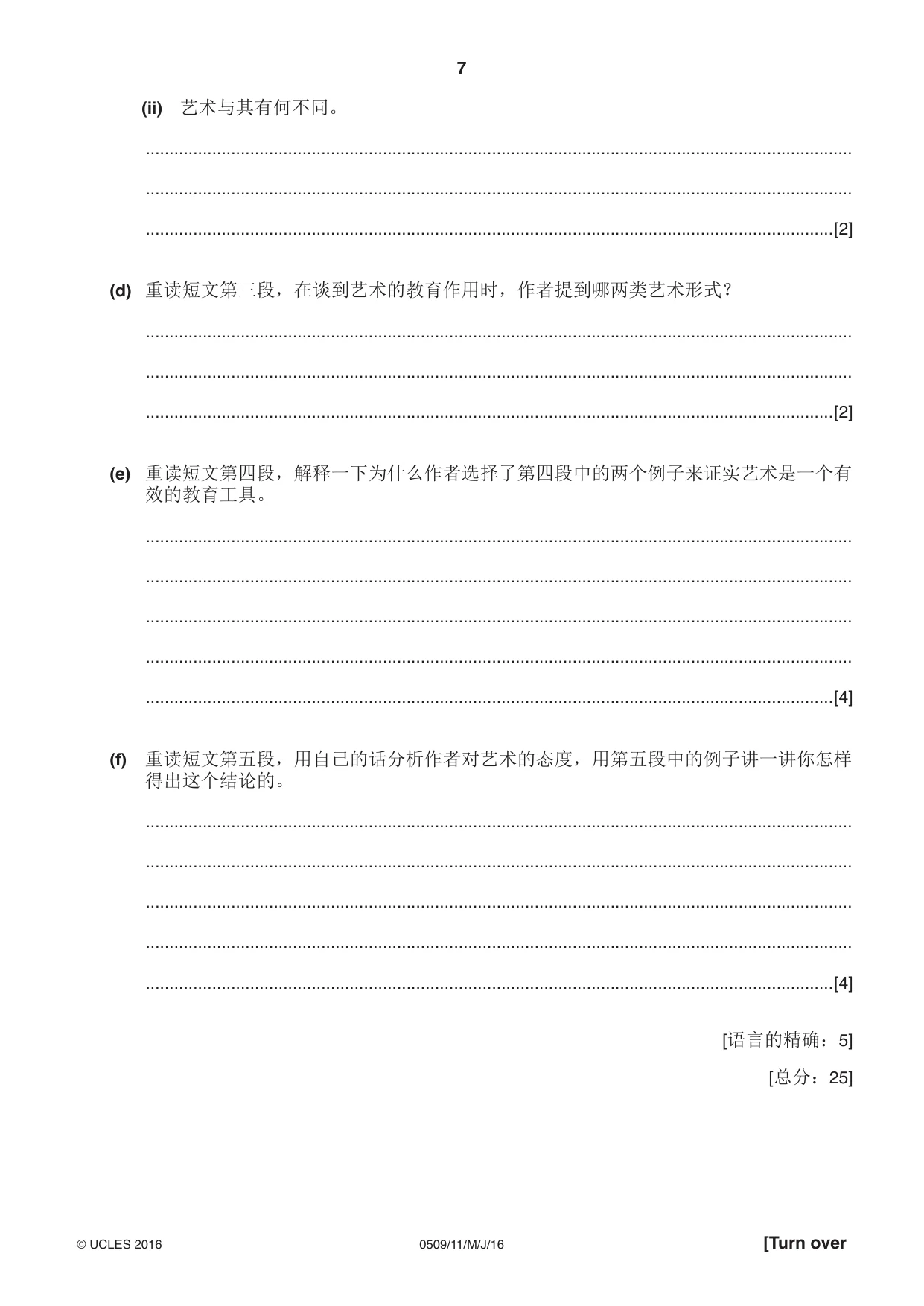
7 0509/11/M/J/16 © UCLES 2016 (ii) 艺术与其有何不同。 … … …[2] (d) 重读短文第三段,在谈到艺术的教育作用时,作者提到哪两类艺术形式? … … …[2] (e) 重读短文第四段,解释一下为什么作者选择了第四段中的两个例子来证实艺术是一个有 效的教育工具。 … … … … …[4] (f) 重读短文第五段,用自己的话分析作者对艺术的态度,用第五段中的例子讲一讲你怎样 得出这个结论的。 … … … … …[4] [语言的精确:5] [总分:25] [Turn over
Question paper, page 8
8 0509/11/M/J/16 © UCLES 2016 第二部分 请阅读插页上的短文二,然后在试卷上回答第二题。 问题 2 看了以上两篇文章,用自己的话简述一下: – 艺术对人类的影响; – 艺术与社会的关系。 (字数250字左右) [内容:15 分] [语言的质量:10 分] … … … … … … … … … … … … … … … … … …
Question paper, page 9
9 0509/11/M/J/16 © UCLES 2016 … … … … … … … … … … … … … … [总分:25 分]
Question paper, page 10
10 0509/11/M/J/16 © UCLES 2016 BLANK PAGE
Question paper, page 11
11 0509/11/M/J/16 © UCLES 2016 BLANK PAGE
Question paper, page 12
12 0509/11/M/J/16 © UCLES 2016 Permission to reproduce items where third-party owned material protected by copyright is included has been sought and cleared where possible. Every reasonable effort has been made by the publisher (UCLES) to trace copyright holders, but if any items requiring clearance have unwittingly been included, the publisher will be pleased to make amends at the earliest possible opportunity. To avoid the issue of disclosure of answer-related information to candidates, all copyright acknowledgements are reproduced online in the Cambridge International Examinations Copyright Acknowledgements Booklet. This is produced for each series of examinations and is freely available to download at www.cie.org.uk after the live examination series. Cambridge International Examinations is part of the Cambridge Assessment Group. Cambridge Assessment is the brand name of University of Cambridge Local Examinations Syndicate (UCLES), which is itself a department of the University of Cambridge. BLANK PAGE
Mark scheme, page 1
® IGCSE is the registered trademark of Cambridge International Examinations. This document consists of 5 printed pages. © UCLES 2016 [Turn over Cambridge International Examinations Cambridge International General Certificate of Secondary Education FIRST LANGUAGE CHINESE 0509/11 Paper 1 Reading May/June 2016 MARK SCHEME Maximum Mark: 50 Published This mark scheme is published as an aid to teachers and candidates, to indicate the requirements of the examination. It shows the basis on which Examiners were instructed to award marks. It does not indicate the details of the discussions that took place at an Examiners’ meeting before marking began, which would have considered the acceptability of alternative answers. Mark schemes should be read in conjunction with the question paper and the Principal Examiner Report for Teachers. Cambridge will not enter into discussions about these mark schemes. Cambridge is publishing the mark schemes for the May/June 2016 series for most Cambridge IGCSE®, Cambridge International A and AS Level components and some Cambridge O Level components.
Mark scheme, page 2
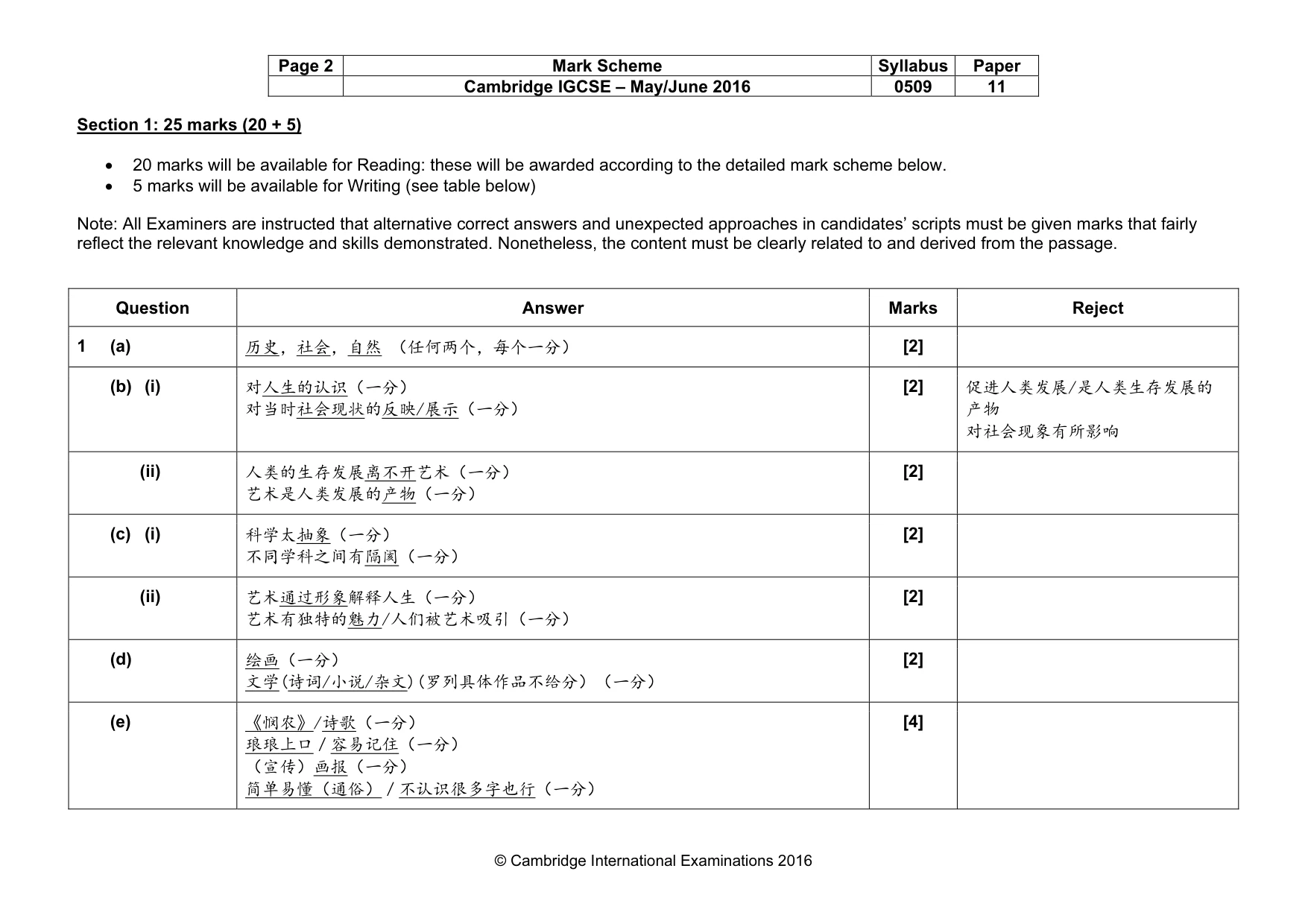
Page 2 Mark Scheme Syllabus Paper Cambridge IGCSE – May/June 2016 0509 11 © Cambridge International Examinations 2016 Section 1: 25 marks (20 + 5) • 20 marks will be available for Reading: these will be awarded according to the detailed mark scheme below. • 5 marks will be available for Writing (see table below) Note: All Examiners are instructed that alternative correct answers and unexpected approaches in candidates’ scripts must be given marks that fairly reflect the relevant knowledge and skills demonstrated. Nonetheless, the content must be clearly related to and derived from the passage. Question Answer Marks Reject 1 (a) 历史,社会,自然 (任何两个,每个一分) [2] (b) (i) 对人生的认识(一分) 对当时社会现状的反映/展示(一分) [2] 促进人类发展/是人类生存发展的 产物 对社会现象有所影响 (ii) 人类的生存发展离不开艺术(一分) 艺术是人类发展的产物(一分) [2] (c) (i) 科学太抽象(一分) 不同学科之间有隔阂(一分) [2] (ii) 艺术通过形象解释人生(一分) 艺术有独特的魅力/人们被艺术吸引(一分) [2] (d) 绘画(一分) 文学(诗词/小说/杂文)(罗列具体作品不给分)(一分) [2] (e) 《悯农》/诗歌(一分) 琅琅上口/容易记住(一分) (宣传)画报(一分) 简单易懂(通俗)/不认识很多字也行(一分) [4]
Mark scheme, page 3
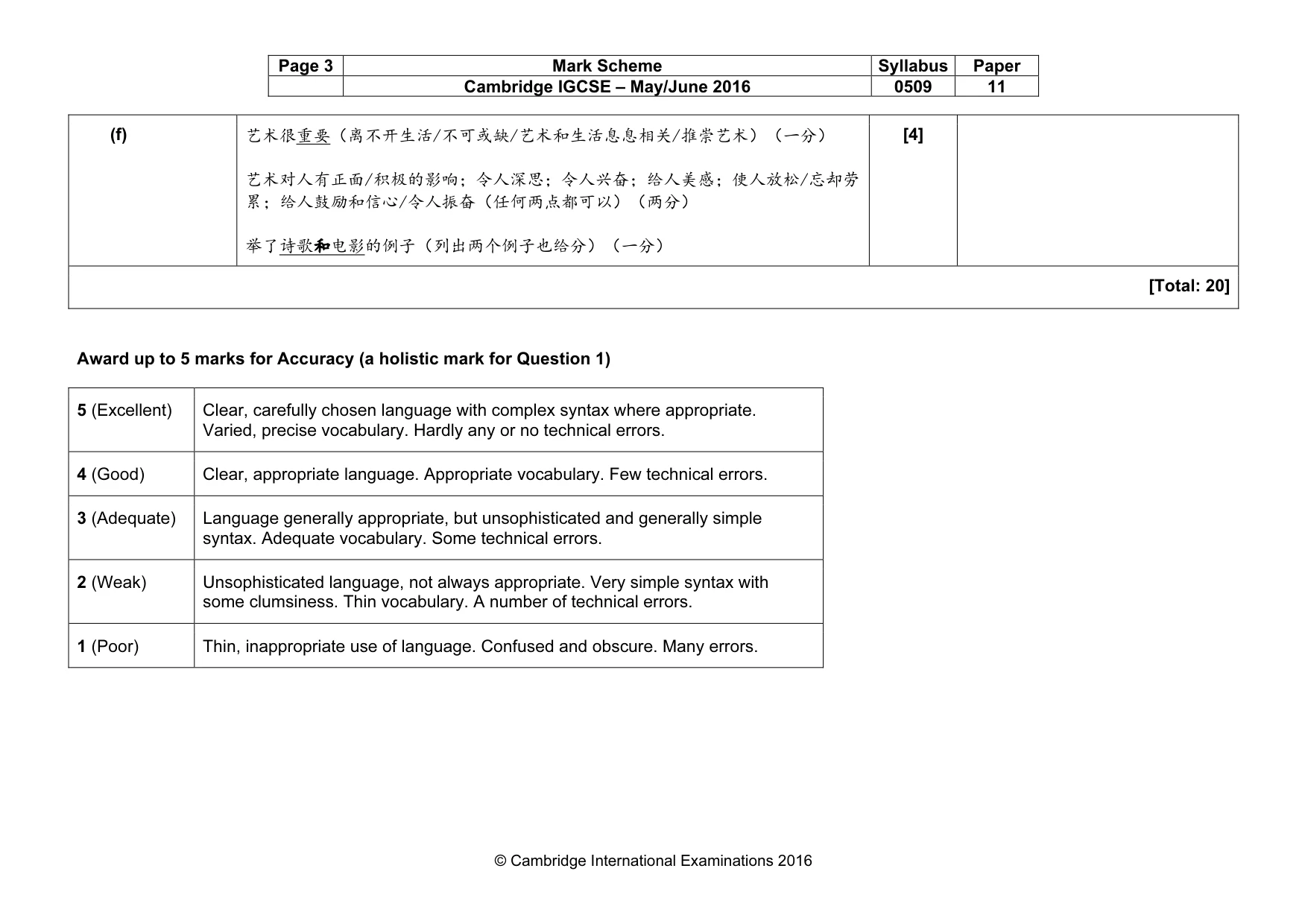
Page 3 Mark Scheme Syllabus Paper Cambridge IGCSE – May/June 2016 0509 11 © Cambridge International Examinations 2016 (f) 艺术很重要(离不开生活/不可或缺/艺术和生活息息相关/推崇艺术)(一分) 艺术对人有正面/积极的影响;令人深思;令人兴奋;给人美感;使人放松/忘却劳 累;给人鼓励和信心/令人振奋(任何两点都可以)(两分) 举了诗歌和电影的例子(列出两个例子也给分)(一分) [4] [Total: 20] Award up to 5 marks for Accuracy (a holistic mark for Question 1) 5 (Excellent) Clear, carefully chosen language with complex syntax where appropriate. Varied, precise vocabulary. Hardly any or no technical errors. 4 (Good) Clear, appropriate language. Appropriate vocabulary. Few technical errors. 3 (Adequate) Language generally appropriate, but unsophisticated and generally simple syntax. Adequate vocabulary. Some technical errors. 2 (Weak) Unsophisticated language, not always appropriate. Very simple syntax with some clumsiness. Thin vocabulary. A number of technical errors. 1 (Poor) Thin, inappropriate use of language. Confused and obscure. Many errors.
Mark scheme, page 4
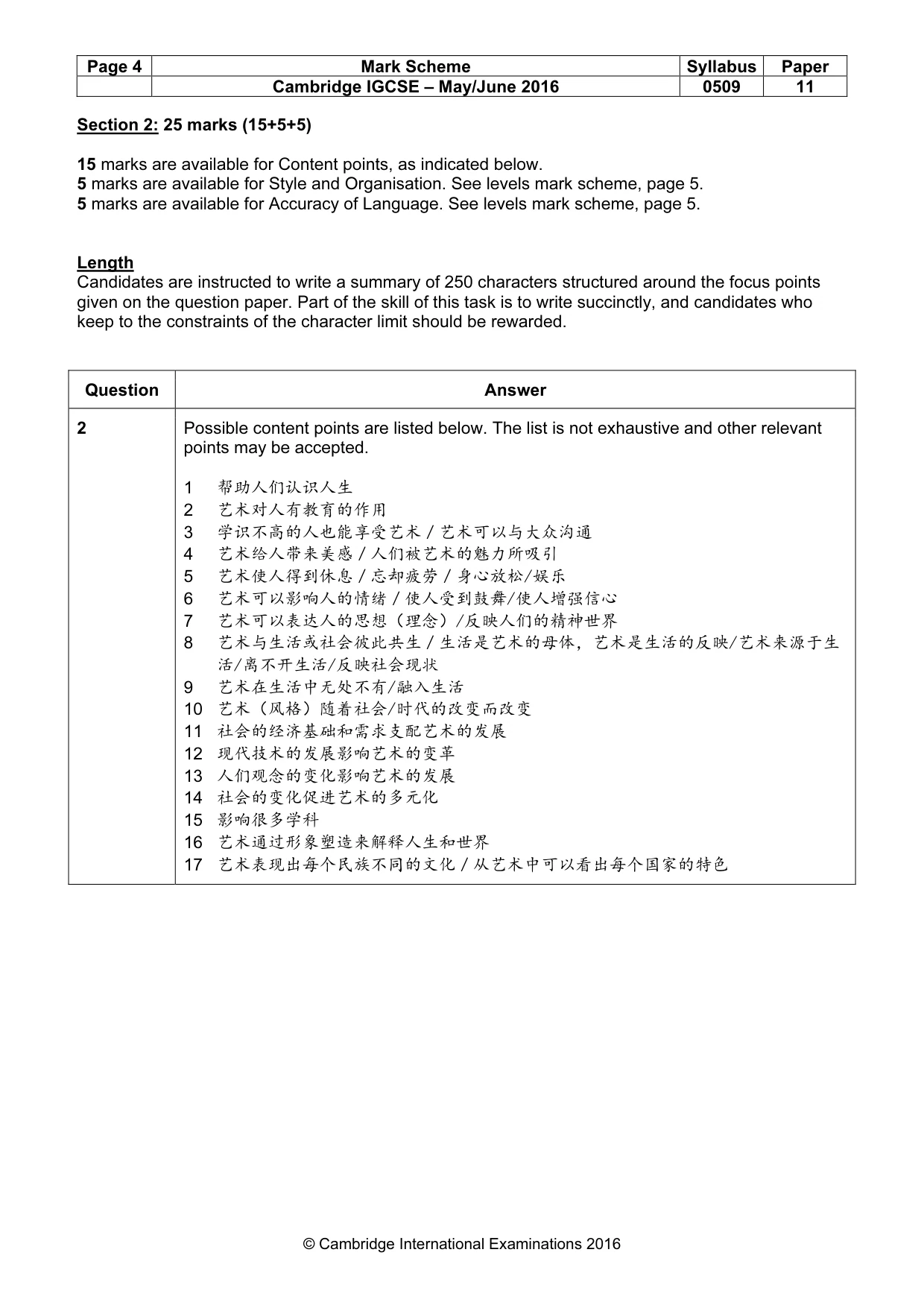
Page 4 Mark Scheme Syllabus Paper Cambridge IGCSE – May/June 2016 0509 11 © Cambridge International Examinations 2016 Section 2: 25 marks (15+5+5) 15 marks are available for Content points, as indicated below. 5 marks are available for Style and Organisation. See levels mark scheme, page 5. 5 marks are available for Accuracy of Language. See levels mark scheme, page 5. Length Candidates are instructed to write a summary of 250 characters structured around the focus points given on the question paper. Part of the skill of this task is to write succinctly, and candidates who keep to the constraints of the character limit should be rewarded. Question Answer 2 Possible content points are listed below. The list is not exhaustive and other relevant points may be accepted. 1 帮助人们认识人生 2 艺术对人有教育的作用 3 学识不高的人也能享受艺术/艺术可以与大众沟通 4 艺术给人带来美感/人们被艺术的魅力所吸引 5 艺术使人得到休息/忘却疲劳/身心放松/娱乐 6 艺术可以影响人的情绪/使人受到鼓舞/使人增强信心 7 艺术可以表达人的思想(理念)/反映人们的精神世界 8 艺术与生活或社会彼此共生/生活是艺术的母体,艺术是生活的反映/艺术来源于生 活/离不开生活/反映社会现状 9 艺术在生活中无处不有/融入生活 10 艺术(风格)随着社会/时代的改变而改变 11 社会的经济基础和需求支配艺术的发展 12 现代技术的发展影响艺术的变革 13 人们观念的变化影响艺术的发展 14 社会的变化促进艺术的多元化 15 影响很多学科 16 艺术通过形象塑造来解释人生和世界 17 艺术表现出每个民族不同的文化/从艺术中可以看出每个国家的特色
Mark scheme, page 5
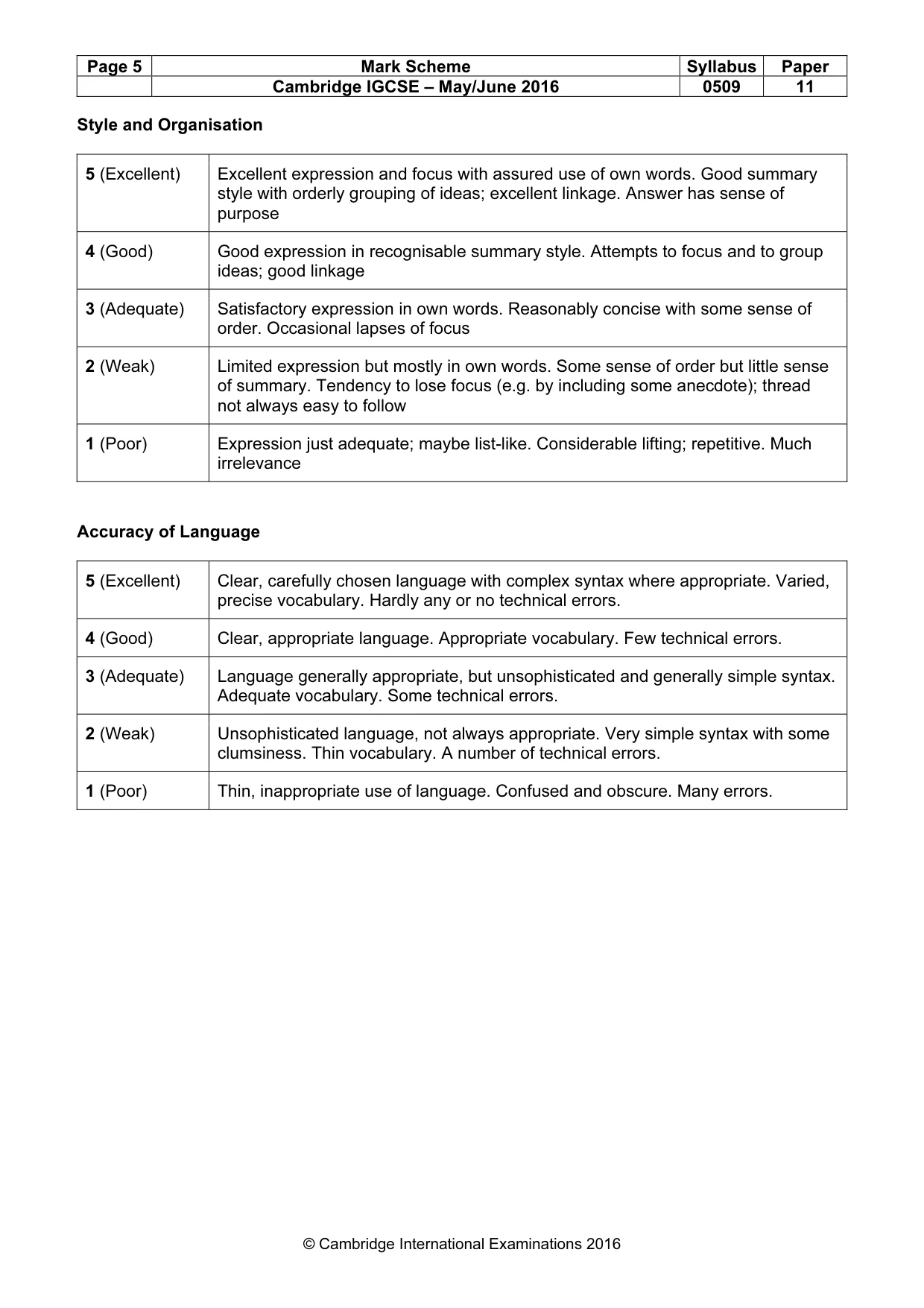
Page 5 Mark Scheme Syllabus Paper Cambridge IGCSE – May/June 2016 0509 11 © Cambridge International Examinations 2016 Style and Organisation 5 (Excellent) Excellent expression and focus with assured use of own words. Good summary style with orderly grouping of ideas; excellent linkage. Answer has sense of purpose 4 (Good) Good expression in recognisable summary style. Attempts to focus and to group ideas; good linkage 3 (Adequate) Satisfactory expression in own words. Reasonably concise with some sense of order. Occasional lapses of focus 2 (Weak) Limited expression but mostly in own words. Some sense of order but little sense of summary. Tendency to lose focus (e.g. by including some anecdote); thread not always easy to follow 1 (Poor) Expression just adequate; maybe list-like. Considerable lifting; repetitive. Much irrelevance Accuracy of Language 5 (Excellent) Clear, carefully chosen language with complex syntax where appropriate. Varied, precise vocabulary. Hardly any or no technical errors. 4 (Good) Clear, appropriate language. Appropriate vocabulary. Few technical errors. 3 (Adequate) Language generally appropriate, but unsophisticated and generally simple syntax. Adequate vocabulary. Some technical errors. 2 (Weak) Unsophisticated language, not always appropriate. Very simple syntax with some clumsiness. Thin vocabulary. A number of technical errors. 1 (Poor) Thin, inappropriate use of language. Confused and obscure. Many errors.
What you needed in this session
Cambridge’s own grade thresholds for 2016 May/June, Paper 1 · Variant 1. A higher threshold means an easier paper — the bar moves with how the cohort did.