Cambridge IGCSE Chemistry (9-1) 0971 — 2019 May/June Paper 4 · Variant 1
0971/41/M/J/19 · 5 questions · 80 marks · ≈90 min
The question paper and its mark scheme, free to read here and free to download. This is Cambridge’s own paper, exactly as it was sat.
Question paper16 pages


Mark scheme9 pages
Answers below. Sit the paper first if you are practising.
Questions as text
Q1 · This question is about the structures of atoms and ions
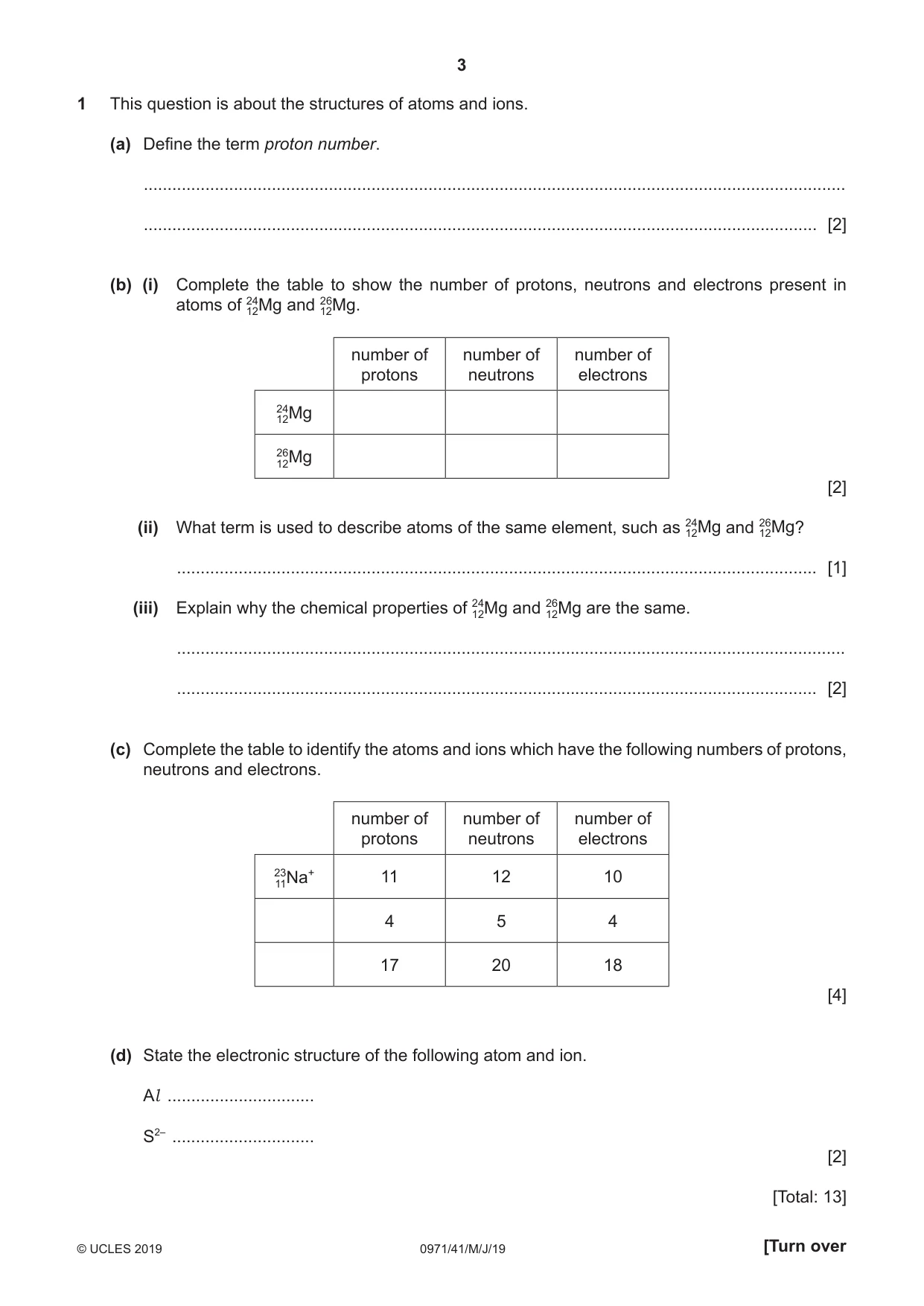
1 This question is about the structures of atoms and ions. (a) Define the term proton number. .................................................................................................................................................... .............................................................................................................................................. [2] (b) (i) Complete the table to show the number of protons, neutrons and electrons present in atoms of 1224Mg and 1226Mg . number of number of number of protons neutrons electrons 1224Mg 1226Mg [2] (ii) What term is used to describe atoms of the same element, such as 1224Mg and 1226Mg ? ....................................................................................................................................... [1] (iii) Explain why the chemical properties of 1224Mg and 1226Mg are the same. ............................................................................................................................................. ....................................................................................................................................... [2] (c) Complete the table to identify the atoms and ions which have the following numbers of protons, neutrons and electrons. number of number of number of protons neutrons electrons 23Na+11 11 12 10 4 5 4 17 20 18 [4] (d) State the electronic structure of the following atom and ion. Al ................................ S2– .............................. [2] [Total: 13]
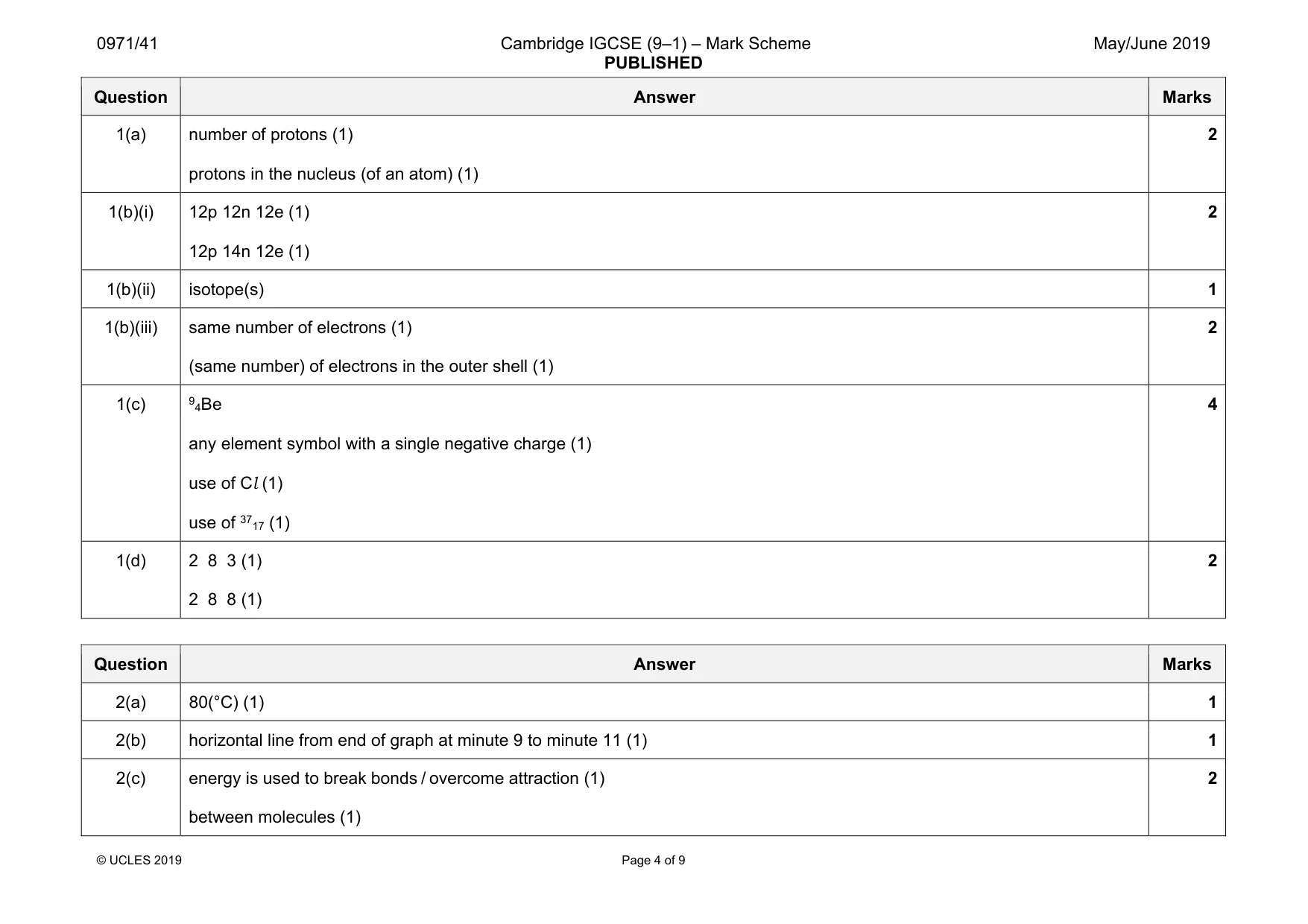
Mark scheme: 1(a) number of protons (1) protons in the nucleus (of an atom) (1) 2 1(b)(i) 12p 12n 12e (1) 12p 14n 12e (1) 2 1(b)(ii) isotope(s) 1 1(b)(iii) same number of electrons (1) (same number) of electrons in the outer shell (1) 2 1(c) 94Be any element symbol with a single negative charge (1) use of Cl (1) use of 3717 (1) 4 1(d) 2 8 3 (1) 2 8 8 (1) 2
Q2 · Z is a covalent substance
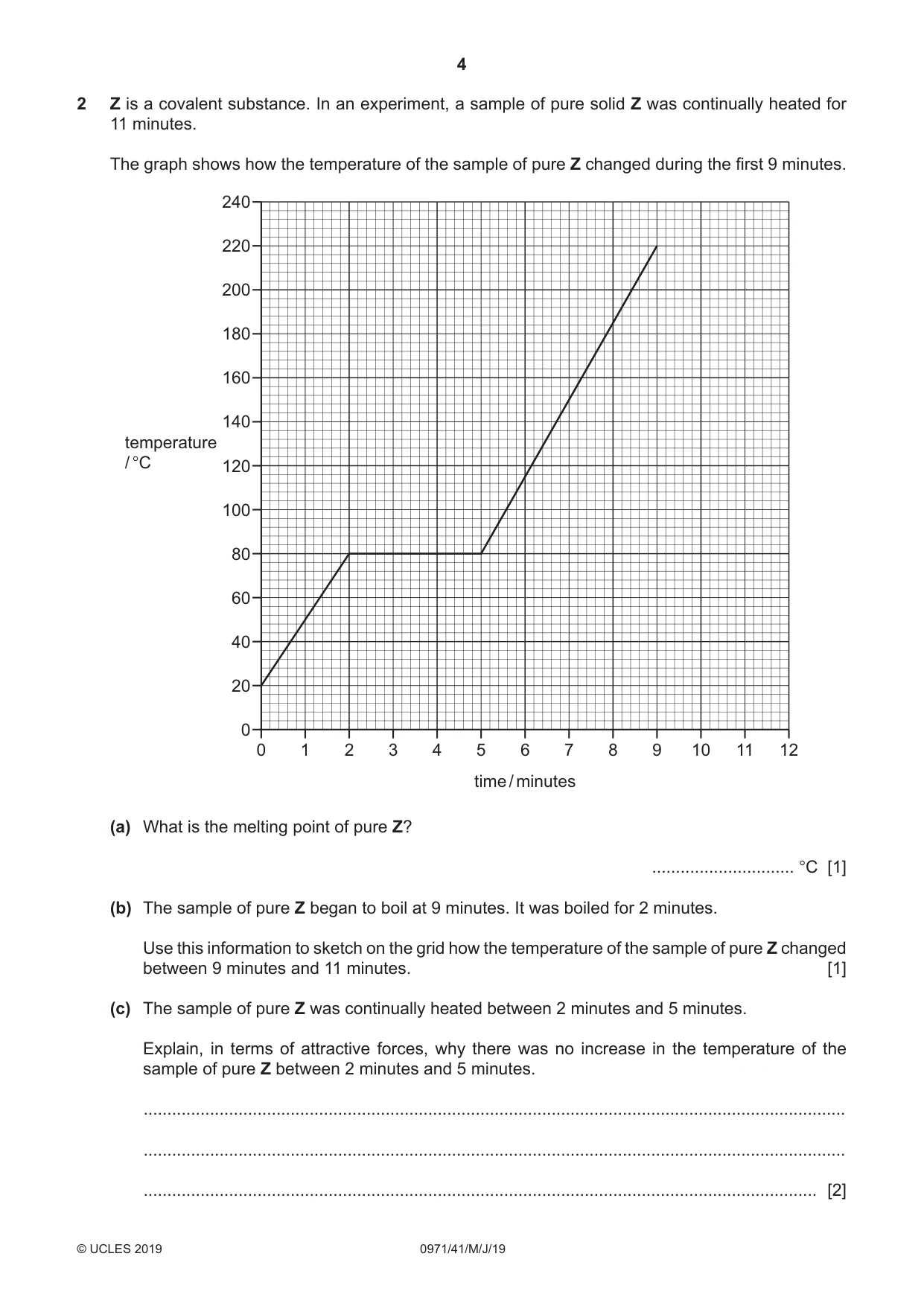
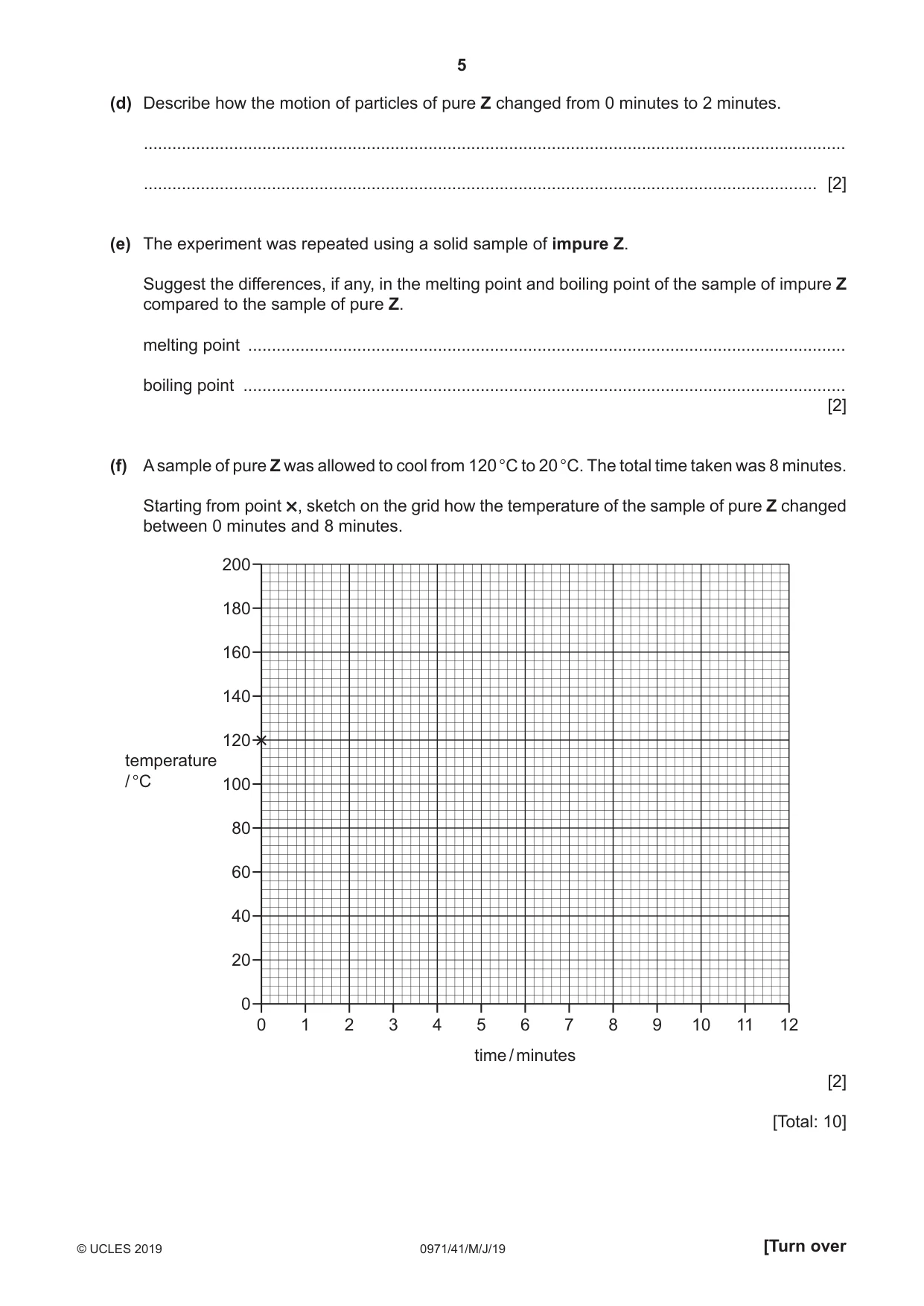
2 Z is a covalent substance. In an experiment, a sample of pure solid Z was continually heated for 11 minutes. The graph shows how the temperature of the sample of pure Z changed during the first 9 minutes. 240 220 200 180 160 140 temperature / °C 120 100 80 60 40 20 0 0 1 2 3 4 5 6 7 8 9 10 11 12 time / minutes (a) What is the melting point of pure Z? .............................. °C [1] (b) The sample of pure Z began to boil at 9 minutes. It was boiled for 2 minutes. Use this information to sketch on the grid how the temperature of the sample of pure Z changed between 9 minutes and 11 minutes. [1] (c) The sample of pure Z was continually heated between 2 minutes and 5 minutes. Explain, in terms of attractive forces, why there was no increase in the temperature of the sample of pure Z between 2 minutes and 5 minutes. .................................................................................................................................................... .................................................................................................................................................... .............................................................................................................................................. [2] (d) Describe how the motion of particles of pure Z changed from 0 minutes to 2 minutes. .................................................................................................................................................... .............................................................................................................................................. [2] (e) The experiment was repeated using a solid sample of impure Z. Suggest the differences, if any, in the melting point and boiling point of the sample of impure Z compared to the sample of pure Z. melting point ............................................................................................................................... boiling point ................................................................................................................................ [2] (f) A sample of pure Z was allowed to cool from 120 °C to 20 °C. The total time taken was 8 minutes. Starting from point ×, sketch on the grid how the temperature of the sample of pure Z changed between 0 minutes and 8 minutes. 200 180 160 140 120 temperature / °C 100 80 60 40 20 0 0 1 2 3 4 5 6 7 8 9 10 11 12 time / minutes [2] [Total: 10]
Mark scheme: 2(a) 80(°C) (1) 1 2(b) horizontal line from end of graph at minute 9 to minute 11 (1) 1 2(c) energy is used to break bonds / overcome attraction (1) between molecules (1) 2 Question Answer Marks 2(d) vibrations (1) increase (1) 2 2(e) melting point decreases (1) boiling point increases (1) 2 2(f) decrease from 120 °C to 80 °C and horizontal line at 80 °C (1) decrease from horizontal line to finish at 20 °C at 8 mins (1) 2
Q3 · Zinc and copper are elements next to each other in the Periodic Table
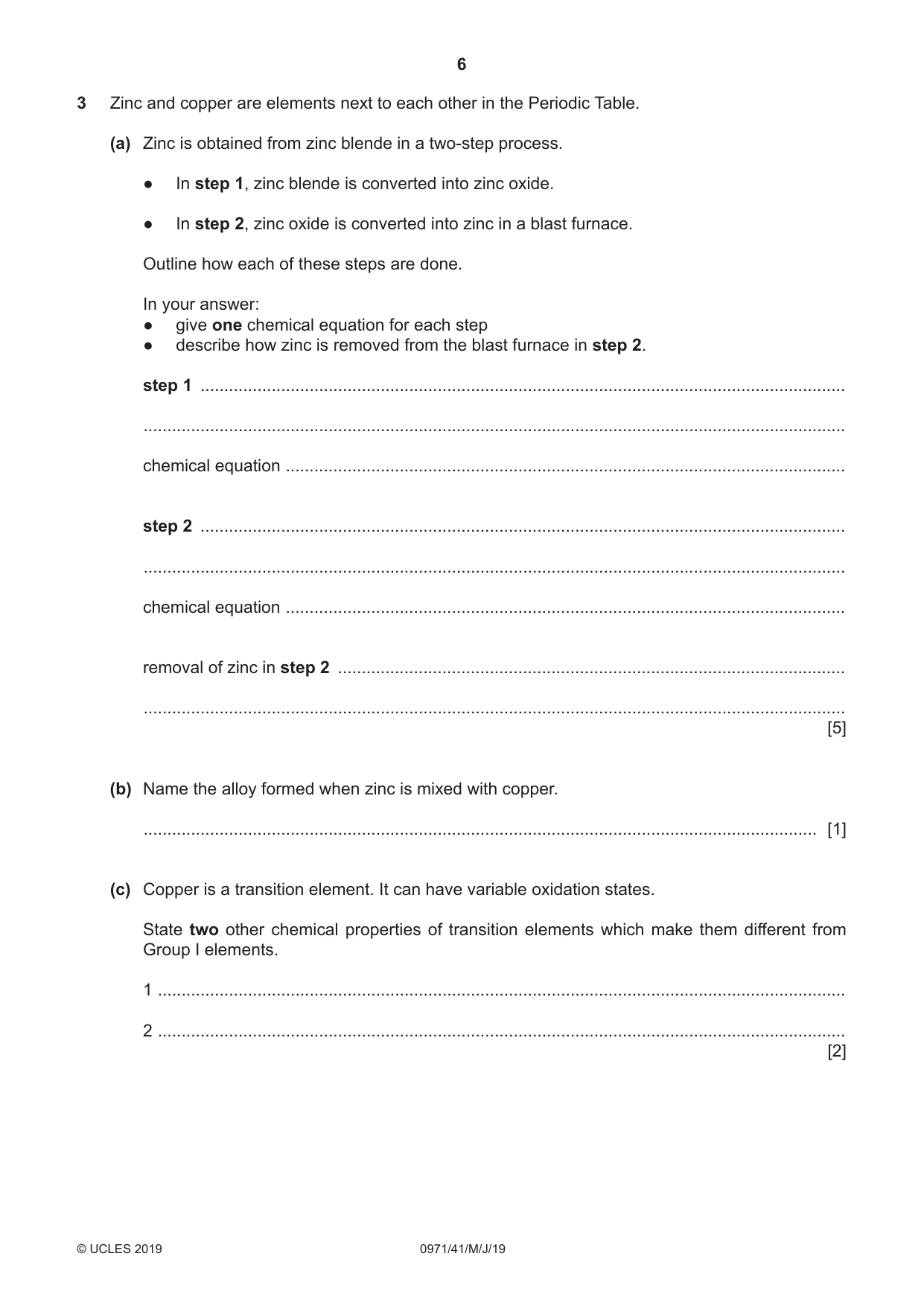
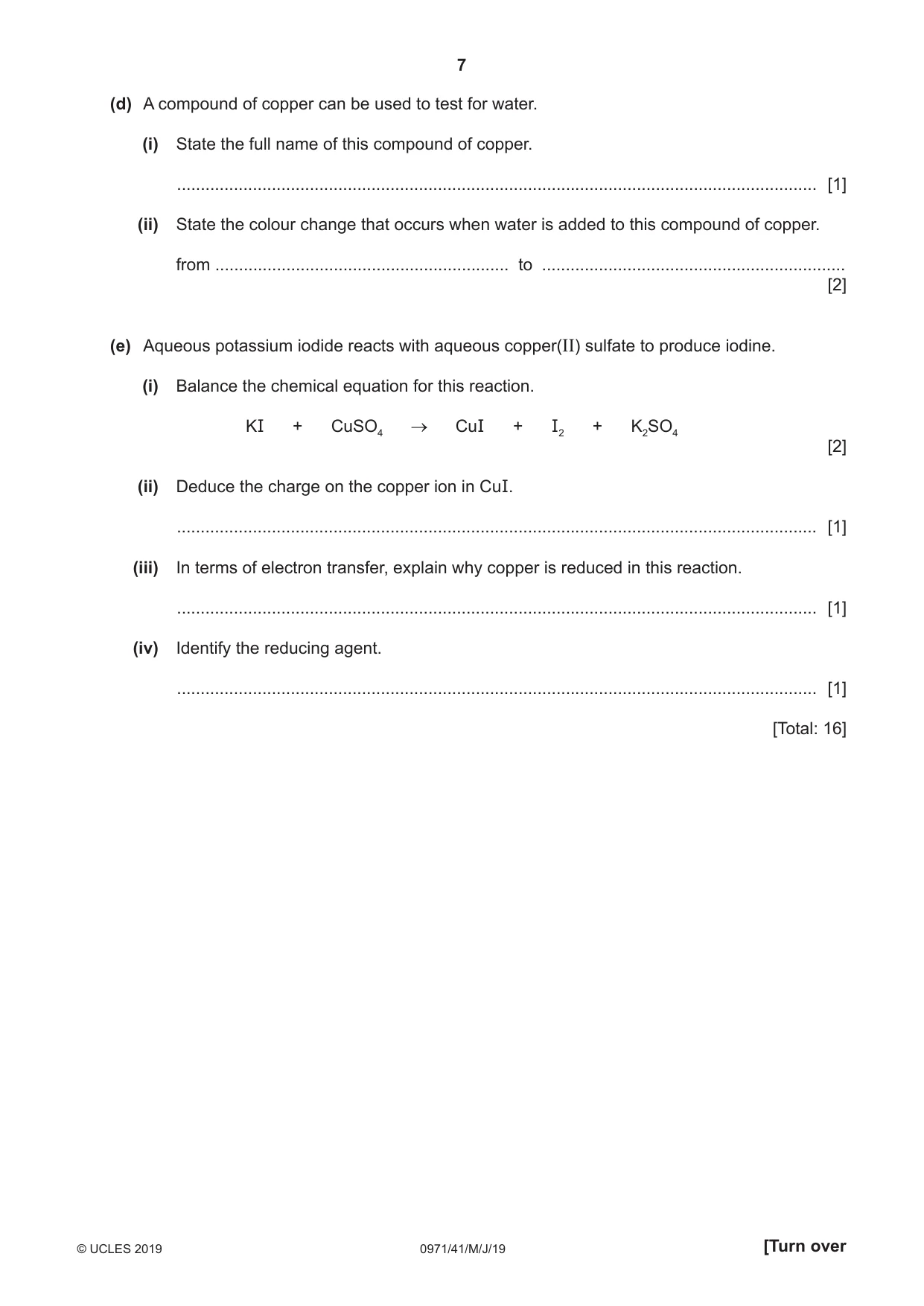
3 Zinc and copper are elements next to each other in the Periodic Table. (a) Zinc is obtained from zinc blende in a two-step process. ●● In step 1, zinc blende is converted into zinc oxide. ●● In step 2, zinc oxide is converted into zinc in a blast furnace. Outline how each of these steps are done. In your answer: ●● give one chemical equation for each step ●● describe how zinc is removed from the blast furnace in step 2. step 1 ......................................................................................................................................... .................................................................................................................................................... chemical equation ...................................................................................................................... step 2 ......................................................................................................................................... .................................................................................................................................................... chemical equation ...................................................................................................................... removal of zinc in step 2 ............................................................................................................ .................................................................................................................................................... [5] (b) Name the alloy formed when zinc is mixed with copper. .............................................................................................................................................. [1] (c) Copper is a transition element. It can have variable oxidation states. State two other chemical properties of transition elements which make them different from Group I elements. 1 ................................................................................................................................................. 2 ................................................................................................................................................. [2] (d) A compound of copper can be used to test for water. (i) State the full name of this compound of copper. ....................................................................................................................................... [1] (ii) State the colour change that occurs when water is added to this compound of copper. from .............................................................. to ................................................................. [2] (e) Aqueous potassium iodide reacts with aqueous copper(II) sulfate to produce iodine. (i) Balance the chemical equation for this reaction. KI + CuSO4 CuI + I2 + K2SO4 [2] (ii) Deduce the charge on the copper ion in CuI. ....................................................................................................................................... [1] (iii) In terms of electron transfer, explain why copper is reduced in this reaction. ....................................................................................................................................... [1] (iv) Identify the reducing agent. ....................................................................................................................................... [1] [Total: 16]
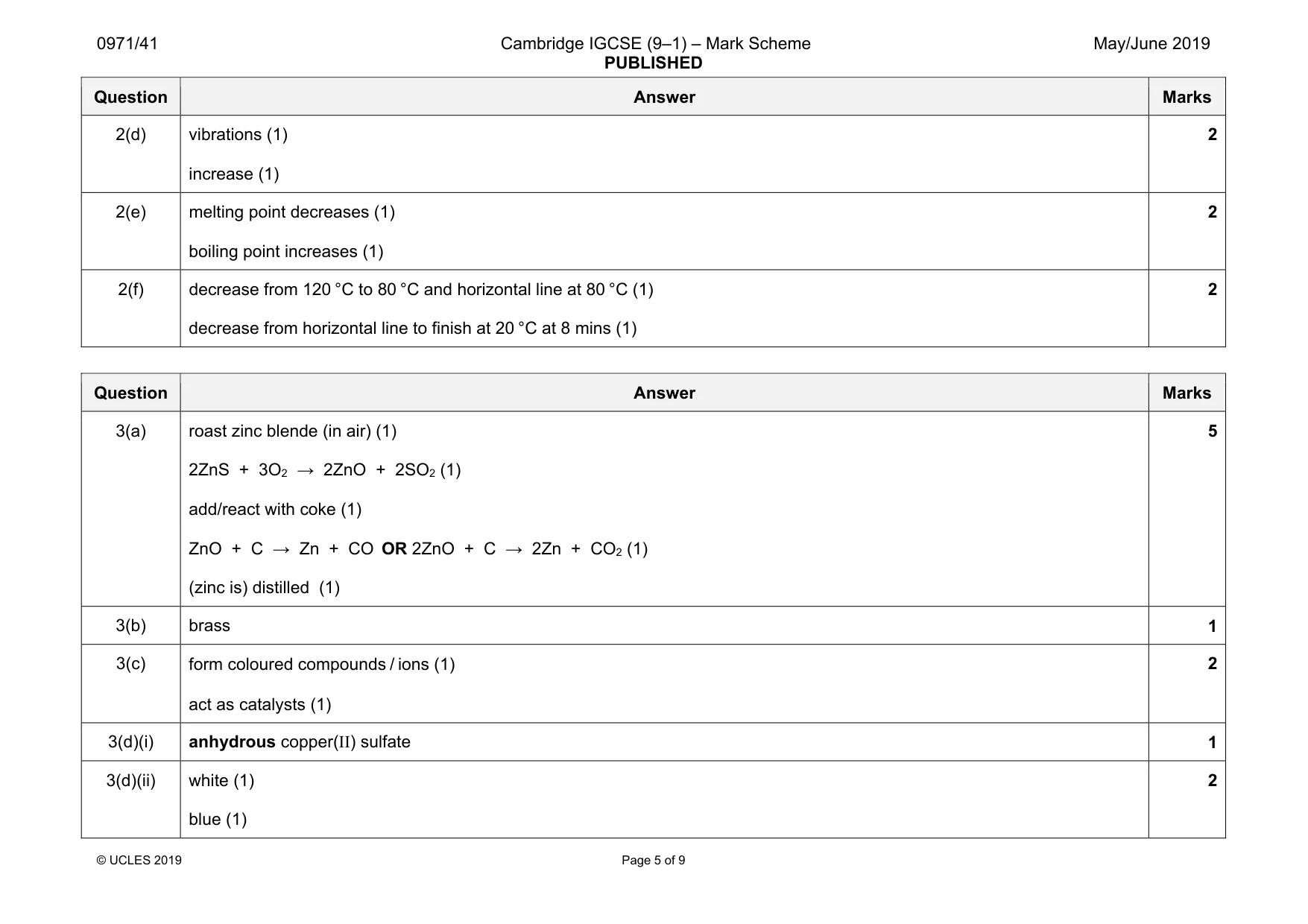
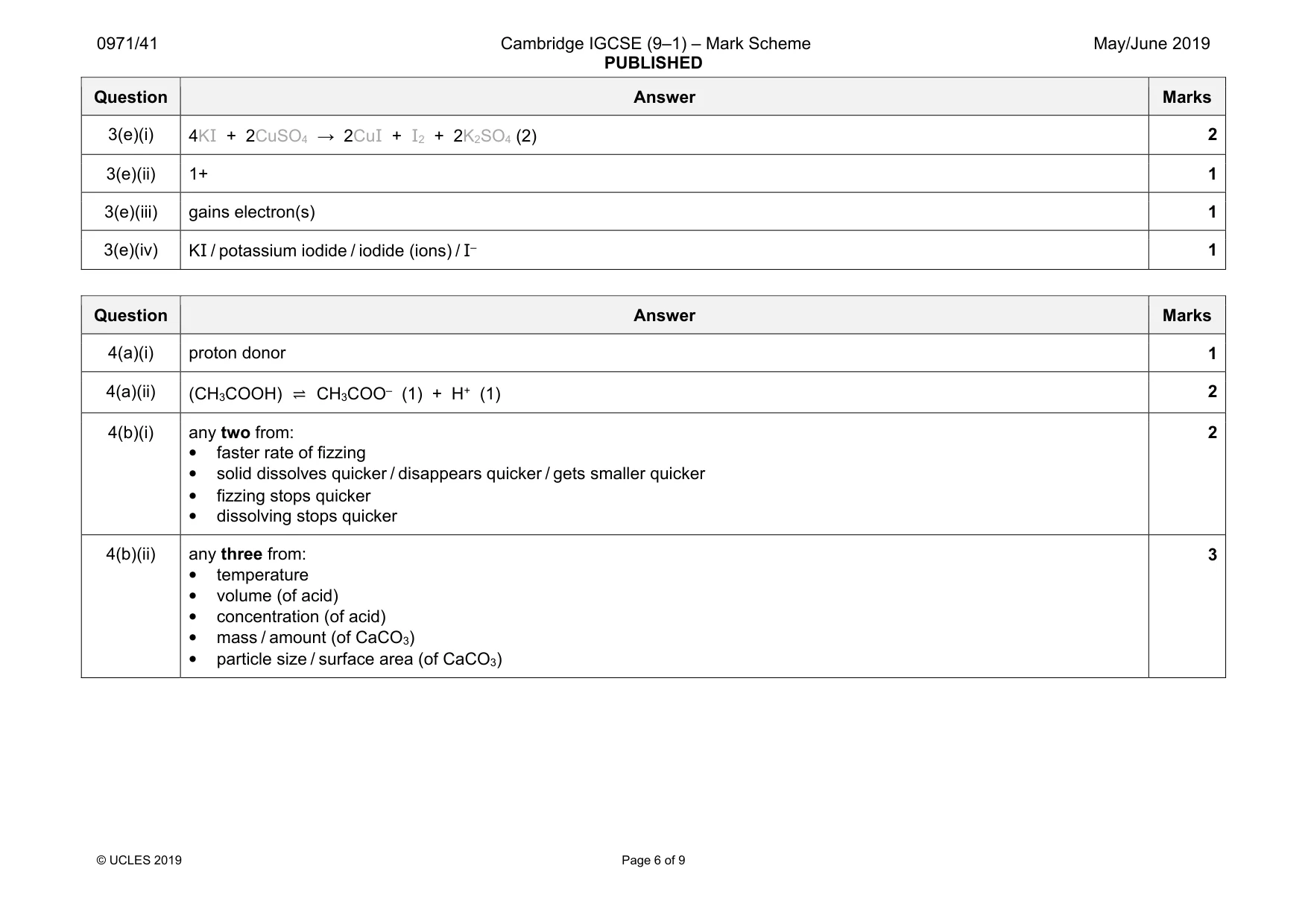
Mark scheme: 3(a) roast zinc blende (in air) (1) 2ZnS + 3O2 → 2ZnO + 2SO2 (1) add/react with coke (1) ZnO + C → Zn + CO OR 2ZnO + C → 2Zn + CO2 (1) (zinc is) distilled (1) 5 3(b) brass 1 3(c) form coloured compounds / ions (1) act as catalysts (1) 2 3(d)(i) anhydrous copper(II) sulfate 1 3(d)(ii) white (1) blue (1) 2 Question Answer Marks 3(e)(i) 4KI + 2CuSO4 → 2CuI + I2 + 2K2SO4 (2) 2 3(e)(ii) 1+ 1 3(e)(iii) gains electron(s) 1 3(e)(iv) KI / potassium iodide / iodide (ions) / I– 1
Q4 · Ethanoic acid is a weak acid and hydrochloric acid is a strong acid
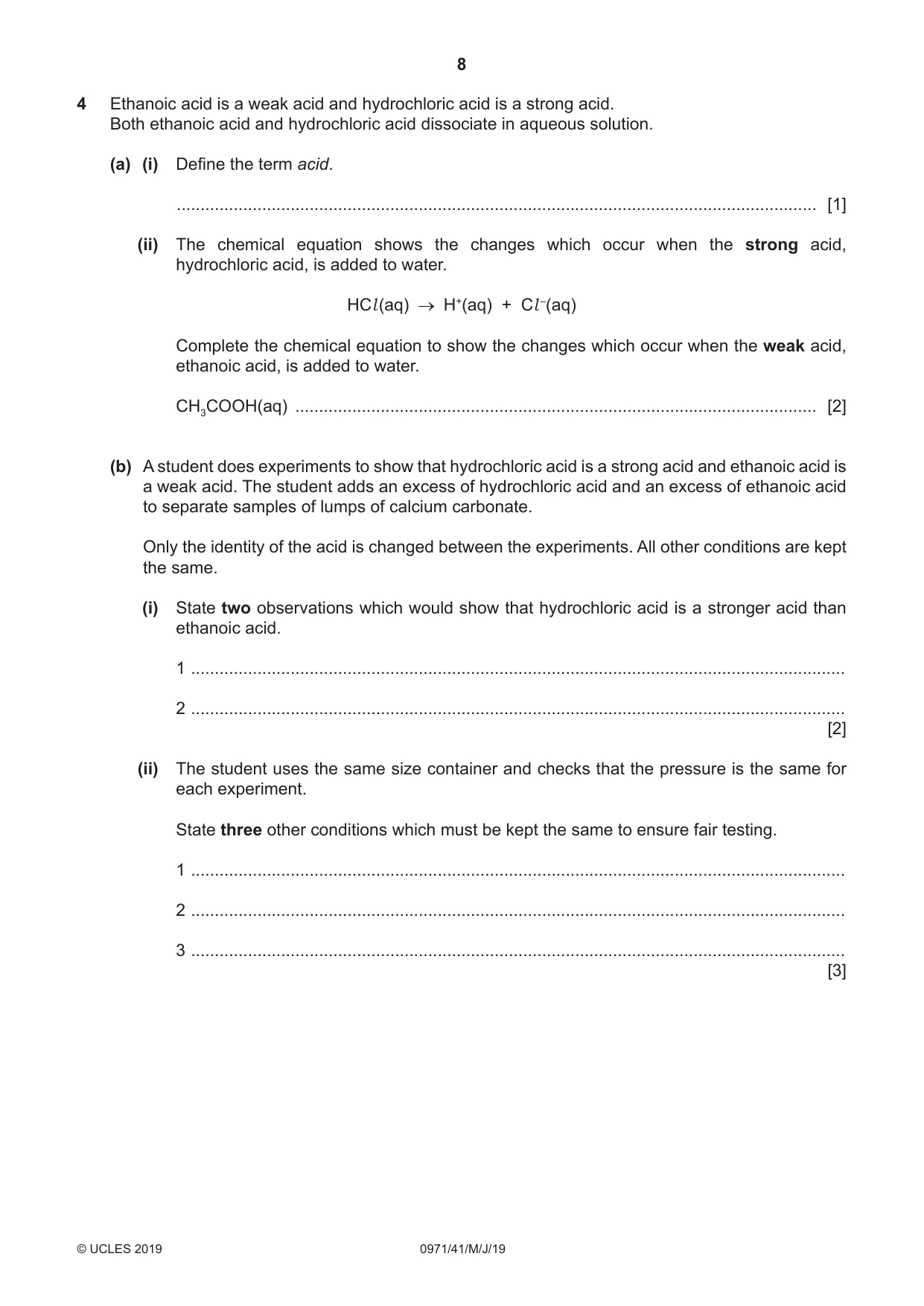
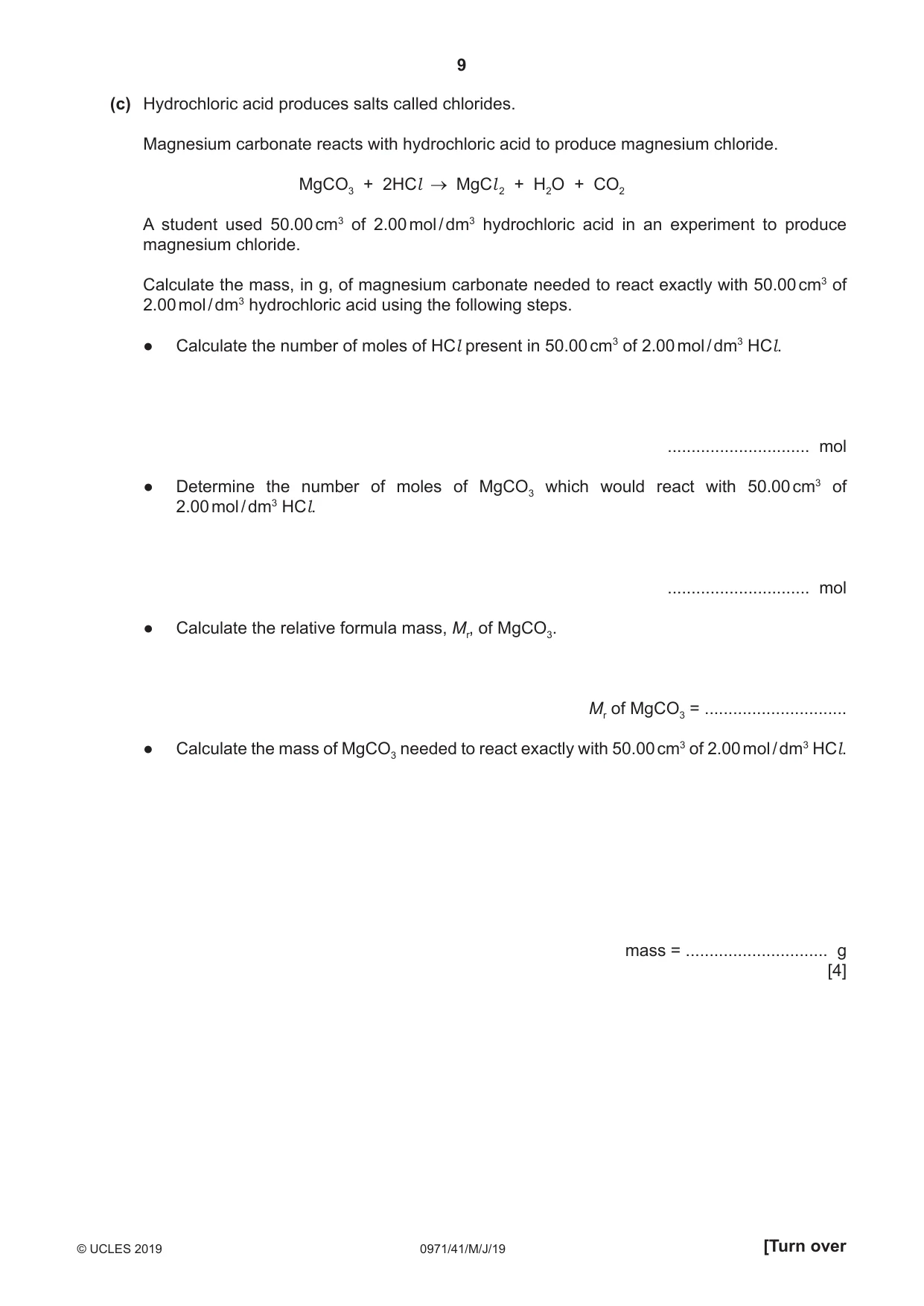
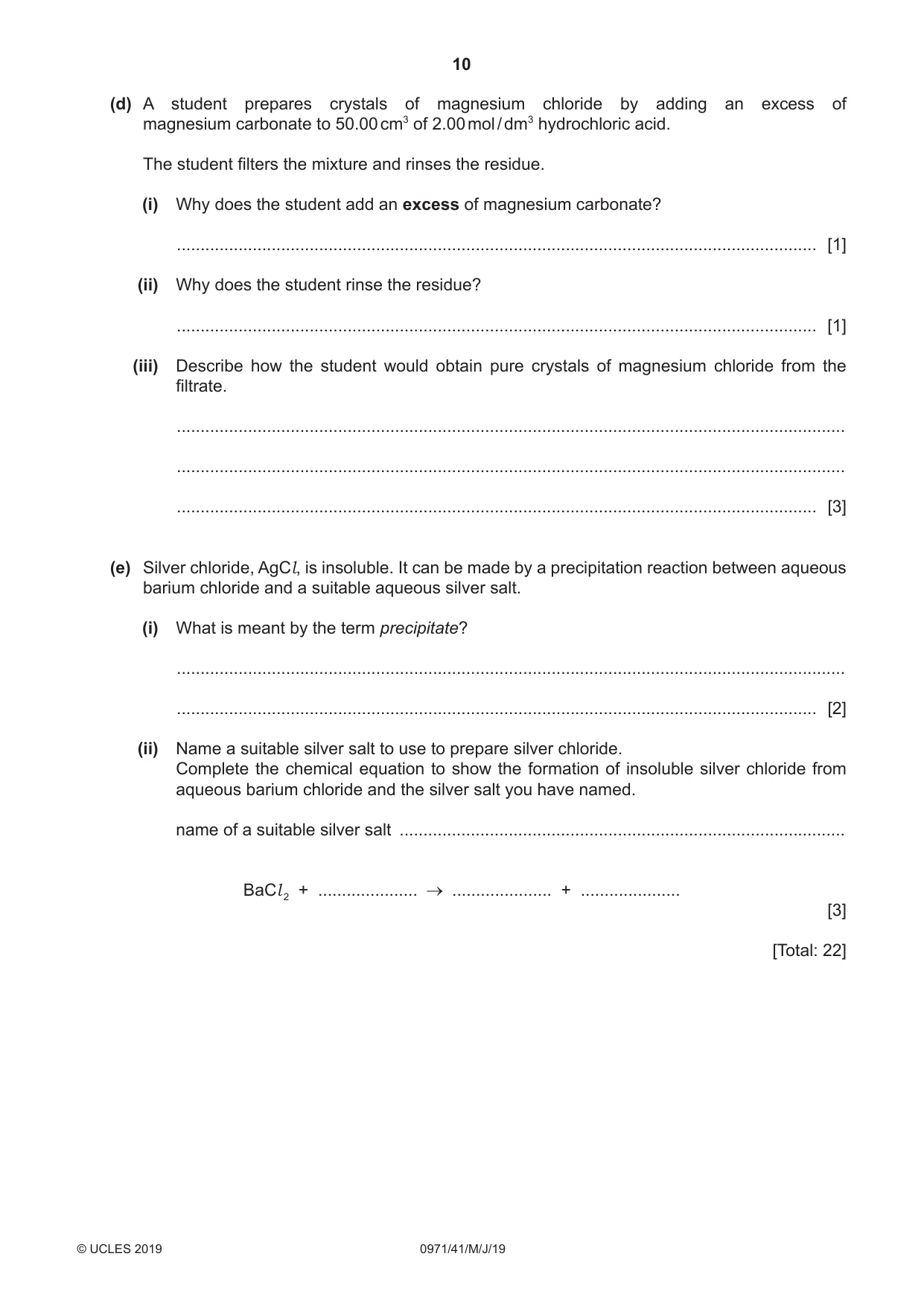
4 Ethanoic acid is a weak acid and hydrochloric acid is a strong acid. Both ethanoic acid and hydrochloric acid dissociate in aqueous solution. (a) (i) Define the term acid. ....................................................................................................................................... [1] (ii) The chemical equation shows the changes which occur when the strong acid, hydrochloric acid, is added to water. HCl (aq) H+(aq) + Cl –(aq) Complete the chemical equation to show the changes which occur when the weak acid, ethanoic acid, is added to water. CH3COOH(aq) ............................................................................................................... [2] (b) A student does experiments to show that hydrochloric acid is a strong acid and ethanoic acid is a weak acid. The student adds an excess of hydrochloric acid and an excess of ethanoic acid to separate samples of lumps of calcium carbonate. Only the identity of the acid is changed between the experiments. All other conditions are kept the same. (i) State two observations which would show that hydrochloric acid is a stronger acid than ethanoic acid. 1 .......................................................................................................................................... 2 .......................................................................................................................................... [2] (ii) The student uses the same size container and checks that the pressure is the same for each experiment. State three other conditions which must be kept the same to ensure fair testing. 1 .......................................................................................................................................... 2 .......................................................................................................................................... 3 .......................................................................................................................................... [3] (c) Hydrochloric acid produces salts called chlorides. Magnesium carbonate reacts with hydrochloric acid to produce magnesium chloride. MgCO3 + 2HCl MgCl 2 + H2O + CO2 A student used 50.00 cm3 of 2.00 mol / dm3 hydrochloric acid in an experiment to produce magnesium chloride. Calculate the mass, in g, of magnesium carbonate needed to react exactly with 50.00 cm3 of 2.00 mol / dm3 hydrochloric acid using the following steps. ●● Calculate the number of moles of HCl present in 50.00 cm3 of 2.00 mol / dm3 HCl. .............................. mol ●● Determine the number of moles of MgCO3 which would react with 50.00 cm3 of 2.00 mol / dm3 HCl. .............................. mol ●● Calculate the relative formula mass, Mr, of MgCO3. Mr of MgCO3 = .............................. ●● Calculate the mass of MgCO3 needed to react exactly with 50.00 cm3 of 2.00 mol / dm3 HCl. mass = .............................. g [4] (d) A student prepares crystals of magnesium chloride by adding an excess of magnesium carbonate to 50.00 cm3 of 2.00 mol / dm3 hydrochloric acid. The student filters the mixture and rinses the residue. (i) Why does the student add an excess of magnesium carbonate? ....................................................................................................................................... [1] (ii) Why does the student rinse the residue? ....................................................................................................................................... [1] (iii) Describe how the student would obtain pure crystals of magnesium chloride from the filtrate. ............................................................................................................................................. ............................................................................................................................................. ....................................................................................................................................... [3] (e) Silver chloride, AgCl, is insoluble. It can be made by a precipitation reaction between aqueous barium chloride and a suitable aqueous silver salt. (i) What is meant by the term precipitate? ............................................................................................................................................. ....................................................................................................................................... [2] (ii) Name a suitable silver salt to use to prepare silver chloride. Complete the chemical equation to show the formation of insoluble silver chloride from aqueous barium chloride and the silver salt you have named. name of a suitable silver salt ............................................................................................... BaCl 2 + ..................... ..................... + ..................... [3] [Total: 22]
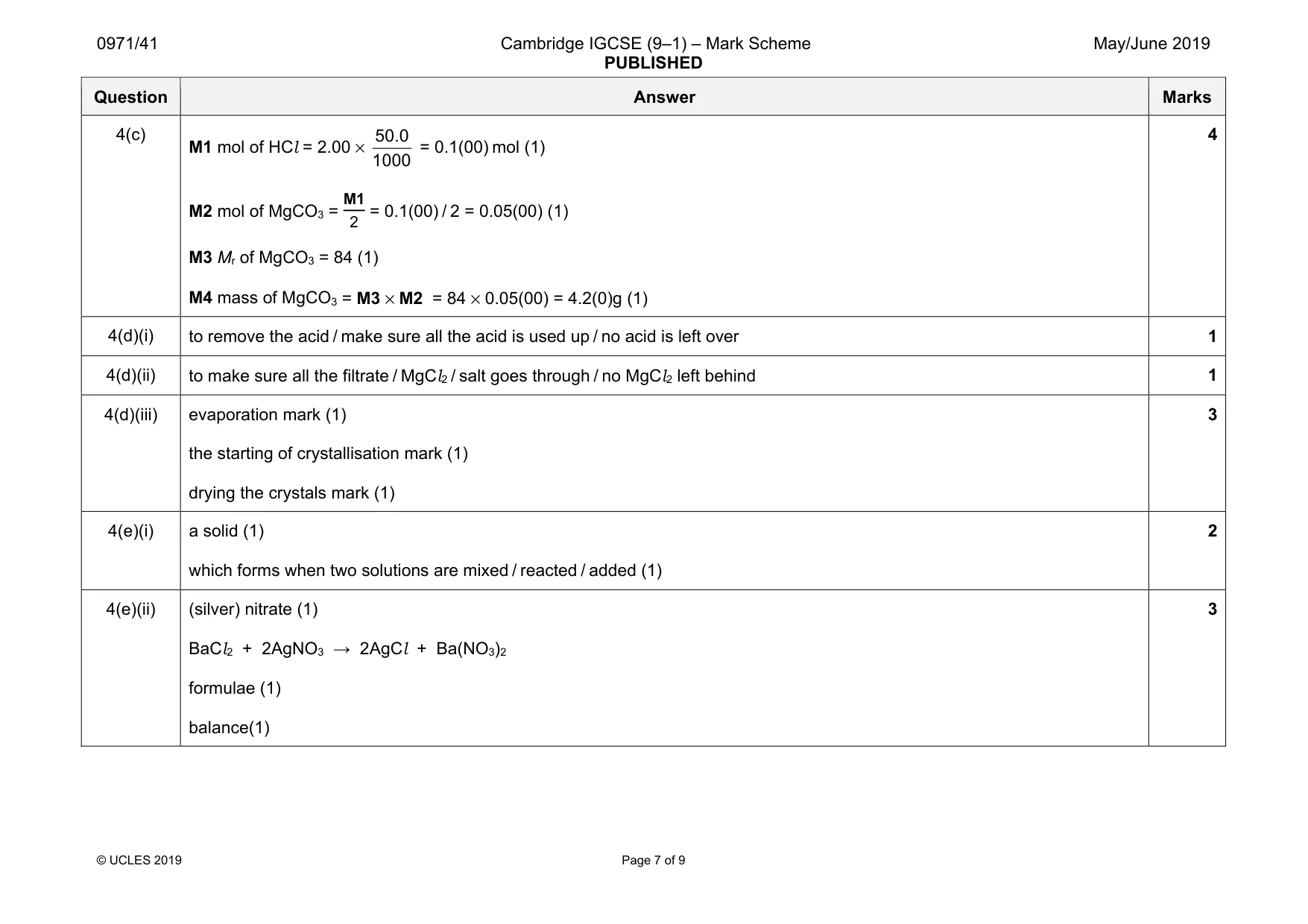
Mark scheme: 4(a)(i) proton donor 1 4(a)(ii) (CH3COOH) ⇌ CH3COO– (1) + H+ (1) 2 4(b)(i) any two from: • faster rate of fizzing • solid dissolves quicker / disappears quicker / gets smaller quicker • fizzing stops quicker • dissolving stops quicker 2 4(b)(ii) any three from: • temperature • volume (of acid) • concentration (of acid) • mass / amount (of CaCO3) • particle size / surface area (of CaCO3) 3 Question Answer Marks 4(c) M1 mol of HCl = 2.00 × 50.0 1000 = 0.1(00) mol (1) M2 mol of MgCO3 = M1 2 = 0.1(00) / 2 = 0.05(00) (1) M3 Mr of MgCO3 = 84 (1) M4 mass of MgCO3 = M3 × M2 = 84 × 0.05(00) = 4.2(0)g (1) 4 4(d)(i) to remove the acid / make sure all the acid is used up / no acid is left over 1 4(d)(ii) to make sure all the filtrate / MgCl2 / salt goes through / no MgCl2 left behind 1 4(d)(iii) evaporation mark (1) the starting of crystallisation mark (1) drying the crystals mark (1) 3 4(e)(i) a solid (1) which forms when two solutions are mixed / reacted / added (1) 2 4(e)(ii) (silver) nitrate (1) BaCl2 + 2AgNO3 → 2AgCl + Ba(NO3)2 formulae (1) balance(1) 3
More questions on The characteristic properties of acids and bases
Q5 · The structures of five alkenes, A, B, C, D and E, are shown
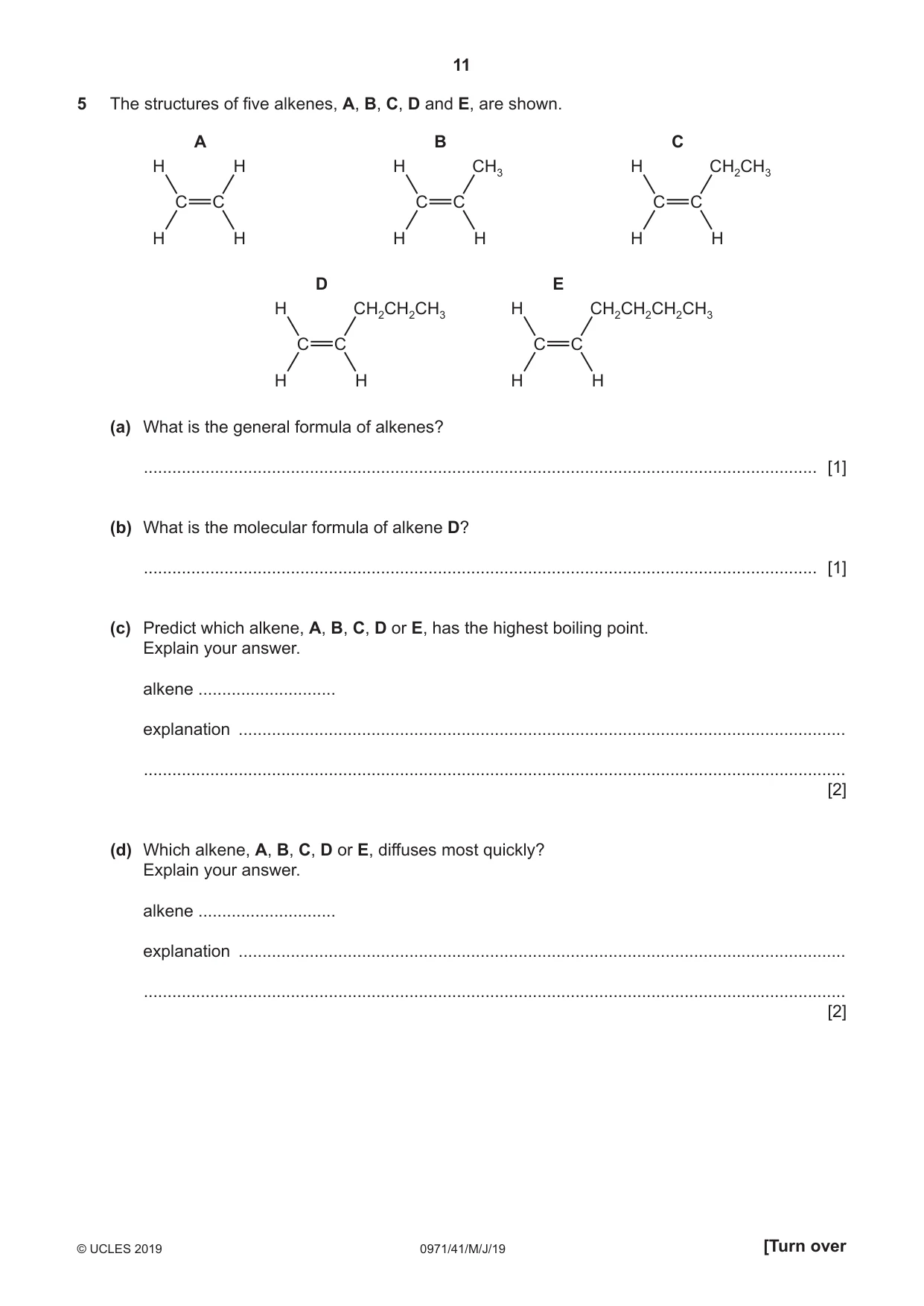
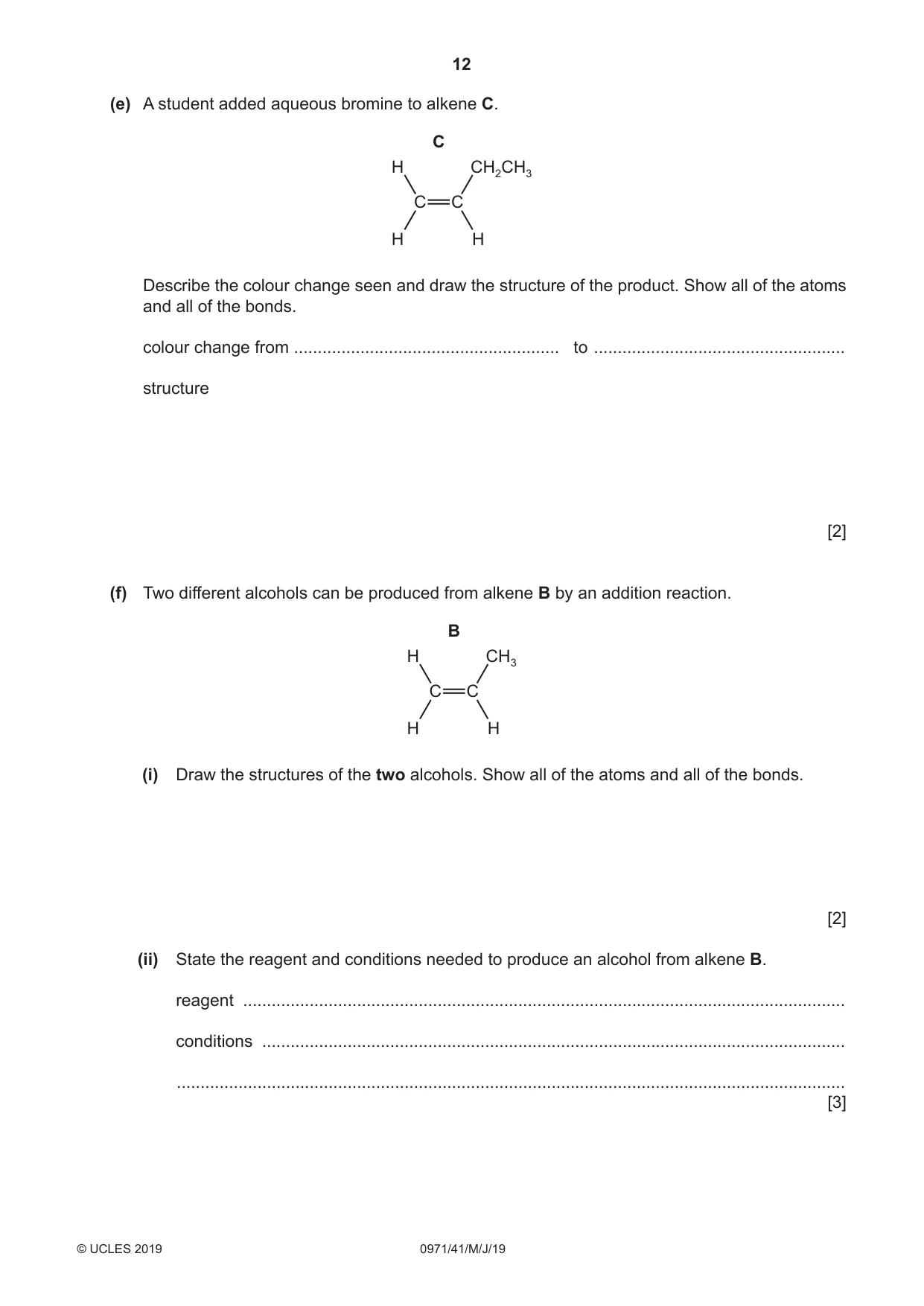
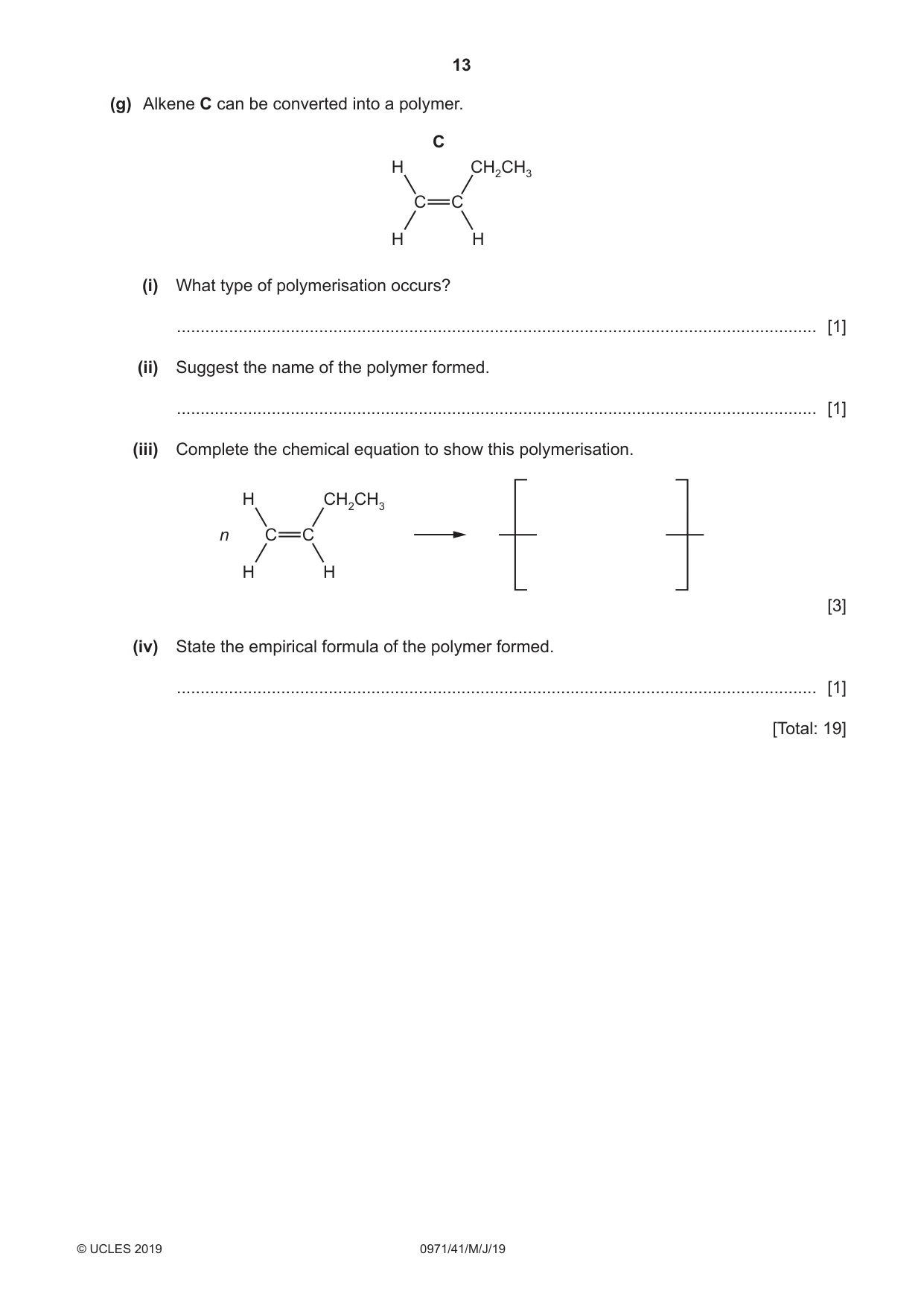
5 The structures of five alkenes, A, B, C, D and E, are shown. A B C H H H CH3 H CH2CH3 C C C C C C H H H H H H D E H CH2CH2CH3 H CH2CH2CH2CH3 C C C C H H H H (a) What is the general formula of alkenes? .............................................................................................................................................. [1] (b) What is the molecular formula of alkene D? .............................................................................................................................................. [1] (c) Predict which alkene, A, B, C, D or E, has the highest boiling point. Explain your answer. alkene ............................. explanation ................................................................................................................................. .................................................................................................................................................... [2] (d) Which alkene, A, B, C, D or E, diffuses most quickly? Explain your answer. alkene ............................. explanation ................................................................................................................................. .................................................................................................................................................... [2] (e) A student added aqueous bromine to alkene C. C H CH2CH3 C C H H Describe the colour change seen and draw the structure of the product. Show all of the atoms and all of the bonds. colour change from ........................................................ to ..................................................... structure [2] (f) Two different alcohols can be produced from alkene B by an addition reaction. B H CH3 C C H H (i) Draw the structures of the two alcohols. Show all of the atoms and all of the bonds. [2] (ii) State the reagent and conditions needed to produce an alcohol from alkene B. reagent ................................................................................................................................ conditions ............................................................................................................................ ............................................................................................................................................. [3] (g) Alkene C can be converted into a polymer. C H CH2CH3 C C H H (i) What type of polymerisation occurs? ....................................................................................................................................... [1] (ii) Suggest the name of the polymer formed. ....................................................................................................................................... [1] (iii) Complete the chemical equation to show this polymerisation. H CH2CH3 n C C H H [3] (iv) State the empirical formula of the polymer formed. ....................................................................................................................................... [1] [Total: 19]
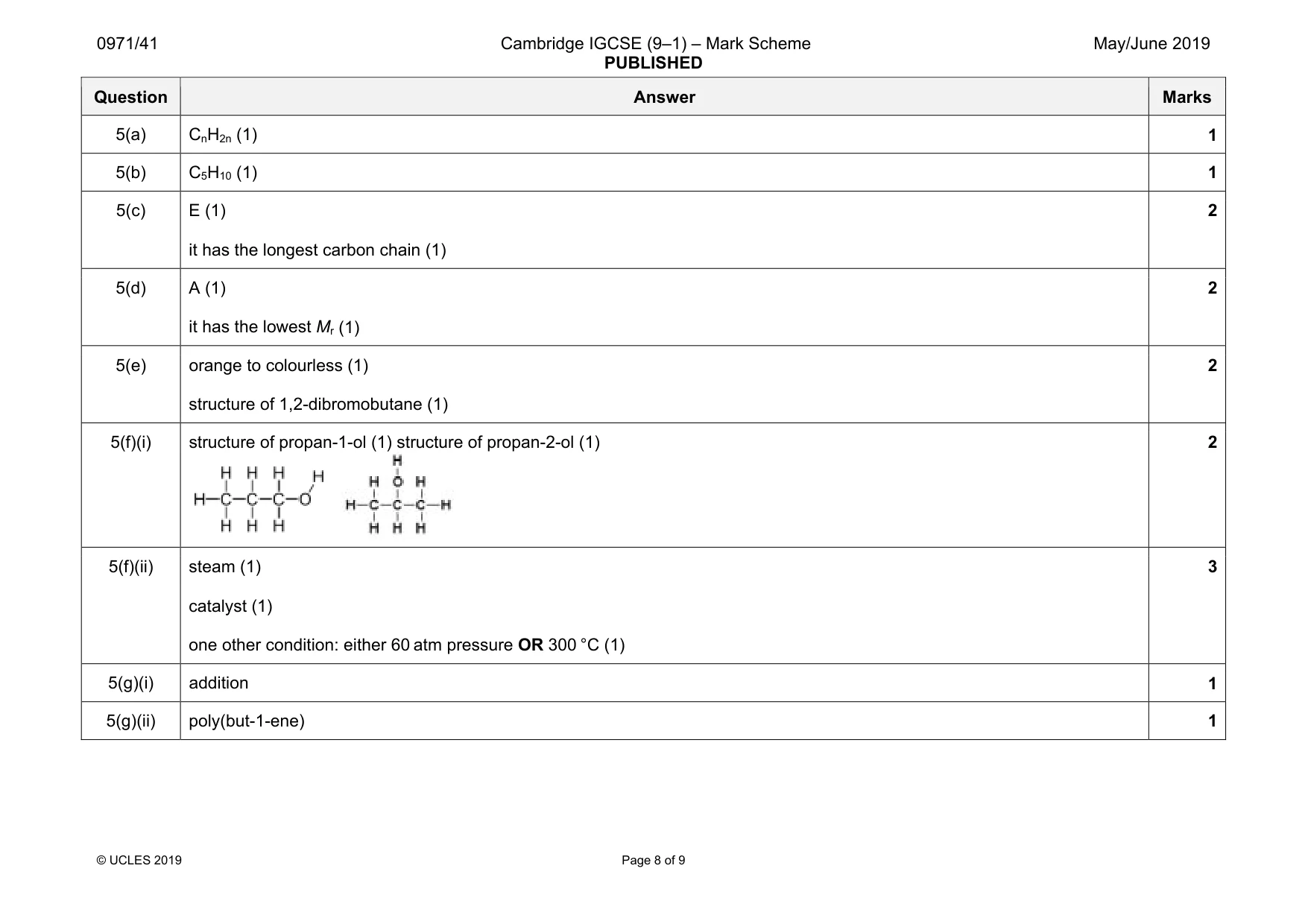
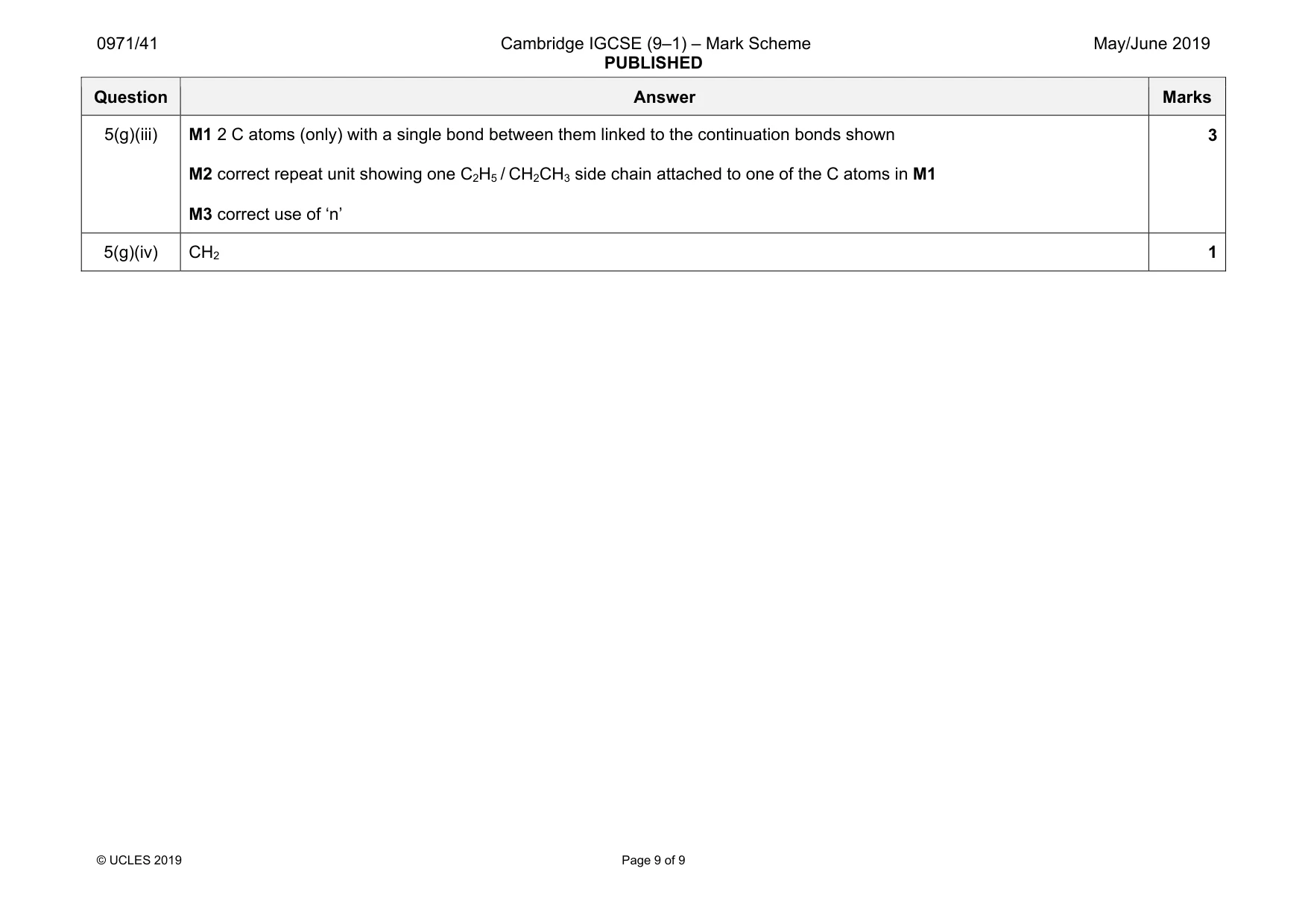
Mark scheme: 5(a) CnH2n (1) 1 5(b) C5H10 (1) 1 5(c) E (1) it has the longest carbon chain (1) 2 5(d) A (1) it has the lowest Mr (1) 2 5(e) orange to colourless (1) structure of 1,2-dibromobutane (1) 2 5(f)(i) structure of propan-1-ol (1) structure of propan-2-ol (1) 2 5(f)(ii) steam (1) catalyst (1) one other condition: either 60 atm pressure OR 300 °C (1) 3 5(g)(i) addition 1 5(g)(ii) poly(but-1-ene) 1 Question Answer Marks 5(g)(iii) M1 2 C atoms (only) with a single bond between them linked to the continuation bonds shown M2 correct repeat unit showing one C2H5 / CH2CH3 side chain attached to one of the C atoms in M1 M3 correct use of ‘n’ 3 5(g)(iv) CH2 1
What was in this paper
The subtopics covered by these 5 questions, and how many questions each got. Open one in a new tab to see every Cambridge question on it.
What you needed in this session
Cambridge’s own grade thresholds for 2019 May/June, Paper 4 · Variant 1. A higher threshold means an easier paper — the bar moves with how the cohort did.