Cambridge IGCSE Chemistry (9-1) 0971 — 2023 Oct/Nov Paper 3 · Variant 2
0971/32/O/N/23 · 8 questions · 80 marks · 75 min
The question paper and its mark scheme, free to read here and free to download. This is Cambridge’s own paper, exactly as it was sat.
Question paper20 pages



Mark scheme11 pages
Answers below. Sit the paper first if you are practising.
Questions as text
Q1 · A list of compounds is shown
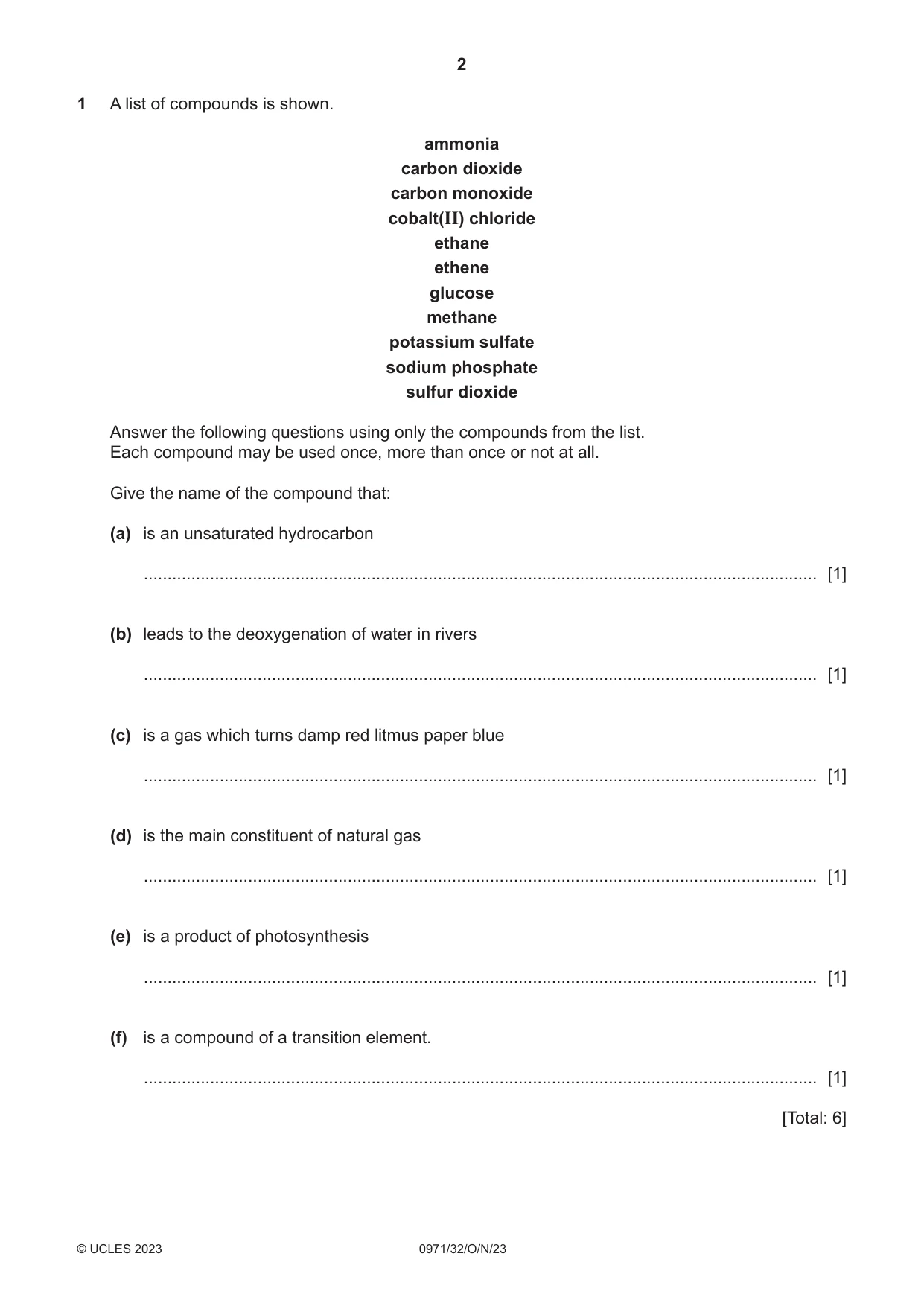
1 A list of compounds is shown. ammonia carbon dioxide carbon monoxide cobalt(II) chloride ethane ethene glucose methane potassium sulfate sodium phosphate sulfur dioxide Answer the following questions using only the compounds from the list. Each compound may be used once, more than once or not at all. Give the name of the compound that: (a) is an unsaturated hydrocarbon .............................................................................................................................................. [1] (b) leads to the deoxygenation of water in rivers .............................................................................................................................................. [1] (c) is a gas which turns damp red litmus paper blue .............................................................................................................................................. [1] (d) is the main constituent of natural gas .............................................................................................................................................. [1] (e) is a product of photosynthesis .............................................................................................................................................. [1] (f) is a compound of a transition element. .............................................................................................................................................. [1] [Total: 6]
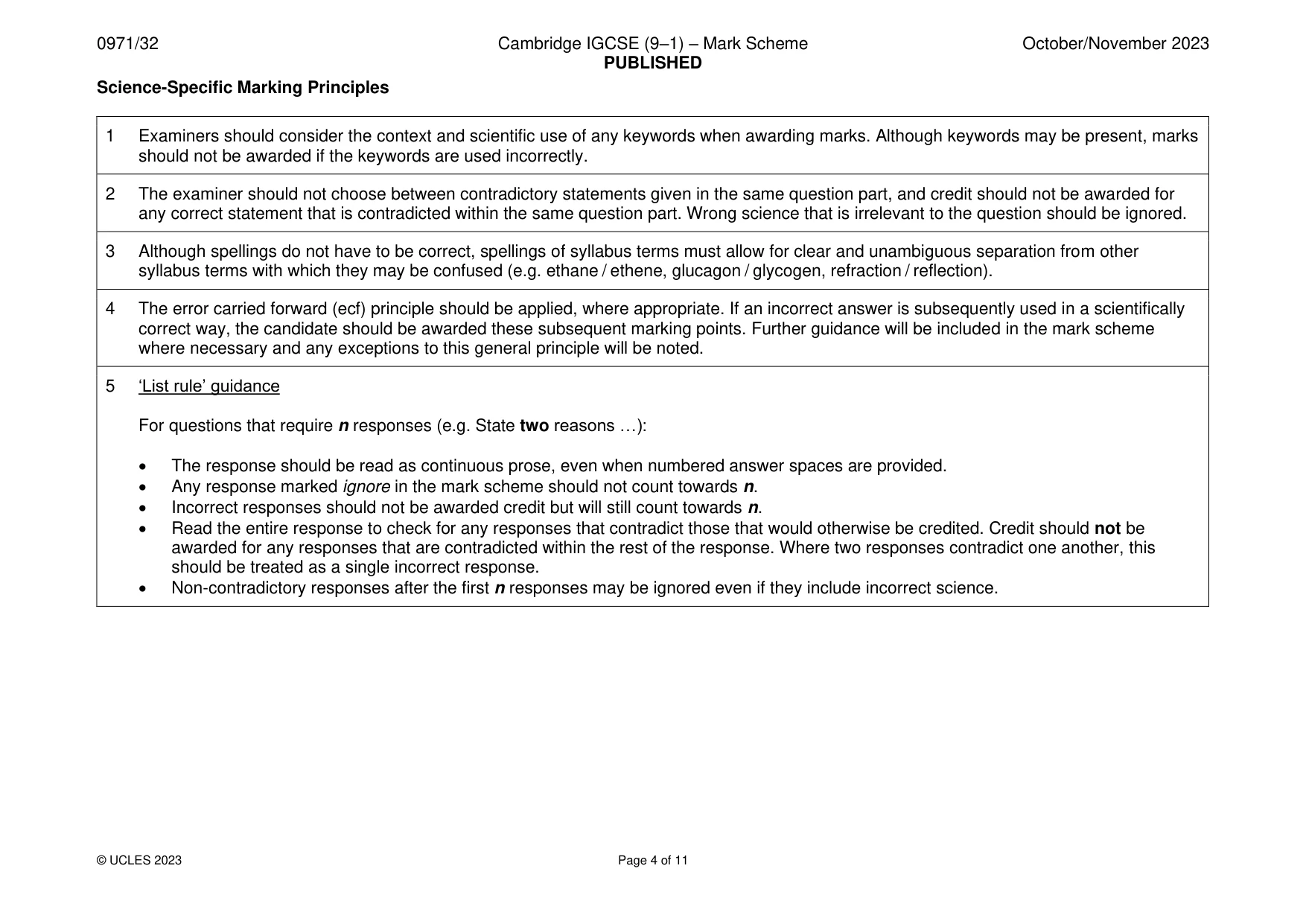
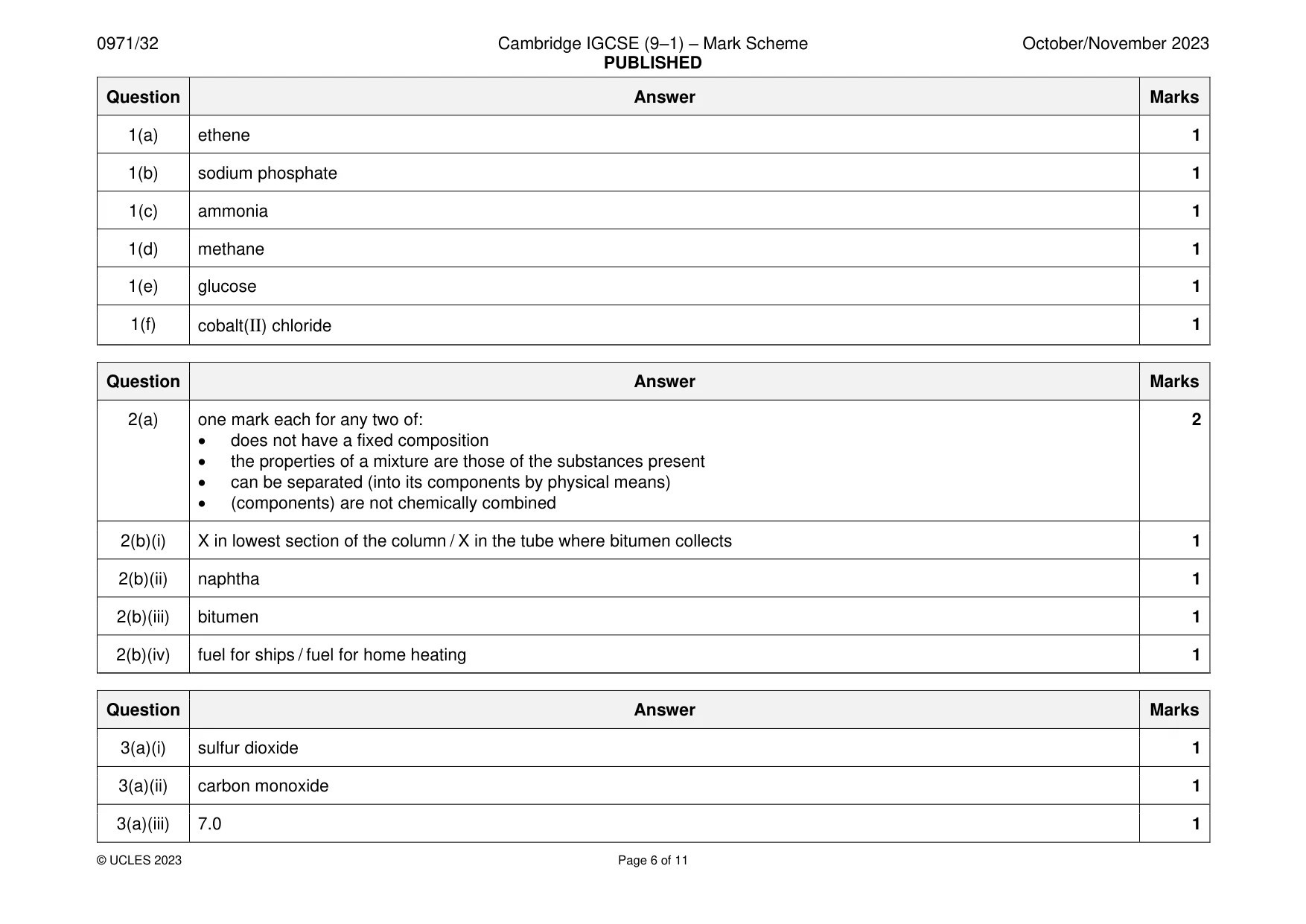
Mark scheme: Question Answer Marks 1(a) ethene 1 1(b) sodium phosphate 1 1(c) ammonia 1 1(d) methane 1 1(e) glucose 1 1(f) cobalt(II) chloride 1
Q2 · Petroleum is a mixture of hydrocarbons
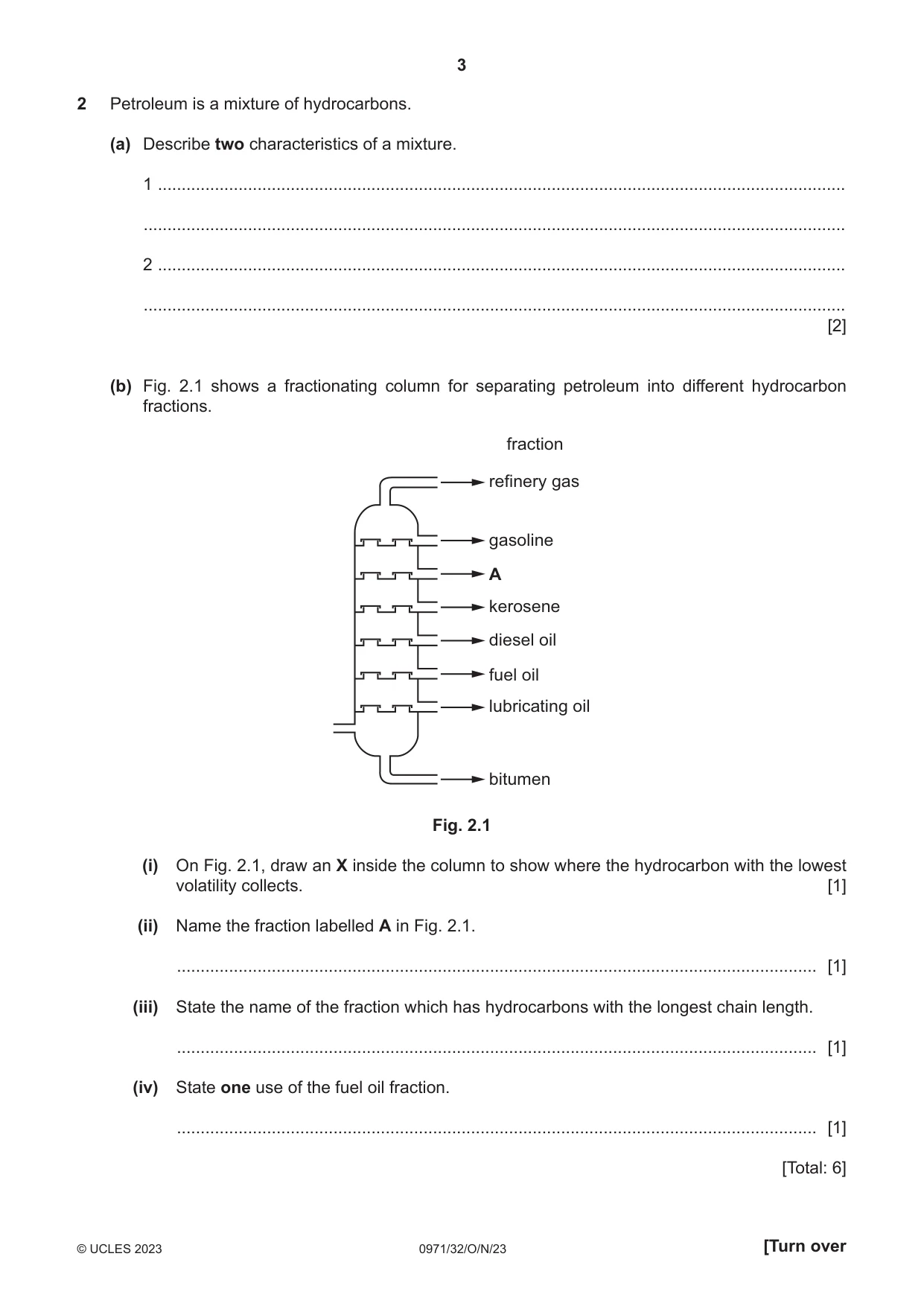
2 Petroleum is a mixture of hydrocarbons. (a) Describe two characteristics of a mixture. 1 ................................................................................................................................................. .................................................................................................................................................... 2 ................................................................................................................................................. .................................................................................................................................................... [2] (b) Fig. 2.1 shows a fractionating column for separating petroleum into different hydrocarbon fractions. fraction refinery gas gasoline A kerosene diesel oil fuel oil lubricating oil bitumen Fig. 2.1 (i) On Fig. 2.1, draw an X inside the column to show where the hydrocarbon with the lowest volatility collects. [1] (ii) Name the fraction labelled A in Fig. 2.1. ....................................................................................................................................... [1] (iii) State the name of the fraction which has hydrocarbons with the longest chain length. ....................................................................................................................................... [1] (iv) State one use of the fuel oil fraction. ....................................................................................................................................... [1] [Total: 6]
Mark scheme: 2(a) one mark each for any two of: 2 • does not have a fixed composition • the properties of a mixture are those of the substances present • can be separated (into its components by physical means) • (components) are not chemically combined 2(b)(i) X in lowest section of the column / X in the tube where bitumen collects 1 2(b)(ii) naphtha 1 2(b)(iii) bitumen 1 2(b)(iv) fuel for ships / fuel for home heating 1
Q3 · The average concentrations, in ng / 1000 cm3, of air pollutants in four different years
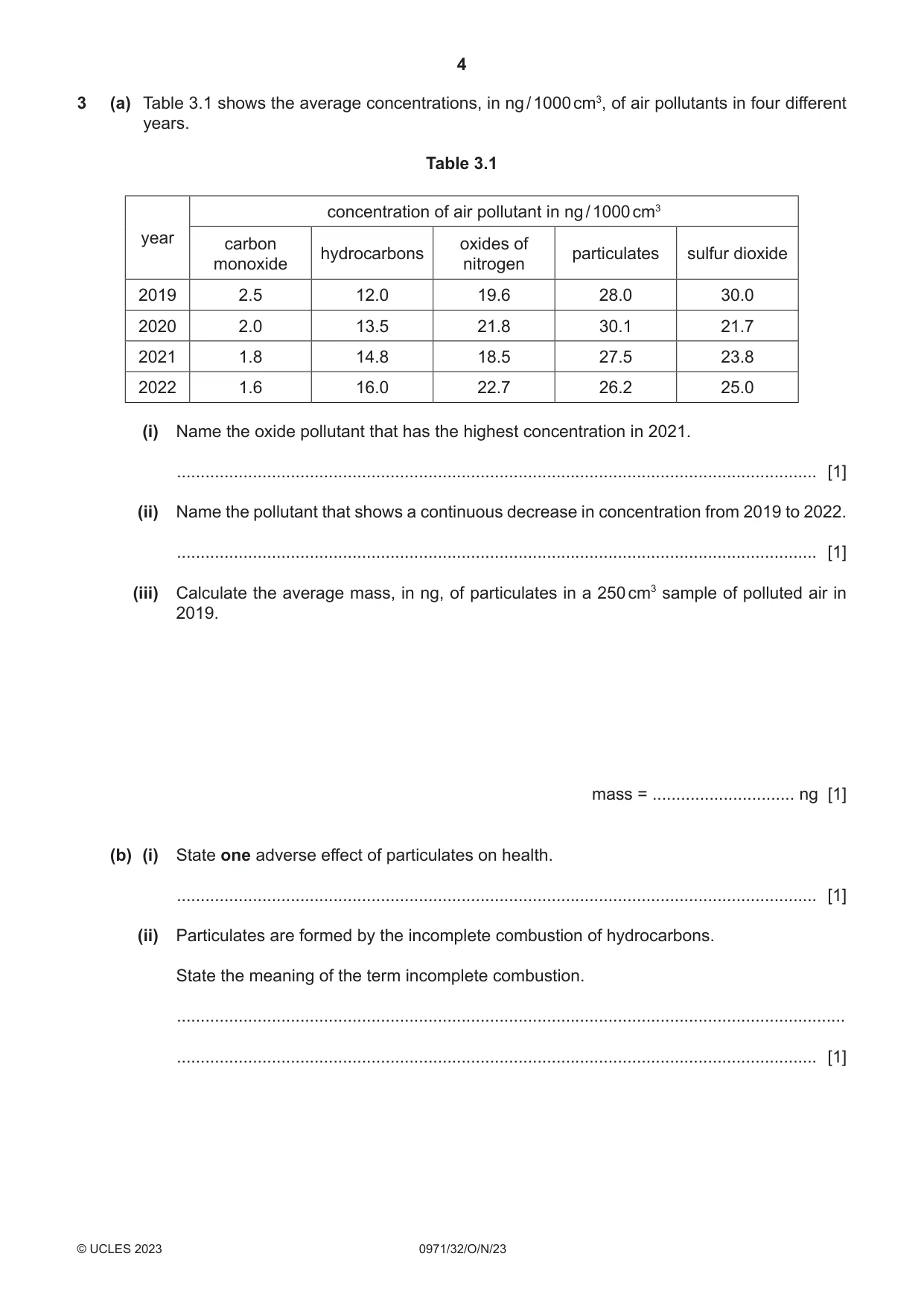
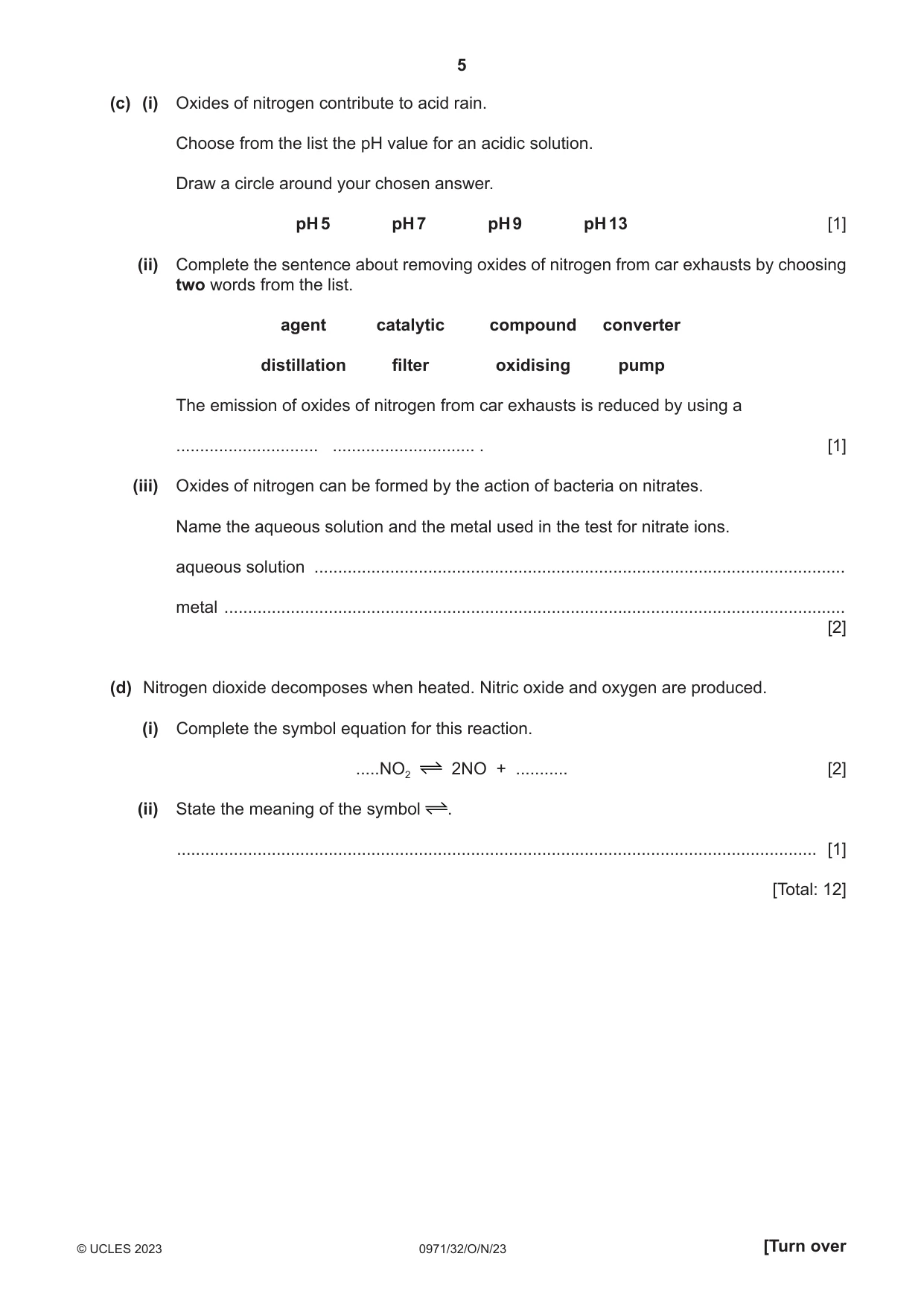
3 (a) Table 3.1 shows the average concentrations, in ng / 1000 cm3, of air pollutants in four different years. Table 3.1 concentration of air pollutant in ng / 1000 cm3 year carbon oxides of hydrocarbons particulates sulfur dioxide monoxide nitrogen 2019 2.5 12.0 19.6 28.0 30.0 2020 2.0 13.5 21.8 30.1 21.7 2021 1.8 14.8 18.5 27.5 23.8 2022 1.6 16.0 22.7 26.2 25.0 (i) Name the oxide pollutant that has the highest concentration in 2021. ....................................................................................................................................... [1] (ii) Name the pollutant that shows a continuous decrease in concentration from 2019 to 2022. ....................................................................................................................................... [1] (iii) Calculate the average mass, in ng, of particulates in a 250 cm3 sample of polluted air in 2019. mass = .............................. ng [1] (b) (i) State one adverse effect of particulates on health. ....................................................................................................................................... [1] (ii) Particulates are formed by the incomplete combustion of hydrocarbons. State the meaning of the term incomplete combustion. ............................................................................................................................................. ....................................................................................................................................... [1] (c) (i) Oxides of nitrogen contribute to acid rain. Choose from the list the pH value for an acidic solution. Draw a circle around your chosen answer. pH 5 pH 7 pH 9 pH 13 [1] (ii) Complete the sentence about removing oxides of nitrogen from car exhausts by choosing two words from the list. agent catalytic compound converter distillation filter oxidising pump The emission of oxides of nitrogen from car exhausts is reduced by using a .............................. .............................. . [1] (iii) Oxides of nitrogen can be formed by the action of bacteria on nitrates. Name the aqueous solution and the metal used in the test for nitrate ions. aqueous solution ................................................................................................................. metal ................................................................................................................................... [2] (d) Nitrogen dioxide decomposes when heated. Nitric oxide and oxygen are produced. (i) Complete the symbol equation for this reaction. .....NO2 2NO + ........... [2] (ii) State the meaning of the symbol . ....................................................................................................................................... [1] [Total: 12]
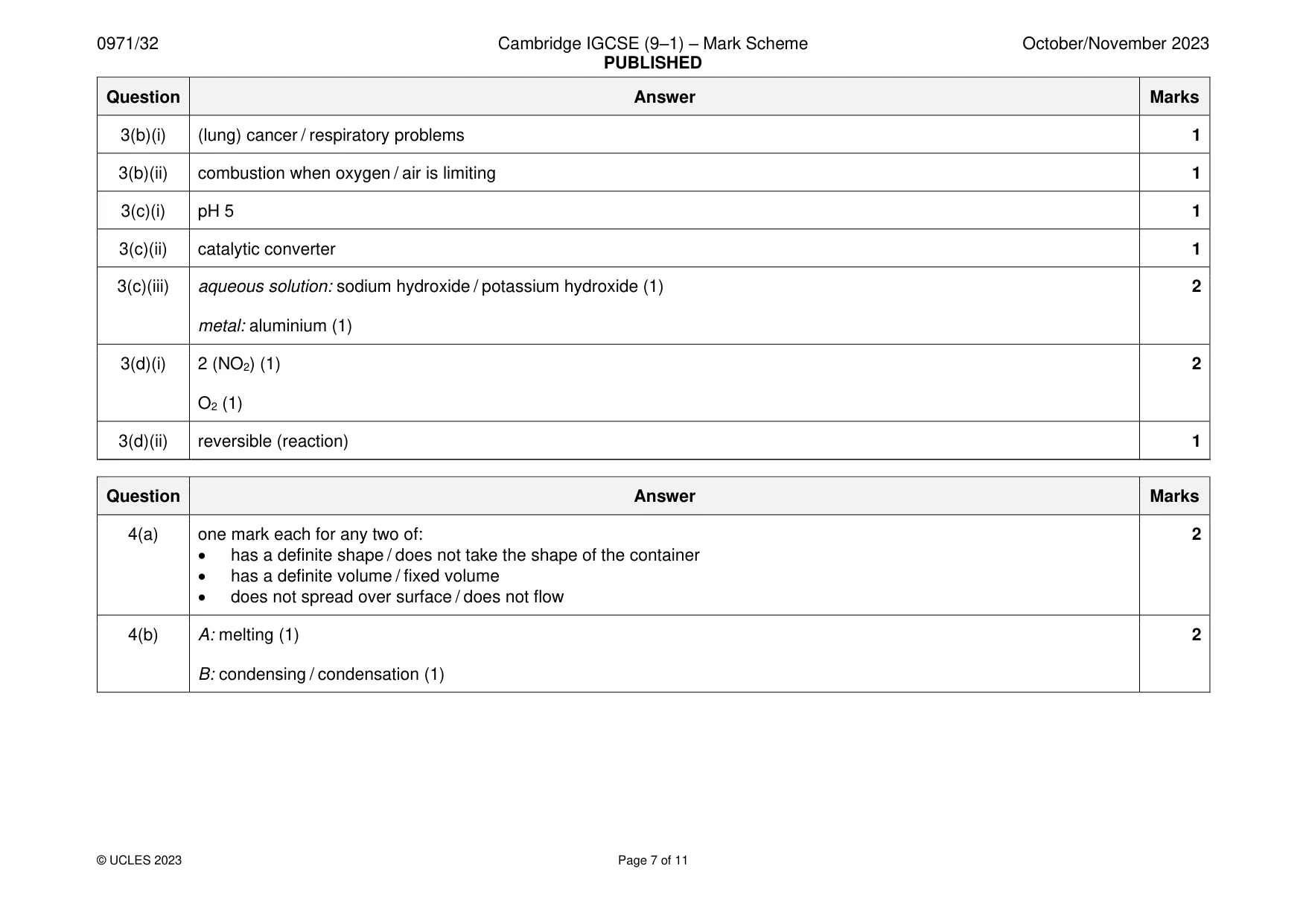
Mark scheme: 3(a)(i) sulfur dioxide 1 3(a)(ii) carbon monoxide 1 3(a)(iii) 7.0 1 3(b)(i) (lung) cancer / respiratory problems 1 3(b)(ii) combustion when oxygen / air is limiting 1 3(c)(i) pH 5 1 3(c)(ii) catalytic converter 1 3(c)(iii) aqueous solution: sodium hydroxide / potassium hydroxide (1) 2 metal: aluminium (1) 3(d)(i) 2 (NO2) (1) 2 O2 (1) 3(d)(ii) reversible (reaction) 1
Q4 · Tin is a solid at room temperature
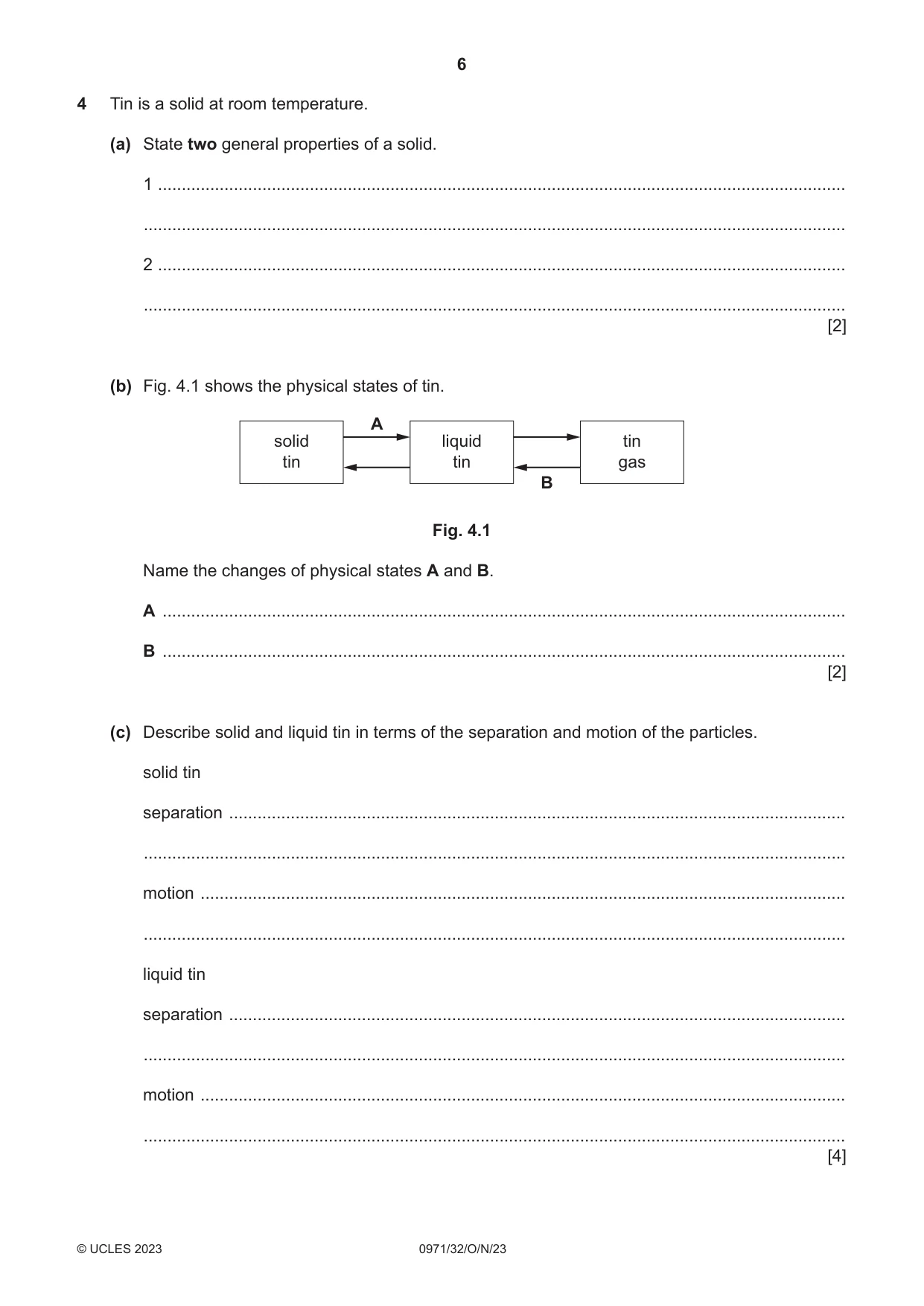
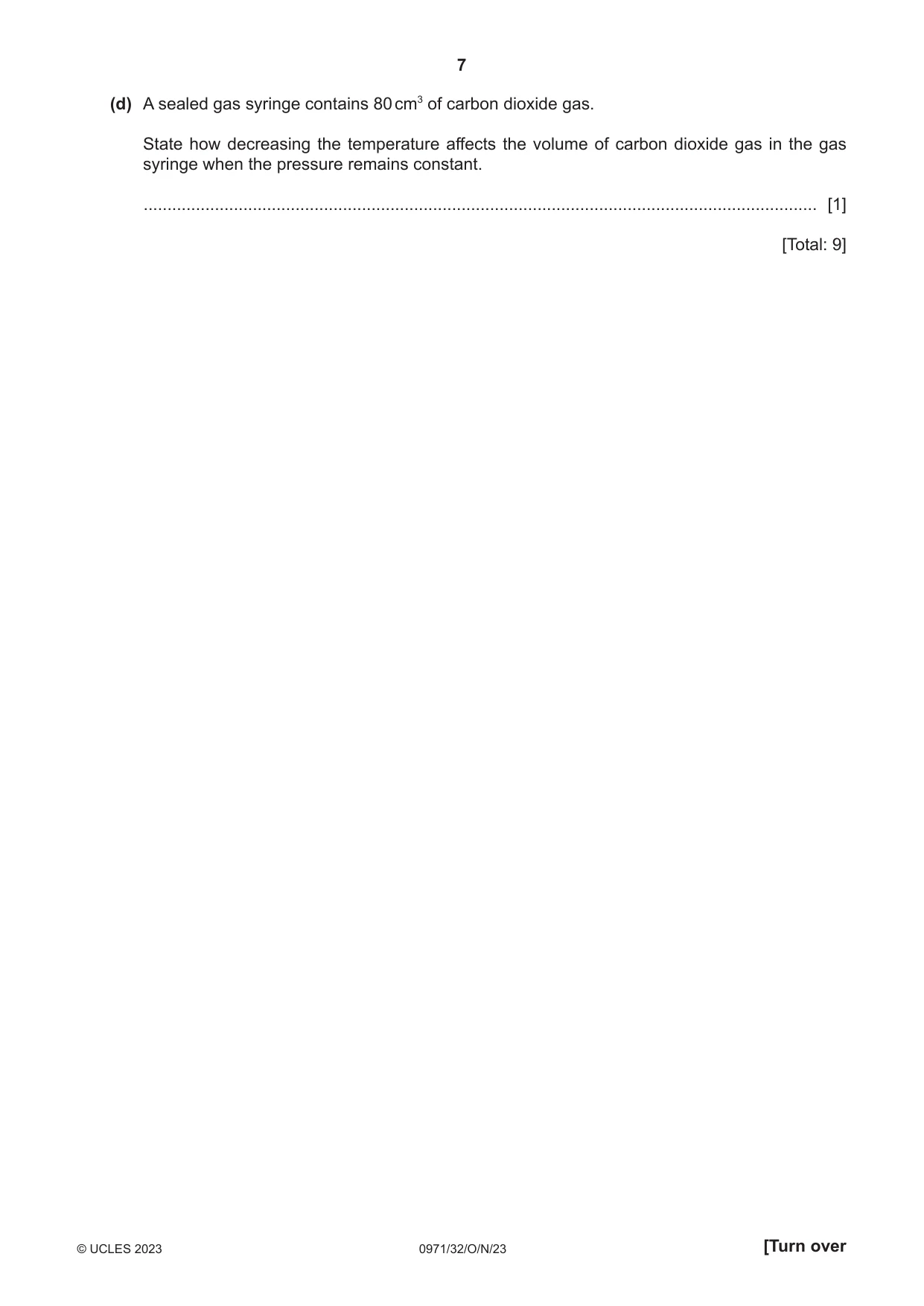
4 Tin is a solid at room temperature. (a) State two general properties of a solid. 1 ................................................................................................................................................. .................................................................................................................................................... 2 ................................................................................................................................................. .................................................................................................................................................... [2] (b) Fig. 4.1 shows the physical states of tin. A solid liquid tin tin tin gas B Fig. 4.1 Name the changes of physical states A and B. A ................................................................................................................................................. B ................................................................................................................................................. [2] (c) Describe solid and liquid tin in terms of the separation and motion of the particles. solid tin separation .................................................................................................................................. .................................................................................................................................................... motion ........................................................................................................................................ .................................................................................................................................................... liquid tin separation .................................................................................................................................. .................................................................................................................................................... motion ........................................................................................................................................ .................................................................................................................................................... [4] (d) A sealed gas syringe contains 80 cm3 of carbon dioxide gas. State how decreasing the temperature affects the volume of carbon dioxide gas in the gas syringe when the pressure remains constant. .............................................................................................................................................. [1] [Total: 9]
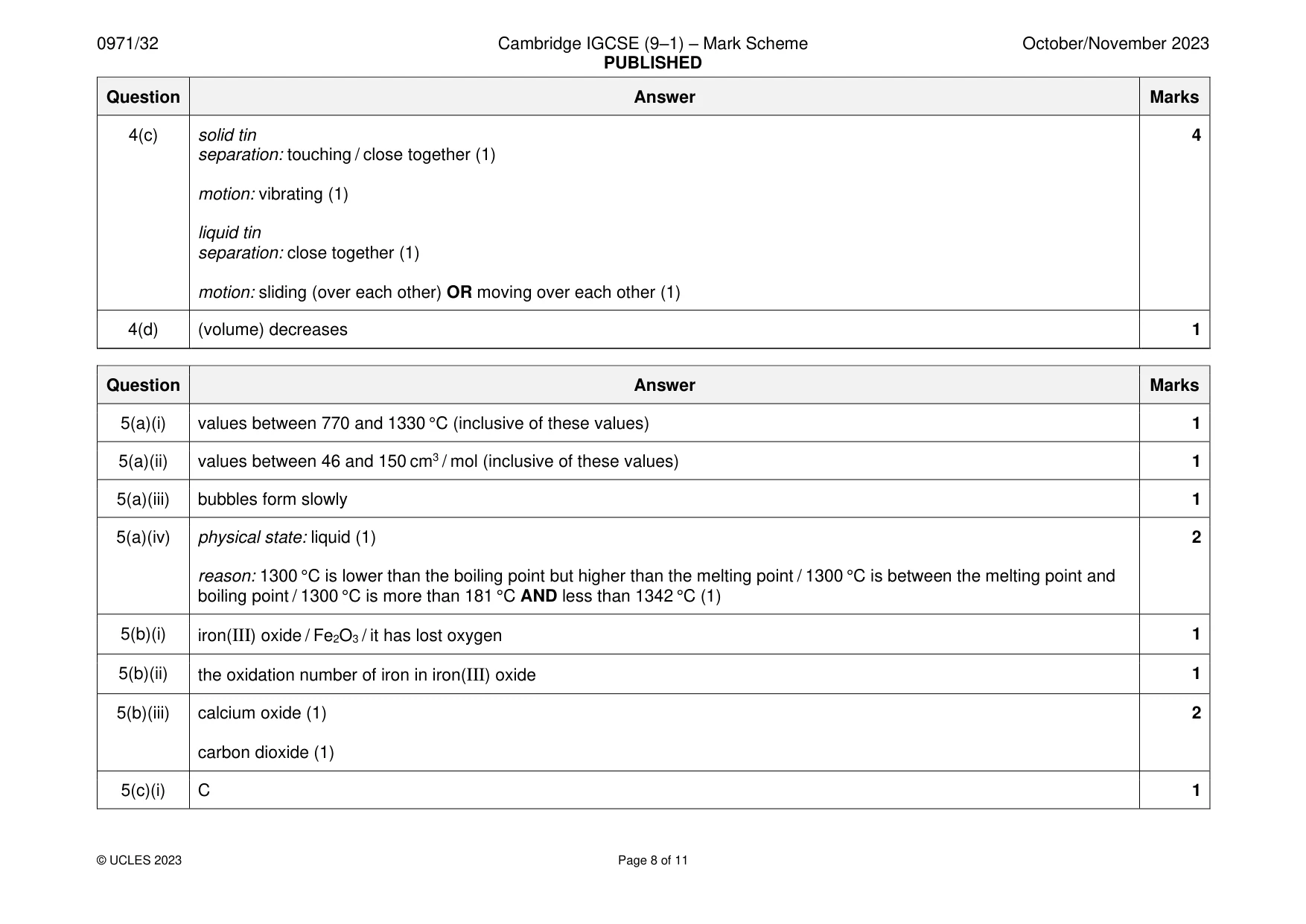
Mark scheme: 4(a) one mark each for any two of: 2 • has a definite shape / does not take the shape of the container • has a definite volume / fixed volume • does not spread over surface / does not flow 4(b) A: melting (1) 2 B: condensing / condensation (1) 4(c) solid tin 4 separation: touching / close together (1) motion: vibrating (1) liquid tin separation: close together (1) motion: sliding (over each other) OR moving over each other (1) 4(d) (volume) decreases 1
Q5 · This question is about metals
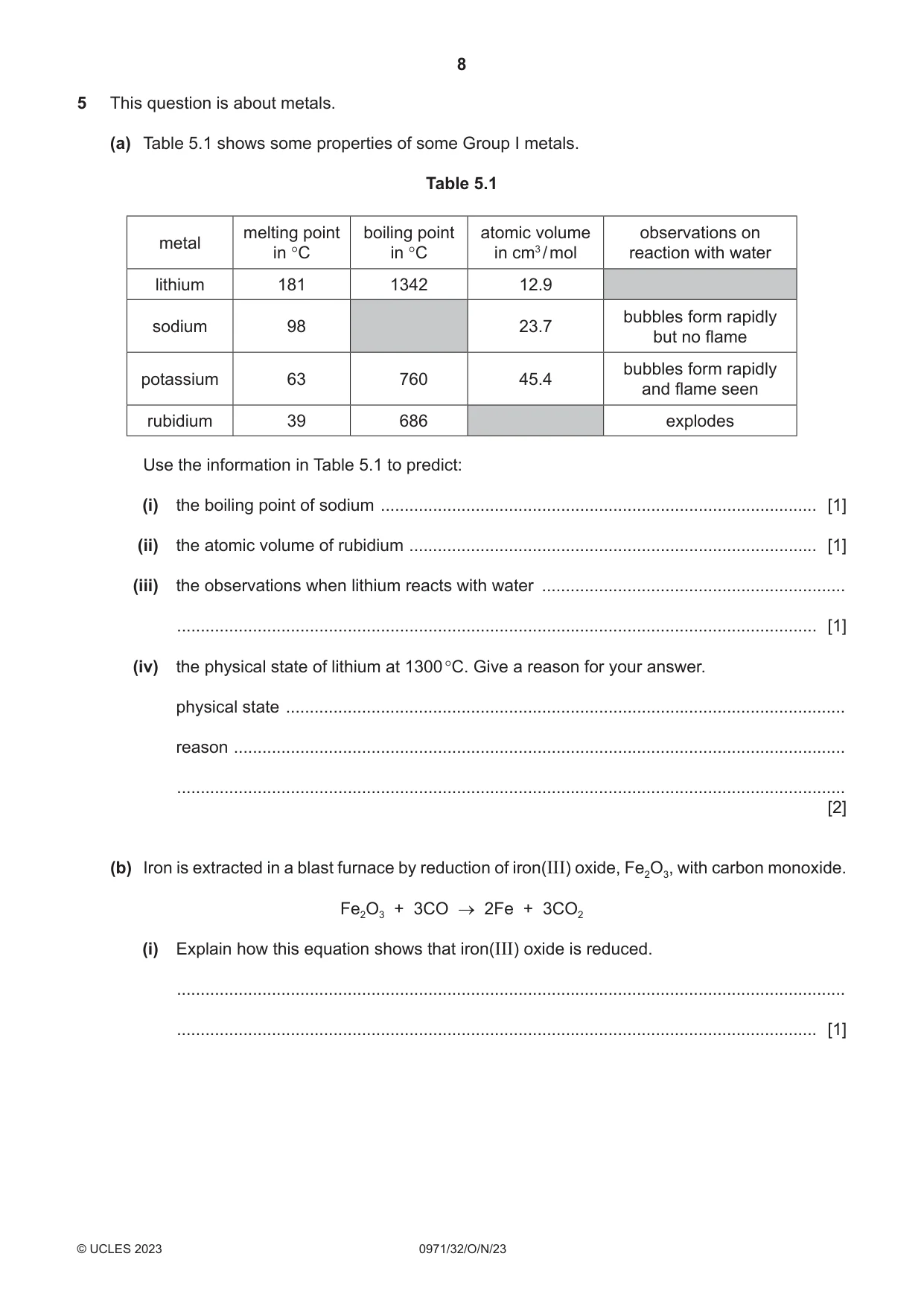
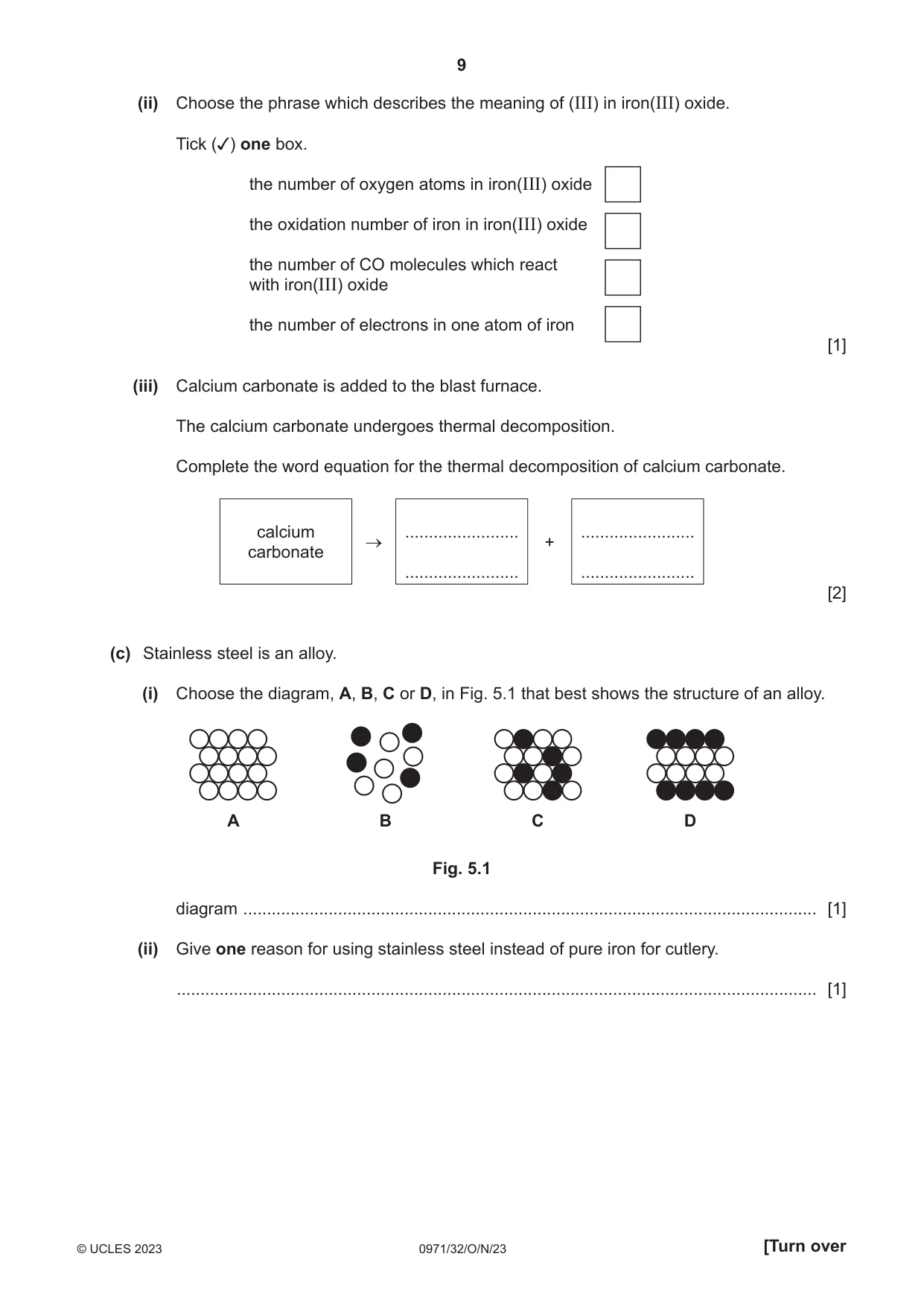
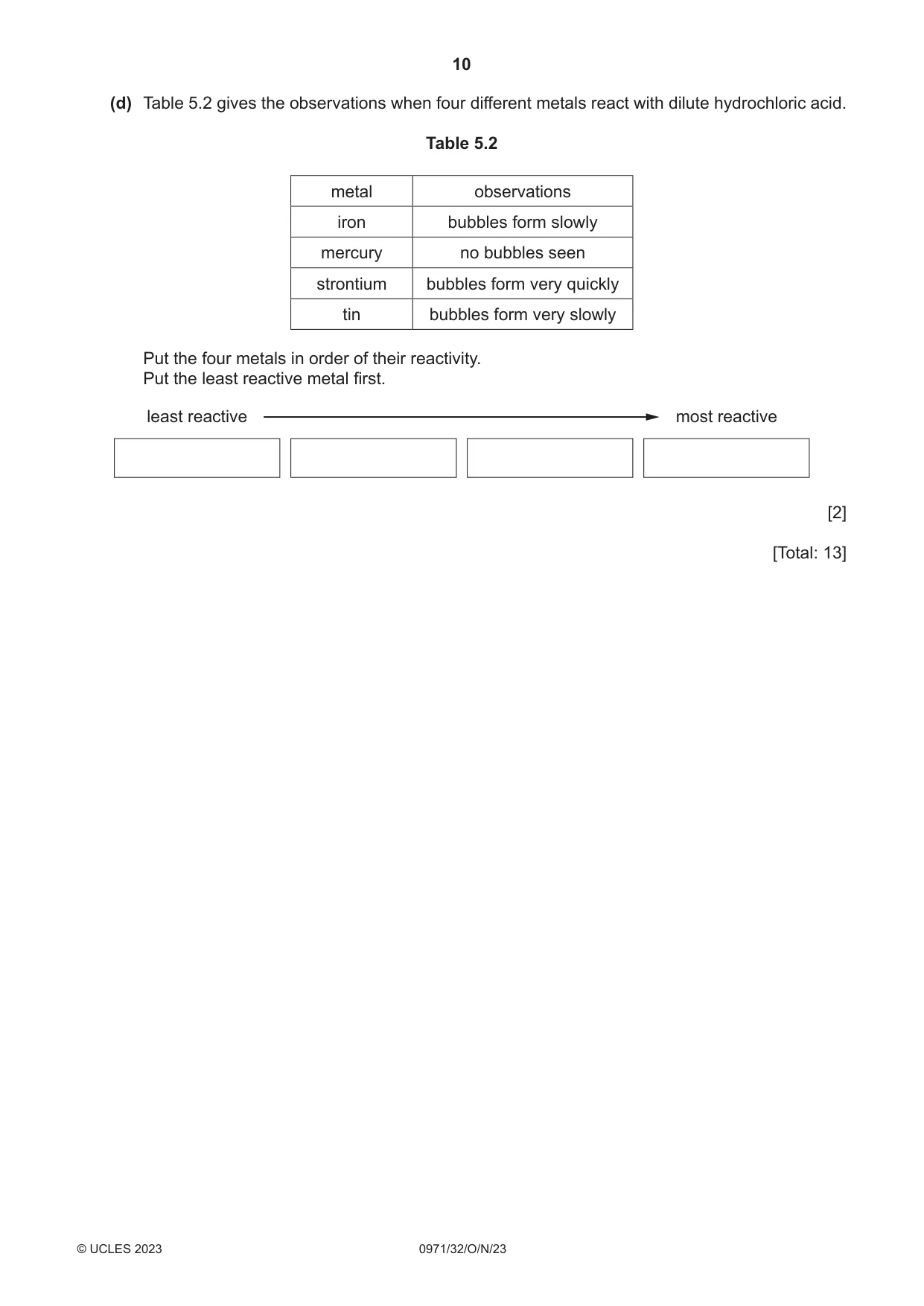
5 This question is about metals. (a) Table 5.1 shows some properties of some Group I metals. Table 5.1 melting point boiling point atomic volume observations on metal in °C in °C in cm3 / mol reaction with water lithium 181 1342 12.9 bubbles form rapidly sodium 98 23.7 but no flame bubbles form rapidly potassium 63 760 45.4 and flame seen rubidium 39 686 explodes Use the information in Table 5.1 to predict: (i) the boiling point of sodium ............................................................................................ [1] (ii) the atomic volume of rubidium ...................................................................................... [1] (iii) the observations when lithium reacts with water ................................................................. ....................................................................................................................................... [1] (iv) the physical state of lithium at 1300 °C. Give a reason for your answer. physical state ...................................................................................................................... reason ................................................................................................................................. ............................................................................................................................................. [2] (b) Iron is extracted in a blast furnace by reduction of iron(III) oxide, Fe2O3, with carbon monoxide. Fe2O3 + 3CO → 2Fe + 3CO2 (i) Explain how this equation shows that iron(III) oxide is reduced. ............................................................................................................................................. ....................................................................................................................................... [1] (ii) Choose the phrase which describes the meaning of (III) in iron(III) oxide. Tick (✓) one box. the number of oxygen atoms in iron(III) oxide the oxidation number of iron in iron(III) oxide the number of CO molecules which react with iron(III) oxide the number of electrons in one atom of iron [1] (iii) Calcium carbonate is added to the blast furnace. The calcium carbonate undergoes thermal decomposition. Complete the word equation for the thermal decomposition of calcium carbonate. calcium ........................ ........................ → + carbonate ........................ ........................ [2] (c) Stainless steel is an alloy. (i) Choose the diagram, A, B, C or D, in Fig. 5.1 that best shows the structure of an alloy. A B C D Fig. 5.1 diagram ......................................................................................................................... [1] (ii) Give one reason for using stainless steel instead of pure iron for cutlery. ....................................................................................................................................... [1] (d) Table 5.2 gives the observations when four different metals react with dilute hydrochloric acid. Table 5.2 metal observations iron bubbles form slowly mercury no bubbles seen strontium bubbles form very quickly tin bubbles form very slowly Put the four metals in order of their reactivity. Put the least reactive metal first. least reactive most reactive [2] [Total: 13]
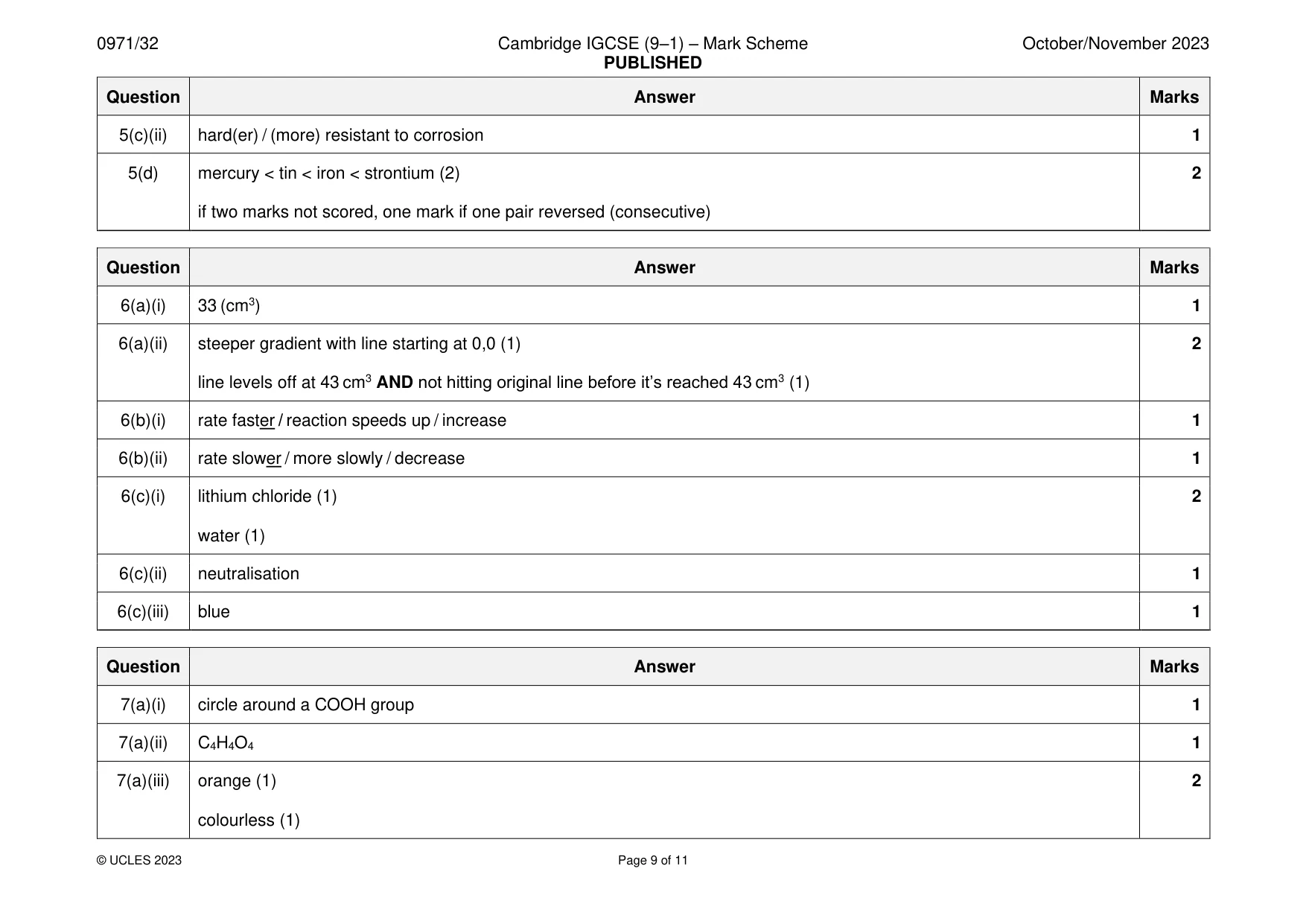
Mark scheme: 5(a)(i) values between 770 and 1330 °C (inclusive of these values) 1 5(a)(ii) values between 46 and 150 cm3 / mol (inclusive of these values) 1 5(a)(iii) bubbles form slowly 1 5(a)(iv) physical state: liquid (1) 2 reason: 1300 °C is lower than the boiling point but higher than the melting point / 1300 °C is between the melting point and boiling point / 1300 °C is more than 181 °C AND less than 1342 °C (1) 5(b)(i) iron(III) oxide / Fe2O3 / it has lost oxygen 1 5(b)(ii) the oxidation number of iron in iron(III) oxide 1 5(b)(iii) calcium oxide (1) 2 carbon dioxide (1) 5(c)(i) C 1 5(c)(ii) hard(er) / (more) resistant to corrosion 1 5(d) mercury < tin < iron < strontium (2) 2 if two marks not scored, one mark if one pair reversed (consecutive)
Q6 · A student investigates the reaction of large pieces of magnesium with dilute hydrochloric…
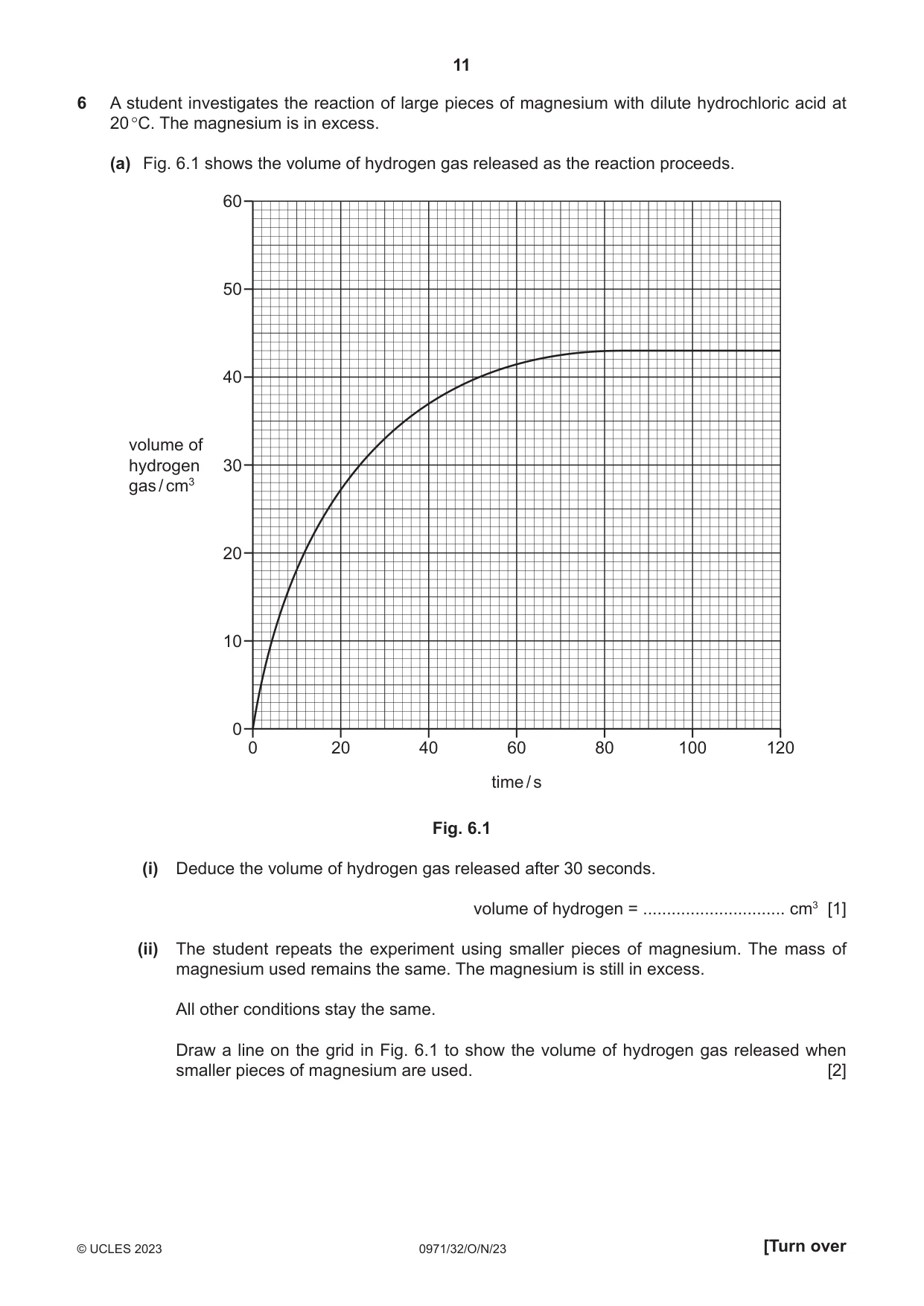
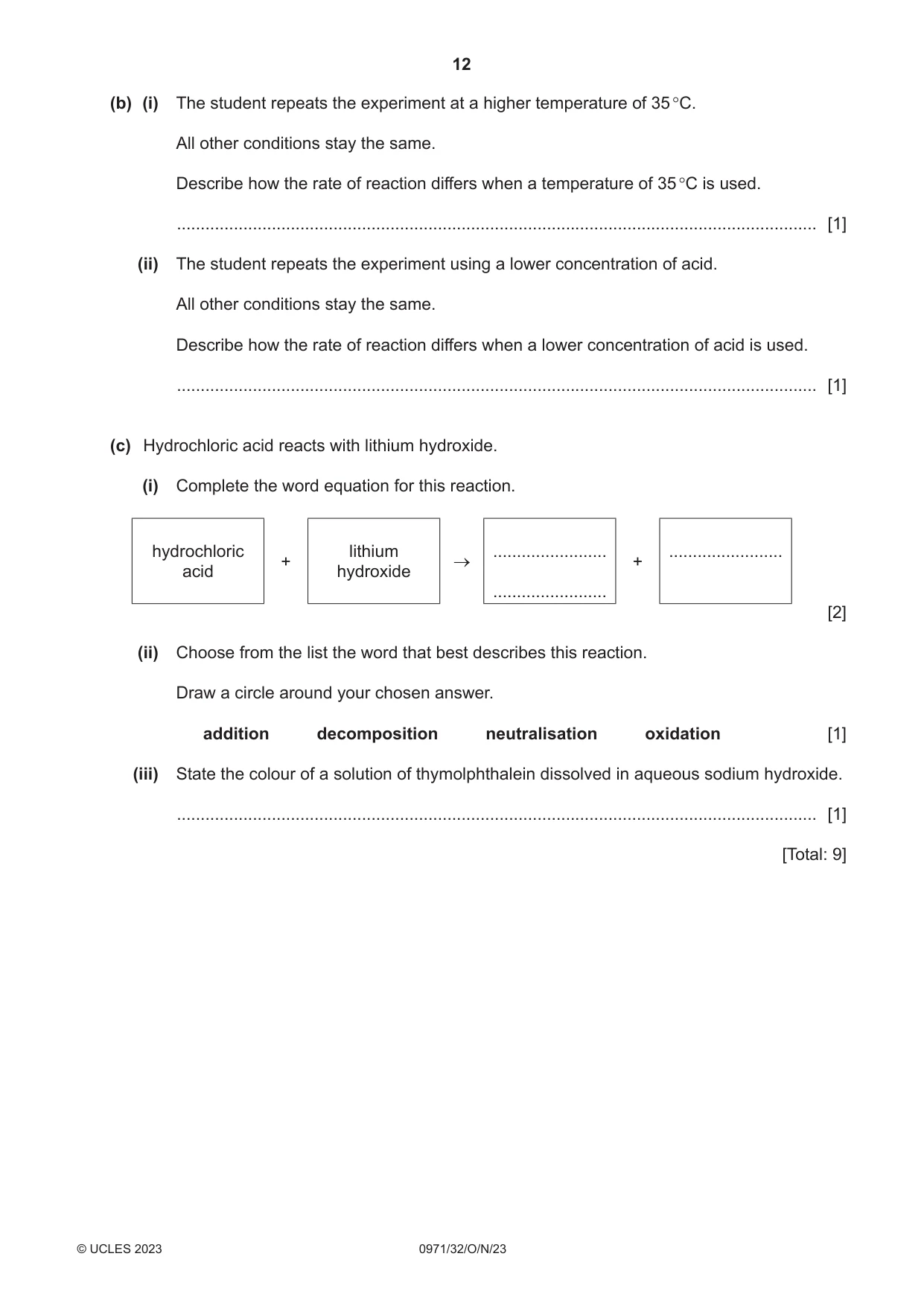
6 A student investigates the reaction of large pieces of magnesium with dilute hydrochloric acid at 20 °C. The magnesium is in excess. (a) Fig. 6.1 shows the volume of hydrogen gas released as the reaction proceeds. 60 50 40 volume of hydrogen 30 gas / cm3 20 10 0 0 20 40 60 80 100 120 time / s Fig. 6.1 (i) Deduce the volume of hydrogen gas released after 30 seconds. volume of hydrogen = .............................. cm3 [1] (ii) The student repeats the experiment using smaller pieces of magnesium. The mass of magnesium used remains the same. The magnesium is still in excess. All other conditions stay the same. Draw a line on the grid in Fig. 6.1 to show the volume of hydrogen gas released when smaller pieces of magnesium are used. [2] (b) (i) The student repeats the experiment at a higher temperature of 35 °C. All other conditions stay the same. Describe how the rate of reaction differs when a temperature of 35 °C is used. ....................................................................................................................................... [1] (ii) The student repeats the experiment using a lower concentration of acid. All other conditions stay the same. Describe how the rate of reaction differs when a lower concentration of acid is used. ....................................................................................................................................... [1] (c) Hydrochloric acid reacts with lithium hydroxide. (i) Complete the word equation for this reaction. hydrochloric lithium ........................ ........................ + → + acid hydroxide ........................ [2] (ii) Choose from the list the word that best describes this reaction. Draw a circle around your chosen answer. addition decomposition neutralisation oxidation [1] (iii) State the colour of a solution of thymolphthalein dissolved in aqueous sodium hydroxide. ....................................................................................................................................... [1] [Total: 9]
Mark scheme: 6(a)(i) 33 (cm3) 1 6(a)(ii) steeper gradient with line starting at 0,0 (1) 2 line levels off at 43 cm3 AND not hitting original line before it’s reached 43 cm3 (1) 6(b)(i) rate faster / reaction speeds up / increase 1 6(b)(ii) rate slower / more slowly / decrease 1 6(c)(i) lithium chloride (1) 2 water (1) 6(c)(ii) neutralisation 1 6(c)(iii) blue 1
Q7 · The displayed formula of fumaric acid
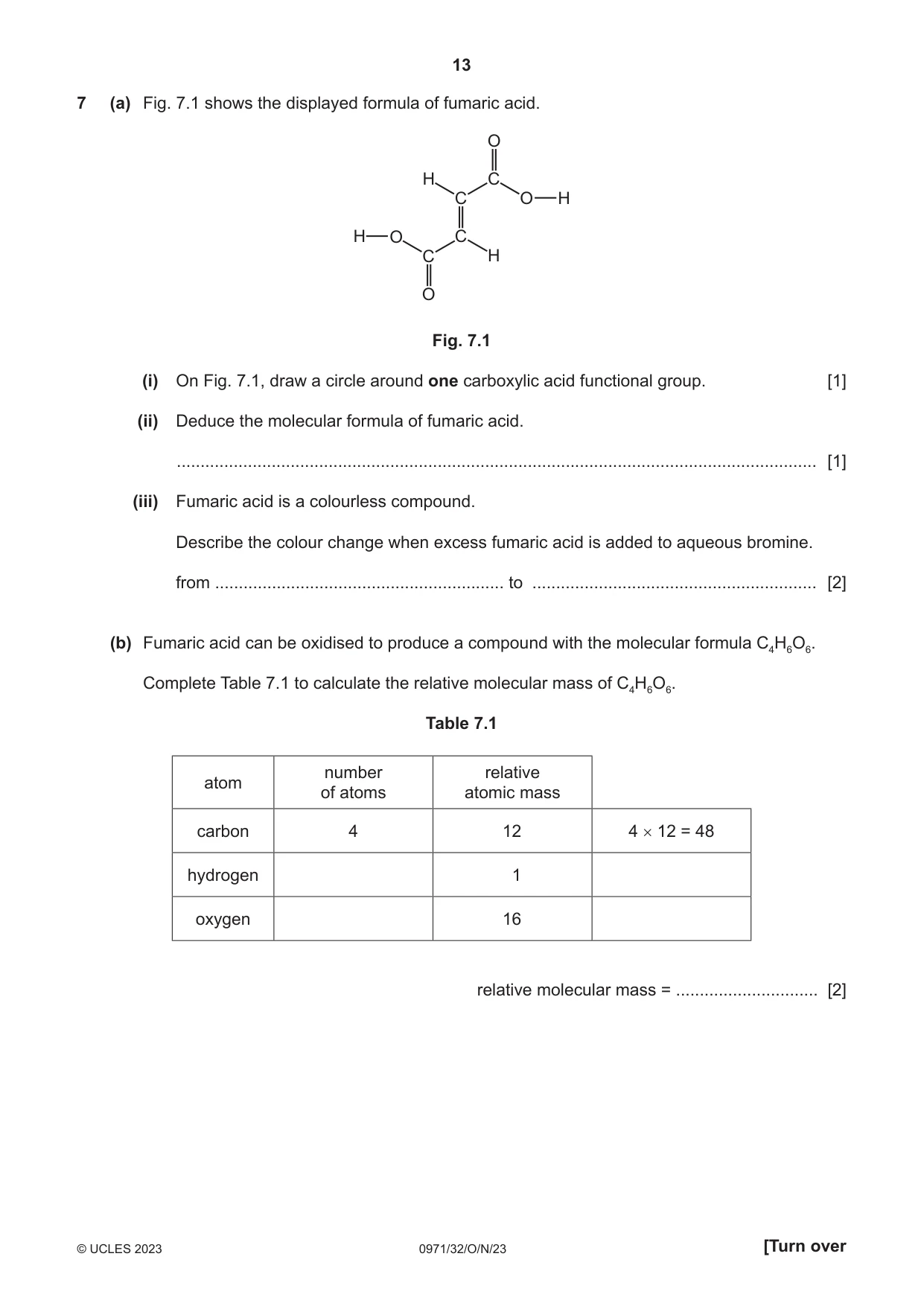
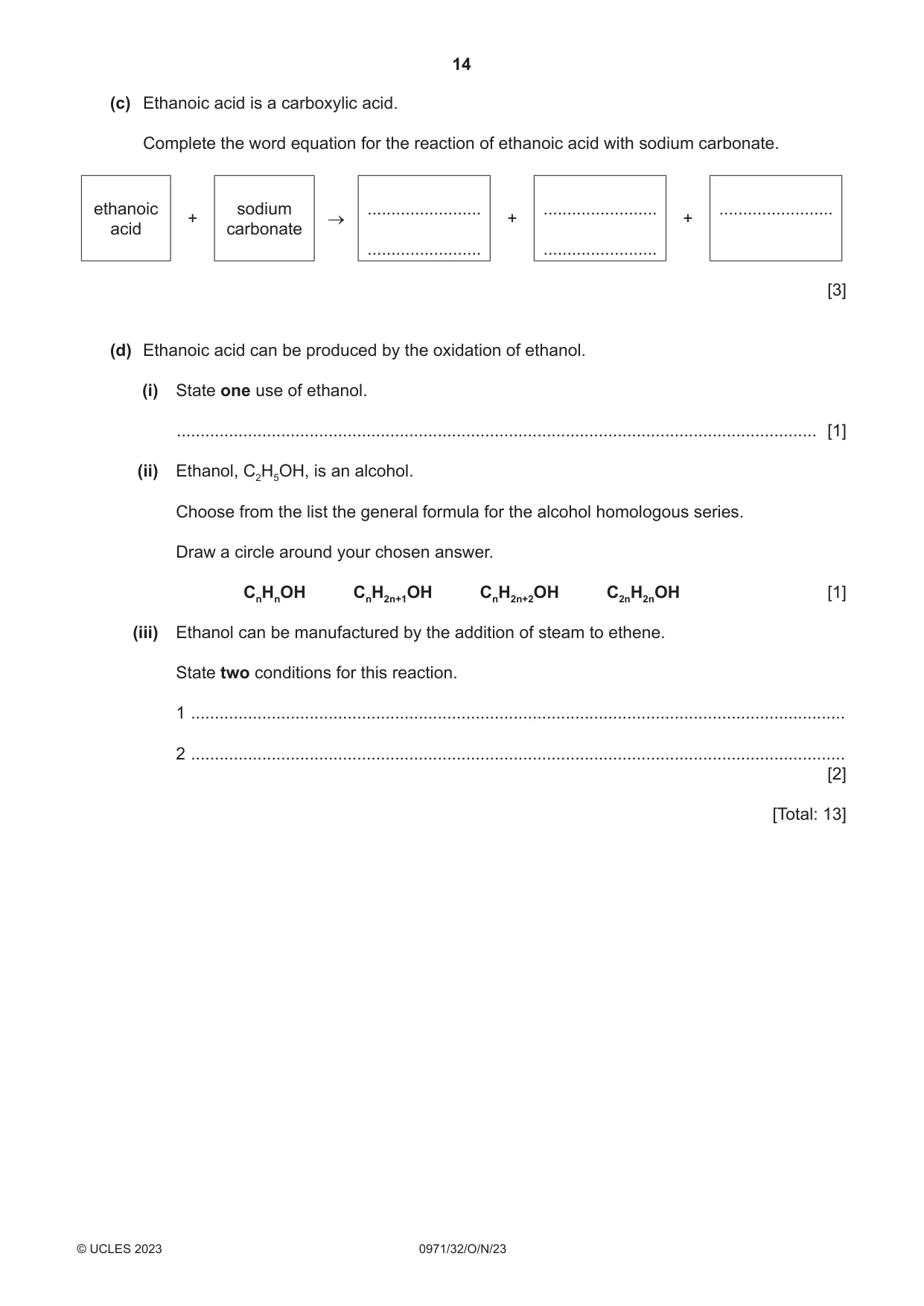
7 (a) Fig. 7.1 shows the displayed formula of fumaric acid. O H C C O H H O C C H O Fig. 7.1 (i) On Fig. 7.1, draw a circle around one carboxylic acid functional group. [1] (ii) Deduce the molecular formula of fumaric acid. ....................................................................................................................................... [1] (iii) Fumaric acid is a colourless compound. Describe the colour change when excess fumaric acid is added to aqueous bromine. from ............................................................. to ������������������������������������������������������������ [2] (b) Fumaric acid can be oxidised to produce a compound with the molecular formula C4H6O6. Complete Table 7.1 to calculate the relative molecular mass of C4H6O6. Table 7.1 number relative atom of atoms atomic mass carbon 4 12 4 × 12 = 48 hydrogen 1 oxygen 16 relative molecular mass = .............................. [2] (c) Ethanoic acid is a carboxylic acid. Complete the word equation for the reaction of ethanoic acid with sodium carbonate. ethanoic sodium ........................ ........................ ........................ + → + + acid carbonate ........................ ........................ [3] (d) Ethanoic acid can be produced by the oxidation of ethanol. (i) State one use of ethanol. ....................................................................................................................................... [1] (ii) Ethanol, C2H5OH, is an alcohol. Choose from the list the general formula for the alcohol homologous series. Draw a circle around your chosen answer. CnHnOH CnH2n+1OH CnH2n+2OH C2nH2nOH [1] (iii) Ethanol can be manufactured by the addition of steam to ethene. State two conditions for this reaction. 1 .......................................................................................................................................... 2 .......................................................................................................................................... [2] [Total: 13]
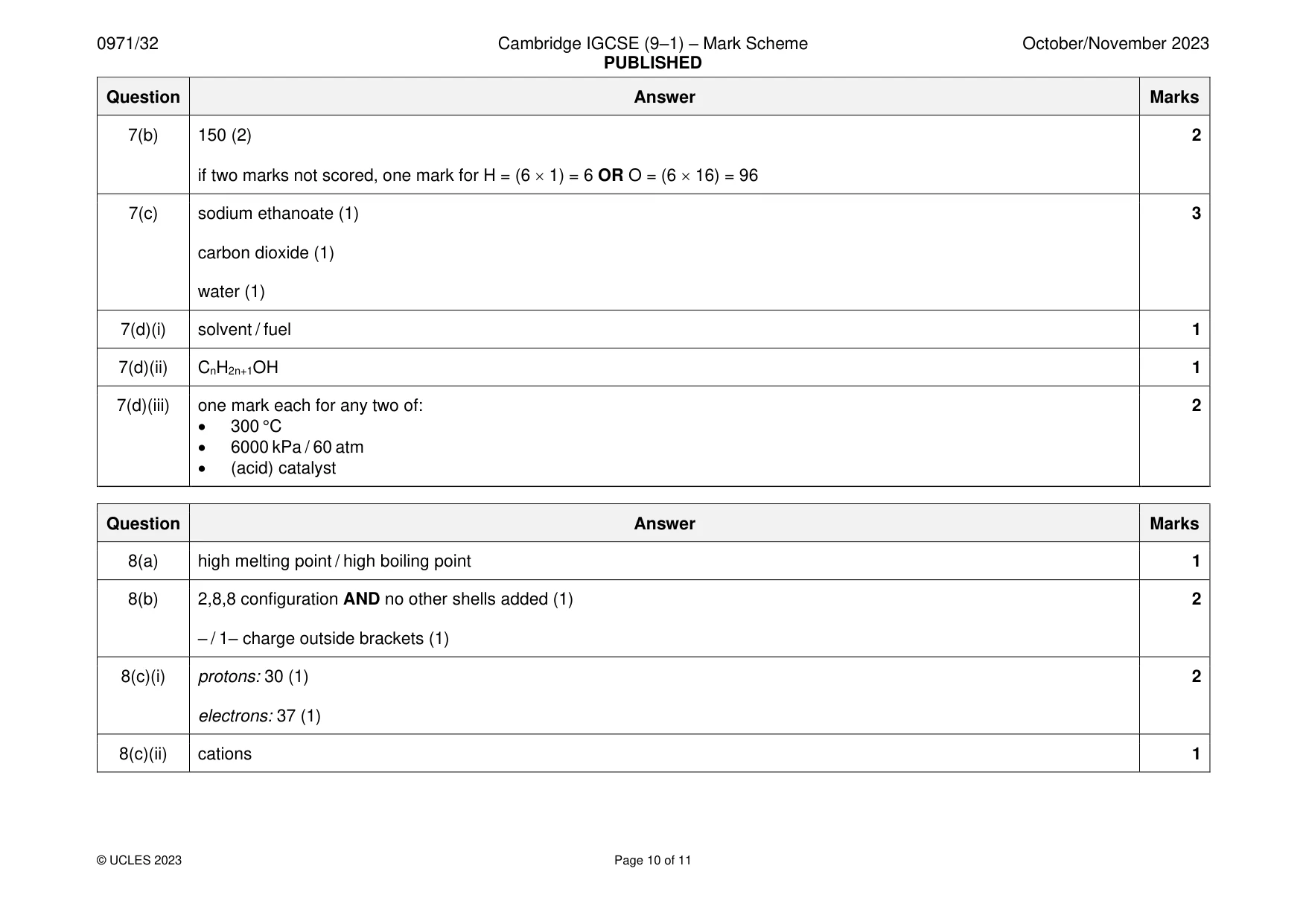
Mark scheme: 7(a)(i) circle around a COOH group 1 7(a)(ii) C4H4O4 1 7(a)(iii) orange (1) 2 colourless (1) 7(b) 150 (2) 2 if two marks not scored, one mark for H = (6 1) = 6 OR O = (6 16) = 96 7(c) sodium ethanoate (1) 3 carbon dioxide (1) water (1) 7(d)(i) solvent / fuel 1 7(d)(ii) CnH2n+1OH 1 7(d)(iii) one mark each for any two of: 2 • 300 °C • 6000 kPa / 60 atm • (acid) catalyst
Q8 · Zinc chloride is an ionic compound
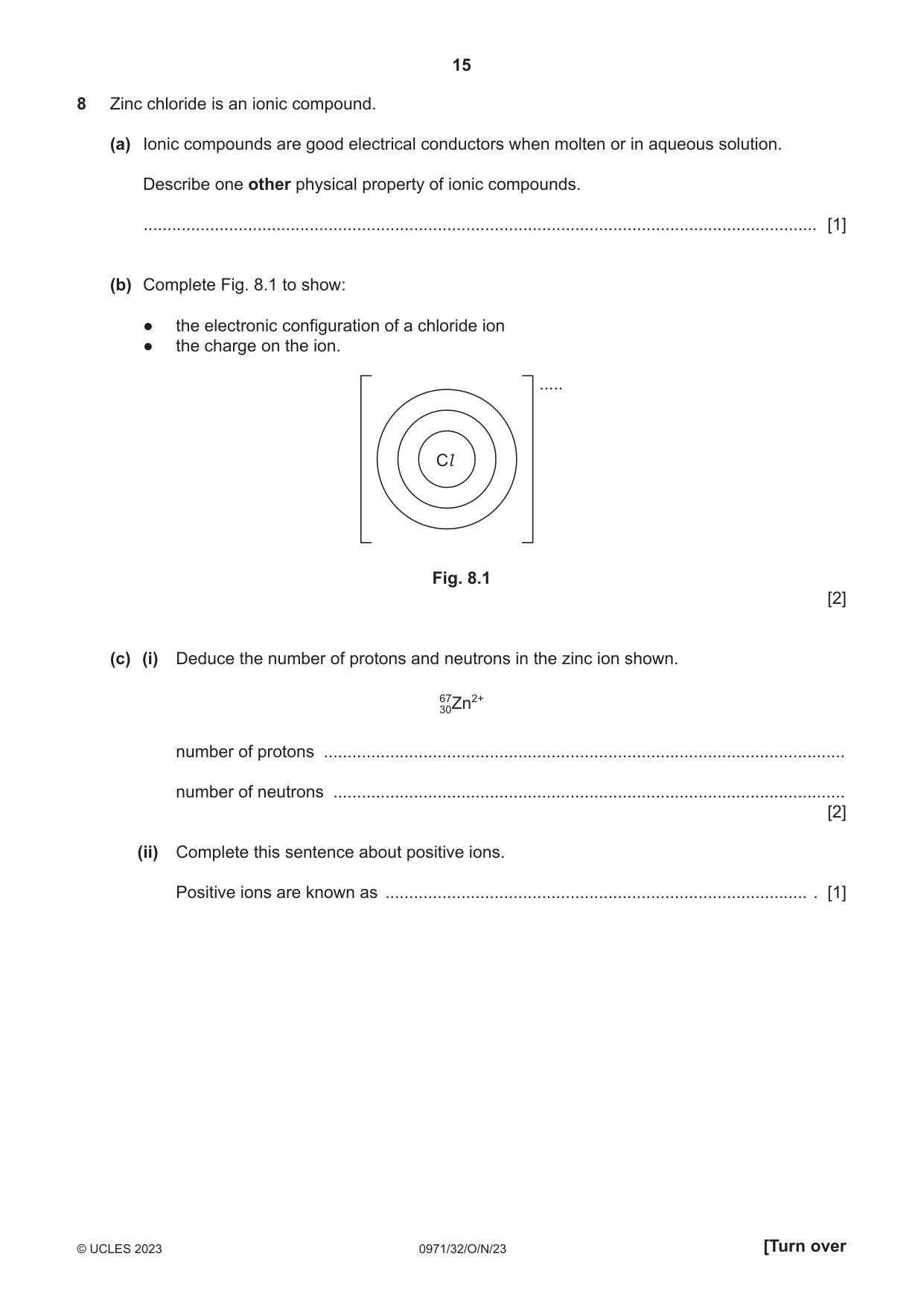
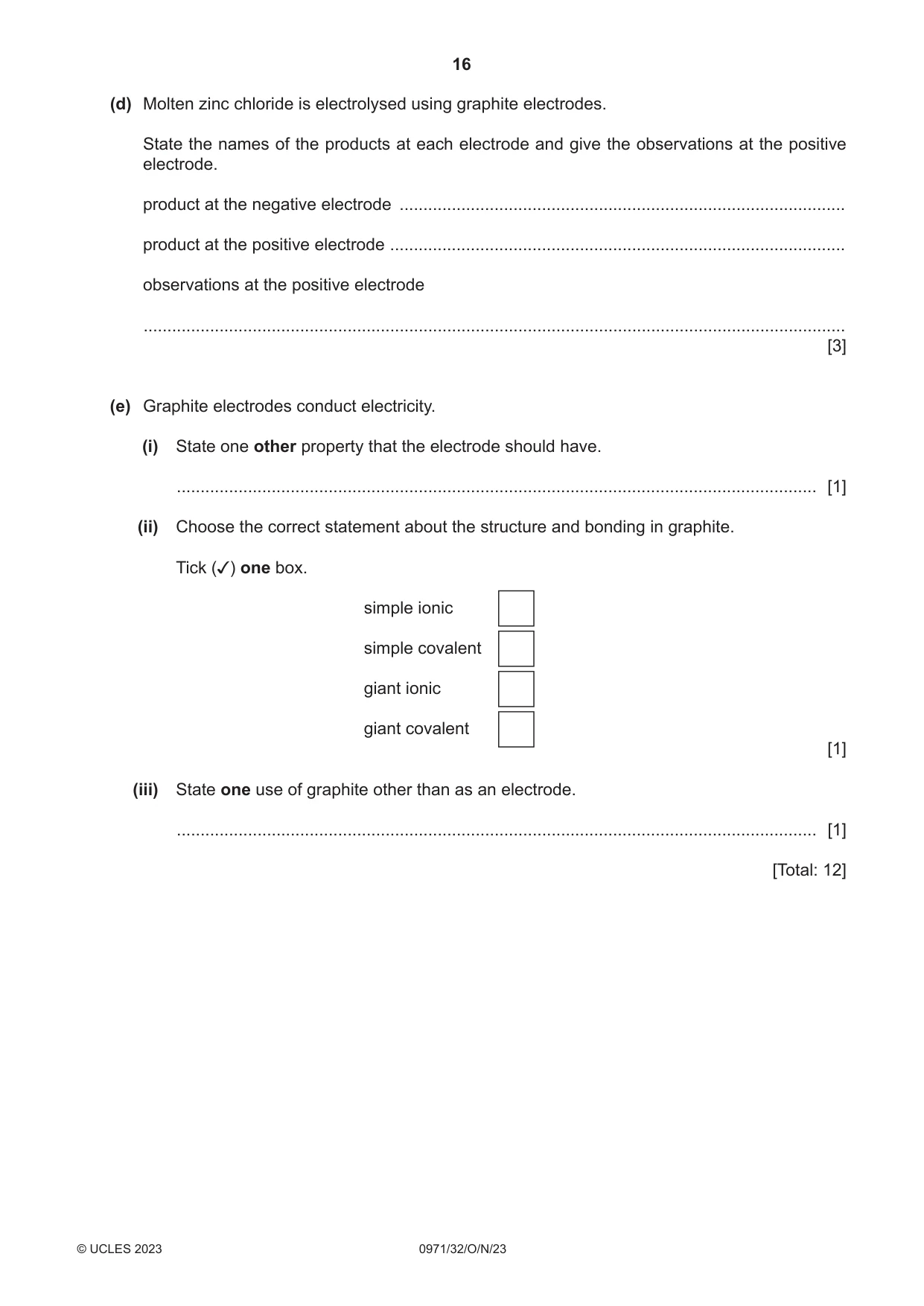
8 Zinc chloride is an ionic compound. (a) Ionic compounds are good electrical conductors when molten or in aqueous solution. Describe one other physical property of ionic compounds. .............................................................................................................................................. [1] (b) Complete Fig. 8.1 to show: ● the electronic configuration of a chloride ion ● the charge on the ion. ..... Cl Fig. 8.1 [2] (c) (i) Deduce the number of protons and neutrons in the zinc ion shown. 3067Zn2+ number of protons ............................................................................................................... number of neutrons ............................................................................................................. [2] (ii) Complete this sentence about positive ions. Positive ions are known as .......................................................................................... . [1] (d) Molten zinc chloride is electrolysed using graphite electrodes. State the names of the products at each electrode and give the observations at the positive electrode. product at the negative electrode ............................................................................................... product at the positive electrode ................................................................................................ observations at the positive electrode .................................................................................................................................................... [3] (e) Graphite electrodes conduct electricity. (i) State one other property that the electrode should have. ....................................................................................................................................... [1] (ii) Choose the correct statement about the structure and bonding in graphite. Tick (✓) one box. simple ionic simple covalent giant ionic giant covalent [1] (iii) State one use of graphite other than as an electrode. ....................................................................................................................................... [1] [Total: 12]
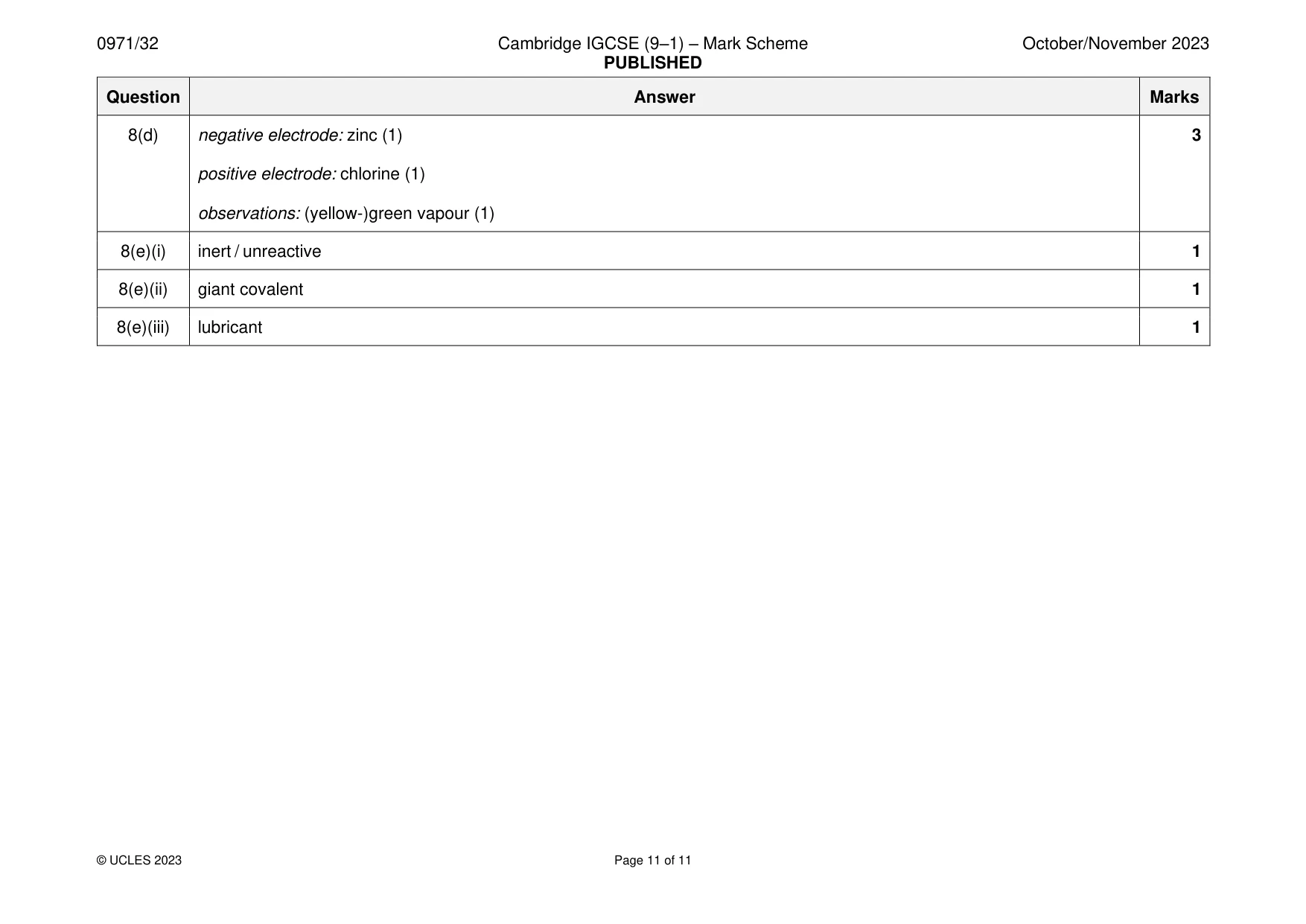
Mark scheme: 8(a) high melting point / high boiling point 1 8(b) 2,8,8 configuration AND no other shells added (1) 2 – / 1– charge outside brackets (1) 8(c)(i) protons: 30 (1) 2 electrons: 37 (1) 8(c)(ii) cations 1 8(d) negative electrode: zinc (1) 3 positive electrode: chlorine (1) observations: (yellow-)green vapour (1) 8(e)(i) inert / unreactive 1 8(e)(ii) giant covalent 1 8(e)(iii) lubricant 1
What was in this paper
The subtopics covered by these 8 questions, and how many questions each got. Open one in a new tab to see every Cambridge question on it.
What you needed in this session
Cambridge’s own grade thresholds for 2023 Oct/Nov, Paper 3 · Variant 2. A higher threshold means an easier paper — the bar moves with how the cohort did.