Cambridge IGCSE Chemistry (9-1) 0971 — 2024 Oct/Nov Paper 3 · Variant 2
0971/32/O/N/24 · 8 questions · 80 marks · 75 min
The question paper and its mark scheme, free to read here and free to download. This is Cambridge’s own paper, exactly as it was sat.
Question paper20 pages
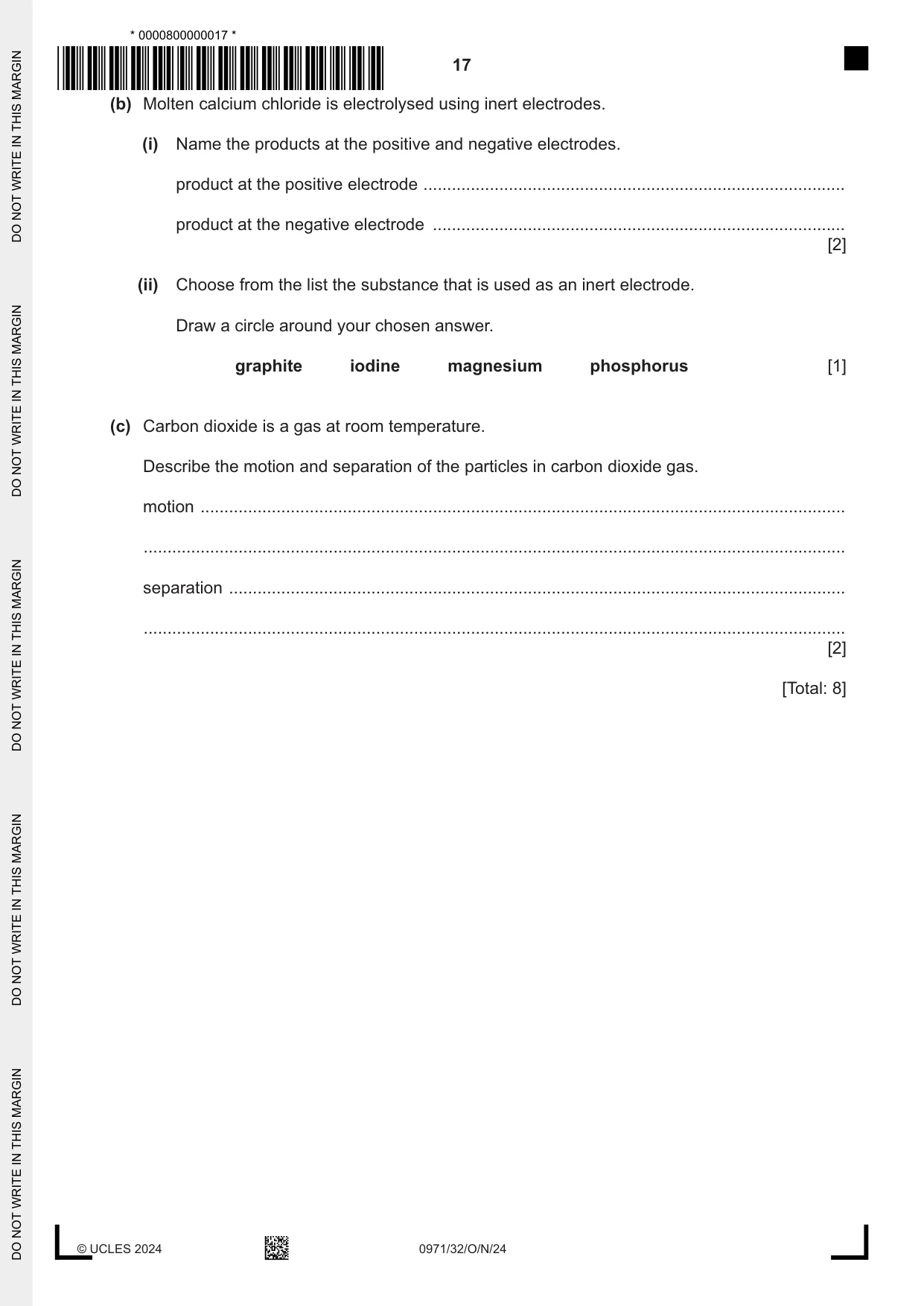

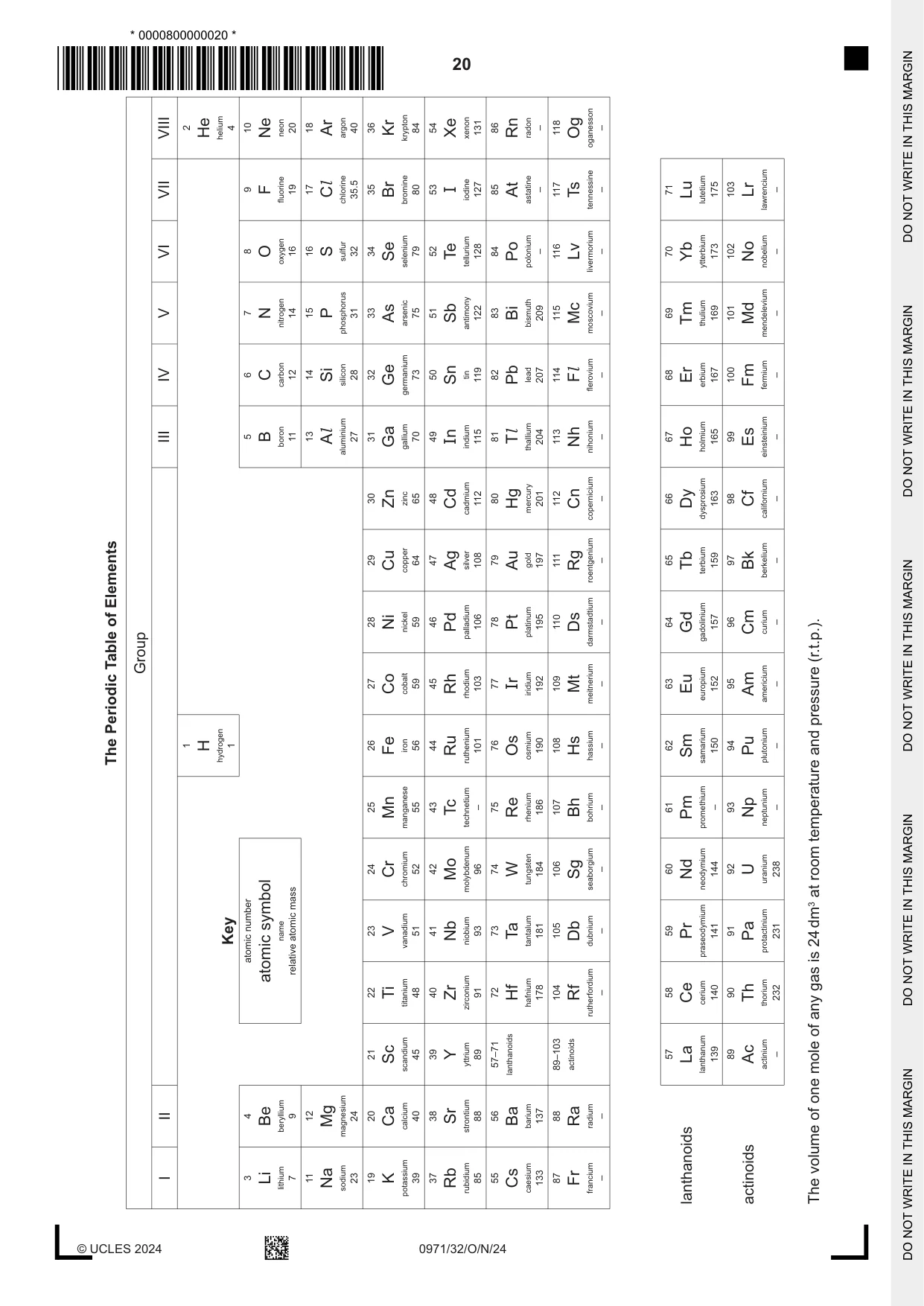
Mark scheme12 pages
Answers below. Sit the paper first if you are practising.
Questions as text
Q1 · Part of the Periodic Table
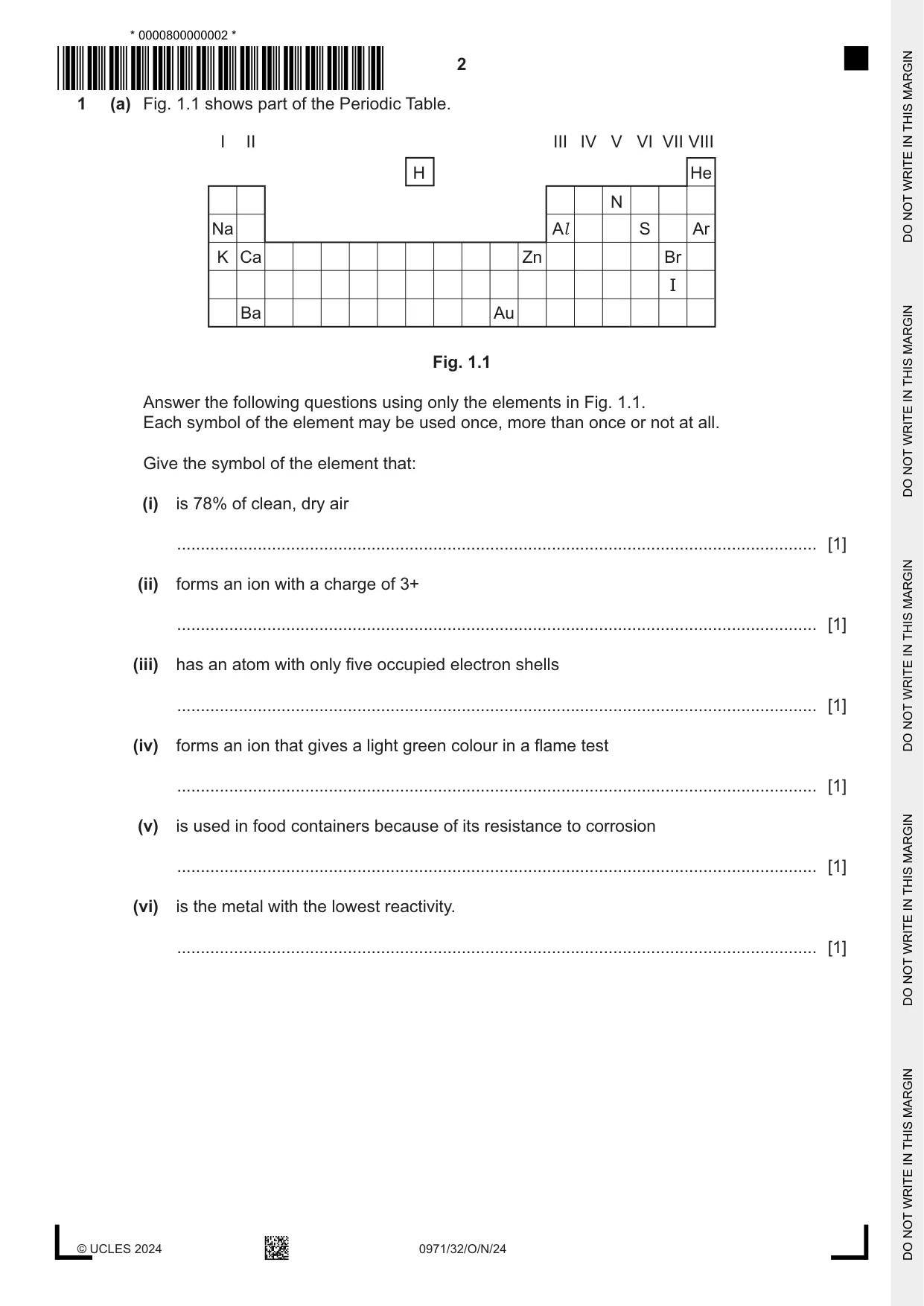
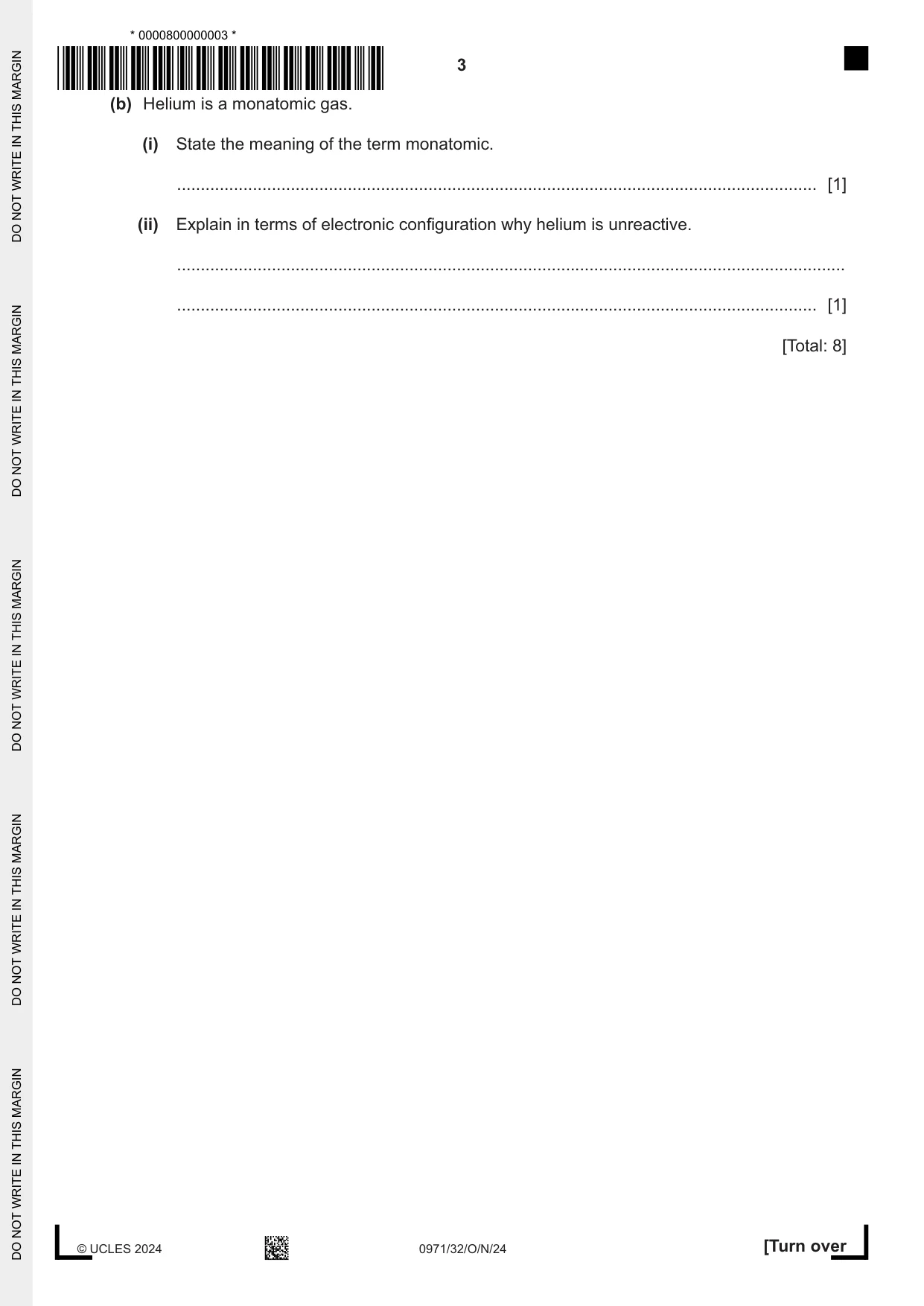
1 (a) Fig. 1.1 shows part of the Periodic Table. I II III IV V VI VII VIII H He N Na Al S Ar K Ca Zn Br I Ba Au Fig. 1.1 Answer the following questions using only the elements in Fig. 1.1. Each symbol of the element may be used once, more than once or not at all. Give the symbol of the element that: (i) is 78% of clean, dry air ....................................................................................................................................... [1] (ii) forms an ion with a charge of 3+ ....................................................................................................................................... [1] (iii) has an atom with only five occupied electron shells ....................................................................................................................................... [1] (iv) forms an ion that gives a light green colour in a flame test ....................................................................................................................................... [1] (v) is used in food containers because of its resistance to corrosion ....................................................................................................................................... [1] (vi) is the metal with the lowest reactivity. ....................................................................................................................................... [1] (b) Helium is a monatomic gas. (i) State the meaning of the term monatomic. ....................................................................................................................................... [1] (ii) Explain in terms of electronic configuration why helium is unreactive. ............................................................................................................................................. ....................................................................................................................................... [1] [Total: 8]
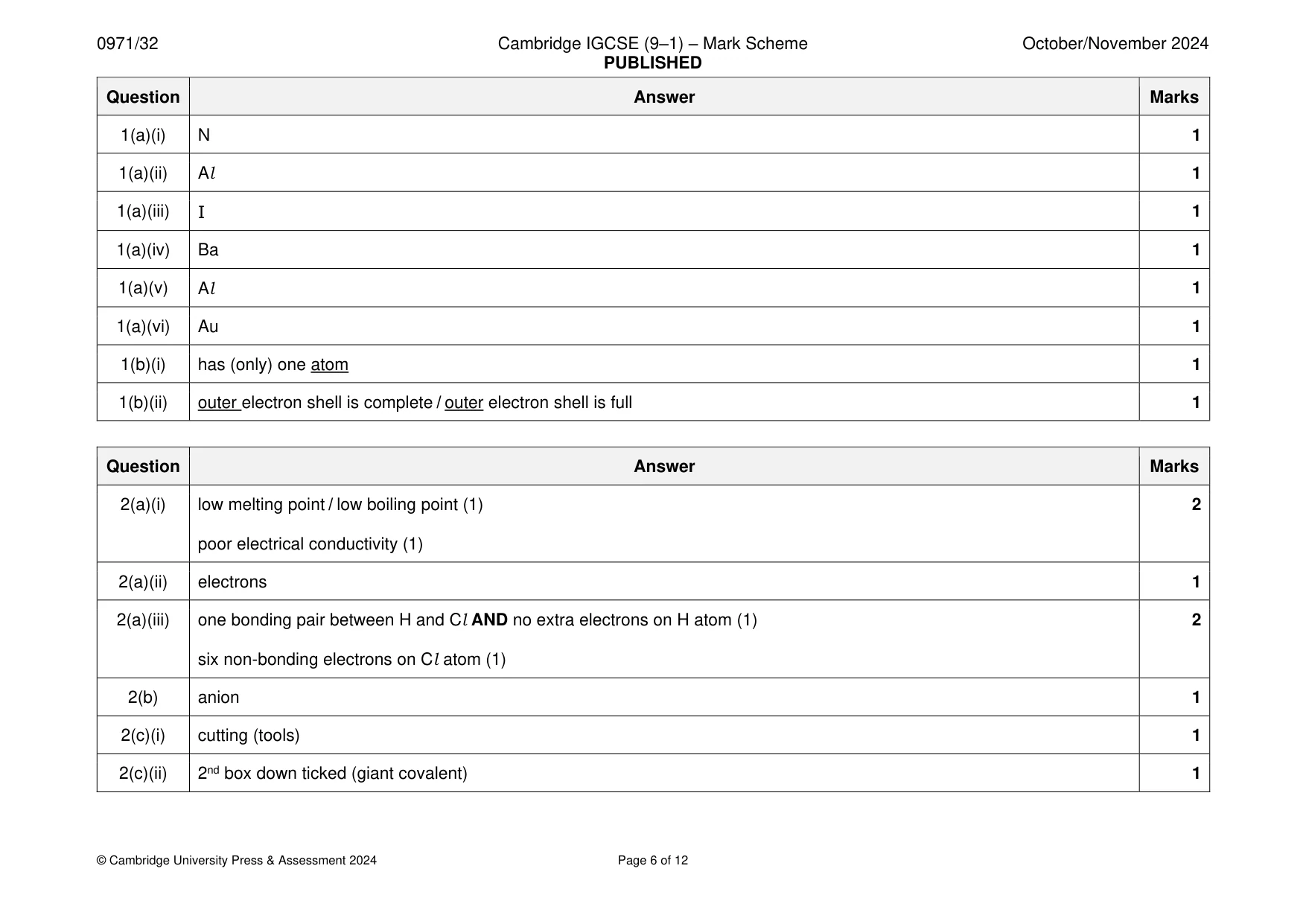
Mark scheme: Question Answer Marks 1(a)(i) N 1 1(a)(ii) Al 1 1(a)(iii) I 1 1(a)(iv) Ba 1 1(a)(v) Al 1 1(a)(vi) Au 1 1(b)(i) has (only) one atom 1 1(b)(ii) outer electron shell is complete / outer electron shell is full 1
Q2 · Hydrogen chloride has a simple molecular structure
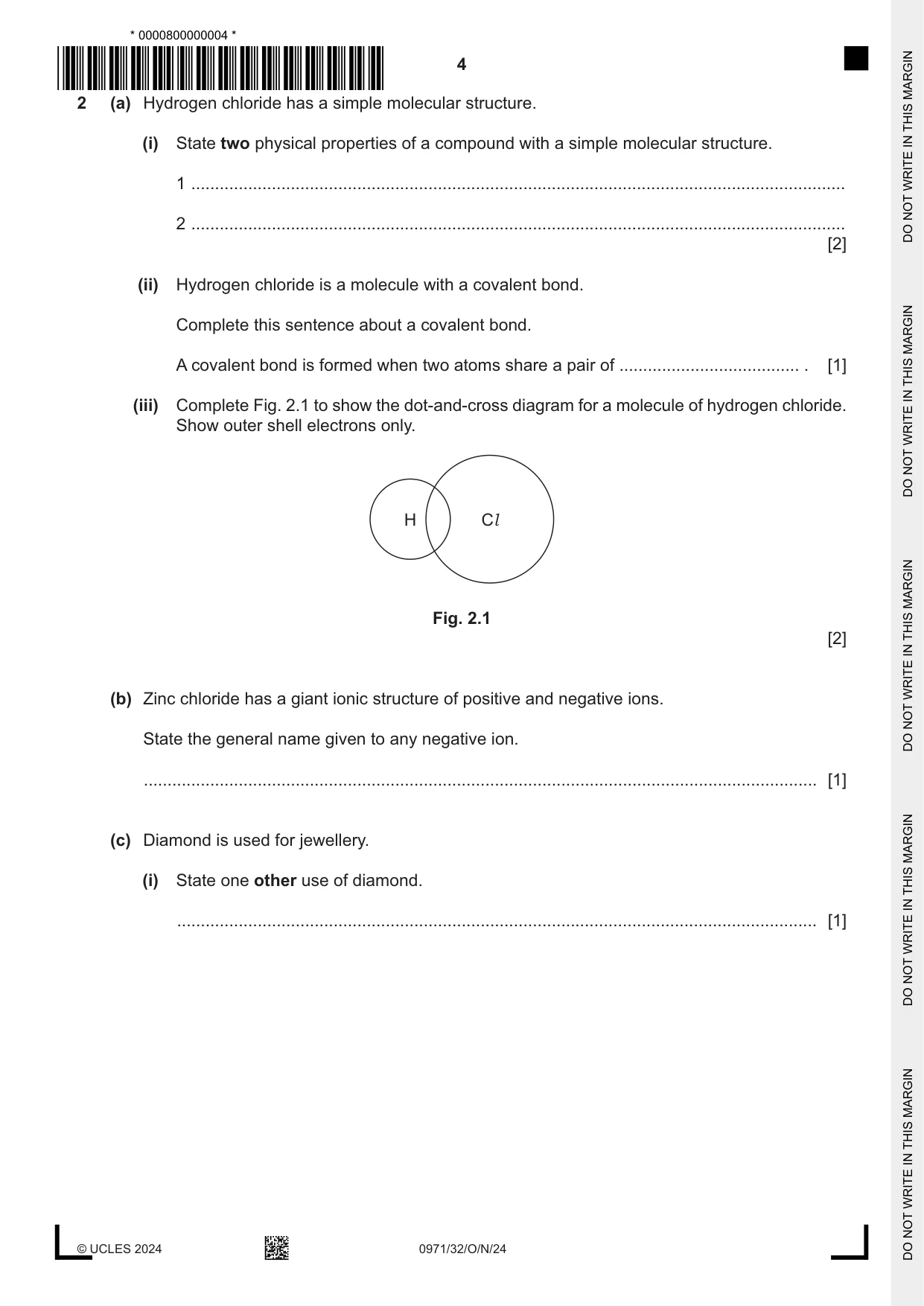
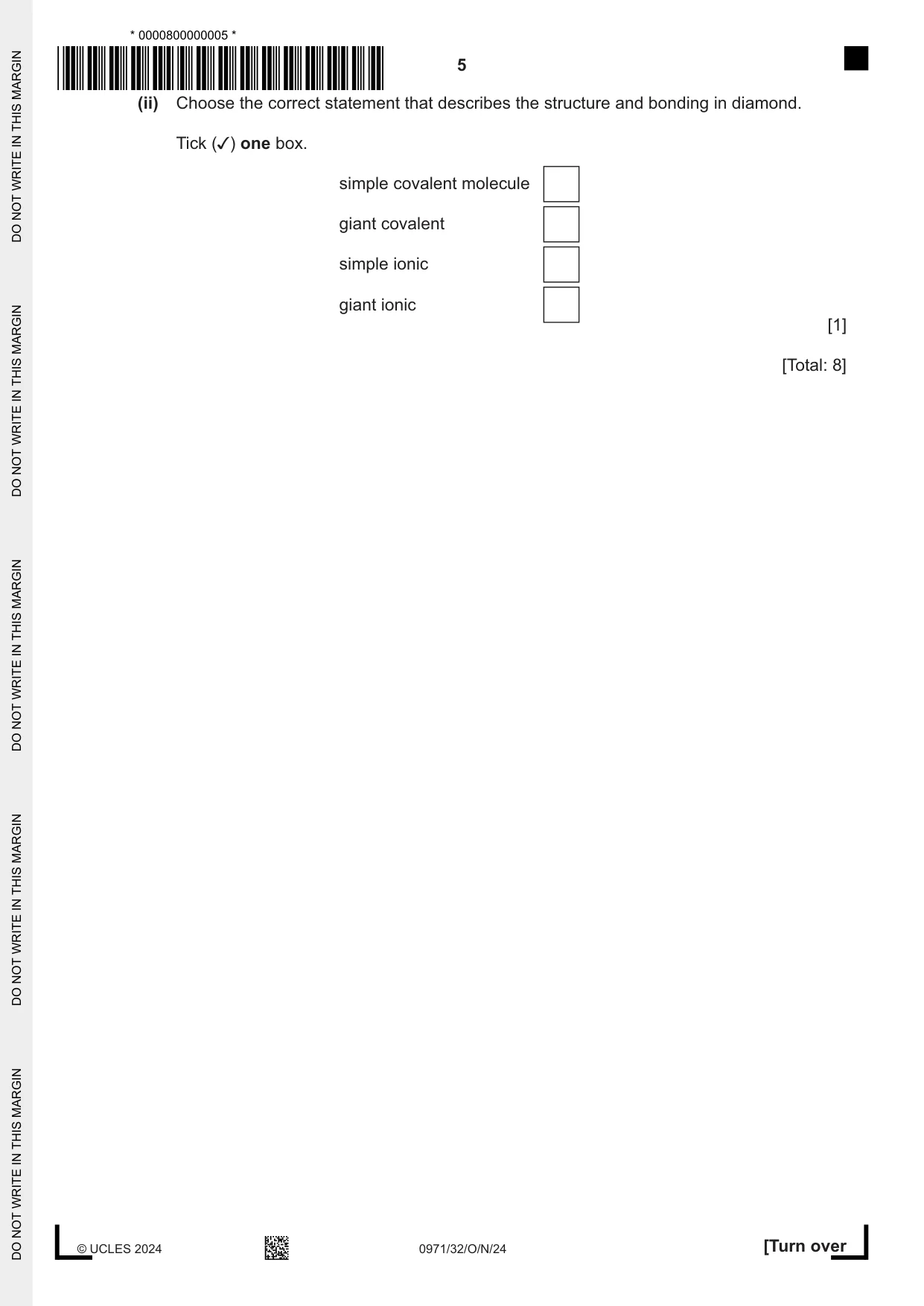
2 (a) Hydrogen chloride has a simple molecular structure. (i) State two physical properties of a compound with a simple molecular structure. 1 .......................................................................................................................................... 2 .......................................................................................................................................... [2] (ii) Hydrogen chloride is a molecule with a covalent bond. Complete this sentence about a covalent bond. A covalent bond is formed when two atoms share a pair of ...................................... . [1] (iii) Complete Fig. 2.1 to show the dot-and-cross diagram for a molecule of hydrogen chloride. Show outer shell electrons only. H Cl Fig. 2.1 [2] (b) Zinc chloride has a giant ionic structure of positive and negative ions. State the general name given to any negative ion. .............................................................................................................................................. [1] (c) Diamond is used for jewellery. (i) State one other use of diamond. ....................................................................................................................................... [1] (ii) Choose the correct statement that describes the structure and bonding in diamond. Tick (✓) one box. simple covalent molecule giant covalent simple ionic giant ionic [1] [Total: 8]
Mark scheme: 2(a)(i) low melting point / low boiling point (1) 2 poor electrical conductivity (1) 2(a)(ii) electrons 1 2(a)(iii) one bonding pair between H and Cl AND no extra electrons on H atom (1) 2 six non-bonding electrons on Cl atom (1) 2(b) anion 1 2(c)(i) cutting (tools) 1 2(c)(ii) 2nd box down ticked (giant covalent) 1
Q3 · The list shows some substances present in water from natural sources
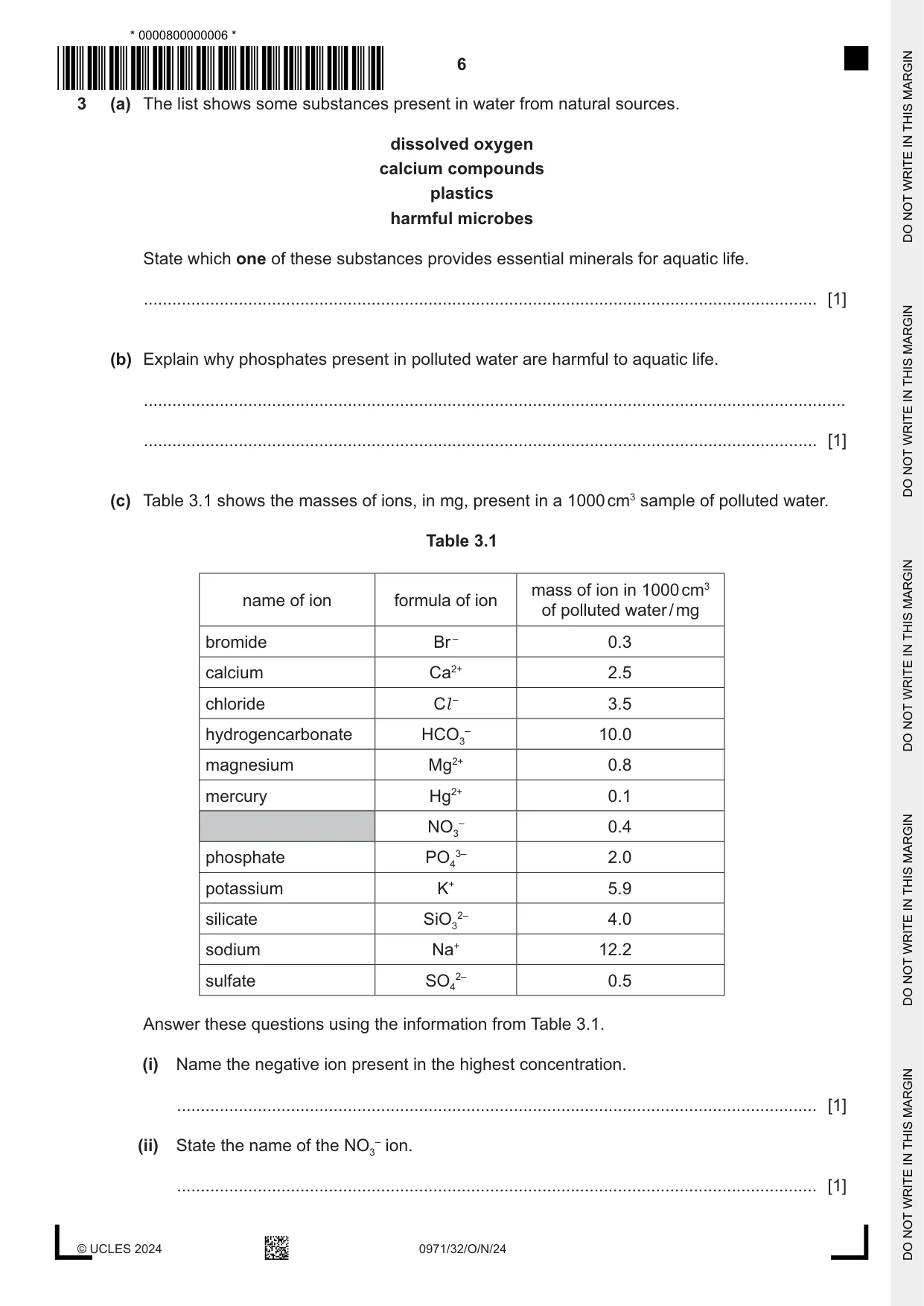
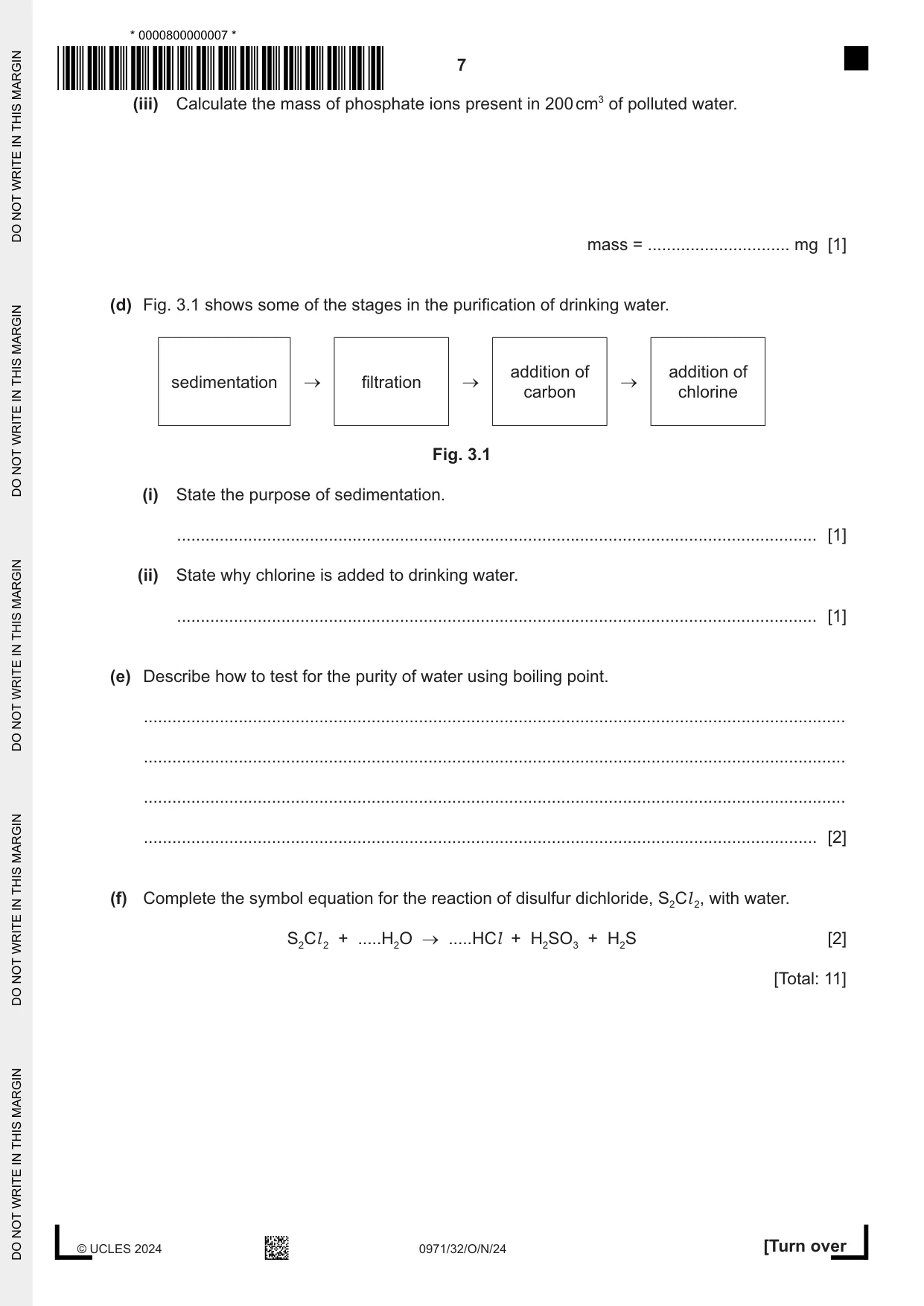
3 (a) The list shows some substances present in water from natural sources. dissolved oxygen calcium compounds plastics harmful microbes State which one of these substances provides essential minerals for aquatic life. .............................................................................................................................................. [1] (b) Explain why phosphates present in polluted water are harmful to aquatic life. .................................................................................................................................................... .............................................................................................................................................. [1] (c) Table 3.1 shows the masses of ions, in mg, present in a 1000 cm3 sample of polluted water. Table 3.1 mass of ion in 1000 cm3 name of ion formula of ion of polluted water / mg bromide Br – 0.3 calcium Ca2+ 2.5 chloride Cl – 3.5 hydrogencarbonate HCO3– 10.0 magnesium Mg2+ 0.8 mercury Hg2+ 0.1 NO3– 0.4 phosphate PO43– 2.0 potassium K+ 5.9 silicate SiO32– 4.0 sodium Na+ 12.2 sulfate SO42– 0.5 Answer these questions using the information from Table 3.1. (i) Name the negative ion present in the highest concentration. ....................................................................................................................................... [1] (ii) State the name of the NO3– ion. ....................................................................................................................................... [1] (iii) Calculate the mass of phosphate ions present in 200 cm3 of polluted water. mass = .............................. mg [1] (d) Fig. 3.1 shows some of the stages in the purification of drinking water. addition of addition of sedimentation → filtration → → carbon chlorine Fig. 3.1 (i) State the purpose of sedimentation. ....................................................................................................................................... [1] (ii) State why chlorine is added to drinking water. ....................................................................................................................................... [1] (e) Describe how to test for the purity of water using boiling point. .................................................................................................................................................... .................................................................................................................................................... .................................................................................................................................................... .............................................................................................................................................. [2] (f) Complete the symbol equation for the reaction of disulfur dichloride, S2Cl 2, with water. S2Cl 2 + .....H2O → .....HCl + H2SO3 + H2S [2] [Total: 11]
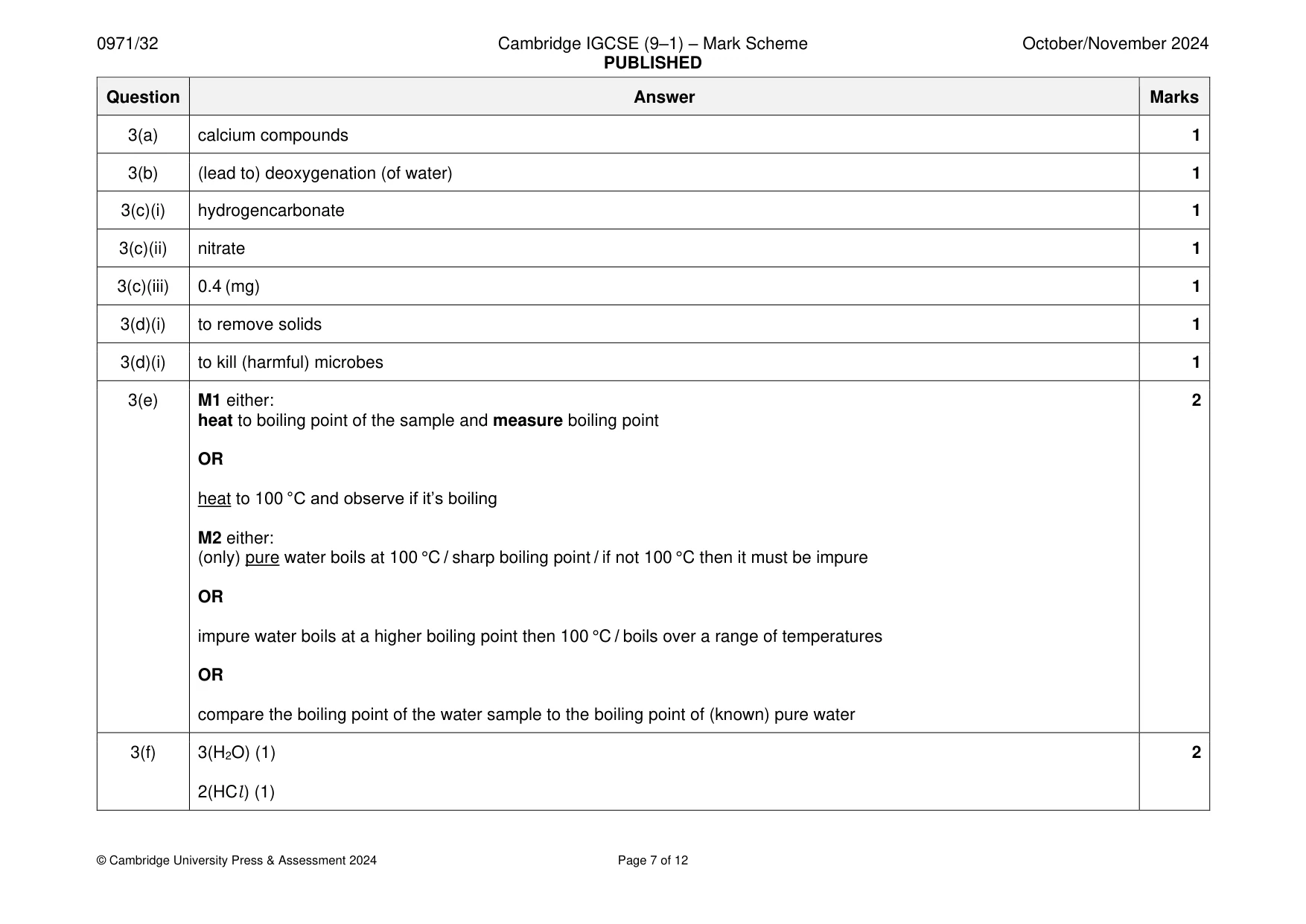
Mark scheme: 3(a) calcium compounds 1 3(b) (lead to) deoxygenation (of water) 1 3(c)(i) hydrogencarbonate 1 3(c)(ii) nitrate 1 3(c)(iii) 0.4 (mg) 1 3(d)(i) to remove solids 1 3(d)(i) to kill (harmful) microbes 1 3(e) M1 either: 2 heat to boiling point of the sample and measure boiling point OR heat to 100 °C and observe if it’s boiling M2 either: (only) pure water boils at 100 °C / sharp boiling point / if not 100 °C then it must be impure OR impure water boils at a higher boiling point then 100 °C / boils over a range of temperatures OR compare the boiling point of the water sample to the boiling point of (known) pure water 3(f) 3(H2O) (1) 2 2(HCl ) (1)
Q4 · The displayed formula of compound A
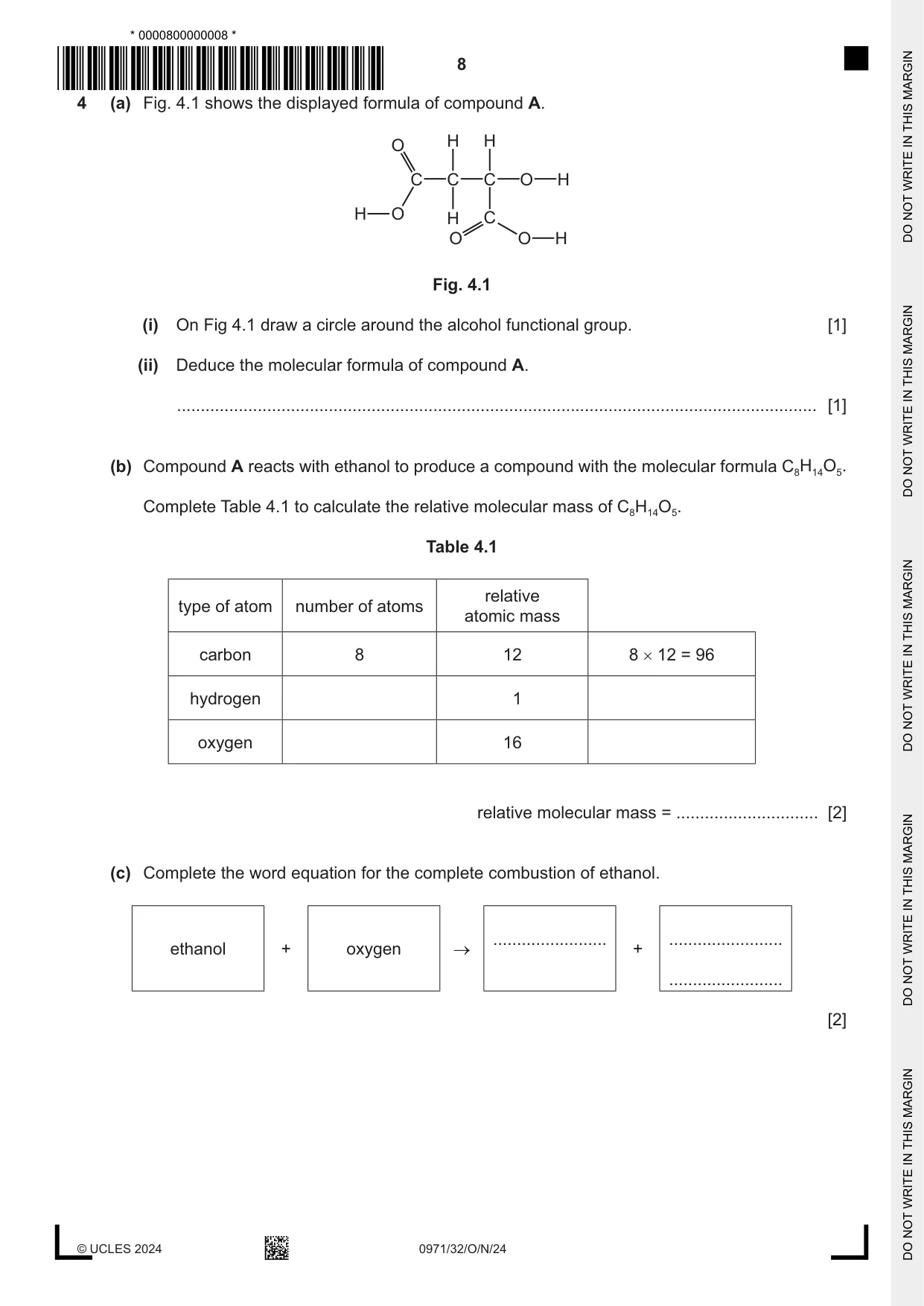
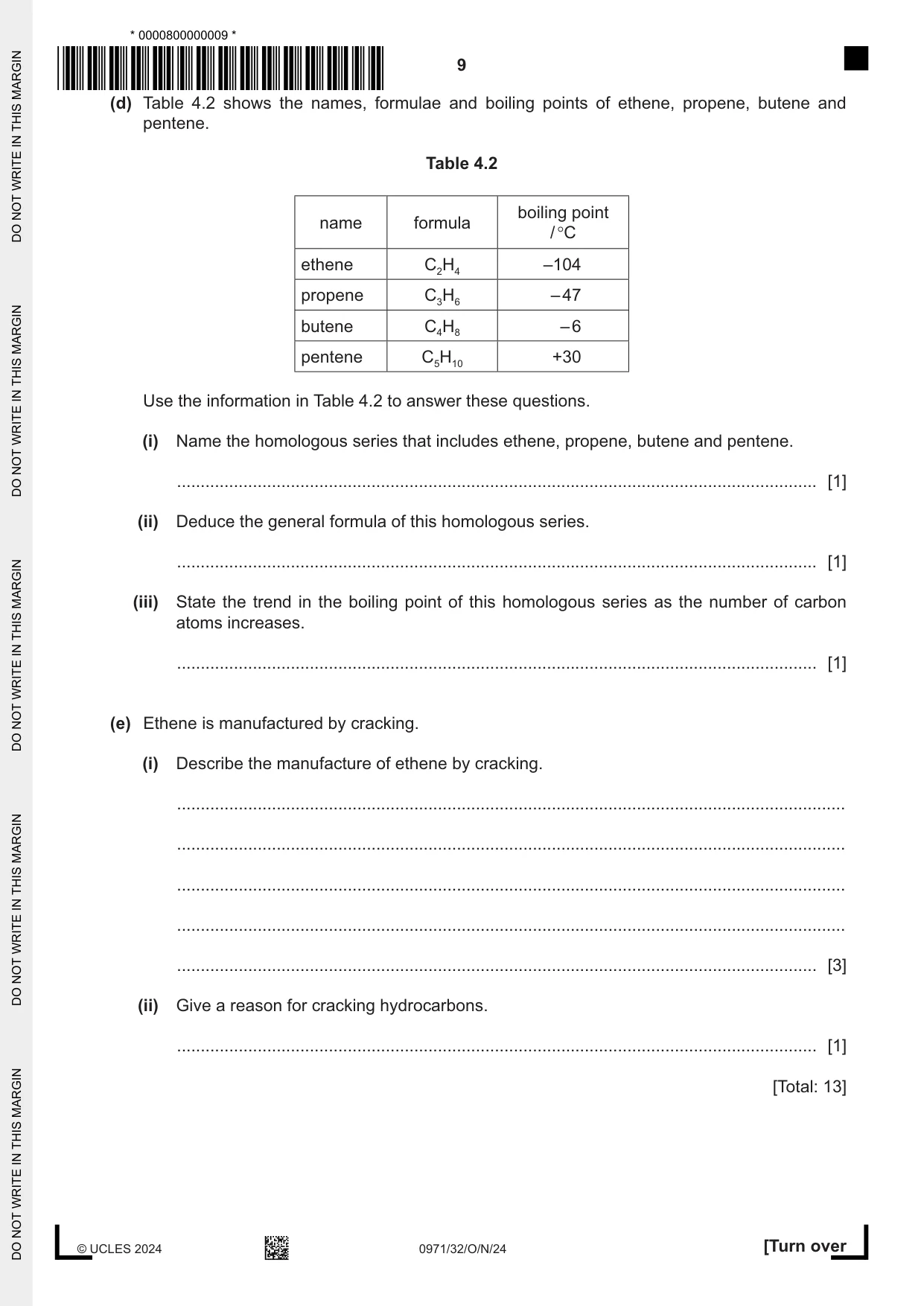
4 (a) Fig. 4.1 shows the displayed formula of compound A. O H H C C C O H H O H C O O H Fig. 4.1 (i) On Fig 4.1 draw a circle around the alcohol functional group. [1] (ii) Deduce the molecular formula of compound A. ....................................................................................................................................... [1] (b) Compound A reacts with ethanol to produce a compound with the molecular formula C8H14O5. Complete Table 4.1 to calculate the relative molecular mass of C8H14O5. Table 4.1 relative type of atom number of atoms atomic mass carbon 8 12 8 × 12 = 96 hydrogen 1 oxygen 16 relative molecular mass = .............................. [2] (c) Complete the word equation for the complete combustion of ethanol. ........................ ........................ ethanol + oxygen → + ........................ [2] (d) Table 4.2 shows the names, formulae and boiling points of ethene, propene, butene and pentene. Table 4.2 boiling point name formula / °C ethene C2H4 –104 propene C3H6 – 47 butene C4H8 – 6 pentene C5H10 +30 Use the information in Table 4.2 to answer these questions. (i) Name the homologous series that includes ethene, propene, butene and pentene. ....................................................................................................................................... [1] (ii) Deduce the general formula of this homologous series. ....................................................................................................................................... [1] (iii) State the trend in the boiling point of this homologous series as the number of carbon atoms increases. ....................................................................................................................................... [1] (e) Ethene is manufactured by cracking. (i) Describe the manufacture of ethene by cracking. ............................................................................................................................................. ............................................................................................................................................. ............................................................................................................................................. ............................................................................................................................................. ....................................................................................................................................... [3] (ii) Give a reason for cracking hydrocarbons. ....................................................................................................................................... [1] [Total: 13]
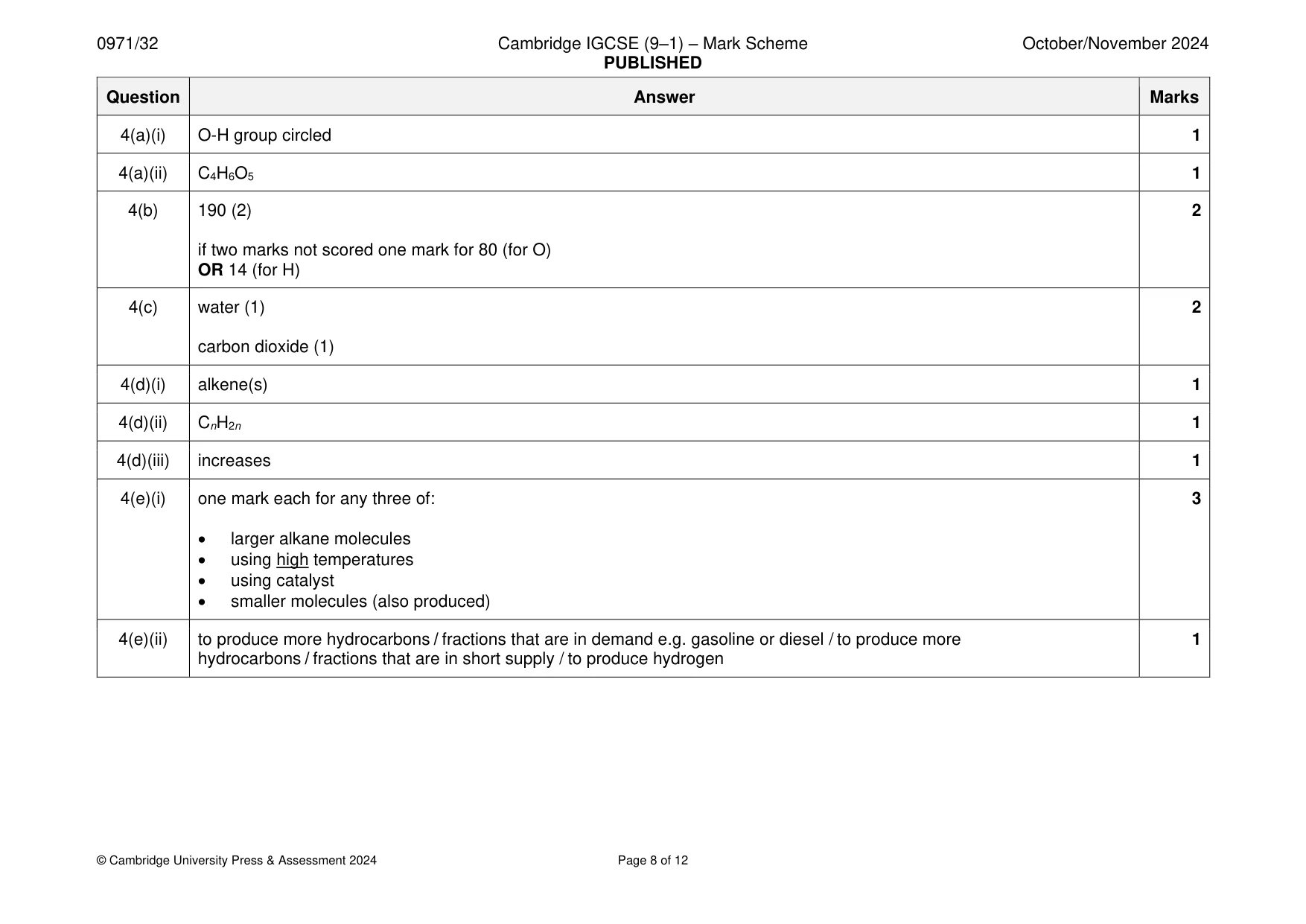
Mark scheme: 4(a)(i) O-H group circled 1 4(a)(ii) C4H6O5 1 4(b) 190 (2) 2 if two marks not scored one mark for 80 (for O) OR 14 (for H) 4(c) water (1) 2 carbon dioxide (1) 4(d)(i) alkene(s) 1 4(d)(ii) CnH2n 1 4(d)(iii) increases 1 4(e)(i) one mark each for any three of: 3 • larger alkane molecules • using high temperatures • using catalyst • smaller molecules (also produced) 4(e)(ii) to produce more hydrocarbons / fractions that are in demand e.g. gasoline or diesel / to produce more 1 hydrocarbons / fractions that are in short supply / to produce hydrogen
Q5 · Some properties of five halogens
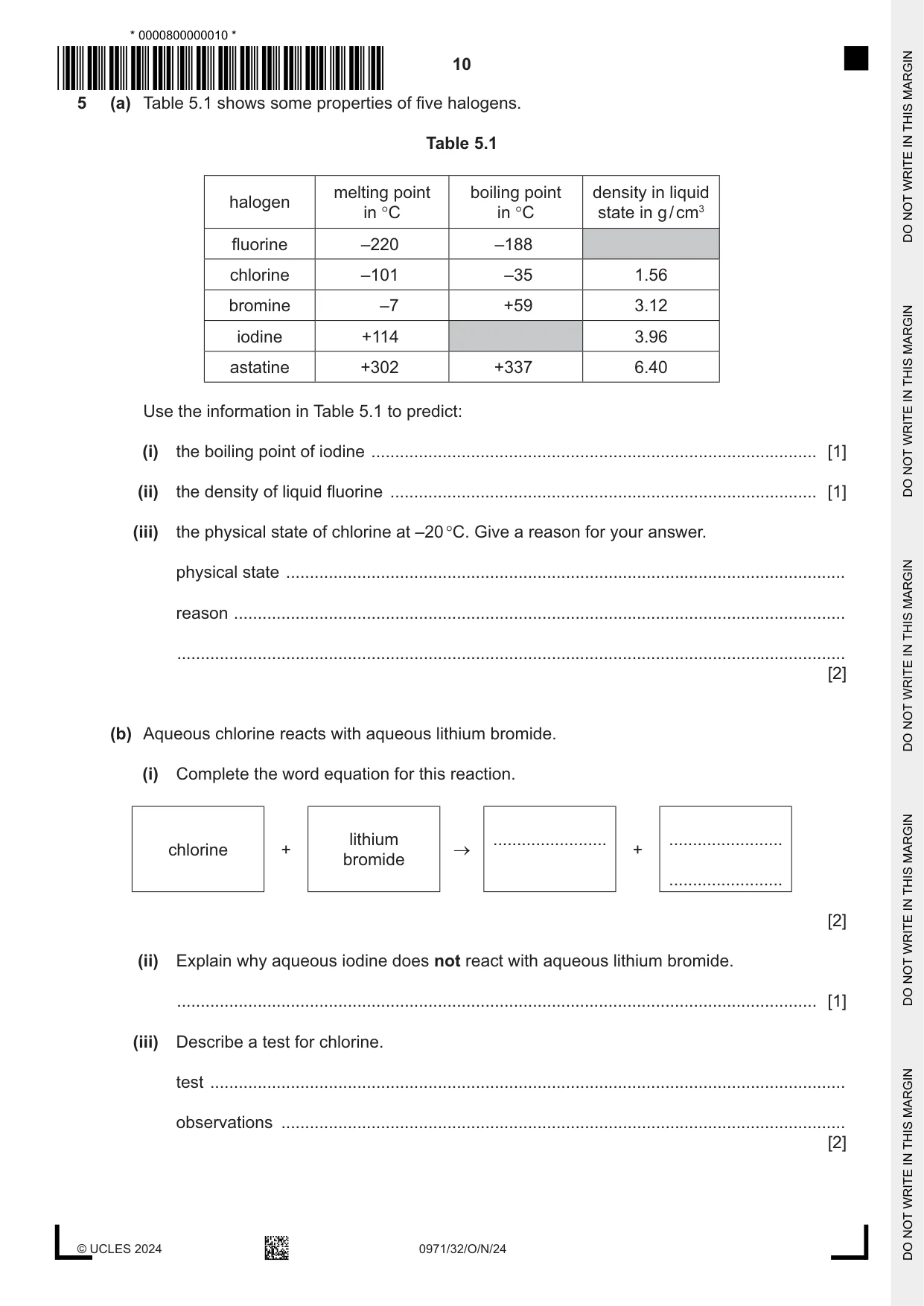
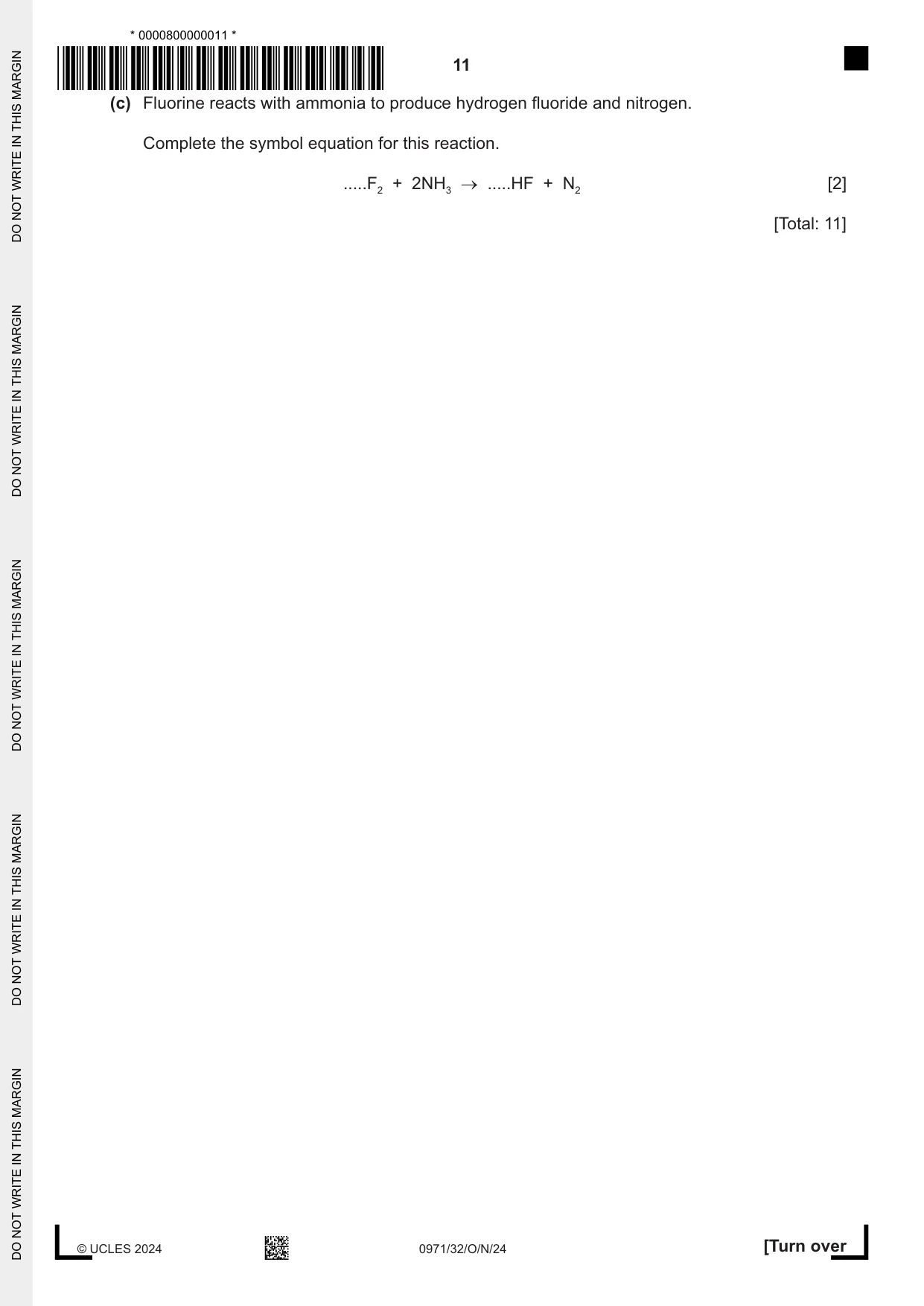
5 (a) Table 5.1 shows some properties of five halogens. Table 5.1 melting point boiling point density in liquid halogen in °C in °C state in g / cm3 fluorine –220 –188 chlorine –101 –35 1.56 bromine –7 +59 3.12 iodine +114 3.96 astatine +302 +337 6.40 Use the information in Table 5.1 to predict: (i) the boiling point of iodine .............................................................................................. [1] (ii) the density of liquid fluorine .......................................................................................... [1] (iii) the physical state of chlorine at –20 °C. Give a reason for your answer. physical state ...................................................................................................................... reason ................................................................................................................................. ............................................................................................................................................. [2] (b) Aqueous chlorine reacts with aqueous lithium bromide. (i) Complete the word equation for this reaction. lithium ........................ ........................ chlorine + → + bromide ........................ [2] (ii) Explain why aqueous iodine does not react with aqueous lithium bromide. ....................................................................................................................................... [1] (iii) Describe a test for chlorine. test ...................................................................................................................................... observations ....................................................................................................................... [2] (c) Fluorine reacts with ammonia to produce hydrogen fluoride and nitrogen. Complete the symbol equation for this reaction. .....F2 + 2NH3 → .....HF + N2 [2] [Total: 11]
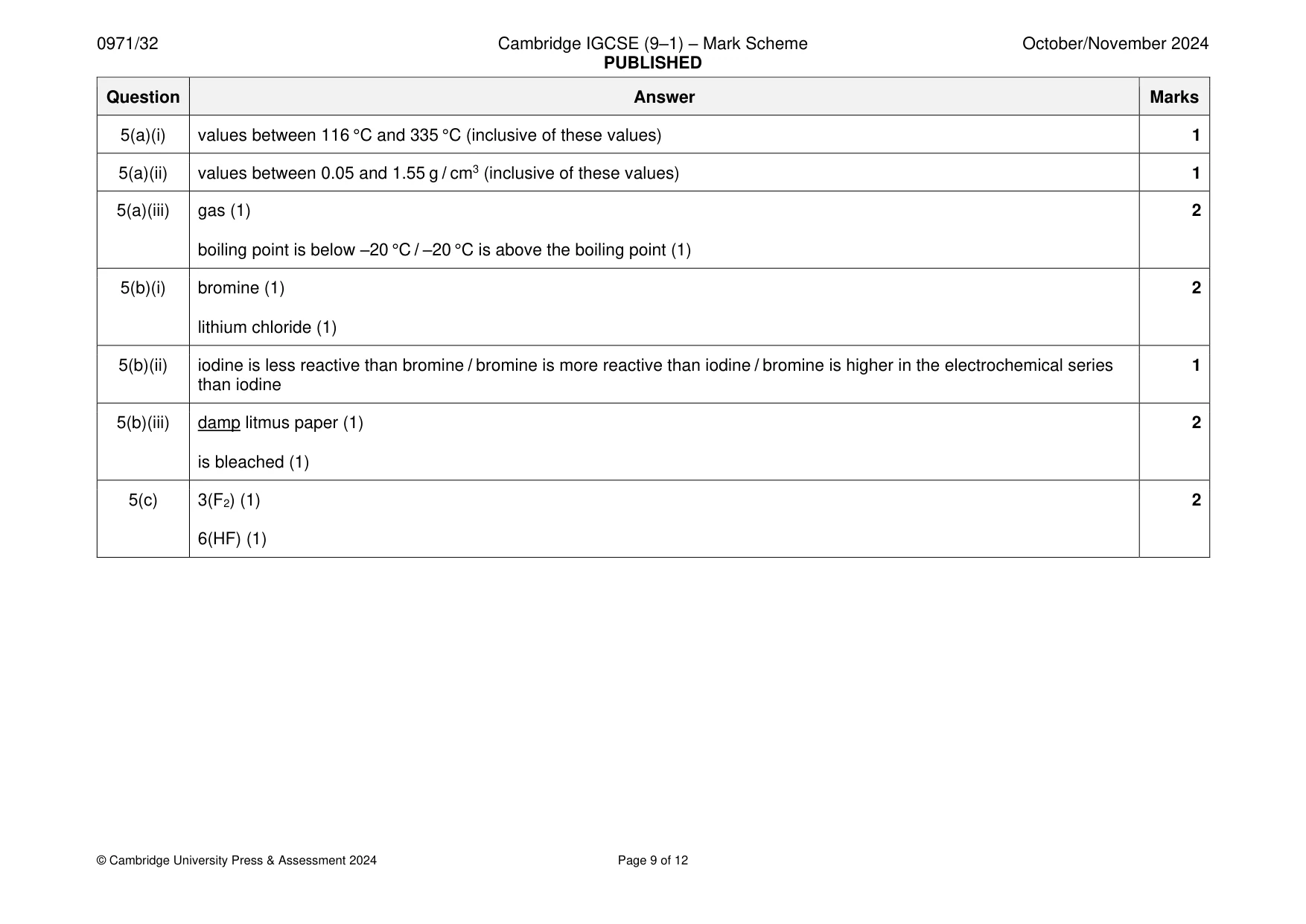
Mark scheme: 5(a)(i) values between 116 °C and 335 °C (inclusive of these values) 1 5(a)(ii) values between 0.05 and 1.55 g / cm3 (inclusive of these values) 1 5(a)(iii) gas (1) 2 boiling point is below –20 °C / –20 °C is above the boiling point (1) 5(b)(i) bromine (1) 2 lithium chloride (1) 5(b)(ii) iodine is less reactive than bromine / bromine is more reactive than iodine / bromine is higher in the electrochemical series 1 than iodine 5(b)(iii) damp litmus paper (1) 2 is bleached (1) 5(c) 3(F2) (1) 2 6(HF) (1)
Q6 · This question is about metals
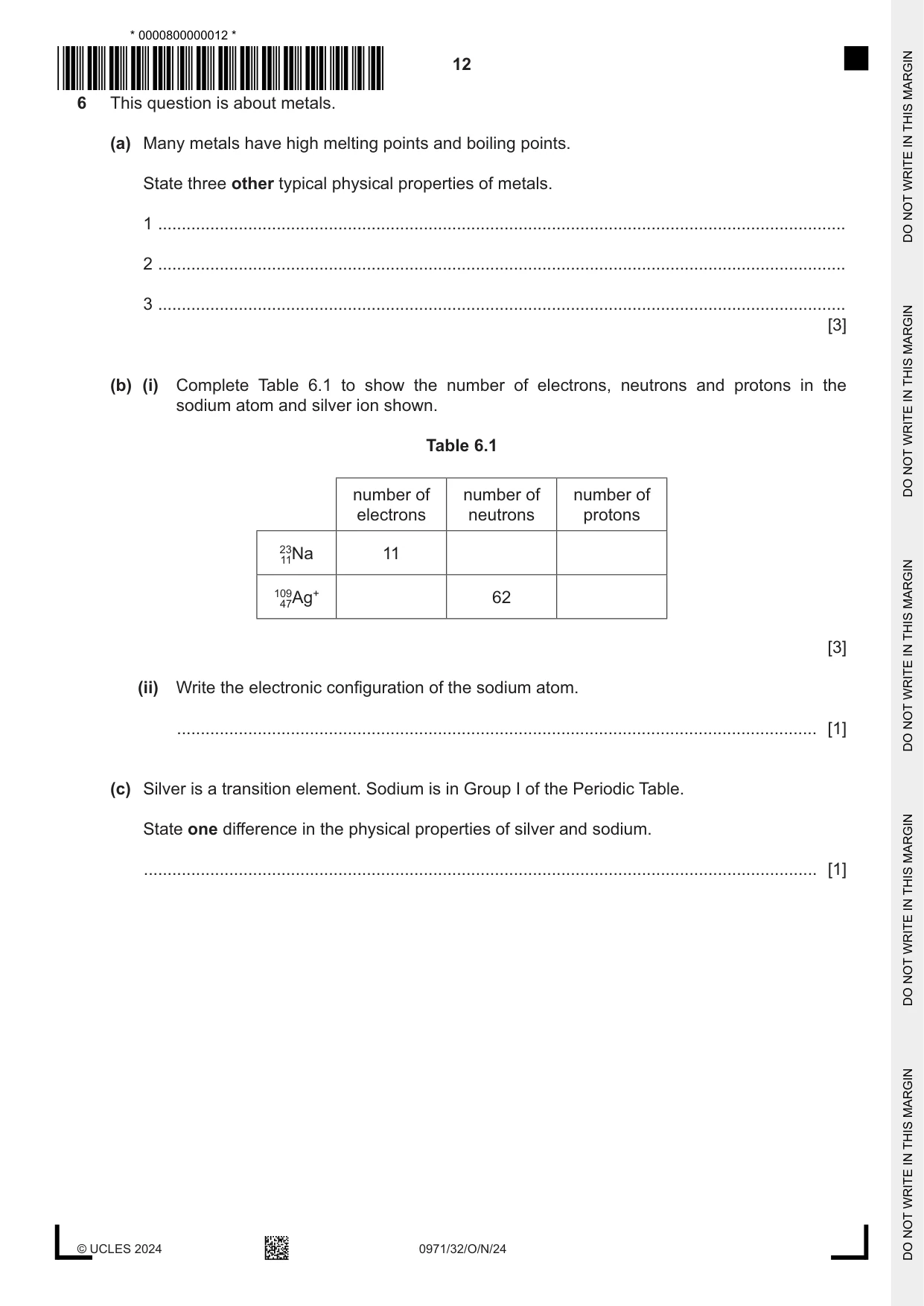
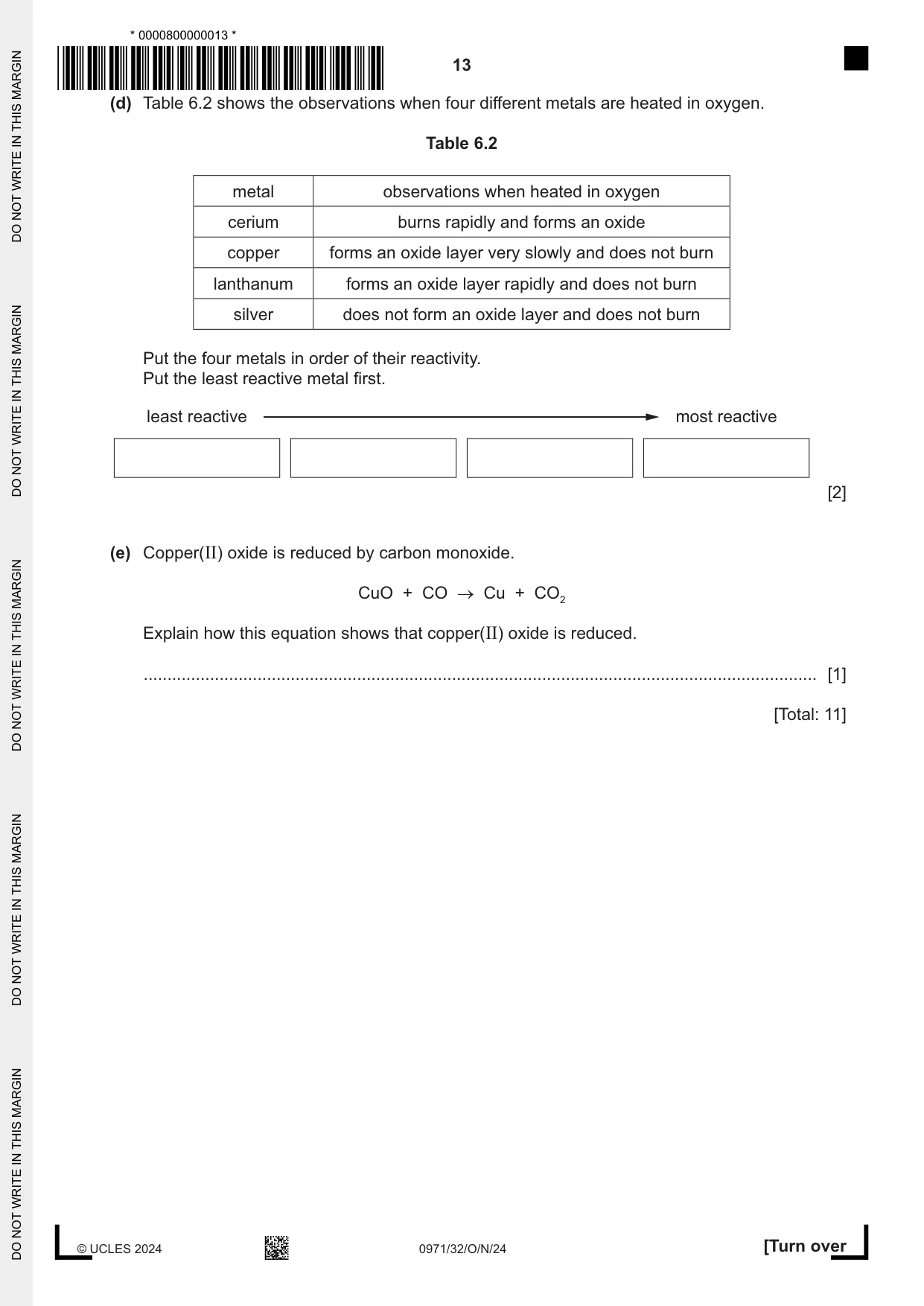
6 This question is about metals. (a) Many metals have high melting points and boiling points. State three other typical physical properties of metals. 1 ................................................................................................................................................. 2 ................................................................................................................................................. 3 ................................................................................................................................................. [3] (b) (i) Complete Table 6.1 to show the number of electrons, neutrons and protons in the sodium atom and silver ion shown. Table 6.1 number of number of number of electrons neutrons protons 23Na11 11 109Ag+47 62 [3] (ii) Write the electronic configuration of the sodium atom. ....................................................................................................................................... [1] (c) Silver is a transition element. Sodium is in Group I of the Periodic Table. State one difference in the physical properties of silver and sodium. .............................................................................................................................................. [1] (d) Table 6.2 shows the observations when four different metals are heated in oxygen. Table 6.2 metal observations when heated in oxygen cerium burns rapidly and forms an oxide copper forms an oxide layer very slowly and does not burn lanthanum forms an oxide layer rapidly and does not burn silver does not form an oxide layer and does not burn Put the four metals in order of their reactivity. Put the least reactive metal first. least reactive most reactive [2] (e) Copper(II) oxide is reduced by carbon monoxide. CuO + CO → Cu + CO2 Explain how this equation shows that copper(II) oxide is reduced. .............................................................................................................................................. [1] [Total: 11]
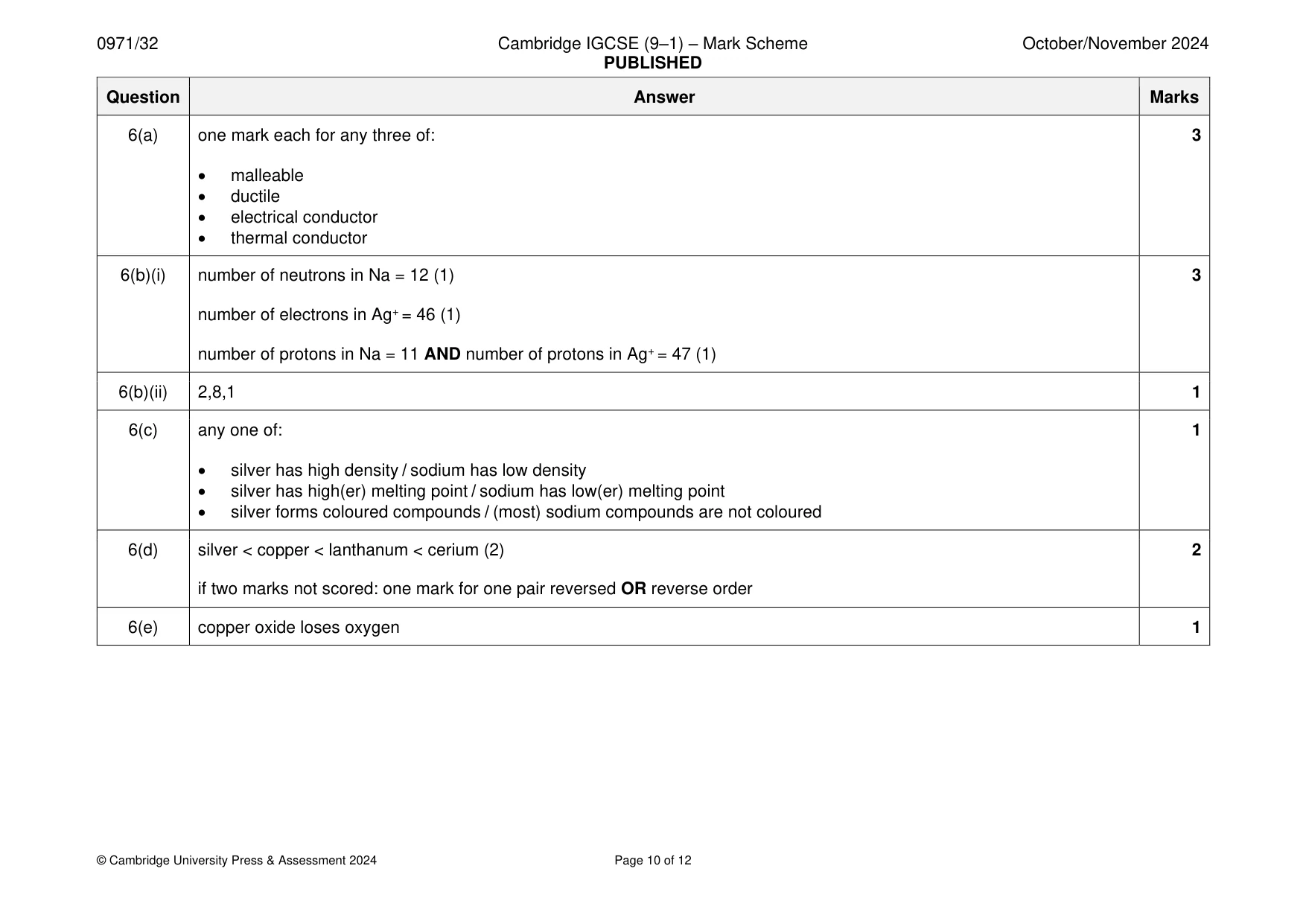
Mark scheme: 6(a) one mark each for any three of: 3 • malleable • ductile • electrical conductor • thermal conductor 6(b)(i) number of neutrons in Na = 12 (1) 3 number of electrons in Ag+ = 46 (1) number of protons in Na = 11 AND number of protons in Ag+ = 47 (1) 6(b)(ii) 2,8,1 1 6(c) any one of: 1 • silver has high density / sodium has low density • silver has high(er) melting point / sodium has low(er) melting point • silver forms coloured compounds / (most) sodium compounds are not coloured 6(d) silver < copper < lanthanum < cerium (2) 2 if two marks not scored: one mark for one pair reversed OR reverse order 6(e) copper oxide loses oxygen 1
Q7 · This question is about acids, bases and salts
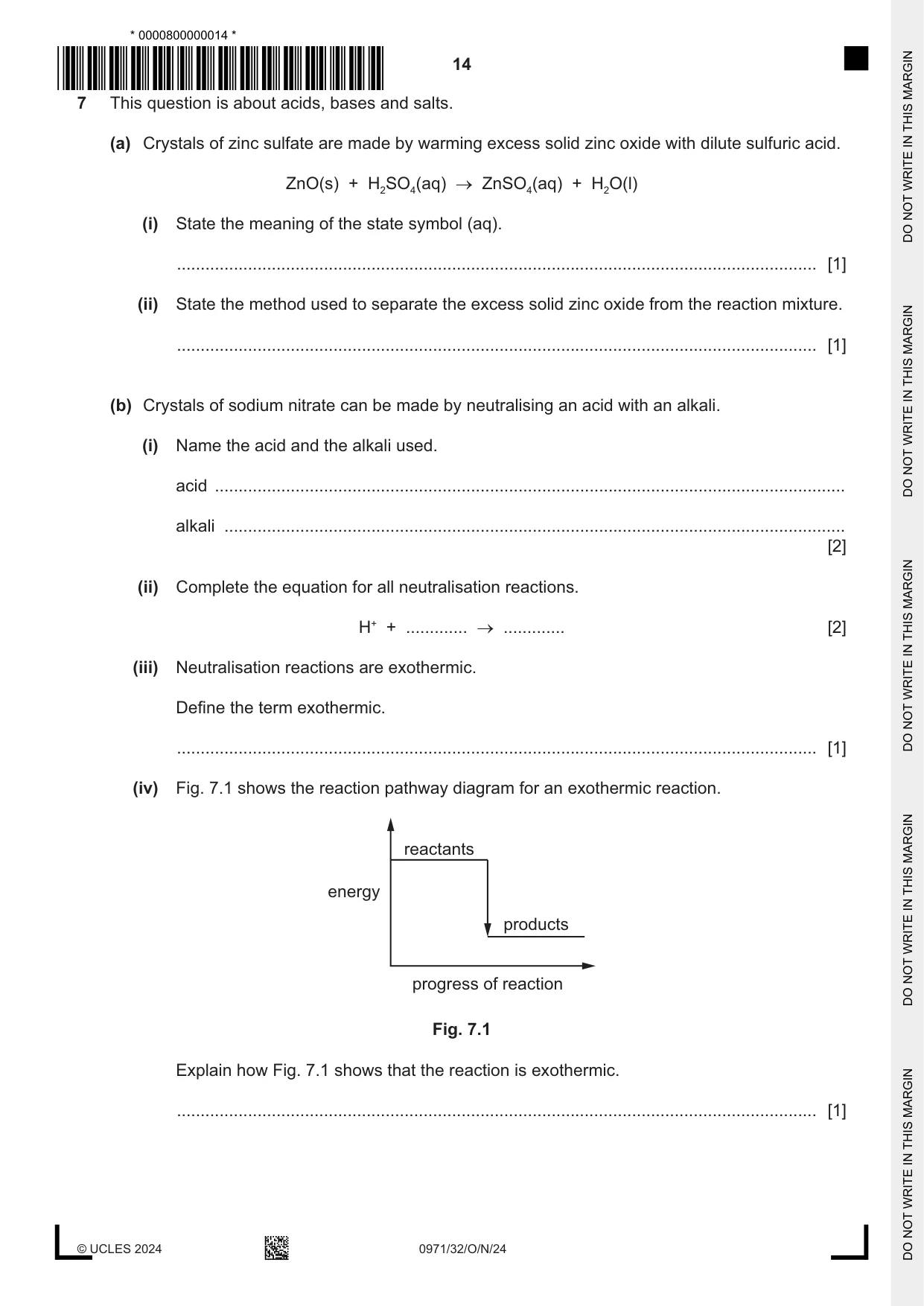
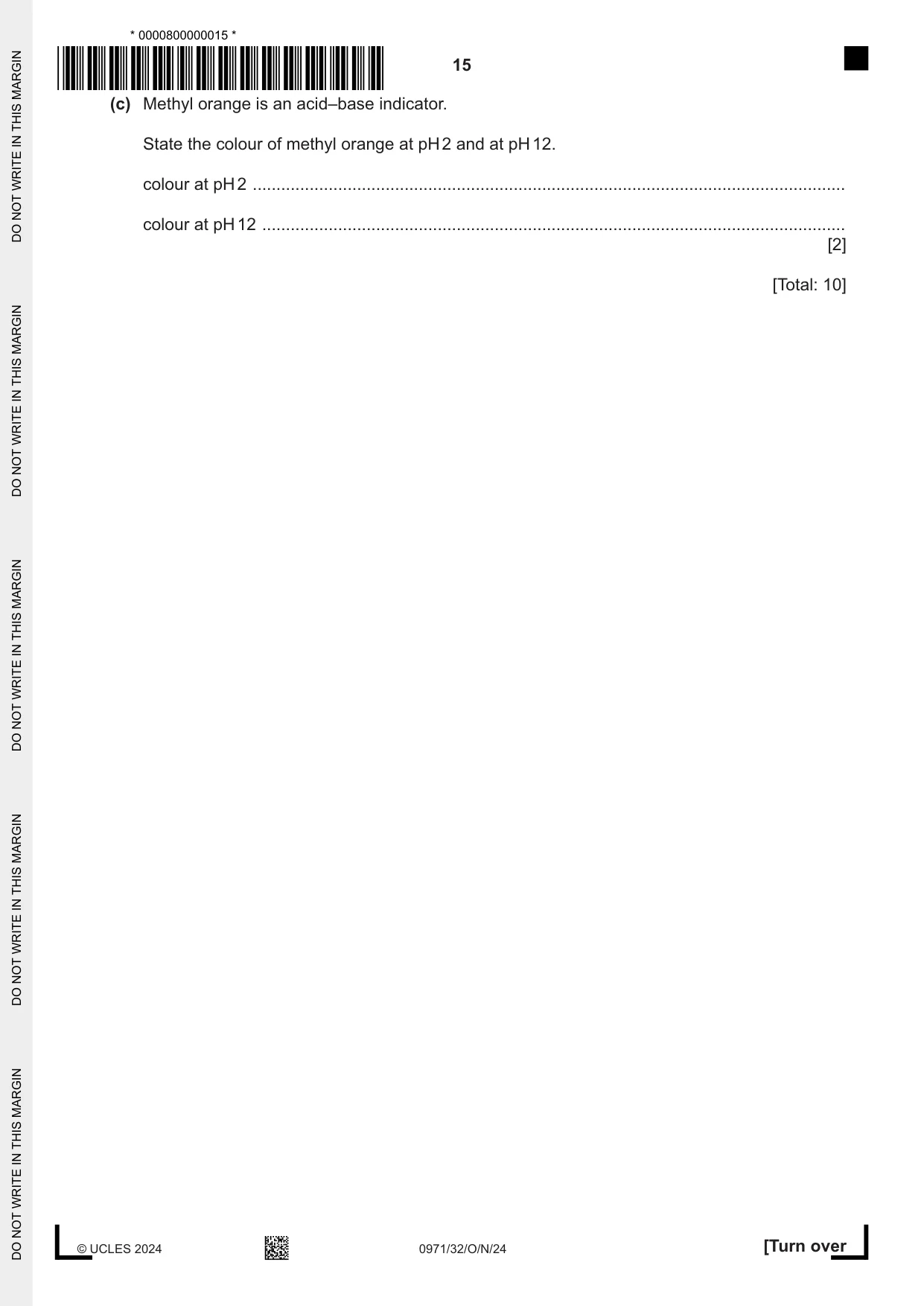
7 This question is about acids, bases and salts. (a) Crystals of zinc sulfate are made by warming excess solid zinc oxide with dilute sulfuric acid. ZnO(s) + H2SO4(aq) → ZnSO4(aq) + H2O(l) (i) State the meaning of the state symbol (aq). ....................................................................................................................................... [1] (ii) State the method used to separate the excess solid zinc oxide from the reaction mixture. ....................................................................................................................................... [1] (b) Crystals of sodium nitrate can be made by neutralising an acid with an alkali. (i) Name the acid and the alkali used. acid ..................................................................................................................................... alkali ................................................................................................................................... [2] (ii) Complete the equation for all neutralisation reactions. H+ + ............. → ............. [2] (iii) Neutralisation reactions are exothermic. Define the term exothermic. ....................................................................................................................................... [1] (iv) Fig. 7.1 shows the reaction pathway diagram for an exothermic reaction. reactants energy products progress of reaction Fig. 7.1 Explain how Fig. 7.1 shows that the reaction is exothermic. ....................................................................................................................................... [1] (c) Methyl orange is an acid–base indicator. State the colour of methyl orange at pH 2 and at pH 12. colour at pH 2 ............................................................................................................................. colour at pH 12 ........................................................................................................................... [2] [Total: 10]
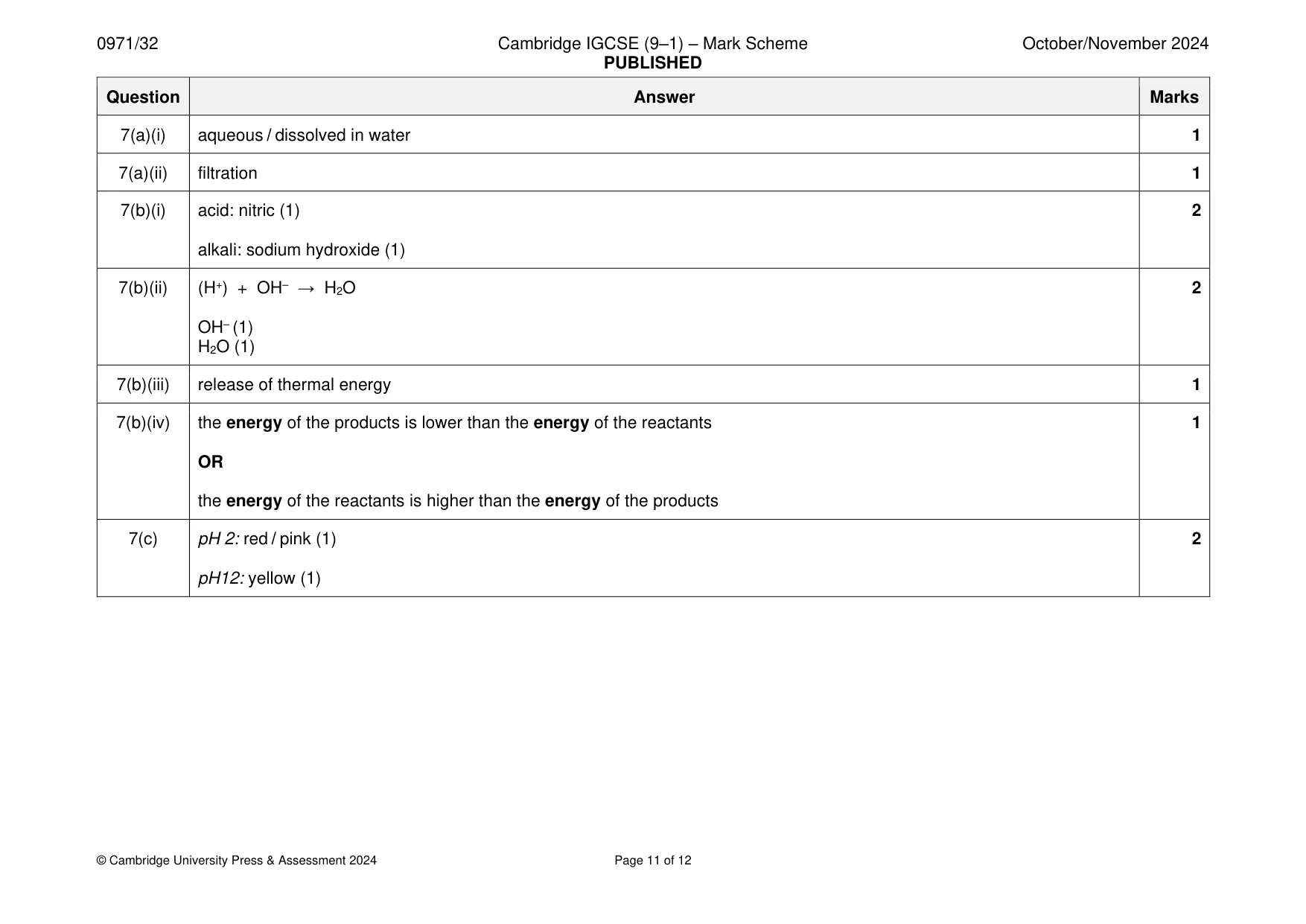
Mark scheme: 7(a)(i) aqueous / dissolved in water 1 7(a)(ii) filtration 1 7(b)(i) acid: nitric (1) 2 alkali: sodium hydroxide (1) 7(b)(ii) (H+) + OH– → H2O 2 OH– (1) H2O (1) 7(b)(iii) release of thermal energy 1 7(b)(iv) the energy of the products is lower than the energy of the reactants 1 OR the energy of the reactants is higher than the energy of the products 7(c) pH 2: red / pink (1) 2 pH12: yellow (1)
Q8 · A student investigates the reaction of small pieces of calcium carbonate with excess…
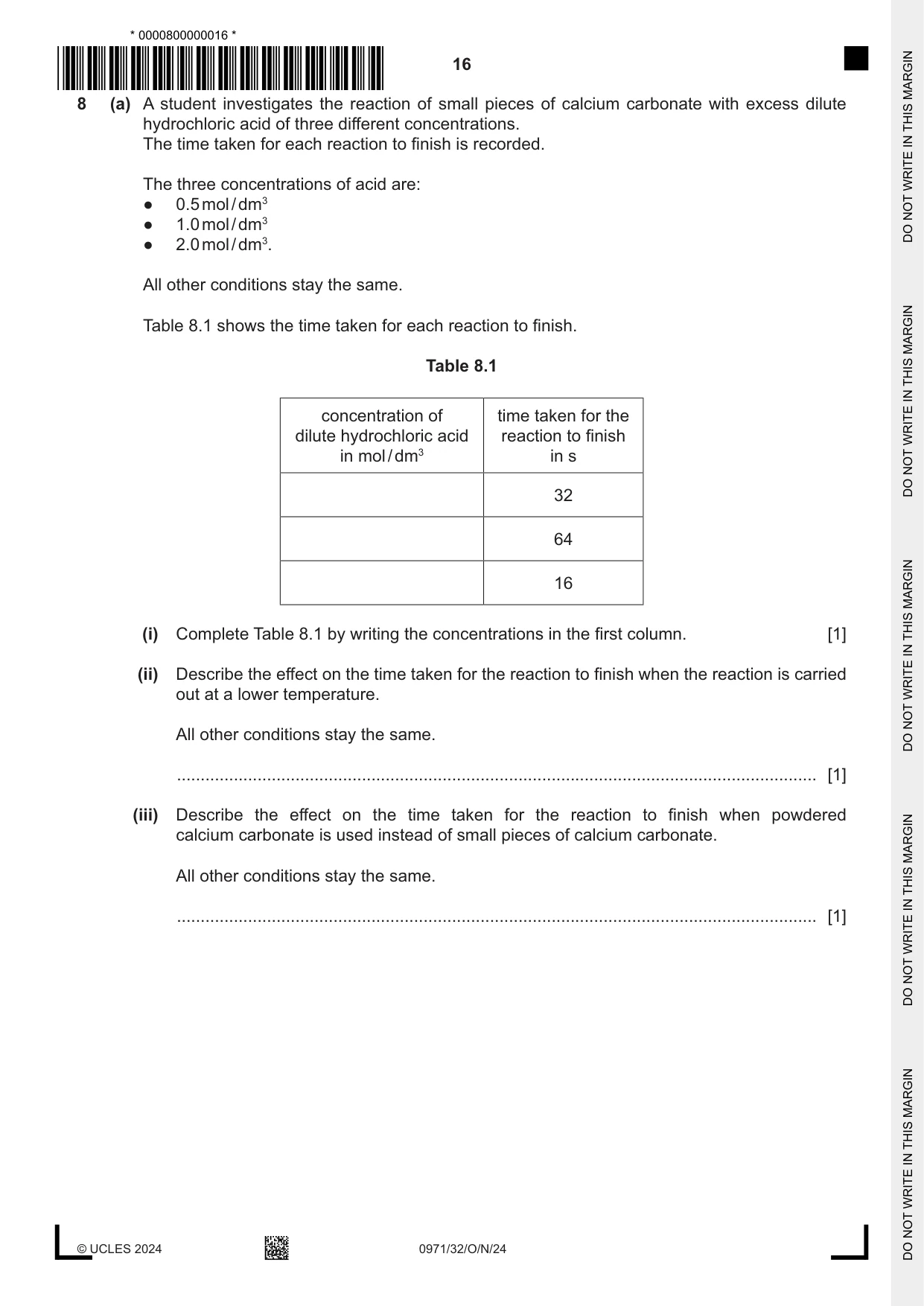
8 (a) A student investigates the reaction of small pieces of calcium carbonate with excess dilute hydrochloric acid of three different concentrations. The time taken for each reaction to finish is recorded. The three concentrations of acid are: ● 0.5 mol / dm3 ● 1.0 mol / dm3 ● 2.0 mol / dm3. All other conditions stay the same. Table 8.1 shows the time taken for each reaction to finish. Table 8.1 concentration of time taken for the dilute hydrochloric acid reaction to finish in mol / dm3 in s 32 64 16 (i) Complete Table 8.1 by writing the concentrations in the first column. [1] (ii) Describe the effect on the time taken for the reaction to finish when the reaction is carried out at a lower temperature. All other conditions stay the same. ....................................................................................................................................... [1] (iii) Describe the effect on the time taken for the reaction to finish when powdered calcium carbonate is used instead of small pieces of calcium carbonate. All other conditions stay the same. ....................................................................................................................................... [1] (b) Molten calcium chloride is electrolysed using inert electrodes. (i) Name the products at the positive and negative electrodes. product at the positive electrode ......................................................................................... product at the negative electrode ....................................................................................... [2] (ii) Choose from the list the substance that is used as an inert electrode. Draw a circle around your chosen answer. graphite iodine magnesium phosphorus [1] (c) Carbon dioxide is a gas at room temperature. Describe the motion and separation of the particles in carbon dioxide gas. motion ........................................................................................................................................ .................................................................................................................................................... separation .................................................................................................................................. .................................................................................................................................................... [2] [Total: 8]
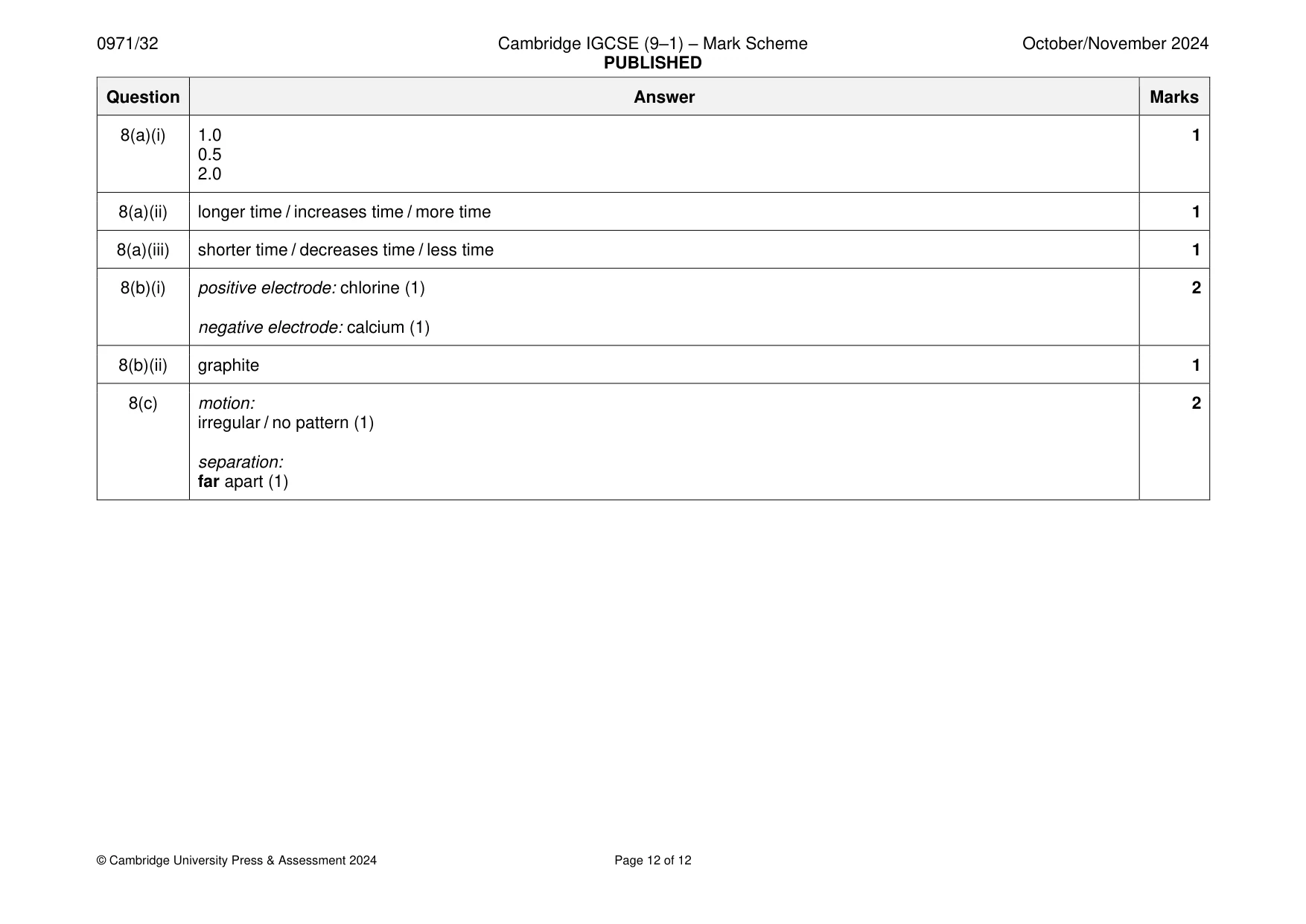
Mark scheme: 8(a)(i) 1.0 1 0.5 2.0 8(a)(ii) longer time / increases time / more time 1 8(a)(iii) shorter time / decreases time / less time 1 8(b)(i) positive electrode: chlorine (1) 2 negative electrode: calcium (1) 8(b)(ii) graphite 1 8(c) motion: 2 irregular / no pattern (1) separation: far apart (1)
What was in this paper
The subtopics covered by these 8 questions, and how many questions each got. Open one in a new tab to see every Cambridge question on it.
What you needed in this session
Cambridge’s own grade thresholds for 2024 Oct/Nov, Paper 3 · Variant 2. A higher threshold means an easier paper — the bar moves with how the cohort did.