Cambridge IGCSE Biology (BES) 0438 — 2014 May/June Paper 3 · Variant 1
0438/31/M/J/14 · 80 marks · ≈90 min
The question paper and its mark scheme, free to read here and free to download. This is Cambridge’s own paper, exactly as it was sat.
Question paper20 pages


Mark scheme10 pages
Answers below. Sit the paper first if you are practising.
Paper as text
Question paper, page 1
This document consists of 18 printed pages and 2 blank pages. DC (NF/CGW) 97665/1 R © UCLES 2014 [Turn over * 1 1 3 7 6 6 7 7 9 4 * BIOLOGY (US) 0438/31 Paper 3 Extended May/June 2014 1 hour 15 minutes Candidates answer on the Question Paper. No Additional Materials are required. READ THESE INSTRUCTIONS FIRST Write your Center number, candidate number and name on all the work you hand in. Write in dark blue or black pen. You may use an HB pencil for any diagrams or graphs. Do not use staples, paper clips, glue or correction fluid. DO NOT WRITE IN ANY BARCODES. Answer all questions. Electronic calculators may be used. You may lose marks if you do not show your working or if you do not use appropriate units. At the end of the examination, fasten all your work securely together. The number of marks is given in brackets [ ] at the end of each question or part question. Cambridge International Examinations Cambridge International General Certificate of Secondary Education
Question paper, page 2
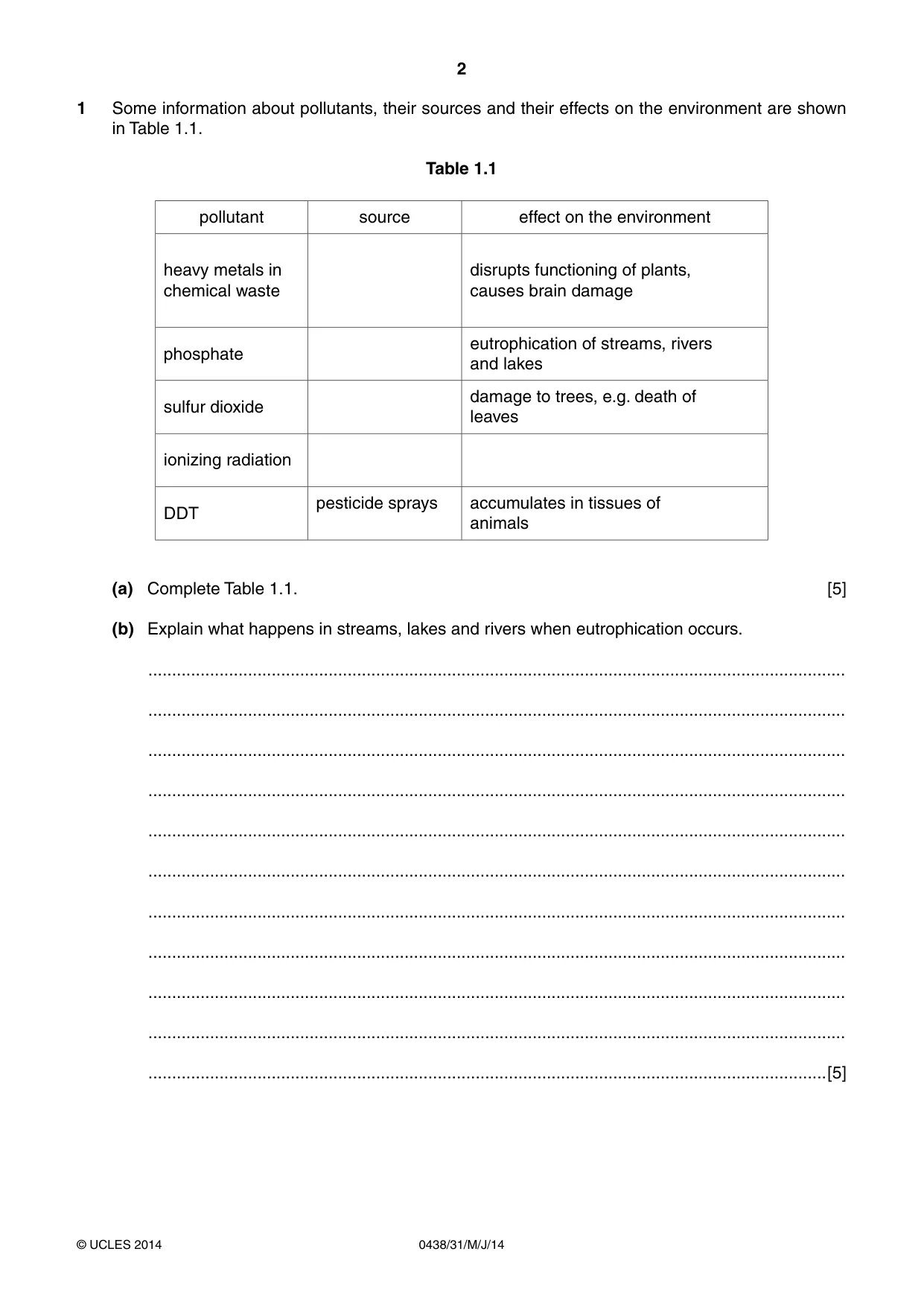
2 0438/31/M/J/14 © UCLES 2014 1 Some information about pollutants, their sources and their effects on the environment are shown in Table 1.1. Table 1.1 pollutant source effect on the environment heavy metals in chemical waste disrupts functioning of plants, causes brain damage phosphate eutrophication of streams, rivers and lakes sulfur dioxide damage to trees, e.g. death of leaves ionizing radiation DDT pesticide sprays accumulates in tissues of animals (a) Complete Table 1.1. [5] (b) Explain what happens in streams, lakes and rivers when eutrophication occurs. … … … … … … … … … … …[5]
Question paper, page 3
3 0438/31/M/J/14 © UCLES 2014 [Turn over (c) Sulfur dioxide dissolves in rain water to form acid rain. Describe two measures that can be taken to reduce the effects of acid rain. 1 … … 2 … … [2] [Total: 12]
Question paper, page 4
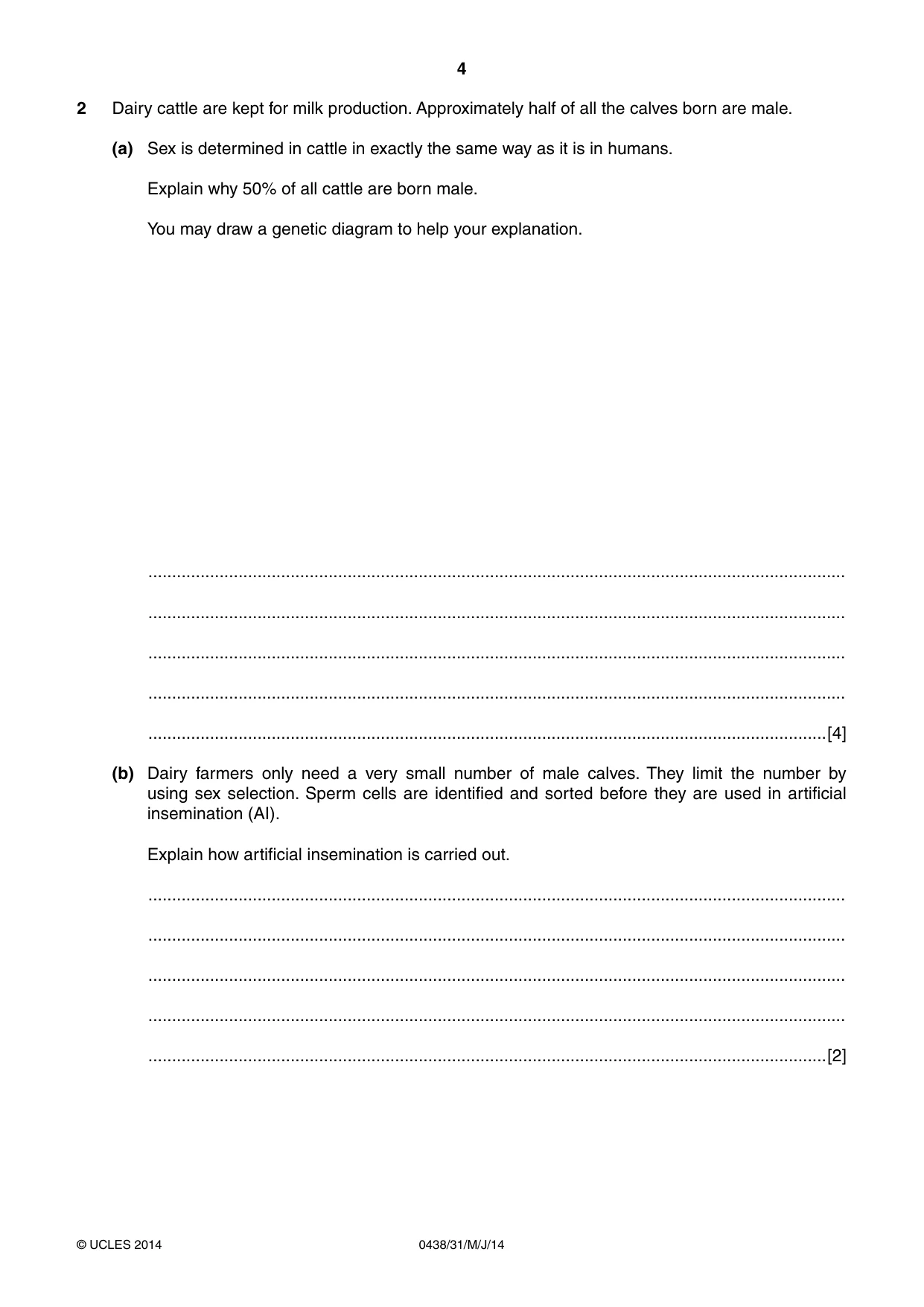
4 0438/31/M/J/14 © UCLES 2014 2 Dairy cattle are kept for milk production. Approximately half of all the calves born are male. (a) Sex is determined in cattle in exactly the same way as it is in humans. Explain why 50% of all cattle are born male. You may draw a genetic diagram to help your explanation. … … … … …[4] (b) Dairy farmers only need a very small number of male calves. They limit the number by using sex selection. Sperm cells are identified and sorted before they are used in artificial insemination (AI). Explain how artificial insemination is carried out. … … … … …[2]
Question paper, page 5
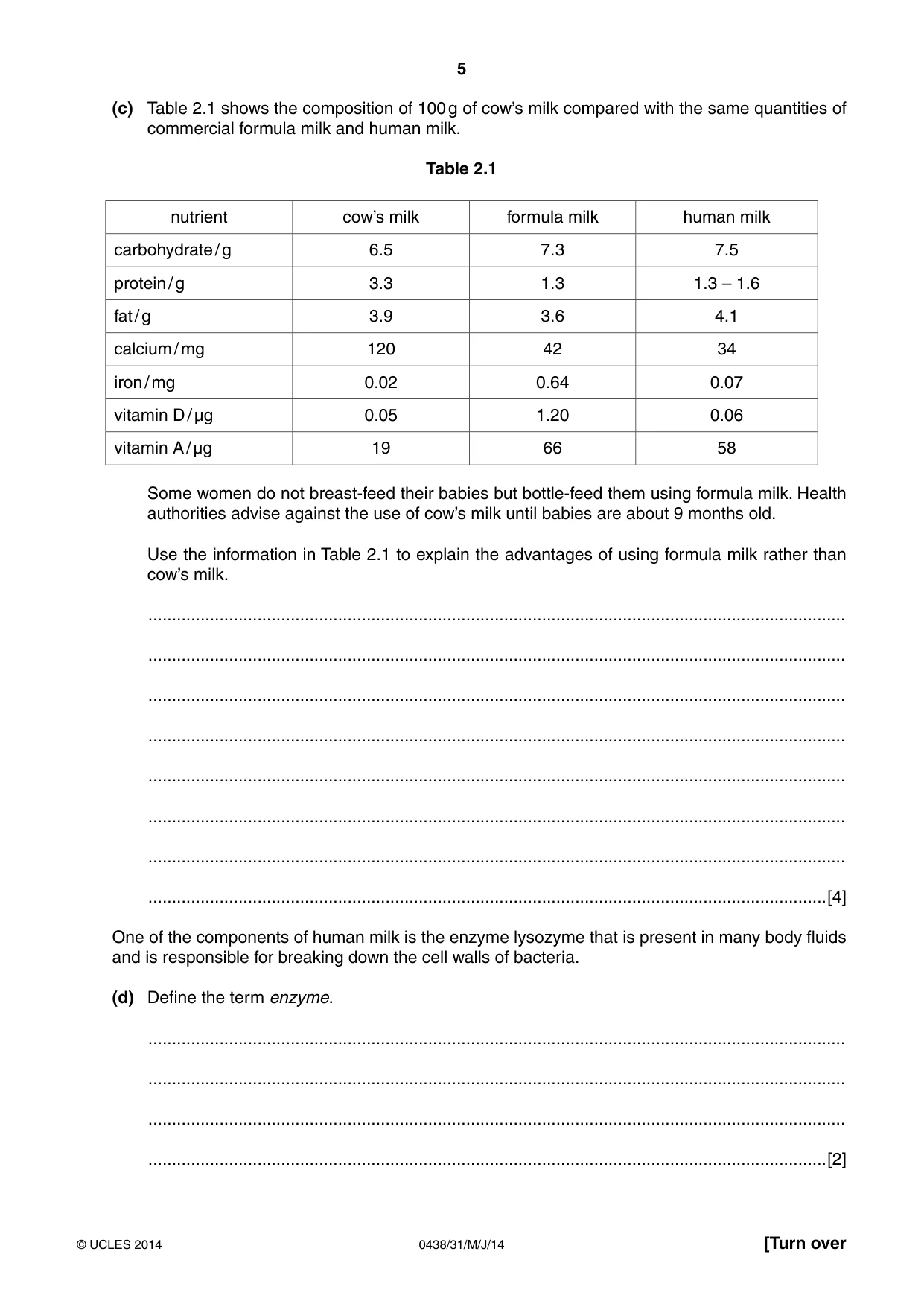
5 0438/31/M/J/14 © UCLES 2014 [Turn over (c) Table 2.1 shows the composition of 100 g of cow’s milk compared with the same quantities of commercial formula milk and human milk. Table 2.1 nutrient cow’s milk formula milk human milk carbohydrate / g 6.5 7.3 7.5 protein / g 3.3 1.3 1.3 – 1.6 fat / g 3.9 3.6 4.1 calcium / mg 120 42 34 iron / mg 0.02 0.64 0.07 vitamin D / µg 0.05 1.20 0.06 vitamin A / µg 19 66 58 Some women do not breast-feed their babies but bottle-feed them using formula milk. Health authorities advise against the use of cow’s milk until babies are about 9 months old. Use the information in Table 2.1 to explain the advantages of using formula milk rather than cow’s milk. … … … … … … … …[4] One of the components of human milk is the enzyme lysozyme that is present in many body fluids and is responsible for breaking down the cell walls of bacteria. (d) Define the term enzyme. … … … …[2]
Question paper, page 6
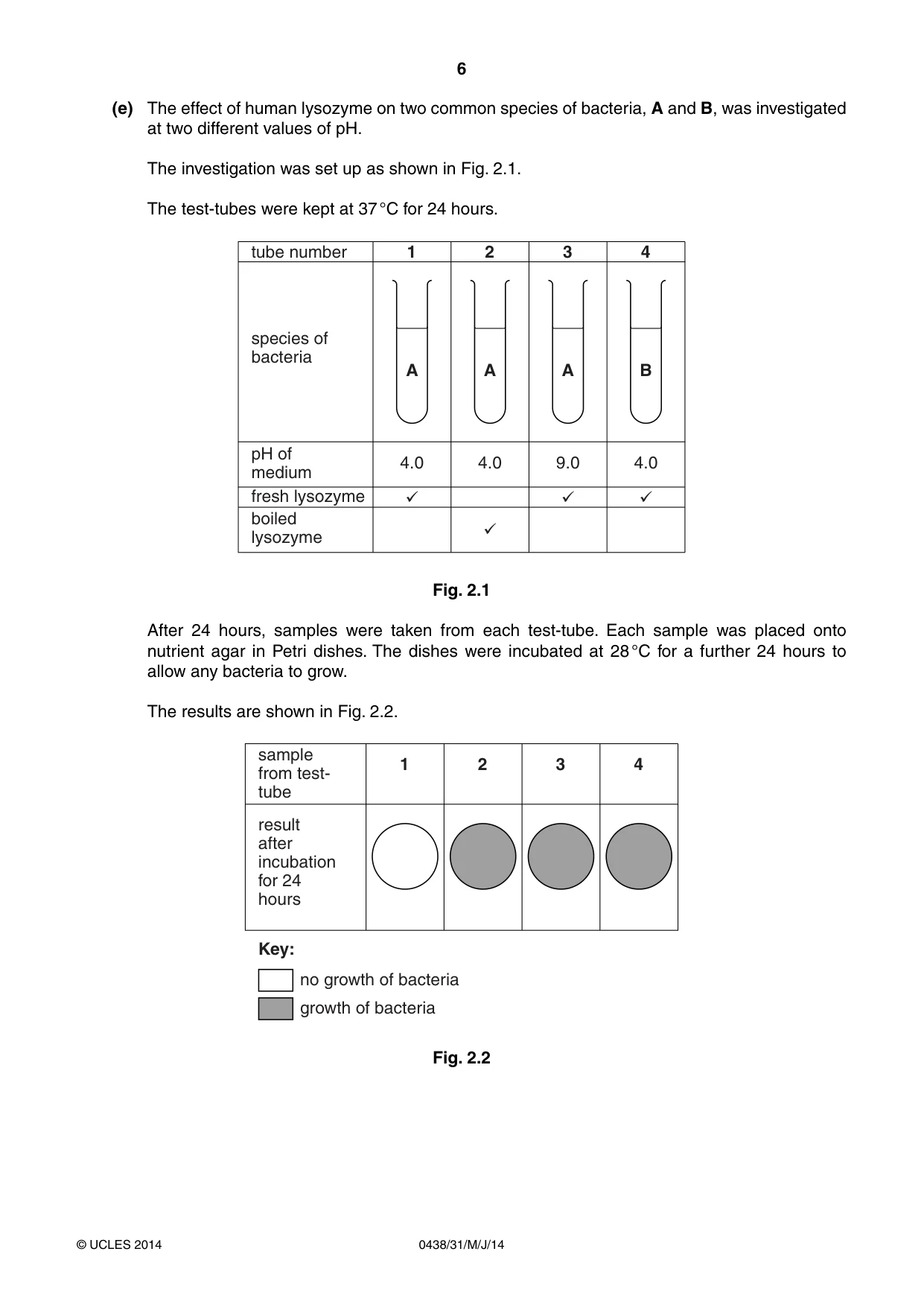
6 0438/31/M/J/14 © UCLES 2014 (e) The effect of human lysozyme on two common species of bacteria, A and B, was investigated at two different values of pH. The investigation was set up as shown in Fig. 2.1. The test-tubes were kept at 37 °C for 24 hours. A 1 tube number pH of medium boiled lysozyme species of bacteria fresh lysozyme A A B 2 3 4 4.0 4.0 9.0 4.0 9 9 9 9 Fig. 2.1 After 24 hours, samples were taken from each test-tube. Each sample was placed onto nutrient agar in Petri dishes. The dishes were incubated at 28 °C for a further 24 hours to allow any bacteria to grow. The results are shown in Fig. 2.2. 1 sample from test- tube result after incubation for 24 hours Key: no growth of bacteria growth of bacteria 2 3 4 Fig. 2.2
Question paper, page 7
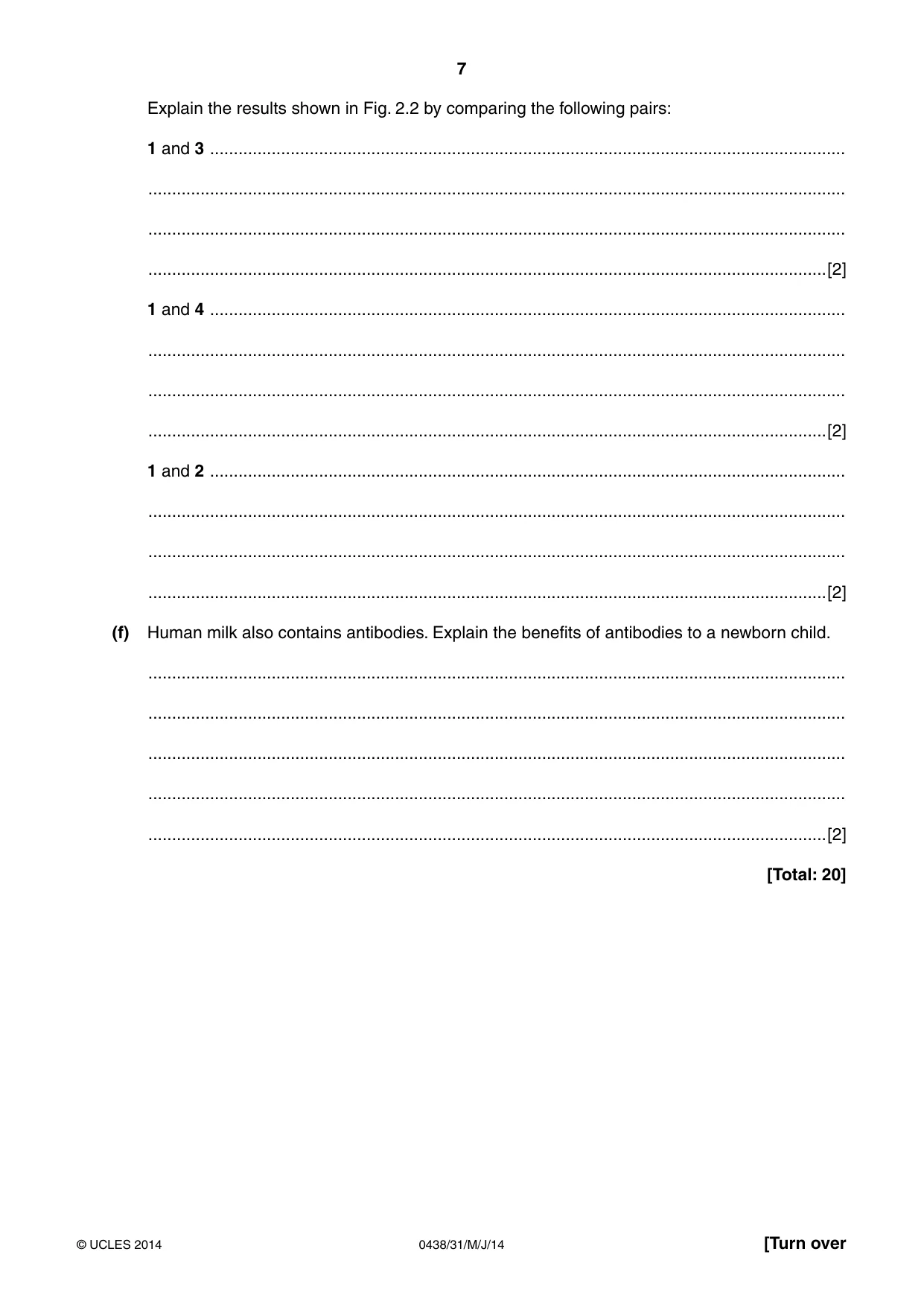
7 0438/31/M/J/14 © UCLES 2014 [Turn over Explain the results shown in Fig. 2.2 by comparing the following pairs: 1 and 3 … … … …[2] 1 and 4 … … … …[2] 1 and 2 … … … …[2] (f) Human milk also contains antibodies. Explain the benefits of antibodies to a newborn child. … … … … …[2] [Total: 20]
Question paper, page 8
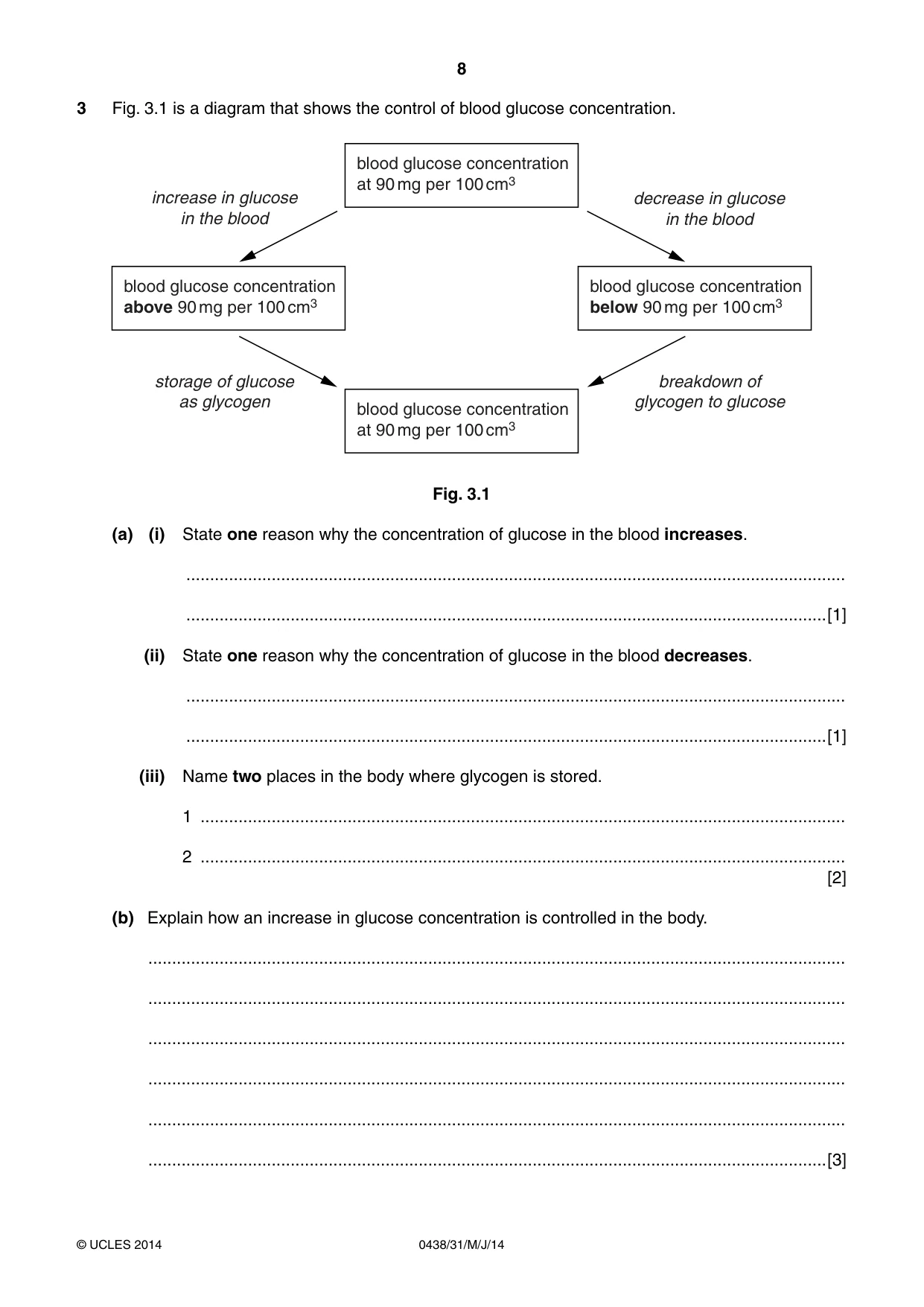
8 0438/31/M/J/14 © UCLES 2014 3 Fig. 3.1 is a diagram that shows the control of blood glucose concentration. blood glucose concentration at 90 mg per 100 cm3 blood glucose concentration at 90 mg per 100 cm3 blood glucose concentration below 90 mg per 100 cm3 blood glucose concentration above 90 mg per 100 cm3 increase in glucose in the blood storage of glucose as glycogen decrease in glucose in the blood breakdown of glycogen to glucose Fig. 3.1 (a) (i) State one reason why the concentration of glucose in the blood increases. … …[1] (ii) State one reason why the concentration of glucose in the blood decreases. … …[1] (iii) Name two places in the body where glycogen is stored. 1 … 2 … [2] (b) Explain how an increase in glucose concentration is controlled in the body. … … … … … …[3]
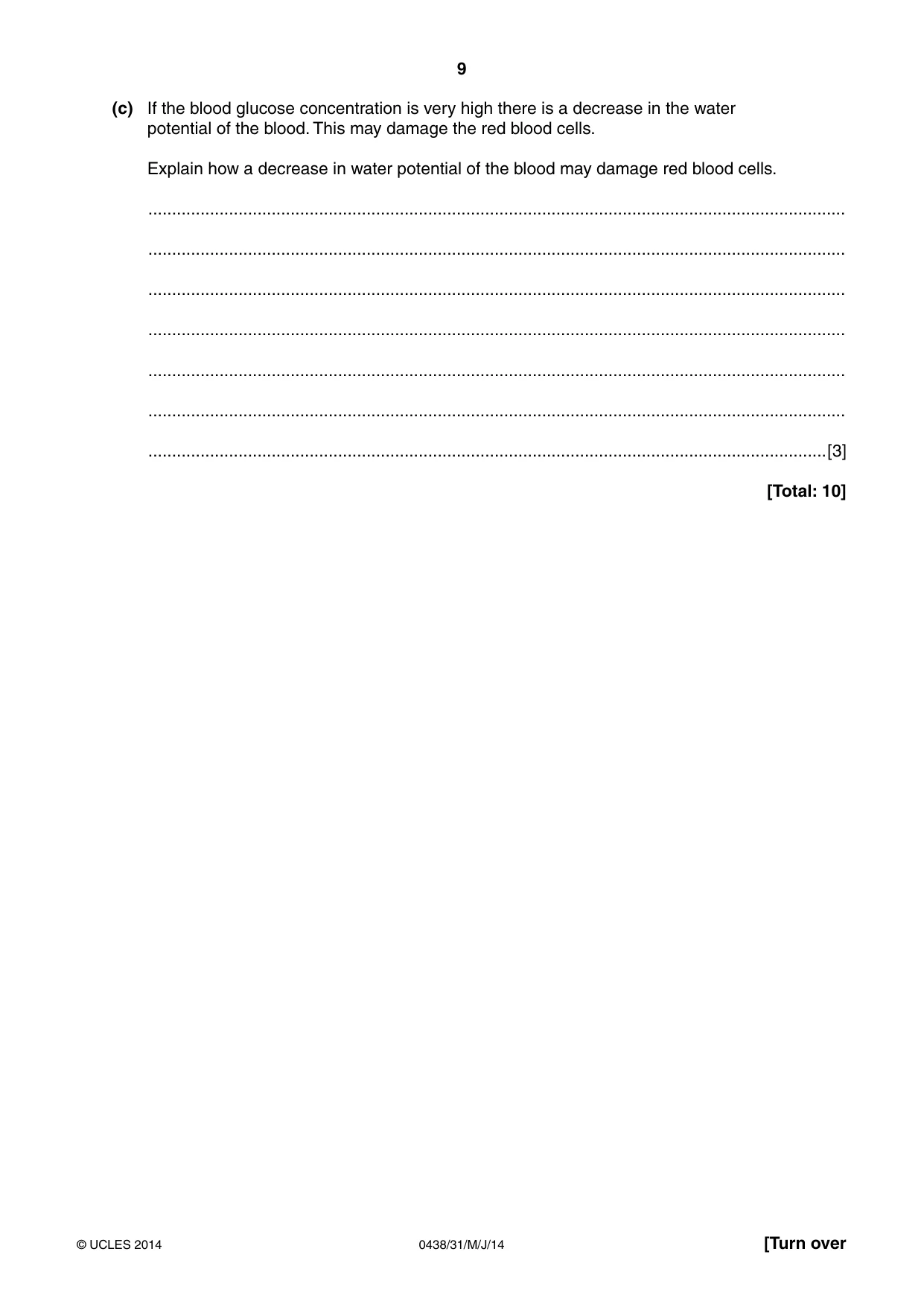
Question paper, page 9
9 0438/31/M/J/14 © UCLES 2014 [Turn over (c) If the blood glucose concentration is very high there is a decrease in the water potential of the blood. This may damage the red blood cells. Explain how a decrease in water potential of the blood may damage red blood cells. … … … … … … …[3] [Total: 10]
Question paper, page 10
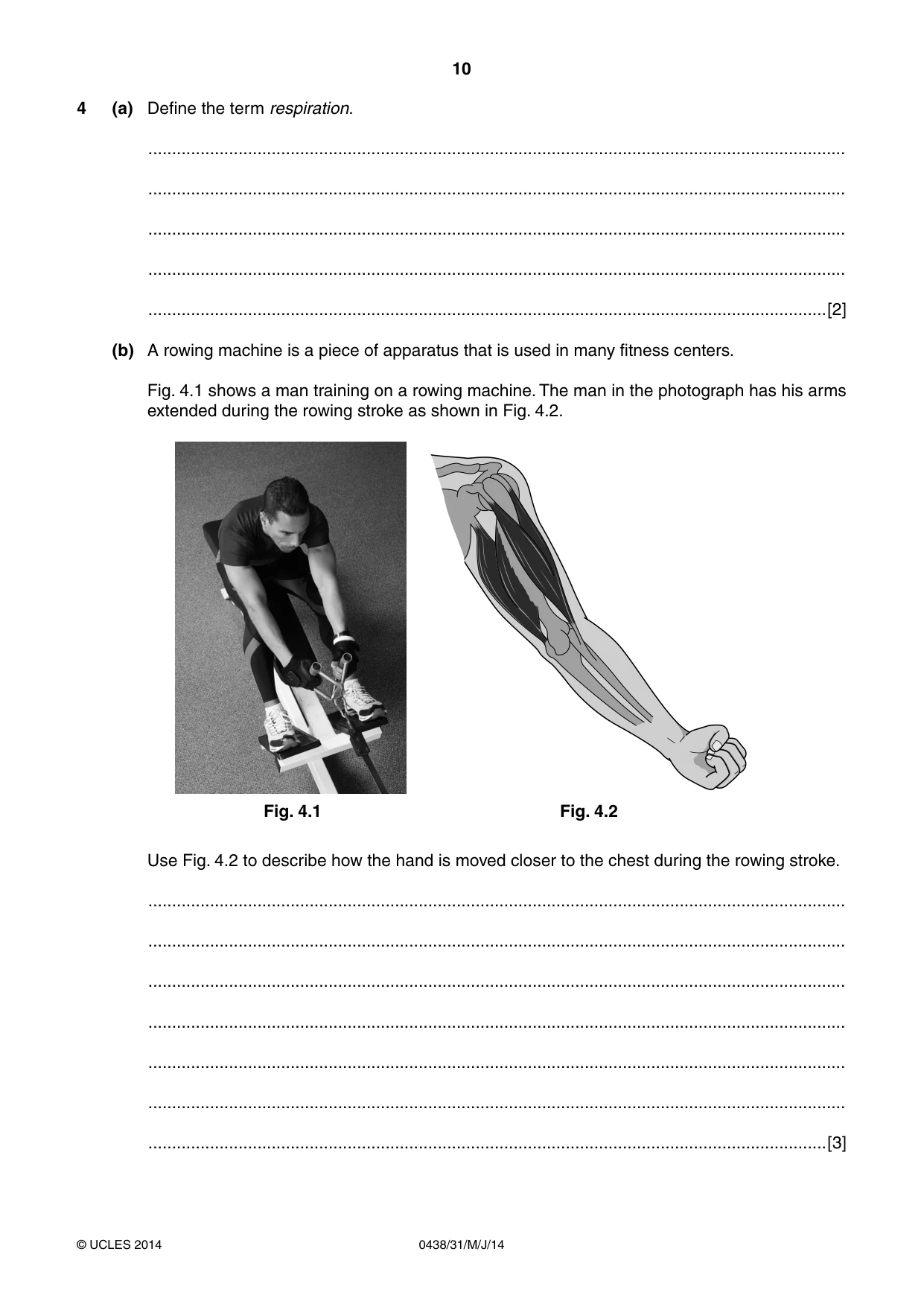
10 0438/31/M/J/14 © UCLES 2014 4 (a) Define the term respiration. … … … … …[2] (b) A rowing machine is a piece of apparatus that is used in many fitness centers. Fig. 4.1 shows a man training on a rowing machine. The man in the photograph has his arms extended during the rowing stroke as shown in Fig. 4.2. Fig. 4.1 Fig. 4.2 Use Fig. 4.2 to describe how the hand is moved closer to the chest during the rowing stroke. … … … … … … …[3]
Question paper, page 11
11 0438/31/M/J/14 © UCLES 2014 [Turn over BLANK PAGE
Question paper, page 12
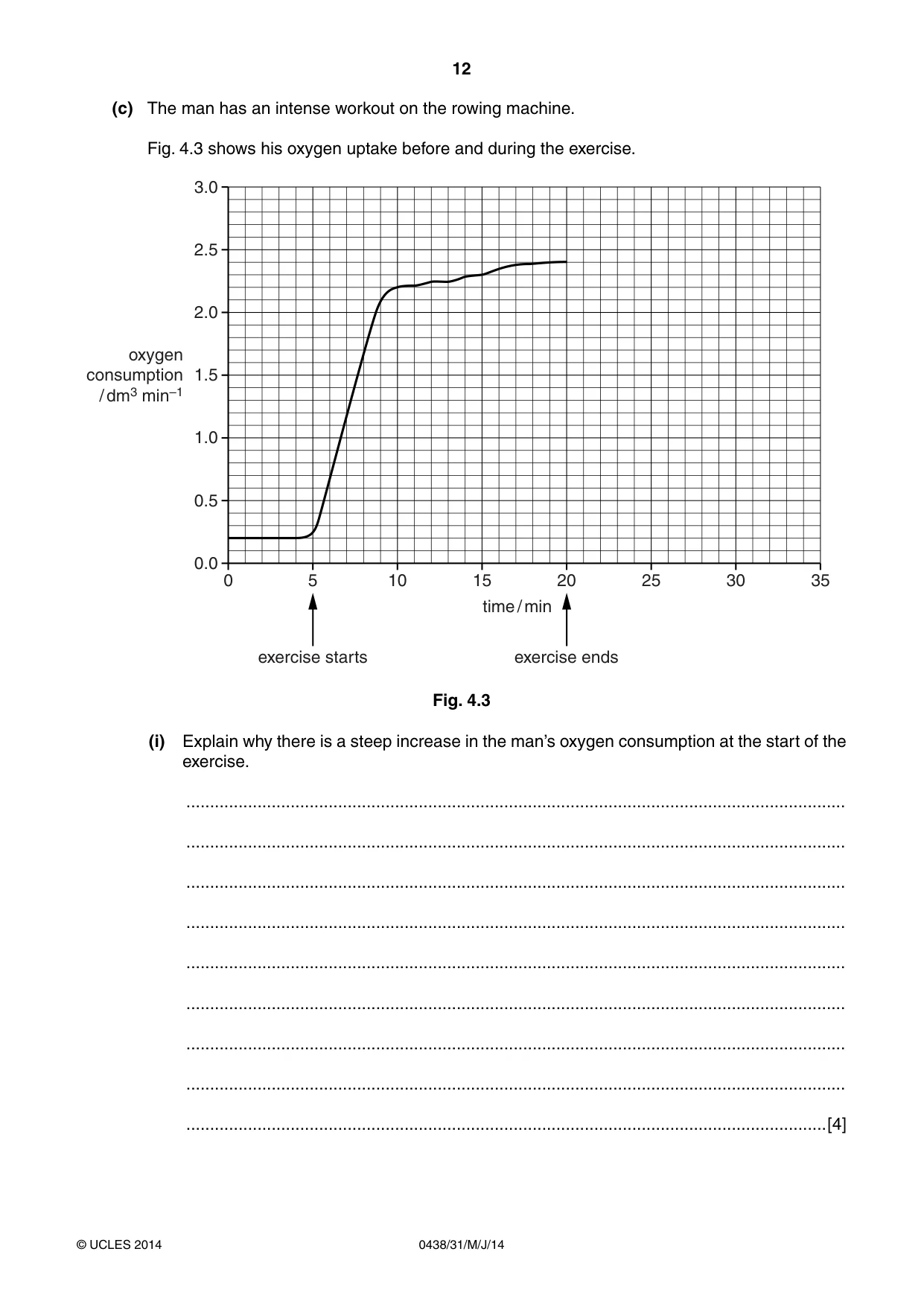
12 0438/31/M/J/14 © UCLES 2014 (c) The man has an intense workout on the rowing machine. Fig. 4.3 shows his oxygen uptake before and during the exercise. 0 0.0 0.5 oxygen consumption / dm3 min–1 1.0 1.5 2.0 2.5 3.0 5 10 15 20 time / min exercise starts exercise ends 25 30 35 Fig. 4.3 (i) Explain why there is a steep increase in the man’s oxygen consumption at the start of the exercise. … … … … … … … … …[4]
Question paper, page 13
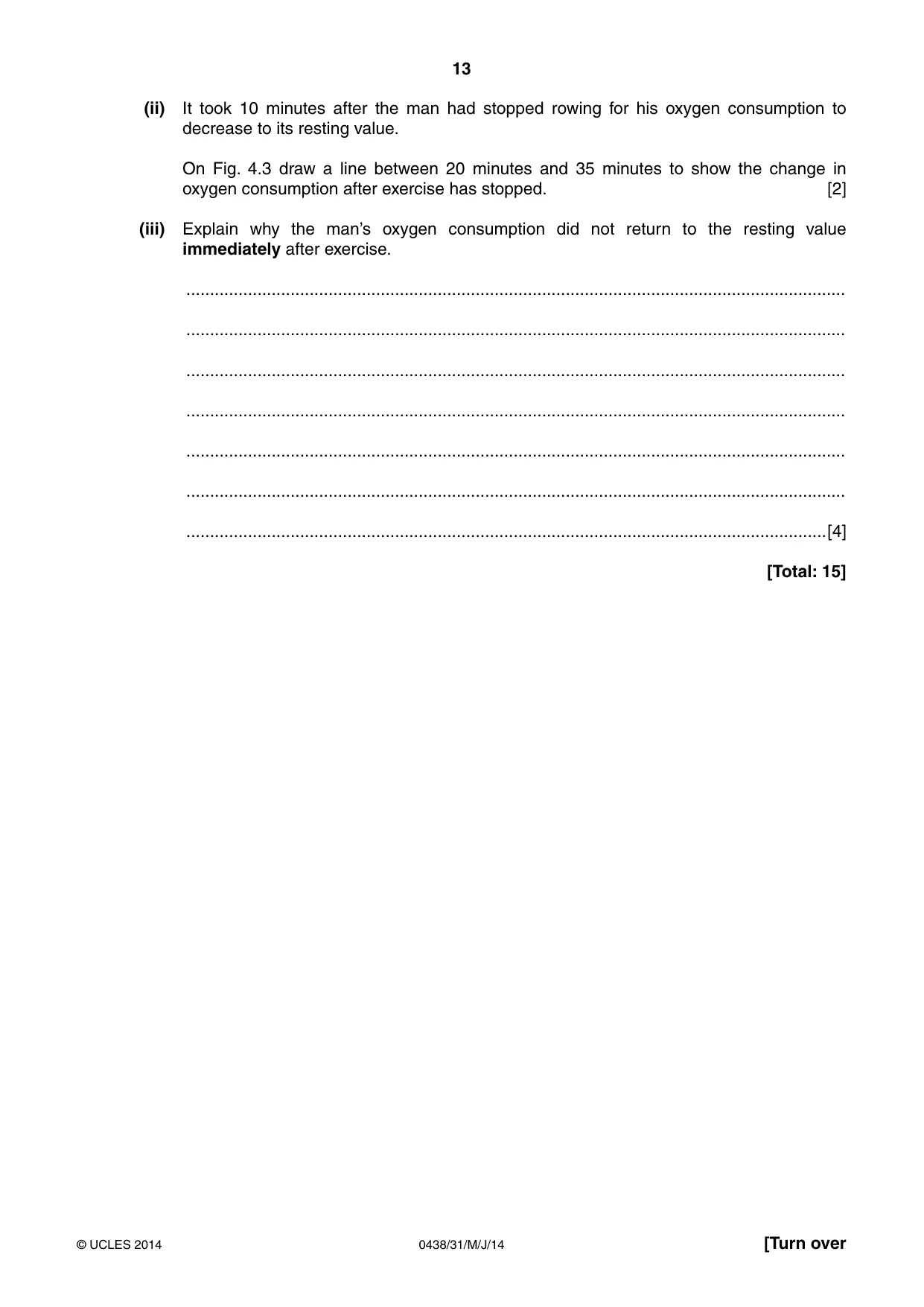
13 0438/31/M/J/14 © UCLES 2014 [Turn over (ii) It took 10 minutes after the man had stopped rowing for his oxygen consumption to decrease to its resting value. On Fig. 4.3 draw a line between 20 minutes and 35 minutes to show the change in oxygen consumption after exercise has stopped. [2] (iii) Explain why the man’s oxygen consumption did not return to the resting value immediately after exercise. … … … … … … …[4] [Total: 15]
Question paper, page 14
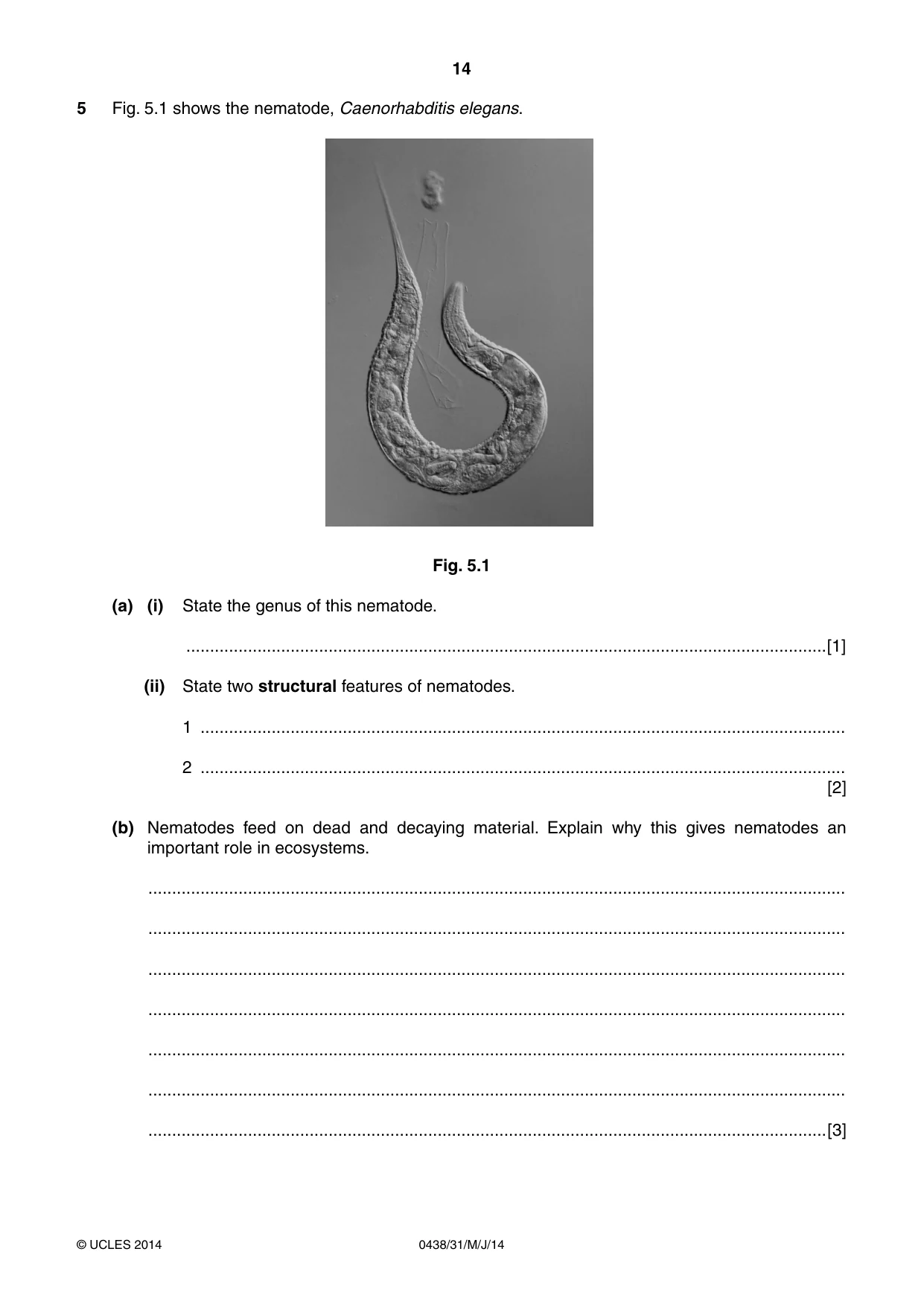
14 0438/31/M/J/14 © UCLES 2014 5 Fig. 5.1 shows the nematode, Caenorhabditis elegans. Fig. 5.1 (a) (i) State the genus of this nematode. …[1] (ii) State two structural features of nematodes. 1 … 2 … [2] (b) Nematodes feed on dead and decaying material. Explain why this gives nematodes an important role in ecosystems. … … … … … … …[3]
Question paper, page 15
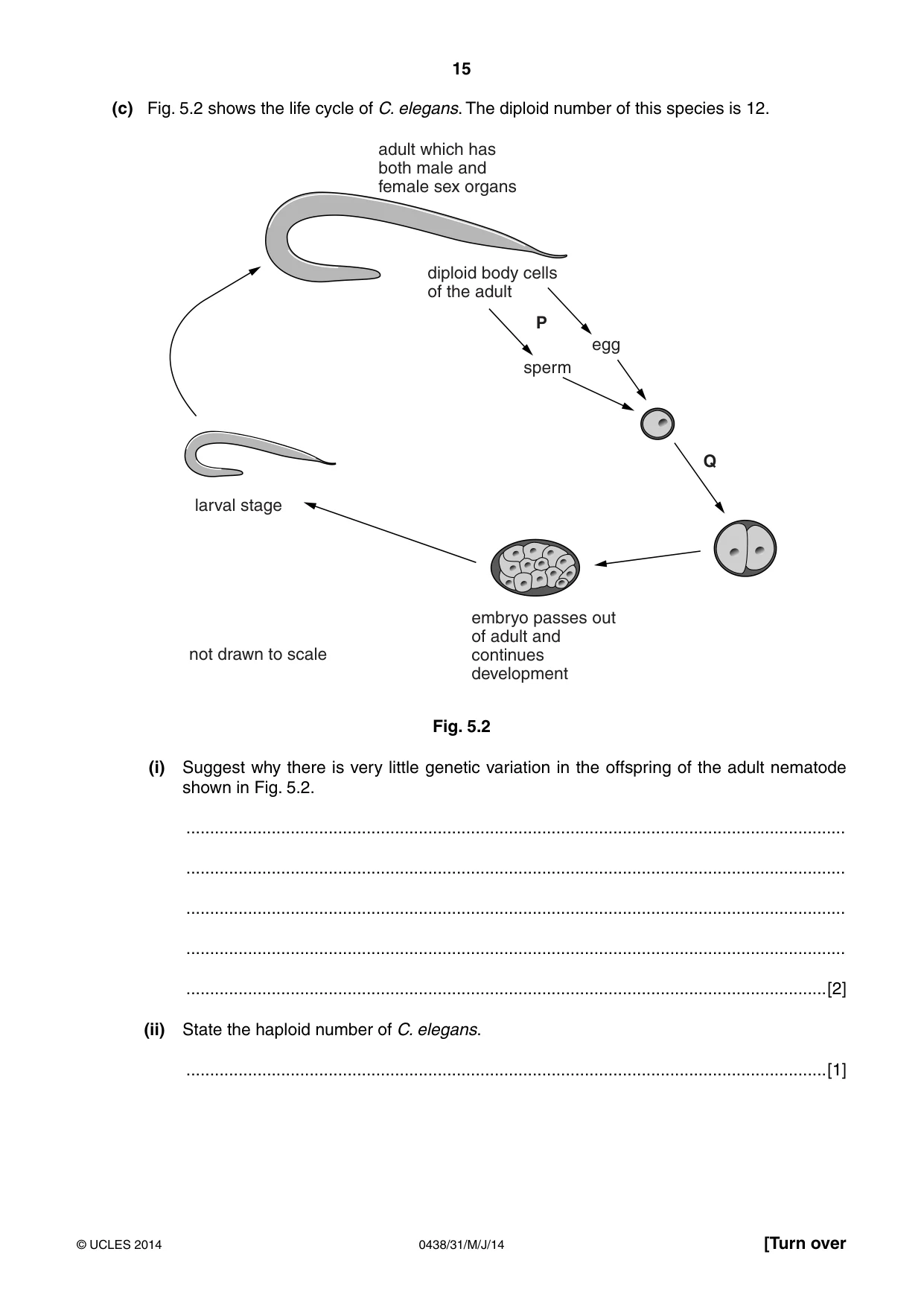
15 0438/31/M/J/14 © UCLES 2014 [Turn over (c) Fig. 5.2 shows the life cycle of C. elegans. The diploid number of this species is 12. adult which has both male and female sex organs diploid body cells of the adult embryo passes out of adult and continues development not drawn to scale egg sperm larval stage P Q Fig. 5.2 (i) Suggest why there is very little genetic variation in the offspring of the adult nematode shown in Fig. 5.2. … … … … …[2] (ii) State the haploid number of C. elegans. …[1]
Question paper, page 16
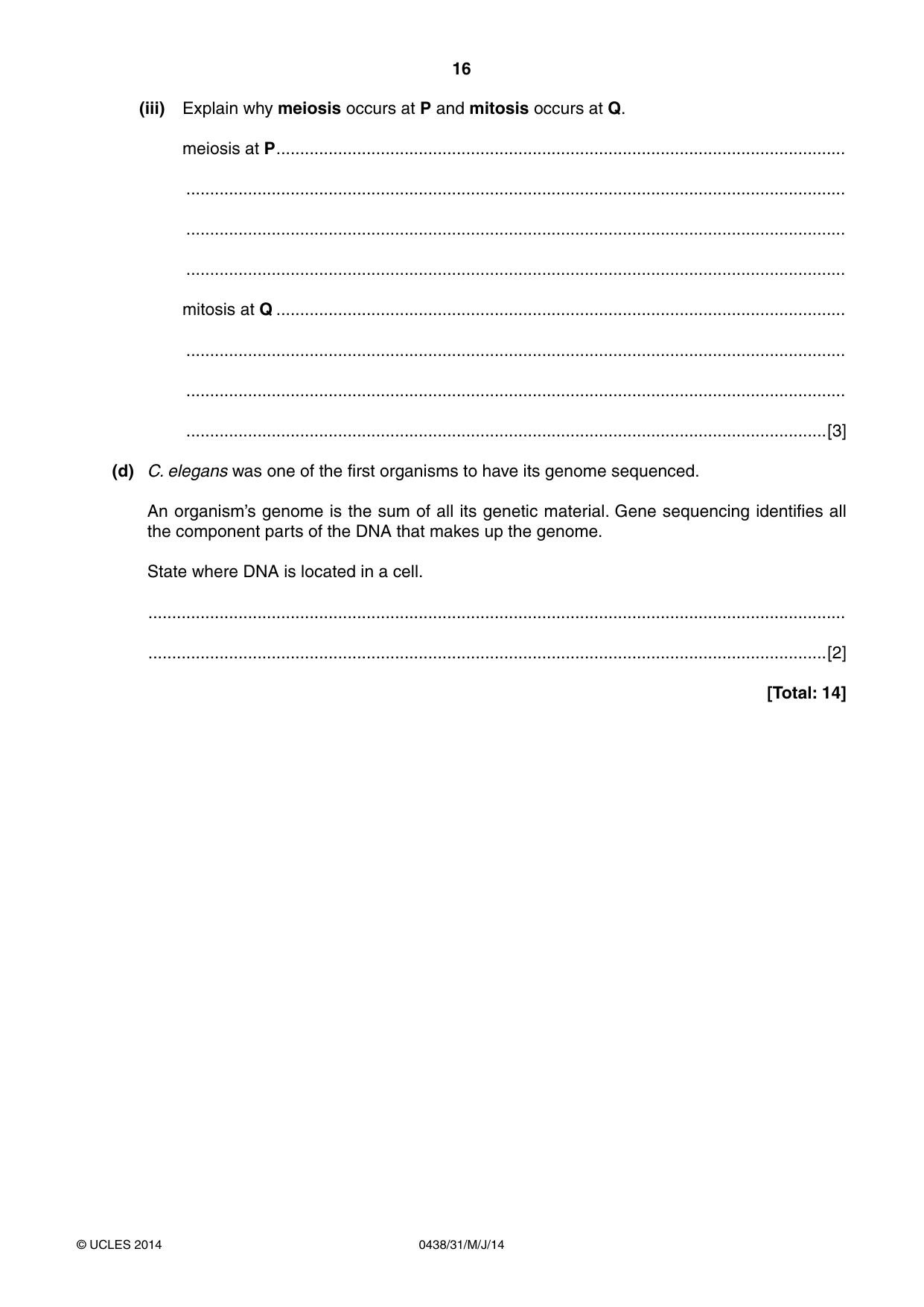
16 0438/31/M/J/14 © UCLES 2014 (iii) Explain why meiosis occurs at P and mitosis occurs at Q. meiosis at P … … … … mitosis at Q … … … …[3] (d) C. elegans was one of the first organisms to have its genome sequenced. An organism’s genome is the sum of all its genetic material. Gene sequencing identifies all the component parts of the DNA that makes up the genome. State where DNA is located in a cell. … …[2] [Total: 14]
Question paper, page 17
17 0438/31/M/J/14 © UCLES 2014 [Turn over BLANK PAGE
Question paper, page 18
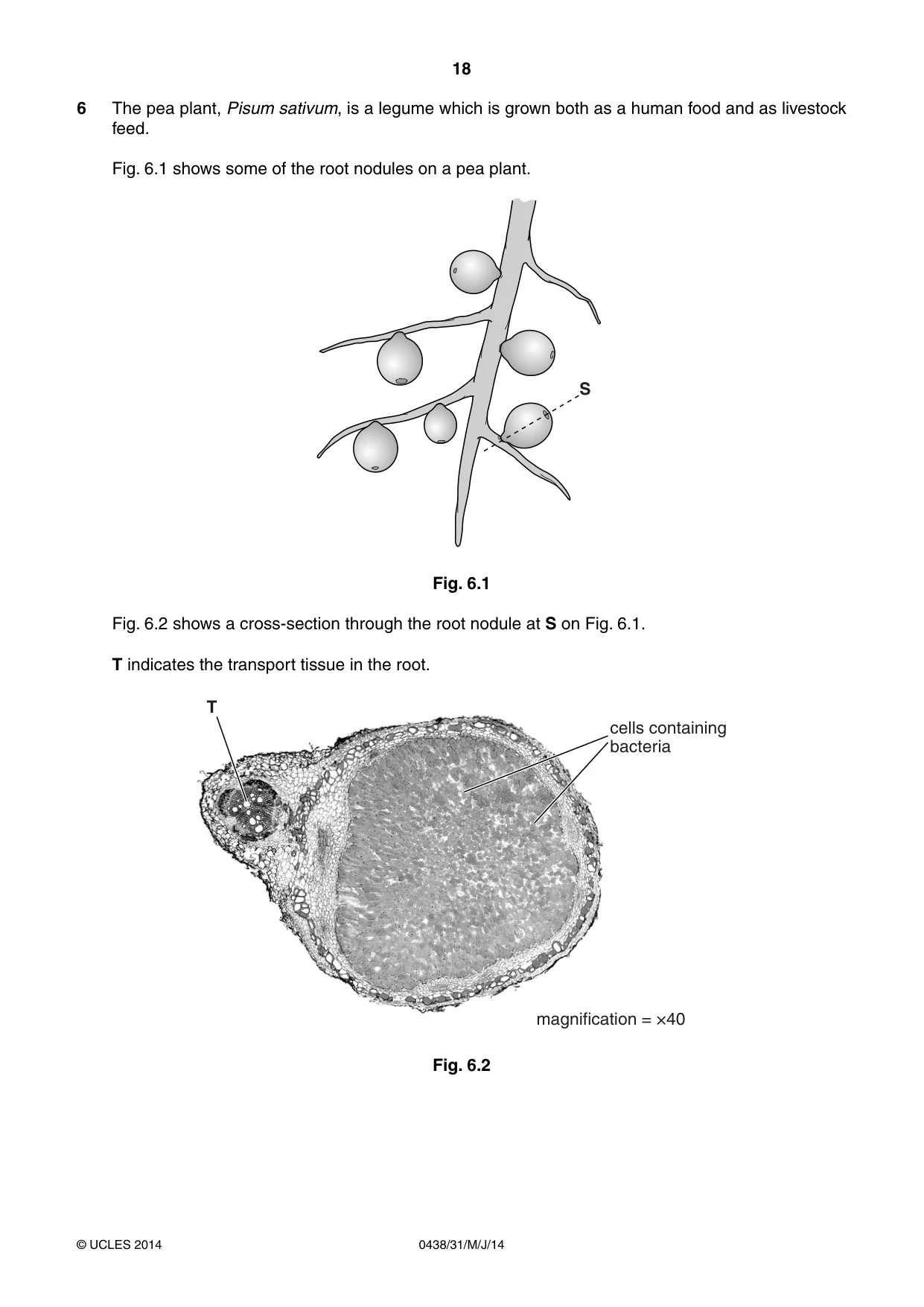
18 0438/31/M/J/14 © UCLES 2014 6 The pea plant, Pisum sativum, is a legume which is grown both as a human food and as livestock feed. Fig. 6.1 shows some of the root nodules on a pea plant. S Fig. 6.1 Fig. 6.2 shows a cross-section through the root nodule at S on Fig. 6.1. T indicates the transport tissue in the root. T cells containing bacteria magnification = ×40 Fig. 6.2
Question paper, page 19
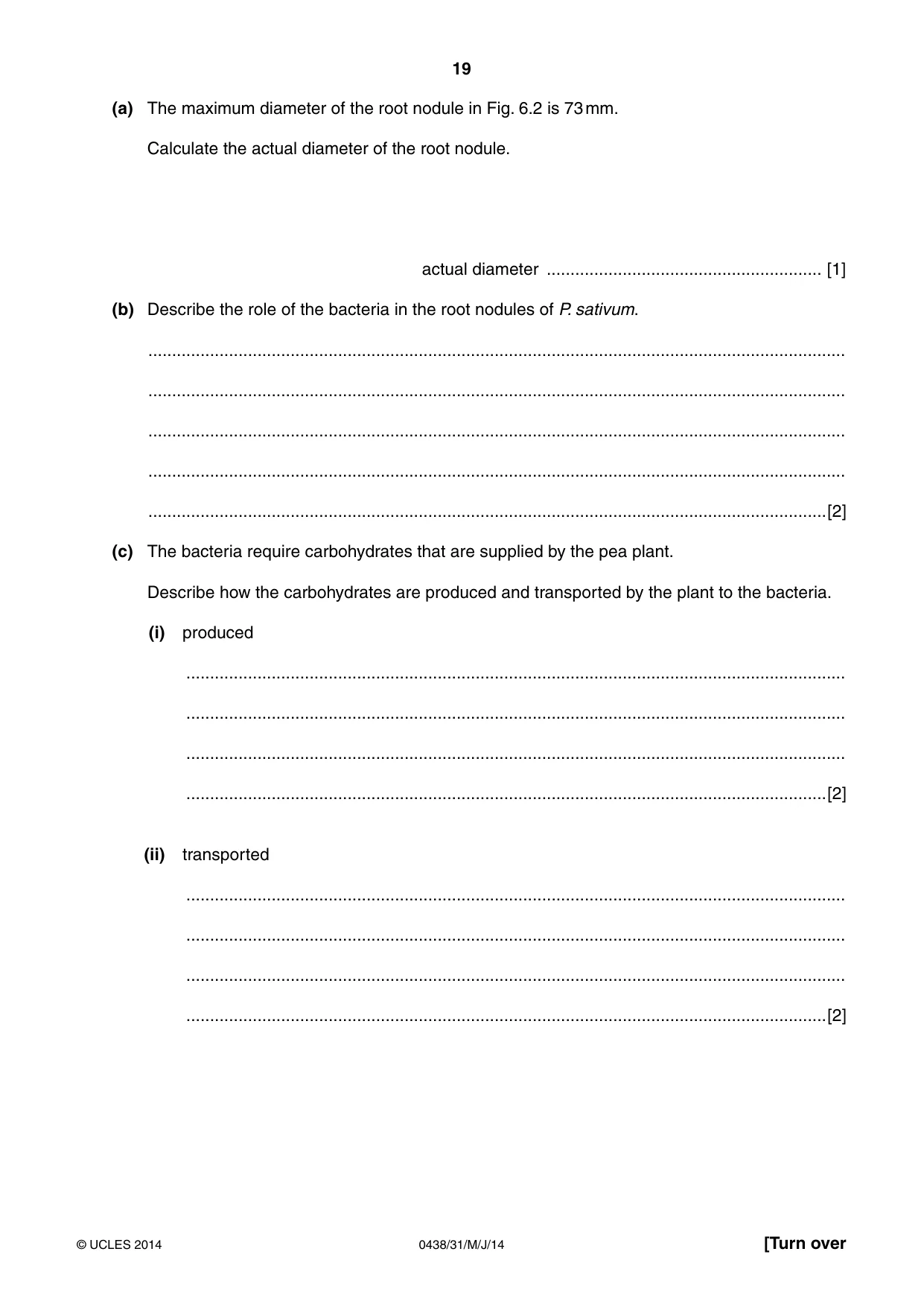
19 0438/31/M/J/14 © UCLES 2014 [Turn over (a) The maximum diameter of the root nodule in Fig. 6.2 is 73 mm. Calculate the actual diameter of the root nodule. actual diameter … [1] (b) Describe the role of the bacteria in the root nodules of P. sativum. … … … … …[2] (c) The bacteria require carbohydrates that are supplied by the pea plant. Describe how the carbohydrates are produced and transported by the plant to the bacteria. (i) produced … … … …[2] (ii) transported … … … …[2]
Question paper, page 20
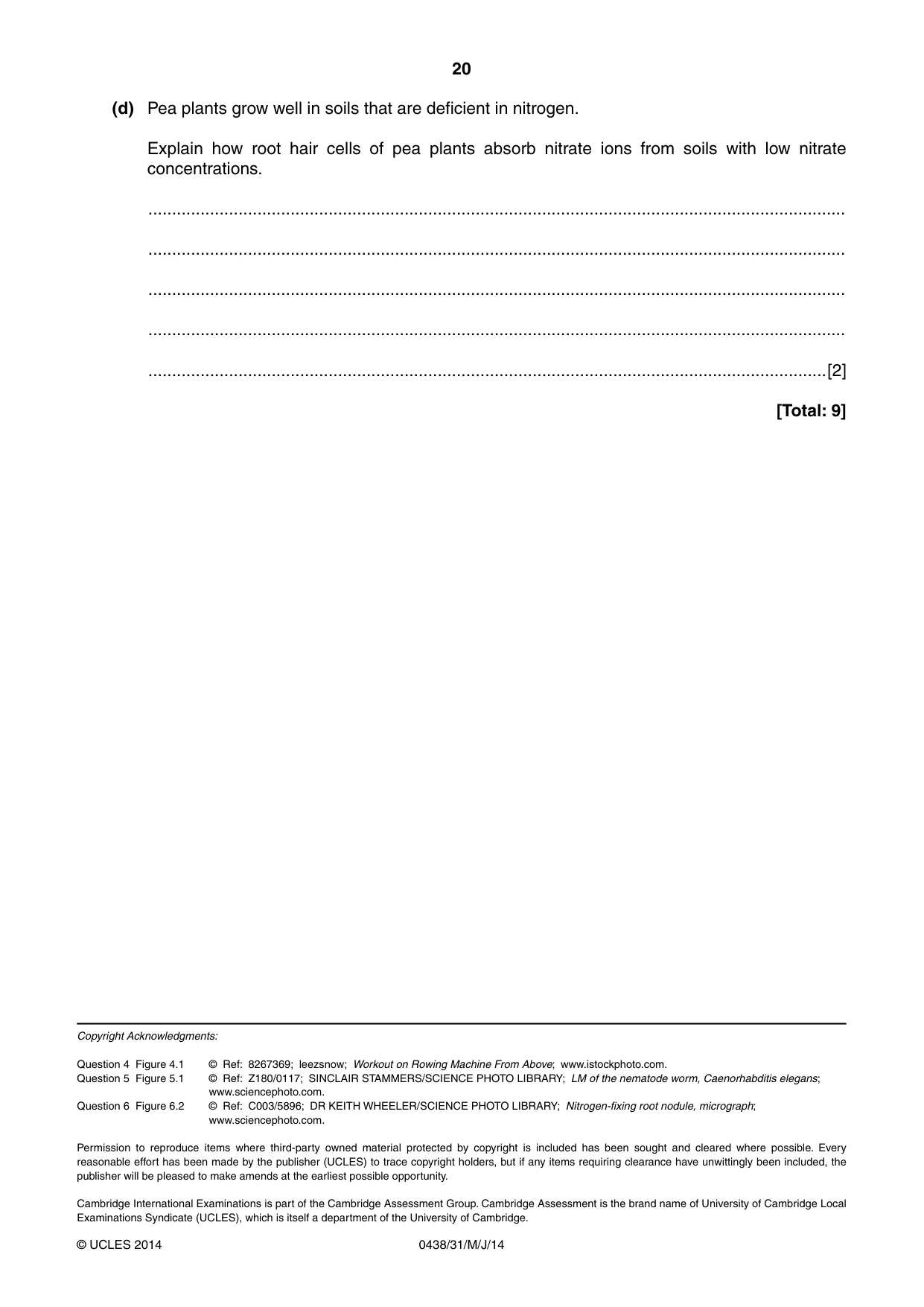
20 0438/31/M/J/14 © UCLES 2014 (d) Pea plants grow well in soils that are deficient in nitrogen. Explain how root hair cells of pea plants absorb nitrate ions from soils with low nitrate concentrations. … … … … …[2] [Total: 9] Copyright Acknowledgments: Question 4 Figure 4.1 © Ref: 8267369; leezsnow; Workout on Rowing Machine From Above; www.istockphoto.com. Question 5 Figure 5.1 © Ref: Z180/0117; SINCLAIR STAMMERS/SCIENCE PHOTO LIBRARY; LM of the nematode worm, Caenorhabditis elegans; www.sciencephoto.com. Question 6 Figure 6.2 © Ref: C003/5896; DR KEITH WHEELER/SCIENCE PHOTO LIBRARY; Nitrogen-fixing root nodule, micrograph; www.sciencephoto.com. Permission to reproduce items where third-party owned material protected by copyright is included has been sought and cleared where possible. Every reasonable effort has been made by the publisher (UCLES) to trace copyright holders, but if any items requiring clearance have unwittingly been included, the publisher will be pleased to make amends at the earliest possible opportunity. Cambridge International Examinations is part of the Cambridge Assessment Group. Cambridge Assessment is the brand name of University of Cambridge Local Examinations Syndicate (UCLES), which is itself a department of the University of Cambridge.
Mark scheme, page 1
CAMBRIDGE INTERNATIONAL EXAMINATIONS International General Certificate of Secondary Education MARK SCHEME for the May/June 2014 series 0438 BIOLOGY (US) 0438/31 Paper 31 (Extended Theory), maximum raw mark 80 This mark scheme is published as an aid to teachers and candidates, to indicate the requirements of the examination. It shows the basis on which Examiners were instructed to award marks. It does not indicate the details of the discussions that took place at an Examiners’ meeting before marking began, which would have considered the acceptability of alternative answers. Mark schemes should be read in conjunction with the question paper and the Principal Examiner Report for Teachers. Cambridge will not enter into discussions about these mark schemes. Cambridge is publishing the mark schemes for the May/June 2014 series for most IGCSE, GCE Advanced Level and Advanced Subsidiary Level components and some Ordinary Level components.
Mark scheme, page 2
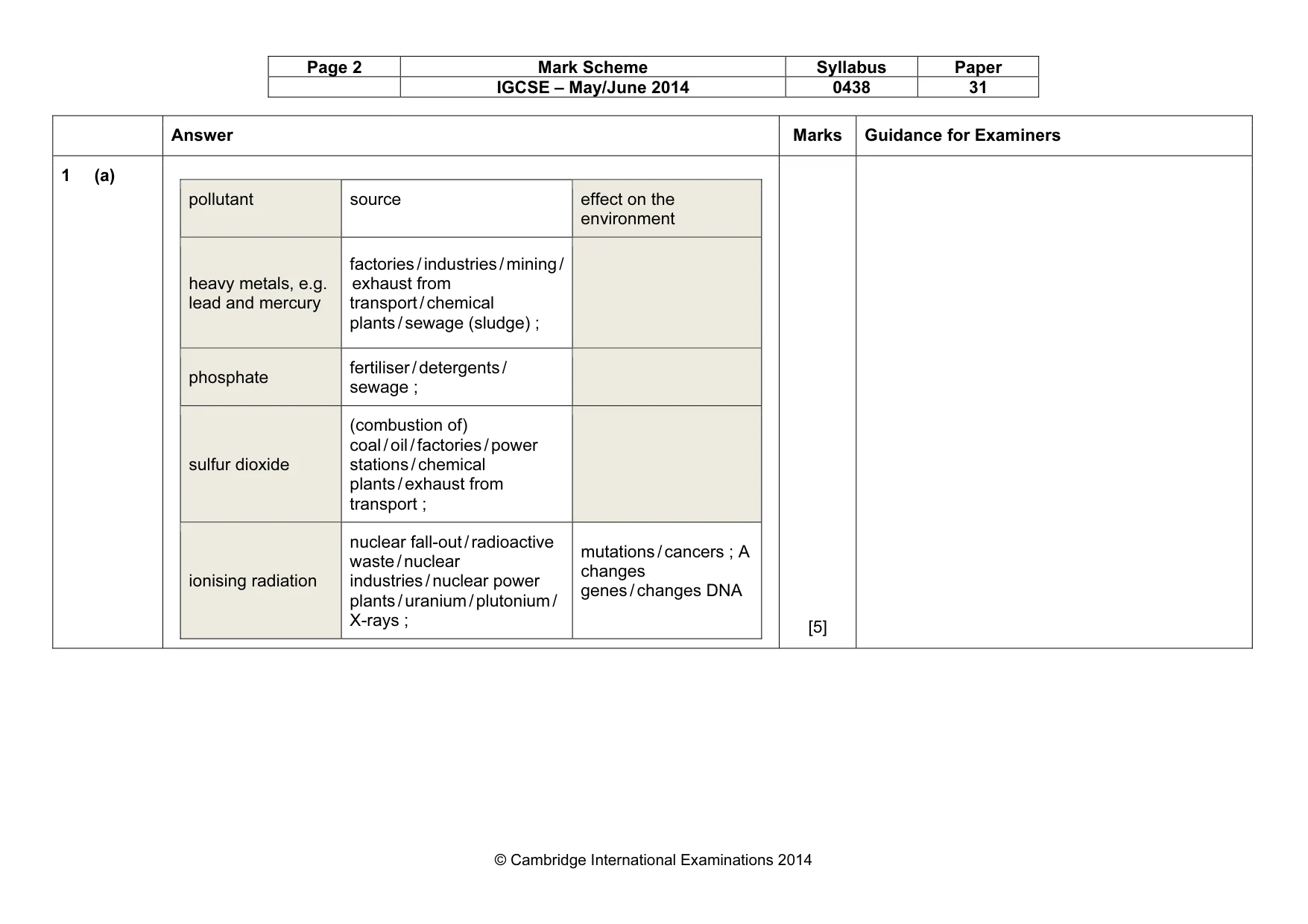
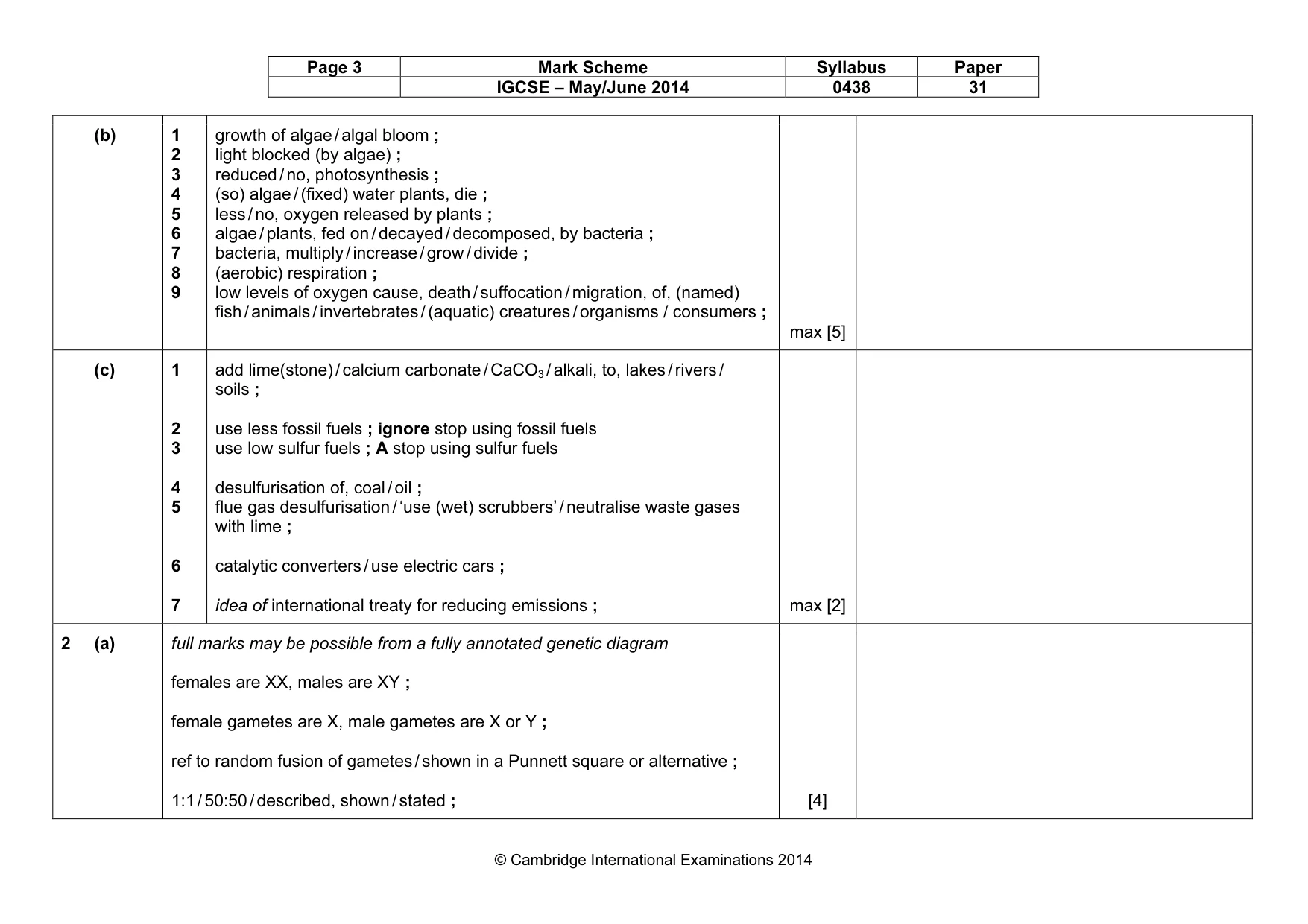
Page 2 Mark Scheme Syllabus Paper IGCSE – May/June 2014 0438 31 © Cambridge International Examinations 2014 Answer Marks Guidance for Examiners 1 (a) pollutant source effect on the environment heavy metals, e.g. lead and mercury factories / industries / mining / exhaust from transport / chemical plants / sewage (sludge) ; phosphate fertiliser / detergents / sewage ; sulfur dioxide (combustion of) coal / oil / factories / power stations / chemical plants / exhaust from transport ; ionising radiation nuclear fall-out / radioactive waste / nuclear industries / nuclear power plants / uranium / plutonium / X-rays ; mutations / cancers ; A changes genes / changes DNA [5]
Mark scheme, page 3
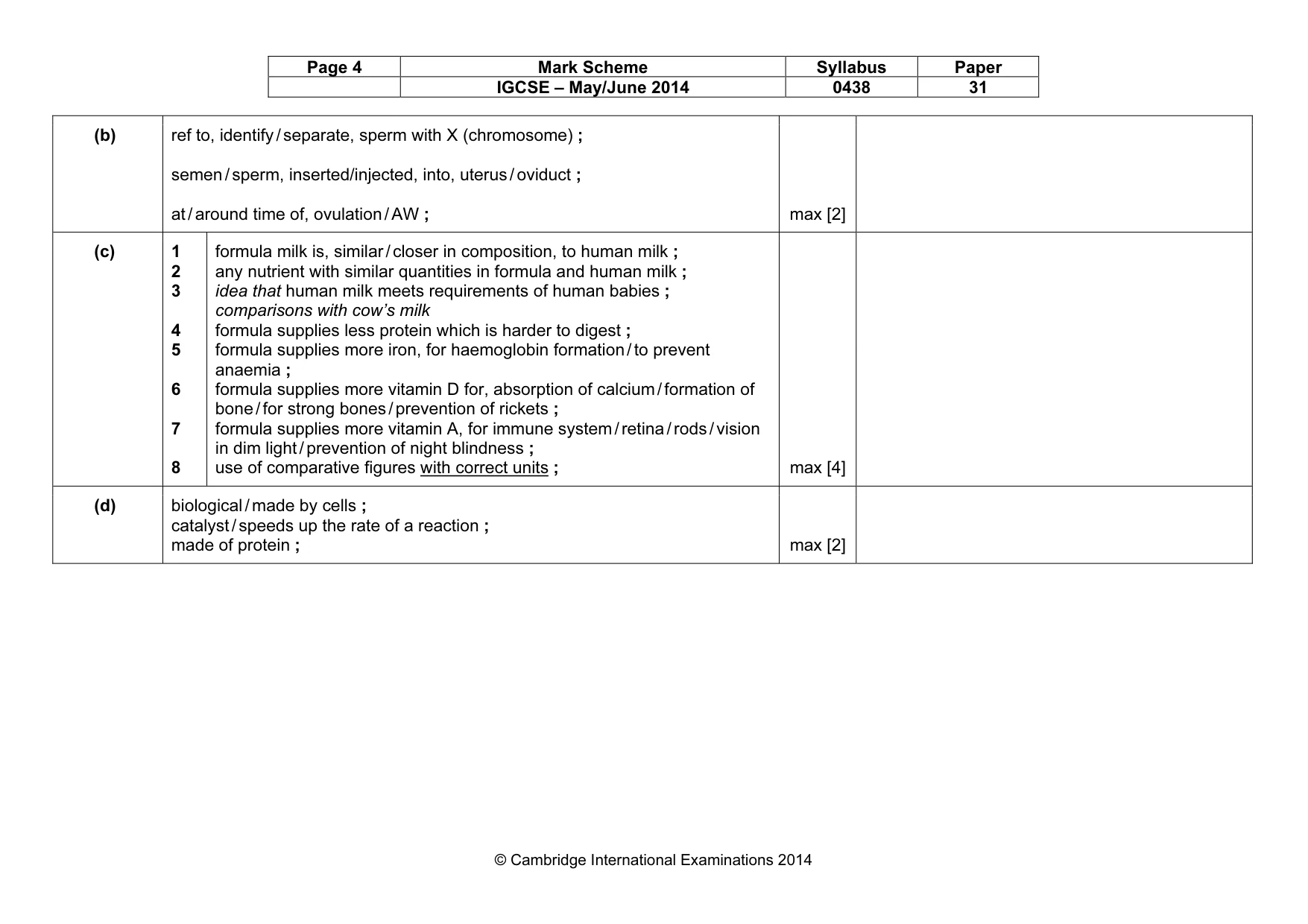
Page 3 Mark Scheme Syllabus Paper IGCSE – May/June 2014 0438 31 © Cambridge International Examinations 2014 (b) 1 2 3 4 5 6 7 8 9 growth of algae / algal bloom ; light blocked (by algae) ; reduced / no, photosynthesis ; (so) algae / (fixed) water plants, die ; less / no, oxygen released by plants ; algae / plants, fed on / decayed / decomposed, by bacteria ; bacteria, multiply / increase / grow / divide ; (aerobic) respiration ; low levels of oxygen cause, death / suffocation / migration, of, (named) fish / animals / invertebrates / (aquatic) creatures / organisms / consumers ; max [5] (c) 1 2 3 4 5 6 7 add lime(stone) / calcium carbonate / CaCO3 / alkali, to, lakes / rivers / soils ; use less fossil fuels ; ignore stop using fossil fuels use low sulfur fuels ; A stop using sulfur fuels desulfurisation of, coal / oil ; flue gas desulfurisation / ‘use (wet) scrubbers’ / neutralise waste gases with lime ; catalytic converters / use electric cars ; idea of international treaty for reducing emissions ; max [2] 2 (a) full marks may be possible from a fully annotated genetic diagram females are XX, males are XY ; female gametes are X, male gametes are X or Y ; ref to random fusion of gametes / shown in a Punnett square or alternative ; 1:1 / 50:50 / described, shown / stated ; [4]
Mark scheme, page 4
Page 4 Mark Scheme Syllabus Paper IGCSE – May/June 2014 0438 31 © Cambridge International Examinations 2014 (b) ref to, identify / separate, sperm with X (chromosome) ; semen / sperm, inserted/injected, into, uterus / oviduct ; at / around time of, ovulation / AW ; max [2] (c) 1 2 3 4 5 6 7 8 formula milk is, similar / closer in composition, to human milk ; any nutrient with similar quantities in formula and human milk ; idea that human milk meets requirements of human babies ; comparisons with cow’s milk formula supplies less protein which is harder to digest ; formula supplies more iron, for haemoglobin formation / to prevent anaemia ; formula supplies more vitamin D for, absorption of calcium / formation of bone / for strong bones / prevention of rickets ; formula supplies more vitamin A, for immune system / retina / rods / vision in dim light / prevention of night blindness ; use of comparative figures with correct units ; max [4] (d) biological / made by cells ; catalyst / speeds up the rate of a reaction ; made of protein ; max [2]
Mark scheme, page 5
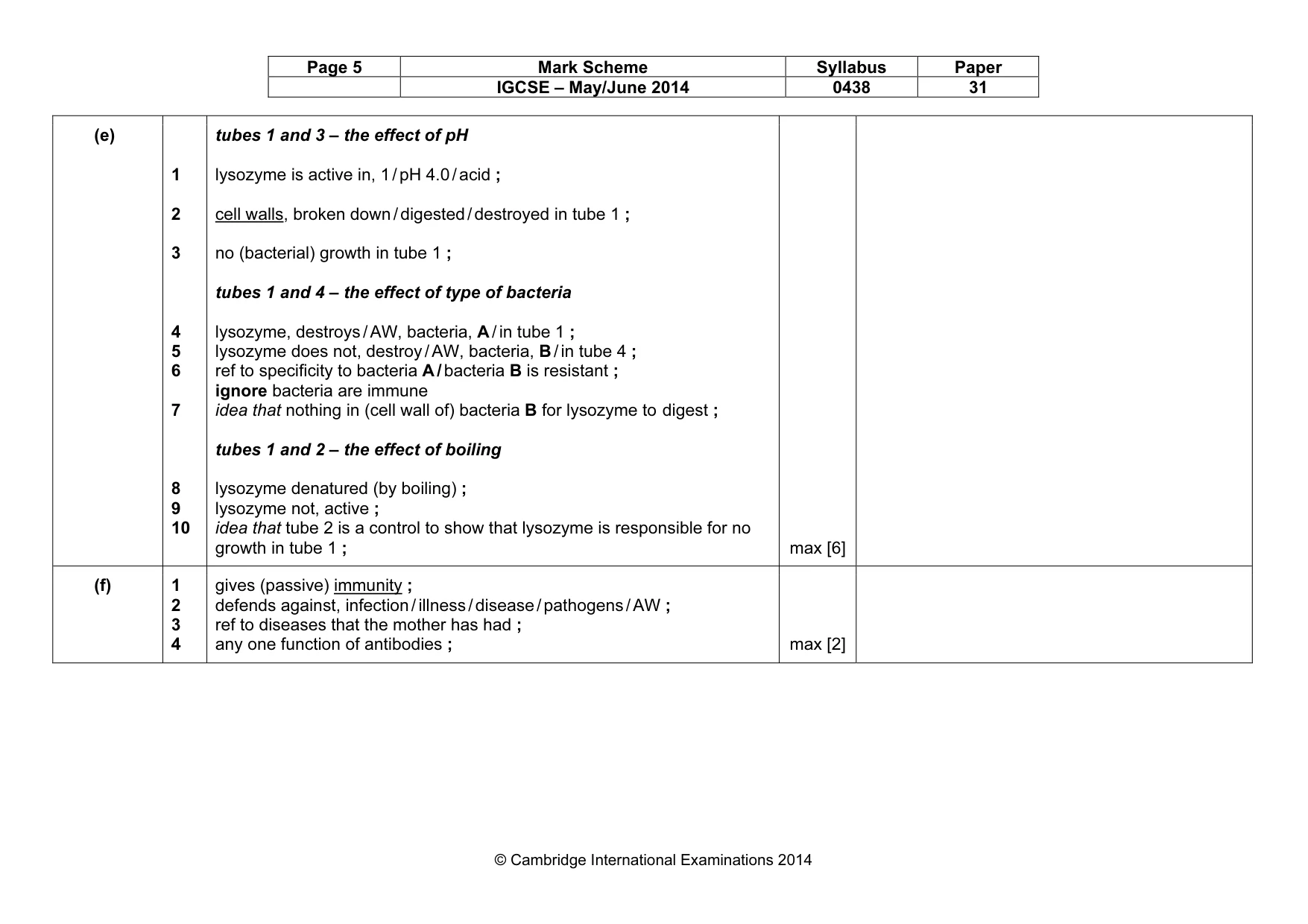
Page 5 Mark Scheme Syllabus Paper IGCSE – May/June 2014 0438 31 © Cambridge International Examinations 2014 (e) 1 2 3 4 5 6 7 8 9 10 tubes 1 and 3 – the effect of pH lysozyme is active in, 1 / pH 4.0 / acid ; cell walls, broken down / digested / destroyed in tube 1 ; no (bacterial) growth in tube 1 ; tubes 1 and 4 – the effect of type of bacteria lysozyme, destroys / AW, bacteria, A / in tube 1 ; lysozyme does not, destroy / AW, bacteria, B / in tube 4 ; ref to specificity to bacteria A / bacteria B is resistant ; ignore bacteria are immune idea that nothing in (cell wall of) bacteria B for lysozyme to digest ; tubes 1 and 2 – the effect of boiling lysozyme denatured (by boiling) ; lysozyme not, active ; idea that tube 2 is a control to show that lysozyme is responsible for no growth in tube 1 ; max [6] (f) 1 2 3 4 gives (passive) immunity ; defends against, infection / illness / disease / pathogens / AW ; ref to diseases that the mother has had ; any one function of antibodies ; max [2]
Mark scheme, page 6
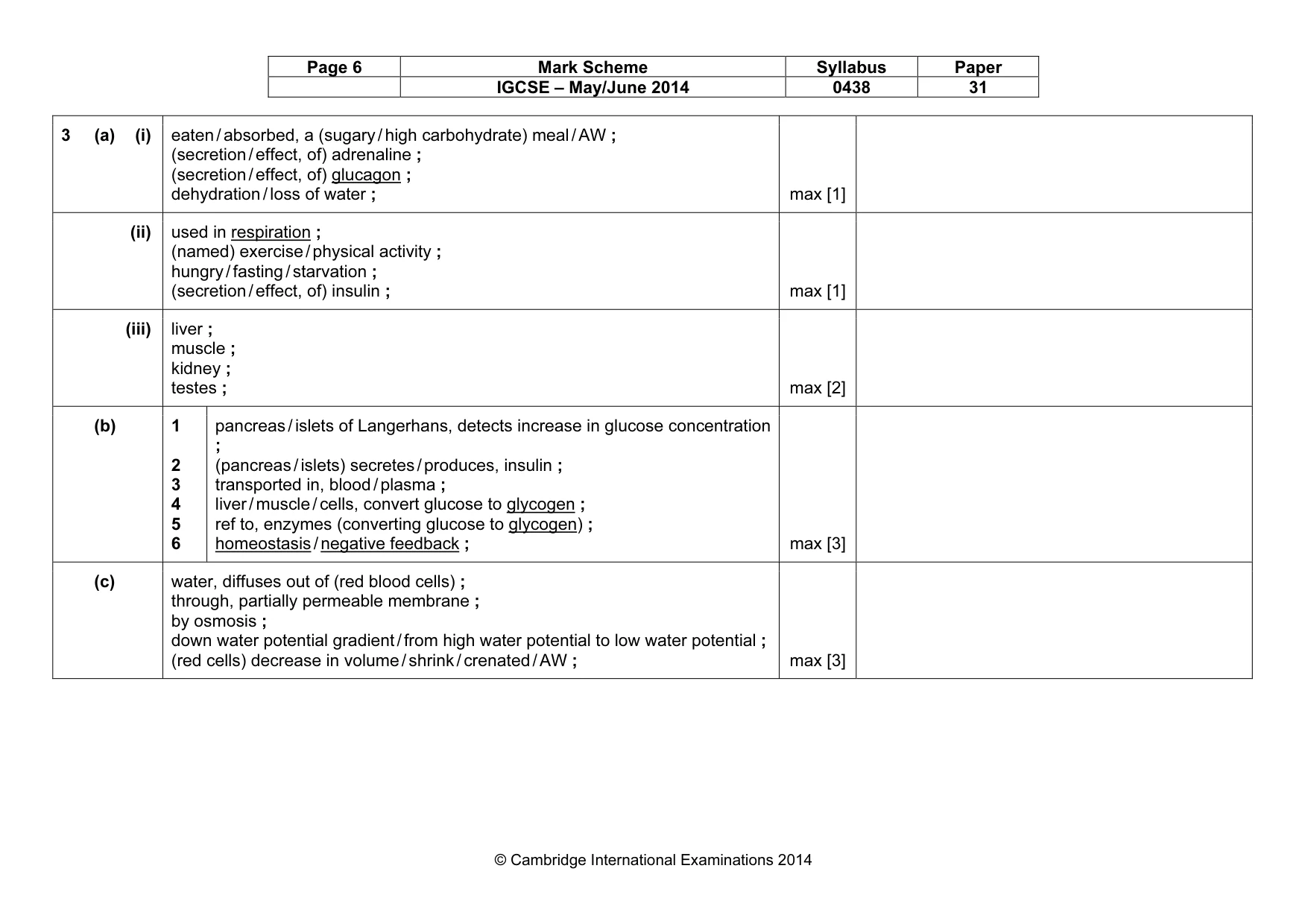
Page 6 Mark Scheme Syllabus Paper IGCSE – May/June 2014 0438 31 © Cambridge International Examinations 2014 3 (a) (i) eaten / absorbed, a (sugary / high carbohydrate) meal / AW ; (secretion / effect, of) adrenaline ; (secretion / effect, of) glucagon ; dehydration / loss of water ; max [1] (ii) used in respiration ; (named) exercise / physical activity ; hungry / fasting / starvation ; (secretion / effect, of) insulin ; max [1] (iii) liver ; muscle ; kidney ; testes ; max [2] (b) 1 2 3 4 5 6 pancreas / islets of Langerhans, detects increase in glucose concentration ; (pancreas / islets) secretes / produces, insulin ; transported in, blood / plasma ; liver / muscle / cells, convert glucose to glycogen ; ref to, enzymes (converting glucose to glycogen) ; homeostasis / negative feedback ; max [3] (c) water, diffuses out of (red blood cells) ; through, partially permeable membrane ; by osmosis ; down water potential gradient / from high water potential to low water potential ; (red cells) decrease in volume / shrink / crenated / AW ; max [3]
Mark scheme, page 7
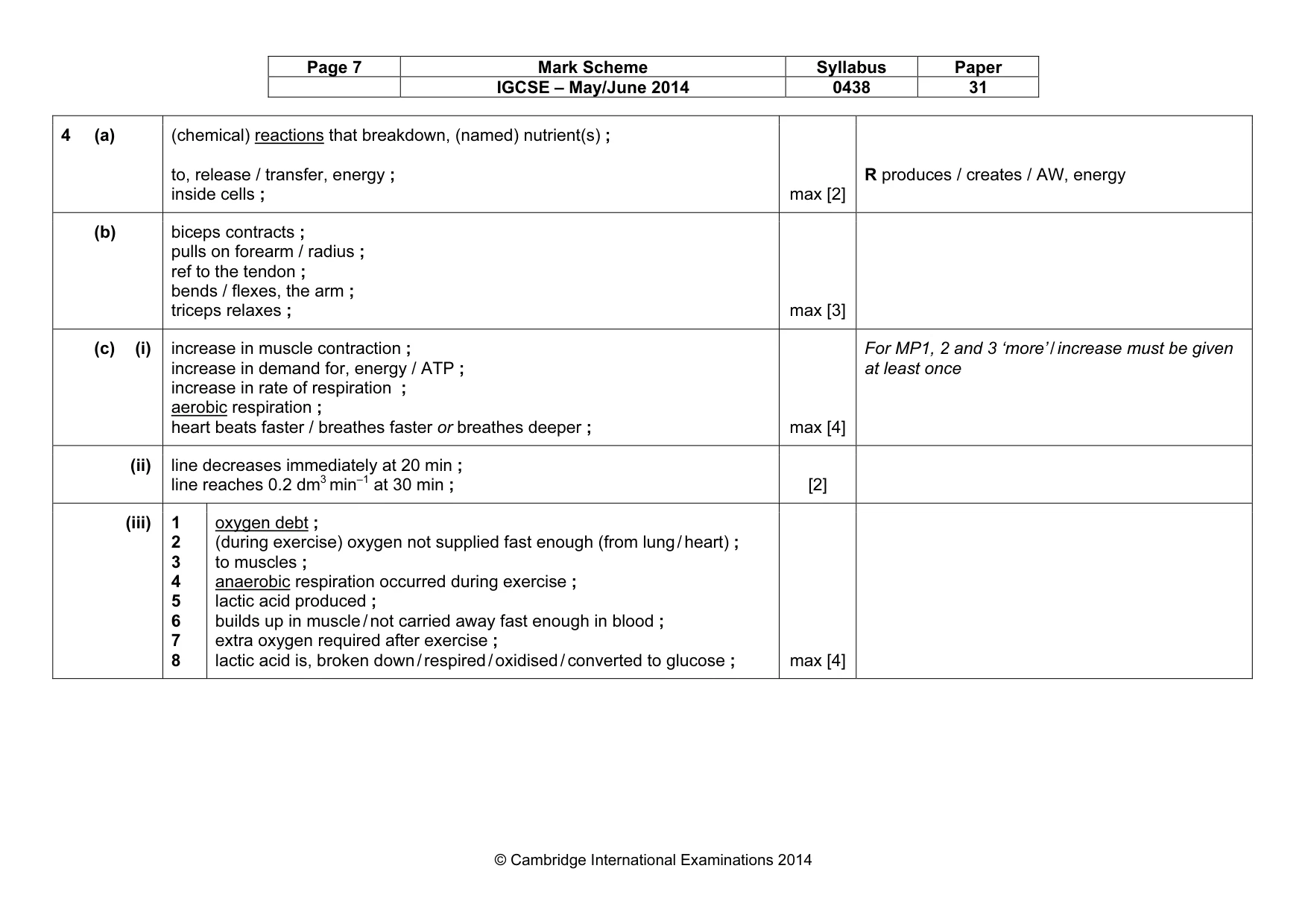
Page 7 Mark Scheme Syllabus Paper IGCSE – May/June 2014 0438 31 © Cambridge International Examinations 2014 4 (a) (chemical) reactions that breakdown, (named) nutrient(s) ; to, release / transfer, energy ; inside cells ; max [2] R produces / creates / AW, energy (b) biceps contracts ; pulls on forearm / radius ; ref to the tendon ; bends / flexes, the arm ; triceps relaxes ; max [3] (c) (i) increase in muscle contraction ; increase in demand for, energy / ATP ; increase in rate of respiration ; aerobic respiration ; heart beats faster / breathes faster or breathes deeper ; max [4] For MP1, 2 and 3 ‘more’ / increase must be given at least once (ii) line decreases immediately at 20 min ; line reaches 0.2 dm3 min–1 at 30 min ; [2] (iii) 1 2 3 4 5 6 7 8 oxygen debt ; (during exercise) oxygen not supplied fast enough (from lung / heart) ; to muscles ; anaerobic respiration occurred during exercise ; lactic acid produced ; builds up in muscle / not carried away fast enough in blood ; extra oxygen required after exercise ; lactic acid is, broken down / respired / oxidised / converted to glucose ; max [4]
Mark scheme, page 8
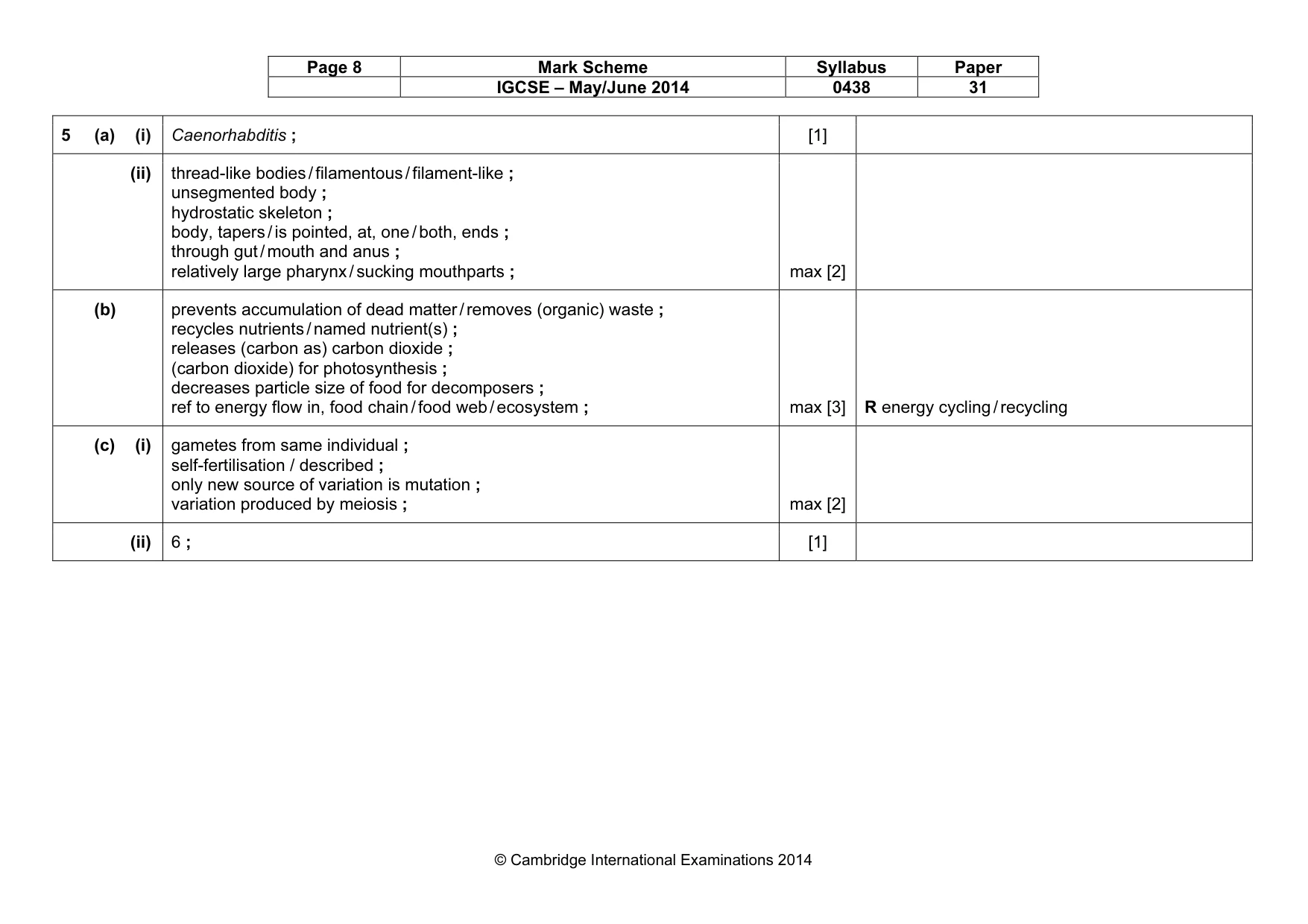
Page 8 Mark Scheme Syllabus Paper IGCSE – May/June 2014 0438 31 © Cambridge International Examinations 2014 5 (a) (i) Caenorhabditis ; [1] (ii) thread-like bodies / filamentous / filament-like ; unsegmented body ; hydrostatic skeleton ; body, tapers / is pointed, at, one / both, ends ; through gut / mouth and anus ; relatively large pharynx / sucking mouthparts ; max [2] (b) prevents accumulation of dead matter / removes (organic) waste ; recycles nutrients / named nutrient(s) ; releases (carbon as) carbon dioxide ; (carbon dioxide) for photosynthesis ; decreases particle size of food for decomposers ; ref to energy flow in, food chain / food web / ecosystem ; max [3] R energy cycling / recycling (c) (i) gametes from same individual ; self-fertilisation / described ; only new source of variation is mutation ; variation produced by meiosis ; max [2] (ii) 6 ; [1]
Mark scheme, page 9
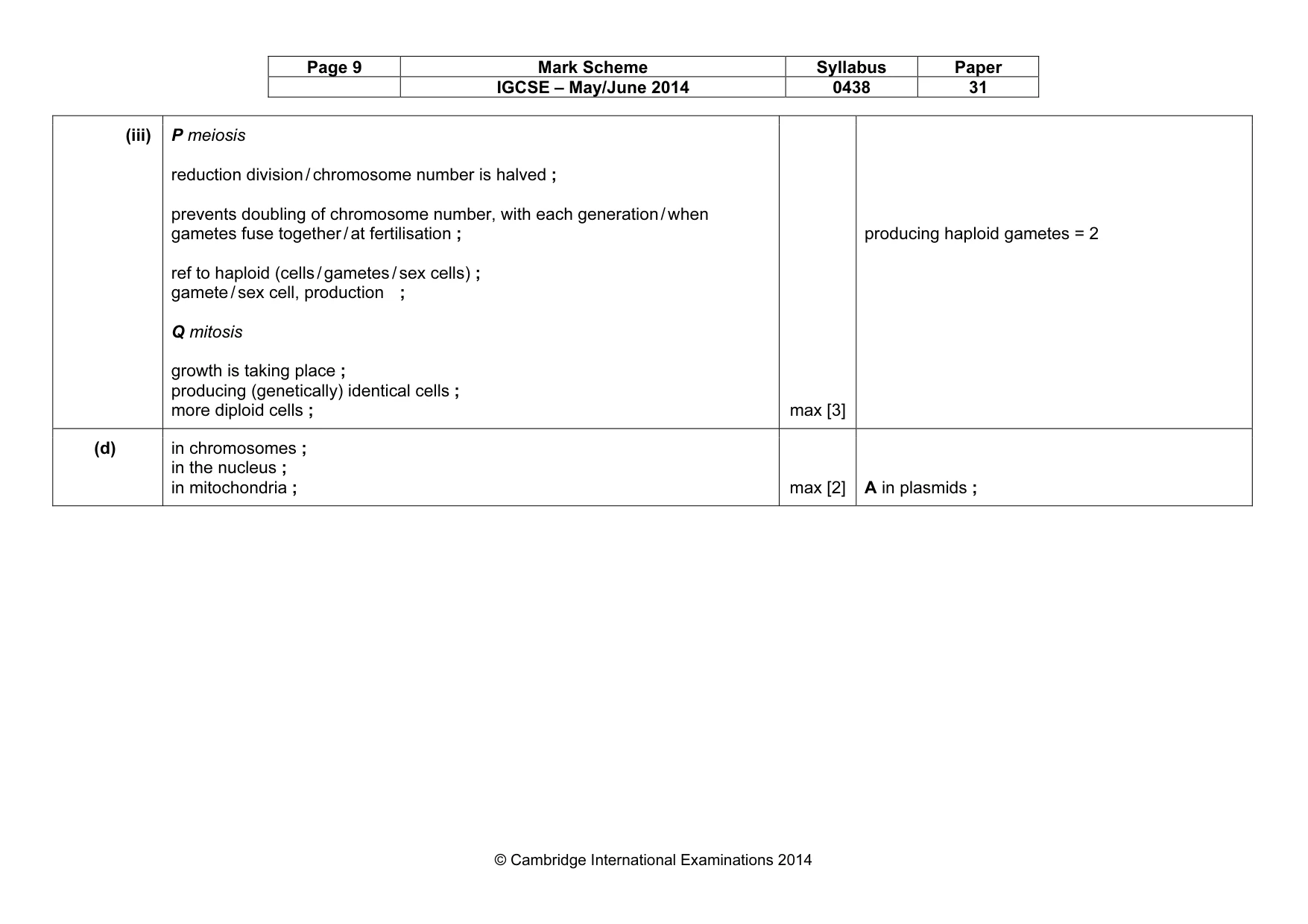
Page 9 Mark Scheme Syllabus Paper IGCSE – May/June 2014 0438 31 © Cambridge International Examinations 2014 (iii) P meiosis reduction division / chromosome number is halved ; prevents doubling of chromosome number, with each generation / when gametes fuse together / at fertilisation ; ref to haploid (cells / gametes / sex cells) ; gamete / sex cell, production ; Q mitosis growth is taking place ; producing (genetically) identical cells ; more diploid cells ; max [3] producing haploid gametes = 2 (d) in chromosomes ; in the nucleus ; in mitochondria ; max [2] A in plasmids ;
Mark scheme, page 10
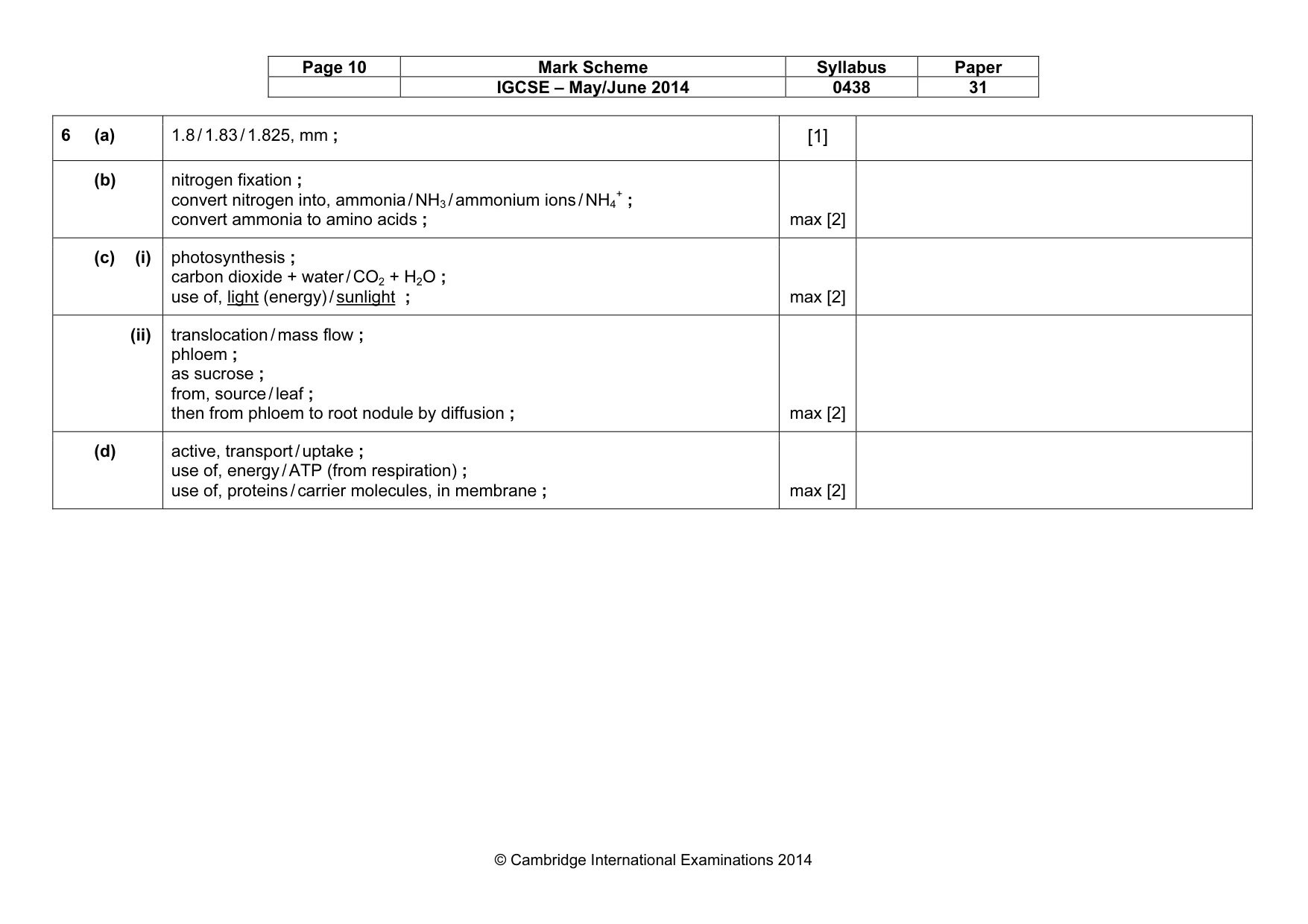
Page 10 Mark Scheme Syllabus Paper IGCSE – May/June 2014 0438 31 © Cambridge International Examinations 2014 6 (a) 1.8 / 1.83 / 1.825, mm ; [1] (b) nitrogen fixation ; convert nitrogen into, ammonia / NH3 / ammonium ions / NH4 + ; convert ammonia to amino acids ; max [2] (c) (i) photosynthesis ; carbon dioxide + water / CO2 + H2O ; use of, light (energy) / sunlight ; max [2] (ii) translocation / mass flow ; phloem ; as sucrose ; from, source / leaf ; then from phloem to root nodule by diffusion ; max [2] (d) active, transport / uptake ; use of, energy / ATP (from respiration) ; use of, proteins / carrier molecules, in membrane ; max [2]
What you needed in this session
Cambridge’s own grade thresholds for 2014 May/June, Paper 3 · Variant 1. A higher threshold means an easier paper — the bar moves with how the cohort did.