Cambridge IGCSE Biology (BES) 0438 — 2017 Oct/Nov Paper 3 · Variant 1
0438/31/O/N/17 · 80 marks · ≈90 min
The question paper and its mark scheme, free to read here and free to download. This is Cambridge’s own paper, exactly as it was sat.
Question paper20 pages

Mark scheme11 pages
Answers below. Sit the paper first if you are practising.
Paper as text
Question paper, page 1
This document consists of 19 printed pages and 1 blank page. DC (KS) 156056 © UCLES 2017 [Turn over * 3 2 8 5 1 7 8 7 6 5 * BIOLOGY (US) 0438/31 Paper 3 Theory (Core) October/November 2017 1 hour 15 minutes Candidates answer on the Question Paper. No Additional Materials are required. READ THESE INSTRUCTIONS FIRST Write your Center number, candidate number and name on all the work you hand in. Write in dark blue or black pen. You may use an HB pencil for any diagrams or graphs. Do not use staples, paper clips, glue or correction fluid. DO NOT WRITE IN ANY BARCODES. Answer all questions. Electronic calculators may be used. You may lose marks if you do not show your working or if you do not use appropriate units. At the end of the examination, fasten all your work securely together. The number of marks is given in brackets [ ] at the end of each question or part question. Cambridge International Examinations Cambridge International General Certificate of Secondary Education
Question paper, page 2
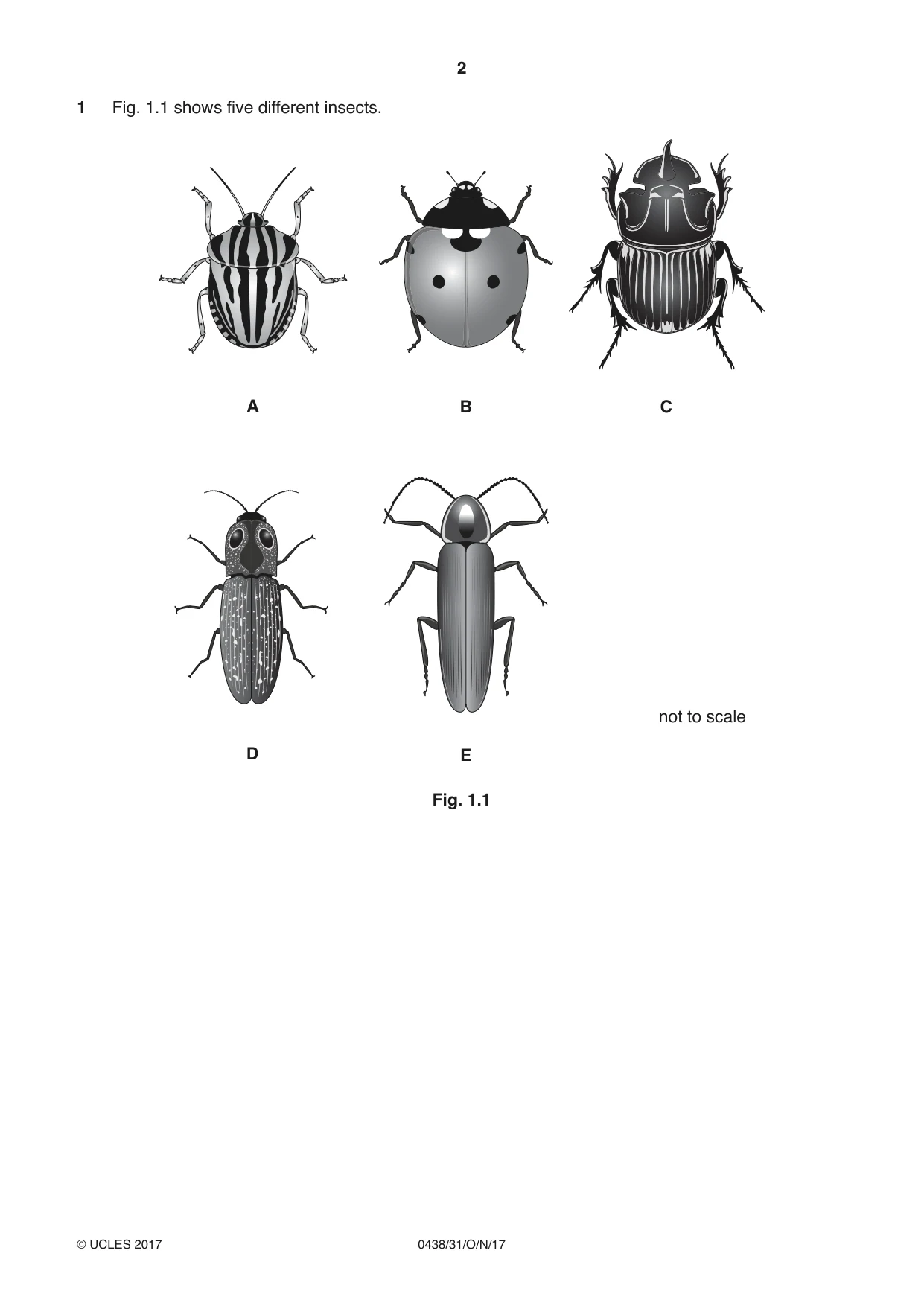
2 0438/31/O/N/17 © UCLES 2017 1 Fig. 1.1 shows five different insects. C B A E not to scale D Fig. 1.1
Question paper, page 3
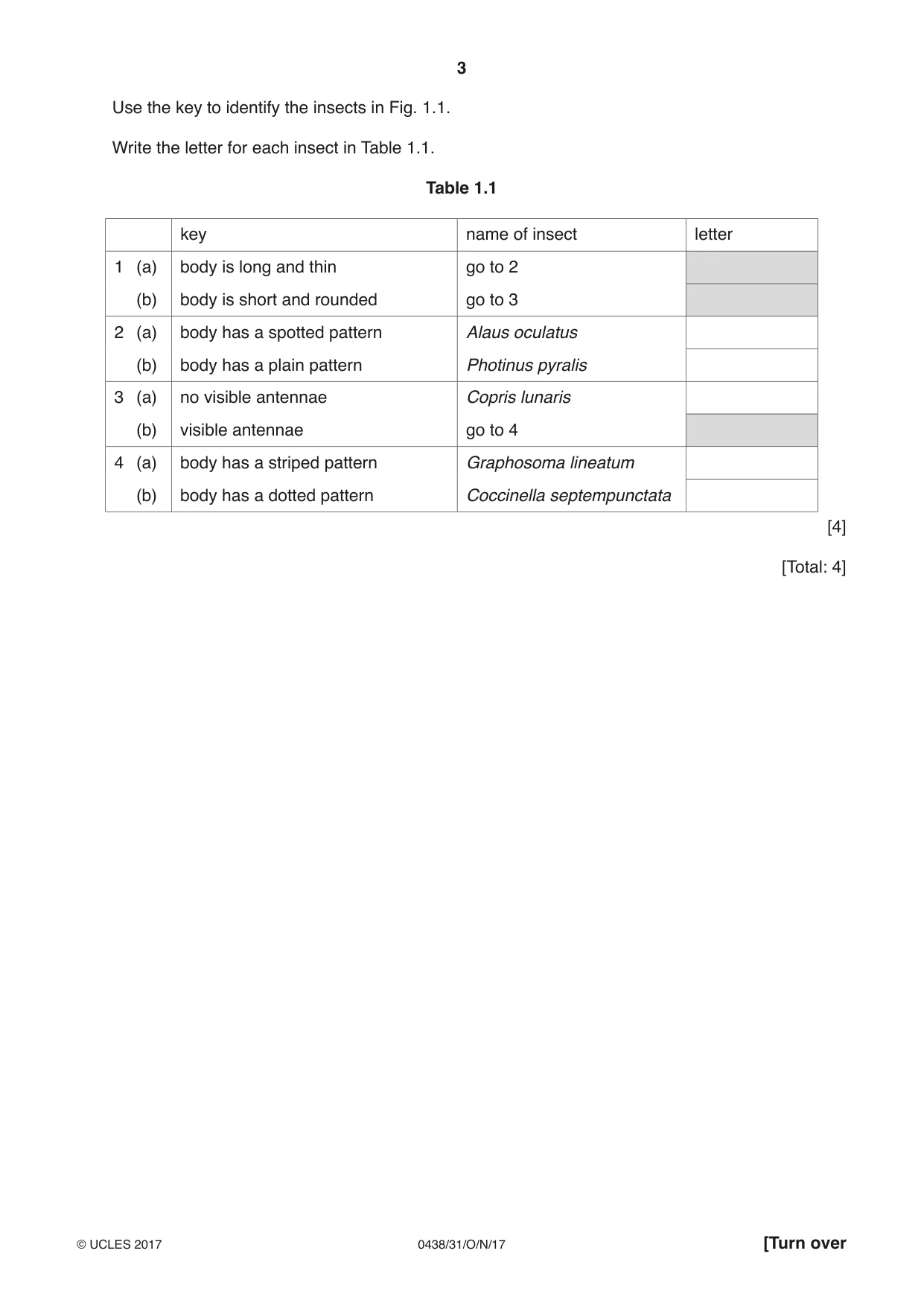
3 0438/31/O/N/17 © UCLES 2017 [Turn over Use the key to identify the insects in Fig. 1.1. Write the letter for each insect in Table 1.1. Table 1.1 key name of insect letter 1 (a) (b) body is long and thin body is short and rounded go to 2 go to 3 2 (a) (b) body has a spotted pattern body has a plain pattern Alaus oculatus Photinus pyralis 3 (a) (b) no visible antennae visible antennae Copris lunaris go to 4 4 (a) (b) body has a striped pattern body has a dotted pattern Graphosoma lineatum Coccinella septempunctata [4] [Total: 4]
Question paper, page 4
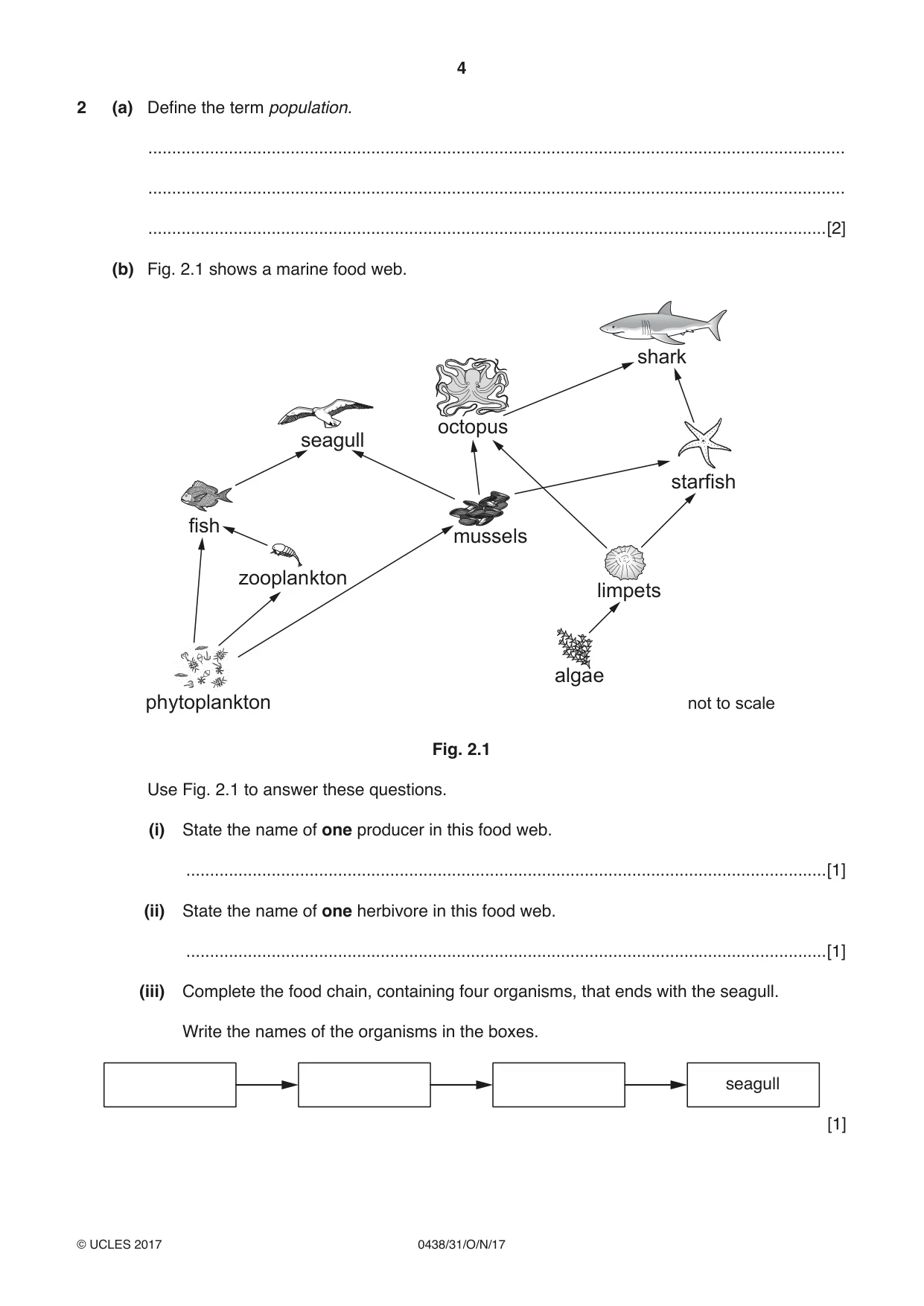
4 0438/31/O/N/17 © UCLES 2017 2 (a) Define the term population. … … …[2] (b) Fig. 2.1 shows a marine food web. algae not to scale limpets starfish shark mussels zooplankton fish seagull octopus phytoplankton Fig. 2.1 Use Fig. 2.1 to answer these questions. (i) State the name of one producer in this food web. …[1] (ii) State the name of one herbivore in this food web. …[1] (iii) Complete the food chain, containing four organisms, that ends with the seagull. Write the names of the organisms in the boxes. seagull [1]
Question paper, page 5
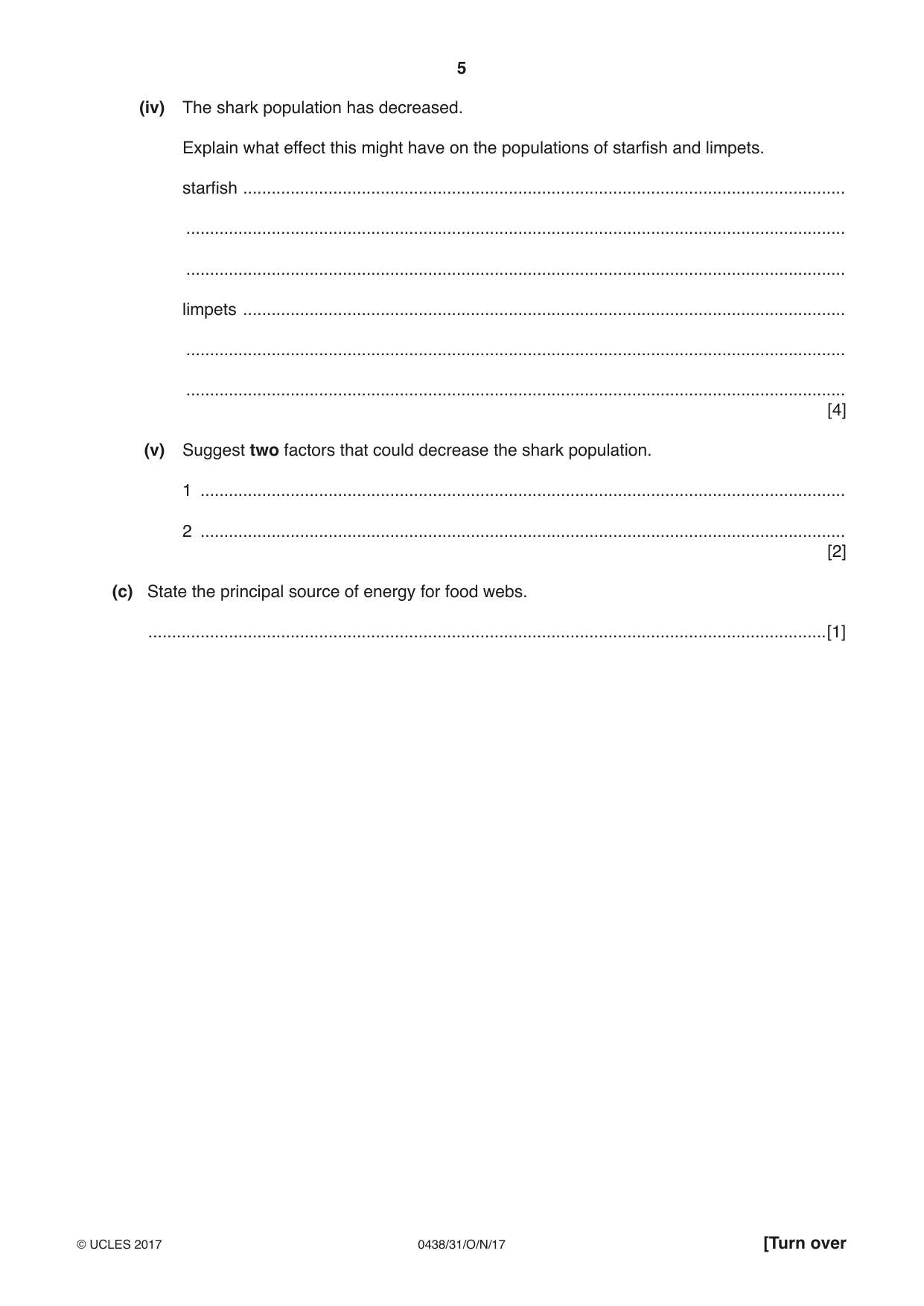
5 0438/31/O/N/17 © UCLES 2017 [Turn over (iv) The shark population has decreased. Explain what effect this might have on the populations of starfish and limpets. starfish … … … limpets … … … [4] (v) Suggest two factors that could decrease the shark population. 1 … 2 … [2] (c) State the principal source of energy for food webs. …[1]
Question paper, page 6
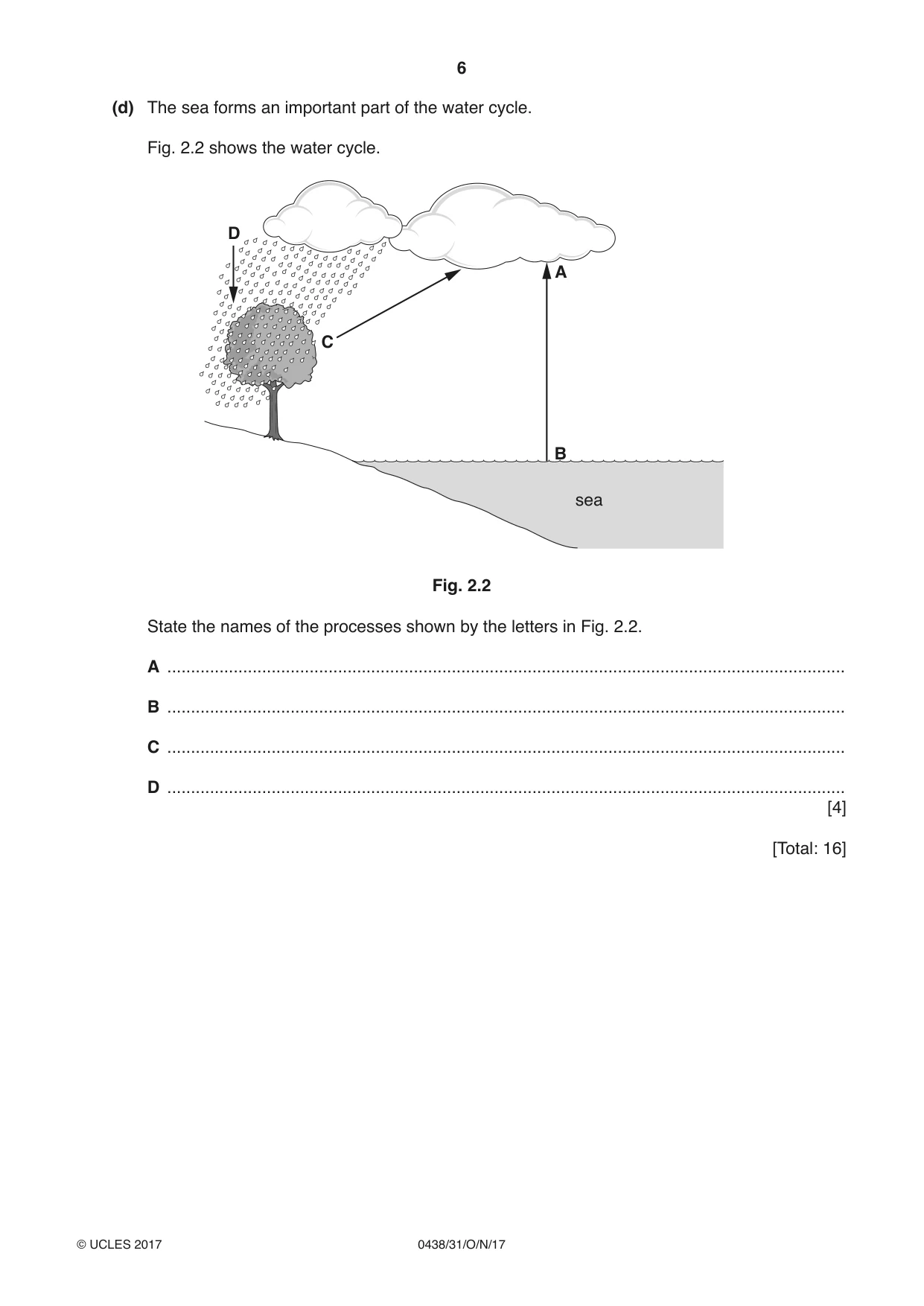
6 0438/31/O/N/17 © UCLES 2017 (d) The sea forms an important part of the water cycle. Fig. 2.2 shows the water cycle. sea C D B A Fig. 2.2 State the names of the processes shown by the letters in Fig. 2.2. A … B … C … D … [4] [Total: 16]
Question paper, page 7
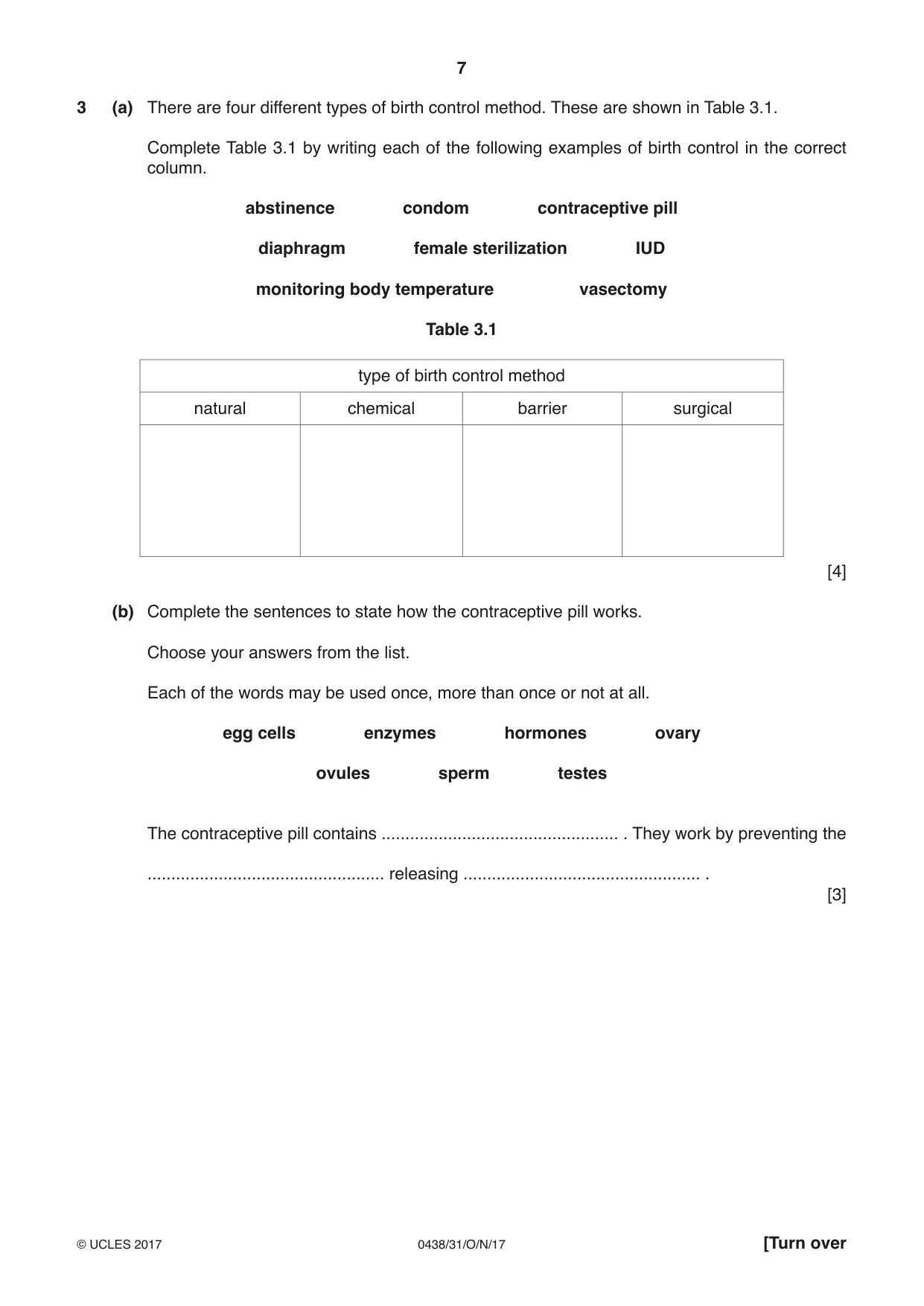
7 0438/31/O/N/17 © UCLES 2017 [Turn over 3 (a) There are four different types of birth control method. These are shown in Table 3.1. Complete Table 3.1 by writing each of the following examples of birth control in the correct column. abstinence condom contraceptive pill diaphragm female sterilization IUD monitoring body temperature vasectomy Table 3.1 type of birth control method natural chemical barrier surgical [4] (b) Complete the sentences to state how the contraceptive pill works. Choose your answers from the list. Each of the words may be used once, more than once or not at all. egg cells enzymes hormones ovary ovules sperm testes The contraceptive pill contains … . They work by preventing the … releasing … . [3]
Question paper, page 8
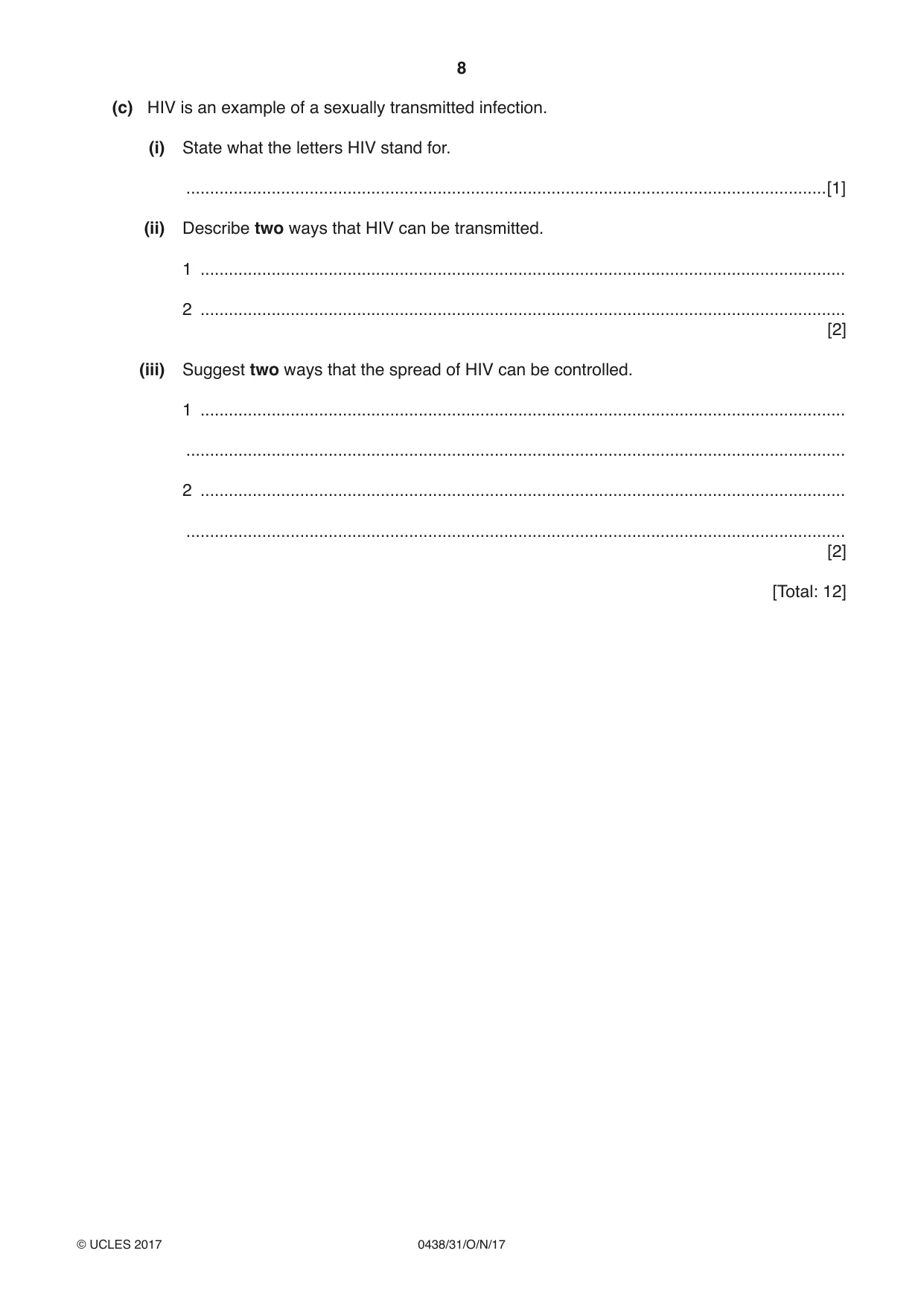
8 0438/31/O/N/17 © UCLES 2017 (c) HIV is an example of a sexually transmitted infection. (i) State what the letters HIV stand for. …[1] (ii) Describe two ways that HIV can be transmitted. 1 … 2 … [2] (iii) Suggest two ways that the spread of HIV can be controlled. 1 … … 2 … … [2] [Total: 12]
Question paper, page 9
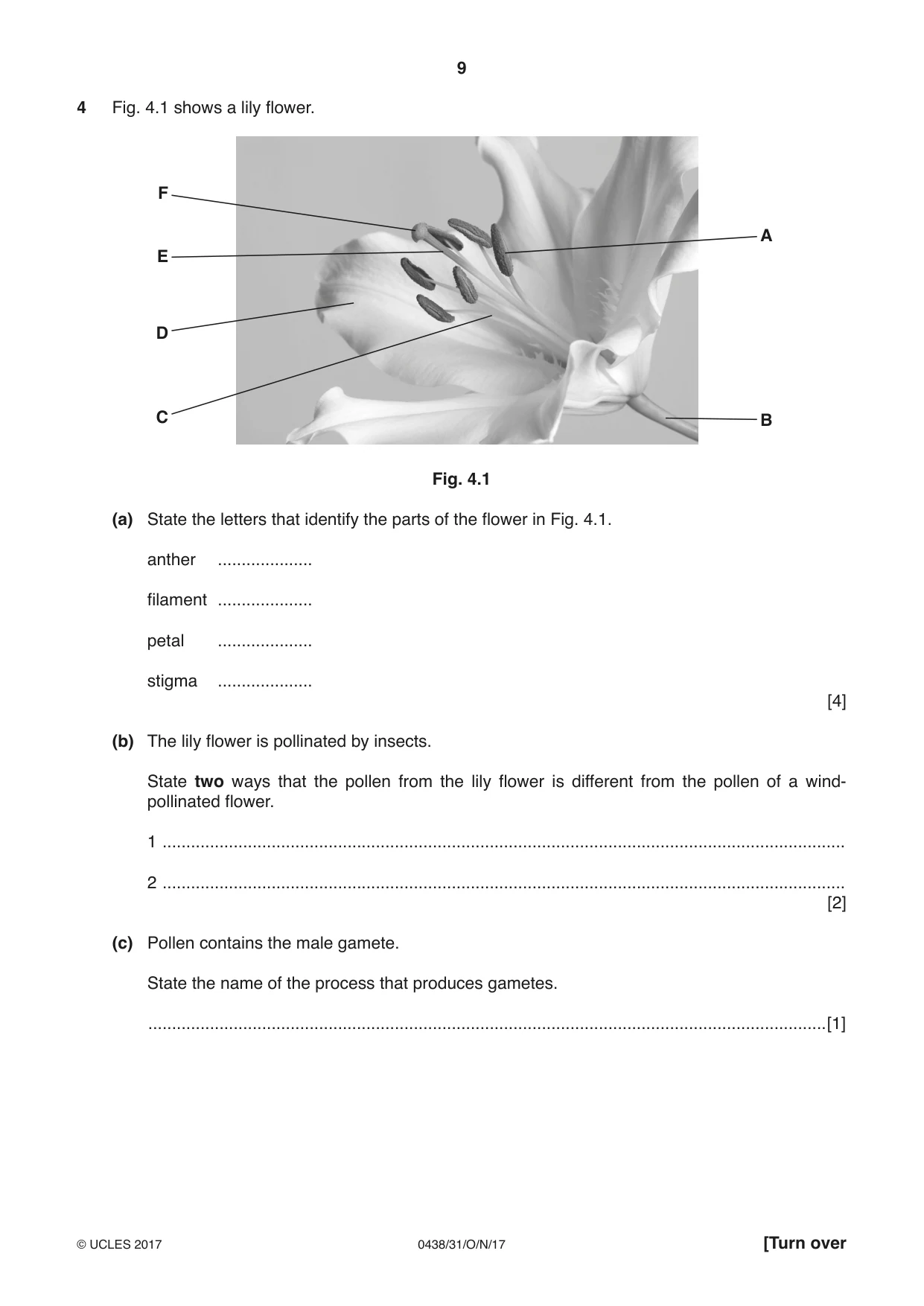
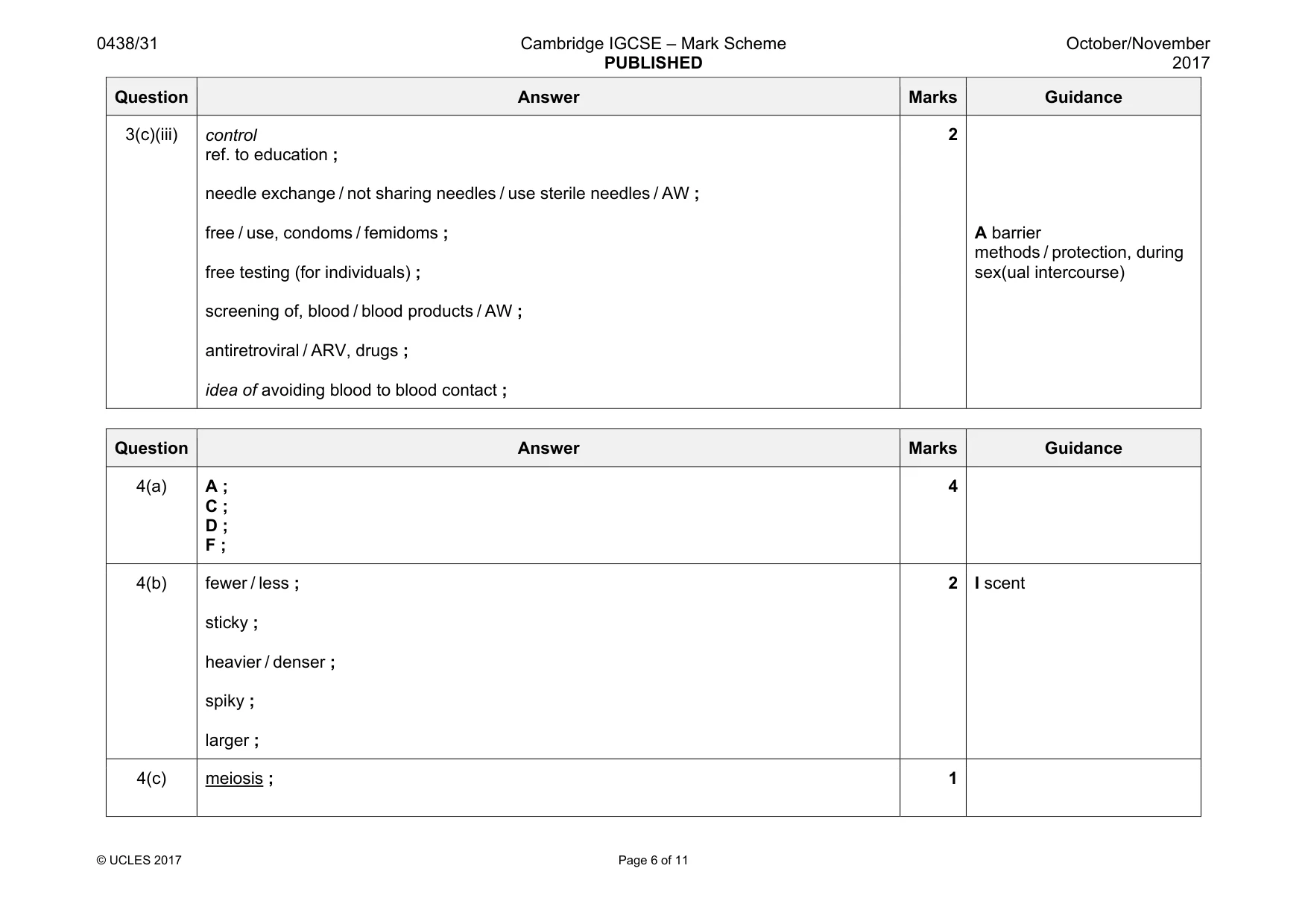
9 0438/31/O/N/17 © UCLES 2017 [Turn over 4 Fig. 4.1 shows a lily flower. F E D C A B Fig. 4.1 (a) State the letters that identify the parts of the flower in Fig. 4.1. anther … filament … petal … stigma … [4] (b) The lily flower is pollinated by insects. State two ways that the pollen from the lily flower is different from the pollen of a wind- pollinated flower. 1 … 2 … [2] (c) Pollen contains the male gamete. State the name of the process that produces gametes. …[1]
Question paper, page 10
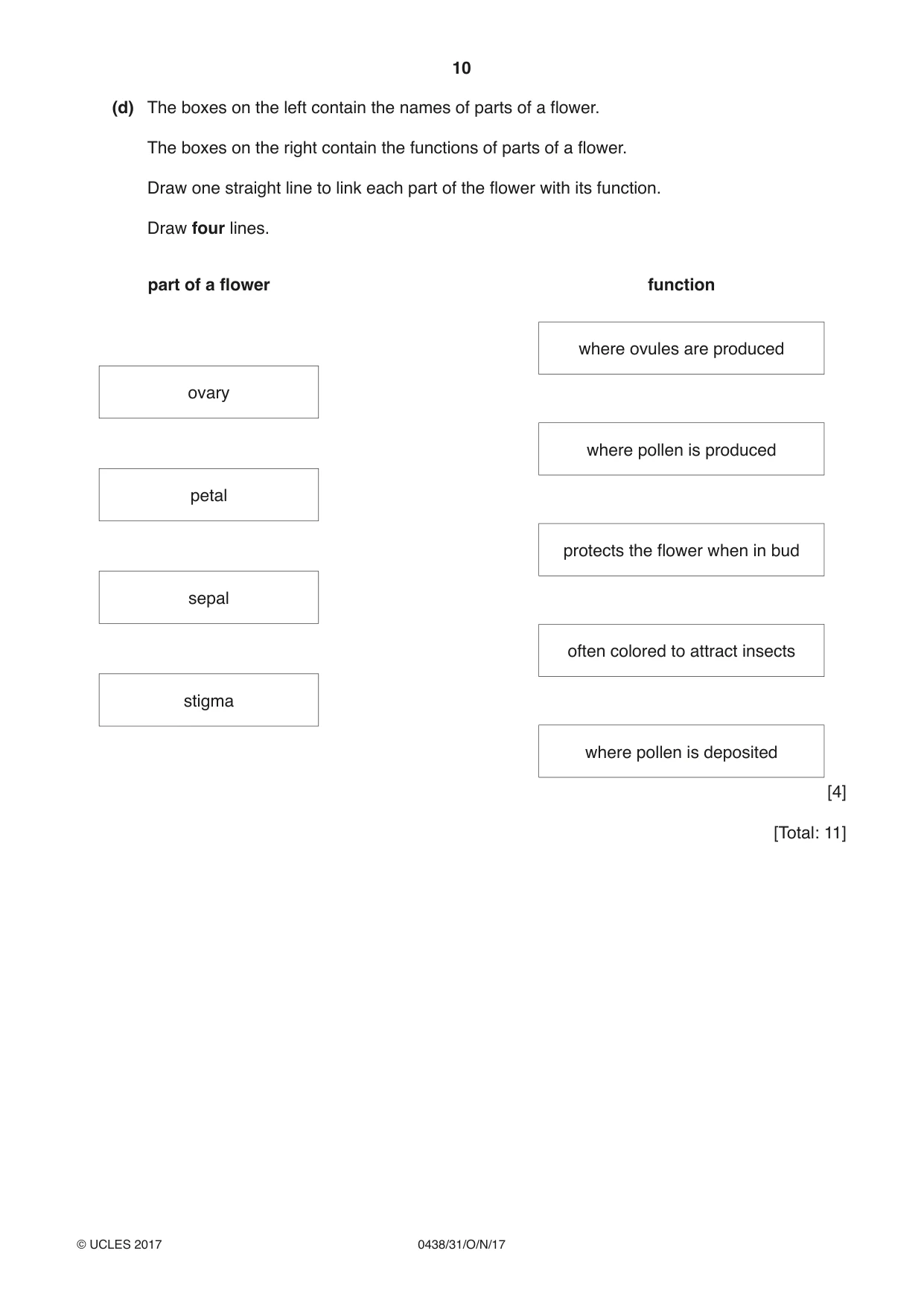
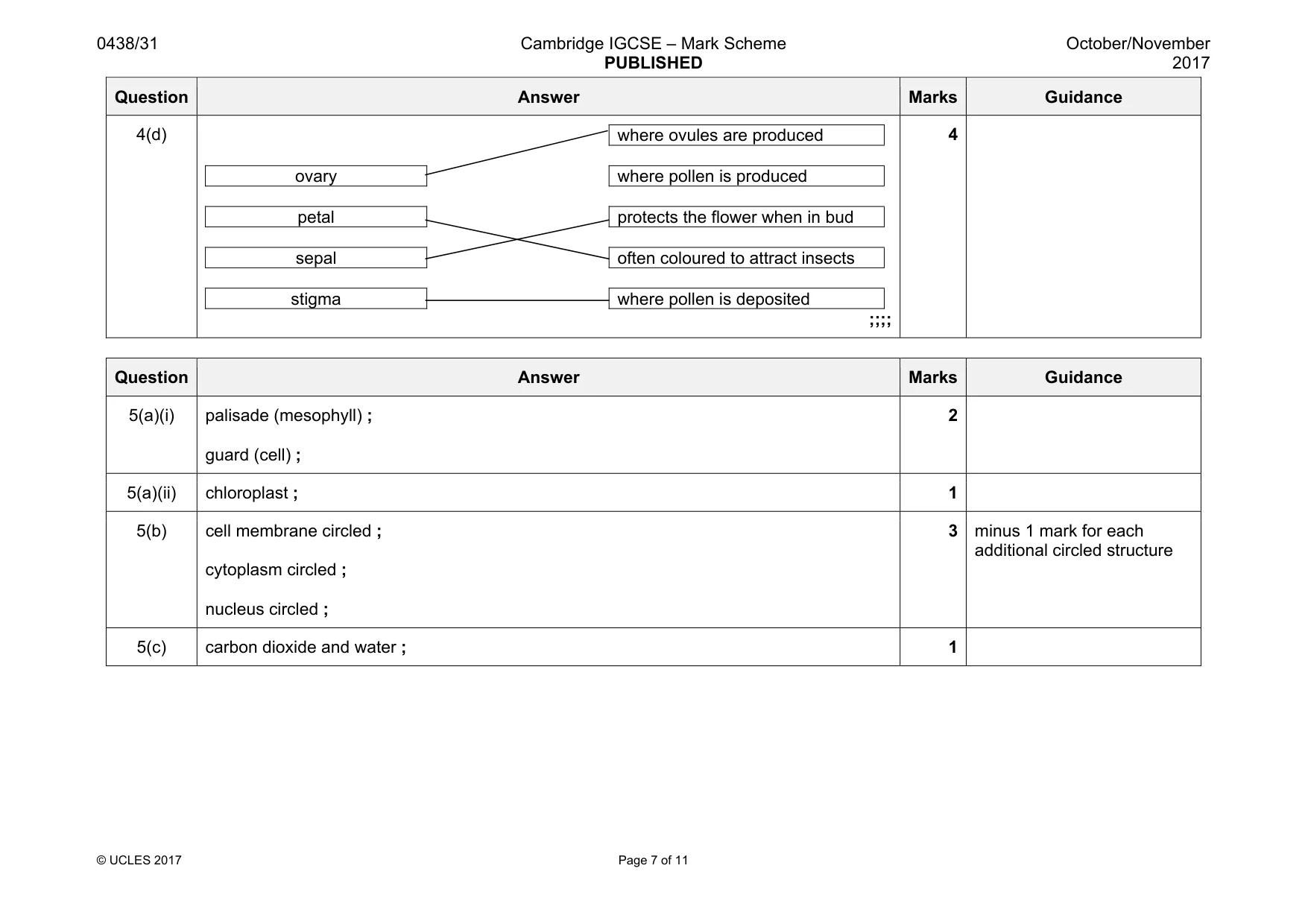
10 0438/31/O/N/17 © UCLES 2017 (d) The boxes on the left contain the names of parts of a flower. The boxes on the right contain the functions of parts of a flower. Draw one straight line to link each part of the flower with its function. Draw four lines. ovary petal sepal stigma where ovules are produced where pollen is produced protects the flower when in bud often colored to attract insects where pollen is deposited part of a flower function [4] [Total: 11]
Question paper, page 11
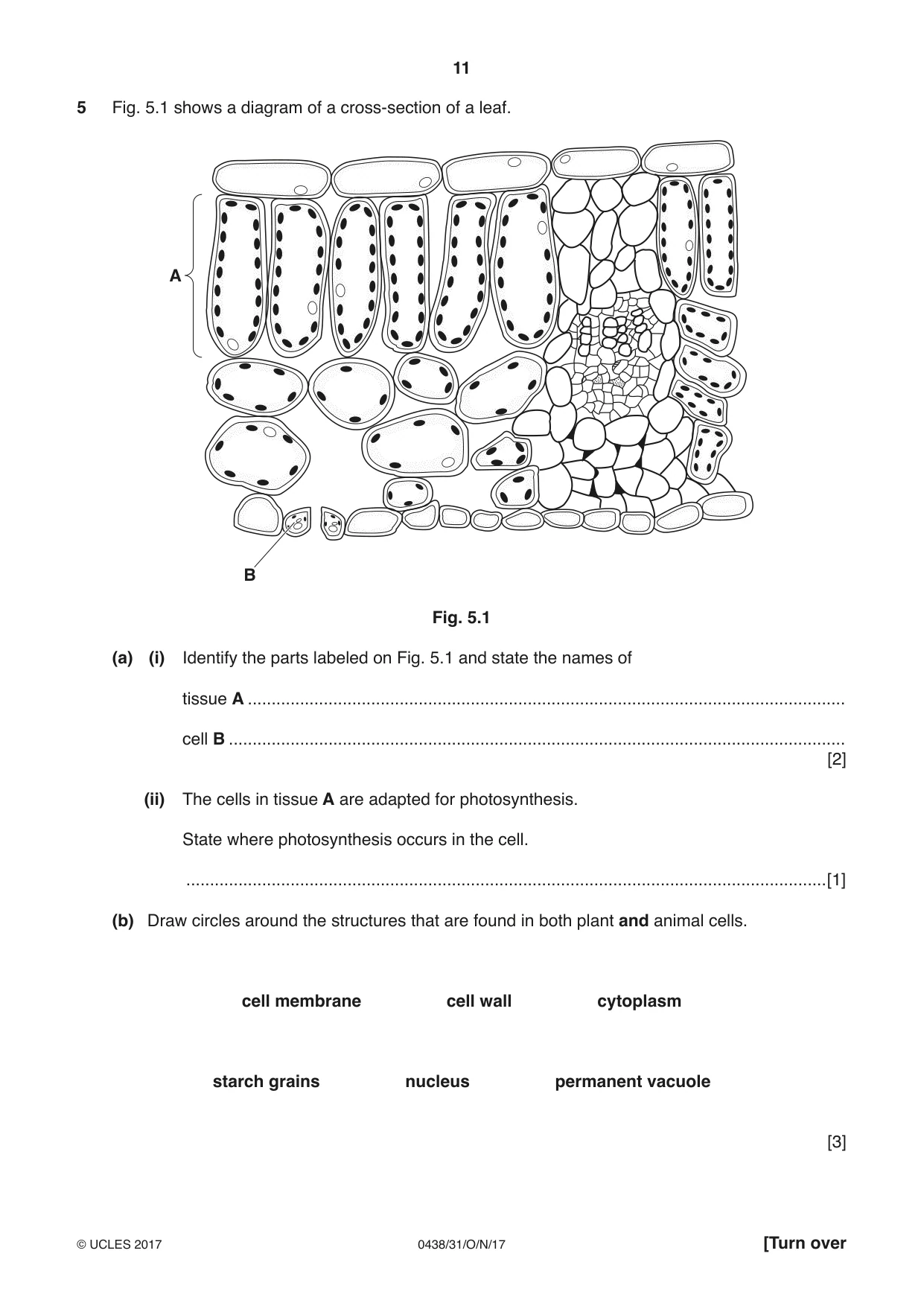
11 0438/31/O/N/17 © UCLES 2017 [Turn over 5 Fig. 5.1 shows a diagram of a cross-section of a leaf. B A Fig. 5.1 (a) (i) Identify the parts labeled on Fig. 5.1 and state the names of tissue A … cell B … [2] (ii) The cells in tissue A are adapted for photosynthesis. State where photosynthesis occurs in the cell. …[1] (b) Draw circles around the structures that are found in both plant and animal cells. cell membrane cell wall cytoplasm starch grains nucleus permanent vacuole [3]
Question paper, page 12
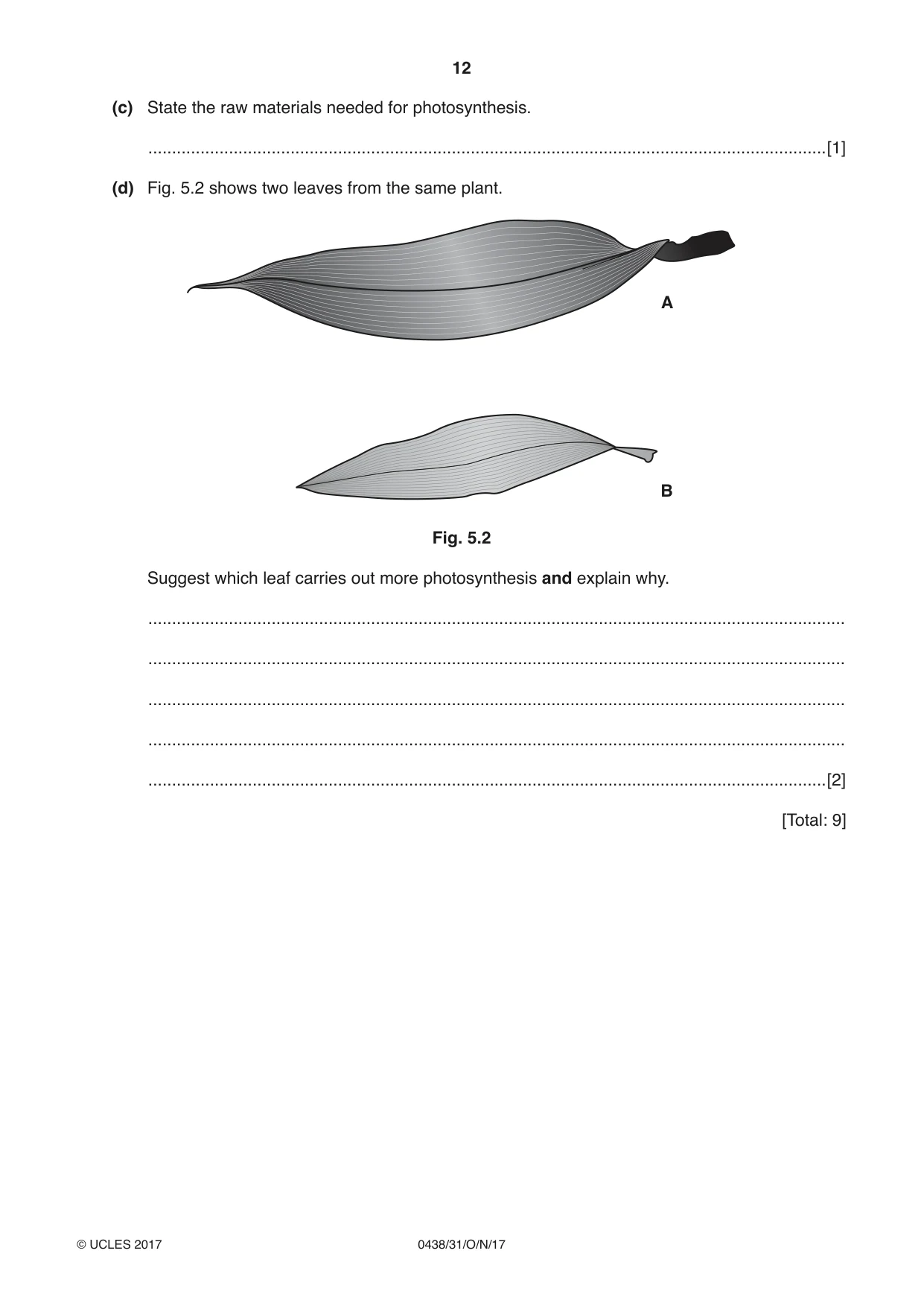
12 0438/31/O/N/17 © UCLES 2017 (c) State the raw materials needed for photosynthesis. …[1] (d) Fig. 5.2 shows two leaves from the same plant. A B Fig. 5.2 Suggest which leaf carries out more photosynthesis and explain why. … … … … …[2] [Total: 9]
Question paper, page 13
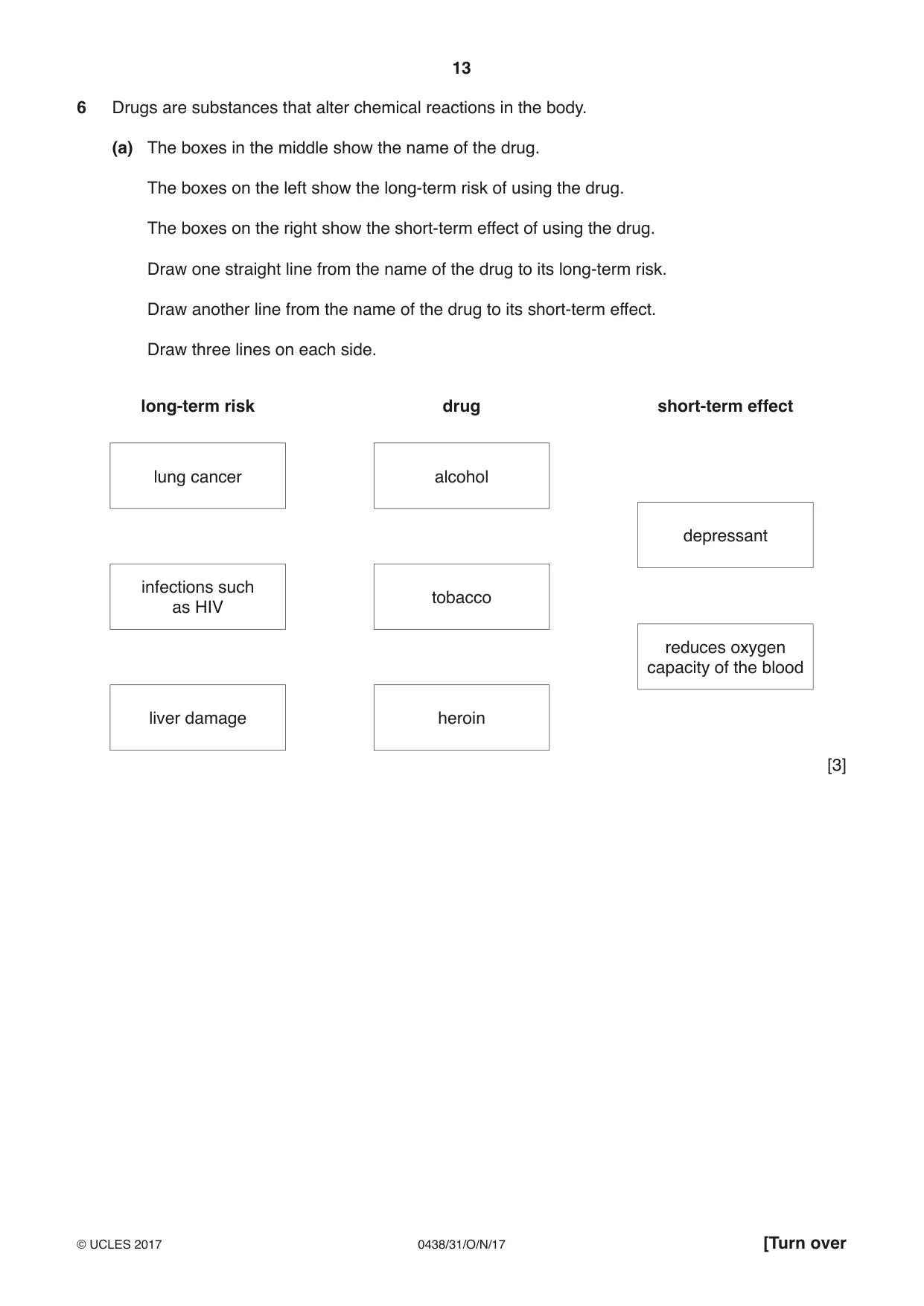
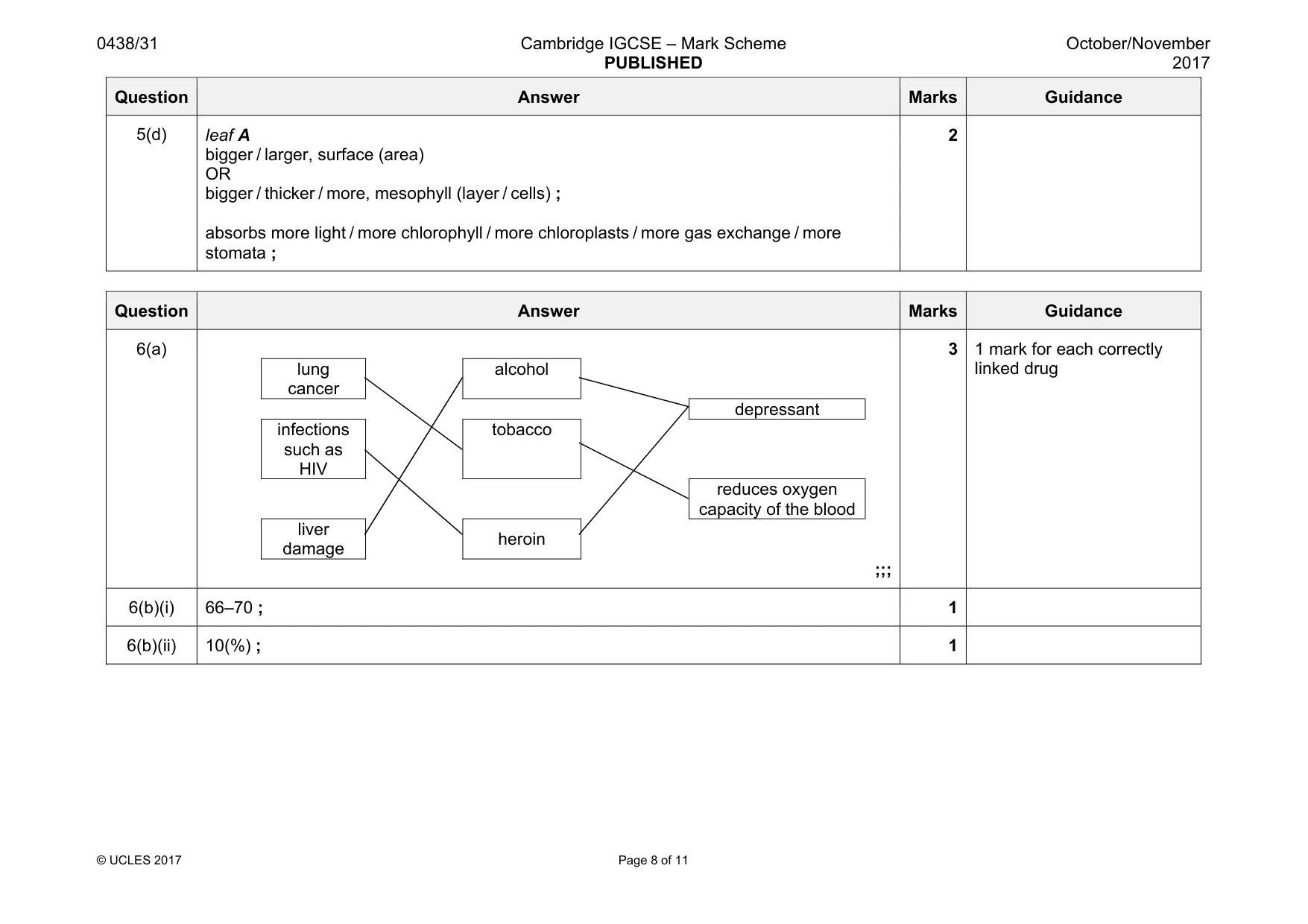
13 0438/31/O/N/17 © UCLES 2017 [Turn over 6 Drugs are substances that alter chemical reactions in the body. (a) The boxes in the middle show the name of the drug. The boxes on the left show the long-term risk of using the drug. The boxes on the right show the short-term effect of using the drug. Draw one straight line from the name of the drug to its long-term risk. Draw another line from the name of the drug to its short-term effect. Draw three lines on each side. lung cancer infections such as HIV liver damage depressant reduces oxygen capacity of the blood long-term risk short-term effect alcohol tobacco heroin drug [3]
Question paper, page 14
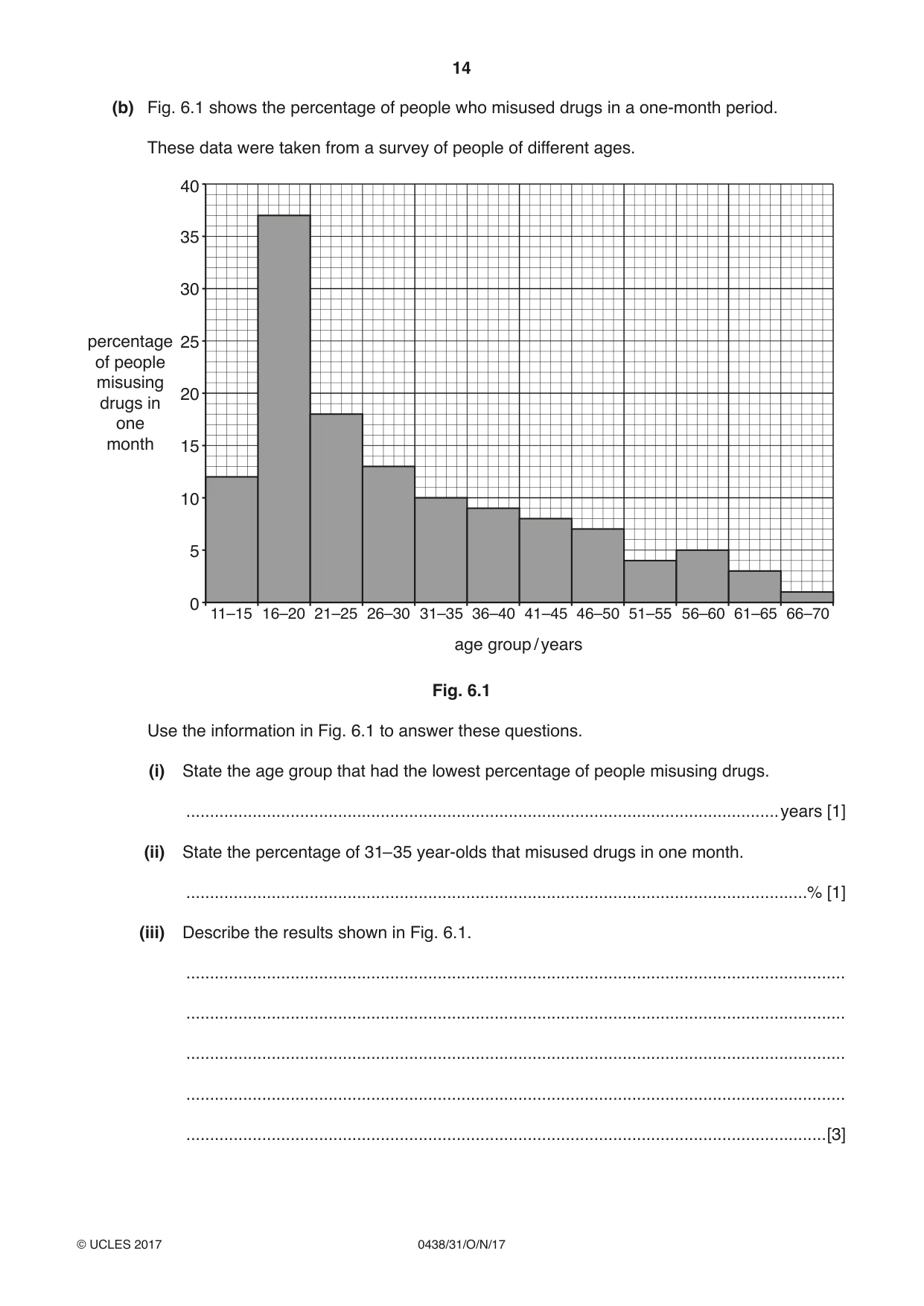
14 0438/31/O/N/17 © UCLES 2017 (b) Fig. 6.1 shows the percentage of people who misused drugs in a one-month period. These data were taken from a survey of people of different ages. 0 5 10 age group / years 15 20 percentage of people misusing drugs in one month 25 30 35 40 11–15 16–20 21–25 26–30 31–35 36–40 41–45 46–50 51–55 56–60 61–65 66–70 Fig. 6.1 Use the information in Fig. 6.1 to answer these questions. (i) State the age group that had the lowest percentage of people misusing drugs. …years [1] (ii) State the percentage of 31–35 year-olds that misused drugs in one month. …% [1] (iii) Describe the results shown in Fig. 6.1. … … … … …[3]
Question paper, page 15
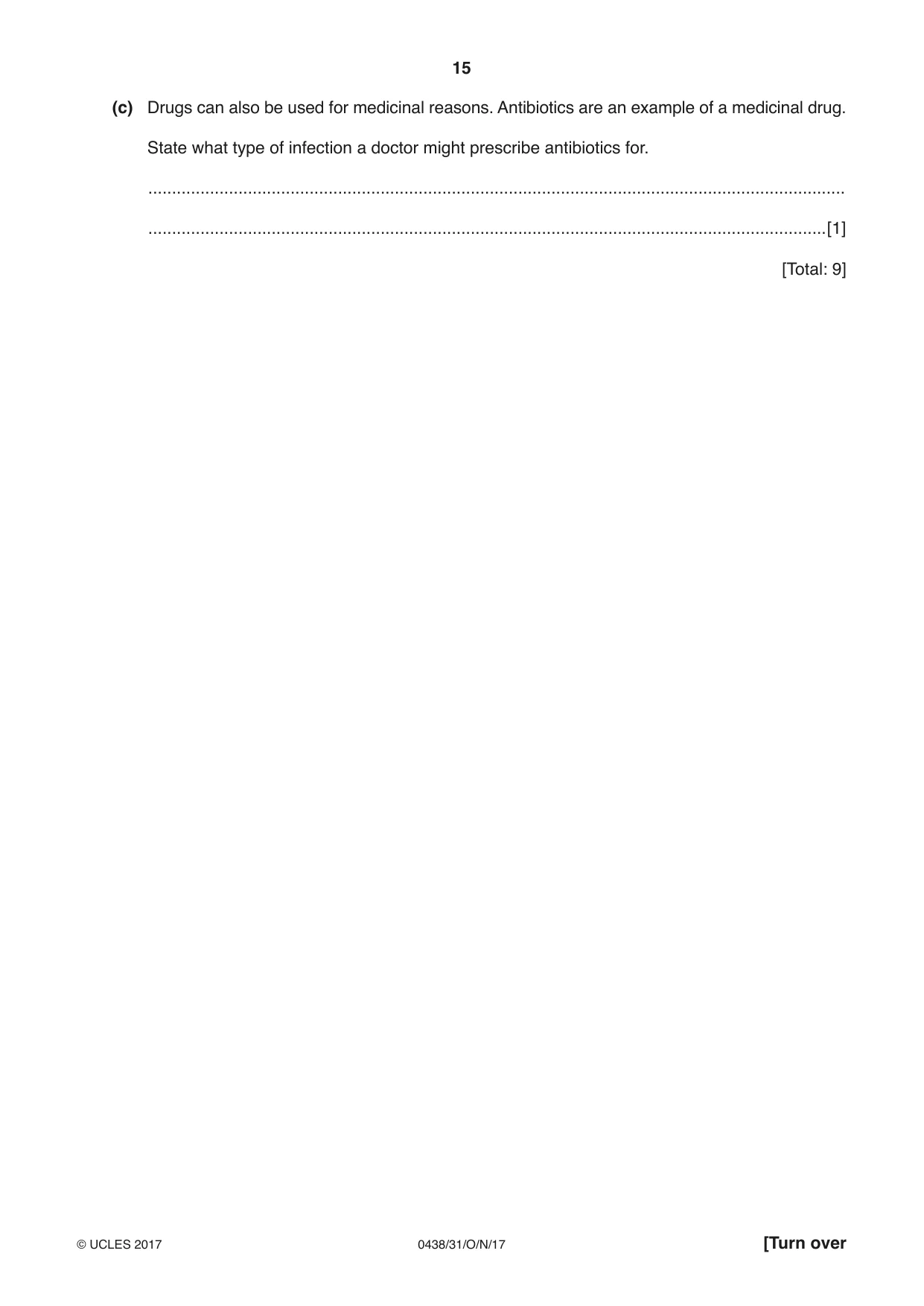
15 0438/31/O/N/17 © UCLES 2017 [Turn over (c) Drugs can also be used for medicinal reasons. Antibiotics are an example of a medicinal drug. State what type of infection a doctor might prescribe antibiotics for. … …[1] [Total: 9]
Question paper, page 16
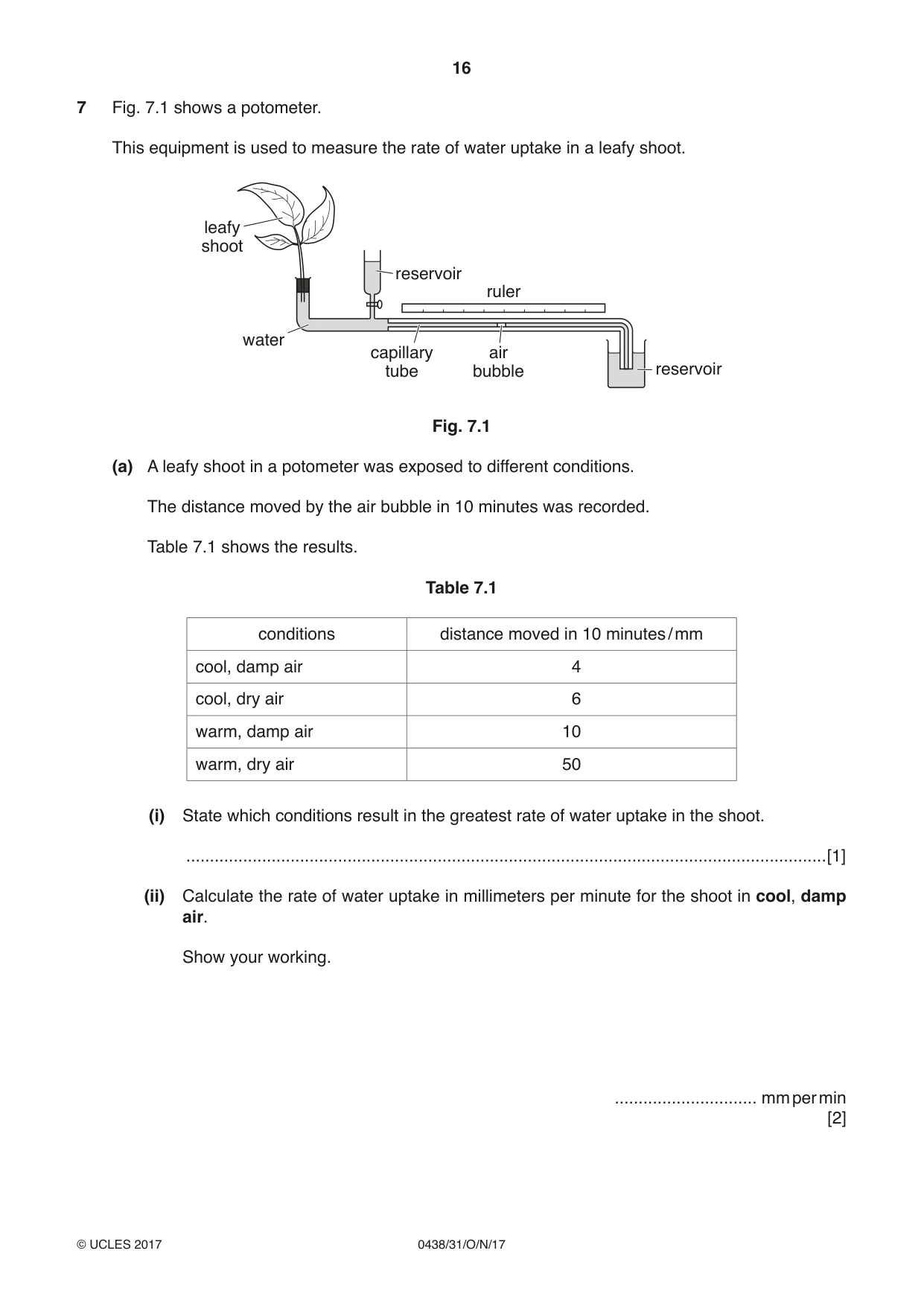
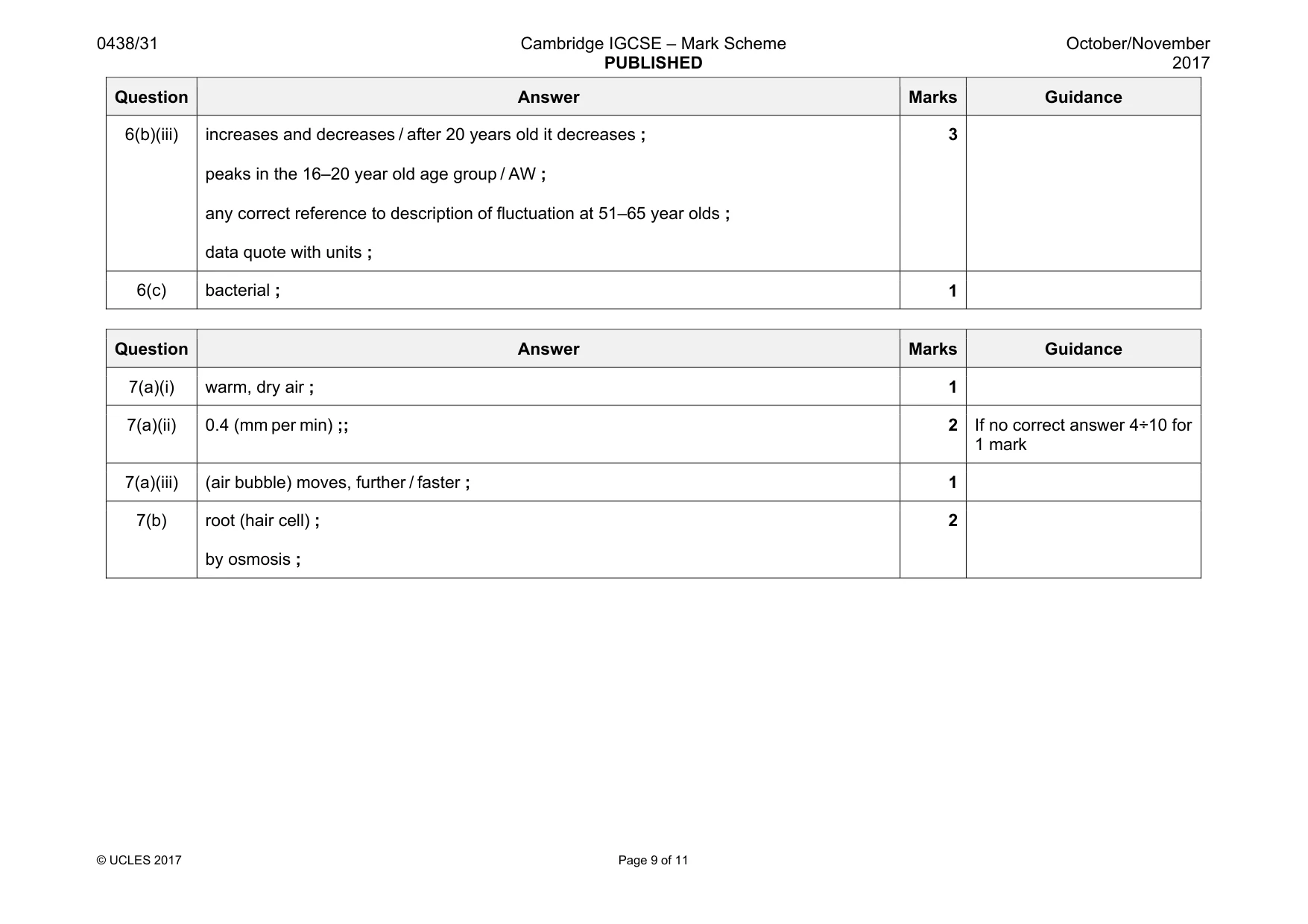
16 0438/31/O/N/17 © UCLES 2017 7 Fig. 7.1 shows a potometer. This equipment is used to measure the rate of water uptake in a leafy shoot. ruler reservoir air bubble capillary tube water leafy shoot reservoir Fig. 7.1 (a) A leafy shoot in a potometer was exposed to different conditions. The distance moved by the air bubble in 10 minutes was recorded. Table 7.1 shows the results. Table 7.1 conditions distance moved in 10 minutes / mm cool, damp air 4 cool, dry air 6 warm, damp air 10 warm, dry air 50 (i) State which conditions result in the greatest rate of water uptake in the shoot. …[1] (ii) Calculate the rate of water uptake in millimeters per minute for the shoot in cool, damp air. Show your working. … mm per min [2]
Question paper, page 17
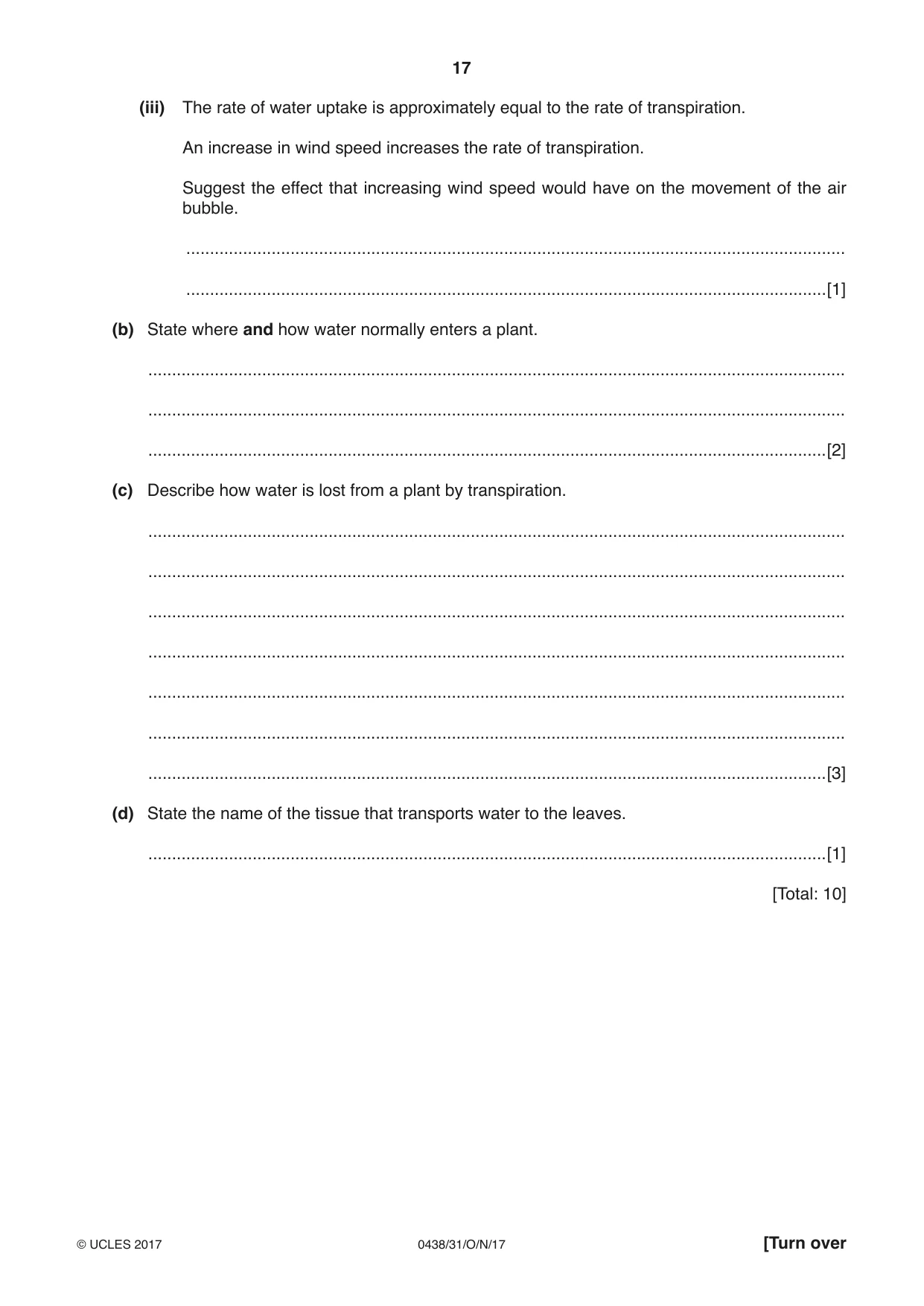
17 0438/31/O/N/17 © UCLES 2017 [Turn over (iii) The rate of water uptake is approximately equal to the rate of transpiration. An increase in wind speed increases the rate of transpiration. Suggest the effect that increasing wind speed would have on the movement of the air bubble. … …[1] (b) State where and how water normally enters a plant. … … …[2] (c) Describe how water is lost from a plant by transpiration. … … … … … … …[3] (d) State the name of the tissue that transports water to the leaves. …[1] [Total: 10]
Question paper, page 18
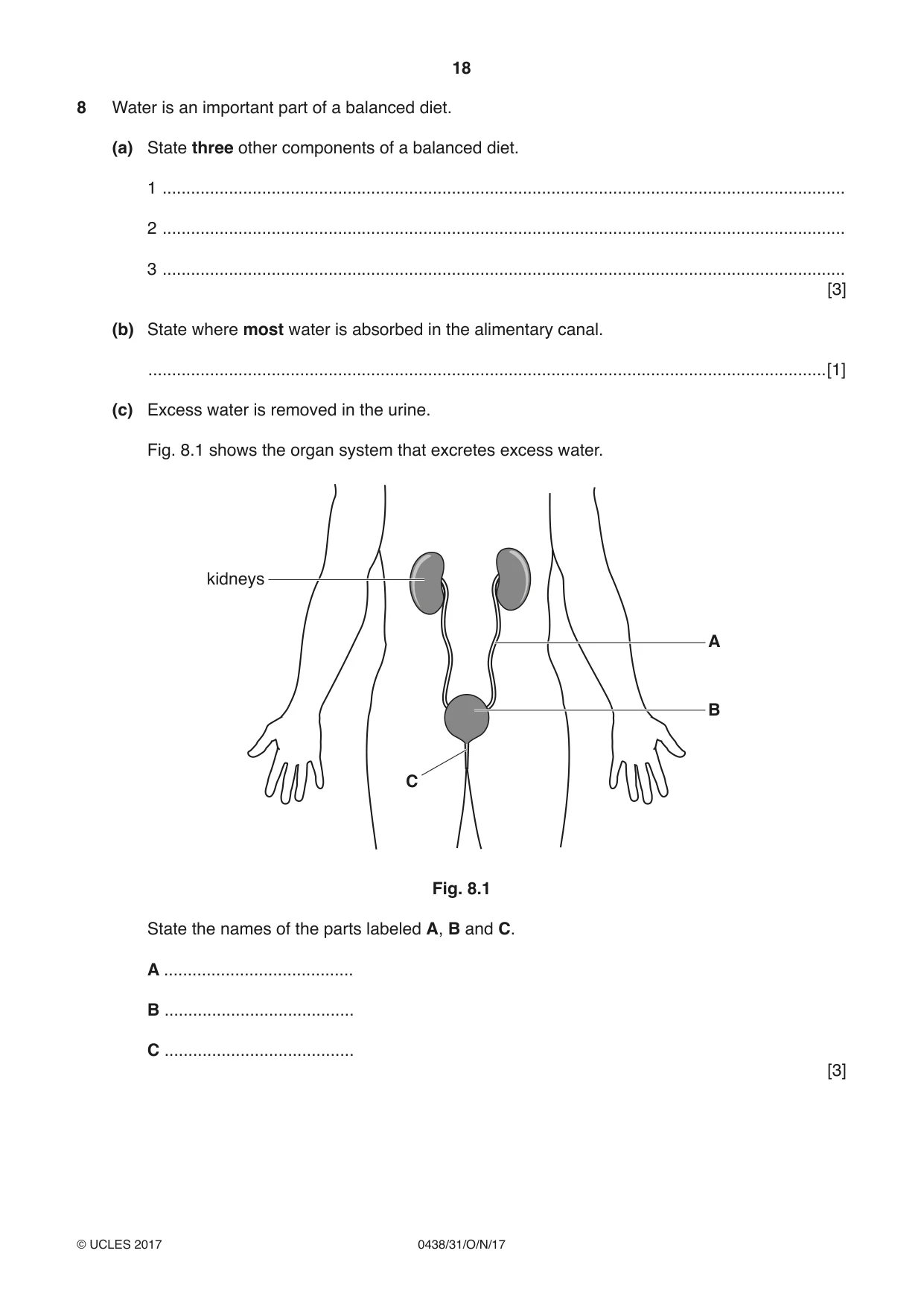
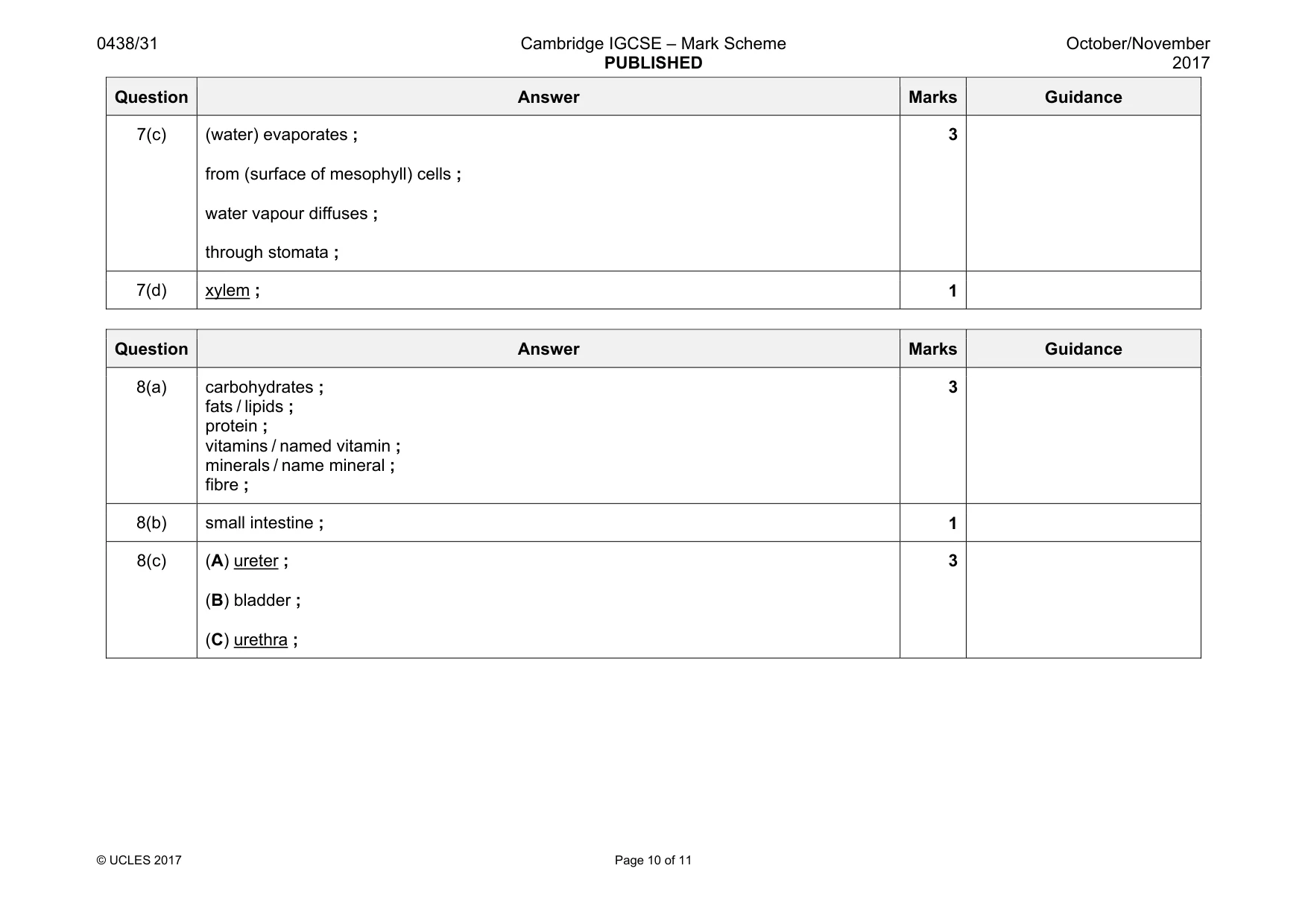
18 0438/31/O/N/17 © UCLES 2017 8 Water is an important part of a balanced diet. (a) State three other components of a balanced diet. 1 … 2 … 3 … [3] (b) State where most water is absorbed in the alimentary canal. …[1] (c) Excess water is removed in the urine. Fig. 8.1 shows the organ system that excretes excess water. kidneys A B C Fig. 8.1 State the names of the parts labeled A, B and C. A … B … C … [3]
Question paper, page 19
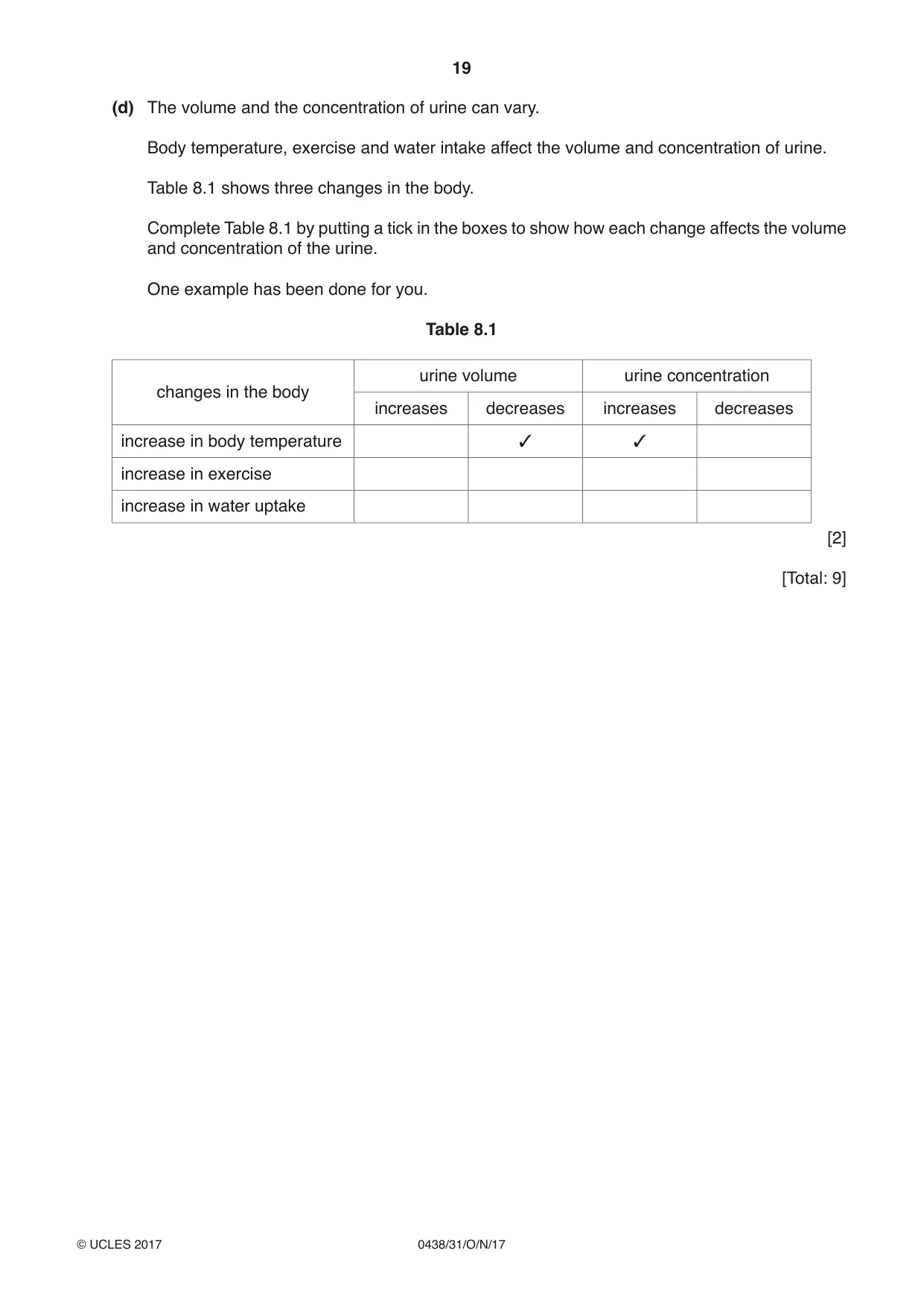
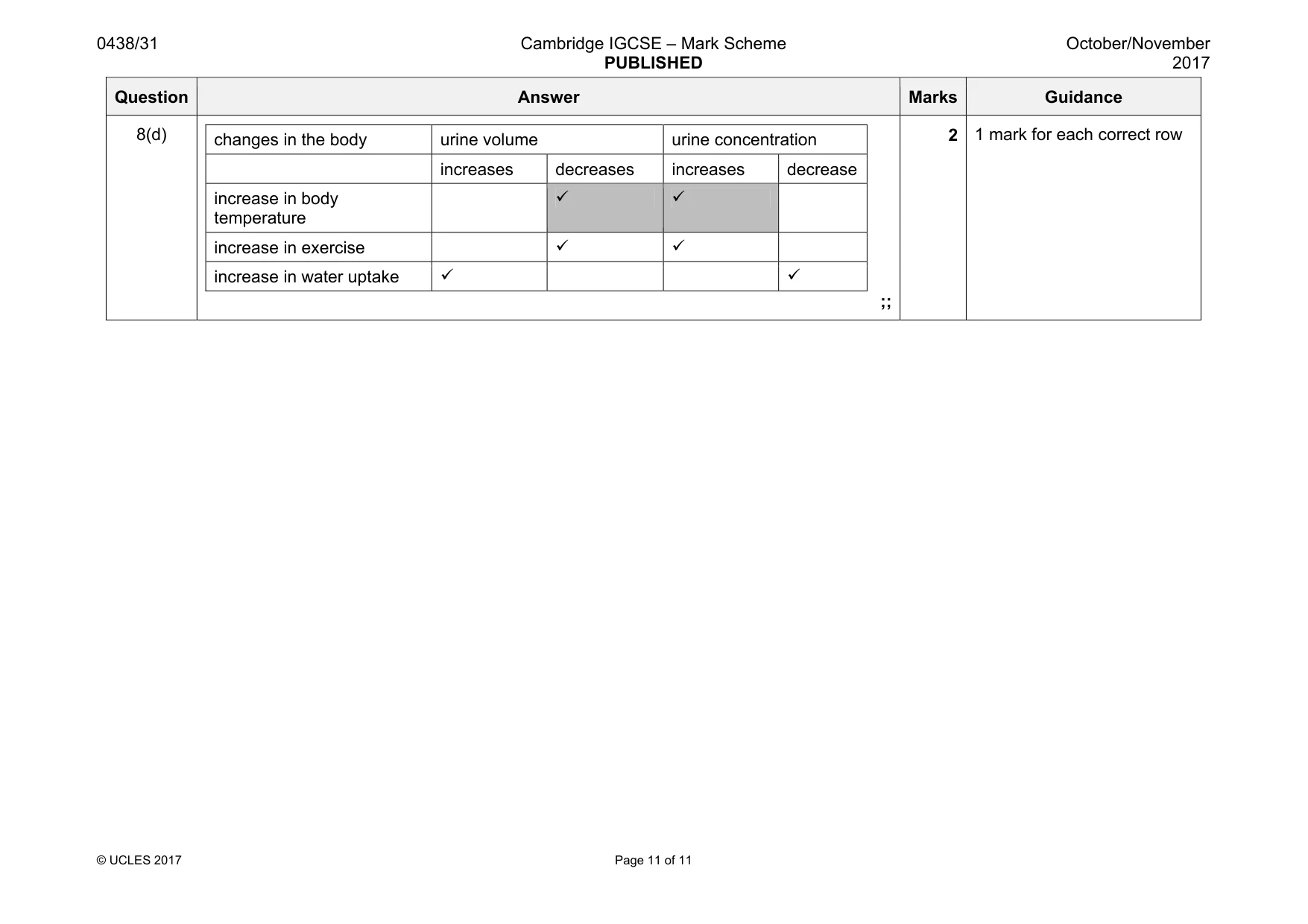
19 0438/31/O/N/17 © UCLES 2017 (d) The volume and the concentration of urine can vary. Body temperature, exercise and water intake affect the volume and concentration of urine. Table 8.1 shows three changes in the body. Complete Table 8.1 by putting a tick in the boxes to show how each change affects the volume and concentration of the urine. One example has been done for you. Table 8.1 changes in the body urine volume urine concentration increases decreases increases decreases increase in body temperature ✓ ✓ increase in exercise increase in water uptake [2] [Total: 9]
Question paper, page 20
20 0438/31/O/N/17 © UCLES 2017 Permission to reproduce items where third-party owned material protected by copyright is included has been sought and cleared where possible. Every reasonable effort has been made by the publisher (UCLES) to trace copyright holders, but if any items requiring clearance have unwittingly been included, the publisher will be pleased to make amends at the earliest possible opportunity. To avoid the issue of disclosure of answer-related information to candidates, all copyright acknowledgements are reproduced online in the Cambridge International Examinations Copyright Acknowledgements Booklet. This is produced for each series of examinations and is freely available to download at www.cie.org.uk after the live examination series. Cambridge International Examinations is part of the Cambridge Assessment Group. Cambridge Assessment is the brand name of University of Cambridge Local Examinations Syndicate (UCLES), which is itself a department of the University of Cambridge. BLANK PAGE
Mark scheme, page 1
® IGCSE is a registered trademark. This document consists of 11 printed pages. © UCLES 2017 [Turn over Cambridge Assessment International Education Cambridge International General Certificate of Secondary Education BIOLOGY (US) 0438/31 Paper 3 Theory (Core) October/November 2017 MARK SCHEME Maximum Mark: 80 Published This mark scheme is published as an aid to teachers and candidates, to indicate the requirements of the examination. It shows the basis on which Examiners were instructed to award marks. It does not indicate the details of the discussions that took place at an Examiners’ meeting before marking began, which would have considered the acceptability of alternative answers. Mark schemes should be read in conjunction with the question paper and the Principal Examiner Report for Teachers. Cambridge International will not enter into discussions about these mark schemes. Cambridge International is publishing the mark schemes for the October/November 2017 series for most Cambridge IGCSE®, Cambridge International A and AS Level components and some Cambridge O Level components.
Mark scheme, page 2
0438/31 Cambridge IGCSE – Mark Scheme PUBLISHED October/November 2017 © UCLES 2017 Page 2 of 11 Mark schemes will use these abbreviations • ; separates marking points • / alternatives • I ignore • R reject • A accept (for answers correctly cued by the question, or guidance for examiners) • AW alternative wording (where responses vary more than usual) • AVP any valid point • ecf credit a correct statement / calculation that follows a previous wrong response • ora or reverse argument • ( ) the word / phrase in brackets is not required, but sets the context • underline actual word given must be used by candidate (grammatical variants excepted) • max indicates the maximum number of marks that can be given
Mark scheme, page 3
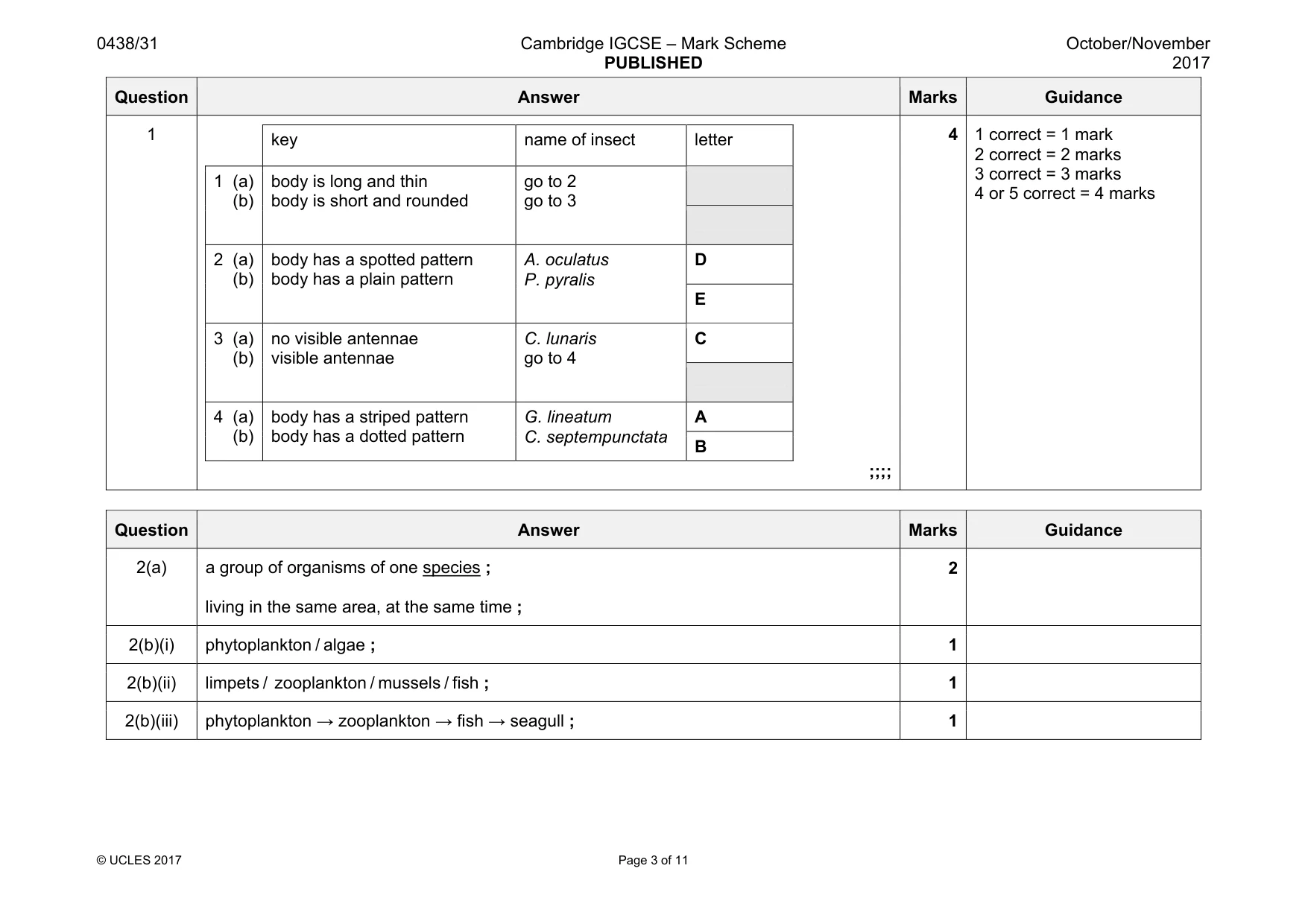
0438/31 Cambridge IGCSE – Mark Scheme PUBLISHED October/November 2017 © UCLES 2017 Page 3 of 11 Question Answer Marks Guidance 1 key name of insect letter 1 (a) (b) body is long and thin body is short and rounded go to 2 go to 3 2 (a) (b) body has a spotted pattern body has a plain pattern A. oculatus P. pyralis D E 3 (a) (b) no visible antennae visible antennae C. lunaris go to 4 C 4 (a) (b) body has a striped pattern body has a dotted pattern G. lineatum C. septempunctata A B ;;;; 4 1 correct = 1 mark 2 correct = 2 marks 3 correct = 3 marks 4 or 5 correct = 4 marks Question Answer Marks Guidance 2(a) a group of organisms of one species ; living in the same area, at the same time ; 2 2(b)(i) phytoplankton / algae ; 1 2(b)(ii) limpets / zooplankton / mussels / fish ; 1 2(b)(iii) phytoplankton → zooplankton → fish → seagull ; 1
Mark scheme, page 4
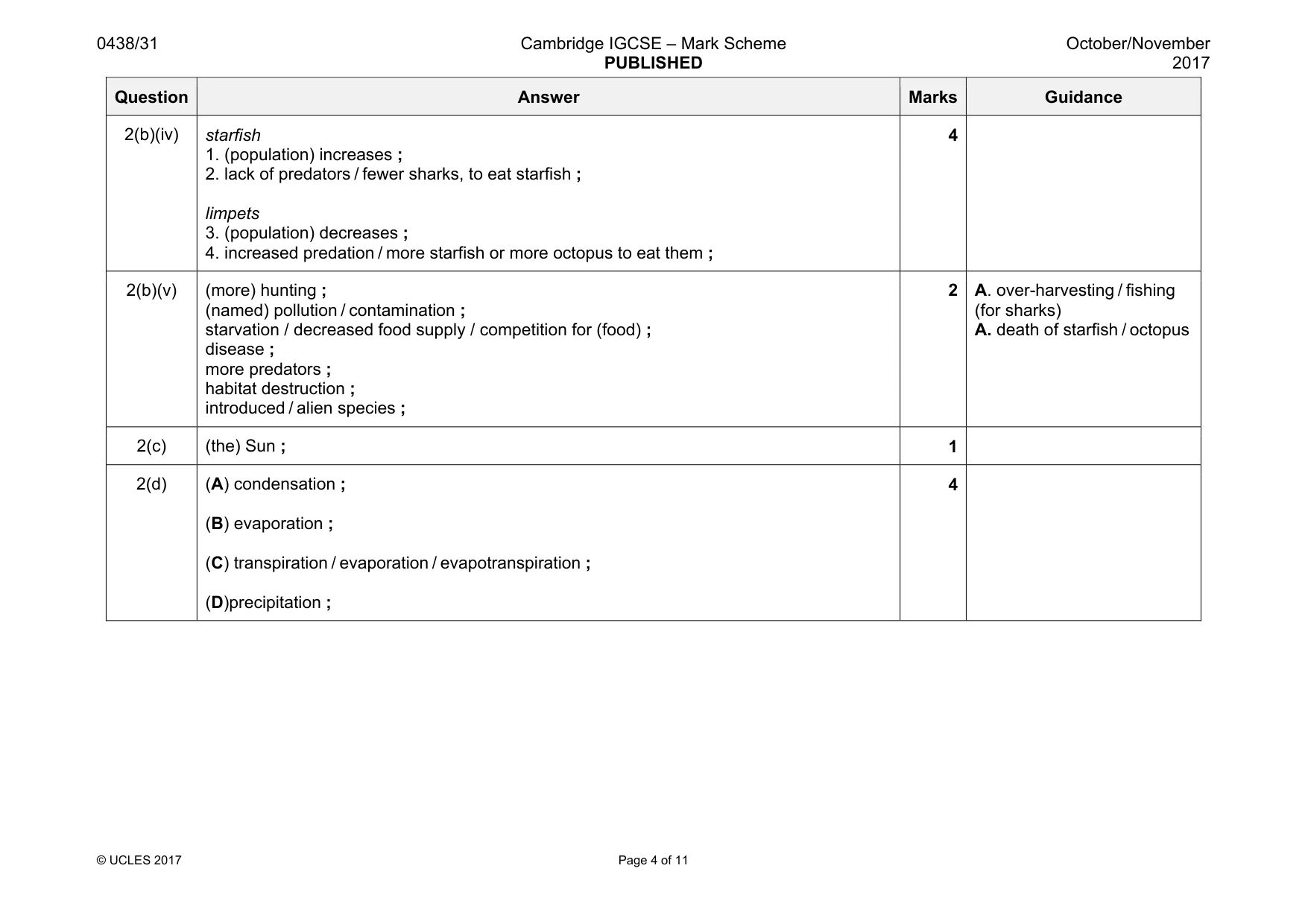
0438/31 Cambridge IGCSE – Mark Scheme PUBLISHED October/November 2017 © UCLES 2017 Page 4 of 11 Question Answer Marks Guidance 2(b)(iv) starfish 1. (population) increases ; 2. lack of predators / fewer sharks, to eat starfish ; limpets 3. (population) decreases ; 4. increased predation / more starfish or more octopus to eat them ; 4 2(b)(v) (more) hunting ; (named) pollution / contamination ; starvation / decreased food supply / competition for (food) ; disease ; more predators ; habitat destruction ; introduced / alien species ; 2 A. over-harvesting / fishing (for sharks) A. death of starfish / octopus 2(c) (the) Sun ; 1 2(d) (A) condensation ; (B) evaporation ; (C) transpiration / evaporation / evapotranspiration ; (D)precipitation ; 4
Mark scheme, page 5
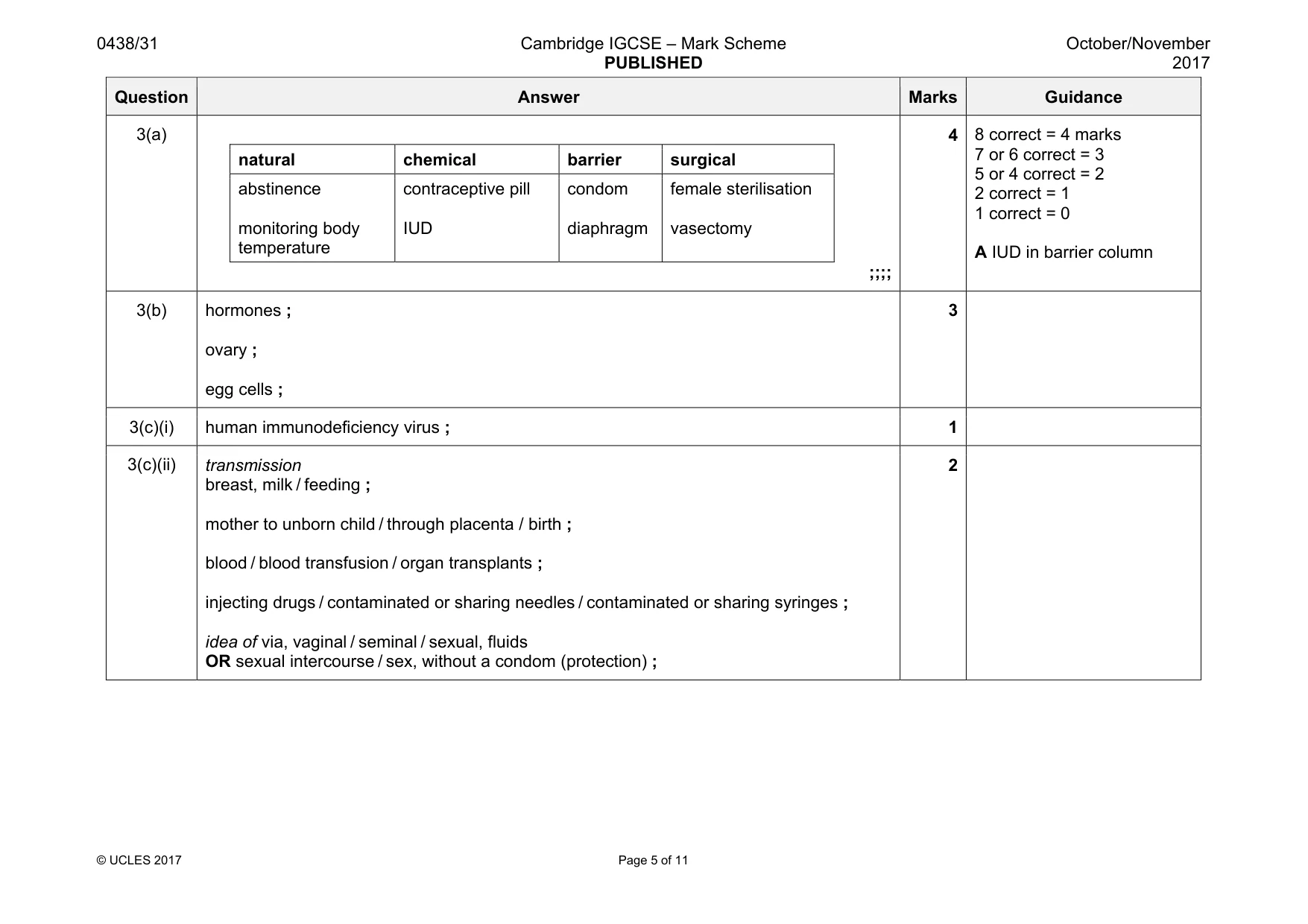
0438/31 Cambridge IGCSE – Mark Scheme PUBLISHED October/November 2017 © UCLES 2017 Page 5 of 11 Question Answer Marks Guidance 3(a) natural chemical barrier surgical abstinence monitoring body temperature contraceptive pill IUD condom diaphragm female sterilisation vasectomy ;;;; 4 8 correct = 4 marks 7 or 6 correct = 3 5 or 4 correct = 2 2 correct = 1 1 correct = 0 A IUD in barrier column 3(b) hormones ; ovary ; egg cells ; 3 3(c)(i) human immunodeficiency virus ; 1 3(c)(ii) transmission breast, milk / feeding ; mother to unborn child / through placenta / birth ; blood / blood transfusion / organ transplants ; injecting drugs / contaminated or sharing needles / contaminated or sharing syringes ; idea of via, vaginal / seminal / sexual, fluids OR sexual intercourse / sex, without a condom (protection) ; 2
Mark scheme, page 6
0438/31 Cambridge IGCSE – Mark Scheme PUBLISHED October/November 2017 © UCLES 2017 Page 6 of 11 Question Answer Marks Guidance 3(c)(iii) control ref. to education ; needle exchange / not sharing needles / use sterile needles / AW ; free / use, condoms / femidoms ; free testing (for individuals) ; screening of, blood / blood products / AW ; antiretroviral / ARV, drugs ; idea of avoiding blood to blood contact ; 2 A barrier methods / protection, during sex(ual intercourse) Question Answer Marks Guidance 4(a) A ; C ; D ; F ; 4 4(b) fewer / less ; sticky ; heavier / denser ; spiky ; larger ; 2 I scent 4(c) meiosis ; 1
Mark scheme, page 7
0438/31 Cambridge IGCSE – Mark Scheme PUBLISHED October/November 2017 © UCLES 2017 Page 7 of 11 Question Answer Marks Guidance 4(d) where ovules are produced ovary where pollen is produced petal protects the flower when in bud sepal often coloured to attract insects stigma where pollen is deposited ;;;; 4 Question Answer Marks Guidance 5(a)(i) palisade (mesophyll) ; guard (cell) ; 2 5(a)(ii) chloroplast ; 1 5(b) cell membrane circled ; cytoplasm circled ; nucleus circled ; 3 minus 1 mark for each additional circled structure 5(c) carbon dioxide and water ; 1
Mark scheme, page 8
0438/31 Cambridge IGCSE – Mark Scheme PUBLISHED October/November 2017 © UCLES 2017 Page 8 of 11 Question Answer Marks Guidance 5(d) leaf A bigger / larger, surface (area) OR bigger / thicker / more, mesophyll (layer / cells) ; absorbs more light / more chlorophyll / more chloroplasts / more gas exchange / more stomata ; 2 Question Answer Marks Guidance 6(a) lung cancer alcohol depressant infections such as HIV tobacco reduces oxygen capacity of the blood liver damage heroin ;;; 3 1 mark for each correctly linked drug 6(b)(i) 66–70 ; 1 6(b)(ii) 10(%) ; 1
Mark scheme, page 9
0438/31 Cambridge IGCSE – Mark Scheme PUBLISHED October/November 2017 © UCLES 2017 Page 9 of 11 Question Answer Marks Guidance 6(b)(iii) increases and decreases / after 20 years old it decreases ; peaks in the 16–20 year old age group / AW ; any correct reference to description of fluctuation at 51–65 year olds ; data quote with units ; 3 6(c) bacterial ; 1 Question Answer Marks Guidance 7(a)(i) warm, dry air ; 1 7(a)(ii) 0.4 (mm per min) ;; 2 If no correct answer 4÷10 for 1 mark 7(a)(iii) (air bubble) moves, further / faster ; 1 7(b) root (hair cell) ; by osmosis ; 2
Mark scheme, page 10
0438/31 Cambridge IGCSE – Mark Scheme PUBLISHED October/November 2017 © UCLES 2017 Page 10 of 11 Question Answer Marks Guidance 7(c) (water) evaporates ; from (surface of mesophyll) cells ; water vapour diffuses ; through stomata ; 3 7(d) xylem ; 1 Question Answer Marks Guidance 8(a) carbohydrates ; fats / lipids ; protein ; vitamins / named vitamin ; minerals / name mineral ; fibre ; 3 8(b) small intestine ; 1 8(c) (A) ureter ; (B) bladder ; (C) urethra ; 3
Mark scheme, page 11
0438/31 Cambridge IGCSE – Mark Scheme PUBLISHED October/November 2017 © UCLES 2017 Page 11 of 11 Question Answer Marks Guidance 8(d) changes in the body urine volume urine concentration increases decreases increases decrease increase in body temperature 9 9 increase in exercise 9 9 increase in water uptake 9 9 ;; 2 1 mark for each correct row
What you needed in this session
Cambridge’s own grade thresholds for 2017 Oct/Nov, Paper 3 · Variant 1. A higher threshold means an easier paper — the bar moves with how the cohort did.