Cambridge IGCSE Biology (BES) 0438 — 2014 May/June Paper 3 · Variant 3
0438/33/M/J/14 · 80 marks · ≈90 min
The question paper and its mark scheme, free to read here and free to download. This is Cambridge’s own paper, exactly as it was sat.
Question paper16 pages

Mark scheme9 pages
Answers below. Sit the paper first if you are practising.
Paper as text
Question paper, page 1
This document consists of 16 printed pages. DC (NF/SW) 93179 © UCLES 2014 [Turn over * 9 2 8 9 7 2 5 5 1 3 * BIOLOGY (US) 0438/33 Paper 3 Extended May/June 2014 1 hour 15 minutes Candidates answer on the Question Paper. No Additional Materials are required. READ THESE INSTRUCTIONS FIRST Write your Center number, candidate number and name on all the work you hand in. Write in dark blue or black pen. You may use a pencil for any diagrams or graphs. Do not use staples, paper clips, glue or correction fluid. DO NOT WRITE IN ANY BARCODES. Answer all questions. Electronic calculators may be used. You may lose marks if you do not show your working or if you do not use appropriate units. At the end of the examination, fasten all your work securely together. The number of marks is given in brackets [ ] at the end of each question or part question. Cambridge International Examinations Cambridge International General Certificate of Secondary Education
Question paper, page 2
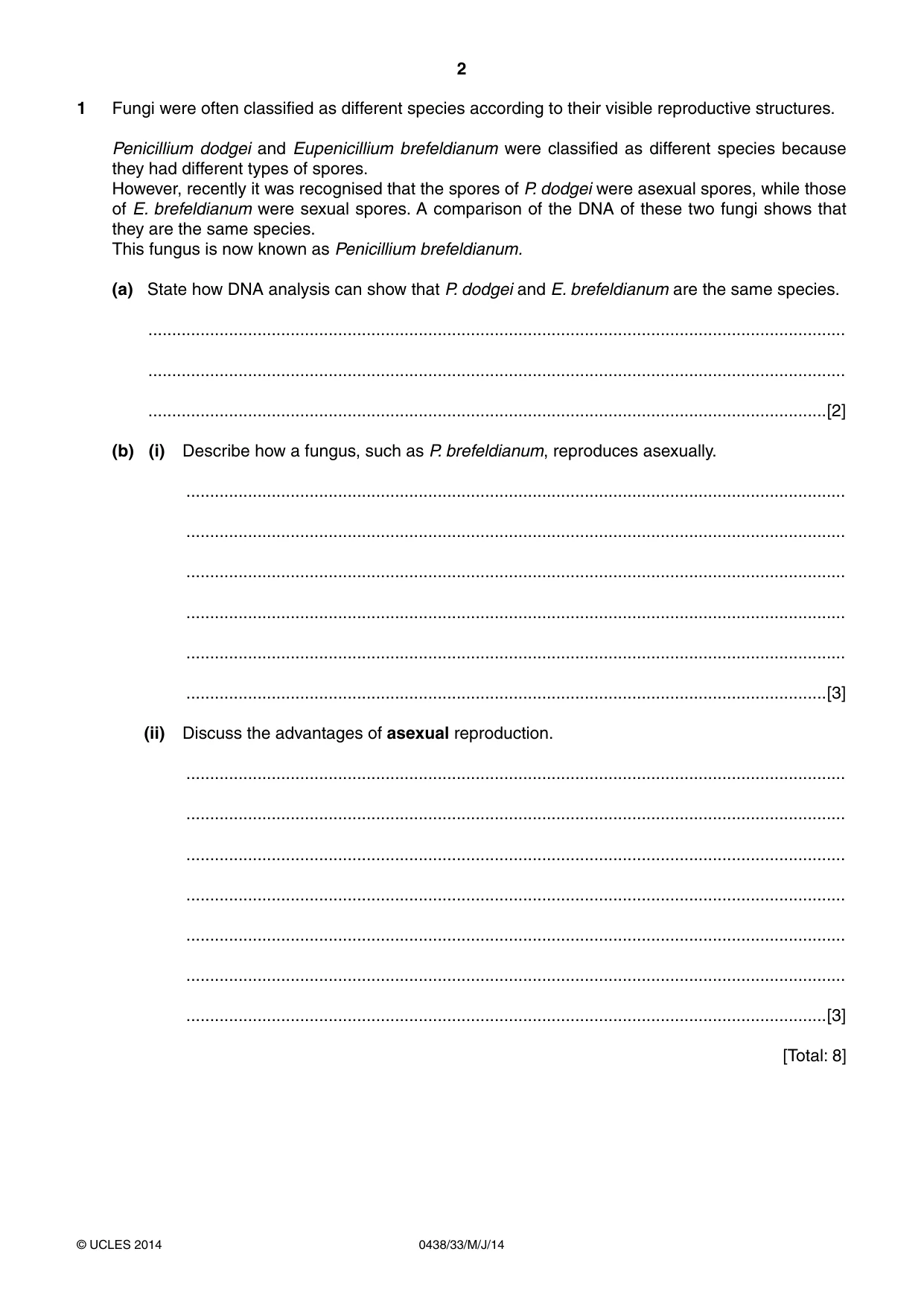
2 0438/33/M/J/14 © UCLES 2014 1 Fungi were often classified as different species according to their visible reproductive structures. Penicillium dodgei and Eupenicillium brefeldianum were classified as different species because they had different types of spores. However, recently it was recognised that the spores of P. dodgei were asexual spores, while those of E. brefeldianum were sexual spores. A comparison of the DNA of these two fungi shows that they are the same species. This fungus is now known as Penicillium brefeldianum. (a) State how DNA analysis can show that P. dodgei and E. brefeldianum are the same species. … … …[2] (b) (i) Describe how a fungus, such as P. brefeldianum, reproduces asexually. … … … … … …[3] (ii) Discuss the advantages of asexual reproduction. … … … … … … …[3] [Total: 8]
Question paper, page 3
3 0438/33/M/J/14 © UCLES 2014 [Turn over 2 Sulfur dioxide (SO2) can cause acid rain. (a) Name one other pollutant that can cause acid rain. …[1] (b) Describe the effects of acid rain on the environment. … … … … … … …[3] (c) State three methods to reduce atmospheric SO2 pollution. 1 … … 2 … … 3 … … [3]
Question paper, page 4
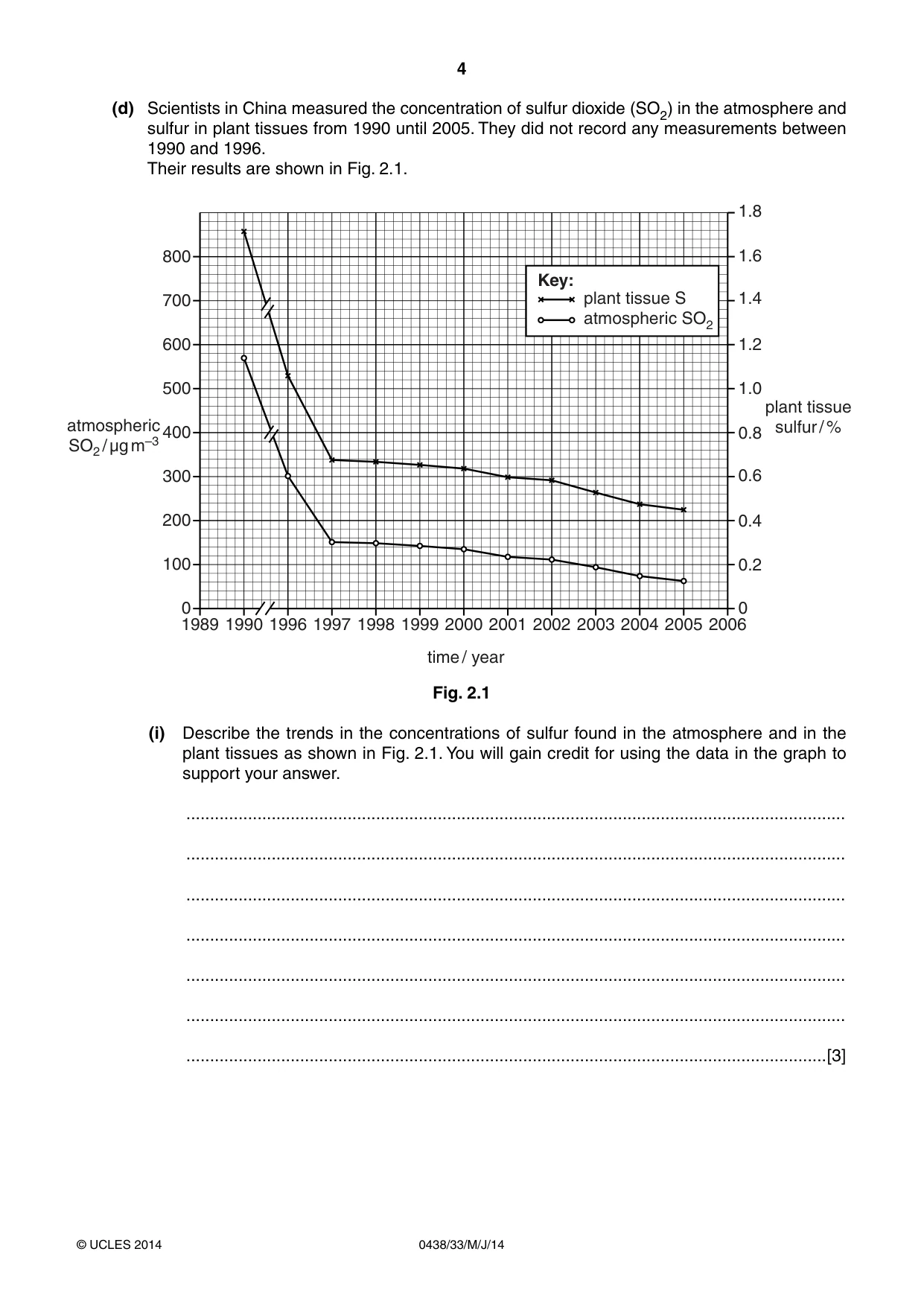
4 0438/33/M/J/14 © UCLES 2014 (d) Scientists in China measured the concentration of sulfur dioxide (SO2) in the atmosphere and sulfur in plant tissues from 1990 until 2005. They did not record any measurements between 1990 and 1996. Their results are shown in Fig. 2.1. 1989 0 100 200 300 400 500 600 700 800 0 0.2 0.4 0.6 0.8 1.0 1.2 1.4 1.6 1.8 1990 1996 1997 1998 1999 2000 time / year atmospheric SO2 / µg m–3 plant tissue sulfur / % 2001 2002 2003 2004 2005 2006 plant tissue S atmospheric SO2 Key: Fig. 2.1 (i) Describe the trends in the concentrations of sulfur found in the atmosphere and in the plant tissues as shown in Fig. 2.1. You will gain credit for using the data in the graph to support your answer. … … … … … … …[3]
Question paper, page 5
5 0438/33/M/J/14 © UCLES 2014 [Turn over (ii) Suggest why the concentration of sulfur in the plant tissues was calculated as a percentage of the dry mass of the plant tissue. … … … … …[2] [Total: 12]
Question paper, page 6
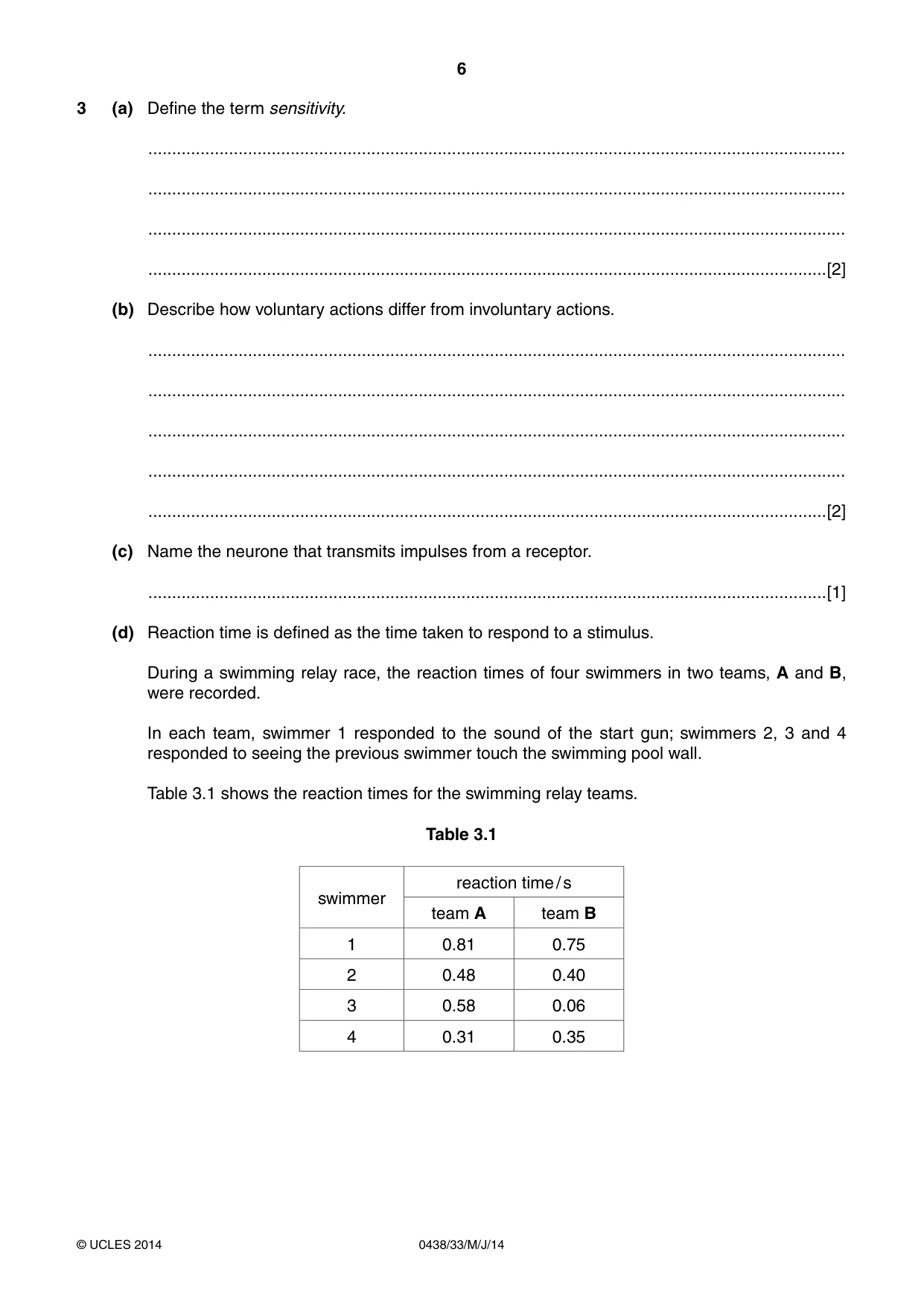
6 0438/33/M/J/14 © UCLES 2014 3 (a) Define the term sensitivity. … … … …[2] (b) Describe how voluntary actions differ from involuntary actions. … … … … …[2] (c) Name the neurone that transmits impulses from a receptor. …[1] (d) Reaction time is defined as the time taken to respond to a stimulus. During a swimming relay race, the reaction times of four swimmers in two teams, A and B, were recorded. In each team, swimmer 1 responded to the sound of the start gun; swimmers 2, 3 and 4 responded to seeing the previous swimmer touch the swimming pool wall. Table 3.1 shows the reaction times for the swimming relay teams. Table 3.1 swimmer reaction time / s team A team B 1 0.81 0.75 2 0.48 0.40 3 0.58 0.06 4 0.31 0.35
Question paper, page 7
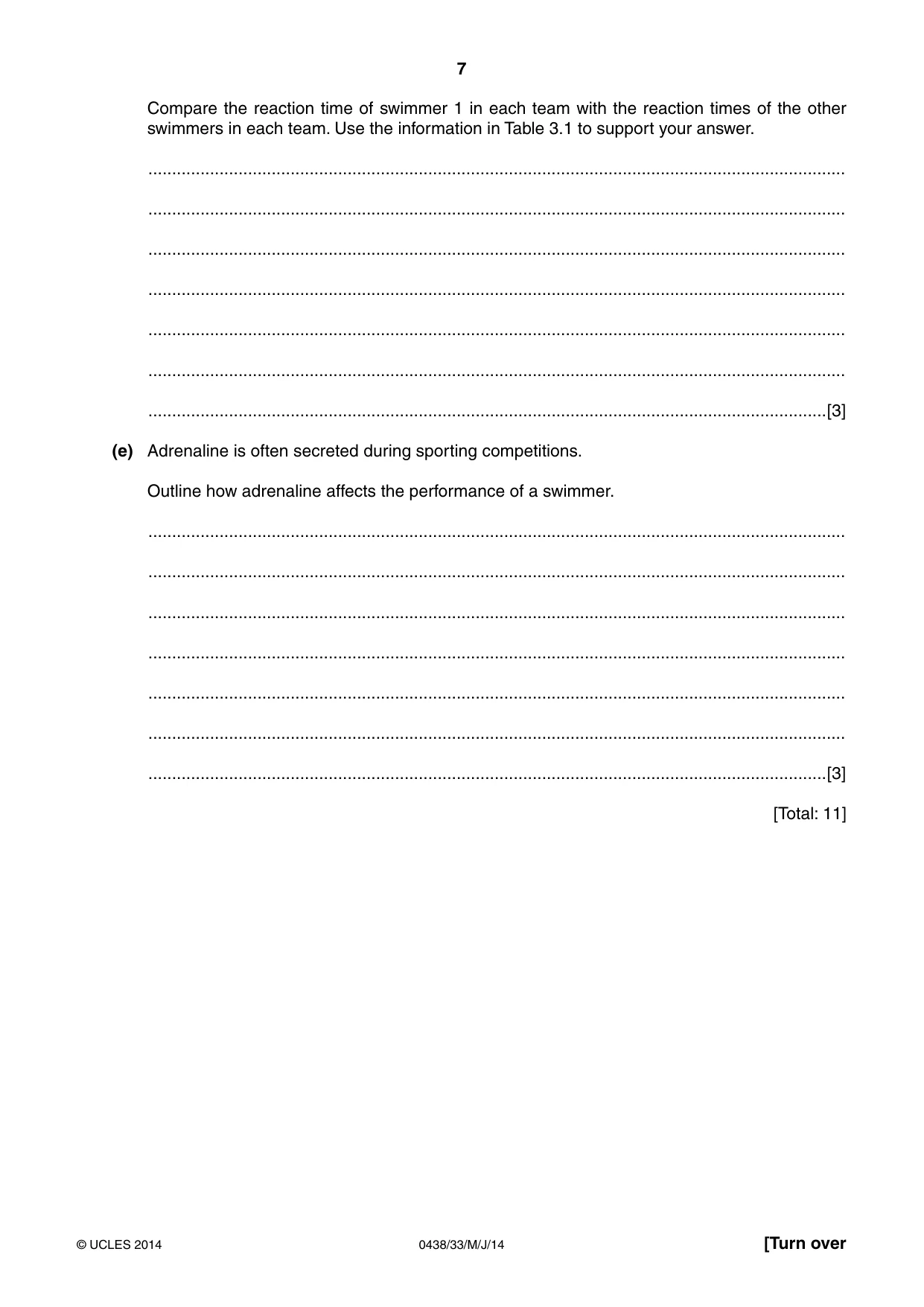
7 0438/33/M/J/14 © UCLES 2014 [Turn over Compare the reaction time of swimmer 1 in each team with the reaction times of the other swimmers in each team. Use the information in Table 3.1 to support your answer. … … … … … … …[3] (e) Adrenaline is often secreted during sporting competitions. Outline how adrenaline affects the performance of a swimmer. … … … … … … …[3] [Total: 11]
Question paper, page 8
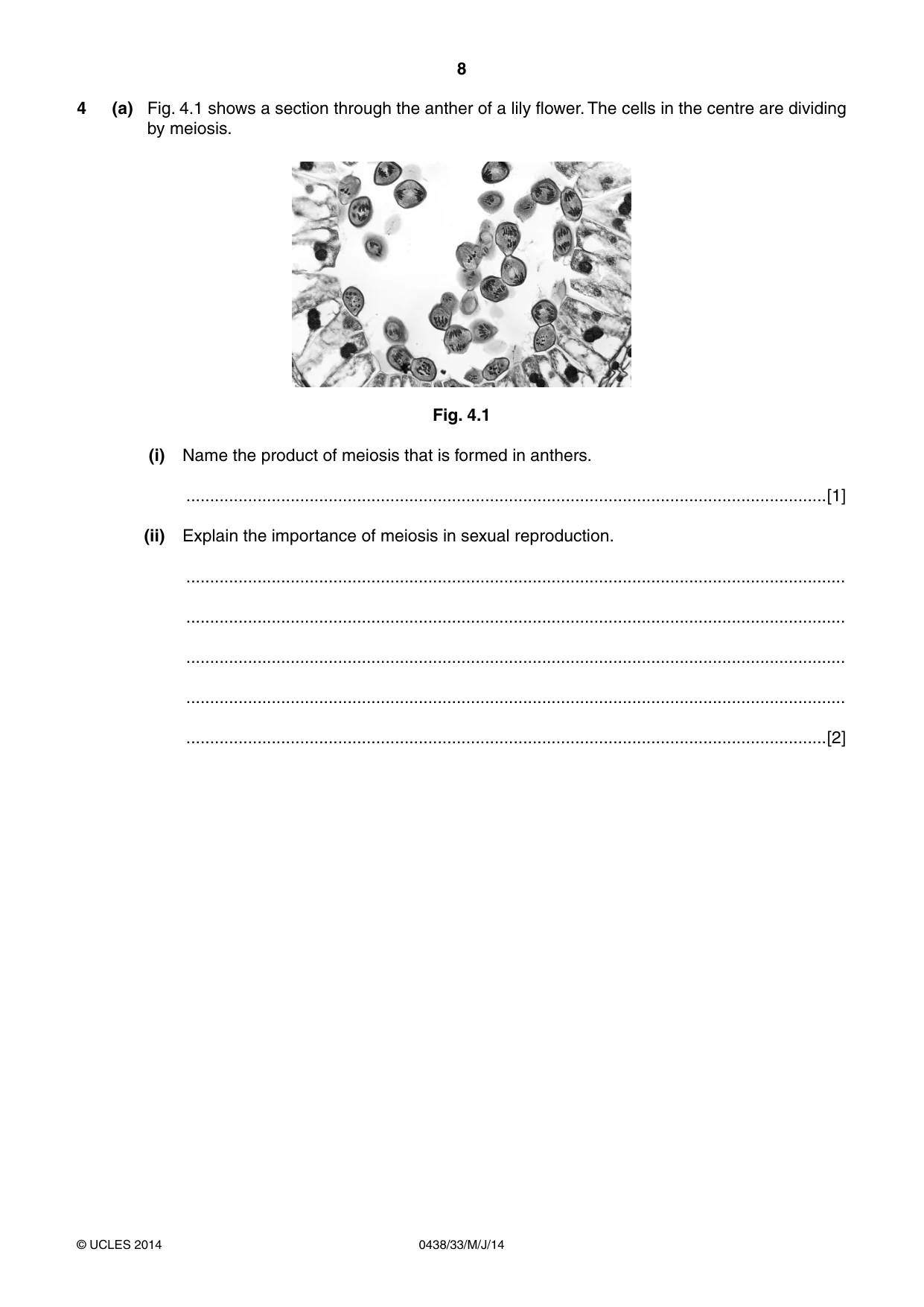
8 0438/33/M/J/14 © UCLES 2014 4 (a) Fig. 4.1 shows a section through the anther of a lily flower. The cells in the centre are dividing by meiosis. Fig. 4.1 (i) Name the product of meiosis that is formed in anthers. …[1] (ii) Explain the importance of meiosis in sexual reproduction. … … … … …[2]
Question paper, page 9
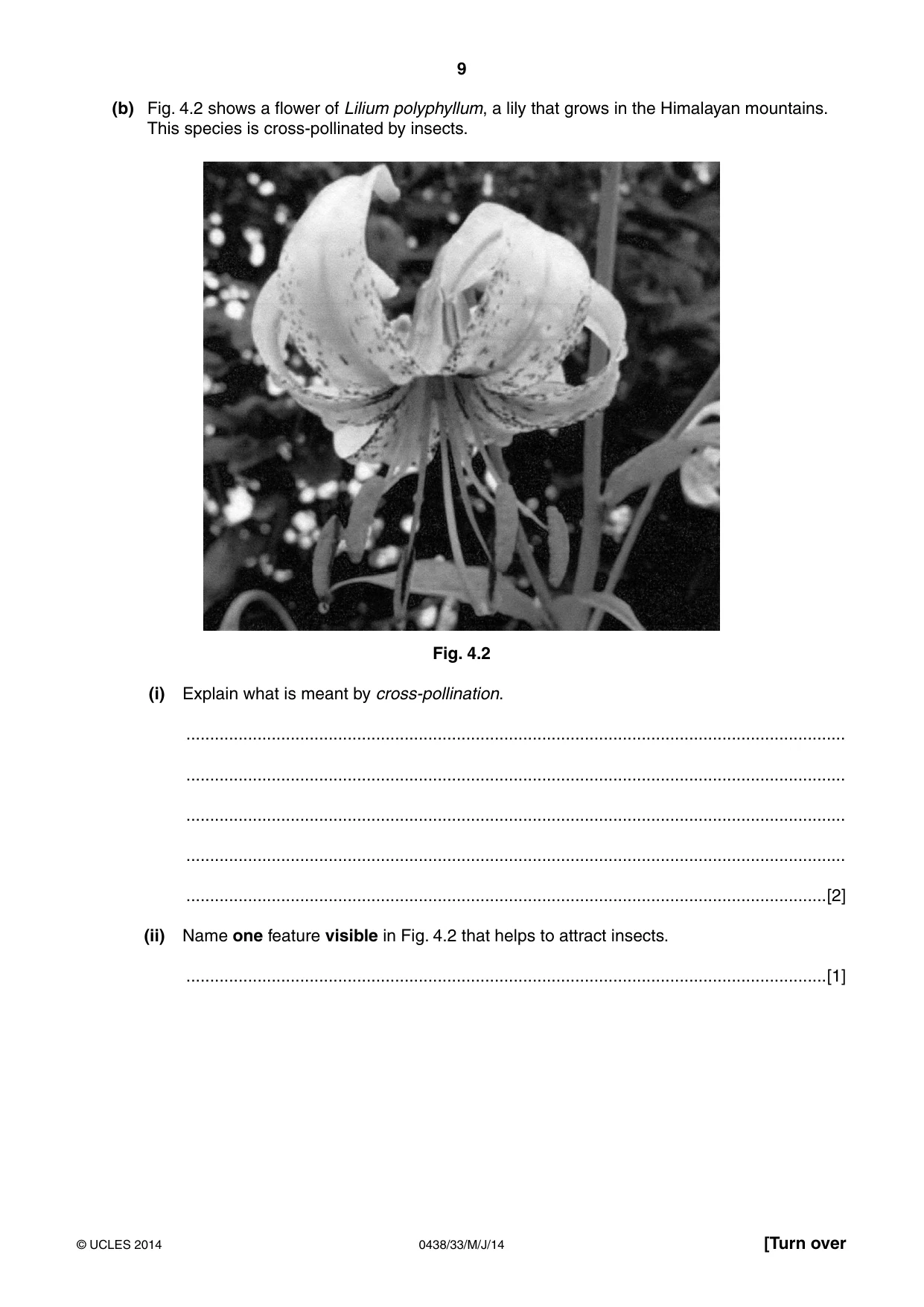
9 0438/33/M/J/14 © UCLES 2014 [Turn over (b) Fig. 4.2 shows a flower of Lilium polyphyllum, a lily that grows in the Himalayan mountains. This species is cross-pollinated by insects. Fig. 4.2 (i) Explain what is meant by cross-pollination. … … … … …[2] (ii) Name one feature visible in Fig. 4.2 that helps to attract insects. …[1]
Question paper, page 10
10 0438/33/M/J/14 © UCLES 2014 (c) Plants of this species that grow at low altitudes produce flowers 60 days before the plants of the same species that grow at high altitudes. (i) Suggest one environmental reason why lilies that grow at lower altitudes flower earlier than the lilies at higher altitudes. …[1] (ii) Explain why flowering time is an example of continuous variation. … … … … …[2] (d) Scientists think that plants of L. polyphyllum growing at high altitudes may evolve into a new species. Explain how natural selection could lead to the evolution of a new species of lily. … … … … … … … … … … …[5] [Total: 14]
Question paper, page 11
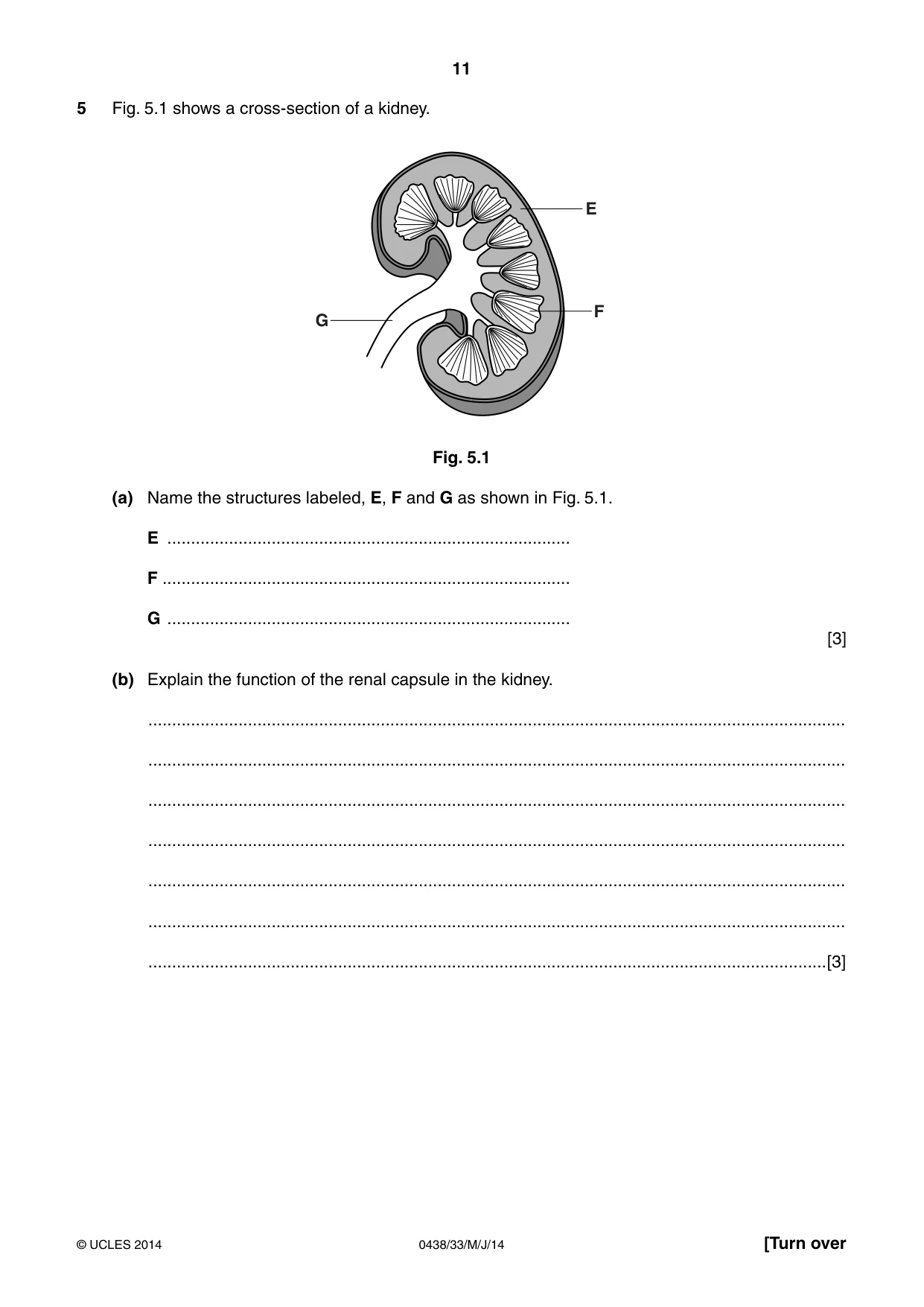
11 0438/33/M/J/14 © UCLES 2014 [Turn over 5 Fig. 5.1 shows a cross-section of a kidney. E F G Fig. 5.1 (a) Name the structures labeled, E, F and G as shown in Fig. 5.1. E … F … G … [3] (b) Explain the function of the renal capsule in the kidney. … … … … … … …[3]
Question paper, page 12
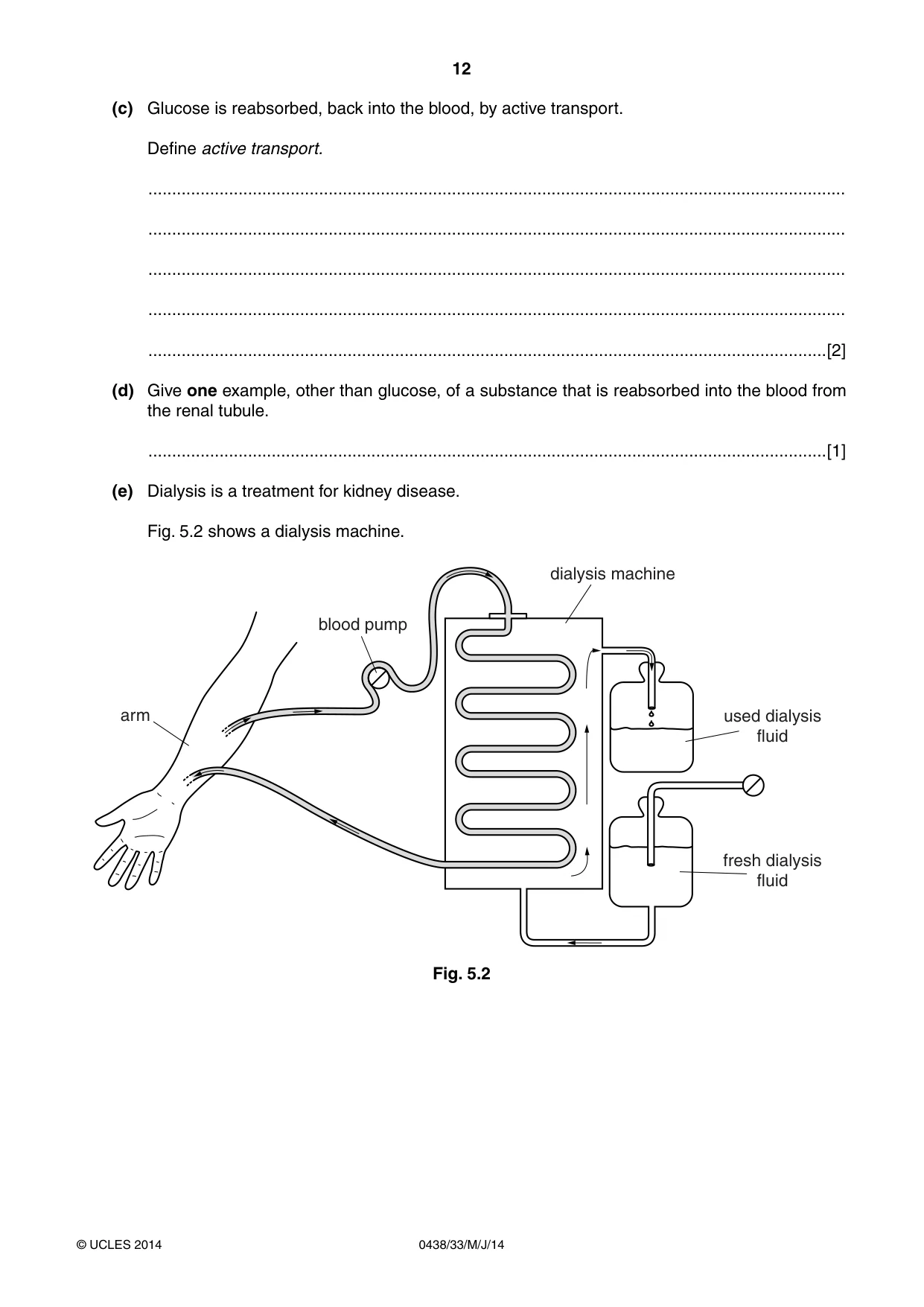
12 0438/33/M/J/14 © UCLES 2014 (c) Glucose is reabsorbed, back into the blood, by active transport. Define active transport. … … … … …[2] (d) Give one example, other than glucose, of a substance that is reabsorbed into the blood from the renal tubule. …[1] (e) Dialysis is a treatment for kidney disease. Fig. 5.2 shows a dialysis machine. dialysis machine used dialysis fluid fresh dialysis fluid blood pump arm Fig. 5.2
Question paper, page 13
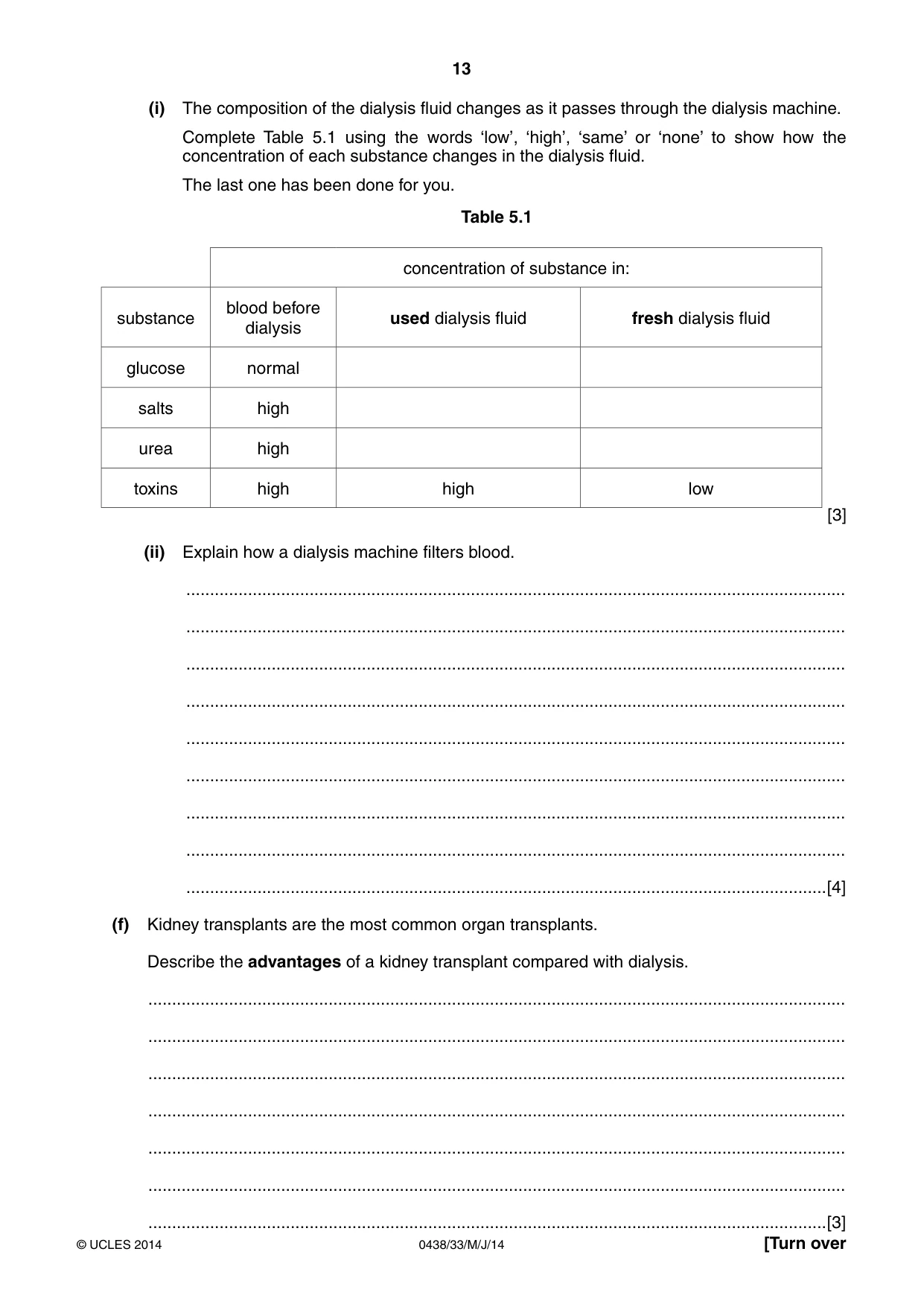
13 0438/33/M/J/14 © UCLES 2014 [Turn over (i) The composition of the dialysis fluid changes as it passes through the dialysis machine. Complete Table 5.1 using the words ‘low’, ‘high’, ‘same’ or ‘none’ to show how the concentration of each substance changes in the dialysis fluid. The last one has been done for you. Table 5.1 concentration of substance in: substance blood before dialysis used dialysis fluid fresh dialysis fluid glucose normal salts high urea high toxins high high low [3] (ii) Explain how a dialysis machine filters blood. … … … … … … … … …[4] (f) Kidney transplants are the most common organ transplants. Describe the advantages of a kidney transplant compared with dialysis. … … … … … … …[3]
Question paper, page 14
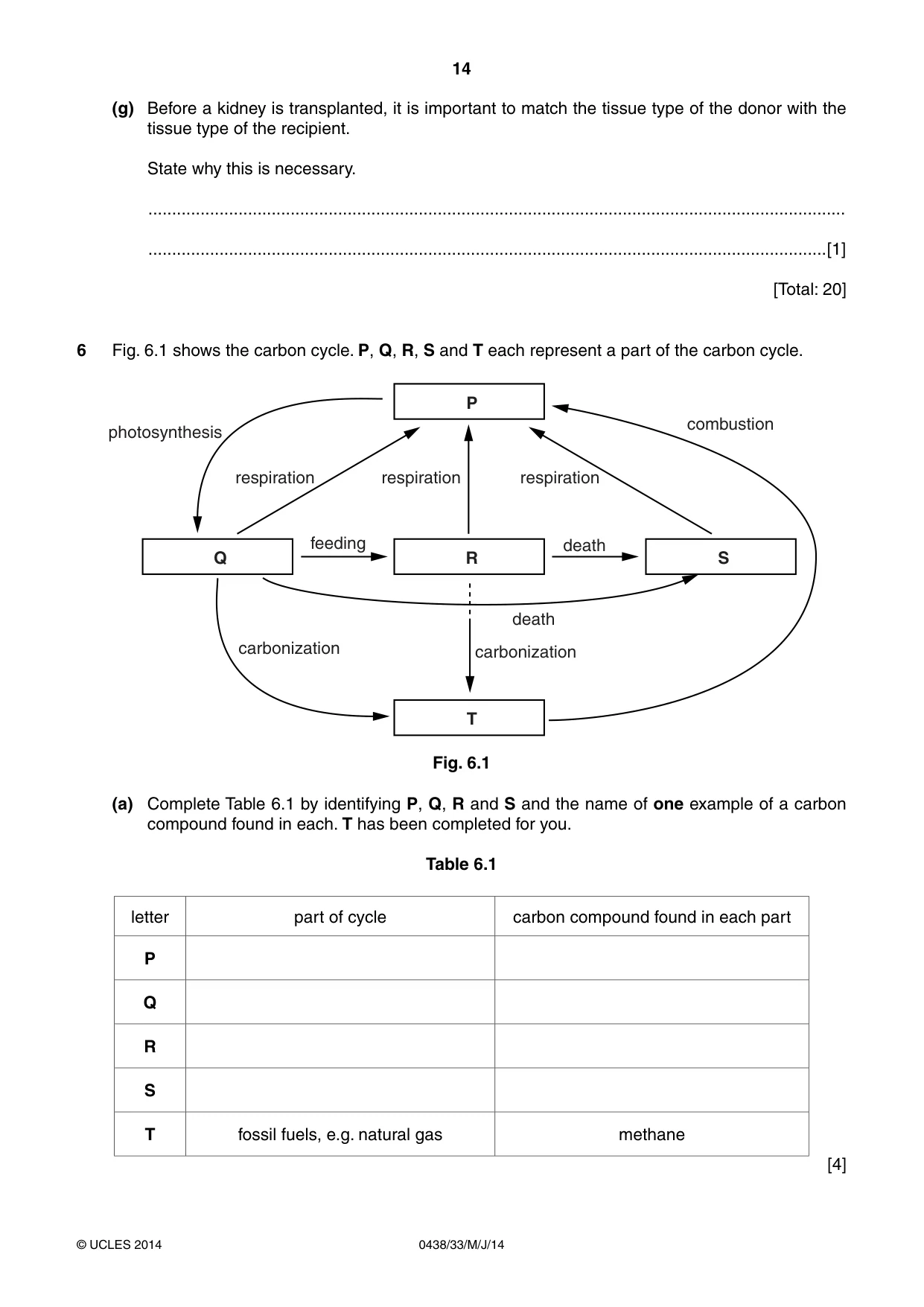
14 0438/33/M/J/14 © UCLES 2014 (g) Before a kidney is transplanted, it is important to match the tissue type of the donor with the tissue type of the recipient. State why this is necessary. … …[1] [Total: 20] 6 Fig. 6.1 shows the carbon cycle. P, Q, R, S and T each represent a part of the carbon cycle. P R T Q S photosynthesis respiration respiration respiration death carbonization carbonization death feeding combustion Fig. 6.1 (a) Complete Table 6.1 by identifying P, Q, R and S and the name of one example of a carbon compound found in each. T has been completed for you. Table 6.1 letter part of cycle carbon compound found in each part P Q R S T fossil fuels, e.g. natural gas methane [4]
Question paper, page 15
15 0438/33/M/J/14 © UCLES 2014 [Turn over (b) Photosynthesis is a very important process in the carbon cycle. Explain how the process of photosynthesis converts carbon compounds from P to carbon compounds in Q. … … … … … … … … … … …[5] (c) The rate of photosynthesis varies as a result of changes in environmental factors. State one environmental factor and explain how it can affect the rate of photosynthesis. … … … … … … …[3]
Question paper, page 16
16 0438/33/M/J/14 © UCLES 2014 Copyright Acknowledgements: Question 2 Figure 2.1 © Xue-Yan Liu, Hua-Yun Xiao, Cong-Qiang Liu, Hong-Wei Xiao, Yan-Li Wang; Assessment of atmospheric sulphur with the epilithic moss Haplocladium microphyllum: Evidences from tissue sulphur and d34S analysis. Environmental Pollution; Elsevier; 2009. Question 4 Figure 4.1 © Biodisc; Cross-section of a Lily anther showing the second meiotic division (Lilium), a monocot. LM X65; Visuals Unlimited; 2011. Question 4 Figure 4.2 © Anurag Dhyani; LILIES and Related Plants, 2011-2012. Phenology of Lilium polyphyllum in Garhwal Himalaya, India; RHS Lily Group; 2011. Permission to reproduce items where third-party owned material protected by copyright is included has been sought and cleared where possible. Every reasonable effort has been made by the publisher (UCLES) to trace copyright holders, but if any items requiring clearance have unwittingly been included, the publisher will be pleased to make amends at the earliest possible opportunity. Cambridge International Examinations is part of the Cambridge Assessment Group. Cambridge Assessment is the brand name of University of Cambridge Local Examinations Syndicate (UCLES), which is itself a department of the University of Cambridge. (d) Environmental factors can be controlled in glasshouses. Describe how three environmental factors are controlled in a glasshouse to improve crop yield. factor 1: … how is it controlled: … … factor 2: … how is it controlled: … … factor 3: … how is it controlled: … … [3] [Total: 15]
Mark scheme, page 1
CAMBRIDGE INTERNATIONAL EXAMINATIONS International General Certificate of Secondary Education MARK SCHEME for the May/June 2014 series 0438 BIOLOGY (US) 0438/33 Paper 33 (Extended), maximum raw mark 80 This mark scheme is published as an aid to teachers and candidates, to indicate the requirements of the examination. It shows the basis on which Examiners were instructed to award marks. It does not indicate the details of the discussions that took place at an Examiners’ meeting before marking began, which would have considered the acceptability of alternative answers. Mark schemes should be read in conjunction with the question paper and the Principal Examiner Report for Teachers. Cambridge will not enter into discussions about these mark schemes. Cambridge is publishing the mark schemes for the May/June 2014 series for most IGCSE, GCE Advanced Level and Advanced Subsidiary Level components and some Ordinary Level components.
Mark scheme, page 2
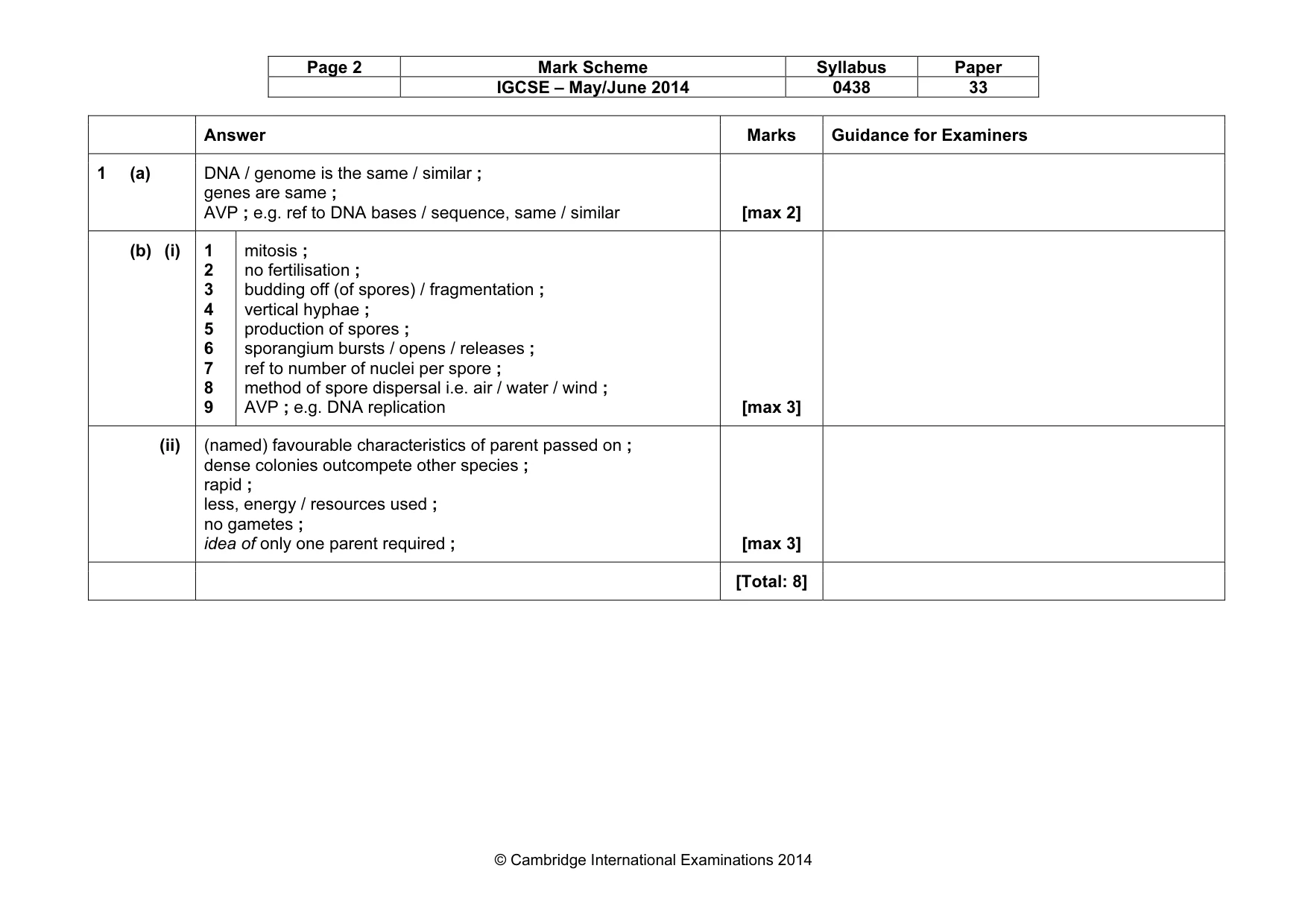
Page 2 Mark Scheme Syllabus Paper IGCSE – May/June 2014 0438 33 © Cambridge International Examinations 2014 Answer Marks Guidance for Examiners 1 (a) DNA / genome is the same / similar ; genes are same ; AVP ; e.g. ref to DNA bases / sequence, same / similar [max 2] (b) (i) 1 2 3 4 5 6 7 8 9 mitosis ; no fertilisation ; budding off (of spores) / fragmentation ; vertical hyphae ; production of spores ; sporangium bursts / opens / releases ; ref to number of nuclei per spore ; method of spore dispersal i.e. air / water / wind ; AVP ; e.g. DNA replication [max 3] (ii) (named) favourable characteristics of parent passed on ; dense colonies outcompete other species ; rapid ; less, energy / resources used ; no gametes ; idea of only one parent required ; [max 3] [Total: 8]
Mark scheme, page 3
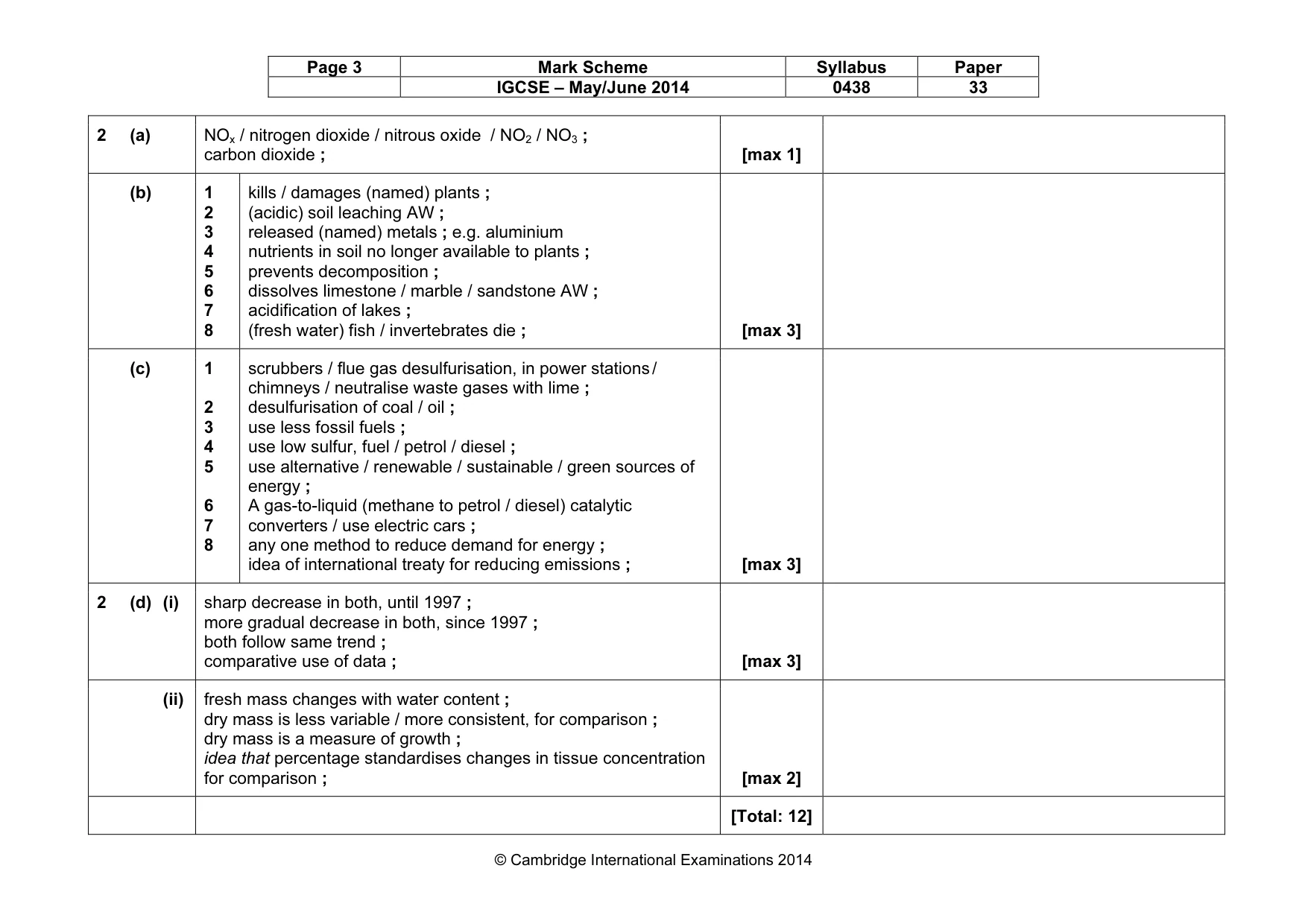
Page 3 Mark Scheme Syllabus Paper IGCSE – May/June 2014 0438 33 © Cambridge International Examinations 2014 2 (a) NOx / nitrogen dioxide / nitrous oxide / NO2 / NO3 ; carbon dioxide ; [max 1] (b) 1 2 3 4 5 6 7 8 kills / damages (named) plants ; (acidic) soil leaching AW ; released (named) metals ; e.g. aluminium nutrients in soil no longer available to plants ; prevents decomposition ; dissolves limestone / marble / sandstone AW ; acidification of lakes ; (fresh water) fish / invertebrates die ; [max 3] (c) 1 2 3 4 5 6 7 8 scrubbers / flue gas desulfurisation, in power stations / chimneys / neutralise waste gases with lime ; desulfurisation of coal / oil ; use less fossil fuels ; use low sulfur, fuel / petrol / diesel ; use alternative / renewable / sustainable / green sources of energy ; A gas-to-liquid (methane to petrol / diesel) catalytic converters / use electric cars ; any one method to reduce demand for energy ; idea of international treaty for reducing emissions ; [max 3] 2 (d) (i) sharp decrease in both, until 1997 ; more gradual decrease in both, since 1997 ; both follow same trend ; comparative use of data ; [max 3] (ii) fresh mass changes with water content ; dry mass is less variable / more consistent, for comparison ; dry mass is a measure of growth ; idea that percentage standardises changes in tissue concentration for comparison ; [max 2] [Total: 12]
Mark scheme, page 4
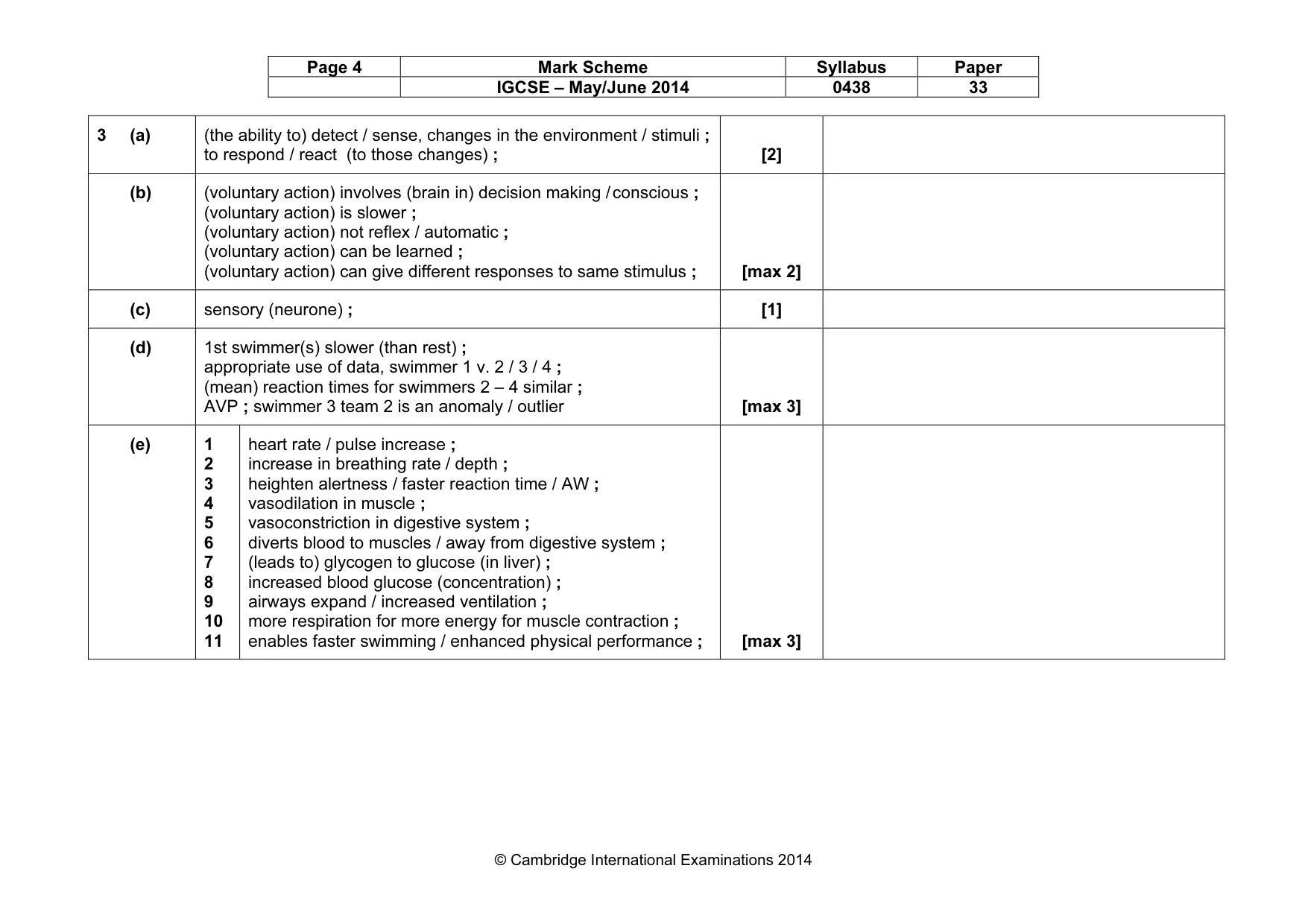
Page 4 Mark Scheme Syllabus Paper IGCSE – May/June 2014 0438 33 © Cambridge International Examinations 2014 3 (a) (the ability to) detect / sense, changes in the environment / stimuli ; to respond / react (to those changes) ; [2] (b) (voluntary action) involves (brain in) decision making / conscious ; (voluntary action) is slower ; (voluntary action) not reflex / automatic ; (voluntary action) can be learned ; (voluntary action) can give different responses to same stimulus ; [max 2] (c) sensory (neurone) ; [1] (d) 1st swimmer(s) slower (than rest) ; appropriate use of data, swimmer 1 v. 2 / 3 / 4 ; (mean) reaction times for swimmers 2 – 4 similar ; AVP ; swimmer 3 team 2 is an anomaly / outlier [max 3] (e) 1 2 3 4 5 6 7 8 9 10 11 heart rate / pulse increase ; increase in breathing rate / depth ; heighten alertness / faster reaction time / AW ; vasodilation in muscle ; vasoconstriction in digestive system ; diverts blood to muscles / away from digestive system ; (leads to) glycogen to glucose (in liver) ; increased blood glucose (concentration) ; airways expand / increased ventilation ; more respiration for more energy for muscle contraction ; enables faster swimming / enhanced physical performance ; [max 3]
Mark scheme, page 5
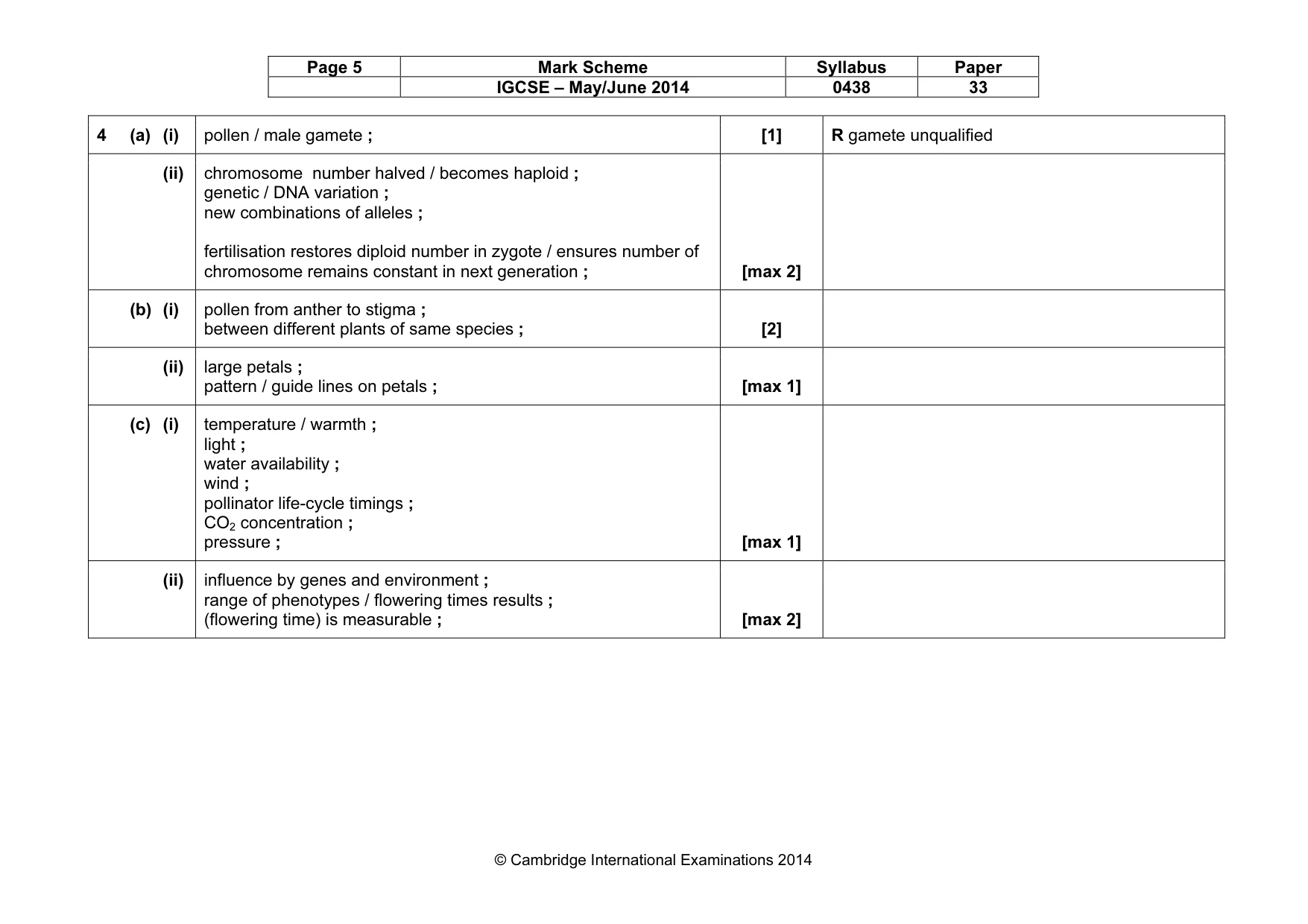
Page 5 Mark Scheme Syllabus Paper IGCSE – May/June 2014 0438 33 © Cambridge International Examinations 2014 4 (a) (i) pollen / male gamete ; [1] R gamete unqualified (ii) chromosome number halved / becomes haploid ; genetic / DNA variation ; new combinations of alleles ; fertilisation restores diploid number in zygote / ensures number of chromosome remains constant in next generation ; [max 2] (b) (i) pollen from anther to stigma ; between different plants of same species ; [2] (ii) large petals ; pattern / guide lines on petals ; [max 1] (c) (i) temperature / warmth ; light ; water availability ; wind ; pollinator life-cycle timings ; CO2 concentration ; pressure ; [max 1] (ii) influence by genes and environment ; range of phenotypes / flowering times results ; (flowering time) is measurable ; [max 2]
Mark scheme, page 6
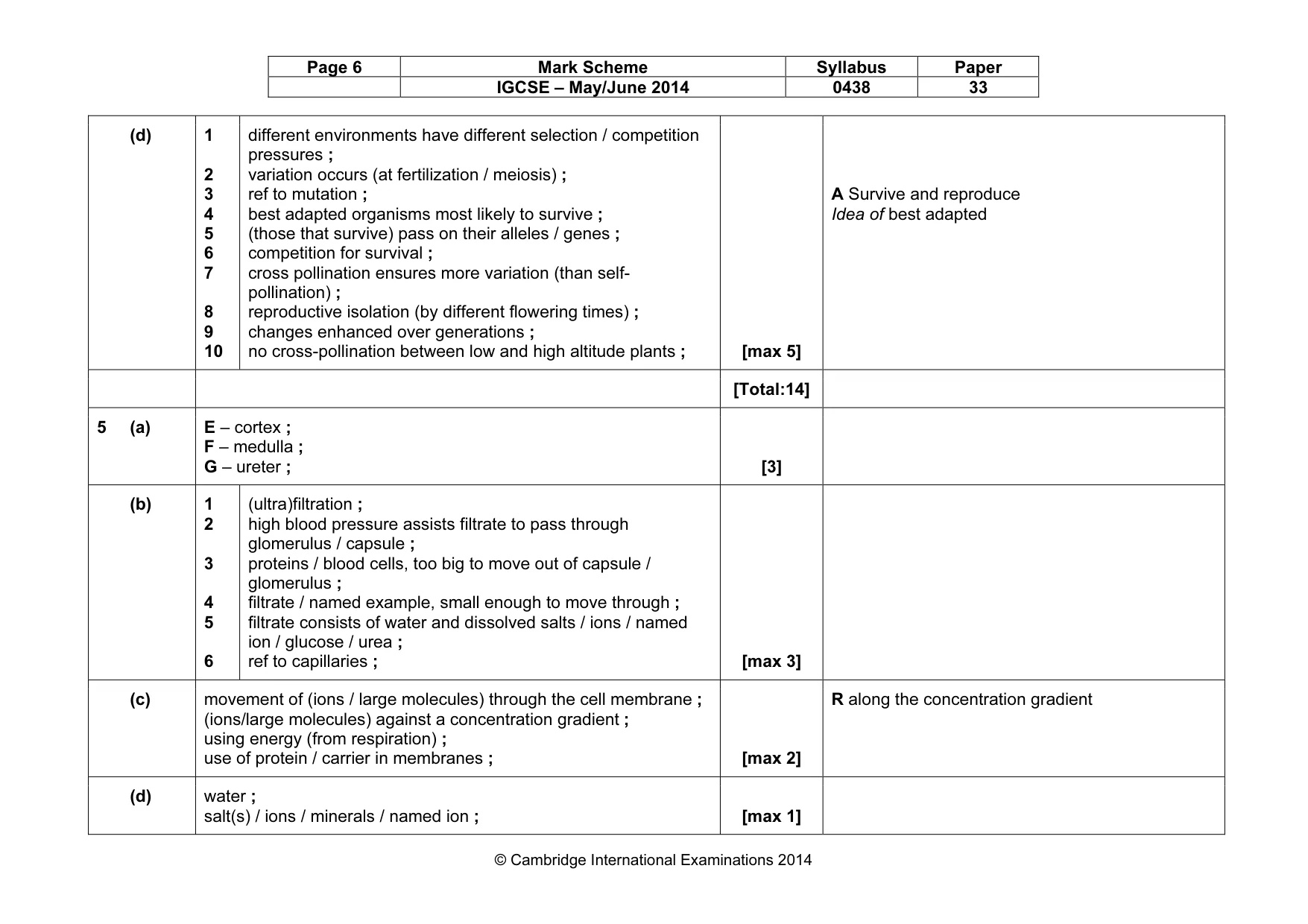
Page 6 Mark Scheme Syllabus Paper IGCSE – May/June 2014 0438 33 © Cambridge International Examinations 2014 (d) 1 2 3 4 5 6 7 8 9 10 different environments have different selection / competition pressures ; variation occurs (at fertilization / meiosis) ; ref to mutation ; best adapted organisms most likely to survive ; (those that survive) pass on their alleles / genes ; competition for survival ; cross pollination ensures more variation (than self- pollination) ; reproductive isolation (by different flowering times) ; changes enhanced over generations ; no cross-pollination between low and high altitude plants ; [max 5] A Survive and reproduce Idea of best adapted [Total:14] 5 (a) E – cortex ; F – medulla ; G – ureter ; [3] (b) 1 2 3 4 5 6 (ultra)filtration ; high blood pressure assists filtrate to pass through glomerulus / capsule ; proteins / blood cells, too big to move out of capsule / glomerulus ; filtrate / named example, small enough to move through ; filtrate consists of water and dissolved salts / ions / named ion / glucose / urea ; ref to capillaries ; [max 3] (c) movement of (ions / large molecules) through the cell membrane ; (ions/large molecules) against a concentration gradient ; using energy (from respiration) ; use of protein / carrier in membranes ; [max 2] R along the concentration gradient (d) water ; salt(s) / ions / minerals / named ion ; [max 1]
Mark scheme, page 7
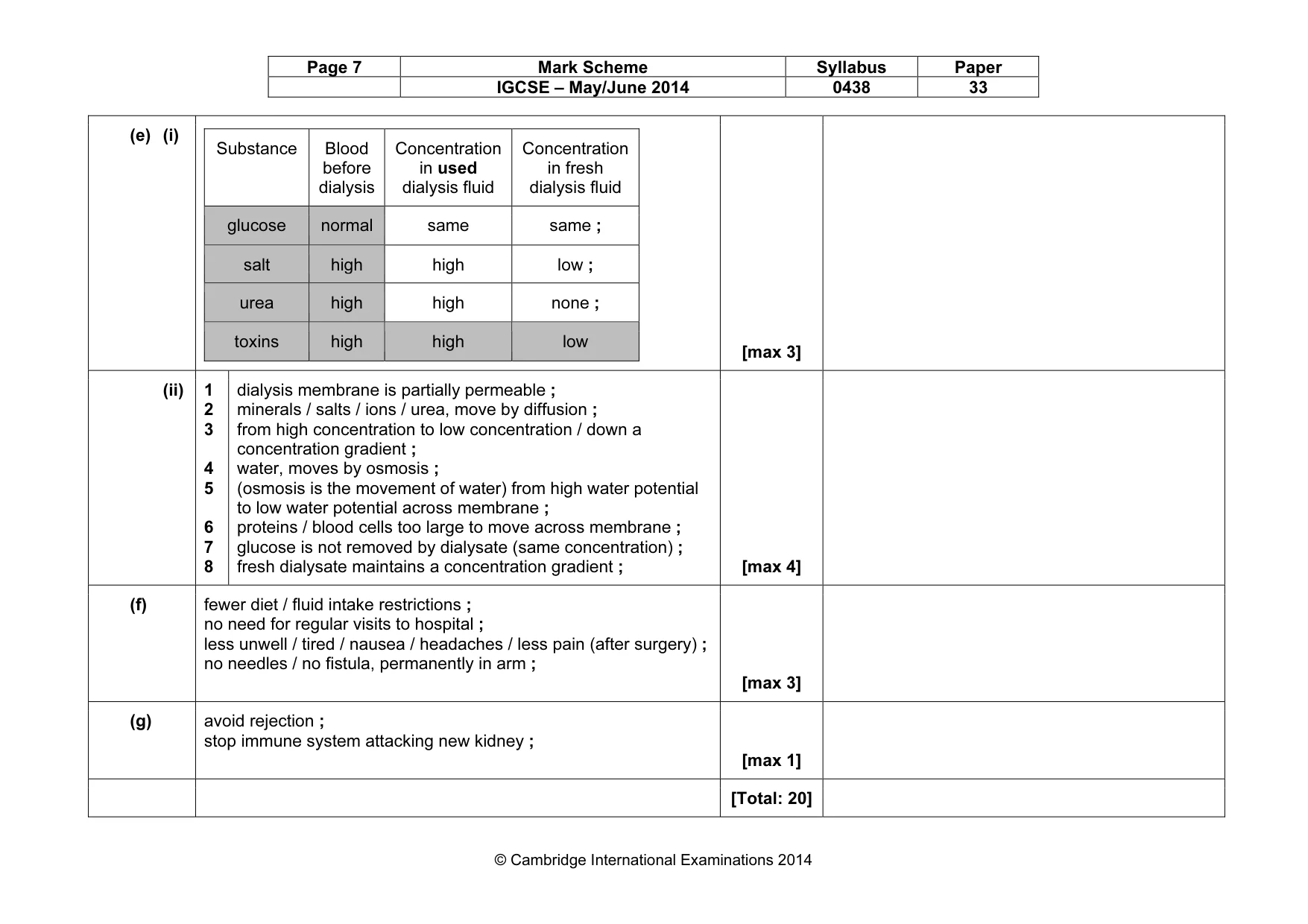
Page 7 Mark Scheme Syllabus Paper IGCSE – May/June 2014 0438 33 © Cambridge International Examinations 2014 (e) (i) Substance Blood before dialysis Concentration in used dialysis fluid Concentration in fresh dialysis fluid glucose normal same same ; salt high high low ; urea high high none ; toxins high high low [max 3] (ii) 1 2 3 4 5 6 7 8 dialysis membrane is partially permeable ; minerals / salts / ions / urea, move by diffusion ; from high concentration to low concentration / down a concentration gradient ; water, moves by osmosis ; (osmosis is the movement of water) from high water potential to low water potential across membrane ; proteins / blood cells too large to move across membrane ; glucose is not removed by dialysate (same concentration) ; fresh dialysate maintains a concentration gradient ; [max 4] (f) fewer diet / fluid intake restrictions ; no need for regular visits to hospital ; less unwell / tired / nausea / headaches / less pain (after surgery) ; no needles / no fistula, permanently in arm ; [max 3] (g) avoid rejection ; stop immune system attacking new kidney ; [max 1] [Total: 20]
Mark scheme, page 8
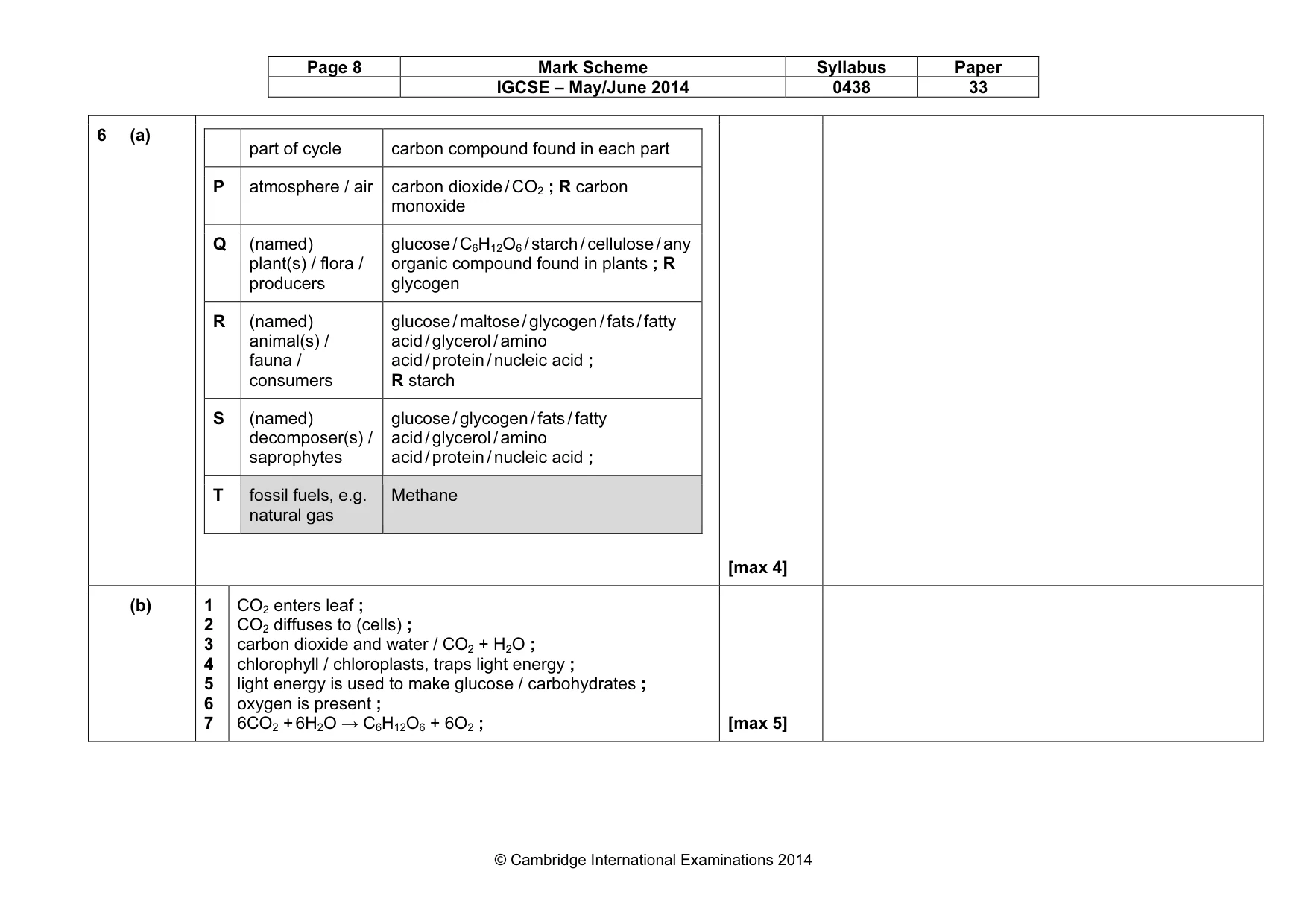
Page 8 Mark Scheme Syllabus Paper IGCSE – May/June 2014 0438 33 © Cambridge International Examinations 2014 6 (a) part of cycle carbon compound found in each part P atmosphere / air carbon dioxide / CO2 ; R carbon monoxide Q (named) plant(s) / flora / producers glucose / C6H12O6 / starch / cellulose / any organic compound found in plants ; R glycogen R (named) animal(s) / fauna / consumers glucose / maltose / glycogen / fats / fatty acid / glycerol / amino acid / protein / nucleic acid ; R starch S (named) decomposer(s) / saprophytes glucose / glycogen / fats / fatty acid / glycerol / amino acid / protein / nucleic acid ; T fossil fuels, e.g. natural gas Methane [max 4] (b) 1 2 3 4 5 6 7 CO2 enters leaf ; CO2 diffuses to (cells) ; carbon dioxide and water / CO2 + H2O ; chlorophyll / chloroplasts, traps light energy ; light energy is used to make glucose / carbohydrates ; oxygen is present ; 6CO2 + 6H2O → C6H12O6 + 6O2 ; [max 5]
Mark scheme, page 9
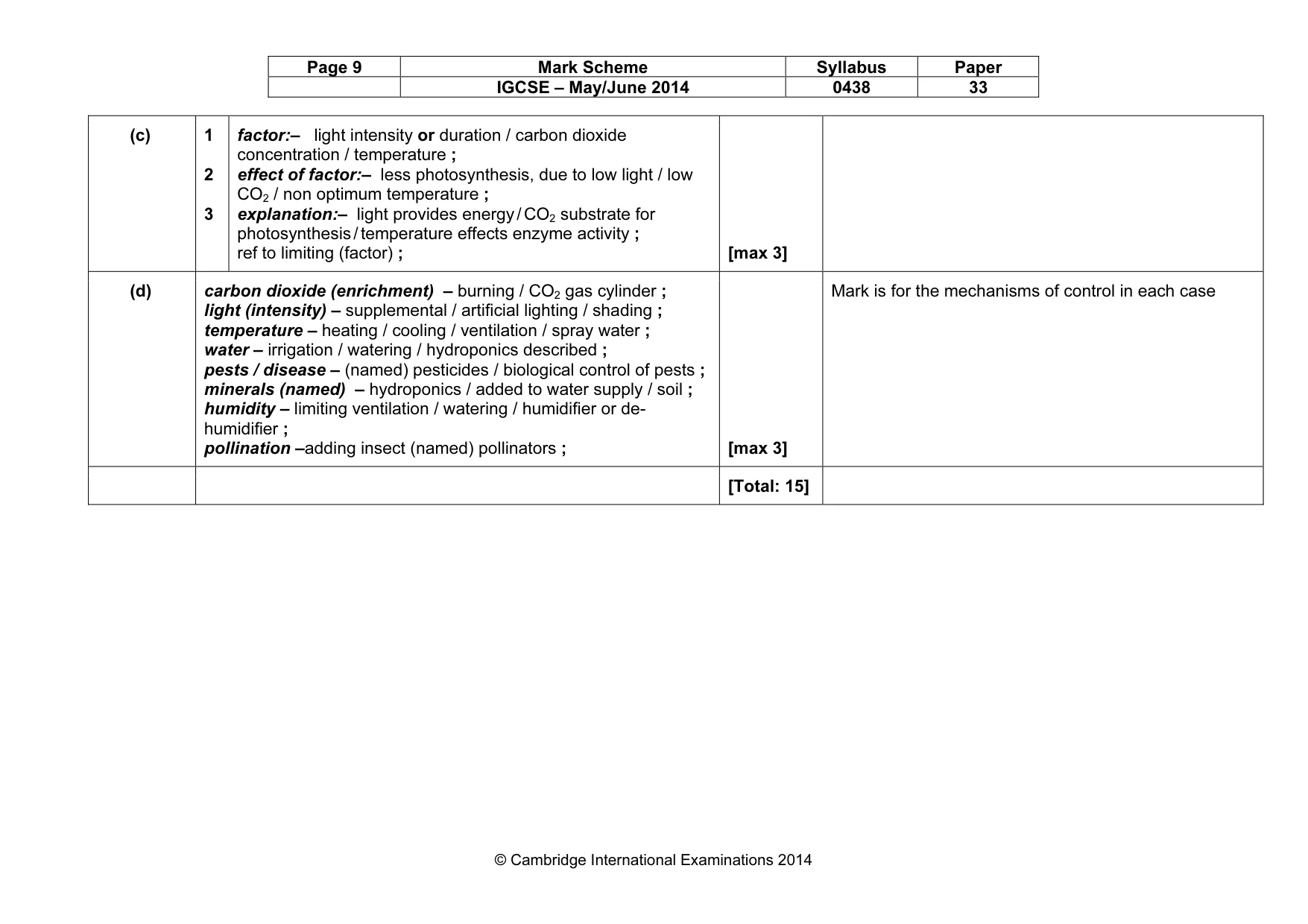
Page 9 Mark Scheme Syllabus Paper IGCSE – May/June 2014 0438 33 © Cambridge International Examinations 2014 (c) 1 2 3 factor:– light intensity or duration / carbon dioxide concentration / temperature ; effect of factor:– less photosynthesis, due to low light / low CO2 / non optimum temperature ; explanation:– light provides energy / CO2 substrate for photosynthesis / temperature effects enzyme activity ; ref to limiting (factor) ; [max 3] (d) carbon dioxide (enrichment) – burning / CO2 gas cylinder ; light (intensity) – supplemental / artificial lighting / shading ; temperature – heating / cooling / ventilation / spray water ; water – irrigation / watering / hydroponics described ; pests / disease – (named) pesticides / biological control of pests ; minerals (named) – hydroponics / added to water supply / soil ; humidity – limiting ventilation / watering / humidifier or de- humidifier ; pollination –adding insect (named) pollinators ; [max 3] Mark is for the mechanisms of control in each case [Total: 15]
What you needed in this session
Cambridge’s own grade thresholds for 2014 May/June, Paper 3 · Variant 3. A higher threshold means an easier paper — the bar moves with how the cohort did.