Cambridge IGCSE Biology (BES) 0438 — 2013 May/June Paper 3 · Variant 1
0438/31/M/J/13
The question paper and its mark scheme, free to read here and free to download. This is Cambridge’s own paper, exactly as it was sat.
Question paper20 pages

Mark scheme10 pages
Answers below. Sit the paper first if you are practising.
Paper as text
Question paper, page 1
This document consists of 19 printed pages and 1 blank page. IB13 06_0438_31/FP © UCLES 2013 [Turn over *7150301830* UNIVERSITY OF CAMBRIDGE INTERNATIONAL EXAMINATIONS International General Certificate of Secondary Education BIOLOGY (US) 0438/31 Paper 3 Extended May/June 2013 1 hour 15 minutes Candidates answer on the Question Paper. No Additional Materials are required. READ THESE INSTRUCTIONS FIRST Write your Center number, candidate number and name on all the work you hand in. Write in dark blue or black pen. You may use a pencil for any diagrams or graphs. Do not use staples, paper clips, highlighters, glue or correction fluid. DO NOT WRITE IN ANY BARCODES. Answer all questions. Electronic calculators may be used. You may lose marks if you do not show your working or if you do not use appropriate units. At the end of the examination, fasten all your work securely together. The number of marks is given in brackets [ ] at the end of each question or part question.
Question paper, page 2
2 © UCLES 2013 0438/31/M/J/13 BLANK PAGE
Question paper, page 3
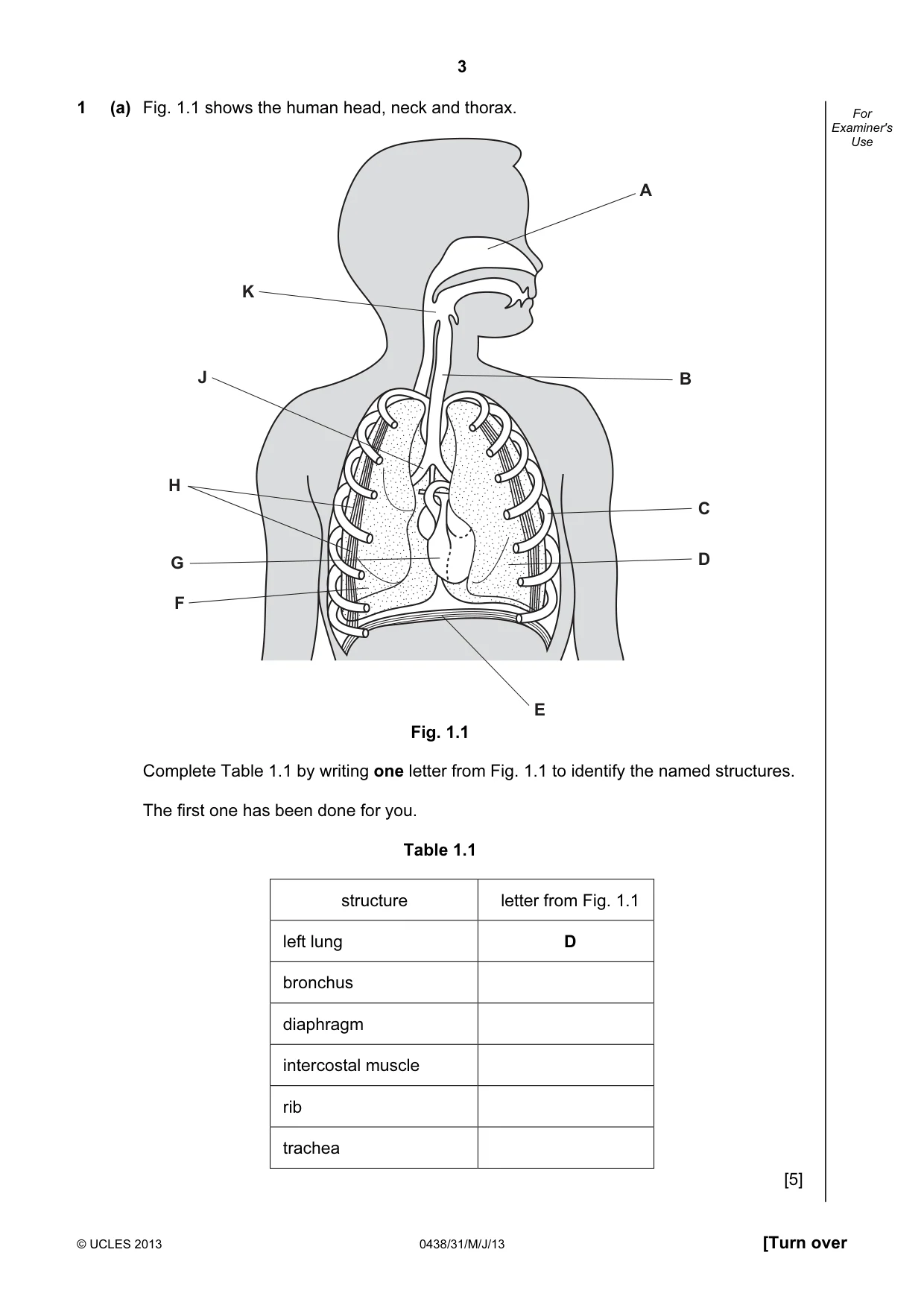
3 © UCLES 2013 0438/31/M/J/13 [Turn over For Examiner's Use 1 (a) Fig. 1.1 shows the human head, neck and thorax. A B C D K J H G F E Fig. 1.1 Complete Table 1.1 by writing one letter from Fig. 1.1 to identify the named structures. The first one has been done for you. Table 1.1 structure letter from Fig. 1.1 left lung D bronchus diaphragm intercostal muscle rib trachea [5]
Question paper, page 4
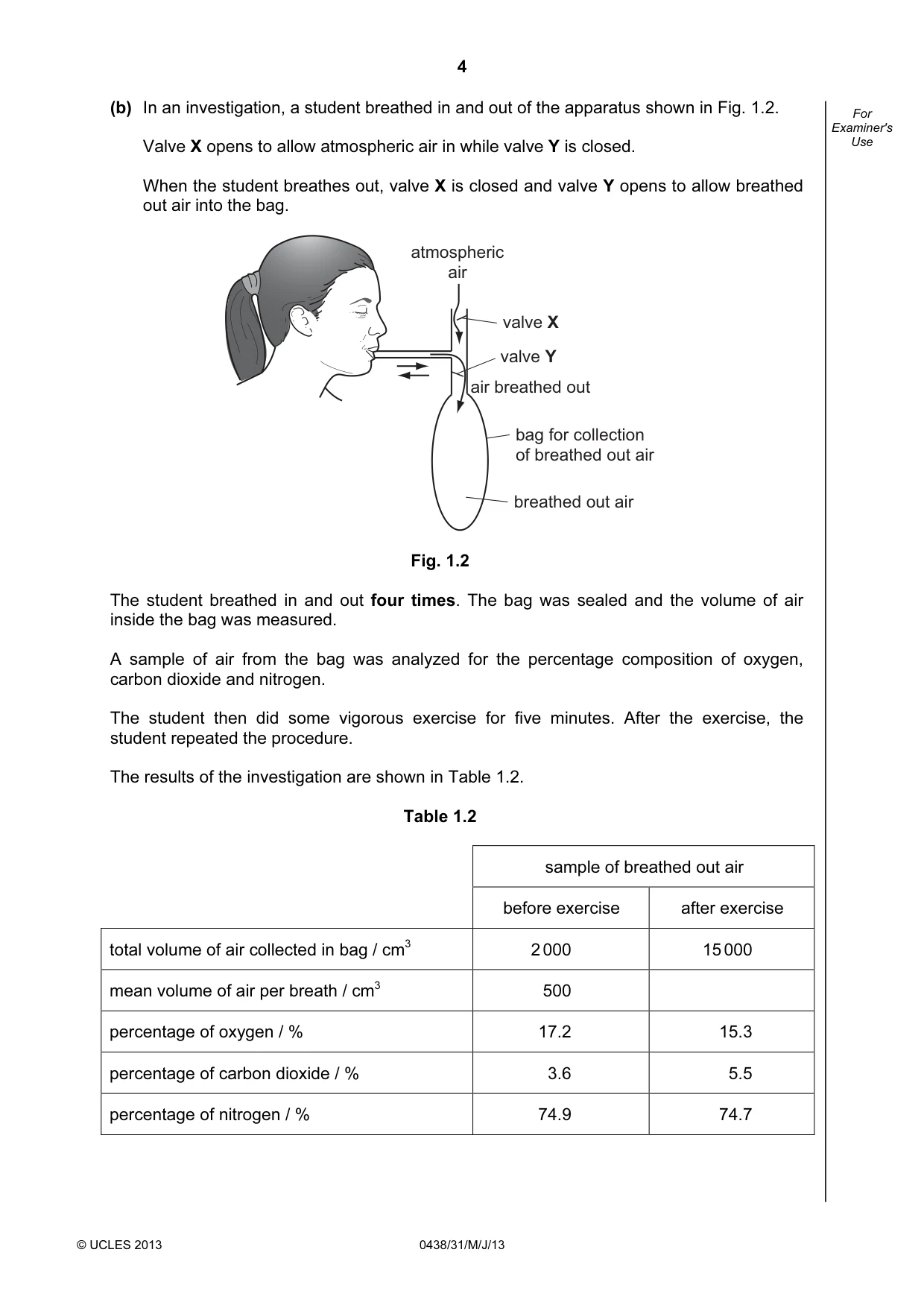
4 © UCLES 2013 0438/31/M/J/13 For Examiner's Use (b) In an investigation, a student breathed in and out of the apparatus shown in Fig. 1.2. Valve X opens to allow atmospheric air in while valve Y is closed. When the student breathes out, valve X is closed and valve Y opens to allow breathed out air into the bag. atmospheric air valve X valve Y bag for collection of breathed out air breathed out air air breathed out Fig. 1.2 The student breathed in and out four times. The bag was sealed and the volume of air inside the bag was measured. A sample of air from the bag was analyzed for the percentage composition of oxygen, carbon dioxide and nitrogen. The student then did some vigorous exercise for five minutes. After the exercise, the student repeated the procedure. The results of the investigation are shown in Table 1.2. Table 1.2 sample of breathed out air before exercise after exercise total volume of air collected in bag / cm3 2 000 15 000 mean volume of air per breath / cm3 500 percentage of oxygen / % 17.2 15.3 percentage of carbon dioxide / % 3.6 5.5 percentage of nitrogen / % 74.9 74.7
Question paper, page 5
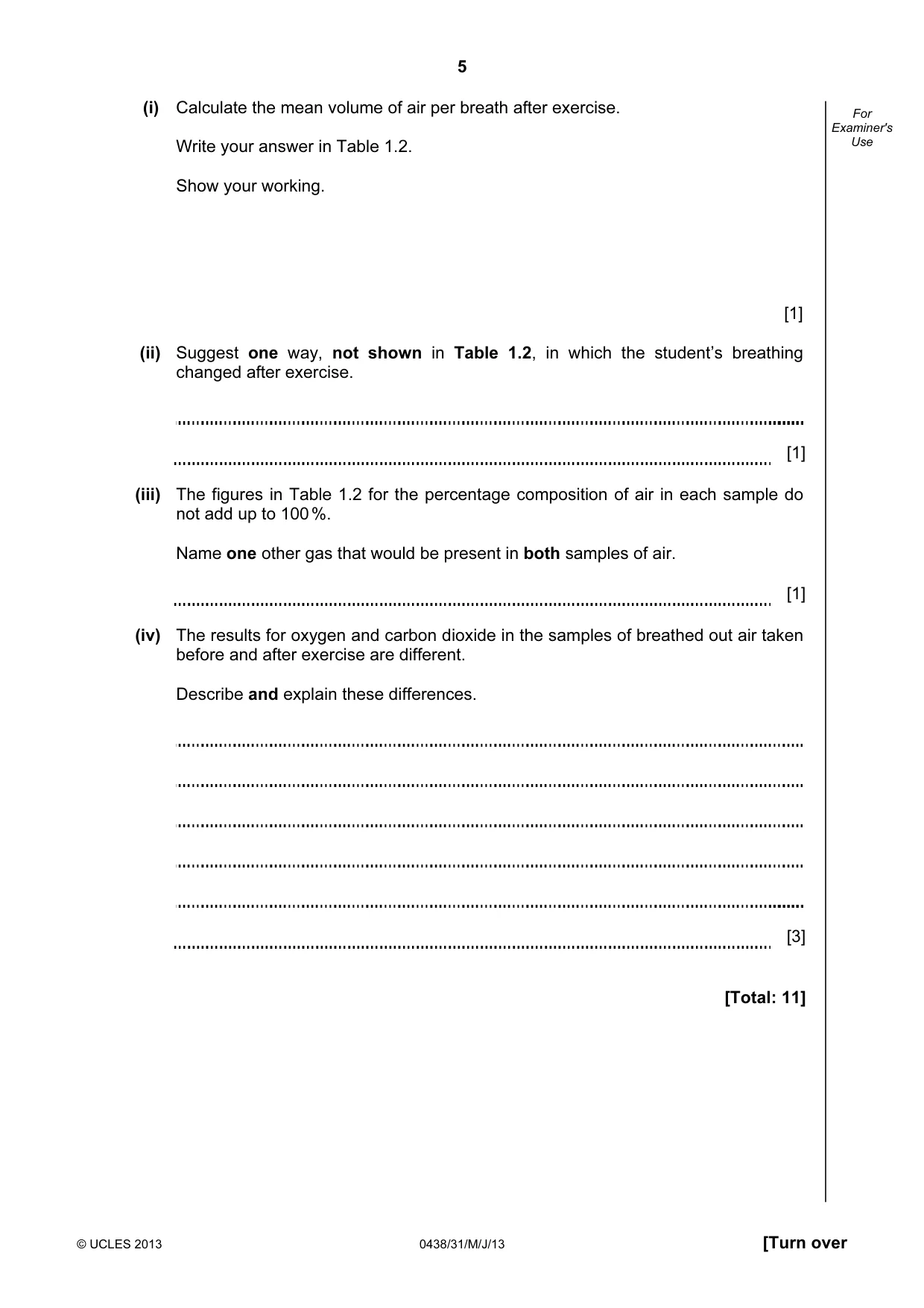
5 © UCLES 2013 0438/31/M/J/13 [Turn over For Examiner's Use (i) Calculate the mean volume of air per breath after exercise. Write your answer in Table 1.2. Show your working. [1] (ii) Suggest one way, not shown in Table 1.2, in which the student’s breathing changed after exercise. [1] (iii) The figures in Table 1.2 for the percentage composition of air in each sample do not add up to 100 %. Name one other gas that would be present in both samples of air. [1] (iv) The results for oxygen and carbon dioxide in the samples of breathed out air taken before and after exercise are different. Describe and explain these differences. [3] [Total: 11]
Question paper, page 6
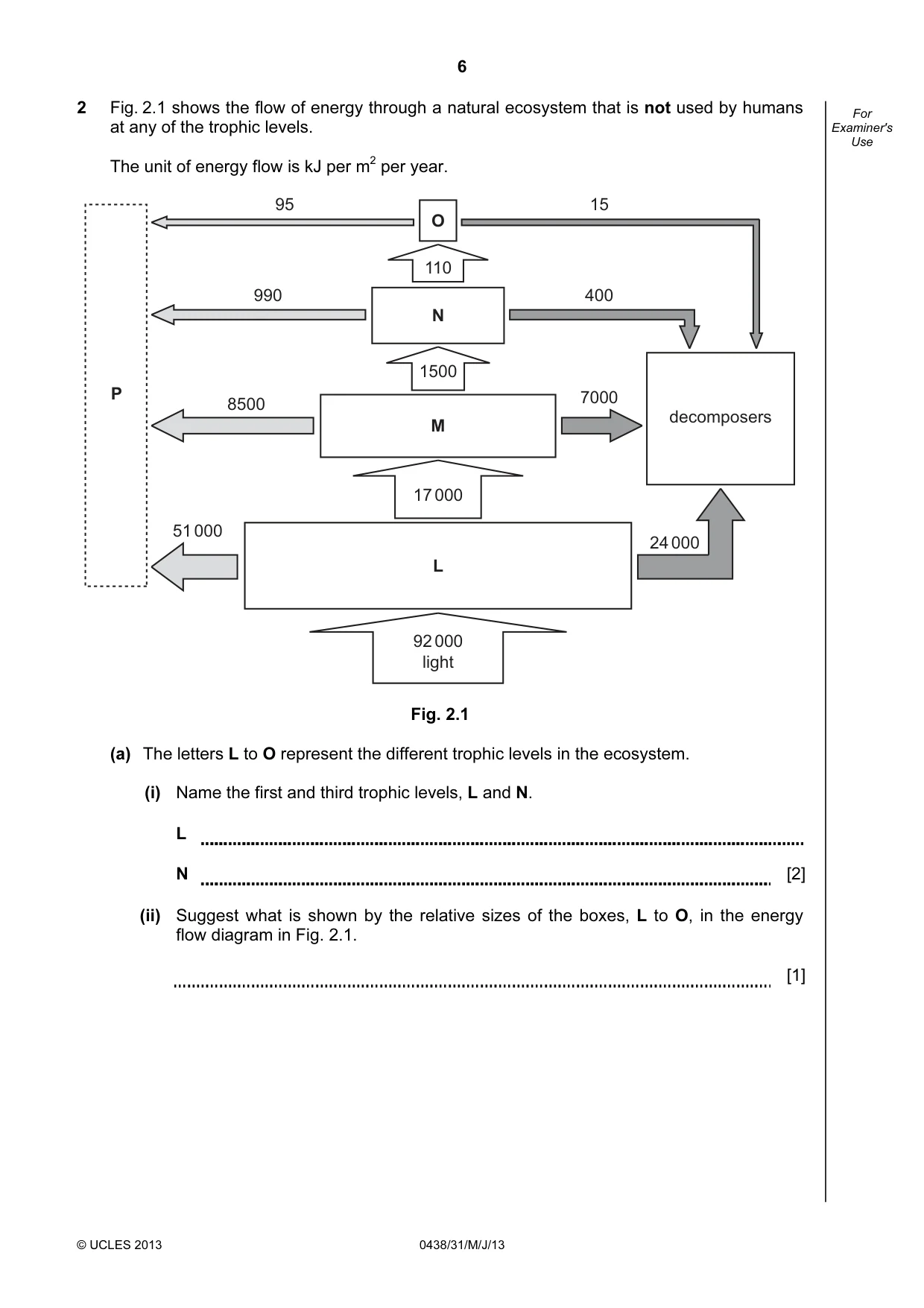
6 © UCLES 2013 0438/31/M/J/13 For Examiner's Use 2 Fig. 2.1 shows the flow of energy through a natural ecosystem that is not used by humans at any of the trophic levels. The unit of energy flow is kJ per m2 per year. O N M P L 92 000 light 17 000 1500 110 decomposers 95 15 990 400 8500 7000 51 000 24 000 Fig. 2.1 (a) The letters L to O represent the different trophic levels in the ecosystem. (i) Name the first and third trophic levels, L and N. L N [2] (ii) Suggest what is shown by the relative sizes of the boxes, L to O, in the energy flow diagram in Fig. 2.1. [1]
Question paper, page 7
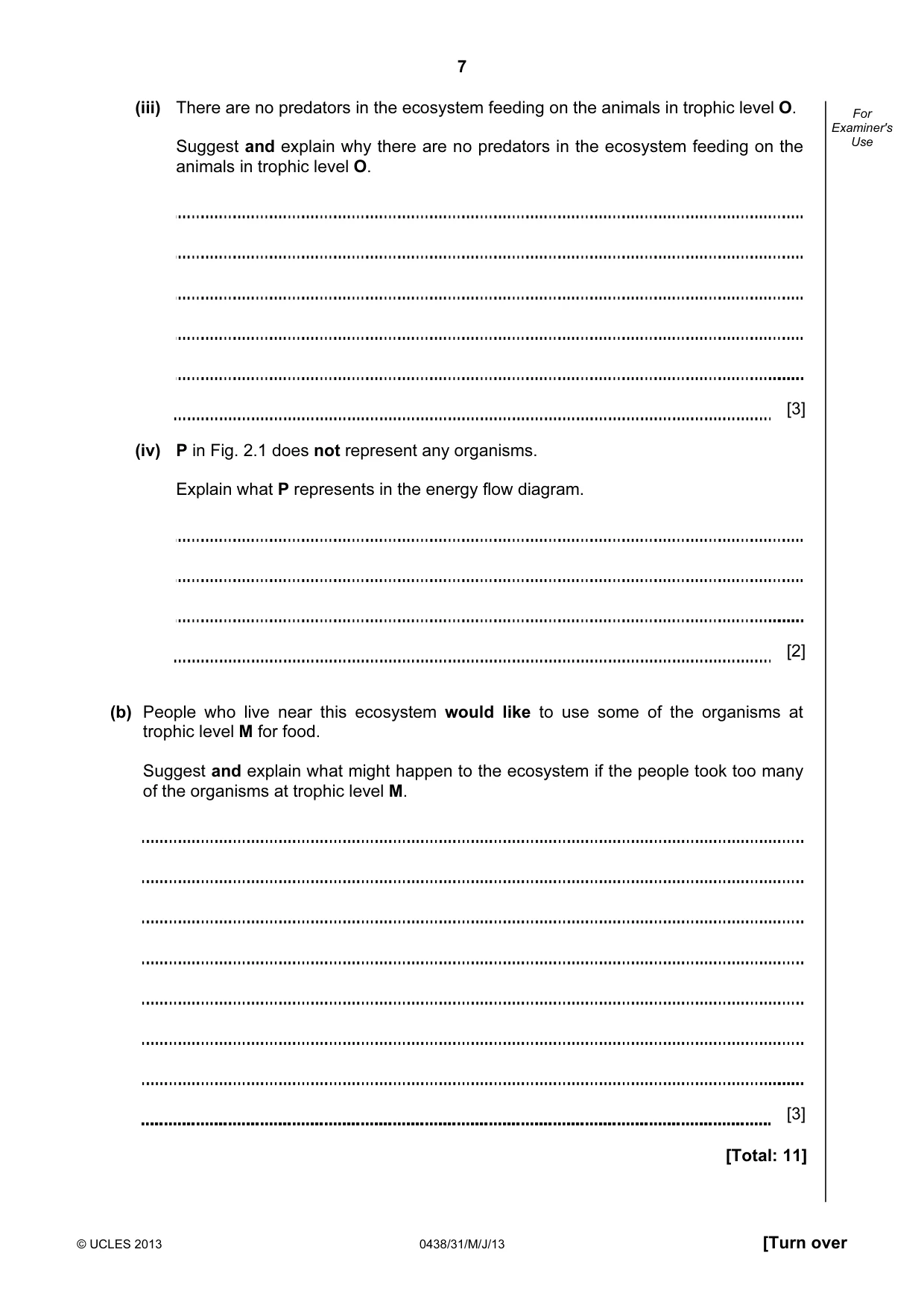
7 © UCLES 2013 0438/31/M/J/13 [Turn over For Examiner's Use (iii) There are no predators in the ecosystem feeding on the animals in trophic level O. Suggest and explain why there are no predators in the ecosystem feeding on the animals in trophic level O. [3] (iv) P in Fig. 2.1 does not represent any organisms. Explain what P represents in the energy flow diagram. [2] (b) People who live near this ecosystem would like to use some of the organisms at trophic level M for food. Suggest and explain what might happen to the ecosystem if the people took too many of the organisms at trophic level M. [3] [Total: 11]
Question paper, page 8
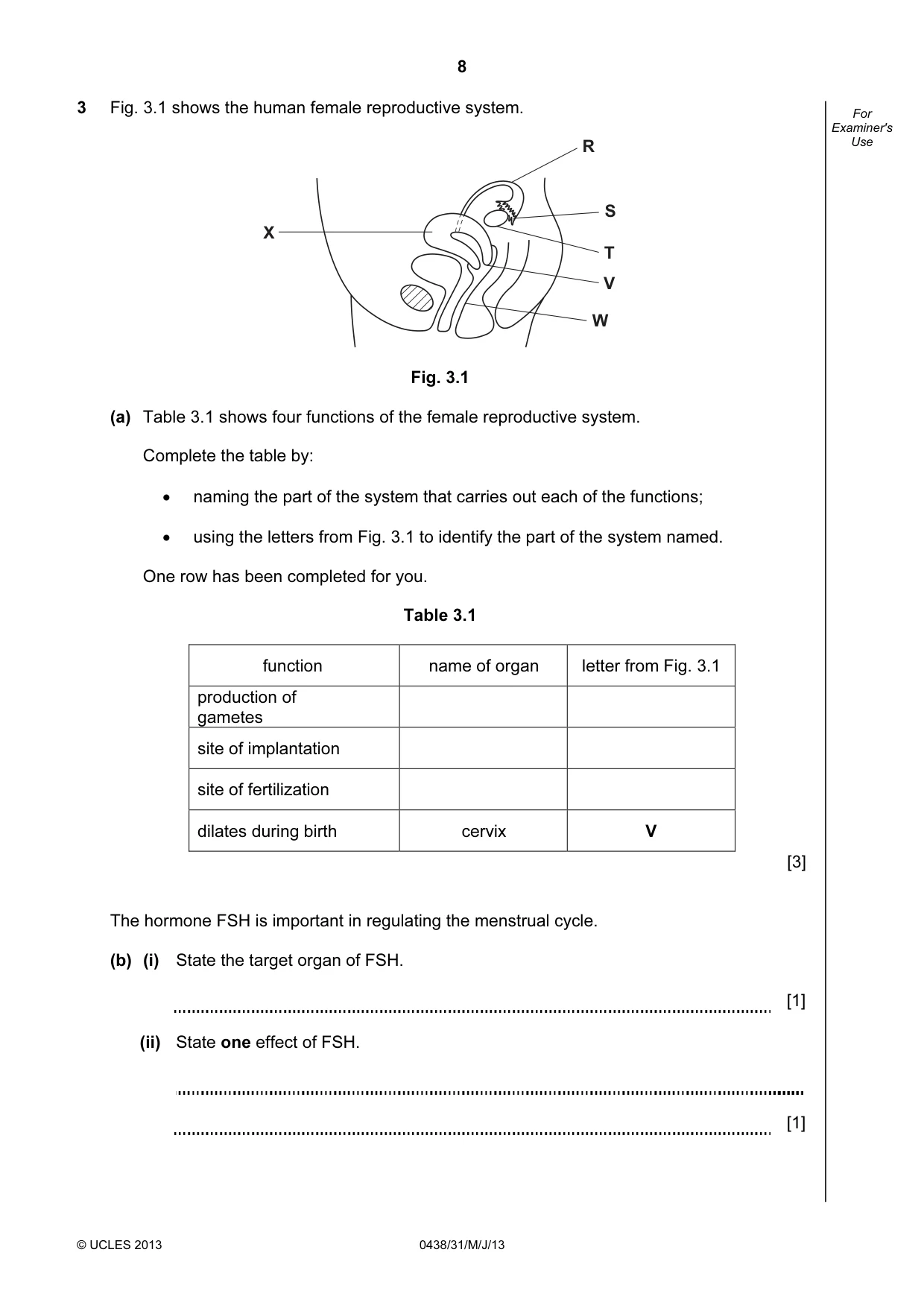
8 © UCLES 2013 0438/31/M/J/13 For Examiner's Use 3 Fig. 3.1 shows the human female reproductive system. X R S T V W Fig. 3.1 (a) Table 3.1 shows four functions of the female reproductive system. Complete the table by: • naming the part of the system that carries out each of the functions; • using the letters from Fig. 3.1 to identify the part of the system named. One row has been completed for you. Table 3.1 function name of organ letter from Fig. 3.1 production of gametes site of implantation site of fertilization dilates during birth cervix V [3] The hormone FSH is important in regulating the menstrual cycle. (b) (i) State the target organ of FSH. [1] (ii) State one effect of FSH. [1]
Question paper, page 9
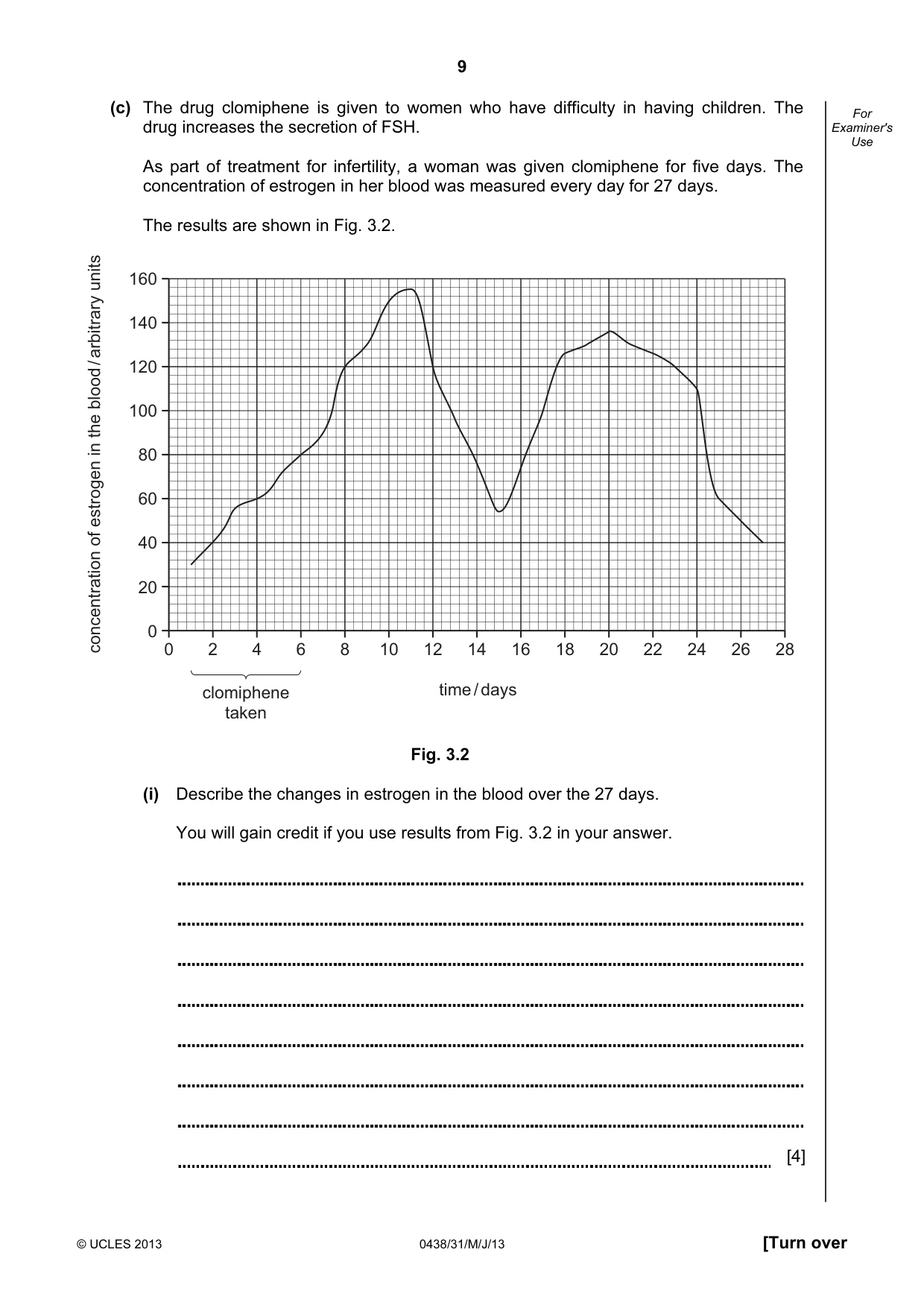
9 © UCLES 2013 0438/31/M/J/13 [Turn over For Examiner's Use (c) The drug clomiphene is given to women who have difficulty in having children. The drug increases the secretion of FSH. As part of treatment for infertility, a woman was given clomiphene for five days. The concentration of estrogen in her blood was measured every day for 27 days. The results are shown in Fig. 3.2. 0 2 4 6 8 10 12 14 16 18 20 22 24 26 28 160 140 120 100 80 60 40 20 0 concentration of estrogen in the blood / arbitrary units time / days clomiphene taken Fig. 3.2 (i) Describe the changes in estrogen in the blood over the 27 days. You will gain credit if you use results from Fig. 3.2 in your answer. [4]
Question paper, page 10
10 © UCLES 2013 0438/31/M/J/13 For Examiner's Use (ii) Doctors thought that ovulation occurred around day 15. Explain what is meant by the term ovulation. [2] (d) The treatment was not successful on the first occasion. As an alternative to this treatment, women may be offered in vitro fertilization (IVF) treatment. In IVF treatment, an egg is fertilized outside the body and the resulting embryo is placed into the uterus. Describe what happens when an egg is fertilized by a sperm. [3]
Question paper, page 11
11 © UCLES 2013 0438/31/M/J/13 [Turn over For Examiner's Use (e) Some embryos produced by IVF do not develop because there are problems with their chromosomes, such as having the wrong number. (i) Define the term chromosome. [2] (ii) State the correct number of chromosomes that should be in a cell of a human embryo. [1] [Total: 17]
Question paper, page 12
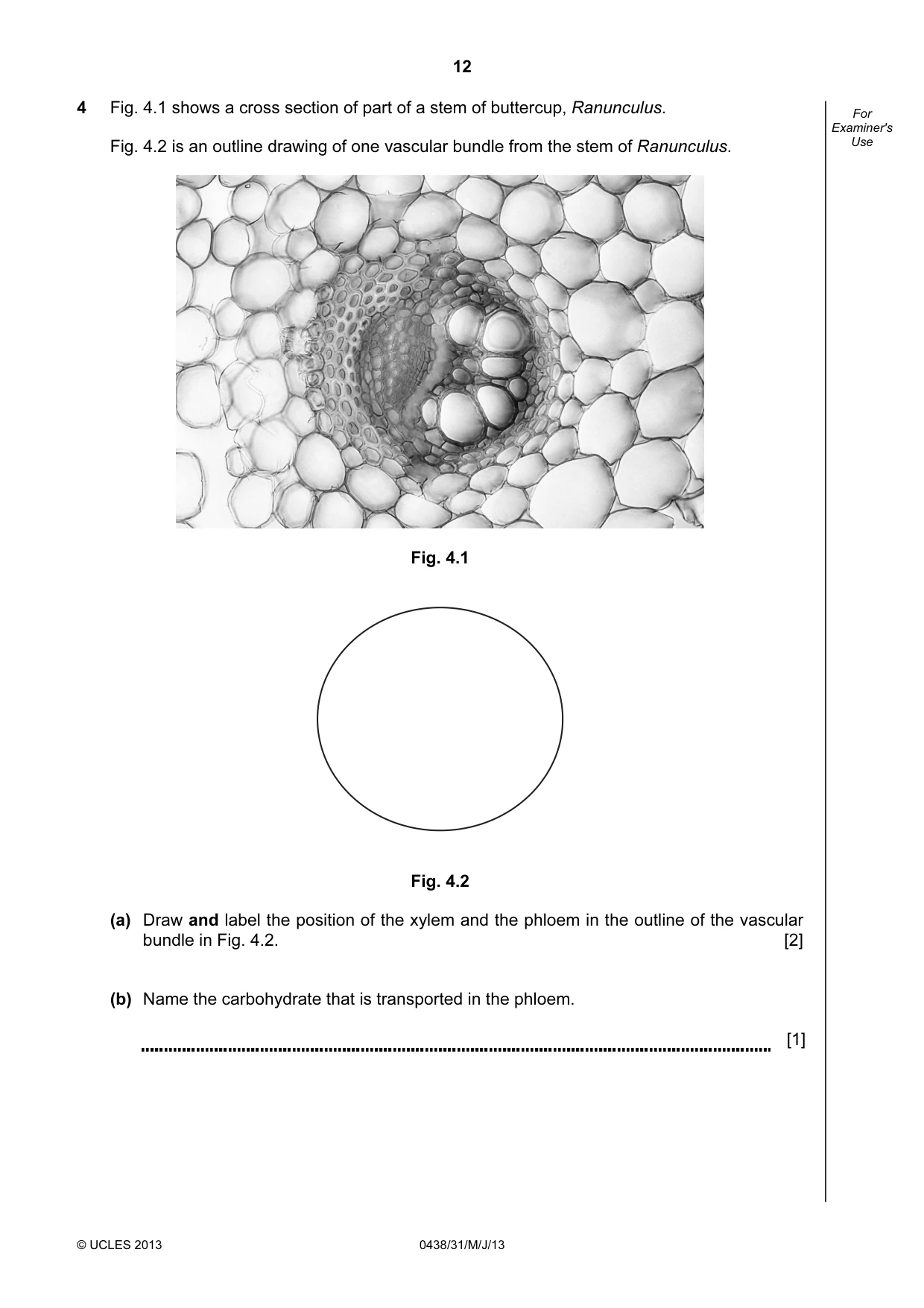
12 © UCLES 2013 0438/31/M/J/13 For Examiner's Use 4 Fig. 4.1 shows a cross section of part of a stem of buttercup, Ranunculus. Fig. 4.2 is an outline drawing of one vascular bundle from the stem of Ranunculus. Fig. 4.1 Fig. 4.2 (a) Draw and label the position of the xylem and the phloem in the outline of the vascular bundle in Fig. 4.2. [2] (b) Name the carbohydrate that is transported in the phloem. [1]
Question paper, page 13
13 © UCLES 2013 0438/31/M/J/13 [Turn over For Examiner's Use (c) Substances transported in the phloem are carried upwards in the stem at some times of the year and downwards at other times. Explain why substances are transported in the phloem upwards at one time of the year and downwards at another. [4] (d) Define the term transpiration. [3]
Question paper, page 14
14 © UCLES 2013 0438/31/M/J/13 For Examiner's Use (e) The rattan palm is a plant that climbs on rainforest trees to heights of about 40 meters. Explain how water is moved to the tops of tall plants, such as the rattan palm. [4] [Total: 14]
Question paper, page 15
15 © UCLES 2013 0438/31/M/J/13 [Turn over For Examiner's Use 5 Enzymes are necessary for many biological processes, such as the digestion of fat. fat + water fatty acids + glycerol lipase (a) (i) Explain why enzymes are necessary for biological processes. [3] (ii) Lipase, protease and amylase are enzymes secreted into the alimentary canal. Name one organ that secretes each enzyme. Choose your answers from this list. colon gall bladder liver esophagus pancreas rectum salivary glands stomach You can use each organ only once. lipase protease amylase [3]
Question paper, page 16
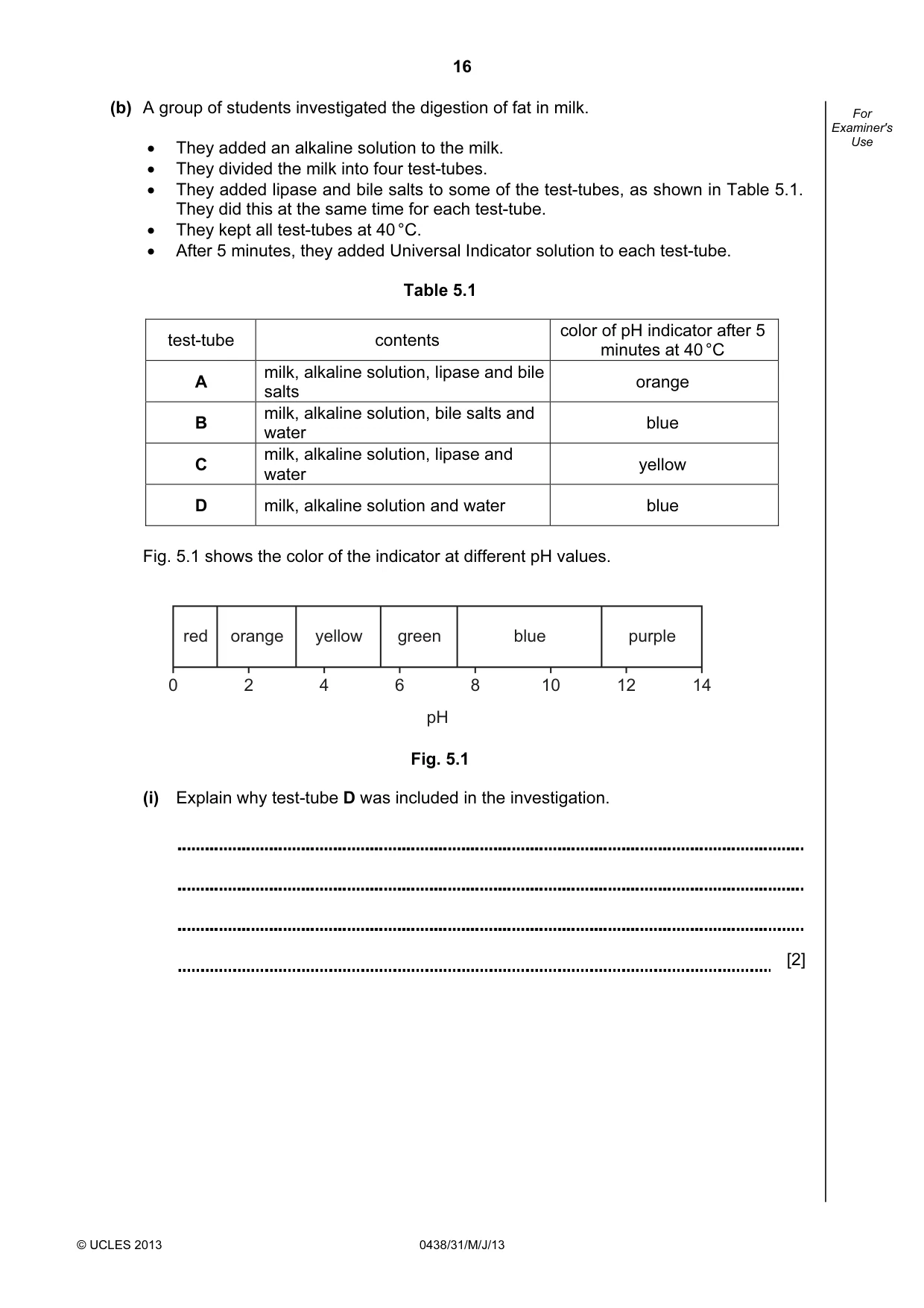
16 © UCLES 2013 0438/31/M/J/13 For Examiner's Use (b) A group of students investigated the digestion of fat in milk. • They added an alkaline solution to the milk. • They divided the milk into four test-tubes. • They added lipase and bile salts to some of the test-tubes, as shown in Table 5.1. They did this at the same time for each test-tube. • They kept all test-tubes at 40 °C. • After 5 minutes, they added Universal Indicator solution to each test-tube. Table 5.1 test-tube contents color of pH indicator after 5 minutes at 40 °C A milk, alkaline solution, lipase and bile salts orange B milk, alkaline solution, bile salts and water blue C milk, alkaline solution, lipase and water yellow D milk, alkaline solution and water blue Fig. 5.1 shows the color of the indicator at different pH values. 0 2 4 6 pH 8 10 12 14 red orange yellow green blue purple Fig. 5.1 (i) Explain why test-tube D was included in the investigation. [2]
Question paper, page 17
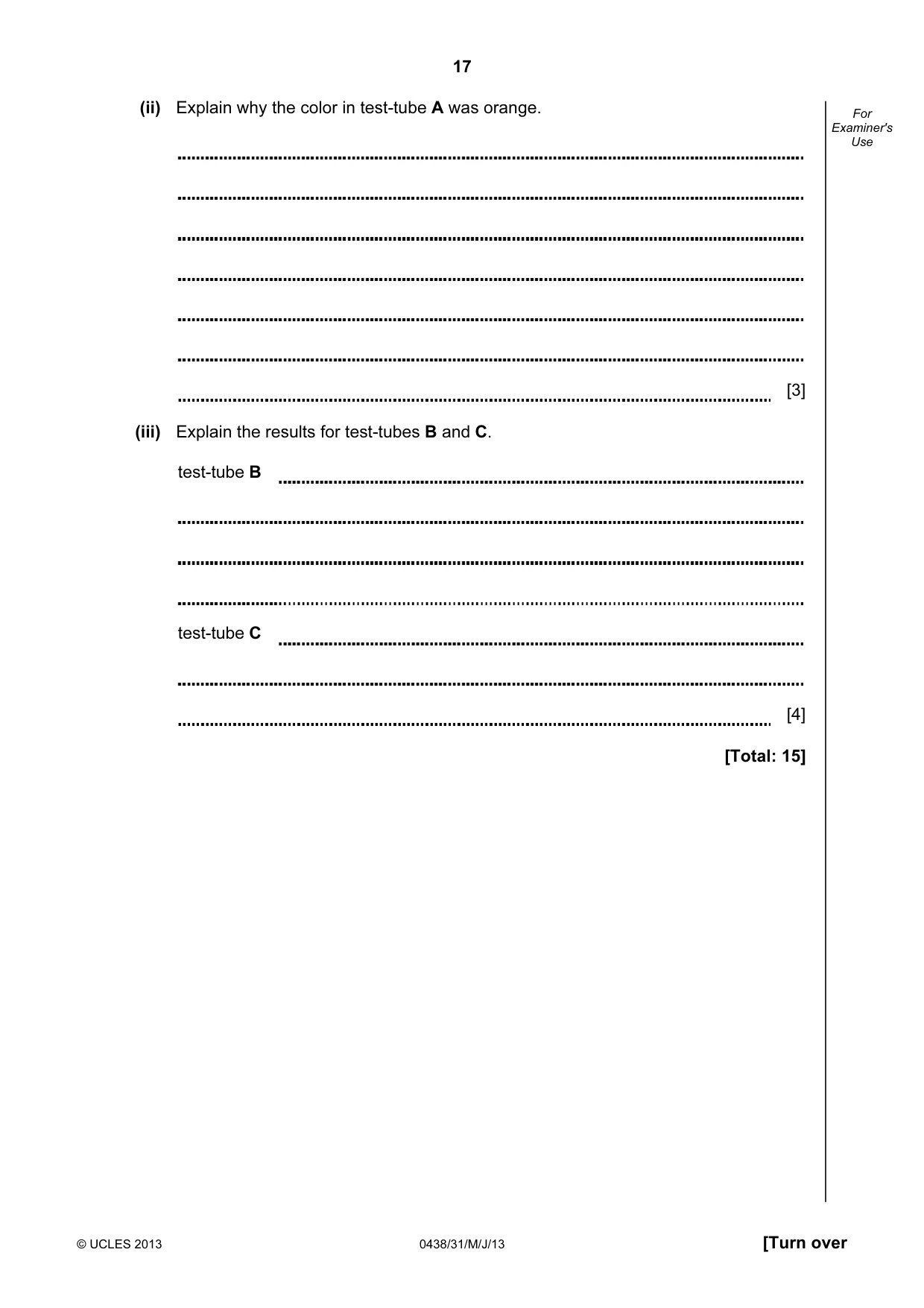
17 © UCLES 2013 0438/31/M/J/13 [Turn over For Examiner's Use (ii) Explain why the color in test-tube A was orange. [3] (iii) Explain the results for test-tubes B and C. test-tube B test-tube C [4] [Total: 15]
Question paper, page 18
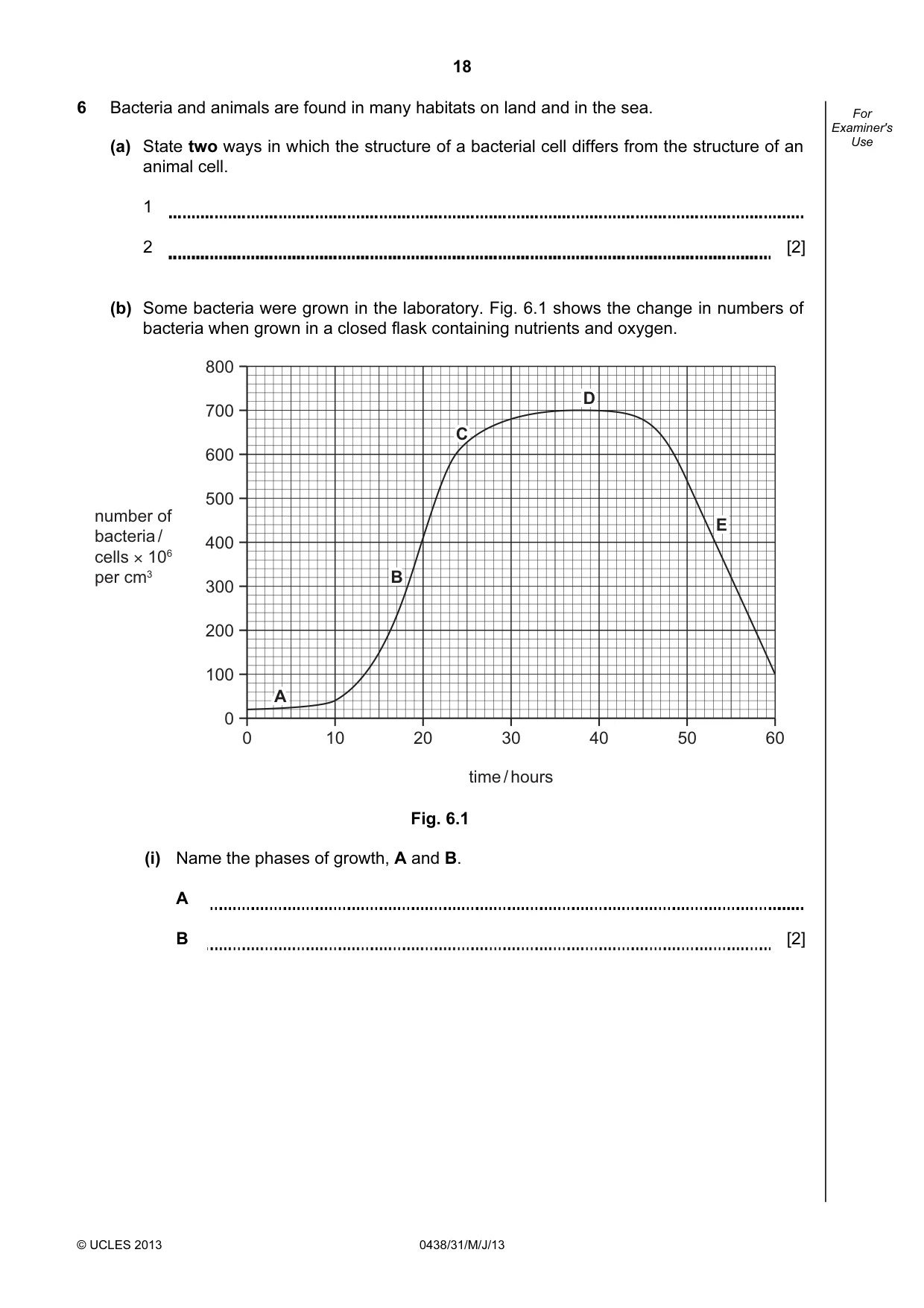
18 © UCLES 2013 0438/31/M/J/13 For Examiner's Use 6 Bacteria and animals are found in many habitats on land and in the sea. (a) State two ways in which the structure of a bacterial cell differs from the structure of an animal cell. 1 2 [2] (b) Some bacteria were grown in the laboratory. Fig. 6.1 shows the change in numbers of bacteria when grown in a closed flask containing nutrients and oxygen. A B C D E 800 700 600 500 400 300 200 100 0 0 10 20 30 time / hours 40 50 60 number of bacteria / cells × 106 per cm3 A B C D E Fig. 6.1 (i) Name the phases of growth, A and B. A B [2]
Question paper, page 19
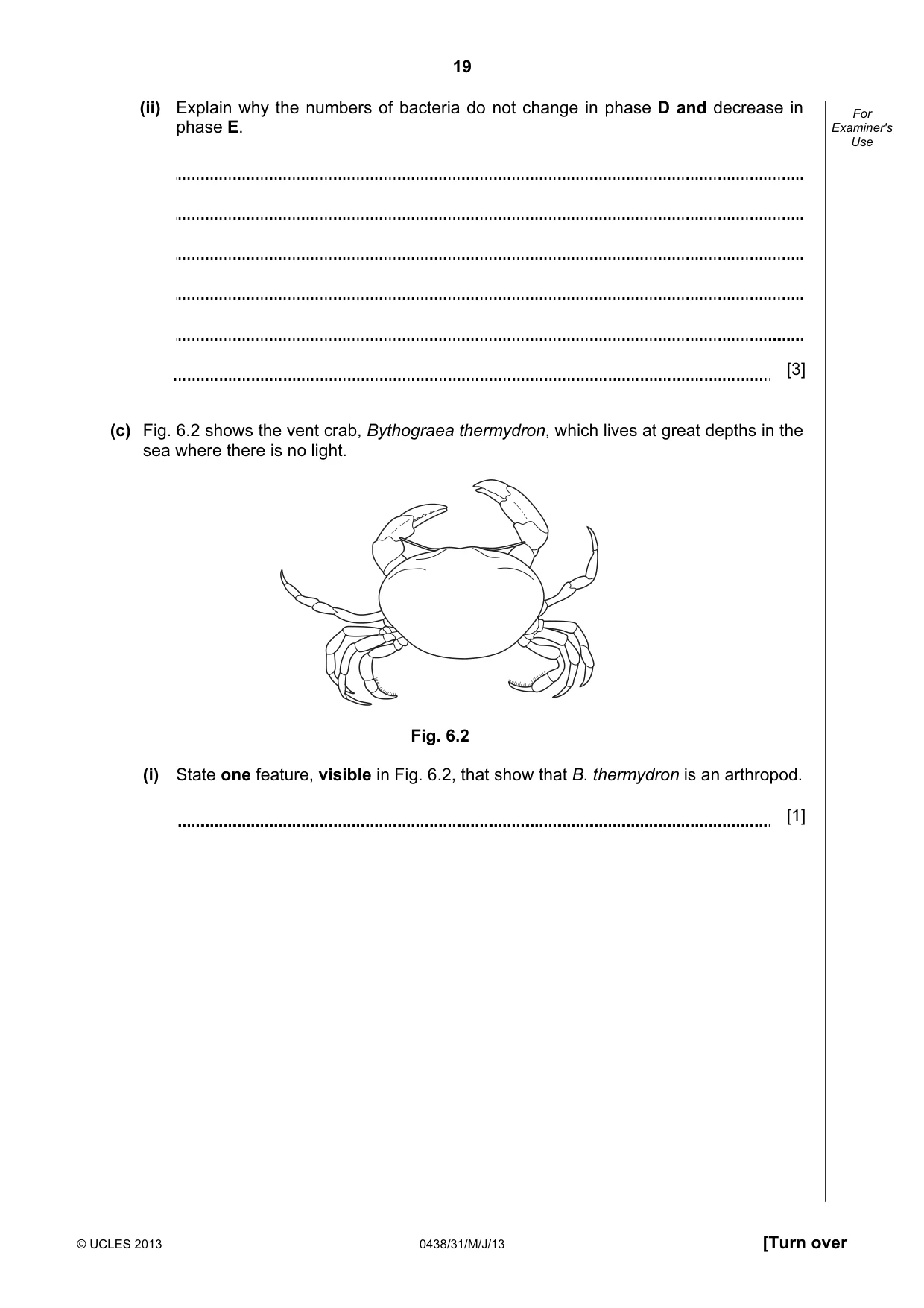
19 © UCLES 2013 0438/31/M/J/13 [Turn over For Examiner's Use (ii) Explain why the numbers of bacteria do not change in phase D and decrease in phase E. [3] (c) Fig. 6.2 shows the vent crab, Bythograea thermydron, which lives at great depths in the sea where there is no light. Fig. 6.2 (i) State one feature, visible in Fig. 6.2, that show that B. thermydron is an arthropod. [1]
Question paper, page 20
20 Copyright Acknowledgements: Figure 1.1 Figure 4.1 © B S Beckett; Biology, A Modern Introduction; Oxford University Press. © Ref: B725/0317; Buttercup Stem (Ranunculus sp.); Herve Conge; ISM Science Photo Library. Permission to reproduce items where third-party owned material protected by copyright is included has been sought and cleared where possible. Every reasonable effort has been made by the publisher (UCLES) to trace copyright holders, but if any items requiring clearance have unwittingly been included, the publisher will be pleased to make amends at the earliest possible opportunity. University of Cambridge International Examinations is part of the Cambridge Assessment Group. Cambridge Assessment is the brand name of University of Cambridge Local Examinations Syndicate (UCLES), which is itself a department of the University of Cambridge. © UCLES 2013 0438/31/M/J/13 For Examiner's Use (ii) Although most species of crabs are red, brown or green, B. thermydron is white. Suggest and explain how white crabs evolved at great depths in the sea. [4] [Total: 12]
Mark scheme, page 1
CAMBRIDGE INTERNATIONAL EXAMINATIONS International General Certificate of Secondary Education MARK SCHEME for the May/June 2013 series 0438 BIOLOGY (US) 0438/31 Paper 3 (Extended Theory), maximum raw mark 80 This mark scheme is published as an aid to teachers and candidates, to indicate the requirements of the examination. It shows the basis on which Examiners were instructed to award marks. It does not indicate the details of the discussions that took place at an Examiners’ meeting before marking began, which would have considered the acceptability of alternative answers. Mark schemes should be read in conjunction with the question paper and the Principal Examiner Report for Teachers. Cambridge will not enter into discussions about these mark schemes. Cambridge is publishing the mark schemes for the May/June 2013 series for most IGCSE, GCE Advanced Level and Advanced Subsidiary Level components and some Ordinary Level components.
Mark scheme, page 2
Page 2 Mark Scheme Syllabus Paper IGCSE – May/June 2013 0438 31 © Cambridge International Examinations 2013 Mark schemes will use these abbreviations • ; separates marking points • / alternatives • R reject • A accept (for answers correctly cued by the question) • I ignore as irrelevant • ecf error carried forward • AW alternative wording (where responses vary more than usual) • AVP alternative valid point • ORA or reverse argument • underline actual word given must be used by candidate (grammatical variants excepted) • ( ) the word / phrase in brackets is not required but sets the context • D, L, T, Q quality of: drawing / labelling / table / detail as indicated • max indicates the maximum number of marks
Mark scheme, page 3
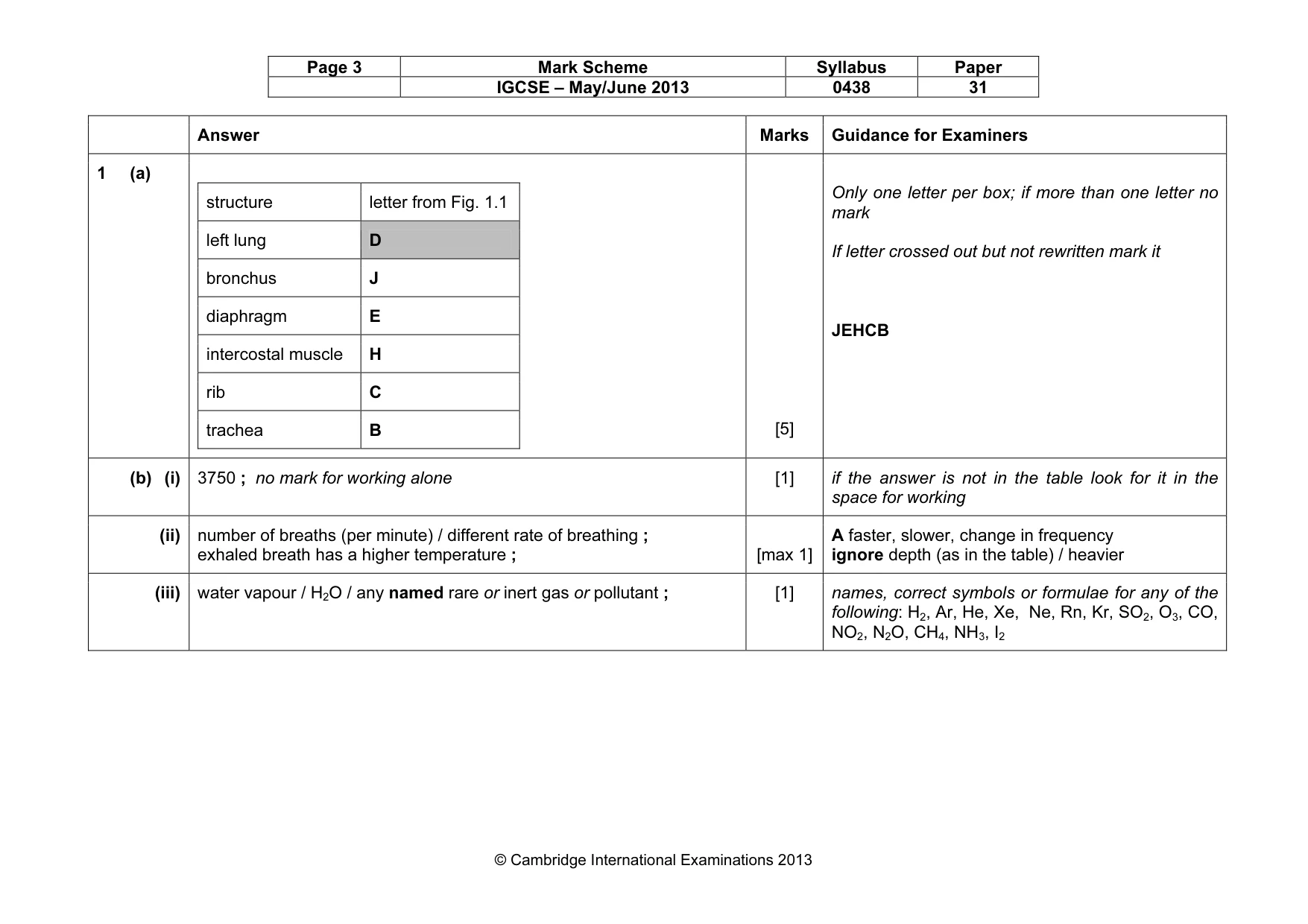
Page 3 Mark Scheme Syllabus Paper IGCSE – May/June 2013 0438 31 © Cambridge International Examinations 2013 Answer Marks Guidance for Examiners 1 (a) structure letter from Fig. 1.1 left lung D bronchus J diaphragm E intercostal muscle H rib C trachea B [5] Only one letter per box; if more than one letter no mark If letter crossed out but not rewritten mark it JEHCB (b) (i) 3750 ; no mark for working alone [1] if the answer is not in the table look for it in the space for working (ii) number of breaths (per minute) / different rate of breathing ; exhaled breath has a higher temperature ; [max 1] A faster, slower, change in frequency ignore depth (as in the table) / heavier (iii) water vapour / H2O / any named rare or inert gas or pollutant ; [1] names, correct symbols or formulae for any of the following: H2, Ar, He, Xe, Ne, Rn, Kr, SO2, O3, CO, NO2, N2O, CH4, NH3, I2
Mark scheme, page 4
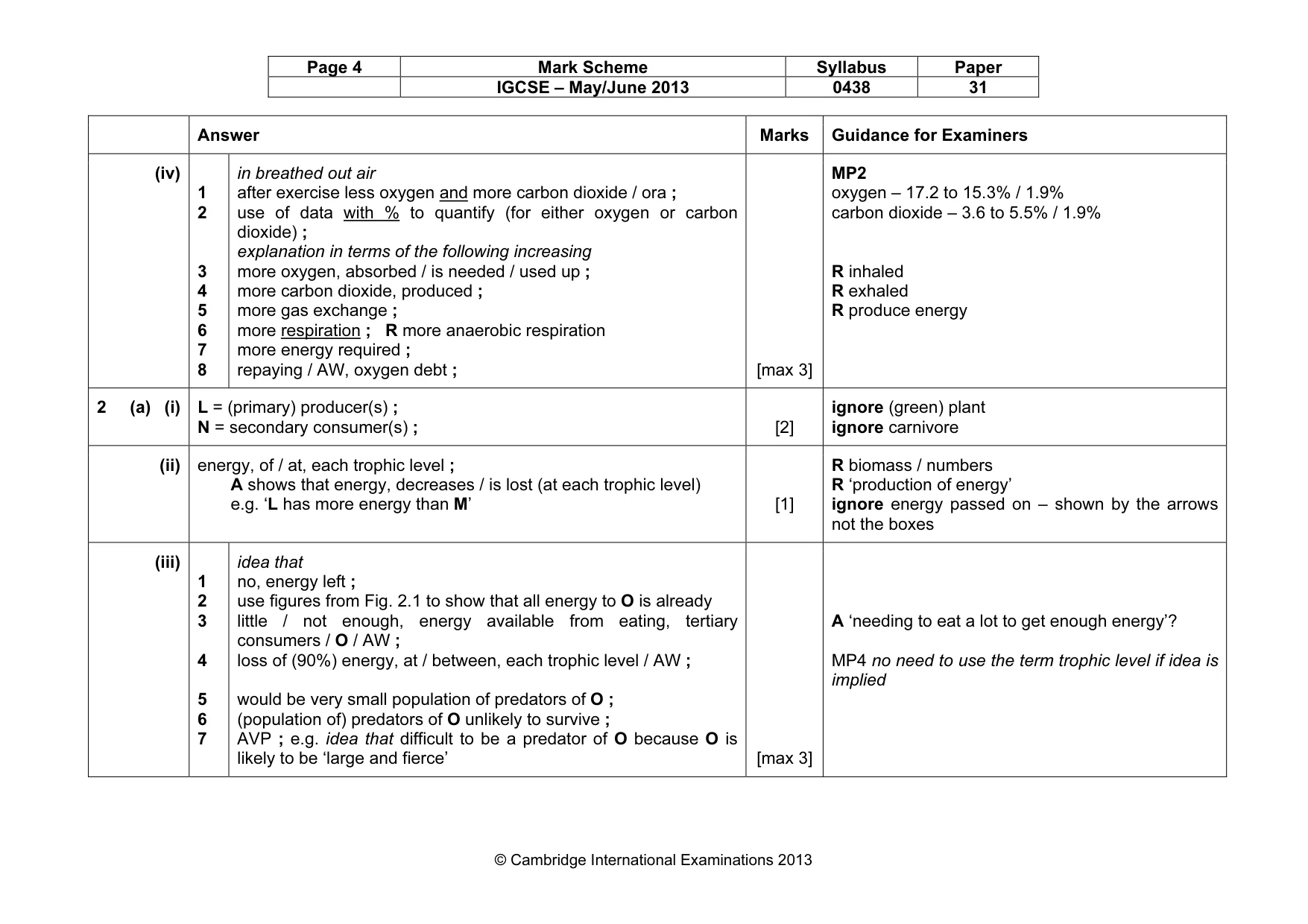
Page 4 Mark Scheme Syllabus Paper IGCSE – May/June 2013 0438 31 © Cambridge International Examinations 2013 Answer Marks Guidance for Examiners (iv) 1 2 3 4 5 6 7 8 in breathed out air after exercise less oxygen and more carbon dioxide / ora ; use of data with % to quantify (for either oxygen or carbon dioxide) ; explanation in terms of the following increasing more oxygen, absorbed / is needed / used up ; more carbon dioxide, produced ; more gas exchange ; more respiration ; R more anaerobic respiration more energy required ; repaying / AW, oxygen debt ; [max 3] MP2 oxygen – 17.2 to 15.3% / 1.9% carbon dioxide – 3.6 to 5.5% / 1.9% R inhaled R exhaled R produce energy 2 (a) (i) L = (primary) producer(s) ; N = secondary consumer(s) ; [2] ignore (green) plant ignore carnivore (ii) energy, of / at, each trophic level ; A shows that energy, decreases / is lost (at each trophic level) e.g. ‘L has more energy than M’ [1] R biomass / numbers R ‘production of energy’ ignore energy passed on – shown by the arrows not the boxes (iii) 1 2 3 4 5 6 7 idea that no, energy left ; use figures from Fig. 2.1 to show that all energy to O is already little / not enough, energy available from eating, tertiary consumers / O / AW ; loss of (90%) energy, at / between, each trophic level / AW ; would be very small population of predators of O ; (population of) predators of O unlikely to survive ; AVP ; e.g. idea that difficult to be a predator of O because O is likely to be ‘large and fierce’ [max 3] A ‘needing to eat a lot to get enough energy’? MP4 no need to use the term trophic level if idea is implied
Mark scheme, page 5
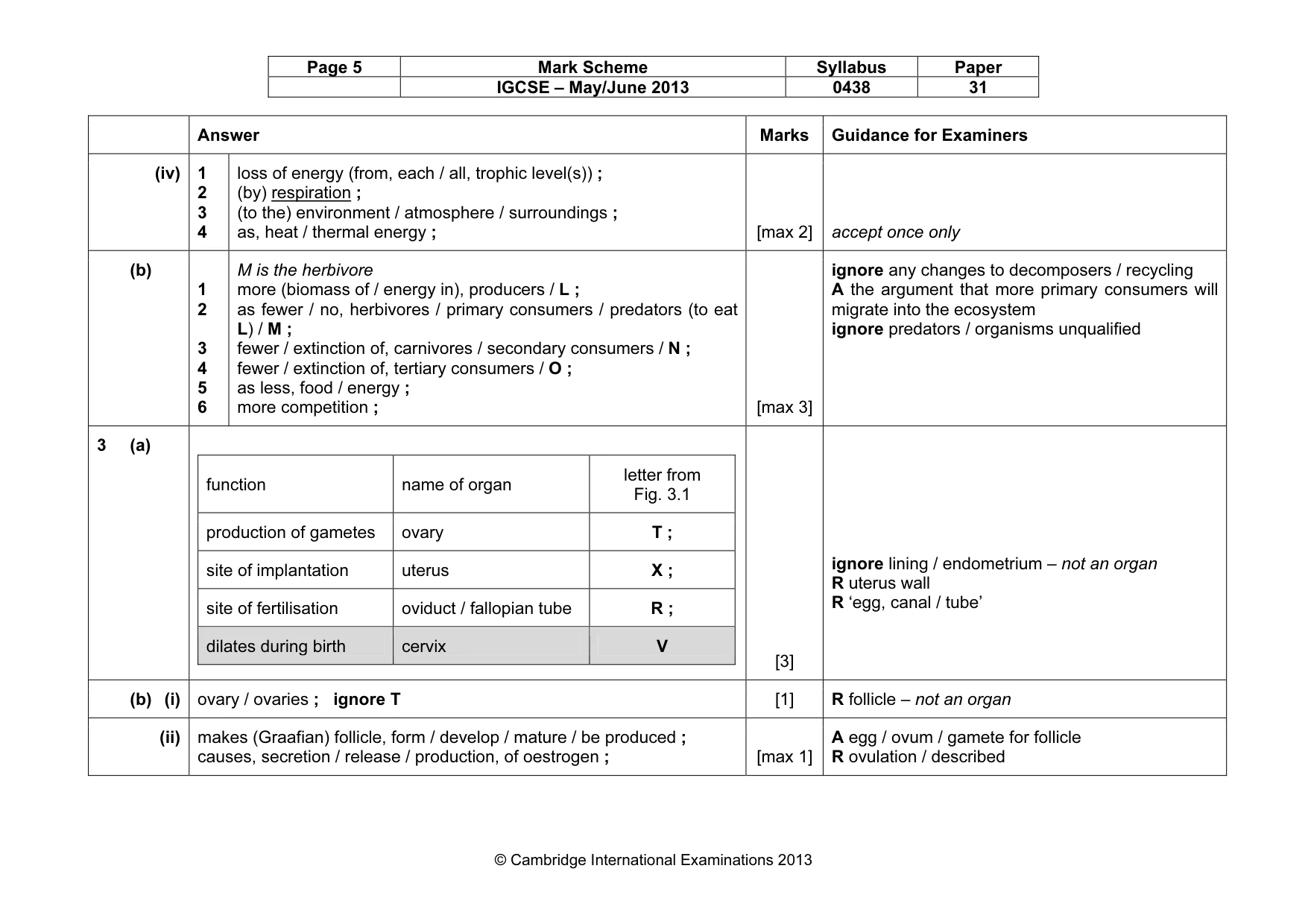
Page 5 Mark Scheme Syllabus Paper IGCSE – May/June 2013 0438 31 © Cambridge International Examinations 2013 Answer Marks Guidance for Examiners (iv) 1 2 3 4 loss of energy (from, each / all, trophic level(s)) ; (by) respiration ; (to the) environment / atmosphere / surroundings ; as, heat / thermal energy ; [max 2] accept once only (b) 1 2 3 4 5 6 M is the herbivore more (biomass of / energy in), producers / L ; as fewer / no, herbivores / primary consumers / predators (to eat L) / M ; fewer / extinction of, carnivores / secondary consumers / N ; fewer / extinction of, tertiary consumers / O ; as less, food / energy ; more competition ; [max 3] ignore any changes to decomposers / recycling A the argument that more primary consumers will migrate into the ecosystem ignore predators / organisms unqualified 3 (a) function name of organ letter from Fig. 3.1 production of gametes ovary T ; site of implantation uterus X ; site of fertilisation oviduct / fallopian tube R ; dilates during birth cervix V [3] ignore lining / endometrium – not an organ R uterus wall R ‘egg, canal / tube’ (b) (i) ovary / ovaries ; ignore T [1] R follicle – not an organ (ii) makes (Graafian) follicle, form / develop / mature / be produced ; causes, secretion / release / production, of oestrogen ; [max 1] A egg / ovum / gamete for follicle R ovulation / described
Mark scheme, page 6
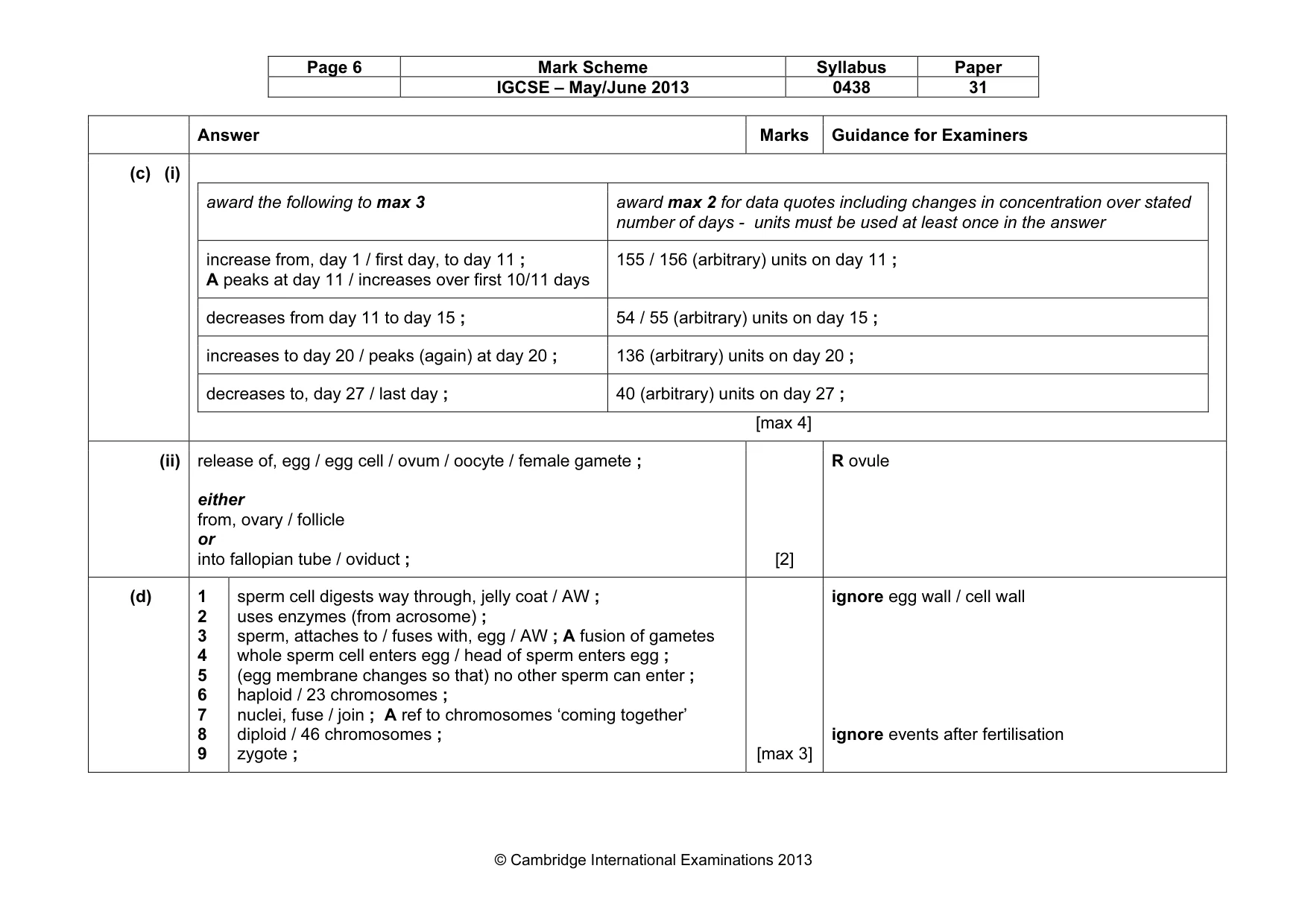
Page 6 Mark Scheme Syllabus Paper IGCSE – May/June 2013 0438 31 © Cambridge International Examinations 2013 Answer Marks Guidance for Examiners (c) (i) award the following to max 3 award max 2 for data quotes including changes in concentration over stated number of days - units must be used at least once in the answer increase from, day 1 / first day, to day 11 ; A peaks at day 11 / increases over first 10/11 days 155 / 156 (arbitrary) units on day 11 ; decreases from day 11 to day 15 ; 54 / 55 (arbitrary) units on day 15 ; increases to day 20 / peaks (again) at day 20 ; 136 (arbitrary) units on day 20 ; decreases to, day 27 / last day ; 40 (arbitrary) units on day 27 ; [max 4] (ii) release of, egg / egg cell / ovum / oocyte / female gamete ; either from, ovary / follicle or into fallopian tube / oviduct ; [2] R ovule (d) 1 2 3 4 5 6 7 8 9 sperm cell digests way through, jelly coat / AW ; uses enzymes (from acrosome) ; sperm, attaches to / fuses with, egg / AW ; A fusion of gametes whole sperm cell enters egg / head of sperm enters egg ; (egg membrane changes so that) no other sperm can enter ; haploid / 23 chromosomes ; nuclei, fuse / join ; A ref to chromosomes ‘coming together’ diploid / 46 chromosomes ; zygote ; [max 3] ignore egg wall / cell wall ignore events after fertilisation
Mark scheme, page 7
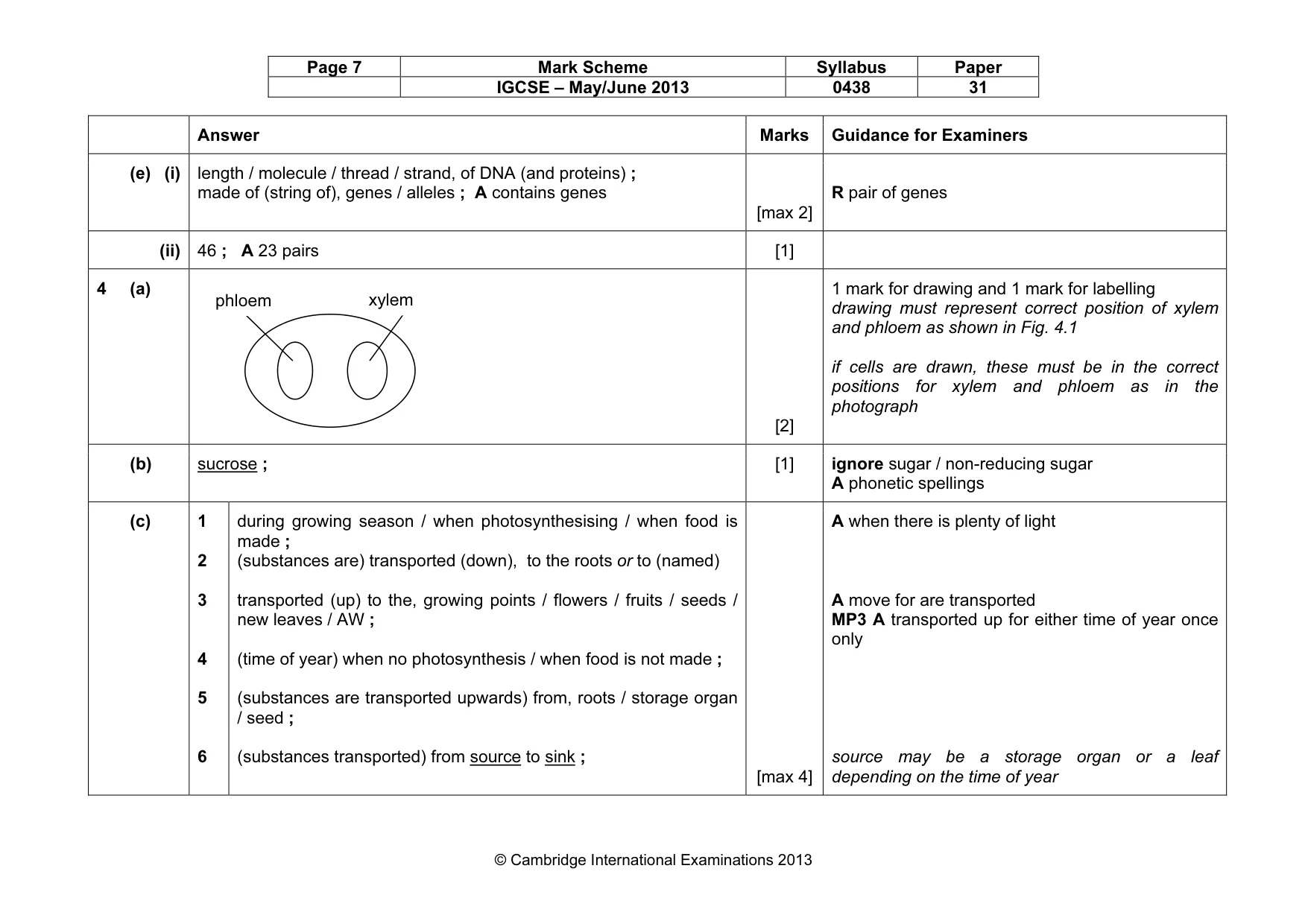
Page 7 Mark Scheme Syllabus Paper IGCSE – May/June 2013 0438 31 © Cambridge International Examinations 2013 Answer Marks Guidance for Examiners (e) (i) length / molecule / thread / strand, of DNA (and proteins) ; made of (string of), genes / alleles ; A contains genes [max 2] R pair of genes (ii) 46 ; A 23 pairs [1] 4 (a) [2] 1 mark for drawing and 1 mark for labelling drawing must represent correct position of xylem and phloem as shown in Fig. 4.1 if cells are drawn, these must be in the correct positions for xylem and phloem as in the photograph (b) sucrose ; [1] ignore sugar / non-reducing sugar A phonetic spellings (c) 1 2 3 4 5 6 during growing season / when photosynthesising / when food is made ; (substances are) transported (down), to the roots or to (named) transported (up) to the, growing points / flowers / fruits / seeds / new leaves / AW ; (time of year) when no photosynthesis / when food is not made ; (substances are transported upwards) from, roots / storage organ / seed ; (substances transported) from source to sink ; [max 4] A when there is plenty of light A move for are transported MP3 A transported up for either time of year once only source may be a storage organ or a leaf depending on the time of year phloem xylem
Mark scheme, page 8
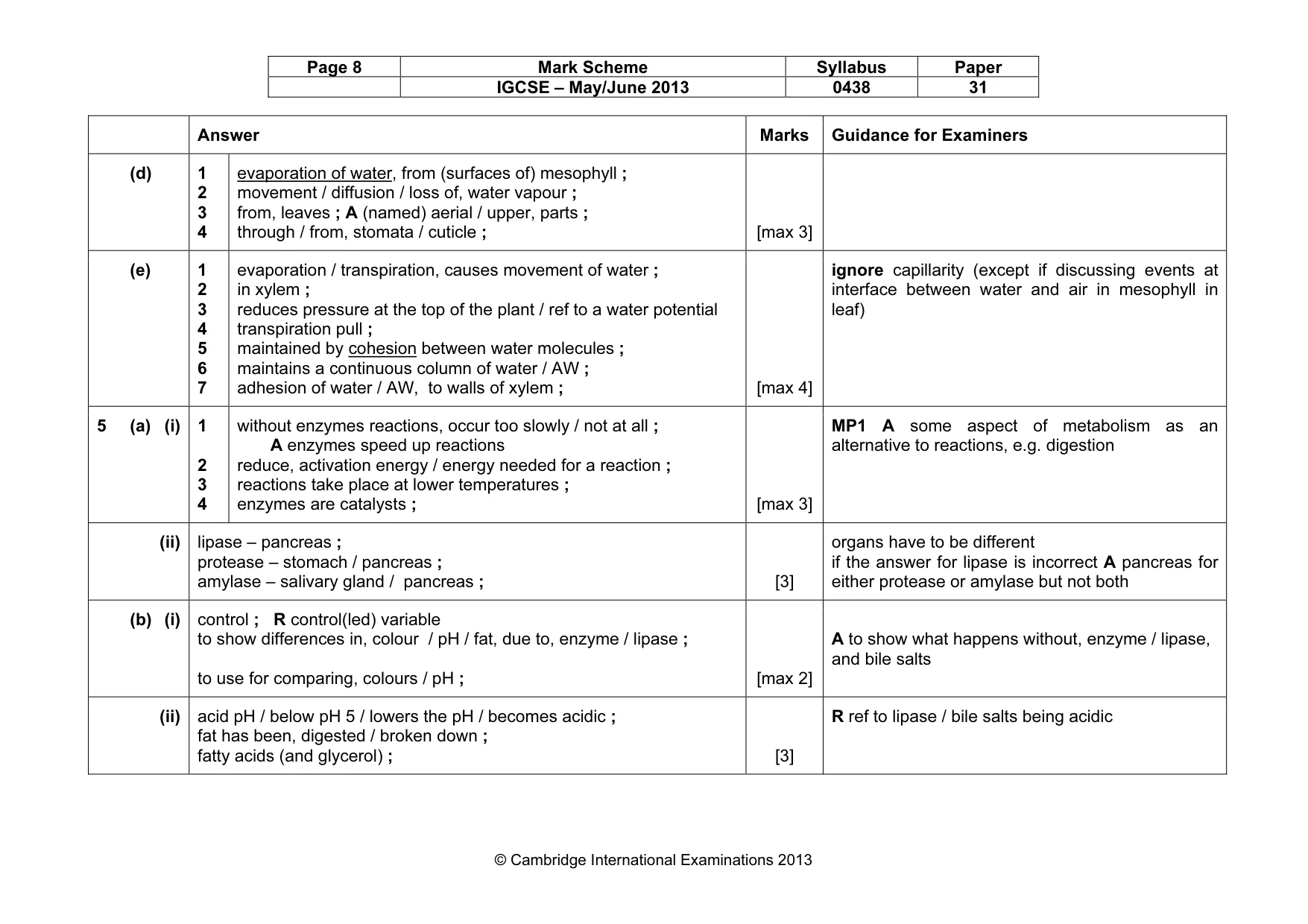
Page 8 Mark Scheme Syllabus Paper IGCSE – May/June 2013 0438 31 © Cambridge International Examinations 2013 Answer Marks Guidance for Examiners (d) 1 2 3 4 evaporation of water, from (surfaces of) mesophyll ; movement / diffusion / loss of, water vapour ; from, leaves ; A (named) aerial / upper, parts ; through / from, stomata / cuticle ; [max 3] (e) 1 2 3 4 5 6 7 evaporation / transpiration, causes movement of water ; in xylem ; reduces pressure at the top of the plant / ref to a water potential transpiration pull ; maintained by cohesion between water molecules ; maintains a continuous column of water / AW ; adhesion of water / AW, to walls of xylem ; [max 4] ignore capillarity (except if discussing events at interface between water and air in mesophyll in leaf) 5 (a) (i) 1 2 3 4 without enzymes reactions, occur too slowly / not at all ; A enzymes speed up reactions reduce, activation energy / energy needed for a reaction ; reactions take place at lower temperatures ; enzymes are catalysts ; [max 3] MP1 A some aspect of metabolism as an alternative to reactions, e.g. digestion (ii) lipase – pancreas ; protease – stomach / pancreas ; amylase – salivary gland / pancreas ; [3] organs have to be different if the answer for lipase is incorrect A pancreas for either protease or amylase but not both (b) (i) control ; R control(led) variable to show differences in, colour / pH / fat, due to, enzyme / lipase ; to use for comparing, colours / pH ; [max 2] A to show what happens without, enzyme / lipase, and bile salts (ii) acid pH / below pH 5 / lowers the pH / becomes acidic ; fat has been, digested / broken down ; fatty acids (and glycerol) ; [3] R ref to lipase / bile salts being acidic
Mark scheme, page 9
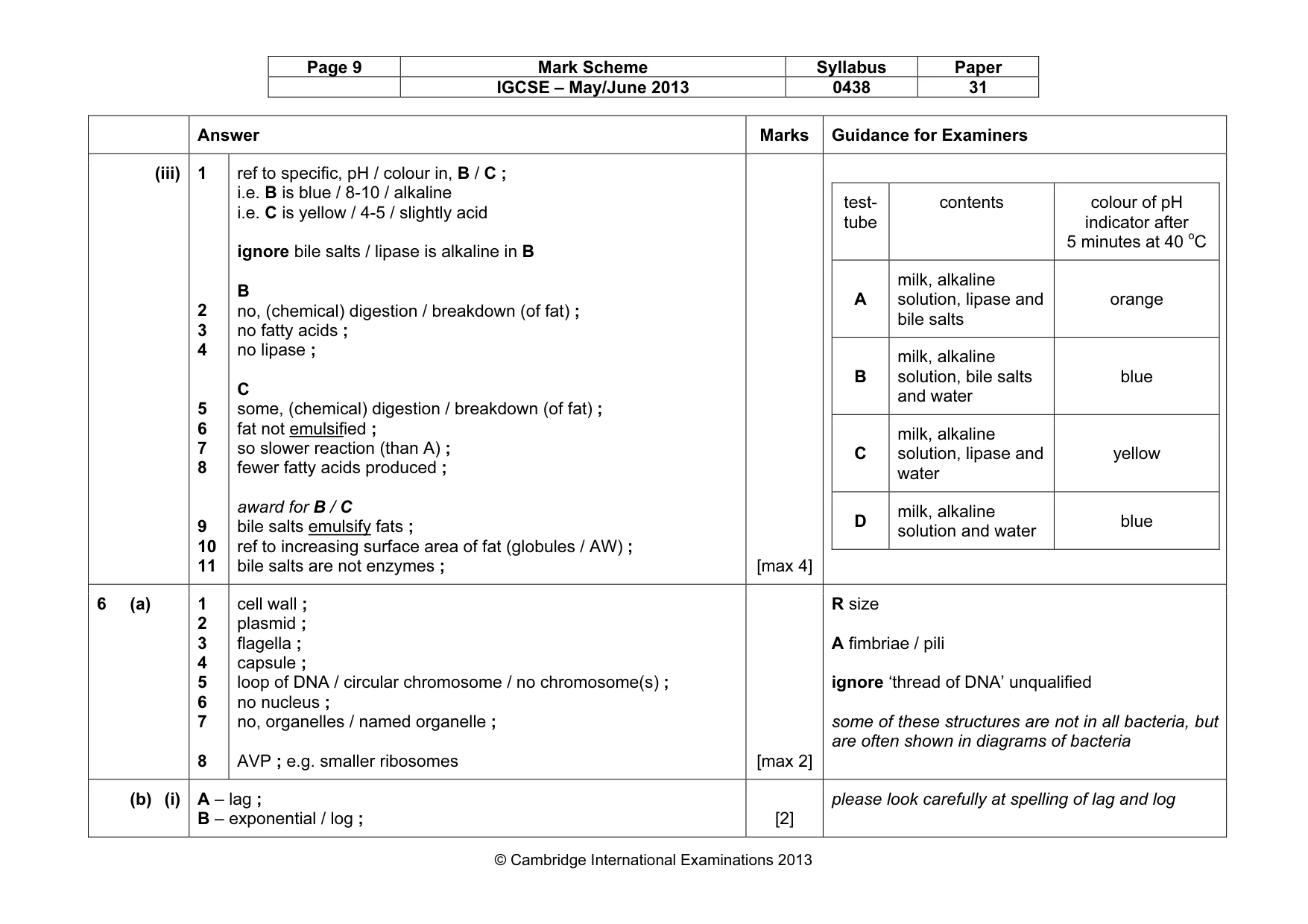
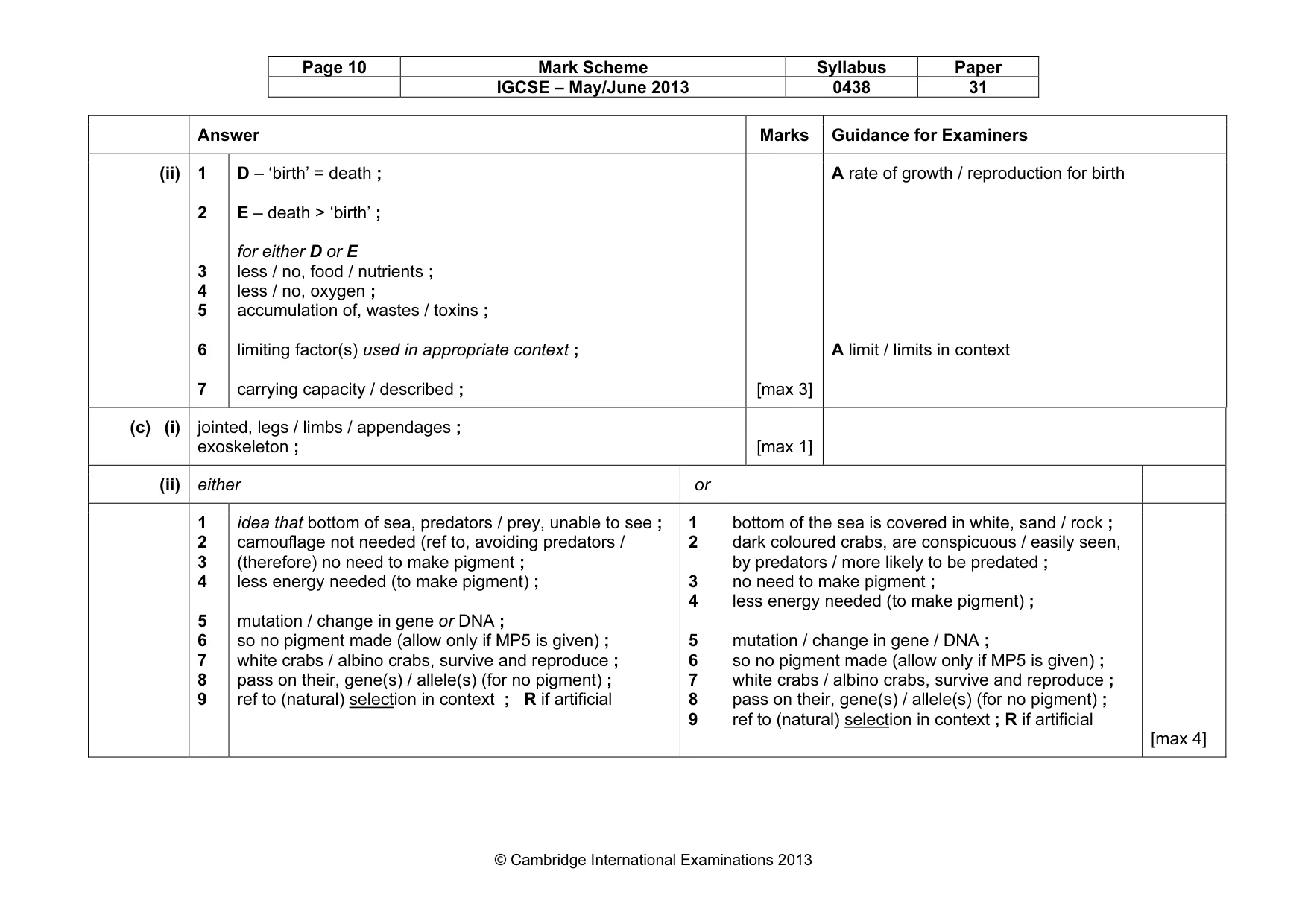
Page 9 Mark Scheme Syllabus Paper IGCSE – May/June 2013 0438 31 © Cambridge International Examinations 2013 Answer Marks Guidance for Examiners (iii) 1 2 3 4 5 6 7 8 9 10 11 ref to specific, pH / colour in, B / C ; i.e. B is blue / 8-10 / alkaline i.e. C is yellow / 4-5 / slightly acid ignore bile salts / lipase is alkaline in B B no, (chemical) digestion / breakdown (of fat) ; no fatty acids ; no lipase ; C some, (chemical) digestion / breakdown (of fat) ; fat not emulsified ; so slower reaction (than A) ; fewer fatty acids produced ; award for B / C bile salts emulsify fats ; ref to increasing surface area of fat (globules / AW) ; bile salts are not enzymes ; [max 4] test- tube contents colour of pH indicator after 5 minutes at 40 oC A milk, alkaline solution, lipase and bile salts orange B milk, alkaline solution, bile salts and water blue C milk, alkaline solution, lipase and water yellow D milk, alkaline solution and water blue 6 (a) 1 2 3 4 5 6 7 8 cell wall ; plasmid ; flagella ; capsule ; loop of DNA / circular chromosome / no chromosome(s) ; no nucleus ; no, organelles / named organelle ; AVP ; e.g. smaller ribosomes [max 2] R size A fimbriae / pili ignore ‘thread of DNA’ unqualified some of these structures are not in all bacteria, but are often shown in diagrams of bacteria (b) (i) A – lag ; B – exponential / log ; [2] please look carefully at spelling of lag and log
Mark scheme, page 10
Page 10 Mark Scheme Syllabus Paper IGCSE – May/June 2013 0438 31 © Cambridge International Examinations 2013 Answer Marks Guidance for Examiners (ii) 1 2 3 4 5 6 7 D – ‘birth’ = death ; E – death > ‘birth’ ; for either D or E less / no, food / nutrients ; less / no, oxygen ; accumulation of, wastes / toxins ; limiting factor(s) used in appropriate context ; carrying capacity / described ; [max 3] A rate of growth / reproduction for birth A limit / limits in context (c) (i) jointed, legs / limbs / appendages ; exoskeleton ; [max 1] (ii) either or 1 2 3 4 5 6 7 8 9 idea that bottom of sea, predators / prey, unable to see ; camouflage not needed (ref to, avoiding predators / (therefore) no need to make pigment ; less energy needed (to make pigment) ; mutation / change in gene or DNA ; so no pigment made (allow only if MP5 is given) ; white crabs / albino crabs, survive and reproduce ; pass on their, gene(s) / allele(s) (for no pigment) ; ref to (natural) selection in context ; R if artificial 1 2 3 4 5 6 7 8 9 bottom of the sea is covered in white, sand / rock ; dark coloured crabs, are conspicuous / easily seen, by predators / more likely to be predated ; no need to make pigment ; less energy needed (to make pigment) ; mutation / change in gene / DNA ; so no pigment made (allow only if MP5 is given) ; white crabs / albino crabs, survive and reproduce ; pass on their, gene(s) / allele(s) (for no pigment) ; ref to (natural) selection in context ; R if artificial [max 4]