Cambridge IGCSE Biology (BES) 0438 — 2018 Oct/Nov Paper 3 · Variant 1
0438/31/O/N/18 · 80 marks · ≈90 min
The question paper and its mark scheme, free to read here and free to download. This is Cambridge’s own paper, exactly as it was sat.
Question paper20 pages




Mark scheme14 pages
Answers below. Sit the paper first if you are practising.

Paper as text
Question paper, page 1
* 2 7 0 6 9 7 5 5 8 7 * This document consists of 18 printed pages and 2 blank pages. DC (SC) 173871/1 © UCLES 2018 [Turn over BIOLOGY (US) 0438/31 Paper 3 Theory (Core) October/November 2018 1 hour 15 minutes Candidates answer on the Question Paper. No Additional Materials are required. READ THESE INSTRUCTIONS FIRST Write your Center number, candidate number and name on all the work you hand in. Write in dark blue or black pen. You may use an HB pencil for any diagrams or graphs. Do not use staples, paper clips, glue or correction fluid. DO NOT WRITE IN ANY BARCODES. Answer all questions. Electronic calculators may be used. You may lose marks if you do not show your working or if you do not use appropriate units. At the end of the examination, fasten all your work securely together. The number of marks is given in brackets [ ] at the end of each question or part question. Cambridge International Examinations Cambridge International General Certificate of Secondary Education
Question paper, page 2
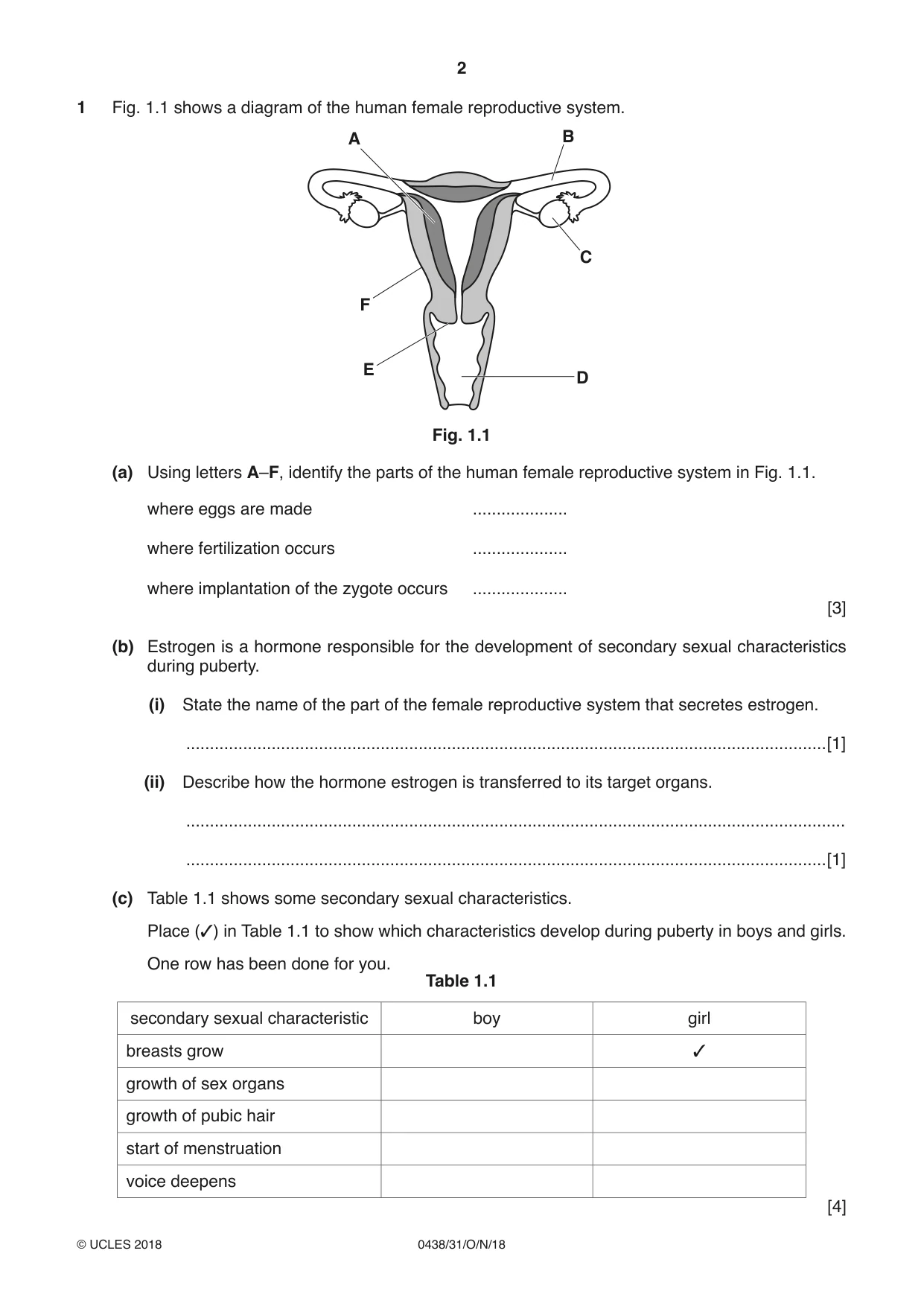
2 0438/31/O/N/18 © UCLES 2018 1 Fig. 1.1 shows a diagram of the human female reproductive system. D F E A B C Fig. 1.1 (a) Using letters A–F, identify the parts of the human female reproductive system in Fig. 1.1. where eggs are made … where fertilization occurs … where implantation of the zygote occurs … [3] (b) Estrogen is a hormone responsible for the development of secondary sexual characteristics during puberty. (i) State the name of the part of the female reproductive system that secretes estrogen. …[1] (ii) Describe how the hormone estrogen is transferred to its target organs. … …[1] (c) Table 1.1 shows some secondary sexual characteristics. Place (3) in Table 1.1 to show which characteristics develop during puberty in boys and girls. One row has been done for you. Table 1.1 secondary sexual characteristic boy girl breasts grow 3 growth of sex organs growth of pubic hair start of menstruation voice deepens [4]
Question paper, page 3
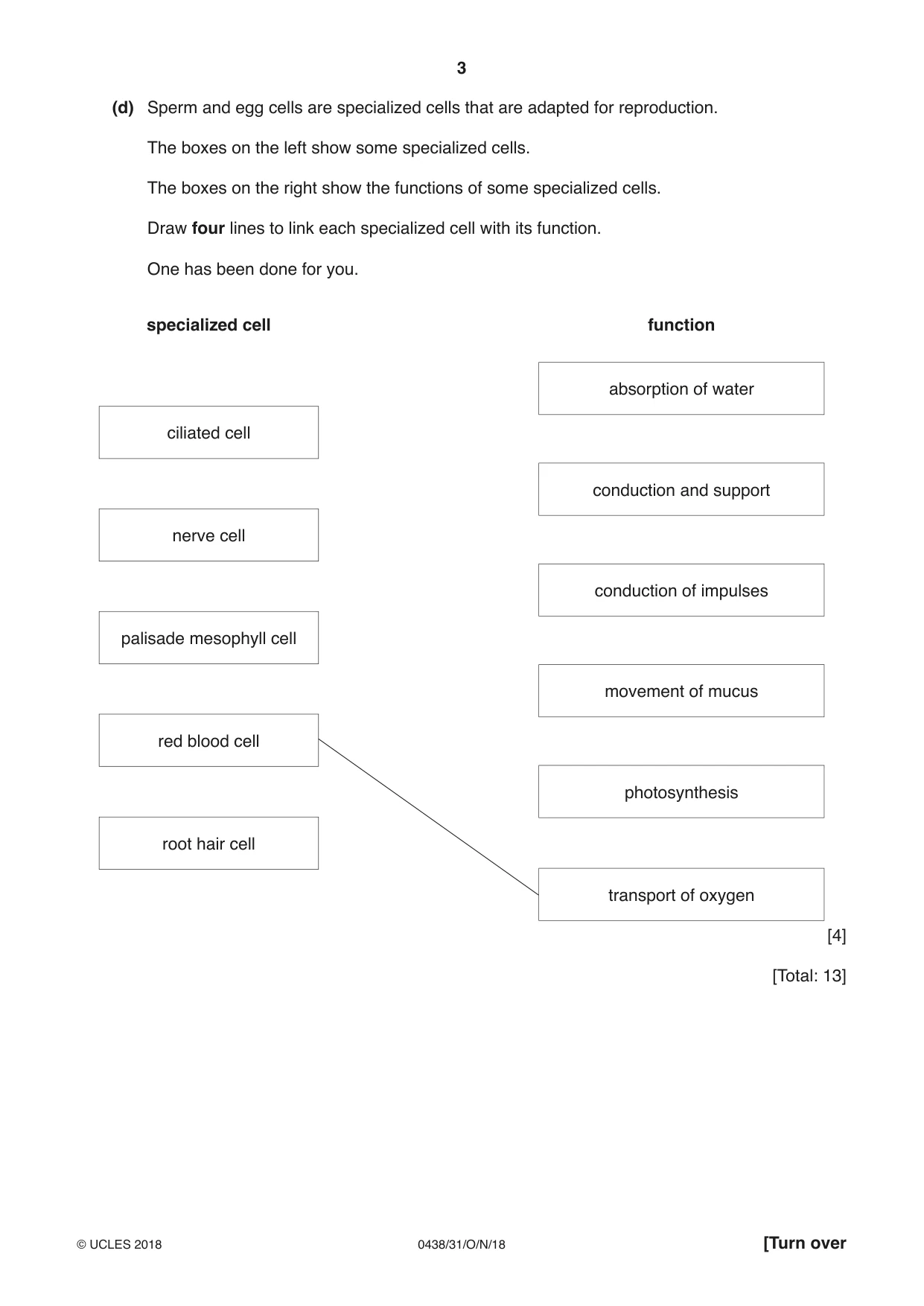
3 0438/31/O/N/18 © UCLES 2018 [Turn over (d) Sperm and egg cells are specialized cells that are adapted for reproduction. The boxes on the left show some specialized cells. The boxes on the right show the functions of some specialized cells. Draw four lines to link each specialized cell with its function. One has been done for you. ciliated cell nerve cell palisade mesophyll cell red blood cell root hair cell absorption of water conduction and support conduction of impulses movement of mucus photosynthesis transport of oxygen specialized cell function [4] [Total: 13]
Question paper, page 4
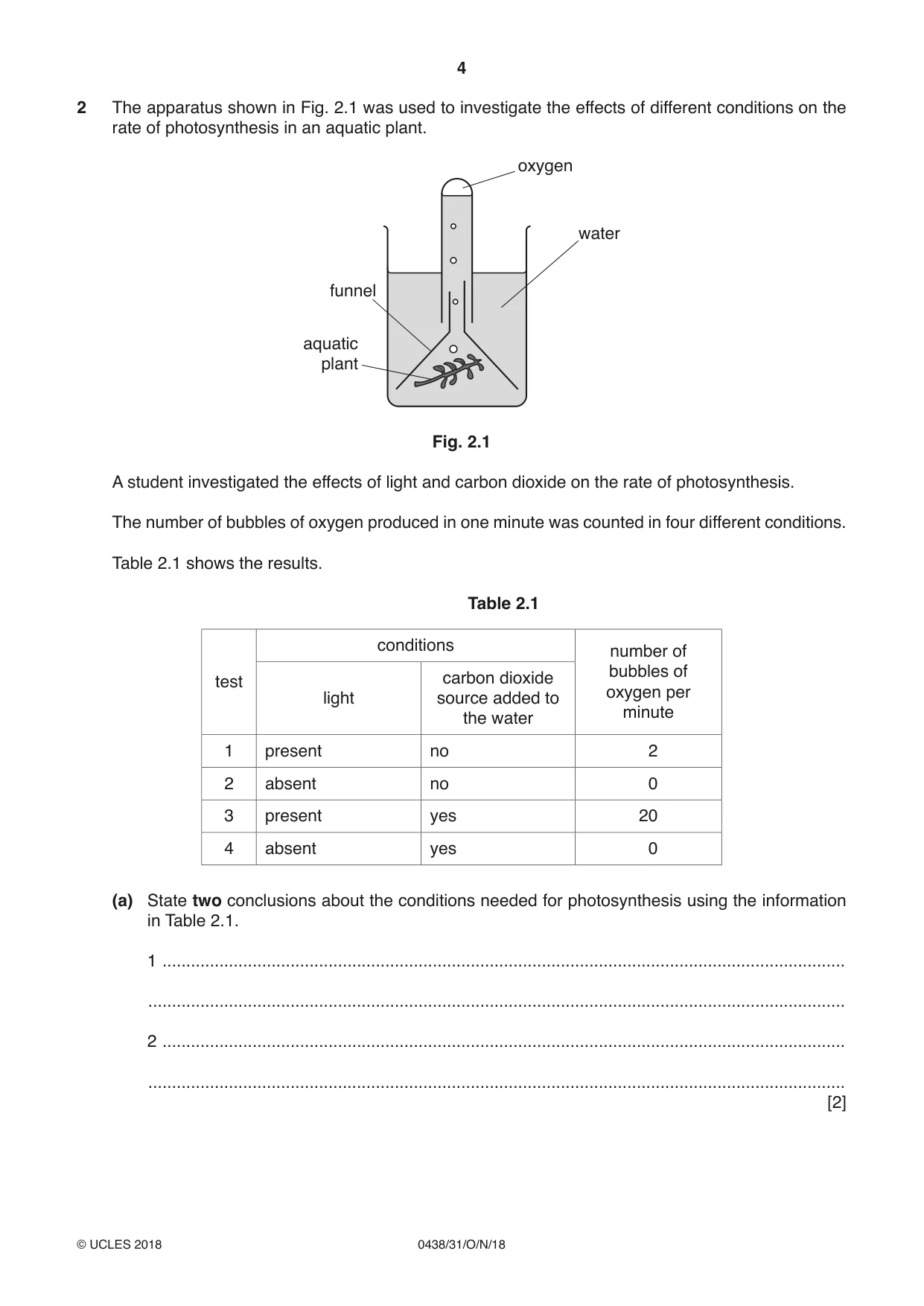
4 0438/31/O/N/18 © UCLES 2018 2 The apparatus shown in Fig. 2.1 was used to investigate the effects of different conditions on the rate of photosynthesis in an aquatic plant. oxygen water funnel aquatic plant Fig. 2.1 A student investigated the effects of light and carbon dioxide on the rate of photosynthesis. The number of bubbles of oxygen produced in one minute was counted in four different conditions. Table 2.1 shows the results. Table 2.1 test conditions number of bubbles of oxygen per minute light carbon dioxide source added to the water 1 present no 2 2 absent no 0 3 present yes 20 4 absent yes 0 (a) State two conclusions about the conditions needed for photosynthesis using the information in Table 2.1. 1 … … 2 … … [2]
Question paper, page 5
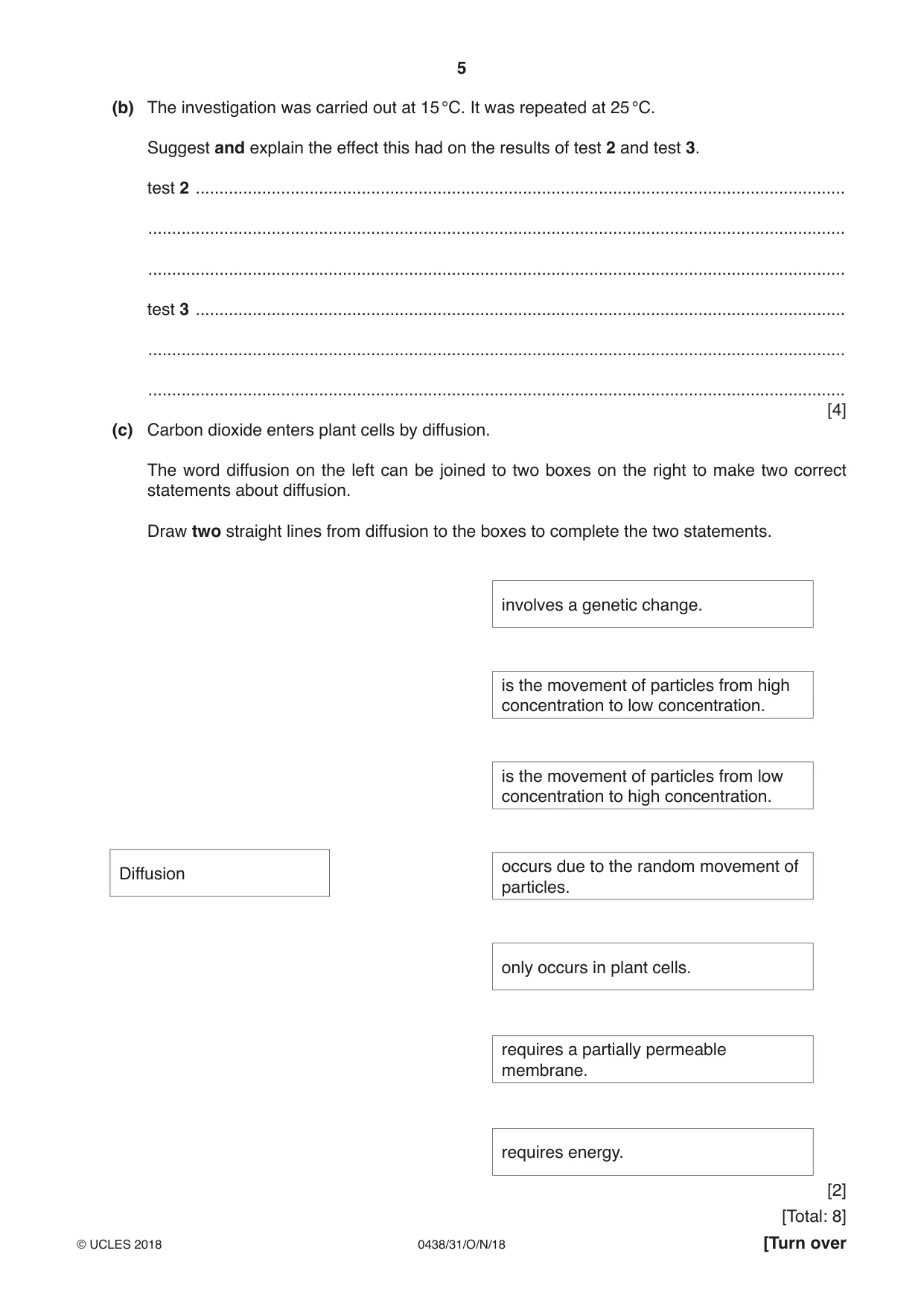
5 0438/31/O/N/18 © UCLES 2018 [Turn over (b) The investigation was carried out at 15 °C. It was repeated at 25 °C. Suggest and explain the effect this had on the results of test 2 and test 3. test 2 … … … test 3 … … … [4] (c) Carbon dioxide enters plant cells by diffusion. The word diffusion on the left can be joined to two boxes on the right to make two correct statements about diffusion. Draw two straight lines from diffusion to the boxes to complete the two statements. Diffusion involves a genetic change. is the movement of particles from high concentration to low concentration. is the movement of particles from low concentration to high concentration. occurs due to the random movement of particles. only occurs in plant cells. requires a partially permeable membrane. requires energy. [2] [Total: 8]
Question paper, page 6
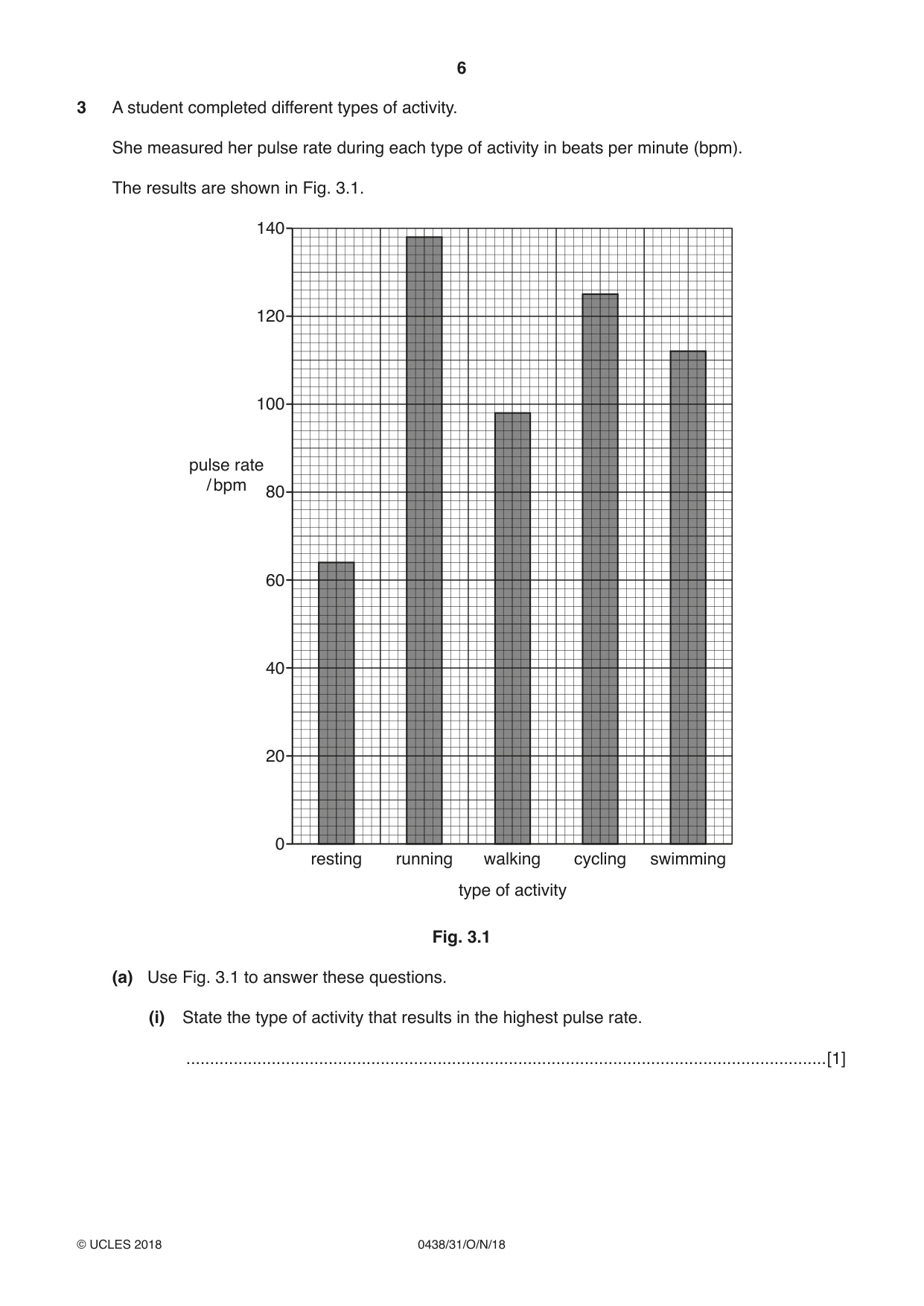
6 0438/31/O/N/18 © UCLES 2018 3 A student completed different types of activity. She measured her pulse rate during each type of activity in beats per minute (bpm). The results are shown in Fig. 3.1. pulse rate / bpm type of activity 140 120 100 80 60 40 20 0 resting running walking cycling swimming Fig. 3.1 (a) Use Fig. 3.1 to answer these questions. (i) State the type of activity that results in the highest pulse rate. …[1]
Question paper, page 7
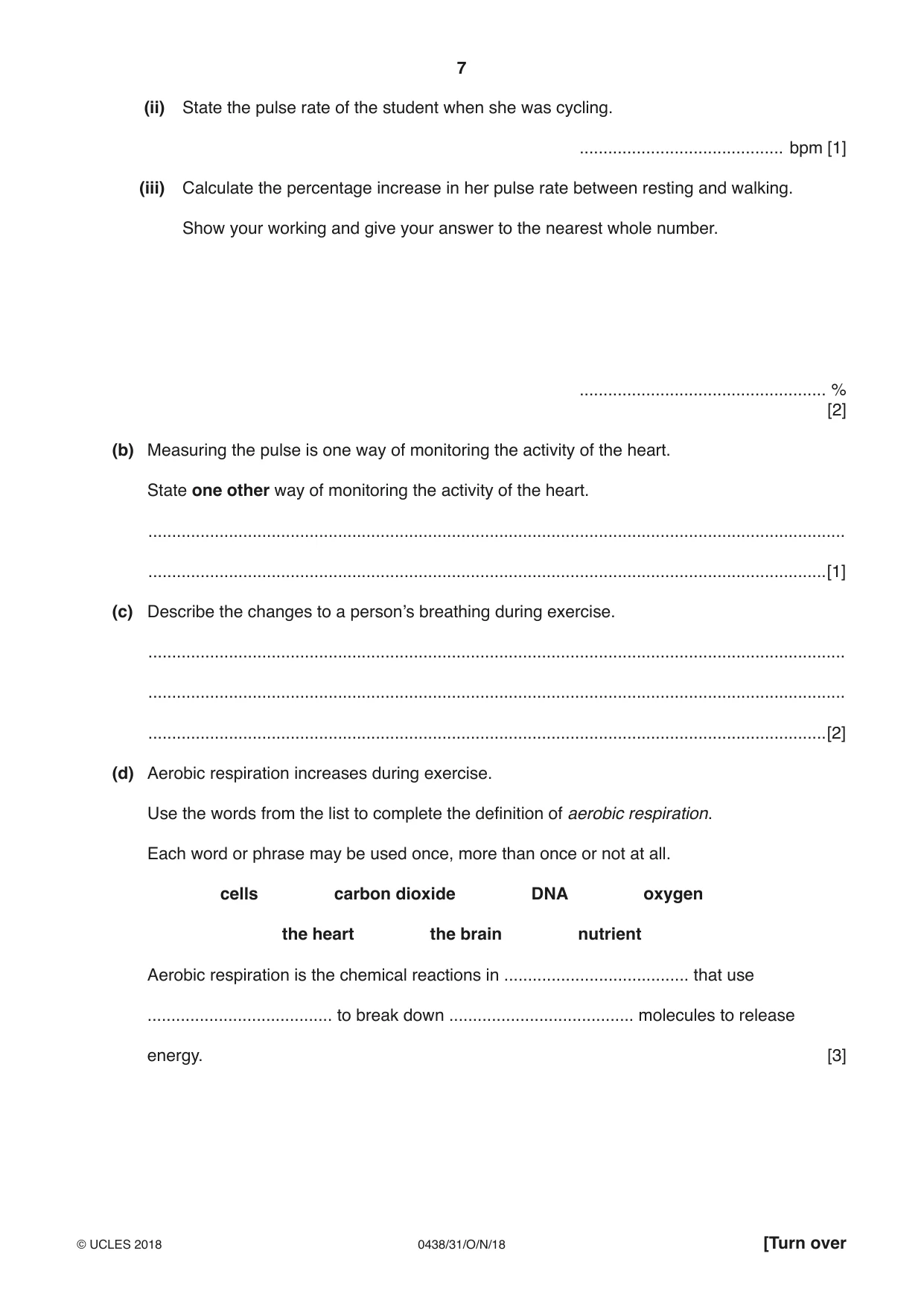
7 0438/31/O/N/18 © UCLES 2018 [Turn over (ii) State the pulse rate of the student when she was cycling. … bpm [1] (iii) Calculate the percentage increase in her pulse rate between resting and walking. Show your working and give your answer to the nearest whole number. … % [2] (b) Measuring the pulse is one way of monitoring the activity of the heart. State one other way of monitoring the activity of the heart. … …[1] (c) Describe the changes to a person’s breathing during exercise. … … …[2] (d) Aerobic respiration increases during exercise. Use the words from the list to complete the definition of aerobic respiration. Each word or phrase may be used once, more than once or not at all. cells carbon dioxide DNA oxygen the heart the brain nutrient Aerobic respiration is the chemical reactions in … that use … to break down … molecules to release energy. [3]
Question paper, page 8
8 0438/31/O/N/18 © UCLES 2018 (e) Anaerobic respiration occurs when exercising vigorously. (i) State the word equation for anaerobic respiration in muscle cells. …[1] (ii) State one advantage of using aerobic rather than anaerobic respiration in humans. … …[1] [Total: 12]
Question paper, page 9
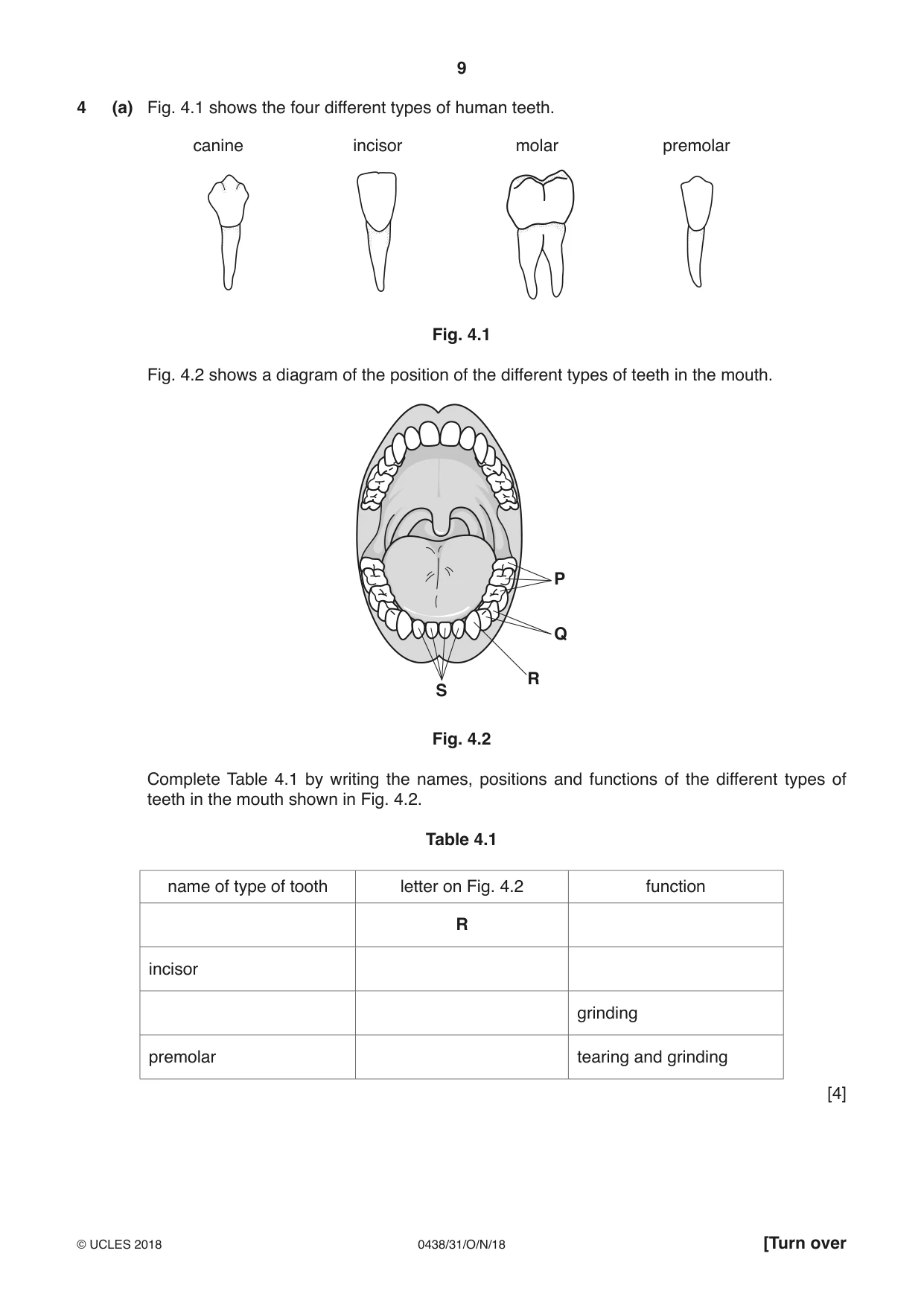
9 0438/31/O/N/18 © UCLES 2018 [Turn over 4 (a) Fig. 4.1 shows the four different types of human teeth. incisor canine premolar molar Fig. 4.1 Fig. 4.2 shows a diagram of the position of the different types of teeth in the mouth. R Q S P Fig. 4.2 Complete Table 4.1 by writing the names, positions and functions of the different types of teeth in the mouth shown in Fig. 4.2. Table 4.1 name of type of tooth letter on Fig. 4.2 function R incisor grinding premolar tearing and grinding [4]
Question paper, page 10
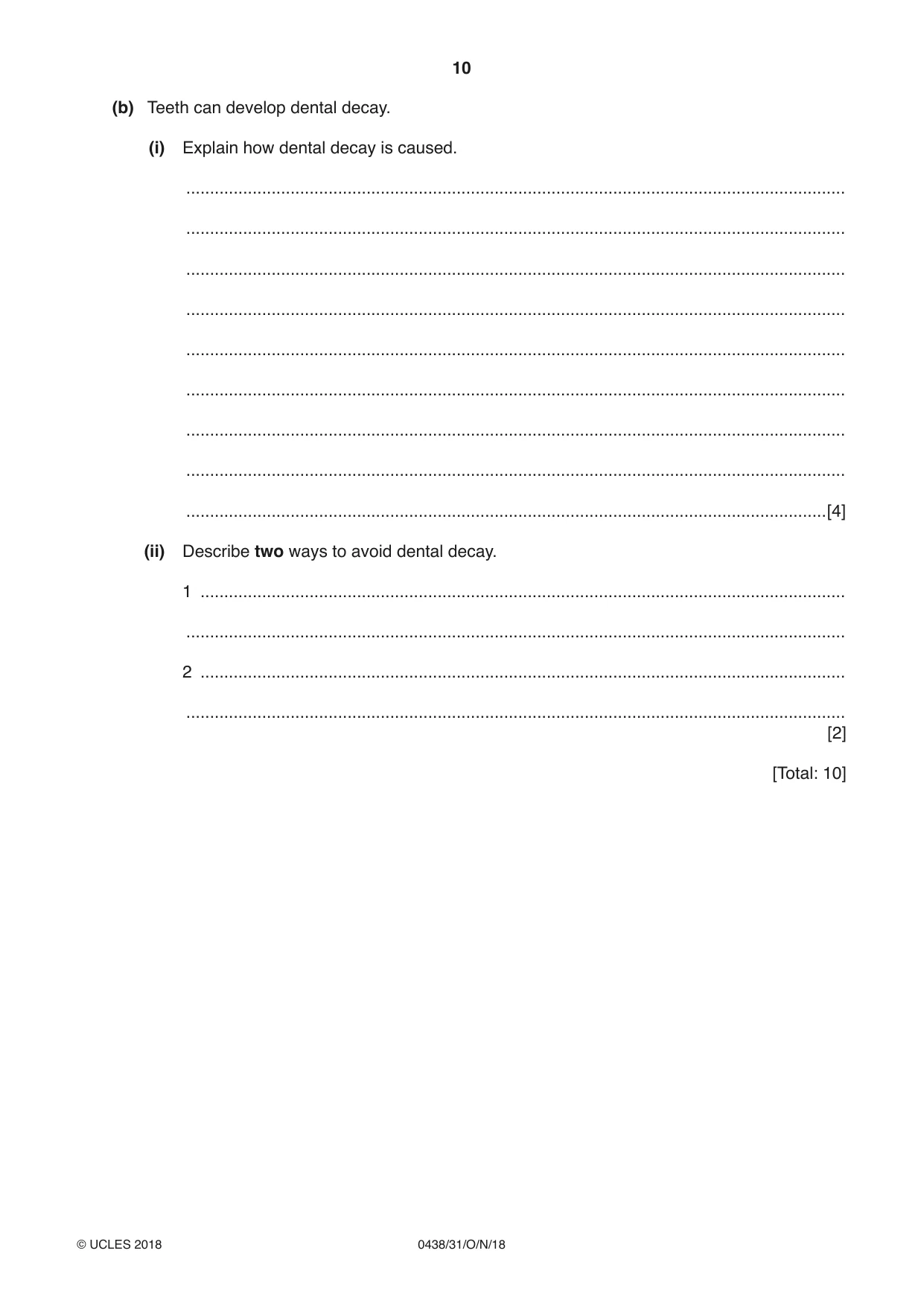
10 0438/31/O/N/18 © UCLES 2018 (b) Teeth can develop dental decay. (i) Explain how dental decay is caused. … … … … … … … … …[4] (ii) Describe two ways to avoid dental decay. 1 … … 2 … … [2] [Total: 10]
Question paper, page 11
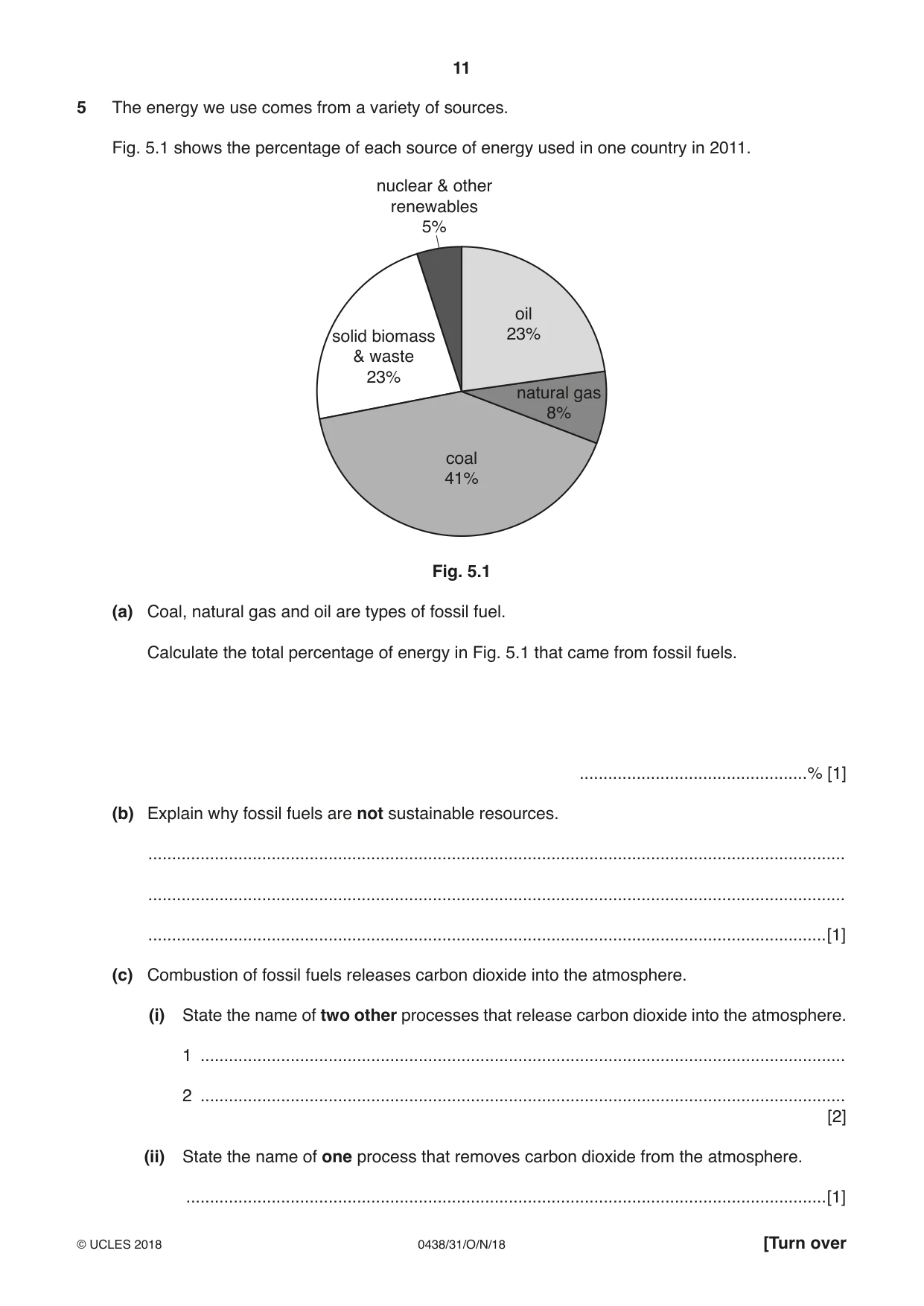
11 0438/31/O/N/18 © UCLES 2018 [Turn over 5 The energy we use comes from a variety of sources. Fig. 5.1 shows the percentage of each source of energy used in one country in 2011. oil 23% natural gas 8% coal 41% solid biomass & waste 23% nuclear & other renewables 5% Fig. 5.1 (a) Coal, natural gas and oil are types of fossil fuel. Calculate the total percentage of energy in Fig. 5.1 that came from fossil fuels. …% [1] (b) Explain why fossil fuels are not sustainable resources. … … …[1] (c) Combustion of fossil fuels releases carbon dioxide into the atmosphere. (i) State the name of two other processes that release carbon dioxide into the atmosphere. 1 … 2 … [2] (ii) State the name of one process that removes carbon dioxide from the atmosphere. …[1]
Question paper, page 12
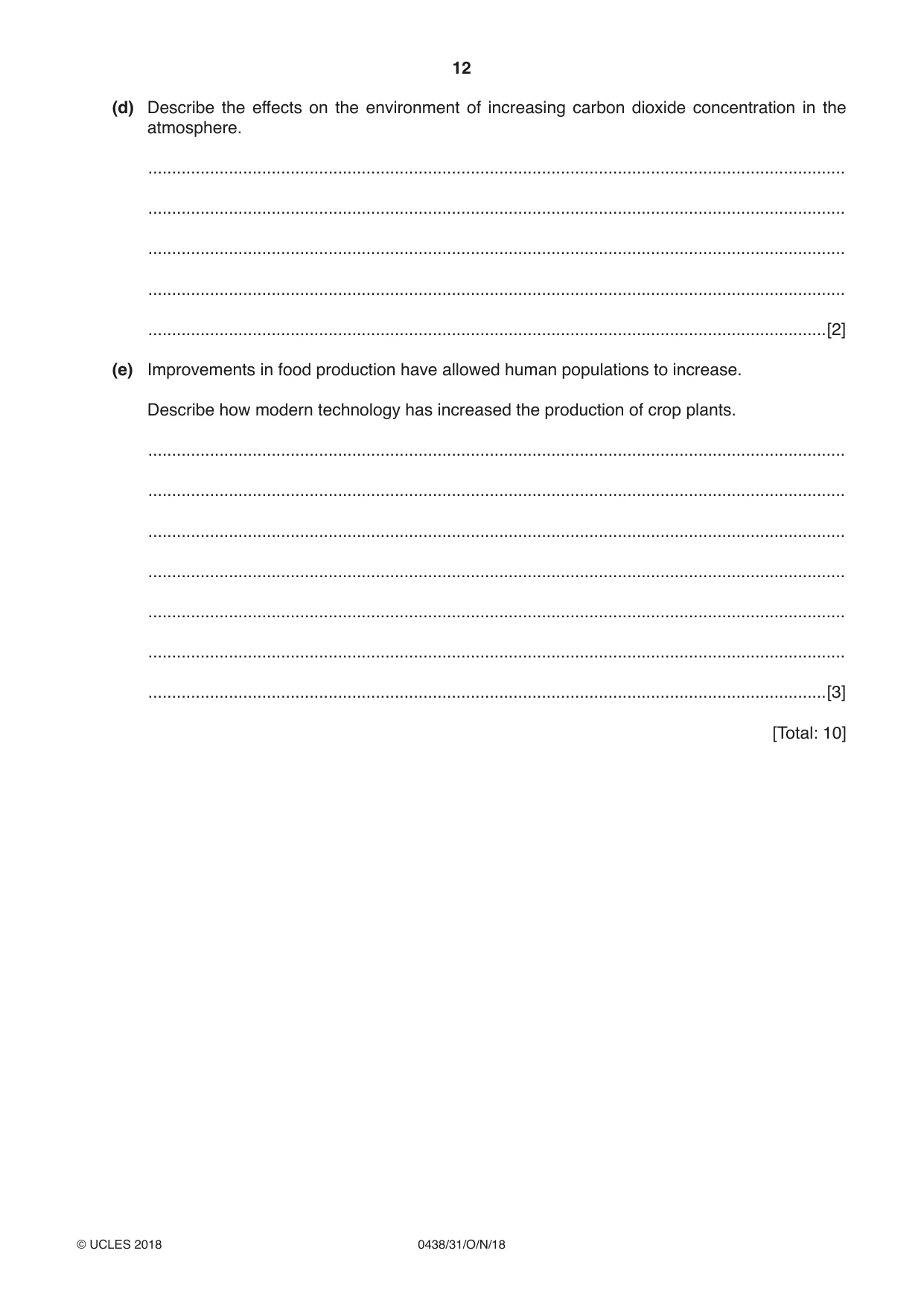
12 0438/31/O/N/18 © UCLES 2018 (d) Describe the effects on the environment of increasing carbon dioxide concentration in the atmosphere. … … … … …[2] (e) Improvements in food production have allowed human populations to increase. Describe how modern technology has increased the production of crop plants. … … … … … … …[3] [Total: 10]
Question paper, page 13
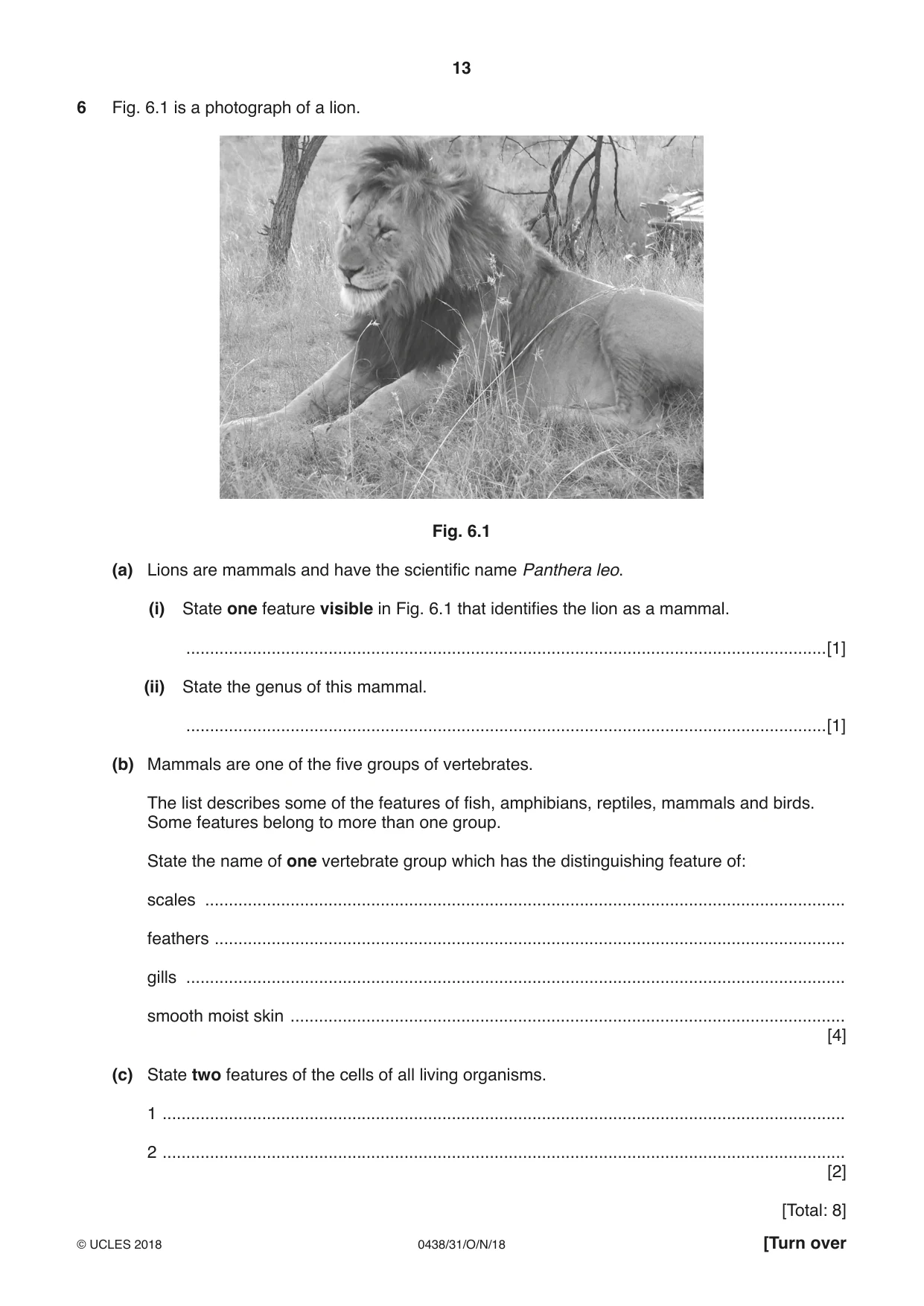
13 0438/31/O/N/18 © UCLES 2018 [Turn over 6 Fig. 6.1 is a photograph of a lion. Fig. 6.1 (a) Lions are mammals and have the scientific name Panthera leo. (i) State one feature visible in Fig. 6.1 that identifies the lion as a mammal. …[1] (ii) State the genus of this mammal. …[1] (b) Mammals are one of the five groups of vertebrates. The list describes some of the features of fish, amphibians, reptiles, mammals and birds. Some features belong to more than one group. State the name of one vertebrate group which has the distinguishing feature of: scales … feathers … gills … smooth moist skin … [4] (c) State two features of the cells of all living organisms. 1 … 2 … [2] [Total: 8]
Question paper, page 14
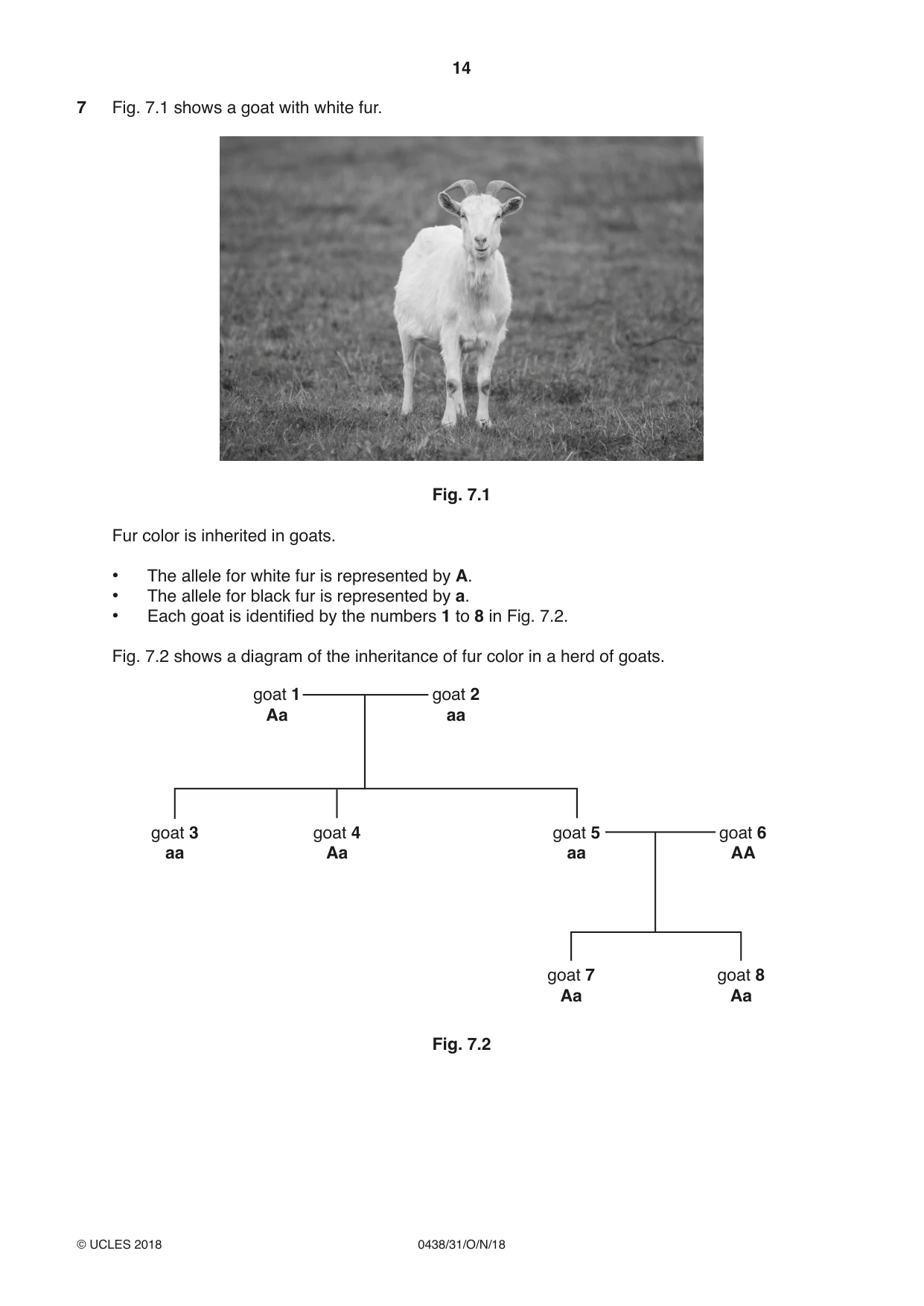
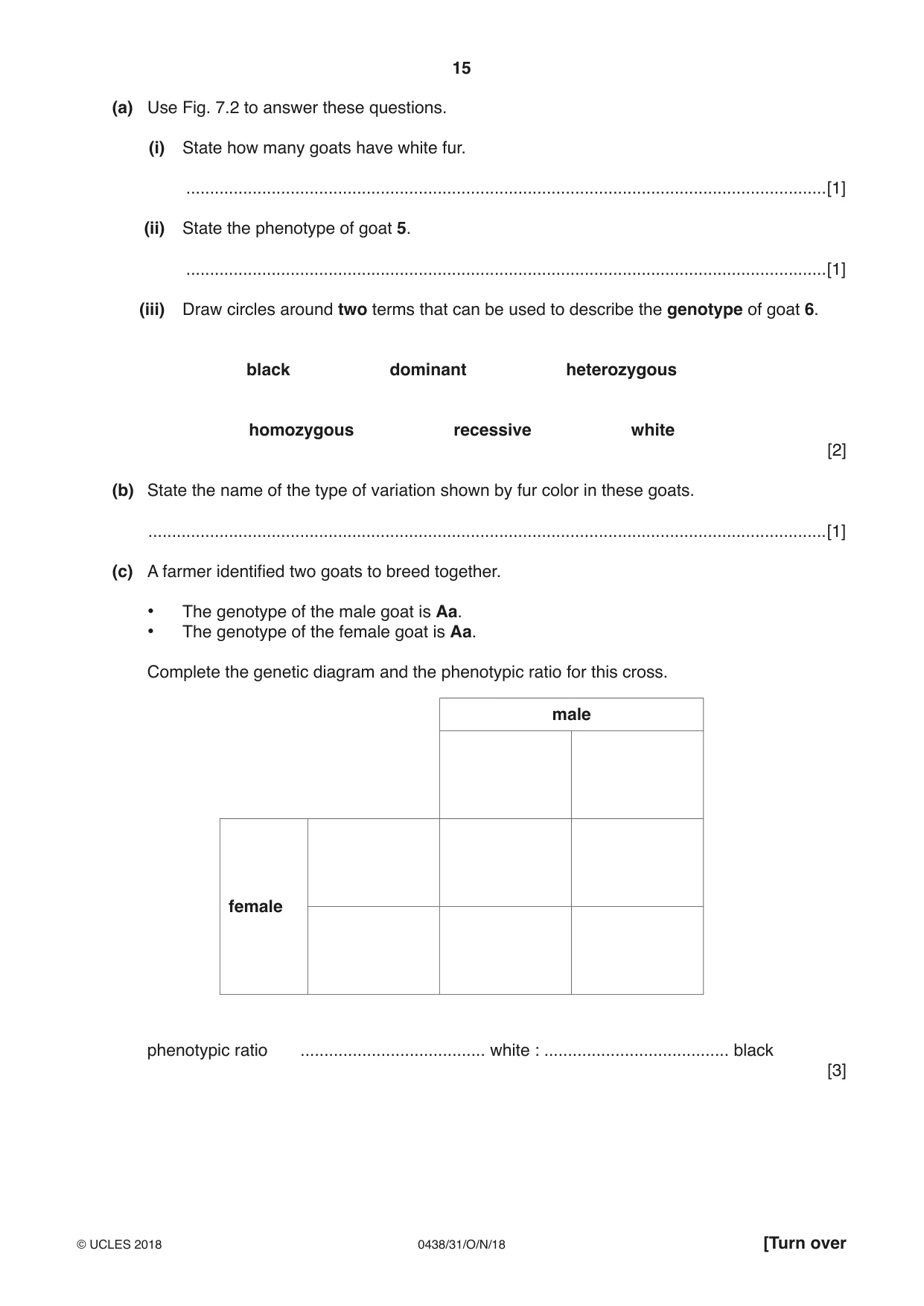
14 0438/31/O/N/18 © UCLES 2018 7 Fig. 7.1 shows a goat with white fur. Fig. 7.1 Fur color is inherited in goats. • The allele for white fur is represented by A. • The allele for black fur is represented by a. • Each goat is identified by the numbers 1 to 8 in Fig. 7.2. Fig. 7.2 shows a diagram of the inheritance of fur color in a herd of goats. goat 1 Aa goat 3 aa goat 4 Aa goat 5 aa goat 7 Aa goat 8 Aa goat 6 AA goat 2 aa Fig. 7.2
Question paper, page 15
15 0438/31/O/N/18 © UCLES 2018 [Turn over (a) Use Fig. 7.2 to answer these questions. (i) State how many goats have white fur. …[1] (ii) State the phenotype of goat 5. …[1] (iii) Draw circles around two terms that can be used to describe the genotype of goat 6. black dominant heterozygous homozygous recessive white [2] (b) State the name of the type of variation shown by fur color in these goats. …[1] (c) A farmer identified two goats to breed together. • The genotype of the male goat is Aa. • The genotype of the female goat is Aa. Complete the genetic diagram and the phenotypic ratio for this cross. male female phenotypic ratio … white : … black [3]
Question paper, page 16
16 0438/31/O/N/18 © UCLES 2018 (d) Describe the process a farmer could use to breed a herd of white goats. … … … … … … …[3] [Total: 11]
Question paper, page 17
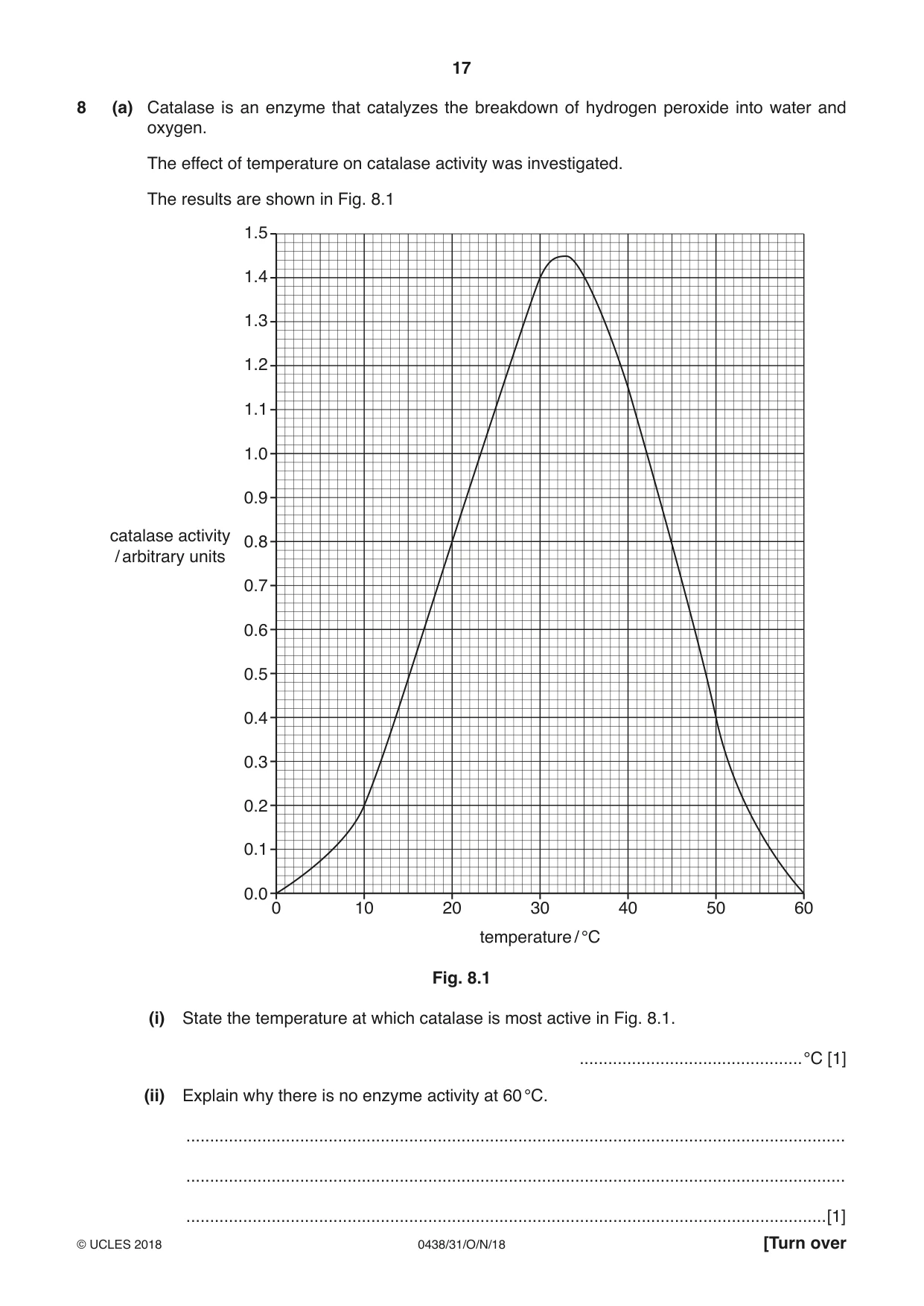
17 0438/31/O/N/18 © UCLES 2018 [Turn over 8 (a) Catalase is an enzyme that catalyzes the breakdown of hydrogen peroxide into water and oxygen. The effect of temperature on catalase activity was investigated. The results are shown in Fig. 8.1 0.0 0 10 20 30 temperature / °C catalase activity / arbitrary units 40 50 60 0.1 0.2 0.3 0.4 0.5 0.6 0.7 0.8 0.9 1.0 1.2 1.1 1.3 1.4 1.5 Fig. 8.1 (i) State the temperature at which catalase is most active in Fig. 8.1. …°C [1] (ii) Explain why there is no enzyme activity at 60 °C. … … …[1]
Question paper, page 18
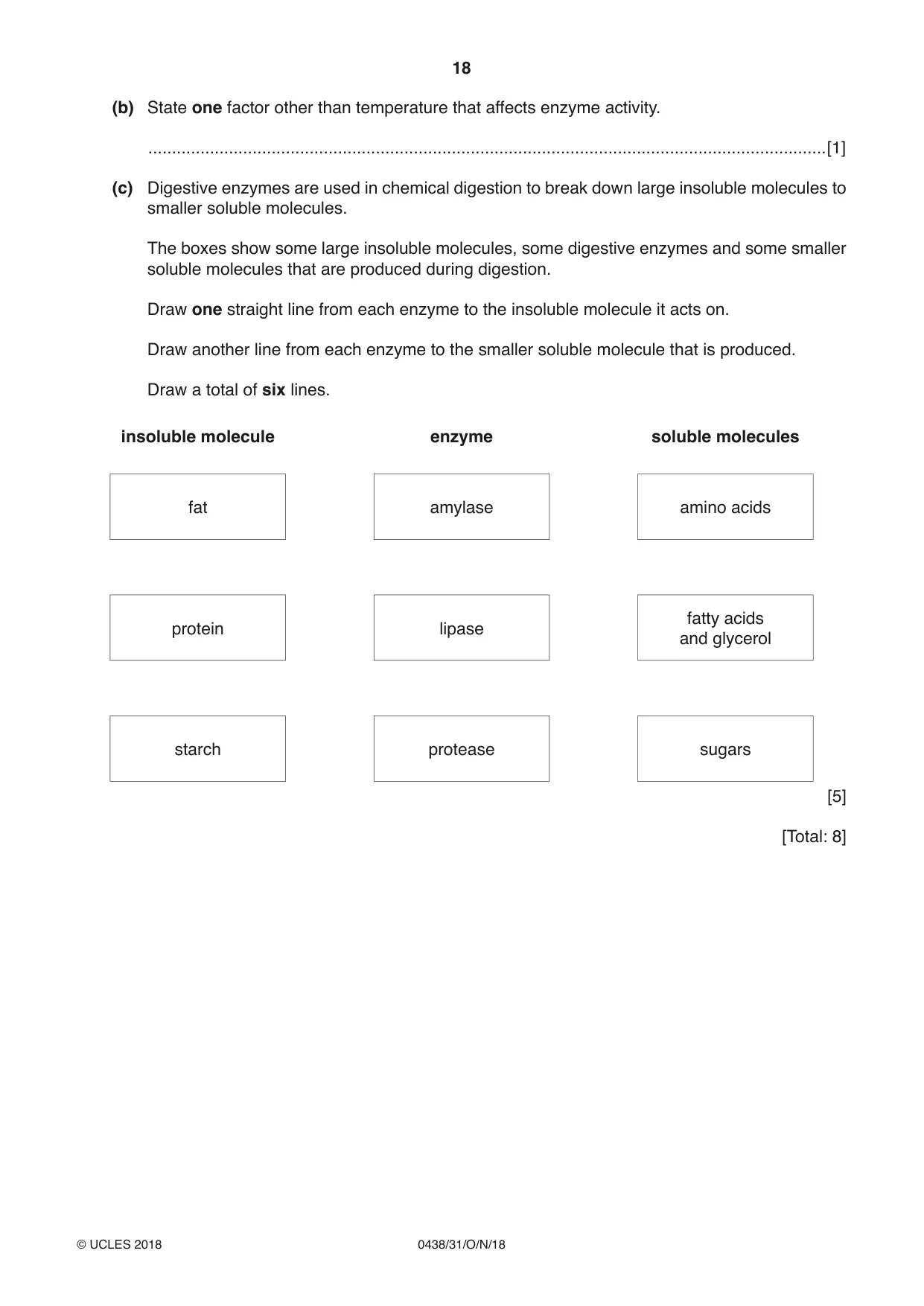
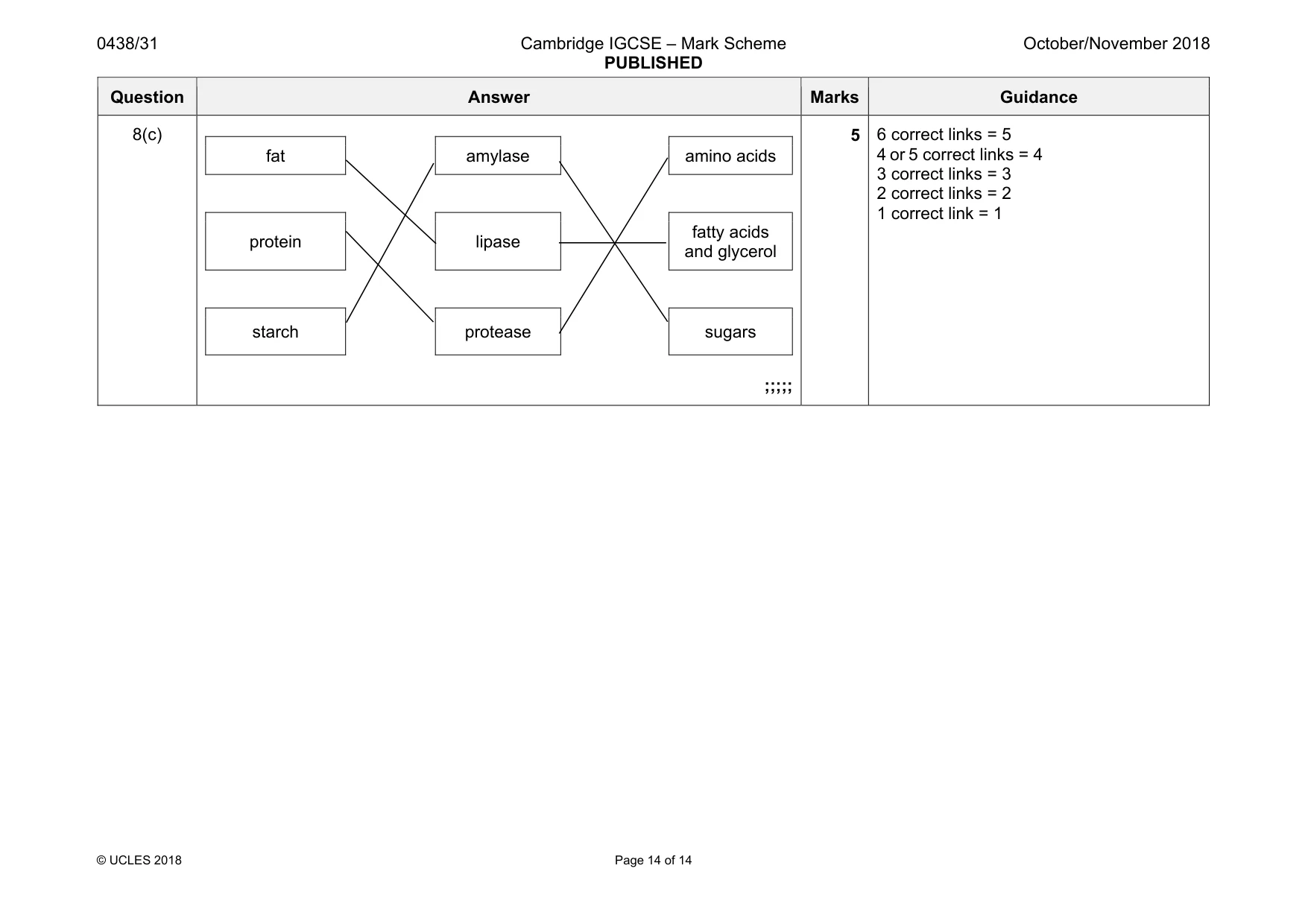
18 0438/31/O/N/18 © UCLES 2018 (b) State one factor other than temperature that affects enzyme activity. …[1] (c) Digestive enzymes are used in chemical digestion to break down large insoluble molecules to smaller soluble molecules. The boxes show some large insoluble molecules, some digestive enzymes and some smaller soluble molecules that are produced during digestion. Draw one straight line from each enzyme to the insoluble molecule it acts on. Draw another line from each enzyme to the smaller soluble molecule that is produced. Draw a total of six lines. fat protein starch insoluble molecule soluble molecules amylase amino acids lipase fatty acids and glycerol protease sugars enzyme [5] [Total: 8]
Question paper, page 19
19 0438/31/O/N/18 © UCLES 2018 BLANK PAGE
Question paper, page 20
20 0438/31/O/N/18 © UCLES 2018 Permission to reproduce items where third-party owned material protected by copyright is included has been sought and cleared where possible. Every reasonable effort has been made by the publisher (UCLES) to trace copyright holders, but if any items requiring clearance have unwittingly been included, the publisher will be pleased to make amends at the earliest possible opportunity. To avoid the issue of disclosure of answer-related information to candidates, all copyright acknowledgements are reproduced online in the Cambridge International Examinations Copyright Acknowledgements Booklet. This is produced for each series of examinations and is freely available to download at www.cie.org.uk after the live examination series. Cambridge International Examinations is part of the Cambridge Assessment Group. Cambridge Assessment is the brand name of University of Cambridge Local Examinations Syndicate (UCLES), which is itself a department of the University of Cambridge. BLANK PAGE
Mark scheme, page 1
This document consists of 14 printed pages. © UCLES 2018 [Turn over Cambridge Assessment International Education Cambridge International General Certificate of Secondary Education BIOLOGY (US) 0438/31 Paper 3 Theory (Core) October/November 2018 MARK SCHEME Maximum Mark: 80 Published This mark scheme is published as an aid to teachers and candidates, to indicate the requirements of the examination. It shows the basis on which Examiners were instructed to award marks. It does not indicate the details of the discussions that took place at an Examiners’ meeting before marking began, which would have considered the acceptability of alternative answers. Mark schemes should be read in conjunction with the question paper and the Principal Examiner Report for Teachers. Cambridge International will not enter into discussions about these mark schemes. Cambridge International is publishing the mark schemes for the October/November 2018 series for most Cambridge IGCSE™, Cambridge International A and AS Level components and some Cambridge O Level components.
Mark scheme, page 2
0438/31 Cambridge IGCSE – Mark Scheme PUBLISHED October/November 2018 © UCLES 2018 Page 2 of 14 Generic Marking Principles These general marking principles must be applied by all examiners when marking candidate answers. They should be applied alongside the specific content of the mark scheme or generic level descriptors for a question. Each question paper and mark scheme will also comply with these marking principles. GENERIC MARKING PRINCIPLE 1: Marks must be awarded in line with: • the specific content of the mark scheme or the generic level descriptors for the question • the specific skills defined in the mark scheme or in the generic level descriptors for the question • the standard of response required by a candidate as exemplified by the standardisation scripts. GENERIC MARKING PRINCIPLE 2: Marks awarded are always whole marks (not half marks, or other fractions). GENERIC MARKING PRINCIPLE 3: Marks must be awarded positively: • marks are awarded for correct/valid answers, as defined in the mark scheme. However, credit is given for valid answers which go beyond the scope of the syllabus and mark scheme, referring to your Team Leader as appropriate • marks are awarded when candidates clearly demonstrate what they know and can do • marks are not deducted for errors • marks are not deducted for omissions • answers should only be judged on the quality of spelling, punctuation and grammar when these features are specifically assessed by the question as indicated by the mark scheme. The meaning, however, should be unambiguous. GENERIC MARKING PRINCIPLE 4: Rules must be applied consistently e.g. in situations where candidates have not followed instructions or in the application of generic level descriptors.
Mark scheme, page 3
0438/31 Cambridge IGCSE – Mark Scheme PUBLISHED October/November 2018 © UCLES 2018 Page 3 of 14 GENERIC MARKING PRINCIPLE 5: Marks should be awarded using the full range of marks defined in the mark scheme for the question (however; the use of the full mark range may be limited according to the quality of the candidate responses seen). GENERIC MARKING PRINCIPLE 6: Marks awarded are based solely on the requirements as defined in the mark scheme. Marks should not be awarded with grade thresholds or grade descriptors in mind.
Mark scheme, page 4
0438/31 Cambridge IGCSE – Mark Scheme PUBLISHED October/November 2018 © UCLES 2018 Page 4 of 14 Mark scheme abbreviations • ; separates marking points • / alternative responses for the same marking point • R reject the response • A accept the response • I ignore the response • ecf error carried forward • AVP any valid point • ora or reverse argument • AW alternative wording • underline actual word given must be used by candidate (grammatical variants excepted) • ( ) the word / phrase in brackets is not required but sets the context
Mark scheme, page 5
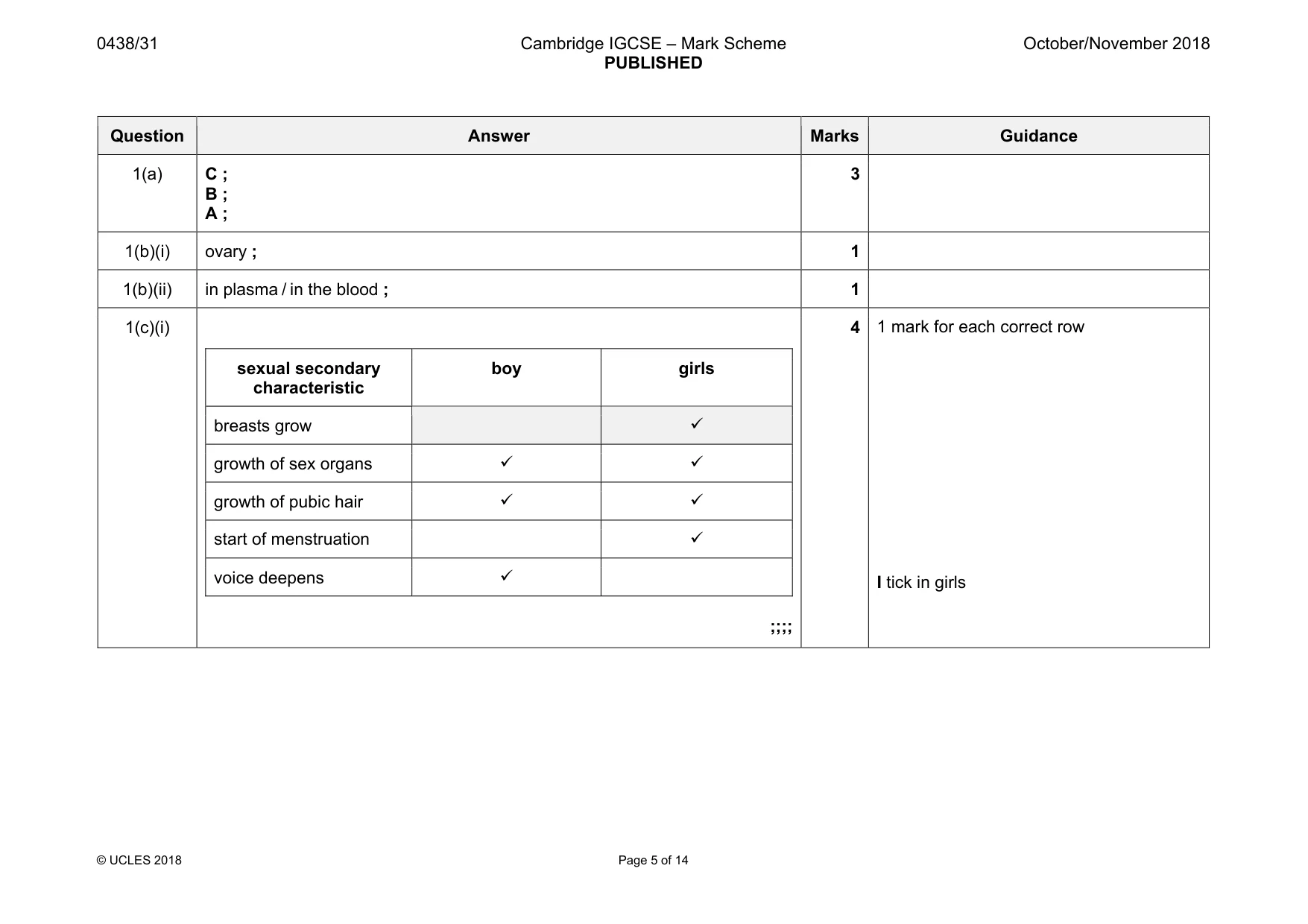
0438/31 Cambridge IGCSE – Mark Scheme PUBLISHED October/November 2018 © UCLES 2018 Page 5 of 14 Question Answer Marks Guidance 1(a) C ; B ; A ; 3 1(b)(i) ovary ; 1 1(b)(ii) in plasma / in the blood ; 1 1(c)(i) ;;;; sexual secondary characteristic boy girls breasts grow 9 growth of sex organs 9 9 growth of pubic hair 9 9 start of menstruation 9 voice deepens 9 4 1 mark for each correct row I tick in girls
Mark scheme, page 6
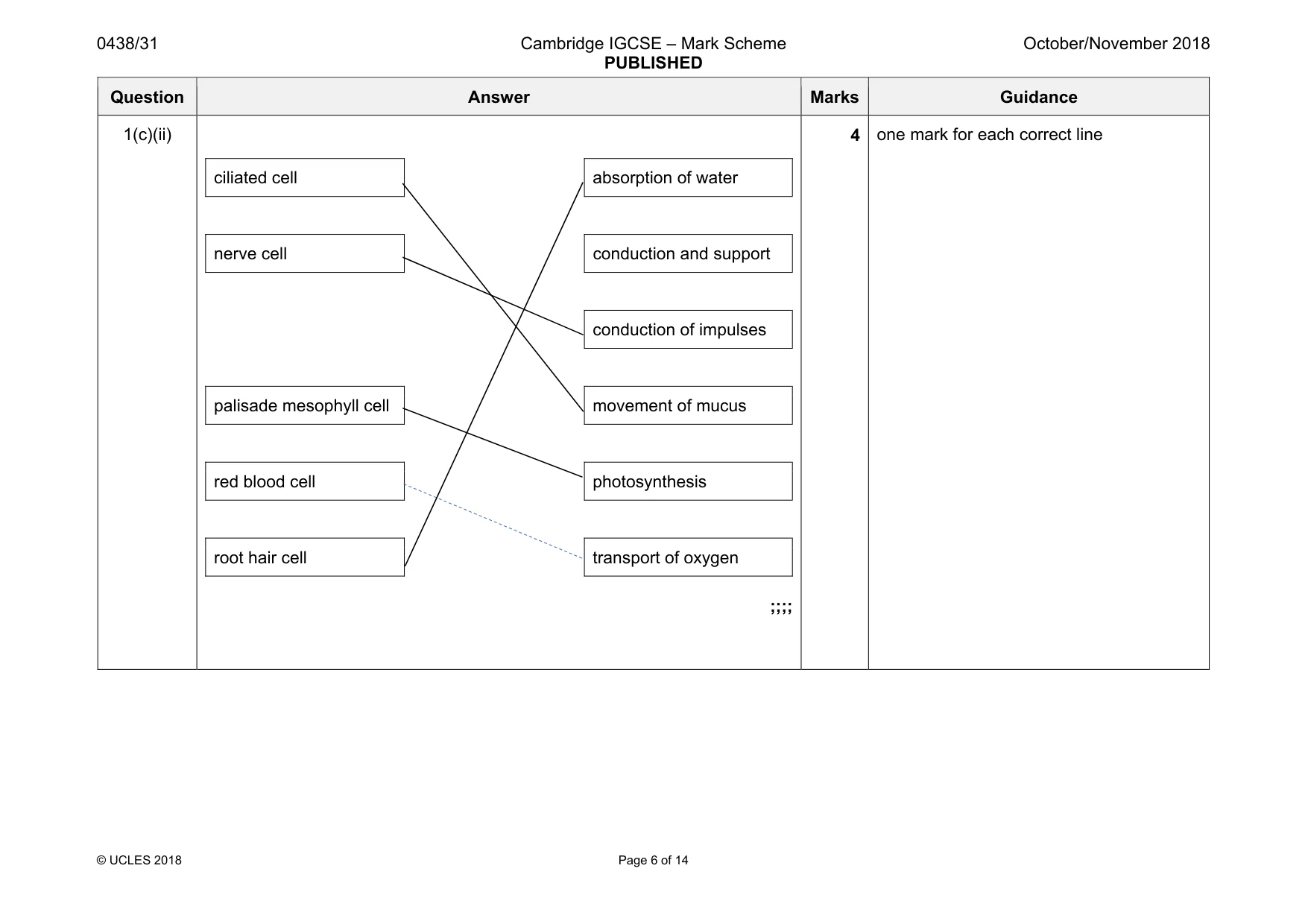
0438/31 Cambridge IGCSE – Mark Scheme PUBLISHED October/November 2018 © UCLES 2018 Page 6 of 14 Question Answer Marks Guidance 1(c)(ii) ;;;; ciliated cell absorption of water nerve cell conduction and support conduction of impulses palisade mesophyll cell movement of mucus red blood cell photosynthesis root hair cell transport of oxygen 4 one mark for each correct line
Mark scheme, page 7
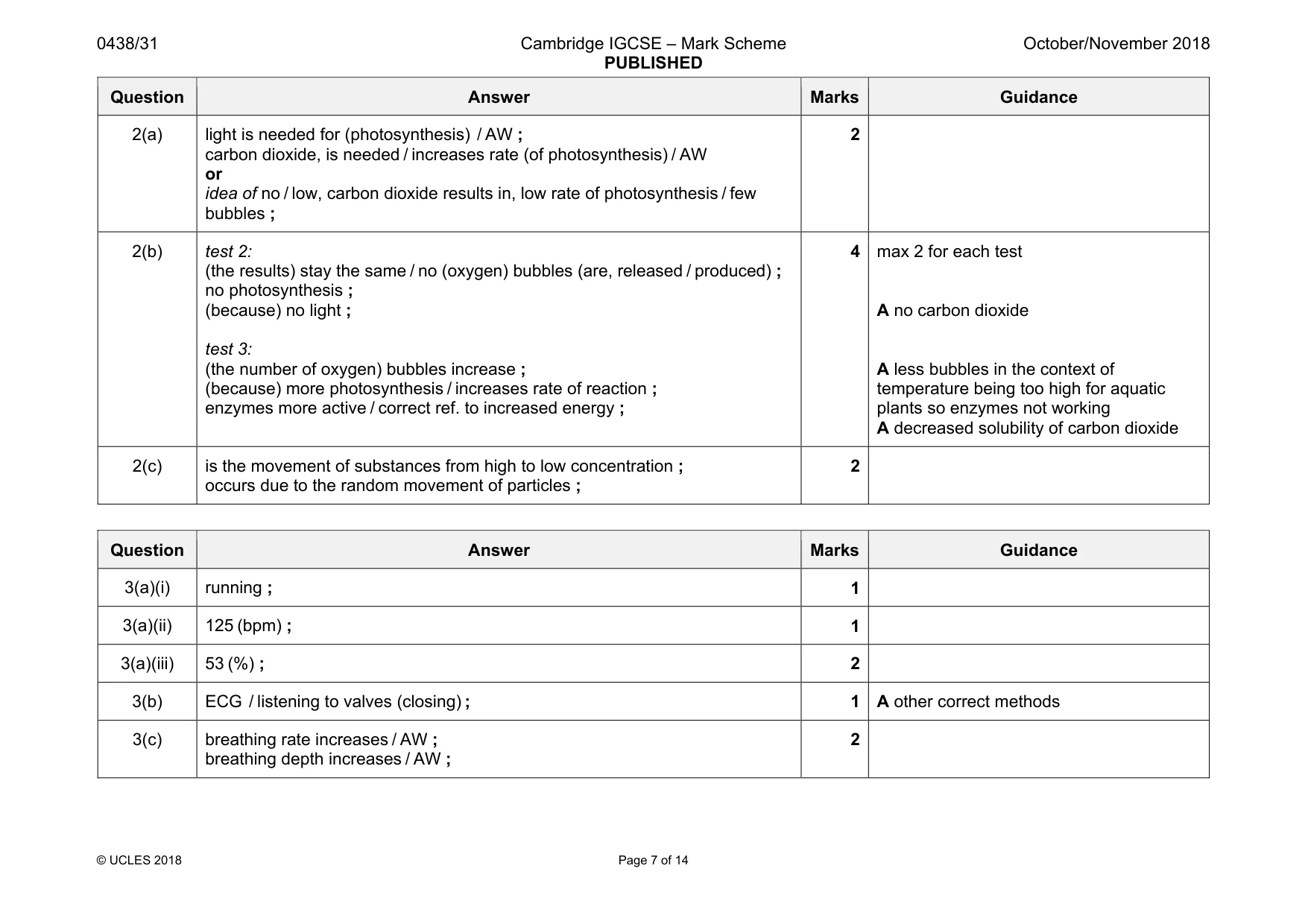
0438/31 Cambridge IGCSE – Mark Scheme PUBLISHED October/November 2018 © UCLES 2018 Page 7 of 14 Question Answer Marks Guidance 2(a) light is needed for (photosynthesis) / AW ; carbon dioxide, is needed / increases rate (of photosynthesis) / AW or idea of no / low, carbon dioxide results in, low rate of photosynthesis / few bubbles ; 2 2(b) test 2: (the results) stay the same / no (oxygen) bubbles (are, released / produced) ; no photosynthesis ; (because) no light ; test 3: (the number of oxygen) bubbles increase ; (because) more photosynthesis / increases rate of reaction ; enzymes more active / correct ref. to increased energy ; 4 max 2 for each test A no carbon dioxide A less bubbles in the context of temperature being too high for aquatic plants so enzymes not working A decreased solubility of carbon dioxide 2(c) is the movement of substances from high to low concentration ; occurs due to the random movement of particles ; 2 Question Answer Marks Guidance 3(a)(i) running ; 1 3(a)(ii) 125 (bpm) ; 1 3(a)(iii) 53 (%) ; 2 3(b) ECG / listening to valves (closing) ; 1 A other correct methods 3(c) breathing rate increases / AW ; breathing depth increases / AW ; 2
Mark scheme, page 8
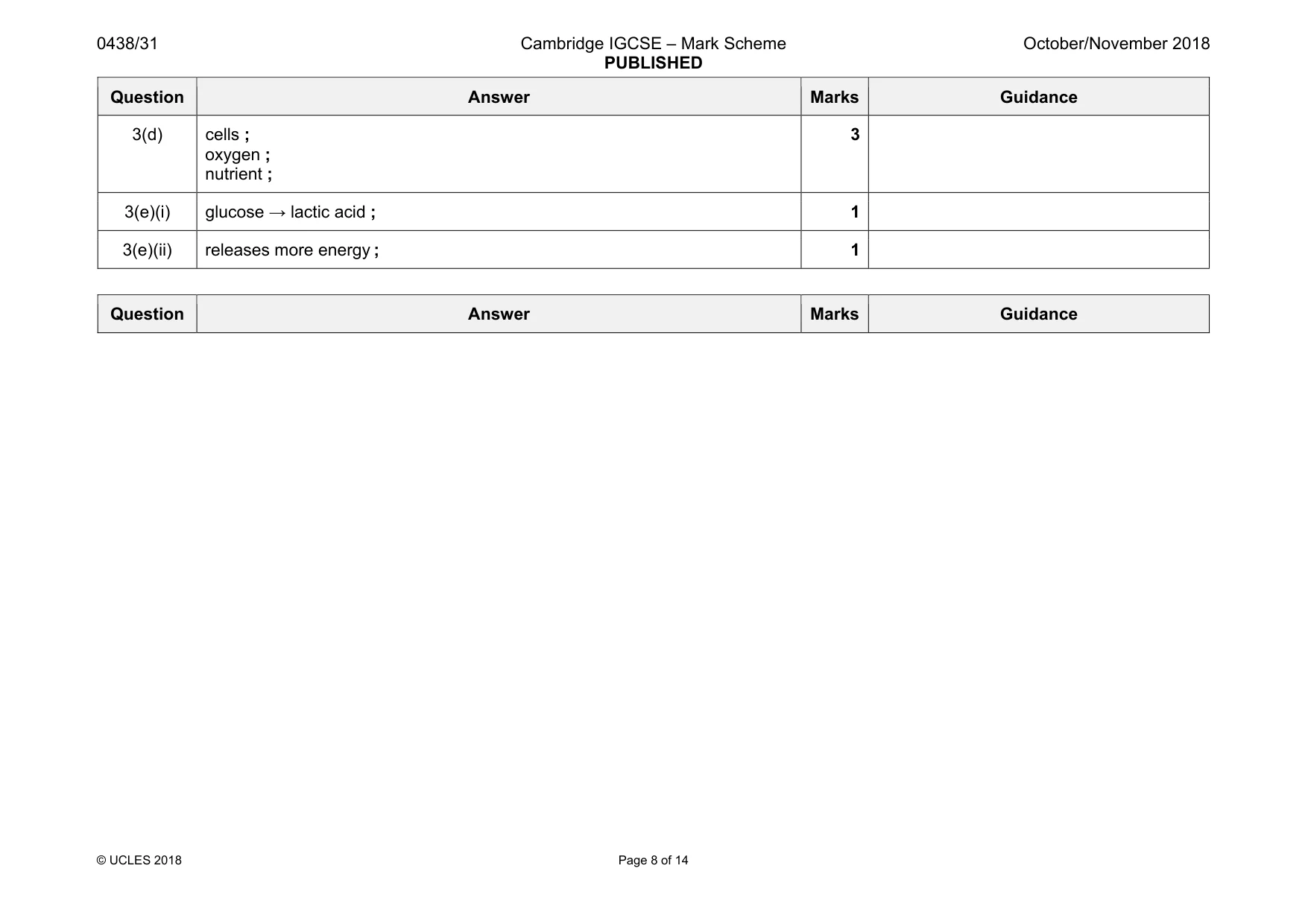
0438/31 Cambridge IGCSE – Mark Scheme PUBLISHED October/November 2018 © UCLES 2018 Page 8 of 14 Question Answer Marks Guidance 3(d) cells ; oxygen ; nutrient ; 3 3(e)(i) glucose → lactic acid ; 1 3(e)(ii) releases more energy ; 1 Question Answer Marks Guidance
Mark scheme, page 9
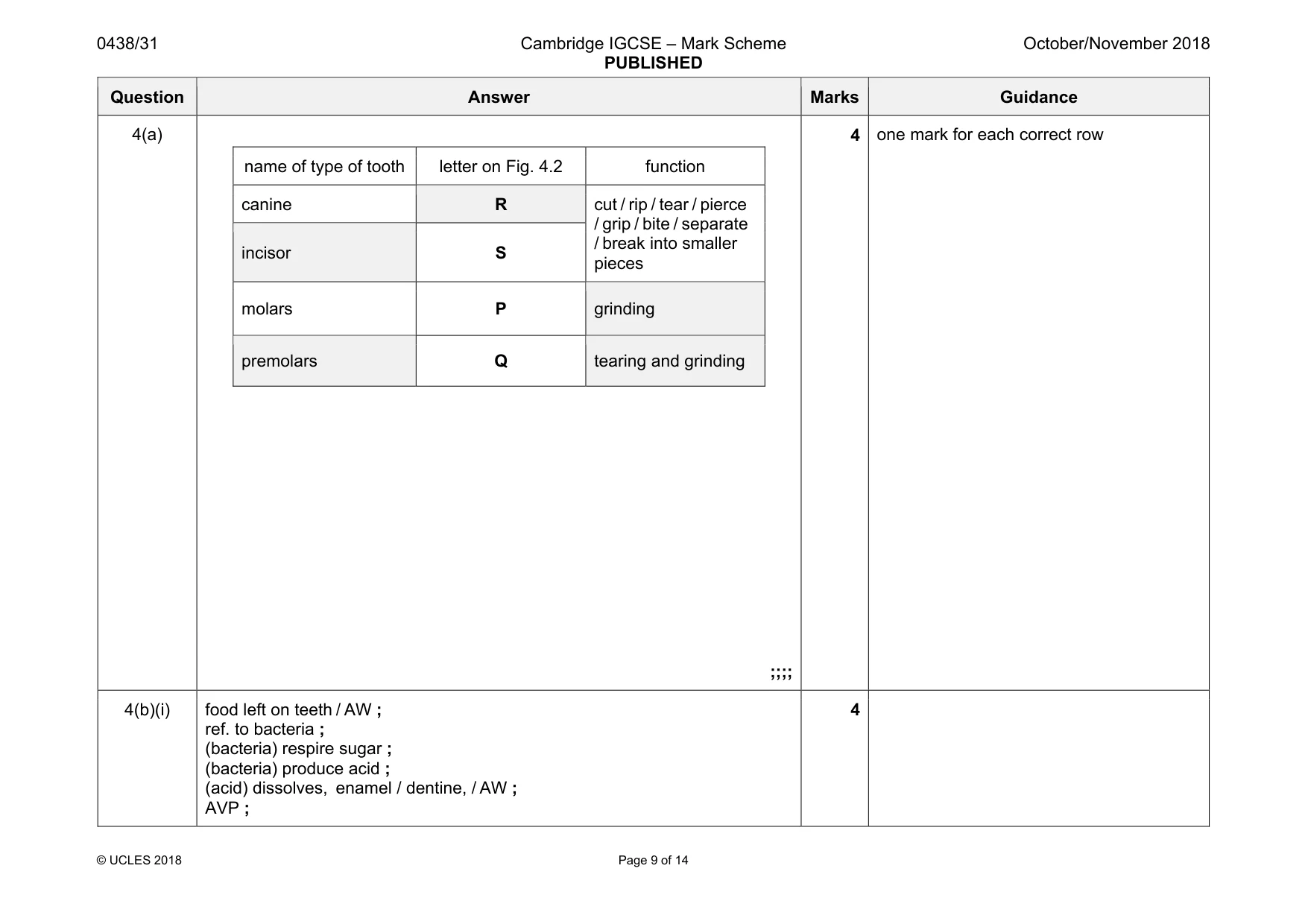
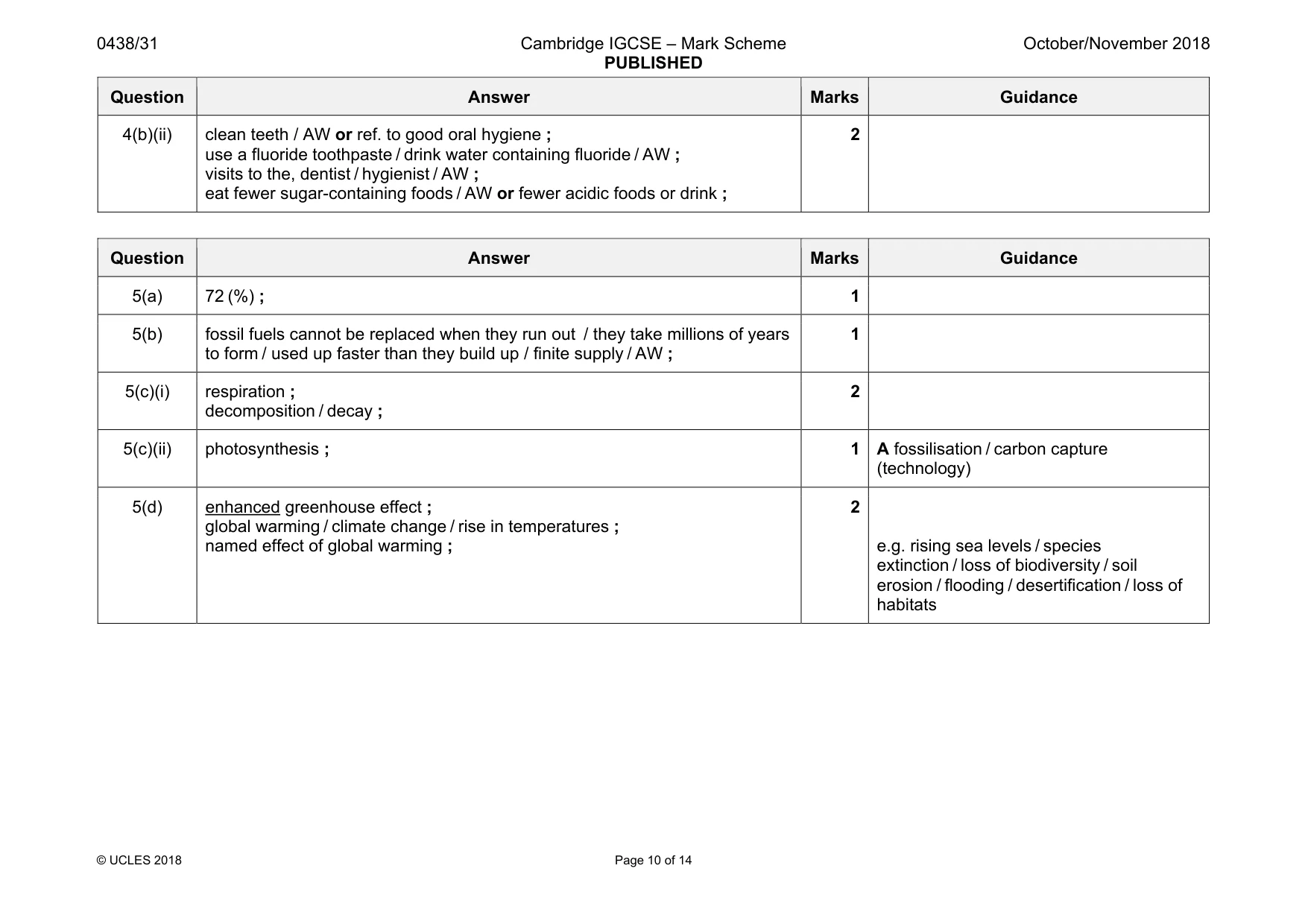
0438/31 Cambridge IGCSE – Mark Scheme PUBLISHED October/November 2018 © UCLES 2018 Page 9 of 14 Question Answer Marks Guidance 4(a) ;;;; name of type of tooth letter on Fig. 4.2 function canine R cut / rip / tear / pierce / grip / bite / separate / break into smaller pieces incisor S molars P grinding premolars Q tearing and grinding 4 one mark for each correct row 4(b)(i) food left on teeth / AW ; ref. to bacteria ; (bacteria) respire sugar ; (bacteria) produce acid ; (acid) dissolves, enamel / dentine, / AW ; AVP ; 4
Mark scheme, page 10
0438/31 Cambridge IGCSE – Mark Scheme PUBLISHED October/November 2018 © UCLES 2018 Page 10 of 14 Question Answer Marks Guidance 4(b)(ii) clean teeth / AW or ref. to good oral hygiene ; use a fluoride toothpaste / drink water containing fluoride / AW ; visits to the, dentist / hygienist / AW ; eat fewer sugar-containing foods / AW or fewer acidic foods or drink ; 2 Question Answer Marks Guidance 5(a) 72 (%) ; 1 5(b) fossil fuels cannot be replaced when they run out / they take millions of years to form / used up faster than they build up / finite supply / AW ; 1 5(c)(i) respiration ; decomposition / decay ; 2 5(c)(ii) photosynthesis ; 1 A fossilisation / carbon capture (technology) 5(d) enhanced greenhouse effect ; global warming / climate change / rise in temperatures ; named effect of global warming ; 2 e.g. rising sea levels / species extinction / loss of biodiversity / soil erosion / flooding / desertification / loss of habitats
Mark scheme, page 11
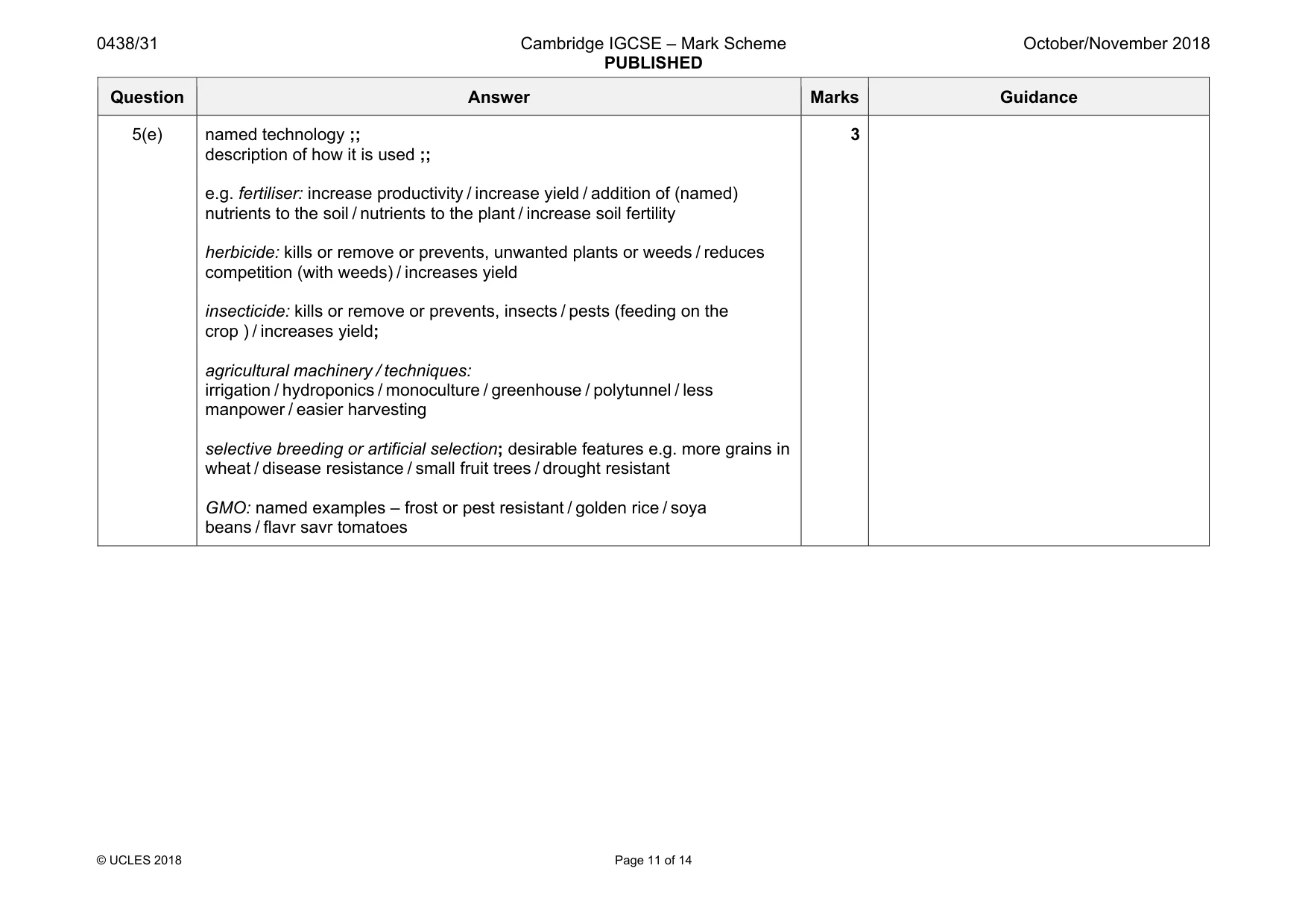
0438/31 Cambridge IGCSE – Mark Scheme PUBLISHED October/November 2018 © UCLES 2018 Page 11 of 14 Question Answer Marks Guidance 5(e) named technology ;; description of how it is used ;; e.g. fertiliser: increase productivity / increase yield / addition of (named) nutrients to the soil / nutrients to the plant / increase soil fertility herbicide: kills or remove or prevents, unwanted plants or weeds / reduces competition (with weeds) / increases yield insecticide: kills or remove or prevents, insects / pests (feeding on the crop ) / increases yield; agricultural machinery / techniques: irrigation / hydroponics / monoculture / greenhouse / polytunnel / less manpower / easier harvesting selective breeding or artificial selection; desirable features e.g. more grains in wheat / disease resistance / small fruit trees / drought resistant GMO: named examples – frost or pest resistant / golden rice / soya beans / flavr savr tomatoes 3
Mark scheme, page 12
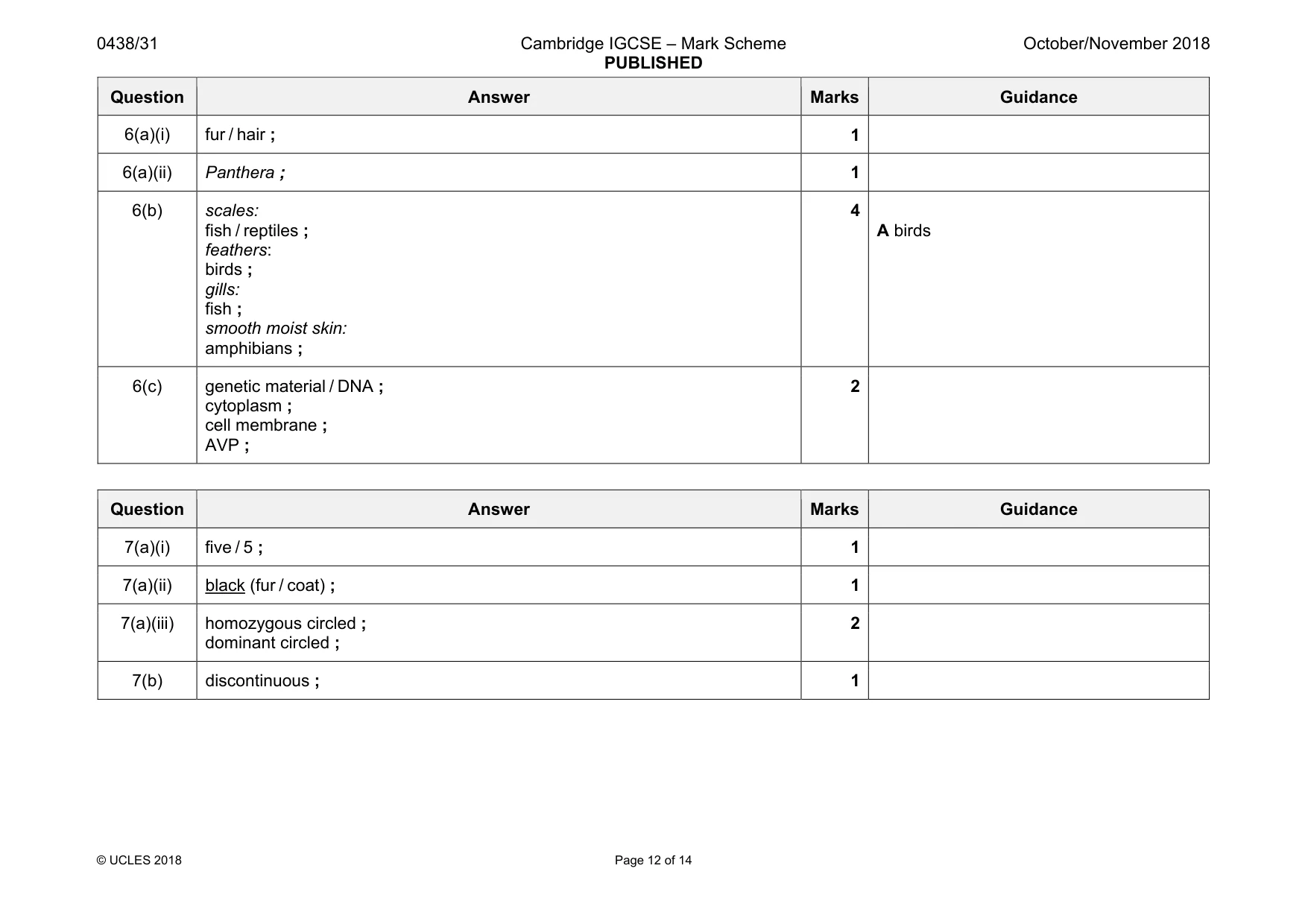
0438/31 Cambridge IGCSE – Mark Scheme PUBLISHED October/November 2018 © UCLES 2018 Page 12 of 14 Question Answer Marks Guidance 6(a)(i) fur / hair ; 1 6(a)(ii) Panthera ; 1 6(b) scales: fish / reptiles ; feathers: birds ; gills: fish ; smooth moist skin: amphibians ; 4 A birds 6(c) genetic material / DNA ; cytoplasm ; cell membrane ; AVP ; 2 Question Answer Marks Guidance 7(a)(i) five / 5 ; 1 7(a)(ii) black (fur / coat) ; 1 7(a)(iii) homozygous circled ; dominant circled ; 2 7(b) discontinuous ; 1
Mark scheme, page 13
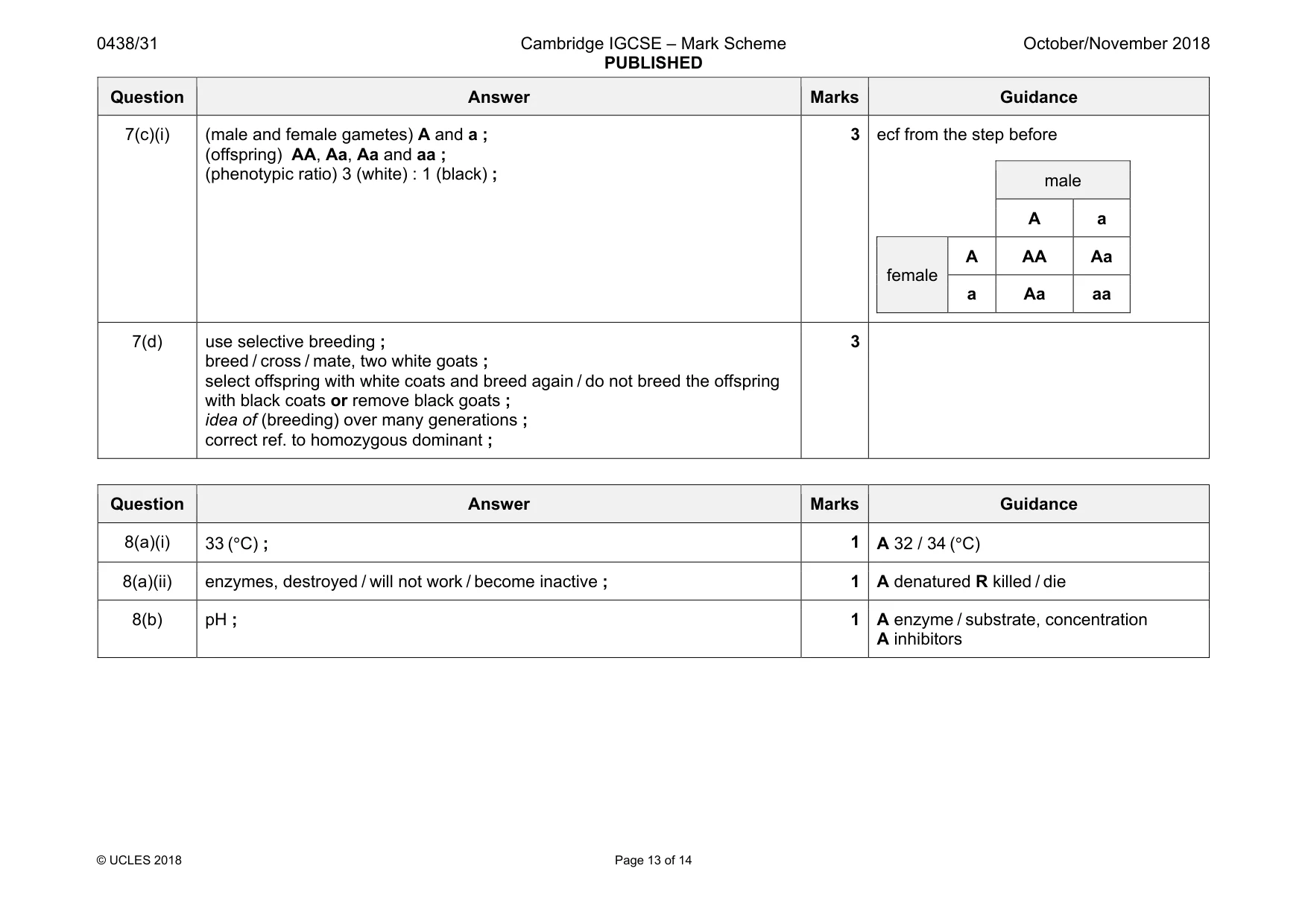
0438/31 Cambridge IGCSE – Mark Scheme PUBLISHED October/November 2018 © UCLES 2018 Page 13 of 14 Question Answer Marks Guidance 7(c)(i) (male and female gametes) A and a ; (offspring) AA, Aa, Aa and aa ; (phenotypic ratio) 3 (white) : 1 (black) ; 3 ecf from the step before male A a female A AA Aa a Aa aa 7(d) use selective breeding ; breed / cross / mate, two white goats ; select offspring with white coats and breed again / do not breed the offspring with black coats or remove black goats ; idea of (breeding) over many generations ; correct ref. to homozygous dominant ; 3 Question Answer Marks Guidance 8(a)(i) 33 (°C) ; 1 A 32 / 34 (°C) 8(a)(ii) enzymes, destroyed / will not work / become inactive ; 1 A denatured R killed / die 8(b) pH ; 1 A enzyme / substrate, concentration A inhibitors
Mark scheme, page 14
0438/31 Cambridge IGCSE – Mark Scheme PUBLISHED October/November 2018 © UCLES 2018 Page 14 of 14 Question Answer Marks Guidance 8(c) ;;;;; fat amylase amino acids protein lipase fatty acids and glycerol starch protease sugars 5 6 correct links = 5 4 or 5 correct links = 4 3 correct links = 3 2 correct links = 2 1 correct link = 1
What you needed in this session
Cambridge’s own grade thresholds for 2018 Oct/Nov, Paper 3 · Variant 1. A higher threshold means an easier paper — the bar moves with how the cohort did.