Cambridge IGCSE Biology (BES) 0438 — 2014 Oct/Nov Paper 3 · Variant 1
0438/31/O/N/14 · 80 marks · ≈90 min
The question paper and its mark scheme, free to read here and free to download. This is Cambridge’s own paper, exactly as it was sat.
Question paper16 pages
Mark scheme12 pages
Answers below. Sit the paper first if you are practising.
Paper as text
Question paper, page 1
This document consists of 15 printed pages and 1 blank page. DC (SJF/SW) 100424 © UCLES 2014 [Turn over * 4 8 1 0 6 4 2 6 8 6 * BIOLOGY (US) 0438/31 Paper 3 Extended October/November 2014 1 hour 15 minutes Candidates answer on the Question Paper. No Additional Materials are required. READ THESE INSTRUCTIONS FIRST Write your Center number, candidate number and name on all the work you hand in. Write in dark blue or black pen. You may use an HB pencil for any diagrams or graphs. Do not use staples, paper clips, glue or correction fluid. DO NOT WRITE IN ANY BARCODES. Answer all questions. Electronic calculators may be used. You may lose marks if you do not show your working or if you do not use appropriate units. At the end of the examination, fasten all your work securely together. The number of marks is given in brackets [ ] at the end of each question or part question. Cambridge International Examinations Cambridge International General Certificate of Secondary Education
Question paper, page 2
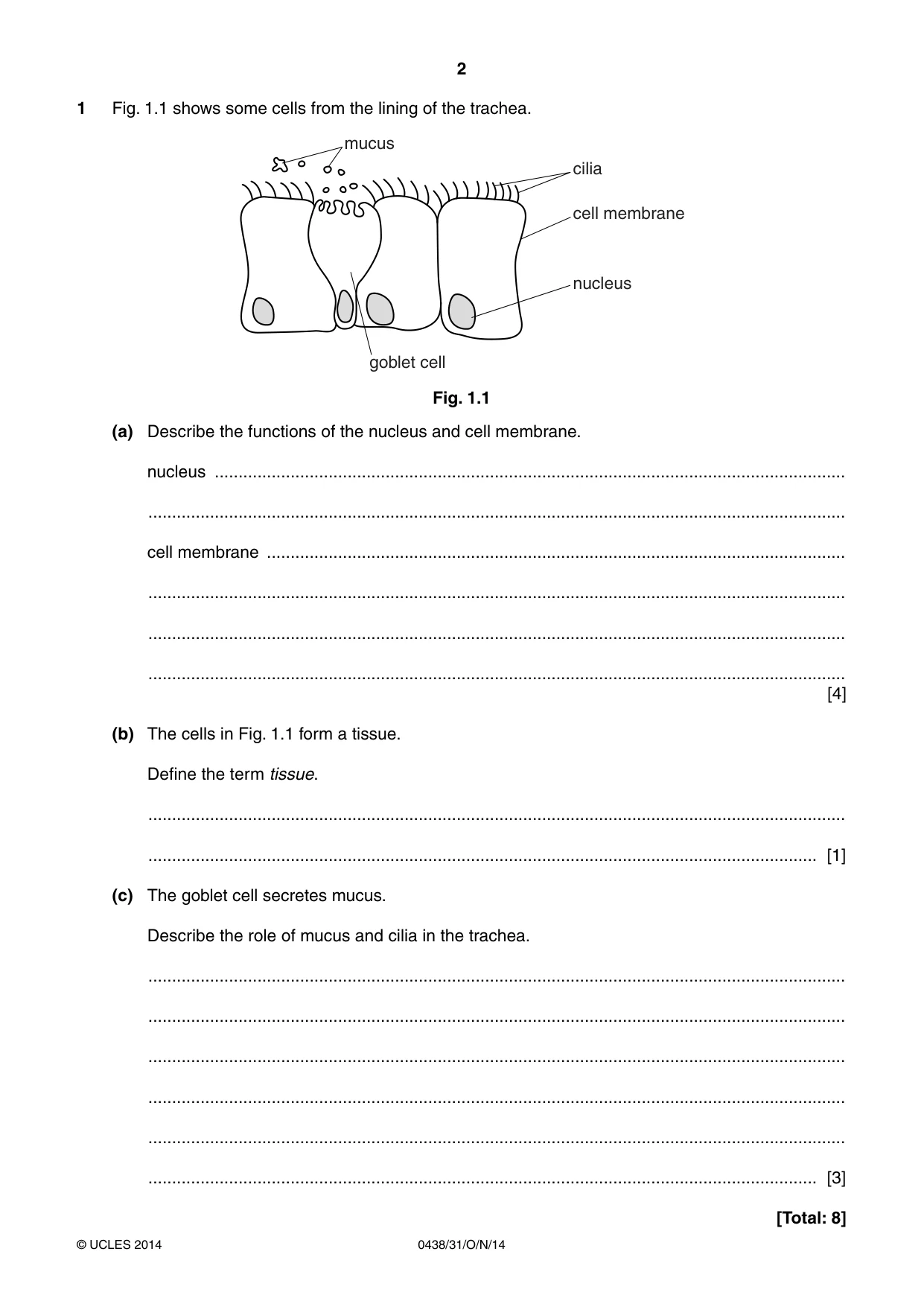
2 0438/31/O/N/14 © UCLES 2014 1 Fig. 1.1 shows some cells from the lining of the trachea. mucus cilia cell membrane nucleus goblet cell Fig. 1.1 (a) Describe the functions of the nucleus and cell membrane. nucleus … … cell membrane … … … … [4] (b) The cells in Fig. 1.1 form a tissue. Define the term tissue. … … [1] (c) The goblet cell secretes mucus. Describe the role of mucus and cilia in the trachea. … … … … … … [3] [Total: 8]
Question paper, page 3
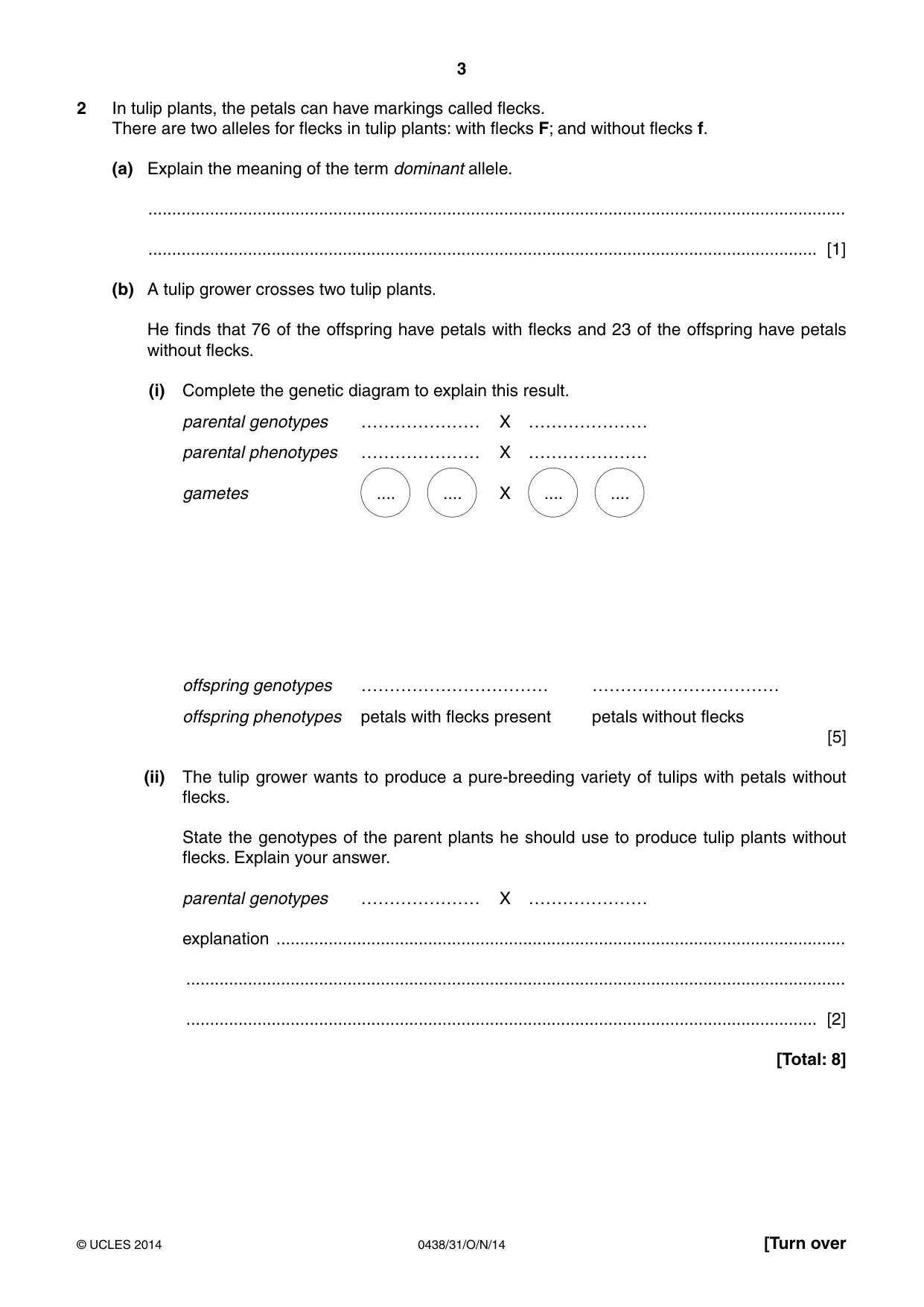
3 0438/31/O/N/14 © UCLES 2014 [Turn over 2 In tulip plants, the petals can have markings called flecks. There are two alleles for flecks in tulip plants: with flecks F; and without flecks f. (a) Explain the meaning of the term dominant allele. … … [1] (b) A tulip grower crosses two tulip plants. He finds that 76 of the offspring have petals with flecks and 23 of the offspring have petals without flecks. (i) Complete the genetic diagram to explain this result. parental genotypes ………………… X ………………… parental phenotypes ………………… X ………………… gametes … … X … … offspring genotypes …………………………… …………………………… offspring phenotypes petals with flecks present petals without flecks [5] (ii) The tulip grower wants to produce a pure-breeding variety of tulips with petals without flecks. State the genotypes of the parent plants he should use to produce tulip plants without flecks. Explain your answer. parental genotypes ………………… X ………………… explanation … … … [2] [Total: 8]
Question paper, page 4
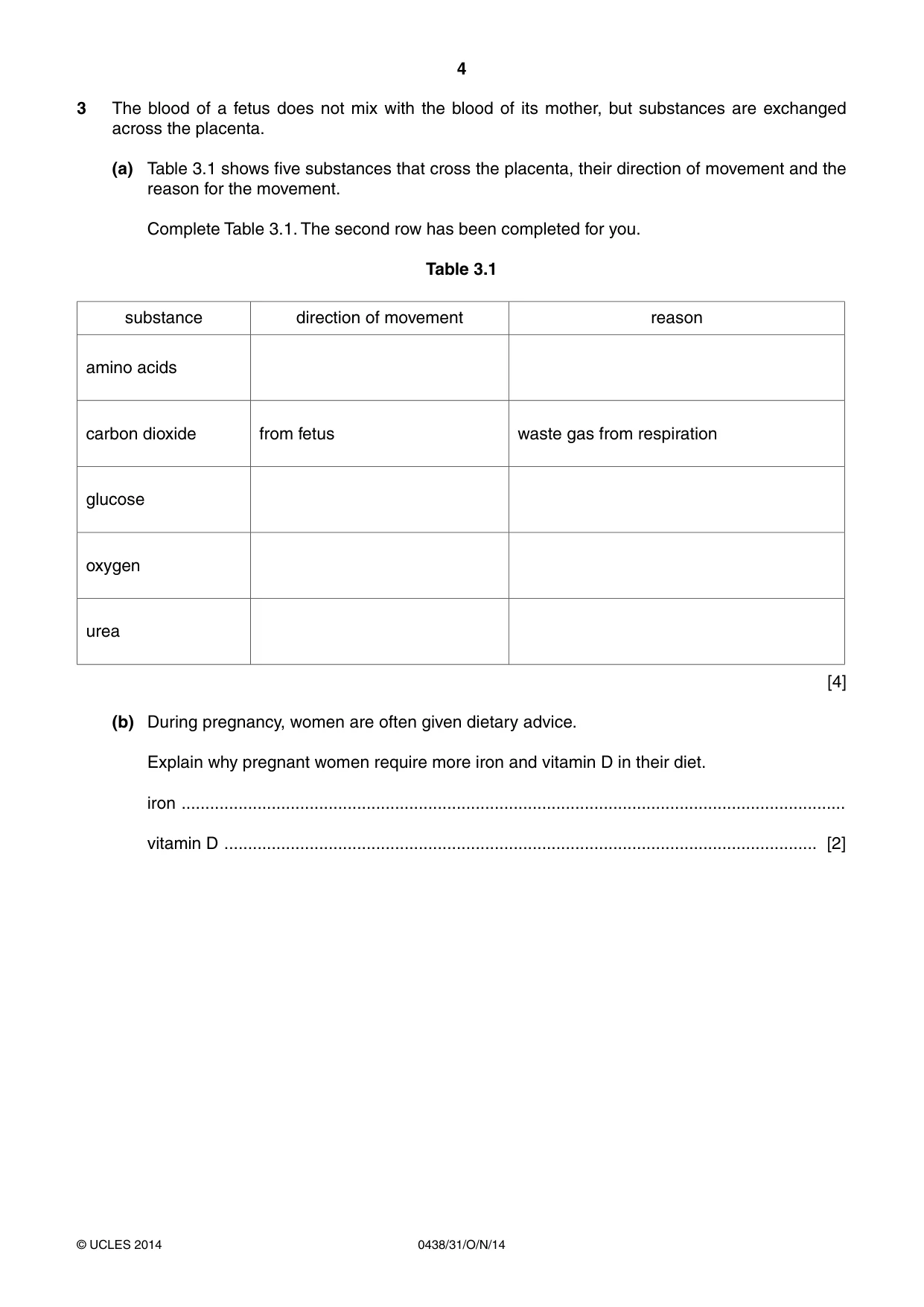
4 0438/31/O/N/14 © UCLES 2014 3 The blood of a fetus does not mix with the blood of its mother, but substances are exchanged across the placenta. (a) Table 3.1 shows five substances that cross the placenta, their direction of movement and the reason for the movement. Complete Table 3.1. The second row has been completed for you. Table 3.1 substance direction of movement reason amino acids carbon dioxide from fetus waste gas from respiration glucose oxygen urea [4] (b) During pregnancy, women are often given dietary advice. Explain why pregnant women require more iron and vitamin D in their diet. iron … vitamin D … [2]
Question paper, page 5
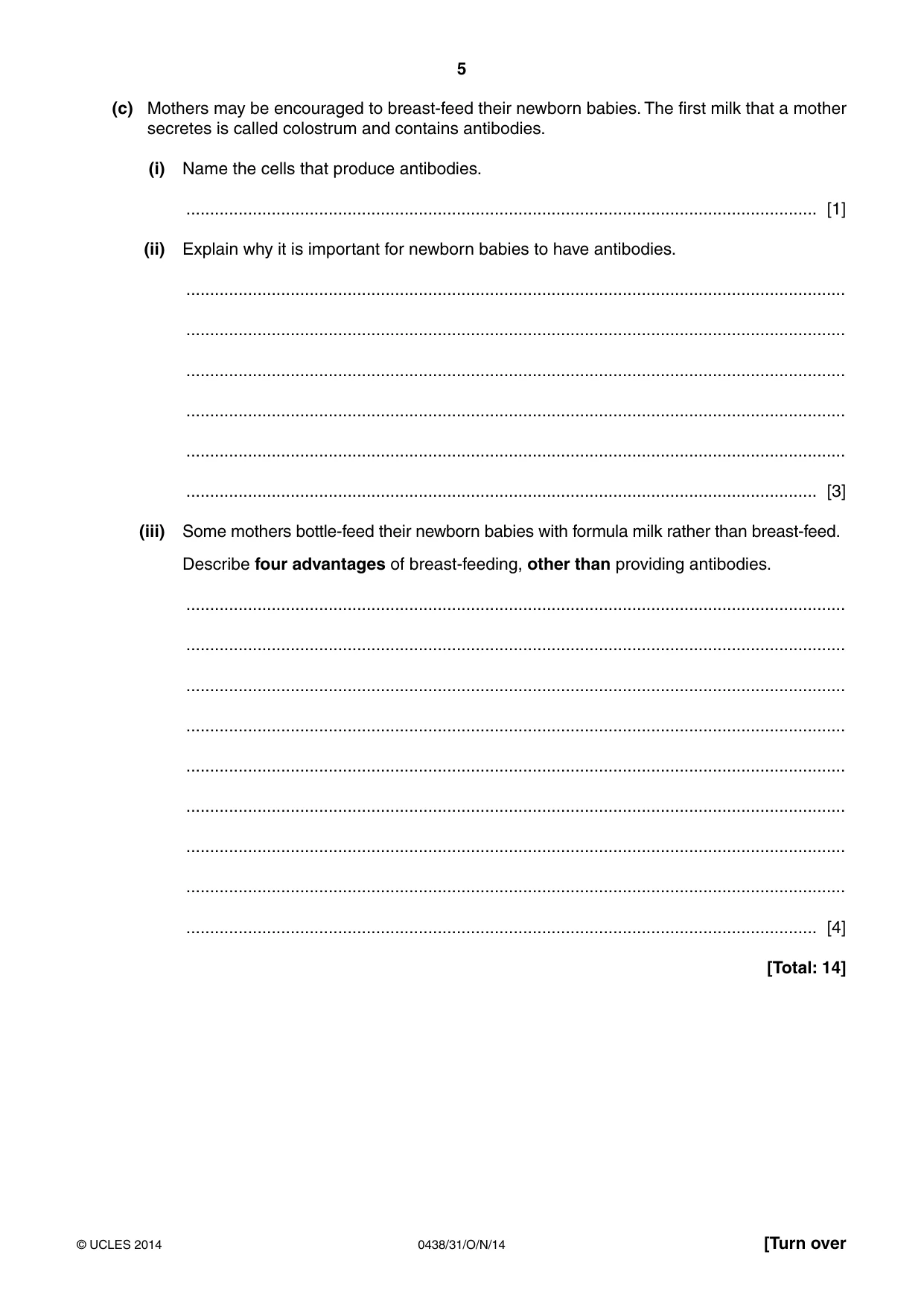
5 0438/31/O/N/14 © UCLES 2014 [Turn over (c) Mothers may be encouraged to breast-feed their newborn babies. The first milk that a mother secretes is called colostrum and contains antibodies. (i) Name the cells that produce antibodies. … [1] (ii) Explain why it is important for newborn babies to have antibodies. … … … … … … [3] (iii) Some mothers bottle-feed their newborn babies with formula milk rather than breast-feed. Describe four advantages of breast-feeding, other than providing antibodies. … … … … … … … … … [4] [Total: 14]
Question paper, page 6
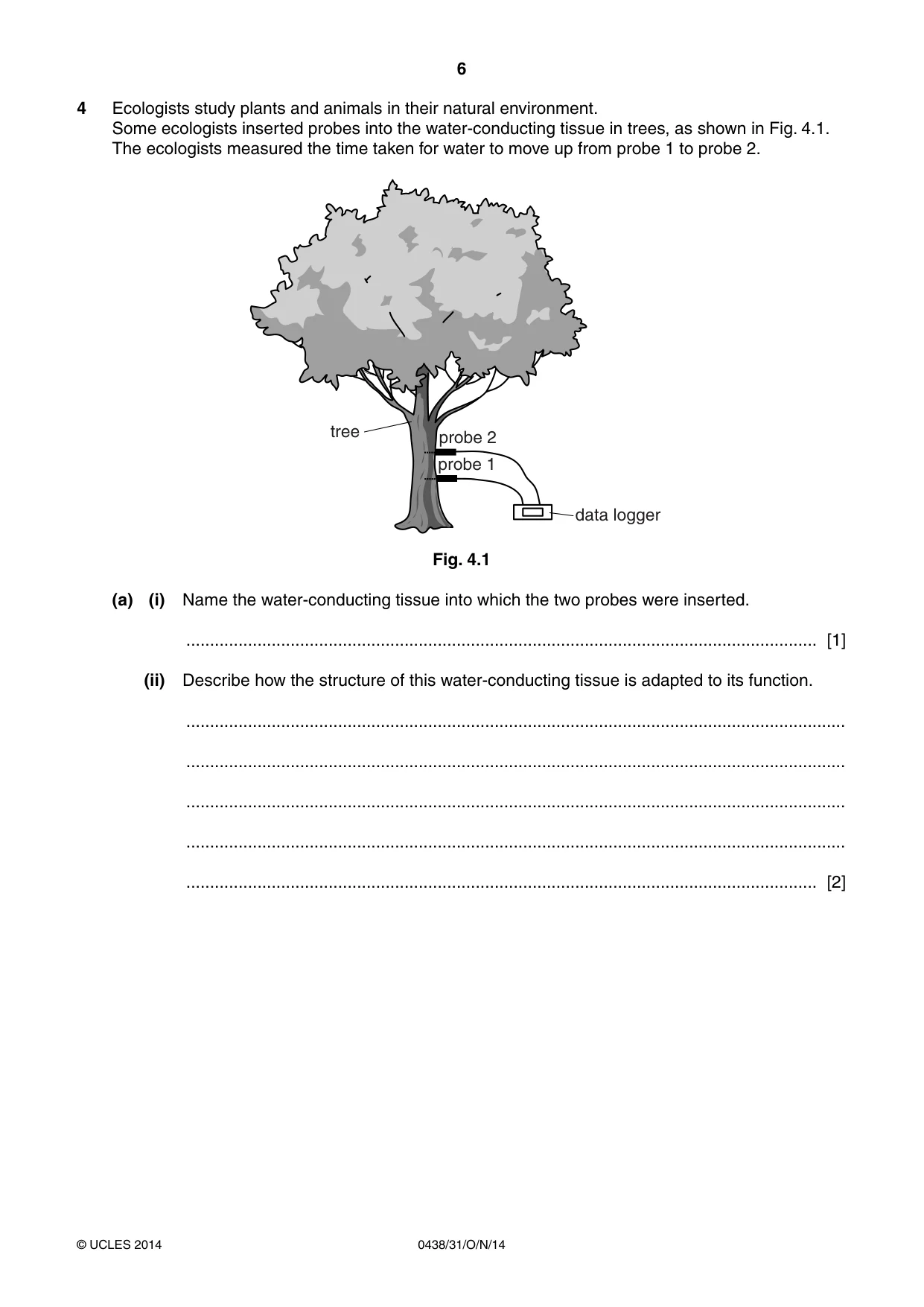
6 0438/31/O/N/14 © UCLES 2014 4 Ecologists study plants and animals in their natural environment. Some ecologists inserted probes into the water-conducting tissue in trees, as shown in Fig. 4.1. The ecologists measured the time taken for water to move up from probe 1 to probe 2. probe 1 data logger probe 2 tree Fig. 4.1 (a) (i) Name the water-conducting tissue into which the two probes were inserted. … [1] (ii) Describe how the structure of this water-conducting tissue is adapted to its function. … … … … … [2]
Question paper, page 7
7 0438/31/O/N/14 © UCLES 2014 [Turn over (b) Explain the mechanism of water movement from the roots up the tree to the leaves. … … … … … … … … … [4]
Question paper, page 8
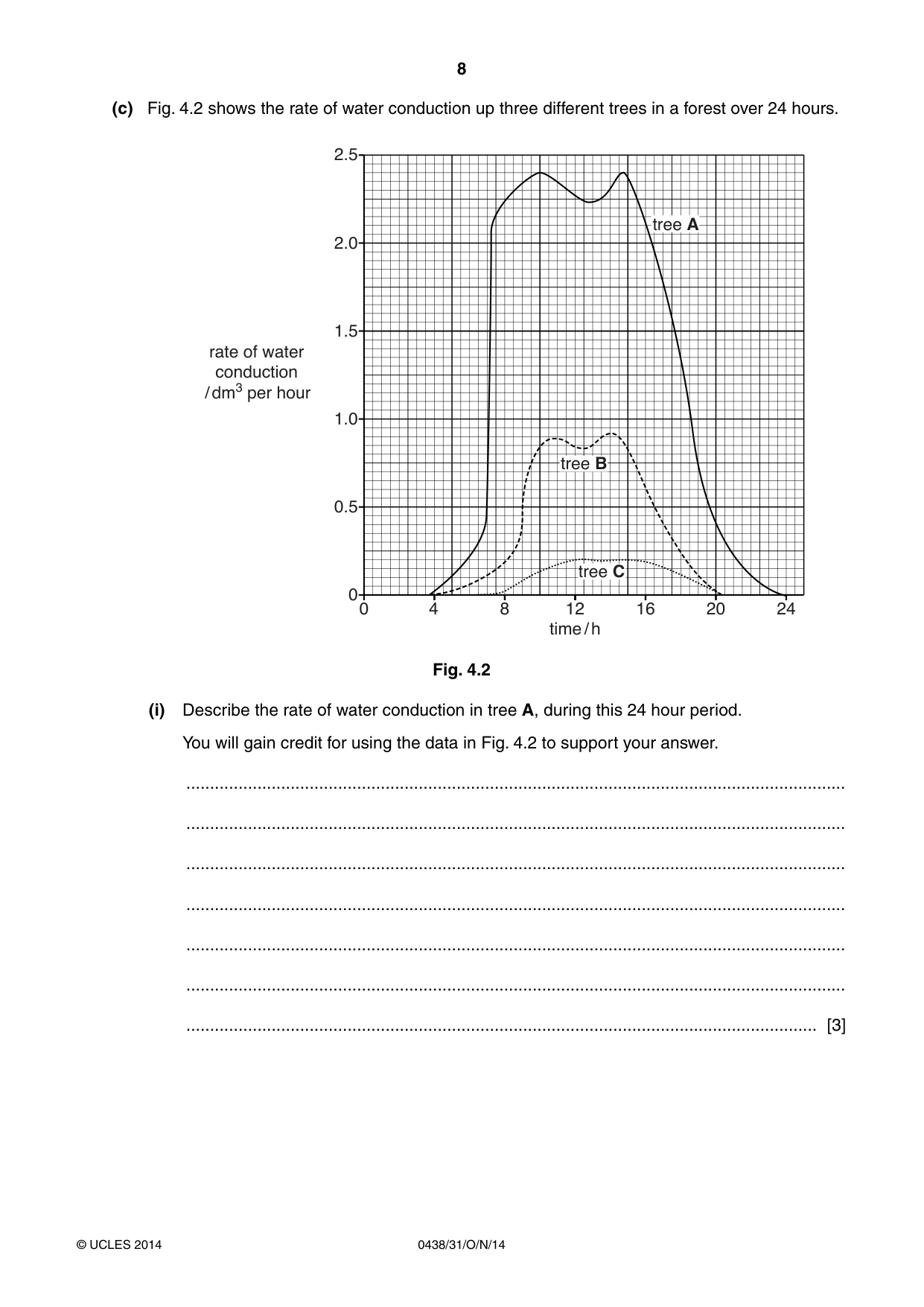
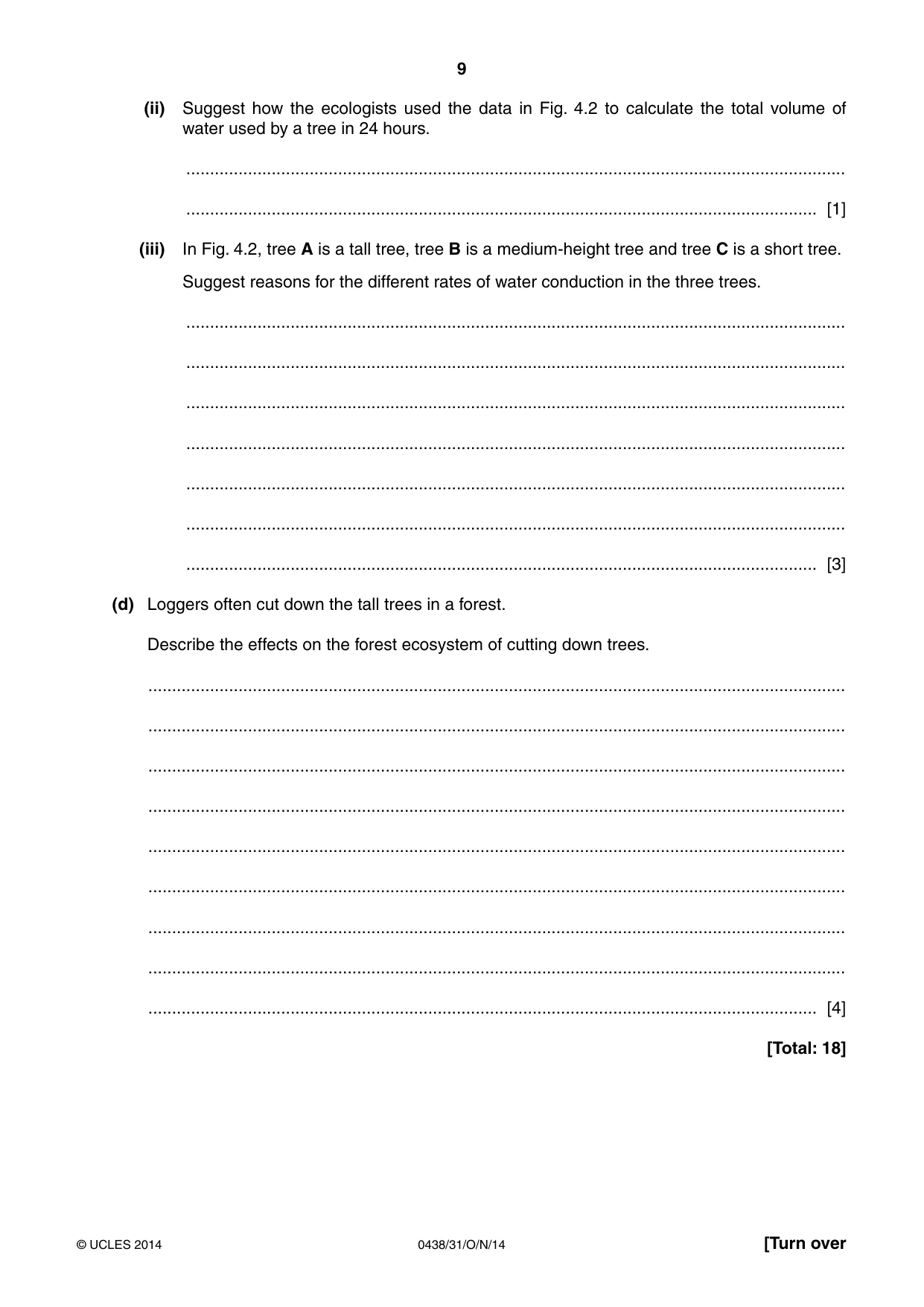
8 0438/31/O/N/14 © UCLES 2014 (c) Fig. 4.2 shows the rate of water conduction up three different trees in a forest over 24 hours. 0 4 8 12 time / h rate of water conduction / dm3 per hour 16 20 24 0 0.5 1.0 1.5 2.0 2.5 tree A tree B tree C Fig. 4.2 (i) Describe the rate of water conduction in tree A, during this 24 hour period. You will gain credit for using the data in Fig. 4.2 to support your answer. … … … … … … … [3]
Question paper, page 9
9 0438/31/O/N/14 © UCLES 2014 [Turn over (ii) Suggest how the ecologists used the data in Fig. 4.2 to calculate the total volume of water used by a tree in 24 hours. … … [1] (iii) In Fig. 4.2, tree A is a tall tree, tree B is a medium-height tree and tree C is a short tree. Suggest reasons for the different rates of water conduction in the three trees. … … … … … … … [3] (d) Loggers often cut down the tall trees in a forest. Describe the effects on the forest ecosystem of cutting down trees. … … … … … … … … … [4] [Total: 18]
Question paper, page 10
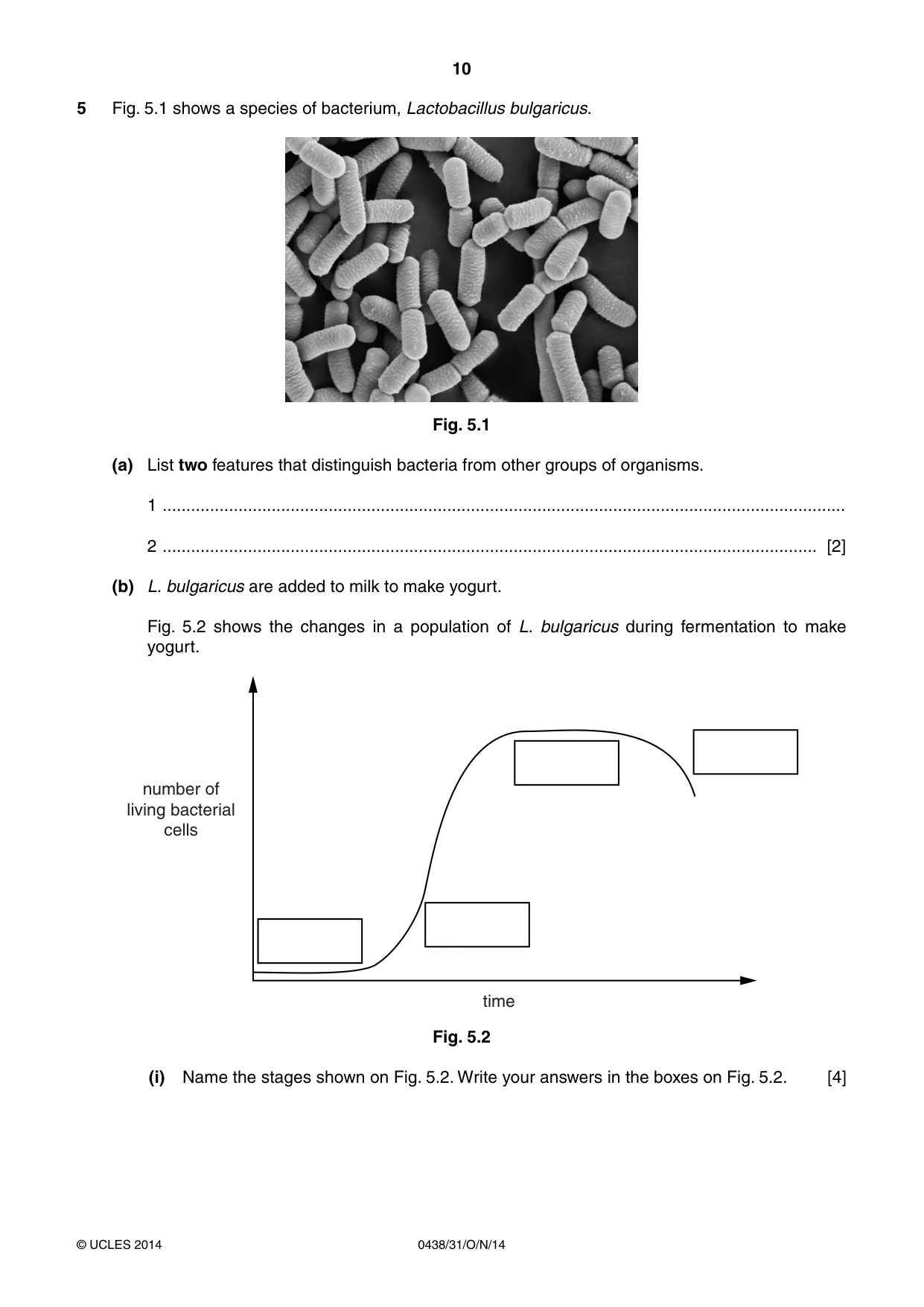
10 0438/31/O/N/14 © UCLES 2014 5 Fig. 5.1 shows a species of bacterium, Lactobacillus bulgaricus. Fig. 5.1 (a) List two features that distinguish bacteria from other groups of organisms. 1 … 2 … [2] (b) L. bulgaricus are added to milk to make yogurt. Fig. 5.2 shows the changes in a population of L. bulgaricus during fermentation to make yogurt. number of living bacterial cells time Fig. 5.2 (i) Name the stages shown on Fig. 5.2. Write your answers in the boxes on Fig. 5.2. [4]
Question paper, page 11
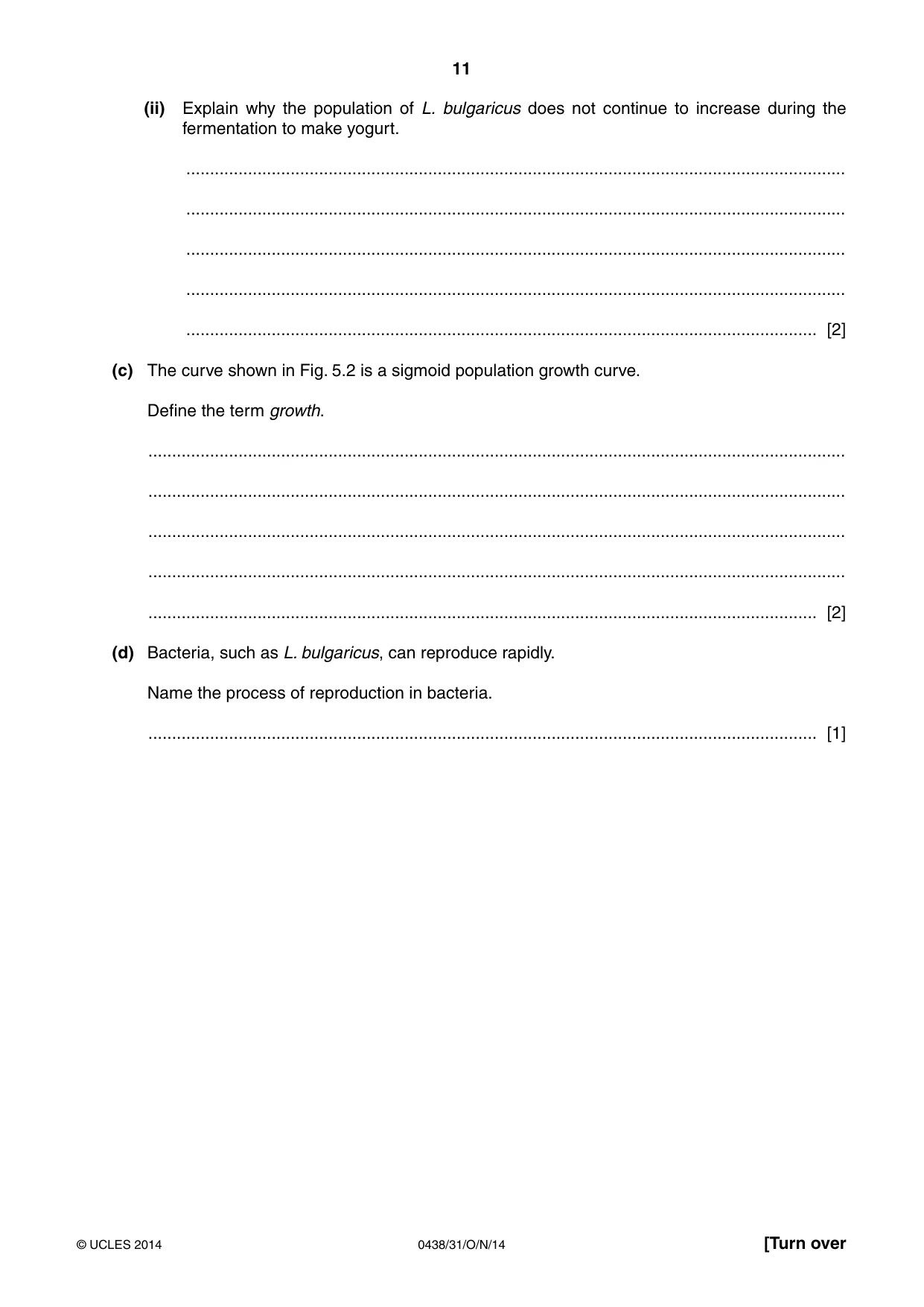
11 0438/31/O/N/14 © UCLES 2014 [Turn over (ii) Explain why the population of L. bulgaricus does not continue to increase during the fermentation to make yogurt. … … … … … [2] (c) The curve shown in Fig. 5.2 is a sigmoid population growth curve. Define the term growth. … … … … … [2] (d) Bacteria, such as L. bulgaricus, can reproduce rapidly. Name the process of reproduction in bacteria. … [1]
Question paper, page 12
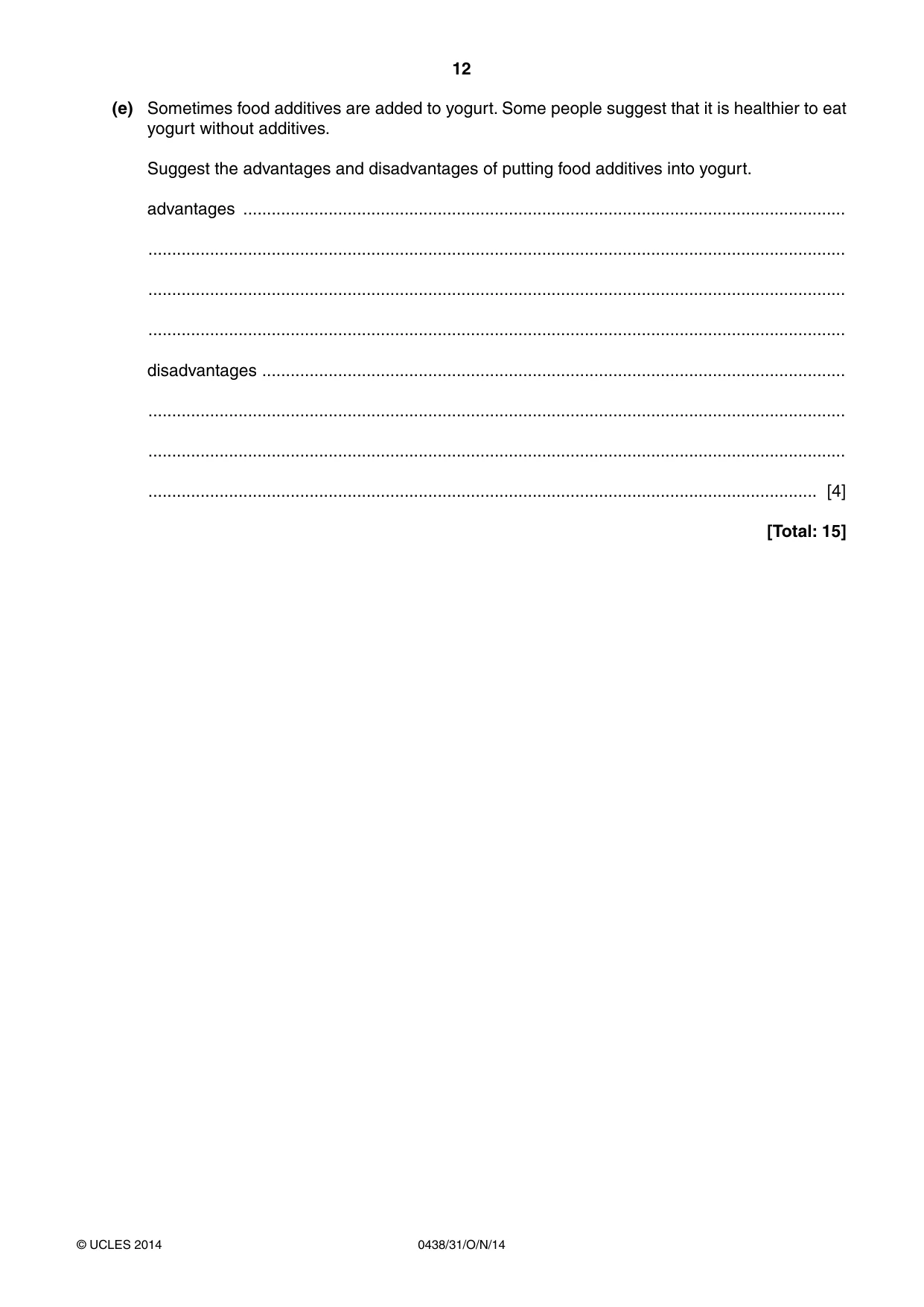
12 0438/31/O/N/14 © UCLES 2014 (e) Sometimes food additives are added to yogurt. Some people suggest that it is healthier to eat yogurt without additives. Suggest the advantages and disadvantages of putting food additives into yogurt. advantages … … … … disadvantages … … … … [4] [Total: 15]
Question paper, page 13
13 0438/31/O/N/14 © UCLES 2014 [Turn over 6 Microorganisms in the soil release enzymes to digest dead leaves. (a) Explain how enzymes catalyze chemical reactions. … … … … … … … [3] (b) Protease and cellulase are two enzymes secreted by soil microorganisms. Protease digests protein. Suggest what part of the dead leaf cells are digested by the enzyme cellulase. … [1]
Question paper, page 14
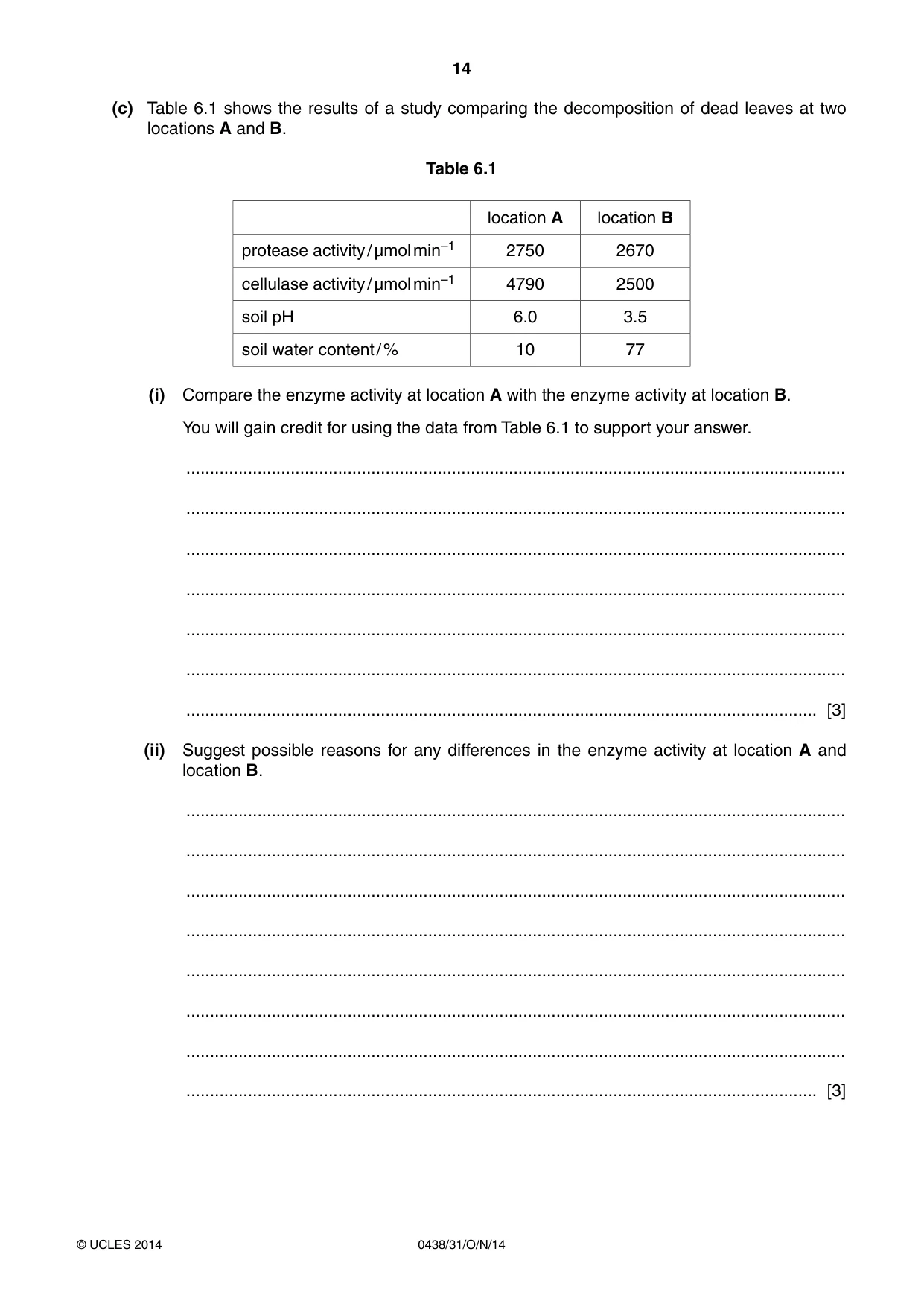
14 0438/31/O/N/14 © UCLES 2014 (c) Table 6.1 shows the results of a study comparing the decomposition of dead leaves at two locations A and B. Table 6.1 location A location B protease activity / µmol min–1 2750 2670 cellulase activity / µmol min–1 4790 2500 soil pH 6.0 3.5 soil water content / % 10 77 (i) Compare the enzyme activity at location A with the enzyme activity at location B. You will gain credit for using the data from Table 6.1 to support your answer. … … … … … … … [3] (ii) Suggest possible reasons for any differences in the enzyme activity at location A and location B. … … … … … … … … [3]
Question paper, page 15
15 0438/31/O/N/14 © UCLES 2014 (d) Describe how nitrogen in proteins in dead leaves is recycled to be absorbed by plants. … … … … … … … … … [4] (e) Microorganisms also process and convert atmospheric nitrogen to form a nitrogen compound that can be absorbed by plants. (i) Name this process of converting atmospheric nitrogen. … [1] (ii) Explain how this process happens. … … … … … [2] [Total: 17]
Question paper, page 16
16 0438/31/O/N/14 © UCLES 2014 Copyright Acknowledgements: Question 4 Figure 4.2 Question 5 Figure 5.1 Question 6 Table 6.1 © adapted: Granier; Tree Physiology 3; Heron Publishing; 1987. © Ref: B220/1875RM; Dr Kari Lounatmaa/Science Photo Library; Lactobacillus bacteria, SEM ; www.sciencephoto.com. © adapted: Munch Dilly; Soil Biology; Biochem 28, no.8; Elsevier; 1996. Permission to reproduce items where third-party owned material protected by copyright is included has been sought and cleared where possible. Every reasonable effort has been made by the publisher (UCLES) to trace copyright holders, but if any items requiring clearance have unwittingly been included, the publisher will be pleased to make amends at the earliest possible opportunity. Cambridge International Examinations is part of the Cambridge Assessment Group. Cambridge Assessment is the brand name of University of Cambridge Local Examinations Syndicate (UCLES), which is itself a department of the University of Cambridge. BLANK PAGE
Mark scheme, page 1
® IGCSE is the registered trademark of Cambridge International Examinations. CAMBRIDGE INTERNATIONAL EXAMINATIONS Cambridge International General Certificate of Secondary Education MARK SCHEME for the October/November 2014 series 0438 BIOLOGY (US) 0438/31 Paper 3 (Extended Theory), maximum raw mark 80 This mark scheme is published as an aid to teachers and candidates, to indicate the requirements of the examination. It shows the basis on which Examiners were instructed to award marks. It does not indicate the details of the discussions that took place at an Examiners’ meeting before marking began, which would have considered the acceptability of alternative answers. Mark schemes should be read in conjunction with the question paper and the Principal Examiner Report for Teachers. Cambridge will not enter into discussions about these mark schemes. Cambridge is publishing the mark schemes for the October/November 2014 series for most Cambridge IGCSE®, Cambridge International A and AS Level components and some Cambridge O Level components.
Mark scheme, page 2
Page 2 Mark Scheme Syllabus Paper Cambridge IGCSE – October/November 2014 0438 31 © Cambridge International Examinations 2014 Abbreviations used in the Mark Scheme • ; separates marking points • / separates alternatives within a marking point • R reject • I ignore (mark as if this material was not present) • A accept (a less than ideal answer which should be marked correct) • AW alternative wording • underline words underlined must be present • max indicates the maximum number of marks that can be awarded • mark independently the second mark may be given even if the first mark is wrong • A, S, P, L Axes, Size, Plots and Line for graphs • O, S, D, L Outline, Size, Detail and Label for drawings • (n)ecf (no) error carried forward • ( ) the word / phrase in brackets is not required, but sets the context • ora or reverse argument. • AVP any valid point
Mark scheme, page 3
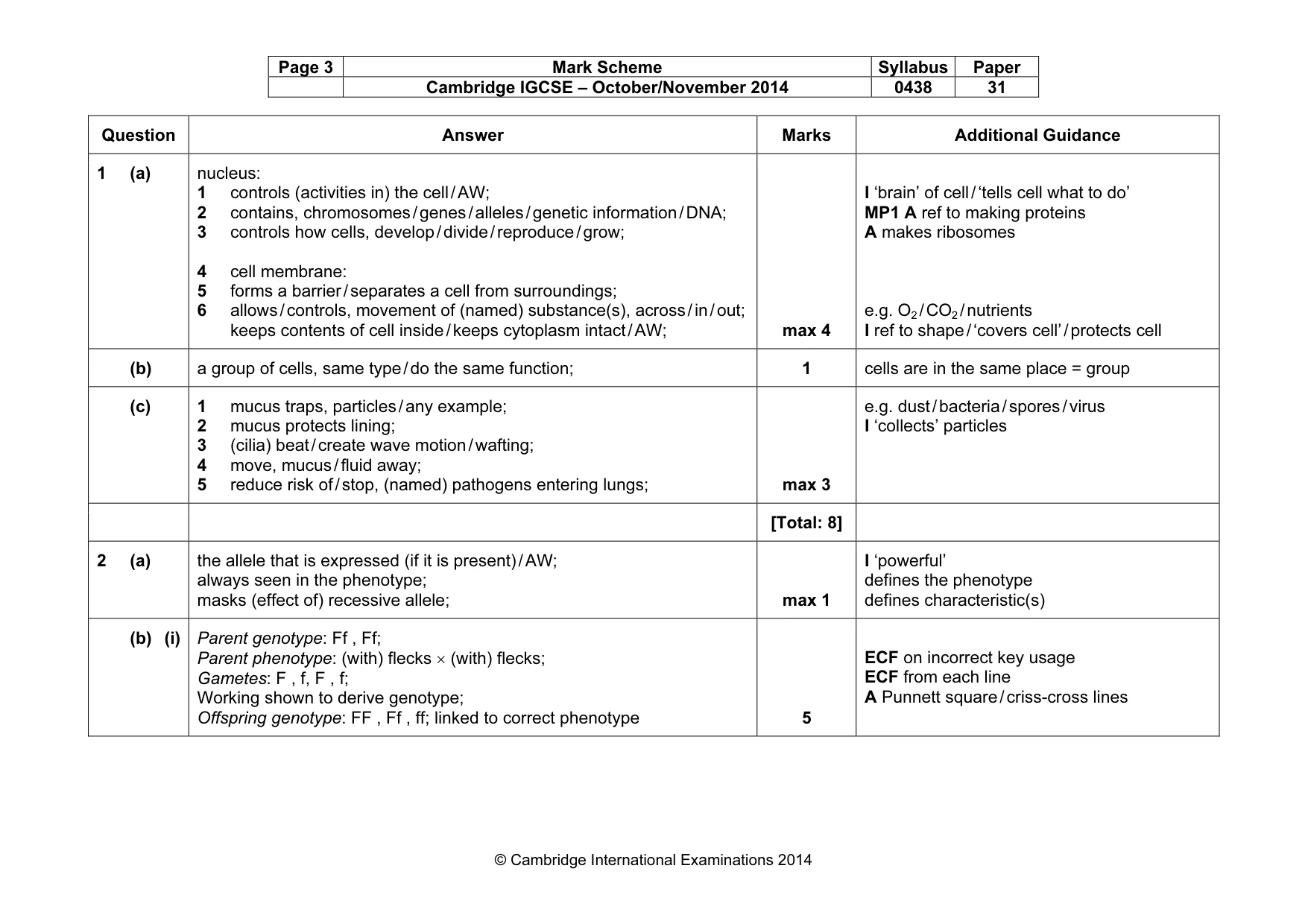
Page 3 Mark Scheme Syllabus Paper Cambridge IGCSE – October/November 2014 0438 31 © Cambridge International Examinations 2014 Question Answer Marks Additional Guidance 1 (a) nucleus: 1 controls (activities in) the cell / AW; 2 contains, chromosomes / genes / alleles / genetic information / DNA; 3 controls how cells, develop / divide / reproduce / grow; 4 cell membrane: 5 forms a barrier / separates a cell from surroundings; 6 allows / controls, movement of (named) substance(s), across / in / out; keeps contents of cell inside / keeps cytoplasm intact / AW; max 4 I ‘brain’ of cell / ‘tells cell what to do’ MP1 A ref to making proteins A makes ribosomes e.g. O2 / CO2 / nutrients I ref to shape / ‘covers cell’ / protects cell (b) a group of cells, same type / do the same function; 1 cells are in the same place = group (c) 1 mucus traps, particles / any example; 2 mucus protects lining; 3 (cilia) beat / create wave motion / wafting; 4 move, mucus / fluid away; 5 reduce risk of / stop, (named) pathogens entering lungs; max 3 e.g. dust / bacteria / spores / virus I ‘collects’ particles [Total: 8] 2 (a) the allele that is expressed (if it is present) / AW; always seen in the phenotype; masks (effect of) recessive allele; max 1 I ‘powerful’ defines the phenotype defines characteristic(s) (b) (i) Parent genotype: Ff , Ff; Parent phenotype: (with) flecks × (with) flecks; Gametes: F , f, F , f; Working shown to derive genotype; Offspring genotype: FF , Ff , ff; linked to correct phenotype 5 ECF on incorrect key usage ECF from each line A Punnett square / criss-cross lines
Mark scheme, page 4
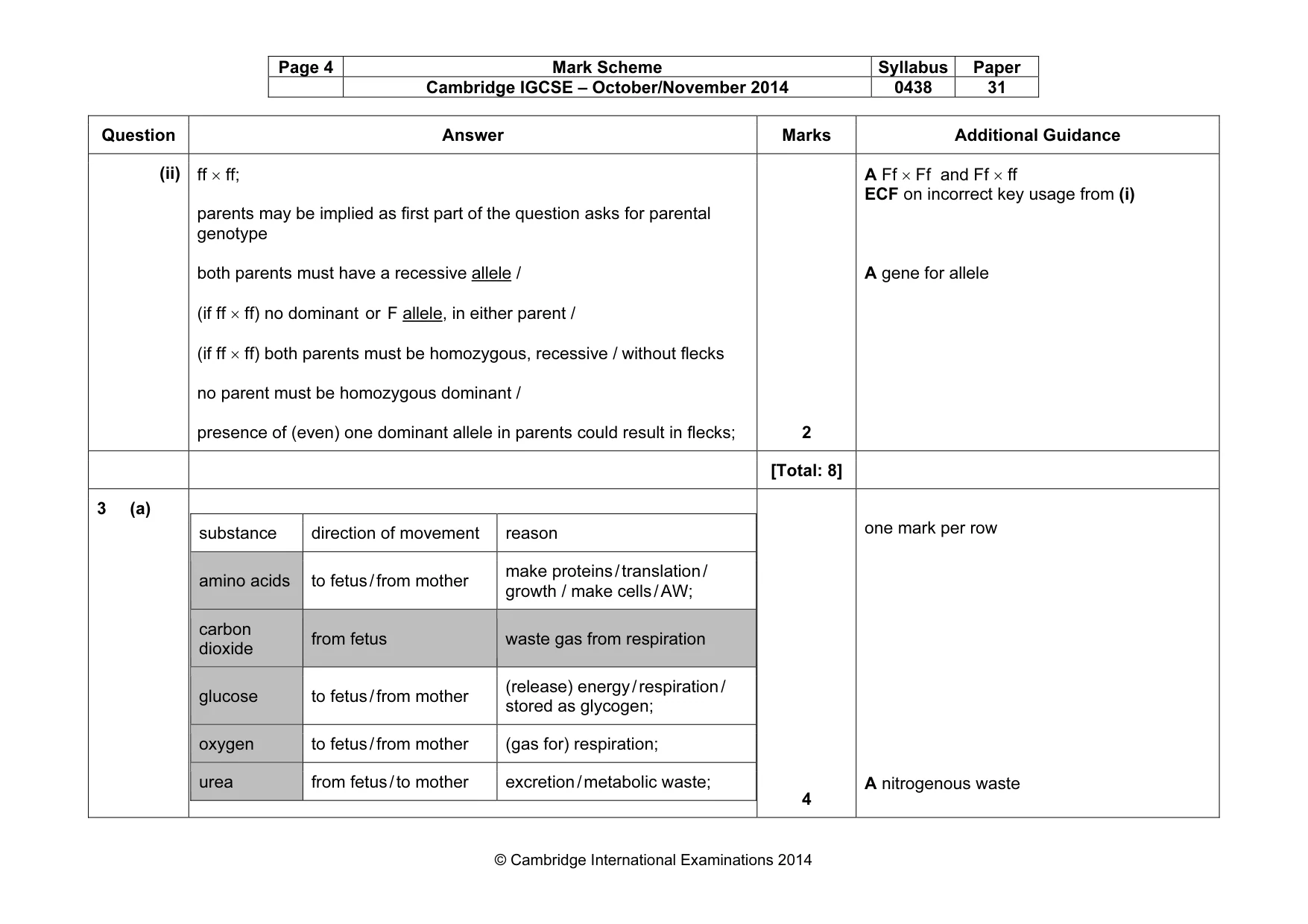
Page 4 Mark Scheme Syllabus Paper Cambridge IGCSE – October/November 2014 0438 31 © Cambridge International Examinations 2014 Question Answer Marks Additional Guidance (ii) ff × ff; parents may be implied as first part of the question asks for parental genotype both parents must have a recessive allele / (if ff × ff) no dominant or F allele, in either parent / (if ff × ff) both parents must be homozygous, recessive / without flecks no parent must be homozygous dominant / presence of (even) one dominant allele in parents could result in flecks; 2 A Ff × Ff and Ff × ff ECF on incorrect key usage from (i) A gene for allele [Total: 8] 3 (a) substance direction of movement reason amino acids to fetus / from mother make proteins / translation / growth / make cells / AW; carbon dioxide from fetus waste gas from respiration glucose to fetus / from mother (release) energy / respiration / stored as glycogen; oxygen to fetus / from mother (gas for) respiration; urea from fetus / to mother excretion / metabolic waste; 4 one mark per row A nitrogenous waste
Mark scheme, page 5
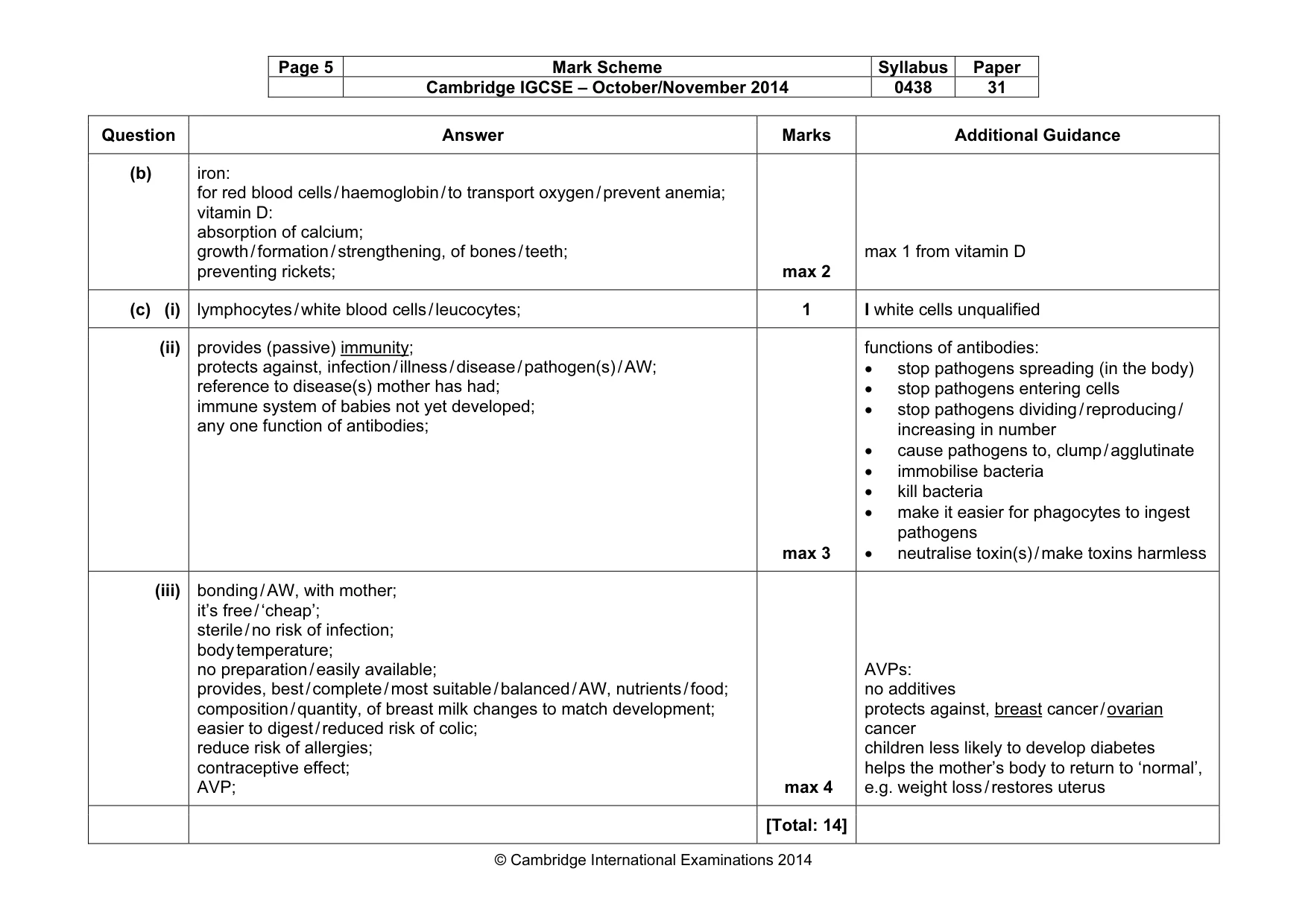
Page 5 Mark Scheme Syllabus Paper Cambridge IGCSE – October/November 2014 0438 31 © Cambridge International Examinations 2014 Question Answer Marks Additional Guidance (b) iron: for red blood cells / haemoglobin / to transport oxygen / prevent anemia; vitamin D: absorption of calcium; growth / formation / strengthening, of bones / teeth; preventing rickets; max 2 max 1 from vitamin D (c) (i) lymphocytes / white blood cells / leucocytes; 1 I white cells unqualified (ii) provides (passive) immunity; protects against, infection / illness / disease / pathogen(s) / AW; reference to disease(s) mother has had; immune system of babies not yet developed; any one function of antibodies; max 3 functions of antibodies: • stop pathogens spreading (in the body) • stop pathogens entering cells • stop pathogens dividing / reproducing / increasing in number • cause pathogens to, clump / agglutinate • immobilise bacteria • kill bacteria • make it easier for phagocytes to ingest pathogens • neutralise toxin(s) / make toxins harmless (iii) bonding / AW, with mother; it’s free / ‘cheap’; sterile / no risk of infection; body temperature; no preparation / easily available; provides, best / complete / most suitable / balanced / AW, nutrients / food; composition / quantity, of breast milk changes to match development; easier to digest / reduced risk of colic; reduce risk of allergies; contraceptive effect; AVP; max 4 AVPs: no additives protects against, breast cancer / ovarian cancer children less likely to develop diabetes helps the mother’s body to return to ‘normal’, e.g. weight loss / restores uterus [Total: 14]
Mark scheme, page 6
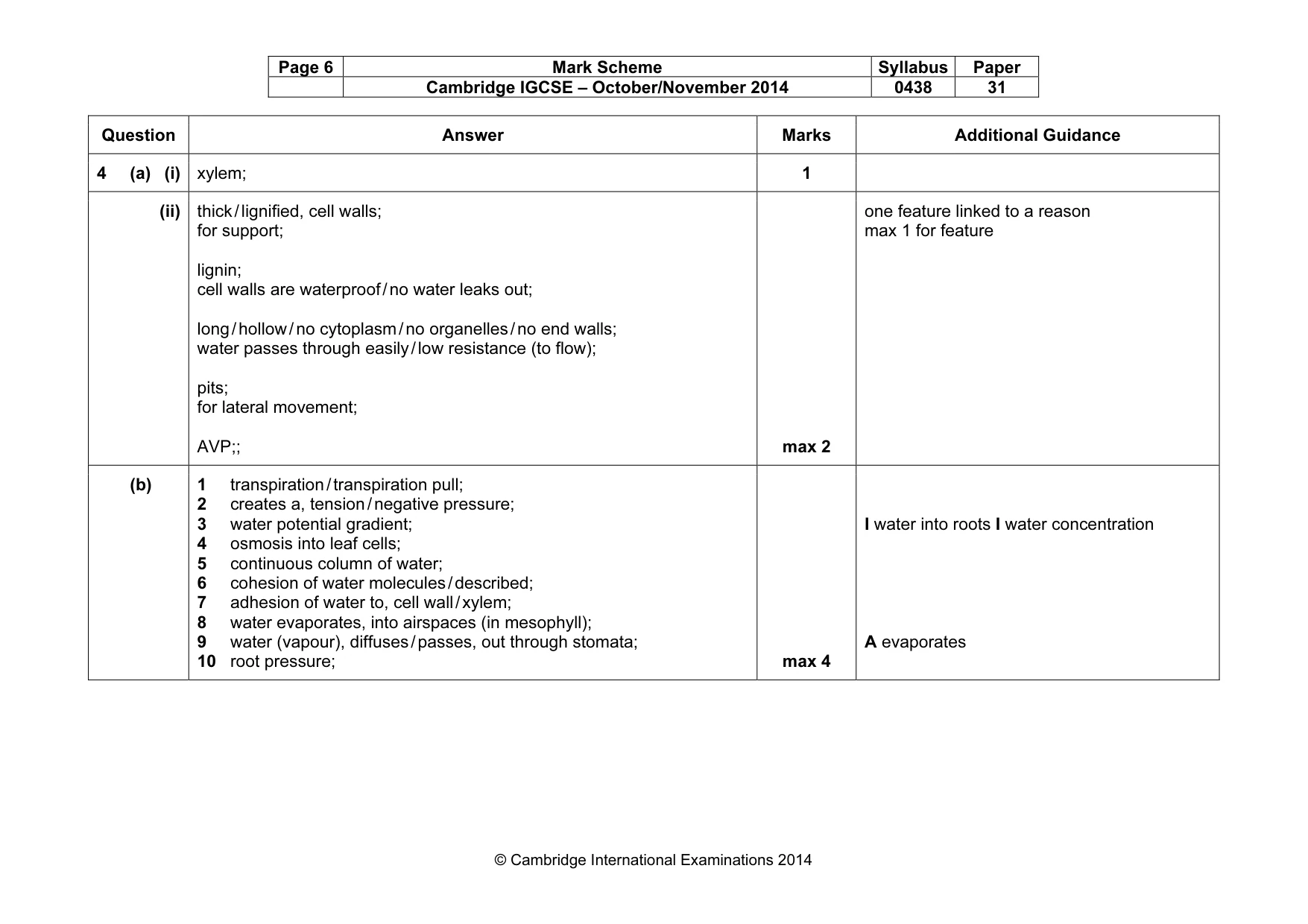
Page 6 Mark Scheme Syllabus Paper Cambridge IGCSE – October/November 2014 0438 31 © Cambridge International Examinations 2014 Question Answer Marks Additional Guidance 4 (a) (i) xylem; 1 (ii) thick / lignified, cell walls; for support; lignin; cell walls are waterproof / no water leaks out; long / hollow / no cytoplasm / no organelles / no end walls; water passes through easily / low resistance (to flow); pits; for lateral movement; AVP;; max 2 one feature linked to a reason max 1 for feature (b) 1 transpiration / transpiration pull; 2 creates a, tension / negative pressure; 3 water potential gradient; 4 osmosis into leaf cells; 5 continuous column of water; 6 cohesion of water molecules / described; 7 adhesion of water to, cell wall / xylem; 8 water evaporates, into airspaces (in mesophyll); 9 water (vapour), diffuses / passes, out through stomata; 10 root pressure; max 4 I water into roots I water concentration A evaporates
Mark scheme, page 7
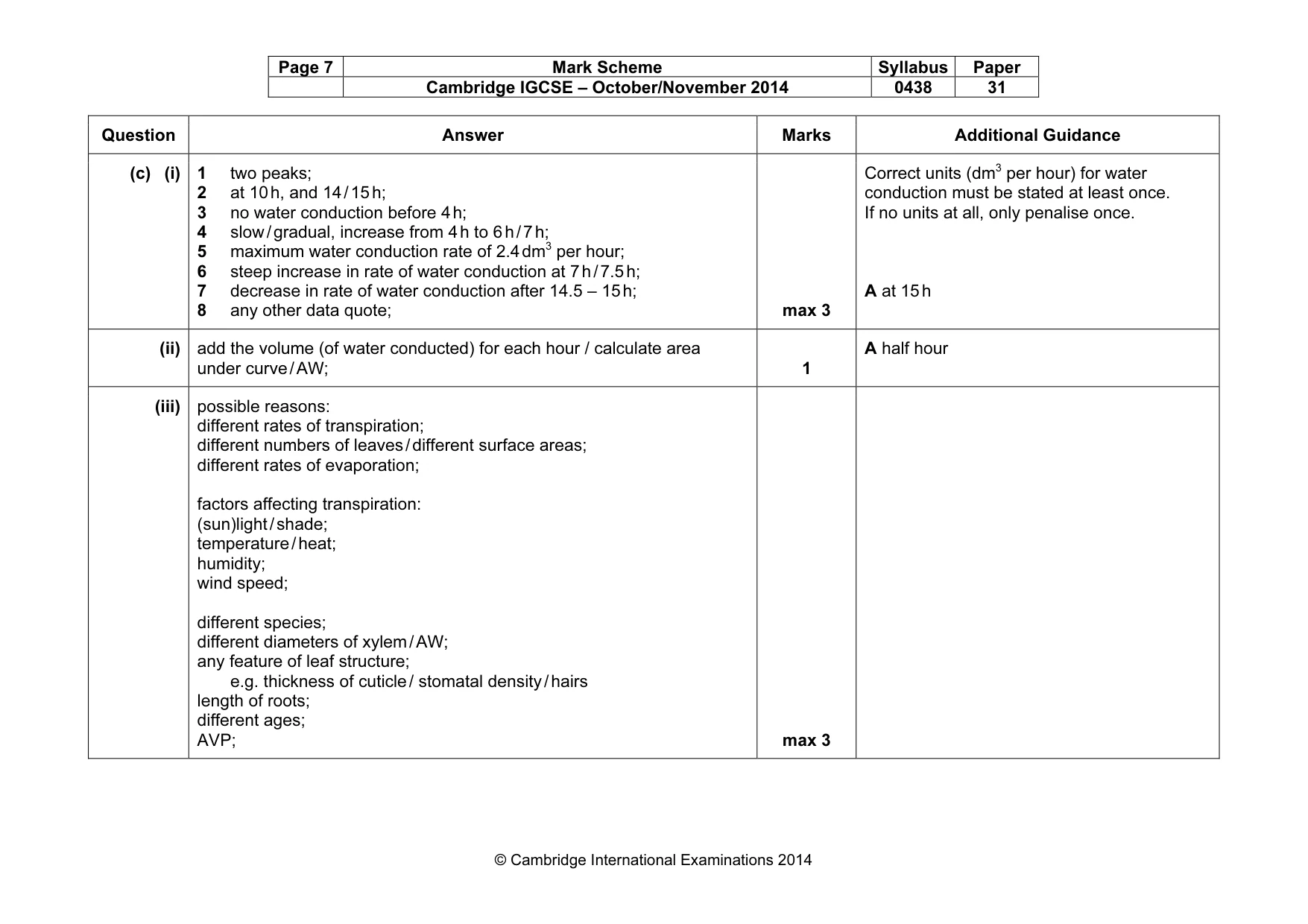
Page 7 Mark Scheme Syllabus Paper Cambridge IGCSE – October/November 2014 0438 31 © Cambridge International Examinations 2014 Question Answer Marks Additional Guidance (c) (i) 1 two peaks; 2 at 10 h, and 14 / 15 h; 3 no water conduction before 4 h; 4 slow / gradual, increase from 4 h to 6 h / 7 h; 5 maximum water conduction rate of 2.4 dm3 per hour; 6 steep increase in rate of water conduction at 7 h / 7.5 h; 7 decrease in rate of water conduction after 14.5 – 15 h; 8 any other data quote; max 3 Correct units (dm3 per hour) for water conduction must be stated at least once. If no units at all, only penalise once. A at 15 h (ii) add the volume (of water conducted) for each hour / calculate area under curve / AW; 1 A half hour (iii) possible reasons: different rates of transpiration; different numbers of leaves / different surface areas; different rates of evaporation; factors affecting transpiration: (sun)light / shade; temperature / heat; humidity; wind speed; different species; different diameters of xylem / AW; any feature of leaf structure; e.g. thickness of cuticle / stomatal density / hairs length of roots; different ages; AVP; max 3
Mark scheme, page 8
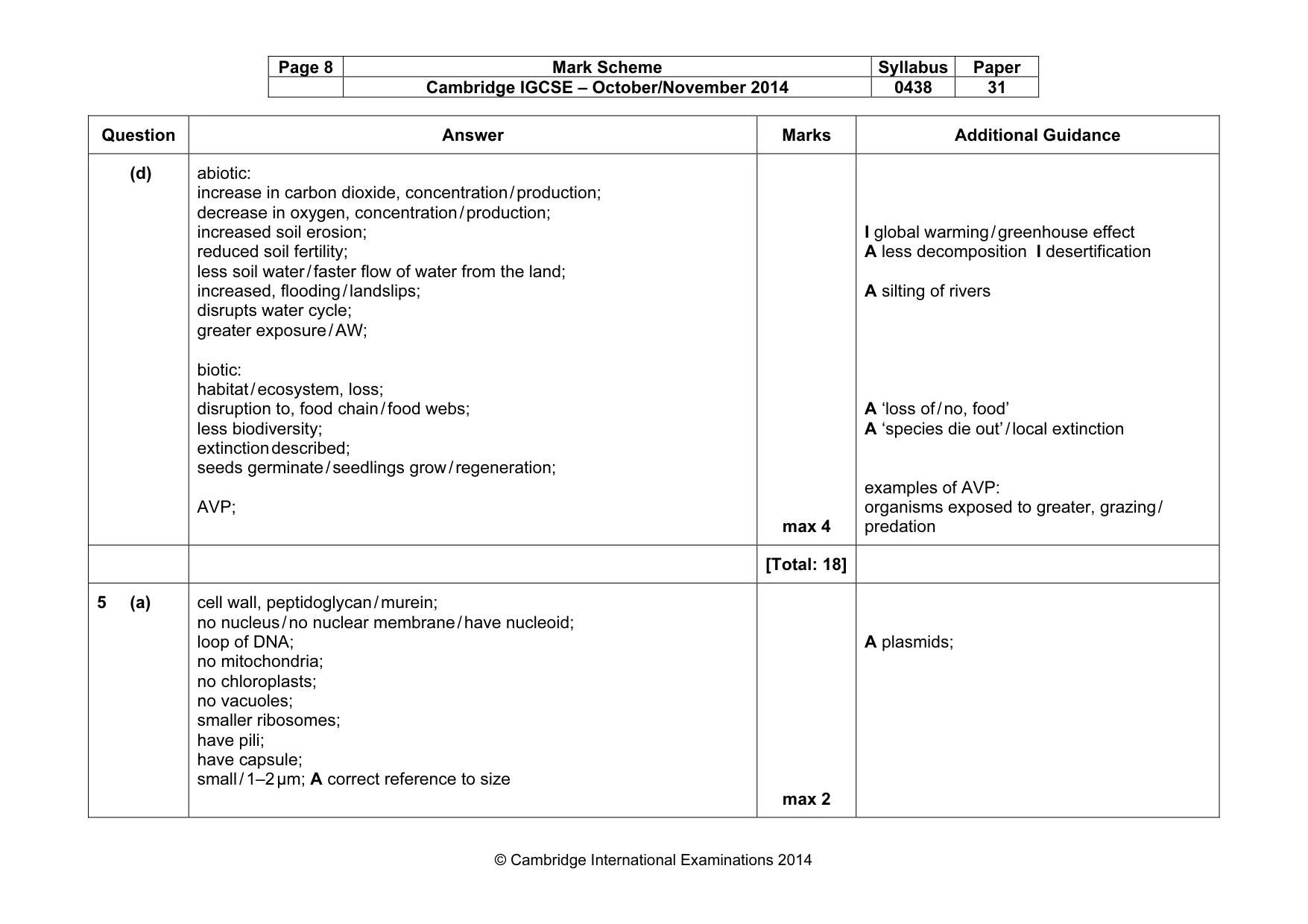
Page 8 Mark Scheme Syllabus Paper Cambridge IGCSE – October/November 2014 0438 31 © Cambridge International Examinations 2014 Question Answer Marks Additional Guidance (d) abiotic: increase in carbon dioxide, concentration / production; decrease in oxygen, concentration / production; increased soil erosion; reduced soil fertility; less soil water / faster flow of water from the land; increased, flooding / landslips; disrupts water cycle; greater exposure / AW; biotic: habitat / ecosystem, loss; disruption to, food chain / food webs; less biodiversity; extinction described; seeds germinate / seedlings grow / regeneration; AVP; max 4 I global warming / greenhouse effect A less decomposition I desertification A silting of rivers A ‘loss of / no, food’ A ‘species die out’ / local extinction examples of AVP: organisms exposed to greater, grazing / predation [Total: 18] 5 (a) cell wall, peptidoglycan / murein; no nucleus / no nuclear membrane / have nucleoid; loop of DNA; no mitochondria; no chloroplasts; no vacuoles; smaller ribosomes; have pili; have capsule; small / 1–2 µm; A correct reference to size max 2 A plasmids;
Mark scheme, page 9
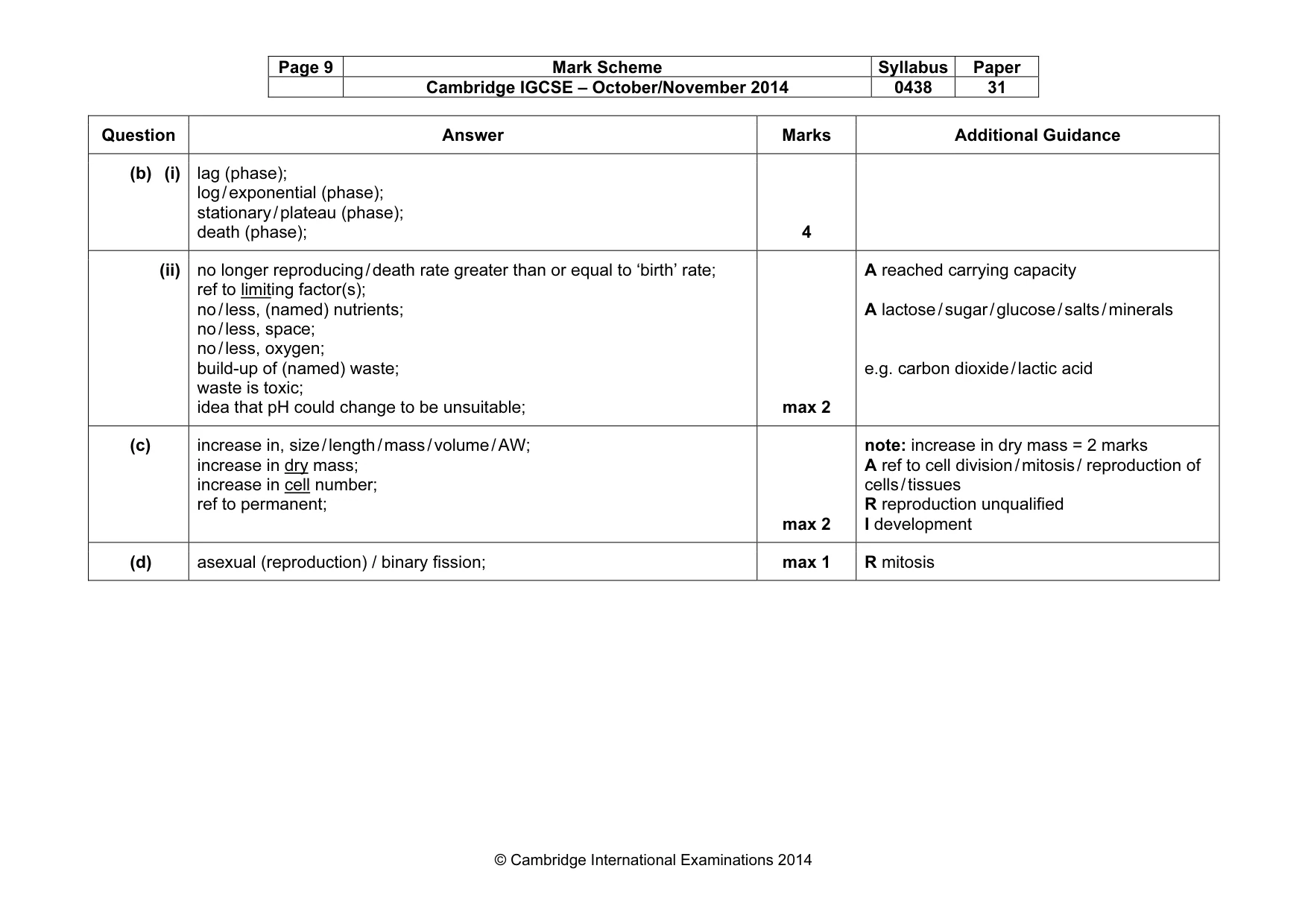
Page 9 Mark Scheme Syllabus Paper Cambridge IGCSE – October/November 2014 0438 31 © Cambridge International Examinations 2014 Question Answer Marks Additional Guidance (b) (i) lag (phase); log / exponential (phase); stationary / plateau (phase); death (phase); 4 (ii) no longer reproducing / death rate greater than or equal to ‘birth’ rate; ref to limiting factor(s); no / less, (named) nutrients; no / less, space; no / less, oxygen; build-up of (named) waste; waste is toxic; idea that pH could change to be unsuitable; max 2 A reached carrying capacity A lactose / sugar / glucose / salts / minerals e.g. carbon dioxide / lactic acid (c) increase in, size / length / mass / volume / AW; increase in dry mass; increase in cell number; ref to permanent; max 2 note: increase in dry mass = 2 marks A ref to cell division / mitosis / reproduction of cells / tissues R reproduction unqualified I development (d) asexual (reproduction) / binary fission; max 1 R mitosis
Mark scheme, page 10
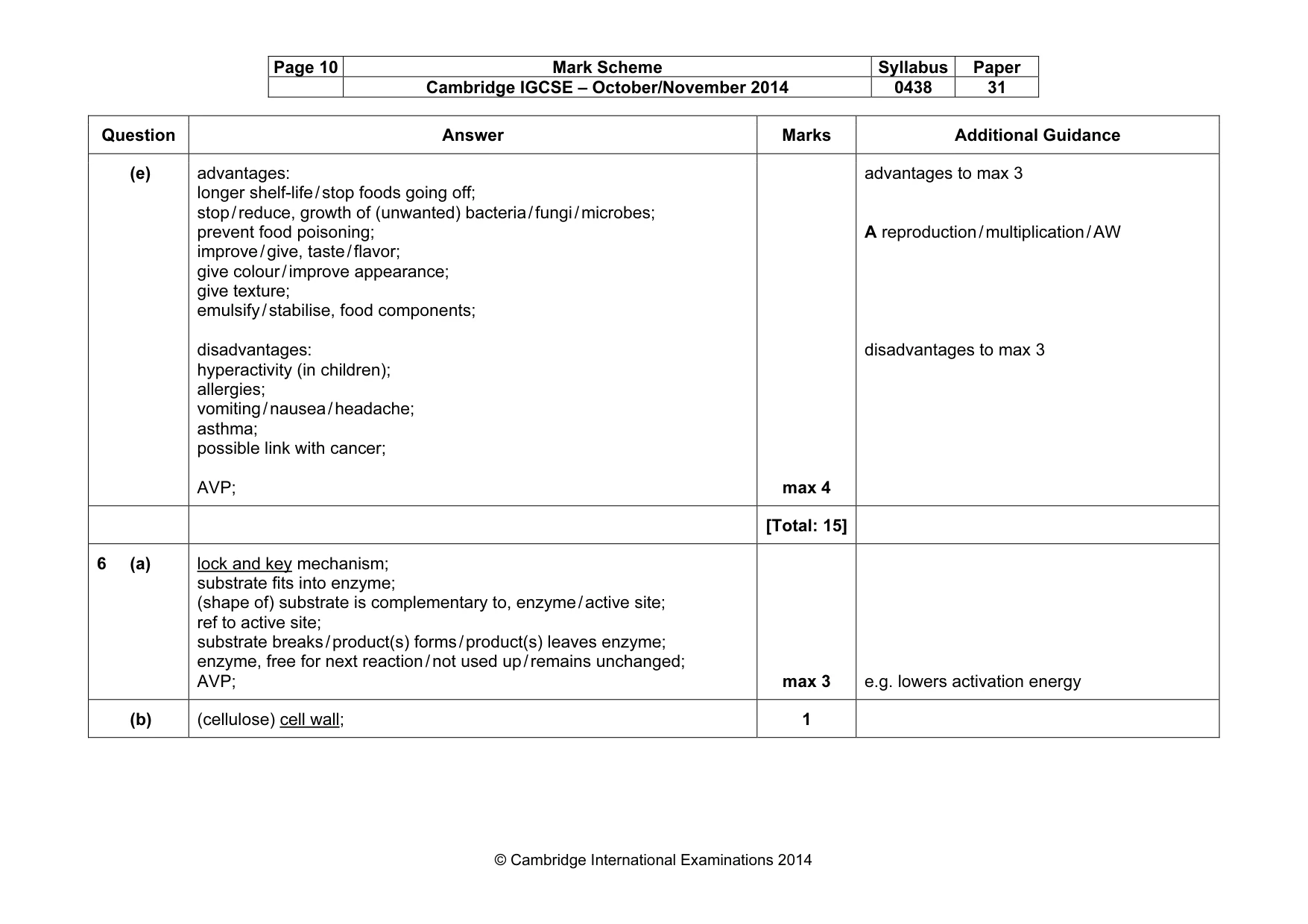
Page 10 Mark Scheme Syllabus Paper Cambridge IGCSE – October/November 2014 0438 31 © Cambridge International Examinations 2014 Question Answer Marks Additional Guidance (e) advantages: longer shelf-life / stop foods going off; stop / reduce, growth of (unwanted) bacteria / fungi / microbes; prevent food poisoning; improve / give, taste / flavor; give colour / improve appearance; give texture; emulsify / stabilise, food components; disadvantages: hyperactivity (in children); allergies; vomiting / nausea / headache; asthma; possible link with cancer; AVP; max 4 advantages to max 3 A reproduction / multiplication / AW disadvantages to max 3 [Total: 15] 6 (a) lock and key mechanism; substrate fits into enzyme; (shape of) substrate is complementary to, enzyme / active site; ref to active site; substrate breaks / product(s) forms / product(s) leaves enzyme; enzyme, free for next reaction / not used up / remains unchanged; AVP; max 3 e.g. lowers activation energy (b) (cellulose) cell wall; 1
Mark scheme, page 11
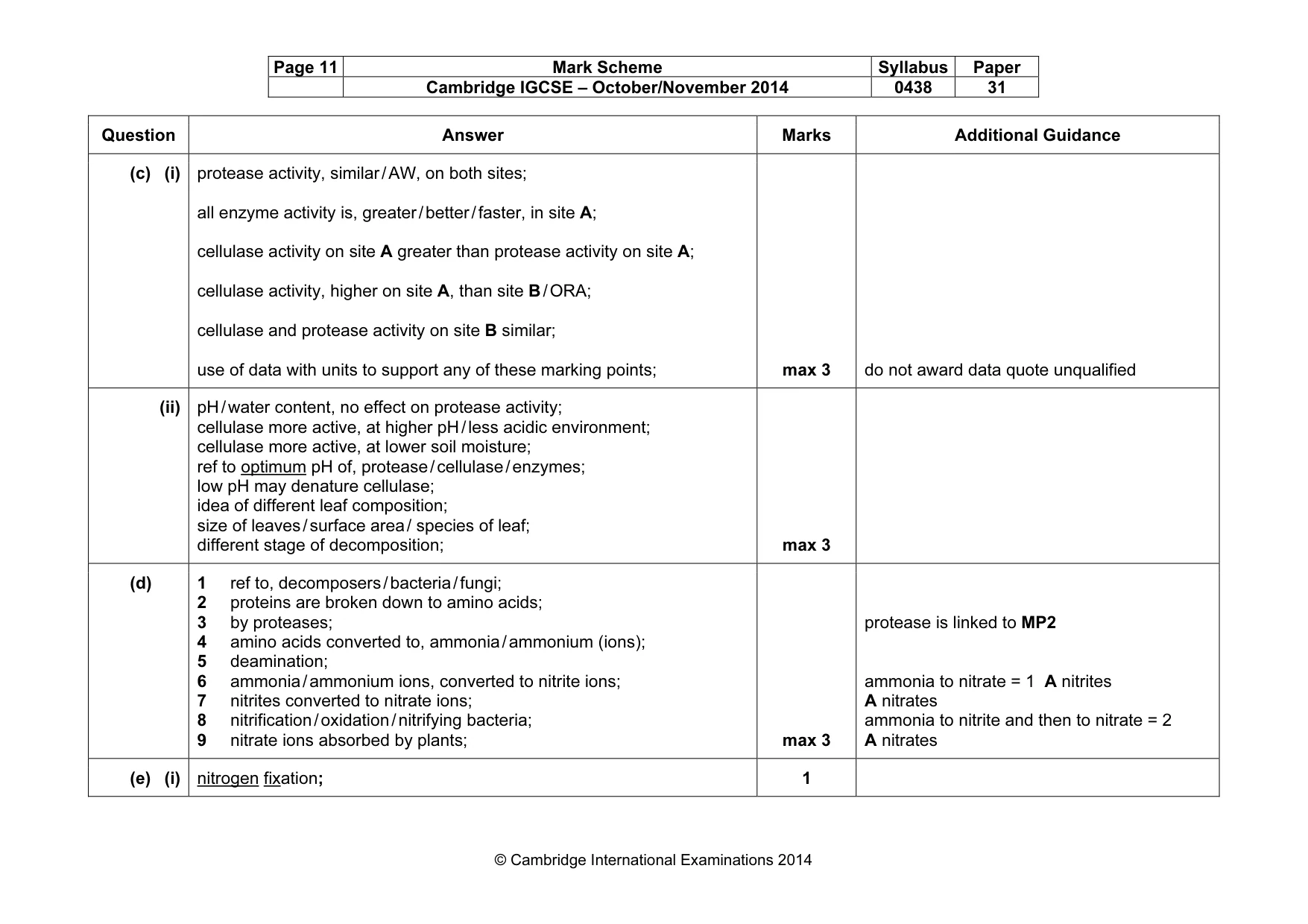
Page 11 Mark Scheme Syllabus Paper Cambridge IGCSE – October/November 2014 0438 31 © Cambridge International Examinations 2014 Question Answer Marks Additional Guidance (c) (i) protease activity, similar / AW, on both sites; all enzyme activity is, greater / better / faster, in site A; cellulase activity on site A greater than protease activity on site A; cellulase activity, higher on site A, than site B / ORA; cellulase and protease activity on site B similar; use of data with units to support any of these marking points; max 3 do not award data quote unqualified (ii) pH / water content, no effect on protease activity; cellulase more active, at higher pH / less acidic environment; cellulase more active, at lower soil moisture; ref to optimum pH of, protease / cellulase / enzymes; low pH may denature cellulase; idea of different leaf composition; size of leaves / surface area / species of leaf; different stage of decomposition; max 3 (d) 1 ref to, decomposers / bacteria / fungi; 2 proteins are broken down to amino acids; 3 by proteases; 4 amino acids converted to, ammonia / ammonium (ions); 5 deamination; 6 ammonia / ammonium ions, converted to nitrite ions; 7 nitrites converted to nitrate ions; 8 nitrification / oxidation / nitrifying bacteria; 9 nitrate ions absorbed by plants; max 3 protease is linked to MP2 ammonia to nitrate = 1 A nitrites A nitrates ammonia to nitrite and then to nitrate = 2 A nitrates (e) (i) nitrogen fixation; 1
Mark scheme, page 12
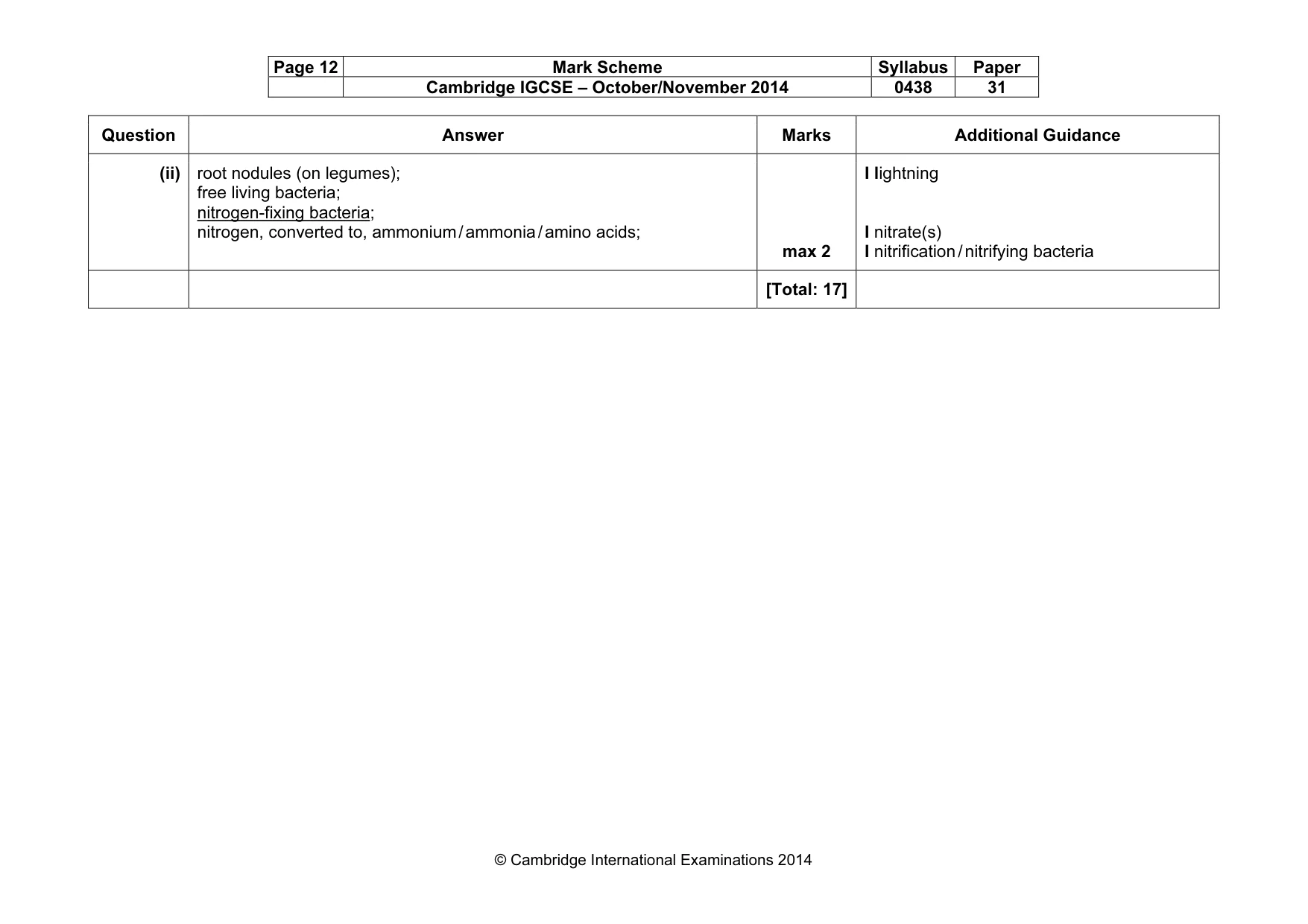
Page 12 Mark Scheme Syllabus Paper Cambridge IGCSE – October/November 2014 0438 31 © Cambridge International Examinations 2014 Question Answer Marks Additional Guidance (ii) root nodules (on legumes); free living bacteria; nitrogen-fixing bacteria; nitrogen, converted to, ammonium / ammonia / amino acids; max 2 I lightning I nitrate(s) I nitrification / nitrifying bacteria [Total: 17]
What you needed in this session
Cambridge’s own grade thresholds for 2014 Oct/Nov, Paper 3 · Variant 1. A higher threshold means an easier paper — the bar moves with how the cohort did.