Cambridge IGCSE Biology (BES) 0438 — 2014 May/June Paper 2 · Variant 1
0438/21/M/J/14 · 80 marks · ≈90 min
The question paper and its mark scheme, free to read here and free to download. This is Cambridge’s own paper, exactly as it was sat.
Question paper20 pages
Mark scheme9 pages
Answers below. Sit the paper first if you are practising.
Paper as text
Question paper, page 1
This document consists of 19 printed pages and 1 blank page. DC (KN/CGW) 96499 © UCLES 2014 [Turn over Cambridge International Examinations Cambridge International General Certificate of Secondary Education * 6 8 1 3 9 2 4 7 3 9 * BIOLOGY (US) 0438/21 Paper 2 Core May/June 2014 1 hour 15 minutes Candidates answer on the Question Paper. No Additional Materials are required. READ THESE INSTRUCTIONS FIRST Write your Center number, candidate number and name on all the work you hand in. Write in dark blue or black pen. You may use an HB pencil for any diagrams or graphs. Do not use staples, paper clips, glue or correction fluid. DO NOT WRITE IN ANY BARCODES. Answer all questions. Electronic calculators may be used. You may lose marks if you do not show your working or if you do not use appropriate units. At the end of the examination, fasten all your work securely together. The number of marks is given in brackets [ ] at the end of each question or part question.
Question paper, page 2
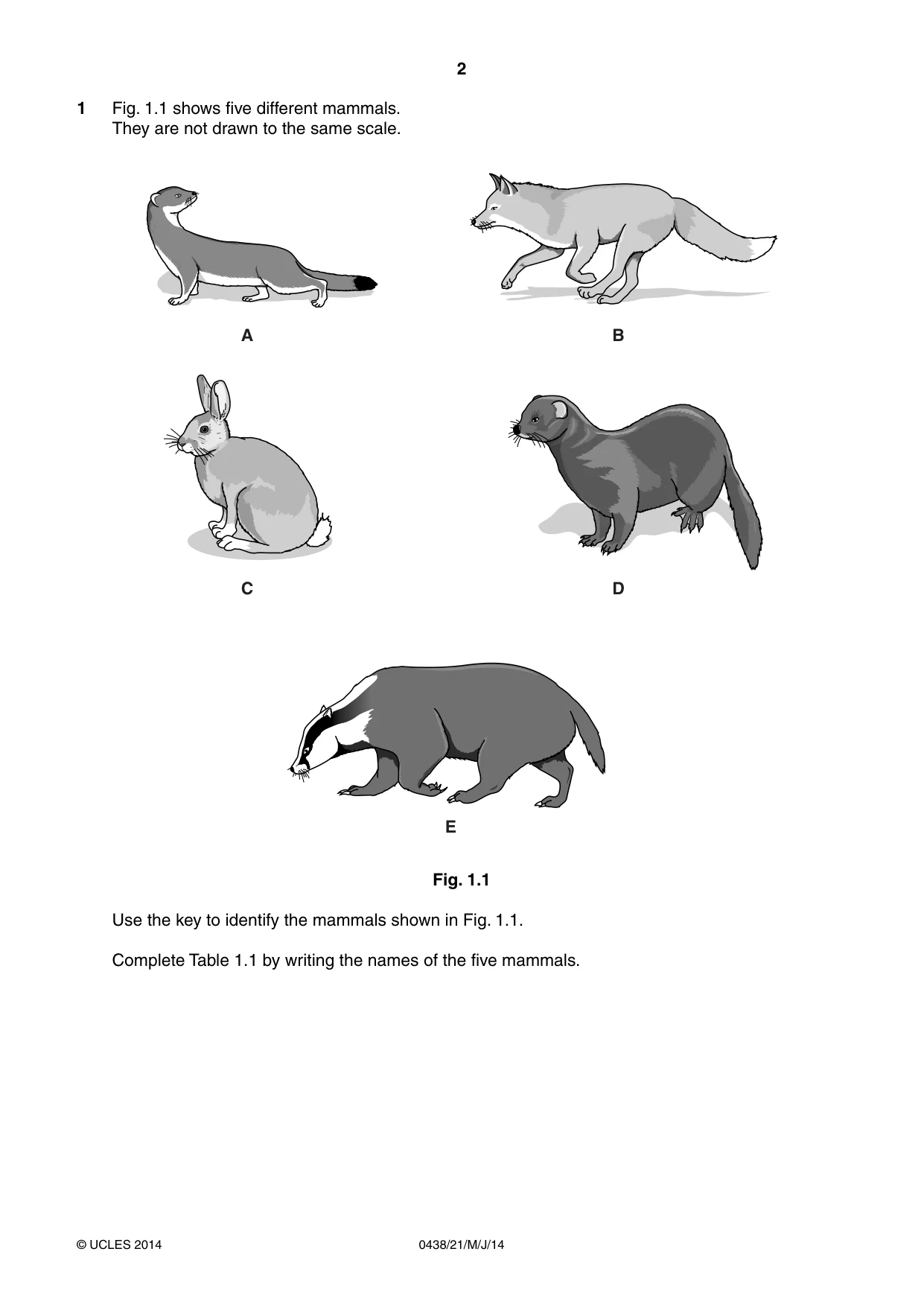
2 0438/21/M/J/14 © UCLES 2014 1 Fig. 1.1 shows five different mammals. They are not drawn to the same scale. A B C E D Fig. 1.1 Use the key to identify the mammals shown in Fig. 1.1. Complete Table 1.1 by writing the names of the five mammals.
Question paper, page 3
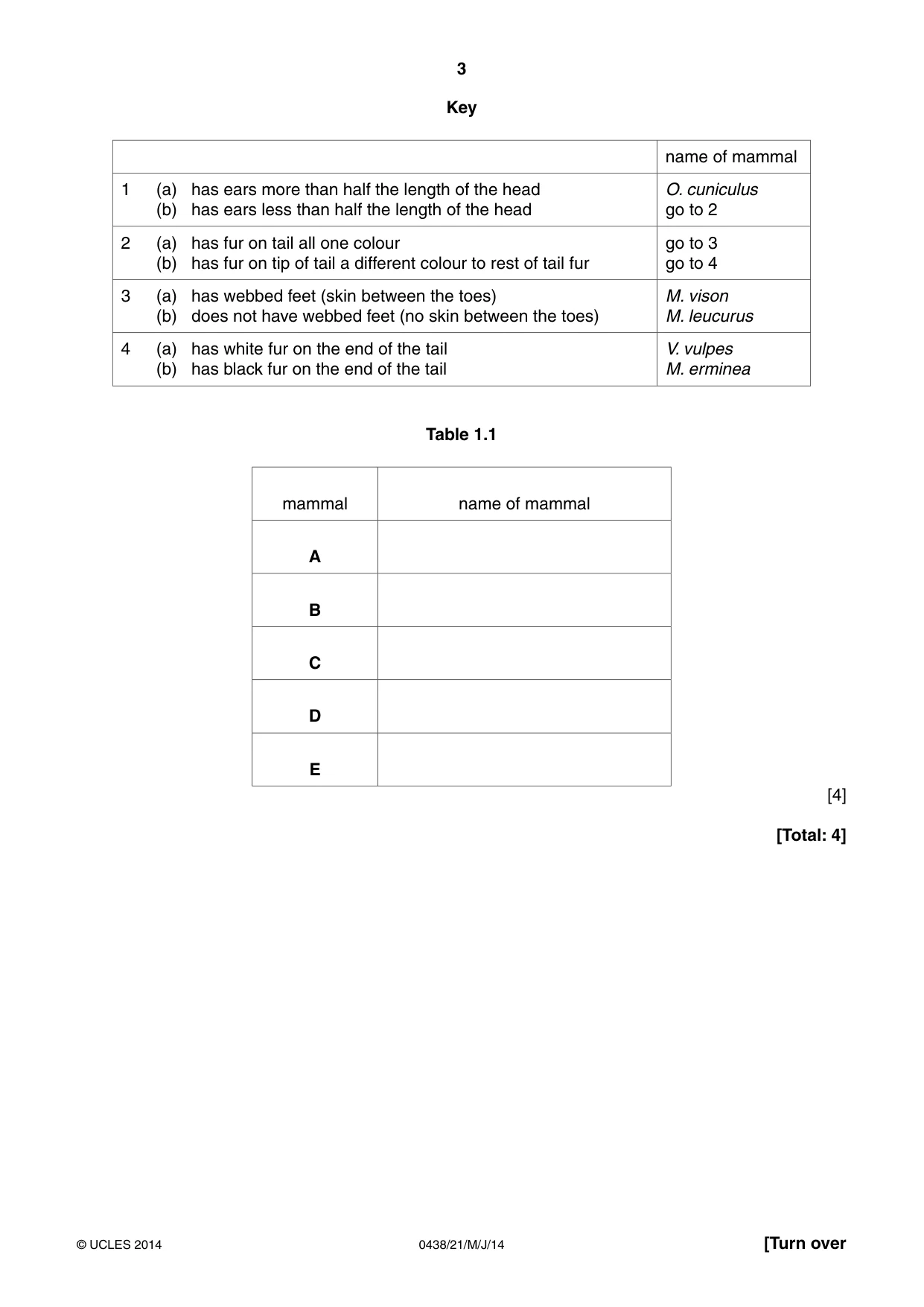
3 0438/21/M/J/14 © UCLES 2014 [Turn over Key name of mammal 1 (a) has ears more than half the length of the head (b) has ears less than half the length of the head O. cuniculus go to 2 2 (a) has fur on tail all one colour (b) has fur on tip of tail a different colour to rest of tail fur go to 3 go to 4 3 (a) has webbed feet (skin between the toes) (b) does not have webbed feet (no skin between the toes) M. vison M. leucurus 4 (a) has white fur on the end of the tail (b) has black fur on the end of the tail V. vulpes M. erminea Table 1.1 mammal name of mammal A B C D E [4] [Total: 4]
Question paper, page 4
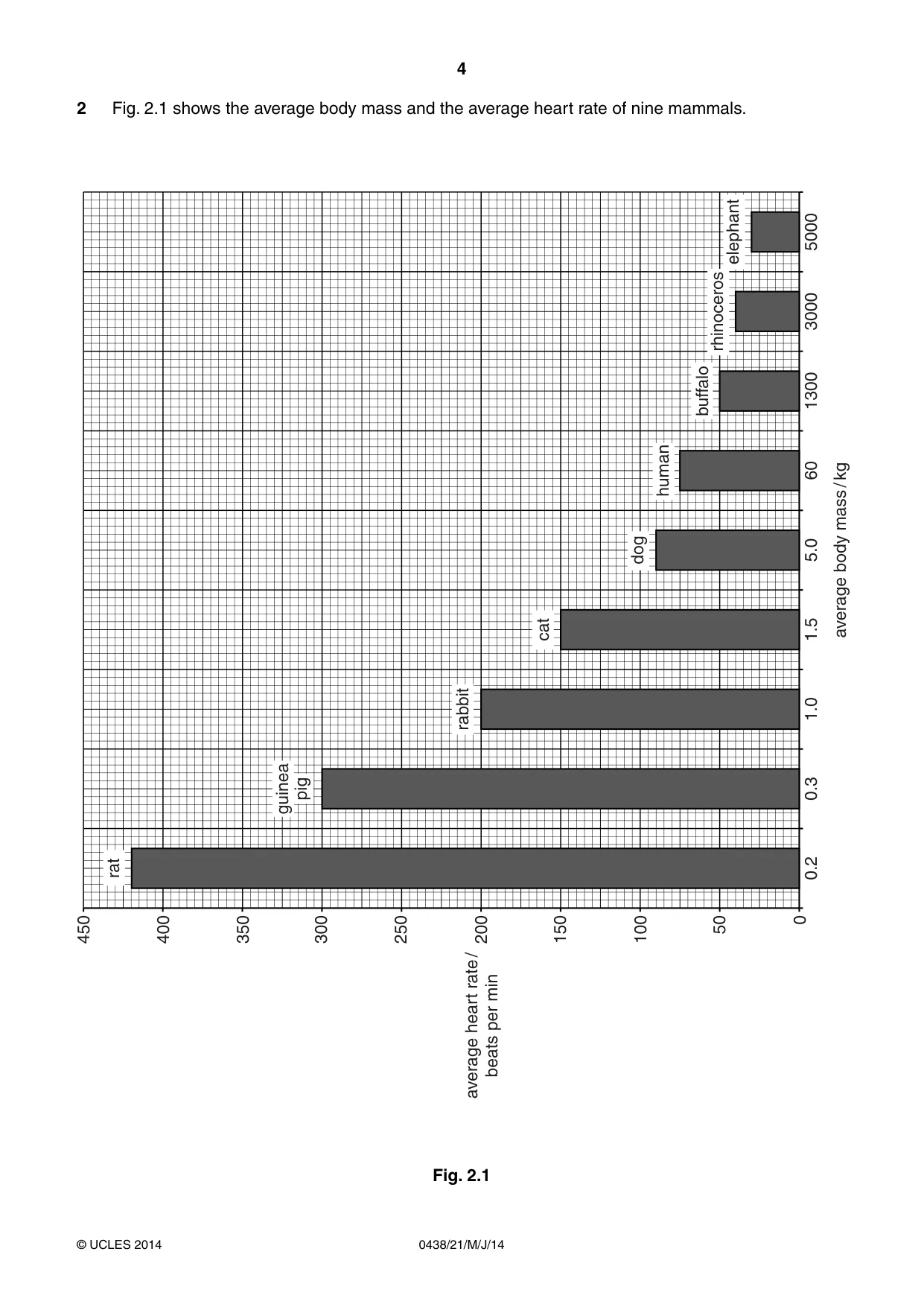
4 0438/21/M/J/14 © UCLES 2014 2 Fig. 2.1 shows the average body mass and the average heart rate of nine mammals. 0 50 0.2 0.3 1.0 1.5 5.0 average body mass / kg 60 1300 3000 5000 100 150 200 average heart rate / beats per min 250 300 350 400 450 dog human buffalo rhinoceros elephant cat rabbit guinea pig rat Fig. 2.1
Question paper, page 5
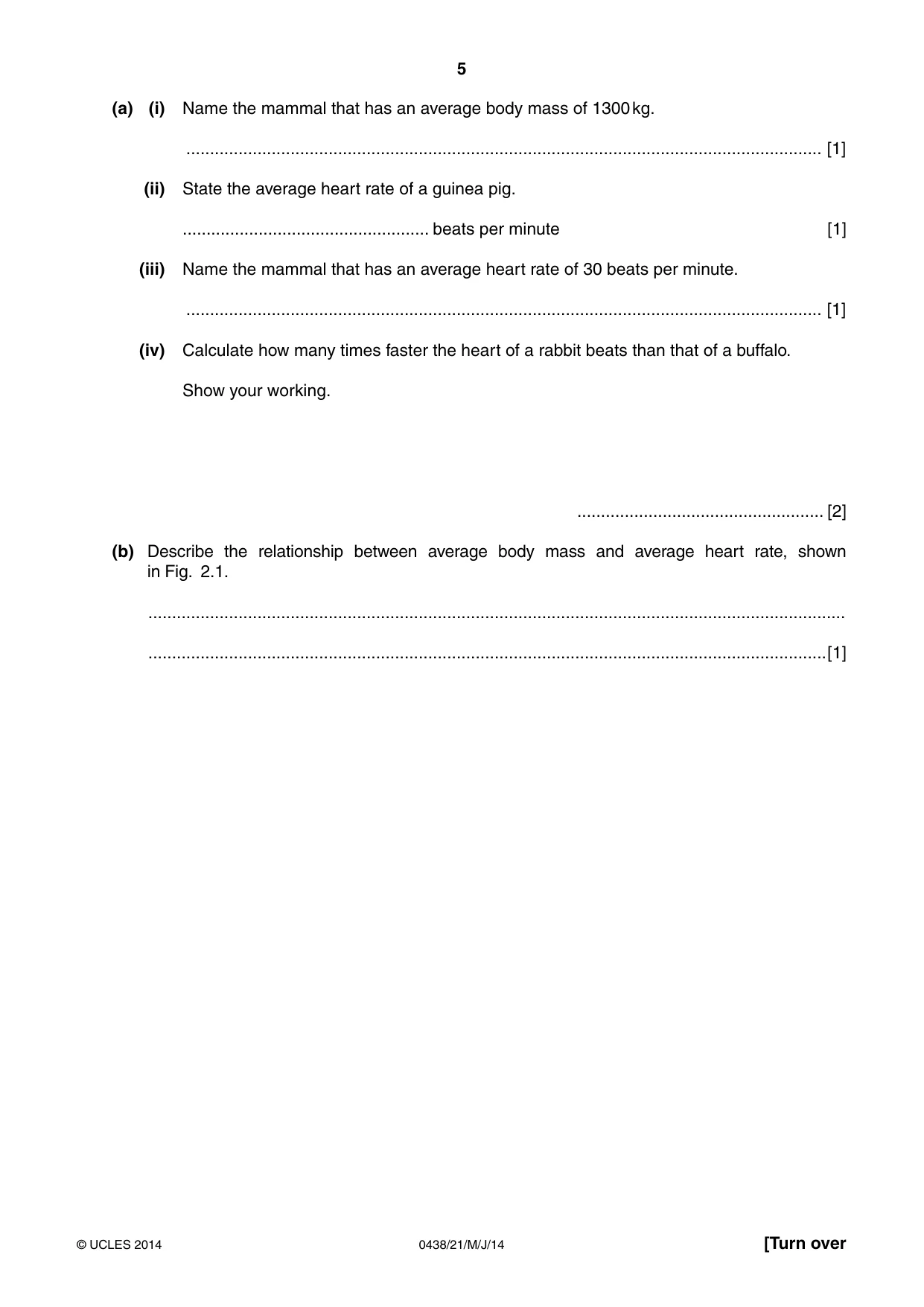
5 0438/21/M/J/14 © UCLES 2014 [Turn over (a) (i) Name the mammal that has an average body mass of 1300 kg. … [1] (ii) State the average heart rate of a guinea pig. … beats per minute [1] (iii) Name the mammal that has an average heart rate of 30 beats per minute. … [1] (iv) Calculate how many times faster the heart of a rabbit beats than that of a buffalo. Show your working. … [2] (b) Describe the relationship between average body mass and average heart rate, shown in Fig. 2.1. … …[1]
Question paper, page 6
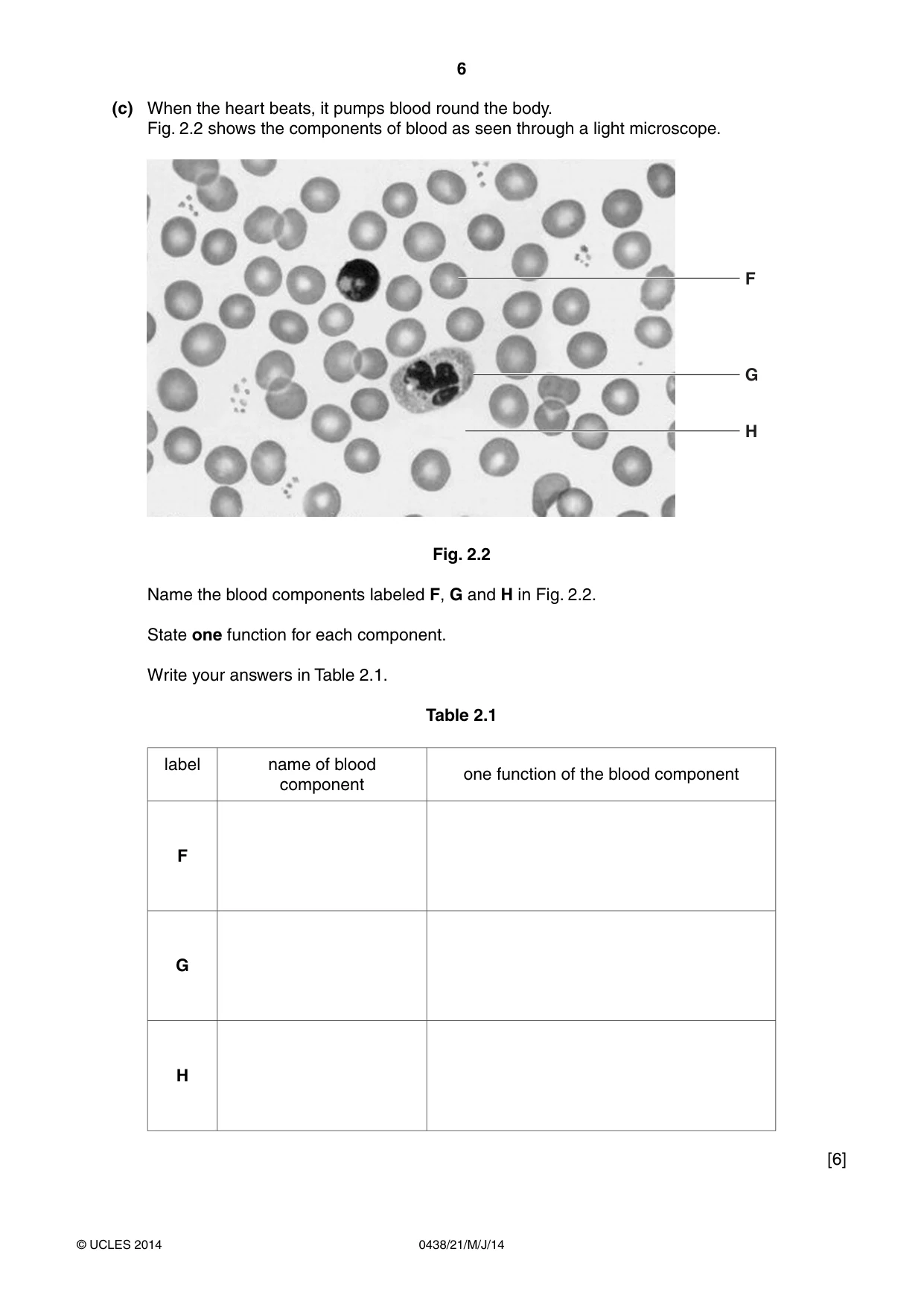
6 0438/21/M/J/14 © UCLES 2014 (c) When the heart beats, it pumps blood round the body. Fig. 2.2 shows the components of blood as seen through a light microscope. ) * + Fig. 2.2 Name the blood components labeled F, G and H in Fig. 2.2. State one function for each component. Write your answers in Table 2.1. Table 2.1 label name of blood component one function of the blood component F G H [6]
Question paper, page 7
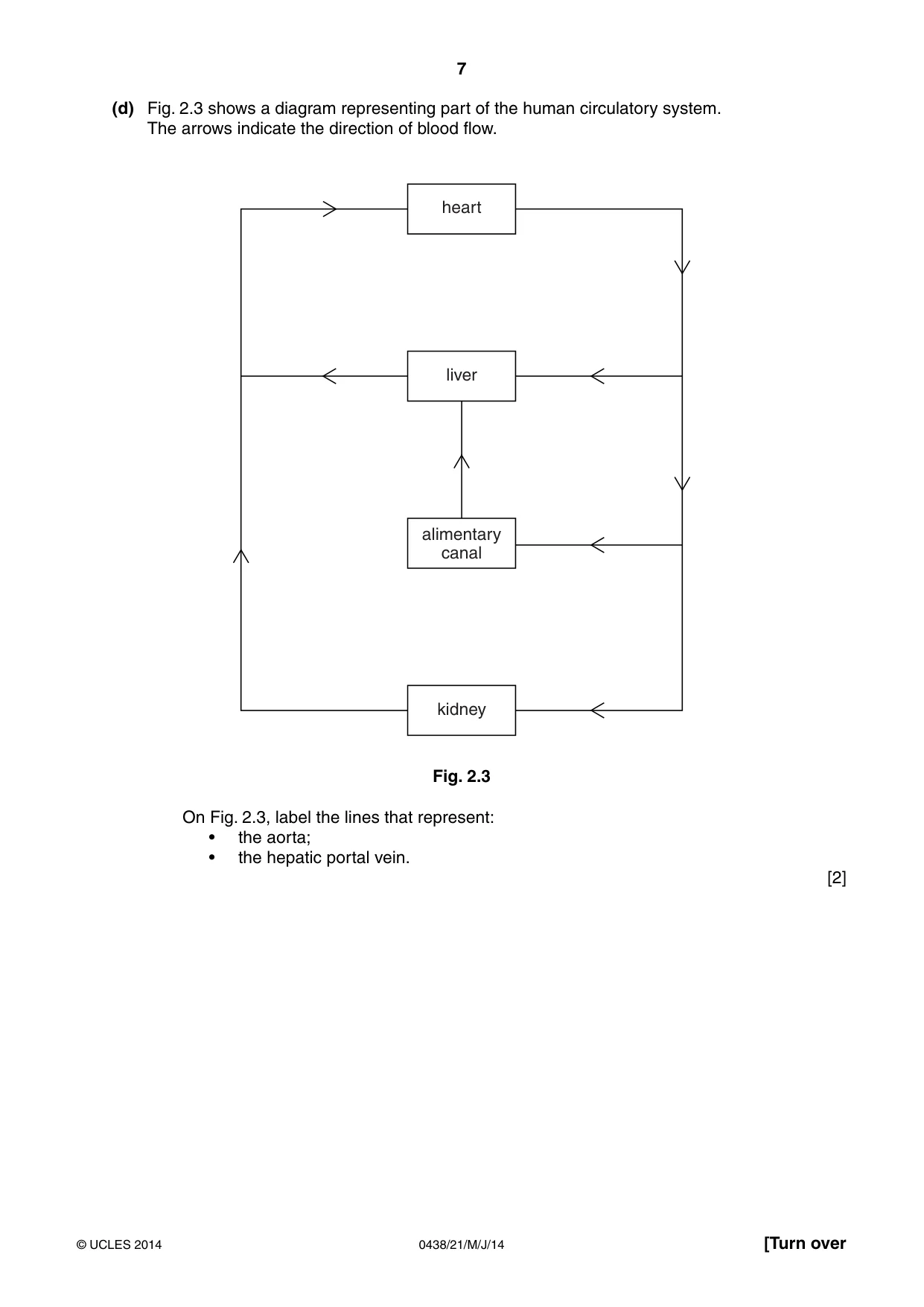
7 0438/21/M/J/14 © UCLES 2014 [Turn over (d) Fig. 2.3 shows a diagram representing part of the human circulatory system. The arrows indicate the direction of blood flow. heart liver alimentary canal kidney Fig. 2.3 On Fig. 2.3, label the lines that represent: • the aorta; • the hepatic portal vein. [2]
Question paper, page 8
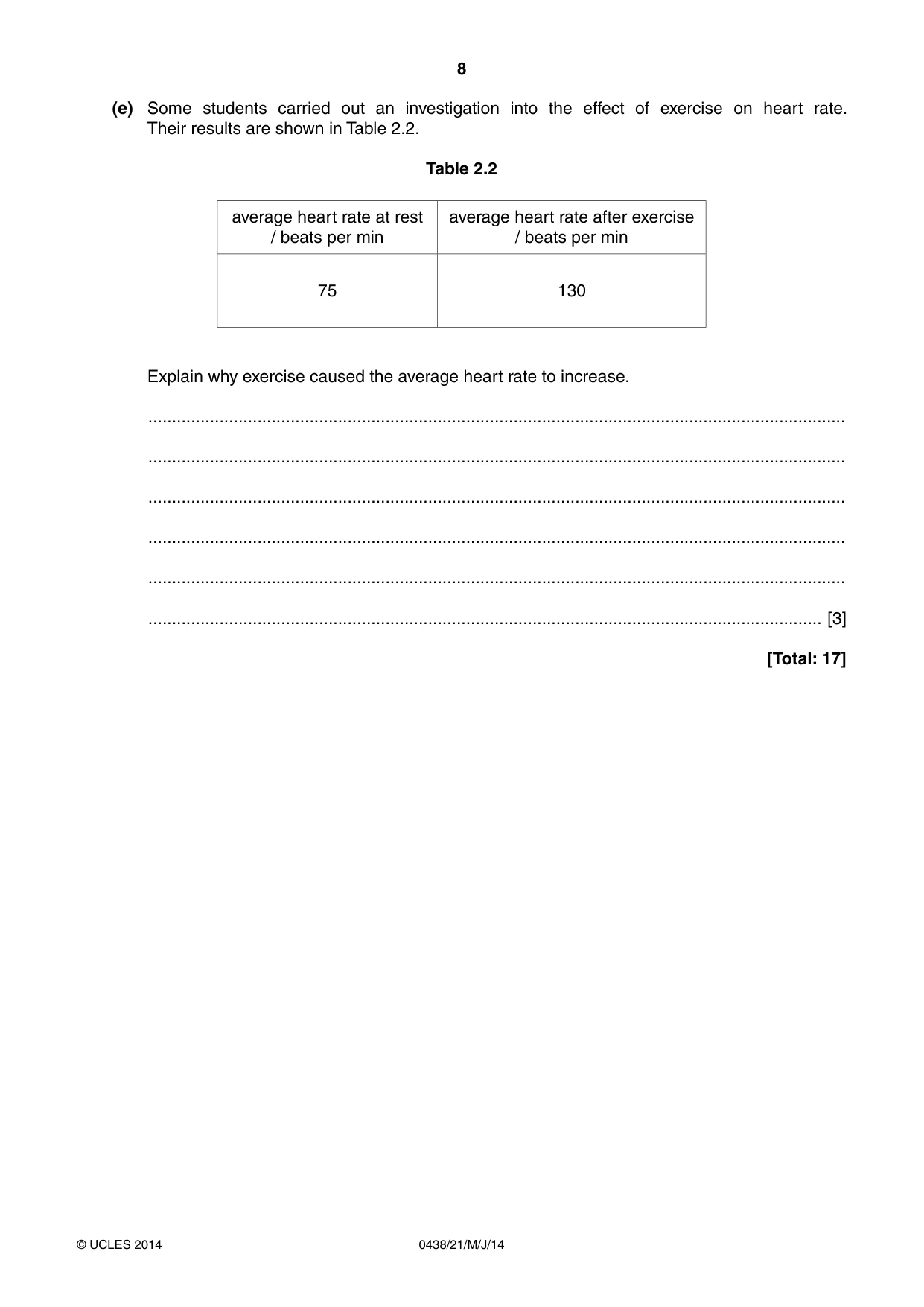
8 0438/21/M/J/14 © UCLES 2014 (e) Some students carried out an investigation into the effect of exercise on heart rate. Their results are shown in Table 2.2. Table 2.2 average heart rate at rest / beats per min average heart rate after exercise / beats per min 75 130 Explain why exercise caused the average heart rate to increase. … … … … … … [3] [Total: 17]
Question paper, page 9
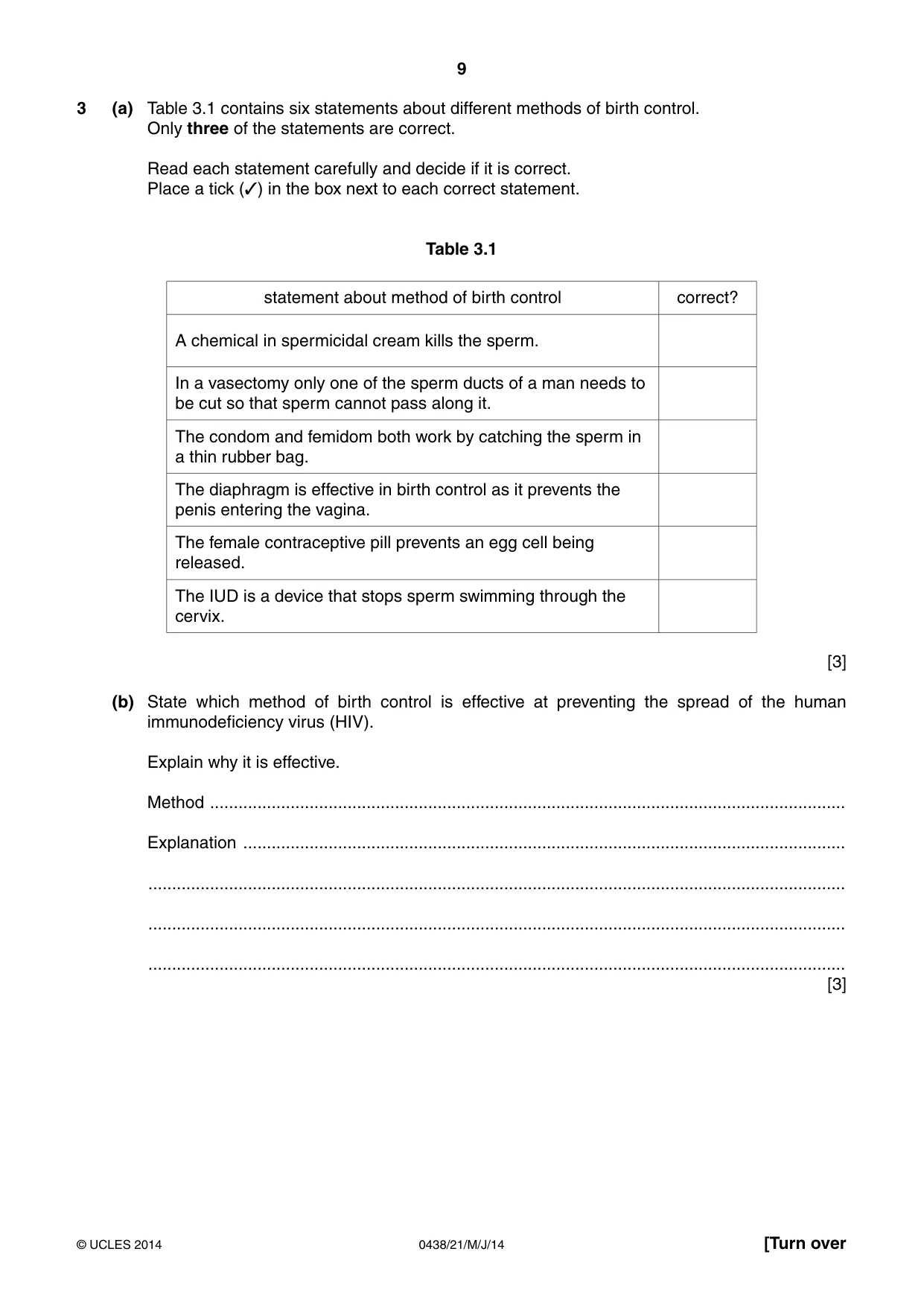
9 0438/21/M/J/14 © UCLES 2014 [Turn over 3 (a) Table 3.1 contains six statements about different methods of birth control. Only three of the statements are correct. Read each statement carefully and decide if it is correct. Place a tick (✓) in the box next to each correct statement. Table 3.1 statement about method of birth control correct? A chemical in spermicidal cream kills the sperm. In a vasectomy only one of the sperm ducts of a man needs to be cut so that sperm cannot pass along it. The condom and femidom both work by catching the sperm in a thin rubber bag. The diaphragm is effective in birth control as it prevents the penis entering the vagina. The female contraceptive pill prevents an egg cell being released. The IUD is a device that stops sperm swimming through the cervix. [3] (b) State which method of birth control is effective at preventing the spread of the human immunodeficiency virus (HIV). Explain why it is effective. Method … Explanation … … … … [3]
Question paper, page 10
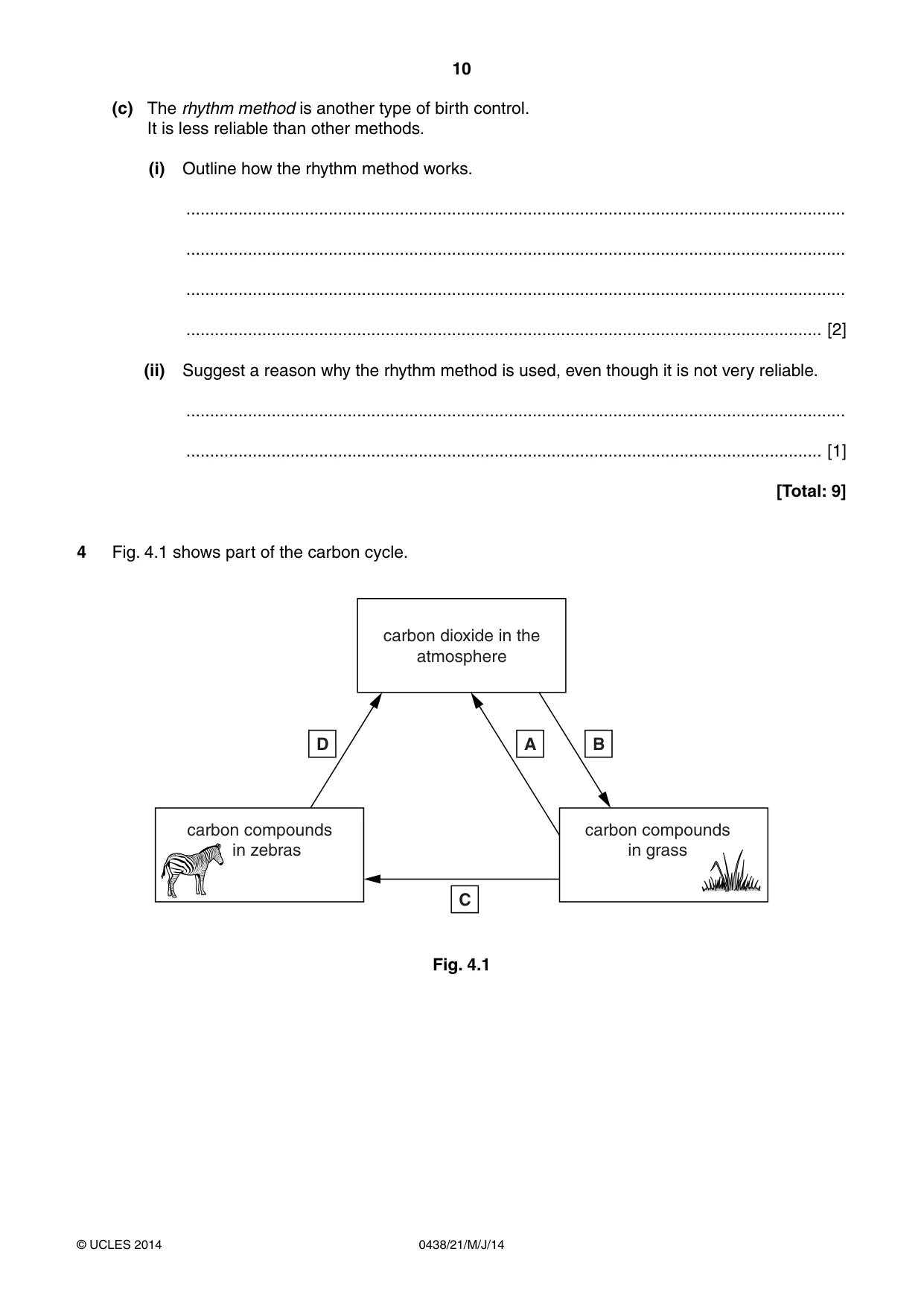
10 0438/21/M/J/14 © UCLES 2014 (c) The rhythm method is another type of birth control. It is less reliable than other methods. (i) Outline how the rhythm method works. … … … … [2] (ii) Suggest a reason why the rhythm method is used, even though it is not very reliable. … … [1] [Total: 9] 4 Fig. 4.1 shows part of the carbon cycle. carbon dioxide in the atmosphere D carbon compounds in grass carbon compounds in zebras A B C Fig. 4.1
Question paper, page 11
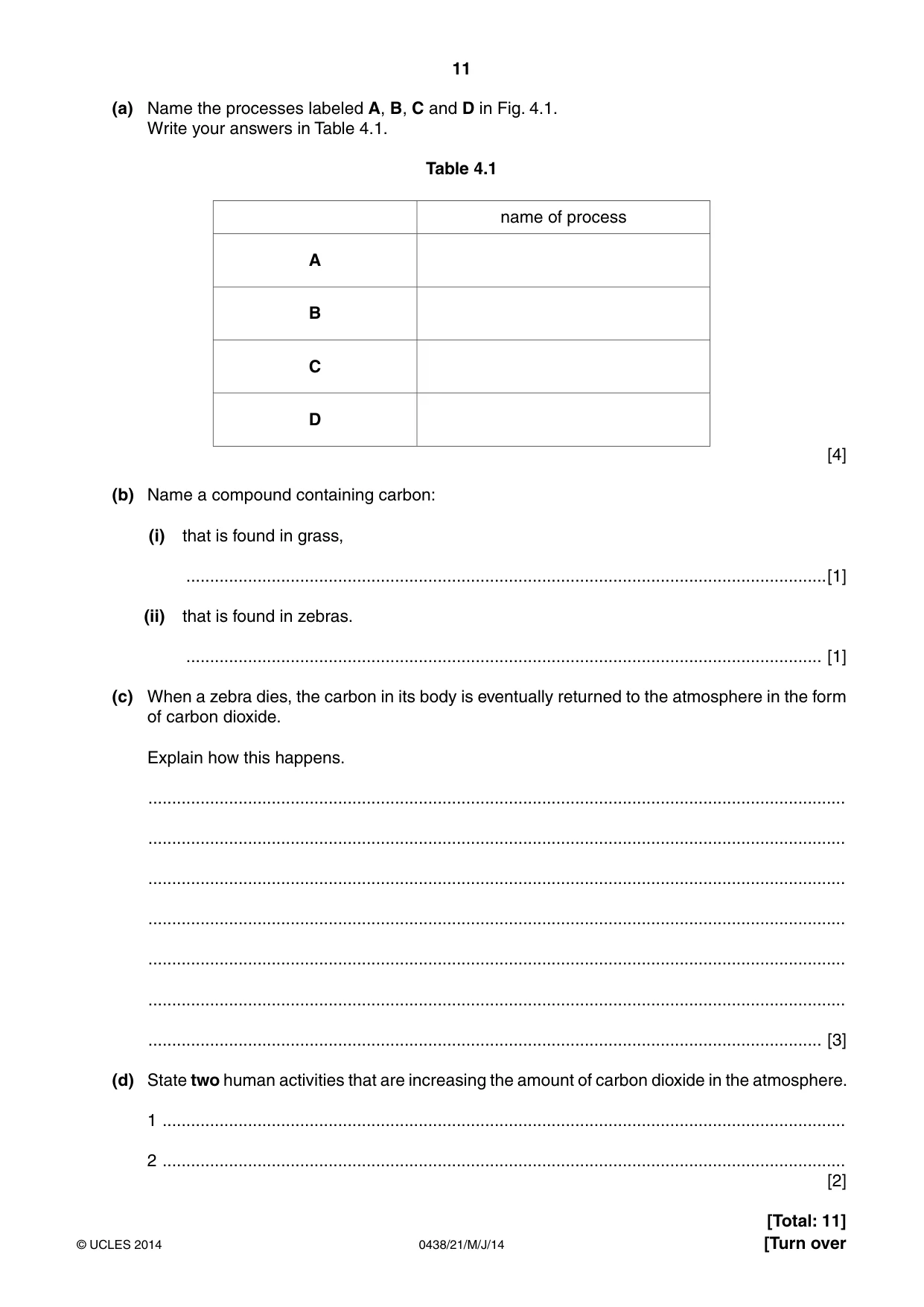
11 0438/21/M/J/14 © UCLES 2014 [Turn over (a) Name the processes labeled A, B, C and D in Fig. 4.1. Write your answers in Table 4.1. Table 4.1 name of process A B C D [4] (b) Name a compound containing carbon: (i) that is found in grass, …[1] (ii) that is found in zebras. … [1] (c) When a zebra dies, the carbon in its body is eventually returned to the atmosphere in the form of carbon dioxide. Explain how this happens. … … … … … … … [3] (d) State two human activities that are increasing the amount of carbon dioxide in the atmosphere. 1 … 2 … [2] [Total: 11]
Question paper, page 12
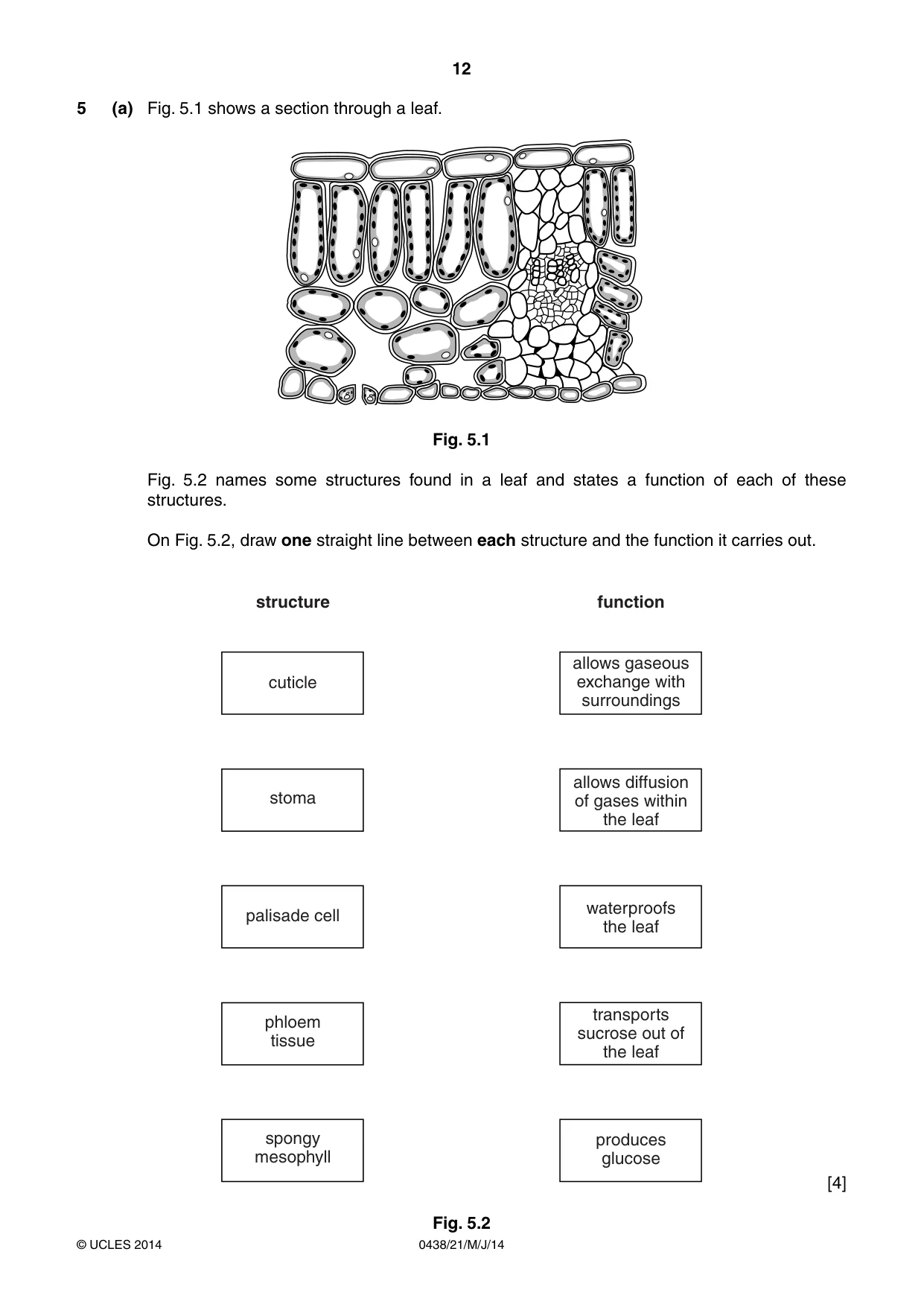
12 0438/21/M/J/14 © UCLES 2014 5 (a) Fig. 5.1 shows a section through a leaf. Fig. 5.1 Fig. 5.2 names some structures found in a leaf and states a function of each of these structures. On Fig. 5.2, draw one straight line between each structure and the function it carries out. structure cuticle stoma palisade cell phloem tissue spongy mesophyll function allows gaseous exchange with surroundings allows diffusion of gases within the leaf waterproofs the leaf transports sucrose out of the leaf produces glucose [4] Fig. 5.2
Question paper, page 13
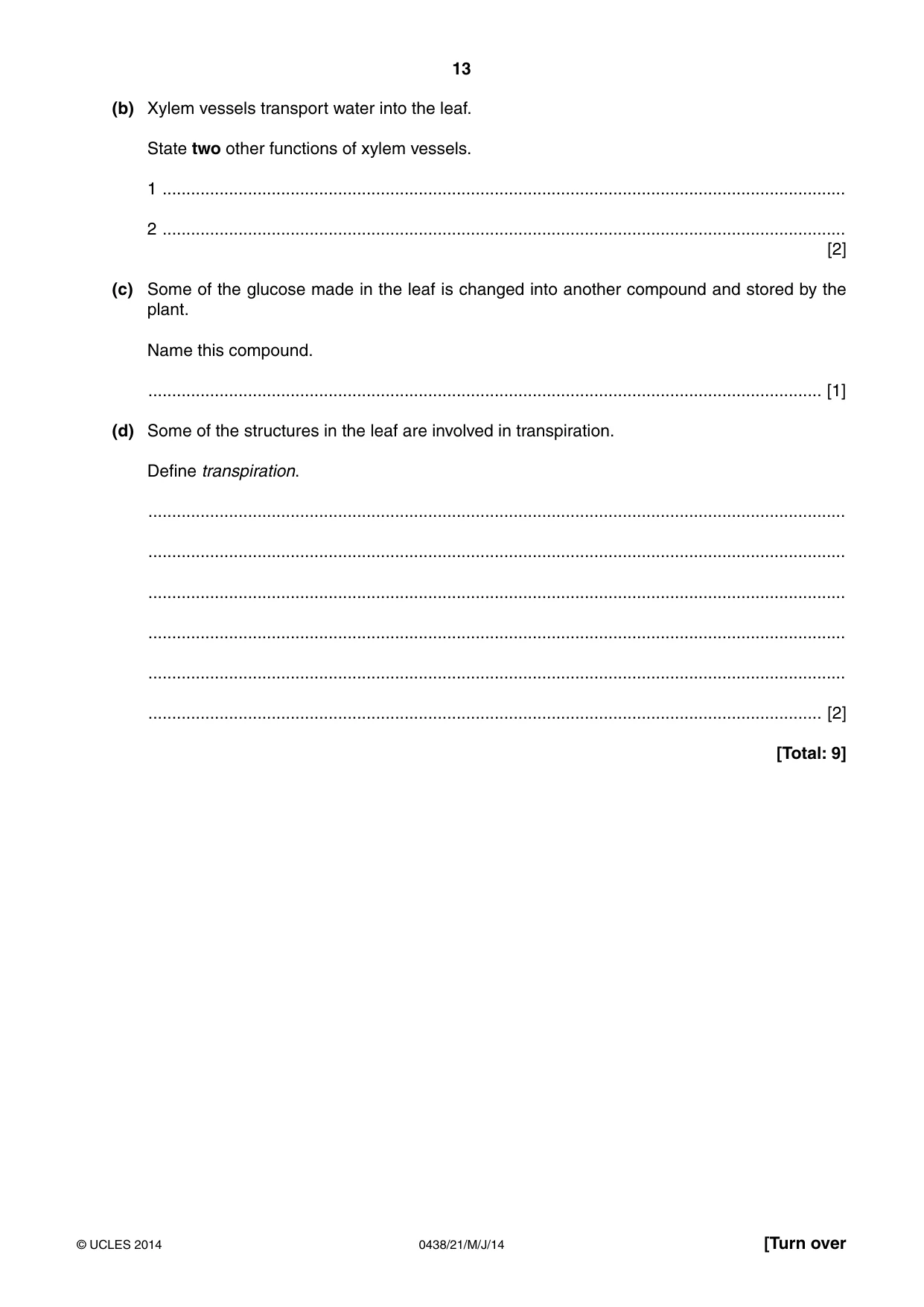
13 0438/21/M/J/14 © UCLES 2014 [Turn over (b) Xylem vessels transport water into the leaf. State two other functions of xylem vessels. 1 … 2 … [2] (c) Some of the glucose made in the leaf is changed into another compound and stored by the plant. Name this compound. … [1] (d) Some of the structures in the leaf are involved in transpiration. Define transpiration. … … … … … … [2] [Total: 9]
Question paper, page 14
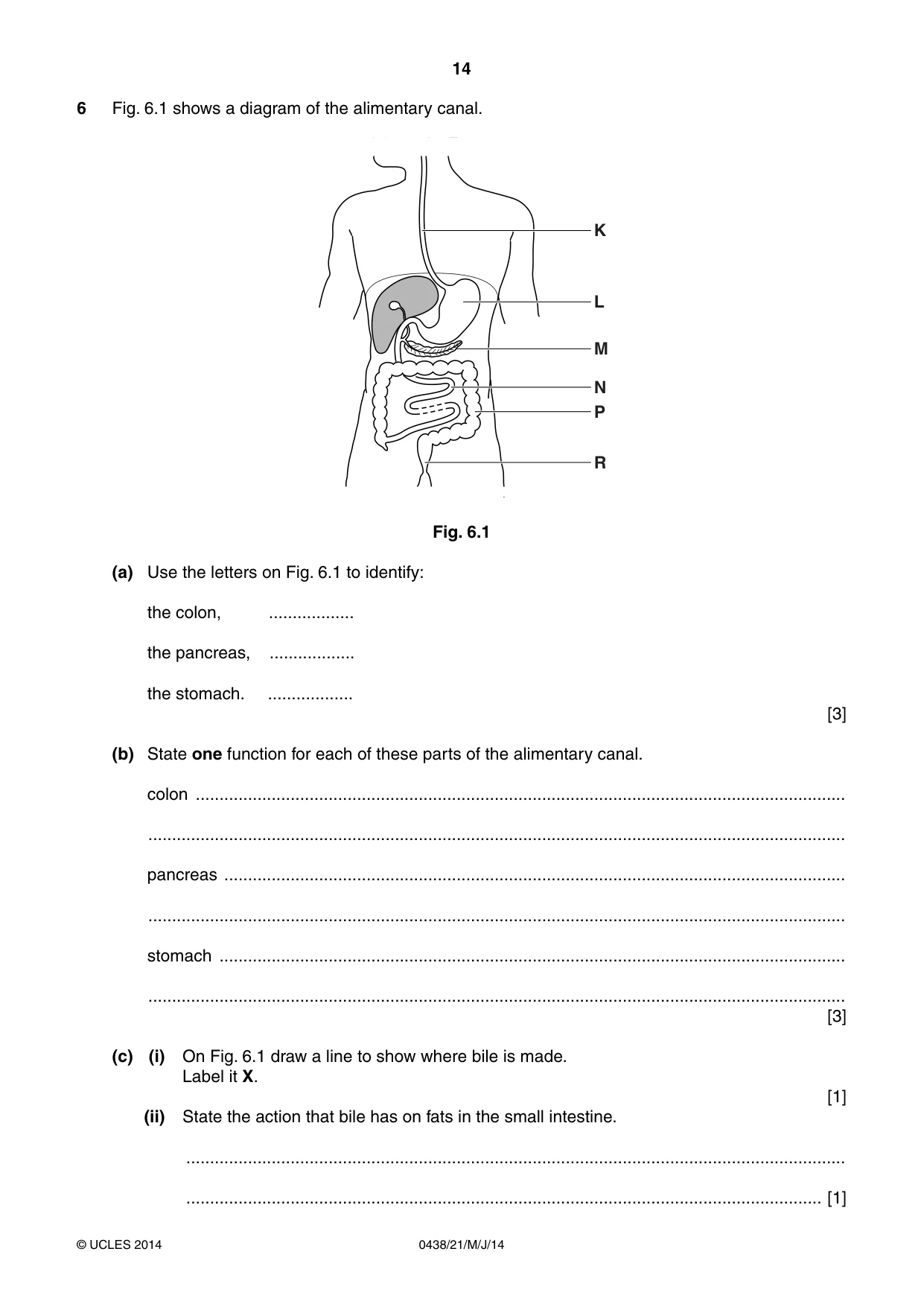
14 0438/21/M/J/14 © UCLES 2014 6 Fig. 6.1 shows a diagram of the alimentary canal. . / 0 1 3 5 Fig. 6.1 (a) Use the letters on Fig. 6.1 to identify: the colon, … the pancreas, … the stomach. … [3] (b) State one function for each of these parts of the alimentary canal. colon … … pancreas … … stomach … … [3] (c) (i) On Fig. 6.1 draw a line to show where bile is made. Label it X. [1] (ii) State the action that bile has on fats in the small intestine. … … [1]
Question paper, page 15
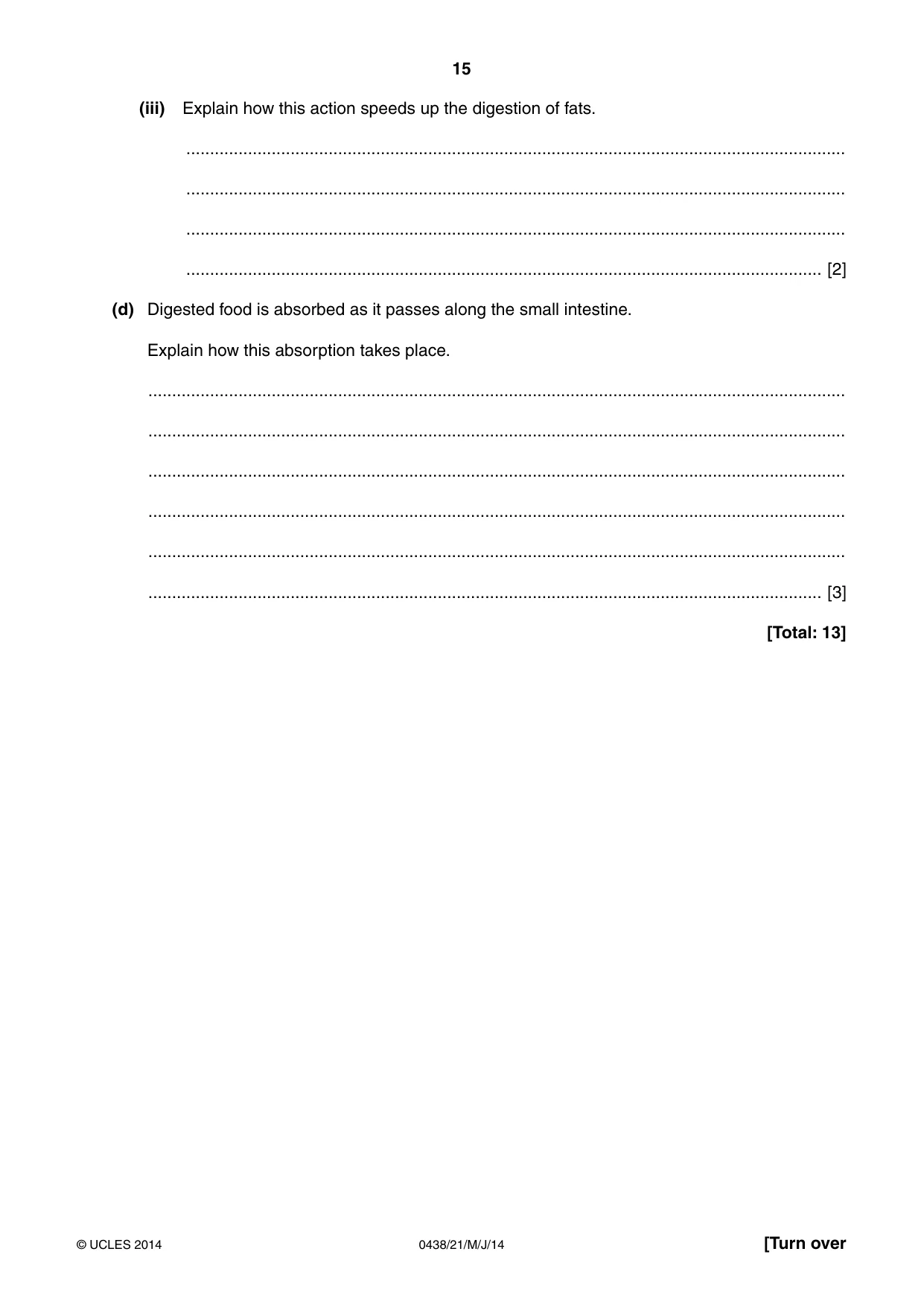
15 0438/21/M/J/14 © UCLES 2014 [Turn over (iii) Explain how this action speeds up the digestion of fats. … … … … [2] (d) Digested food is absorbed as it passes along the small intestine. Explain how this absorption takes place. … … … … … … [3] [Total: 13]
Question paper, page 16
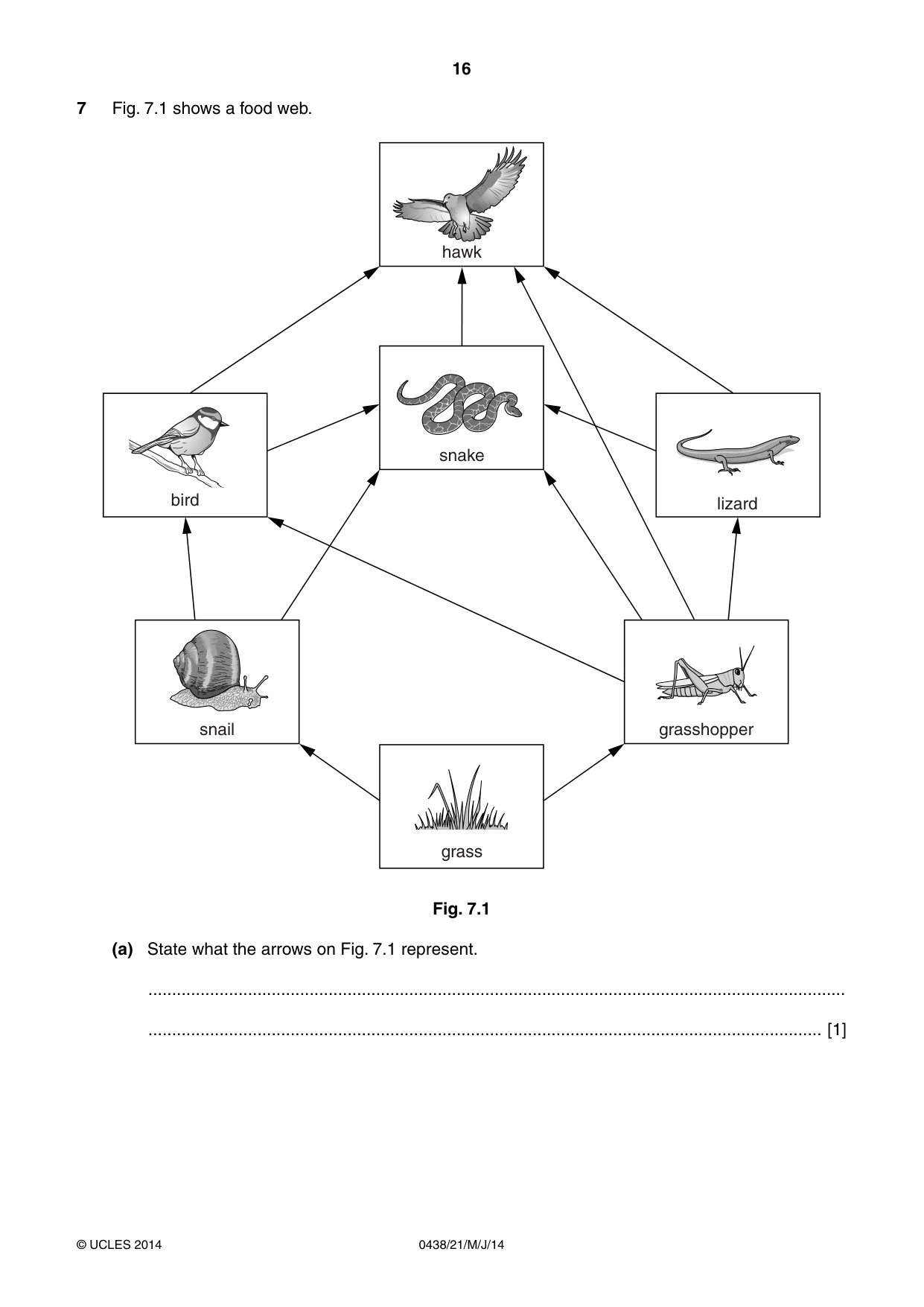
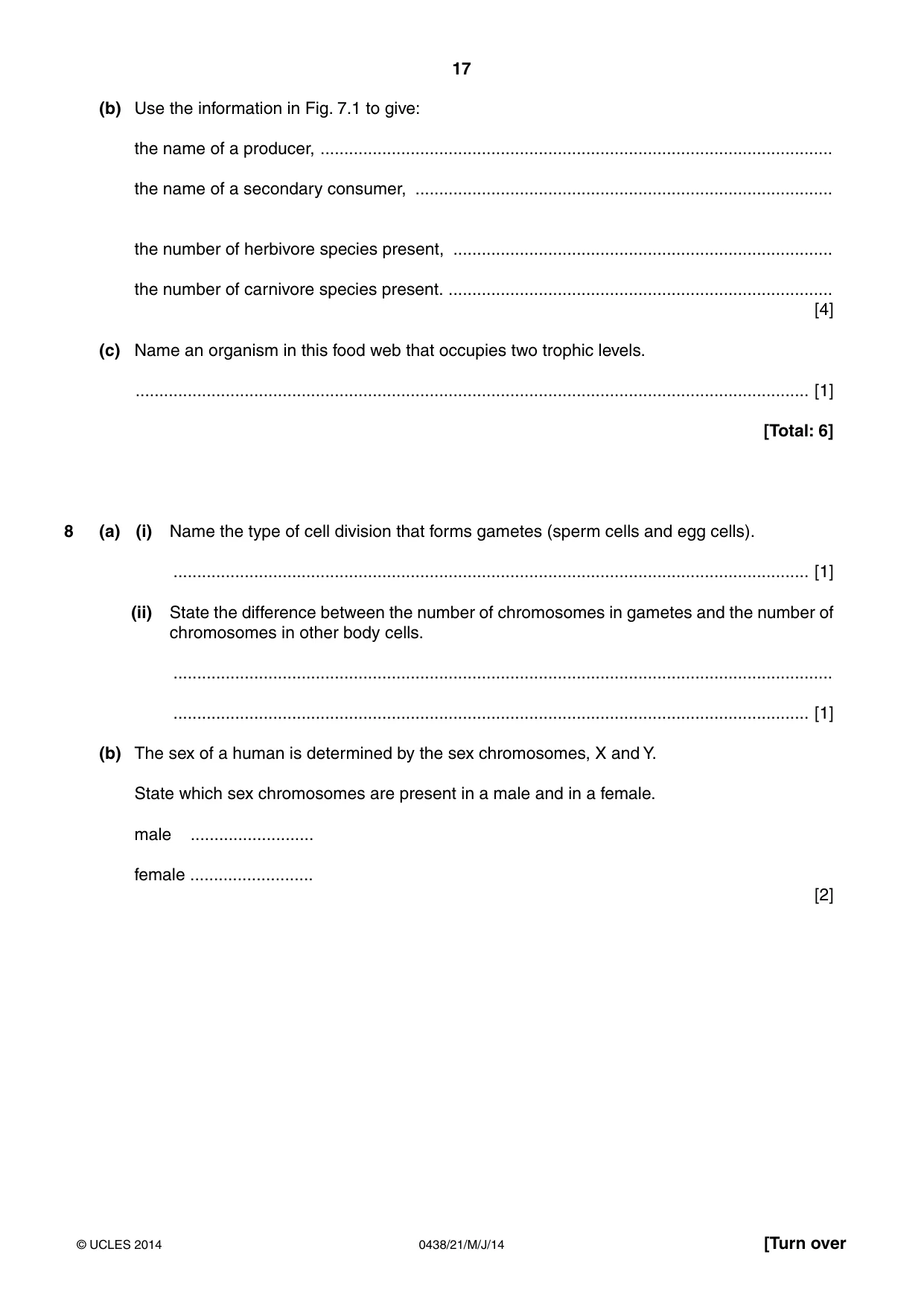
16 0438/21/M/J/14 © UCLES 2014 7 Fig. 7.1 shows a food web. hawk snake lizard grasshopper grass bird snail Fig. 7.1 (a) State what the arrows on Fig. 7.1 represent. … … [1]
Question paper, page 17
17 0438/21/M/J/14 © UCLES 2014 [Turn over (b) Use the information in Fig. 7.1 to give: the name of a producer, … the name of a secondary consumer, … the number of herbivore species present, … the number of carnivore species present. … [4] (c) Name an organism in this food web that occupies two trophic levels. … [1] [Total: 6] 8 (a) (i) Name the type of cell division that forms gametes (sperm cells and egg cells). … [1] (ii) State the difference between the number of chromosomes in gametes and the number of chromosomes in other body cells. … … [1] (b) The sex of a human is determined by the sex chromosomes, X and Y. State which sex chromosomes are present in a male and in a female. male … female … [2]
Question paper, page 18
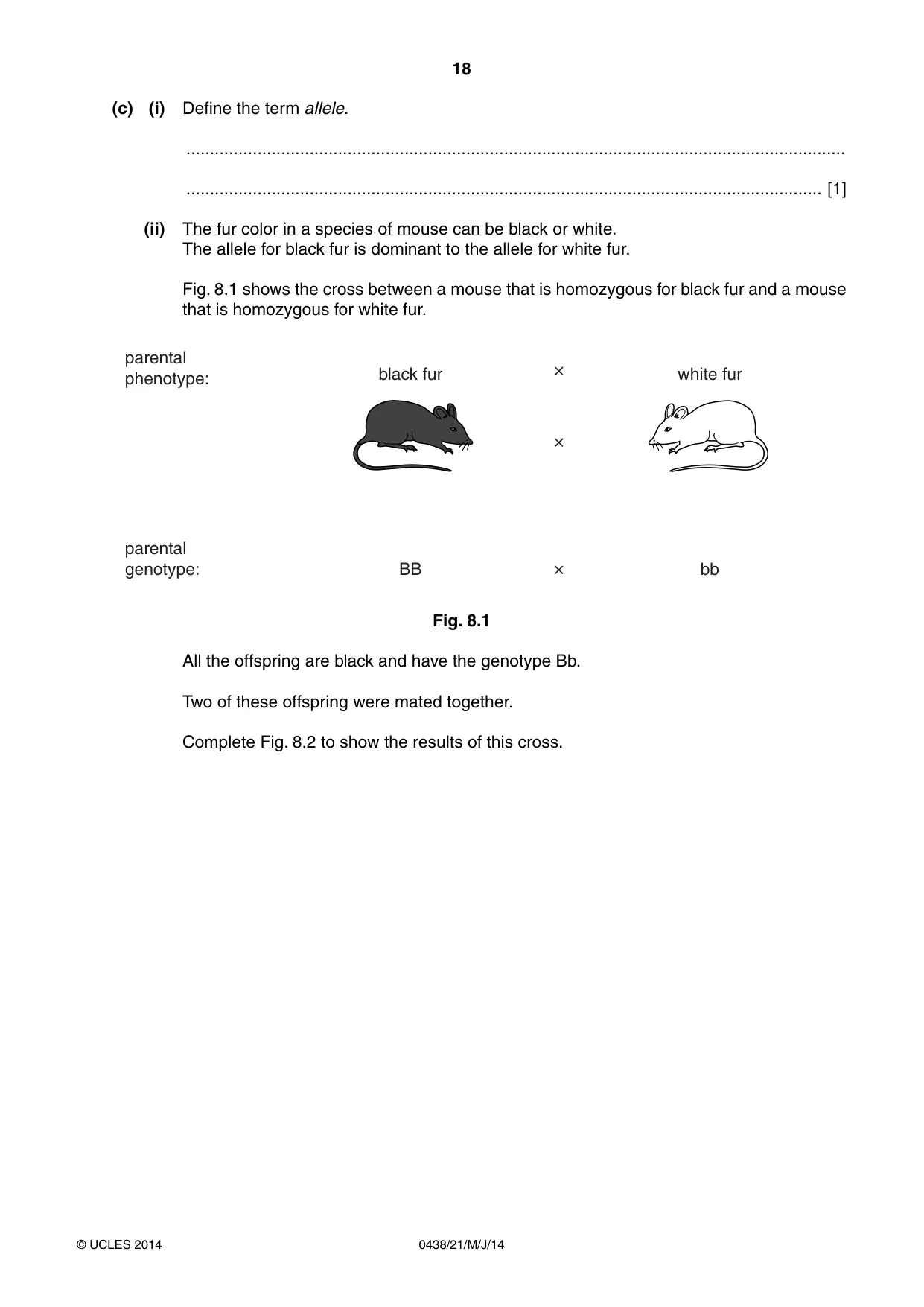
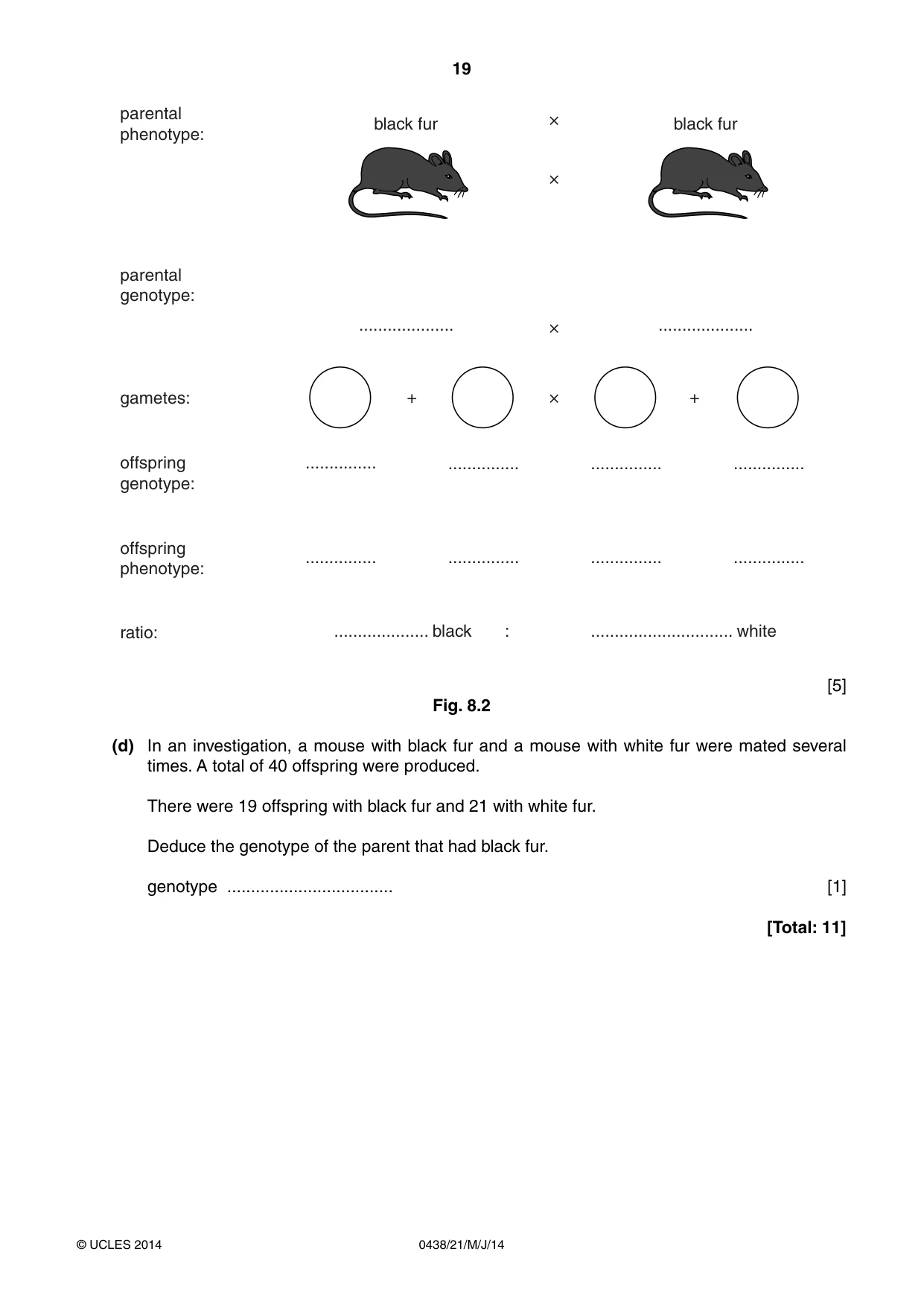
18 0438/21/M/J/14 © UCLES 2014 (c) (i) Define the term allele. … … [1] (ii) The fur color in a species of mouse can be black or white. The allele for black fur is dominant to the allele for white fur. Fig. 8.1 shows the cross between a mouse that is homozygous for black fur and a mouse that is homozygous for white fur. parental phenotype: parental genotype: black fur BB white fur bb × × × Fig. 8.1 All the offspring are black and have the genotype Bb. Two of these offspring were mated together. Complete Fig. 8.2 to show the results of this cross.
Question paper, page 19
19 0438/21/M/J/14 © UCLES 2014 parental phenotype: parental genotype: gametes: offspring genotype: offspring phenotype: black fur … … … black : … white … × × × + + × … … … … … … … ratio: black fur [5] Fig. 8.2 (d) In an investigation, a mouse with black fur and a mouse with white fur were mated several times. A total of 40 offspring were produced. There were 19 offspring with black fur and 21 with white fur. Deduce the genotype of the parent that had black fur. genotype … [1] [Total: 11]
Question paper, page 20
20 0438/21/M/J/14 © UCLES 2014 Permission to reproduce items where third-party owned material protected by copyright is included has been sought and cleared where possible. Every reasonable effort has been made by the publisher (UCLES) to trace copyright holders, but if any items requiring clearance have unwittingly been included, the publisher will be pleased to make amends at the earliest possible opportunity. Cambridge International Examinations is part of the Cambridge Assessment Group. Cambridge Assessment is the brand name of University of Cambridge Local Examinations Syndicate (UCLES), which is itself a department of the University of Cambridge. BLANK PAGE
Mark scheme, page 1
CAMBRIDGE INTERNATIONAL EXAMINATIONS International General Certificate of Secondary Education MARK SCHEME for the May/June 2014 series 0438 BIOLOGY (US) 0438/21 Paper 2 (Core Theory), maximum raw mark 80 This mark scheme is published as an aid to teachers and candidates, to indicate the requirements of the examination. It shows the basis on which Examiners were instructed to award marks. It does not indicate the details of the discussions that took place at an Examiners’ meeting before marking began, which would have considered the acceptability of alternative answers. Mark schemes should be read in conjunction with the question paper and the Principal Examiner Report for Teachers. Cambridge will not enter into discussions about these mark schemes. Cambridge is publishing the mark schemes for the May/June 2014 series for most IGCSE, GCE Advanced Level and Advanced Subsidiary Level components and some Ordinary Level components.
Mark scheme, page 2
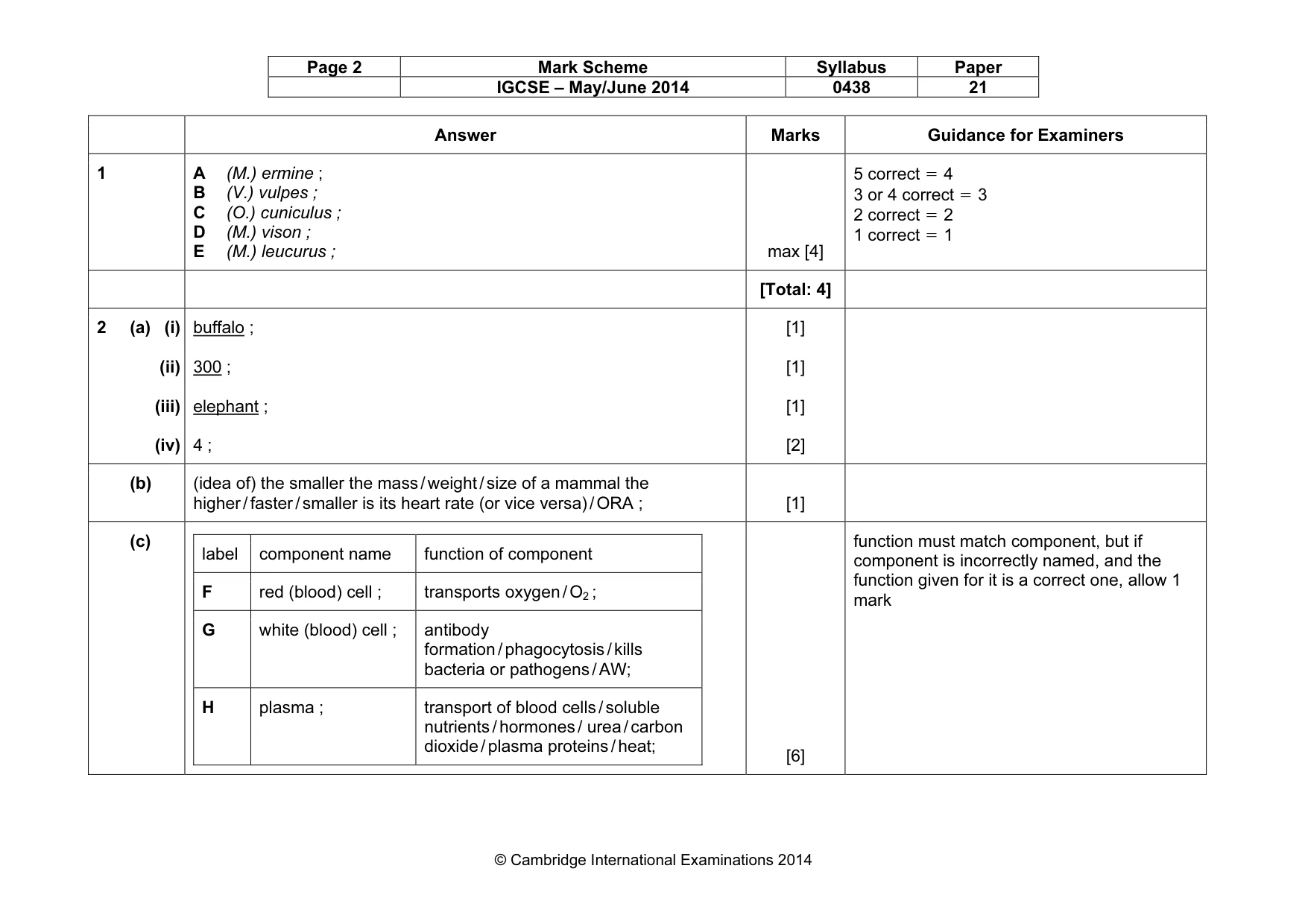
Page 2 Mark Scheme Syllabus Paper IGCSE – May/June 2014 0438 21 © Cambridge International Examinations 2014 Answer Marks Guidance for Examiners 1 A (M.) ermine ; B (V.) vulpes ; C (O.) cuniculus ; D (M.) vison ; E (M.) leucurus ; max [4] 5 correct R 4 3 or 4 correct R 3 2 correct R 2 1 correct R 1 [Total: 4] 2 (a) (i) (ii) (iii) (iv) buffalo ; 300 ; elephant ; 4 ; [1] [1] [1] [2] (b) (idea of) the smaller the mass / weight / size of a mammal the higher / faster / smaller is its heart rate (or vice versa) / ORA ; [1] (c) label component name function of component F red (blood) cell ; transports oxygen / O2 ; G white (blood) cell ; antibody formation / phagocytosis / kills bacteria or pathogens / AW; H plasma ; transport of blood cells / soluble nutrients / hormones / urea / carbon dioxide / plasma proteins / heat; [6] function must match component, but if component is incorrectly named, and the function given for it is a correct one, allow 1 mark
Mark scheme, page 3
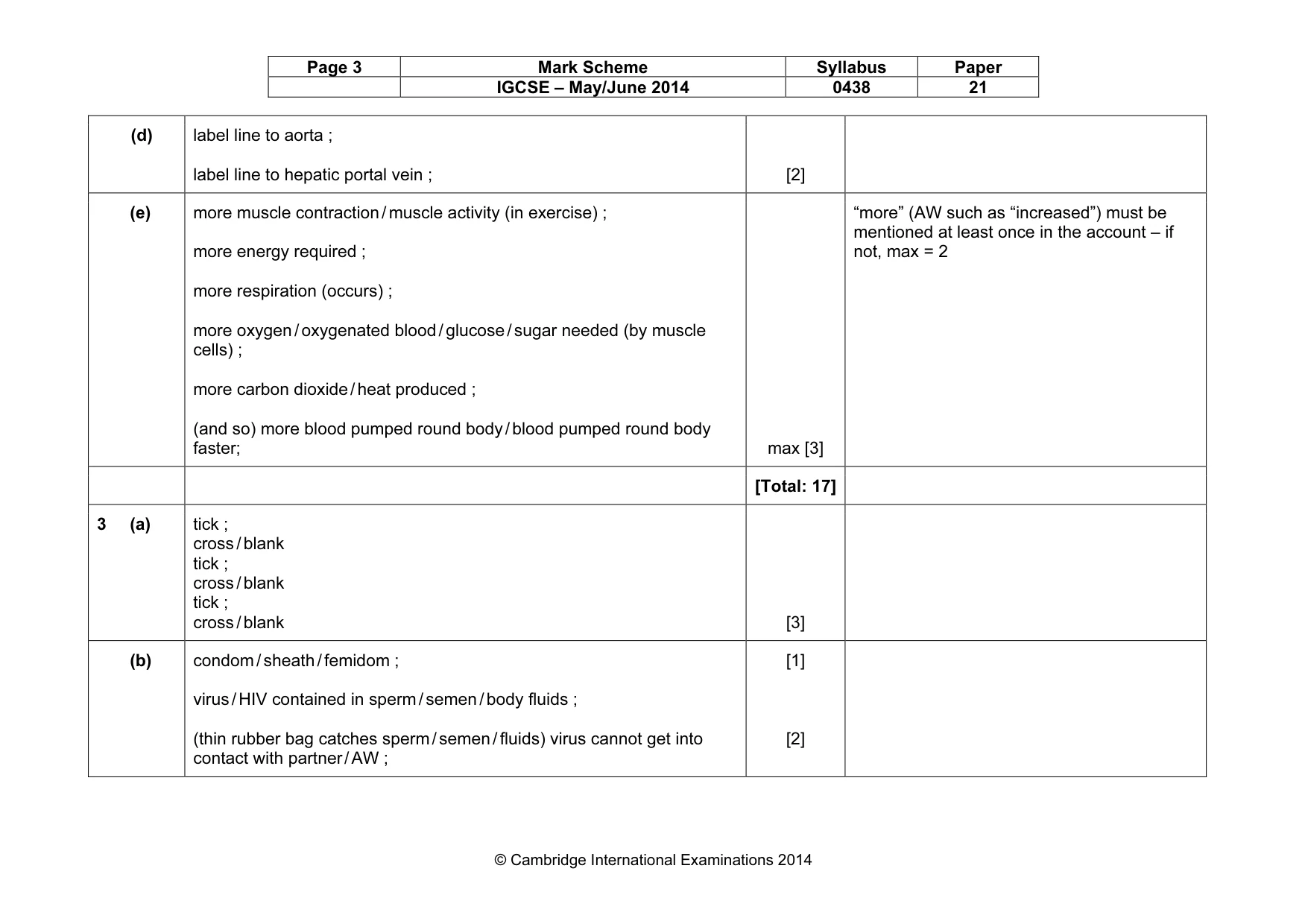
Page 3 Mark Scheme Syllabus Paper IGCSE – May/June 2014 0438 21 © Cambridge International Examinations 2014 (d) label line to aorta ; label line to hepatic portal vein ; [2] (e) more muscle contraction / muscle activity (in exercise) ; more energy required ; more respiration (occurs) ; more oxygen / oxygenated blood / glucose / sugar needed (by muscle cells) ; more carbon dioxide / heat produced ; (and so) more blood pumped round body / blood pumped round body faster; max [3] “more” (AW such as “increased”) must be mentioned at least once in the account – if not, max = 2 [Total: 17] 3 (a) tick ; cross / blank tick ; cross / blank tick ; cross / blank [3] (b) condom / sheath / femidom ; virus / HIV contained in sperm / semen / body fluids ; (thin rubber bag catches sperm / semen / fluids) virus cannot get into contact with partner / AW ; [1] [2]
Mark scheme, page 4
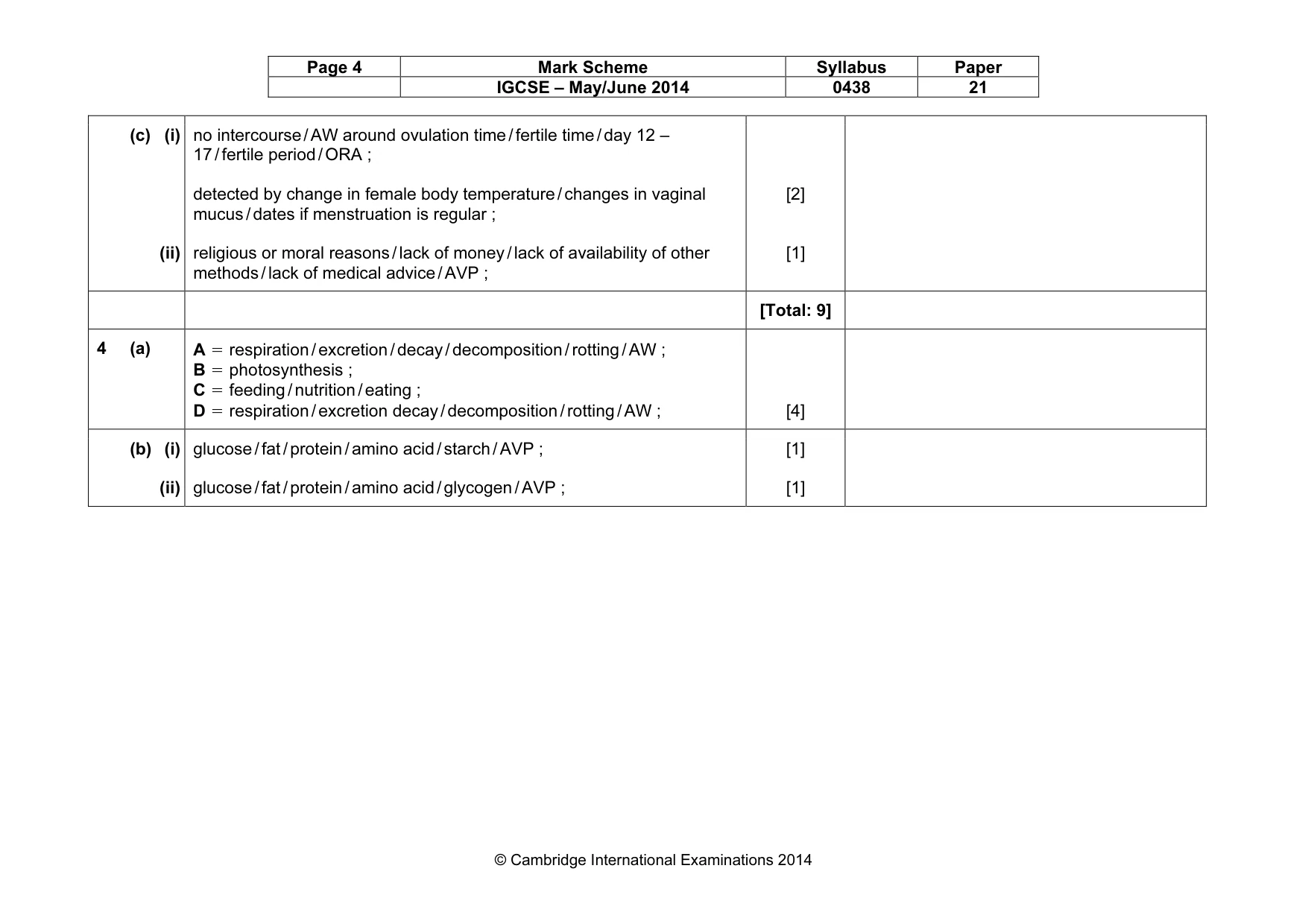
Page 4 Mark Scheme Syllabus Paper IGCSE – May/June 2014 0438 21 © Cambridge International Examinations 2014 (c) (i) (ii) no intercourse / AW around ovulation time / fertile time / day 12 – 17 / fertile period / ORA ; detected by change in female body temperature / changes in vaginal mucus / dates if menstruation is regular ; religious or moral reasons / lack of money / lack of availability of other methods / lack of medical advice / AVP ; [2] [1] [Total: 9] 4 (a) A R respiration / excretion / decay / decomposition / rotting / AW ; B R photosynthesis ; C R feeding / nutrition / eating ; D R respiration / excretion decay / decomposition / rotting / AW ; [4] (b) (i) (ii) glucose / fat / protein / amino acid / starch / AVP ; glucose / fat / protein / amino acid / glycogen / AVP ; [1] [1]
Mark scheme, page 5
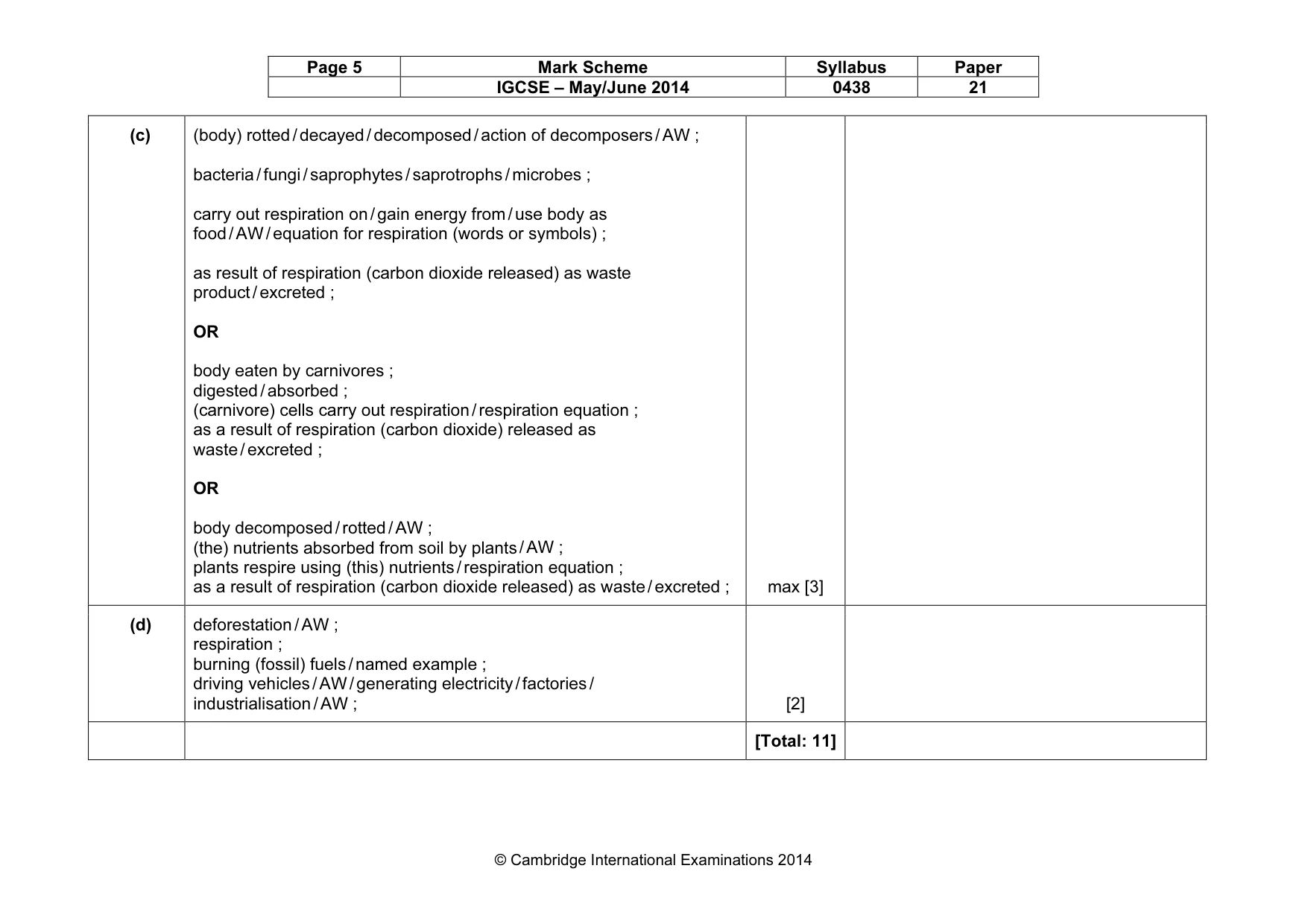
Page 5 Mark Scheme Syllabus Paper IGCSE – May/June 2014 0438 21 © Cambridge International Examinations 2014 (c) (body) rotted / decayed / decomposed / action of decomposers / AW ; bacteria / fungi / saprophytes / saprotrophs / microbes ; carry out respiration on / gain energy from / use body as food / AW / equation for respiration (words or symbols) ; as result of respiration (carbon dioxide released) as waste product / excreted ; OR body eaten by carnivores ; digested / absorbed ; (carnivore) cells carry out respiration / respiration equation ; as a result of respiration (carbon dioxide) released as waste / excreted ; OR body decomposed / rotted / AW ; (the) nutrients absorbed from soil by plants / AW ; plants respire using (this) nutrients / respiration equation ; as a result of respiration (carbon dioxide released) as waste / excreted ; max [3] (d) deforestation / AW ; respiration ; burning (fossil) fuels / named example ; driving vehicles / AW / generating electricity / factories / industrialisation / AW ; [2] [Total: 11]
Mark scheme, page 6
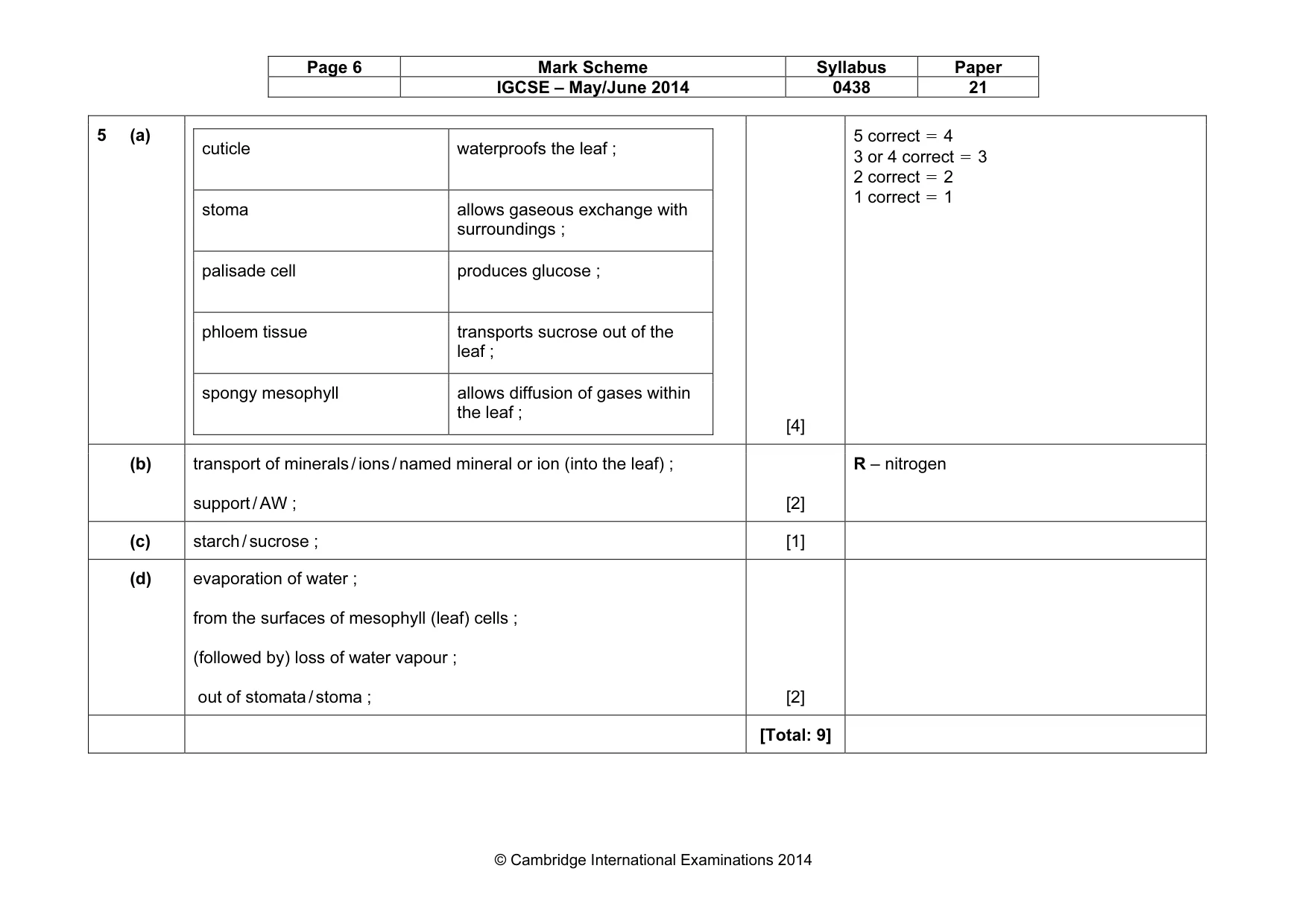
Page 6 Mark Scheme Syllabus Paper IGCSE – May/June 2014 0438 21 © Cambridge International Examinations 2014 5 (a) cuticle waterproofs the leaf ; stoma allows gaseous exchange with surroundings ; palisade cell produces glucose ; phloem tissue transports sucrose out of the leaf ; spongy mesophyll allows diffusion of gases within the leaf ; [4] 5 correct R 4 3 or 4 correct R 3 2 correct R 2 1 correct R 1 (b) transport of minerals / ions / named mineral or ion (into the leaf) ; support / AW ; [2] R – nitrogen (c) starch / sucrose ; [1] (d) evaporation of water ; from the surfaces of mesophyll (leaf) cells ; (followed by) loss of water vapour ; out of stomata / stoma ; [2] [Total: 9]
Mark scheme, page 7
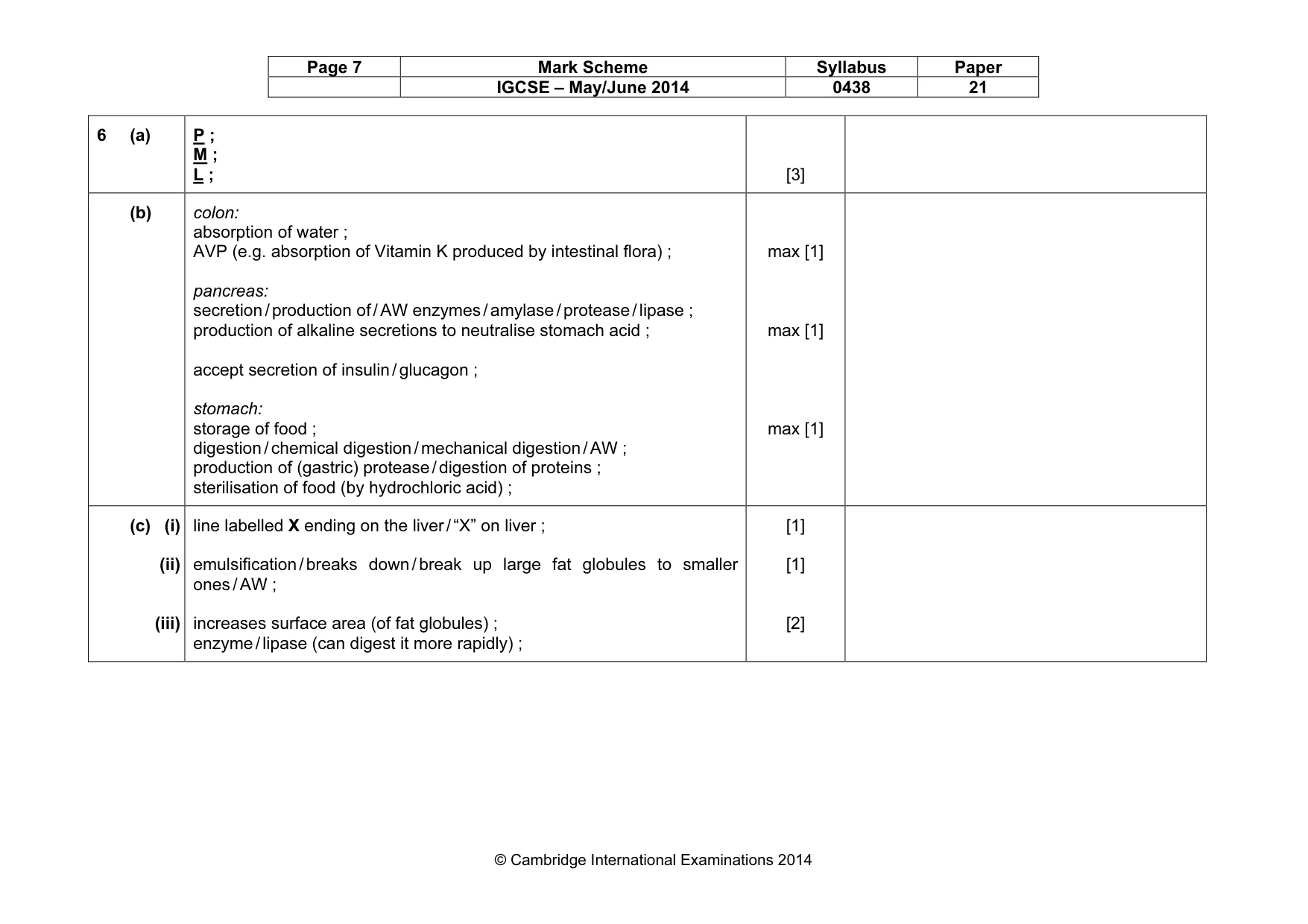
Page 7 Mark Scheme Syllabus Paper IGCSE – May/June 2014 0438 21 © Cambridge International Examinations 2014 6 (a) P ; M ; L ; [3] (b) colon: absorption of water ; AVP (e.g. absorption of Vitamin K produced by intestinal flora) ; pancreas: secretion / production of / AW enzymes / amylase / protease / lipase ; production of alkaline secretions to neutralise stomach acid ; accept secretion of insulin / glucagon ; stomach: storage of food ; digestion / chemical digestion / mechanical digestion / AW ; production of (gastric) protease / digestion of proteins ; sterilisation of food (by hydrochloric acid) ; max [1] max [1] max [1] (c) (i) (ii) (iii) line labelled X ending on the liver / “X” on liver ; emulsification / breaks down / break up large fat globules to smaller ones / AW ; increases surface area (of fat globules) ; enzyme / lipase (can digest it more rapidly) ; [1] [1] [2]
Mark scheme, page 8
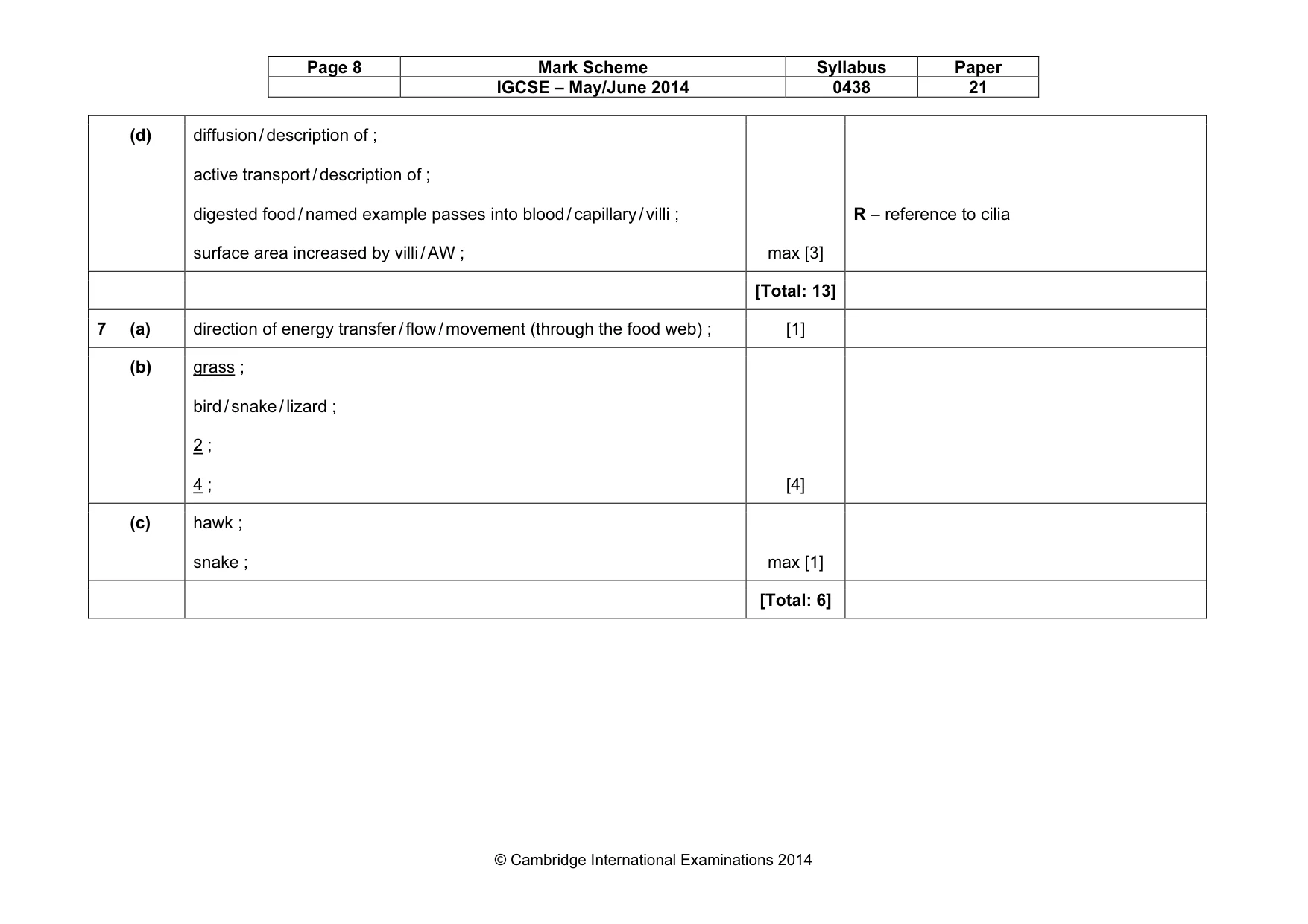
Page 8 Mark Scheme Syllabus Paper IGCSE – May/June 2014 0438 21 © Cambridge International Examinations 2014 (d) diffusion / description of ; active transport / description of ; digested food / named example passes into blood / capillary / villi ; surface area increased by villi / AW ; max [3] R – reference to cilia [Total: 13] 7 (a) direction of energy transfer / flow / movement (through the food web) ; [1] (b) grass ; bird / snake / lizard ; 2 ; 4 ; [4] (c) hawk ; snake ; max [1] [Total: 6]
Mark scheme, page 9
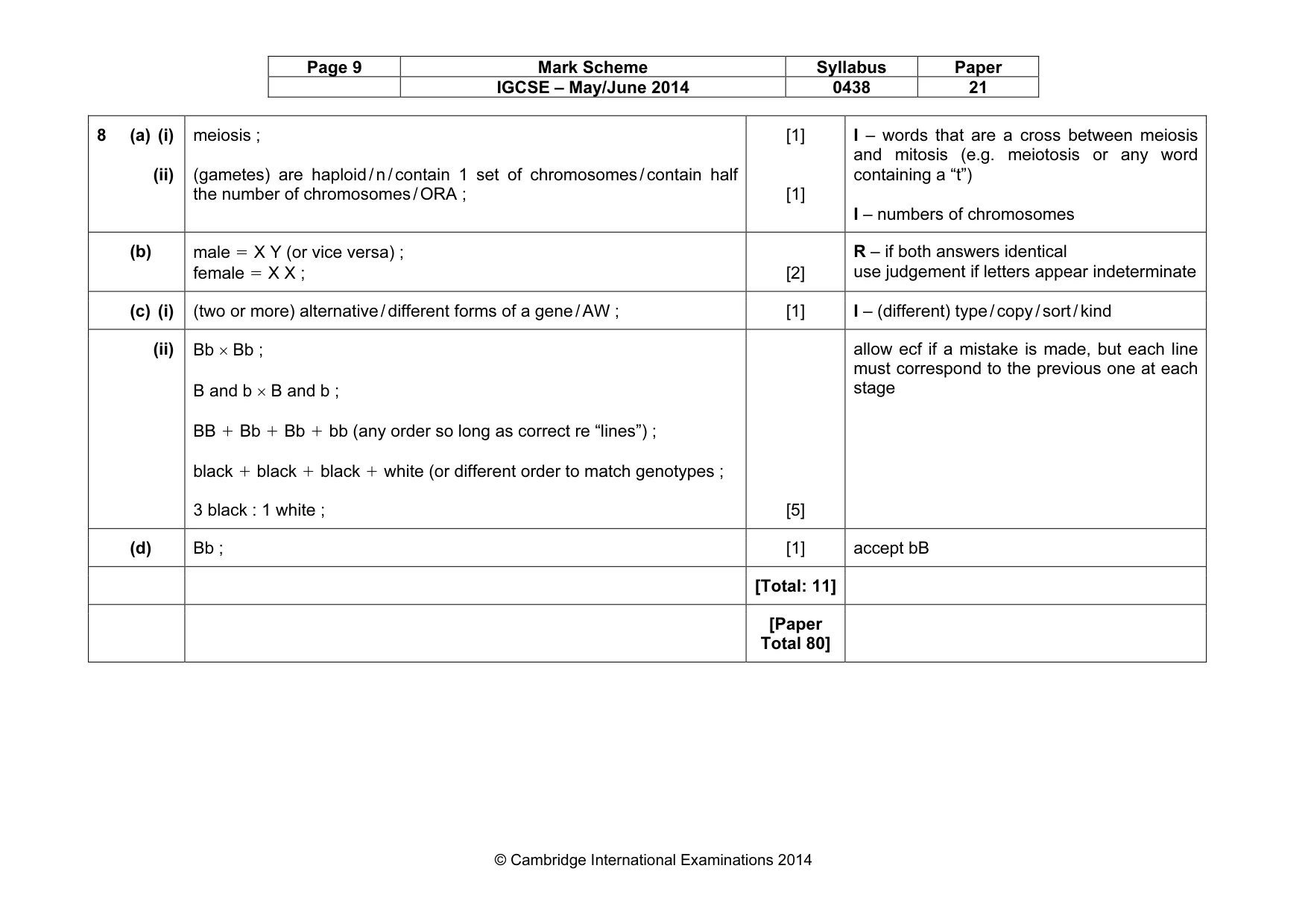
Page 9 Mark Scheme Syllabus Paper IGCSE – May/June 2014 0438 21 © Cambridge International Examinations 2014 8 (a) (i) (ii) meiosis ; (gametes) are haploid / n / contain 1 set of chromosomes / contain half the number of chromosomes / ORA ; [1] [1] I – words that are a cross between meiosis and mitosis (e.g. meiotosis or any word containing a “t”) I – numbers of chromosomes (b) male R X Y (or vice versa) ; female R X X ; [2] R – if both answers identical use judgement if letters appear indeterminate (c) (i) (two or more) alternative / different forms of a gene / AW ; [1] I – (different) type / copy / sort / kind (ii) Bb × Bb ; B and b × B and b ; BB N Bb N Bb N bb (any order so long as correct re “lines”) ; black N black N black N white (or different order to match genotypes ; 3 black : 1 white ; [5] allow ecf if a mistake is made, but each line must correspond to the previous one at each stage (d) Bb ; [1] accept bB [Total: 11] [Paper Total 80]
What you needed in this session
Cambridge’s own grade thresholds for 2014 May/June, Paper 2 · Variant 1. A higher threshold means an easier paper — the bar moves with how the cohort did.