Cambridge IGCSE Biology (BES) 0438 — 2013 May/June Paper 2 · Variant 1
0438/21/M/J/13 · 80 marks · ≈90 min
The question paper and its mark scheme, free to read here and free to download. This is Cambridge’s own paper, exactly as it was sat.
Question paper20 pages



Mark scheme13 pages
Answers below. Sit the paper first if you are practising.
Paper as text
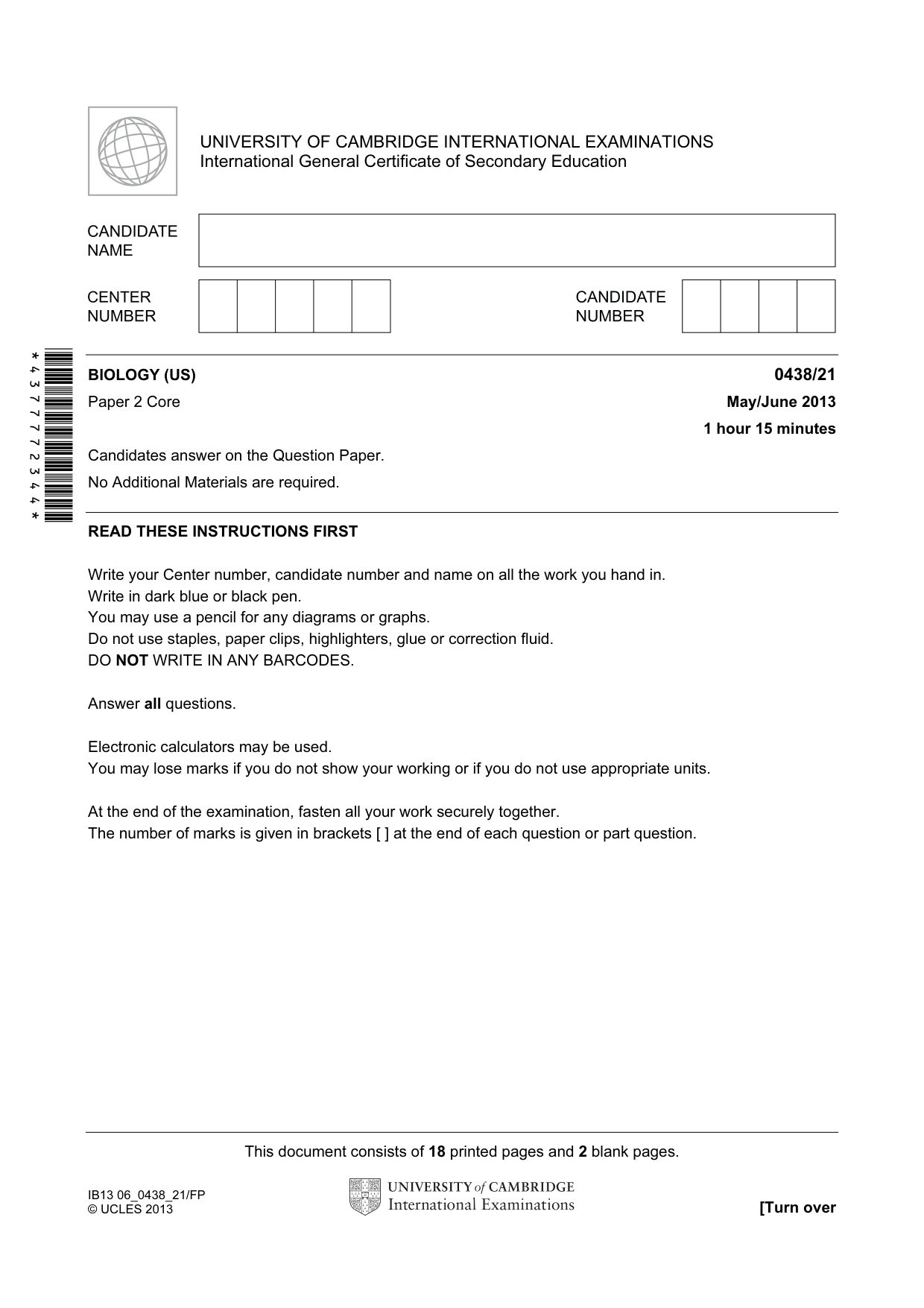
Question paper, page 1
This document consists of 18 printed pages and 2 blank pages. IB13 06_0438_21/FP © UCLES 2013 [Turn over *4377772344* UNIVERSITY OF CAMBRIDGE INTERNATIONAL EXAMINATIONS International General Certificate of Secondary Education BIOLOGY (US) 0438/21 Paper 2 Core May/June 2013 1 hour 15 minutes Candidates answer on the Question Paper. No Additional Materials are required. READ THESE INSTRUCTIONS FIRST Write your Center number, candidate number and name on all the work you hand in. Write in dark blue or black pen. You may use a pencil for any diagrams or graphs. Do not use staples, paper clips, highlighters, glue or correction fluid. DO NOT WRITE IN ANY BARCODES. Answer all questions. Electronic calculators may be used. You may lose marks if you do not show your working or if you do not use appropriate units. At the end of the examination, fasten all your work securely together. The number of marks is given in brackets [ ] at the end of each question or part question.
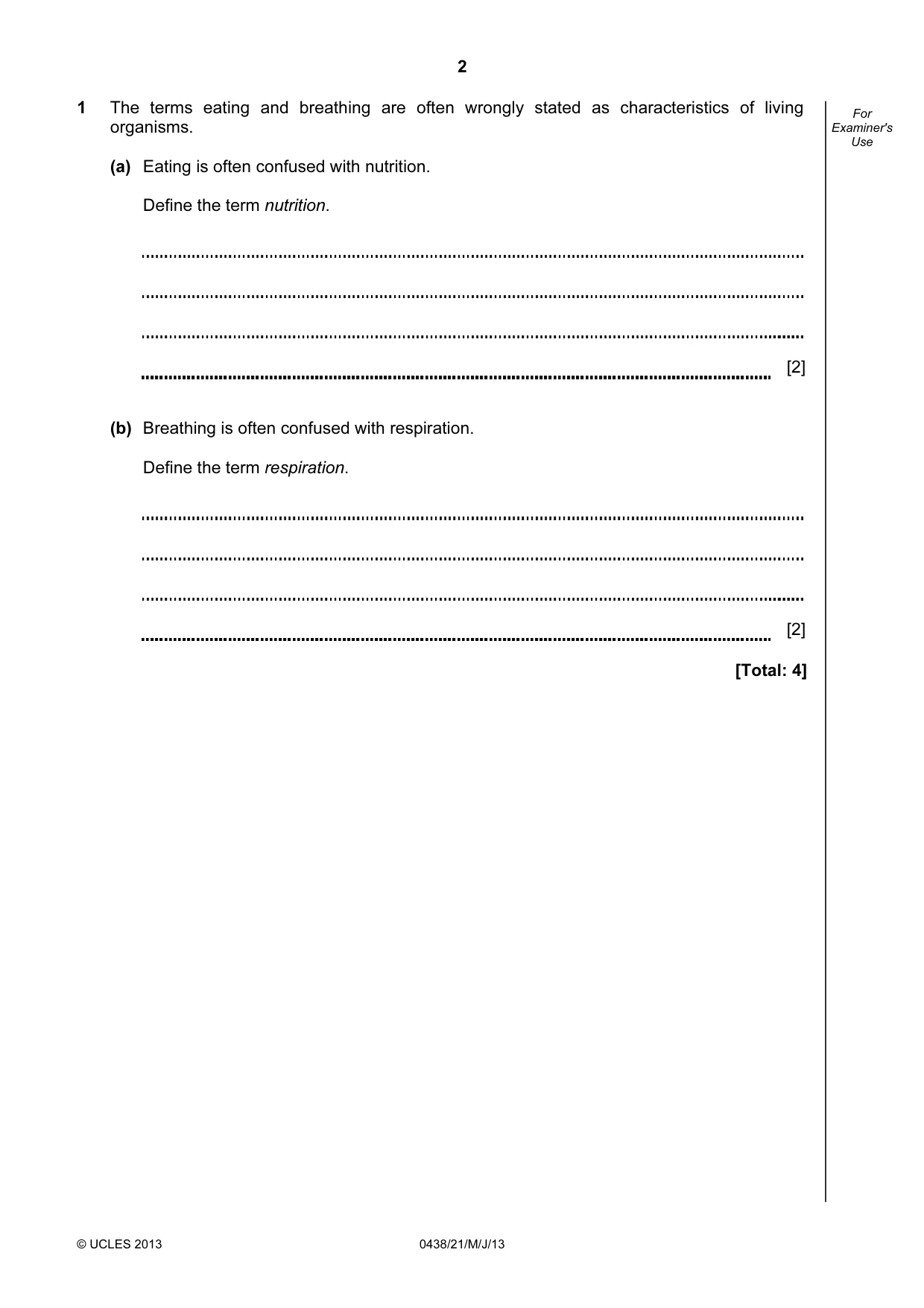
Question paper, page 2
2 © UCLES 2013 0438/21/M/J/13 For Examiner's Use 1 The terms eating and breathing are often wrongly stated as characteristics of living organisms. (a) Eating is often confused with nutrition. Define the term nutrition. [2] (b) Breathing is often confused with respiration. Define the term respiration. [2] [Total: 4]
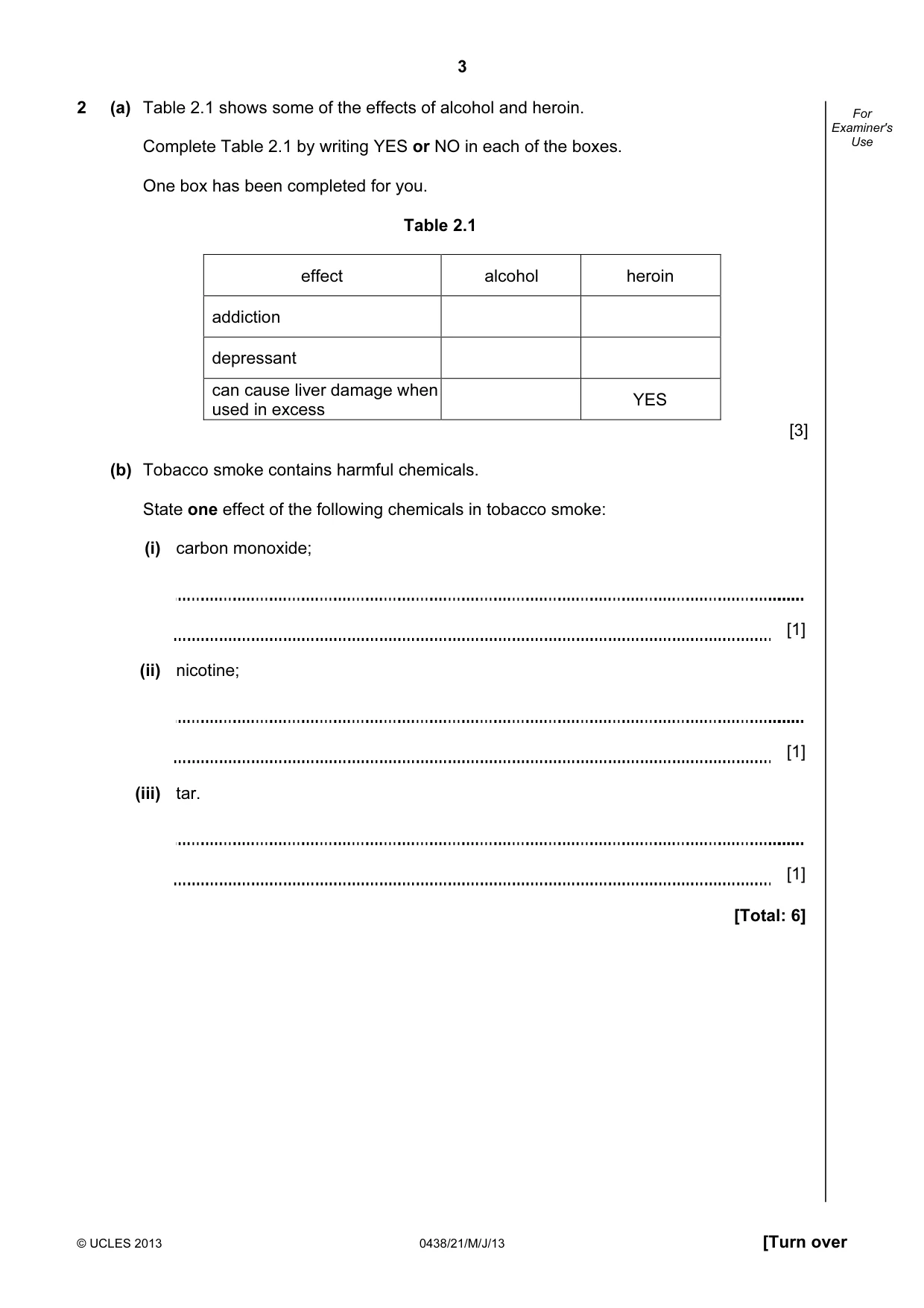
Question paper, page 3
3 © UCLES 2013 0438/21/M/J/13 [Turn over For Examiner's Use 2 (a) Table 2.1 shows some of the effects of alcohol and heroin. Complete Table 2.1 by writing YES or NO in each of the boxes. One box has been completed for you. Table 2.1 effect alcohol heroin addiction depressant can cause liver damage when used in excess YES [3] (b) Tobacco smoke contains harmful chemicals. State one effect of the following chemicals in tobacco smoke: (i) carbon monoxide; [1] (ii) nicotine; [1] (iii) tar. [1] [Total: 6]
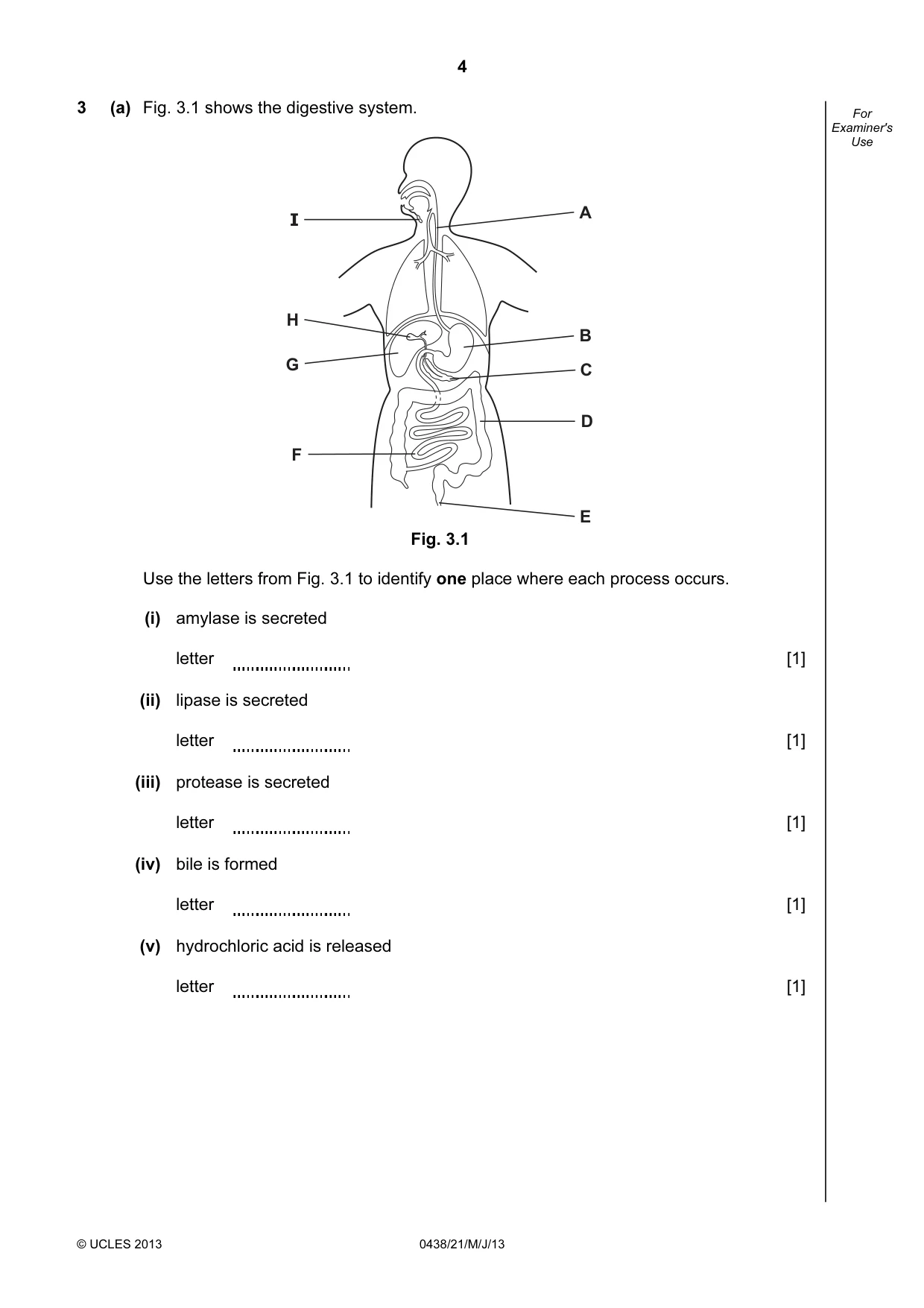
Question paper, page 4
4 © UCLES 2013 0438/21/M/J/13 For Examiner's Use 3 (a) Fig. 3.1 shows the digestive system. H G F E D C B A I Fig. 3.1 Use the letters from Fig. 3.1 to identify one place where each process occurs. (i) amylase is secreted letter [1] (ii) lipase is secreted letter [1] (iii) protease is secreted letter [1] (iv) bile is formed letter [1] (v) hydrochloric acid is released letter [1]
Question paper, page 5
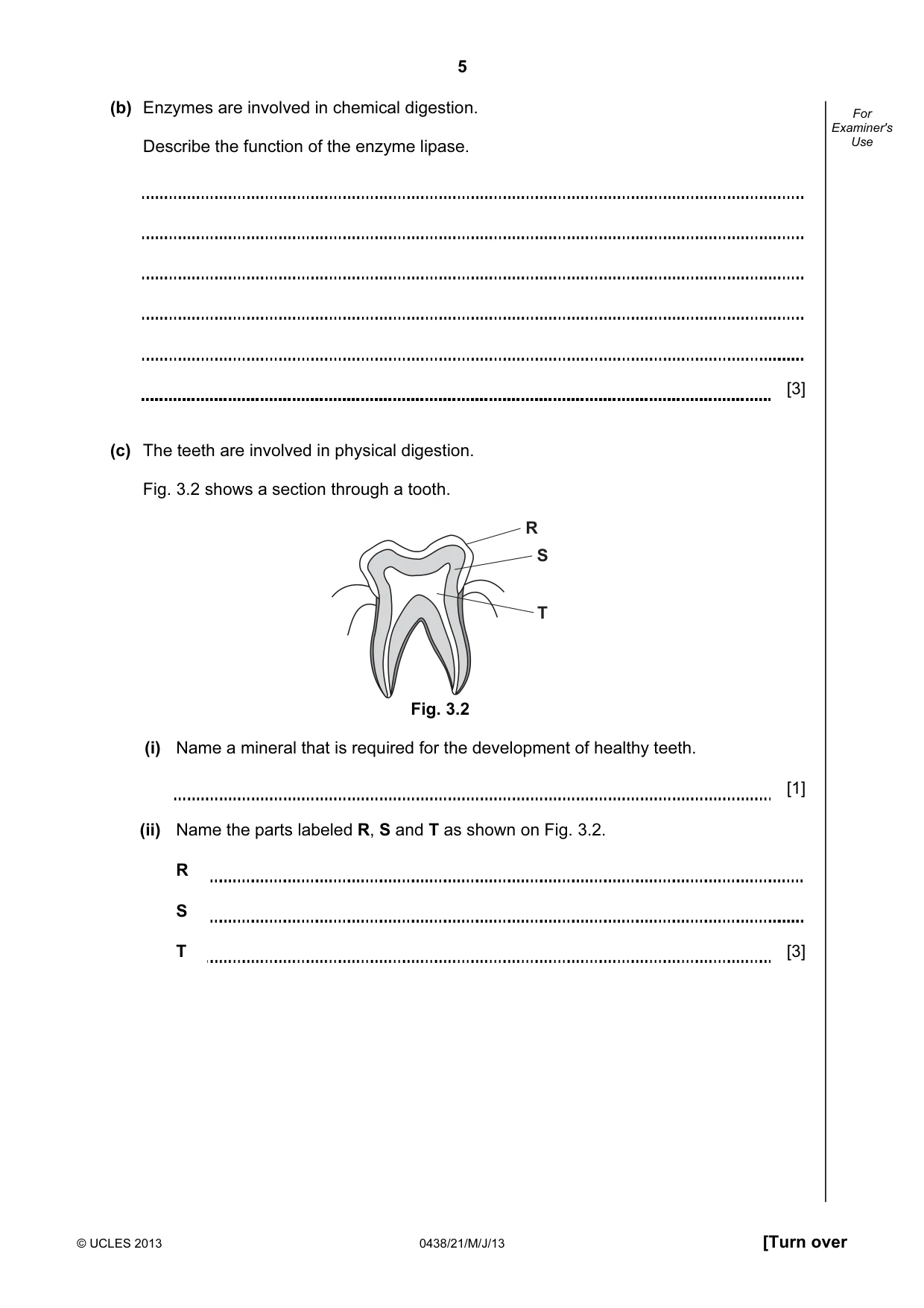
5 © UCLES 2013 0438/21/M/J/13 [Turn over For Examiner's Use (b) Enzymes are involved in chemical digestion. Describe the function of the enzyme lipase. [3] (c) The teeth are involved in physical digestion. Fig. 3.2 shows a section through a tooth. R S T Fig. 3.2 (i) Name a mineral that is required for the development of healthy teeth. [1] (ii) Name the parts labeled R, S and T as shown on Fig. 3.2. R S T [3]
Question paper, page 6
6 © UCLES 2013 0438/21/M/J/13 For Examiner's Use (iii) Describe how dental decay is caused. [3] [Total: 15]
Question paper, page 7
7 © UCLES 2013 0438/21/M/J/13 [Turn over Question 4 begins on page 8.
Question paper, page 8
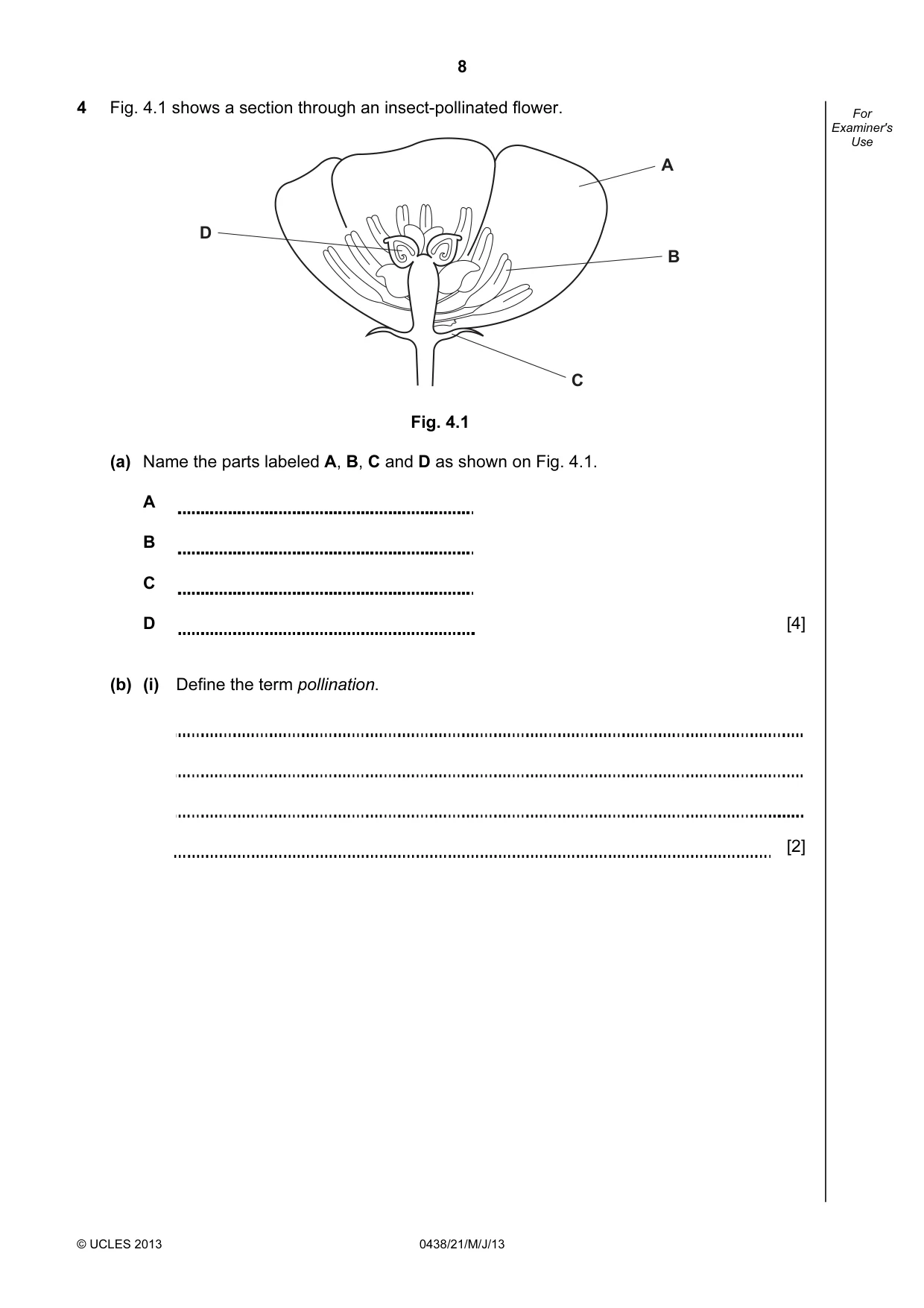
8 © UCLES 2013 0438/21/M/J/13 For Examiner's Use 4 Fig. 4.1 shows a section through an insect-pollinated flower. D A B C Fig. 4.1 (a) Name the parts labeled A, B, C and D as shown on Fig. 4.1. A B C D [4] (b) (i) Define the term pollination. [2]
Question paper, page 9
9 © UCLES 2013 0438/21/M/J/13 [Turn over For Examiner's Use (ii) Pollination can be carried out by insects or by wind. Describe four features of flowers that would show they are insect-pollinated. 1 2 3 4 [4] (c) Wind-pollinated flowers produce much more pollen than insect-pollinated flowers. This pollen is usually lighter than pollen from insect-pollinated flowers. Suggest why these are advantages to a plant that is wind-pollinated. more pollen light pollen [2] [Total: 12]
Question paper, page 10
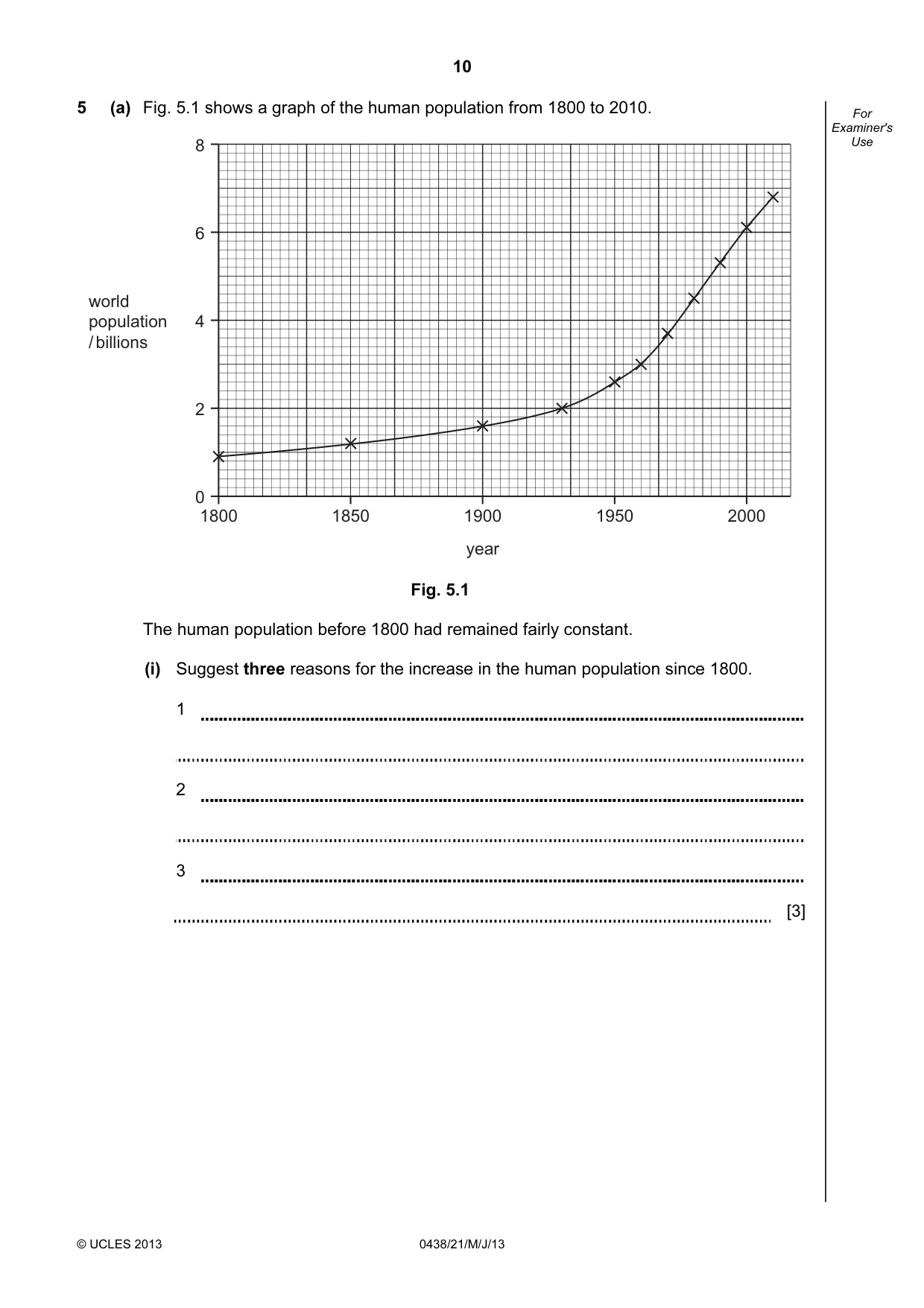
10 © UCLES 2013 0438/21/M/J/13 For Examiner's Use 5 (a) Fig. 5.1 shows a graph of the human population from 1800 to 2010. 8 6 4 2 0 1800 1850 1900 year 1950 2000 world population / billions Fig. 5.1 The human population before 1800 had remained fairly constant. (i) Suggest three reasons for the increase in the human population since 1800. 1 2 3 [3]
Question paper, page 11
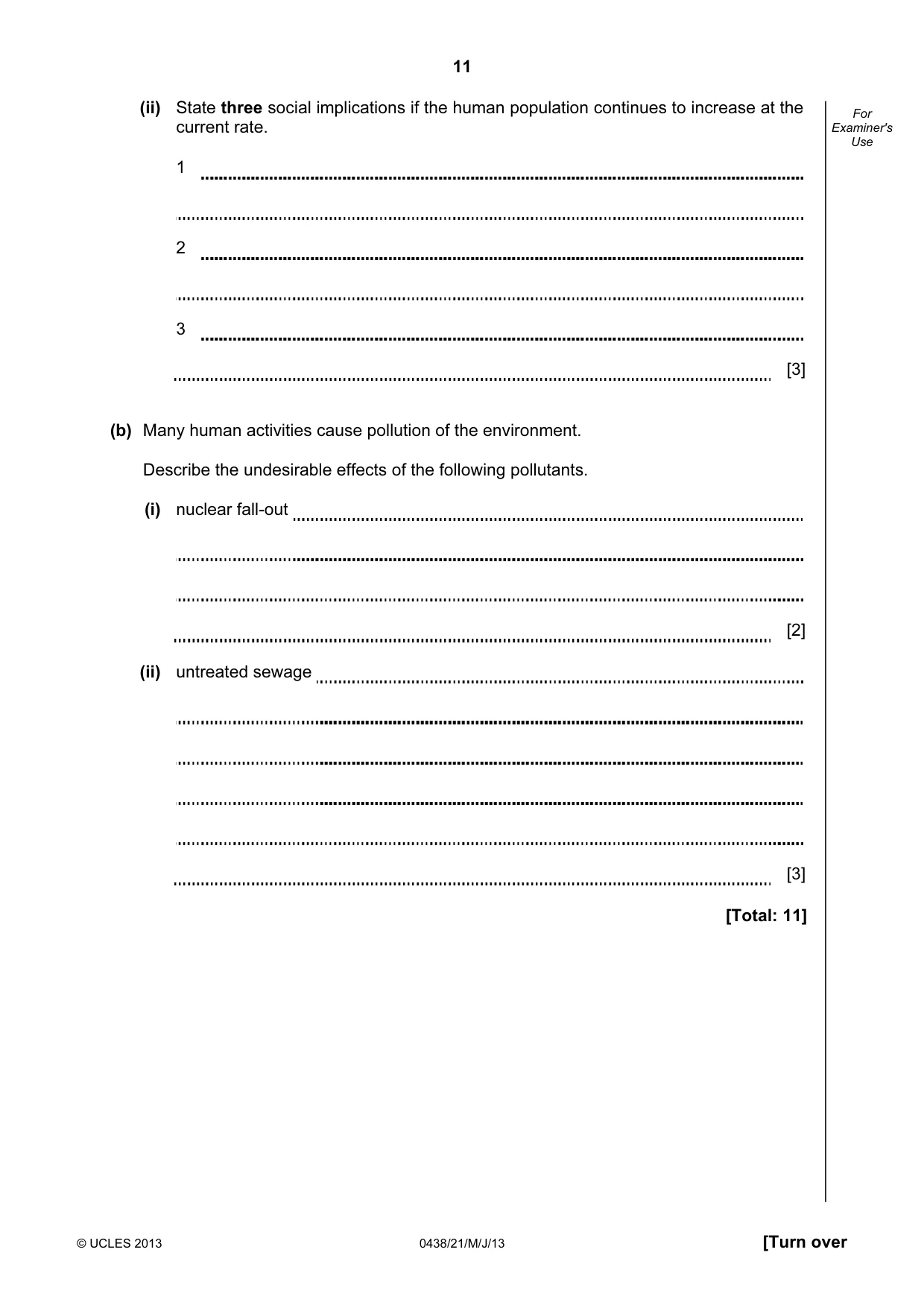
11 © UCLES 2013 0438/21/M/J/13 [Turn over For Examiner's Use (ii) State three social implications if the human population continues to increase at the current rate. 1 2 3 [3] (b) Many human activities cause pollution of the environment. Describe the undesirable effects of the following pollutants. (i) nuclear fall-out [2] (ii) untreated sewage [3] [Total: 11]
Question paper, page 12
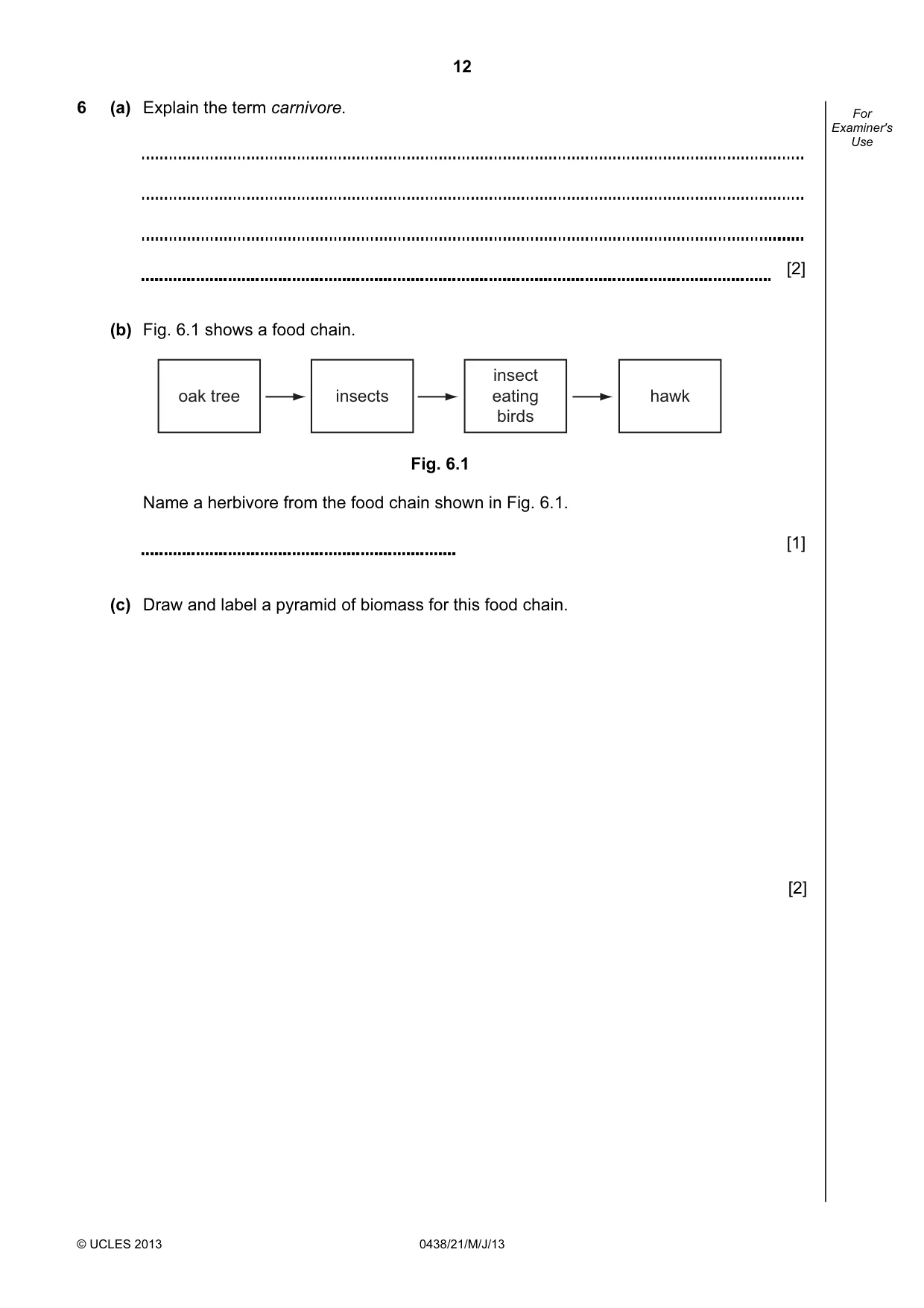
12 © UCLES 2013 0438/21/M/J/13 For Examiner's Use 6 (a) Explain the term carnivore. [2] (b) Fig. 6.1 shows a food chain. oak tree insects insect eating birds hawk Fig. 6.1 Name a herbivore from the food chain shown in Fig. 6.1. [1] (c) Draw and label a pyramid of biomass for this food chain. [2]
Question paper, page 13
13 © UCLES 2013 0438/21/M/J/13 [Turn over For Examiner's Use (d) The food chain shown in Fig. 6.1 starts with an oak tree. Name and describe the method of nutrition of the oak tree. name description [4] [Total: 9]
Question paper, page 14
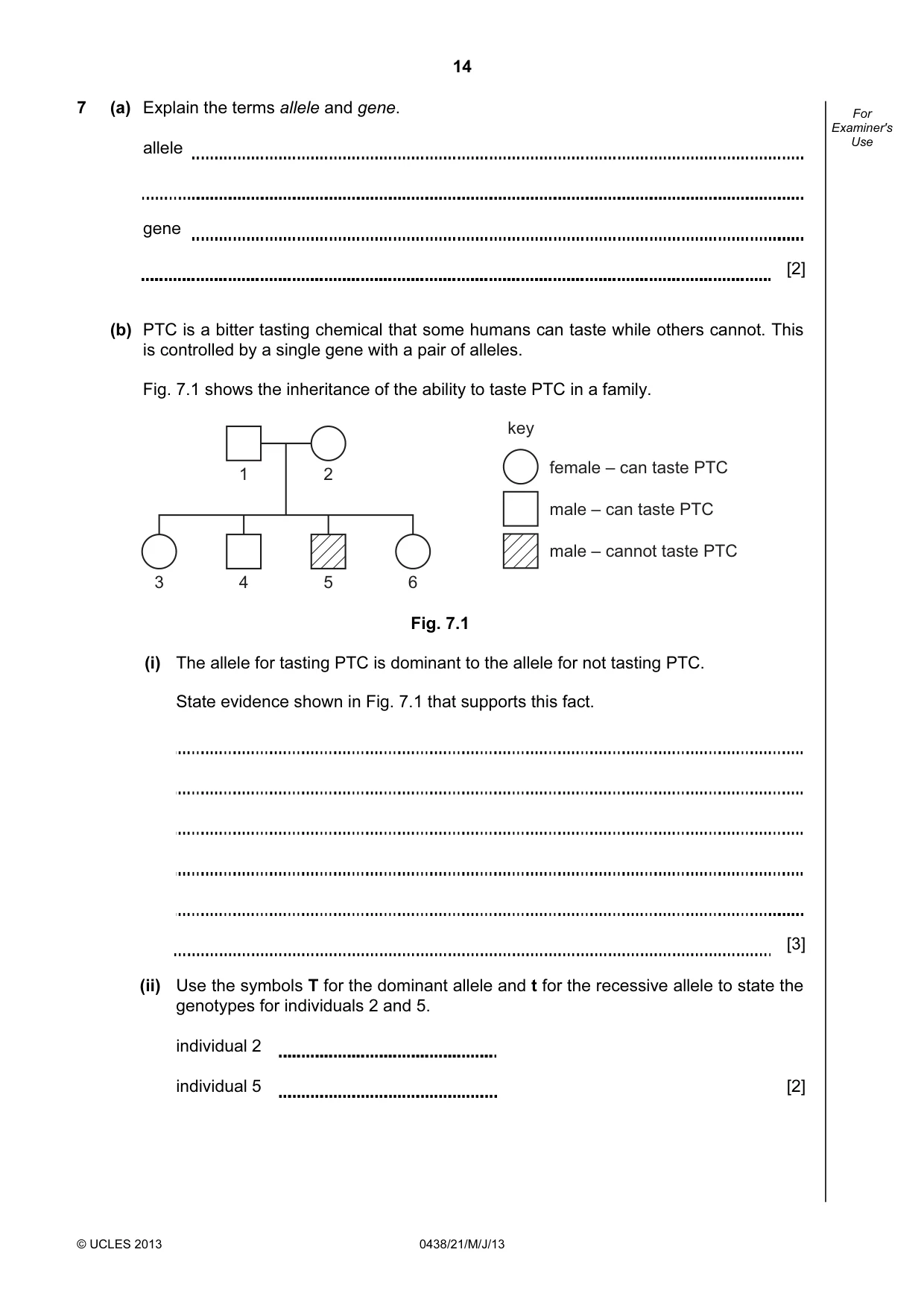
14 © UCLES 2013 0438/21/M/J/13 For Examiner's Use 7 (a) Explain the terms allele and gene. allele gene [2] (b) PTC is a bitter tasting chemical that some humans can taste while others cannot. This is controlled by a single gene with a pair of alleles. Fig. 7.1 shows the inheritance of the ability to taste PTC in a family. 1 2 6 5 4 3 key female – can taste PTC male – can taste PTC male – cannot taste PTC Fig. 7.1 (i) The allele for tasting PTC is dominant to the allele for not tasting PTC. State evidence shown in Fig. 7.1 that supports this fact. [3] (ii) Use the symbols T for the dominant allele and t for the recessive allele to state the genotypes for individuals 2 and 5. individual 2 individual 5 [2]
Question paper, page 15
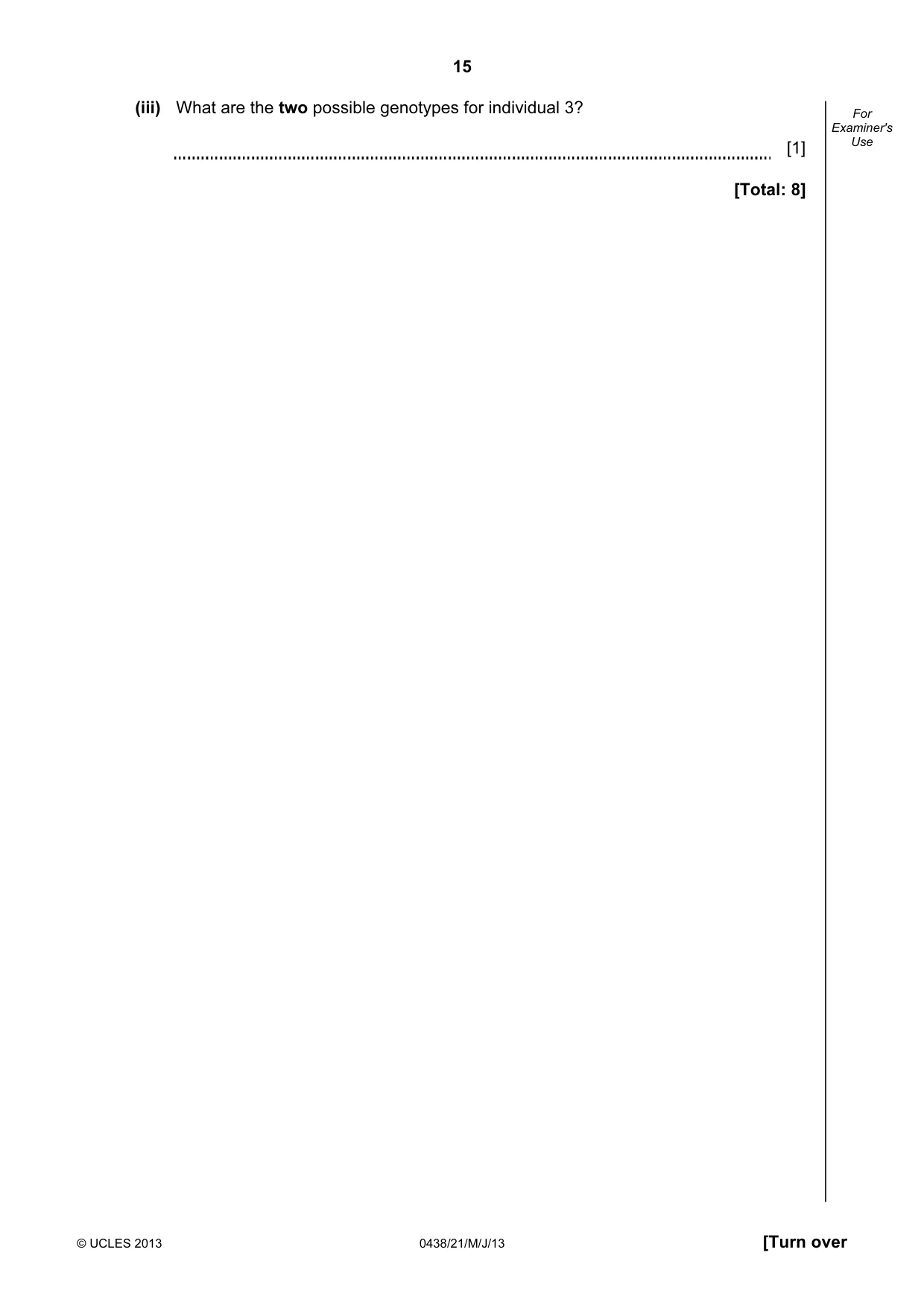
15 © UCLES 2013 0438/21/M/J/13 [Turn over For Examiner's Use (iii) What are the two possible genotypes for individual 3? [1] [Total: 8]
Question paper, page 16
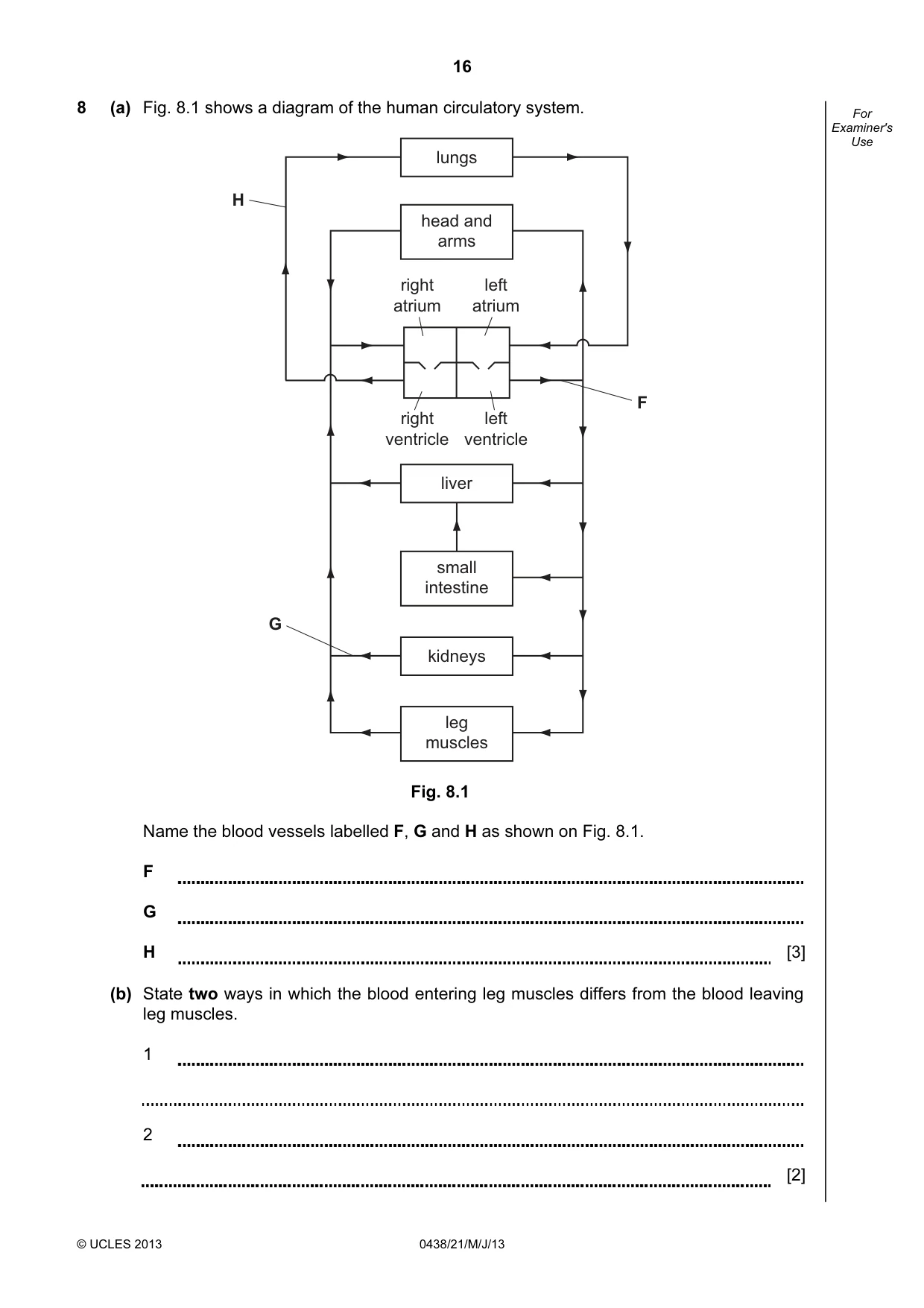
16 © UCLES 2013 0438/21/M/J/13 For Examiner's Use 8 (a) Fig. 8.1 shows a diagram of the human circulatory system. small intestine head and arms leg muscles kidneys liver lungs right ventricle left ventricle right atrium left atrium H G F Fig. 8.1 Name the blood vessels labelled F, G and H as shown on Fig. 8.1. F G H [3] (b) State two ways in which the blood entering leg muscles differs from the blood leaving leg muscles. 1 2 [2]
Question paper, page 17
17 © UCLES 2013 0438/21/M/J/13 [Turn over For Examiner's Use (c) Humans have a double circulation, as shown in Fig. 8.1. Explain the advantages of humans having a double circulation. [3] [Total: 8]
Question paper, page 18
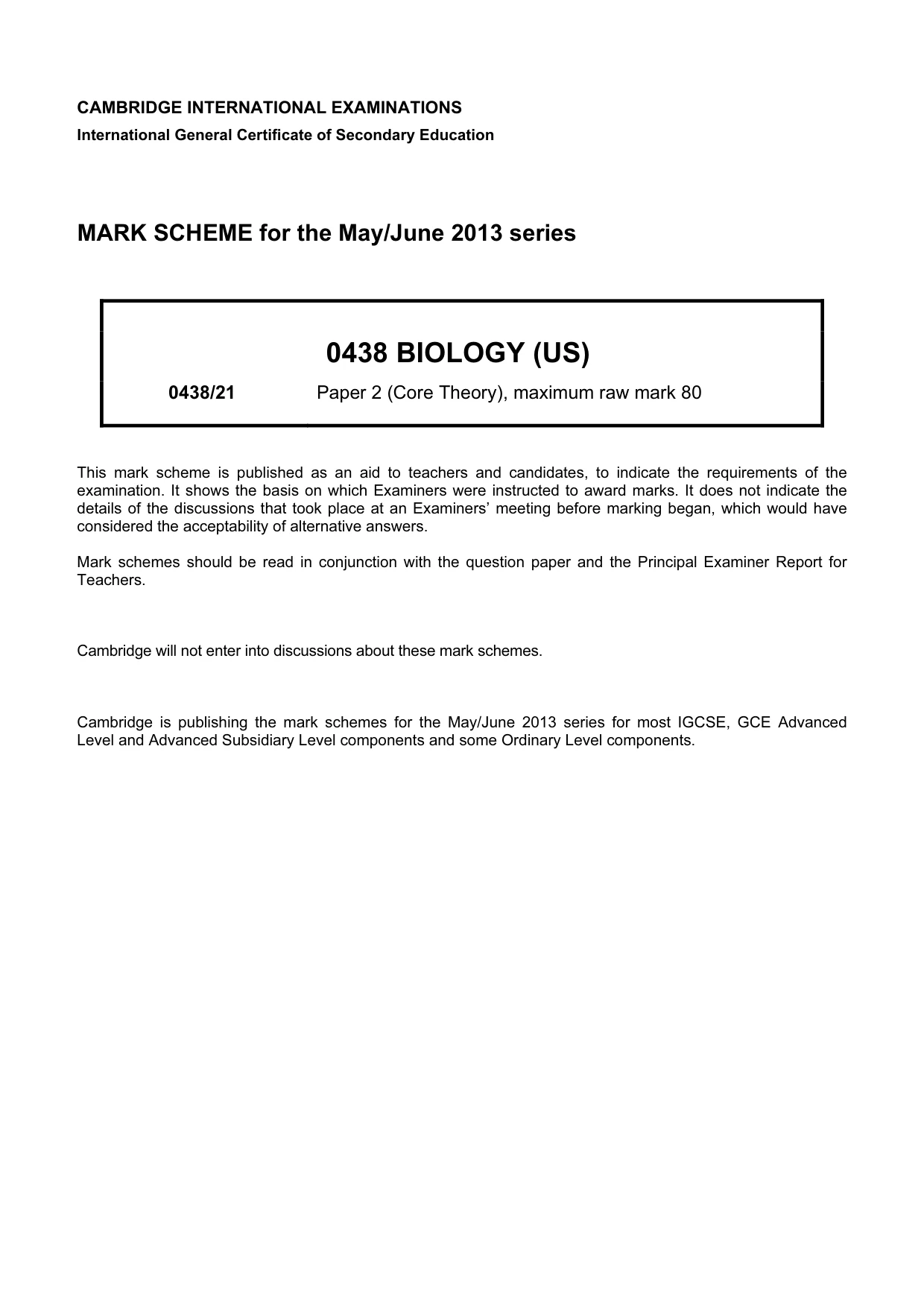
18 © UCLES 2013 0438/21/M/J/13 For Examiner's Use 9 (a) Define the term excretion. [2] (b) Name two human excretory organs. Identify two substances that each organ excretes. organ substances excreted 1 2 organ substances excreted 1 2 [4] (c) Green plants are living organisms and excrete substances. Suggest one substance that plants excrete. [1] [Total: 7]
Question paper, page 19
19 © UCLES 2013 0438/21/M/J/13 BLANK PAGE
Question paper, page 20
20 Permission to reproduce items where third-party owned material protected by copyright is included has been sought and cleared where possible. Every reasonable effort has been made by the publisher (UCLES) to trace copyright holders, but if any items requiring clearance have unwittingly been included, the publisher will be pleased to make amends at the earliest possible opportunity. University of Cambridge International Examinations is part of the Cambridge Assessment Group. Cambridge Assessment is the brand name of University of Cambridge Local Examinations Syndicate (UCLES), which is itself a department of the University of Cambridge. © UCLES 2013 0438/21/M/J/13 BLANK PAGE
Mark scheme, page 1
CAMBRIDGE INTERNATIONAL EXAMINATIONS International General Certificate of Secondary Education MARK SCHEME for the May/June 2013 series 0438 BIOLOGY (US) 0438/21 Paper 2 (Core Theory), maximum raw mark 80 This mark scheme is published as an aid to teachers and candidates, to indicate the requirements of the examination. It shows the basis on which Examiners were instructed to award marks. It does not indicate the details of the discussions that took place at an Examiners’ meeting before marking began, which would have considered the acceptability of alternative answers. Mark schemes should be read in conjunction with the question paper and the Principal Examiner Report for Teachers. Cambridge will not enter into discussions about these mark schemes. Cambridge is publishing the mark schemes for the May/June 2013 series for most IGCSE, GCE Advanced Level and Advanced Subsidiary Level components and some Ordinary Level components.
Mark scheme, page 2
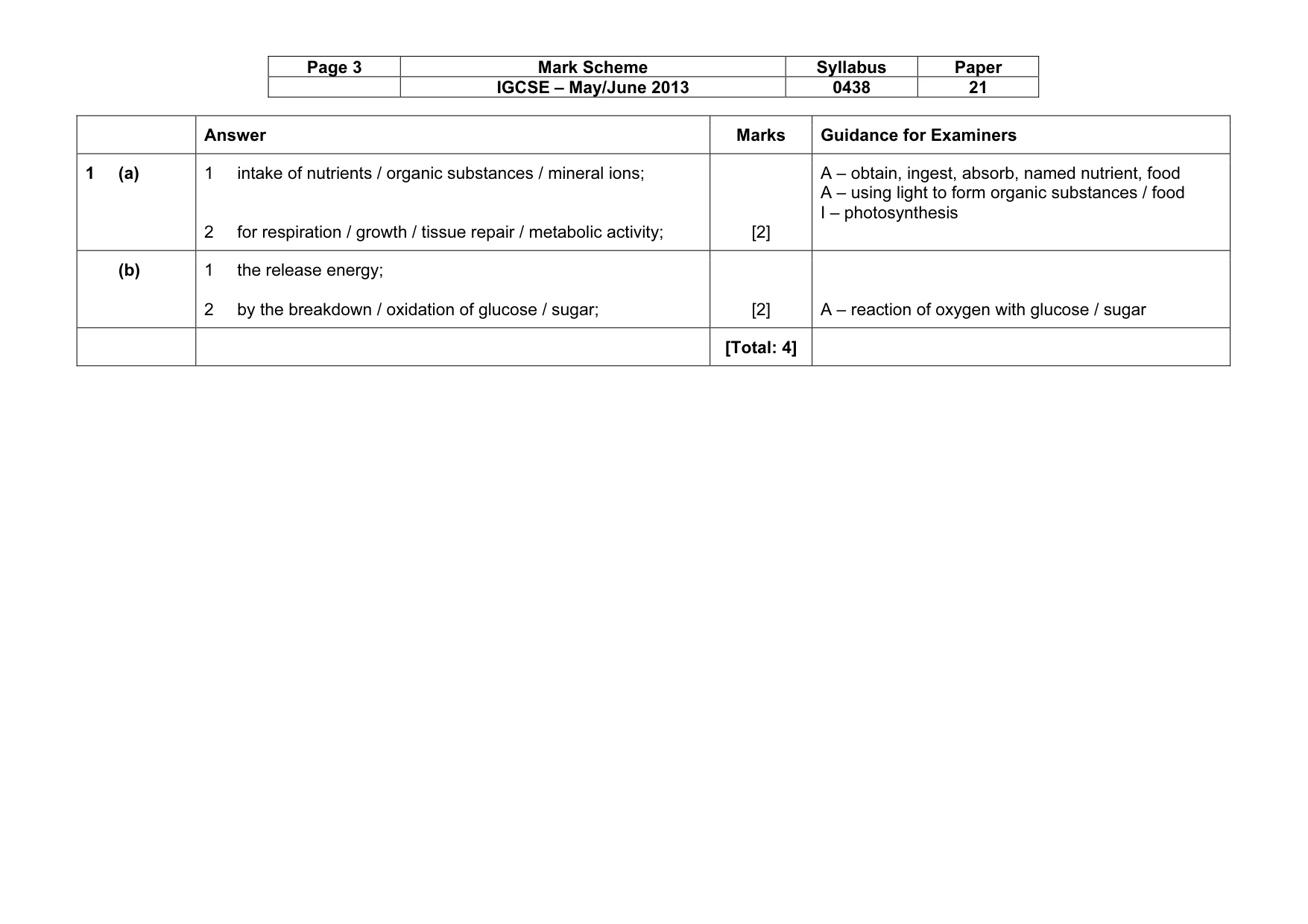
Page 2 Mark Scheme Syllabus Paper IGCSE – May/June 2013 0438 21 Mark schemes will use these abbreviations • ; separates marking points • / alternatives • R reject • A accept (for answers correctly cued by the question) • I ignore as irrelevant or inadequate • ecf error carried forward • AW alternative wording (where responses vary more than usual) • AVP alternative valid point • ORA or reverse argument • OWTTE or words to that effect • underline actual word given must be used by candidate (grammatical variants excepted) • ( ) the word / phrase in brackets is not required but sets the context • D, L, T, Q quality of: drawing / labelling / table / detail as indicated • max indicates the maximum number of marks
Mark scheme, page 3
Page 3 Mark Scheme Syllabus Paper IGCSE – May/June 2013 0438 21 Answer Marks Guidance for Examiners 1 (a) 1 intake of nutrients / organic substances / mineral ions; 2 for respiration / growth / tissue repair / metabolic activity; [2] A – obtain, ingest, absorb, named nutrient, food A – using light to form organic substances / food I – photosynthesis (b) 1 the release energy; 2 by the breakdown / oxidation of glucose / sugar; [2] A – reaction of oxygen with glucose / sugar [Total: 4]
Mark scheme, page 4
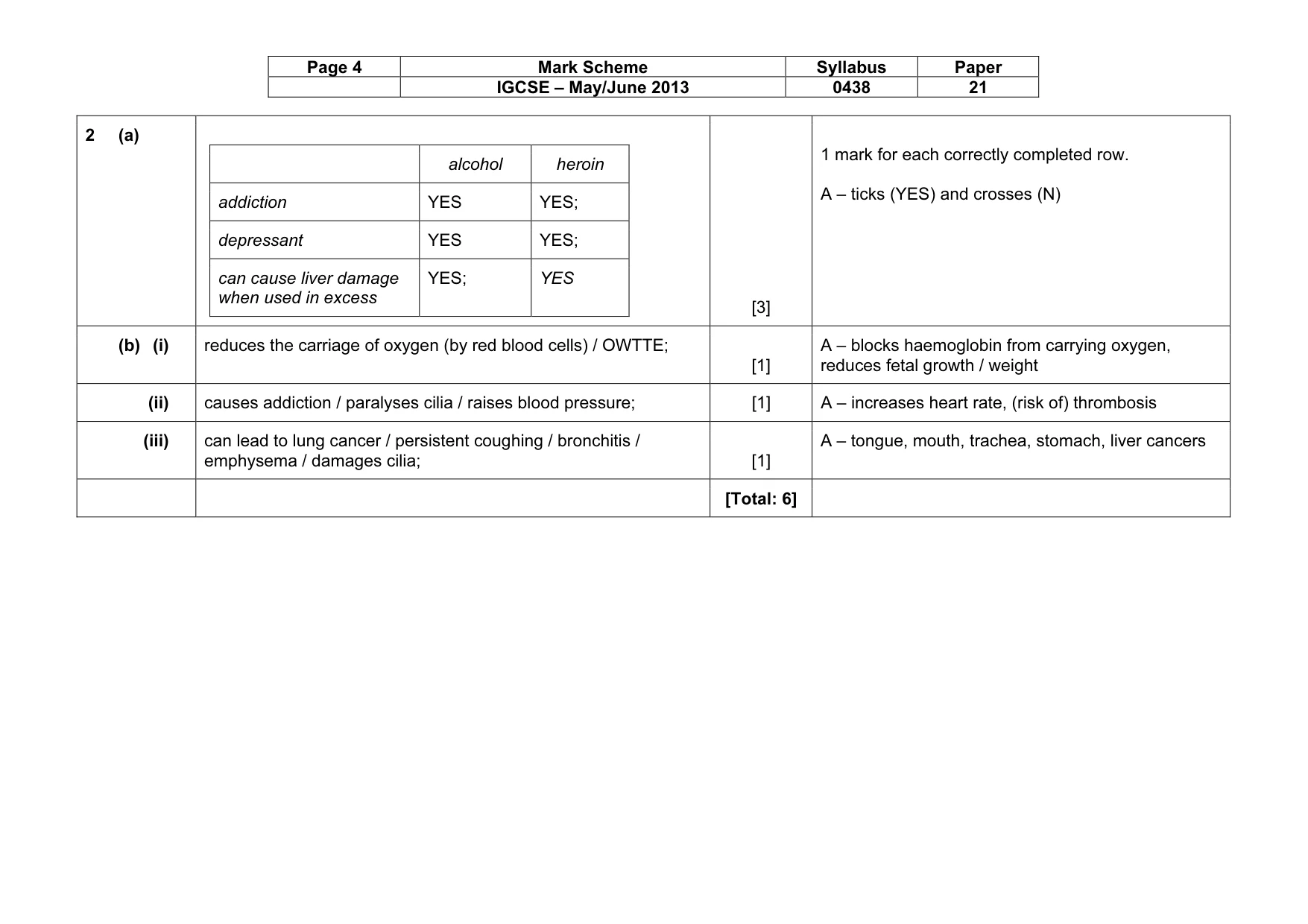
Page 4 Mark Scheme Syllabus Paper IGCSE – May/June 2013 0438 21 2 (a) alcohol heroin addiction YES YES; depressant YES YES; can cause liver damage when used in excess YES; YES [3] 1 mark for each correctly completed row. A – ticks (YES) and crosses (N) (b) (i) reduces the carriage of oxygen (by red blood cells) / OWTTE; [1] A – blocks haemoglobin from carrying oxygen, reduces fetal growth / weight (ii) causes addiction / paralyses cilia / raises blood pressure; [1] A – increases heart rate, (risk of) thrombosis (iii) can lead to lung cancer / persistent coughing / bronchitis / emphysema / damages cilia; [1] A – tongue, mouth, trachea, stomach, liver cancers [Total: 6]
Mark scheme, page 5
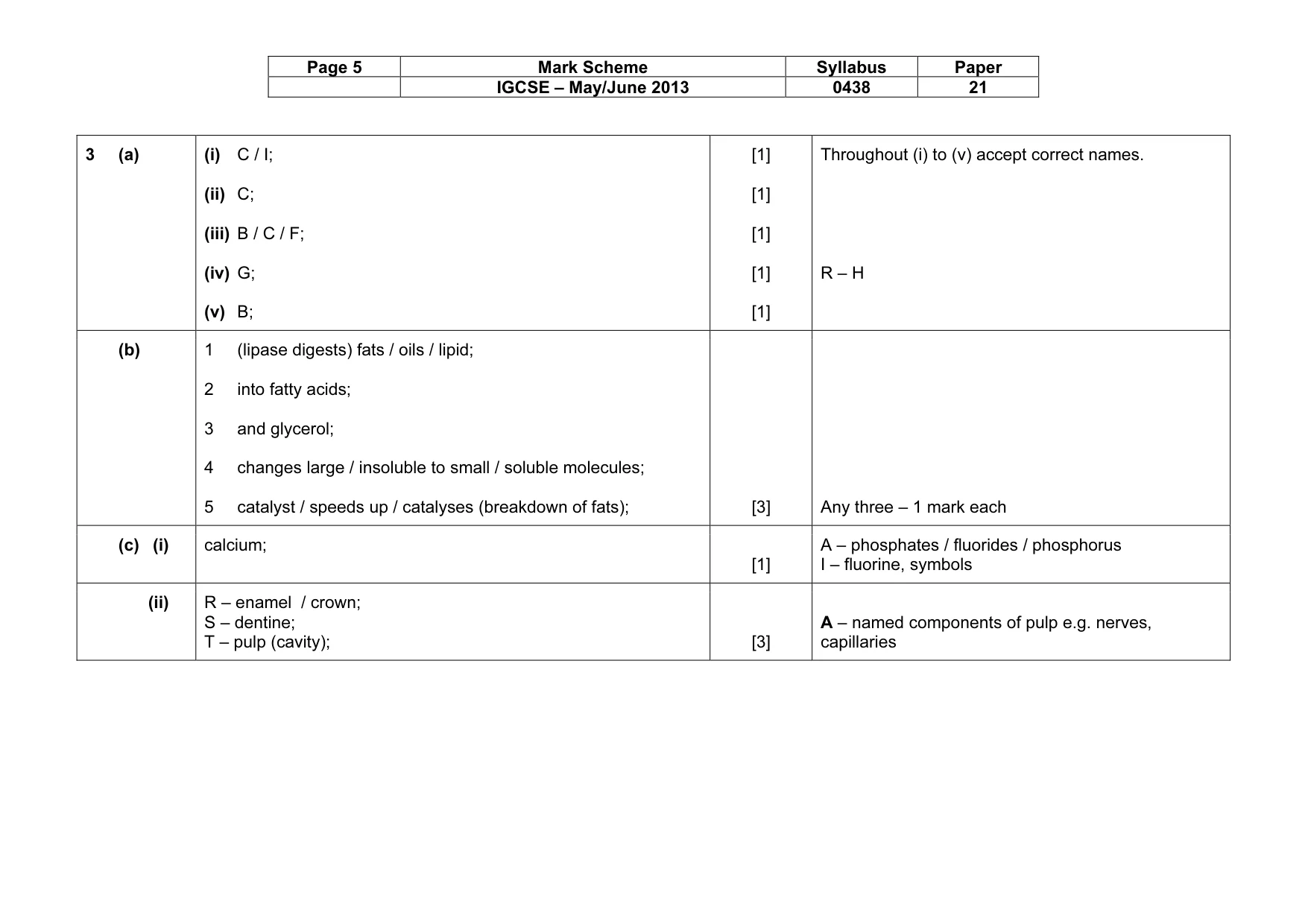
Page 5 Mark Scheme Syllabus Paper IGCSE – May/June 2013 0438 21 3 (a) (i) C / I; (ii) C; (iii) B / C / F; (iv) G; (v) B; [1] [1] [1] [1] [1] Throughout (i) to (v) accept correct names. R – H (b) 1 (lipase digests) fats / oils / lipid; 2 into fatty acids; 3 and glycerol; 4 changes large / insoluble to small / soluble molecules; 5 catalyst / speeds up / catalyses (breakdown of fats); [3] Any three – 1 mark each (c) (i) calcium; [1] A – phosphates / fluorides / phosphorus I – fluorine, symbols (ii) R – enamel / crown; S – dentine; T – pulp (cavity); [3] A – named components of pulp e.g. nerves, capillaries
Mark scheme, page 6
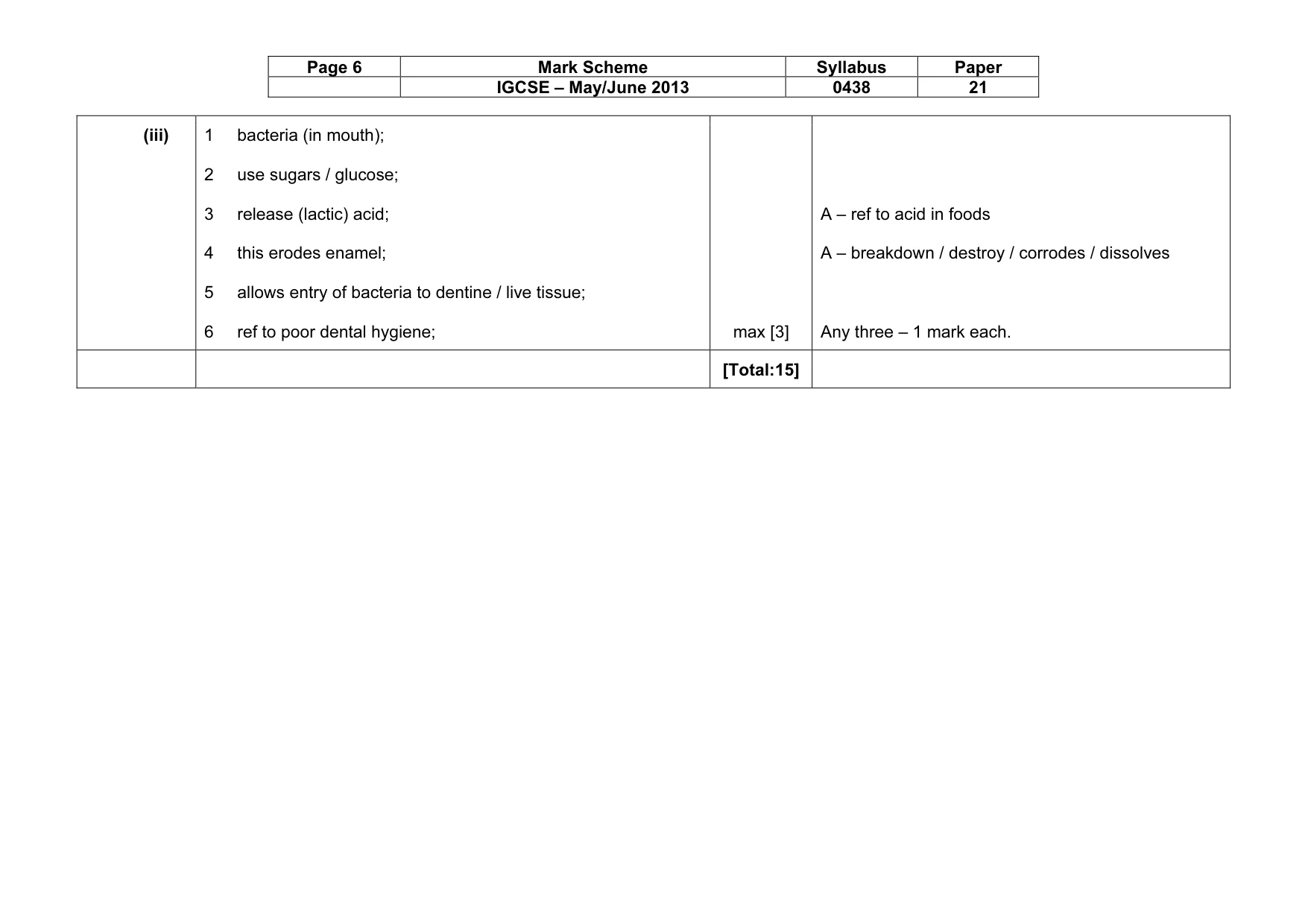
Page 6 Mark Scheme Syllabus Paper IGCSE – May/June 2013 0438 21 (iii) 1 bacteria (in mouth); 2 use sugars / glucose; 3 release (lactic) acid; 4 this erodes enamel; 5 allows entry of bacteria to dentine / live tissue; 6 ref to poor dental hygiene; max [3] A – ref to acid in foods A – breakdown / destroy / corrodes / dissolves Any three – 1 mark each. [Total:15]
Mark scheme, page 7
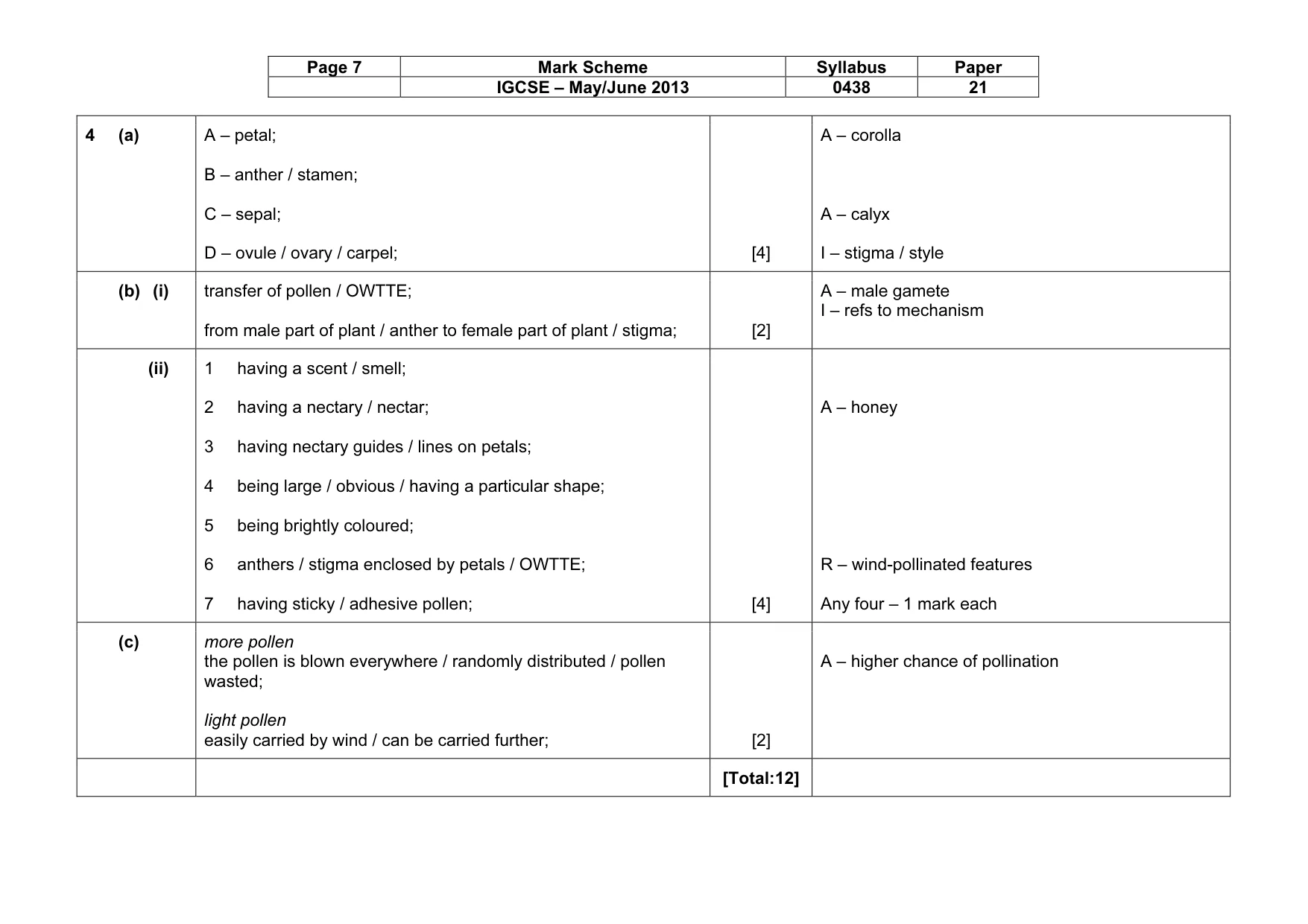
Page 7 Mark Scheme Syllabus Paper IGCSE – May/June 2013 0438 21 4 (a) A – petal; B – anther / stamen; C – sepal; D – ovule / ovary / carpel; [4] A – corolla A – calyx I – stigma / style (b) (i) transfer of pollen / OWTTE; from male part of plant / anther to female part of plant / stigma; [2] A – male gamete I – refs to mechanism (ii) 1 having a scent / smell; 2 having a nectary / nectar; 3 having nectary guides / lines on petals; 4 being large / obvious / having a particular shape; 5 being brightly coloured; 6 anthers / stigma enclosed by petals / OWTTE; 7 having sticky / adhesive pollen; [4] A – honey R – wind-pollinated features Any four – 1 mark each (c) more pollen the pollen is blown everywhere / randomly distributed / pollen wasted; light pollen easily carried by wind / can be carried further; [2] A – higher chance of pollination [Total:12]
Mark scheme, page 8
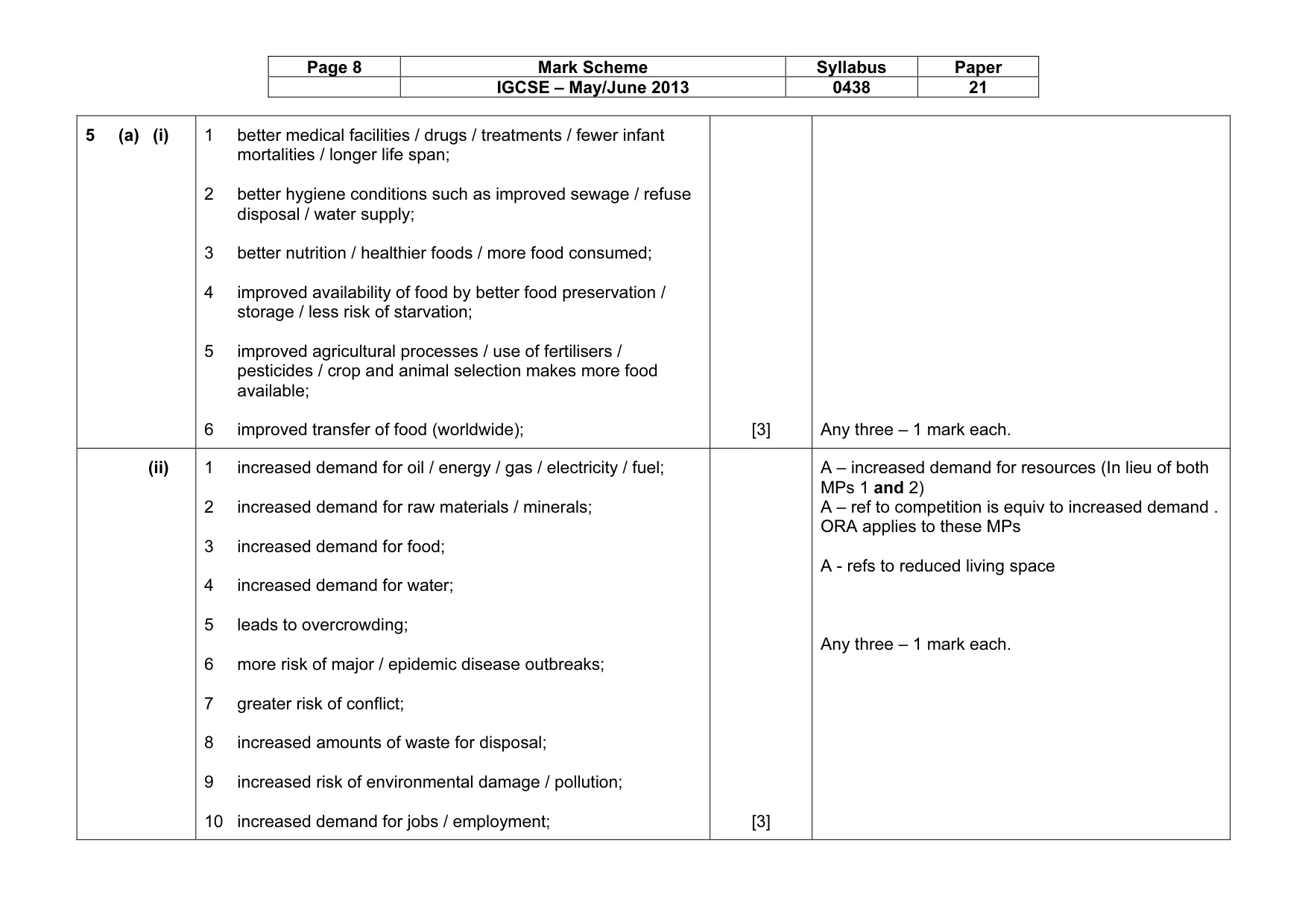
Page 8 Mark Scheme Syllabus Paper IGCSE – May/June 2013 0438 21 5 (a) (i) 1 better medical facilities / drugs / treatments / fewer infant mortalities / longer life span; 2 better hygiene conditions such as improved sewage / refuse disposal / water supply; 3 better nutrition / healthier foods / more food consumed; 4 improved availability of food by better food preservation / storage / less risk of starvation; 5 improved agricultural processes / use of fertilisers / pesticides / crop and animal selection makes more food available; 6 improved transfer of food (worldwide); [3] Any three – 1 mark each. (ii) 1 increased demand for oil / energy / gas / electricity / fuel; 2 increased demand for raw materials / minerals; 3 increased demand for food; 4 increased demand for water; 5 leads to overcrowding; 6 more risk of major / epidemic disease outbreaks; 7 greater risk of conflict; 8 increased amounts of waste for disposal; 9 increased risk of environmental damage / pollution; 10 increased demand for jobs / employment; [3] A – increased demand for resources (In lieu of both MPs 1 and 2) A – ref to competition is equiv to increased demand . ORA applies to these MPs A - refs to reduced living space Any three – 1 mark each.
Mark scheme, page 9
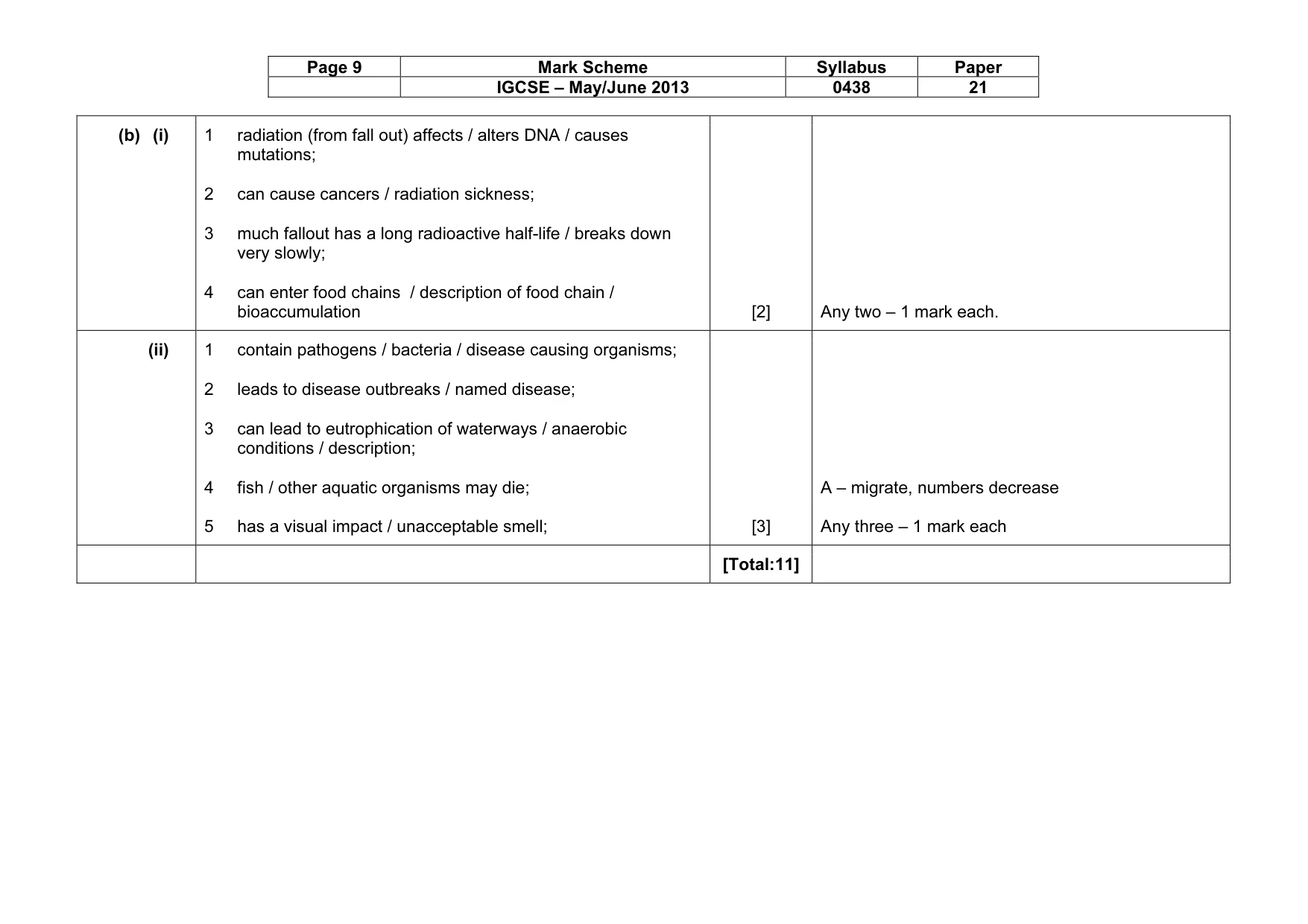
Page 9 Mark Scheme Syllabus Paper IGCSE – May/June 2013 0438 21 (b) (i) 1 radiation (from fall out) affects / alters DNA / causes mutations; 2 can cause cancers / radiation sickness; 3 much fallout has a long radioactive half-life / breaks down very slowly; 4 can enter food chains / description of food chain / bioaccumulation [2] Any two – 1 mark each. (ii) 1 contain pathogens / bacteria / disease causing organisms; 2 leads to disease outbreaks / named disease; 3 can lead to eutrophication of waterways / anaerobic conditions / description; 4 fish / other aquatic organisms may die; 5 has a visual impact / unacceptable smell; [3] A – migrate, numbers decrease Any three – 1 mark each [Total:11]
Mark scheme, page 10
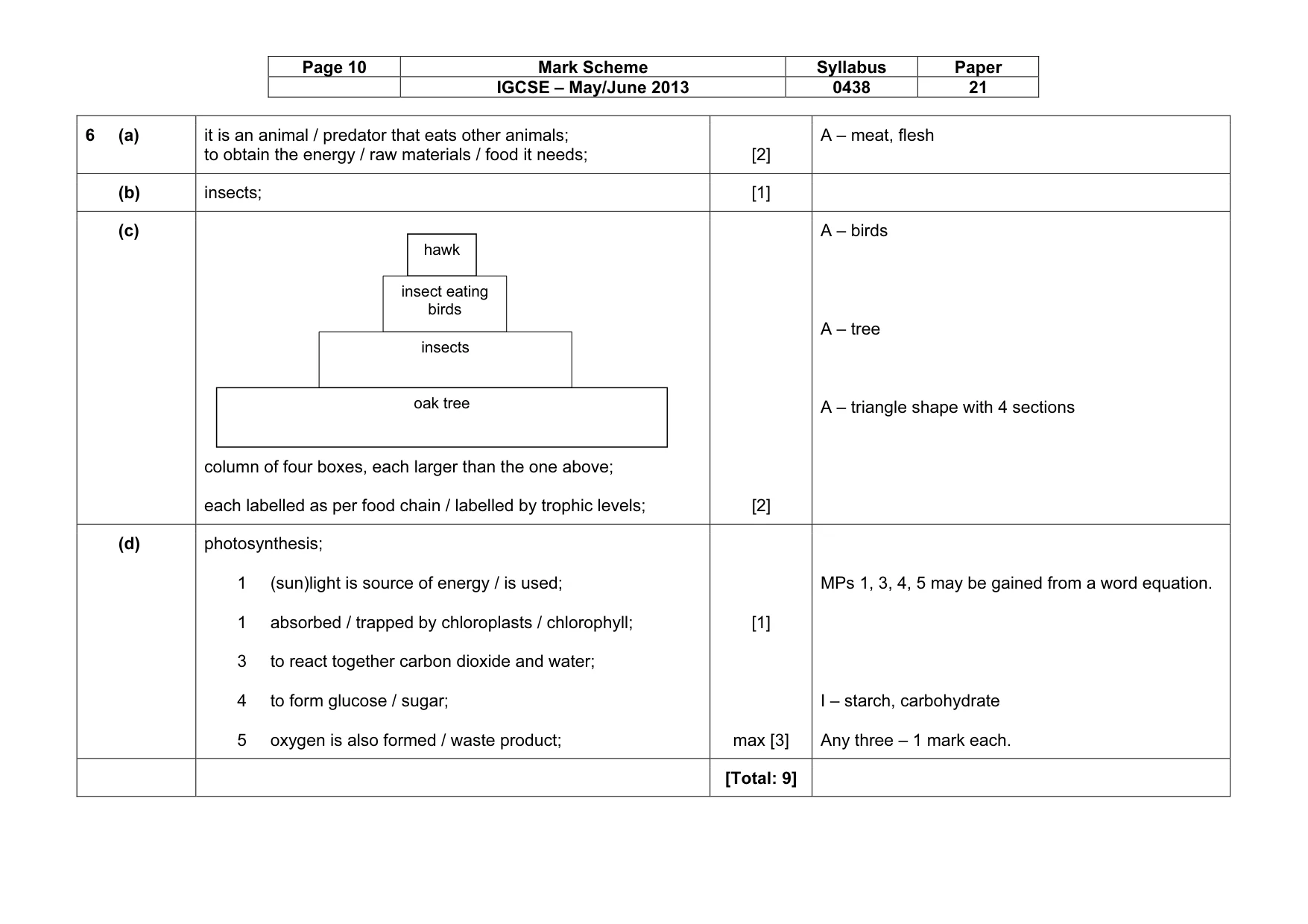
Page 10 Mark Scheme Syllabus Paper IGCSE – May/June 2013 0438 21 6 (a) it is an animal / predator that eats other animals; to obtain the energy / raw materials / food it needs; [2] A – meat, flesh (b) insects; [1] (c) column of four boxes, each larger than the one above; each labelled as per food chain / labelled by trophic levels; [2] A – birds A – tree A – triangle shape with 4 sections (d) photosynthesis; 1 (sun)light is source of energy / is used; 1 absorbed / trapped by chloroplasts / chlorophyll; 3 to react together carbon dioxide and water; 4 to form glucose / sugar; 5 oxygen is also formed / waste product; [1] max [3] MPs 1, 3, 4, 5 may be gained from a word equation. I – starch, carbohydrate Any three – 1 mark each. [Total: 9] hawk insect eating birds insects oak tree
Mark scheme, page 11
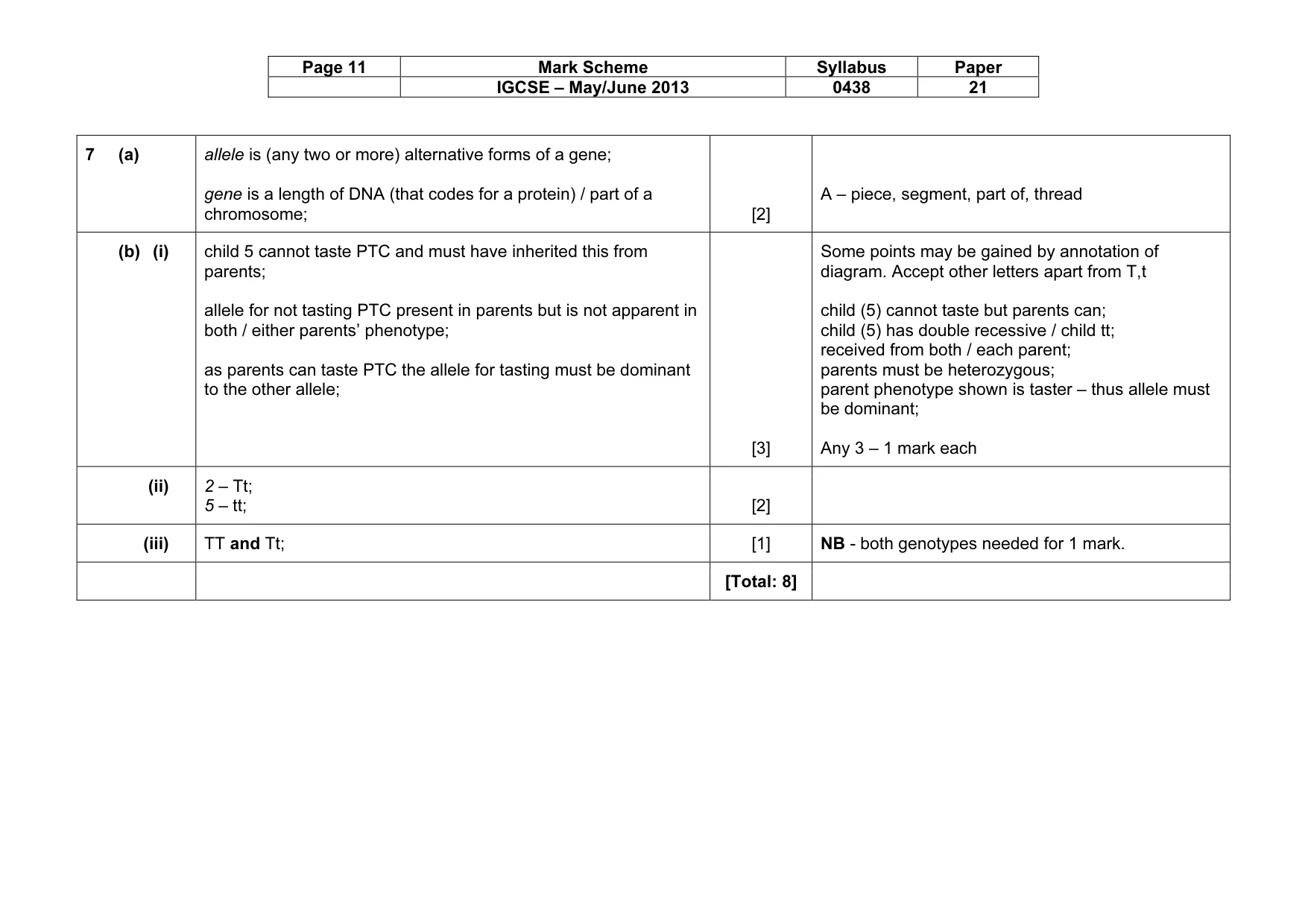
Page 11 Mark Scheme Syllabus Paper IGCSE – May/June 2013 0438 21 7 (a) allele is (any two or more) alternative forms of a gene; gene is a length of DNA (that codes for a protein) / part of a chromosome; [2] A – piece, segment, part of, thread (b) (i) child 5 cannot taste PTC and must have inherited this from parents; allele for not tasting PTC present in parents but is not apparent in both / either parents’ phenotype; as parents can taste PTC the allele for tasting must be dominant to the other allele; [3] Some points may be gained by annotation of diagram. Accept other letters apart from T,t child (5) cannot taste but parents can; child (5) has double recessive / child tt; received from both / each parent; parents must be heterozygous; parent phenotype shown is taster – thus allele must be dominant; Any 3 – 1 mark each (ii) 2 – Tt; 5 – tt; [2] (iii) TT and Tt; [1] NB - both genotypes needed for 1 mark. [Total: 8]
Mark scheme, page 12
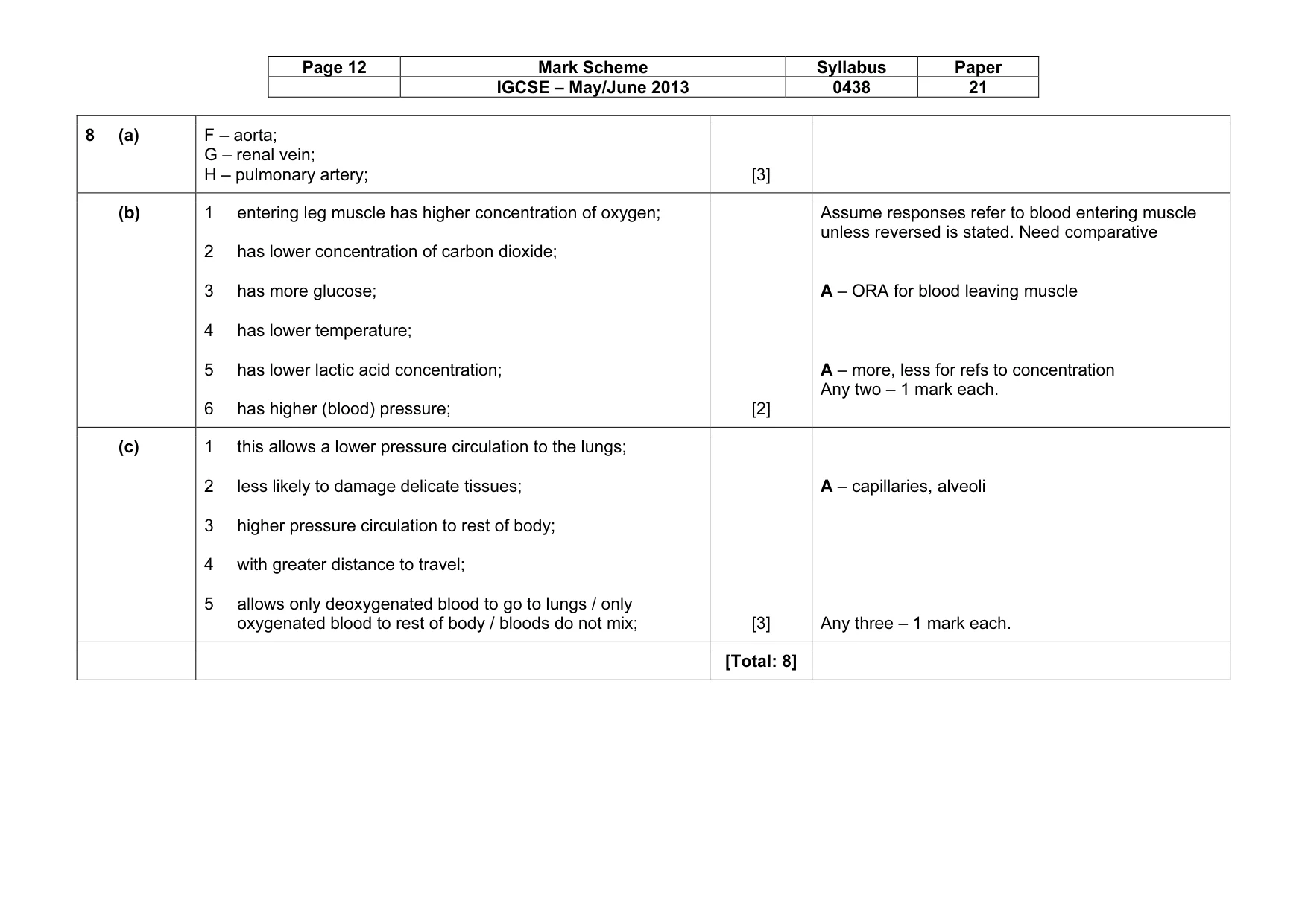
Page 12 Mark Scheme Syllabus Paper IGCSE – May/June 2013 0438 21 8 (a) F – aorta; G – renal vein; H – pulmonary artery; [3] (b) 1 entering leg muscle has higher concentration of oxygen; 2 has lower concentration of carbon dioxide; 3 has more glucose; 4 has lower temperature; 5 has lower lactic acid concentration; 6 has higher (blood) pressure; [2] Assume responses refer to blood entering muscle unless reversed is stated. Need comparative A – ORA for blood leaving muscle A – more, less for refs to concentration Any two – 1 mark each. (c) 1 this allows a lower pressure circulation to the lungs; 2 less likely to damage delicate tissues; 3 higher pressure circulation to rest of body; 4 with greater distance to travel; 5 allows only deoxygenated blood to go to lungs / only oxygenated blood to rest of body / bloods do not mix; [3] A – capillaries, alveoli Any three – 1 mark each. [Total: 8]
Mark scheme, page 13
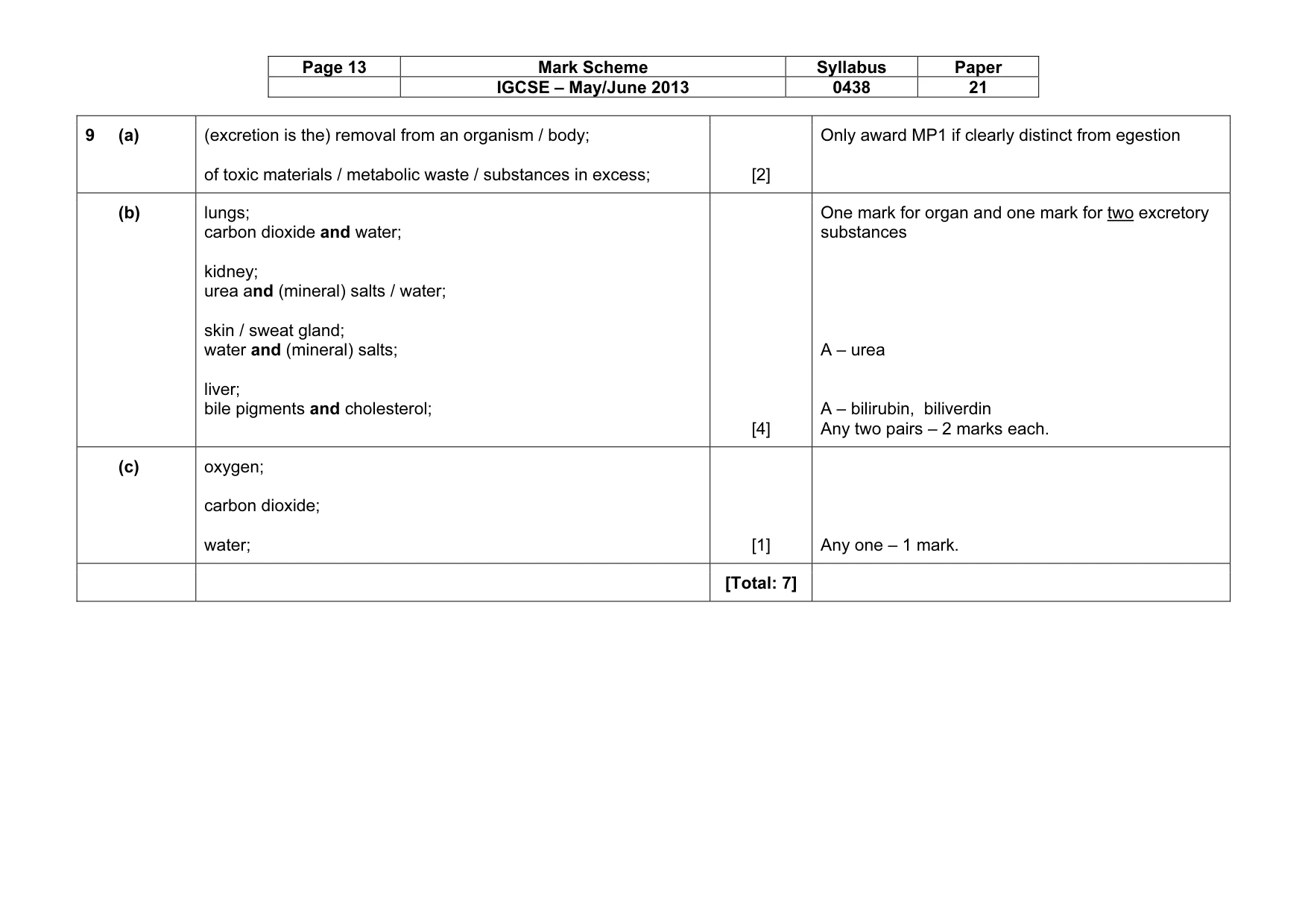
Page 13 Mark Scheme Syllabus Paper IGCSE – May/June 2013 0438 21 9 (a) (excretion is the) removal from an organism / body; of toxic materials / metabolic waste / substances in excess; [2] Only award MP1 if clearly distinct from egestion (b) lungs; carbon dioxide and water; kidney; urea and (mineral) salts / water; skin / sweat gland; water and (mineral) salts; liver; bile pigments and cholesterol; [4] One mark for organ and one mark for two excretory substances A – urea A – bilirubin, biliverdin Any two pairs – 2 marks each. (c) oxygen; carbon dioxide; water; [1] Any one – 1 mark. [Total: 7]
What you needed in this session
Cambridge’s own grade thresholds for 2013 May/June, Paper 2 · Variant 1. A higher threshold means an easier paper — the bar moves with how the cohort did.