Cambridge IGCSE Biology (BES) 0438 — 2014 Oct/Nov Paper 2 · Variant 1
0438/21/O/N/14 · 80 marks · ≈90 min
The question paper and its mark scheme, free to read here and free to download. This is Cambridge’s own paper, exactly as it was sat.
Question paper20 pages

Mark scheme10 pages
Answers below. Sit the paper first if you are practising.
Paper as text
Question paper, page 1
This document consists of 20 printed pages. DC (SJF/SW) 102347 © UCLES 2014 [Turn over Cambridge International Examinations Cambridge International General Certificate of Secondary Education * 3 0 9 0 5 1 0 5 5 0 * BIOLOGY (US) 0438/21 Paper 2 Core October/November 2014 1 hour 15 minutes Candidates answer on the Question Paper. No Additional Materials are required. READ THESE INSTRUCTIONS FIRST Write your Center number, candidate number and name on all the work you hand in. Write in dark blue or black pen. You may use an HB pencil for any diagrams or graphs. Do not use staples, paper clips, glue or correction fluid. DO NOT WRITE IN ANY BARCODES. Answer all questions. Electronic calculators may be used. You may lose marks if you do not show your working or if you do not use appropriate units. At the end of the examination, fasten all your work securely together. The number of marks is given in brackets [ ] at the end of each question or part question.
Question paper, page 2
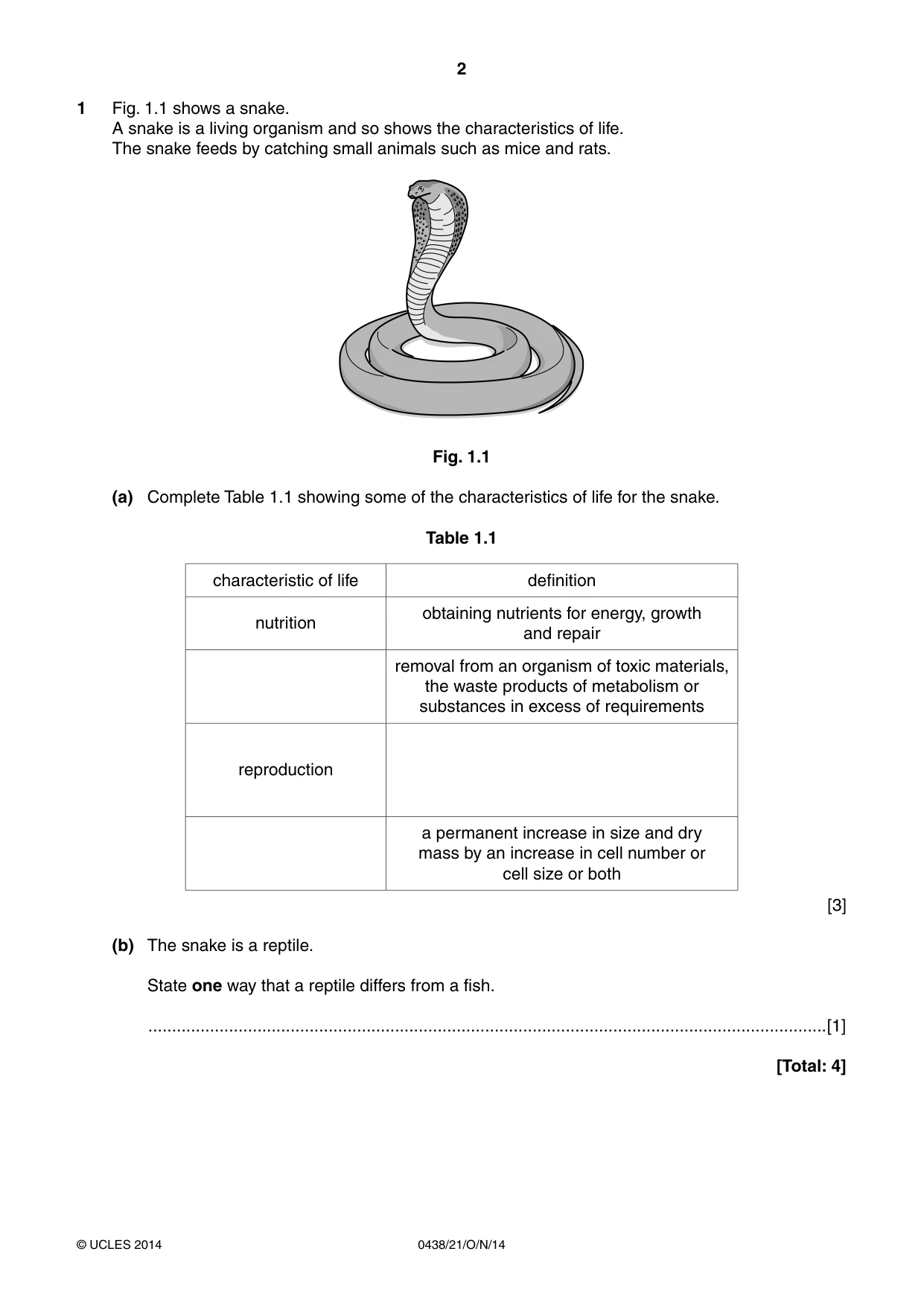
2 0438/21/O/N/14 © UCLES 2014 1 Fig. 1.1 shows a snake. A snake is a living organism and so shows the characteristics of life. The snake feeds by catching small animals such as mice and rats. Fig. 1.1 (a) Complete Table 1.1 showing some of the characteristics of life for the snake. Table 1.1 characteristic of life definition nutrition obtaining nutrients for energy, growth and repair removal from an organism of toxic materials, the waste products of metabolism or substances in excess of requirements reproduction a permanent increase in size and dry mass by an increase in cell number or cell size or both [3] (b) The snake is a reptile. State one way that a reptile differs from a fish. …[1] [Total: 4]
Question paper, page 3
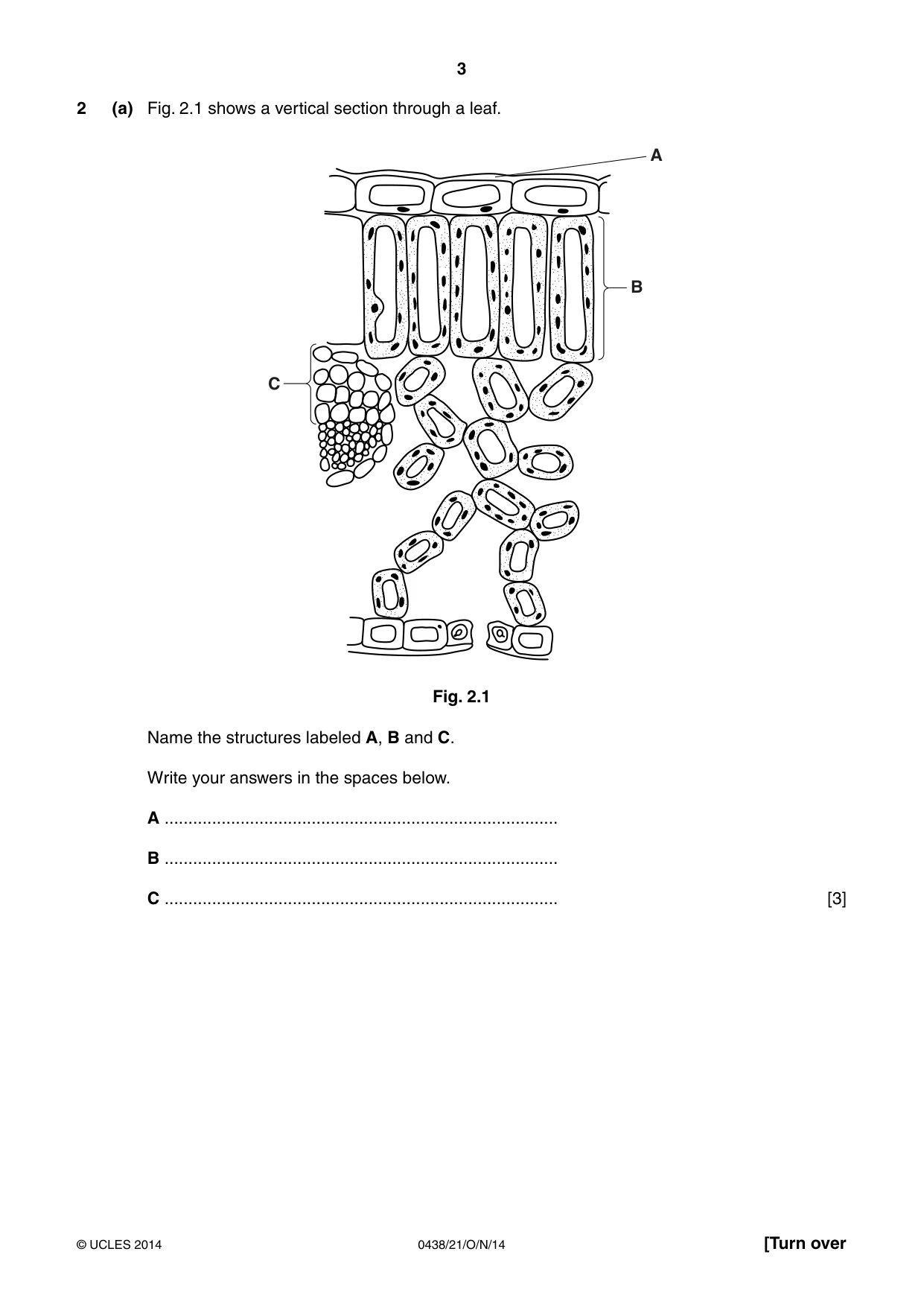
3 0438/21/O/N/14 © UCLES 2014 [Turn over 2 (a) Fig. 2.1 shows a vertical section through a leaf. B A C Fig. 2.1 Name the structures labeled A, B and C. Write your answers in the spaces below. A … B … C … [3]
Question paper, page 4
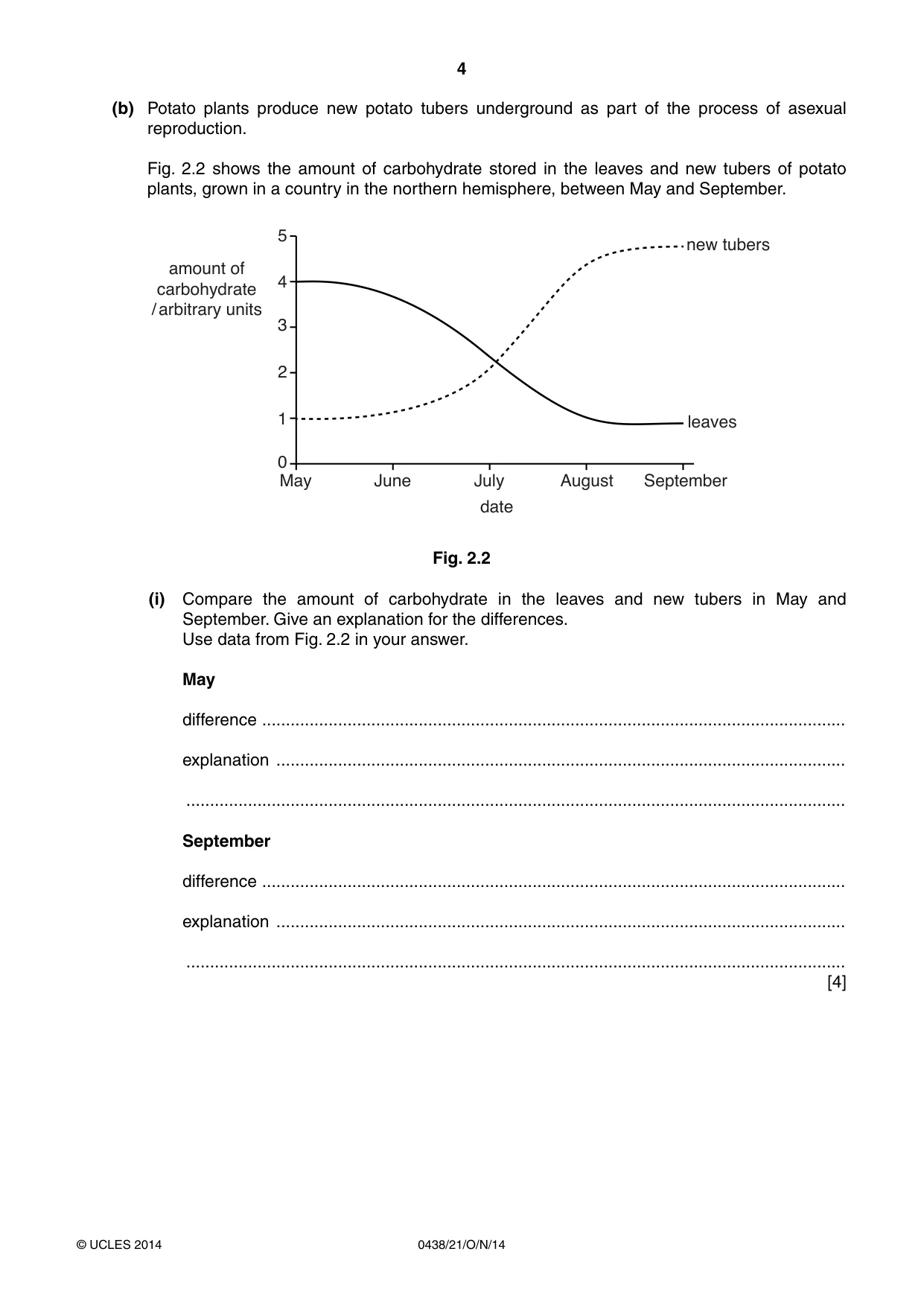
4 0438/21/O/N/14 © UCLES 2014 (b) Potato plants produce new potato tubers underground as part of the process of asexual reproduction. Fig. 2.2 shows the amount of carbohydrate stored in the leaves and new tubers of potato plants, grown in a country in the northern hemisphere, between May and September. 5 4 3 amount of carbohydrate / arbitrary units May June July date August September 2 1 0 new tubers leaves Fig. 2.2 (i) Compare the amount of carbohydrate in the leaves and new tubers in May and September. Give an explanation for the differences. Use data from Fig. 2.2 in your answer. May difference … explanation … … September difference … explanation … … [4]
Question paper, page 5
5 0438/21/O/N/14 © UCLES 2014 [Turn over (ii) State the form in which carbohydrate is stored in potato plants. …[1] (iii) State two uses, other than storage, for the carbohydrate made by photosynthesis. 1 … 2 … [2] [Total: 10]
Question paper, page 6
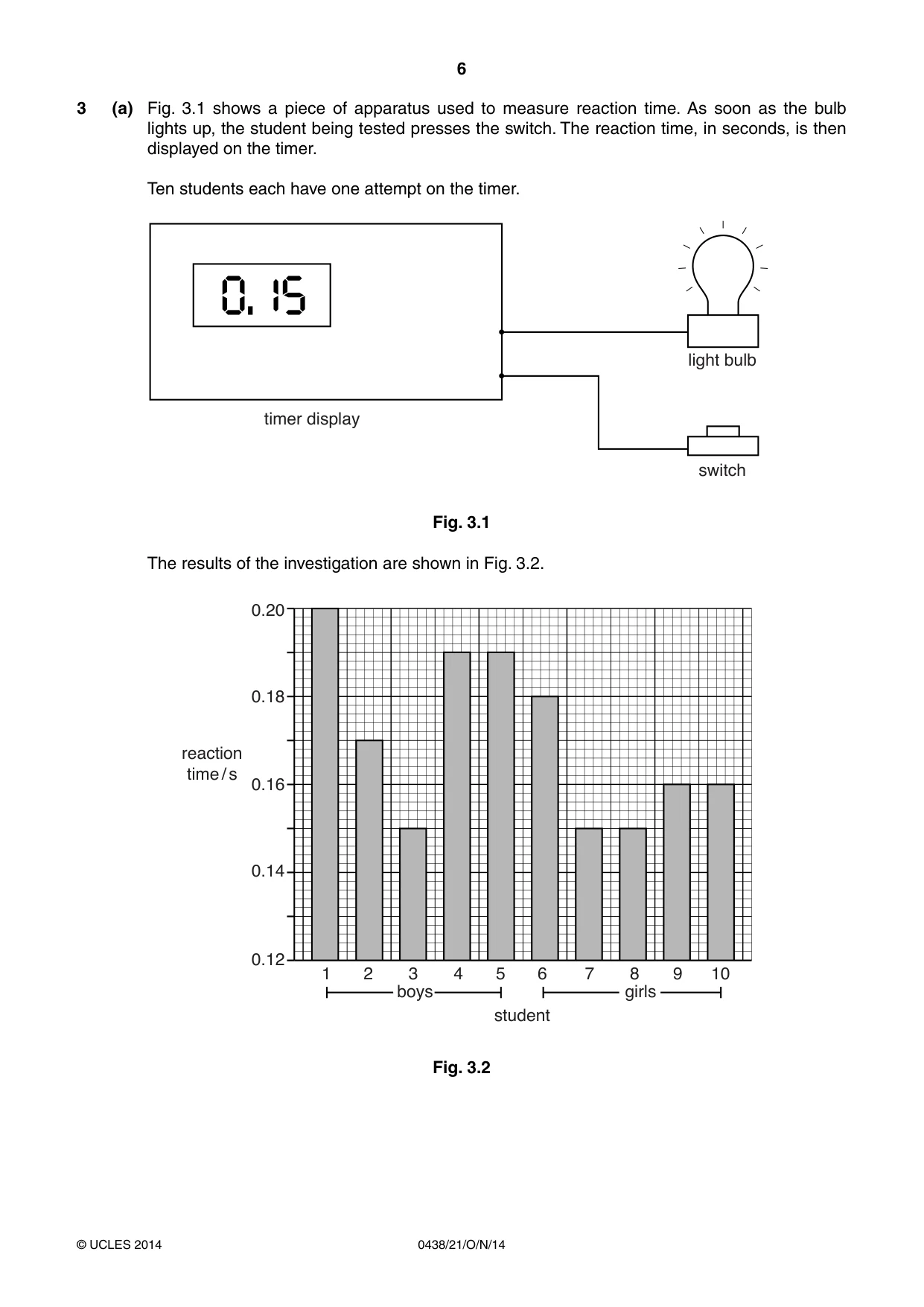
6 0438/21/O/N/14 © UCLES 2014 3 (a) Fig. 3.1 shows a piece of apparatus used to measure reaction time. As soon as the bulb lights up, the student being tested presses the switch. The reaction time, in seconds, is then displayed on the timer. Ten students each have one attempt on the timer. light bulb timer display switch Fig. 3.1 The results of the investigation are shown in Fig. 3.2. 0.12 0.14 0.16 0.18 0.20 reaction time / s 1 student boys 2 3 4 5 6 7 8 9 10 girls Fig. 3.2
Question paper, page 7
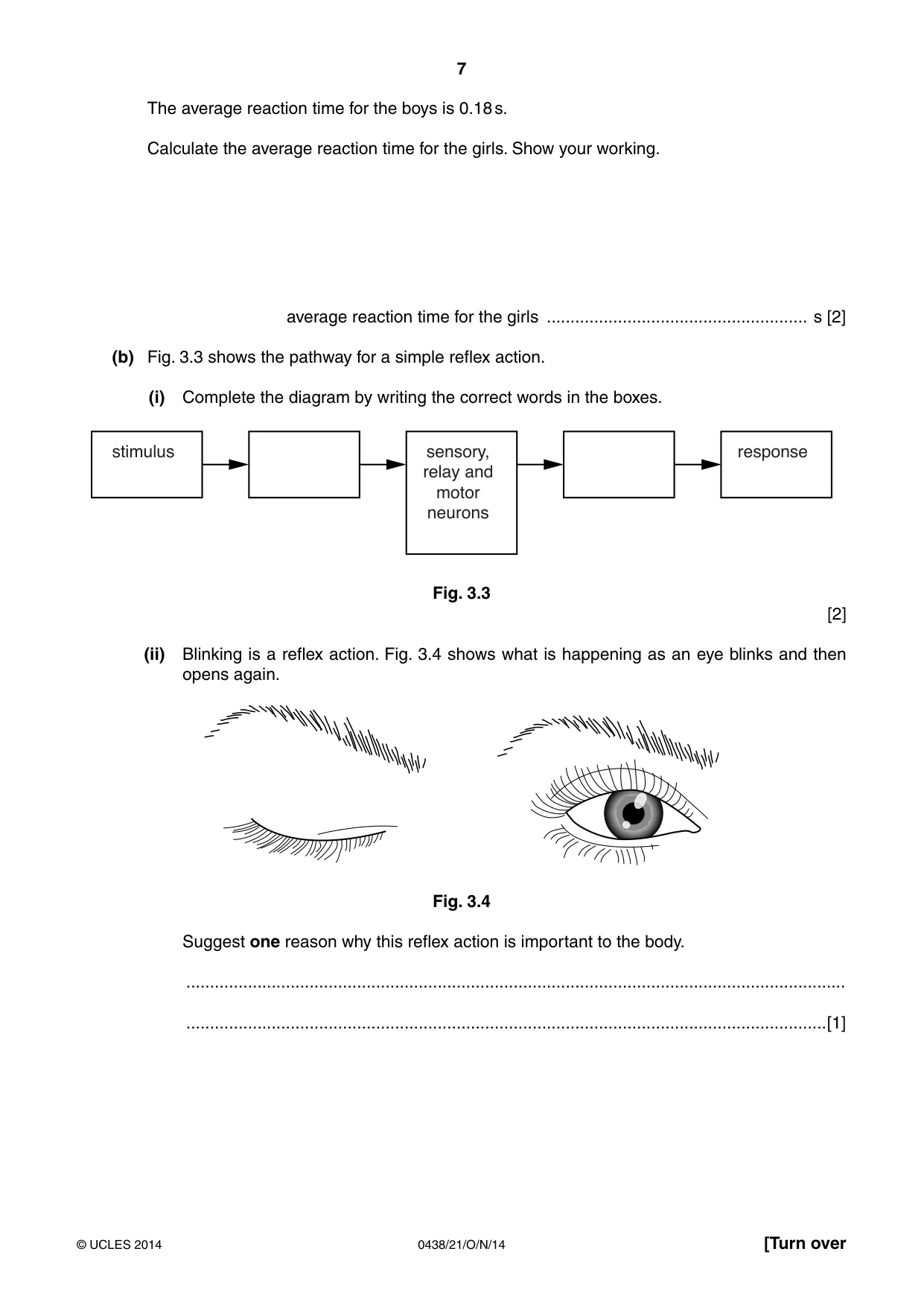
7 0438/21/O/N/14 © UCLES 2014 [Turn over The average reaction time for the boys is 0.18 s. Calculate the average reaction time for the girls. Show your working. average reaction time for the girls … s [2] (b) Fig. 3.3 shows the pathway for a simple reflex action. (i) Complete the diagram by writing the correct words in the boxes. stimulus sensory, relay and motor neurons response Fig. 3.3 [2] (ii) Blinking is a reflex action. Fig. 3.4 shows what is happening as an eye blinks and then opens again. Fig. 3.4 Suggest one reason why this reflex action is important to the body. … …[1]
Question paper, page 8
8 0438/21/O/N/14 © UCLES 2014 (c) Heroin is a powerful drug. (i) Describe what is meant by the term drug. … … … …[2] (ii) Suggest how heroin could affect reaction time. … …[1] (iii) There are many problems caused by people using heroin. Describe three examples of these problems. 1 … … 2 … … 3 … …[3] (d) An antibiotic is an example of a drug that can be used as a medicine. Describe how antibiotics are useful to the human body. … …[1] [Total: 12]
Question paper, page 9
9 0438/21/O/N/14 © UCLES 2014 [Turn over Question 4 begins on page 10.
Question paper, page 10
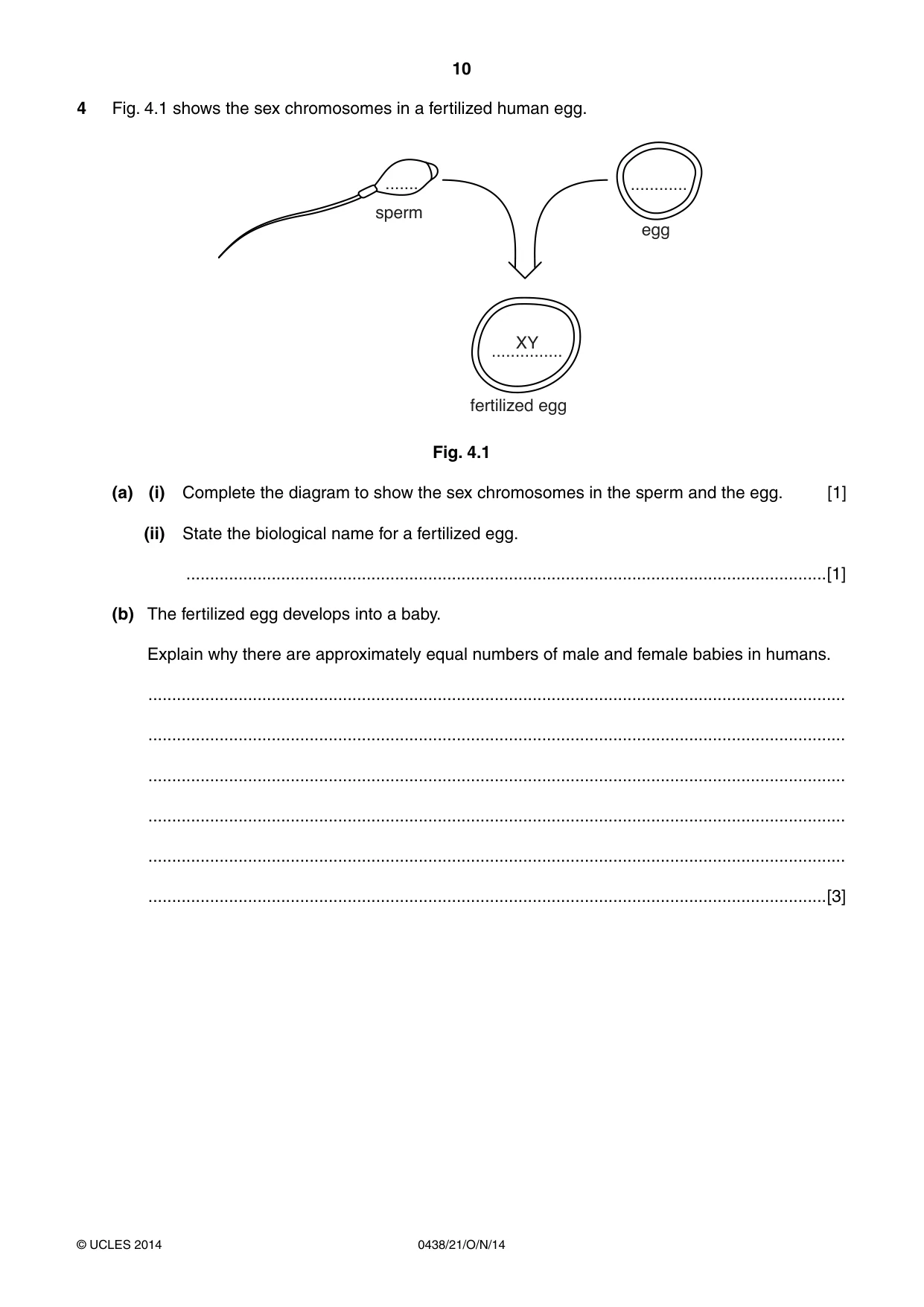
10 0438/21/O/N/14 © UCLES 2014 4 Fig. 4.1 shows the sex chromosomes in a fertilized human egg. egg fertilized egg XY … … … sperm Fig. 4.1 (a) (i) Complete the diagram to show the sex chromosomes in the sperm and the egg. [1] (ii) State the biological name for a fertilized egg. …[1] (b) The fertilized egg develops into a baby. Explain why there are approximately equal numbers of male and female babies in humans. … … … … … …[3]
Question paper, page 11
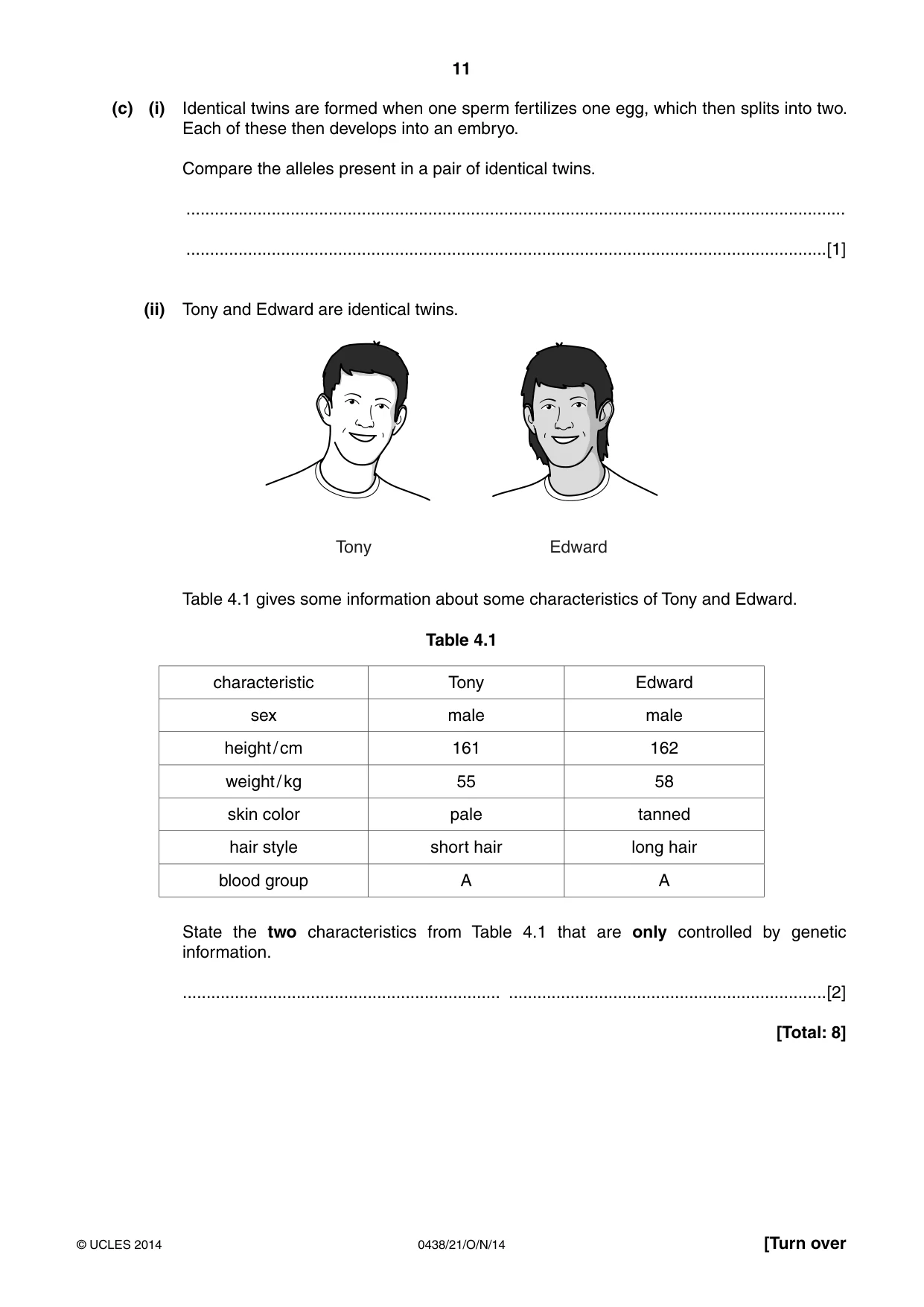
11 0438/21/O/N/14 © UCLES 2014 [Turn over (c) (i) Identical twins are formed when one sperm fertilizes one egg, which then splits into two. Each of these then develops into an embryo. Compare the alleles present in a pair of identical twins. … …[1] (ii) Tony and Edward are identical twins. Tony Edward Table 4.1 gives some information about some characteristics of Tony and Edward. Table 4.1 characteristic Tony Edward sex male male height / cm 161 162 weight / kg 55 58 skin color pale tanned hair style short hair long hair blood group A A State the two characteristics from Table 4.1 that are only controlled by genetic information. … …[2] [Total: 8]
Question paper, page 12
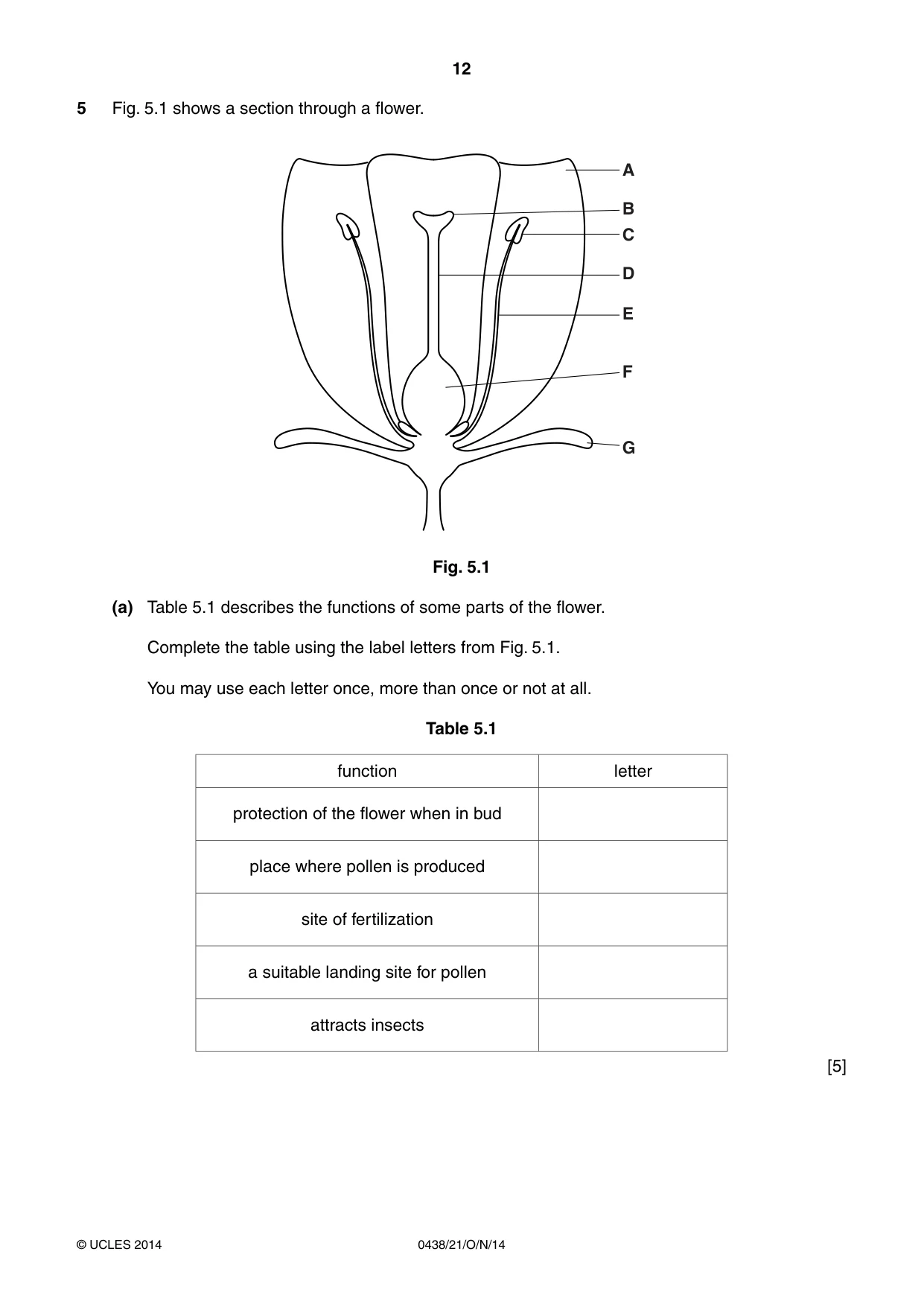
12 0438/21/O/N/14 © UCLES 2014 5 Fig. 5.1 shows a section through a flower. A B C E F G D Fig. 5.1 (a) Table 5.1 describes the functions of some parts of the flower. Complete the table using the label letters from Fig. 5.1. You may use each letter once, more than once or not at all. Table 5.1 function letter protection of the flower when in bud place where pollen is produced site of fertilization a suitable landing site for pollen attracts insects [5]
Question paper, page 13
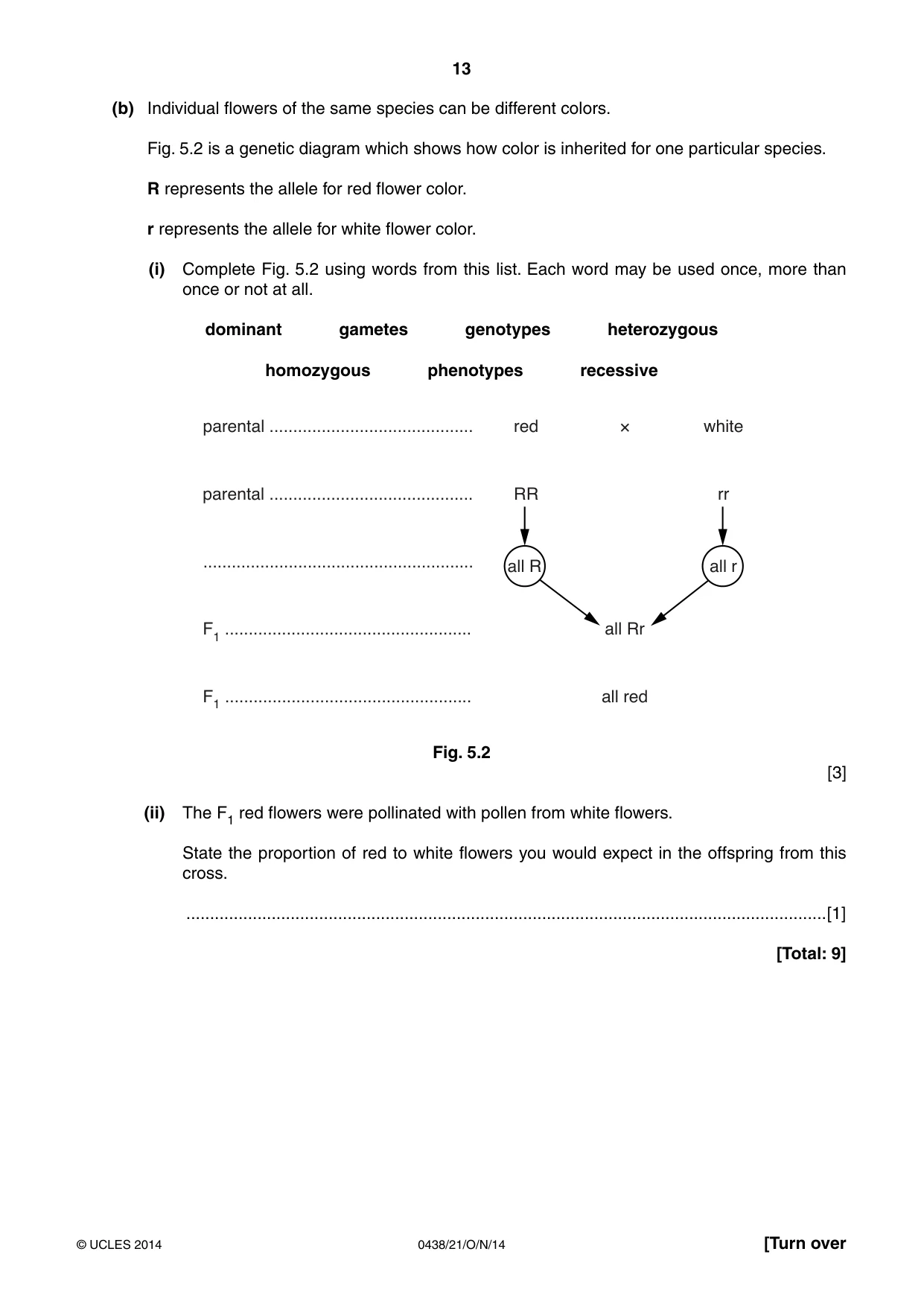
13 0438/21/O/N/14 © UCLES 2014 [Turn over (b) Individual flowers of the same species can be different colors. Fig. 5.2 is a genetic diagram which shows how color is inherited for one particular species. R represents the allele for red flower color. r represents the allele for white flower color. (i) Complete Fig. 5.2 using words from this list. Each word may be used once, more than once or not at all. dominant gametes genotypes heterozygous homozygous phenotypes recessive red parental … × white RR parental … rr all R … all r all Rr F1 … all red F1 … Fig. 5.2 [3] (ii) The F1 red flowers were pollinated with pollen from white flowers. State the proportion of red to white flowers you would expect in the offspring from this cross. …[1] [Total: 9]
Question paper, page 14
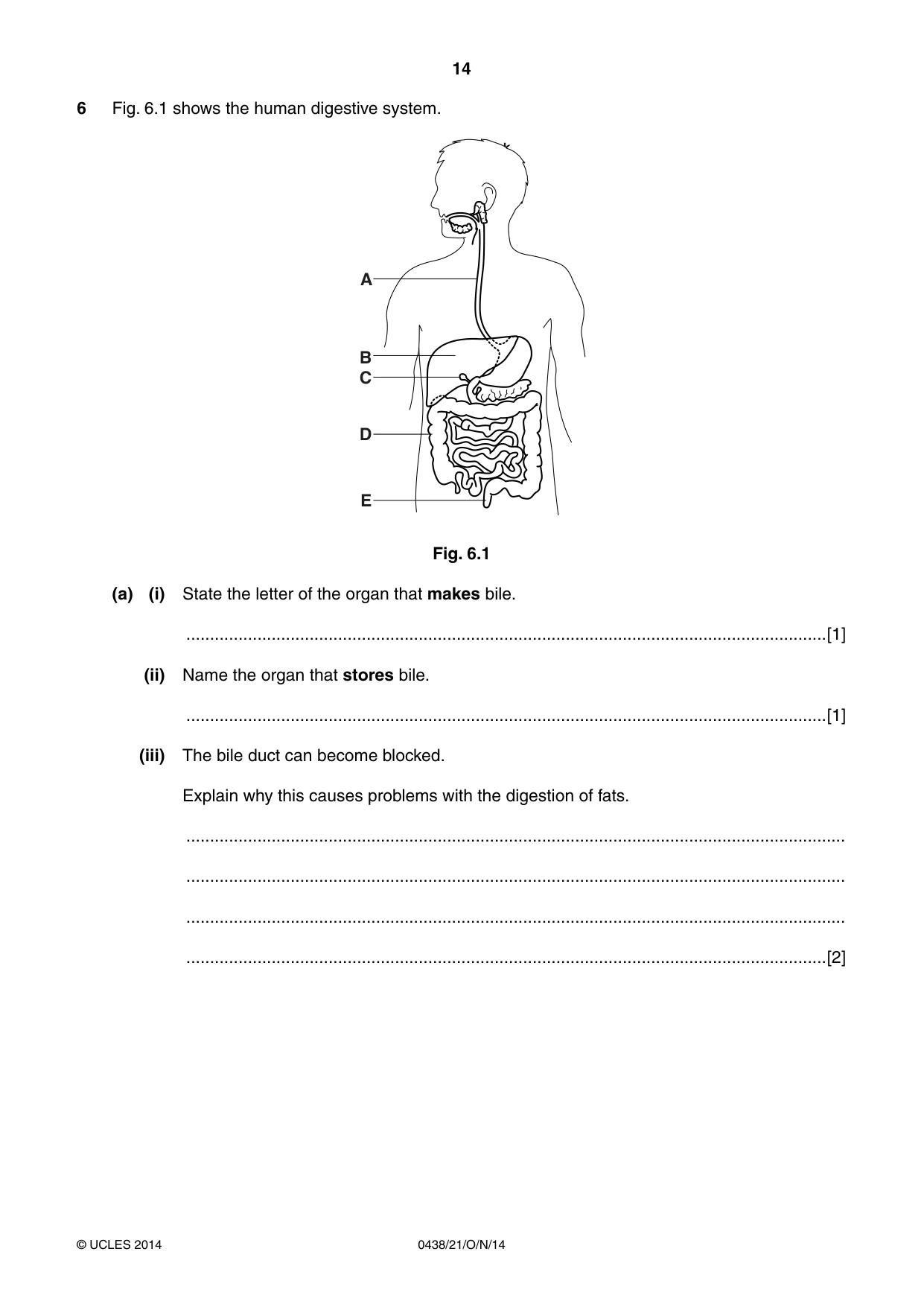
14 0438/21/O/N/14 © UCLES 2014 6 Fig. 6.1 shows the human digestive system. A B C D E Fig. 6.1 (a) (i) State the letter of the organ that makes bile. …[1] (ii) Name the organ that stores bile. …[1] (iii) The bile duct can become blocked. Explain why this causes problems with the digestion of fats. … … … …[2]
Question paper, page 15
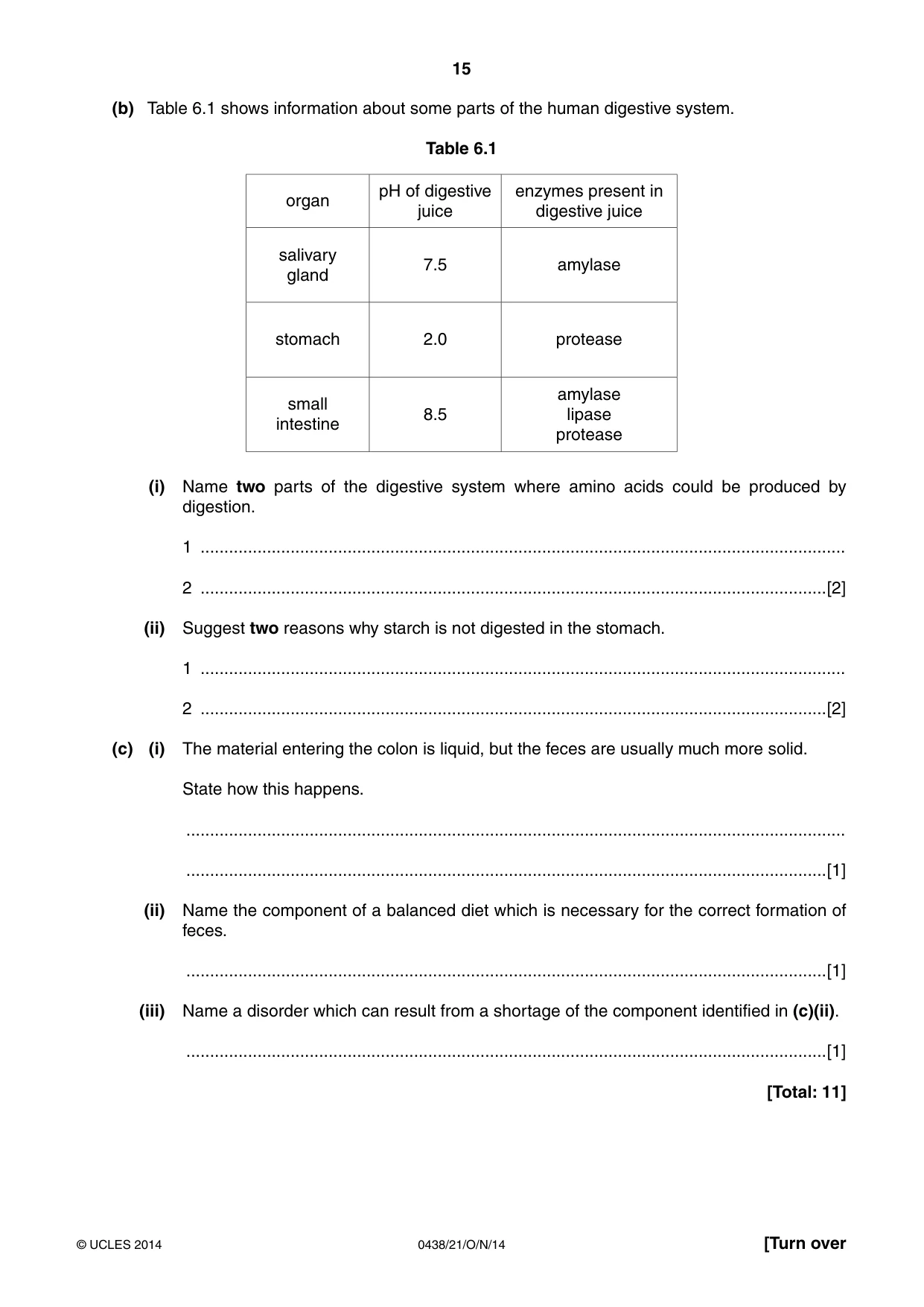
15 0438/21/O/N/14 © UCLES 2014 [Turn over (b) Table 6.1 shows information about some parts of the human digestive system. Table 6.1 organ pH of digestive juice enzymes present in digestive juice salivary gland 7.5 amylase stomach 2.0 protease small intestine 8.5 amylase lipase protease (i) Name two parts of the digestive system where amino acids could be produced by digestion. 1 … 2 …[2] (ii) Suggest two reasons why starch is not digested in the stomach. 1 … 2 …[2] (c) (i) The material entering the colon is liquid, but the feces are usually much more solid. State how this happens. … …[1] (ii) Name the component of a balanced diet which is necessary for the correct formation of feces. …[1] (iii) Name a disorder which can result from a shortage of the component identified in (c)(ii). …[1] [Total: 11]
Question paper, page 16
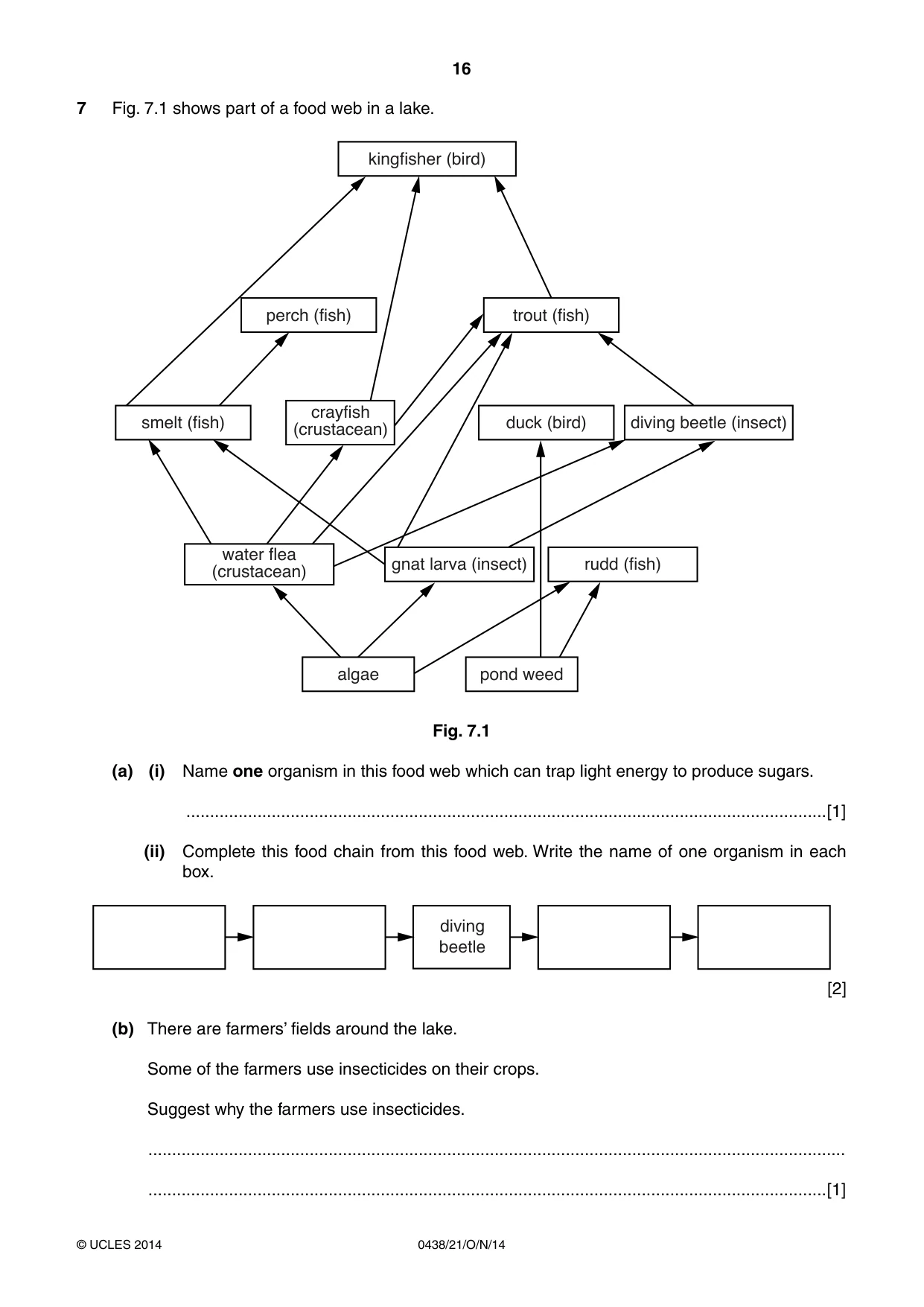
16 0438/21/O/N/14 © UCLES 2014 7 Fig. 7.1 shows part of a food web in a lake. kingfisher (bird) perch (fish) trout (fish) smelt (fish) crayfish (crustacean) duck (bird) diving beetle (insect) water flea (crustacean) gnat larva (insect) rudd (fish) algae pond weed Fig. 7.1 (a) (i) Name one organism in this food web which can trap light energy to produce sugars. …[1] (ii) Complete this food chain from this food web. Write the name of one organism in each box. diving beetle [2] (b) There are farmers’ fields around the lake. Some of the farmers use insecticides on their crops. Suggest why the farmers use insecticides. … …[1]
Question paper, page 17
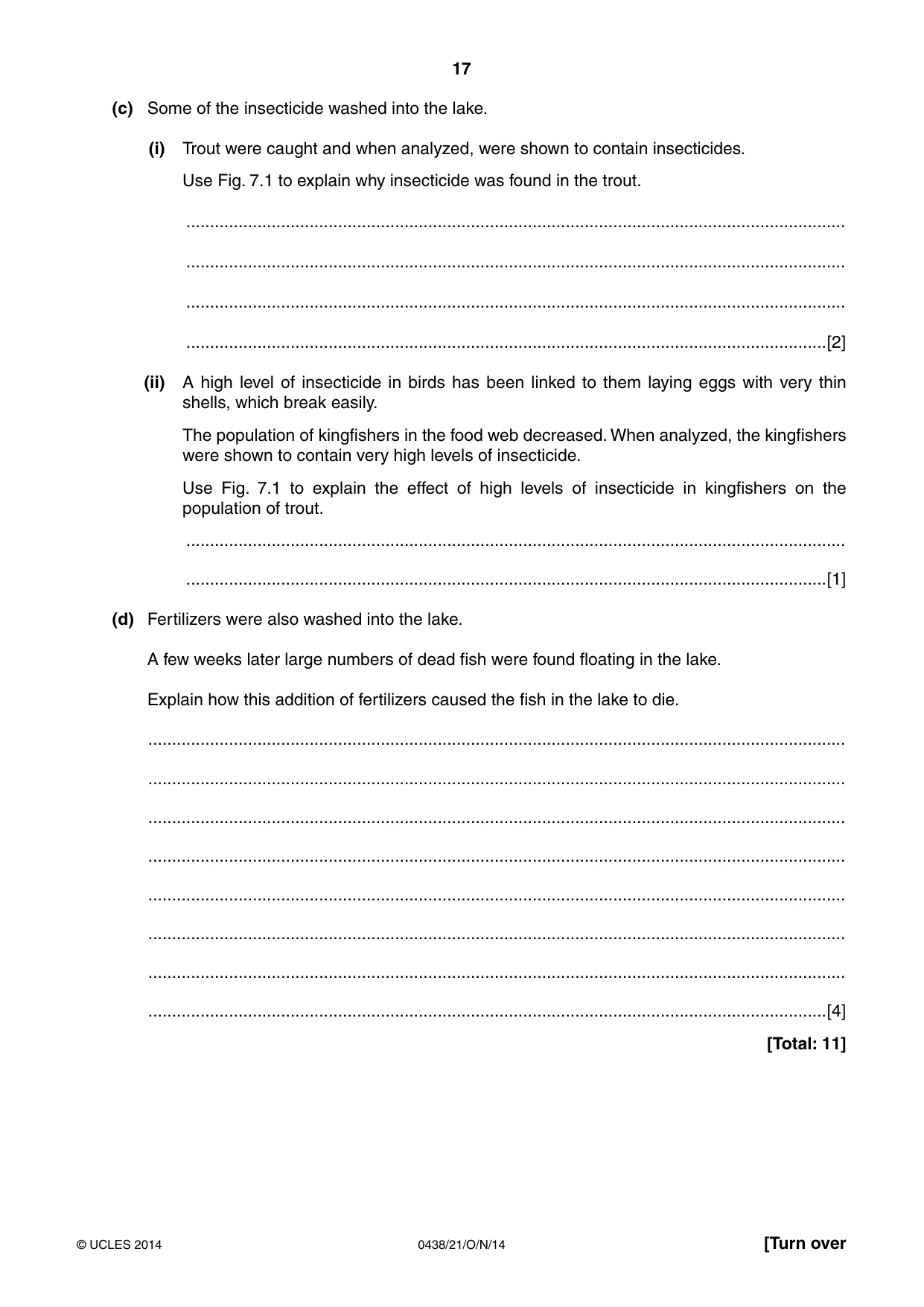
17 0438/21/O/N/14 © UCLES 2014 [Turn over (c) Some of the insecticide washed into the lake. (i) Trout were caught and when analyzed, were shown to contain insecticides. Use Fig. 7.1 to explain why insecticide was found in the trout. … … … …[2] (ii) A high level of insecticide in birds has been linked to them laying eggs with very thin shells, which break easily. The population of kingfishers in the food web decreased. When analyzed, the kingfishers were shown to contain very high levels of insecticide. Use Fig. 7.1 to explain the effect of high levels of insecticide in kingfishers on the population of trout. … …[1] (d) Fertilizers were also washed into the lake. A few weeks later large numbers of dead fish were found floating in the lake. Explain how this addition of fertilizers caused the fish in the lake to die. … … … … … … … …[4] [Total: 11]
Question paper, page 18
18 0438/21/O/N/14 © UCLES 2014 8 Fig. 8.1 shows the flow of energy through a food chain in a field. The figures refer to the quantity of energy being transferred, in kJ per m2 per year. sunlight grass 21 500 cattle 3050 1900 125 new growth respiration feces food eaten death and decay Fig. 8.1 (a) (i) Name one group of organisms which could decay the dead remains of the grass plants. …[1] (ii) Decay is usually fastest in the early autumn. Suggest two factors which could affect the rate of decay. 1 … 2 …[2] (b) After the cattle have eaten the grass, much of the energy is released in respiration. (i) Calculate how much energy is released by the cattle in respiration. Show your working. … kJ per m2 per year [2] (ii) State two uses of the energy released in respiration. 1 … 2 …[2]
Question paper, page 19
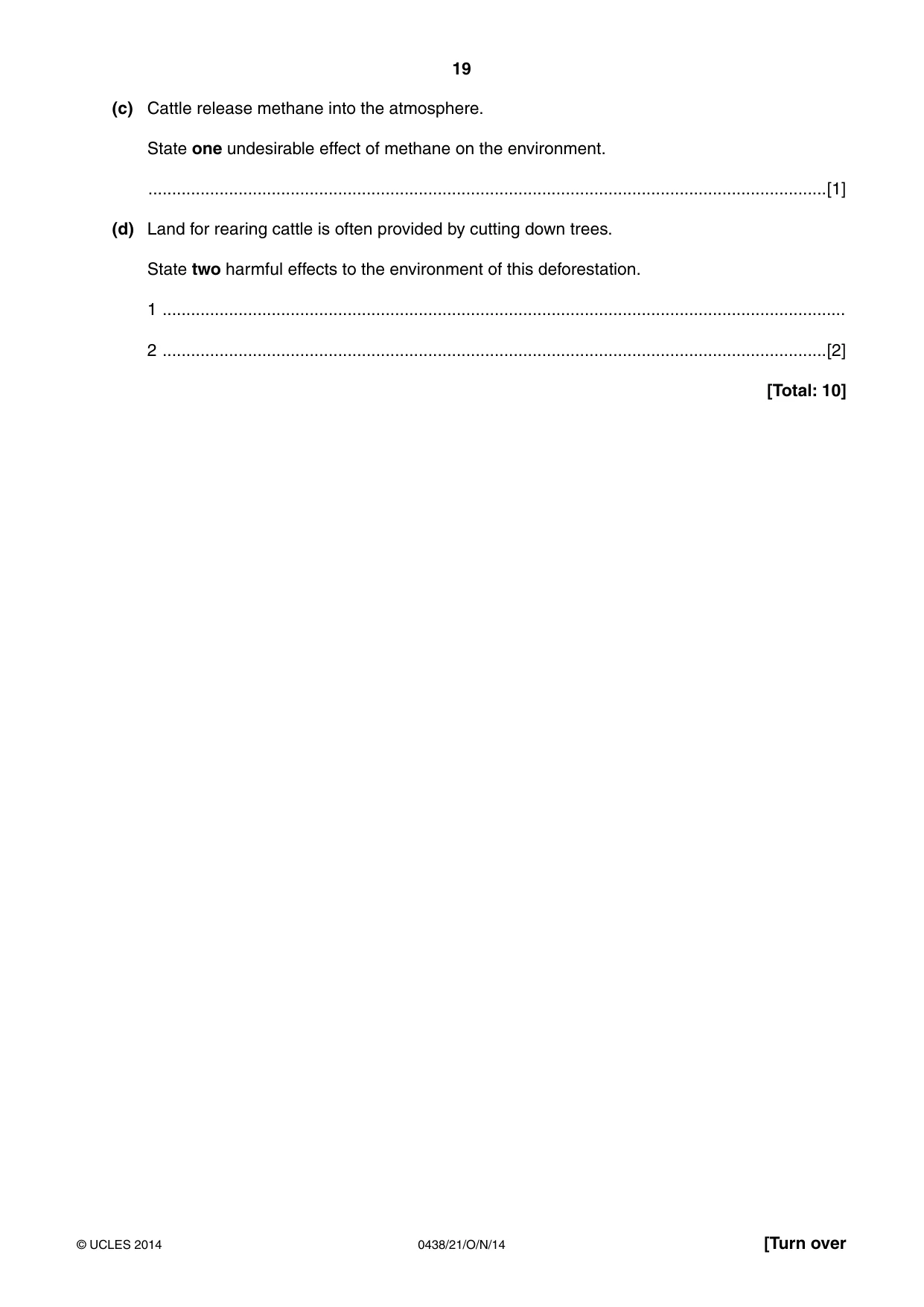
19 0438/21/O/N/14 © UCLES 2014 [Turn over (c) Cattle release methane into the atmosphere. State one undesirable effect of methane on the environment. …[1] (d) Land for rearing cattle is often provided by cutting down trees. State two harmful effects to the environment of this deforestation. 1 … 2 …[2] [Total: 10]
Question paper, page 20
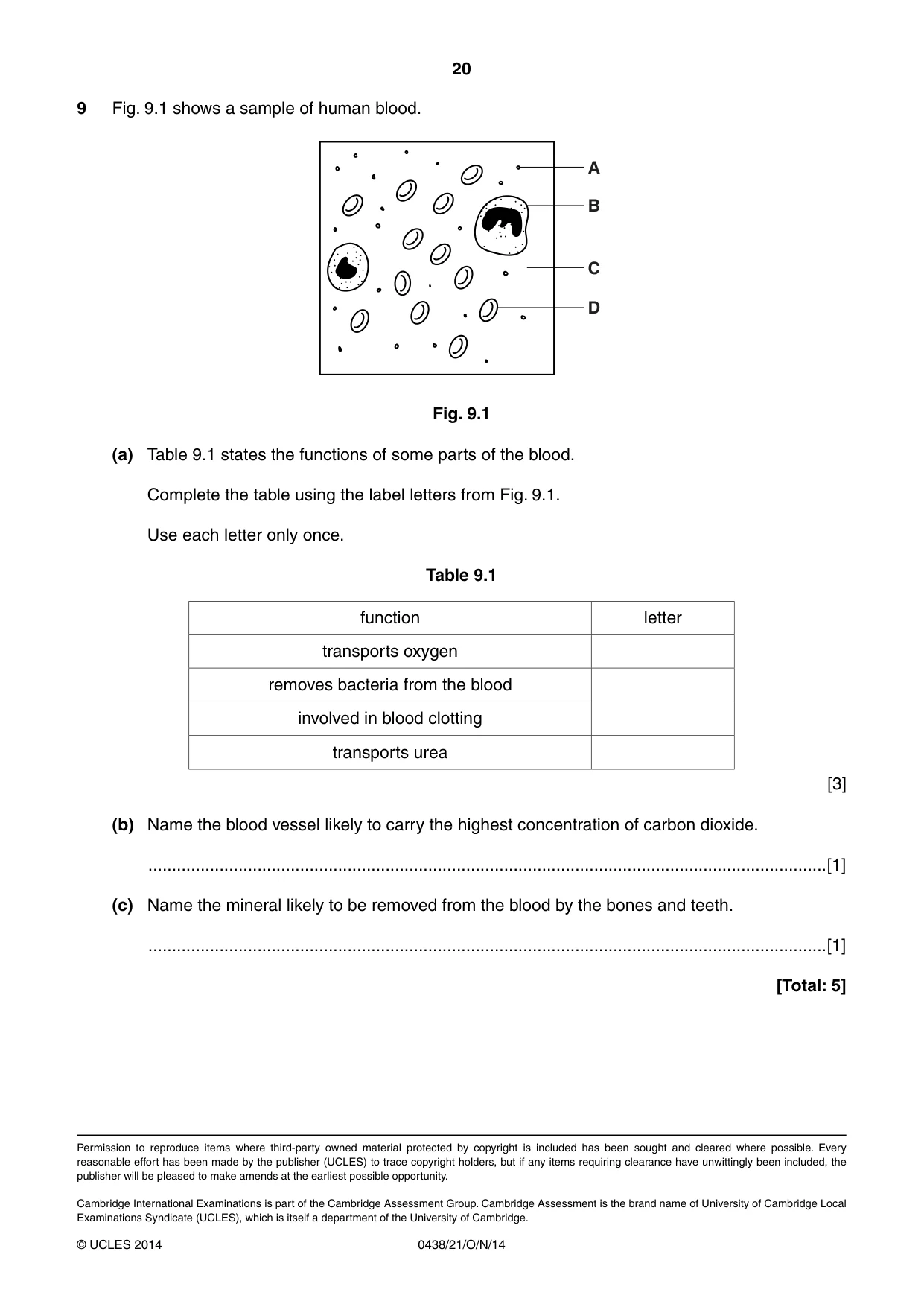
20 0438/21/O/N/14 © UCLES 2014 Permission to reproduce items where third-party owned material protected by copyright is included has been sought and cleared where possible. Every reasonable effort has been made by the publisher (UCLES) to trace copyright holders, but if any items requiring clearance have unwittingly been included, the publisher will be pleased to make amends at the earliest possible opportunity. Cambridge International Examinations is part of the Cambridge Assessment Group. Cambridge Assessment is the brand name of University of Cambridge Local Examinations Syndicate (UCLES), which is itself a department of the University of Cambridge. 9 Fig. 9.1 shows a sample of human blood. A B C D Fig. 9.1 (a) Table 9.1 states the functions of some parts of the blood. Complete the table using the label letters from Fig. 9.1. Use each letter only once. Table 9.1 function letter transports oxygen removes bacteria from the blood involved in blood clotting transports urea [3] (b) Name the blood vessel likely to carry the highest concentration of carbon dioxide. …[1] (c) Name the mineral likely to be removed from the blood by the bones and teeth. …[1] [Total: 5]
Mark scheme, page 1
® IGCSE is the registered trademark of Cambridge International Examinations. CAMBRIDGE INTERNATIONAL EXAMINATIONS Cambridge International General Certificate of Secondary Education MARK SCHEME for the October/November 2014 series 0438 BIOLOGY (US) 0438/21 Paper 2 (Core Theory), maximum raw mark 80 This mark scheme is published as an aid to teachers and candidates, to indicate the requirements of the examination. It shows the basis on which Examiners were instructed to award marks. It does not indicate the details of the discussions that took place at an Examiners’ meeting before marking began, which would have considered the acceptability of alternative answers. Mark schemes should be read in conjunction with the question paper and the Principal Examiner Report for Teachers. Cambridge will not enter into discussions about these mark schemes. Cambridge is publishing the mark schemes for the October/November 2014 series for most Cambridge IGCSE®, Cambridge International A and AS Level components and some Cambridge O Level components.
Mark scheme, page 2
Page 2 Mark Scheme Syllabus Paper Cambridge IGCSE – October/November 2014 0438 21 © Cambridge International Examinations 2014 Abbreviations used in the Mark Scheme • ; separates marking points • / separates alternatives within a marking point • R reject • I ignore (mark as if this material was not present) • A accept (a less than ideal answer which should be marked correct) • AW alternative wording • underline words underlined must be present • max indicates the maximum number of marks that can be awarded • mark independently the second mark may be given even if the first mark is wrong • A, S, P, L Axes, Size, Plots and Line for graphs • O, S, D, L Outline, Size, Detail and Label for drawings • (n)ecf (no) error carried forward • ( ) the word / phrase in brackets is not required, but sets the context • ora or reverse argument. • AVP any valid point
Mark scheme, page 3
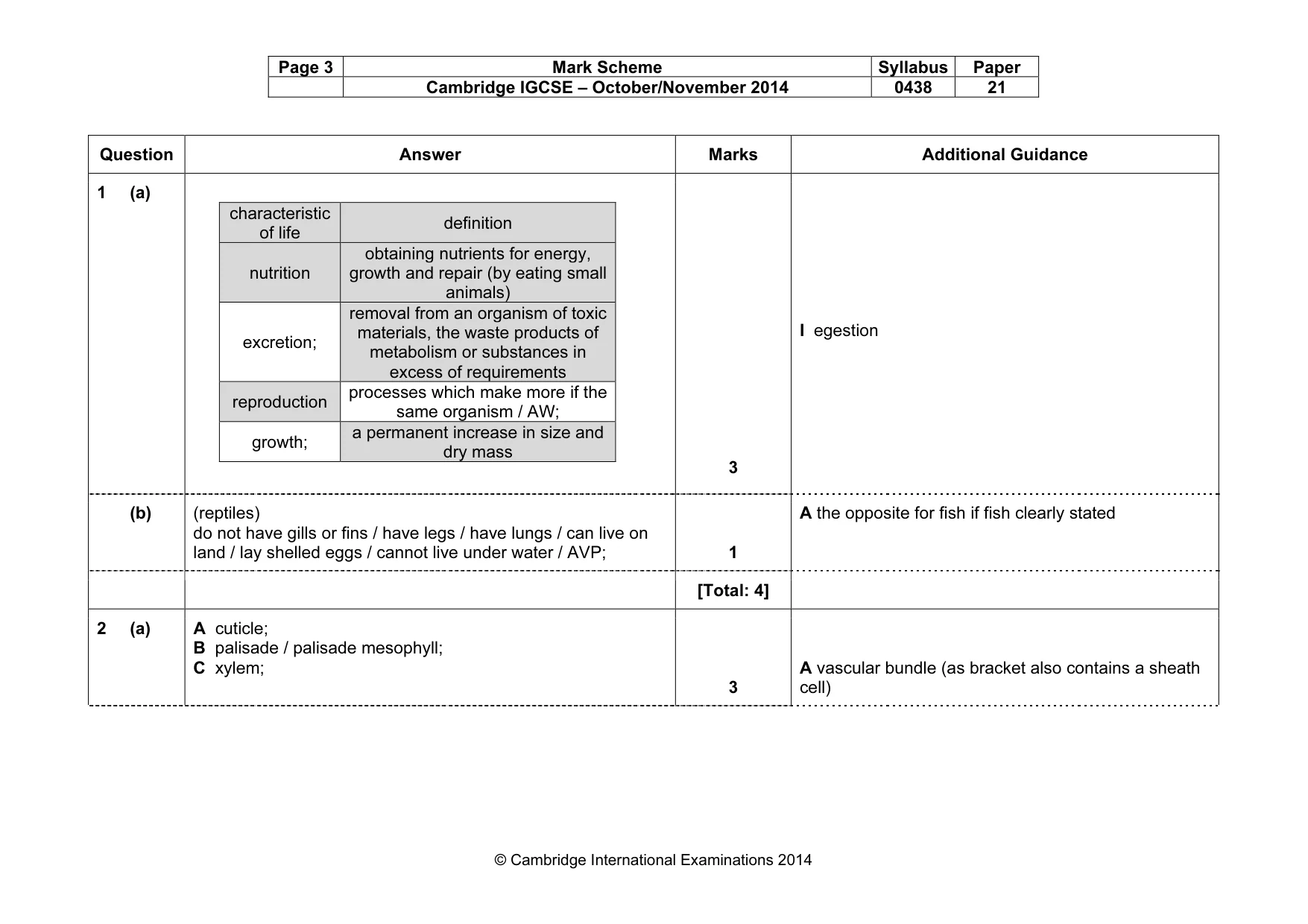
Page 3 Mark Scheme Syllabus Paper Cambridge IGCSE – October/November 2014 0438 21 © Cambridge International Examinations 2014 Question Answer Marks Additional Guidance 1 (a) characteristic of life definition nutrition obtaining nutrients for energy, growth and repair (by eating small animals) excretion; removal from an organism of toxic materials, the waste products of metabolism or substances in excess of requirements reproduction processes which make more if the same organism / AW; growth; a permanent increase in size and dry mass 3 I egestion (b) (reptiles) do not have gills or fins / have legs / have lungs / can live on land / lay shelled eggs / cannot live under water / AVP; 1 A the opposite for fish if fish clearly stated [Total: 4] 2 (a) A cuticle; B palisade / palisade mesophyll; C xylem; 3 A vascular bundle (as bracket also contains a sheath cell)
Mark scheme, page 4
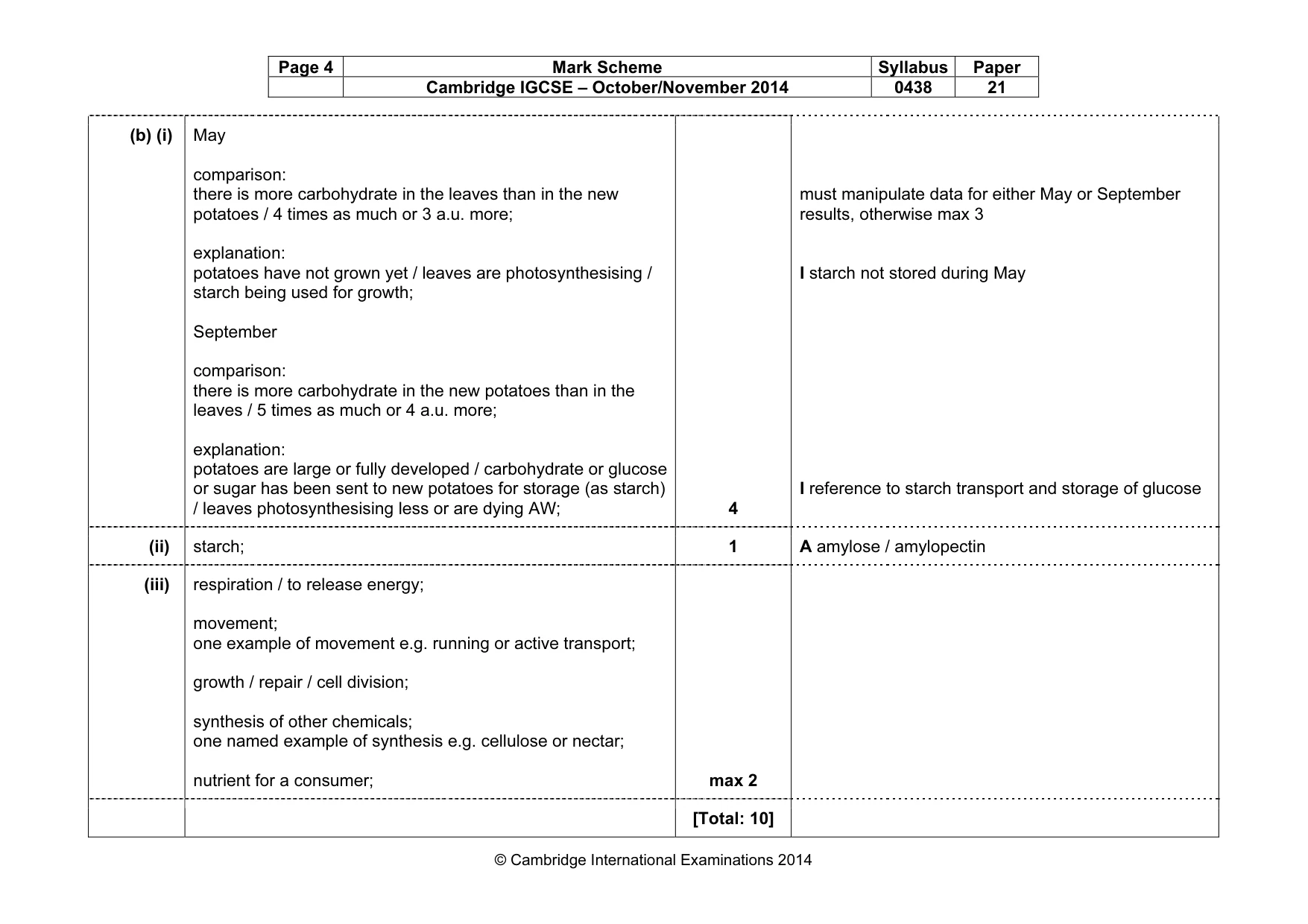
Page 4 Mark Scheme Syllabus Paper Cambridge IGCSE – October/November 2014 0438 21 © Cambridge International Examinations 2014 (b) (i) May comparison: there is more carbohydrate in the leaves than in the new potatoes / 4 times as much or 3 a.u. more; explanation: potatoes have not grown yet / leaves are photosynthesising / starch being used for growth; September comparison: there is more carbohydrate in the new potatoes than in the leaves / 5 times as much or 4 a.u. more; explanation: potatoes are large or fully developed / carbohydrate or glucose or sugar has been sent to new potatoes for storage (as starch) / leaves photosynthesising less or are dying AW; 4 must manipulate data for either May or September results, otherwise max 3 I starch not stored during May I reference to starch transport and storage of glucose (ii) starch; 1 A amylose / amylopectin (iii) respiration / to release energy; movement; one example of movement e.g. running or active transport; growth / repair / cell division; synthesis of other chemicals; one named example of synthesis e.g. cellulose or nectar; nutrient for a consumer; max 2 [Total: 10]
Mark scheme, page 5
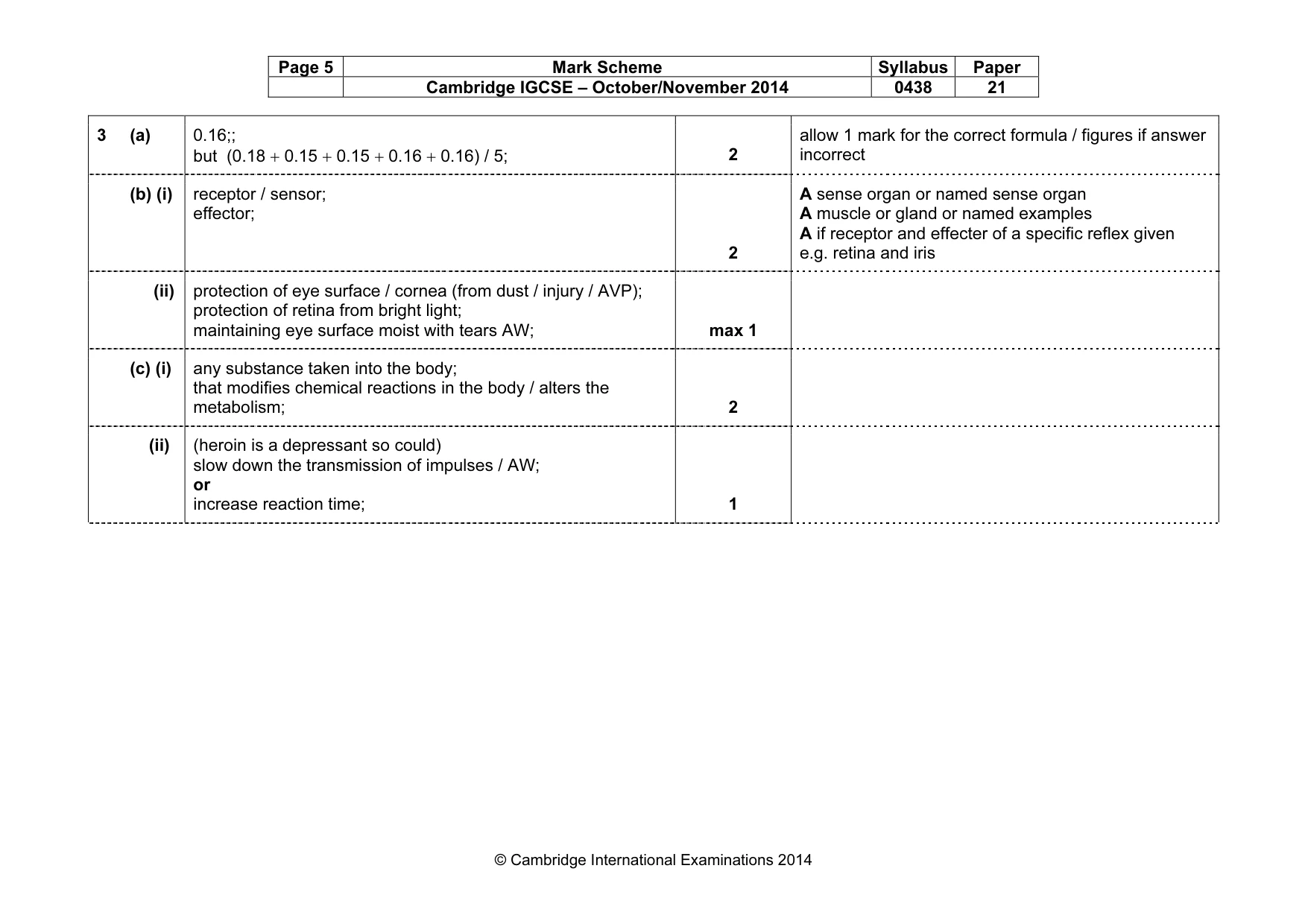
Page 5 Mark Scheme Syllabus Paper Cambridge IGCSE – October/November 2014 0438 21 © Cambridge International Examinations 2014 3 (a) 0.16;; but (0.18 + 0.15 + 0.15 + 0.16 + 0.16) / 5; 2 allow 1 mark for the correct formula / figures if answer incorrect (b) (i) receptor / sensor; effector; 2 A sense organ or named sense organ A muscle or gland or named examples A if receptor and effecter of a specific reflex given e.g. retina and iris (ii) protection of eye surface / cornea (from dust / injury / AVP); protection of retina from bright light; maintaining eye surface moist with tears AW; max 1 (c) (i) any substance taken into the body; that modifies chemical reactions in the body / alters the metabolism; 2 (ii) (heroin is a depressant so could) slow down the transmission of impulses / AW; or increase reaction time; 1
Mark scheme, page 6
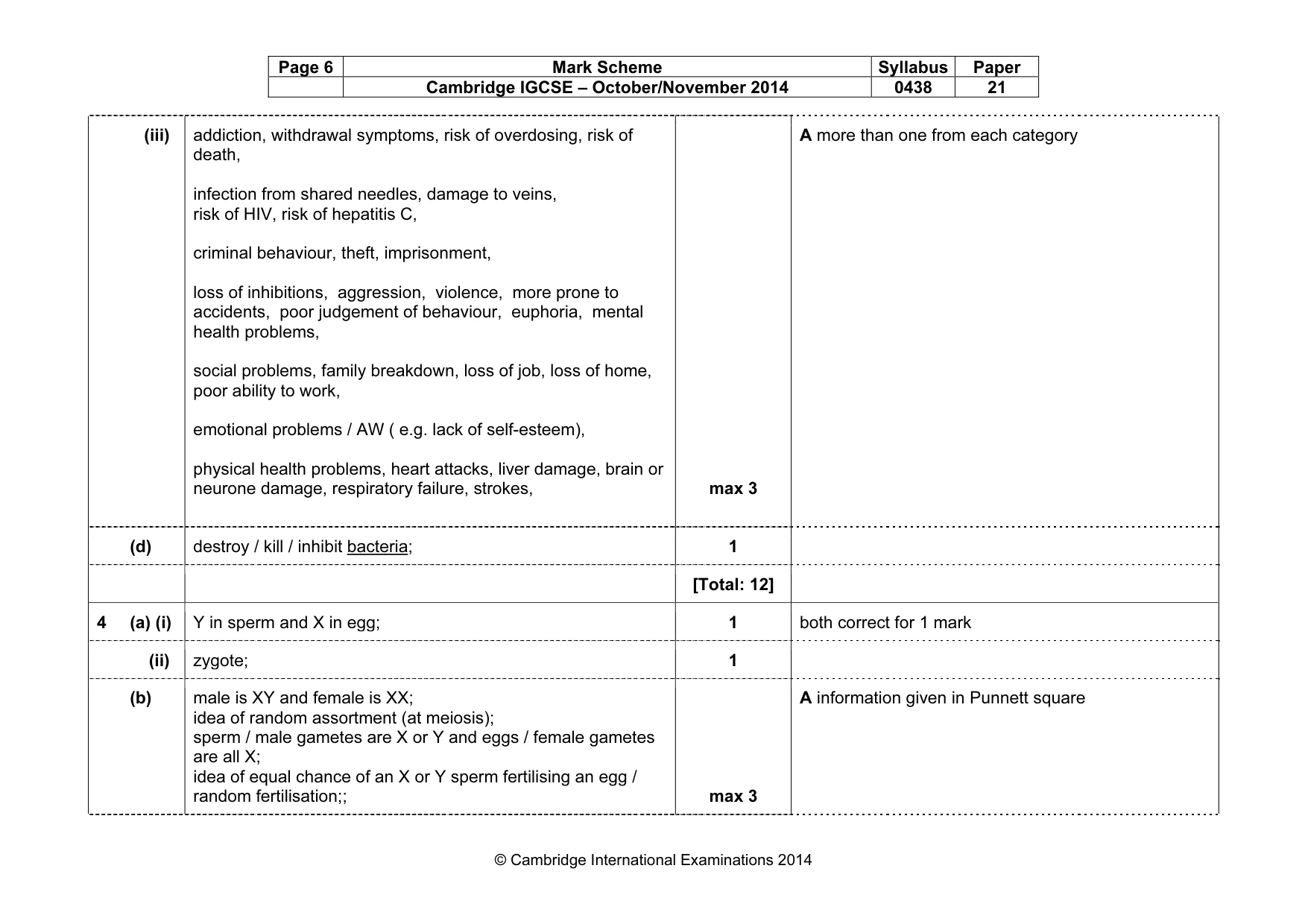
Page 6 Mark Scheme Syllabus Paper Cambridge IGCSE – October/November 2014 0438 21 © Cambridge International Examinations 2014 (iii) addiction, withdrawal symptoms, risk of overdosing, risk of death, infection from shared needles, damage to veins, risk of HIV, risk of hepatitis C, criminal behaviour, theft, imprisonment, loss of inhibitions, aggression, violence, more prone to accidents, poor judgement of behaviour, euphoria, mental health problems, social problems, family breakdown, loss of job, loss of home, poor ability to work, emotional problems / AW ( e.g. lack of self-esteem), physical health problems, heart attacks, liver damage, brain or neurone damage, respiratory failure, strokes, max 3 A more than one from each category (d) destroy / kill / inhibit bacteria; 1 [Total: 12] 4 (a) (i) Y in sperm and X in egg; 1 both correct for 1 mark (ii) zygote; 1 (b) male is XY and female is XX; idea of random assortment (at meiosis); sperm / male gametes are X or Y and eggs / female gametes are all X; idea of equal chance of an X or Y sperm fertilising an egg / random fertilisation;; max 3 A information given in Punnett square
Mark scheme, page 7
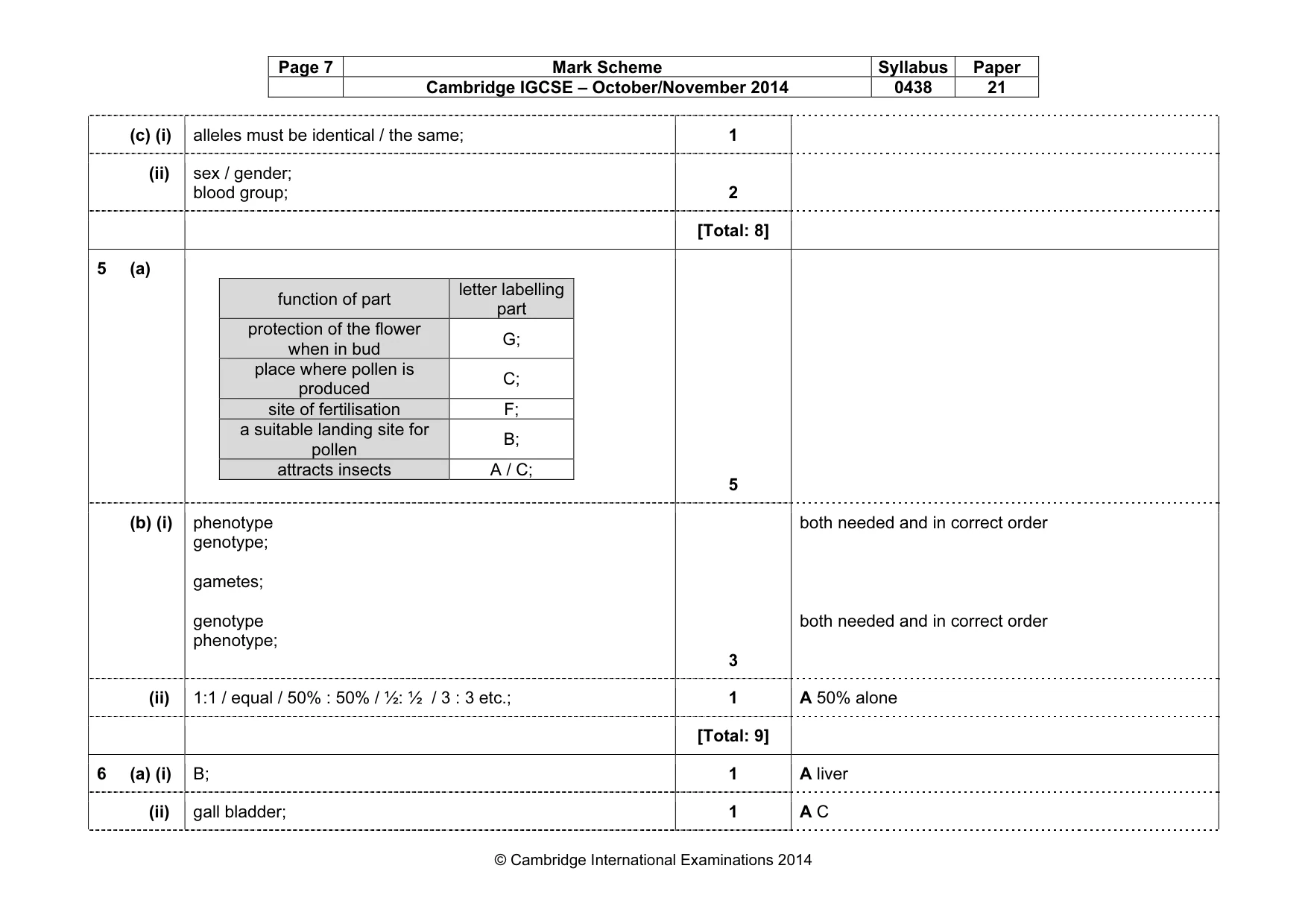
Page 7 Mark Scheme Syllabus Paper Cambridge IGCSE – October/November 2014 0438 21 © Cambridge International Examinations 2014 (c) (i) alleles must be identical / the same; 1 (ii) sex / gender; blood group; 2 [Total: 8] 5 (a) function of part letter labelling part protection of the flower when in bud G; place where pollen is produced C; site of fertilisation F; a suitable landing site for pollen B; attracts insects A / C; 5 (b) (i) phenotype genotype; gametes; genotype phenotype; 3 both needed and in correct order both needed and in correct order (ii) 1:1 / equal / 50% : 50% / ½: ½ / 3 : 3 etc.; 1 A 50% alone [Total: 9] 6 (a) (i) B; 1 A liver (ii) gall bladder; 1 A C
Mark scheme, page 8
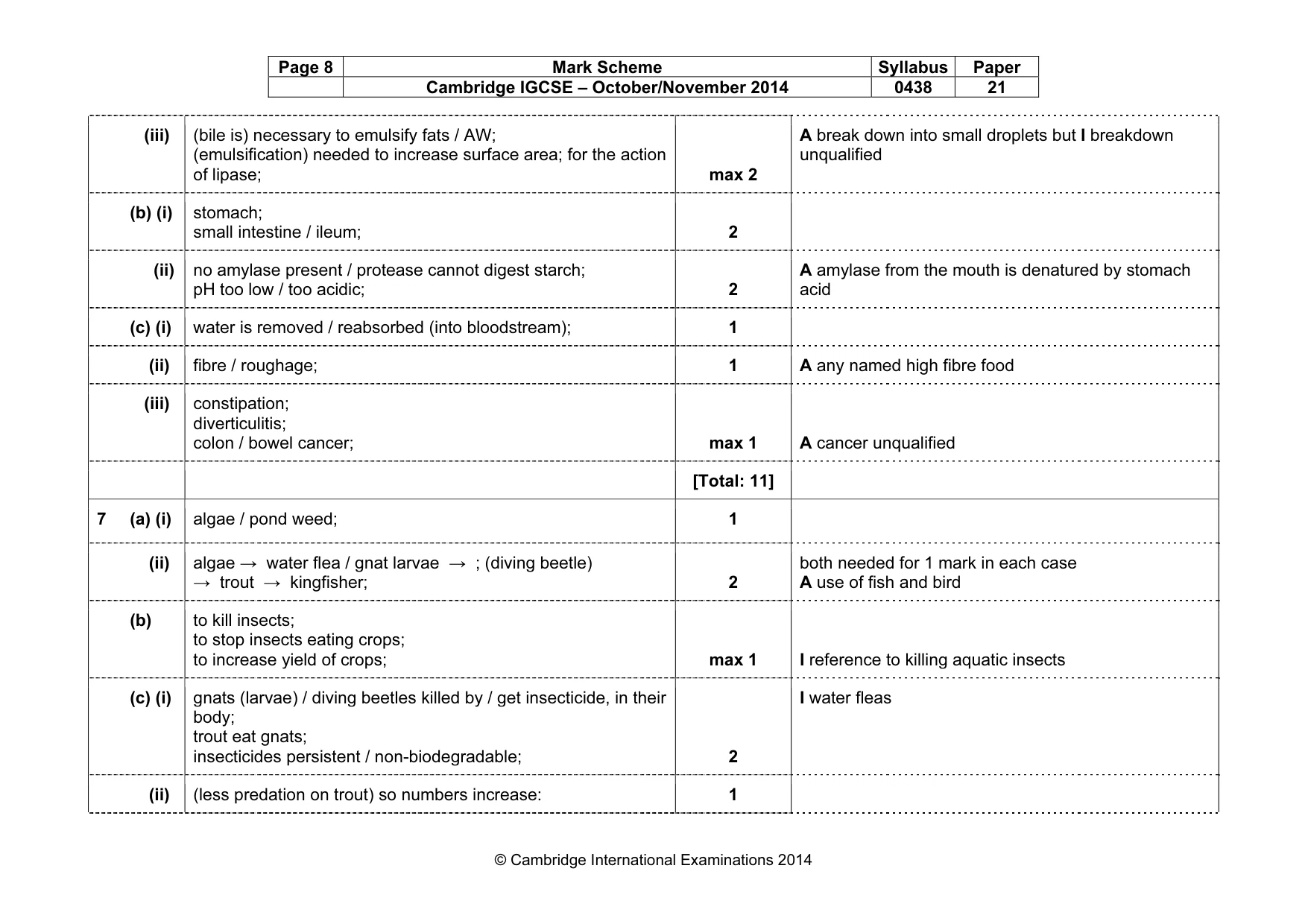
Page 8 Mark Scheme Syllabus Paper Cambridge IGCSE – October/November 2014 0438 21 © Cambridge International Examinations 2014 (iii) (bile is) necessary to emulsify fats / AW; (emulsification) needed to increase surface area; for the action of lipase; max 2 A break down into small droplets but I breakdown unqualified (b) (i) stomach; small intestine / ileum; 2 (ii) no amylase present / protease cannot digest starch; pH too low / too acidic; 2 A amylase from the mouth is denatured by stomach acid (c) (i) water is removed / reabsorbed (into bloodstream); 1 (ii) fibre / roughage; 1 A any named high fibre food (iii) constipation; diverticulitis; colon / bowel cancer; max 1 A cancer unqualified [Total: 11] 7 (a) (i) algae / pond weed; 1 (ii) algae → water flea / gnat larvae → ; (diving beetle) → trout → kingfisher; 2 both needed for 1 mark in each case A use of fish and bird (b) to kill insects; to stop insects eating crops; to increase yield of crops; max 1 I reference to killing aquatic insects (c) (i) gnats (larvae) / diving beetles killed by / get insecticide, in their body; trout eat gnats; insecticides persistent / non-biodegradable; 2 I water fleas (ii) (less predation on trout) so numbers increase: 1
Mark scheme, page 9
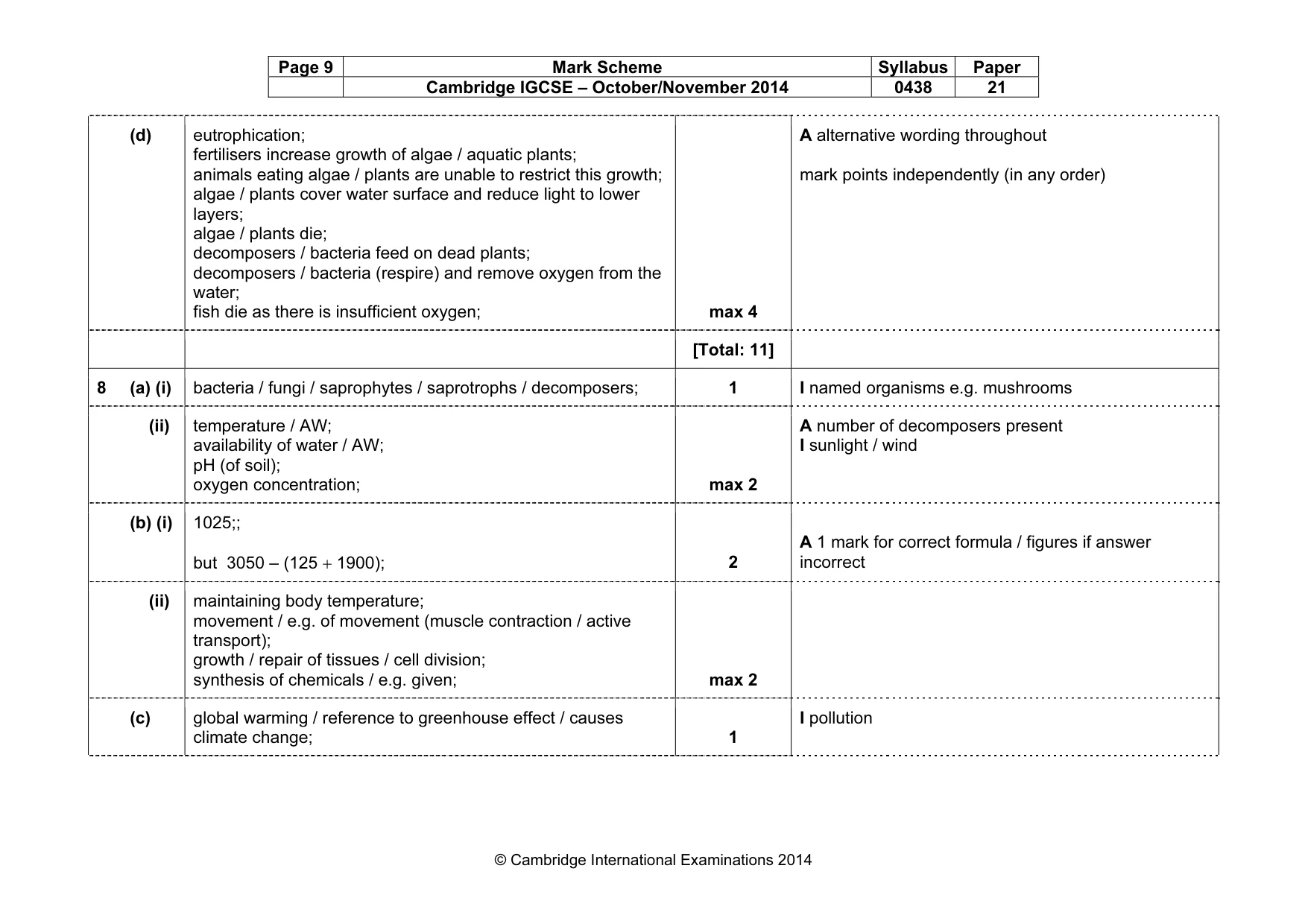
Page 9 Mark Scheme Syllabus Paper Cambridge IGCSE – October/November 2014 0438 21 © Cambridge International Examinations 2014 (d) eutrophication; fertilisers increase growth of algae / aquatic plants; animals eating algae / plants are unable to restrict this growth; algae / plants cover water surface and reduce light to lower layers; algae / plants die; decomposers / bacteria feed on dead plants; decomposers / bacteria (respire) and remove oxygen from the water; fish die as there is insufficient oxygen; max 4 A alternative wording throughout mark points independently (in any order) [Total: 11] 8 (a) (i) bacteria / fungi / saprophytes / saprotrophs / decomposers; 1 I named organisms e.g. mushrooms (ii) temperature / AW; availability of water / AW; pH (of soil); oxygen concentration; max 2 A number of decomposers present I sunlight / wind (b) (i) 1025;; but 3050 – (125 + 1900); 2 A 1 mark for correct formula / figures if answer incorrect (ii) maintaining body temperature; movement / e.g. of movement (muscle contraction / active transport); growth / repair of tissues / cell division; synthesis of chemicals / e.g. given; max 2 (c) global warming / reference to greenhouse effect / causes climate change; 1 I pollution
Mark scheme, page 10
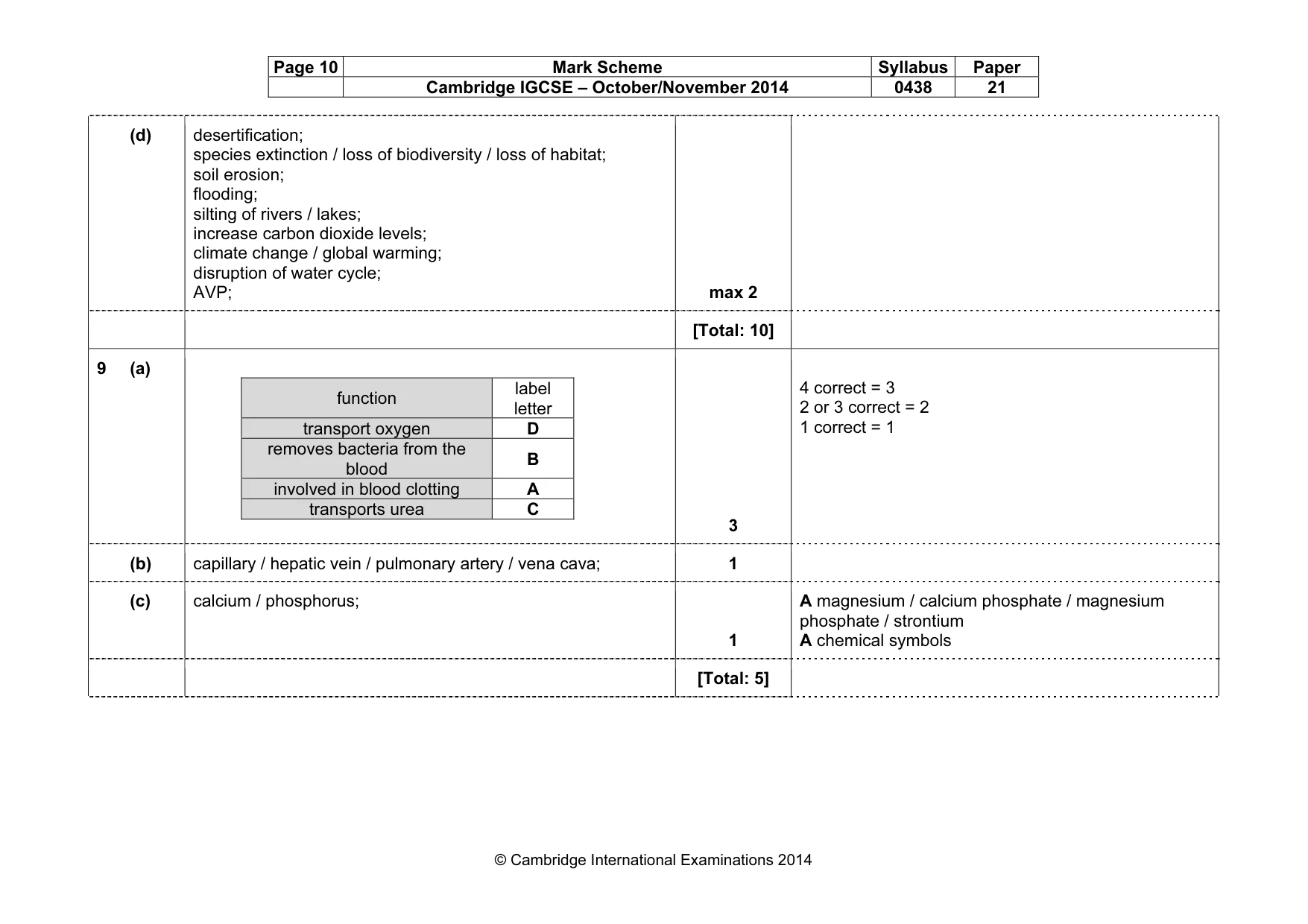
Page 10 Mark Scheme Syllabus Paper Cambridge IGCSE – October/November 2014 0438 21 © Cambridge International Examinations 2014 (d) desertification; species extinction / loss of biodiversity / loss of habitat; soil erosion; flooding; silting of rivers / lakes; increase carbon dioxide levels; climate change / global warming; disruption of water cycle; AVP; max 2 [Total: 10] 9 (a) function label letter transport oxygen D removes bacteria from the blood B involved in blood clotting A transports urea C 3 4 correct = 3 2 or 3 correct = 2 1 correct = 1 (b) capillary / hepatic vein / pulmonary artery / vena cava; 1 (c) calcium / phosphorus; 1 A magnesium / calcium phosphate / magnesium phosphate / strontium A chemical symbols [Total: 5]
What you needed in this session
Cambridge’s own grade thresholds for 2014 Oct/Nov, Paper 2 · Variant 1. A higher threshold means an easier paper — the bar moves with how the cohort did.