Cambridge IGCSE Biology (BES) 0438 — 2017 Oct/Nov Paper 2 · Variant 1
0438/21/O/N/17 · 40 marks · ≈45 min
The question paper and its mark scheme, free to read here and free to download. This is Cambridge’s own paper, exactly as it was sat.
Question paper16 pages

Mark scheme3 pages
Answers below. Sit the paper first if you are practising.
Paper as text
Question paper, page 1
This document consists of 15 printed pages and 1 blank page. IB17 11_0438_21/FP © UCLES 2017 [Turn over *2376054178* Cambridge International Examinations Cambridge International General Certificate of Secondary Education BIOLOGY (US) 0438/21 Paper 2 Multiple Choice (Extended) October/November 2017 45 minutes Additional Materials: Multiple Choice Answer Sheet Soft clean eraser Soft pencil (type B or HB is recommended) READ THESE INSTRUCTIONS FIRST Write in soft pencil. Do not use staples, paper clips, glue or correction fluid. Write your name, Center number and candidate number on the Answer Sheet in the spaces provided unless this has been done for you. DO NOT WRITE IN ANY BARCODES. There are forty questions on this paper. Answer all questions. For each question there are four possible answers A, B, C and D. Choose the one you consider correct and record your choice in soft pencil on the separate Answer Sheet. Read the instructions on the Answer Sheet very carefully. Each correct answer will score one mark. A mark will not be deducted for a wrong answer. Any rough working should be done in this booklet. Electronic calculators may be used.
Question paper, page 2
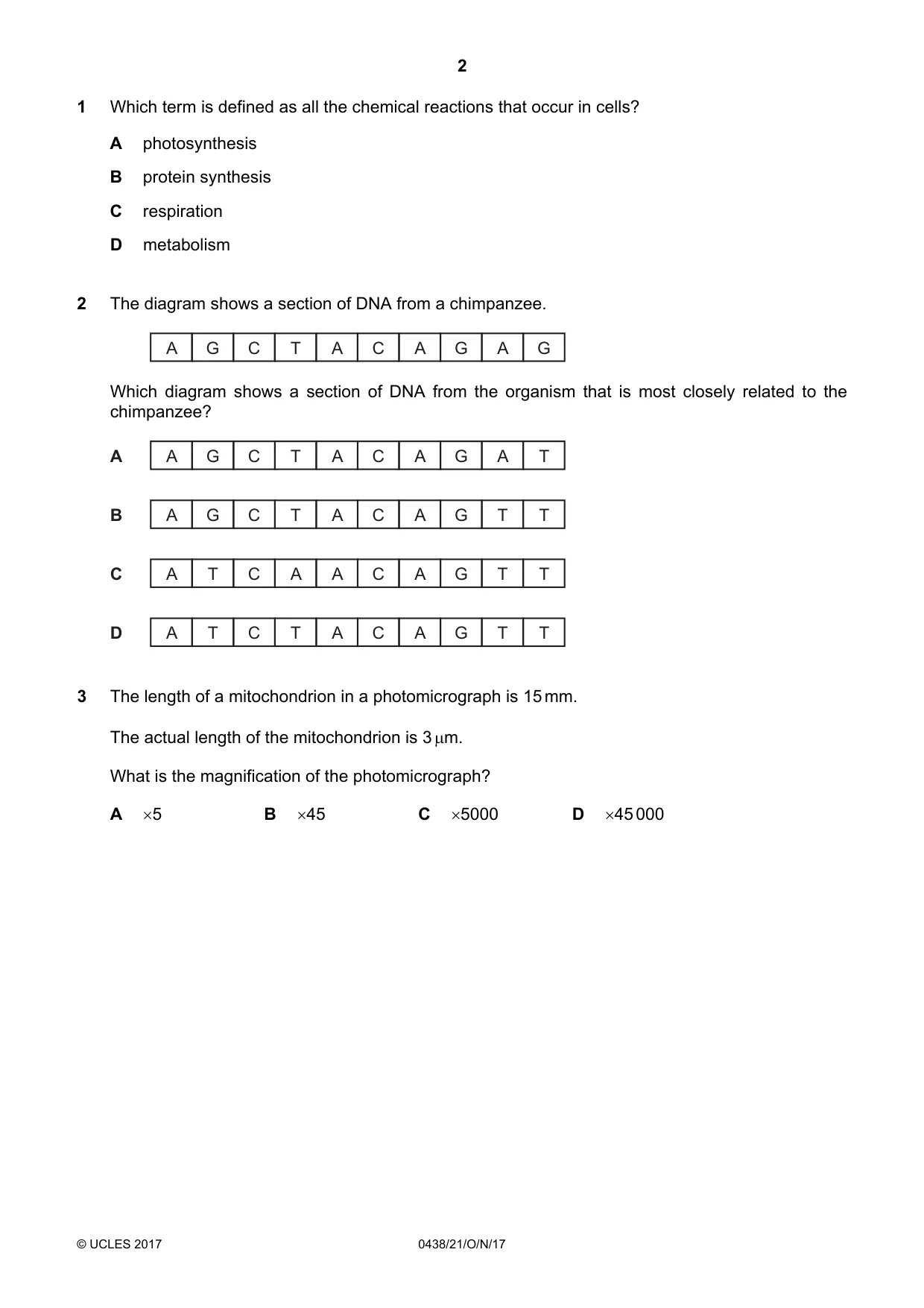
2 © UCLES 2017 0438/21/O/N/17 1 Which term is defined as all the chemical reactions that occur in cells? A photosynthesis B protein synthesis C respiration D metabolism 2 The diagram shows a section of DNA from a chimpanzee. A G C T A C A G A G Which diagram shows a section of DNA from the organism that is most closely related to the chimpanzee? A A G C T A C A G A T A B G C T A C A G T T A C T C A A C A G T T A D T C T A C A G T T 3 The length of a mitochondrion in a photomicrograph is 15 mm. The actual length of the mitochondrion is 3 µm. What is the magnification of the photomicrograph? A ×5 B ×45 C ×5000 D ×45 000
Question paper, page 3
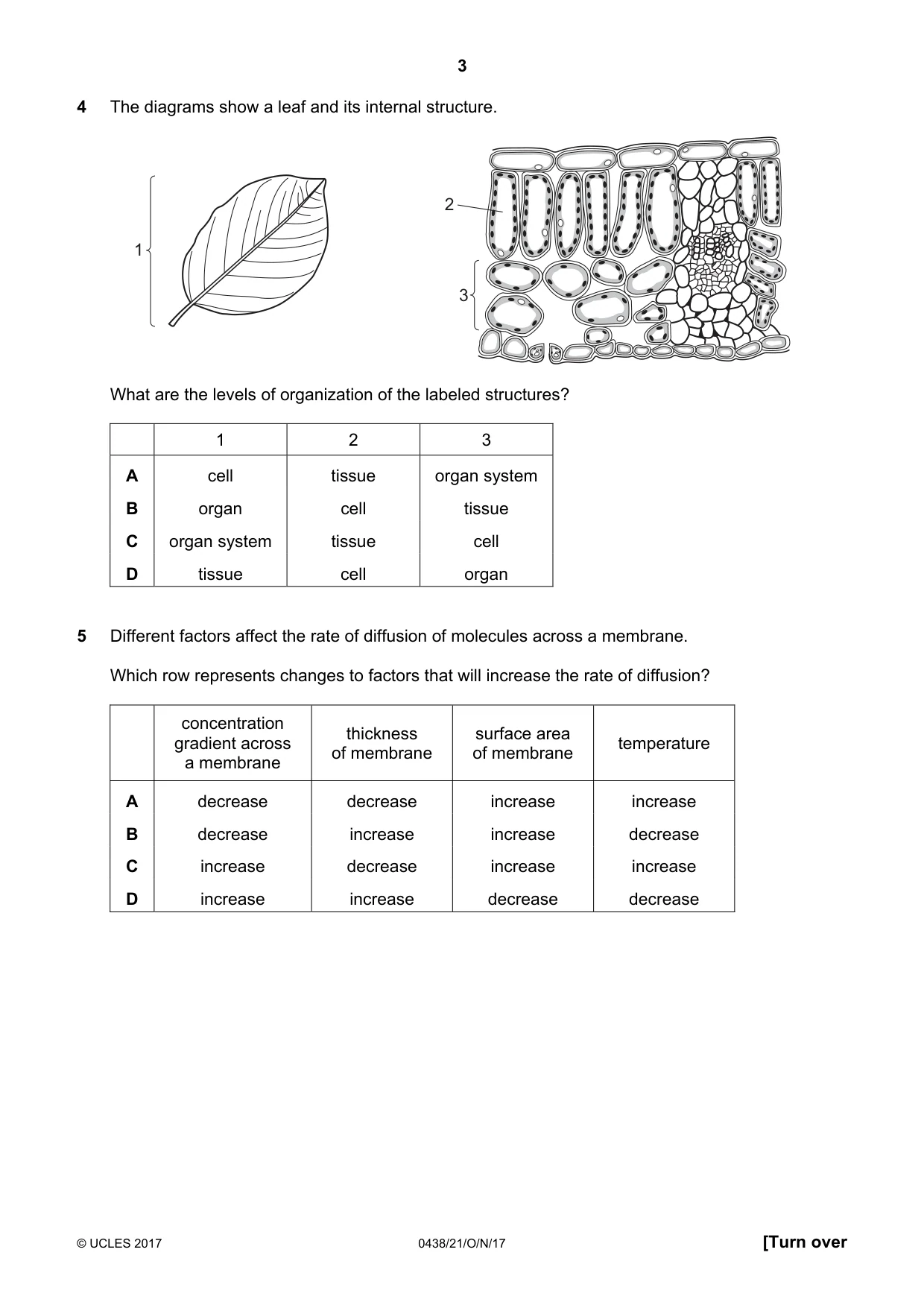
3 © UCLES 2017 0438/21/O/N/17 [Turn over 4 The diagrams show a leaf and its internal structure. 1 2 3 What are the levels of organization of the labeled structures? 1 2 3 A cell tissue organ system B organ cell tissue C organ system tissue cell D tissue cell organ 5 Different factors affect the rate of diffusion of molecules across a membrane. Which row represents changes to factors that will increase the rate of diffusion? concentration gradient across a membrane thickness of membrane surface area of membrane temperature A decrease decrease increase increase B decrease increase increase decrease C increase decrease increase increase D increase increase decrease decrease
Question paper, page 4
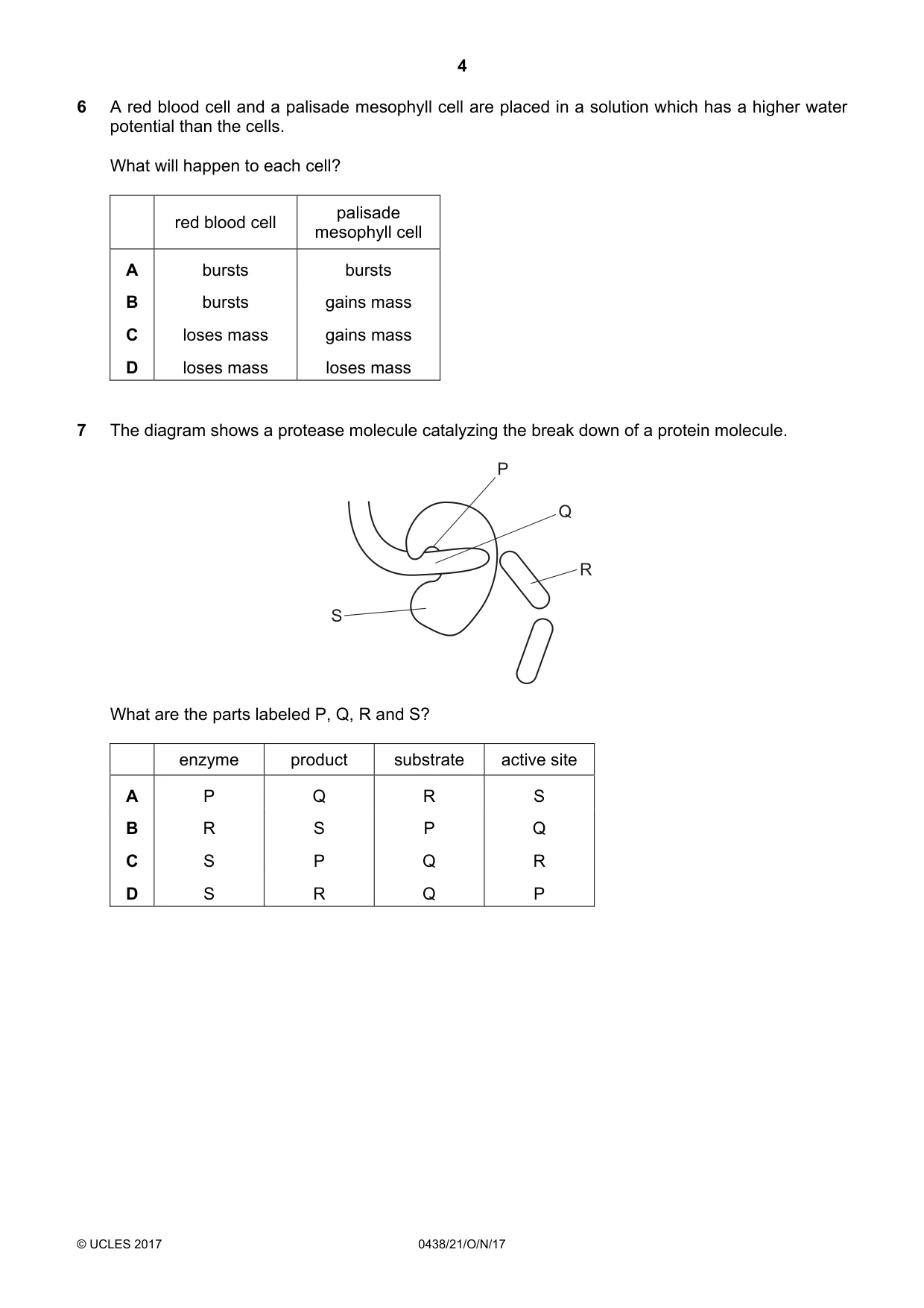
4 © UCLES 2017 0438/21/O/N/17 6 A red blood cell and a palisade mesophyll cell are placed in a solution which has a higher water potential than the cells. What will happen to each cell? red blood cell palisade mesophyll cell A bursts bursts B bursts gains mass C loses mass gains mass D loses mass loses mass 7 The diagram shows a protease molecule catalyzing the break down of a protein molecule. R P Q S What are the parts labeled P, Q, R and S? enzyme product substrate active site A P Q R S B R S P Q C S P Q R D S R Q P
Question paper, page 5
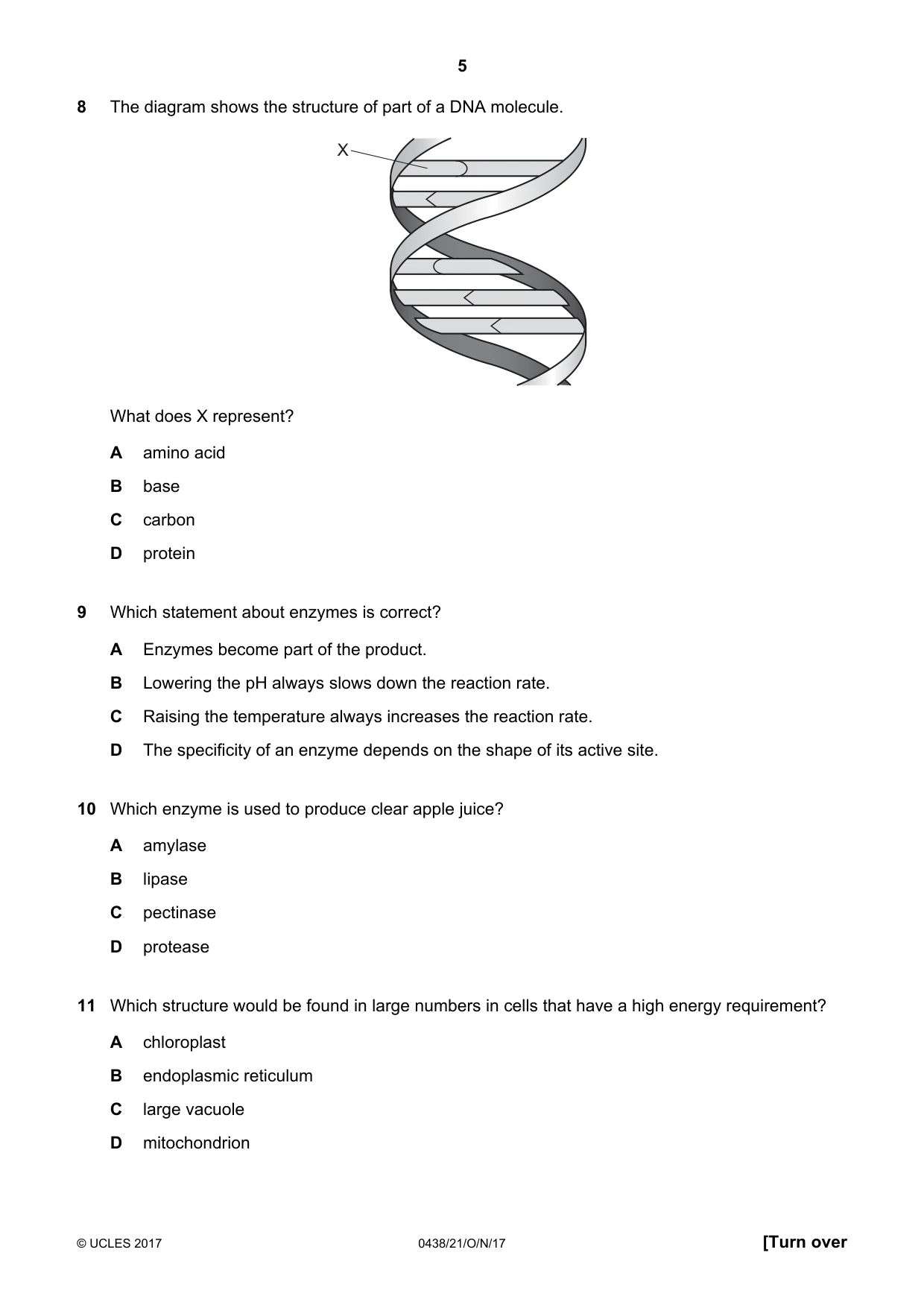
5 © UCLES 2017 0438/21/O/N/17 [Turn over 8 The diagram shows the structure of part of a DNA molecule. X What does X represent? A amino acid B base C carbon D protein 9 Which statement about enzymes is correct? A Enzymes become part of the product. B Lowering the pH always slows down the reaction rate. C Raising the temperature always increases the reaction rate. D The specificity of an enzyme depends on the shape of its active site. 10 Which enzyme is used to produce clear apple juice? A amylase B lipase C pectinase D protease 11 Which structure would be found in large numbers in cells that have a high energy requirement? A chloroplast B endoplasmic reticulum C large vacuole D mitochondrion
Question paper, page 6
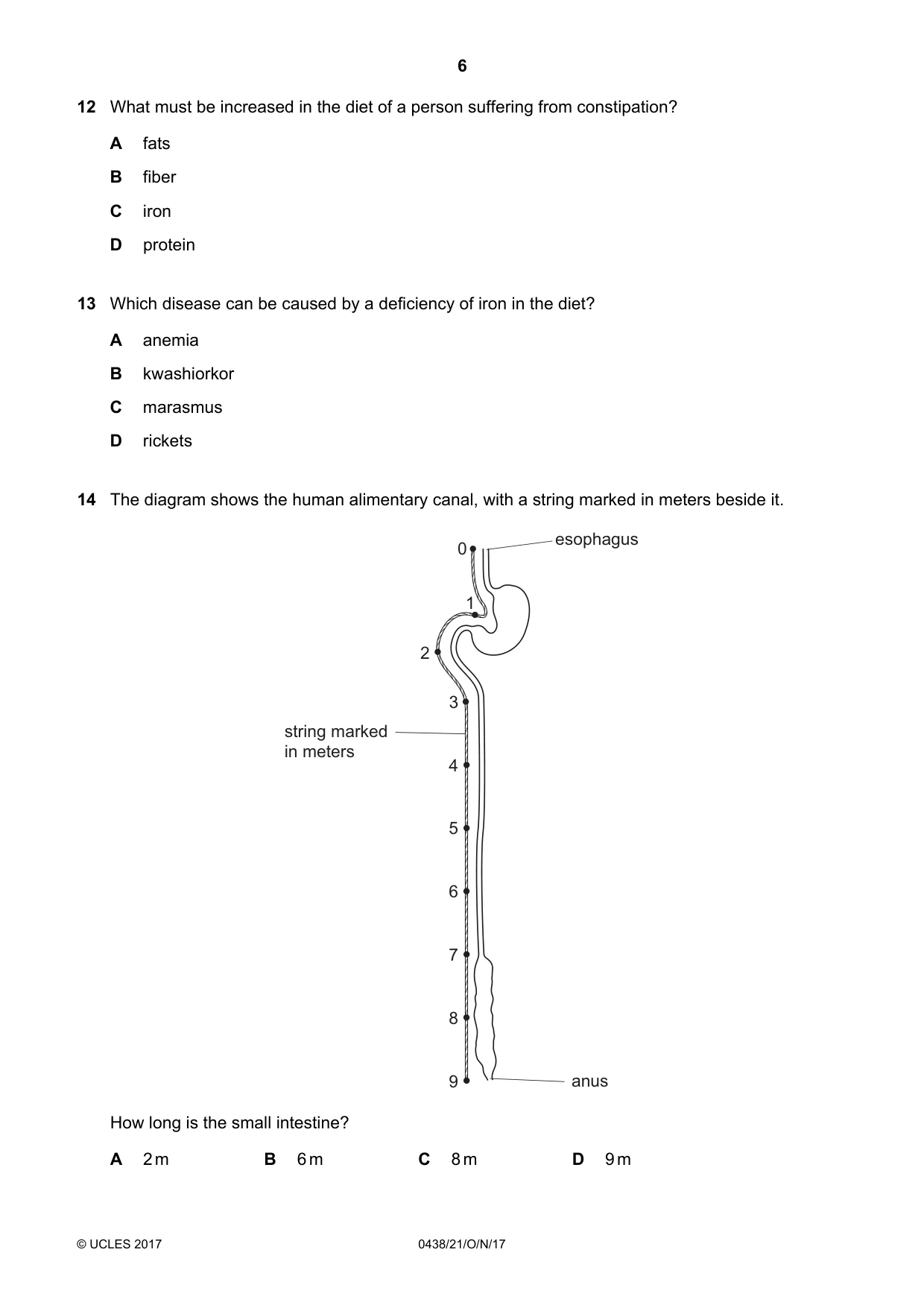
6 © UCLES 2017 0438/21/O/N/17 12 What must be increased in the diet of a person suffering from constipation? A fats B fiber C iron D protein 13 Which disease can be caused by a deficiency of iron in the diet? A anemia B kwashiorkor C marasmus D rickets 14 The diagram shows the human alimentary canal, with a string marked in meters beside it. esophagus anus 0 1 2 3 4 5 6 7 8 9 string marked in meters How long is the small intestine? A 2 m B 6 m C 8 m D 9 m
Question paper, page 7
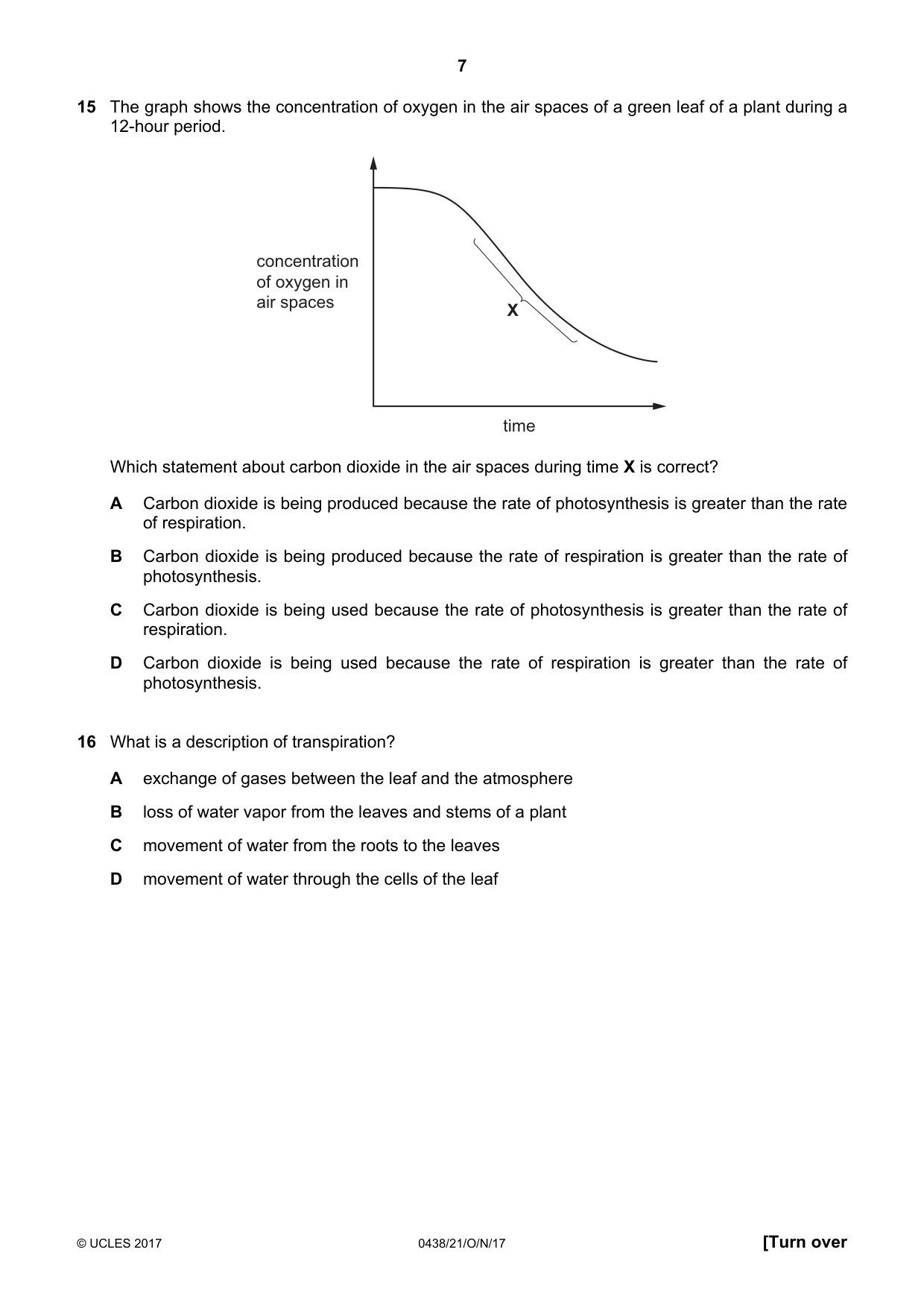
7 © UCLES 2017 0438/21/O/N/17 [Turn over 15 The graph shows the concentration of oxygen in the air spaces of a green leaf of a plant during a 12-hour period. concentration of oxygen in air spaces time X Which statement about carbon dioxide in the air spaces during time X is correct? A Carbon dioxide is being produced because the rate of photosynthesis is greater than the rate of respiration. B Carbon dioxide is being produced because the rate of respiration is greater than the rate of photosynthesis. C Carbon dioxide is being used because the rate of photosynthesis is greater than the rate of respiration. D Carbon dioxide is being used because the rate of respiration is greater than the rate of photosynthesis. 16 What is a description of transpiration? A exchange of gases between the leaf and the atmosphere B loss of water vapor from the leaves and stems of a plant C movement of water from the roots to the leaves D movement of water through the cells of the leaf
Question paper, page 8
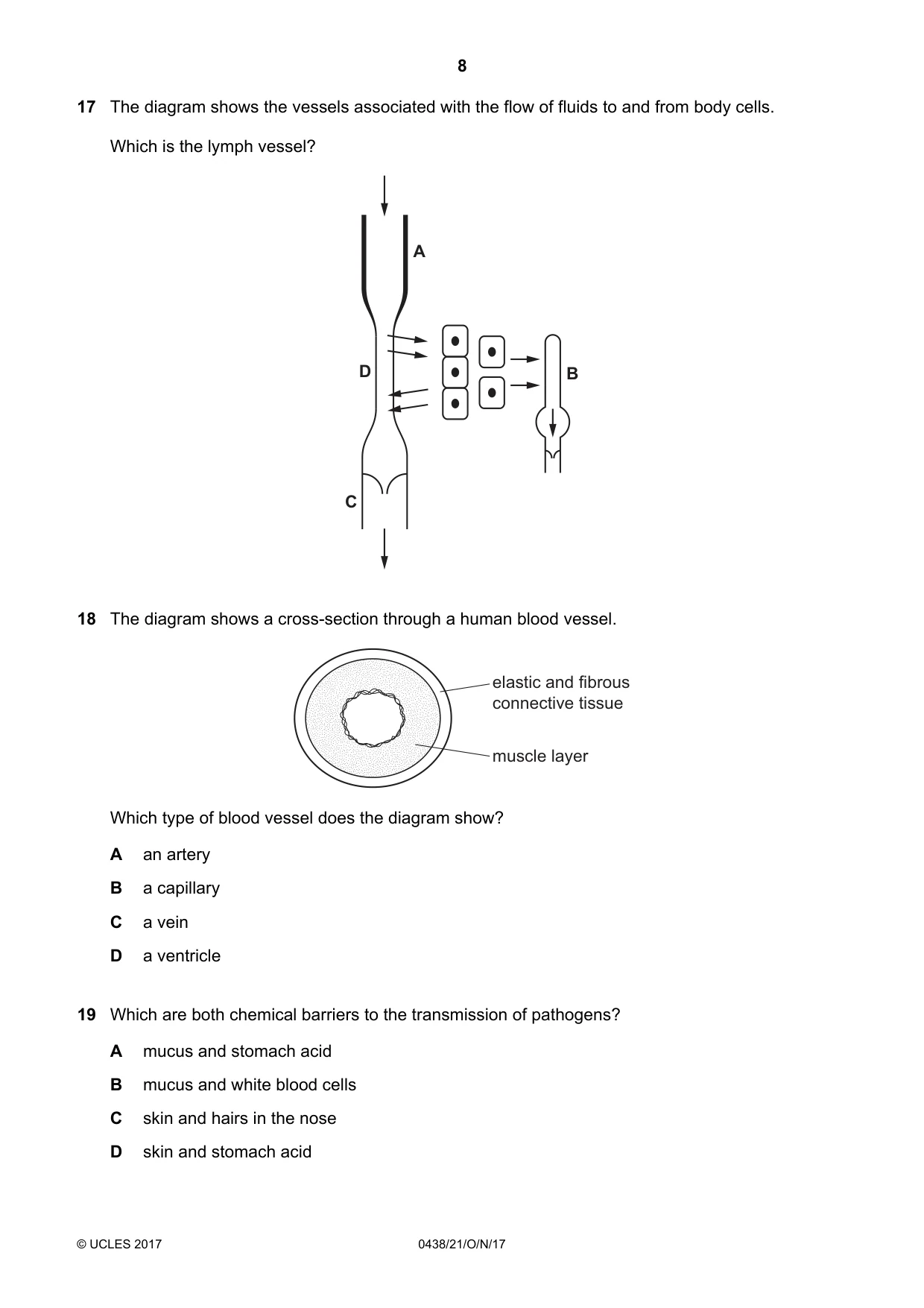
8 © UCLES 2017 0438/21/O/N/17 17 The diagram shows the vessels associated with the flow of fluids to and from body cells. Which is the lymph vessel? A D C B 18 The diagram shows a cross-section through a human blood vessel. elastic and fibrous connective tissue muscle layer Which type of blood vessel does the diagram show? A an artery B a capillary C a vein D a ventricle 19 Which are both chemical barriers to the transmission of pathogens? A mucus and stomach acid B mucus and white blood cells C skin and hairs in the nose D skin and stomach acid
Question paper, page 9
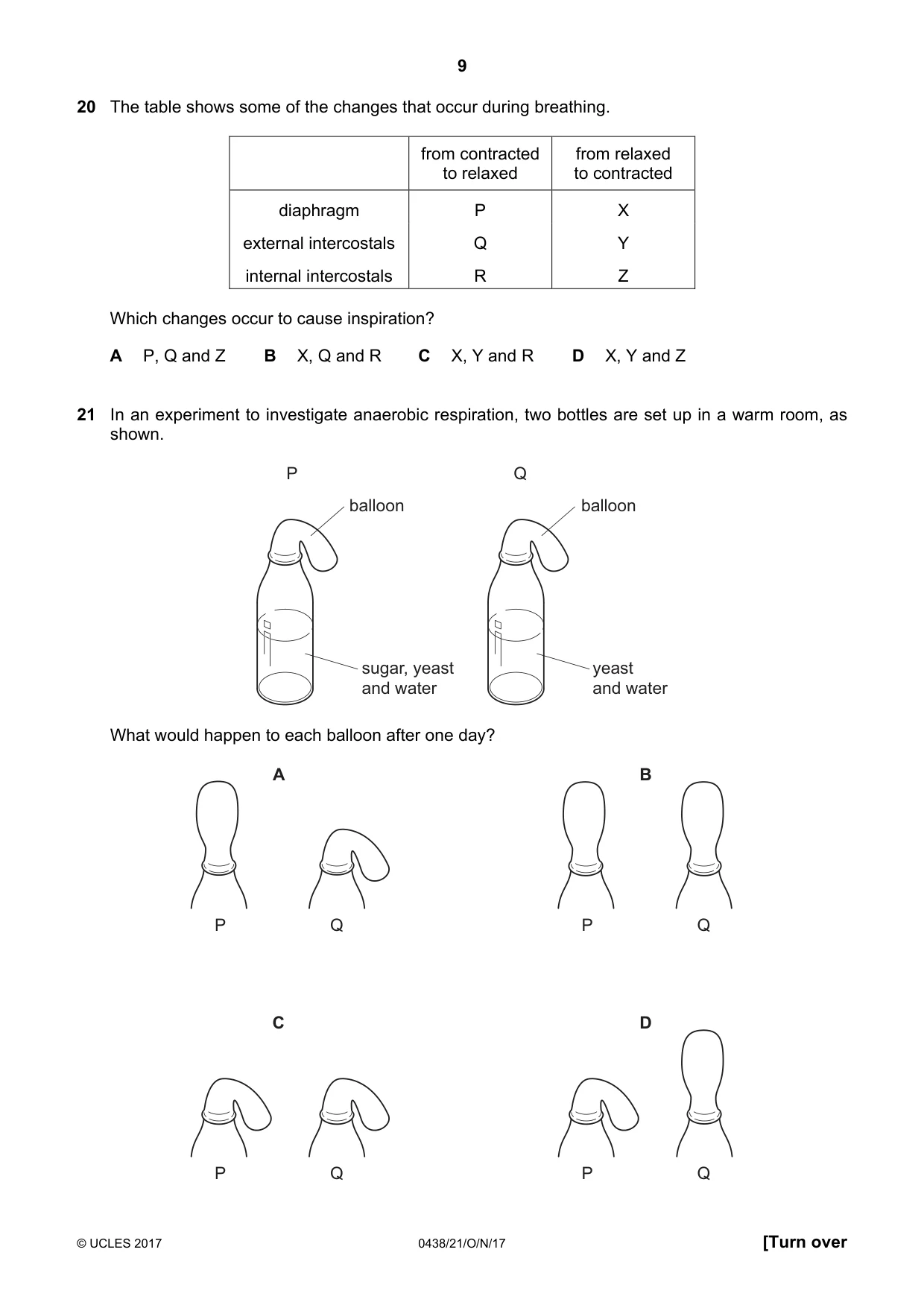
9 © UCLES 2017 0438/21/O/N/17 [Turn over 20 The table shows some of the changes that occur during breathing. from contracted to relaxed from relaxed to contracted diaphragm P X external intercostals Q Y internal intercostals R Z Which changes occur to cause inspiration? A P, Q and Z B X, Q and R C X, Y and R D X, Y and Z 21 In an experiment to investigate anaerobic respiration, two bottles are set up in a warm room, as shown. balloon P Q balloon yeast and water sugar, yeast and water What would happen to each balloon after one day? P Q A P Q B P Q C P Q D
Question paper, page 10
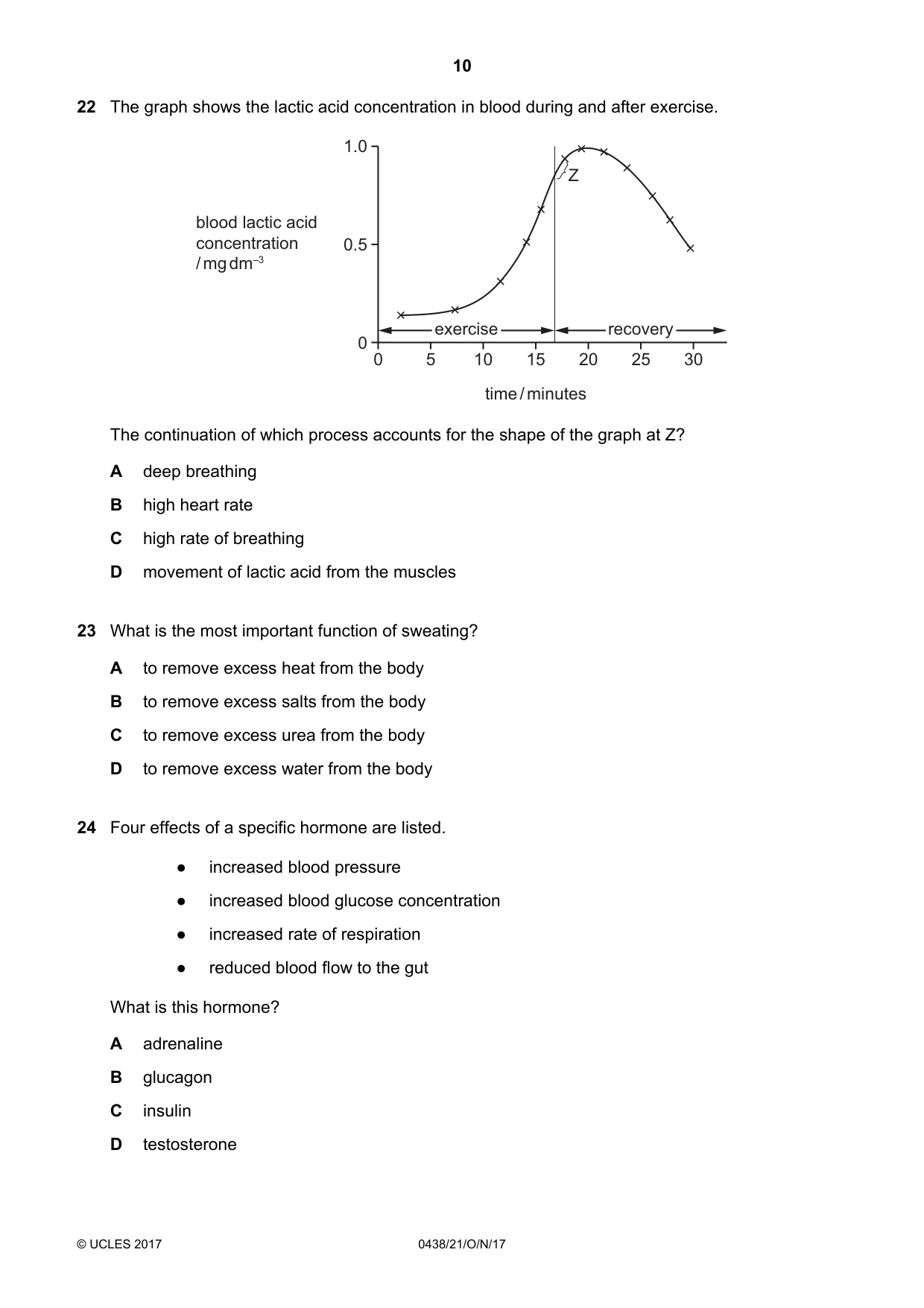
10 © UCLES 2017 0438/21/O/N/17 22 The graph shows the lactic acid concentration in blood during and after exercise. 1.0 0.5 0 0 5 10 15 time / minutes 20 25 30 blood lactic acid concentration / mg dm–3 exercise recovery Z The continuation of which process accounts for the shape of the graph at Z? A deep breathing B high heart rate C high rate of breathing D movement of lactic acid from the muscles 23 What is the most important function of sweating? A to remove excess heat from the body B to remove excess salts from the body C to remove excess urea from the body D to remove excess water from the body 24 Four effects of a specific hormone are listed. ● increased blood pressure ● increased blood glucose concentration ● increased rate of respiration ● reduced blood flow to the gut What is this hormone? A adrenaline B glucagon C insulin D testosterone
Question paper, page 11
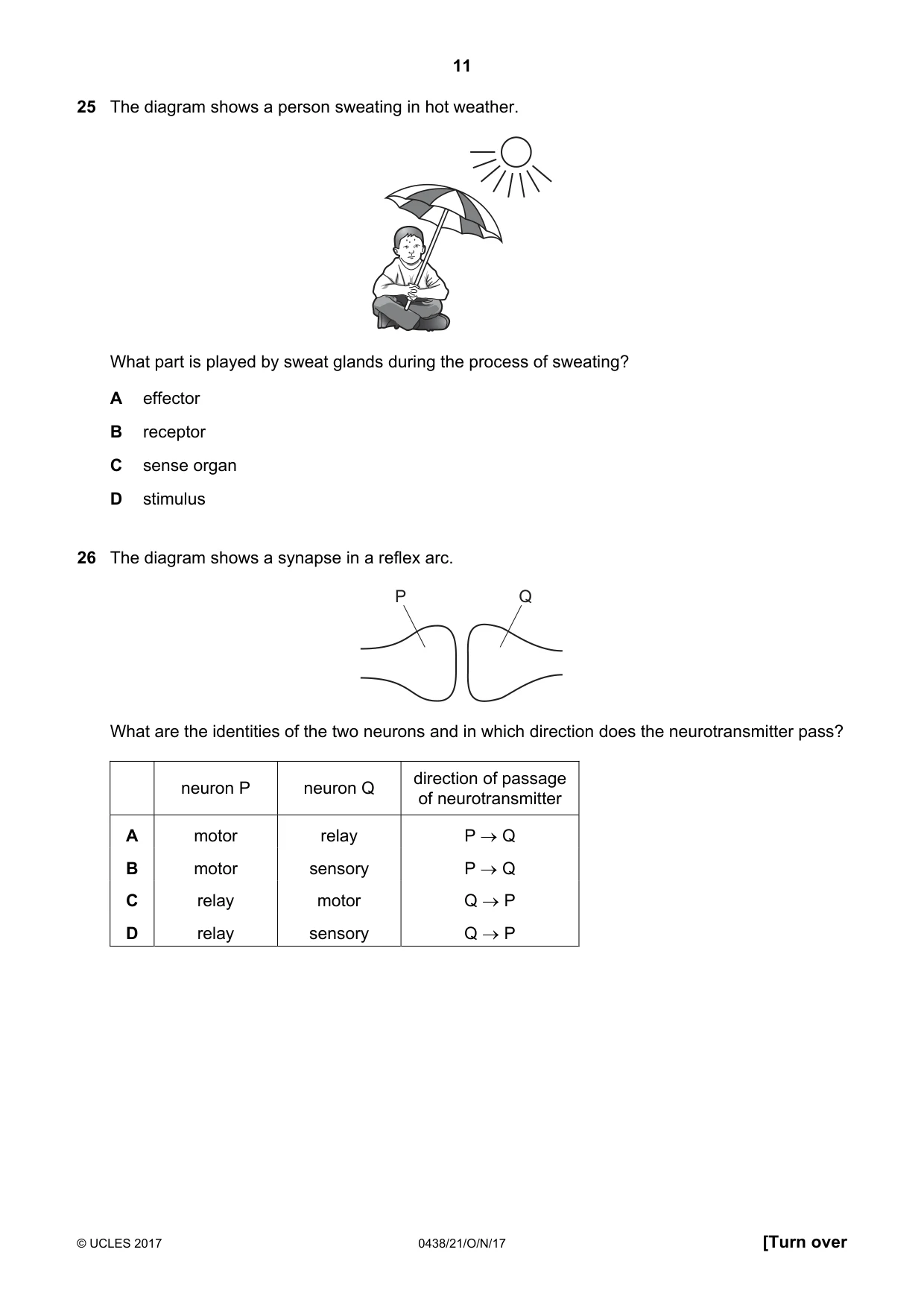
11 © UCLES 2017 0438/21/O/N/17 [Turn over 25 The diagram shows a person sweating in hot weather. What part is played by sweat glands during the process of sweating? A effector B receptor C sense organ D stimulus 26 The diagram shows a synapse in a reflex arc. P Q What are the identities of the two neurons and in which direction does the neurotransmitter pass? neuron P neuron Q direction of passage of neurotransmitter A motor relay P → Q B motor sensory P → Q C relay motor Q → P D relay sensory Q → P
Question paper, page 12
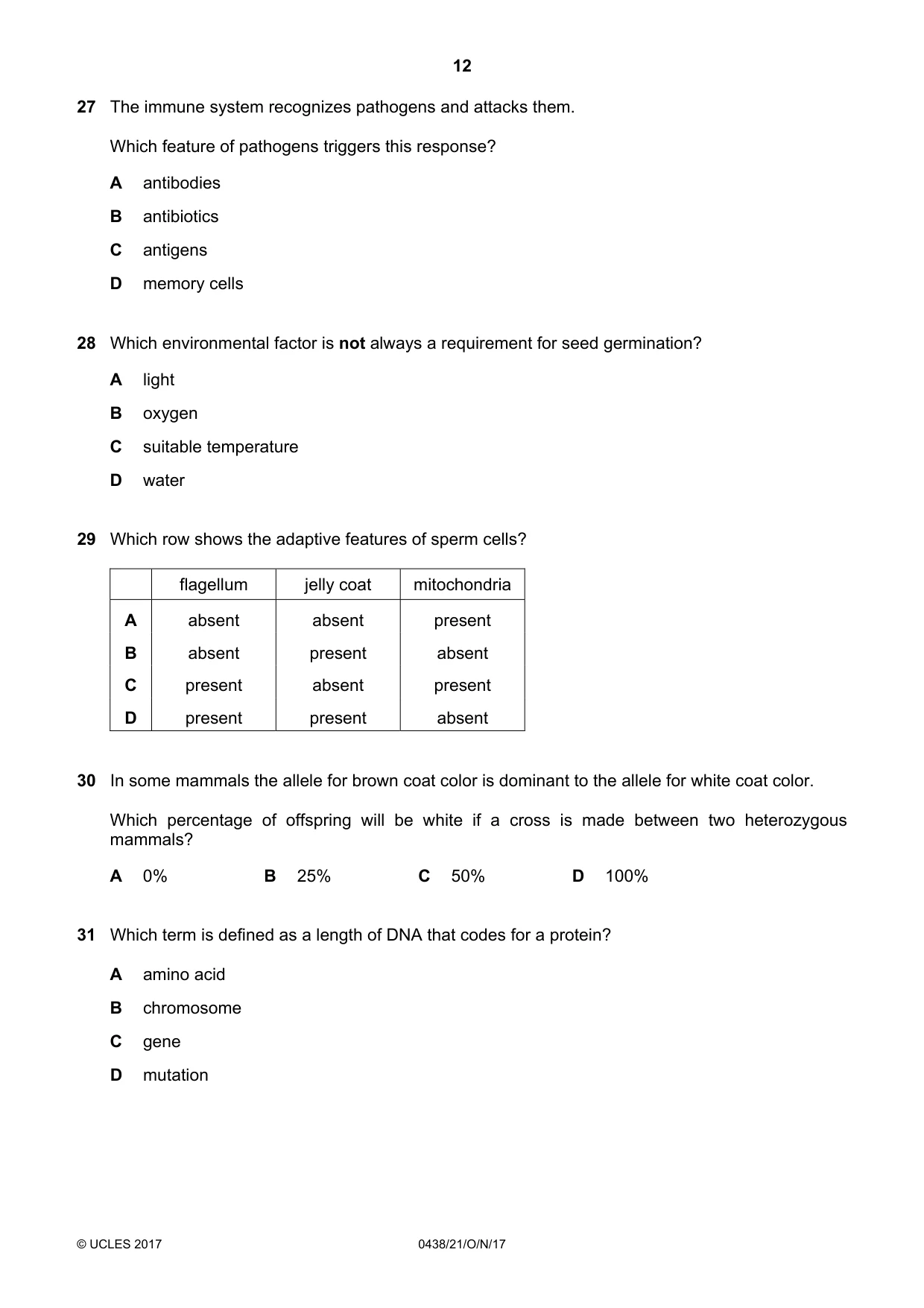
12 © UCLES 2017 0438/21/O/N/17 27 The immune system recognizes pathogens and attacks them. Which feature of pathogens triggers this response? A antibodies B antibiotics C antigens D memory cells 28 Which environmental factor is not always a requirement for seed germination? A light B oxygen C suitable temperature D water 29 Which row shows the adaptive features of sperm cells? flagellum jelly coat mitochondria A absent absent present B absent present absent C present absent present D present present absent 30 In some mammals the allele for brown coat color is dominant to the allele for white coat color. Which percentage of offspring will be white if a cross is made between two heterozygous mammals? A 0% B 25% C 50% D 100% 31 Which term is defined as a length of DNA that codes for a protein? A amino acid B chromosome C gene D mutation
Question paper, page 13
13 © UCLES 2017 0438/21/O/N/17 [Turn over 32 The following are involved in protein synthesis. 1 amino acids assembled in order 2 mRNA moves to the cytoplasm 3 mRNA passing through a ribosome 4 DNA in the nucleus In which order do they become involved when proteins are made? A 1 → 3 → 2 → 4 B 3 → 2 → 1 → 4 C 4 → 2 → 3 → 1 D 4 → 3 → 2 → 1 33 What makes tongue rolling an example of discontinuous variation? A A person can roll their tongue only when they are young. B There are many different types of tongue rollers. C Tongue rolling has to be learnt. D Tongue rolling is something that a person either can or cannot do. 34 The distribution of the sickle-cell allele in human populations varies in different areas of the world. What is an explanation for this difference? A People that are heterozygous for the sickle-cell allele have a resistance to cholera. B People that are heterozygous for the sickle-cell allele have a resistance to malaria. C People that are heterozygous for the sickle-cell allele are more likely to suffer from anemia. D People with sickle-cell anemia have more alleles. 35 Nitrogen in the air cannot be used by plants until it is in the form of nitrates. Which two processes convert nitrogen from the air into nitrates? A decomposition of feces and nitrification B denitrification and lightning C nitrogen fixation by bacteria and denitrification D nitrogen fixation by bacteria and lightning
Question paper, page 14
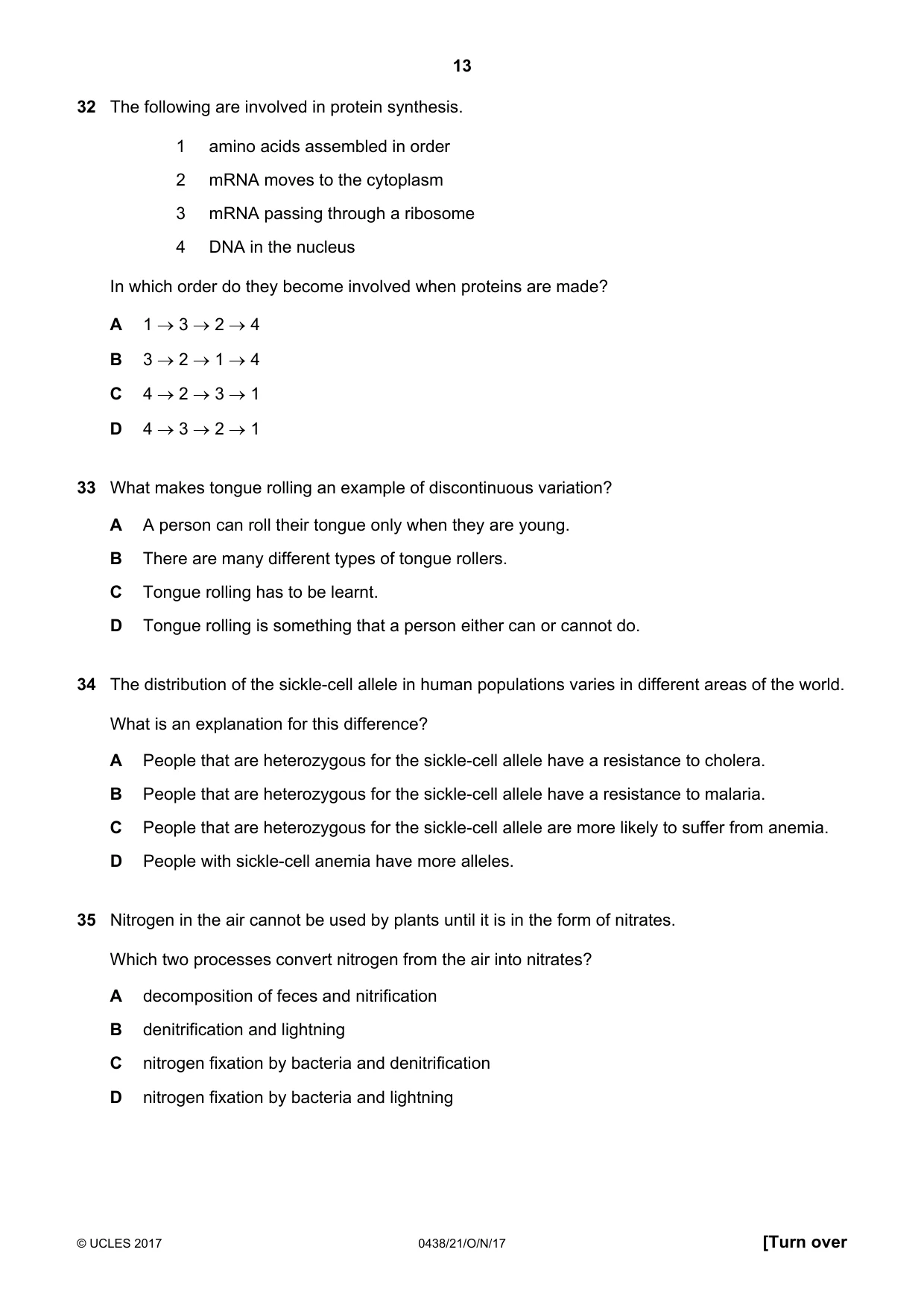
14 © UCLES 2017 0438/21/O/N/17 36 What is shown by the widest block in a pyramid of numbers for a grassland ecosystem? A all the consumers in the pyramid B the carnivores in the pyramid C the organisms at the top of the pyramid D the producers in the pyramid 37 The diagrams show the depth and rate of breathing in a person at 12.00 pm and 1.00 pm. volume 0 10 20 30 time / seconds 40 50 60 70 volume 0 10 20 30 time / seconds 12.00 pm 1.00 pm 40 50 60 70 0.5 dm3 What happens to the person’s breathing between 12.00 pm and 1.00 pm? depth of breathing rate of breathing A decreases decreases B decreases increases C increases decreases D increases increases 38 Ligase enzymes are used in genetic engineering to A cut open plasmid DNA. B insert plasmids into bacteria. C isolate the DNA making up a human gene. D join human DNA to plasmid DNA.
Question paper, page 15
15 © UCLES 2017 0438/21/O/N/17 39 What is not a reason for conservation programmes? A to introduce new species B to maintain nutrient cycles C to maintain resources D to protect vulnerable environments 40 Some examples of the waste products of human activity are discarded household rubbish, excess fertilizer, industrial chemicals and untreated sewage. Which of these can both cause increased growth of aquatic plants? A chemical waste and discarded household rubbish B discarded household rubbish and excess fertilizer C excess fertilizer and untreated sewage D untreated sewage and chemical waste
Question paper, page 16
16 Permission to reproduce items where third-party owned material protected by copyright is included has been sought and cleared where possible. Every reasonable effort has been made by the publisher (UCLES) to trace copyright holders, but if any items requiring clearance have unwittingly been included, the publisher will be pleased to make amends at the earliest possible opportunity. To avoid the issue of disclosure of answer-related information to candidates, all copyright acknowledgements are reproduced online in the Cambridge International Examinations Copyright Acknowledgements Booklet. This is produced for each series of examinations and is freely available to download at www.cie.org.uk after the live examination series. Cambridge International Examinations is part of the Cambridge Assessment Group. Cambridge Assessment is the brand name of University of Cambridge Local Examinations Syndicate (UCLES), which is itself a department of the University of Cambridge. © UCLES 2017 0438/21/O/N/17 BLANK PAGE
Mark scheme, page 1
® IGCSE is a registered trademark. This document consists of 3 printed pages. © UCLES 2017 [Turn over Cambridge Assessment International Education Cambridge International General Certificate of Secondary Education BIOLOGY (US) 0438/21 Paper 2 Multiple Choice (Extended) October/November 2017 MARK SCHEME Maximum Mark: 40 Published This mark scheme is published as an aid to teachers and candidates, to indicate the requirements of the examination. Mark schemes should be read in conjunction with the question paper and the Principal Examiner Report for Teachers. Cambridge International will not enter into discussions about these mark schemes. Cambridge International is publishing the mark schemes for the October/November 2017 series for most Cambridge IGCSE®, Cambridge International A and AS Level components and some Cambridge O Level components.
Mark scheme, page 2
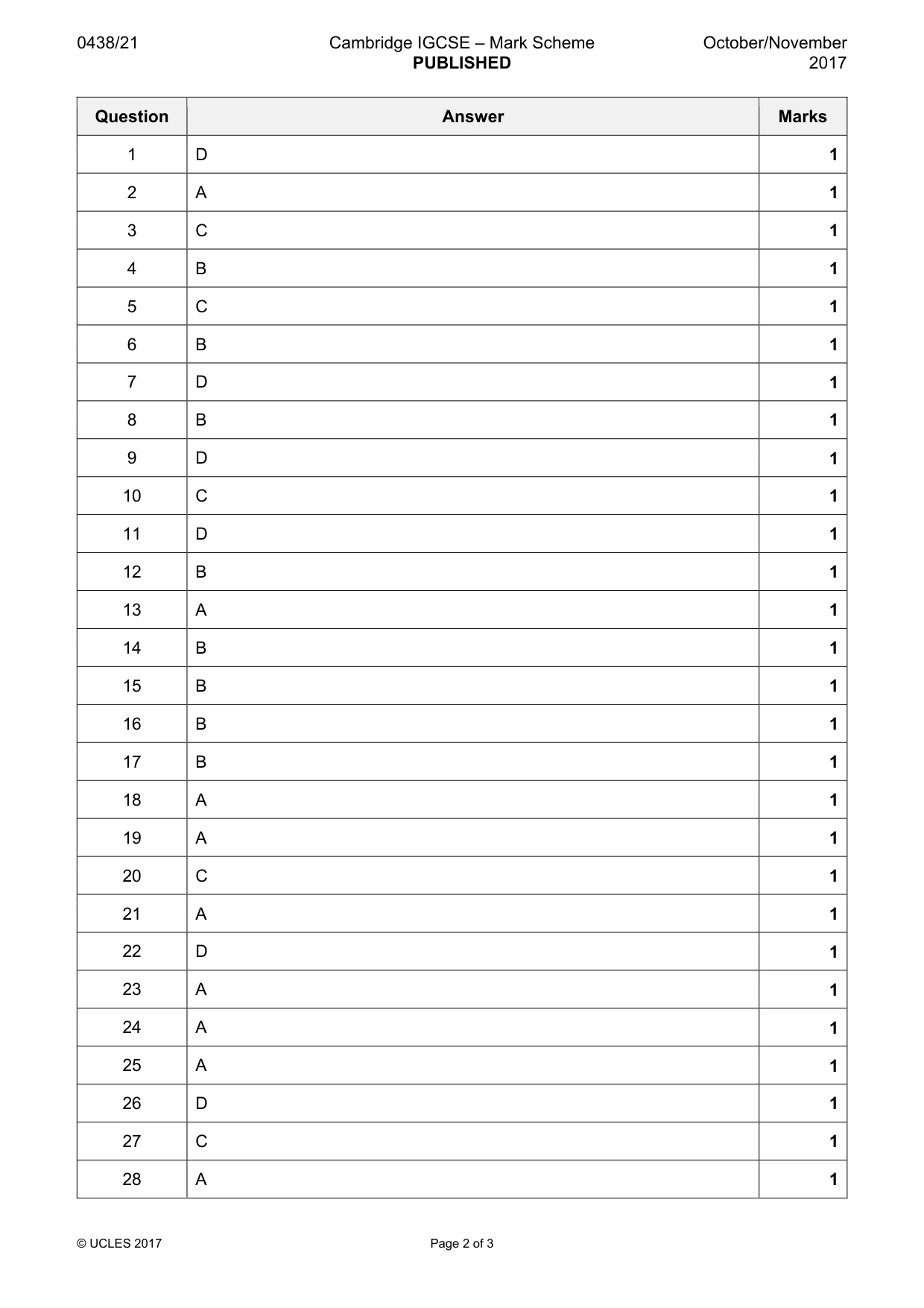
0438/21 Cambridge IGCSE – Mark Scheme PUBLISHED October/November 2017 © UCLES 2017 Page 2 of 3 Question Answer Marks 1 D 1 2 A 1 3 C 1 4 B 1 5 C 1 6 B 1 7 D 1 8 B 1 9 D 1 10 C 1 11 D 1 12 B 1 13 A 1 14 B 1 15 B 1 16 B 1 17 B 1 18 A 1 19 A 1 20 C 1 21 A 1 22 D 1 23 A 1 24 A 1 25 A 1 26 D 1 27 C 1 28 A 1
Mark scheme, page 3
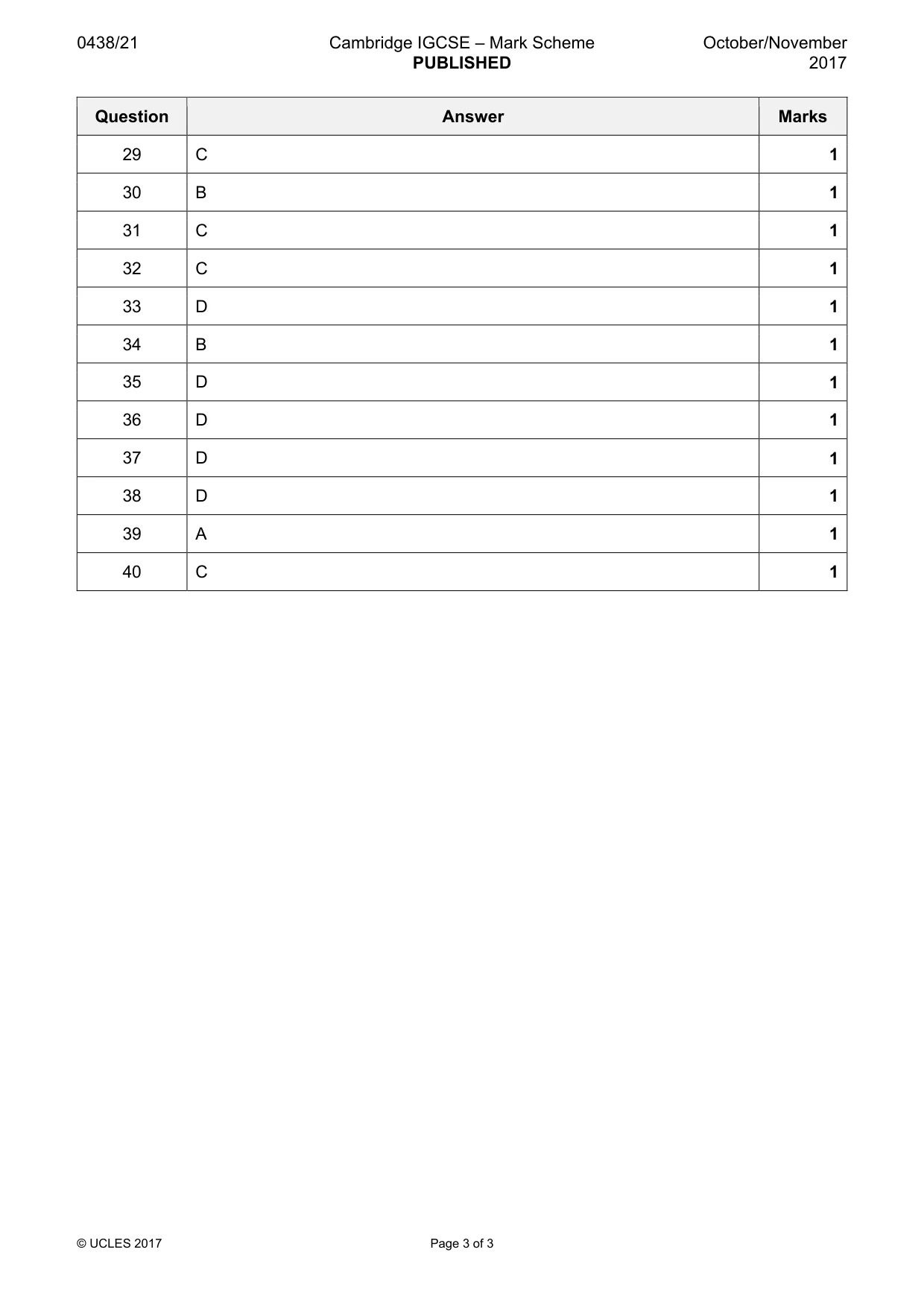
0438/21 Cambridge IGCSE – Mark Scheme PUBLISHED October/November 2017 © UCLES 2017 Page 3 of 3 Question Answer Marks 29 C 1 30 B 1 31 C 1 32 C 1 33 D 1 34 B 1 35 D 1 36 D 1 37 D 1 38 D 1 39 A 1 40 C 1
What you needed in this session
Cambridge’s own grade thresholds for 2017 Oct/Nov, Paper 2 · Variant 1. A higher threshold means an easier paper — the bar moves with how the cohort did.