Cambridge IGCSE Biology (BES) 0438 — 2014 May/June Paper 2 · Variant 3
0438/23/M/J/14 · 80 marks · ≈90 min
The question paper and its mark scheme, free to read here and free to download. This is Cambridge’s own paper, exactly as it was sat.
Question paper20 pages




Mark scheme9 pages
Answers below. Sit the paper first if you are practising.
Paper as text
Question paper, page 1
This document consists of 17 printed pages and 3 blank pages. DC (NF/SW) 93180 © UCLES 2014 [Turn over * 8 6 3 0 9 6 6 5 5 4 * BIOLOGY (US) 0438/23 Paper 2 Core May/June 2014 1 hour 15 minutes Candidates answer on the Question Paper. No Additional Materials are required. READ THESE INSTRUCTIONS FIRST Write your Center number, candidate number and name on all the work you hand in. Write in dark blue or black pen. You may use a pencil for any diagrams or graphs. Do not use staples, paper clips, glue or correction fluid. DO NOT WRITE IN ANY BARCODES. Answer all questions. Electronic calculators may be used. You may lose marks if you do not show your working or if you do not use appropriate units. At the end of the examination, fasten all your work securely together. The number of marks is given in brackets [ ] at the end of each question or part question. Cambridge International Examinations Cambridge International General Certificate of Secondary Education
Question paper, page 2
2 0438/23/M/J/14 © UCLES 2014 BLANK PAGE
Question paper, page 3
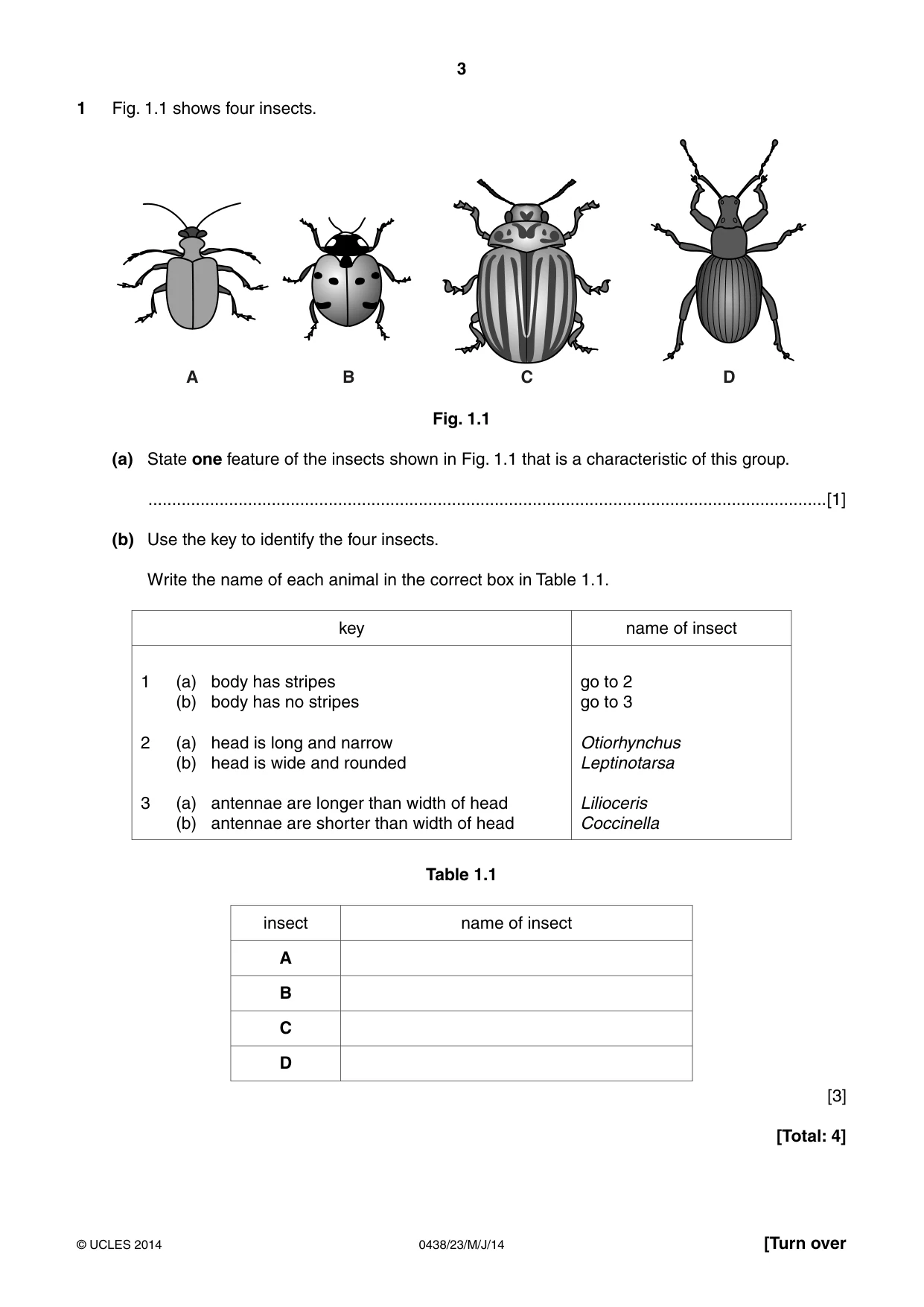
3 0438/23/M/J/14 © UCLES 2014 [Turn over 1 Fig. 1.1 shows four insects. A B C D Fig. 1.1 (a) State one feature of the insects shown in Fig. 1.1 that is a characteristic of this group. …[1] (b) Use the key to identify the four insects. Write the name of each animal in the correct box in Table 1.1. key name of insect 1 (a) body has stripes (b) body has no stripes 2 (a) head is long and narrow (b) head is wide and rounded 3 (a) antennae are longer than width of head (b) antennae are shorter than width of head go to 2 go to 3 Otiorhynchus Leptinotarsa Lilioceris Coccinella Table 1.1 insect name of insect A B C D [3] [Total: 4]
Question paper, page 4
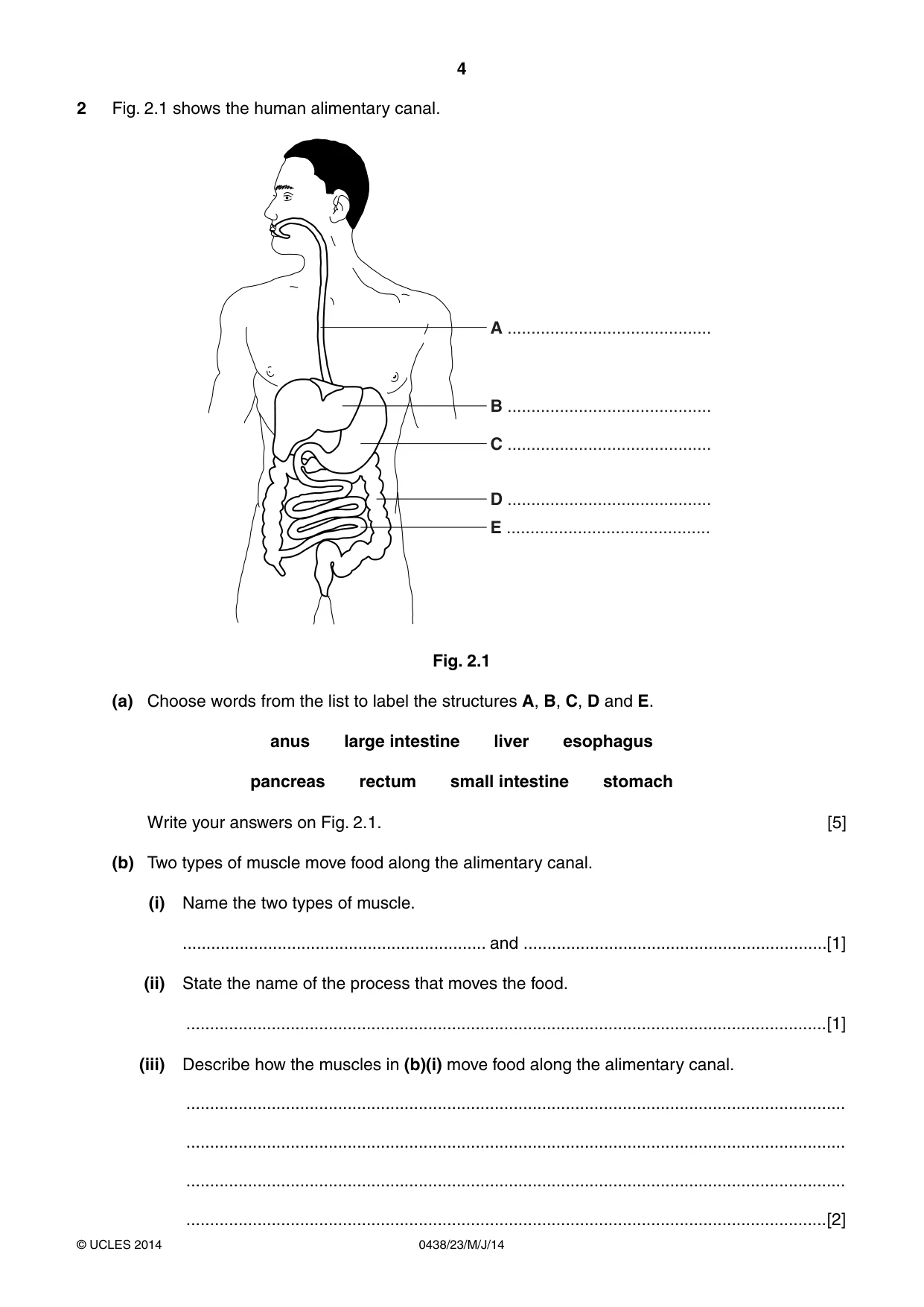
4 0438/23/M/J/14 © UCLES 2014 2 Fig. 2.1 shows the human alimentary canal. A … B … C … D … E … Fig. 2.1 (a) Choose words from the list to label the structures A, B, C, D and E. anus large intestine liver esophagus pancreas rectum small intestine stomach Write your answers on Fig. 2.1. [5] (b) Two types of muscle move food along the alimentary canal. (i) Name the two types of muscle. … and …[1] (ii) State the name of the process that moves the food. …[1] (iii) Describe how the muscles in (b)(i) move food along the alimentary canal. … … … …[2]
Question paper, page 5
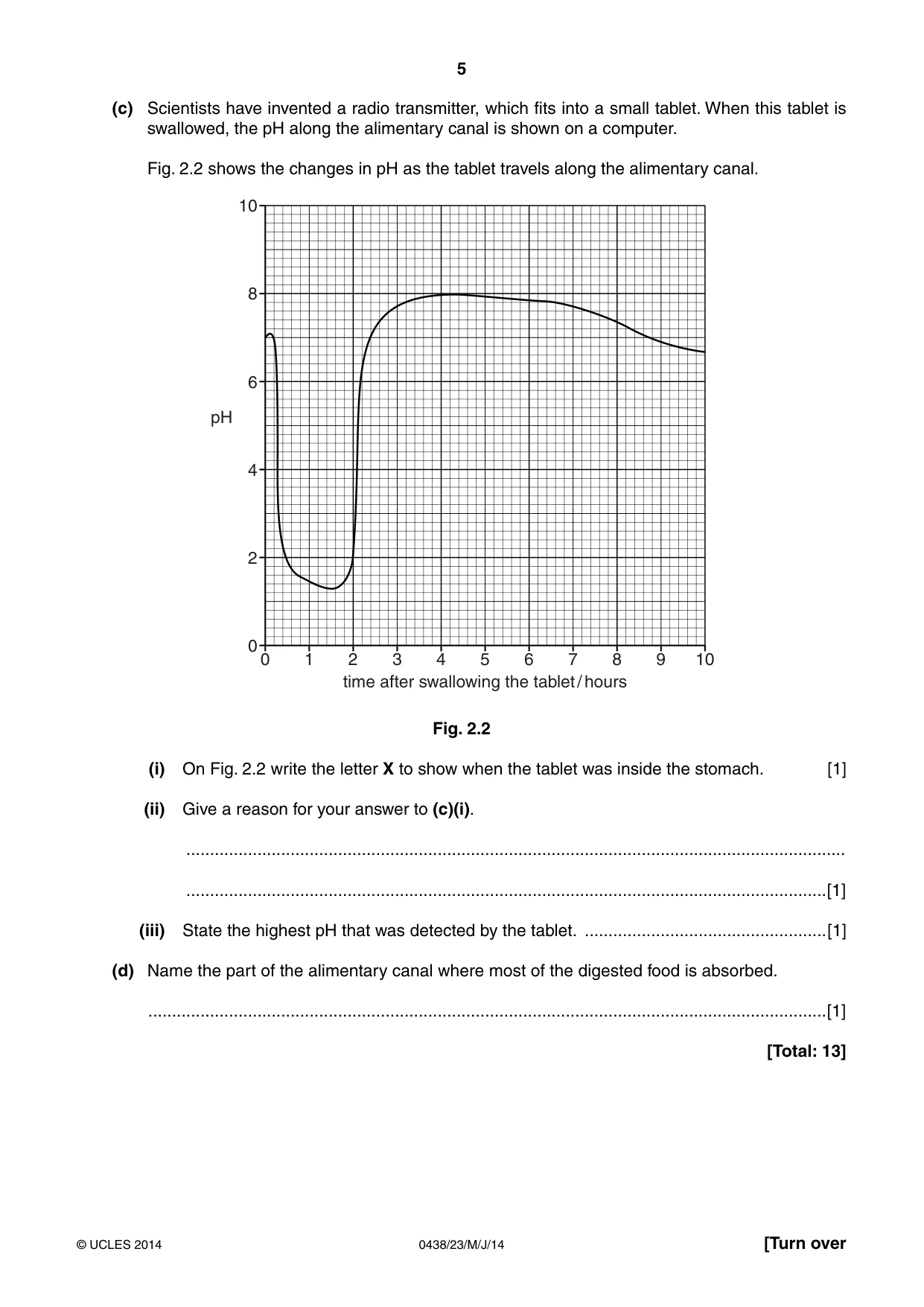
5 0438/23/M/J/14 © UCLES 2014 [Turn over (c) Scientists have invented a radio transmitter, which fits into a small tablet. When this tablet is swallowed, the pH along the alimentary canal is shown on a computer. Fig. 2.2 shows the changes in pH as the tablet travels along the alimentary canal. 0 0 2 4 6 8 10 1 2 3 4 5 time after swallowing the tablet / hours pH 6 7 8 9 10 Fig. 2.2 (i) On Fig. 2.2 write the letter X to show when the tablet was inside the stomach. [1] (ii) Give a reason for your answer to (c)(i). … …[1] (iii) State the highest pH that was detected by the tablet. …[1] (d) Name the part of the alimentary canal where most of the digested food is absorbed. …[1] [Total: 13]
Question paper, page 6
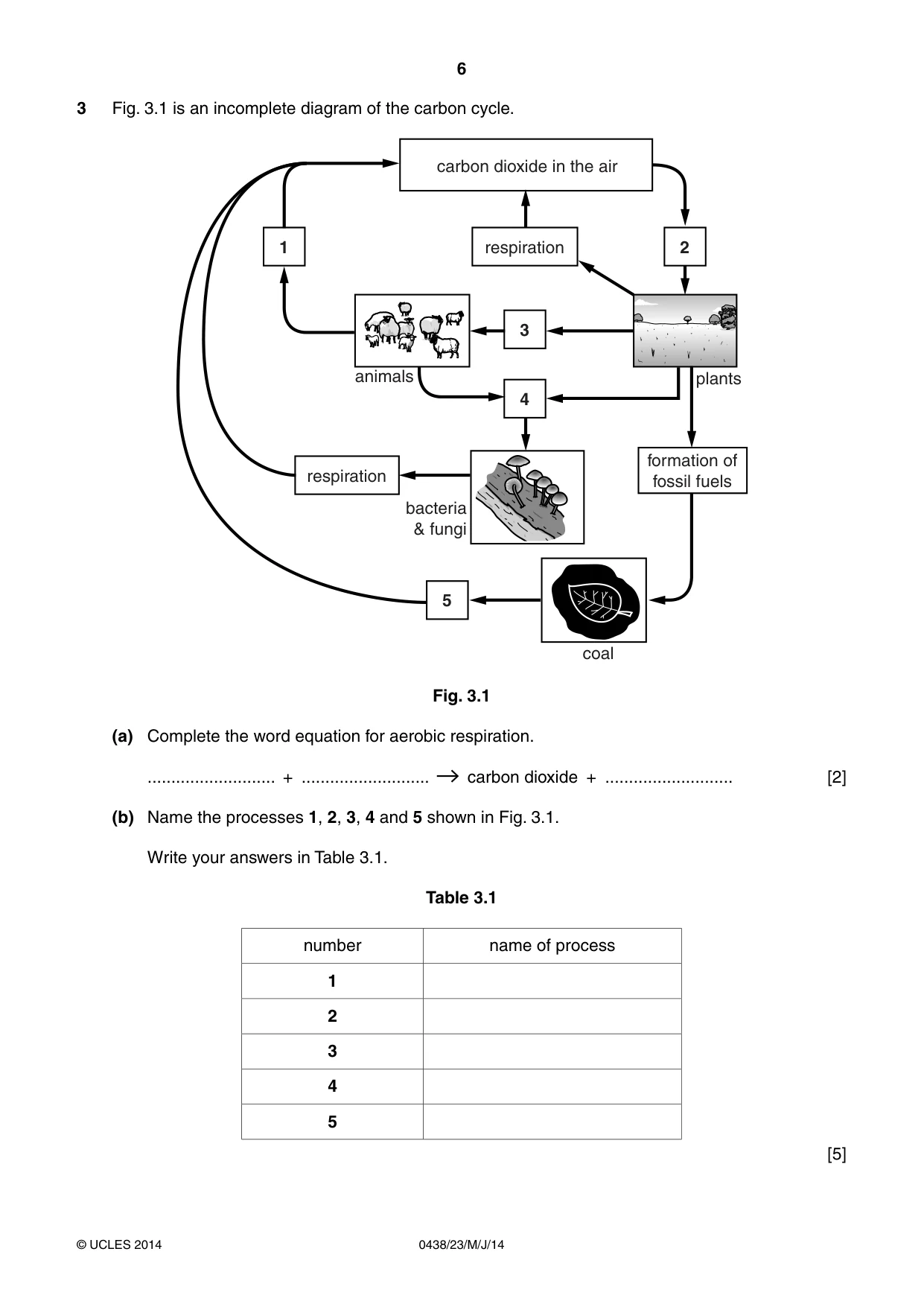
6 0438/23/M/J/14 © UCLES 2014 3 Fig. 3.1 is an incomplete diagram of the carbon cycle. carbon dioxide in the air 1 respiration 2 3 4 5 respiration bacteria & fungi animals plants coal formation of fossil fuels Fig. 3.1 (a) Complete the word equation for aerobic respiration. … + … carbon dioxide + … [2] (b) Name the processes 1, 2, 3, 4 and 5 shown in Fig. 3.1. Write your answers in Table 3.1. Table 3.1 number name of process 1 2 3 4 5 [5]
Question paper, page 7
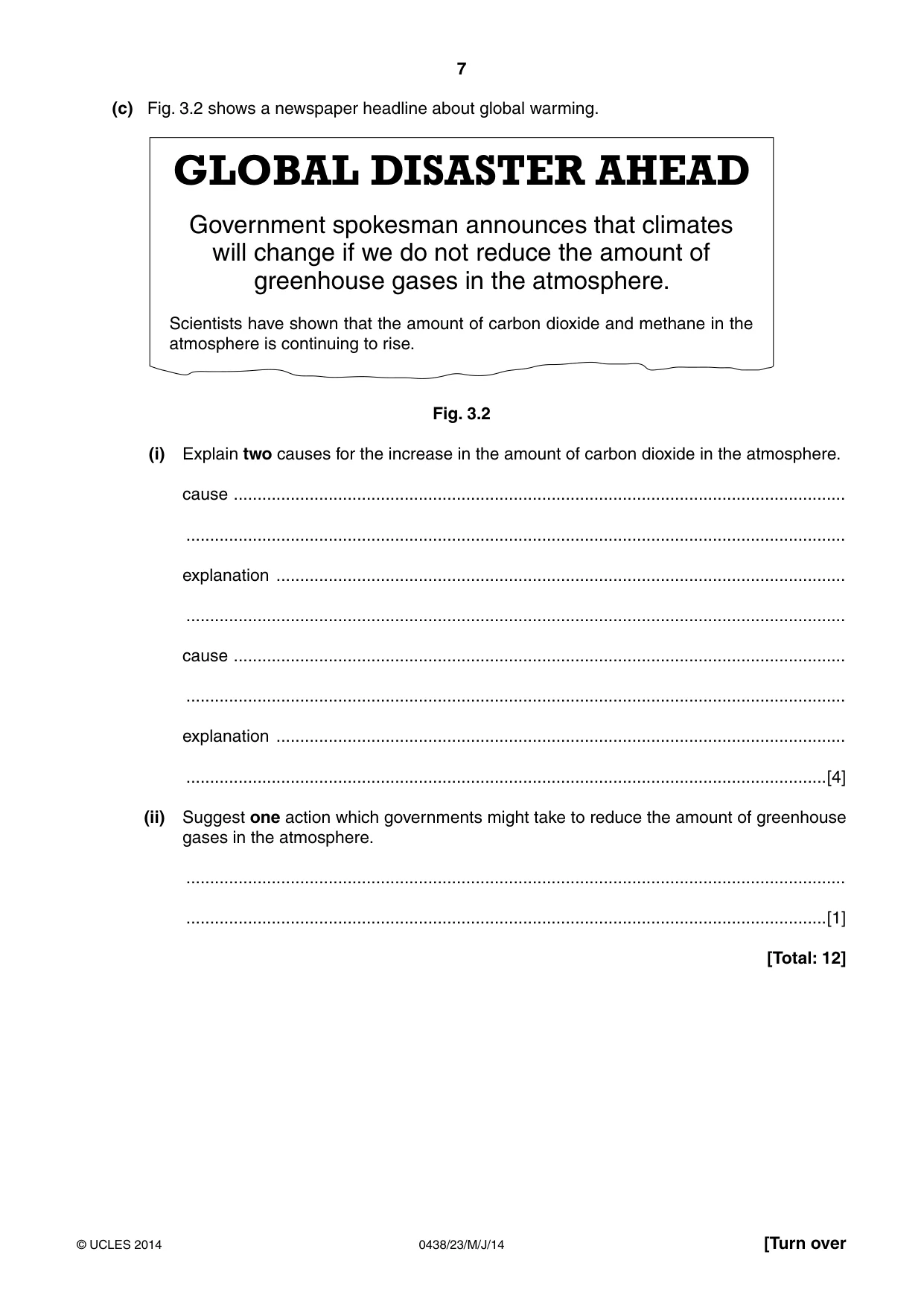
7 0438/23/M/J/14 © UCLES 2014 [Turn over (c) Fig. 3.2 shows a newspaper headline about global warming. GLOBAL DISASTER AHEAD Government spokesman announces that climates will change if we do not reduce the amount of greenhouse gases in the atmosphere. Scientists have shown that the amount of carbon dioxide and methane in the atmosphere is continuing to rise. Fig. 3.2 (i) Explain two causes for the increase in the amount of carbon dioxide in the atmosphere. cause … … explanation … … cause … … explanation … …[4] (ii) Suggest one action which governments might take to reduce the amount of greenhouse gases in the atmosphere. … …[1] [Total: 12]
Question paper, page 8
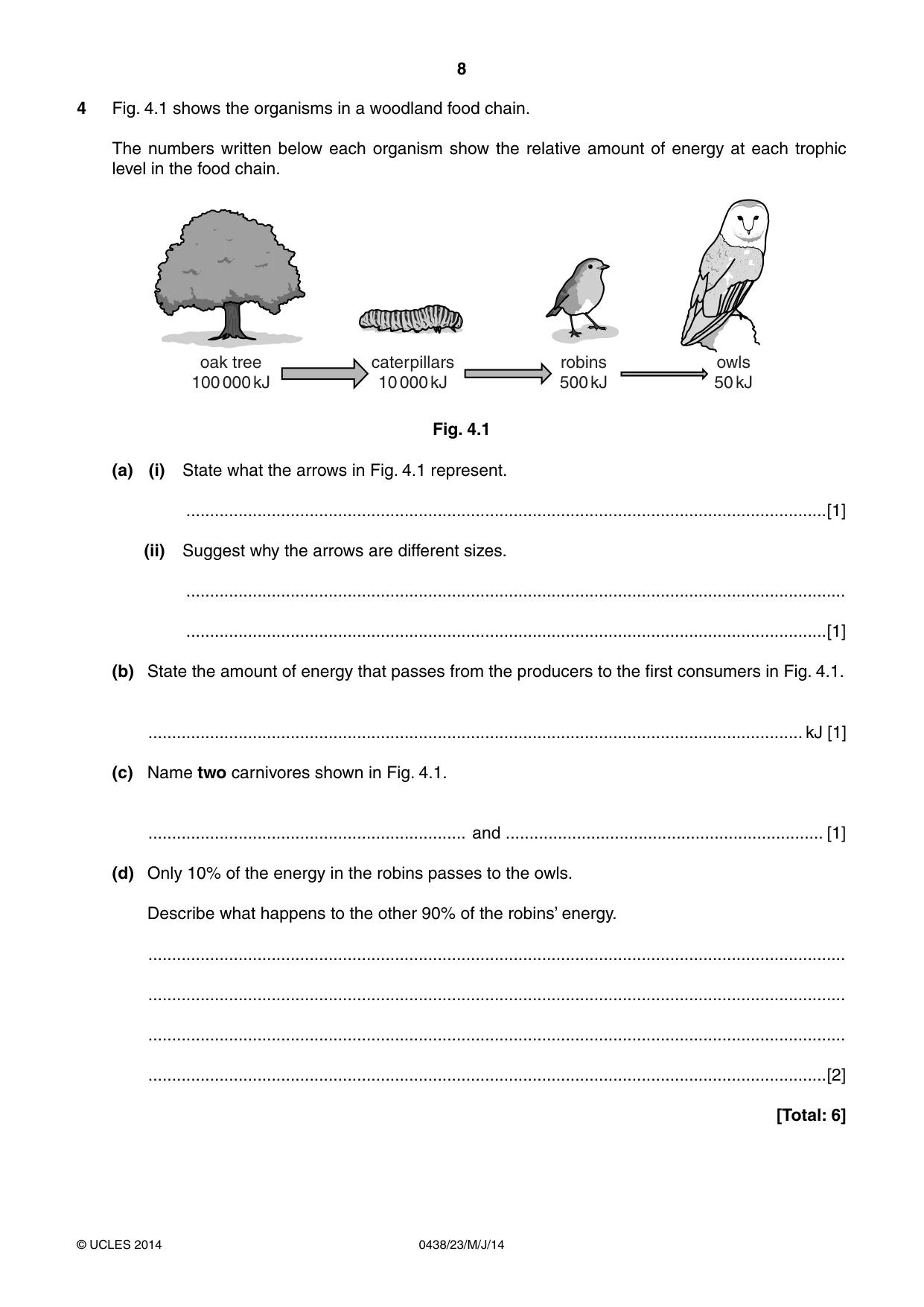
8 0438/23/M/J/14 © UCLES 2014 4 Fig. 4.1 shows the organisms in a woodland food chain. The numbers written below each organism show the relative amount of energy at each trophic level in the food chain. oak tree 100 000 kJ caterpillars 10 000 kJ robins 500 kJ owls 50 kJ Fig. 4.1 (a) (i) State what the arrows in Fig. 4.1 represent. …[1] (ii) Suggest why the arrows are different sizes. … …[1] (b) State the amount of energy that passes from the producers to the first consumers in Fig. 4.1. … kJ [1] (c) Name two carnivores shown in Fig. 4.1. … and … [1] (d) Only 10% of the energy in the robins passes to the owls. Describe what happens to the other 90% of the robins’ energy. … … … …[2] [Total: 6]
Question paper, page 9
9 0438/23/M/J/14 © UCLES 2014 [Turn over Question 5 starts on page 10.
Question paper, page 10
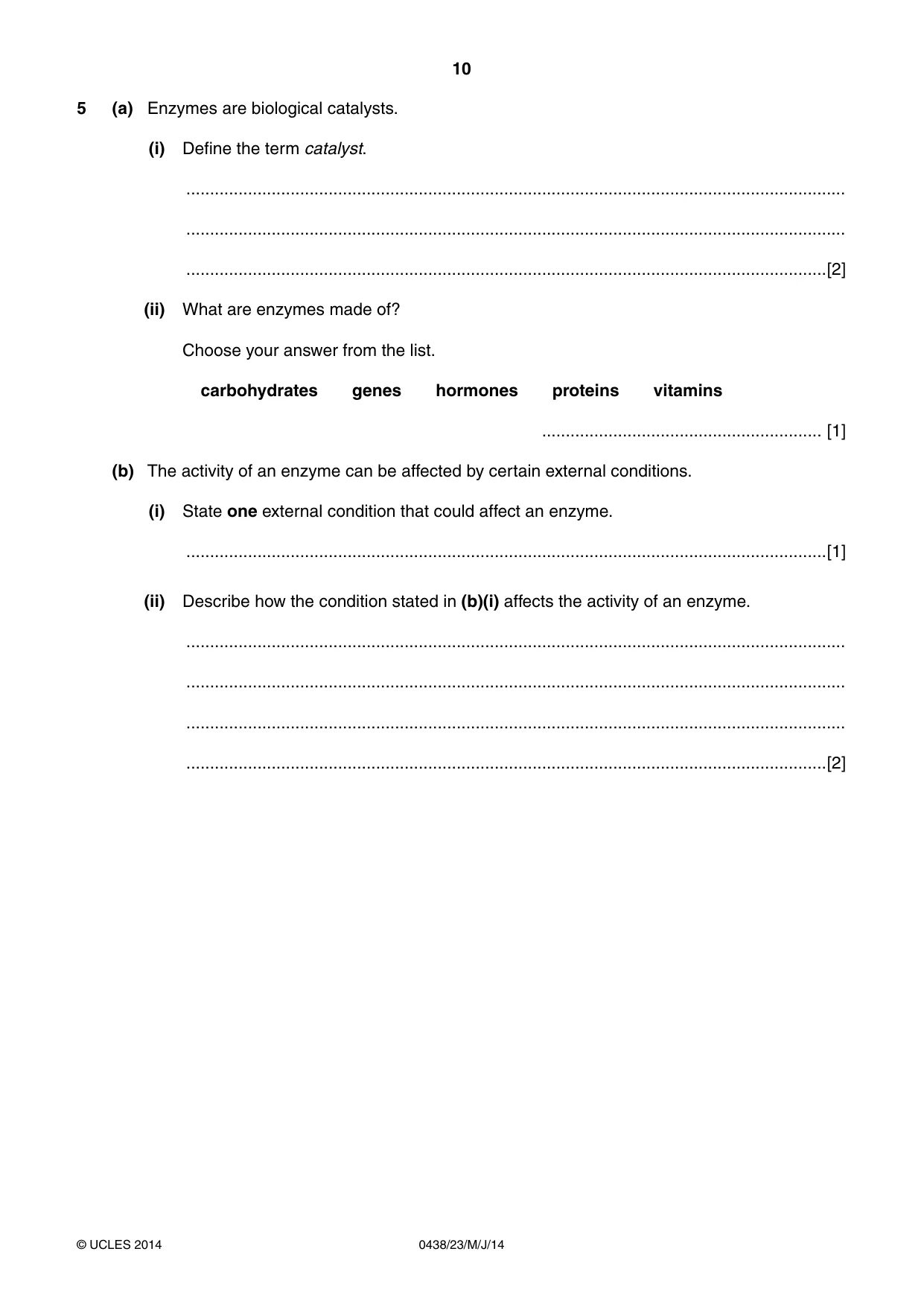
10 0438/23/M/J/14 © UCLES 2014 5 (a) Enzymes are biological catalysts. (i) Define the term catalyst. … … …[2] (ii) What are enzymes made of? Choose your answer from the list. carbohydrates genes hormones proteins vitamins … [1] (b) The activity of an enzyme can be affected by certain external conditions. (i) State one external condition that could affect an enzyme. …[1] (ii) Describe how the condition stated in (b)(i) affects the activity of an enzyme. … … … …[2]
Question paper, page 11
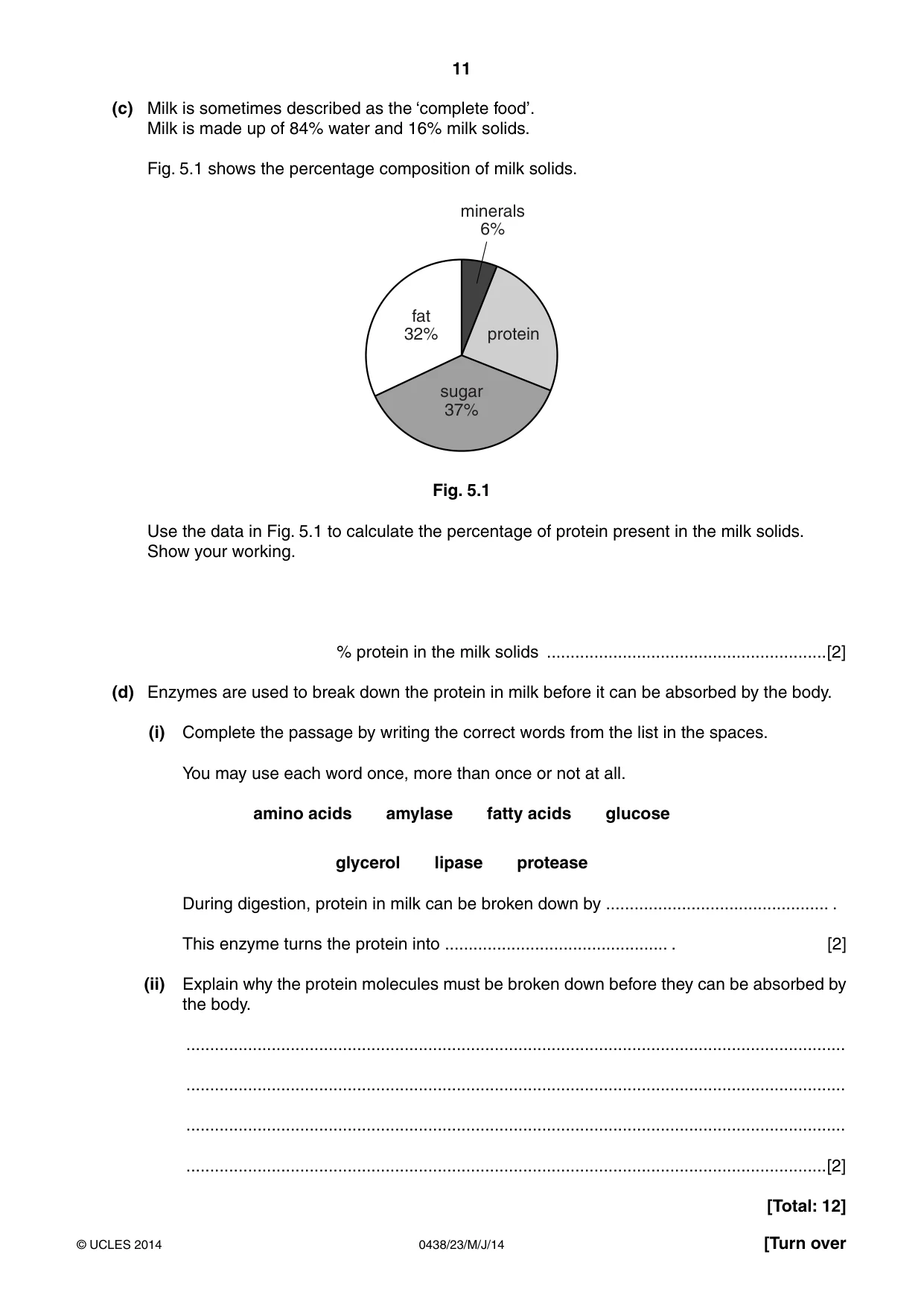
11 0438/23/M/J/14 © UCLES 2014 [Turn over (c) Milk is sometimes described as the ‘complete food’. Milk is made up of 84% water and 16% milk solids. Fig. 5.1 shows the percentage composition of milk solids. fat 32% sugar 37% protein minerals 6% Fig. 5.1 Use the data in Fig. 5.1 to calculate the percentage of protein present in the milk solids. Show your working. % protein in the milk solids …[2] (d) Enzymes are used to break down the protein in milk before it can be absorbed by the body. (i) Complete the passage by writing the correct words from the list in the spaces. You may use each word once, more than once or not at all. amino acids amylase fatty acids glucose glycerol lipase protease During digestion, protein in milk can be broken down by … . This enzyme turns the protein into … . [2] (ii) Explain why the protein molecules must be broken down before they can be absorbed by the body. … … … …[2] [Total: 12]
Question paper, page 12
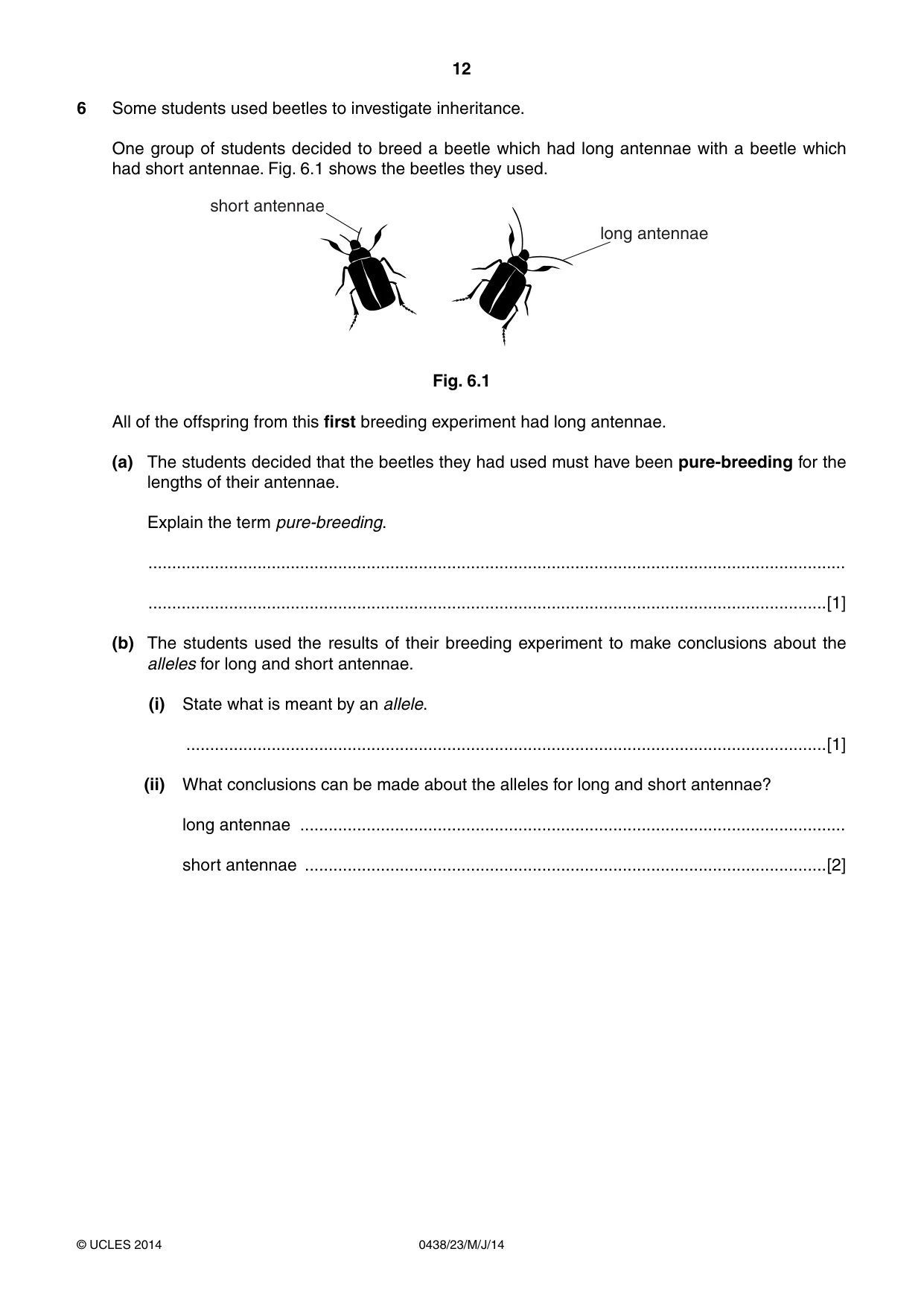
12 0438/23/M/J/14 © UCLES 2014 6 Some students used beetles to investigate inheritance. One group of students decided to breed a beetle which had long antennae with a beetle which had short antennae. Fig. 6.1 shows the beetles they used. short antennae long antennae Fig. 6.1 All of the offspring from this first breeding experiment had long antennae. (a) The students decided that the beetles they had used must have been pure-breeding for the lengths of their antennae. Explain the term pure-breeding. … …[1] (b) The students used the results of their breeding experiment to make conclusions about the alleles for long and short antennae. (i) State what is meant by an allele. …[1] (ii) What conclusions can be made about the alleles for long and short antennae? long antennae … short antennae …[2]
Question paper, page 13
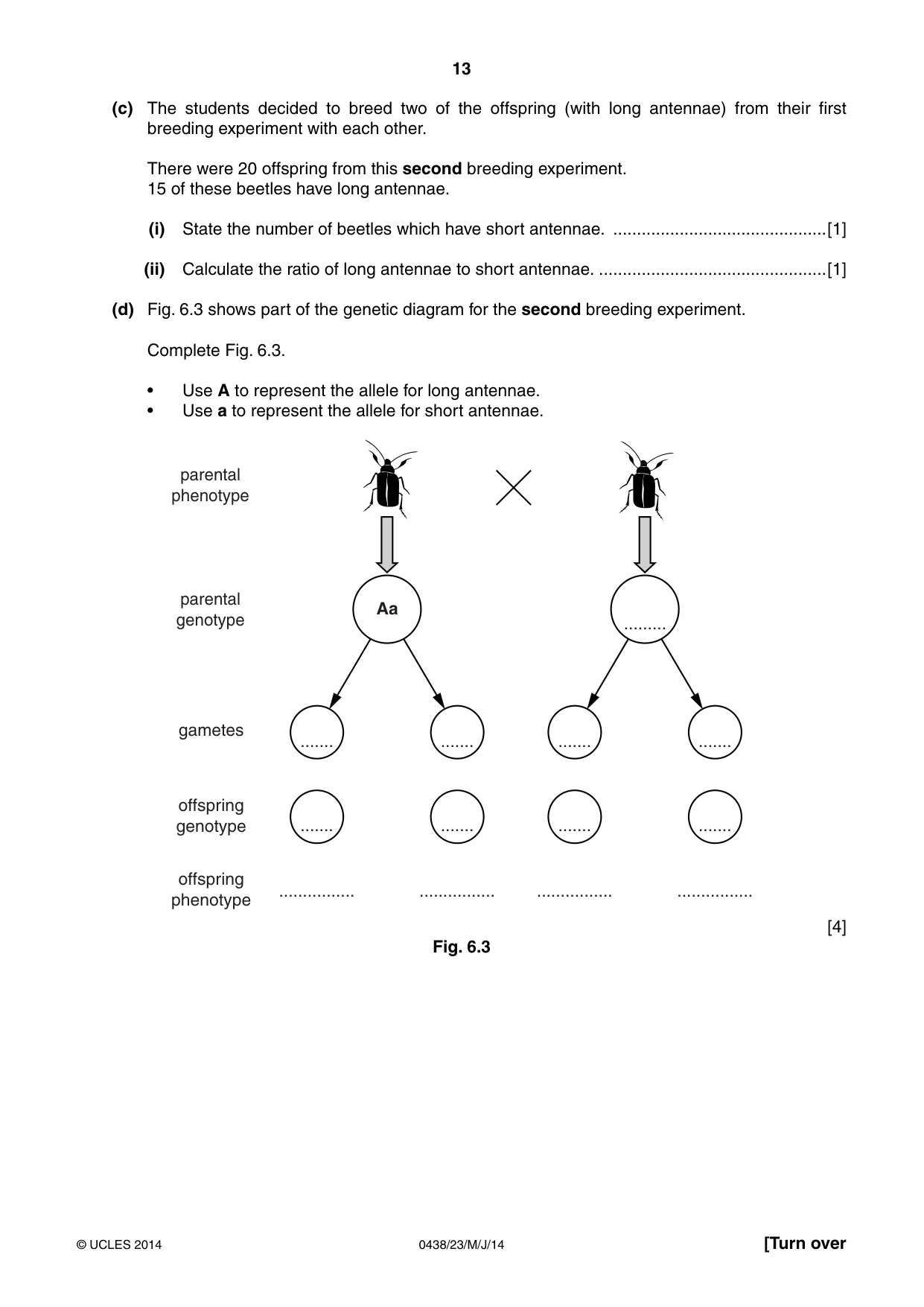
13 0438/23/M/J/14 © UCLES 2014 [Turn over (c) The students decided to breed two of the offspring (with long antennae) from their first breeding experiment with each other. There were 20 offspring from this second breeding experiment. 15 of these beetles have long antennae. (i) State the number of beetles which have short antennae. …[1] (ii) Calculate the ratio of long antennae to short antennae. …[1] (d) Fig. 6.3 shows part of the genetic diagram for the second breeding experiment. Complete Fig. 6.3. • Use A to represent the allele for long antennae. • Use a to represent the allele for short antennae. Aa … … … … … gametes … … … … … … … … offspring genotype offspring phenotype parental phenotype parental genotype [4] Fig. 6.3
Question paper, page 14
14 0438/23/M/J/14 © UCLES 2014 (e) In another investigation, a beetle with long antennae and a beetle with short antennae were bred together several times. A total of 60 offspring were produced. There were 31 with long antennae and 29 with short antennae. Deduce the genotype of the parent that had long antennae. …[1] [Total: 11]
Question paper, page 15
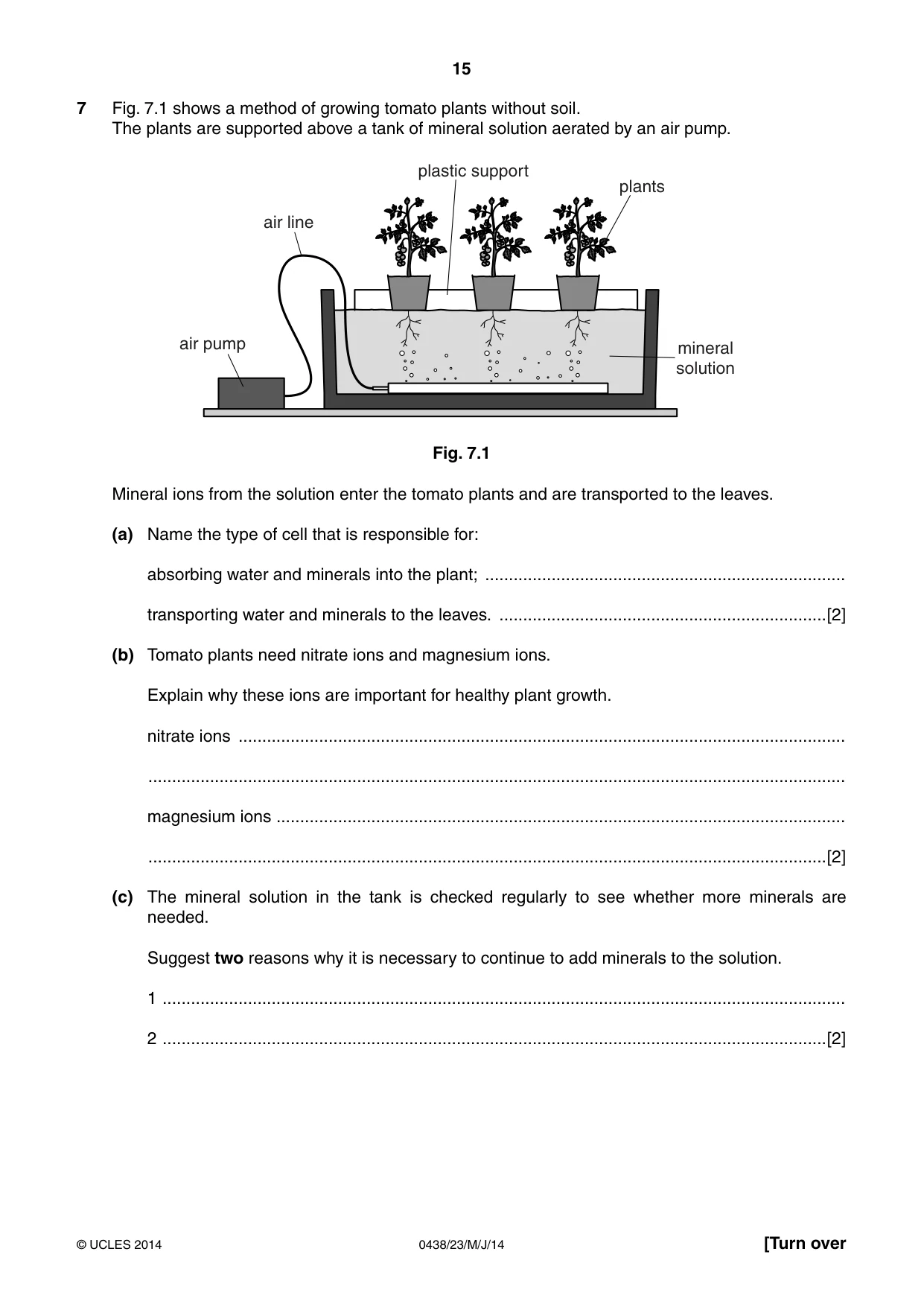
15 0438/23/M/J/14 © UCLES 2014 [Turn over 7 Fig. 7.1 shows a method of growing tomato plants without soil. The plants are supported above a tank of mineral solution aerated by an air pump. plastic support air line air pump mineral solution plants Fig. 7.1 Mineral ions from the solution enter the tomato plants and are transported to the leaves. (a) Name the type of cell that is responsible for: absorbing water and minerals into the plant; … transporting water and minerals to the leaves. …[2] (b) Tomato plants need nitrate ions and magnesium ions. Explain why these ions are important for healthy plant growth. nitrate ions … … magnesium ions … …[2] (c) The mineral solution in the tank is checked regularly to see whether more minerals are needed. Suggest two reasons why it is necessary to continue to add minerals to the solution. 1 … 2 …[2]
Question paper, page 16
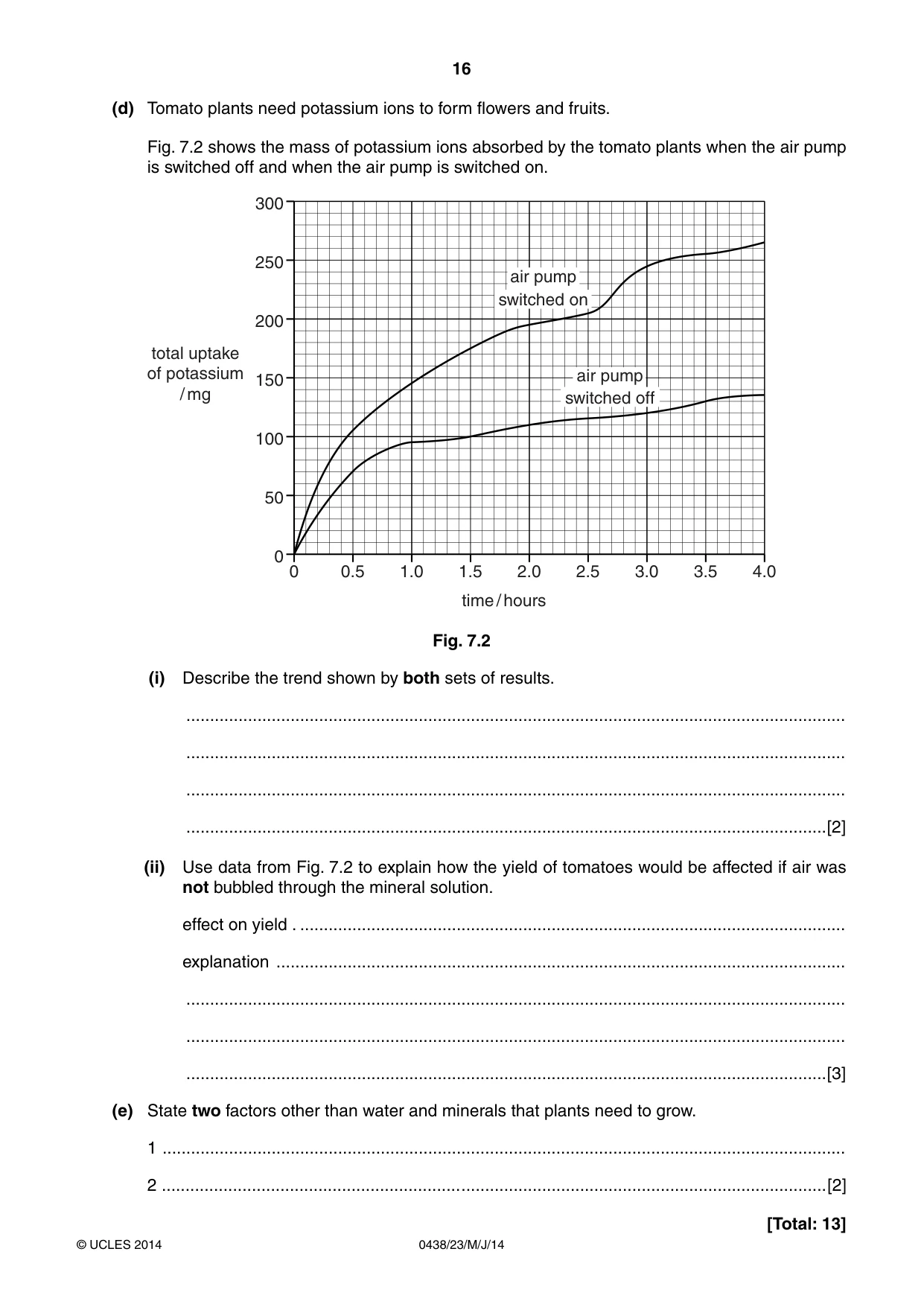
16 0438/23/M/J/14 © UCLES 2014 (d) Tomato plants need potassium ions to form flowers and fruits. Fig. 7.2 shows the mass of potassium ions absorbed by the tomato plants when the air pump is switched off and when the air pump is switched on. 0 0 100 200 300 50 150 total uptake of potassium / mg 250 0.5 1.0 1.5 2.0 2.5 time / hours 3.0 3.5 4.0 air pump switched on air pump switched off Fig. 7.2 (i) Describe the trend shown by both sets of results. … … … …[2] (ii) Use data from Fig. 7.2 to explain how the yield of tomatoes would be affected if air was not bubbled through the mineral solution. effect on yield . … explanation … … … …[3] (e) State two factors other than water and minerals that plants need to grow. 1 … 2 … …[2] [Total: 13]
Question paper, page 17
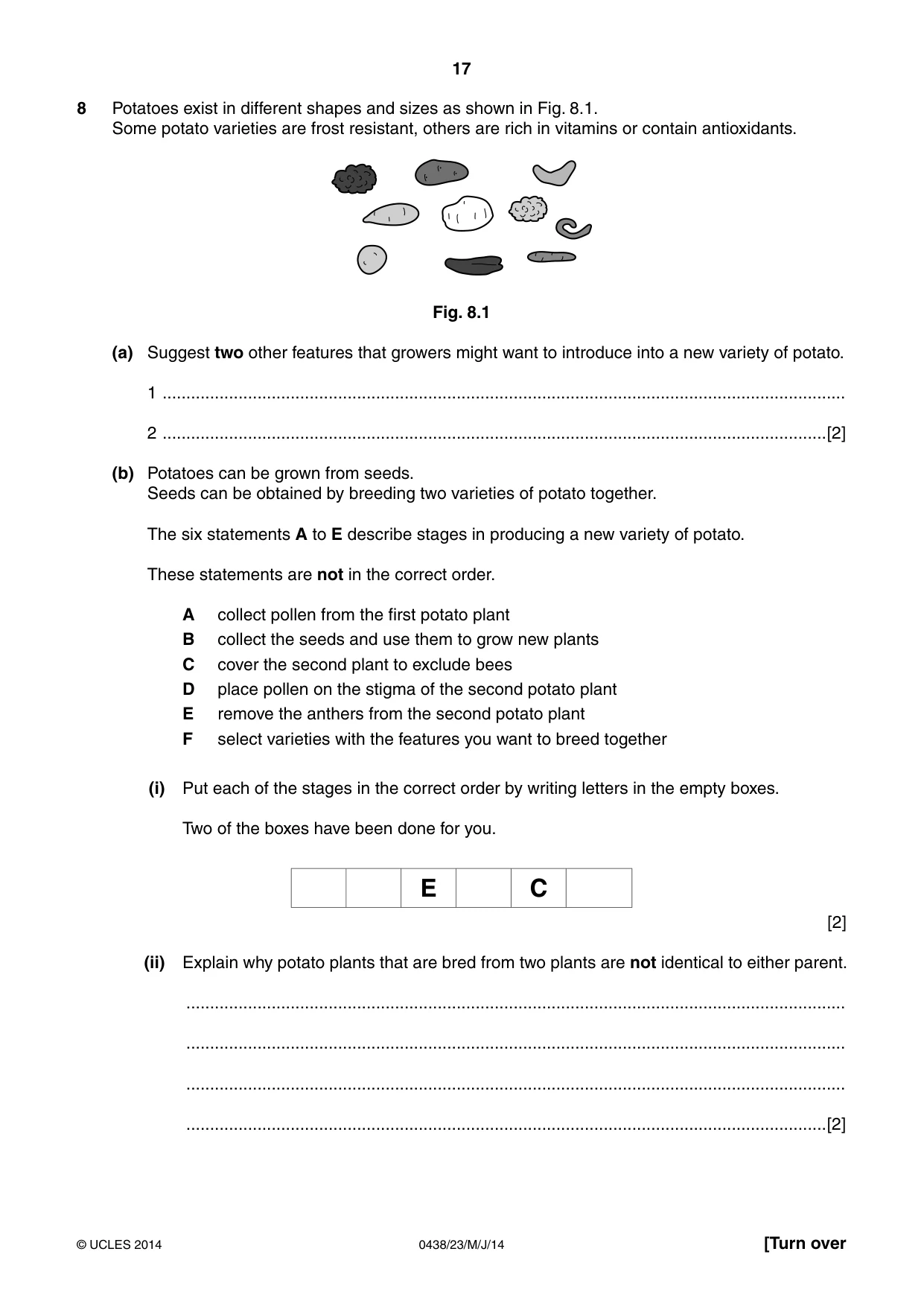
17 0438/23/M/J/14 © UCLES 2014 [Turn over 8 Potatoes exist in different shapes and sizes as shown in Fig. 8.1. Some potato varieties are frost resistant, others are rich in vitamins or contain antioxidants. Fig. 8.1 (a) Suggest two other features that growers might want to introduce into a new variety of potato. 1 … 2 …[2] (b) Potatoes can be grown from seeds. Seeds can be obtained by breeding two varieties of potato together. The six statements A to E describe stages in producing a new variety of potato. These statements are not in the correct order. A collect pollen from the first potato plant B collect the seeds and use them to grow new plants C cover the second plant to exclude bees D place pollen on the stigma of the second potato plant E remove the anthers from the second potato plant F select varieties with the features you want to breed together (i) Put each of the stages in the correct order by writing letters in the empty boxes. Two of the boxes have been done for you. E C [2] (ii) Explain why potato plants that are bred from two plants are not identical to either parent. … … … …[2]
Question paper, page 18
18 0438/23/M/J/14 © UCLES 2014 (c) Explain why all the plants that are grown from the tubers of one potato plant are very similar. … … … …[2] (d) It is now possible to alter the DNA in potato plants so that they produce chemicals that can be used as bioplastics or biofuels. State the name of the process used to alter the DNA in plants. Choose your answer from the list. artificial selection genetic engineering natural selection selective breeding …[1] [Total: 9]
Question paper, page 19
19 0438/23/M/J/14 © UCLES 2014 BLANK PAGE
Question paper, page 20
20 0438/23/M/J/14 © UCLES 2014 Permission to reproduce items where third-party owned material protected by copyright is included has been sought and cleared where possible. Every reasonable effort has been made by the publisher (UCLES) to trace copyright holders, but if any items requiring clearance have unwittingly been included, the publisher will be pleased to make amends at the earliest possible opportunity. Cambridge International Examinations is part of the Cambridge Assessment Group. Cambridge Assessment is the brand name of University of Cambridge Local Examinations Syndicate (UCLES), which is itself a department of the University of Cambridge. BLANK PAGE
Mark scheme, page 1
CAMBRIDGE INTERNATIONAL EXAMINATIONS International General Certificate of Secondary Education MARK SCHEME for the May/June 2014 series 0438 BIOLOGY (US) 0438/23 Paper 2 (Core Theory), maximum raw mark 80 This mark scheme is published as an aid to teachers and candidates, to indicate the requirements of the examination. It shows the basis on which Examiners were instructed to award marks. It does not indicate the details of the discussions that took place at an Examiners’ meeting before marking began, which would have considered the acceptability of alternative answers. Mark schemes should be read in conjunction with the question paper and the Principal Examiner Report for Teachers. Cambridge will not enter into discussions about these mark schemes. Cambridge is publishing the mark schemes for the May/June 2014 series for most IGCSE, GCE Advanced Level and Advanced Subsidiary Level components and some Ordinary Level components.
Mark scheme, page 2
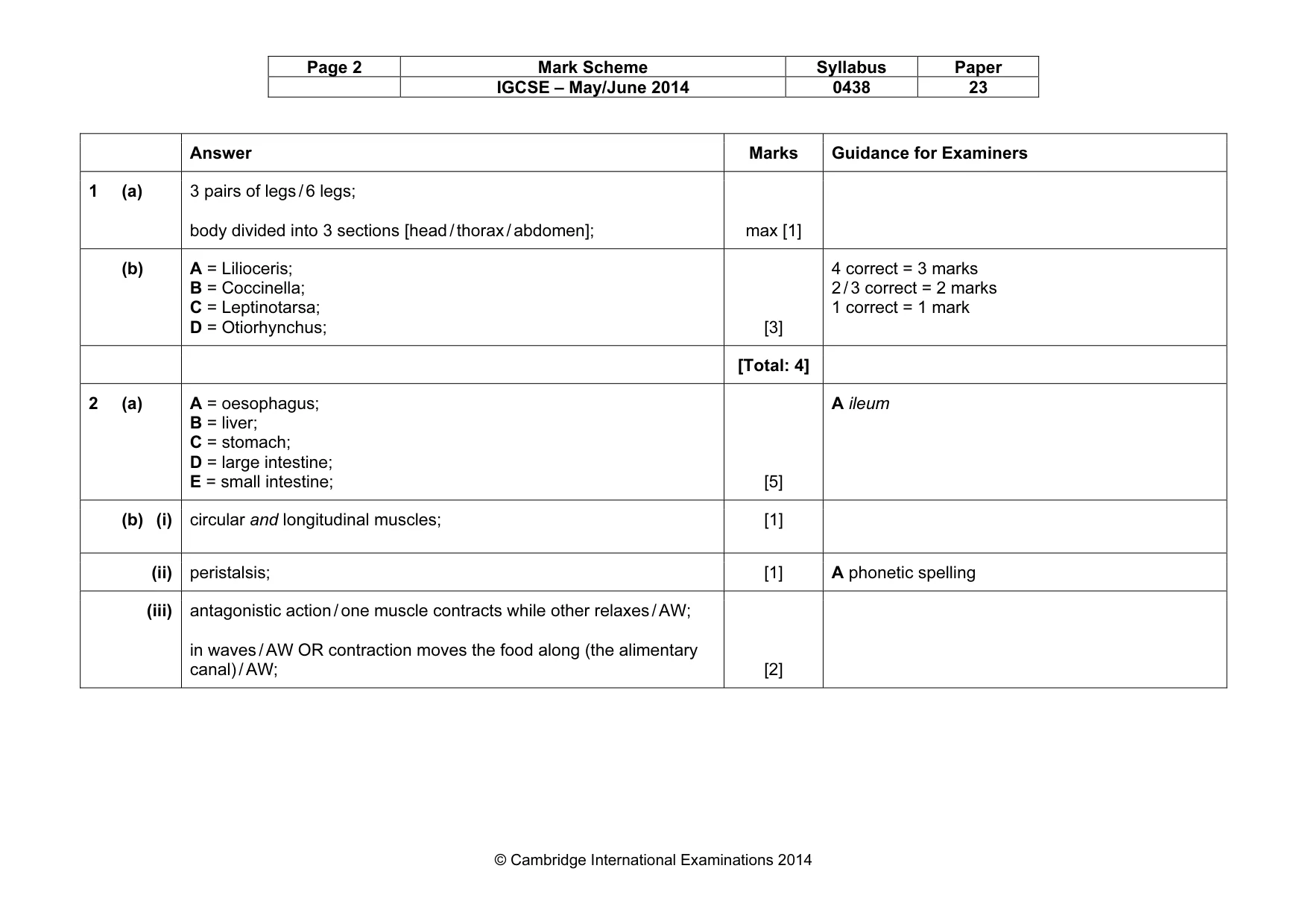
Page 2 Mark Scheme Syllabus Paper IGCSE – May/June 2014 0438 23 © Cambridge International Examinations 2014 Answer Marks Guidance for Examiners 1 (a) 3 pairs of legs / 6 legs; body divided into 3 sections [head / thorax / abdomen]; max [1] (b) A = Lilioceris; B = Coccinella; C = Leptinotarsa; D = Otiorhynchus; [3] 4 correct = 3 marks 2 / 3 correct = 2 marks 1 correct = 1 mark [Total: 4] 2 (a) A = oesophagus; B = liver; C = stomach; D = large intestine; E = small intestine; [5] A ileum (b) (i) circular and longitudinal muscles; [1] (ii) peristalsis; [1] A phonetic spelling (iii) antagonistic action / one muscle contracts while other relaxes / AW; in waves / AW OR contraction moves the food along (the alimentary canal) / AW; [2]
Mark scheme, page 3
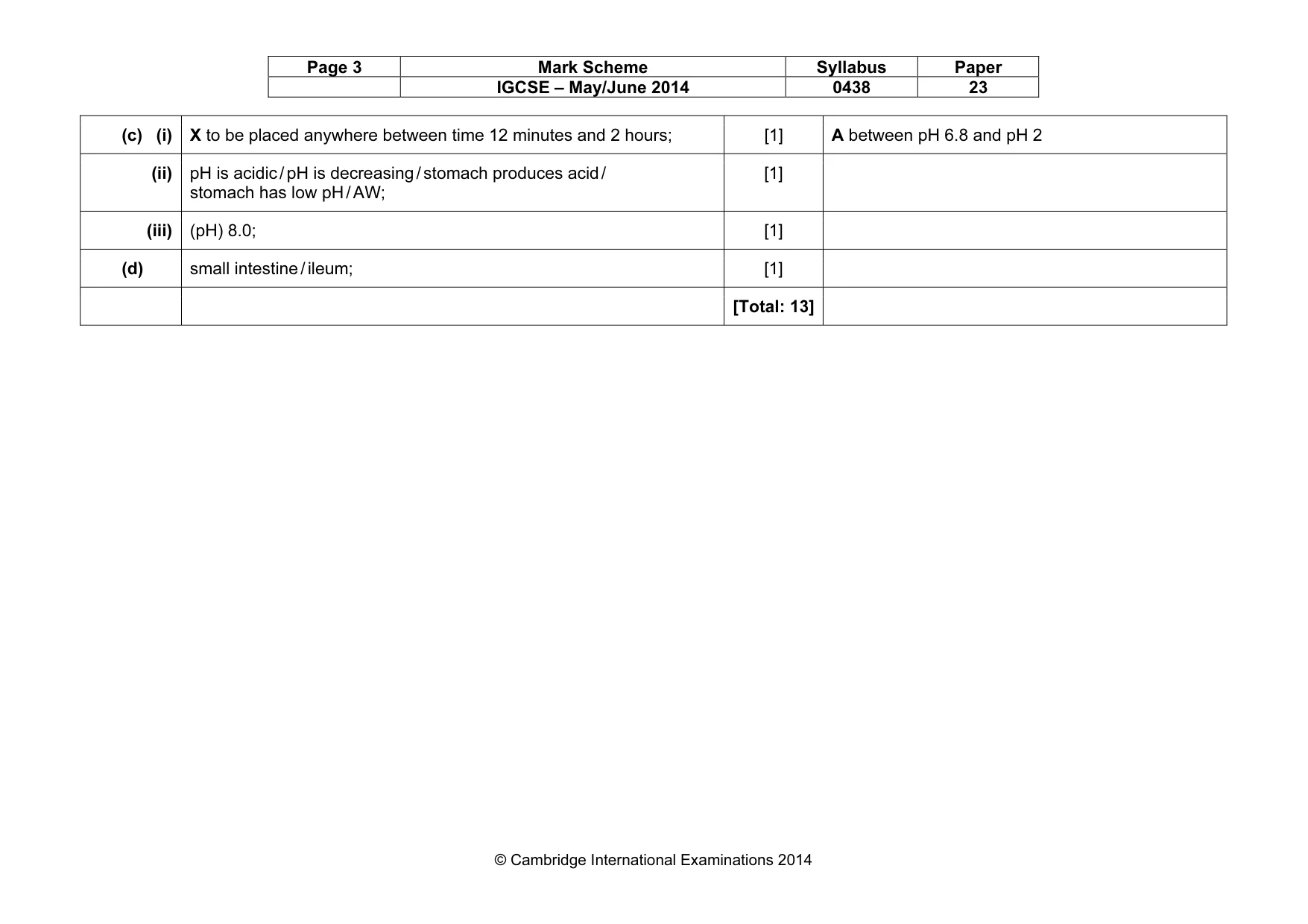
Page 3 Mark Scheme Syllabus Paper IGCSE – May/June 2014 0438 23 © Cambridge International Examinations 2014 (c) (i) X to be placed anywhere between time 12 minutes and 2 hours; [1] A between pH 6.8 and pH 2 (ii) pH is acidic / pH is decreasing / stomach produces acid / stomach has low pH / AW; [1] (iii) (pH) 8.0; [1] (d) small intestine / ileum; [1] [Total: 13]
Mark scheme, page 4
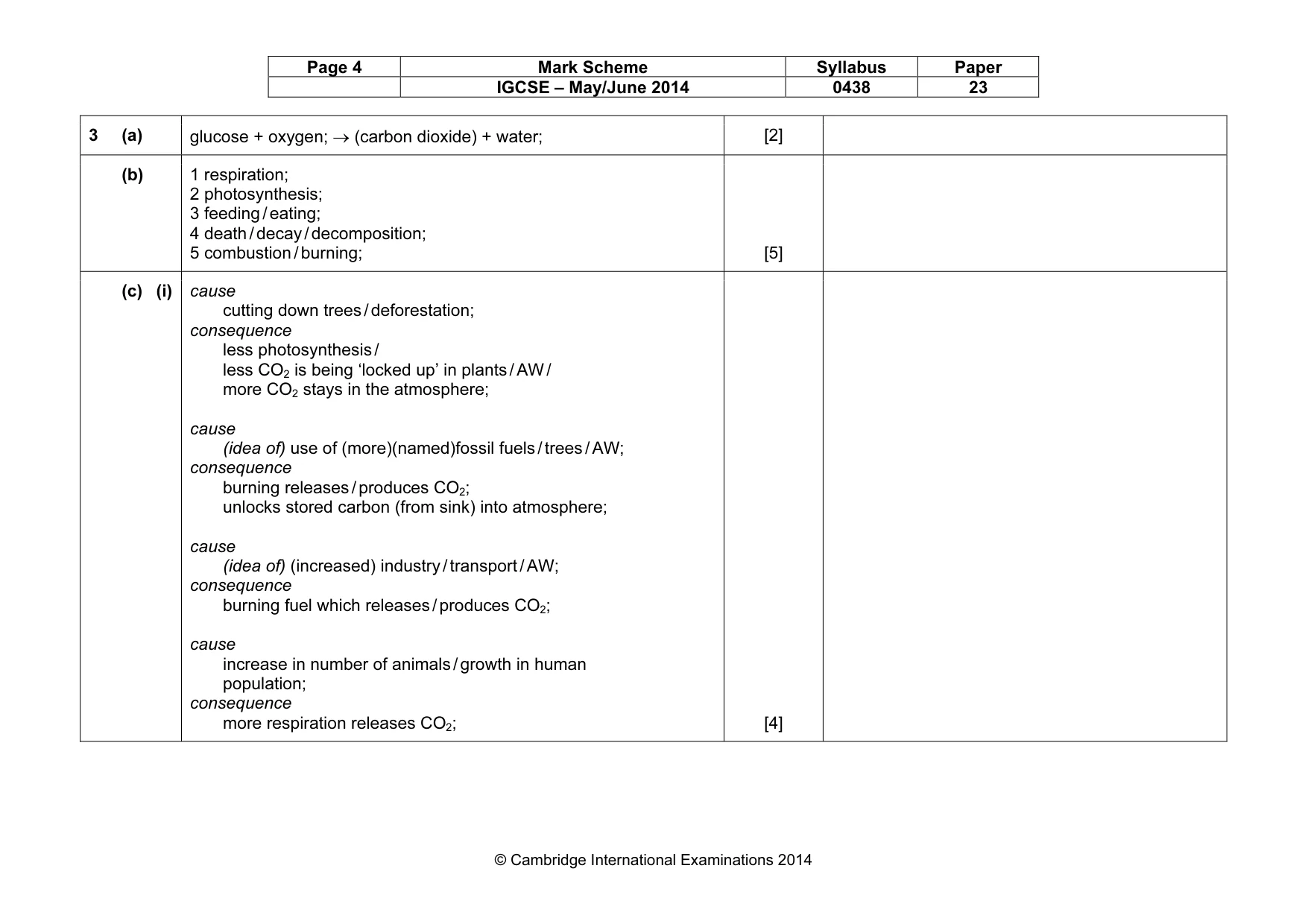
Page 4 Mark Scheme Syllabus Paper IGCSE – May/June 2014 0438 23 © Cambridge International Examinations 2014 3 (a) glucose + oxygen; → (carbon dioxide) + water; [2] (b) 1 respiration; 2 photosynthesis; 3 feeding / eating; 4 death / decay / decomposition; 5 combustion / burning; [5] (c) (i) cause cutting down trees / deforestation; consequence less photosynthesis / less CO2 is being ‘locked up’ in plants / AW / more CO2 stays in the atmosphere; cause (idea of) use of (more)(named)fossil fuels / trees / AW; consequence burning releases / produces CO2; unlocks stored carbon (from sink) into atmosphere; cause (idea of) (increased) industry / transport / AW; consequence burning fuel which releases / produces CO2; cause increase in number of animals / growth in human population; consequence more respiration releases CO2; [4]
Mark scheme, page 5
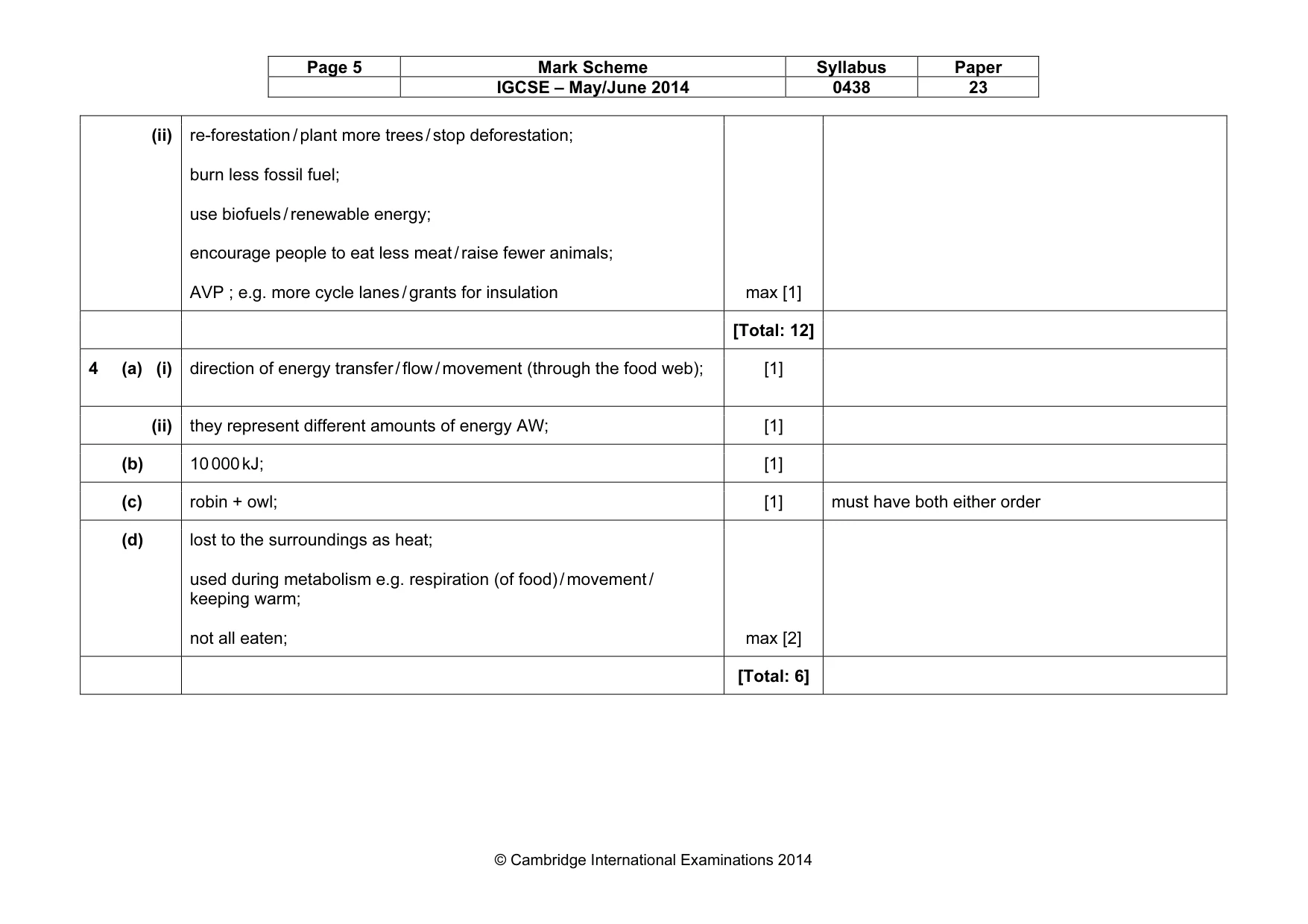
Page 5 Mark Scheme Syllabus Paper IGCSE – May/June 2014 0438 23 © Cambridge International Examinations 2014 (ii) re-forestation / plant more trees / stop deforestation; burn less fossil fuel; use biofuels / renewable energy; encourage people to eat less meat / raise fewer animals; AVP ; e.g. more cycle lanes / grants for insulation max [1] [Total: 12] 4 (a) (i) direction of energy transfer / flow / movement (through the food web); [1] (ii) they represent different amounts of energy AW; [1] (b) 10 000 kJ; [1] (c) robin + owl; [1] must have both either order (d) lost to the surroundings as heat; used during metabolism e.g. respiration (of food) / movement / keeping warm; not all eaten; max [2] [Total: 6]
Mark scheme, page 6
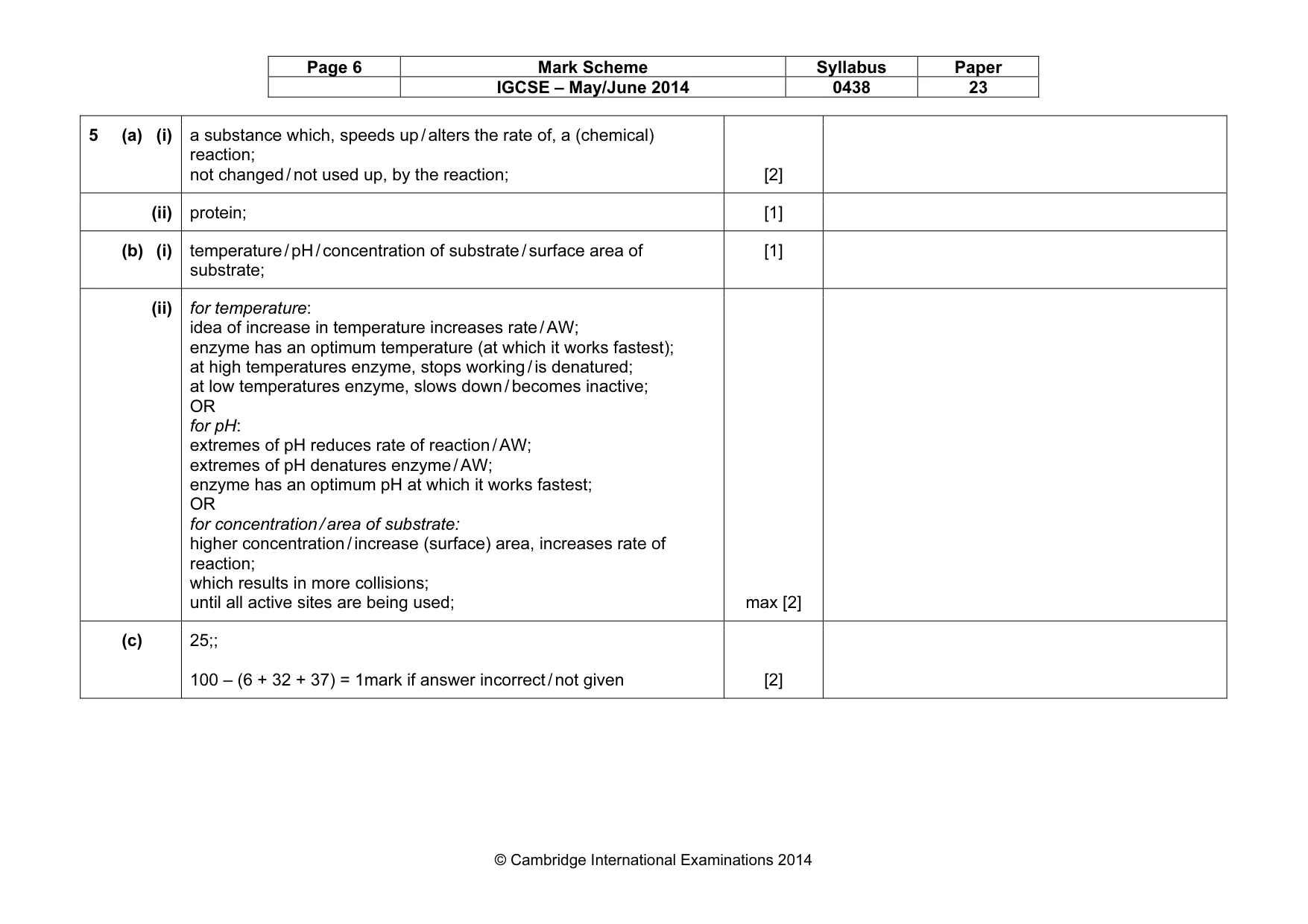
Page 6 Mark Scheme Syllabus Paper IGCSE – May/June 2014 0438 23 © Cambridge International Examinations 2014 5 (a) (i) a substance which, speeds up / alters the rate of, a (chemical) reaction; not changed / not used up, by the reaction; [2] (ii) protein; [1] (b) (i) temperature / pH / concentration of substrate / surface area of substrate; [1] (ii) for temperature: idea of increase in temperature increases rate / AW; enzyme has an optimum temperature (at which it works fastest); at high temperatures enzyme, stops working / is denatured; at low temperatures enzyme, slows down / becomes inactive; OR for pH: extremes of pH reduces rate of reaction / AW; extremes of pH denatures enzyme / AW; enzyme has an optimum pH at which it works fastest; OR for concentration / area of substrate: higher concentration / increase (surface) area, increases rate of reaction; which results in more collisions; until all active sites are being used; max [2] (c) 25;; 100 – (6 + 32 + 37) = 1mark if answer incorrect / not given [2]
Mark scheme, page 7
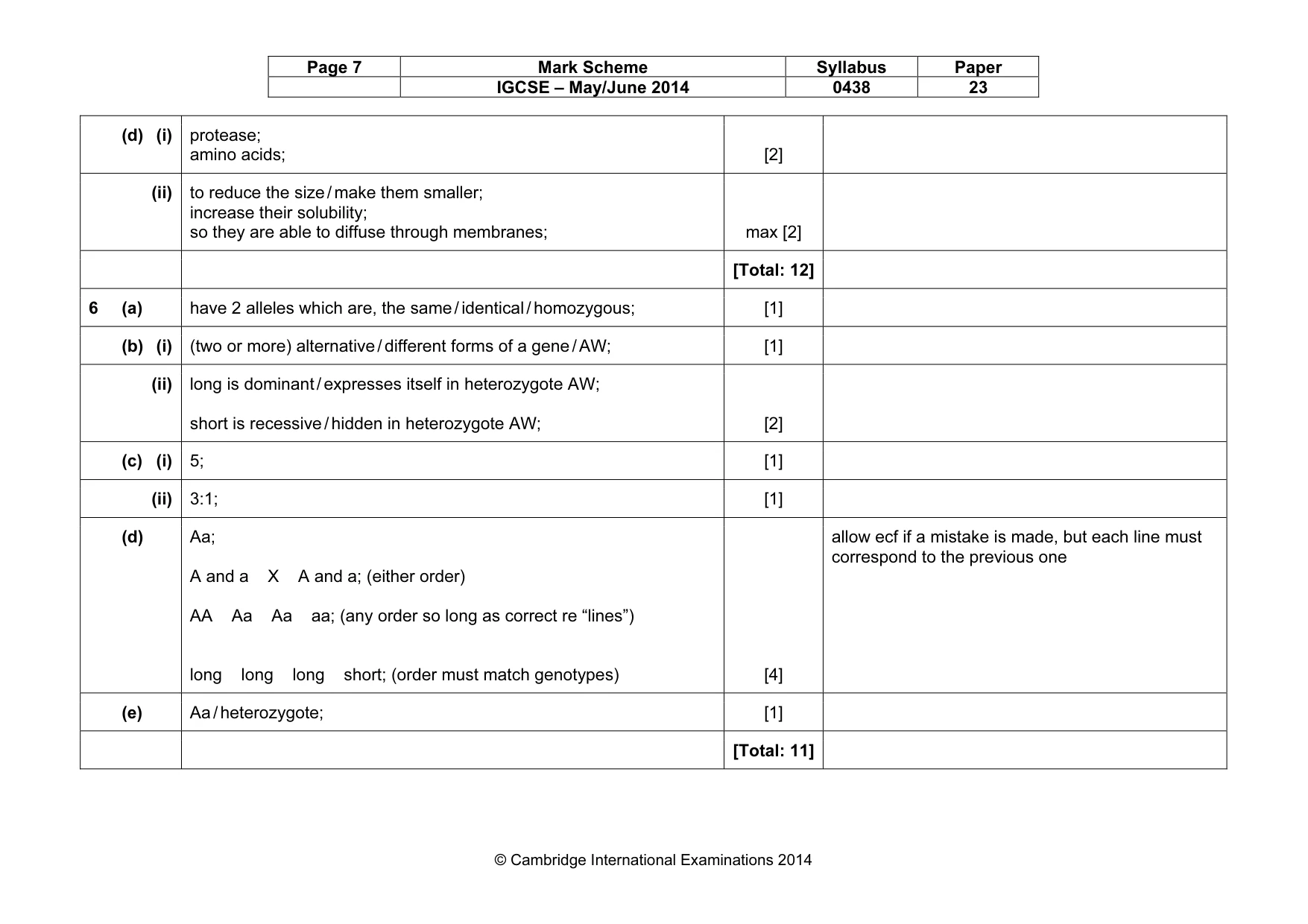
Page 7 Mark Scheme Syllabus Paper IGCSE – May/June 2014 0438 23 © Cambridge International Examinations 2014 (d) (i) protease; amino acids; [2] (ii) to reduce the size / make them smaller; increase their solubility; so they are able to diffuse through membranes; max [2] [Total: 12] 6 (a) have 2 alleles which are, the same / identical / homozygous; [1] (b) (i) (two or more) alternative / different forms of a gene / AW; [1] (ii) long is dominant / expresses itself in heterozygote AW; short is recessive / hidden in heterozygote AW; [2] (c) (i) 5; [1] (ii) 3:1; [1] (d) Aa; A and a X A and a; (either order) AA Aa Aa aa; (any order so long as correct re “lines”) long long long short; (order must match genotypes) [4] allow ecf if a mistake is made, but each line must correspond to the previous one (e) Aa / heterozygote; [1] [Total: 11]
Mark scheme, page 8
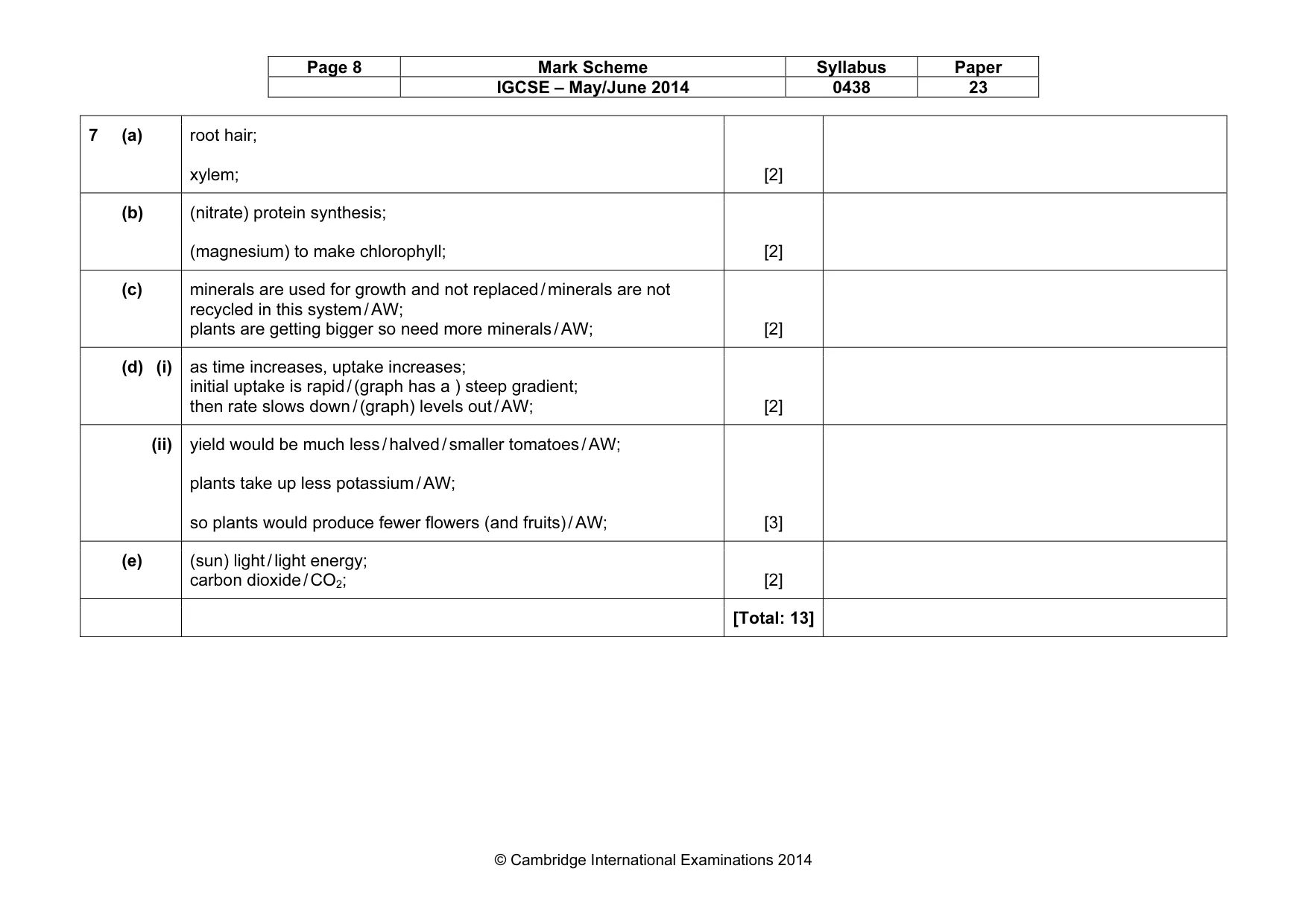
Page 8 Mark Scheme Syllabus Paper IGCSE – May/June 2014 0438 23 © Cambridge International Examinations 2014 7 (a) root hair; xylem; [2] (b) (nitrate) protein synthesis; (magnesium) to make chlorophyll; [2] (c) minerals are used for growth and not replaced / minerals are not recycled in this system / AW; plants are getting bigger so need more minerals / AW; [2] (d) (i) as time increases, uptake increases; initial uptake is rapid / (graph has a ) steep gradient; then rate slows down / (graph) levels out / AW; [2] (ii) yield would be much less / halved / smaller tomatoes / AW; plants take up less potassium / AW; so plants would produce fewer flowers (and fruits) / AW; [3] (e) (sun) light / light energy; carbon dioxide / CO2; [2] [Total: 13]
Mark scheme, page 9
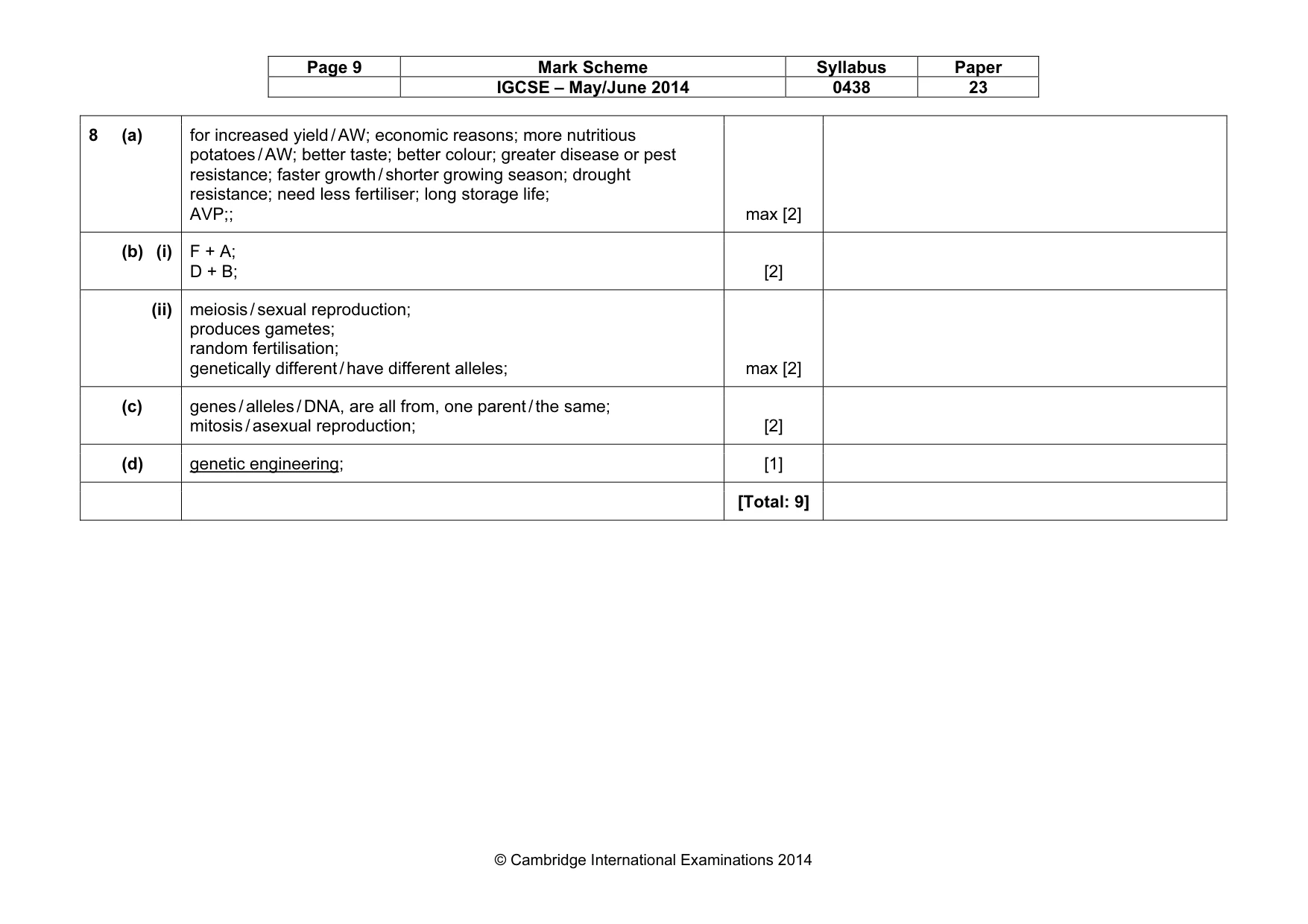
Page 9 Mark Scheme Syllabus Paper IGCSE – May/June 2014 0438 23 © Cambridge International Examinations 2014 8 (a) for increased yield / AW; economic reasons; more nutritious potatoes / AW; better taste; better colour; greater disease or pest resistance; faster growth / shorter growing season; drought resistance; need less fertiliser; long storage life; AVP;; max [2] (b) (i) F + A; D + B; [2] (ii) meiosis / sexual reproduction; produces gametes; random fertilisation; genetically different / have different alleles; max [2] (c) genes / alleles / DNA, are all from, one parent / the same; mitosis / asexual reproduction; [2] (d) genetic engineering; [1] [Total: 9]
What you needed in this session
Cambridge’s own grade thresholds for 2014 May/June, Paper 2 · Variant 3. A higher threshold means an easier paper — the bar moves with how the cohort did.