Cambridge IGCSE Biology (9-1) 0970 — 2023 May/June Paper 3 · Variant 2
0970/32/M/J/23 · 8 questions · 80 marks · ≈90 min
The question paper and its mark scheme, free to read here and free to download. This is Cambridge’s own paper, exactly as it was sat.
Question paper20 pages





Mark scheme13 pages
Answers below. Sit the paper first if you are practising.
Questions as text
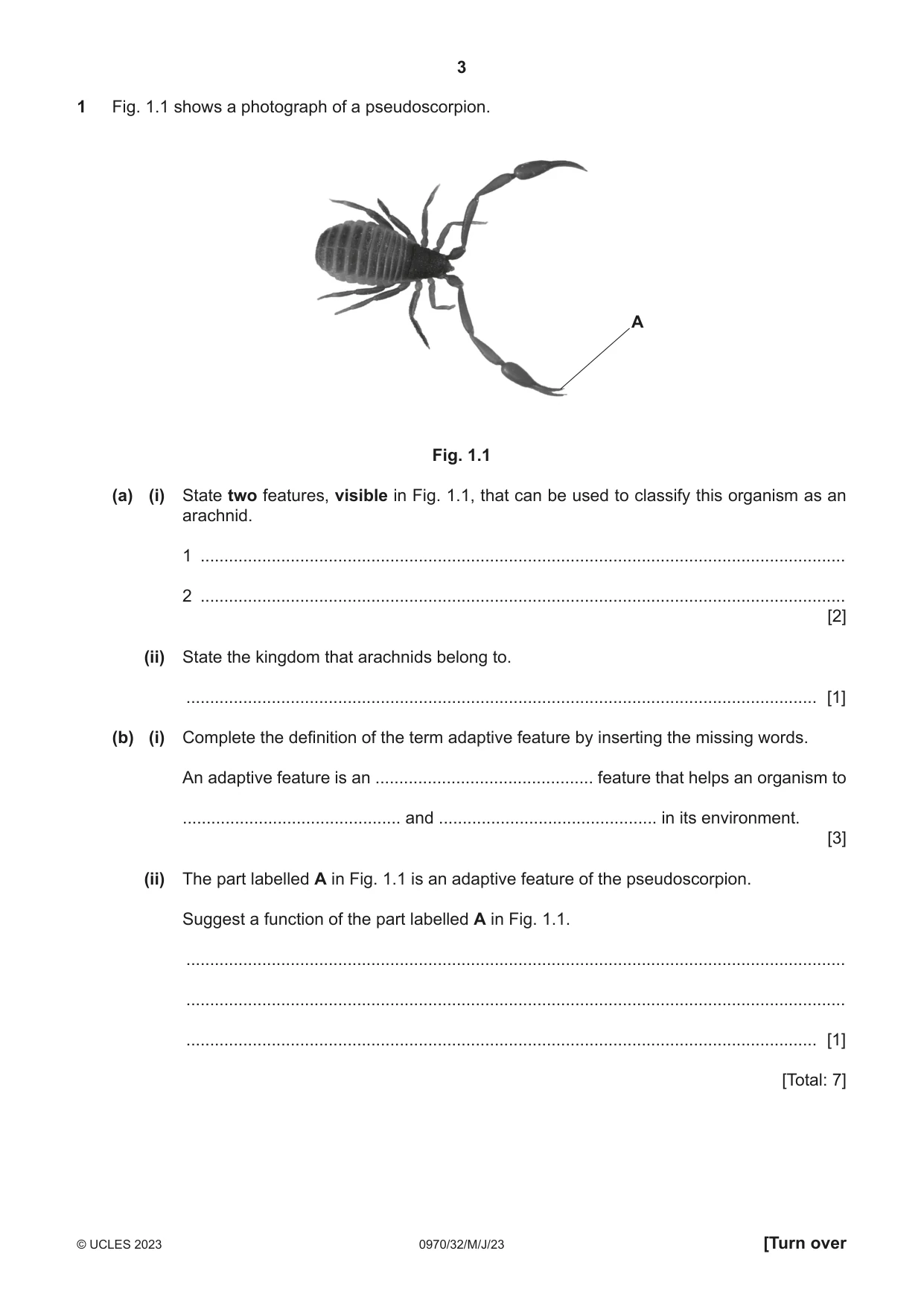
Q1 · A photograph of a pseudoscorpion
1 Fig. 1.1 shows a photograph of a pseudoscorpion. A Fig. 1.1 (a) (i) State two features, visible in Fig. 1.1, that can be used to classify this organism as an arachnid. 1 ........................................................................................................................................ 2 ........................................................................................................................................ [2] (ii) State the kingdom that arachnids belong to. ..................................................................................................................................... [1] (b) (i) Complete the definition of the term adaptive feature by inserting the missing words. An adaptive feature is an .............................................. feature that helps an organism to .............................................. and .............................................. in its environment. [3] (ii) The part labelled A in Fig. 1.1 is an adaptive feature of the pseudoscorpion. Suggest a function of the part labelled A in Fig. 1.1. ........................................................................................................................................... ........................................................................................................................................... ..................................................................................................................................... [1] [Total: 7]
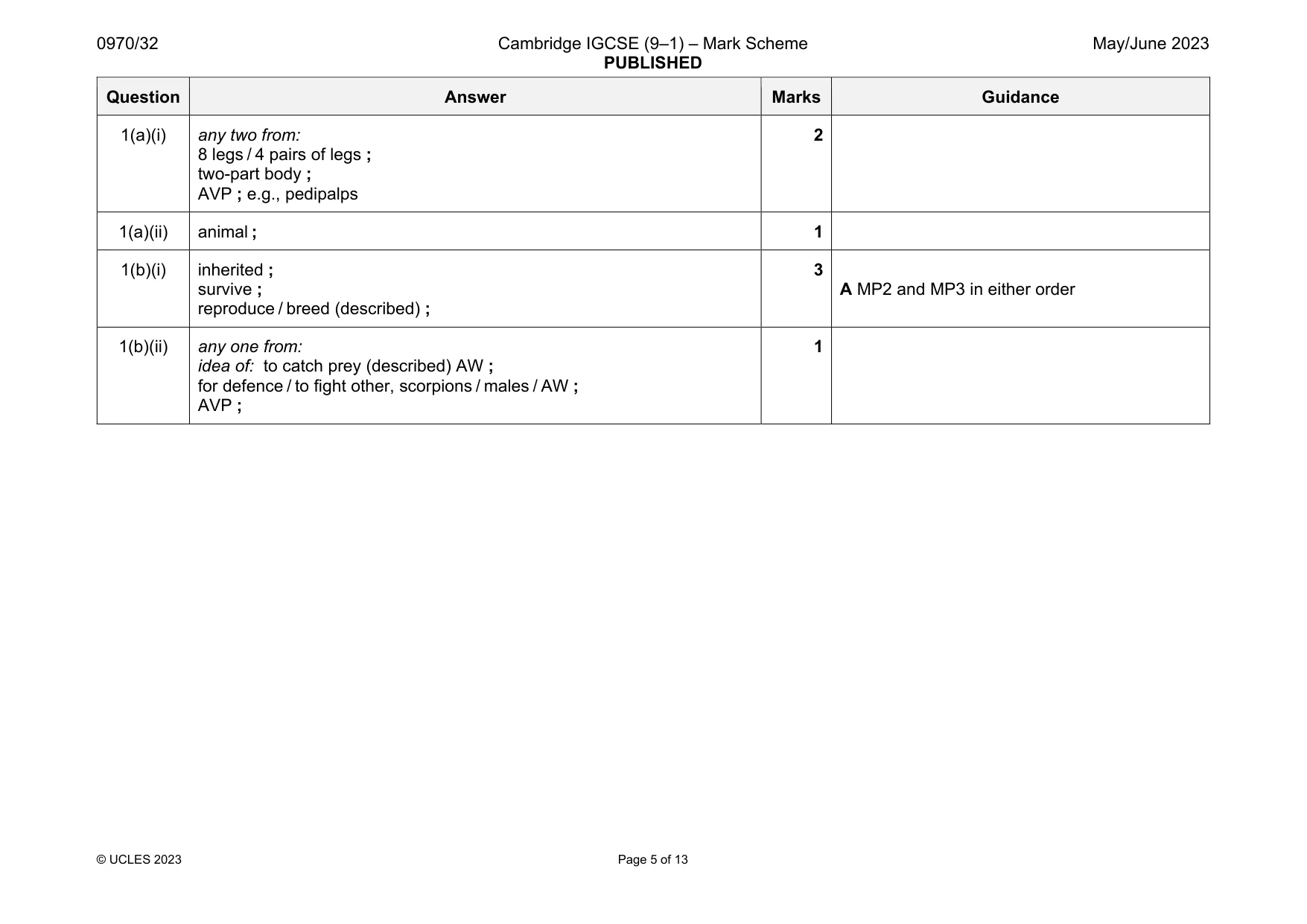
Mark scheme: 1(a)(i) any two from: 8 legs / 4 pairs of legs ; two-part body ; AVP ; e.g., pedipalps 2 1(a)(ii) animal ; 1 1(b)(i) inherited ; survive ; reproduce / breed (described) ; 3 A MP2 and MP3 in either order 1(b)(ii) any one from: idea of: to catch prey (described) AW ; for defence / to fight other, scorpions / males / AW ; AVP ; 1
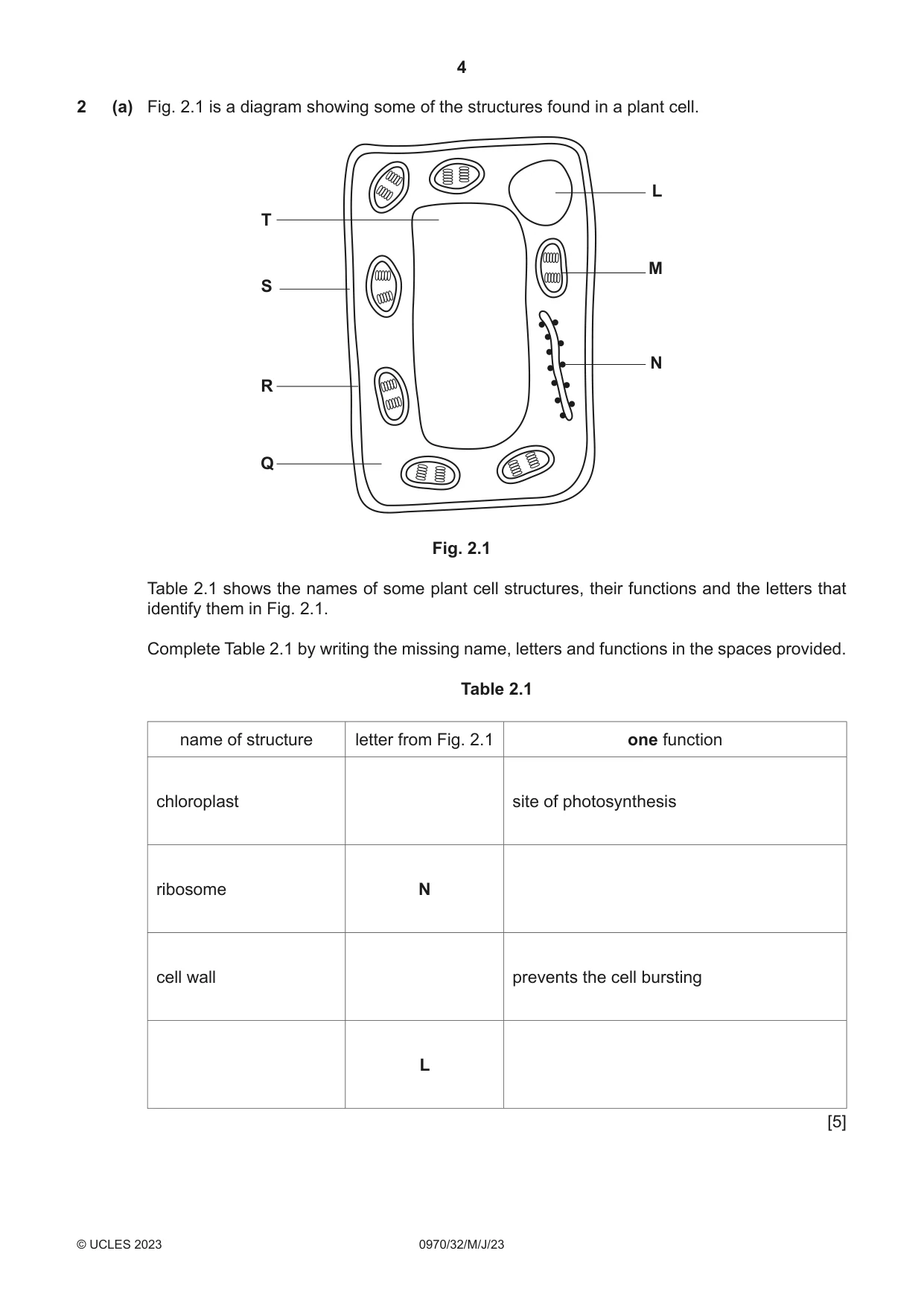
Q2 · A diagram showing some of the structures found in a plant cell
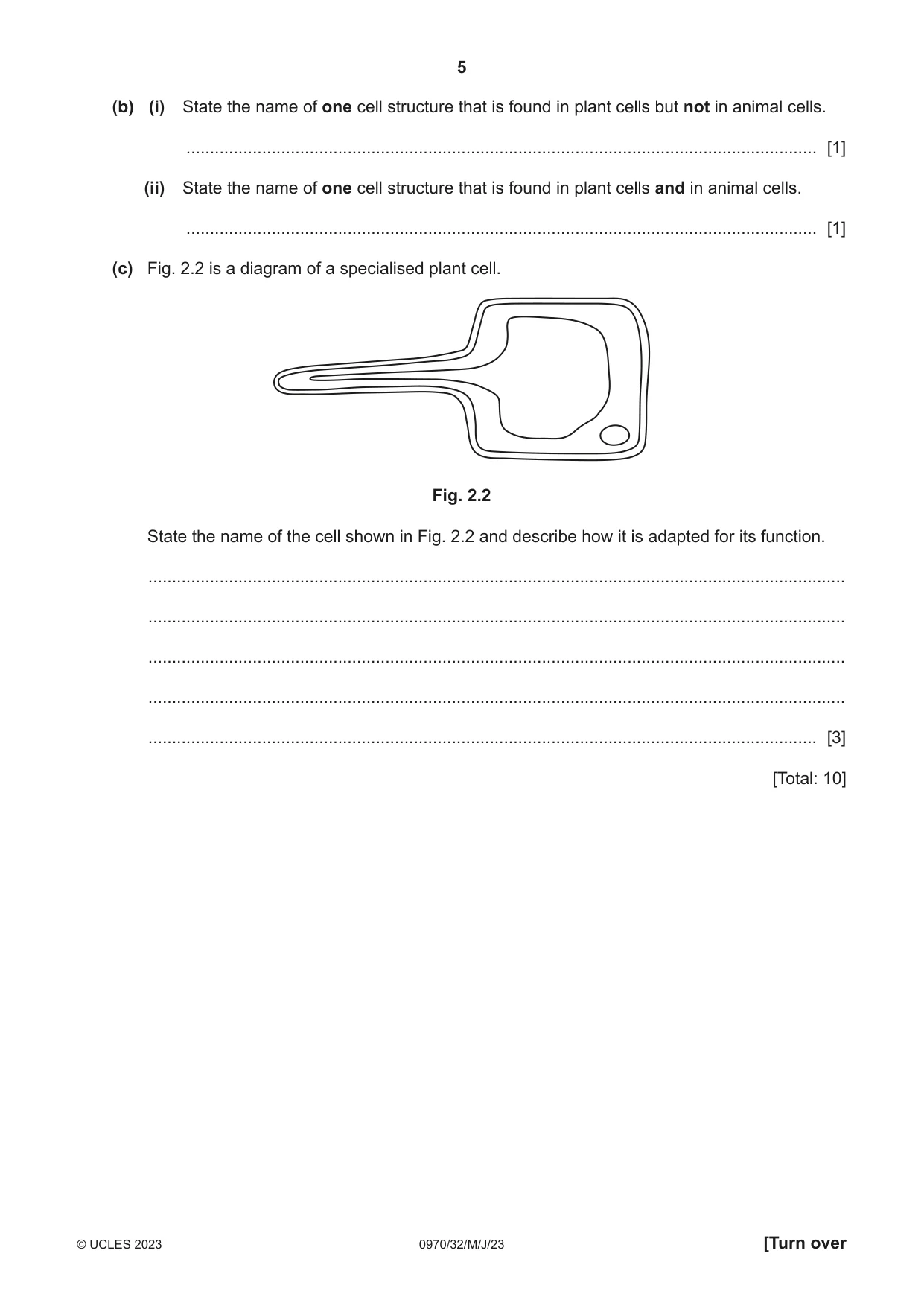
2 (a) Fig. 2.1 is a diagram showing some of the structures found in a plant cell. L T M S N R Q Fig. 2.1 Table 2.1 shows the names of some plant cell structures, their functions and the letters that identify them in Fig. 2.1. Complete Table 2.1 by writing the missing name, letters and functions in the spaces provided. Table 2.1 name of structure letter from Fig. 2.1 one function chloroplast site of photosynthesis ribosome N cell wall prevents the cell bursting L [5] (b) (i) State the name of one cell structure that is found in plant cells but not in animal cells. ..................................................................................................................................... [1] (ii) State the name of one cell structure that is found in plant cells and in animal cells. ..................................................................................................................................... [1] (c) Fig. 2.2 is a diagram of a specialised plant cell. Fig. 2.2 State the name of the cell shown in Fig. 2.2 and describe how it is adapted for its function. ................................................................................................................................................... ................................................................................................................................................... ................................................................................................................................................... ................................................................................................................................................... ............................................................................................................................................. [3] [Total: 10]
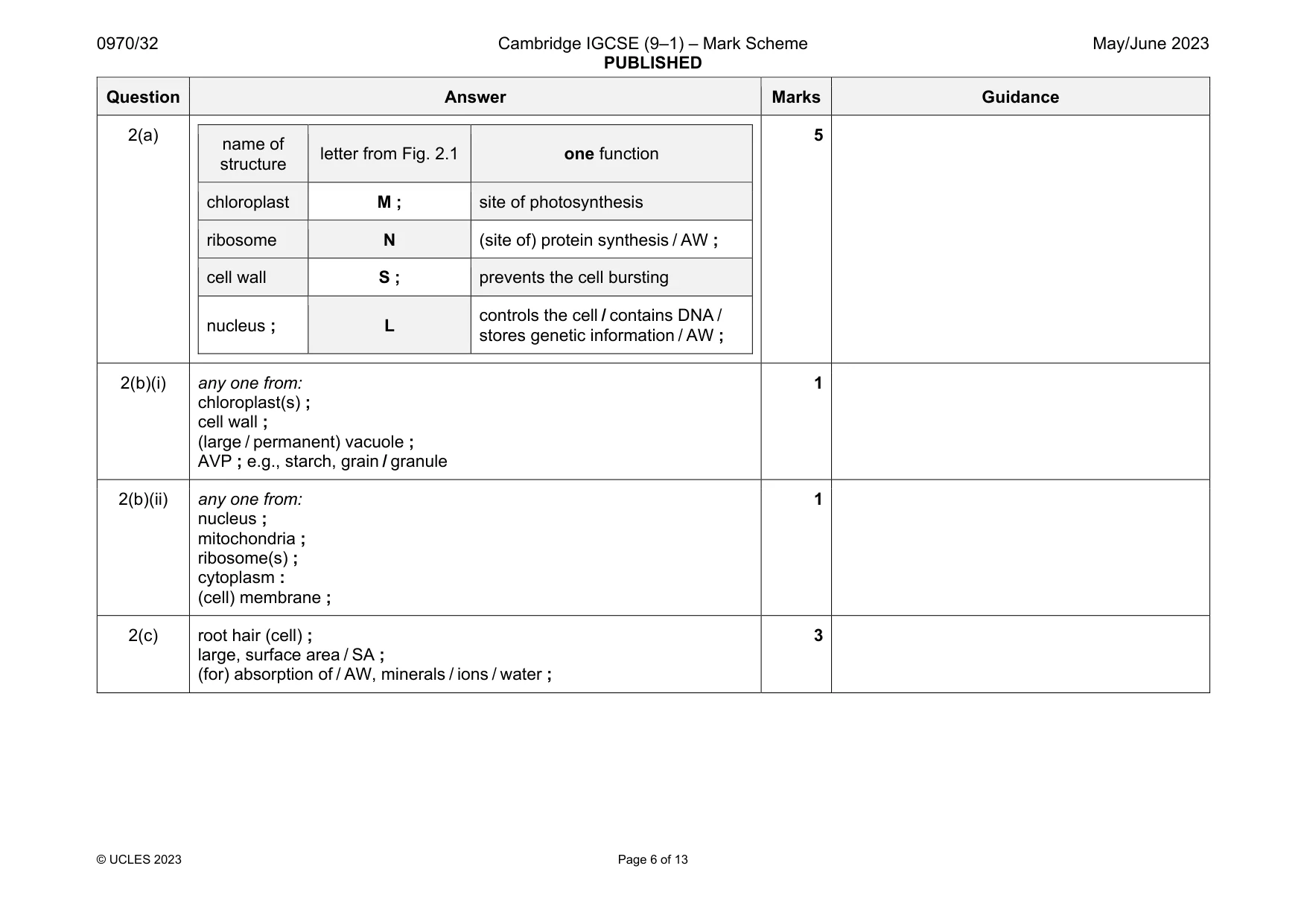
Mark scheme: 2(a) name of structure letter from Fig. 2.1 one function chloroplast M ; site of photosynthesis ribosome N (site of) protein synthesis / AW ; cell wall S ; prevents the cell bursting nucleus ; L controls the cell / contains DNA / stores genetic information / AW ; 5 2(b)(i) any one from: chloroplast(s) ; cell wall ; (large / permanent) vacuole ; AVP ; e.g., starch, grain / granule 1 2(b)(ii) any one from: nucleus ; mitochondria ; ribosome(s) ; cytoplasm : (cell) membrane ; 1 2(c) root hair (cell) ; large, surface area / SA ; (for) absorption of / AW, minerals / ions / water ; 3
Q3 · The action of an enzyme
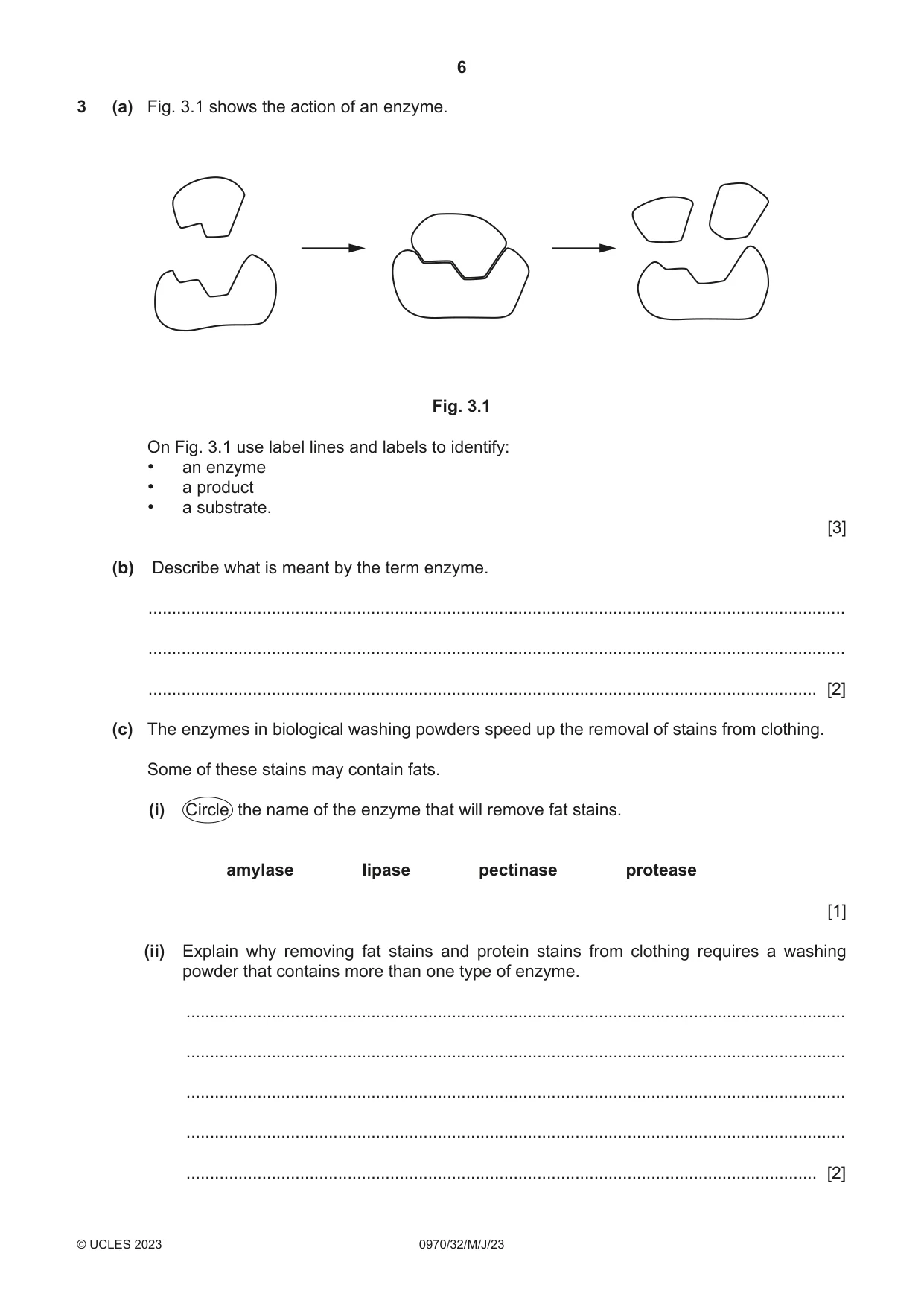
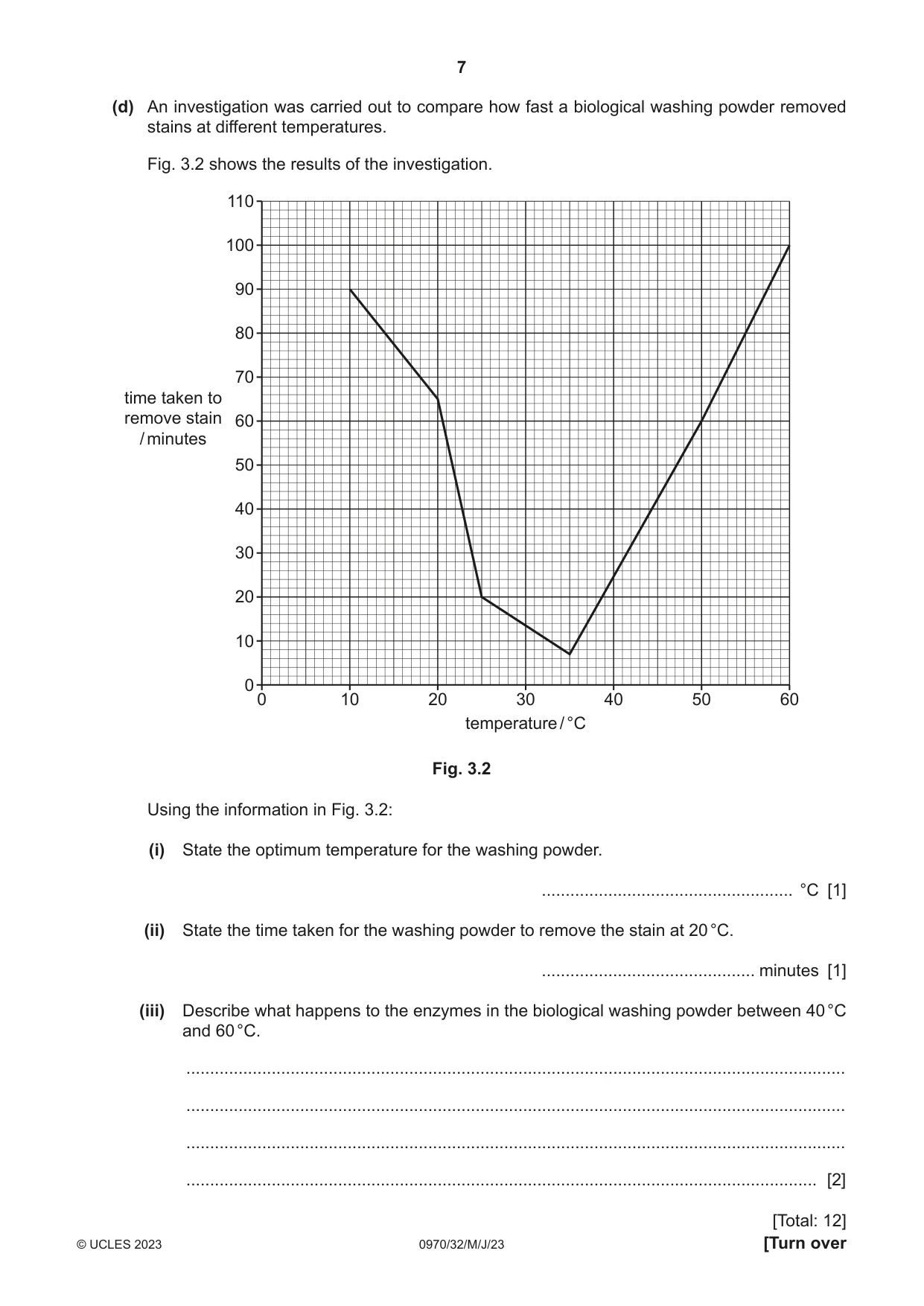
3 (a) Fig. 3.1 shows the action of an enzyme. Fig. 3.1 On Fig. 3.1 use label lines and labels to identify: • an enzyme • a product • a substrate. [3] (b) Describe what is meant by the term enzyme. ................................................................................................................................................... ................................................................................................................................................... ............................................................................................................................................. [2] (c) The enzymes in biological washing powders speed up the removal of stains from clothing. Some of these stains may contain fats. (i) Circle the name of the enzyme that will remove fat stains. amylase lipase pectinase protease [1] (ii) Explain why removing fat stains and protein stains from clothing requires a washing powder that contains more than one type of enzyme. ........................................................................................................................................... ........................................................................................................................................... ........................................................................................................................................... ........................................................................................................................................... ..................................................................................................................................... [2] (d) An investigation was carried out to compare how fast a biological washing powder removed stains at different temperatures. Fig. 3.2 shows the results of the investigation. 110 100 90 80 70 time taken to remove stain 60 / minutes 50 40 30 20 10 0 0 10 20 30 40 50 60 temperature / °C Fig. 3.2 Using the information in Fig. 3.2: (i) State the optimum temperature for the washing powder. ..................................................... °C [1] (ii) State the time taken for the washing powder to remove the stain at 20 °C. ............................................. minutes [1] (iii) Describe what happens to the enzymes in the biological washing powder between 40 °C and 60 °C. ........................................................................................................................................... ........................................................................................................................................... ........................................................................................................................................... ..................................................................................................................................... [2] [Total: 12]
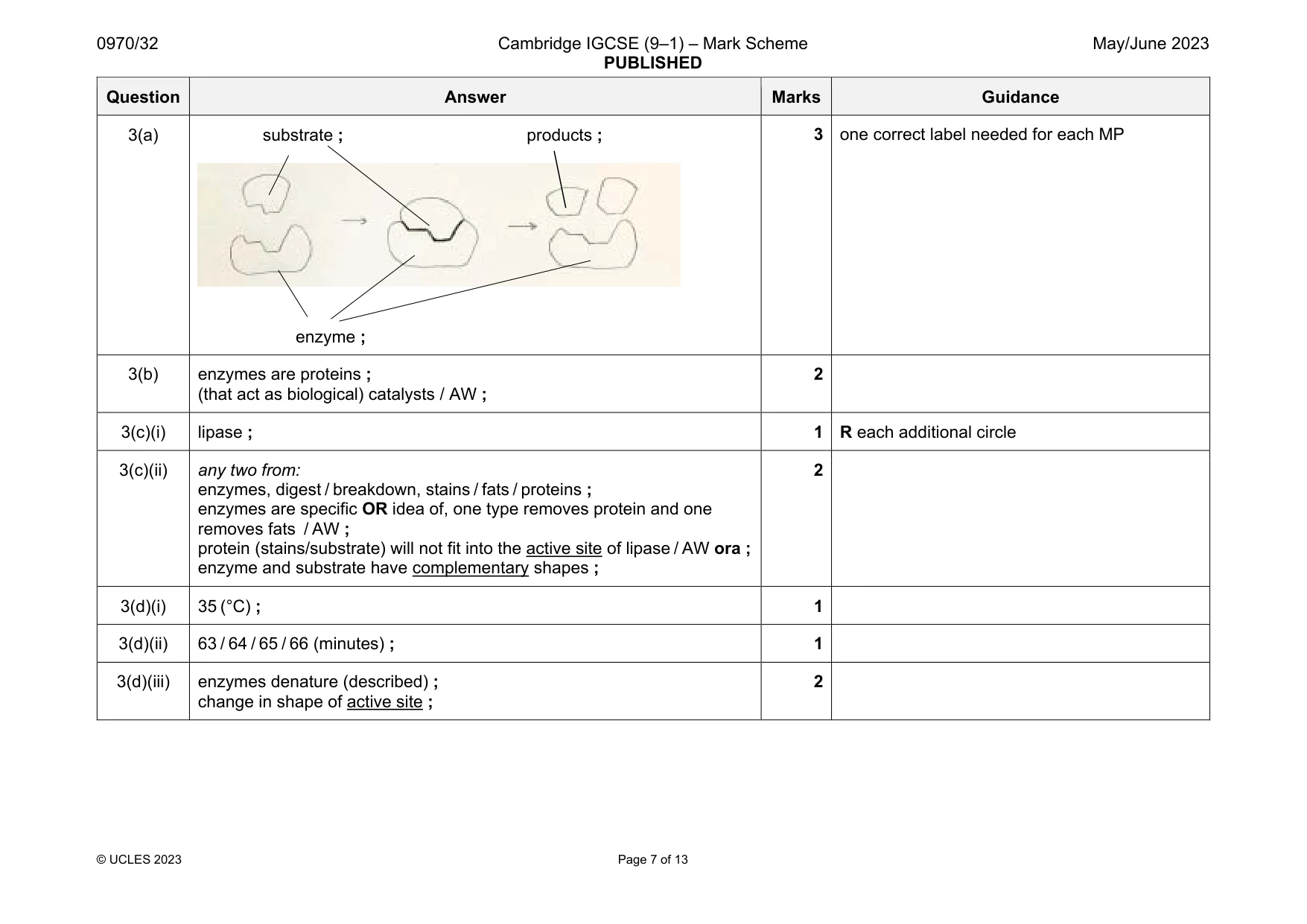
Mark scheme: 3(a) substrate ; products ; enzyme ; 3(b) enzymes are proteins ; (that act as biological) catalysts / AW ; 2 3(c)(i) lipase ; 1 R each additional circle 3(c)(ii) any two from: enzymes, digest / breakdown, stains / fats / proteins ; enzymes are specific OR idea of, one type removes protein and one removes fats / AW ; protein (stains/substrate) will not fit into the active site of lipase / AW ora ; enzyme and substrate have complementary shapes ; 2 3(d)(i) 35 (°C) ; 1 3(d)(ii) 63 / 64 / 65 / 66 (minutes) ; 1 3(d)(iii) enzymes denature (described) ; change in shape of active site ; 2
Q4 · A balanced diet includes foods that contain calcium ions
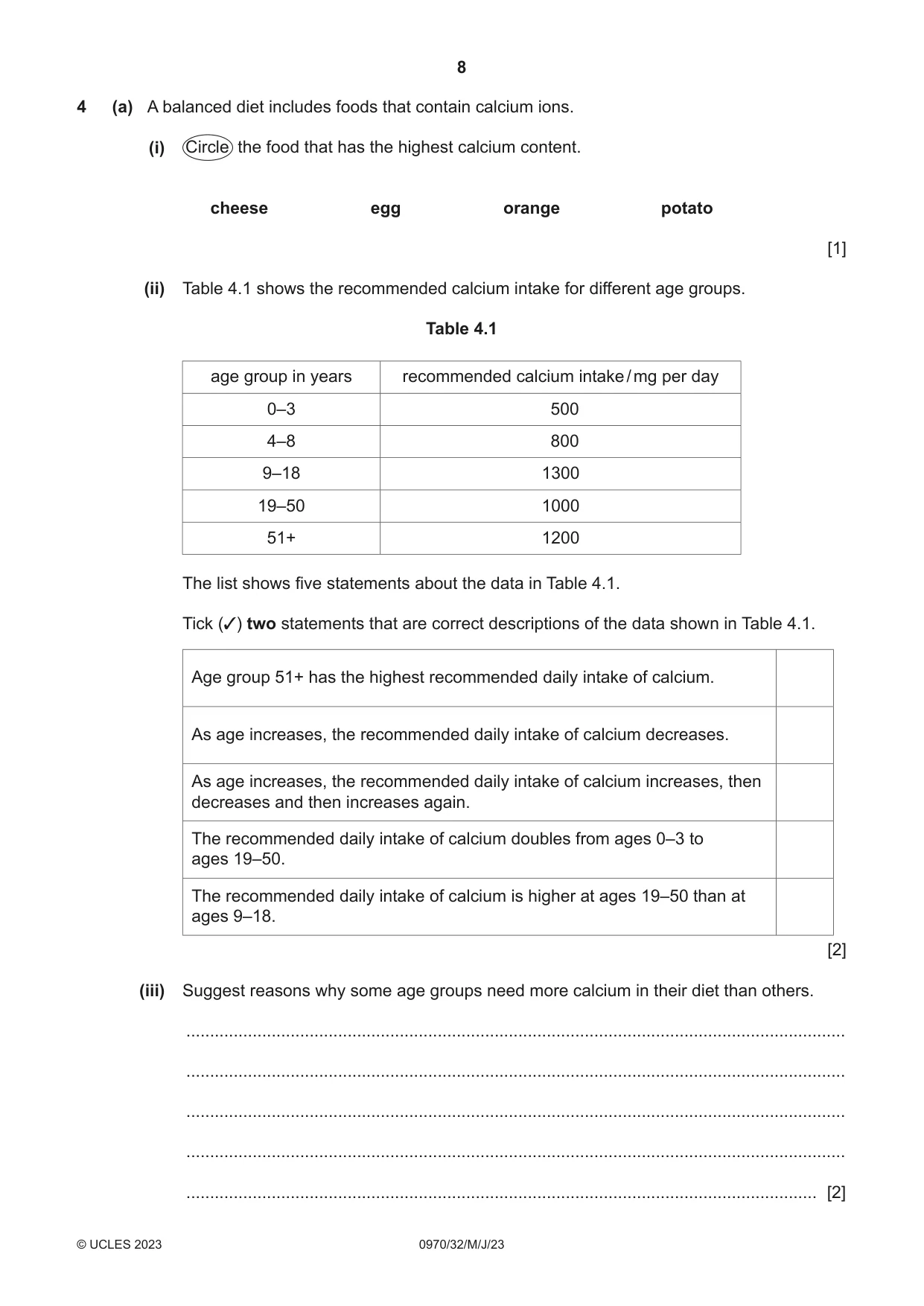
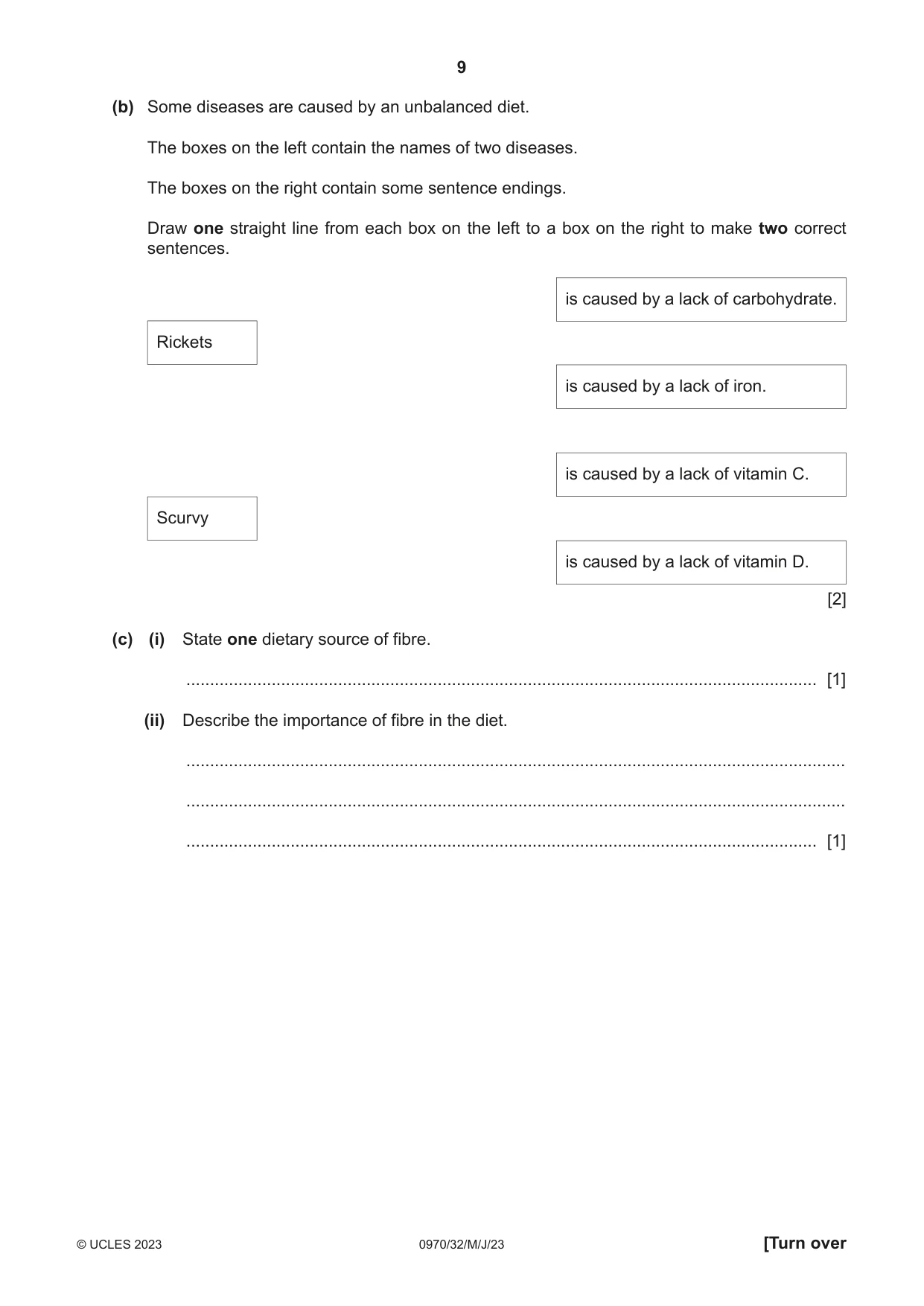
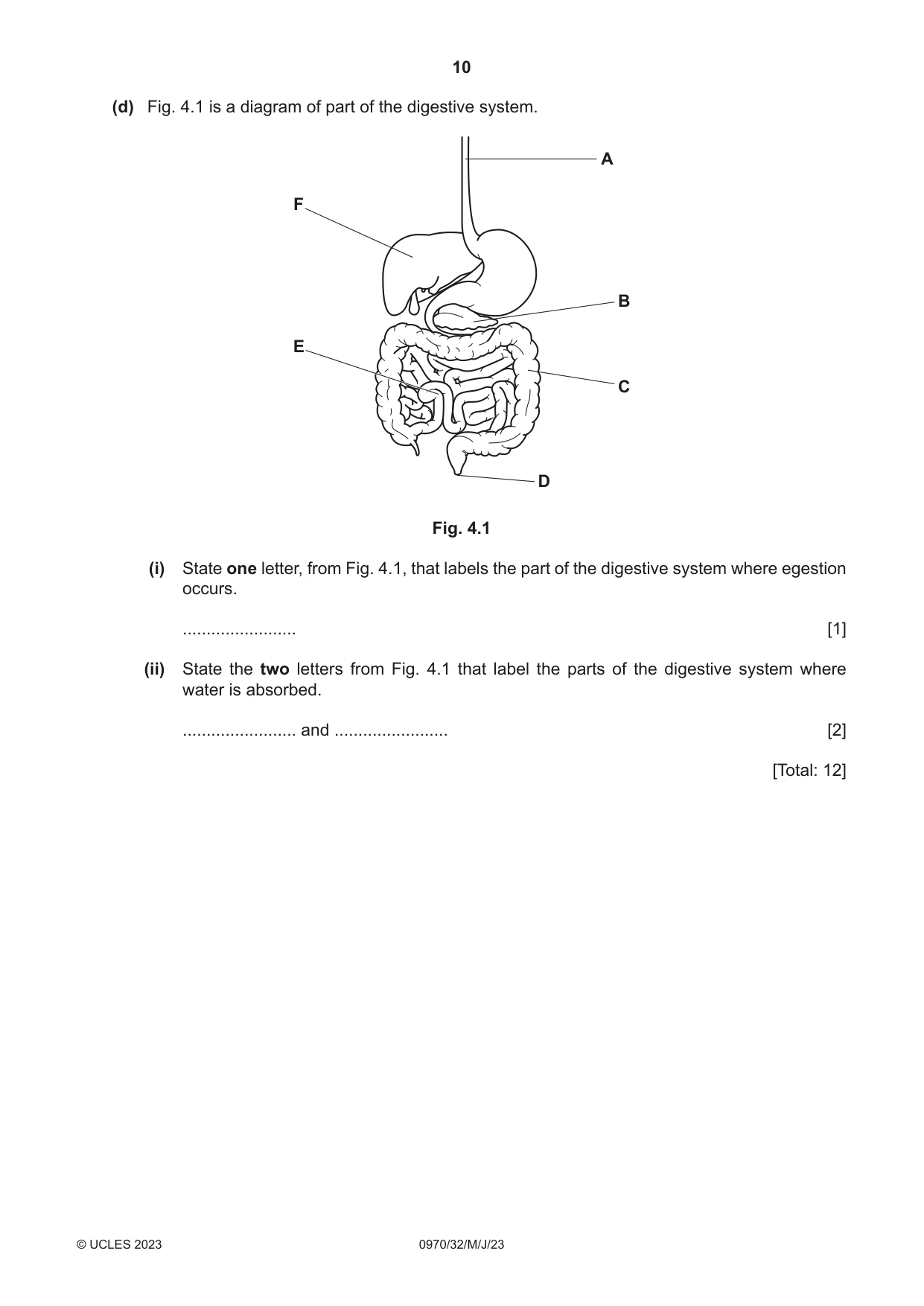
4 (a) A balanced diet includes foods that contain calcium ions. (i) Circle the food that has the highest calcium content. cheese egg orange potato [1] (ii) Table 4.1 shows the recommended calcium intake for different age groups. Table 4.1 age group in years recommended calcium intake / mg per day 0–3 500 4–8 800 9–18 1300 19–50 1000 51+ 1200 The list shows five statements about the data in Table 4.1. Tick (3) two statements that are correct descriptions of the data shown in Table 4.1. Age group 51+ has the highest recommended daily intake of calcium. As age increases, the recommended daily intake of calcium decreases. As age increases, the recommended daily intake of calcium increases, then decreases and then increases again. The recommended daily intake of calcium doubles from ages 0–3 to ages 19–50. The recommended daily intake of calcium is higher at ages 19–50 than at ages 9–18. [2] (iii) Suggest reasons why some age groups need more calcium in their diet than others. ........................................................................................................................................... ........................................................................................................................................... ........................................................................................................................................... ........................................................................................................................................... ..................................................................................................................................... [2] (b) Some diseases are caused by an unbalanced diet. The boxes on the left contain the names of two diseases. The boxes on the right contain some sentence endings. Draw one straight line from each box on the left to a box on the right to make two correct sentences. is caused by a lack of carbohydrate. Rickets is caused by a lack of iron. is caused by a lack of vitamin C. Scurvy is caused by a lack of vitamin D. [2] (c) (i) State one dietary source of fibre. ..................................................................................................................................... [1] (ii) Describe the importance of fibre in the diet. ........................................................................................................................................... ........................................................................................................................................... ..................................................................................................................................... [1] (d) Fig. 4.1 is a diagram of part of the digestive system. A F B E C D Fig. 4.1 (i) State one letter, from Fig. 4.1, that labels the part of the digestive system where egestion occurs. ........................ [1] (ii) State the two letters from Fig. 4.1 that label the parts of the digestive system where water is absorbed. ........................ and ........................ [2] [Total: 12]
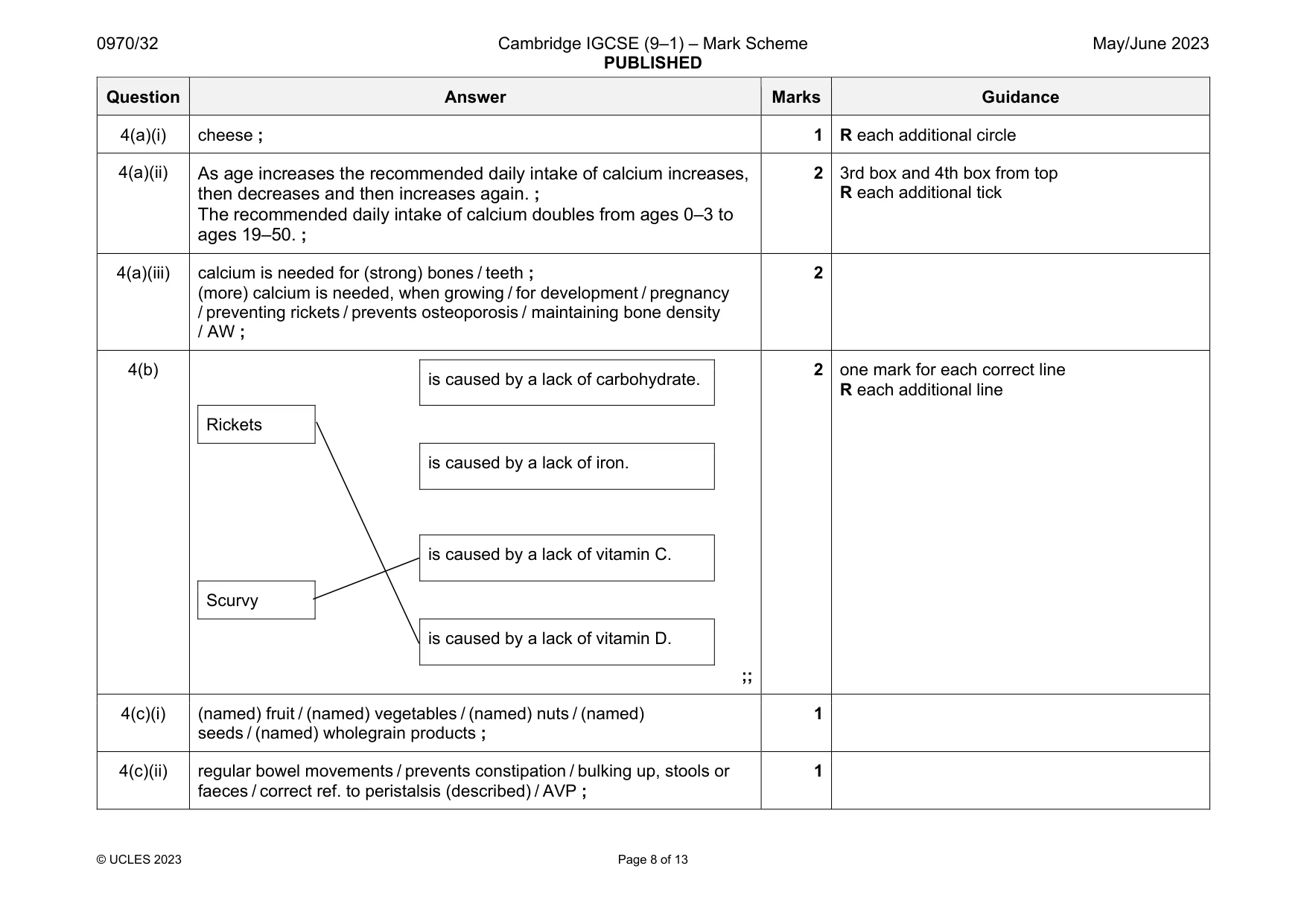
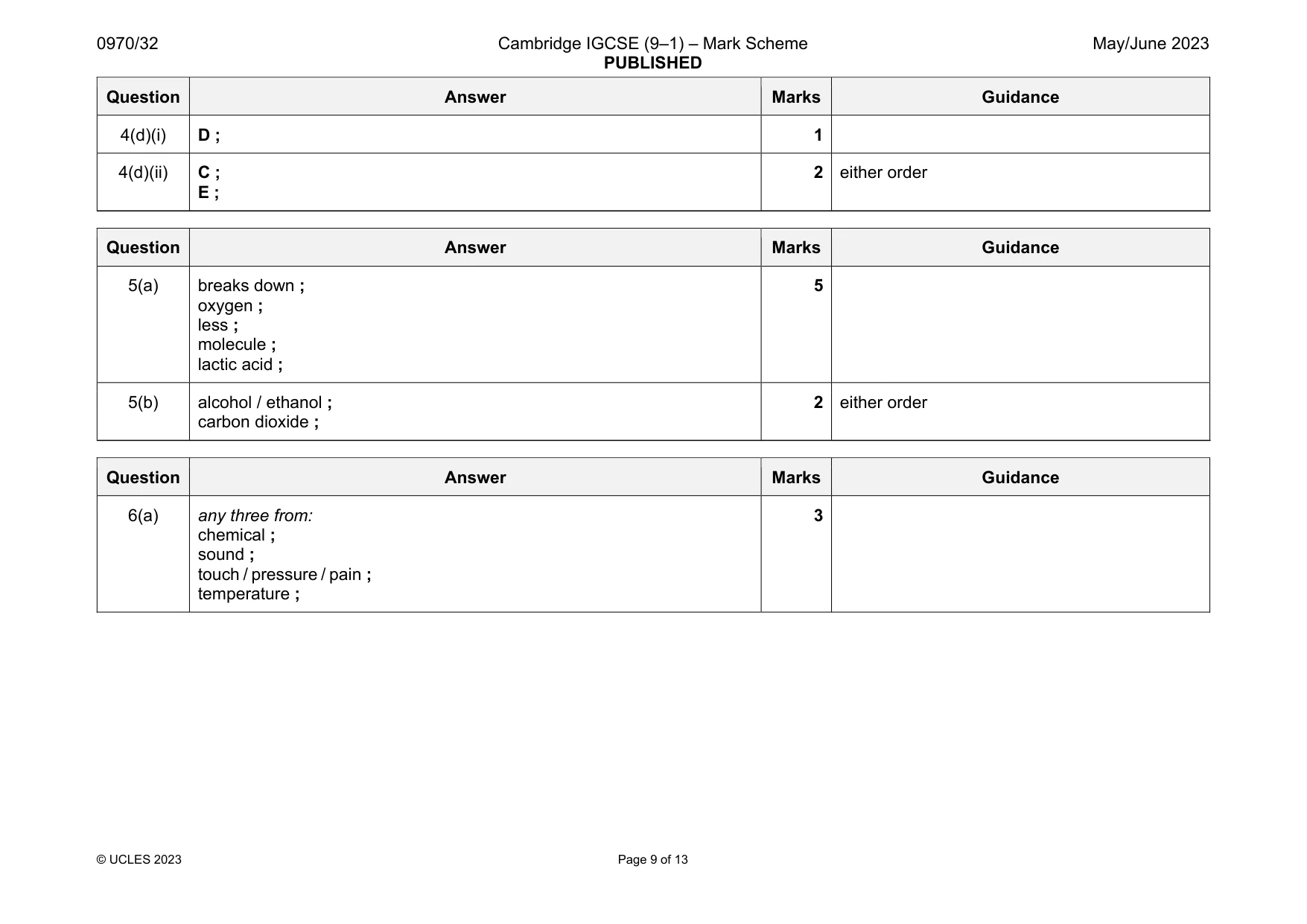
Mark scheme: 4(a)(i) cheese ; 1 R each additional circle 4(a)(ii) As age increases the recommended daily intake of calcium increases, then decreases and then increases again. ; The recommended daily intake of calcium doubles from ages 0–3 to ages 19–50. ; 2 3rd box and 4th box from top R each additional tick 4(a)(iii) calcium is needed for (strong) bones / teeth ; (more) calcium is needed, when growing / for development / pregnancy / preventing rickets / prevents osteoporosis / maintaining bone density / AW ; 2 4(b) is caused by a lack of carbohydrate. Rickets is caused by a lack of iron. is caused by a lack of vitamin C. Scurvy is caused by a lack of vitamin D. ;; 2 one mark for each correct line R each additional line 4(c)(i) (named) fruit / (named) vegetables / (named) nuts / (named) seeds / (named) wholegrain products ; 1 4(c)(ii) regular bowel movements / prevents constipation / bulking up, stools or faeces / correct ref. to peristalsis (described) / AVP ; 1 Question Answer Marks Guidance 4(d)(i) D ; 1 4(d)(ii) C ; E ; 2 either order
Q5 · Complete the sentences about anaerobic respiration in humans, using words or phrases from…
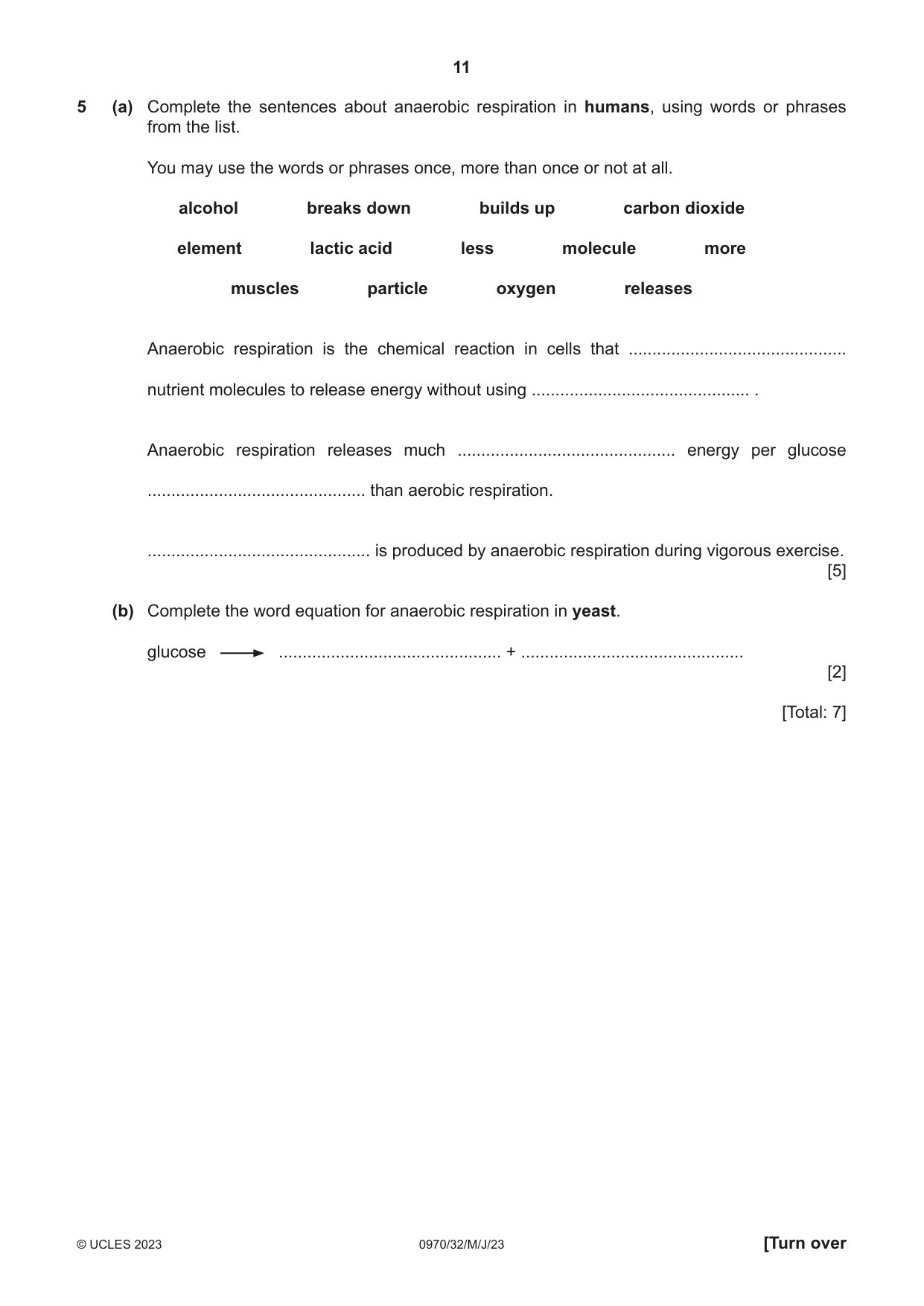
5 (a) Complete the sentences about anaerobic respiration in humans, using words or phrases from the list. You may use the words or phrases once, more than once or not at all. alcohol breaks down builds up carbon dioxide element lactic acid less molecule more muscles particle oxygen releases Anaerobic respiration is the chemical reaction in cells that .............................................. nutrient molecules to release energy without using .............................................. . Anaerobic respiration releases much .............................................. energy per glucose .............................................. than aerobic respiration. ............................................... is produced by anaerobic respiration during vigorous exercise. [5] (b) Complete the word equation for anaerobic respiration in yeast. glucose ............................................... + ............................................... [2] [Total: 7]
Mark scheme: 5(a) breaks down ; oxygen ; less ; molecule ; lactic acid ; 5(b) alcohol / ethanol ; carbon dioxide ; 2 either order
Q6 · The eye is a sense organ that contains receptor cells that respond to light
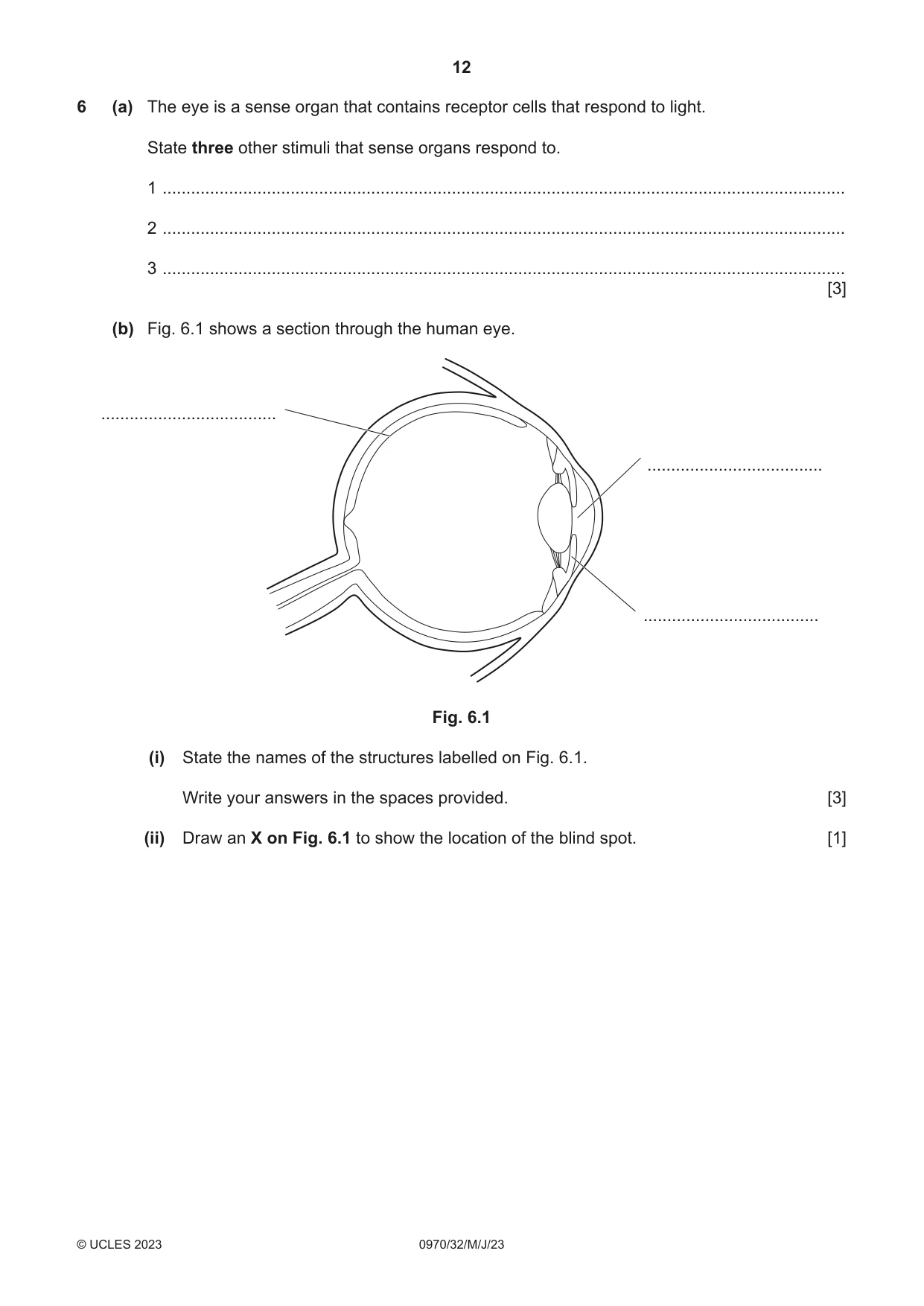
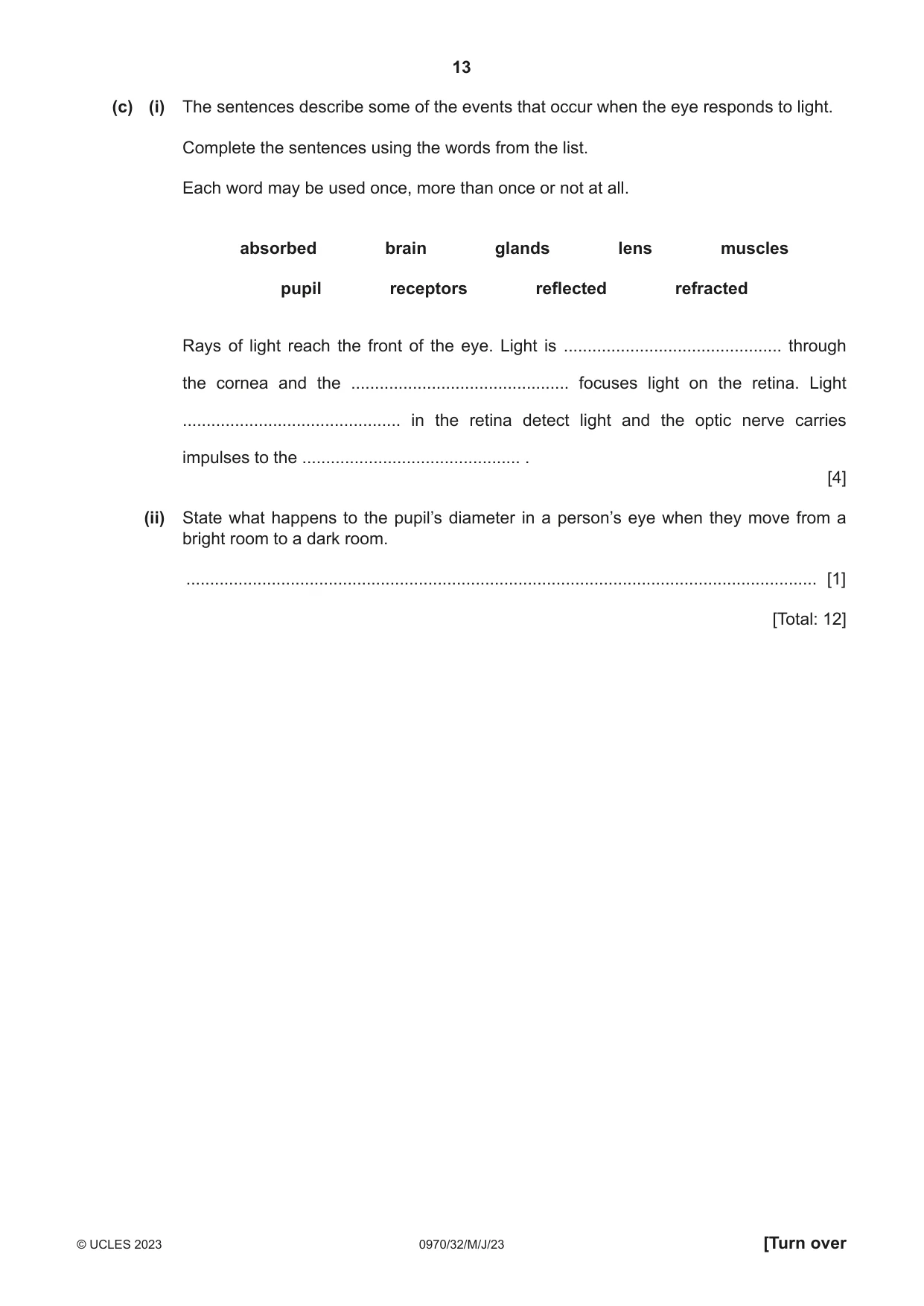
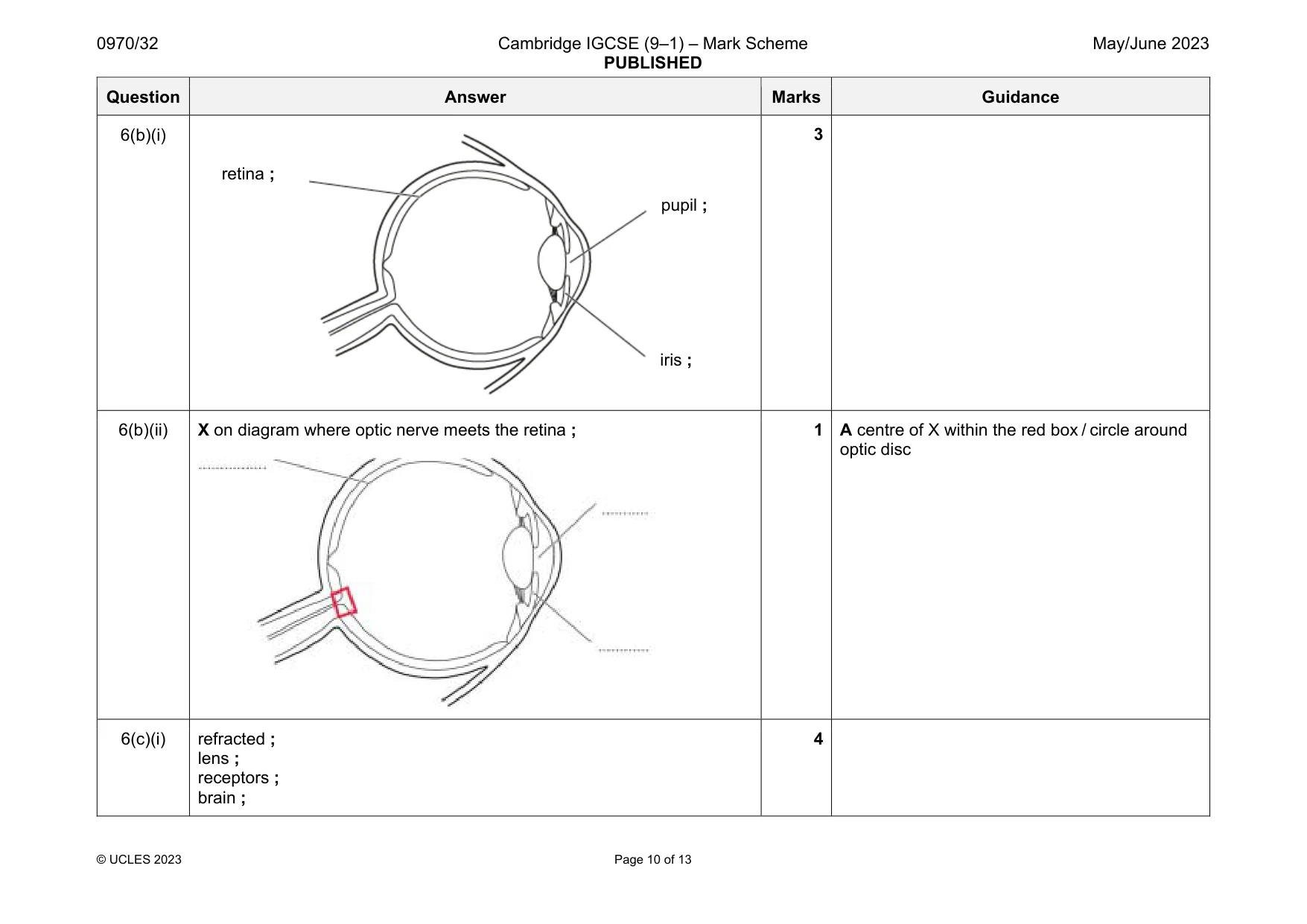
6 (a) The eye is a sense organ that contains receptor cells that respond to light. State three other stimuli that sense organs respond to. 1 ................................................................................................................................................ 2 ................................................................................................................................................ 3 ................................................................................................................................................ [3] (b) Fig. 6.1 shows a section through the human eye. ..................................... ..................................... ..................................... Fig. 6.1 (i) State the names of the structures labelled on Fig. 6.1. Write your answers in the spaces provided. [3] (ii) Draw an X on Fig. 6.1 to show the location of the blind spot. [1] (c) (i) The sentences describe some of the events that occur when the eye responds to light. Complete the sentences using the words from the list. Each word may be used once, more than once or not at all. absorbed brain glands lens muscles pupil receptors reflected refracted Rays of light reach the front of the eye. Light is .............................................. through the cornea and the .............................................. focuses light on the retina. Light .............................................. in the retina detect light and the optic nerve carries impulses to the .............................................. . [4] (ii) State what happens to the pupil’s diameter in a person’s eye when they move from a bright room to a dark room. ..................................................................................................................................... [1] [Total: 12]
Mark scheme: 6(a) any three from: chemical ; sound ; touch / pressure / pain ; temperature ; Question Answer Marks Guidance 6(b)(i) 3 6(b)(ii) X on diagram where optic nerve meets the retina ; 1 A centre of X within the red box / circle around optic disc 6(c)(i) refracted ; lens ; receptors ; brain ; 4 retina ; pupil ; iris ; Question Answer Marks Guidance 6(c)(ii) (pupil diameter) gets bigger / dilates / AW ; 1
Q7 · A farmer wanted to use selective breeding to produce goats with a high milk yield
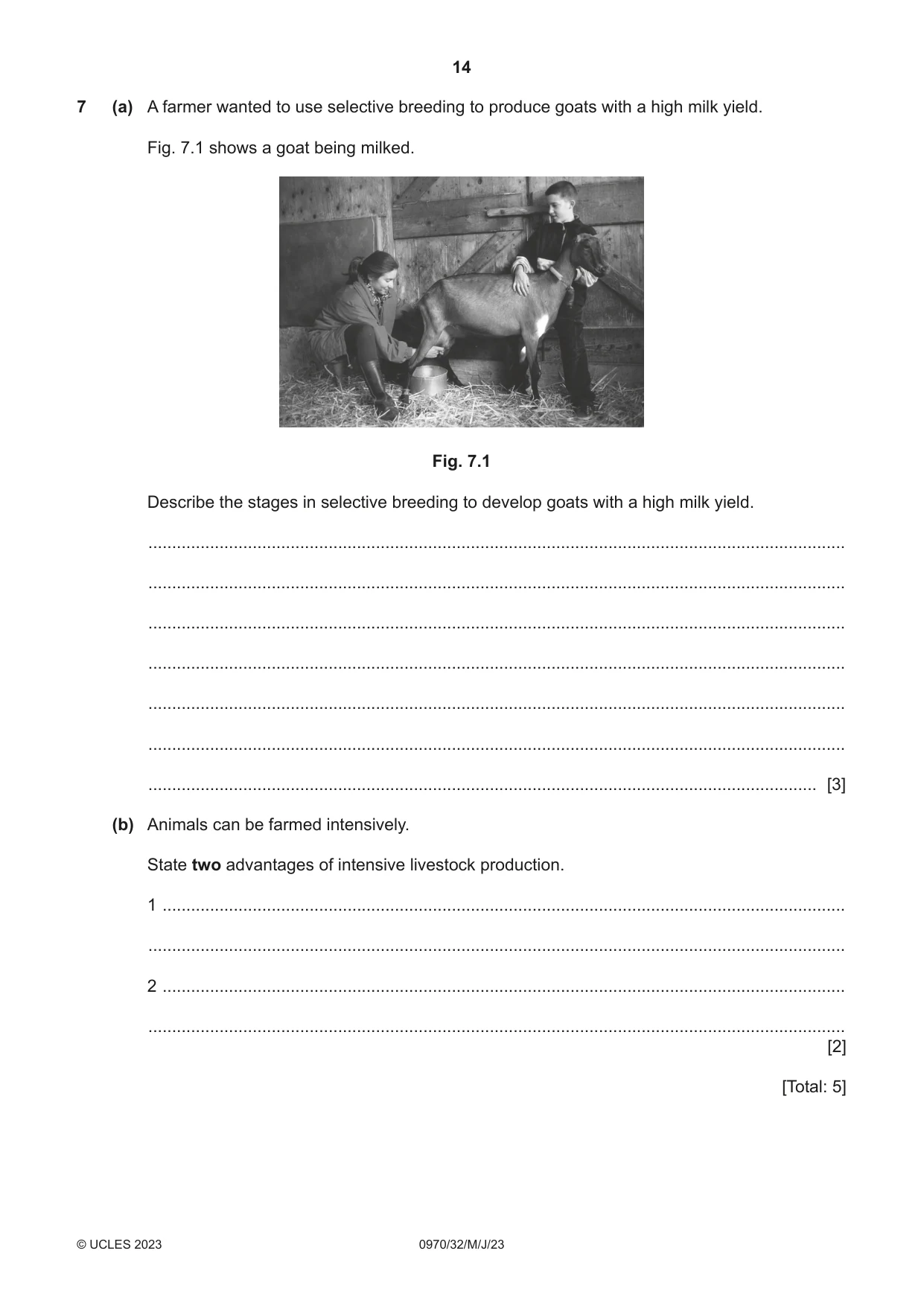
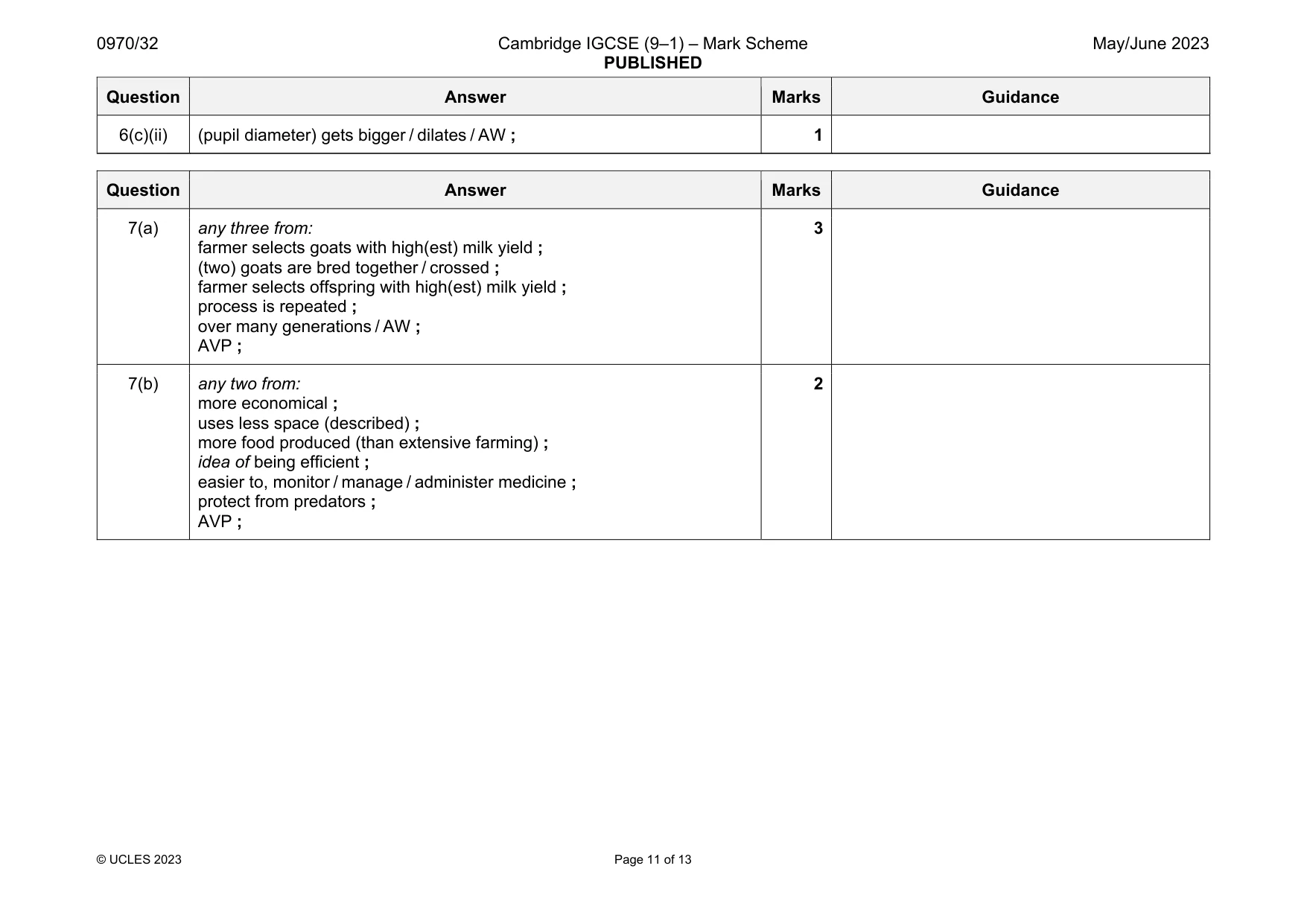
7 (a) A farmer wanted to use selective breeding to produce goats with a high milk yield. Fig. 7.1 shows a goat being milked. Fig. 7.1 Describe the stages in selective breeding to develop goats with a high milk yield. ................................................................................................................................................... ................................................................................................................................................... ................................................................................................................................................... ................................................................................................................................................... ................................................................................................................................................... ................................................................................................................................................... ............................................................................................................................................. [3] (b) Animals can be farmed intensively. State two advantages of intensive livestock production. 1 ................................................................................................................................................ ................................................................................................................................................... 2 ................................................................................................................................................ ................................................................................................................................................... [2] [Total: 5]
Mark scheme: 7(a) any three from: farmer selects goats with high(est) milk yield ; (two) goats are bred together / crossed ; farmer selects offspring with high(est) milk yield ; process is repeated ; over many generations / AW ; AVP ; 3 7(b) any two from: more economical ; uses less space (described) ; more food produced (than extensive farming) ; idea of being efficient ; easier to, monitor / manage / administer medicine ; protect from predators ; AVP ; 2
Q8 · Explain the importance of the acrosome and the mitochondria for the function of sperm…
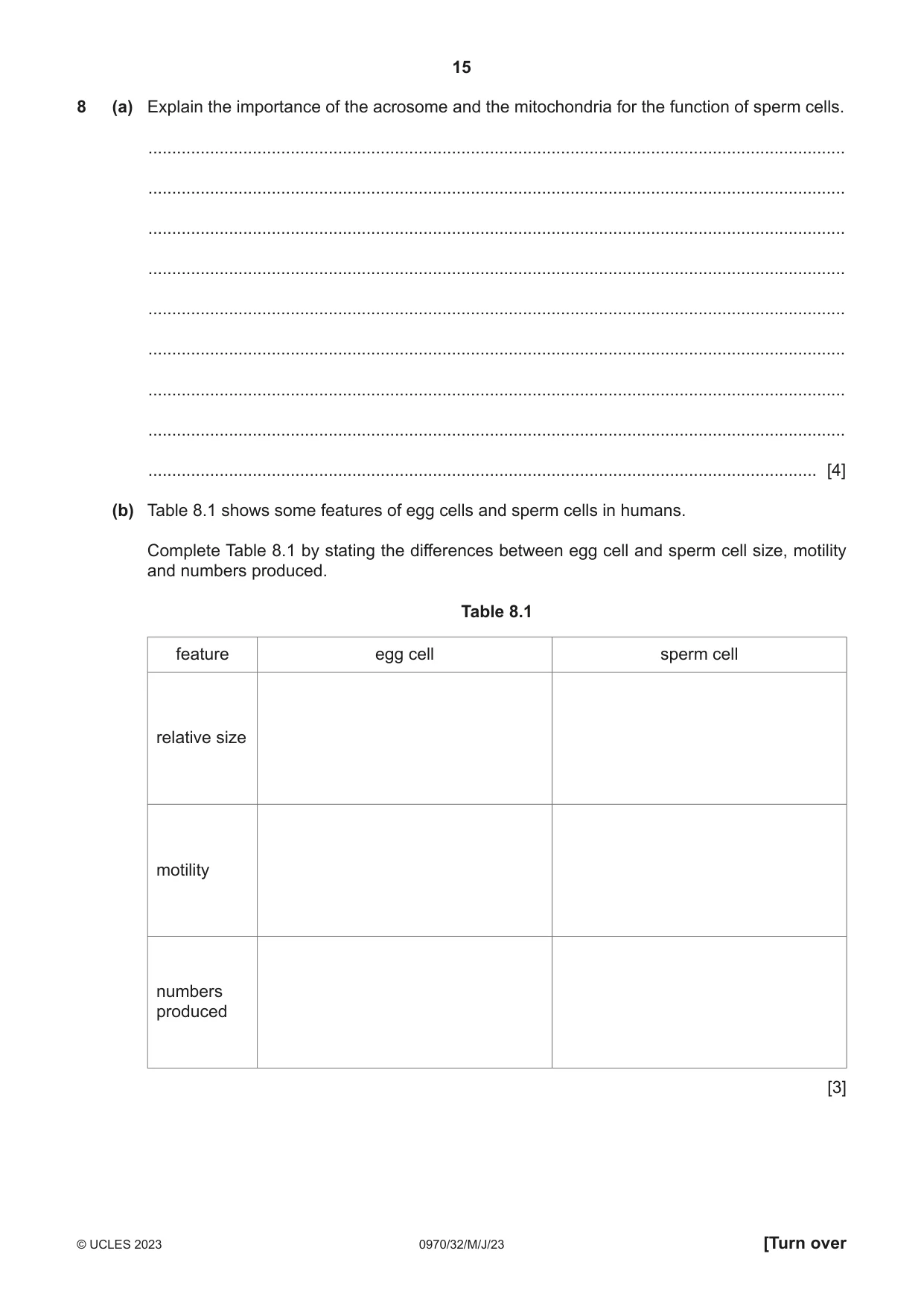
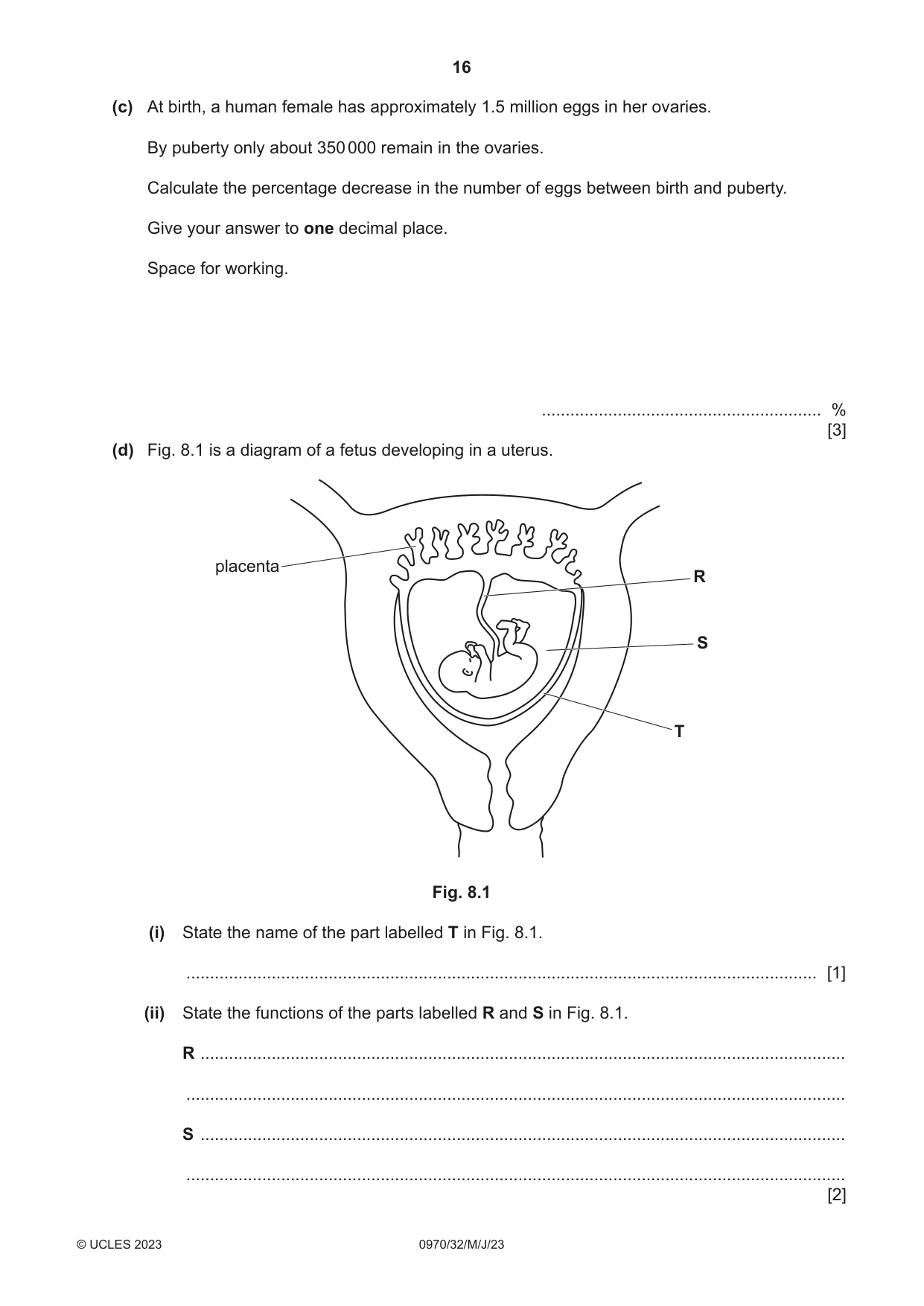
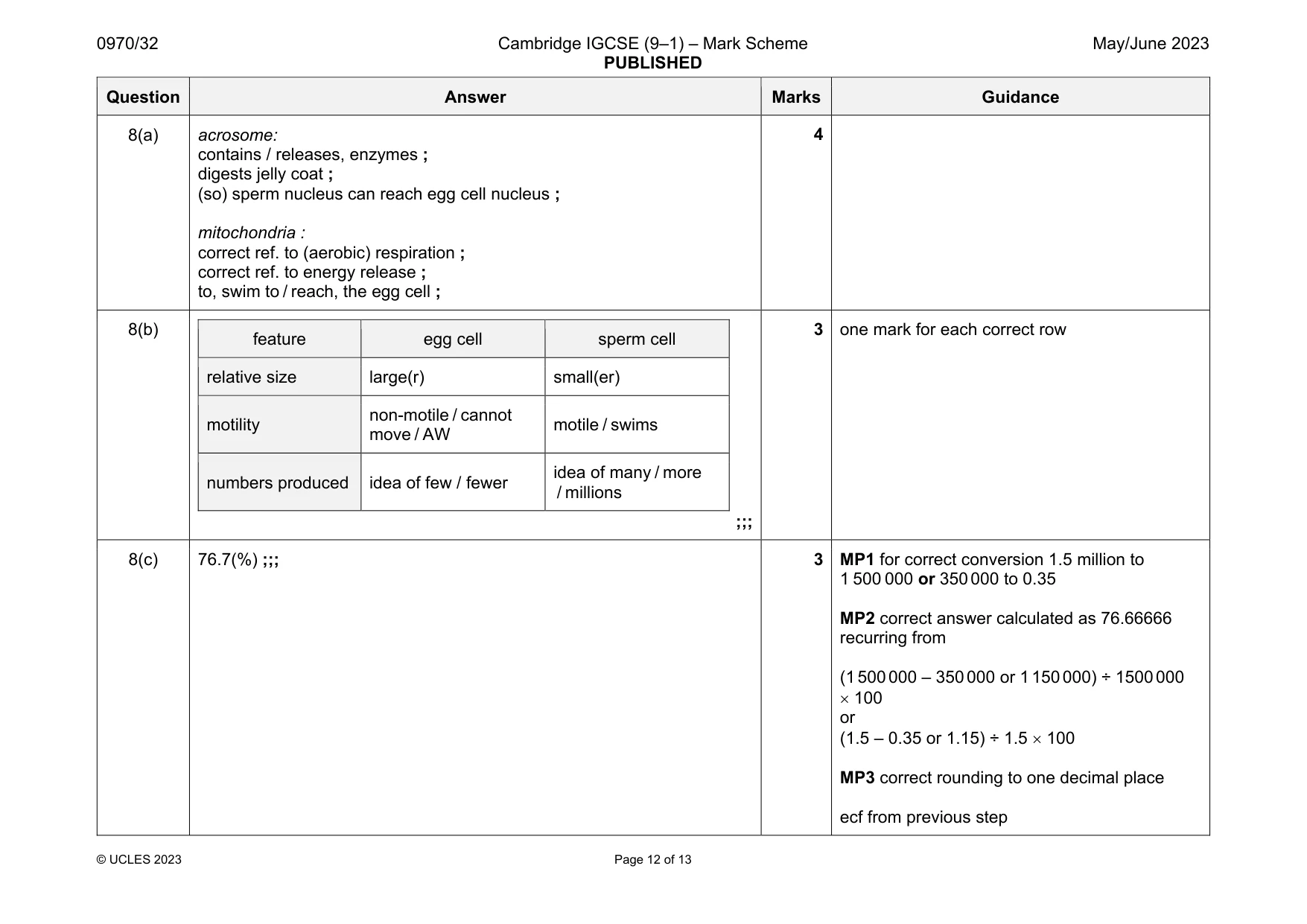
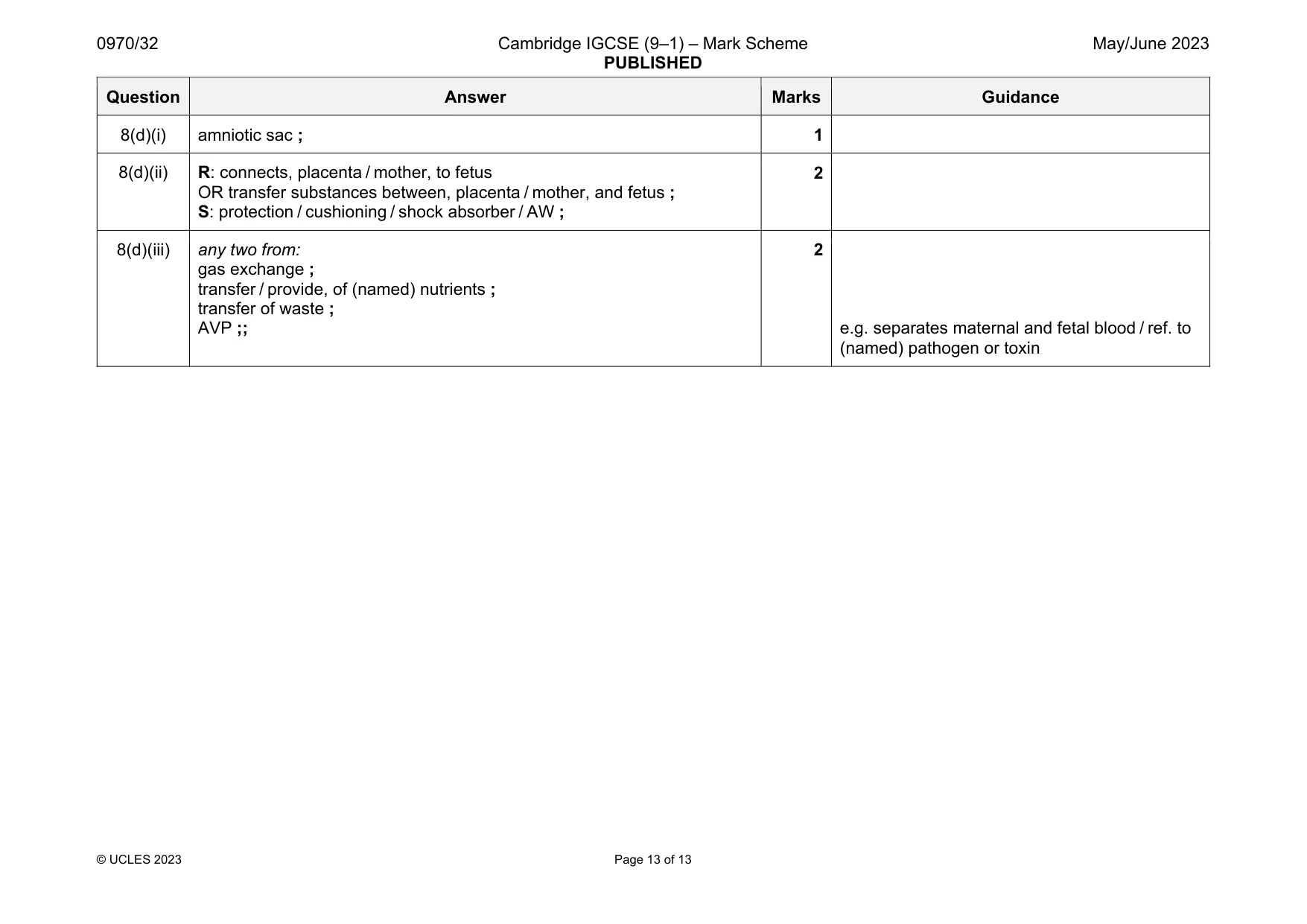
8 (a) Explain the importance of the acrosome and the mitochondria for the function of sperm cells. ................................................................................................................................................... ................................................................................................................................................... ................................................................................................................................................... ................................................................................................................................................... ................................................................................................................................................... ................................................................................................................................................... ................................................................................................................................................... ................................................................................................................................................... ............................................................................................................................................. [4] (b) Table 8.1 shows some features of egg cells and sperm cells in humans. Complete Table 8.1 by stating the differences between egg cell and sperm cell size, motility and numbers produced. Table 8.1 feature egg cell sperm cell relative size motility numbers produced [3] (c) At birth, a human female has approximately 1.5 million eggs in her ovaries. By puberty only about 350 000 remain in the ovaries. Calculate the percentage decrease in the number of eggs between birth and puberty. Give your answer to one decimal place. Space for working. ........................................................... % [3] (d) Fig. 8.1 is a diagram of a fetus developing in a uterus. placenta R S T Fig. 8.1 (i) State the name of the part labelled T in Fig. 8.1. ..................................................................................................................................... [1] (ii) State the functions of the parts labelled R and S in Fig. 8.1. R ........................................................................................................................................ ........................................................................................................................................... S ........................................................................................................................................ ........................................................................................................................................... [2] (iii) Describe the functions of the placenta. ........................................................................................................................................... ........................................................................................................................................... ........................................................................................................................................... ........................................................................................................................................... ..................................................................................................................................... [2] [Total: 15]
Mark scheme: 8(a) acrosome: contains / releases, enzymes ; digests jelly coat ; (so) sperm nucleus can reach egg cell nucleus ; mitochondria : correct ref. to (aerobic) respiration ; correct ref. to energy release ; to, swim to / reach, the egg cell ; 8(b) feature egg cell sperm cell relative size large(r) small(er) motility non-motile / cannot move / AW motile / swims numbers produced idea of few / fewer idea of many / more / millions ;;; 3 one mark for each correct row 8(c) 76.7(%) ;;; 3 MP1 for correct conversion 1.5 million to 1 500 000 or 350 000 to 0.35 MP2 correct answer calculated as 76.66666 recurring from (1 500 000 – 350 000 or 1 150 000) ÷ 1500 000 100 or (1.5 – 0.35 or 1.15) ÷ 1.5 100 MP3 correct rounding to one decimal place ecf from previous step Question Answer Marks Guidance 8(d)(i) amniotic sac ; 1 8(d)(ii) R: connects, placenta / mother, to fetus OR transfer substances between, placenta / mother, and fetus ; S: protection / cushioning / shock absorber / AW ; 2 8(d)(iii) any two from: gas exchange ; transfer / provide, of (named) nutrients ; transfer of waste ; AVP ;; 2 e.g. separates maternal and fetal blood / ref. to (named) pathogen or toxin
What was in this paper
The subtopics covered by these 8 questions, and how many questions each got. Open one in a new tab to see every Cambridge question on it.
What you needed in this session
Cambridge’s own grade thresholds for 2023 May/June, Paper 3 · Variant 2. A higher threshold means an easier paper — the bar moves with how the cohort did.