Cambridge IGCSE Biology (9-1) 0970 — 2018 May/June Paper 4 · Variant 1
0970/41/M/J/18 · 6 questions · 80 marks · ≈90 min
The question paper and its mark scheme, free to read here and free to download. This is Cambridge’s own paper, exactly as it was sat.
Question paper20 pages



Mark scheme10 pages
Answers below. Sit the paper first if you are practising.
Questions as text
Q1 · The reactions of chemical digestion are catalysed by enzymes
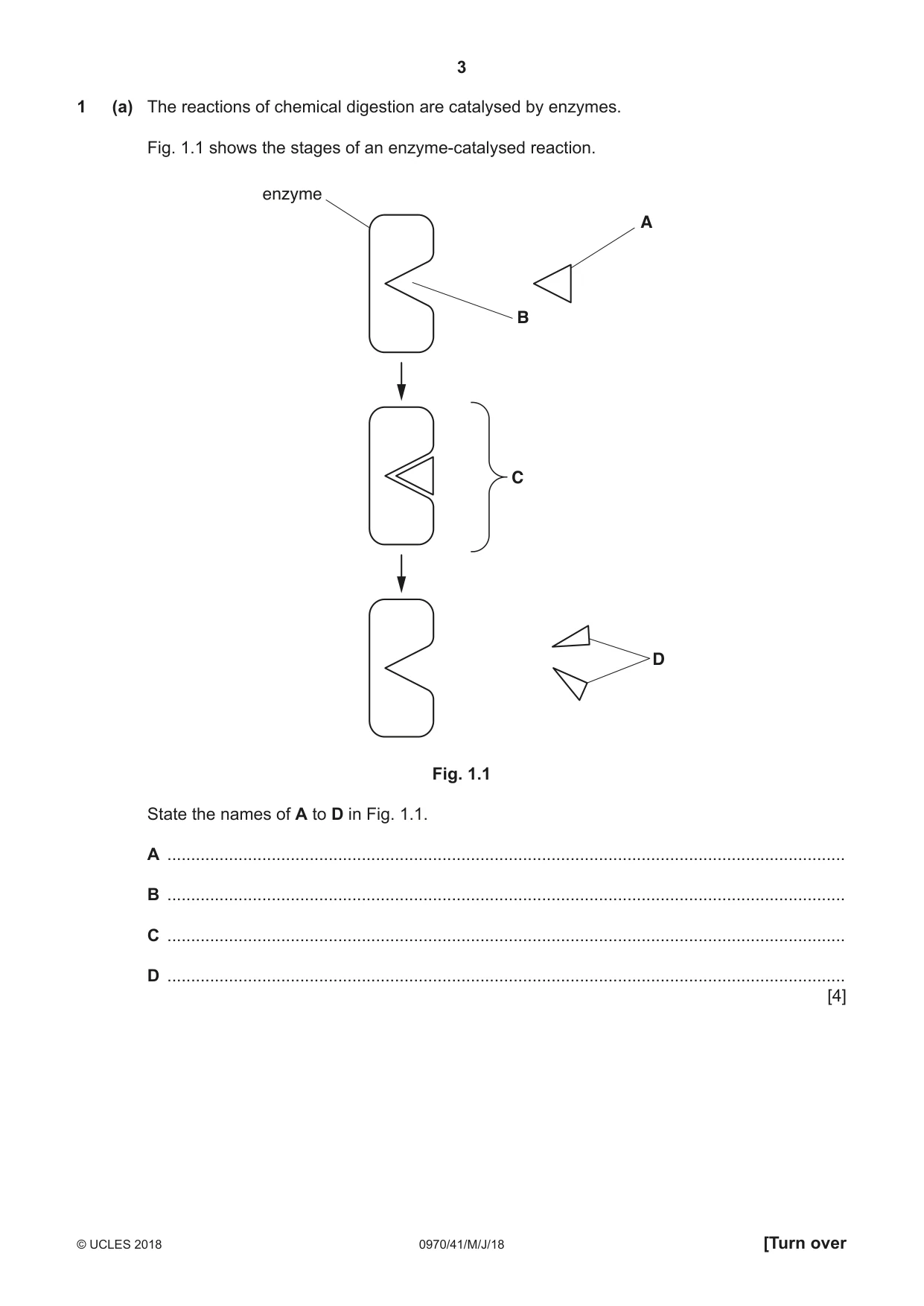
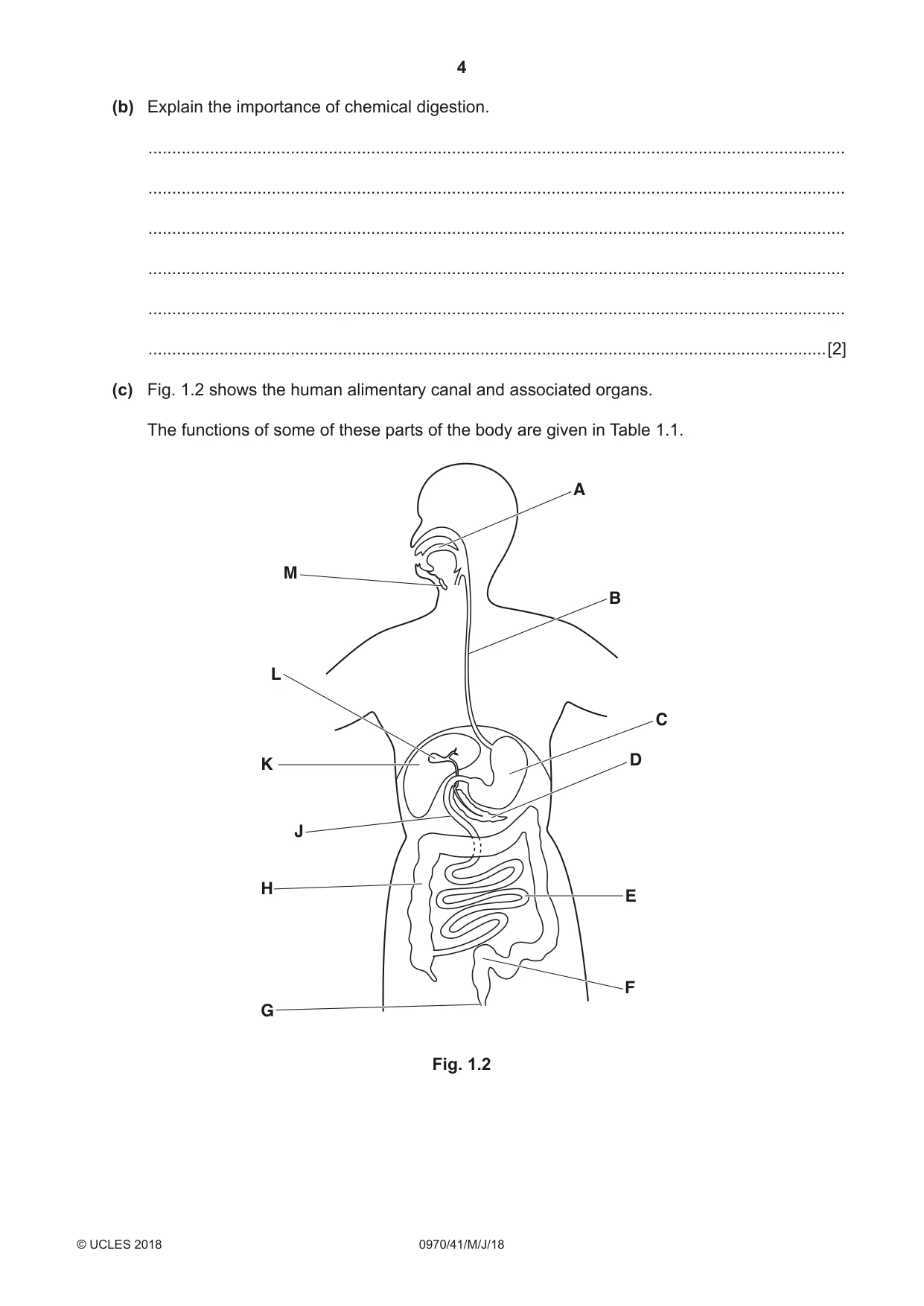
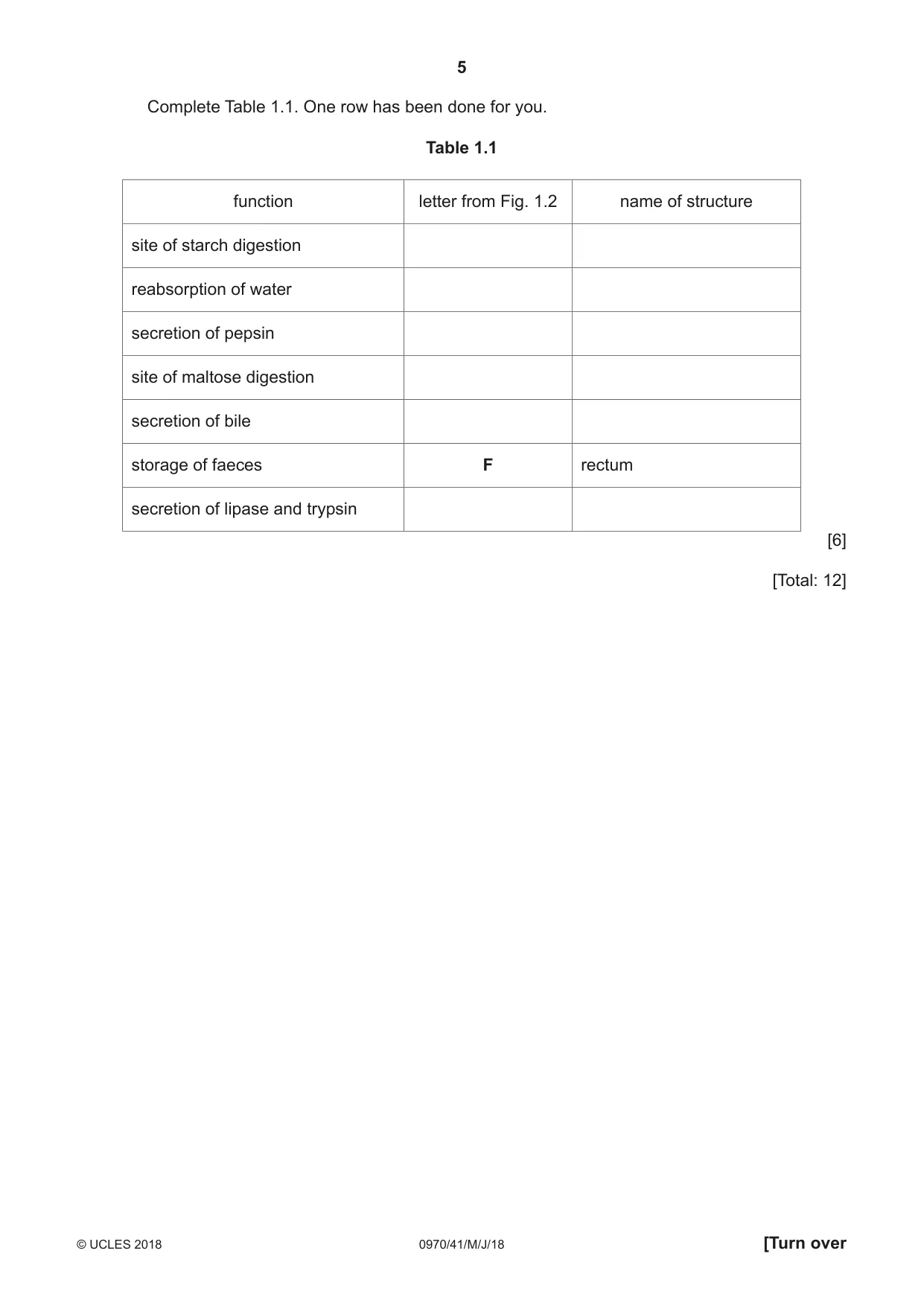
1 (a) The reactions of chemical digestion are catalysed by enzymes. Fig. 1.1 shows the stages of an enzyme-catalysed reaction. enzyme A B C D Fig. 1.1 State the names of A to D in Fig. 1.1. A ............................................................................................................................................... B ............................................................................................................................................... C ............................................................................................................................................... D ............................................................................................................................................... [4] (b) Explain the importance of chemical digestion. ................................................................................................................................................... ................................................................................................................................................... ................................................................................................................................................... ................................................................................................................................................... ................................................................................................................................................... ...............................................................................................................................................[2] (c) Fig. 1.2 shows the human alimentary canal and associated organs. The functions of some of these parts of the body are given in Table 1.1. A M B L C K D J H E F G Fig. 1.2 Complete Table 1.1. One row has been done for you. Table 1.1 function letter from Fig. 1.2 name of structure site of starch digestion reabsorption of water secretion of pepsin site of maltose digestion secretion of bile storage of faeces F rectum secretion of lipase and trypsin [6] [Total: 12]
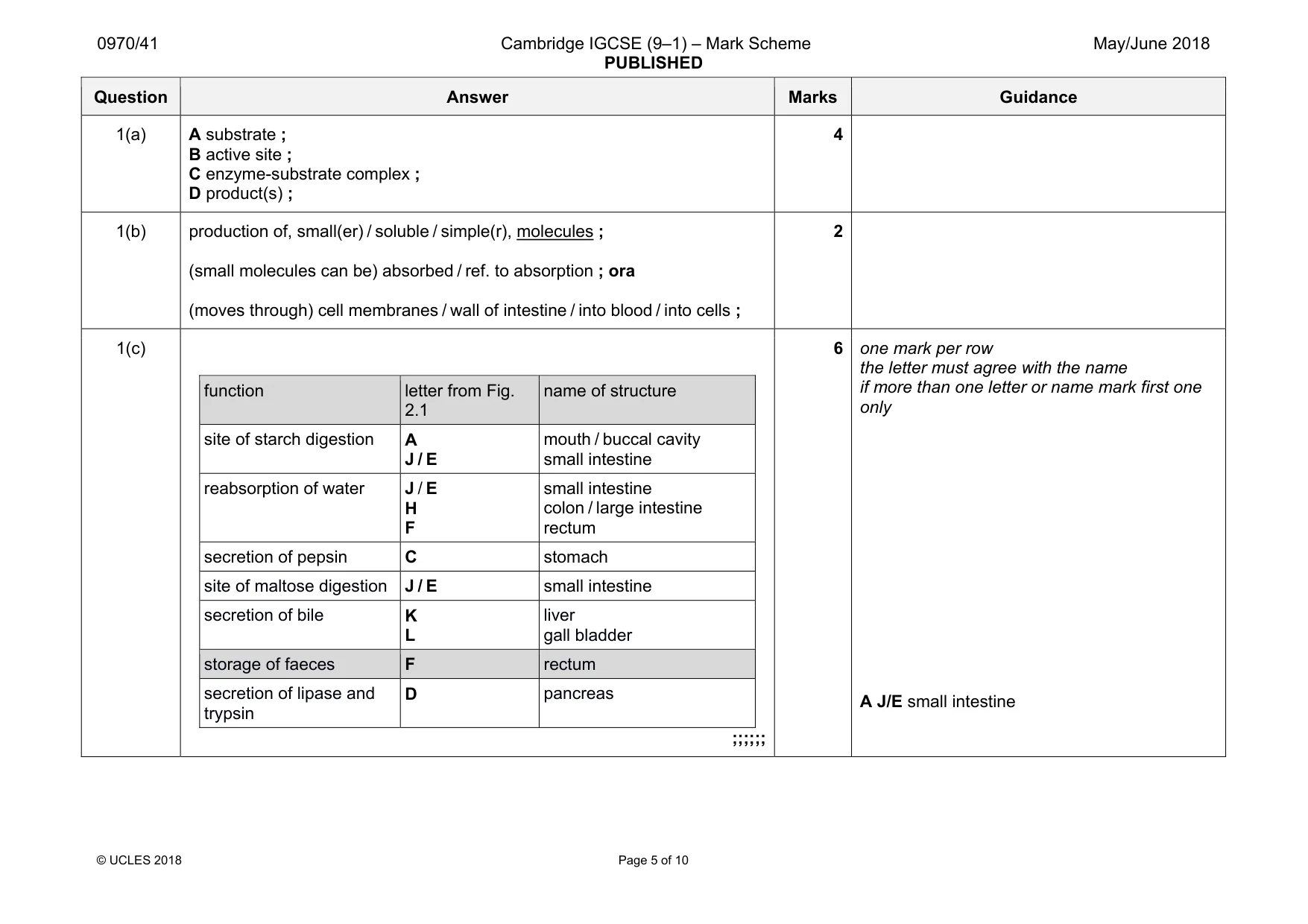
Mark scheme: 1(a) A substrate ; B active site ; C enzyme-substrate complex ; D product(s) ; 4 1(b) production of, small(er) / soluble / simple(r), molecules ; (small molecules can be) absorbed / ref. to absorption ; ora (moves through) cell membranes / wall of intestine / into blood / into cells ; 2 1(c) ;;;;;; function letter from Fig. 2.1 name of structure site of starch digestion A J / E mouth / buccal cavity small intestine reabsorption of water J / E H F small intestine colon / large intestine rectum secretion of pepsin C stomach site of maltose digestion J / E small intestine secretion of bile K L liver gall bladder storage of faeces F rectum secretion of lipase and trypsin D pancreas 6 one mark per row the letter must agree with the name if more than one letter or name mark first one only A J/E small intestine
Q2 · Adaptive features are defined as the inherited features of an organism that increase its…
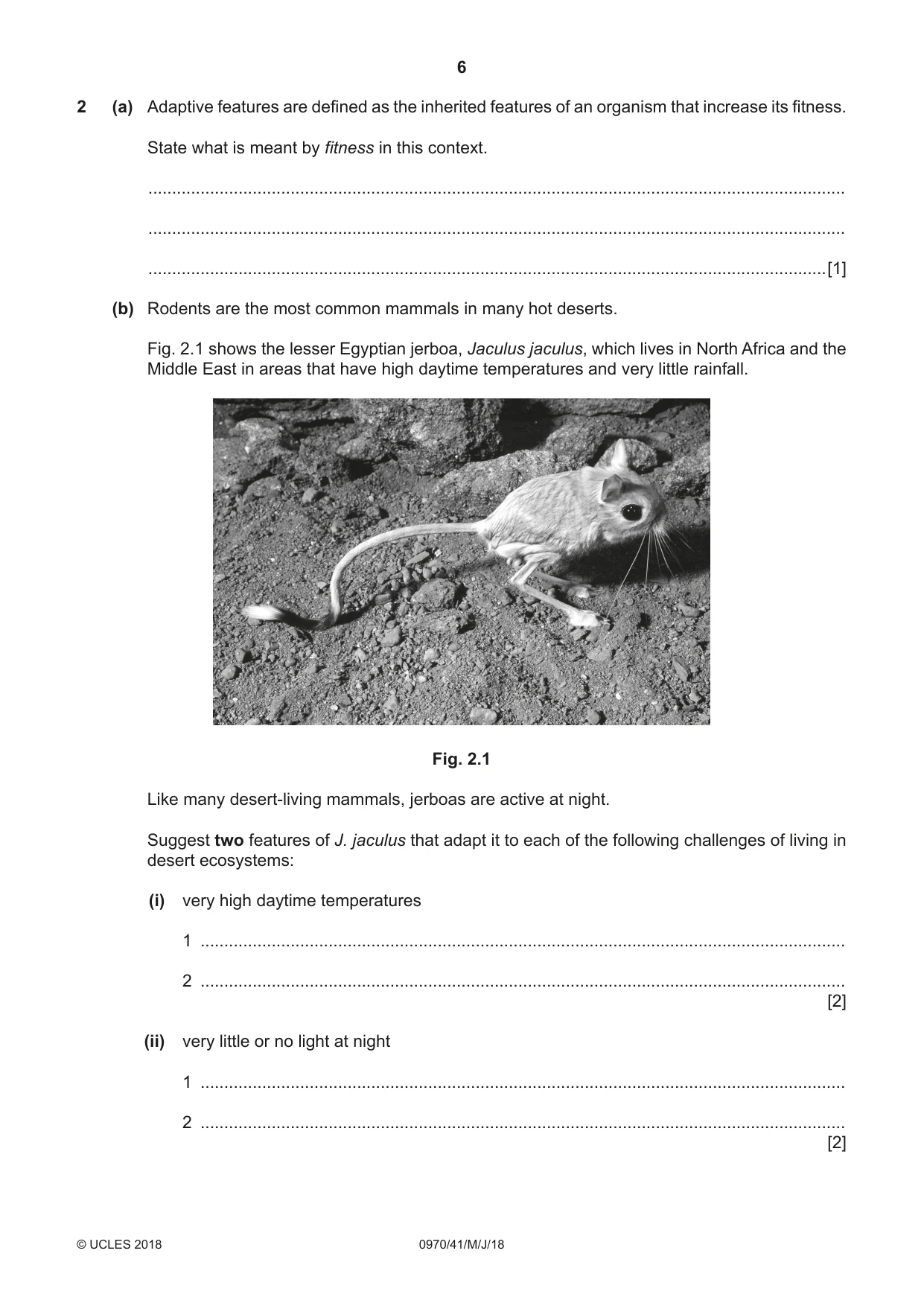
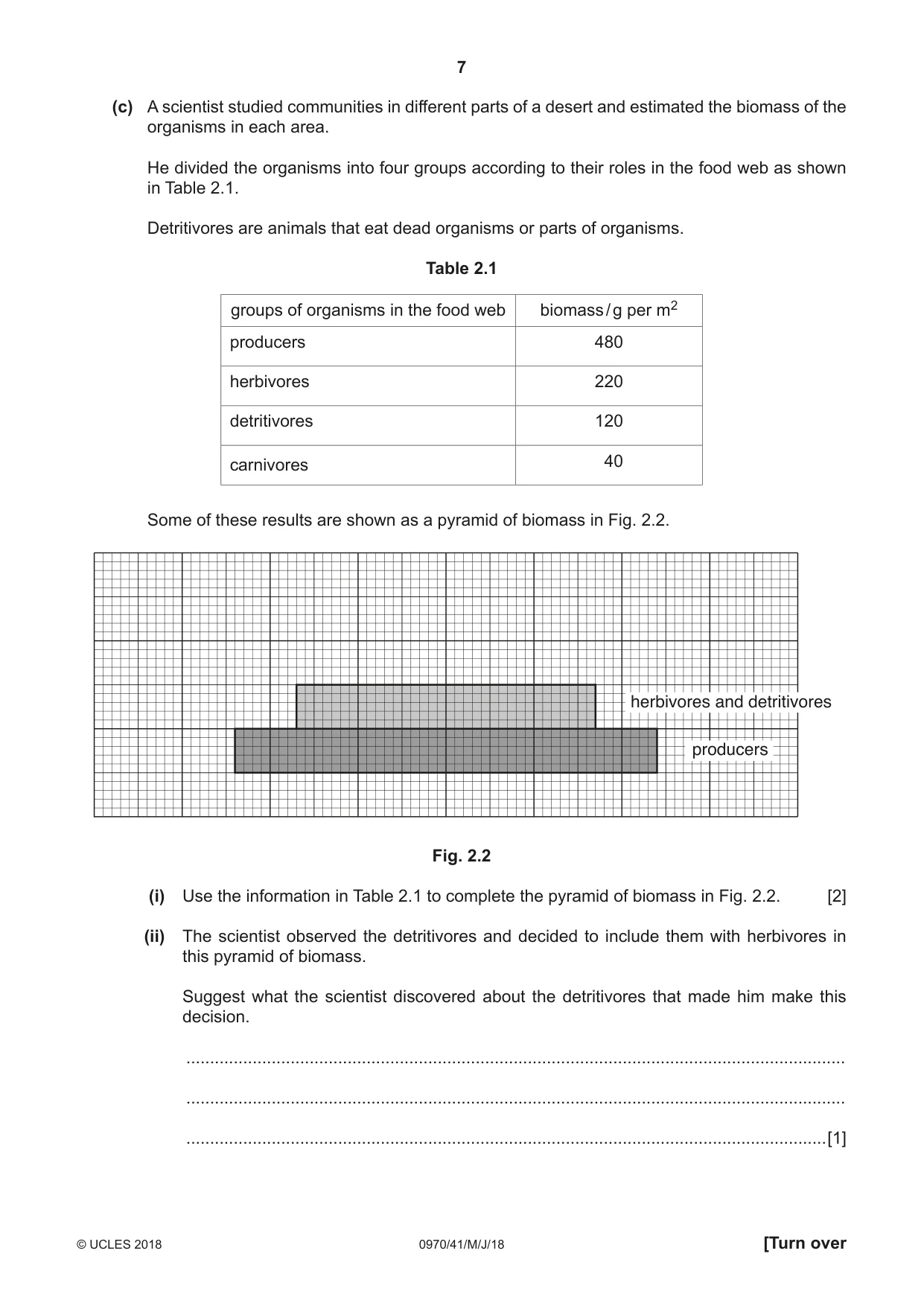
2 (a) Adaptive features are defined as the inherited features of an organism that increase its fitness. State what is meant by fitness in this context. ................................................................................................................................................... ................................................................................................................................................... ...............................................................................................................................................[1] (b) Rodents are the most common mammals in many hot deserts. Fig. 2.1 shows the lesser Egyptian jerboa, Jaculus jaculus, which lives in North Africa and the Middle East in areas that have high daytime temperatures and very little rainfall. Fig. 2.1 Like many desert-living mammals, jerboas are active at night. Suggest two features of J. jaculus that adapt it to each of the following challenges of living in desert ecosystems: (i) very high daytime temperatures 1 ........................................................................................................................................ 2 ........................................................................................................................................ [2] (ii) very little or no light at night 1 ........................................................................................................................................ 2 ........................................................................................................................................ [2] (c) A scientist studied communities in different parts of a desert and estimated the biomass of the organisms in each area. He divided the organisms into four groups according to their roles in the food web as shown in Table 2.1. Detritivores are animals that eat dead organisms or parts of organisms. Table 2.1 groups of organisms in the food web biomass / g per m2 producers 480 herbivores 220 detritivores 120 carnivores 40 Some of these results are shown as a pyramid of biomass in Fig. 2.2. herbivores and detritivores producers Fig. 2.2 (i) Use the information in Table 2.1 to complete the pyramid of biomass in Fig. 2.2. [2] (ii) The scientist observed the detritivores and decided to include them with herbivores in this pyramid of biomass. Suggest what the scientist discovered about the detritivores that made him make this decision. ........................................................................................................................................... ........................................................................................................................................... .......................................................................................................................................[1] (iii) Explain why there are rarely more than four or five trophic levels in ecosystems. ........................................................................................................................................... ........................................................................................................................................... ........................................................................................................................................... ........................................................................................................................................... .......................................................................................................................................[2] (iv) Explain the advantages of presenting information about food webs as a pyramid of biomass and not as a pyramid of numbers. ........................................................................................................................................... ........................................................................................................................................... ........................................................................................................................................... ........................................................................................................................................... ........................................................................................................................................... ........................................................................................................................................... ........................................................................................................................................... .......................................................................................................................................[3] [Total: 13]
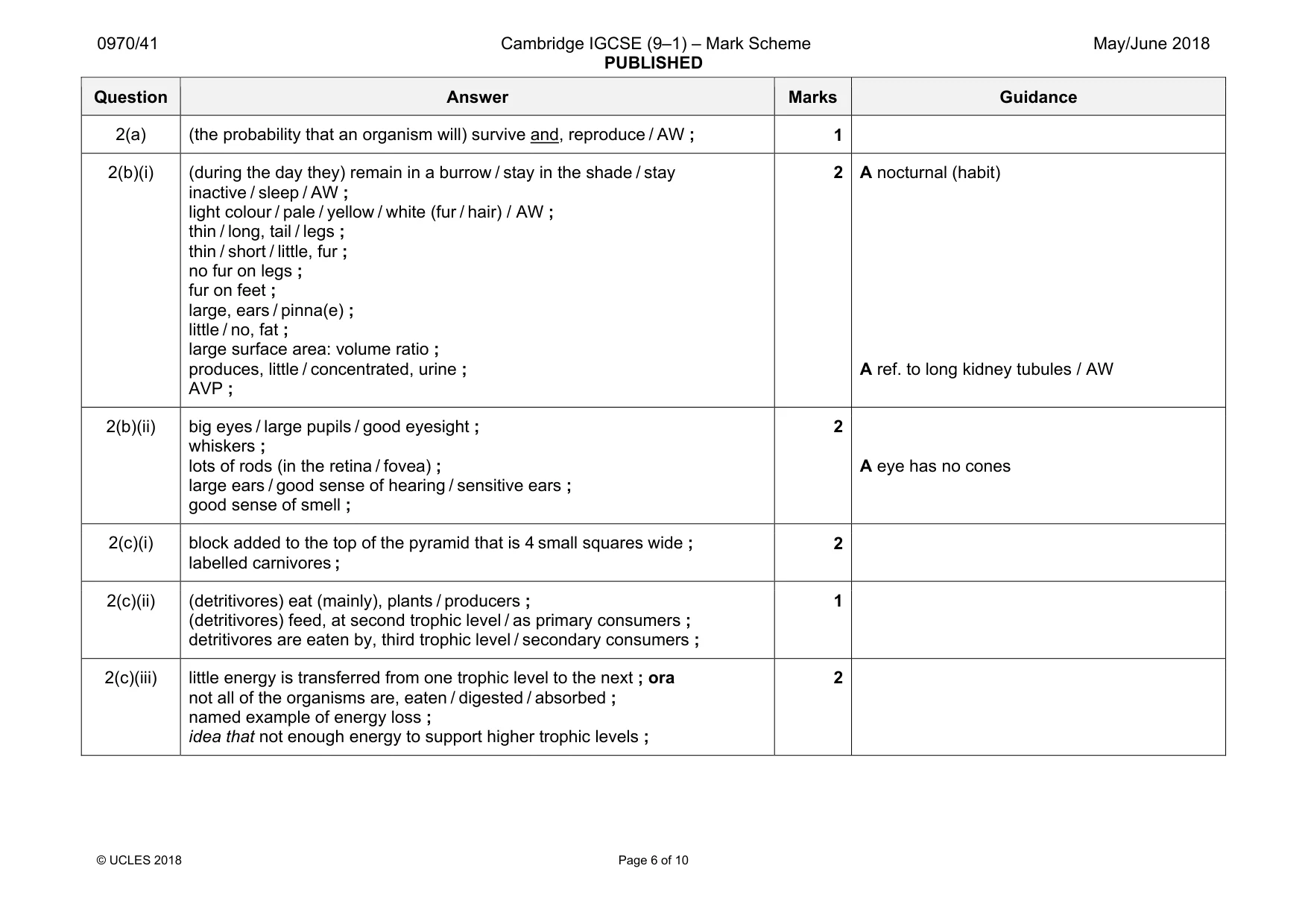
Mark scheme: 2(a) (the probability that an organism will) survive and, reproduce / AW ; 1 2(b)(i) (during the day they) remain in a burrow / stay in the shade / stay inactive / sleep / AW ; light colour / pale / yellow / white (fur / hair) / AW ; thin / long, tail / legs ; thin / short / little, fur ; no fur on legs ; fur on feet ; large, ears / pinna(e) ; little / no, fat ; large surface area: volume ratio ; produces, little / concentrated, urine ; AVP ; 2 A nocturnal (habit) A ref. to long kidney tubules / AW 2(b)(ii) big eyes / large pupils / good eyesight ; whiskers ; lots of rods (in the retina / fovea) ; large ears / good sense of hearing / sensitive ears ; good sense of smell ; 2 A eye has no cones 2(c)(i) block added to the top of the pyramid that is 4 small squares wide ; labelled carnivores ; 2 2(c)(ii) (detritivores) eat (mainly), plants / producers ; (detritivores) feed, at second trophic level / as primary consumers ; detritivores are eaten by, third trophic level / secondary consumers ; 1 2(c)(iii) little energy is transferred from one trophic level to the next ; ora not all of the organisms are, eaten / digested / absorbed ; named example of energy loss ; idea that not enough energy to support higher trophic levels ; 2 Question Answer Marks Guidance 2(c)(iv) idea that in a pyramid of numbers one large individual is shown in the same way as one very tiny individual ; ora biomass indicates how much food there is, available / left ; biomass is an indicator of the energy available ; pyramid of biomass is pyramid shaped whereas a pyramid of numbers is not always ; ora AVP ; 3
Q3 · A student cut a section of a root and made an outline drawing of the distribution of…
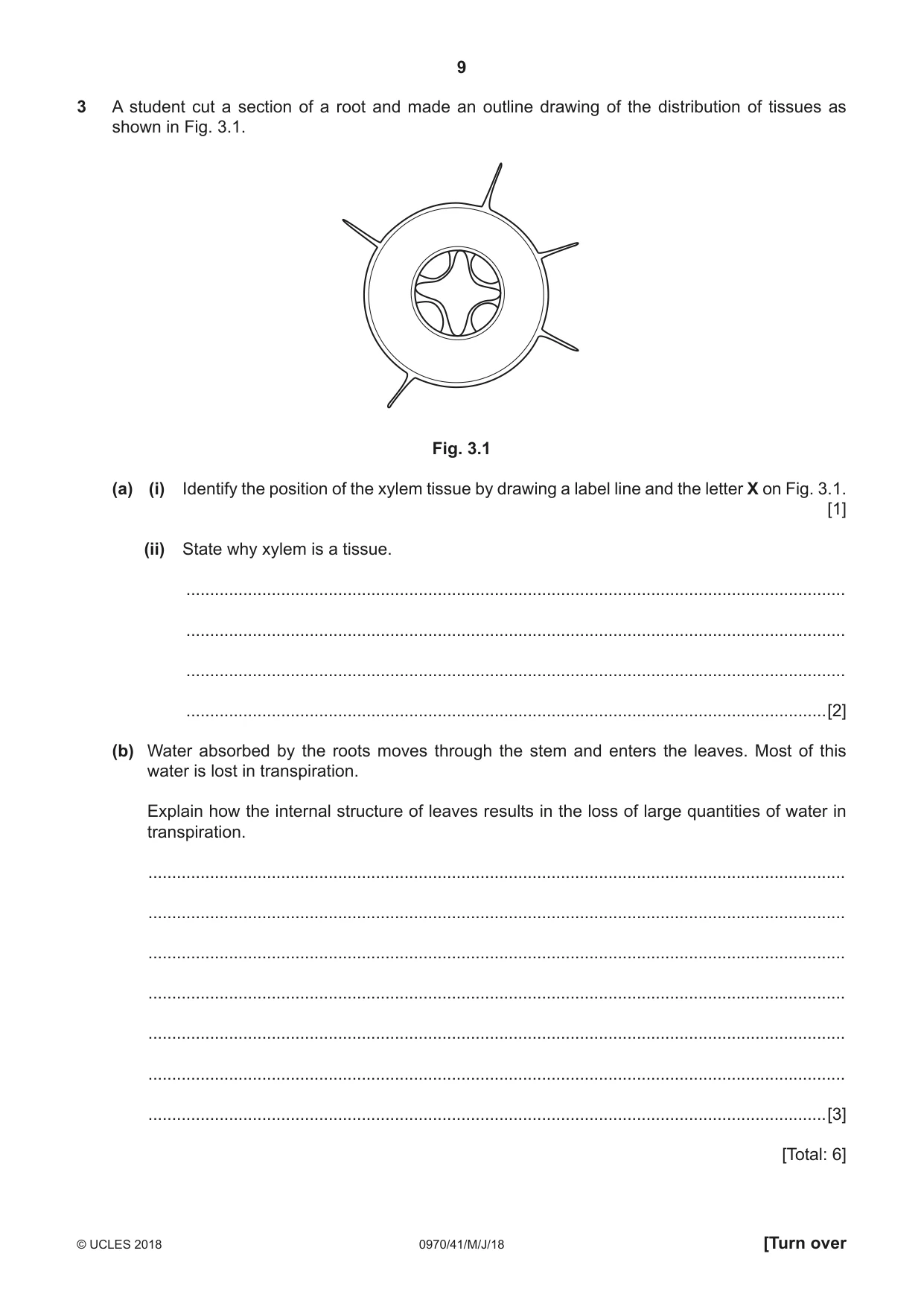
3 A student cut a section of a root and made an outline drawing of the distribution of tissues as shown in Fig. 3.1. Fig. 3.1 (a) (i) Identify the position of the xylem tissue by drawing a label line and the letter X on Fig. 3.1. [1] (ii) State why xylem is a tissue. ........................................................................................................................................... ........................................................................................................................................... ........................................................................................................................................... .......................................................................................................................................[2] (b) Water absorbed by the roots moves through the stem and enters the leaves. Most of this water is lost in transpiration. Explain how the internal structure of leaves results in the loss of large quantities of water in transpiration. ................................................................................................................................................... ................................................................................................................................................... ................................................................................................................................................... ................................................................................................................................................... ................................................................................................................................................... ................................................................................................................................................... ...............................................................................................................................................[3] [Total: 6]
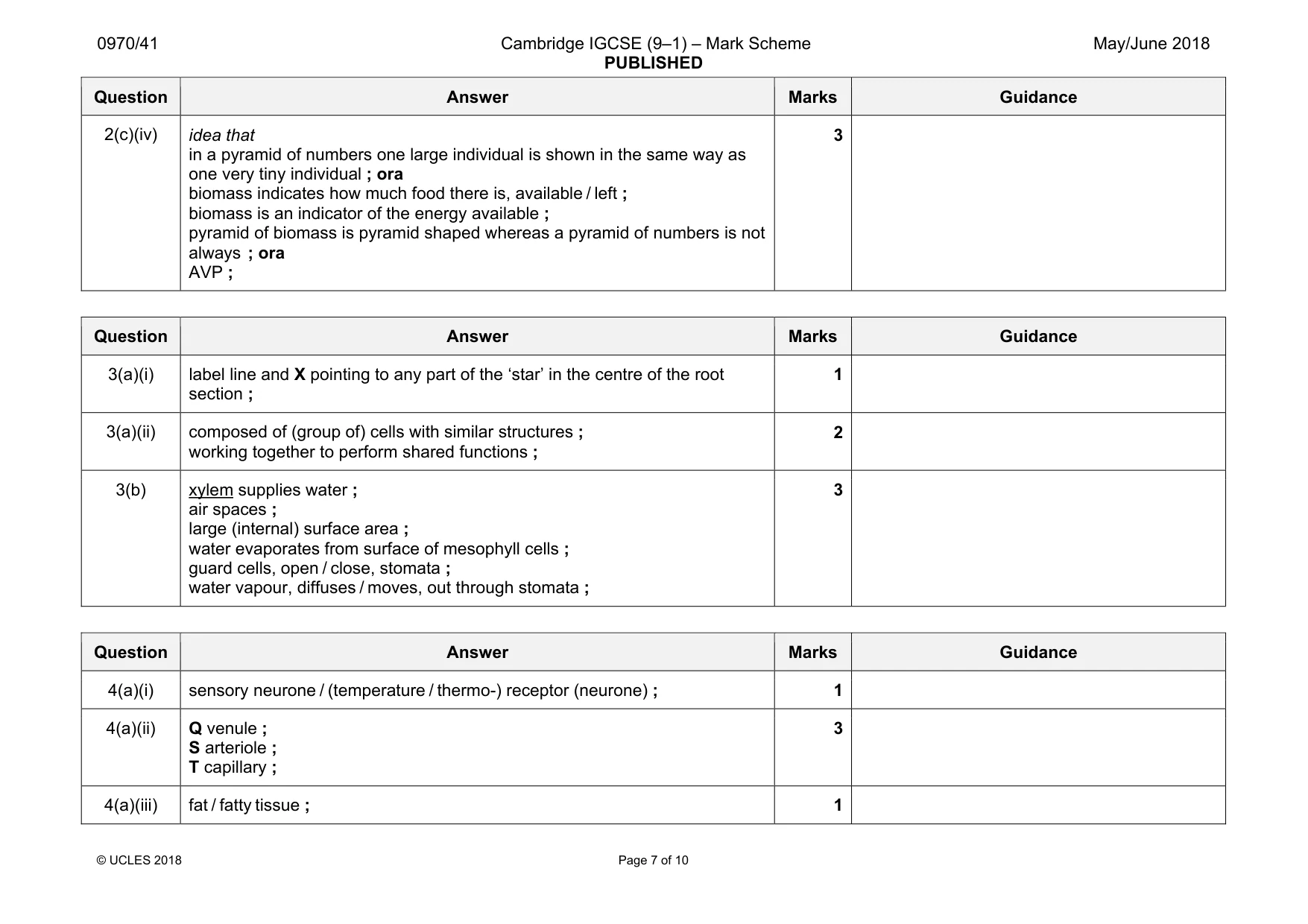
Mark scheme: 3(a)(i) label line and X pointing to any part of the ‘star’ in the centre of the root section ; 1 3(a)(ii) composed of (group of) cells with similar structures ; working together to perform shared functions ; 2 3(b) xylem supplies water ; air spaces ; large (internal) surface area ; water evaporates from surface of mesophyll cells ; guard cells, open / close, stomata ; water vapour, diffuses / moves, out through stomata ; 3
Q4 · The flow of blood through the skin can be investigated by using a flow-meter
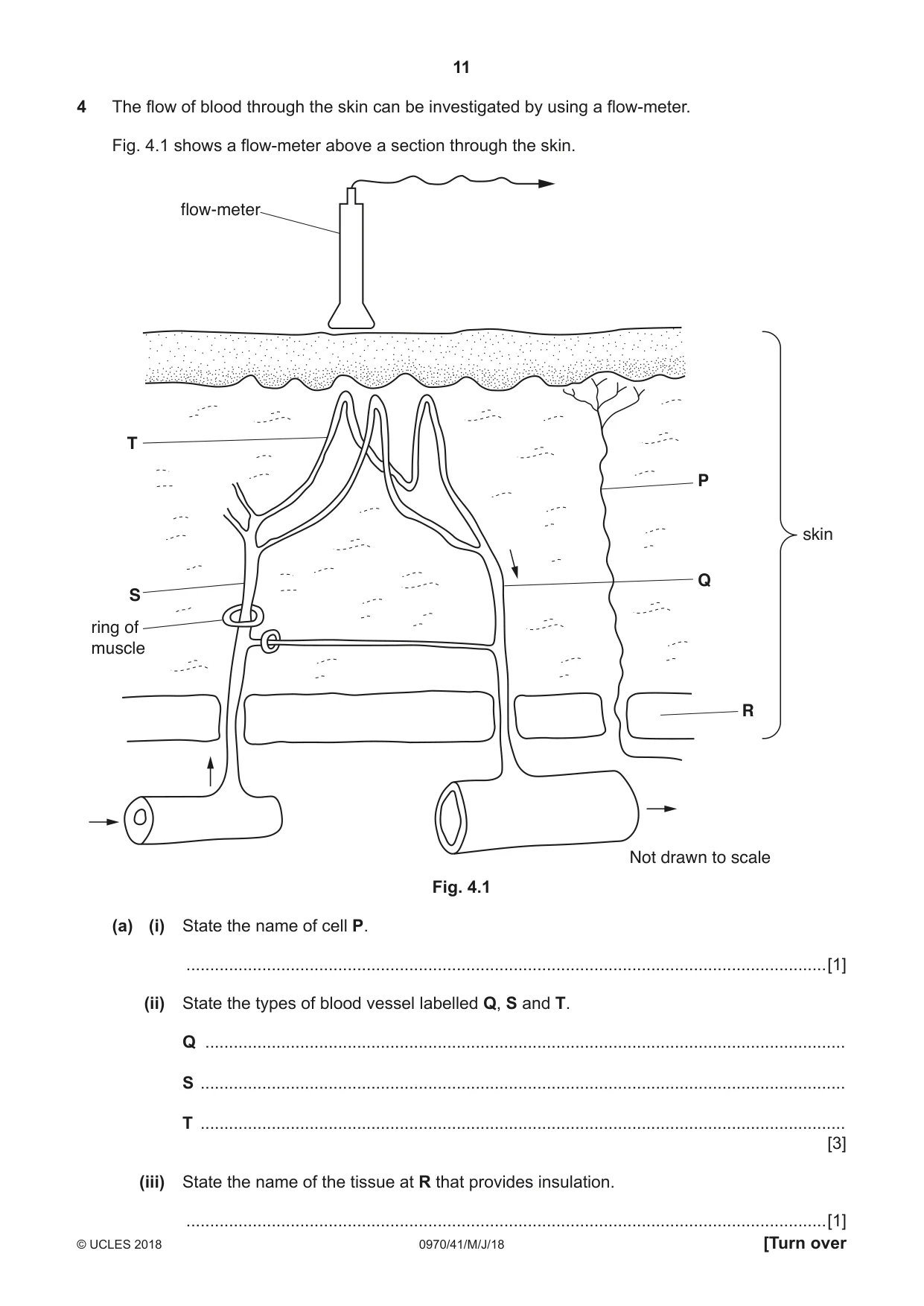
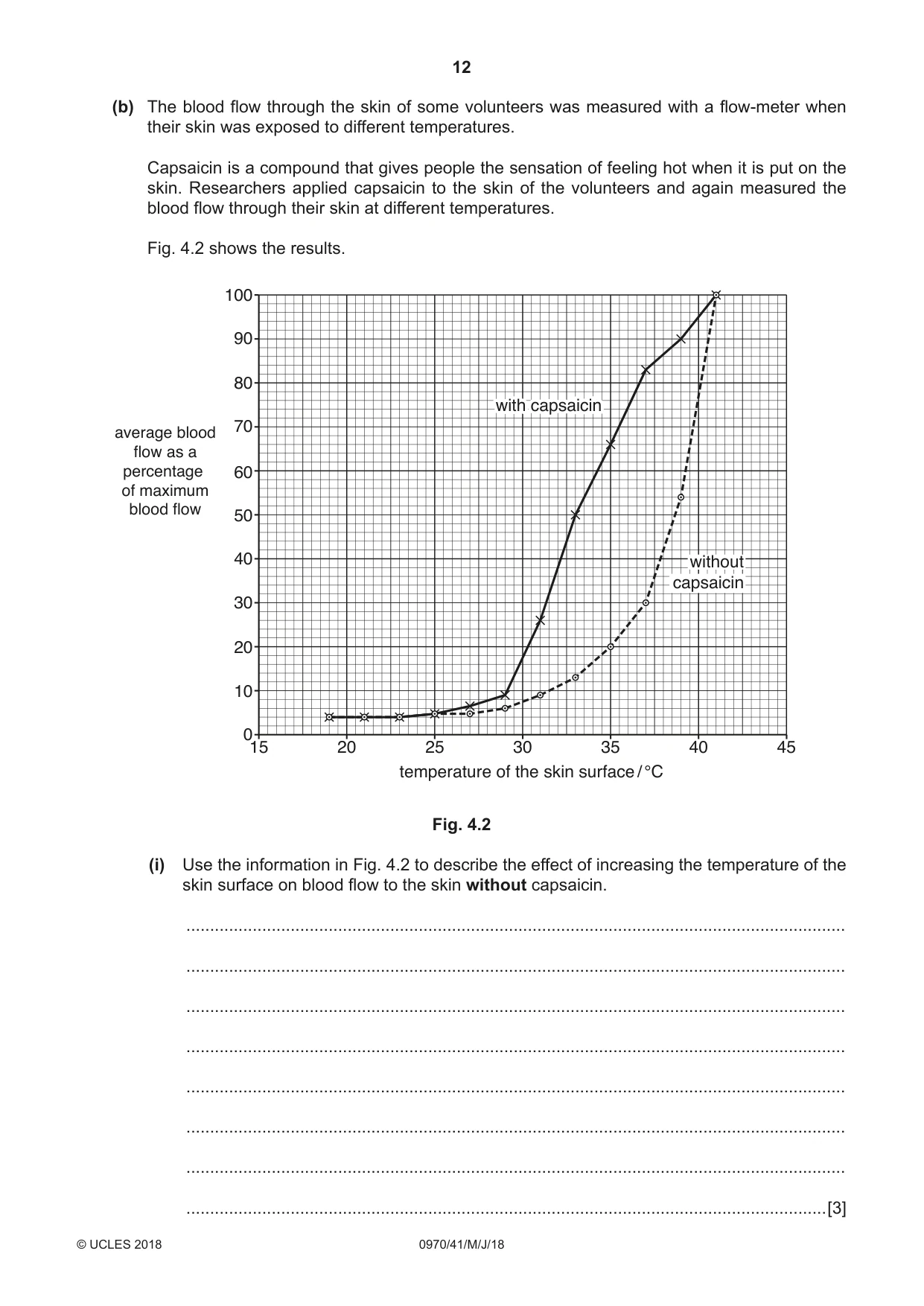
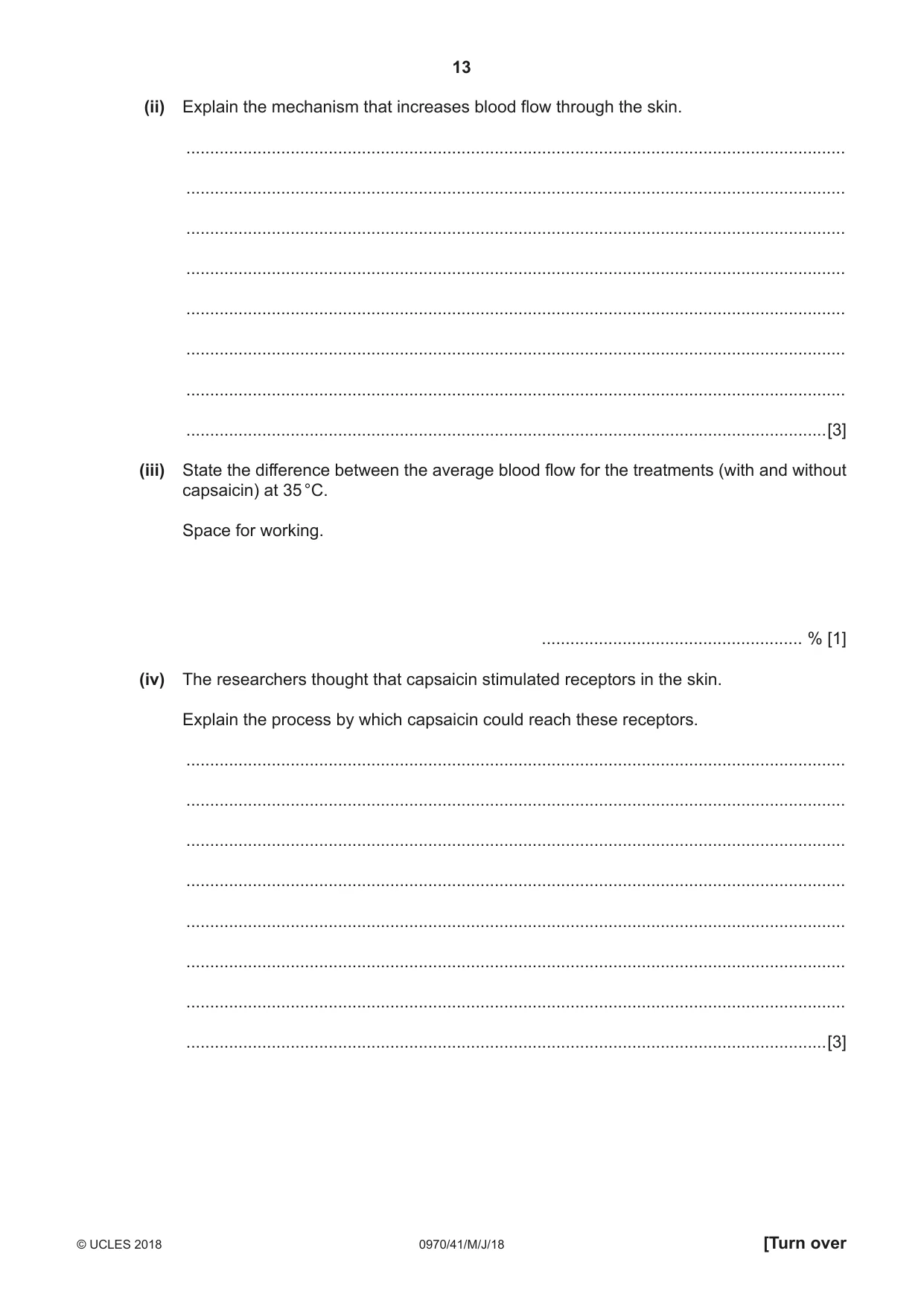
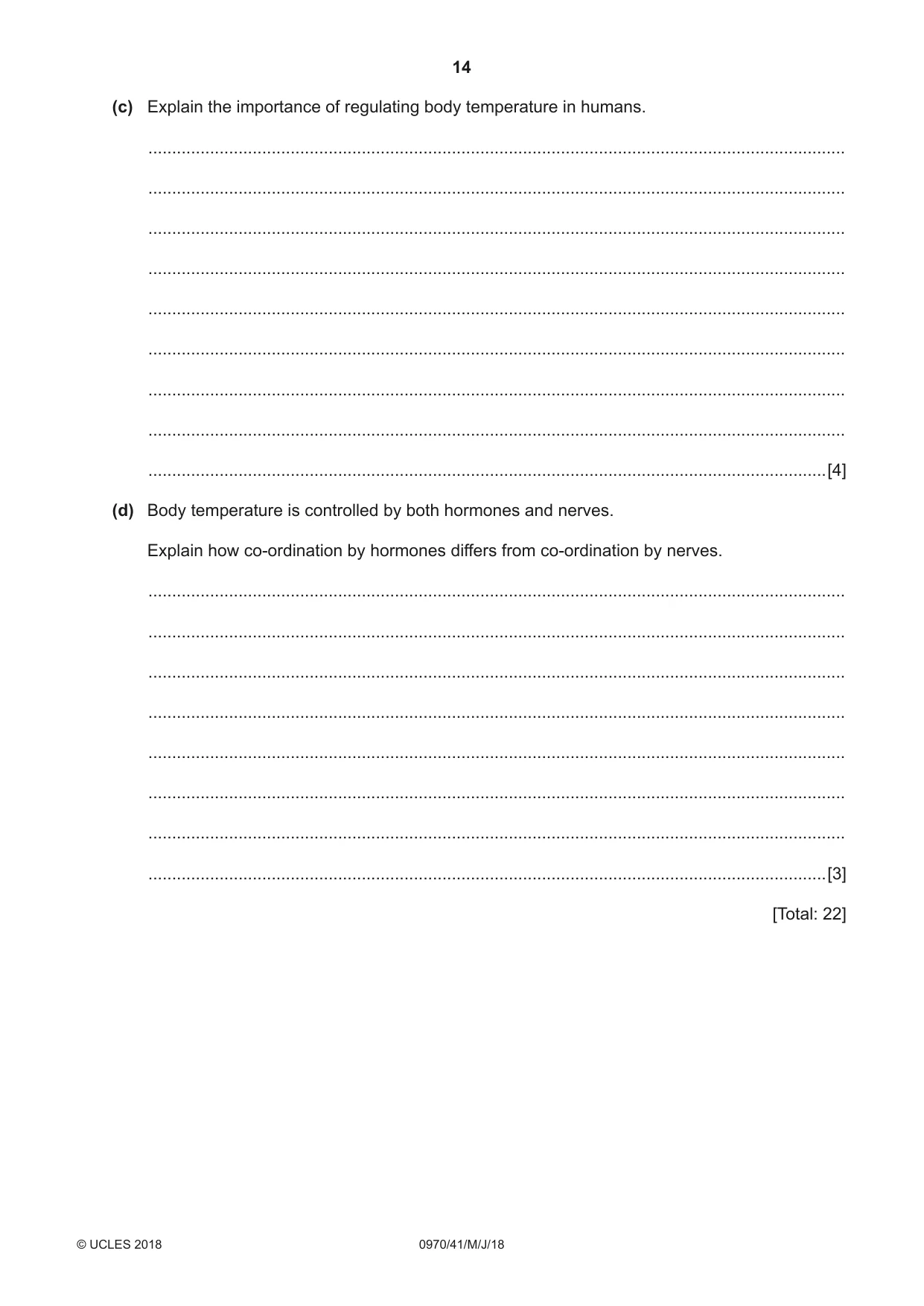
4 The flow of blood through the skin can be investigated by using a flow-meter. Fig. 4.1 shows a flow-meter above a section through the skin. flow-meter T P skin Q S ring of muscle R Not drawn to scale Fig. 4.1 (a) (i) State the name of cell P. .......................................................................................................................................[1] (ii) State the types of blood vessel labelled Q, S and T. Q ....................................................................................................................................... S ........................................................................................................................................ T ........................................................................................................................................ [3] (iii) State the name of the tissue at R that provides insulation. .......................................................................................................................................[1] (b) The blood flow through the skin of some volunteers was measured with a flow-meter when their skin was exposed to different temperatures. Capsaicin is a compound that gives people the sensation of feeling hot when it is put on the skin. Researchers applied capsaicin to the skin of the volunteers and again measured the blood flow through their skin at different temperatures. Fig. 4.2 shows the results. 100 90 80 withwith capsaicincapsaicin 70average blood flow as a percentage 60 of maximum blood flow 50 40 without capsaicin 30 20 10 015 20 25 30 35 40 45 temperature of the skin surface / °C Fig. 4.2 (i) Use the information in Fig. 4.2 to describe the effect of increasing the temperature of the skin surface on blood flow to the skin without capsaicin. ........................................................................................................................................... ........................................................................................................................................... ........................................................................................................................................... ........................................................................................................................................... ........................................................................................................................................... ........................................................................................................................................... ........................................................................................................................................... .......................................................................................................................................[3] (ii) Explain the mechanism that increases blood flow through the skin. ........................................................................................................................................... ........................................................................................................................................... ........................................................................................................................................... ........................................................................................................................................... ........................................................................................................................................... ........................................................................................................................................... ........................................................................................................................................... .......................................................................................................................................[3] (iii) State the difference between the average blood flow for the treatments (with and without capsaicin) at 35 °C. Space for working. ....................................................... % [1] (iv) The researchers thought that capsaicin stimulated receptors in the skin. Explain the process by which capsaicin could reach these receptors. ........................................................................................................................................... ........................................................................................................................................... ........................................................................................................................................... ........................................................................................................................................... ........................................................................................................................................... ........................................................................................................................................... ........................................................................................................................................... .......................................................................................................................................[3] (c) Explain the importance of regulating body temperature in humans. ................................................................................................................................................... ................................................................................................................................................... ................................................................................................................................................... ................................................................................................................................................... ................................................................................................................................................... ................................................................................................................................................... ................................................................................................................................................... ................................................................................................................................................... ...............................................................................................................................................[4] (d) Body temperature is controlled by both hormones and nerves. Explain how co-ordination by hormones differs from co-ordination by nerves. ................................................................................................................................................... ................................................................................................................................................... ................................................................................................................................................... ................................................................................................................................................... ................................................................................................................................................... ................................................................................................................................................... ................................................................................................................................................... ...............................................................................................................................................[3] [Total: 22]
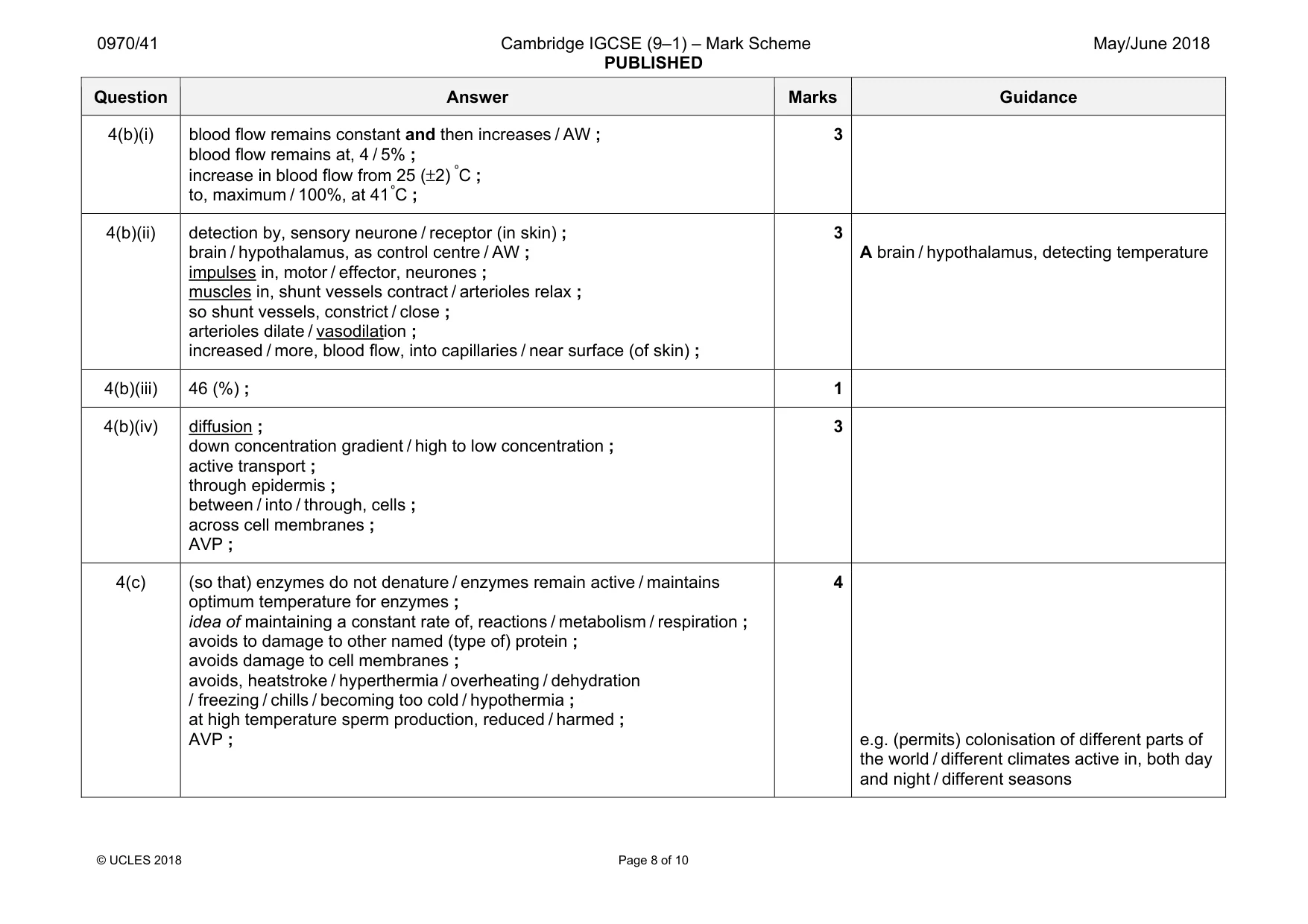
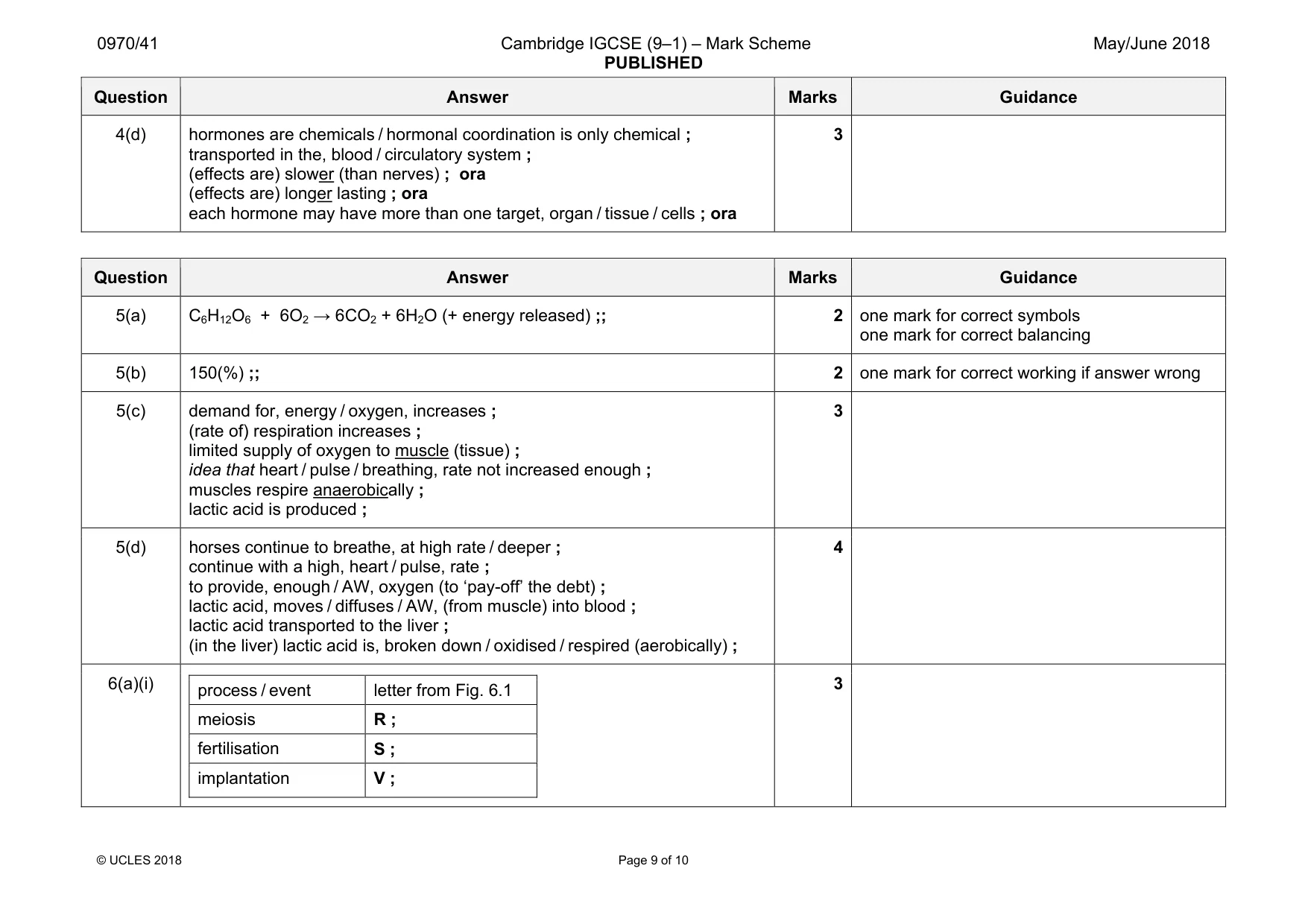
Mark scheme: 4(a)(i) sensory neurone / (temperature / thermo-) receptor (neurone) ; 1 4(a)(ii) Q venule ; S arteriole ; T capillary ; 3 4(a)(iii) fat / fatty tissue ; 1 Question Answer Marks Guidance 4(b)(i) blood flow remains constant and then increases / AW ; blood flow remains at, 4 / 5% ; increase in blood flow from 25 (±2) ºC ; to, maximum / 100%, at 41 ºC ; 3 4(b)(ii) detection by, sensory neurone / receptor (in skin) ; brain / hypothalamus, as control centre / AW ; impulses in, motor / effector, neurones ; muscles in, shunt vessels contract / arterioles relax ; so shunt vessels, constrict / close ; arterioles dilate / vasodilation ; increased / more, blood flow, into capillaries / near surface (of skin) ; 3 A brain / hypothalamus, detecting temperature 4(b)(iii) 46 (%) ; 1 4(b)(iv) diffusion ; down concentration gradient / high to low concentration ; active transport ; through epidermis ; between / into / through, cells ; across cell membranes ; AVP ; 3 4(c) (so that) enzymes do not denature / enzymes remain active / maintains optimum temperature for enzymes ; idea of maintaining a constant rate of, reactions / metabolism / respiration ; avoids to damage to other named (type of) protein ; avoids damage to cell membranes ; avoids, heatstroke / hyperthermia / overheating / dehydration / freezing / chills / becoming too cold / hypothermia ; at high temperature sperm production, reduced / harmed ; AVP ; 4 e.g. (permits) colonisation of different parts of the world / different climates active in, both day and night / different seasons Question Answer Marks Guidance 4(d) hormones are chemicals / hormonal coordination is only chemical ; transported in the, blood / circulatory system ; (effects are) slower (than nerves) ; ora (effects are) longer lasting ; ora each hormone may have more than one target, organ / tissue / cells ; ora 3
Q5 · State the balanced chemical equation for aerobic respiration
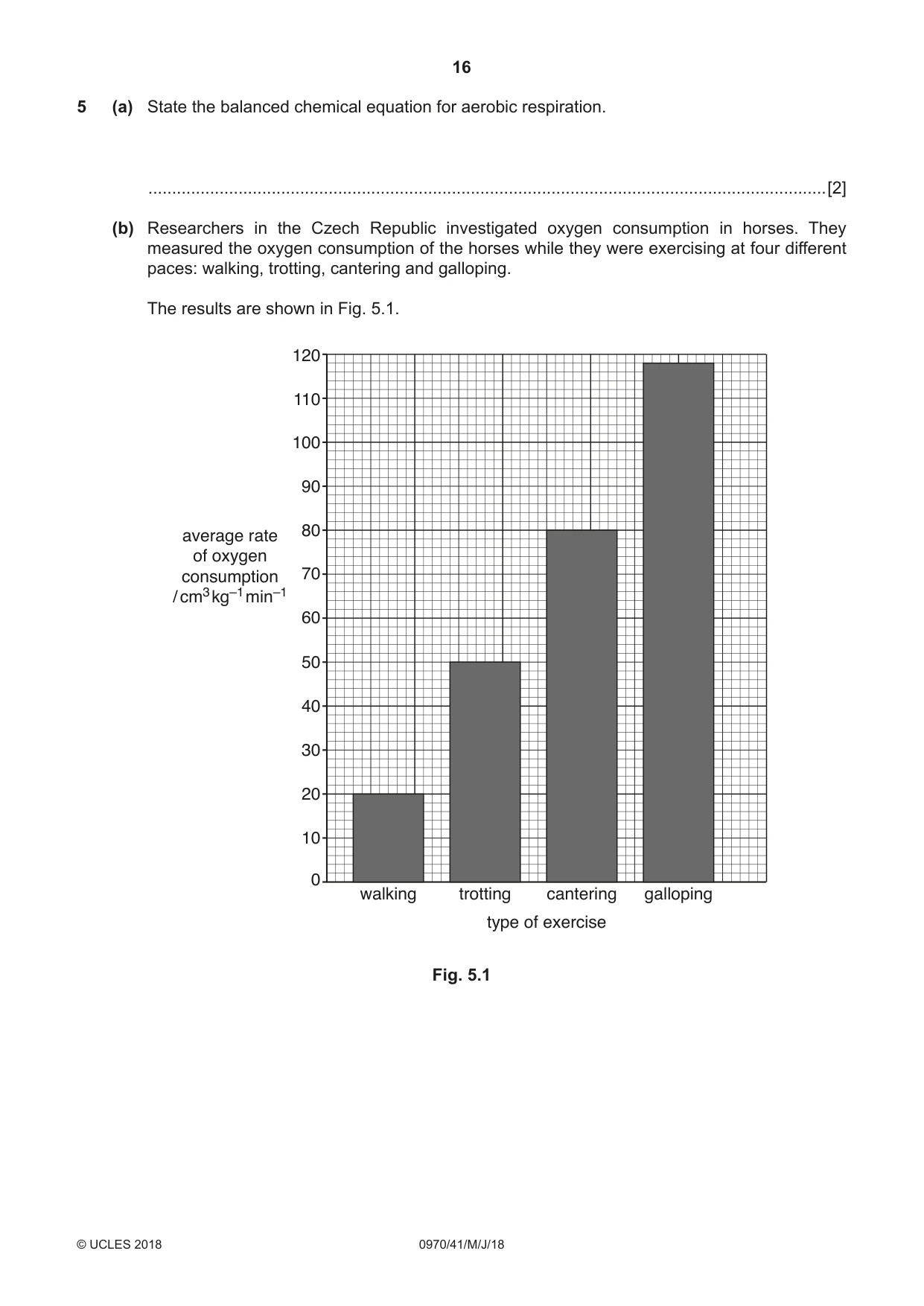
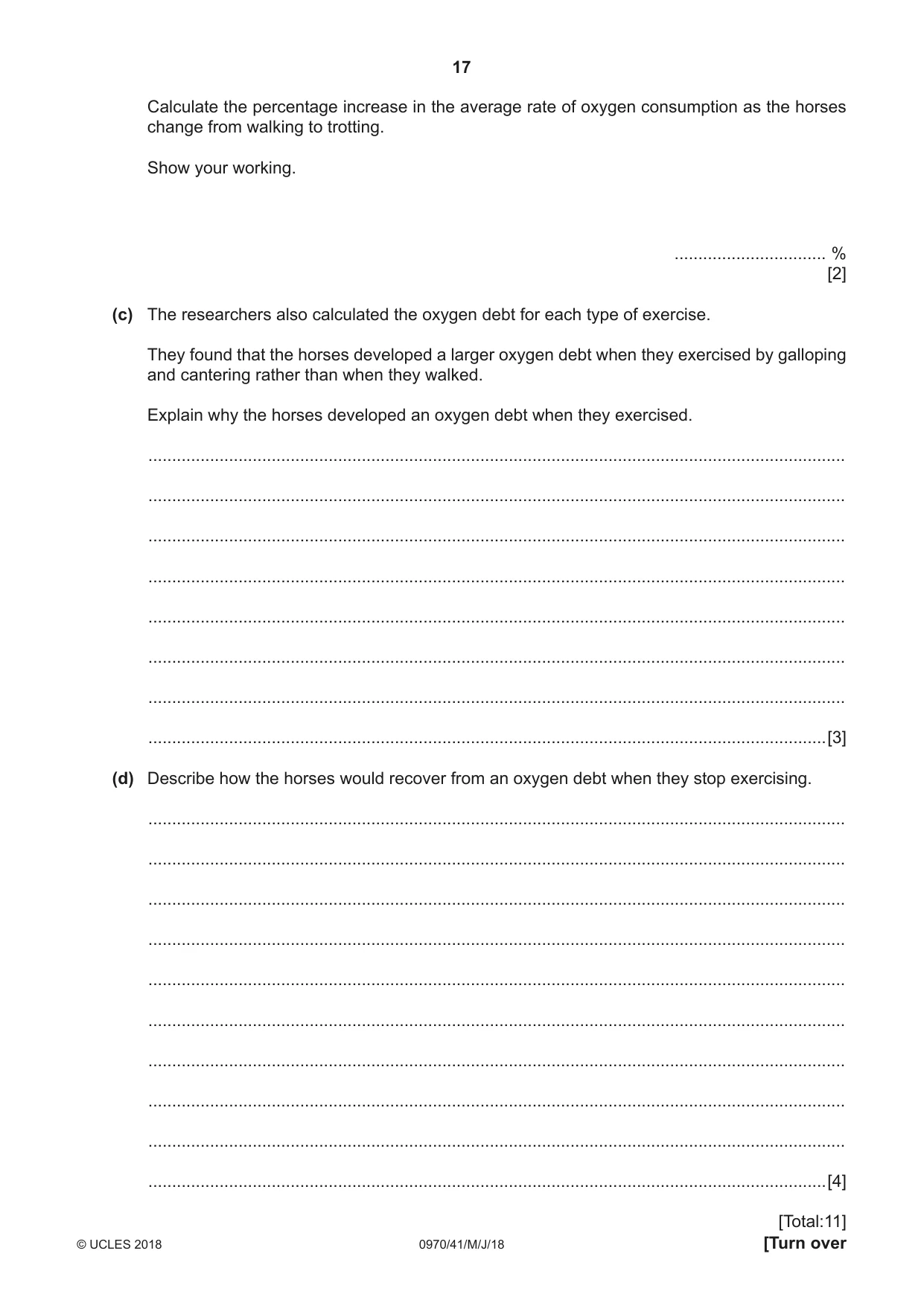
5 (a) State the balanced chemical equation for aerobic respiration. ...............................................................................................................................................[2] (b) Researchers in the Czech Republic investigated oxygen consumption in horses. They measured the oxygen consumption of the horses while they were exercising at four different paces: walking, trotting, cantering and galloping. The results are shown in Fig. 5.1. 120 110 100 90 80 average rate of oxygen consumption 70 / cm3 kg–1 min–1 60 50 40 30 20 10 0 walking trotting cantering galloping type of exercise Fig. 5.1 Calculate the percentage increase in the average rate of oxygen consumption as the horses change from walking to trotting. Show your working. ................................ % [2] (c) The researchers also calculated the oxygen debt for each type of exercise. They found that the horses developed a larger oxygen debt when they exercised by galloping and cantering rather than when they walked. Explain why the horses developed an oxygen debt when they exercised. ................................................................................................................................................... ................................................................................................................................................... ................................................................................................................................................... ................................................................................................................................................... ................................................................................................................................................... ................................................................................................................................................... ................................................................................................................................................... ...............................................................................................................................................[3] (d) Describe how the horses would recover from an oxygen debt when they stop exercising. ................................................................................................................................................... ................................................................................................................................................... ................................................................................................................................................... ................................................................................................................................................... ................................................................................................................................................... ................................................................................................................................................... ................................................................................................................................................... ................................................................................................................................................... ................................................................................................................................................... ...............................................................................................................................................[4] [Total:11]
Mark scheme: 5(a) C6H12O6 + 6O2 → 6CO2 + 6H2O (+ energy released) ;; 2 one mark for correct symbols one mark for correct balancing 5(b) 150(%) ;; 2 one mark for correct working if answer wrong 5(c) demand for, energy / oxygen, increases ; (rate of) respiration increases ; limited supply of oxygen to muscle (tissue) ; idea that heart / pulse / breathing, rate not increased enough ; muscles respire anaerobically ; lactic acid is produced ; 3 5(d) horses continue to breathe, at high rate / deeper ; continue with a high, heart / pulse, rate ; to provide, enough / AW, oxygen (to ‘pay-off’ the debt) ; lactic acid, moves / diffuses / AW, (from muscle) into blood ; lactic acid transported to the liver ; (in the liver) lactic acid is, broken down / oxidised / respired (aerobically) ; 4
Q6 · A diagram of the human female reproductive system
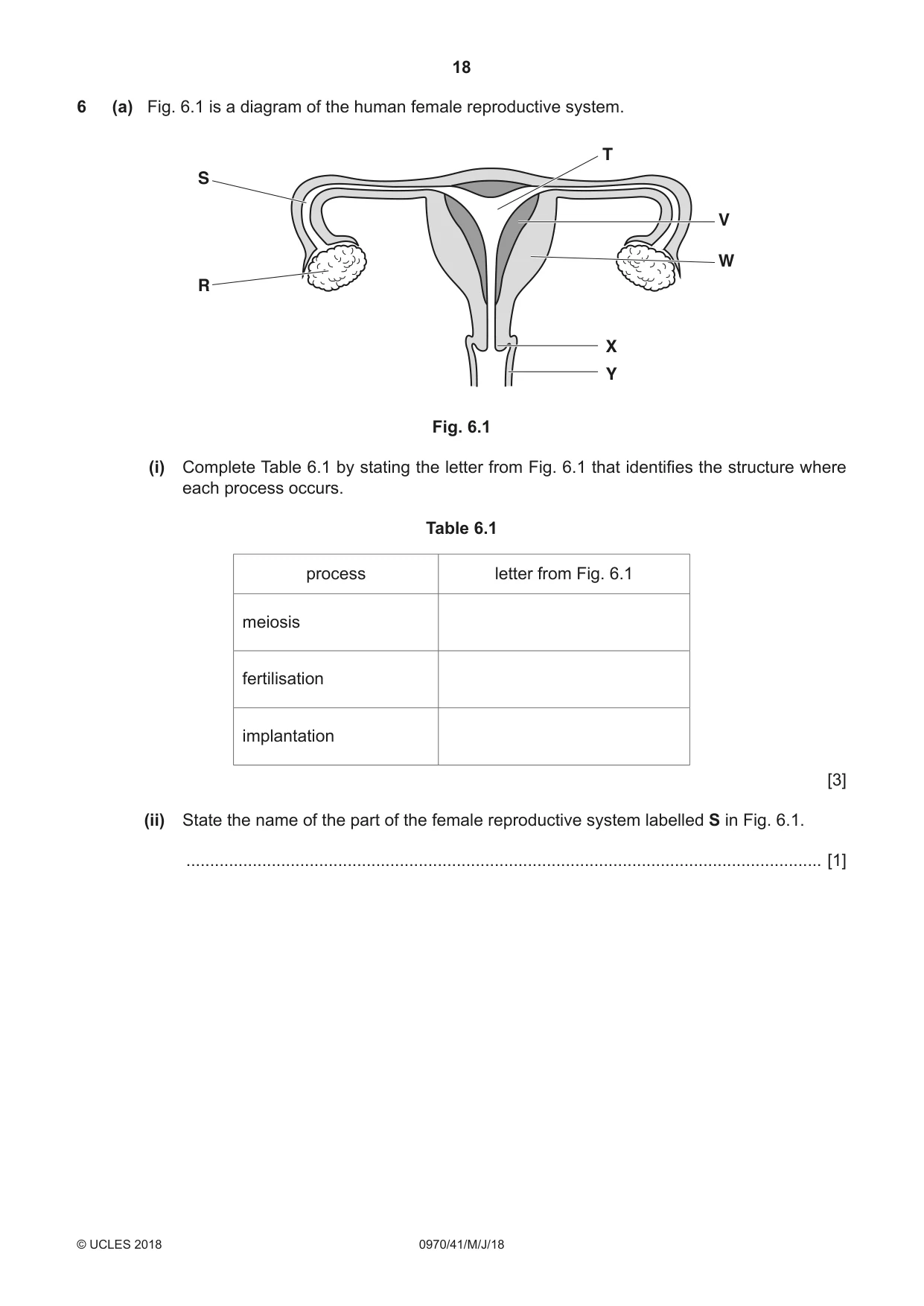
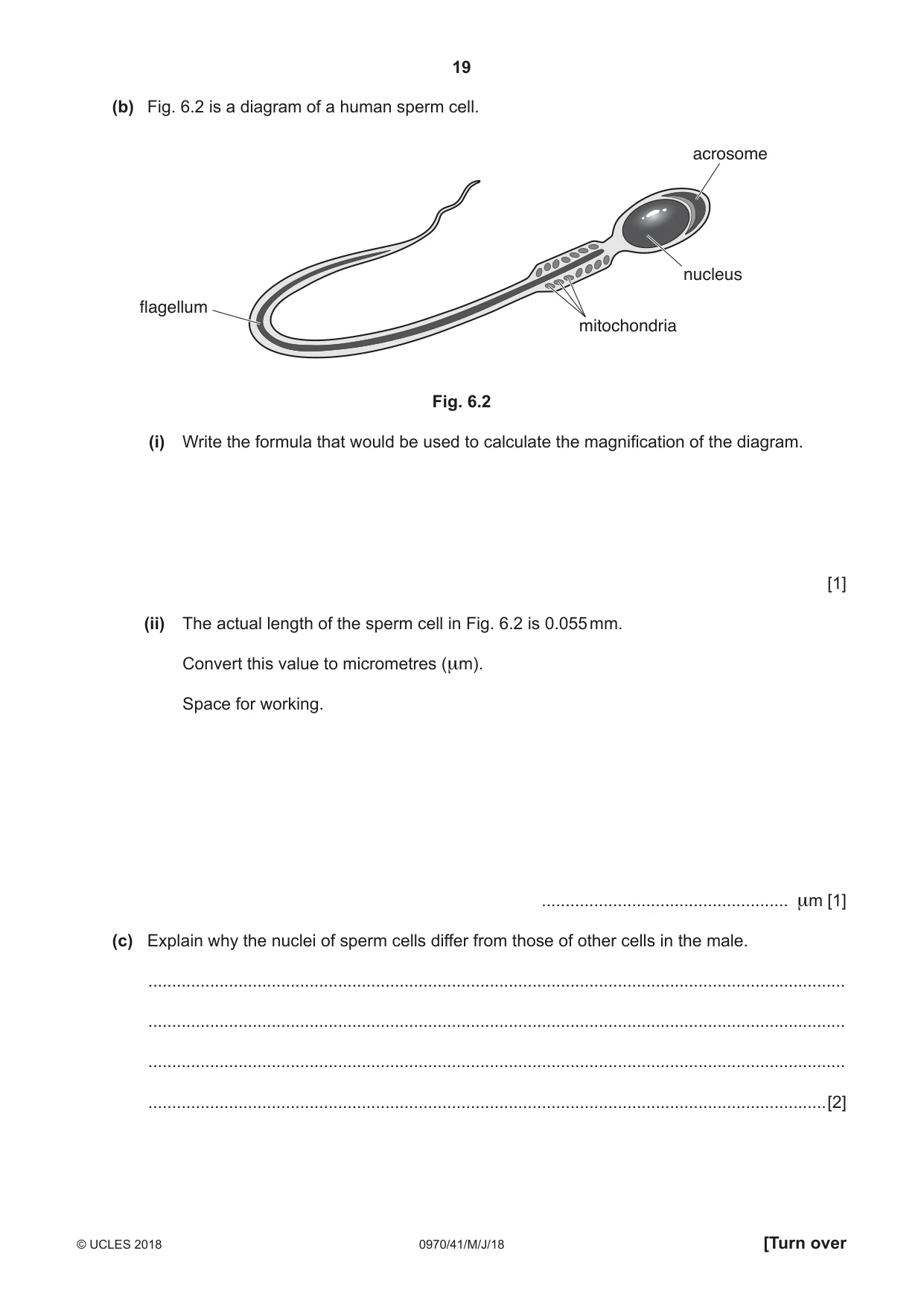
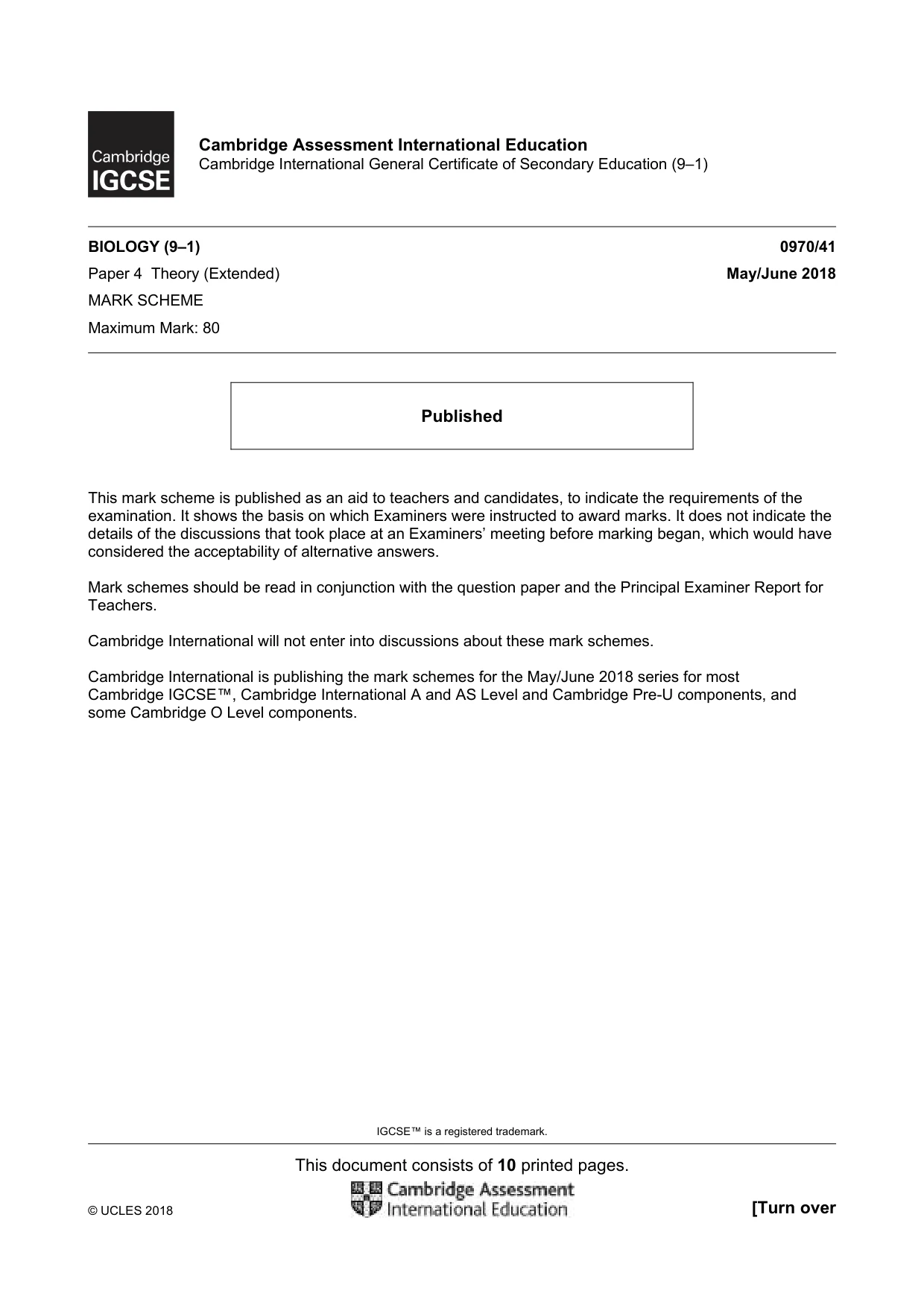
6 (a) Fig. 6.1 is a diagram of the human female reproductive system. T S V W R X Y Fig. 6.1 (i) Complete Table 6.1 by stating the letter from Fig. 6.1 that identifies the structure where each process occurs. Table 6.1 process letter from Fig. 6.1 meiosis fertilisation implantation [3] (ii) State the name of the part of the female reproductive system labelled S in Fig. 6.1. ...................................................................................................................................... [1] (b) Fig. 6.2 is a diagram of a human sperm cell. acrosome nucleus flagellum mitochondria Fig. 6.2 (i) Write the formula that would be used to calculate the magnification of the diagram. [1] (ii) The actual length of the sperm cell in Fig. 6.2 is 0.055 mm. Convert this value to micrometres (μm). Space for working. .................................................... μm [1] (c) Explain why the nuclei of sperm cells differ from those of other cells in the male. ................................................................................................................................................... ................................................................................................................................................... ................................................................................................................................................... ...............................................................................................................................................[2] (d) Explain the roles of the flagellum, the mitochondria and the acrosome in sperm cells. ................................................................................................................................................... ................................................................................................................................................... ................................................................................................................................................... ................................................................................................................................................... ................................................................................................................................................... ................................................................................................................................................... ................................................................................................................................................... ................................................................................................................................................... ................................................................................................................................................... ................................................................................................................................................... ................................................................................................................................................... ................................................................................................................................................... ...............................................................................................................................................[6] (e) Explain why the sex of a child is determined by its father. ................................................................................................................................................... ................................................................................................................................................... ................................................................................................................................................... ...............................................................................................................................................[2] [Total: 16]
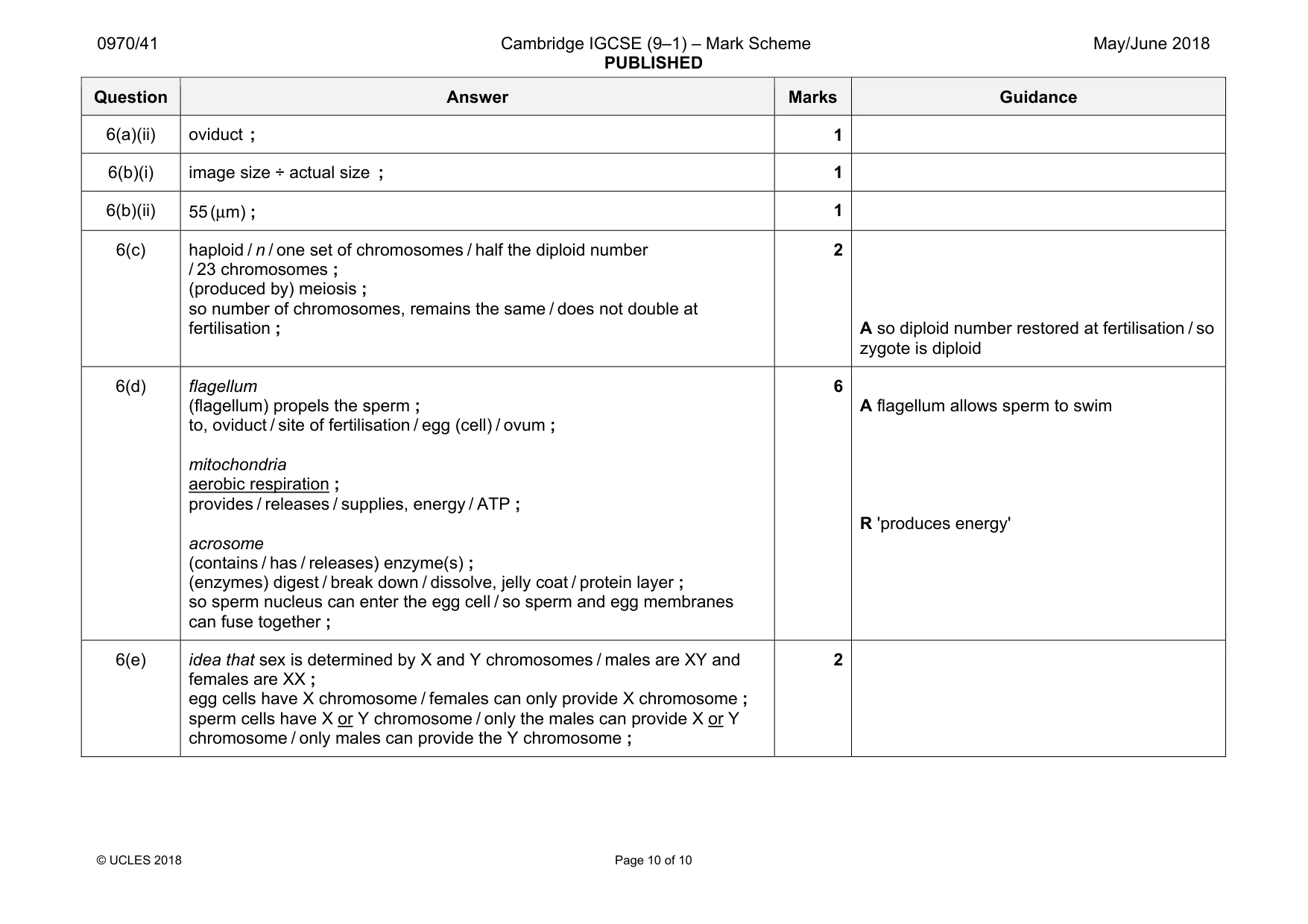
Mark scheme: 6(a)(i) process / event letter from Fig. 6.1 meiosis R ; fertilisation S ; implantation V ; 3 Question Answer Marks Guidance 6(a)(ii) oviduct ; 1 6(b)(i) image size ÷ actual size ; 1 6(b)(ii) 55 (µm) ; 1 6(c) haploid / n / one set of chromosomes / half the diploid number / 23 chromosomes ; (produced by) meiosis ; so number of chromosomes, remains the same / does not double at fertilisation ; 2 A so diploid number restored at fertilisation / so zygote is diploid 6(d) flagellum (flagellum) propels the sperm ; to, oviduct / site of fertilisation / egg (cell) / ovum ; mitochondria aerobic respiration ; provides / releases / supplies, energy / ATP ; acrosome (contains / has / releases) enzyme(s) ; (enzymes) digest / break down / dissolve, jelly coat / protein layer ; so sperm nucleus can enter the egg cell / so sperm and egg membranes can fuse together ; 6 A flagellum allows sperm to swim R 'produces energy' 6(e) idea that sex is determined by X and Y chromosomes / males are XY and females are XX ; egg cells have X chromosome / females can only provide X chromosome ; sperm cells have X or Y chromosome / only the males can provide X or Y chromosome / only males can provide the Y chromosome ; 2
What was in this paper
The subtopics covered by these 6 questions, and how many questions each got. Open one in a new tab to see every Cambridge question on it.
What you needed in this session
Cambridge’s own grade thresholds for 2018 May/June, Paper 4 · Variant 1. A higher threshold means an easier paper — the bar moves with how the cohort did.