Cambridge IGCSE Accounting 0452 — 2013 Oct/Nov Paper 2 · Variant 2
0452/22/O/N/13 · 120 marks · ≈135 min
The question paper and its mark scheme, free to read here and free to download. This is Cambridge’s own paper, exactly as it was sat.
Question paper20 pages
Mark scheme12 pages
Answers below. Sit the paper first if you are practising.
Paper as text
Question paper, page 1
This document consists of 19 printed pages and 1 blank page. IB13 11_0452_22/FP © UCLES 2013 [Turn over *4102705838* UNIVERSITY OF CAMBRIDGE INTERNATIONAL EXAMINATIONS International General Certificate of Secondary Education ACCOUNTING 0452/22 Paper 2 October/November 2013 1 hour 45 minutes Candidates answer on the Question Paper. No Additional Materials are required. READ THESE INSTRUCTIONS FIRST Write your Centre number, candidate number and name on all the work you hand in. Write in dark blue or black pen. You may use a soft pencil for any diagrams or graphs. Do not use staples, paper clips, highlighters, glue or correction fluid. DO NOT WRITE IN ANY BARCODES. Answer all questions. You may use a calculator. Where layouts are to be completed, you may not need all the lines for your answer. The businesses mentioned in this Question Paper are fictitious. At the end of the examination, fasten all your work securely together. The number of marks is given in brackets [ ] at the end of each question or part question. www.theallpapers.com
Question paper, page 2
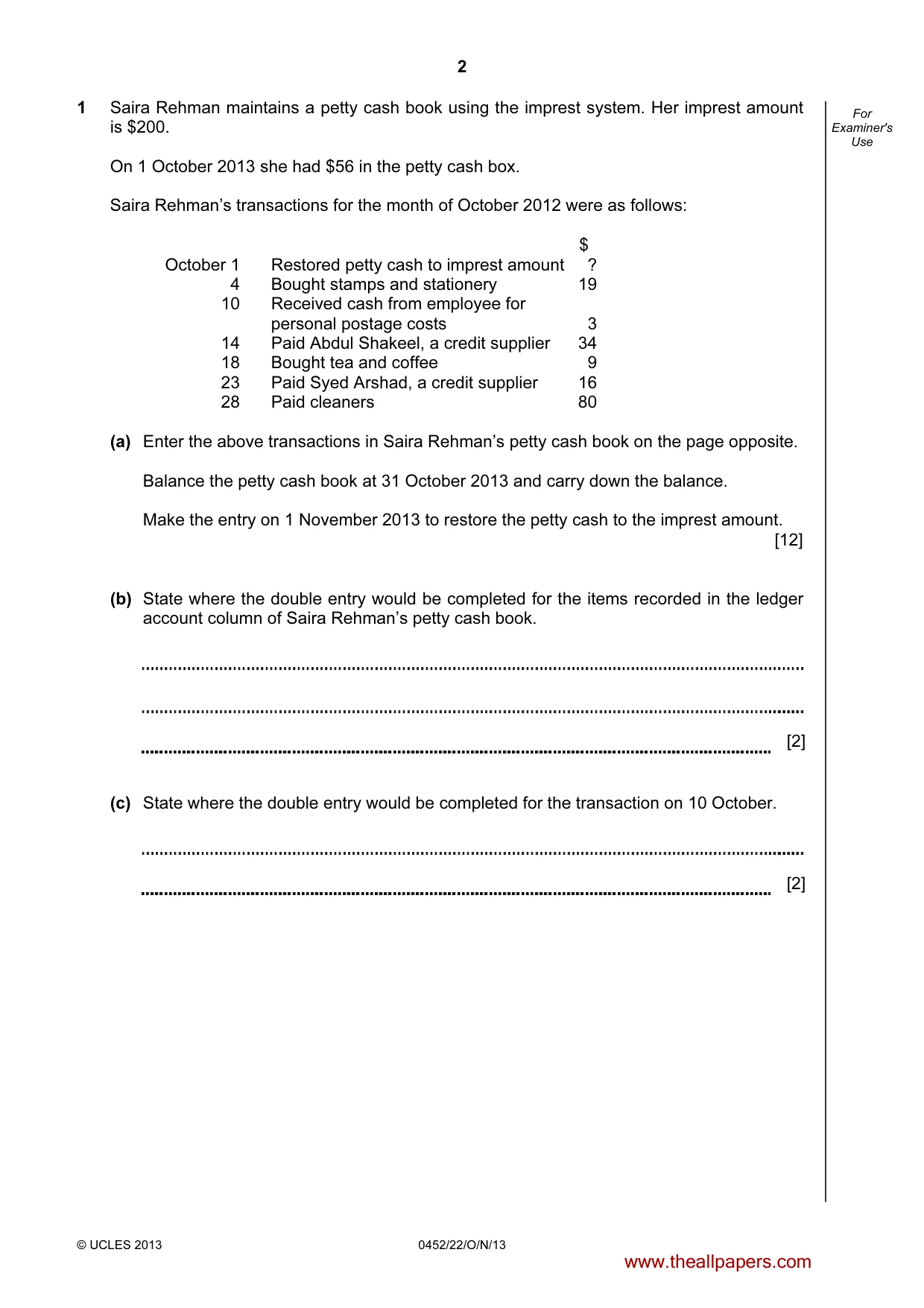
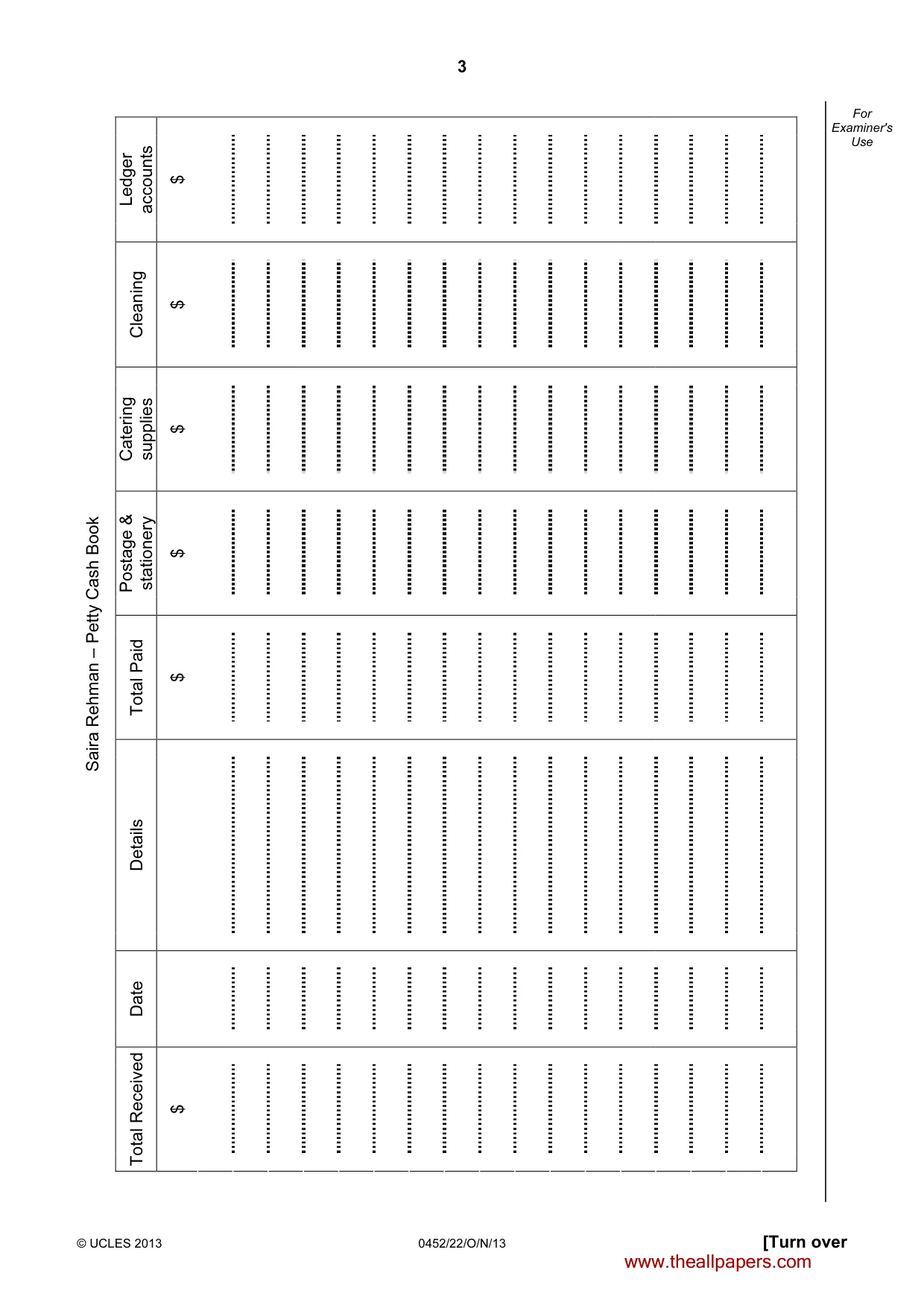
2 © UCLES 2013 0452/22/O/N/13 For Examiner's Use 1 Saira Rehman maintains a petty cash book using the imprest system. Her imprest amount is $200. On 1 October 2013 she had $56 in the petty cash box. Saira Rehman’s transactions for the month of October 2012 were as follows: $ October 1 Restored petty cash to imprest amount ? 4 Bought stamps and stationery 19 10 Received cash from employee for personal postage costs 3 14 Paid Abdul Shakeel, a credit supplier 34 18 Bought tea and coffee 9 23 Paid Syed Arshad, a credit supplier 16 28 Paid cleaners 80 (a) Enter the above transactions in Saira Rehman’s petty cash book on the page opposite. Balance the petty cash book at 31 October 2013 and carry down the balance. Make the entry on 1 November 2013 to restore the petty cash to the imprest amount. [12] (b) State where the double entry would be completed for the items recorded in the ledger account column of Saira Rehman’s petty cash book. [2] (c) State where the double entry would be completed for the transaction on 10 October. [2] www.theallpapers.com
Question paper, page 3
3 © UCLES 2013 0452/22/O/N/13 [Turn over For Examiner's Use Ledger accounts $ Cleaning $ Catering supplies $ Postage & stationery $ Total Paid $ Details Date Saira Rehman – Petty Cash Book Total Received $ www.theallpapers.com
Question paper, page 4
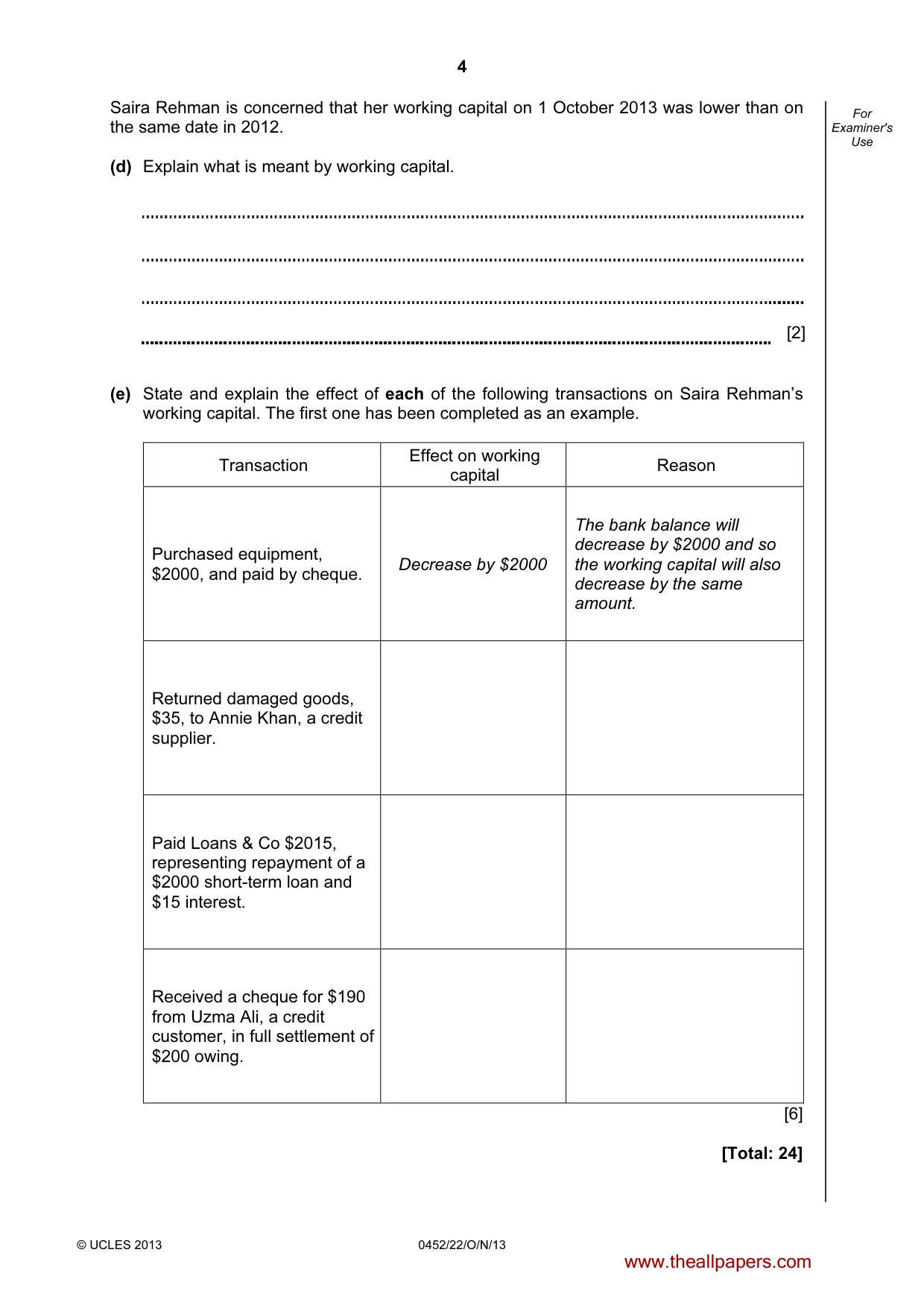
4 © UCLES 2013 0452/22/O/N/13 For Examiner's Use Saira Rehman is concerned that her working capital on 1 October 2013 was lower than on the same date in 2012. (d) Explain what is meant by working capital. [2] (e) State and explain the effect of each of the following transactions on Saira Rehman’s working capital. The first one has been completed as an example. Transaction Effect on working capital Reason Purchased equipment, $2000, and paid by cheque. Decrease by $2000 The bank balance will decrease by $2000 and so the working capital will also decrease by the same amount. Returned damaged goods, $35, to Annie Khan, a credit supplier. Paid Loans & Co $2015, representing repayment of a $2000 short-term loan and $15 interest. Received a cheque for $190 from Uzma Ali, a credit customer, in full settlement of $200 owing. [6] [Total: 24] www.theallpapers.com
Question paper, page 5
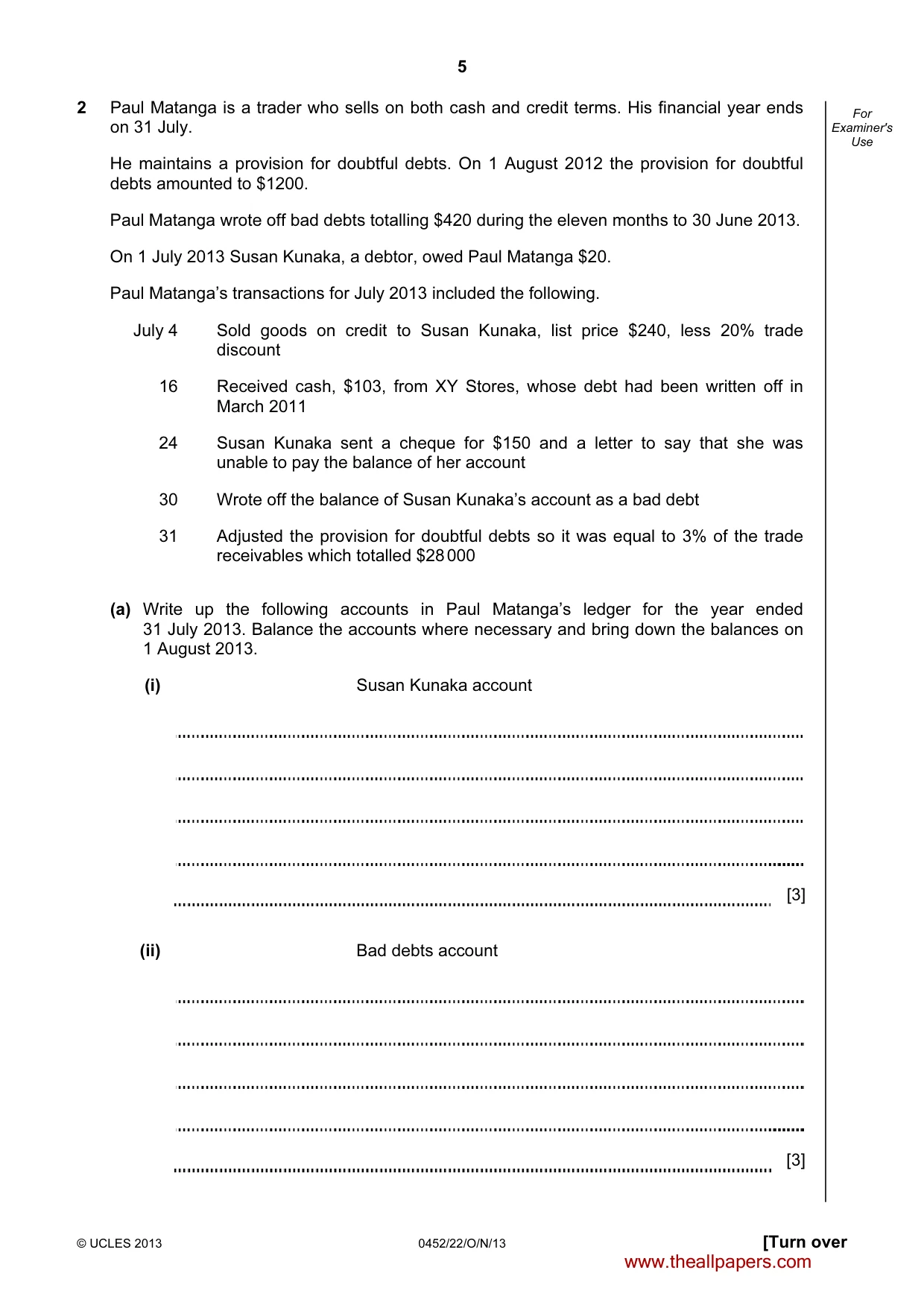
5 © UCLES 2013 0452/22/O/N/13 [Turn over For Examiner's Use 2 Paul Matanga is a trader who sells on both cash and credit terms. His financial year ends on 31 July. He maintains a provision for doubtful debts. On 1 August 2012 the provision for doubtful debts amounted to $1200. Paul Matanga wrote off bad debts totalling $420 during the eleven months to 30 June 2013. On 1 July 2013 Susan Kunaka, a debtor, owed Paul Matanga $20. Paul Matanga’s transactions for July 2013 included the following. July 4 Sold goods on credit to Susan Kunaka, list price $240, less 20% trade discount 16 Received cash, $103, from XY Stores, whose debt had been written off in March 2011 24 Susan Kunaka sent a cheque for $150 and a letter to say that she was unable to pay the balance of her account 30 Wrote off the balance of Susan Kunaka’s account as a bad debt 31 Adjusted the provision for doubtful debts so it was equal to 3% of the trade receivables which totalled $28 000 (a) Write up the following accounts in Paul Matanga’s ledger for the year ended 31 July 2013. Balance the accounts where necessary and bring down the balances on 1 August 2013. (i) Susan Kunaka account [3] (ii) Bad debts account [3] www.theallpapers.com
Question paper, page 6
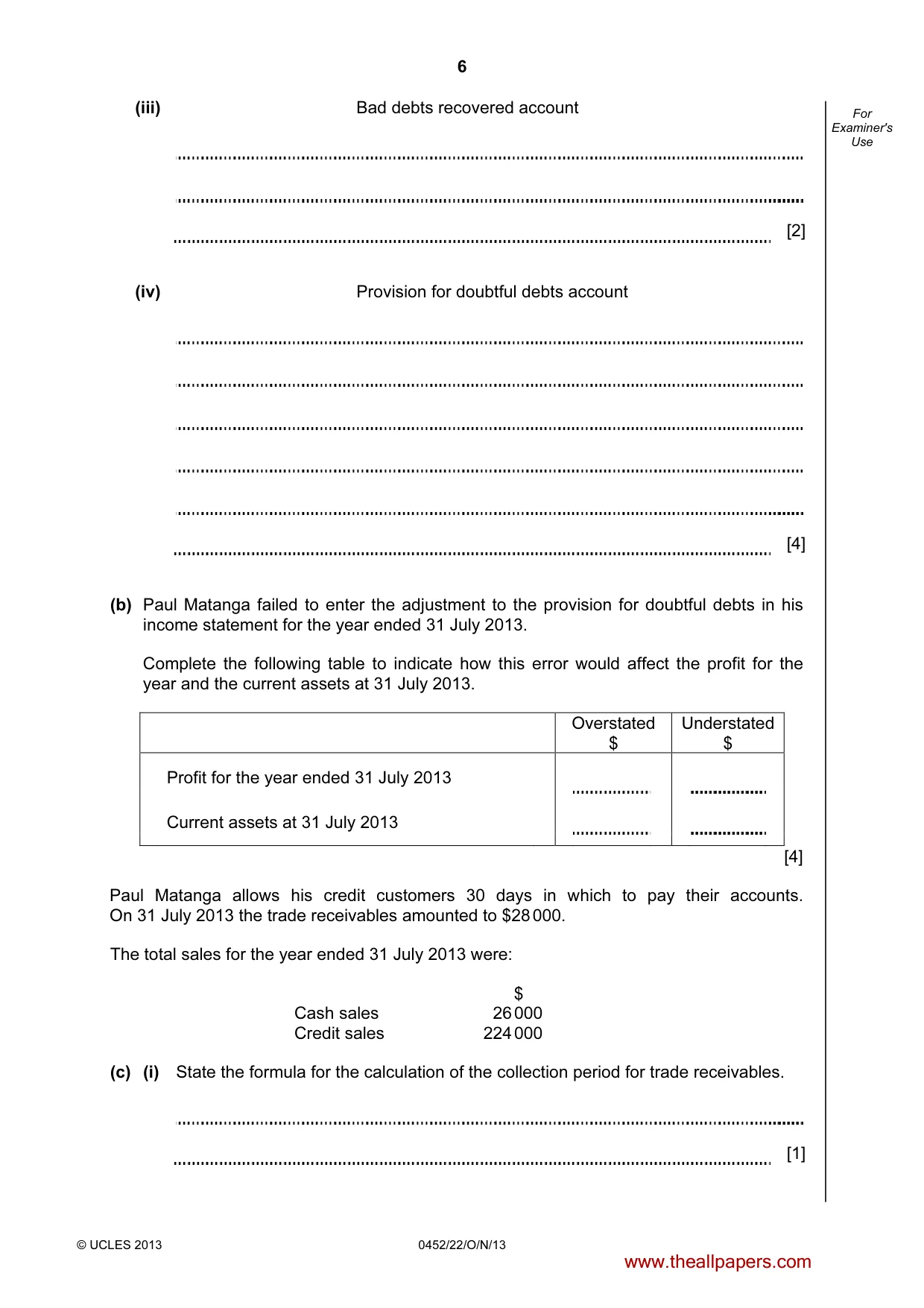
6 © UCLES 2013 0452/22/O/N/13 For Examiner's Use (iii) Bad debts recovered account [2] (iv) Provision for doubtful debts account [4] (b) Paul Matanga failed to enter the adjustment to the provision for doubtful debts in his income statement for the year ended 31 July 2013. Complete the following table to indicate how this error would affect the profit for the year and the current assets at 31 July 2013. Overstated $ Understated $ Profit for the year ended 31 July 2013 Current assets at 31 July 2013 [4] Paul Matanga allows his credit customers 30 days in which to pay their accounts. On 31 July 2013 the trade receivables amounted to $28 000. The total sales for the year ended 31 July 2013 were: $ Cash sales 26 000 Credit sales 224 000 (c) (i) State the formula for the calculation of the collection period for trade receivables. [1] www.theallpapers.com
Question paper, page 7
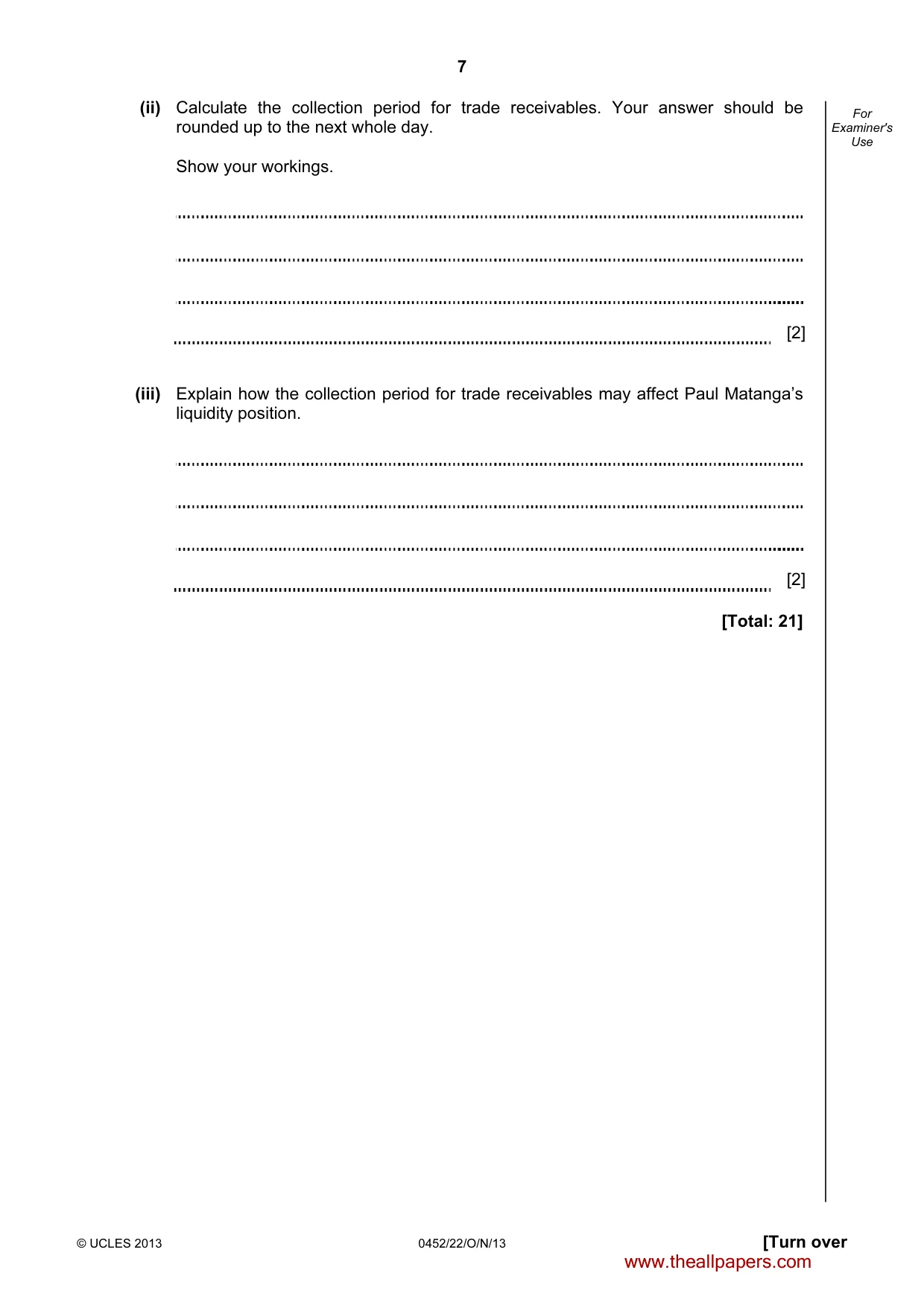
7 © UCLES 2013 0452/22/O/N/13 [Turn over For Examiner's Use (ii) Calculate the collection period for trade receivables. Your answer should be rounded up to the next whole day. Show your workings. [2] (iii) Explain how the collection period for trade receivables may affect Paul Matanga’s liquidity position. [2] [Total: 21] www.theallpapers.com
Question paper, page 8
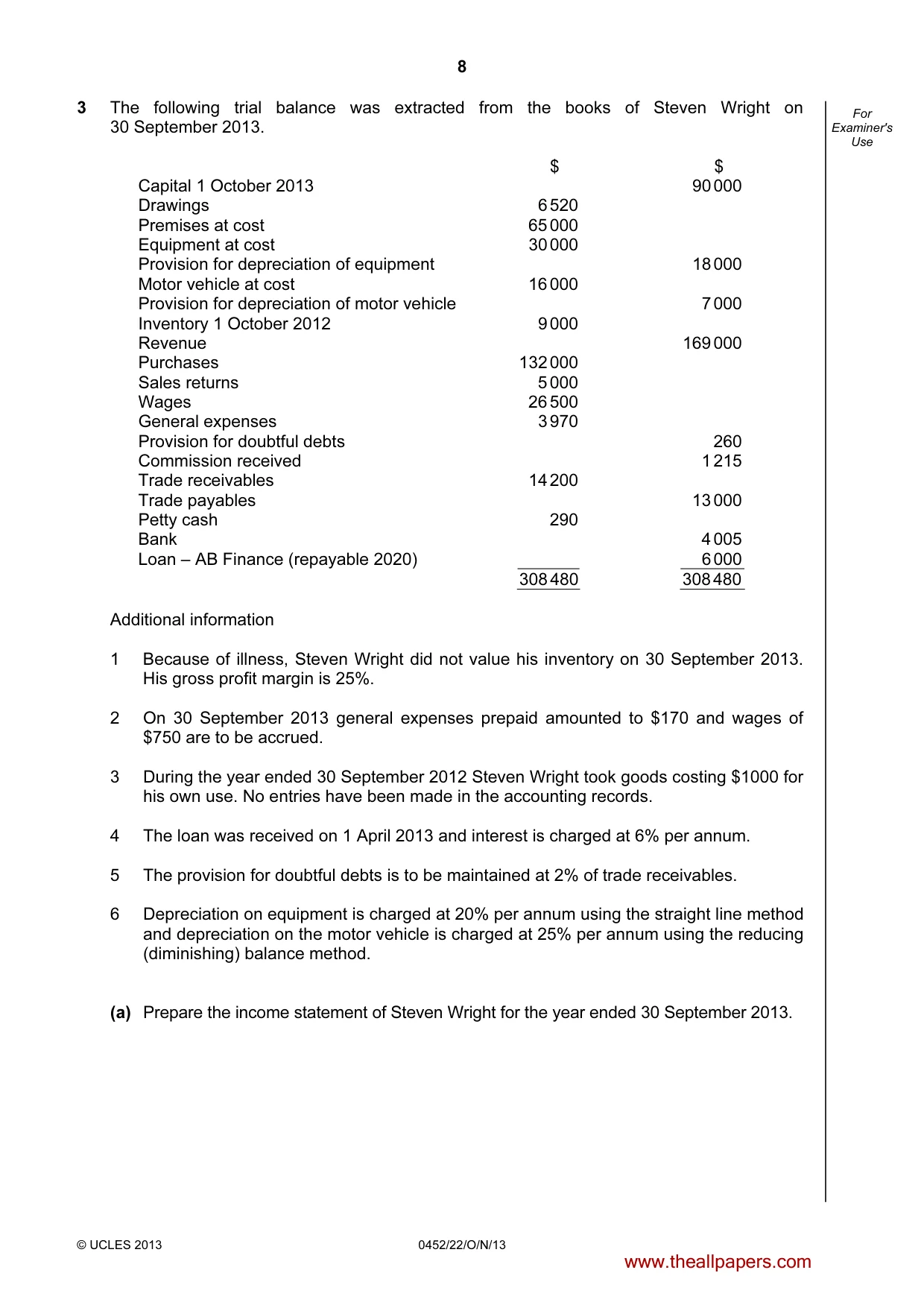
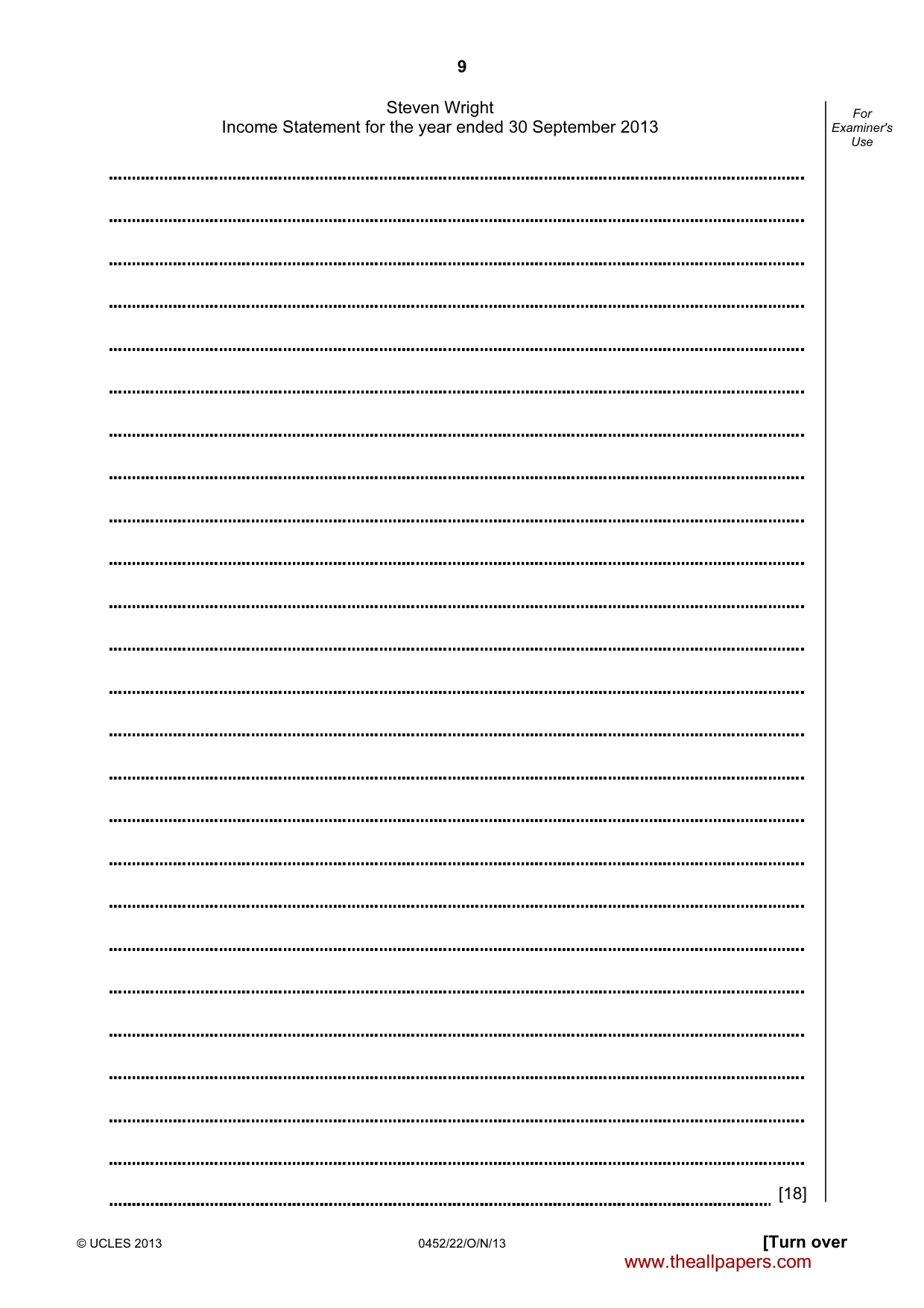
8 © UCLES 2013 0452/22/O/N/13 For Examiner's Use 3 The following trial balance was extracted from the books of Steven Wright on 30 September 2013. $ $ Capital 1 October 2013 90 000 Drawings 6 520 Premises at cost 65 000 Equipment at cost 30 000 Provision for depreciation of equipment 18 000 Motor vehicle at cost 16 000 Provision for depreciation of motor vehicle 7 000 Inventory 1 October 2012 9 000 Revenue 169 000 Purchases 132 000 Sales returns 5 000 Wages 26 500 General expenses 3 970 Provision for doubtful debts 260 Commission received 1 215 Trade receivables 14 200 Trade payables 13 000 Petty cash 290 Bank 4 005 Loan – AB Finance (repayable 2020) 6 000 308 480 308 480 Additional information 1 Because of illness, Steven Wright did not value his inventory on 30 September 2013. His gross profit margin is 25%. 2 On 30 September 2013 general expenses prepaid amounted to $170 and wages of $750 are to be accrued. 3 During the year ended 30 September 2012 Steven Wright took goods costing $1000 for his own use. No entries have been made in the accounting records. 4 The loan was received on 1 April 2013 and interest is charged at 6% per annum. 5 The provision for doubtful debts is to be maintained at 2% of trade receivables. 6 Depreciation on equipment is charged at 20% per annum using the straight line method and depreciation on the motor vehicle is charged at 25% per annum using the reducing (diminishing) balance method. (a) Prepare the income statement of Steven Wright for the year ended 30 September 2013. www.theallpapers.com
Question paper, page 9
9 © UCLES 2013 0452/22/O/N/13 [Turn over For Examiner's Use Steven Wright Income Statement for the year ended 30 September 2013 [18] www.theallpapers.com
Question paper, page 10
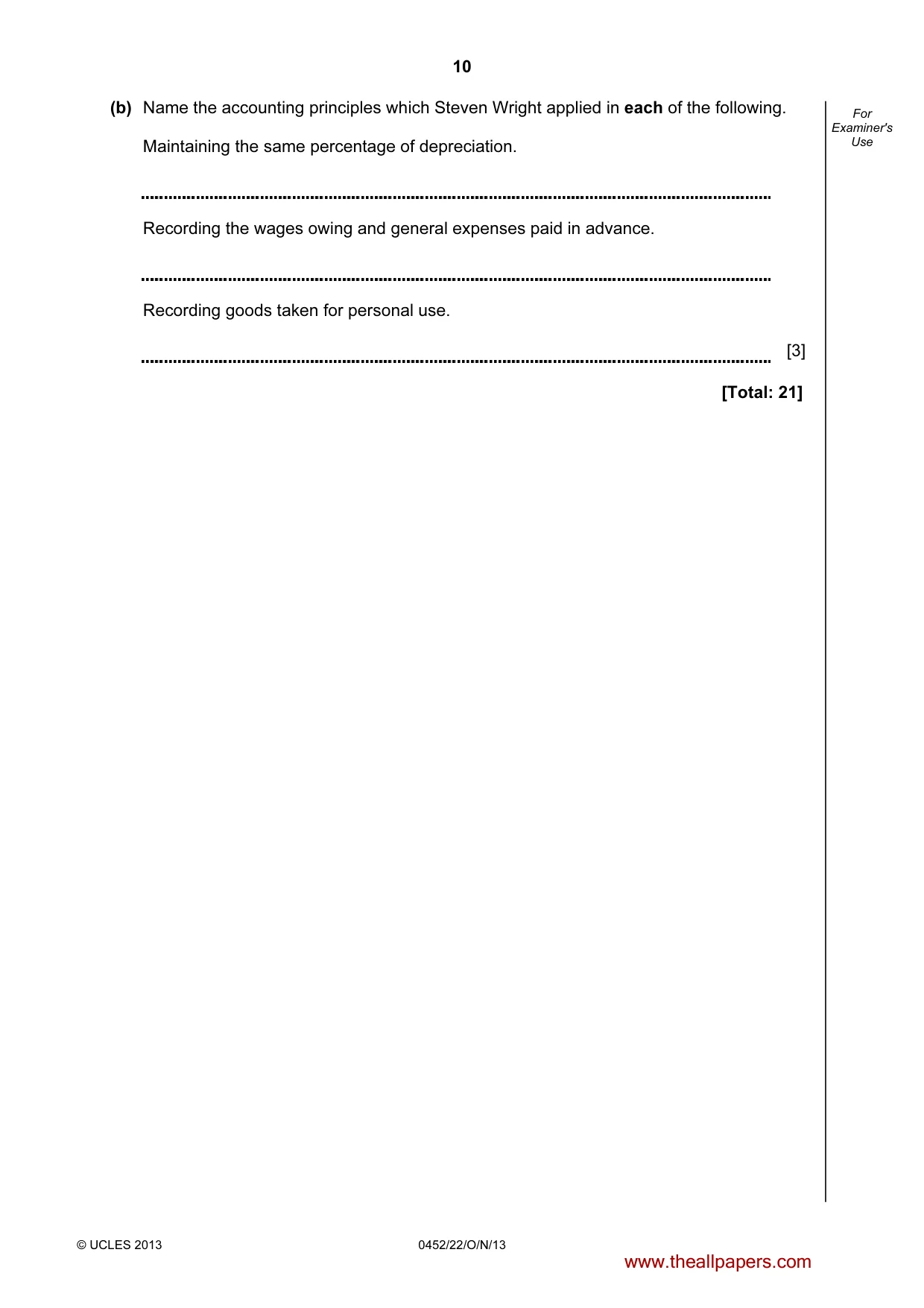
10 © UCLES 2013 0452/22/O/N/13 For Examiner's Use (b) Name the accounting principles which Steven Wright applied in each of the following. Maintaining the same percentage of depreciation. Recording the wages owing and general expenses paid in advance. Recording goods taken for personal use. [3] [Total: 21] www.theallpapers.com
Question paper, page 11
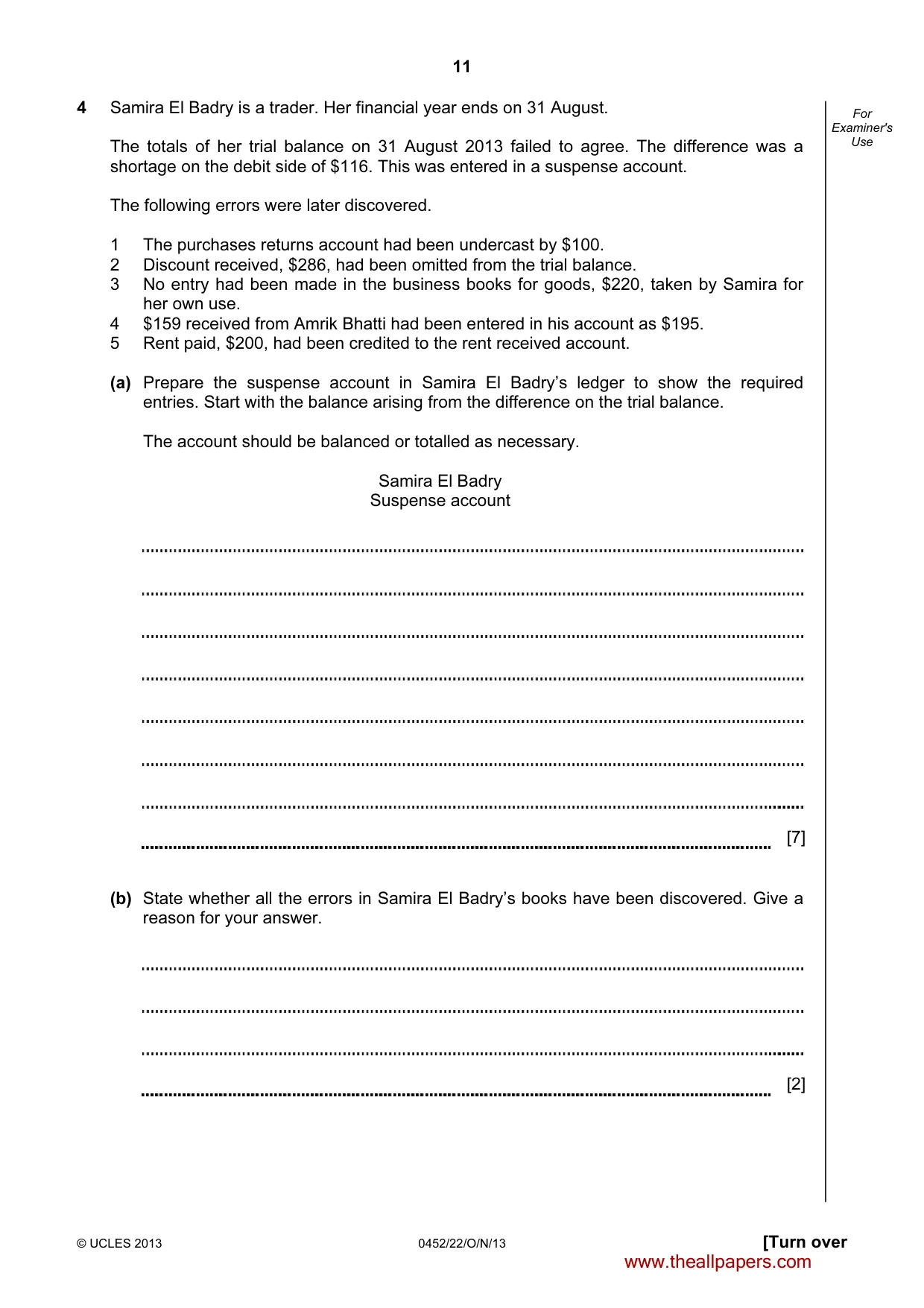
11 © UCLES 2013 0452/22/O/N/13 [Turn over For Examiner's Use 4 Samira El Badry is a trader. Her financial year ends on 31 August. The totals of her trial balance on 31 August 2013 failed to agree. The difference was a shortage on the debit side of $116. This was entered in a suspense account. The following errors were later discovered. 1 The purchases returns account had been undercast by $100. 2 Discount received, $286, had been omitted from the trial balance. 3 No entry had been made in the business books for goods, $220, taken by Samira for her own use. 4 $159 received from Amrik Bhatti had been entered in his account as $195. 5 Rent paid, $200, had been credited to the rent received account. (a) Prepare the suspense account in Samira El Badry’s ledger to show the required entries. Start with the balance arising from the difference on the trial balance. The account should be balanced or totalled as necessary. Samira El Badry Suspense account [7] (b) State whether all the errors in Samira El Badry’s books have been discovered. Give a reason for your answer. [2] www.theallpapers.com
Question paper, page 12
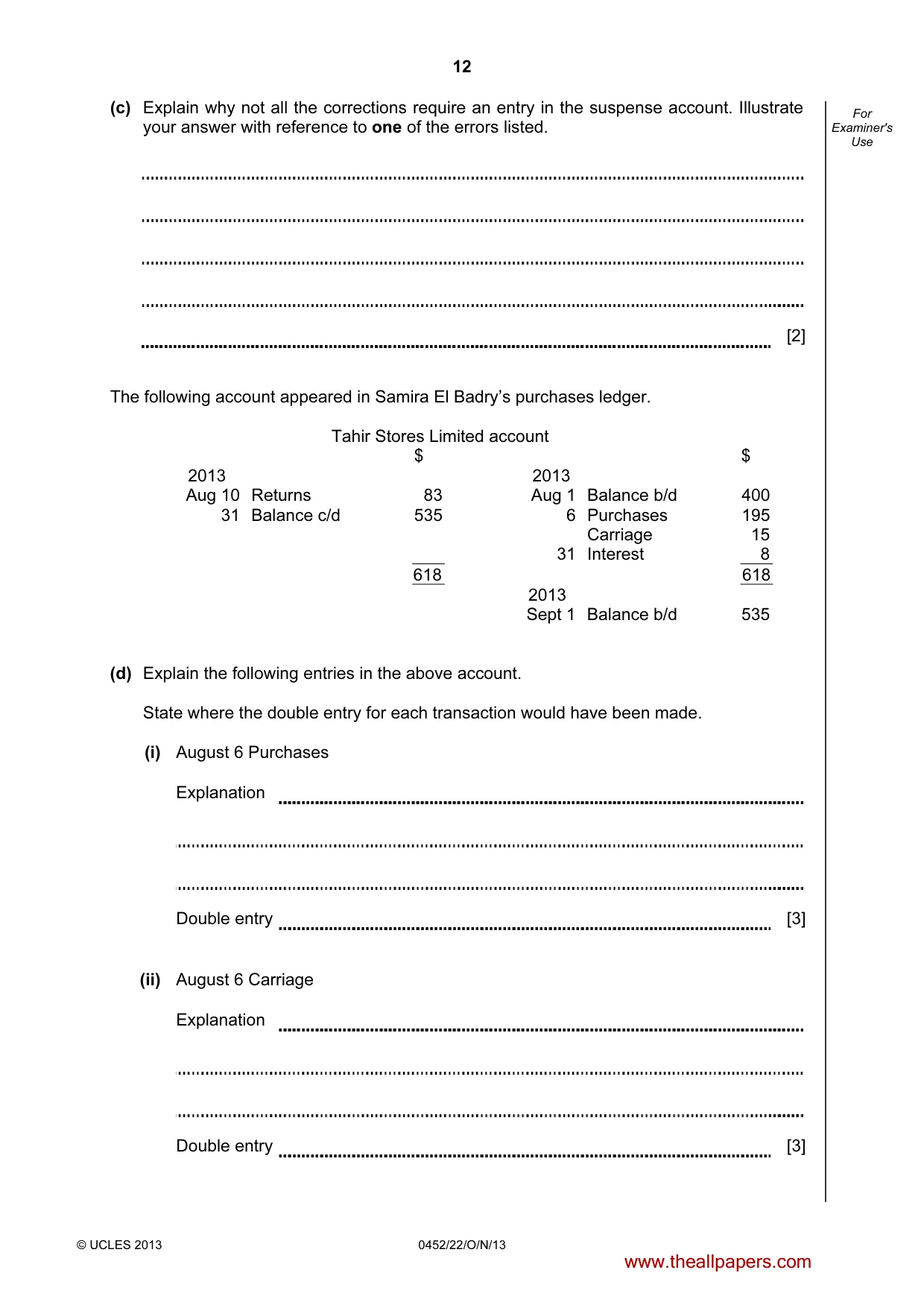
12 © UCLES 2013 0452/22/O/N/13 For Examiner's Use (c) Explain why not all the corrections require an entry in the suspense account. Illustrate your answer with reference to one of the errors listed. [2] The following account appeared in Samira El Badry’s purchases ledger. Tahir Stores Limited account $ $ 2013 2013 Aug 10 Returns 83 Aug 1 Balance b/d 400 31 Balance c/d 535 6 Purchases 195 Carriage 15 31 Interest 8 618 618 2013 Sept 1 Balance b/d 535 (d) Explain the following entries in the above account. State where the double entry for each transaction would have been made. (i) August 6 Purchases Explanation Double entry [3] (ii) August 6 Carriage Explanation Double entry [3] www.theallpapers.com
Question paper, page 13
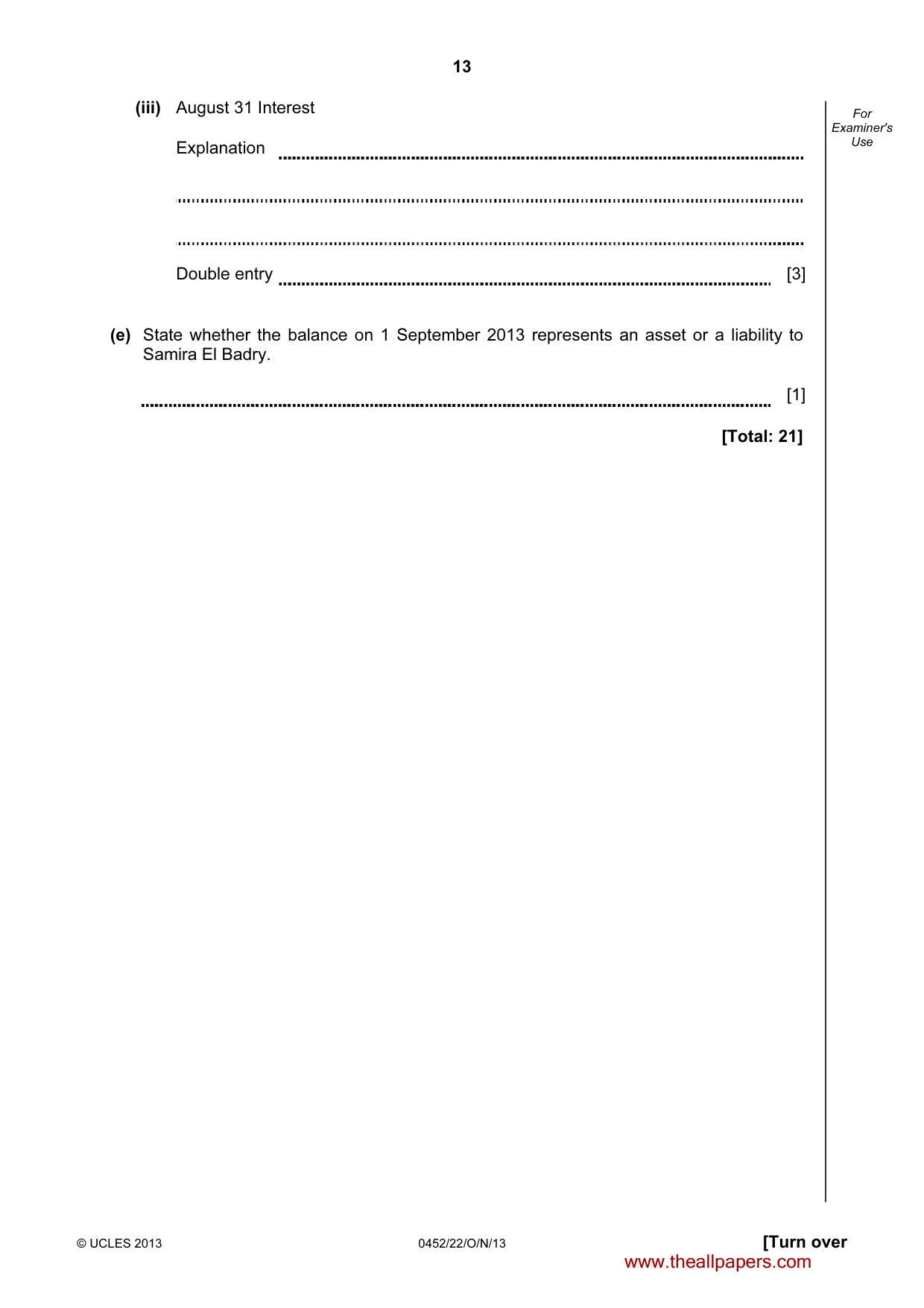
13 © UCLES 2013 0452/22/O/N/13 [Turn over For Examiner's Use (iii) August 31 Interest Explanation Double entry [3] (e) State whether the balance on 1 September 2013 represents an asset or a liability to Samira El Badry. [1] [Total: 21] www.theallpapers.com
Question paper, page 14
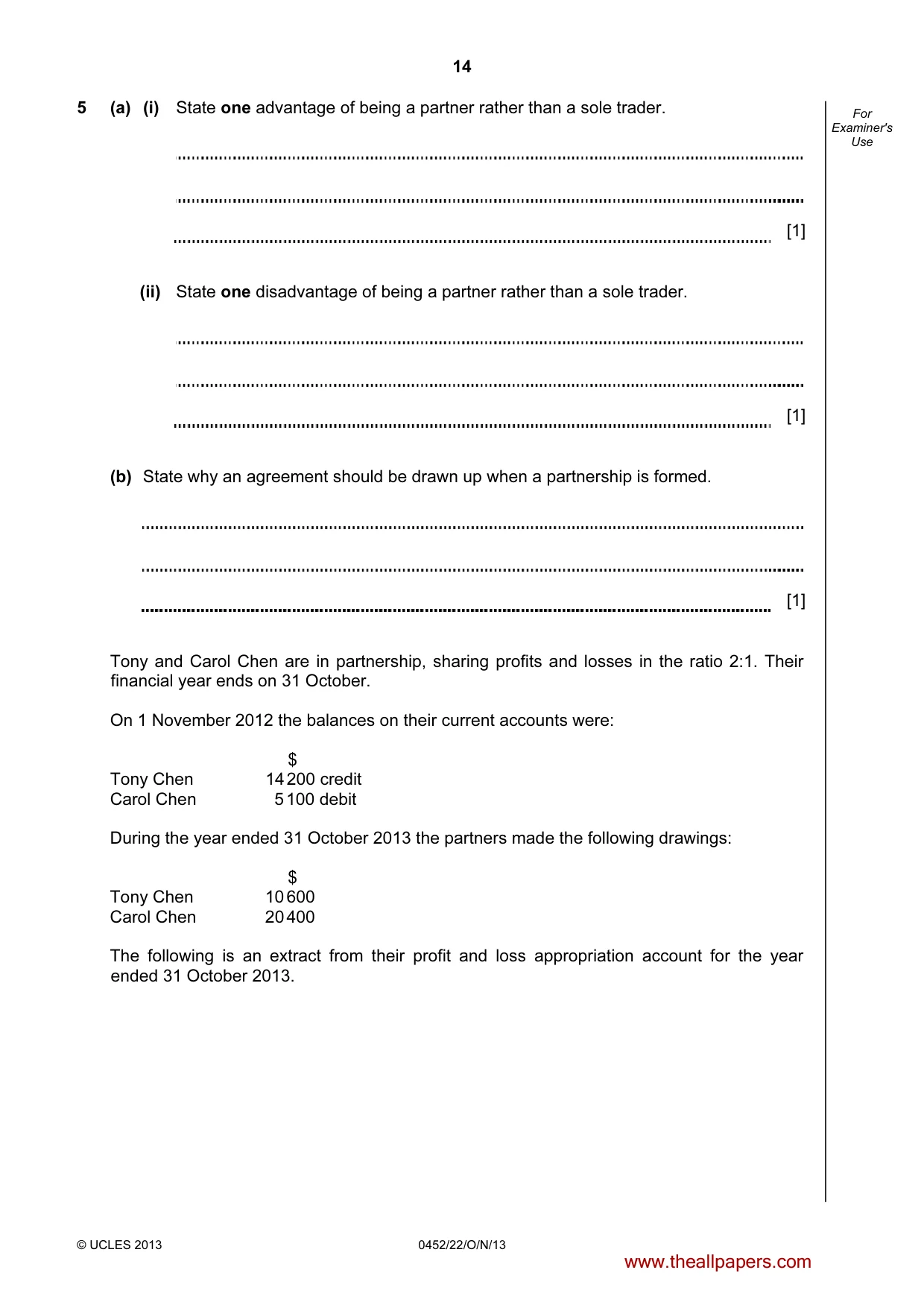
14 © UCLES 2013 0452/22/O/N/13 For Examiner's Use 5 (a) (i) State one advantage of being a partner rather than a sole trader. [1] (ii) State one disadvantage of being a partner rather than a sole trader. [1] (b) State why an agreement should be drawn up when a partnership is formed. [1] Tony and Carol Chen are in partnership, sharing profits and losses in the ratio 2:1. Their financial year ends on 31 October. On 1 November 2012 the balances on their current accounts were: $ Tony Chen 14 200 credit Carol Chen 5 100 debit During the year ended 31 October 2013 the partners made the following drawings: $ Tony Chen 10 600 Carol Chen 20 400 The following is an extract from their profit and loss appropriation account for the year ended 31 October 2013. www.theallpapers.com
Question paper, page 15
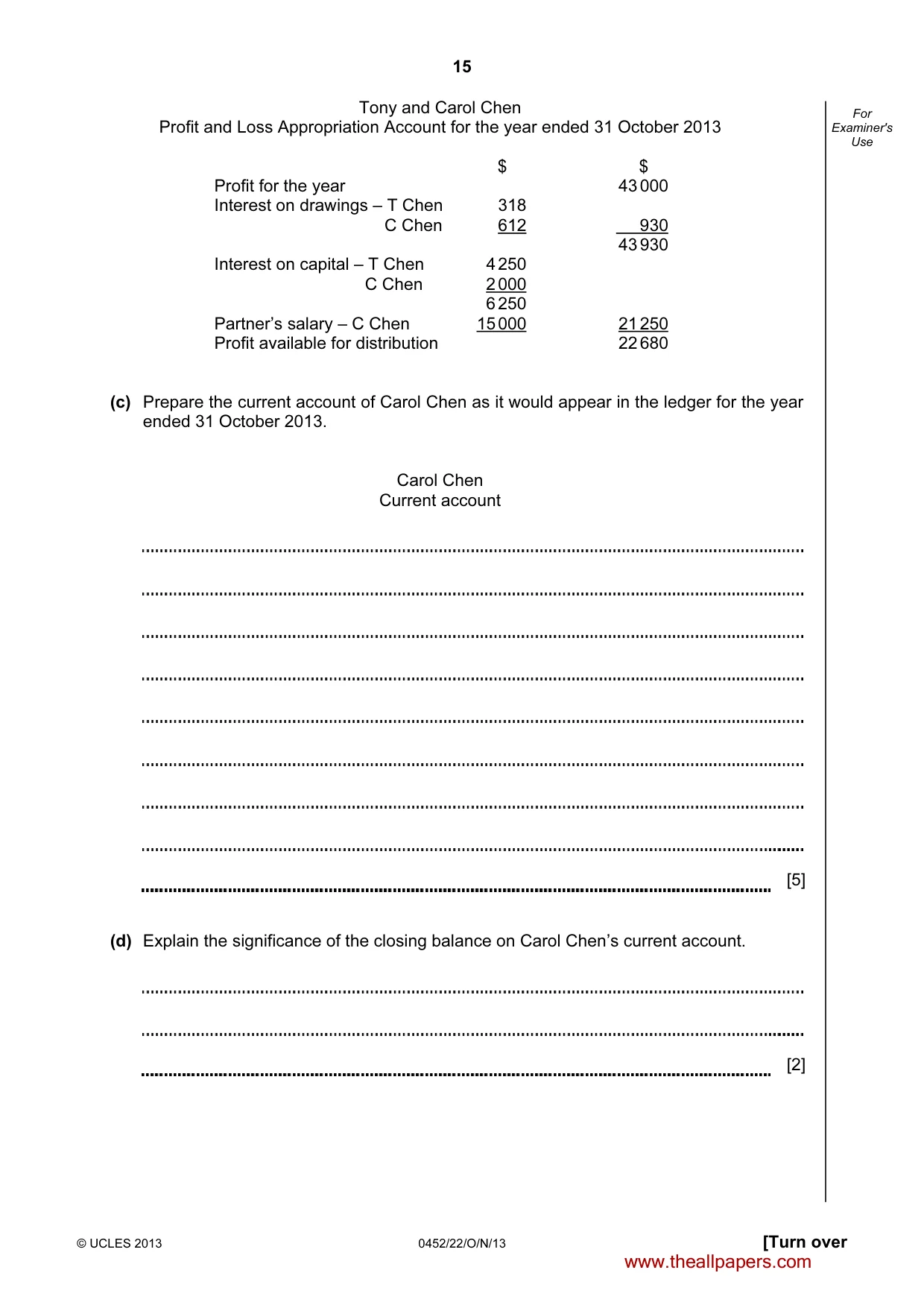
15 © UCLES 2013 0452/22/O/N/13 [Turn over For Examiner's Use Tony and Carol Chen Profit and Loss Appropriation Account for the year ended 31 October 2013 $ $ Profit for the year 43 000 Interest on drawings – T Chen 318 C Chen 612 930 43 930 Interest on capital – T Chen 4 250 C Chen 2 000 6 250 Partner’s salary – C Chen 15 000 21 250 Profit available for distribution 22 680 (c) Prepare the current account of Carol Chen as it would appear in the ledger for the year ended 31 October 2013. Carol Chen Current account [5] (d) Explain the significance of the closing balance on Carol Chen’s current account. [2] www.theallpapers.com
Question paper, page 16
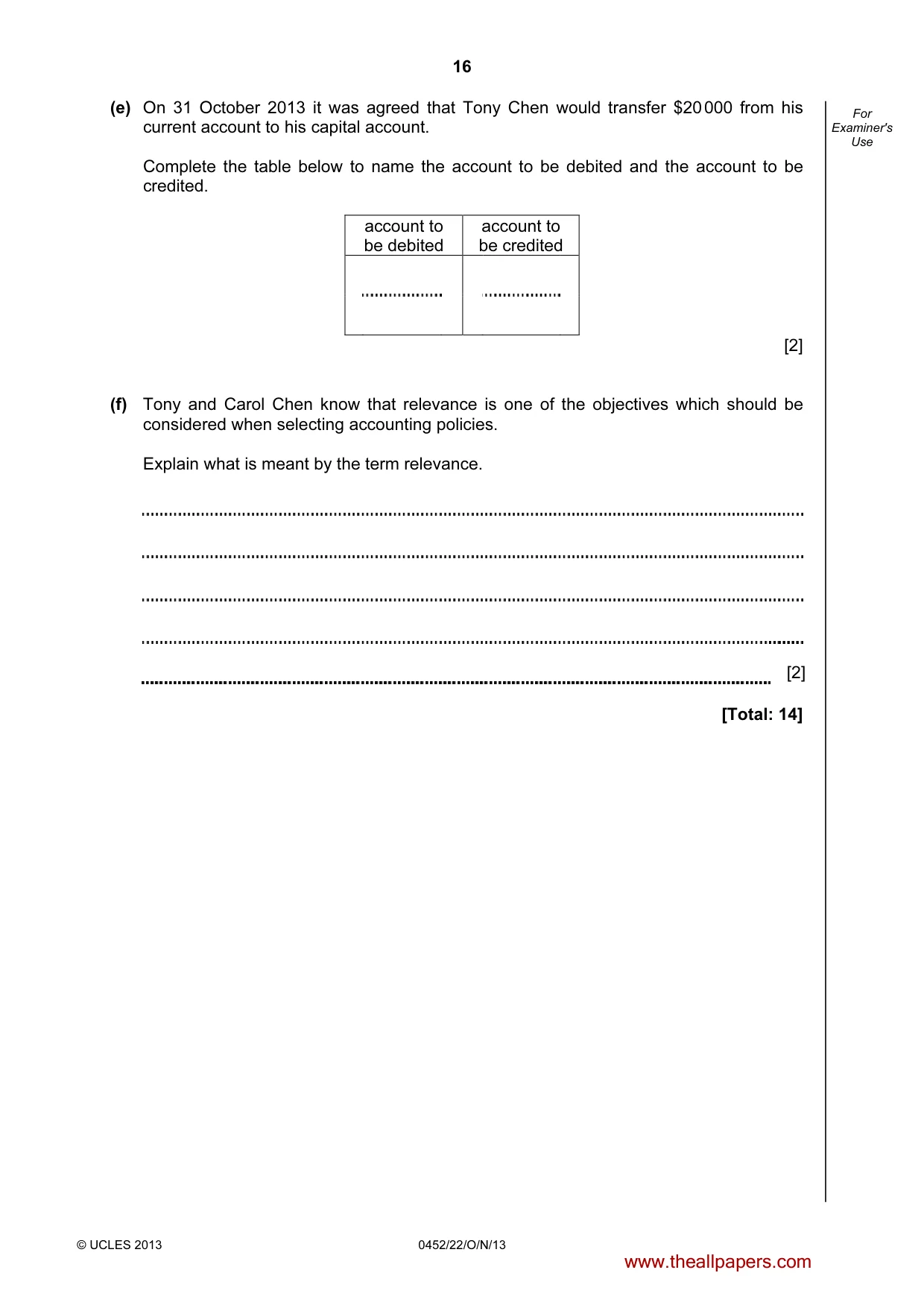
16 © UCLES 2013 0452/22/O/N/13 For Examiner's Use (e) On 31 October 2013 it was agreed that Tony Chen would transfer $20 000 from his current account to his capital account. Complete the table below to name the account to be debited and the account to be credited. account to be debited account to be credited [2] (f) Tony and Carol Chen know that relevance is one of the objectives which should be considered when selecting accounting policies. Explain what is meant by the term relevance. [2] [Total: 14] www.theallpapers.com
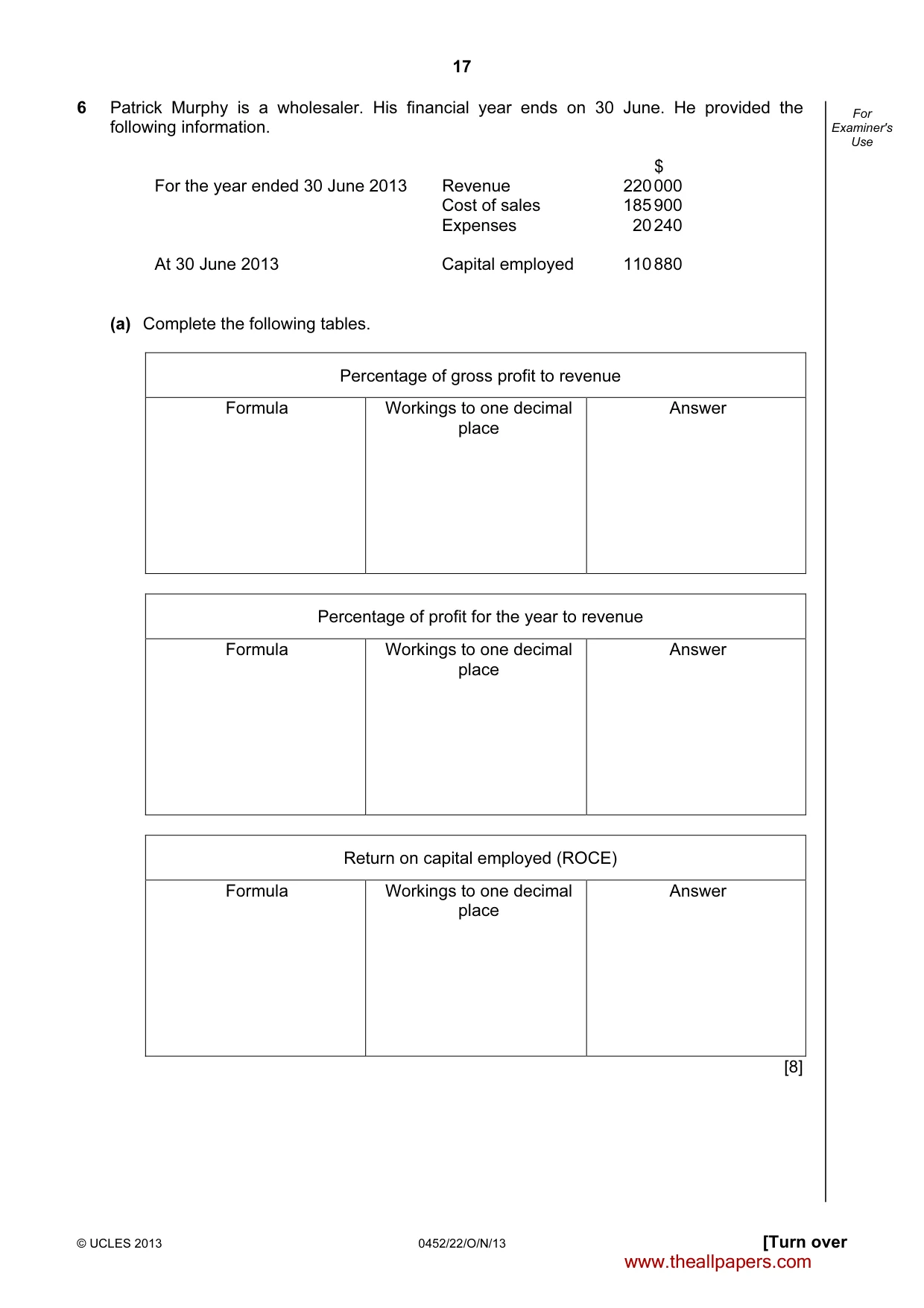
Question paper, page 17
17 © UCLES 2013 0452/22/O/N/13 [Turn over For Examiner's Use 6 Patrick Murphy is a wholesaler. His financial year ends on 30 June. He provided the following information. $ For the year ended 30 June 2013 Revenue 220 000 Cost of sales 185 900 Expenses 20 240 At 30 June 2013 Capital employed 110 880 (a) Complete the following tables. Percentage of gross profit to revenue Formula Workings to one decimal place Answer Percentage of profit for the year to revenue Formula Workings to one decimal place Answer Return on capital employed (ROCE) Formula Workings to one decimal place Answer [8] www.theallpapers.com
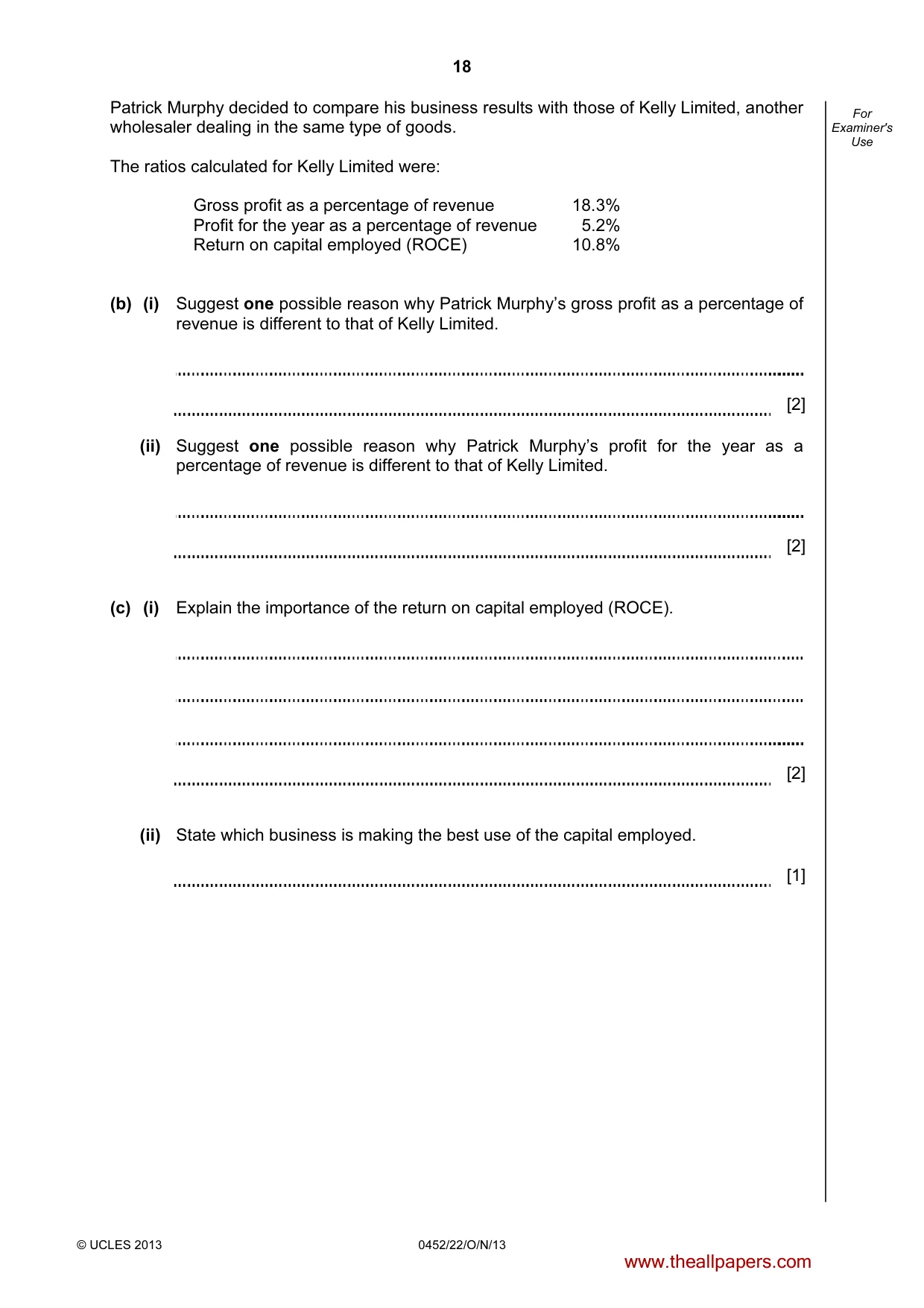
Question paper, page 18
18 © UCLES 2013 0452/22/O/N/13 For Examiner's Use Patrick Murphy decided to compare his business results with those of Kelly Limited, another wholesaler dealing in the same type of goods. The ratios calculated for Kelly Limited were: Gross profit as a percentage of revenue 18.3% Profit for the year as a percentage of revenue 5.2% Return on capital employed (ROCE) 10.8% (b) (i) Suggest one possible reason why Patrick Murphy’s gross profit as a percentage of revenue is different to that of Kelly Limited. [2] (ii) Suggest one possible reason why Patrick Murphy’s profit for the year as a percentage of revenue is different to that of Kelly Limited. [2] (c) (i) Explain the importance of the return on capital employed (ROCE). [2] (ii) State which business is making the best use of the capital employed. [1] www.theallpapers.com
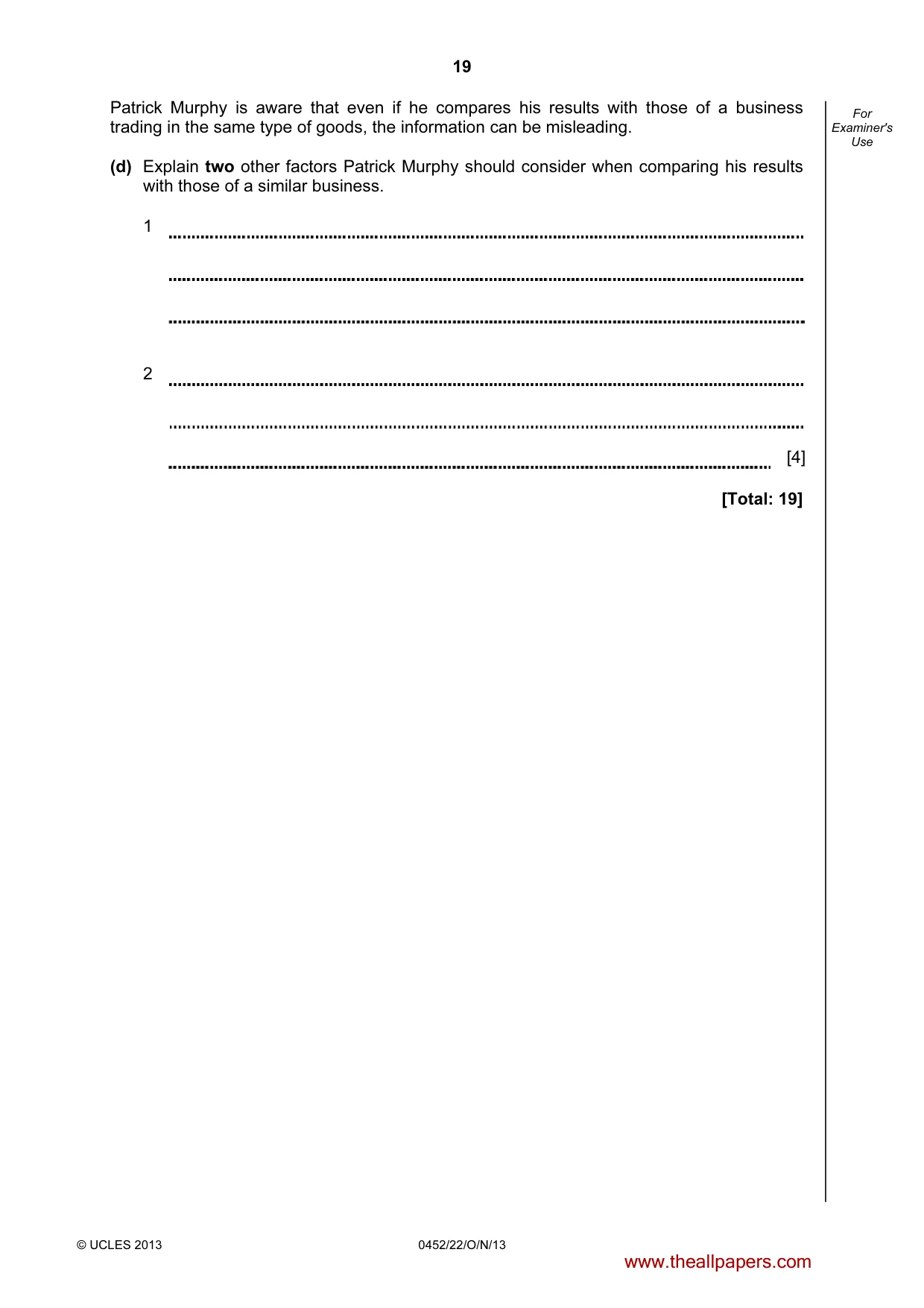
Question paper, page 19
19 © UCLES 2013 0452/22/O/N/13 For Examiner's Use Patrick Murphy is aware that even if he compares his results with those of a business trading in the same type of goods, the information can be misleading. (d) Explain two other factors Patrick Murphy should consider when comparing his results with those of a similar business. 1 2 [4] [Total: 19] www.theallpapers.com
Question paper, page 20
20 Permission to reproduce items where third-party owned material protected by copyright is included has been sought and cleared where possible. Every reasonable effort has been made by the publisher (UCLES) to trace copyright holders, but if any items requiring clearance have unwittingly been included, the publisher will be pleased to make amends at the earliest possible opportunity. University of Cambridge International Examinations is part of the Cambridge Assessment Group. Cambridge Assessment is the brand name of University of Cambridge Local Examinations Syndicate (UCLES), which is itself a department of the University of Cambridge. © UCLES 2013 0452/22/O/N/13 BLANK PAGE www.theallpapers.com
Mark scheme, page 1
CAMBRIDGE INTERNATIONAL EXAMINATIONS International General Certificate of Secondary Education MARK SCHEME for the October/November 2013 series 0452 ACCOUNTING 0452/22 Paper 2, maximum raw mark 120 This mark scheme is published as an aid to teachers and candidates, to indicate the requirements of the examination. It shows the basis on which Examiners were instructed to award marks. It does not indicate the details of the discussions that took place at an Examiners’ meeting before marking began, which would have considered the acceptability of alternative answers. Mark schemes should be read in conjunction with the question paper and the Principal Examiner Report for Teachers. Cambridge will not enter into discussions about these mark schemes. Cambridge is publishing the mark schemes for the October/November 2013 series for most IGCSE, GCE Advanced Level and Advanced Subsidiary Level components and some Ordinary Level components.
Mark scheme, page 2
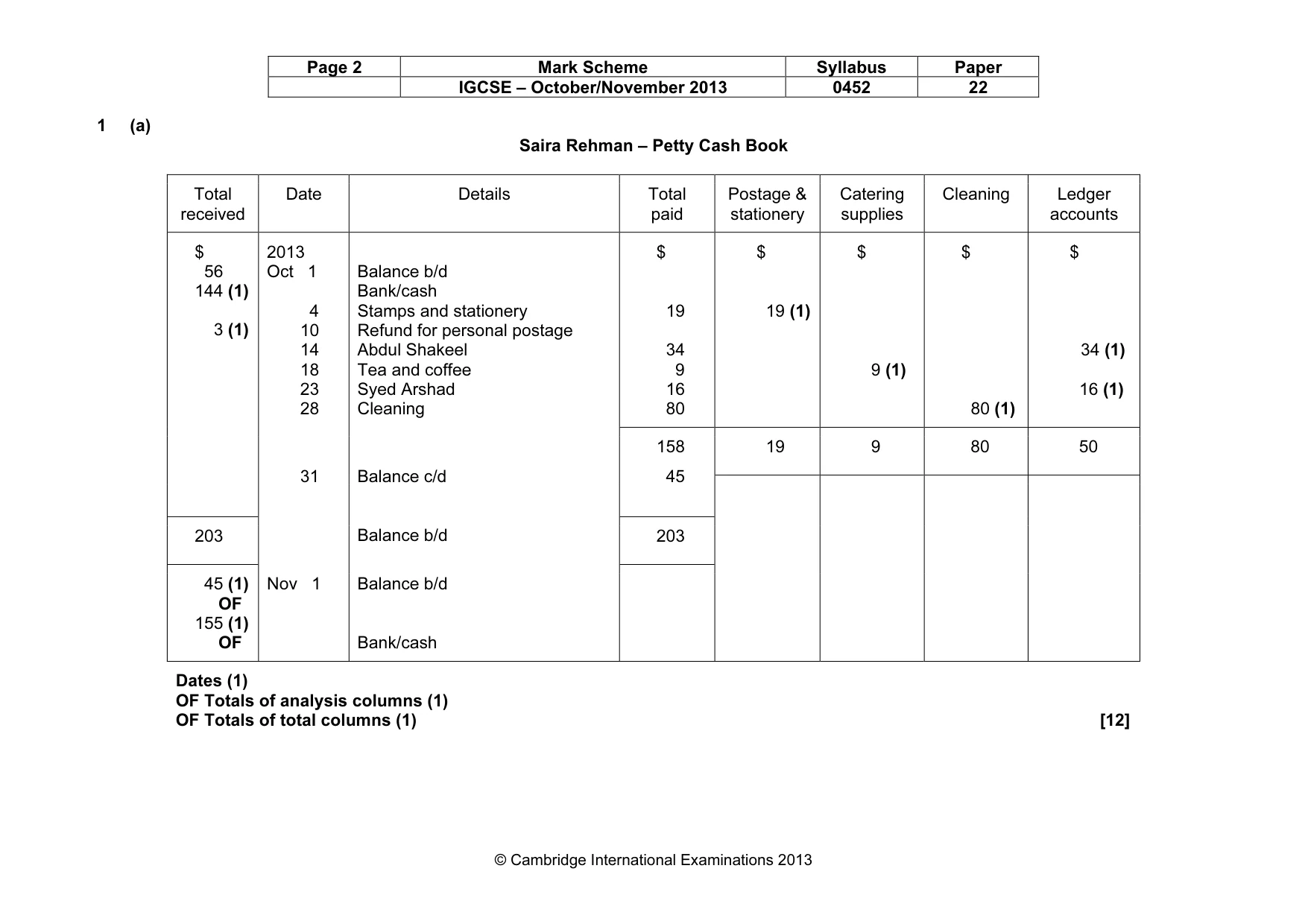
Page 2 Mark Scheme Syllabus Paper IGCSE – October/November 2013 0452 22 © Cambridge International Examinations 2013 1 (a) Saira Rehman – Petty Cash Book Total received Date Details Total paid Postage & stationery Catering supplies Cleaning Ledger accounts $ 56 144 (1) 3 (1) 2013 Oct 1 4 10 14 18 23 28 31 Nov 1 Balance b/d Bank/cash Stamps and stationery Refund for personal postage Abdul Shakeel Tea and coffee Syed Arshad Cleaning Balance c/d Balance b/d Balance b/d Bank/cash $ 19 34 9 16 80 $ 19 (1) $ 9 (1) $ 80 (1) $ 34 (1) 16 (1) 158 45 19 9 80 50 203 203 45 (1) OF 155 (1) OF Dates (1) OF Totals of analysis columns (1) OF Totals of total columns (1) [12]
Mark scheme, page 3
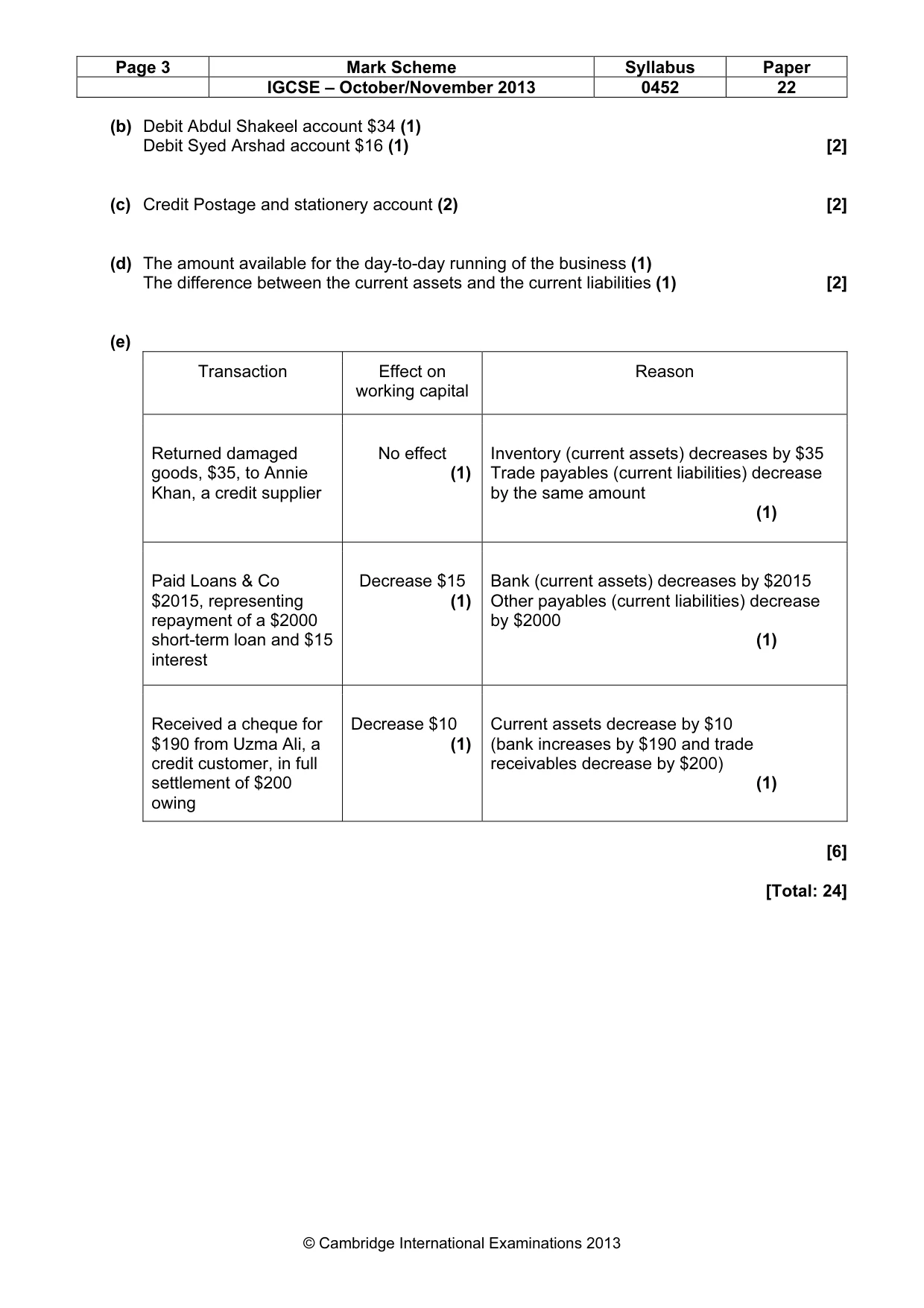
Page 3 Mark Scheme Syllabus Paper IGCSE – October/November 2013 0452 22 © Cambridge International Examinations 2013 (b) Debit Abdul Shakeel account $34 (1) Debit Syed Arshad account $16 (1) [2] (c) Credit Postage and stationery account (2) [2] (d) The amount available for the day-to-day running of the business (1) The difference between the current assets and the current liabilities (1) [2] (e) Transaction Effect on working capital Reason Returned damaged goods, $35, to Annie Khan, a credit supplier No effect (1) Inventory (current assets) decreases by $35 Trade payables (current liabilities) decrease by the same amount (1) Paid Loans & Co $2015, representing repayment of a $2000 short-term loan and $15 interest Decrease $15 (1) Bank (current assets) decreases by $2015 Other payables (current liabilities) decrease by $2000 (1) Received a cheque for $190 from Uzma Ali, a credit customer, in full settlement of $200 owing Decrease $10 (1) Current assets decrease by $10 (bank increases by $190 and trade receivables decrease by $200) (1) [6] [Total: 24]
Mark scheme, page 4
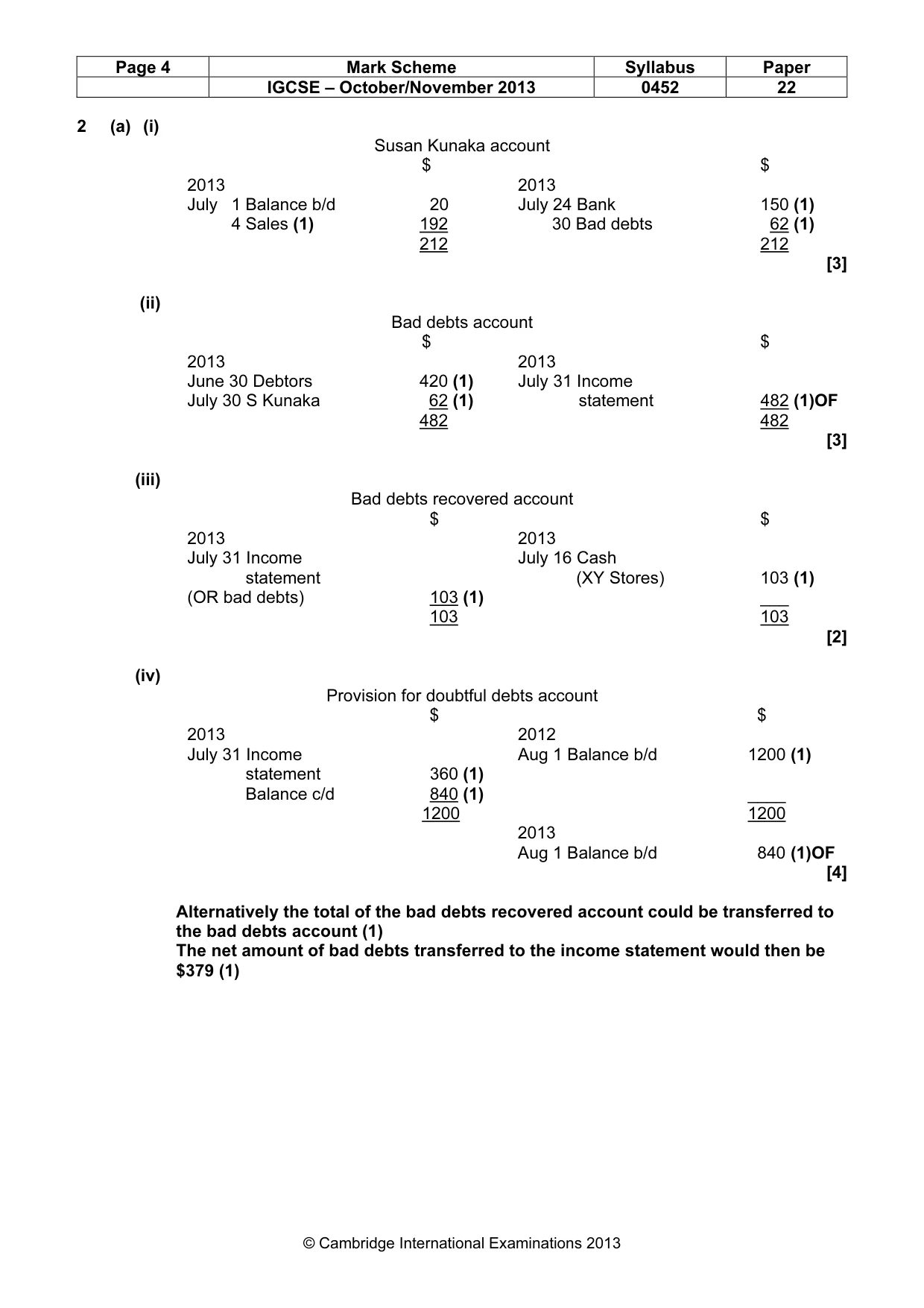
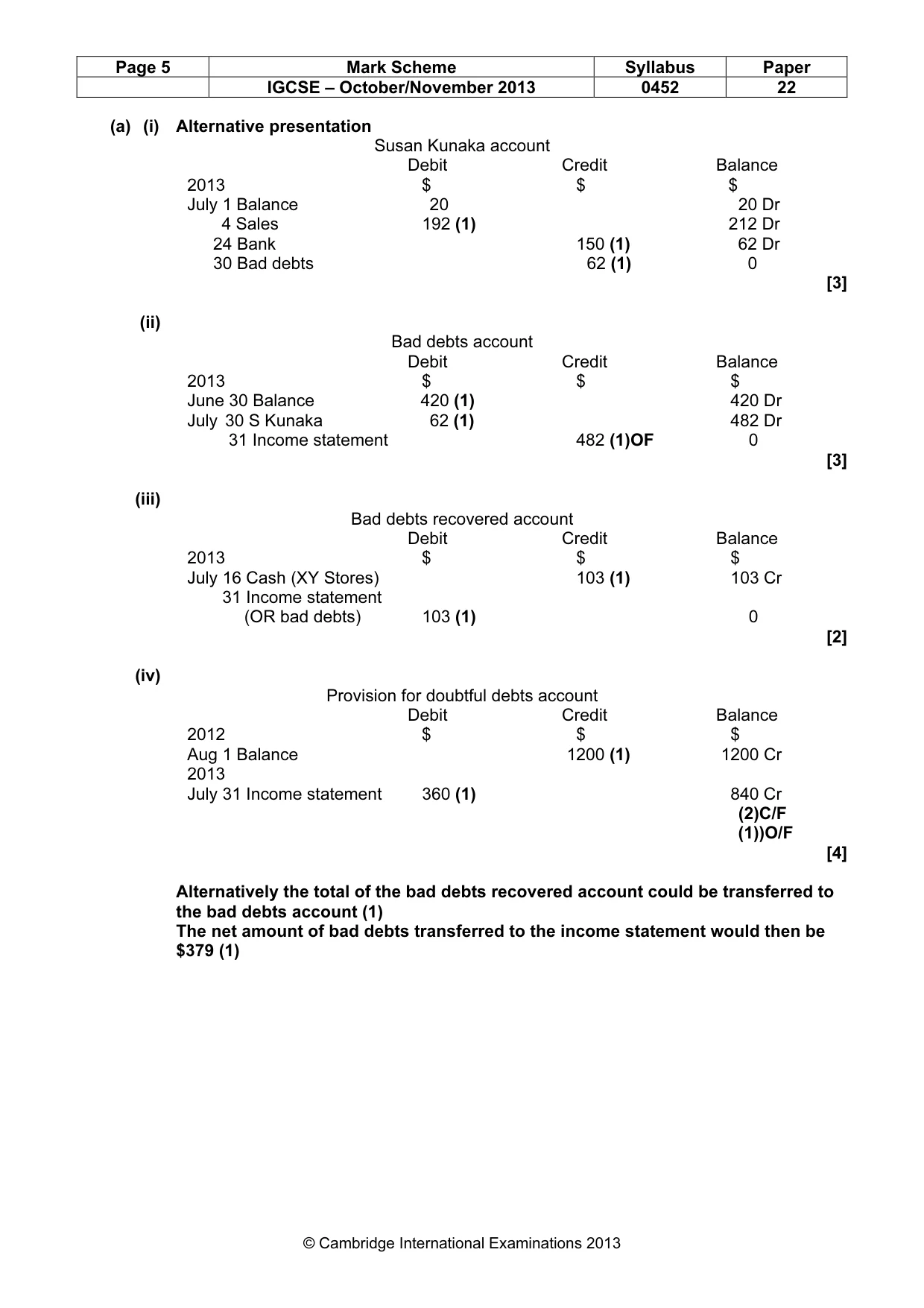
Page 4 Mark Scheme Syllabus Paper IGCSE – October/November 2013 0452 22 © Cambridge International Examinations 2013 2 (a) (i) Susan Kunaka account $ $ 2013 2013 July 1 Balance b/d 20 July 24 Bank 150 (1) 4 Sales (1) 192 30 Bad debts 62 (1) 212 212 [3] (ii) Bad debts account $ $ 2013 2013 June 30 Debtors 420 (1) July 31 Income July 30 S Kunaka 62 (1) statement 482 (1)OF 482 482 [3] (iii) Bad debts recovered account $ $ 2013 2013 July 31 Income July 16 Cash statement (XY Stores) 103 (1) (OR bad debts) 103 (1) ___ 103 103 [2] (iv) Provision for doubtful debts account $ $ 2013 2012 July 31 Income Aug 1 Balance b/d 1200 (1) statement 360 (1) Balance c/d 840 (1) ____ 1200 1200 2013 Aug 1 Balance b/d 840 (1)OF [4] Alternatively the total of the bad debts recovered account could be transferred to the bad debts account (1) The net amount of bad debts transferred to the income statement would then be $379 (1)
Mark scheme, page 5
Page 5 Mark Scheme Syllabus Paper IGCSE – October/November 2013 0452 22 © Cambridge International Examinations 2013 (a) (i) Alternative presentation Susan Kunaka account Debit Credit Balance 2013 $ $ $ July 1 Balance 20 20 Dr 4 Sales 192 (1) 212 Dr 24 Bank 150 (1) 62 Dr 30 Bad debts 62 (1) 0 [3] (ii) Bad debts account Debit Credit Balance 2013 $ $ $ June 30 Balance 420 (1) 420 Dr July 30 S Kunaka 62 (1) 482 Dr 31 Income statement 482 (1)OF 0 [3] (iii) Bad debts recovered account Debit Credit Balance 2013 $ $ $ July 16 Cash (XY Stores) 103 (1) 103 Cr 31 Income statement (OR bad debts) 103 (1) 0 [2] (iv) Provision for doubtful debts account Debit Credit Balance 2012 $ $ $ Aug 1 Balance 1200 (1) 1200 Cr 2013 July 31 Income statement 360 (1) 840 Cr (2)C/F (1))O/F [4] Alternatively the total of the bad debts recovered account could be transferred to the bad debts account (1) The net amount of bad debts transferred to the income statement would then be $379 (1)
Mark scheme, page 6
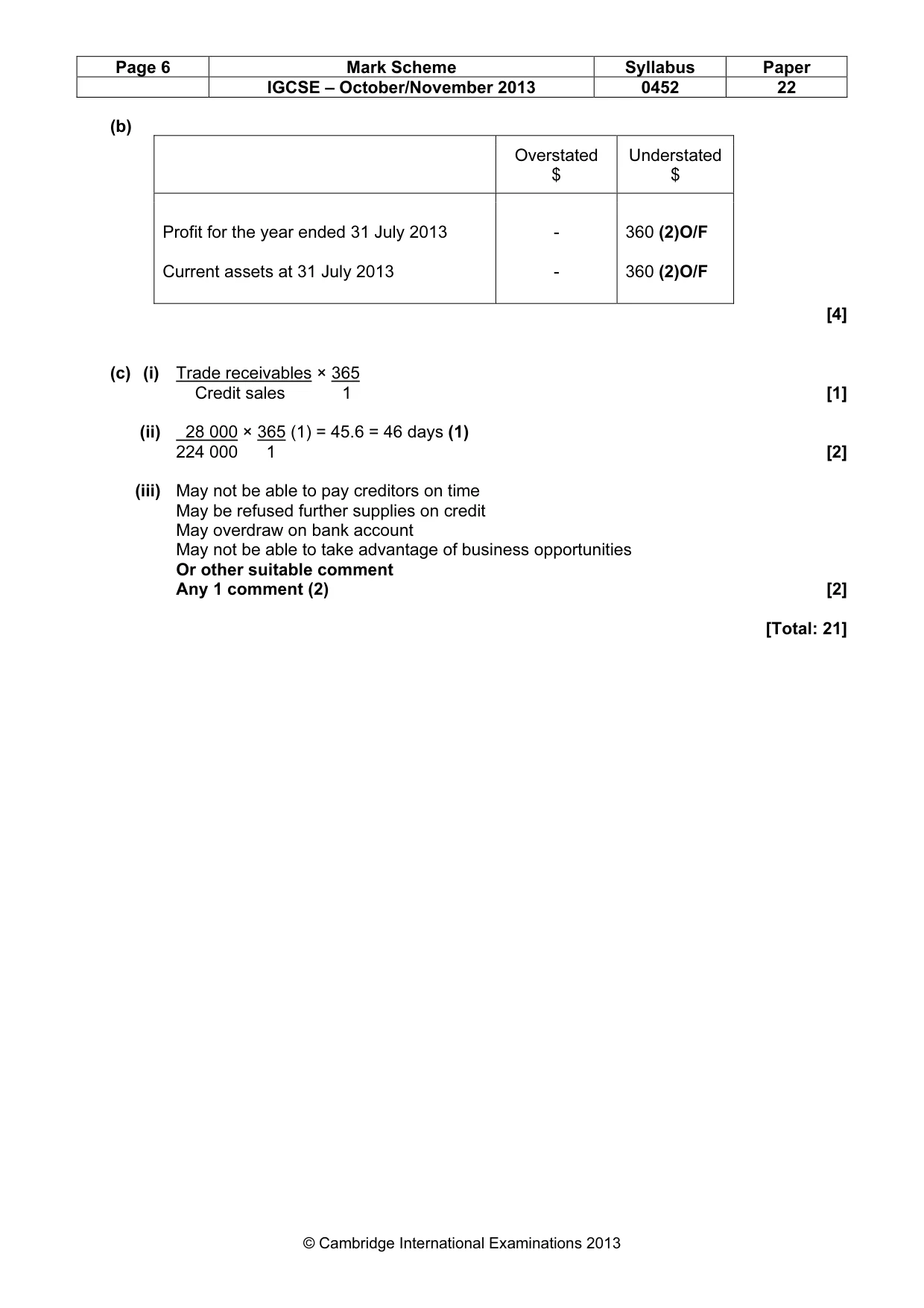
Page 6 Mark Scheme Syllabus Paper IGCSE – October/November 2013 0452 22 © Cambridge International Examinations 2013 (b) Overstated $ Understated $ Profit for the year ended 31 July 2013 Current assets at 31 July 2013 - - 360 (2)O/F 360 (2)O/F [4] (c) (i) Trade receivables × 365 Credit sales 1 [1] (ii) 28 000 × 365 (1) = 45.6 = 46 days (1) 224 000 1 [2] (iii) May not be able to pay creditors on time May be refused further supplies on credit May overdraw on bank account May not be able to take advantage of business opportunities Or other suitable comment Any 1 comment (2) [2] [Total: 21]
Mark scheme, page 7
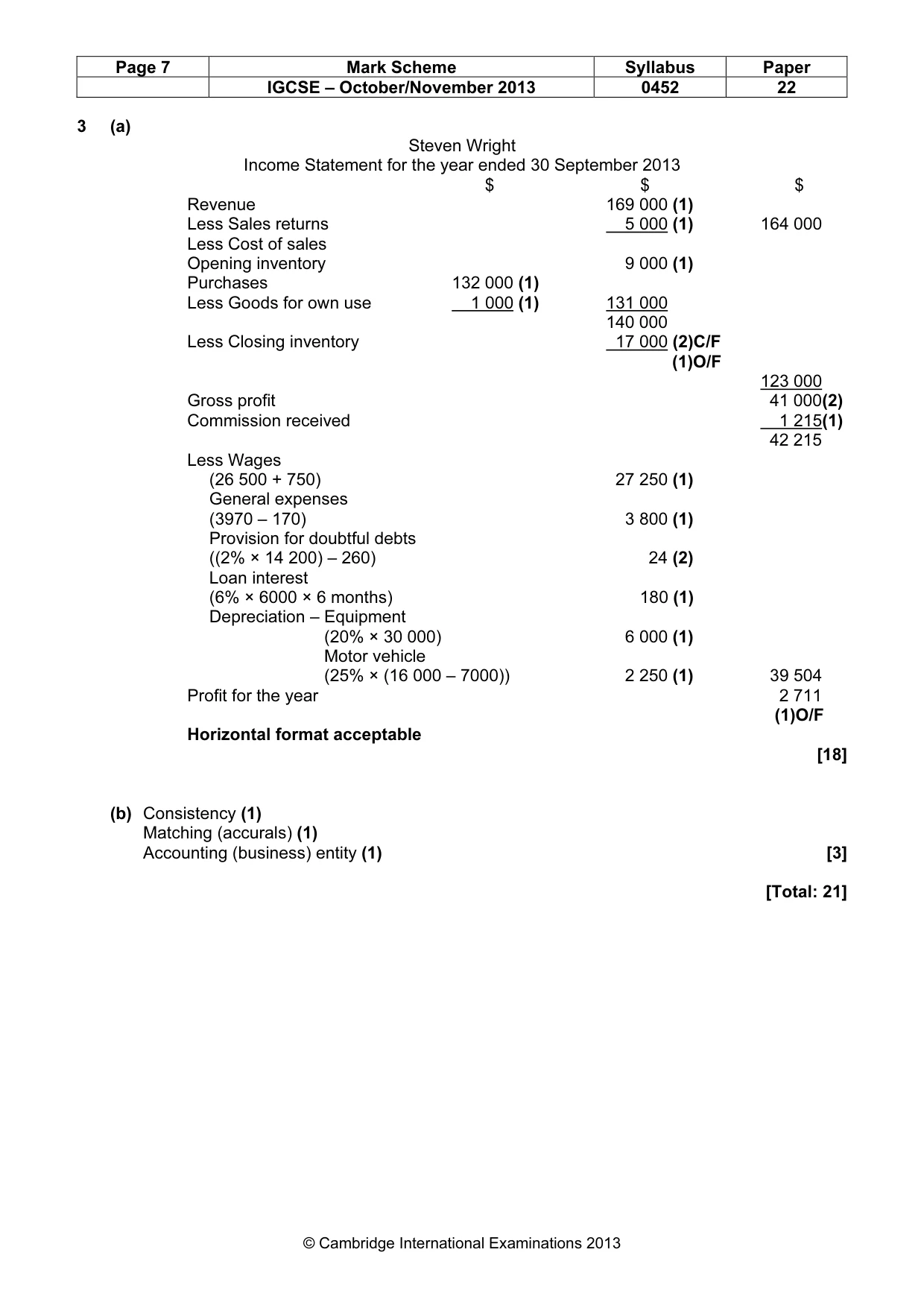
Page 7 Mark Scheme Syllabus Paper IGCSE – October/November 2013 0452 22 © Cambridge International Examinations 2013 3 (a) Steven Wright Income Statement for the year ended 30 September 2013 $ $ $ Revenue 169 000 (1) Less Sales returns 5 000 (1) 164 000 Less Cost of sales Opening inventory 9 000 (1) Purchases 132 000 (1) Less Goods for own use 1 000 (1) 131 000 140 000 Less Closing inventory 17 000 (2)C/F (1)O/F 123 000 Gross profit 41 000(2) Commission received 1 215(1) 42 215 Less Wages (26 500 + 750) 27 250 (1) General expenses (3970 – 170) 3 800 (1) Provision for doubtful debts ((2% × 14 200) – 260) 24 (2) Loan interest (6% × 6000 × 6 months) 180 (1) Depreciation – Equipment (20% × 30 000) 6 000 (1) Motor vehicle (25% × (16 000 – 7000)) 2 250 (1) 39 504 Profit for the year 2 711 (1)O/F Horizontal format acceptable [18] (b) Consistency (1) Matching (accurals) (1) Accounting (business) entity (1) [3] [Total: 21]
Mark scheme, page 8
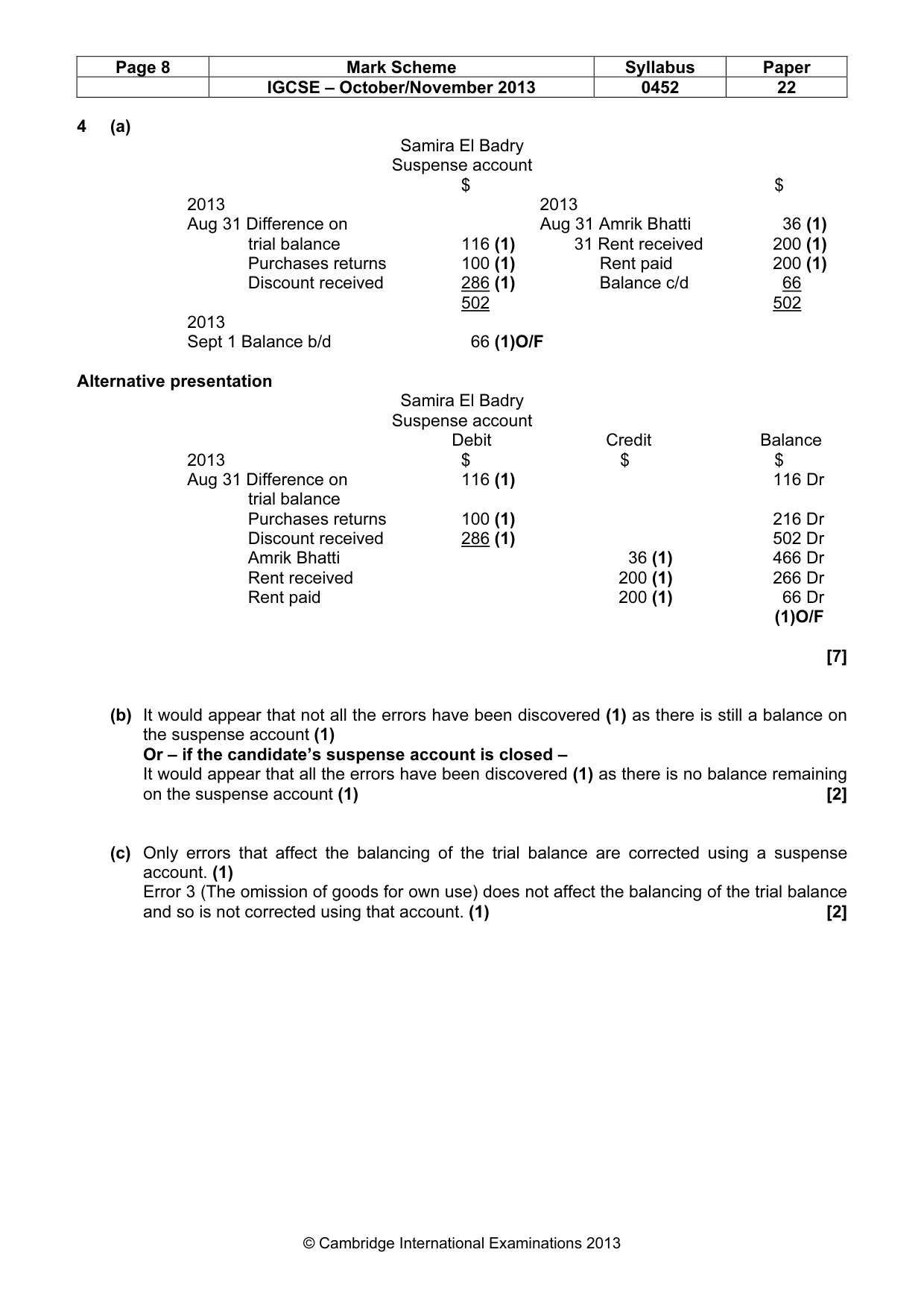
Page 8 Mark Scheme Syllabus Paper IGCSE – October/November 2013 0452 22 © Cambridge International Examinations 2013 4 (a) Samira El Badry Suspense account $ $ 2013 2013 Aug 31 Difference on Aug 31 Amrik Bhatti 36 (1) trial balance 116 (1) 31 Rent received 200 (1) Purchases returns 100 (1) Rent paid 200 (1) Discount received 286 (1) Balance c/d 66 502 502 2013 Sept 1 Balance b/d 66 (1)O/F Alternative presentation Samira El Badry Suspense account Debit Credit Balance 2013 $ $ $ Aug 31 Difference on 116 (1) 116 Dr trial balance Purchases returns 100 (1) 216 Dr Discount received 286 (1) 502 Dr Amrik Bhatti 36 (1) 466 Dr Rent received 200 (1) 266 Dr Rent paid 200 (1) 66 Dr (1)O/F [7] (b) It would appear that not all the errors have been discovered (1) as there is still a balance on the suspense account (1) Or – if the candidate’s suspense account is closed – It would appear that all the errors have been discovered (1) as there is no balance remaining on the suspense account (1) [2] (c) Only errors that affect the balancing of the trial balance are corrected using a suspense account. (1) Error 3 (The omission of goods for own use) does not affect the balancing of the trial balance and so is not corrected using that account. (1) [2]
Mark scheme, page 9
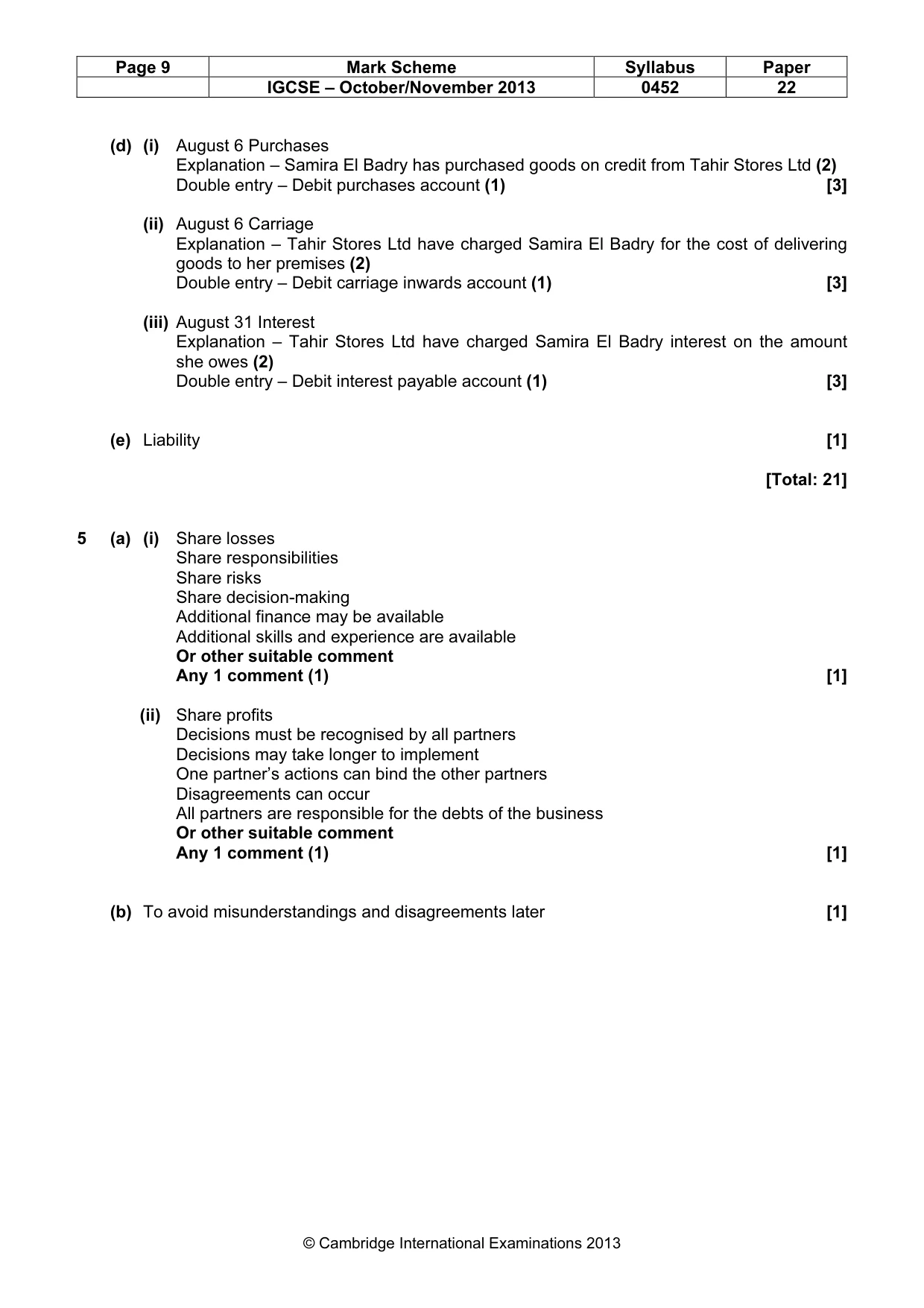
Page 9 Mark Scheme Syllabus Paper IGCSE – October/November 2013 0452 22 © Cambridge International Examinations 2013 (d) (i) August 6 Purchases Explanation – Samira El Badry has purchased goods on credit from Tahir Stores Ltd (2) Double entry – Debit purchases account (1) [3] (ii) August 6 Carriage Explanation – Tahir Stores Ltd have charged Samira El Badry for the cost of delivering goods to her premises (2) Double entry – Debit carriage inwards account (1) [3] (iii) August 31 Interest Explanation – Tahir Stores Ltd have charged Samira El Badry interest on the amount she owes (2) Double entry – Debit interest payable account (1) [3] (e) Liability [1] [Total: 21] 5 (a) (i) Share losses Share responsibilities Share risks Share decision-making Additional finance may be available Additional skills and experience are available Or other suitable comment Any 1 comment (1) [1] (ii) Share profits Decisions must be recognised by all partners Decisions may take longer to implement One partner’s actions can bind the other partners Disagreements can occur All partners are responsible for the debts of the business Or other suitable comment Any 1 comment (1) [1] (b) To avoid misunderstandings and disagreements later [1]
Mark scheme, page 10
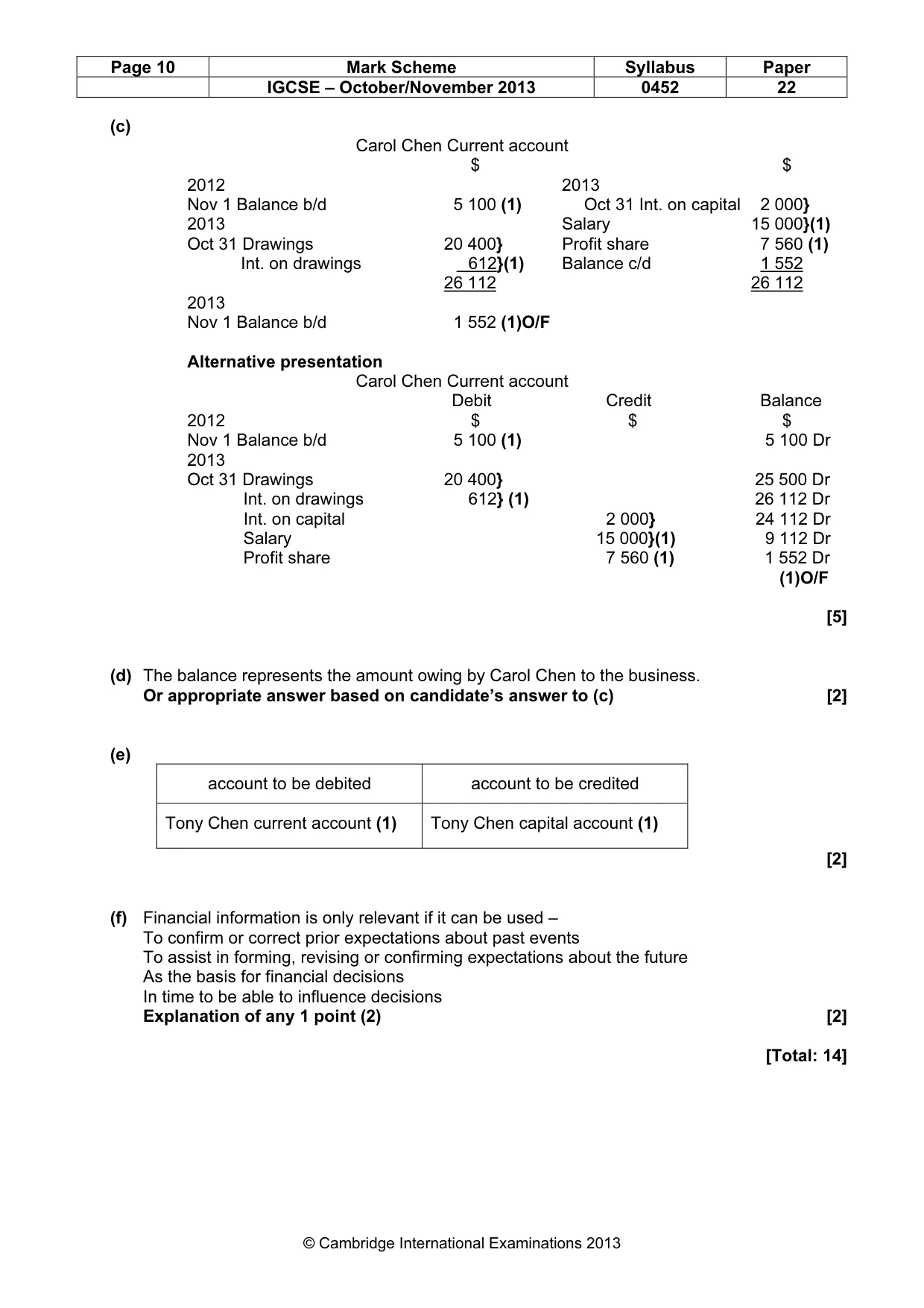
Page 10 Mark Scheme Syllabus Paper IGCSE – October/November 2013 0452 22 © Cambridge International Examinations 2013 (c) Carol Chen Current account $ $ 2012 2013 Nov 1 Balance b/d 5 100 (1) Oct 31 Int. on capital 2 000} 2013 Salary 15 000}(1) Oct 31 Drawings 20 400} Profit share 7 560 (1) Int. on drawings 612}(1) Balance c/d 1 552 26 112 26 112 2013 Nov 1 Balance b/d 1 552 (1)O/F Alternative presentation Carol Chen Current account Debit Credit Balance 2012 $ $ $ Nov 1 Balance b/d 5 100 (1) 5 100 Dr 2013 Oct 31 Drawings 20 400} 25 500 Dr Int. on drawings 612} (1) 26 112 Dr Int. on capital 2 000} 24 112 Dr Salary 15 000}(1) 9 112 Dr Profit share 7 560 (1) 1 552 Dr (1)O/F [5] (d) The balance represents the amount owing by Carol Chen to the business. Or appropriate answer based on candidate’s answer to (c) [2] (e) account to be debited account to be credited Tony Chen current account (1) Tony Chen capital account (1) [2] (f) Financial information is only relevant if it can be used – To confirm or correct prior expectations about past events To assist in forming, revising or confirming expectations about the future As the basis for financial decisions In time to be able to influence decisions Explanation of any 1 point (2) [2] [Total: 14]
Mark scheme, page 11
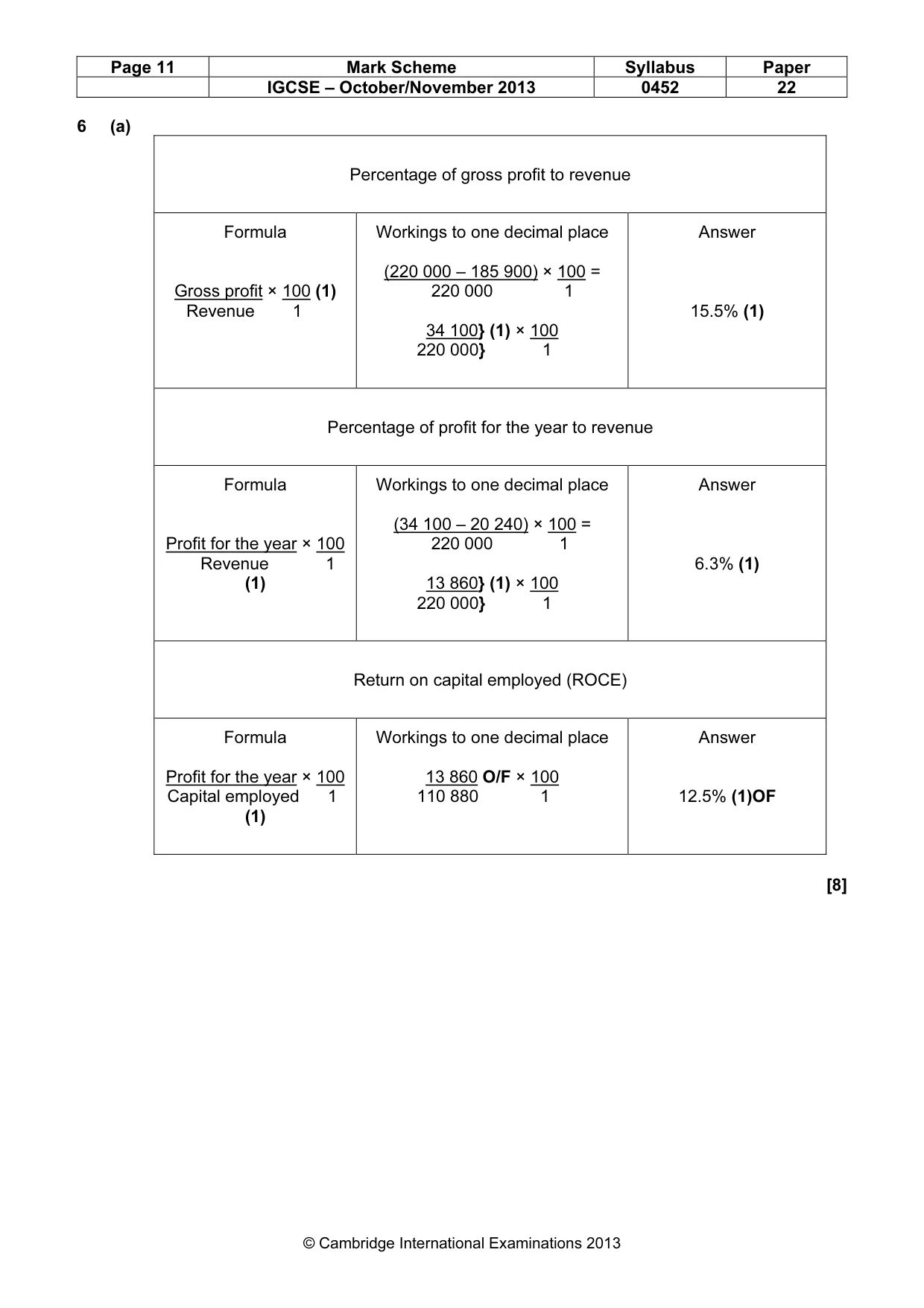
Page 11 Mark Scheme Syllabus Paper IGCSE – October/November 2013 0452 22 © Cambridge International Examinations 2013 6 (a) Percentage of gross profit to revenue Formula Gross profit × 100 (1) Revenue 1 Workings to one decimal place (220 000 – 185 900) × 100 = 220 000 1 34 100} (1) × 100 220 000} 1 Answer 15.5% (1) Percentage of profit for the year to revenue Formula Profit for the year × 100 Revenue 1 (1) Workings to one decimal place (34 100 – 20 240) × 100 = 220 000 1 13 860} (1) × 100 220 000} 1 Answer 6.3% (1) Return on capital employed (ROCE) Formula Profit for the year × 100 Capital employed 1 (1) Workings to one decimal place 13 860 O/F × 100 110 880 1 Answer 12.5% (1)OF [8]
Mark scheme, page 12
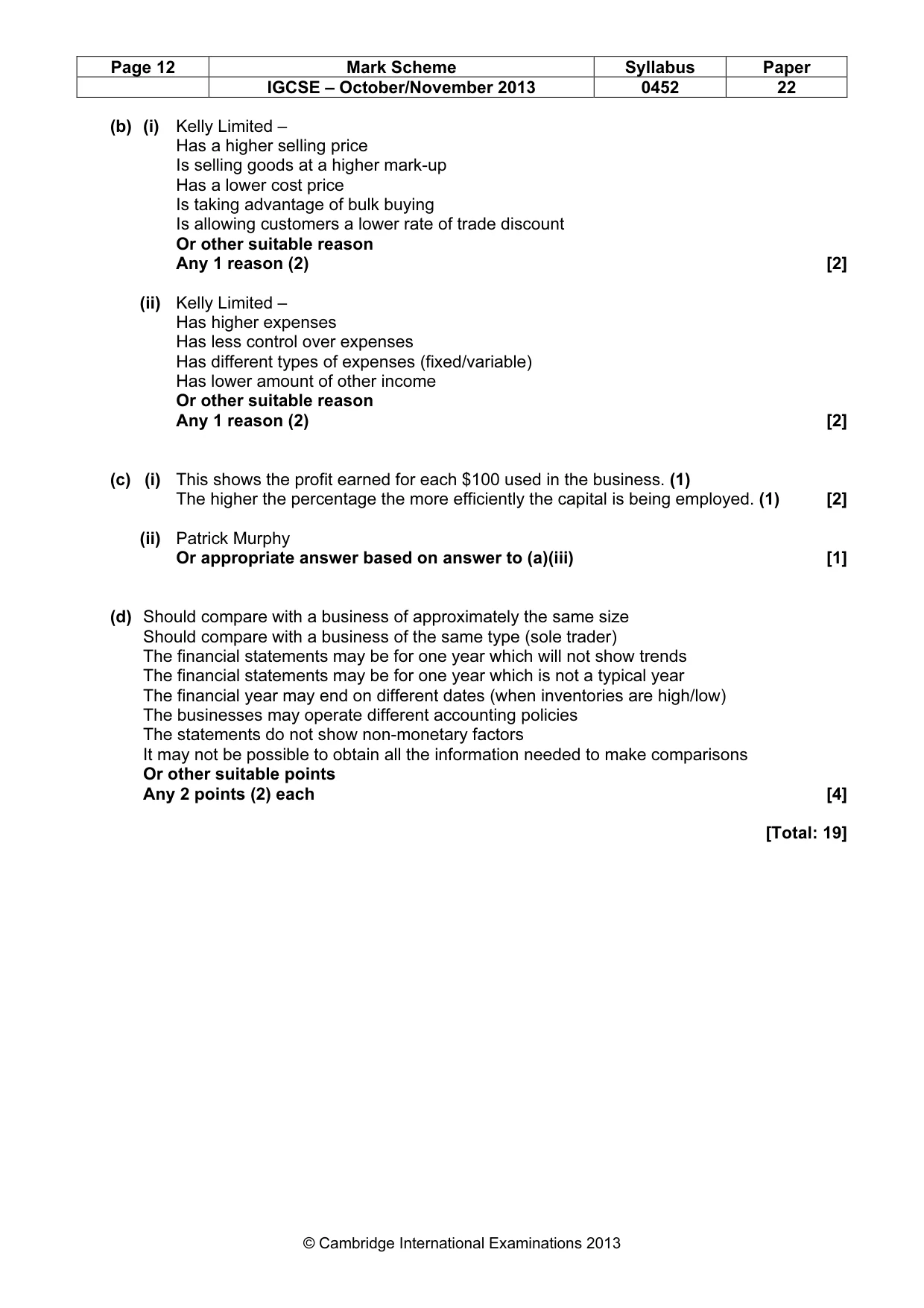
Page 12 Mark Scheme Syllabus Paper IGCSE – October/November 2013 0452 22 © Cambridge International Examinations 2013 (b) (i) Kelly Limited – Has a higher selling price Is selling goods at a higher mark-up Has a lower cost price Is taking advantage of bulk buying Is allowing customers a lower rate of trade discount Or other suitable reason Any 1 reason (2) [2] (ii) Kelly Limited – Has higher expenses Has less control over expenses Has different types of expenses (fixed/variable) Has lower amount of other income Or other suitable reason Any 1 reason (2) [2] (c) (i) This shows the profit earned for each $100 used in the business. (1) The higher the percentage the more efficiently the capital is being employed. (1) [2] (ii) Patrick Murphy Or appropriate answer based on answer to (a)(iii) [1] (d) Should compare with a business of approximately the same size Should compare with a business of the same type (sole trader) The financial statements may be for one year which will not show trends The financial statements may be for one year which is not a typical year The financial year may end on different dates (when inventories are high/low) The businesses may operate different accounting policies The statements do not show non-monetary factors It may not be possible to obtain all the information needed to make comparisons Or other suitable points Any 2 points (2) each [4] [Total: 19]
What you needed in this session
Cambridge’s own grade thresholds for 2013 Oct/Nov, Paper 2 · Variant 2. A higher threshold means an easier paper — the bar moves with how the cohort did.