Cambridge IGCSE Accounting 0452 — 2013 Oct/Nov Paper 2 · Variant 1
0452/21/O/N/13 · 120 marks · ≈135 min
The question paper and its mark scheme, free to read here and free to download. This is Cambridge’s own paper, exactly as it was sat.
Question paper1 pages
Mark scheme12 pages
Answers below. Sit the paper first if you are practising.
Paper as text
Question paper, page 1
UNIVERSITY OF CAMBRIDGE INTERNATIONAL EXAMINATIONS International General Certificate of Secondary Education ACCOUNTING 0452/21 Paper 2 October/November 2013 This Question Paper is not currently available, but will be uploaded here as soon as possible. www.theallpapers.com
Mark scheme, page 1
CAMBRIDGE INTERNATIONAL EXAMINATIONS International General Certificate of Secondary Education MARK SCHEME for the October/November 2013 series 0452 ACCOUNTING 0452/21 Paper 2, maximum raw mark 120 This mark scheme is published as an aid to teachers and candidates, to indicate the requirements of the examination. It shows the basis on which Examiners were instructed to award marks. It does not indicate the details of the discussions that took place at an Examiners’ meeting before marking began, which would have considered the acceptability of alternative answers. Mark schemes should be read in conjunction with the question paper and the Principal Examiner Report for Teachers. Cambridge will not enter into discussions about these mark schemes. Cambridge is publishing the mark schemes for the October/November 2013 series for most IGCSE, GCE Advanced Level and Advanced Subsidiary Level components and some Ordinary Level components.
Mark scheme, page 2
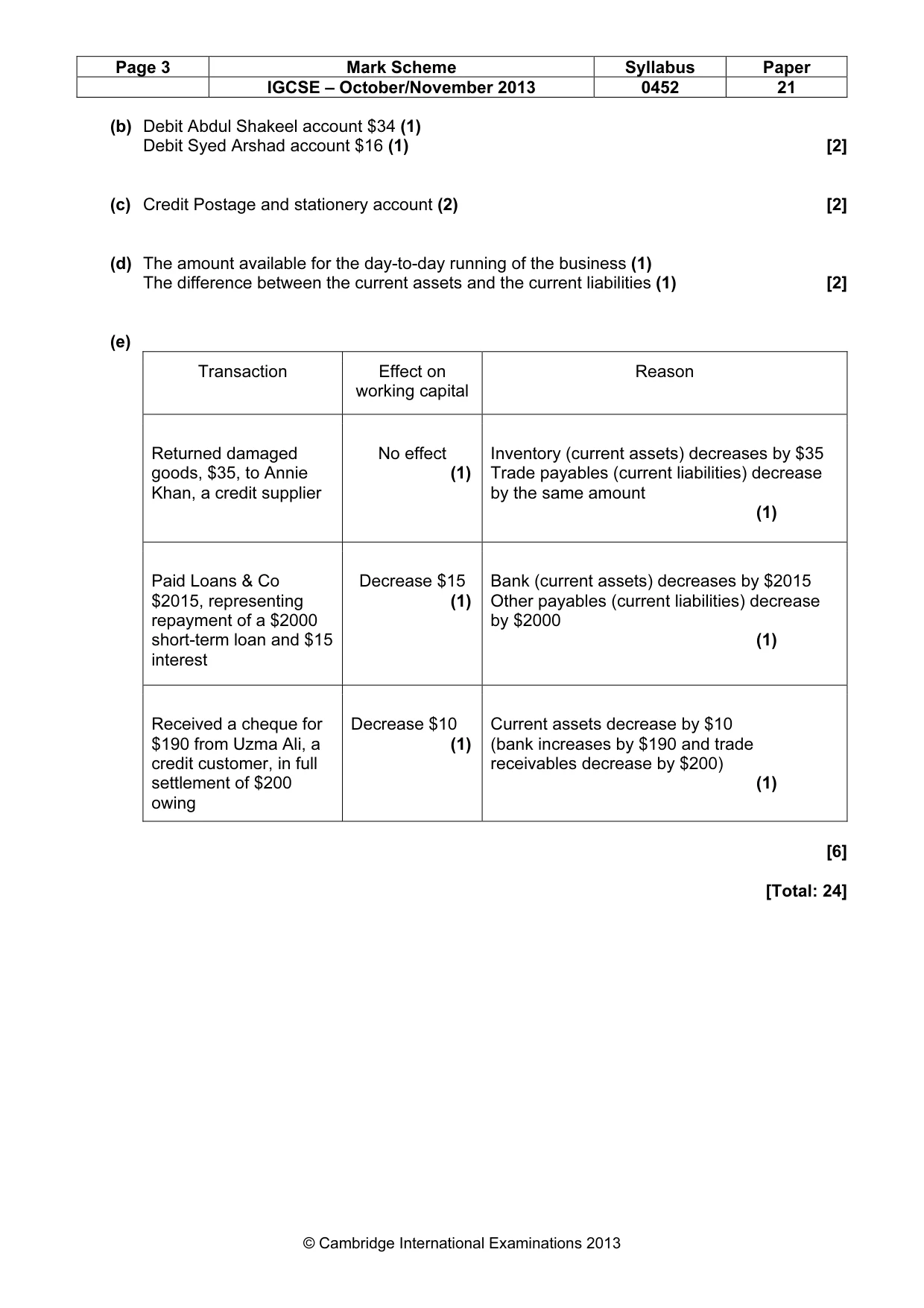
Page 2 Mark Scheme Syllabus Paper IGCSE – October/November 2013 0452 21 © Cambridge International Examinations 2013 1 (a) Saira Rehman – Petty Cash Book Total received Date Details Total paid Postage & stationery Catering supplies Cleaning Ledger accounts $ 56 144 (1) 3 (1) 2013 Oct 1 4 10 14 18 23 28 31 Nov 1 Balance b/d Bank/cash Stamps and stationery Refund for personal postage Abdul Shakeel Tea and coffee Syed Arshad Cleaning Balance c/d Balance b/d Balance b/d Bank/cash $ 19 34 9 16 80 $ 19 (1) $ 9 (1) $ 80 (1) $ 34 (1) 16 (1) 158 45 19 9 80 50 203 203 45 (1) OF 155 (1) OF Dates (1) OF Totals of analysis columns (1) OF Totals of total columns (1) [12]
Mark scheme, page 3
Page 3 Mark Scheme Syllabus Paper IGCSE – October/November 2013 0452 21 © Cambridge International Examinations 2013 (b) Debit Abdul Shakeel account $34 (1) Debit Syed Arshad account $16 (1) [2] (c) Credit Postage and stationery account (2) [2] (d) The amount available for the day-to-day running of the business (1) The difference between the current assets and the current liabilities (1) [2] (e) Transaction Effect on working capital Reason Returned damaged goods, $35, to Annie Khan, a credit supplier No effect (1) Inventory (current assets) decreases by $35 Trade payables (current liabilities) decrease by the same amount (1) Paid Loans & Co $2015, representing repayment of a $2000 short-term loan and $15 interest Decrease $15 (1) Bank (current assets) decreases by $2015 Other payables (current liabilities) decrease by $2000 (1) Received a cheque for $190 from Uzma Ali, a credit customer, in full settlement of $200 owing Decrease $10 (1) Current assets decrease by $10 (bank increases by $190 and trade receivables decrease by $200) (1) [6] [Total: 24]
Mark scheme, page 4
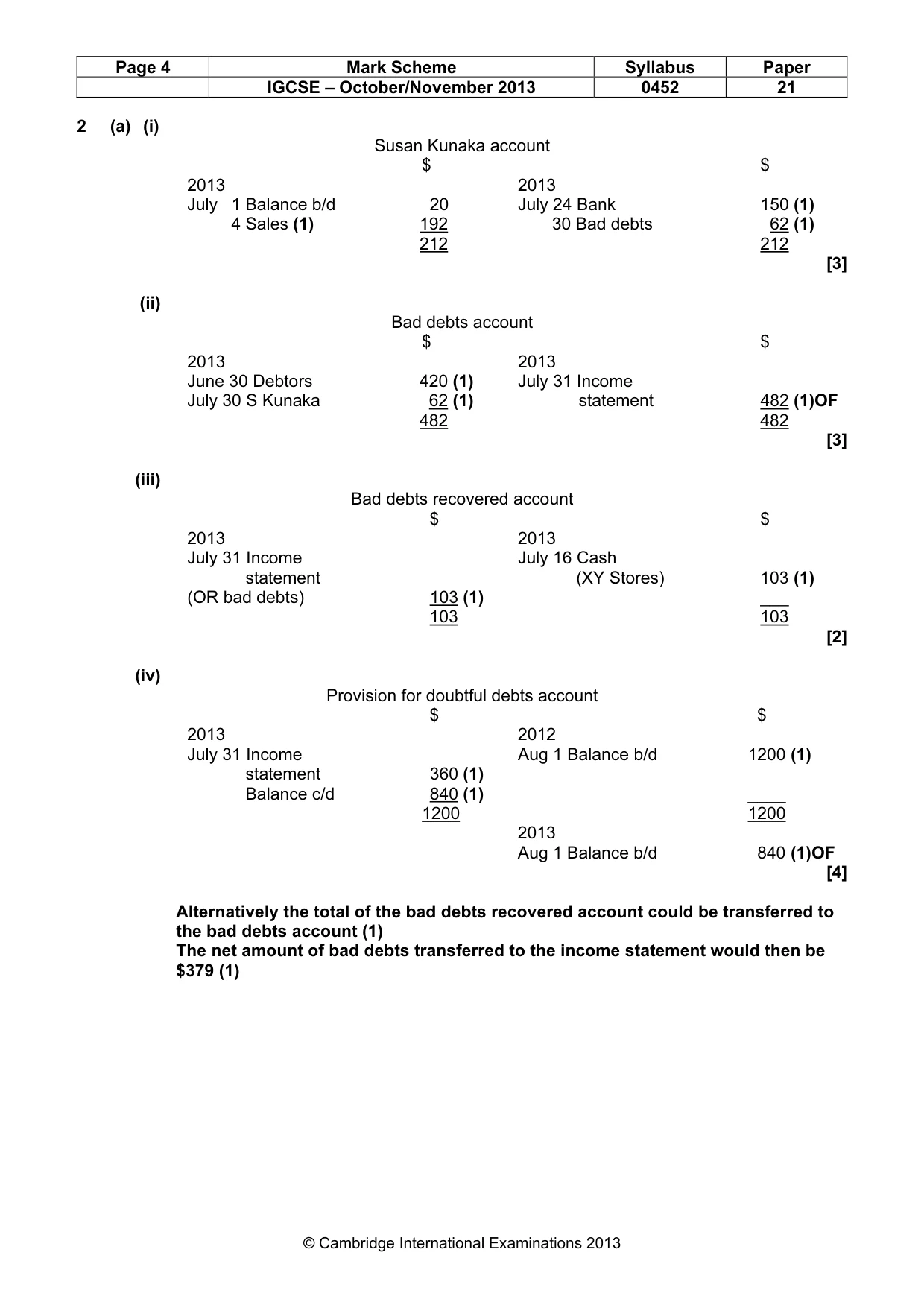
Page 4 Mark Scheme Syllabus Paper IGCSE – October/November 2013 0452 21 © Cambridge International Examinations 2013 2 (a) (i) Susan Kunaka account $ $ 2013 2013 July 1 Balance b/d 20 July 24 Bank 150 (1) 4 Sales (1) 192 30 Bad debts 62 (1) 212 212 [3] (ii) Bad debts account $ $ 2013 2013 June 30 Debtors 420 (1) July 31 Income July 30 S Kunaka 62 (1) statement 482 (1)OF 482 482 [3] (iii) Bad debts recovered account $ $ 2013 2013 July 31 Income July 16 Cash statement (XY Stores) 103 (1) (OR bad debts) 103 (1) ___ 103 103 [2] (iv) Provision for doubtful debts account $ $ 2013 2012 July 31 Income Aug 1 Balance b/d 1200 (1) statement 360 (1) Balance c/d 840 (1) ____ 1200 1200 2013 Aug 1 Balance b/d 840 (1)OF [4] Alternatively the total of the bad debts recovered account could be transferred to the bad debts account (1) The net amount of bad debts transferred to the income statement would then be $379 (1)
Mark scheme, page 5
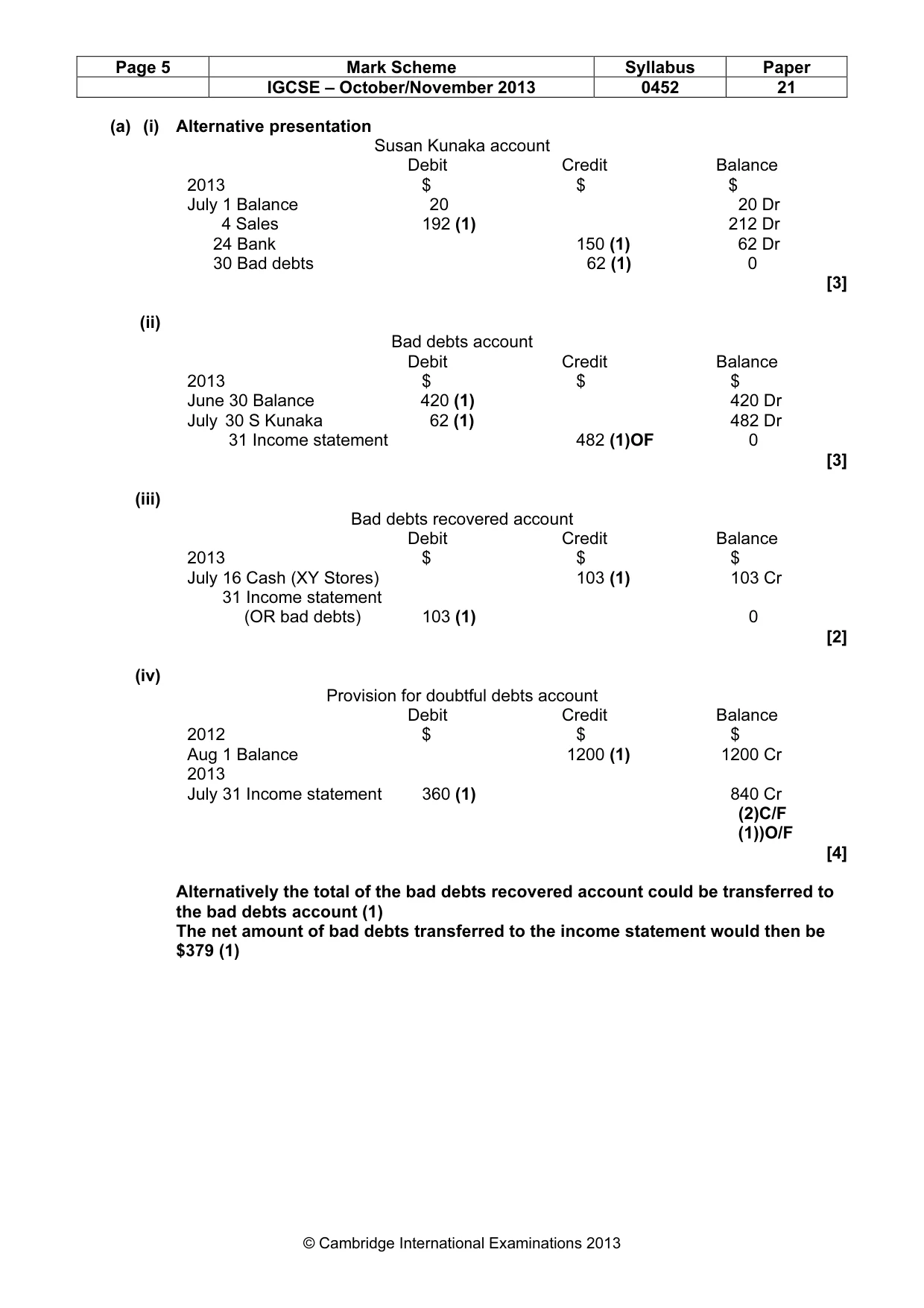
Page 5 Mark Scheme Syllabus Paper IGCSE – October/November 2013 0452 21 © Cambridge International Examinations 2013 (a) (i) Alternative presentation Susan Kunaka account Debit Credit Balance 2013 $ $ $ July 1 Balance 20 20 Dr 4 Sales 192 (1) 212 Dr 24 Bank 150 (1) 62 Dr 30 Bad debts 62 (1) 0 [3] (ii) Bad debts account Debit Credit Balance 2013 $ $ $ June 30 Balance 420 (1) 420 Dr July 30 S Kunaka 62 (1) 482 Dr 31 Income statement 482 (1)OF 0 [3] (iii) Bad debts recovered account Debit Credit Balance 2013 $ $ $ July 16 Cash (XY Stores) 103 (1) 103 Cr 31 Income statement (OR bad debts) 103 (1) 0 [2] (iv) Provision for doubtful debts account Debit Credit Balance 2012 $ $ $ Aug 1 Balance 1200 (1) 1200 Cr 2013 July 31 Income statement 360 (1) 840 Cr (2)C/F (1))O/F [4] Alternatively the total of the bad debts recovered account could be transferred to the bad debts account (1) The net amount of bad debts transferred to the income statement would then be $379 (1)
Mark scheme, page 6
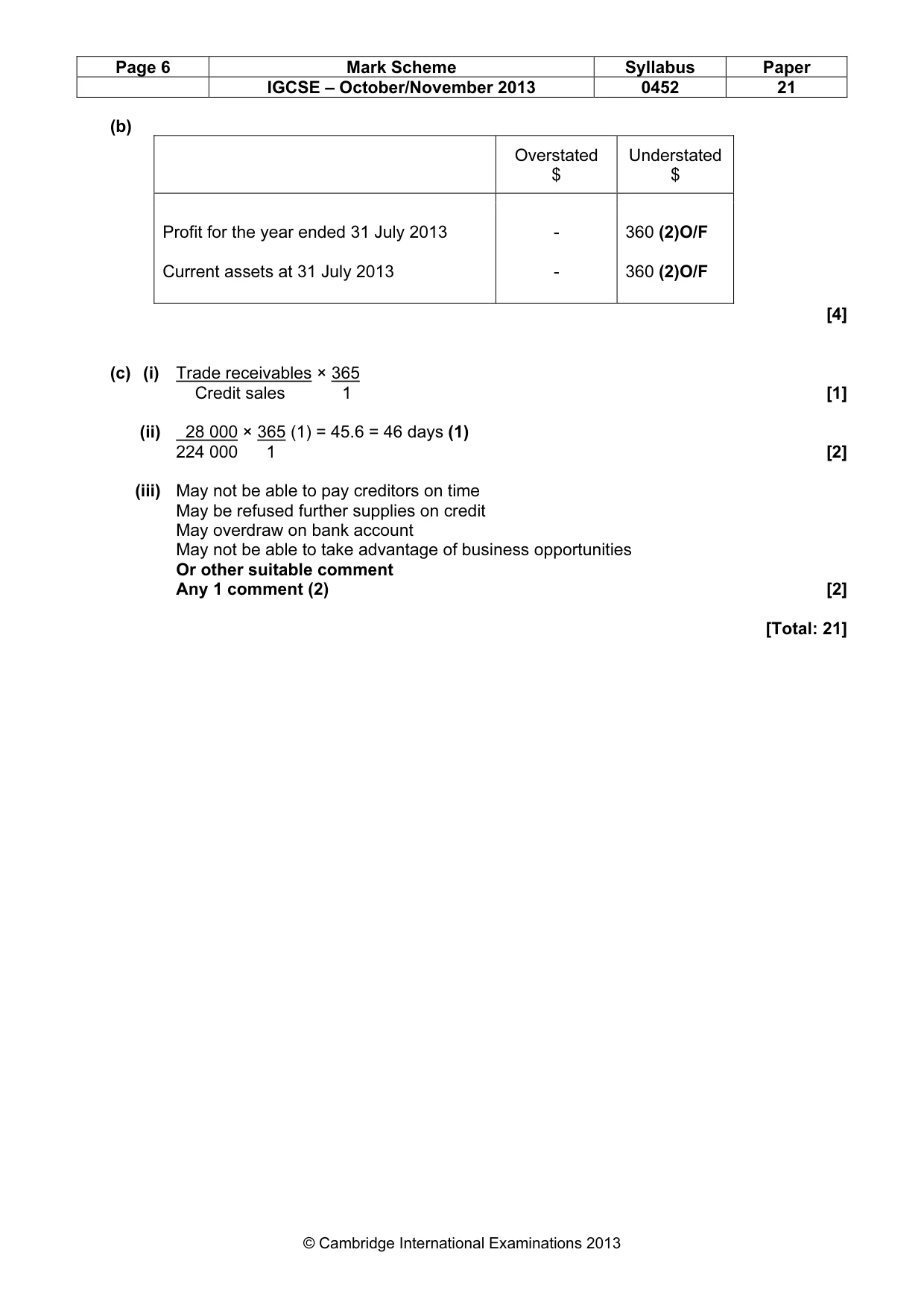
Page 6 Mark Scheme Syllabus Paper IGCSE – October/November 2013 0452 21 © Cambridge International Examinations 2013 (b) Overstated $ Understated $ Profit for the year ended 31 July 2013 Current assets at 31 July 2013 - - 360 (2)O/F 360 (2)O/F [4] (c) (i) Trade receivables × 365 Credit sales 1 [1] (ii) 28 000 × 365 (1) = 45.6 = 46 days (1) 224 000 1 [2] (iii) May not be able to pay creditors on time May be refused further supplies on credit May overdraw on bank account May not be able to take advantage of business opportunities Or other suitable comment Any 1 comment (2) [2] [Total: 21]
Mark scheme, page 7
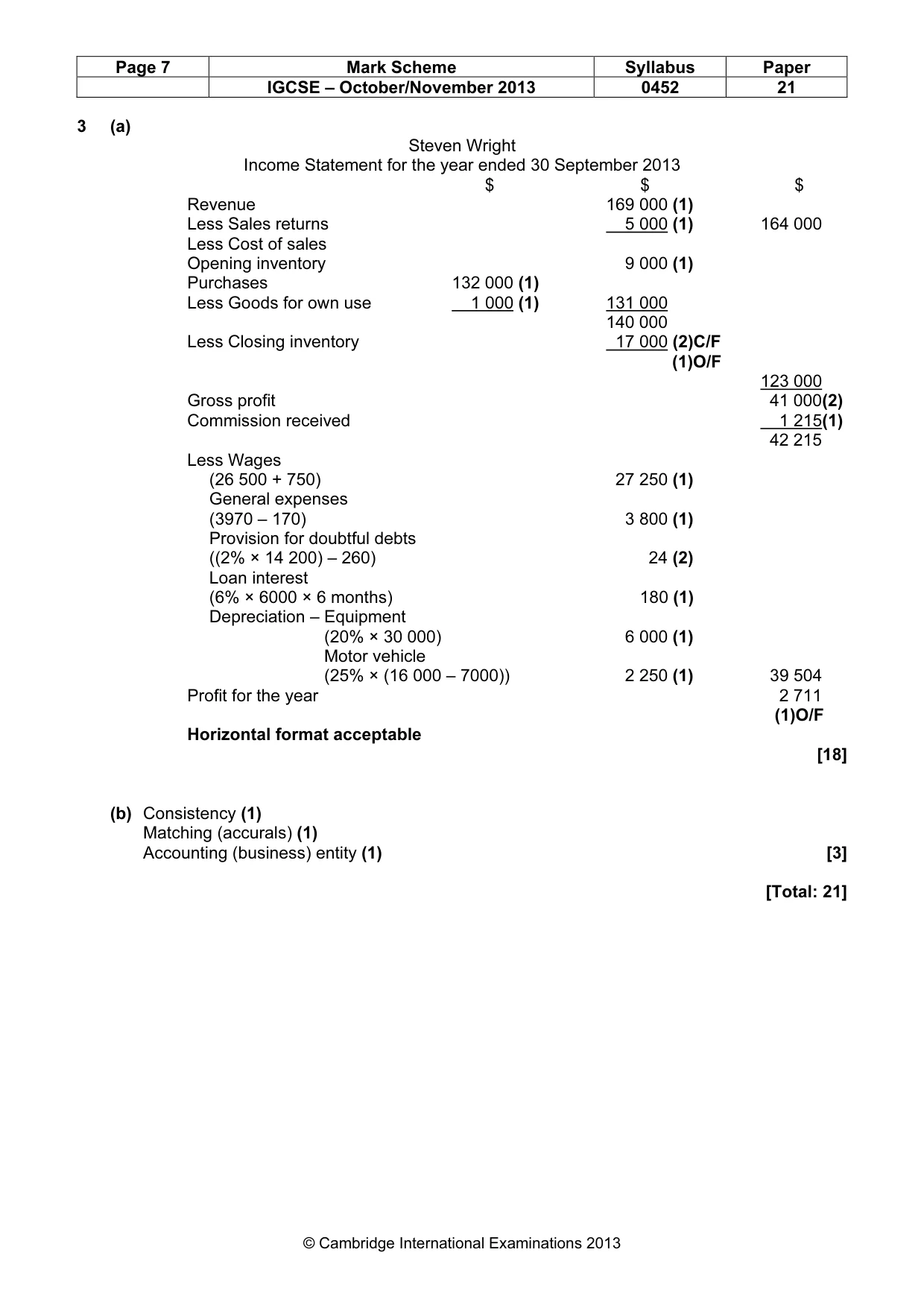
Page 7 Mark Scheme Syllabus Paper IGCSE – October/November 2013 0452 21 © Cambridge International Examinations 2013 3 (a) Steven Wright Income Statement for the year ended 30 September 2013 $ $ $ Revenue 169 000 (1) Less Sales returns 5 000 (1) 164 000 Less Cost of sales Opening inventory 9 000 (1) Purchases 132 000 (1) Less Goods for own use 1 000 (1) 131 000 140 000 Less Closing inventory 17 000 (2)C/F (1)O/F 123 000 Gross profit 41 000(2) Commission received 1 215(1) 42 215 Less Wages (26 500 + 750) 27 250 (1) General expenses (3970 – 170) 3 800 (1) Provision for doubtful debts ((2% × 14 200) – 260) 24 (2) Loan interest (6% × 6000 × 6 months) 180 (1) Depreciation – Equipment (20% × 30 000) 6 000 (1) Motor vehicle (25% × (16 000 – 7000)) 2 250 (1) 39 504 Profit for the year 2 711 (1)O/F Horizontal format acceptable [18] (b) Consistency (1) Matching (accurals) (1) Accounting (business) entity (1) [3] [Total: 21]
Mark scheme, page 8
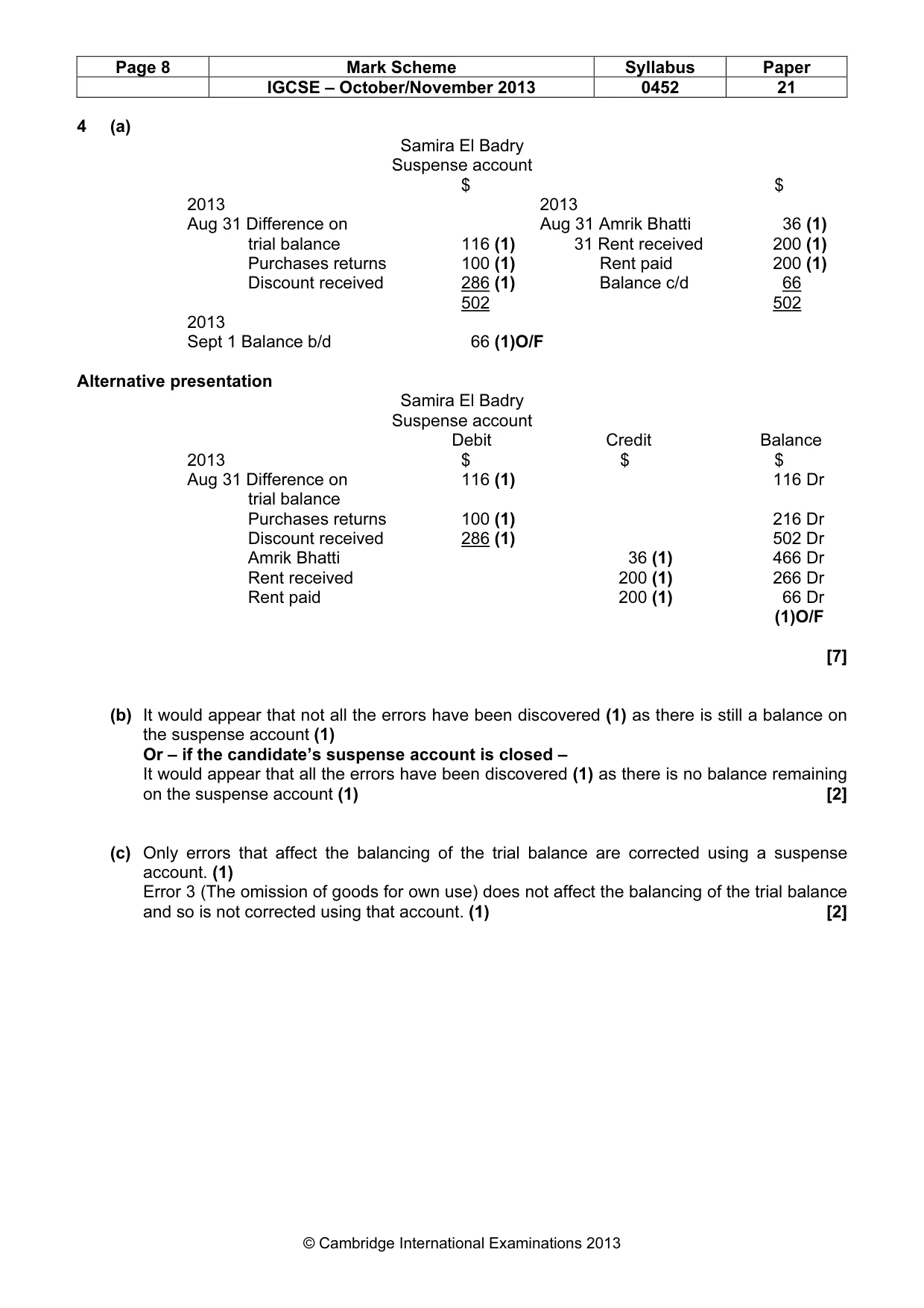
Page 8 Mark Scheme Syllabus Paper IGCSE – October/November 2013 0452 21 © Cambridge International Examinations 2013 4 (a) Samira El Badry Suspense account $ $ 2013 2013 Aug 31 Difference on Aug 31 Amrik Bhatti 36 (1) trial balance 116 (1) 31 Rent received 200 (1) Purchases returns 100 (1) Rent paid 200 (1) Discount received 286 (1) Balance c/d 66 502 502 2013 Sept 1 Balance b/d 66 (1)O/F Alternative presentation Samira El Badry Suspense account Debit Credit Balance 2013 $ $ $ Aug 31 Difference on 116 (1) 116 Dr trial balance Purchases returns 100 (1) 216 Dr Discount received 286 (1) 502 Dr Amrik Bhatti 36 (1) 466 Dr Rent received 200 (1) 266 Dr Rent paid 200 (1) 66 Dr (1)O/F [7] (b) It would appear that not all the errors have been discovered (1) as there is still a balance on the suspense account (1) Or – if the candidate’s suspense account is closed – It would appear that all the errors have been discovered (1) as there is no balance remaining on the suspense account (1) [2] (c) Only errors that affect the balancing of the trial balance are corrected using a suspense account. (1) Error 3 (The omission of goods for own use) does not affect the balancing of the trial balance and so is not corrected using that account. (1) [2]
Mark scheme, page 9
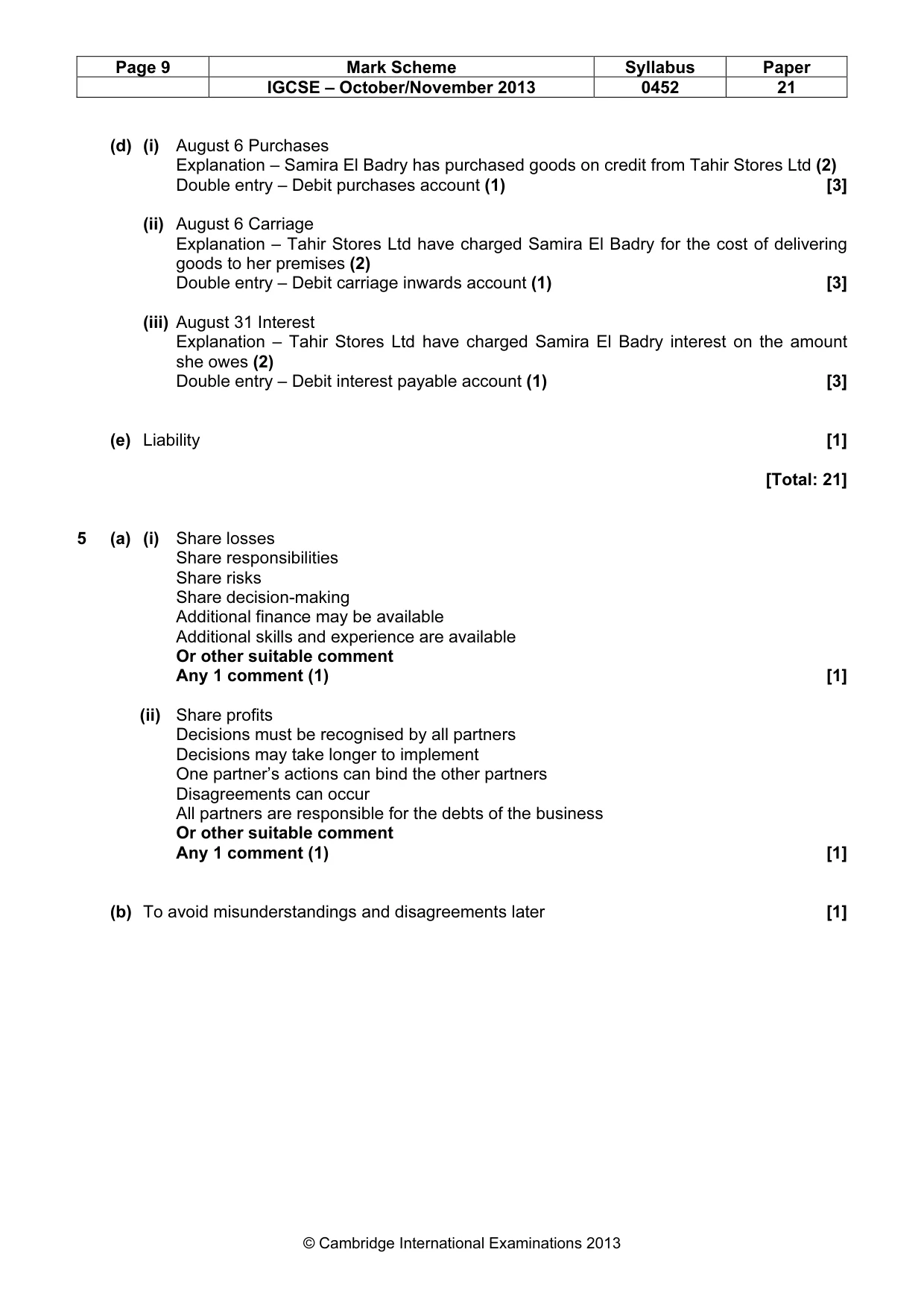
Page 9 Mark Scheme Syllabus Paper IGCSE – October/November 2013 0452 21 © Cambridge International Examinations 2013 (d) (i) August 6 Purchases Explanation – Samira El Badry has purchased goods on credit from Tahir Stores Ltd (2) Double entry – Debit purchases account (1) [3] (ii) August 6 Carriage Explanation – Tahir Stores Ltd have charged Samira El Badry for the cost of delivering goods to her premises (2) Double entry – Debit carriage inwards account (1) [3] (iii) August 31 Interest Explanation – Tahir Stores Ltd have charged Samira El Badry interest on the amount she owes (2) Double entry – Debit interest payable account (1) [3] (e) Liability [1] [Total: 21] 5 (a) (i) Share losses Share responsibilities Share risks Share decision-making Additional finance may be available Additional skills and experience are available Or other suitable comment Any 1 comment (1) [1] (ii) Share profits Decisions must be recognised by all partners Decisions may take longer to implement One partner’s actions can bind the other partners Disagreements can occur All partners are responsible for the debts of the business Or other suitable comment Any 1 comment (1) [1] (b) To avoid misunderstandings and disagreements later [1]
Mark scheme, page 10
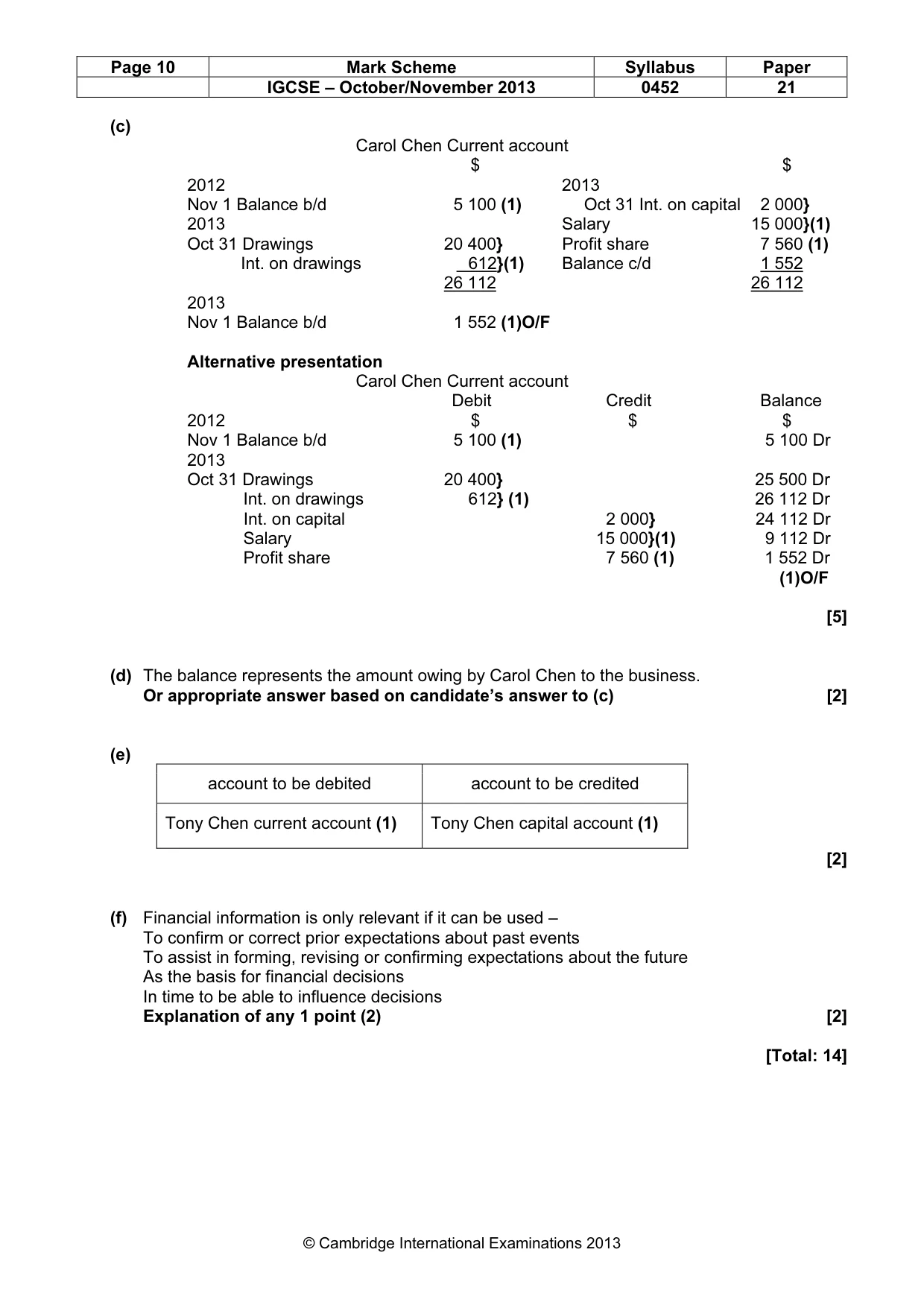
Page 10 Mark Scheme Syllabus Paper IGCSE – October/November 2013 0452 21 © Cambridge International Examinations 2013 (c) Carol Chen Current account $ $ 2012 2013 Nov 1 Balance b/d 5 100 (1) Oct 31 Int. on capital 2 000} 2013 Salary 15 000}(1) Oct 31 Drawings 20 400} Profit share 7 560 (1) Int. on drawings 612}(1) Balance c/d 1 552 26 112 26 112 2013 Nov 1 Balance b/d 1 552 (1)O/F Alternative presentation Carol Chen Current account Debit Credit Balance 2012 $ $ $ Nov 1 Balance b/d 5 100 (1) 5 100 Dr 2013 Oct 31 Drawings 20 400} 25 500 Dr Int. on drawings 612} (1) 26 112 Dr Int. on capital 2 000} 24 112 Dr Salary 15 000}(1) 9 112 Dr Profit share 7 560 (1) 1 552 Dr (1)O/F [5] (d) The balance represents the amount owing by Carol Chen to the business. Or appropriate answer based on candidate’s answer to (c) [2] (e) account to be debited account to be credited Tony Chen current account (1) Tony Chen capital account (1) [2] (f) Financial information is only relevant if it can be used – To confirm or correct prior expectations about past events To assist in forming, revising or confirming expectations about the future As the basis for financial decisions In time to be able to influence decisions Explanation of any 1 point (2) [2] [Total: 14]
Mark scheme, page 11
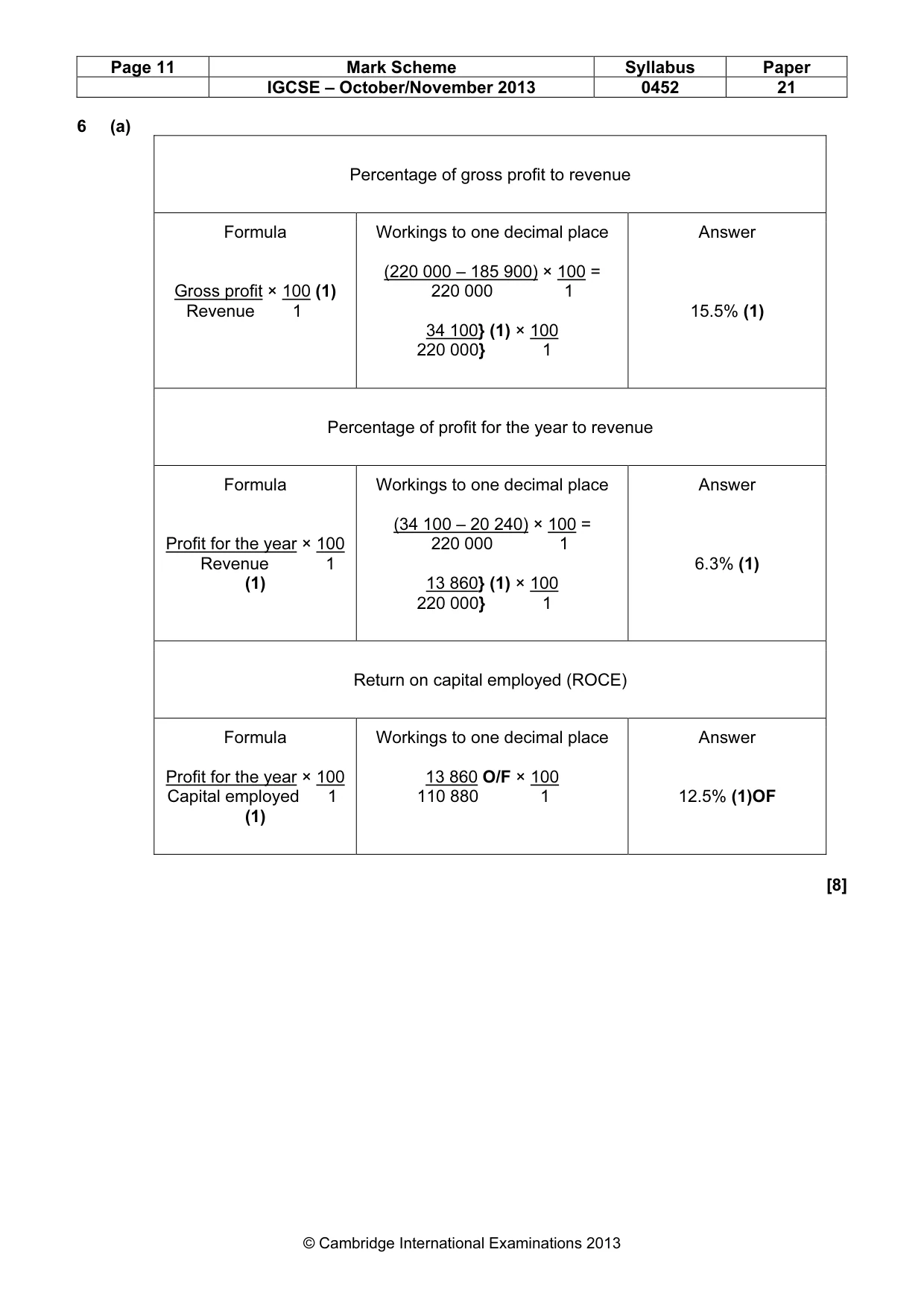
Page 11 Mark Scheme Syllabus Paper IGCSE – October/November 2013 0452 21 © Cambridge International Examinations 2013 6 (a) Percentage of gross profit to revenue Formula Gross profit × 100 (1) Revenue 1 Workings to one decimal place (220 000 – 185 900) × 100 = 220 000 1 34 100} (1) × 100 220 000} 1 Answer 15.5% (1) Percentage of profit for the year to revenue Formula Profit for the year × 100 Revenue 1 (1) Workings to one decimal place (34 100 – 20 240) × 100 = 220 000 1 13 860} (1) × 100 220 000} 1 Answer 6.3% (1) Return on capital employed (ROCE) Formula Profit for the year × 100 Capital employed 1 (1) Workings to one decimal place 13 860 O/F × 100 110 880 1 Answer 12.5% (1)OF [8]
Mark scheme, page 12
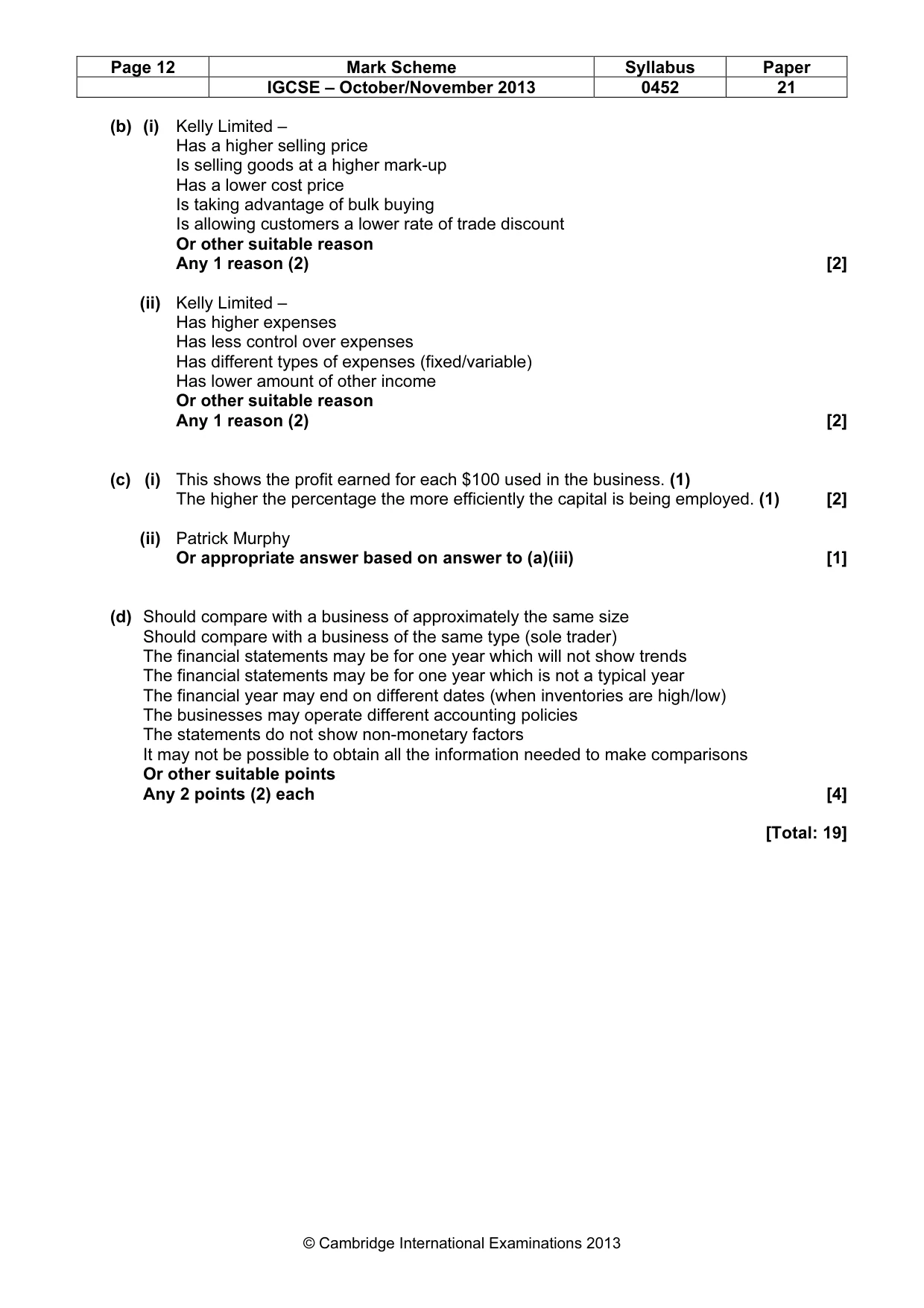
Page 12 Mark Scheme Syllabus Paper IGCSE – October/November 2013 0452 21 © Cambridge International Examinations 2013 (b) (i) Kelly Limited – Has a higher selling price Is selling goods at a higher mark-up Has a lower cost price Is taking advantage of bulk buying Is allowing customers a lower rate of trade discount Or other suitable reason Any 1 reason (2) [2] (ii) Kelly Limited – Has higher expenses Has less control over expenses Has different types of expenses (fixed/variable) Has lower amount of other income Or other suitable reason Any 1 reason (2) [2] (c) (i) This shows the profit earned for each $100 used in the business. (1) The higher the percentage the more efficiently the capital is being employed. (1) [2] (ii) Patrick Murphy Or appropriate answer based on answer to (a)(iii) [1] (d) Should compare with a business of approximately the same size Should compare with a business of the same type (sole trader) The financial statements may be for one year which will not show trends The financial statements may be for one year which is not a typical year The financial year may end on different dates (when inventories are high/low) The businesses may operate different accounting policies The statements do not show non-monetary factors It may not be possible to obtain all the information needed to make comparisons Or other suitable points Any 2 points (2) each [4] [Total: 19]
What you needed in this session
Cambridge’s own grade thresholds for 2013 Oct/Nov, Paper 2 · Variant 1. A higher threshold means an easier paper — the bar moves with how the cohort did.