Cambridge IGCSE Accounting 0452 — 2013 Oct/Nov Paper 1 · Variant 1
0452/11/O/N/13 · 120 marks · ≈135 min
The question paper and its mark scheme, free to read here and free to download. This is Cambridge’s own paper, exactly as it was sat.
Question paper20 pages
Mark scheme9 pages
Answers below. Sit the paper first if you are practising.
Paper as text
Question paper, page 1
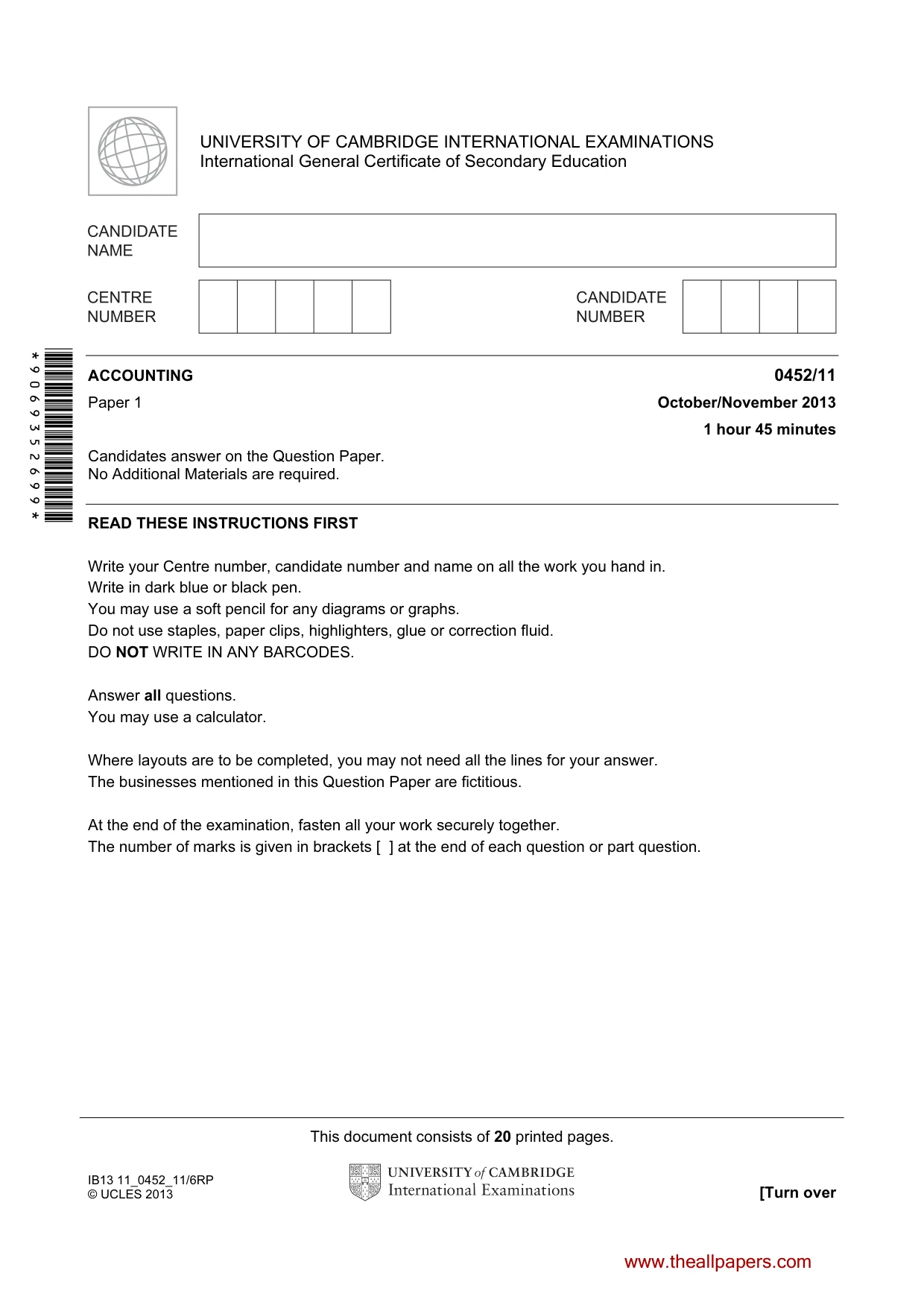
This document consists of 20 printed pages. IB13 11_0452_11/6RP © UCLES 2013 [Turn over *9069352699* UNIVERSITY OF CAMBRIDGE INTERNATIONAL EXAMINATIONS International General Certificate of Secondary Education ACCOUNTING 0452/11 Paper 1 October/November 2013 1 hour 45 minutes Candidates answer on the Question Paper. No Additional Materials are required. READ THESE INSTRUCTIONS FIRST Write your Centre number, candidate number and name on all the work you hand in. Write in dark blue or black pen. You may use a soft pencil for any diagrams or graphs. Do not use staples, paper clips, highlighters, glue or correction fluid. DO NOT WRITE IN ANY BARCODES. Answer all questions. You may use a calculator. Where layouts are to be completed, you may not need all the lines for your answer. The businesses mentioned in this Question Paper are fictitious. At the end of the examination, fasten all your work securely together. The number of marks is given in brackets [ ] at the end of each question or part question. www.theallpapers.com
Question paper, page 2
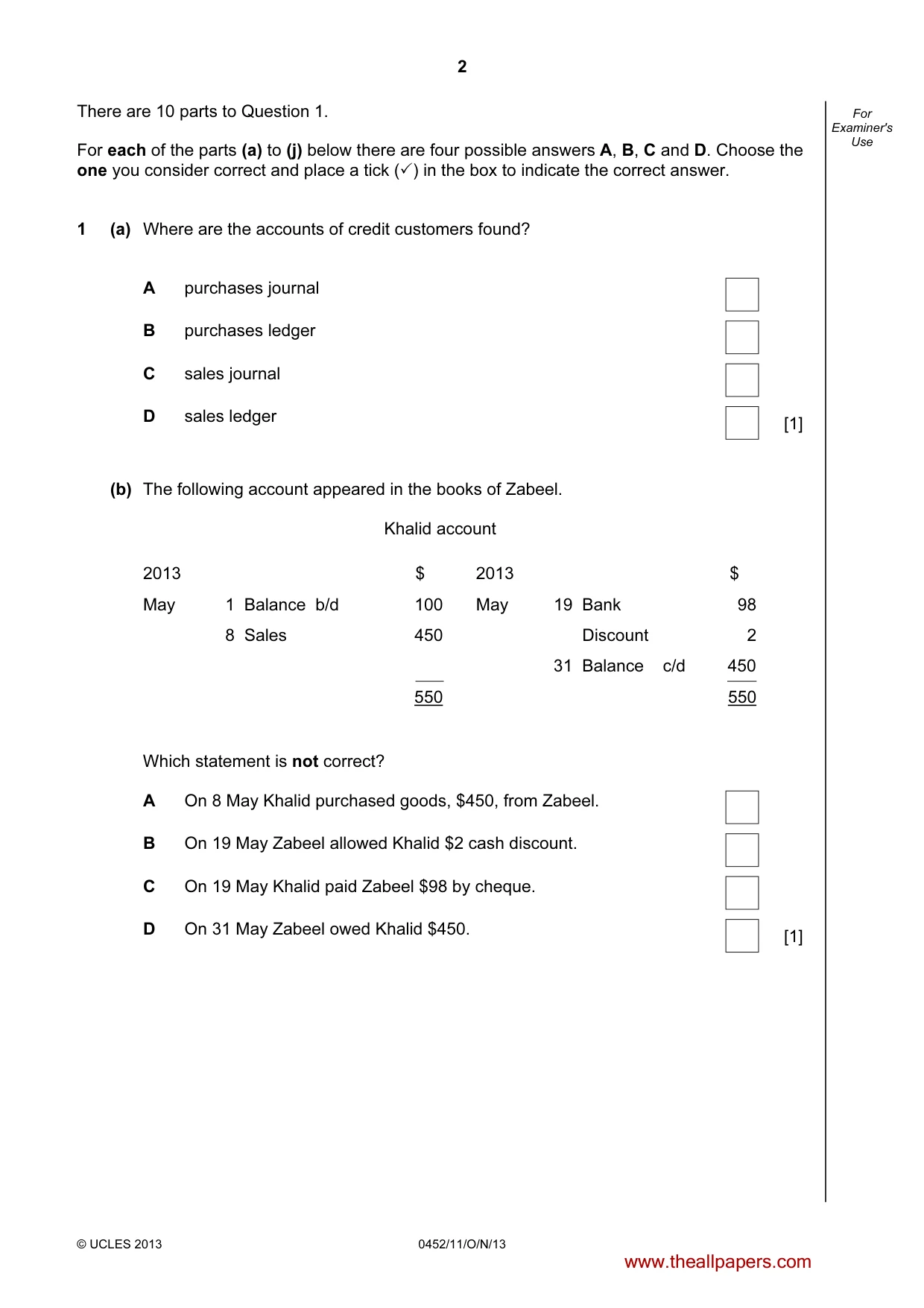
2 © UCLES 2013 0452/11/O/N/13 For Examiner's Use There are 10 parts to Question 1. For each of the parts (a) to (j) below there are four possible answers A, B, C and D. Choose the one you consider correct and place a tick (✓) in the box to indicate the correct answer. 1 (a) Where are the accounts of credit customers found? A purchases journal B purchases ledger C sales journal D sales ledger [1] (b) The following account appeared in the books of Zabeel. Khalid account 2013 $ 2013 $ May 1 Balance b/d 100 May 19 Bank 98 8 Sales 450 Discount 2 31 Balance c/d 450 550 550 Which statement is not correct? A On 8 May Khalid purchased goods, $450, from Zabeel. B On 19 May Zabeel allowed Khalid $2 cash discount. C On 19 May Khalid paid Zabeel $98 by cheque. D On 31 May Zabeel owed Khalid $450. [1] www.theallpapers.com
Question paper, page 3
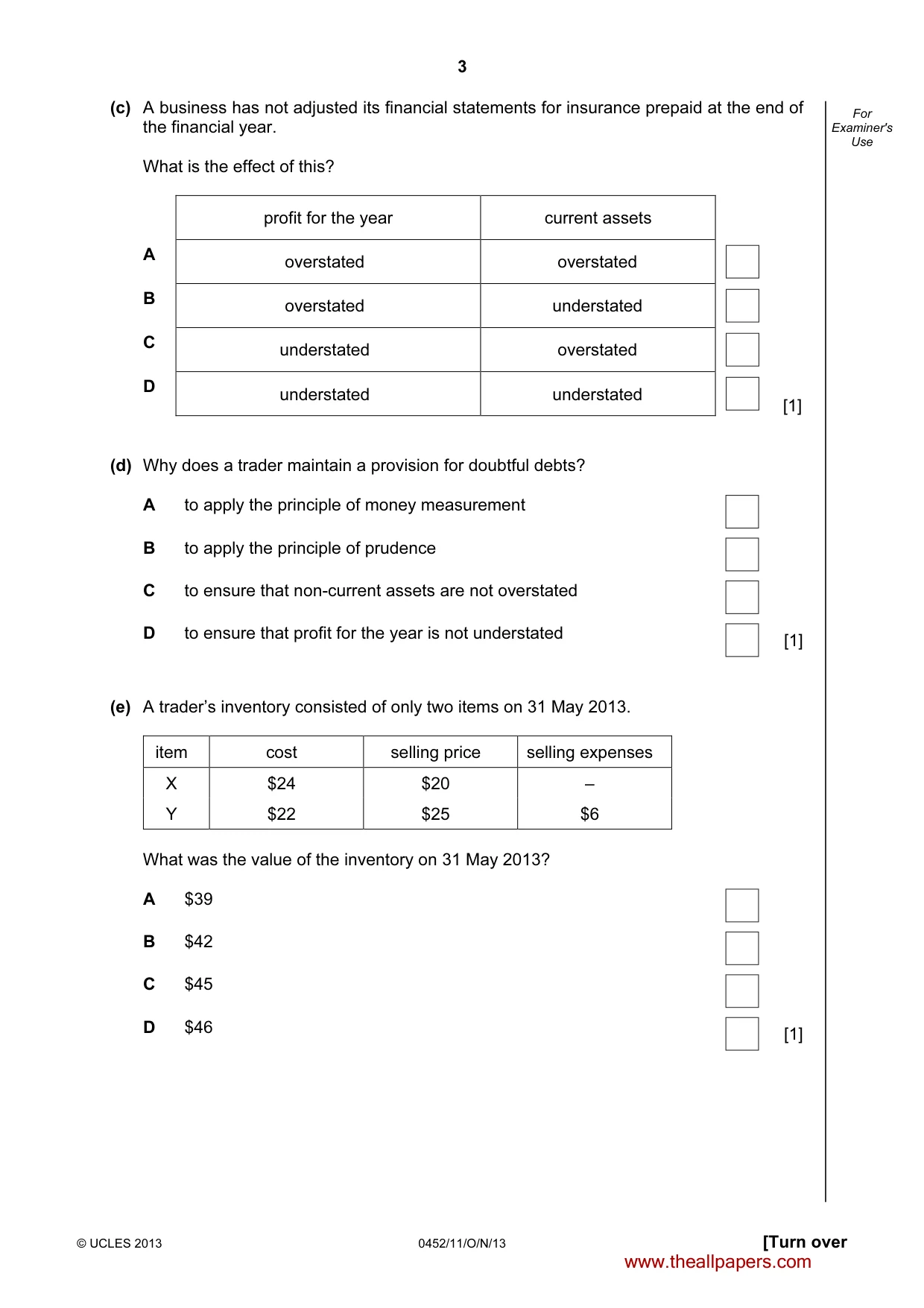
3 © UCLES 2013 0452/11/O/N/13 [Turn over For Examiner's Use (c) A business has not adjusted its financial statements for insurance prepaid at the end of the financial year. What is the effect of this? profit for the year current assets A overstated overstated B overstated understated C understated overstated D understated understated [1] (d) Why does a trader maintain a provision for doubtful debts? A to apply the principle of money measurement B to apply the principle of prudence C to ensure that non-current assets are not overstated D to ensure that profit for the year is not understated [1] (e) A trader’s inventory consisted of only two items on 31 May 2013. item cost selling price selling expenses X $24 $20 – Y $22 $25 $6 What was the value of the inventory on 31 May 2013? A $39 B $42 C $45 D $46 [1] www.theallpapers.com
Question paper, page 4
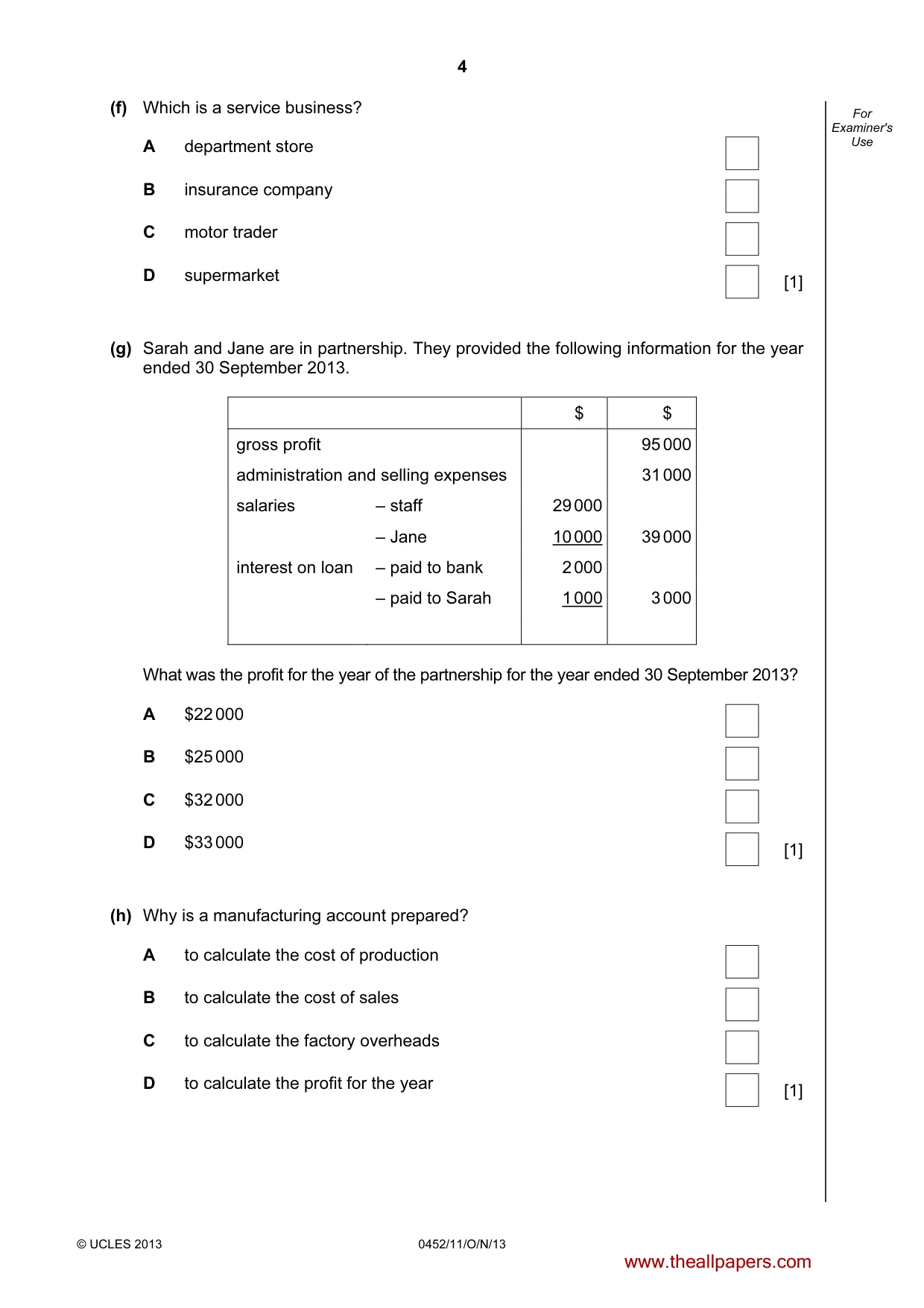
4 © UCLES 2013 0452/11/O/N/13 For Examiner's Use (f) Which is a service business? A department store B insurance company C motor trader D supermarket [1] (g) Sarah and Jane are in partnership. They provided the following information for the year ended 30 September 2013. $ $ gross profit 95 000 administration and selling expenses 31 000 salaries – staff 29 000 – Jane 10 000 39 000 interest on loan – paid to bank 2 000 – paid to Sarah 1 000 3 000 What was the profit for the year of the partnership for the year ended 30 September 2013? A $22 000 B $25 000 C $32 000 D $33 000 [1] (h) Why is a manufacturing account prepared? A to calculate the cost of production B to calculate the cost of sales C to calculate the factory overheads D to calculate the profit for the year [1] www.theallpapers.com
Question paper, page 5
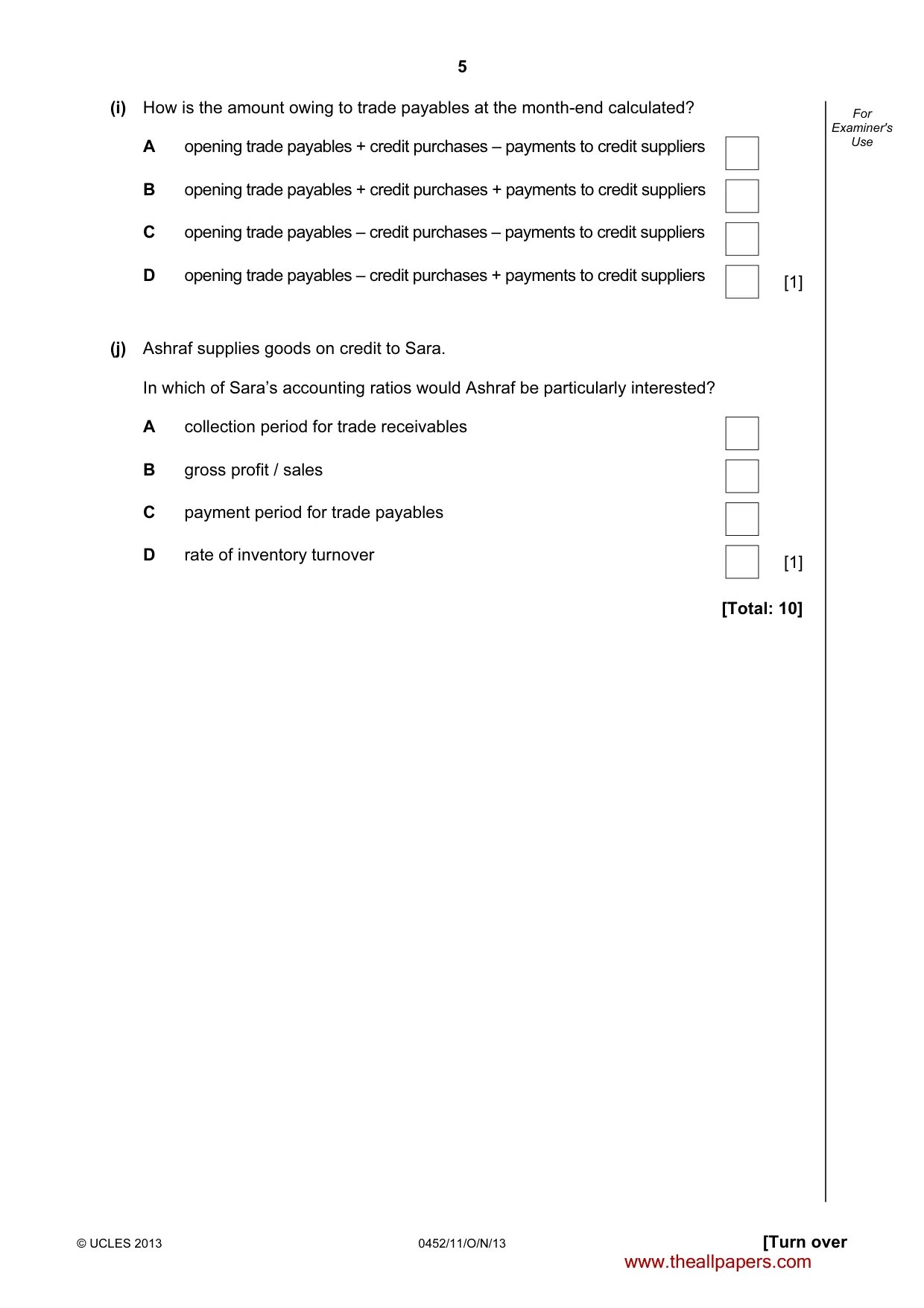
5 © UCLES 2013 0452/11/O/N/13 [Turn over For Examiner's Use (i) How is the amount owing to trade payables at the month-end calculated? A opening trade payables + credit purchases – payments to credit suppliers B opening trade payables + credit purchases + payments to credit suppliers C opening trade payables – credit purchases – payments to credit suppliers D opening trade payables – credit purchases + payments to credit suppliers [1] (j) Ashraf supplies goods on credit to Sara. In which of Sara’s accounting ratios would Ashraf be particularly interested? A collection period for trade receivables B gross profit / sales C payment period for trade payables D rate of inventory turnover [1] [Total: 10] www.theallpapers.com
Question paper, page 6
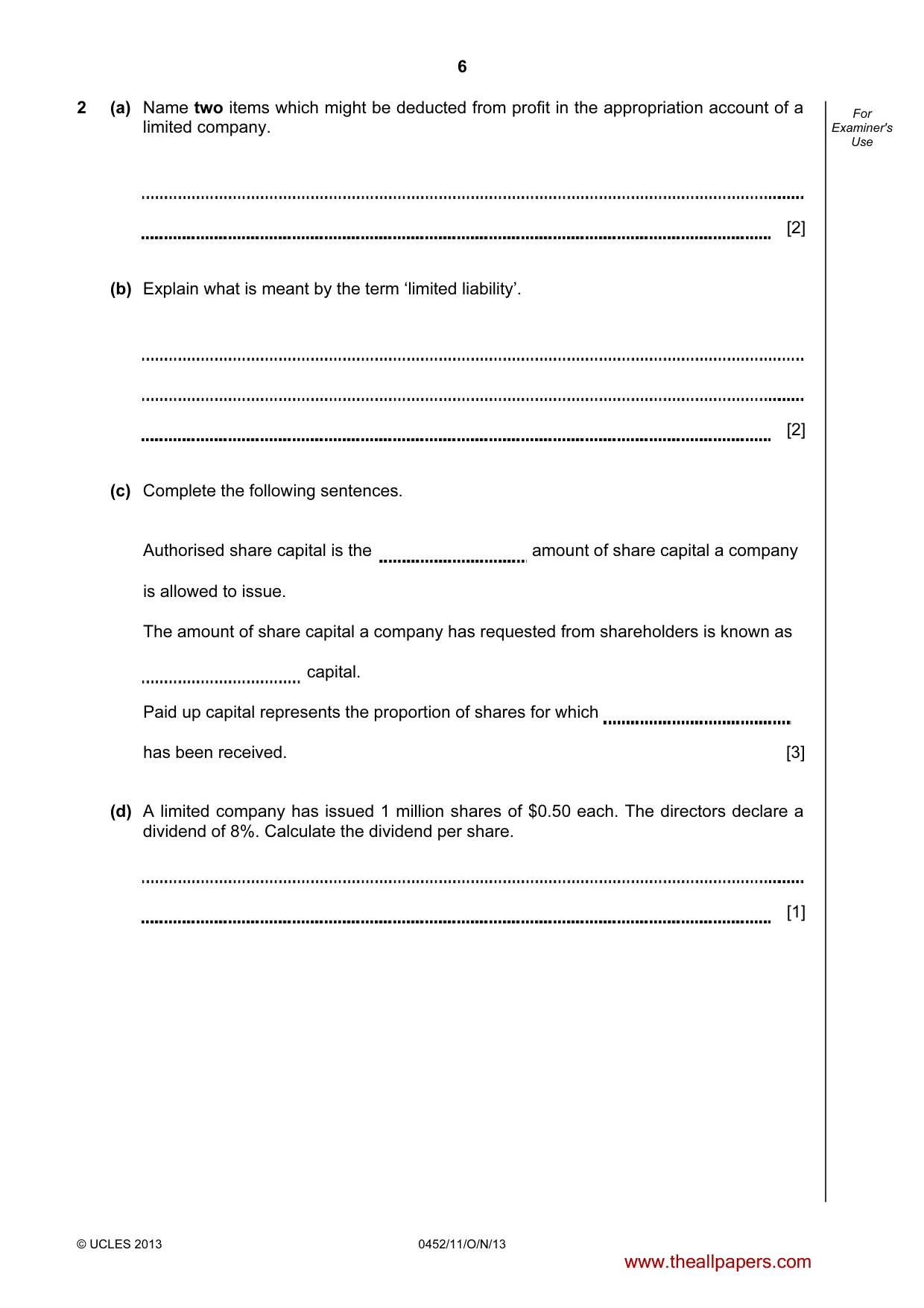
6 © UCLES 2013 0452/11/O/N/13 For Examiner's Use 2 (a) Name two items which might be deducted from profit in the appropriation account of a limited company. [2] (b) Explain what is meant by the term ‘limited liability’. [2] (c) Complete the following sentences. Authorised share capital is the amount of share capital a company is allowed to issue. The amount of share capital a company has requested from shareholders is known as capital. Paid up capital represents the proportion of shares for which has been received. [3] (d) A limited company has issued 1 million shares of $0.50 each. The directors declare a dividend of 8%. Calculate the dividend per share. [1] www.theallpapers.com
Question paper, page 7
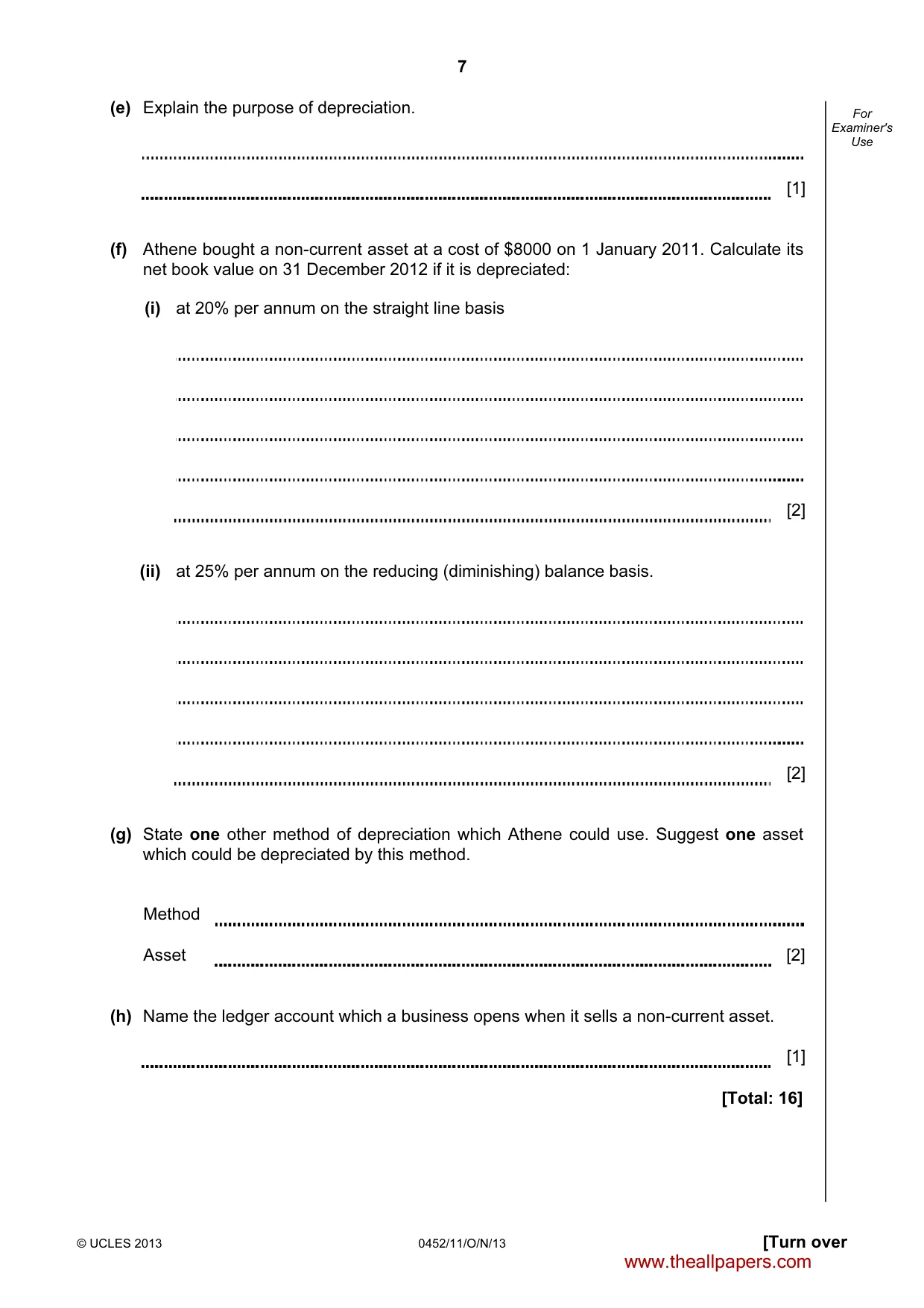
7 © UCLES 2013 0452/11/O/N/13 [Turn over For Examiner's Use (e) Explain the purpose of depreciation. [1] (f) Athene bought a non-current asset at a cost of $8000 on 1 January 2011. Calculate its net book value on 31 December 2012 if it is depreciated: (i) at 20% per annum on the straight line basis [2] (ii) at 25% per annum on the reducing (diminishing) balance basis. [2] (g) State one other method of depreciation which Athene could use. Suggest one asset which could be depreciated by this method. Method Asset [2] (h) Name the ledger account which a business opens when it sells a non-current asset. [1] [Total: 16] www.theallpapers.com
Question paper, page 8
8 © UCLES 2013 0452/11/O/N/13 Question 3 is on the next page. www.theallpapers.com
Question paper, page 9
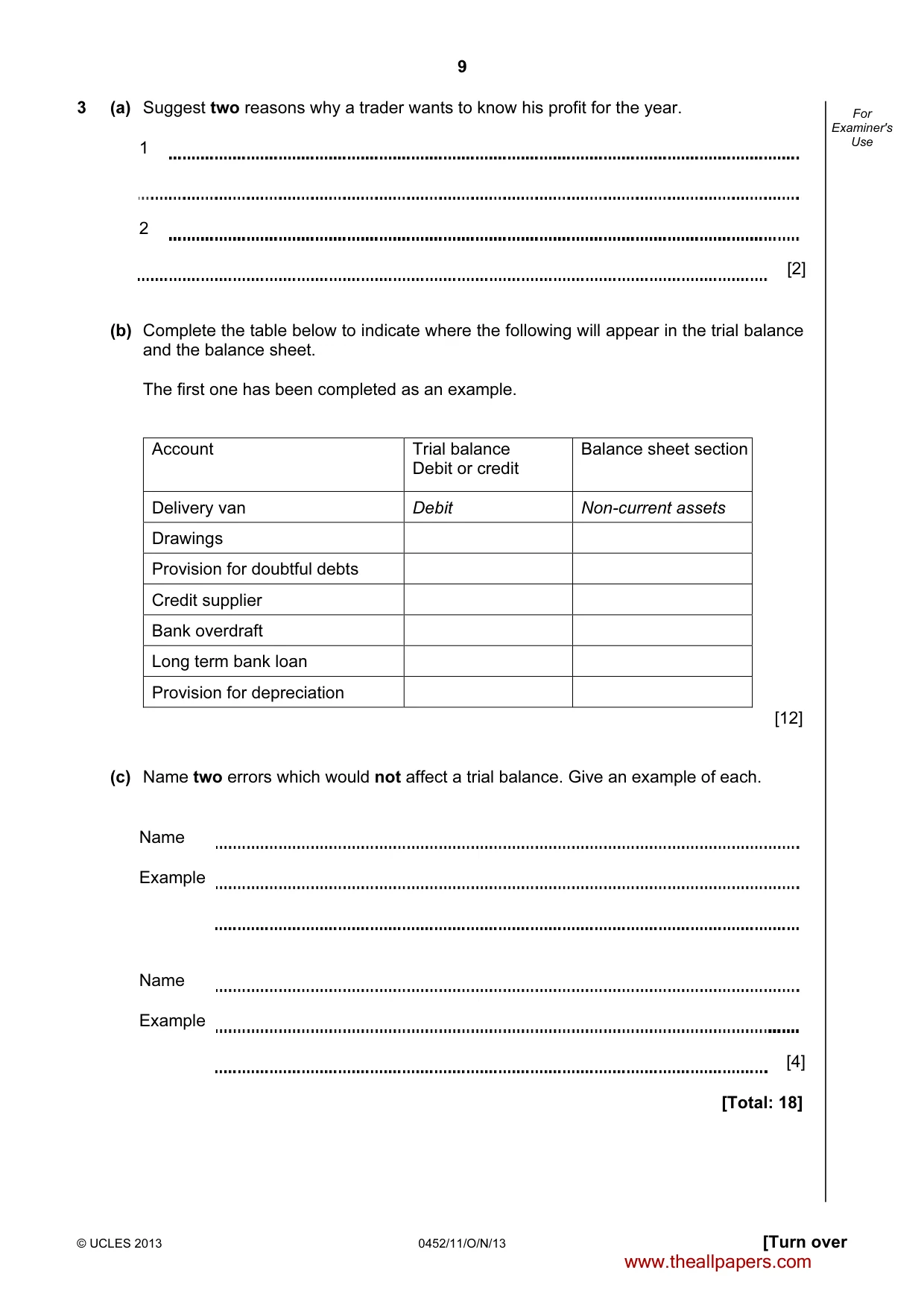
9 © UCLES 2013 0452/11/O/N/13 [Turn over For Examiner's Use 3 (a) Suggest two reasons why a trader wants to know his profit for the year. 1 2 [2] (b) Complete the table below to indicate where the following will appear in the trial balance and the balance sheet. The first one has been completed as an example. Account Trial balance Debit or credit Balance sheet section Delivery van Debit Non-current assets Drawings Provision for doubtful debts Credit supplier Bank overdraft Long term bank loan Provision for depreciation [12] (c) Name two errors which would not affect a trial balance. Give an example of each. Name Example Name Example [4] [Total: 18] www.theallpapers.com
Question paper, page 10
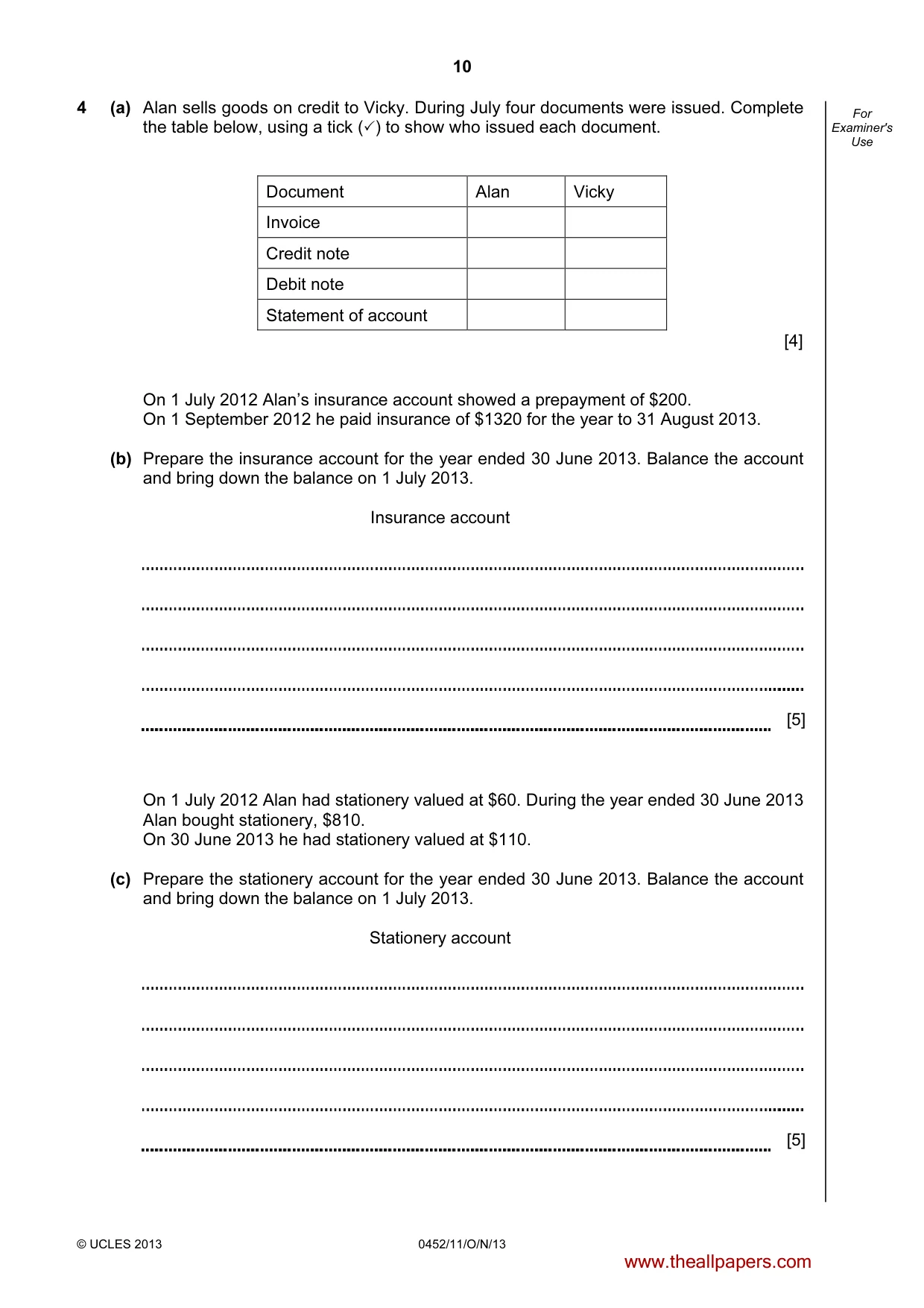
10 © UCLES 2013 0452/11/O/N/13 For Examiner's Use 4 (a) Alan sells goods on credit to Vicky. During July four documents were issued. Complete the table below, using a tick (✓) to show who issued each document. Document Alan Vicky Invoice Credit note Debit note Statement of account [4] On 1 July 2012 Alan’s insurance account showed a prepayment of $200. On 1 September 2012 he paid insurance of $1320 for the year to 31 August 2013. (b) Prepare the insurance account for the year ended 30 June 2013. Balance the account and bring down the balance on 1 July 2013. Insurance account [5] On 1 July 2012 Alan had stationery valued at $60. During the year ended 30 June 2013 Alan bought stationery, $810. On 30 June 2013 he had stationery valued at $110. (c) Prepare the stationery account for the year ended 30 June 2013. Balance the account and bring down the balance on 1 July 2013. Stationery account [5] www.theallpapers.com
Question paper, page 11
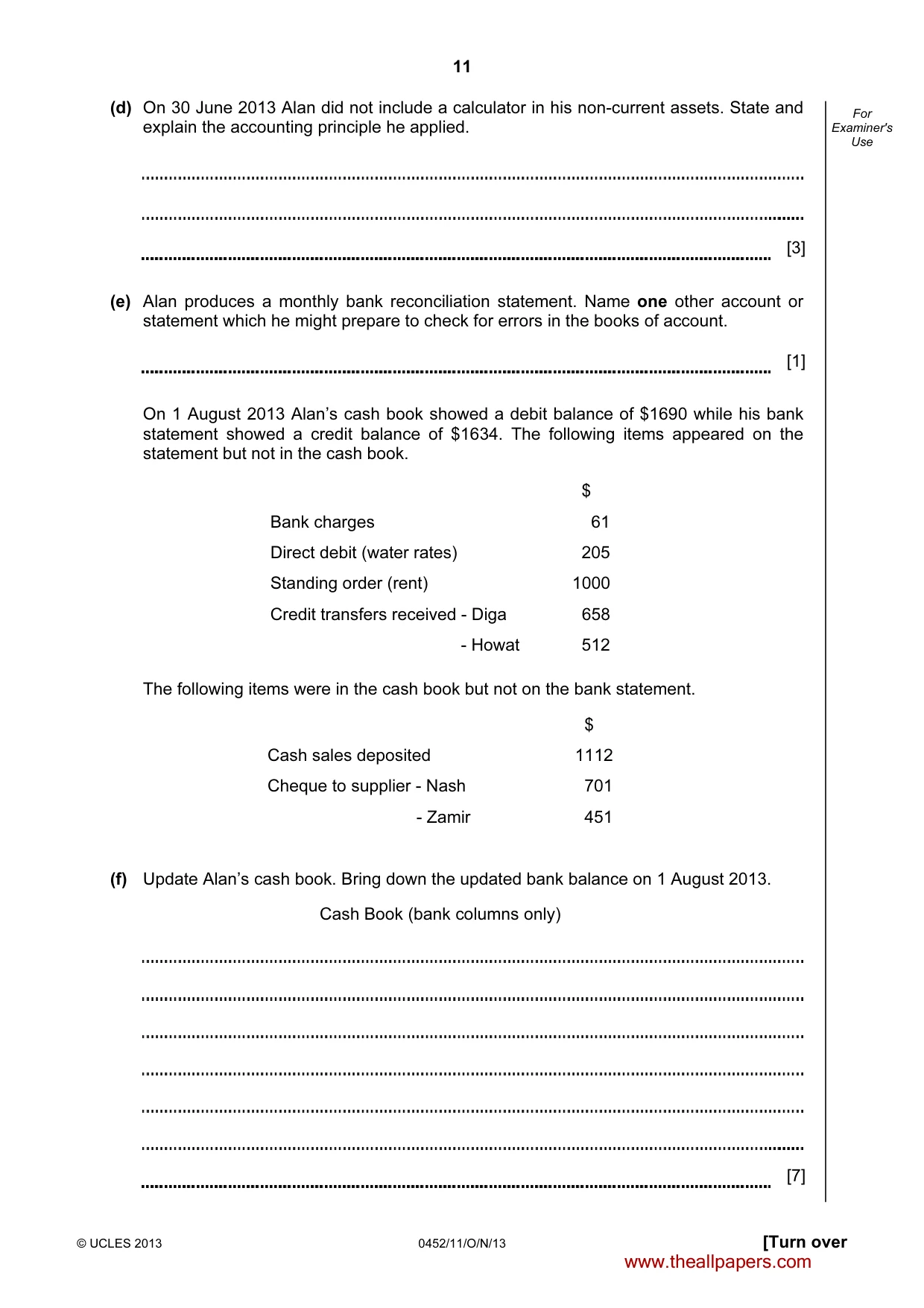
11 © UCLES 2013 0452/11/O/N/13 [Turn over For Examiner's Use (d) On 30 June 2013 Alan did not include a calculator in his non-current assets. State and explain the accounting principle he applied. [3] (e) Alan produces a monthly bank reconciliation statement. Name one other account or statement which he might prepare to check for errors in the books of account. [1] On 1 August 2013 Alan’s cash book showed a debit balance of $1690 while his bank statement showed a credit balance of $1634. The following items appeared on the statement but not in the cash book. The following items were in the cash book but not on the bank statement. $ Cash sales deposited 1112 Cheque to supplier - Nash 701 - Zamir 451 (f) Update Alan’s cash book. Bring down the updated bank balance on 1 August 2013. Cash Book (bank columns only) [7] $ Bank charges 61 Direct debit (water rates) 205 Standing order (rent) 1000 Credit transfers received - Diga 658 - Howat 512 www.theallpapers.com
Question paper, page 12
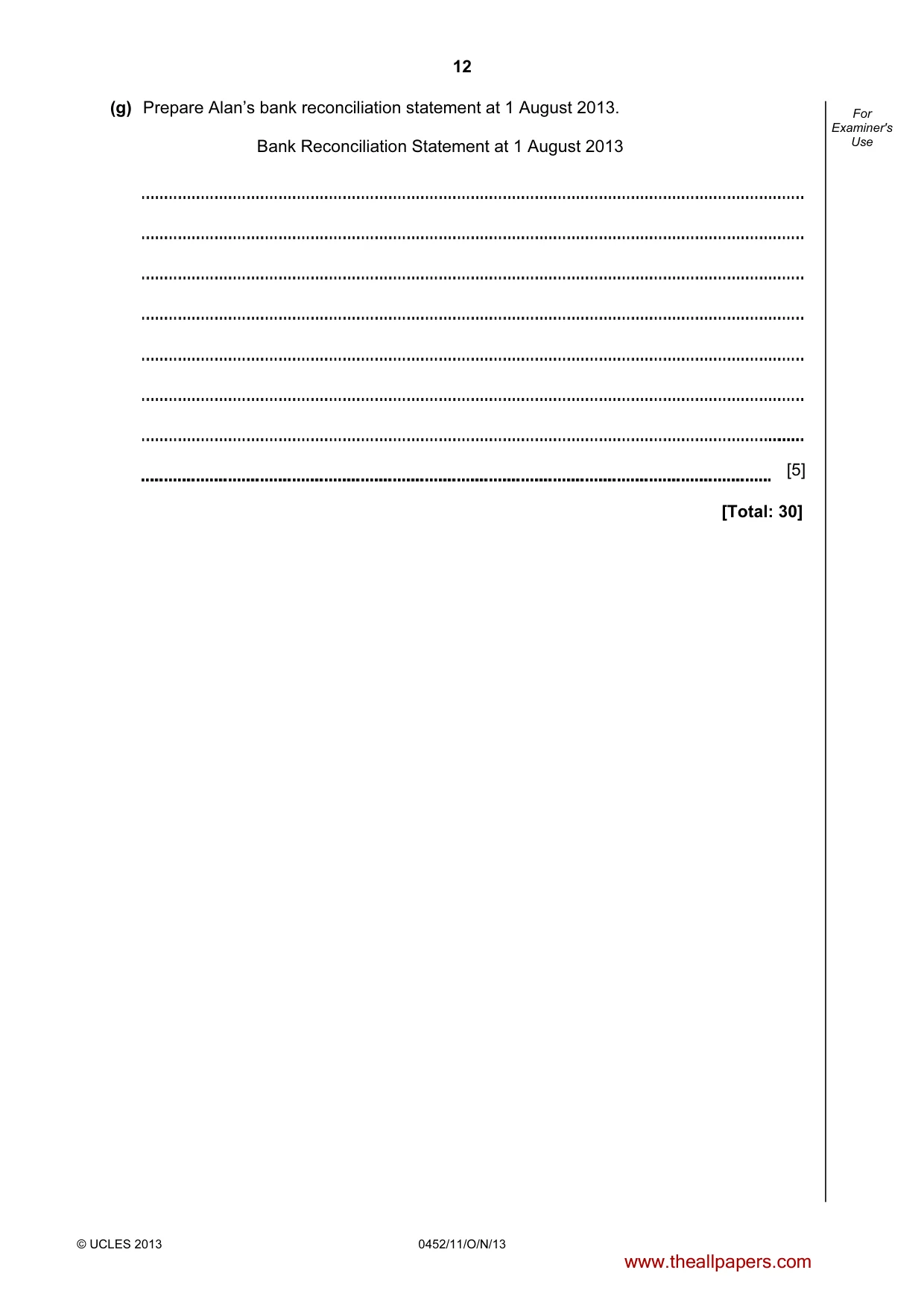
12 © UCLES 2013 0452/11/O/N/13 For Examiner's Use (g) Prepare Alan’s bank reconciliation statement at 1 August 2013. Bank Reconciliation Statement at 1 August 2013 [5] [Total: 30] www.theallpapers.com
Question paper, page 13
13 © UCLES 2013 0452/11/O/N/13 [Turn over Question 5 is on the next page. www.theallpapers.com
Question paper, page 14
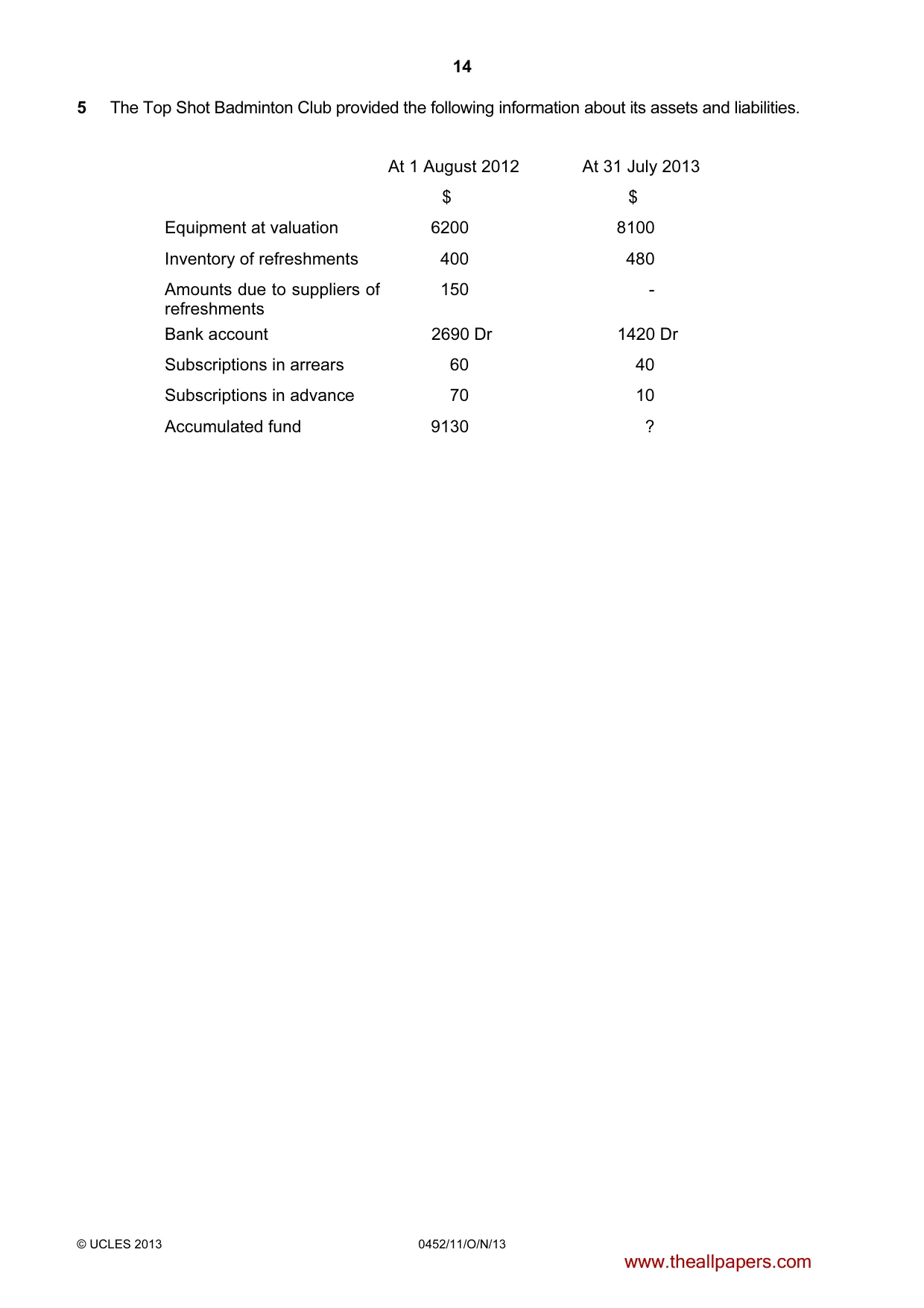
14 © UCLES 2013 0452/11/O/N/13 5 The Top Shot Badminton Club provided the following information about its assets and liabilities. At 1 August 2012 At 31 July 2013 $ $ Equipment at valuation 6200 8100 Inventory of refreshments 400 480 Amounts due to suppliers of refreshments 150 - Bank account 2690 Dr 1420 Dr Subscriptions in arrears 60 40 Subscriptions in advance 70 10 Accumulated fund 9130 ? www.theallpapers.com
Question paper, page 15
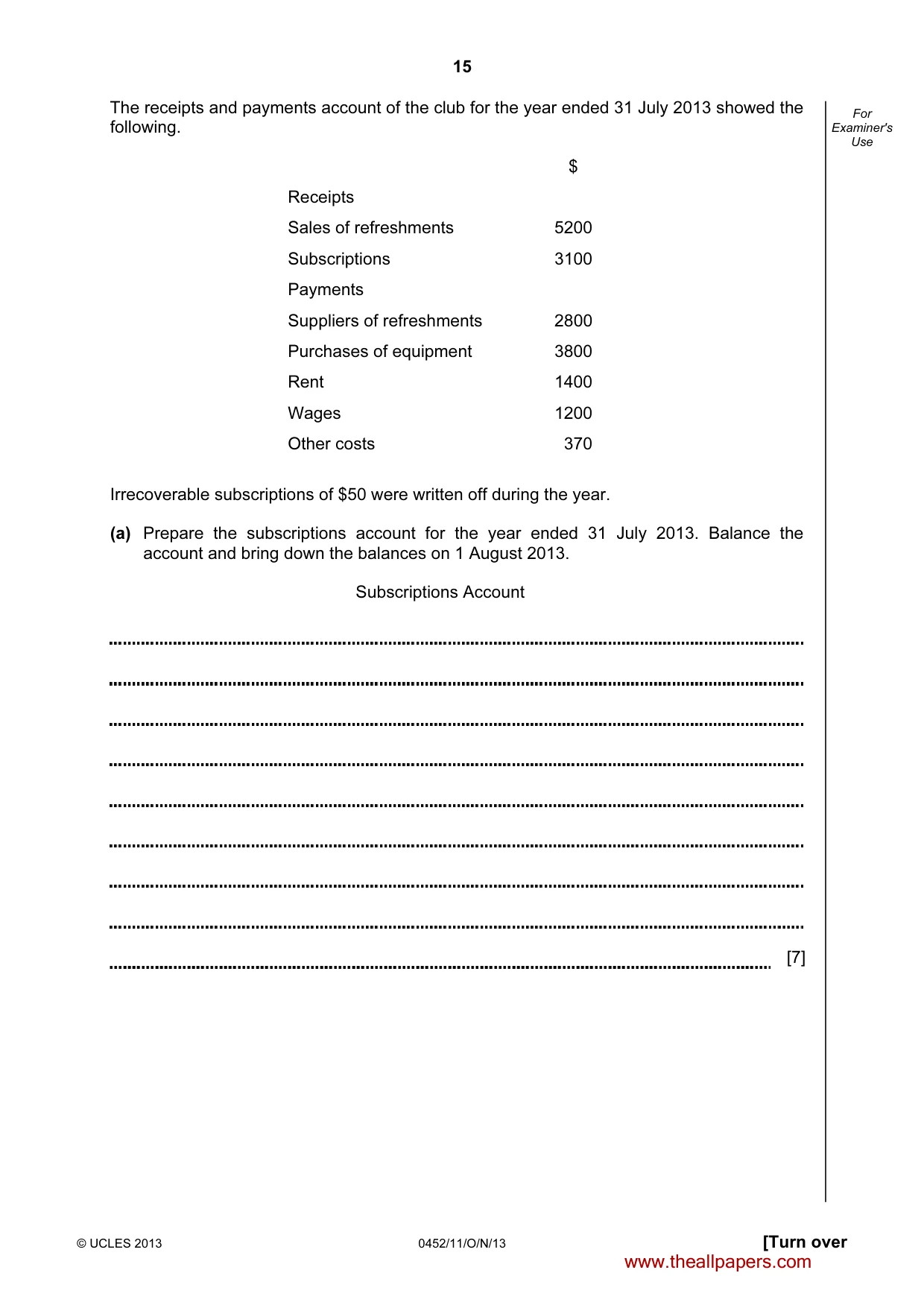
15 © UCLES 2013 0452/11/O/N/13 [Turn over For Examiner's Use The receipts and payments account of the club for the year ended 31 July 2013 showed the following. $ Receipts Sales of refreshments 5200 Subscriptions 3100 Payments Suppliers of refreshments 2800 Purchases of equipment 3800 Rent 1400 Wages 1200 Other costs 370 Irrecoverable subscriptions of $50 were written off during the year. (a) Prepare the subscriptions account for the year ended 31 July 2013. Balance the account and bring down the balances on 1 August 2013. Subscriptions Account [7] www.theallpapers.com
Question paper, page 16
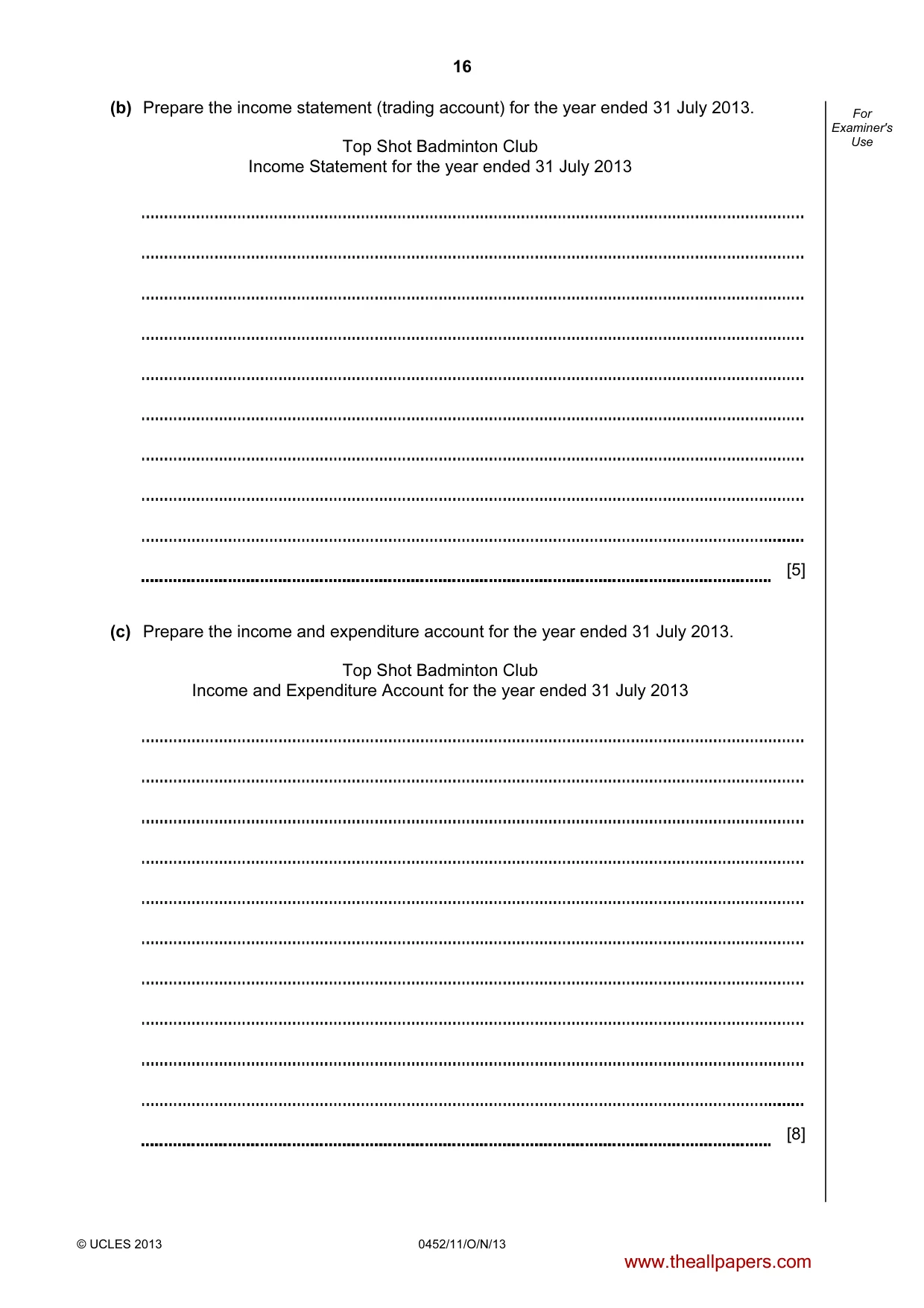
16 © UCLES 2013 0452/11/O/N/13 For Examiner's Use (b) Prepare the income statement (trading account) for the year ended 31 July 2013. Top Shot Badminton Club Income Statement for the year ended 31 July 2013 [5] (c) Prepare the income and expenditure account for the year ended 31 July 2013. Top Shot Badminton Club Income and Expenditure Account for the year ended 31 July 2013 [8] www.theallpapers.com
Question paper, page 17
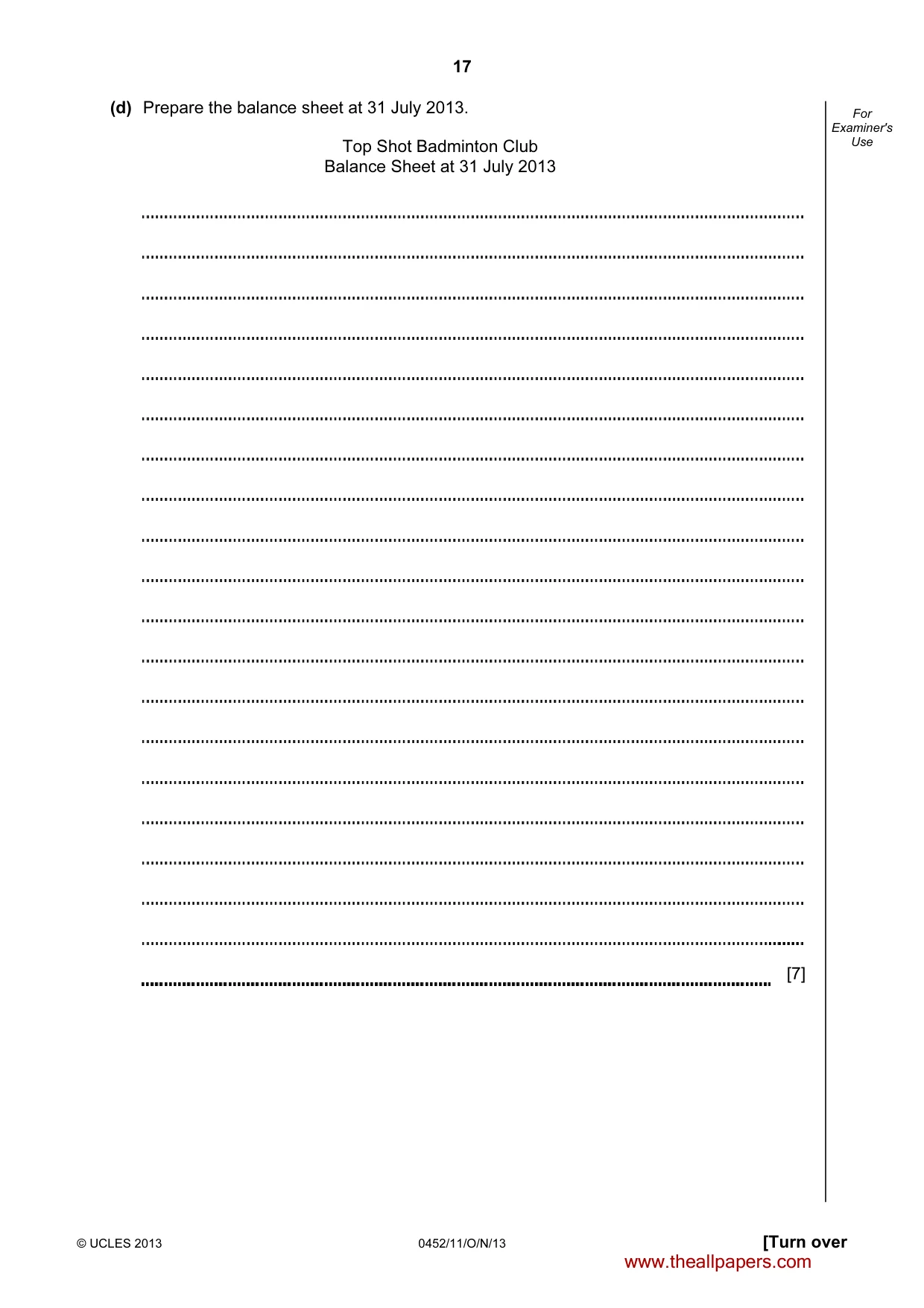
17 © UCLES 2013 0452/11/O/N/13 [Turn over For Examiner's Use (d) Prepare the balance sheet at 31 July 2013. Top Shot Badminton Club Balance Sheet at 31 July 2013 [7] www.theallpapers.com
Question paper, page 18
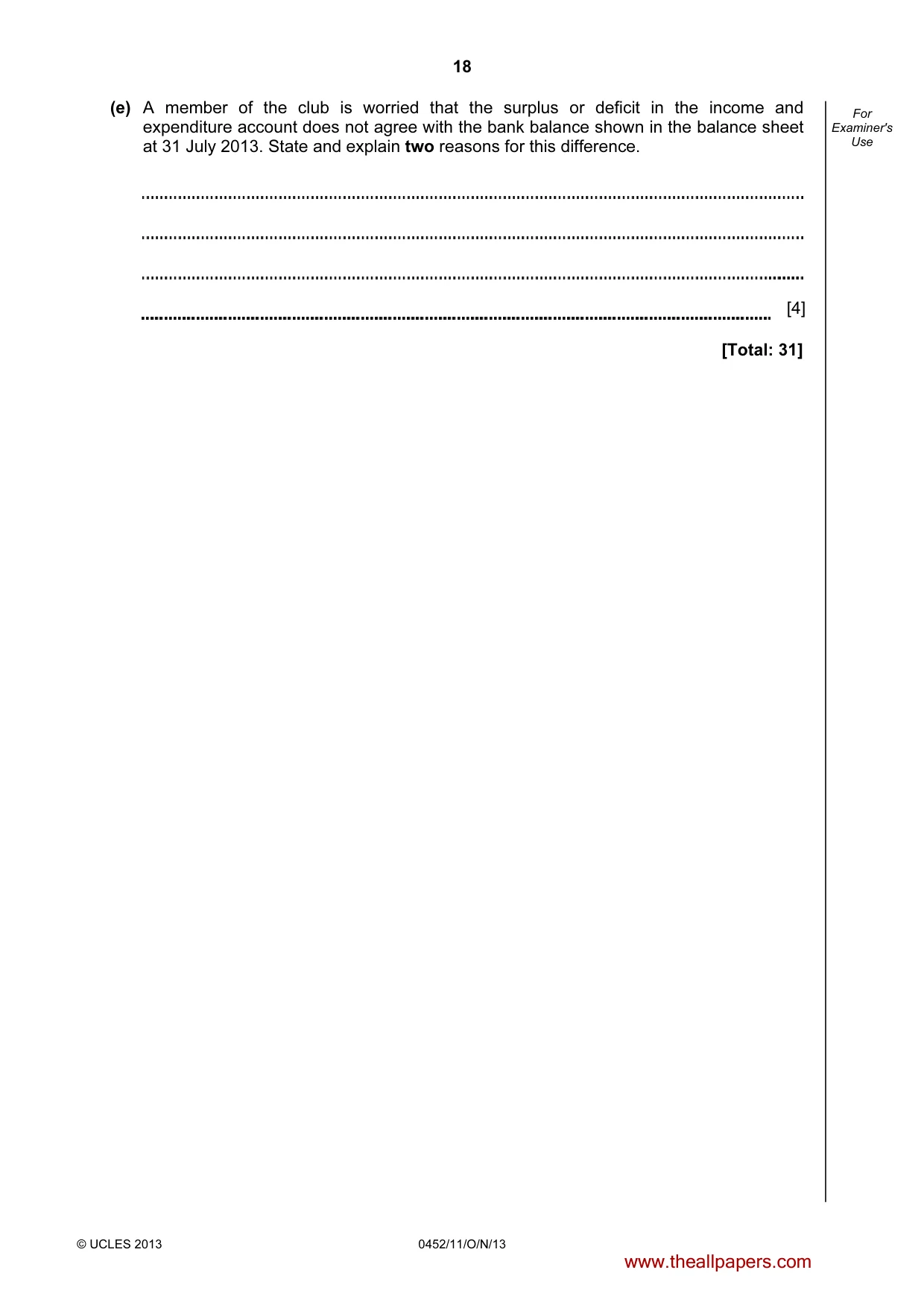
18 © UCLES 2013 0452/11/O/N/13 For Examiner's Use (e) A member of the club is worried that the surplus or deficit in the income and expenditure account does not agree with the bank balance shown in the balance sheet at 31 July 2013. State and explain two reasons for this difference. [4] [Total: 31] www.theallpapers.com
Question paper, page 19
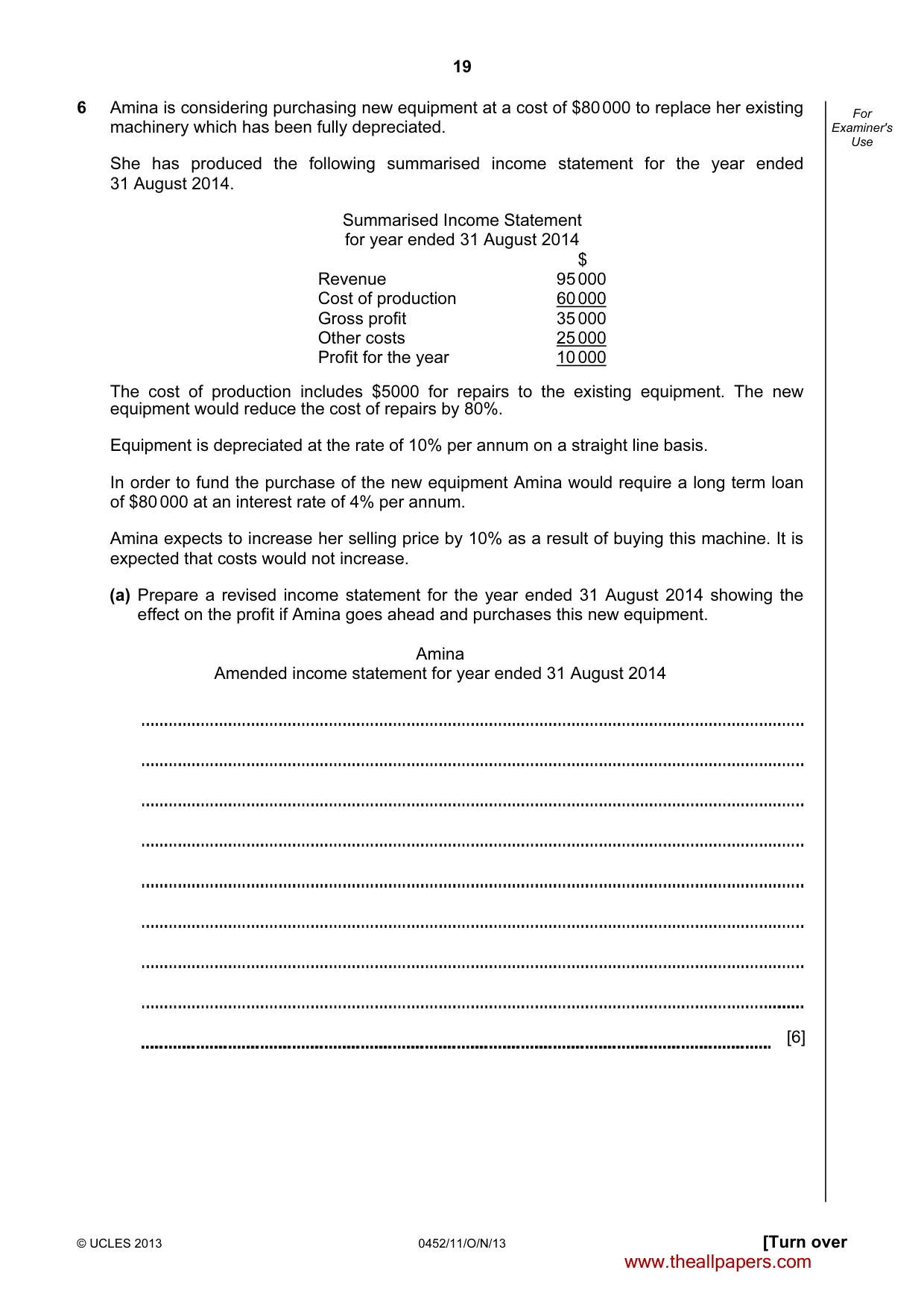
19 © UCLES 2013 0452/11/O/N/13 [Turn over For Examiner's Use 6 Amina is considering purchasing new equipment at a cost of $80 000 to replace her existing machinery which has been fully depreciated. She has produced the following summarised income statement for the year ended 31 August 2014. Summarised Income Statement for year ended 31 August 2014 $ Revenue 95 000 Cost of production 60 000 Gross profit 35 000 Other costs 25 000 Profit for the year 10 000 The cost of production includes $5000 for repairs to the existing equipment. The new equipment would reduce the cost of repairs by 80%. Equipment is depreciated at the rate of 10% per annum on a straight line basis. In order to fund the purchase of the new equipment Amina would require a long term loan of $80 000 at an interest rate of 4% per annum. Amina expects to increase her selling price by 10% as a result of buying this machine. It is expected that costs would not increase. (a) Prepare a revised income statement for the year ended 31 August 2014 showing the effect on the profit if Amina goes ahead and purchases this new equipment. Amina Amended income statement for year ended 31 August 2014 [6] www.theallpapers.com
Question paper, page 20
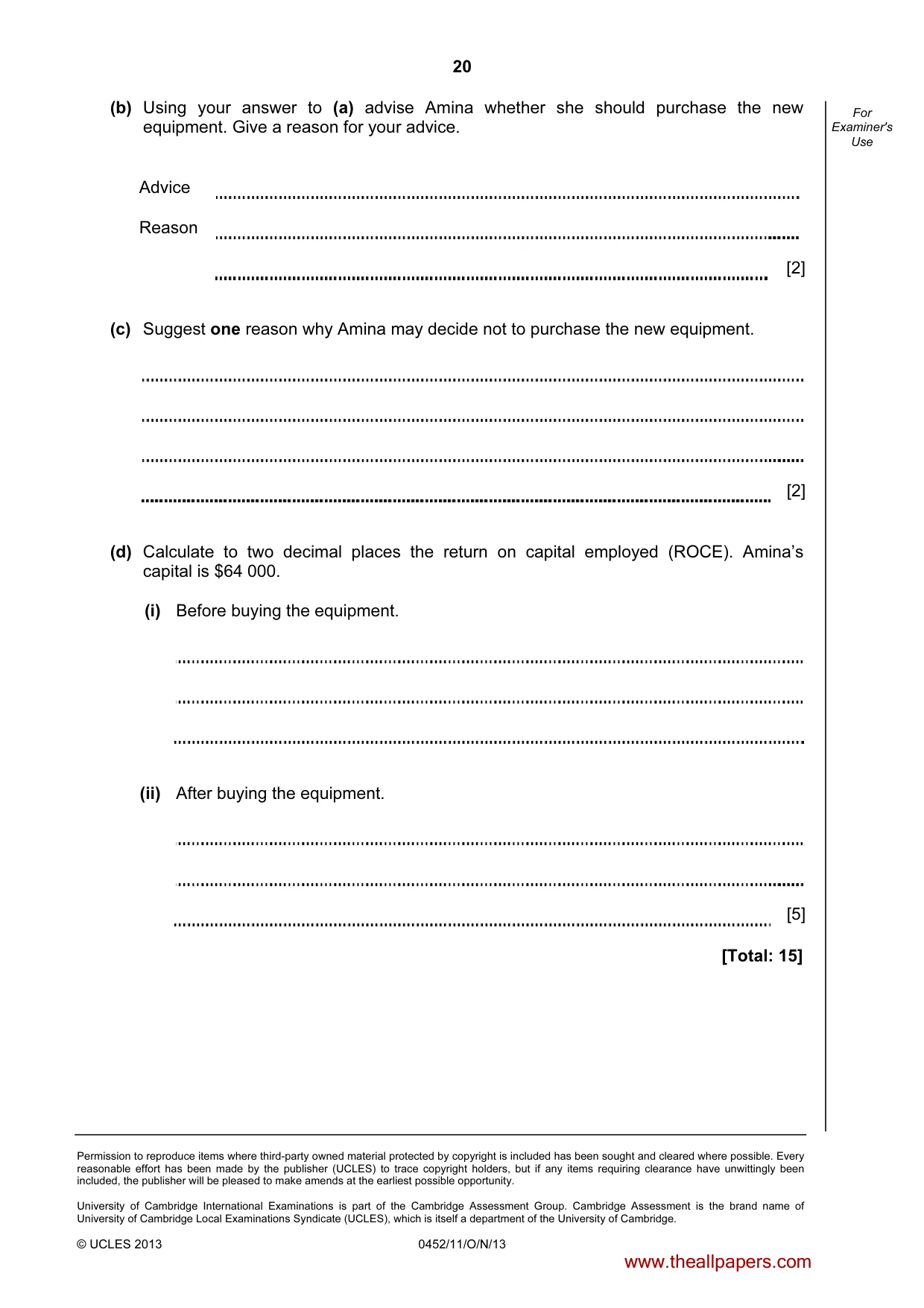
20 Permission to reproduce items where third-party owned material protected by copyright is included has been sought and cleared where possible. Every reasonable effort has been made by the publisher (UCLES) to trace copyright holders, but if any items requiring clearance have unwittingly been included, the publisher will be pleased to make amends at the earliest possible opportunity. University of Cambridge International Examinations is part of the Cambridge Assessment Group. Cambridge Assessment is the brand name of University of Cambridge Local Examinations Syndicate (UCLES), which is itself a department of the University of Cambridge. © UCLES 2013 0452/11/O/N/13 For Examiner's Use (b) Using your answer to (a) advise Amina whether she should purchase the new equipment. Give a reason for your advice. Advice Reason [2] (c) Suggest one reason why Amina may decide not to purchase the new equipment. [2] (d) Calculate to two decimal places the return on capital employed (ROCE). Amina’s capital is $64 000. (i) Before buying the equipment. (ii) After buying the equipment. [5] [Total: 15] www.theallpapers.com
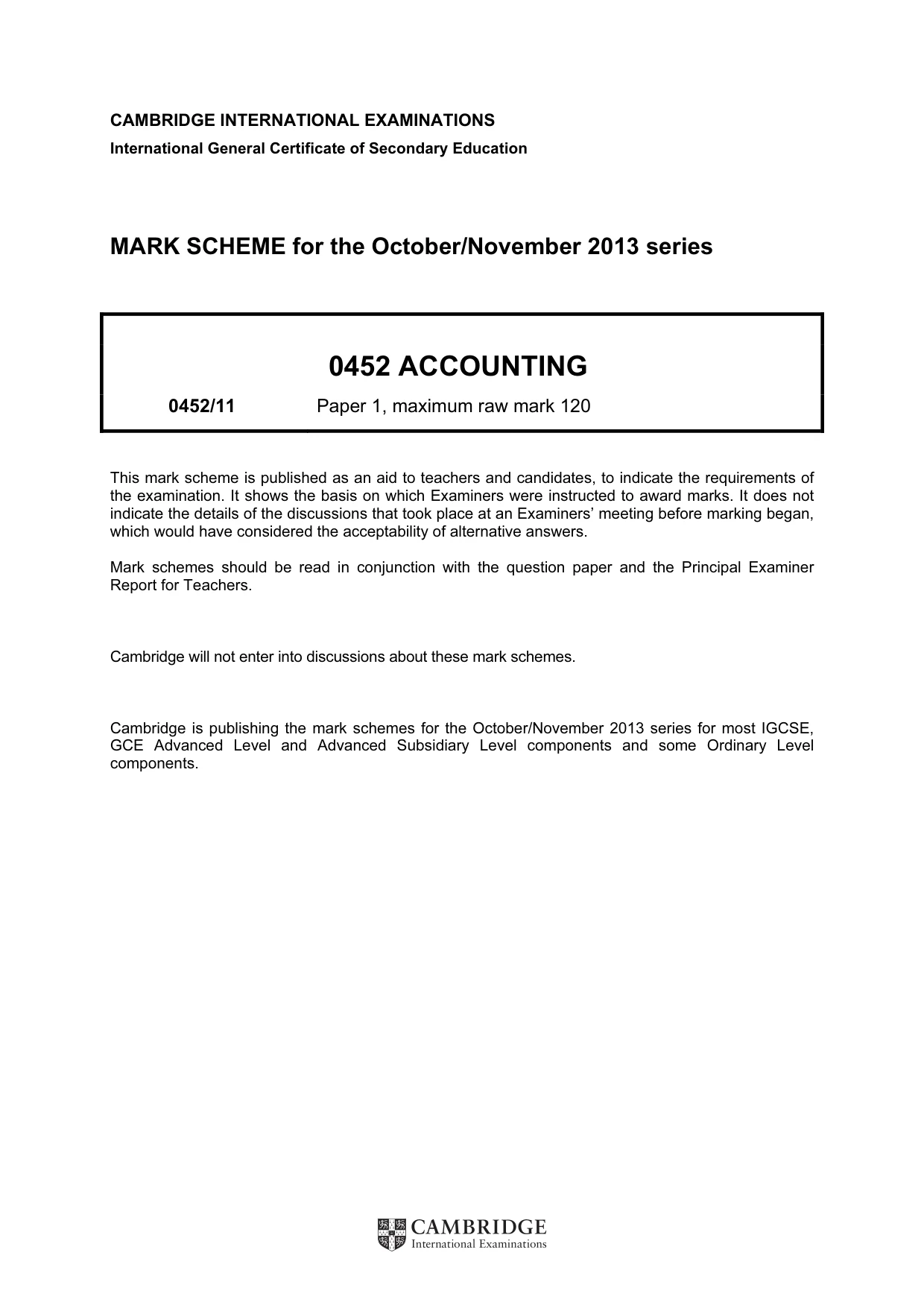
Mark scheme, page 1
CAMBRIDGE INTERNATIONAL EXAMINATIONS International General Certificate of Secondary Education MARK SCHEME for the October/November 2013 series 0452 ACCOUNTING 0452/11 Paper 1, maximum raw mark 120 This mark scheme is published as an aid to teachers and candidates, to indicate the requirements of the examination. It shows the basis on which Examiners were instructed to award marks. It does not indicate the details of the discussions that took place at an Examiners’ meeting before marking began, which would have considered the acceptability of alternative answers. Mark schemes should be read in conjunction with the question paper and the Principal Examiner Report for Teachers. Cambridge will not enter into discussions about these mark schemes. Cambridge is publishing the mark schemes for the October/November 2013 series for most IGCSE, GCE Advanced Level and Advanced Subsidiary Level components and some Ordinary Level components.
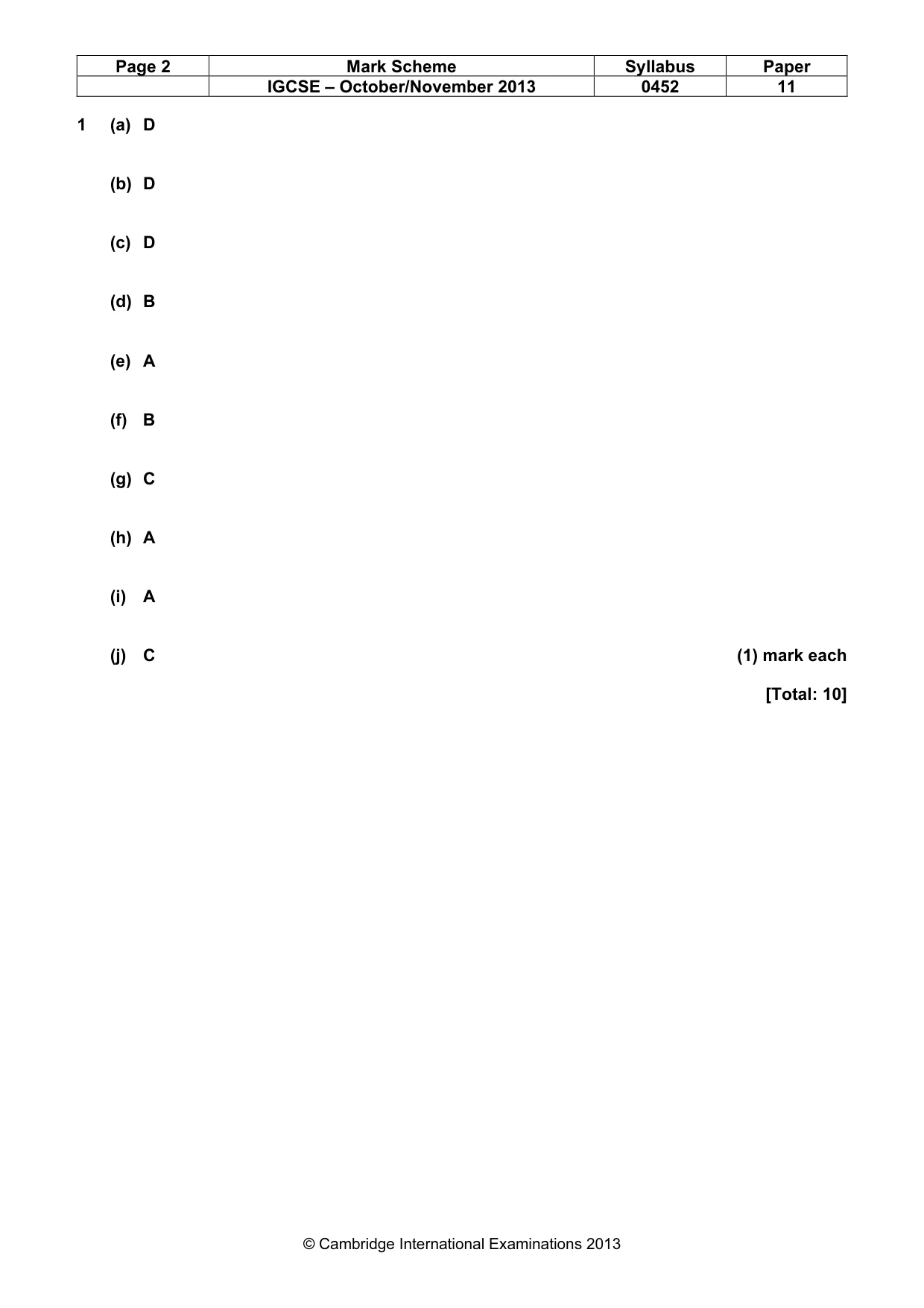
Mark scheme, page 2
Page 2 Mark Scheme Syllabus Paper IGCSE – October/November 2013 0452 11 © Cambridge International Examinations 2013 1 (a) D (b) D (c) D (d) B (e) A (f) B (g) C (h) A (i) A (j) C (1) mark each [Total: 10]
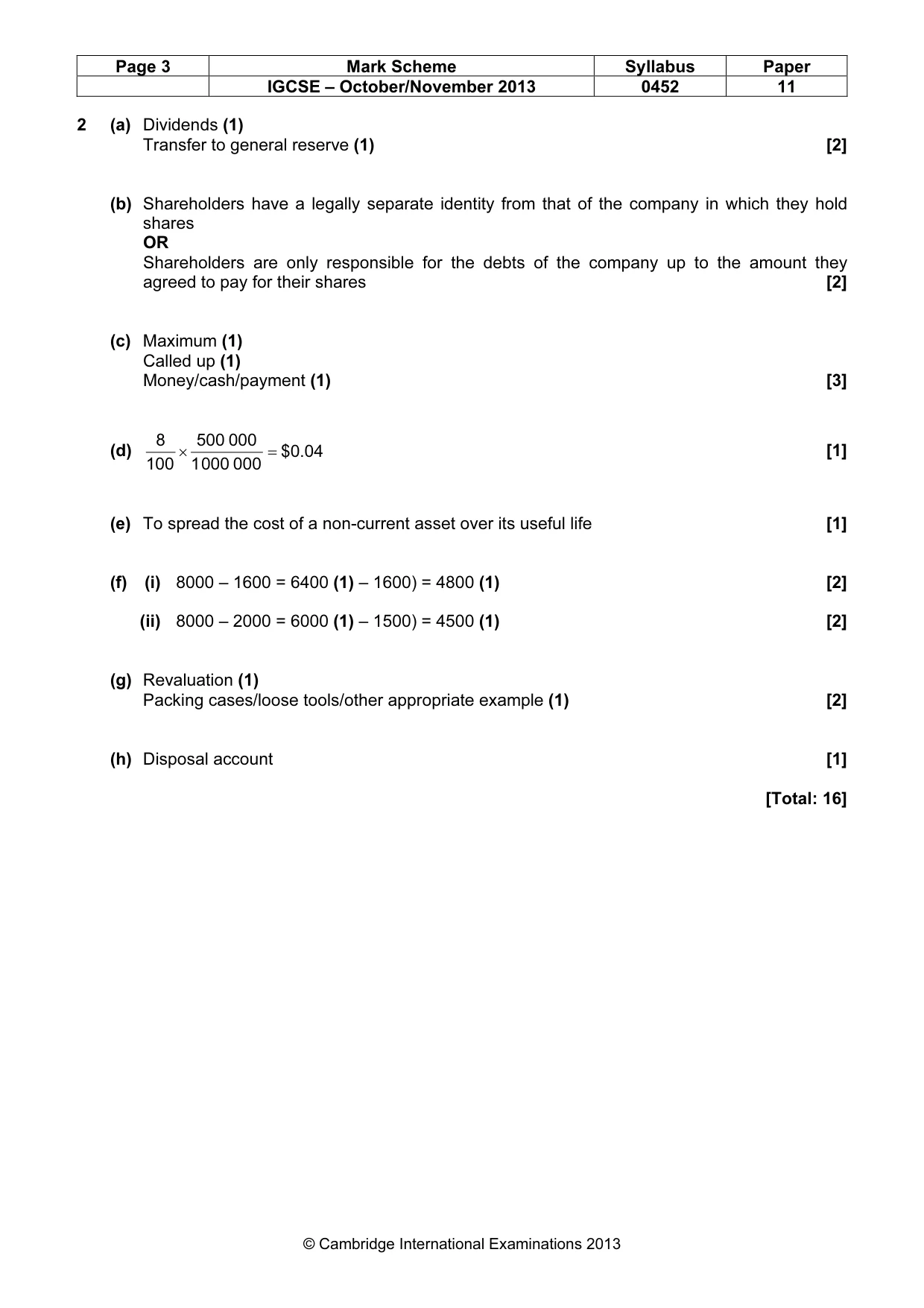
Mark scheme, page 3
Page 3 Mark Scheme Syllabus Paper IGCSE – October/November 2013 0452 11 © Cambridge International Examinations 2013 2 (a) Dividends (1) Transfer to general reserve (1) [2] (b) Shareholders have a legally separate identity from that of the company in which they hold shares OR Shareholders are only responsible for the debts of the company up to the amount they agreed to pay for their shares [2] (c) Maximum (1) Called up (1) Money/cash/payment (1) [3] (d) $0.04 000 000 1 000 500 100 8 = × [1] (e) To spread the cost of a non-current asset over its useful life [1] (f) (i) 8000 – 1600 = 6400 (1) – 1600) = 4800 (1) [2] (ii) 8000 – 2000 = 6000 (1) – 1500) = 4500 (1) [2] (g) Revaluation (1) Packing cases/loose tools/other appropriate example (1) [2] (h) Disposal account [1] [Total: 16]
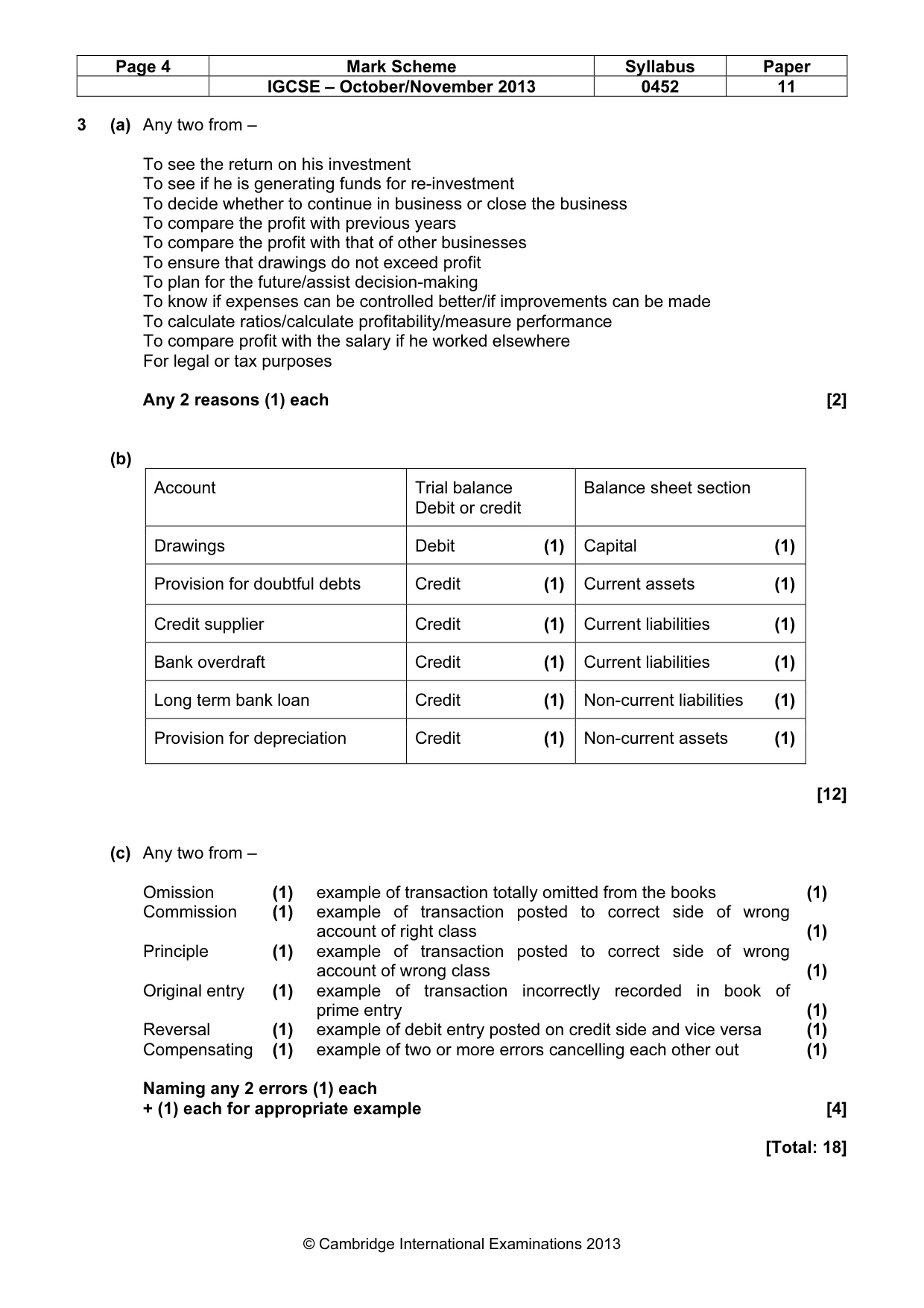
Mark scheme, page 4
Page 4 Mark Scheme Syllabus Paper IGCSE – October/November 2013 0452 11 © Cambridge International Examinations 2013 3 (a) Any two from – To see the return on his investment To see if he is generating funds for re-investment To decide whether to continue in business or close the business To compare the profit with previous years To compare the profit with that of other businesses To ensure that drawings do not exceed profit To plan for the future/assist decision-making To know if expenses can be controlled better/if improvements can be made To calculate ratios/calculate profitability/measure performance To compare profit with the salary if he worked elsewhere For legal or tax purposes Any 2 reasons (1) each [2] (b) Account Trial balance Debit or credit Balance sheet section Drawings Debit (1) Capital (1) Provision for doubtful debts Credit (1) Current assets (1) Credit supplier Credit (1) Current liabilities (1) Bank overdraft Credit (1) Current liabilities (1) Long term bank loan Credit (1) Non-current liabilities (1) Provision for depreciation Credit (1) Non-current assets (1) [12] (c) Any two from – Omission (1) example of transaction totally omitted from the books (1) Commission (1) example of transaction posted to correct side of wrong account of right class (1) Principle (1) example of transaction posted to correct side of wrong account of wrong class (1) Original entry (1) example of transaction incorrectly recorded in book of prime entry (1) Reversal (1) example of debit entry posted on credit side and vice versa (1) Compensating (1) example of two or more errors cancelling each other out (1) Naming any 2 errors (1) each + (1) each for appropriate example [4] [Total: 18]
Mark scheme, page 5
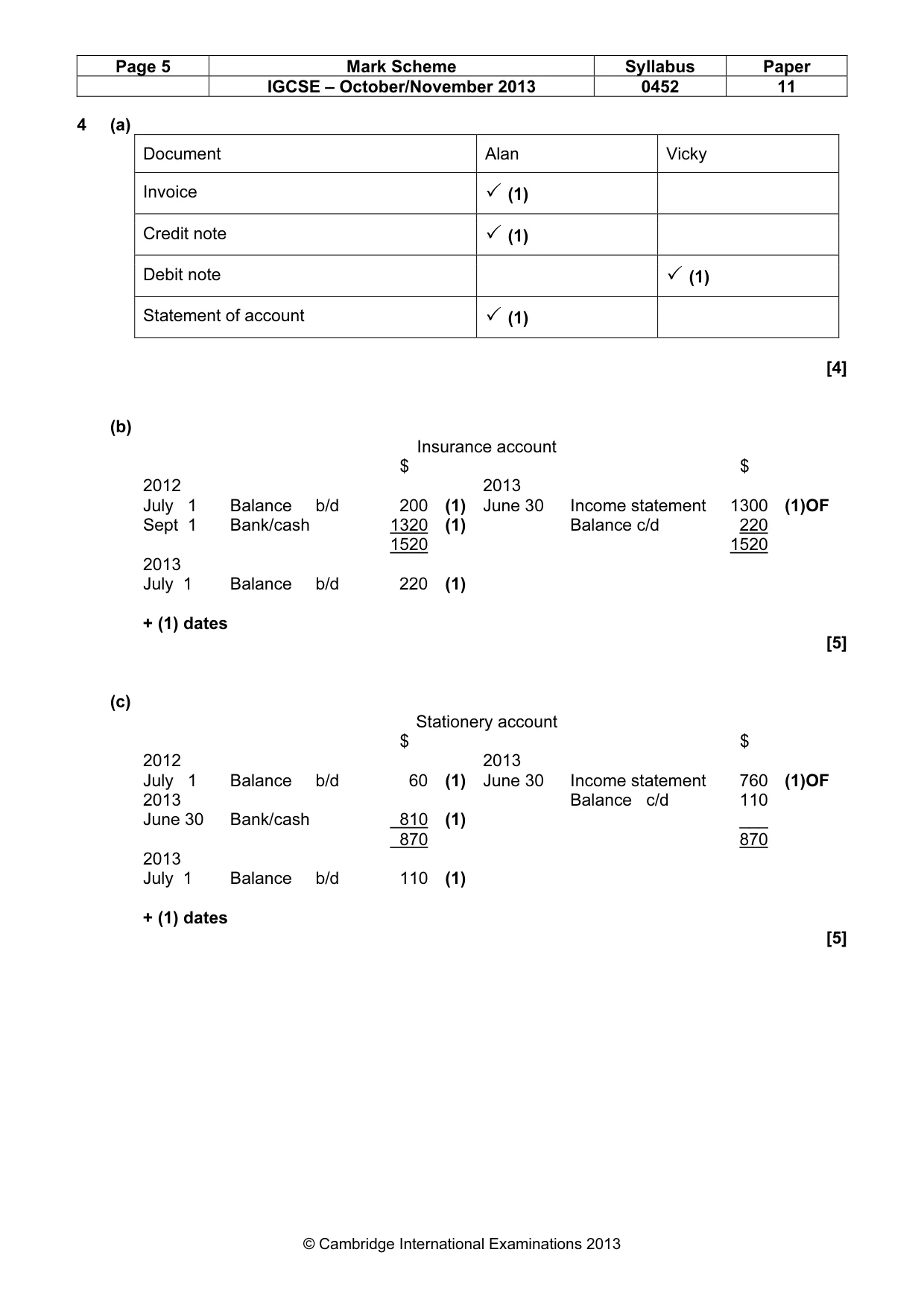
Page 5 Mark Scheme Syllabus Paper IGCSE – October/November 2013 0452 11 © Cambridge International Examinations 2013 4 (a) Document Alan Vicky Invoice ✓(1) Credit note ✓(1) Debit note ✓ (1) Statement of account ✓(1) [4] (b) Insurance account $ $ 2012 2013 July 1 Balance b/d 200 (1) June 30 Income statement 1300 (1)OF Sept 1 Bank/cash 1320 (1) Balance c/d 220 1520 1520 2013 July 1 Balance b/d 220 (1) + (1) dates [5] (c) Stationery account $ $ 2012 2013 July 1 Balance b/d 60 (1) June 30 Income statement 760 (1)OF 2013 Balance c/d 110 June 30 Bank/cash 810 (1) ___ 870 870 2013 July 1 Balance b/d 110 (1) + (1) dates [5]
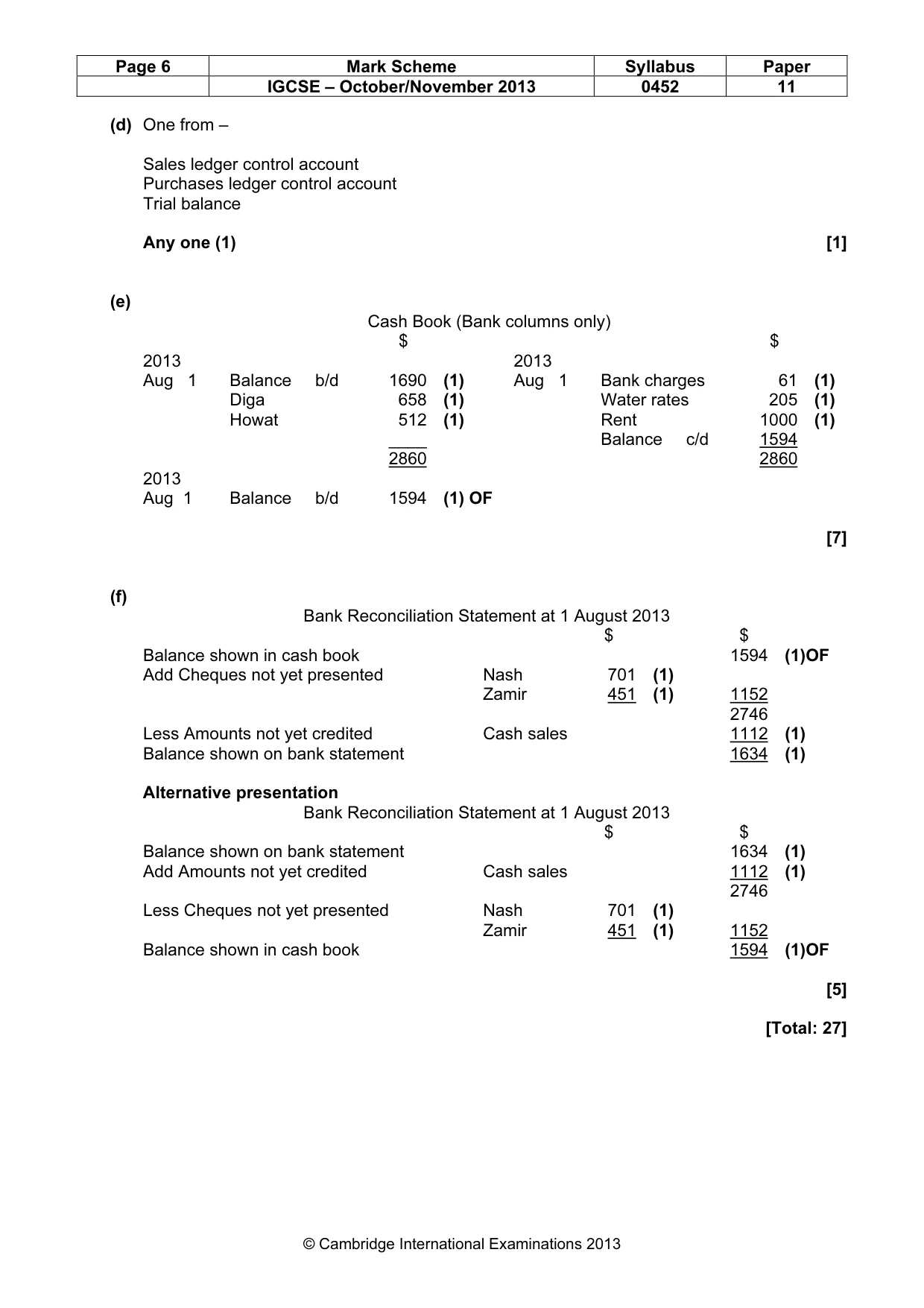
Mark scheme, page 6
Page 6 Mark Scheme Syllabus Paper IGCSE – October/November 2013 0452 11 © Cambridge International Examinations 2013 (d) One from – Sales ledger control account Purchases ledger control account Trial balance Any one (1) [1] (e) Cash Book (Bank columns only) $ $ 2013 2013 Aug 1 Balance b/d 1690 (1) Aug 1 Bank charges 61 (1) Diga 658 (1) Water rates 205 (1) Howat 512 (1) Rent 1000 (1) ____ Balance c/d 1594 2860 2860 2013 Aug 1 Balance b/d 1594 (1) OF [7] (f) Bank Reconciliation Statement at 1 August 2013 $ $ Balance shown in cash book 1594 (1)OF Add Cheques not yet presented Nash 701 (1) Zamir 451 (1) 1152 2746 Less Amounts not yet credited Cash sales 1112 (1) Balance shown on bank statement 1634 (1) Alternative presentation Bank Reconciliation Statement at 1 August 2013 $ $ Balance shown on bank statement 1634 (1) Add Amounts not yet credited Cash sales 1112 (1) 2746 Less Cheques not yet presented Nash 701 (1) Zamir 451 (1) 1152 Balance shown in cash book 1594 (1)OF [5] [Total: 27]
Mark scheme, page 7
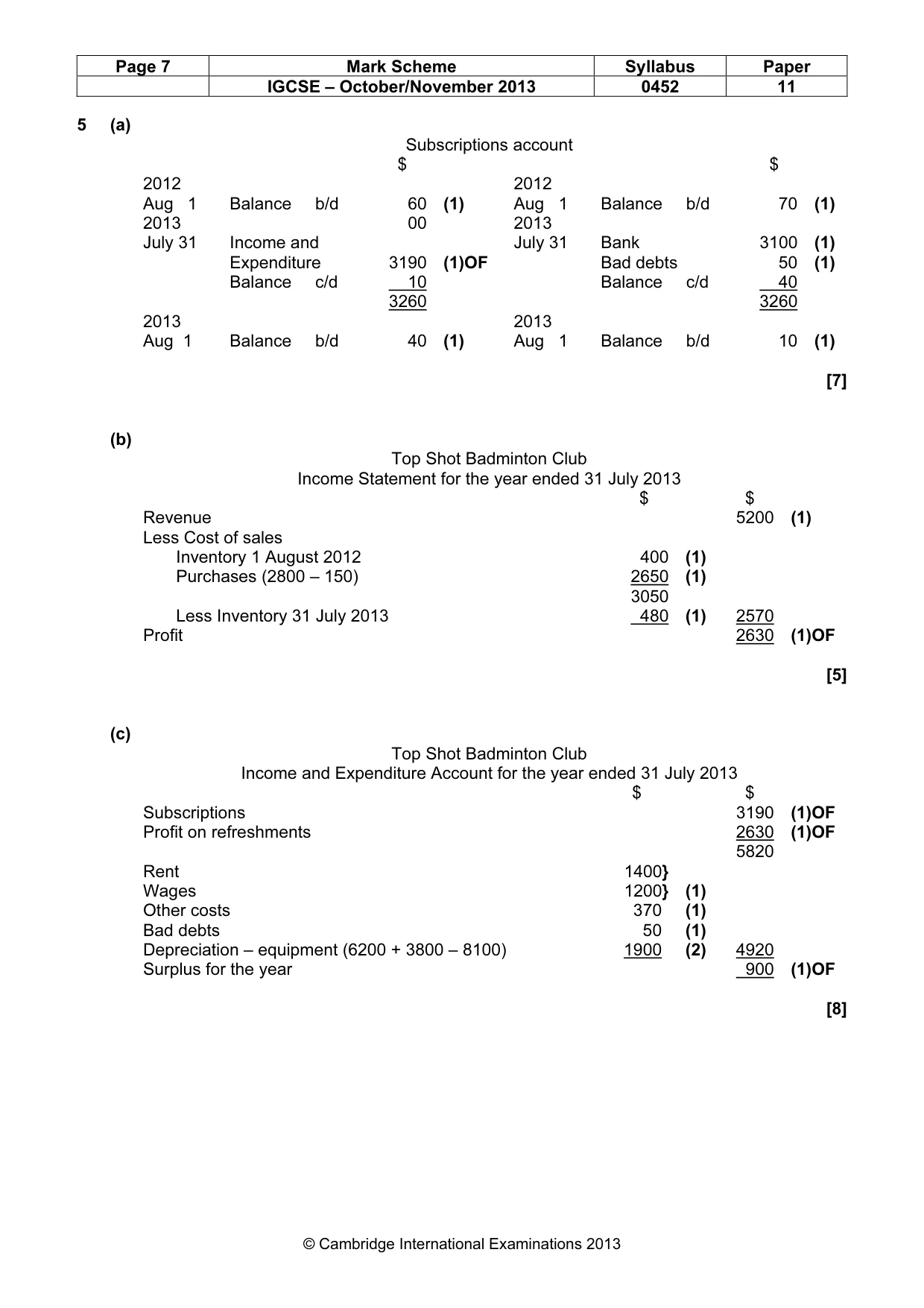
Page 7 Mark Scheme Syllabus Paper IGCSE – October/November 2013 0452 11 © Cambridge International Examinations 2013 5 (a) Subscriptions account $ $ 2012 2012 Aug 1 Balance b/d 60 (1) Aug 1 Balance b/d 70 (1) 2013 00 2013 July 31 Income and July 31 Bank 3100 (1) Expenditure 3190 (1)OF Bad debts 50 (1) Balance c/d 10 Balance c/d 40 3260 3260 2013 2013 Aug 1 Balance b/d 40 (1) Aug 1 Balance b/d 10 (1) [7] (b) Top Shot Badminton Club Income Statement for the year ended 31 July 2013 $ $ Revenue 5200 (1) Less Cost of sales Inventory 1 August 2012 400 (1) Purchases (2800 – 150) 2650 (1) 3050 Less Inventory 31 July 2013 480 (1) 2570 Profit 2630 (1)OF [5] (c) Top Shot Badminton Club Income and Expenditure Account for the year ended 31 July 2013 $ $ Subscriptions 3190 (1)OF Profit on refreshments 2630 (1)OF 5820 Rent 1400} Wages 1200} (1) Other costs 370 (1) Bad debts 50 (1) Depreciation – equipment (6200 + 3800 – 8100) 1900 (2) 4920 Surplus for the year 900 (1)OF [8]
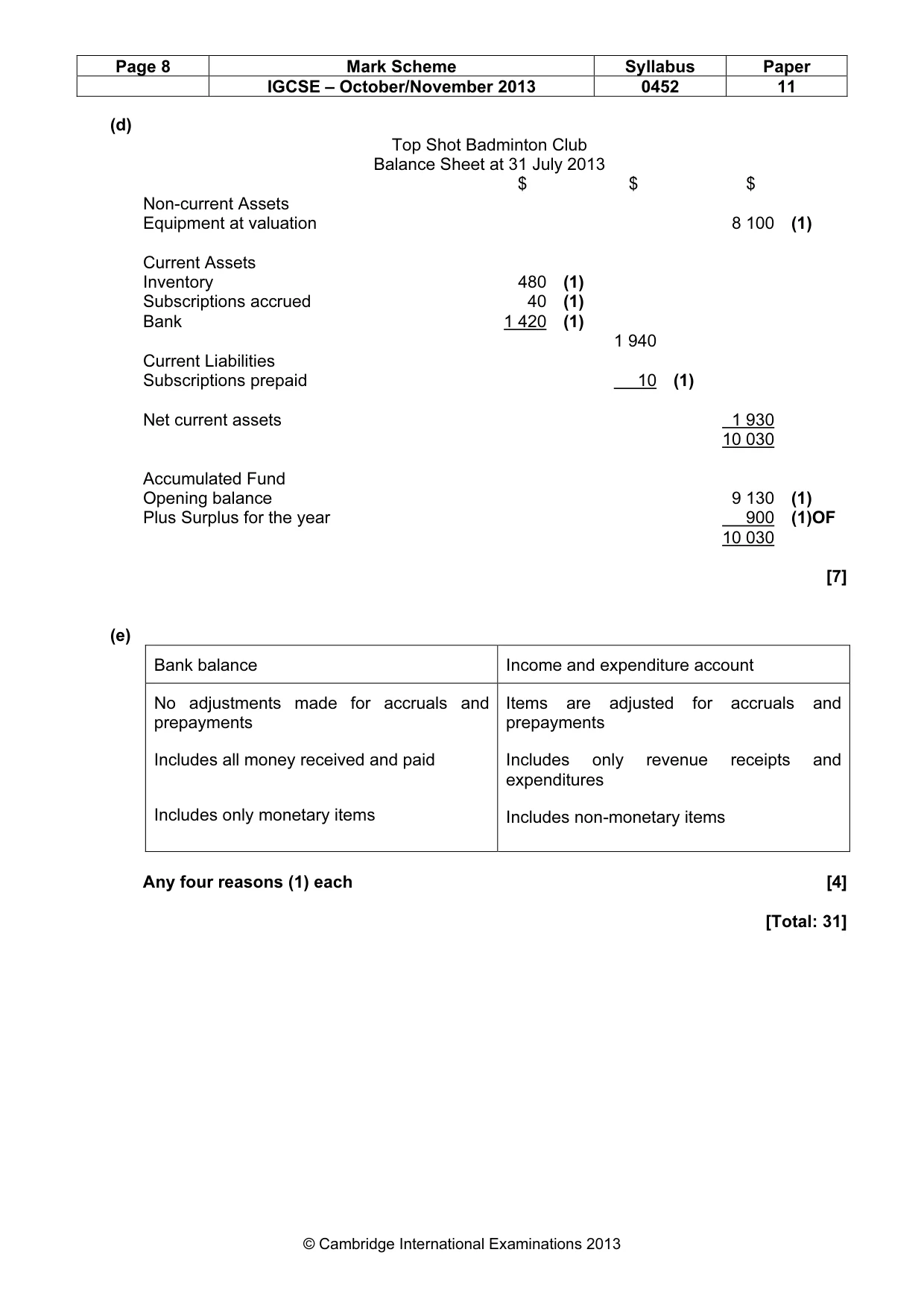
Mark scheme, page 8
Page 8 Mark Scheme Syllabus Paper IGCSE – October/November 2013 0452 11 © Cambridge International Examinations 2013 (d) Top Shot Badminton Club Balance Sheet at 31 July 2013 $ $ $ Non-current Assets Equipment at valuation 8 100 (1) Current Assets Inventory 480 (1) Subscriptions accrued 40 (1) Bank 1 420 (1) 1 940 Current Liabilities Subscriptions prepaid 10 (1) Net current assets 1 930 10 030 Accumulated Fund Opening balance 9 130 (1) Plus Surplus for the year 900 (1)OF 10 030 [7] (e) Bank balance Income and expenditure account No adjustments made for accruals and prepayments Includes all money received and paid Includes only monetary items Items are adjusted for accruals and prepayments Includes only revenue receipts and expenditures Includes non-monetary items Any four reasons (1) each [4] [Total: 31]
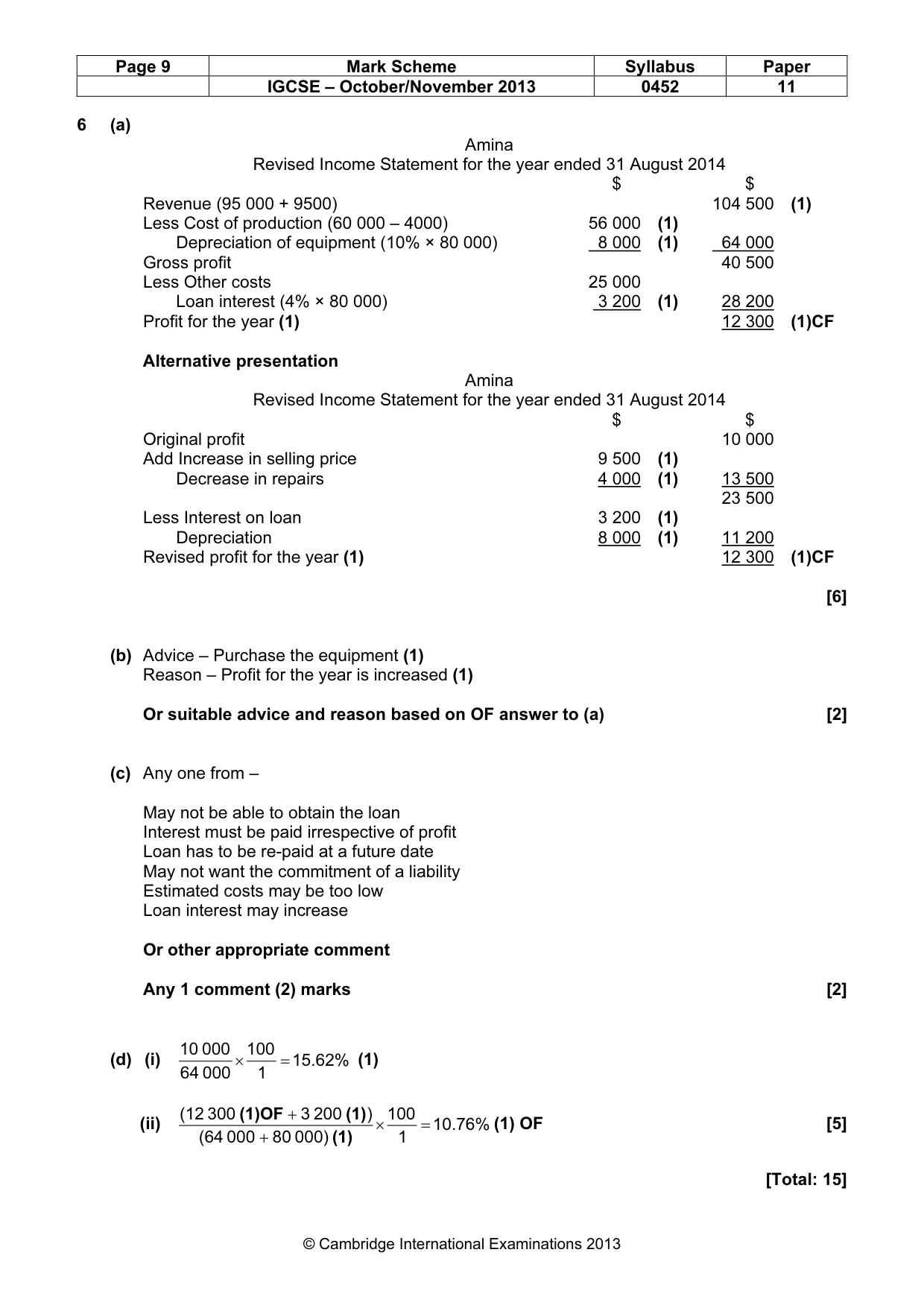
Mark scheme, page 9
Page 9 Mark Scheme Syllabus Paper IGCSE – October/November 2013 0452 11 © Cambridge International Examinations 2013 6 (a) Amina Revised Income Statement for the year ended 31 August 2014 $ $ Revenue (95 000 + 9500) 104 500 (1) Less Cost of production (60 000 – 4000) 56 000 (1) Depreciation of equipment (10% × 80 000) 8 000 (1) 64 000 Gross profit 40 500 Less Other costs 25 000 Loan interest (4% × 80 000) 3 200 (1) 28 200 Profit for the year (1) 12 300 (1)CF Alternative presentation Amina Revised Income Statement for the year ended 31 August 2014 $ $ Original profit 10 000 Add Increase in selling price 9 500 (1) Decrease in repairs 4 000 (1) 13 500 23 500 Less Interest on loan 3 200 (1) Depreciation 8 000 (1) 11 200 Revised profit for the year (1) 12 300 (1)CF [6] (b) Advice – Purchase the equipment (1) Reason – Profit for the year is increased (1) Or suitable advice and reason based on OF answer to (a) [2] (c) Any one from – May not be able to obtain the loan Interest must be paid irrespective of profit Loan has to be re-paid at a future date May not want the commitment of a liability Estimated costs may be too low Loan interest may increase Or other appropriate comment Any 1 comment (2) marks [2] (d) (i) 15.62% 1 100 000 64 000 10 = × (1) (ii) 10.76% 1 100 000) 80 000 (64 ) 200 3 300 (12 = × + + (1) (1) (1)OF (1) OF [5] [Total: 15]
What you needed in this session
Cambridge’s own grade thresholds for 2013 Oct/Nov, Paper 1 · Variant 1. A higher threshold means an easier paper — the bar moves with how the cohort did.