Cambridge IGCSE Accounting 0452 — 2013 Oct/Nov Paper 1 · Variant 3
0452/13/O/N/13 · 120 marks · ≈135 min
The question paper and its mark scheme, free to read here and free to download. This is Cambridge’s own paper, exactly as it was sat.
Question paper20 pages

Mark scheme10 pages
Answers below. Sit the paper first if you are practising.
Paper as text
Question paper, page 1
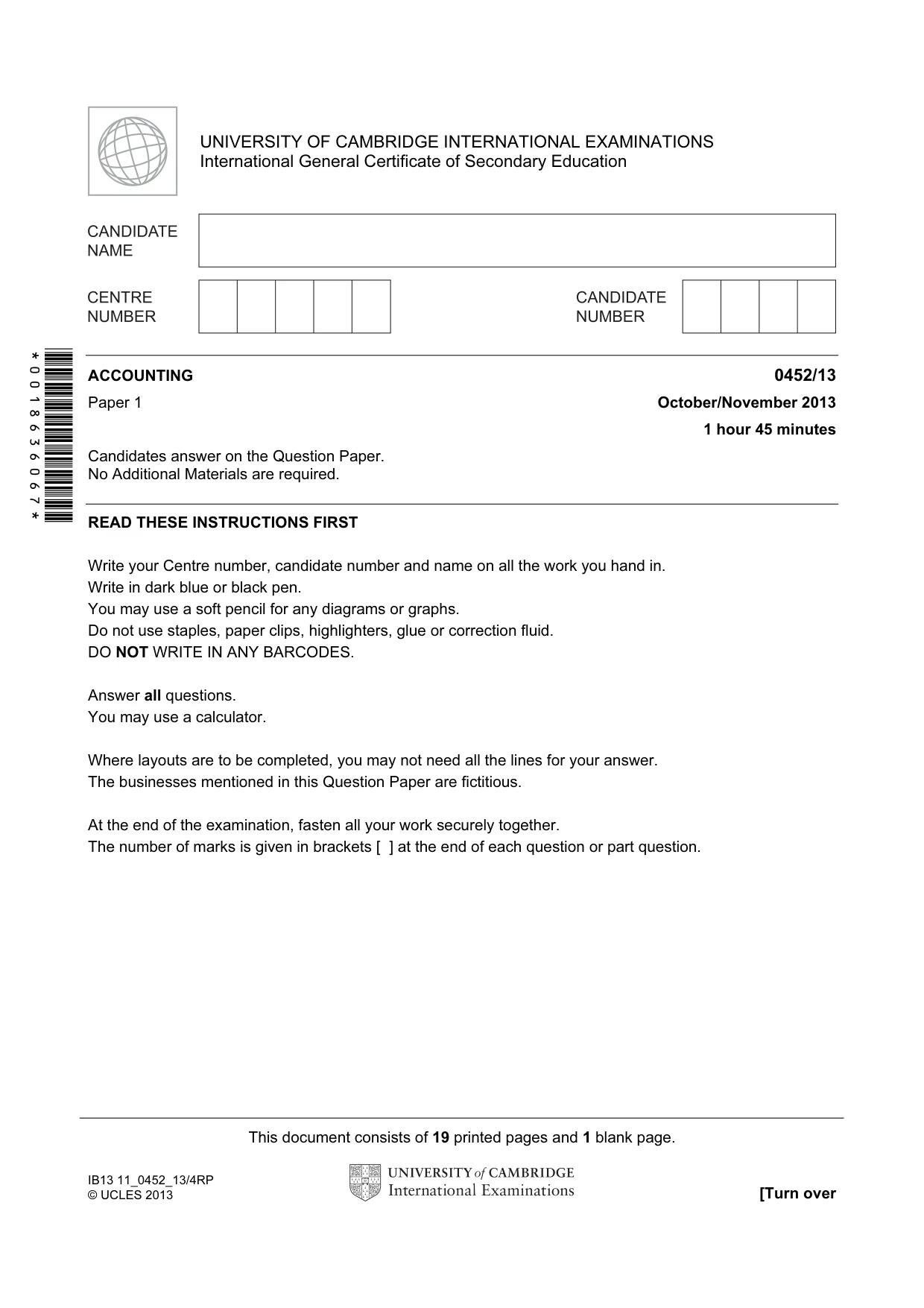
This document consists of 19 printed pages and 1 blank page. IB13 11_0452_13/4RP © UCLES 2013 [Turn over *0018636067* UNIVERSITY OF CAMBRIDGE INTERNATIONAL EXAMINATIONS International General Certificate of Secondary Education ACCOUNTING 0452/13 Paper 1 October/November 2013 1 hour 45 minutes Candidates answer on the Question Paper. No Additional Materials are required. READ THESE INSTRUCTIONS FIRST Write your Centre number, candidate number and name on all the work you hand in. Write in dark blue or black pen. You may use a soft pencil for any diagrams or graphs. Do not use staples, paper clips, highlighters, glue or correction fluid. DO NOT WRITE IN ANY BARCODES. Answer all questions. You may use a calculator. Where layouts are to be completed, you may not need all the lines for your answer. The businesses mentioned in this Question Paper are fictitious. At the end of the examination, fasten all your work securely together. The number of marks is given in brackets [ ] at the end of each question or part question.
Question paper, page 2
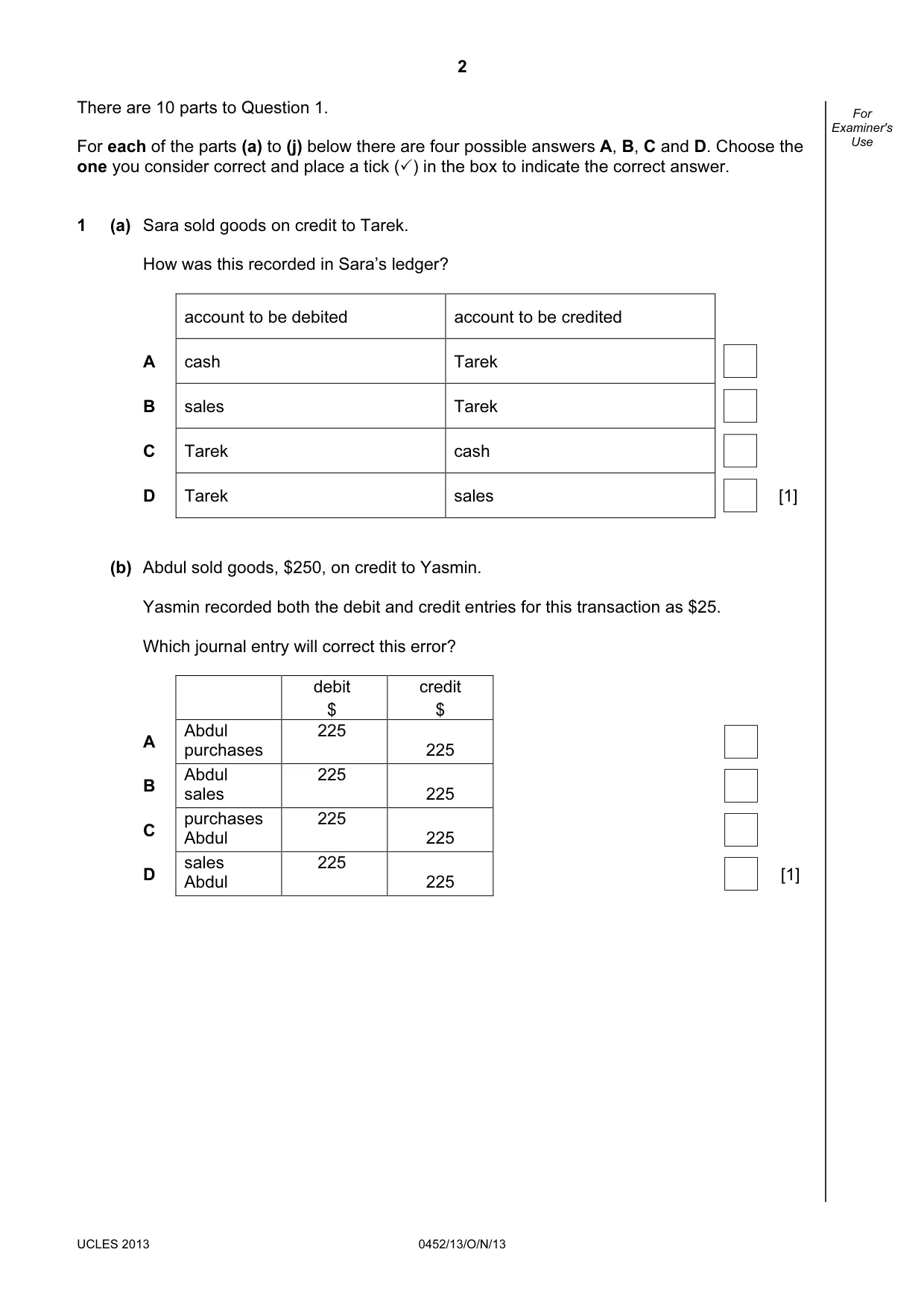
2 UCLES 2013 0452/13/O/N/13 For Examiner's Use There are 10 parts to Question 1. For each of the parts (a) to (j) below there are four possible answers A, B, C and D. Choose the one you consider correct and place a tick (✓) in the box to indicate the correct answer. 1 (a) Sara sold goods on credit to Tarek. How was this recorded in Sara’s ledger? account to be debited account to be credited A cash Tarek B sales Tarek C Tarek cash D Tarek sales [1] (b) Abdul sold goods, $250, on credit to Yasmin. Yasmin recorded both the debit and credit entries for this transaction as $25. Which journal entry will correct this error? debit $ credit $ A Abdul purchases 225 225 B Abdul sales 225 225 C purchases Abdul 225 225 D sales Abdul 225 225 [1]
Question paper, page 3
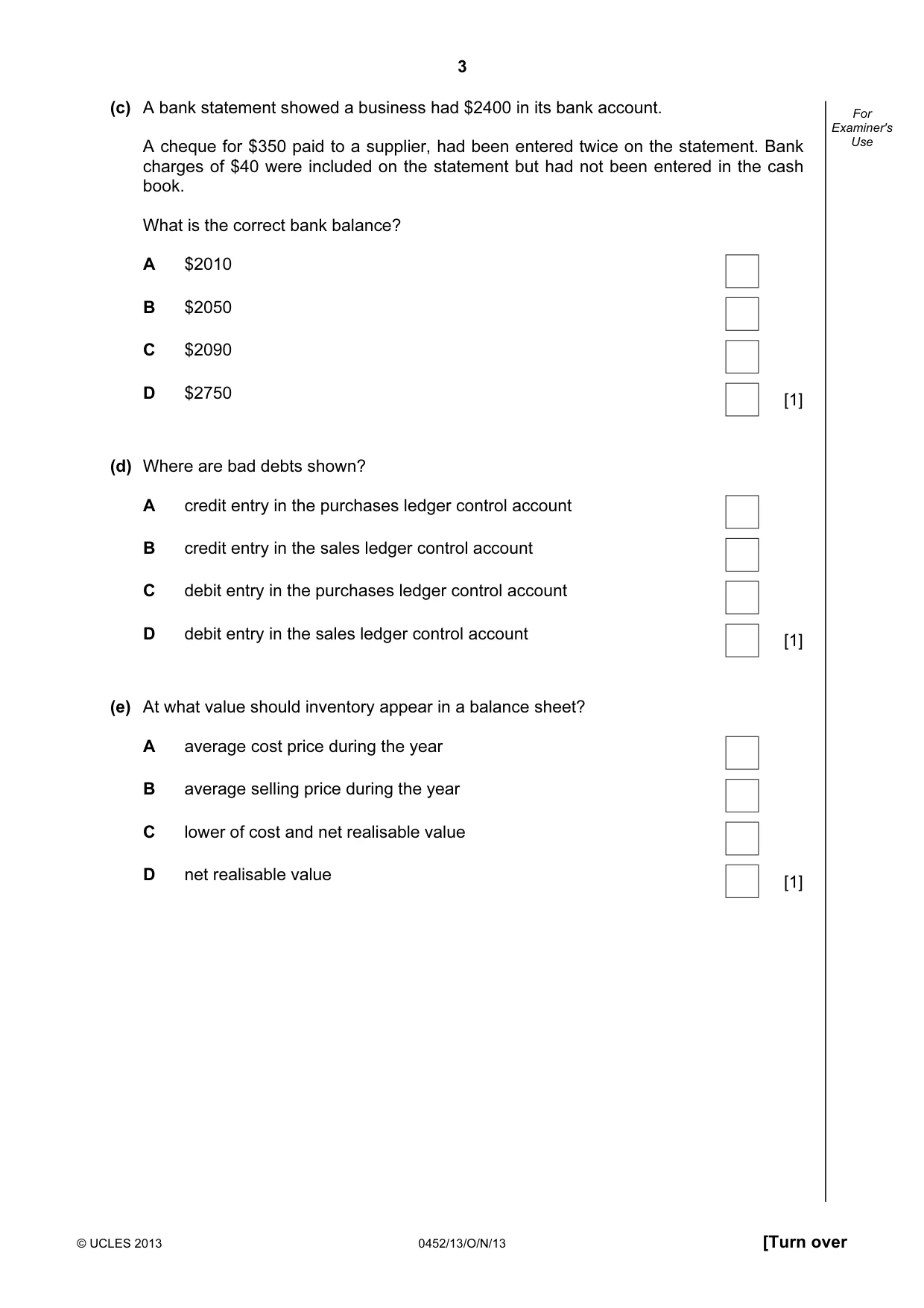
3 © UCLES 2013 0452/13/O/N/13 [Turn over For Examiner's Use (c) A bank statement showed a business had $2400 in its bank account. A cheque for $350 paid to a supplier, had been entered twice on the statement. Bank charges of $40 were included on the statement but had not been entered in the cash book. What is the correct bank balance? A $2010 B $2050 C $2090 D $2750 [1] (d) Where are bad debts shown? A credit entry in the purchases ledger control account B credit entry in the sales ledger control account C debit entry in the purchases ledger control account D debit entry in the sales ledger control account [1] (e) At what value should inventory appear in a balance sheet? A average cost price during the year B average selling price during the year C lower of cost and net realisable value D net realisable value [1]
Question paper, page 4
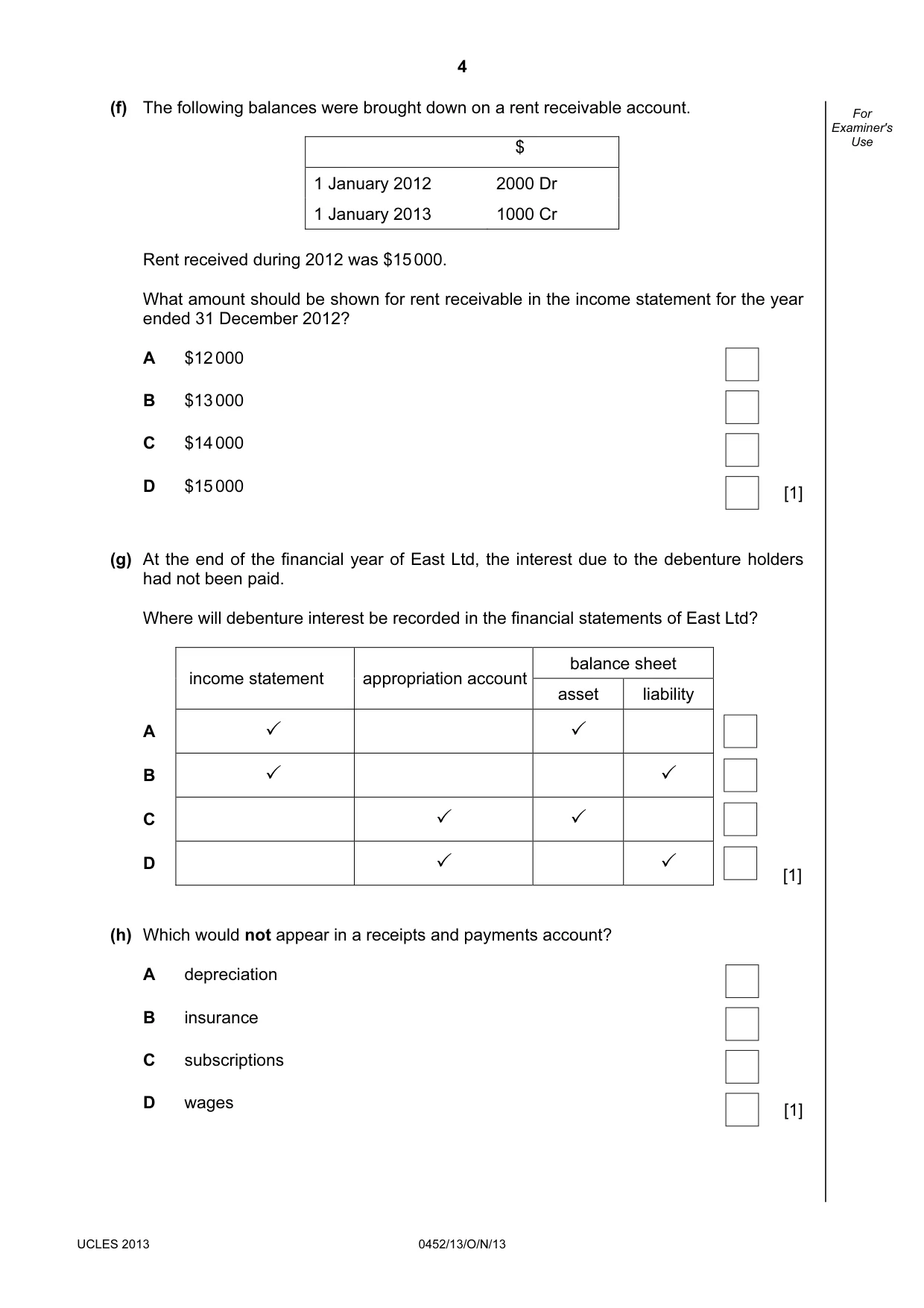
4 UCLES 2013 0452/13/O/N/13 For Examiner's Use (f) The following balances were brought down on a rent receivable account. $ 1 January 2012 2000 Dr 1 January 2013 1000 Cr Rent received during 2012 was $15 000. What amount should be shown for rent receivable in the income statement for the year ended 31 December 2012? A $12 000 B $13 000 C $14 000 D $15 000 [1] (g) At the end of the financial year of East Ltd, the interest due to the debenture holders had not been paid. Where will debenture interest be recorded in the financial statements of East Ltd? balance sheet income statement appropriation account asset liability A ✓ ✓ B ✓ ✓ C ✓ ✓ D ✓ ✓ [1] (h) Which would not appear in a receipts and payments account? A depreciation B insurance C subscriptions D wages [1]
Question paper, page 5
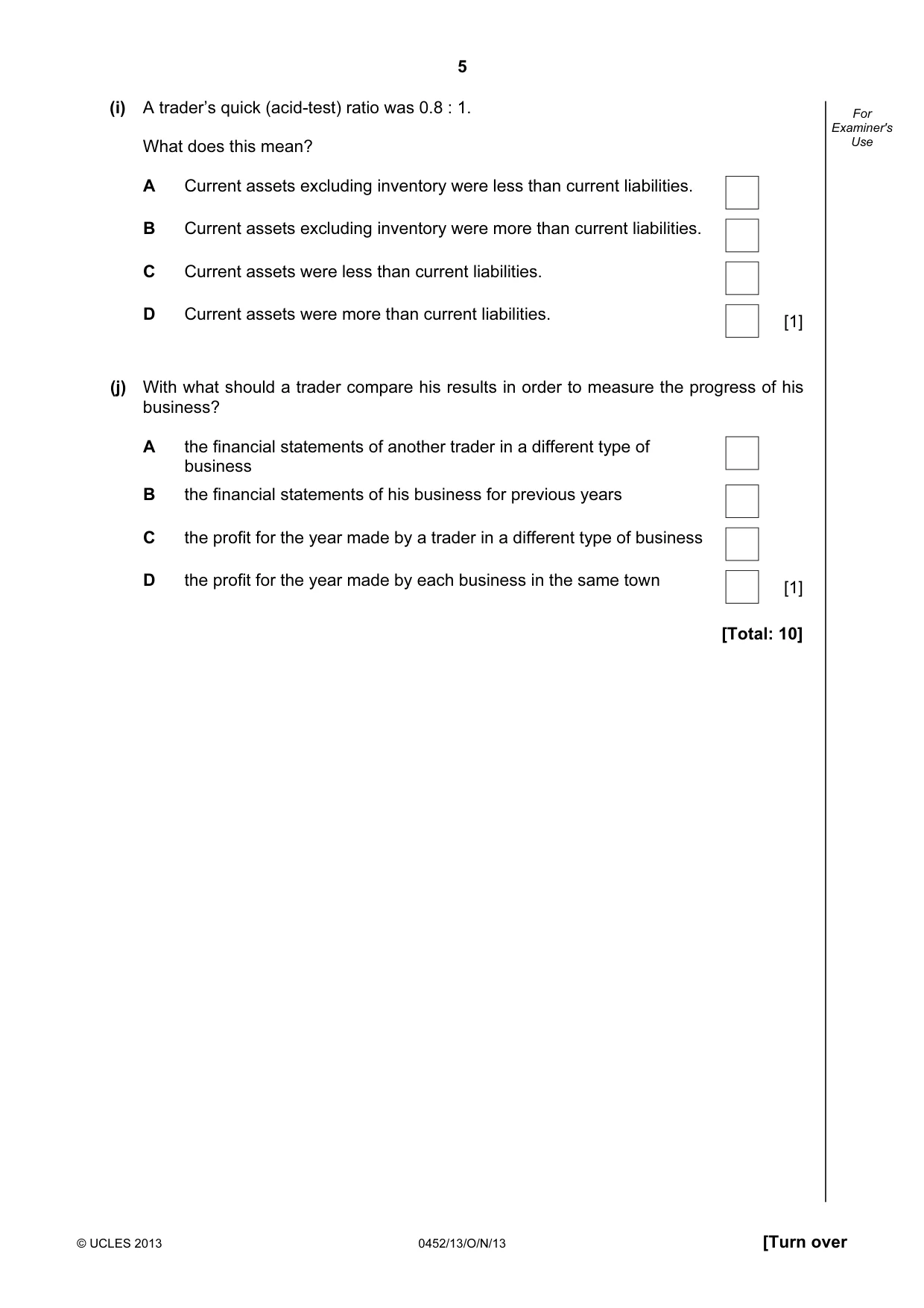
5 © UCLES 2013 0452/13/O/N/13 [Turn over For Examiner's Use (i) A trader’s quick (acid-test) ratio was 0.8 : 1. What does this mean? A Current assets excluding inventory were less than current liabilities. B Current assets excluding inventory were more than current liabilities. C Current assets were less than current liabilities. D Current assets were more than current liabilities. [1] (j) With what should a trader compare his results in order to measure the progress of his business? A the financial statements of another trader in a different type of business B the financial statements of his business for previous years C the profit for the year made by a trader in a different type of business D the profit for the year made by each business in the same town [1] [Total: 10]
Question paper, page 6
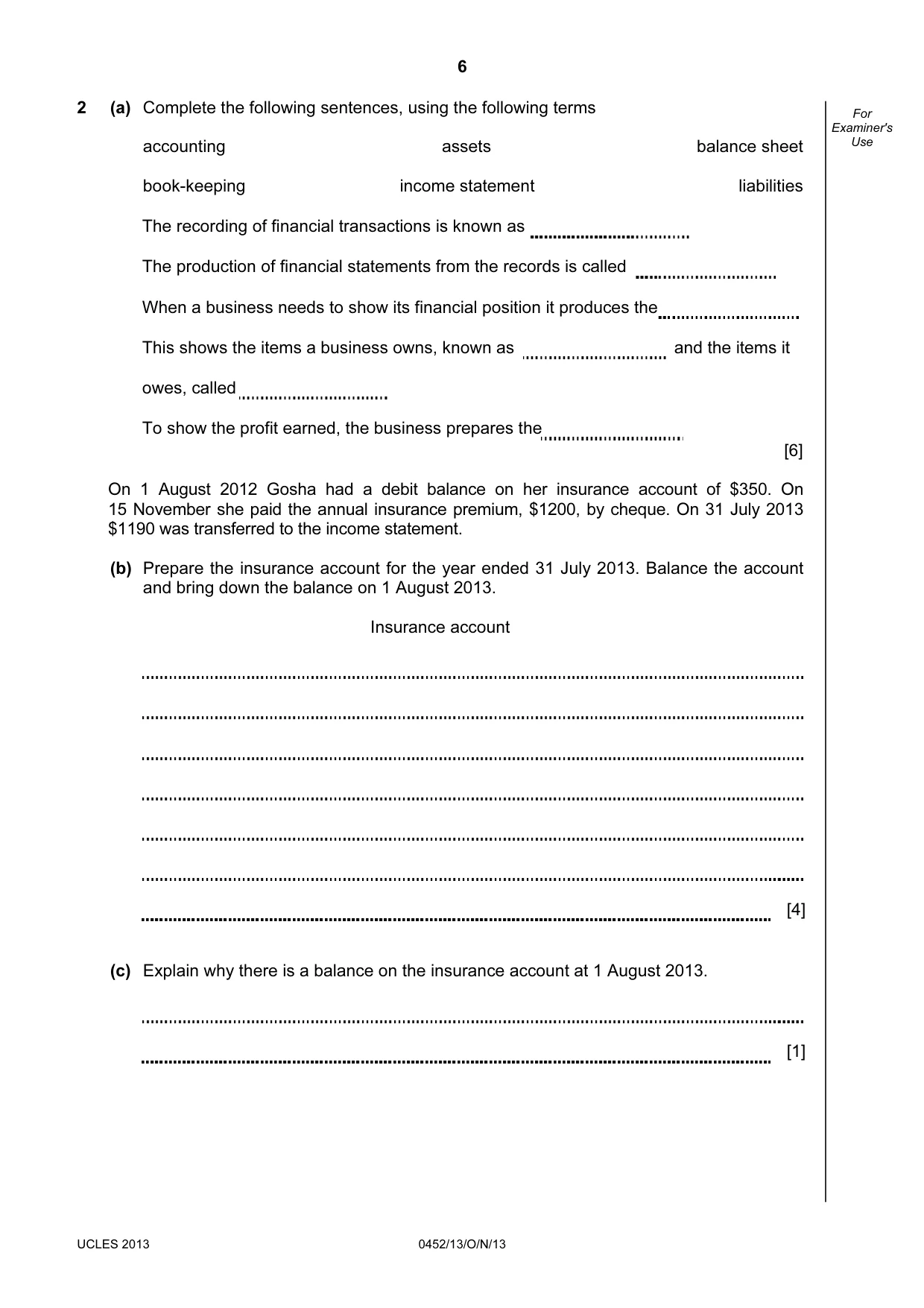
6 UCLES 2013 0452/13/O/N/13 For Examiner's Use 2 (a) Complete the following sentences, using the following terms accounting assets balance sheet book-keeping income statement liabilities The recording of financial transactions is known as The production of financial statements from the records is called When a business needs to show its financial position it produces the This shows the items a business owns, known as and the items it owes, called To show the profit earned, the business prepares the [6] On 1 August 2012 Gosha had a debit balance on her insurance account of $350. On 15 November she paid the annual insurance premium, $1200, by cheque. On 31 July 2013 $1190 was transferred to the income statement. (b) Prepare the insurance account for the year ended 31 July 2013. Balance the account and bring down the balance on 1 August 2013. Insurance account [4] (c) Explain why there is a balance on the insurance account at 1 August 2013. [1]
Question paper, page 7
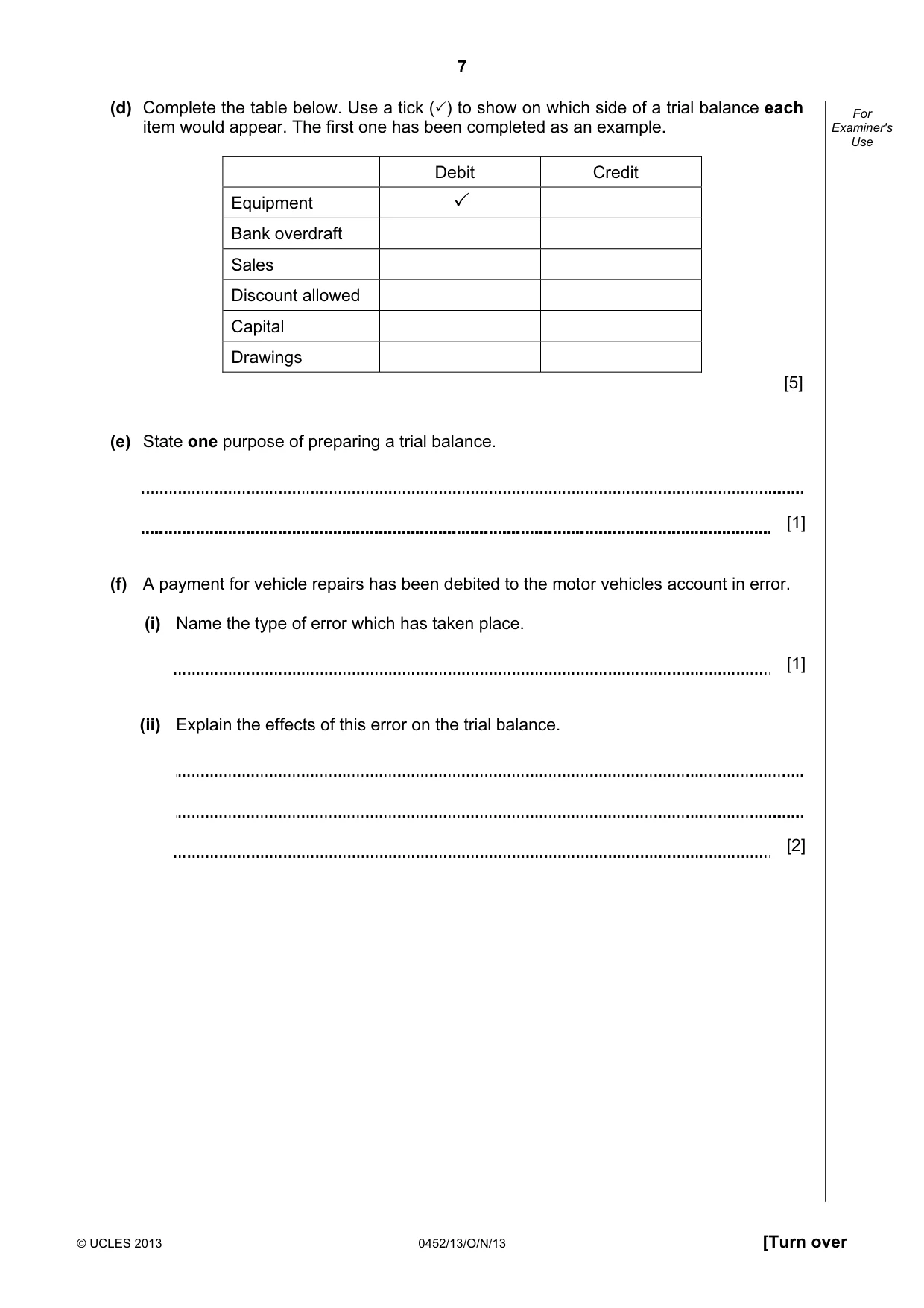
7 © UCLES 2013 0452/13/O/N/13 [Turn over For Examiner's Use (d) Complete the table below. Use a tick (✓) to show on which side of a trial balance each item would appear. The first one has been completed as an example. Debit Credit Equipment ✓ Bank overdraft Sales Discount allowed Capital Drawings [5] (e) State one purpose of preparing a trial balance. [1] (f) A payment for vehicle repairs has been debited to the motor vehicles account in error. (i) Name the type of error which has taken place. [1] (ii) Explain the effects of this error on the trial balance. [2]
Question paper, page 8
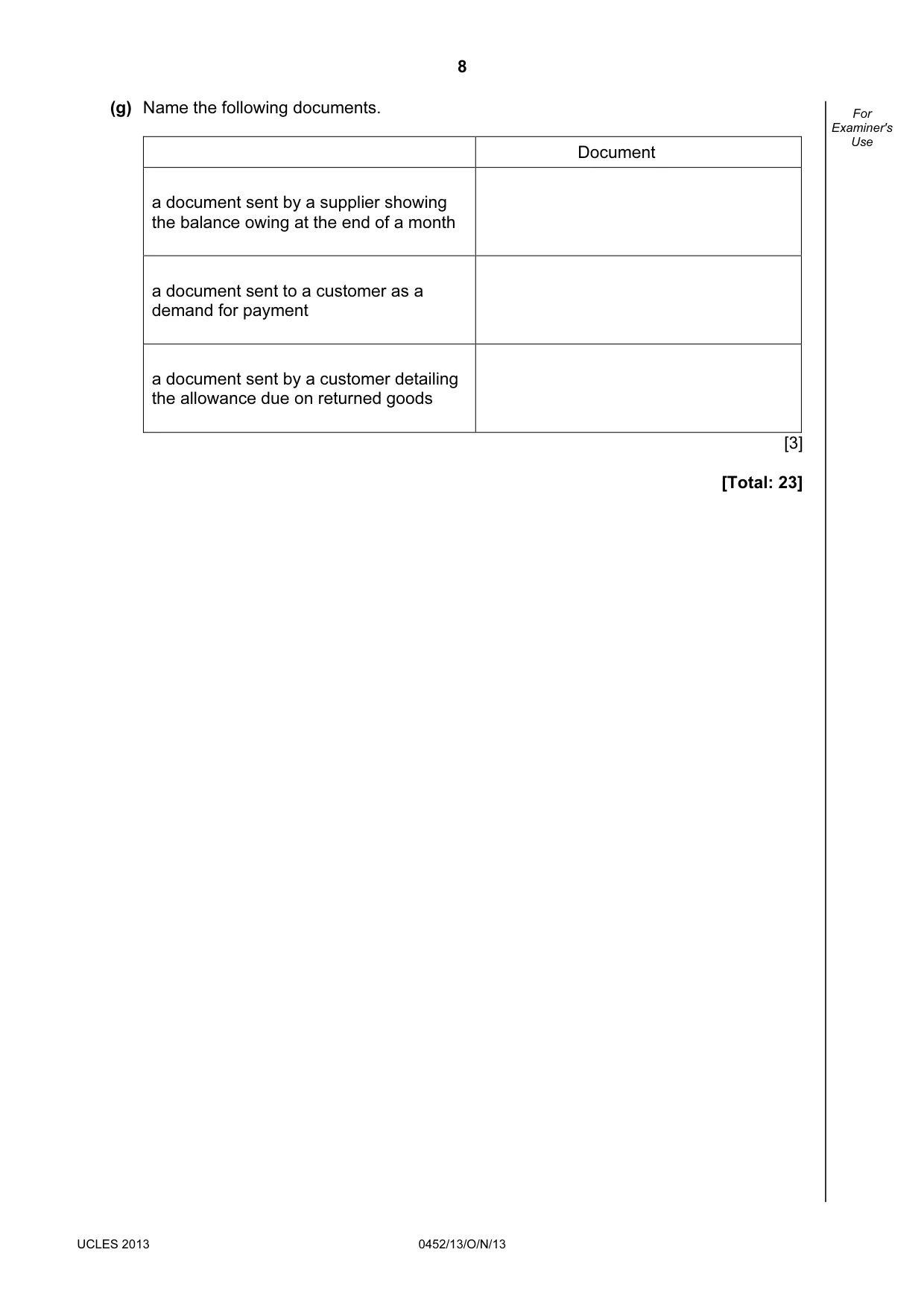
8 UCLES 2013 0452/13/O/N/13 For Examiner's Use (g) Name the following documents. Document a document sent by a supplier showing the balance owing at the end of a month a document sent to a customer as a demand for payment a document sent by a customer detailing the allowance due on returned goods [3] [Total: 23]
Question paper, page 9
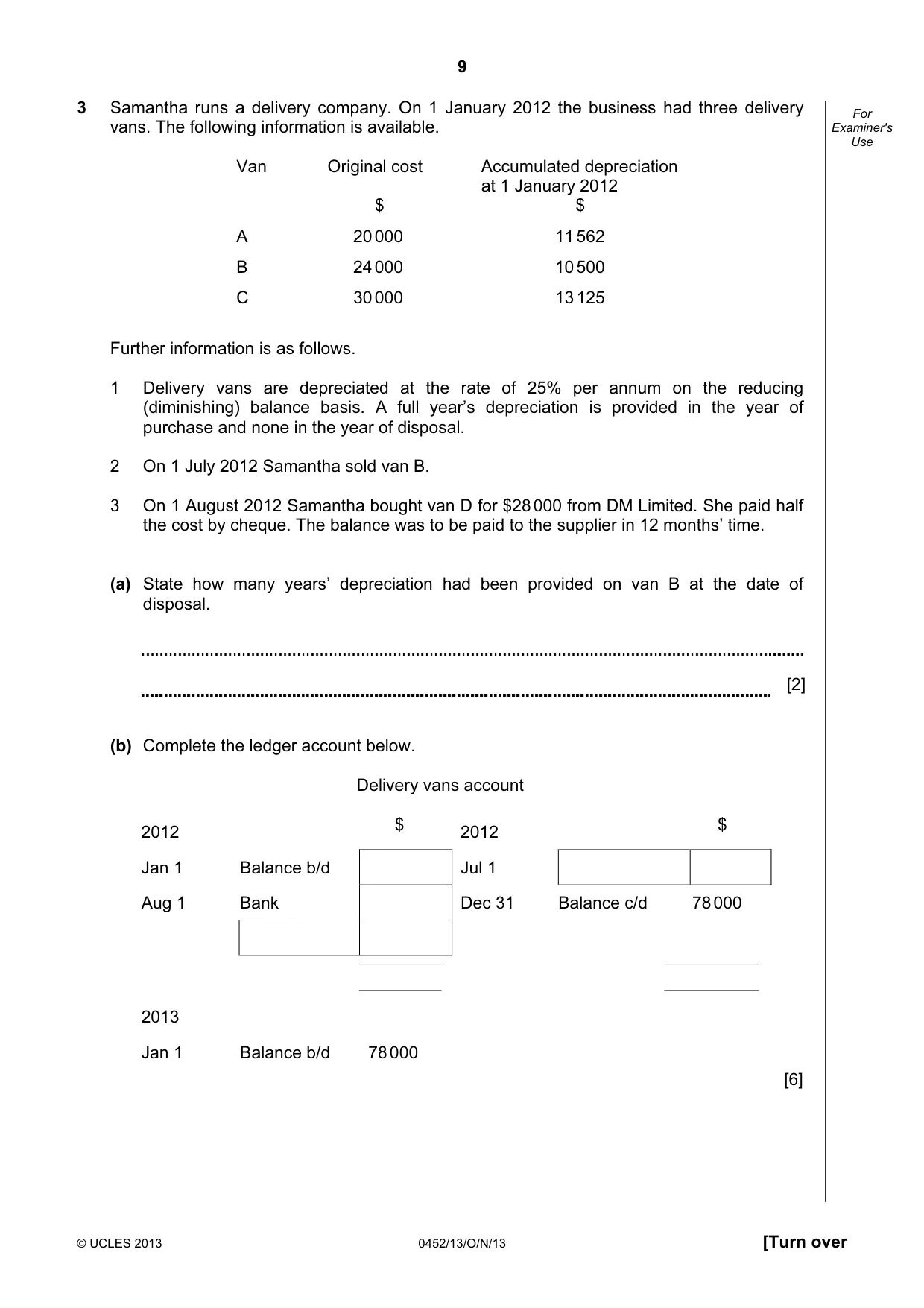
9 © UCLES 2013 0452/13/O/N/13 [Turn over For Examiner's Use 3 Samantha runs a delivery company. On 1 January 2012 the business had three delivery vans. The following information is available. Van Original cost Accumulated depreciation at 1 January 2012 $ $ A 20 000 11 562 B 24 000 10 500 C 30 000 13 125 Further information is as follows. 1 Delivery vans are depreciated at the rate of 25% per annum on the reducing (diminishing) balance basis. A full year’s depreciation is provided in the year of purchase and none in the year of disposal. 2 On 1 July 2012 Samantha sold van B. 3 On 1 August 2012 Samantha bought van D for $28 000 from DM Limited. She paid half the cost by cheque. The balance was to be paid to the supplier in 12 months’ time. (a) State how many years’ depreciation had been provided on van B at the date of disposal. [2] (b) Complete the ledger account below. Delivery vans account 2012 $ 2012 $ Jan 1 Balance b/d Jul 1 Aug 1 Bank Dec 31 Balance c/d 78 000 2013 Jan 1 Balance b/d 78 000 [6]
Question paper, page 10
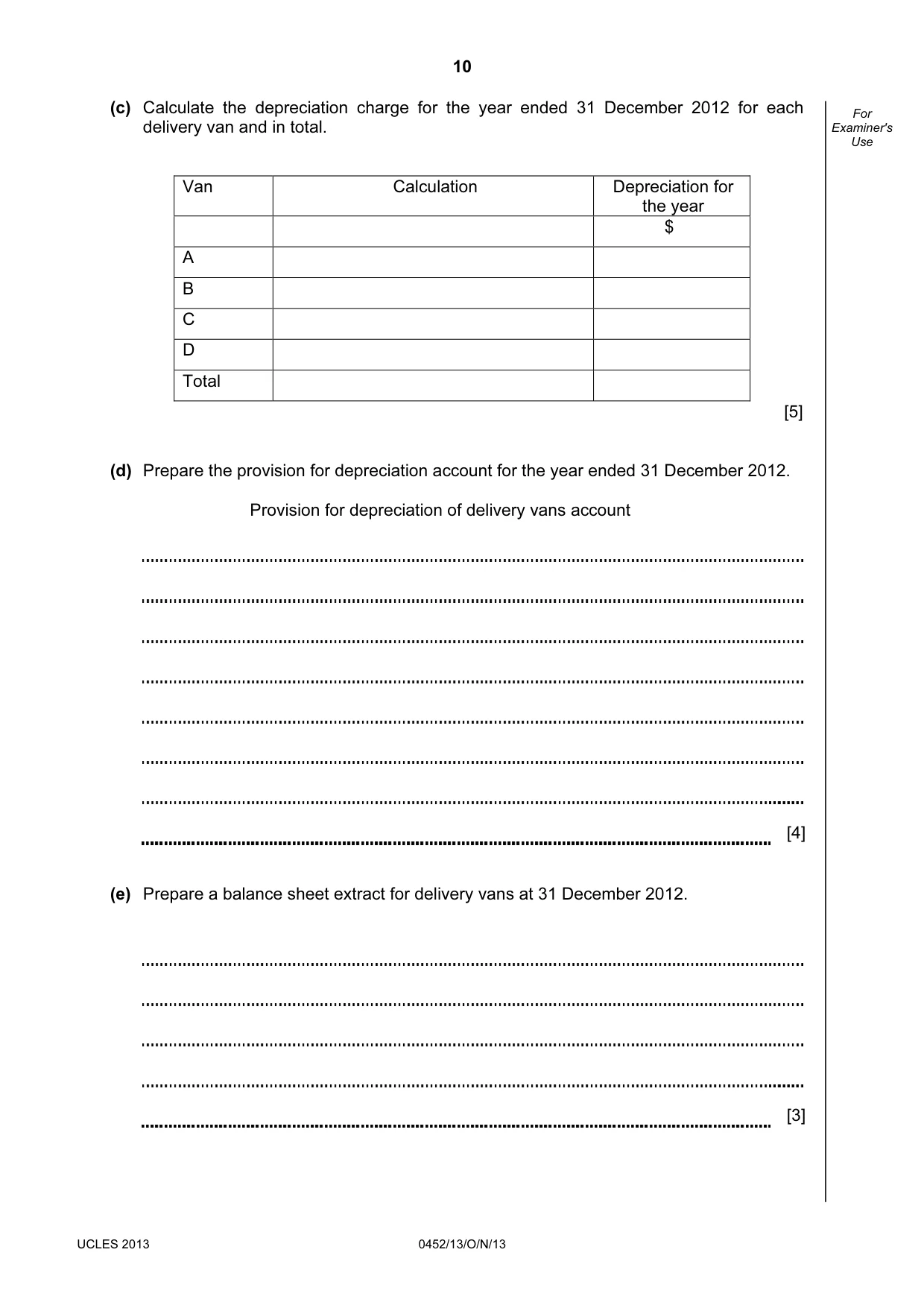
10 UCLES 2013 0452/13/O/N/13 For Examiner's Use (c) Calculate the depreciation charge for the year ended 31 December 2012 for each delivery van and in total. Van Calculation Depreciation for the year $ A B C D Total [5] (d) Prepare the provision for depreciation account for the year ended 31 December 2012. Provision for depreciation of delivery vans account [4] (e) Prepare a balance sheet extract for delivery vans at 31 December 2012. [3]
Question paper, page 11
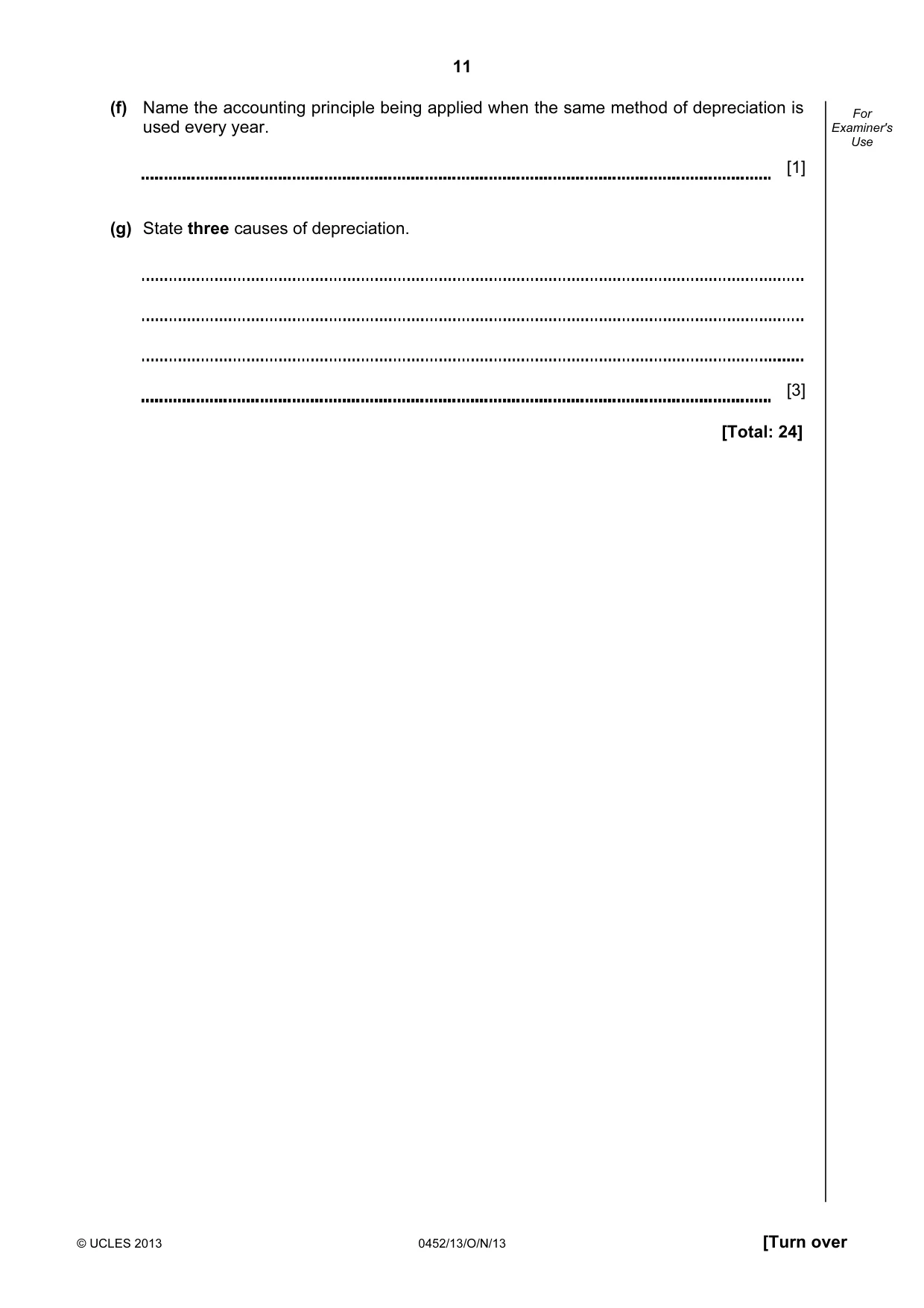
11 © UCLES 2013 0452/13/O/N/13 [Turn over For Examiner's Use (f) Name the accounting principle being applied when the same method of depreciation is used every year. [1] (g) State three causes of depreciation. [3] [Total: 24]
Question paper, page 12
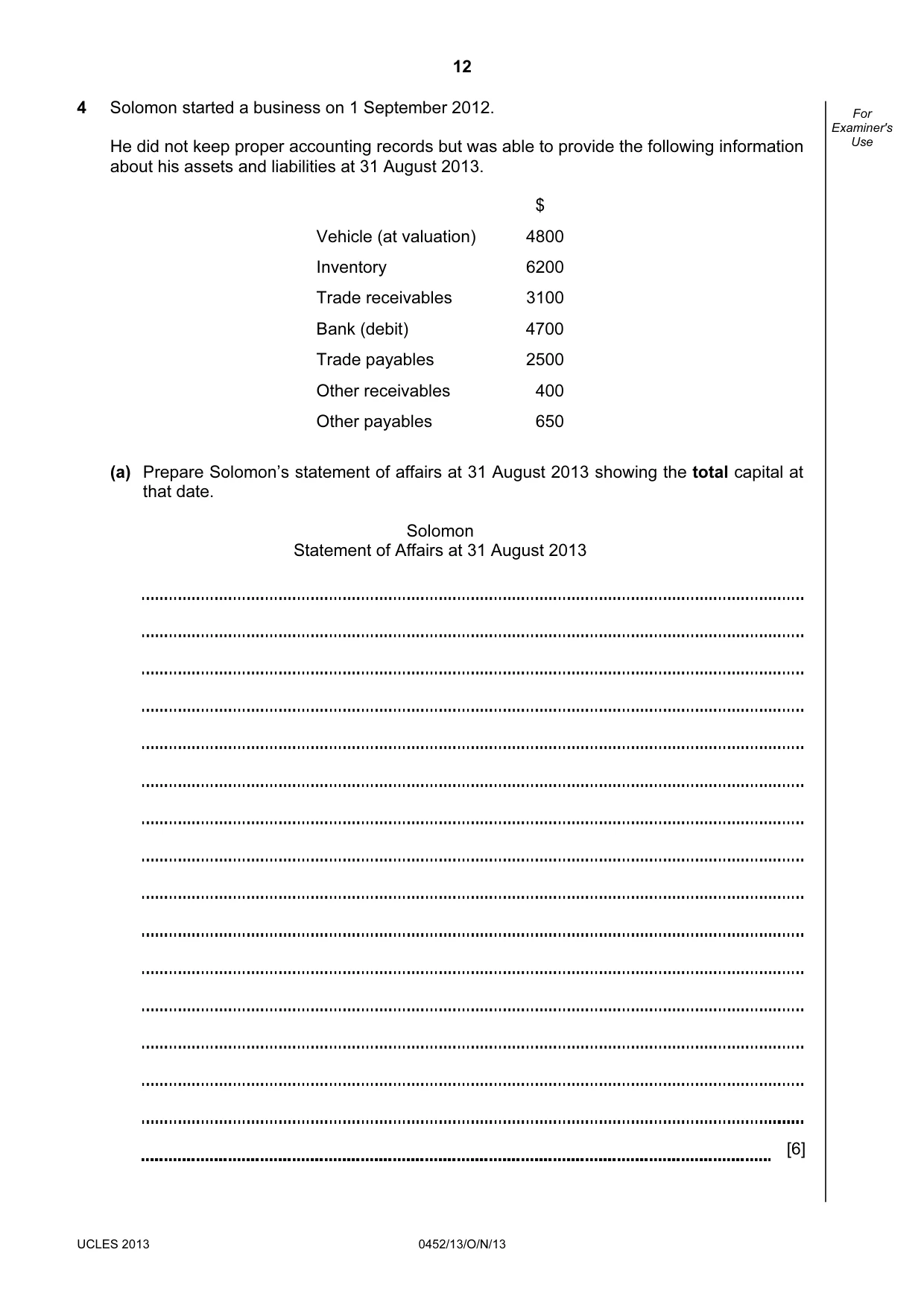
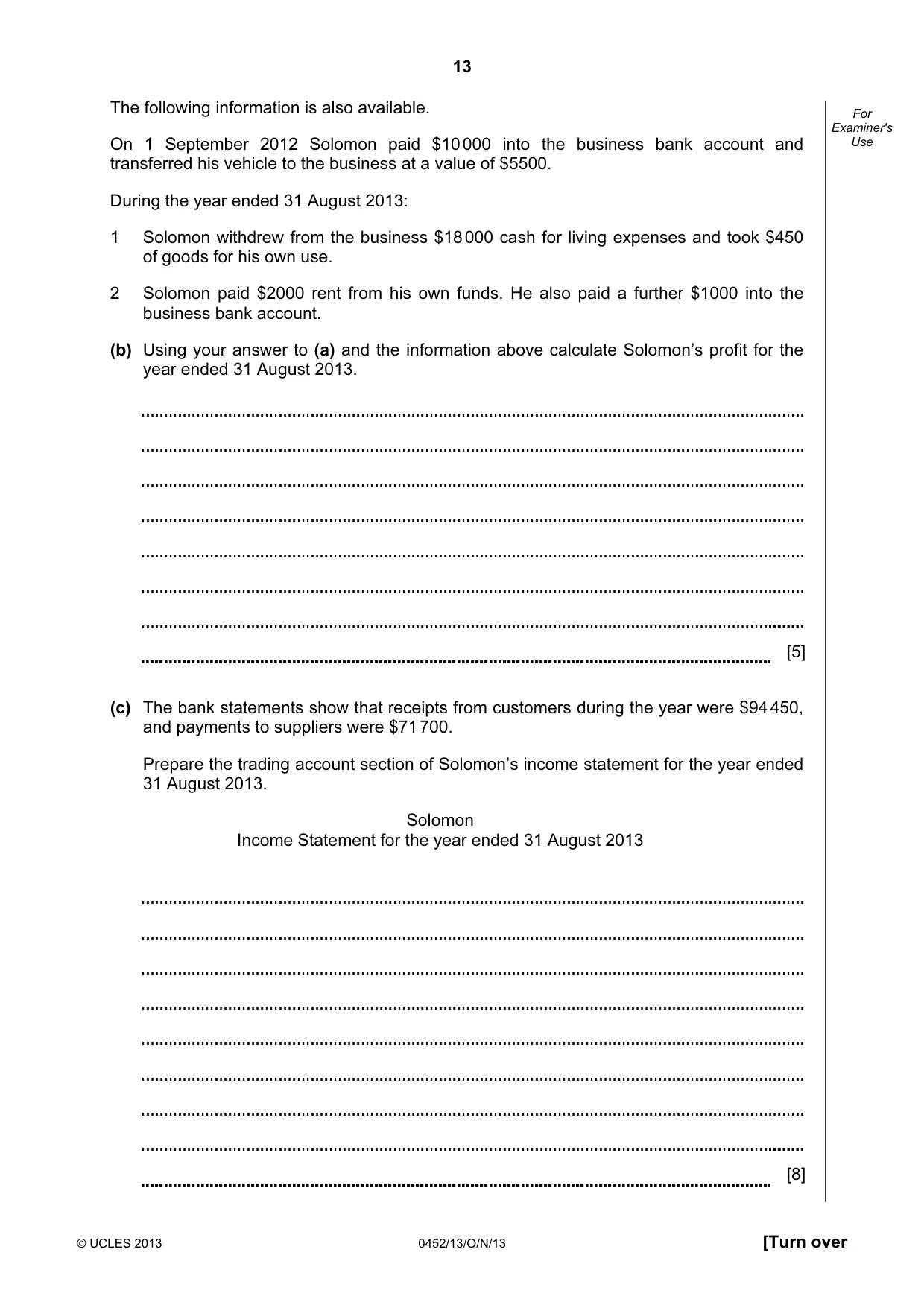
12 UCLES 2013 0452/13/O/N/13 For Examiner's Use 4 Solomon started a business on 1 September 2012. He did not keep proper accounting records but was able to provide the following information about his assets and liabilities at 31 August 2013. $ Vehicle (at valuation) 4800 Inventory 6200 Trade receivables 3100 Bank (debit) 4700 Trade payables 2500 Other receivables 400 Other payables 650 (a) Prepare Solomon’s statement of affairs at 31 August 2013 showing the total capital at that date. Solomon Statement of Affairs at 31 August 2013 [6]
Question paper, page 13
13 © UCLES 2013 0452/13/O/N/13 [Turn over For Examiner's Use The following information is also available. On 1 September 2012 Solomon paid $10 000 into the business bank account and transferred his vehicle to the business at a value of $5500. During the year ended 31 August 2013: 1 Solomon withdrew from the business $18 000 cash for living expenses and took $450 of goods for his own use. 2 Solomon paid $2000 rent from his own funds. He also paid a further $1000 into the business bank account. (b) Using your answer to (a) and the information above calculate Solomon’s profit for the year ended 31 August 2013. [5] (c) The bank statements show that receipts from customers during the year were $94 450, and payments to suppliers were $71 700. Prepare the trading account section of Solomon’s income statement for the year ended 31 August 2013. Solomon Income Statement for the year ended 31 August 2013 [8]
Question paper, page 14
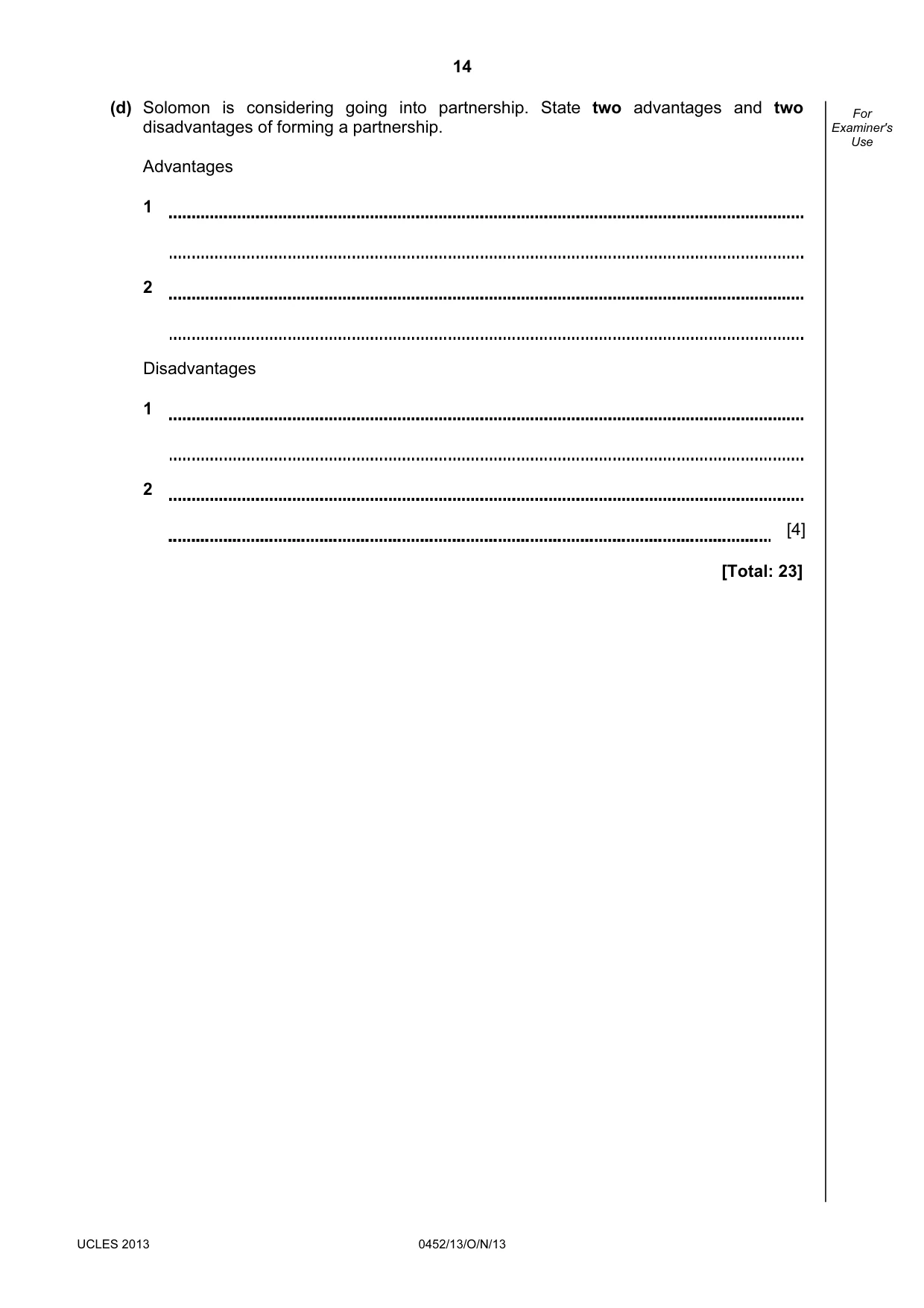
14 UCLES 2013 0452/13/O/N/13 For Examiner's Use (d) Solomon is considering going into partnership. State two advantages and two disadvantages of forming a partnership. Advantages 1 2 Disadvantages 1 2 [4] [Total: 23]
Question paper, page 15
15 © UCLES 2013 0452/13/O/N/13 [Turn over Question 5 is on the next page.
Question paper, page 16
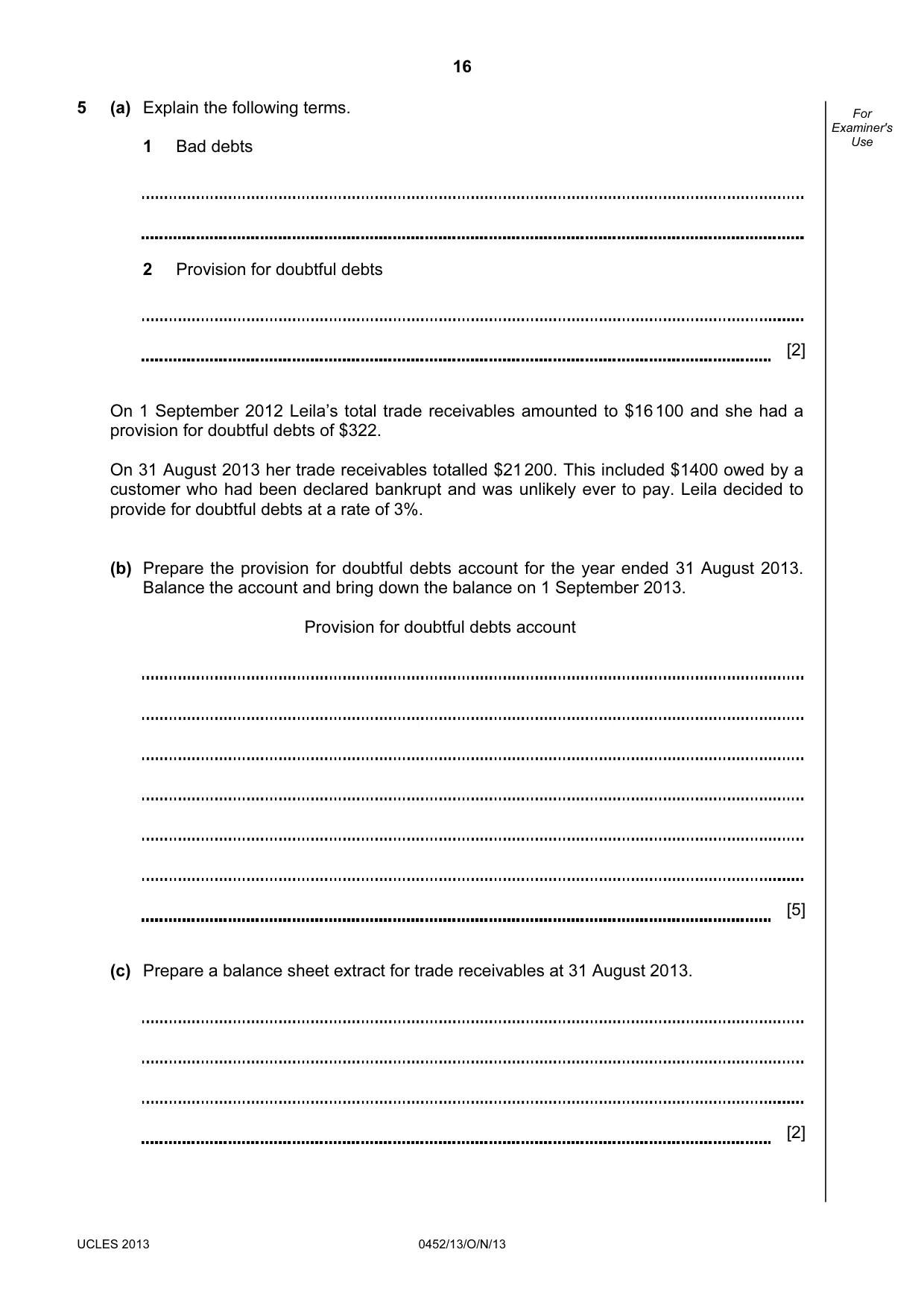
16 UCLES 2013 0452/13/O/N/13 For Examiner's Use 5 (a) Explain the following terms. 1 Bad debts 2 Provision for doubtful debts [2] On 1 September 2012 Leila’s total trade receivables amounted to $16 100 and she had a provision for doubtful debts of $322. On 31 August 2013 her trade receivables totalled $21 200. This included $1400 owed by a customer who had been declared bankrupt and was unlikely ever to pay. Leila decided to provide for doubtful debts at a rate of 3%. (b) Prepare the provision for doubtful debts account for the year ended 31 August 2013. Balance the account and bring down the balance on 1 September 2013. Provision for doubtful debts account [5] (c) Prepare a balance sheet extract for trade receivables at 31 August 2013. [2]
Question paper, page 17
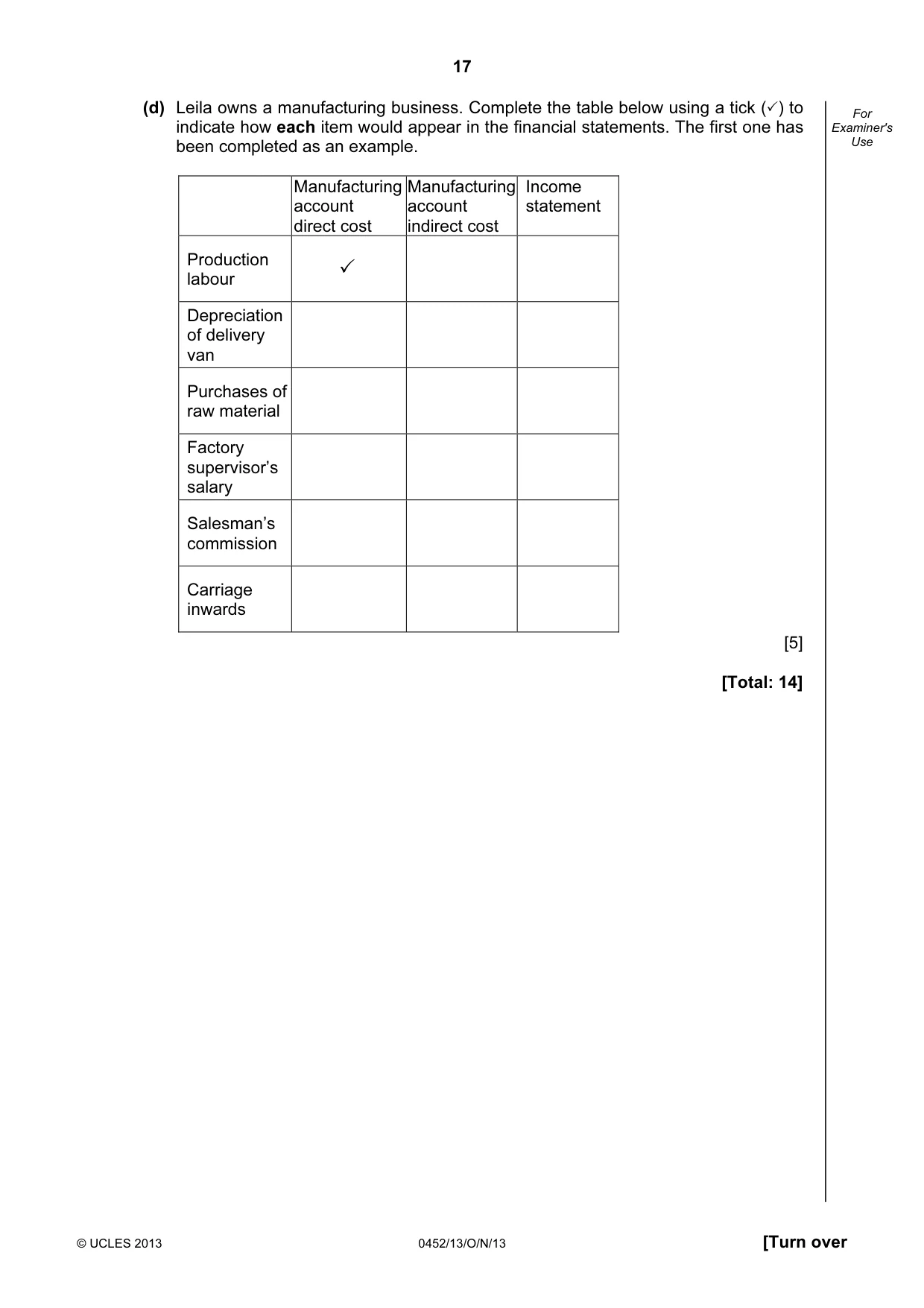
17 © UCLES 2013 0452/13/O/N/13 [Turn over For Examiner's Use (d) Leila owns a manufacturing business. Complete the table below using a tick (✓) to indicate how each item would appear in the financial statements. The first one has been completed as an example. Manufacturing account direct cost Manufacturing account indirect cost Income statement Production labour ✓ Depreciation of delivery van Purchases of raw material Factory supervisor’s salary Salesman’s commission Carriage inwards [5] [Total: 14]
Question paper, page 18
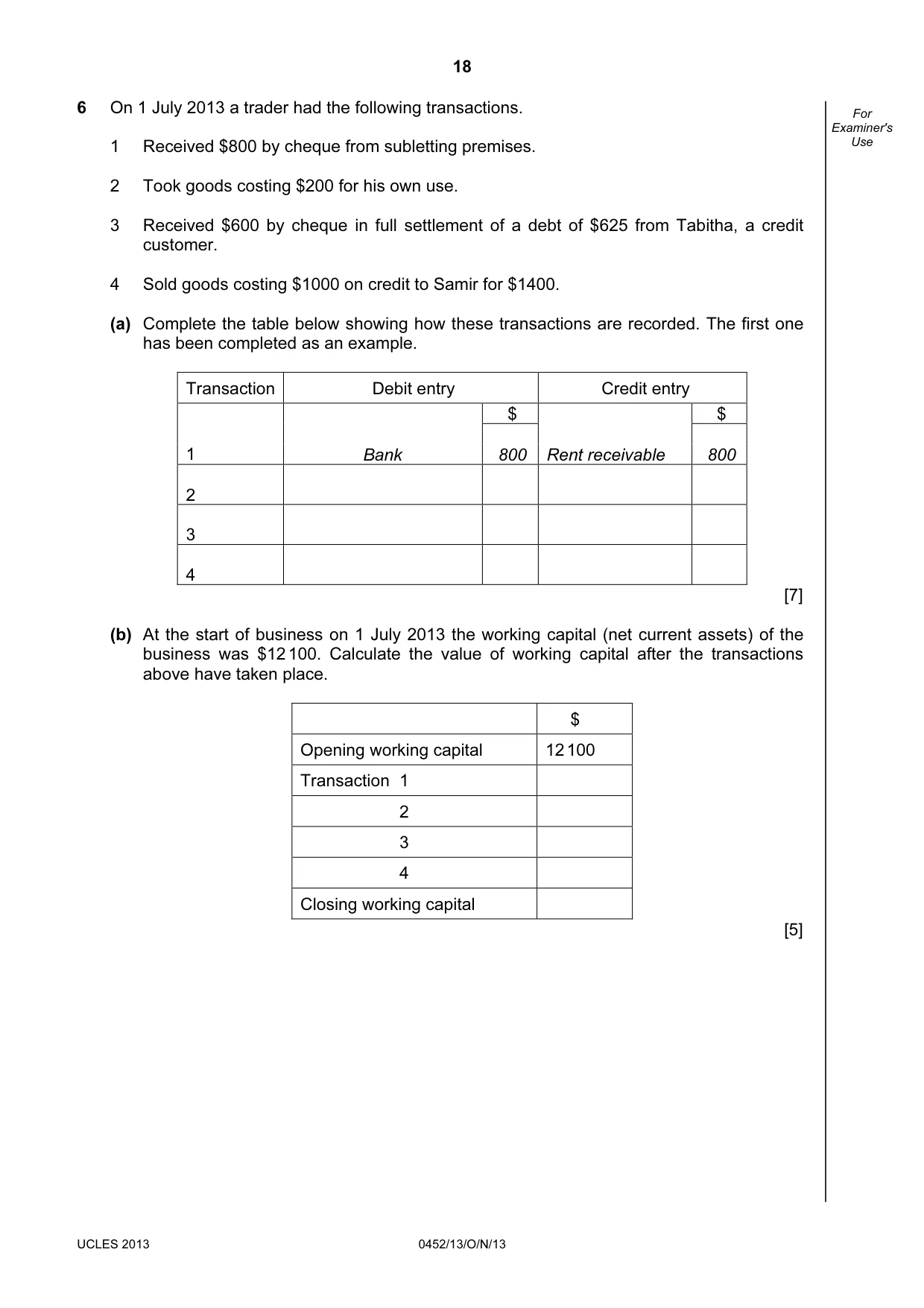
18 UCLES 2013 0452/13/O/N/13 For Examiner's Use 6 On 1 July 2013 a trader had the following transactions. 1 Received $800 by cheque from subletting premises. 2 Took goods costing $200 for his own use. 3 Received $600 by cheque in full settlement of a debt of $625 from Tabitha, a credit customer. 4 Sold goods costing $1000 on credit to Samir for $1400. (a) Complete the table below showing how these transactions are recorded. The first one has been completed as an example. Transaction Debit entry Credit entry $ $ 1 Bank 800 Rent receivable 800 2 3 4 [7] (b) At the start of business on 1 July 2013 the working capital (net current assets) of the business was $12 100. Calculate the value of working capital after the transactions above have taken place. $ Opening working capital 12 100 Transaction 1 2 3 4 Closing working capital [5]
Question paper, page 19
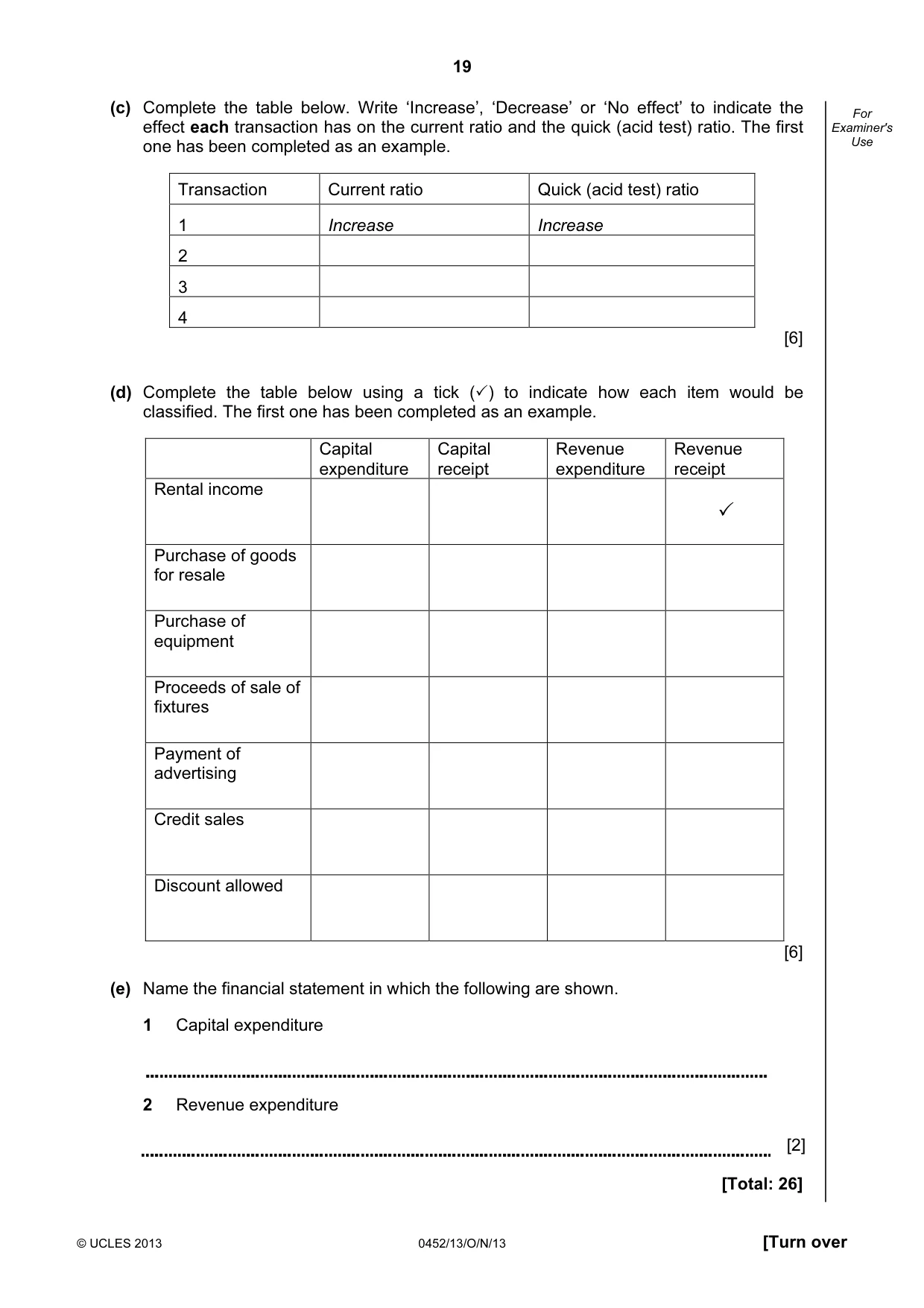
19 © UCLES 2013 0452/13/O/N/13 [Turn over For Examiner's Use (c) Complete the table below. Write ‘Increase’, ‘Decrease’ or ‘No effect’ to indicate the effect each transaction has on the current ratio and the quick (acid test) ratio. The first one has been completed as an example. Transaction Current ratio Quick (acid test) ratio 1 Increase Increase 2 3 4 [6] (d) Complete the table below using a tick (✓) to indicate how each item would be classified. The first one has been completed as an example. Capital expenditure Capital receipt Revenue expenditure Revenue receipt Rental income ✓ Purchase of goods for resale Purchase of equipment Proceeds of sale of fixtures Payment of advertising Credit sales Discount allowed [6] (e) Name the financial statement in which the following are shown. 1 Capital expenditure 2 Revenue expenditure [2] [Total: 26]
Question paper, page 20
20 Permission to reproduce items where third-party owned material protected by copyright is included has been sought and cleared where possible. Every reasonable effort has been made by the publisher (UCLES) to trace copyright holders, but if any items requiring clearance have unwittingly been included, the publisher will be pleased to make amends at the earliest possible opportunity. University of Cambridge International Examinations is part of the Cambridge Assessment Group. Cambridge Assessment is the brand name of University of Cambridge Local Examinations Syndicate (UCLES), which is itself a department of the University of Cambridge. © UCLES 2013 0452/13/O/N/13 BLANK PAGE
Mark scheme, page 1
CAMBRIDGE INTERNATIONAL EXAMINATIONS International General Certificate of Secondary Education MARK SCHEME for the October/November 2013 series 0452 ACCOUNTING 0452/13 Paper 1, maximum raw mark 120 This mark scheme is published as an aid to teachers and candidates, to indicate the requirements of the examination. It shows the basis on which Examiners were instructed to award marks. It does not indicate the details of the discussions that took place at an Examiners’ meeting before marking began, which would have considered the acceptability of alternative answers. Mark schemes should be read in conjunction with the question paper and the Principal Examiner Report for Teachers. Cambridge will not enter into discussions about these mark schemes. Cambridge is publishing the mark schemes for the October/November 2013 series for most IGCSE, GCE Advanced Level and Advanced Subsidiary Level components and some Ordinary Level components.
Mark scheme, page 2
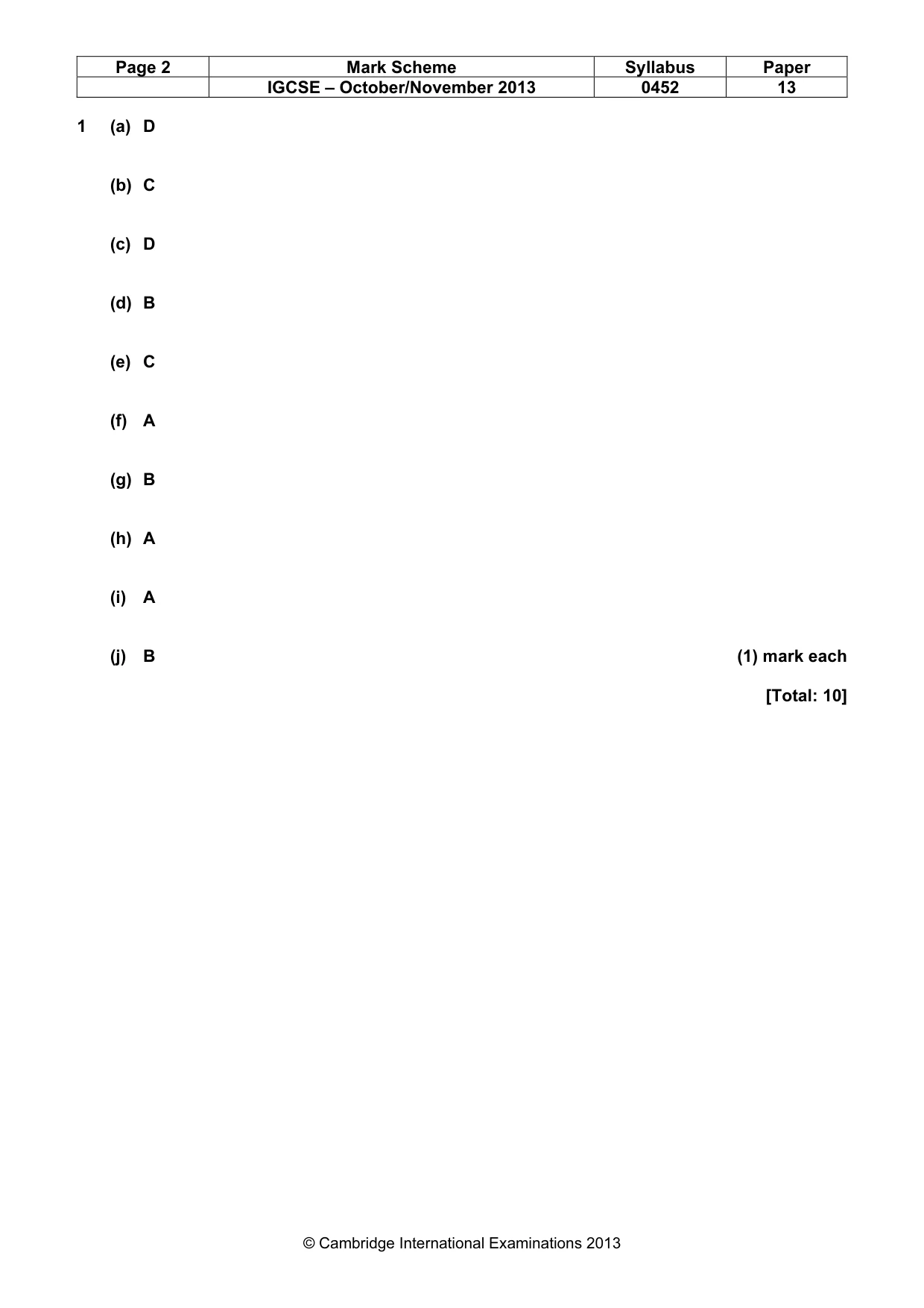
Page 2 Mark Scheme Syllabus Paper IGCSE – October/November 2013 0452 13 © Cambridge International Examinations 2013 1 (a) D (b) C (c) D (d) B (e) C (f) A (g) B (h) A (i) A (j) B (1) mark each [Total: 10]
Mark scheme, page 3
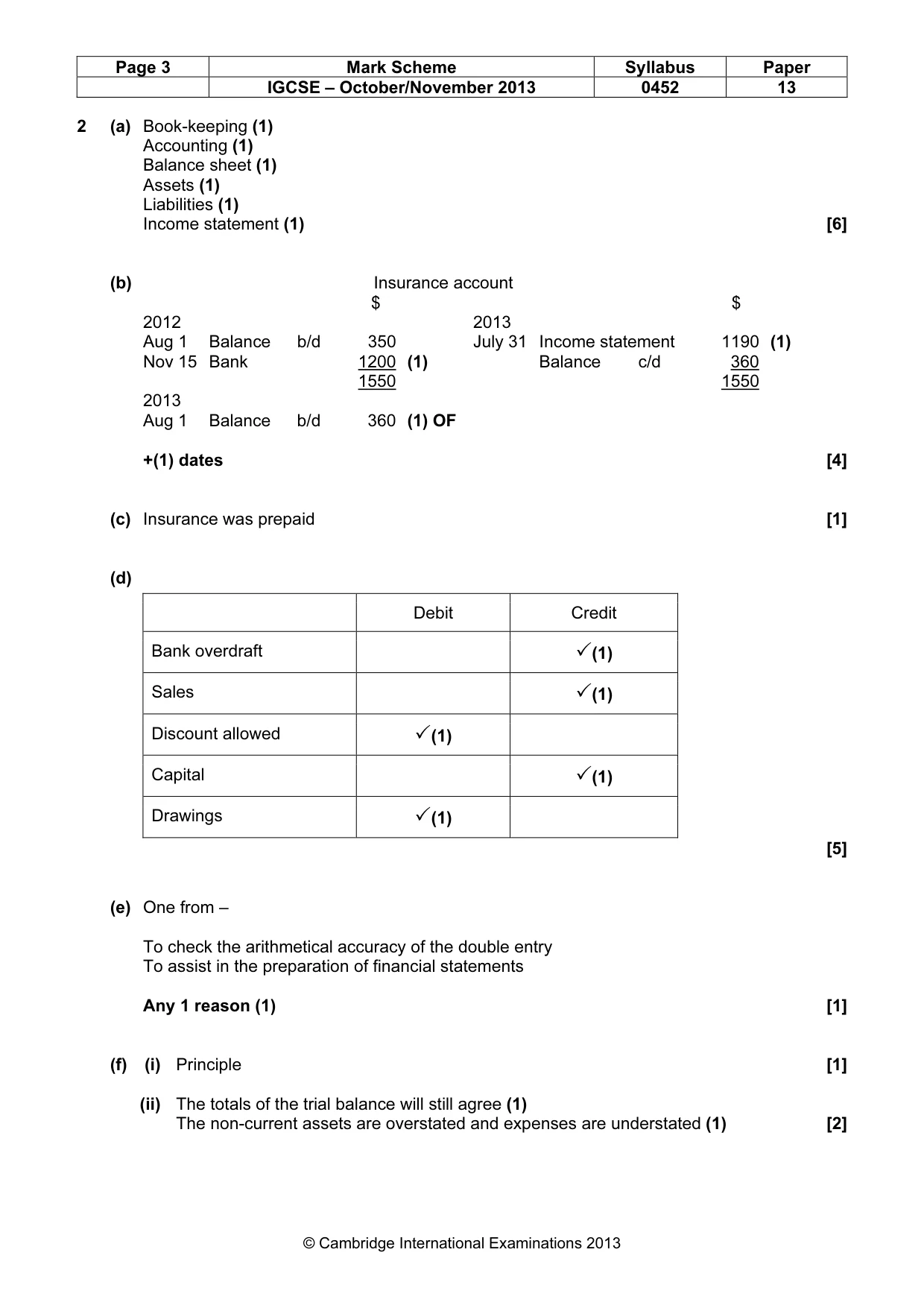
Page 3 Mark Scheme Syllabus Paper IGCSE – October/November 2013 0452 13 © Cambridge International Examinations 2013 2 (a) Book-keeping (1) Accounting (1) Balance sheet (1) Assets (1) Liabilities (1) Income statement (1) [6] (b) Insurance account $ $ 2012 2013 Aug 1 Balance b/d 350 July 31 Income statement 1190 (1) Nov 15 Bank 1200 (1) Balance c/d 360 1550 1550 2013 Aug 1 Balance b/d 360 (1) OF +(1) dates [4] (c) Insurance was prepaid [1] (d) Debit Credit Bank overdraft ✓(1) Sales ✓(1) Discount allowed ✓(1) Capital ✓(1) Drawings ✓(1) [5] (e) One from – To check the arithmetical accuracy of the double entry To assist in the preparation of financial statements Any 1 reason (1) [1] (f) (i) Principle [1] (ii) The totals of the trial balance will still agree (1) The non-current assets are overstated and expenses are understated (1) [2]
Mark scheme, page 4
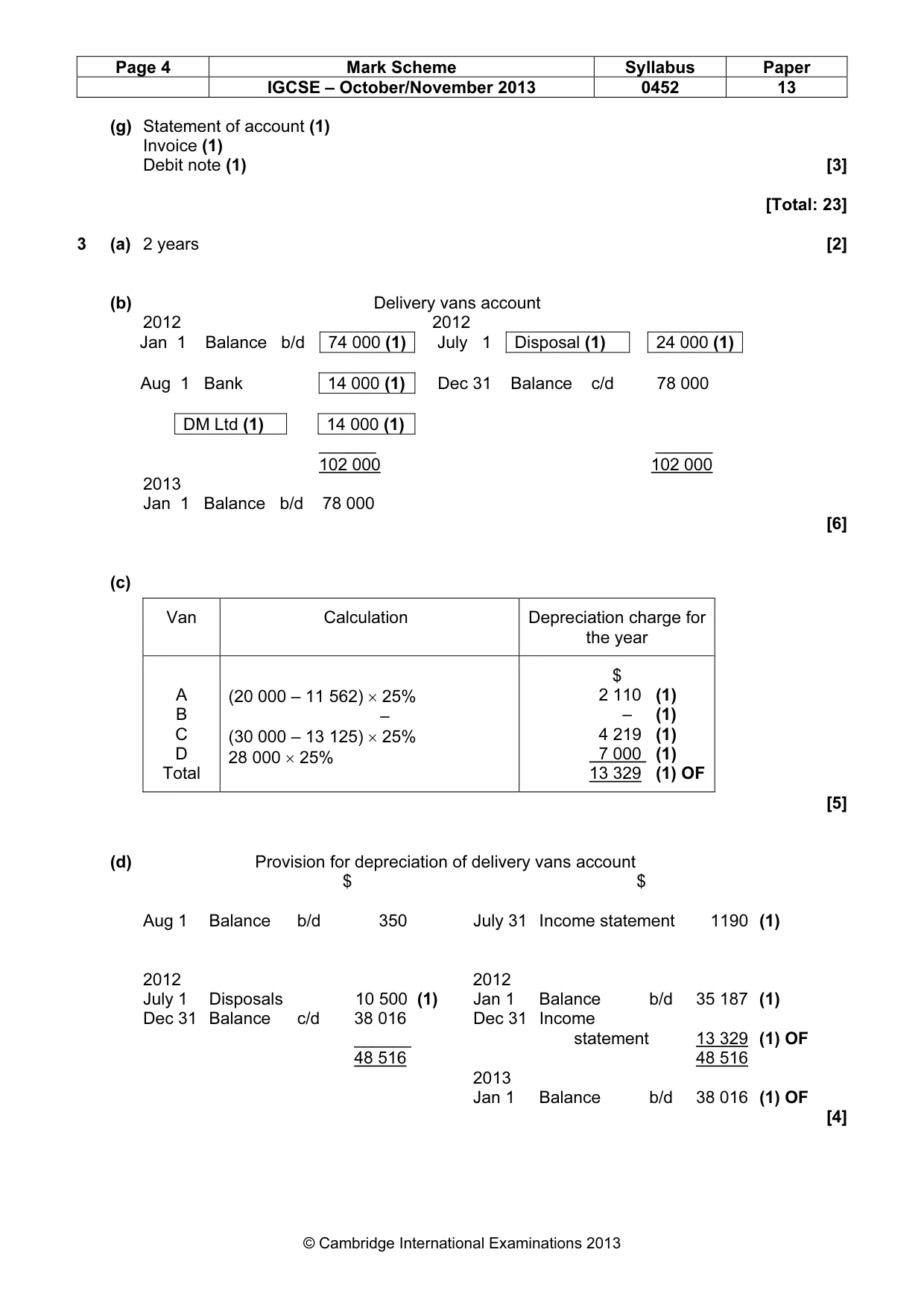
Page 4 Mark Scheme Syllabus Paper IGCSE – October/November 2013 0452 13 © Cambridge International Examinations 2013 (g) Statement of account (1) Invoice (1) Debit note (1) [3] [Total: 23] 3 (a) 2 years [2] (b) Delivery vans account 2012 2012 Jan 1 Balance b/d 74 000 (1) July 1 Disposal (1) 24 000 (1) Aug 1 Bank 14 000 (1) Dec 31 Balance c/d 78 000 DM Ltd (1) 14 000 (1) ______ ______ 102 000 102 000 2013 Jan 1 Balance b/d 78 000 [6] (c) Van Calculation Depreciation charge for the year A B C D Total (20 000 – 11 562) × 25% – (30 000 – 13 125) × 25% 28 000 × 25% $ 2 110 (1) – (1) 4 219 (1) 7 000 (1) 13 329 (1) OF [5] (d) Provision for depreciation of delivery vans account $ $ Aug 1 Balance b/d 350 July 31 Income statement 1190 (1) 2012 2012 July 1 Disposals 10 500 (1) Jan 1 Balance b/d 35 187 (1) Dec 31 Balance c/d 38 016 Dec 31 Income ______ statement 13 329 (1) OF 48 516 48 516 2013 Jan 1 Balance b/d 38 016 (1) OF [4]
Mark scheme, page 5
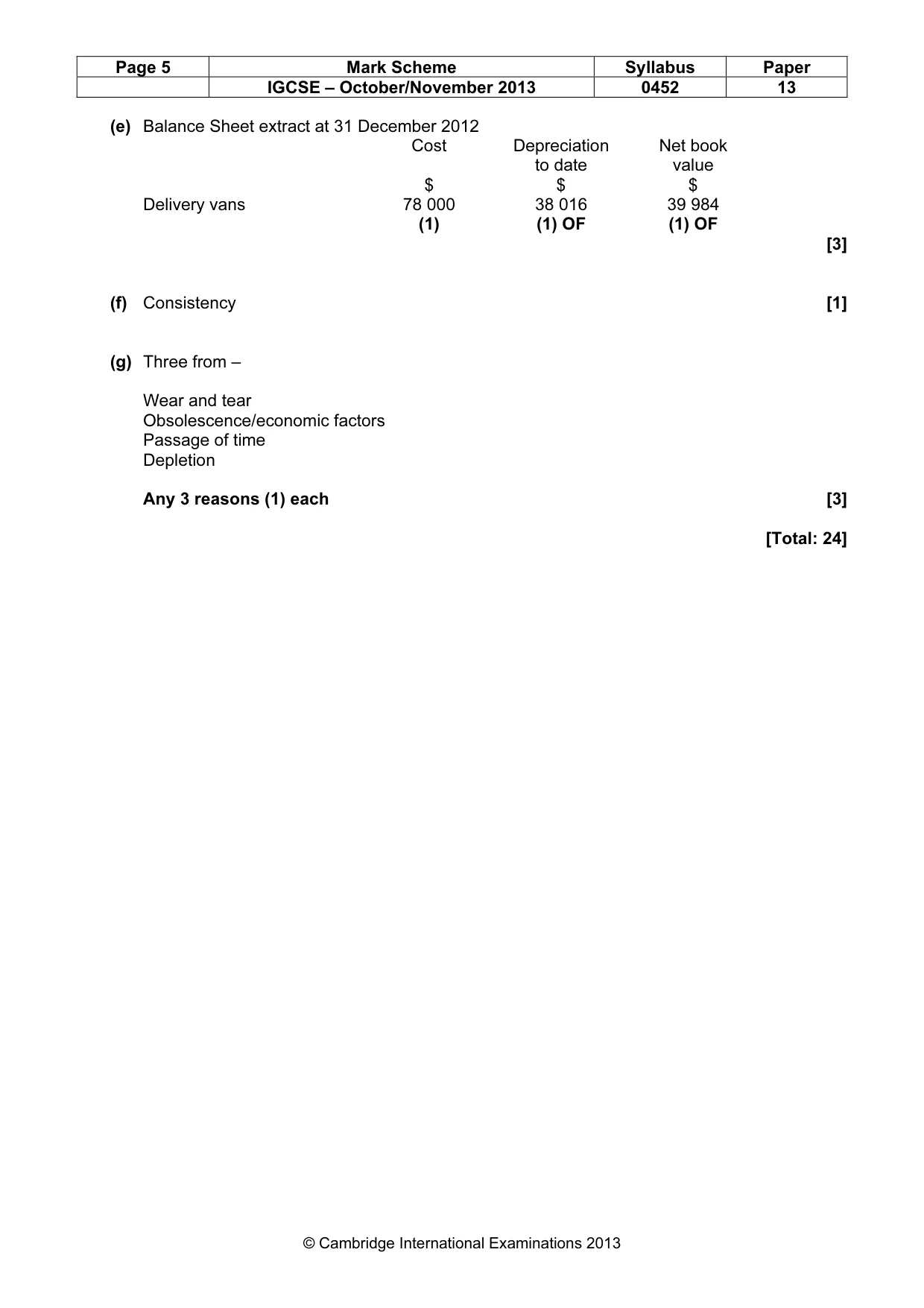
Page 5 Mark Scheme Syllabus Paper IGCSE – October/November 2013 0452 13 © Cambridge International Examinations 2013 (e) Balance Sheet extract at 31 December 2012 Cost Depreciation Net book to date value $ $ $ Delivery vans 78 000 38 016 39 984 (1) (1) OF (1) OF [3] (f) Consistency [1] (g) Three from – Wear and tear Obsolescence/economic factors Passage of time Depletion Any 3 reasons (1) each [3] [Total: 24]
Mark scheme, page 6
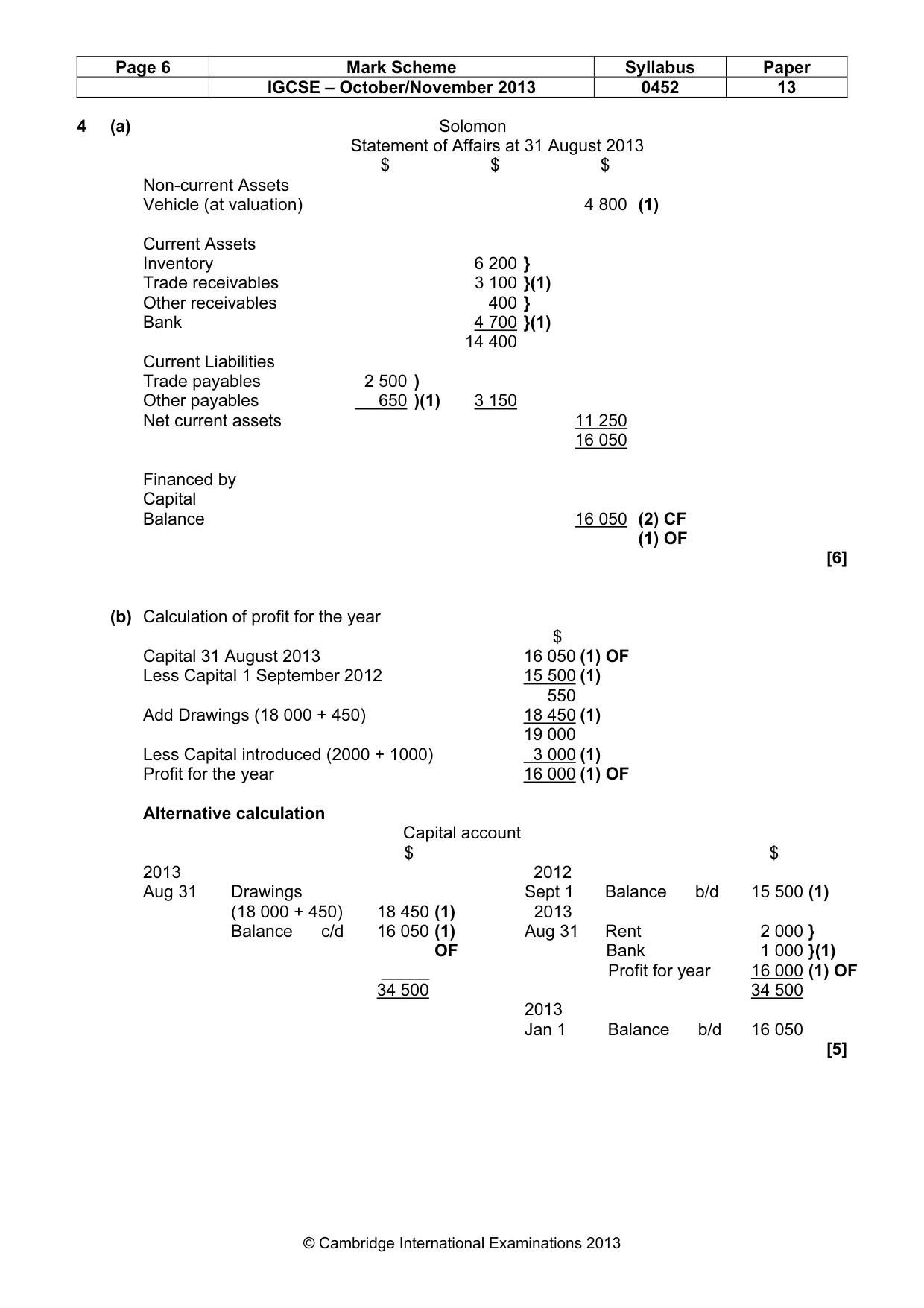
Page 6 Mark Scheme Syllabus Paper IGCSE – October/November 2013 0452 13 © Cambridge International Examinations 2013 4 (a) Solomon Statement of Affairs at 31 August 2013 $ $ $ Non-current Assets Vehicle (at valuation) 4 800 (1) Current Assets Inventory 6 200 } Trade receivables 3 100 }(1) Other receivables 400 } Bank 4 700 }(1) 14 400 Current Liabilities Trade payables 2 500 ) Other payables 650 )(1) 3 150 Net current assets 11 250 16 050 Financed by Capital Balance 16 050 (2) CF (1) OF [6] (b) Calculation of profit for the year $ Capital 31 August 2013 16 050 (1) OF Less Capital 1 September 2012 15 500 (1) 550 Add Drawings (18 000 + 450) 18 450 (1) 19 000 Less Capital introduced (2000 + 1000) 3 000 (1) Profit for the year 16 000 (1) OF Alternative calculation Capital account $ $ 2013 2012 Aug 31 Drawings Sept 1 Balance b/d 15 500 (1) (18 000 + 450) 18 450 (1) 2013 Balance c/d 16 050 (1) Aug 31 Rent 2 000 } OF Bank 1 000 }(1) _____ Profit for year 16 000 (1) OF 34 500 34 500 2013 Jan 1 Balance b/d 16 050 [5]
Mark scheme, page 7
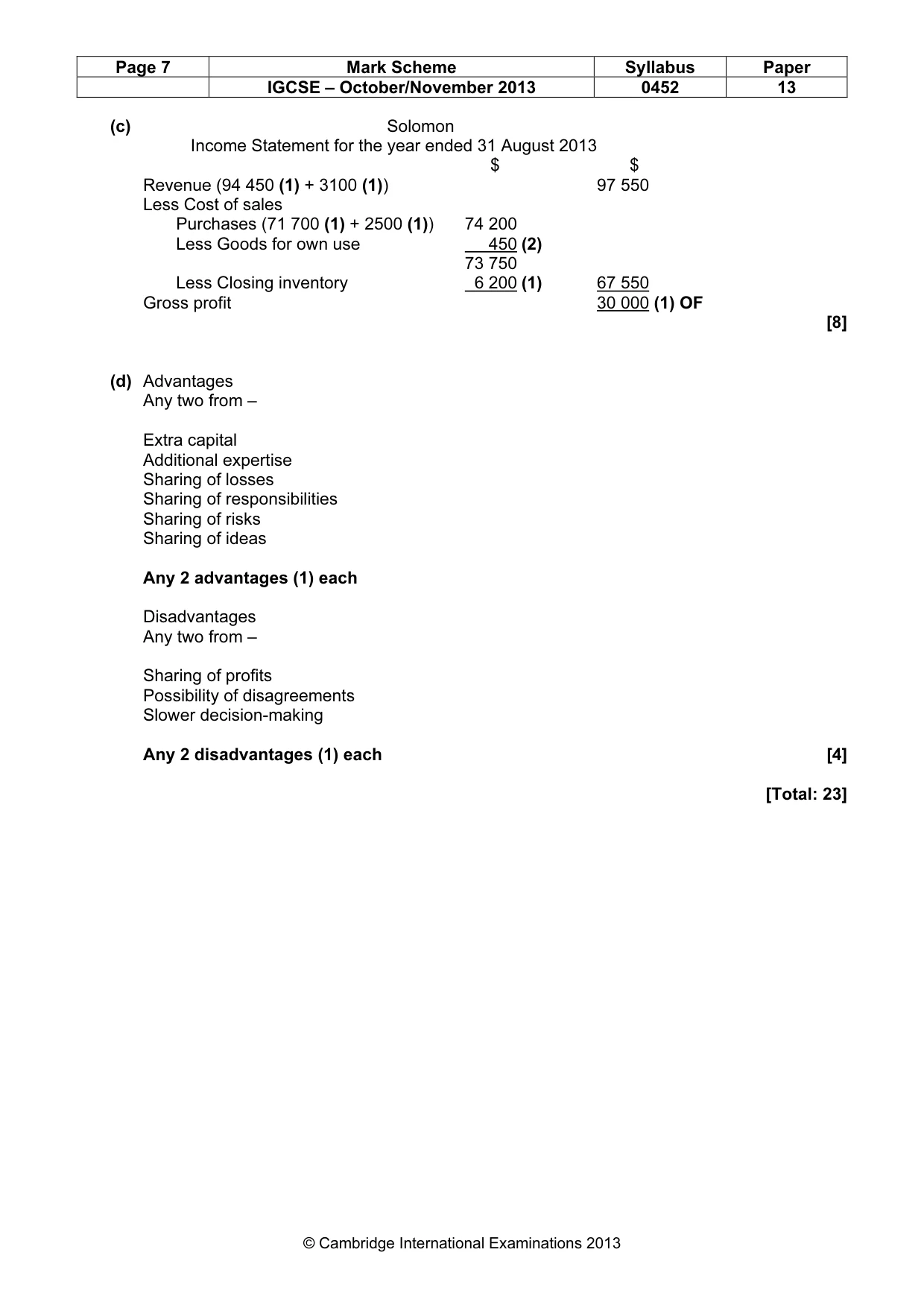
Page 7 Mark Scheme Syllabus Paper IGCSE – October/November 2013 0452 13 © Cambridge International Examinations 2013 (c) Solomon Income Statement for the year ended 31 August 2013 $ $ Revenue (94 450 (1) + 3100 (1)) 97 550 Less Cost of sales Purchases (71 700 (1) + 2500 (1)) 74 200 Less Goods for own use 450 (2) 73 750 Less Closing inventory 6 200 (1) 67 550 Gross profit 30 000 (1) OF [8] (d) Advantages Any two from – Extra capital Additional expertise Sharing of losses Sharing of responsibilities Sharing of risks Sharing of ideas Any 2 advantages (1) each Disadvantages Any two from – Sharing of profits Possibility of disagreements Slower decision-making Any 2 disadvantages (1) each [4] [Total: 23]
Mark scheme, page 8
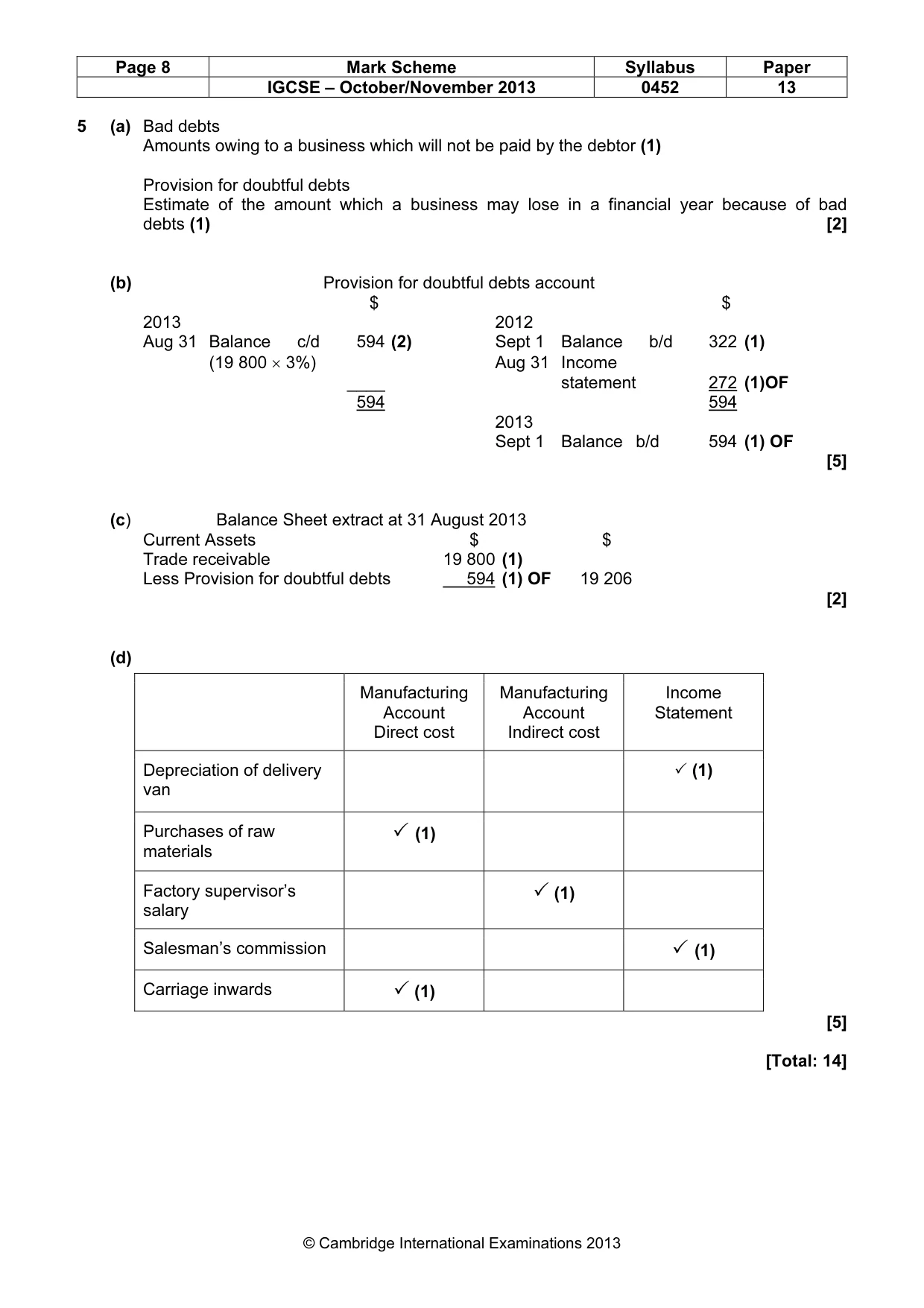
Page 8 Mark Scheme Syllabus Paper IGCSE – October/November 2013 0452 13 © Cambridge International Examinations 2013 5 (a) Bad debts Amounts owing to a business which will not be paid by the debtor (1) Provision for doubtful debts Estimate of the amount which a business may lose in a financial year because of bad debts (1) [2] (b) Provision for doubtful debts account $ $ 2013 2012 Aug 31 Balance c/d 594 (2) Sept 1 Balance b/d 322 (1) (19 800 × 3%) Aug 31 Income ____ statement 272 (1)OF 594 594 2013 Sept 1 Balance b/d 594 (1) OF [5] (c) Balance Sheet extract at 31 August 2013 Current Assets $ $ Trade receivable 19 800 (1) Less Provision for doubtful debts 594 (1) OF 19 206 [2] (d) Manufacturing Account Direct cost Manufacturing Account Indirect cost Income Statement Depreciation of delivery van ✓ (1) Purchases of raw materials ✓ (1) Factory supervisor’s salary ✓ (1) Salesman’s commission ✓ (1) Carriage inwards ✓ (1) [5] [Total: 14]
Mark scheme, page 9
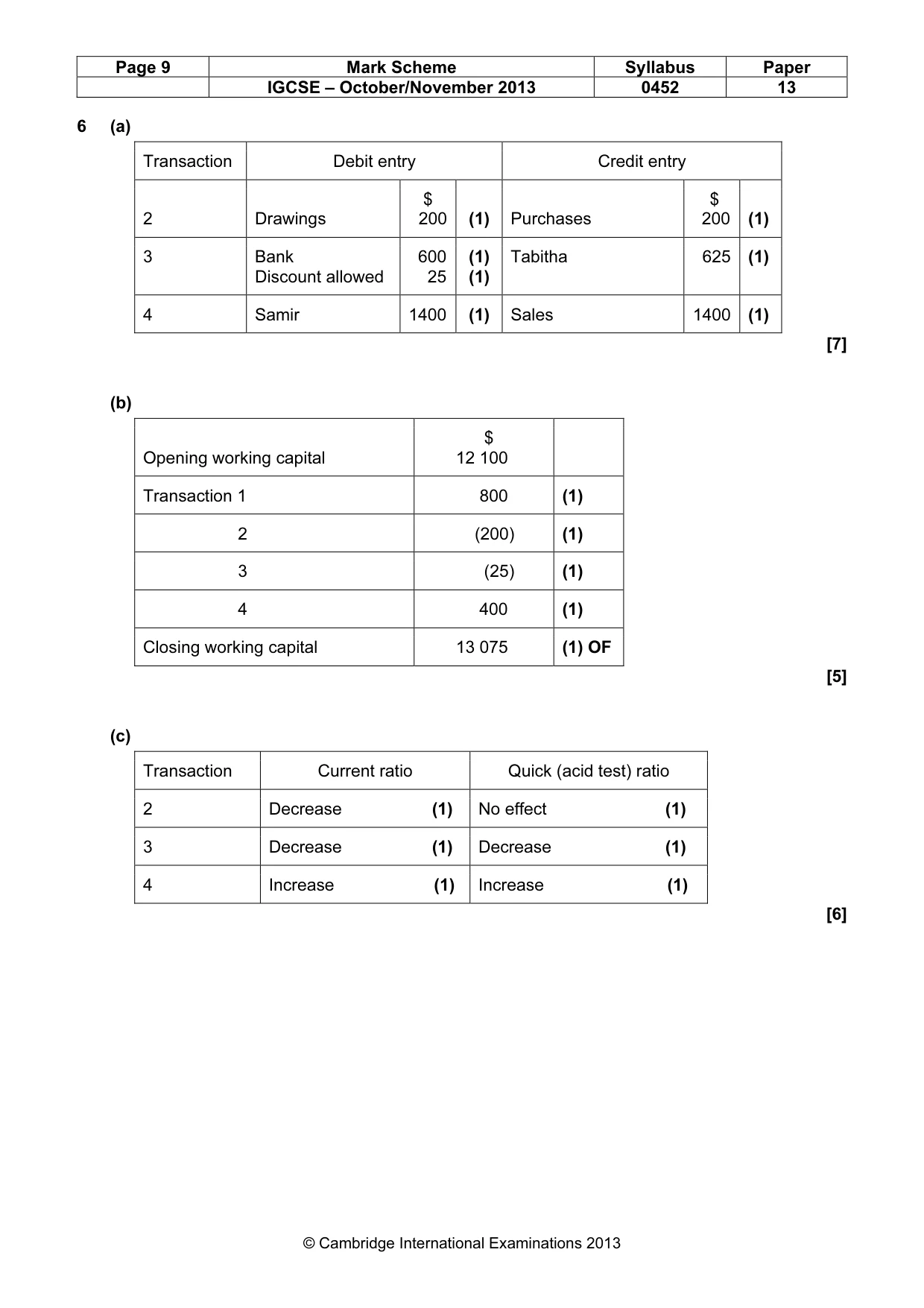
Page 9 Mark Scheme Syllabus Paper IGCSE – October/November 2013 0452 13 © Cambridge International Examinations 2013 6 (a) Transaction Debit entry Credit entry 2 Drawings $ 200 (1) Purchases $ 200 (1) 3 Bank Discount allowed 600 25 (1) (1) Tabitha 625 (1) 4 Samir 1400 (1) Sales 1400 (1) [7] (b) Opening working capital $ 12 100 Transaction 1 800 (1) 2 (200) (1) 3 (25) (1) 4 400 (1) Closing working capital 13 075 (1) OF [5] (c) Transaction Current ratio Quick (acid test) ratio 2 Decrease (1) No effect (1) 3 Decrease (1) Decrease (1) 4 Increase (1) Increase (1) [6]
Mark scheme, page 10
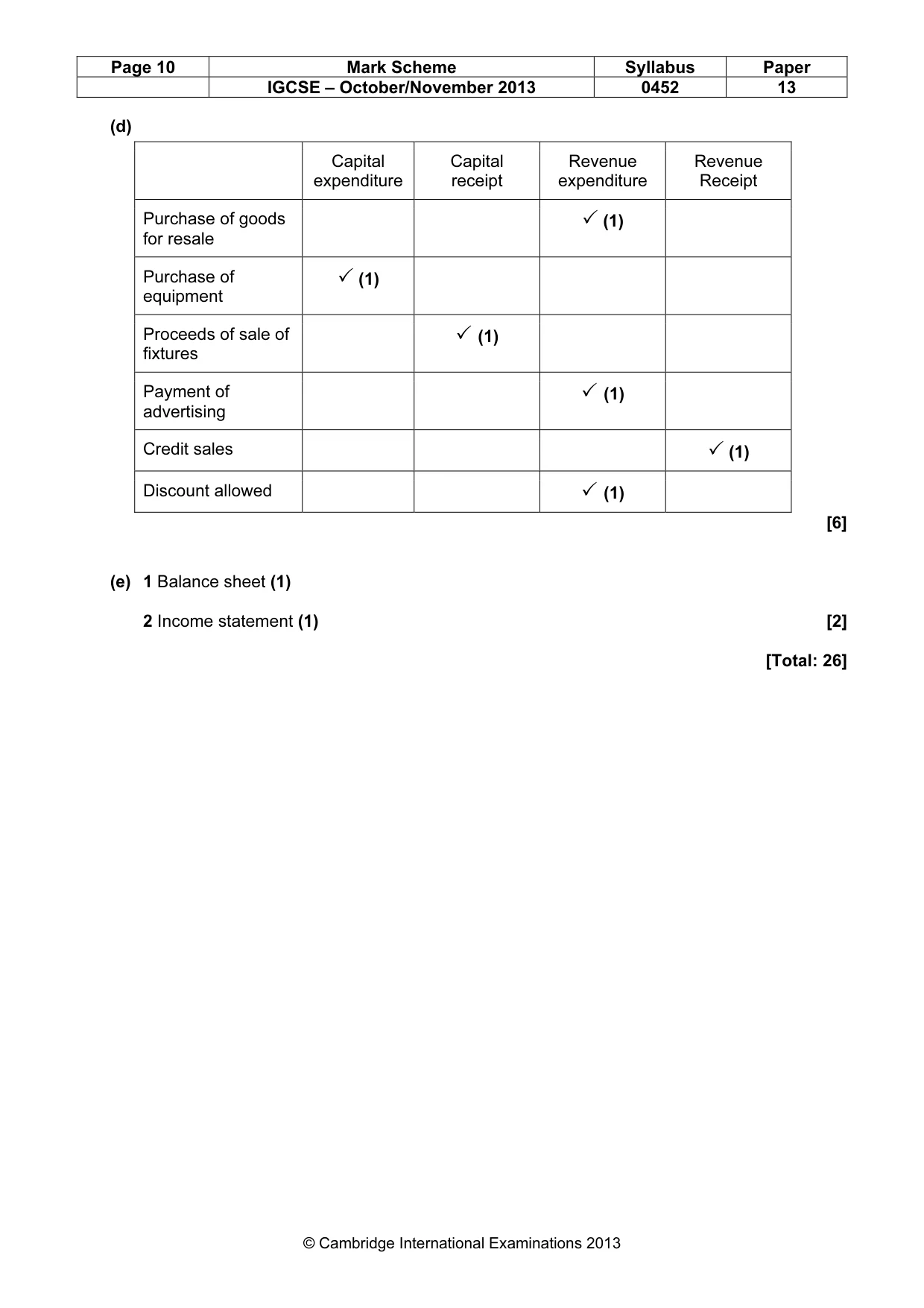
Page 10 Mark Scheme Syllabus Paper IGCSE – October/November 2013 0452 13 © Cambridge International Examinations 2013 (d) Capital expenditure Capital receipt Revenue expenditure Revenue Receipt Purchase of goods for resale ✓ (1) Purchase of equipment ✓ (1) Proceeds of sale of fixtures ✓ (1) Payment of advertising ✓ (1) Credit sales ✓ (1) Discount allowed ✓ (1) [6] (e) 1 Balance sheet (1) 2 Income statement (1) [2] [Total: 26]
What you needed in this session
Cambridge’s own grade thresholds for 2013 Oct/Nov, Paper 1 · Variant 3. A higher threshold means an easier paper — the bar moves with how the cohort did.