Cambridge A Level Thinking Skills 9694 — 2025 May/June Paper 4 · Variant 3
9694/43/M/J/25 · 50 marks · ≈56 min
The question paper and its mark scheme, free to read here and free to download. This is Cambridge’s own paper, exactly as it was sat.
Question paper8 pages

Mark scheme16 pages
Answers below. Sit the paper first if you are practising.
Paper as text
Question paper, page 1
This document has 8 pages. Any blank pages are indicated. [Turn over Cambridge International AS & A Level THINKING SKILLS 9694/43 Paper 4 Applied Reasoning May/June 2025 1 hour 45 minutes You must answer on the enclosed answer booklet. You will need: Answer booklet (enclosed) INSTRUCTIONS ● Answer all questions. ● Follow the instructions on the front cover of the answer booklet. If you need additional answer paper, ask the invigilator for a continuation booklet. INFORMATION ● The total mark for this paper is 50. ● The number of marks for each question or part question is shown in brackets [ ]. * 1 9 8 1 6 3 3 8 7 8 * DC (JP) 356342 © UCLES 2025
Question paper, page 2
2 9694/43/M/J/25 © UCLES 2025 Questions 1 and 2 refer to Document 1. 1 (a) State the main conclusion of the argument. [1] (b) Identify two intermediate conclusions in paragraphs 5 to 6. [2] (c) Analyse the structure of the reasoning in paragraph 3. [5] (d) Identify one unstated assumption in paragraph 7 upon which the reasoning relies. [1] 2 (a) Identify and explain three flaws and/or weaknesses in the reasoning in paragraphs 4 to 6. [6] (b) Explain how the reasoning in paragraph 2 is weakened by the flaw of invalid deduction. [2] 3 (a) ‘Americans find studying history is more valuable than studying science.’ (Document 4A) Explain why this conclusion cannot be drawn from the data collected by the survey described in Document 4A. [2] (b) ‘Studying history gives you more earning power than studying biology.’ (Document 4B) Identify four weaknesses in the support given by the graph in Document 4B to this claim. [4] 4 You are advised to spend some time planning your answer before you begin to write it. ‘History should not be taught at school.’ Construct a reasoned argument to support or challenge this claim. Your argument should: • have a clear structure and make use of various argument elements • use and evaluate evidence from Documents 1 to 5 • respond to significant counter-positions. [27]
Question paper, page 3
3 9694/43/M/J/25 © UCLES 2025 [Turn over DOCUMENT 1 The dangers of ‘history’ 1 Most schools teach history as a regular part of the curriculum, and the wisdom of the subject’s existence in schools is rarely commented upon. However, while there might be a case for learning history as an adult or at university, history should not be taught in schools. 2 If the lessons students receive are presented in a fair and balanced way, then they will leave school with a fair and balanced view of the world. However, history lessons are inevitably tainted with the teachers’ own biases and preconceptions. It is easy to imagine teachers with differing political views presenting the history of the Russian revolution to children in different ways. So the teaching of history means young people do not leave school with a fair and balanced view of the world. 3 Young people are very interested in historical battles and they are also very impressionable. As a consequence, children can become obsessed with historical conflicts. Destructive thoughts can last for years. So history teaching leads to destructive behaviours, like discrimination, hatred, and violence. 4 History can lead to wars, because courses deliberately present a version of history designed to promote nationalism. Many countries, including France, Hungary, Ireland, Japan, the Netherlands, New Zealand, Portugal, Singapore, the UK, and most US states, have what amounts to a ‘national curriculum’ that schools must follow. Uncomfortable aspects of a nation’s past are often avoided in favour of events that engender national pride, like military victories and great inventions. 5 History lessons present oversimplified information, partly so that young children can understand it, but also because of the limited teaching time – school history is often described as ‘some dates and who won what battle’. Schoolchildren regard historical ‘facts’ as being equivalent to the facts they encounter in mathematics and science. So the inclusion of history in a school curriculum can be intellectually dangerous, because people who study history at school may learn to treat questionable information as truth. 6 In my biology class, I once taught an intelligent, hardworking student called Alison. She went to a top university to study history. I met her after she graduated from university, when she was working in a café for the minimum wage. So studying history at school ruins your employment prospects. 7 Anyway, studying history takes time away from the really useful subjects, like maths and science. We need more scientists and mathematicians to help us solve the big global issues, like climate change. So teaching history makes dangerous climate change more likely.
Question paper, page 4
4 9694/43/M/J/25 © UCLES 2025 DOCUMENT 2 Why Study History? In answer to the question, ‘Why study history?’, one could do worse than to ask some historians, those fearless explorers of the past who give our lives some context. Arthur Marwick, Professor of History at the Open University, once suggested that people try to imagine what everyday life would be like in a society in which no one knew any history, stating that ‘It is only through knowledge of its history that a society can have knowledge of itself’. In the 1960s, historian EH Carr wrote, ‘We can fully understand the present only in the light of the past.’ Having an educated view on matters of public concern is fundamental to democracy, whether one is involved in a political party, casting a vote in an election or discussing politics with friends. In order to function effectively, representative democracy needs an electorate that has a certain level of relevant knowledge, understanding and critical thinking. Studying history trains the mind, increases empathy and provides a necessary historical perspective from which to view the most pressing problems of our time. A lack of historical understanding in society can have negative effects for democratic decision-making. Another historian once stated, ‘Time and again, complex policy issues are placed before the public without adequate explanation of how they have come to assume their present shape, and without any hint of the possibilities which are disclosed by the record of the past.’ The school history lesson is a fertile ground for the development of a host of transferrable skills. Students must use memory, imagination, reasoning power and judgment while collecting, examining, weighing and evaluating evidence before drawing conclusions, forming opinions and then communicating those opinions clearly and convincingly to others. The study of history equips children with these indispensable job-related and life-related skills. History fires students’ curiosity about the past, in their own country and in the wider world. They learn how the past influences the present and what beliefs and cultures have influenced people’s actions. While learning about history, students develop a time-framework for the world they live in. They see the diversity of human experience, which helps them understand more about themselves as individuals and members of society. What they learn in history lessons can influence their attitudes and values in later life. TV history presenter and History Professor, Simon Schama, thinks that it is particularly important that children learn history: ‘Unless they can be won to history, their imagination will be held hostage in the cage of eternal Now: the flickering instant that’s gone as soon as it has arrived.’
Question paper, page 5
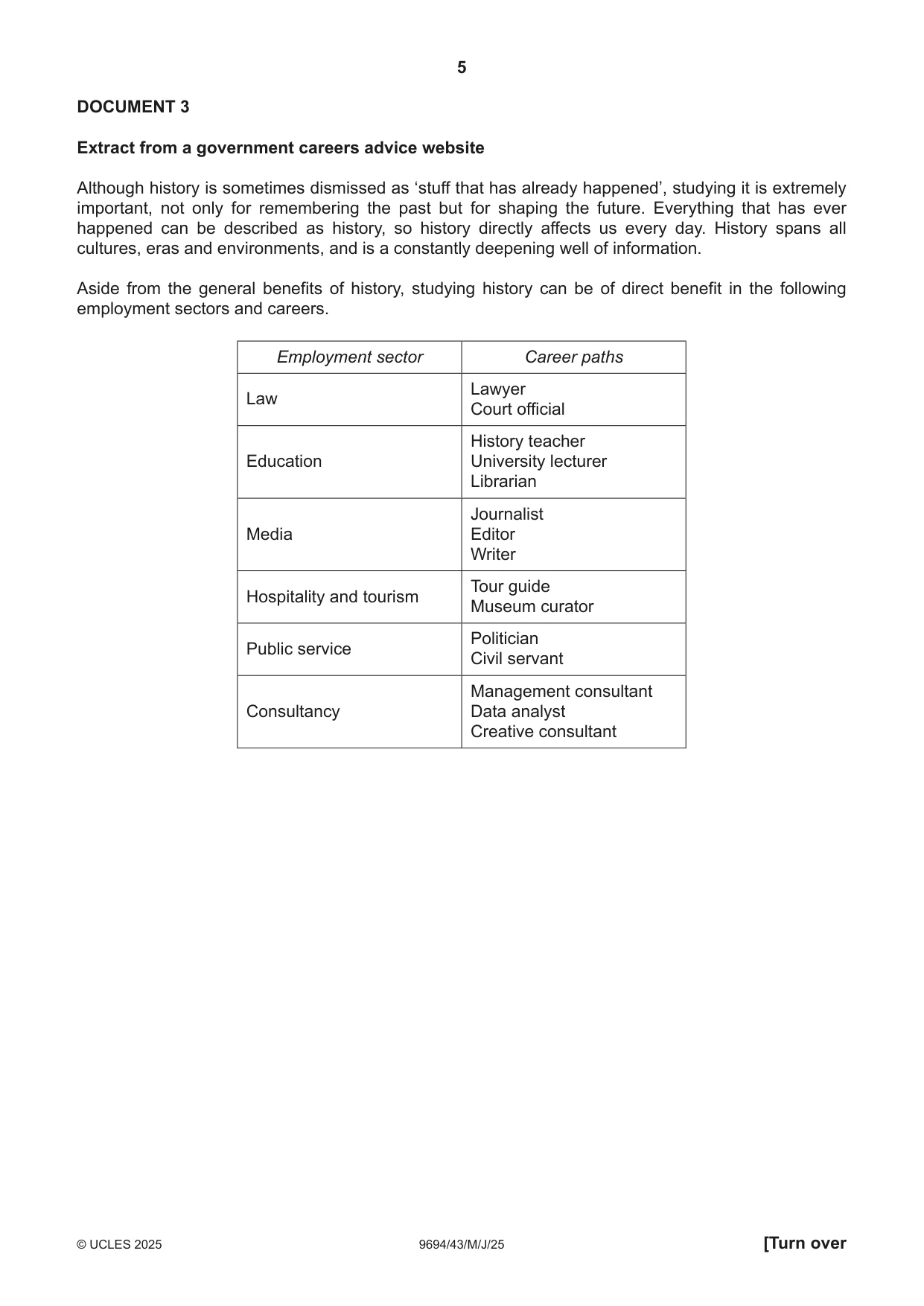
5 9694/43/M/J/25 © UCLES 2025 [Turn over DOCUMENT 3 Extract from a government careers advice website Although history is sometimes dismissed as ‘stuff that has already happened’, studying it is extremely important, not only for remembering the past but for shaping the future. Everything that has ever happened can be described as history, so history directly affects us every day. History spans all cultures, eras and environments, and is a constantly deepening well of information. Aside from the general benefits of history, studying history can be of direct benefit in the following employment sectors and careers. Employment sector Career paths Law Lawyer Court official Education History teacher University lecturer Librarian Media Journalist Editor Writer Hospitality and tourism Tour guide Museum curator Public service Politician Civil servant Consultancy Management consultant Data analyst Creative consultant
Question paper, page 6
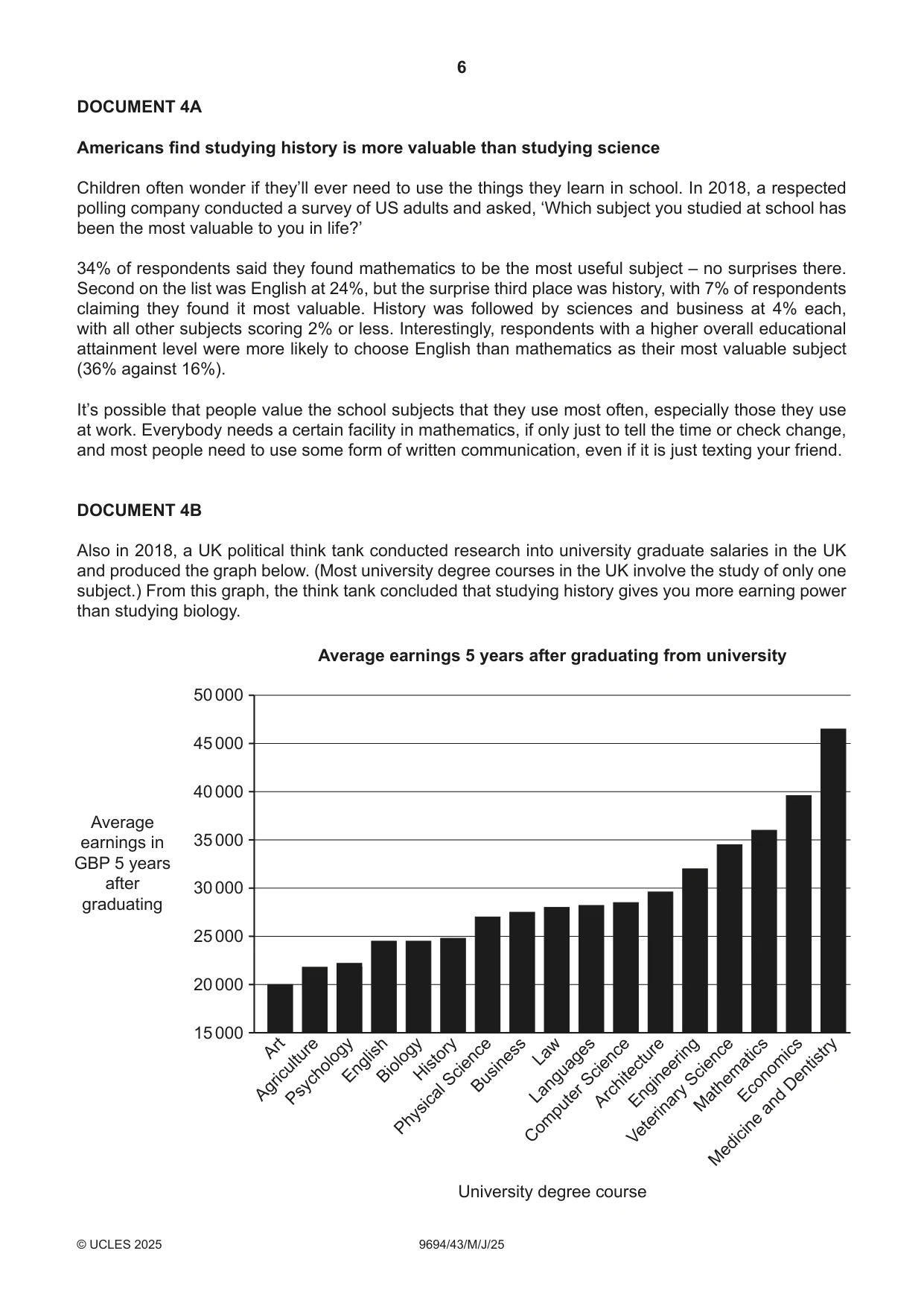
6 9694/43/M/J/25 © UCLES 2025 DOCUMENT 4A Americans find studying history is more valuable than studying science Children often wonder if they’ll ever need to use the things they learn in school. In 2018, a respected polling company conducted a survey of US adults and asked, ‘Which subject you studied at school has been the most valuable to you in life?’ 34% of respondents said they found mathematics to be the most useful subject – no surprises there. Second on the list was English at 24%, but the surprise third place was history, with 7% of respondents claiming they found it most valuable. History was followed by sciences and business at 4% each, with all other subjects scoring 2% or less. Interestingly, respondents with a higher overall educational attainment level were more likely to choose English than mathematics as their most valuable subject (36% against 16%). It’s possible that people value the school subjects that they use most often, especially those they use at work. Everybody needs a certain facility in mathematics, if only just to tell the time or check change, and most people need to use some form of written communication, even if it is just texting your friend. DOCUMENT 4B Also in 2018, a UK political think tank conducted research into university graduate salaries in the UK and produced the graph below. (Most university degree courses in the UK involve the study of only one subject.) From this graph, the think tank concluded that studying history gives you more earning power than studying biology. 20 000 30 000 Average earnings in GBP 5 years after graduating University degree course 40 000 15 000 25 000 35 000 45 000 50 000 Art Agriculture Psychology English Biology History Physical Science Business Law Languages Computer Science Architecture Engineering Veterinary Science Mathematics Economics Medicine and Dentistry Average earnings 5 years after graduating from university
Question paper, page 7
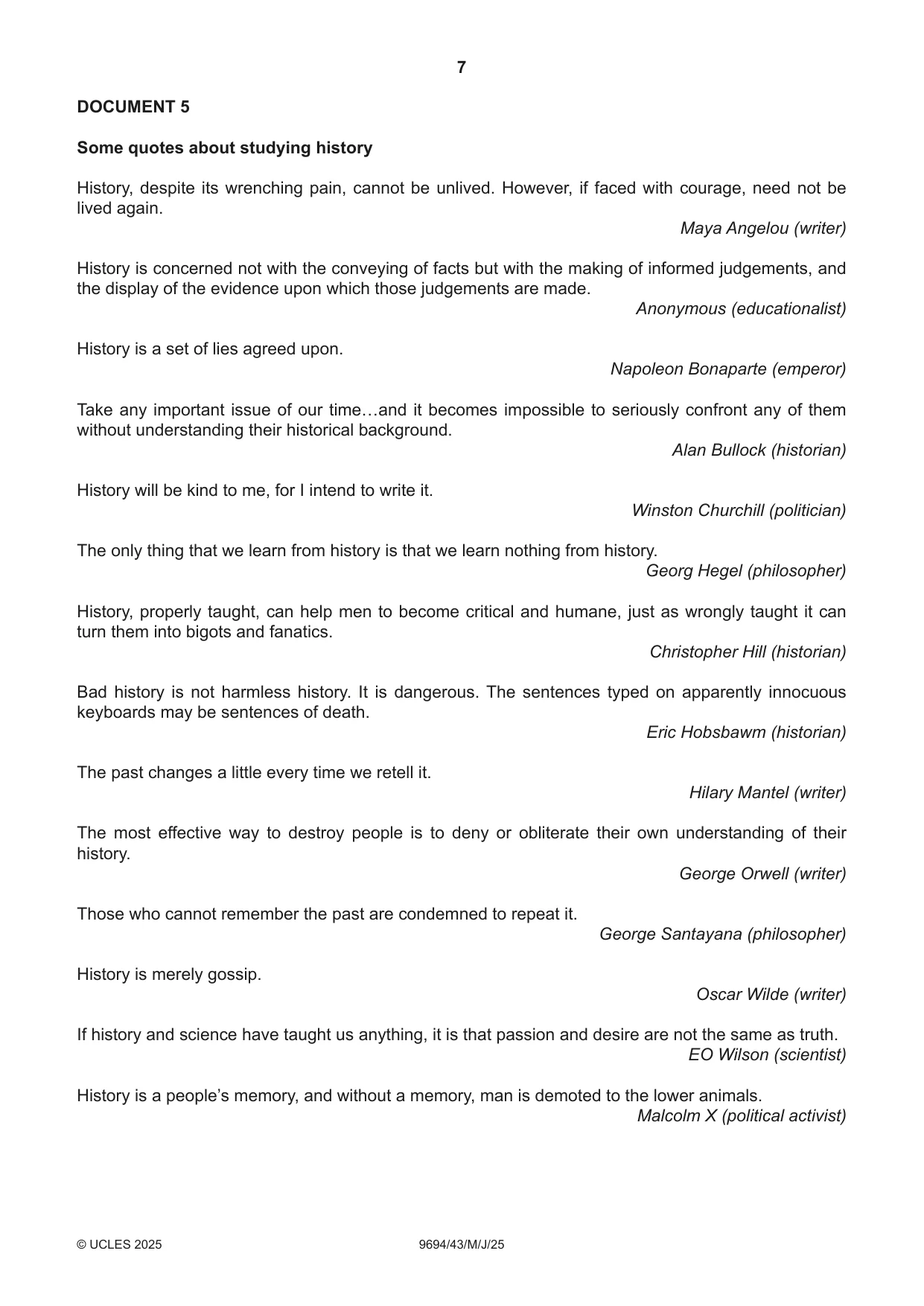
7 9694/43/M/J/25 © UCLES 2025 DOCUMENT 5 Some quotes about studying history History, despite its wrenching pain, cannot be unlived. However, if faced with courage, need not be lived again. Maya Angelou (writer) History is concerned not with the conveying of facts but with the making of informed judgements, and the display of the evidence upon which those judgements are made. Anonymous (educationalist) History is a set of lies agreed upon. Napoleon Bonaparte (emperor) Take any important issue of our time…and it becomes impossible to seriously confront any of them without understanding their historical background. Alan Bullock (historian) History will be kind to me, for I intend to write it. Winston Churchill (politician) The only thing that we learn from history is that we learn nothing from history. Georg Hegel (philosopher) History, properly taught, can help men to become critical and humane, just as wrongly taught it can turn them into bigots and fanatics. Christopher Hill (historian) Bad history is not harmless history. It is dangerous. The sentences typed on apparently innocuous keyboards may be sentences of death. Eric Hobsbawm (historian) The past changes a little every time we retell it. Hilary Mantel (writer) The most effective way to destroy people is to deny or obliterate their own understanding of their history. George Orwell (writer) Those who cannot remember the past are condemned to repeat it. George Santayana (philosopher) History is merely gossip. Oscar Wilde (writer) If history and science have taught us anything, it is that passion and desire are not the same as truth. EO Wilson (scientist) History is a people’s memory, and without a memory, man is demoted to the lower animals. Malcolm X (political activist)
Question paper, page 8
8 9694/43/M/J/25 © UCLES 2025 Permission to reproduce items where third-party owned material protected by copyright is included has been sought and cleared where possible. Every reasonable effort has been made by the publisher (UCLES) to trace copyright holders, but if any items requiring clearance have unwittingly been included, the publisher will be pleased to make amends at the earliest possible opportunity. To avoid the issue of disclosure of answer-related information to candidates, all copyright acknowledgements are reproduced online in the Cambridge Assessment International Education Copyright Acknowledgements Booklet. This is produced for each series of examinations and is freely available to download at www.cambridgeinternational.org after the live examination series. Cambridge Assessment International Education is part of Cambridge Assessment. Cambridge Assessment is the brand name of the University of Cambridge Local Examinations Syndicate (UCLES), which is a department of the University of Cambridge. BLANK PAGE
Mark scheme, page 1
This document consists of 16 printed pages. © Cambridge University Press & Assessment 2025 [Turn over Cambridge International AS & A Level THINKING SKILLS 9694/43 Paper 4 Applied Reasoning May/June 2025 MARK SCHEME Maximum Mark: 50 Published This mark scheme is published as an aid to teachers and candidates, to indicate the requirements of the examination. It shows the basis on which Examiners were instructed to award marks. It does not indicate the details of the discussions that took place at an Examiners’ meeting before marking began, which would have considered the acceptability of alternative answers. Mark schemes should be read in conjunction with the question paper and the Principal Examiner Report for Teachers. Cambridge International will not enter into discussions about these mark schemes. Cambridge International is publishing the mark schemes for the May/June 2025 series for most Cambridge IGCSE, Cambridge International A and AS Level components, and some Cambridge O Level components.
Mark scheme, page 2
9694/43 Cambridge International AS & A Level – Mark Scheme PUBLISHED May/June 2025 © Cambridge University Press & Assessment 2025 Page 2 of 16 Generic Marking Principles These general marking principles must be applied by all examiners when marking candidate answers. They should be applied alongside the specific content of the mark scheme or generic level descriptions for a question. Each question paper and mark scheme will also comply with these marking principles. GENERIC MARKING PRINCIPLE 1: Marks must be awarded in line with: • the specific content of the mark scheme or the generic level descriptors for the question • the specific skills defined in the mark scheme or in the generic level descriptors for the question • the standard of response required by a candidate as exemplified by the standardisation scripts. GENERIC MARKING PRINCIPLE 2: Marks awarded are always whole marks (not half marks, or other fractions). GENERIC MARKING PRINCIPLE 3: Marks must be awarded positively: • marks are awarded for correct/valid answers, as defined in the mark scheme. However, credit is given for valid answers which go beyond the scope of the syllabus and mark scheme, referring to your Team Leader as appropriate • marks are awarded when candidates clearly demonstrate what they know and can do • marks are not deducted for errors • marks are not deducted for omissions • answers should only be judged on the quality of spelling, punctuation and grammar when these features are specifically assessed by the question as indicated by the mark scheme. The meaning, however, should be unambiguous. GENERIC MARKING PRINCIPLE 4: Rules must be applied consistently, e.g. in situations where candidates have not followed instructions or in the application of generic level descriptors.
Mark scheme, page 3
9694/43 Cambridge International AS & A Level – Mark Scheme PUBLISHED May/June 2025 © Cambridge University Press & Assessment 2025 Page 3 of 16 GENERIC MARKING PRINCIPLE 5: Marks should be awarded using the full range of marks defined in the mark scheme for the question (however; the use of the full mark range may be limited according to the quality of the candidate responses seen). GENERIC MARKING PRINCIPLE 6: Marks awarded are based solely on the requirements as defined in the mark scheme. Marks should not be awarded with grade thresholds or grade descriptors in mind.
Mark scheme, page 4
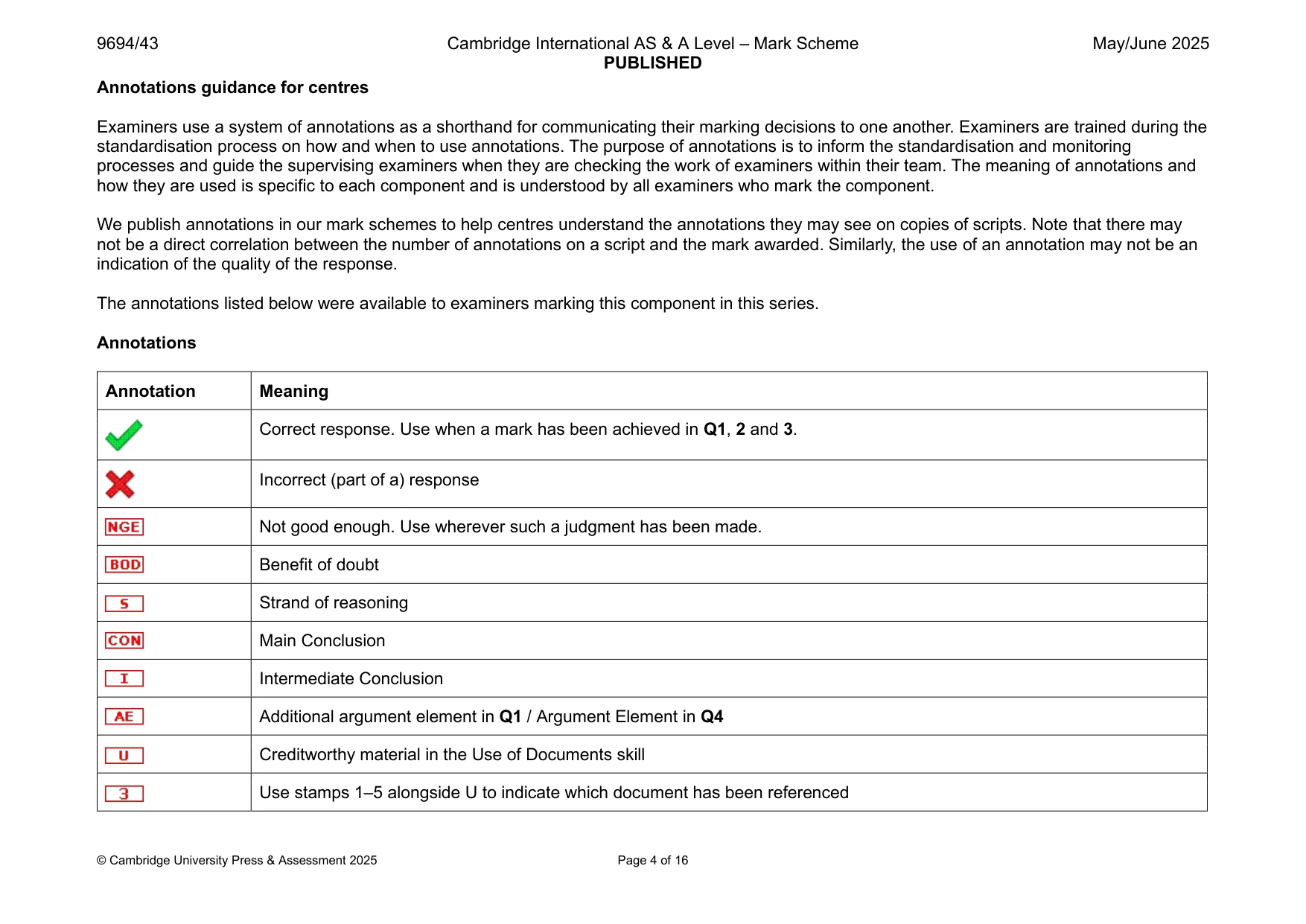
9694/43 Cambridge International AS & A Level – Mark Scheme PUBLISHED May/June 2025 © Cambridge University Press & Assessment 2025 Page 4 of 16 Annotations guidance for centres Examiners use a system of annotations as a shorthand for communicating their marking decisions to one another. Examiners are trained during the standardisation process on how and when to use annotations. The purpose of annotations is to inform the standardisation and monitoring processes and guide the supervising examiners when they are checking the work of examiners within their team. The meaning of annotations and how they are used is specific to each component and is understood by all examiners who mark the component. We publish annotations in our mark schemes to help centres understand the annotations they may see on copies of scripts. Note that there may not be a direct correlation between the number of annotations on a script and the mark awarded. Similarly, the use of an annotation may not be an indication of the quality of the response. The annotations listed below were available to examiners marking this component in this series. Annotations Annotation Meaning Correct response. Use when a mark has been achieved in Q1, 2 and 3. Incorrect (part of a) response Not good enough. Use wherever such a judgment has been made. Benefit of doubt Strand of reasoning Main Conclusion Intermediate Conclusion Additional argument element in Q1 / Argument Element in Q4 Creditworthy material in the Use of Documents skill Use stamps 1–5 alongside U to indicate which document has been referenced
Mark scheme, page 5
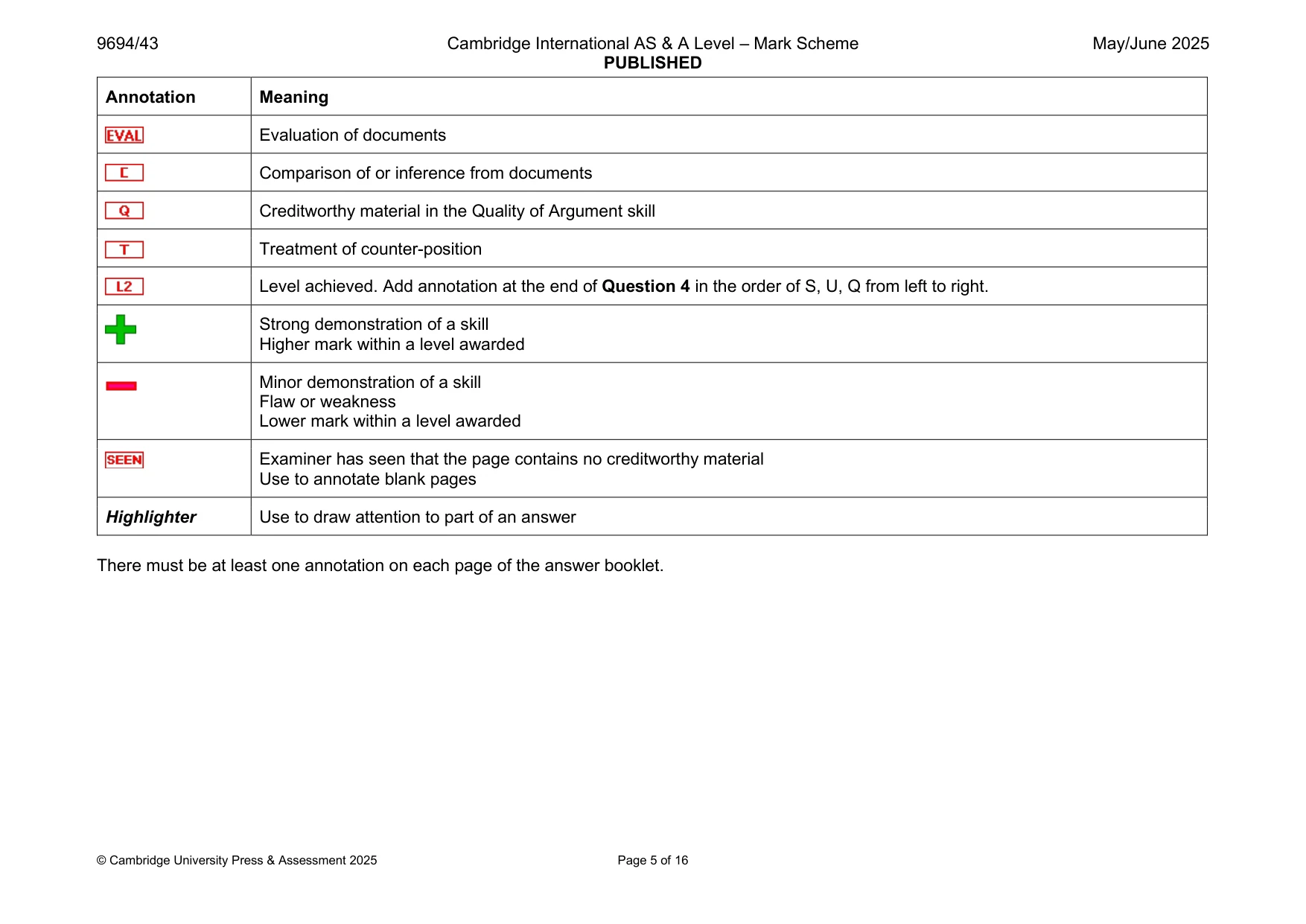
9694/43 Cambridge International AS & A Level – Mark Scheme PUBLISHED May/June 2025 © Cambridge University Press & Assessment 2025 Page 5 of 16 Annotation Meaning Evaluation of documents Comparison of or inference from documents Creditworthy material in the Quality of Argument skill Treatment of counter-position Level achieved. Add annotation at the end of Question 4 in the order of S, U, Q from left to right. Strong demonstration of a skill Higher mark within a level awarded Minor demonstration of a skill Flaw or weakness Lower mark within a level awarded Examiner has seen that the page contains no creditworthy material Use to annotate blank pages Highlighter Use to draw attention to part of an answer There must be at least one annotation on each page of the answer booklet.
Mark scheme, page 6
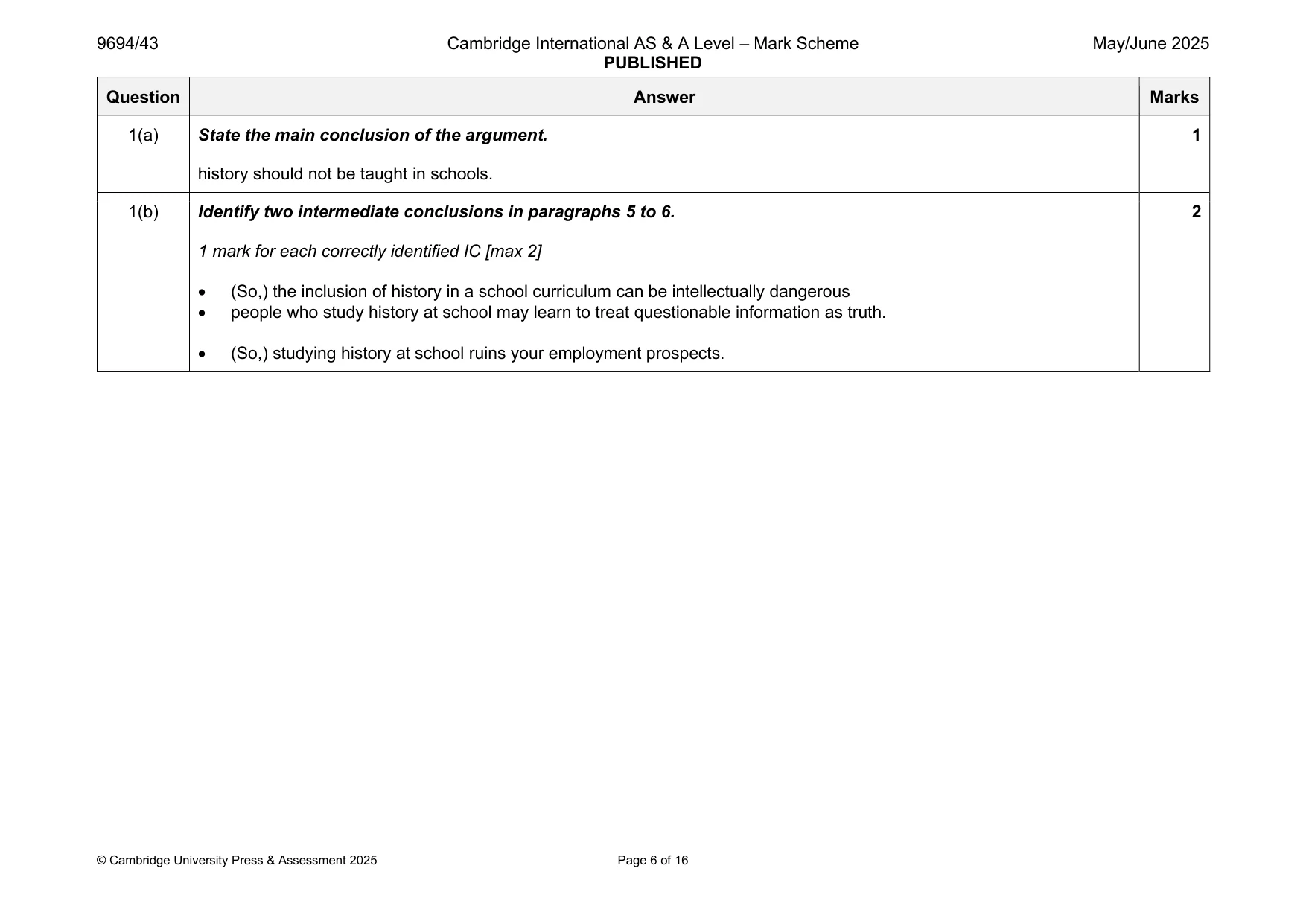
9694/43 Cambridge International AS & A Level – Mark Scheme PUBLISHED May/June 2025 © Cambridge University Press & Assessment 2025 Page 6 of 16 Question Answer Marks 1(a) State the main conclusion of the argument. history should not be taught in schools. 1 1(b) Identify two intermediate conclusions in paragraphs 5 to 6. 1 mark for each correctly identified IC [max 2] • (So,) the inclusion of history in a school curriculum can be intellectually dangerous • people who study history at school may learn to treat questionable information as truth. • (So,) studying history at school ruins your employment prospects. 2
Mark scheme, page 7
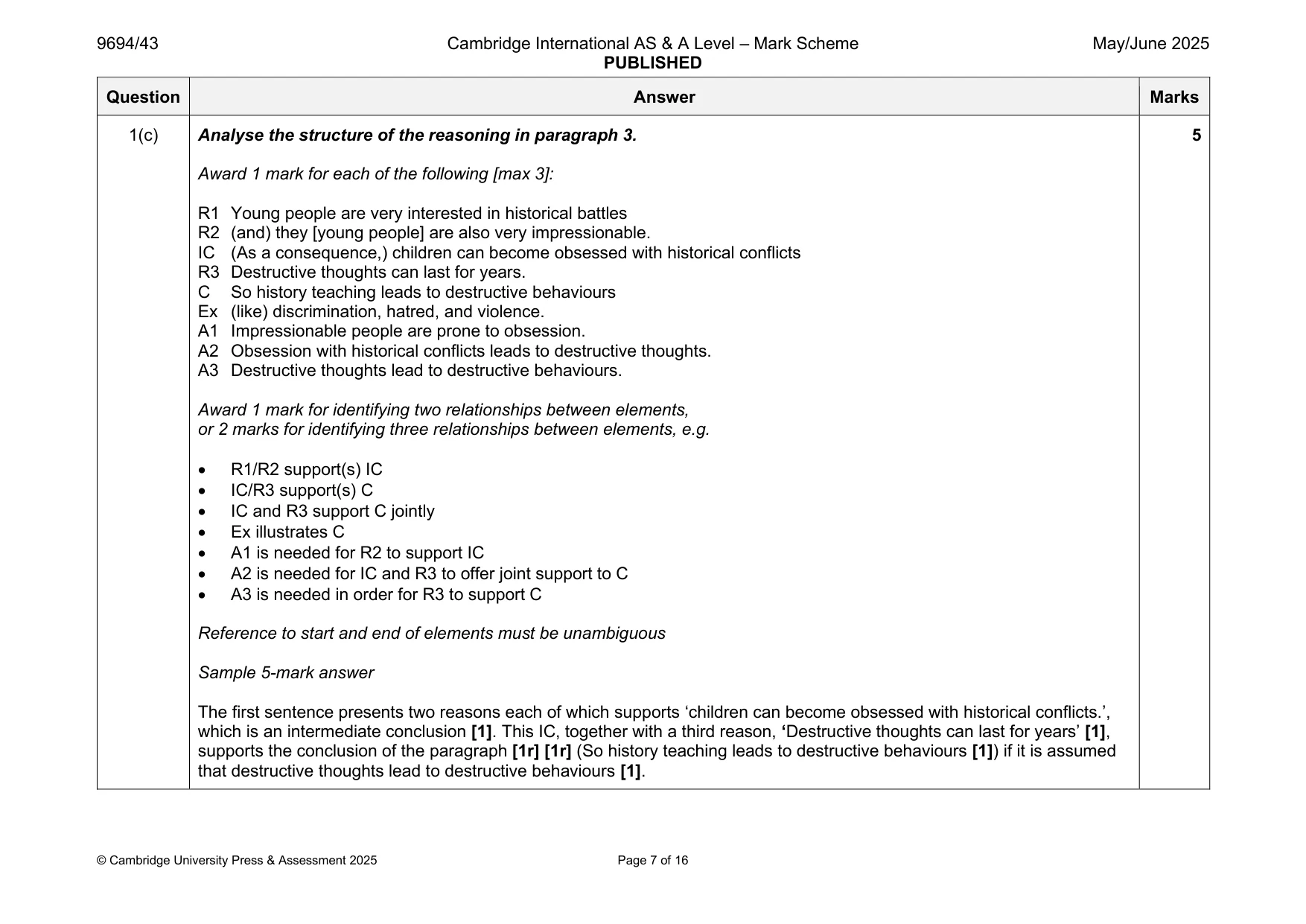
9694/43 Cambridge International AS & A Level – Mark Scheme PUBLISHED May/June 2025 © Cambridge University Press & Assessment 2025 Page 7 of 16 Question Answer Marks 1(c) Analyse the structure of the reasoning in paragraph 3. Award 1 mark for each of the following [max 3]: R1 Young people are very interested in historical battles R2 (and) they [young people] are also very impressionable. IC (As a consequence,) children can become obsessed with historical conflicts R3 Destructive thoughts can last for years. C So history teaching leads to destructive behaviours Ex (like) discrimination, hatred, and violence. A1 Impressionable people are prone to obsession. A2 Obsession with historical conflicts leads to destructive thoughts. A3 Destructive thoughts lead to destructive behaviours. Award 1 mark for identifying two relationships between elements, or 2 marks for identifying three relationships between elements, e.g. • R1/R2 support(s) IC • IC/R3 support(s) C • IC and R3 support C jointly • Ex illustrates C • A1 is needed for R2 to support IC • A2 is needed for IC and R3 to offer joint support to C • A3 is needed in order for R3 to support C Reference to start and end of elements must be unambiguous Sample 5-mark answer The first sentence presents two reasons each of which supports ‘children can become obsessed with historical conflicts.’, which is an intermediate conclusion [1]. This IC, together with a third reason, ‘Destructive thoughts can last for years’ [1], supports the conclusion of the paragraph [1r] [1r] (So history teaching leads to destructive behaviours [1]) if it is assumed that destructive thoughts lead to destructive behaviours [1]. 5
Mark scheme, page 8
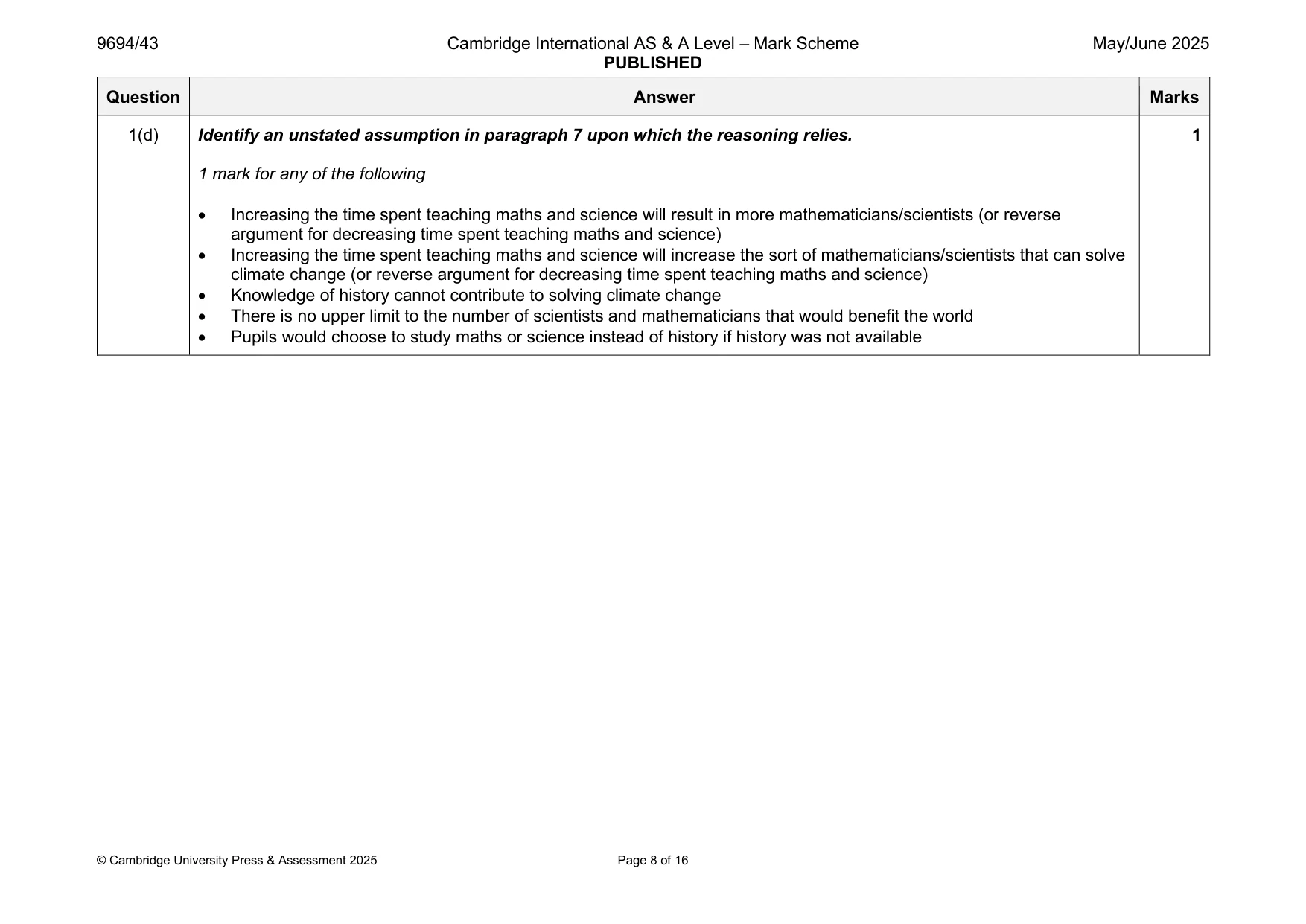
9694/43 Cambridge International AS & A Level – Mark Scheme PUBLISHED May/June 2025 © Cambridge University Press & Assessment 2025 Page 8 of 16 Question Answer Marks 1(d) Identify an unstated assumption in paragraph 7 upon which the reasoning relies. 1 mark for any of the following • Increasing the time spent teaching maths and science will result in more mathematicians/scientists (or reverse argument for decreasing time spent teaching maths and science) • Increasing the time spent teaching maths and science will increase the sort of mathematicians/scientists that can solve climate change (or reverse argument for decreasing time spent teaching maths and science) • Knowledge of history cannot contribute to solving climate change • There is no upper limit to the number of scientists and mathematicians that would benefit the world • Pupils would choose to study maths or science instead of history if history was not available 1
Mark scheme, page 9
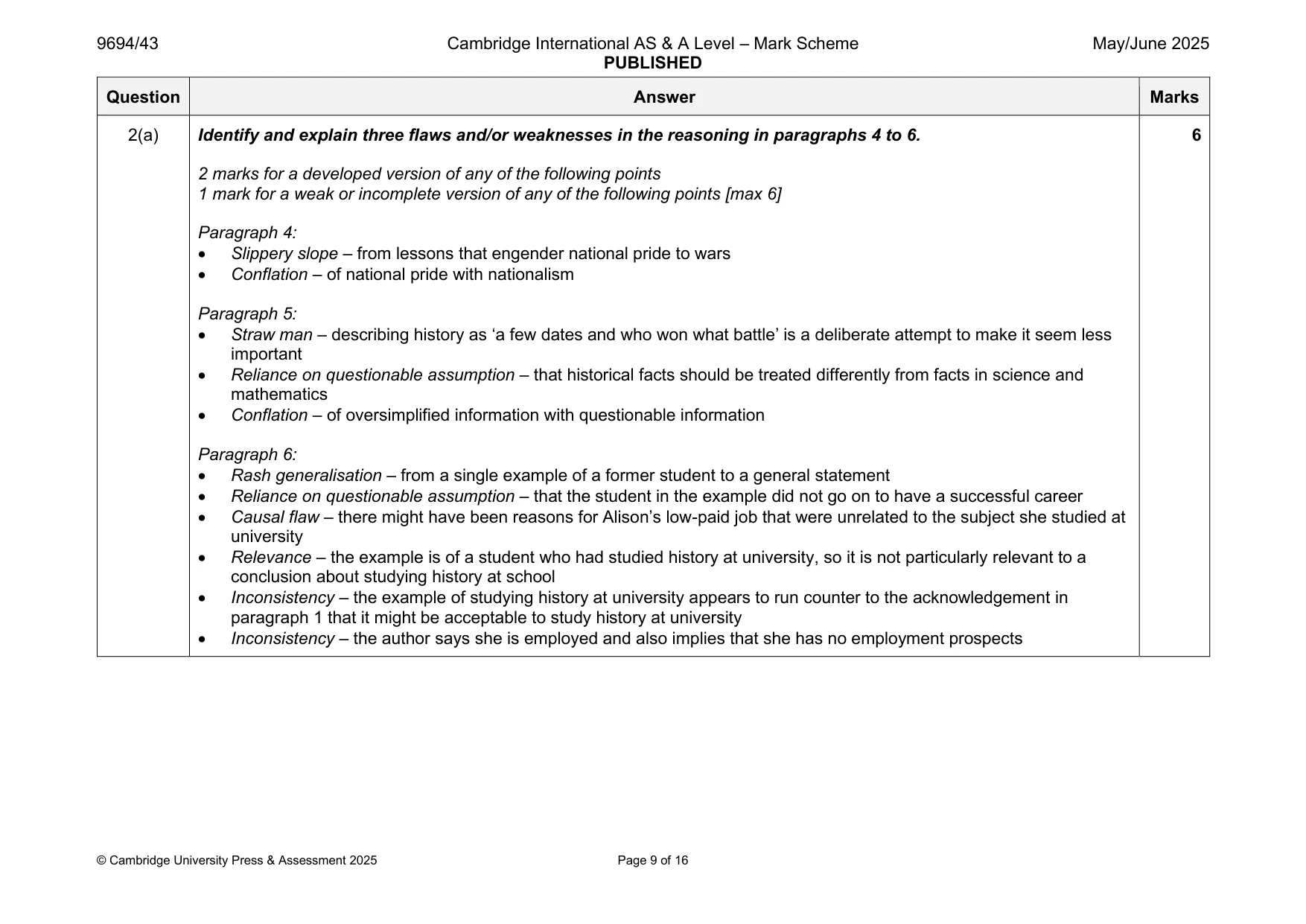
9694/43 Cambridge International AS & A Level – Mark Scheme PUBLISHED May/June 2025 © Cambridge University Press & Assessment 2025 Page 9 of 16 Question Answer Marks 2(a) Identify and explain three flaws and/or weaknesses in the reasoning in paragraphs 4 to 6. 2 marks for a developed version of any of the following points 1 mark for a weak or incomplete version of any of the following points [max 6] Paragraph 4: • Slippery slope – from lessons that engender national pride to wars • Conflation – of national pride with nationalism Paragraph 5: • Straw man – describing history as ‘a few dates and who won what battle’ is a deliberate attempt to make it seem less important • Reliance on questionable assumption – that historical facts should be treated differently from facts in science and mathematics • Conflation – of oversimplified information with questionable information Paragraph 6: • Rash generalisation – from a single example of a former student to a general statement • Reliance on questionable assumption – that the student in the example did not go on to have a successful career • Causal flaw – there might have been reasons for Alison’s low-paid job that were unrelated to the subject she studied at university • Relevance – the example is of a student who had studied history at university, so it is not particularly relevant to a conclusion about studying history at school • Inconsistency – the example of studying history at university appears to run counter to the acknowledgement in paragraph 1 that it might be acceptable to study history at university • Inconsistency – the author says she is employed and also implies that she has no employment prospects 6
Mark scheme, page 10
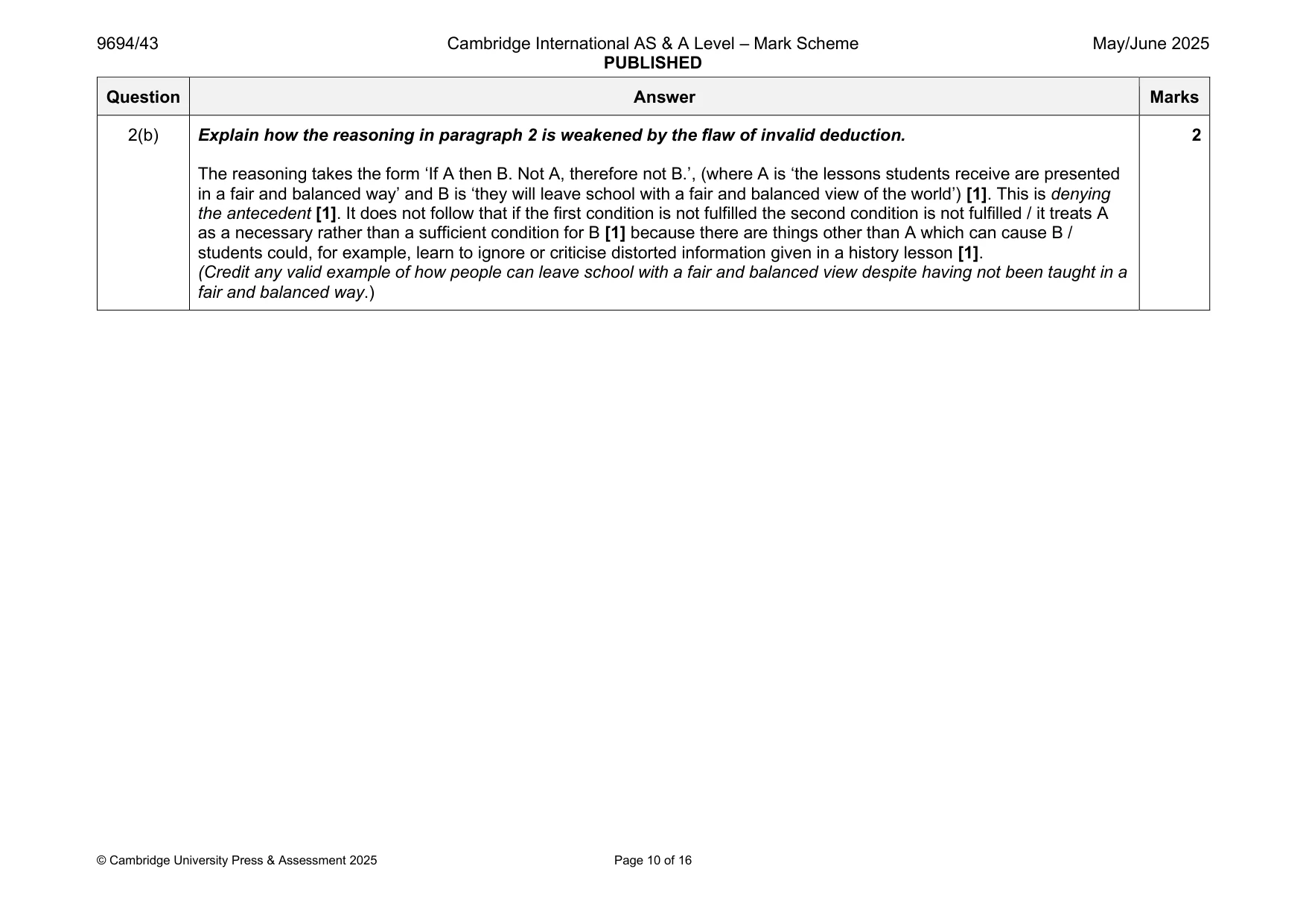
9694/43 Cambridge International AS & A Level – Mark Scheme PUBLISHED May/June 2025 © Cambridge University Press & Assessment 2025 Page 10 of 16 Question Answer Marks 2(b) Explain how the reasoning in paragraph 2 is weakened by the flaw of invalid deduction. The reasoning takes the form ‘If A then B. Not A, therefore not B.’, (where A is ‘the lessons students receive are presented in a fair and balanced way’ and B is ‘they will leave school with a fair and balanced view of the world’) [1]. This is denying the antecedent [1]. It does not follow that if the first condition is not fulfilled the second condition is not fulfilled / it treats A as a necessary rather than a sufficient condition for B [1] because there are things other than A which can cause B / students could, for example, learn to ignore or criticise distorted information given in a history lesson [1]. (Credit any valid example of how people can leave school with a fair and balanced view despite having not been taught in a fair and balanced way.) 2
Mark scheme, page 11
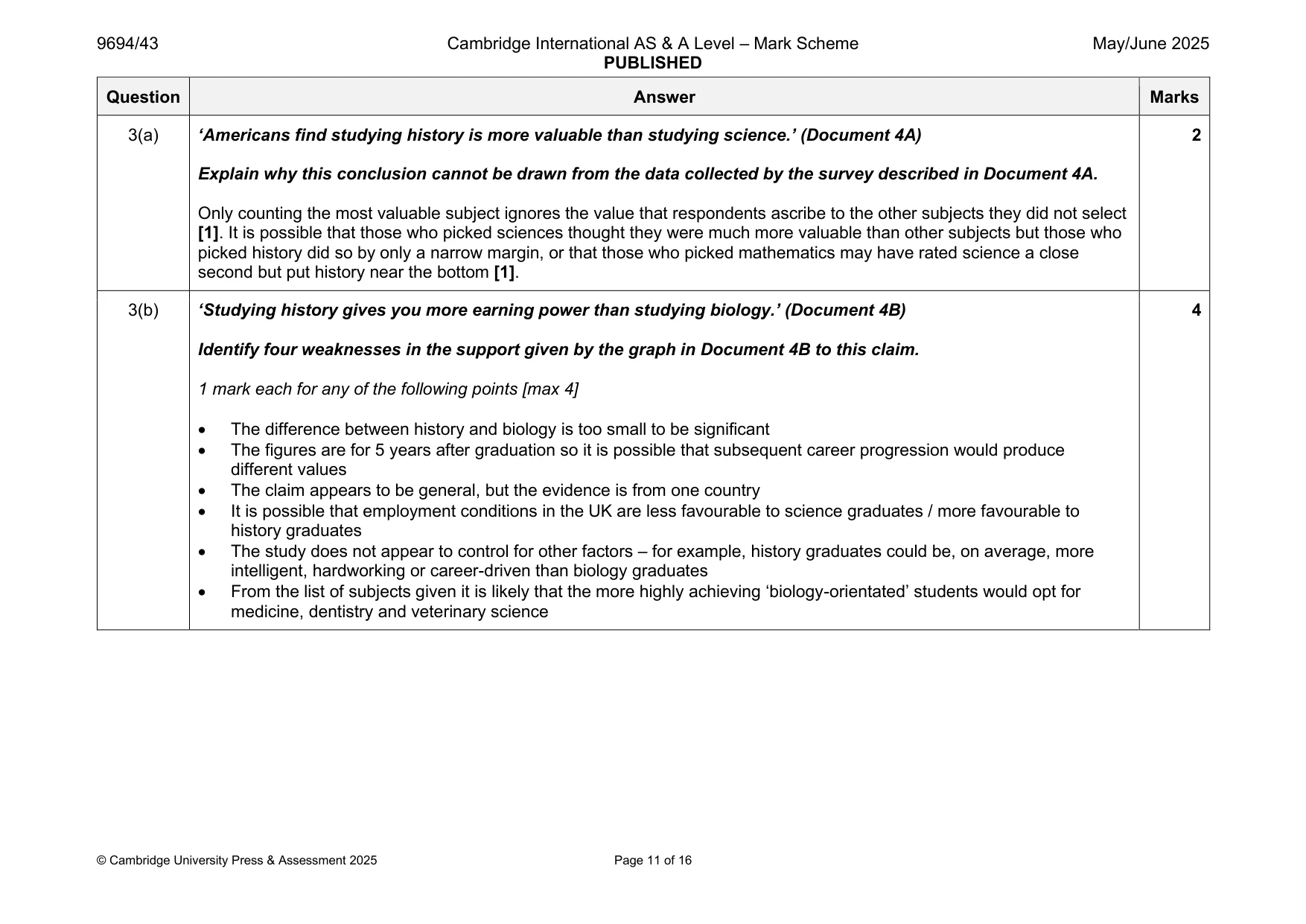
9694/43 Cambridge International AS & A Level – Mark Scheme PUBLISHED May/June 2025 © Cambridge University Press & Assessment 2025 Page 11 of 16 Question Answer Marks 3(a) ‘Americans find studying history is more valuable than studying science.’ (Document 4A) Explain why this conclusion cannot be drawn from the data collected by the survey described in Document 4A. Only counting the most valuable subject ignores the value that respondents ascribe to the other subjects they did not select [1]. It is possible that those who picked sciences thought they were much more valuable than other subjects but those who picked history did so by only a narrow margin, or that those who picked mathematics may have rated science a close second but put history near the bottom [1]. 2 3(b) ‘Studying history gives you more earning power than studying biology.’ (Document 4B) Identify four weaknesses in the support given by the graph in Document 4B to this claim. 1 mark each for any of the following points [max 4] • The difference between history and biology is too small to be significant • The figures are for 5 years after graduation so it is possible that subsequent career progression would produce different values • The claim appears to be general, but the evidence is from one country • It is possible that employment conditions in the UK are less favourable to science graduates / more favourable to history graduates • The study does not appear to control for other factors – for example, history graduates could be, on average, more intelligent, hardworking or career-driven than biology graduates • From the list of subjects given it is likely that the more highly achieving ‘biology-orientated’ students would opt for medicine, dentistry and veterinary science 4
Mark scheme, page 12
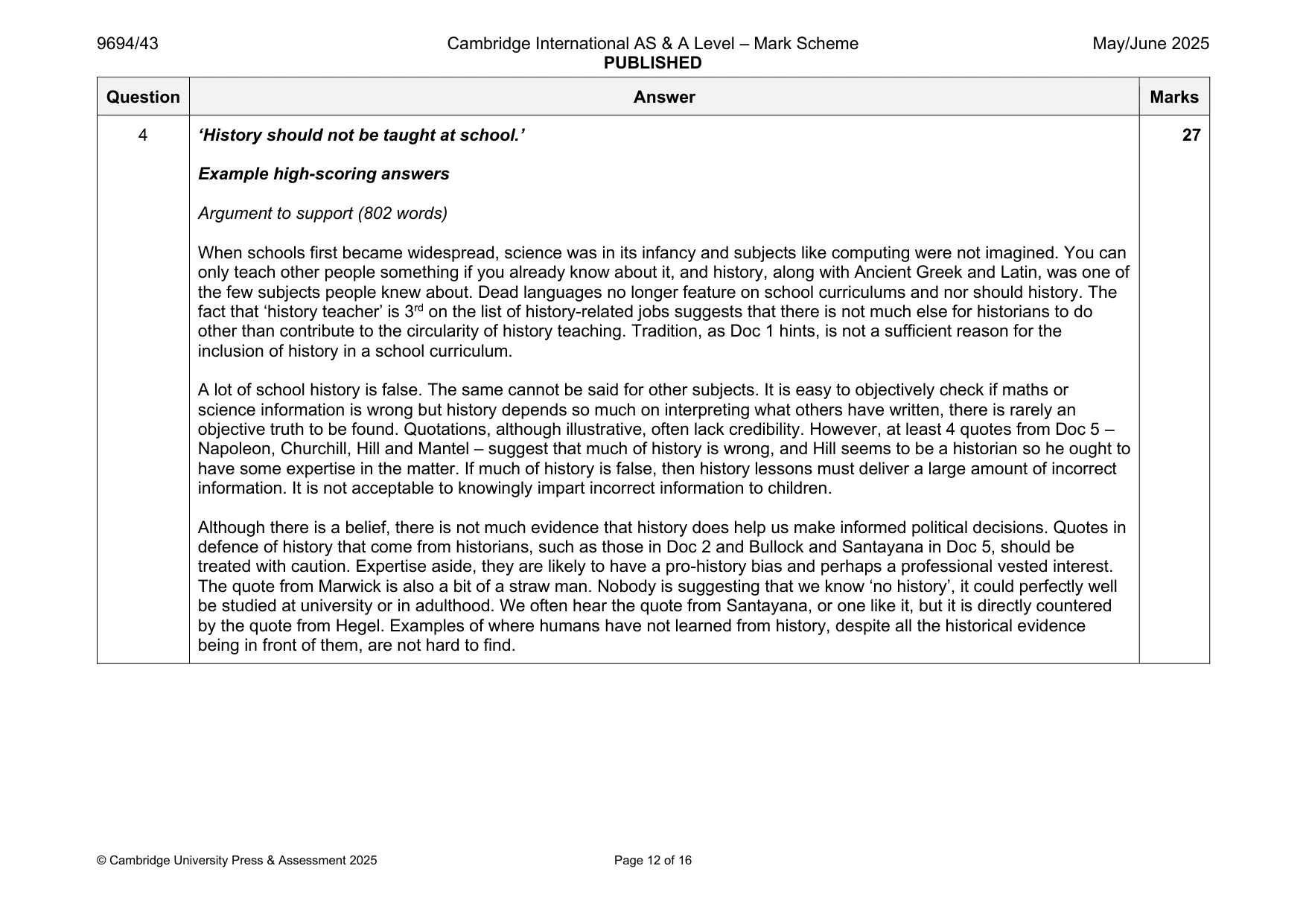
9694/43 Cambridge International AS & A Level – Mark Scheme PUBLISHED May/June 2025 © Cambridge University Press & Assessment 2025 Page 12 of 16 Question Answer Marks 4 ‘History should not be taught at school.’ Example high-scoring answers Argument to support (802 words) When schools first became widespread, science was in its infancy and subjects like computing were not imagined. You can only teach other people something if you already know about it, and history, along with Ancient Greek and Latin, was one of the few subjects people knew about. Dead languages no longer feature on school curriculums and nor should history. The fact that ‘history teacher’ is 3rd on the list of history-related jobs suggests that there is not much else for historians to do other than contribute to the circularity of history teaching. Tradition, as Doc 1 hints, is not a sufficient reason for the inclusion of history in a school curriculum. A lot of school history is false. The same cannot be said for other subjects. It is easy to objectively check if maths or science information is wrong but history depends so much on interpreting what others have written, there is rarely an objective truth to be found. Quotations, although illustrative, often lack credibility. However, at least 4 quotes from Doc 5 – Napoleon, Churchill, Hill and Mantel – suggest that much of history is wrong, and Hill seems to be a historian so he ought to have some expertise in the matter. If much of history is false, then history lessons must deliver a large amount of incorrect information. It is not acceptable to knowingly impart incorrect information to children. Although there is a belief, there is not much evidence that history does help us make informed political decisions. Quotes in defence of history that come from historians, such as those in Doc 2 and Bullock and Santayana in Doc 5, should be treated with caution. Expertise aside, they are likely to have a pro-history bias and perhaps a professional vested interest. The quote from Marwick is also a bit of a straw man. Nobody is suggesting that we know ‘no history’, it could perfectly well be studied at university or in adulthood. We often hear the quote from Santayana, or one like it, but it is directly countered by the quote from Hegel. Examples of where humans have not learned from history, despite all the historical evidence being in front of them, are not hard to find. 27
Mark scheme, page 13
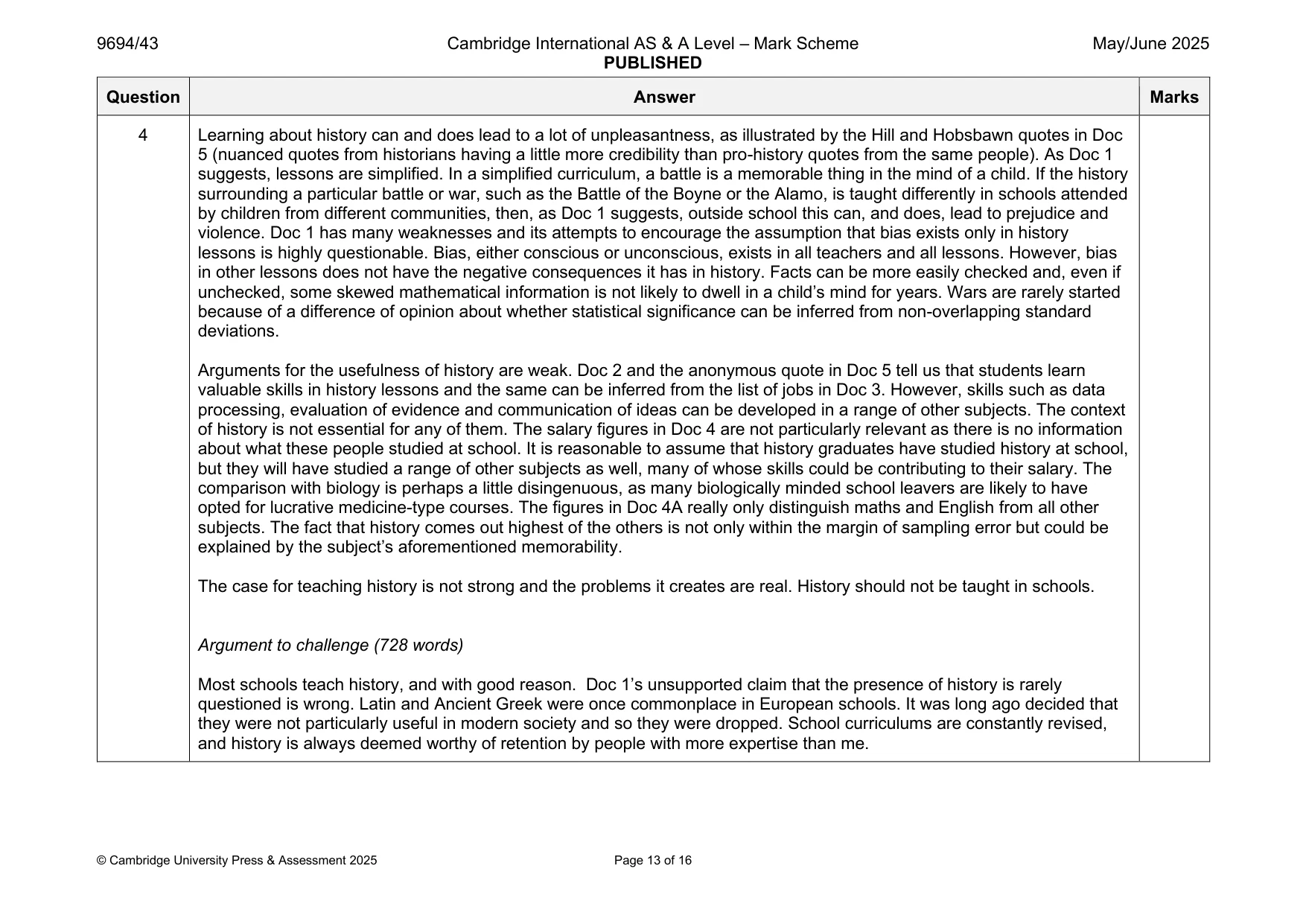
9694/43 Cambridge International AS & A Level – Mark Scheme PUBLISHED May/June 2025 © Cambridge University Press & Assessment 2025 Page 13 of 16 Question Answer Marks 4 Learning about history can and does lead to a lot of unpleasantness, as illustrated by the Hill and Hobsbawn quotes in Doc 5 (nuanced quotes from historians having a little more credibility than pro-history quotes from the same people). As Doc 1 suggests, lessons are simplified. In a simplified curriculum, a battle is a memorable thing in the mind of a child. If the history surrounding a particular battle or war, such as the Battle of the Boyne or the Alamo, is taught differently in schools attended by children from different communities, then, as Doc 1 suggests, outside school this can, and does, lead to prejudice and violence. Doc 1 has many weaknesses and its attempts to encourage the assumption that bias exists only in history lessons is highly questionable. Bias, either conscious or unconscious, exists in all teachers and all lessons. However, bias in other lessons does not have the negative consequences it has in history. Facts can be more easily checked and, even if unchecked, some skewed mathematical information is not likely to dwell in a child’s mind for years. Wars are rarely started because of a difference of opinion about whether statistical significance can be inferred from non-overlapping standard deviations. Arguments for the usefulness of history are weak. Doc 2 and the anonymous quote in Doc 5 tell us that students learn valuable skills in history lessons and the same can be inferred from the list of jobs in Doc 3. However, skills such as data processing, evaluation of evidence and communication of ideas can be developed in a range of other subjects. The context of history is not essential for any of them. The salary figures in Doc 4 are not particularly relevant as there is no information about what these people studied at school. It is reasonable to assume that history graduates have studied history at school, but they will have studied a range of other subjects as well, many of whose skills could be contributing to their salary. The comparison with biology is perhaps a little disingenuous, as many biologically minded school leavers are likely to have opted for lucrative medicine-type courses. The figures in Doc 4A really only distinguish maths and English from all other subjects. The fact that history comes out highest of the others is not only within the margin of sampling error but could be explained by the subject’s aforementioned memorability. The case for teaching history is not strong and the problems it creates are real. History should not be taught in schools. Argument to challenge (728 words) Most schools teach history, and with good reason. Doc 1’s unsupported claim that the presence of history is rarely questioned is wrong. Latin and Ancient Greek were once commonplace in European schools. It was long ago decided that they were not particularly useful in modern society and so they were dropped. School curriculums are constantly revised, and history is always deemed worthy of retention by people with more expertise than me.
Mark scheme, page 14
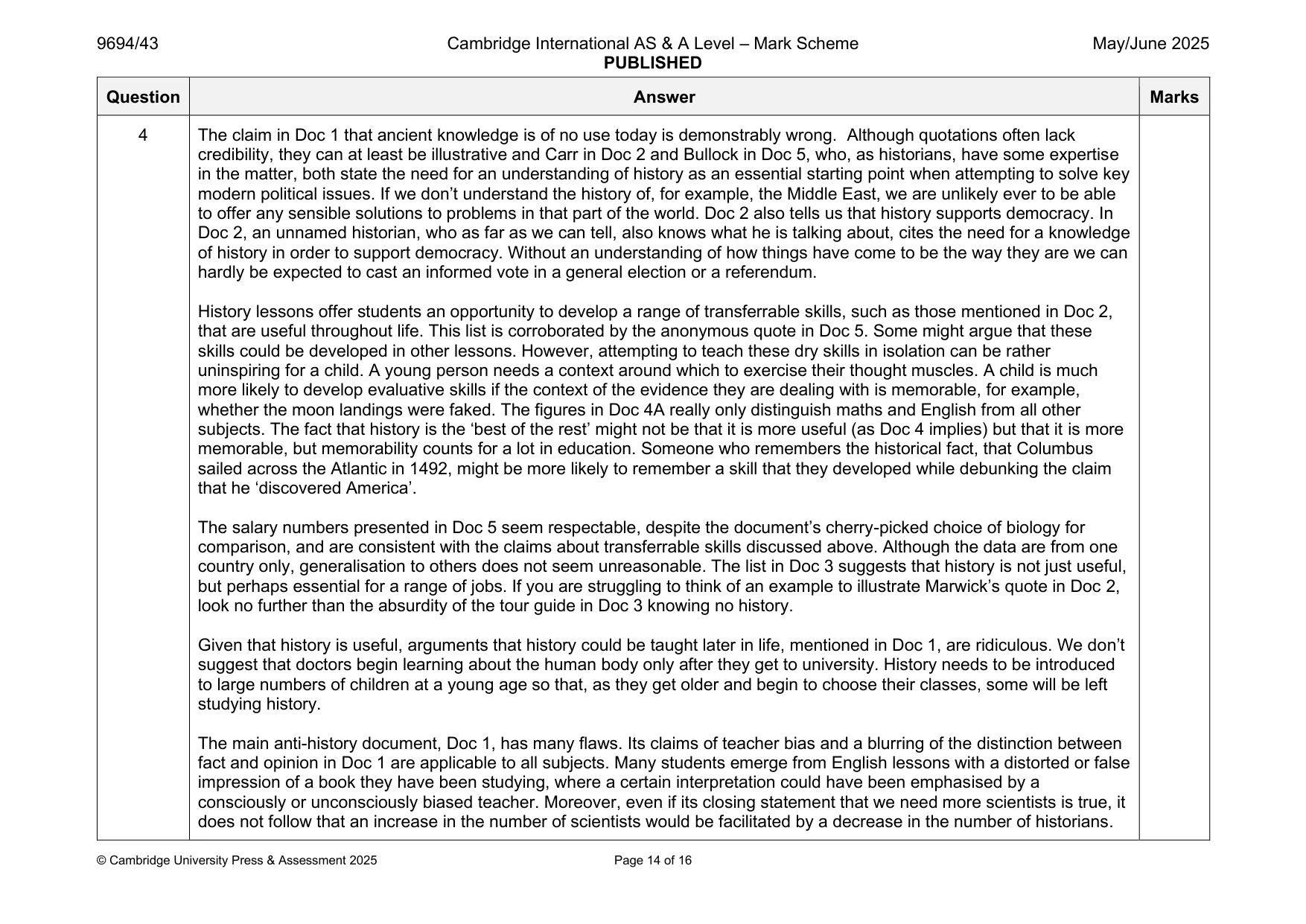
9694/43 Cambridge International AS & A Level – Mark Scheme PUBLISHED May/June 2025 © Cambridge University Press & Assessment 2025 Page 14 of 16 Question Answer Marks 4 The claim in Doc 1 that ancient knowledge is of no use today is demonstrably wrong. Although quotations often lack credibility, they can at least be illustrative and Carr in Doc 2 and Bullock in Doc 5, who, as historians, have some expertise in the matter, both state the need for an understanding of history as an essential starting point when attempting to solve key modern political issues. If we don’t understand the history of, for example, the Middle East, we are unlikely ever to be able to offer any sensible solutions to problems in that part of the world. Doc 2 also tells us that history supports democracy. In Doc 2, an unnamed historian, who as far as we can tell, also knows what he is talking about, cites the need for a knowledge of history in order to support democracy. Without an understanding of how things have come to be the way they are we can hardly be expected to cast an informed vote in a general election or a referendum. History lessons offer students an opportunity to develop a range of transferrable skills, such as those mentioned in Doc 2, that are useful throughout life. This list is corroborated by the anonymous quote in Doc 5. Some might argue that these skills could be developed in other lessons. However, attempting to teach these dry skills in isolation can be rather uninspiring for a child. A young person needs a context around which to exercise their thought muscles. A child is much more likely to develop evaluative skills if the context of the evidence they are dealing with is memorable, for example, whether the moon landings were faked. The figures in Doc 4A really only distinguish maths and English from all other subjects. The fact that history is the ‘best of the rest’ might not be that it is more useful (as Doc 4 implies) but that it is more memorable, but memorability counts for a lot in education. Someone who remembers the historical fact, that Columbus sailed across the Atlantic in 1492, might be more likely to remember a skill that they developed while debunking the claim that he ‘discovered America’. The salary numbers presented in Doc 5 seem respectable, despite the document’s cherry-picked choice of biology for comparison, and are consistent with the claims about transferrable skills discussed above. Although the data are from one country only, generalisation to others does not seem unreasonable. The list in Doc 3 suggests that history is not just useful, but perhaps essential for a range of jobs. If you are struggling to think of an example to illustrate Marwick’s quote in Doc 2, look no further than the absurdity of the tour guide in Doc 3 knowing no history. Given that history is useful, arguments that history could be taught later in life, mentioned in Doc 1, are ridiculous. We don’t suggest that doctors begin learning about the human body only after they get to university. History needs to be introduced to large numbers of children at a young age so that, as they get older and begin to choose their classes, some will be left studying history. The main anti-history document, Doc 1, has many flaws. Its claims of teacher bias and a blurring of the distinction between fact and opinion in Doc 1 are applicable to all subjects. Many students emerge from English lessons with a distorted or false impression of a book they have been studying, where a certain interpretation could have been emphasised by a consciously or unconsciously biased teacher. Moreover, even if its closing statement that we need more scientists is true, it does not follow that an increase in the number of scientists would be facilitated by a decrease in the number of historians.
Mark scheme, page 15
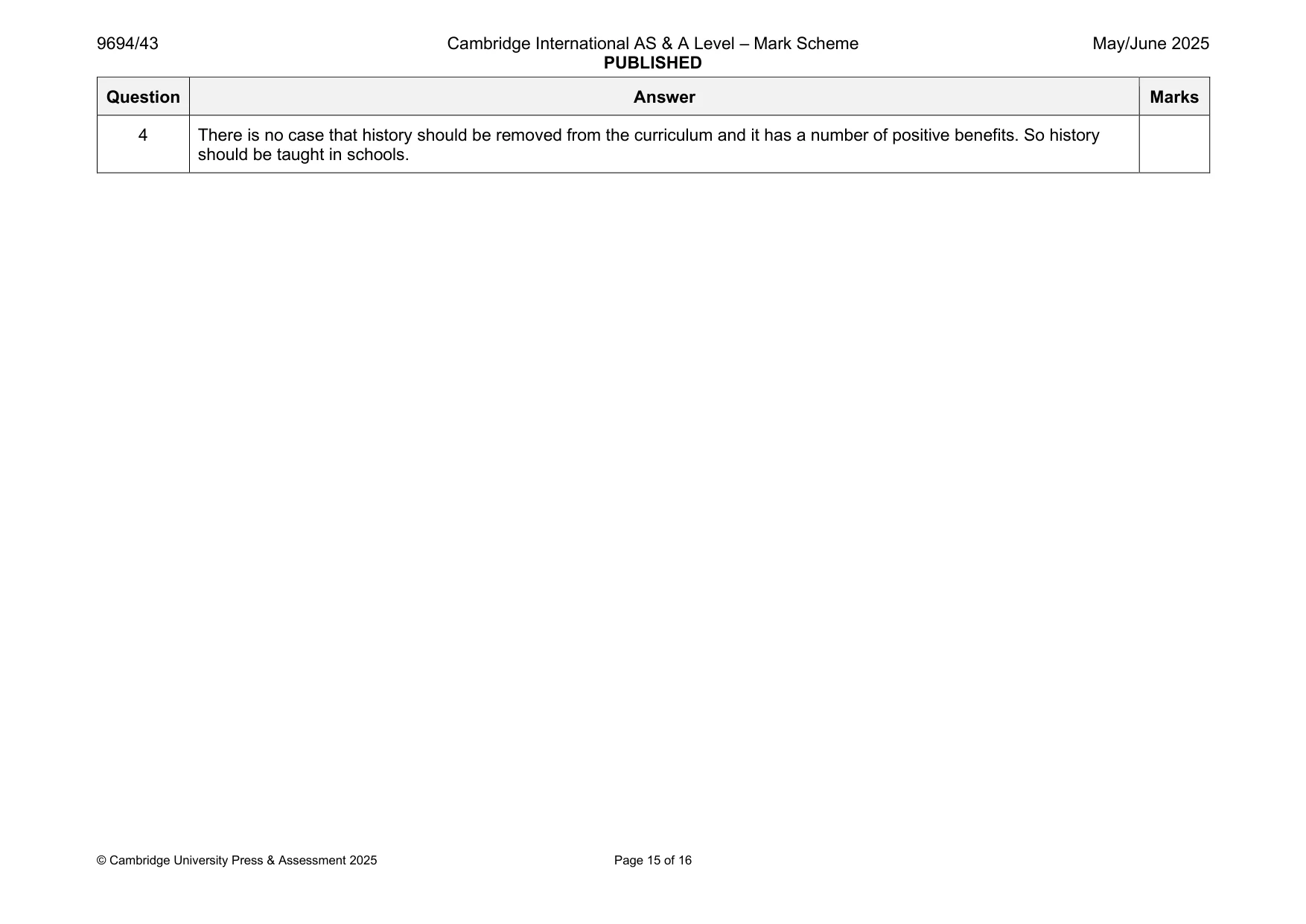
9694/43 Cambridge International AS & A Level – Mark Scheme PUBLISHED May/June 2025 © Cambridge University Press & Assessment 2025 Page 15 of 16 Question Answer Marks 4 There is no case that history should be removed from the curriculum and it has a number of positive benefits. So history should be taught in schools.
Mark scheme, page 16
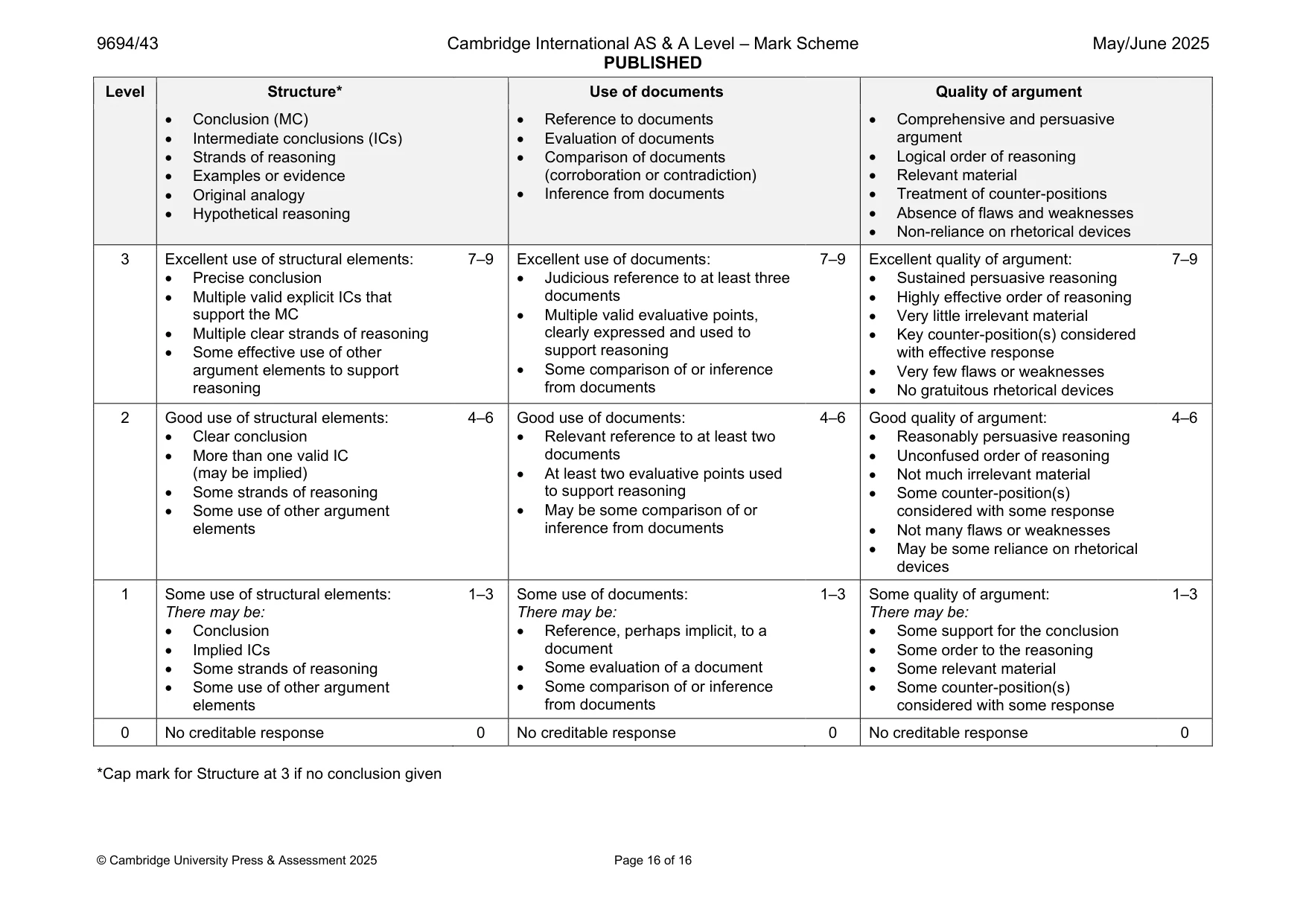
9694/43 Cambridge International AS & A Level – Mark Scheme PUBLISHED May/June 2025 © Cambridge University Press & Assessment 2025 Page 16 of 16 Level Structure* Use of documents Quality of argument • Conclusion (MC) • Intermediate conclusions (ICs) • Strands of reasoning • Examples or evidence • Original analogy • Hypothetical reasoning • Reference to documents • Evaluation of documents • Comparison of documents (corroboration or contradiction) • Inference from documents • Comprehensive and persuasive argument • Logical order of reasoning • Relevant material • Treatment of counter-positions • Absence of flaws and weaknesses • Non-reliance on rhetorical devices 3 Excellent use of structural elements: • Precise conclusion • Multiple valid explicit ICs that support the MC • Multiple clear strands of reasoning • Some effective use of other argument elements to support reasoning 7–9 Excellent use of documents: • Judicious reference to at least three documents • Multiple valid evaluative points, clearly expressed and used to support reasoning • Some comparison of or inference from documents 7–9 Excellent quality of argument: • Sustained persuasive reasoning • Highly effective order of reasoning • Very little irrelevant material • Key counter-position(s) considered with effective response • Very few flaws or weaknesses • No gratuitous rhetorical devices 7–9 2 Good use of structural elements: • Clear conclusion • More than one valid IC (may be implied) • Some strands of reasoning • Some use of other argument elements 4–6 Good use of documents: • Relevant reference to at least two documents • At least two evaluative points used to support reasoning • May be some comparison of or inference from documents 4–6 Good quality of argument: • Reasonably persuasive reasoning • Unconfused order of reasoning • Not much irrelevant material • Some counter-position(s) considered with some response • Not many flaws or weaknesses • May be some reliance on rhetorical devices 4–6 1 Some use of structural elements: There may be: • Conclusion • Implied ICs • Some strands of reasoning • Some use of other argument elements 1–3 Some use of documents: There may be: • Reference, perhaps implicit, to a document • Some evaluation of a document • Some comparison of or inference from documents 1–3 Some quality of argument: There may be: • Some support for the conclusion • Some order to the reasoning • Some relevant material • Some counter-position(s) considered with some response 1–3 0 No creditable response 0 No creditable response 0 No creditable response 0 *Cap mark for Structure at 3 if no conclusion given
What you needed in this session
Cambridge’s own grade thresholds for 2025 May/June, Paper 4 · Variant 3. A higher threshold means an easier paper — the bar moves with how the cohort did.