Cambridge A Level Thinking Skills 9694 — 2024 May/June Paper 4 · Variant 3
9694/43/M/J/24 · 50 marks · ≈56 min
The question paper and its mark scheme, free to read here and free to download. This is Cambridge’s own paper, exactly as it was sat.
Question paper8 pages
Mark scheme12 pages
Answers below. Sit the paper first if you are practising.
Paper as text
Question paper, page 1
This document has 8 pages. Any blank pages are indicated. [Turn over Cambridge International AS & A Level THINKING SKILLS 9694/43 Paper 4 Applied Reasoning May/June 2024 1 hour 45 minutes You must answer on the enclosed answer booklet. You will need: Answer booklet (enclosed) INSTRUCTIONS ● Answer all questions. ● Follow the instructions on the front cover of the answer booklet. If you need additional answer paper, ask the invigilator for a continuation booklet. INFORMATION ● The total mark for this paper is 50. ● The number of marks for each question or part question is shown in brackets [ ]. * 1 6 0 3 4 8 3 8 1 6 * DC (WW) 341287 © UCLES 2024
Question paper, page 2
2 9694/43/M/J/24 © UCLES 2024 Questions 1 and 2 refer to Document 1. 1 (a) State the main conclusion of the argument. [1] (b) Identify three intermediate conclusions in paragraphs 3 to 4. [3] (c) Analyse the structure of the reasoning in paragraph 2. [4] 2 (a) Identify and explain three flaws and/or weaknesses in the reasoning in paragraphs 3 to 5. [6] (b) Assess the extent to which paragraph 6 supports the argument as a whole. [3] 3 Question 3 refers to Document 4. (a) ‘The UK public thinks individuals have more responsibility for safeguarding online privacy than governments.’ Identify three weaknesses in the support given by the graph in Document 4A to this claim. [3] (b) ‘Public opinion about how much the government should regulate the internet remains largely unchanged since 2013.’ Identify three weaknesses in the support given by the table in Document 4B to this claim. [3] 4 You are advised to spend some time planning your answer before you begin to write it. ‘Governments should regulate the internet.’ Construct a reasoned argument to support or challenge this claim. In your answer you should make critical use of the documents provided. [27]
Question paper, page 3
3 9694/43/M/J/24 © UCLES 2024 [Turn over DOCUMENT 1 1 In 2021, India announced rules to regulate social media that would make companies more accountable for content hosted on their platforms. India joined an expanding list of countries that regulate social media. Should we be worried about this trend? 2 Many governments want to regulate social media because they are worried about the dangerous consequences of certain forms of content such as misinformation, defamation, hate speech, threats to public order and terrorist incitement. But we already have laws against most of these things. All we need to do to remove the need for regulation is to enforce more rigorously the laws we already have. 3 State regulation of social media would restrict the freedom of speech of every citizen. If a government has the ability to censor social media platforms, then the content that the site’s users can view will be limited. This deprives citizens of the right not only to choose the information sources that inform their opinions but also the right to express those opinions. If we want to have freedom of speech, we cannot have social media censorship. 4 Strict censorship is likely to lead to fewer news platforms in total and thus a narrow information stream. A narrow information stream would lead to an increase in prejudice and hence an increase in religious and cultural intolerance. A lack of available information can also make people feel detached and powerless. Therefore censorship would create a perfect environment for the rise of extreme ideologies. 5 In a regime of censorship, those providers that want to keep operating must learn to work within the regulations set by the government in order to avoid negative attention or sanctions. This means that all social media platforms that are allowed to exist must actively avoid offending the government. Eventually the only providers that are left are, in effect, mouthpieces for state propaganda. In such a society, independent news outlets struggle to exist, which leads to public protests, the destabilisation of the country and the fall of the government itself. 6 Tighter regulation of social media would undoubtedly reduce competition, and competition is obviously necessary for innovation; so, tighter regulation of social media platforms would stifle innovation and hence the economy. 7 Regulation could have negative consequences for freedom, stability and the economy; so we should resist the increase in state regulation of social media.
Question paper, page 4
4 9694/43/M/J/24 © UCLES 2024 DOCUMENT 2 Early enthusiasts believed that the internet was the beginning of a new egalitarian world, where the powerless would be on an equal footing with the powerful. There was no central controlling authority regulating who could contribute or what they could contribute. Anyone with an internet connection would have the same ability to reach everyone on the internet as the editor of the Washington Post. Access to government, data, education and information was open and licence-free. However, with universal access comes universal vulnerability. Today everyone, including young children, has access to the internet. In these circumstances we must have procedures for tackling illegal and harmful content. The internet is used for a wide range of unpleasant activities, many of which are illegal in most countries, for example financial scams, copyright theft, money laundering, cyber terrorism and libel. Society is as entitled to protect itself from these crimes as it would be if such activity occurred off-line. We ought not to accept universal access to offensive content as the price for freedom of expression. The benefits of the free market are often cited as the prime reason to hesitate about government interference in any business activity. In the early days, the new crop of internet-based companies embraced that belief, arguing that the internet and internet-based companies should not be regulated in the new libertarian utopia. However, the benefits of a free market derive from competition and the ability of new providers to enter the marketplace. Ironically, the internet has become dominated by companies emerging from those early pioneers, all of whom pursue profit and market dominance as aggressively as any oil company. Moreover, the internet is being used by companies, governments, and others to gather personal information that can be used as a commodity and to actively misinform people. During the Industrial Revolution, governments did not interfere much in big business. The results of this lack of regulation were pollution, long working hours, a disregard for safety and low wages. But unions, social movements and the media of the time forced governments to create regulations that changed the way companies operated. The result was not a catastrophic destruction of capitalist society. Economies continued to thrive, and a balance was struck between the interests of business and social justice. The same sort of regulation could work for the internet without destroying what makes it a great benefit to modern life. Other electronic communication networks, such as radio, television and telecommunications, are regulated and the same could, and ought to, be done for the internet. Most governments, consumer groups and even internet service providers favour some form of regulation. It is time to overrule ideological objections to government interference and embrace fair regulation of the internet.
Question paper, page 5
5 9694/43/M/J/24 © UCLES 2024 [Turn over DOCUMENT 3 Existing internet regulation around the world The internet poses problems for censorship because it becomes difficult to classify it and to decide who regulates it and how. Is it a postal service, or a telecommunications service? Should it be treated like a print medium or a broadcast medium? Should advertising industry regulations apply? However, many international jurisdictions have some form of internet regulation in place. An EU publication lists the following as concerns about unregulated internet activity: • national security • protection of children • protection of human dignity • economic security • information security • protection of privacy • protection of reputation • intellectual property rights. The approach to internet regulation varies from country to country and is constantly evolving. The USA has sophisticated regulations for the internet and uses a very broad definition of ‘internet’. Content is lightly regulated but users can be, and are, prosecuted for activities that are illegal in the real world. France has proposed using inspectors to prowl the internet inspecting content to ensure that information providers comply with regulations. Currently, however, the legal position is uncertain because the relevant section of French law has been declared unconstitutional on grounds of ‘vagueness’. Another French proposal for regulation, called the Fillon amendment, is through a ‘negative option’ – internet service providers would not have to abide by the telecommunications code of conduct, but those which did abide by the code would be absolved of legal liabilities for content. However, the legal liabilities themselves are uncertain. In China, internet access has to go through filters, using only a few government-controlled access providers. A common reply from those who argue against internet censorship is that users can simply connect using an international call. However, a Chinese law prohibits such calls. Violators face a warning, then a fine of up to the equivalent of an average worker’s annual salary. The laws that apply to the internet are a subset of China’s electronic media laws. South Korea was the first country to have an internet-specific censorship law. It covers material on ‘public domain services’ that may affect public morals, national sovereignty, and ‘young people’s character, emotions and the sense of value’. Political speech is also regulated.
Question paper, page 6
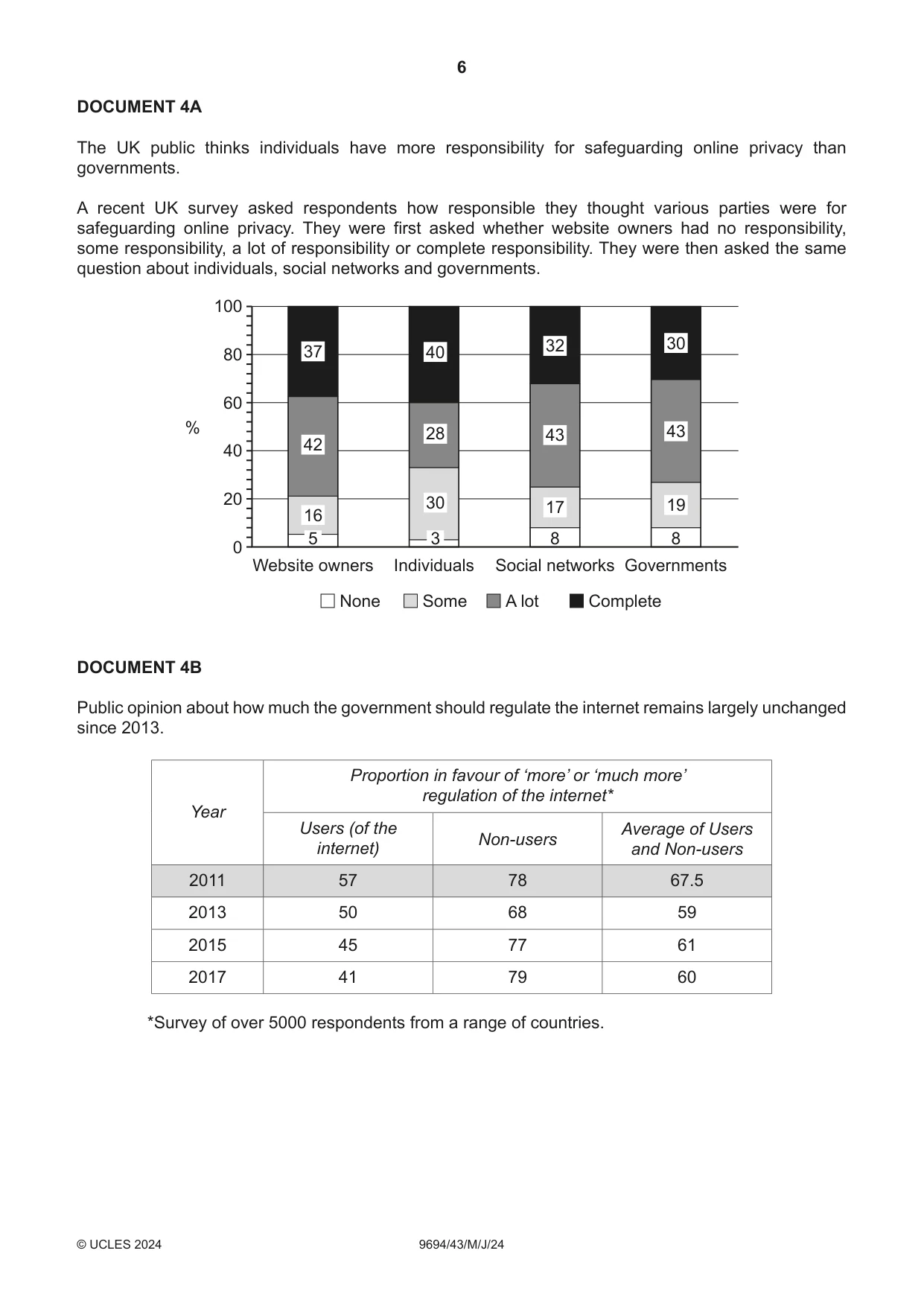
6 9694/43/M/J/24 © UCLES 2024 DOCUMENT 4A The UK public thinks individuals have more responsibility for safeguarding online privacy than governments. A recent UK survey asked respondents how responsible they thought various parties were for safeguarding online privacy. They were first asked whether website owners had no responsibility, some responsibility, a lot of responsibility or complete responsibility. They were then asked the same question about individuals, social networks and governments. 100 80 60 40 % 20 Website owners None Individuals Social networks Governments 0 Some A lot Complete 37 42 16 30 28 40 32 30 43 19 43 17 5 3 8 8 DOCUMENT 4B Public opinion about how much the government should regulate the internet remains largely unchanged since 2013. Year Proportion in favour of ‘more’ or ‘much more’ regulation of the internet* Users (of the internet) Non-users Average of Users and Non-users 2011 57 78 67.5 2013 50 68 59 2015 45 77 61 2017 41 79 60 *Survey of over 5000 respondents from a range of countries.
Question paper, page 7
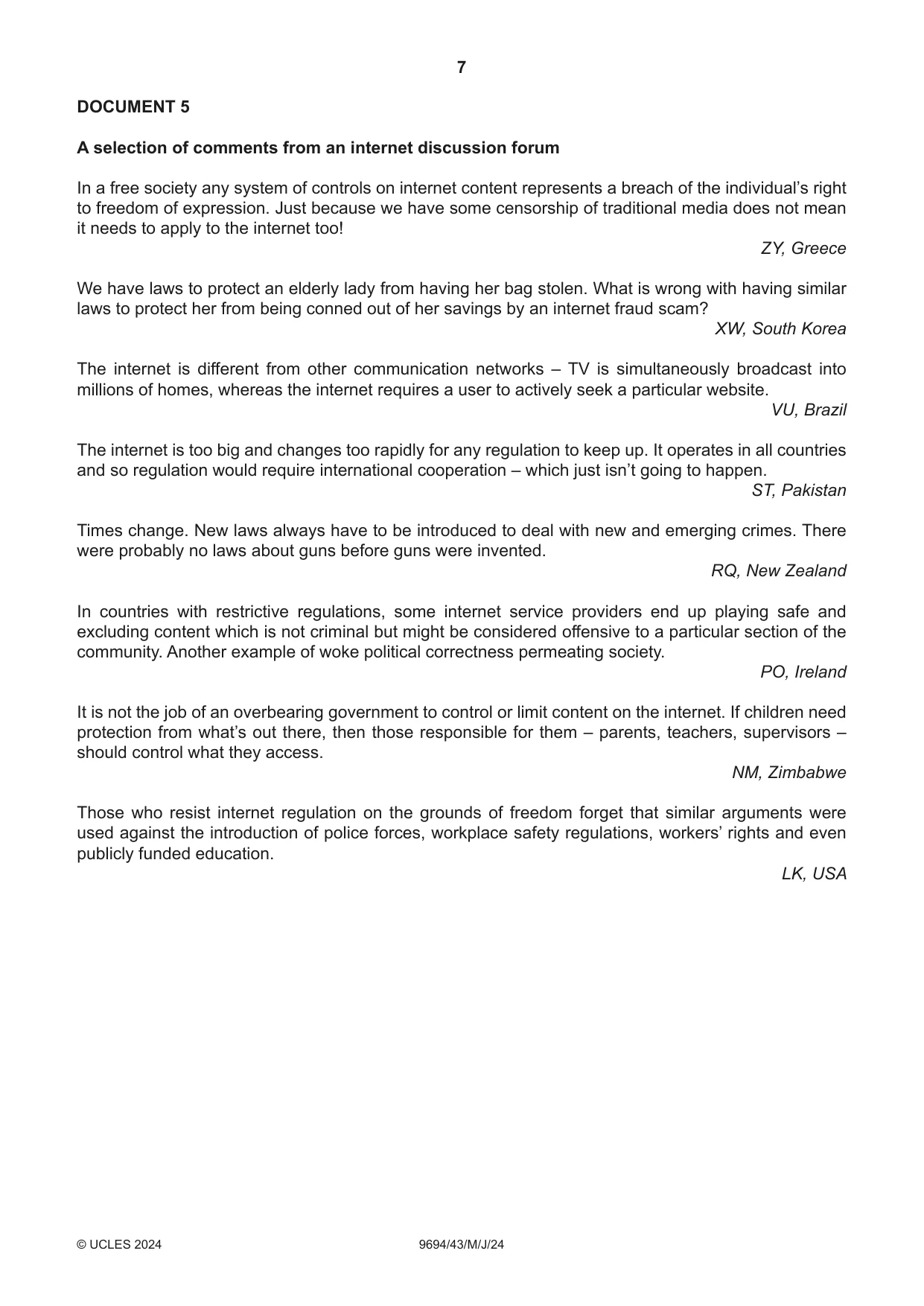
7 9694/43/M/J/24 © UCLES 2024 DOCUMENT 5 A selection of comments from an internet discussion forum In a free society any system of controls on internet content represents a breach of the individual’s right to freedom of expression. Just because we have some censorship of traditional media does not mean it needs to apply to the internet too! ZY, Greece We have laws to protect an elderly lady from having her bag stolen. What is wrong with having similar laws to protect her from being conned out of her savings by an internet fraud scam? XW, South Korea The internet is different from other communication networks – TV is simultaneously broadcast into millions of homes, whereas the internet requires a user to actively seek a particular website. VU, Brazil The internet is too big and changes too rapidly for any regulation to keep up. It operates in all countries and so regulation would require international cooperation – which just isn’t going to happen. ST, Pakistan Times change. New laws always have to be introduced to deal with new and emerging crimes. There were probably no laws about guns before guns were invented. RQ, New Zealand In countries with restrictive regulations, some internet service providers end up playing safe and excluding content which is not criminal but might be considered offensive to a particular section of the community. Another example of woke political correctness permeating society. PO, Ireland It is not the job of an overbearing government to control or limit content on the internet. If children need protection from what’s out there, then those responsible for them – parents, teachers, supervisors – should control what they access. NM, Zimbabwe Those who resist internet regulation on the grounds of freedom forget that similar arguments were used against the introduction of police forces, workplace safety regulations, workers’ rights and even publicly funded education. LK, USA
Question paper, page 8
8 9694/43/M/J/24 © UCLES 2024 Permission to reproduce items where third-party owned material protected by copyright is included has been sought and cleared where possible. Every reasonable effort has been made by the publisher (UCLES) to trace copyright holders, but if any items requiring clearance have unwittingly been included, the publisher will be pleased to make amends at the earliest possible opportunity. To avoid the issue of disclosure of answer-related information to candidates, all copyright acknowledgements are reproduced online in the Cambridge Assessment International Education Copyright Acknowledgements Booklet. This is produced for each series of examinations and is freely available to download at www.cambridgeinternational.org after the live examination series. Cambridge Assessment International Education is part of Cambridge Assessment. Cambridge Assessment is the brand name of the University of Cambridge Local Examinations Syndicate (UCLES), which is a department of the University of Cambridge. BLANK PAGE
Mark scheme, page 1
This document consists of 12 printed pages. © Cambridge University Press & Assessment 2024 [Turn over Cambridge International AS & A Level THINKING SKILLS 9694/43 Paper 4 Applied Reasoning May/June 2024 MARK SCHEME Maximum Mark: 50 Published This mark scheme is published as an aid to teachers and candidates, to indicate the requirements of the examination. It shows the basis on which Examiners were instructed to award marks. It does not indicate the details of the discussions that took place at an Examiners’ meeting before marking began, which would have considered the acceptability of alternative answers. Mark schemes should be read in conjunction with the question paper and the Principal Examiner Report for Teachers. Cambridge International will not enter into discussions about these mark schemes. Cambridge International is publishing the mark schemes for the May/June 2024 series for most Cambridge IGCSE, Cambridge International A and AS Level and Cambridge Pre-U components, and some Cambridge O Level components.
Mark scheme, page 2
9694/43 Cambridge International AS & A Level – Mark Scheme PUBLISHED May/June 2024 © Cambridge University Press & Assessment 2024 Page 2 of 12 Generic Marking Principles These general marking principles must be applied by all examiners when marking candidate answers. They should be applied alongside the specific content of the mark scheme or generic level descriptions for a question. Each question paper and mark scheme will also comply with these marking principles. GENERIC MARKING PRINCIPLE 1: Marks must be awarded in line with: the specific content of the mark scheme or the generic level descriptors for the question the specific skills defined in the mark scheme or in the generic level descriptors for the question the standard of response required by a candidate as exemplified by the standardisation scripts. GENERIC MARKING PRINCIPLE 2: Marks awarded are always whole marks (not half marks, or other fractions). GENERIC MARKING PRINCIPLE 3: Marks must be awarded positively: marks are awarded for correct/valid answers, as defined in the mark scheme. However, credit is given for valid answers which go beyond the scope of the syllabus and mark scheme, referring to your Team Leader as appropriate marks are awarded when candidates clearly demonstrate what they know and can do marks are not deducted for errors marks are not deducted for omissions answers should only be judged on the quality of spelling, punctuation and grammar when these features are specifically assessed by the question as indicated by the mark scheme. The meaning, however, should be unambiguous. GENERIC MARKING PRINCIPLE 4: Rules must be applied consistently, e.g. in situations where candidates have not followed instructions or in the application of generic level descriptors.
Mark scheme, page 3
9694/43 Cambridge International AS & A Level – Mark Scheme PUBLISHED May/June 2024 © Cambridge University Press & Assessment 2024 Page 3 of 12 GENERIC MARKING PRINCIPLE 5: Marks should be awarded using the full range of marks defined in the mark scheme for the question (however; the use of the full mark range may be limited according to the quality of the candidate responses seen). GENERIC MARKING PRINCIPLE 6: Marks awarded are based solely on the requirements as defined in the mark scheme. Marks should not be awarded with grade thresholds or grade descriptors in mind.
Mark scheme, page 4
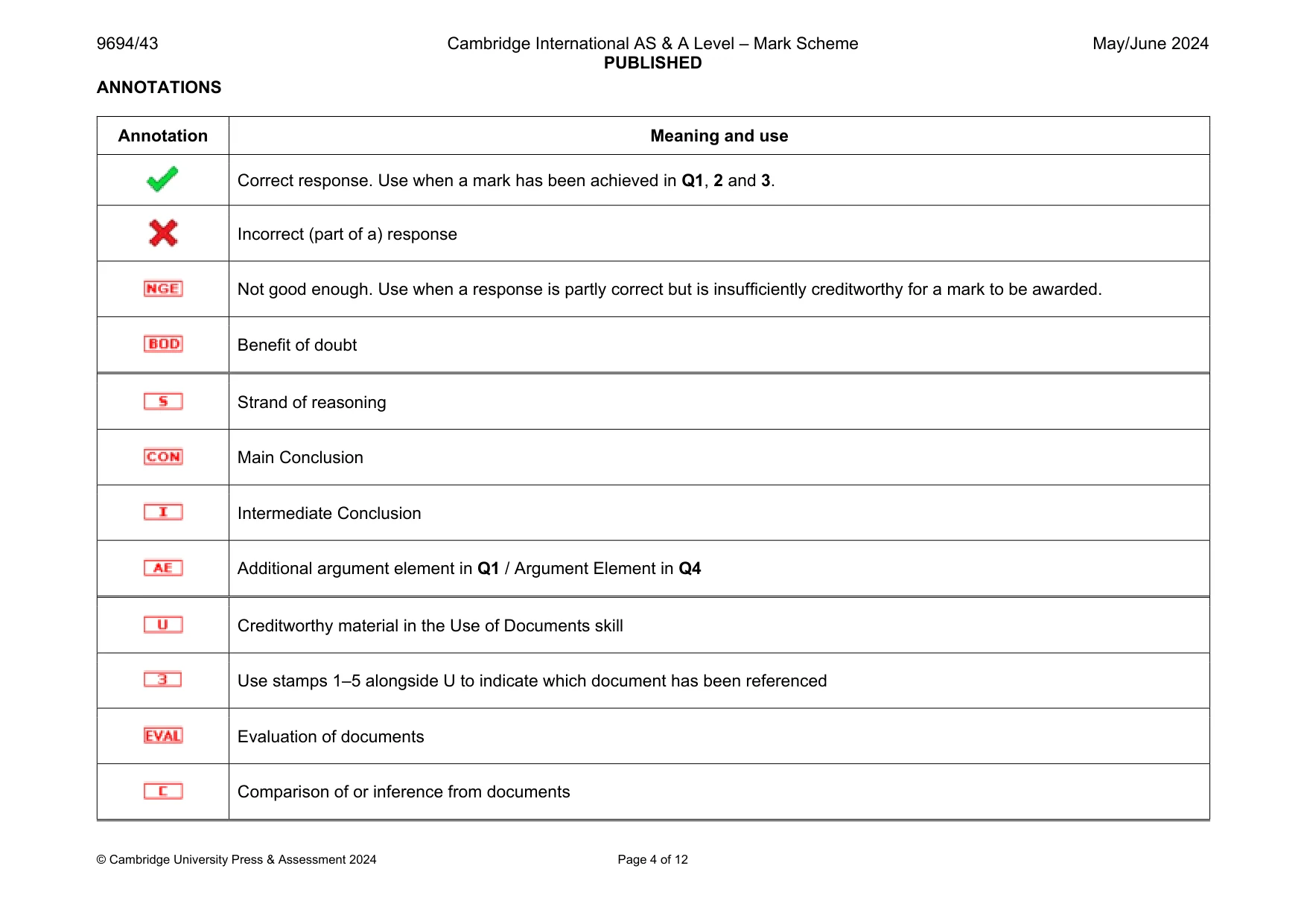
9694/43 Cambridge International AS & A Level – Mark Scheme PUBLISHED May/June 2024 © Cambridge University Press & Assessment 2024 Page 4 of 12 ANNOTATIONS Annotation Meaning and use Correct response. Use when a mark has been achieved in Q1, 2 and 3. Incorrect (part of a) response Not good enough. Use when a response is partly correct but is insufficiently creditworthy for a mark to be awarded. Benefit of doubt Strand of reasoning Main Conclusion Intermediate Conclusion Additional argument element in Q1 / Argument Element in Q4 Creditworthy material in the Use of Documents skill Use stamps 1–5 alongside U to indicate which document has been referenced Evaluation of documents Comparison of or inference from documents
Mark scheme, page 5
9694/43 Cambridge International AS & A Level – Mark Scheme PUBLISHED May/June 2024 © Cambridge University Press & Assessment 2024 Page 5 of 12 Annotation Meaning and use Creditworthy material in the Quality of Argument skill Treatment of counter-position Level achieved. Add annotation at the end of Question 4 in the order of S, U, Q from left to right. Strong demonstration of a skill Higher mark within a level awarded Minor demonstration of a skill Flaw or weakness Lower mark within a level awarded Examiner has seen that the page contains no creditworthy material Use to annotate blank pages Highlight Use to draw attention to part of an answer There must be at least one annotation on each page of the answer booklet.
Mark scheme, page 6
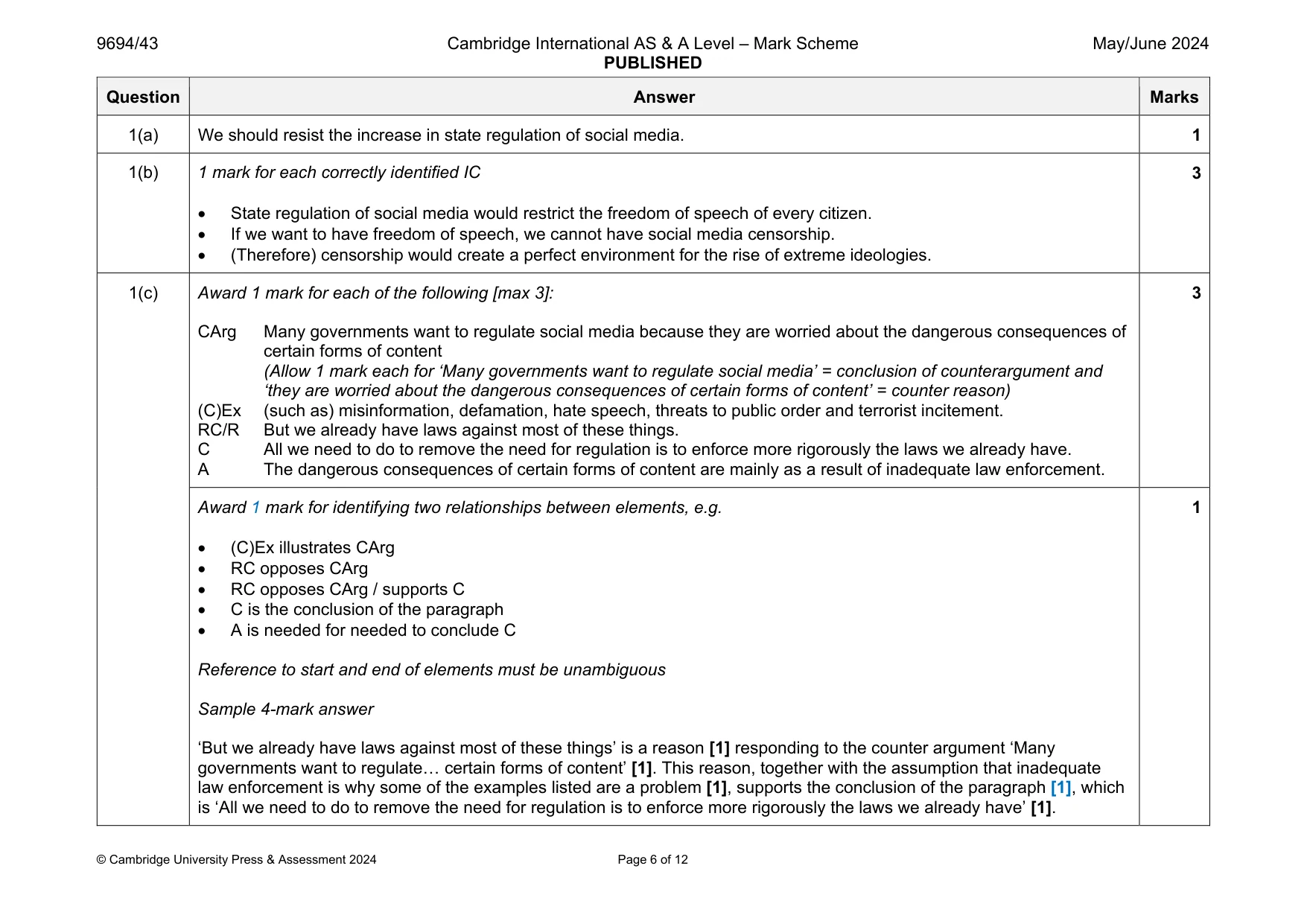
9694/43 Cambridge International AS & A Level – Mark Scheme PUBLISHED May/June 2024 © Cambridge University Press & Assessment 2024 Page 6 of 12 Question Answer Marks 1(a) We should resist the increase in state regulation of social media. 1 1(b) 1 mark for each correctly identified IC State regulation of social media would restrict the freedom of speech of every citizen. If we want to have freedom of speech, we cannot have social media censorship. (Therefore) censorship would create a perfect environment for the rise of extreme ideologies. 3 1(c) Award 1 mark for each of the following [max 3]: CArg Many governments want to regulate social media because they are worried about the dangerous consequences of certain forms of content (Allow 1 mark each for ‘Many governments want to regulate social media’ = conclusion of counterargument and ‘they are worried about the dangerous consequences of certain forms of content’ = counter reason) (C)Ex (such as) misinformation, defamation, hate speech, threats to public order and terrorist incitement. RC/R But we already have laws against most of these things. C All we need to do to remove the need for regulation is to enforce more rigorously the laws we already have. A The dangerous consequences of certain forms of content are mainly as a result of inadequate law enforcement. 3 Award 1 mark for identifying two relationships between elements, e.g. (C)Ex illustrates CArg RC opposes CArg RC opposes CArg / supports C C is the conclusion of the paragraph A is needed for needed to conclude C Reference to start and end of elements must be unambiguous Sample 4-mark answer ‘But we already have laws against most of these things’ is a reason [1] responding to the counter argument ‘Many governments want to regulate… certain forms of content’ [1]. This reason, together with the assumption that inadequate law enforcement is why some of the examples listed are a problem [1], supports the conclusion of the paragraph [1], which is ‘All we need to do to remove the need for regulation is to enforce more rigorously the laws we already have’ [1]. 1
Mark scheme, page 7
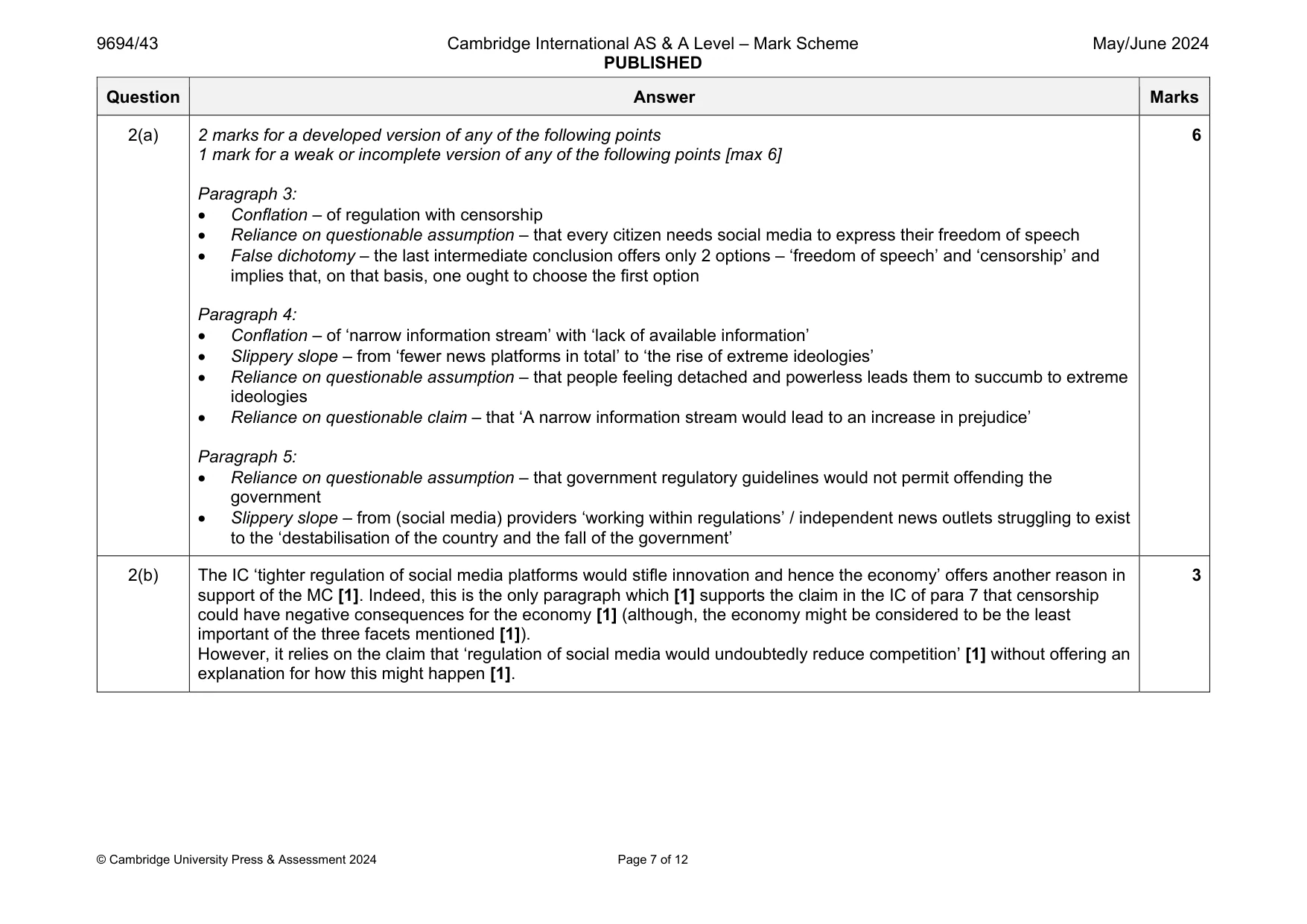
9694/43 Cambridge International AS & A Level – Mark Scheme PUBLISHED May/June 2024 © Cambridge University Press & Assessment 2024 Page 7 of 12 Question Answer Marks 2(a) 2 marks for a developed version of any of the following points 1 mark for a weak or incomplete version of any of the following points [max 6] Paragraph 3: Conflation – of regulation with censorship Reliance on questionable assumption – that every citizen needs social media to express their freedom of speech False dichotomy – the last intermediate conclusion offers only 2 options – ‘freedom of speech’ and ‘censorship’ and implies that, on that basis, one ought to choose the first option Paragraph 4: Conflation – of ‘narrow information stream’ with ‘lack of available information’ Slippery slope – from ‘fewer news platforms in total’ to ‘the rise of extreme ideologies’ Reliance on questionable assumption – that people feeling detached and powerless leads them to succumb to extreme ideologies Reliance on questionable claim – that ‘A narrow information stream would lead to an increase in prejudice’ Paragraph 5: Reliance on questionable assumption – that government regulatory guidelines would not permit offending the government Slippery slope – from (social media) providers ‘working within regulations’ / independent news outlets struggling to exist to the ‘destabilisation of the country and the fall of the government’ 6 2(b) The IC ‘tighter regulation of social media platforms would stifle innovation and hence the economy’ offers another reason in support of the MC [1]. Indeed, this is the only paragraph which [1] supports the claim in the IC of para 7 that censorship could have negative consequences for the economy [1] (although, the economy might be considered to be the least important of the three facets mentioned [1]). However, it relies on the claim that ‘regulation of social media would undoubtedly reduce competition’ [1] without offering an explanation for how this might happen [1]. 3
Mark scheme, page 8
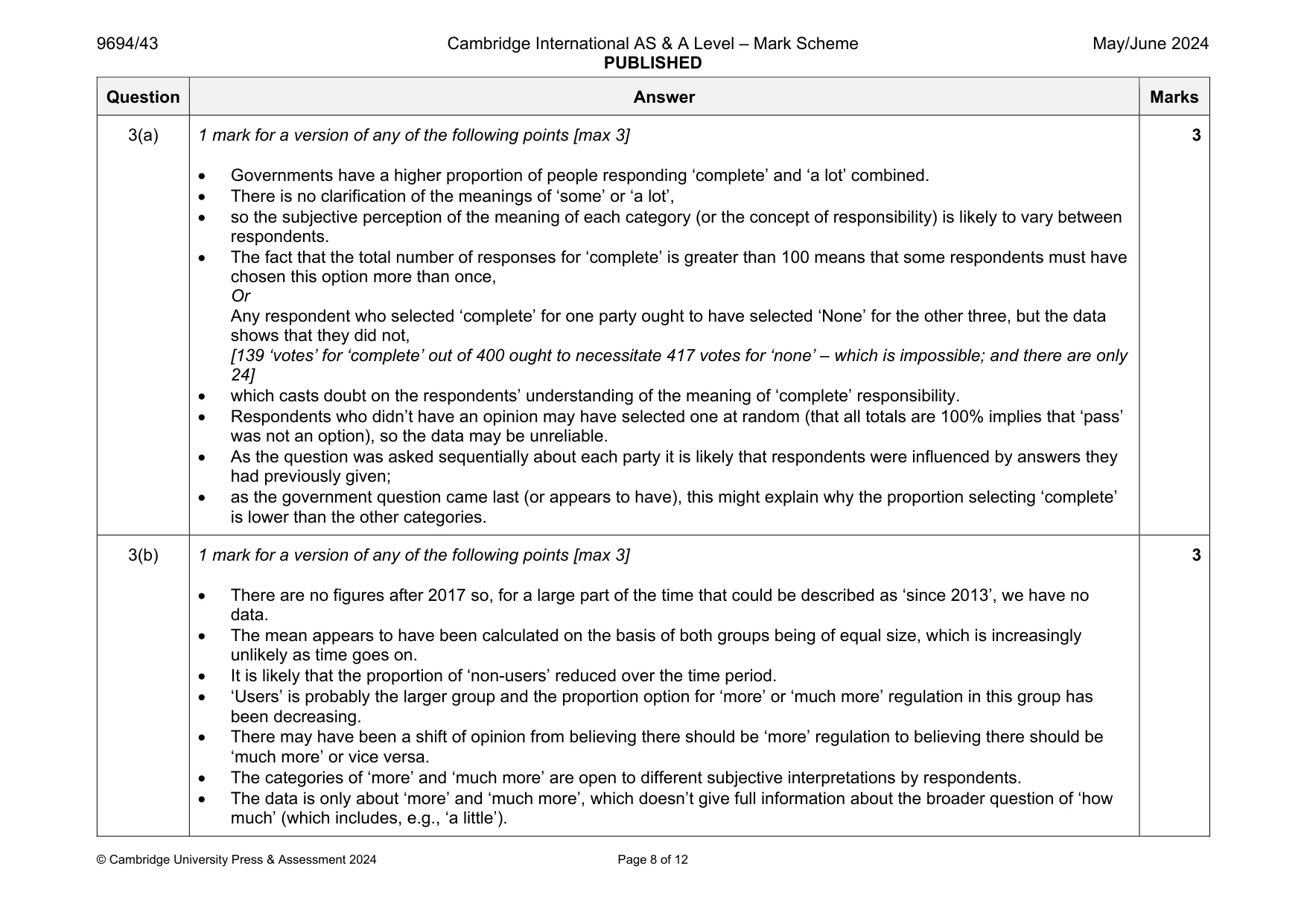
9694/43 Cambridge International AS & A Level – Mark Scheme PUBLISHED May/June 2024 © Cambridge University Press & Assessment 2024 Page 8 of 12 Question Answer Marks 3(a) 1 mark for a version of any of the following points [max 3] Governments have a higher proportion of people responding ‘complete’ and ‘a lot’ combined. There is no clarification of the meanings of ‘some’ or ‘a lot’, so the subjective perception of the meaning of each category (or the concept of responsibility) is likely to vary between respondents. The fact that the total number of responses for ‘complete’ is greater than 100 means that some respondents must have chosen this option more than once, Or Any respondent who selected ‘complete’ for one party ought to have selected ‘None’ for the other three, but the data shows that they did not, [139 ‘votes’ for ‘complete’ out of 400 ought to necessitate 417 votes for ‘none’ – which is impossible; and there are only 24] which casts doubt on the respondents’ understanding of the meaning of ‘complete’ responsibility. Respondents who didn’t have an opinion may have selected one at random (that all totals are 100% implies that ‘pass’ was not an option), so the data may be unreliable. As the question was asked sequentially about each party it is likely that respondents were influenced by answers they had previously given; as the government question came last (or appears to have), this might explain why the proportion selecting ‘complete’ is lower than the other categories. 3 3(b) 1 mark for a version of any of the following points [max 3] There are no figures after 2017 so, for a large part of the time that could be described as ‘since 2013’, we have no data. The mean appears to have been calculated on the basis of both groups being of equal size, which is increasingly unlikely as time goes on. It is likely that the proportion of ‘non-users’ reduced over the time period. ‘Users’ is probably the larger group and the proportion option for ‘more’ or ‘much more’ regulation in this group has been decreasing. There may have been a shift of opinion from believing there should be ‘more’ regulation to believing there should be ‘much more’ or vice versa. The categories of ‘more’ and ‘much more’ are open to different subjective interpretations by respondents. The data is only about ‘more’ and ‘much more’, which doesn’t give full information about the broader question of ‘how much’ (which includes, e.g., ‘a little’). 3
Mark scheme, page 9
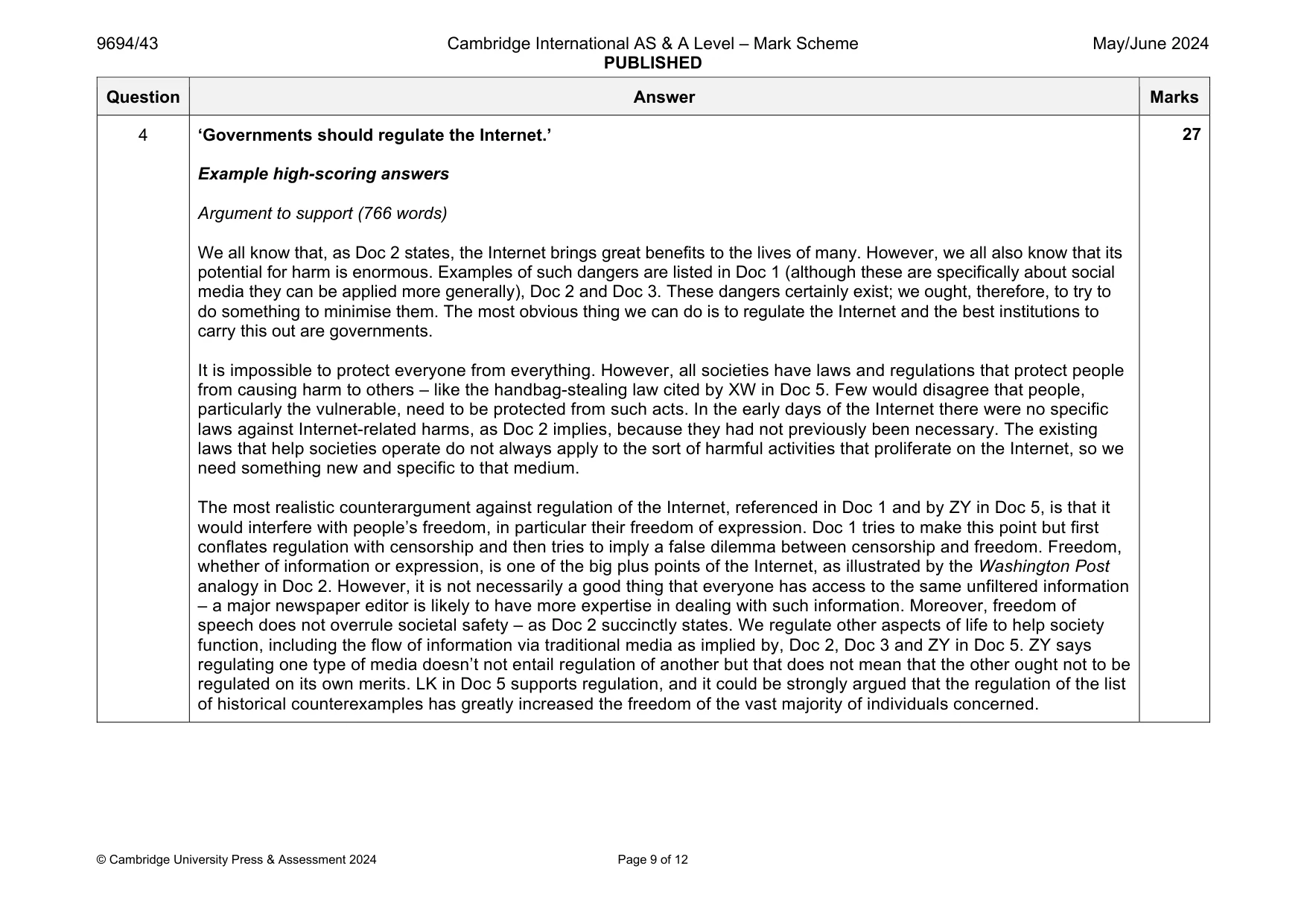
9694/43 Cambridge International AS & A Level – Mark Scheme PUBLISHED May/June 2024 © Cambridge University Press & Assessment 2024 Page 9 of 12 Question Answer Marks 4 ‘Governments should regulate the Internet.’ Example high-scoring answers Argument to support (766 words) We all know that, as Doc 2 states, the Internet brings great benefits to the lives of many. However, we all also know that its potential for harm is enormous. Examples of such dangers are listed in Doc 1 (although these are specifically about social media they can be applied more generally), Doc 2 and Doc 3. These dangers certainly exist; we ought, therefore, to try to do something to minimise them. The most obvious thing we can do is to regulate the Internet and the best institutions to carry this out are governments. It is impossible to protect everyone from everything. However, all societies have laws and regulations that protect people from causing harm to others – like the handbag-stealing law cited by XW in Doc 5. Few would disagree that people, particularly the vulnerable, need to be protected from such acts. In the early days of the Internet there were no specific laws against Internet-related harms, as Doc 2 implies, because they had not previously been necessary. The existing laws that help societies operate do not always apply to the sort of harmful activities that proliferate on the Internet, so we need something new and specific to that medium. The most realistic counterargument against regulation of the Internet, referenced in Doc 1 and by ZY in Doc 5, is that it would interfere with people’s freedom, in particular their freedom of expression. Doc 1 tries to make this point but first conflates regulation with censorship and then tries to imply a false dilemma between censorship and freedom. Freedom, whether of information or expression, is one of the big plus points of the Internet, as illustrated by the Washington Post analogy in Doc 2. However, it is not necessarily a good thing that everyone has access to the same unfiltered information – a major newspaper editor is likely to have more expertise in dealing with such information. Moreover, freedom of speech does not overrule societal safety – as Doc 2 succinctly states. We regulate other aspects of life to help society function, including the flow of information via traditional media as implied by, Doc 2, Doc 3 and ZY in Doc 5. ZY says regulating one type of media doesn’t not entail regulation of another but that does not mean that the other ought not to be regulated on its own merits. LK in Doc 5 supports regulation, and it could be strongly argued that the regulation of the list of historical counterexamples has greatly increased the freedom of the vast majority of individuals concerned. 27
Mark scheme, page 10
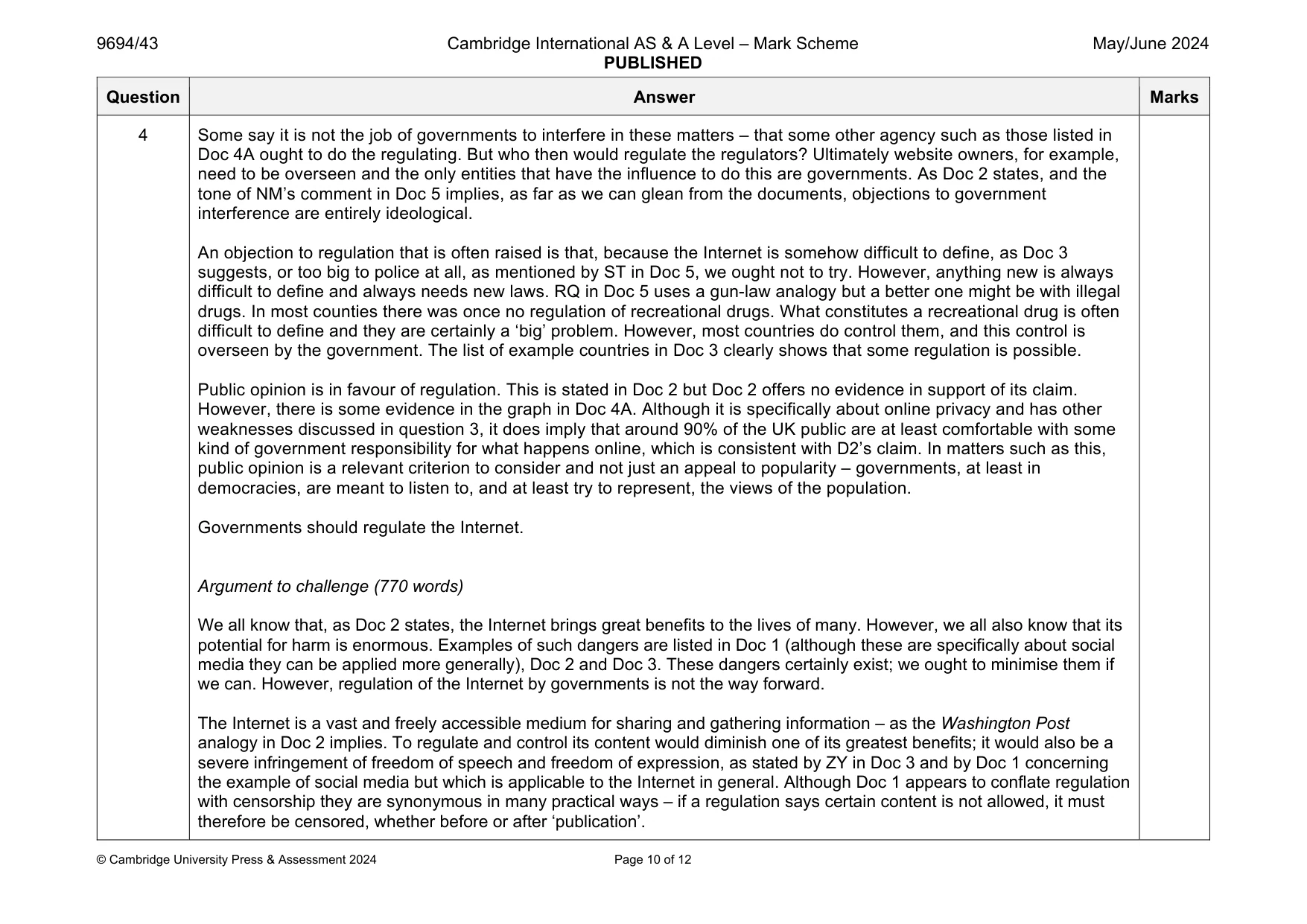
9694/43 Cambridge International AS & A Level – Mark Scheme PUBLISHED May/June 2024 © Cambridge University Press & Assessment 2024 Page 10 of 12 Question Answer Marks 4 Some say it is not the job of governments to interfere in these matters – that some other agency such as those listed in Doc 4A ought to do the regulating. But who then would regulate the regulators? Ultimately website owners, for example, need to be overseen and the only entities that have the influence to do this are governments. As Doc 2 states, and the tone of NM’s comment in Doc 5 implies, as far as we can glean from the documents, objections to government interference are entirely ideological. An objection to regulation that is often raised is that, because the Internet is somehow difficult to define, as Doc 3 suggests, or too big to police at all, as mentioned by ST in Doc 5, we ought not to try. However, anything new is always difficult to define and always needs new laws. RQ in Doc 5 uses a gun-law analogy but a better one might be with illegal drugs. In most counties there was once no regulation of recreational drugs. What constitutes a recreational drug is often difficult to define and they are certainly a ‘big’ problem. However, most countries do control them, and this control is overseen by the government. The list of example countries in Doc 3 clearly shows that some regulation is possible. Public opinion is in favour of regulation. This is stated in Doc 2 but Doc 2 offers no evidence in support of its claim. However, there is some evidence in the graph in Doc 4A. Although it is specifically about online privacy and has other weaknesses discussed in question 3, it does imply that around 90% of the UK public are at least comfortable with some kind of government responsibility for what happens online, which is consistent with D2’s claim. In matters such as this, public opinion is a relevant criterion to consider and not just an appeal to popularity – governments, at least in democracies, are meant to listen to, and at least try to represent, the views of the population. Governments should regulate the Internet. Argument to challenge (770 words) We all know that, as Doc 2 states, the Internet brings great benefits to the lives of many. However, we all also know that its potential for harm is enormous. Examples of such dangers are listed in Doc 1 (although these are specifically about social media they can be applied more generally), Doc 2 and Doc 3. These dangers certainly exist; we ought to minimise them if we can. However, regulation of the Internet by governments is not the way forward. The Internet is a vast and freely accessible medium for sharing and gathering information – as the Washington Post analogy in Doc 2 implies. To regulate and control its content would diminish one of its greatest benefits; it would also be a severe infringement of freedom of speech and freedom of expression, as stated by ZY in Doc 3 and by Doc 1 concerning the example of social media but which is applicable to the Internet in general. Although Doc 1 appears to conflate regulation with censorship they are synonymous in many practical ways – if a regulation says certain content is not allowed, it must therefore be censored, whether before or after ‘publication’.
Mark scheme, page 11
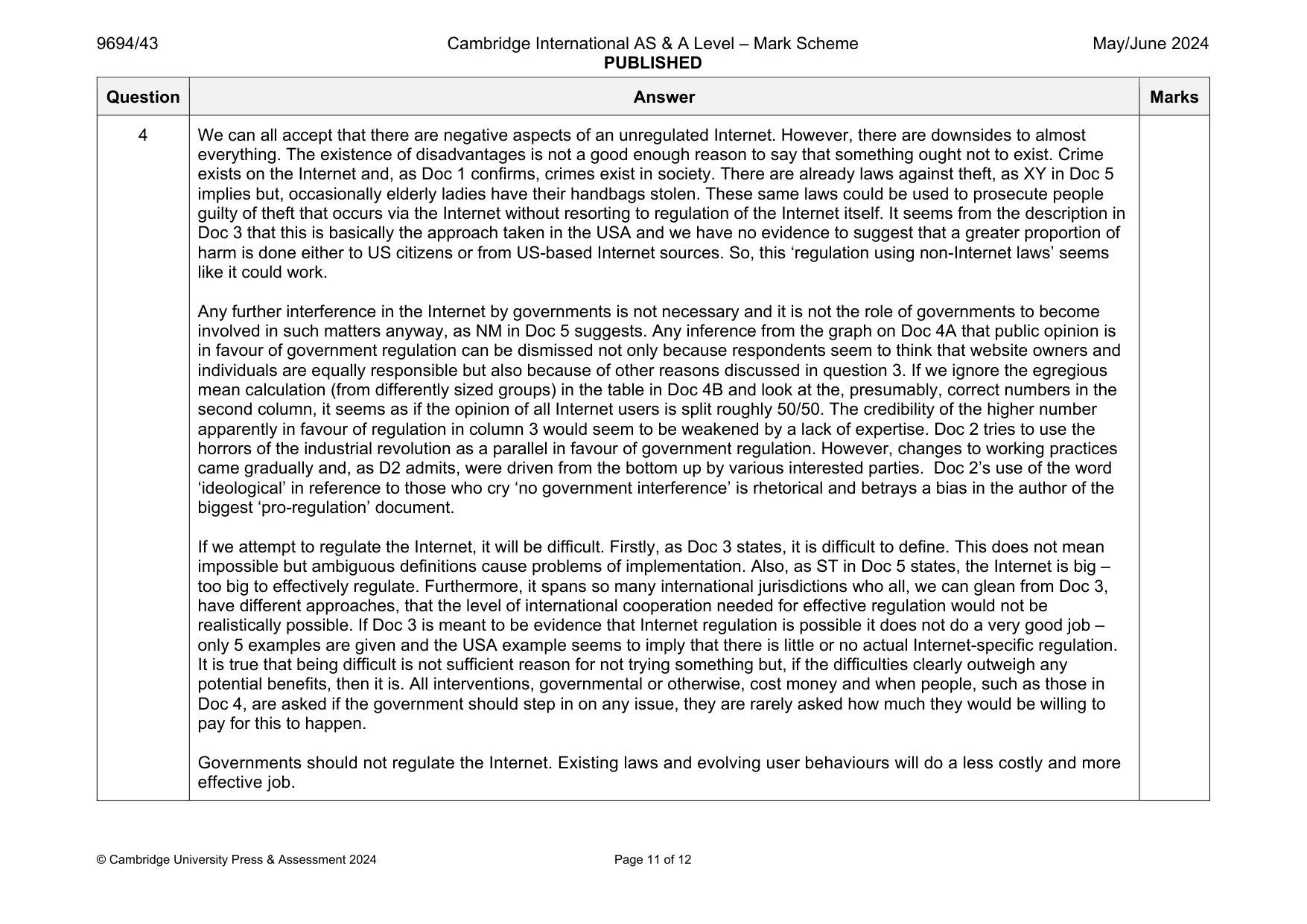
9694/43 Cambridge International AS & A Level – Mark Scheme PUBLISHED May/June 2024 © Cambridge University Press & Assessment 2024 Page 11 of 12 Question Answer Marks 4 We can all accept that there are negative aspects of an unregulated Internet. However, there are downsides to almost everything. The existence of disadvantages is not a good enough reason to say that something ought not to exist. Crime exists on the Internet and, as Doc 1 confirms, crimes exist in society. There are already laws against theft, as XY in Doc 5 implies but, occasionally elderly ladies have their handbags stolen. These same laws could be used to prosecute people guilty of theft that occurs via the Internet without resorting to regulation of the Internet itself. It seems from the description in Doc 3 that this is basically the approach taken in the USA and we have no evidence to suggest that a greater proportion of harm is done either to US citizens or from US-based Internet sources. So, this ‘regulation using non-Internet laws’ seems like it could work. Any further interference in the Internet by governments is not necessary and it is not the role of governments to become involved in such matters anyway, as NM in Doc 5 suggests. Any inference from the graph on Doc 4A that public opinion is in favour of government regulation can be dismissed not only because respondents seem to think that website owners and individuals are equally responsible but also because of other reasons discussed in question 3. If we ignore the egregious mean calculation (from differently sized groups) in the table in Doc 4B and look at the, presumably, correct numbers in the second column, it seems as if the opinion of all Internet users is split roughly 50/50. The credibility of the higher number apparently in favour of regulation in column 3 would seem to be weakened by a lack of expertise. Doc 2 tries to use the horrors of the industrial revolution as a parallel in favour of government regulation. However, changes to working practices came gradually and, as D2 admits, were driven from the bottom up by various interested parties. Doc 2’s use of the word ‘ideological’ in reference to those who cry ‘no government interference’ is rhetorical and betrays a bias in the author of the biggest ‘pro-regulation’ document. If we attempt to regulate the Internet, it will be difficult. Firstly, as Doc 3 states, it is difficult to define. This does not mean impossible but ambiguous definitions cause problems of implementation. Also, as ST in Doc 5 states, the Internet is big – too big to effectively regulate. Furthermore, it spans so many international jurisdictions who all, we can glean from Doc 3, have different approaches, that the level of international cooperation needed for effective regulation would not be realistically possible. If Doc 3 is meant to be evidence that Internet regulation is possible it does not do a very good job – only 5 examples are given and the USA example seems to imply that there is little or no actual Internet-specific regulation. It is true that being difficult is not sufficient reason for not trying something but, if the difficulties clearly outweigh any potential benefits, then it is. All interventions, governmental or otherwise, cost money and when people, such as those in Doc 4, are asked if the government should step in on any issue, they are rarely asked how much they would be willing to pay for this to happen. Governments should not regulate the Internet. Existing laws and evolving user behaviours will do a less costly and more effective job.
Mark scheme, page 12
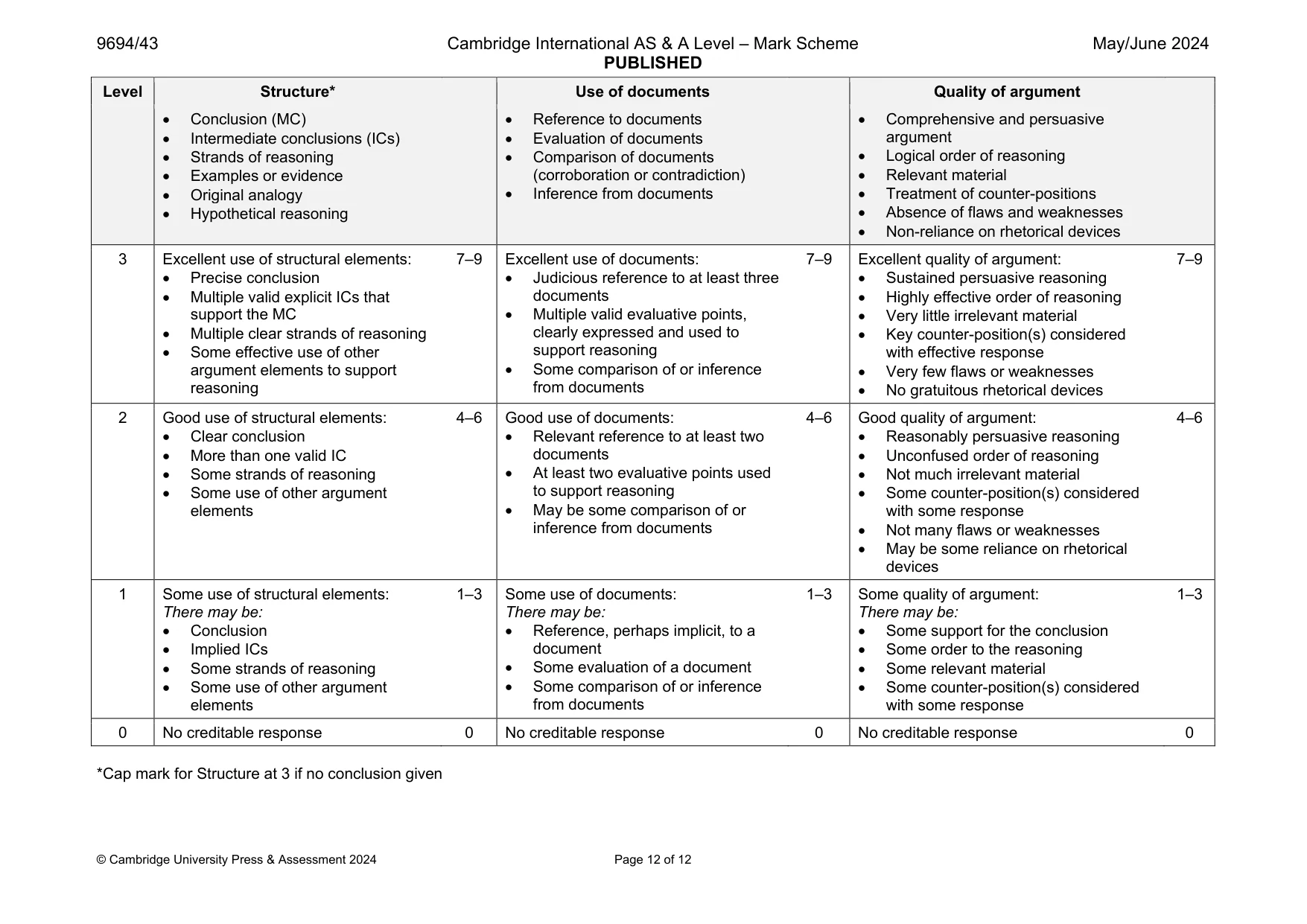
9694/43 Cambridge International AS & A Level – Mark Scheme PUBLISHED May/June 2024 © Cambridge University Press & Assessment 2024 Page 12 of 12 Level Structure* Use of documents Quality of argument Conclusion (MC) Intermediate conclusions (ICs) Strands of reasoning Examples or evidence Original analogy Hypothetical reasoning Reference to documents Evaluation of documents Comparison of documents (corroboration or contradiction) Inference from documents Comprehensive and persuasive argument Logical order of reasoning Relevant material Treatment of counter-positions Absence of flaws and weaknesses Non-reliance on rhetorical devices 3 Excellent use of structural elements: Precise conclusion Multiple valid explicit ICs that support the MC Multiple clear strands of reasoning Some effective use of other argument elements to support reasoning 7–9 Excellent use of documents: Judicious reference to at least three documents Multiple valid evaluative points, clearly expressed and used to support reasoning Some comparison of or inference from documents 7–9 Excellent quality of argument: Sustained persuasive reasoning Highly effective order of reasoning Very little irrelevant material Key counter-position(s) considered with effective response Very few flaws or weaknesses No gratuitous rhetorical devices 7–9 2 Good use of structural elements: Clear conclusion More than one valid IC Some strands of reasoning Some use of other argument elements 4–6 Good use of documents: Relevant reference to at least two documents At least two evaluative points used to support reasoning May be some comparison of or inference from documents 4–6 Good quality of argument: Reasonably persuasive reasoning Unconfused order of reasoning Not much irrelevant material Some counter-position(s) considered with some response Not many flaws or weaknesses May be some reliance on rhetorical devices 4–6 1 Some use of structural elements: There may be: Conclusion Implied ICs Some strands of reasoning Some use of other argument elements 1–3 Some use of documents: There may be: Reference, perhaps implicit, to a document Some evaluation of a document Some comparison of or inference from documents 1–3 Some quality of argument: There may be: Some support for the conclusion Some order to the reasoning Some relevant material Some counter-position(s) considered with some response 1–3 0 No creditable response 0 No creditable response 0 No creditable response 0 *Cap mark for Structure at 3 if no conclusion given
What you needed in this session
Cambridge’s own grade thresholds for 2024 May/June, Paper 4 · Variant 3. A higher threshold means an easier paper — the bar moves with how the cohort did.