Cambridge A Level Thinking Skills 9694 — 2023 Oct/Nov Paper 4 · Variant 3
9694/43/O/N/23 · 50 marks · ≈56 min
The question paper and its mark scheme, free to read here and free to download. This is Cambridge’s own paper, exactly as it was sat.
Question paper8 pages

Mark scheme13 pages
Answers below. Sit the paper first if you are practising.
Paper as text
Question paper, page 1
This document has 8 pages. Any blank pages are indicated. [Turn over Cambridge International AS & A Level * 7 4 6 2 2 9 9 4 9 0 * DC (AP) 332418 © UCLES 2023 THINKING SKILLS 9694/43 Paper 4 Applied Reasoning October/November 2023 1 hour 45 minutes You must answer on the enclosed answer booklet. You will need: Answer booklet (enclosed) INSTRUCTIONS ● Answer all questions. ● Follow the instructions on the front cover of the answer booklet. If you need additional answer paper, ask the invigilator for a continuation booklet. INFORMATION ● The total mark for this paper is 50. ● The number of marks for each question or part question is shown in brackets [ ].
Question paper, page 2
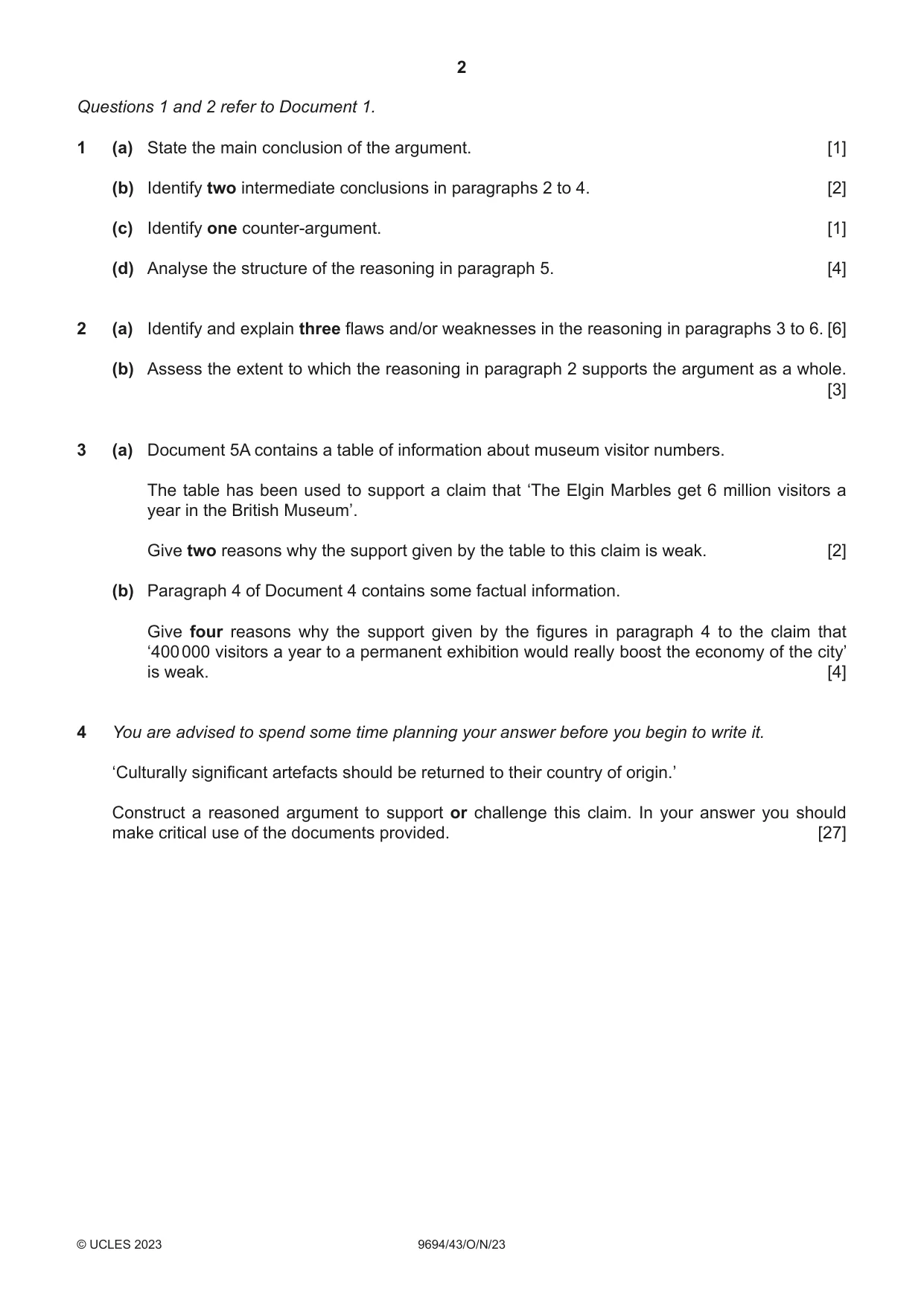
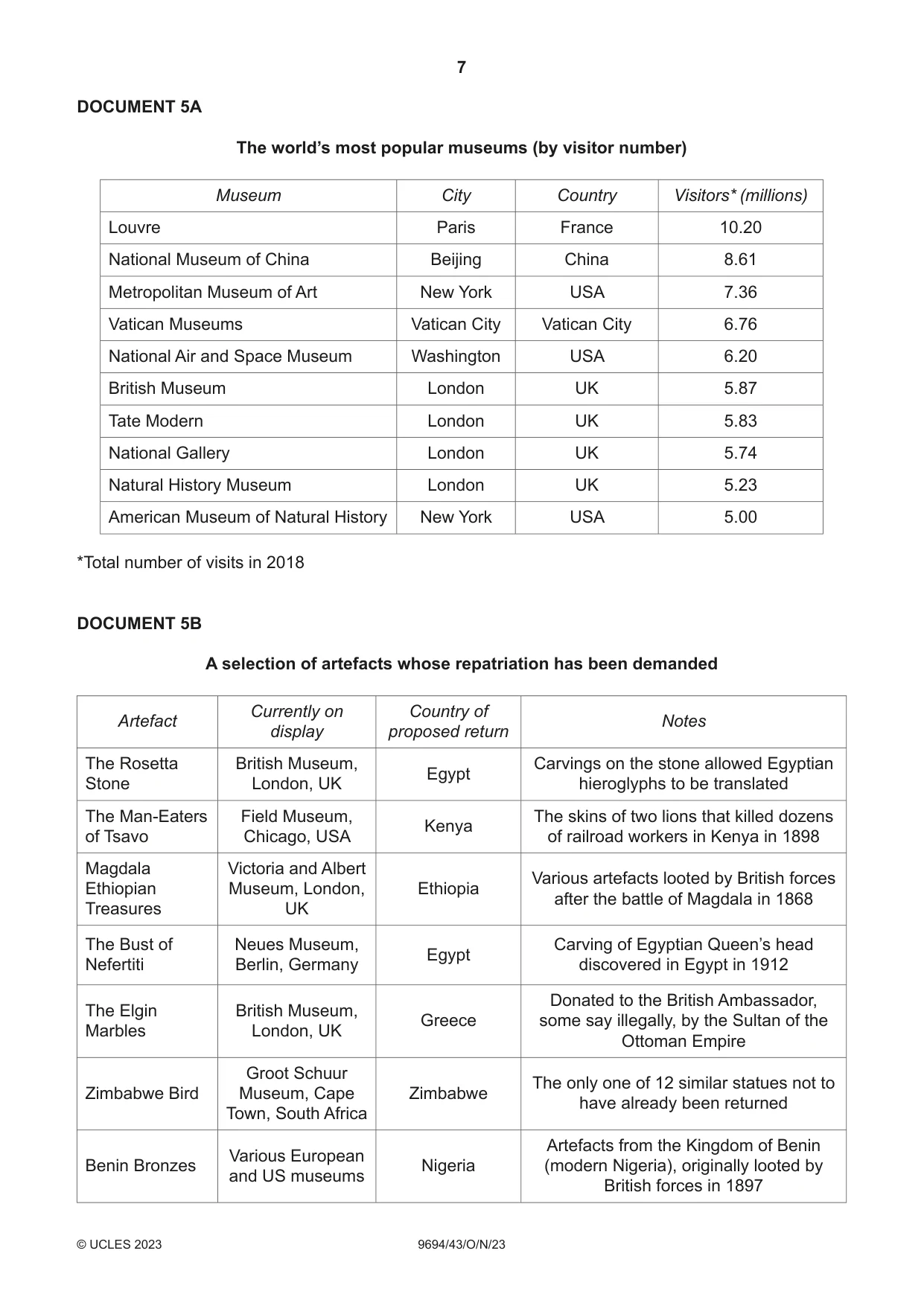
2 9694/43/O/N/23 © UCLES 2023 Questions 1 and 2 refer to Document 1. 1 (a) State the main conclusion of the argument. [1] (b) Identify two intermediate conclusions in paragraphs 2 to 4. [2] (c) Identify one counter-argument. [1] (d) Analyse the structure of the reasoning in paragraph 5. [4] 2 (a) Identify and explain three flaws and/or weaknesses in the reasoning in paragraphs 3 to 6. [6] (b) Assess the extent to which the reasoning in paragraph 2 supports the argument as a whole. [3] 3 (a) Document 5A contains a table of information about museum visitor numbers. The table has been used to support a claim that ‘The Elgin Marbles get 6 million visitors a year in the British Museum’. Give two reasons why the support given by the table to this claim is weak. [2] (b) Paragraph 4 of Document 4 contains some factual information. Give four reasons why the support given by the figures in paragraph 4 to the claim that ‘400 000 visitors a year to a permanent exhibition would really boost the economy of the city’ is weak. [4] 4 You are advised to spend some time planning your answer before you begin to write it. ‘Culturally significant artefacts should be returned to their country of origin.’ Construct a reasoned argument to support or challenge this claim. In your answer you should make critical use of the documents provided. [27]
Question paper, page 3
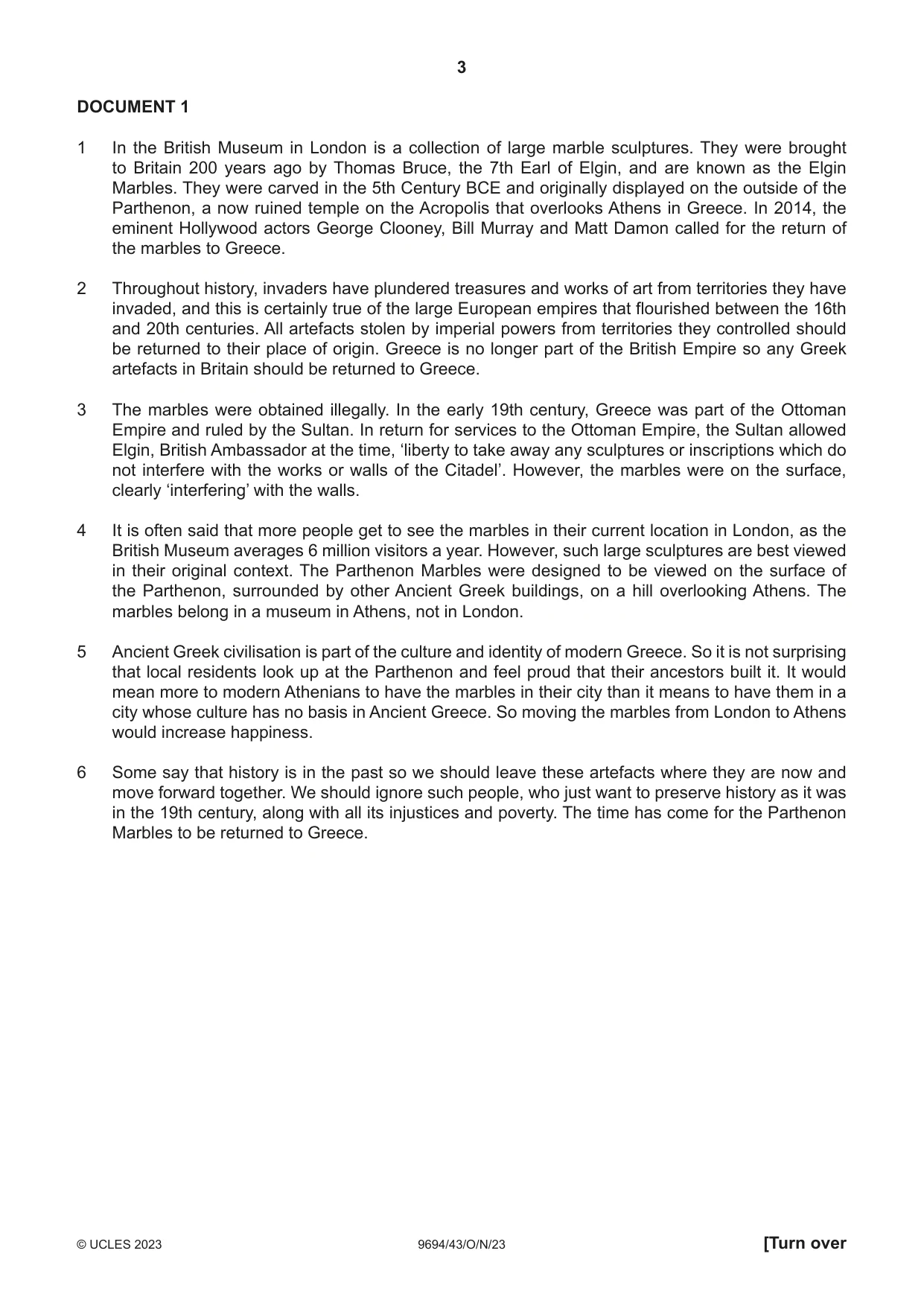
3 9694/43/O/N/23 © UCLES 2023 [Turn over DOCUMENT 1 1 In the British Museum in London is a collection of large marble sculptures. They were brought to Britain 200 years ago by Thomas Bruce, the 7th Earl of Elgin, and are known as the Elgin Marbles. They were carved in the 5th Century BCE and originally displayed on the outside of the Parthenon, a now ruined temple on the Acropolis that overlooks Athens in Greece. In 2014, the eminent Hollywood actors George Clooney, Bill Murray and Matt Damon called for the return of the marbles to Greece. 2 Throughout history, invaders have plundered treasures and works of art from territories they have invaded, and this is certainly true of the large European empires that flourished between the 16th and 20th centuries. All artefacts stolen by imperial powers from territories they controlled should be returned to their place of origin. Greece is no longer part of the British Empire so any Greek artefacts in Britain should be returned to Greece. 3 The marbles were obtained illegally. In the early 19th century, Greece was part of the Ottoman Empire and ruled by the Sultan. In return for services to the Ottoman Empire, the Sultan allowed Elgin, British Ambassador at the time, ‘liberty to take away any sculptures or inscriptions which do not interfere with the works or walls of the Citadel’. However, the marbles were on the surface, clearly ‘interfering’ with the walls. 4 It is often said that more people get to see the marbles in their current location in London, as the British Museum averages 6 million visitors a year. However, such large sculptures are best viewed in their original context. The Parthenon Marbles were designed to be viewed on the surface of the Parthenon, surrounded by other Ancient Greek buildings, on a hill overlooking Athens. The marbles belong in a museum in Athens, not in London. 5 Ancient Greek civilisation is part of the culture and identity of modern Greece. So it is not surprising that local residents look up at the Parthenon and feel proud that their ancestors built it. It would mean more to modern Athenians to have the marbles in their city than it means to have them in a city whose culture has no basis in Ancient Greece. So moving the marbles from London to Athens would increase happiness. 6 Some say that history is in the past so we should leave these artefacts where they are now and move forward together. We should ignore such people, who just want to preserve history as it was in the 19th century, along with all its injustices and poverty. The time has come for the Parthenon Marbles to be returned to Greece.
Question paper, page 4
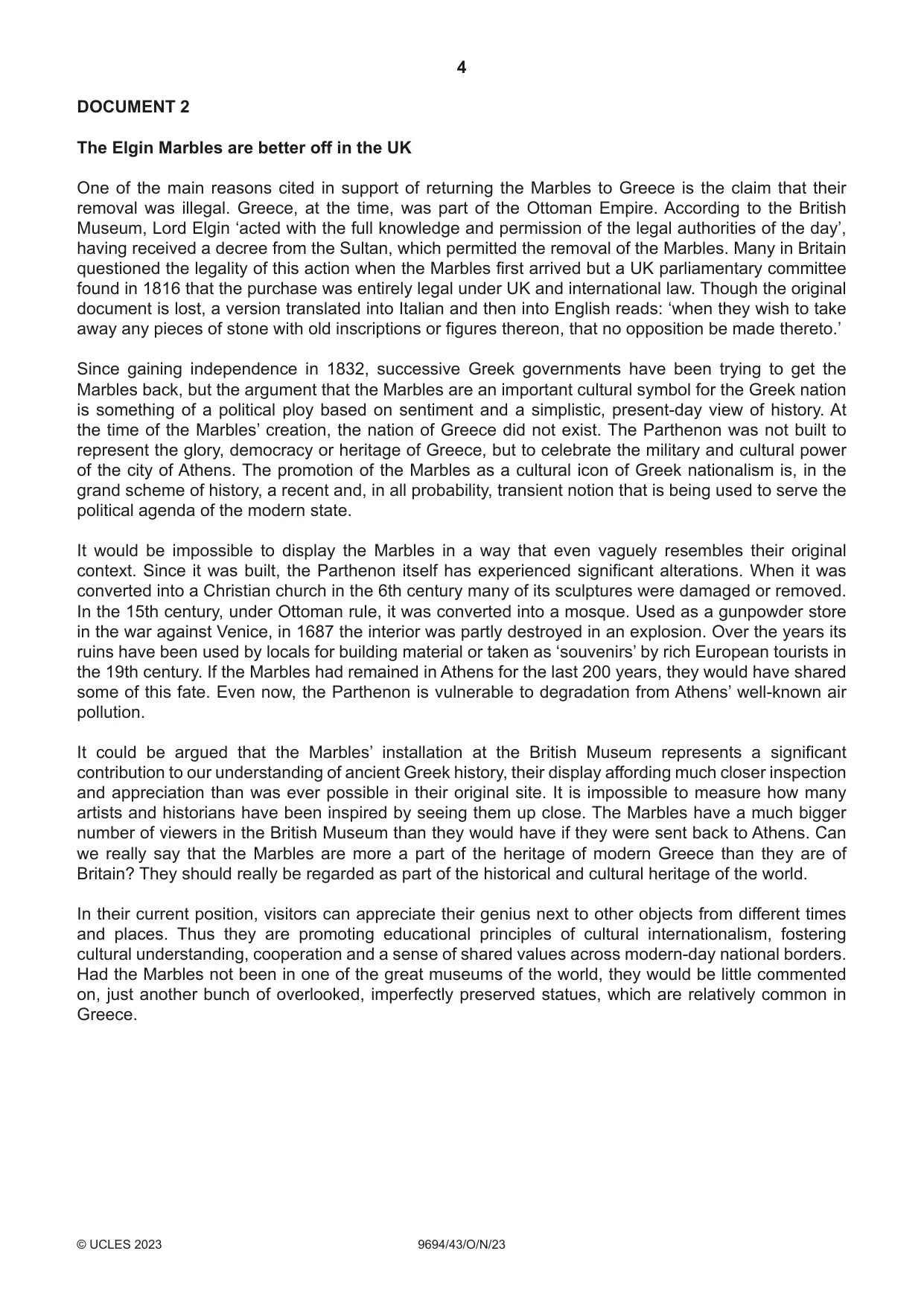
4 9694/43/O/N/23 © UCLES 2023 DOCUMENT 2 The Elgin Marbles are better off in the UK One of the main reasons cited in support of returning the Marbles to Greece is the claim that their removal was illegal. Greece, at the time, was part of the Ottoman Empire. According to the British Museum, Lord Elgin ‘acted with the full knowledge and permission of the legal authorities of the day’, having received a decree from the Sultan, which permitted the removal of the Marbles. Many in Britain questioned the legality of this action when the Marbles first arrived but a UK parliamentary committee found in 1816 that the purchase was entirely legal under UK and international law. Though the original document is lost, a version translated into Italian and then into English reads: ‘when they wish to take away any pieces of stone with old inscriptions or figures thereon, that no opposition be made thereto.’ Since gaining independence in 1832, successive Greek governments have been trying to get the Marbles back, but the argument that the Marbles are an important cultural symbol for the Greek nation is something of a political ploy based on sentiment and a simplistic, present-day view of history. At the time of the Marbles’ creation, the nation of Greece did not exist. The Parthenon was not built to represent the glory, democracy or heritage of Greece, but to celebrate the military and cultural power of the city of Athens. The promotion of the Marbles as a cultural icon of Greek nationalism is, in the grand scheme of history, a recent and, in all probability, transient notion that is being used to serve the political agenda of the modern state. It would be impossible to display the Marbles in a way that even vaguely resembles their original context. Since it was built, the Parthenon itself has experienced significant alterations. When it was converted into a Christian church in the 6th century many of its sculptures were damaged or removed. In the 15th century, under Ottoman rule, it was converted into a mosque. Used as a gunpowder store in the war against Venice, in 1687 the interior was partly destroyed in an explosion. Over the years its ruins have been used by locals for building material or taken as ‘souvenirs’ by rich European tourists in the 19th century. If the Marbles had remained in Athens for the last 200 years, they would have shared some of this fate. Even now, the Parthenon is vulnerable to degradation from Athens’ well-known air pollution. It could be argued that the Marbles’ installation at the British Museum represents a significant contribution to our understanding of ancient Greek history, their display affording much closer inspection and appreciation than was ever possible in their original site. It is impossible to measure how many artists and historians have been inspired by seeing them up close. The Marbles have a much bigger number of viewers in the British Museum than they would have if they were sent back to Athens. Can we really say that the Marbles are more a part of the heritage of modern Greece than they are of Britain? They should really be regarded as part of the historical and cultural heritage of the world. In their current position, visitors can appreciate their genius next to other objects from different times and places. Thus they are promoting educational principles of cultural internationalism, fostering cultural understanding, cooperation and a sense of shared values across modern-day national borders. Had the Marbles not been in one of the great museums of the world, they would be little commented on, just another bunch of overlooked, imperfectly preserved statues, which are relatively common in Greece.
Question paper, page 5
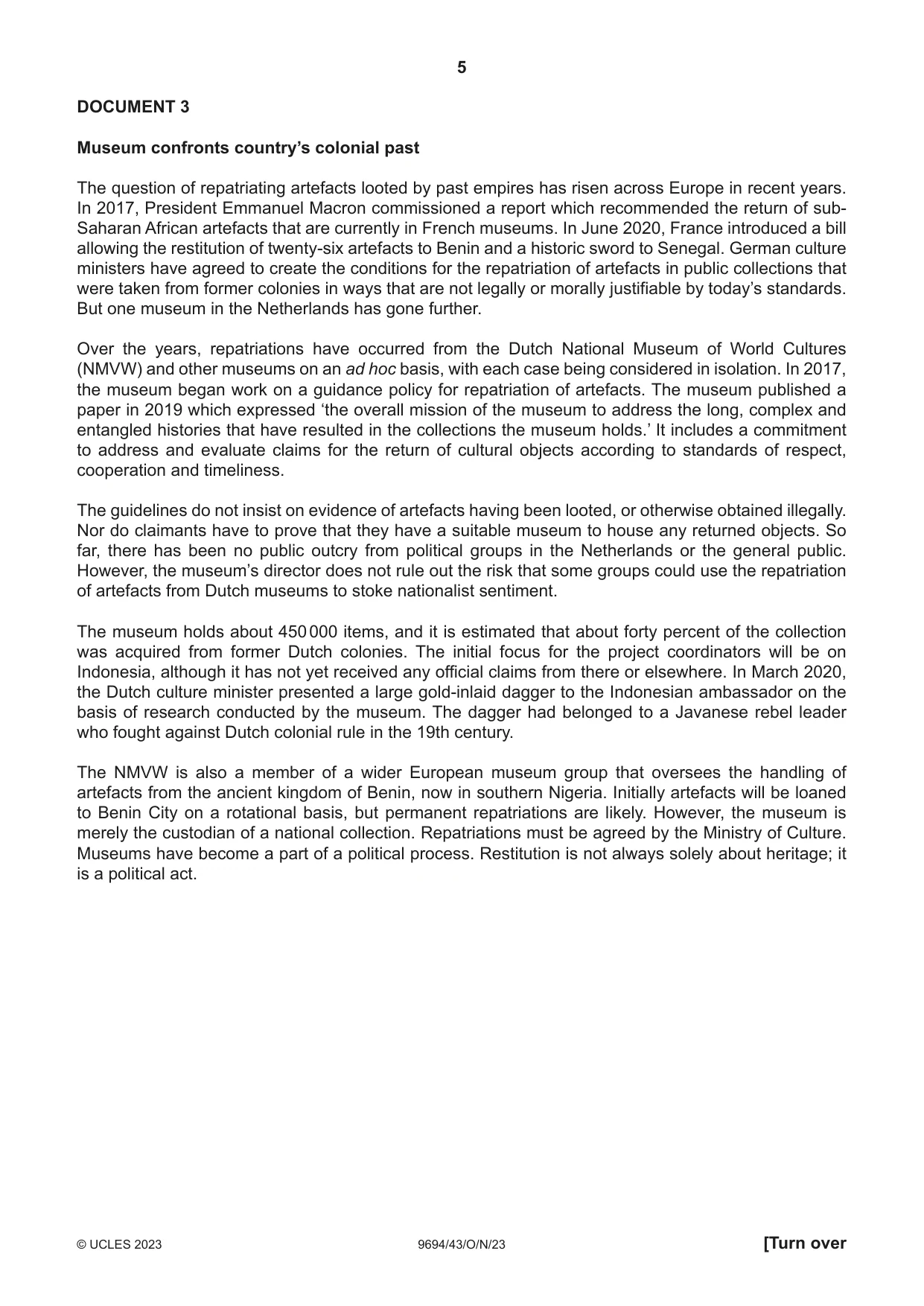
5 9694/43/O/N/23 © UCLES 2023 [Turn over DOCUMENT 3 Museum confronts country’s colonial past The question of repatriating artefacts looted by past empires has risen across Europe in recent years. In 2017, President Emmanuel Macron commissioned a report which recommended the return of sub- Saharan African artefacts that are currently in French museums. In June 2020, France introduced a bill allowing the restitution of twenty-six artefacts to Benin and a historic sword to Senegal. German culture ministers have agreed to create the conditions for the repatriation of artefacts in public collections that were taken from former colonies in ways that are not legally or morally justifiable by today’s standards. But one museum in the Netherlands has gone further. Over the years, repatriations have occurred from the Dutch National Museum of World Cultures (NMVW) and other museums on an ad hoc basis, with each case being considered in isolation. In 2017, the museum began work on a guidance policy for repatriation of artefacts. The museum published a paper in 2019 which expressed ‘the overall mission of the museum to address the long, complex and entangled histories that have resulted in the collections the museum holds.’ It includes a commitment to address and evaluate claims for the return of cultural objects according to standards of respect, cooperation and timeliness. The guidelines do not insist on evidence of artefacts having been looted, or otherwise obtained illegally. Nor do claimants have to prove that they have a suitable museum to house any returned objects. So far, there has been no public outcry from political groups in the Netherlands or the general public. However, the museum’s director does not rule out the risk that some groups could use the repatriation of artefacts from Dutch museums to stoke nationalist sentiment. The museum holds about 450 000 items, and it is estimated that about forty percent of the collection was acquired from former Dutch colonies. The initial focus for the project coordinators will be on Indonesia, although it has not yet received any official claims from there or elsewhere. In March 2020, the Dutch culture minister presented a large gold-inlaid dagger to the Indonesian ambassador on the basis of research conducted by the museum. The dagger had belonged to a Javanese rebel leader who fought against Dutch colonial rule in the 19th century. The NMVW is also a member of a wider European museum group that oversees the handling of artefacts from the ancient kingdom of Benin, now in southern Nigeria. Initially artefacts will be loaned to Benin City on a rotational basis, but permanent repatriations are likely. However, the museum is merely the custodian of a national collection. Repatriations must be agreed by the Ministry of Culture. Museums have become a part of a political process. Restitution is not always solely about heritage; it is a political act.
Question paper, page 6
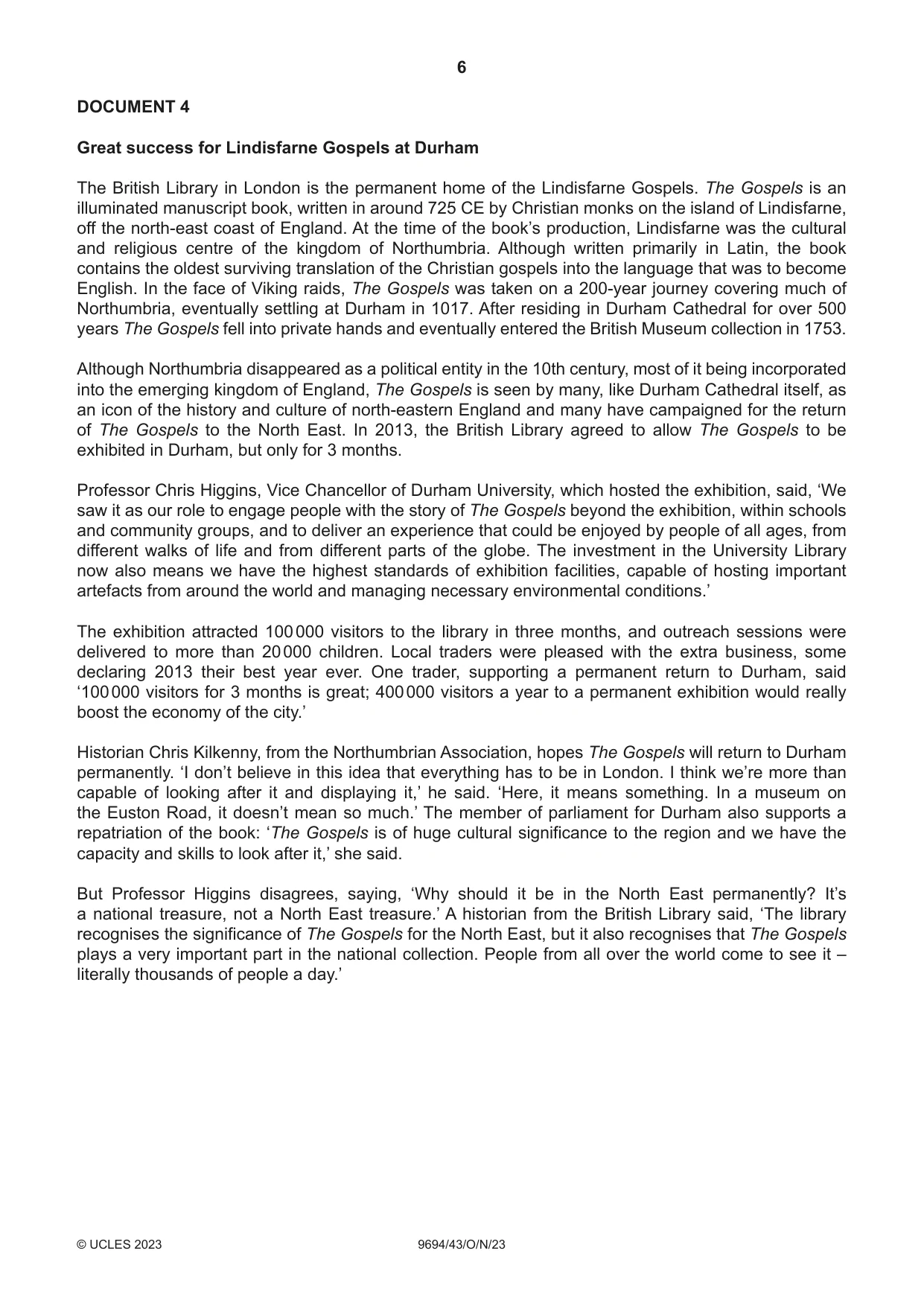
6 9694/43/O/N/23 © UCLES 2023 DOCUMENT 4 Great success for Lindisfarne Gospels at Durham The British Library in London is the permanent home of the Lindisfarne Gospels. The Gospels is an illuminated manuscript book, written in around 725 CE by Christian monks on the island of Lindisfarne, off the north-east coast of England. At the time of the book’s production, Lindisfarne was the cultural and religious centre of the kingdom of Northumbria. Although written primarily in Latin, the book contains the oldest surviving translation of the Christian gospels into the language that was to become English. In the face of Viking raids, The Gospels was taken on a 200-year journey covering much of Northumbria, eventually settling at Durham in 1017. After residing in Durham Cathedral for over 500 years The Gospels fell into private hands and eventually entered the British Museum collection in 1753. Although Northumbria disappeared as a political entity in the 10th century, most of it being incorporated into the emerging kingdom of England, The Gospels is seen by many, like Durham Cathedral itself, as an icon of the history and culture of north-eastern England and many have campaigned for the return of The Gospels to the North East. In 2013, the British Library agreed to allow The Gospels to be exhibited in Durham, but only for 3 months. Professor Chris Higgins, Vice Chancellor of Durham University, which hosted the exhibition, said, ‘We saw it as our role to engage people with the story of The Gospels beyond the exhibition, within schools and community groups, and to deliver an experience that could be enjoyed by people of all ages, from different walks of life and from different parts of the globe. The investment in the University Library now also means we have the highest standards of exhibition facilities, capable of hosting important artefacts from around the world and managing necessary environmental conditions.’ The exhibition attracted 100 000 visitors to the library in three months, and outreach sessions were delivered to more than 20 000 children. Local traders were pleased with the extra business, some declaring 2013 their best year ever. One trader, supporting a permanent return to Durham, said ‘100 000 visitors for 3 months is great; 400 000 visitors a year to a permanent exhibition would really boost the economy of the city.’ Historian Chris Kilkenny, from the Northumbrian Association, hopes The Gospels will return to Durham permanently. ‘I don’t believe in this idea that everything has to be in London. I think we’re more than capable of looking after it and displaying it,’ he said. ‘Here, it means something. In a museum on the Euston Road, it doesn’t mean so much.’ The member of parliament for Durham also supports a repatriation of the book: ‘The Gospels is of huge cultural significance to the region and we have the capacity and skills to look after it,’ she said. But Professor Higgins disagrees, saying, ‘Why should it be in the North East permanently? It’s a national treasure, not a North East treasure.’ A historian from the British Library said, ‘The library recognises the significance of The Gospels for the North East, but it also recognises that The Gospels plays a very important part in the national collection. People from all over the world come to see it – literally thousands of people a day.’
Question paper, page 7
7 9694/43/O/N/23 © UCLES 2023 DOCUMENT 5A The world’s most popular museums (by visitor number) Museum City Country Visitors* (millions) Louvre Paris France 10.20 National Museum of China Beijing China 8.61 Metropolitan Museum of Art New York USA 7.36 Vatican Museums Vatican City Vatican City 6.76 National Air and Space Museum Washington USA 6.20 British Museum London UK 5.87 Tate Modern London UK 5.83 National Gallery London UK 5.74 Natural History Museum London UK 5.23 American Museum of Natural History New York USA 5.00 *Total number of visits in 2018 DOCUMENT 5B A selection of artefacts whose repatriation has been demanded Artefact Currently on display Country of proposed return Notes The Rosetta Stone British Museum, London, UK Egypt Carvings on the stone allowed Egyptian hieroglyphs to be translated The Man-Eaters of Tsavo Field Museum, Chicago, USA Kenya The skins of two lions that killed dozens of railroad workers in Kenya in 1898 Magdala Ethiopian Treasures Victoria and Albert Museum, London, UK Ethiopia Various artefacts looted by British forces after the battle of Magdala in 1868 The Bust of Nefertiti Neues Museum, Berlin, Germany Egypt Carving of Egyptian Queen’s head discovered in Egypt in 1912 The Elgin Marbles British Museum, London, UK Greece Donated to the British Ambassador, some say illegally, by the Sultan of the Ottoman Empire Zimbabwe Bird Groot Schuur Museum, Cape Town, South Africa Zimbabwe The only one of 12 similar statues not to have already been returned Benin Bronzes Various European and US museums Nigeria Artefacts from the Kingdom of Benin (modern Nigeria), originally looted by British forces in 1897
Question paper, page 8
8 9694/43/O/N/23 © UCLES 2023 Permission to reproduce items where third-party owned material protected by copyright is included has been sought and cleared where possible. Every reasonable effort has been made by the publisher (UCLES) to trace copyright holders, but if any items requiring clearance have unwittingly been included, the publisher will be pleased to make amends at the earliest possible opportunity. To avoid the issue of disclosure of answer-related information to candidates, all copyright acknowledgements are reproduced online in the Cambridge Assessment International Education Copyright Acknowledgements Booklet. This is produced for each series of examinations and is freely available to download at www.cambridgeinternational.org after the live examination series. Cambridge Assessment International Education is part of Cambridge Assessment. Cambridge Assessment is the brand name of the University of Cambridge Local Examinations Syndicate (UCLES), which is a department of the University of Cambridge. BLANK PAGE
Mark scheme, page 1
This document consists of 13 printed pages. © UCLES 2023 [Turn over Cambridge International AS & A Level THINKING SKILLS 9694/43 Paper 4 Applied Reasoning October/November 2023 MARK SCHEME Maximum Mark: 50 Published This mark scheme is published as an aid to teachers and candidates, to indicate the requirements of the examination. It shows the basis on which Examiners were instructed to award marks. It does not indicate the details of the discussions that took place at an Examiners’ meeting before marking began, which would have considered the acceptability of alternative answers. Mark schemes should be read in conjunction with the question paper and the Principal Examiner Report for Teachers. Cambridge International will not enter into discussions about these mark schemes. Cambridge International is publishing the mark schemes for the October/November 2023 series for most Cambridge IGCSE, Cambridge International A and AS Level components, and some Cambridge O Level components.
Mark scheme, page 2
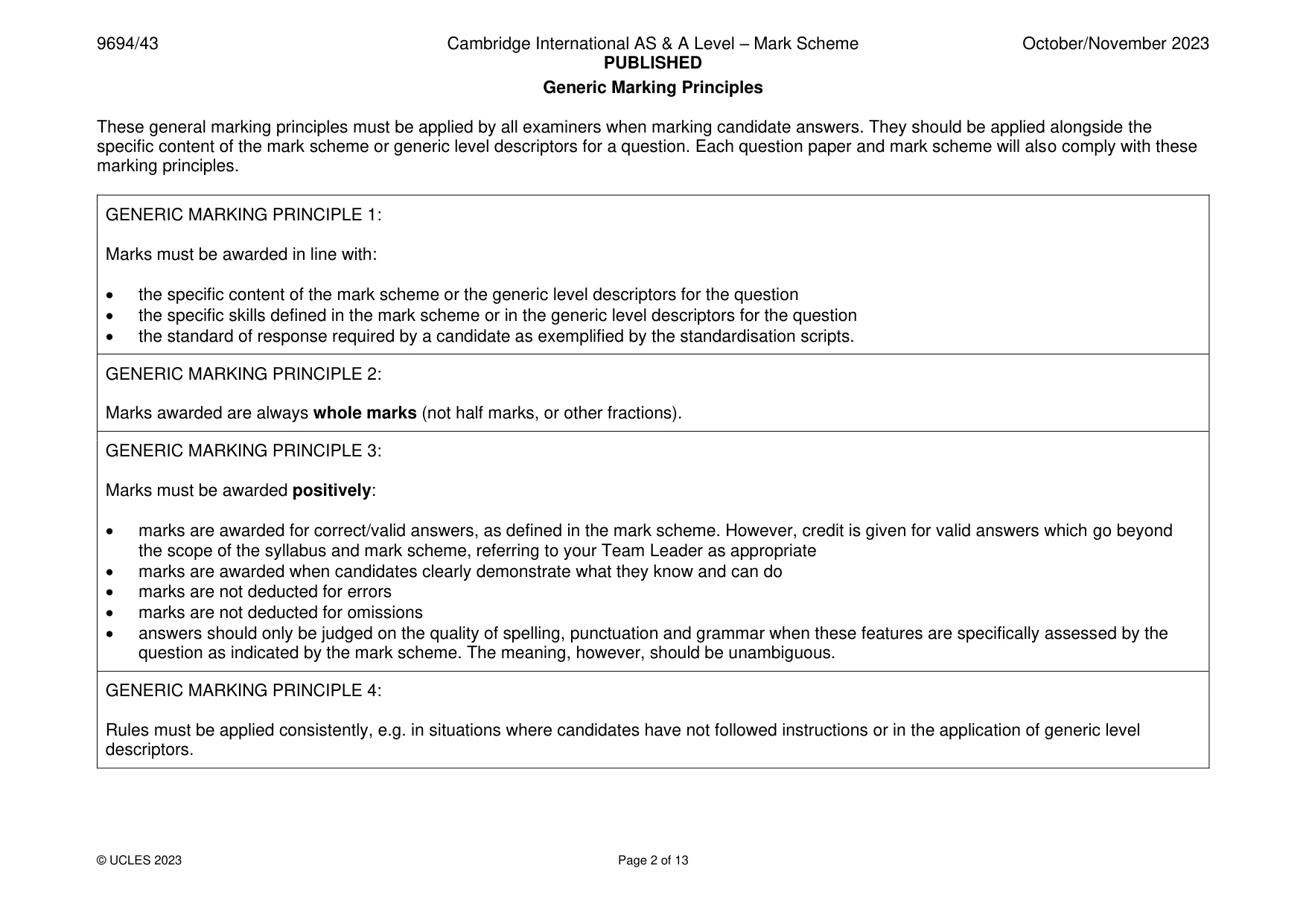
9694/43 Cambridge International AS & A Level – Mark Scheme PUBLISHED October/November 2023 © UCLES 2023 Page 2 of 13 Generic Marking Principles These general marking principles must be applied by all examiners when marking candidate answers. They should be applied alongside the specific content of the mark scheme or generic level descriptors for a question. Each question paper and mark scheme will also comply with these marking principles. GENERIC MARKING PRINCIPLE 1: Marks must be awarded in line with: • the specific content of the mark scheme or the generic level descriptors for the question • the specific skills defined in the mark scheme or in the generic level descriptors for the question • the standard of response required by a candidate as exemplified by the standardisation scripts. GENERIC MARKING PRINCIPLE 2: Marks awarded are always whole marks (not half marks, or other fractions). GENERIC MARKING PRINCIPLE 3: Marks must be awarded positively: • marks are awarded for correct/valid answers, as defined in the mark scheme. However, credit is given for valid answers which go beyond the scope of the syllabus and mark scheme, referring to your Team Leader as appropriate • marks are awarded when candidates clearly demonstrate what they know and can do • marks are not deducted for errors • marks are not deducted for omissions • answers should only be judged on the quality of spelling, punctuation and grammar when these features are specifically assessed by the question as indicated by the mark scheme. The meaning, however, should be unambiguous. GENERIC MARKING PRINCIPLE 4: Rules must be applied consistently, e.g. in situations where candidates have not followed instructions or in the application of generic level descriptors.
Mark scheme, page 3
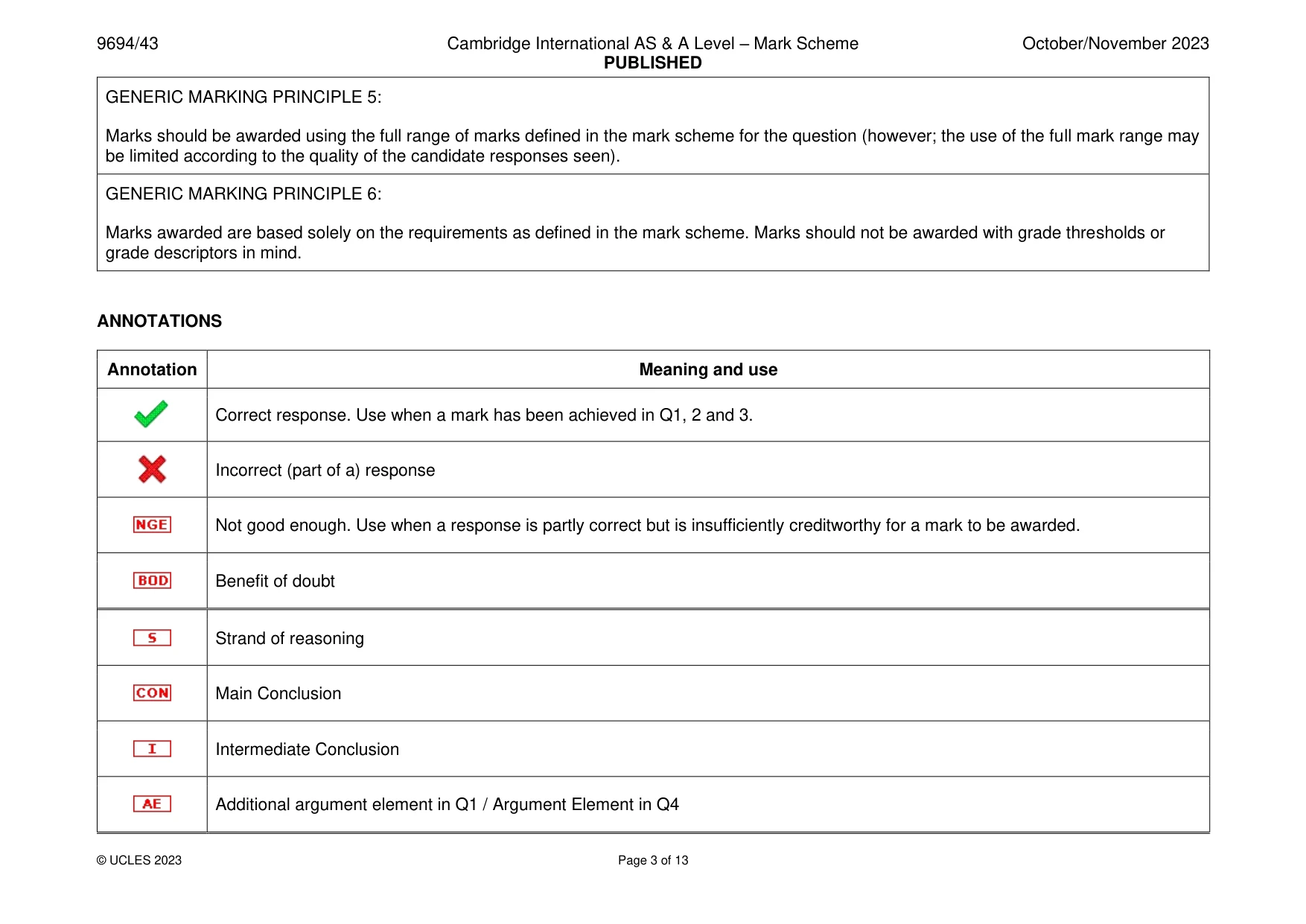
9694/43 Cambridge International AS & A Level – Mark Scheme PUBLISHED October/November 2023 © UCLES 2023 Page 3 of 13 GENERIC MARKING PRINCIPLE 5: Marks should be awarded using the full range of marks defined in the mark scheme for the question (however; the use of the full mark range may be limited according to the quality of the candidate responses seen). GENERIC MARKING PRINCIPLE 6: Marks awarded are based solely on the requirements as defined in the mark scheme. Marks should not be awarded with grade thresholds or grade descriptors in mind. ANNOTATIONS Annotation Meaning and use Correct response. Use when a mark has been achieved in Q1, 2 and 3. Incorrect (part of a) response Not good enough. Use when a response is partly correct but is insufficiently creditworthy for a mark to be awarded. Benefit of doubt Strand of reasoning Main Conclusion Intermediate Conclusion Additional argument element in Q1 / Argument Element in Q4
Mark scheme, page 4
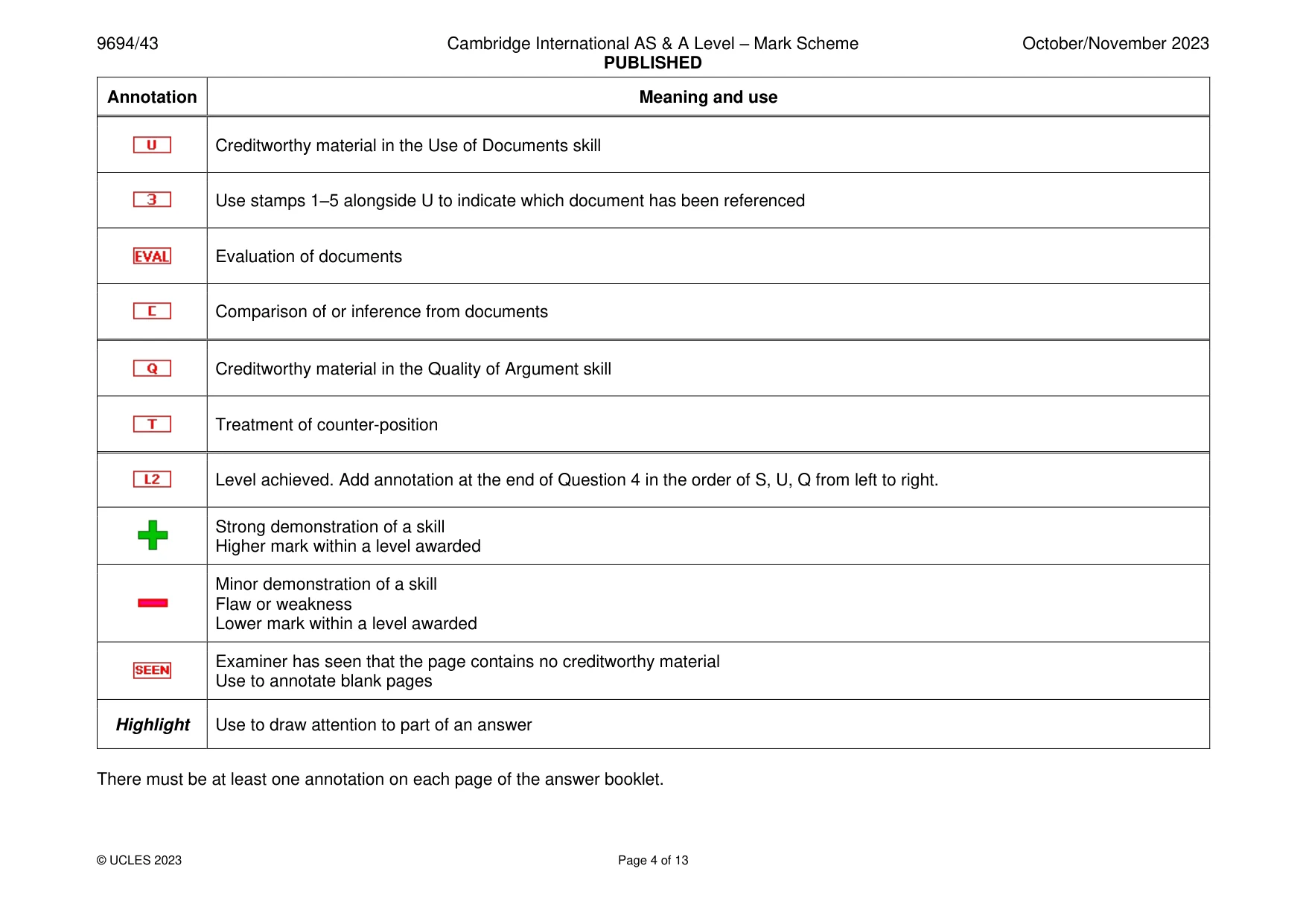
9694/43 Cambridge International AS & A Level – Mark Scheme PUBLISHED October/November 2023 © UCLES 2023 Page 4 of 13 Annotation Meaning and use Creditworthy material in the Use of Documents skill Use stamps 1–5 alongside U to indicate which document has been referenced Evaluation of documents Comparison of or inference from documents Creditworthy material in the Quality of Argument skill Treatment of counter-position Level achieved. Add annotation at the end of Question 4 in the order of S, U, Q from left to right. Strong demonstration of a skill Higher mark within a level awarded Minor demonstration of a skill Flaw or weakness Lower mark within a level awarded Examiner has seen that the page contains no creditworthy material Use to annotate blank pages Highlight Use to draw attention to part of an answer There must be at least one annotation on each page of the answer booklet.
Mark scheme, page 5
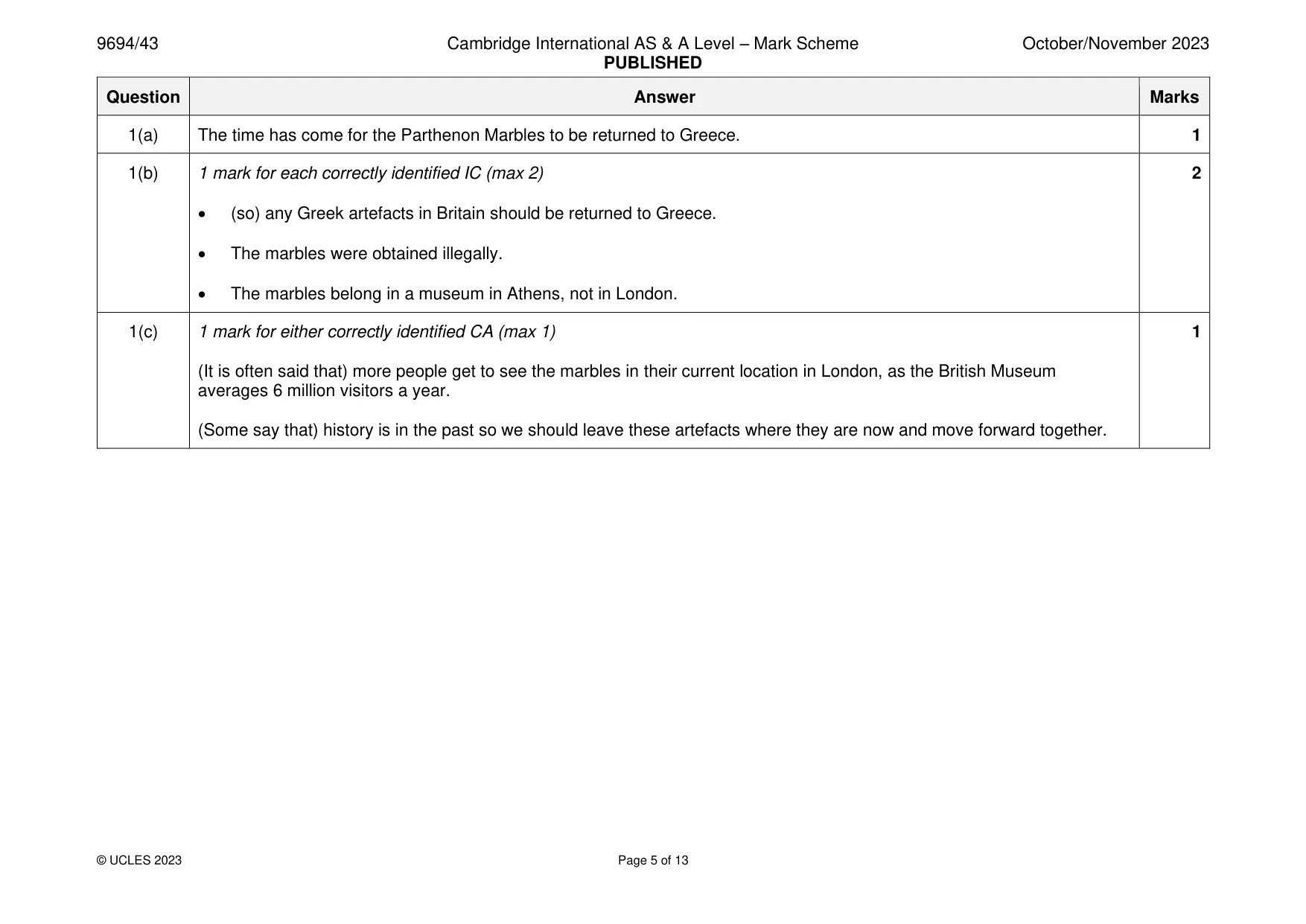
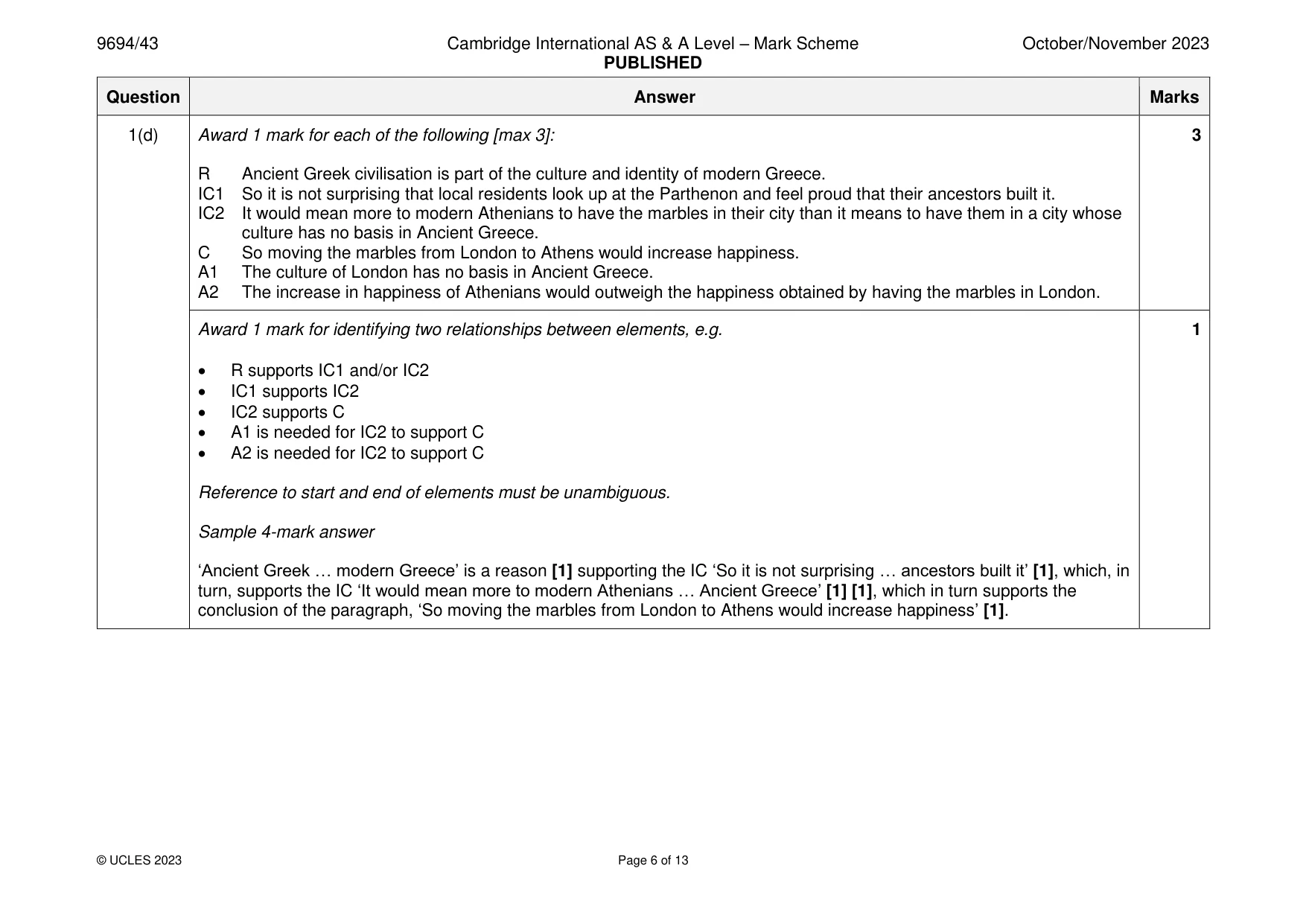
9694/43 Cambridge International AS & A Level – Mark Scheme PUBLISHED October/November 2023 © UCLES 2023 Page 5 of 13 Question Answer Marks 1(a) The time has come for the Parthenon Marbles to be returned to Greece. 1 1(b) 1 mark for each correctly identified IC (max 2) • (so) any Greek artefacts in Britain should be returned to Greece. • The marbles were obtained illegally. • The marbles belong in a museum in Athens, not in London. 2 1(c) 1 mark for either correctly identified CA (max 1) (It is often said that) more people get to see the marbles in their current location in London, as the British Museum averages 6 million visitors a year. (Some say that) history is in the past so we should leave these artefacts where they are now and move forward together. 1
Mark scheme, page 6
9694/43 Cambridge International AS & A Level – Mark Scheme PUBLISHED October/November 2023 © UCLES 2023 Page 6 of 13 Question Answer Marks 1(d) Award 1 mark for each of the following [max 3]: R Ancient Greek civilisation is part of the culture and identity of modern Greece. IC1 So it is not surprising that local residents look up at the Parthenon and feel proud that their ancestors built it. IC2 It would mean more to modern Athenians to have the marbles in their city than it means to have them in a city whose culture has no basis in Ancient Greece. C So moving the marbles from London to Athens would increase happiness. A1 The culture of London has no basis in Ancient Greece. A2 The increase in happiness of Athenians would outweigh the happiness obtained by having the marbles in London. 3 Award 1 mark for identifying two relationships between elements, e.g. • R supports IC1 and/or IC2 • IC1 supports IC2 • IC2 supports C • A1 is needed for IC2 to support C • A2 is needed for IC2 to support C Reference to start and end of elements must be unambiguous. Sample 4-mark answer ‘Ancient Greek … modern Greece’ is a reason [1] supporting the IC ‘So it is not surprising … ancestors built it’ [1], which, in turn, supports the IC ‘It would mean more to modern Athenians … Ancient Greece’ [1] [1], which in turn supports the conclusion of the paragraph, ‘So moving the marbles from London to Athens would increase happiness’ [1]. 1
Mark scheme, page 7
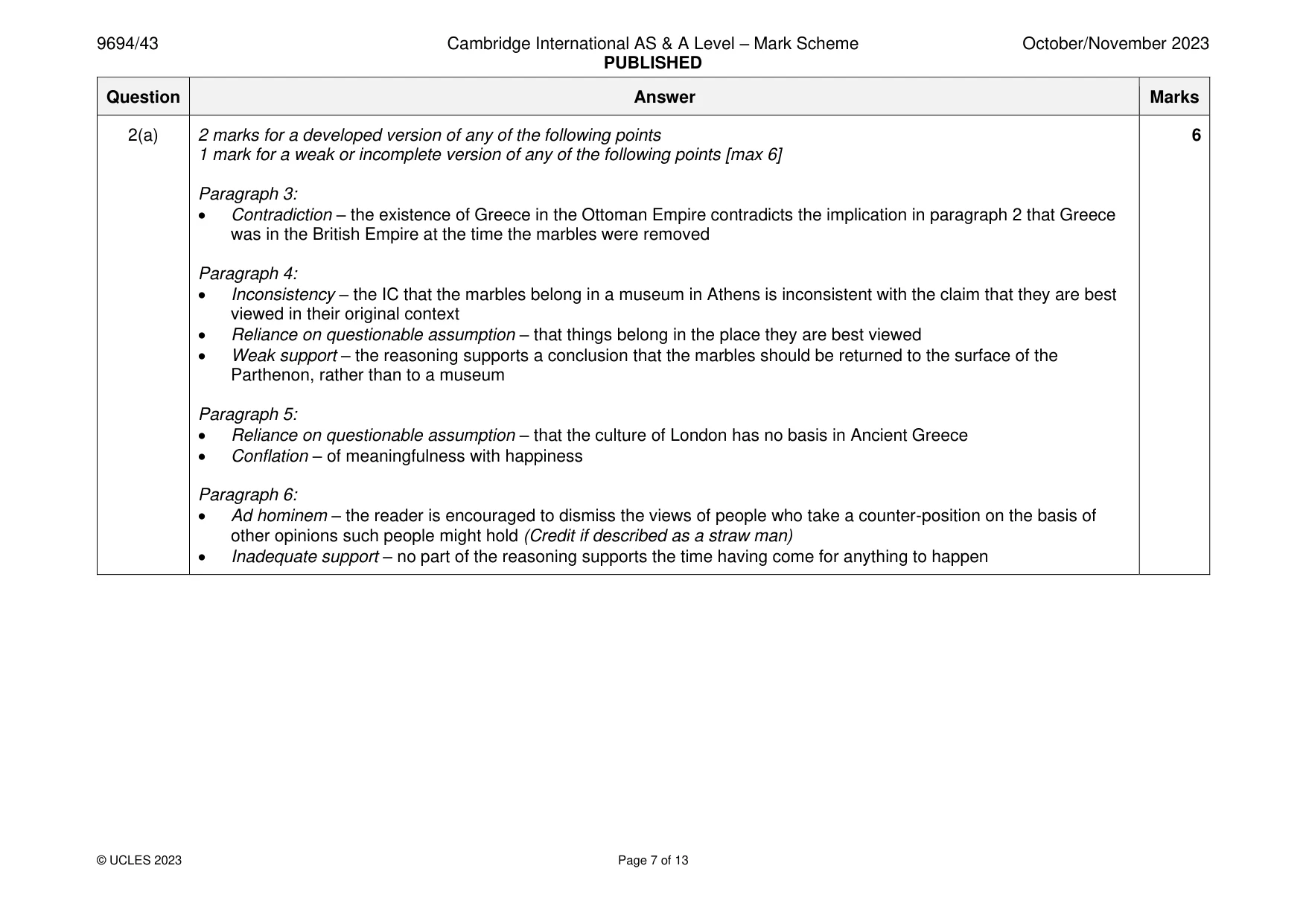
9694/43 Cambridge International AS & A Level – Mark Scheme PUBLISHED October/November 2023 © UCLES 2023 Page 7 of 13 Question Answer Marks 2(a) 2 marks for a developed version of any of the following points 1 mark for a weak or incomplete version of any of the following points [max 6] Paragraph 3: • Contradiction – the existence of Greece in the Ottoman Empire contradicts the implication in paragraph 2 that Greece was in the British Empire at the time the marbles were removed Paragraph 4: • Inconsistency – the IC that the marbles belong in a museum in Athens is inconsistent with the claim that they are best viewed in their original context • Reliance on questionable assumption – that things belong in the place they are best viewed • Weak support – the reasoning supports a conclusion that the marbles should be returned to the surface of the Parthenon, rather than to a museum Paragraph 5: • Reliance on questionable assumption – that the culture of London has no basis in Ancient Greece • Conflation – of meaningfulness with happiness Paragraph 6: • Ad hominem – the reader is encouraged to dismiss the views of people who take a counter-position on the basis of other opinions such people might hold (Credit if described as a straw man) • Inadequate support – no part of the reasoning supports the time having come for anything to happen 6
Mark scheme, page 8
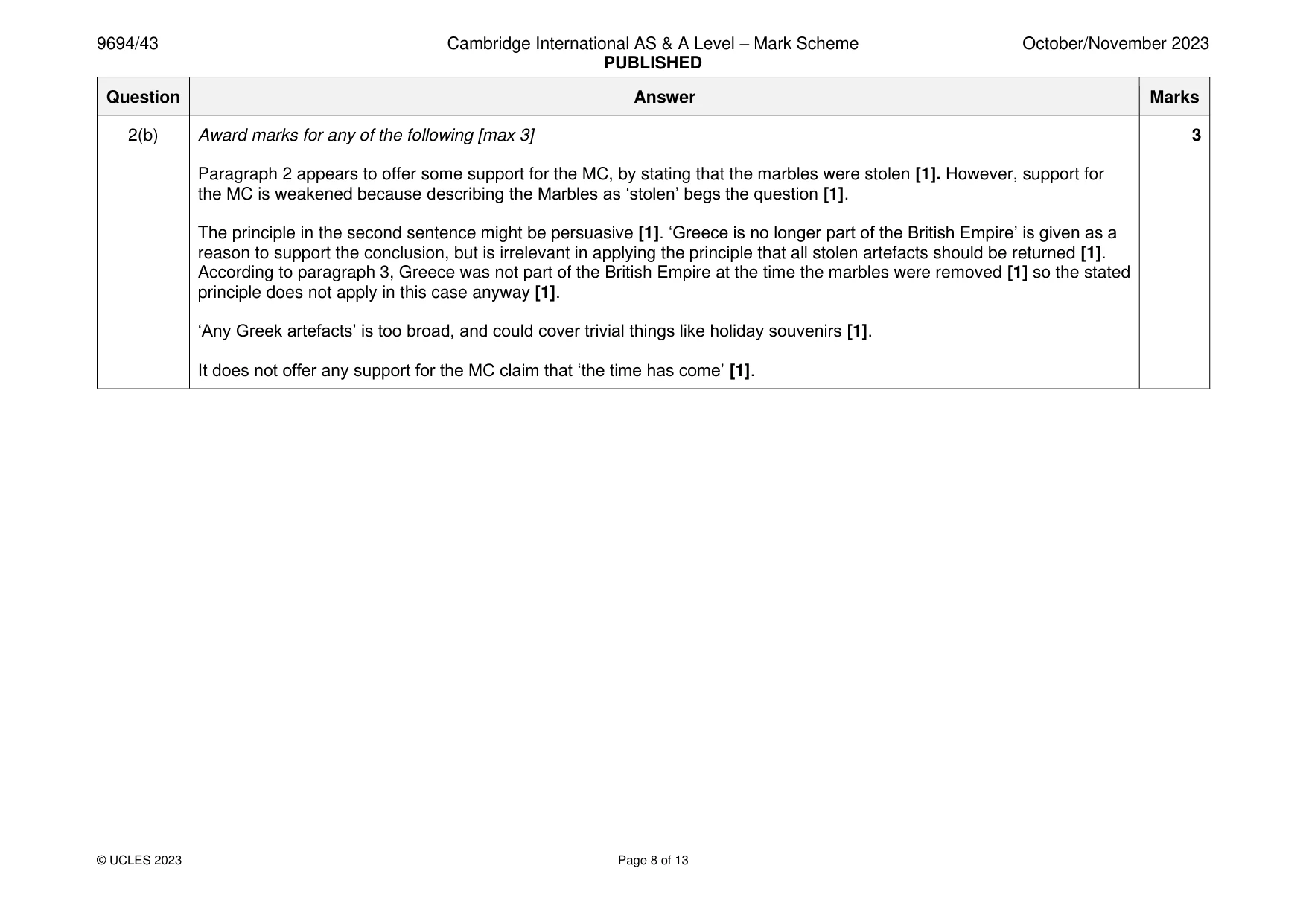
9694/43 Cambridge International AS & A Level – Mark Scheme PUBLISHED October/November 2023 © UCLES 2023 Page 8 of 13 Question Answer Marks 2(b) Award marks for any of the following [max 3] Paragraph 2 appears to offer some support for the MC, by stating that the marbles were stolen [1]. However, support for the MC is weakened because describing the Marbles as ‘stolen’ begs the question [1]. The principle in the second sentence might be persuasive [1]. ‘Greece is no longer part of the British Empire’ is given as a reason to support the conclusion, but is irrelevant in applying the principle that all stolen artefacts should be returned [1]. According to paragraph 3, Greece was not part of the British Empire at the time the marbles were removed [1] so the stated principle does not apply in this case anyway [1]. ‘Any Greek artefacts’ is too broad, and could cover trivial things like holiday souvenirs [1]. It does not offer any support for the MC claim that ‘the time has come’ [1]. 3
Mark scheme, page 9
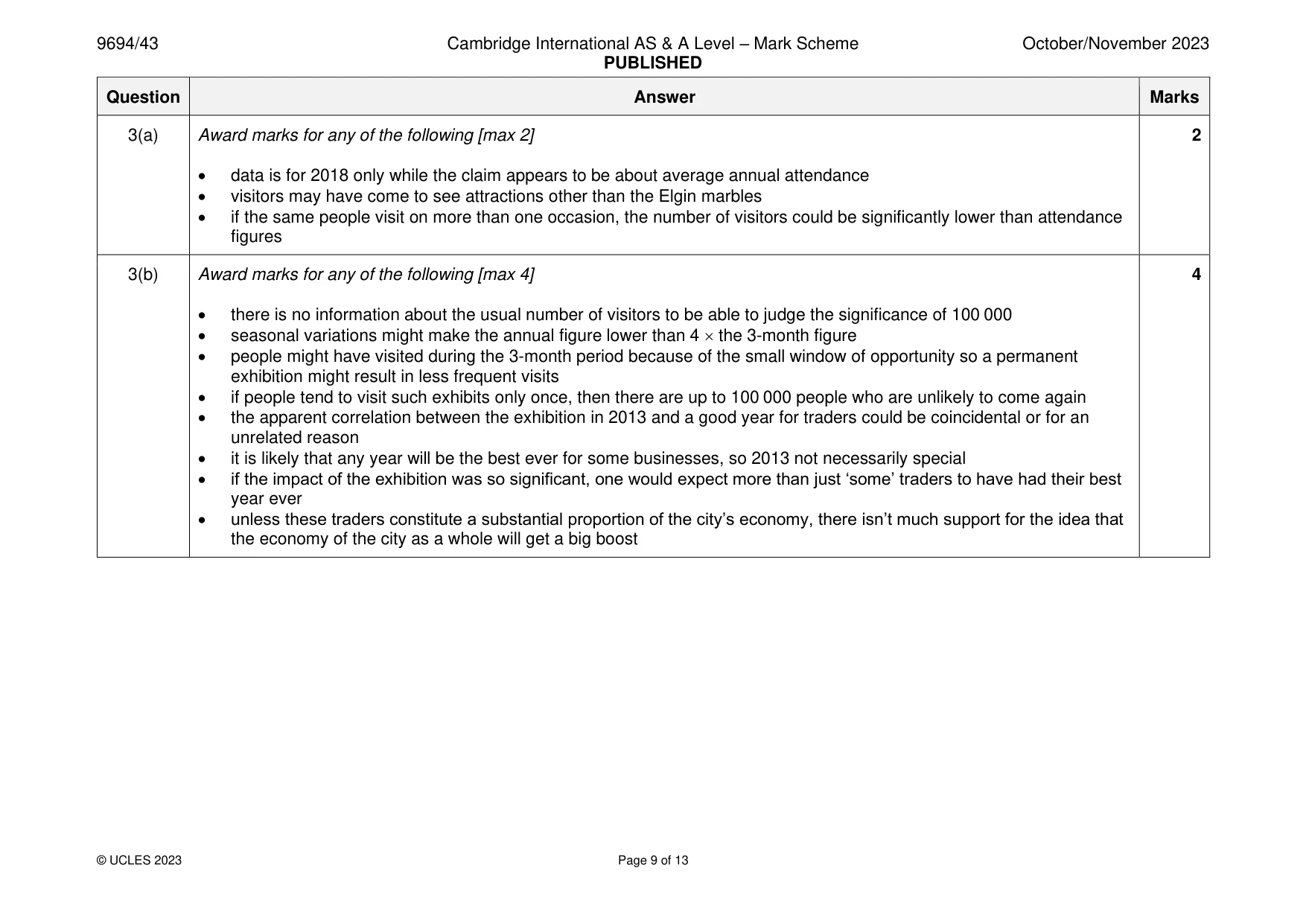
9694/43 Cambridge International AS & A Level – Mark Scheme PUBLISHED October/November 2023 © UCLES 2023 Page 9 of 13 Question Answer Marks 3(a) Award marks for any of the following [max 2] • data is for 2018 only while the claim appears to be about average annual attendance • visitors may have come to see attractions other than the Elgin marbles • if the same people visit on more than one occasion, the number of visitors could be significantly lower than attendance figures 2 3(b) Award marks for any of the following [max 4] • there is no information about the usual number of visitors to be able to judge the significance of 100 000 • seasonal variations might make the annual figure lower than 4 the 3-month figure • people might have visited during the 3-month period because of the small window of opportunity so a permanent exhibition might result in less frequent visits • if people tend to visit such exhibits only once, then there are up to 100 000 people who are unlikely to come again • the apparent correlation between the exhibition in 2013 and a good year for traders could be coincidental or for an unrelated reason • it is likely that any year will be the best ever for some businesses, so 2013 not necessarily special • if the impact of the exhibition was so significant, one would expect more than just ‘some’ traders to have had their best year ever • unless these traders constitute a substantial proportion of the city’s economy, there isn’t much support for the idea that the economy of the city as a whole will get a big boost 4
Mark scheme, page 10
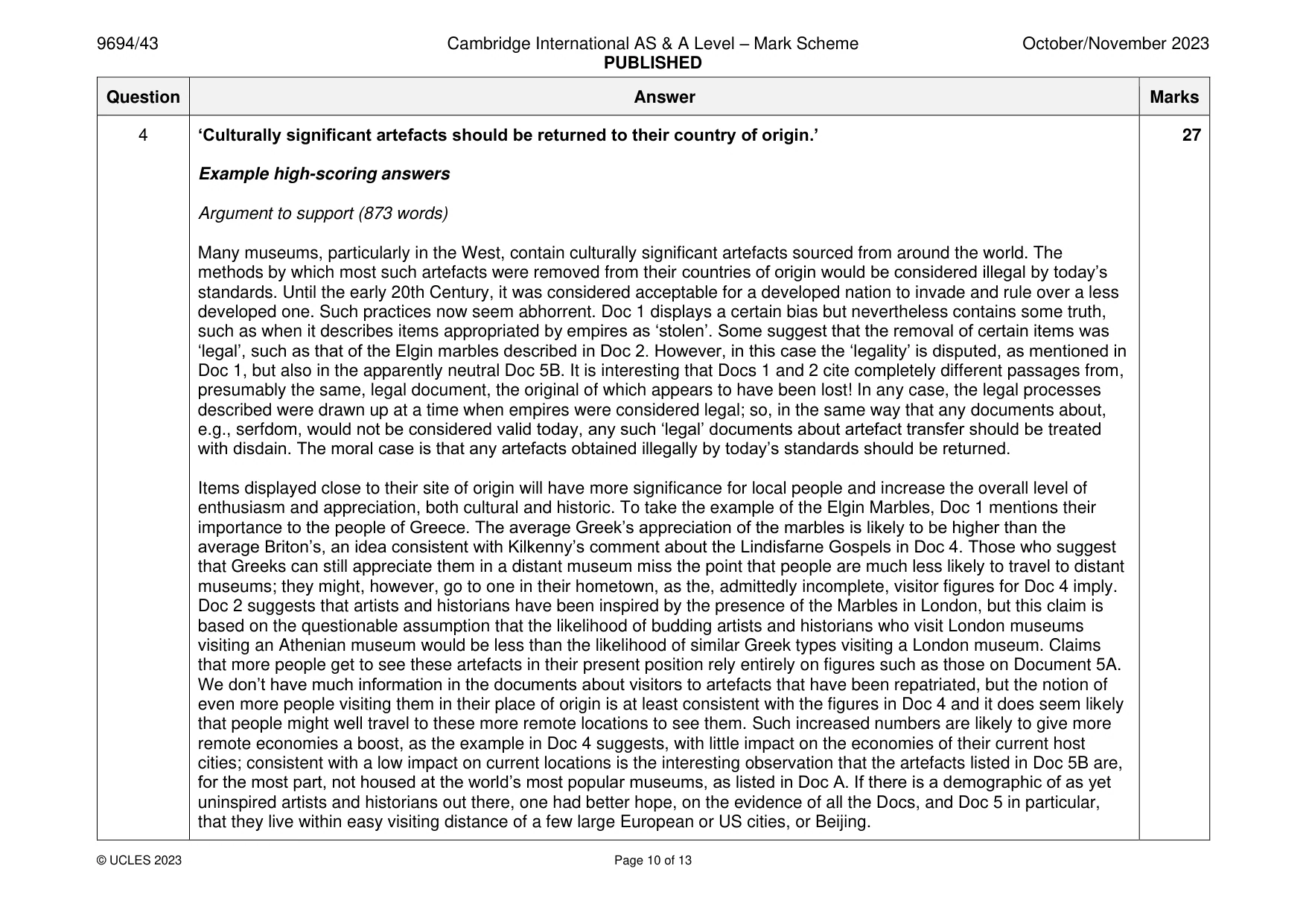
9694/43 Cambridge International AS & A Level – Mark Scheme PUBLISHED October/November 2023 © UCLES 2023 Page 10 of 13 Question Answer Marks 4 ‘Culturally significant artefacts should be returned to their country of origin.’ Example high-scoring answers Argument to support (873 words) Many museums, particularly in the West, contain culturally significant artefacts sourced from around the world. The methods by which most such artefacts were removed from their countries of origin would be considered illegal by today’s standards. Until the early 20th Century, it was considered acceptable for a developed nation to invade and rule over a less developed one. Such practices now seem abhorrent. Doc 1 displays a certain bias but nevertheless contains some truth, such as when it describes items appropriated by empires as ‘stolen’. Some suggest that the removal of certain items was ‘legal’, such as that of the Elgin marbles described in Doc 2. However, in this case the ‘legality’ is disputed, as mentioned in Doc 1, but also in the apparently neutral Doc 5B. It is interesting that Docs 1 and 2 cite completely different passages from, presumably the same, legal document, the original of which appears to have been lost! In any case, the legal processes described were drawn up at a time when empires were considered legal; so, in the same way that any documents about, e.g., serfdom, would not be considered valid today, any such ‘legal’ documents about artefact transfer should be treated with disdain. The moral case is that any artefacts obtained illegally by today’s standards should be returned. Items displayed close to their site of origin will have more significance for local people and increase the overall level of enthusiasm and appreciation, both cultural and historic. To take the example of the Elgin Marbles, Doc 1 mentions their importance to the people of Greece. The average Greek’s appreciation of the marbles is likely to be higher than the average Briton’s, an idea consistent with Kilkenny’s comment about the Lindisfarne Gospels in Doc 4. Those who suggest that Greeks can still appreciate them in a distant museum miss the point that people are much less likely to travel to distant museums; they might, however, go to one in their hometown, as the, admittedly incomplete, visitor figures for Doc 4 imply. Doc 2 suggests that artists and historians have been inspired by the presence of the Marbles in London, but this claim is based on the questionable assumption that the likelihood of budding artists and historians who visit London museums visiting an Athenian museum would be less than the likelihood of similar Greek types visiting a London museum. Claims that more people get to see these artefacts in their present position rely entirely on figures such as those on Document 5A. We don’t have much information in the documents about visitors to artefacts that have been repatriated, but the notion of even more people visiting them in their place of origin is at least consistent with the figures in Doc 4 and it does seem likely that people might well travel to these more remote locations to see them. Such increased numbers are likely to give more remote economies a boost, as the example in Doc 4 suggests, with little impact on the economies of their current host cities; consistent with a low impact on current locations is the interesting observation that the artefacts listed in Doc 5B are, for the most part, not housed at the world’s most popular museums, as listed in Doc A. If there is a demographic of as yet uninspired artists and historians out there, one had better hope, on the evidence of all the Docs, and Doc 5 in particular, that they live within easy visiting distance of a few large European or US cities, or Beijing. 27
Mark scheme, page 11
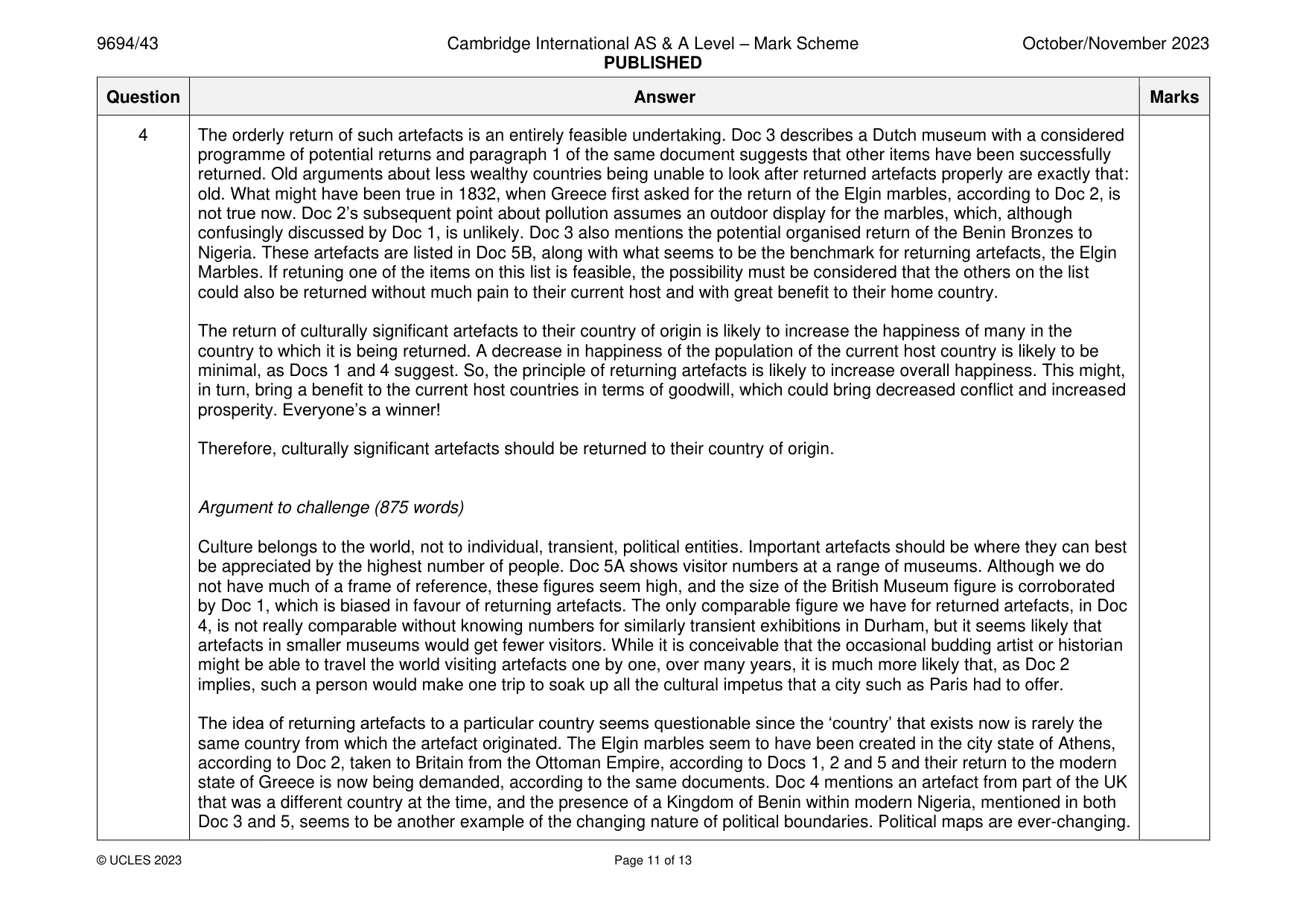
9694/43 Cambridge International AS & A Level – Mark Scheme PUBLISHED October/November 2023 © UCLES 2023 Page 11 of 13 Question Answer Marks 4 The orderly return of such artefacts is an entirely feasible undertaking. Doc 3 describes a Dutch museum with a considered programme of potential returns and paragraph 1 of the same document suggests that other items have been successfully returned. Old arguments about less wealthy countries being unable to look after returned artefacts properly are exactly that: old. What might have been true in 1832, when Greece first asked for the return of the Elgin marbles, according to Doc 2, is not true now. Doc 2’s subsequent point about pollution assumes an outdoor display for the marbles, which, although confusingly discussed by Doc 1, is unlikely. Doc 3 also mentions the potential organised return of the Benin Bronzes to Nigeria. These artefacts are listed in Doc 5B, along with what seems to be the benchmark for returning artefacts, the Elgin Marbles. If retuning one of the items on this list is feasible, the possibility must be considered that the others on the list could also be returned without much pain to their current host and with great benefit to their home country. The return of culturally significant artefacts to their country of origin is likely to increase the happiness of many in the country to which it is being returned. A decrease in happiness of the population of the current host country is likely to be minimal, as Docs 1 and 4 suggest. So, the principle of returning artefacts is likely to increase overall happiness. This might, in turn, bring a benefit to the current host countries in terms of goodwill, which could bring decreased conflict and increased prosperity. Everyone’s a winner! Therefore, culturally significant artefacts should be returned to their country of origin. Argument to challenge (875 words) Culture belongs to the world, not to individual, transient, political entities. Important artefacts should be where they can best be appreciated by the highest number of people. Doc 5A shows visitor numbers at a range of museums. Although we do not have much of a frame of reference, these figures seem high, and the size of the British Museum figure is corroborated by Doc 1, which is biased in favour of returning artefacts. The only comparable figure we have for returned artefacts, in Doc 4, is not really comparable without knowing numbers for similarly transient exhibitions in Durham, but it seems likely that artefacts in smaller museums would get fewer visitors. While it is conceivable that the occasional budding artist or historian might be able to travel the world visiting artefacts one by one, over many years, it is much more likely that, as Doc 2 implies, such a person would make one trip to soak up all the cultural impetus that a city such as Paris had to offer. The idea of returning artefacts to a particular country seems questionable since the ‘country’ that exists now is rarely the same country from which the artefact originated. The Elgin marbles seem to have been created in the city state of Athens, according to Doc 2, taken to Britain from the Ottoman Empire, according to Docs 1, 2 and 5 and their return to the modern state of Greece is now being demanded, according to the same documents. Doc 4 mentions an artefact from part of the UK that was a different country at the time, and the presence of a Kingdom of Benin within modern Nigeria, mentioned in both Doc 3 and 5, seems to be another example of the changing nature of political boundaries. Political maps are ever-changing.
Mark scheme, page 12
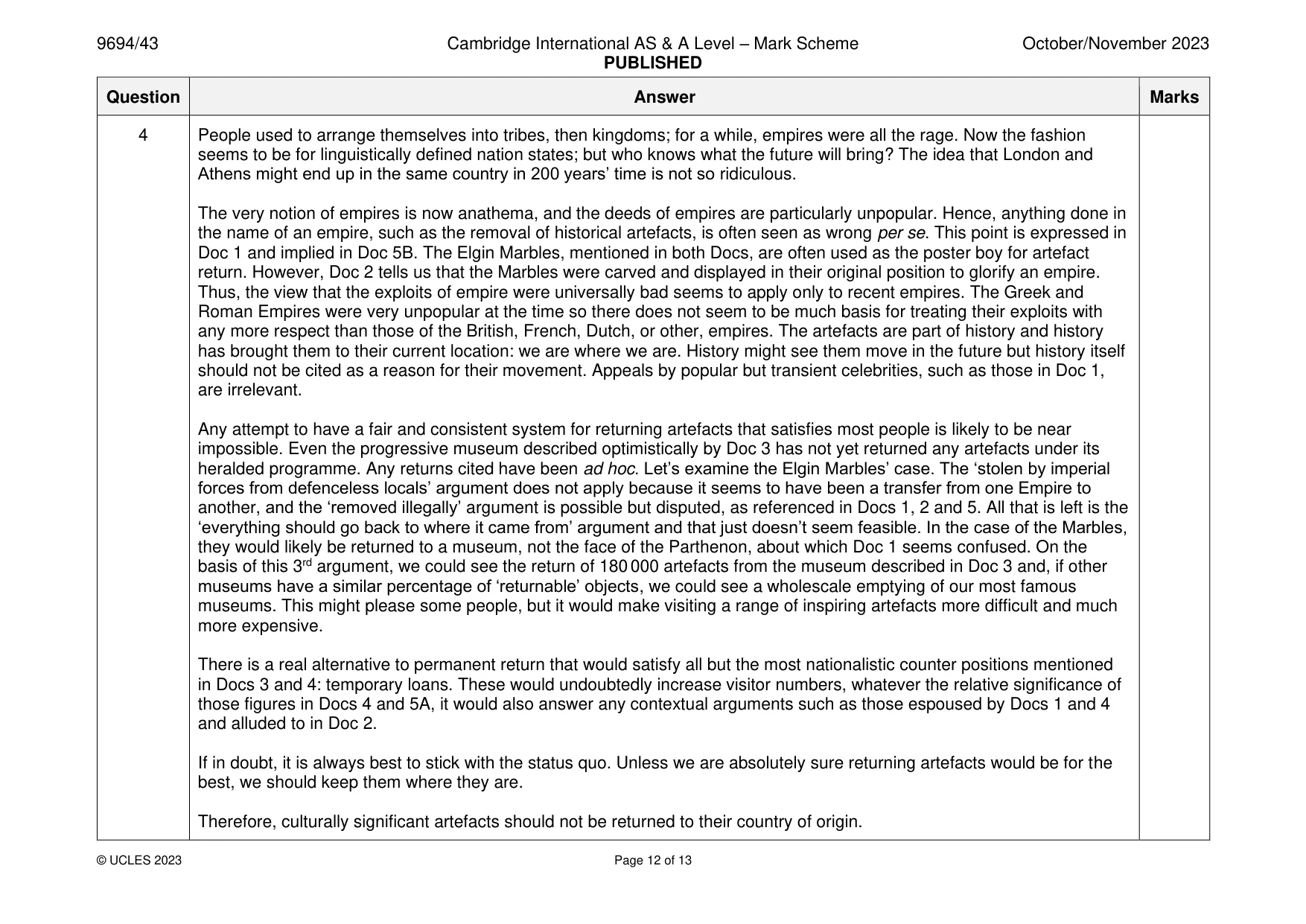
9694/43 Cambridge International AS & A Level – Mark Scheme PUBLISHED October/November 2023 © UCLES 2023 Page 12 of 13 Question Answer Marks 4 People used to arrange themselves into tribes, then kingdoms; for a while, empires were all the rage. Now the fashion seems to be for linguistically defined nation states; but who knows what the future will bring? The idea that London and Athens might end up in the same country in 200 years’ time is not so ridiculous. The very notion of empires is now anathema, and the deeds of empires are particularly unpopular. Hence, anything done in the name of an empire, such as the removal of historical artefacts, is often seen as wrong per se. This point is expressed in Doc 1 and implied in Doc 5B. The Elgin Marbles, mentioned in both Docs, are often used as the poster boy for artefact return. However, Doc 2 tells us that the Marbles were carved and displayed in their original position to glorify an empire. Thus, the view that the exploits of empire were universally bad seems to apply only to recent empires. The Greek and Roman Empires were very unpopular at the time so there does not seem to be much basis for treating their exploits with any more respect than those of the British, French, Dutch, or other, empires. The artefacts are part of history and history has brought them to their current location: we are where we are. History might see them move in the future but history itself should not be cited as a reason for their movement. Appeals by popular but transient celebrities, such as those in Doc 1, are irrelevant. Any attempt to have a fair and consistent system for returning artefacts that satisfies most people is likely to be near impossible. Even the progressive museum described optimistically by Doc 3 has not yet returned any artefacts under its heralded programme. Any returns cited have been ad hoc. Let’s examine the Elgin Marbles’ case. The ‘stolen by imperial forces from defenceless locals’ argument does not apply because it seems to have been a transfer from one Empire to another, and the ‘removed illegally’ argument is possible but disputed, as referenced in Docs 1, 2 and 5. All that is left is the ‘everything should go back to where it came from’ argument and that just doesn’t seem feasible. In the case of the Marbles, they would likely be returned to a museum, not the face of the Parthenon, about which Doc 1 seems confused. On the basis of this 3rd argument, we could see the return of 180 000 artefacts from the museum described in Doc 3 and, if other museums have a similar percentage of ‘returnable’ objects, we could see a wholescale emptying of our most famous museums. This might please some people, but it would make visiting a range of inspiring artefacts more difficult and much more expensive. There is a real alternative to permanent return that would satisfy all but the most nationalistic counter positions mentioned in Docs 3 and 4: temporary loans. These would undoubtedly increase visitor numbers, whatever the relative significance of those figures in Docs 4 and 5A, it would also answer any contextual arguments such as those espoused by Docs 1 and 4 and alluded to in Doc 2. If in doubt, it is always best to stick with the status quo. Unless we are absolutely sure returning artefacts would be for the best, we should keep them where they are. Therefore, culturally significant artefacts should not be returned to their country of origin.
Mark scheme, page 13
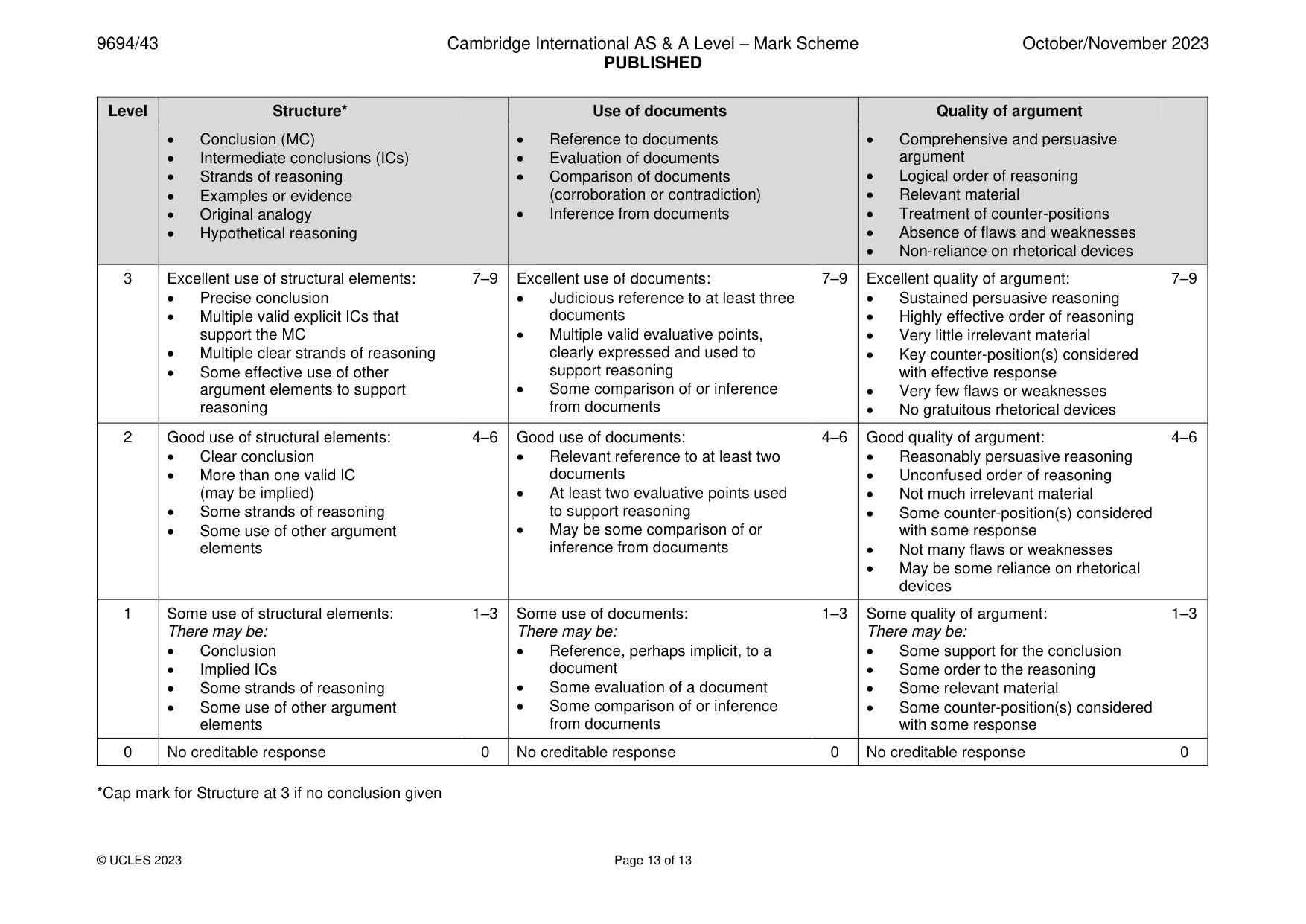
9694/43 Cambridge International AS & A Level – Mark Scheme PUBLISHED October/November 2023 © UCLES 2023 Page 13 of 13 Level Structure* Use of documents Quality of argument • Conclusion (MC) • Intermediate conclusions (ICs) • Strands of reasoning • Examples or evidence • Original analogy • Hypothetical reasoning • Reference to documents • Evaluation of documents • Comparison of documents (corroboration or contradiction) • Inference from documents • Comprehensive and persuasive argument • Logical order of reasoning • Relevant material • Treatment of counter-positions • Absence of flaws and weaknesses • Non-reliance on rhetorical devices 3 Excellent use of structural elements: • Precise conclusion • Multiple valid explicit ICs that support the MC • Multiple clear strands of reasoning • Some effective use of other argument elements to support reasoning 7–9 Excellent use of documents: • Judicious reference to at least three documents • Multiple valid evaluative points, clearly expressed and used to support reasoning • Some comparison of or inference from documents 7–9 Excellent quality of argument: • Sustained persuasive reasoning • Highly effective order of reasoning • Very little irrelevant material • Key counter-position(s) considered with effective response • Very few flaws or weaknesses • No gratuitous rhetorical devices 7–9 2 Good use of structural elements: • Clear conclusion • More than one valid IC (may be implied) • Some strands of reasoning • Some use of other argument elements 4–6 Good use of documents: • Relevant reference to at least two documents • At least two evaluative points used to support reasoning • May be some comparison of or inference from documents 4–6 Good quality of argument: • Reasonably persuasive reasoning • Unconfused order of reasoning • Not much irrelevant material • Some counter-position(s) considered with some response • Not many flaws or weaknesses • May be some reliance on rhetorical devices 4–6 1 Some use of structural elements: There may be: • Conclusion • Implied ICs • Some strands of reasoning • Some use of other argument elements 1–3 Some use of documents: There may be: • Reference, perhaps implicit, to a document • Some evaluation of a document • Some comparison of or inference from documents 1–3 Some quality of argument: There may be: • Some support for the conclusion • Some order to the reasoning • Some relevant material • Some counter-position(s) considered with some response 1–3 0 No creditable response 0 No creditable response 0 No creditable response 0 *Cap mark for Structure at 3 if no conclusion given
What you needed in this session
Cambridge’s own grade thresholds for 2023 Oct/Nov, Paper 4 · Variant 3. A higher threshold means an easier paper — the bar moves with how the cohort did.