Cambridge A Level Thinking Skills 9694 — 2025 May/June Paper 4 · Variant 1
9694/41/M/J/25 · 50 marks · ≈56 min
The question paper and its mark scheme, free to read here and free to download. This is Cambridge’s own paper, exactly as it was sat.
Question paper8 pages

Mark scheme13 pages
Answers below. Sit the paper first if you are practising.
Paper as text
Question paper, page 1
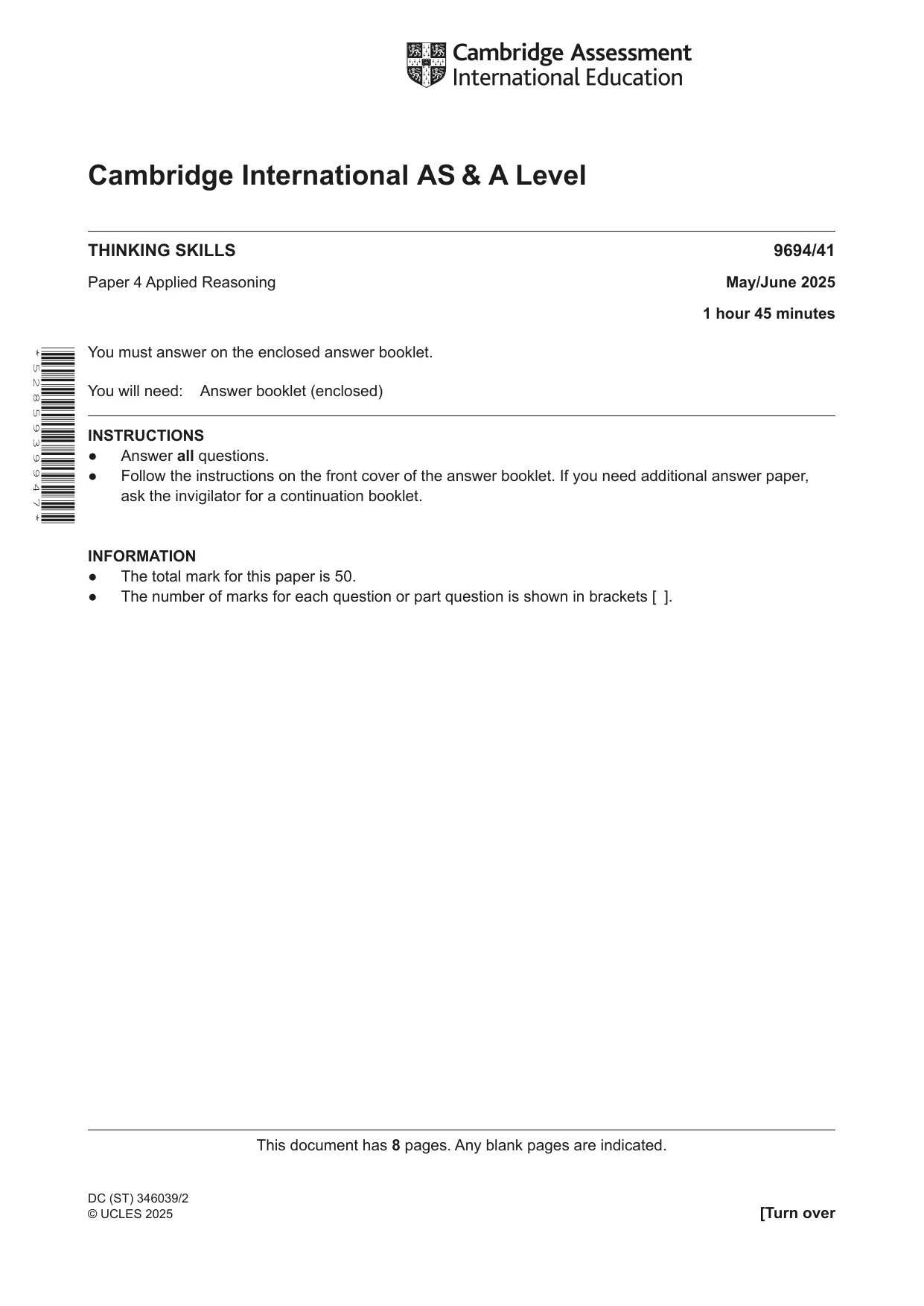
This document has 8 pages. Any blank pages are indicated. [Turn over Cambridge International AS & A Level * 5 2 8 5 9 3 9 9 4 7 * THINKING SKILLS 9694/41 Paper 4 Applied Reasoning May/June 2025 1 hour 45 minutes You must answer on the enclosed answer booklet. You will need: Answer booklet (enclosed) INSTRUCTIONS ● Answer all questions. ● Follow the instructions on the front cover of the answer booklet. If you need additional answer paper, ask the invigilator for a continuation booklet. INFORMATION ● The total mark for this paper is 50. ● The number of marks for each question or part question is shown in brackets [ ]. DC (ST) 346039/2 © UCLES 2025
Question paper, page 2
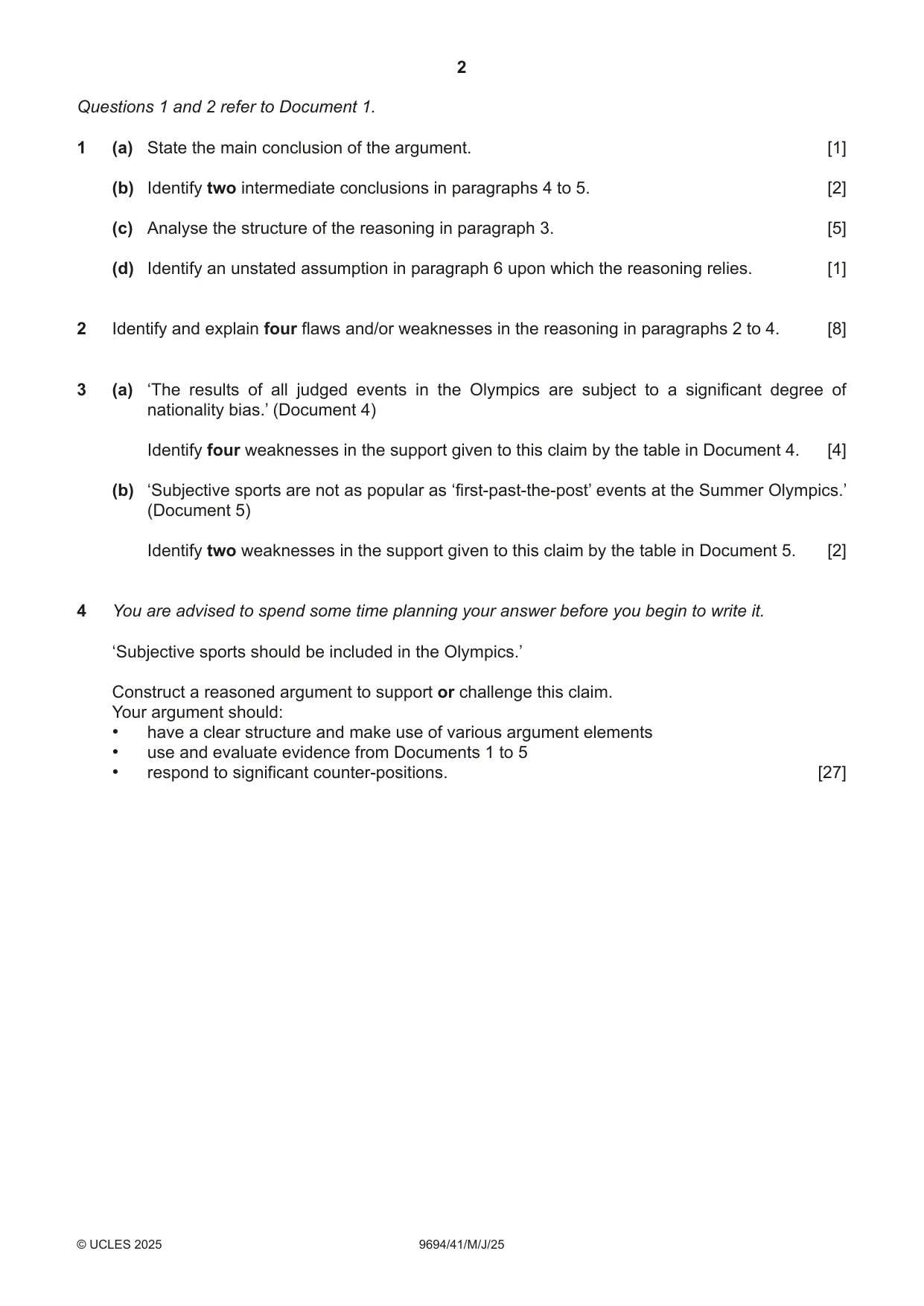
2 9694/41/M/J/25 © UCLES 2025 Questions 1 and 2 refer to Document 1. 1 (a) State the main conclusion of the argument. [1] (b) Identify two intermediate conclusions in paragraphs 4 to 5. [2] (c) Analyse the structure of the reasoning in paragraph 3. [5] (d) Identify an unstated assumption in paragraph 6 upon which the reasoning relies. [1] 2 Identify and explain four flaws and/or weaknesses in the reasoning in paragraphs 2 to 4. [8] 3 (a) ‘The results of all judged events in the Olympics are subject to a significant degree of nationality bias.’ (Document 4) Identify four weaknesses in the support given to this claim by the table in Document 4. [4] (b) ‘Subjective sports are not as popular as ‘first-past-the-post’ events at the Summer Olympics.’ (Document 5) Identify two weaknesses in the support given to this claim by the table in Document 5. [2] 4 You are advised to spend some time planning your answer before you begin to write it. ‘Subjective sports should be included in the Olympics.’ Construct a reasoned argument to support or challenge this claim. Your argument should: • have a clear structure and make use of various argument elements • use and evaluate evidence from Documents 1 to 5 • respond to significant counter-positions. [27]
Question paper, page 3
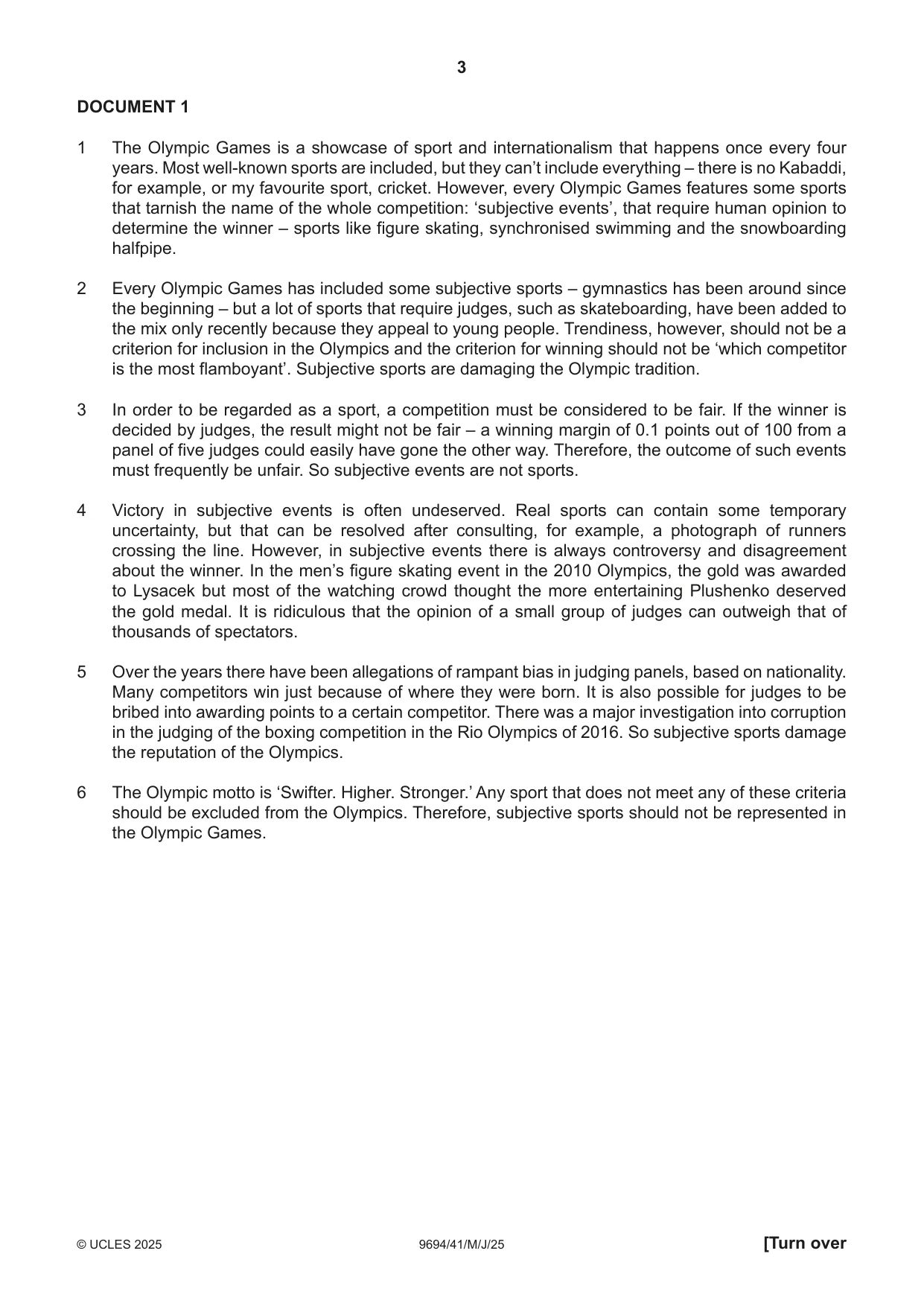
3 9694/41/M/J/25 © UCLES 2025 [Turn over DOCUMENT 1 1 The Olympic Games is a showcase of sport and internationalism that happens once every four years. Most well-known sports are included, but they can’t include everything – there is no Kabaddi, for example, or my favourite sport, cricket. However, every Olympic Games features some sports that tarnish the name of the whole competition: ‘subjective events’, that require human opinion to determine the winner – sports like figure skating, synchronised swimming and the snowboarding halfpipe. 2 Every Olympic Games has included some subjective sports – gymnastics has been around since the beginning – but a lot of sports that require judges, such as skateboarding, have been added to the mix only recently because they appeal to young people. Trendiness, however, should not be a criterion for inclusion in the Olympics and the criterion for winning should not be ‘which competitor is the most flamboyant’. Subjective sports are damaging the Olympic tradition. 3 In order to be regarded as a sport, a competition must be considered to be fair. If the winner is decided by judges, the result might not be fair – a winning margin of 0.1 points out of 100 from a panel of five judges could easily have gone the other way. Therefore, the outcome of such events must frequently be unfair. So subjective events are not sports. 4 Victory in subjective events is often undeserved. Real sports can contain some temporary uncertainty, but that can be resolved after consulting, for example, a photograph of runners crossing the line. However, in subjective events there is always controversy and disagreement about the winner. In the men’s figure skating event in the 2010 Olympics, the gold was awarded to Lysacek but most of the watching crowd thought the more entertaining Plushenko deserved the gold medal. It is ridiculous that the opinion of a small group of judges can outweigh that of thousands of spectators. 5 Over the years there have been allegations of rampant bias in judging panels, based on nationality. Many competitors win just because of where they were born. It is also possible for judges to be bribed into awarding points to a certain competitor. There was a major investigation into corruption in the judging of the boxing competition in the Rio Olympics of 2016. So subjective sports damage the reputation of the Olympics. 6 The Olympic motto is ‘Swifter. Higher. Stronger.’ Any sport that does not meet any of these criteria should be excluded from the Olympics. Therefore, subjective sports should not be represented in the Olympic Games.
Question paper, page 4
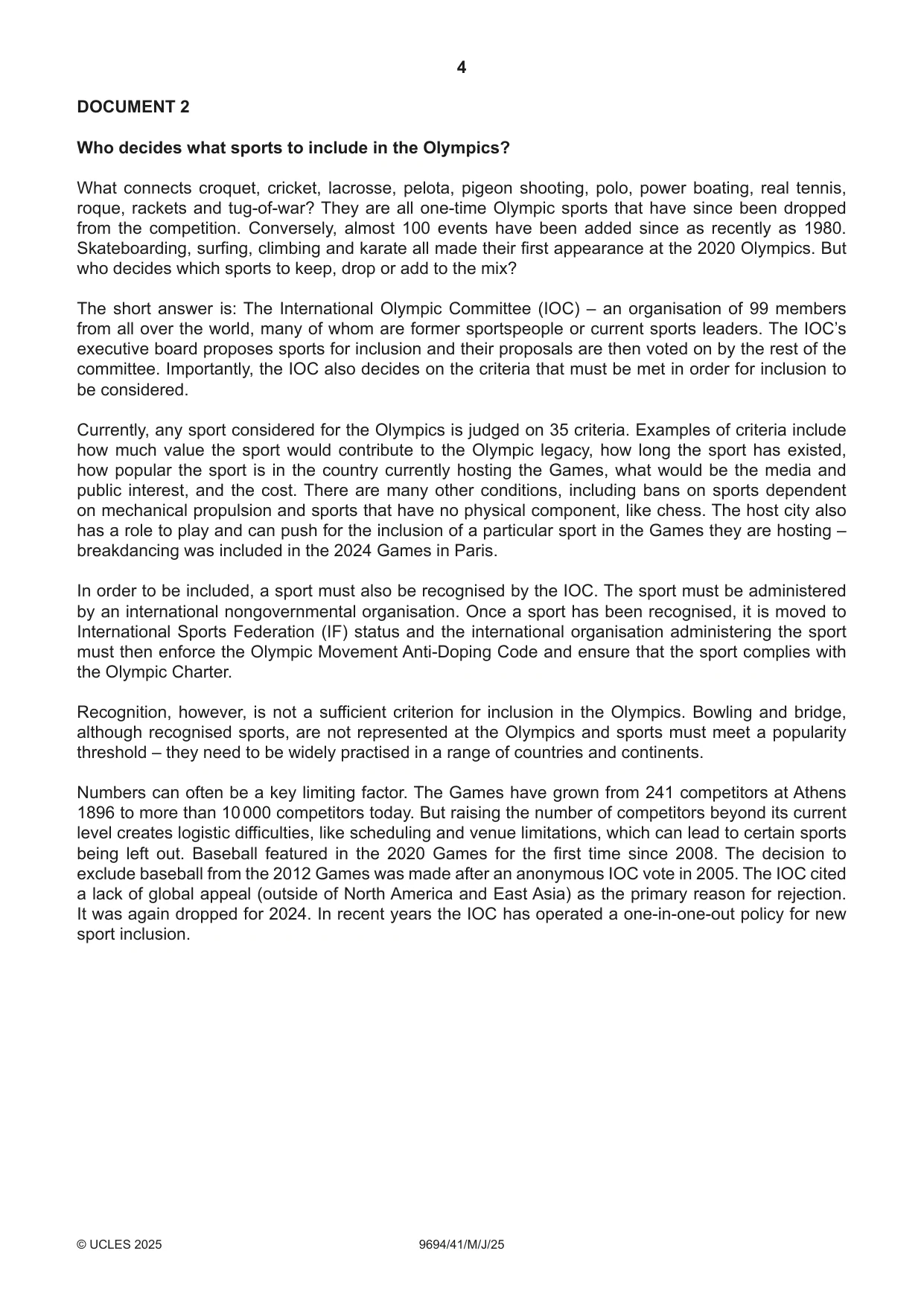
4 9694/41/M/J/25 © UCLES 2025 DOCUMENT 2 Who decides what sports to include in the Olympics? What connects croquet, cricket, lacrosse, pelota, pigeon shooting, polo, power boating, real tennis, roque, rackets and tug-of-war? They are all one-time Olympic sports that have since been dropped from the competition. Conversely, almost 100 events have been added since as recently as 1980. Skateboarding, surfing, climbing and karate all made their first appearance at the 2020 Olympics. But who decides which sports to keep, drop or add to the mix? The short answer is: The International Olympic Committee (IOC) – an organisation of 99 members from all over the world, many of whom are former sportspeople or current sports leaders. The IOC’s executive board proposes sports for inclusion and their proposals are then voted on by the rest of the committee. Importantly, the IOC also decides on the criteria that must be met in order for inclusion to be considered. Currently, any sport considered for the Olympics is judged on 35 criteria. Examples of criteria include how much value the sport would contribute to the Olympic legacy, how long the sport has existed, how popular the sport is in the country currently hosting the Games, what would be the media and public interest, and the cost. There are many other conditions, including bans on sports dependent on mechanical propulsion and sports that have no physical component, like chess. The host city also has a role to play and can push for the inclusion of a particular sport in the Games they are hosting – breakdancing was included in the 2024 Games in Paris. In order to be included, a sport must also be recognised by the IOC. The sport must be administered by an international nongovernmental organisation. Once a sport has been recognised, it is moved to International Sports Federation (IF) status and the international organisation administering the sport must then enforce the Olympic Movement Anti-Doping Code and ensure that the sport complies with the Olympic Charter. Recognition, however, is not a sufficient criterion for inclusion in the Olympics. Bowling and bridge, although recognised sports, are not represented at the Olympics and sports must meet a popularity threshold – they need to be widely practised in a range of countries and continents. Numbers can often be a key limiting factor. The Games have grown from 241 competitors at Athens 1896 to more than 10 000 competitors today. But raising the number of competitors beyond its current level creates logistic difficulties, like scheduling and venue limitations, which can lead to certain sports being left out. Baseball featured in the 2020 Games for the first time since 2008. The decision to exclude baseball from the 2012 Games was made after an anonymous IOC vote in 2005. The IOC cited a lack of global appeal (outside of North America and East Asia) as the primary reason for rejection. It was again dropped for 2024. In recent years the IOC has operated a one-in-one-out policy for new sport inclusion.
Question paper, page 5
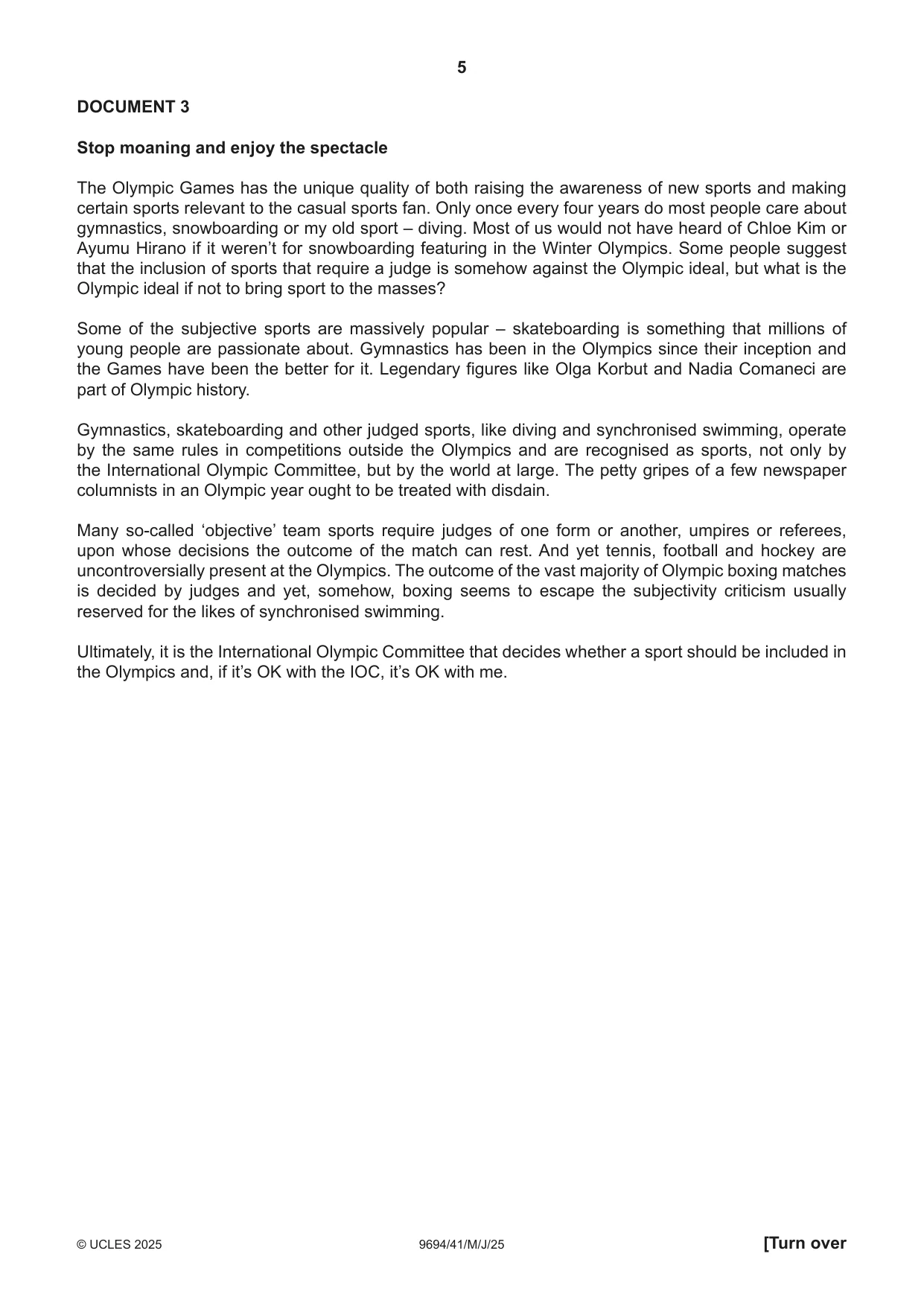
5 9694/41/M/J/25 © UCLES 2025 [Turn over DOCUMENT 3 Stop moaning and enjoy the spectacle The Olympic Games has the unique quality of both raising the awareness of new sports and making certain sports relevant to the casual sports fan. Only once every four years do most people care about gymnastics, snowboarding or my old sport – diving. Most of us would not have heard of Chloe Kim or Ayumu Hirano if it weren’t for snowboarding featuring in the Winter Olympics. Some people suggest that the inclusion of sports that require a judge is somehow against the Olympic ideal, but what is the Olympic ideal if not to bring sport to the masses? Some of the subjective sports are massively popular – skateboarding is something that millions of young people are passionate about. Gymnastics has been in the Olympics since their inception and the Games have been the better for it. Legendary figures like Olga Korbut and Nadia Comaneci are part of Olympic history. Gymnastics, skateboarding and other judged sports, like diving and synchronised swimming, operate by the same rules in competitions outside the Olympics and are recognised as sports, not only by the International Olympic Committee, but by the world at large. The petty gripes of a few newspaper columnists in an Olympic year ought to be treated with disdain. Many so-called ‘objective’ team sports require judges of one form or another, umpires or referees, upon whose decisions the outcome of the match can rest. And yet tennis, football and hockey are uncontroversially present at the Olympics. The outcome of the vast majority of Olympic boxing matches is decided by judges and yet, somehow, boxing seems to escape the subjectivity criticism usually reserved for the likes of synchronised swimming. Ultimately, it is the International Olympic Committee that decides whether a sport should be included in the Olympics and, if it’s OK with the IOC, it’s OK with me.
Question paper, page 6
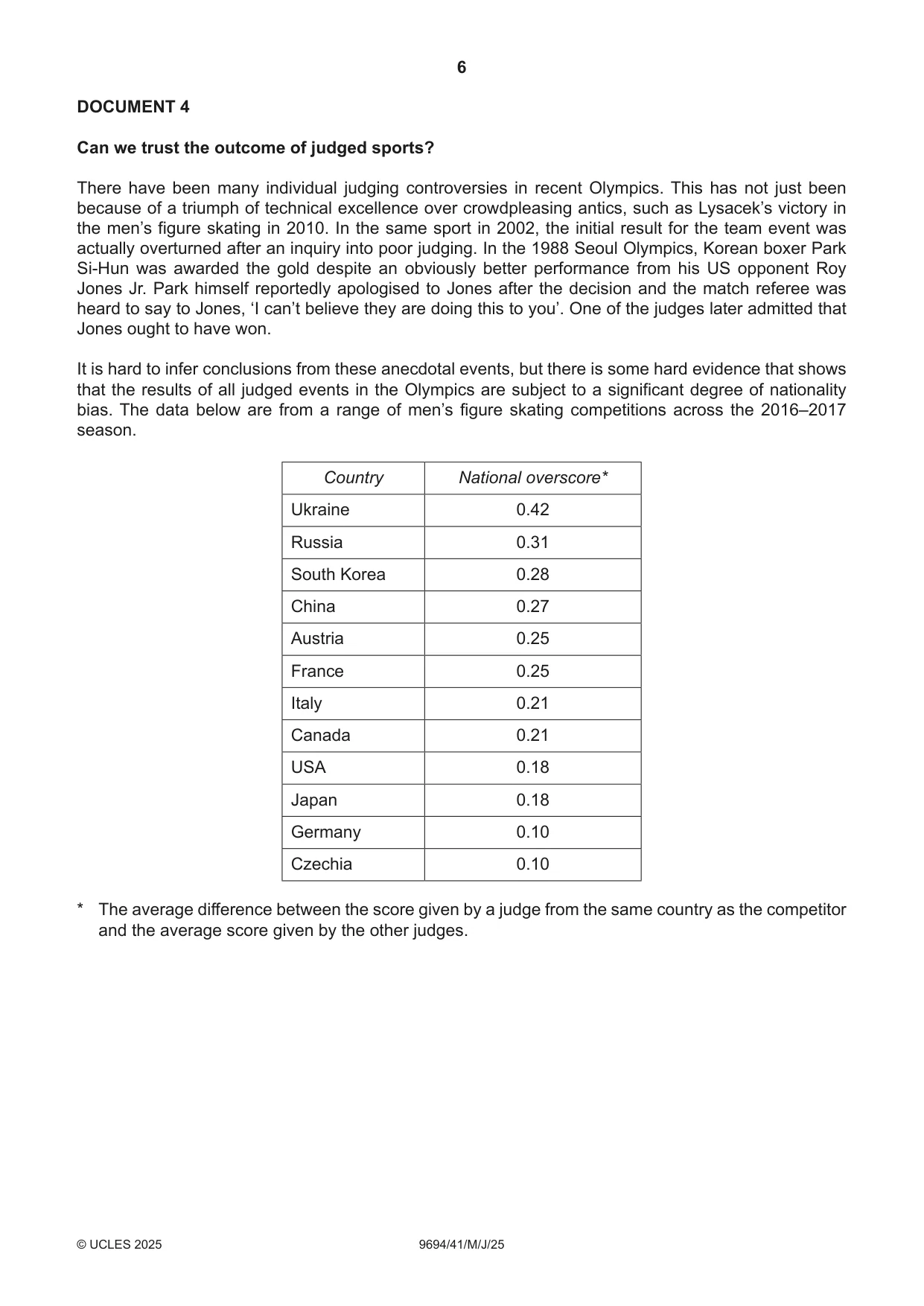
6 9694/41/M/J/25 © UCLES 2025 DOCUMENT 4 Can we trust the outcome of judged sports? There have been many individual judging controversies in recent Olympics. This has not just been because of a triumph of technical excellence over crowdpleasing antics, such as Lysacek’s victory in the men’s figure skating in 2010. In the same sport in 2002, the initial result for the team event was actually overturned after an inquiry into poor judging. In the 1988 Seoul Olympics, Korean boxer Park Si-Hun was awarded the gold despite an obviously better performance from his US opponent Roy Jones Jr. Park himself reportedly apologised to Jones after the decision and the match referee was heard to say to Jones, ‘I can’t believe they are doing this to you’. One of the judges later admitted that Jones ought to have won. It is hard to infer conclusions from these anecdotal events, but there is some hard evidence that shows that the results of all judged events in the Olympics are subject to a significant degree of nationality bias. The data below are from a range of men’s figure skating competitions across the 2016–2017 season. Country National overscore* Ukraine 0.42 Russia 0.31 South Korea 0.28 China 0.27 Austria 0.25 France 0.25 Italy 0.21 Canada 0.21 USA 0.18 Japan 0.18 Germany 0.10 Czechia 0.10 * The average difference between the score given by a judge from the same country as the competitor and the average score given by the other judges.
Question paper, page 7
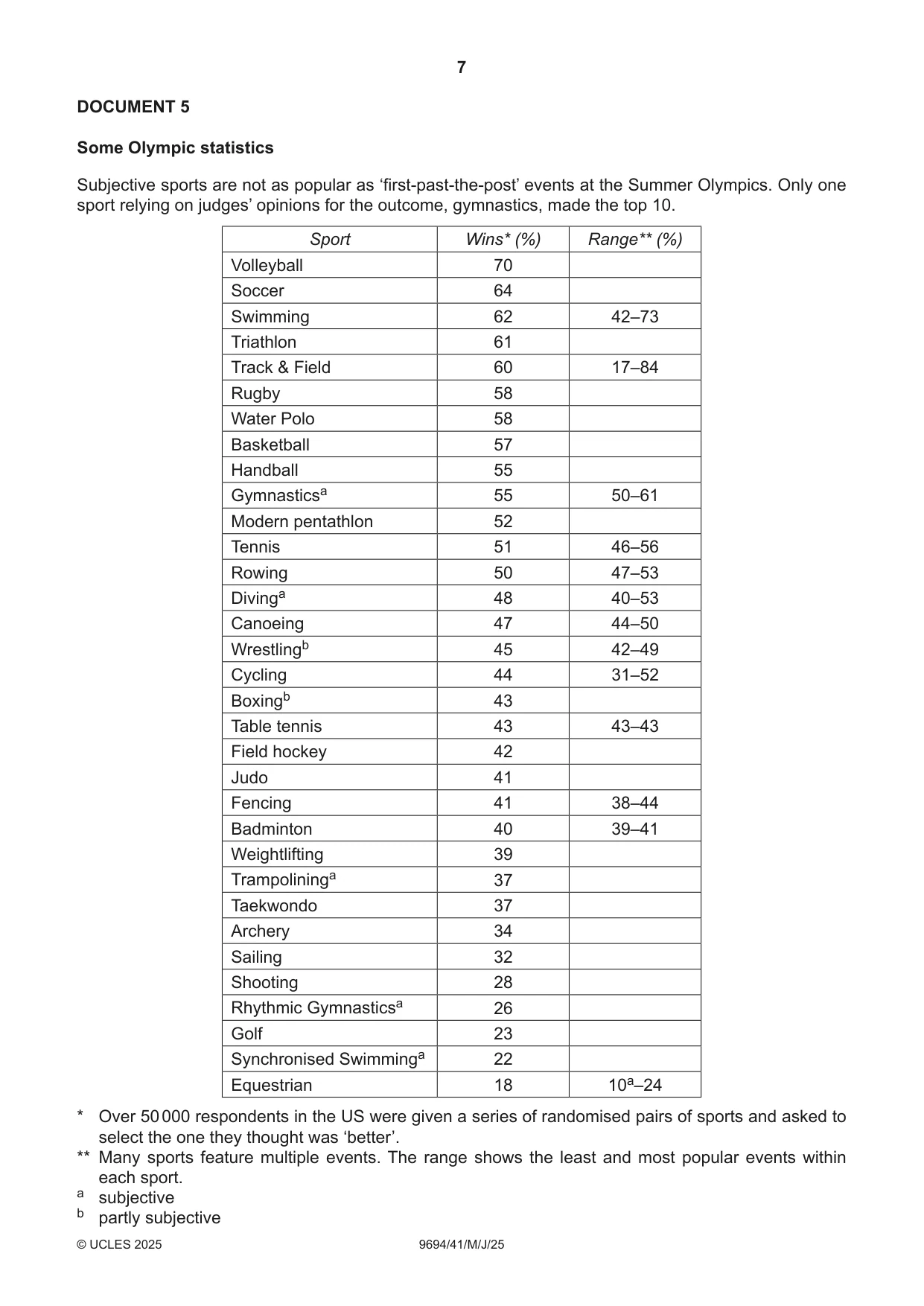
7 9694/41/M/J/25 © UCLES 2025 DOCUMENT 5 Some Olympic statistics Subjective sports are not as popular as ‘first-past-the-post’ events at the Summer Olympics. Only one sport relying on judges’ opinions for the outcome, gymnastics, made the top 10. Sport Wins* (%) Range** (%) Volleyball 70 Soccer 64 Swimming 62 42–73 Triathlon 61 Track & Field 60 17–84 Rugby 58 Water Polo 58 Basketball 57 Handball 55 Gymnasticsa 55 50–61 Modern pentathlon 52 Tennis 51 46–56 Rowing 50 47–53 Divinga 48 40–53 Canoeing 47 44–50 Wrestlingb 45 42–49 Cycling 44 31–52 Boxingb 43 Table tennis 43 43–43 Field hockey 42 Judo 41 Fencing 41 38–44 Badminton 40 39–41 Weightlifting 39 Trampolininga 37 Taekwondo 37 Archery 34 Sailing 32 Shooting 28 Rhythmic Gymnasticsa 26 Golf 23 Synchronised Swimminga 22 Equestrian 18 10a–24 * Over 50 000 respondents in the US were given a series of randomised pairs of sports and asked to select the one they thought was ‘better’. ** Many sports feature multiple events. The range shows the least and most popular events within each sport. a subjective b partly subjective
Question paper, page 8
8 9694/41/M/J/25 © UCLES 2025 Permission to reproduce items where third-party owned material protected by copyright is included has been sought and cleared where possible. Every reasonable effort has been made by the publisher (UCLES) to trace copyright holders, but if any items requiring clearance have unwittingly been included, the publisher will be pleased to make amends at the earliest possible opportunity. To avoid the issue of disclosure of answer-related information to candidates, all copyright acknowledgements are reproduced online in the Cambridge Assessment International Education Copyright Acknowledgements Booklet. This is produced for each series of examinations and is freely available to download at www.cambridgeinternational.org after the live examination series. Cambridge Assessment International Education is part of Cambridge Assessment. Cambridge Assessment is the brand name of the University of Cambridge Local Examinations Syndicate (UCLES), which is a department of the University of Cambridge. BLANK PAGE
Mark scheme, page 1
This document consists of 13 printed pages. © Cambridge University Press & Assessment 2025 [Turn over Cambridge International AS & A Level THINKING SKILLS 9694/41 Paper 4 Applied Reasoning May/June 2025 MARK SCHEME Maximum Mark: 50 Published This mark scheme is published as an aid to teachers and candidates, to indicate the requirements of the examination. It shows the basis on which Examiners were instructed to award marks. It does not indicate the details of the discussions that took place at an Examiners’ meeting before marking began, which would have considered the acceptability of alternative answers. Mark schemes should be read in conjunction with the question paper and the Principal Examiner Report for Teachers. Cambridge International will not enter into discussions about these mark schemes. Cambridge International is publishing the mark schemes for the May/June 2025 series for most Cambridge IGCSE, Cambridge International A and AS Level components, and some Cambridge O Level components.
Mark scheme, page 2
9694/41 Cambridge International AS & A Level – Mark Scheme PUBLISHED May/June 2025 © Cambridge University Press & Assessment 2025 Page 2 of 13 Generic Marking Principles These general marking principles must be applied by all examiners when marking candidate answers. They should be applied alongside the specific content of the mark scheme or generic level descriptions for a question. Each question paper and mark scheme will also comply with these marking principles. GENERIC MARKING PRINCIPLE 1: Marks must be awarded in line with: • the specific content of the mark scheme or the generic level descriptors for the question • the specific skills defined in the mark scheme or in the generic level descriptors for the question • the standard of response required by a candidate as exemplified by the standardisation scripts. GENERIC MARKING PRINCIPLE 2: Marks awarded are always whole marks (not half marks, or other fractions). GENERIC MARKING PRINCIPLE 3: Marks must be awarded positively: • marks are awarded for correct/valid answers, as defined in the mark scheme. However, credit is given for valid answers which go beyond the scope of the syllabus and mark scheme, referring to your Team Leader as appropriate • marks are awarded when candidates clearly demonstrate what they know and can do • marks are not deducted for errors • marks are not deducted for omissions • answers should only be judged on the quality of spelling, punctuation and grammar when these features are specifically assessed by the question as indicated by the mark scheme. The meaning, however, should be unambiguous. GENERIC MARKING PRINCIPLE 4: Rules must be applied consistently, e.g. in situations where candidates have not followed instructions or in the application of generic level descriptors.
Mark scheme, page 3
9694/41 Cambridge International AS & A Level – Mark Scheme PUBLISHED May/June 2025 © Cambridge University Press & Assessment 2025 Page 3 of 13 GENERIC MARKING PRINCIPLE 5: Marks should be awarded using the full range of marks defined in the mark scheme for the question (however; the use of the full mark range may be limited according to the quality of the candidate responses seen). GENERIC MARKING PRINCIPLE 6: Marks awarded are based solely on the requirements as defined in the mark scheme. Marks should not be awarded with grade thresholds or grade descriptors in mind.
Mark scheme, page 4
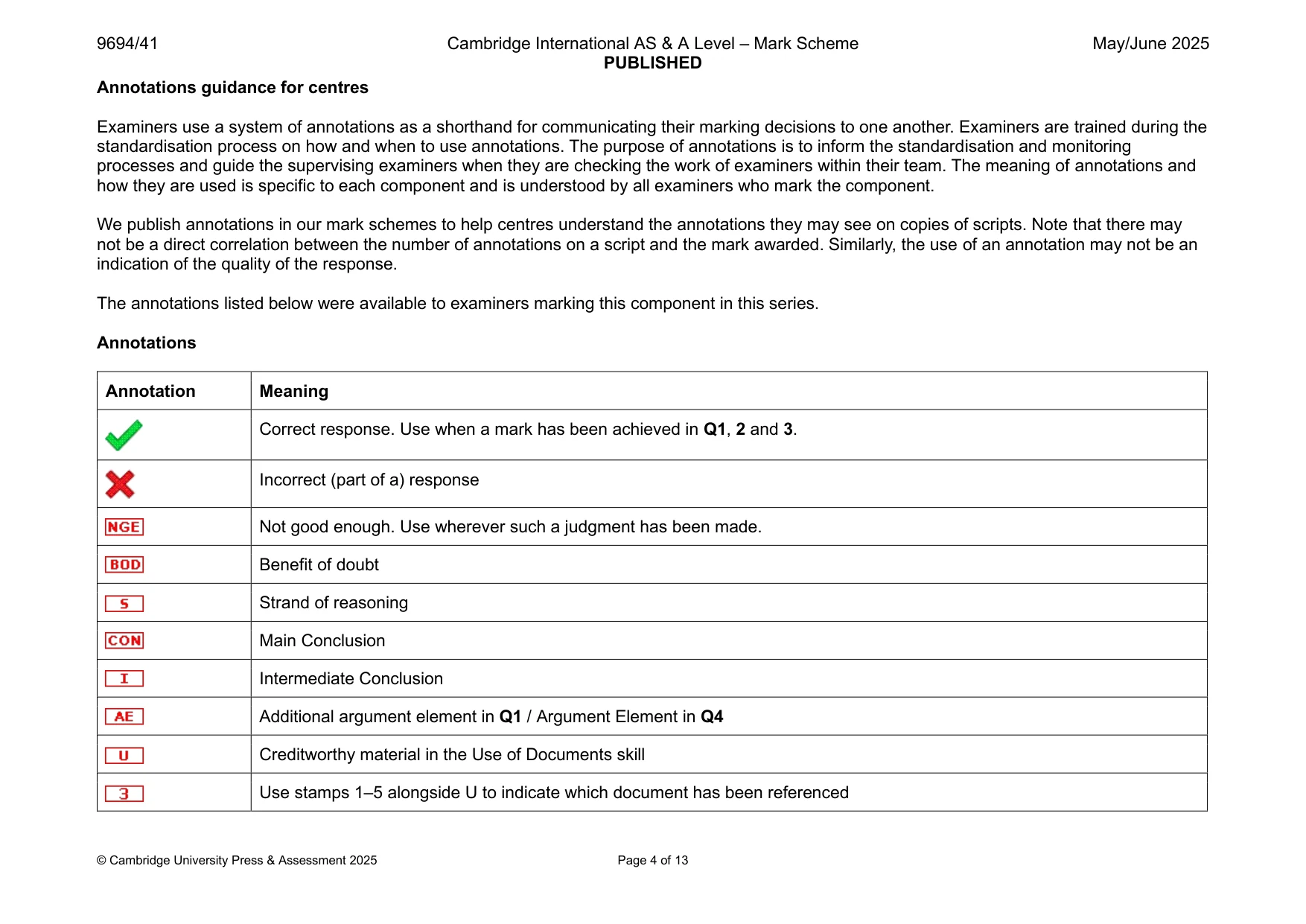
9694/41 Cambridge International AS & A Level – Mark Scheme PUBLISHED May/June 2025 © Cambridge University Press & Assessment 2025 Page 4 of 13 Annotations guidance for centres Examiners use a system of annotations as a shorthand for communicating their marking decisions to one another. Examiners are trained during the standardisation process on how and when to use annotations. The purpose of annotations is to inform the standardisation and monitoring processes and guide the supervising examiners when they are checking the work of examiners within their team. The meaning of annotations and how they are used is specific to each component and is understood by all examiners who mark the component. We publish annotations in our mark schemes to help centres understand the annotations they may see on copies of scripts. Note that there may not be a direct correlation between the number of annotations on a script and the mark awarded. Similarly, the use of an annotation may not be an indication of the quality of the response. The annotations listed below were available to examiners marking this component in this series. Annotations Annotation Meaning Correct response. Use when a mark has been achieved in Q1, 2 and 3. Incorrect (part of a) response Not good enough. Use wherever such a judgment has been made. Benefit of doubt Strand of reasoning Main Conclusion Intermediate Conclusion Additional argument element in Q1 / Argument Element in Q4 Creditworthy material in the Use of Documents skill Use stamps 1–5 alongside U to indicate which document has been referenced
Mark scheme, page 5
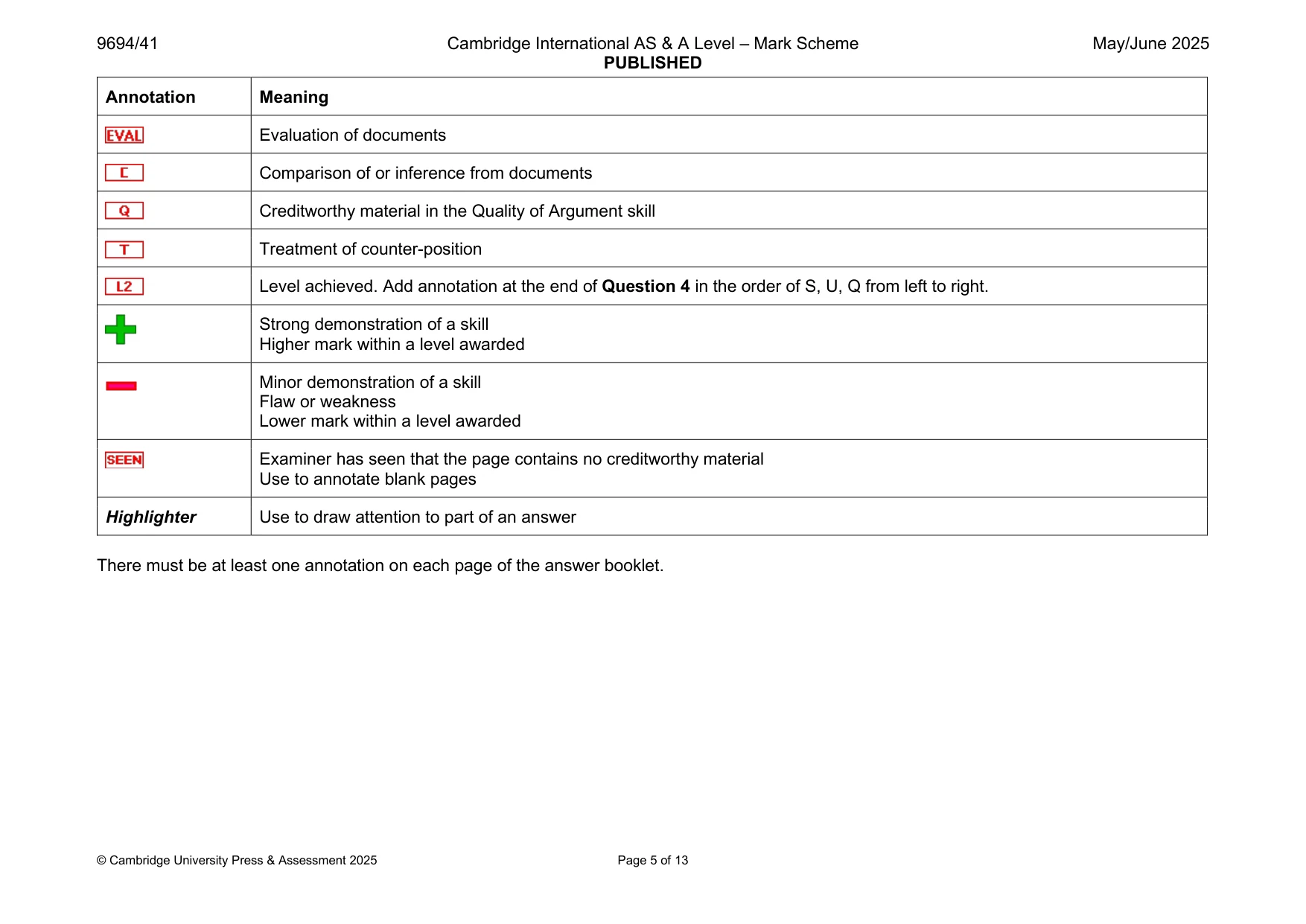
9694/41 Cambridge International AS & A Level – Mark Scheme PUBLISHED May/June 2025 © Cambridge University Press & Assessment 2025 Page 5 of 13 Annotation Meaning Evaluation of documents Comparison of or inference from documents Creditworthy material in the Quality of Argument skill Treatment of counter-position Level achieved. Add annotation at the end of Question 4 in the order of S, U, Q from left to right. Strong demonstration of a skill Higher mark within a level awarded Minor demonstration of a skill Flaw or weakness Lower mark within a level awarded Examiner has seen that the page contains no creditworthy material Use to annotate blank pages Highlighter Use to draw attention to part of an answer There must be at least one annotation on each page of the answer booklet.
Mark scheme, page 6
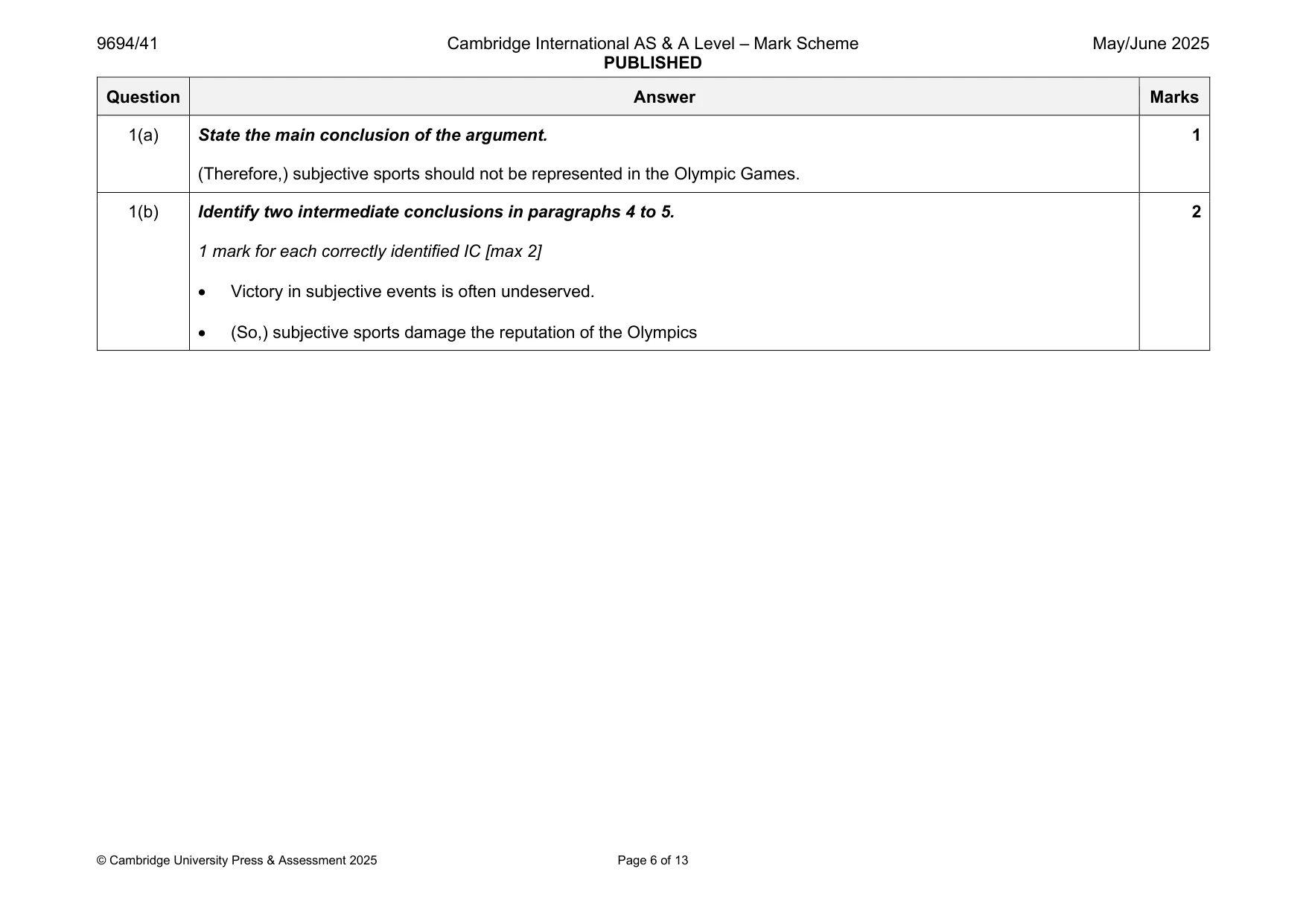
9694/41 Cambridge International AS & A Level – Mark Scheme PUBLISHED May/June 2025 © Cambridge University Press & Assessment 2025 Page 6 of 13 Question Answer Marks 1(a) State the main conclusion of the argument. (Therefore,) subjective sports should not be represented in the Olympic Games. 1 1(b) Identify two intermediate conclusions in paragraphs 4 to 5. 1 mark for each correctly identified IC [max 2] • Victory in subjective events is often undeserved. • (So,) subjective sports damage the reputation of the Olympics 2
Mark scheme, page 7
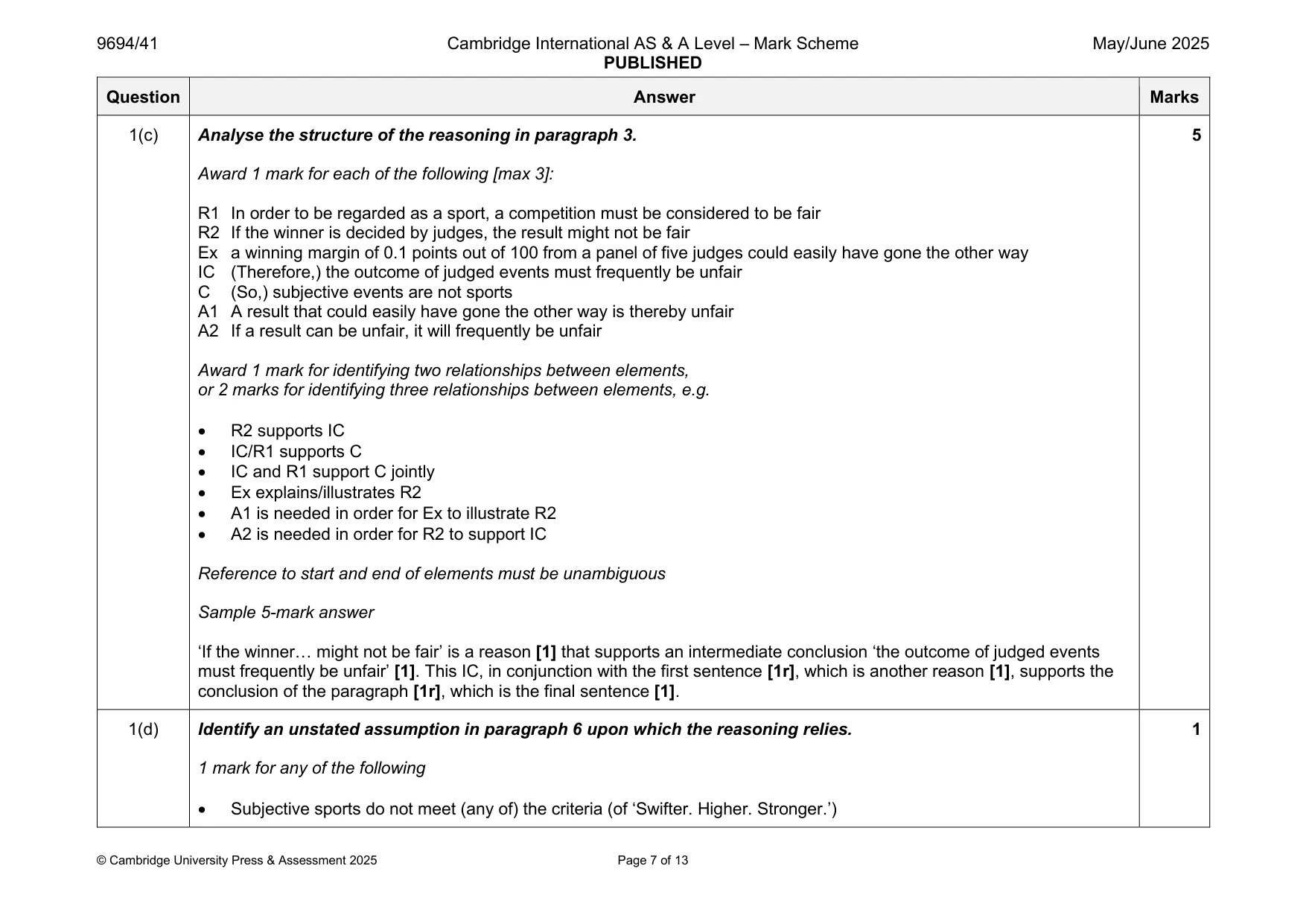
9694/41 Cambridge International AS & A Level – Mark Scheme PUBLISHED May/June 2025 © Cambridge University Press & Assessment 2025 Page 7 of 13 Question Answer Marks 1(c) Analyse the structure of the reasoning in paragraph 3. Award 1 mark for each of the following [max 3]: R1 In order to be regarded as a sport, a competition must be considered to be fair R2 If the winner is decided by judges, the result might not be fair Ex a winning margin of 0.1 points out of 100 from a panel of five judges could easily have gone the other way IC (Therefore,) the outcome of judged events must frequently be unfair C (So,) subjective events are not sports A1 A result that could easily have gone the other way is thereby unfair A2 If a result can be unfair, it will frequently be unfair Award 1 mark for identifying two relationships between elements, or 2 marks for identifying three relationships between elements, e.g. • R2 supports IC • IC/R1 supports C • IC and R1 support C jointly • Ex explains/illustrates R2 • A1 is needed in order for Ex to illustrate R2 • A2 is needed in order for R2 to support IC Reference to start and end of elements must be unambiguous Sample 5-mark answer ‘If the winner… might not be fair’ is a reason [1] that supports an intermediate conclusion ‘the outcome of judged events must frequently be unfair’ [1]. This IC, in conjunction with the first sentence [1r], which is another reason [1], supports the conclusion of the paragraph [1r], which is the final sentence [1]. 5 1(d) Identify an unstated assumption in paragraph 6 upon which the reasoning relies. 1 mark for any of the following • Subjective sports do not meet (any of) the criteria (of ‘Swifter. Higher. Stronger.’) 1
Mark scheme, page 8
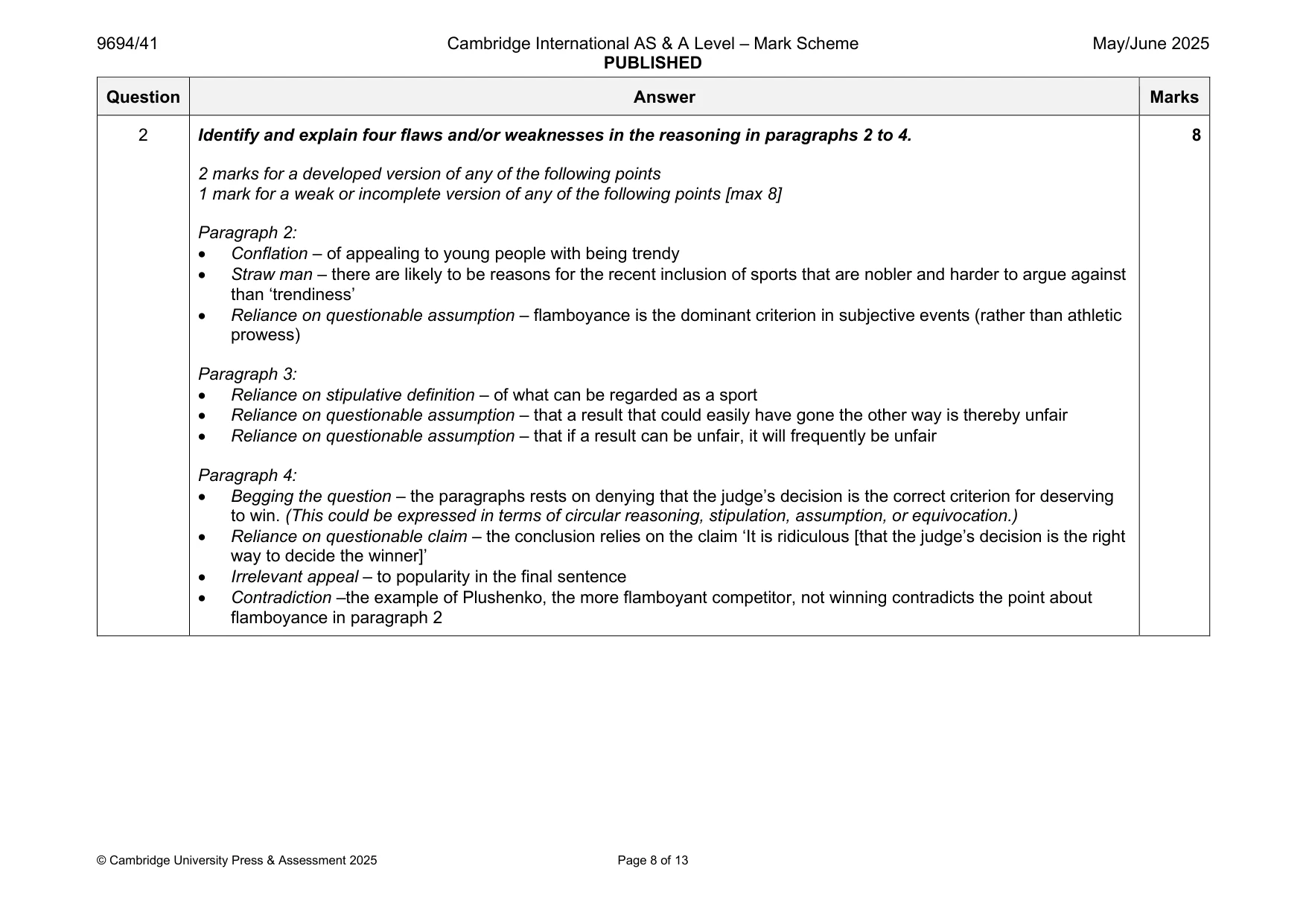
9694/41 Cambridge International AS & A Level – Mark Scheme PUBLISHED May/June 2025 © Cambridge University Press & Assessment 2025 Page 8 of 13 Question Answer Marks 2 Identify and explain four flaws and/or weaknesses in the reasoning in paragraphs 2 to 4. 2 marks for a developed version of any of the following points 1 mark for a weak or incomplete version of any of the following points [max 8] Paragraph 2: • Conflation – of appealing to young people with being trendy • Straw man – there are likely to be reasons for the recent inclusion of sports that are nobler and harder to argue against than ‘trendiness’ • Reliance on questionable assumption – flamboyance is the dominant criterion in subjective events (rather than athletic prowess) Paragraph 3: • Reliance on stipulative definition – of what can be regarded as a sport • Reliance on questionable assumption – that a result that could easily have gone the other way is thereby unfair • Reliance on questionable assumption – that if a result can be unfair, it will frequently be unfair Paragraph 4: • Begging the question – the paragraphs rests on denying that the judge’s decision is the correct criterion for deserving to win. (This could be expressed in terms of circular reasoning, stipulation, assumption, or equivocation.) • Reliance on questionable claim – the conclusion relies on the claim ‘It is ridiculous [that the judge’s decision is the right way to decide the winner]’ • Irrelevant appeal – to popularity in the final sentence • Contradiction –the example of Plushenko, the more flamboyant competitor, not winning contradicts the point about flamboyance in paragraph 2 8
Mark scheme, page 9
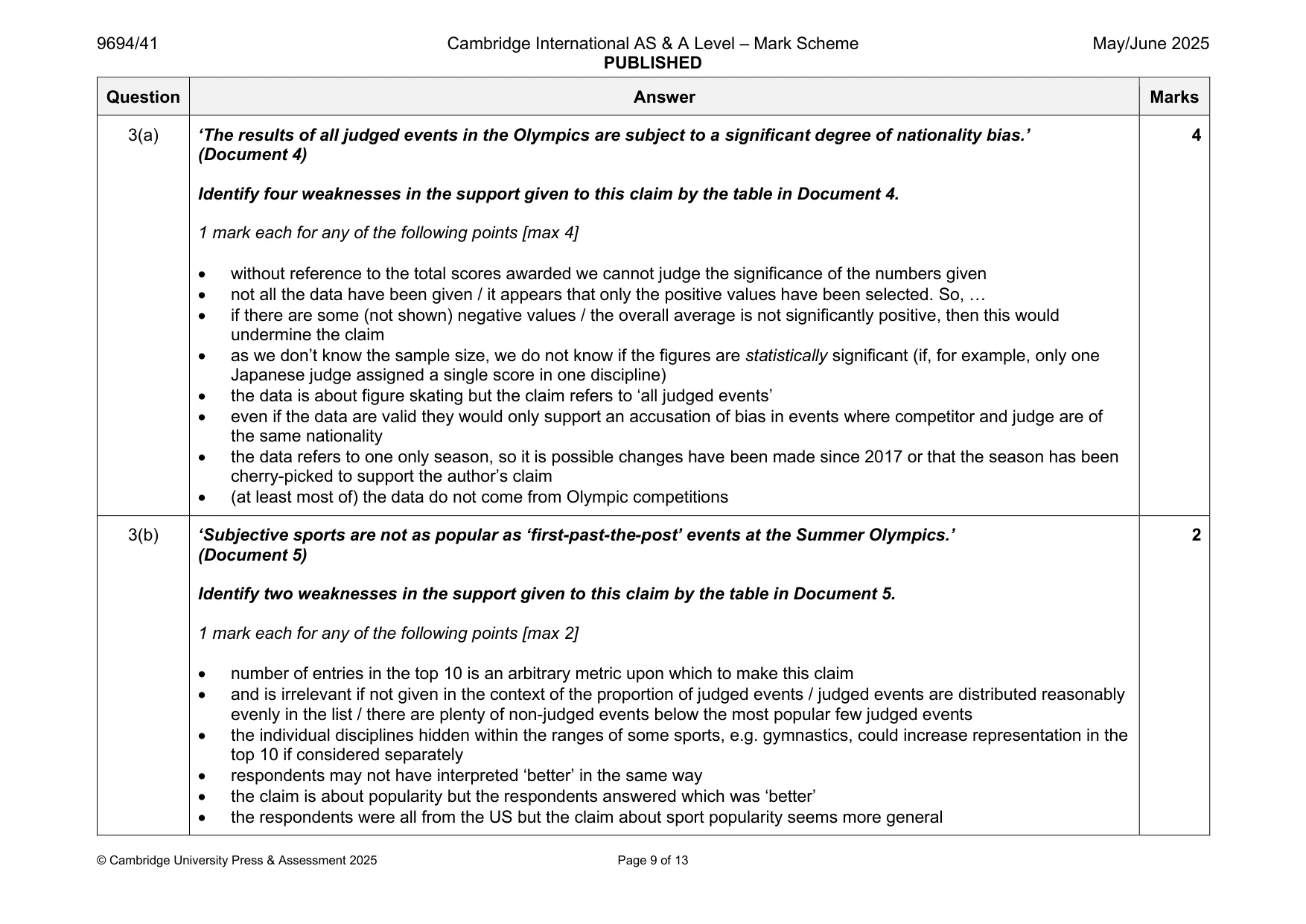
9694/41 Cambridge International AS & A Level – Mark Scheme PUBLISHED May/June 2025 © Cambridge University Press & Assessment 2025 Page 9 of 13 Question Answer Marks 3(a) ‘The results of all judged events in the Olympics are subject to a significant degree of nationality bias.’ (Document 4) Identify four weaknesses in the support given to this claim by the table in Document 4. 1 mark each for any of the following points [max 4] • without reference to the total scores awarded we cannot judge the significance of the numbers given • not all the data have been given / it appears that only the positive values have been selected. So, … • if there are some (not shown) negative values / the overall average is not significantly positive, then this would undermine the claim • as we don’t know the sample size, we do not know if the figures are statistically significant (if, for example, only one Japanese judge assigned a single score in one discipline) • the data is about figure skating but the claim refers to ‘all judged events’ • even if the data are valid they would only support an accusation of bias in events where competitor and judge are of the same nationality • the data refers to one only season, so it is possible changes have been made since 2017 or that the season has been cherry-picked to support the author’s claim • (at least most of) the data do not come from Olympic competitions 4 3(b) ‘Subjective sports are not as popular as ‘first-past-the-post’ events at the Summer Olympics.’ (Document 5) Identify two weaknesses in the support given to this claim by the table in Document 5. 1 mark each for any of the following points [max 2] • number of entries in the top 10 is an arbitrary metric upon which to make this claim • and is irrelevant if not given in the context of the proportion of judged events / judged events are distributed reasonably evenly in the list / there are plenty of non-judged events below the most popular few judged events • the individual disciplines hidden within the ranges of some sports, e.g. gymnastics, could increase representation in the top 10 if considered separately • respondents may not have interpreted ‘better’ in the same way • the claim is about popularity but the respondents answered which was ‘better’ • the respondents were all from the US but the claim about sport popularity seems more general 2
Mark scheme, page 10
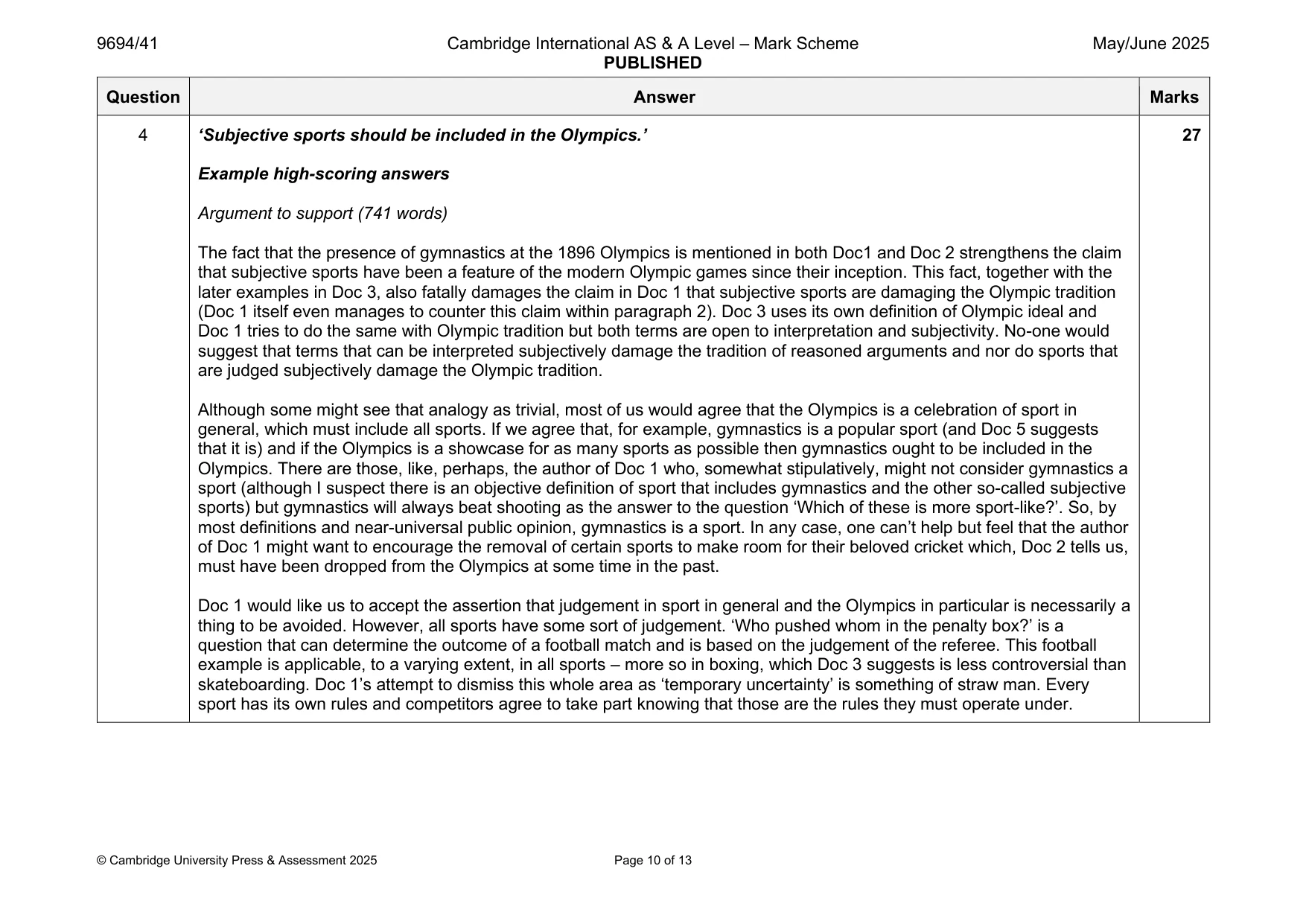
9694/41 Cambridge International AS & A Level – Mark Scheme PUBLISHED May/June 2025 © Cambridge University Press & Assessment 2025 Page 10 of 13 Question Answer Marks 4 ‘Subjective sports should be included in the Olympics.’ Example high-scoring answers Argument to support (741 words) The fact that the presence of gymnastics at the 1896 Olympics is mentioned in both Doc1 and Doc 2 strengthens the claim that subjective sports have been a feature of the modern Olympic games since their inception. This fact, together with the later examples in Doc 3, also fatally damages the claim in Doc 1 that subjective sports are damaging the Olympic tradition (Doc 1 itself even manages to counter this claim within paragraph 2). Doc 3 uses its own definition of Olympic ideal and Doc 1 tries to do the same with Olympic tradition but both terms are open to interpretation and subjectivity. No-one would suggest that terms that can be interpreted subjectively damage the tradition of reasoned arguments and nor do sports that are judged subjectively damage the Olympic tradition. Although some might see that analogy as trivial, most of us would agree that the Olympics is a celebration of sport in general, which must include all sports. If we agree that, for example, gymnastics is a popular sport (and Doc 5 suggests that it is) and if the Olympics is a showcase for as many sports as possible then gymnastics ought to be included in the Olympics. There are those, like, perhaps, the author of Doc 1 who, somewhat stipulatively, might not consider gymnastics a sport (although I suspect there is an objective definition of sport that includes gymnastics and the other so-called subjective sports) but gymnastics will always beat shooting as the answer to the question ‘Which of these is more sport-like?’. So, by most definitions and near-universal public opinion, gymnastics is a sport. In any case, one can’t help but feel that the author of Doc 1 might want to encourage the removal of certain sports to make room for their beloved cricket which, Doc 2 tells us, must have been dropped from the Olympics at some time in the past. Doc 1 would like us to accept the assertion that judgement in sport in general and the Olympics in particular is necessarily a thing to be avoided. However, all sports have some sort of judgement. ‘Who pushed whom in the penalty box?’ is a question that can determine the outcome of a football match and is based on the judgement of the referee. This football example is applicable, to a varying extent, in all sports – more so in boxing, which Doc 3 suggests is less controversial than skateboarding. Doc 1’s attempt to dismiss this whole area as ‘temporary uncertainty’ is something of straw man. Every sport has its own rules and competitors agree to take part knowing that those are the rules they must operate under. 27
Mark scheme, page 11
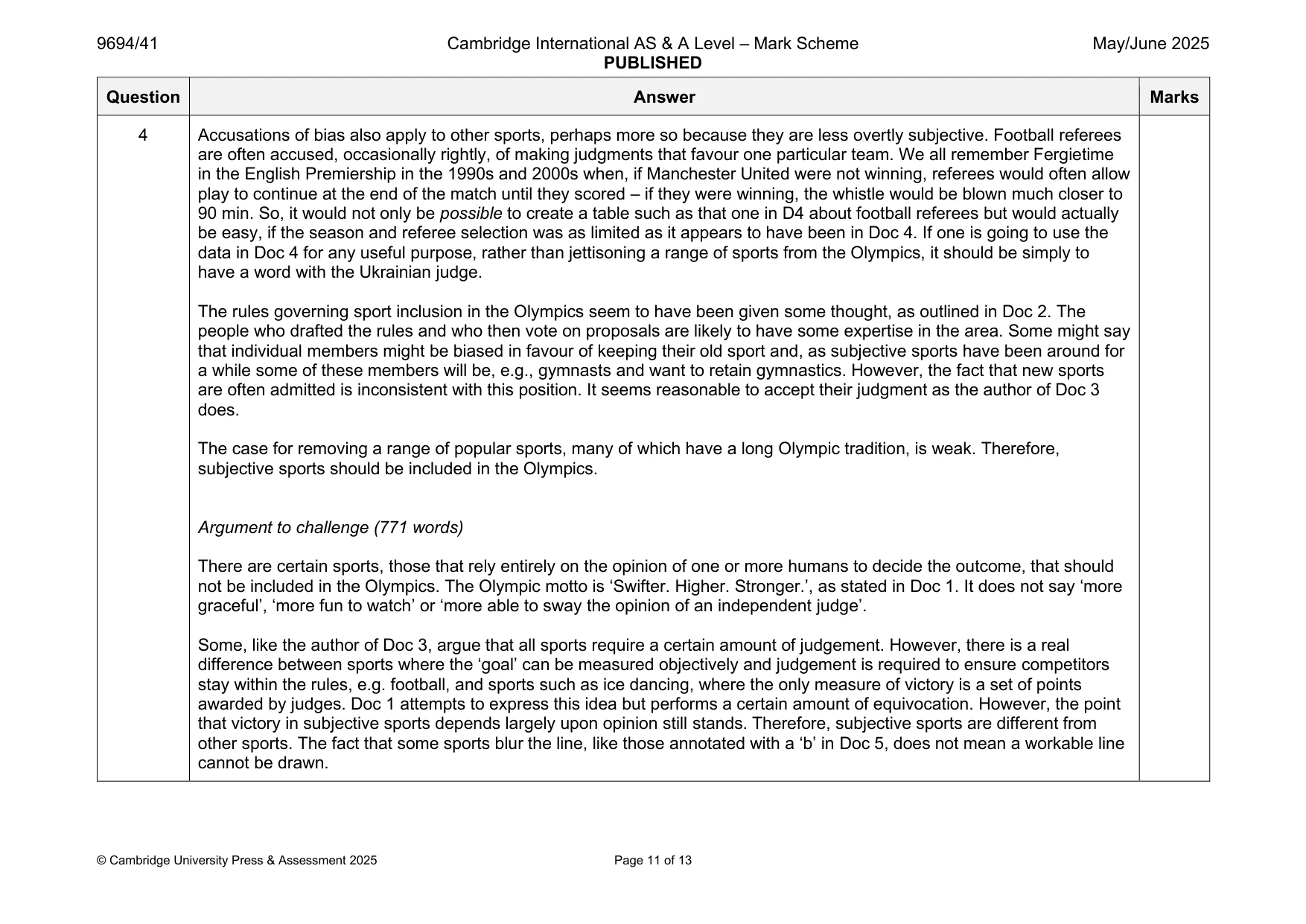
9694/41 Cambridge International AS & A Level – Mark Scheme PUBLISHED May/June 2025 © Cambridge University Press & Assessment 2025 Page 11 of 13 Question Answer Marks 4 Accusations of bias also apply to other sports, perhaps more so because they are less overtly subjective. Football referees are often accused, occasionally rightly, of making judgments that favour one particular team. We all remember Fergietime in the English Premiership in the 1990s and 2000s when, if Manchester United were not winning, referees would often allow play to continue at the end of the match until they scored – if they were winning, the whistle would be blown much closer to 90 min. So, it would not only be possible to create a table such as that one in D4 about football referees but would actually be easy, if the season and referee selection was as limited as it appears to have been in Doc 4. If one is going to use the data in Doc 4 for any useful purpose, rather than jettisoning a range of sports from the Olympics, it should be simply to have a word with the Ukrainian judge. The rules governing sport inclusion in the Olympics seem to have been given some thought, as outlined in Doc 2. The people who drafted the rules and who then vote on proposals are likely to have some expertise in the area. Some might say that individual members might be biased in favour of keeping their old sport and, as subjective sports have been around for a while some of these members will be, e.g., gymnasts and want to retain gymnastics. However, the fact that new sports are often admitted is inconsistent with this position. It seems reasonable to accept their judgment as the author of Doc 3 does. The case for removing a range of popular sports, many of which have a long Olympic tradition, is weak. Therefore, subjective sports should be included in the Olympics. Argument to challenge (771 words) There are certain sports, those that rely entirely on the opinion of one or more humans to decide the outcome, that should not be included in the Olympics. The Olympic motto is ‘Swifter. Higher. Stronger.’, as stated in Doc 1. It does not say ‘more graceful’, ‘more fun to watch’ or ‘more able to sway the opinion of an independent judge’. Some, like the author of Doc 3, argue that all sports require a certain amount of judgement. However, there is a real difference between sports where the ‘goal’ can be measured objectively and judgement is required to ensure competitors stay within the rules, e.g. football, and sports such as ice dancing, where the only measure of victory is a set of points awarded by judges. Doc 1 attempts to express this idea but performs a certain amount of equivocation. However, the point that victory in subjective sports depends largely upon opinion still stands. Therefore, subjective sports are different from other sports. The fact that some sports blur the line, like those annotated with a ‘b’ in Doc 5, does not mean a workable line cannot be drawn.
Mark scheme, page 12
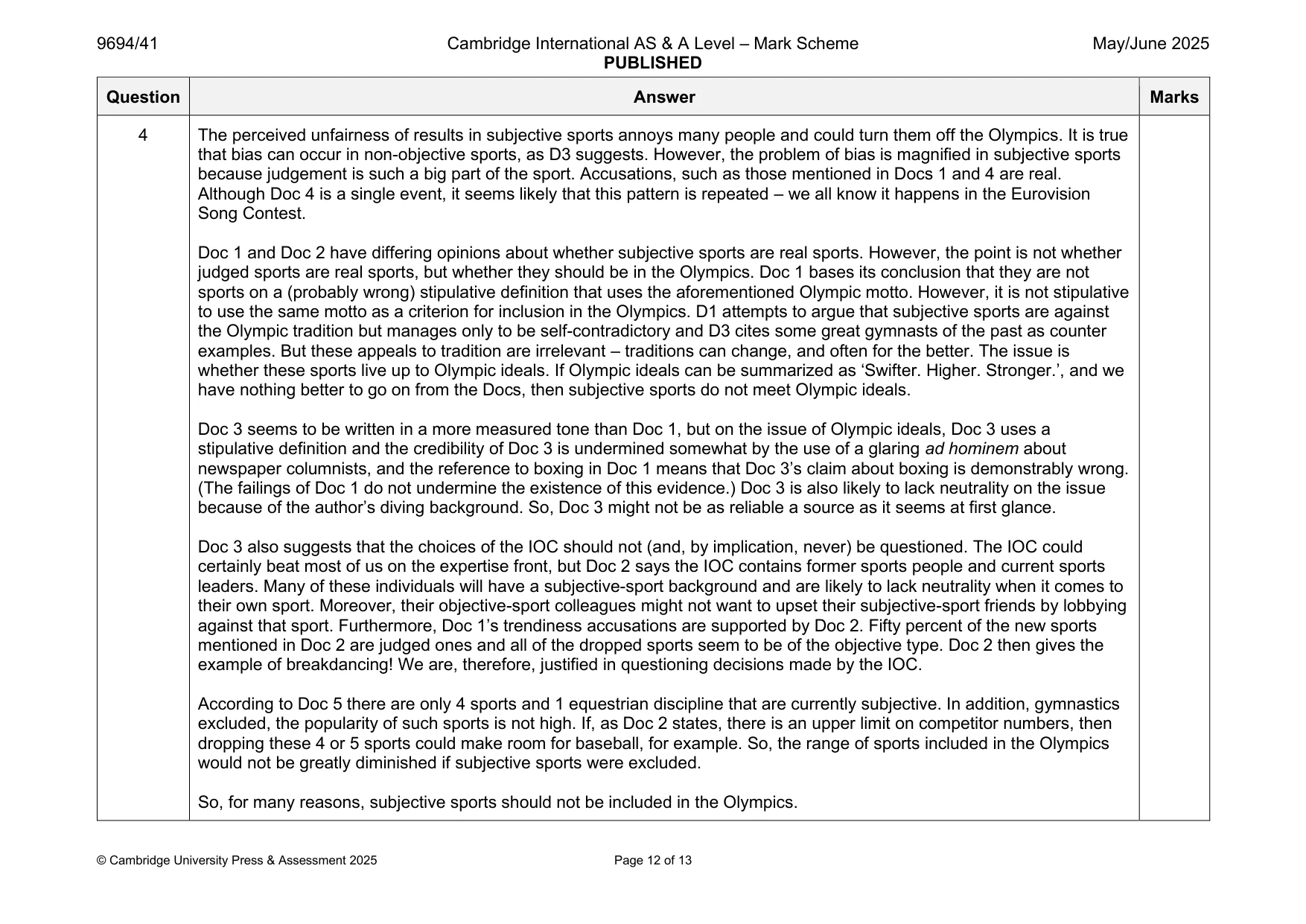
9694/41 Cambridge International AS & A Level – Mark Scheme PUBLISHED May/June 2025 © Cambridge University Press & Assessment 2025 Page 12 of 13 Question Answer Marks 4 The perceived unfairness of results in subjective sports annoys many people and could turn them off the Olympics. It is true that bias can occur in non-objective sports, as D3 suggests. However, the problem of bias is magnified in subjective sports because judgement is such a big part of the sport. Accusations, such as those mentioned in Docs 1 and 4 are real. Although Doc 4 is a single event, it seems likely that this pattern is repeated – we all know it happens in the Eurovision Song Contest. Doc 1 and Doc 2 have differing opinions about whether subjective sports are real sports. However, the point is not whether judged sports are real sports, but whether they should be in the Olympics. Doc 1 bases its conclusion that they are not sports on a (probably wrong) stipulative definition that uses the aforementioned Olympic motto. However, it is not stipulative to use the same motto as a criterion for inclusion in the Olympics. D1 attempts to argue that subjective sports are against the Olympic tradition but manages only to be self-contradictory and D3 cites some great gymnasts of the past as counter examples. But these appeals to tradition are irrelevant – traditions can change, and often for the better. The issue is whether these sports live up to Olympic ideals. If Olympic ideals can be summarized as ‘Swifter. Higher. Stronger.’, and we have nothing better to go on from the Docs, then subjective sports do not meet Olympic ideals. Doc 3 seems to be written in a more measured tone than Doc 1, but on the issue of Olympic ideals, Doc 3 uses a stipulative definition and the credibility of Doc 3 is undermined somewhat by the use of a glaring ad hominem about newspaper columnists, and the reference to boxing in Doc 1 means that Doc 3’s claim about boxing is demonstrably wrong. (The failings of Doc 1 do not undermine the existence of this evidence.) Doc 3 is also likely to lack neutrality on the issue because of the author’s diving background. So, Doc 3 might not be as reliable a source as it seems at first glance. Doc 3 also suggests that the choices of the IOC should not (and, by implication, never) be questioned. The IOC could certainly beat most of us on the expertise front, but Doc 2 says the IOC contains former sports people and current sports leaders. Many of these individuals will have a subjective-sport background and are likely to lack neutrality when it comes to their own sport. Moreover, their objective-sport colleagues might not want to upset their subjective-sport friends by lobbying against that sport. Furthermore, Doc 1’s trendiness accusations are supported by Doc 2. Fifty percent of the new sports mentioned in Doc 2 are judged ones and all of the dropped sports seem to be of the objective type. Doc 2 then gives the example of breakdancing! We are, therefore, justified in questioning decisions made by the IOC. According to Doc 5 there are only 4 sports and 1 equestrian discipline that are currently subjective. In addition, gymnastics excluded, the popularity of such sports is not high. If, as Doc 2 states, there is an upper limit on competitor numbers, then dropping these 4 or 5 sports could make room for baseball, for example. So, the range of sports included in the Olympics would not be greatly diminished if subjective sports were excluded. So, for many reasons, subjective sports should not be included in the Olympics.
Mark scheme, page 13
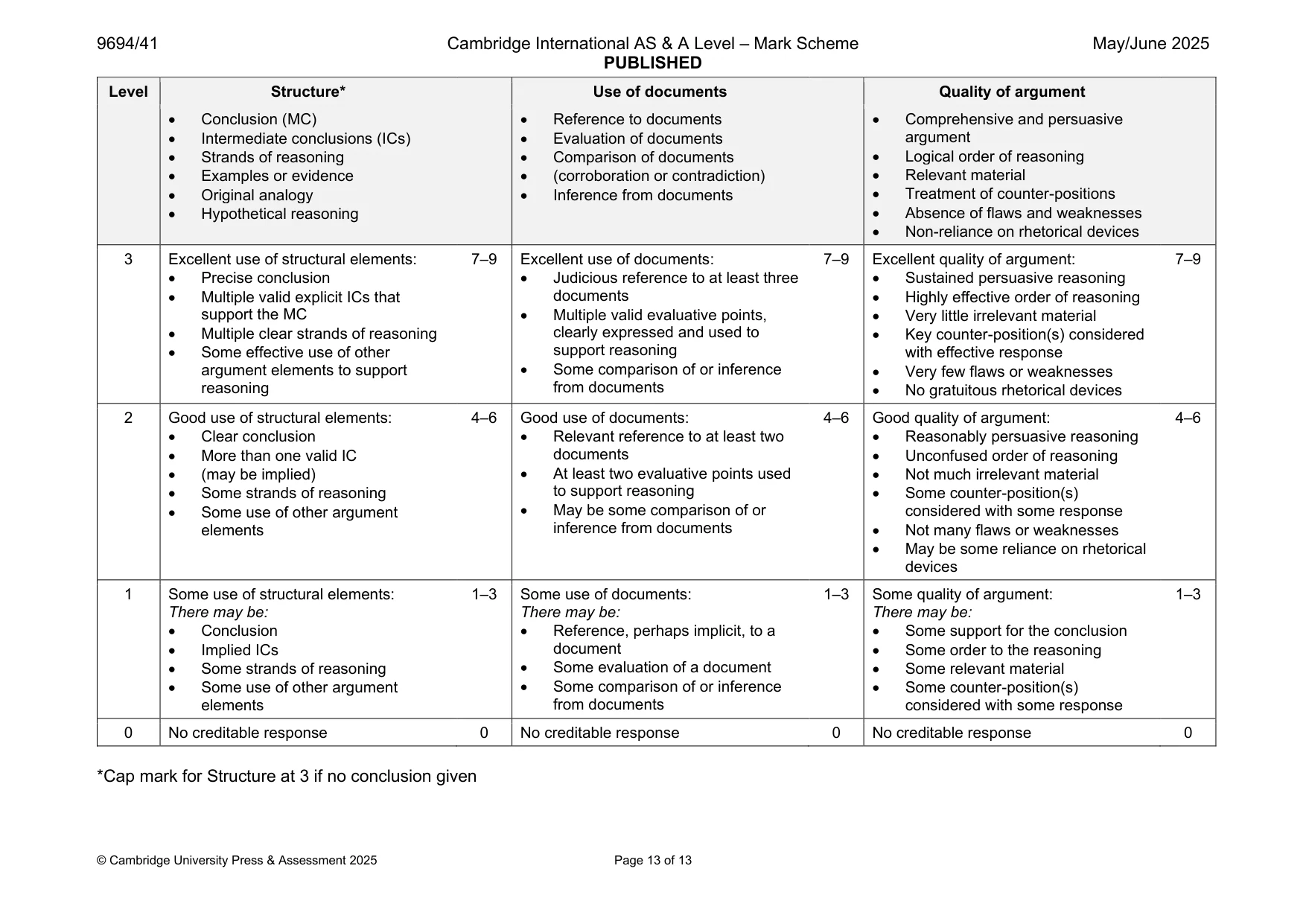
9694/41 Cambridge International AS & A Level – Mark Scheme PUBLISHED May/June 2025 © Cambridge University Press & Assessment 2025 Page 13 of 13 Level Structure* Use of documents Quality of argument • Conclusion (MC) • Intermediate conclusions (ICs) • Strands of reasoning • Examples or evidence • Original analogy • Hypothetical reasoning • Reference to documents • Evaluation of documents • Comparison of documents • (corroboration or contradiction) • Inference from documents • Comprehensive and persuasive argument • Logical order of reasoning • Relevant material • Treatment of counter-positions • Absence of flaws and weaknesses • Non-reliance on rhetorical devices 3 Excellent use of structural elements: • Precise conclusion • Multiple valid explicit ICs that support the MC • Multiple clear strands of reasoning • Some effective use of other argument elements to support reasoning 7–9 Excellent use of documents: • Judicious reference to at least three documents • Multiple valid evaluative points, clearly expressed and used to support reasoning • Some comparison of or inference from documents 7–9 Excellent quality of argument: • Sustained persuasive reasoning • Highly effective order of reasoning • Very little irrelevant material • Key counter-position(s) considered with effective response • Very few flaws or weaknesses • No gratuitous rhetorical devices 7–9 2 Good use of structural elements: • Clear conclusion • More than one valid IC • (may be implied) • Some strands of reasoning • Some use of other argument elements 4–6 Good use of documents: • Relevant reference to at least two documents • At least two evaluative points used to support reasoning • May be some comparison of or inference from documents 4–6 Good quality of argument: • Reasonably persuasive reasoning • Unconfused order of reasoning • Not much irrelevant material • Some counter-position(s) considered with some response • Not many flaws or weaknesses • May be some reliance on rhetorical devices 4–6 1 Some use of structural elements: There may be: • Conclusion • Implied ICs • Some strands of reasoning • Some use of other argument elements 1–3 Some use of documents: There may be: • Reference, perhaps implicit, to a document • Some evaluation of a document • Some comparison of or inference from documents 1–3 Some quality of argument: There may be: • Some support for the conclusion • Some order to the reasoning • Some relevant material • Some counter-position(s) considered with some response 1–3 0 No creditable response 0 No creditable response 0 No creditable response 0 *Cap mark for Structure at 3 if no conclusion given
What you needed in this session
Cambridge’s own grade thresholds for 2025 May/June, Paper 4 · Variant 1. A higher threshold means an easier paper — the bar moves with how the cohort did.