Cambridge A Level Thinking Skills 9694 — 2022 May/June Paper 4 · Variant 3
9694/43/M/J/22 · 50 marks · ≈56 min
The question paper and its mark scheme, free to read here and free to download. This is Cambridge’s own paper, exactly as it was sat.
Question paper8 pages
Mark scheme14 pages
Answers below. Sit the paper first if you are practising.
Paper as text
Question paper, page 1
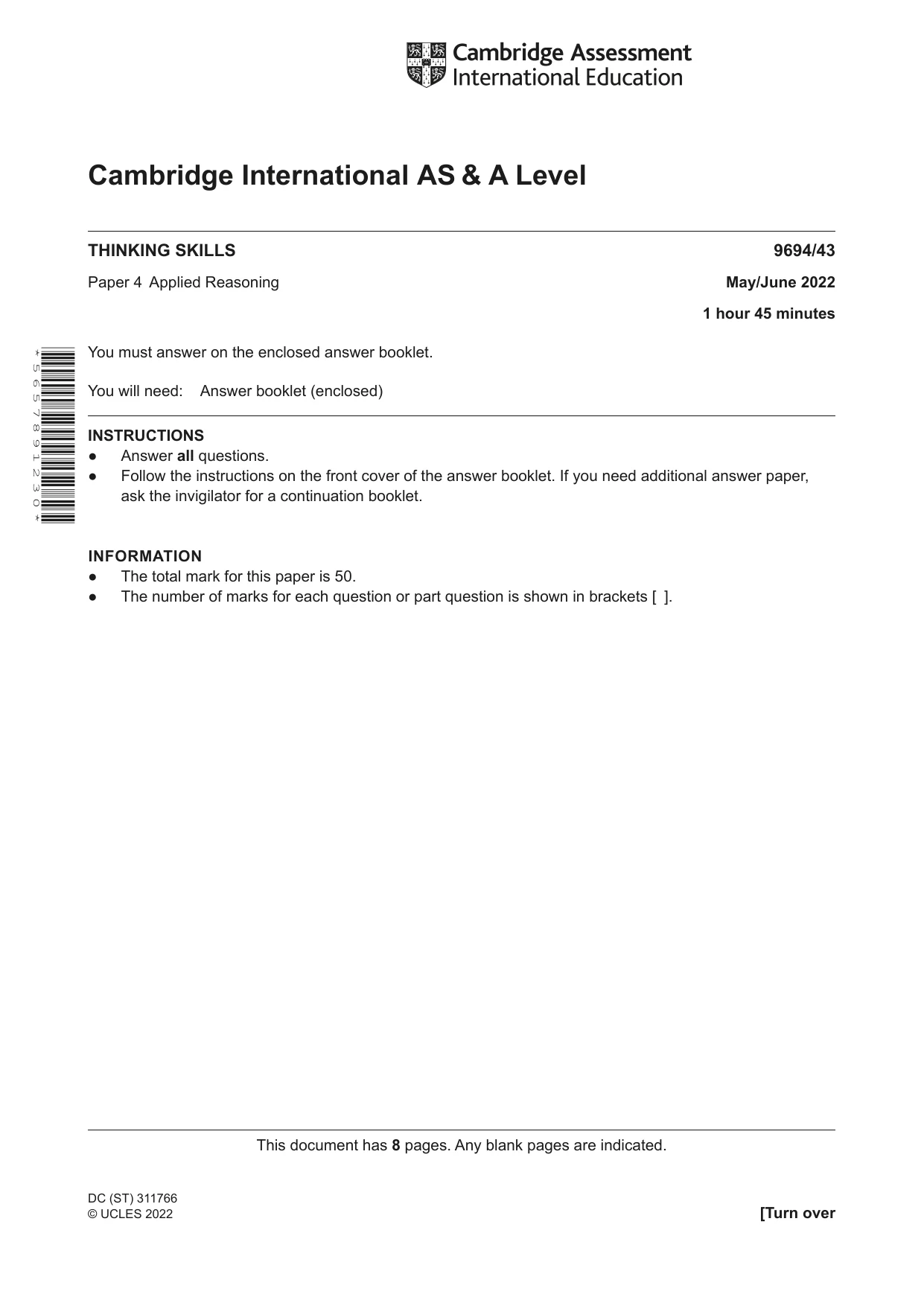
This document has 8 pages. Any blank pages are indicated. [Turn over Cambridge International AS & A Level THINKING SKILLS 9694/43 Paper 4 Applied Reasoning May/June 2022 1 hour 45 minutes You must answer on the enclosed answer booklet. You will need: Answer booklet (enclosed) INSTRUCTIONS ● Answer all questions. ● Follow the instructions on the front cover of the answer booklet. If you need additional answer paper, ask the invigilator for a continuation booklet. INFORMATION ● The total mark for this paper is 50. ● The number of marks for each question or part question is shown in brackets [ ]. DC (ST) 311766 © UCLES 2022 * 5 6 5 7 8 9 1 2 3 0 *
Question paper, page 2
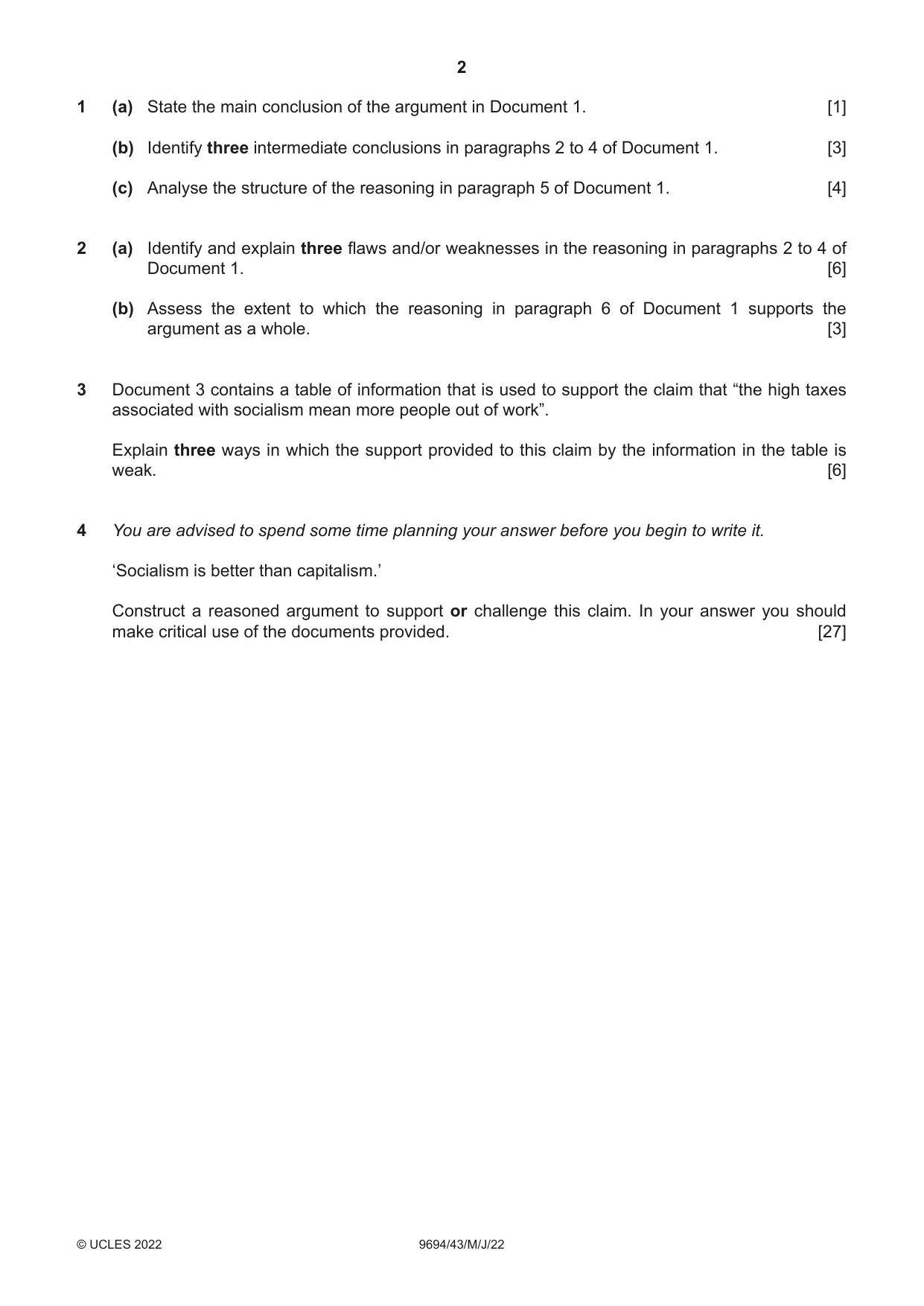
2 9694/43/M/J/22 © UCLES 2022 1 (a) State the main conclusion of the argument in Document 1. [1] (b) Identify three intermediate conclusions in paragraphs 2 to 4 of Document 1. [3] (c) Analyse the structure of the reasoning in paragraph 5 of Document 1. [4] 2 (a) Identify and explain three flaws and/or weaknesses in the reasoning in paragraphs 2 to 4 of Document 1. [6] (b) Assess the extent to which the reasoning in paragraph 6 of Document 1 supports the argument as a whole. [3] 3 Document 3 contains a table of information that is used to support the claim that “the high taxes associated with socialism mean more people out of work”. Explain three ways in which the support provided to this claim by the information in the table is weak. [6] 4 You are advised to spend some time planning your answer before you begin to write it. ‘Socialism is better than capitalism.’ Construct a reasoned argument to support or challenge this claim. In your answer you should make critical use of the documents provided. [27]
Question paper, page 3
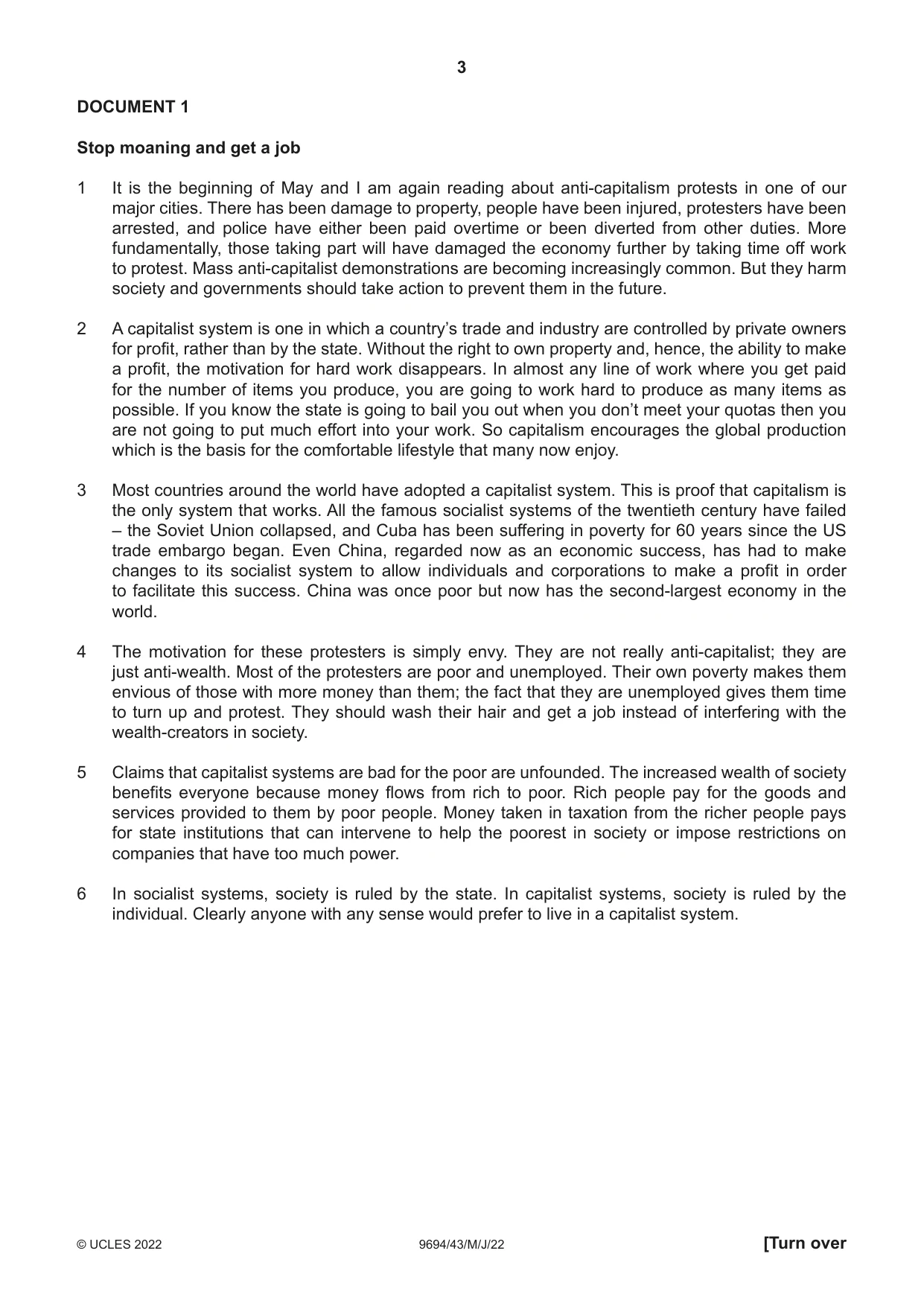
3 9694/43/M/J/22 © UCLES 2022 [Turn over DOCUMENT 1 Stop moaning and get a job 1 It is the beginning of May and I am again reading about anti-capitalism protests in one of our major cities. There has been damage to property, people have been injured, protesters have been arrested, and police have either been paid overtime or been diverted from other duties. More fundamentally, those taking part will have damaged the economy further by taking time off work to protest. Mass anti-capitalist demonstrations are becoming increasingly common. But they harm society and governments should take action to prevent them in the future. 2 A capitalist system is one in which a country’s trade and industry are controlled by private owners for profit, rather than by the state. Without the right to own property and, hence, the ability to make a profit, the motivation for hard work disappears. In almost any line of work where you get paid for the number of items you produce, you are going to work hard to produce as many items as possible. If you know the state is going to bail you out when you don’t meet your quotas then you are not going to put much effort into your work. So capitalism encourages the global production which is the basis for the comfortable lifestyle that many now enjoy. 3 Most countries around the world have adopted a capitalist system. This is proof that capitalism is the only system that works. All the famous socialist systems of the twentieth century have failed – the Soviet Union collapsed, and Cuba has been suffering in poverty for 60 years since the US trade embargo began. Even China, regarded now as an economic success, has had to make changes to its socialist system to allow individuals and corporations to make a profit in order to facilitate this success. China was once poor but now has the second-largest economy in the world. 4 The motivation for these protesters is simply envy. They are not really anti-capitalist; they are just anti-wealth. Most of the protesters are poor and unemployed. Their own poverty makes them envious of those with more money than them; the fact that they are unemployed gives them time to turn up and protest. They should wash their hair and get a job instead of interfering with the wealth-creators in society. 5 Claims that capitalist systems are bad for the poor are unfounded. The increased wealth of society benefits everyone because money flows from rich to poor. Rich people pay for the goods and services provided to them by poor people. Money taken in taxation from the richer people pays for state institutions that can intervene to help the poorest in society or impose restrictions on companies that have too much power. 6 In socialist systems, society is ruled by the state. In capitalist systems, society is ruled by the individual. Clearly anyone with any sense would prefer to live in a capitalist system.
Question paper, page 4
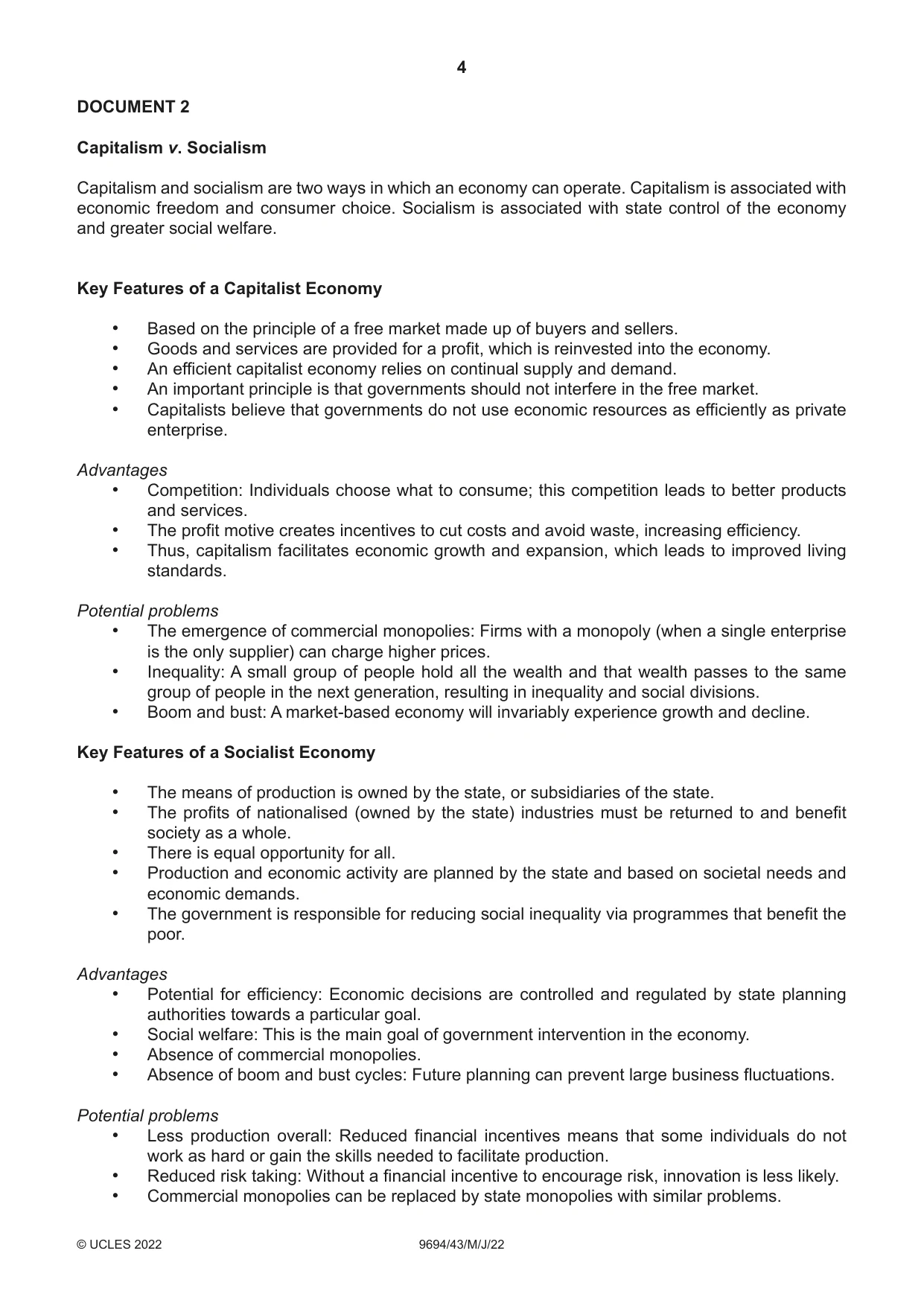
4 9694/43/M/J/22 © UCLES 2022 DOCUMENT 2 Capitalism v. Socialism Capitalism and socialism are two ways in which an economy can operate. Capitalism is associated with economic freedom and consumer choice. Socialism is associated with state control of the economy and greater social welfare. Key Features of a Capitalist Economy • Based on the principle of a free market made up of buyers and sellers. • Goods and services are provided for a profit, which is reinvested into the economy. • An efficient capitalist economy relies on continual supply and demand. • An important principle is that governments should not interfere in the free market. • Capitalists believe that governments do not use economic resources as efficiently as private enterprise. Advantages • Competition: Individuals choose what to consume; this competition leads to better products and services. • The profit motive creates incentives to cut costs and avoid waste, increasing efficiency. • Thus, capitalism facilitates economic growth and expansion, which leads to improved living standards. Potential problems • The emergence of commercial monopolies: Firms with a monopoly (when a single enterprise is the only supplier) can charge higher prices. • Inequality: A small group of people hold all the wealth and that wealth passes to the same group of people in the next generation, resulting in inequality and social divisions. • Boom and bust: A market-based economy will invariably experience growth and decline. Key Features of a Socialist Economy • The means of production is owned by the state, or subsidiaries of the state. • The profits of nationalised (owned by the state) industries must be returned to and benefit society as a whole. • There is equal opportunity for all. • Production and economic activity are planned by the state and based on societal needs and economic demands. • The government is responsible for reducing social inequality via programmes that benefit the poor. Advantages • Potential for efficiency: Economic decisions are controlled and regulated by state planning authorities towards a particular goal. • Social welfare: This is the main goal of government intervention in the economy. • Absence of commercial monopolies. • Absence of boom and bust cycles: Future planning can prevent large business fluctuations. Potential problems • Less production overall: Reduced financial incentives means that some individuals do not work as hard or gain the skills needed to facilitate production. • Reduced risk taking: Without a financial incentive to encourage risk, innovation is less likely. • Commercial monopolies can be replaced by state monopolies with similar problems.
Question paper, page 5
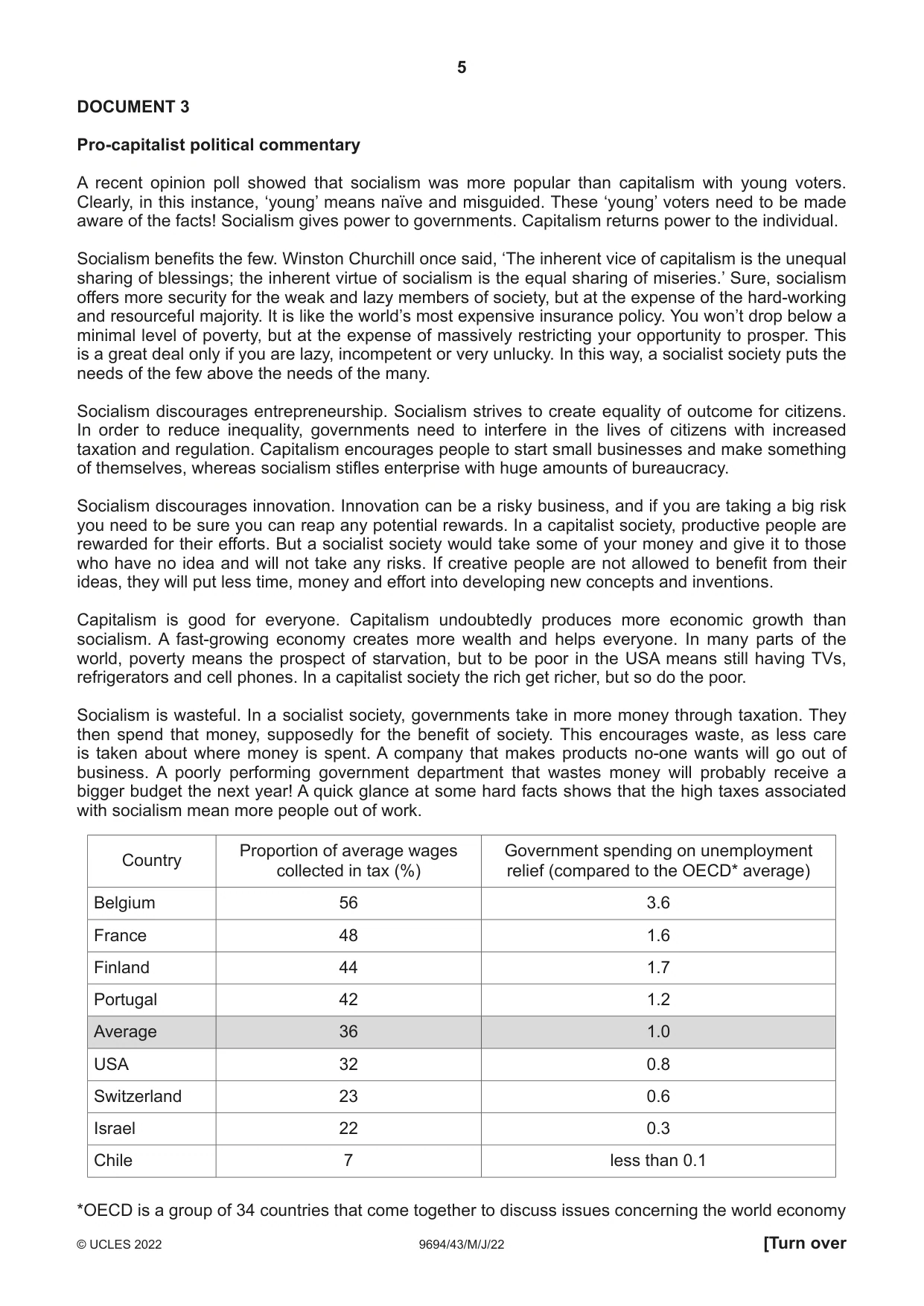
5 9694/43/M/J/22 © UCLES 2022 [Turn over DOCUMENT 3 Pro-capitalist political commentary A recent opinion poll showed that socialism was more popular than capitalism with young voters. Clearly, in this instance, ‘young’ means naїve and misguided. These ‘young’ voters need to be made aware of the facts! Socialism gives power to governments. Capitalism returns power to the individual. Socialism benefits the few. Winston Churchill once said, ‘The inherent vice of capitalism is the unequal sharing of blessings; the inherent virtue of socialism is the equal sharing of miseries.’ Sure, socialism offers more security for the weak and lazy members of society, but at the expense of the hard-working and resourceful majority. It is like the world’s most expensive insurance policy. You won’t drop below a minimal level of poverty, but at the expense of massively restricting your opportunity to prosper. This is a great deal only if you are lazy, incompetent or very unlucky. In this way, a socialist society puts the needs of the few above the needs of the many. Socialism discourages entrepreneurship. Socialism strives to create equality of outcome for citizens. In order to reduce inequality, governments need to interfere in the lives of citizens with increased taxation and regulation. Capitalism encourages people to start small businesses and make something of themselves, whereas socialism stifles enterprise with huge amounts of bureaucracy. Socialism discourages innovation. Innovation can be a risky business, and if you are taking a big risk you need to be sure you can reap any potential rewards. In a capitalist society, productive people are rewarded for their efforts. But a socialist society would take some of your money and give it to those who have no idea and will not take any risks. If creative people are not allowed to benefit from their ideas, they will put less time, money and effort into developing new concepts and inventions. Capitalism is good for everyone. Capitalism undoubtedly produces more economic growth than socialism. A fast-growing economy creates more wealth and helps everyone. In many parts of the world, poverty means the prospect of starvation, but to be poor in the USA means still having TVs, refrigerators and cell phones. In a capitalist society the rich get richer, but so do the poor. Socialism is wasteful. In a socialist society, governments take in more money through taxation. They then spend that money, supposedly for the benefit of society. This encourages waste, as less care is taken about where money is spent. A company that makes products no-one wants will go out of business. A poorly performing government department that wastes money will probably receive a bigger budget the next year! A quick glance at some hard facts shows that the high taxes associated with socialism mean more people out of work. Country Proportion of average wages collected in tax (%) Government spending on unemployment relief (compared to the OECD* average) Belgium 56 3.6 France 48 1.6 Finland 44 1.7 Portugal 42 1.2 Average 36 1.0 USA 32 0.8 Switzerland 23 0.6 Israel 22 0.3 Chile 7 less than 0.1 *OECD is a group of 34 countries that come together to discuss issues concerning the world economy
Question paper, page 6
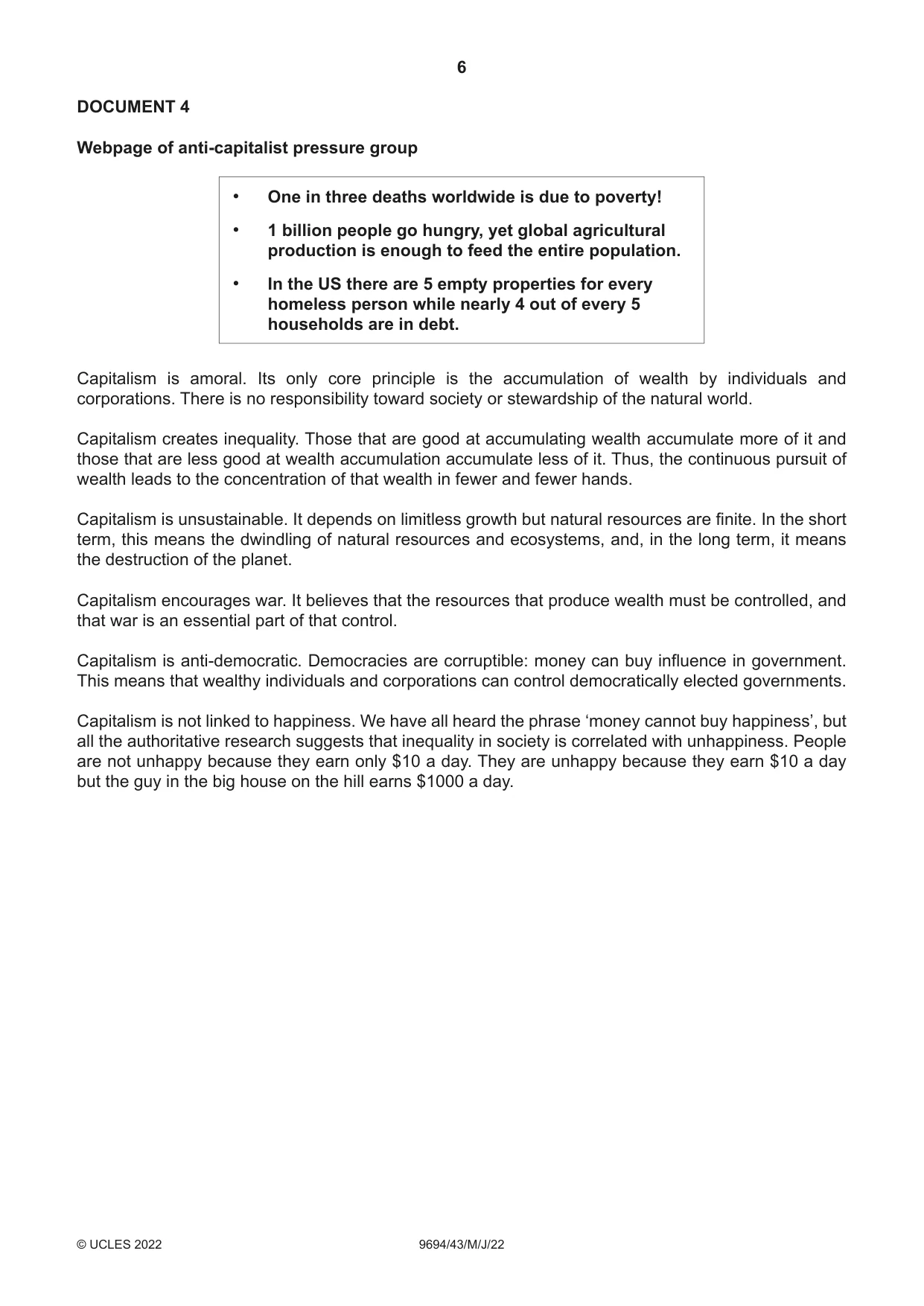
6 9694/43/M/J/22 © UCLES 2022 DOCUMENT 4 Webpage of anti-capitalist pressure group • One in three deaths worldwide is due to poverty! • 1 billion people go hungry, yet global agricultural production is enough to feed the entire population. • In the US there are 5 empty properties for every homeless person while nearly 4 out of every 5 households are in debt. Capitalism is amoral. Its only core principle is the accumulation of wealth by individuals and corporations. There is no responsibility toward society or stewardship of the natural world. Capitalism creates inequality. Those that are good at accumulating wealth accumulate more of it and those that are less good at wealth accumulation accumulate less of it. Thus, the continuous pursuit of wealth leads to the concentration of that wealth in fewer and fewer hands. Capitalism is unsustainable. It depends on limitless growth but natural resources are finite. In the short term, this means the dwindling of natural resources and ecosystems, and, in the long term, it means the destruction of the planet. Capitalism encourages war. It believes that the resources that produce wealth must be controlled, and that war is an essential part of that control. Capitalism is anti-democratic. Democracies are corruptible: money can buy influence in government. This means that wealthy individuals and corporations can control democratically elected governments. Capitalism is not linked to happiness. We have all heard the phrase ‘money cannot buy happiness’, but all the authoritative research suggests that inequality in society is correlated with unhappiness. People are not unhappy because they earn only $10 a day. They are unhappy because they earn $10 a day but the guy in the big house on the hill earns $1000 a day.
Question paper, page 7
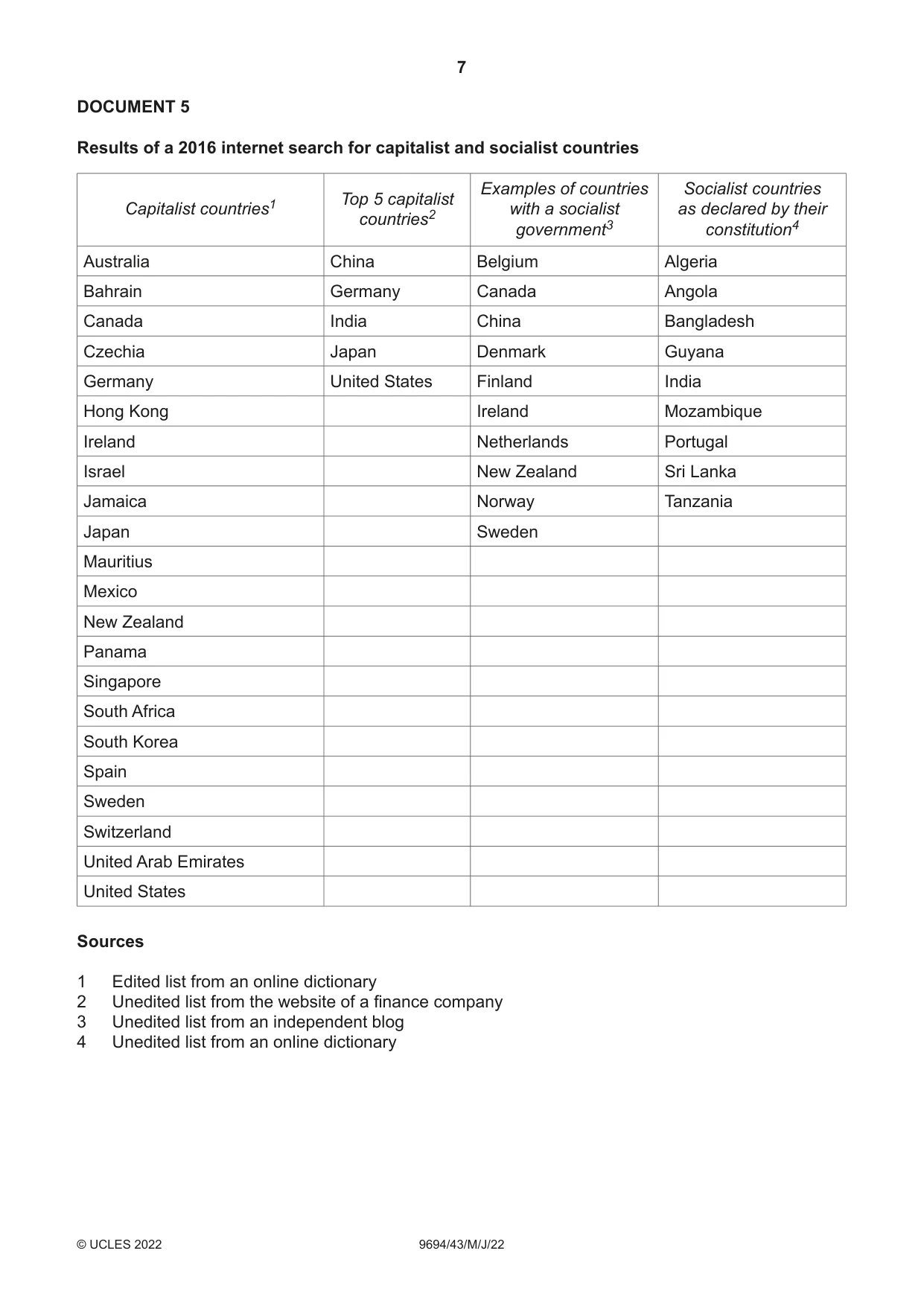
7 9694/43/M/J/22 © UCLES 2022 DOCUMENT 5 Results of a 2016 internet search for capitalist and socialist countries Capitalist countries1 Top 5 capitalist countries2 Examples of countries with a socialist government3 Socialist countries as declared by their constitution4 Australia China Belgium Algeria Bahrain Germany Canada Angola Canada India China Bangladesh Czechia Japan Denmark Guyana Germany United States Finland India Hong Kong Ireland Mozambique Ireland Netherlands Portugal Israel New Zealand Sri Lanka Jamaica Norway Tanzania Japan Sweden Mauritius Mexico New Zealand Panama Singapore South Africa South Korea Spain Sweden Switzerland United Arab Emirates United States Sources 1 Edited list from an online dictionary 2 Unedited list from the website of a finance company 3 Unedited list from an independent blog 4 Unedited list from an online dictionary
Question paper, page 8
8 9694/43/M/J/22 © UCLES 2022 Permission to reproduce items where third-party owned material protected by copyright is included has been sought and cleared where possible. Every reasonable effort has been made by the publisher (UCLES) to trace copyright holders, but if any items requiring clearance have unwittingly been included, the publisher will be pleased to make amends at the earliest possible opportunity. To avoid the issue of disclosure of answer-related information to candidates, all copyright acknowledgements are reproduced online in the Cambridge Assessment International Education Copyright Acknowledgements Booklet. This is produced for each series of examinations and is freely available to download at www.cambridgeinternational.org after the live examination series. Cambridge Assessment International Education is part of Cambridge Assessment. Cambridge Assessment is the brand name of the University of Cambridge Local Examinations Syndicate (UCLES), which is a department of the University of Cambridge. BLANK PAGE
Mark scheme, page 1
This document consists of 14 printed pages. © UCLES 2022 [Turn over Cambridge International AS & A Level THINKING SKILLS 9694/43 Paper 4 Applied Reasoning May/June 2022 MARK SCHEME Maximum Mark: 50 Published This mark scheme is published as an aid to teachers and candidates, to indicate the requirements of the examination. It shows the basis on which Examiners were instructed to award marks. It does not indicate the details of the discussions that took place at an Examiners’ meeting before marking began, which would have considered the acceptability of alternative answers. Mark schemes should be read in conjunction with the question paper and the Principal Examiner Report for Teachers. Cambridge International will not enter into discussions about these mark schemes. Cambridge International is publishing the mark schemes for the May/June 2022 series for most Cambridge IGCSE, Cambridge International A and AS Level and Cambridge Pre-U components, and some Cambridge O Level components.
Mark scheme, page 2
9694/43 Cambridge International AS & A Level – Mark Scheme PUBLISHED May/June 2022 © UCLES 2022 Page 2 of 14 Generic Marking Principles These general marking principles must be applied by all examiners when marking candidate answers. They should be applied alongside the specific content of the mark scheme or generic level descriptors for a question. Each question paper and mark scheme will also comply with these marking principles. GENERIC MARKING PRINCIPLE 1: Marks must be awarded in line with: the specific content of the mark scheme or the generic level descriptors for the question the specific skills defined in the mark scheme or in the generic level descriptors for the question the standard of response required by a candidate as exemplified by the standardisation scripts. GENERIC MARKING PRINCIPLE 2: Marks awarded are always whole marks (not half marks, or other fractions). GENERIC MARKING PRINCIPLE 3: Marks must be awarded positively: marks are awarded for correct/valid answers, as defined in the mark scheme. However, credit is given for valid answers which go beyond the scope of the syllabus and mark scheme, referring to your Team Leader as appropriate marks are awarded when candidates clearly demonstrate what they know and can do marks are not deducted for errors marks are not deducted for omissions answers should only be judged on the quality of spelling, punctuation and grammar when these features are specifically assessed by the question as indicated by the mark scheme. The meaning, however, should be unambiguous. GENERIC MARKING PRINCIPLE 4: Rules must be applied consistently, e.g. in situations where candidates have not followed instructions or in the application of generic level descriptors.
Mark scheme, page 3
9694/43 Cambridge International AS & A Level – Mark Scheme PUBLISHED May/June 2022 © UCLES 2022 Page 3 of 14 GENERIC MARKING PRINCIPLE 5: Marks should be awarded using the full range of marks defined in the mark scheme for the question (however; the use of the full mark range may be limited according to the quality of the candidate responses seen). GENERIC MARKING PRINCIPLE 6: Marks awarded are based solely on the requirements as defined in the mark scheme. Marks should not be awarded with grade thresholds or grade descriptors in mind.
Mark scheme, page 4
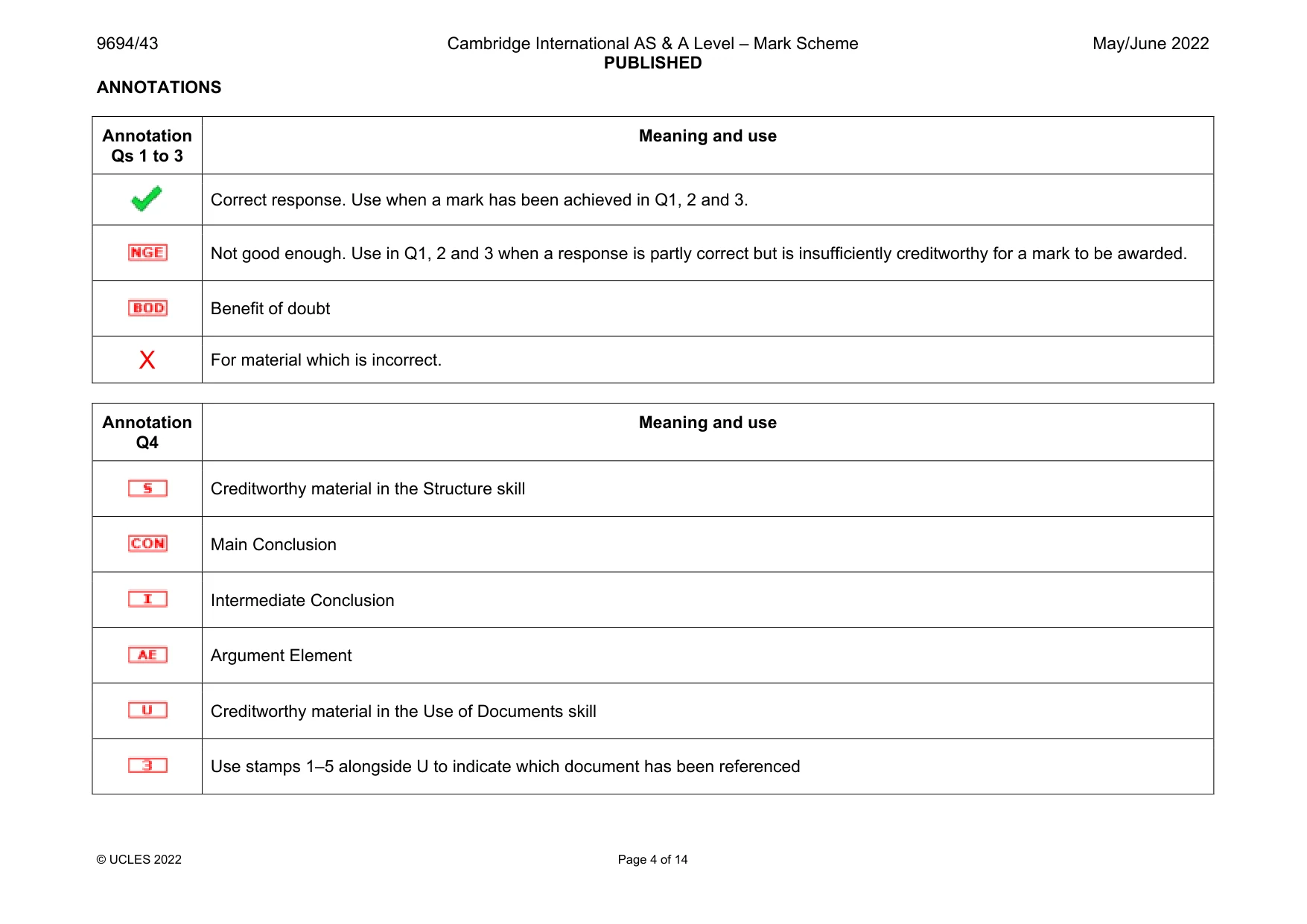
9694/43 Cambridge International AS & A Level – Mark Scheme PUBLISHED May/June 2022 © UCLES 2022 Page 4 of 14 ANNOTATIONS Annotation Qs 1 to 3 Meaning and use Correct response. Use when a mark has been achieved in Q1, 2 and 3. Not good enough. Use in Q1, 2 and 3 when a response is partly correct but is insufficiently creditworthy for a mark to be awarded. Benefit of doubt X For material which is incorrect. Annotation Q4 Meaning and use Creditworthy material in the Structure skill Main Conclusion Intermediate Conclusion Argument Element Creditworthy material in the Use of Documents skill Use stamps 1–5 alongside U to indicate which document has been referenced
Mark scheme, page 5
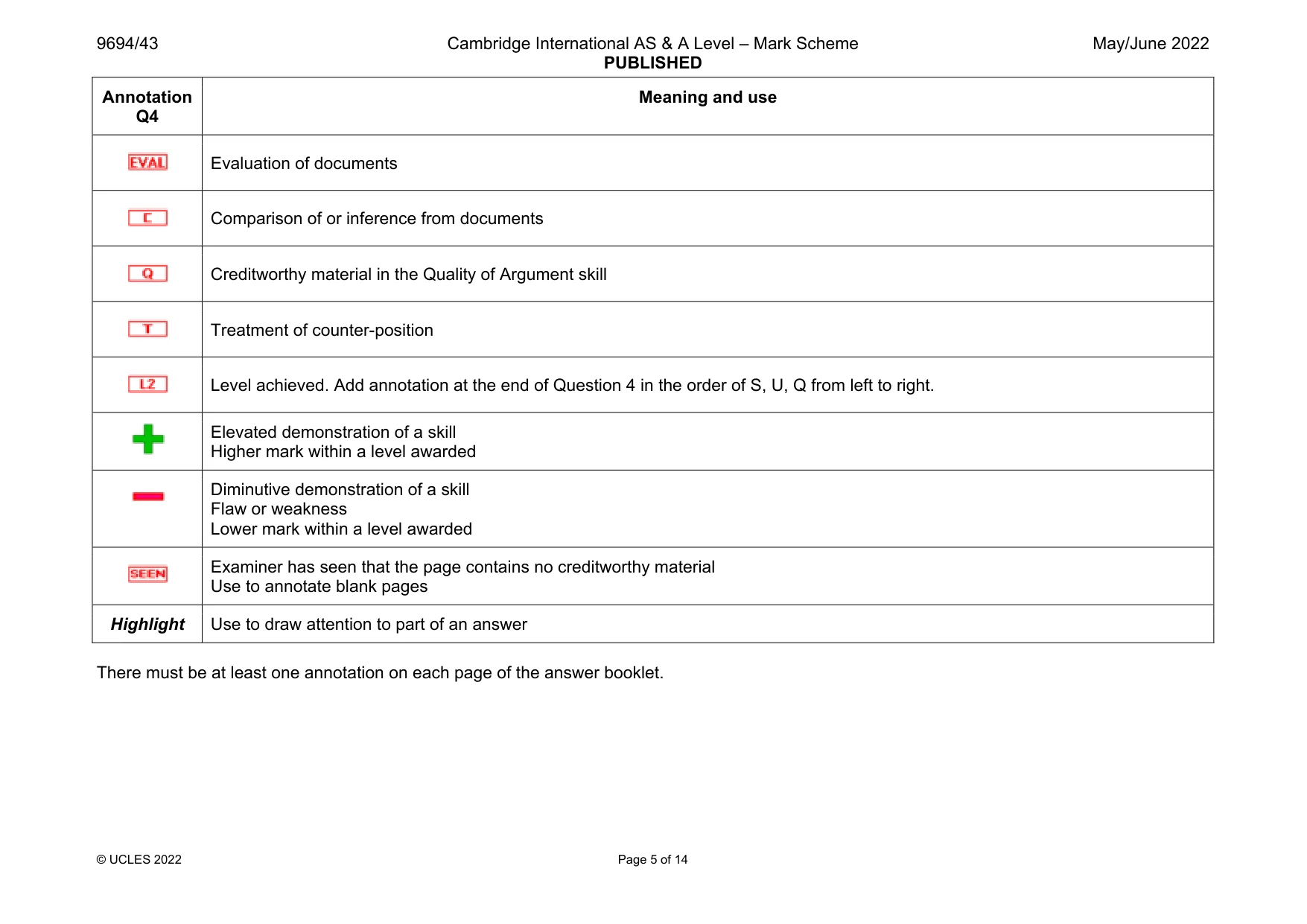
9694/43 Cambridge International AS & A Level – Mark Scheme PUBLISHED May/June 2022 © UCLES 2022 Page 5 of 14 Annotation Q4 Meaning and use Evaluation of documents Comparison of or inference from documents Creditworthy material in the Quality of Argument skill Treatment of counter-position Level achieved. Add annotation at the end of Question 4 in the order of S, U, Q from left to right. Elevated demonstration of a skill Higher mark within a level awarded Diminutive demonstration of a skill Flaw or weakness Lower mark within a level awarded Examiner has seen that the page contains no creditworthy material Use to annotate blank pages Highlight Use to draw attention to part of an answer There must be at least one annotation on each page of the answer booklet.
Mark scheme, page 6
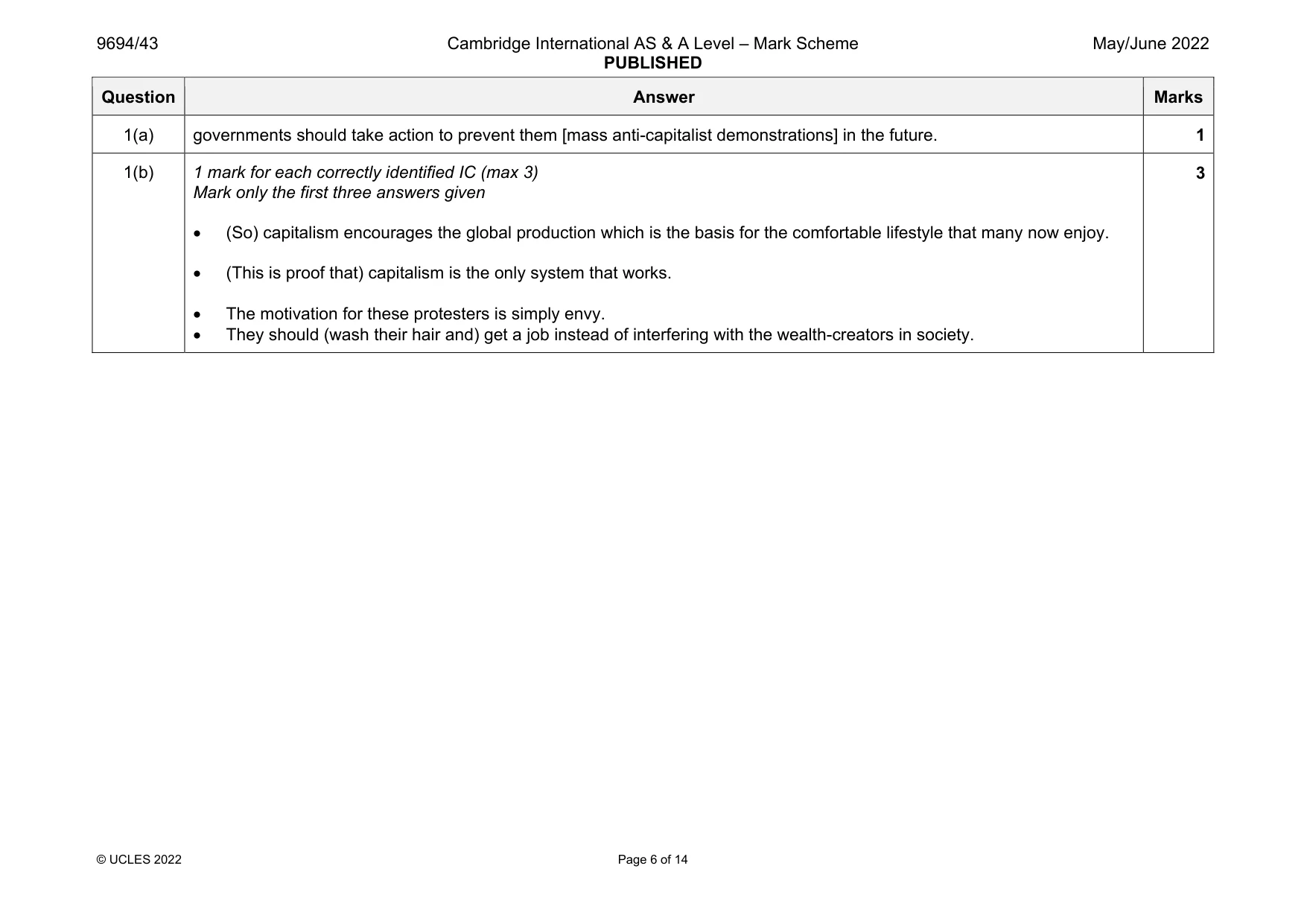
9694/43 Cambridge International AS & A Level – Mark Scheme PUBLISHED May/June 2022 © UCLES 2022 Page 6 of 14 Question Answer Marks 1(a) governments should take action to prevent them [mass anti-capitalist demonstrations] in the future. 1 1(b) 1 mark for each correctly identified IC (max 3) Mark only the first three answers given (So) capitalism encourages the global production which is the basis for the comfortable lifestyle that many now enjoy. (This is proof that) capitalism is the only system that works. The motivation for these protesters is simply envy. They should (wash their hair and) get a job instead of interfering with the wealth-creators in society. 3
Mark scheme, page 7
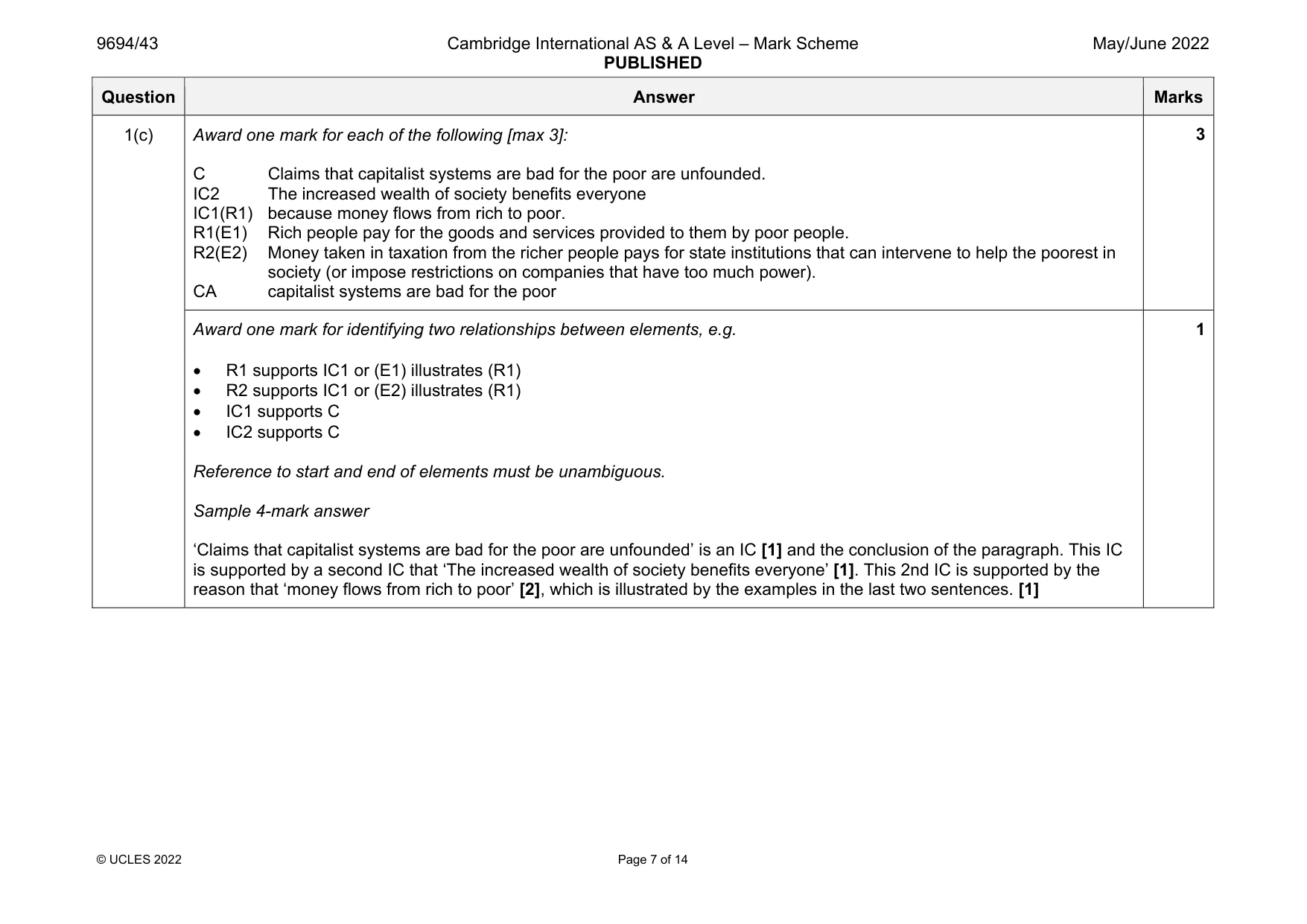
9694/43 Cambridge International AS & A Level – Mark Scheme PUBLISHED May/June 2022 © UCLES 2022 Page 7 of 14 Question Answer Marks 1(c) Award one mark for each of the following [max 3]: C Claims that capitalist systems are bad for the poor are unfounded. IC2 The increased wealth of society benefits everyone IC1(R1) because money flows from rich to poor. R1(E1) Rich people pay for the goods and services provided to them by poor people. R2(E2) Money taken in taxation from the richer people pays for state institutions that can intervene to help the poorest in society (or impose restrictions on companies that have too much power). CA capitalist systems are bad for the poor 3 Award one mark for identifying two relationships between elements, e.g. R1 supports IC1 or (E1) illustrates (R1) R2 supports IC1 or (E2) illustrates (R1) IC1 supports C IC2 supports C Reference to start and end of elements must be unambiguous. Sample 4-mark answer ‘Claims that capitalist systems are bad for the poor are unfounded’ is an IC [1] and the conclusion of the paragraph. This IC is supported by a second IC that ‘The increased wealth of society benefits everyone’ [1]. This 2nd IC is supported by the reason that ‘money flows from rich to poor’ [2], which is illustrated by the examples in the last two sentences. [1] 1
Mark scheme, page 8
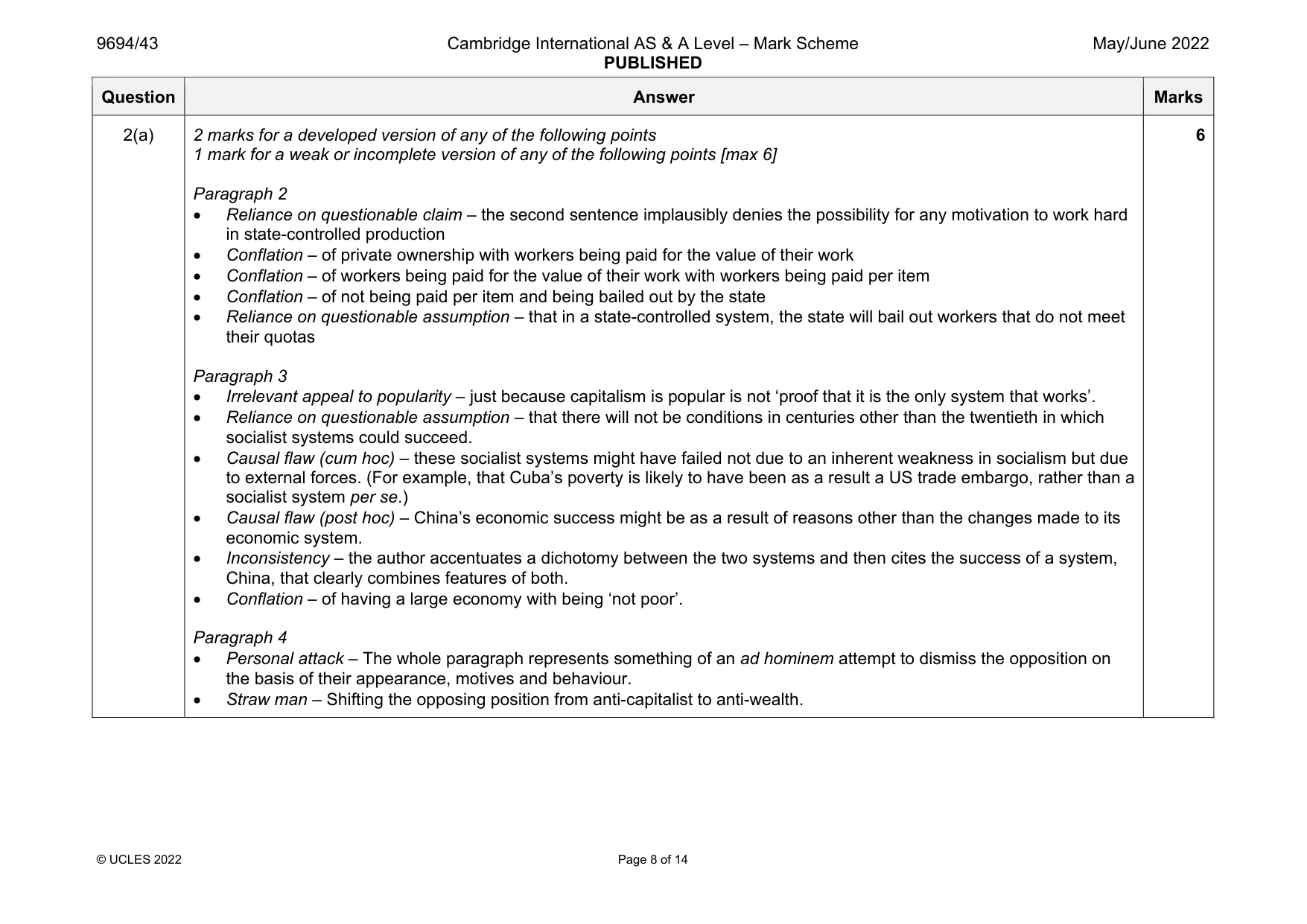
9694/43 Cambridge International AS & A Level – Mark Scheme PUBLISHED May/June 2022 © UCLES 2022 Page 8 of 14 Question Answer Marks 2(a) 2 marks for a developed version of any of the following points 1 mark for a weak or incomplete version of any of the following points [max 6] Paragraph 2 Reliance on questionable claim – the second sentence implausibly denies the possibility for any motivation to work hard in state-controlled production Conflation – of private ownership with workers being paid for the value of their work Conflation – of workers being paid for the value of their work with workers being paid per item Conflation – of not being paid per item and being bailed out by the state Reliance on questionable assumption – that in a state-controlled system, the state will bail out workers that do not meet their quotas Paragraph 3 Irrelevant appeal to popularity – just because capitalism is popular is not ‘proof that it is the only system that works’. Reliance on questionable assumption – that there will not be conditions in centuries other than the twentieth in which socialist systems could succeed. Causal flaw (cum hoc) – these socialist systems might have failed not due to an inherent weakness in socialism but due to external forces. (For example, that Cuba’s poverty is likely to have been as a result a US trade embargo, rather than a socialist system per se.) Causal flaw (post hoc) – China’s economic success might be as a result of reasons other than the changes made to its economic system. Inconsistency – the author accentuates a dichotomy between the two systems and then cites the success of a system, China, that clearly combines features of both. Conflation – of having a large economy with being ‘not poor’. Paragraph 4 Personal attack – The whole paragraph represents something of an ad hominem attempt to dismiss the opposition on the basis of their appearance, motives and behaviour. Straw man – Shifting the opposing position from anti-capitalist to anti-wealth. 6
Mark scheme, page 9
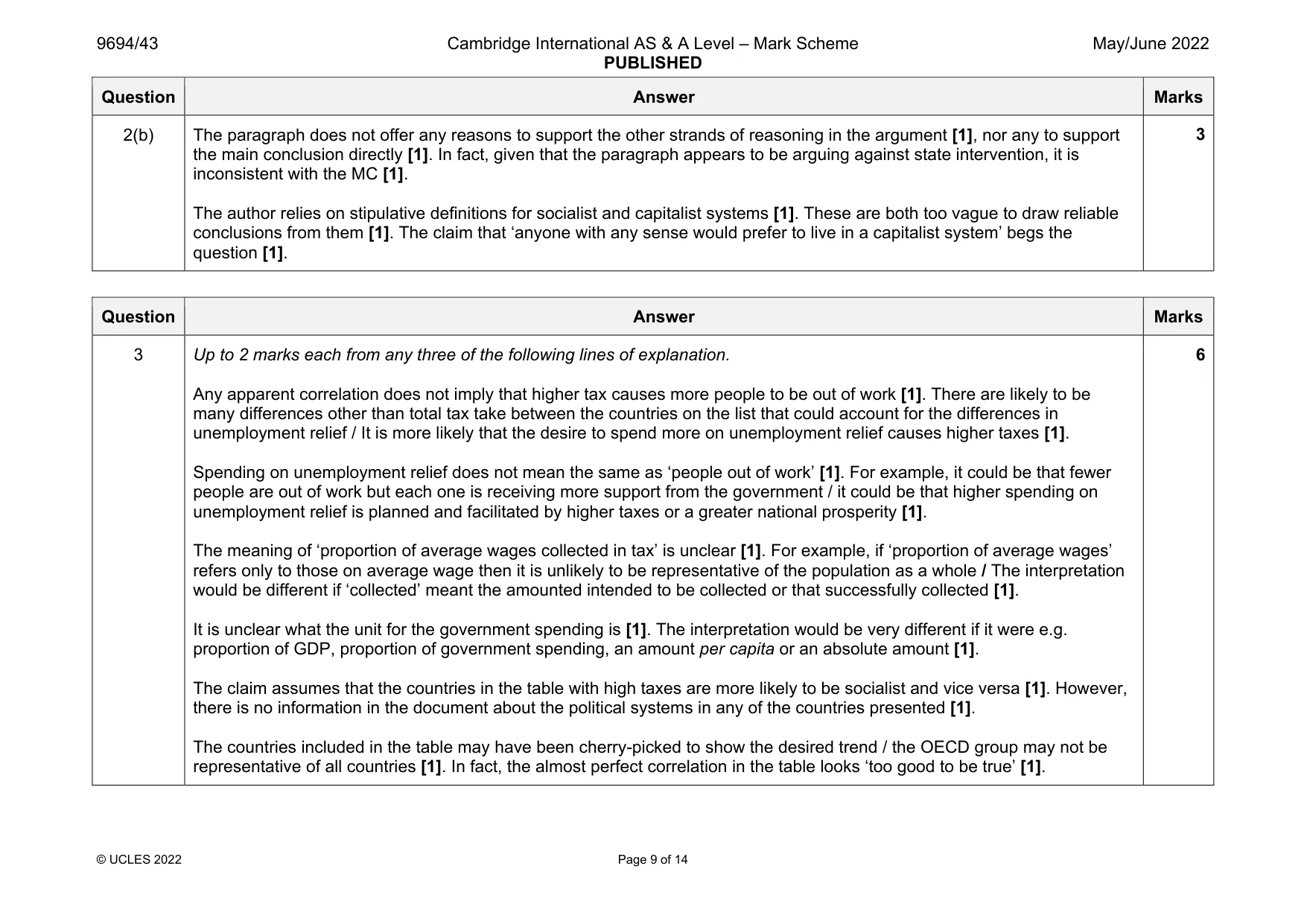
9694/43 Cambridge International AS & A Level – Mark Scheme PUBLISHED May/June 2022 © UCLES 2022 Page 9 of 14 Question Answer Marks 2(b) The paragraph does not offer any reasons to support the other strands of reasoning in the argument [1], nor any to support the main conclusion directly [1]. In fact, given that the paragraph appears to be arguing against state intervention, it is inconsistent with the MC [1]. The author relies on stipulative definitions for socialist and capitalist systems [1]. These are both too vague to draw reliable conclusions from them [1]. The claim that ‘anyone with any sense would prefer to live in a capitalist system’ begs the question [1]. 3 Question Answer Marks 3 Up to 2 marks each from any three of the following lines of explanation. Any apparent correlation does not imply that higher tax causes more people to be out of work [1]. There are likely to be many differences other than total tax take between the countries on the list that could account for the differences in unemployment relief / It is more likely that the desire to spend more on unemployment relief causes higher taxes [1]. Spending on unemployment relief does not mean the same as ‘people out of work’ [1]. For example, it could be that fewer people are out of work but each one is receiving more support from the government / it could be that higher spending on unemployment relief is planned and facilitated by higher taxes or a greater national prosperity [1]. The meaning of ‘proportion of average wages collected in tax’ is unclear [1]. For example, if ‘proportion of average wages’ refers only to those on average wage then it is unlikely to be representative of the population as a whole / The interpretation would be different if ‘collected’ meant the amounted intended to be collected or that successfully collected [1]. It is unclear what the unit for the government spending is [1]. The interpretation would be very different if it were e.g. proportion of GDP, proportion of government spending, an amount per capita or an absolute amount [1]. The claim assumes that the countries in the table with high taxes are more likely to be socialist and vice versa [1]. However, there is no information in the document about the political systems in any of the countries presented [1]. The countries included in the table may have been cherry-picked to show the desired trend / the OECD group may not be representative of all countries [1]. In fact, the almost perfect correlation in the table looks ‘too good to be true’ [1]. 6
Mark scheme, page 10
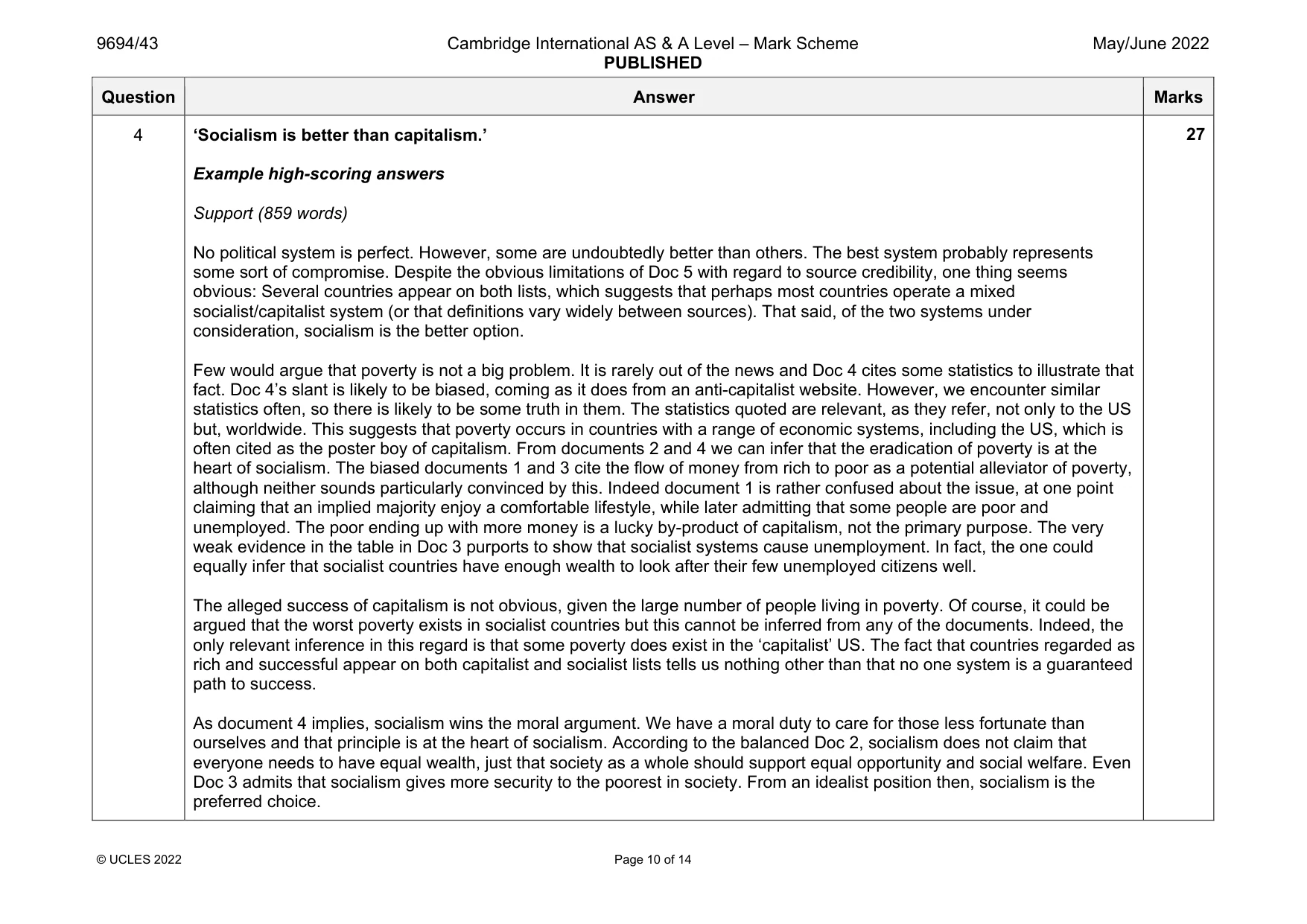
9694/43 Cambridge International AS & A Level – Mark Scheme PUBLISHED May/June 2022 © UCLES 2022 Page 10 of 14 Question Answer Marks 4 ‘Socialism is better than capitalism.’ Example high-scoring answers Support (859 words) No political system is perfect. However, some are undoubtedly better than others. The best system probably represents some sort of compromise. Despite the obvious limitations of Doc 5 with regard to source credibility, one thing seems obvious: Several countries appear on both lists, which suggests that perhaps most countries operate a mixed socialist/capitalist system (or that definitions vary widely between sources). That said, of the two systems under consideration, socialism is the better option. Few would argue that poverty is not a big problem. It is rarely out of the news and Doc 4 cites some statistics to illustrate that fact. Doc 4’s slant is likely to be biased, coming as it does from an anti-capitalist website. However, we encounter similar statistics often, so there is likely to be some truth in them. The statistics quoted are relevant, as they refer, not only to the US but, worldwide. This suggests that poverty occurs in countries with a range of economic systems, including the US, which is often cited as the poster boy of capitalism. From documents 2 and 4 we can infer that the eradication of poverty is at the heart of socialism. The biased documents 1 and 3 cite the flow of money from rich to poor as a potential alleviator of poverty, although neither sounds particularly convinced by this. Indeed document 1 is rather confused about the issue, at one point claiming that an implied majority enjoy a comfortable lifestyle, while later admitting that some people are poor and unemployed. The poor ending up with more money is a lucky by-product of capitalism, not the primary purpose. The very weak evidence in the table in Doc 3 purports to show that socialist systems cause unemployment. In fact, the one could equally infer that socialist countries have enough wealth to look after their few unemployed citizens well. The alleged success of capitalism is not obvious, given the large number of people living in poverty. Of course, it could be argued that the worst poverty exists in socialist countries but this cannot be inferred from any of the documents. Indeed, the only relevant inference in this regard is that some poverty does exist in the ‘capitalist’ US. The fact that countries regarded as rich and successful appear on both capitalist and socialist lists tells us nothing other than that no one system is a guaranteed path to success. As document 4 implies, socialism wins the moral argument. We have a moral duty to care for those less fortunate than ourselves and that principle is at the heart of socialism. According to the balanced Doc 2, socialism does not claim that everyone needs to have equal wealth, just that society as a whole should support equal opportunity and social welfare. Even Doc 3 admits that socialism gives more security to the poorest in society. From an idealist position then, socialism is the preferred choice. 27
Mark scheme, page 11
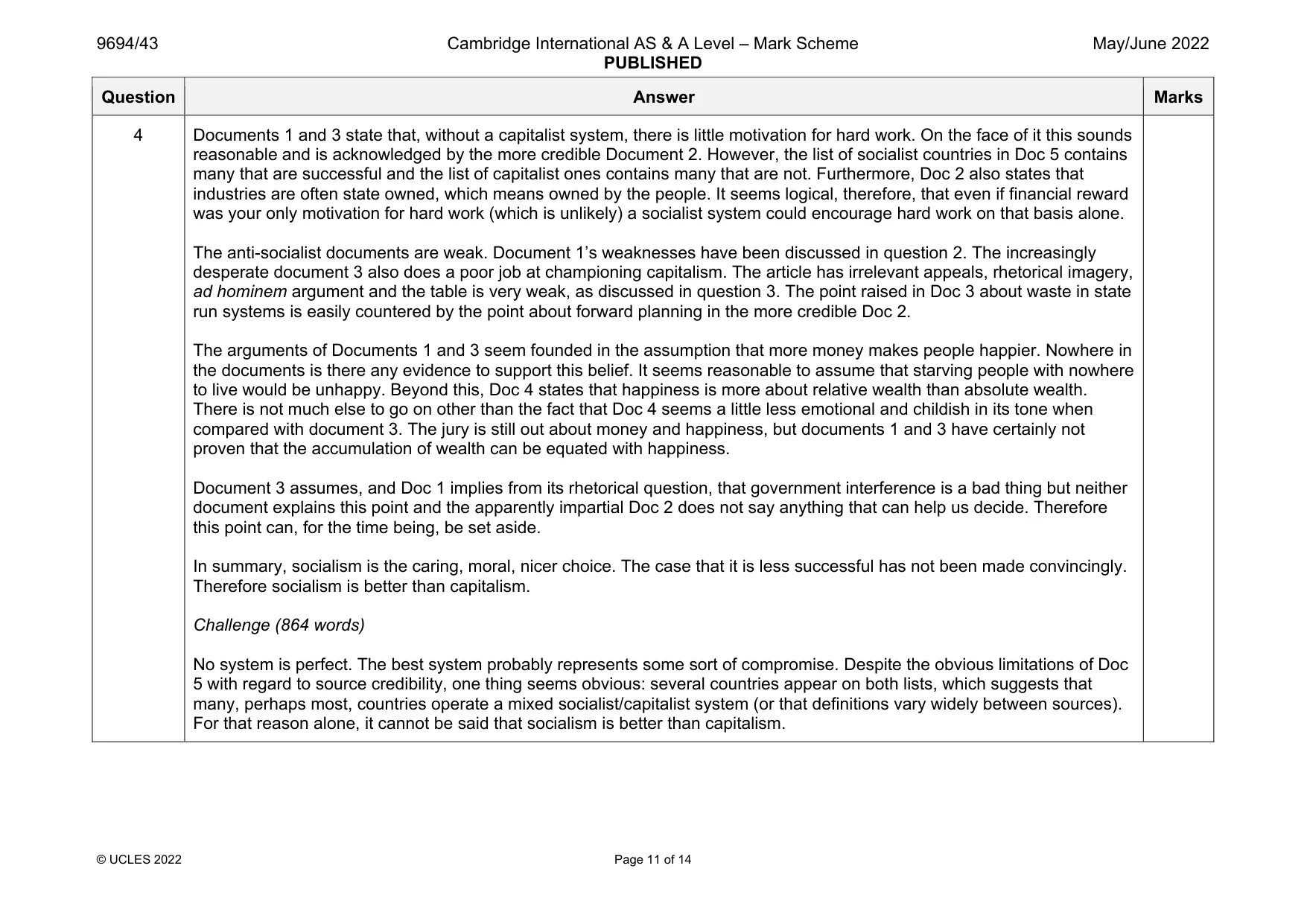
9694/43 Cambridge International AS & A Level – Mark Scheme PUBLISHED May/June 2022 © UCLES 2022 Page 11 of 14 Question Answer Marks 4 Documents 1 and 3 state that, without a capitalist system, there is little motivation for hard work. On the face of it this sounds reasonable and is acknowledged by the more credible Document 2. However, the list of socialist countries in Doc 5 contains many that are successful and the list of capitalist ones contains many that are not. Furthermore, Doc 2 also states that industries are often state owned, which means owned by the people. It seems logical, therefore, that even if financial reward was your only motivation for hard work (which is unlikely) a socialist system could encourage hard work on that basis alone. The anti-socialist documents are weak. Document 1’s weaknesses have been discussed in question 2. The increasingly desperate document 3 also does a poor job at championing capitalism. The article has irrelevant appeals, rhetorical imagery, ad hominem argument and the table is very weak, as discussed in question 3. The point raised in Doc 3 about waste in state run systems is easily countered by the point about forward planning in the more credible Doc 2. The arguments of Documents 1 and 3 seem founded in the assumption that more money makes people happier. Nowhere in the documents is there any evidence to support this belief. It seems reasonable to assume that starving people with nowhere to live would be unhappy. Beyond this, Doc 4 states that happiness is more about relative wealth than absolute wealth. There is not much else to go on other than the fact that Doc 4 seems a little less emotional and childish in its tone when compared with document 3. The jury is still out about money and happiness, but documents 1 and 3 have certainly not proven that the accumulation of wealth can be equated with happiness. Document 3 assumes, and Doc 1 implies from its rhetorical question, that government interference is a bad thing but neither document explains this point and the apparently impartial Doc 2 does not say anything that can help us decide. Therefore this point can, for the time being, be set aside. In summary, socialism is the caring, moral, nicer choice. The case that it is less successful has not been made convincingly. Therefore socialism is better than capitalism. Challenge (864 words) No system is perfect. The best system probably represents some sort of compromise. Despite the obvious limitations of Doc 5 with regard to source credibility, one thing seems obvious: several countries appear on both lists, which suggests that many, perhaps most, countries operate a mixed socialist/capitalist system (or that definitions vary widely between sources). For that reason alone, it cannot be said that socialism is better than capitalism.
Mark scheme, page 12
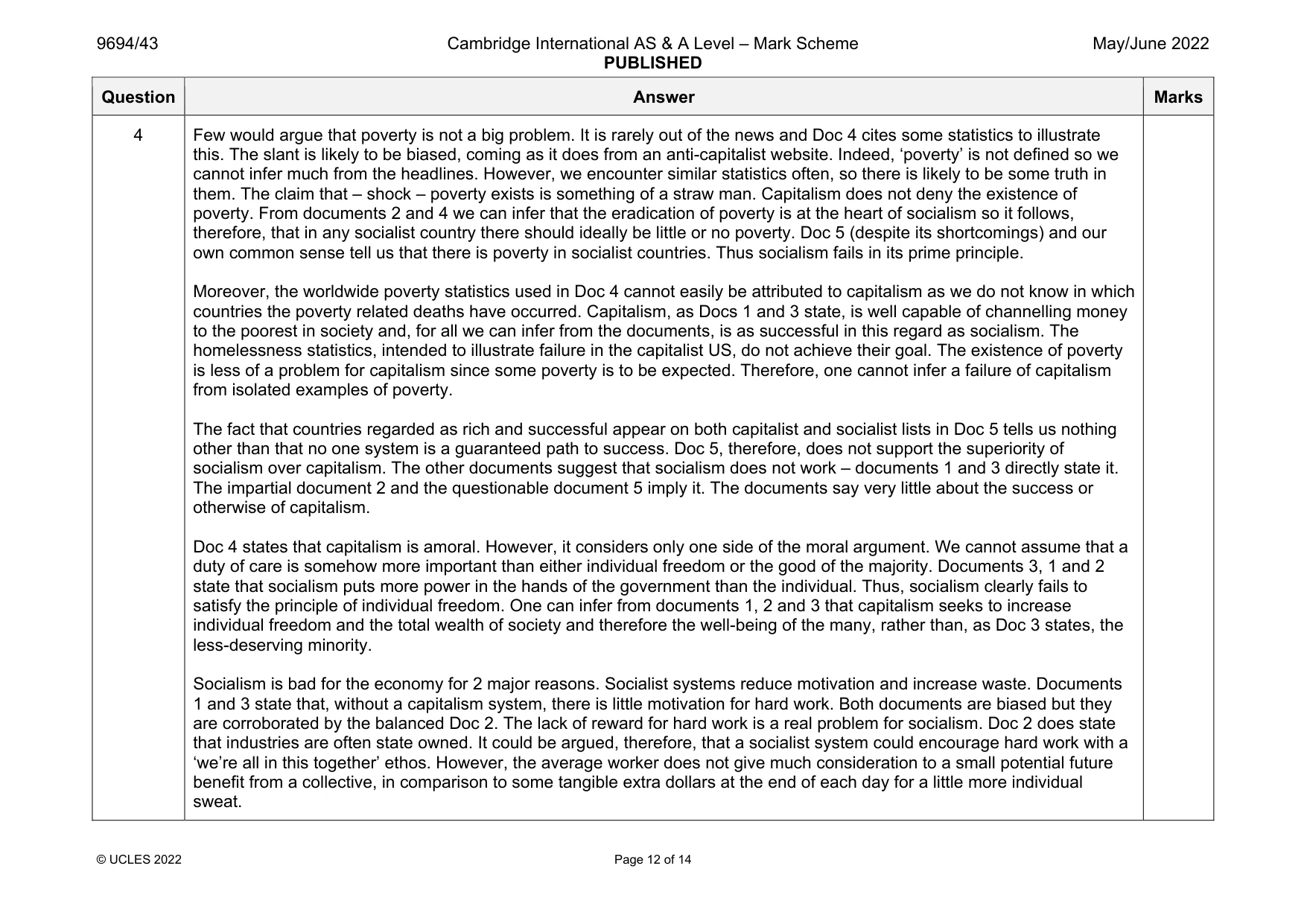
9694/43 Cambridge International AS & A Level – Mark Scheme PUBLISHED May/June 2022 © UCLES 2022 Page 12 of 14 Question Answer Marks 4 Few would argue that poverty is not a big problem. It is rarely out of the news and Doc 4 cites some statistics to illustrate this. The slant is likely to be biased, coming as it does from an anti-capitalist website. Indeed, ‘poverty’ is not defined so we cannot infer much from the headlines. However, we encounter similar statistics often, so there is likely to be some truth in them. The claim that – shock – poverty exists is something of a straw man. Capitalism does not deny the existence of poverty. From documents 2 and 4 we can infer that the eradication of poverty is at the heart of socialism so it follows, therefore, that in any socialist country there should ideally be little or no poverty. Doc 5 (despite its shortcomings) and our own common sense tell us that there is poverty in socialist countries. Thus socialism fails in its prime principle. Moreover, the worldwide poverty statistics used in Doc 4 cannot easily be attributed to capitalism as we do not know in which countries the poverty related deaths have occurred. Capitalism, as Docs 1 and 3 state, is well capable of channelling money to the poorest in society and, for all we can infer from the documents, is as successful in this regard as socialism. The homelessness statistics, intended to illustrate failure in the capitalist US, do not achieve their goal. The existence of poverty is less of a problem for capitalism since some poverty is to be expected. Therefore, one cannot infer a failure of capitalism from isolated examples of poverty. The fact that countries regarded as rich and successful appear on both capitalist and socialist lists in Doc 5 tells us nothing other than that no one system is a guaranteed path to success. Doc 5, therefore, does not support the superiority of socialism over capitalism. The other documents suggest that socialism does not work – documents 1 and 3 directly state it. The impartial document 2 and the questionable document 5 imply it. The documents say very little about the success or otherwise of capitalism. Doc 4 states that capitalism is amoral. However, it considers only one side of the moral argument. We cannot assume that a duty of care is somehow more important than either individual freedom or the good of the majority. Documents 3, 1 and 2 state that socialism puts more power in the hands of the government than the individual. Thus, socialism clearly fails to satisfy the principle of individual freedom. One can infer from documents 1, 2 and 3 that capitalism seeks to increase individual freedom and the total wealth of society and therefore the well-being of the many, rather than, as Doc 3 states, the less-deserving minority. Socialism is bad for the economy for 2 major reasons. Socialist systems reduce motivation and increase waste. Documents 1 and 3 state that, without a capitalism system, there is little motivation for hard work. Both documents are biased but they are corroborated by the balanced Doc 2. The lack of reward for hard work is a real problem for socialism. Doc 2 does state that industries are often state owned. It could be argued, therefore, that a socialist system could encourage hard work with a ‘we’re all in this together’ ethos. However, the average worker does not give much consideration to a small potential future benefit from a collective, in comparison to some tangible extra dollars at the end of each day for a little more individual sweat.
Mark scheme, page 13
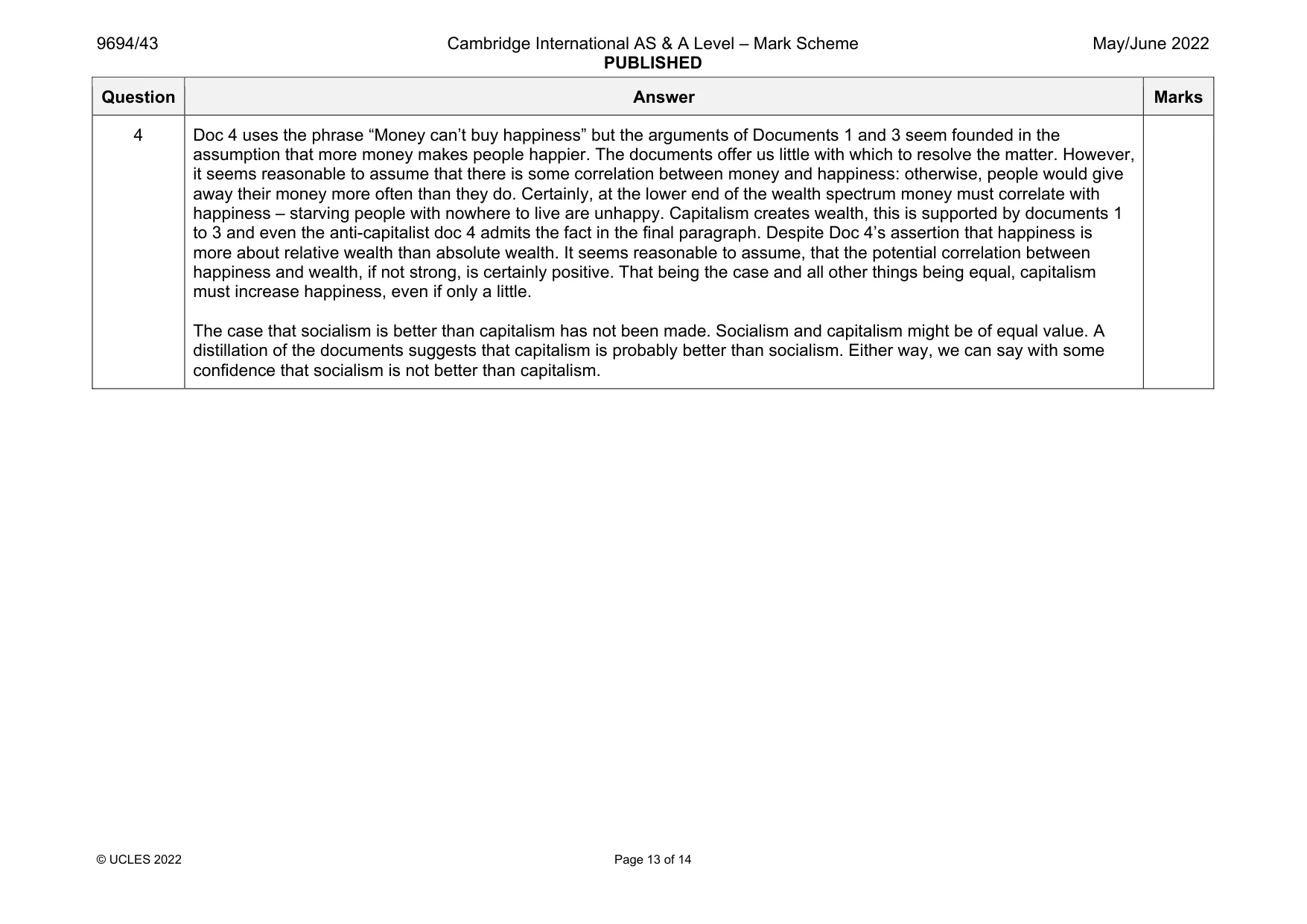
9694/43 Cambridge International AS & A Level – Mark Scheme PUBLISHED May/June 2022 © UCLES 2022 Page 13 of 14 Question Answer Marks 4 Doc 4 uses the phrase “Money can’t buy happiness” but the arguments of Documents 1 and 3 seem founded in the assumption that more money makes people happier. The documents offer us little with which to resolve the matter. However, it seems reasonable to assume that there is some correlation between money and happiness: otherwise, people would give away their money more often than they do. Certainly, at the lower end of the wealth spectrum money must correlate with happiness – starving people with nowhere to live are unhappy. Capitalism creates wealth, this is supported by documents 1 to 3 and even the anti-capitalist doc 4 admits the fact in the final paragraph. Despite Doc 4’s assertion that happiness is more about relative wealth than absolute wealth. It seems reasonable to assume, that the potential correlation between happiness and wealth, if not strong, is certainly positive. That being the case and all other things being equal, capitalism must increase happiness, even if only a little. The case that socialism is better than capitalism has not been made. Socialism and capitalism might be of equal value. A distillation of the documents suggests that capitalism is probably better than socialism. Either way, we can say with some confidence that socialism is not better than capitalism.
Mark scheme, page 14
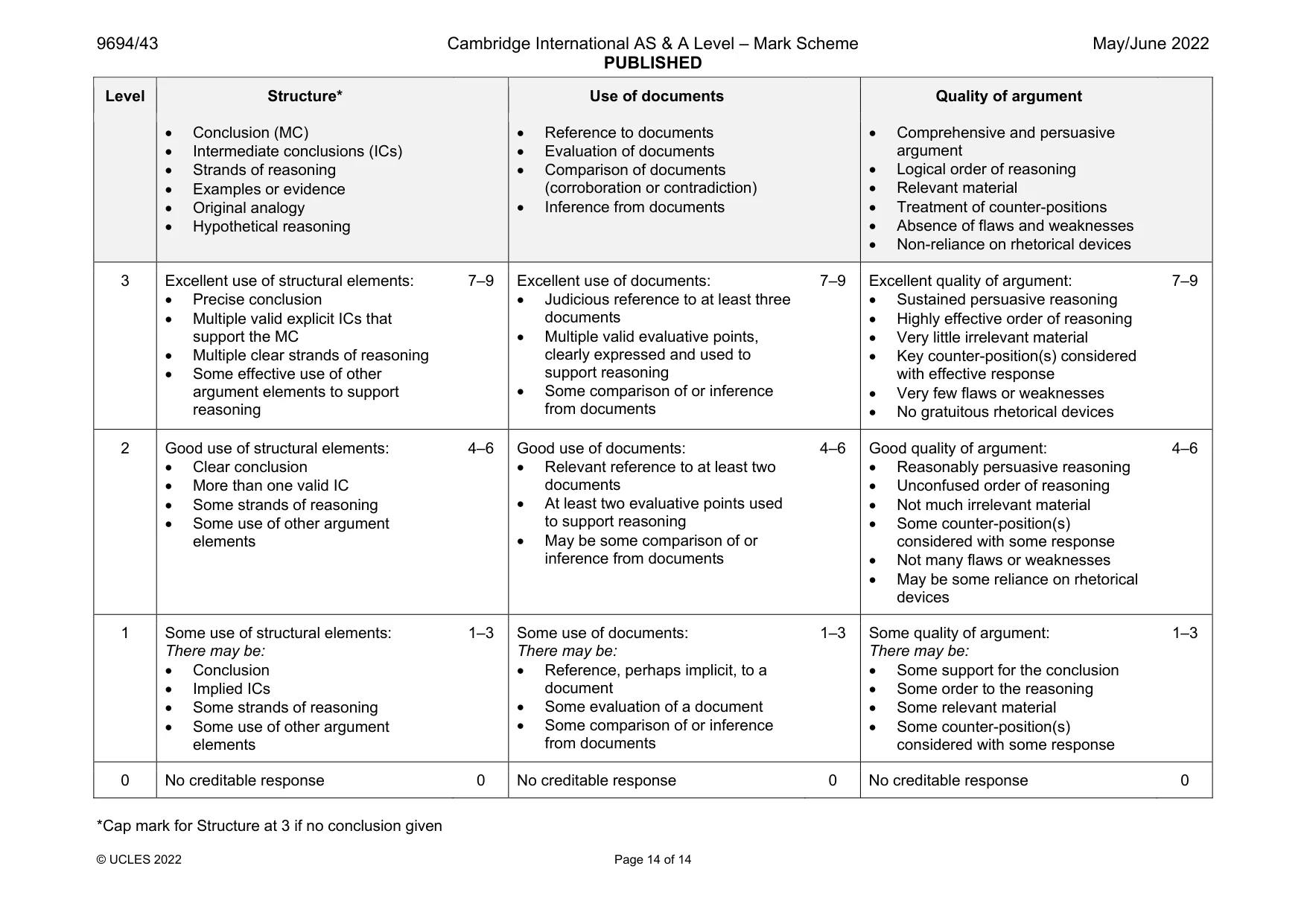
9694/43 Cambridge International AS & A Level – Mark Scheme PUBLISHED May/June 2022 © UCLES 2022 Page 14 of 14 Level Structure* Use of documents Quality of argument Conclusion (MC) Intermediate conclusions (ICs) Strands of reasoning Examples or evidence Original analogy Hypothetical reasoning Reference to documents Evaluation of documents Comparison of documents (corroboration or contradiction) Inference from documents Comprehensive and persuasive argument Logical order of reasoning Relevant material Treatment of counter-positions Absence of flaws and weaknesses Non-reliance on rhetorical devices 3 Excellent use of structural elements: Precise conclusion Multiple valid explicit ICs that support the MC Multiple clear strands of reasoning Some effective use of other argument elements to support reasoning 7–9 Excellent use of documents: Judicious reference to at least three documents Multiple valid evaluative points, clearly expressed and used to support reasoning Some comparison of or inference from documents 7–9 Excellent quality of argument: Sustained persuasive reasoning Highly effective order of reasoning Very little irrelevant material Key counter-position(s) considered with effective response Very few flaws or weaknesses No gratuitous rhetorical devices 7–9 2 Good use of structural elements: Clear conclusion More than one valid IC Some strands of reasoning Some use of other argument elements 4–6 Good use of documents: Relevant reference to at least two documents At least two evaluative points used to support reasoning May be some comparison of or inference from documents 4–6 Good quality of argument: Reasonably persuasive reasoning Unconfused order of reasoning Not much irrelevant material Some counter-position(s) considered with some response Not many flaws or weaknesses May be some reliance on rhetorical devices 4–6 1 Some use of structural elements: There may be: Conclusion Implied ICs Some strands of reasoning Some use of other argument elements 1–3 Some use of documents: There may be: Reference, perhaps implicit, to a document Some evaluation of a document Some comparison of or inference from documents 1–3 Some quality of argument: There may be: Some support for the conclusion Some order to the reasoning Some relevant material Some counter-position(s) considered with some response 1–3 0 No creditable response 0 No creditable response 0 No creditable response 0 *Cap mark for Structure at 3 if no conclusion given
What you needed in this session
Cambridge’s own grade thresholds for 2022 May/June, Paper 4 · Variant 3. A higher threshold means an easier paper — the bar moves with how the cohort did.