Cambridge A Level Thinking Skills 9694 — 2024 Oct/Nov Paper 4 · Variant 3
9694/43/O/N/24 · 50 marks · ≈56 min
The question paper and its mark scheme, free to read here and free to download. This is Cambridge’s own paper, exactly as it was sat.
Question paper8 pages

Mark scheme13 pages
Answers below. Sit the paper first if you are practising.
Paper as text
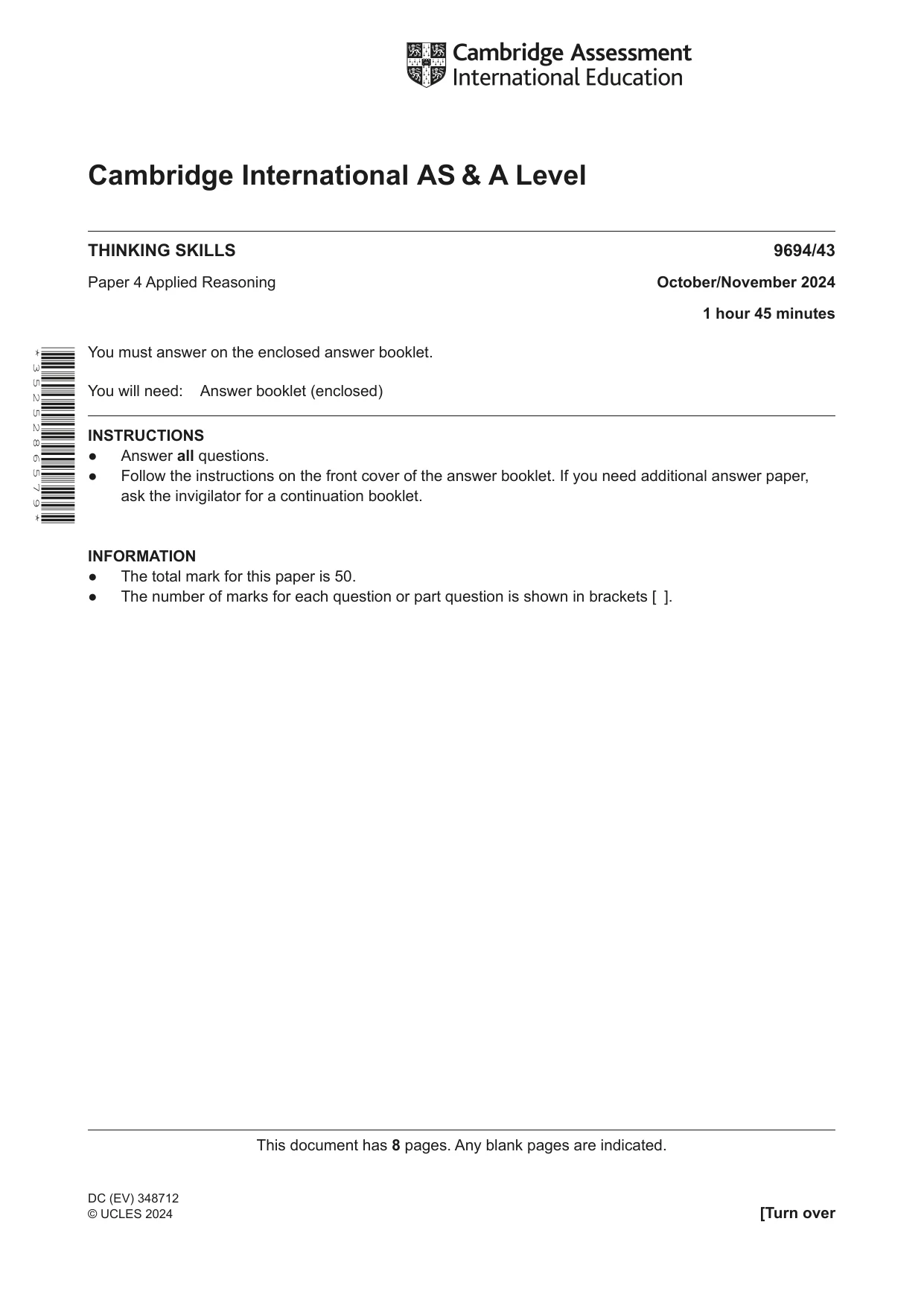
Question paper, page 1
This document has 8 pages. Any blank pages are indicated. [Turn over Cambridge International AS & A Level * 3 5 2 5 2 8 6 5 7 9 * THINKING SKILLS 9694/43 Paper 4 Applied Reasoning October/November 2024 1 hour 45 minutes You must answer on the enclosed answer booklet. You will need: Answer booklet (enclosed) INSTRUCTIONS ● Answer all questions. ● Follow the instructions on the front cover of the answer booklet. If you need additional answer paper, ask the invigilator for a continuation booklet. INFORMATION ● The total mark for this paper is 50. ● The number of marks for each question or part question is shown in brackets [ ]. DC (EV) 348712 © UCLES 2024
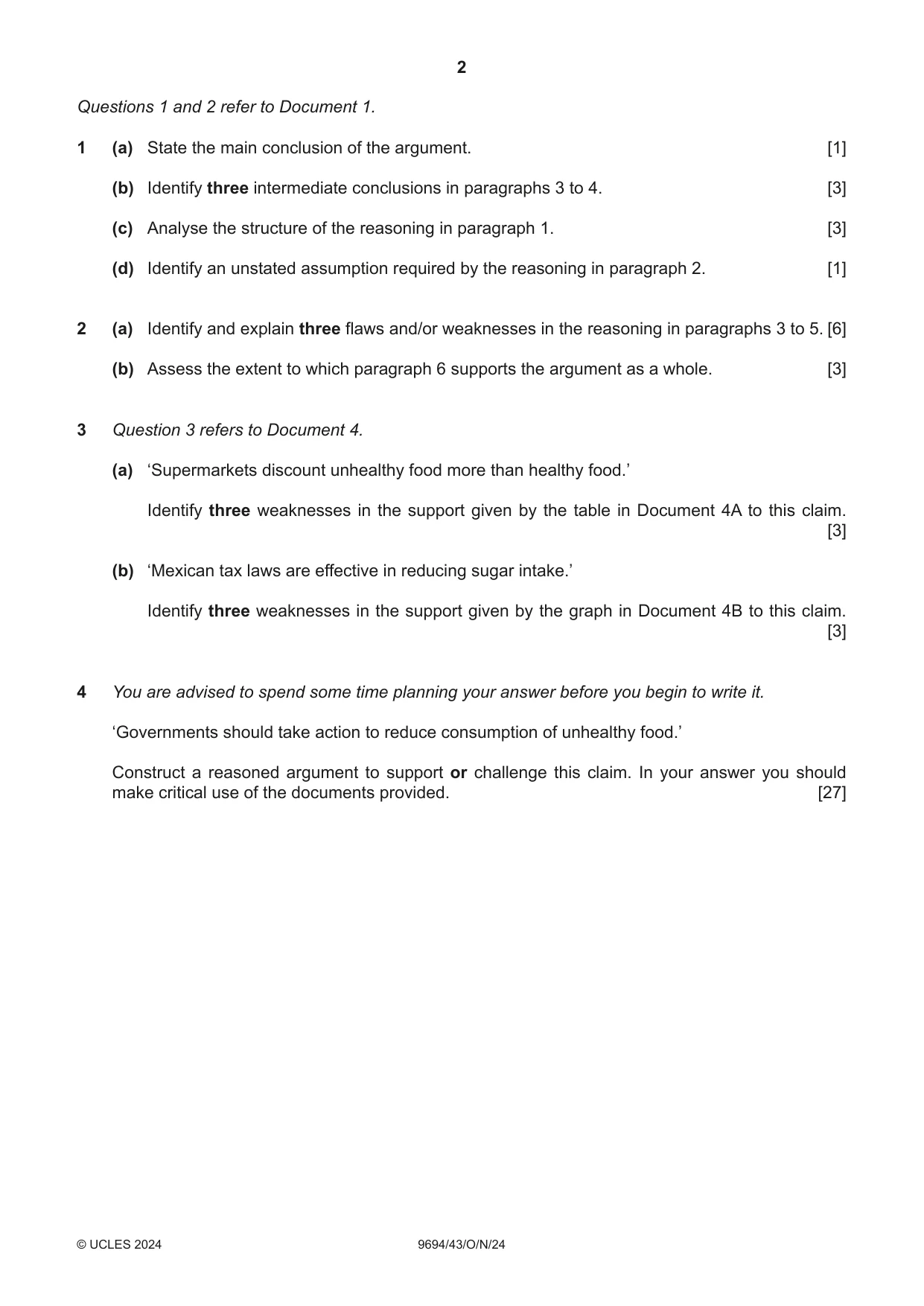
Question paper, page 2
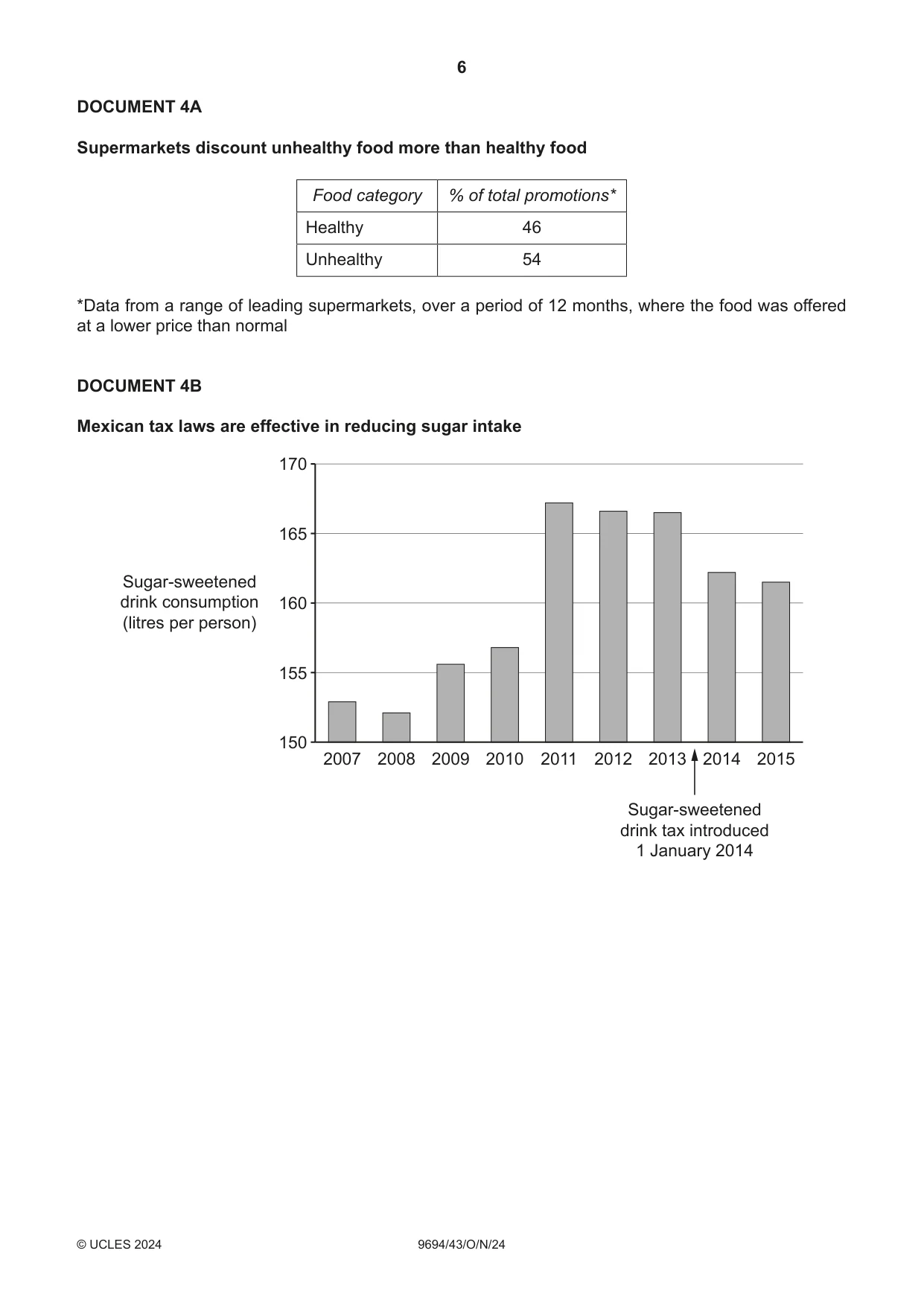
2 9694/43/O/N/24 © UCLES 2024 Questions 1 and 2 refer to Document 1. 1 (a) State the main conclusion of the argument. [1] (b) Identify three intermediate conclusions in paragraphs 3 to 4. [3] (c) Analyse the structure of the reasoning in paragraph 1. [3] (d) Identify an unstated assumption required by the reasoning in paragraph 2. [1] 2 (a) Identify and explain three flaws and/or weaknesses in the reasoning in paragraphs 3 to 5. [6] (b) Assess the extent to which paragraph 6 supports the argument as a whole. [3] 3 Question 3 refers to Document 4. (a) ‘Supermarkets discount unhealthy food more than healthy food.’ Identify three weaknesses in the support given by the table in Document 4A to this claim. [3] (b) ‘Mexican tax laws are effective in reducing sugar intake.’ Identify three weaknesses in the support given by the graph in Document 4B to this claim. [3] 4 You are advised to spend some time planning your answer before you begin to write it. ‘Governments should take action to reduce consumption of unhealthy food.’ Construct a reasoned argument to support or challenge this claim. In your answer you should make critical use of the documents provided. [27]
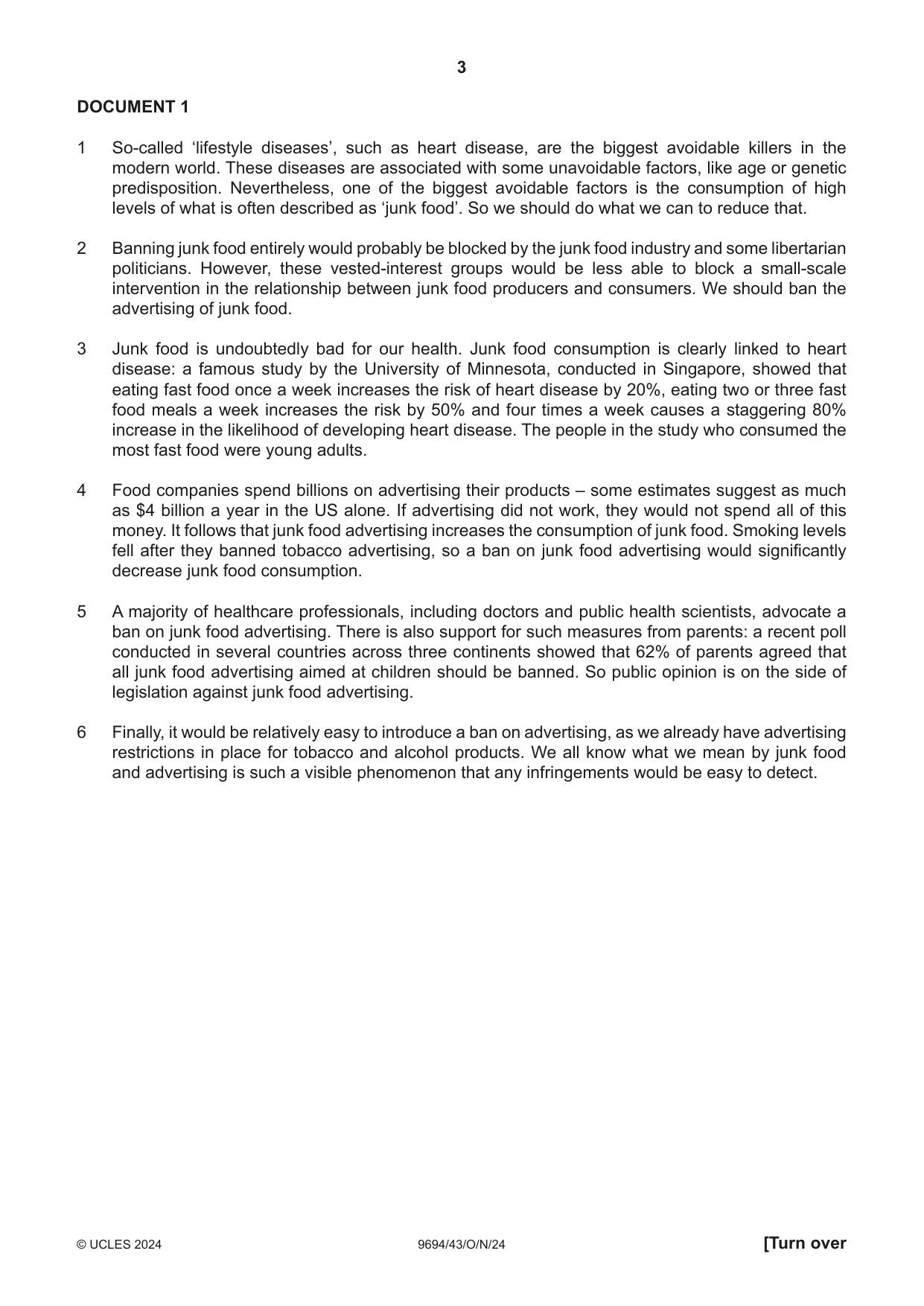
Question paper, page 3
3 9694/43/O/N/24 © UCLES 2024 [Turn over DOCUMENT 1 1 So-called ‘lifestyle diseases’, such as heart disease, are the biggest avoidable killers in the modern world. These diseases are associated with some unavoidable factors, like age or genetic predisposition. Nevertheless, one of the biggest avoidable factors is the consumption of high levels of what is often described as ‘junk food’. So we should do what we can to reduce that. 2 Banning junk food entirely would probably be blocked by the junk food industry and some libertarian politicians. However, these vested-interest groups would be less able to block a small-scale intervention in the relationship between junk food producers and consumers. We should ban the advertising of junk food. 3 Junk food is undoubtedly bad for our health. Junk food consumption is clearly linked to heart disease: a famous study by the University of Minnesota, conducted in Singapore, showed that eating fast food once a week increases the risk of heart disease by 20%, eating two or three fast food meals a week increases the risk by 50% and four times a week causes a staggering 80% increase in the likelihood of developing heart disease. The people in the study who consumed the most fast food were young adults. 4 Food companies spend billions on advertising their products – some estimates suggest as much as $4 billion a year in the US alone. If advertising did not work, they would not spend all of this money. It follows that junk food advertising increases the consumption of junk food. Smoking levels fell after they banned tobacco advertising, so a ban on junk food advertising would significantly decrease junk food consumption. 5 A majority of healthcare professionals, including doctors and public health scientists, advocate a ban on junk food advertising. There is also support for such measures from parents: a recent poll conducted in several countries across three continents showed that 62% of parents agreed that all junk food advertising aimed at children should be banned. So public opinion is on the side of legislation against junk food advertising. 6 Finally, it would be relatively easy to introduce a ban on advertising, as we already have advertising restrictions in place for tobacco and alcohol products. We all know what we mean by junk food and advertising is such a visible phenomenon that any infringements would be easy to detect.
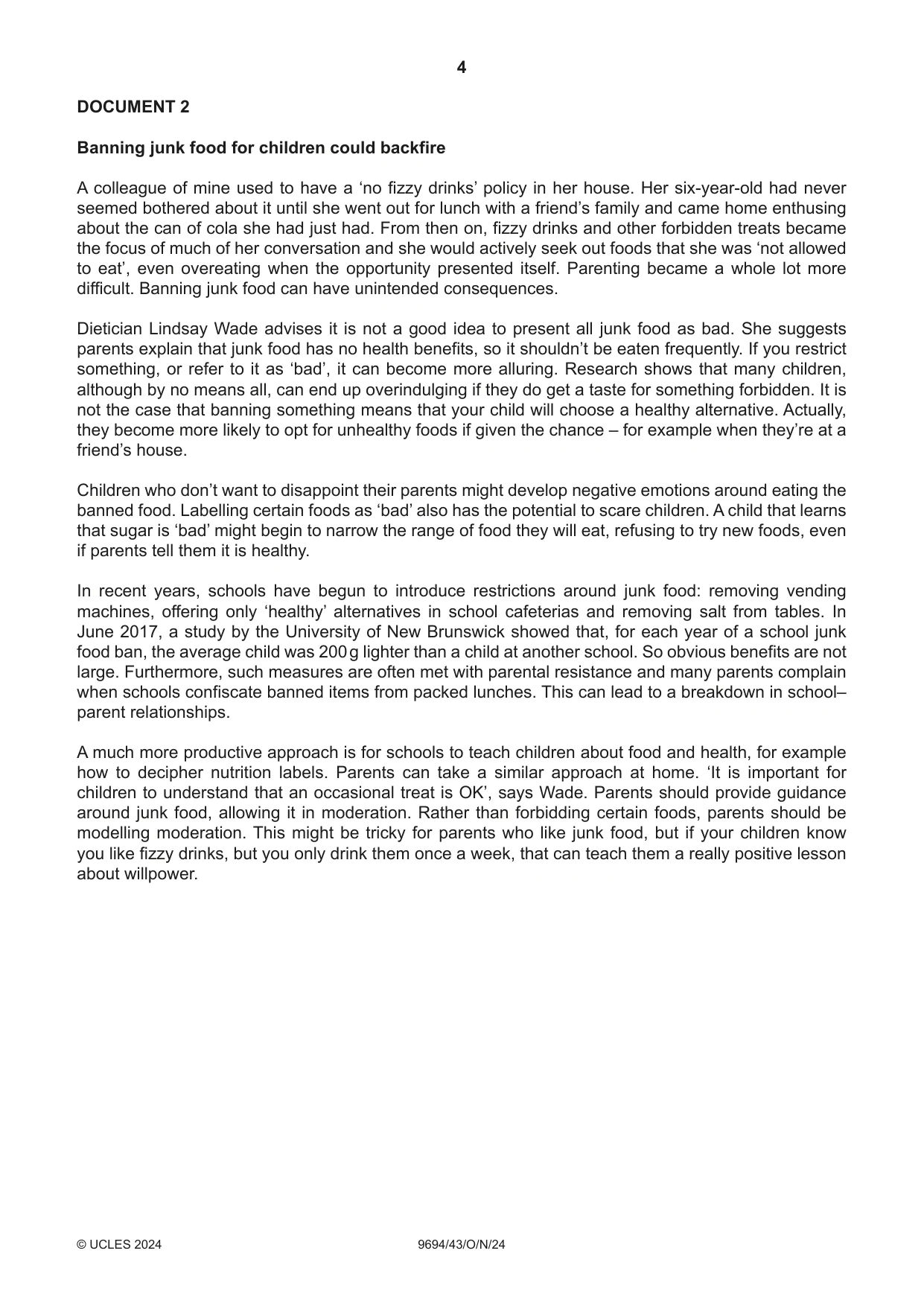
Question paper, page 4
4 9694/43/O/N/24 © UCLES 2024 DOCUMENT 2 Banning junk food for children could backfire A colleague of mine used to have a ‘no fizzy drinks’ policy in her house. Her six-year-old had never seemed bothered about it until she went out for lunch with a friend’s family and came home enthusing about the can of cola she had just had. From then on, fizzy drinks and other forbidden treats became the focus of much of her conversation and she would actively seek out foods that she was ‘not allowed to eat’, even overeating when the opportunity presented itself. Parenting became a whole lot more difficult. Banning junk food can have unintended consequences. Dietician Lindsay Wade advises it is not a good idea to present all junk food as bad. She suggests parents explain that junk food has no health benefits, so it shouldn’t be eaten frequently. If you restrict something, or refer to it as ‘bad’, it can become more alluring. Research shows that many children, although by no means all, can end up overindulging if they do get a taste for something forbidden. It is not the case that banning something means that your child will choose a healthy alternative. Actually, they become more likely to opt for unhealthy foods if given the chance – for example when they’re at a friend’s house. Children who don’t want to disappoint their parents might develop negative emotions around eating the banned food. Labelling certain foods as ‘bad’ also has the potential to scare children. A child that learns that sugar is ‘bad’ might begin to narrow the range of food they will eat, refusing to try new foods, even if parents tell them it is healthy. In recent years, schools have begun to introduce restrictions around junk food: removing vending machines, offering only ‘healthy’ alternatives in school cafeterias and removing salt from tables. In June 2017, a study by the University of New Brunswick showed that, for each year of a school junk food ban, the average child was 200 g lighter than a child at another school. So obvious benefits are not large. Furthermore, such measures are often met with parental resistance and many parents complain when schools confiscate banned items from packed lunches. This can lead to a breakdown in school– parent relationships. A much more productive approach is for schools to teach children about food and health, for example how to decipher nutrition labels. Parents can take a similar approach at home. ‘It is important for children to understand that an occasional treat is OK’, says Wade. Parents should provide guidance around junk food, allowing it in moderation. Rather than forbidding certain foods, parents should be modelling moderation. This might be tricky for parents who like junk food, but if your children know you like fizzy drinks, but you only drink them once a week, that can teach them a really positive lesson about willpower.
Question paper, page 5
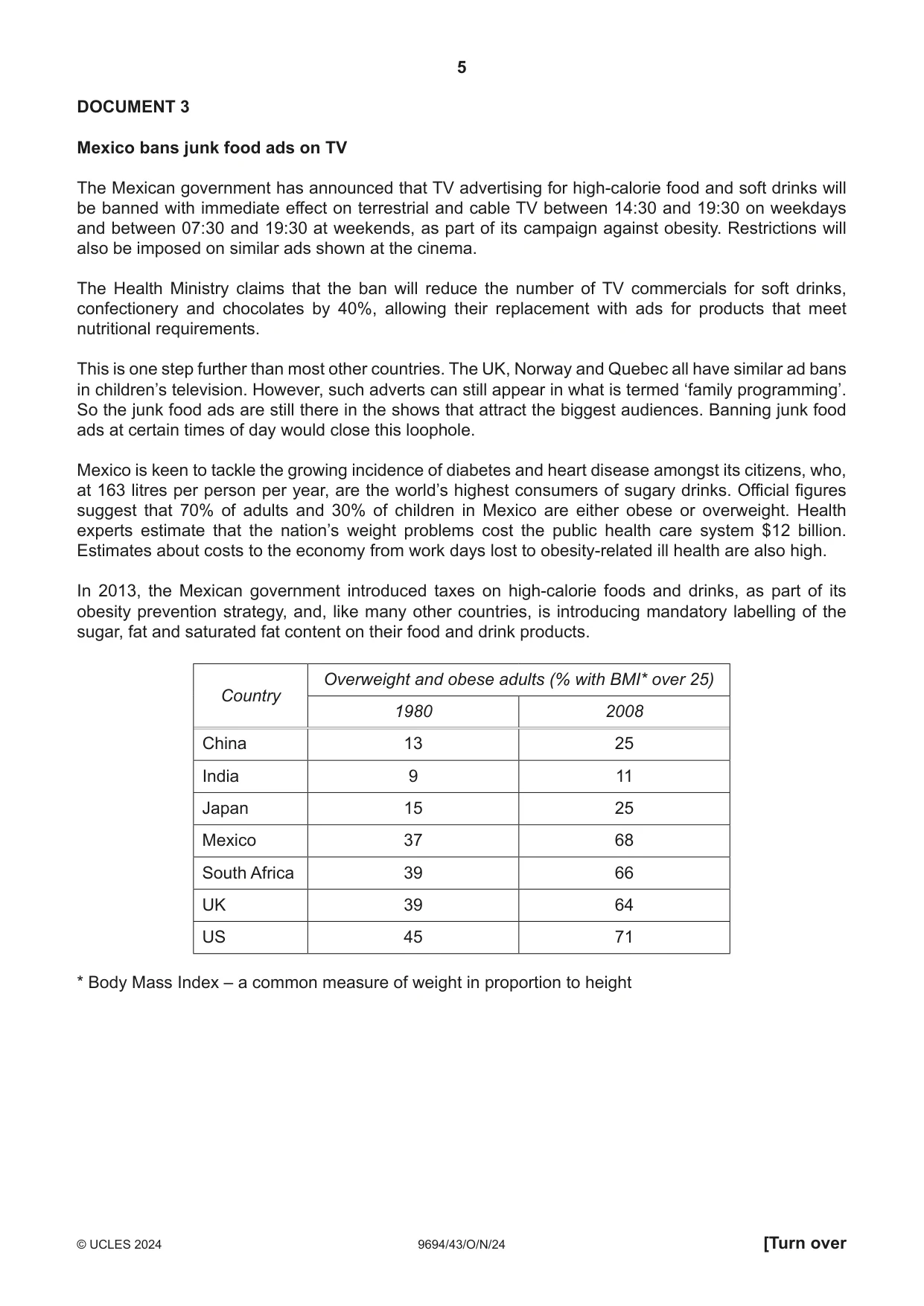
5 9694/43/O/N/24 © UCLES 2024 [Turn over DOCUMENT 3 Mexico bans junk food ads on TV The Mexican government has announced that TV advertising for high-calorie food and soft drinks will be banned with immediate effect on terrestrial and cable TV between 14:30 and 19:30 on weekdays and between 07:30 and 19:30 at weekends, as part of its campaign against obesity. Restrictions will also be imposed on similar ads shown at the cinema. The Health Ministry claims that the ban will reduce the number of TV commercials for soft drinks, confectionery and chocolates by 40%, allowing their replacement with ads for products that meet nutritional requirements. This is one step further than most other countries. The UK, Norway and Quebec all have similar ad bans in children’s television. However, such adverts can still appear in what is termed ‘family programming’. So the junk food ads are still there in the shows that attract the biggest audiences. Banning junk food ads at certain times of day would close this loophole. Mexico is keen to tackle the growing incidence of diabetes and heart disease amongst its citizens, who, at 163 litres per person per year, are the world’s highest consumers of sugary drinks. Official figures suggest that 70% of adults and 30% of children in Mexico are either obese or overweight. Health experts estimate that the nation’s weight problems cost the public health care system $12 billion. Estimates about costs to the economy from work days lost to obesity-related ill health are also high. In 2013, the Mexican government introduced taxes on high-calorie foods and drinks, as part of its obesity prevention strategy, and, like many other countries, is introducing mandatory labelling of the sugar, fat and saturated fat content on their food and drink products. Country Overweight and obese adults (% with BMI* over 25) 1980 2008 China 13 25 India 9 11 Japan 15 25 Mexico 37 68 South Africa 39 66 UK 39 64 US 45 71 * Body Mass Index – a common measure of weight in proportion to height
Question paper, page 6
6 9694/43/O/N/24 © UCLES 2024 DOCUMENT 4A Supermarkets discount unhealthy food more than healthy food Food category % of total promotions* Healthy 46 Unhealthy 54 *Data from a range of leading supermarkets, over a period of 12 months, where the food was offered at a lower price than normal DOCUMENT 4B Mexican tax laws are effective in reducing sugar intake 2007 150 2008 2009 2010 2011 2012 2013 2014 2015 155 Sugar-sweetened drink consumption (litres per person) Sugar-sweetened drink tax introduced 1 January 2014 160 165 170
Question paper, page 7
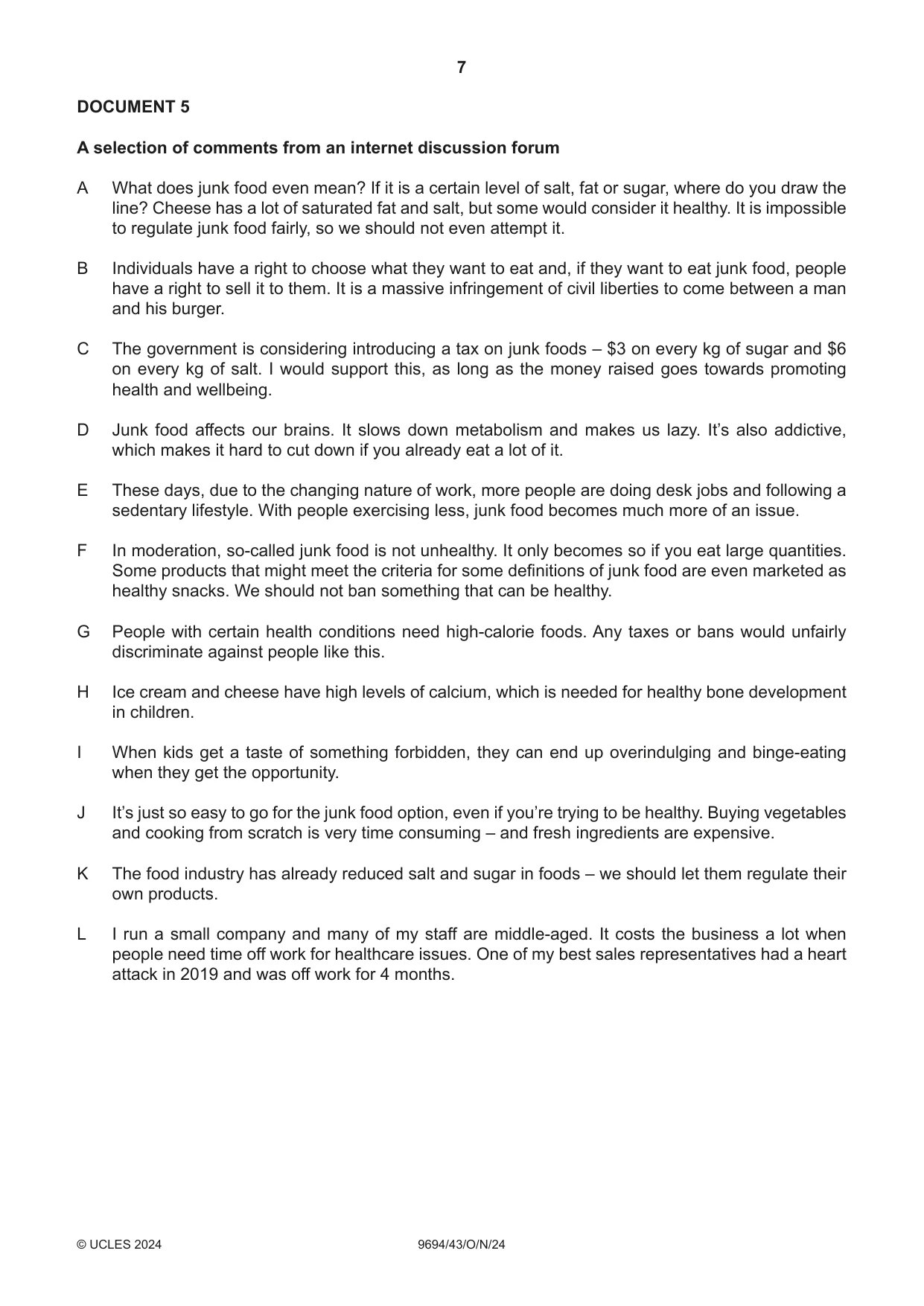
7 9694/43/O/N/24 © UCLES 2024 DOCUMENT 5 A selection of comments from an internet discussion forum A What does junk food even mean? If it is a certain level of salt, fat or sugar, where do you draw the line? Cheese has a lot of saturated fat and salt, but some would consider it healthy. It is impossible to regulate junk food fairly, so we should not even attempt it. B Individuals have a right to choose what they want to eat and, if they want to eat junk food, people have a right to sell it to them. It is a massive infringement of civil liberties to come between a man and his burger. C The government is considering introducing a tax on junk foods – $3 on every kg of sugar and $6 on every kg of salt. I would support this, as long as the money raised goes towards promoting health and wellbeing. D Junk food affects our brains. It slows down metabolism and makes us lazy. It’s also addictive, which makes it hard to cut down if you already eat a lot of it. E These days, due to the changing nature of work, more people are doing desk jobs and following a sedentary lifestyle. With people exercising less, junk food becomes much more of an issue. F In moderation, so-called junk food is not unhealthy. It only becomes so if you eat large quantities. Some products that might meet the criteria for some definitions of junk food are even marketed as healthy snacks. We should not ban something that can be healthy. G People with certain health conditions need high-calorie foods. Any taxes or bans would unfairly discriminate against people like this. H Ice cream and cheese have high levels of calcium, which is needed for healthy bone development in children. I When kids get a taste of something forbidden, they can end up overindulging and binge-eating when they get the opportunity. J It’s just so easy to go for the junk food option, even if you’re trying to be healthy. Buying vegetables and cooking from scratch is very time consuming – and fresh ingredients are expensive. K The food industry has already reduced salt and sugar in foods – we should let them regulate their own products. L I run a small company and many of my staff are middle-aged. It costs the business a lot when people need time off work for healthcare issues. One of my best sales representatives had a heart attack in 2019 and was off work for 4 months.
Question paper, page 8
8 9694/43/O/N/24 © UCLES 2024 Permission to reproduce items where third-party owned material protected by copyright is included has been sought and cleared where possible. Every reasonable effort has been made by the publisher (UCLES) to trace copyright holders, but if any items requiring clearance have unwittingly been included, the publisher will be pleased to make amends at the earliest possible opportunity. To avoid the issue of disclosure of answer-related information to candidates, all copyright acknowledgements are reproduced online in the Cambridge Assessment International Education Copyright Acknowledgements Booklet. This is produced for each series of examinations and is freely available to download at www.cambridgeinternational.org after the live examination series. Cambridge Assessment International Education is part of Cambridge Assessment. Cambridge Assessment is the brand name of the University of Cambridge Local Examinations Syndicate (UCLES), which is a department of the University of Cambridge. BLANK PAGE
Mark scheme, page 1
This document consists of 13 printed pages. © Cambridge University Press & Assessment 2024 [Turn over Cambridge International AS & A Level THINKING SKILLS 9694/43 Paper 4 Applied Reasoning October/November 2024 MARK SCHEME Maximum Mark: 50 Published This mark scheme is published as an aid to teachers and candidates, to indicate the requirements of the examination. It shows the basis on which Examiners were instructed to award marks. It does not indicate the details of the discussions that took place at an Examiners’ meeting before marking began, which would have considered the acceptability of alternative answers. Mark schemes should be read in conjunction with the question paper and the Principal Examiner Report for Teachers. Cambridge International will not enter into discussions about these mark schemes. Cambridge International is publishing the mark schemes for the October/November 2024 series for most Cambridge IGCSE, Cambridge International A and AS Level components, and some Cambridge O Level components.
Mark scheme, page 2
9694/43 Cambridge International AS & A Level – Mark Scheme PUBLISHED October/November 2024 © Cambridge University Press & Assessment 2024 Page 2 of 13 Generic Marking Principles These general marking principles must be applied by all examiners when marking candidate answers. They should be applied alongside the specific content of the mark scheme or generic level descriptions for a question. Each question paper and mark scheme will also comply with these marking principles. GENERIC MARKING PRINCIPLE 1: Marks must be awarded in line with: • the specific content of the mark scheme or the generic level descriptors for the question • the specific skills defined in the mark scheme or in the generic level descriptors for the question • the standard of response required by a candidate as exemplified by the standardisation scripts. GENERIC MARKING PRINCIPLE 2: Marks awarded are always whole marks (not half marks, or other fractions). GENERIC MARKING PRINCIPLE 3: Marks must be awarded positively: • marks are awarded for correct/valid answers, as defined in the mark scheme. However, credit is given for valid answers which go beyond the scope of the syllabus and mark scheme, referring to your Team Leader as appropriate • marks are awarded when candidates clearly demonstrate what they know and can do • marks are not deducted for errors • marks are not deducted for omissions • answers should only be judged on the quality of spelling, punctuation and grammar when these features are specifically assessed by the question as indicated by the mark scheme. The meaning, however, should be unambiguous. GENERIC MARKING PRINCIPLE 4: Rules must be applied consistently, e.g. in situations where candidates have not followed instructions or in the application of generic level descriptors.
Mark scheme, page 3
9694/43 Cambridge International AS & A Level – Mark Scheme PUBLISHED October/November 2024 © Cambridge University Press & Assessment 2024 Page 3 of 13 GENERIC MARKING PRINCIPLE 5: Marks should be awarded using the full range of marks defined in the mark scheme for the question (however; the use of the full mark range may be limited according to the quality of the candidate responses seen). GENERIC MARKING PRINCIPLE 6: Marks awarded are based solely on the requirements as defined in the mark scheme. Marks should not be awarded with grade thresholds or grade descriptors in mind.
Mark scheme, page 4
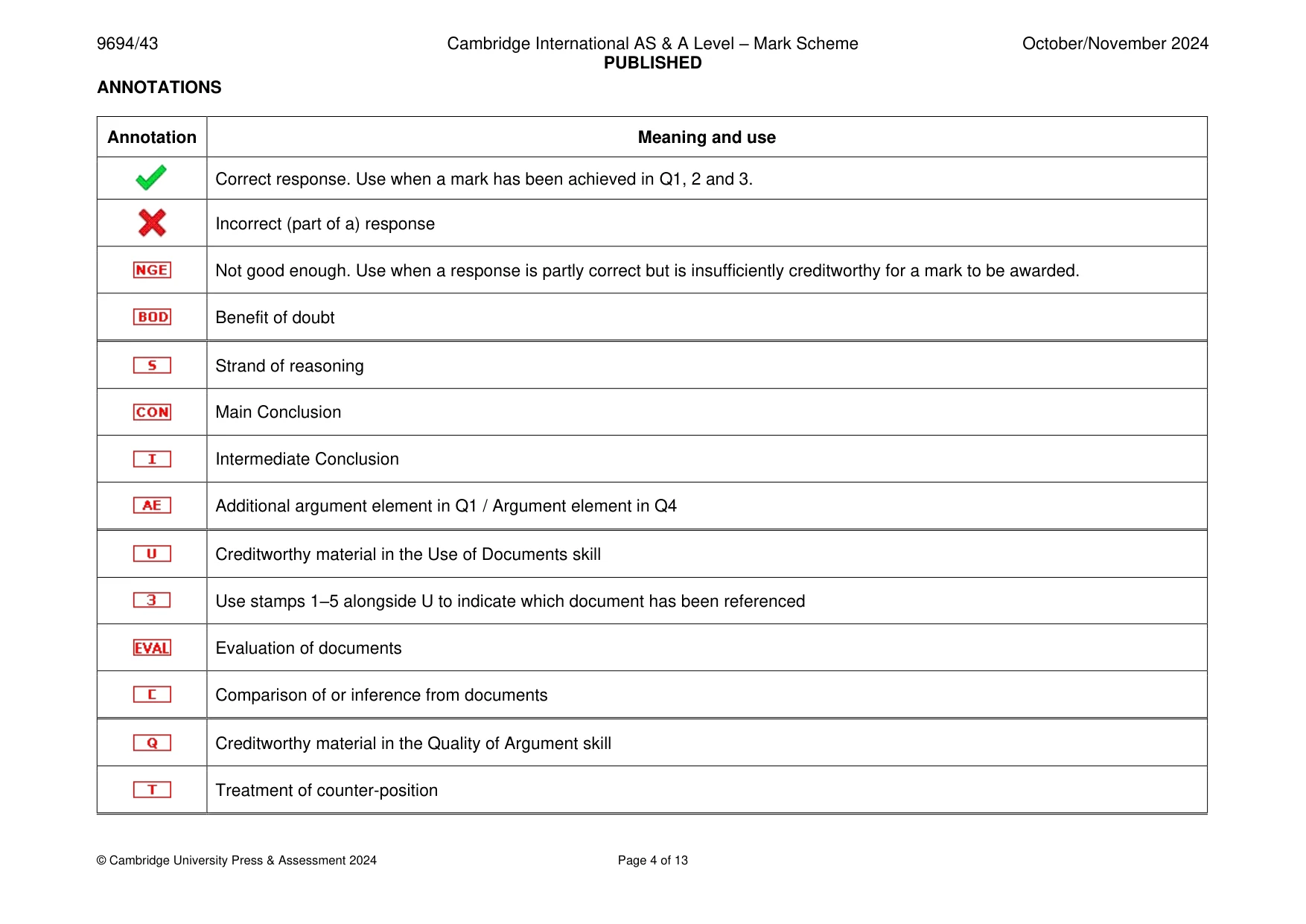
9694/43 Cambridge International AS & A Level – Mark Scheme PUBLISHED October/November 2024 © Cambridge University Press & Assessment 2024 Page 4 of 13 ANNOTATIONS Annotation Meaning and use Correct response. Use when a mark has been achieved in Q1, 2 and 3. Incorrect (part of a) response Not good enough. Use when a response is partly correct but is insufficiently creditworthy for a mark to be awarded. Benefit of doubt Strand of reasoning Main Conclusion Intermediate Conclusion Additional argument element in Q1 / Argument element in Q4 Creditworthy material in the Use of Documents skill Use stamps 1–5 alongside U to indicate which document has been referenced Evaluation of documents Comparison of or inference from documents Creditworthy material in the Quality of Argument skill Treatment of counter-position
Mark scheme, page 5
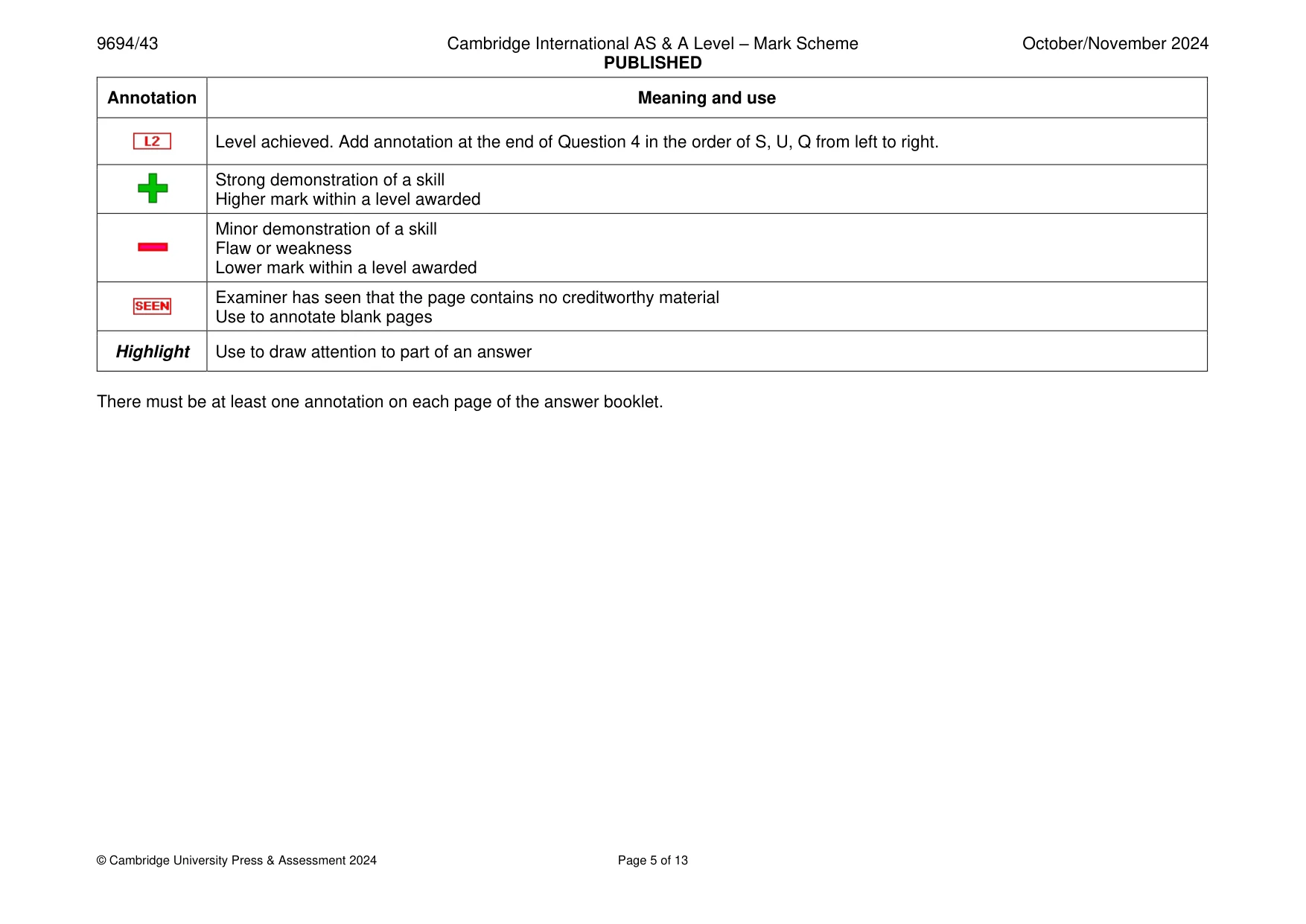
9694/43 Cambridge International AS & A Level – Mark Scheme PUBLISHED October/November 2024 © Cambridge University Press & Assessment 2024 Page 5 of 13 Annotation Meaning and use Level achieved. Add annotation at the end of Question 4 in the order of S, U, Q from left to right. Strong demonstration of a skill Higher mark within a level awarded Minor demonstration of a skill Flaw or weakness Lower mark within a level awarded Examiner has seen that the page contains no creditworthy material Use to annotate blank pages Highlight Use to draw attention to part of an answer There must be at least one annotation on each page of the answer booklet.
Mark scheme, page 6
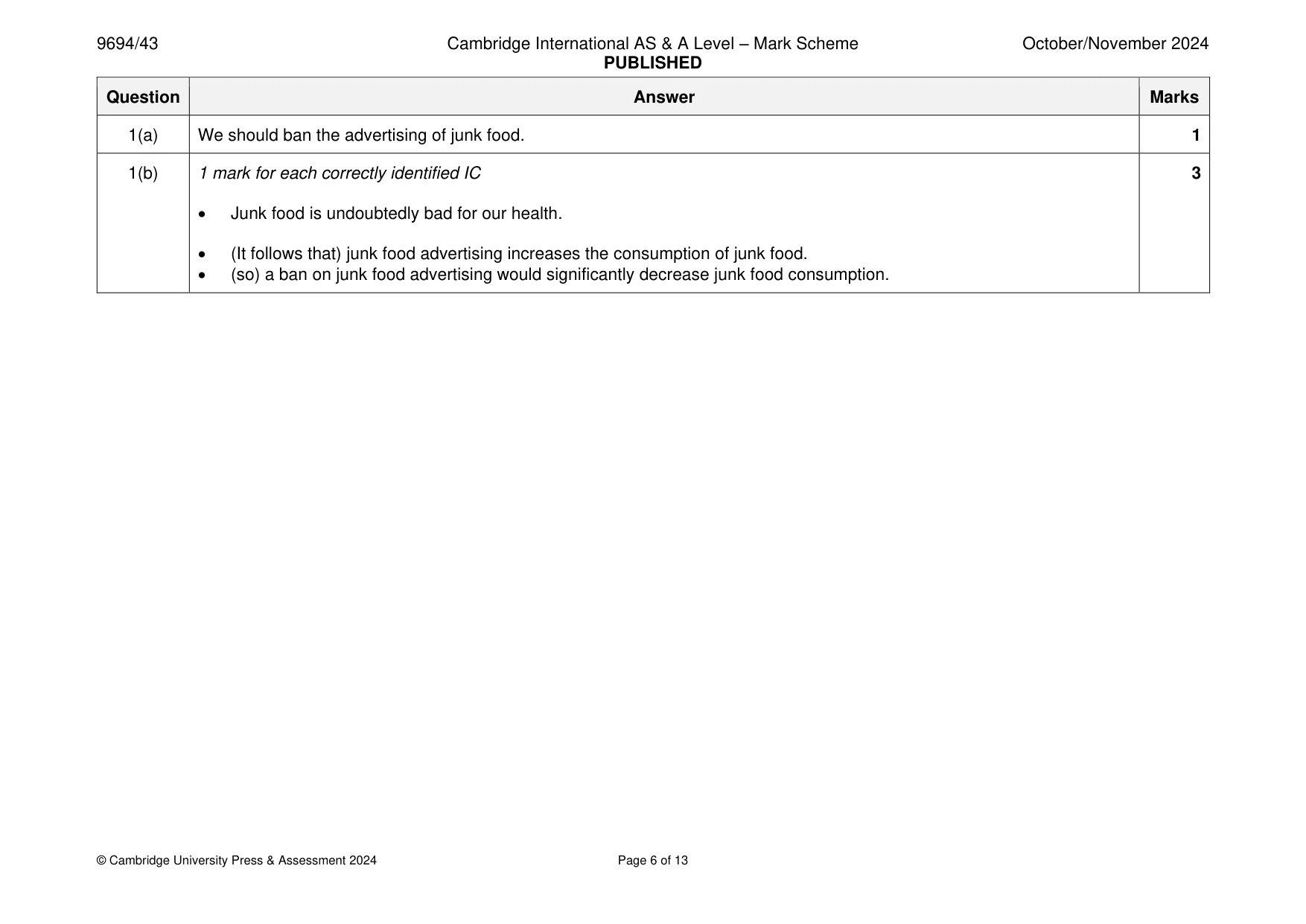
9694/43 Cambridge International AS & A Level – Mark Scheme PUBLISHED October/November 2024 © Cambridge University Press & Assessment 2024 Page 6 of 13 Question Answer Marks 1(a) We should ban the advertising of junk food. 1 1(b) 1 mark for each correctly identified IC • Junk food is undoubtedly bad for our health. • (It follows that) junk food advertising increases the consumption of junk food. • (so) a ban on junk food advertising would significantly decrease junk food consumption. 3
Mark scheme, page 7
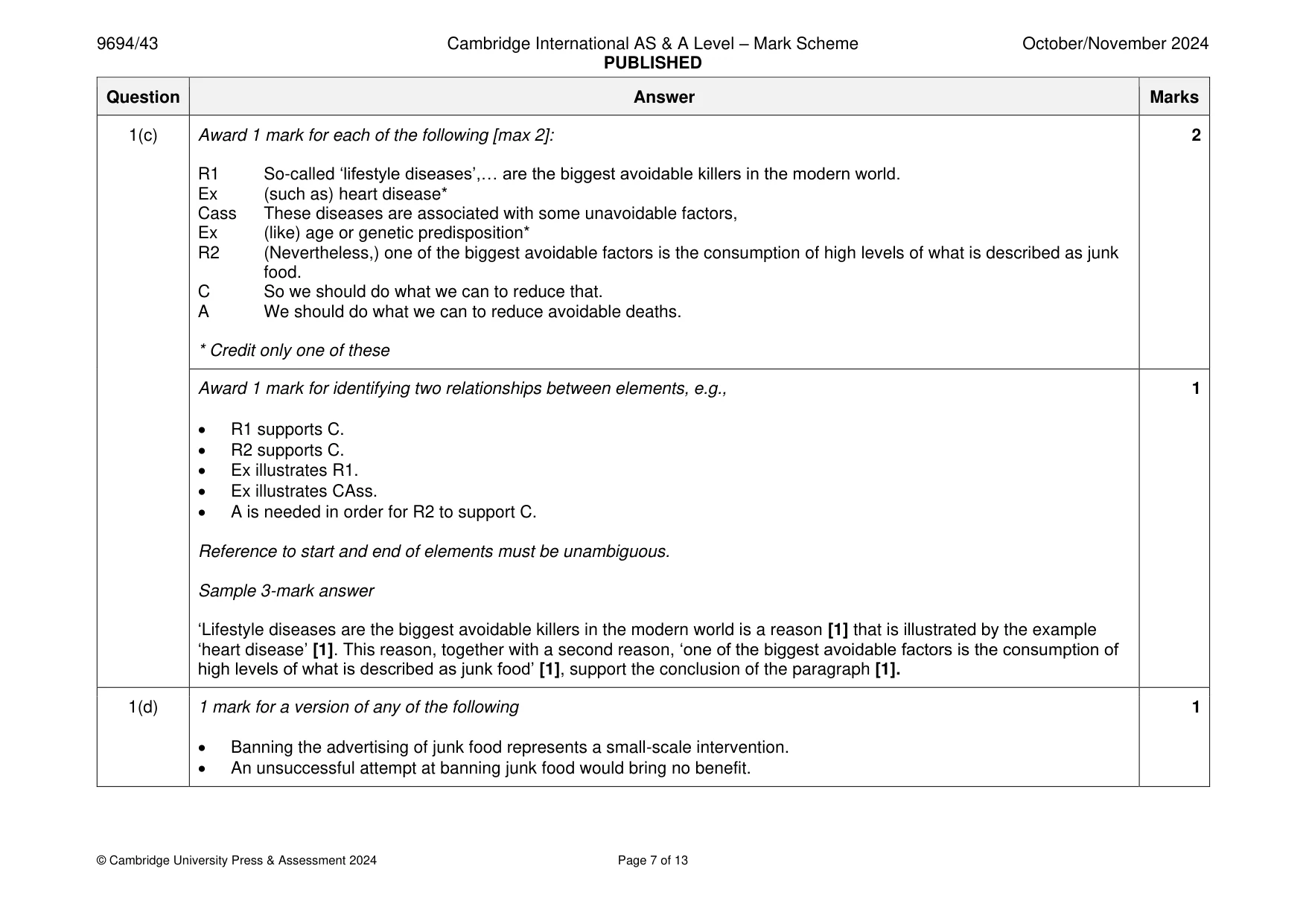
9694/43 Cambridge International AS & A Level – Mark Scheme PUBLISHED October/November 2024 © Cambridge University Press & Assessment 2024 Page 7 of 13 Question Answer Marks 1(c) Award 1 mark for each of the following [max 2]: R1 So-called ‘lifestyle diseases’,… are the biggest avoidable killers in the modern world. Ex (such as) heart disease* Cass These diseases are associated with some unavoidable factors, Ex (like) age or genetic predisposition* R2 (Nevertheless,) one of the biggest avoidable factors is the consumption of high levels of what is described as junk food. C So we should do what we can to reduce that. A We should do what we can to reduce avoidable deaths. * Credit only one of these 2 Award 1 mark for identifying two relationships between elements, e.g., • R1 supports C. • R2 supports C. • Ex illustrates R1. • Ex illustrates CAss. • A is needed in order for R2 to support C. Reference to start and end of elements must be unambiguous. Sample 3-mark answer ‘Lifestyle diseases are the biggest avoidable killers in the modern world is a reason [1] that is illustrated by the example ‘heart disease’ [1]. This reason, together with a second reason, ‘one of the biggest avoidable factors is the consumption of high levels of what is described as junk food’ [1], support the conclusion of the paragraph [1]. 1 1(d) 1 mark for a version of any of the following • Banning the advertising of junk food represents a small-scale intervention. • An unsuccessful attempt at banning junk food would bring no benefit. 1
Mark scheme, page 8
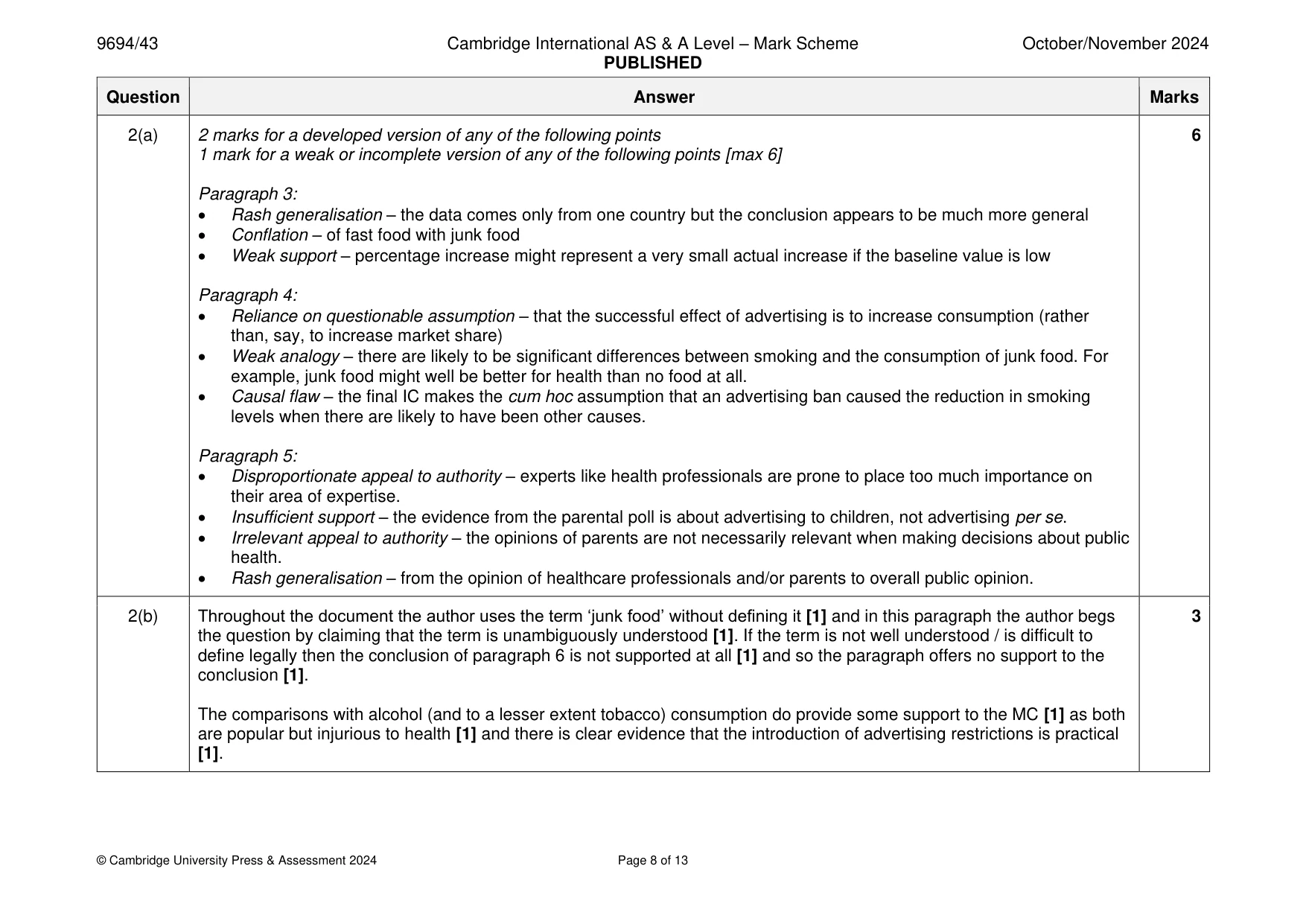
9694/43 Cambridge International AS & A Level – Mark Scheme PUBLISHED October/November 2024 © Cambridge University Press & Assessment 2024 Page 8 of 13 Question Answer Marks 2(a) 2 marks for a developed version of any of the following points 1 mark for a weak or incomplete version of any of the following points [max 6] Paragraph 3: • Rash generalisation – the data comes only from one country but the conclusion appears to be much more general • Conflation – of fast food with junk food • Weak support – percentage increase might represent a very small actual increase if the baseline value is low Paragraph 4: • Reliance on questionable assumption – that the successful effect of advertising is to increase consumption (rather than, say, to increase market share) • Weak analogy – there are likely to be significant differences between smoking and the consumption of junk food. For example, junk food might well be better for health than no food at all. • Causal flaw – the final IC makes the cum hoc assumption that an advertising ban caused the reduction in smoking levels when there are likely to have been other causes. Paragraph 5: • Disproportionate appeal to authority – experts like health professionals are prone to place too much importance on their area of expertise. • Insufficient support – the evidence from the parental poll is about advertising to children, not advertising per se. • Irrelevant appeal to authority – the opinions of parents are not necessarily relevant when making decisions about public health. • Rash generalisation – from the opinion of healthcare professionals and/or parents to overall public opinion. 6 2(b) Throughout the document the author uses the term ‘junk food’ without defining it [1] and in this paragraph the author begs the question by claiming that the term is unambiguously understood [1]. If the term is not well understood / is difficult to define legally then the conclusion of paragraph 6 is not supported at all [1] and so the paragraph offers no support to the conclusion [1]. The comparisons with alcohol (and to a lesser extent tobacco) consumption do provide some support to the MC [1] as both are popular but injurious to health [1] and there is clear evidence that the introduction of advertising restrictions is practical [1]. 3
Mark scheme, page 9
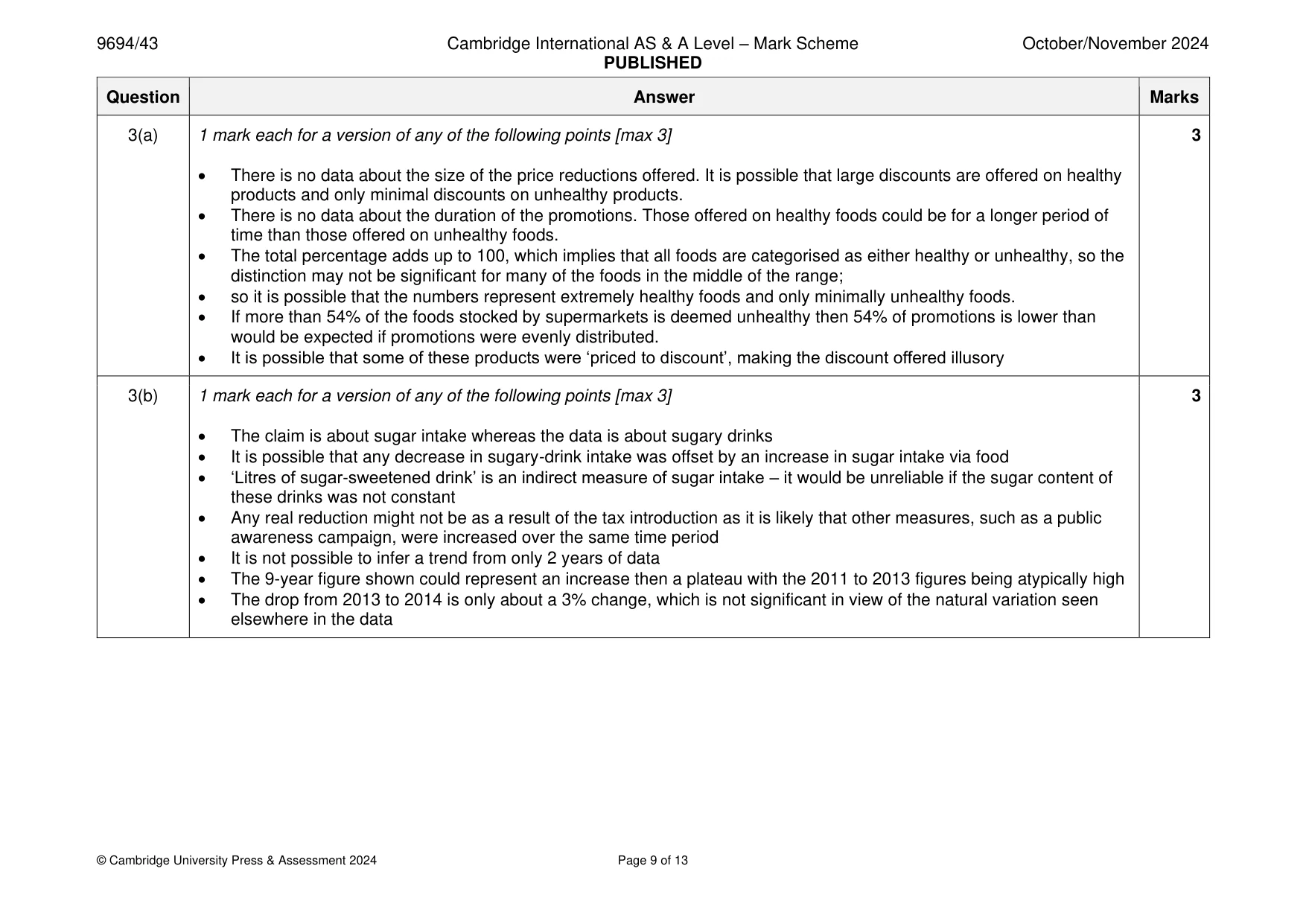
9694/43 Cambridge International AS & A Level – Mark Scheme PUBLISHED October/November 2024 © Cambridge University Press & Assessment 2024 Page 9 of 13 Question Answer Marks 3(a) 1 mark each for a version of any of the following points [max 3] • There is no data about the size of the price reductions offered. It is possible that large discounts are offered on healthy products and only minimal discounts on unhealthy products. • There is no data about the duration of the promotions. Those offered on healthy foods could be for a longer period of time than those offered on unhealthy foods. • The total percentage adds up to 100, which implies that all foods are categorised as either healthy or unhealthy, so the distinction may not be significant for many of the foods in the middle of the range; • so it is possible that the numbers represent extremely healthy foods and only minimally unhealthy foods. • If more than 54% of the foods stocked by supermarkets is deemed unhealthy then 54% of promotions is lower than would be expected if promotions were evenly distributed. • It is possible that some of these products were ‘priced to discount’, making the discount offered illusory 3 3(b) 1 mark each for a version of any of the following points [max 3] • The claim is about sugar intake whereas the data is about sugary drinks • It is possible that any decrease in sugary-drink intake was offset by an increase in sugar intake via food • ‘Litres of sugar-sweetened drink’ is an indirect measure of sugar intake – it would be unreliable if the sugar content of these drinks was not constant • Any real reduction might not be as a result of the tax introduction as it is likely that other measures, such as a public awareness campaign, were increased over the same time period • It is not possible to infer a trend from only 2 years of data • The 9-year figure shown could represent an increase then a plateau with the 2011 to 2013 figures being atypically high • The drop from 2013 to 2014 is only about a 3% change, which is not significant in view of the natural variation seen elsewhere in the data 3
Mark scheme, page 10
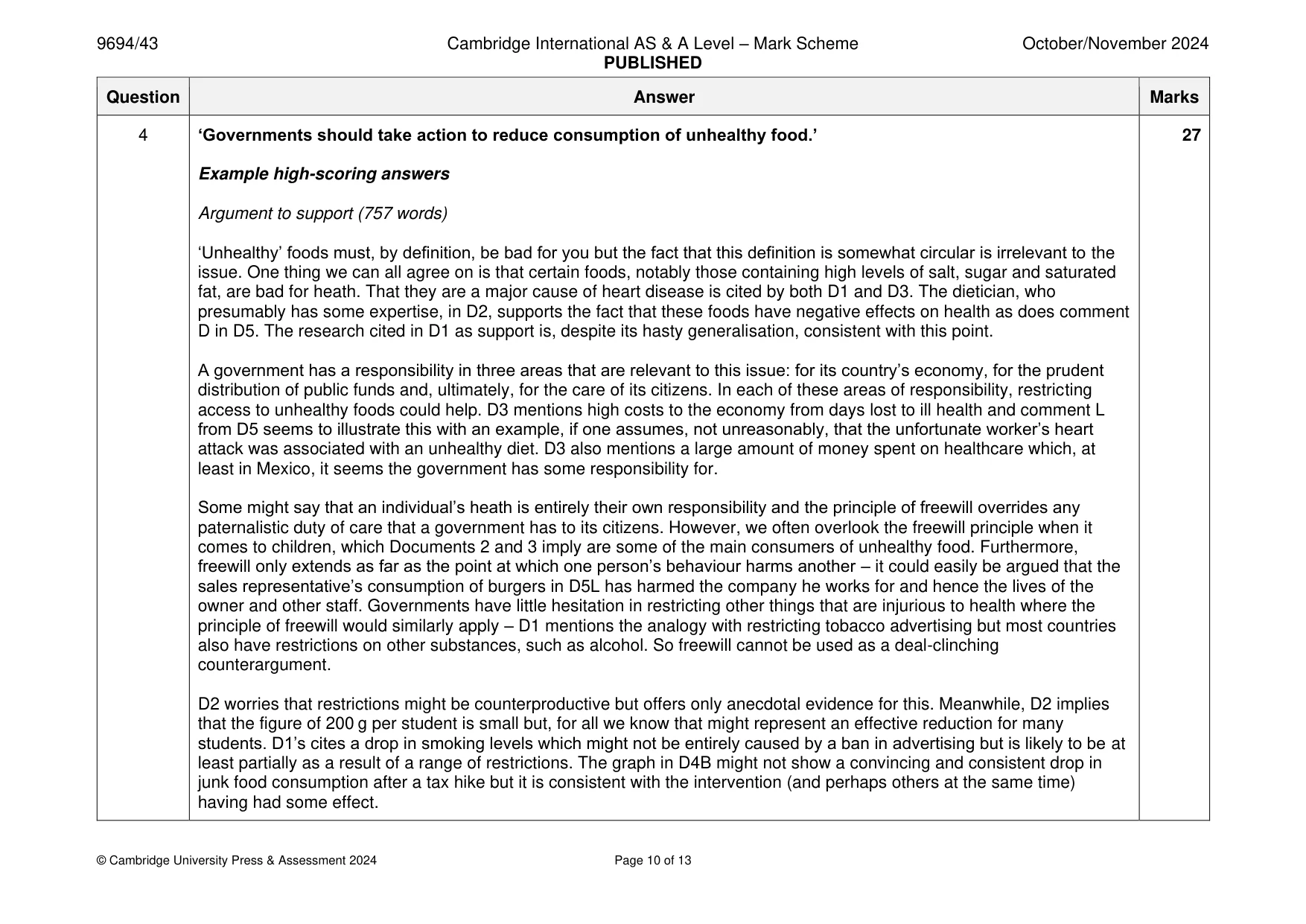
9694/43 Cambridge International AS & A Level – Mark Scheme PUBLISHED October/November 2024 © Cambridge University Press & Assessment 2024 Page 10 of 13 Question Answer Marks 4 ‘Governments should take action to reduce consumption of unhealthy food.’ Example high-scoring answers Argument to support (757 words) ‘Unhealthy’ foods must, by definition, be bad for you but the fact that this definition is somewhat circular is irrelevant to the issue. One thing we can all agree on is that certain foods, notably those containing high levels of salt, sugar and saturated fat, are bad for heath. That they are a major cause of heart disease is cited by both D1 and D3. The dietician, who presumably has some expertise, in D2, supports the fact that these foods have negative effects on health as does comment D in D5. The research cited in D1 as support is, despite its hasty generalisation, consistent with this point. A government has a responsibility in three areas that are relevant to this issue: for its country’s economy, for the prudent distribution of public funds and, ultimately, for the care of its citizens. In each of these areas of responsibility, restricting access to unhealthy foods could help. D3 mentions high costs to the economy from days lost to ill health and comment L from D5 seems to illustrate this with an example, if one assumes, not unreasonably, that the unfortunate worker’s heart attack was associated with an unhealthy diet. D3 also mentions a large amount of money spent on healthcare which, at least in Mexico, it seems the government has some responsibility for. Some might say that an individual’s heath is entirely their own responsibility and the principle of freewill overrides any paternalistic duty of care that a government has to its citizens. However, we often overlook the freewill principle when it comes to children, which Documents 2 and 3 imply are some of the main consumers of unhealthy food. Furthermore, freewill only extends as far as the point at which one person’s behaviour harms another – it could easily be argued that the sales representative’s consumption of burgers in D5L has harmed the company he works for and hence the lives of the owner and other staff. Governments have little hesitation in restricting other things that are injurious to health where the principle of freewill would similarly apply – D1 mentions the analogy with restricting tobacco advertising but most countries also have restrictions on other substances, such as alcohol. So freewill cannot be used as a deal-clinching counterargument. D2 worries that restrictions might be counterproductive but offers only anecdotal evidence for this. Meanwhile, D2 implies that the figure of 200 g per student is small but, for all we know that might represent an effective reduction for many students. D1’s cites a drop in smoking levels which might not be entirely caused by a ban in advertising but is likely to be at least partially as a result of a range of restrictions. The graph in D4B might not show a convincing and consistent drop in junk food consumption after a tax hike but it is consistent with the intervention (and perhaps others at the same time) having had some effect. 27
Mark scheme, page 11
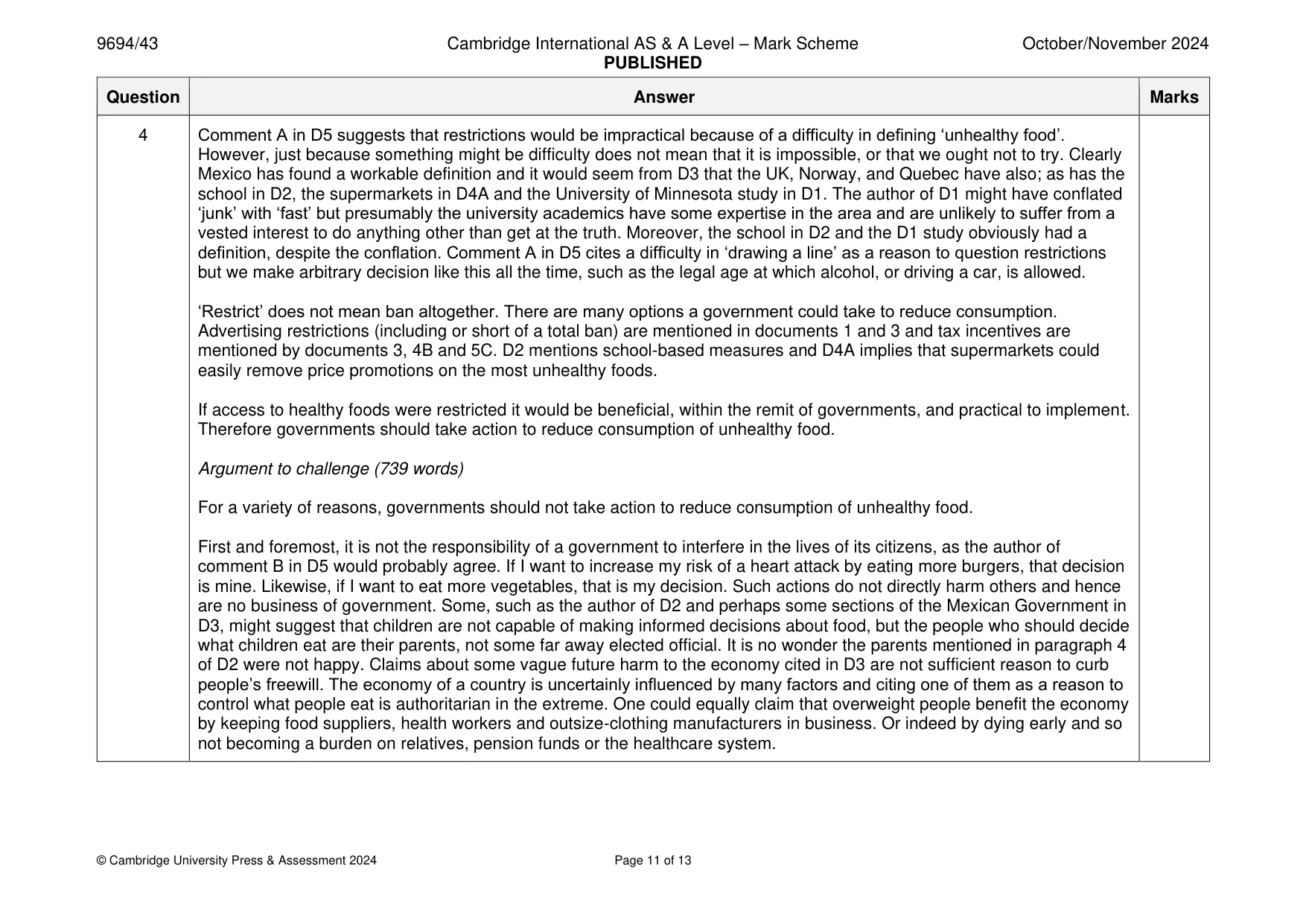
9694/43 Cambridge International AS & A Level – Mark Scheme PUBLISHED October/November 2024 © Cambridge University Press & Assessment 2024 Page 11 of 13 Question Answer Marks 4 Comment A in D5 suggests that restrictions would be impractical because of a difficulty in defining ‘unhealthy food’. However, just because something might be difficulty does not mean that it is impossible, or that we ought not to try. Clearly Mexico has found a workable definition and it would seem from D3 that the UK, Norway, and Quebec have also; as has the school in D2, the supermarkets in D4A and the University of Minnesota study in D1. The author of D1 might have conflated ‘junk’ with ‘fast’ but presumably the university academics have some expertise in the area and are unlikely to suffer from a vested interest to do anything other than get at the truth. Moreover, the school in D2 and the D1 study obviously had a definition, despite the conflation. Comment A in D5 cites a difficulty in ‘drawing a line’ as a reason to question restrictions but we make arbitrary decision like this all the time, such as the legal age at which alcohol, or driving a car, is allowed. ‘Restrict’ does not mean ban altogether. There are many options a government could take to reduce consumption. Advertising restrictions (including or short of a total ban) are mentioned in documents 1 and 3 and tax incentives are mentioned by documents 3, 4B and 5C. D2 mentions school-based measures and D4A implies that supermarkets could easily remove price promotions on the most unhealthy foods. If access to healthy foods were restricted it would be beneficial, within the remit of governments, and practical to implement. Therefore governments should take action to reduce consumption of unhealthy food. Argument to challenge (739 words) For a variety of reasons, governments should not take action to reduce consumption of unhealthy food. First and foremost, it is not the responsibility of a government to interfere in the lives of its citizens, as the author of comment B in D5 would probably agree. If I want to increase my risk of a heart attack by eating more burgers, that decision is mine. Likewise, if I want to eat more vegetables, that is my decision. Such actions do not directly harm others and hence are no business of government. Some, such as the author of D2 and perhaps some sections of the Mexican Government in D3, might suggest that children are not capable of making informed decisions about food, but the people who should decide what children eat are their parents, not some far away elected official. It is no wonder the parents mentioned in paragraph 4 of D2 were not happy. Claims about some vague future harm to the economy cited in D3 are not sufficient reason to curb people’s freewill. The economy of a country is uncertainly influenced by many factors and citing one of them as a reason to control what people eat is authoritarian in the extreme. One could equally claim that overweight people benefit the economy by keeping food suppliers, health workers and outsize-clothing manufacturers in business. Or indeed by dying early and so not becoming a burden on relatives, pension funds or the healthcare system.
Mark scheme, page 12
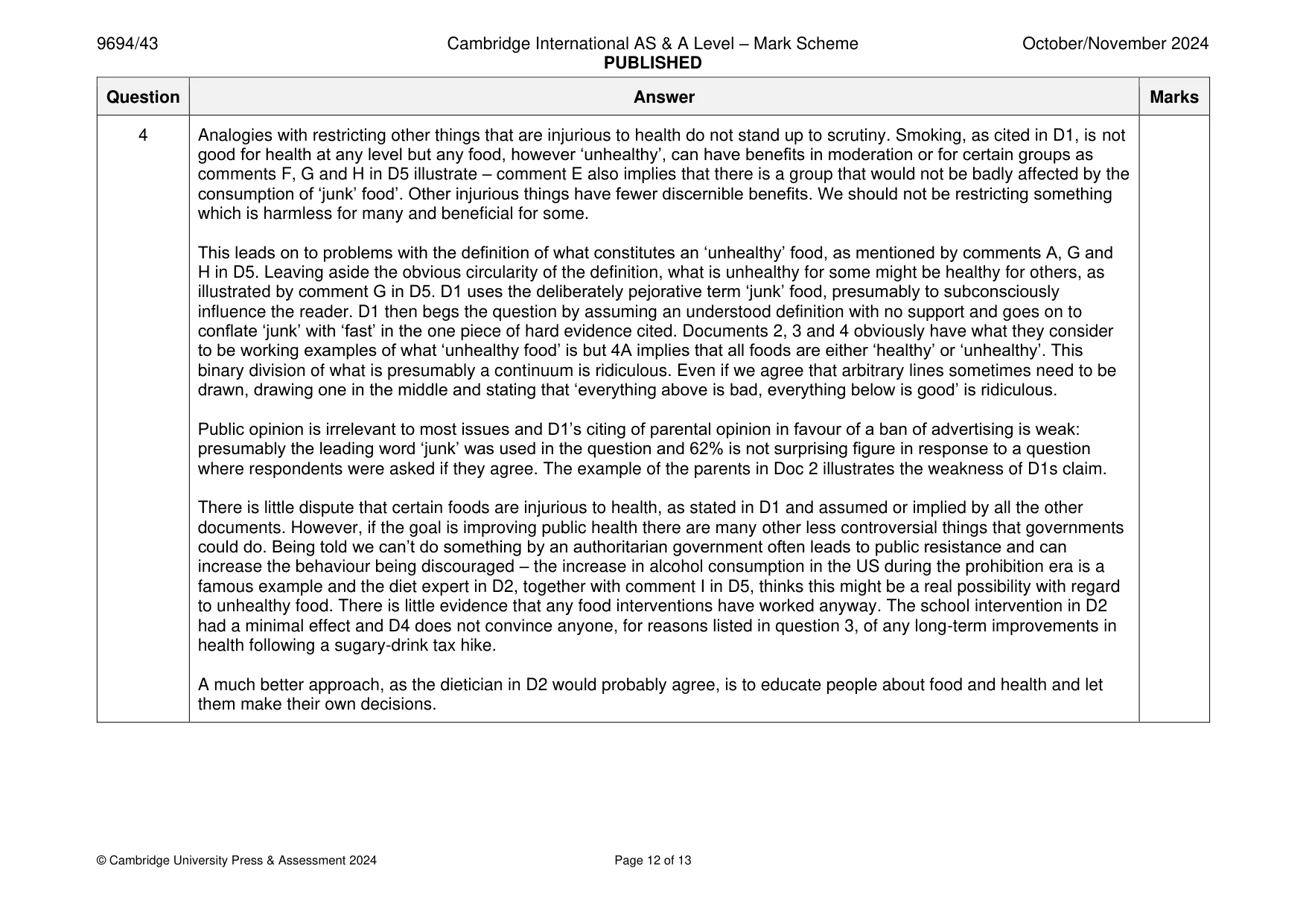
9694/43 Cambridge International AS & A Level – Mark Scheme PUBLISHED October/November 2024 © Cambridge University Press & Assessment 2024 Page 12 of 13 Question Answer Marks 4 Analogies with restricting other things that are injurious to health do not stand up to scrutiny. Smoking, as cited in D1, is not good for health at any level but any food, however ‘unhealthy’, can have benefits in moderation or for certain groups as comments F, G and H in D5 illustrate – comment E also implies that there is a group that would not be badly affected by the consumption of ‘junk’ food’. Other injurious things have fewer discernible benefits. We should not be restricting something which is harmless for many and beneficial for some. This leads on to problems with the definition of what constitutes an ‘unhealthy’ food, as mentioned by comments A, G and H in D5. Leaving aside the obvious circularity of the definition, what is unhealthy for some might be healthy for others, as illustrated by comment G in D5. D1 uses the deliberately pejorative term ‘junk’ food, presumably to subconsciously influence the reader. D1 then begs the question by assuming an understood definition with no support and goes on to conflate ‘junk’ with ‘fast’ in the one piece of hard evidence cited. Documents 2, 3 and 4 obviously have what they consider to be working examples of what ‘unhealthy food’ is but 4A implies that all foods are either ‘healthy’ or ‘unhealthy’. This binary division of what is presumably a continuum is ridiculous. Even if we agree that arbitrary lines sometimes need to be drawn, drawing one in the middle and stating that ‘everything above is bad, everything below is good’ is ridiculous. Public opinion is irrelevant to most issues and D1’s citing of parental opinion in favour of a ban of advertising is weak: presumably the leading word ‘junk’ was used in the question and 62% is not surprising figure in response to a question where respondents were asked if they agree. The example of the parents in Doc 2 illustrates the weakness of D1s claim. There is little dispute that certain foods are injurious to health, as stated in D1 and assumed or implied by all the other documents. However, if the goal is improving public health there are many other less controversial things that governments could do. Being told we can’t do something by an authoritarian government often leads to public resistance and can increase the behaviour being discouraged – the increase in alcohol consumption in the US during the prohibition era is a famous example and the diet expert in D2, together with comment I in D5, thinks this might be a real possibility with regard to unhealthy food. There is little evidence that any food interventions have worked anyway. The school intervention in D2 had a minimal effect and D4 does not convince anyone, for reasons listed in question 3, of any long-term improvements in health following a sugary-drink tax hike. A much better approach, as the dietician in D2 would probably agree, is to educate people about food and health and let them make their own decisions.
Mark scheme, page 13
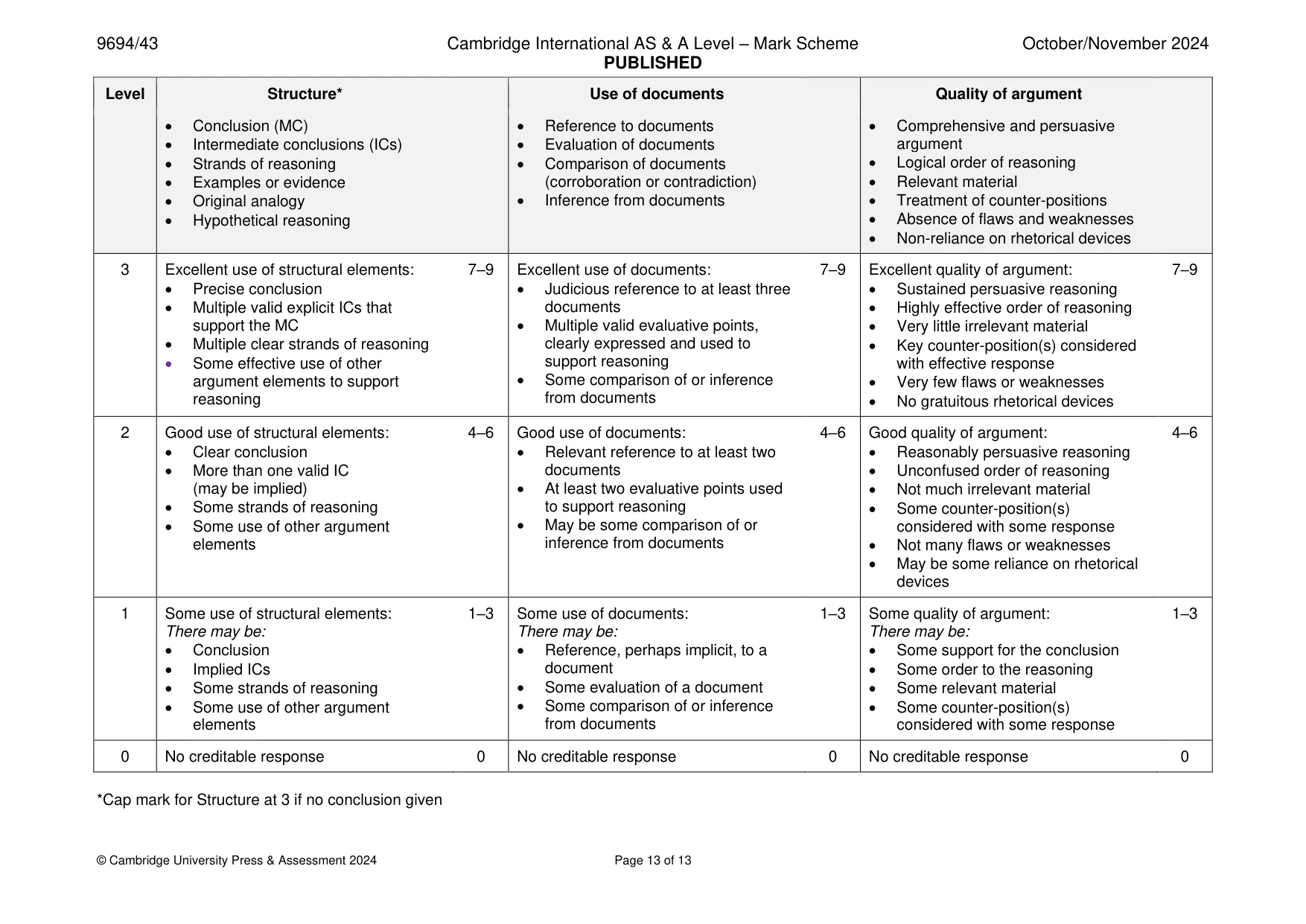
9694/43 Cambridge International AS & A Level – Mark Scheme PUBLISHED October/November 2024 © Cambridge University Press & Assessment 2024 Page 13 of 13 Level Structure* Use of documents Quality of argument • Conclusion (MC) • Intermediate conclusions (ICs) • Strands of reasoning • Examples or evidence • Original analogy • Hypothetical reasoning • Reference to documents • Evaluation of documents • Comparison of documents (corroboration or contradiction) • Inference from documents • Comprehensive and persuasive argument • Logical order of reasoning • Relevant material • Treatment of counter-positions • Absence of flaws and weaknesses • Non-reliance on rhetorical devices 3 Excellent use of structural elements: • Precise conclusion • Multiple valid explicit ICs that support the MC • Multiple clear strands of reasoning • Some effective use of other argument elements to support reasoning 7–9 Excellent use of documents: • Judicious reference to at least three documents • Multiple valid evaluative points, clearly expressed and used to support reasoning • Some comparison of or inference from documents 7–9 Excellent quality of argument: • Sustained persuasive reasoning • Highly effective order of reasoning • Very little irrelevant material • Key counter-position(s) considered with effective response • Very few flaws or weaknesses • No gratuitous rhetorical devices 7–9 2 Good use of structural elements: • Clear conclusion • More than one valid IC (may be implied) • Some strands of reasoning • Some use of other argument elements 4–6 Good use of documents: • Relevant reference to at least two documents • At least two evaluative points used to support reasoning • May be some comparison of or inference from documents 4–6 Good quality of argument: • Reasonably persuasive reasoning • Unconfused order of reasoning • Not much irrelevant material • Some counter-position(s) considered with some response • Not many flaws or weaknesses • May be some reliance on rhetorical devices 4–6 1 Some use of structural elements: There may be: • Conclusion • Implied ICs • Some strands of reasoning • Some use of other argument elements 1–3 Some use of documents: There may be: • Reference, perhaps implicit, to a document • Some evaluation of a document • Some comparison of or inference from documents 1–3 Some quality of argument: There may be: • Some support for the conclusion • Some order to the reasoning • Some relevant material • Some counter-position(s) considered with some response 1–3 0 No creditable response 0 No creditable response 0 No creditable response 0 *Cap mark for Structure at 3 if no conclusion given
What you needed in this session
Cambridge’s own grade thresholds for 2024 Oct/Nov, Paper 4 · Variant 3. A higher threshold means an easier paper — the bar moves with how the cohort did.