Cambridge A Level Thinking Skills 9694 — 2023 May/June Paper 4 · Variant 1
9694/41/M/J/23 · 50 marks · ≈56 min
The question paper and its mark scheme, free to read here and free to download. This is Cambridge’s own paper, exactly as it was sat.
Question paper8 pages

Mark scheme11 pages
Answers below. Sit the paper first if you are practising.
Paper as text
Question paper, page 1
This document has 8 pages. Any blank pages are indicated. [Turn over Cambridge International AS & A Level DC (CE/CGW) 321987/3 © UCLES 2023 * 8 5 2 7 1 7 0 5 8 4 * THINKING SKILLS 9694/41 Paper 4 Applied Reasoning May/June 2023 1 hour 45 minutes You must answer on the enclosed answer booklet. You will need: Answer booklet (enclosed) INSTRUCTIONS ● Answer all questions. ● Follow the instructions on the front cover of the answer booklet. If you need additional answer paper, ask the invigilator for a continuation booklet. INFORMATION ● The total mark for this paper is 50. ● The number of marks for each question or part question is shown in brackets [ ].
Question paper, page 2
2 9694/41/M/J/23 © UCLES 2023 Questions 1 and 2 refer to Document 1. 1 (a) State the main conclusion of the argument. [1] (b) Identify two intermediate conclusions in paragraphs 2 to 3. [2] (c) Analyse the structure of the reasoning in paragraph 4. [5] 2 (a) Identify and explain three flaws and/or weaknesses in the reasoning in paragraphs 2 to 4. [6] (b) Assess the extent to which paragraph 6 supports the argument as a whole. [3] 3 Document 5 contains some statistical information. (a) Give four reasons why the support given by the graph in Document 5A to the claim that ‘Greta Thunberg has persuaded people to fly less’ is weak. [4] (b) Give two reasons why the support given by the table in Document 5B to the claim that ‘US adults trust teenagers on climate change more than church leaders or politicians’ is weak. [2] 4 You are advised to spend some time planning your answer before you begin to write it. ‘Teenage political activism is a force for good.’ Construct a reasoned argument to support or challenge this claim. In your answer you should make critical use of the documents provided. [27]
Question paper, page 3
3 9694/41/M/J/23 © UCLES 2023 [Turn over DOCUMENT 1 1 Since Swedish teenager Greta Thunberg began skipping school and protesting against so-called climate change, millions of feckless teenagers around the world have imitated her. Time magazine even named her ‘Person of the Year’ in 2019. Should we see Thunberg’s behaviour as a harmless letting off of teenage steam, or is it something more serious that could influence people? Being cited in a magazine comes with no official authority, but the award does encourage the idea that Thunberg is someone whose opinion should be taken seriously. However, the public adulation of this teenager is dangerous. 2 The opinions of young people should not determine government policy. Traditionally, the media ignored the views of children, but now too much weight is given to the opinions of a small group of young activists, particularly when they protest about trendy issues, like climate change. Those who shout loudest do not generally have special insights or strong knowledge about public policy. In fact, as a general rule, the young know less about such issues than other age groups. In any case, teenagers make up only 16% of the world’s population and we should not base decisions about government policy on the view of a small minority. 3 Teenagers are particularly unqualified to comment on politics. They have not had enough education or life experience to form a valid opinion on most issues. 16-year-olds have had, at most, 12 years of formal education but most of that has probably been spent playing with their mobile phones. They are also notoriously ‘hormonal and angry’, which impairs their ability to make rational decisions. So the fact that large numbers of young people support a political cause adds little, if anything, to its merits. 4 Greta herself is a very unusual teenager. She describes herself as a ‘16-year-old climate activist with Asperger’s’; she also frequently refers to herself as a ‘child’, which is the last thing most 16-year-olds would do. So it is probable that her views don’t even represent the majority of teenagers. 5 The radical approach of Thunberg and those like her undermines democracy. Public policy should not be decided by who is most popular, let alone who is the most popular teenager. It should be decided by elected representatives chosen by informed adults on the basis of their policies, expertise and reputation. 6 Finally, Greta Thunberg preaches an unrealistic message of doom and gloom. She imagines devastating consequences if we continue to use fossil fuels at the present rate. However, we can dismiss her views on the basis that she is never explicit about the alternatives. If civilization is left in the hands of Thunberg’s supporters, we will soon be back in the Stone Age, living in caves, fighting to find food and being under constant threat of attack by wild animals.
Question paper, page 4
4 9694/41/M/J/23 © UCLES 2023 DOCUMENT 2 Respected broadcaster praises Greta Thunberg Greta Thunberg yesterday had a video call with Sir David Attenborough. During the call, the 93-year-old naturalist and broadcaster told the teenager her climate change protests were having an ‘astonishing’ impact and that she had ‘woken up the world’ to climate change. Somewhat bizarrely, the video call was first broadcast on the radio. BBC Radio 4 invited the Swedish schoolgirl to edit Today, its weighty morning news and current affairs programme, that has a history of inviting prominent people to guest-edit the show. Speaking to Greta during the Today programme, Sir David praised her for waking up the world by delivering ‘a very powerful message’ and told her, ‘You have made it an argument that people have not been able to dodge. We don’t want to spend our time marching through the streets, but we have to. People of my generation should be very grateful to you.’ The respected film maker, who was on the show to promote his opposition to a house-building project on an ecologically important area of peat bog, said it was depressing when governments in some countries took no notice of what needed to be done, and continued: ‘It needs a real electric shock – such as you have produced socially – to bring them to their senses, and let’s hope that shock will go on.’ He added that no one had taken the slightest notice twenty years ago, when he stressed the need for changes to our daily lives to halt global warming. The 16-year-old thanked Sir David for his documentaries about the natural world, which she said had ‘opened her eyes’ to what was happening in the environment. She went on to say that certain world leaders, some of whom had attacked her personally on social media, ought to watch some of his programmes themselves. Research suggests that Greta is not alone in being concerned about the climate crisis. A recent survey showed that 61% of US adults born after 1981 supported climate change activists, and the figure for those born before 1981 was 49%.
Question paper, page 5
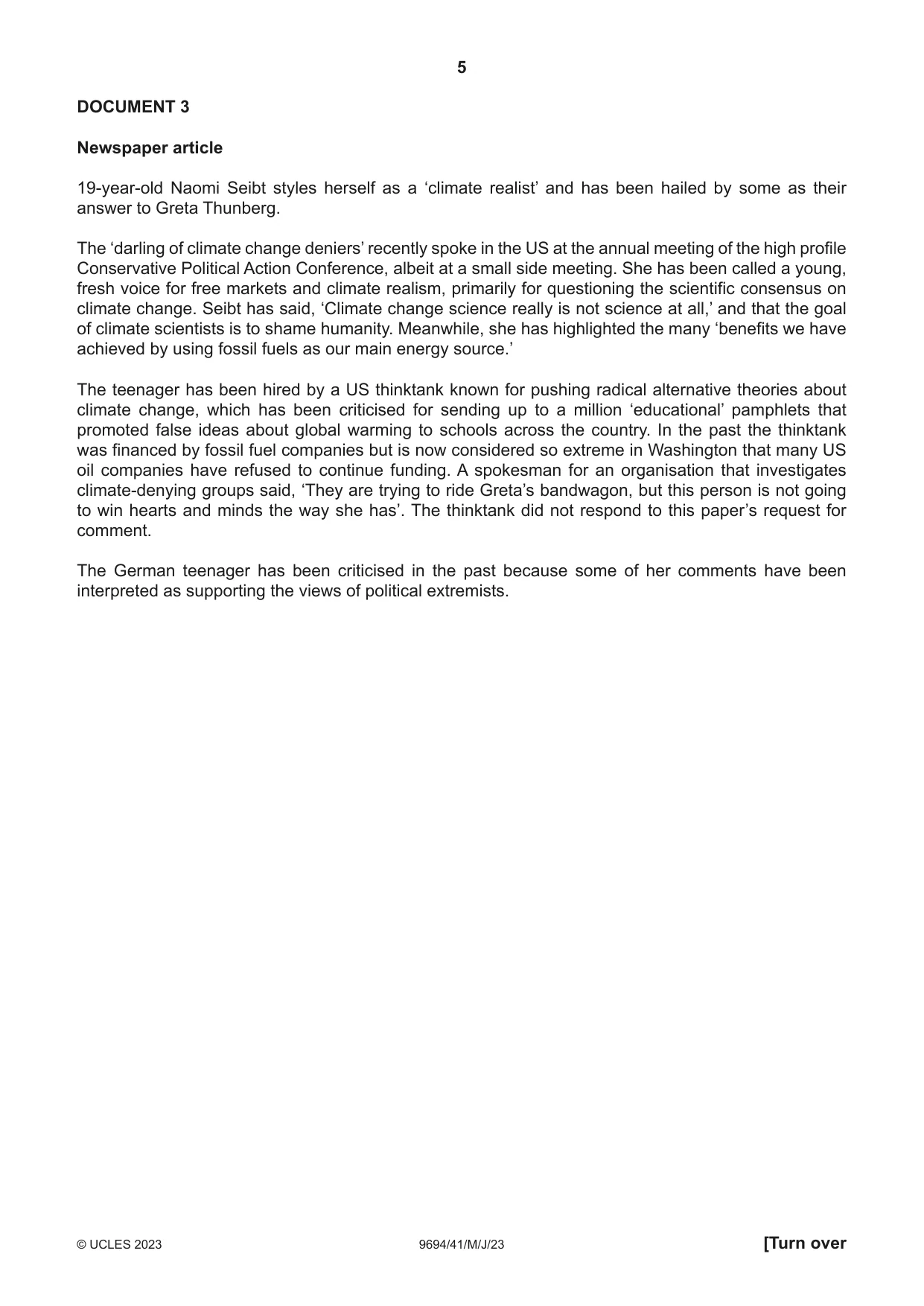
5 9694/41/M/J/23 © UCLES 2023 [Turn over DOCUMENT 3 Newspaper article 19-year-old Naomi Seibt styles herself as a ‘climate realist’ and has been hailed by some as their answer to Greta Thunberg. The ‘darling of climate change deniers’ recently spoke in the US at the annual meeting of the high profile Conservative Political Action Conference, albeit at a small side meeting. She has been called a young, fresh voice for free markets and climate realism, primarily for questioning the scientific consensus on climate change. Seibt has said, ‘Climate change science really is not science at all,’ and that the goal of climate scientists is to shame humanity. Meanwhile, she has highlighted the many ‘benefits we have achieved by using fossil fuels as our main energy source.’ The teenager has been hired by a US thinktank known for pushing radical alternative theories about climate change, which has been criticised for sending up to a million ‘educational’ pamphlets that promoted false ideas about global warming to schools across the country. In the past the thinktank was financed by fossil fuel companies but is now considered so extreme in Washington that many US oil companies have refused to continue funding. A spokesman for an organisation that investigates climate-denying groups said, ‘They are trying to ride Greta’s bandwagon, but this person is not going to win hearts and minds the way she has’. The thinktank did not respond to this paper’s request for comment. The German teenager has been criticised in the past because some of her comments have been interpreted as supporting the views of political extremists.
Question paper, page 6
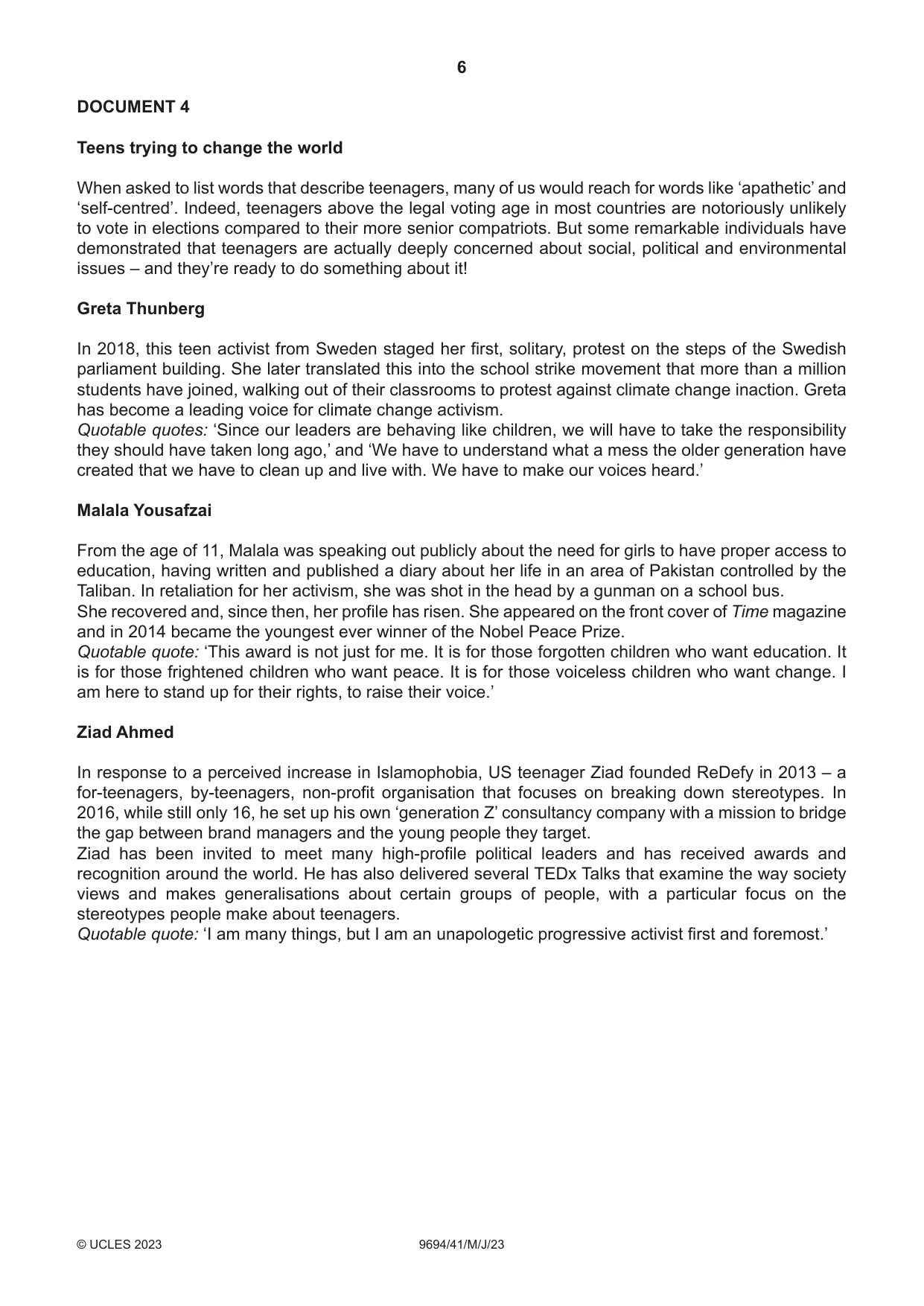
6 9694/41/M/J/23 © UCLES 2023 DOCUMENT 4 Teens trying to change the world When asked to list words that describe teenagers, many of us would reach for words like ‘apathetic’ and ‘self-centred’. Indeed, teenagers above the legal voting age in most countries are notoriously unlikely to vote in elections compared to their more senior compatriots. But some remarkable individuals have demonstrated that teenagers are actually deeply concerned about social, political and environmental issues – and they’re ready to do something about it! Greta Thunberg In 2018, this teen activist from Sweden staged her first, solitary, protest on the steps of the Swedish parliament building. She later translated this into the school strike movement that more than a million students have joined, walking out of their classrooms to protest against climate change inaction. Greta has become a leading voice for climate change activism. Quotable quotes: ‘Since our leaders are behaving like children, we will have to take the responsibility they should have taken long ago,’ and ‘We have to understand what a mess the older generation have created that we have to clean up and live with. We have to make our voices heard.’ Malala Yousafzai From the age of 11, Malala was speaking out publicly about the need for girls to have proper access to education, having written and published a diary about her life in an area of Pakistan controlled by the Taliban. In retaliation for her activism, she was shot in the head by a gunman on a school bus. She recovered and, since then, her profile has risen. She appeared on the front cover of Time magazine and in 2014 became the youngest ever winner of the Nobel Peace Prize. Quotable quote: ‘This award is not just for me. It is for those forgotten children who want education. It is for those frightened children who want peace. It is for those voiceless children who want change. I am here to stand up for their rights, to raise their voice.’ Ziad Ahmed In response to a perceived increase in Islamophobia, US teenager Ziad founded ReDefy in 2013 – a for-teenagers, by-teenagers, non-profit organisation that focuses on breaking down stereotypes. In 2016, while still only 16, he set up his own ‘generation Z’ consultancy company with a mission to bridge the gap between brand managers and the young people they target. Ziad has been invited to meet many high-profile political leaders and has received awards and recognition around the world. He has also delivered several TEDx Talks that examine the way society views and makes generalisations about certain groups of people, with a particular focus on the stereotypes people make about teenagers. Quotable quote: ‘I am many things, but I am an unapologetic progressive activist first and foremost.’
Question paper, page 7
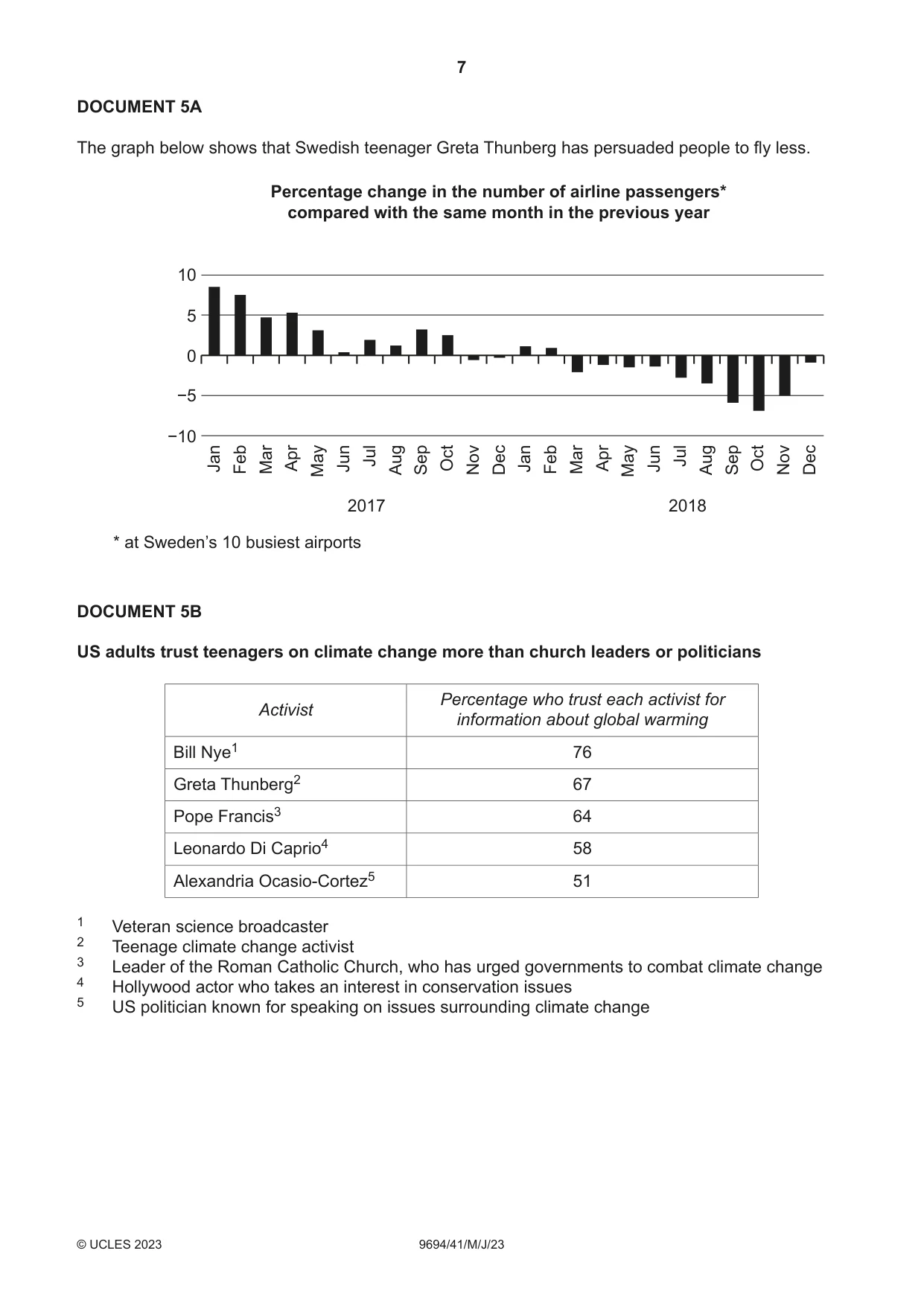
7 9694/41/M/J/23 © UCLES 2023 DOCUMENT 5A The graph below shows that Swedish teenager Greta Thunberg has persuaded people to fly less. 10 5 0 −5 2017 Percentage change in the number of airline passengers* compared with the same month in the previous year 2018 * at Sweden’s 10 busiest airports −10 Jan Feb Mar Apr May Jun Jul Aug Sep Oct Nov Dec Jan Feb Mar Apr May Jun Jul Aug Sep Oct Nov Dec DOCUMENT 5B US adults trust teenagers on climate change more than church leaders or politicians Activist Percentage who trust each activist for information about global warming Bill Nye1 76 Greta Thunberg2 67 Pope Francis3 64 Leonardo Di Caprio4 58 Alexandria Ocasio-Cortez5 51 1 Veteran science broadcaster 2 Teenage climate change activist 3 Leader of the Roman Catholic Church, who has urged governments to combat climate change 4 Hollywood actor who takes an interest in conservation issues 5 US politician known for speaking on issues surrounding climate change
Question paper, page 8
8 9694/41/M/J/23 © UCLES 2023 Permission to reproduce items where third-party owned material protected by copyright is included has been sought and cleared where possible. Every reasonable effort has been made by the publisher (UCLES) to trace copyright holders, but if any items requiring clearance have unwittingly been included, the publisher will be pleased to make amends at the earliest possible opportunity. To avoid the issue of disclosure of answer-related information to candidates, all copyright acknowledgements are reproduced online in the Cambridge Assessment International Education Copyright Acknowledgements Booklet. This is produced for each series of examinations and is freely available to download at www.cambridgeinternational.org after the live examination series. Cambridge Assessment International Education is part of Cambridge Assessment. Cambridge Assessment is the brand name of the University of Cambridge Local Examinations Syndicate (UCLES), which is a department of the University of Cambridge. BLANK PAGE
Mark scheme, page 1
This document consists of 11 printed pages. © UCLES 2023 [Turn over Cambridge International AS & A Level THINKING SKILLS 9694/41 Paper 4 Applied Reasoning May/June 2023 MARK SCHEME Maximum Mark: 50 Published This mark scheme is published as an aid to teachers and candidates, to indicate the requirements of the examination. It shows the basis on which Examiners were instructed to award marks. It does not indicate the details of the discussions that took place at an Examiners’ meeting before marking began, which would have considered the acceptability of alternative answers. Mark schemes should be read in conjunction with the question paper and the Principal Examiner Report for Teachers. Cambridge International will not enter into discussions about these mark schemes. Cambridge International is publishing the mark schemes for the May/June 2023 series for most Cambridge IGCSE, Cambridge International A and AS Level and Cambridge Pre-U components, and some Cambridge O Level components.
Mark scheme, page 2
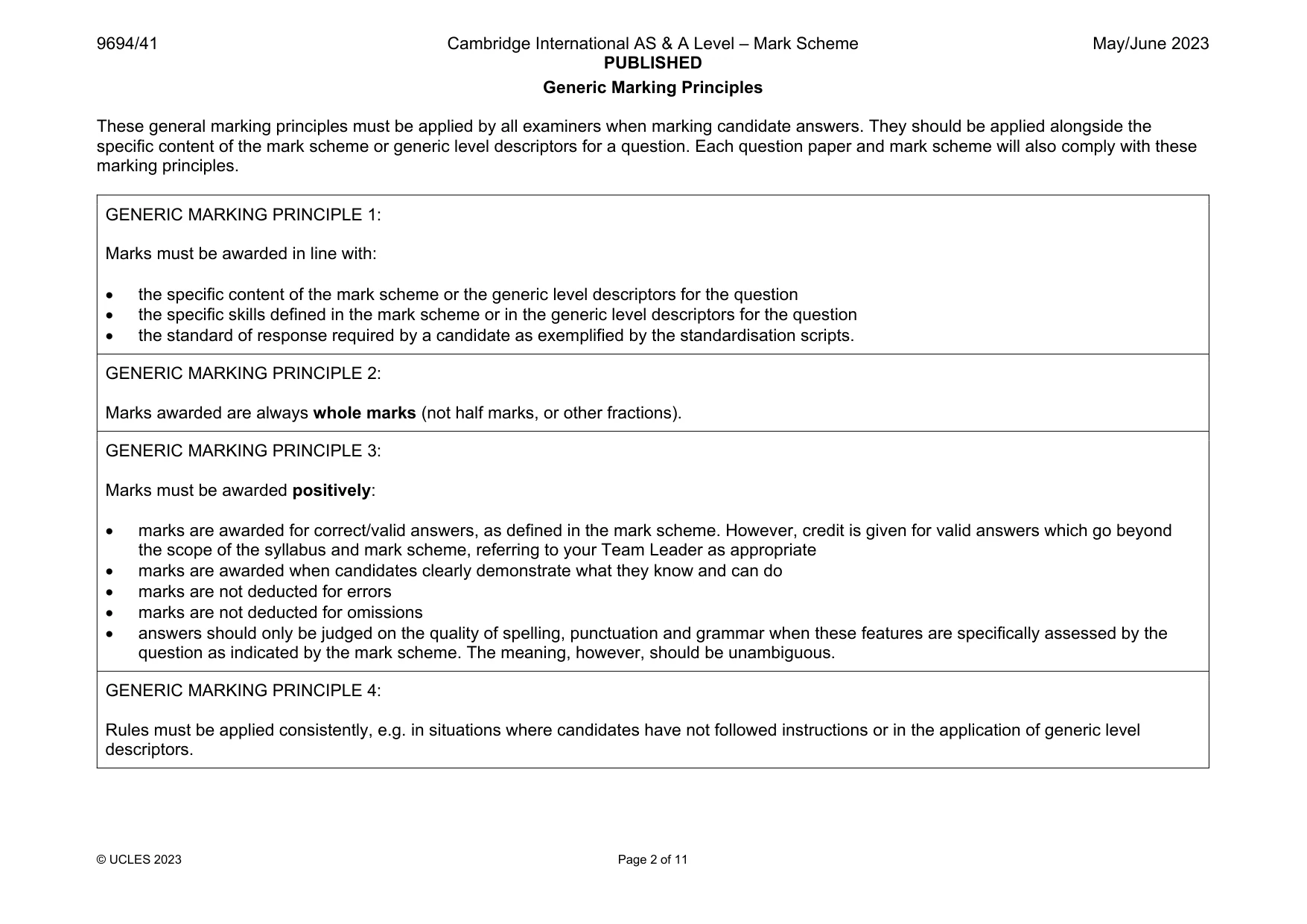
9694/41 Cambridge International AS & A Level – Mark Scheme PUBLISHED May/June 2023 © UCLES 2023 Page 2 of 11 Generic Marking Principles These general marking principles must be applied by all examiners when marking candidate answers. They should be applied alongside the specific content of the mark scheme or generic level descriptors for a question. Each question paper and mark scheme will also comply with these marking principles. GENERIC MARKING PRINCIPLE 1: Marks must be awarded in line with: the specific content of the mark scheme or the generic level descriptors for the question the specific skills defined in the mark scheme or in the generic level descriptors for the question the standard of response required by a candidate as exemplified by the standardisation scripts. GENERIC MARKING PRINCIPLE 2: Marks awarded are always whole marks (not half marks, or other fractions). GENERIC MARKING PRINCIPLE 3: Marks must be awarded positively: marks are awarded for correct/valid answers, as defined in the mark scheme. However, credit is given for valid answers which go beyond the scope of the syllabus and mark scheme, referring to your Team Leader as appropriate marks are awarded when candidates clearly demonstrate what they know and can do marks are not deducted for errors marks are not deducted for omissions answers should only be judged on the quality of spelling, punctuation and grammar when these features are specifically assessed by the question as indicated by the mark scheme. The meaning, however, should be unambiguous. GENERIC MARKING PRINCIPLE 4: Rules must be applied consistently, e.g. in situations where candidates have not followed instructions or in the application of generic level descriptors.
Mark scheme, page 3
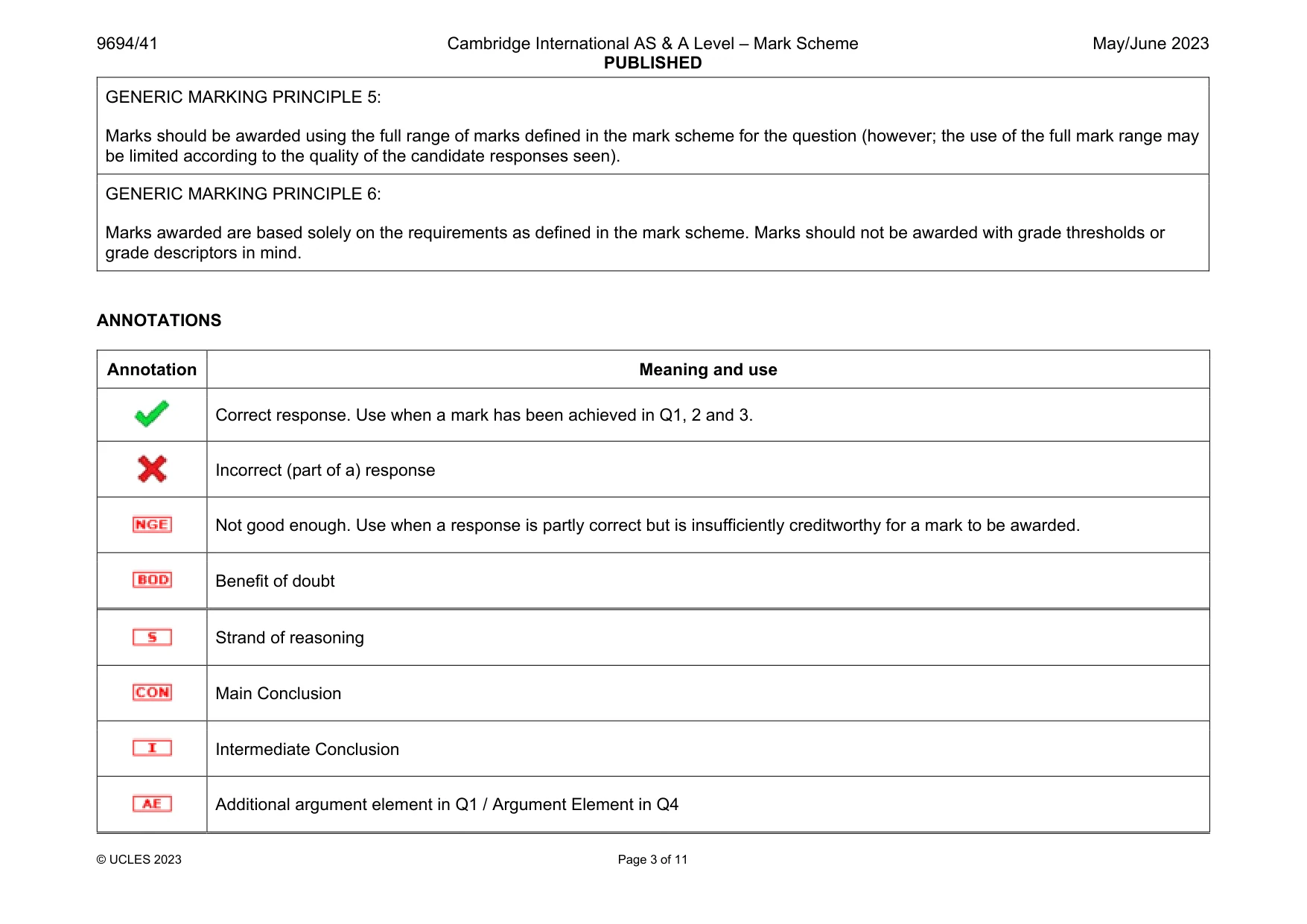
9694/41 Cambridge International AS & A Level – Mark Scheme PUBLISHED May/June 2023 © UCLES 2023 Page 3 of 11 GENERIC MARKING PRINCIPLE 5: Marks should be awarded using the full range of marks defined in the mark scheme for the question (however; the use of the full mark range may be limited according to the quality of the candidate responses seen). GENERIC MARKING PRINCIPLE 6: Marks awarded are based solely on the requirements as defined in the mark scheme. Marks should not be awarded with grade thresholds or grade descriptors in mind. ANNOTATIONS Annotation Meaning and use Correct response. Use when a mark has been achieved in Q1, 2 and 3. Incorrect (part of a) response Not good enough. Use when a response is partly correct but is insufficiently creditworthy for a mark to be awarded. Benefit of doubt Strand of reasoning Main Conclusion Intermediate Conclusion Additional argument element in Q1 / Argument Element in Q4
Mark scheme, page 4
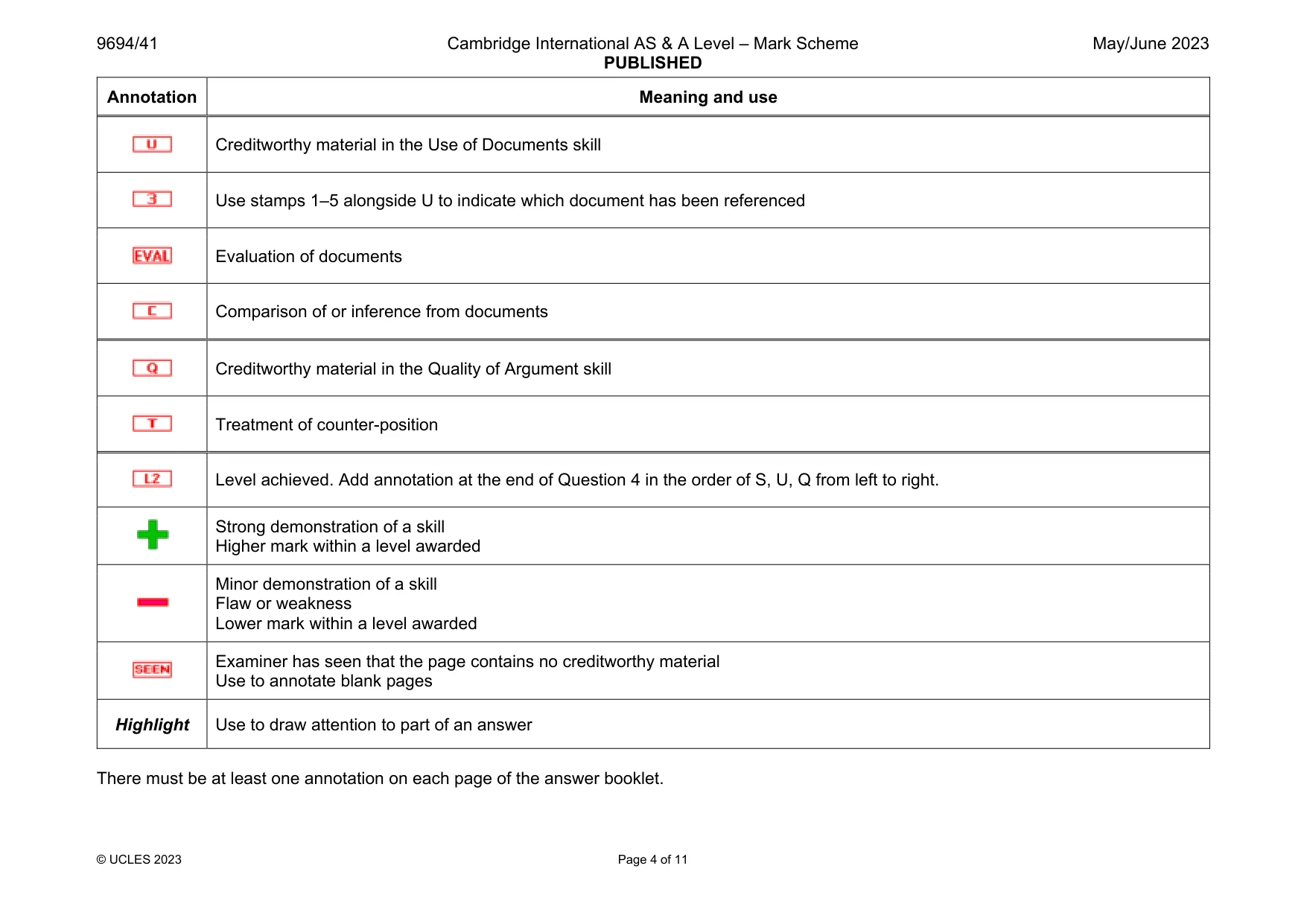
9694/41 Cambridge International AS & A Level – Mark Scheme PUBLISHED May/June 2023 © UCLES 2023 Page 4 of 11 Annotation Meaning and use Creditworthy material in the Use of Documents skill Use stamps 1–5 alongside U to indicate which document has been referenced Evaluation of documents Comparison of or inference from documents Creditworthy material in the Quality of Argument skill Treatment of counter-position Level achieved. Add annotation at the end of Question 4 in the order of S, U, Q from left to right. Strong demonstration of a skill Higher mark within a level awarded Minor demonstration of a skill Flaw or weakness Lower mark within a level awarded Examiner has seen that the page contains no creditworthy material Use to annotate blank pages Highlight Use to draw attention to part of an answer There must be at least one annotation on each page of the answer booklet.
Mark scheme, page 5
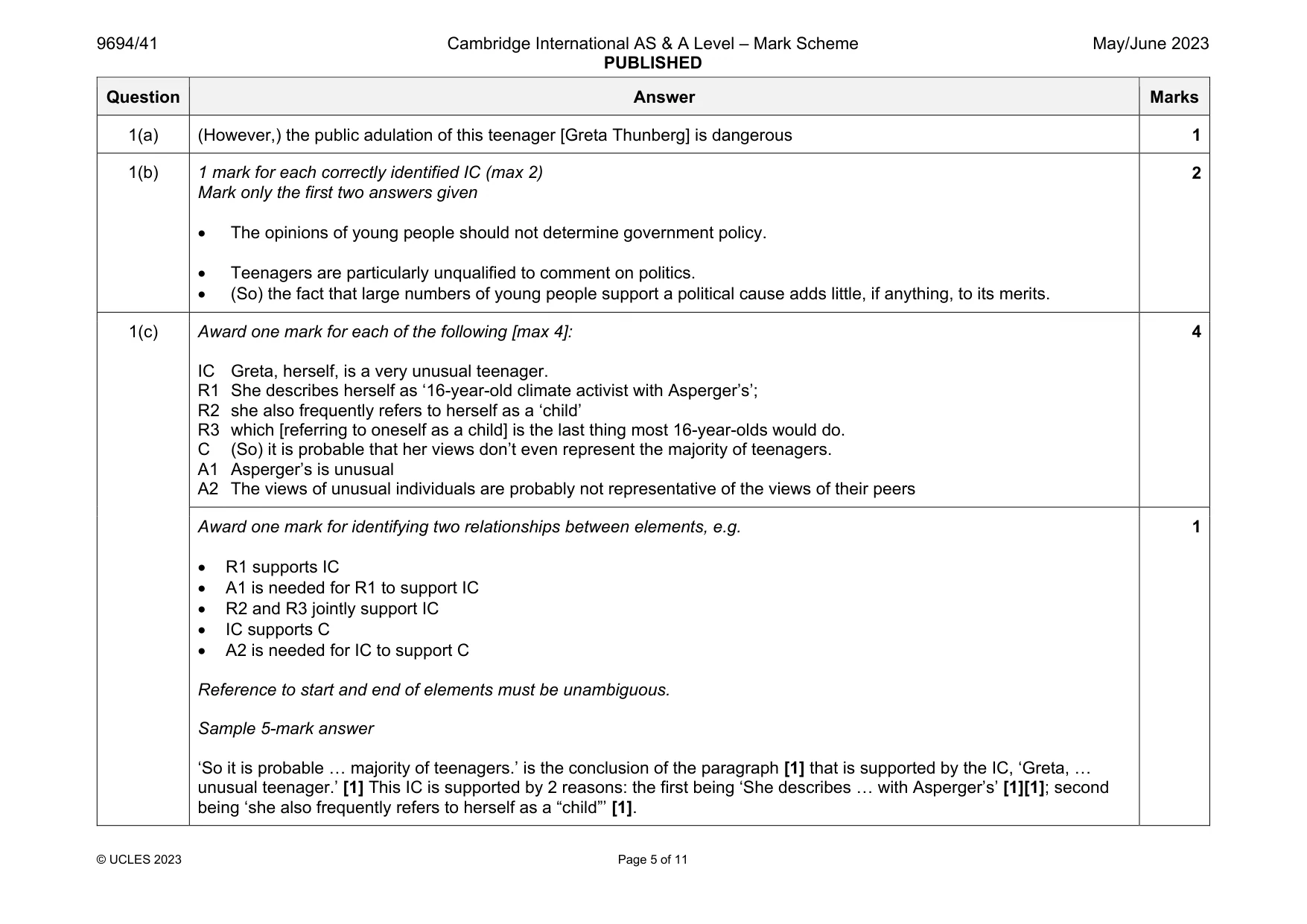
9694/41 Cambridge International AS & A Level – Mark Scheme PUBLISHED May/June 2023 © UCLES 2023 Page 5 of 11 Question Answer Marks 1(a) (However,) the public adulation of this teenager [Greta Thunberg] is dangerous 1 1(b) 1 mark for each correctly identified IC (max 2) Mark only the first two answers given The opinions of young people should not determine government policy. Teenagers are particularly unqualified to comment on politics. (So) the fact that large numbers of young people support a political cause adds little, if anything, to its merits. 2 1(c) Award one mark for each of the following [max 4]: IC Greta, herself, is a very unusual teenager. R1 She describes herself as ‘16-year-old climate activist with Asperger’s’; R2 she also frequently refers to herself as a ‘child’ R3 which [referring to oneself as a child] is the last thing most 16-year-olds would do. C (So) it is probable that her views don’t even represent the majority of teenagers. A1 Asperger’s is unusual A2 The views of unusual individuals are probably not representative of the views of their peers 4 Award one mark for identifying two relationships between elements, e.g. R1 supports IC A1 is needed for R1 to support IC R2 and R3 jointly support IC IC supports C A2 is needed for IC to support C Reference to start and end of elements must be unambiguous. Sample 5-mark answer ‘So it is probable … majority of teenagers.’ is the conclusion of the paragraph [1] that is supported by the IC, ‘Greta, … unusual teenager.’ [1] This IC is supported by 2 reasons: the first being ‘She describes … with Asperger’s’ [1][1]; second being ‘she also frequently refers to herself as a “child”’ [1]. 1
Mark scheme, page 6
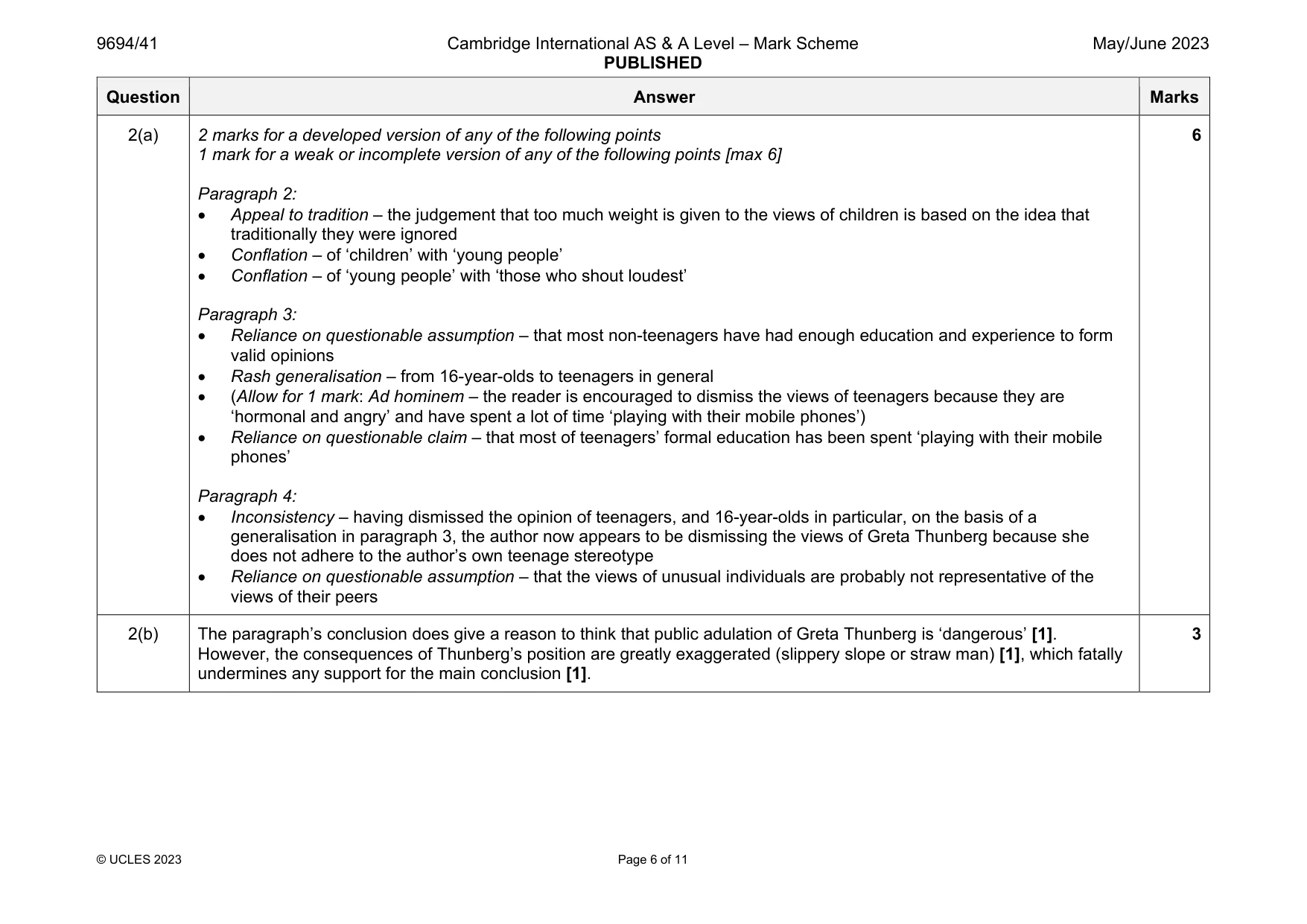
9694/41 Cambridge International AS & A Level – Mark Scheme PUBLISHED May/June 2023 © UCLES 2023 Page 6 of 11 Question Answer Marks 2(a) 2 marks for a developed version of any of the following points 1 mark for a weak or incomplete version of any of the following points [max 6] Paragraph 2: Appeal to tradition – the judgement that too much weight is given to the views of children is based on the idea that traditionally they were ignored Conflation – of ‘children’ with ‘young people’ Conflation – of ‘young people’ with ‘those who shout loudest’ Paragraph 3: Reliance on questionable assumption – that most non-teenagers have had enough education and experience to form valid opinions Rash generalisation – from 16-year-olds to teenagers in general (Allow for 1 mark: Ad hominem – the reader is encouraged to dismiss the views of teenagers because they are ‘hormonal and angry’ and have spent a lot of time ‘playing with their mobile phones’) Reliance on questionable claim – that most of teenagers’ formal education has been spent ‘playing with their mobile phones’ Paragraph 4: Inconsistency – having dismissed the opinion of teenagers, and 16-year-olds in particular, on the basis of a generalisation in paragraph 3, the author now appears to be dismissing the views of Greta Thunberg because she does not adhere to the author’s own teenage stereotype Reliance on questionable assumption – that the views of unusual individuals are probably not representative of the views of their peers 6 2(b) The paragraph’s conclusion does give a reason to think that public adulation of Greta Thunberg is ‘dangerous’ [1]. However, the consequences of Thunberg’s position are greatly exaggerated (slippery slope or straw man) [1], which fatally undermines any support for the main conclusion [1]. 3
Mark scheme, page 7
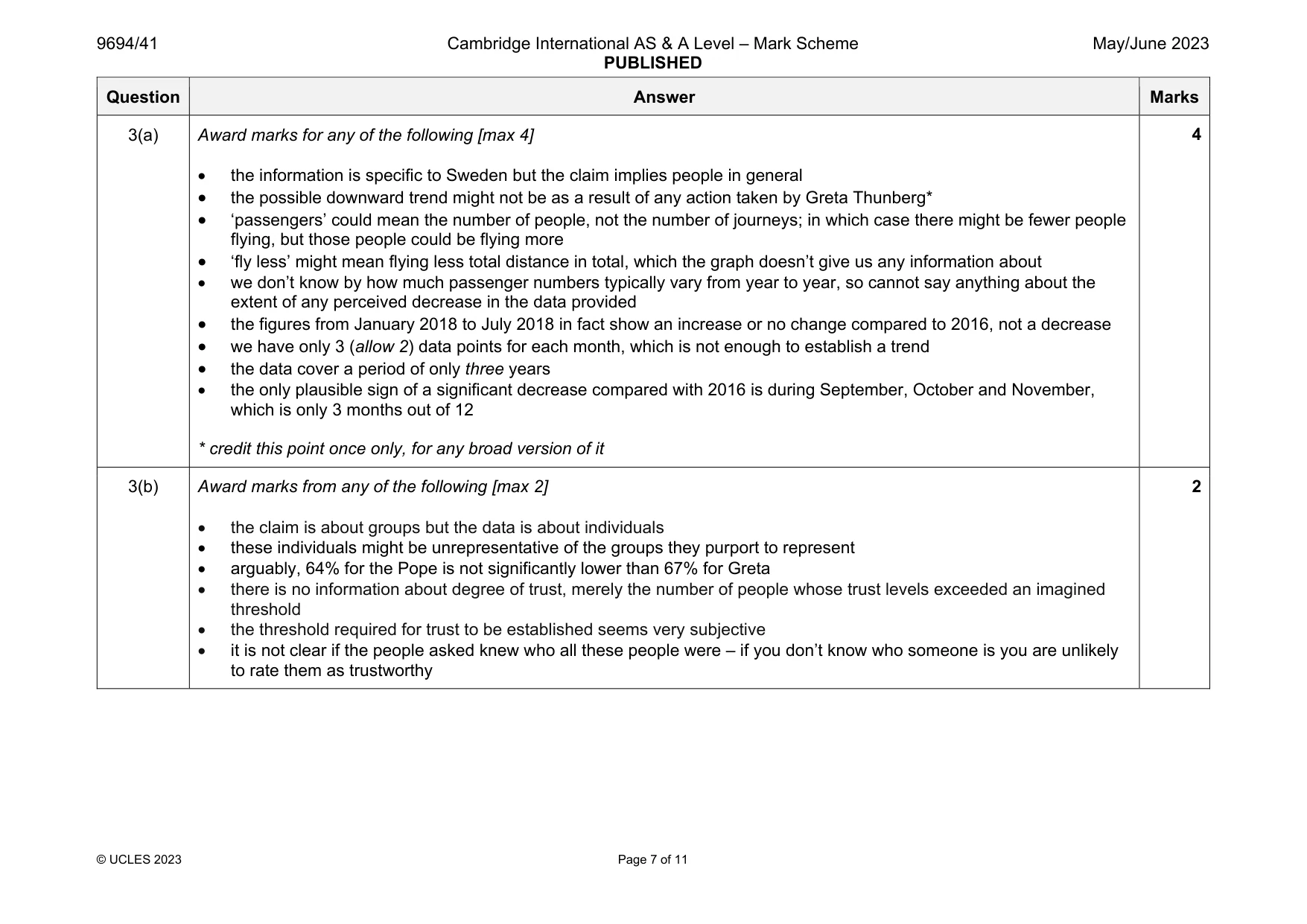
9694/41 Cambridge International AS & A Level – Mark Scheme PUBLISHED May/June 2023 © UCLES 2023 Page 7 of 11 Question Answer Marks 3(a) Award marks for any of the following [max 4] the information is specific to Sweden but the claim implies people in general the possible downward trend might not be as a result of any action taken by Greta Thunberg* ‘passengers’ could mean the number of people, not the number of journeys; in which case there might be fewer people flying, but those people could be flying more ‘fly less’ might mean flying less total distance in total, which the graph doesn’t give us any information about we don’t know by how much passenger numbers typically vary from year to year, so cannot say anything about the extent of any perceived decrease in the data provided the figures from January 2018 to July 2018 in fact show an increase or no change compared to 2016, not a decrease we have only 3 (allow 2) data points for each month, which is not enough to establish a trend the data cover a period of only three years the only plausible sign of a significant decrease compared with 2016 is during September, October and November, which is only 3 months out of 12 * credit this point once only, for any broad version of it 4 3(b) Award marks from any of the following [max 2] the claim is about groups but the data is about individuals these individuals might be unrepresentative of the groups they purport to represent arguably, 64% for the Pope is not significantly lower than 67% for Greta there is no information about degree of trust, merely the number of people whose trust levels exceeded an imagined threshold the threshold required for trust to be established seems very subjective it is not clear if the people asked knew who all these people were – if you don’t know who someone is you are unlikely to rate them as trustworthy 2
Mark scheme, page 8
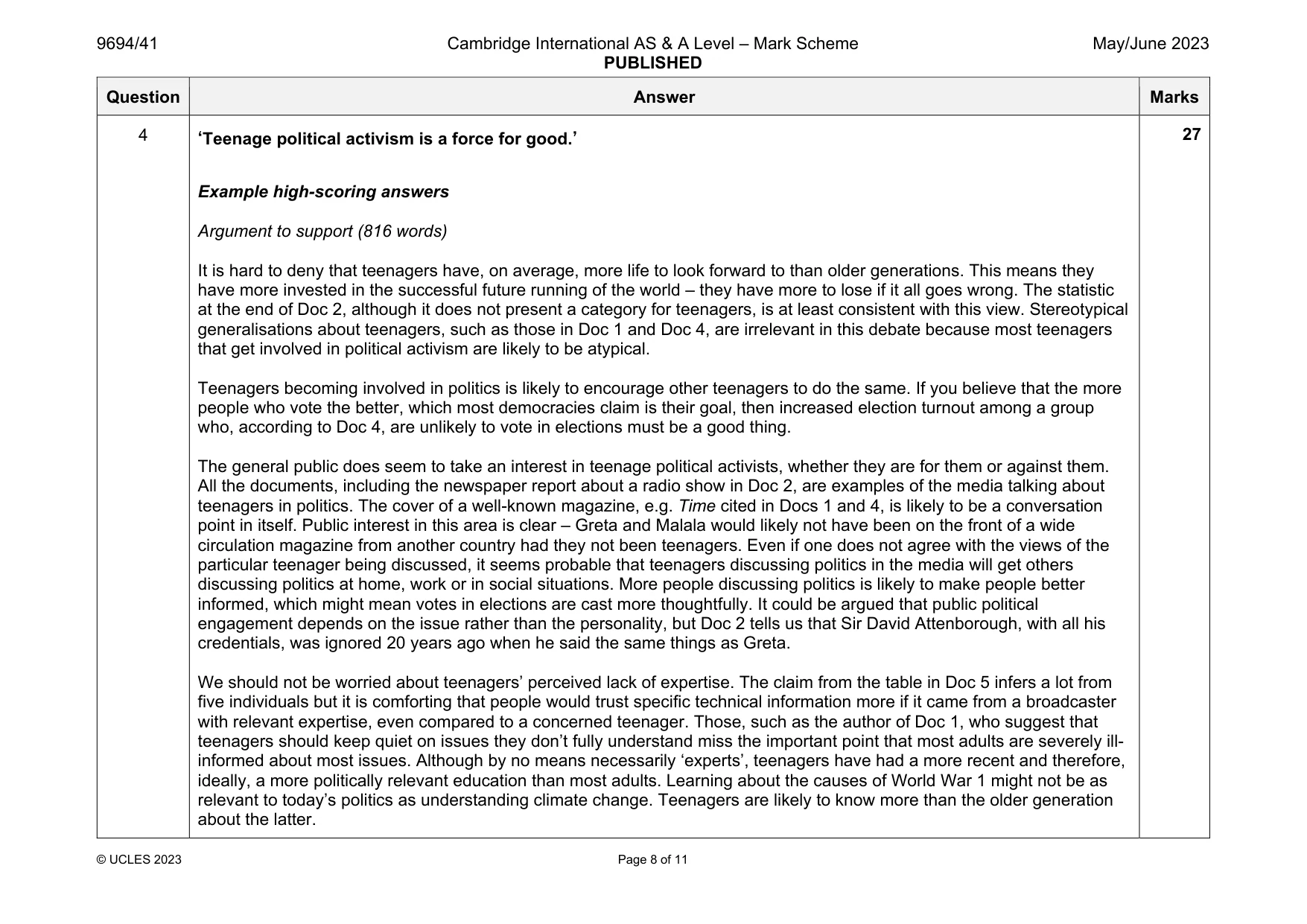
9694/41 Cambridge International AS & A Level – Mark Scheme PUBLISHED May/June 2023 © UCLES 2023 Page 8 of 11 Question Answer Marks 4 ‘Teenage political activism is a force for good.’ Example high-scoring answers Argument to support (816 words) It is hard to deny that teenagers have, on average, more life to look forward to than older generations. This means they have more invested in the successful future running of the world – they have more to lose if it all goes wrong. The statistic at the end of Doc 2, although it does not present a category for teenagers, is at least consistent with this view. Stereotypical generalisations about teenagers, such as those in Doc 1 and Doc 4, are irrelevant in this debate because most teenagers that get involved in political activism are likely to be atypical. Teenagers becoming involved in politics is likely to encourage other teenagers to do the same. If you believe that the more people who vote the better, which most democracies claim is their goal, then increased election turnout among a group who, according to Doc 4, are unlikely to vote in elections must be a good thing. The general public does seem to take an interest in teenage political activists, whether they are for them or against them. All the documents, including the newspaper report about a radio show in Doc 2, are examples of the media talking about teenagers in politics. The cover of a well-known magazine, e.g. Time cited in Docs 1 and 4, is likely to be a conversation point in itself. Public interest in this area is clear – Greta and Malala would likely not have been on the front of a wide circulation magazine from another country had they not been teenagers. Even if one does not agree with the views of the particular teenager being discussed, it seems probable that teenagers discussing politics in the media will get others discussing politics at home, work or in social situations. More people discussing politics is likely to make people better informed, which might mean votes in elections are cast more thoughtfully. It could be argued that public political engagement depends on the issue rather than the personality, but Doc 2 tells us that Sir David Attenborough, with all his credentials, was ignored 20 years ago when he said the same things as Greta. We should not be worried about teenagers’ perceived lack of expertise. The claim from the table in Doc 5 infers a lot from five individuals but it is comforting that people would trust specific technical information more if it came from a broadcaster with relevant expertise, even compared to a concerned teenager. Those, such as the author of Doc 1, who suggest that teenagers should keep quiet on issues they don’t fully understand miss the important point that most adults are severely ill- informed about most issues. Although by no means necessarily ‘experts’, teenagers have had a more recent and therefore, ideally, a more politically relevant education than most adults. Learning about the causes of World War 1 might not be as relevant to today’s politics as understanding climate change. Teenagers are likely to know more than the older generation about the latter. 27
Mark scheme, page 9
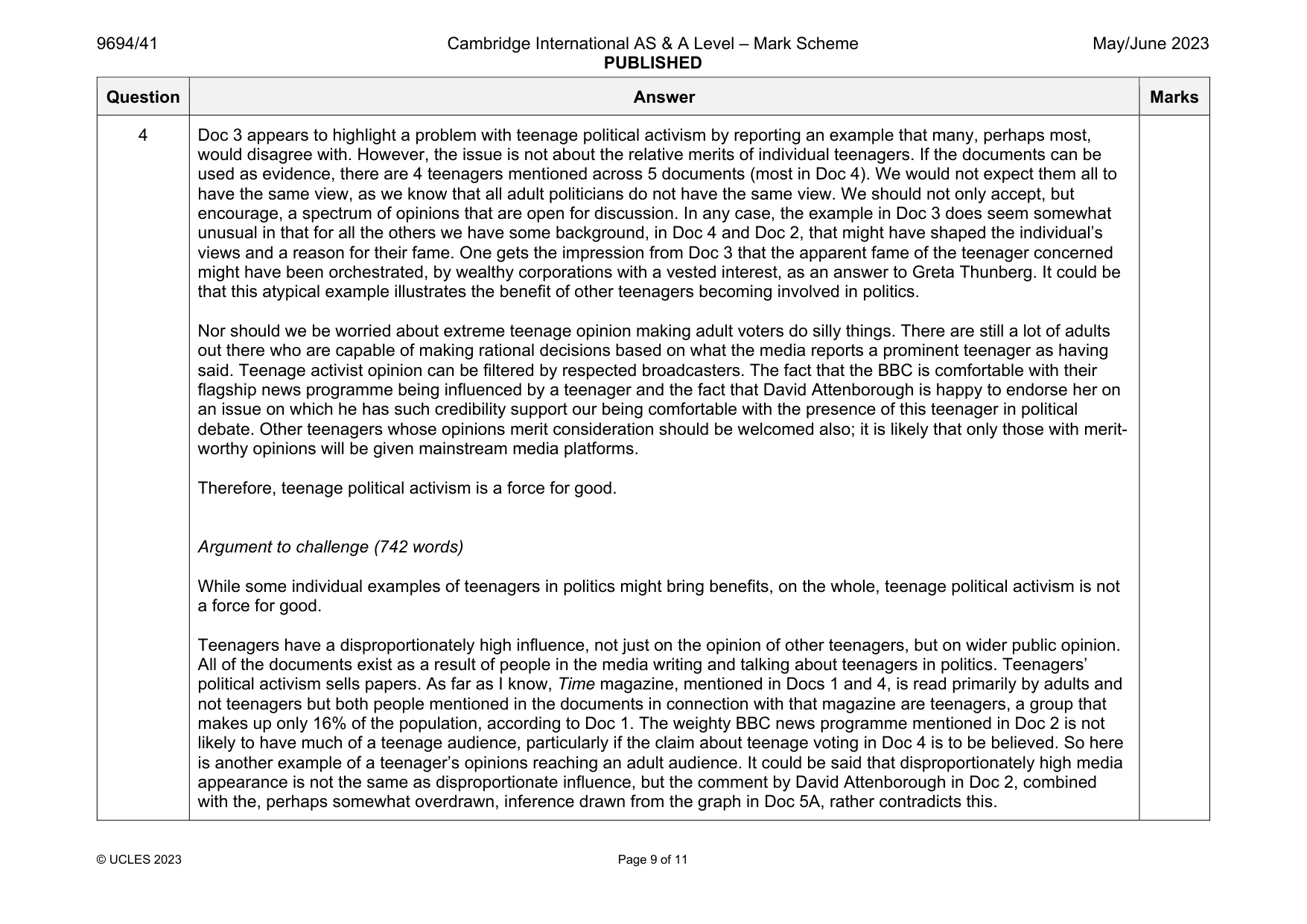
9694/41 Cambridge International AS & A Level – Mark Scheme PUBLISHED May/June 2023 © UCLES 2023 Page 9 of 11 Question Answer Marks 4 Doc 3 appears to highlight a problem with teenage political activism by reporting an example that many, perhaps most, would disagree with. However, the issue is not about the relative merits of individual teenagers. If the documents can be used as evidence, there are 4 teenagers mentioned across 5 documents (most in Doc 4). We would not expect them all to have the same view, as we know that all adult politicians do not have the same view. We should not only accept, but encourage, a spectrum of opinions that are open for discussion. In any case, the example in Doc 3 does seem somewhat unusual in that for all the others we have some background, in Doc 4 and Doc 2, that might have shaped the individual’s views and a reason for their fame. One gets the impression from Doc 3 that the apparent fame of the teenager concerned might have been orchestrated, by wealthy corporations with a vested interest, as an answer to Greta Thunberg. It could be that this atypical example illustrates the benefit of other teenagers becoming involved in politics. Nor should we be worried about extreme teenage opinion making adult voters do silly things. There are still a lot of adults out there who are capable of making rational decisions based on what the media reports a prominent teenager as having said. Teenage activist opinion can be filtered by respected broadcasters. The fact that the BBC is comfortable with their flagship news programme being influenced by a teenager and the fact that David Attenborough is happy to endorse her on an issue on which he has such credibility support our being comfortable with the presence of this teenager in political debate. Other teenagers whose opinions merit consideration should be welcomed also; it is likely that only those with merit- worthy opinions will be given mainstream media platforms. Therefore, teenage political activism is a force for good. Argument to challenge (742 words) While some individual examples of teenagers in politics might bring benefits, on the whole, teenage political activism is not a force for good. Teenagers have a disproportionately high influence, not just on the opinion of other teenagers, but on wider public opinion. All of the documents exist as a result of people in the media writing and talking about teenagers in politics. Teenagers’ political activism sells papers. As far as I know, Time magazine, mentioned in Docs 1 and 4, is read primarily by adults and not teenagers but both people mentioned in the documents in connection with that magazine are teenagers, a group that makes up only 16% of the population, according to Doc 1. The weighty BBC news programme mentioned in Doc 2 is not likely to have much of a teenage audience, particularly if the claim about teenage voting in Doc 4 is to be believed. So here is another example of a teenager’s opinions reaching an adult audience. It could be said that disproportionately high media appearance is not the same as disproportionate influence, but the comment by David Attenborough in Doc 2, combined with the, perhaps somewhat overdrawn, inference drawn from the graph in Doc 5A, rather contradicts this.
Mark scheme, page 10
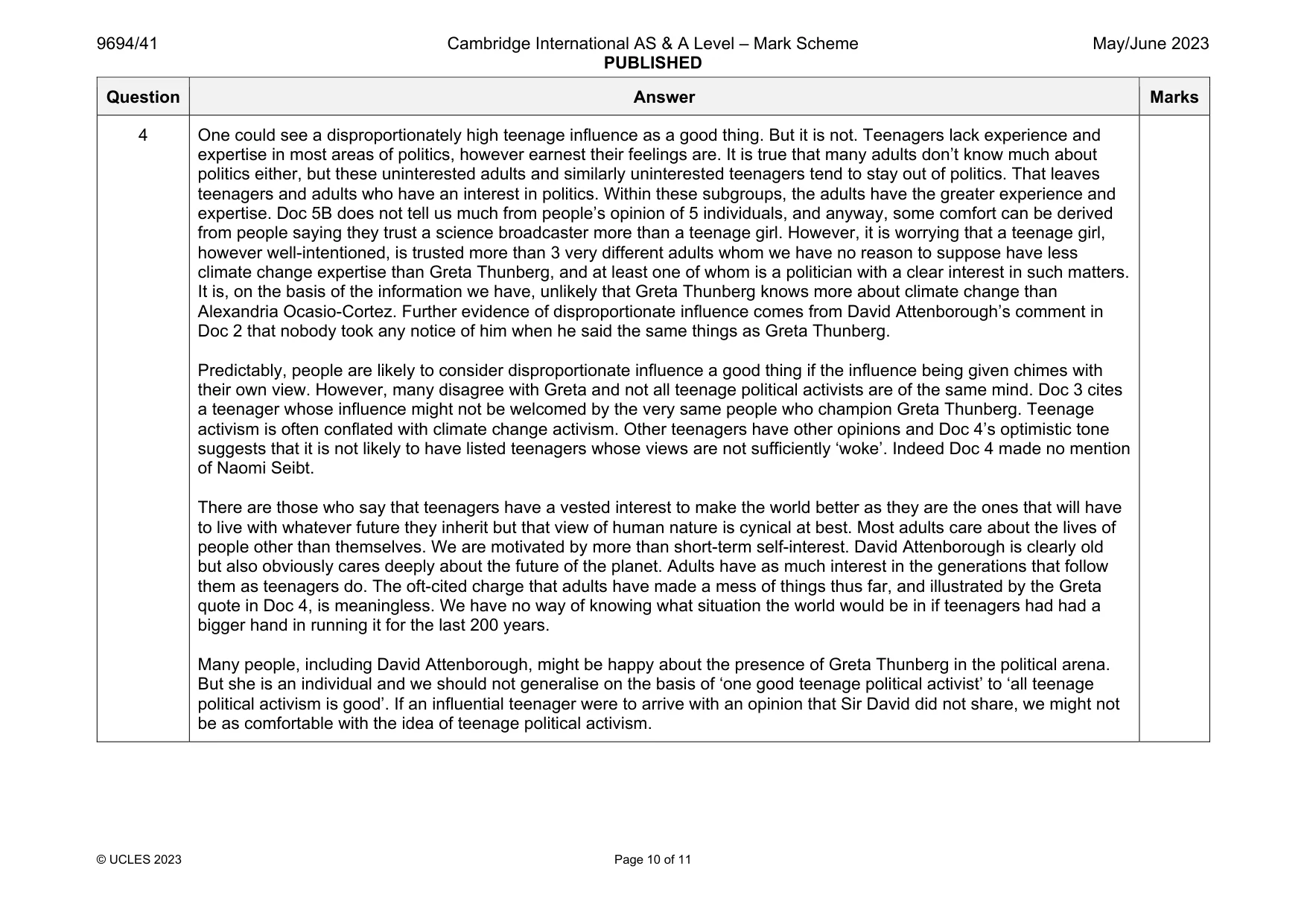
9694/41 Cambridge International AS & A Level – Mark Scheme PUBLISHED May/June 2023 © UCLES 2023 Page 10 of 11 Question Answer Marks 4 One could see a disproportionately high teenage influence as a good thing. But it is not. Teenagers lack experience and expertise in most areas of politics, however earnest their feelings are. It is true that many adults don’t know much about politics either, but these uninterested adults and similarly uninterested teenagers tend to stay out of politics. That leaves teenagers and adults who have an interest in politics. Within these subgroups, the adults have the greater experience and expertise. Doc 5B does not tell us much from people’s opinion of 5 individuals, and anyway, some comfort can be derived from people saying they trust a science broadcaster more than a teenage girl. However, it is worrying that a teenage girl, however well-intentioned, is trusted more than 3 very different adults whom we have no reason to suppose have less climate change expertise than Greta Thunberg, and at least one of whom is a politician with a clear interest in such matters. It is, on the basis of the information we have, unlikely that Greta Thunberg knows more about climate change than Alexandria Ocasio-Cortez. Further evidence of disproportionate influence comes from David Attenborough’s comment in Doc 2 that nobody took any notice of him when he said the same things as Greta Thunberg. Predictably, people are likely to consider disproportionate influence a good thing if the influence being given chimes with their own view. However, many disagree with Greta and not all teenage political activists are of the same mind. Doc 3 cites a teenager whose influence might not be welcomed by the very same people who champion Greta Thunberg. Teenage activism is often conflated with climate change activism. Other teenagers have other opinions and Doc 4’s optimistic tone suggests that it is not likely to have listed teenagers whose views are not sufficiently ‘woke’. Indeed Doc 4 made no mention of Naomi Seibt. There are those who say that teenagers have a vested interest to make the world better as they are the ones that will have to live with whatever future they inherit but that view of human nature is cynical at best. Most adults care about the lives of people other than themselves. We are motivated by more than short-term self-interest. David Attenborough is clearly old but also obviously cares deeply about the future of the planet. Adults have as much interest in the generations that follow them as teenagers do. The oft-cited charge that adults have made a mess of things thus far, and illustrated by the Greta quote in Doc 4, is meaningless. We have no way of knowing what situation the world would be in if teenagers had had a bigger hand in running it for the last 200 years. Many people, including David Attenborough, might be happy about the presence of Greta Thunberg in the political arena. But she is an individual and we should not generalise on the basis of ‘one good teenage political activist’ to ‘all teenage political activism is good’. If an influential teenager were to arrive with an opinion that Sir David did not share, we might not be as comfortable with the idea of teenage political activism.
Mark scheme, page 11
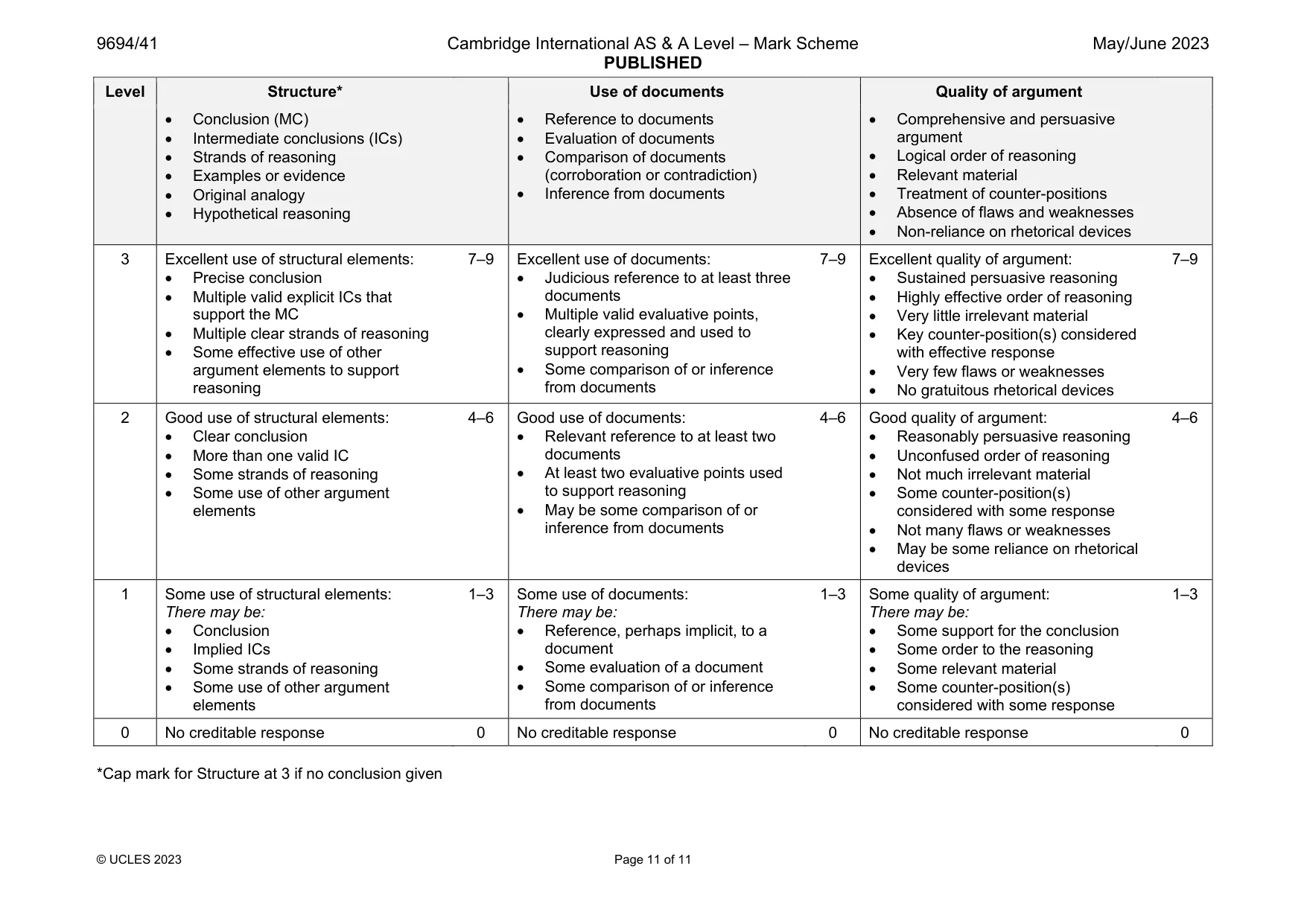
9694/41 Cambridge International AS & A Level – Mark Scheme PUBLISHED May/June 2023 © UCLES 2023 Page 11 of 11 Level Structure* Use of documents Quality of argument Conclusion (MC) Intermediate conclusions (ICs) Strands of reasoning Examples or evidence Original analogy Hypothetical reasoning Reference to documents Evaluation of documents Comparison of documents (corroboration or contradiction) Inference from documents Comprehensive and persuasive argument Logical order of reasoning Relevant material Treatment of counter-positions Absence of flaws and weaknesses Non-reliance on rhetorical devices 3 Excellent use of structural elements: Precise conclusion Multiple valid explicit ICs that support the MC Multiple clear strands of reasoning Some effective use of other argument elements to support reasoning 7–9 Excellent use of documents: Judicious reference to at least three documents Multiple valid evaluative points, clearly expressed and used to support reasoning Some comparison of or inference from documents 7–9 Excellent quality of argument: Sustained persuasive reasoning Highly effective order of reasoning Very little irrelevant material Key counter-position(s) considered with effective response Very few flaws or weaknesses No gratuitous rhetorical devices 7–9 2 Good use of structural elements: Clear conclusion More than one valid IC Some strands of reasoning Some use of other argument elements 4–6 Good use of documents: Relevant reference to at least two documents At least two evaluative points used to support reasoning May be some comparison of or inference from documents 4–6 Good quality of argument: Reasonably persuasive reasoning Unconfused order of reasoning Not much irrelevant material Some counter-position(s) considered with some response Not many flaws or weaknesses May be some reliance on rhetorical devices 4–6 1 Some use of structural elements: There may be: Conclusion Implied ICs Some strands of reasoning Some use of other argument elements 1–3 Some use of documents: There may be: Reference, perhaps implicit, to a document Some evaluation of a document Some comparison of or inference from documents 1–3 Some quality of argument: There may be: Some support for the conclusion Some order to the reasoning Some relevant material Some counter-position(s) considered with some response 1–3 0 No creditable response 0 No creditable response 0 No creditable response 0 *Cap mark for Structure at 3 if no conclusion given
What you needed in this session
Cambridge’s own grade thresholds for 2023 May/June, Paper 4 · Variant 1. A higher threshold means an easier paper — the bar moves with how the cohort did.