Cambridge A Level Thinking Skills 9694 — 2024 May/June Paper 4 · Variant 1
9694/41/M/J/24 · 50 marks · ≈56 min
The question paper and its mark scheme, free to read here and free to download. This is Cambridge’s own paper, exactly as it was sat.
Question paper8 pages

Mark scheme13 pages
Answers below. Sit the paper first if you are practising.
Paper as text
Question paper, page 1
This document has 8 pages. Any blank pages are indicated. [Turn over Cambridge International AS & A Level THINKING SKILLS 9694/41 Paper 4 Applied Reasoning May/June 2024 1 hour 45 minutes You must answer on the enclosed answer booklet. You will need: Answer booklet (enclosed) INSTRUCTIONS ● Answer all questions. ● Follow the instructions on the front cover of the answer booklet. If you need additional answer paper, ask the invigilator for a continuation booklet. INFORMATION ● The total mark for this paper is 50. ● The number of marks for each question or part question is shown in brackets [ ]. * 0 6 8 6 6 9 2 7 2 4 * DC (SL) 330023/1 © UCLES 2024
Question paper, page 2
2 9694/41/M/J/24 © UCLES 2024 Questions 1 and 2 refer to Document 1. 1 (a) State the main conclusion of the argument. [1] (b) Identify two intermediate conclusions in paragraphs 3 to 4. [2] (c) Analyse the structure of the reasoning in paragraph 2. [4] (d) Identify one counter-argument in paragraphs 4 to 6. [1] 2 (a) Identify and explain three flaws and/or weaknesses in the reasoning in paragraphs 3 to 5. [6] (b) Assess the extent to which paragraph 6 supports the argument as a whole. [3] 3 Question 3 refers to Document 2. (a) ‘Homework greatly improves student achievement, as measured by improved exam results and the likelihood of entering higher education after school.’ (Paragraph 4) Identify four weaknesses in the support given by paragraph 4 to this claim. [4] (b) ‘Homework develops good study habits and key skills … that students can use throughout their lives.’ (Paragraph 5) Explain why the support given by paragraph 5 to this claim is weak. [2] 4 You are advised to spend some time planning your answer before you begin to write it. ‘Schools should not set compulsory homework.’ Construct a reasoned argument to support or challenge this claim. In your answer you should make critical use of the documents provided. [27]
Question paper, page 3
3 9694/41/M/J/24 © UCLES 2024 [Turn over DOCUMENT 1 1 In today’s world, it is obviously important that young people go to school and get an education. However, like most aspects of life, there are good things about school and there are bad things. Top of my list of bad things is homework. 2 Many homework tasks, like writing essays, are dull and too difficult for some students to engage with. Furthermore, with incomplete or late homework comes the threat of punishment. Consequently, students find the whole thing very stressful. Many students learn to associate education with stressful situations and so homework can put students off learning altogether. 3 It is misleading to argue that, because working in the evening is something they will do as adults, homework helps students to prepare for work. My father works in a factory making parts for computers. At around 6.30 he arrives home and does no job-related activities at all. Moreover, he did not learn the skills he uses in his job by doing homework when he was a student. 4 The work produced by students at home has no educational value. Teachers often set tasks without much thought about whether they are appropriate, and assignments are often not returned to students anyway – many are not even marked by the teacher. If there were no homework, teachers could use all the hours currently spent setting and assessing homework to produce better lessons that would improve learning. Overall, homework has a negative effect on education. 5 Growing up should not be about only schoolwork. Time in the evenings and weekends should be available for relaxation, hobbies, sport and socialising with friends and family. It is ridiculous for schools to prevent students from doing these things. If children do homework rather than some form of exercise after school, then this could store up all sorts of health problems in the future. Lack of exercise leads to obesity and the subsequent development of heart disease. Schools should stop issuing homework to students. We could see an increase in heart disease in 20 years’ time if they don’t. 6 Of course, some young people are preparing for tests and so would benefit from studying at home, but these tasks should not be compulsory. Students themselves should be able to choose what type of studying they want to do and how much time they will spend on it. Students who set their own studying goals will be more motivated to learn and will not be put off learning for life.
Question paper, page 4
4 9694/41/M/J/24 © UCLES 2024 DOCUMENT 2 1 When my children first received homework from school, they completed it enthusiastically and took pride in what they had produced, never questioning its value. When they were a little older, they had a different view: they completed it reluctantly, often only after much parental encouragement, and frequently claimed that it added nothing to their education. However, by the time they got to university, their view changed again and, whilst not perhaps enthusiastic about homework, they could certainly see its value. 2 Many things have changed in education over the last 100 years but one of the constants has been homework. So the positives must outweigh the negatives. Let’s look at some of them. 3 It is obvious that homework allows extra time for students to consolidate what they have learned in class. Class time is limited, and many things are difficult to learn without substantial practice. Using class time for practice means less time for introducing and explaining new topics. So homework increases the effectiveness of any school-based education students receive. Of course, poorly planned tasks can add little, if anything, to school learning but planned homework that can be completed independently and with ease is the goal of most teachers. 4 Homework greatly improves student achievement, as measured by improved exam results and the likelihood of entering higher education after school. According to the educational research literature, 64% of homework studies conducted in the last 10 years showed that completing assignments at home was effective in improving academic achievement. A recent report in an education research journal reported that children who spent an average of an hour a day on homework scored 40% higher on a national standardised mathematics test than their peers who completed no homework. 5 Homework develops good study habits and key skills, like self-discipline, time management and problem solving, that students can use throughout their lives. Research by a leading US university noted that ‘students who engage in self-regulatory processes, such as goal setting and time management, while completing homework are generally more motivated and are higher achievers than those who do not use these processes’. 6 Take-home assignments also allow parents to be more involved with their children’s education, enabling them to track what their children are learning at school and become more informed about their academic strengths and weaknesses. This can often make parents aware of the existence of any learning disabilities their children may have and thus allow them to seek the appropriate help. Countless studies, including one from the prestigious Johns Hopkins University in the US, have demonstrated beyond doubt that increased parental involvement with education at home is associated with improved class performance by students.
Question paper, page 5
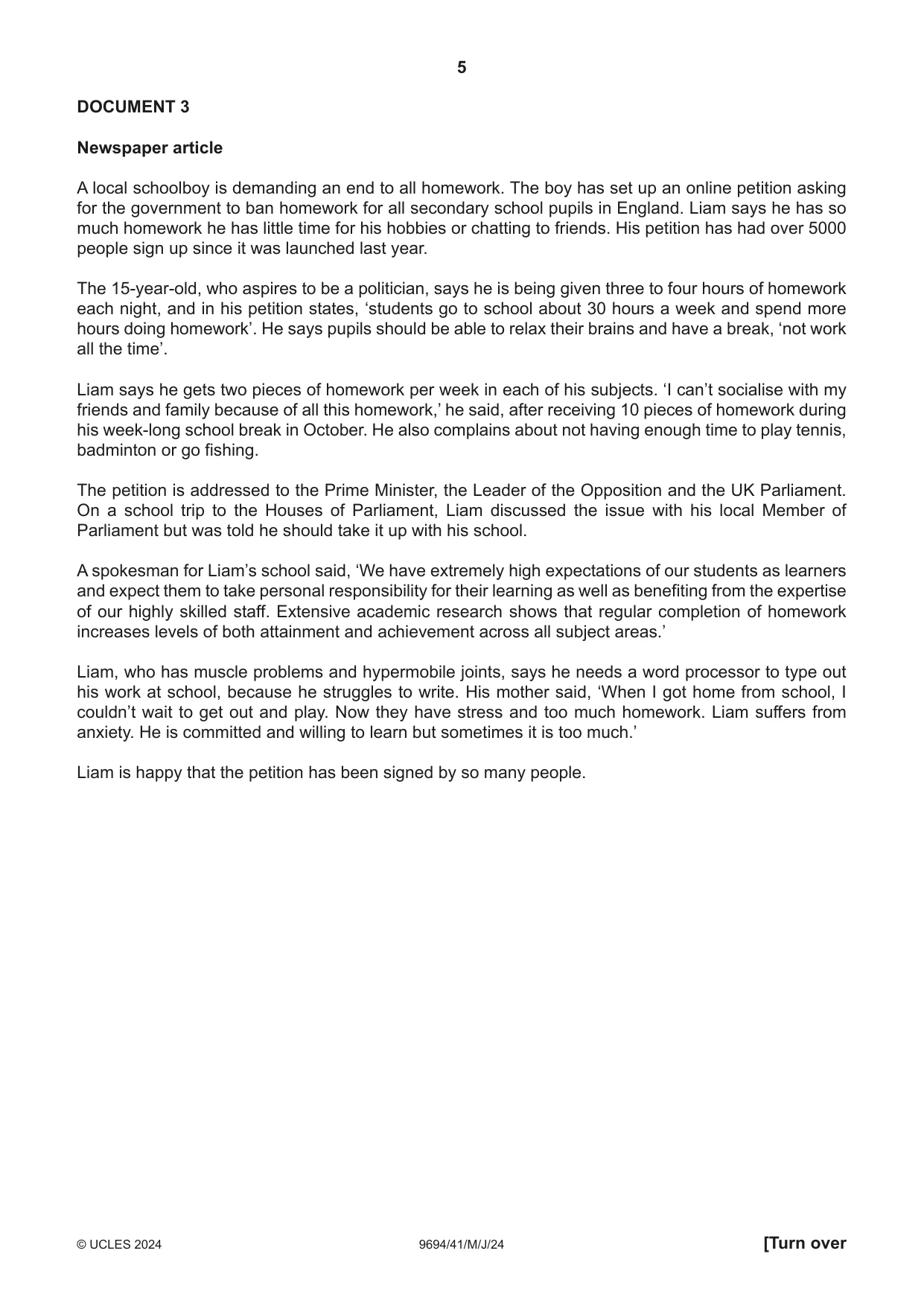
5 9694/41/M/J/24 © UCLES 2024 [Turn over DOCUMENT 3 Newspaper article A local schoolboy is demanding an end to all homework. The boy has set up an online petition asking for the government to ban homework for all secondary school pupils in England. Liam says he has so much homework he has little time for his hobbies or chatting to friends. His petition has had over 5000 people sign up since it was launched last year. The 15-year-old, who aspires to be a politician, says he is being given three to four hours of homework each night, and in his petition states, ‘students go to school about 30 hours a week and spend more hours doing homework’. He says pupils should be able to relax their brains and have a break, ‘not work all the time’. Liam says he gets two pieces of homework per week in each of his subjects. ‘I can’t socialise with my friends and family because of all this homework,’ he said, after receiving 10 pieces of homework during his week-long school break in October. He also complains about not having enough time to play tennis, badminton or go fishing. The petition is addressed to the Prime Minister, the Leader of the Opposition and the UK Parliament. On a school trip to the Houses of Parliament, Liam discussed the issue with his local Member of Parliament but was told he should take it up with his school. A spokesman for Liam’s school said, ‘We have extremely high expectations of our students as learners and expect them to take personal responsibility for their learning as well as benefiting from the expertise of our highly skilled staff. Extensive academic research shows that regular completion of homework increases levels of both attainment and achievement across all subject areas.’ Liam, who has muscle problems and hypermobile joints, says he needs a word processor to type out his work at school, because he struggles to write. His mother said, ‘When I got home from school, I couldn’t wait to get out and play. Now they have stress and too much homework. Liam suffers from anxiety. He is committed and willing to learn but sometimes it is too much.’ Liam is happy that the petition has been signed by so many people.
Question paper, page 6
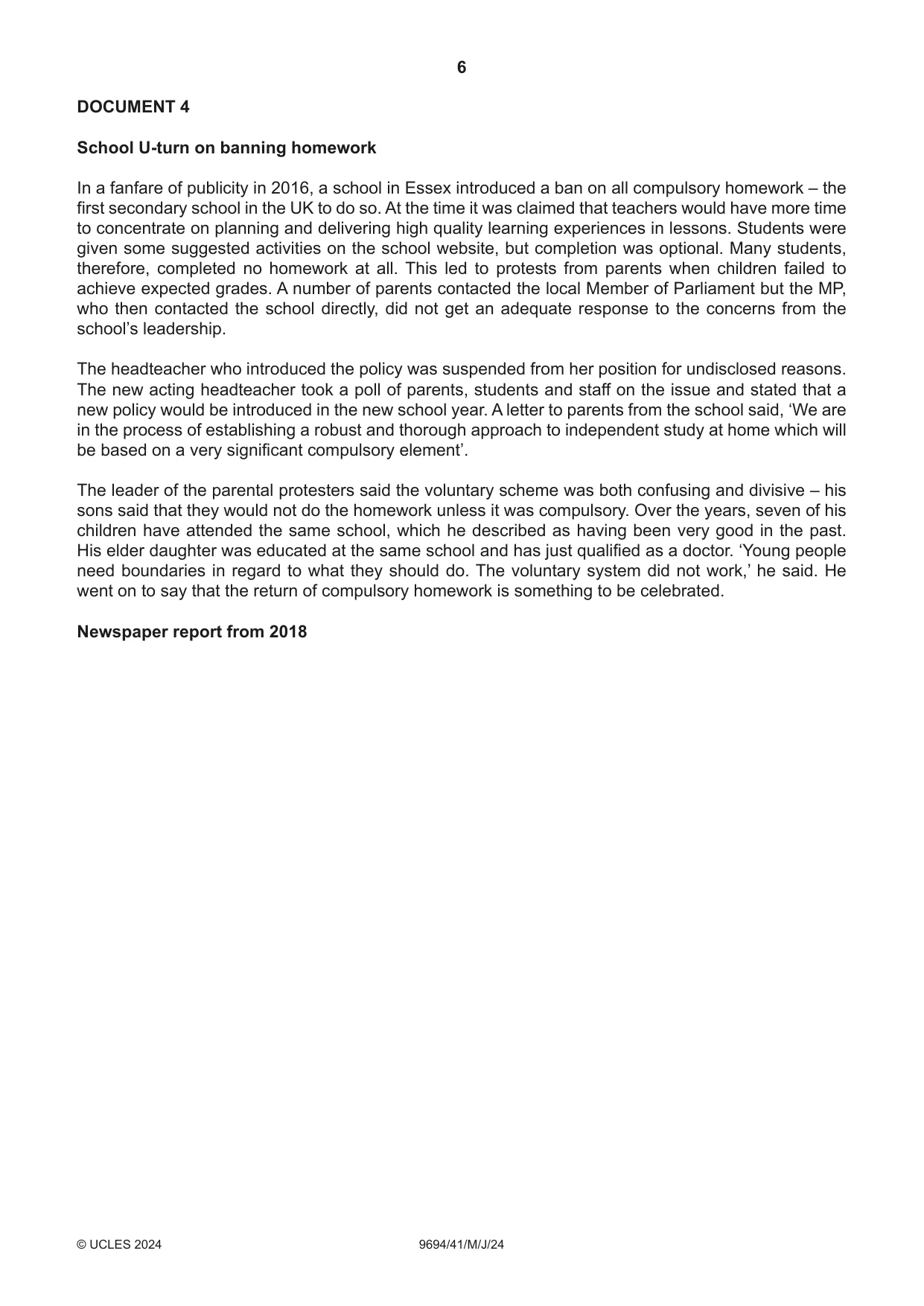
6 9694/41/M/J/24 © UCLES 2024 DOCUMENT 4 School U-turn on banning homework In a fanfare of publicity in 2016, a school in Essex introduced a ban on all compulsory homework – the first secondary school in the UK to do so. At the time it was claimed that teachers would have more time to concentrate on planning and delivering high quality learning experiences in lessons. Students were given some suggested activities on the school website, but completion was optional. Many students, therefore, completed no homework at all. This led to protests from parents when children failed to achieve expected grades. A number of parents contacted the local Member of Parliament but the MP, who then contacted the school directly, did not get an adequate response to the concerns from the school’s leadership. The headteacher who introduced the policy was suspended from her position for undisclosed reasons. The new acting headteacher took a poll of parents, students and staff on the issue and stated that a new policy would be introduced in the new school year. A letter to parents from the school said, ‘We are in the process of establishing a robust and thorough approach to independent study at home which will be based on a very significant compulsory element’. The leader of the parental protesters said the voluntary scheme was both confusing and divisive – his sons said that they would not do the homework unless it was compulsory. Over the years, seven of his children have attended the same school, which he described as having been very good in the past. His elder daughter was educated at the same school and has just qualified as a doctor. ‘Young people need boundaries in regard to what they should do. The voluntary system did not work,’ he said. He went on to say that the return of compulsory homework is something to be celebrated. Newspaper report from 2018
Question paper, page 7
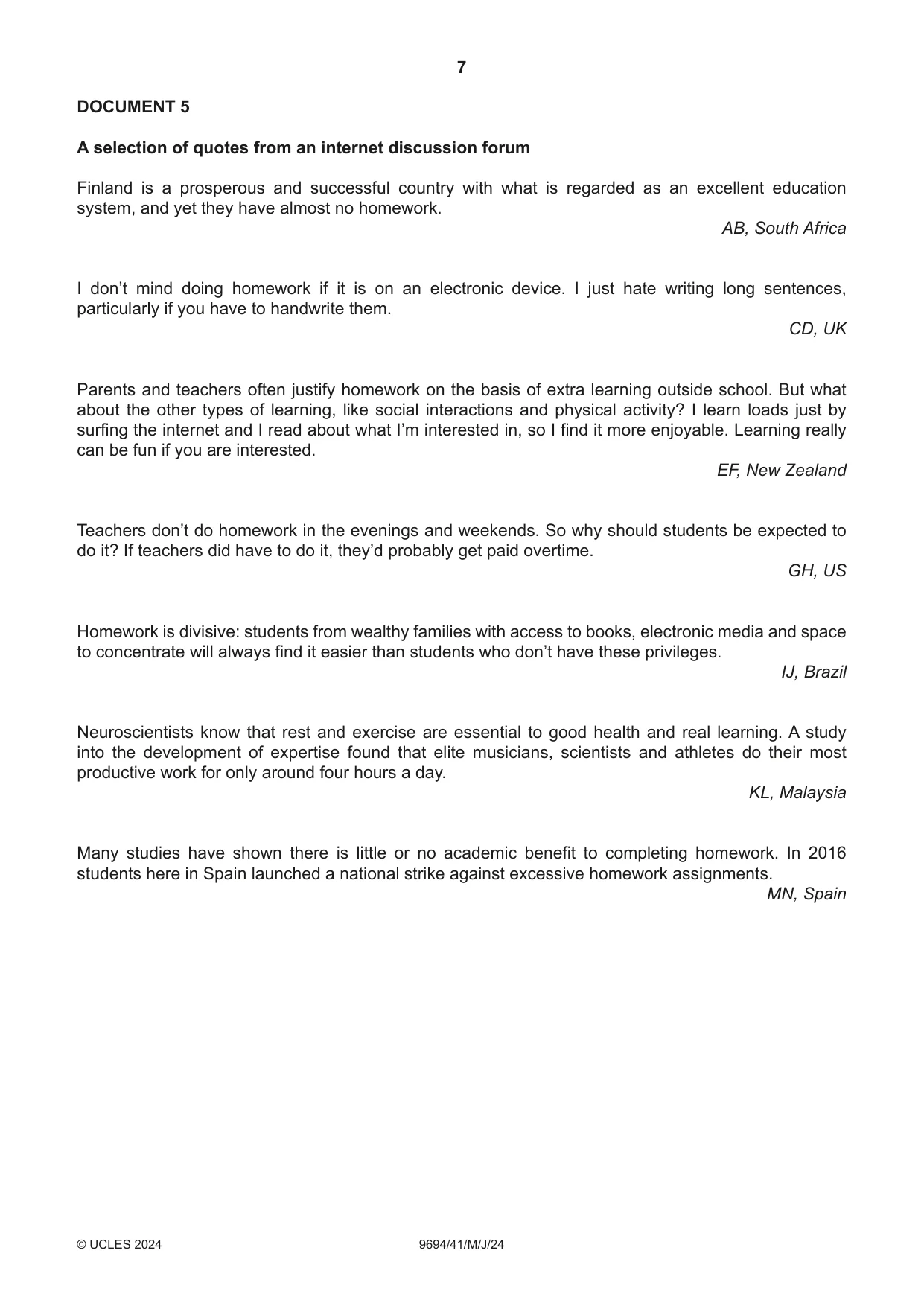
7 9694/41/M/J/24 © UCLES 2024 DOCUMENT 5 A selection of quotes from an internet discussion forum Finland is a prosperous and successful country with what is regarded as an excellent education system, and yet they have almost no homework. AB, South Africa I don’t mind doing homework if it is on an electronic device. I just hate writing long sentences, particularly if you have to handwrite them. CD, UK Parents and teachers often justify homework on the basis of extra learning outside school. But what about the other types of learning, like social interactions and physical activity? I learn loads just by surfing the internet and I read about what I’m interested in, so I find it more enjoyable. Learning really can be fun if you are interested. EF, New Zealand Teachers don’t do homework in the evenings and weekends. So why should students be expected to do it? If teachers did have to do it, they’d probably get paid overtime. GH, US Homework is divisive: students from wealthy families with access to books, electronic media and space to concentrate will always find it easier than students who don’t have these privileges. IJ, Brazil Neuroscientists know that rest and exercise are essential to good health and real learning. A study into the development of expertise found that elite musicians, scientists and athletes do their most productive work for only around four hours a day. KL, Malaysia Many studies have shown there is little or no academic benefit to completing homework. In 2016 students here in Spain launched a national strike against excessive homework assignments. MN, Spain
Question paper, page 8
8 9694/41/M/J/24 © UCLES 2024 Permission to reproduce items where third-party owned material protected by copyright is included has been sought and cleared where possible. Every reasonable effort has been made by the publisher (UCLES) to trace copyright holders, but if any items requiring clearance have unwittingly been included, the publisher will be pleased to make amends at the earliest possible opportunity. To avoid the issue of disclosure of answer-related information to candidates, all copyright acknowledgements are reproduced online in the Cambridge Assessment International Education Copyright Acknowledgements Booklet. This is produced for each series of examinations and is freely available to download at www.cambridgeinternational.org after the live examination series. Cambridge Assessment International Education is part of Cambridge Assessment. Cambridge Assessment is the brand name of the University of Cambridge Local Examinations Syndicate (UCLES), which is a department of the University of Cambridge. BLANK PAGE
Mark scheme, page 1
This document consists of 13 printed pages. © Cambridge University Press & Assessment 2024 [Turn over Cambridge International AS & A Level THINKING SKILLS 9694/41 Paper 4 Applied Reasoning May/June 2024 MARK SCHEME Maximum Mark: 50 Published This mark scheme is published as an aid to teachers and candidates, to indicate the requirements of the examination. It shows the basis on which Examiners were instructed to award marks. It does not indicate the details of the discussions that took place at an Examiners’ meeting before marking began, which would have considered the acceptability of alternative answers. Mark schemes should be read in conjunction with the question paper and the Principal Examiner Report for Teachers. Cambridge International will not enter into discussions about these mark schemes. Cambridge International is publishing the mark schemes for the May/June 2024 series for most Cambridge IGCSE, Cambridge International A and AS Level and Cambridge Pre-U components, and some Cambridge O Level components.
Mark scheme, page 2
9694/41 Cambridge International AS & A Level – Mark Scheme PUBLISHED May/June 2024 © Cambridge University Press & Assessment 2024 Page 2 of 13 Generic Marking Principles These general marking principles must be applied by all examiners when marking candidate answers. They should be applied alongside the specific content of the mark scheme or generic level descriptions for a question. Each question paper and mark scheme will also comply with these marking principles. GENERIC MARKING PRINCIPLE 1: Marks must be awarded in line with: the specific content of the mark scheme or the generic level descriptors for the question the specific skills defined in the mark scheme or in the generic level descriptors for the question the standard of response required by a candidate as exemplified by the standardisation scripts. GENERIC MARKING PRINCIPLE 2: Marks awarded are always whole marks (not half marks, or other fractions). GENERIC MARKING PRINCIPLE 3: Marks must be awarded positively: marks are awarded for correct/valid answers, as defined in the mark scheme. However, credit is given for valid answers which go beyond the scope of the syllabus and mark scheme, referring to your Team Leader as appropriate marks are awarded when candidates clearly demonstrate what they know and can do marks are not deducted for errors marks are not deducted for omissions answers should only be judged on the quality of spelling, punctuation and grammar when these features are specifically assessed by the question as indicated by the mark scheme. The meaning, however, should be unambiguous. GENERIC MARKING PRINCIPLE 4: Rules must be applied consistently, e.g. in situations where candidates have not followed instructions or in the application of generic level descriptors.
Mark scheme, page 3
9694/41 Cambridge International AS & A Level – Mark Scheme PUBLISHED May/June 2024 © Cambridge University Press & Assessment 2024 Page 3 of 13 GENERIC MARKING PRINCIPLE 5: Marks should be awarded using the full range of marks defined in the mark scheme for the question (however; the use of the full mark range may be limited according to the quality of the candidate responses seen). GENERIC MARKING PRINCIPLE 6: Marks awarded are based solely on the requirements as defined in the mark scheme. Marks should not be awarded with grade thresholds or grade descriptors in mind.
Mark scheme, page 4
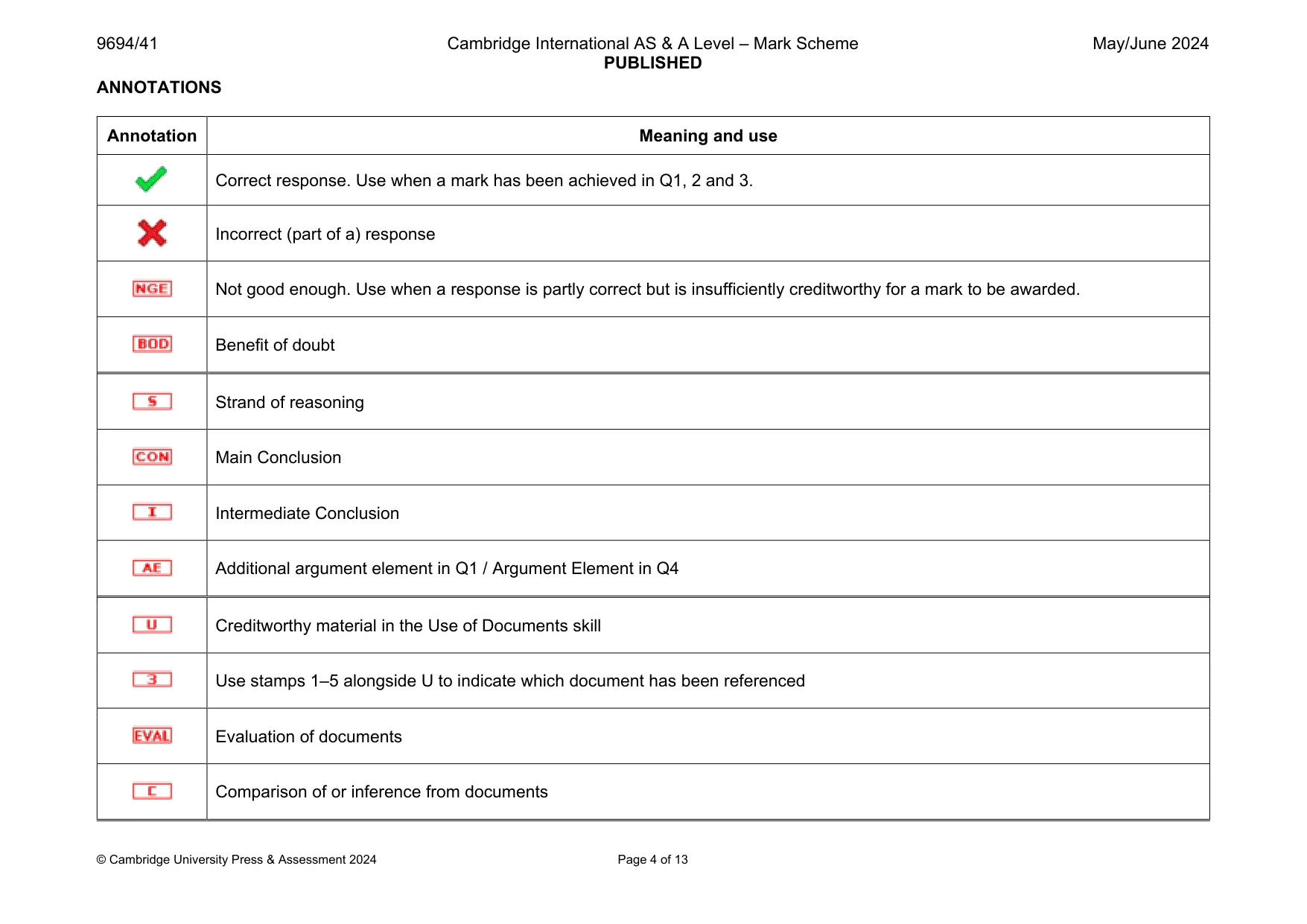
9694/41 Cambridge International AS & A Level – Mark Scheme PUBLISHED May/June 2024 © Cambridge University Press & Assessment 2024 Page 4 of 13 ANNOTATIONS Annotation Meaning and use Correct response. Use when a mark has been achieved in Q1, 2 and 3. Incorrect (part of a) response Not good enough. Use when a response is partly correct but is insufficiently creditworthy for a mark to be awarded. Benefit of doubt Strand of reasoning Main Conclusion Intermediate Conclusion Additional argument element in Q1 / Argument Element in Q4 Creditworthy material in the Use of Documents skill Use stamps 1–5 alongside U to indicate which document has been referenced Evaluation of documents Comparison of or inference from documents
Mark scheme, page 5
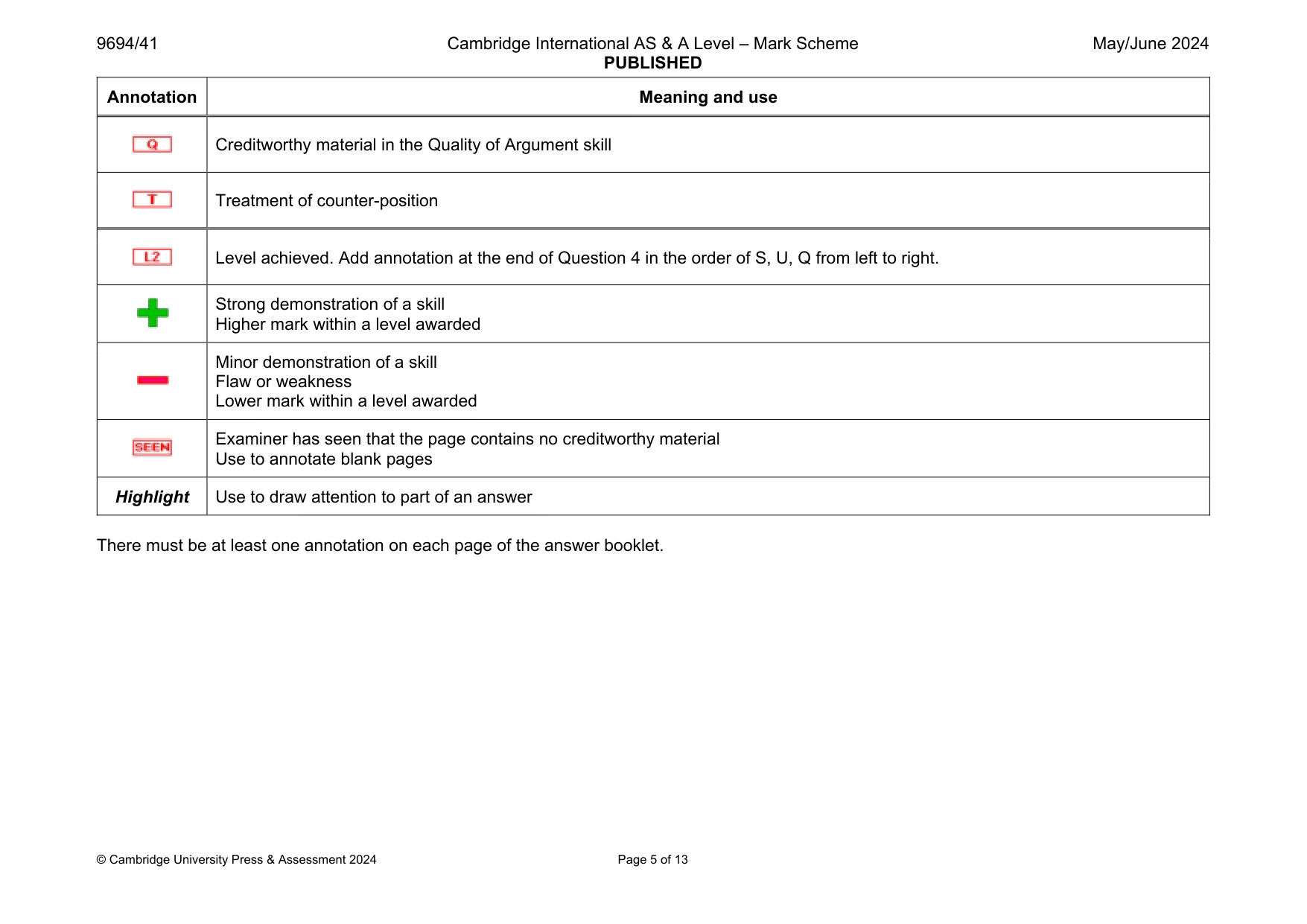
9694/41 Cambridge International AS & A Level – Mark Scheme PUBLISHED May/June 2024 © Cambridge University Press & Assessment 2024 Page 5 of 13 Annotation Meaning and use Creditworthy material in the Quality of Argument skill Treatment of counter-position Level achieved. Add annotation at the end of Question 4 in the order of S, U, Q from left to right. Strong demonstration of a skill Higher mark within a level awarded Minor demonstration of a skill Flaw or weakness Lower mark within a level awarded Examiner has seen that the page contains no creditworthy material Use to annotate blank pages Highlight Use to draw attention to part of an answer There must be at least one annotation on each page of the answer booklet.
Mark scheme, page 6
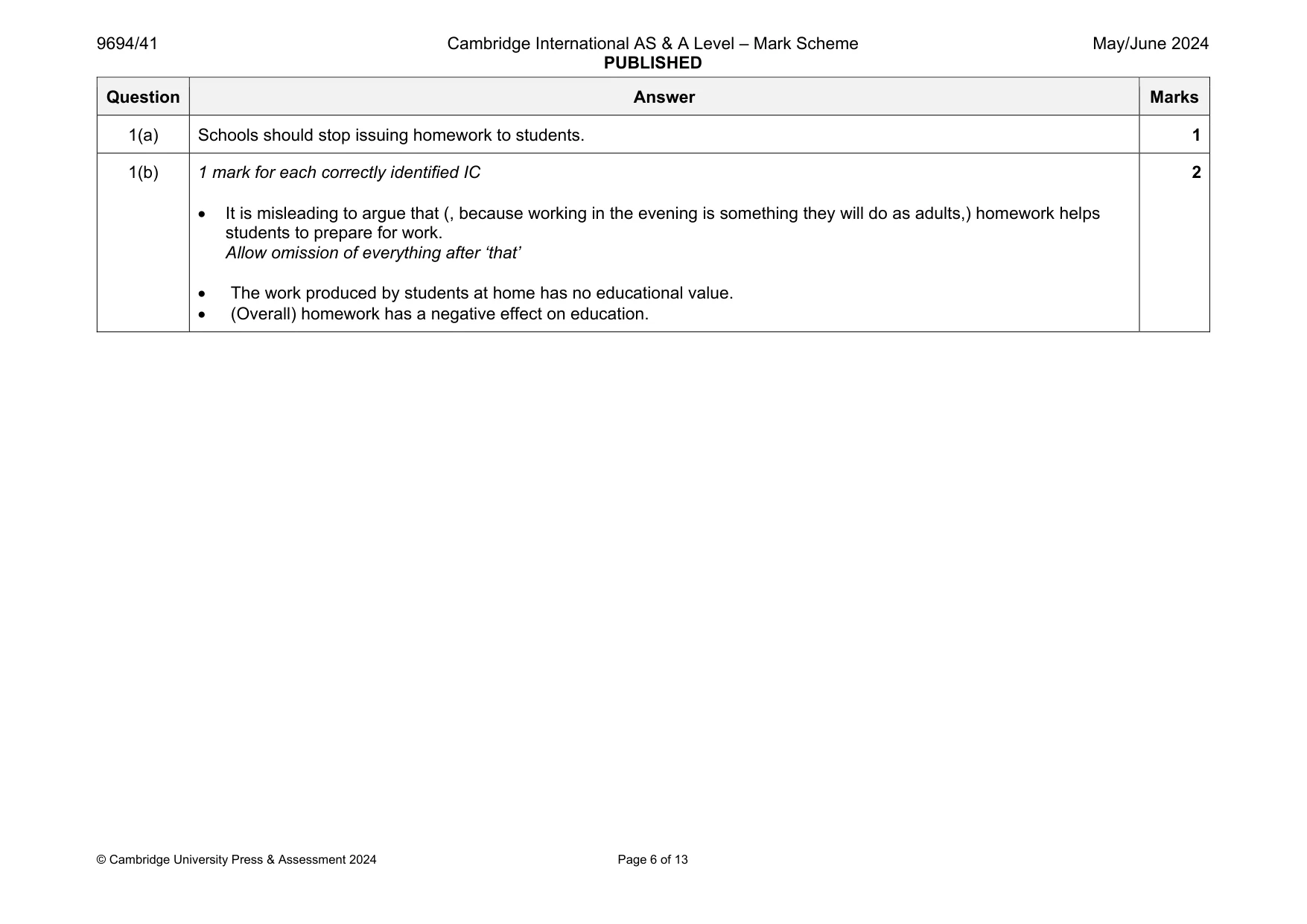
9694/41 Cambridge International AS & A Level – Mark Scheme PUBLISHED May/June 2024 © Cambridge University Press & Assessment 2024 Page 6 of 13 Question Answer Marks 1(a) Schools should stop issuing homework to students. 1 1(b) 1 mark for each correctly identified IC It is misleading to argue that (, because working in the evening is something they will do as adults,) homework helps students to prepare for work. Allow omission of everything after ‘that’ The work produced by students at home has no educational value. (Overall) homework has a negative effect on education. 2
Mark scheme, page 7
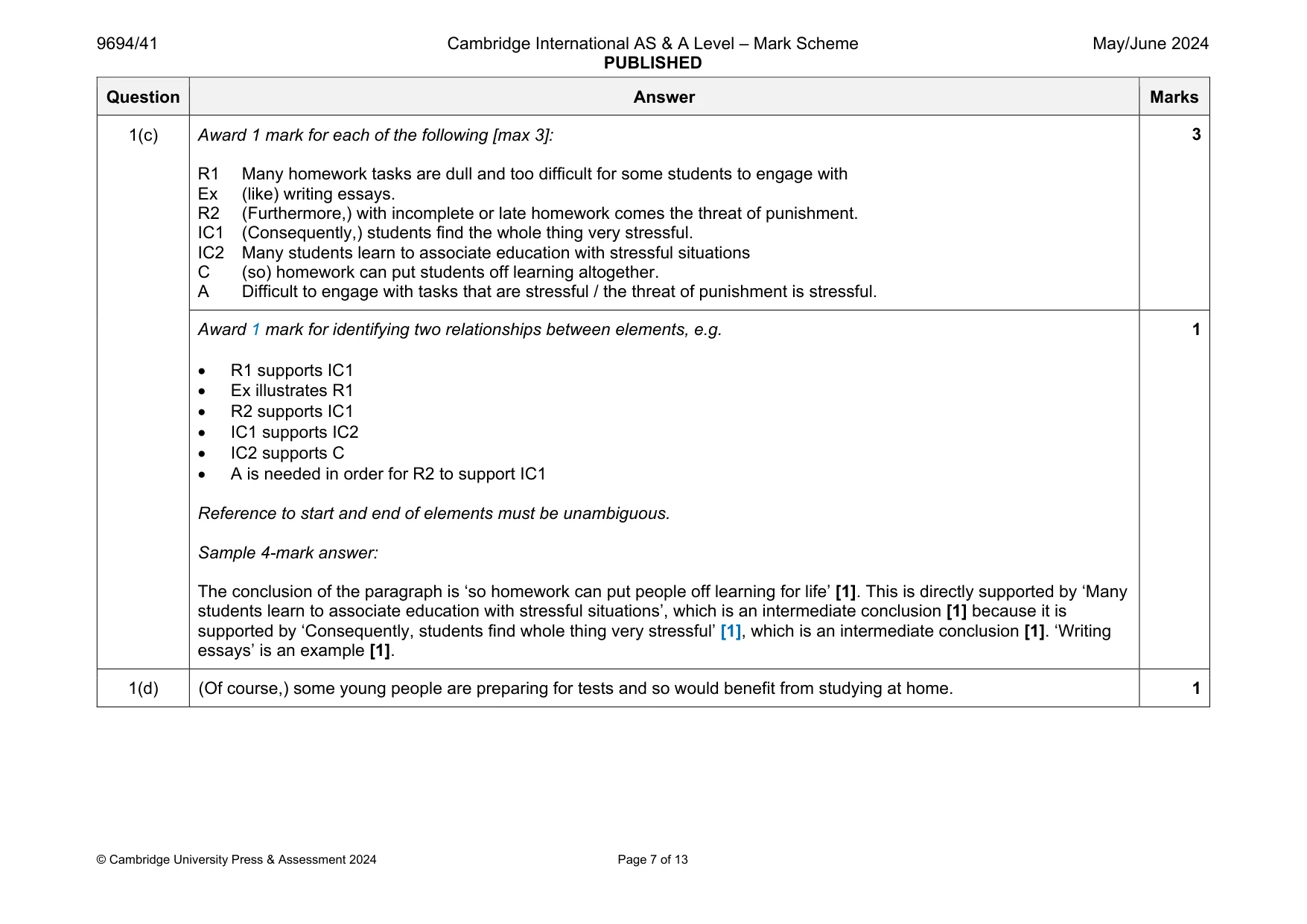
9694/41 Cambridge International AS & A Level – Mark Scheme PUBLISHED May/June 2024 © Cambridge University Press & Assessment 2024 Page 7 of 13 Question Answer Marks 1(c) Award 1 mark for each of the following [max 3]: R1 Many homework tasks are dull and too difficult for some students to engage with Ex (like) writing essays. R2 (Furthermore,) with incomplete or late homework comes the threat of punishment. IC1 (Consequently,) students find the whole thing very stressful. IC2 Many students learn to associate education with stressful situations C (so) homework can put students off learning altogether. A Difficult to engage with tasks that are stressful / the threat of punishment is stressful. 3 Award 1 mark for identifying two relationships between elements, e.g. R1 supports IC1 Ex illustrates R1 R2 supports IC1 IC1 supports IC2 IC2 supports C A is needed in order for R2 to support IC1 Reference to start and end of elements must be unambiguous. Sample 4-mark answer: The conclusion of the paragraph is ‘so homework can put people off learning for life’ [1]. This is directly supported by ‘Many students learn to associate education with stressful situations’, which is an intermediate conclusion [1] because it is supported by ‘Consequently, students find whole thing very stressful’ [1], which is an intermediate conclusion [1]. ‘Writing essays’ is an example [1]. 1 1(d) (Of course,) some young people are preparing for tests and so would benefit from studying at home. 1
Mark scheme, page 8
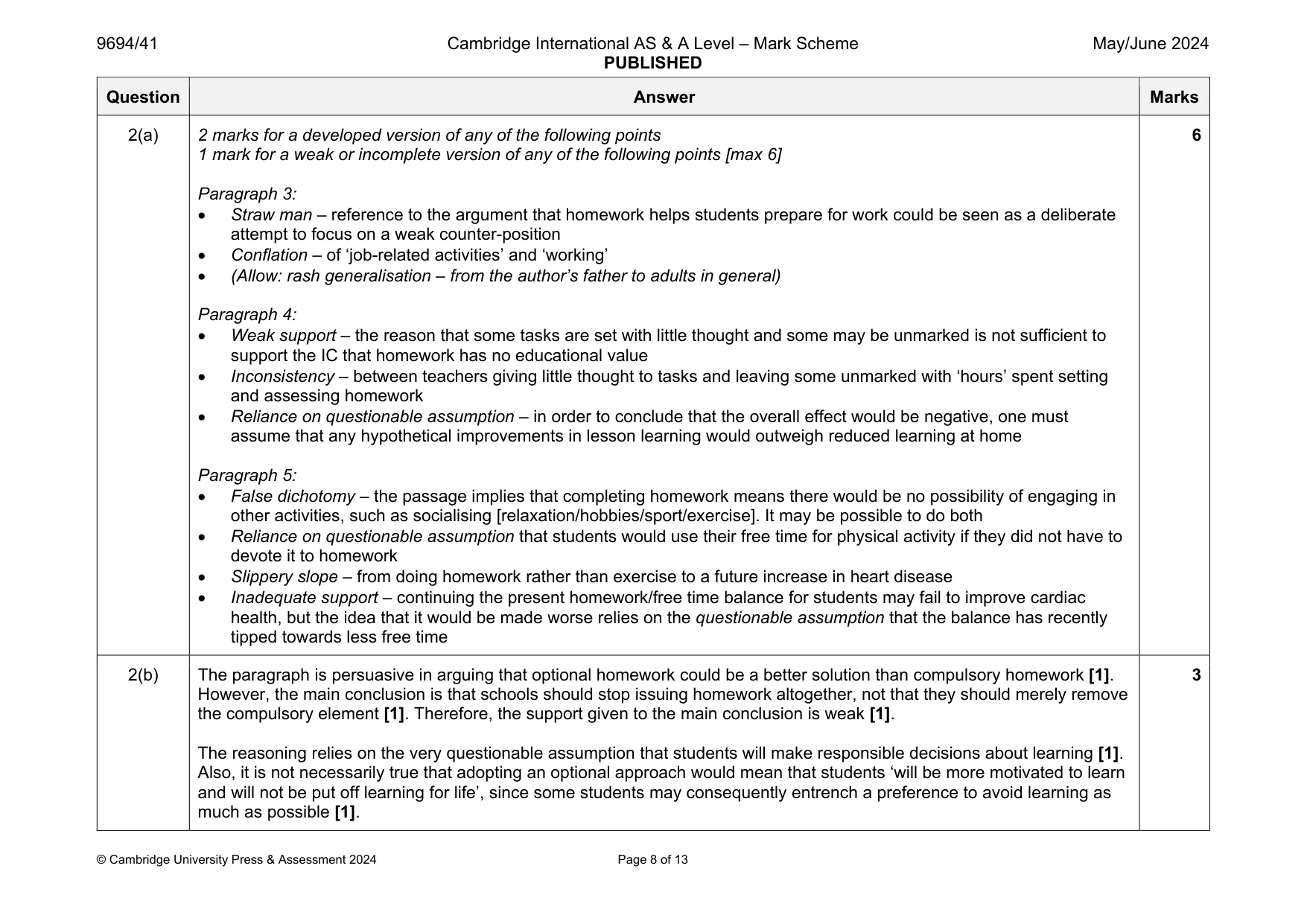
9694/41 Cambridge International AS & A Level – Mark Scheme PUBLISHED May/June 2024 © Cambridge University Press & Assessment 2024 Page 8 of 13 Question Answer Marks 2(a) 2 marks for a developed version of any of the following points 1 mark for a weak or incomplete version of any of the following points [max 6] Paragraph 3: Straw man – reference to the argument that homework helps students prepare for work could be seen as a deliberate attempt to focus on a weak counter-position Conflation – of ‘job-related activities’ and ‘working’ (Allow: rash generalisation – from the author’s father to adults in general) Paragraph 4: Weak support – the reason that some tasks are set with little thought and some may be unmarked is not sufficient to support the IC that homework has no educational value Inconsistency – between teachers giving little thought to tasks and leaving some unmarked with ‘hours’ spent setting and assessing homework Reliance on questionable assumption – in order to conclude that the overall effect would be negative, one must assume that any hypothetical improvements in lesson learning would outweigh reduced learning at home Paragraph 5: False dichotomy – the passage implies that completing homework means there would be no possibility of engaging in other activities, such as socialising [relaxation/hobbies/sport/exercise]. It may be possible to do both Reliance on questionable assumption that students would use their free time for physical activity if they did not have to devote it to homework Slippery slope – from doing homework rather than exercise to a future increase in heart disease Inadequate support – continuing the present homework/free time balance for students may fail to improve cardiac health, but the idea that it would be made worse relies on the questionable assumption that the balance has recently tipped towards less free time 6 2(b) The paragraph is persuasive in arguing that optional homework could be a better solution than compulsory homework [1]. However, the main conclusion is that schools should stop issuing homework altogether, not that they should merely remove the compulsory element [1]. Therefore, the support given to the main conclusion is weak [1]. The reasoning relies on the very questionable assumption that students will make responsible decisions about learning [1]. Also, it is not necessarily true that adopting an optional approach would mean that students ‘will be more motivated to learn and will not be put off learning for life’, since some students may consequently entrench a preference to avoid learning as much as possible [1]. 3
Mark scheme, page 9
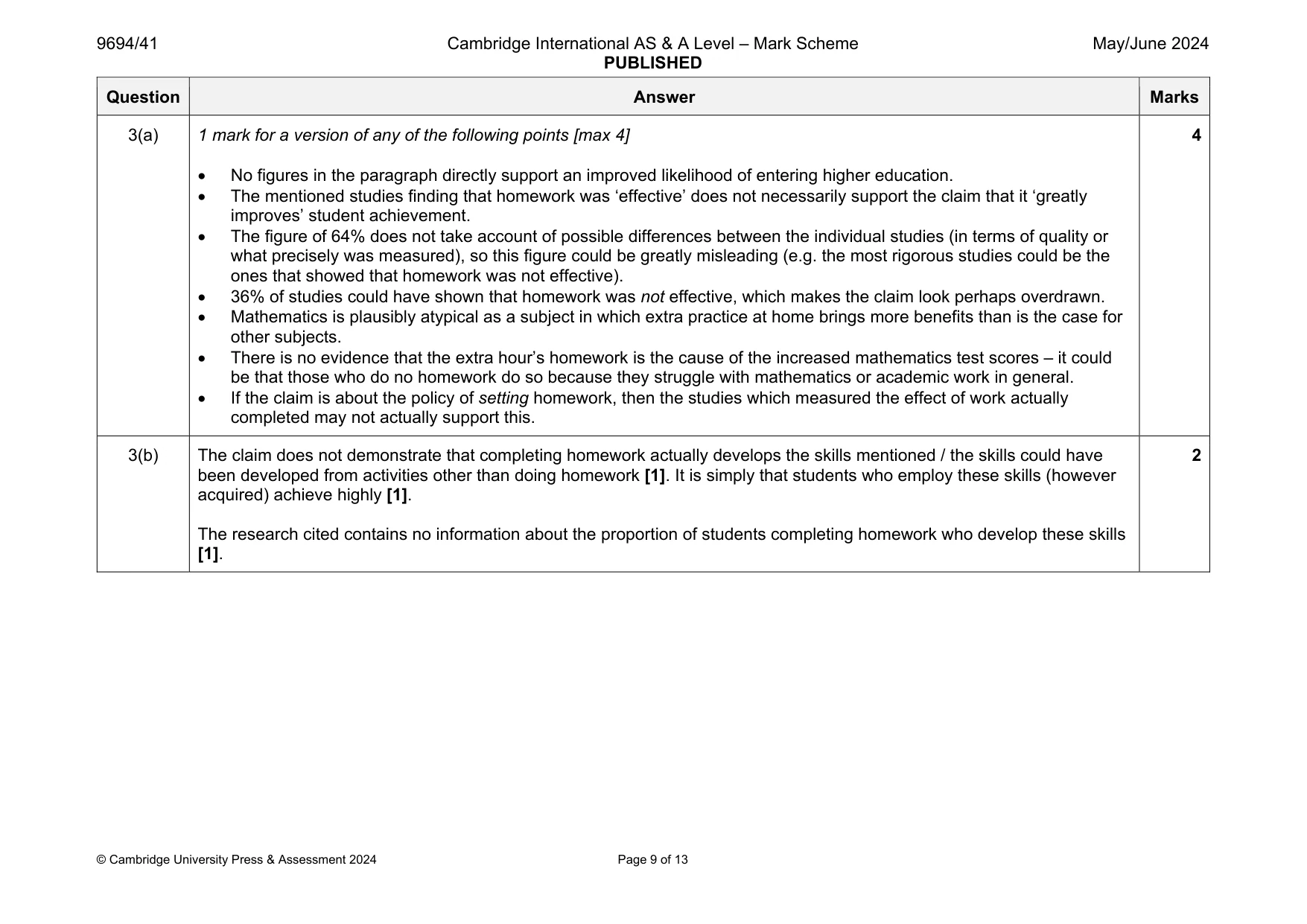
9694/41 Cambridge International AS & A Level – Mark Scheme PUBLISHED May/June 2024 © Cambridge University Press & Assessment 2024 Page 9 of 13 Question Answer Marks 3(a) 1 mark for a version of any of the following points [max 4] No figures in the paragraph directly support an improved likelihood of entering higher education. The mentioned studies finding that homework was ‘effective’ does not necessarily support the claim that it ‘greatly improves’ student achievement. The figure of 64% does not take account of possible differences between the individual studies (in terms of quality or what precisely was measured), so this figure could be greatly misleading (e.g. the most rigorous studies could be the ones that showed that homework was not effective). 36% of studies could have shown that homework was not effective, which makes the claim look perhaps overdrawn. Mathematics is plausibly atypical as a subject in which extra practice at home brings more benefits than is the case for other subjects. There is no evidence that the extra hour’s homework is the cause of the increased mathematics test scores – it could be that those who do no homework do so because they struggle with mathematics or academic work in general. If the claim is about the policy of setting homework, then the studies which measured the effect of work actually completed may not actually support this. 4 3(b) The claim does not demonstrate that completing homework actually develops the skills mentioned / the skills could have been developed from activities other than doing homework [1]. It is simply that students who employ these skills (however acquired) achieve highly [1]. The research cited contains no information about the proportion of students completing homework who develop these skills [1]. 2
Mark scheme, page 10
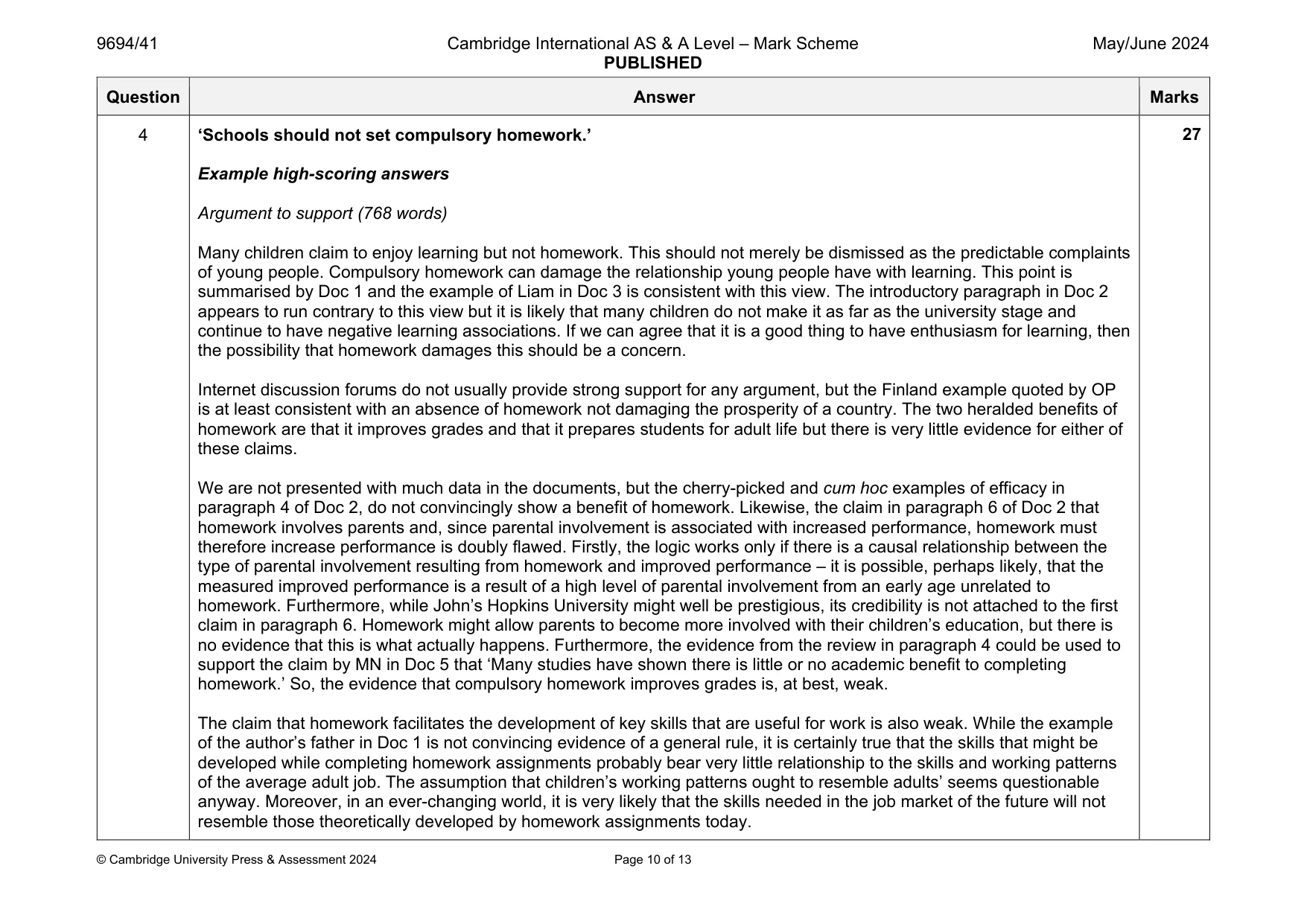
9694/41 Cambridge International AS & A Level – Mark Scheme PUBLISHED May/June 2024 © Cambridge University Press & Assessment 2024 Page 10 of 13 Question Answer Marks 4 ‘Schools should not set compulsory homework.’ Example high-scoring answers Argument to support (768 words) Many children claim to enjoy learning but not homework. This should not merely be dismissed as the predictable complaints of young people. Compulsory homework can damage the relationship young people have with learning. This point is summarised by Doc 1 and the example of Liam in Doc 3 is consistent with this view. The introductory paragraph in Doc 2 appears to run contrary to this view but it is likely that many children do not make it as far as the university stage and continue to have negative learning associations. If we can agree that it is a good thing to have enthusiasm for learning, then the possibility that homework damages this should be a concern. Internet discussion forums do not usually provide strong support for any argument, but the Finland example quoted by OP is at least consistent with an absence of homework not damaging the prosperity of a country. The two heralded benefits of homework are that it improves grades and that it prepares students for adult life but there is very little evidence for either of these claims. We are not presented with much data in the documents, but the cherry-picked and cum hoc examples of efficacy in paragraph 4 of Doc 2, do not convincingly show a benefit of homework. Likewise, the claim in paragraph 6 of Doc 2 that homework involves parents and, since parental involvement is associated with increased performance, homework must therefore increase performance is doubly flawed. Firstly, the logic works only if there is a causal relationship between the type of parental involvement resulting from homework and improved performance – it is possible, perhaps likely, that the measured improved performance is a result of a high level of parental involvement from an early age unrelated to homework. Furthermore, while John’s Hopkins University might well be prestigious, its credibility is not attached to the first claim in paragraph 6. Homework might allow parents to become more involved with their children’s education, but there is no evidence that this is what actually happens. Furthermore, the evidence from the review in paragraph 4 could be used to support the claim by MN in Doc 5 that ‘Many studies have shown there is little or no academic benefit to completing homework.’ So, the evidence that compulsory homework improves grades is, at best, weak. The claim that homework facilitates the development of key skills that are useful for work is also weak. While the example of the author’s father in Doc 1 is not convincing evidence of a general rule, it is certainly true that the skills that might be developed while completing homework assignments probably bear very little relationship to the skills and working patterns of the average adult job. The assumption that children’s working patterns ought to resemble adults’ seems questionable anyway. Moreover, in an ever-changing world, it is very likely that the skills needed in the job market of the future will not resemble those theoretically developed by homework assignments today. 27
Mark scheme, page 11
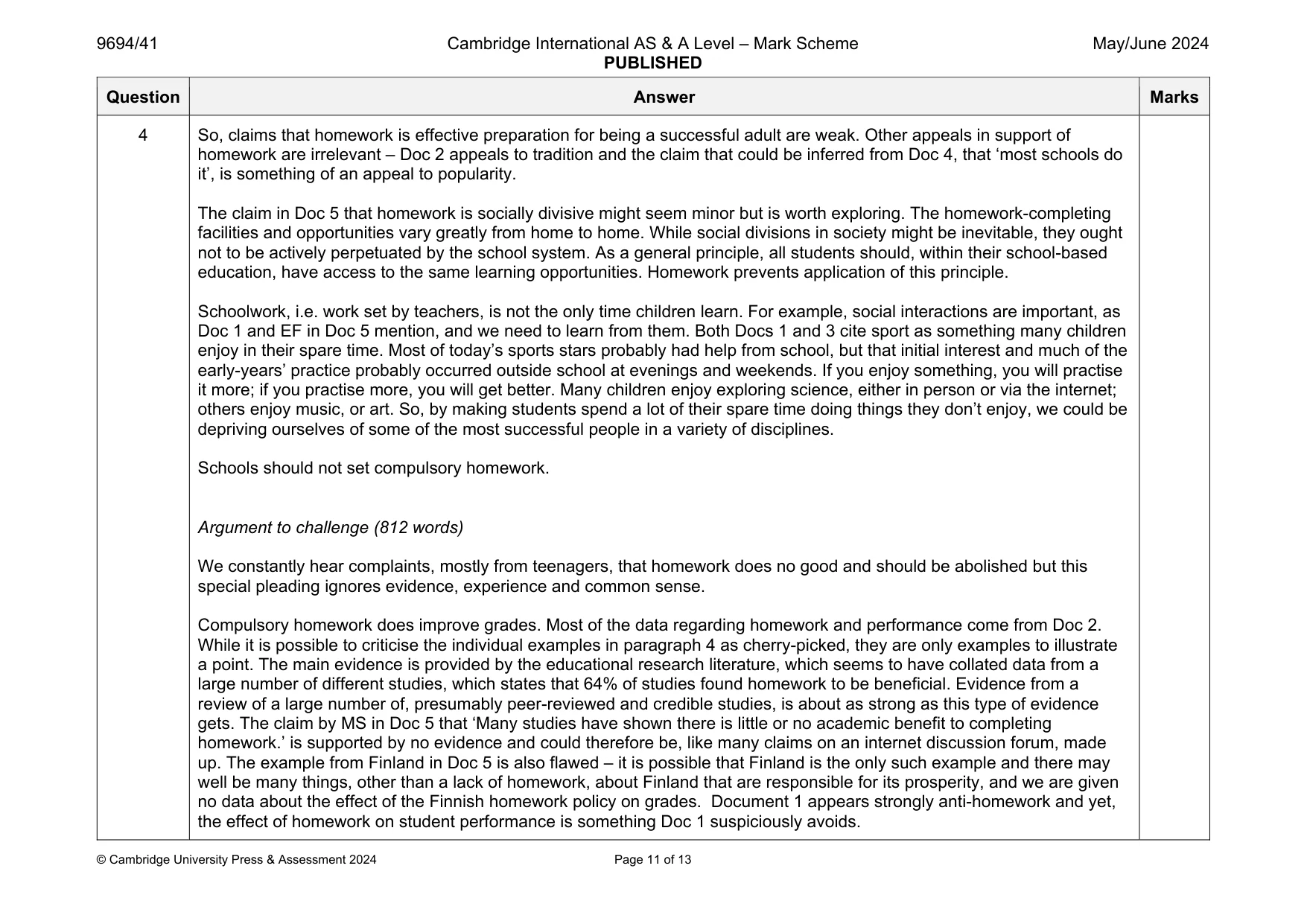
9694/41 Cambridge International AS & A Level – Mark Scheme PUBLISHED May/June 2024 © Cambridge University Press & Assessment 2024 Page 11 of 13 Question Answer Marks 4 So, claims that homework is effective preparation for being a successful adult are weak. Other appeals in support of homework are irrelevant – Doc 2 appeals to tradition and the claim that could be inferred from Doc 4, that ‘most schools do it’, is something of an appeal to popularity. The claim in Doc 5 that homework is socially divisive might seem minor but is worth exploring. The homework-completing facilities and opportunities vary greatly from home to home. While social divisions in society might be inevitable, they ought not to be actively perpetuated by the school system. As a general principle, all students should, within their school-based education, have access to the same learning opportunities. Homework prevents application of this principle. Schoolwork, i.e. work set by teachers, is not the only time children learn. For example, social interactions are important, as Doc 1 and EF in Doc 5 mention, and we need to learn from them. Both Docs 1 and 3 cite sport as something many children enjoy in their spare time. Most of today’s sports stars probably had help from school, but that initial interest and much of the early-years’ practice probably occurred outside school at evenings and weekends. If you enjoy something, you will practise it more; if you practise more, you will get better. Many children enjoy exploring science, either in person or via the internet; others enjoy music, or art. So, by making students spend a lot of their spare time doing things they don’t enjoy, we could be depriving ourselves of some of the most successful people in a variety of disciplines. Schools should not set compulsory homework. Argument to challenge (812 words) We constantly hear complaints, mostly from teenagers, that homework does no good and should be abolished but this special pleading ignores evidence, experience and common sense. Compulsory homework does improve grades. Most of the data regarding homework and performance come from Doc 2. While it is possible to criticise the individual examples in paragraph 4 as cherry-picked, they are only examples to illustrate a point. The main evidence is provided by the educational research literature, which seems to have collated data from a large number of different studies, which states that 64% of studies found homework to be beneficial. Evidence from a review of a large number of, presumably peer-reviewed and credible studies, is about as strong as this type of evidence gets. The claim by MS in Doc 5 that ‘Many studies have shown there is little or no academic benefit to completing homework.’ is supported by no evidence and could therefore be, like many claims on an internet discussion forum, made up. The example from Finland in Doc 5 is also flawed – it is possible that Finland is the only such example and there may well be many things, other than a lack of homework, about Finland that are responsible for its prosperity, and we are given no data about the effect of the Finnish homework policy on grades. Document 1 appears strongly anti-homework and yet, the effect of homework on student performance is something Doc 1 suspiciously avoids.
Mark scheme, page 12
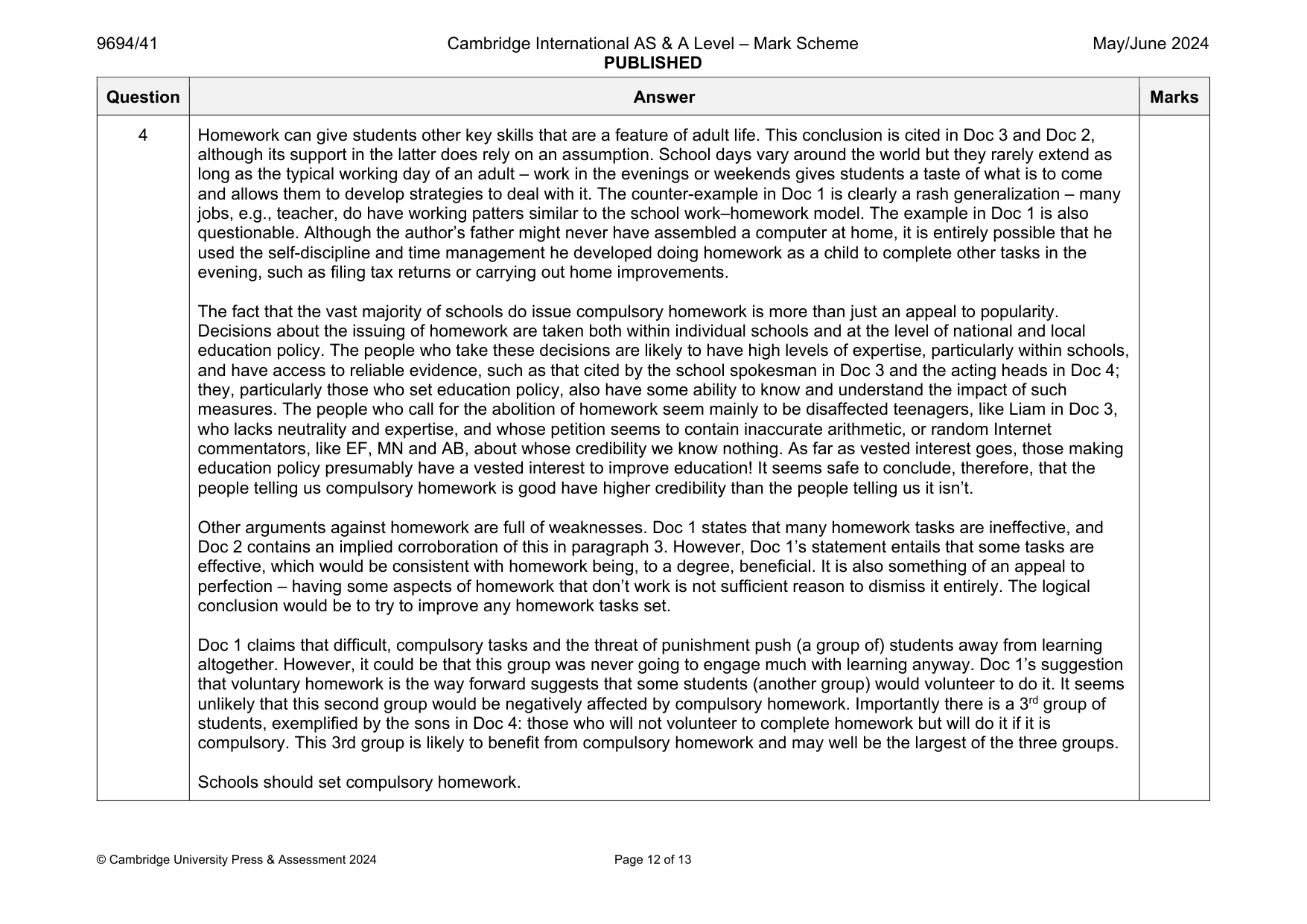
9694/41 Cambridge International AS & A Level – Mark Scheme PUBLISHED May/June 2024 © Cambridge University Press & Assessment 2024 Page 12 of 13 Question Answer Marks 4 Homework can give students other key skills that are a feature of adult life. This conclusion is cited in Doc 3 and Doc 2, although its support in the latter does rely on an assumption. School days vary around the world but they rarely extend as long as the typical working day of an adult – work in the evenings or weekends gives students a taste of what is to come and allows them to develop strategies to deal with it. The counter-example in Doc 1 is clearly a rash generalization – many jobs, e.g., teacher, do have working patters similar to the school work–homework model. The example in Doc 1 is also questionable. Although the author’s father might never have assembled a computer at home, it is entirely possible that he used the self-discipline and time management he developed doing homework as a child to complete other tasks in the evening, such as filing tax returns or carrying out home improvements. The fact that the vast majority of schools do issue compulsory homework is more than just an appeal to popularity. Decisions about the issuing of homework are taken both within individual schools and at the level of national and local education policy. The people who take these decisions are likely to have high levels of expertise, particularly within schools, and have access to reliable evidence, such as that cited by the school spokesman in Doc 3 and the acting heads in Doc 4; they, particularly those who set education policy, also have some ability to know and understand the impact of such measures. The people who call for the abolition of homework seem mainly to be disaffected teenagers, like Liam in Doc 3, who lacks neutrality and expertise, and whose petition seems to contain inaccurate arithmetic, or random Internet commentators, like EF, MN and AB, about whose credibility we know nothing. As far as vested interest goes, those making education policy presumably have a vested interest to improve education! It seems safe to conclude, therefore, that the people telling us compulsory homework is good have higher credibility than the people telling us it isn’t. Other arguments against homework are full of weaknesses. Doc 1 states that many homework tasks are ineffective, and Doc 2 contains an implied corroboration of this in paragraph 3. However, Doc 1’s statement entails that some tasks are effective, which would be consistent with homework being, to a degree, beneficial. It is also something of an appeal to perfection – having some aspects of homework that don’t work is not sufficient reason to dismiss it entirely. The logical conclusion would be to try to improve any homework tasks set. Doc 1 claims that difficult, compulsory tasks and the threat of punishment push (a group of) students away from learning altogether. However, it could be that this group was never going to engage much with learning anyway. Doc 1’s suggestion that voluntary homework is the way forward suggests that some students (another group) would volunteer to do it. It seems unlikely that this second group would be negatively affected by compulsory homework. Importantly there is a 3rd group of students, exemplified by the sons in Doc 4: those who will not volunteer to complete homework but will do it if it is compulsory. This 3rd group is likely to benefit from compulsory homework and may well be the largest of the three groups. Schools should set compulsory homework.
Mark scheme, page 13
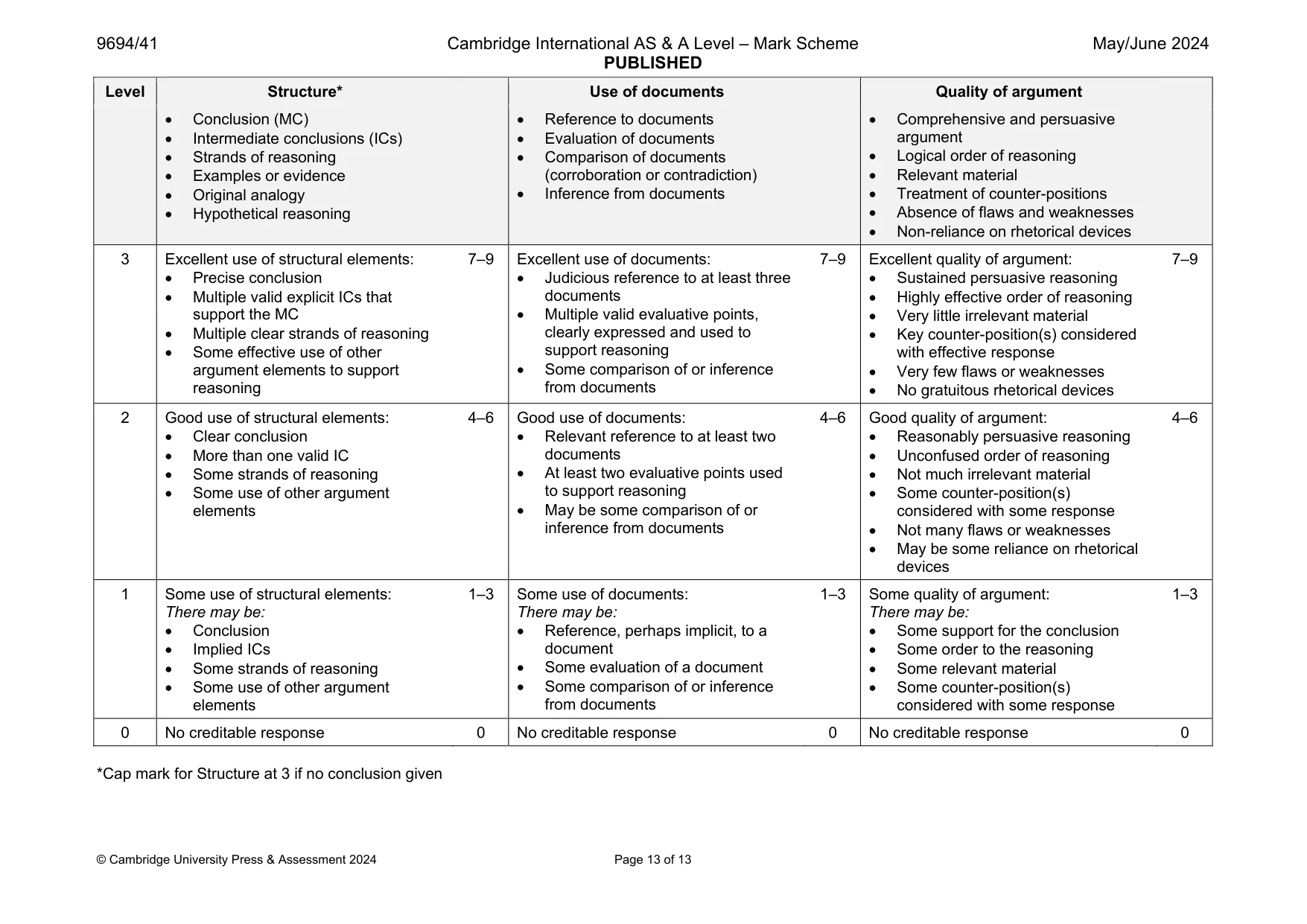
9694/41 Cambridge International AS & A Level – Mark Scheme PUBLISHED May/June 2024 © Cambridge University Press & Assessment 2024 Page 13 of 13 Level Structure* Use of documents Quality of argument Conclusion (MC) Intermediate conclusions (ICs) Strands of reasoning Examples or evidence Original analogy Hypothetical reasoning Reference to documents Evaluation of documents Comparison of documents (corroboration or contradiction) Inference from documents Comprehensive and persuasive argument Logical order of reasoning Relevant material Treatment of counter-positions Absence of flaws and weaknesses Non-reliance on rhetorical devices 3 Excellent use of structural elements: Precise conclusion Multiple valid explicit ICs that support the MC Multiple clear strands of reasoning Some effective use of other argument elements to support reasoning 7–9 Excellent use of documents: Judicious reference to at least three documents Multiple valid evaluative points, clearly expressed and used to support reasoning Some comparison of or inference from documents 7–9 Excellent quality of argument: Sustained persuasive reasoning Highly effective order of reasoning Very little irrelevant material Key counter-position(s) considered with effective response Very few flaws or weaknesses No gratuitous rhetorical devices 7–9 2 Good use of structural elements: Clear conclusion More than one valid IC Some strands of reasoning Some use of other argument elements 4–6 Good use of documents: Relevant reference to at least two documents At least two evaluative points used to support reasoning May be some comparison of or inference from documents 4–6 Good quality of argument: Reasonably persuasive reasoning Unconfused order of reasoning Not much irrelevant material Some counter-position(s) considered with some response Not many flaws or weaknesses May be some reliance on rhetorical devices 4–6 1 Some use of structural elements: There may be: Conclusion Implied ICs Some strands of reasoning Some use of other argument elements 1–3 Some use of documents: There may be: Reference, perhaps implicit, to a document Some evaluation of a document Some comparison of or inference from documents 1–3 Some quality of argument: There may be: Some support for the conclusion Some order to the reasoning Some relevant material Some counter-position(s) considered with some response 1–3 0 No creditable response 0 No creditable response 0 No creditable response 0 *Cap mark for Structure at 3 if no conclusion given
What you needed in this session
Cambridge’s own grade thresholds for 2024 May/June, Paper 4 · Variant 1. A higher threshold means an easier paper — the bar moves with how the cohort did.