Cambridge A Level Thinking Skills 9694 — 2022 May/June Paper 4 · Variant 1
9694/41/M/J/22 · 50 marks · ≈56 min
The question paper and its mark scheme, free to read here and free to download. This is Cambridge’s own paper, exactly as it was sat.
Question paper8 pages

Mark scheme16 pages
Answers below. Sit the paper first if you are practising.
Paper as text
Question paper, page 1
This document has 8 pages. Any blank pages are indicated. [Turn over Cambridge International AS & A Level DC (CE/SG) 303073/3 © UCLES 2022 * 6 9 1 5 2 5 9 8 8 3 * THINKING SKILLS 9694/41 Paper 4 Applied Reasoning May/June 2022 1 hour 45 minutes You must answer on the enclosed answer booklet. You will need: Answer booklet (enclosed) INSTRUCTIONS ● Answer all questions. ● Follow the instructions on the front cover of the answer booklet. If you need additional answer paper, ask the invigilator for a continuation booklet. INFORMATION ● The total mark for this paper is 50. ● The number of marks for each question or part question is shown in brackets [ ].
Question paper, page 2
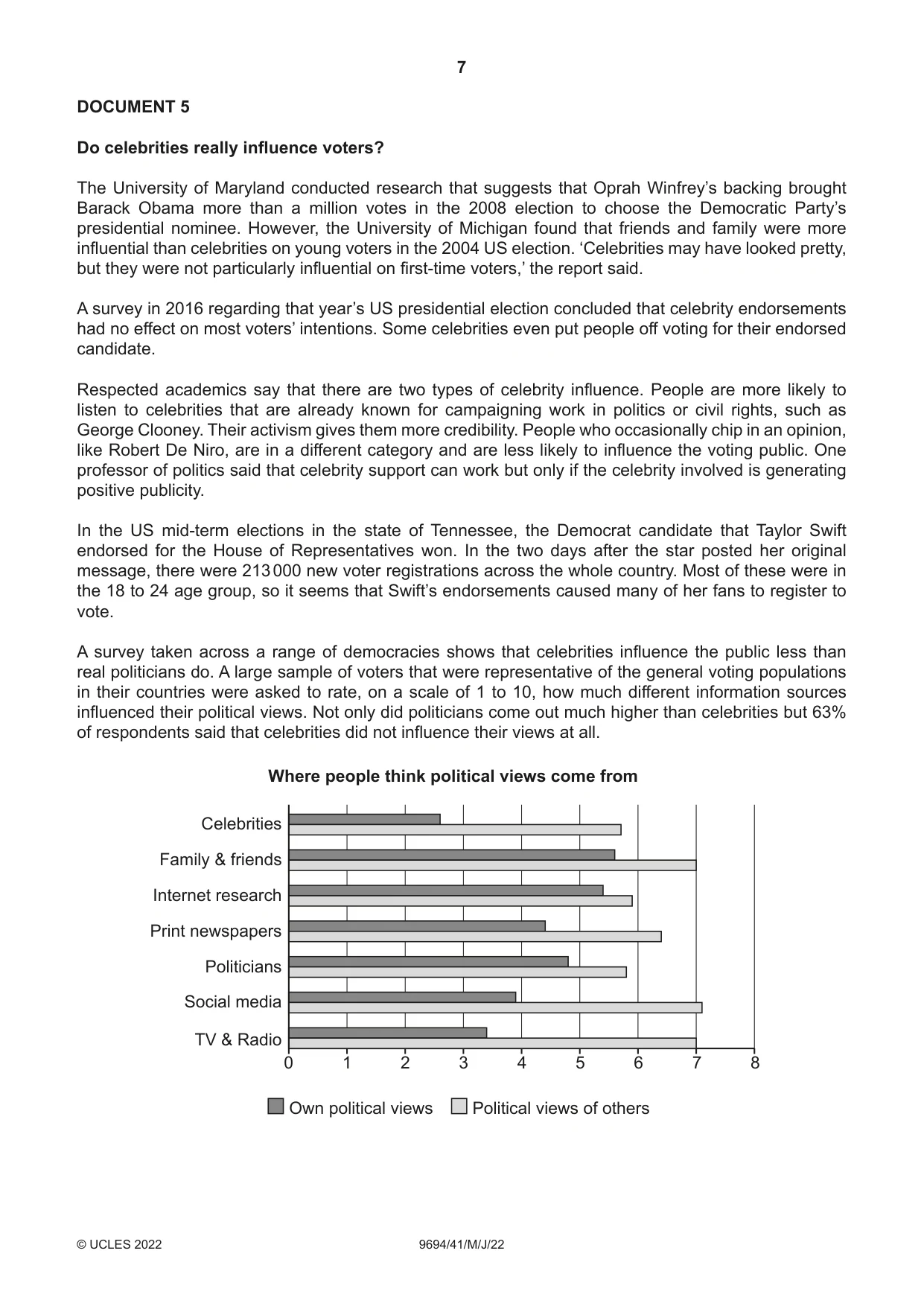
2 9694/41/M/J/22 © UCLES 2022 1 (a) State the main conclusion of the argument in Document 1. [1] (b) Identify two intermediate conclusions in paragraphs 3 to 4 of Document 1. [2] (c) Analyse the structure of the reasoning in paragraph 5 of Document 1. [4] (d) Identify an unstated assumption which is needed to support the reasoning in paragraph 6 of Document 1. [1] 2 (a) Identify and explain three flaws and/or weaknesses in the reasoning in paragraphs 1 to 4 of Document 1. [6] (b) Assess the extent to which the reasoning in paragraph 5 of Document 1 supports the argument as a whole. [3] 3 (a) Document 5 contains some statistical information in paragraph 4. Explain two ways in which the support given by the statistics in paragraph 4 to the claim that “Swift’s endorsements caused many of her fans to register to vote” is weak. [2] (b) Document 5 contains a graph. Explain why the support given by the graph to the claim that “Celebrities influence the public less than real politicians” is weak. [4] 4 You are advised to spend some time planning your answer before you begin to write it. ‘Celebrity involvement is bad for politics.’ Construct a reasoned argument to support or challenge this claim. In your answer you should make critical use of the documents provided. [27]
Question paper, page 3
3 9694/41/M/J/22 © UCLES 2022 [Turn over DOCUMENT 1 Should actors enter politics? 1 We live in a world where members of the acting profession seem to think it is their right, or even duty, to get involved in politics – from Arnold Schwarzenegger in the US to Melina Mercouri in Greece to Sunny Deol in India. But the duty of actors is to entertain, not to influence how society works, so they should stick to what they have been trained to do and let professional politicians run things. I have no desire to see Angela Merkel star in the next Hollywood blockbuster, so why would I want to see an actor hold political office? 2 Most actors are not fit to hold public office. Child stars often struggle to cope with fame at a young age, suffering mental health issues and problems with addiction. No wonder we are always hearing about the latest actor to spend time in rehab. These issues can influence their views and the way they perceive the world. If actors were in charge, they might make a lot of bad decisions, which could lead to economic, environmental or geopolitical disaster. 3 The most well-known, and so most influential, actors have enormous salaries. Their vast wealth makes them unable to empathise with the concerns of the majority of the population. Actors do not know what it is like to hold down a steady full-time job or raise a family as a single parent and still get out of bed every morning. In this way, actors cannot hope to represent the people they would be supposed to represent. 4 People are increasingly likely to re-post celebrity views on political issues as if they have genuine weight. This could mean that, if a popular actor holds a dangerous opinion, that opinion is likely to gain support based on the actor’s popularity, rather than the content of the opinion itself. A photo of Bollywood actress Priyanka Chopra Jonas encouraging people to vote in Indian elections was seen initially by millions of her own followers, and many times more than that after the image was re-posted. Moreover, a particularly skilled actor could use their tone of voice and body language to manipulate the emotions of voters and so would have an unfair advantage over professional politicians. 5 When an actor becomes involved in politics, the distinction between fact and fiction is blurred in the minds of the public. Gullible voters might think that an actor who played a judge in a well- known television series was in real life a legal expert. Thus, an actor could be elected based on the public’s perception of the fictional character. This would be disastrous, as the government would become filled with people with no political expertise. 6 It seems the number of actor politicians is on the rise. At the same time there has been fragmentation of international alliances and an increased instability around the globe. If actors continue to become politicians, then the prospects for peace are poor.
Question paper, page 4
4 9694/41/M/J/22 © UCLES 2022 DOCUMENT 2 Actors make good politicians We could write several volumes about what ‘good politician’ actually means. However, if we all agree that politicians are necessary for an ordered and prosperous society, then those who can bring more positives to society than negatives could be described as good – but don’t get me started on what ‘society’ means! Indian actor Rajinikanth recently announced that he wants to enter politics, and form a new political party. He is not the first, nor will he be the last. Ronald Reagan was a well-known Hollywood star, if not quite on the ‘A-list’, before he became Governor of California in 1967 and then US President in 1980. Some credit him with bringing in an era of peace by ending the cold war between the US and the Soviet Union. After two successful terms in the White House, he retired with a very high (68%) approval rating. People forget that Reagan was ridiculed by many when first elected. To many of those same sceptics, he now seems like a relatively strong and stable politician. Other examples of celebrity politicians abound: Arnold Schwarzenegger was Governor of California; Joseph Estrada, a former movie star, was President of Philippines from 1998 until his impeachment trial in 2001 and, in 2019, the actor/comedian Volodymyr Zelensky became President of Ukraine. Why should it be so common for celebrities, particularly actors, to enter politics? One possible reason could be a decline in public trust in professional politicians. The respected Pew Research Center has data that in 1958 75% of Americans trusted the US government to do the right thing, at least most of the time. By 1980, the year that America’s first celebrity president took office, this figure had dropped to 25%. The qualities that can underpin success in acting and politics are not dissimilar. In both, appearance matters. So much, in fact, that the CIA allegedly tried to poison Fidel Castro so that he would lose his facial hair. This, they believed, would make him look weak and would therefore lose him the support of the Cuban people. Furthermore, actors are trained to pretend to be who they are not, and, like it or loathe it, it is necessary for politicians to mislead and deceive at least some of the people some of the time. Actors and politicians both have an image they like to present to the public. Come to think of it, many politicians might make good actors. Popularity is all that matters in a democracy and, compared to ordinary politicians, actors and other celebrities have this in abundance. This popularity can give celebrities an easy ride when starting their careers compared with aspiring politicians who are not famous already. Celebrities are often particularly popular amongst younger people, a demographic which is traditionally unlikely to vote in elections. Celebrities also find it easier to fund their political ambitions. The fame they already enjoy attracts money from sponsors and, in most societies, a great deal of money is needed to fund political campaigns and win elections. The usual criticisms about not understanding international issues or being out of touch with real people apply well beyond the acting profession – nobody has a monopoly on ignorance – and actors are as capable as anyone of surrounding themselves with well-informed advisors. It is by no means certain that actors and other celebrities are better than normal politicians, but they are certainly no worse, and they might encourage more young people to take an interest in politics. Politics is, at least, more interesting with a few celebrities in the mix.
Question paper, page 5
5 9694/41/M/J/22 © UCLES 2022 [Turn over DOCUMENT 3 The good and bad of celebrities in politics 2018 saw two celebrities enter politics on opposite sides of the US political divide. Taylor Swift told her multitude of social media followers to register to vote and educate themselves on the candidates running in their state, while herself endorsing the Democratic candidate. The appeal worked – an estimated 65 000 people registered within 24 hours of her post. Meanwhile, Kanye West visited the White House for a meeting with President Trump. The phenomenon of celebrity involvement in politics has recently acquired a name – Poliwood – at least in the US. But celebrities have been used for good and ill by politicians of every type for a long time. Charlie Chaplin and Douglas Fairbanks, megastars in their time, sold war bonds on behalf of President Woodrow Wilson during World War 1. Frank Sinatra and Orson Welles performed at political rallies for Franklin D Roosevelt. Welles also supported Roosevelt in his newspaper columns and helped write his speeches. Before he became president, John F Kennedy commissioned Frank Sinatra to sing High Hopes during the 1960 election campaign. Republican Richard Nixon was backed by the likes of Bob Hope and Sammy Davis Jr, and was famously visited by Elvis Presley in the Oval Office. Democratic successor Jimmy Carter’s rise was aided by his associations with Bob Dylan, Willie Nelson and the Allman Brothers. The bulk of celebrity endorsement has been for those on the Democratic side, but the only Hollywood type that ever became president was right-wing Republican Ronald Reagan. Reagan’s success seemed to inspire a host of Republican celebrities to run for office, such as California Governor Arnold Schwarzenegger. Poliwood can make it cool to care. Bono, the singer from the band U2, encouraged George W Bush to release funds for an international AIDS drug programme. George Clooney, who worked to bring international attention to the genocide and civil war in South Sudan, said ‘Celebrity can help focus news media where they have abdicated their responsibility. We can’t make policy, but we can encourage politicians more than ever before.’ However, Poliwood can sometimes ‘dumb down’ political debate, by allowing politicians to deflect attention from their own unpopular policies. So is Poliwood a force for good or simply a glittering distraction? The answer depends on what it accomplishes. If it draws attention to a real problem, it can promote public engagement and political action. If politicians are just looking for a celebrity endorsement to boost their profile and make themselves look cool, then it dumbs down politics, which cannot be a good thing.
Question paper, page 6
6 9694/41/M/J/22 © UCLES 2022 DOCUMENT 4 Some quotes from an online discussion about celebrities in politics Celebrity involvement in politics is nothing new so we should not be concerned about it now. Many celebrities, such as Warren Beatty and Jane Fonda, spoke out against the Vietnam War, for example. AB, New Zealand It is well documented that certain types of mental illness, such as bipolar disorder, are more common in people with a talent for performance or creativity. We might appreciate a Van Gogh painting, but we wouldn’t want him running the Netherlands. Beethoven had bipolar disorder. Great symphonies, but would you rather have him or Angela Merkel as German Chancellor? PJ, Belgium It is cowardly to have a large platform and not speak out about injustices that are happening in society. Several black celebrities have spoken out about racism. This sends a powerful message. TT, Canada Celebrities are citizens first and as such have the right to get involved. They have the right to freedom of speech like everyone else! AG, South Africa Who actually looks at the campaign videos anymore? We look for recognisable faces and names. Because we think they’re always good people, we listen to what they say. RM, India With great power comes great responsibility. Many celebrities perceive politics as all about winning elections, but they lack the knowledge and skills to implement any policies they might support. CH, USA People like being fooled by actors, but they like being fooled by politicians even more. US, Brazil
Question paper, page 7
7 9694/41/M/J/22 © UCLES 2022 DOCUMENT 5 Do celebrities really influence voters? The University of Maryland conducted research that suggests that Oprah Winfrey’s backing brought Barack Obama more than a million votes in the 2008 election to choose the Democratic Party’s presidential nominee. However, the University of Michigan found that friends and family were more influential than celebrities on young voters in the 2004 US election. ‘Celebrities may have looked pretty, but they were not particularly influential on first-time voters,’ the report said. A survey in 2016 regarding that year’s US presidential election concluded that celebrity endorsements had no effect on most voters’ intentions. Some celebrities even put people off voting for their endorsed candidate. Respected academics say that there are two types of celebrity influence. People are more likely to listen to celebrities that are already known for campaigning work in politics or civil rights, such as George Clooney. Their activism gives them more credibility. People who occasionally chip in an opinion, like Robert De Niro, are in a different category and are less likely to influence the voting public. One professor of politics said that celebrity support can work but only if the celebrity involved is generating positive publicity. In the US mid-term elections in the state of Tennessee, the Democrat candidate that Taylor Swift endorsed for the House of Representatives won. In the two days after the star posted her original message, there were 213 000 new voter registrations across the whole country. Most of these were in the 18 to 24 age group, so it seems that Swift’s endorsements caused many of her fans to register to vote. A survey taken across a range of democracies shows that celebrities influence the public less than real politicians do. A large sample of voters that were representative of the general voting populations in their countries were asked to rate, on a scale of 1 to 10, how much different information sources influenced their political views. Not only did politicians come out much higher than celebrities but 63% of respondents said that celebrities did not influence their views at all. 0 1 2 3 4 5 6 7 8 TV & Radio Social media Politicians Print newspapers Internet research Family & friends Celebrities Where people think political views come from Own political views Political views of others
Question paper, page 8
8 9694/41/M/J/22 © UCLES 2022 Permission to reproduce items where third-party owned material protected by copyright is included has been sought and cleared where possible. Every reasonable effort has been made by the publisher (UCLES) to trace copyright holders, but if any items requiring clearance have unwittingly been included, the publisher will be pleased to make amends at the earliest possible opportunity. To avoid the issue of disclosure of answer-related information to candidates, all copyright acknowledgements are reproduced online in the Cambridge Assessment International Education Copyright Acknowledgements Booklet. This is produced for each series of examinations and is freely available to download at www.cambridgeinternational.org after the live examination series. Cambridge Assessment International Education is part of Cambridge Assessment. Cambridge Assessment is the brand name of the University of Cambridge Local Examinations Syndicate (UCLES), which is a department of the University of Cambridge. BLANK PAGE
Mark scheme, page 1
This document consists of 16 printed pages. © UCLES 2022 [Turn over Cambridge International AS & A Level THINKING SKILLS 9694/41 Paper 4 Applied Reasoning May/June 2022 MARK SCHEME Maximum Mark: 50 Published This mark scheme is published as an aid to teachers and candidates, to indicate the requirements of the examination. It shows the basis on which Examiners were instructed to award marks. It does not indicate the details of the discussions that took place at an Examiners’ meeting before marking began, which would have considered the acceptability of alternative answers. Mark schemes should be read in conjunction with the question paper and the Principal Examiner Report for Teachers. Cambridge International will not enter into discussions about these mark schemes. Cambridge International is publishing the mark schemes for the May/June 2022 series for most Cambridge IGCSE, Cambridge International A and AS Level and Cambridge Pre-U components, and some Cambridge O Level components.
Mark scheme, page 2
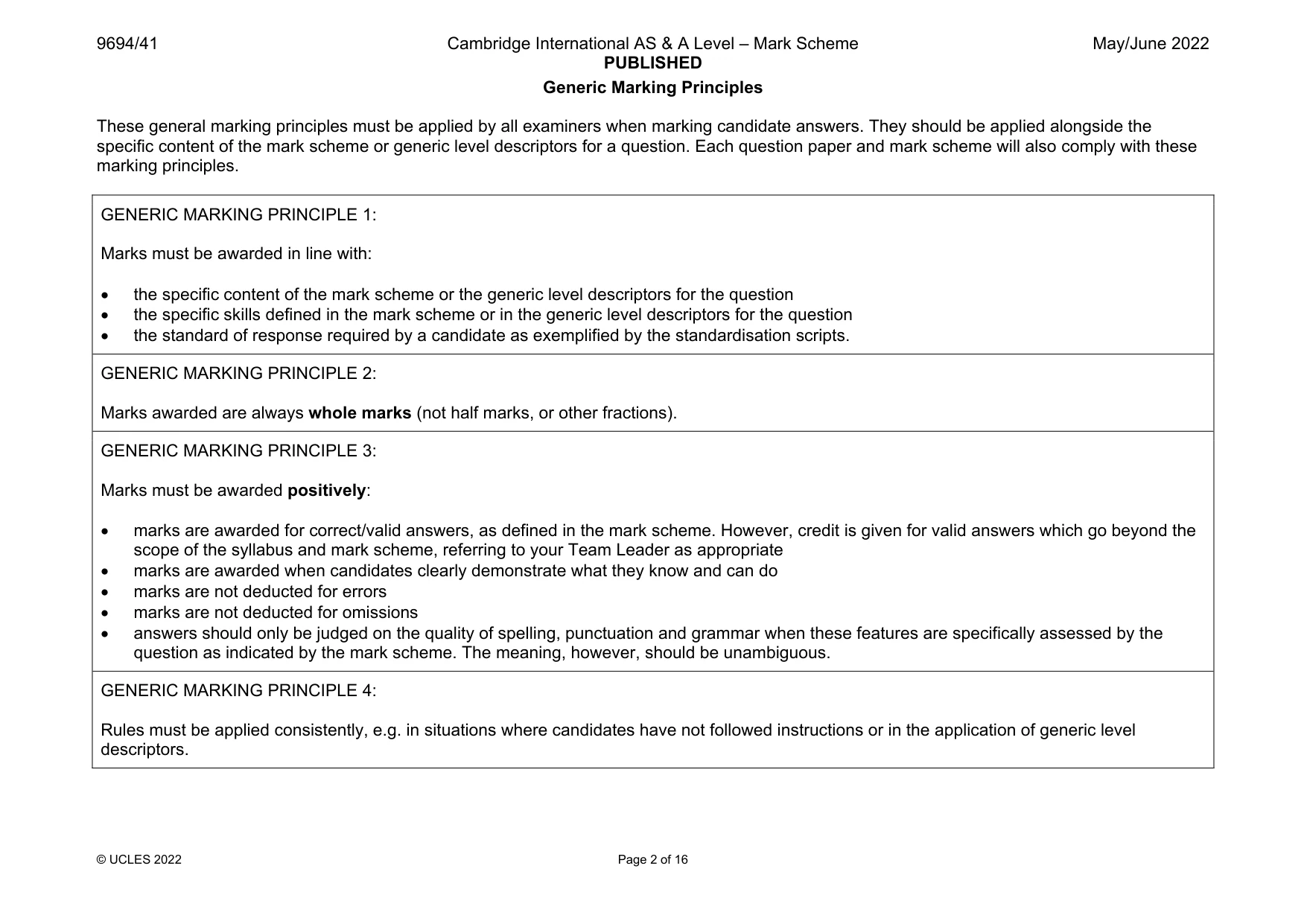
9694/41 Cambridge International AS & A Level – Mark Scheme PUBLISHED May/June 2022 © UCLES 2022 Page 2 of 16 Generic Marking Principles These general marking principles must be applied by all examiners when marking candidate answers. They should be applied alongside the specific content of the mark scheme or generic level descriptors for a question. Each question paper and mark scheme will also comply with these marking principles. GENERIC MARKING PRINCIPLE 1: Marks must be awarded in line with: the specific content of the mark scheme or the generic level descriptors for the question the specific skills defined in the mark scheme or in the generic level descriptors for the question the standard of response required by a candidate as exemplified by the standardisation scripts. GENERIC MARKING PRINCIPLE 2: Marks awarded are always whole marks (not half marks, or other fractions). GENERIC MARKING PRINCIPLE 3: Marks must be awarded positively: marks are awarded for correct/valid answers, as defined in the mark scheme. However, credit is given for valid answers which go beyond the scope of the syllabus and mark scheme, referring to your Team Leader as appropriate marks are awarded when candidates clearly demonstrate what they know and can do marks are not deducted for errors marks are not deducted for omissions answers should only be judged on the quality of spelling, punctuation and grammar when these features are specifically assessed by the question as indicated by the mark scheme. The meaning, however, should be unambiguous. GENERIC MARKING PRINCIPLE 4: Rules must be applied consistently, e.g. in situations where candidates have not followed instructions or in the application of generic level descriptors.
Mark scheme, page 3
9694/41 Cambridge International AS & A Level – Mark Scheme PUBLISHED May/June 2022 © UCLES 2022 Page 3 of 16 GENERIC MARKING PRINCIPLE 5: Marks should be awarded using the full range of marks defined in the mark scheme for the question (however; the use of the full mark range may be limited according to the quality of the candidate responses seen). GENERIC MARKING PRINCIPLE 6: Marks awarded are based solely on the requirements as defined in the mark scheme. Marks should not be awarded with grade thresholds or grade descriptors in mind.
Mark scheme, page 4
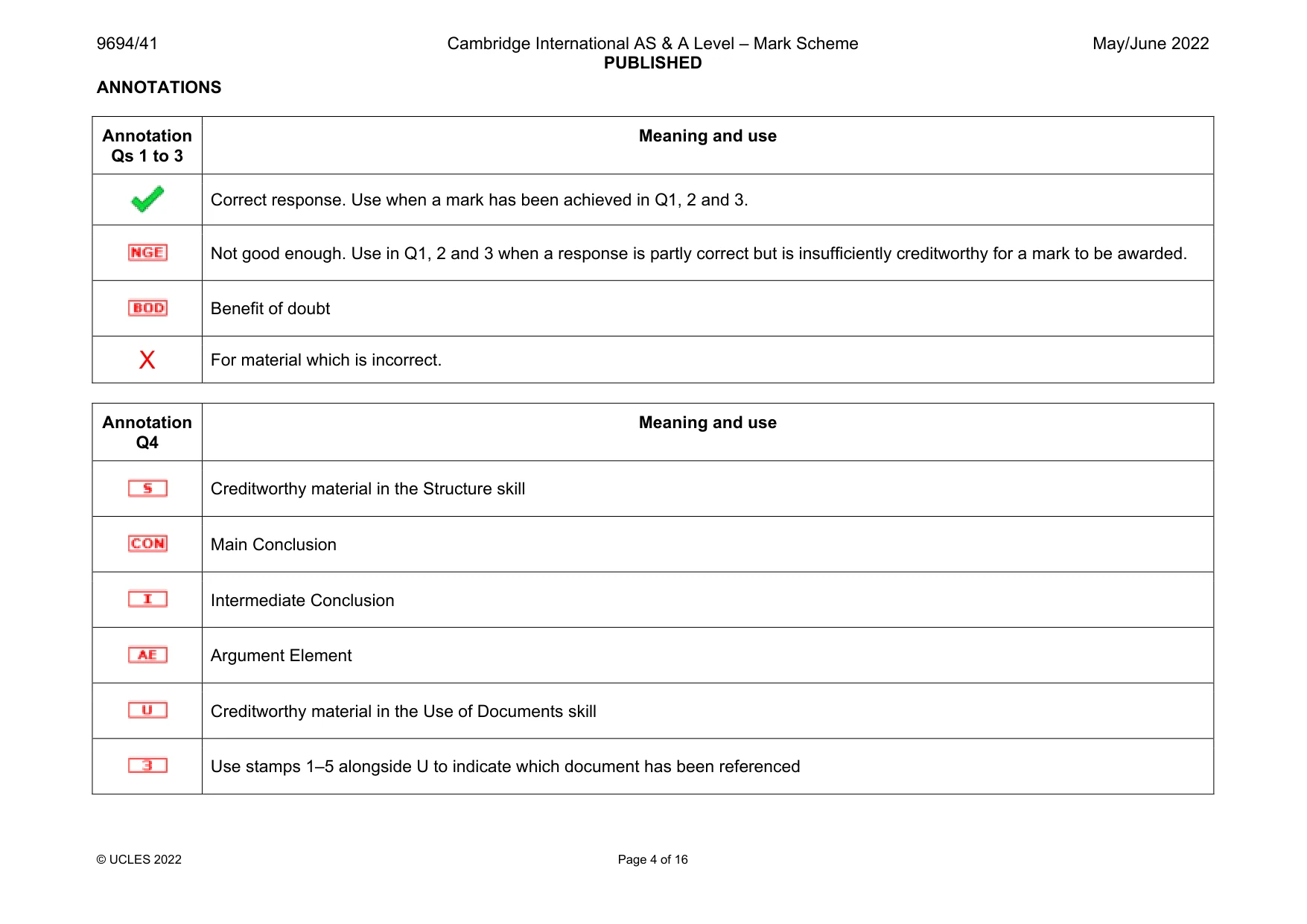
9694/41 Cambridge International AS & A Level – Mark Scheme PUBLISHED May/June 2022 © UCLES 2022 Page 4 of 16 ANNOTATIONS Annotation Qs 1 to 3 Meaning and use Correct response. Use when a mark has been achieved in Q1, 2 and 3. Not good enough. Use in Q1, 2 and 3 when a response is partly correct but is insufficiently creditworthy for a mark to be awarded. Benefit of doubt X For material which is incorrect. Annotation Q4 Meaning and use Creditworthy material in the Structure skill Main Conclusion Intermediate Conclusion Argument Element Creditworthy material in the Use of Documents skill Use stamps 1–5 alongside U to indicate which document has been referenced
Mark scheme, page 5
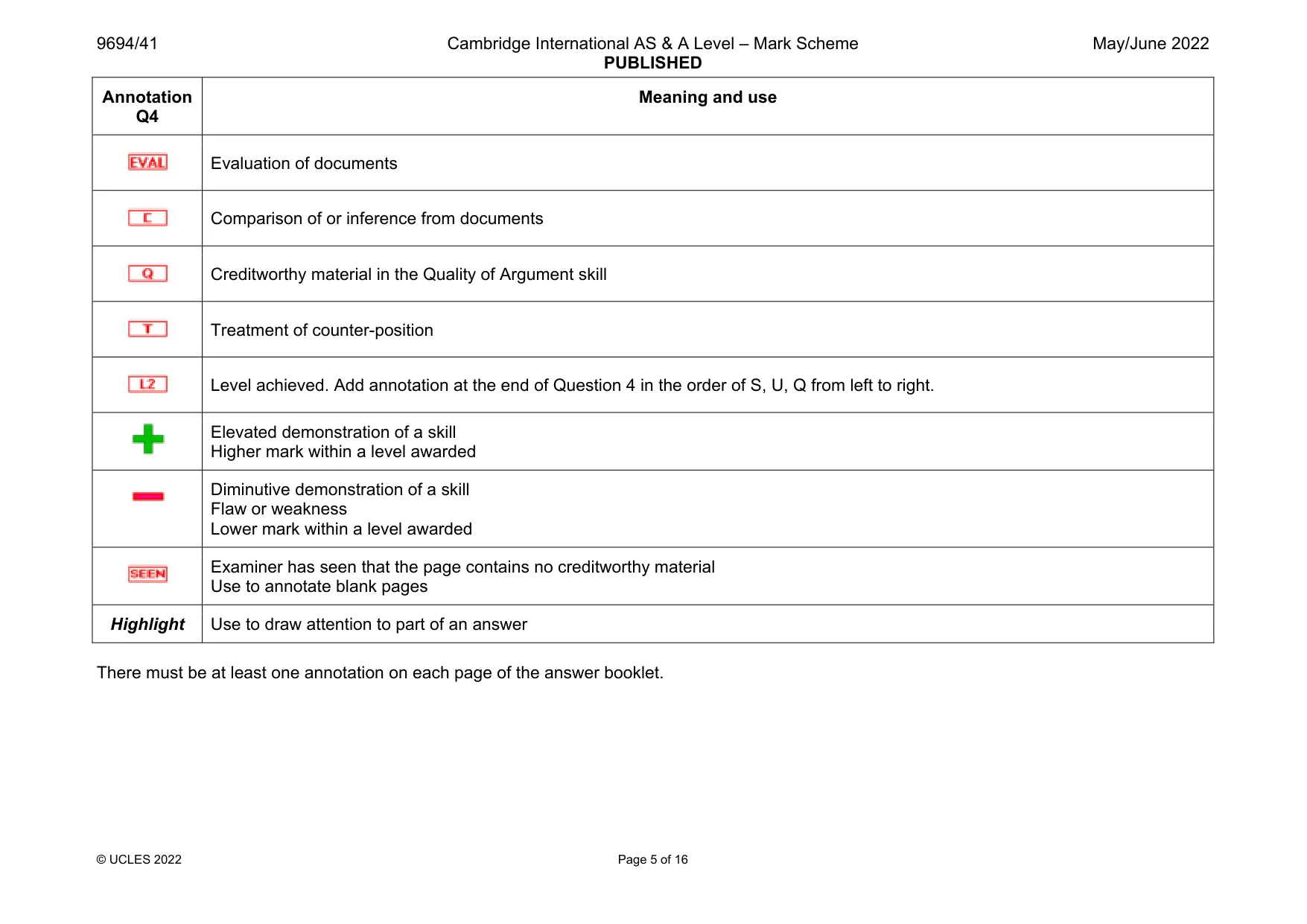
9694/41 Cambridge International AS & A Level – Mark Scheme PUBLISHED May/June 2022 © UCLES 2022 Page 5 of 16 Annotation Q4 Meaning and use Evaluation of documents Comparison of or inference from documents Creditworthy material in the Quality of Argument skill Treatment of counter-position Level achieved. Add annotation at the end of Question 4 in the order of S, U, Q from left to right. Elevated demonstration of a skill Higher mark within a level awarded Diminutive demonstration of a skill Flaw or weakness Lower mark within a level awarded Examiner has seen that the page contains no creditworthy material Use to annotate blank pages Highlight Use to draw attention to part of an answer There must be at least one annotation on each page of the answer booklet.
Mark scheme, page 6
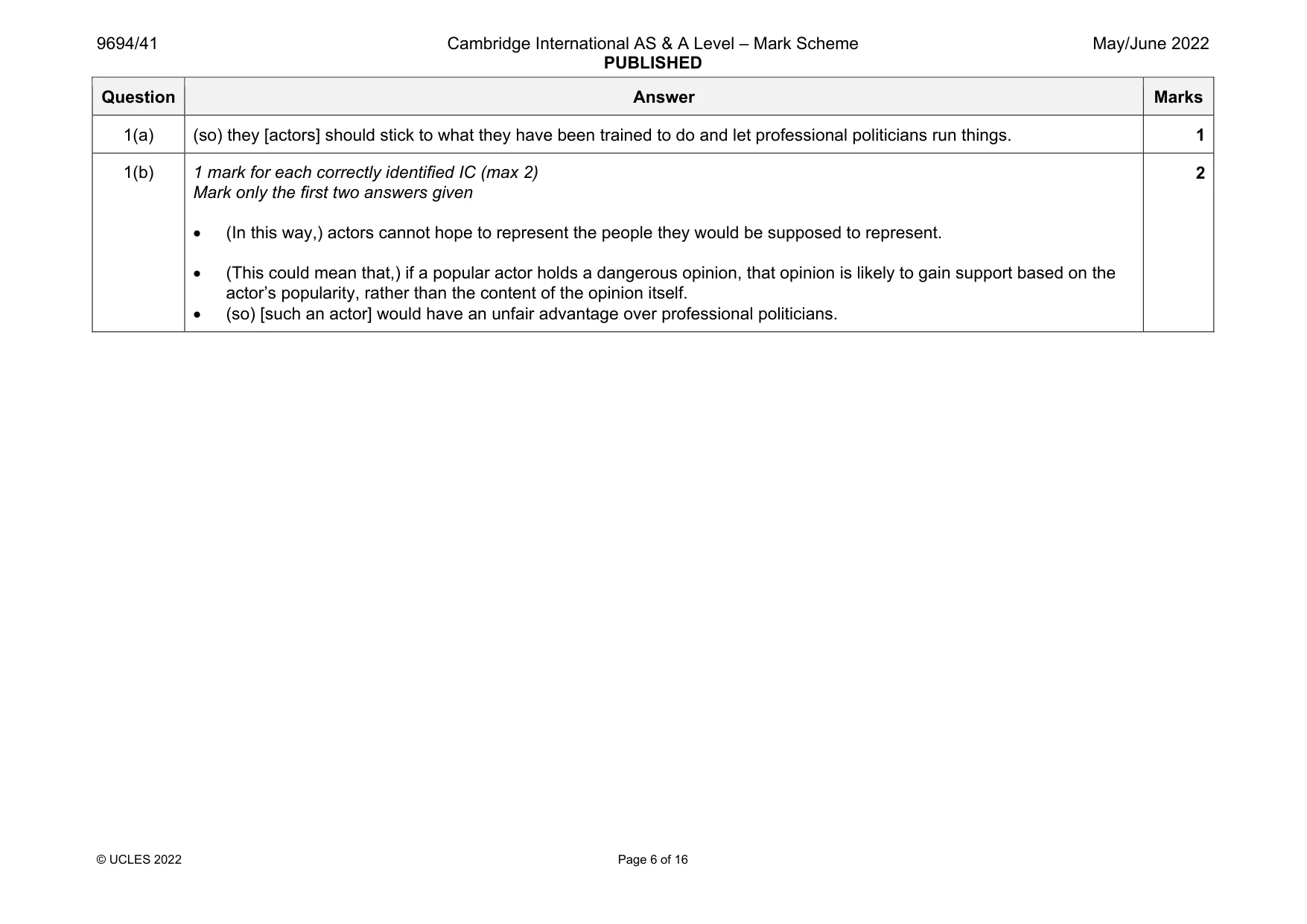
9694/41 Cambridge International AS & A Level – Mark Scheme PUBLISHED May/June 2022 © UCLES 2022 Page 6 of 16 Question Answer Marks 1(a) (so) they [actors] should stick to what they have been trained to do and let professional politicians run things. 1 1(b) 1 mark for each correctly identified IC (max 2) Mark only the first two answers given (In this way,) actors cannot hope to represent the people they would be supposed to represent. (This could mean that,) if a popular actor holds a dangerous opinion, that opinion is likely to gain support based on the actor’s popularity, rather than the content of the opinion itself. (so) [such an actor] would have an unfair advantage over professional politicians. 2
Mark scheme, page 7
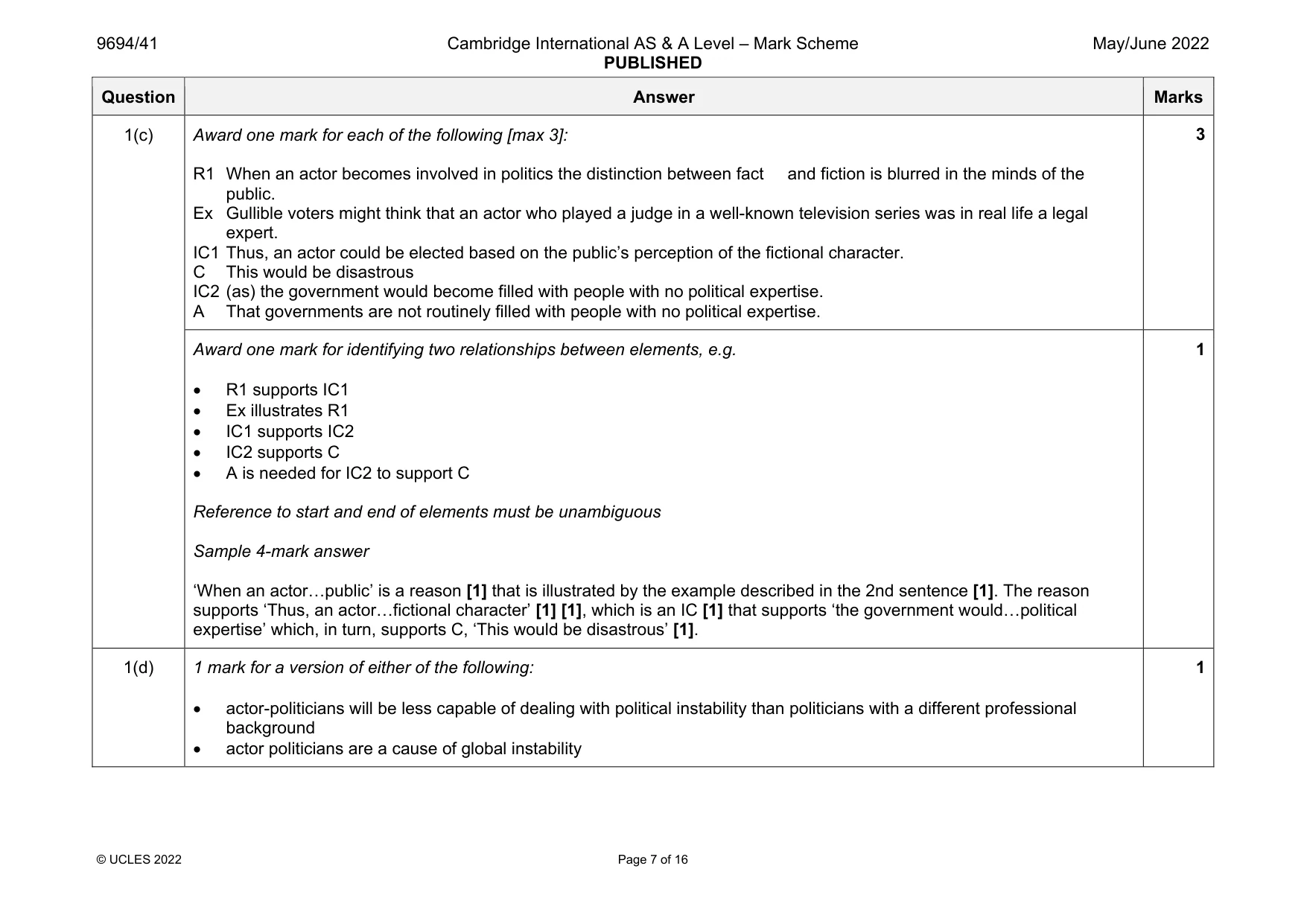
9694/41 Cambridge International AS & A Level – Mark Scheme PUBLISHED May/June 2022 © UCLES 2022 Page 7 of 16 Question Answer Marks 1(c) Award one mark for each of the following [max 3]: R1 When an actor becomes involved in politics the distinction between fact and fiction is blurred in the minds of the public. Ex Gullible voters might think that an actor who played a judge in a well-known television series was in real life a legal expert. IC1 Thus, an actor could be elected based on the public’s perception of the fictional character. C This would be disastrous IC2 (as) the government would become filled with people with no political expertise. A That governments are not routinely filled with people with no political expertise. 3 Award one mark for identifying two relationships between elements, e.g. R1 supports IC1 Ex illustrates R1 IC1 supports IC2 IC2 supports C A is needed for IC2 to support C Reference to start and end of elements must be unambiguous Sample 4-mark answer ‘When an actor…public’ is a reason [1] that is illustrated by the example described in the 2nd sentence [1]. The reason supports ‘Thus, an actor…fictional character’ [1] [1], which is an IC [1] that supports ‘the government would…political expertise’ which, in turn, supports C, ‘This would be disastrous’ [1]. 1 1(d) 1 mark for a version of either of the following: actor-politicians will be less capable of dealing with political instability than politicians with a different professional background actor politicians are a cause of global instability 1
Mark scheme, page 8
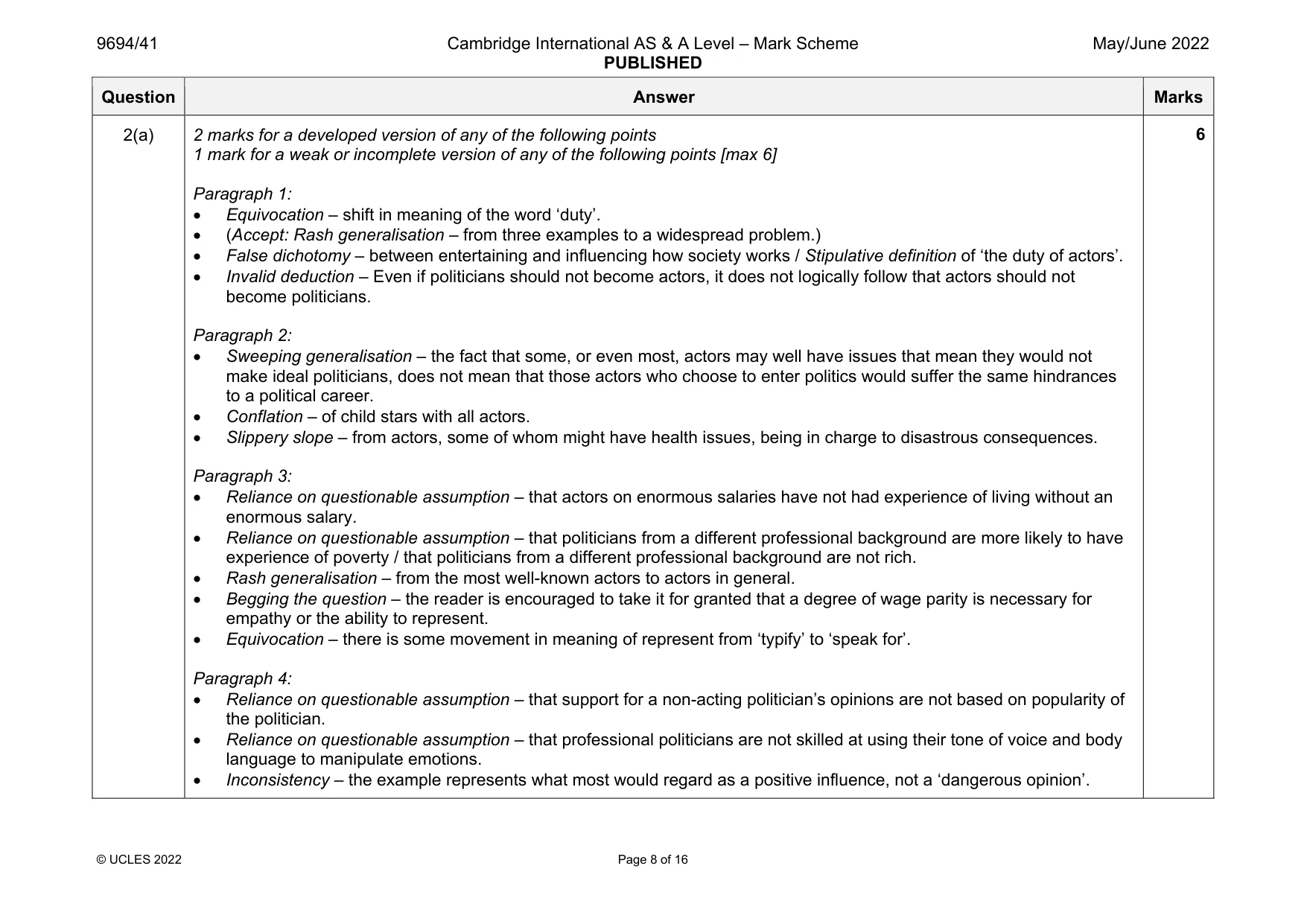
9694/41 Cambridge International AS & A Level – Mark Scheme PUBLISHED May/June 2022 © UCLES 2022 Page 8 of 16 Question Answer Marks 2(a) 2 marks for a developed version of any of the following points 1 mark for a weak or incomplete version of any of the following points [max 6] Paragraph 1: Equivocation – shift in meaning of the word ‘duty’. (Accept: Rash generalisation – from three examples to a widespread problem.) False dichotomy – between entertaining and influencing how society works / Stipulative definition of ‘the duty of actors’. Invalid deduction – Even if politicians should not become actors, it does not logically follow that actors should not become politicians. Paragraph 2: Sweeping generalisation – the fact that some, or even most, actors may well have issues that mean they would not make ideal politicians, does not mean that those actors who choose to enter politics would suffer the same hindrances to a political career. Conflation – of child stars with all actors. Slippery slope – from actors, some of whom might have health issues, being in charge to disastrous consequences. Paragraph 3: Reliance on questionable assumption – that actors on enormous salaries have not had experience of living without an enormous salary. Reliance on questionable assumption – that politicians from a different professional background are more likely to have experience of poverty / that politicians from a different professional background are not rich. Rash generalisation – from the most well-known actors to actors in general. Begging the question – the reader is encouraged to take it for granted that a degree of wage parity is necessary for empathy or the ability to represent. Equivocation – there is some movement in meaning of represent from ‘typify’ to ‘speak for’. Paragraph 4: Reliance on questionable assumption – that support for a non-acting politician’s opinions are not based on popularity of the politician. Reliance on questionable assumption – that professional politicians are not skilled at using their tone of voice and body language to manipulate emotions. Inconsistency – the example represents what most would regard as a positive influence, not a ‘dangerous opinion’. 6
Mark scheme, page 9
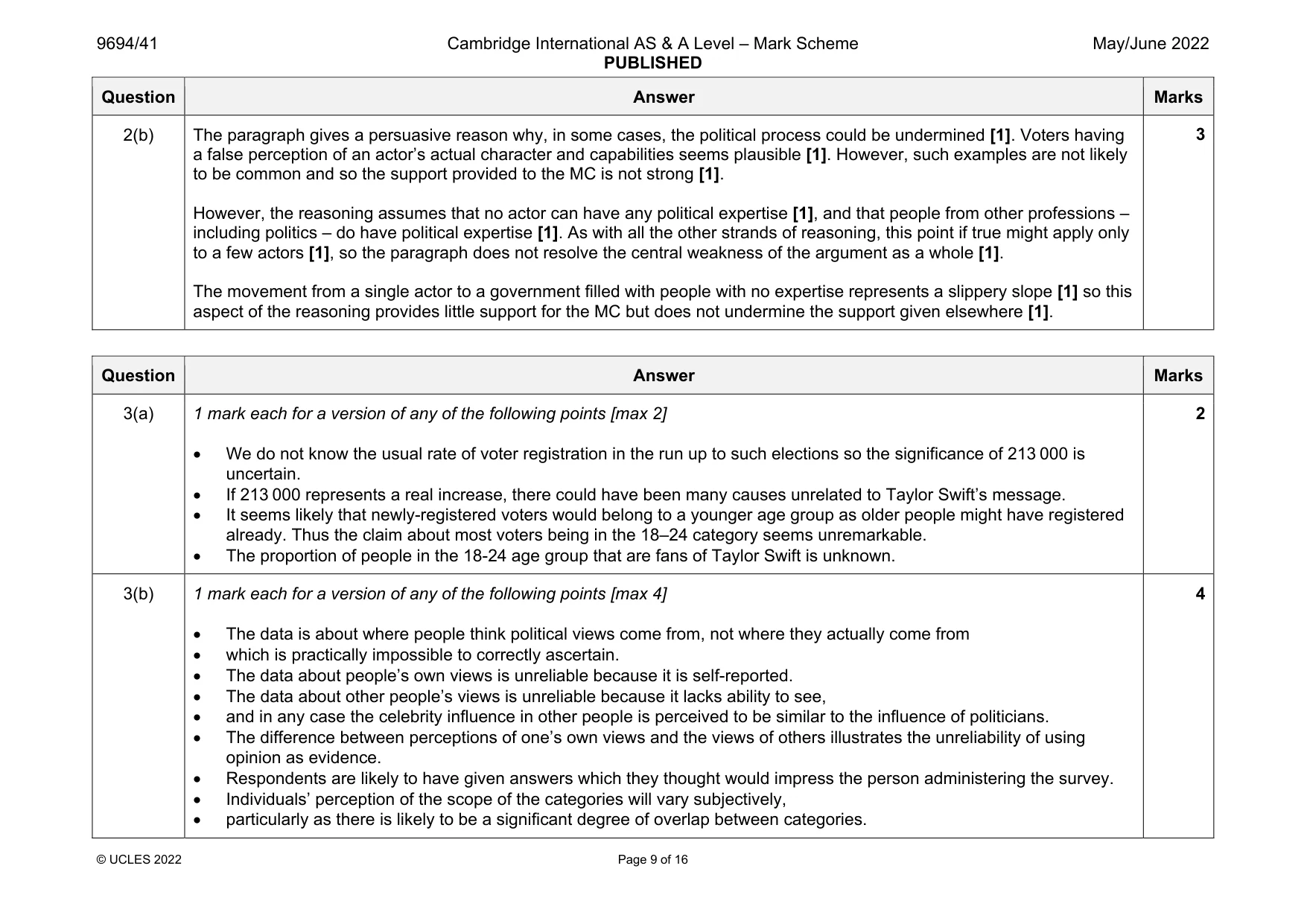
9694/41 Cambridge International AS & A Level – Mark Scheme PUBLISHED May/June 2022 © UCLES 2022 Page 9 of 16 Question Answer Marks 2(b) The paragraph gives a persuasive reason why, in some cases, the political process could be undermined [1]. Voters having a false perception of an actor’s actual character and capabilities seems plausible [1]. However, such examples are not likely to be common and so the support provided to the MC is not strong [1]. However, the reasoning assumes that no actor can have any political expertise [1], and that people from other professions – including politics – do have political expertise [1]. As with all the other strands of reasoning, this point if true might apply only to a few actors [1], so the paragraph does not resolve the central weakness of the argument as a whole [1]. The movement from a single actor to a government filled with people with no expertise represents a slippery slope [1] so this aspect of the reasoning provides little support for the MC but does not undermine the support given elsewhere [1]. 3 Question Answer Marks 3(a) 1 mark each for a version of any of the following points [max 2] We do not know the usual rate of voter registration in the run up to such elections so the significance of 213 000 is uncertain. If 213 000 represents a real increase, there could have been many causes unrelated to Taylor Swift’s message. It seems likely that newly-registered voters would belong to a younger age group as older people might have registered already. Thus the claim about most voters being in the 18–24 category seems unremarkable. The proportion of people in the 18-24 age group that are fans of Taylor Swift is unknown. 2 3(b) 1 mark each for a version of any of the following points [max 4] The data is about where people think political views come from, not where they actually come from which is practically impossible to correctly ascertain. The data about people’s own views is unreliable because it is self-reported. The data about other people’s views is unreliable because it lacks ability to see, and in any case the celebrity influence in other people is perceived to be similar to the influence of politicians. The difference between perceptions of one’s own views and the views of others illustrates the unreliability of using opinion as evidence. Respondents are likely to have given answers which they thought would impress the person administering the survey. Individuals’ perception of the scope of the categories will vary subjectively, particularly as there is likely to be a significant degree of overlap between categories. 4
Mark scheme, page 10
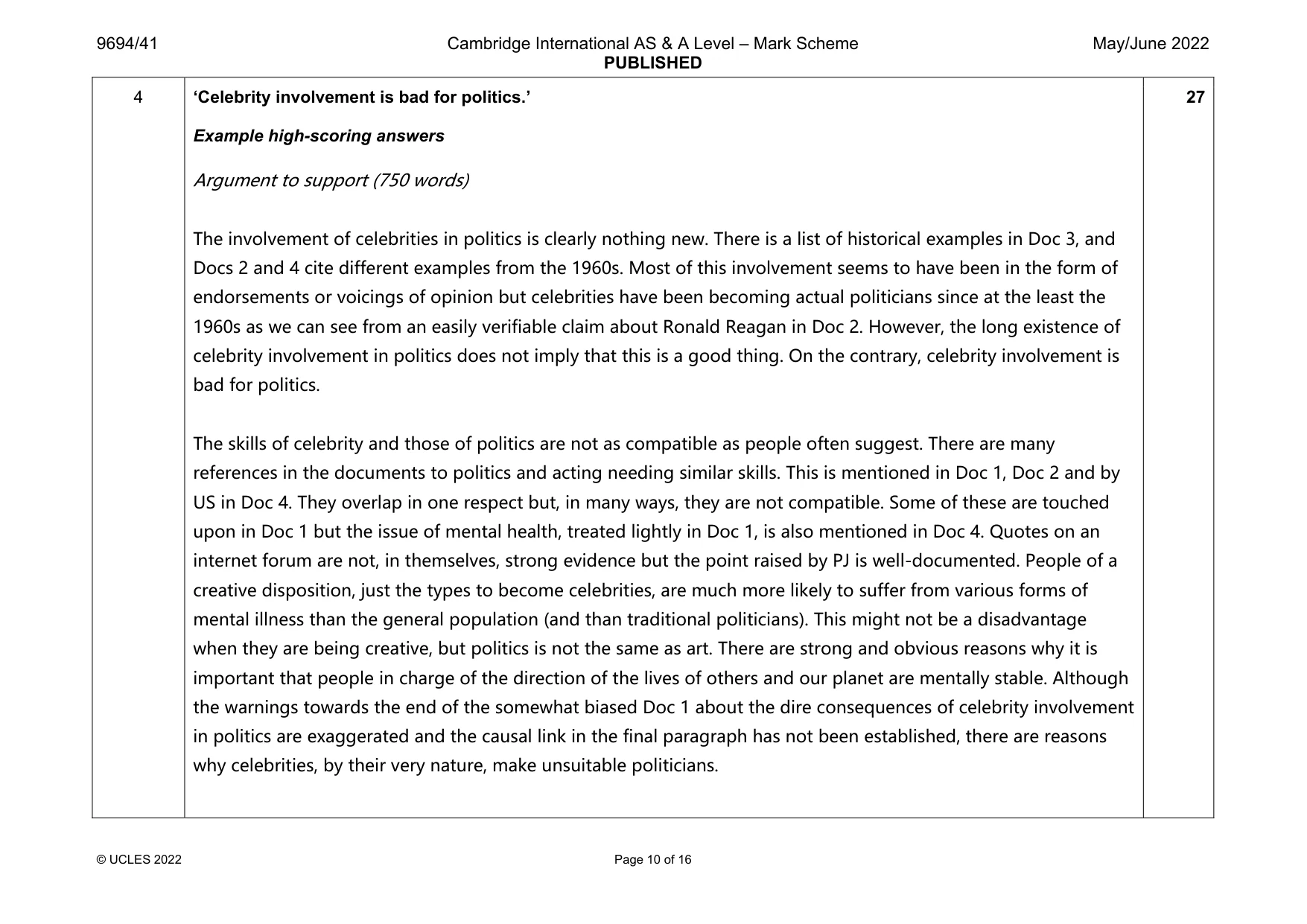
9694/41 Cambridge International AS & A Level – Mark Scheme PUBLISHED May/June 2022 © UCLES 2022 Page 10 of 16 4 ‘Celebrity involvement is bad for politics.’ Example high-scoring answers Argument to support (750 words) The involvement of celebrities in politics is clearly nothing new. There is a list of historical examples in Doc 3, and Docs 2 and 4 cite different examples from the 1960s. Most of this involvement seems to have been in the form of endorsements or voicings of opinion but celebrities have been becoming actual politicians since at the least the 1960s as we can see from an easily verifiable claim about Ronald Reagan in Doc 2. However, the long existence of celebrity involvement in politics does not imply that this is a good thing. On the contrary, celebrity involvement is bad for politics. The skills of celebrity and those of politics are not as compatible as people often suggest. There are many references in the documents to politics and acting needing similar skills. This is mentioned in Doc 1, Doc 2 and by US in Doc 4. They overlap in one respect but, in many ways, they are not compatible. Some of these are touched upon in Doc 1 but the issue of mental health, treated lightly in Doc 1, is also mentioned in Doc 4. Quotes on an internet forum are not, in themselves, strong evidence but the point raised by PJ is well-documented. People of a creative disposition, just the types to become celebrities, are much more likely to suffer from various forms of mental illness than the general population (and than traditional politicians). This might not be a disadvantage when they are being creative, but politics is not the same as art. There are strong and obvious reasons why it is important that people in charge of the direction of the lives of others and our planet are mentally stable. Although the warnings towards the end of the somewhat biased Doc 1 about the dire consequences of celebrity involvement in politics are exaggerated and the causal link in the final paragraph has not been established, there are reasons why celebrities, by their very nature, make unsuitable politicians. 27
Mark scheme, page 11
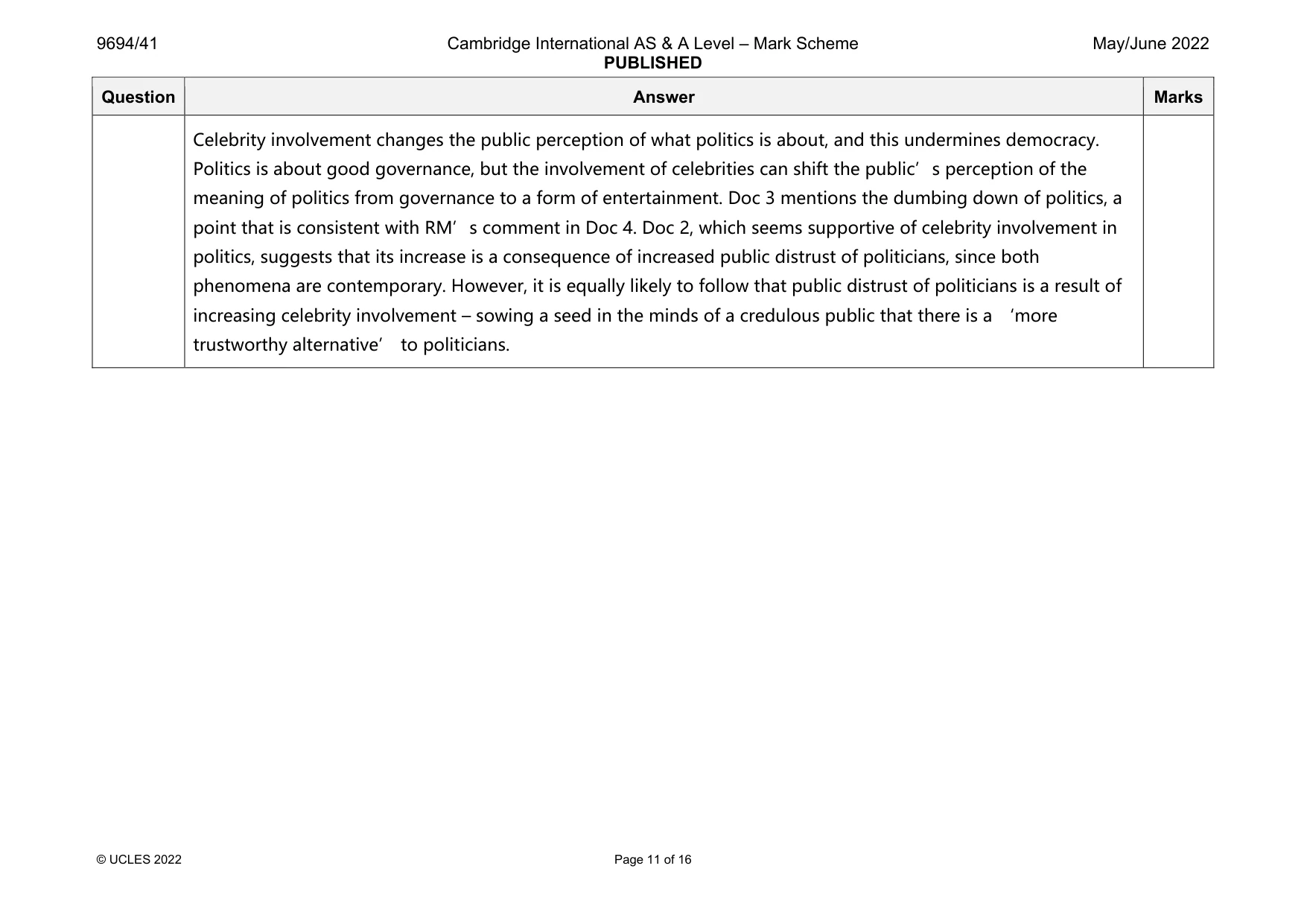
9694/41 Cambridge International AS & A Level – Mark Scheme PUBLISHED May/June 2022 © UCLES 2022 Page 11 of 16 Question Answer Marks Celebrity involvement changes the public perception of what politics is about, and this undermines democracy. Politics is about good governance, but the involvement of celebrities can shift the public’s perception of the meaning of politics from governance to a form of entertainment. Doc 3 mentions the dumbing down of politics, a point that is consistent with RM’s comment in Doc 4. Doc 2, which seems supportive of celebrity involvement in politics, suggests that its increase is a consequence of increased public distrust of politicians, since both phenomena are contemporary. However, it is equally likely to follow that public distrust of politicians is a result of increasing celebrity involvement – sowing a seed in the minds of a credulous public that there is a ‘more trustworthy alternative’ to politicians.
Mark scheme, page 12
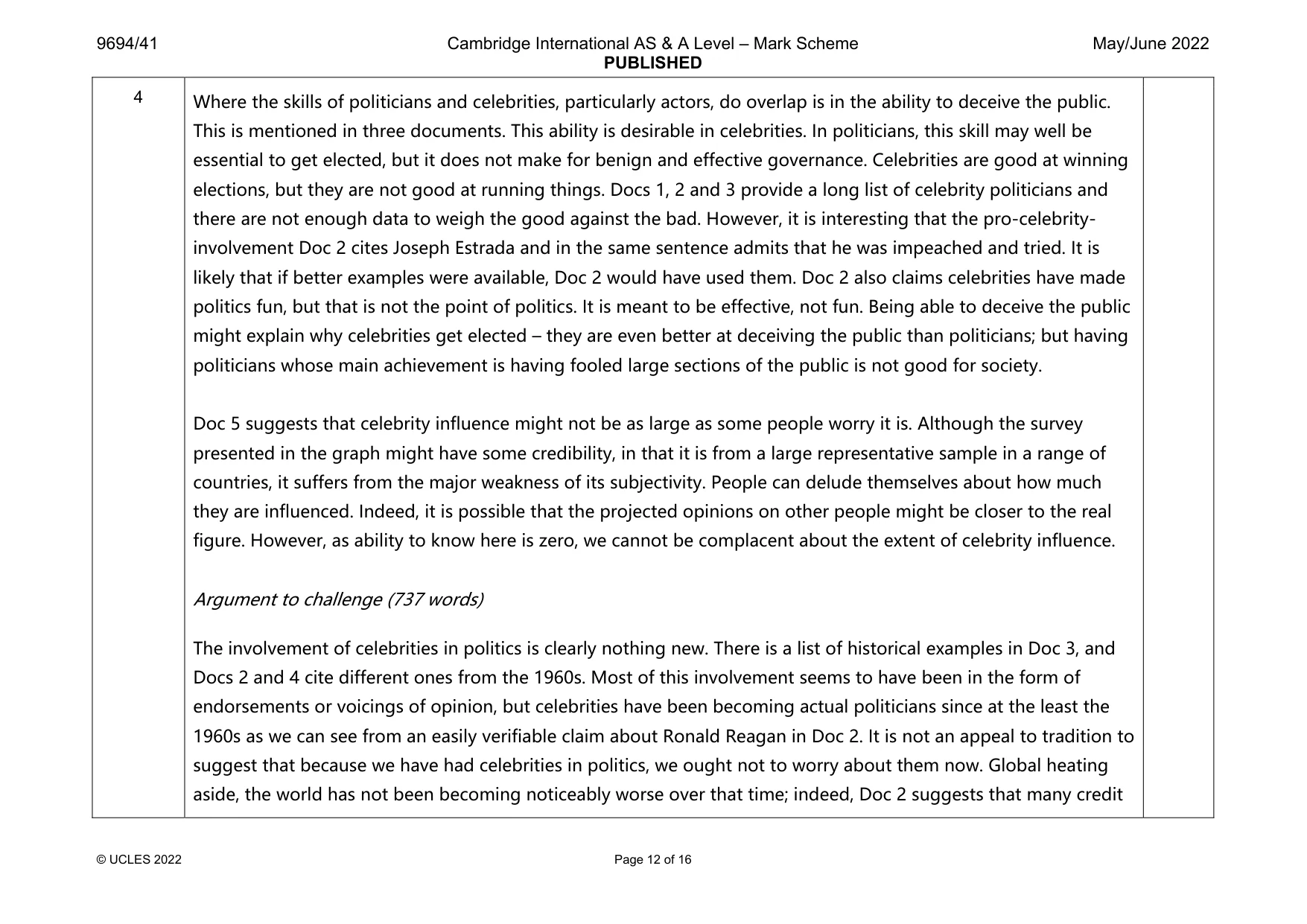
9694/41 Cambridge International AS & A Level – Mark Scheme PUBLISHED May/June 2022 © UCLES 2022 Page 12 of 16 4 Where the skills of politicians and celebrities, particularly actors, do overlap is in the ability to deceive the public. This is mentioned in three documents. This ability is desirable in celebrities. In politicians, this skill may well be essential to get elected, but it does not make for benign and effective governance. Celebrities are good at winning elections, but they are not good at running things. Docs 1, 2 and 3 provide a long list of celebrity politicians and there are not enough data to weigh the good against the bad. However, it is interesting that the pro-celebrity- involvement Doc 2 cites Joseph Estrada and in the same sentence admits that he was impeached and tried. It is likely that if better examples were available, Doc 2 would have used them. Doc 2 also claims celebrities have made politics fun, but that is not the point of politics. It is meant to be effective, not fun. Being able to deceive the public might explain why celebrities get elected – they are even better at deceiving the public than politicians; but having politicians whose main achievement is having fooled large sections of the public is not good for society. Doc 5 suggests that celebrity influence might not be as large as some people worry it is. Although the survey presented in the graph might have some credibility, in that it is from a large representative sample in a range of countries, it suffers from the major weakness of its subjectivity. People can delude themselves about how much they are influenced. Indeed, it is possible that the projected opinions on other people might be closer to the real figure. However, as ability to know here is zero, we cannot be complacent about the extent of celebrity influence. Argument to challenge (737 words) The involvement of celebrities in politics is clearly nothing new. There is a list of historical examples in Doc 3, and Docs 2 and 4 cite different ones from the 1960s. Most of this involvement seems to have been in the form of endorsements or voicings of opinion, but celebrities have been becoming actual politicians since at the least the 1960s as we can see from an easily verifiable claim about Ronald Reagan in Doc 2. It is not an appeal to tradition to suggest that because we have had celebrities in politics, we ought not to worry about them now. Global heating aside, the world has not been becoming noticeably worse over that time; indeed, Doc 2 suggests that many credit
Mark scheme, page 13
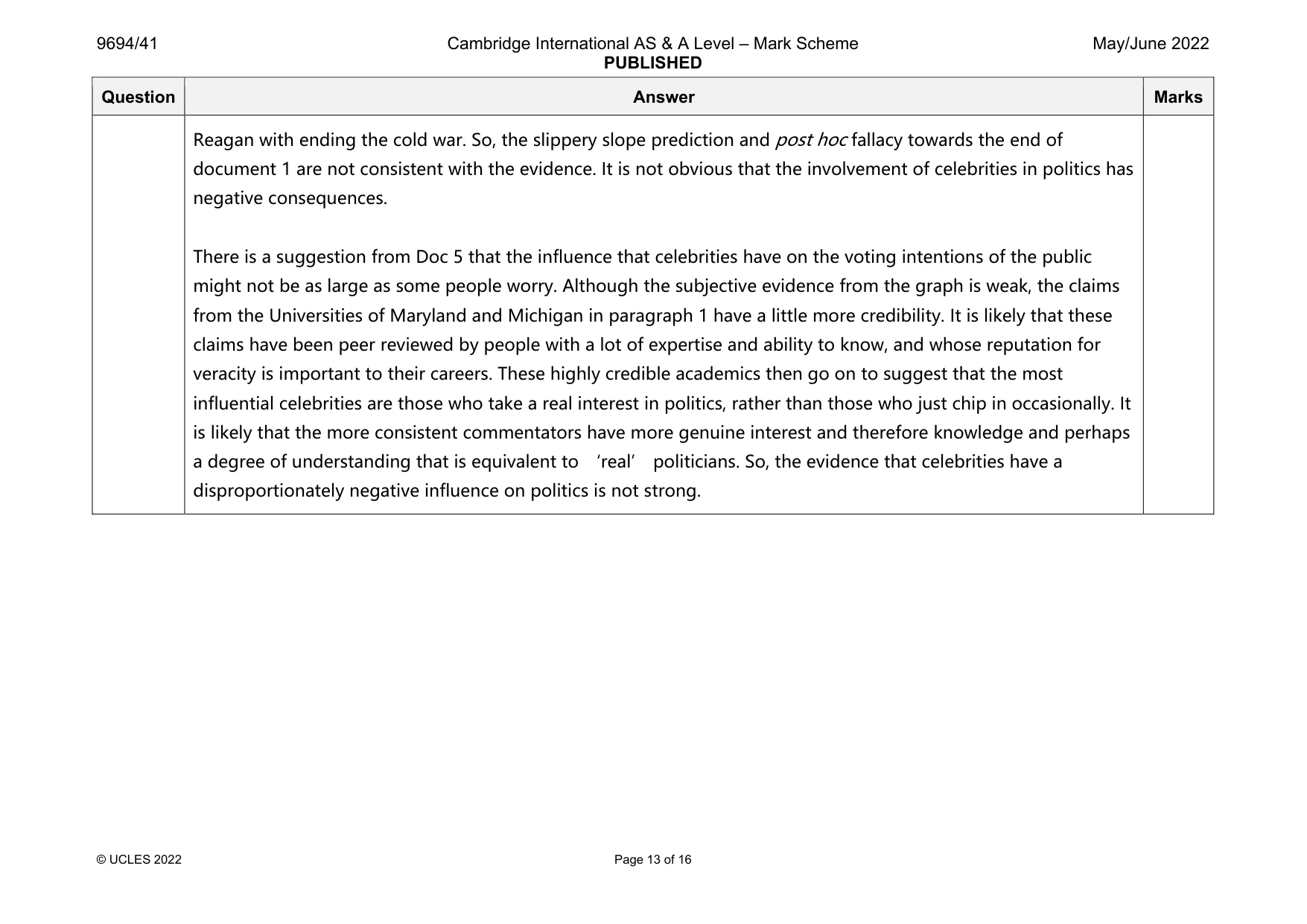
9694/41 Cambridge International AS & A Level – Mark Scheme PUBLISHED May/June 2022 © UCLES 2022 Page 13 of 16 Question Answer Marks Reagan with ending the cold war. So, the slippery slope prediction and post hoc fallacy towards the end of document 1 are not consistent with the evidence. It is not obvious that the involvement of celebrities in politics has negative consequences. There is a suggestion from Doc 5 that the influence that celebrities have on the voting intentions of the public might not be as large as some people worry. Although the subjective evidence from the graph is weak, the claims from the Universities of Maryland and Michigan in paragraph 1 have a little more credibility. It is likely that these claims have been peer reviewed by people with a lot of expertise and ability to know, and whose reputation for veracity is important to their careers. These highly credible academics then go on to suggest that the most influential celebrities are those who take a real interest in politics, rather than those who just chip in occasionally. It is likely that the more consistent commentators have more genuine interest and therefore knowledge and perhaps a degree of understanding that is equivalent to ‘real’ politicians. So, the evidence that celebrities have a disproportionately negative influence on politics is not strong.
Mark scheme, page 14
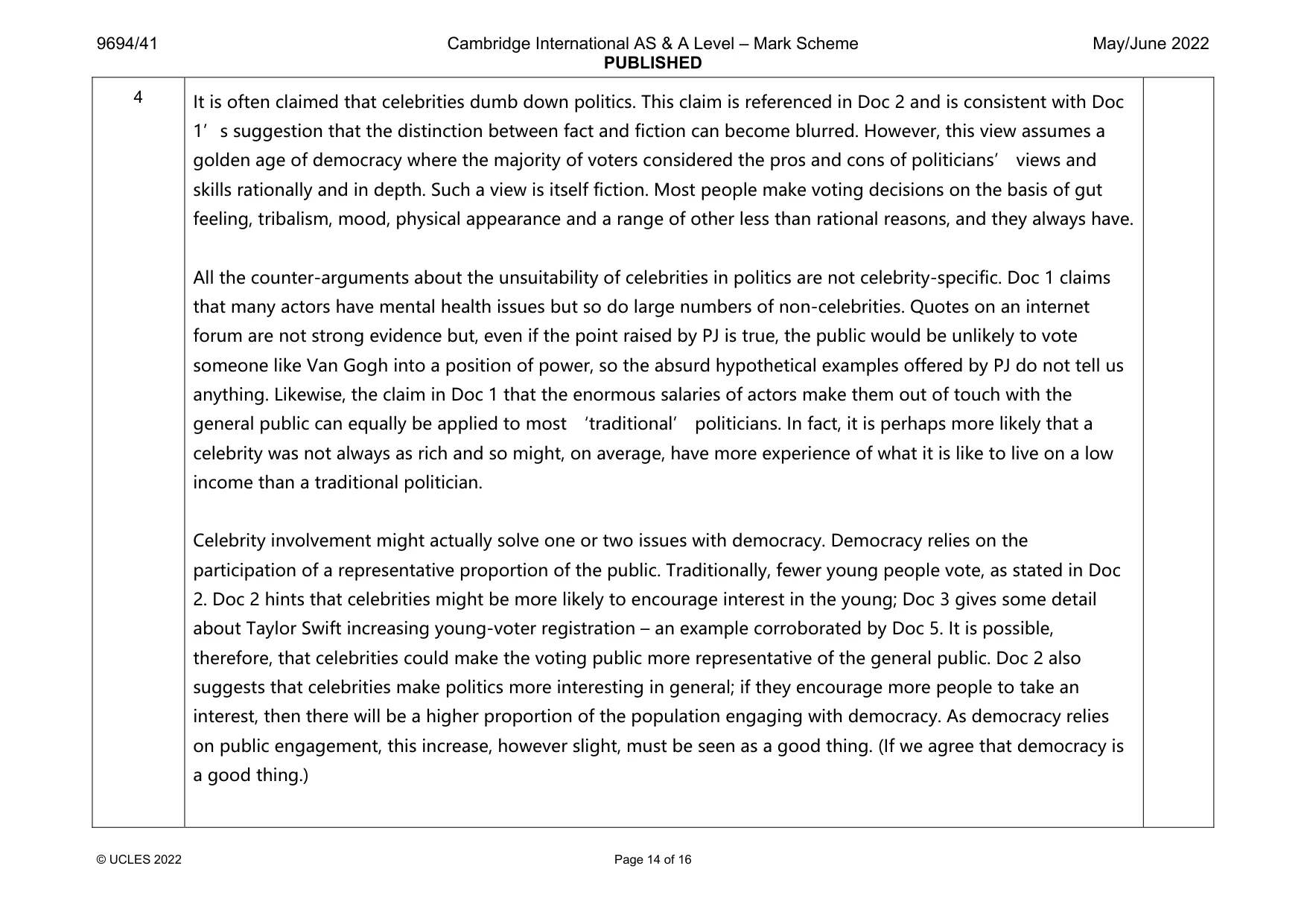
9694/41 Cambridge International AS & A Level – Mark Scheme PUBLISHED May/June 2022 © UCLES 2022 Page 14 of 16 4 It is often claimed that celebrities dumb down politics. This claim is referenced in Doc 2 and is consistent with Doc 1’s suggestion that the distinction between fact and fiction can become blurred. However, this view assumes a golden age of democracy where the majority of voters considered the pros and cons of politicians’ views and skills rationally and in depth. Such a view is itself fiction. Most people make voting decisions on the basis of gut feeling, tribalism, mood, physical appearance and a range of other less than rational reasons, and they always have. All the counter-arguments about the unsuitability of celebrities in politics are not celebrity-specific. Doc 1 claims that many actors have mental health issues but so do large numbers of non-celebrities. Quotes on an internet forum are not strong evidence but, even if the point raised by PJ is true, the public would be unlikely to vote someone like Van Gogh into a position of power, so the absurd hypothetical examples offered by PJ do not tell us anything. Likewise, the claim in Doc 1 that the enormous salaries of actors make them out of touch with the general public can equally be applied to most ‘traditional’ politicians. In fact, it is perhaps more likely that a celebrity was not always as rich and so might, on average, have more experience of what it is like to live on a low income than a traditional politician. Celebrity involvement might actually solve one or two issues with democracy. Democracy relies on the participation of a representative proportion of the public. Traditionally, fewer young people vote, as stated in Doc 2. Doc 2 hints that celebrities might be more likely to encourage interest in the young; Doc 3 gives some detail about Taylor Swift increasing young-voter registration – an example corroborated by Doc 5. It is possible, therefore, that celebrities could make the voting public more representative of the general public. Doc 2 also suggests that celebrities make politics more interesting in general; if they encourage more people to take an interest, then there will be a higher proportion of the population engaging with democracy. As democracy relies on public engagement, this increase, however slight, must be seen as a good thing. (If we agree that democracy is a good thing.)
Mark scheme, page 15
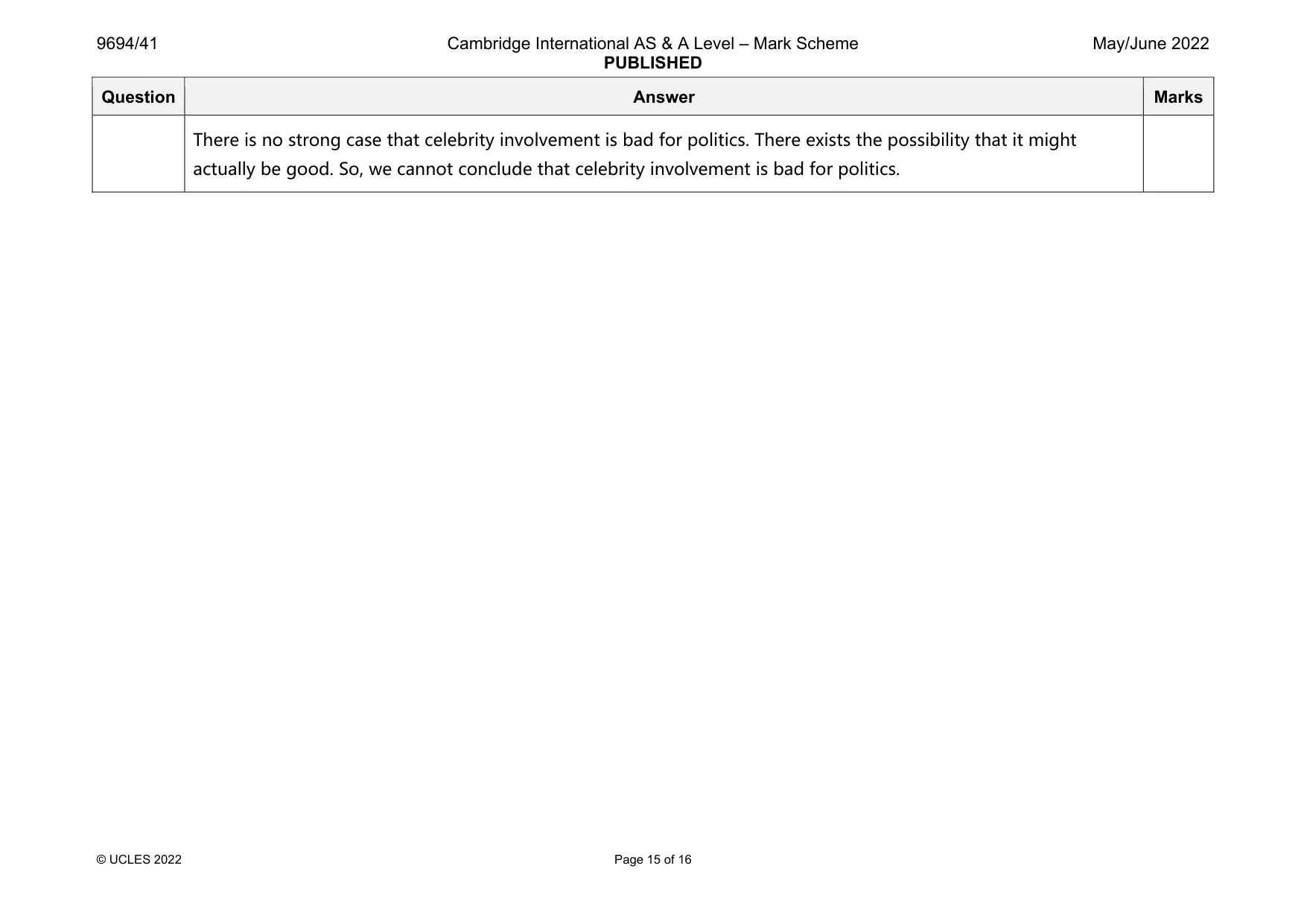
9694/41 Cambridge International AS & A Level – Mark Scheme PUBLISHED May/June 2022 © UCLES 2022 Page 15 of 16 Question Answer Marks There is no strong case that celebrity involvement is bad for politics. There exists the possibility that it might actually be good. So, we cannot conclude that celebrity involvement is bad for politics.
Mark scheme, page 16
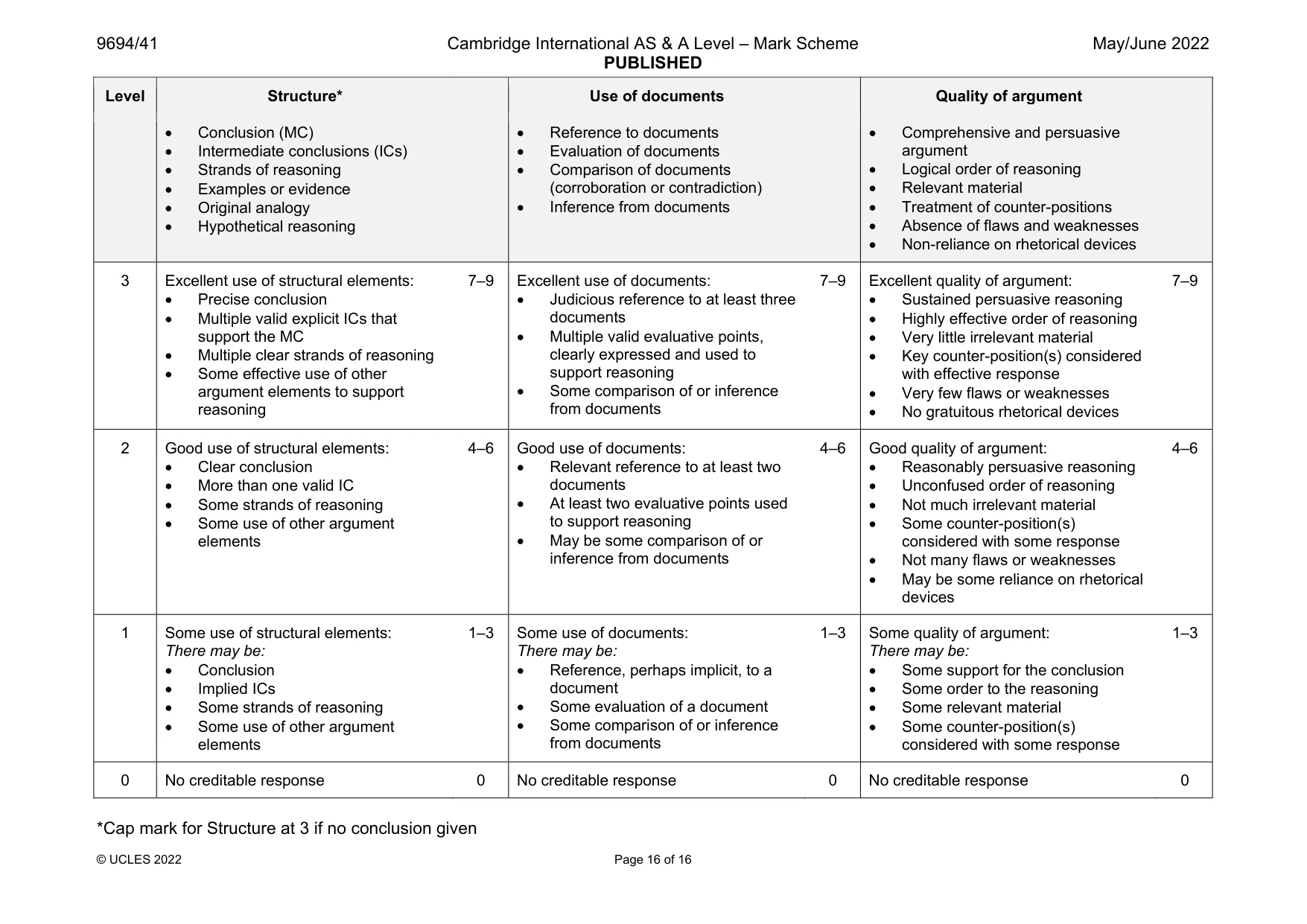
9694/41 Cambridge International AS & A Level – Mark Scheme PUBLISHED May/June 2022 © UCLES 2022 Page 16 of 16 Level Structure* Use of documents Quality of argument Conclusion (MC) Intermediate conclusions (ICs) Strands of reasoning Examples or evidence Original analogy Hypothetical reasoning Reference to documents Evaluation of documents Comparison of documents (corroboration or contradiction) Inference from documents Comprehensive and persuasive argument Logical order of reasoning Relevant material Treatment of counter-positions Absence of flaws and weaknesses Non-reliance on rhetorical devices 3 Excellent use of structural elements: Precise conclusion Multiple valid explicit ICs that support the MC Multiple clear strands of reasoning Some effective use of other argument elements to support reasoning 7–9 Excellent use of documents: Judicious reference to at least three documents Multiple valid evaluative points, clearly expressed and used to support reasoning Some comparison of or inference from documents 7–9 Excellent quality of argument: Sustained persuasive reasoning Highly effective order of reasoning Very little irrelevant material Key counter-position(s) considered with effective response Very few flaws or weaknesses No gratuitous rhetorical devices 7–9 2 Good use of structural elements: Clear conclusion More than one valid IC Some strands of reasoning Some use of other argument elements 4–6 Good use of documents: Relevant reference to at least two documents At least two evaluative points used to support reasoning May be some comparison of or inference from documents 4–6 Good quality of argument: Reasonably persuasive reasoning Unconfused order of reasoning Not much irrelevant material Some counter-position(s) considered with some response Not many flaws or weaknesses May be some reliance on rhetorical devices 4–6 1 Some use of structural elements: There may be: Conclusion Implied ICs Some strands of reasoning Some use of other argument elements 1–3 Some use of documents: There may be: Reference, perhaps implicit, to a document Some evaluation of a document Some comparison of or inference from documents 1–3 Some quality of argument: There may be: Some support for the conclusion Some order to the reasoning Some relevant material Some counter-position(s) considered with some response 1–3 0 No creditable response 0 No creditable response 0 No creditable response 0 *Cap mark for Structure at 3 if no conclusion given
What you needed in this session
Cambridge’s own grade thresholds for 2022 May/June, Paper 4 · Variant 1. A higher threshold means an easier paper — the bar moves with how the cohort did.