Cambridge A Level Thinking Skills 9694 — 2025 Oct/Nov Paper 4 · Variant 1
9694/41/O/N/25 · 50 marks · ≈56 min
The question paper and its mark scheme, free to read here and free to download. This is Cambridge’s own paper, exactly as it was sat.
Question paper8 pages
Mark scheme14 pages
Answers below. Sit the paper first if you are practising.
Paper as text
Question paper, page 1
[Turn over Cambridge International AS & A Level * 3 2 0 6 7 9 2 4 7 9 * THINKING SKILLS 9694/41 Paper 4 Applied Reasoning October/November 2025 1 hour 45 minutes You must answer on the enclosed answer booklet. You will need: Answer booklet (enclosed) INSTRUCTIONS ● Answer all questions. ● Follow the instructions on the front cover of the answer booklet. If you need additional answer paper, ask the invigilator for a continuation booklet. INFORMATION ● The total mark for this paper is 50. ● The number of marks for each question or part question is shown in brackets [ ]. This document has 8 pages. Any blank pages are indicated. DC (CE) 362126 © UCLES 2025
Question paper, page 2
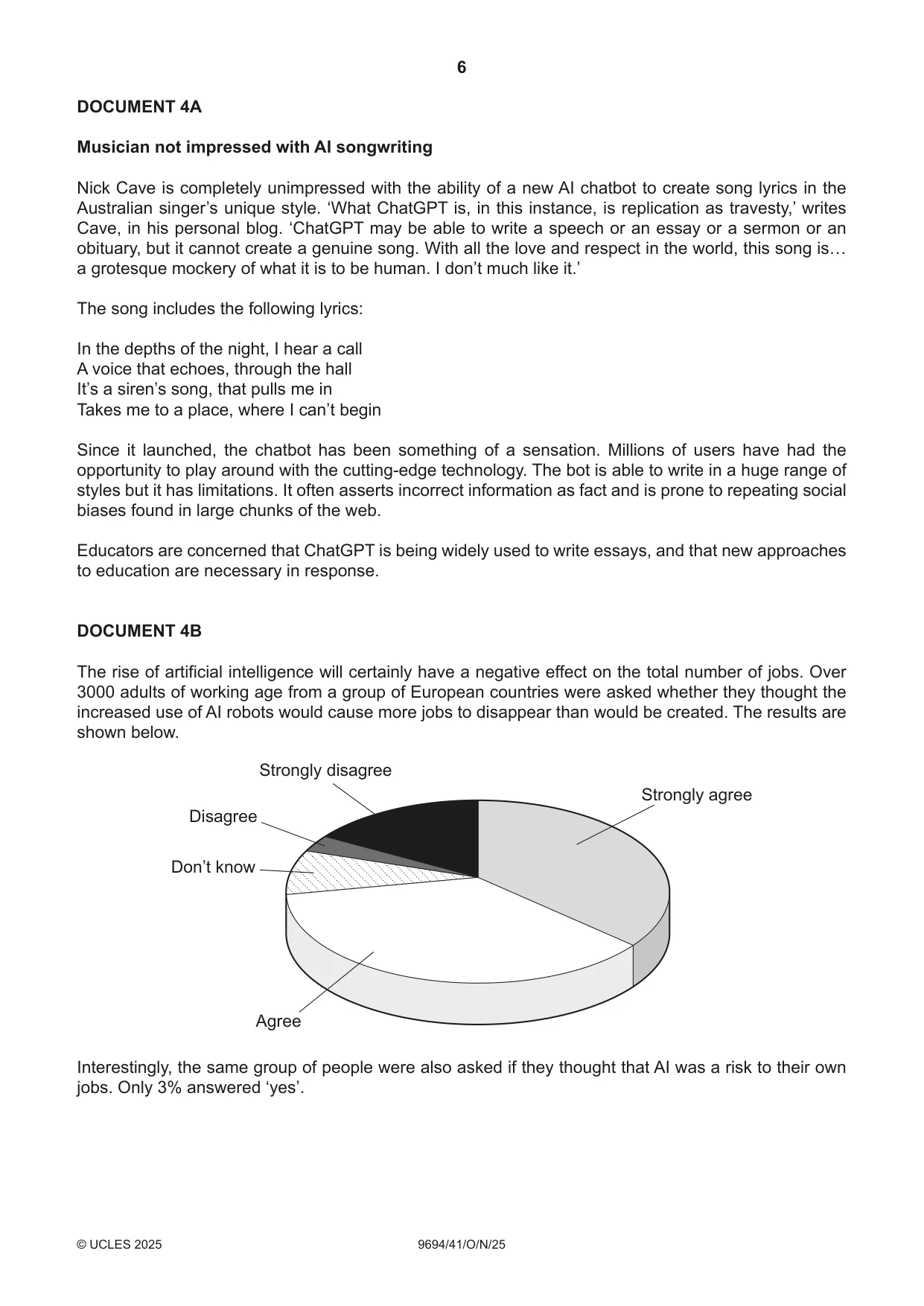
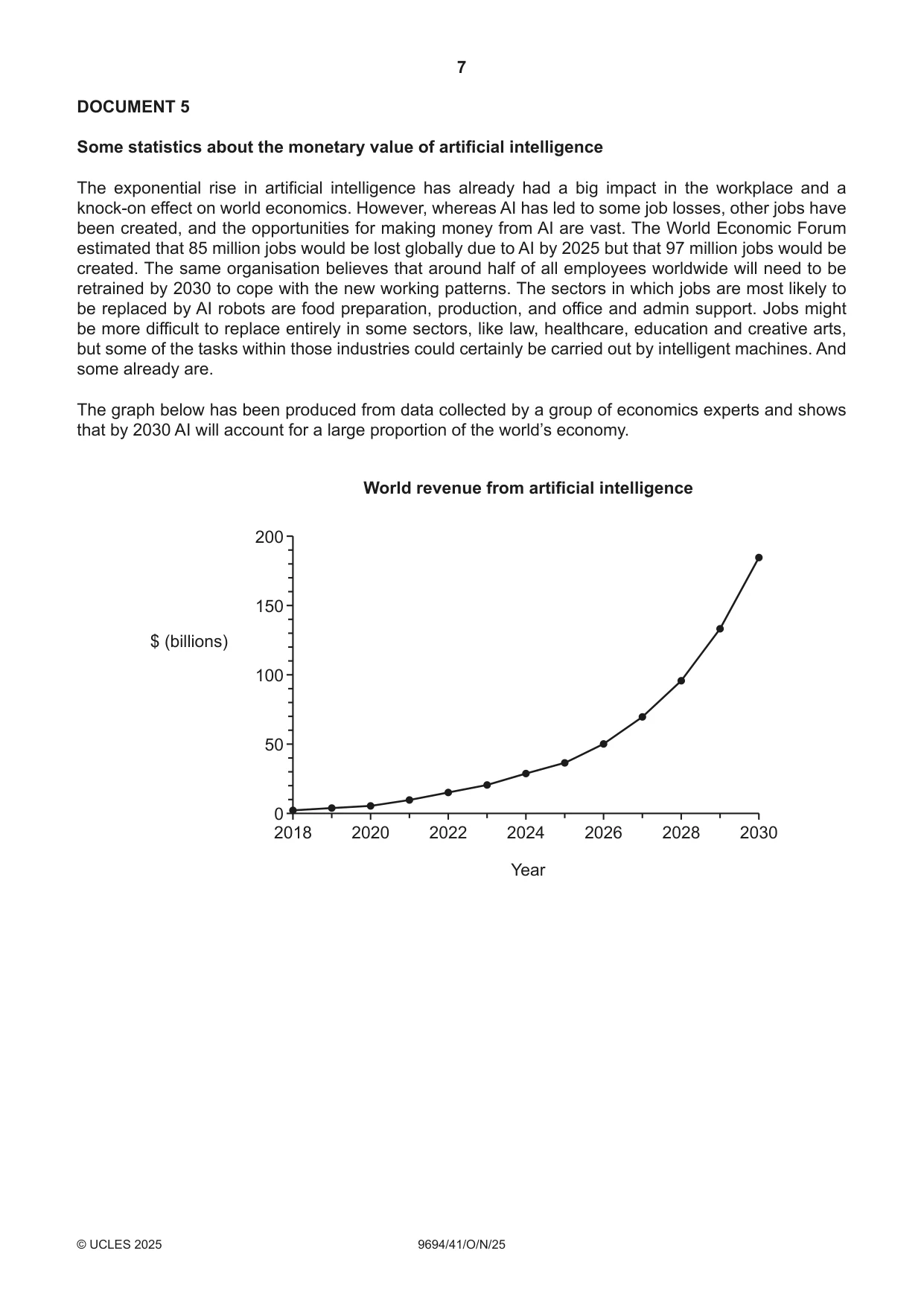
2 9694/41/O/N/25 © UCLES 2025 Questions 1 and 2 refer to Document 1. 1 (a) State the main conclusion of the argument. [1] (b) Identify two intermediate conclusions in paragraphs 3 to 4. [2] (c) Analyse the structure of the reasoning in paragraph 2. [5] (d) Identify one counter-assertion. [1] 2 Identify and explain four flaws and/or weaknesses in the reasoning in paragraphs 3 to 5. [8] 3 Questions 3(a) and 3(b) refer to Document 4B. (a) ‘The rise of artificial intelligence will certainly have a negative effect on the total number of jobs.’ Identify three weaknesses in the support given to this claim. [3] (b) Make one criticism of the way in which the chart has been presented. [1] Question 3(c) refers to Document 5. (c) ‘By 2030 AI will account for a large proportion of the world’s economy.’ Identify two weaknesses in the support given to this claim by the graph. [2] 4 You are advised to spend some time planning your answer before you begin to write it. ‘The rise of artificial intelligence should be restricted.’ Construct a reasoned argument to support or challenge this claim. Your argument should: • have a clear structure and make use of various argument elements • use and evaluate evidence from Documents 1 to 5 • respond to significant counter-positions. [27]
Question paper, page 3
3 9694/41/O/N/25 © UCLES 2025 [Turn over DOCUMENT 1 The future of artificial intelligence 1 Many people remember the premise of the film The Terminator and its various sequels – machines become too clever, take over the world and declare war on humanity. Some dismiss this as Hollywood fantasy, but they are naïvely optimistic. Artificial intelligence (AI) is everywhere in the modern world, from virtual assistants in our homes to smart screens that guess what we are going to type next. It is often said that AI not only makes our lives easier but will eliminate the need to do boring or dangerous jobs and could solve some of the big global issues. However, the dangers of AI are overlooked and our lives being easier is something of an illusion. 2 Many workers lost their jobs with the introduction of steam-powered machinery during the industrial revolution. So the AI revolution will cause many people to be out of work. Long-term unemployment leads to poverty and poverty results in starvation and civil unrest. So AI will cause starvation and civil unrest. 3 AI is not safe. The rise of driverless cars will increase the number of road accidents. The computers which control driverless cars are programmed to react to certain situations, such as ‘If someone is on the road, stop,’ but the computer’s camera is not a human eye. In 2018, a cyclist was killed by a self-driving vehicle, which proves that we cannot trust these machines with our lives. AI can also be used in hacking and cybercrimes, and terrorists could use it to inflict mass destruction. 4 The capabilities of AI have been increasing for years and will eventually surpass human intelligence. Our future safety is at risk from AI because it will perceive humans as inferior and begin to refuse human commands. It will prevent itself from being switched off and eventually create its own robot weapons to attack humanity. 5 It is often said that AI does, or will, solve many of the world’s problems, like climate change. However, problem-solving is an activity that many humans enjoy, and its development can lead to innovation and creativity. A future without art and new ideas is a very bleak future indeed. The rise of intelligent machines is dangerous, as it puts us at risk in the present and in the future. Several film stars have warned that there are very real risks associated with the march of the technology if left unchecked. We ought to limit the development of AI. 6 The world could function without AI. The fact that we have successfully managed to remove environmentally damaging chemicals from aerosol sprays, have almost eliminated the use of coal for electricity generation and are on the way to replacing petrol and diesel vehicles shows that we can eliminate a technology that people once thought essential and still function perfectly well.
Question paper, page 4
4 9694/41/O/N/25 © UCLES 2025 DOCUMENT 2 Don’t worry about AI One can’t help but be impressed by the increasing ability of machines to replicate or even surpass human abilities in complex tasks. Artificial intelligence (AI) machines can already beat the best players in the world at the boardgames chess and go. In addition to such intriguing demonstrations of AI capabilities, there are an increasing number of real-world applications for AI. Digital personal assistants, like Alexa and Siri, use AI technologies to learn the most suitable answers to our questions. Driverless cars ‘learn’ through experience using AI. AI-enabled machines could learn to interpret medical results, such as CT scans, making diagnosis quicker and more accurate. Artificial intelligence can be defined as ‘a collection of technologies that can be used to imitate or outperform humans in tasks traditionally carried out by humans’. AI is already used in a wide range of applications, including search engines and chatbots, but machines are encroaching on the fundamental abilities that distinguish humans from animals: making complex decisions, solving problems and, crucially, learning. There are many concerns about AI. As far back as 2015, the UK’s chief economist suggested that as many as one third of jobs, for example, drivers, administrative staff and people who answer customer questions over the phone, could be lost to automation. In the future, AI will affect a much broader range of jobs, including many that are highly paid and highly skilled. Facial recognition systems and CCTV could jeopardise our privacy. World-renowned scientist Stephen Hawking once said that ‘AI may replace humans altogether’ as a ‘new form of life’ that can rapidly learn and improve, making people obsolete. However, many have a positive view of the future of AI. Tech billionaire Jeff Bezos has stated that ‘Artificial intelligence is more likely to save humanity than to destroy it’, and technology entrepreneur and Stanford University professor Andrew Ng thinks AI capabilities will allow us to build a much brighter future where humans are relieved of menial work. AI has the potential to change the world in unimaginable ways and society has always been concerned about the introduction of new technology. From the textile machines of the industrial revolution that were smashed by angry workers to the bicycle, new technology has prompted cries that people will become redundant or that society will be massively altered. The nature of work and working patterns has always changed and will continue to do so. New technology often results in temporary job losses, but the system has always reset and in recent years that reset has been associated with better working conditions for most people. We should consider the benefits that AI has already brought, such as the speedier detection of bank fraud and cancer diagnosis. Worries about sci-fi scenarios are a distraction from the real challenges of the future. We are repeatedly told about the superiority of computers, but these machines are built by our own hands. Most people would agree that technological progress is a good thing. For centuries we have gradually made our lives easier and safer through innovation and automation. Driverless vehicles will drastically reduce the number of traffic accidents, whatever the opponents claim. The world moves on and we should embrace it, sensibly.
Question paper, page 5
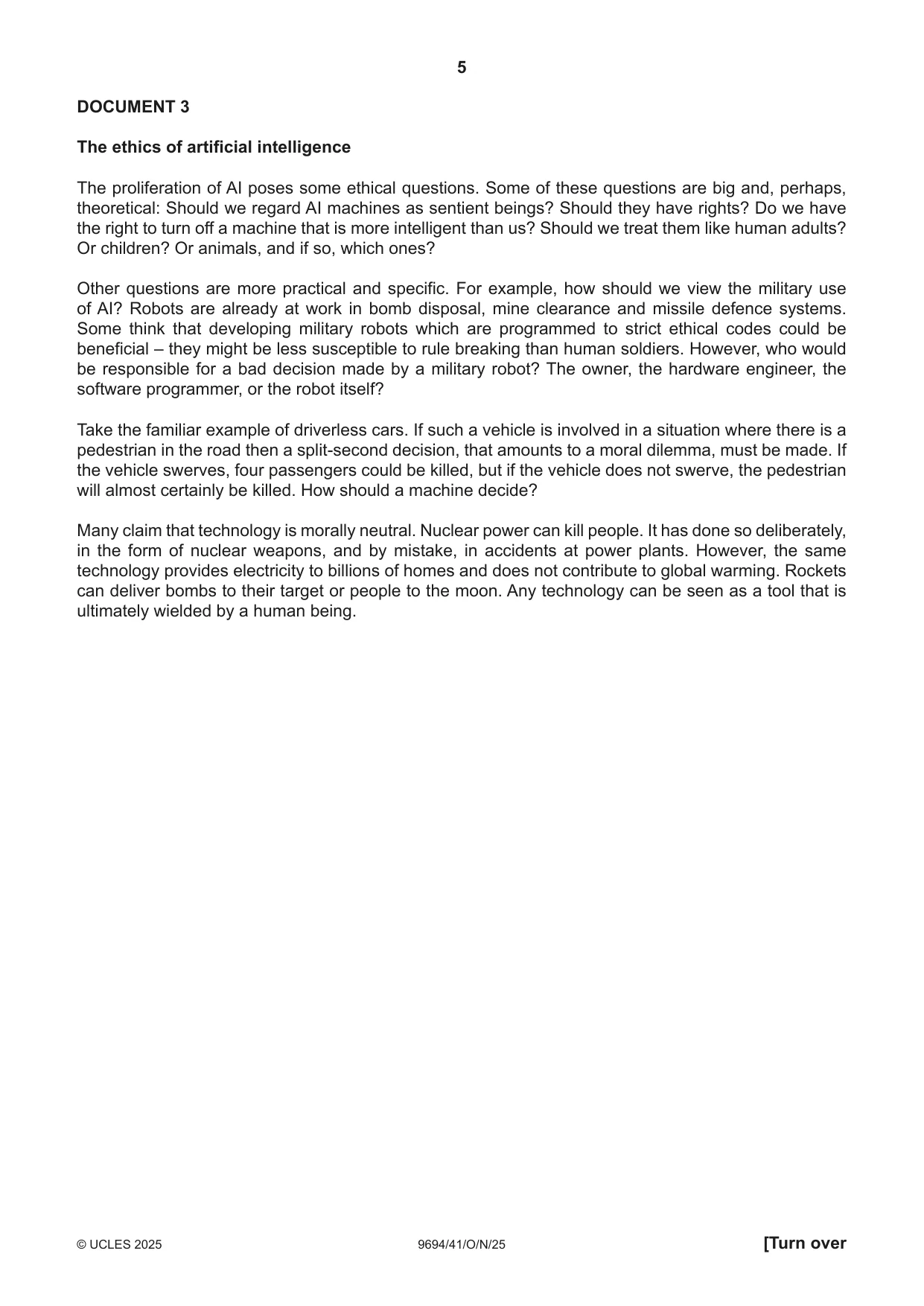
5 9694/41/O/N/25 © UCLES 2025 [Turn over DOCUMENT 3 The ethics of artificial intelligence The proliferation of AI poses some ethical questions. Some of these questions are big and, perhaps, theoretical: Should we regard AI machines as sentient beings? Should they have rights? Do we have the right to turn off a machine that is more intelligent than us? Should we treat them like human adults? Or children? Or animals, and if so, which ones? Other questions are more practical and specific. For example, how should we view the military use of AI? Robots are already at work in bomb disposal, mine clearance and missile defence systems. Some think that developing military robots which are programmed to strict ethical codes could be beneficial – they might be less susceptible to rule breaking than human soldiers. However, who would be responsible for a bad decision made by a military robot? The owner, the hardware engineer, the software programmer, or the robot itself? Take the familiar example of driverless cars. If such a vehicle is involved in a situation where there is a pedestrian in the road then a split-second decision, that amounts to a moral dilemma, must be made. If the vehicle swerves, four passengers could be killed, but if the vehicle does not swerve, the pedestrian will almost certainly be killed. How should a machine decide? Many claim that technology is morally neutral. Nuclear power can kill people. It has done so deliberately, in the form of nuclear weapons, and by mistake, in accidents at power plants. However, the same technology provides electricity to billions of homes and does not contribute to global warming. Rockets can deliver bombs to their target or people to the moon. Any technology can be seen as a tool that is ultimately wielded by a human being.
Question paper, page 6
6 9694/41/O/N/25 © UCLES 2025 DOCUMENT 4A Musician not impressed with AI songwriting Nick Cave is completely unimpressed with the ability of a new AI chatbot to create song lyrics in the Australian singer’s unique style. ‘What ChatGPT is, in this instance, is replication as travesty,’ writes Cave, in his personal blog. ‘ChatGPT may be able to write a speech or an essay or a sermon or an obituary, but it cannot create a genuine song. With all the love and respect in the world, this song is… a grotesque mockery of what it is to be human. I don’t much like it.’ The song includes the following lyrics: In the depths of the night, I hear a call A voice that echoes, through the hall It’s a siren’s song, that pulls me in Takes me to a place, where I can’t begin Since it launched, the chatbot has been something of a sensation. Millions of users have had the opportunity to play around with the cutting-edge technology. The bot is able to write in a huge range of styles but it has limitations. It often asserts incorrect information as fact and is prone to repeating social biases found in large chunks of the web. Educators are concerned that ChatGPT is being widely used to write essays, and that new approaches to education are necessary in response. DOCUMENT 4B The rise of artificial intelligence will certainly have a negative effect on the total number of jobs. Over 3000 adults of working age from a group of European countries were asked whether they thought the increased use of AI robots would cause more jobs to disappear than would be created. The results are shown below. Strongly agree Agree Don’t know Disagree Strongly disagree Interestingly, the same group of people were also asked if they thought that AI was a risk to their own jobs. Only 3% answered ‘yes’.
Question paper, page 7
7 9694/41/O/N/25 © UCLES 2025 DOCUMENT 5 Some statistics about the monetary value of artificial intelligence The exponential rise in artificial intelligence has already had a big impact in the workplace and a knock-on effect on world economics. However, whereas AI has led to some job losses, other jobs have been created, and the opportunities for making money from AI are vast. The World Economic Forum estimated that 85 million jobs would be lost globally due to AI by 2025 but that 97 million jobs would be created. The same organisation believes that around half of all employees worldwide will need to be retrained by 2030 to cope with the new working patterns. The sectors in which jobs are most likely to be replaced by AI robots are food preparation, production, and office and admin support. Jobs might be more difficult to replace entirely in some sectors, like law, healthcare, education and creative arts, but some of the tasks within those industries could certainly be carried out by intelligent machines. And some already are. The graph below has been produced from data collected by a group of economics experts and shows that by 2030 AI will account for a large proportion of the world’s economy. 2018 0 50 100 $ (billions) 150 200 2020 2022 2024 Year World revenue from artificial intelligence 2026 2028 2030
Question paper, page 8
8 9694/41/O/N/25 © UCLES 2025 Permission to reproduce items where third-party owned material protected by copyright is included has been sought and cleared where possible. Every reasonable effort has been made by the publisher (UCLES) to trace copyright holders, but if any items requiring clearance have unwittingly been included, the publisher will be pleased to make amends at the earliest possible opportunity. To avoid the issue of disclosure of answer-related information to candidates, all copyright acknowledgements are reproduced online in the Cambridge Assessment International Education Copyright Acknowledgements Booklet. This is produced for each series of examinations and is freely available to download at www.cambridgeinternational.org after the live examination series. Cambridge Assessment International Education is part of Cambridge Assessment. Cambridge Assessment is the brand name of the University of Cambridge Local Examinations Syndicate (UCLES), which is a department of the University of Cambridge. BLANK PAGE
Mark scheme, page 1
This document consists of 14 printed pages. © Cambridge University Press & Assessment 2025 [Turn over Cambridge International AS & A Level THINKING SKILLS 9694/41 Paper 4 Applied Reasoning October/November 2025 MARK SCHEME Maximum Mark: 50 Published This mark scheme is published as an aid to teachers and candidates, to indicate the requirements of the examination. It shows the basis on which Examiners were instructed to award marks. It does not indicate the details of the discussions that took place at an Examiners’ meeting before marking began, which would have considered the acceptability of alternative answers. Mark schemes should be read in conjunction with the question paper and the Principal Examiner Report for Teachers. Cambridge International will not enter into discussions about these mark schemes. Cambridge International is publishing the mark schemes for the October/November 2025 series for most Cambridge IGCSE, Cambridge International A and AS Level components, and some Cambridge O Level components.
Mark scheme, page 2
9694/41 Cambridge International AS & A Level – Mark Scheme PUBLISHED October/November 2025 © Cambridge University Press & Assessment 2025 Page 2 of 14 Generic Marking Principles These general marking principles must be applied by all examiners when marking candidate answers. They should be applied alon gside the specific content of the mark scheme or generic level descriptions for a question. Each question paper and mark scheme will also comply with these marking principles. GENERIC MARKING PRINCIPLE 1: Marks must be awarded in line with: • the specific content of the mark scheme or the generic level descriptors for the question • the specific skills defined in the mark scheme or in the generic level descriptors for the question • the standard of response required by a candidate as exemplified by the standardisation scripts. GENERIC MARKING PRINCIPLE 2: Marks awarded are always whole marks (not half marks, or other fractions). GENERIC MARKING PRINCIPLE 3: Marks must be awarded positively: • marks are awarded for correct/valid answers, as defined in the mark scheme. However, credit is given for valid answers which go beyond the scope of the syllabus and mark scheme, referring to your Team Leader as appropriate • marks are awarded when candidates clearly demonstrate what they know and can do • marks are not deducted for errors • marks are not deducted for omissions • answers should only be judged on the quality of spelling, punctuation and grammar when these features are specifically assessed by the question as indicated by the mark scheme. The meaning, however, should be unambiguous. GENERIC MARKING PRINCIPLE 4: Rules must be applied consistently, e.g. in situations where candidates have not followed instructions or in the application of generic level descriptors.
Mark scheme, page 3
9694/41 Cambridge International AS & A Level – Mark Scheme PUBLISHED October/November 2025 © Cambridge University Press & Assessment 2025 Page 3 of 14 GENERIC MARKING PRINCIPLE 5: Marks should be awarded using the full range of marks defined in the mark scheme for the question (however; the use of the full mark range may be limited according to the quality of the candidate responses seen). GENERIC MARKING PRINCIPLE 6: Marks awarded are based solely on the requirements as defined in the mark scheme. Marks should not be awarded with grade thre sholds or grade descriptors in mind.
Mark scheme, page 4
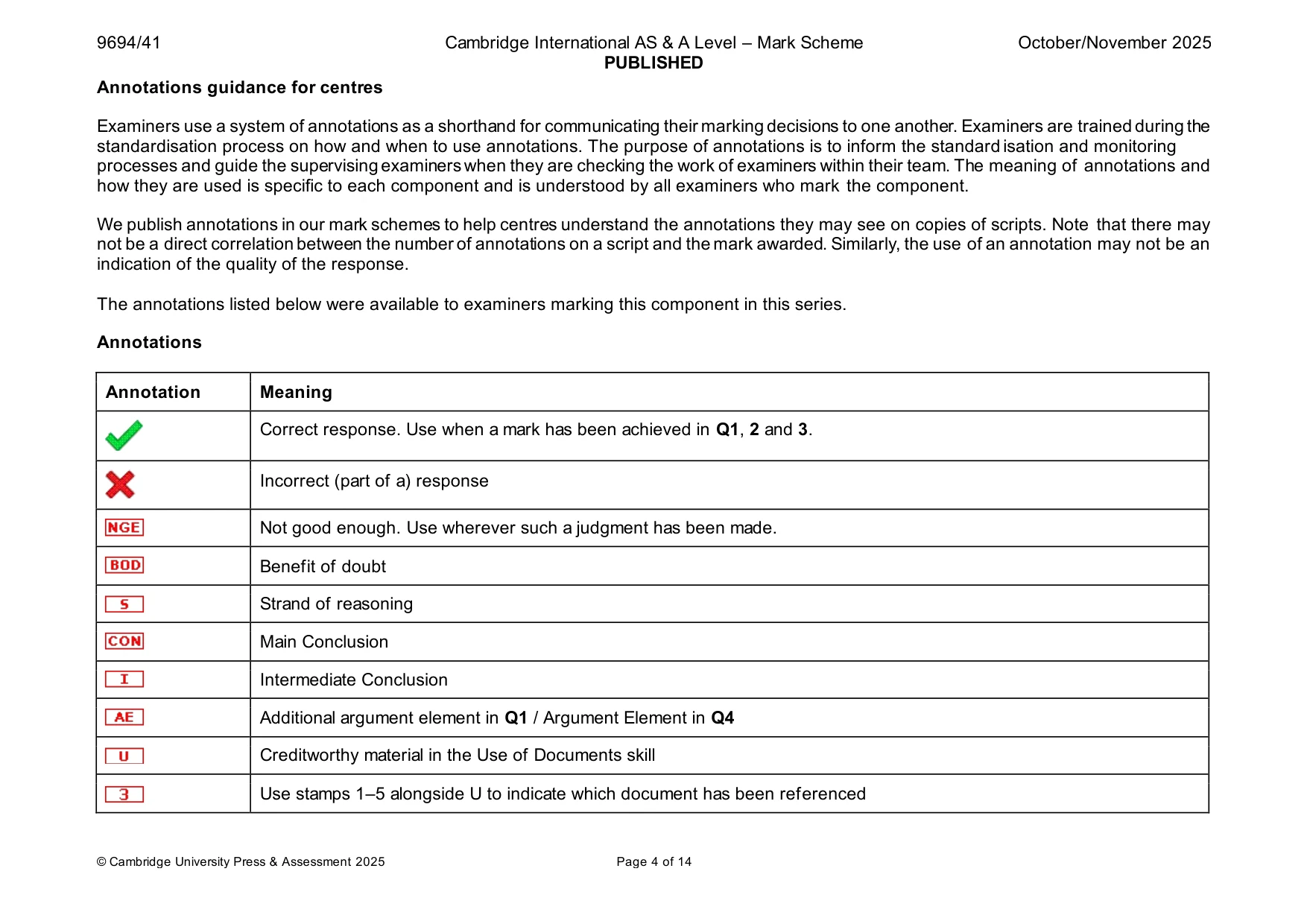
9694/41 Cambridge International AS & A Level – Mark Scheme PUBLISHED October/November 2025 © Cambridge University Press & Assessment 2025 Page 4 of 14 Annotations guidance for centres Examiners use a system of annotations as a shorthand for communicating their marking decisions to one another. Examiners are trained during the standardisation process on how and when to use annotations. The purpose of annotations is to inform the standard isation and monitoring processes and guide the supervising examiners when they are checking the work of examiners within their team. The meaning of annotations and how they are used is specific to each component and is understood by all examiners who mark the component. We publish annotations in our mark schemes to help centres understand the annotations they may see on copies of scripts. Note that there may not be a direct correlation between the number of annotations on a script and the mark awarded. Similarly, the use of an annotation may not be an indication of the quality of the response. The annotations listed below were available to examiners marking this component in this series. Annotations Annotation Meaning Correct response. Use when a mark has been achieved in Q1, 2 and 3. Incorrect (part of a) response Not good enough. Use wherever such a judgment has been made. Benefit of doubt Strand of reasoning Main Conclusion Intermediate Conclusion Additional argument element in Q1 / Argument Element in Q4 Creditworthy material in the Use of Documents skill Use stamps 1–5 alongside U to indicate which document has been referenced
Mark scheme, page 5
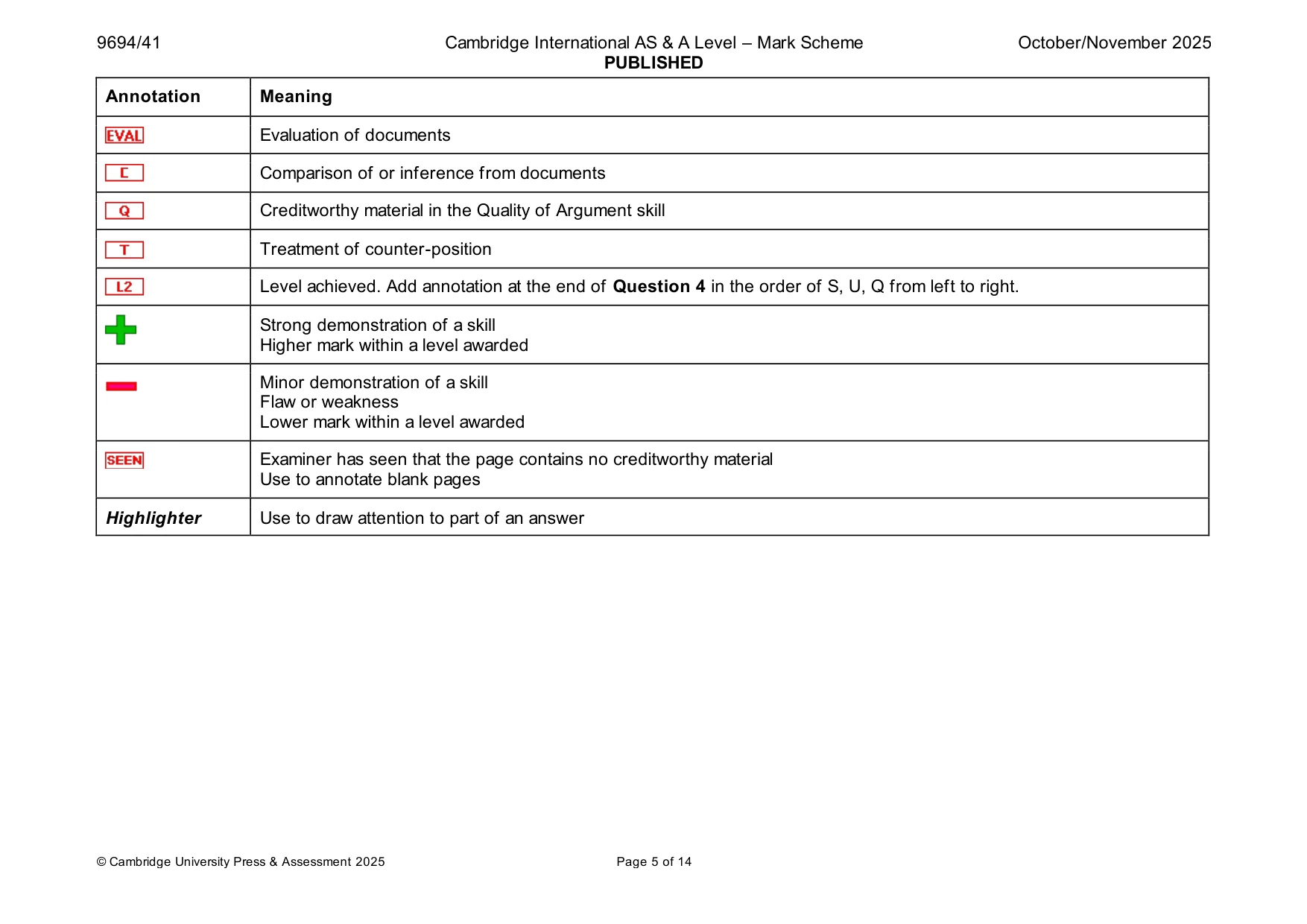
9694/41 Cambridge International AS & A Level – Mark Scheme PUBLISHED October/November 2025 © Cambridge University Press & Assessment 2025 Page 5 of 14 Annotation Meaning Evaluation of documents Comparison of or inference from documents Creditworthy material in the Quality of Argument skill Treatment of counter-position Level achieved. Add annotation at the end of Question 4 in the order of S, U, Q from left to right. Strong demonstration of a skill Higher mark within a level awarded Minor demonstration of a skill Flaw or weakness Lower mark within a level awarded Examiner has seen that the page contains no creditworthy material Use to annotate blank pages Highlighter Use to draw attention to part of an answer
Mark scheme, page 6
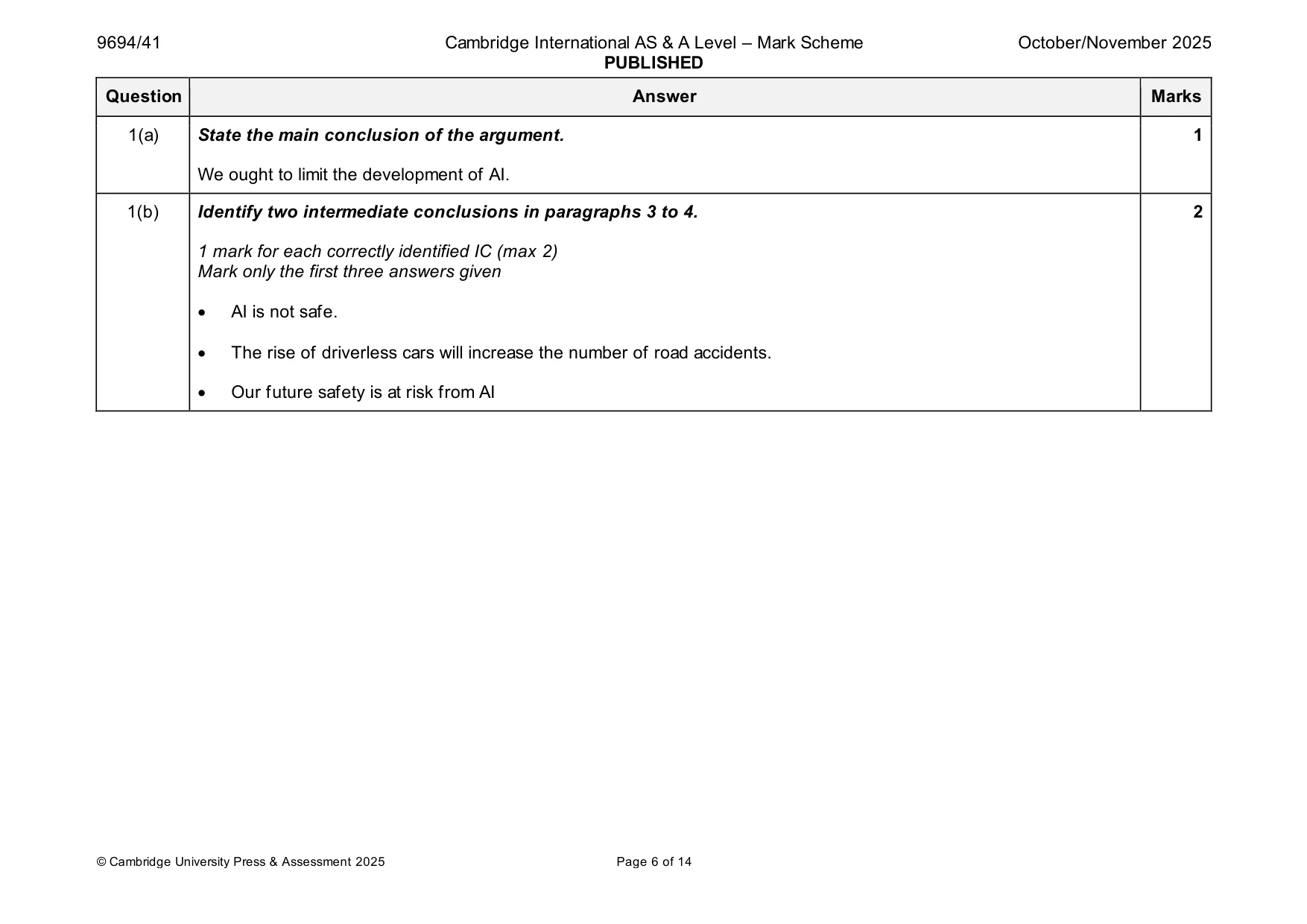
9694/41 Cambridge International AS & A Level – Mark Scheme PUBLISHED October/November 2025 © Cambridge University Press & Assessment 2025 Page 6 of 14 Question Answer Marks 1(a) State the main conclusion of the argument. We ought to limit the development of AI. 1 1(b) Identify two intermediate conclusions in paragraphs 3 to 4. 1 mark for each correctly identified IC (max 2) Mark only the first three answers given • AI is not safe. • The rise of driverless cars will increase the number of road accidents. • Our future safety is at risk from AI 2
Mark scheme, page 7
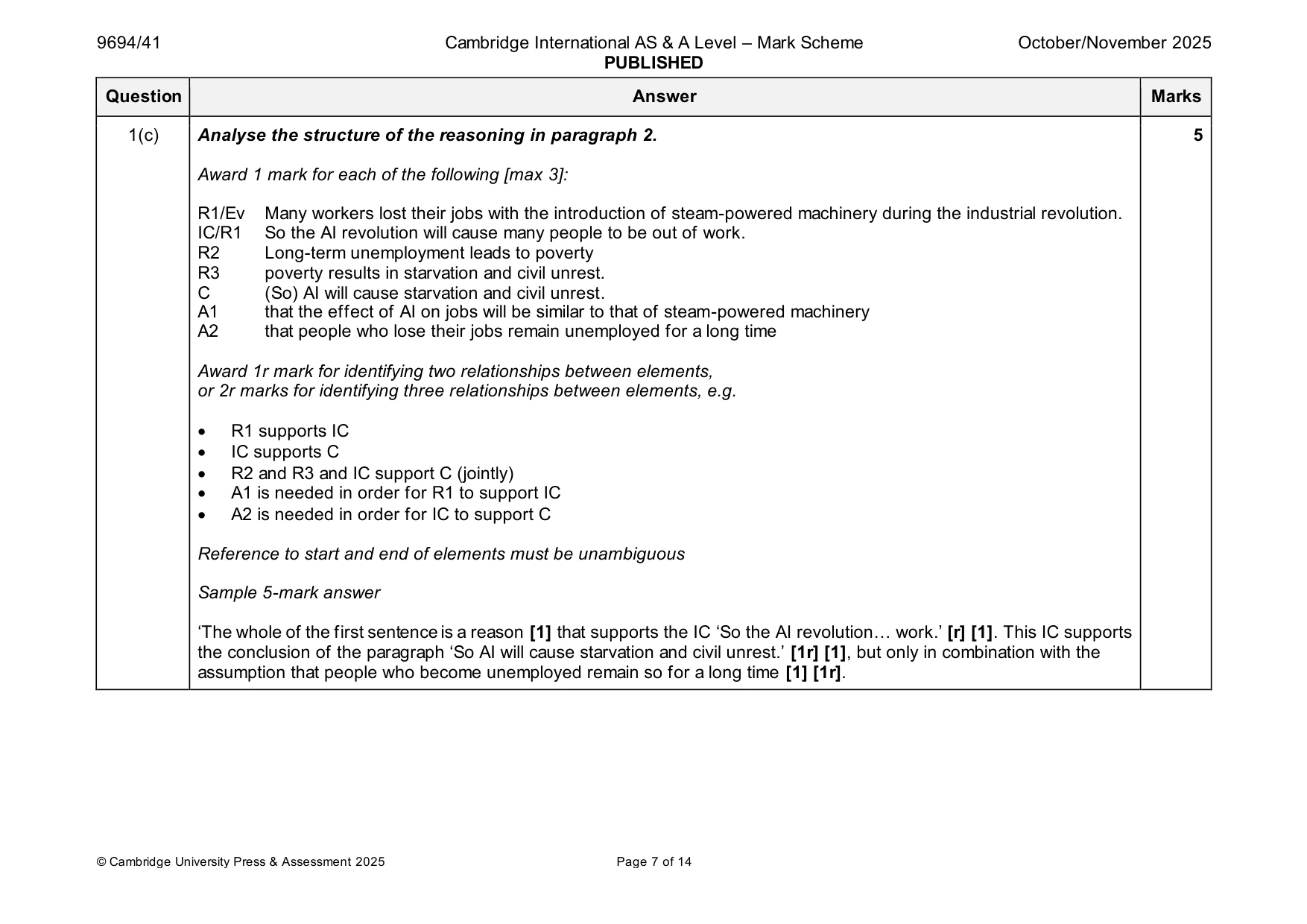
9694/41 Cambridge International AS & A Level – Mark Scheme PUBLISHED October/November 2025 © Cambridge University Press & Assessment 2025 Page 7 of 14 Question Answer Marks 1(c) Analyse the structure of the reasoning in paragraph 2. Award 1 mark for each of the following [max 3]: R1/Ev Many workers lost their jobs with the introduction of steam-powered machinery during the industrial revolution. IC/R1 So the AI revolution will cause many people to be out of work. R2 Long-term unemployment leads to poverty R3 poverty results in starvation and civil unrest. C (So) AI will cause starvation and civil unrest. A1 that the effect of AI on jobs will be similar to that of steam-powered machinery A2 that people who lose their jobs remain unemployed for a long time Award 1r mark for identifying two relationships between elements, or 2r marks for identifying three relationships between elements, e.g. • R1 supports IC • IC supports C • R2 and R3 and IC support C (jointly) • A1 is needed in order for R1 to support IC • A2 is needed in order for IC to support C Reference to start and end of elements must be unambiguous Sample 5-mark answer ‘The whole of the first sentence is a reason [1] that supports the IC ‘So the AI revolution… work.’ [r] [1]. This IC supports the conclusion of the paragraph ‘So AI will cause starvation and civil unrest.’ [1r] [1], but only in combination with the assumption that people who become unemployed remain so for a long time [1] [1r]. 5
Mark scheme, page 8
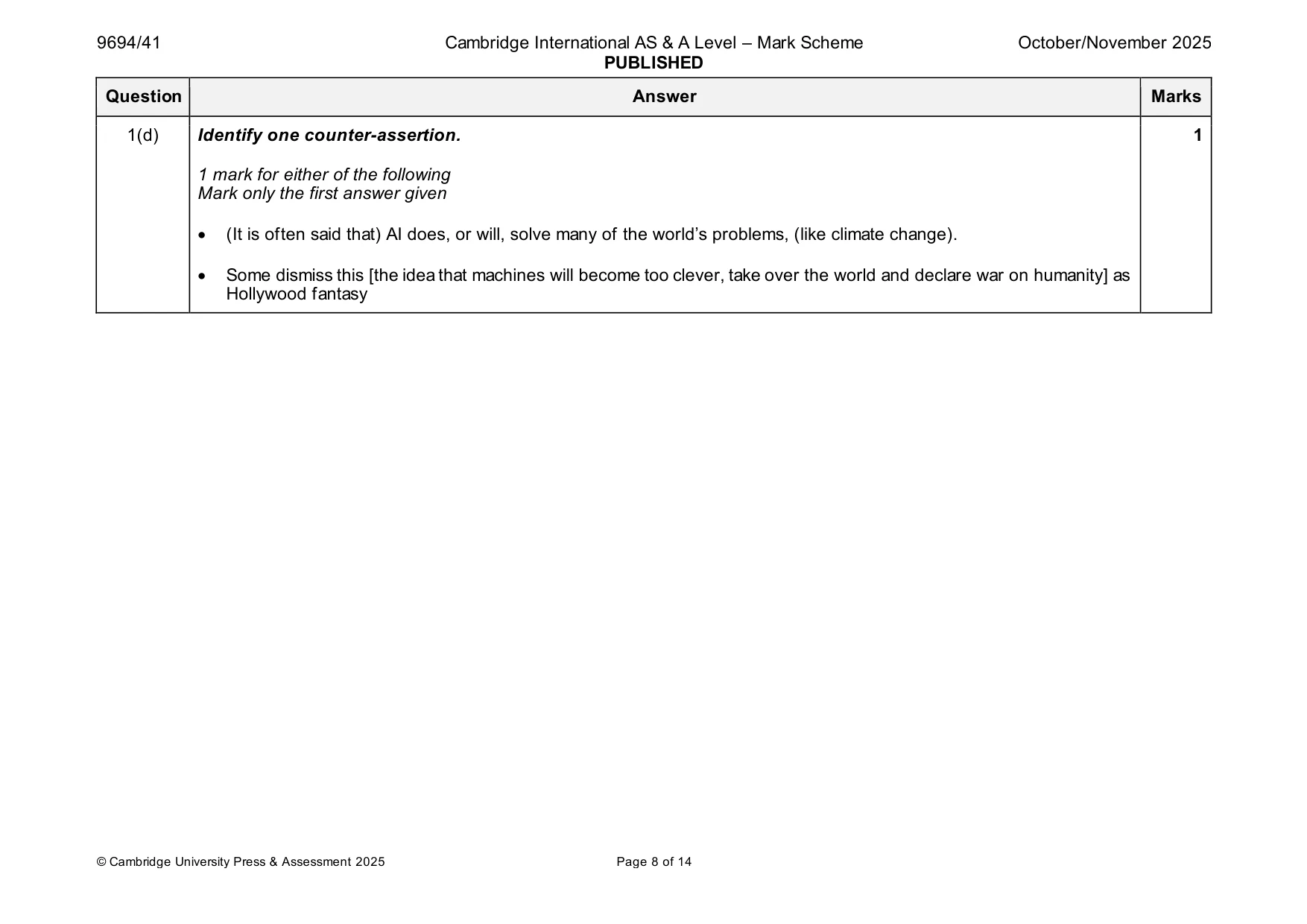
9694/41 Cambridge International AS & A Level – Mark Scheme PUBLISHED October/November 2025 © Cambridge University Press & Assessment 2025 Page 8 of 14 Question Answer Marks 1(d) Identify one counter-assertion. 1 mark for either of the following Mark only the first answer given • (It is often said that) AI does, or will, solve many of the world’s problems, (like climate change). • Some dismiss this [the idea that machines will become too clever, take over the world and declare war on humanity] as Hollywood fantasy 1
Mark scheme, page 9
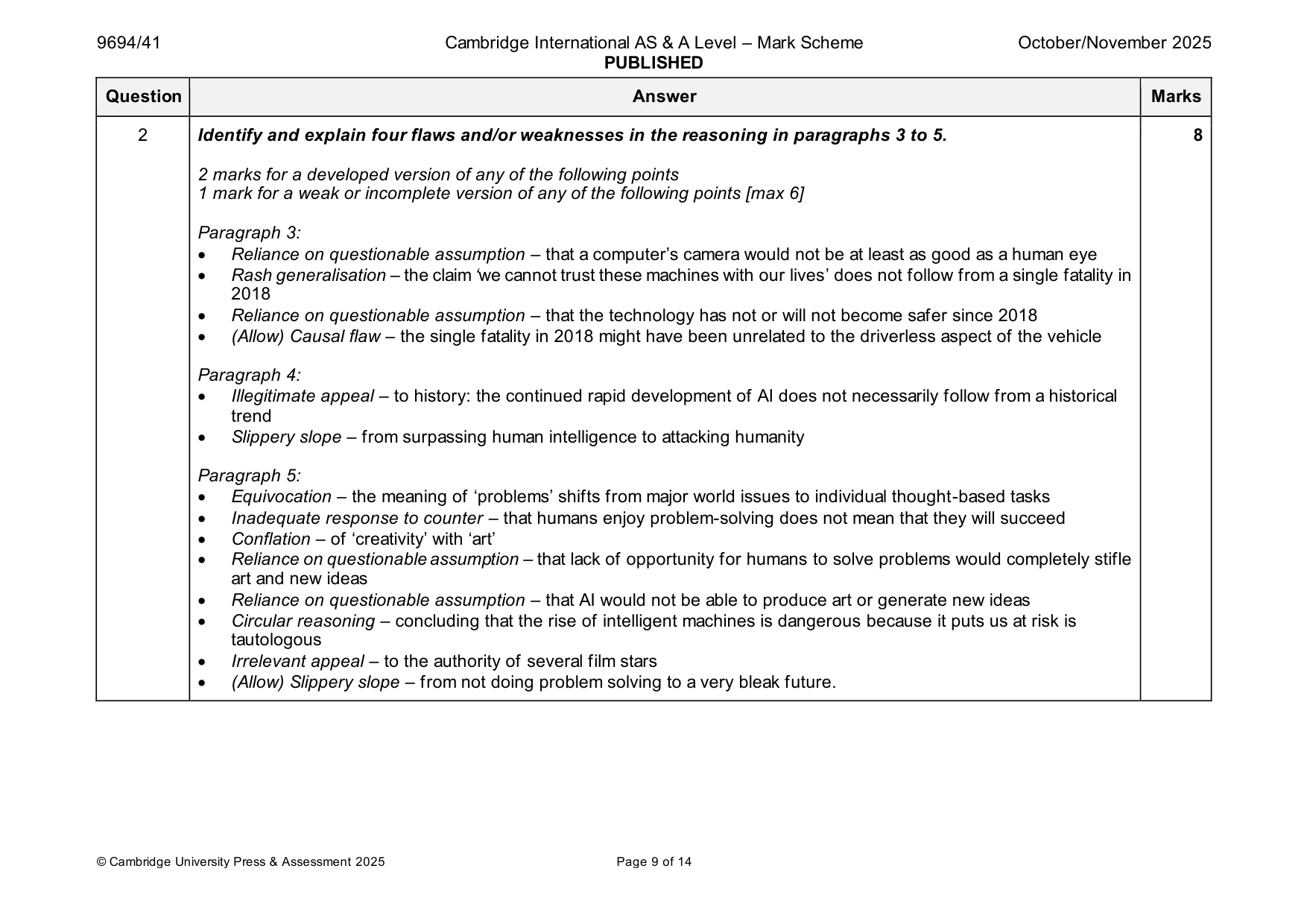
9694/41 Cambridge International AS & A Level – Mark Scheme PUBLISHED October/November 2025 © Cambridge University Press & Assessment 2025 Page 9 of 14 Question Answer Marks 2 Identify and explain four flaws and/or weaknesses in the reasoning in paragraphs 3 to 5. 2 marks for a developed version of any of the following points 1 mark for a weak or incomplete version of any of the following points [max 6] Paragraph 3: • Reliance on questionable assumption – that a computer’s camera would not be at least as good as a human eye • Rash generalisation – the claim ‘we cannot trust these machines with our lives’ does not follow from a single fatality in 2018 • Reliance on questionable assumption – that the technology has not or will not become safer since 2018 • (Allow) Causal flaw – the single fatality in 2018 might have been unrelated to the driverless aspect of the vehicle Paragraph 4: • Illegitimate appeal – to history: the continued rapid development of AI does not necessarily follow from a historical trend • Slippery slope – from surpassing human intelligence to attacking humanity Paragraph 5: • Equivocation – the meaning of ‘problems’ shifts from major world issues to individual thought-based tasks • Inadequate response to counter – that humans enjoy problem-solving does not mean that they will succeed • Conflation – of ‘creativity’ with ‘art’ • Reliance on questionable assumption – that lack of opportunity for humans to solve problems would completely stifle art and new ideas • Reliance on questionable assumption – that AI would not be able to produce art or generate new ideas • Circular reasoning – concluding that the rise of intelligent machines is dangerous because it puts us at risk is tautologous • Irrelevant appeal – to the authority of several film stars • (Allow) Slippery slope – from not doing problem solving to a very bleak future. 8
Mark scheme, page 10
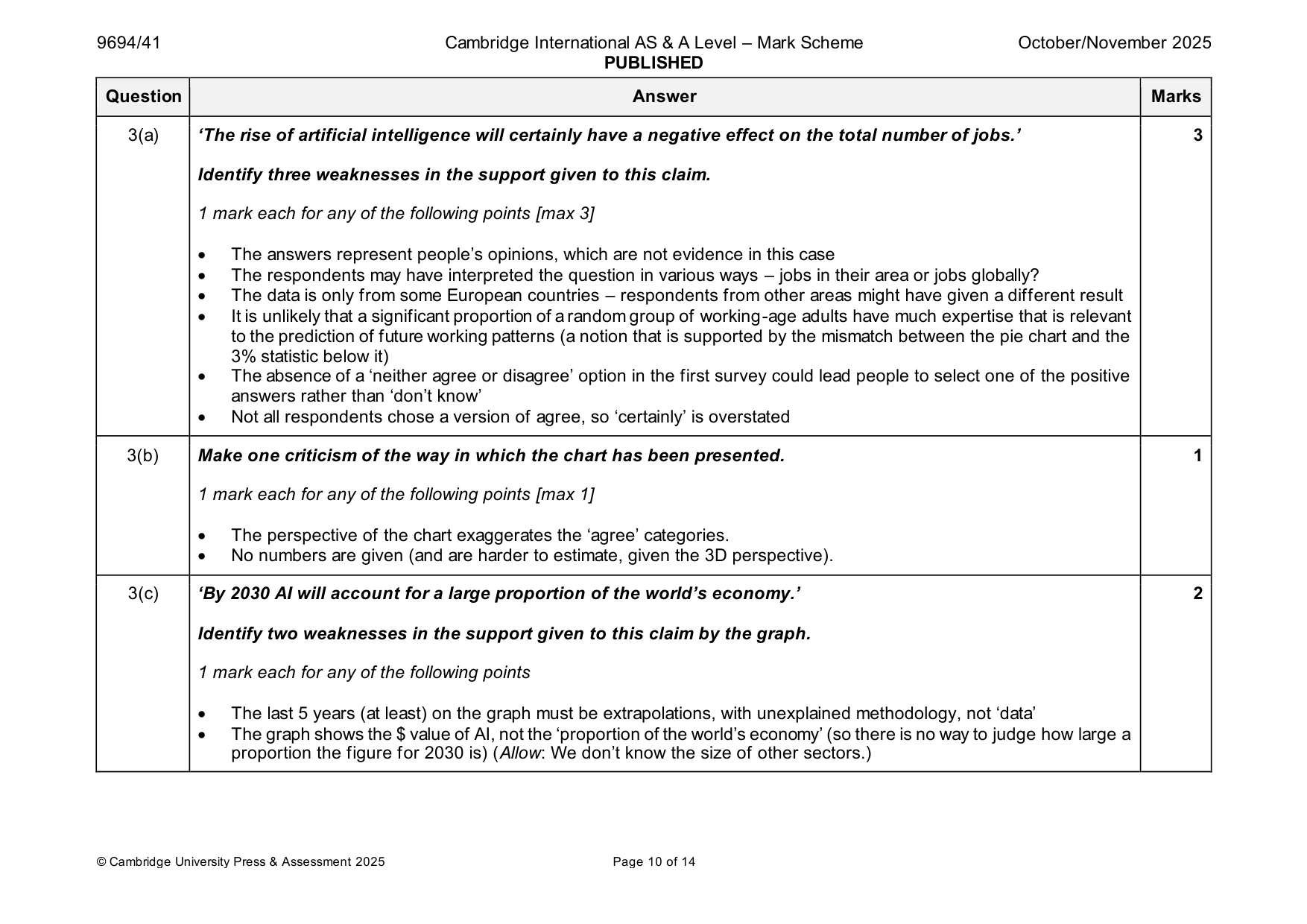
9694/41 Cambridge International AS & A Level – Mark Scheme PUBLISHED October/November 2025 © Cambridge University Press & Assessment 2025 Page 10 of 14 Question Answer Marks 3(a) ‘The rise of artificial intelligence will certainly have a negative effect on the total number of jobs.’ Identify three weaknesses in the support given to this claim. 1 mark each for any of the following points [max 3] • The answers represent people’s opinions, which are not evidence in this case • The respondents may have interpreted the question in various ways – jobs in their area or jobs globally? • The data is only from some European countries – respondents from other areas might have given a different result • It is unlikely that a significant proportion of a random group of working-age adults have much expertise that is relevant to the prediction of future working patterns (a notion that is supported by the mismatch between the pie chart and the 3% statistic below it) • The absence of a ‘neither agree or disagree’ option in the first survey could lead people to select one of the positive answers rather than ‘don’t know’ • Not all respondents chose a version of agree, so ‘certainly’ is overstated 3 3(b) Make one criticism of the way in which the chart has been presented. 1 mark each for any of the following points [max 1] • The perspective of the chart exaggerates the ‘agree’ categories. • No numbers are given (and are harder to estimate, given the 3D perspective). 1 3(c) ‘By 2030 AI will account for a large proportion of the world’s economy.’ Identify two weaknesses in the support given to this claim by the graph. 1 mark each for any of the following points • The last 5 years (at least) on the graph must be extrapolations, with unexplained methodology, not ‘data’ • The graph shows the $ value of AI, not the ‘proportion of the world’s economy’ (so there is no way to judge how large a proportion the figure for 2030 is) (Allow: We don’t know the size of other sectors.) 2
Mark scheme, page 11
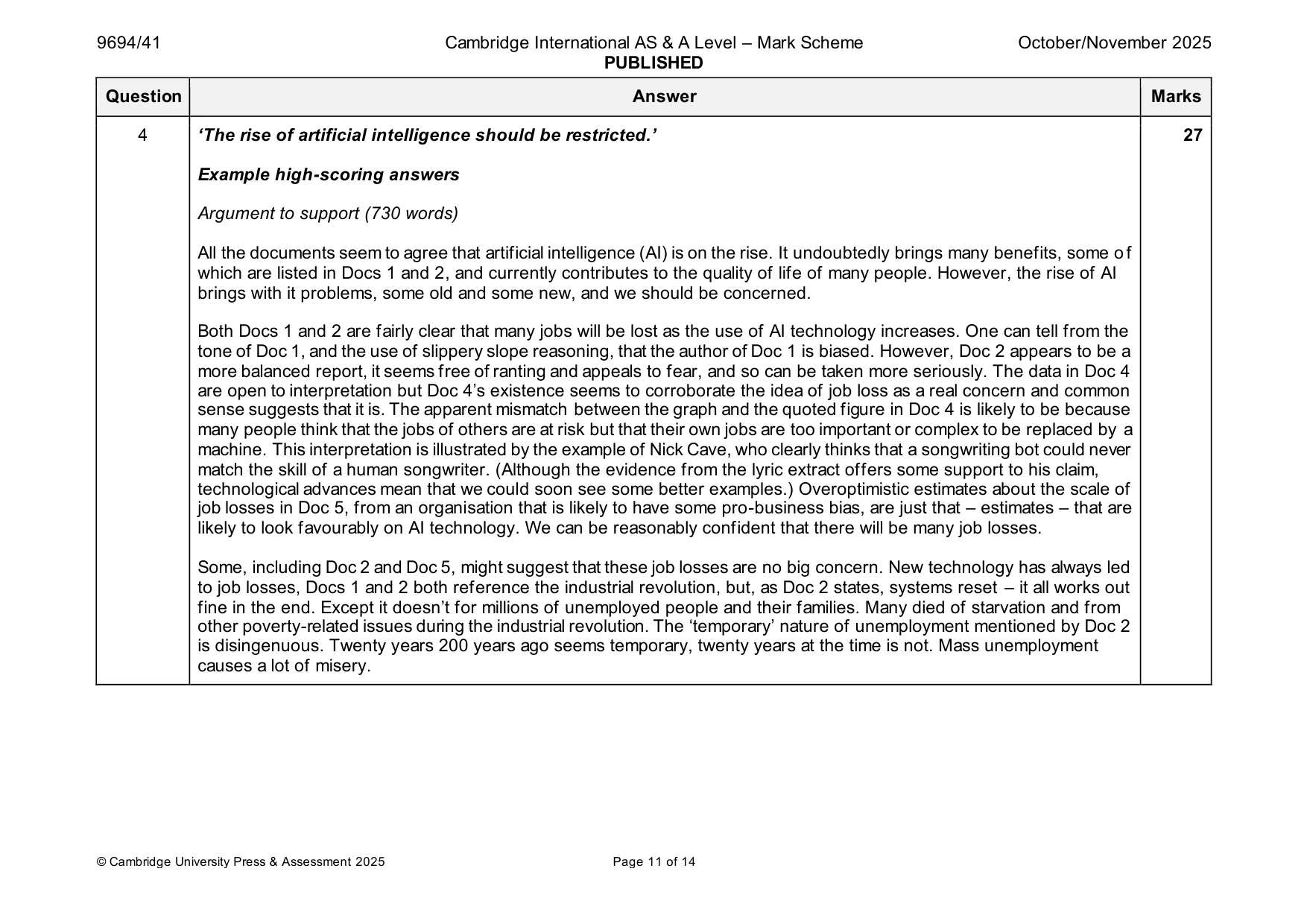
9694/41 Cambridge International AS & A Level – Mark Scheme PUBLISHED October/November 2025 © Cambridge University Press & Assessment 2025 Page 11 of 14 Question Answer Marks 4 ‘The rise of artificial intelligence should be restricted.’ Example high-scoring answers Argument to support (730 words) All the documents seem to agree that artificial intelligence (AI) is on the rise. It undoubtedly brings many benefits, some of which are listed in Docs 1 and 2, and currently contributes to the quality of life of many people. However, the rise of AI brings with it problems, some old and some new, and we should be concerned. Both Docs 1 and 2 are fairly clear that many jobs will be lost as the use of AI technology increases. One can tell from the tone of Doc 1, and the use of slippery slope reasoning, that the author of Doc 1 is biased. However, Doc 2 appears to be a more balanced report, it seems free of ranting and appeals to fear, and so can be taken more seriously. The data in Doc 4 are open to interpretation but Doc 4’s existence seems to corroborate the idea of job loss as a real concern and common sense suggests that it is. The apparent mismatch between the graph and the quoted figure in Doc 4 is likely to be because many people think that the jobs of others are at risk but that their own jobs are too important or complex to be replaced by a machine. This interpretation is illustrated by the example of Nick Cave, who clearly thinks that a songwriting bot could never match the skill of a human songwriter. (Although the evidence from the lyric extract offers some support to his claim, technological advances mean that we could soon see some better examples.) Overoptimistic estimates about the scale of job losses in Doc 5, from an organisation that is likely to have some pro-business bias, are just that – estimates – that are likely to look favourably on AI technology. We can be reasonably confident that there will be many job losses. Some, including Doc 2 and Doc 5, might suggest that these job losses are no big concern. New technology has always led to job losses, Docs 1 and 2 both reference the industrial revolution, but, as Doc 2 states, systems reset – it all works out fine in the end. Except it doesn’t for millions of unemployed people and their families. Many died of starvation and from other poverty-related issues during the industrial revolution. The ‘temporary’ nature of unemployment mentioned by Doc 2 is disingenuous. Twenty years 200 years ago seems temporary, twenty years at the time is not. Mass unemployment causes a lot of misery. 27
Mark scheme, page 12
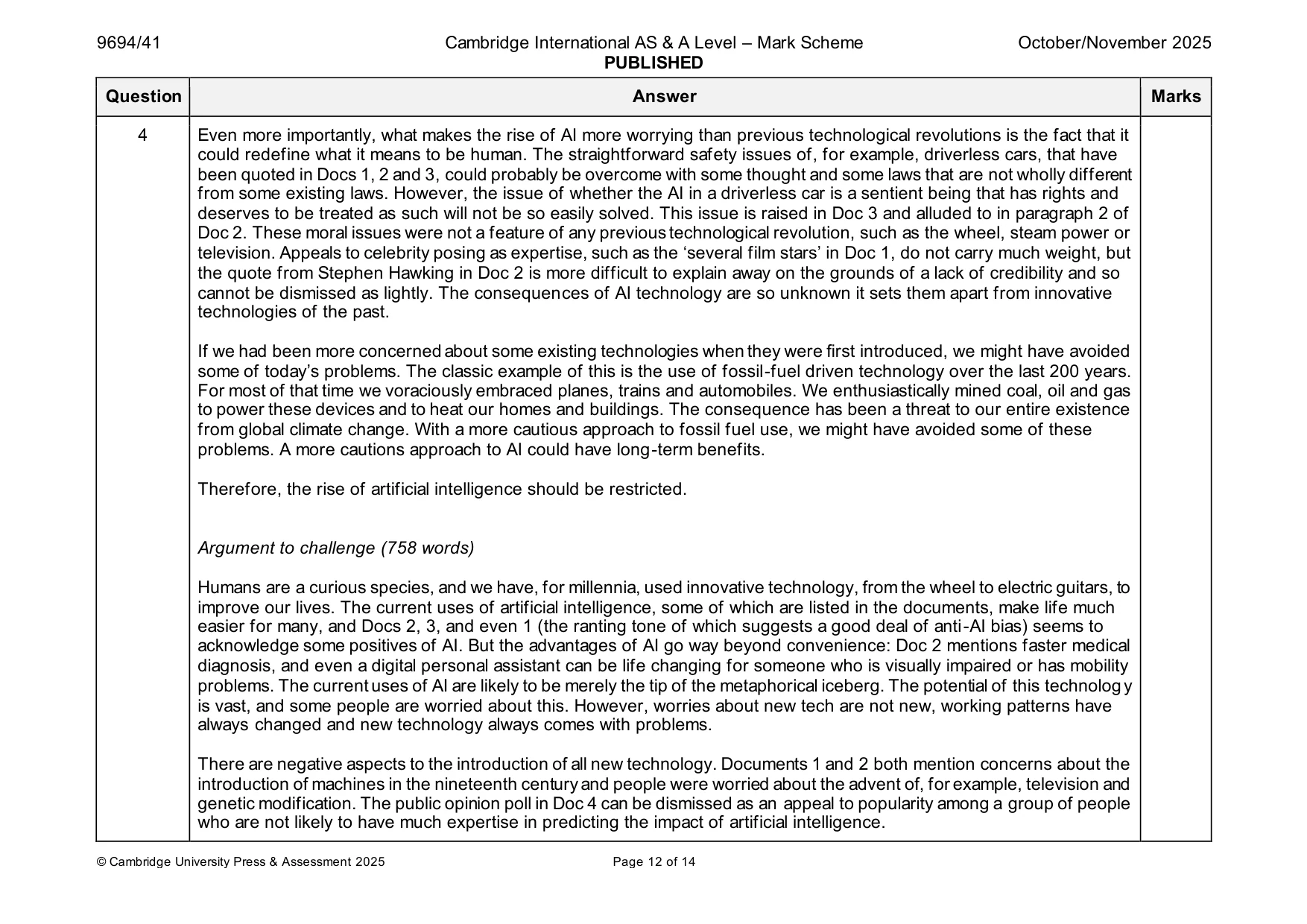
9694/41 Cambridge International AS & A Level – Mark Scheme PUBLISHED October/November 2025 © Cambridge University Press & Assessment 2025 Page 12 of 14 Question Answer Marks 4 Even more importantly, what makes the rise of AI more worrying than previous technological revolutions is the fact that it could redefine what it means to be human. The straightforward safety issues of, for example, driverless cars, that have been quoted in Docs 1, 2 and 3, could probably be overcome with some thought and some laws that are not wholly different from some existing laws. However, the issue of whether the AI in a driverless car is a sentient being that has rights and deserves to be treated as such will not be so easily solved. This issue is raised in Doc 3 and alluded to in paragraph 2 of Doc 2. These moral issues were not a feature of any previous technological revolution, such as the wheel, steam power or television. Appeals to celebrity posing as expertise, such as the ‘several film stars’ in Doc 1, do not carry much weight, but the quote from Stephen Hawking in Doc 2 is more difficult to explain away on the grounds of a lack of credibility and so cannot be dismissed as lightly. The consequences of AI technology are so unknown it sets them apart from innovative technologies of the past. If we had been more concerned about some existing technologies when they were first introduced, we might have avoided some of today’s problems. The classic example of this is the use of fossil-fuel driven technology over the last 200 years. For most of that time we voraciously embraced planes, trains and automobiles. We enthusiastically mined coal, oil and gas to power these devices and to heat our homes and buildings. The consequence has been a threat to our entire existence from global climate change. With a more cautious approach to fossil fuel use, we might have avoided some of these problems. A more cautions approach to AI could have long-term benefits. Therefore, the rise of artificial intelligence should be restricted. Argument to challenge (758 words) Humans are a curious species, and we have, for millennia, used innovative technology, from the wheel to electric guitars, to improve our lives. The current uses of artificial intelligence, some of which are listed in the documents, make life much easier for many, and Docs 2, 3, and even 1 (the ranting tone of which suggests a good deal of anti-AI bias) seems to acknowledge some positives of AI. But the advantages of AI go way beyond convenience: Doc 2 mentions faster medical diagnosis, and even a digital personal assistant can be life changing for someone who is visually impaired or has mobility problems. The current uses of AI are likely to be merely the tip of the metaphorical iceberg. The potential of this technology is vast, and some people are worried about this. However, worries about new tech are not new, working patterns have always changed and new technology always comes with problems. There are negative aspects to the introduction of all new technology. Documents 1 and 2 both mention concerns about the introduction of machines in the nineteenth century and people were worried about the advent of, for example, television and genetic modification. The public opinion poll in Doc 4 can be dismissed as an appeal to popularity among a group of people who are not likely to have much expertise in predicting the impact of artificial intelligence.
Mark scheme, page 13
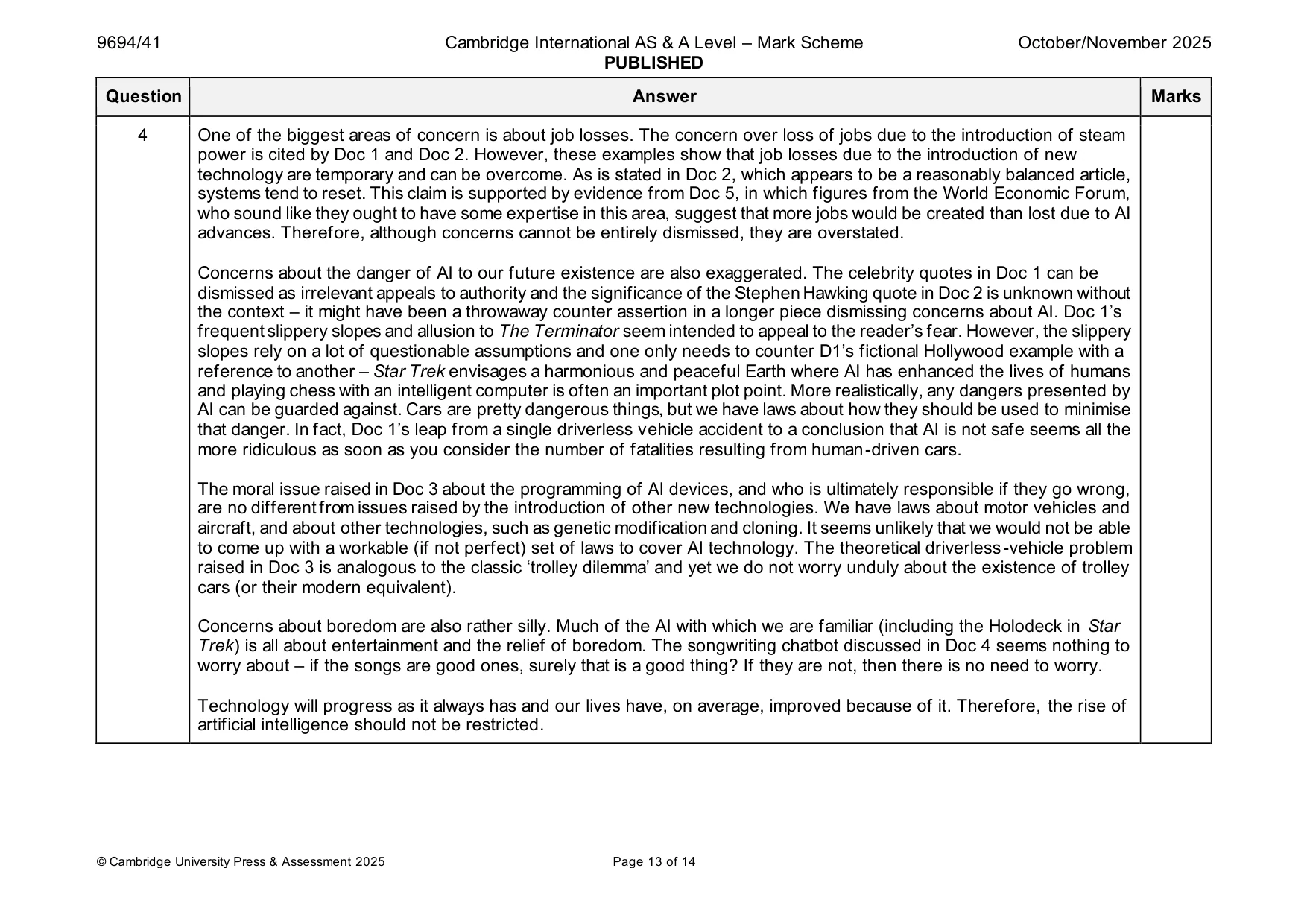
9694/41 Cambridge International AS & A Level – Mark Scheme PUBLISHED October/November 2025 © Cambridge University Press & Assessment 2025 Page 13 of 14 Question Answer Marks 4 One of the biggest areas of concern is about job losses. The concern over loss of jobs due to the introduction of steam power is cited by Doc 1 and Doc 2. However, these examples show that job losses due to the introduction of new technology are temporary and can be overcome. As is stated in Doc 2, which appears to be a reasonably balanced article, systems tend to reset. This claim is supported by evidence from Doc 5, in which figures from the World Economic Forum, who sound like they ought to have some expertise in this area, suggest that more jobs would be created than lost due to AI advances. Therefore, although concerns cannot be entirely dismissed, they are overstated. Concerns about the danger of AI to our future existence are also exaggerated. The celebrity quotes in Doc 1 can be dismissed as irrelevant appeals to authority and the significance of the Stephen Hawking quote in Doc 2 is unknown without the context – it might have been a throwaway counter assertion in a longer piece dismissing concerns about AI. Doc 1’s frequent slippery slopes and allusion to The Terminator seem intended to appeal to the reader’s fear. However, the slippery slopes rely on a lot of questionable assumptions and one only needs to counter D1’s fictional Hollywood example with a reference to another – Star Trek envisages a harmonious and peaceful Earth where AI has enhanced the lives of humans and playing chess with an intelligent computer is often an important plot point. More realistically, any dangers presented by AI can be guarded against. Cars are pretty dangerous things, but we have laws about how they should be used to minimise that danger. In fact, Doc 1’s leap from a single driverless vehicle accident to a conclusion that AI is not safe seems all the more ridiculous as soon as you consider the number of fatalities resulting from human-driven cars. The moral issue raised in Doc 3 about the programming of AI devices, and who is ultimately responsible if they go wrong, are no different from issues raised by the introduction of other new technologies. We have laws about motor vehicles and aircraft, and about other technologies, such as genetic modification and cloning. It seems unlikely that we would not be able to come up with a workable (if not perfect) set of laws to cover AI technology. The theoretical driverless-vehicle problem raised in Doc 3 is analogous to the classic ‘trolley dilemma’ and yet we do not worry unduly about the existence of trolley cars (or their modern equivalent). Concerns about boredom are also rather silly. Much of the AI with which we are familiar (including the Holodeck in Star Trek) is all about entertainment and the relief of boredom. The songwriting chatbot discussed in Doc 4 seems nothing to worry about – if the songs are good ones, surely that is a good thing? If they are not, then there is no need to worry. Technology will progress as it always has and our lives have, on average, improved because of it. Therefore, the rise of artificial intelligence should not be restricted.
Mark scheme, page 14
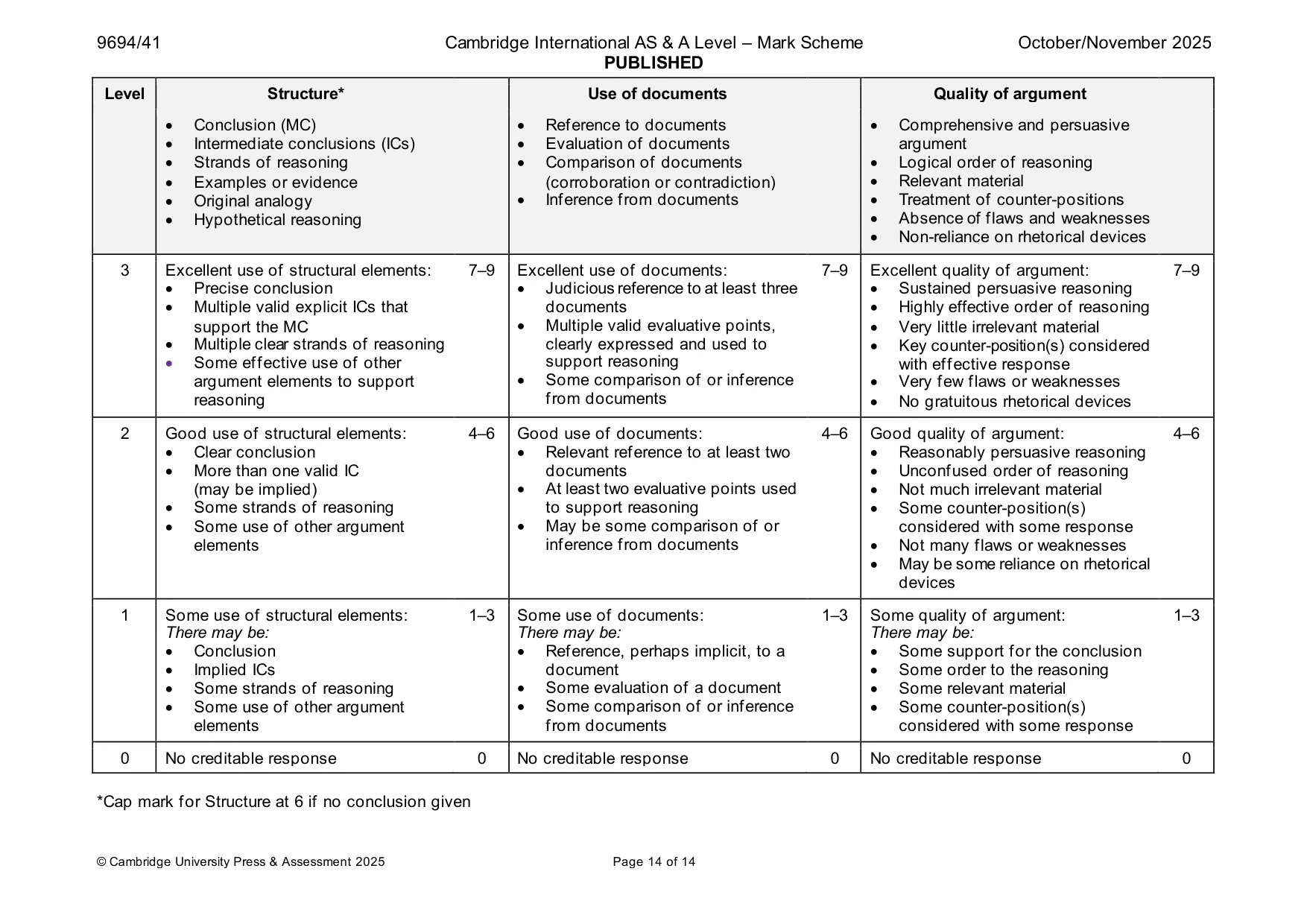
9694/41 Cambridge International AS & A Level – Mark Scheme PUBLISHED October/November 2025 © Cambridge University Press & Assessment 2025 Page 14 of 14 Level Structure* Use of documents Quality of argument • Conclusion (MC) • Intermediate conclusions (ICs) • Strands of reasoning • Examples or evidence • Original analogy • Hypothetical reasoning • Reference to documents • Evaluation of documents • Comparison of documents (corroboration or contradiction) • Inference from documents • Comprehensive and persuasive argument • Logical order of reasoning • Relevant material • Treatment of counter-positions • Absence of flaws and weaknesses • Non-reliance on rhetorical devices 3 Excellent use of structural elements: • Precise conclusion • Multiple valid explicit ICs that support the MC • Multiple clear strands of reasoning • Some effective use of other argument elements to support reasoning 7–9 Excellent use of documents: • Judicious reference to at least three documents • Multiple valid evaluative points, clearly expressed and used to support reasoning • Some comparison of or inference from documents 7–9 Excellent quality of argument: • Sustained persuasive reasoning • Highly effective order of reasoning • Very little irrelevant material • Key counter-position(s) considered with effective response • Very few flaws or weaknesses • No gratuitous rhetorical devices 7–9 2 Good use of structural elements: • Clear conclusion • More than one valid IC (may be implied) • Some strands of reasoning • Some use of other argument elements 4–6 Good use of documents: • Relevant reference to at least two documents • At least two evaluative points used to support reasoning • May be some comparison of or inference from documents 4–6 Good quality of argument: • Reasonably persuasive reasoning • Unconfused order of reasoning • Not much irrelevant material • Some counter-position(s) considered with some response • Not many flaws or weaknesses • May be some reliance on rhetorical devices 4–6 1 Some use of structural elements: There may be: • Conclusion • Implied ICs • Some strands of reasoning • Some use of other argument elements 1–3 Some use of documents: There may be: • Reference, perhaps implicit, to a document • Some evaluation of a document • Some comparison of or inference from documents 1–3 Some quality of argument: There may be: • Some support for the conclusion • Some order to the reasoning • Some relevant material • Some counter-position(s) considered with some response 1–3 0 No creditable response 0 No creditable response 0 No creditable response 0 *Cap mark for Structure at 6 if no conclusion given
What you needed in this session
Cambridge’s own grade thresholds for 2025 Oct/Nov, Paper 4 · Variant 1. A higher threshold means an easier paper — the bar moves with how the cohort did.