Cambridge A Level Thinking Skills 9694 — 2023 May/June Paper 4 · Variant 2
9694/42/M/J/23 · 50 marks · ≈56 min
The question paper and its mark scheme, free to read here and free to download. This is Cambridge’s own paper, exactly as it was sat.
Question paper8 pages

Mark scheme13 pages
Answers below. Sit the paper first if you are practising.
Paper as text
Question paper, page 1
This document has 8 pages. Any blank pages are indicated. [Turn over Cambridge International AS & A Level THINKING SKILLS 9694/42 Paper 4 Applied Reasoning May/June 2023 1 hour 45 minutes You must answer on the enclosed answer booklet. You will need: Answer booklet (enclosed) INSTRUCTIONS ● Answer all questions. ● Follow the instructions on the front cover of the answer booklet. If you need additional answer paper, ask the invigilator for a continuation booklet. INFORMATION ● The total mark for this paper is 50. ● The number of marks for each question or part question is shown in brackets [ ]. * 5 9 2 7 8 0 5 2 0 5 * DC (PQ) 323621/1 © UCLES 2023
Question paper, page 2
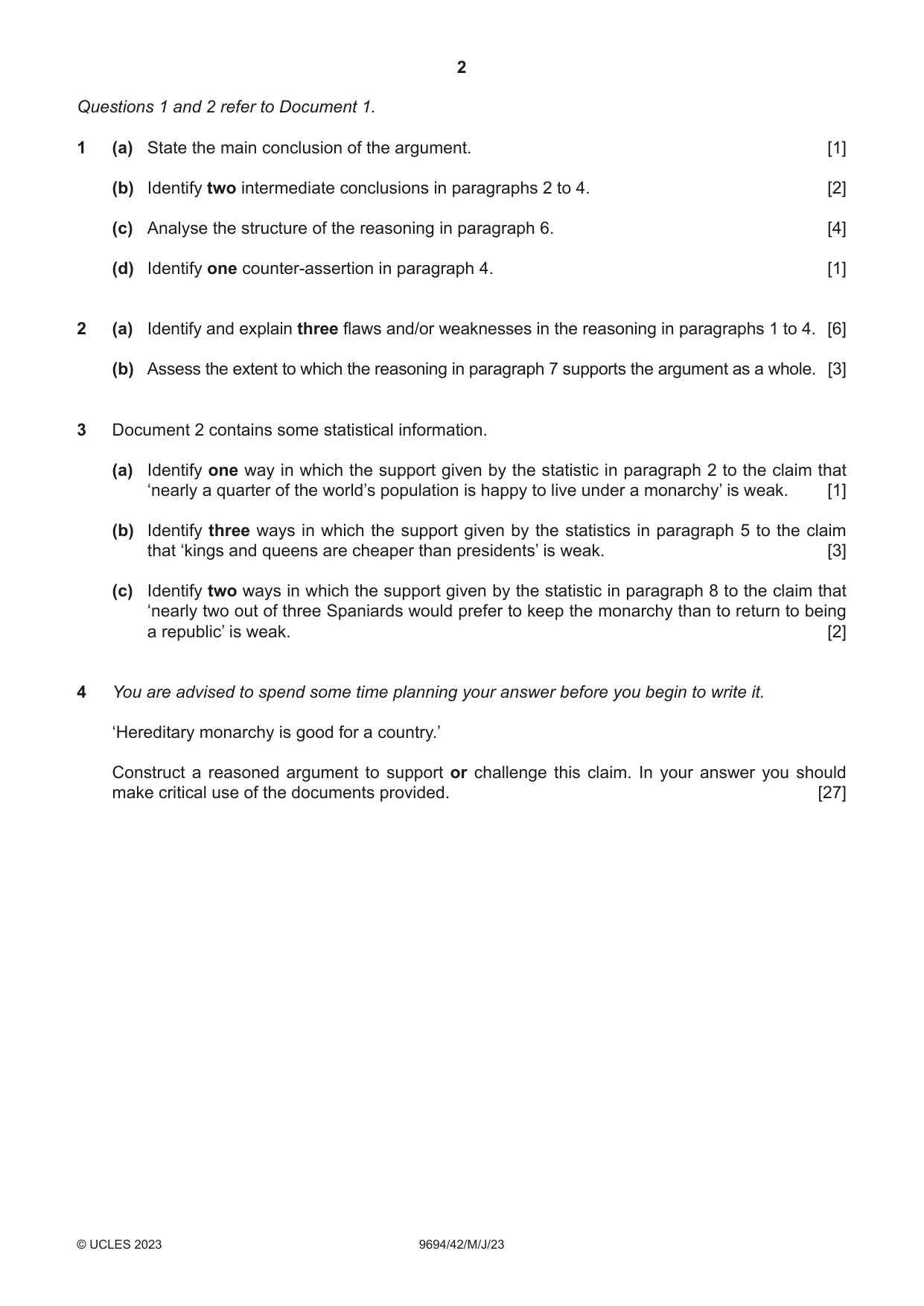
2 9694/42/M/J/23 © UCLES 2023 Questions 1 and 2 refer to Document 1. 1 (a) State the main conclusion of the argument. [1] (b) Identify two intermediate conclusions in paragraphs 2 to 4. [2] (c) Analyse the structure of the reasoning in paragraph 6. [4] (d) Identify one counter-assertion in paragraph 4. [1] 2 (a) Identify and explain three flaws and/or weaknesses in the reasoning in paragraphs 1 to 4. [6] (b) Assess the extent to which the reasoning in paragraph 7 supports the argument as a whole. [3] 3 Document 2 contains some statistical information. (a) Identify one way in which the support given by the statistic in paragraph 2 to the claim that ‘nearly a quarter of the world’s population is happy to live under a monarchy’ is weak. [1] (b) Identify three ways in which the support given by the statistics in paragraph 5 to the claim that ‘kings and queens are cheaper than presidents’ is weak. [3] (c) Identify two ways in which the support given by the statistic in paragraph 8 to the claim that ‘nearly two out of three Spaniards would prefer to keep the monarchy than to return to being a republic’ is weak. [2] 4 You are advised to spend some time planning your answer before you begin to write it. ‘Hereditary monarchy is good for a country.’ Construct a reasoned argument to support or challenge this claim. In your answer you should make critical use of the documents provided. [27]
Question paper, page 3
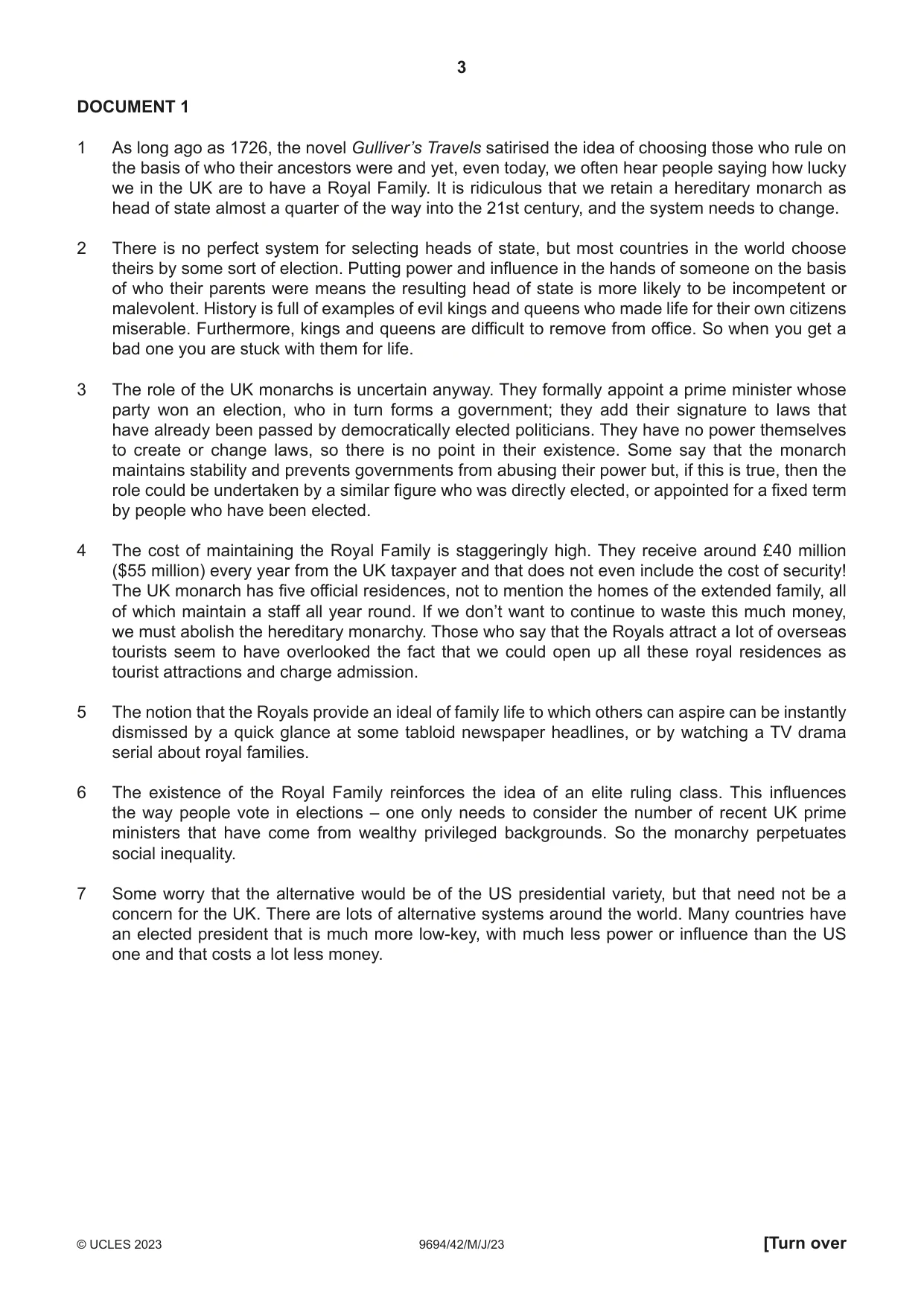
3 9694/42/M/J/23 © UCLES 2023 [Turn over DOCUMENT 1 1 As long ago as 1726, the novel Gulliver’s Travels satirised the idea of choosing those who rule on the basis of who their ancestors were and yet, even today, we often hear people saying how lucky we in the UK are to have a Royal Family. It is ridiculous that we retain a hereditary monarch as head of state almost a quarter of the way into the 21st century, and the system needs to change. 2 There is no perfect system for selecting heads of state, but most countries in the world choose theirs by some sort of election. Putting power and influence in the hands of someone on the basis of who their parents were means the resulting head of state is more likely to be incompetent or malevolent. History is full of examples of evil kings and queens who made life for their own citizens miserable. Furthermore, kings and queens are difficult to remove from office. So when you get a bad one you are stuck with them for life. 3 The role of the UK monarchs is uncertain anyway. They formally appoint a prime minister whose party won an election, who in turn forms a government; they add their signature to laws that have already been passed by democratically elected politicians. They have no power themselves to create or change laws, so there is no point in their existence. Some say that the monarch maintains stability and prevents governments from abusing their power but, if this is true, then the role could be undertaken by a similar figure who was directly elected, or appointed for a fixed term by people who have been elected. 4 The cost of maintaining the Royal Family is staggeringly high. They receive around £40 million ($55 million) every year from the UK taxpayer and that does not even include the cost of security! The UK monarch has five official residences, not to mention the homes of the extended family, all of which maintain a staff all year round. If we don’t want to continue to waste this much money, we must abolish the hereditary monarchy. Those who say that the Royals attract a lot of overseas tourists seem to have overlooked the fact that we could open up all these royal residences as tourist attractions and charge admission. 5 The notion that the Royals provide an ideal of family life to which others can aspire can be instantly dismissed by a quick glance at some tabloid newspaper headlines, or by watching a TV drama serial about royal families. 6 The existence of the Royal Family reinforces the idea of an elite ruling class. This influences the way people vote in elections – one only needs to consider the number of recent UK prime ministers that have come from wealthy privileged backgrounds. So the monarchy perpetuates social inequality. 7 Some worry that the alternative would be of the US presidential variety, but that need not be a concern for the UK. There are lots of alternative systems around the world. Many countries have an elected president that is much more low-key, with much less power or influence than the US one and that costs a lot less money.
Question paper, page 4
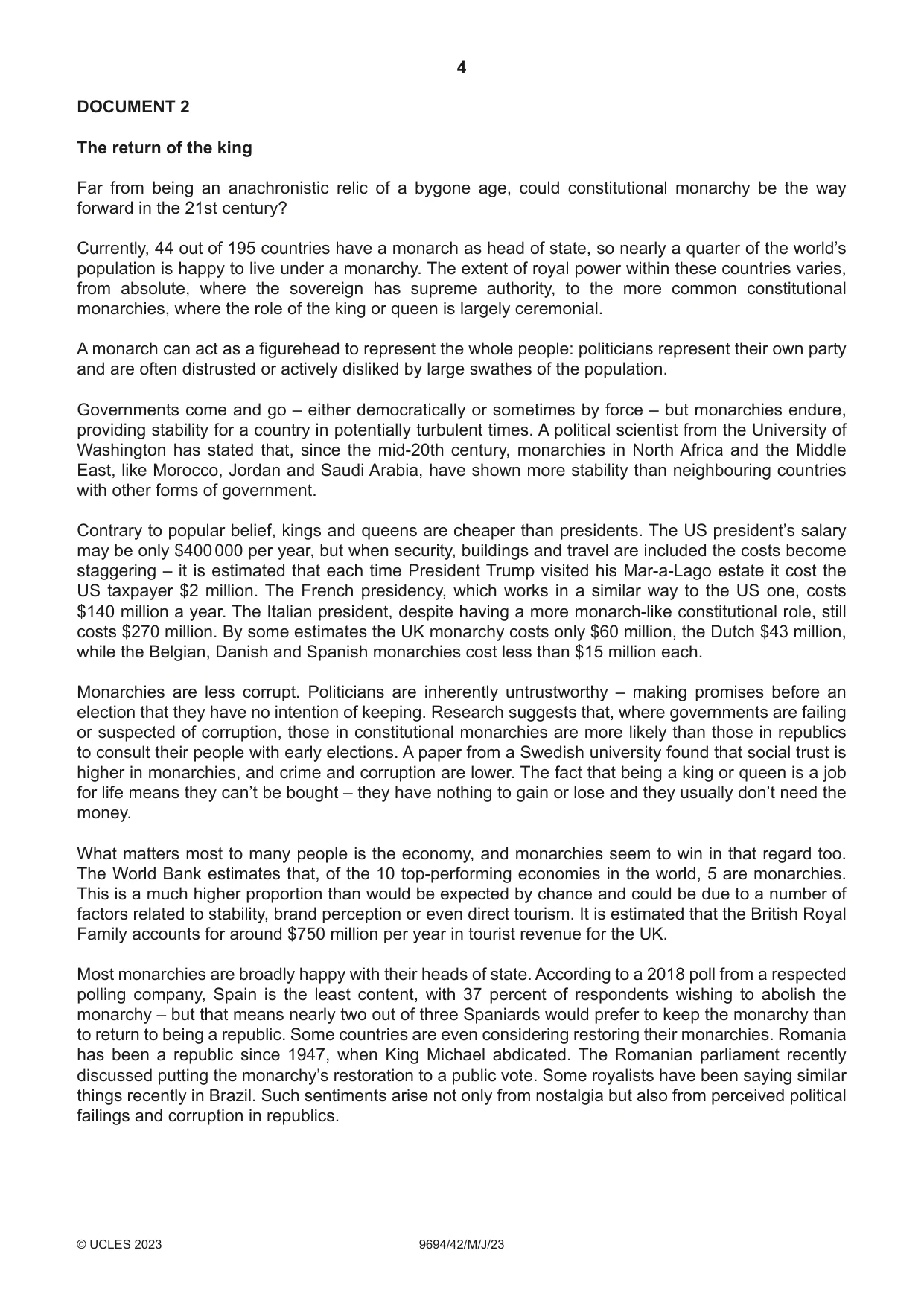
4 9694/42/M/J/23 © UCLES 2023 DOCUMENT 2 The return of the king Far from being an anachronistic relic of a bygone age, could constitutional monarchy be the way forward in the 21st century? Currently, 44 out of 195 countries have a monarch as head of state, so nearly a quarter of the world’s population is happy to live under a monarchy. The extent of royal power within these countries varies, from absolute, where the sovereign has supreme authority, to the more common constitutional monarchies, where the role of the king or queen is largely ceremonial. A monarch can act as a figurehead to represent the whole people: politicians represent their own party and are often distrusted or actively disliked by large swathes of the population. Governments come and go – either democratically or sometimes by force – but monarchies endure, providing stability for a country in potentially turbulent times. A political scientist from the University of Washington has stated that, since the mid-20th century, monarchies in North Africa and the Middle East, like Morocco, Jordan and Saudi Arabia, have shown more stability than neighbouring countries with other forms of government. Contrary to popular belief, kings and queens are cheaper than presidents. The US president’s salary may be only $400 000 per year, but when security, buildings and travel are included the costs become staggering – it is estimated that each time President Trump visited his Mar-a-Lago estate it cost the US taxpayer $2 million. The French presidency, which works in a similar way to the US one, costs $140 million a year. The Italian president, despite having a more monarch-like constitutional role, still costs $270 million. By some estimates the UK monarchy costs only $60 million, the Dutch $43 million, while the Belgian, Danish and Spanish monarchies cost less than $15 million each. Monarchies are less corrupt. Politicians are inherently untrustworthy – making promises before an election that they have no intention of keeping. Research suggests that, where governments are failing or suspected of corruption, those in constitutional monarchies are more likely than those in republics to consult their people with early elections. A paper from a Swedish university found that social trust is higher in monarchies, and crime and corruption are lower. The fact that being a king or queen is a job for life means they can’t be bought – they have nothing to gain or lose and they usually don’t need the money. What matters most to many people is the economy, and monarchies seem to win in that regard too. The World Bank estimates that, of the 10 top-performing economies in the world, 5 are monarchies. This is a much higher proportion than would be expected by chance and could be due to a number of factors related to stability, brand perception or even direct tourism. It is estimated that the British Royal Family accounts for around $750 million per year in tourist revenue for the UK. Most monarchies are broadly happy with their heads of state. According to a 2018 poll from a respected polling company, Spain is the least content, with 37 percent of respondents wishing to abolish the monarchy – but that means nearly two out of three Spaniards would prefer to keep the monarchy than to return to being a republic. Some countries are even considering restoring their monarchies. Romania has been a republic since 1947, when King Michael abdicated. The Romanian parliament recently discussed putting the monarchy’s restoration to a public vote. Some royalists have been saying similar things recently in Brazil. Such sentiments arise not only from nostalgia but also from perceived political failings and corruption in republics.
Question paper, page 5
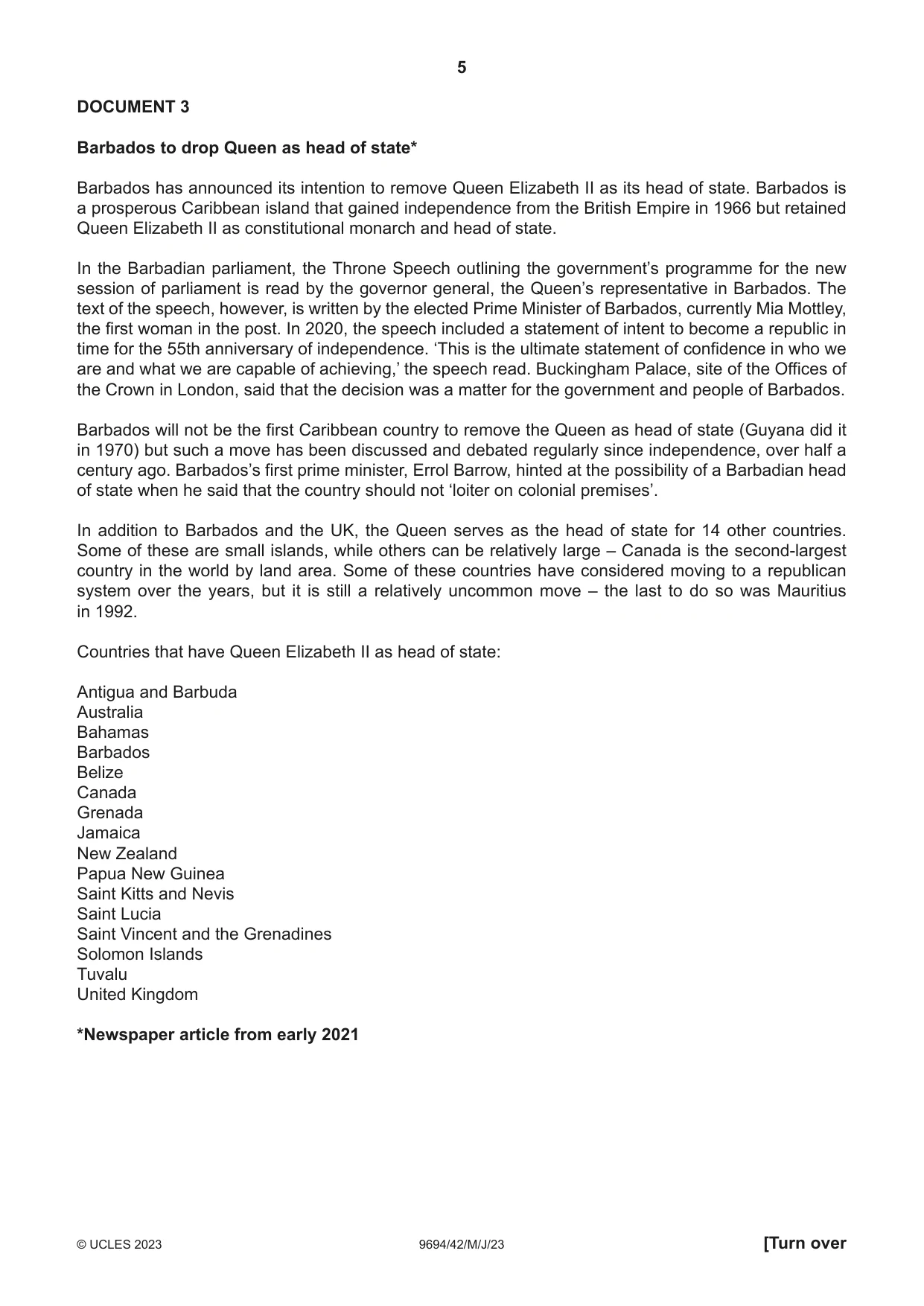
5 9694/42/M/J/23 © UCLES 2023 [Turn over DOCUMENT 3 Barbados to drop Queen as head of state* Barbados has announced its intention to remove Queen Elizabeth II as its head of state. Barbados is a prosperous Caribbean island that gained independence from the British Empire in 1966 but retained Queen Elizabeth II as constitutional monarch and head of state. In the Barbadian parliament, the Throne Speech outlining the government’s programme for the new session of parliament is read by the governor general, the Queen’s representative in Barbados. The text of the speech, however, is written by the elected Prime Minister of Barbados, currently Mia Mottley, the first woman in the post. In 2020, the speech included a statement of intent to become a republic in time for the 55th anniversary of independence. ‘This is the ultimate statement of confidence in who we are and what we are capable of achieving,’ the speech read. Buckingham Palace, site of the Offices of the Crown in London, said that the decision was a matter for the government and people of Barbados. Barbados will not be the first Caribbean country to remove the Queen as head of state (Guyana did it in 1970) but such a move has been discussed and debated regularly since independence, over half a century ago. Barbados’s first prime minister, Errol Barrow, hinted at the possibility of a Barbadian head of state when he said that the country should not ‘loiter on colonial premises’. In addition to Barbados and the UK, the Queen serves as the head of state for 14 other countries. Some of these are small islands, while others can be relatively large – Canada is the second-largest country in the world by land area. Some of these countries have considered moving to a republican system over the years, but it is still a relatively uncommon move – the last to do so was Mauritius in 1992. Countries that have Queen Elizabeth II as head of state: Antigua and Barbuda Australia Bahamas Barbados Belize Canada Grenada Jamaica New Zealand Papua New Guinea Saint Kitts and Nevis Saint Lucia Saint Vincent and the Grenadines Solomon Islands Tuvalu United Kingdom *Newspaper article from early 2021
Question paper, page 6
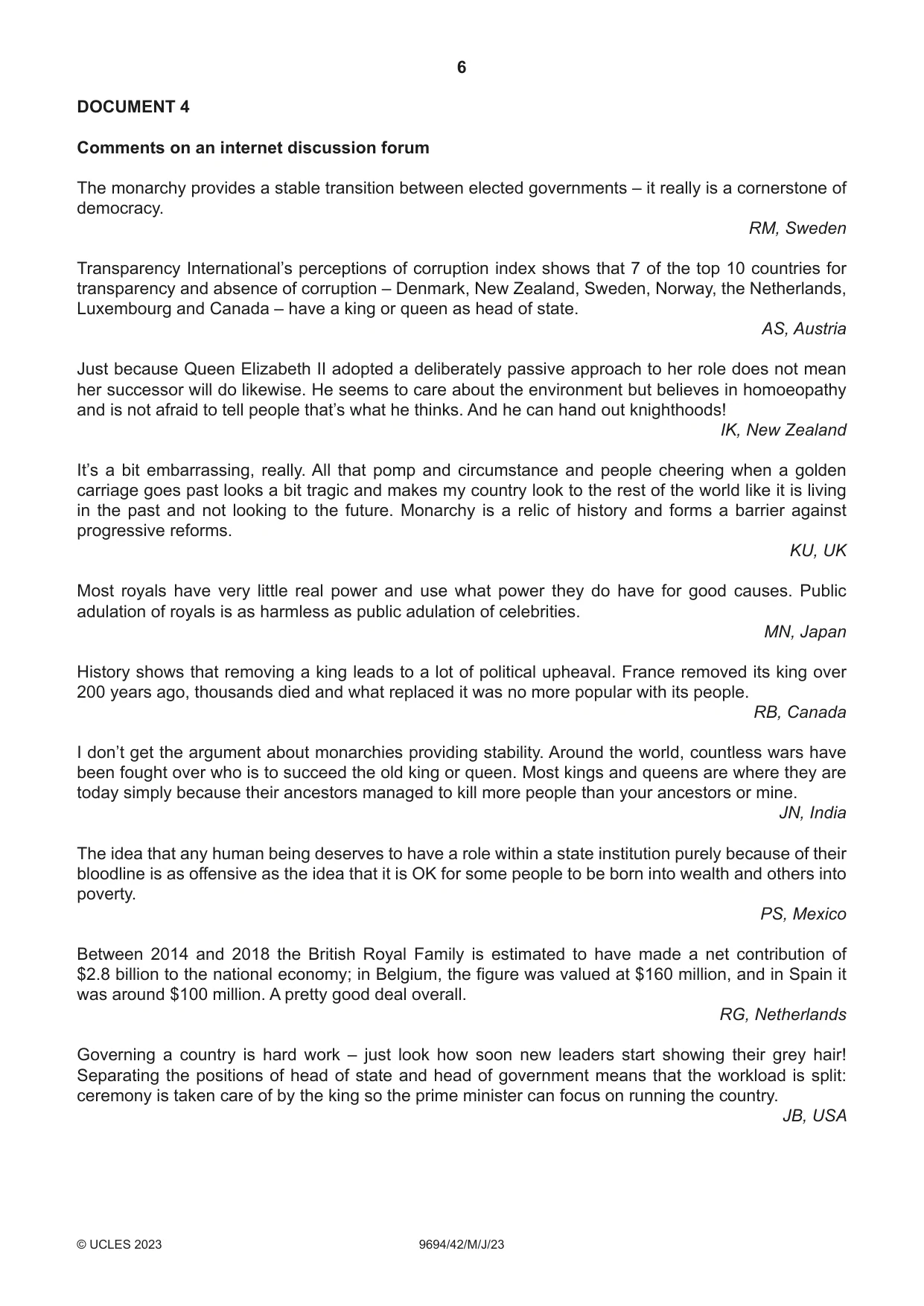
6 9694/42/M/J/23 © UCLES 2023 DOCUMENT 4 Comments on an internet discussion forum The monarchy provides a stable transition between elected governments – it really is a cornerstone of democracy. RM, Sweden Transparency International’s perceptions of corruption index shows that 7 of the top 10 countries for transparency and absence of corruption – Denmark, New Zealand, Sweden, Norway, the Netherlands, Luxembourg and Canada – have a king or queen as head of state. AS, Austria Just because Queen Elizabeth II adopted a deliberately passive approach to her role does not mean her successor will do likewise. He seems to care about the environment but believes in homoeopathy and is not afraid to tell people that’s what he thinks. And he can hand out knighthoods! IK, New Zealand It’s a bit embarrassing, really. All that pomp and circumstance and people cheering when a golden carriage goes past looks a bit tragic and makes my country look to the rest of the world like it is living in the past and not looking to the future. Monarchy is a relic of history and forms a barrier against progressive reforms. KU, UK Most royals have very little real power and use what power they do have for good causes. Public adulation of royals is as harmless as public adulation of celebrities. MN, Japan History shows that removing a king leads to a lot of political upheaval. France removed its king over 200 years ago, thousands died and what replaced it was no more popular with its people. RB, Canada I don’t get the argument about monarchies providing stability. Around the world, countless wars have been fought over who is to succeed the old king or queen. Most kings and queens are where they are today simply because their ancestors managed to kill more people than your ancestors or mine. JN, India The idea that any human being deserves to have a role within a state institution purely because of their bloodline is as offensive as the idea that it is OK for some people to be born into wealth and others into poverty. PS, Mexico Between 2014 and 2018 the British Royal Family is estimated to have made a net contribution of $2.8 billion to the national economy; in Belgium, the figure was valued at $160 million, and in Spain it was around $100 million. A pretty good deal overall. RG, Netherlands Governing a country is hard work – just look how soon new leaders start showing their grey hair! Separating the positions of head of state and head of government means that the workload is split: ceremony is taken care of by the king so the prime minister can focus on running the country. JB, USA
Question paper, page 7
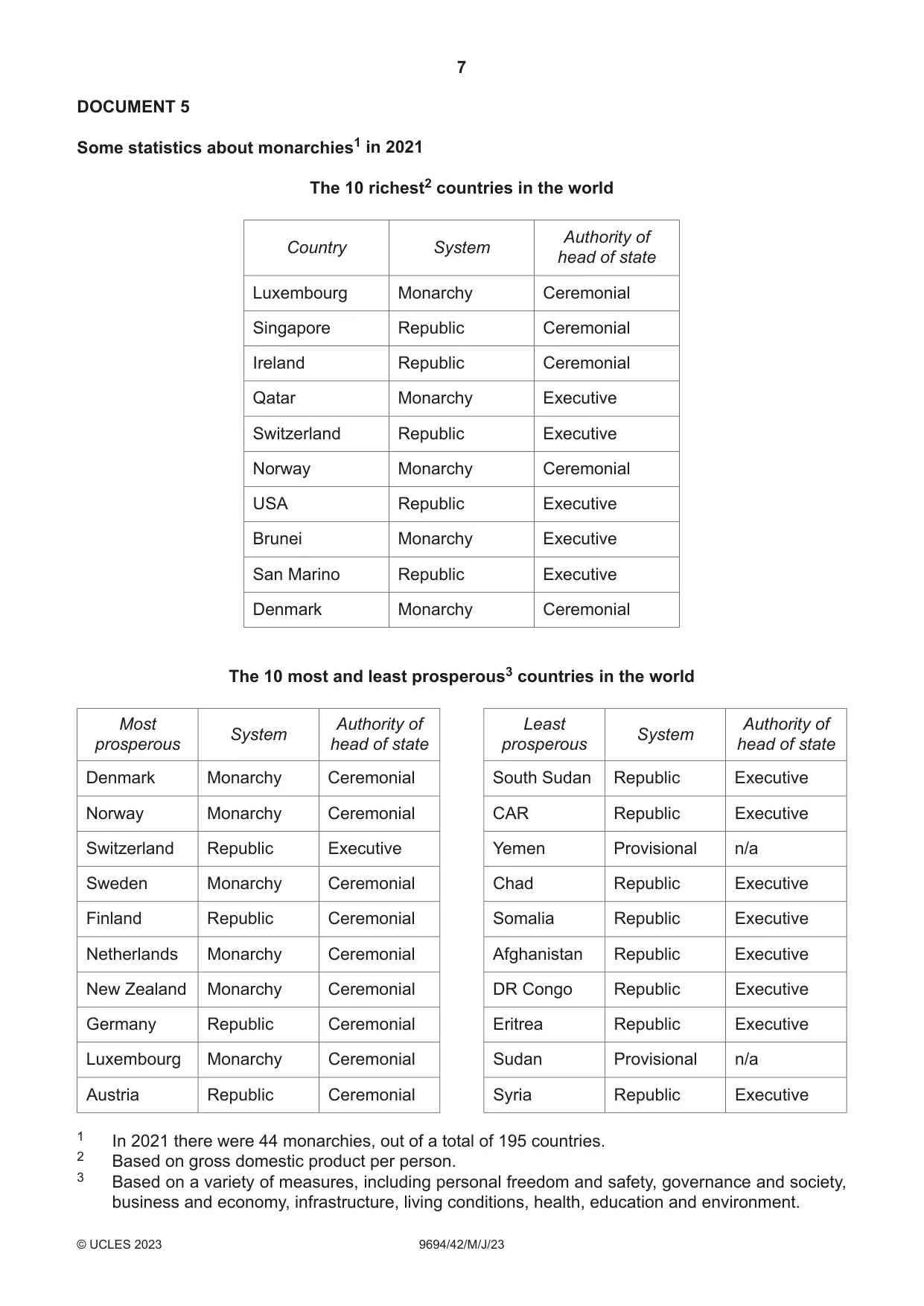
7 9694/42/M/J/23 © UCLES 2023 DOCUMENT 5 Some statistics about monarchies1 in 2021 The 10 richest2 countries in the world Country System Authority of head of state Luxembourg Monarchy Ceremonial Singapore Republic Ceremonial Ireland Republic Ceremonial Qatar Monarchy Executive Switzerland Republic Executive Norway Monarchy Ceremonial USA Republic Executive Brunei Monarchy Executive San Marino Republic Executive Denmark Monarchy Ceremonial The 10 most and least prosperous3 countries in the world Most prosperous System Authority of head of state Least prosperous System Authority of head of state Denmark Monarchy Ceremonial South Sudan Republic Executive Norway Monarchy Ceremonial CAR Republic Executive Switzerland Republic Executive Yemen Provisional n/a Sweden Monarchy Ceremonial Chad Republic Executive Finland Republic Ceremonial Somalia Republic Executive Netherlands Monarchy Ceremonial Afghanistan Republic Executive New Zealand Monarchy Ceremonial DR Congo Republic Executive Germany Republic Ceremonial Eritrea Republic Executive Luxembourg Monarchy Ceremonial Sudan Provisional n/a Austria Republic Ceremonial Syria Republic Executive 1 In 2021 there were 44 monarchies, out of a total of 195 countries. 2 Based on gross domestic product per person. 3 Based on a variety of measures, including personal freedom and safety, governance and society, business and economy, infrastructure, living conditions, health, education and environment.
Question paper, page 8
8 9694/42/M/J/23 © UCLES 2023 Permission to reproduce items where third-party owned material protected by copyright is included has been sought and cleared where possible. Every reasonable effort has been made by the publisher (UCLES) to trace copyright holders, but if any items requiring clearance have unwittingly been included, the publisher will be pleased to make amends at the earliest possible opportunity. To avoid the issue of disclosure of answer-related information to candidates, all copyright acknowledgements are reproduced online in the Cambridge Assessment International Education Copyright Acknowledgements Booklet. This is produced for each series of examinations and is freely available to download at www.cambridgeinternational.org after the live examination series. Cambridge Assessment International Education is part of Cambridge Assessment. Cambridge Assessment is the brand name of the University of Cambridge Local Examinations Syndicate (UCLES), which is a department of the University of Cambridge. BLANK PAGE
Mark scheme, page 1
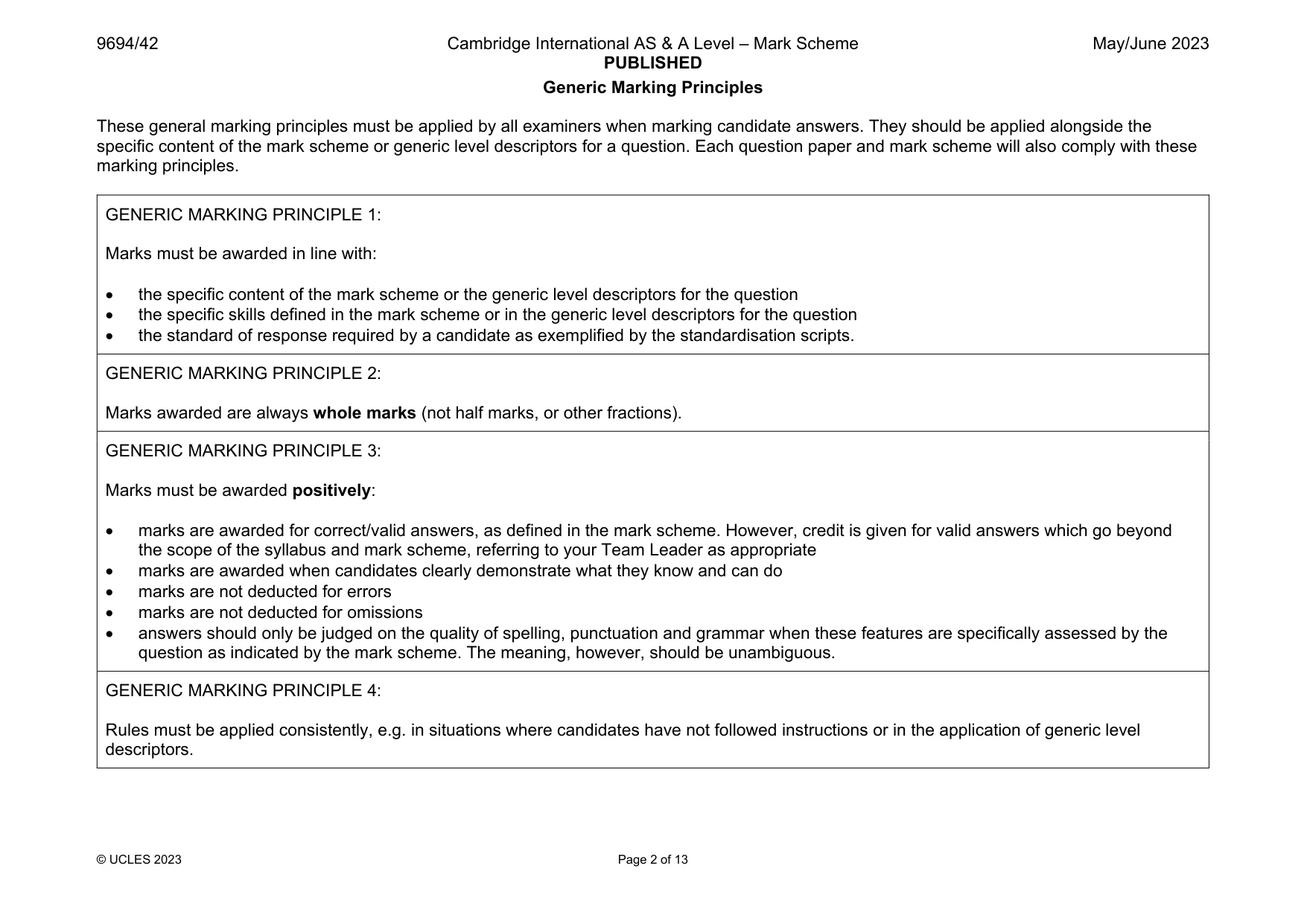
This document consists of 13 printed pages. © UCLES 2023 [Turn over Cambridge International AS & A Level THINKING SKILLS 9694/42 Paper 4 Applied Reasoning May/June 2023 MARK SCHEME Maximum Mark: 50 Published This mark scheme is published as an aid to teachers and candidates, to indicate the requirements of the examination. It shows the basis on which Examiners were instructed to award marks. It does not indicate the details of the discussions that took place at an Examiners’ meeting before marking began, which would have considered the acceptability of alternative answers. Mark schemes should be read in conjunction with the question paper and the Principal Examiner Report for Teachers. Cambridge International will not enter into discussions about these mark schemes. Cambridge International is publishing the mark schemes for the May/June 2023 series for most Cambridge IGCSE, Cambridge International A and AS Level and Cambridge Pre-U components, and some Cambridge O Level components.
Mark scheme, page 2
9694/42 Cambridge International AS & A Level – Mark Scheme PUBLISHED May/June 2023 © UCLES 2023 Page 2 of 13 Generic Marking Principles These general marking principles must be applied by all examiners when marking candidate answers. They should be applied alongside the specific content of the mark scheme or generic level descriptors for a question. Each question paper and mark scheme will also comply with these marking principles. GENERIC MARKING PRINCIPLE 1: Marks must be awarded in line with: the specific content of the mark scheme or the generic level descriptors for the question the specific skills defined in the mark scheme or in the generic level descriptors for the question the standard of response required by a candidate as exemplified by the standardisation scripts. GENERIC MARKING PRINCIPLE 2: Marks awarded are always whole marks (not half marks, or other fractions). GENERIC MARKING PRINCIPLE 3: Marks must be awarded positively: marks are awarded for correct/valid answers, as defined in the mark scheme. However, credit is given for valid answers which go beyond the scope of the syllabus and mark scheme, referring to your Team Leader as appropriate marks are awarded when candidates clearly demonstrate what they know and can do marks are not deducted for errors marks are not deducted for omissions answers should only be judged on the quality of spelling, punctuation and grammar when these features are specifically assessed by the question as indicated by the mark scheme. The meaning, however, should be unambiguous. GENERIC MARKING PRINCIPLE 4: Rules must be applied consistently, e.g. in situations where candidates have not followed instructions or in the application of generic level descriptors.
Mark scheme, page 3
9694/42 Cambridge International AS & A Level – Mark Scheme PUBLISHED May/June 2023 © UCLES 2023 Page 3 of 13 GENERIC MARKING PRINCIPLE 5: Marks should be awarded using the full range of marks defined in the mark scheme for the question (however; the use of the full mark range may be limited according to the quality of the candidate responses seen). GENERIC MARKING PRINCIPLE 6: Marks awarded are based solely on the requirements as defined in the mark scheme. Marks should not be awarded with grade thresholds or grade descriptors in mind.
Mark scheme, page 4
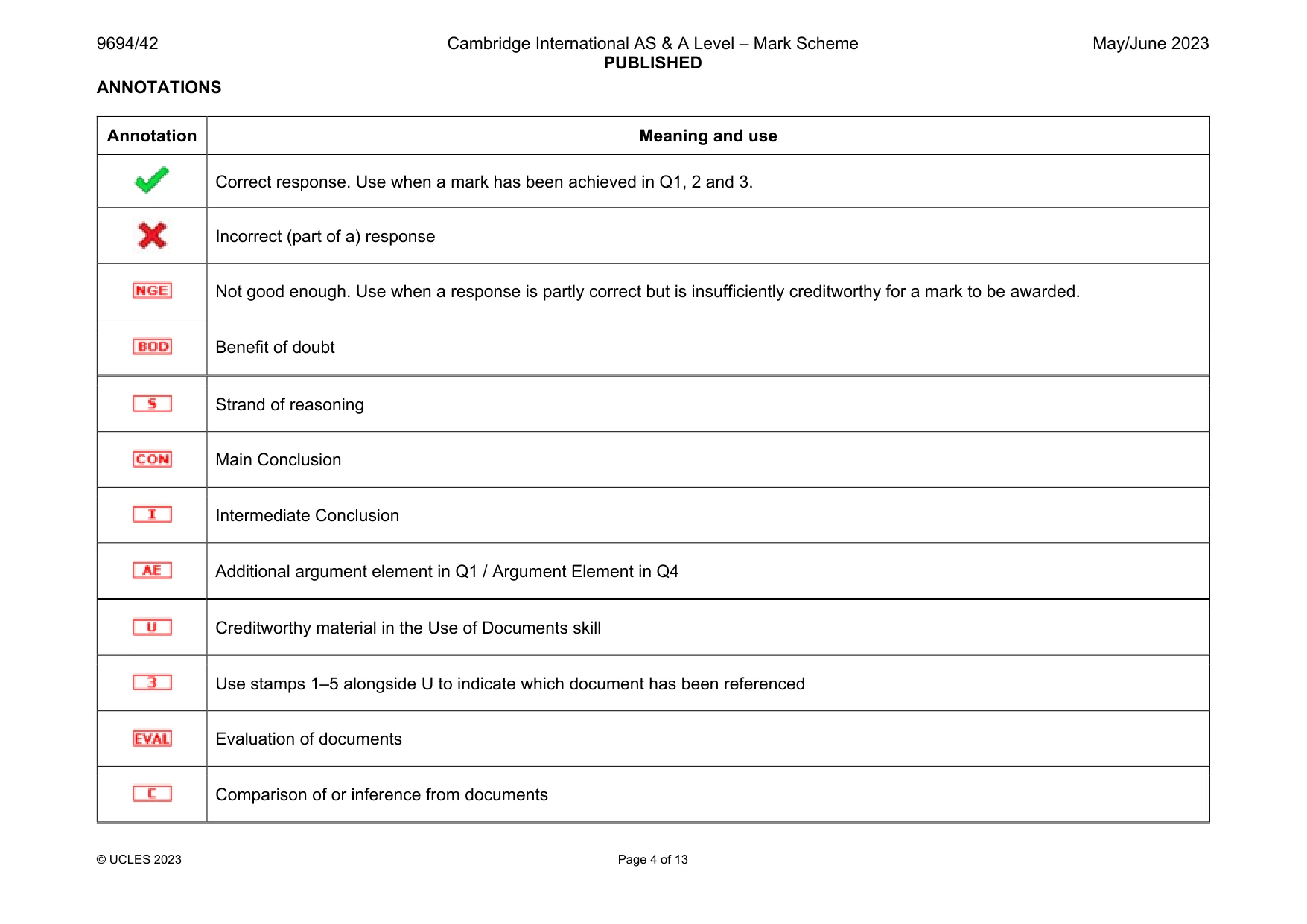
9694/42 Cambridge International AS & A Level – Mark Scheme PUBLISHED May/June 2023 © UCLES 2023 Page 4 of 13 ANNOTATIONS Annotation Meaning and use Correct response. Use when a mark has been achieved in Q1, 2 and 3. Incorrect (part of a) response Not good enough. Use when a response is partly correct but is insufficiently creditworthy for a mark to be awarded. Benefit of doubt Strand of reasoning Main Conclusion Intermediate Conclusion Additional argument element in Q1 / Argument Element in Q4 Creditworthy material in the Use of Documents skill Use stamps 1–5 alongside U to indicate which document has been referenced Evaluation of documents Comparison of or inference from documents
Mark scheme, page 5
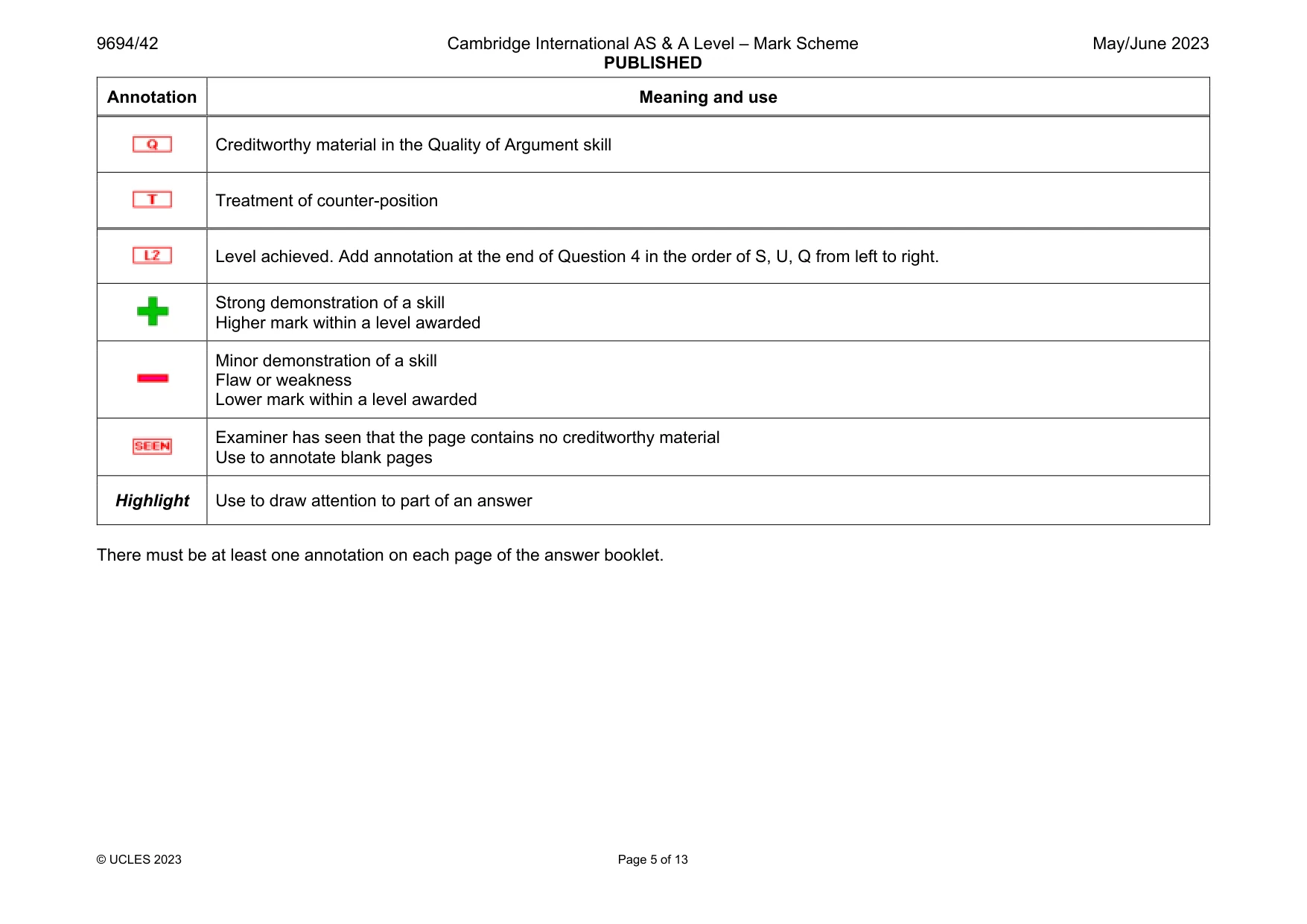
9694/42 Cambridge International AS & A Level – Mark Scheme PUBLISHED May/June 2023 © UCLES 2023 Page 5 of 13 Annotation Meaning and use Creditworthy material in the Quality of Argument skill Treatment of counter-position Level achieved. Add annotation at the end of Question 4 in the order of S, U, Q from left to right. Strong demonstration of a skill Higher mark within a level awarded Minor demonstration of a skill Flaw or weakness Lower mark within a level awarded Examiner has seen that the page contains no creditworthy material Use to annotate blank pages Highlight Use to draw attention to part of an answer There must be at least one annotation on each page of the answer booklet.
Mark scheme, page 6
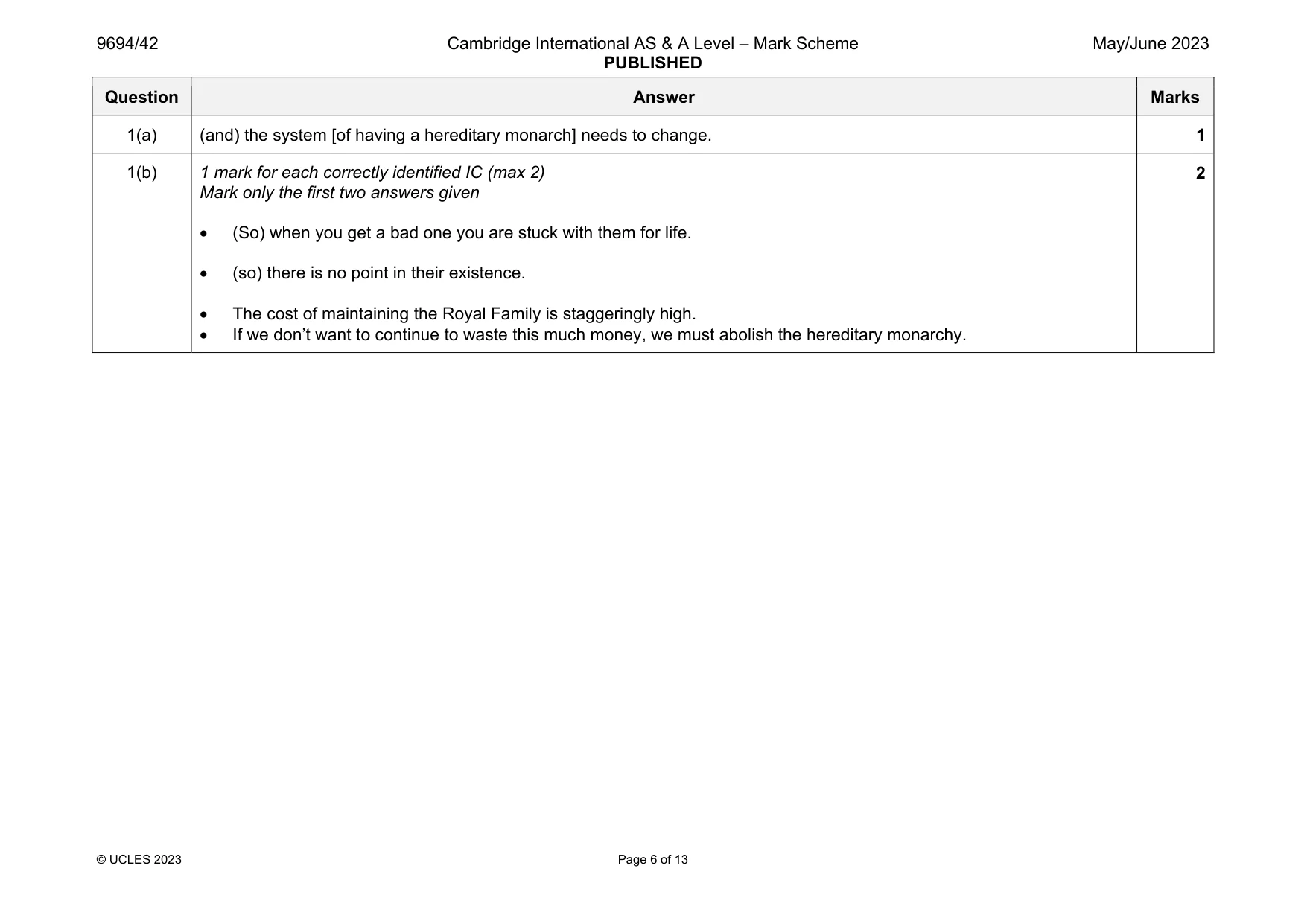
9694/42 Cambridge International AS & A Level – Mark Scheme PUBLISHED May/June 2023 © UCLES 2023 Page 6 of 13 Question Answer Marks 1(a) (and) the system [of having a hereditary monarch] needs to change. 1 1(b) 1 mark for each correctly identified IC (max 2) Mark only the first two answers given (So) when you get a bad one you are stuck with them for life. (so) there is no point in their existence. The cost of maintaining the Royal Family is staggeringly high. If we don’t want to continue to waste this much money, we must abolish the hereditary monarchy. 2
Mark scheme, page 7
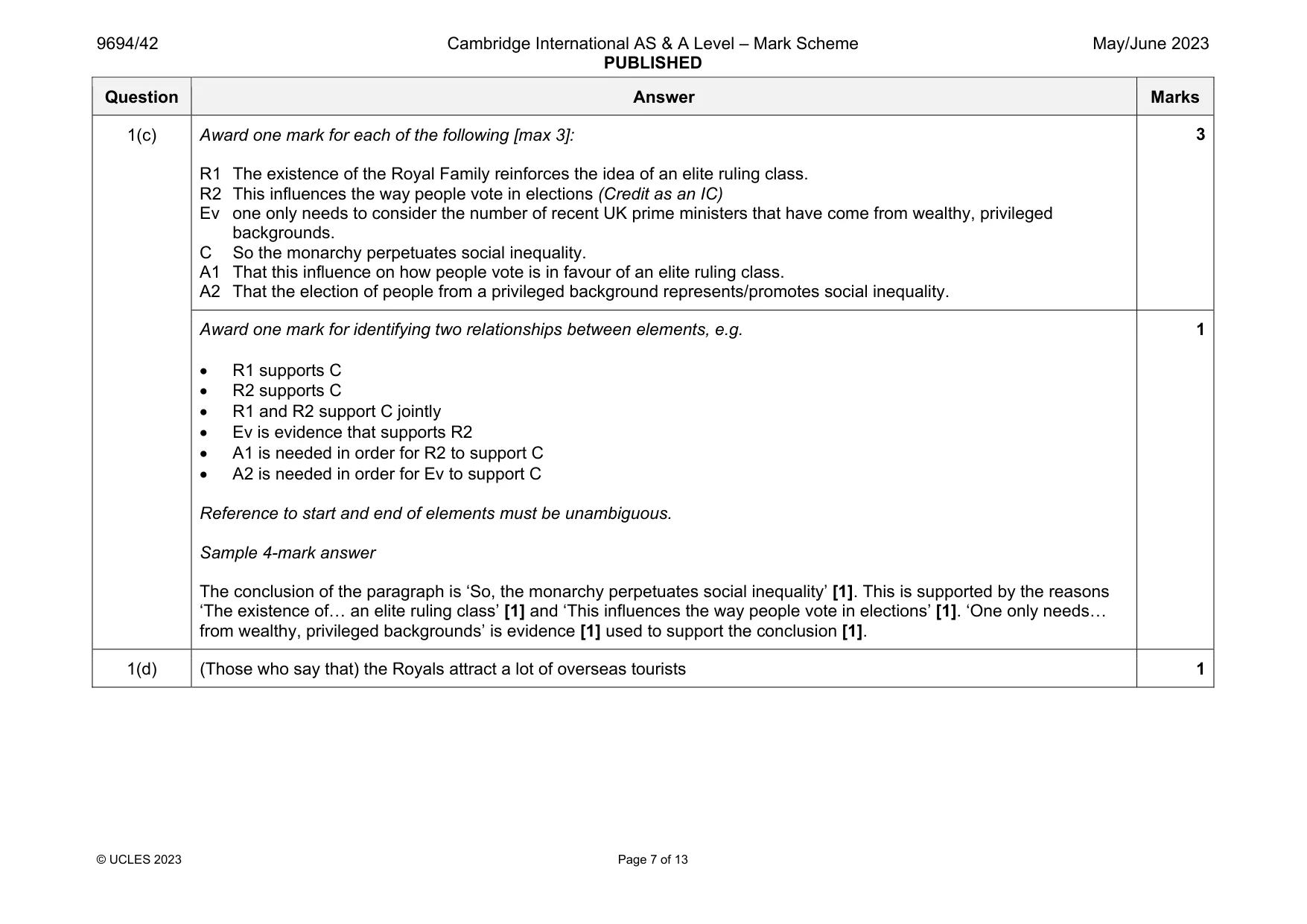
9694/42 Cambridge International AS & A Level – Mark Scheme PUBLISHED May/June 2023 © UCLES 2023 Page 7 of 13 Question Answer Marks 1(c) Award one mark for each of the following [max 3]: R1 The existence of the Royal Family reinforces the idea of an elite ruling class. R2 This influences the way people vote in elections (Credit as an IC) Ev one only needs to consider the number of recent UK prime ministers that have come from wealthy, privileged backgrounds. C So the monarchy perpetuates social inequality. A1 That this influence on how people vote is in favour of an elite ruling class. A2 That the election of people from a privileged background represents/promotes social inequality. 3 Award one mark for identifying two relationships between elements, e.g. R1 supports C R2 supports C R1 and R2 support C jointly Ev is evidence that supports R2 A1 is needed in order for R2 to support C A2 is needed in order for Ev to support C Reference to start and end of elements must be unambiguous. Sample 4-mark answer The conclusion of the paragraph is ‘So, the monarchy perpetuates social inequality’ [1]. This is supported by the reasons ‘The existence of… an elite ruling class’ [1] and ‘This influences the way people vote in elections’ [1]. ‘One only needs… from wealthy, privileged backgrounds’ is evidence [1] used to support the conclusion [1]. 1 1(d) (Those who say that) the Royals attract a lot of overseas tourists 1
Mark scheme, page 8
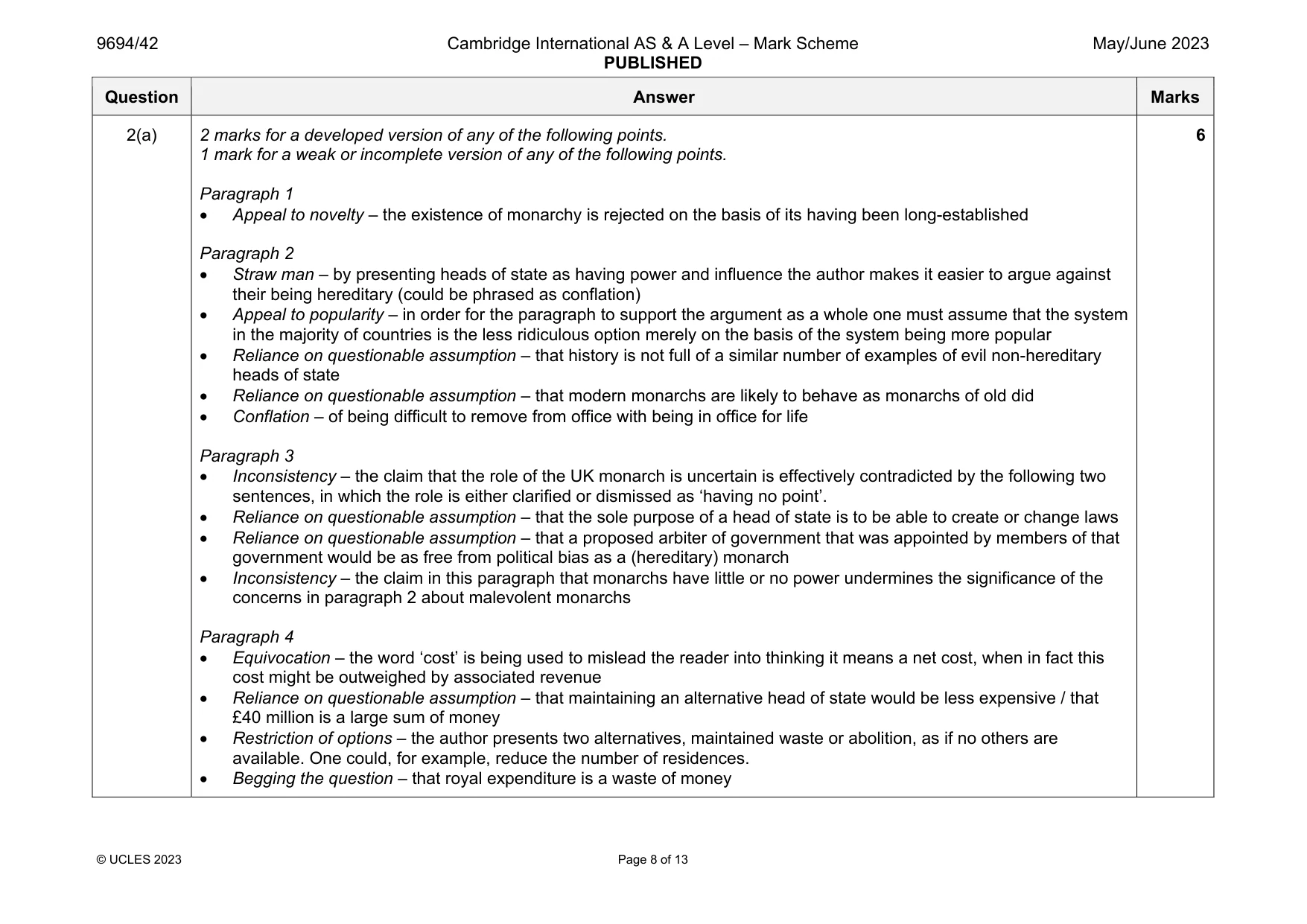
9694/42 Cambridge International AS & A Level – Mark Scheme PUBLISHED May/June 2023 © UCLES 2023 Page 8 of 13 Question Answer Marks 2(a) 2 marks for a developed version of any of the following points. 1 mark for a weak or incomplete version of any of the following points. Paragraph 1 Appeal to novelty – the existence of monarchy is rejected on the basis of its having been long-established Paragraph 2 Straw man – by presenting heads of state as having power and influence the author makes it easier to argue against their being hereditary (could be phrased as conflation) Appeal to popularity – in order for the paragraph to support the argument as a whole one must assume that the system in the majority of countries is the less ridiculous option merely on the basis of the system being more popular Reliance on questionable assumption – that history is not full of a similar number of examples of evil non-hereditary heads of state Reliance on questionable assumption – that modern monarchs are likely to behave as monarchs of old did Conflation – of being difficult to remove from office with being in office for life Paragraph 3 Inconsistency – the claim that the role of the UK monarch is uncertain is effectively contradicted by the following two sentences, in which the role is either clarified or dismissed as ‘having no point’. Reliance on questionable assumption – that the sole purpose of a head of state is to be able to create or change laws Reliance on questionable assumption – that a proposed arbiter of government that was appointed by members of that government would be as free from political bias as a (hereditary) monarch Inconsistency – the claim in this paragraph that monarchs have little or no power undermines the significance of the concerns in paragraph 2 about malevolent monarchs Paragraph 4 Equivocation – the word ‘cost’ is being used to mislead the reader into thinking it means a net cost, when in fact this cost might be outweighed by associated revenue Reliance on questionable assumption – that maintaining an alternative head of state would be less expensive / that £40 million is a large sum of money Restriction of options – the author presents two alternatives, maintained waste or abolition, as if no others are available. One could, for example, reduce the number of residences. Begging the question – that royal expenditure is a waste of money 6
Mark scheme, page 9
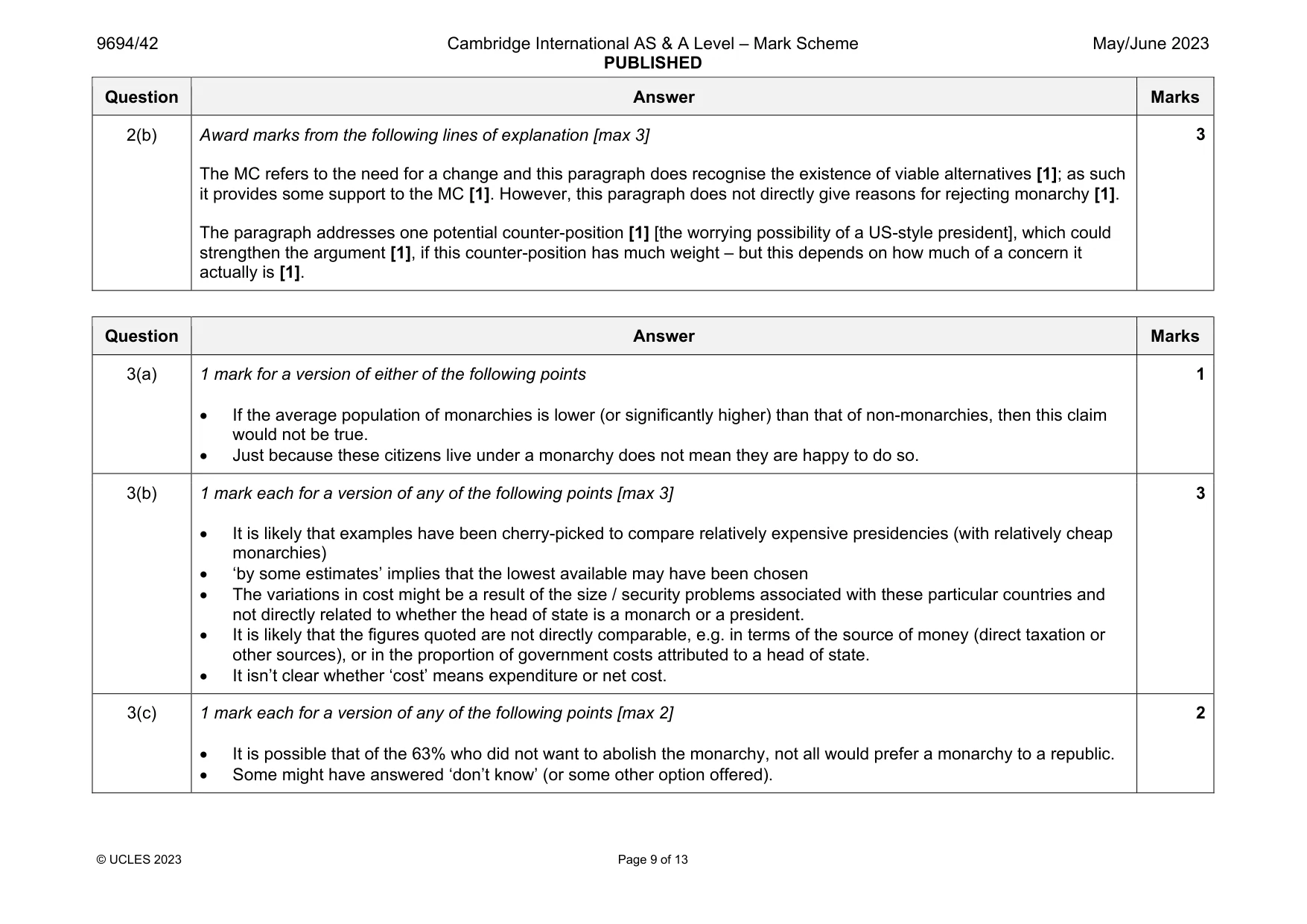
9694/42 Cambridge International AS & A Level – Mark Scheme PUBLISHED May/June 2023 © UCLES 2023 Page 9 of 13 Question Answer Marks 2(b) Award marks from the following lines of explanation [max 3] The MC refers to the need for a change and this paragraph does recognise the existence of viable alternatives [1]; as such it provides some support to the MC [1]. However, this paragraph does not directly give reasons for rejecting monarchy [1]. The paragraph addresses one potential counter-position [1] [the worrying possibility of a US-style president], which could strengthen the argument [1], if this counter-position has much weight – but this depends on how much of a concern it actually is [1]. 3 Question Answer Marks 3(a) 1 mark for a version of either of the following points If the average population of monarchies is lower (or significantly higher) than that of non-monarchies, then this claim would not be true. Just because these citizens live under a monarchy does not mean they are happy to do so. 1 3(b) 1 mark each for a version of any of the following points [max 3] It is likely that examples have been cherry-picked to compare relatively expensive presidencies (with relatively cheap monarchies) ‘by some estimates’ implies that the lowest available may have been chosen The variations in cost might be a result of the size / security problems associated with these particular countries and not directly related to whether the head of state is a monarch or a president. It is likely that the figures quoted are not directly comparable, e.g. in terms of the source of money (direct taxation or other sources), or in the proportion of government costs attributed to a head of state. It isn’t clear whether ‘cost’ means expenditure or net cost. 3 3(c) 1 mark each for a version of any of the following points [max 2] It is possible that of the 63% who did not want to abolish the monarchy, not all would prefer a monarchy to a republic. Some might have answered ‘don’t know’ (or some other option offered). 2
Mark scheme, page 10
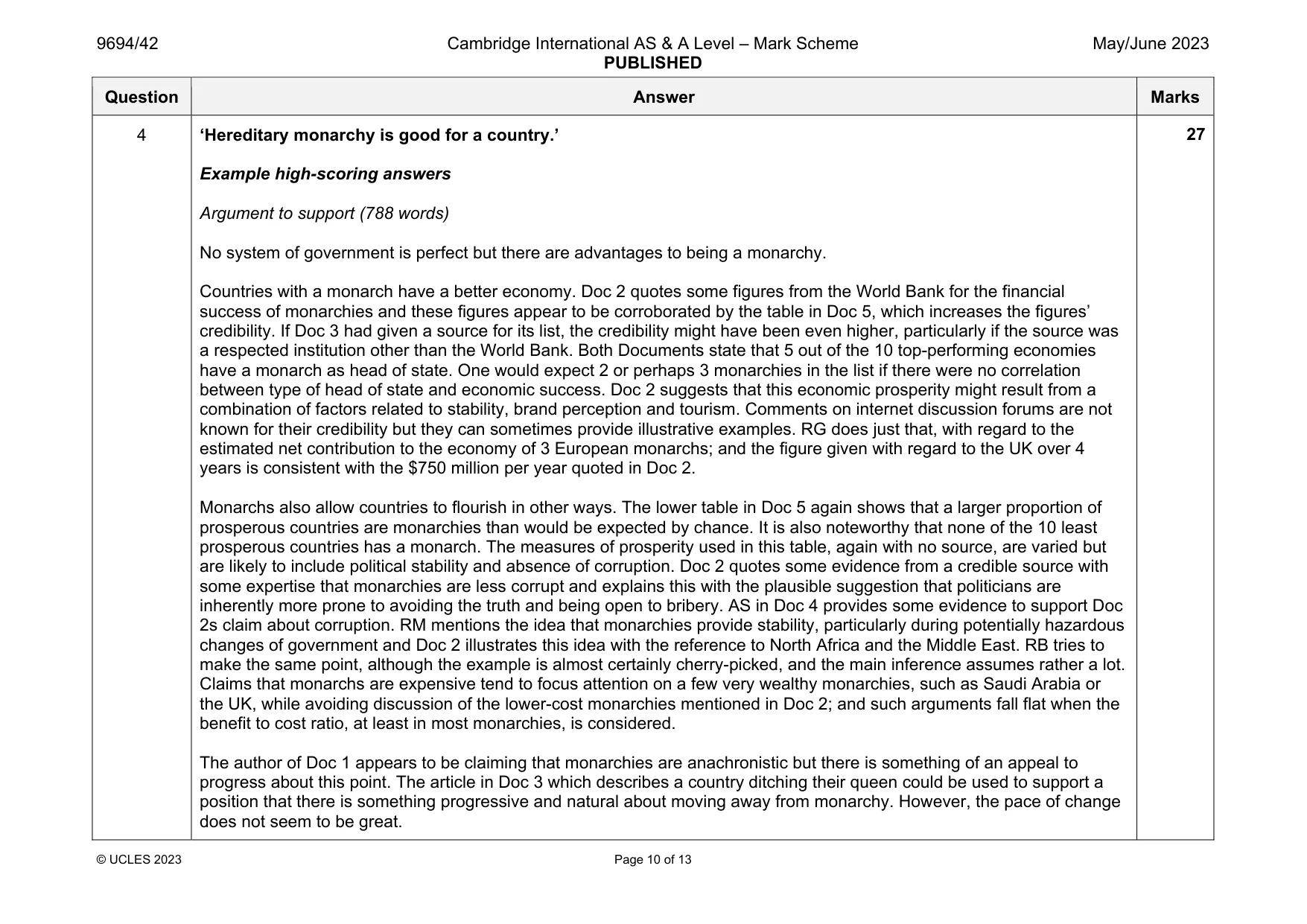
9694/42 Cambridge International AS & A Level – Mark Scheme PUBLISHED May/June 2023 © UCLES 2023 Page 10 of 13 Question Answer Marks 4 ‘Hereditary monarchy is good for a country.’ Example high-scoring answers Argument to support (788 words) No system of government is perfect but there are advantages to being a monarchy. Countries with a monarch have a better economy. Doc 2 quotes some figures from the World Bank for the financial success of monarchies and these figures appear to be corroborated by the table in Doc 5, which increases the figures’ credibility. If Doc 3 had given a source for its list, the credibility might have been even higher, particularly if the source was a respected institution other than the World Bank. Both Documents state that 5 out of the 10 top-performing economies have a monarch as head of state. One would expect 2 or perhaps 3 monarchies in the list if there were no correlation between type of head of state and economic success. Doc 2 suggests that this economic prosperity might result from a combination of factors related to stability, brand perception and tourism. Comments on internet discussion forums are not known for their credibility but they can sometimes provide illustrative examples. RG does just that, with regard to the estimated net contribution to the economy of 3 European monarchs; and the figure given with regard to the UK over 4 years is consistent with the $750 million per year quoted in Doc 2. Monarchs also allow countries to flourish in other ways. The lower table in Doc 5 again shows that a larger proportion of prosperous countries are monarchies than would be expected by chance. It is also noteworthy that none of the 10 least prosperous countries has a monarch. The measures of prosperity used in this table, again with no source, are varied but are likely to include political stability and absence of corruption. Doc 2 quotes some evidence from a credible source with some expertise that monarchies are less corrupt and explains this with the plausible suggestion that politicians are inherently more prone to avoiding the truth and being open to bribery. AS in Doc 4 provides some evidence to support Doc 2s claim about corruption. RM mentions the idea that monarchies provide stability, particularly during potentially hazardous changes of government and Doc 2 illustrates this idea with the reference to North Africa and the Middle East. RB tries to make the same point, although the example is almost certainly cherry-picked, and the main inference assumes rather a lot. Claims that monarchs are expensive tend to focus attention on a few very wealthy monarchies, such as Saudi Arabia or the UK, while avoiding discussion of the lower-cost monarchies mentioned in Doc 2; and such arguments fall flat when the benefit to cost ratio, at least in most monarchies, is considered. The author of Doc 1 appears to be claiming that monarchies are anachronistic but there is something of an appeal to progress about this point. The article in Doc 3 which describes a country ditching their queen could be used to support a position that there is something progressive and natural about moving away from monarchy. However, the pace of change does not seem to be great. 27
Mark scheme, page 11
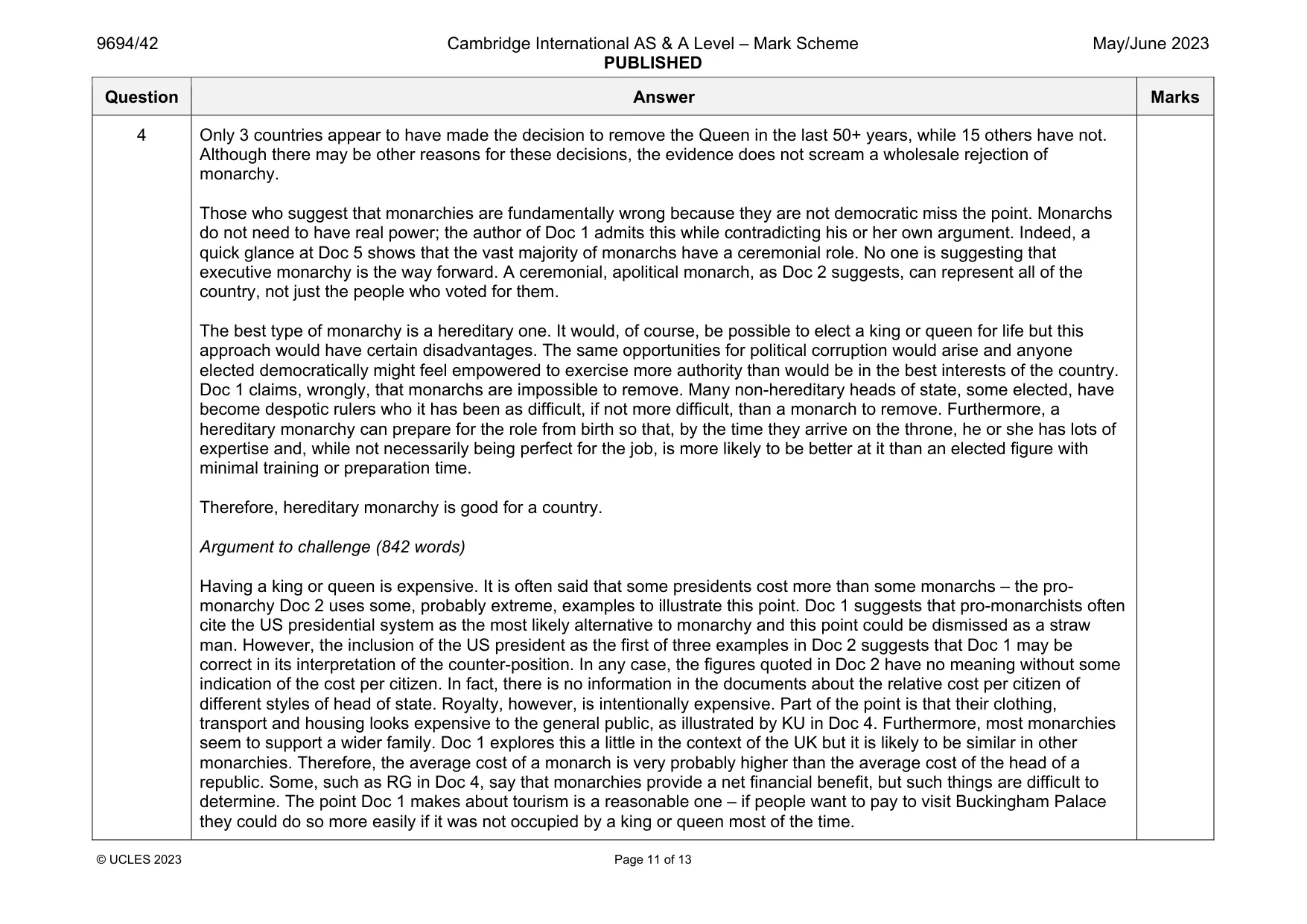
9694/42 Cambridge International AS & A Level – Mark Scheme PUBLISHED May/June 2023 © UCLES 2023 Page 11 of 13 Question Answer Marks 4 Only 3 countries appear to have made the decision to remove the Queen in the last 50+ years, while 15 others have not. Although there may be other reasons for these decisions, the evidence does not scream a wholesale rejection of monarchy. Those who suggest that monarchies are fundamentally wrong because they are not democratic miss the point. Monarchs do not need to have real power; the author of Doc 1 admits this while contradicting his or her own argument. Indeed, a quick glance at Doc 5 shows that the vast majority of monarchs have a ceremonial role. No one is suggesting that executive monarchy is the way forward. A ceremonial, apolitical monarch, as Doc 2 suggests, can represent all of the country, not just the people who voted for them. The best type of monarchy is a hereditary one. It would, of course, be possible to elect a king or queen for life but this approach would have certain disadvantages. The same opportunities for political corruption would arise and anyone elected democratically might feel empowered to exercise more authority than would be in the best interests of the country. Doc 1 claims, wrongly, that monarchs are impossible to remove. Many non-hereditary heads of state, some elected, have become despotic rulers who it has been as difficult, if not more difficult, than a monarch to remove. Furthermore, a hereditary monarchy can prepare for the role from birth so that, by the time they arrive on the throne, he or she has lots of expertise and, while not necessarily being perfect for the job, is more likely to be better at it than an elected figure with minimal training or preparation time. Therefore, hereditary monarchy is good for a country. Argument to challenge (842 words) Having a king or queen is expensive. It is often said that some presidents cost more than some monarchs – the pro- monarchy Doc 2 uses some, probably extreme, examples to illustrate this point. Doc 1 suggests that pro-monarchists often cite the US presidential system as the most likely alternative to monarchy and this point could be dismissed as a straw man. However, the inclusion of the US president as the first of three examples in Doc 2 suggests that Doc 1 may be correct in its interpretation of the counter-position. In any case, the figures quoted in Doc 2 have no meaning without some indication of the cost per citizen. In fact, there is no information in the documents about the relative cost per citizen of different styles of head of state. Royalty, however, is intentionally expensive. Part of the point is that their clothing, transport and housing looks expensive to the general public, as illustrated by KU in Doc 4. Furthermore, most monarchies seem to support a wider family. Doc 1 explores this a little in the context of the UK but it is likely to be similar in other monarchies. Therefore, the average cost of a monarch is very probably higher than the average cost of the head of a republic. Some, such as RG in Doc 4, say that monarchies provide a net financial benefit, but such things are difficult to determine. The point Doc 1 makes about tourism is a reasonable one – if people want to pay to visit Buckingham Palace they could do so more easily if it was not occupied by a king or queen most of the time.
Mark scheme, page 12
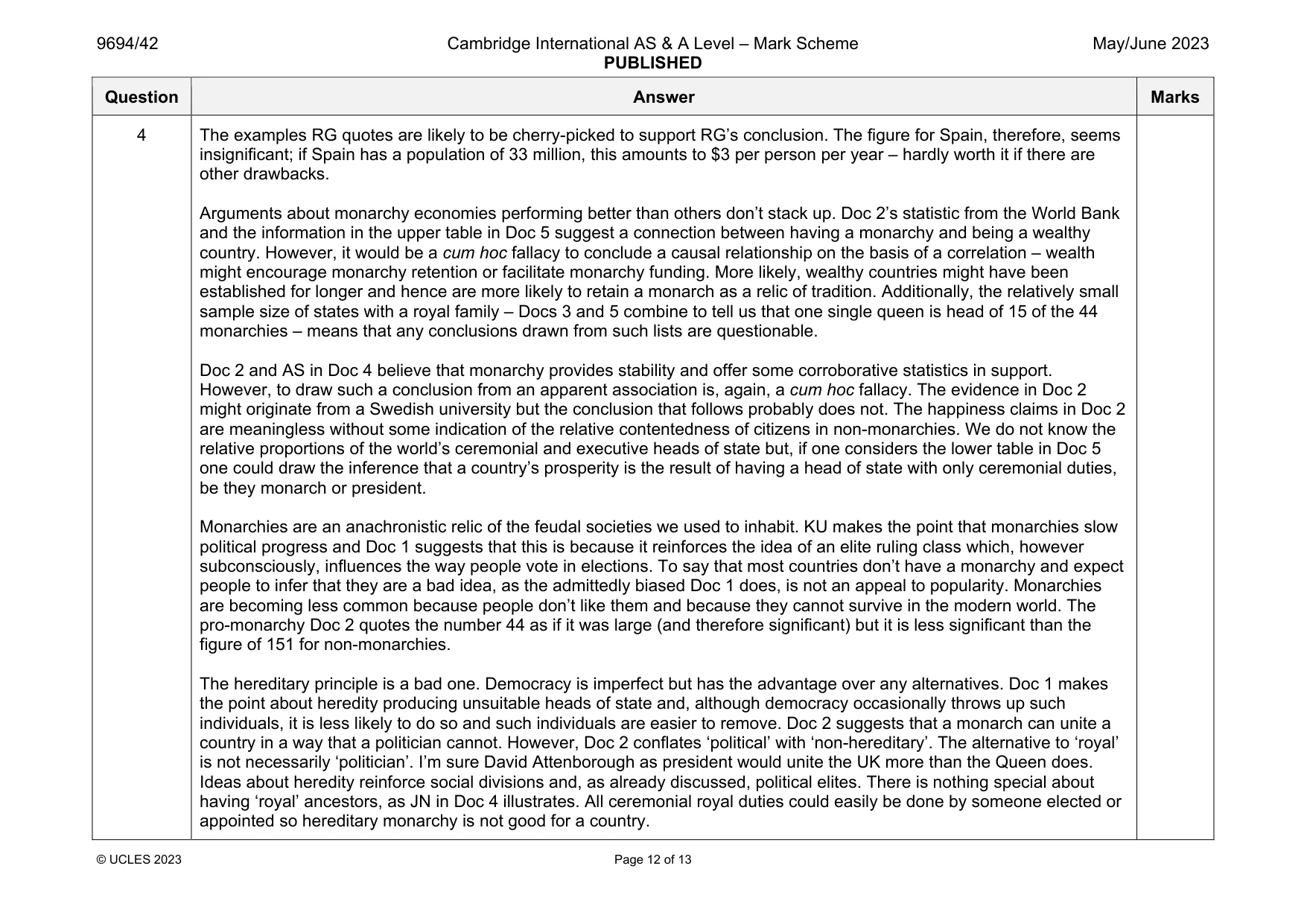
9694/42 Cambridge International AS & A Level – Mark Scheme PUBLISHED May/June 2023 © UCLES 2023 Page 12 of 13 Question Answer Marks 4 The examples RG quotes are likely to be cherry-picked to support RG’s conclusion. The figure for Spain, therefore, seems insignificant; if Spain has a population of 33 million, this amounts to $3 per person per year – hardly worth it if there are other drawbacks. Arguments about monarchy economies performing better than others don’t stack up. Doc 2’s statistic from the World Bank and the information in the upper table in Doc 5 suggest a connection between having a monarchy and being a wealthy country. However, it would be a cum hoc fallacy to conclude a causal relationship on the basis of a correlation – wealth might encourage monarchy retention or facilitate monarchy funding. More likely, wealthy countries might have been established for longer and hence are more likely to retain a monarch as a relic of tradition. Additionally, the relatively small sample size of states with a royal family – Docs 3 and 5 combine to tell us that one single queen is head of 15 of the 44 monarchies – means that any conclusions drawn from such lists are questionable. Doc 2 and AS in Doc 4 believe that monarchy provides stability and offer some corroborative statistics in support. However, to draw such a conclusion from an apparent association is, again, a cum hoc fallacy. The evidence in Doc 2 might originate from a Swedish university but the conclusion that follows probably does not. The happiness claims in Doc 2 are meaningless without some indication of the relative contentedness of citizens in non-monarchies. We do not know the relative proportions of the world’s ceremonial and executive heads of state but, if one considers the lower table in Doc 5 one could draw the inference that a country’s prosperity is the result of having a head of state with only ceremonial duties, be they monarch or president. Monarchies are an anachronistic relic of the feudal societies we used to inhabit. KU makes the point that monarchies slow political progress and Doc 1 suggests that this is because it reinforces the idea of an elite ruling class which, however subconsciously, influences the way people vote in elections. To say that most countries don’t have a monarchy and expect people to infer that they are a bad idea, as the admittedly biased Doc 1 does, is not an appeal to popularity. Monarchies are becoming less common because people don’t like them and because they cannot survive in the modern world. The pro-monarchy Doc 2 quotes the number 44 as if it was large (and therefore significant) but it is less significant than the figure of 151 for non-monarchies. The hereditary principle is a bad one. Democracy is imperfect but has the advantage over any alternatives. Doc 1 makes the point about heredity producing unsuitable heads of state and, although democracy occasionally throws up such individuals, it is less likely to do so and such individuals are easier to remove. Doc 2 suggests that a monarch can unite a country in a way that a politician cannot. However, Doc 2 conflates ‘political’ with ‘non-hereditary’. The alternative to ‘royal’ is not necessarily ‘politician’. I’m sure David Attenborough as president would unite the UK more than the Queen does. Ideas about heredity reinforce social divisions and, as already discussed, political elites. There is nothing special about having ‘royal’ ancestors, as JN in Doc 4 illustrates. All ceremonial royal duties could easily be done by someone elected or appointed so hereditary monarchy is not good for a country.
Mark scheme, page 13
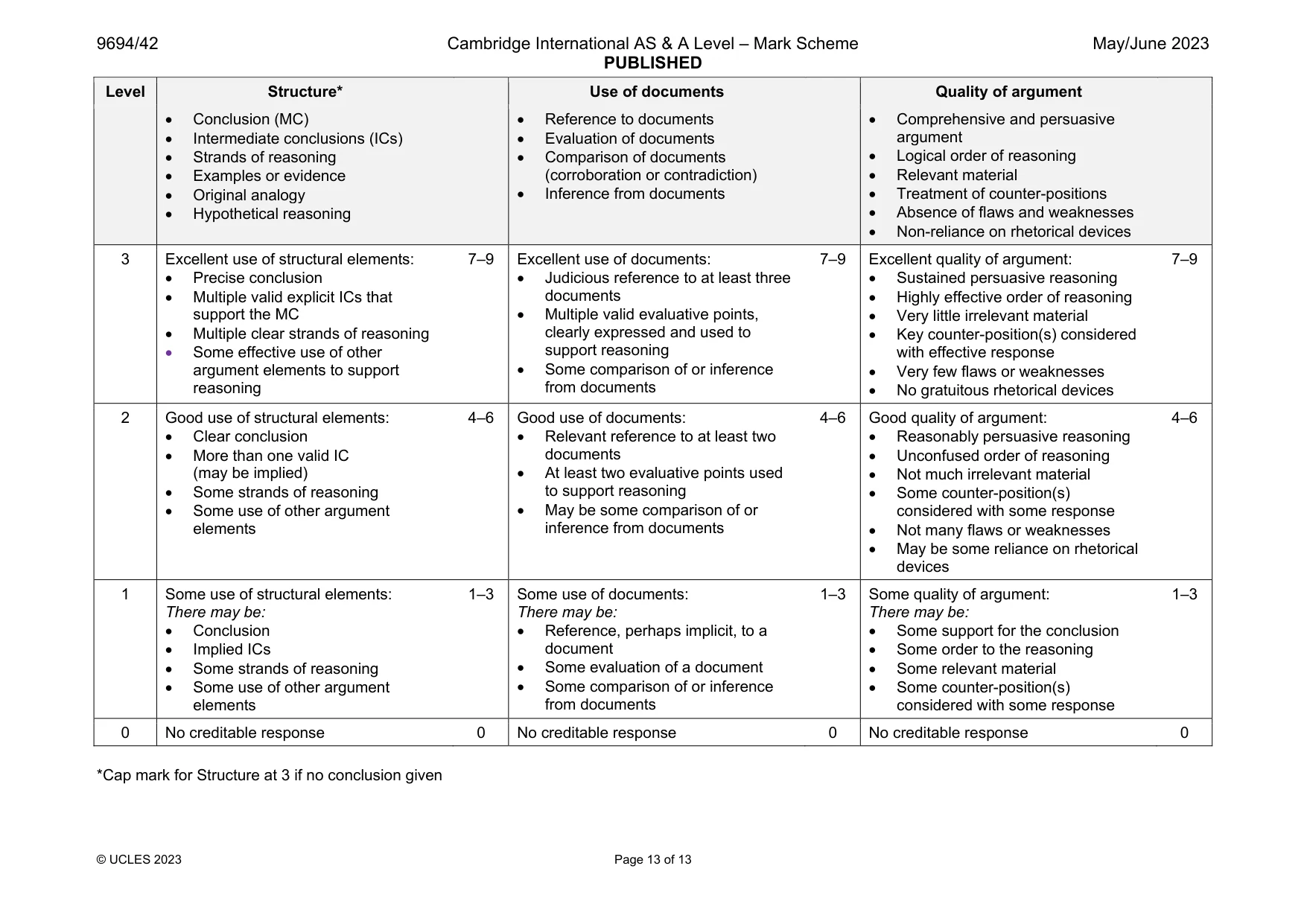
9694/42 Cambridge International AS & A Level – Mark Scheme PUBLISHED May/June 2023 © UCLES 2023 Page 13 of 13 Level Structure* Use of documents Quality of argument Conclusion (MC) Intermediate conclusions (ICs) Strands of reasoning Examples or evidence Original analogy Hypothetical reasoning Reference to documents Evaluation of documents Comparison of documents (corroboration or contradiction) Inference from documents Comprehensive and persuasive argument Logical order of reasoning Relevant material Treatment of counter-positions Absence of flaws and weaknesses Non-reliance on rhetorical devices 3 Excellent use of structural elements: Precise conclusion Multiple valid explicit ICs that support the MC Multiple clear strands of reasoning Some effective use of other argument elements to support reasoning 7–9 Excellent use of documents: Judicious reference to at least three documents Multiple valid evaluative points, clearly expressed and used to support reasoning Some comparison of or inference from documents 7–9 Excellent quality of argument: Sustained persuasive reasoning Highly effective order of reasoning Very little irrelevant material Key counter-position(s) considered with effective response Very few flaws or weaknesses No gratuitous rhetorical devices 7–9 2 Good use of structural elements: Clear conclusion More than one valid IC (may be implied) Some strands of reasoning Some use of other argument elements 4–6 Good use of documents: Relevant reference to at least two documents At least two evaluative points used to support reasoning May be some comparison of or inference from documents 4–6 Good quality of argument: Reasonably persuasive reasoning Unconfused order of reasoning Not much irrelevant material Some counter-position(s) considered with some response Not many flaws or weaknesses May be some reliance on rhetorical devices 4–6 1 Some use of structural elements: There may be: Conclusion Implied ICs Some strands of reasoning Some use of other argument elements 1–3 Some use of documents: There may be: Reference, perhaps implicit, to a document Some evaluation of a document Some comparison of or inference from documents 1–3 Some quality of argument: There may be: Some support for the conclusion Some order to the reasoning Some relevant material Some counter-position(s) considered with some response 1–3 0 No creditable response 0 No creditable response 0 No creditable response 0 *Cap mark for Structure at 3 if no conclusion given
What you needed in this session
Cambridge’s own grade thresholds for 2023 May/June, Paper 4 · Variant 2. A higher threshold means an easier paper — the bar moves with how the cohort did.