Cambridge A Level Thinking Skills 9694 — 2021 May/June Paper 4 · Variant 3
9694/43/M/J/21 · 50 marks · ≈56 min
The question paper and its mark scheme, free to read here and free to download. This is Cambridge’s own paper, exactly as it was sat.
Question paper8 pages

Mark scheme13 pages
Answers below. Sit the paper first if you are practising.
Paper as text
Question paper, page 1
This document has 8 pages. Any blank pages are indicated. Cambridge International AS & A Level DC (KS) 214261 © UCLES 2021 [Turn over * 5 8 8 6 9 8 2 1 6 0 * THINKING SKILLS 9694/43 Paper 4 Applied Reasoning May/June 2021 1 hour 45 minutes You must answer on the enclosed answer booklet. You will need: Answer booklet (enclosed) INSTRUCTIONS ● Answer all questions. ● Follow the instructions on the front cover of the answer booklet. If you need additional answer paper, ask the invigilator for a continuation booklet. INFORMATION ● The total mark for this paper is 50. ● The number of marks for each question or part question is shown in brackets [ ].
Question paper, page 2
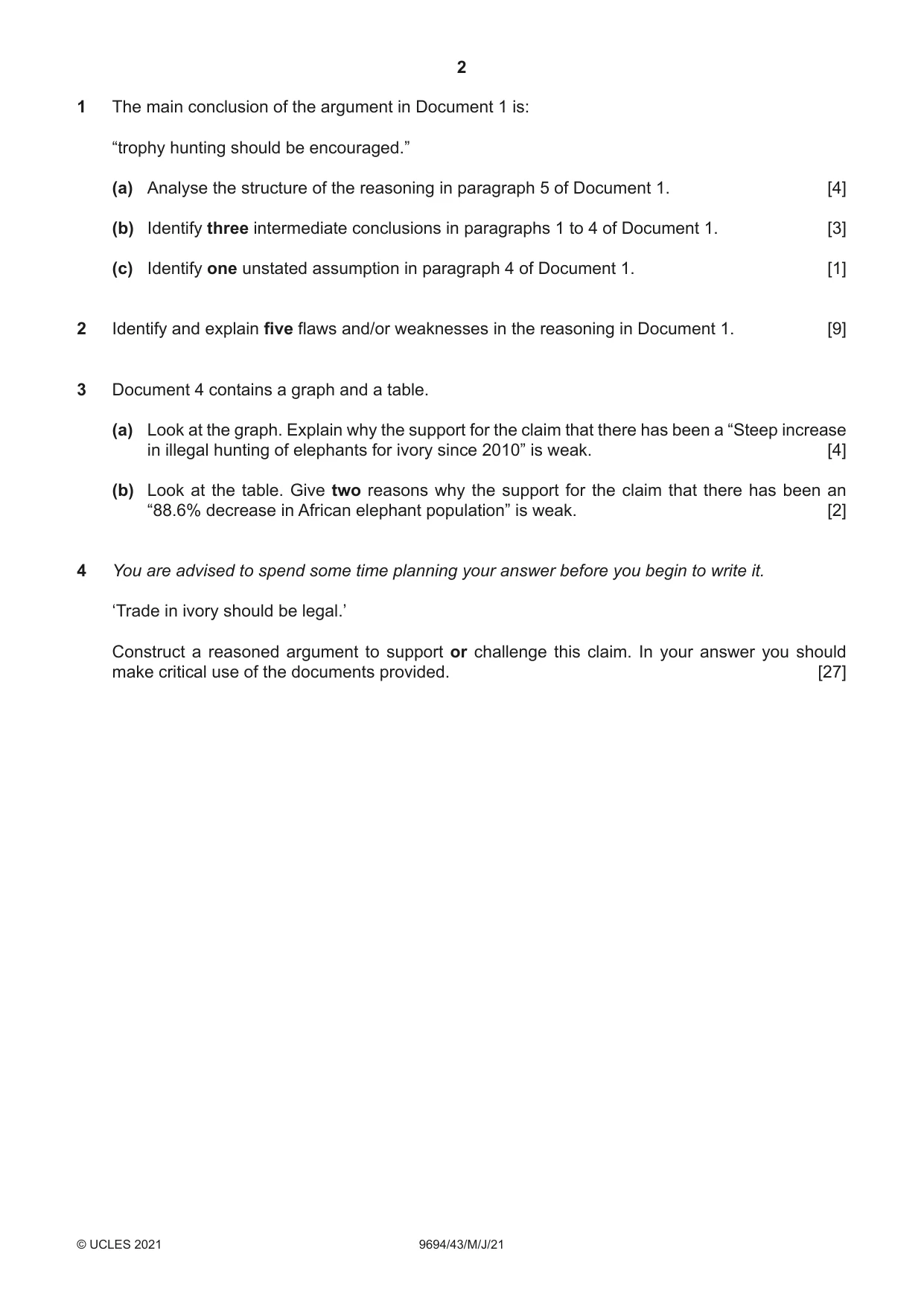
2 9694/43/M/J/21 © UCLES 2021 1 The main conclusion of the argument in Document 1 is: “trophy hunting should be encouraged.” (a) Analyse the structure of the reasoning in paragraph 5 of Document 1. [4] (b) Identify three intermediate conclusions in paragraphs 1 to 4 of Document 1. [3] (c) Identify one unstated assumption in paragraph 4 of Document 1. [1] 2 Identify and explain five flaws and/or weaknesses in the reasoning in Document 1. [9] 3 Document 4 contains a graph and a table. (a) Look at the graph. Explain why the support for the claim that there has been a “Steep increase in illegal hunting of elephants for ivory since 2010” is weak. [4] (b) Look at the table. Give two reasons why the support for the claim that there has been an “88.6% decrease in African elephant population” is weak. [2] 4 You are advised to spend some time planning your answer before you begin to write it. ‘Trade in ivory should be legal.’ Construct a reasoned argument to support or challenge this claim. In your answer you should make critical use of the documents provided. [27]
Question paper, page 3
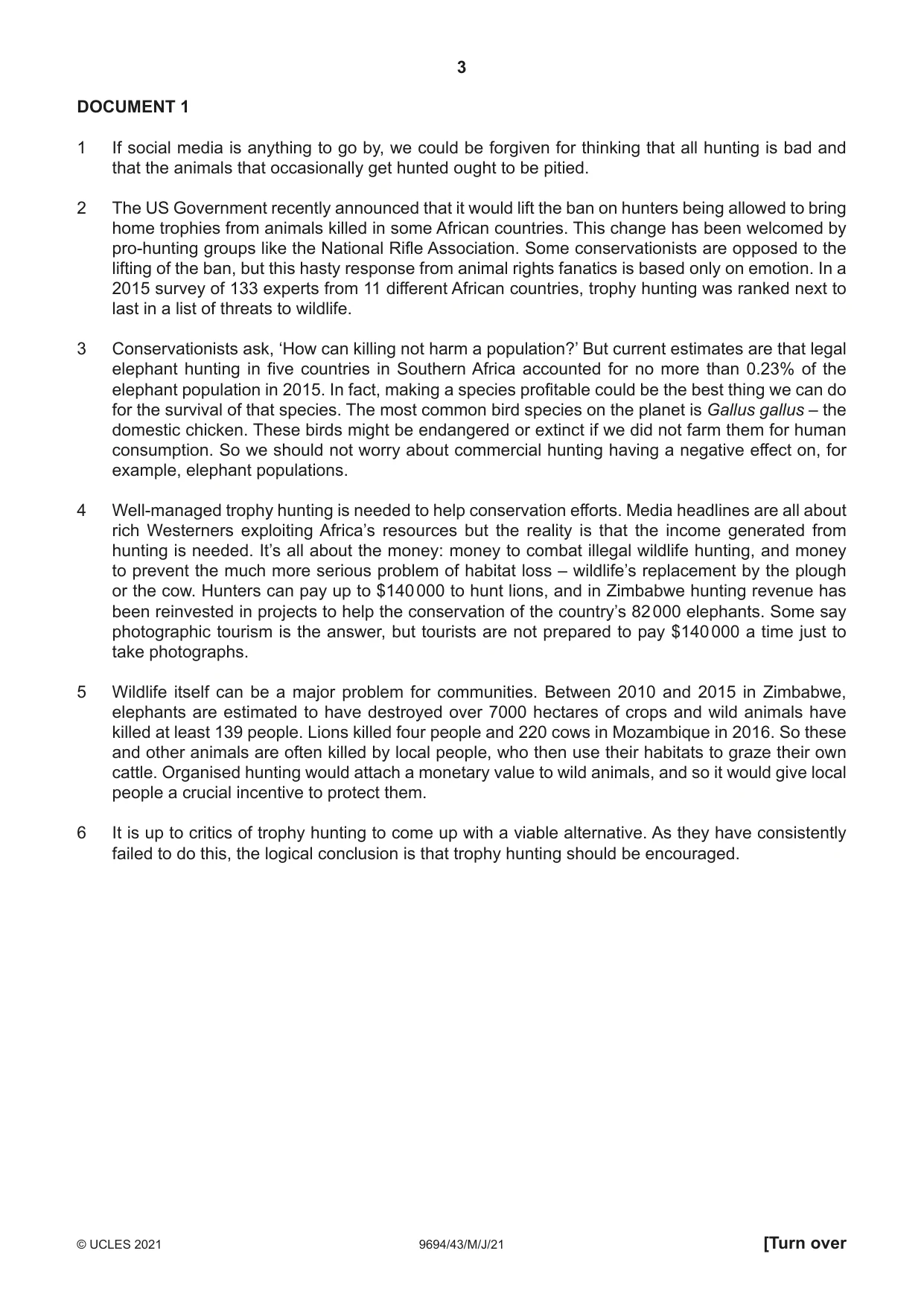
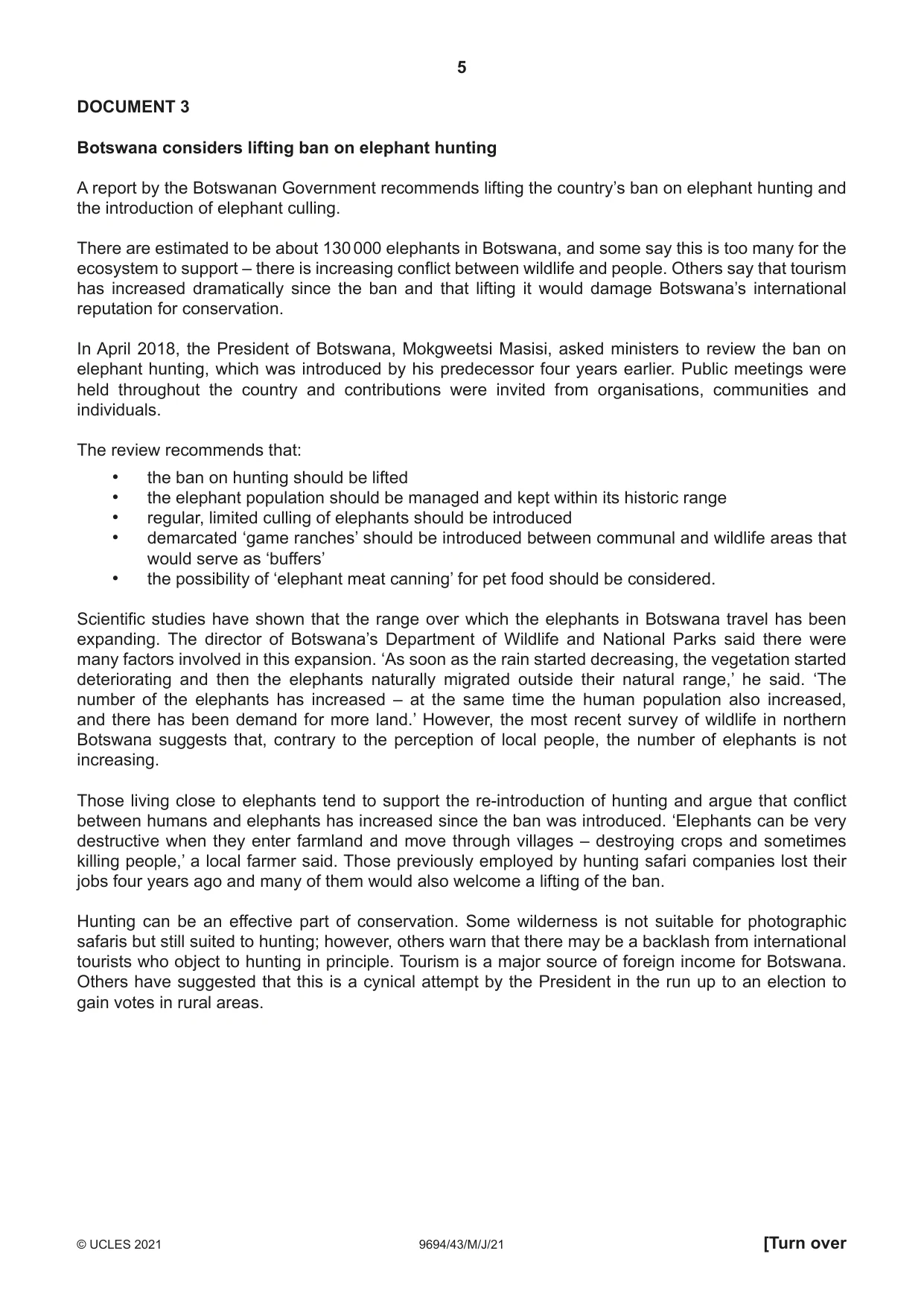
3 9694/43/M/J/21 © UCLES 2021 [Turn over DOCUMENT 1 1 If social media is anything to go by, we could be forgiven for thinking that all hunting is bad and that the animals that occasionally get hunted ought to be pitied. 2 The US Government recently announced that it would lift the ban on hunters being allowed to bring home trophies from animals killed in some African countries. This change has been welcomed by pro-hunting groups like the National Rifle Association. Some conservationists are opposed to the lifting of the ban, but this hasty response from animal rights fanatics is based only on emotion. In a 2015 survey of 133 experts from 11 different African countries, trophy hunting was ranked next to last in a list of threats to wildlife. 3 Conservationists ask, ‘How can killing not harm a population?’ But current estimates are that legal elephant hunting in five countries in Southern Africa accounted for no more than 0.23% of the elephant population in 2015. In fact, making a species profitable could be the best thing we can do for the survival of that species. The most common bird species on the planet is Gallus gallus – the domestic chicken. These birds might be endangered or extinct if we did not farm them for human consumption. So we should not worry about commercial hunting having a negative effect on, for example, elephant populations. 4 Well-managed trophy hunting is needed to help conservation efforts. Media headlines are all about rich Westerners exploiting Africa’s resources but the reality is that the income generated from hunting is needed. It’s all about the money: money to combat illegal wildlife hunting, and money to prevent the much more serious problem of habitat loss – wildlife’s replacement by the plough or the cow. Hunters can pay up to $140 000 to hunt lions, and in Zimbabwe hunting revenue has been reinvested in projects to help the conservation of the country’s 82 000 elephants. Some say photographic tourism is the answer, but tourists are not prepared to pay $140 000 a time just to take photographs. 5 Wildlife itself can be a major problem for communities. Between 2010 and 2015 in Zimbabwe, elephants are estimated to have destroyed over 7000 hectares of crops and wild animals have killed at least 139 people. Lions killed four people and 220 cows in Mozambique in 2016. So these and other animals are often killed by local people, who then use their habitats to graze their own cattle. Organised hunting would attach a monetary value to wild animals, and so it would give local people a crucial incentive to protect them. 6 It is up to critics of trophy hunting to come up with a viable alternative. As they have consistently failed to do this, the logical conclusion is that trophy hunting should be encouraged.
Question paper, page 4
4 9694/43/M/J/21 © UCLES 2021 DOCUMENT 2 Every year thousands of elephants are being killed across Africa. It is thought that there were about 5 million African elephants a century ago but there are now less than 500 000. The 1980s saw a catastrophic increase in ivory poaching. In 1989 the Convention on International Trade in Endangered Species (CITES) announced a complete ban on the international commercial trade in ‘new’ ivory, effectively making the killing of elephants for their tusks illegal. However, many countries continue to allow some form of commercial trade in ‘old’ ivory within and across their borders. These domestic markets are increasingly being recognised as major drivers of continued ivory trafficking and, as a consequence, illegal elephant hunting. The current regulatory approach that has permitted a controlled legal trade in existing ivory (i.e. ivory products from elephants killed before the ban was introduced) has failed elephants. In 1999 and 2008, experimental weakenings of the international ban on commercial ivory trade led to one-off sales of large quantities of ivory to countries where there is a large demand for ivory products. This was done in the interests of providing funds for elephant conservation and for measures to reduce poaching. However, these sales have only stimulated demand in a trade which is subject to weak and inconsistent law enforcement. Moreover, there is very little evidence that shows that the funds generated have been channeled effectively into supporting elephant conservation. Some countries have introduced restrictions on commercial trade within their own borders to older ivory items, often described as ‘antique ivory’. However, ascertaining the age of ivory has many difficulties and this, together with loosely-interpreted and often poorly enforced regulation, provides a convenient loophole for ivory traffickers. We would like to end the ivory trade completely, including ivory from non-elephant sources such as hippo, walrus, narwhal, and extinct animals such as the mammoth. Only in this way can we cut off demand for ivory, which will mean that supply becomes a much less profitable enterprise.
Question paper, page 5
5 9694/43/M/J/21 © UCLES 2021 [Turn over DOCUMENT 3 Botswana considers lifting ban on elephant hunting A report by the Botswanan Government recommends lifting the country’s ban on elephant hunting and the introduction of elephant culling. There are estimated to be about 130 000 elephants in Botswana, and some say this is too many for the ecosystem to support – there is increasing conflict between wildlife and people. Others say that tourism has increased dramatically since the ban and that lifting it would damage Botswana’s international reputation for conservation. In April 2018, the President of Botswana, Mokgweetsi Masisi, asked ministers to review the ban on elephant hunting, which was introduced by his predecessor four years earlier. Public meetings were held throughout the country and contributions were invited from organisations, communities and individuals. The review recommends that: • the ban on hunting should be lifted • the elephant population should be managed and kept within its historic range • regular, limited culling of elephants should be introduced • demarcated ‘game ranches’ should be introduced between communal and wildlife areas that would serve as ‘buffers’ • the possibility of ‘elephant meat canning’ for pet food should be considered. Scientific studies have shown that the range over which the elephants in Botswana travel has been expanding. The director of Botswana’s Department of Wildlife and National Parks said there were many factors involved in this expansion. ‘As soon as the rain started decreasing, the vegetation started deteriorating and then the elephants naturally migrated outside their natural range,’ he said. ‘The number of the elephants has increased – at the same time the human population also increased, and there has been demand for more land.’ However, the most recent survey of wildlife in northern Botswana suggests that, contrary to the perception of local people, the number of elephants is not increasing. Those living close to elephants tend to support the re-introduction of hunting and argue that conflict between humans and elephants has increased since the ban was introduced. ‘Elephants can be very destructive when they enter farmland and move through villages – destroying crops and sometimes killing people,’ a local farmer said. Those previously employed by hunting safari companies lost their jobs four years ago and many of them would also welcome a lifting of the ban. Hunting can be an effective part of conservation. Some wilderness is not suitable for photographic safaris but still suited to hunting; however, others warn that there may be a backlash from international tourists who object to hunting in principle. Tourism is a major source of foreign income for Botswana. Others have suggested that this is a cynical attempt by the President in the run up to an election to gain votes in rural areas.
Question paper, page 6
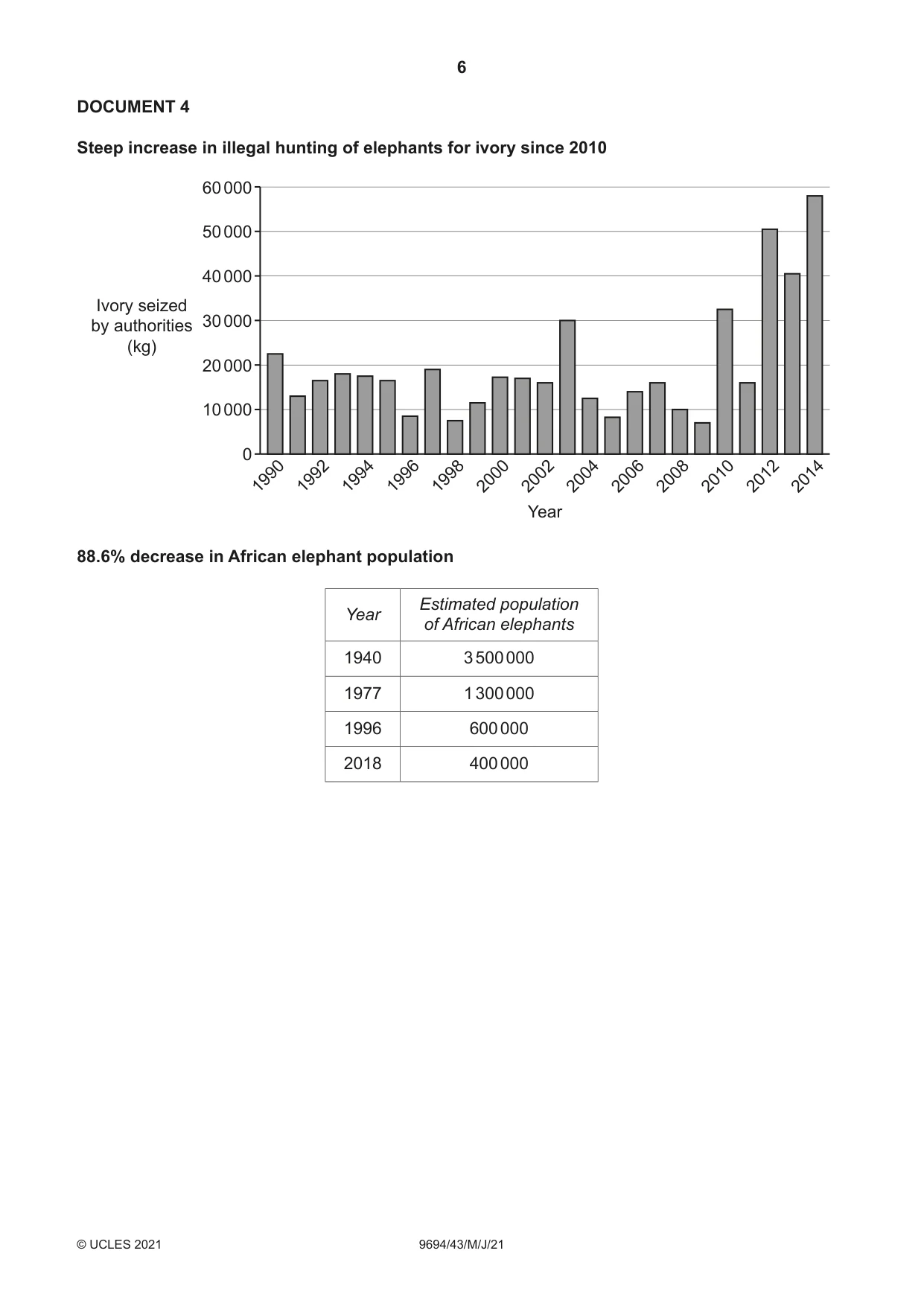
6 9694/43/M/J/21 © UCLES 2021 DOCUMENT 4 Steep increase in illegal hunting of elephants for ivory since 2010 Year 10 000 20 000 30 000 40 000 50 000 60 000 Ivory seized by authorities (kg) 1990 1992 1994 1996 1998 2000 2002 2004 2006 2008 2010 2012 2014 0 88.6% decrease in African elephant population Year Estimated population of African elephants 1940 3 500 000 1977 1 300 000 1996 600 000 2018 400 000
Question paper, page 7
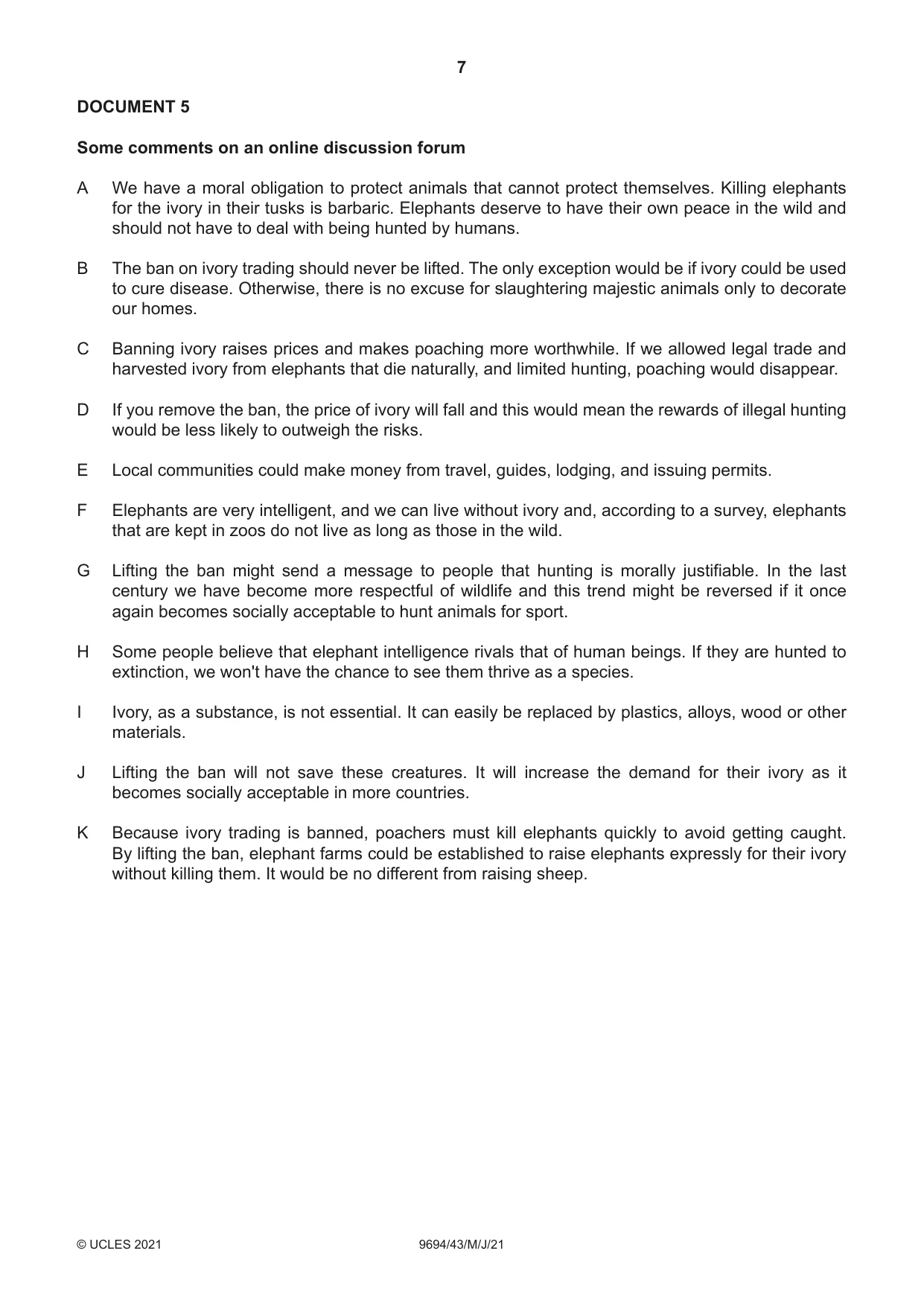
7 9694/43/M/J/21 © UCLES 2021 DOCUMENT 5 Some comments on an online discussion forum A We have a moral obligation to protect animals that cannot protect themselves. Killing elephants for the ivory in their tusks is barbaric. Elephants deserve to have their own peace in the wild and should not have to deal with being hunted by humans. B The ban on ivory trading should never be lifted. The only exception would be if ivory could be used to cure disease. Otherwise, there is no excuse for slaughtering majestic animals only to decorate our homes. C Banning ivory raises prices and makes poaching more worthwhile. If we allowed legal trade and harvested ivory from elephants that die naturally, and limited hunting, poaching would disappear. D If you remove the ban, the price of ivory will fall and this would mean the rewards of illegal hunting would be less likely to outweigh the risks. E Local communities could make money from travel, guides, lodging, and issuing permits. F Elephants are very intelligent, and we can live without ivory and, according to a survey, elephants that are kept in zoos do not live as long as those in the wild. G Lifting the ban might send a message to people that hunting is morally justifiable. In the last century we have become more respectful of wildlife and this trend might be reversed if it once again becomes socially acceptable to hunt animals for sport. H Some people believe that elephant intelligence rivals that of human beings. If they are hunted to extinction, we won't have the chance to see them thrive as a species. I Ivory, as a substance, is not essential. It can easily be replaced by plastics, alloys, wood or other materials. J Lifting the ban will not save these creatures. It will increase the demand for their ivory as it becomes socially acceptable in more countries. K Because ivory trading is banned, poachers must kill elephants quickly to avoid getting caught. By lifting the ban, elephant farms could be established to raise elephants expressly for their ivory without killing them. It would be no different from raising sheep.
Question paper, page 8
8 9694/43/M/J/21 © UCLES 2021 Permission to reproduce items where third-party owned material protected by copyright is included has been sought and cleared where possible. Every reasonable effort has been made by the publisher (UCLES) to trace copyright holders, but if any items requiring clearance have unwittingly been included, the publisher will be pleased to make amends at the earliest possible opportunity. To avoid the issue of disclosure of answer-related information to candidates, all copyright acknowledgements are reproduced online in the Cambridge Assessment International Education Copyright Acknowledgements Booklet. This is produced for each series of examinations and is freely available to download at www.cambridgeinternational.org after the live examination series. Cambridge Assessment International Education is part of the Cambridge Assessment Group. Cambridge Assessment is the brand name of the University of Cambridge Local Examinations Syndicate (UCLES), which itself is a department of the University of Cambridge. BLANK PAGE
Mark scheme, page 1
This document consists of 13 printed pages. © UCLES 2021 [Turn over Cambridge International AS & A Level THINKING SKILLS 9694/43 Paper 4 Applied Reasoning May/June 2021 MARK SCHEME Maximum Mark: 50 Published This mark scheme is published as an aid to teachers and candidates, to indicate the requirements of the examination. It shows the basis on which Examiners were instructed to award marks. It does not indicate the details of the discussions that took place at an Examiners’ meeting before marking began, which would have considered the acceptability of alternative answers. Mark schemes should be read in conjunction with the question paper and the Principal Examiner Report for Teachers. Cambridge International will not enter into discussions about these mark schemes. Cambridge International is publishing the mark schemes for the May/June 2021 series for most Cambridge IGCSE™, Cambridge International A and AS Level components and some Cambridge O Level components.
Mark scheme, page 2
9694/43 Cambridge International AS & A Level – Mark Scheme PUBLISHED May/June 2021 © UCLES 2021 Page 2 of 13 Generic Marking Principles These general marking principles must be applied by all examiners when marking candidate answers. They should be applied alongside the specific content of the mark scheme or generic level descriptors for a question. Each question paper and mark scheme will also comply with these marking principles. GENERIC MARKING PRINCIPLE 1: Marks must be awarded in line with: • the specific content of the mark scheme or the generic level descriptors for the question • the specific skills defined in the mark scheme or in the generic level descriptors for the question • the standard of response required by a candidate as exemplified by the standardisation scripts. GENERIC MARKING PRINCIPLE 2: Marks awarded are always whole marks (not half marks, or other fractions). GENERIC MARKING PRINCIPLE 3: Marks must be awarded positively: • marks are awarded for correct/valid answers, as defined in the mark scheme. However, credit is given for valid answers which go beyond the scope of the syllabus and mark scheme, referring to your Team Leader as appropriate • marks are awarded when candidates clearly demonstrate what they know and can do • marks are not deducted for errors • marks are not deducted for omissions • answers should only be judged on the quality of spelling, punctuation and grammar when these features are specifically assessed by the question as indicated by the mark scheme. The meaning, however, should be unambiguous. GENERIC MARKING PRINCIPLE 4: Rules must be applied consistently, e.g. in situations where candidates have not followed instructions or in the application of generic level descriptors.
Mark scheme, page 3
9694/43 Cambridge International AS & A Level – Mark Scheme PUBLISHED May/June 2021 © UCLES 2021 Page 3 of 13 GENERIC MARKING PRINCIPLE 5: Marks should be awarded using the full range of marks defined in the mark scheme for the question (however; the use of the full mark range may be limited according to the quality of the candidate responses seen). GENERIC MARKING PRINCIPLE 6: Marks awarded are based solely on the requirements as defined in the mark scheme. Marks should not be awarded with grade thresholds or grade descriptors in mind.
Mark scheme, page 4
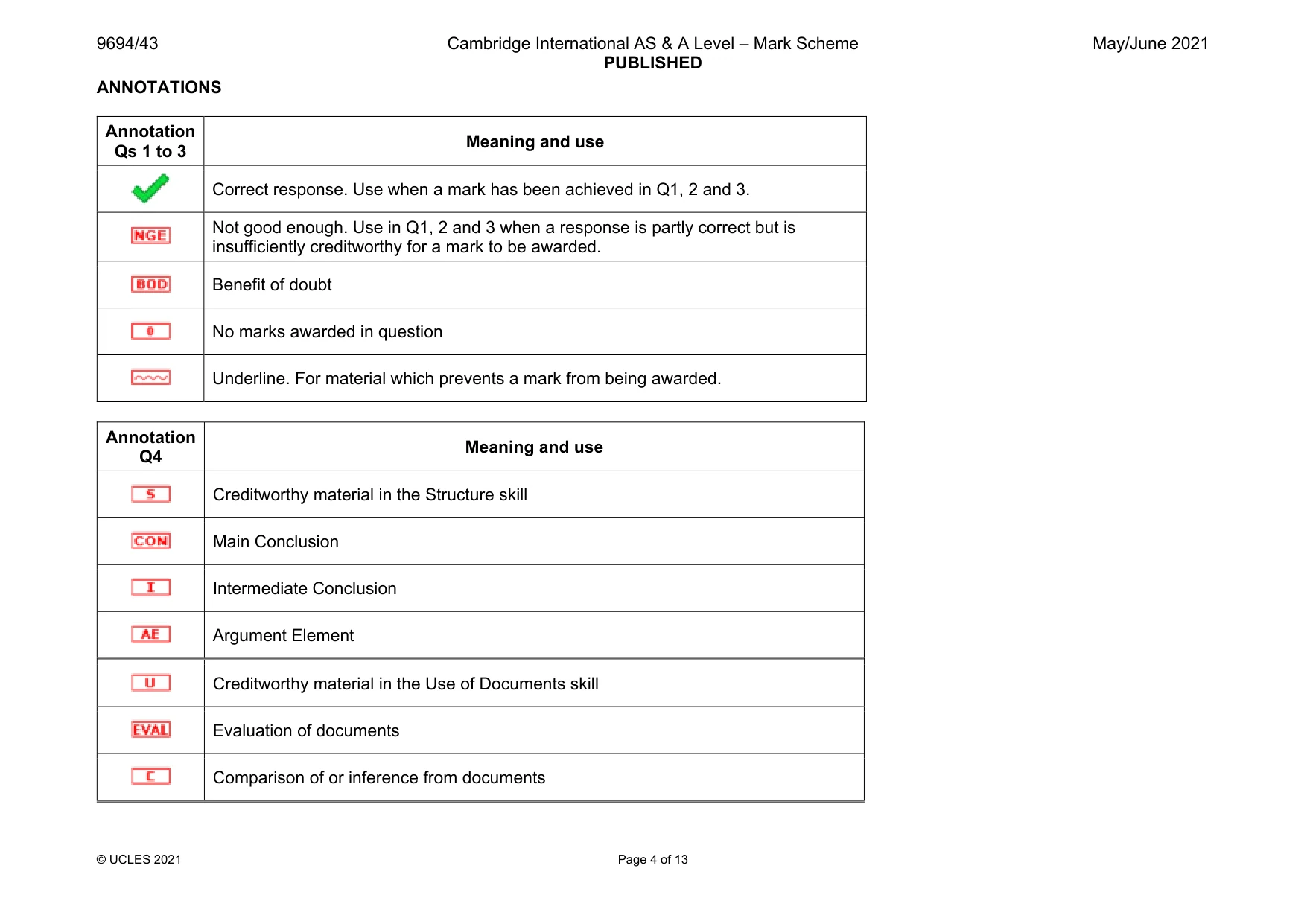
9694/43 Cambridge International AS & A Level – Mark Scheme PUBLISHED May/June 2021 © UCLES 2021 Page 4 of 13 ANNOTATIONS Annotation Qs 1 to 3 Meaning and use Correct response. Use when a mark has been achieved in Q1, 2 and 3. Not good enough. Use in Q1, 2 and 3 when a response is partly correct but is insufficiently creditworthy for a mark to be awarded. Benefit of doubt No marks awarded in question Underline. For material which prevents a mark from being awarded. Annotation Q4 Meaning and use Creditworthy material in the Structure skill Main Conclusion Intermediate Conclusion Argument Element Creditworthy material in the Use of Documents skill Evaluation of documents Comparison of or inference from documents
Mark scheme, page 5
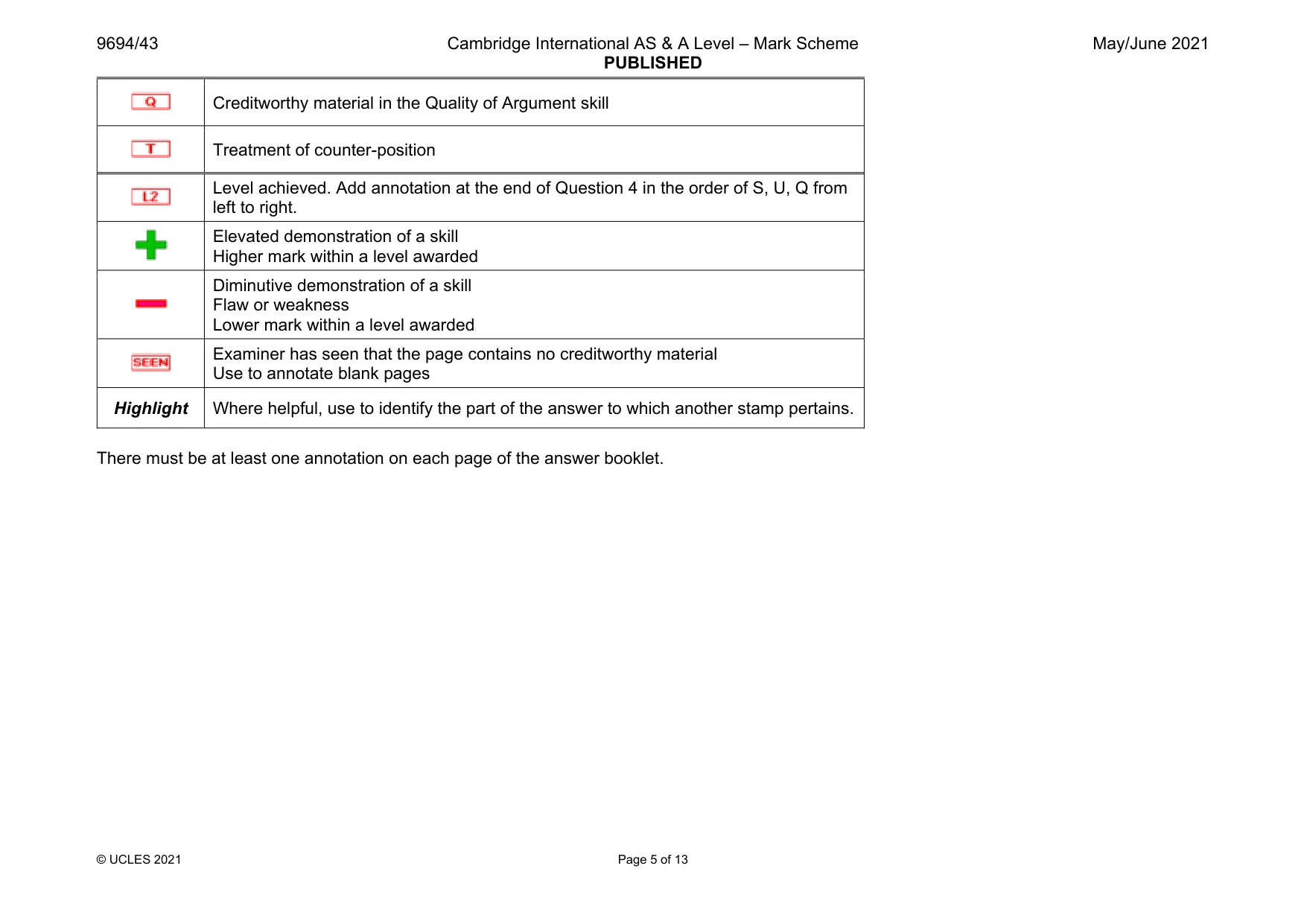
9694/43 Cambridge International AS & A Level – Mark Scheme PUBLISHED May/June 2021 © UCLES 2021 Page 5 of 13 Creditworthy material in the Quality of Argument skill Treatment of counter-position Level achieved. Add annotation at the end of Question 4 in the order of S, U, Q from left to right. Elevated demonstration of a skill Higher mark within a level awarded Diminutive demonstration of a skill Flaw or weakness Lower mark within a level awarded Examiner has seen that the page contains no creditworthy material Use to annotate blank pages Highlight Where helpful, use to identify the part of the answer to which another stamp pertains. There must be at least one annotation on each page of the answer booklet.
Mark scheme, page 6
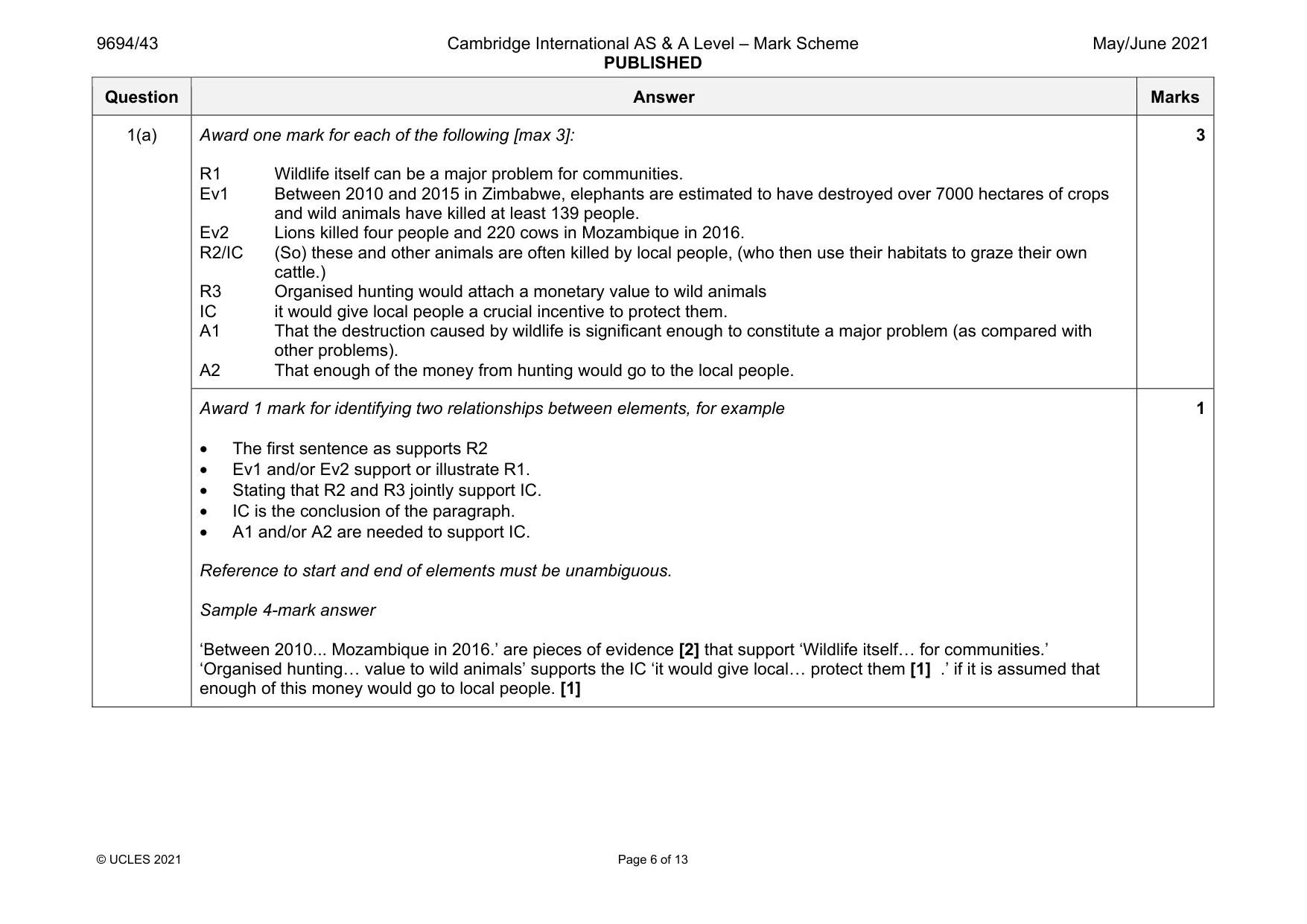
9694/43 Cambridge International AS & A Level – Mark Scheme PUBLISHED May/June 2021 © UCLES 2021 Page 6 of 13 Question Answer Marks 1(a) Award one mark for each of the following [max 3]: R1 Wildlife itself can be a major problem for communities. Ev1 Between 2010 and 2015 in Zimbabwe, elephants are estimated to have destroyed over 7000 hectares of crops and wild animals have killed at least 139 people. Ev2 Lions killed four people and 220 cows in Mozambique in 2016. R2/IC (So) these and other animals are often killed by local people, (who then use their habitats to graze their own cattle.) R3 Organised hunting would attach a monetary value to wild animals IC it would give local people a crucial incentive to protect them. A1 That the destruction caused by wildlife is significant enough to constitute a major problem (as compared with other problems). A2 That enough of the money from hunting would go to the local people. 3 Award 1 mark for identifying two relationships between elements, for example • The first sentence as supports R2 • Ev1 and/or Ev2 support or illustrate R1. • Stating that R2 and R3 jointly support IC. • IC is the conclusion of the paragraph. • A1 and/or A2 are needed to support IC. Reference to start and end of elements must be unambiguous. Sample 4-mark answer ‘Between 2010... Mozambique in 2016.’ are pieces of evidence [2] that support ‘Wildlife itself… for communities.’ ‘Organised hunting… value to wild animals’ supports the IC ‘it would give local… protect them [1] .’ if it is assumed that enough of this money would go to local people. [1] 1
Mark scheme, page 7
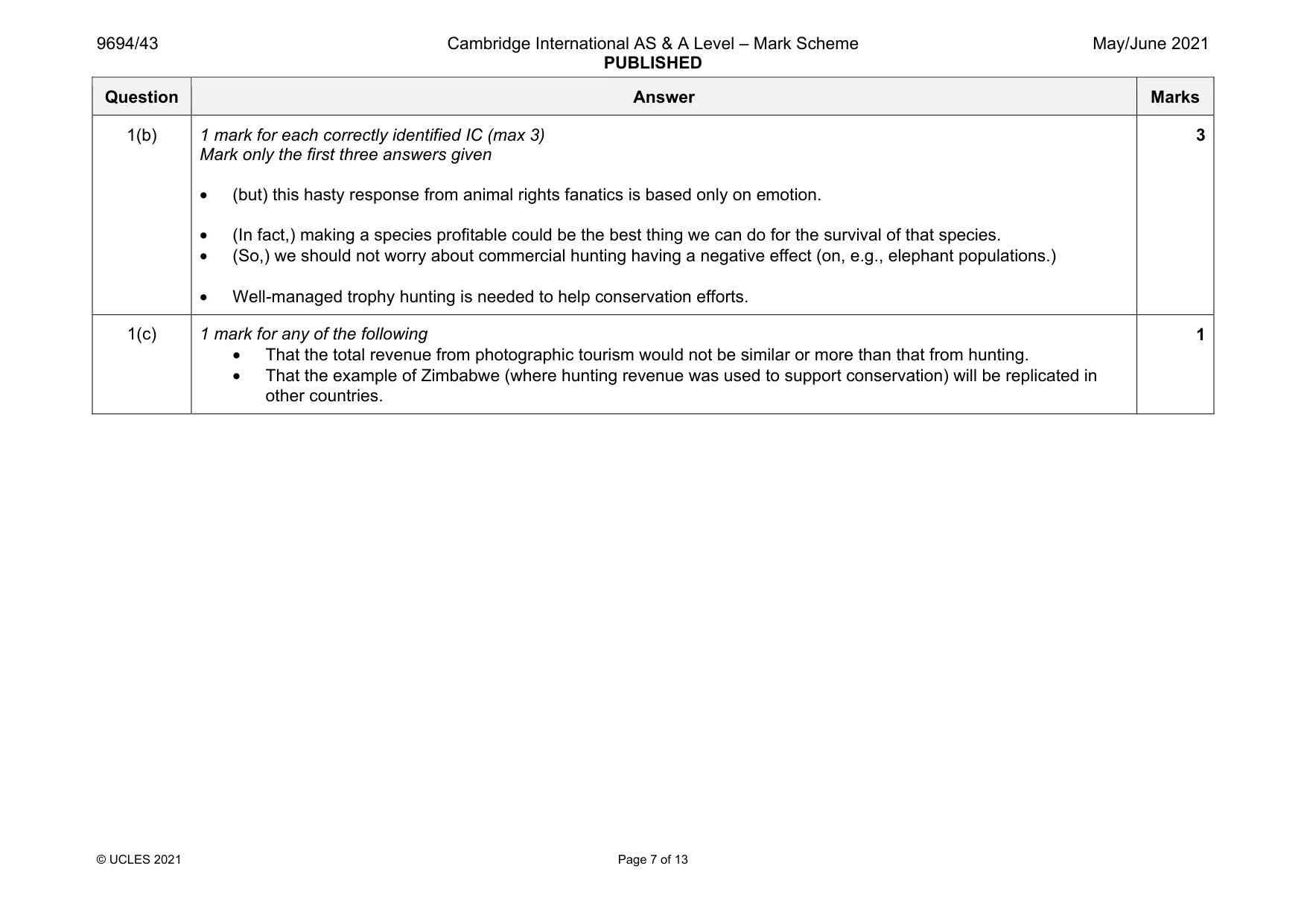
9694/43 Cambridge International AS & A Level – Mark Scheme PUBLISHED May/June 2021 © UCLES 2021 Page 7 of 13 Question Answer Marks 1(b) 1 mark for each correctly identified IC (max 3) Mark only the first three answers given • (but) this hasty response from animal rights fanatics is based only on emotion. • (In fact,) making a species profitable could be the best thing we can do for the survival of that species. • (So,) we should not worry about commercial hunting having a negative effect (on, e.g., elephant populations.) • Well-managed trophy hunting is needed to help conservation efforts. 3 1(c) 1 mark for any of the following • That the total revenue from photographic tourism would not be similar or more than that from hunting. • That the example of Zimbabwe (where hunting revenue was used to support conservation) will be replicated in other countries. 1
Mark scheme, page 8
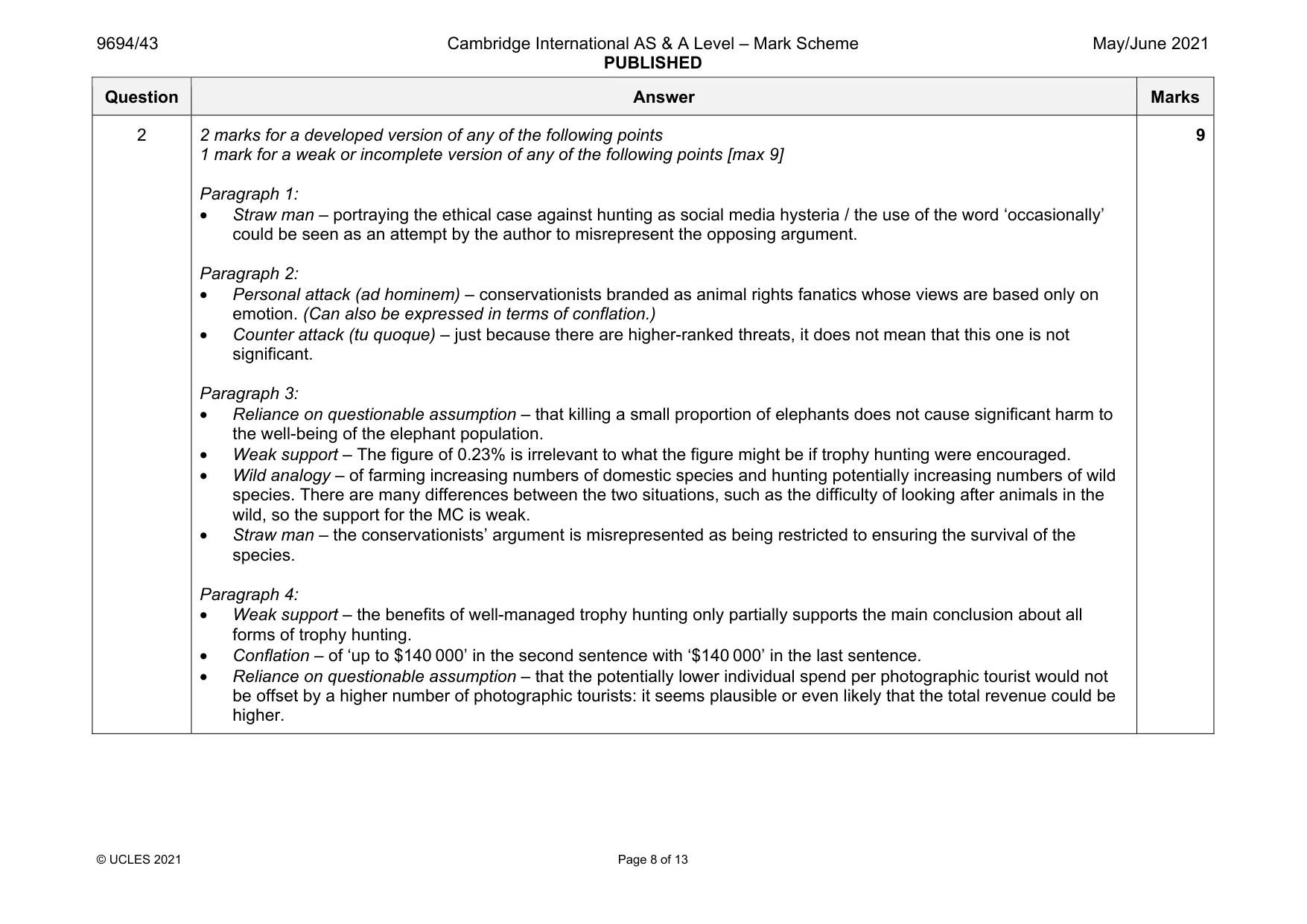
9694/43 Cambridge International AS & A Level – Mark Scheme PUBLISHED May/June 2021 © UCLES 2021 Page 8 of 13 Question Answer Marks 2 2 marks for a developed version of any of the following points 1 mark for a weak or incomplete version of any of the following points [max 9] Paragraph 1: • Straw man – portraying the ethical case against hunting as social media hysteria / the use of the word ‘occasionally’ could be seen as an attempt by the author to misrepresent the opposing argument. Paragraph 2: • Personal attack (ad hominem) – conservationists branded as animal rights fanatics whose views are based only on emotion. (Can also be expressed in terms of conflation.) • Counter attack (tu quoque) – just because there are higher-ranked threats, it does not mean that this one is not significant. Paragraph 3: • Reliance on questionable assumption – that killing a small proportion of elephants does not cause significant harm to the well-being of the elephant population. • Weak support – The figure of 0.23% is irrelevant to what the figure might be if trophy hunting were encouraged. • Wild analogy – of farming increasing numbers of domestic species and hunting potentially increasing numbers of wild species. There are many differences between the two situations, such as the difficulty of looking after animals in the wild, so the support for the MC is weak. • Straw man – the conservationists’ argument is misrepresented as being restricted to ensuring the survival of the species. Paragraph 4: • Weak support – the benefits of well-managed trophy hunting only partially supports the main conclusion about all forms of trophy hunting. • Conflation – of ‘up to $140 000’ in the second sentence with ‘$140 000’ in the last sentence. • Reliance on questionable assumption – that the potentially lower individual spend per photographic tourist would not be offset by a higher number of photographic tourists: it seems plausible or even likely that the total revenue could be higher. 9
Mark scheme, page 9
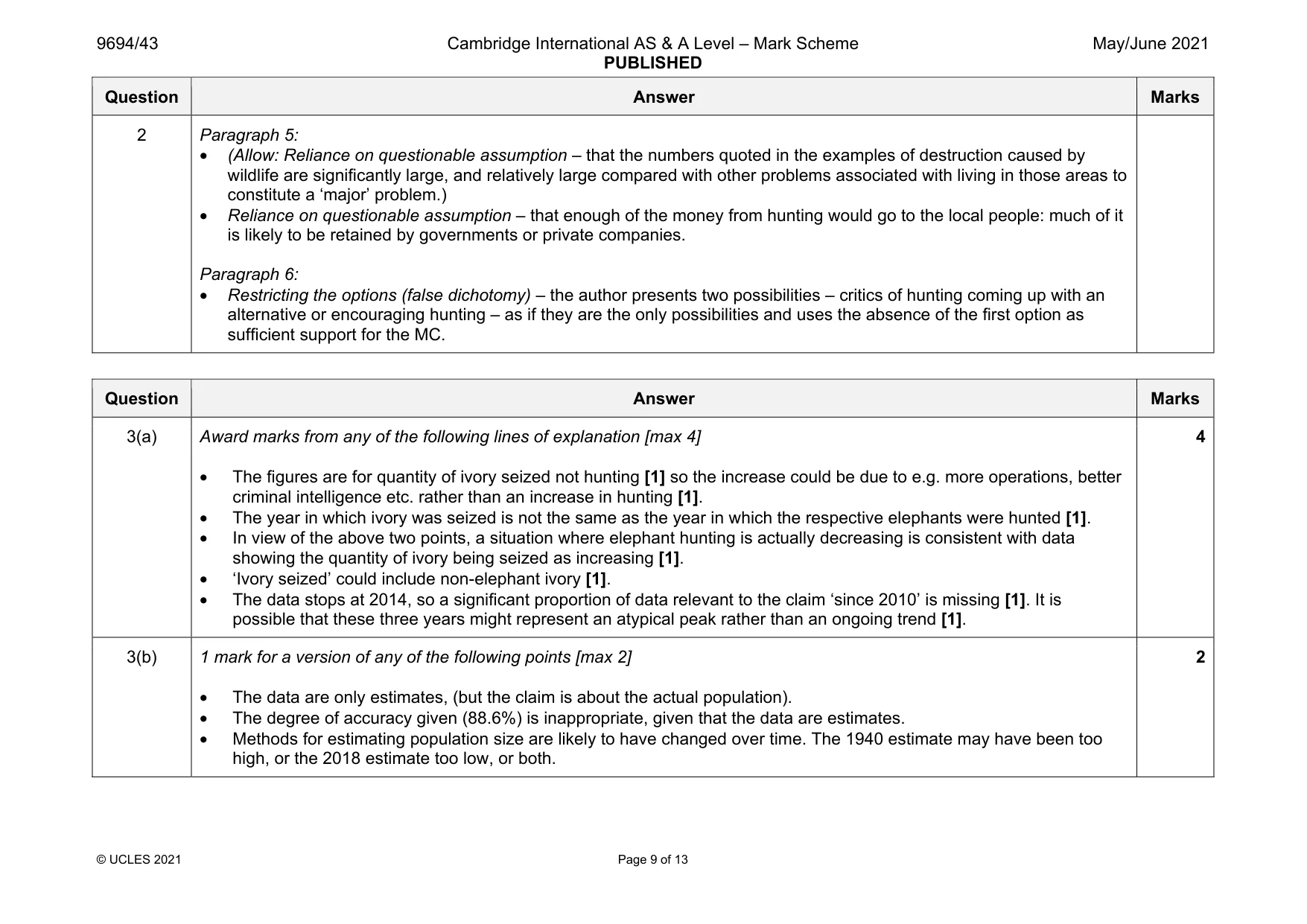
9694/43 Cambridge International AS & A Level – Mark Scheme PUBLISHED May/June 2021 © UCLES 2021 Page 9 of 13 Question Answer Marks 2 Paragraph 5: • (Allow: Reliance on questionable assumption – that the numbers quoted in the examples of destruction caused by wildlife are significantly large, and relatively large compared with other problems associated with living in those areas to constitute a ‘major’ problem.) • Reliance on questionable assumption – that enough of the money from hunting would go to the local people: much of it is likely to be retained by governments or private companies. Paragraph 6: • Restricting the options (false dichotomy) – the author presents two possibilities – critics of hunting coming up with an alternative or encouraging hunting – as if they are the only possibilities and uses the absence of the first option as sufficient support for the MC. Question Answer Marks 3(a) Award marks from any of the following lines of explanation [max 4] • The figures are for quantity of ivory seized not hunting [1] so the increase could be due to e.g. more operations, better criminal intelligence etc. rather than an increase in hunting [1]. • The year in which ivory was seized is not the same as the year in which the respective elephants were hunted [1]. • In view of the above two points, a situation where elephant hunting is actually decreasing is consistent with data showing the quantity of ivory being seized as increasing [1]. • ‘Ivory seized’ could include non-elephant ivory [1]. • The data stops at 2014, so a significant proportion of data relevant to the claim ‘since 2010’ is missing [1]. It is possible that these three years might represent an atypical peak rather than an ongoing trend [1]. 4 3(b) 1 mark for a version of any of the following points [max 2] • The data are only estimates, (but the claim is about the actual population). • The degree of accuracy given (88.6%) is inappropriate, given that the data are estimates. • Methods for estimating population size are likely to have changed over time. The 1940 estimate may have been too high, or the 2018 estimate too low, or both. 2
Mark scheme, page 10
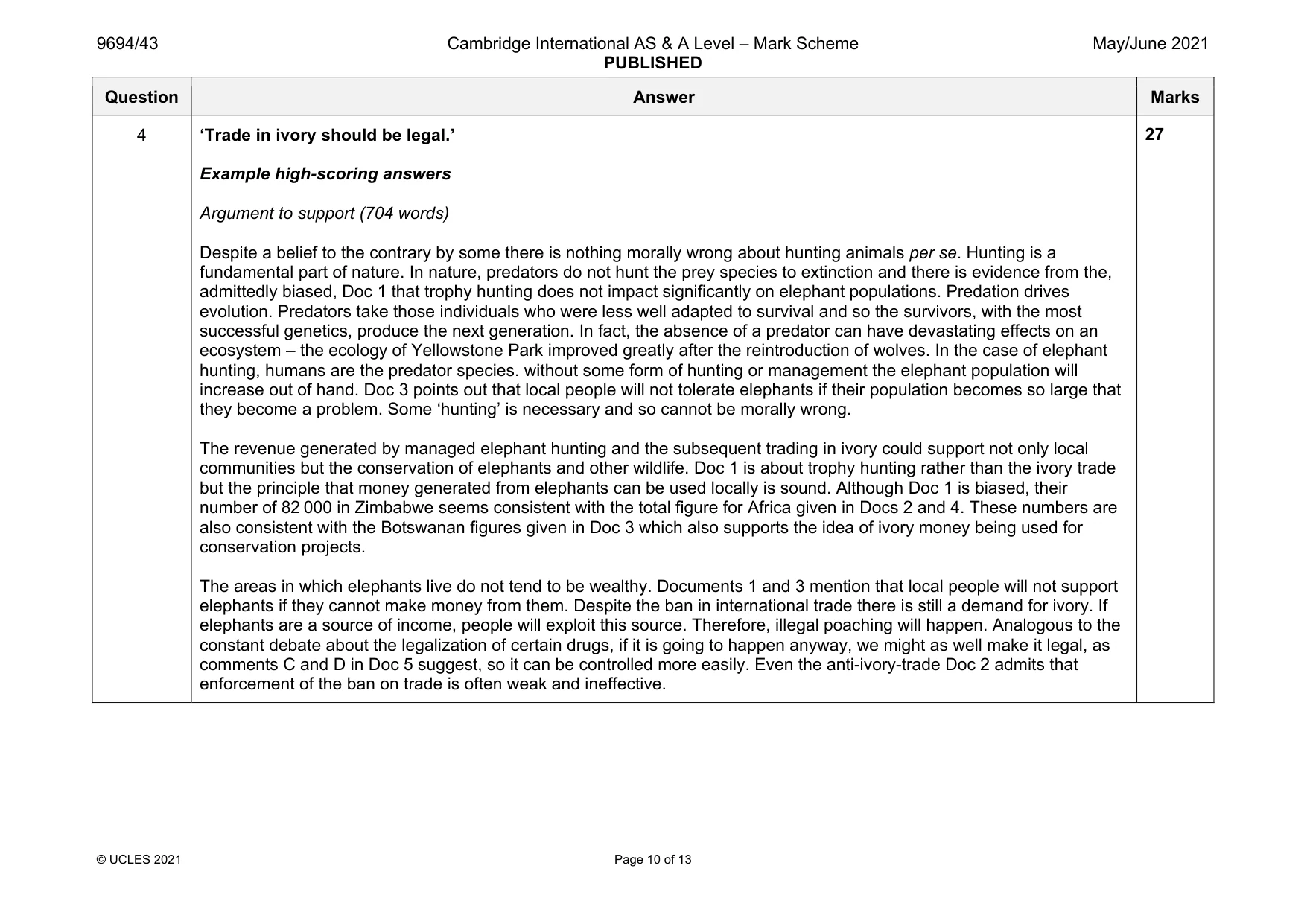
9694/43 Cambridge International AS & A Level – Mark Scheme PUBLISHED May/June 2021 © UCLES 2021 Page 10 of 13 Question Answer Marks 4 ‘Trade in ivory should be legal.’ Example high-scoring answers Argument to support (704 words) Despite a belief to the contrary by some there is nothing morally wrong about hunting animals per se. Hunting is a fundamental part of nature. In nature, predators do not hunt the prey species to extinction and there is evidence from the, admittedly biased, Doc 1 that trophy hunting does not impact significantly on elephant populations. Predation drives evolution. Predators take those individuals who were less well adapted to survival and so the survivors, with the most successful genetics, produce the next generation. In fact, the absence of a predator can have devastating effects on an ecosystem – the ecology of Yellowstone Park improved greatly after the reintroduction of wolves. In the case of elephant hunting, humans are the predator species. without some form of hunting or management the elephant population will increase out of hand. Doc 3 points out that local people will not tolerate elephants if their population becomes so large that they become a problem. Some ‘hunting’ is necessary and so cannot be morally wrong. The revenue generated by managed elephant hunting and the subsequent trading in ivory could support not only local communities but the conservation of elephants and other wildlife. Doc 1 is about trophy hunting rather than the ivory trade but the principle that money generated from elephants can be used locally is sound. Although Doc 1 is biased, their number of 82 000 in Zimbabwe seems consistent with the total figure for Africa given in Docs 2 and 4. These numbers are also consistent with the Botswanan figures given in Doc 3 which also supports the idea of ivory money being used for conservation projects. The areas in which elephants live do not tend to be wealthy. Documents 1 and 3 mention that local people will not support elephants if they cannot make money from them. Despite the ban in international trade there is still a demand for ivory. If elephants are a source of income, people will exploit this source. Therefore, illegal poaching will happen. Analogous to the constant debate about the legalization of certain drugs, if it is going to happen anyway, we might as well make it legal, as comments C and D in Doc 5 suggest, so it can be controlled more easily. Even the anti-ivory-trade Doc 2 admits that enforcement of the ban on trade is often weak and ineffective. 27
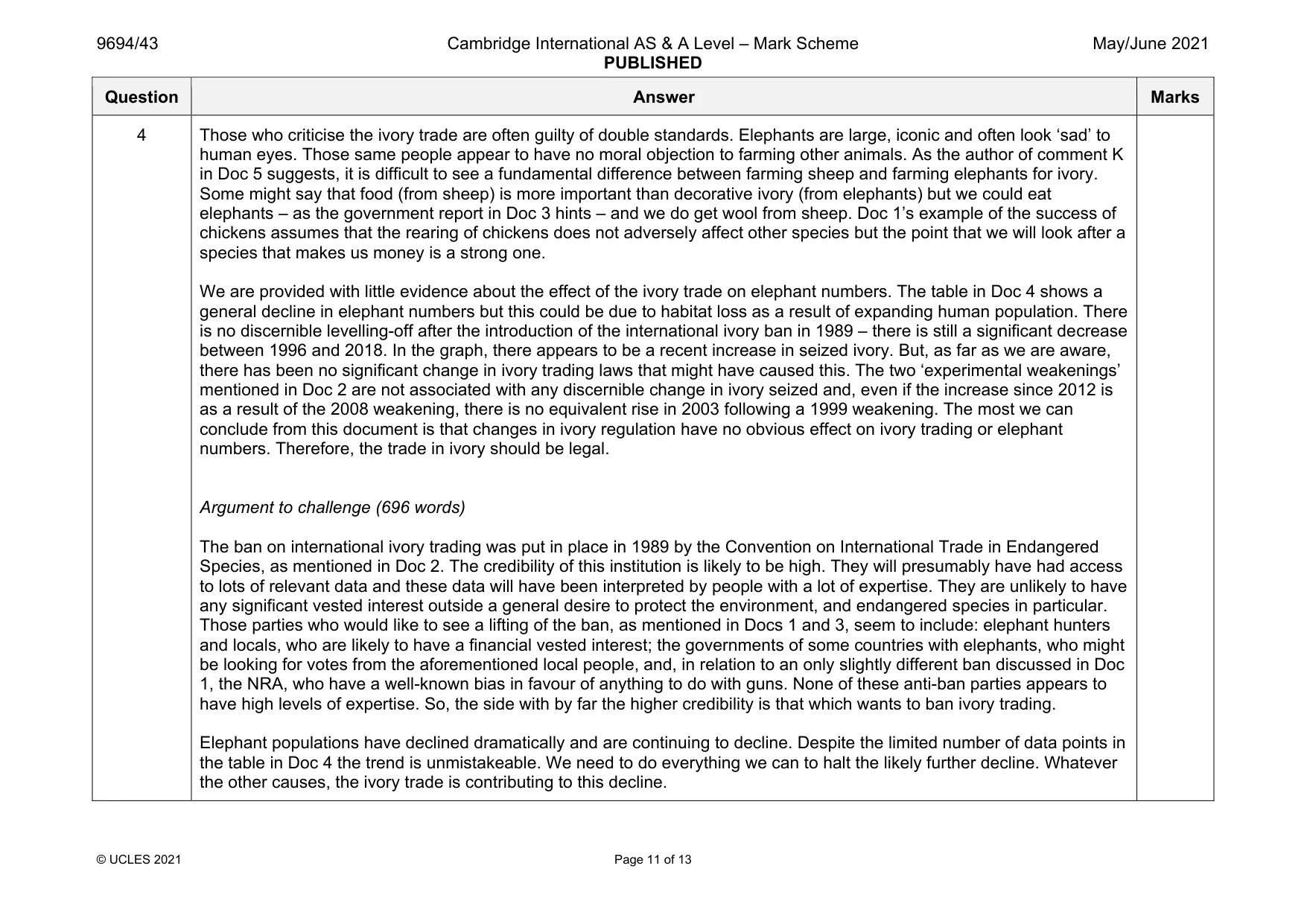
Mark scheme, page 11
9694/43 Cambridge International AS & A Level – Mark Scheme PUBLISHED May/June 2021 © UCLES 2021 Page 11 of 13 Question Answer Marks 4 Those who criticise the ivory trade are often guilty of double standards. Elephants are large, iconic and often look ‘sad’ to human eyes. Those same people appear to have no moral objection to farming other animals. As the author of comment K in Doc 5 suggests, it is difficult to see a fundamental difference between farming sheep and farming elephants for ivory. Some might say that food (from sheep) is more important than decorative ivory (from elephants) but we could eat elephants – as the government report in Doc 3 hints – and we do get wool from sheep. Doc 1’s example of the success of chickens assumes that the rearing of chickens does not adversely affect other species but the point that we will look after a species that makes us money is a strong one. We are provided with little evidence about the effect of the ivory trade on elephant numbers. The table in Doc 4 shows a general decline in elephant numbers but this could be due to habitat loss as a result of expanding human population. There is no discernible levelling-off after the introduction of the international ivory ban in 1989 – there is still a significant decrease between 1996 and 2018. In the graph, there appears to be a recent increase in seized ivory. But, as far as we are aware, there has been no significant change in ivory trading laws that might have caused this. The two ‘experimental weakenings’ mentioned in Doc 2 are not associated with any discernible change in ivory seized and, even if the increase since 2012 is as a result of the 2008 weakening, there is no equivalent rise in 2003 following a 1999 weakening. The most we can conclude from this document is that changes in ivory regulation have no obvious effect on ivory trading or elephant numbers. Therefore, the trade in ivory should be legal. Argument to challenge (696 words) The ban on international ivory trading was put in place in 1989 by the Convention on International Trade in Endangered Species, as mentioned in Doc 2. The credibility of this institution is likely to be high. They will presumably have had access to lots of relevant data and these data will have been interpreted by people with a lot of expertise. They are unlikely to have any significant vested interest outside a general desire to protect the environment, and endangered species in particular. Those parties who would like to see a lifting of the ban, as mentioned in Docs 1 and 3, seem to include: elephant hunters and locals, who are likely to have a financial vested interest; the governments of some countries with elephants, who might be looking for votes from the aforementioned local people, and, in relation to an only slightly different ban discussed in Doc 1, the NRA, who have a well-known bias in favour of anything to do with guns. None of these anti-ban parties appears to have high levels of expertise. So, the side with by far the higher credibility is that which wants to ban ivory trading. Elephant populations have declined dramatically and are continuing to decline. Despite the limited number of data points in the table in Doc 4 the trend is unmistakeable. We need to do everything we can to halt the likely further decline. Whatever the other causes, the ivory trade is contributing to this decline.
Mark scheme, page 12
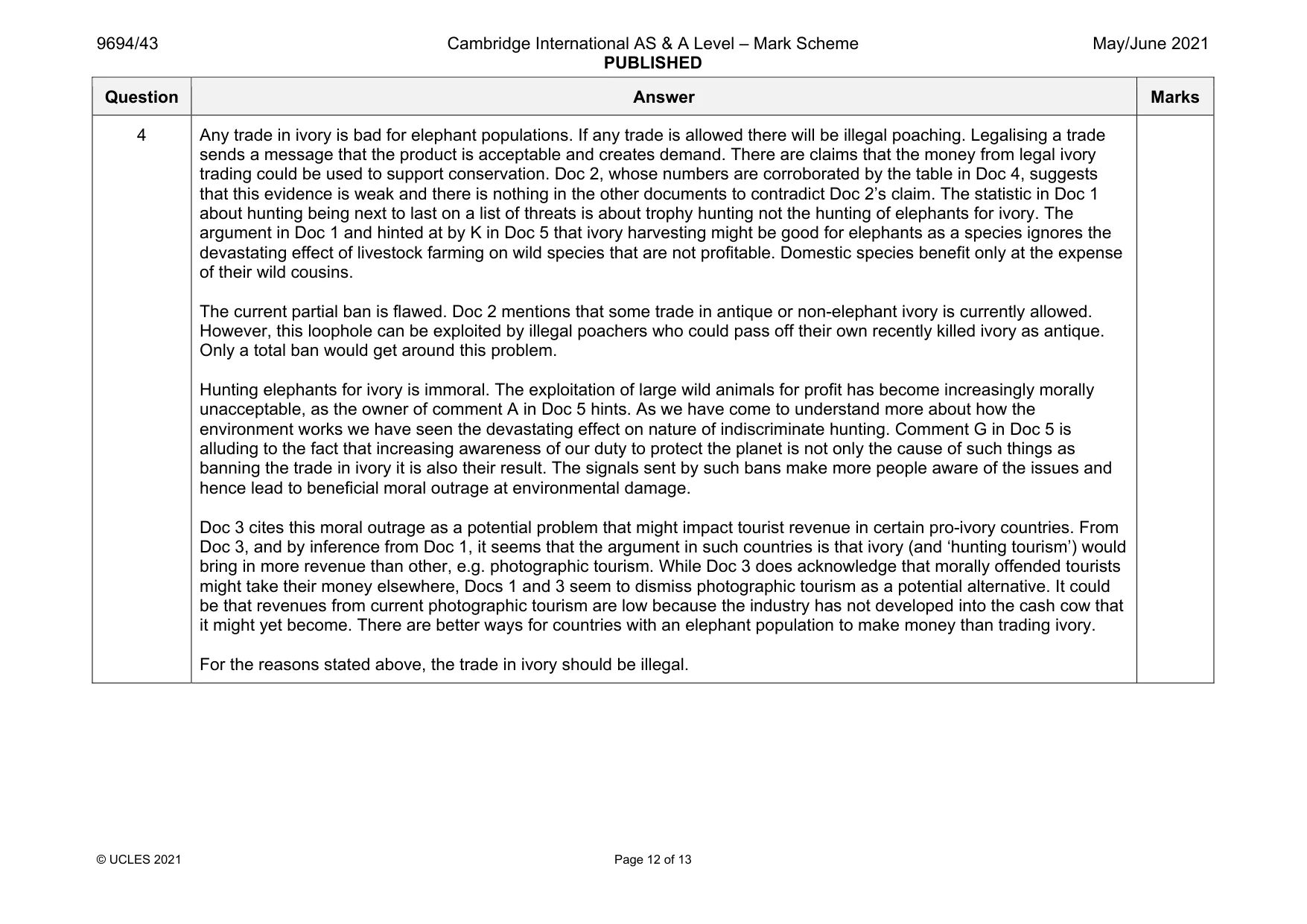
9694/43 Cambridge International AS & A Level – Mark Scheme PUBLISHED May/June 2021 © UCLES 2021 Page 12 of 13 Question Answer Marks 4 Any trade in ivory is bad for elephant populations. If any trade is allowed there will be illegal poaching. Legalising a trade sends a message that the product is acceptable and creates demand. There are claims that the money from legal ivory trading could be used to support conservation. Doc 2, whose numbers are corroborated by the table in Doc 4, suggests that this evidence is weak and there is nothing in the other documents to contradict Doc 2’s claim. The statistic in Doc 1 about hunting being next to last on a list of threats is about trophy hunting not the hunting of elephants for ivory. The argument in Doc 1 and hinted at by K in Doc 5 that ivory harvesting might be good for elephants as a species ignores the devastating effect of livestock farming on wild species that are not profitable. Domestic species benefit only at the expense of their wild cousins. The current partial ban is flawed. Doc 2 mentions that some trade in antique or non-elephant ivory is currently allowed. However, this loophole can be exploited by illegal poachers who could pass off their own recently killed ivory as antique. Only a total ban would get around this problem. Hunting elephants for ivory is immoral. The exploitation of large wild animals for profit has become increasingly morally unacceptable, as the owner of comment A in Doc 5 hints. As we have come to understand more about how the environment works we have seen the devastating effect on nature of indiscriminate hunting. Comment G in Doc 5 is alluding to the fact that increasing awareness of our duty to protect the planet is not only the cause of such things as banning the trade in ivory it is also their result. The signals sent by such bans make more people aware of the issues and hence lead to beneficial moral outrage at environmental damage. Doc 3 cites this moral outrage as a potential problem that might impact tourist revenue in certain pro-ivory countries. From Doc 3, and by inference from Doc 1, it seems that the argument in such countries is that ivory (and ‘hunting tourism’) would bring in more revenue than other, e.g. photographic tourism. While Doc 3 does acknowledge that morally offended tourists might take their money elsewhere, Docs 1 and 3 seem to dismiss photographic tourism as a potential alternative. It could be that revenues from current photographic tourism are low because the industry has not developed into the cash cow that it might yet become. There are better ways for countries with an elephant population to make money than trading ivory. For the reasons stated above, the trade in ivory should be illegal.
Mark scheme, page 13
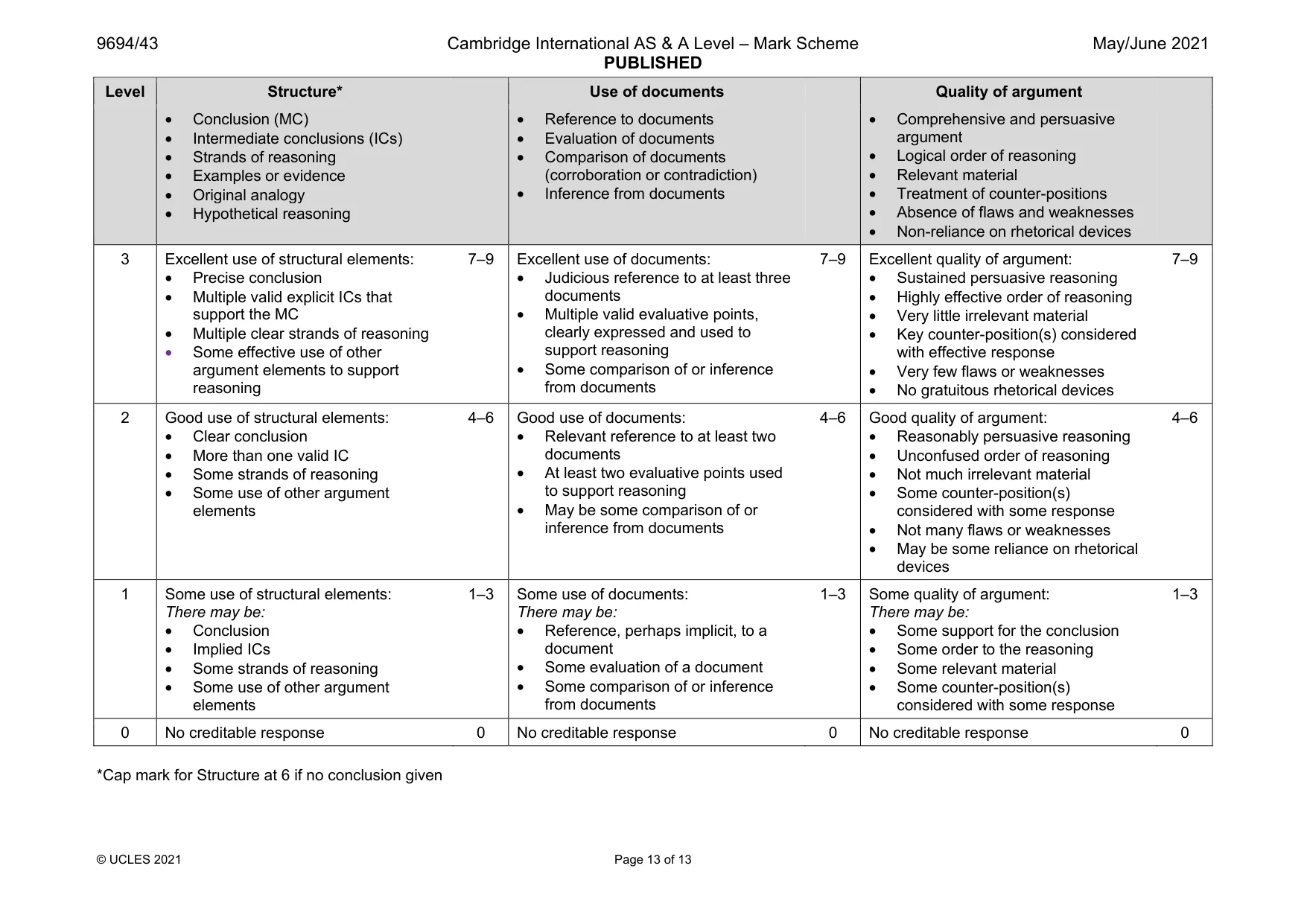
9694/43 Cambridge International AS & A Level – Mark Scheme PUBLISHED May/June 2021 © UCLES 2021 Page 13 of 13 Level Structure* Use of documents Quality of argument • Conclusion (MC) • Intermediate conclusions (ICs) • Strands of reasoning • Examples or evidence • Original analogy • Hypothetical reasoning • Reference to documents • Evaluation of documents • Comparison of documents (corroboration or contradiction) • Inference from documents • Comprehensive and persuasive argument • Logical order of reasoning • Relevant material • Treatment of counter-positions • Absence of flaws and weaknesses • Non-reliance on rhetorical devices 3 Excellent use of structural elements: • Precise conclusion • Multiple valid explicit ICs that support the MC • Multiple clear strands of reasoning • Some effective use of other argument elements to support reasoning 7–9 Excellent use of documents: • Judicious reference to at least three documents • Multiple valid evaluative points, clearly expressed and used to support reasoning • Some comparison of or inference from documents 7–9 Excellent quality of argument: • Sustained persuasive reasoning • Highly effective order of reasoning • Very little irrelevant material • Key counter-position(s) considered with effective response • Very few flaws or weaknesses • No gratuitous rhetorical devices 7–9 2 Good use of structural elements: • Clear conclusion • More than one valid IC • Some strands of reasoning • Some use of other argument elements 4–6 Good use of documents: • Relevant reference to at least two documents • At least two evaluative points used to support reasoning • May be some comparison of or inference from documents 4–6 Good quality of argument: • Reasonably persuasive reasoning • Unconfused order of reasoning • Not much irrelevant material • Some counter-position(s) considered with some response • Not many flaws or weaknesses • May be some reliance on rhetorical devices 4–6 1 Some use of structural elements: There may be: • Conclusion • Implied ICs • Some strands of reasoning • Some use of other argument elements 1–3 Some use of documents: There may be: • Reference, perhaps implicit, to a document • Some evaluation of a document • Some comparison of or inference from documents 1–3 Some quality of argument: There may be: • Some support for the conclusion • Some order to the reasoning • Some relevant material • Some counter-position(s) considered with some response 1–3 0 No creditable response 0 No creditable response 0 No creditable response 0 *Cap mark for Structure at 6 if no conclusion given
What you needed in this session
Cambridge’s own grade thresholds for 2021 May/June, Paper 4 · Variant 3. A higher threshold means an easier paper — the bar moves with how the cohort did.