Cambridge A Level Thinking Skills 9694 — 2021 May/June Paper 4 · Variant 1
9694/41/M/J/21 · 50 marks · ≈56 min
The question paper and its mark scheme, free to read here and free to download. This is Cambridge’s own paper, exactly as it was sat.
Question paper8 pages

Mark scheme15 pages
Answers below. Sit the paper first if you are practising.
Paper as text
Question paper, page 1
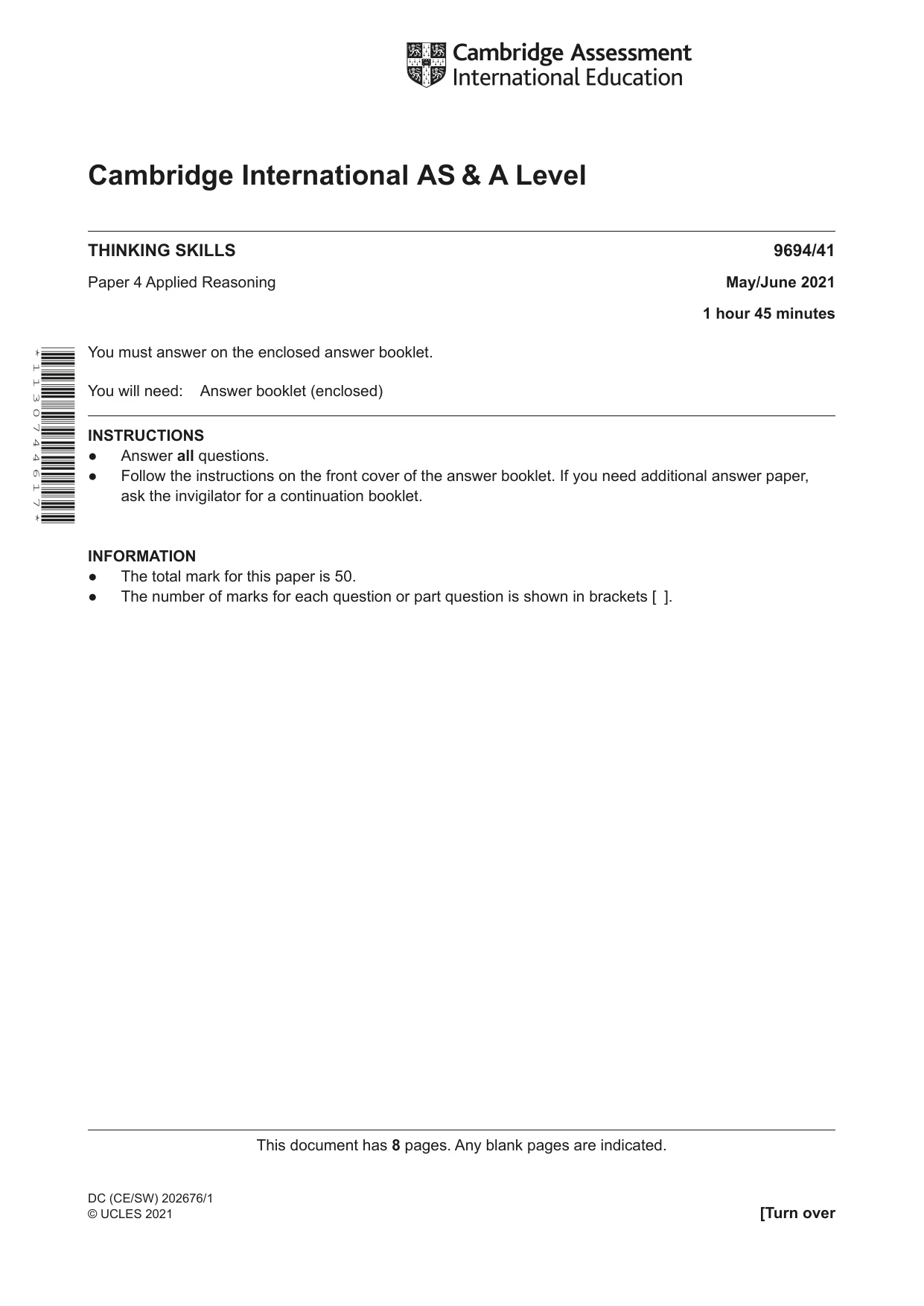
This document has 8 pages. Any blank pages are indicated. Cambridge International AS & A Level DC (CE/SW) 202676/1 © UCLES 2021 [Turn over * 1 1 3 0 7 4 4 6 1 7 * THINKING SKILLS 9694/41 Paper 4 Applied Reasoning May/June 2021 1 hour 45 minutes You must answer on the enclosed answer booklet. You will need: Answer booklet (enclosed) INSTRUCTIONS ● Answer all questions. ● Follow the instructions on the front cover of the answer booklet. If you need additional answer paper, ask the invigilator for a continuation booklet. INFORMATION ● The total mark for this paper is 50. ● The number of marks for each question or part question is shown in brackets [ ].
Question paper, page 2
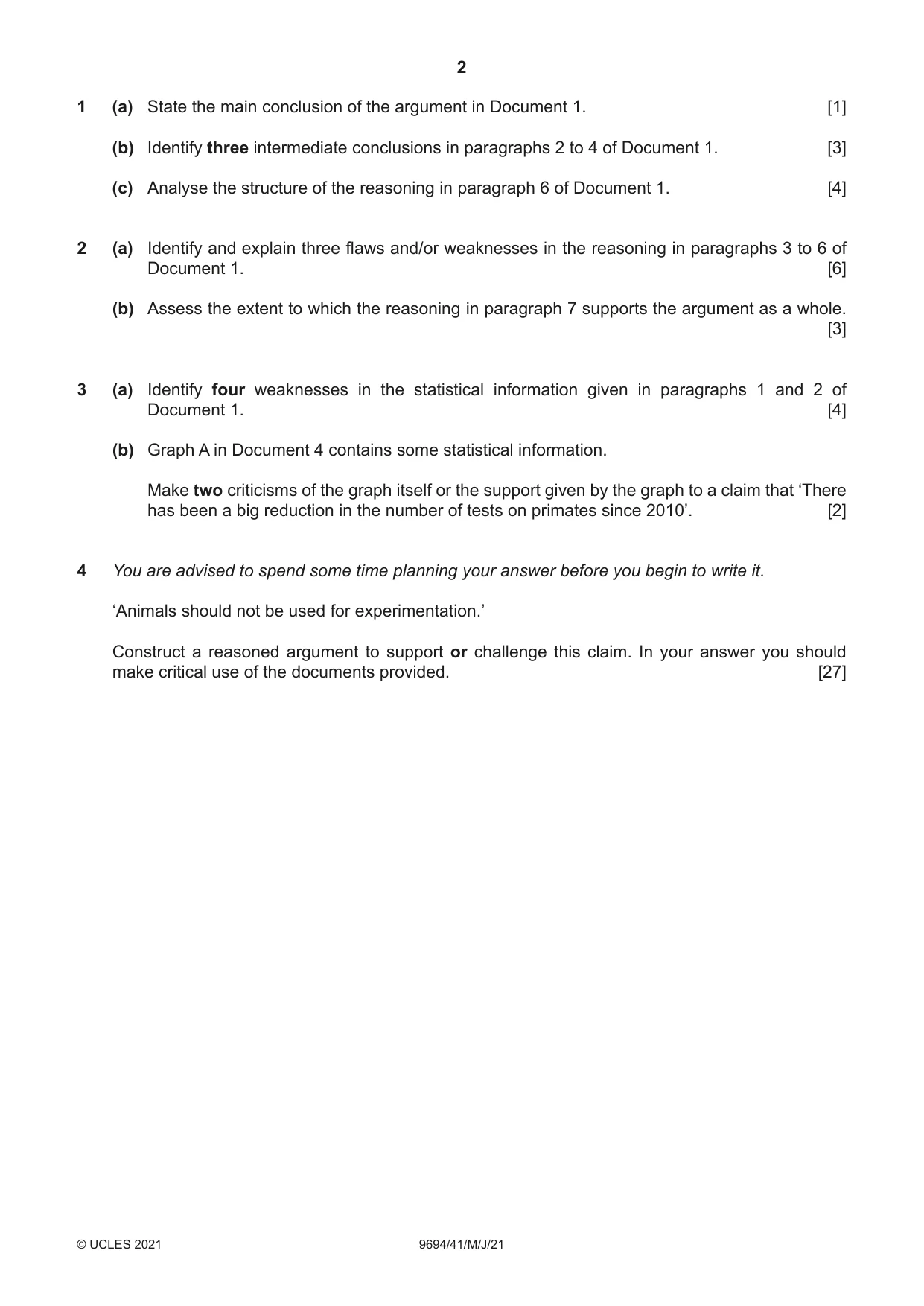
2 9694/41/M/J/21 © UCLES 2021 1 (a) State the main conclusion of the argument in Document 1. [1] (b) Identify three intermediate conclusions in paragraphs 2 to 4 of Document 1. [3] (c) Analyse the structure of the reasoning in paragraph 6 of Document 1. [4] 2 (a) Identify and explain three flaws and/or weaknesses in the reasoning in paragraphs 3 to 6 of Document 1. [6] (b) Assess the extent to which the reasoning in paragraph 7 supports the argument as a whole. [3] 3 (a) Identify four weaknesses in the statistical information given in paragraphs 1 and 2 of Document 1. [4] (b) Graph A in Document 4 contains some statistical information. Make two criticisms of the graph itself or the support given by the graph to a claim that ‘There has been a big reduction in the number of tests on primates since 2010’. [2] 4 You are advised to spend some time planning your answer before you begin to write it. ‘Animals should not be used for experimentation.’ Construct a reasoned argument to support or challenge this claim. In your answer you should make critical use of the documents provided. [27]
Question paper, page 3
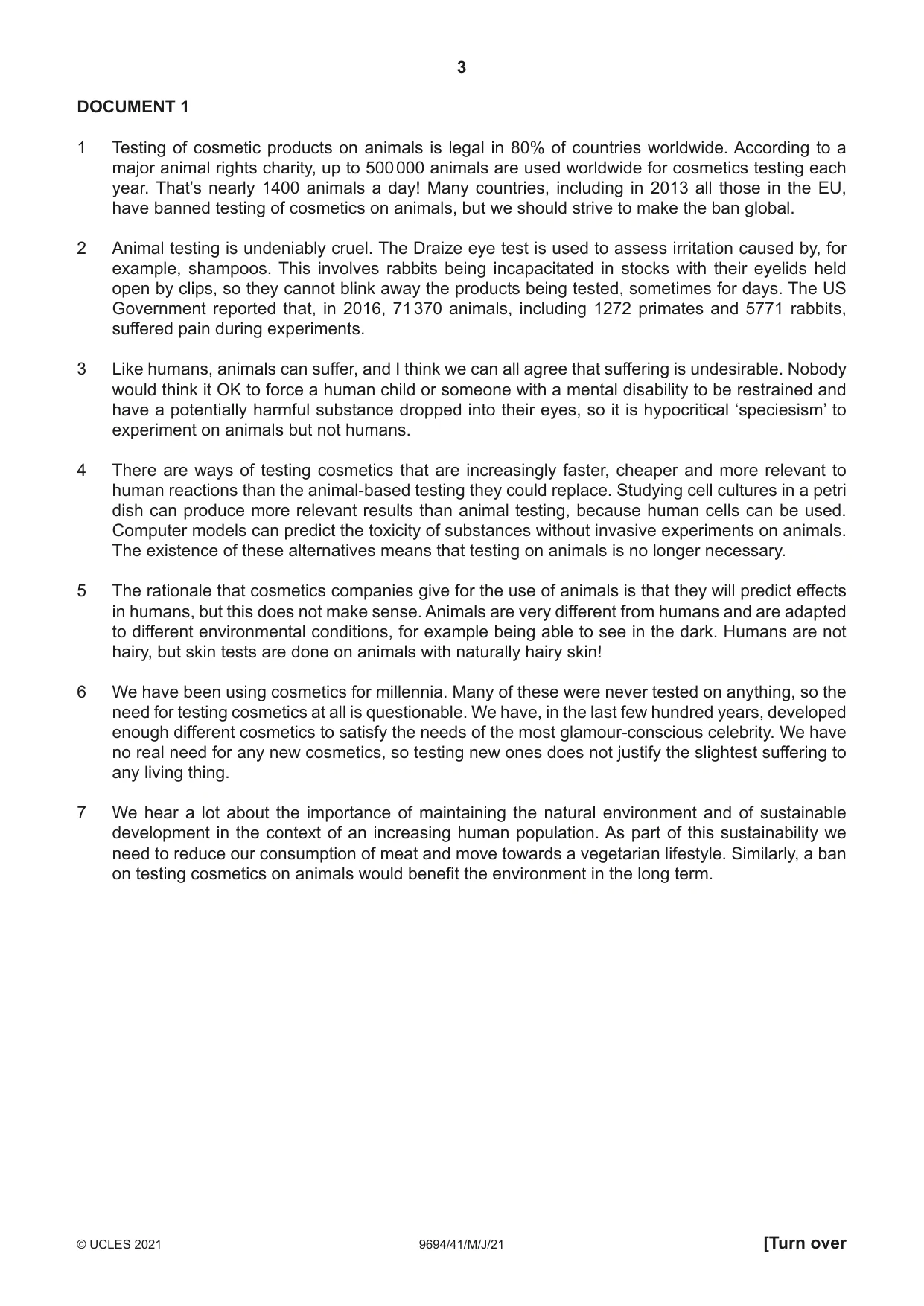
3 9694/41/M/J/21 © UCLES 2021 [Turn over DOCUMENT 1 1 Testing of cosmetic products on animals is legal in 80% of countries worldwide. According to a major animal rights charity, up to 500 000 animals are used worldwide for cosmetics testing each year. That’s nearly 1400 animals a day! Many countries, including in 2013 all those in the EU, have banned testing of cosmetics on animals, but we should strive to make the ban global. 2 Animal testing is undeniably cruel. The Draize eye test is used to assess irritation caused by, for example, shampoos. This involves rabbits being incapacitated in stocks with their eyelids held open by clips, so they cannot blink away the products being tested, sometimes for days. The US Government reported that, in 2016, 71 370 animals, including 1272 primates and 5771 rabbits, suffered pain during experiments. 3 Like humans, animals can suffer, and I think we can all agree that suffering is undesirable. Nobody would think it OK to force a human child or someone with a mental disability to be restrained and have a potentially harmful substance dropped into their eyes, so it is hypocritical ‘speciesism’ to experiment on animals but not humans. 4 There are ways of testing cosmetics that are increasingly faster, cheaper and more relevant to human reactions than the animal-based testing they could replace. Studying cell cultures in a petri dish can produce more relevant results than animal testing, because human cells can be used. Computer models can predict the toxicity of substances without invasive experiments on animals. The existence of these alternatives means that testing on animals is no longer necessary. 5 The rationale that cosmetics companies give for the use of animals is that they will predict effects in humans, but this does not make sense. Animals are very different from humans and are adapted to different environmental conditions, for example being able to see in the dark. Humans are not hairy, but skin tests are done on animals with naturally hairy skin! 6 We have been using cosmetics for millennia. Many of these were never tested on anything, so the need for testing cosmetics at all is questionable. We have, in the last few hundred years, developed enough different cosmetics to satisfy the needs of the most glamour-conscious celebrity. We have no real need for any new cosmetics, so testing new ones does not justify the slightest suffering to any living thing. 7 We hear a lot about the importance of maintaining the natural environment and of sustainable development in the context of an increasing human population. As part of this sustainability we need to reduce our consumption of meat and move towards a vegetarian lifestyle. Similarly, a ban on testing cosmetics on animals would benefit the environment in the long term.
Question paper, page 4
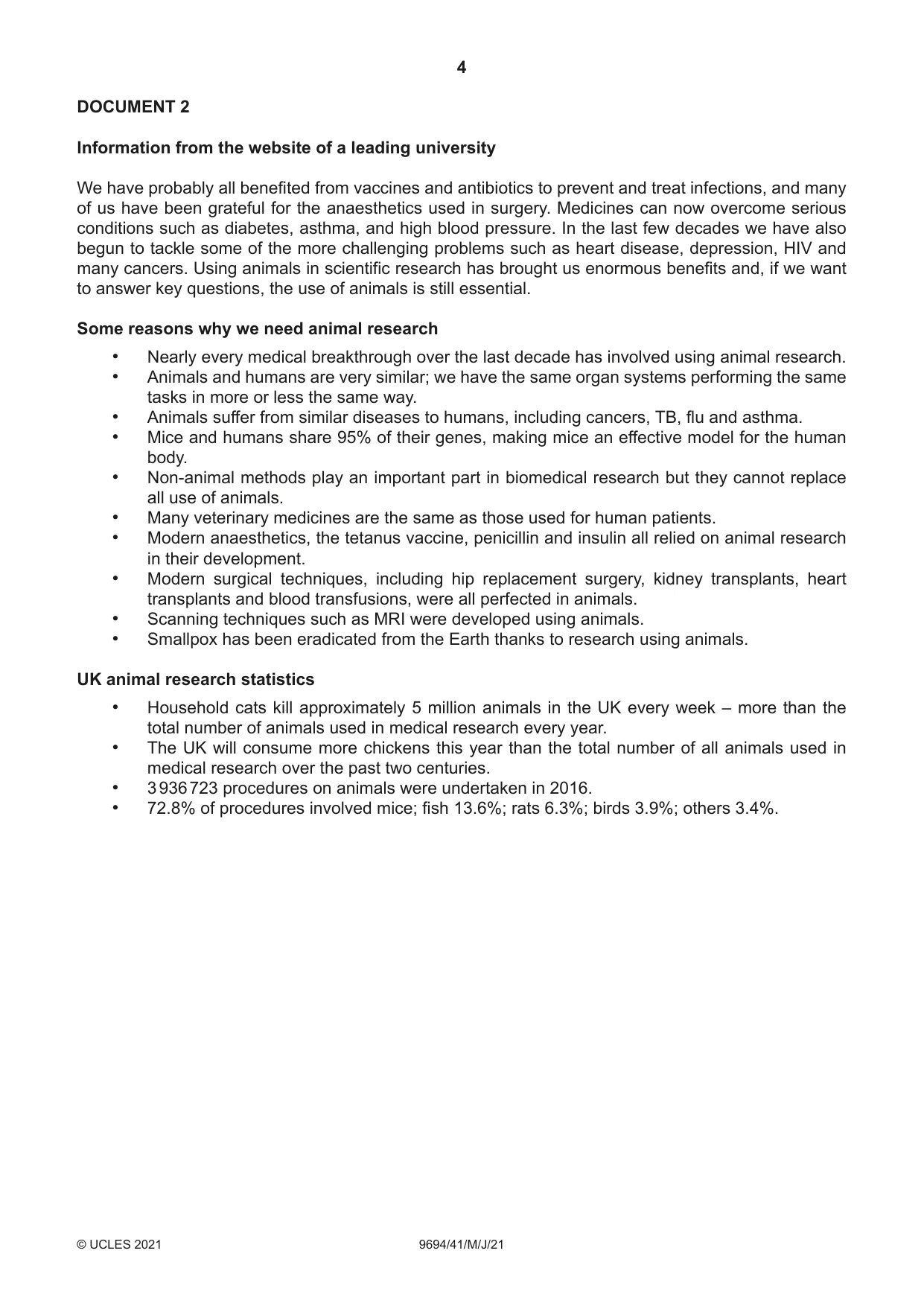
4 9694/41/M/J/21 © UCLES 2021 DOCUMENT 2 Information from the website of a leading university We have probably all benefited from vaccines and antibiotics to prevent and treat infections, and many of us have been grateful for the anaesthetics used in surgery. Medicines can now overcome serious conditions such as diabetes, asthma, and high blood pressure. In the last few decades we have also begun to tackle some of the more challenging problems such as heart disease, depression, HIV and many cancers. Using animals in scientific research has brought us enormous benefits and, if we want to answer key questions, the use of animals is still essential. Some reasons why we need animal research • Nearly every medical breakthrough over the last decade has involved using animal research. • Animals and humans are very similar; we have the same organ systems performing the same tasks in more or less the same way. • Animals suffer from similar diseases to humans, including cancers, TB, flu and asthma. • Mice and humans share 95% of their genes, making mice an effective model for the human body. • Non-animal methods play an important part in biomedical research but they cannot replace all use of animals. • Many veterinary medicines are the same as those used for human patients. • Modern anaesthetics, the tetanus vaccine, penicillin and insulin all relied on animal research in their development. • Modern surgical techniques, including hip replacement surgery, kidney transplants, heart transplants and blood transfusions, were all perfected in animals. • Scanning techniques such as MRI were developed using animals. • Smallpox has been eradicated from the Earth thanks to research using animals. UK animal research statistics • Household cats kill approximately 5 million animals in the UK every week – more than the total number of animals used in medical research every year. • The UK will consume more chickens this year than the total number of all animals used in medical research over the past two centuries. • 3 936 723 procedures on animals were undertaken in 2016. • 72.8% of procedures involved mice; fish 13.6%; rats 6.3%; birds 3.9%; others 3.4%.
Question paper, page 5
5 9694/41/M/J/21 © UCLES 2021 [Turn over DOCUMENT 3 Actor and comedian Robin Griffiths summed up in less than sixty seconds why animal testing is cruel and unreliable. In a radio interview last month, the vegetarian entertainer said, ‘It hardly ever works. Nine out of ten experiments that work on animals then fail on humans and are dangerous. The animal models don’t work. Even computer models work better than testing on animals.’ ‘It continues to happen because people get paid. The people who breed the dogs can make $3000 or $4000 per animal. Universities get money from big pharmaceutical companies to carry out research.’ ‘We’ve got to end animal testing,’ Griffiths continued. ‘I know some people are all, “OK but what about AIDS and cancer?” and I can understand that view. But there’s no ambiguity about shampoo and beauty products – that’s just crazy. Putting chemicals in rabbits’ eyes; torturing them to death – it serves no purpose. If you don’t want shampoo to sting – don’t get it in your eyes,’ the comedian joked. He then went on to say that he thinks testing medicines on animals is also cruel and it doesn’t work. According to PETA (People for the Ethical Treatment of Animals, the largest animal rights organisation in the world), more than 93% of animal experiments funded, directly or indirectly, by the US Government fail to lead to human treatments – which means testing on animals is almost all useless. PETA added that over 95% of medicinal drugs that appear to be safe and effective in animals then fail once they reach the stage of human trials. Most people do not support animal experimentation. A recent survey showed that 72% of consumers believe animal testing is ‘inhumane or unethical’. Last year, a campaign for animal-free breast cancer research was launched. The organisation behind the campaign supports doctors who create human breast tissue, outside the body, that can be used to better understand the disease. ‘Human disease can only be examined properly using human tissue,’ a spokesperson for the organisation said. Griffiths has long been a supporter of animal welfare and has campaigned against the fur trade and trophy hunting.
Question paper, page 6
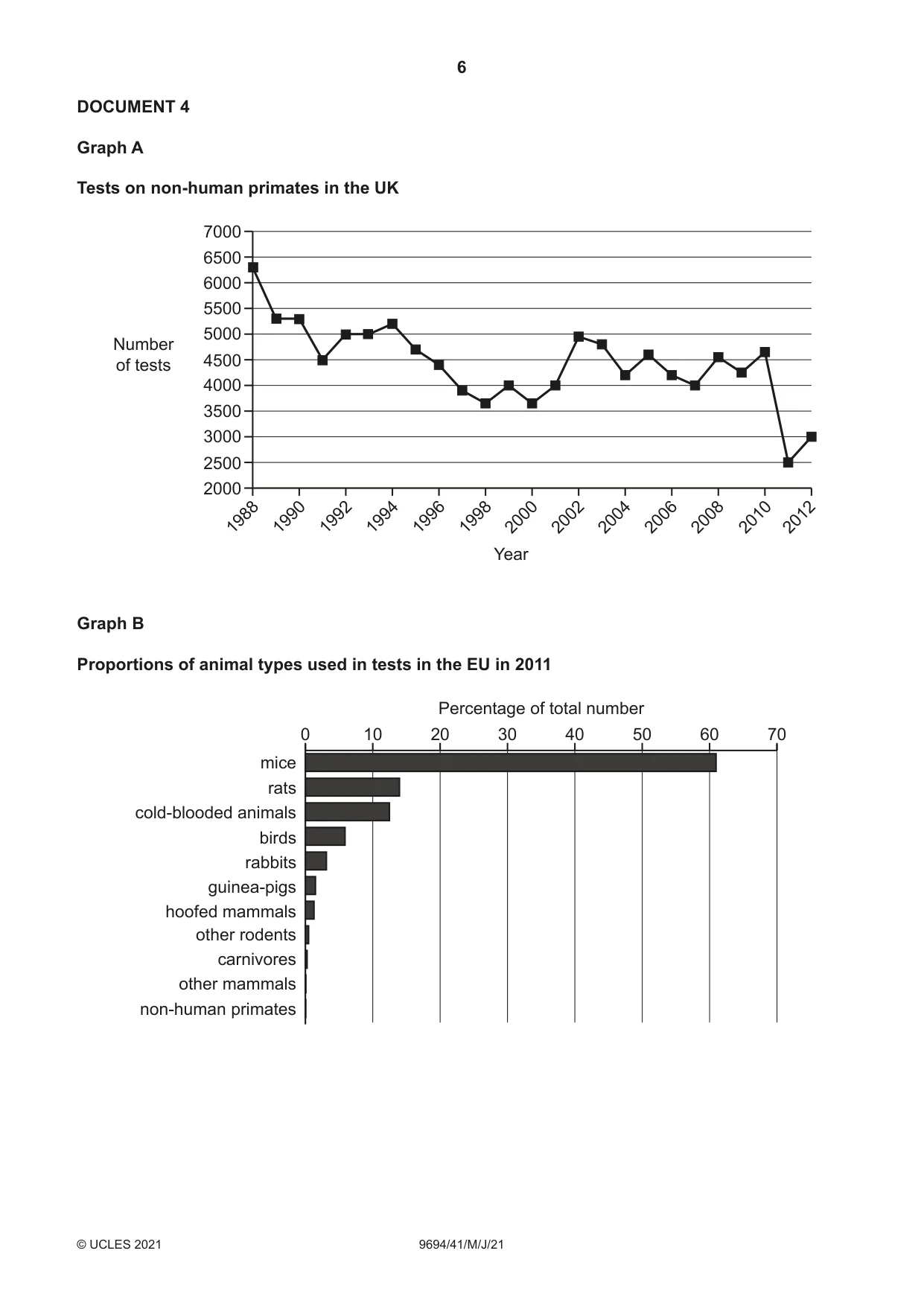
6 9694/41/M/J/21 © UCLES 2021 DOCUMENT 4 Graph A Tests on non-human primates in the UK 7000 6500 6000 5500 5000 4500 4000 3500 3000 2500 2000 1988 1990 1992 1994 1996 1998 2000 2002 2004 2006 2008 2010 2012 Year Number of tests Graph B Proportions of animal types used in tests in the EU in 2011 0 mice rats cold-blooded animals birds rabbits guinea-pigs hoofed mammals other rodents carnivores other mammals non-human primates 10 20 30 40 Percentage of total number 50 60 70
Question paper, page 7
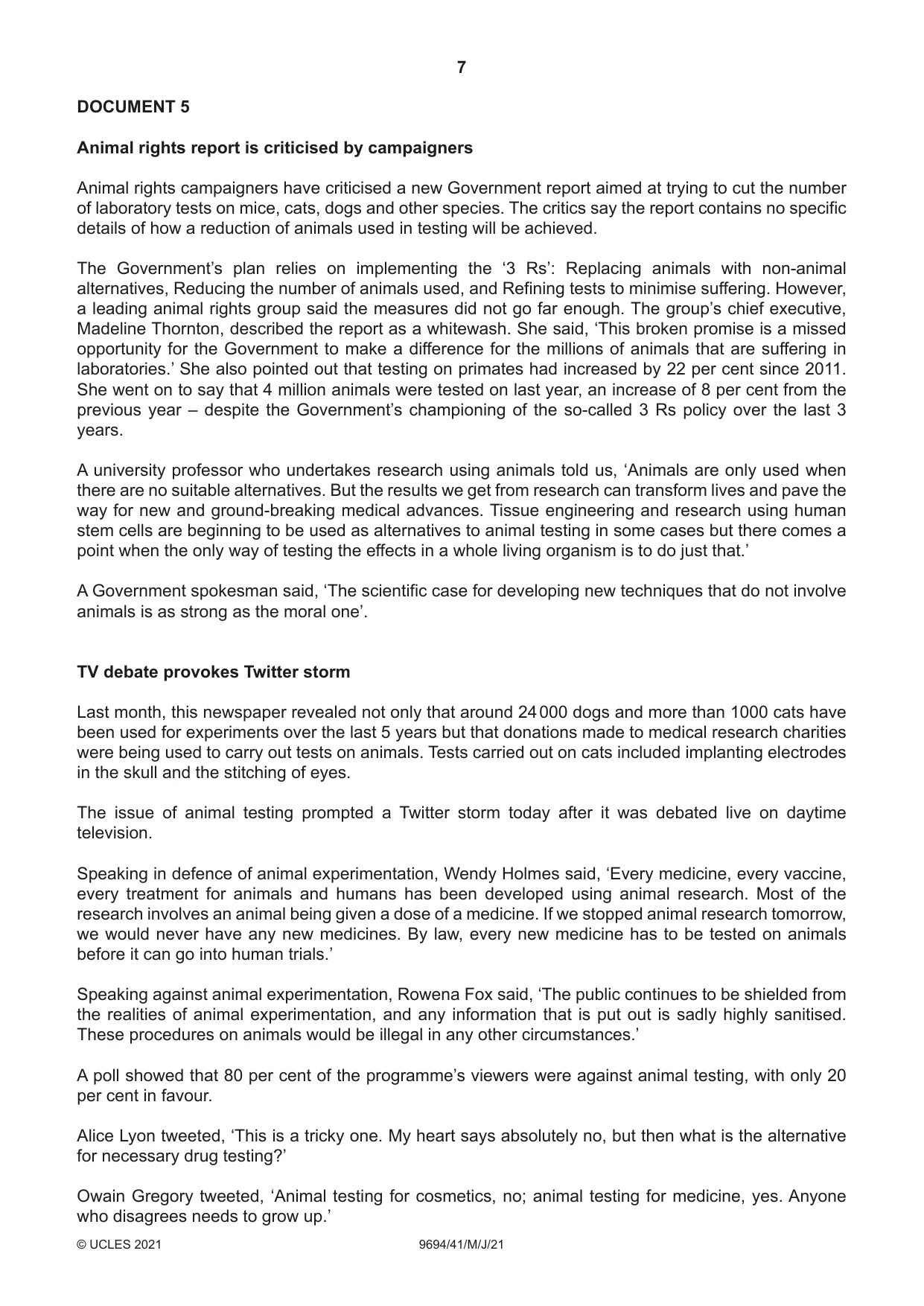
7 9694/41/M/J/21 © UCLES 2021 DOCUMENT 5 Animal rights report is criticised by campaigners Animal rights campaigners have criticised a new Government report aimed at trying to cut the number of laboratory tests on mice, cats, dogs and other species. The critics say the report contains no specific details of how a reduction of animals used in testing will be achieved. The Government’s plan relies on implementing the ‘3 Rs’: Replacing animals with non-animal alternatives, Reducing the number of animals used, and Refining tests to minimise suffering. However, a leading animal rights group said the measures did not go far enough. The group’s chief executive, Madeline Thornton, described the report as a whitewash. She said, ‘This broken promise is a missed opportunity for the Government to make a difference for the millions of animals that are suffering in laboratories.’ She also pointed out that testing on primates had increased by 22 per cent since 2011. She went on to say that 4 million animals were tested on last year, an increase of 8 per cent from the previous year – despite the Government’s championing of the so-called 3 Rs policy over the last 3 years. A university professor who undertakes research using animals told us, ‘Animals are only used when there are no suitable alternatives. But the results we get from research can transform lives and pave the way for new and ground-breaking medical advances. Tissue engineering and research using human stem cells are beginning to be used as alternatives to animal testing in some cases but there comes a point when the only way of testing the effects in a whole living organism is to do just that.’ A Government spokesman said, ‘The scientific case for developing new techniques that do not involve animals is as strong as the moral one’. TV debate provokes Twitter storm Last month, this newspaper revealed not only that around 24 000 dogs and more than 1000 cats have been used for experiments over the last 5 years but that donations made to medical research charities were being used to carry out tests on animals. Tests carried out on cats included implanting electrodes in the skull and the stitching of eyes. The issue of animal testing prompted a Twitter storm today after it was debated live on daytime television. Speaking in defence of animal experimentation, Wendy Holmes said, ‘Every medicine, every vaccine, every treatment for animals and humans has been developed using animal research. Most of the research involves an animal being given a dose of a medicine. If we stopped animal research tomorrow, we would never have any new medicines. By law, every new medicine has to be tested on animals before it can go into human trials.’ Speaking against animal experimentation, Rowena Fox said, ‘The public continues to be shielded from the realities of animal experimentation, and any information that is put out is sadly highly sanitised. These procedures on animals would be illegal in any other circumstances.’ A poll showed that 80 per cent of the programme’s viewers were against animal testing, with only 20 per cent in favour. Alice Lyon tweeted, ‘This is a tricky one. My heart says absolutely no, but then what is the alternative for necessary drug testing?’ Owain Gregory tweeted, ‘Animal testing for cosmetics, no; animal testing for medicine, yes. Anyone who disagrees needs to grow up.’
Question paper, page 8
8 9694/41/M/J/21 © UCLES 2021 Permission to reproduce items where third-party owned material protected by copyright is included has been sought and cleared where possible. Every reasonable effort has been made by the publisher (UCLES) to trace copyright holders, but if any items requiring clearance have unwittingly been included, the publisher will be pleased to make amends at the earliest possible opportunity. To avoid the issue of disclosure of answer-related information to candidates, all copyright acknowledgements are reproduced online in the Cambridge Assessment International Education Copyright Acknowledgements Booklet. This is produced for each series of examinations and is freely available to download at www.cambridgeinternational.org after the live examination series. Cambridge Assessment International Education is part of the Cambridge Assessment Group. Cambridge Assessment is the brand name of the University of Cambridge Local Examinations Syndicate (UCLES), which itself is a department of the University of Cambridge. BLANK PAGE
Mark scheme, page 1
This document consists of 15 printed pages. © UCLES 2021 [Turn over Cambridge International AS & A Level THINKING SKILLS 9694/41 Paper 4 Applied Reasoning May/June 2021 MARK SCHEME Maximum Mark: 50 Published This mark scheme is published as an aid to teachers and candidates, to indicate the requirements of the examination. It shows the basis on which Examiners were instructed to award marks. It does not indicate the details of the discussions that took place at an Examiners’ meeting before marking began, which would have considered the acceptability of alternative answers. Mark schemes should be read in conjunction with the question paper and the Principal Examiner Report for Teachers. Cambridge International will not enter into discussions about these mark schemes. Cambridge International is publishing the mark schemes for the May/June 2021 series for most Cambridge IGCSE™, Cambridge International A and AS Level components and some Cambridge O Level components.
Mark scheme, page 2
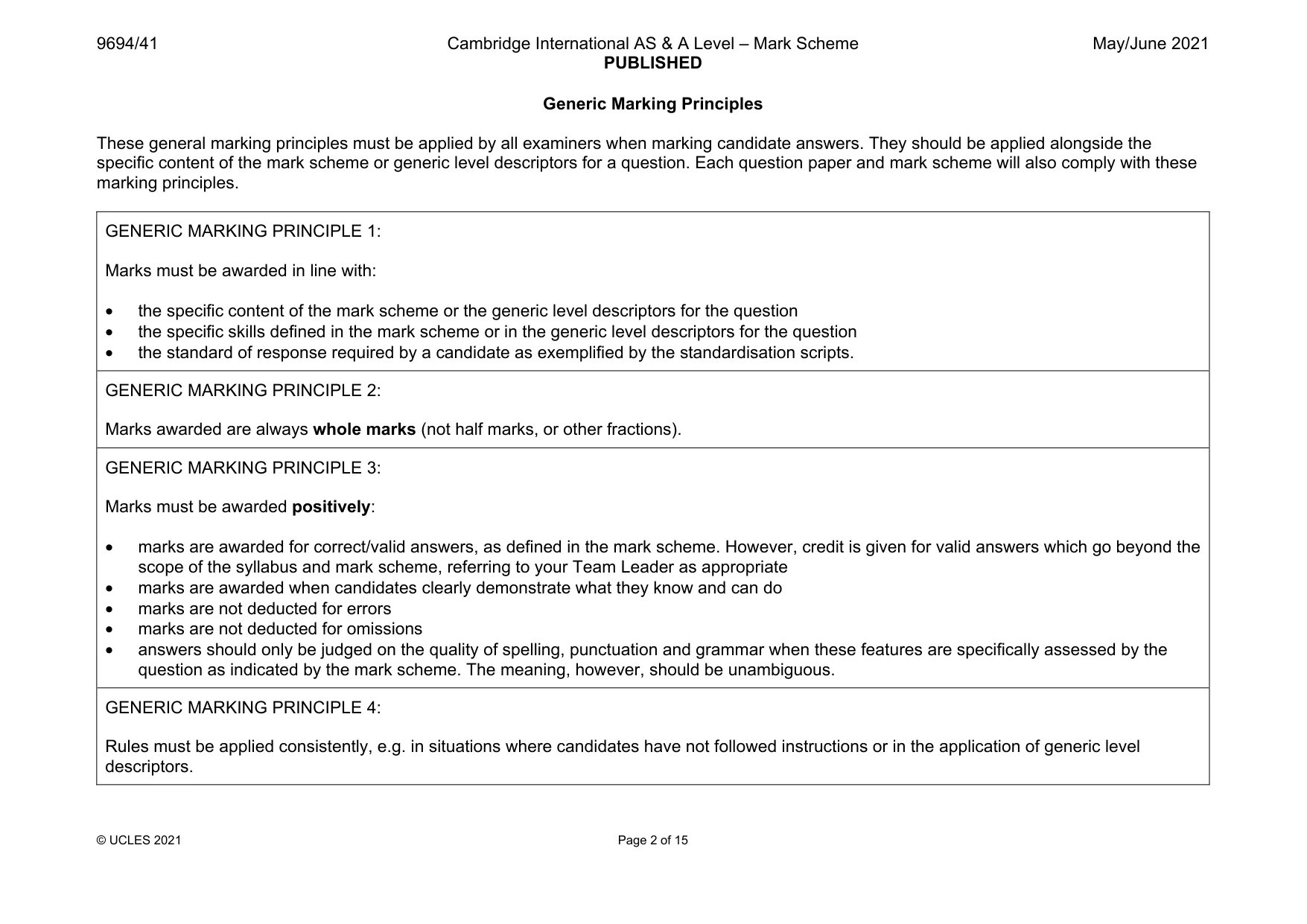
9694/41 Cambridge International AS & A Level – Mark Scheme PUBLISHED May/June 2021 © UCLES 2021 Page 2 of 15 Generic Marking Principles These general marking principles must be applied by all examiners when marking candidate answers. They should be applied alongside the specific content of the mark scheme or generic level descriptors for a question. Each question paper and mark scheme will also comply with these marking principles. GENERIC MARKING PRINCIPLE 1: Marks must be awarded in line with: • the specific content of the mark scheme or the generic level descriptors for the question • the specific skills defined in the mark scheme or in the generic level descriptors for the question • the standard of response required by a candidate as exemplified by the standardisation scripts. GENERIC MARKING PRINCIPLE 2: Marks awarded are always whole marks (not half marks, or other fractions). GENERIC MARKING PRINCIPLE 3: Marks must be awarded positively: • marks are awarded for correct/valid answers, as defined in the mark scheme. However, credit is given for valid answers which go beyond the scope of the syllabus and mark scheme, referring to your Team Leader as appropriate • marks are awarded when candidates clearly demonstrate what they know and can do • marks are not deducted for errors • marks are not deducted for omissions • answers should only be judged on the quality of spelling, punctuation and grammar when these features are specifically assessed by the question as indicated by the mark scheme. The meaning, however, should be unambiguous. GENERIC MARKING PRINCIPLE 4: Rules must be applied consistently, e.g. in situations where candidates have not followed instructions or in the application of generic level descriptors.
Mark scheme, page 3
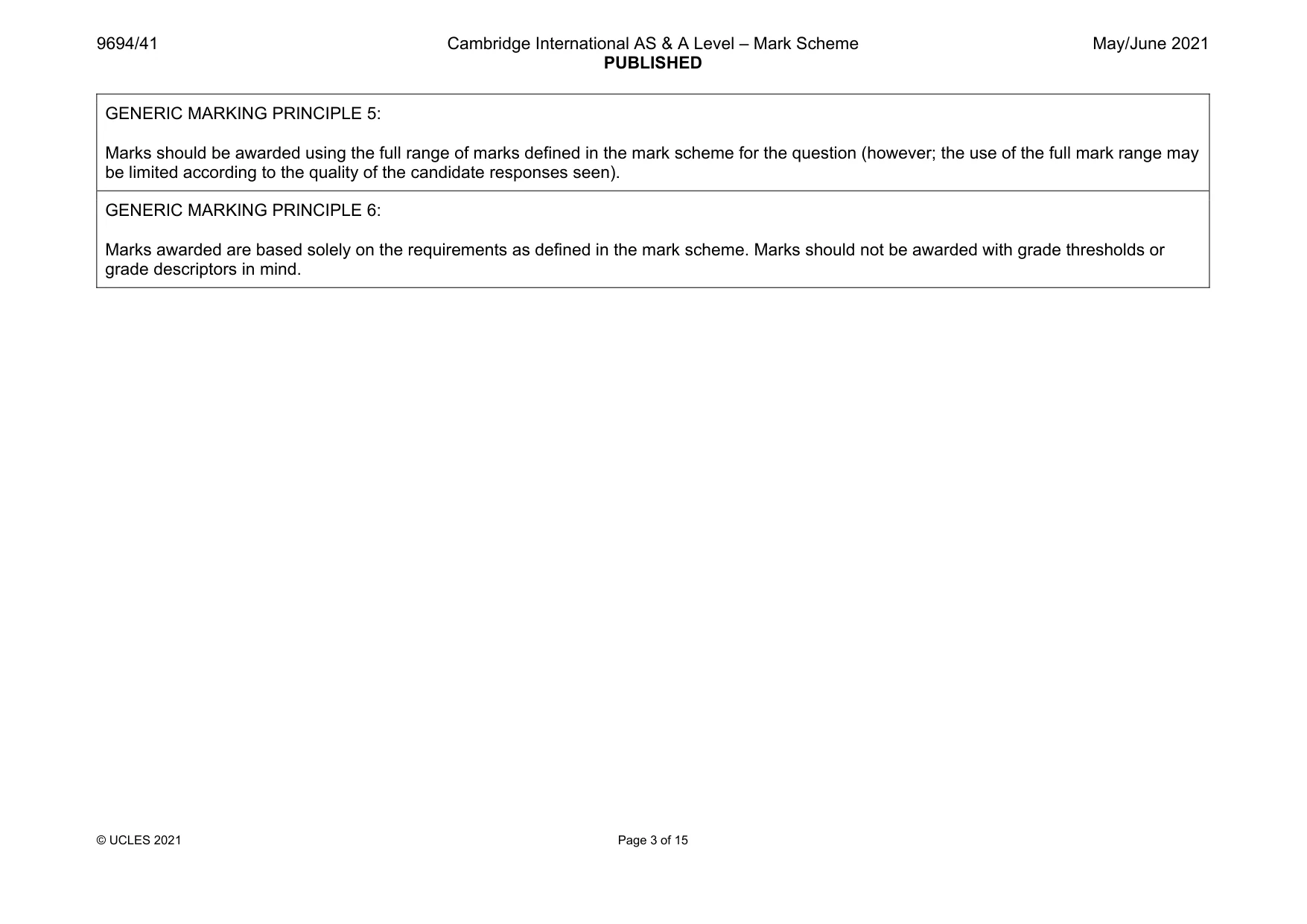
9694/41 Cambridge International AS & A Level – Mark Scheme PUBLISHED May/June 2021 © UCLES 2021 Page 3 of 15 GENERIC MARKING PRINCIPLE 5: Marks should be awarded using the full range of marks defined in the mark scheme for the question (however; the use of the full mark range may be limited according to the quality of the candidate responses seen). GENERIC MARKING PRINCIPLE 6: Marks awarded are based solely on the requirements as defined in the mark scheme. Marks should not be awarded with grade thresholds or grade descriptors in mind.
Mark scheme, page 4
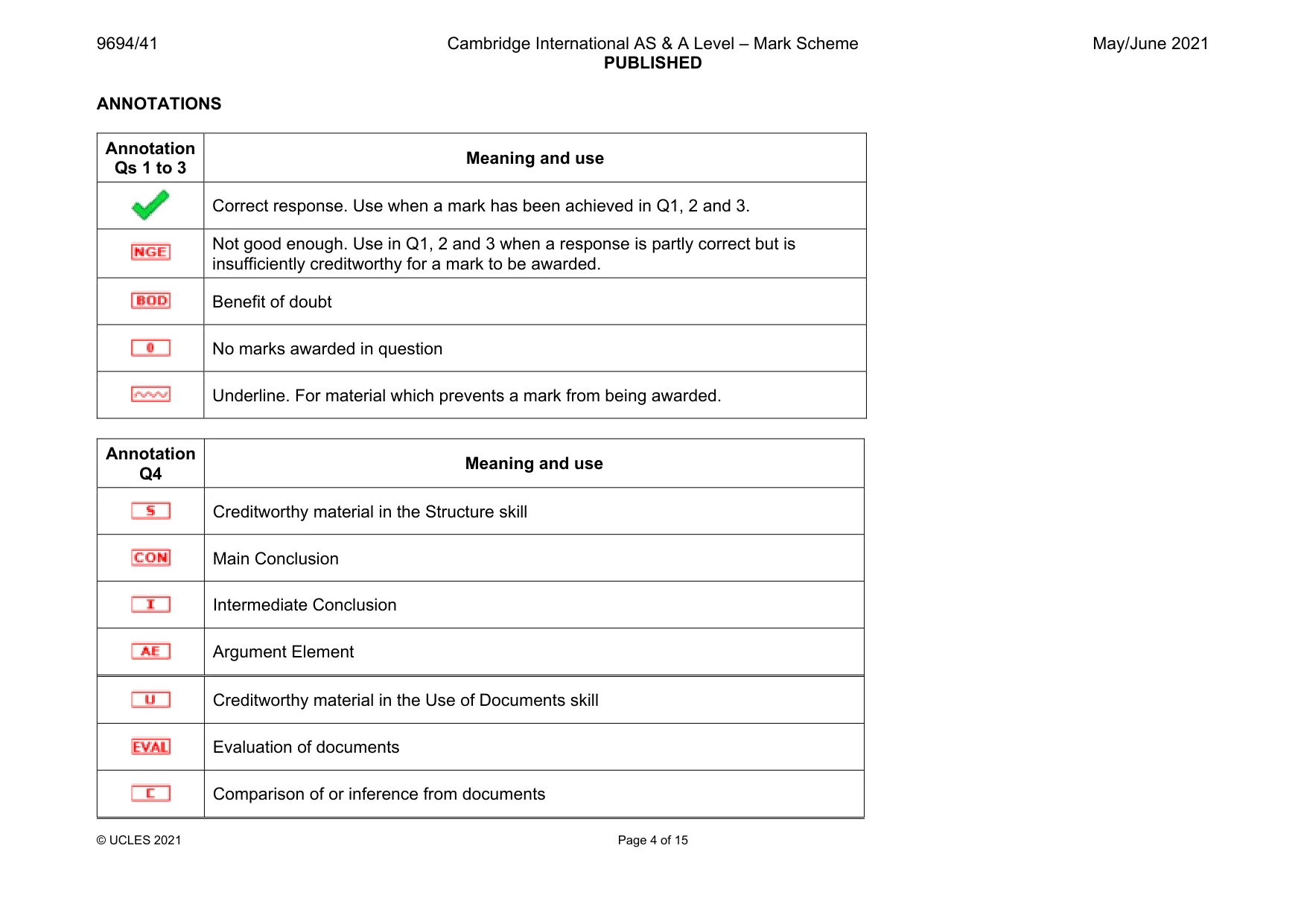
9694/41 Cambridge International AS & A Level – Mark Scheme PUBLISHED May/June 2021 © UCLES 2021 Page 4 of 15 ANNOTATIONS Annotation Qs 1 to 3 Meaning and use Correct response. Use when a mark has been achieved in Q1, 2 and 3. Not good enough. Use in Q1, 2 and 3 when a response is partly correct but is insufficiently creditworthy for a mark to be awarded. Benefit of doubt No marks awarded in question Underline. For material which prevents a mark from being awarded. Annotation Q4 Meaning and use Creditworthy material in the Structure skill Main Conclusion Intermediate Conclusion Argument Element Creditworthy material in the Use of Documents skill Evaluation of documents Comparison of or inference from documents
Mark scheme, page 5
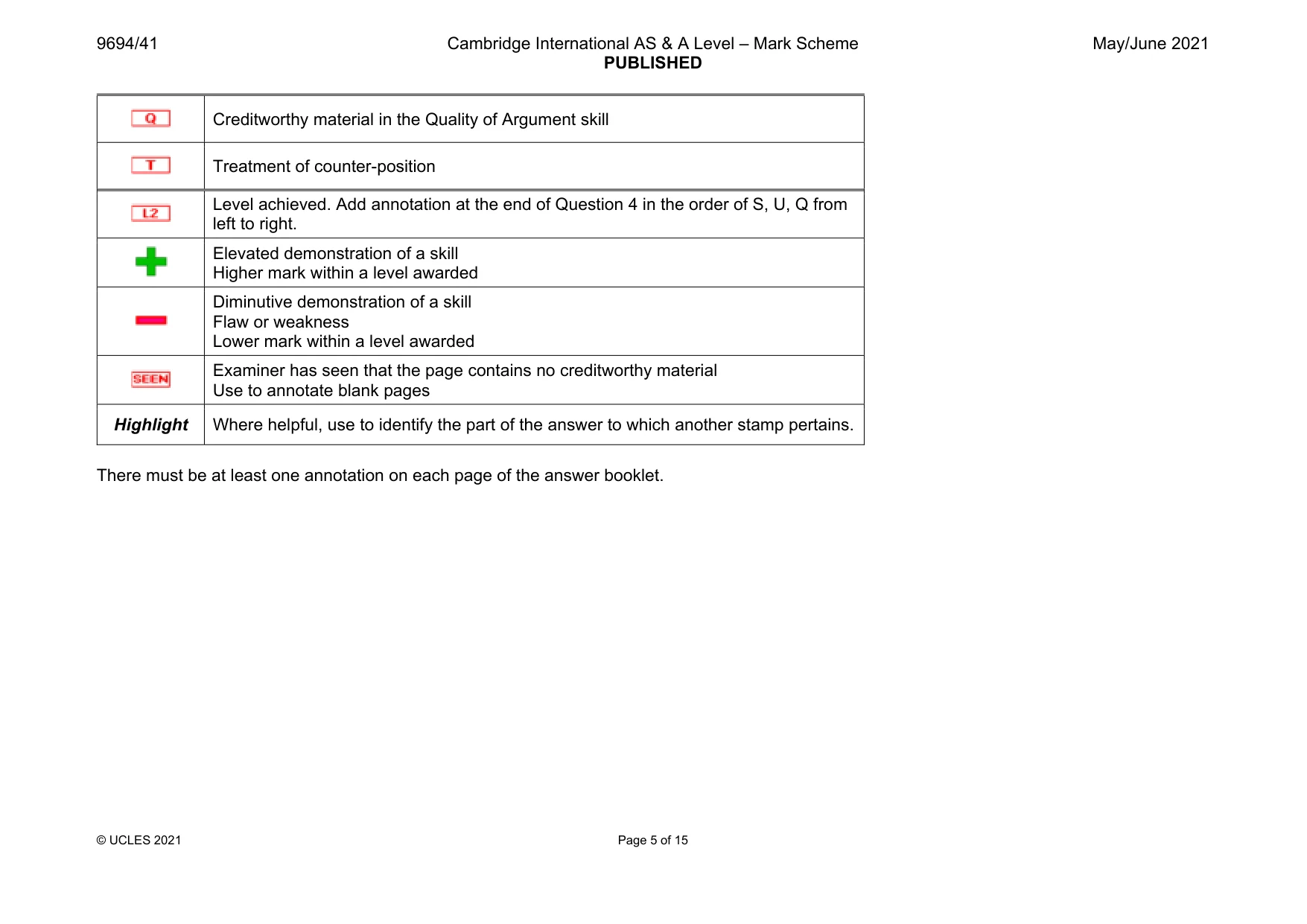
9694/41 Cambridge International AS & A Level – Mark Scheme PUBLISHED May/June 2021 © UCLES 2021 Page 5 of 15 Creditworthy material in the Quality of Argument skill Treatment of counter-position Level achieved. Add annotation at the end of Question 4 in the order of S, U, Q from left to right. Elevated demonstration of a skill Higher mark within a level awarded Diminutive demonstration of a skill Flaw or weakness Lower mark within a level awarded Examiner has seen that the page contains no creditworthy material Use to annotate blank pages Highlight Where helpful, use to identify the part of the answer to which another stamp pertains. There must be at least one annotation on each page of the answer booklet.
Mark scheme, page 6
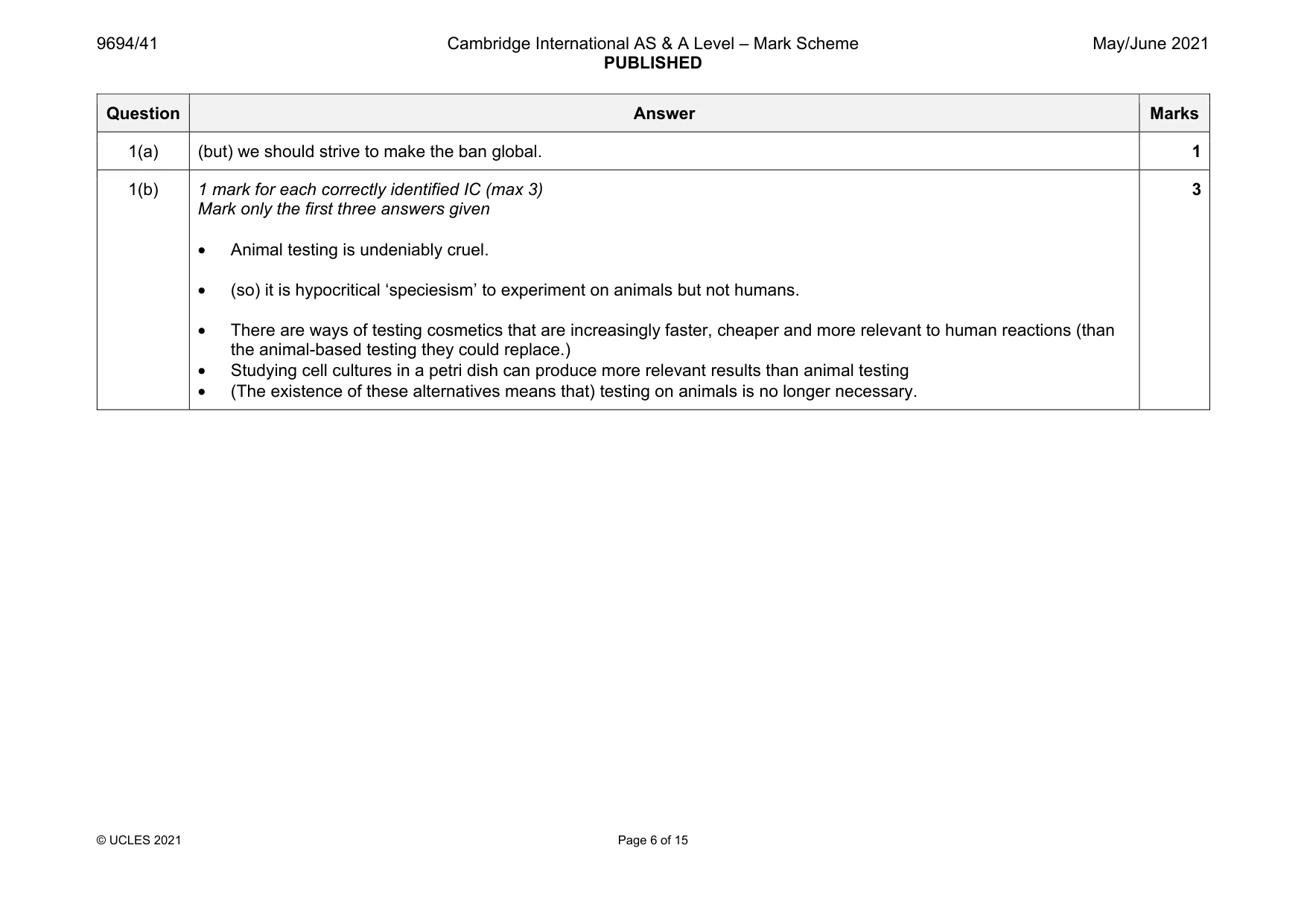
9694/41 Cambridge International AS & A Level – Mark Scheme PUBLISHED May/June 2021 © UCLES 2021 Page 6 of 15 Question Answer Marks 1(a) (but) we should strive to make the ban global. 1 1(b) 1 mark for each correctly identified IC (max 3) Mark only the first three answers given • Animal testing is undeniably cruel. • (so) it is hypocritical ‘speciesism’ to experiment on animals but not humans. • There are ways of testing cosmetics that are increasingly faster, cheaper and more relevant to human reactions (than the animal-based testing they could replace.) • Studying cell cultures in a petri dish can produce more relevant results than animal testing • (The existence of these alternatives means that) testing on animals is no longer necessary. 3
Mark scheme, page 7
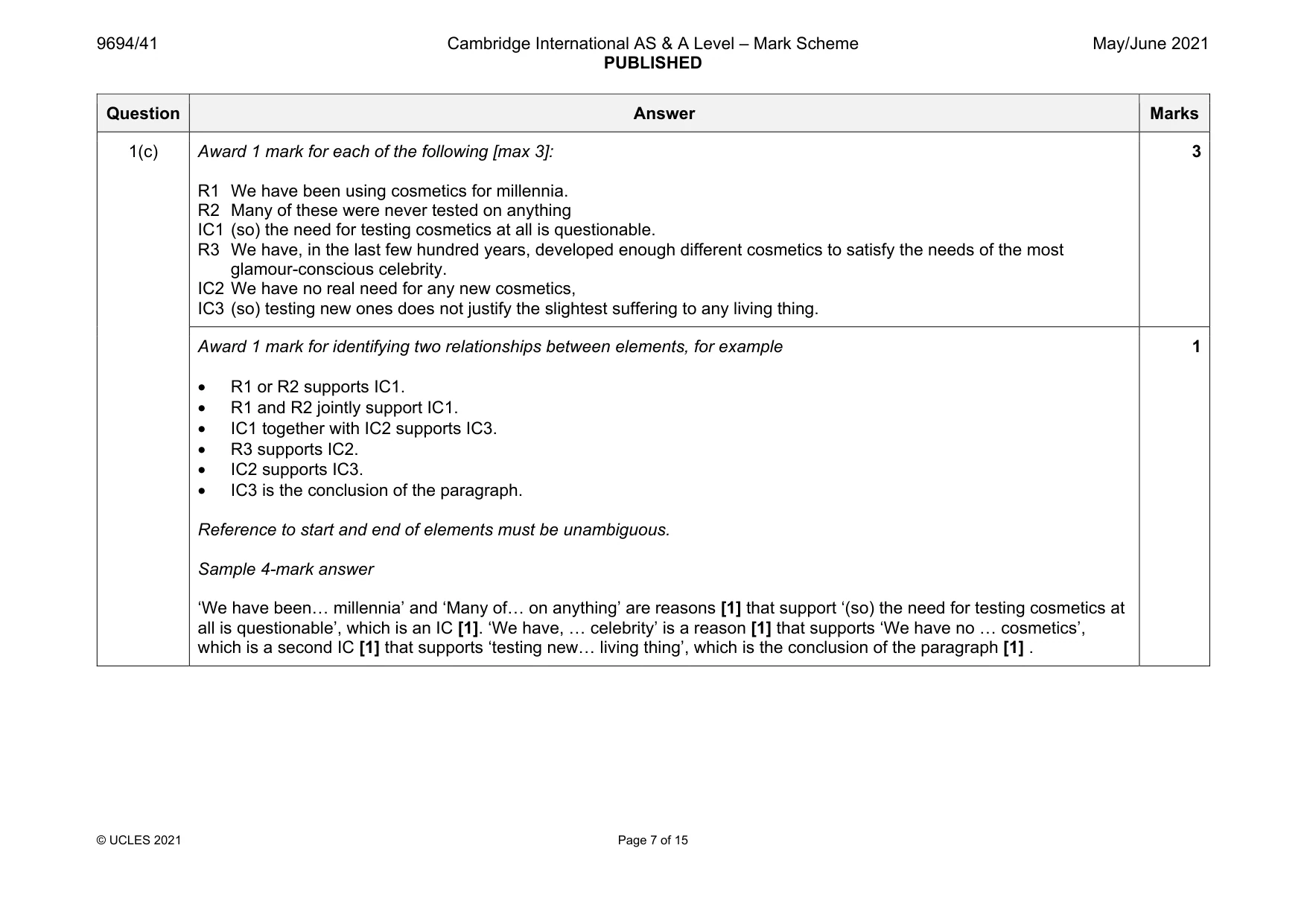
9694/41 Cambridge International AS & A Level – Mark Scheme PUBLISHED May/June 2021 © UCLES 2021 Page 7 of 15 Question Answer Marks 1(c) Award 1 mark for each of the following [max 3]: R1 We have been using cosmetics for millennia. R2 Many of these were never tested on anything IC1 (so) the need for testing cosmetics at all is questionable. R3 We have, in the last few hundred years, developed enough different cosmetics to satisfy the needs of the most glamour-conscious celebrity. IC2 We have no real need for any new cosmetics, IC3 (so) testing new ones does not justify the slightest suffering to any living thing. 3 Award 1 mark for identifying two relationships between elements, for example • R1 or R2 supports IC1. • R1 and R2 jointly support IC1. • IC1 together with IC2 supports IC3. • R3 supports IC2. • IC2 supports IC3. • IC3 is the conclusion of the paragraph. Reference to start and end of elements must be unambiguous. Sample 4-mark answer ‘We have been… millennia’ and ‘Many of… on anything’ are reasons [1] that support ‘(so) the need for testing cosmetics at all is questionable’, which is an IC [1]. ‘We have, … celebrity’ is a reason [1] that supports ‘We have no … cosmetics’, which is a second IC [1] that supports ‘testing new… living thing’, which is the conclusion of the paragraph [1] . 1
Mark scheme, page 8
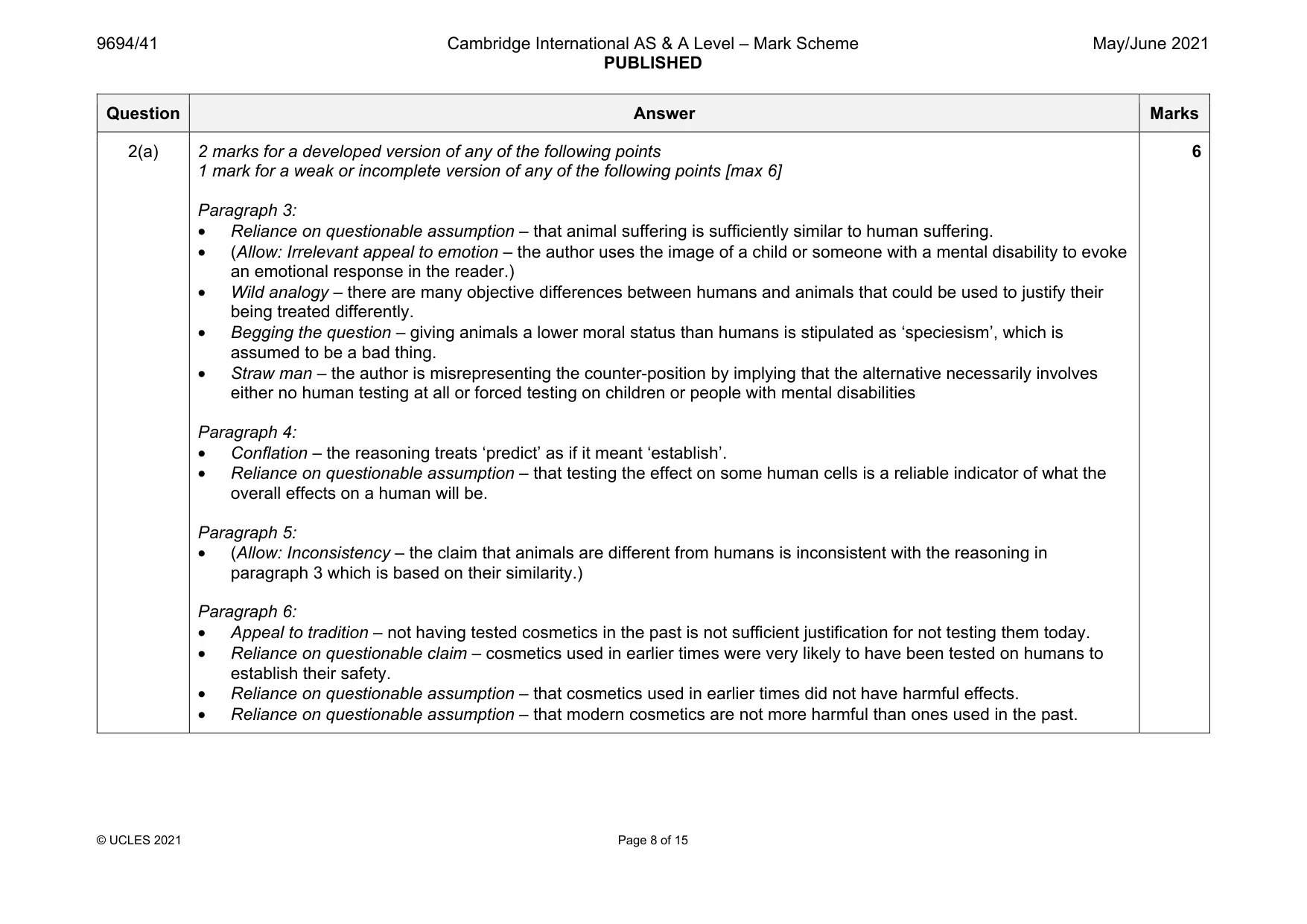
9694/41 Cambridge International AS & A Level – Mark Scheme PUBLISHED May/June 2021 © UCLES 2021 Page 8 of 15 Question Answer Marks 2(a) 2 marks for a developed version of any of the following points 1 mark for a weak or incomplete version of any of the following points [max 6] Paragraph 3: • Reliance on questionable assumption – that animal suffering is sufficiently similar to human suffering. • (Allow: Irrelevant appeal to emotion – the author uses the image of a child or someone with a mental disability to evoke an emotional response in the reader.) • Wild analogy – there are many objective differences between humans and animals that could be used to justify their being treated differently. • Begging the question – giving animals a lower moral status than humans is stipulated as ‘speciesism’, which is assumed to be a bad thing. • Straw man – the author is misrepresenting the counter-position by implying that the alternative necessarily involves either no human testing at all or forced testing on children or people with mental disabilities Paragraph 4: • Conflation – the reasoning treats ‘predict’ as if it meant ‘establish’. • Reliance on questionable assumption – that testing the effect on some human cells is a reliable indicator of what the overall effects on a human will be. Paragraph 5: • (Allow: Inconsistency – the claim that animals are different from humans is inconsistent with the reasoning in paragraph 3 which is based on their similarity.) Paragraph 6: • Appeal to tradition – not having tested cosmetics in the past is not sufficient justification for not testing them today. • Reliance on questionable claim – cosmetics used in earlier times were very likely to have been tested on humans to establish their safety. • Reliance on questionable assumption – that cosmetics used in earlier times did not have harmful effects. • Reliance on questionable assumption – that modern cosmetics are not more harmful than ones used in the past. 6
Mark scheme, page 9
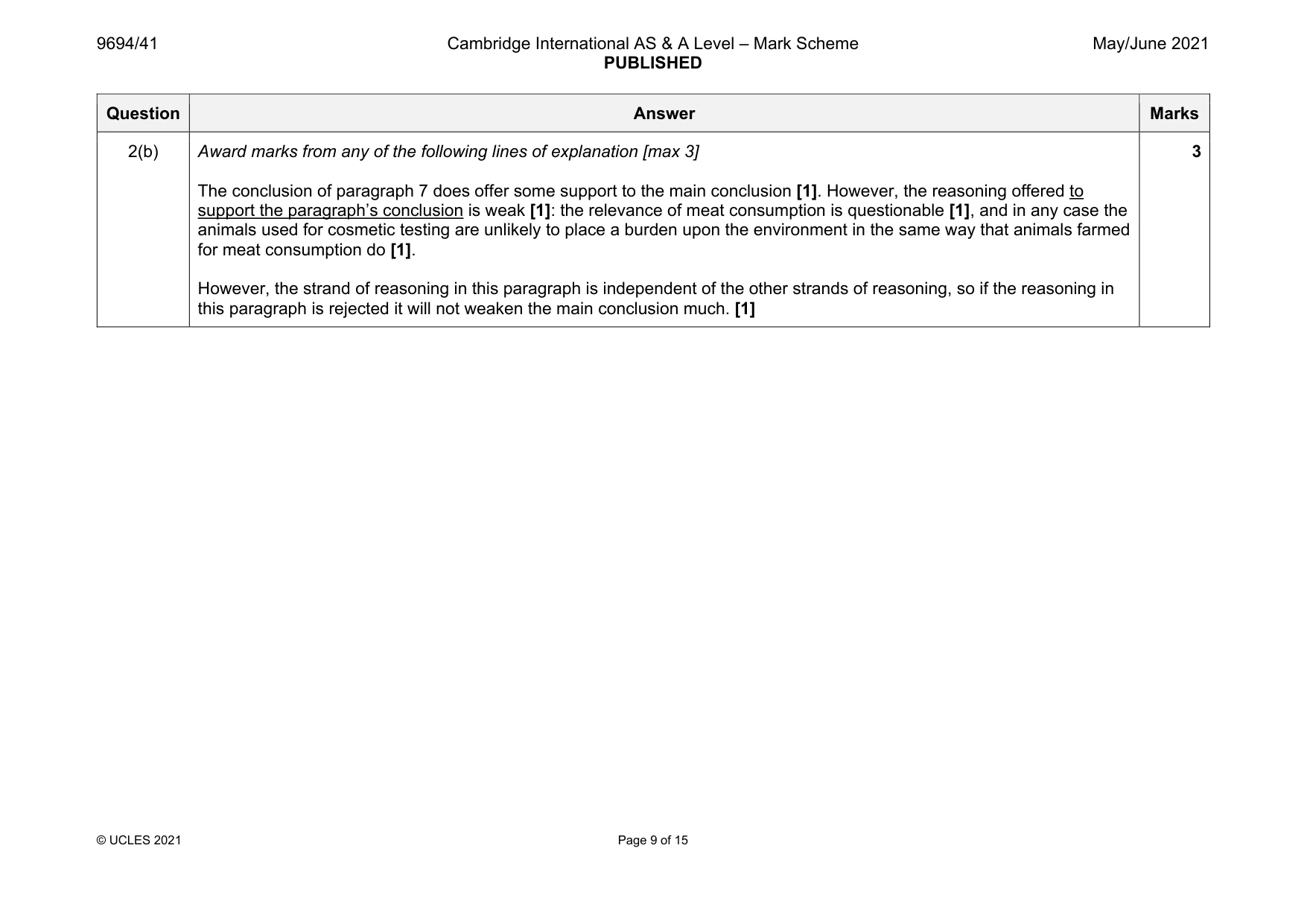
9694/41 Cambridge International AS & A Level – Mark Scheme PUBLISHED May/June 2021 © UCLES 2021 Page 9 of 15 Question Answer Marks 2(b) Award marks from any of the following lines of explanation [max 3] The conclusion of paragraph 7 does offer some support to the main conclusion [1]. However, the reasoning offered to support the paragraph’s conclusion is weak [1]: the relevance of meat consumption is questionable [1], and in any case the animals used for cosmetic testing are unlikely to place a burden upon the environment in the same way that animals farmed for meat consumption do [1]. However, the strand of reasoning in this paragraph is independent of the other strands of reasoning, so if the reasoning in this paragraph is rejected it will not weaken the main conclusion much. [1] 3
Mark scheme, page 10
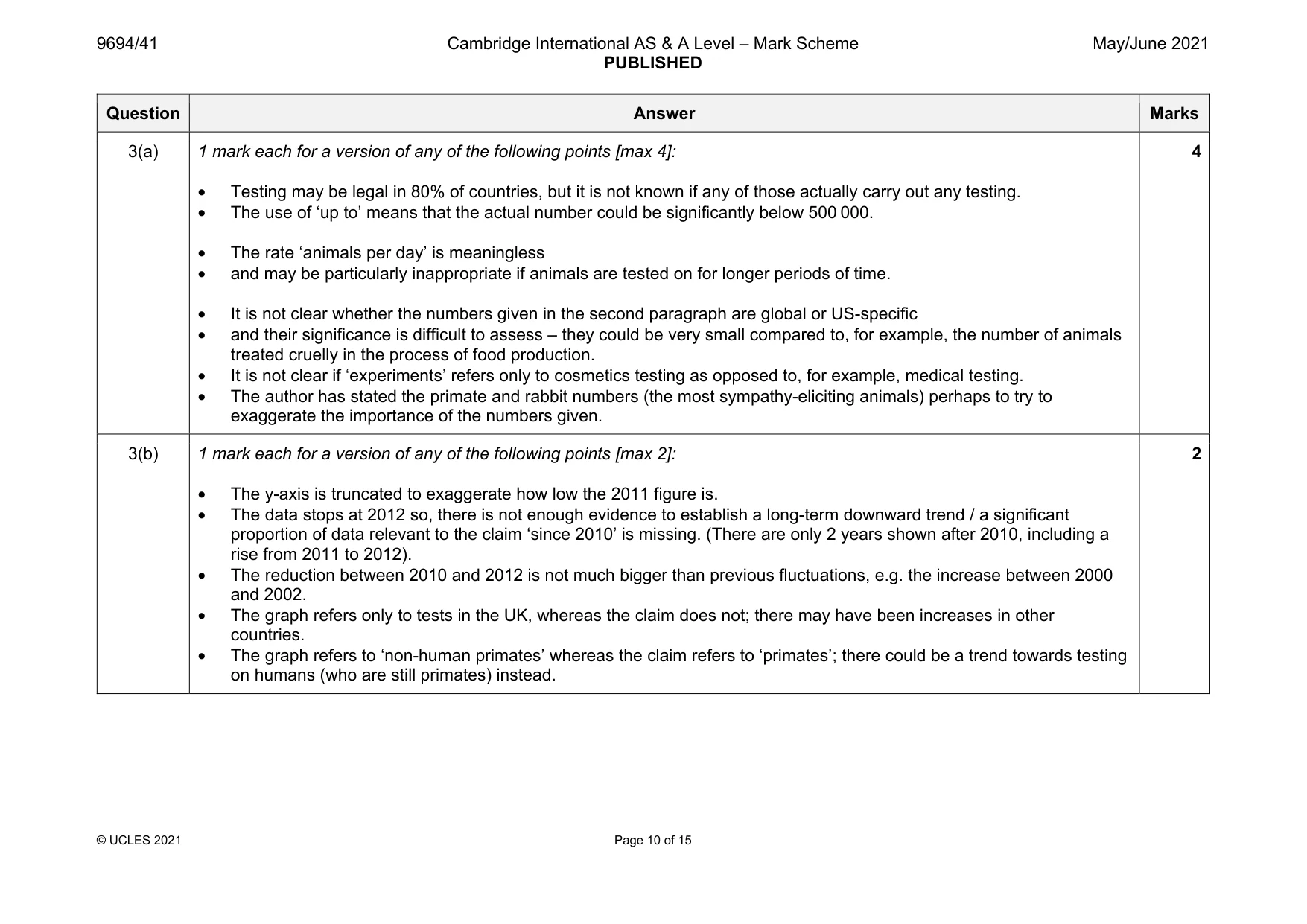
9694/41 Cambridge International AS & A Level – Mark Scheme PUBLISHED May/June 2021 © UCLES 2021 Page 10 of 15 Question Answer Marks 3(a) 1 mark each for a version of any of the following points [max 4]: • Testing may be legal in 80% of countries, but it is not known if any of those actually carry out any testing. • The use of ‘up to’ means that the actual number could be significantly below 500 000. • The rate ‘animals per day’ is meaningless • and may be particularly inappropriate if animals are tested on for longer periods of time. • It is not clear whether the numbers given in the second paragraph are global or US-specific • and their significance is difficult to assess – they could be very small compared to, for example, the number of animals treated cruelly in the process of food production. • It is not clear if ‘experiments’ refers only to cosmetics testing as opposed to, for example, medical testing. • The author has stated the primate and rabbit numbers (the most sympathy-eliciting animals) perhaps to try to exaggerate the importance of the numbers given. 4 3(b) 1 mark each for a version of any of the following points [max 2]: • The y-axis is truncated to exaggerate how low the 2011 figure is. • The data stops at 2012 so, there is not enough evidence to establish a long-term downward trend / a significant proportion of data relevant to the claim ‘since 2010’ is missing. (There are only 2 years shown after 2010, including a rise from 2011 to 2012). • The reduction between 2010 and 2012 is not much bigger than previous fluctuations, e.g. the increase between 2000 and 2002. • The graph refers only to tests in the UK, whereas the claim does not; there may have been increases in other countries. • The graph refers to ‘non-human primates’ whereas the claim refers to ‘primates’; there could be a trend towards testing on humans (who are still primates) instead. 2
Mark scheme, page 11
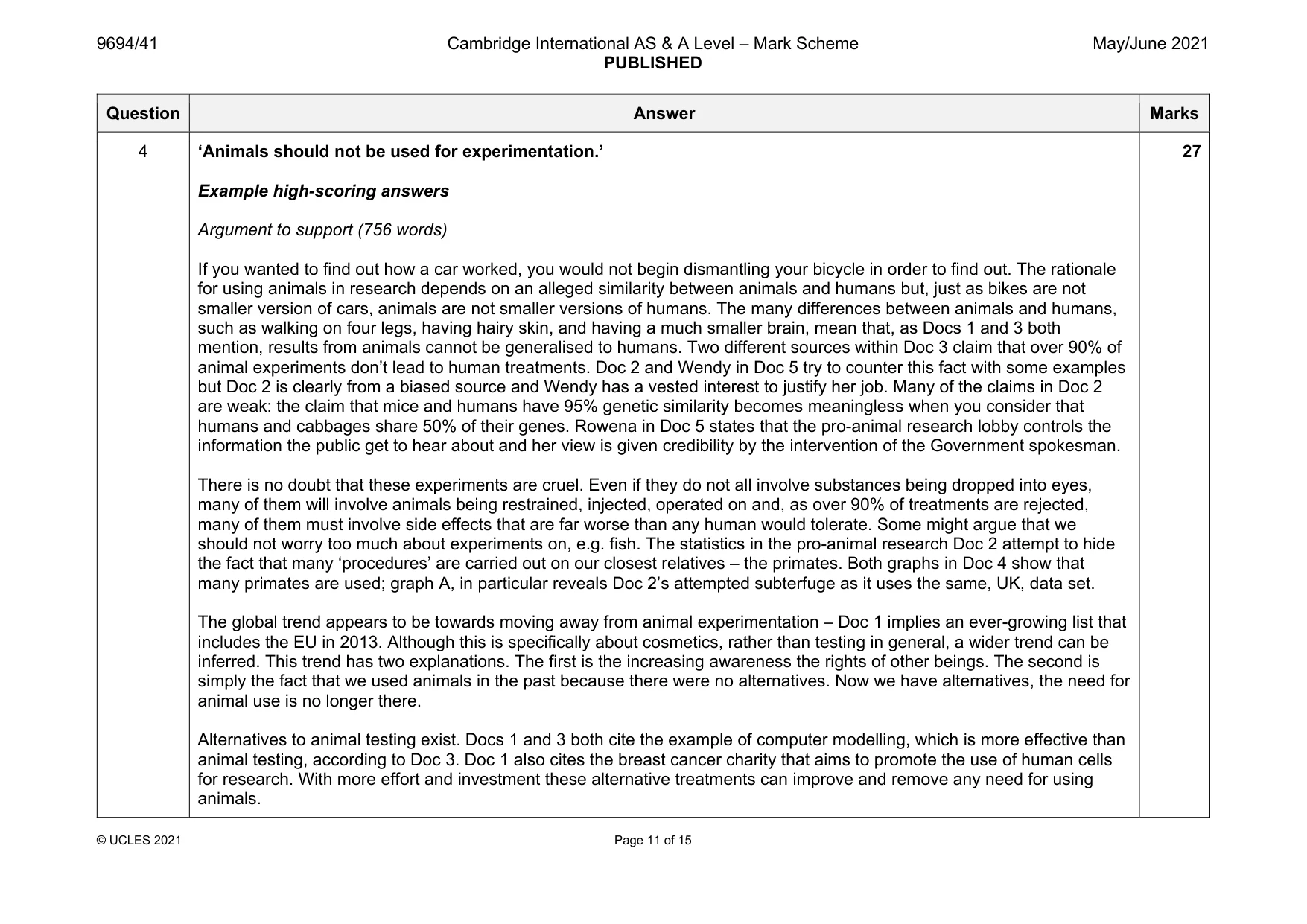
9694/41 Cambridge International AS & A Level – Mark Scheme PUBLISHED May/June 2021 © UCLES 2021 Page 11 of 15 Question Answer Marks 4 ‘Animals should not be used for experimentation.’ Example high-scoring answers Argument to support (756 words) If you wanted to find out how a car worked, you would not begin dismantling your bicycle in order to find out. The rationale for using animals in research depends on an alleged similarity between animals and humans but, just as bikes are not smaller version of cars, animals are not smaller versions of humans. The many differences between animals and humans, such as walking on four legs, having hairy skin, and having a much smaller brain, mean that, as Docs 1 and 3 both mention, results from animals cannot be generalised to humans. Two different sources within Doc 3 claim that over 90% of animal experiments don’t lead to human treatments. Doc 2 and Wendy in Doc 5 try to counter this fact with some examples but Doc 2 is clearly from a biased source and Wendy has a vested interest to justify her job. Many of the claims in Doc 2 are weak: the claim that mice and humans have 95% genetic similarity becomes meaningless when you consider that humans and cabbages share 50% of their genes. Rowena in Doc 5 states that the pro-animal research lobby controls the information the public get to hear about and her view is given credibility by the intervention of the Government spokesman. There is no doubt that these experiments are cruel. Even if they do not all involve substances being dropped into eyes, many of them will involve animals being restrained, injected, operated on and, as over 90% of treatments are rejected, many of them must involve side effects that are far worse than any human would tolerate. Some might argue that we should not worry too much about experiments on, e.g. fish. The statistics in the pro-animal research Doc 2 attempt to hide the fact that many ‘procedures’ are carried out on our closest relatives – the primates. Both graphs in Doc 4 show that many primates are used; graph A, in particular reveals Doc 2’s attempted subterfuge as it uses the same, UK, data set. The global trend appears to be towards moving away from animal experimentation – Doc 1 implies an ever-growing list that includes the EU in 2013. Although this is specifically about cosmetics, rather than testing in general, a wider trend can be inferred. This trend has two explanations. The first is the increasing awareness the rights of other beings. The second is simply the fact that we used animals in the past because there were no alternatives. Now we have alternatives, the need for animal use is no longer there. Alternatives to animal testing exist. Docs 1 and 3 both cite the example of computer modelling, which is more effective than animal testing, according to Doc 3. Doc 1 also cites the breast cancer charity that aims to promote the use of human cells for research. With more effort and investment these alternative treatments can improve and remove any need for using animals. 27
Mark scheme, page 12
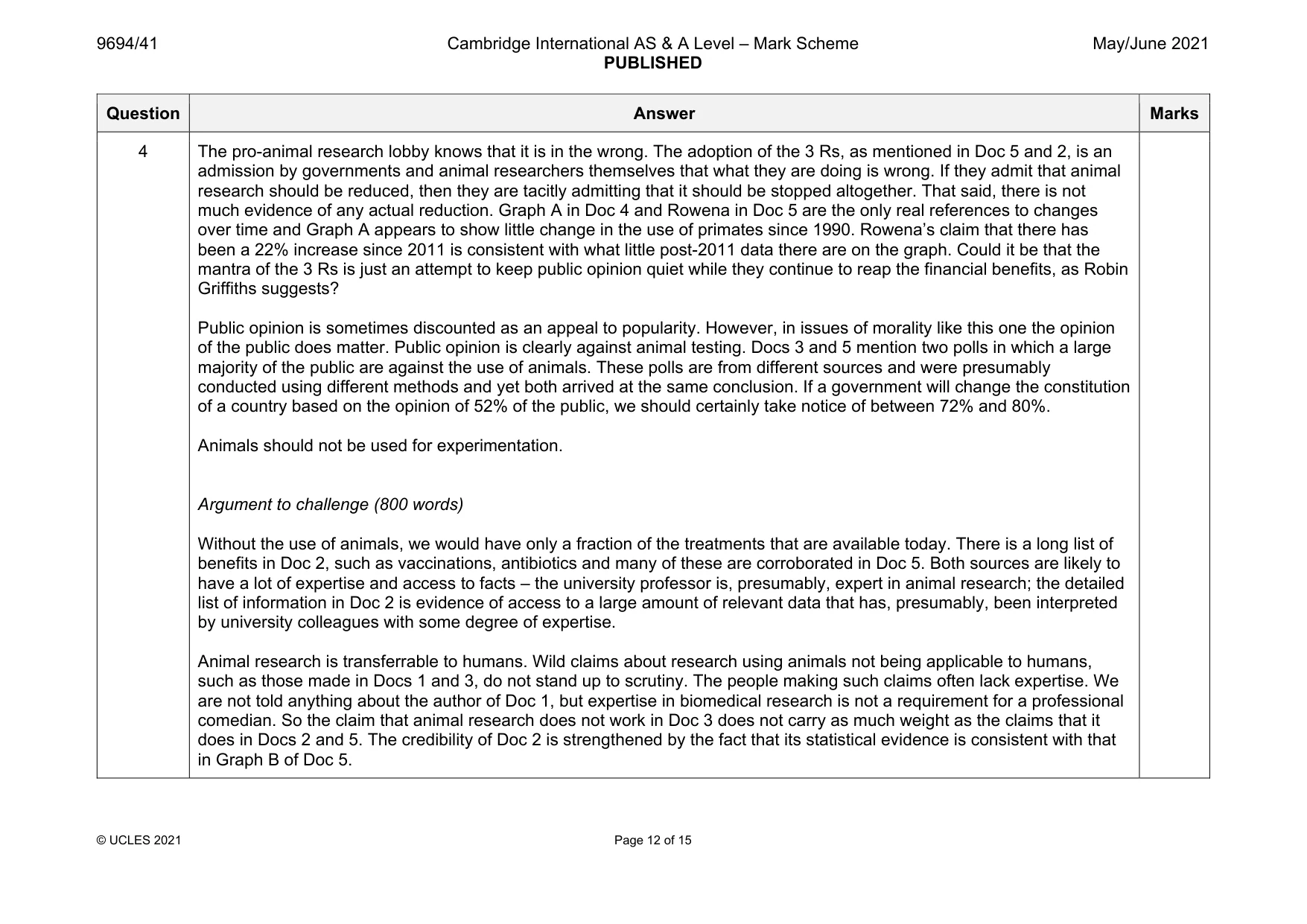
9694/41 Cambridge International AS & A Level – Mark Scheme PUBLISHED May/June 2021 © UCLES 2021 Page 12 of 15 Question Answer Marks 4 The pro-animal research lobby knows that it is in the wrong. The adoption of the 3 Rs, as mentioned in Doc 5 and 2, is an admission by governments and animal researchers themselves that what they are doing is wrong. If they admit that animal research should be reduced, then they are tacitly admitting that it should be stopped altogether. That said, there is not much evidence of any actual reduction. Graph A in Doc 4 and Rowena in Doc 5 are the only real references to changes over time and Graph A appears to show little change in the use of primates since 1990. Rowena’s claim that there has been a 22% increase since 2011 is consistent with what little post-2011 data there are on the graph. Could it be that the mantra of the 3 Rs is just an attempt to keep public opinion quiet while they continue to reap the financial benefits, as Robin Griffiths suggests? Public opinion is sometimes discounted as an appeal to popularity. However, in issues of morality like this one the opinion of the public does matter. Public opinion is clearly against animal testing. Docs 3 and 5 mention two polls in which a large majority of the public are against the use of animals. These polls are from different sources and were presumably conducted using different methods and yet both arrived at the same conclusion. If a government will change the constitution of a country based on the opinion of 52% of the public, we should certainly take notice of between 72% and 80%. Animals should not be used for experimentation. Argument to challenge (800 words) Without the use of animals, we would have only a fraction of the treatments that are available today. There is a long list of benefits in Doc 2, such as vaccinations, antibiotics and many of these are corroborated in Doc 5. Both sources are likely to have a lot of expertise and access to facts – the university professor is, presumably, expert in animal research; the detailed list of information in Doc 2 is evidence of access to a large amount of relevant data that has, presumably, been interpreted by university colleagues with some degree of expertise. Animal research is transferrable to humans. Wild claims about research using animals not being applicable to humans, such as those made in Docs 1 and 3, do not stand up to scrutiny. The people making such claims often lack expertise. We are not told anything about the author of Doc 1, but expertise in biomedical research is not a requirement for a professional comedian. So the claim that animal research does not work in Doc 3 does not carry as much weight as the claims that it does in Docs 2 and 5. The credibility of Doc 2 is strengthened by the fact that its statistical evidence is consistent with that in Graph B of Doc 5.
Mark scheme, page 13
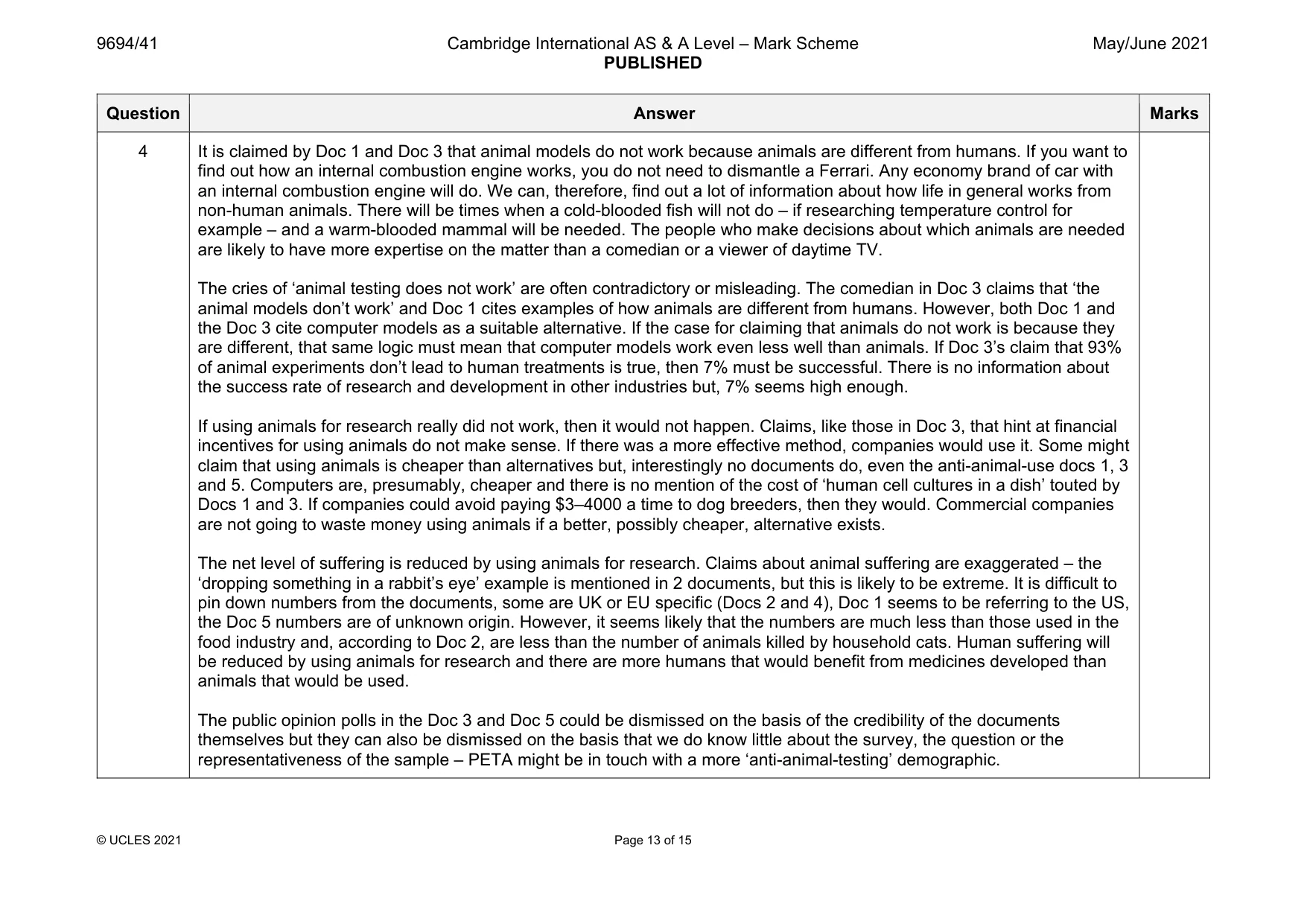
9694/41 Cambridge International AS & A Level – Mark Scheme PUBLISHED May/June 2021 © UCLES 2021 Page 13 of 15 Question Answer Marks 4 It is claimed by Doc 1 and Doc 3 that animal models do not work because animals are different from humans. If you want to find out how an internal combustion engine works, you do not need to dismantle a Ferrari. Any economy brand of car with an internal combustion engine will do. We can, therefore, find out a lot of information about how life in general works from non-human animals. There will be times when a cold-blooded fish will not do – if researching temperature control for example – and a warm-blooded mammal will be needed. The people who make decisions about which animals are needed are likely to have more expertise on the matter than a comedian or a viewer of daytime TV. The cries of ‘animal testing does not work’ are often contradictory or misleading. The comedian in Doc 3 claims that ‘the animal models don’t work’ and Doc 1 cites examples of how animals are different from humans. However, both Doc 1 and the Doc 3 cite computer models as a suitable alternative. If the case for claiming that animals do not work is because they are different, that same logic must mean that computer models work even less well than animals. If Doc 3’s claim that 93% of animal experiments don’t lead to human treatments is true, then 7% must be successful. There is no information about the success rate of research and development in other industries but, 7% seems high enough. If using animals for research really did not work, then it would not happen. Claims, like those in Doc 3, that hint at financial incentives for using animals do not make sense. If there was a more effective method, companies would use it. Some might claim that using animals is cheaper than alternatives but, interestingly no documents do, even the anti-animal-use docs 1, 3 and 5. Computers are, presumably, cheaper and there is no mention of the cost of ‘human cell cultures in a dish’ touted by Docs 1 and 3. If companies could avoid paying $3–4000 a time to dog breeders, then they would. Commercial companies are not going to waste money using animals if a better, possibly cheaper, alternative exists. The net level of suffering is reduced by using animals for research. Claims about animal suffering are exaggerated – the ‘dropping something in a rabbit’s eye’ example is mentioned in 2 documents, but this is likely to be extreme. It is difficult to pin down numbers from the documents, some are UK or EU specific (Docs 2 and 4), Doc 1 seems to be referring to the US, the Doc 5 numbers are of unknown origin. However, it seems likely that the numbers are much less than those used in the food industry and, according to Doc 2, are less than the number of animals killed by household cats. Human suffering will be reduced by using animals for research and there are more humans that would benefit from medicines developed than animals that would be used. The public opinion polls in the Doc 3 and Doc 5 could be dismissed on the basis of the credibility of the documents themselves but they can also be dismissed on the basis that we do know little about the survey, the question or the representativeness of the sample – PETA might be in touch with a more ‘anti-animal-testing’ demographic.
Mark scheme, page 14
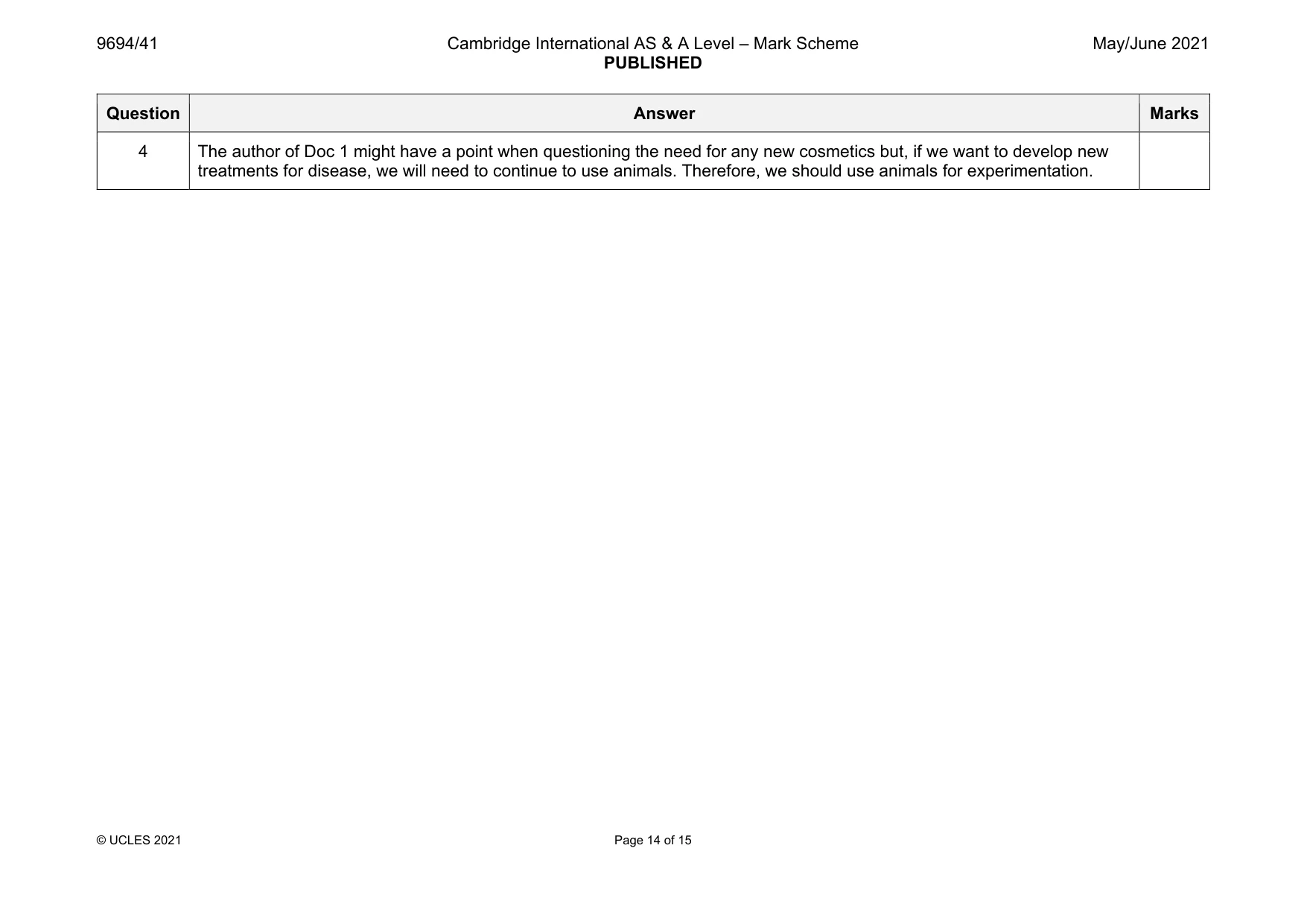
9694/41 Cambridge International AS & A Level – Mark Scheme PUBLISHED May/June 2021 © UCLES 2021 Page 14 of 15 Question Answer Marks 4 The author of Doc 1 might have a point when questioning the need for any new cosmetics but, if we want to develop new treatments for disease, we will need to continue to use animals. Therefore, we should use animals for experimentation.
Mark scheme, page 15
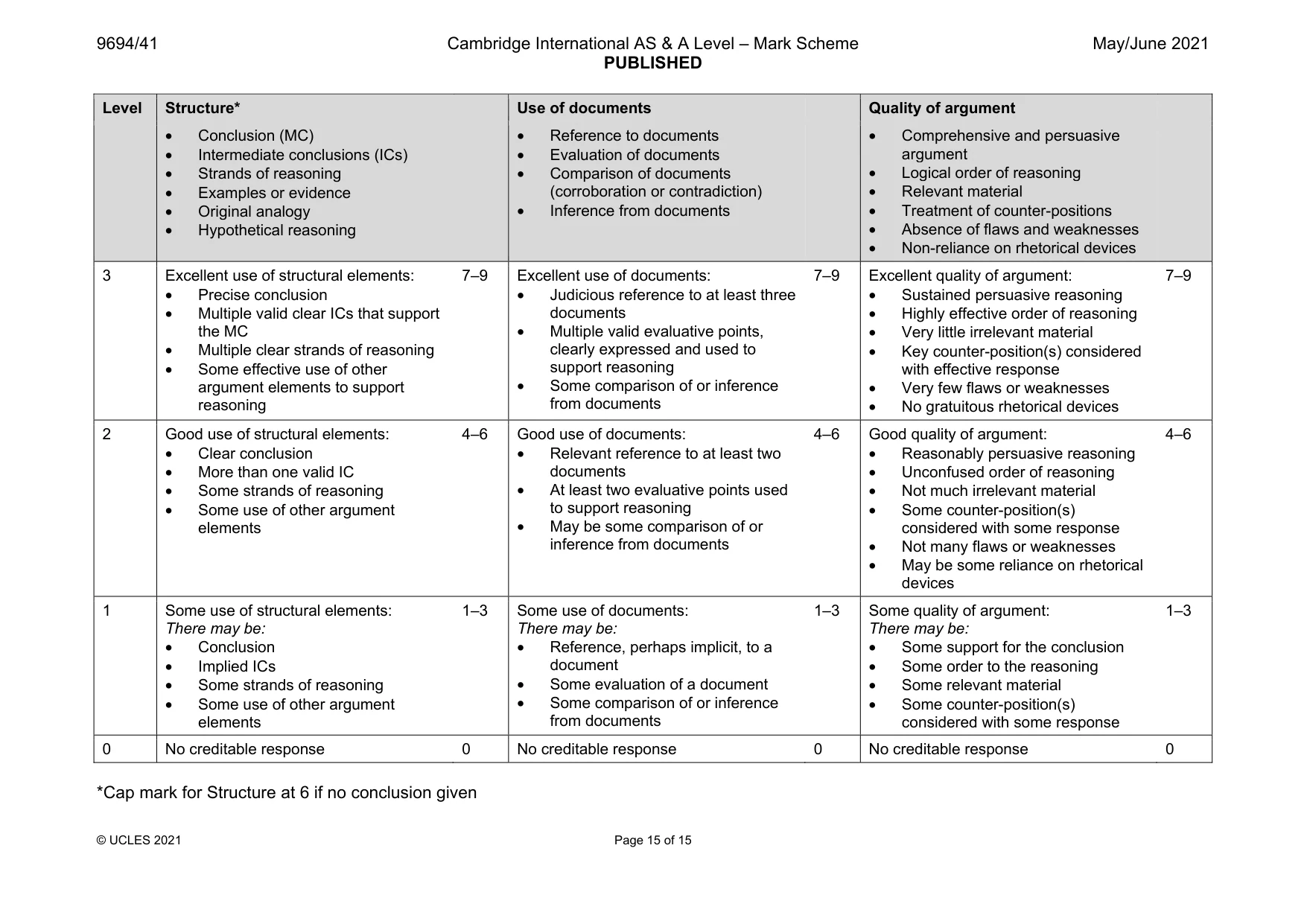
9694/41 Cambridge International AS & A Level – Mark Scheme PUBLISHED May/June 2021 © UCLES 2021 Page 15 of 15 Level Structure* Use of documents Quality of argument • Conclusion (MC) • Intermediate conclusions (ICs) • Strands of reasoning • Examples or evidence • Original analogy • Hypothetical reasoning • Reference to documents • Evaluation of documents • Comparison of documents (corroboration or contradiction) • Inference from documents • Comprehensive and persuasive argument • Logical order of reasoning • Relevant material • Treatment of counter-positions • Absence of flaws and weaknesses • Non-reliance on rhetorical devices 3 Excellent use of structural elements: • Precise conclusion • Multiple valid clear ICs that support the MC • Multiple clear strands of reasoning • Some effective use of other argument elements to support reasoning 7–9 Excellent use of documents: • Judicious reference to at least three documents • Multiple valid evaluative points, clearly expressed and used to support reasoning • Some comparison of or inference from documents 7–9 Excellent quality of argument: • Sustained persuasive reasoning • Highly effective order of reasoning • Very little irrelevant material • Key counter-position(s) considered with effective response • Very few flaws or weaknesses • No gratuitous rhetorical devices 7–9 2 Good use of structural elements: • Clear conclusion • More than one valid IC • Some strands of reasoning • Some use of other argument elements 4–6 Good use of documents: • Relevant reference to at least two documents • At least two evaluative points used to support reasoning • May be some comparison of or inference from documents 4–6 Good quality of argument: • Reasonably persuasive reasoning • Unconfused order of reasoning • Not much irrelevant material • Some counter-position(s) considered with some response • Not many flaws or weaknesses • May be some reliance on rhetorical devices 4–6 1 Some use of structural elements: There may be: • Conclusion • Implied ICs • Some strands of reasoning • Some use of other argument elements 1–3 Some use of documents: There may be: • Reference, perhaps implicit, to a document • Some evaluation of a document • Some comparison of or inference from documents 1–3 Some quality of argument: There may be: • Some support for the conclusion • Some order to the reasoning • Some relevant material • Some counter-position(s) considered with some response 1–3 0 No creditable response 0 No creditable response 0 No creditable response 0 *Cap mark for Structure at 6 if no conclusion given
What you needed in this session
Cambridge’s own grade thresholds for 2021 May/June, Paper 4 · Variant 1. A higher threshold means an easier paper — the bar moves with how the cohort did.